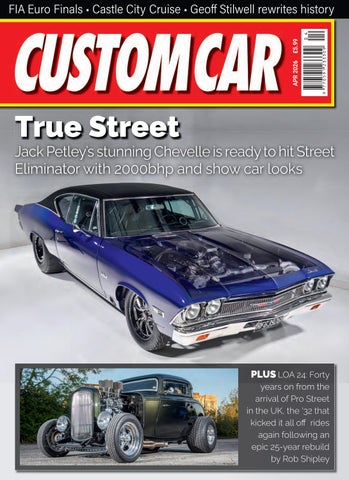
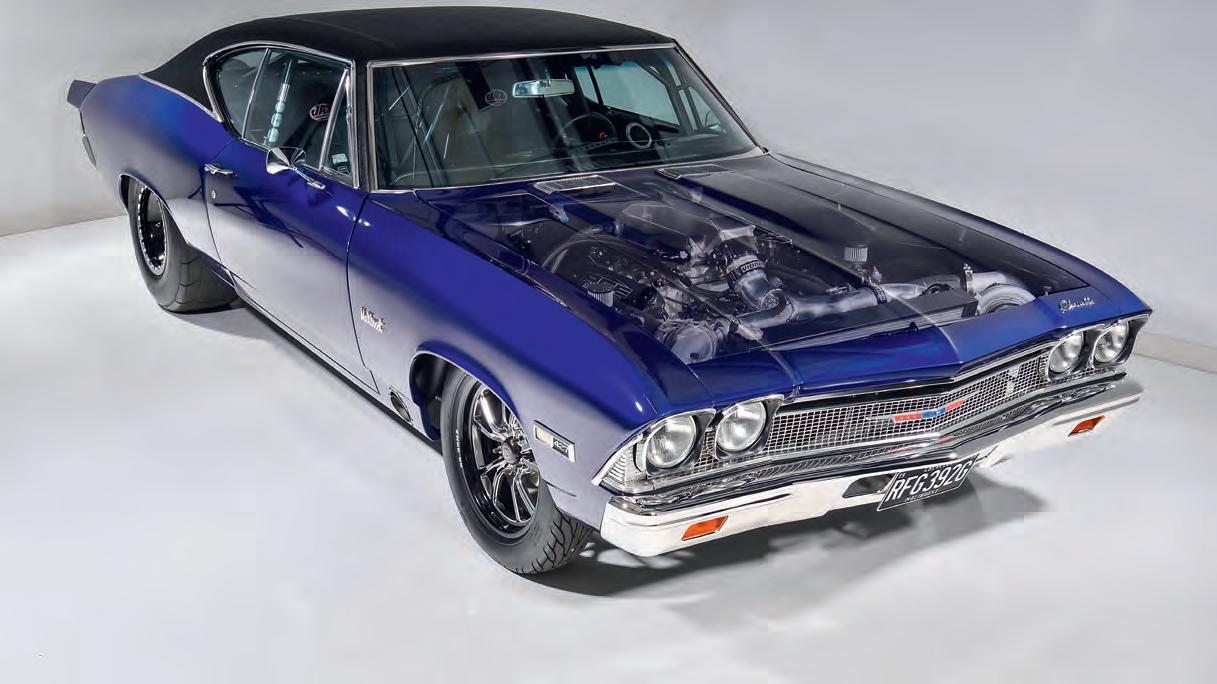
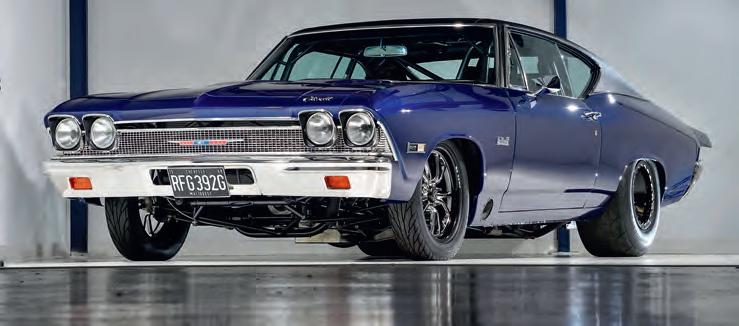
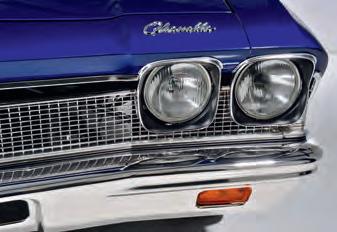
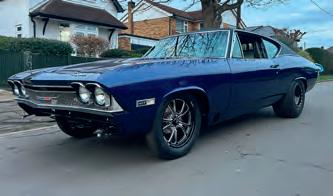
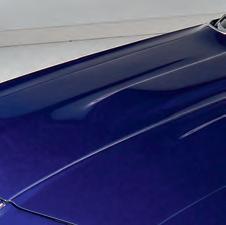
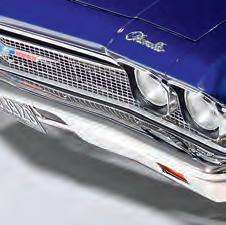
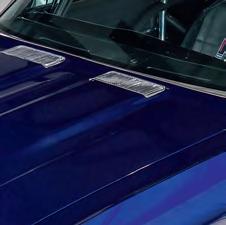
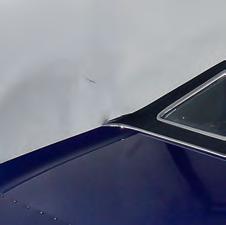
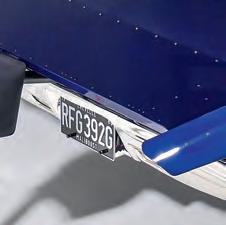
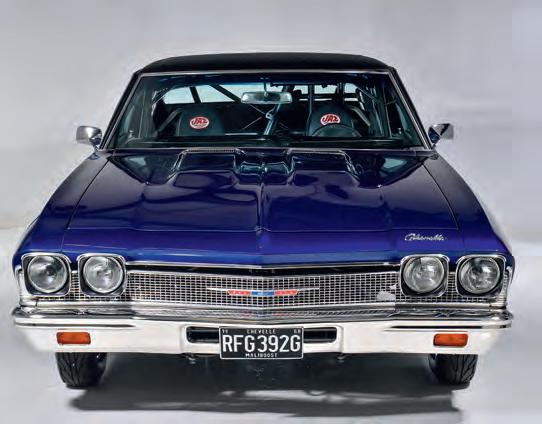
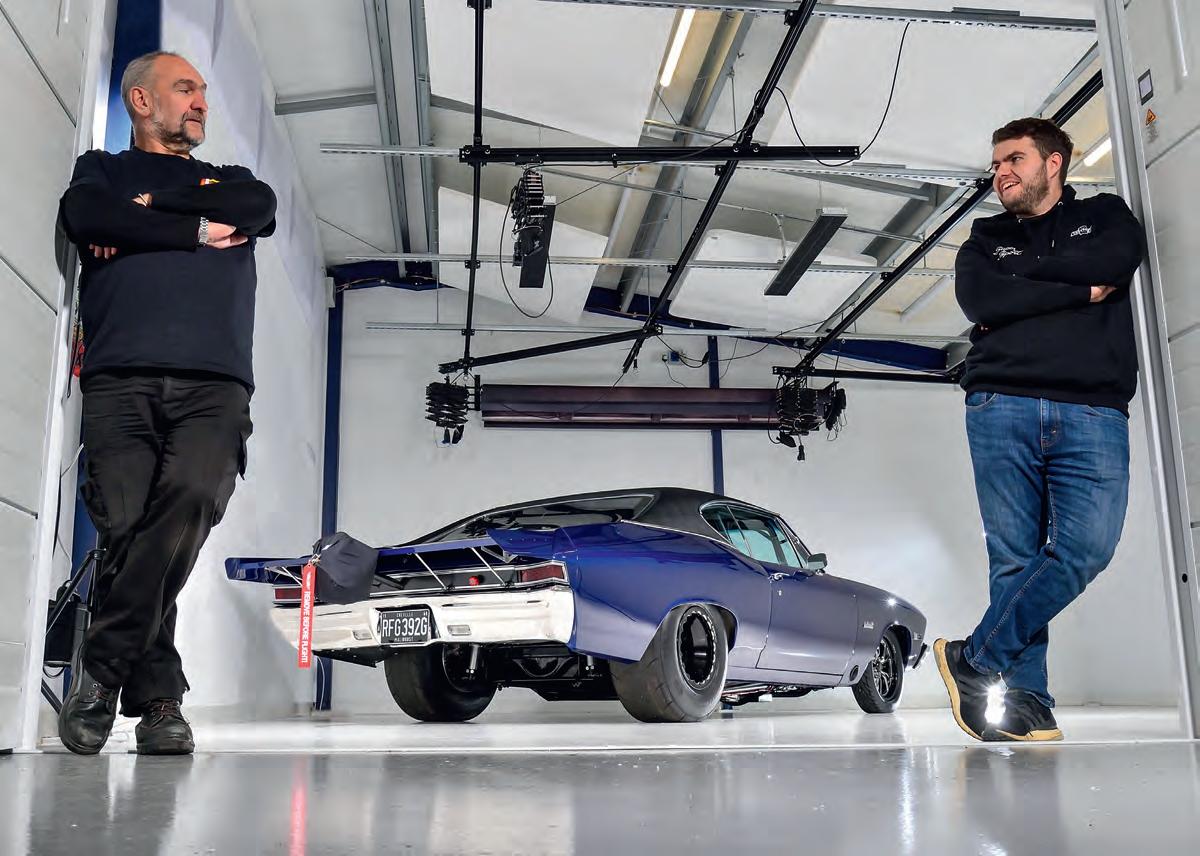
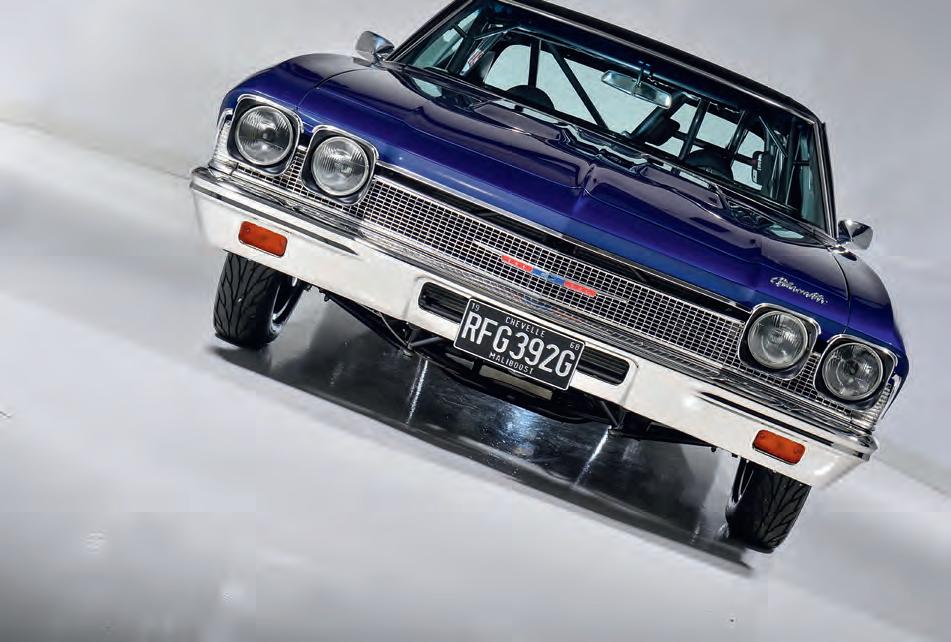
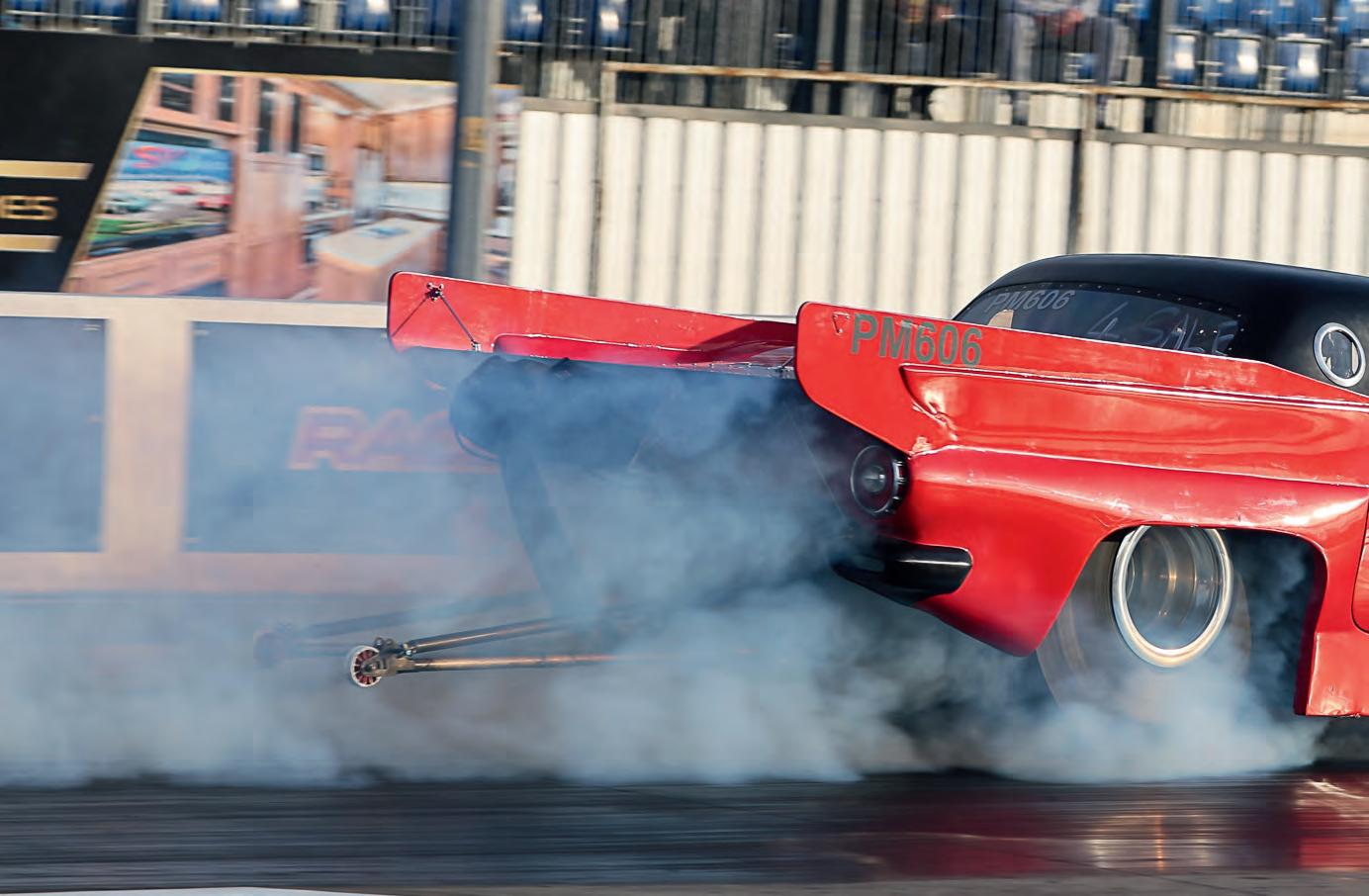
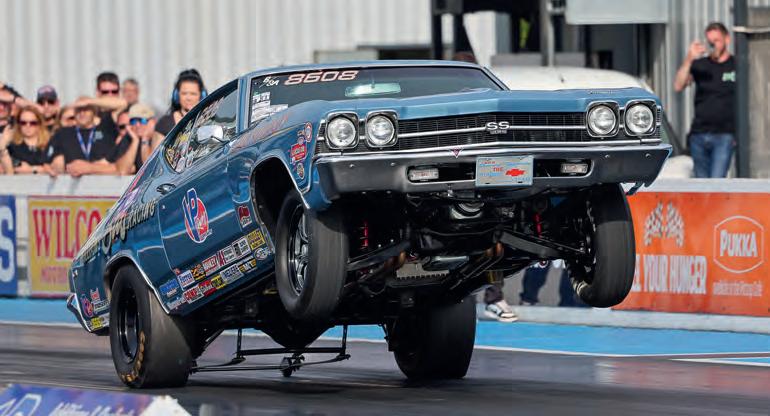
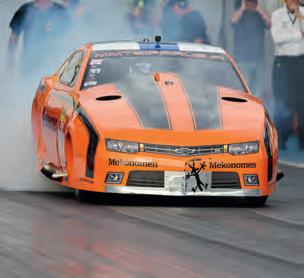
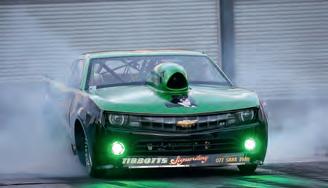
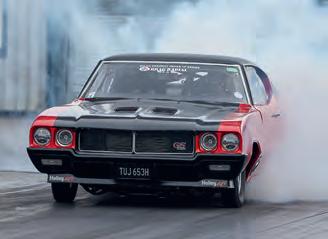
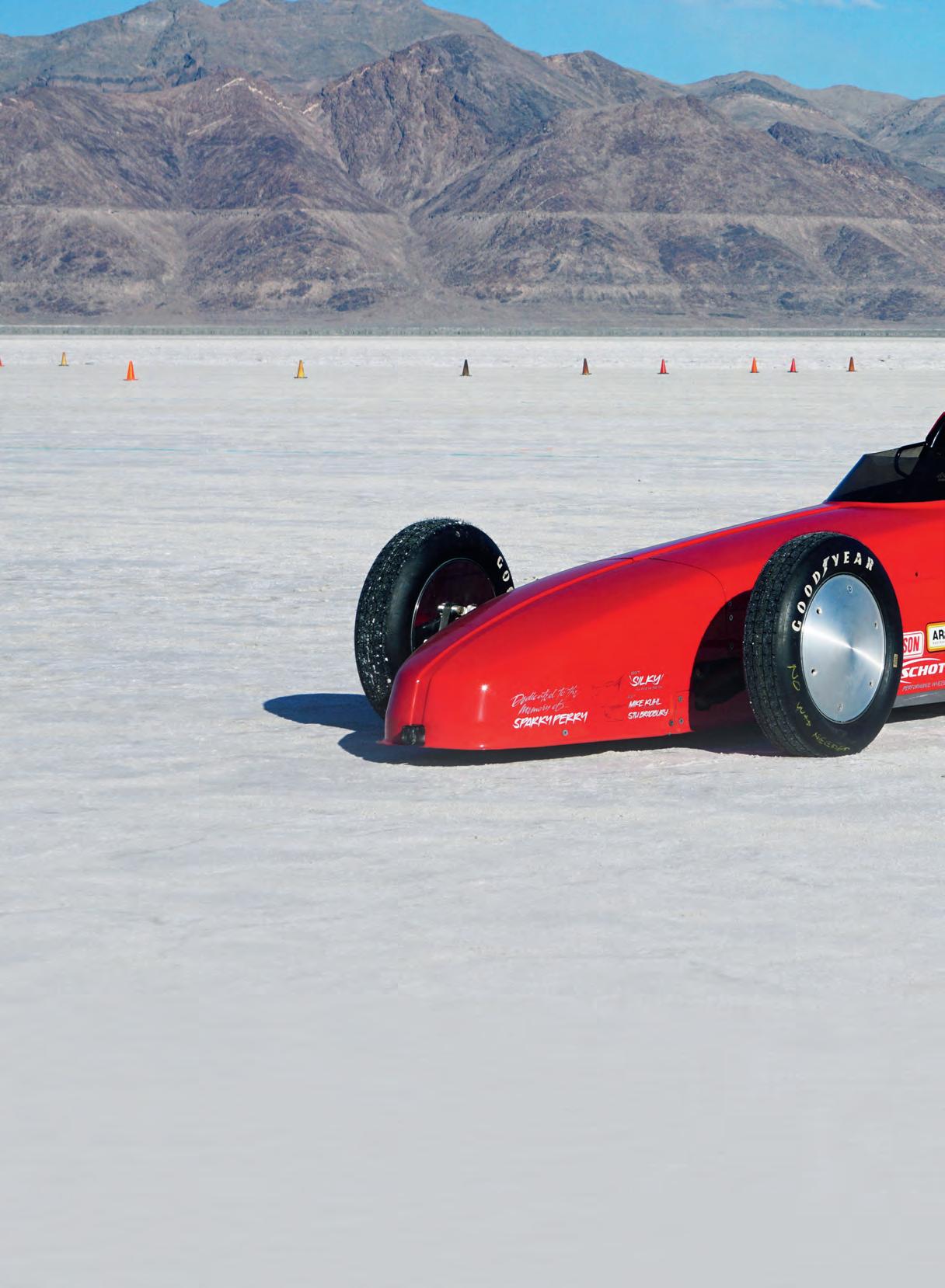
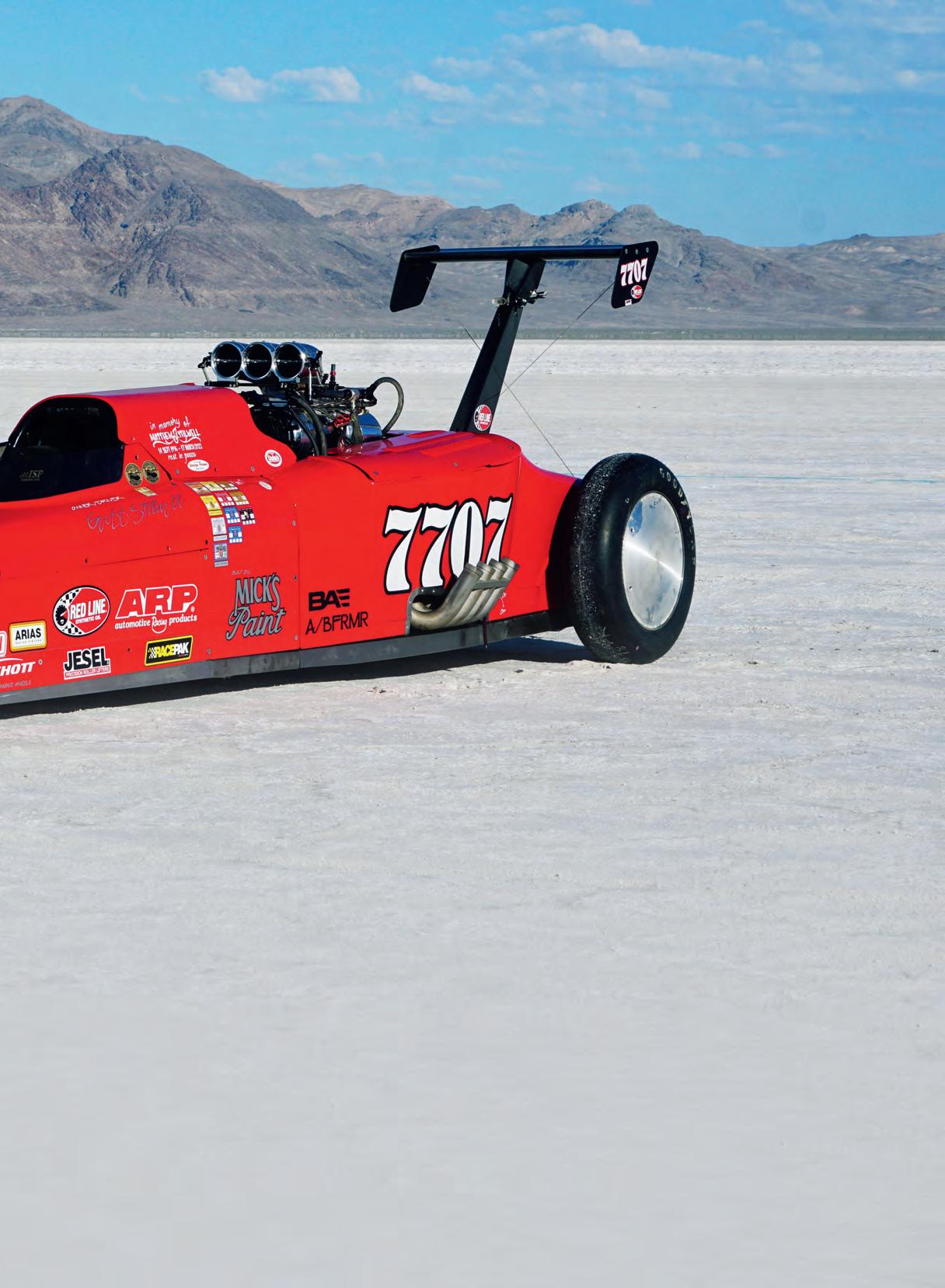
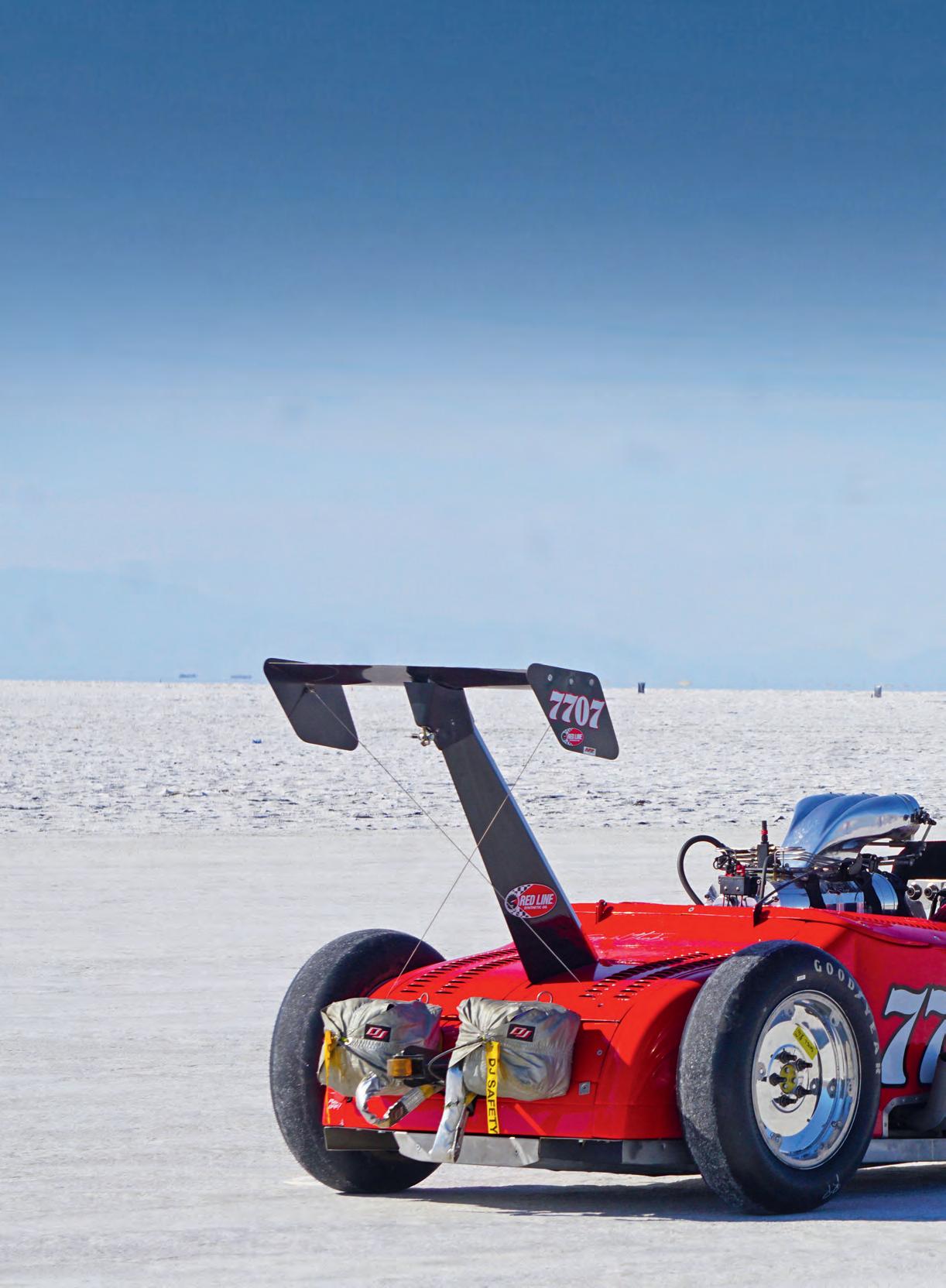
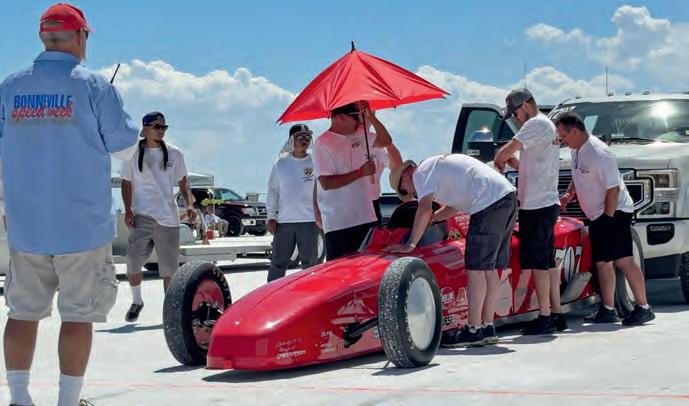
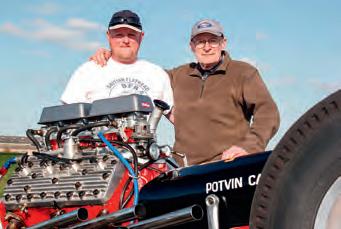
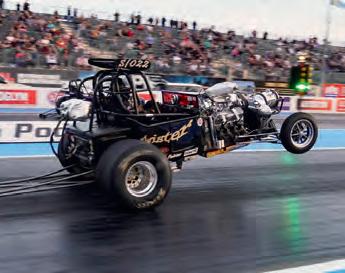
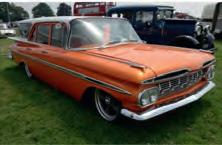
Jack Petley’s stunning Chevelle is ready to hit Street Eliminator with 2000bhp and show car looks
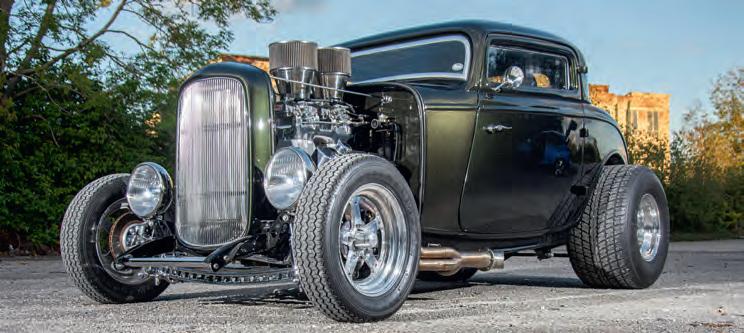
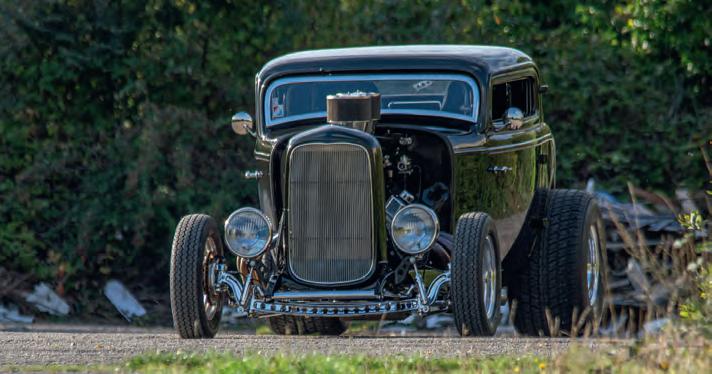
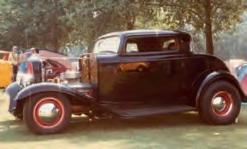
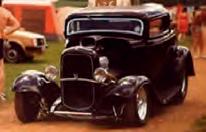
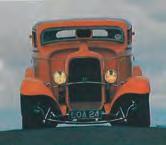
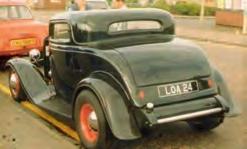
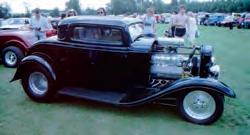
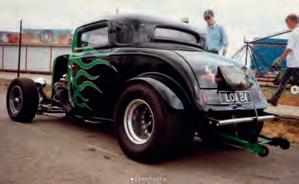
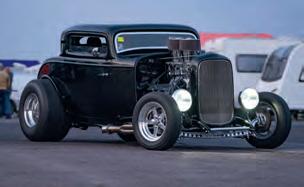
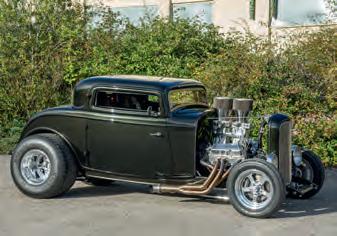
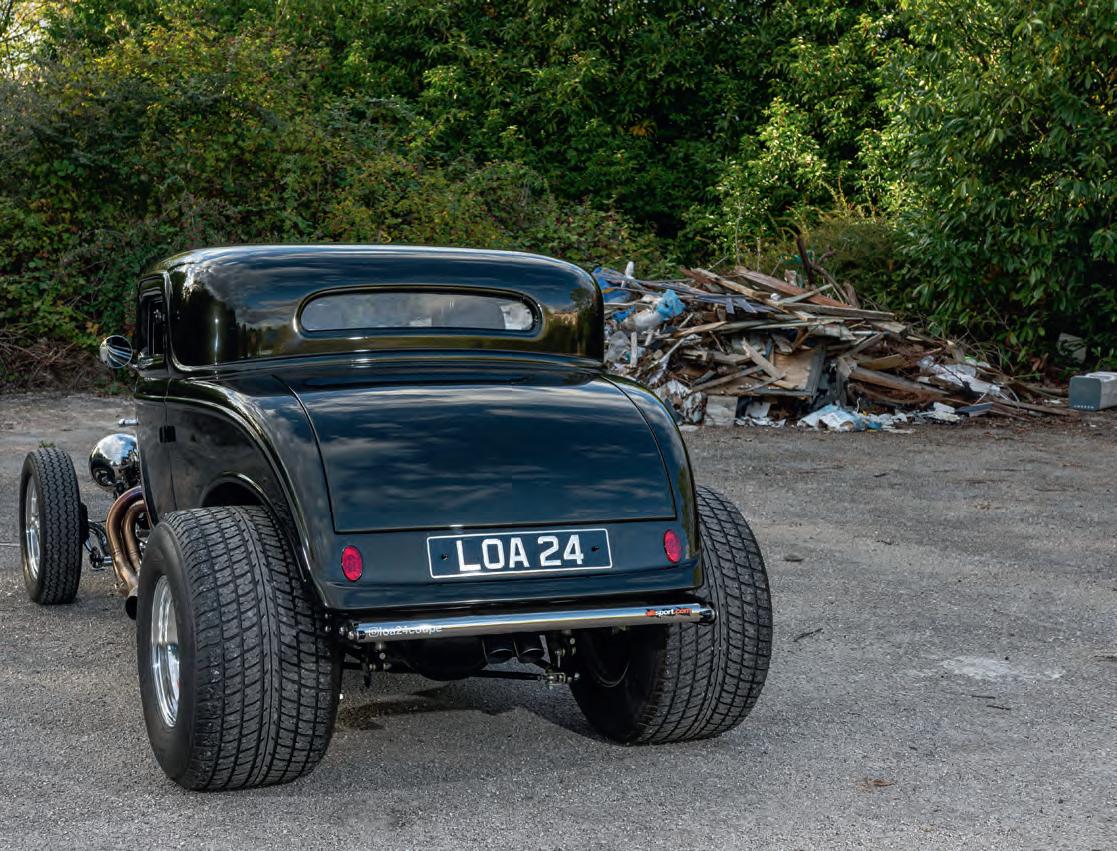
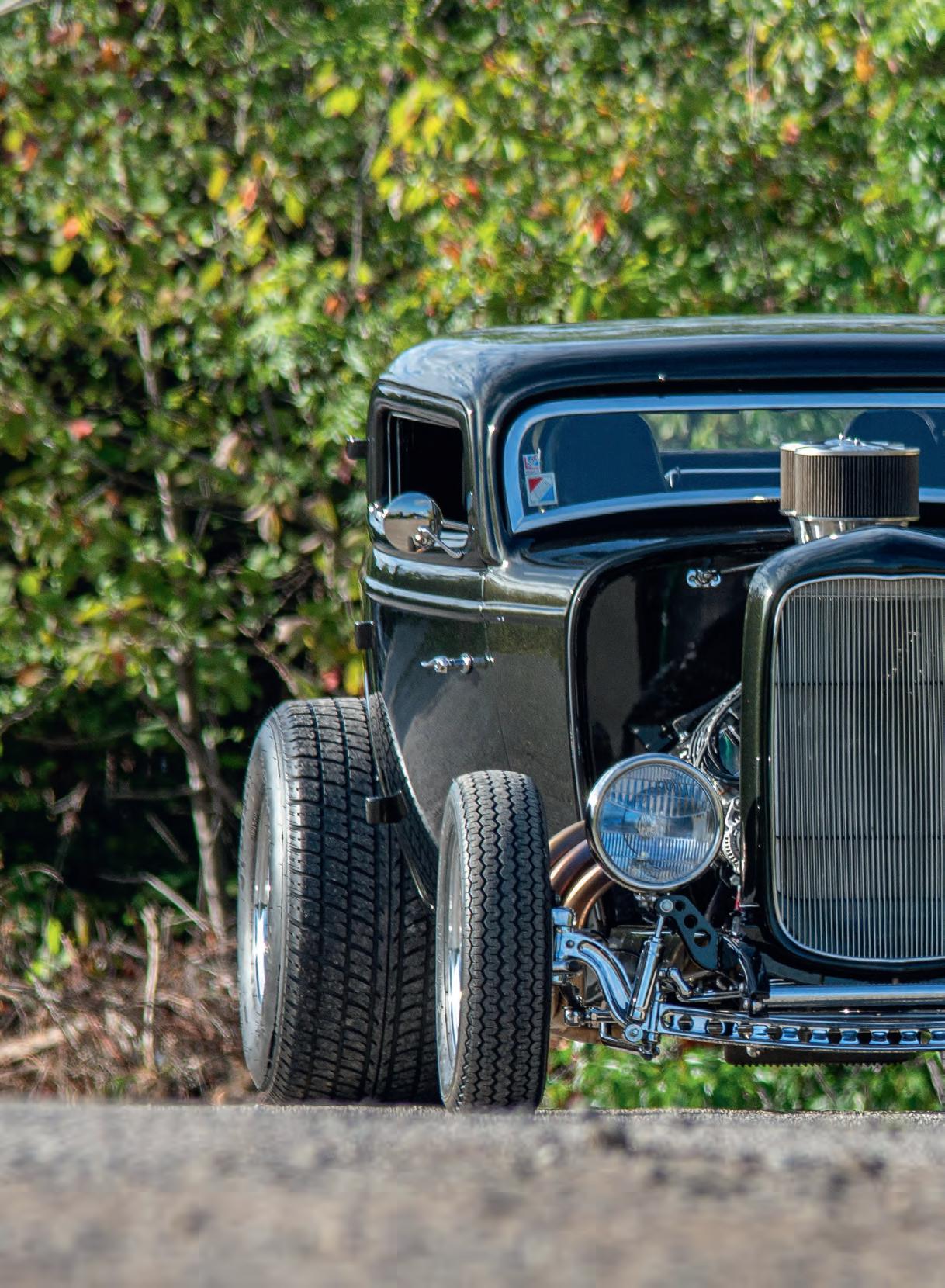
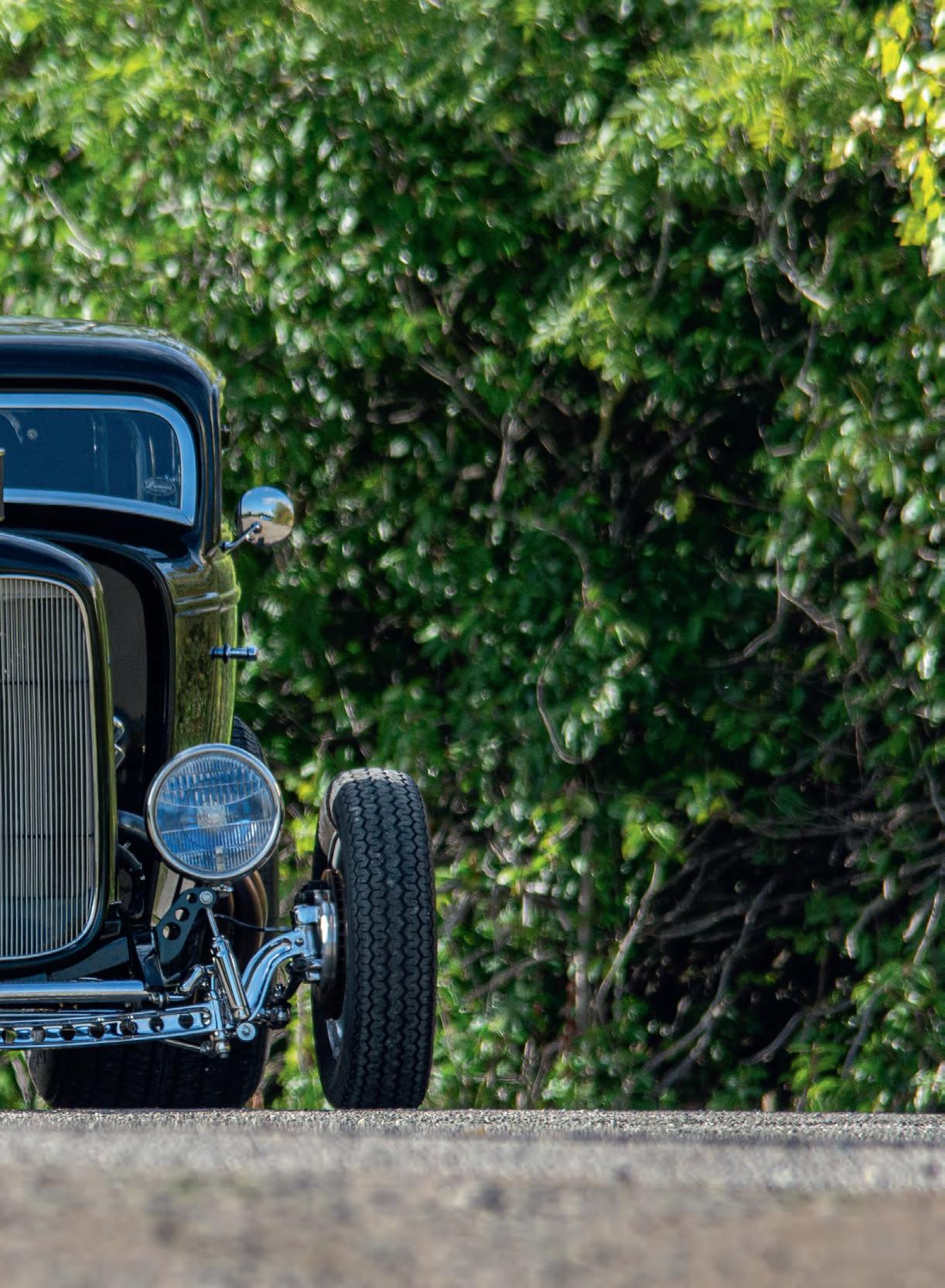
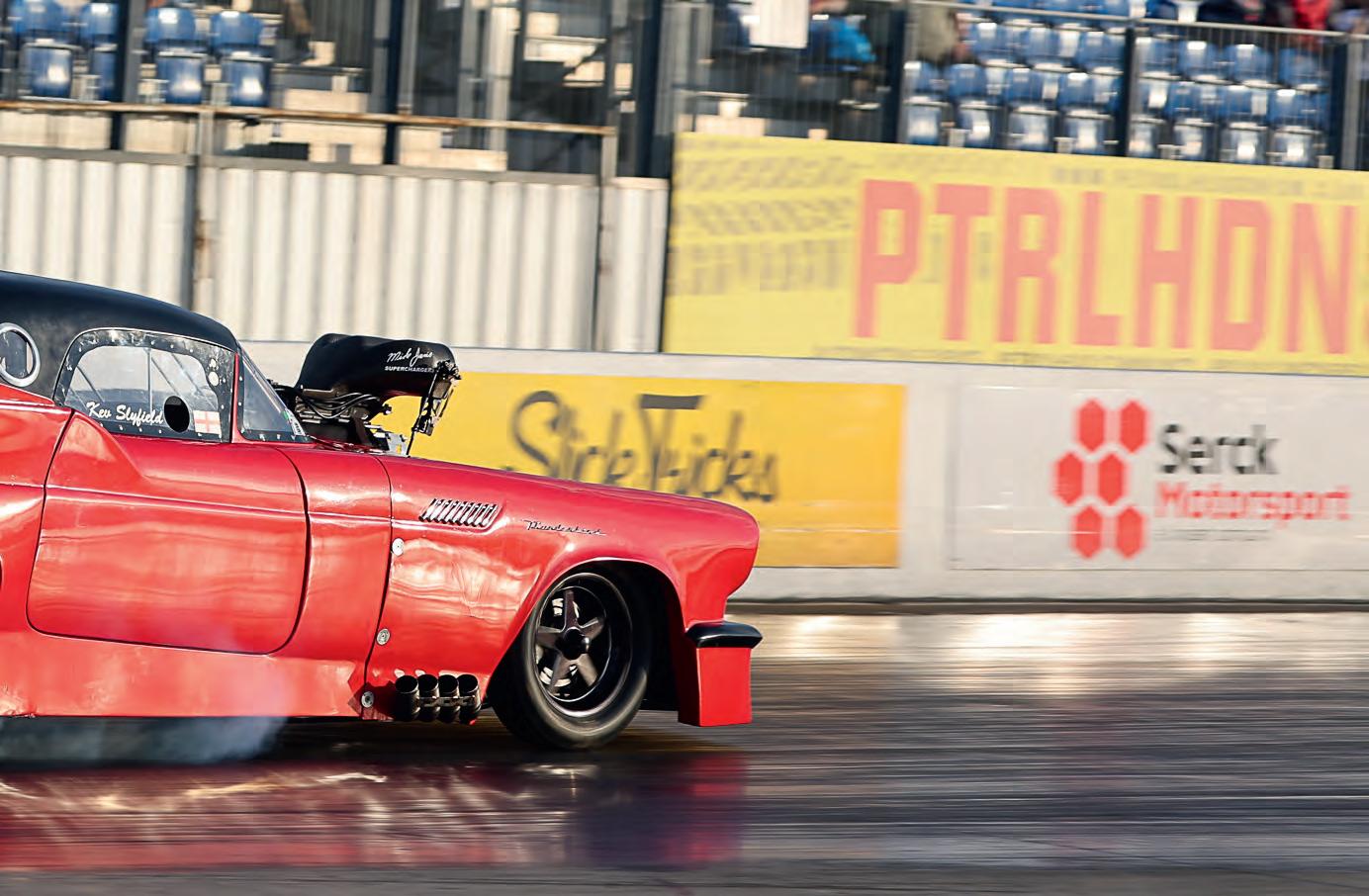
PLUS LOA 24: Forty years on from the arrival of Pro Street in the UK, the ‘32 that kicked it all off rides again following an epic 25-year rebuild by Rob Shipley
News & reviews
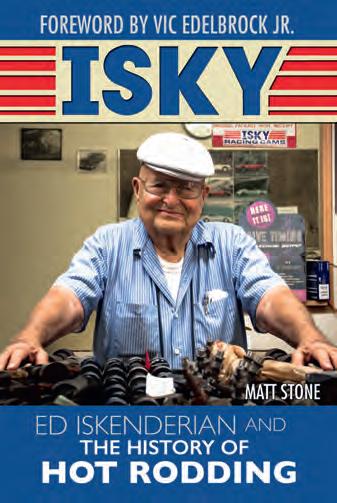
Ed Iskenderian
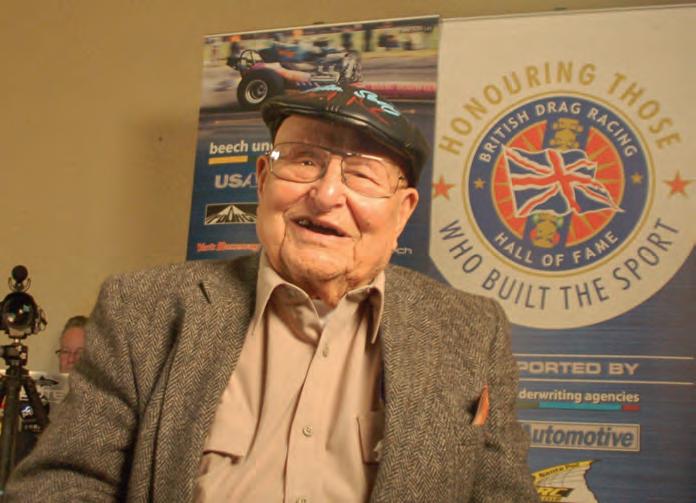
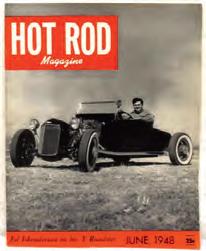
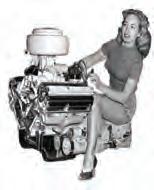
Ed ‘Isky’ Iskenderian passed away in early February at the grand old age of 104. In the very early days, Ed built a Ford Model T hot rod, adapting what was available at the time, specifi cally an overhead camshaft conversion kit and a multi-Flathead cylinder head. After graduating, Ed worked as an apprentice tool and die maker until his career was interrupted by WWII.
Isky befriended Ed Winfi eld, a pioneer in the world of camshaft and carburetor design, and following the war he began fabricating camshafts and other parts for fellow hot rodders out of the business he had established in Culver City, CA. Demand for speed parts was high and the business fl ourished, with Ed offering hard-facing along with camshafts designed to work with hydraulic lifters.
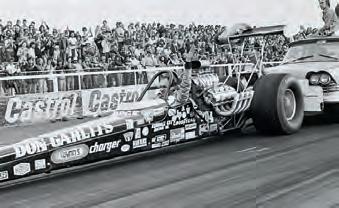
Alongside his engineering prowess, Ed understood the business essentials of marketing, branding and promotion, traits that led to him becoming affectionately known as the Camfather. He worked with Don Garlits and his impressive customer list included such names as ‘Big John’ Mazmanian, the Stone-Woods-Cook team and Mickey Thompson.
There was more to Ed than camshafts, though, and he went on to establish a formidable performance brand. In 1963, he collaborated with Vic Edelbrock Jr, Roy Richter, Bob Hedman, Robert E. Wyman, John Bartlett, Phil Weiand Jr, Dean Moon, Al Segal and Willie Garner. That collaboration resulted in the formation of the Speed Equipment Manufacturers Association, now known as SEMA, with Ed serving as its fi rst president.
www.customcarmag.co.uk
Piston Publications Ltd,
EDITORIAL
Group Editor: Alan Kidd
editorial@pistonpublications.co.uk
Art Editor: Ian Denby-Jones
Contributors
Dave Biggadyke, Mike Pye, Keith Lee, James Webber, Olly Sack, Dan Fenn, Tony Thacker
Photographers
Julian Hunt, Vic Peel, Harry Hamm, Richard Hair
ADVERTISEMENT SALES
Assignment Media Ltd
Colin Ashworth 01283 742969 colin.ashworth@assignment-media. co.uk
MANAGEMENT
Publisher: Alan Kidd editorial@pistonpublications.co.uk
SUBSCRIPTIONS
13 issues of Custom Car are published per annum
UK annual subscription price: £64.87
Europe annual subscription price: £78
USA annual subscription price: £78
Rest of World annual subscription price: £85
UK subscription and back issue orders: ccsubscriptions@wwonline.co.uk 01283 742970
Together with his business, Isky Racing Cams, Ed Iskenderian became a legend among racers across the globe. In 1985, he was inducted as a member of Chevrolet’s Legends of Performance and inducted into the SEMA Hall of Fame. In 2016, the BDRHoF presented Ed with an award for Engineering Innovation and Excellence for his development of racing camshafts, pioneering corporate sponsorship in the 1950s and helping to create SEMA.
Isky Racing Cams currently employs over 100 staff who professionally support the thousands of Isky dealers throughout the world. Despite his advancing years, Ed still played a role, remaining a vital force and a welcome guest at multiple motorsports events. The legacy of the Camfather, Ed ‘Isky’ Iskenderian, lives on.
RIP Ed
SUBSCRIPTIONS AGENCY
WW Magazines, 151 Station Street, Burton on Trent, Sta s DE14 1BG 01283 742970
DISTRIBUTION
Distribution in Great Britain: Marketforce UK Limited, 121-141 Westbourne Terrace, London W2 6JR Tel: 0330 390 6555 www.marketforce.co.uk
Every e ort is made to ensure the contents of Custom Car are accurate, but Piston Publications accepts no responsibility for errors or omissions nor the consequences of actions made as a result of these. When responding to any advert in Custom Car, you should make appropriate enquiries before sending money or entering into a contract. The publishers take reasonable care to ensure advertisers’ probity, but will not be liable for loss or damage incurred from responding to adverts
Where a photo credit includes the note ‘CC BY 2.0’ or similar, the image is made available under that Creative Commons licence: details at www.creativecommons.org
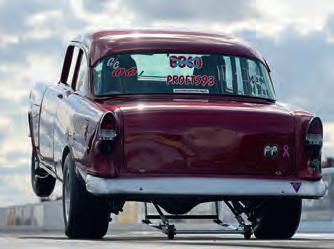
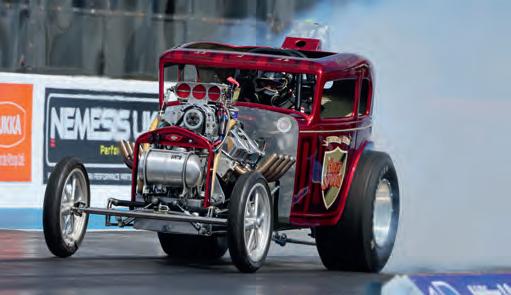
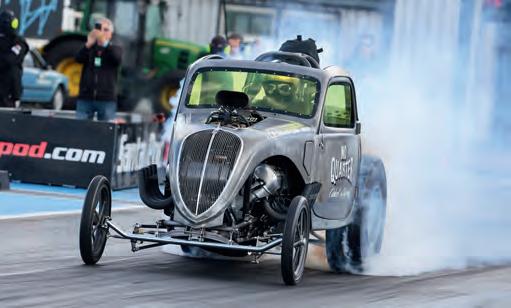
Melbourne Raceway’s Spring Nationals on 11-12 April now has an added wow factor in the form of two cars from OSCAR (Old School Classic Altered Racers). Nick Davies will be at the wheel of his No Quarter ‘37 all-steel Fiat Topolino, against the Bryan Whitfield and Ian Tubbs High Spirits ’31 Austin Bantam coupe. The eighth-mile track will also be staging double header rounds for American Super Stock and National Street Car Challenge, as well as the Pro Comp Quick 8 Novelty Shootout. Graham Sykes will be on board his Force of Nature steam-powered rocket bike and there will be a full weekend of RWYB, No Mercy Bracket Racing, Junior Sprint Car and much more.
Facebook: Melbourne Raceway / 07971 172210
German classic
Held in conjunction with the town’s Whitsun Market, the Cars & Kirmes US Car & Oldtimers Show takes place on 24-25 May. It’s held in Germersheim, Rhineland-Palatinate, Germany, and all American cars and other classics are welcome. The show runs from 10am to 5pm each day.
Celebrating 74 years
Stop by showroomthe today to check it out.
RAISED WHITE LETTER TYRES 13”-15” MOST SIZES IN STOCK NARROW BAND, WHITEWALLS 13’-15”
News & reviews
Something for the weekend?
Lead and ink
The Leadroom Traditional Kustom Kar Show will be staged alongside The Tattoo Expo UK on 2-3 May. The venue is Sandown Park Racecourse in Esher, Surrey, which offers indoor and outdoor display areas. Day tickets are priced at £11 per person and weekend tickets at £20 per person, with under-16s being admitted free. www.thetattooexpo.co.uk
Arty show
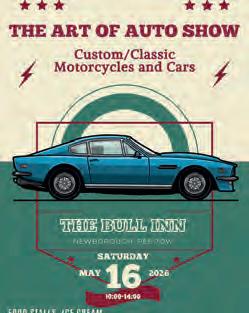
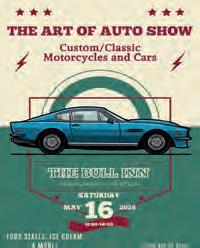
The Art of Auto Show is open to all custom and classic cars and motorcycles. It takes place on Saturday 16 May at the Bull Inn, Newborough, Peterborough PE6 7QW, from 10am to 2pm. Attractions include merchandise stands, a food truck, a charity tombola and a bouncy castle.
Instagram: the_art_of_auto
Shiny fins
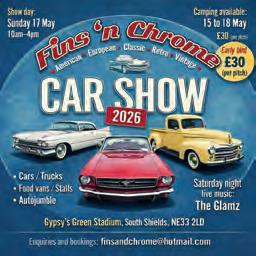
Gypsy’s Green Stadium in South Shields is the venue for the Fins ‘n’ Chrome Car Show on Sunday 17 May. Camping is available from Friday at the early bird price of £30 per pitch, and live music on Saturday night will be performed by The Glamz. The show offers cars and trucks, food vans, stalls and an autojumble.
Facebook: Fins & Chrome
Eastern classic
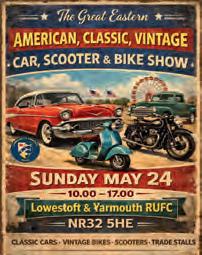
Sunday 24 May is the date for The Great Eastern American, Classic, Vintage, Car, Scooter and Bike Show at Lowestoft & Yarmouth RUFC, NR32 5HE. Classic cars, vintage bikes and scooters will be on display, alongside an assortment of trade stands and live music from The Austin Beats. Entry is free for both exhibitors and visitors, and limited car parking is available at £5 per car. Paul: 07900 005871
Fire ‘em up
The Flat Caps and Ferrets Fire Up Automotive Show will be held on 29-31 May. It takes place at the Phoenix Sports and Social Club, Brinsworth, Rotherham, and the weekend offers music and dancers, food and drink stalls and a show and shine. All types of vehicles from different nations are welcome, for what is billed as a weekend full of automotive history. That includes classics, modern and retro, from the 1920s through to 2026. Exhibitors only: flatcaps. yas.25@gmail.com
Traders only: flatcapsNferrets@ gmail.com
One-off
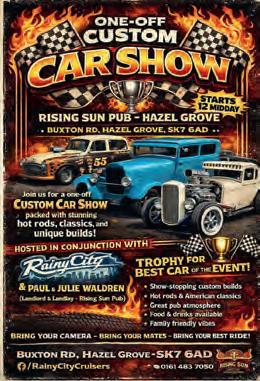
The One-Off Custom Show at The Rising Sun public house in Hazel Grove, Stockport SK7 6AD on Sunday 31 May kicks off at 12 noon. Hosted in conjunction with Rainy City Cruisers, there will be a trophy up for grabs for the Best Car of the Event. Paul and Julie Waldren, landlord and landlady, promise a great pub atmosphere and family-
friendly vibes, while Rainy City promise plenty of stunning hot rods and classics.
Facebook: Rainy City Cruisers
Era swaps
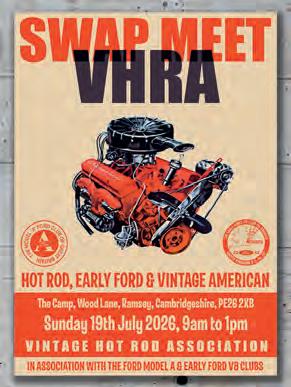
Held in association with the Ford Model A and Early Ford V8 clubs, the VHRA Swap Meet takes place on Sunday 19 July at The Camp in Ramsey, Cambs. The gates will open on Saturday if you fancy a pint in the Drill Hall the night before. All traders are welcome but must adhere to the criteria that all merchandise on offer conforms to the ballpark of the kind of cars and era that the VHRA is aiming for.
www.vhra.co.uk
Colin Millar has announced his intention to drive Top Fuel in 2026 in partnership with RF Motorsport. The plan is still in its infancy but the intention is for Colin
Colin has also confirmed that in addition to this new challenge, Outlaw Anglia 88 will
be running at all the events it can. We wish Colin and The Flyin’ Fyfer Drag Racing Team all the best with this exciting new venture.
News & reviews
Barnstormers
Stonham Barns in Suffolk kick off with the Spring Break Kustom Kulture Show on Sunday 10 May. Run in conjunction with Knuckle Busters Car Club, the day is dedicated to all things vintage. Camping is available for those wishing to make a weekend of it, with holiday homes available for hire.
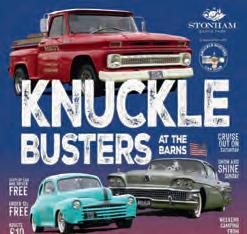
The August Bank Holiday weekend welcomes Knuckle Buster s at the Barns, which is open to all British and American classic cars, VW classics, hot rods and customs. Camping is available from Wednesday 26 August, with the Bank Holiday Sunday being the show day.
Sunday 20 September is the date for the American Car Show, with entry strictly restricted to vehicles of US origin only. Once again, camping is available, dogs are welcome but must be kept on a lead at all times. www.stonhambarns.co.uk
Date check
The dates for this year’s National Hot Rod, Custom and American Car Show have been confirmed as 26-28 June, and not as previously published. We’ll bring you the full lowdown on this entertainment-packed weekend next month.
www.hotrodandcustomshow. co.uk
Strip geezers
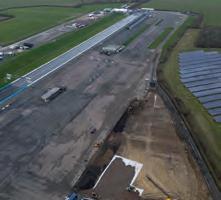
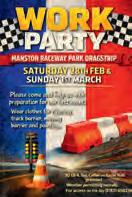
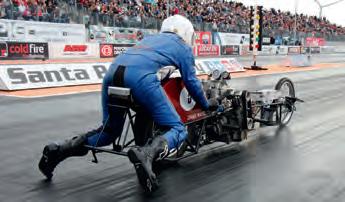
While the tracks may have been idle in recent months, the teams at the facilities most certainly haven’t. At Santa Pod Raceway, the track surface has received attention, new burnout boxes are in place and work is continuing on extending the pit area. Over at Melbourne Raceway, concrete has been laid in readiness to refit the display tower, cable channel has been cut out, spectator access has been upgraded and rubber is being removed from the start line to ensure a fresh surface for the new season. Meanwhile, working party weekends at Manston Raceway Park have resulted in new barriers being installed and countless hours have been clocked up cleaning, painting and tweaking, to ensure the track is ready for the season opener on 20-21 March.
Thanks go to the often unsung heroes working behind the scenes for the benefit of racers and spectators alike.
Performance filtering
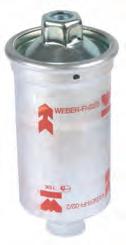
Webcon can now supply the genuine Weber FI02/02 fuel filter from stock. This filter is as fitted to many prestige and high-performance cars from the 1980s such as Lamborghini, Maserati and Aston Martin, and is the best way of maintaining OEM quality fuel filtering.
The filter has a retail price of £55.94 including VAT.
www.webcon.co.uk
Circles on sand
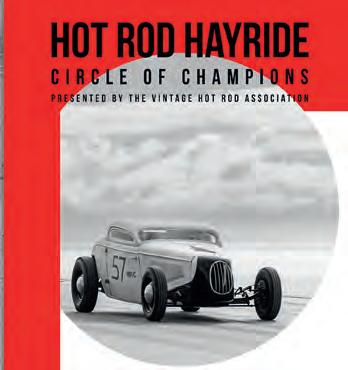
This year will see a one-off offering at the Hot Rod Hayride, which will be staged at Bisley Shooting Ground in Surrey on 19-21 June. Hosted by the VHRA , the Circle of Champions will showcase a display of Pendine Sands Record Holders and Kings of the Beach, such as the Devey / Peters ’34 Ford coupe that set a new V8F/C record last year by clocking 108.75 mph. hotrodhayride. co.uk
Challenging show
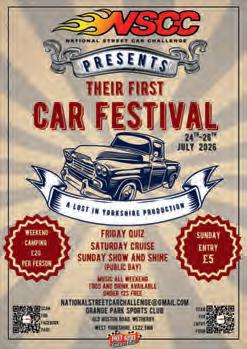
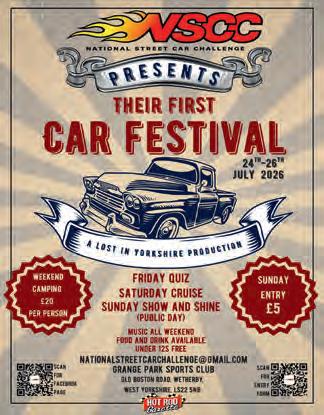
At the recent National Street Car Challenge AGM and award presentations, it was announced that 2026 would witness the first-ever NSCC car show. It will take place at Grange Park Sports Club in Wetherby, West Yorks, on 24-26 July. Full details are to be confirmed but we can tell you that weekend admission, including camping, is priced at £20 per person, while Sunday entry will cost £5.
www.nscc.info
Show of Steel
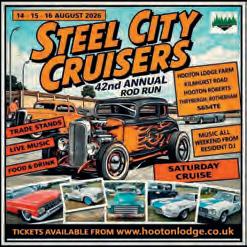
The Steel City Cruisers 42nd Rod Run will take place on 14-16 August at Hooton Lodge Farm, Rotherham S65 4TE. The weekend offers live music, top entertainment and a Saturday cruise, with a top-notch car show on Sunday. Supporting acts include food and drink vendors and trade stands, and early bird tickets are on sale now.
www.hootonlodge.co.uk
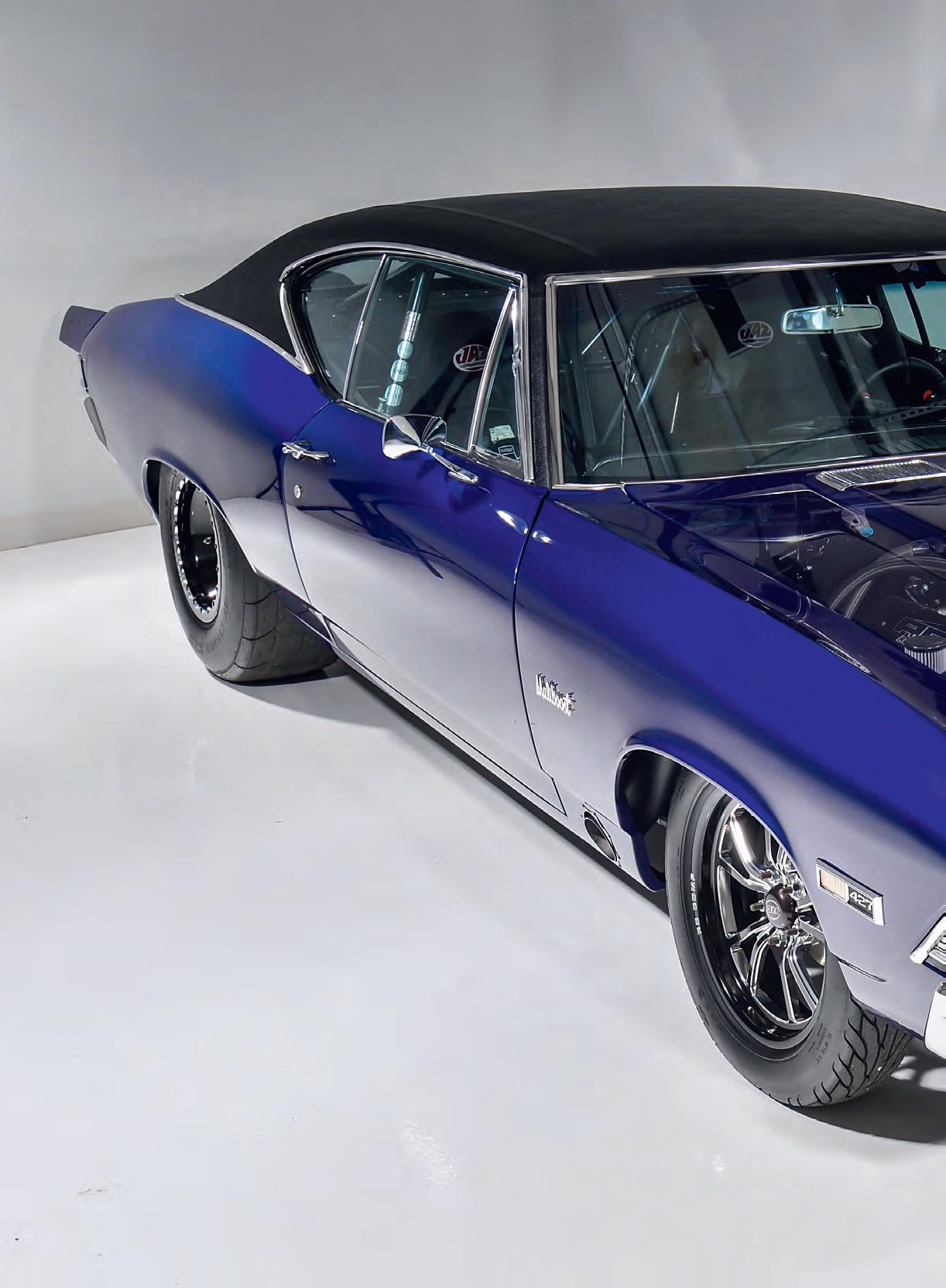
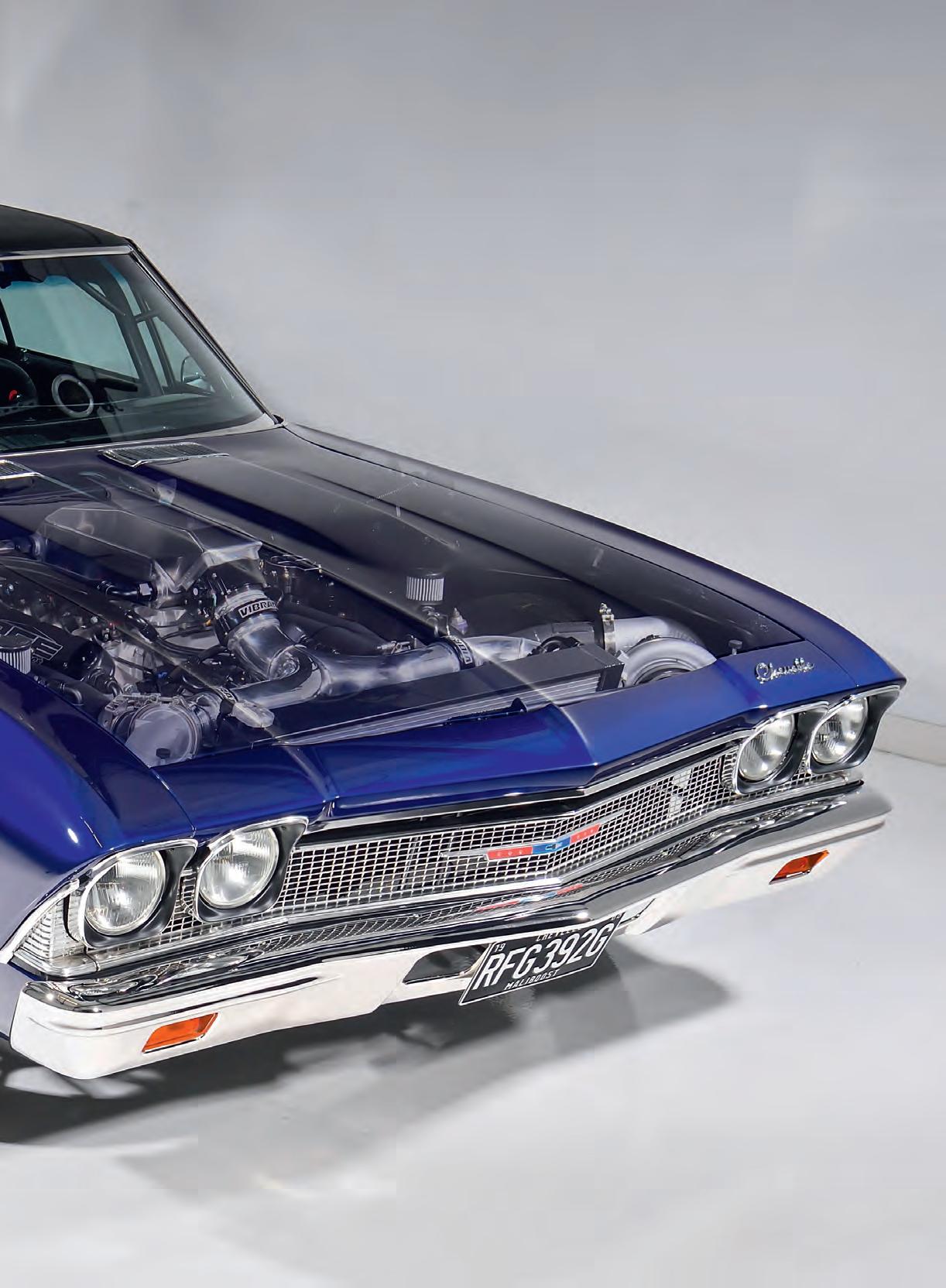
Last time Jack Petley was in CC he was in a show-winning tot rod. His new ride is a step up, in every way
Words: Mike Pye Pics: Matt Words
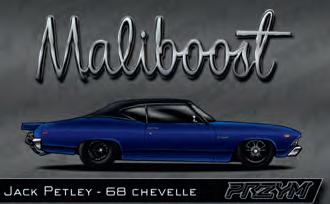
Maliboost logo: Andy Pryzbyl
It’s no coincidence that the majority of young rodders and racers I have come into contact with over the years are a product of their upbringing. Sure, there are some anomalies, but the vast majority got into it through a family interest. Be that an older brother, an uncle or a mum or dad. Both rodding and racing are expensive, time and space consuming hobbies and, as a young person, you need some support. It could be a garage or driveway to do the work, the loan of tools or just advice and encouragement. A bit of exposure helps, too.
So, when we were tipped off (thanks Matt) about young Jack Petley’s Street Eliminator Chevelle, I decided to do some digging. Petley, you say? Hmmm… that name rings a vague bell.
It took some finding, but there it was, in the February ’92 issue of CC. Gary Petley’s red, big-block ’72 Corvette Stingray. Having crewed for various racers, Gary bought the ’Vette in 1988 and gradually turned it into a comfortable 12-second street car, though you would never have known it from the concours exterior.
After doing what he jokingly refers to as a ‘Saturday boy’ job with Rob Loaring at I.C.E. Automotive, the factory 454 was bumped to over 500bhp and Gary thought he’d have a go in the early days of the CC Street Eliminator championship. He’s justifiably proud of the fact that in his second year of competition, 1996, he came third overall. “In what I considered a really proper street car,” he says.
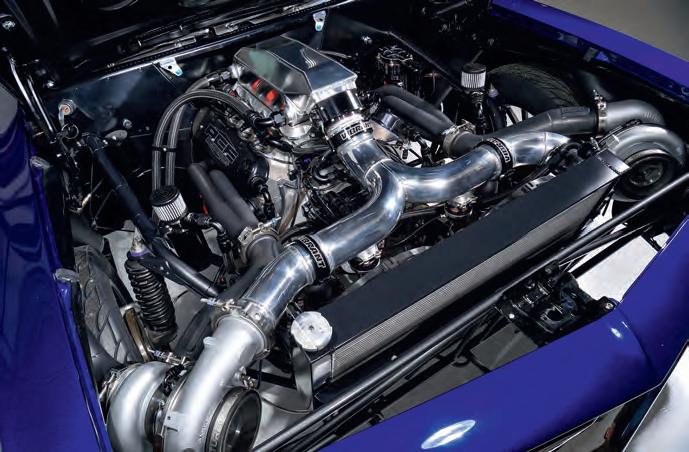
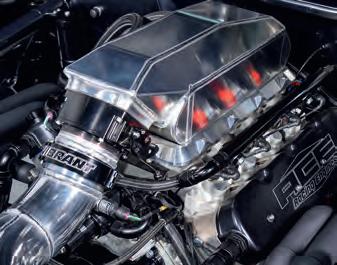
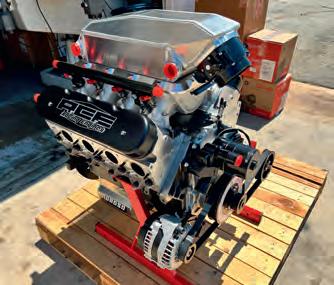
Above: If you think all cars claim to make 1000 horsepower these days, we’re here to tell you that Jack’s 427 made 639bhp and 550lbfft of torque on pump fuel on the ACE Racing Engines dyno in the States…
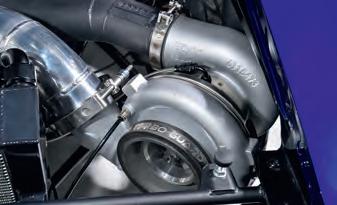
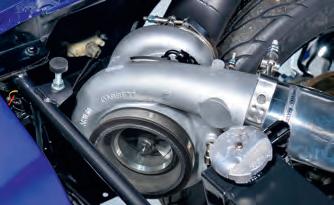
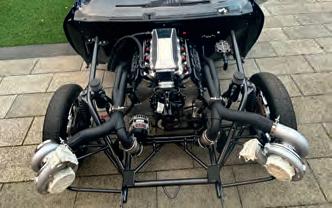
Right: …but that was without these two little suckers hooked up. With the mirror image Garrett GT4202R 76mm turbos on song, plus a drop of E85, there’s scope to triple that output with the right tune on board
Baby seat
“Dad would put a baby seat in the Corvette and take me out in it,” remembers Jack fondly. “As he couldn’t hear me above the noise of the engine, he’d hold my hand and tell me to squeeze if I wanted to go faster.
“Yeah, I squeezed.”
By age seven, Jack had his first hot rod. And his first feature in CC, too. February 2005. Okay, so it was an electric tot rod, but one built with as much care and attention as the Corvette. Same colour, too. Hell, it even had a Neil Tadman interior, and took first place at both the NSRA Fun Run and NASC Nationals on its debut in 2004.
If your maths is up to snuff, you’ll have worked out that young Jack is now 29, and things have stepped up a gear. A pretty bloody big gear at that. But it was dad’s trusty ’Vette that helped pave the way.
“When I passed my test at 17, dad let me drag race his Corvette,” Jack continues. “First at a test ’n’ tune at North Weald and then at Santa Pod, where I ran a PB for me of 12.78 at 111mph. We went back the following year and, with a shot of nitrous, I ran 11.80 at 125mph. That gave me the bug to want to go faster, and to get my own car.”
What came along at the right time was a ’99 Camaro Z28 which, with a new cam,
The 427ci LS was spec’d and built by ex-pat Brit Stefan Rossi at ACE Racing Engines in Florida. It’s based on a Dart Next Pro SHP iron block with Trick Flow ali heads, hydraulic roller cam and Shearer Fabrications sheet metal intake manifold. Turbo plumbing is by Jedd Guy. Keeping it all in line is a FuelTech FT550 ECU and RaceWire Solutions PowerCore 3 electronics package
“We started at 1000 horsepower… but then I asked about 1200, then 1400, and it crept up to around 2000”
exhaust and converter, became Jack’s low 12-second street ’n’ strip car. “I ran that in Sportsman E/T for a season and then started looking at upgrading the rear end and gearbox to go quicker.”
However, pricing the work up, and coming to terms with the fact it was going to undermine the driveability of the car, he decided to look for a ‘built’ car instead.
20 at 20
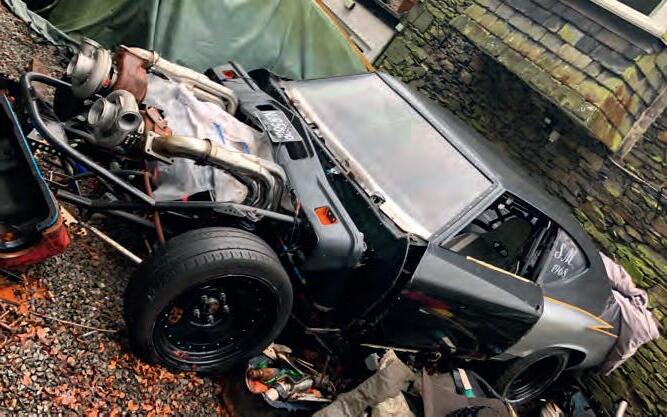
Having a bit of a thing for Chevelles, he found just what he was looking for in the ex-David James Pro ET / Peter Thompson Super Modified ’68 Malibu. It was already ’caged, back halved, 9-inch equipped and strut fronted, and had run deep into the eights. “It was practically a turnkey car – but I was only 20 and it was about 20 grand. I couldn’t afford that at the time,” recalls Jack. When it came back up for sale again, two years later, it had been partially stripped and left outside in the delightful but perennially pluvial Lake District.
“It was a bit less of a starting point that I’d have liked. But I spoke with dad about it and asked if he would partner with me on it as I couldn’t afford to do it alone.” After Jeff and Belinda Bull confirmed it was a good foundation, Gary agreed… on the condition that it ran a stock-style bonnet and was put back on the street.
Which, ever so neatly, brings us back round to Street Eliminator again.
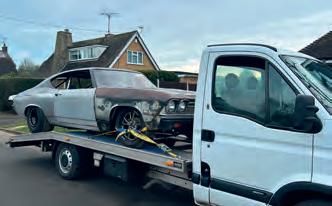
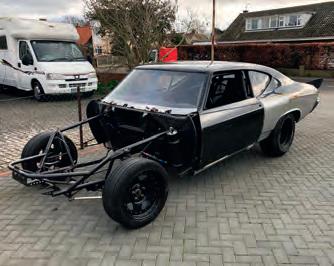
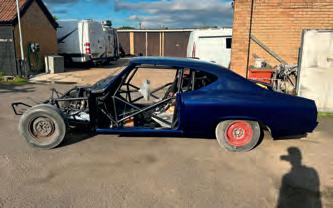
And so, in February 2020, Jack and Gary hooked up a trailer and drove north, loaded what was left of the car in the pouring rain and headed home. It was in a bit of a sorry state at that point, but the bare bones were there: a 7.50 chassis by Chris Isaacs Race Cars, 9-inch, 4-link and all the tinwork.
And of course it was the real thing, a ’68 Chevelle, albeit one largely made up of glass fibre repro panels at the time. “I’ve always loved ’68 / ’69 Chevelles,” Jack beams. “We had an old Flowmaster poster on the back of the garage door for years with Ron Fisher’s ’68 on it.”
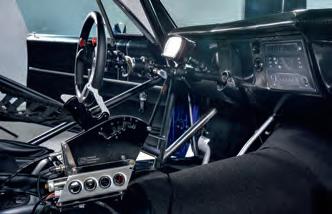
One of the few concessions to lightness is the carbon fibre dash, added by a former owner. It was there, so it stayed in the car, but check out the pseudo radio and heater controls in the middle. It even starts using the original ignition key. Too cool
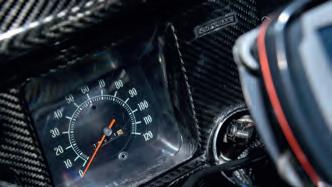
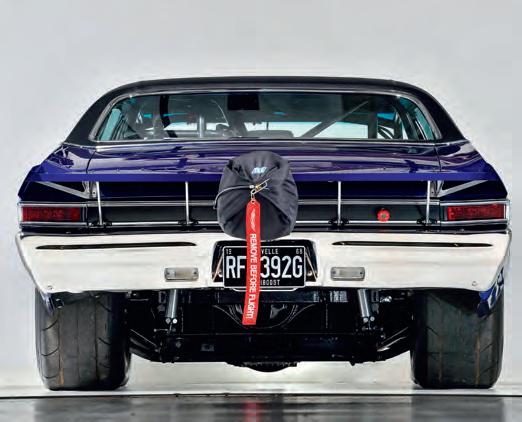
It’s unlikely 120mph on the speedo was seen too often, if at all, when this car was a regular Chevelle. But with what Jack’s packing now, that’s a woefully inadequate figure
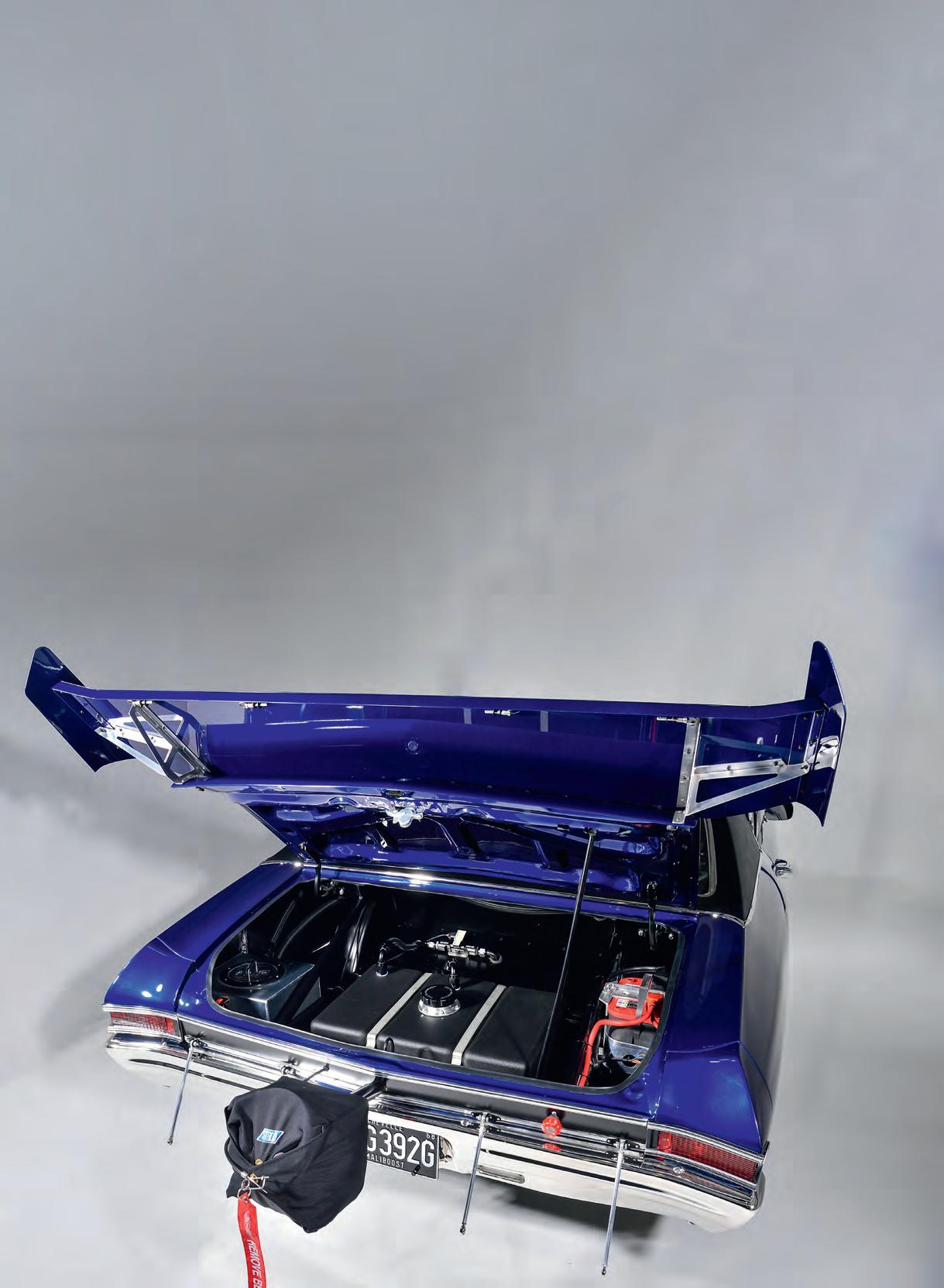
Hence the need for the rear wing with end plates and parachute hanging off the tail. Note sano treatment of the plumbing in the boot. That’s an ice tank over on the left, with its lower fitting modified so it’s easily removable to drain at the track. Details
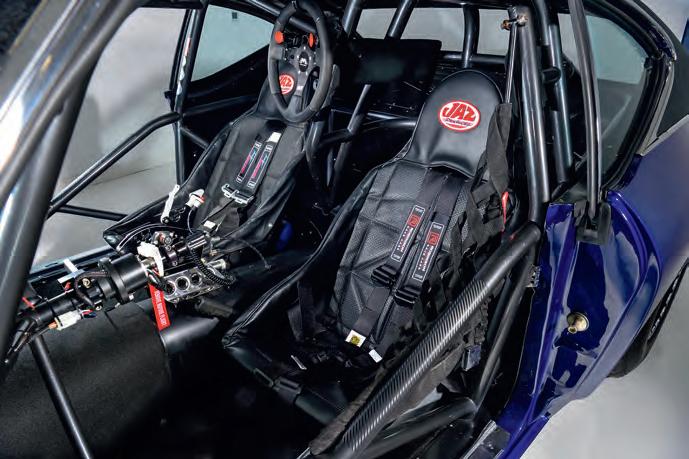
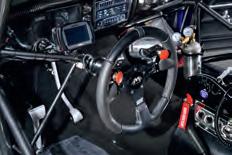
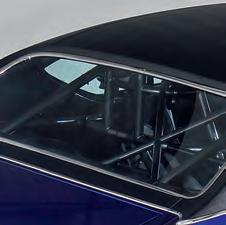
Command centre features a pair of Jaz buckets with TRS harnesses, all wrapped up in a 7.50spec ’cage by Chris Isaacs Race Cars. A Precision Performance Products gear shifter with air assist engages the cogs in a Reid-cased TH400 auto’ transmission, rebuilt by Edge Performance Transmissions with a bolt-together torque converter
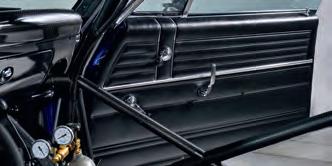
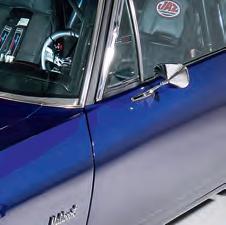
A key build criterion of the car was streetability. It’s clearly a full race interior, yet there are factory door cards, with all working glass windows and door handles. Even the quarter lights work as they should. We love that detail
The Build
1.
Here’s what greeted Jack and Gary on a very wet day in the Lake District six years ago. The rest of the car was dotted around various other locations and yes, they had to help the seller take that engine out on the day
Jedd Guy at Shorty’s Fabrication Shop did the work to re-fit a full complement of steel body panels, as well as a bunch of other fabrication work
Then the final build up could commence at home. Apart from an issue with the USsupplied transmission not being up to scratch, it all went together pretty well
Most of the exterior trim is original GM, much of it donated to the build by all-round top bloke Matt Bolt. “His knowledge of Chevelles, and his attitude to doing things, is just brilliant. The car would never have got finished without his help,” admits Jack. Believe it or not, the bumpers are ’glass, painted in chrome-effect paint and held on with polished stainless bolts
2.
Back home in Essex. Time to take stock of what they’d actually bought. A 7.50 tagged steel chassis by Chris Isaacs Race Cars with a later chromoly front clip, a ’68 Chevelle Malibu bodyshell and a bunch of glass fibre parts they didn’t want
and back on the street where it belongs. Everywhere you look, the detail work on this car is spot on, with as many original GM parts as Jack (well, largely Matt Bolt) could rustle up
Family bond
“Right from the start,” says Jack, “I had a clear direction of what the car needed to end up looking like and what I wanted to do with it, and dad was there to help bridge the gap between it looking right and it working right.”
To that Gary adds: “It’s keeping the family bond alive. And I love that, though somehow I got mugged into paying for half of it!”
With that caveat about the stock bonnet in mind, the decision was made to go back to all steel, with all the correct factory Malibu trim, and glass windows all round, right down to opening quarter lights and roll-up door windows. After all, this was to
3.
After much deliberation, Jack decided to have Stefan Rossi at ACE Racing Engines in the States build him a motor on a fresh Dart block. In this form here it made 639bhp on the dyno. That’s without turbos…
Even though the car was always going to have a vinyl roof fitted, Darren made sure every part of the paintwork was perfect before he was prepared to give the car back to Jack
Rendering of the car done by Paul
kept Jack on track throughout the build
be a street car, albeit one with devastating quarter mile potential.
Now, when Gary was running in the early days of Street Eliminator in the mid-’90s,a 10-second car was a quick car and his very streetable 12-second Corvette was a contender. It didn’t take long for things to rapidly accelerate and, by the end of that inaugural decade, SE front runners were in the sevens. Only a rarified few have dipped into the sixes in the class in all the years since but, if you’re going to enter Street Eliminator today, that’s what you’ve got to have in your sights.
Having seen with the old Camaro how tuneable LS motors are, Jack bought a
Pryzbyl
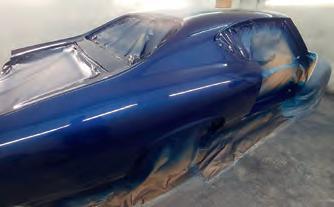
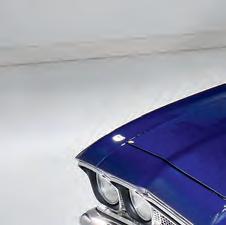
Next stop was Darren Scannell’s workshop, where an immaculate coat of GM Corvette / Cadillac Opulent Blue was laid down over arrow straight bodywork
Almost there,
8.
“By age seven, Jack had his first hot rod. And his first feature in CC, too”
6.0-litre, iron block truck engine as the basis for the build. “I started pricing up parts and it wasn’t going to be cheap. It was also going to be a compromise, so Rob [Loaring] suggested I started looking at complete engines instead. Someone mentioned Stefan Rossi at ACE Racing Engines in the States and we started talking specs.”
Power rising
Here’s where the inevitable kid enters the sweet shop. “We started at 1000 horsepower, looking at what some of the
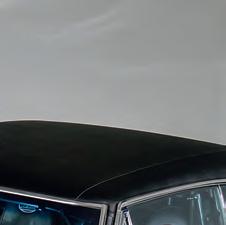
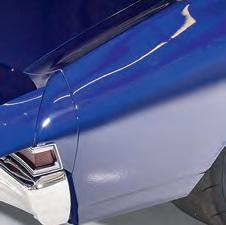
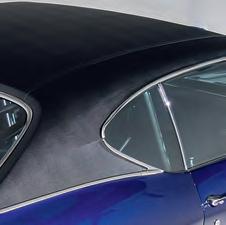
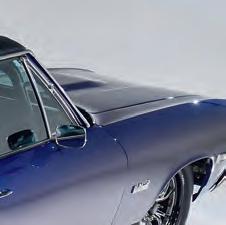
For what is ostensibly a race car, with a complete removable front end and lift-off doors, the paintwork by Darren Scannell is magnificent. Colour is GM Opulent Blue, with the all-important vinyl roof installed by Kevin at Car Glass and Trim in Ipswich
Gary and Jack happily describe the Chevelle as “a bit of a fat car. It’s 3550lbs, so a bit of a porker, but it’s all steel, all glass windows, full interior and everything works. It’s a street car”
drag ’n’ drive competitors are using, but then I asked about 1200, then 1400, and it crept up to around 2000. It sounds silly, but it didn’t really jump that much in price and I’d rather be over specced and running below the limit than running on the limit.”
Dad cuts in: “It’s still a simple motor, though, designed for low maintenance. So it’s steel rods, hydraulic roller cam. Hopefully, maintenance will be oil, plugs, filters, that’s it. We didn’t want it to be too nasty on the street as we like going to car shows as well as racing.”
Adding to that eminently sensible approach, ancillaries like the alternator and starter are regular off-the-shelf street car parts. Equally important, the layout has been designed to be user friendly. It helps having a removable front end – even if it is a bit f’in’ heavy – but it’s all very mechanically friendly.
“Don’t get me wrong,” adds Jack, “I won’t be driving it every day. But we’ve built it so if I want to go and get a coffee and a bacon roll in it, I can.”
Given the complexity of the build, it’s refreshing to hear Jack and Gary say how
Left: “It’s secret squirrel, under the radar, nothing hanging out.” That’s Jack’s dad Gary’s description of the car. From this angle, he’s not wrong; catch a glimpse of it in your mirror and you might think you’ve got a nicely restored classic American behind you
Right: Things definitely get a bit spicier when you go round the back. Even the wing is understated from this angle, but the car’s intent is loud and clear. Rear end is a 9-inch with spool on a 4-link, modified by Jedd Guy to better work with radial tyres, damped by Vikings and with an anti-roll bar
well it all went, the only setback being the transmission, bought on recommendation from a specialist the States. “Yeah, the less said about that the better,” they chorus. Suffice to say, SE sponsor Edge Performance Transmissions, here in the UK, stepped up and sorted that costly mistake out.
As he’d had a hand in modifying the chassis when working for Chris Isaacs, Jedd Guy at Shorty’s Fabrication Shop carried out all the fab’ work, including the turbo pipework, making the stock panels fit and the one-piece steel front end, and made the necessary mods to the 4-link to work with a radial tyre.
With all the main components in play, Jack and Gary plumbed the car themselves and then had John ‘Porky’ Atkinson hook up the FuelTech EFI, with its various sensors, and the necessary road-going bits like lights, wipers and horn. Only then could they fire the beast for the first time, some six years after that journey back from the Lake District.
One and only
“It’s cost a bit more than we anticipated,” admits Gary. No surprise there. “But I think now it’s done, we can budget sensibly to
The Chevelle was born a V8 Malibu in 1968 but has been a racecar for almost as long as it was a stocker, competing first in Pro ET with David James and then Super Modified with Peter Thompson since the early 2000s. Its next evolution is with Jack as Maliboost in Street Eliminator
run it. We’re not going to kick the arse of the class or anything like that. Jack would be happy to run a seven, but I’d be happy if he runs a nine. He’s a good driver but he’s also my only son, and I don’t want him to get hurt.”
Jack: “It should piss a nine and it will comfortably do an eight. One of Stef’s customers has a similar set up in a Chevelle and it’s gone 4.56 in the eighth, which should be a 6.90 out the back door in the quarter. But he’s 100lb lighter and running 5psi more
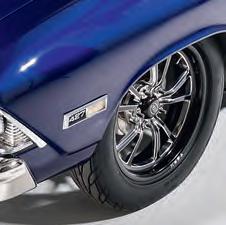
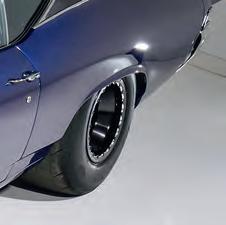
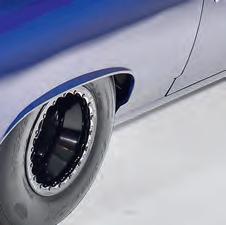
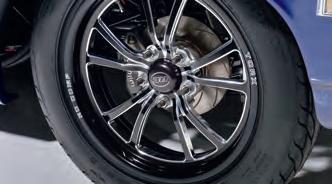
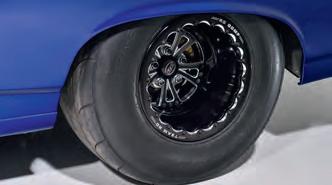
Did you clock the mismatched wheel sizes? Wanting to add a little bit of a modern feel, Jack chose 5 x 17-inch RC Components Torx wheels for the front with 27 x 6.00 R17 Mickeys, backing them up with 12 x 15-inch double beadlock rears with 295/65-15 Mickey Thompson ET Streets, the biggest 60-profile tyre you can run in Street Eliminator. To keep things on the down low at shows, the plan is to have a set of steels and hubcaps for going out
boost than we’ll be, so if we can eventually get into the sevens I’d be made up.”
And that there is youth versus experience in a nutshell.
None of that happens overnight with a car like this though. You have to get a feel for it and creep up on the times, and not in the way you might with a carburetted race car. Which brings us very neatly to the subject of tuning.
Jack spoke to Stef about that one and they agreed it was better to have someone more local do it. So that’ll be Sweden, then. Hey, it’s closer than Florida, particularly in time zone.
That someone is Andreas Artursson of Pure Performance Factory (PPF) in Krylbo. He’s coming over to do an initial tune at the Pod at Easter. After that, Jack can just email him data from the onboard logger and he can do the tuning remotely. “If he feels he needs more time with the car, we’ll take it to Sweden and put it on the hub dyno there,” adds Jack.
And yes, thanks in part to a nifty flex fuel sensor, the ECU will have two maps – one for street use and another for racing. It’ll also be able to comfortably run on different fuels,
“Firstly, thanks to dad and mum (Jill) and my girlfriend Amber for putting up with us building the car for the last six years. Then, in no particular order, ACE Racing Engines, Edge Performance Transmissions, Shorty’s Fabrication Shop, Darren Scannell, Goodale American Speed Shop, John ‘Porky’ Atkinson, Al Mac, Chris the engineer, Kevin at Car Glass and Trim and last but definitely not least, Matt Bolt for advice, parts and his immense Chevelle knowledge.”
The Chevelle may be Jack’s car on paper but it’s also a true family affair. Dad Gary raced in the early days of Street Eliminator and now his son is getting set to carry that torch into the future. The car is a joint project in every way and will be a family deal during weekends at the track
the electronics automatically adjusting for the ethanol content.
It’s a different world, but an exciting one, and Jack is the right age to get his head around this new world order of electronic, data-led tuning.
“This was to be a street car, albeit one with devastating quarter mile potential”
Talking of clever electronics, Jack became quite animated while telling me about how it’s not just the power he can control with the FuelTech ECU. “It’s all the safety factors you can add in as well. You can test fire all the injectors separately, check the fuel pump, everything. That makes it really good for problem solving as well.
“It’s all been a massive learning curve for us but, if we can turn up with a wellpresented car, go a few rounds on race day and come home smiling, then we will have achieved our goal.”
At which point Gary interjects again: “And have fun together as a family, that’s what it’s all about for us.”
Which feels like the perfect place to put the full stop on this adventure. The build part of it, at least. Now we’ve just got to wait to see the Chevelle on track – which is where the adventure will really begin. CC
RAISING THE STANDARD
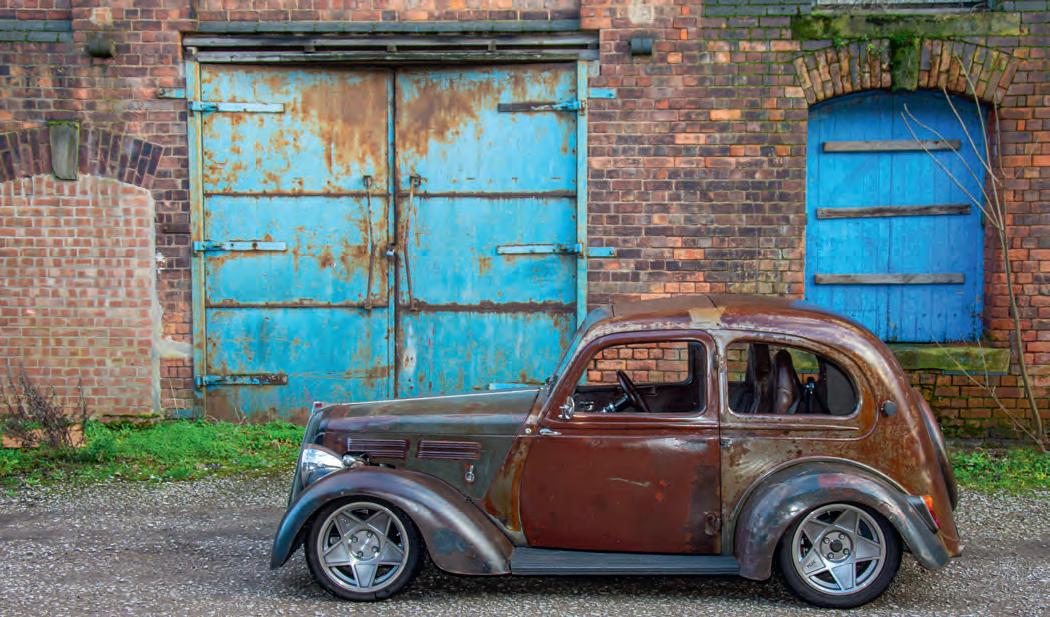
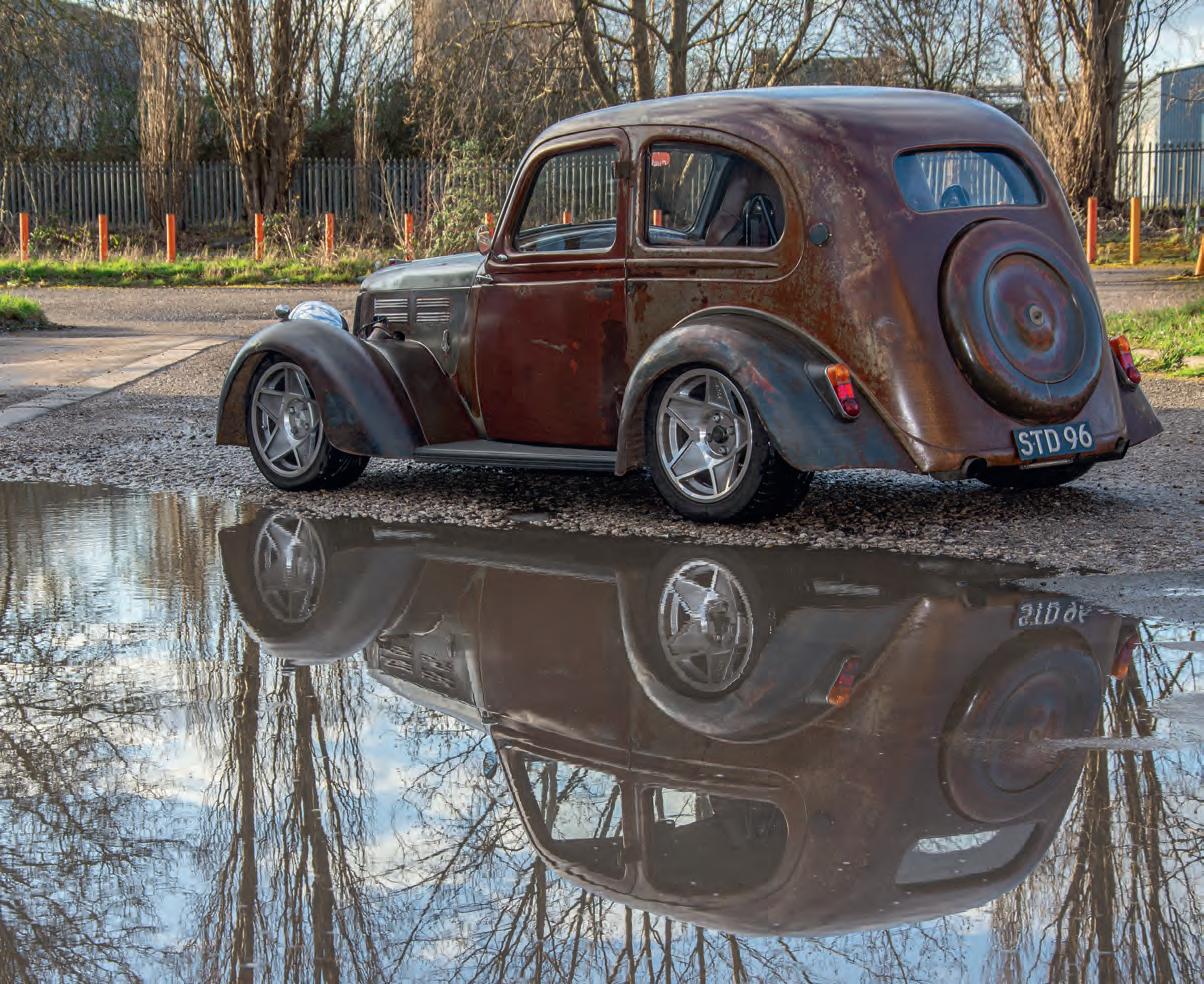
Life is about choices, but not many people find themselves having to choose between a pre-war classic and a TVR. Fewer still find the solution in a hot rod made from both
Words & Pictures: Dan Fenn
Most of us know the feeling of having to decide between one car and another. Usually, though, they’re at least a bit similar. A ’32 or a ’34, that kind of thing.
A few years back, on the other hand, Andy Taylor found himself trying to decide what his next project was going to be. He’d done a few Beetles, teaching himself to weld, spanner and mod along the way, and now he was looking for a new challenge. “I was torn between either getting something pre-war or getting a TVR,” he explains. Which sounds pretty unlikely, but not as unlikely as what happened next. “While browsing eBay, I saw this car come up as a barely-started project – it was just a bare bodyshell tack-welded on to a chassis.”
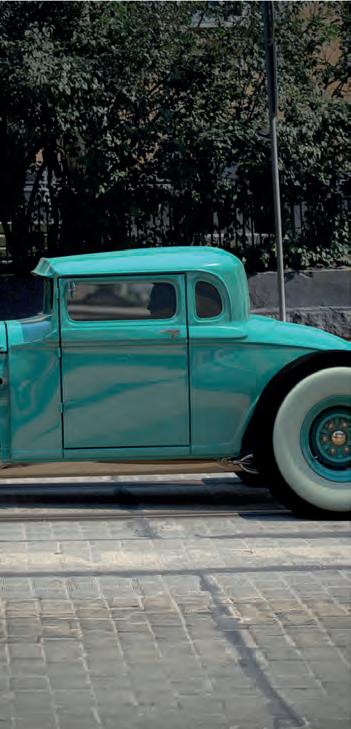
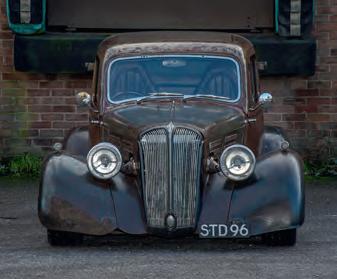
What was it? A 1938 Standard Flying 9 on top of 1995 TVR Chimaera is what. “It ticked both the pre-war and the TVR boxes. So the deal was done!”
Now, putting an old body on a new chassis is not hot rod building in the traditional sense. But we have a custom here that probably saved two cars from the scrapper, whose owner put years of work into it and loves driving it and which makes everyone who sees it smile. And that certainly IS what the hobby is all about.
Those years of work numbered just shy of five, although the project was slowed down somewhat when Andy bought another Flying 9 and restored it back to original. It’s now
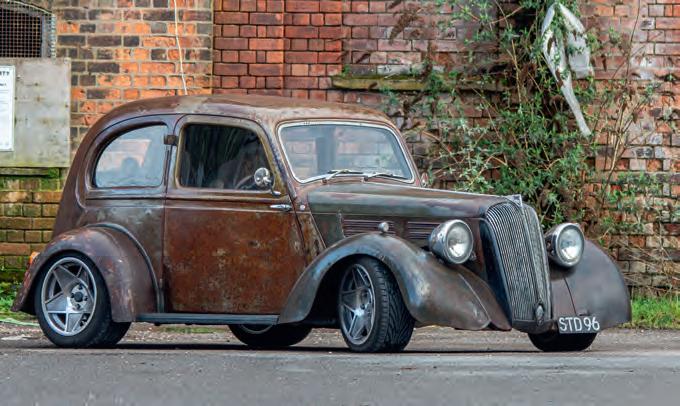
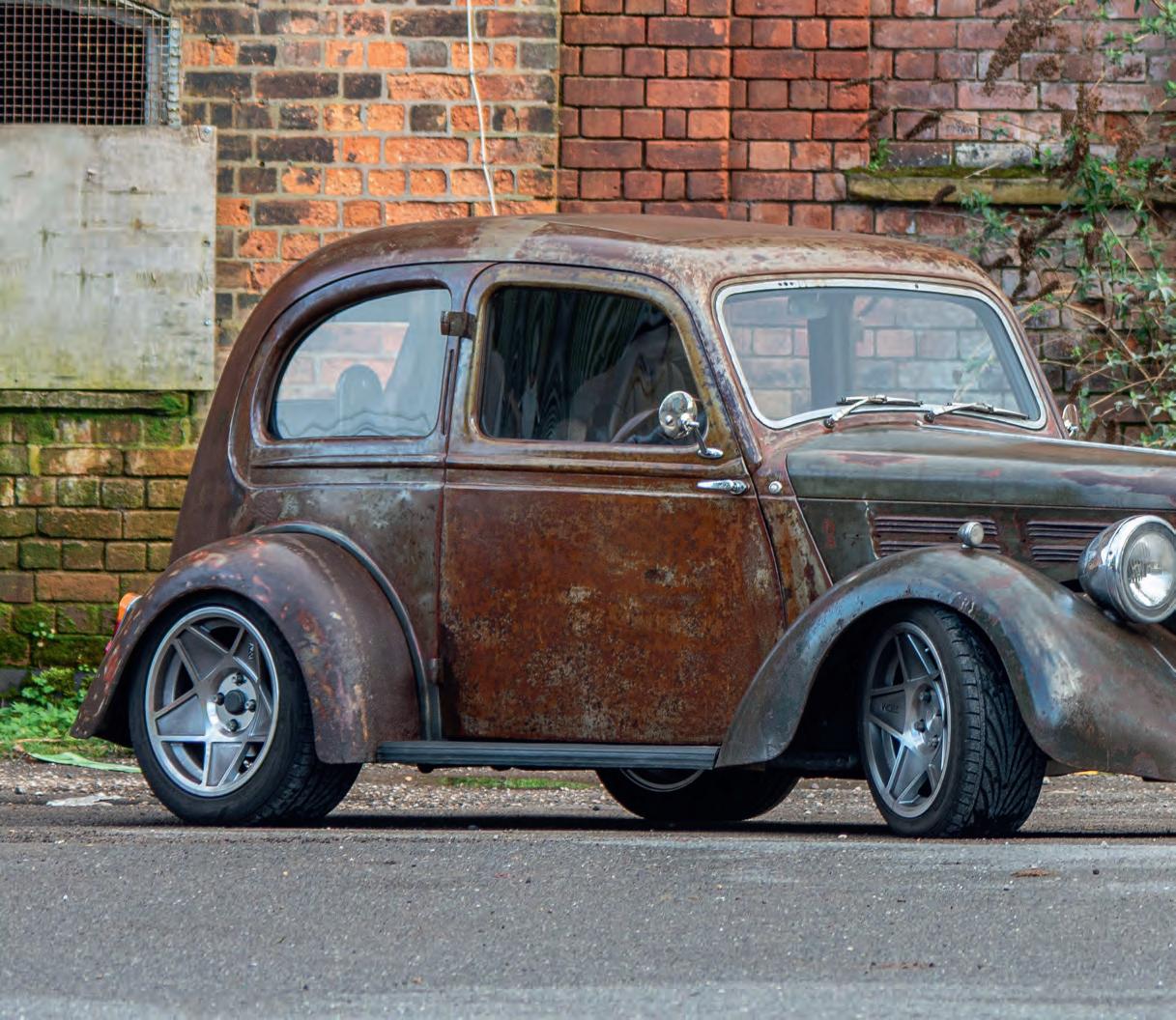
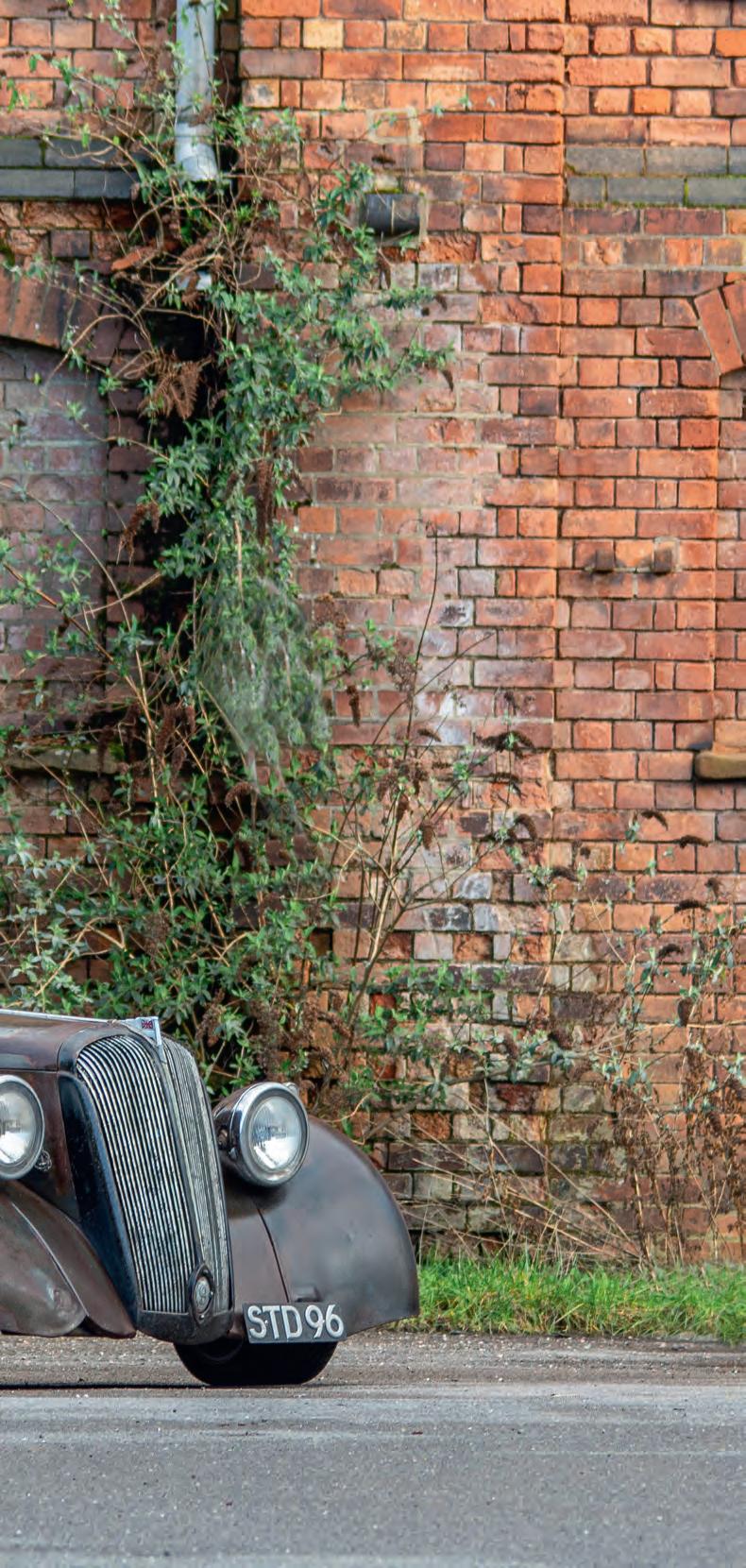
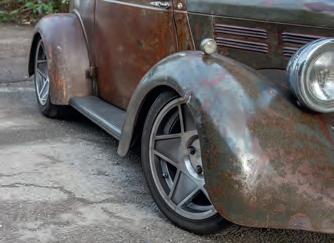
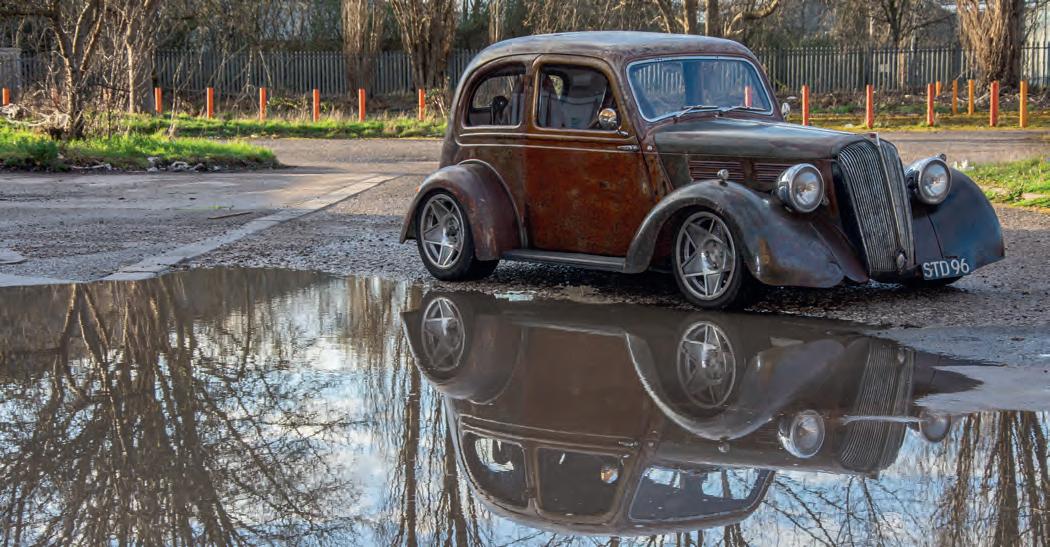
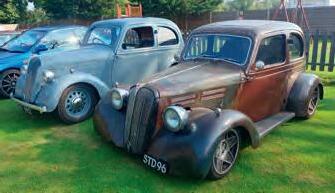
Front wings are original, albeit with spacer panels added to make them about six inches wider each, while the rears are heavily modded Volkswagen Beetle units. 3SDM alloys came with the car; ‘I like them,’ says Andy, ‘and haven’t seen any that I would rather have’
known as the ‘standard Standard,’ obviously. As for this one, as we’ve already said he got it from someone who, well, let’s say they appeared to have a rich vein of optimism running through them.
“The previous owner had bought a very ropey TVR Chimaera and had taken the TVR bodyshell off,” explains Andy. “He bought the Standard bodyshell from a breaker and got as far as sitting it on top of the chassis and tack welding it roughly in place.
“The first job was to do a full mechanical rebuild on the chassis (which needed lots of welding) and the TVR mechanicals. These TVR basically went through a full nut-and-
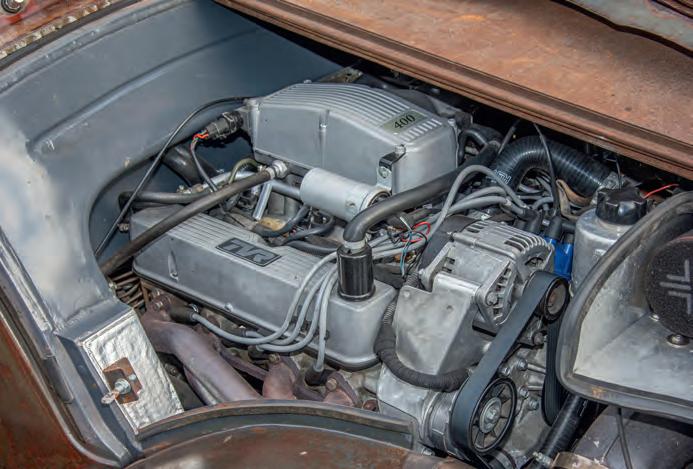
TVR used many incarnations of the Rover V8 down the years, some of them more heavily tuned than others. The 4.0-litre version taken from the Range Rover of the time was good for 190bhp in standard form; with the addition of flat-top pistons and a high-lift cam, this climbed to an official 275 and a commonly accepted 240. Dave reckons he’d be happy if his is still putting out 200 – what matters more to him is that it sounds like a hot rod should
bolt rebuild – the mechanicals underneath are all like new now.
Panel of expertise
“Once the chassis was sound and the mechanical bits sorted, I set to building all of the body panels to link the Standard bodyshell to the TVR chassis. I bought myself a bead roller and English wheel and set to fabricating the floors, transmission tunnel, inner arches, firewall and everything else. I used as many of the original TVR parts as I could, both to save cost and so that future servicing and troubleshooting is as easy as possible.”
As well as the chassis, the Chimaera gave up its suspension, brakes, steering and wiring loom (well, in part – half of it had been chopped out when Andy got the car), as well as the gearbox and a nice 4.0-litre Rover V8 to turn it. The latter is the version of the old Buick unit that went into entry-level Mk2 Range Rovers; TVR gave it flattop pistons and a high-lift camshaft, upping its compression ratio to 10.5:1 in the process, but that apart it was just as it
came out of the Land Rover factory. In the Range Rover, it produced 190bhp, whereas TVR quoted a figure of 275 that people tend
one is still doing 200, he’d be happy with that. In any case, he didn’t want a V8 for the performance, just the sound.
“Everything has been done by me and it’s all self-taught. The only thing I paid someone to do was cut the glass for the windows!”
to sneer at now. Accepted wisdom is that it put out 240bhp from new: Andy says if his
One mod he did make was with the suspension, where a set of coil-overs has
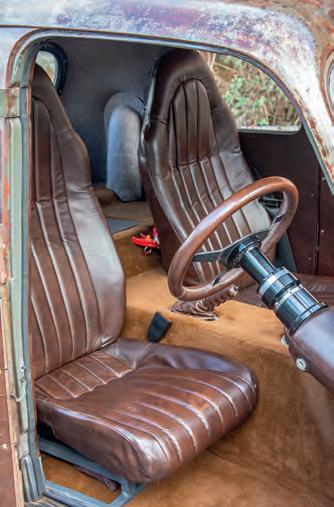
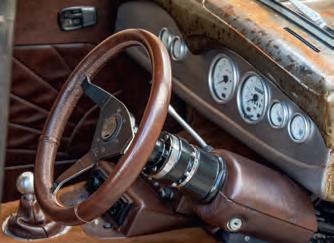
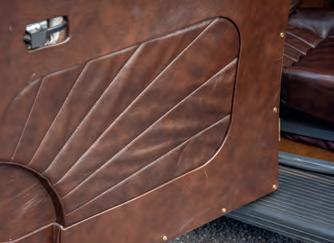
The first part of the project, which took around three years, started with a tatty Standard Flying 9 body held to a grotty TVR chassis by not that much more than gravity and ended with a car capable of getting through the MOT. That was only two thirds of the job, though: sorting the interior added another 18 months. Andy did the lot, teaching himself along the way when necessary. He bought an old sewing machine and some leather then trimmed the seats (modified Toyota MR2 units) and door panels – the latter with a nice art deco design radiating from a cut-out to make space for his right foot. He did the carpets and headlining, too, and added a vent panel in front of the original upper dash panel
it sitting a touch higher than the original springs. Shome mistake, shurely? No, actually: “I built the body a bit too low on the chassis and had to raise it up for the wheels to clear the wings,” admits Andy, with admirable candour.
Flying with wings
Which does indeed bring us nicely to the important bit. As we’ve already said, Andy fabbed all the metal you can’t see any more that was necessary to graft the Standard body on to the TVR frame, and there’s more handiwork on show up top. the front wings are original, but fitted with spacer panels to move them outwards by about six inches apiece, while the rears are heavily modified VW Beetle units.
“The hardest part,” says Andy, “was getting the wings sitting in the right place. I only have a single-width garage so I would mock everything up and then have to tow the car up my steep driveway and on to the road to get a proper view of how it looked. This drove me crazy!”
The tail-light clusters on the real wings are from an old-shape Mini. Up front, Andy made the headlamps using outer shells he bought on eBay. He fabricated some perspex rings to fit modern 7-inch sealed beam units into the 9-inch shells, “to pass an MOT and allow me to actually see at night.”
There’s a part of us, we must confess, that can’t help picturing the car with a really nice paint finish. But we also agree that it looks absolutely right the way Andy’s done it.
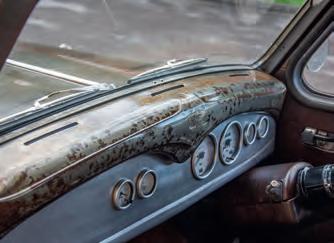
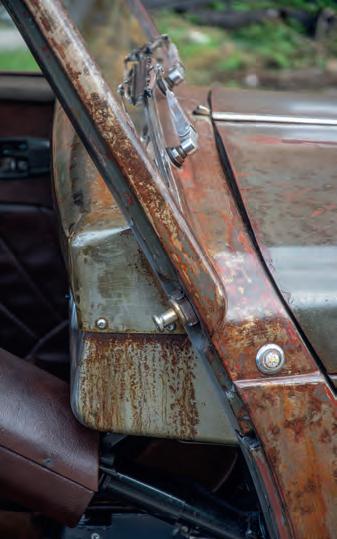
“Some of the rust is real and some is fake,” he laughs. Either way, having done the fab work he just gave it a couple of coats of Owatrol Oil to stop it getting all too real and that’s how you see it now.
Inside, the lower dash panel is a complete one-off which Andy fabricated by hand. The upper panel is original, in some form, however he moved it backwards into the cabin by two inches in order to fit in proper air vents for demisting the screen. The air comes from a proper heater, too, and even more outlandishly the door windows are electric “as I couldn’t find a good spot to locate a manual winder handle.”
Sunny disposition
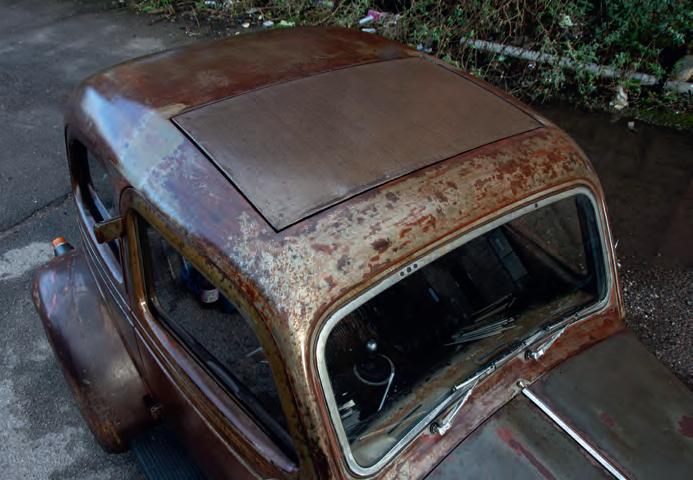
Air-con would be a luxury too far but the Flying 9 came with a sunroof as standard. It was made of wood and fabric and was liable to fly away if you made it up to 40mph (a rare achievement, possibly, with the factory engine being a 1131cc four-pot chugging out a mighty 30bhp), so Andy replaced it with a steel one that only shifts when it’s shifted. He’s done a pretty heat job of trimming the headlining, too; the door cards and carpets are all his own work, as is the leather on a pair of Toyota MR2 seats which he modified heavily to make them fit.
“I bought a vintage Singer sewing machine and some leather and taught myself how to
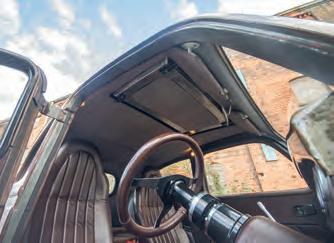
The Flying 9 came as standard with a wood and fabric sunroof, which was loved nothing more than to take flight when the car reached heady speeds like 40mph. Not ideal when you’re packing a TVR-tuned V8, so Andy replaced it with a proper one made of steel
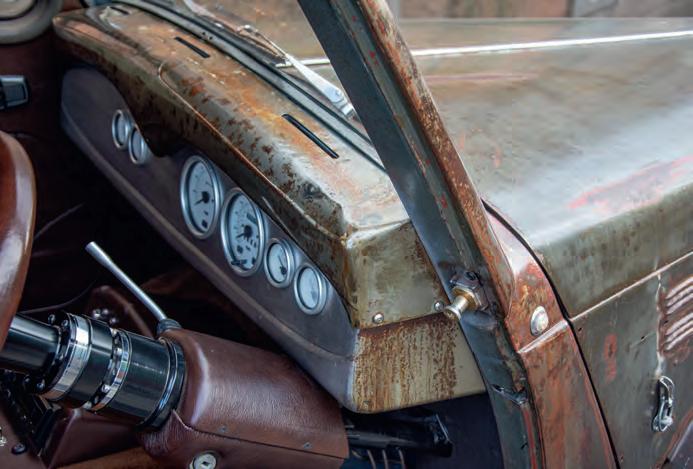
The lower dash panel is a complete one-off which Andy fabricated by hand. Above it, the upper part of the structure is original but not in its original position. Andy moved it backwards by two inches to make room for a proper ventilation system, complete with a heater
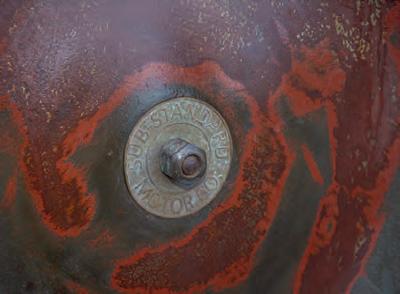
do upholstery!” he says. You may or may not call it a hot rod but the DIY attitude is there in everything he’s done. “Everything on the car has been done by me and it’s all selftaught. The only thing I paid someone to do was cut the glass for the windows!” He even made his own etched brass ‘Sub-Standard’ tailgate badge.
That’s a reference to what a few people have accused the car of being on social media. Light-heartedly, you’d hope, though there’s always one who can’t help himself. Not that Andy’s likely to care much about that guy, because whatever you call the car he says it’s turned out better than he expected. “It’s great to drive and you can really just jump in it and go anywhere in relative comfort. It’ll cruise happily on long motorway journeys but handles (like a TVR) on winding country lanes.”
So he’s got a car that meant he didn’t have to decide between a pre-war and a TVR, and now all he has to do is decide between one Standard and another. “Everyone asks which I prefer driving,” he confirms. Add us to that list, then. “I have to say that I love them both but in completely different ways. The smell,
sound, feel and challenge of the vintage Standard on a summer evening potter is wonderful. Equally, the hot rod is brilliant for longer journeys and ‘spirited’ driving. And it gets smiles and waves whenever I drive it.” Always helps when you’ve got a tricky choice to make. CC
we know which one you’d spent more time poking around if you saw them together
My other car’s a… Standard Flying 9. Andy says they’re very different to drive but he loves them both. You can’t blame him, though we suspect
Home Pro Deuced again
Many rot rods are instantly recognisable by the name given to them by the original builder. Occasionally, all it takes is a registration number
Words: Dave Biggadyke Pics: Alan Kidd
“
It’s arrived,” was the statement emblazoned across the cover of the December ’86 issue of Street Machine magazine. That was a reference to the Pro Street build-style phenomenon that had been stomping across America for some time. Four UK-built Pro Streeters adorned the cover, with the one taking centre stage most certainly shouting the arrival of the radical style the loudest.
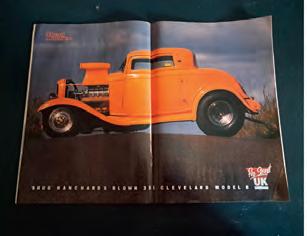
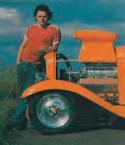
Written by Tony Beadle, the feature inside followed on from the header “Home Pro Deuced, a witty play on words that I couldn’t resist plagiarising for this follow-up feature 40 years later. Built by Scottish hot rodder Shug Hanchard, the very orange Deuce coupe boasted all the features expected of a Pro Street build, and more besides.
The chopped 3-window body sat atop Deuce Factory rails, heavily modified Pro Street style. A dropped tube axle hung
under the front, while at the rear, a severely narrowed Ford 9-inch axle kept the Mickey Thompson wrapped 15x15 Center Lines apart. The 351 Cleveland was fitted with +40 thou forged pistons and a GMC 6-71 blower was towered over by the most menacing snorkel scoop I’ve ever come across. In keeping with an ethos that said all-action, plenty of traction, bolted to the back of the Ford V8 was a 4-speed top loader gearbox.
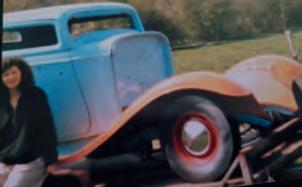
The Pro Street Deuce was far removed from how Shug had first built it, as it had a far more traditional look when it first hit the road. The orange paint came about following the car’s second rebuild, and Shug radically changed the coupe’s appearance once more when he still owned it.
Shug ultimately relocated over the Pond and expanded his hot rodding activities to include Lakes racing. Prior to that, though, he added one last twist to this story.
Parting company
Shug made the decision to part out the coupe, and the first to come knocking on his door were Richard Hughes and Mick Tebbs. The pair left having scored the blown 351 Cleveland, the C4 transmission that was fitted at the time and the narrowed 9-inch nodular casing, with added extras. That was circa 1988 / ’89, and everything was destined for a new life in the Fordson van that Richard owns, the equally iconic Speed Freak.
The Street Machine cover in 1986 announcing the arrival of Pro Street in the UK. Undoubtedly, version two of the coupe that Shug built is the most striking
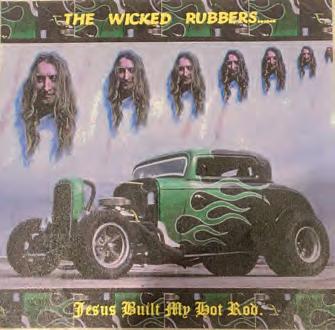
The coupe even made it on to a record sleeve Pic: Simon Prest
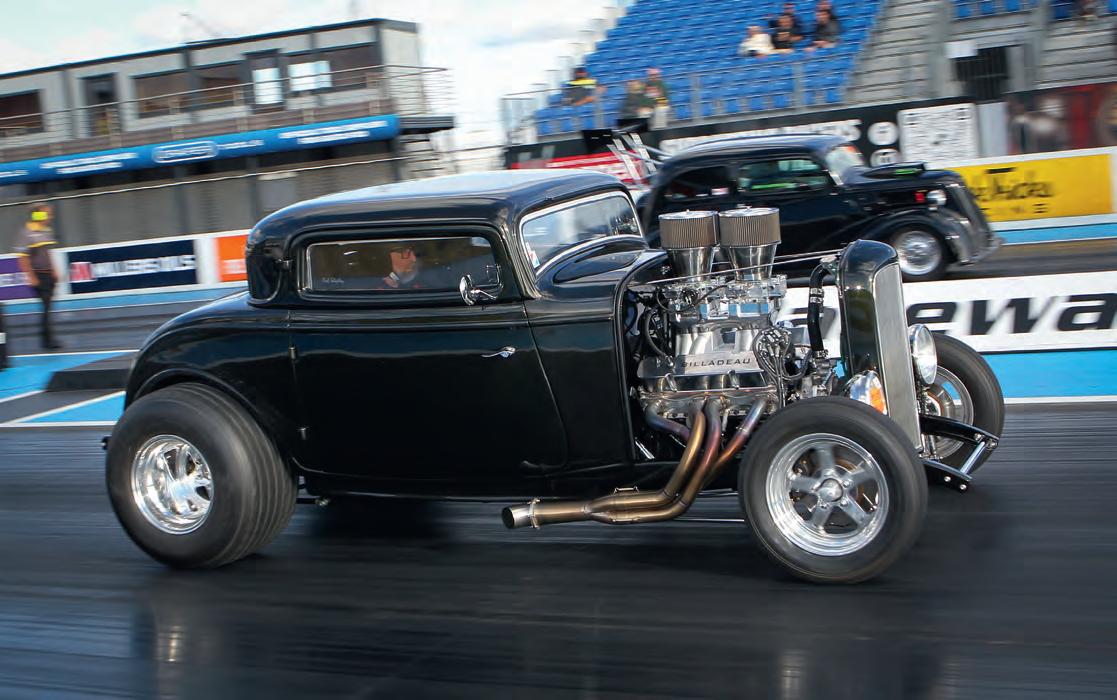
Rob took the coupe to the Hot Rod Drags last September, fully intending to do a 17-second shakedown run as the steering wasn’t 100% dialled in. The three timing slips he went home with read 12.8, 12.1 and 11.8, all just running the trans’ in drive
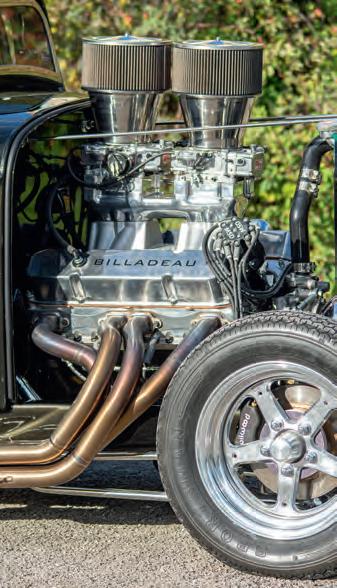
The engine is a 440ci Chrysler taken from a Jensen, mated to a 727 TorqueFlite 3-speed auto. Rebuilt by Dave Billadeau, the decked block has been overbored and fitted with ICON pistons and rods, a polished crank and Edelbrock E-Street heads. Topped off with a pair of 450cfm Holley carbs on a Weiand tunnel ram, the engine has been dyno’d at 510hp. The carbs are fed by a Bosch high-pressure fuel pump, the awesome headers are by OJZ Engineering and as the first one split, cooling is now taken care of by a version 2 ali radiator
Stewart Johnston then came along and bought all that was left, along with a replacement small block Ford, transmission and rear axle. The package he purchased included the original red and cream tuck ‘n’ roll interior and the wings, which had been cut up to make cycle fenders. Stewart got them ‘glassed back together and began rebuilding the car – until he needed to raise funds to buy Colin Millar’s old Pop.
Circa 1992, Stewart advertised the unfinished coupe for sale. Simon Prest, who currently drives The ROCKET ’64 Comet in Gasser Circus, struck a deal and spent the next four years stamping his mark on the coupe. Then, in 1998, Rob Shipley, who had recently finished building a ’66 Ford Galaxie, spotted Simon driving into a show and immediately asked if he would sell the coupe to him. Simon’s initial response wasn’t favourable, but Rob was persistent and when Simon found himself needing to raise money for a house deposit, the pair agreed on a deal. With the Galaxie rehomed, Rob drove the coupe just as it was for about a year and clocked a PB of 13.2 seconds at the Pod during that time. Fate then took a hand, though, as when chasing a Jag down the M1 on the way home, one of the front brake calipers parted company with its mount. The front wheel locked but fortunately, Rob was able to safely guide the car into a service station.
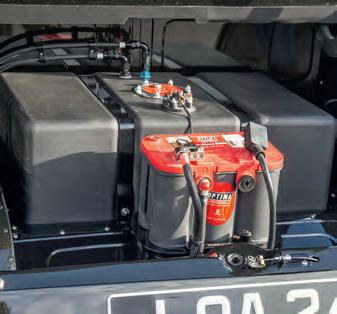
You have to travel light if you drive a Pro Street coupe. Boot luggage space is non-existent thanks to the wheel tubs, fuel cell and Optima battery
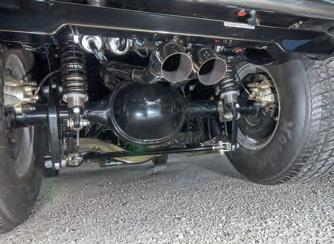
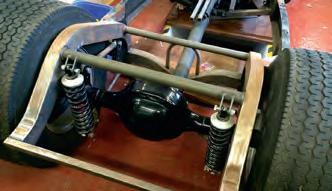
The Ford 9-inch rear axle features a smooth casing, a Truetrac centre diff with 4.00 gears, and disc brakes. Axle location is taken care of by short 4-bars and a Panhard rod, with a pair of coilovers completing the installation. The upgrade to a 3-inch exhaust system will prove to be a tight fit
Pic: Julian Hunt
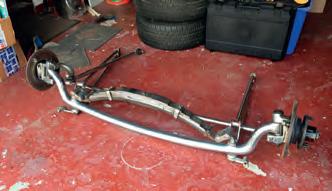
The 5-inch dropped I beam helps keep the front end down in the weeds. Installation was straightforward thanks to buying the complete package from the same source, with Jon Golding even fitting the kingpins when Rob collected it and giving invaluable advice on installing it all
“A quick rebuild was a better option”
Chopping and changing
Rob decided that rather than just repairing the car, a quick rebuild was a better option. Like that ever happens, eh?
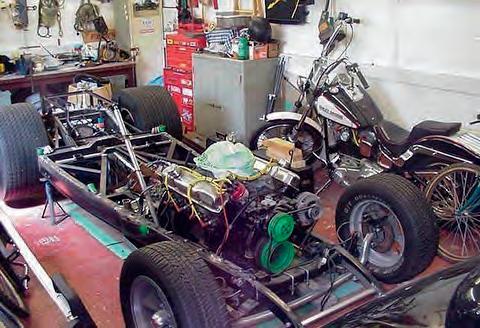
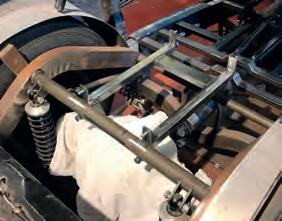
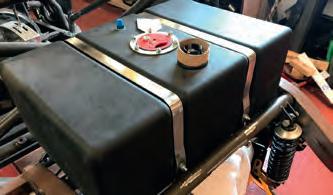
Separating the body from the chassis involved cutting out the rollcage and, as the small ali tank was never going to be up to the thirst of a big block 440, he planned to fit a larger capacity fuel cell. That, however, wasn’t straightforward, as the only way to achieve it was to chop off the rear chassis
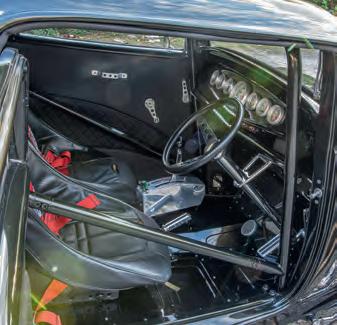
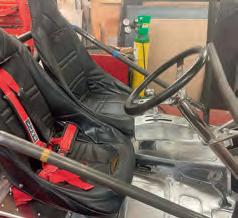
The rollcage is such a tight fit that it has to be assembled once the body is in place, but it is in keeping with the minimalistic race-style interior. The Limeworks steering column replaces the original VW item that Rob was never a fan of, and a B&M Quicksilver shifter brings the TorqueFlite to life. The smoothed-out dash is home to a complement of AutoMeter Pro-Comp gauges. Rob finds the flat-top trans’ tunnel makes for a great footrest
rails, the outboard shocks and ladder bars being in the way.
Hauser Race Cars was selling rear clip sections for full-size cars, and Rob had a chat with them. “The guys were mint,” he enthused. “They made a bespoke rear clip to suit the ’32 chassis, complete with supershort 4 bars, and a Panhard rod.” The Hauser Hot Rod 9-inch Ford axle housing was fitted with a 4.00:1 geared Truetrac diff, together with a Ford disc brake pack.
With the rear clip and axle installed, attention turned to the rest of the chassis. The rails, still C-section in parts, were strengthened, and numerous surplus holes were welded up.
The rebuild was progressing well but then it ground to a halt, with Rob confessing to a gap of several years in the work schedule. Once back on it, he focused on the front axle and suspension. “The drop tube was fitted with Sherpa spindles and Ford disc
Prest
Simon
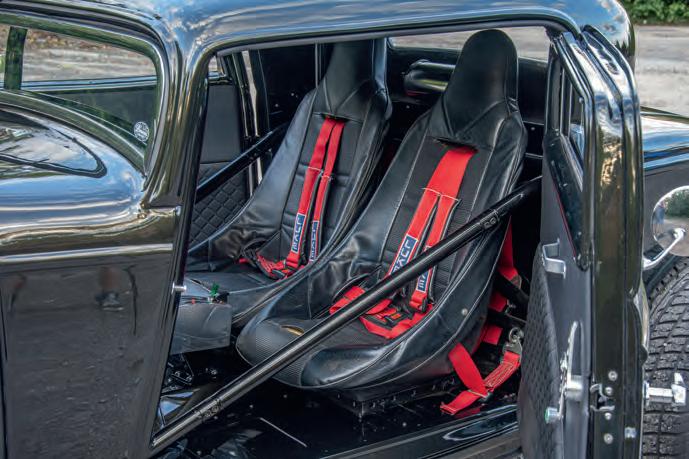
fitted a pair of JAZ bucket seats when he had the coupe over 30 years ago, and they’re still in there now. A pair of Luke harnesses keeps Rob and Sally firmly in their place and, as a concession to creature comfort, Rob made up the door cards and had them trimmed in black vinyl
Pro forma
The coupe 20 plus years ago, before Rob embarked on the ‘quick rebuild’
Under the bespoke Hauser rear clip, the 9-inch axle installation features short 4-bars and inboard coilovers
Rob was never keen on the VW bus steering as the column pointed straight at his chest and the box hung down below the chassis…
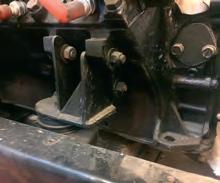
The engine mounts were obtrusive when it came to connecting the steering shafts to the box…
Rob had fresh tube sections bent, then notched and tack-welded them into place, with Ben Dexter TIG welding the joints. As the body wouldn’t drop over the assembled cage…
…to position it higher. This was then finished off with a filler plate
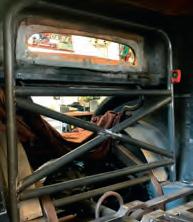
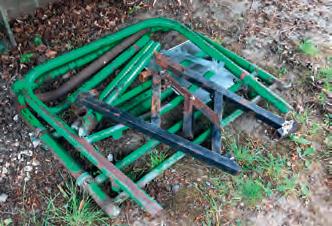
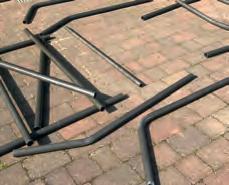
The original 2-inch seamed pipe roll cage had to be cut into sections to get the body off the chassis
The catalyst behind the rebuild was a snapped brake caliper mounting lug. As new parts were not available, and machining costs prohibitive…
The coupe’s original chassis features Pro Street-style rear rails fabricated by Shug Hanchard
…so he replaced it with a Vega box included as part of the frontend package supplied by Home Grown Hot Rods 6.
…Rob removed the front axle assembly and gave it to a mate for his Pop
…so Rob designed more streamlined alternatives that utilised polyurethane bushes 12.
…it features notchable tube joiners supplied by Oddrods to facilitate assembly in situ
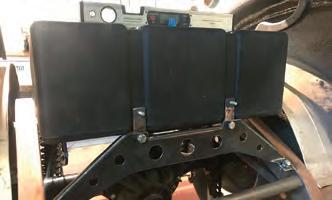
No clearance issues now. The cell is secured by homemade tank straps
That package also included weld-on brackets for the transverse leaf spring to eliminate the need for the original U-bolts
The sections of the original roll cage were used as templates for the new one
As the fuel cell fouled on the rear crossmember, Rob fabricated a mounting cradle…
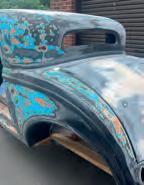
As close inspection revealed the body needed a lot of attention, Rob called upon the services of Coging Motorsport 15. 18.
The body was stripped back to its bare bones…
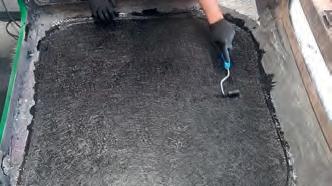
To get the boot lid to fit properly, it was sectioned into 4 pieces and then ‘glassed back together
After a mate had TIG welded it all, Harry at Briteworx worked his magic to obtain a mirror finish
Although he says he’s no fab guy, he and Sally have done a great job in our book
…which included removing the ali roof panel that had been pop riveted in place
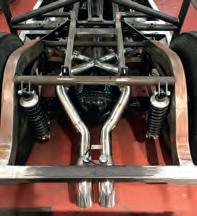
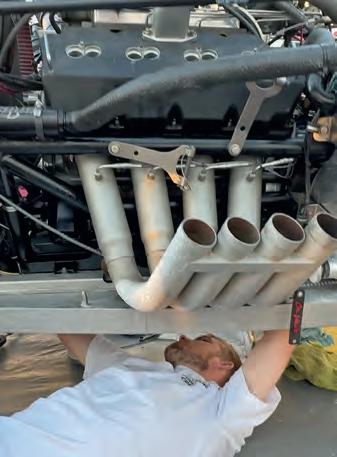
Rob fabricated the 2¼ inch stainless steel exhaust system using preformed bends tack welded together…
Having bought a bead roller from Wayne at Oddrods, Rob set about forming the individual floor panels from sheet steel…
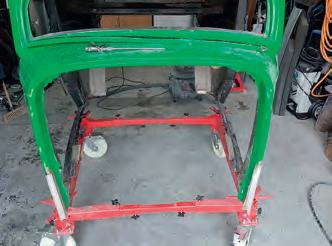
To make life easier when tackling all the finishing work on the chassis, Rob designed and fabricated a rotisserie. With everything smoothed, the finish TIG welding was handled by a mate
The seats bolted in place and the brake pedal fabricated and fitted
Along with sorting the roof, a new firewall and smoothed-out dashboard were formed, while Rob fitted bear claw latches and MG window regulators to the doors
Rob handled the labourintensive body prep himself
With the chassis and floor panels painted and the bracketry powder coated, the rolling chassis was assembled for the final time When Rob collected the freshly painted body from GB Flint Coachworks, he was more than happy with the finish
Ben at Vapourworx cleaned up the bottom half of the tunnel ram, while Rob’s nephew Marc O’Donnell got the riser block milled out full bore to accept dual Holley carbs …ensuring everything was tucked up as high as possible
…helped by his wife, Sally, who he says became really good at being Windy Miller by the end of it all
A coat of many colours indeed, and each of them has a story to tell
Gently does it. Lowering the body on to the chassis involves lifting it at an angle then twisting it straight as it’s lowered. It really is a 6-man job
Progression
Our research has turned up seven different incarnations of LOA 24. No mean feat, especially as it’s spent over the last quarter of a century off the road.
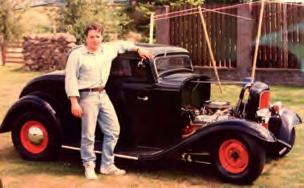
Shug’s initial build of the coupe was old school style, painted black and rolling on red steels
The coupe’s most auspicious guise, which Shug revealed to the world in 1986. Does anyone know what happened to that domineering scoop?
Shug then got the Pro Street bug and revamped the car accordingly, but still left it painted black
radical
in
to a
brakes, and the cost of making new parts was prohibitive. I spoke with Jon Golding at Home Grown Hot Rods, and he sorted me out with an I beam axle and everything to go with it. I must say Jon is a mint bloke and he helped me loads.”
Bracketry was made in readiness for fitting ancillary components and, as they would hamper installation of the steering, the engine mounts were ground off. Rob
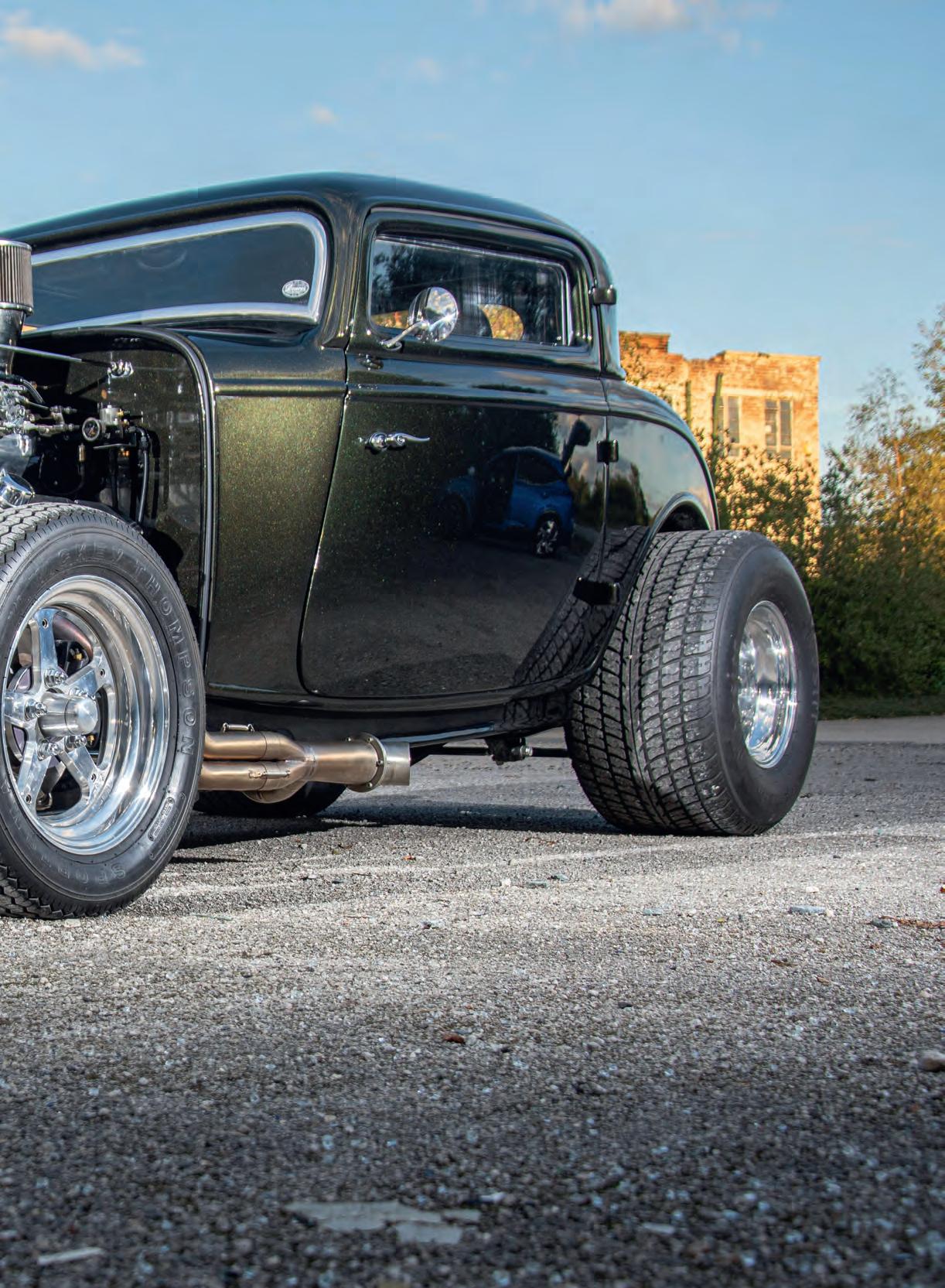
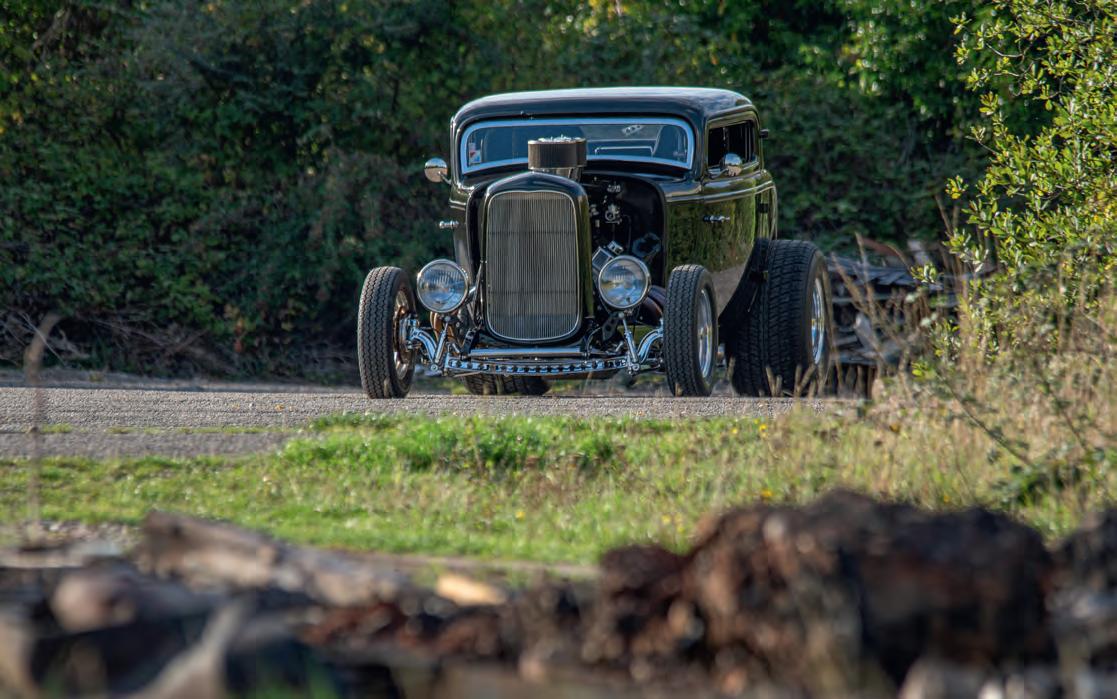
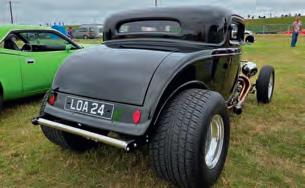
Rear wheels are 14 x 15-inch Weld Prostars smothered with 31x16.50x15 Hoosier Pro Street rubber, and the fronts are 5x15-inch Drag Stars wearing 26x7.50-15 Mickey Thompson Sportsmans. The paintwork was expertly handled by GB Flint Coachworks. The colour – no, it’s not black as you may first think – is actually Honda Dark Olive Green Metallic
Stewart Johnston rebuilt it in a similar fashion to its first incarnation, fully fendered, painted black with a mural on the boot lid and rolling on red steels. He never did get it on the road, though
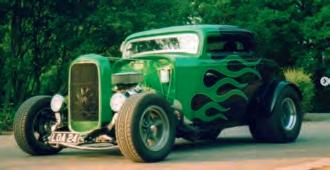
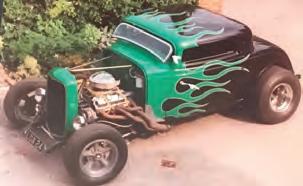
Simon Prest returned the coupe to Pro Street, albeit without a blower. The paint was enhanced with green flames, power came from a 440ci Chrysler and the car rolled on rare Rocket 5-spokes and bespoke Revolution split rims
The final incarnation, at least for now. Rob Shipley rebuilt LOA 24 over a 26-year period and honed it into a true Pro Streeter of modern times
A
change
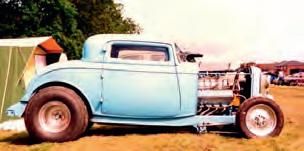
appearance came next, with Shug going fenderless, painting the body baby blue and toning down the scoop
Pics: Simon Prest
Pics: Street Machine
Pics: Stewart Johnston
Pics: Rob Shipley
Pic: Rob Shipley
Pic: Stewart Johnston
Pics: Rob Shipley
Pic: Rob Shipley
Having switched
pair of bucket seats, Simon Prest held on to the bench seat originally fitted in the car. He also did a deal with Rob, resulting in the Rocket 5-spokes he had fitted now hanging on his garage wall
Pic: Simon Prest
“A gap of several years in the work schedule”
fabricated fresh mounts, which he tacked into place before having them fully TIG welded. With the chassis work complete, Rob formed the steel sections for a new floor.
He then turned his attention to the ‘glass body of unknown original origin. “It was in need of lots of work, in particular the ali roof panel that was pop riveted in place,” he recalled. Steve Brindle of Outlaw Anglia suggested that I take it to fiberglass specialist Ian Coging at Coging Motorsport in Wellingborough. He was amazing, and I cannot recommend him highly enough.”
The engine was next in line for attention. “It had sat for a few years,” Rob elaborated. “Only one bloke’s name is ever mentioned when it comes to Mopars: Dave Billadeau. He convinced me that building it in the region of 500hp would be within my budget. He put all the right bits in and even decked the block, and it ended up at 510hp on the dyno. Dave’s only comment was, ‘ya exhaust will be too small now,’ and he was bang on.”
Coming together
Rob assembled everything one last time for a final dry build, ensuring that fitment was
as good as he could possibly get it. He then pulled it all apart again and sent the chassis and floor panels off to the paint shop, while the bracketry went the way of the powder coaters and came back nicely finished in black.
With the rolling chassis assembled, the freshly painted body was carefully lowered into place over the rear roll hoop. The rest of the roll cage went in, the doors went on, and Adam at Down to Earth Auto Electrics sorted the one-off wiring.
Rob gave us his take on the build. “I bought good second-hand parts whenever I could, or new if I had to. There was lots of forward planning, with the build based on an amalgamation of Simon’s black and green flamed version and Shug’s blue version.
“Inevitably, some things changed along the way, such as the headers. At the eleventh hour, I decided the ones I had weren’t doing the car justice, and I took the coupe to Lance at OJZ Engineering in Newark. I gave him a couple of pics and a brief description, and four days later, wow!
“Ultimately, fire-up day came. I was nervous as hell but boy, what a relief when
“Thanks to Hauser Race Cars, Billadeau Speed & Automotive, Coging Motorsport, Home Grown Hot Rods, Wayne at Oddrods Customs, Ben Dexter, Harry at Briteworx, Down to Earth Auto Electrics, OJZ Engineering, Russ Pepper of R&R Imports, Ben at Vapourworx, Marc O’Donnell, Chris Goodale of Goodale American Speedshop and Wayne at GB Flint Coachworks. Special thanks to my wife Sally – the coupe wouldn’t be together if it hadn’t been for her pushing me on.”
The peep mirrors and door handles are new repro, while the rear lights are LED versions of the ones Shug fitted all those years ago. This time round, though, they are flush-fitted on proper brackets, not held in place with silicone and glue as before
the motor lit. The timing was off and the fuel pressure was out, but it ran.
“I took the coupe to a show at Great Northern Classics in Derby and did a few local events, one with Simon Prest and The ROCKET turning up on open headers – mint. I won a Top Five award, too. There have been niggles and things I’m not happy with, but it’s close to what my idea was and that has to be a good thing, right? I’m now looking forward to 2026 when I can actually drive and race it a little!”
We asked Rob how the coupe drives and why he kept it right-hand drive, as it would have probably been easier to switch to the other side. “It drives better than expected. Potholes are no friend of the I beam front end, though. As for the steering wheel being on the right, that’s in the DNA of LOA 24.”
Rob did confess that a few changes may be on the cards, like fresh seats and door cards, and he confirmed the exhaust is definitely coming off in favour of a 3-inch system. He also mentioned that originally the coupe was to be 70% street and 30% strip… but only time will tell if that will always be the case. CC
Castle Cruise Nights
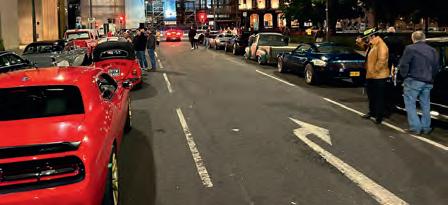
Spawned from the popularity of the Merchant Cruise Nights in Glasgow, the inaugural Castle Cruise in Edinburgh was held on Saturday 20 September. The planning was meticulous, with the route carefully chosen to make the most of all the city’s photogenic offerings.
It kicked off with a meet-up in Shawfair, on the outskirts of the city, for a bite to eat. Then at 7pm, engines were fired up and the cruise headed off to the first catch-up point in Holyrood Park Road. It was then onwards
Pics: Gordon Elder
to the old town, passing under bridges and on to the history-steeped Grassmarket, with the final destination being Kings Stables Road, which joins the old and New Town areas. For those wanting to show off their rides to the full, there was also a circular city centre cruise route.
Subsequent cruise nights have included Hell on Wheels, a Halloween special in October, followed by the All Hallows Night Cruise the following day. The weather didn’t dampen spirits, with attendees dressing up both themselves and their rides.
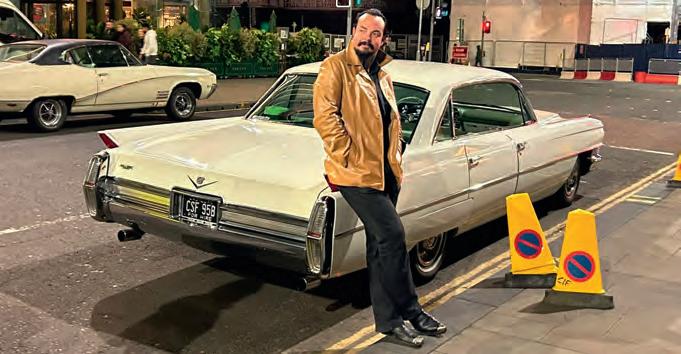
Levi Tusoon posing with his ‘64 Cadillac opposite The Ivy in St Andrew Square
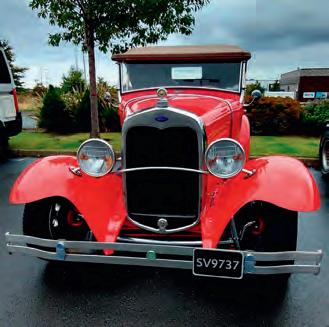
Graham Dickie’s small block-powered Model A roadster in the car park at the Old Colliery in Shawfair, before the cruisers headed off to Edinburgh’s old town
Despite this ’29 Model A sedan being parked next to an EV charging station, we can assure you its only green credential is the colour of the paint
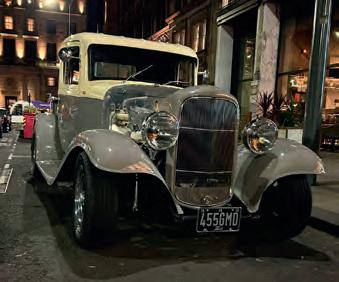
Left: It took Niz Hasham five years to complete the rebuild of his Rover V8-powered ’32 pick-up. That was time well spent in our book
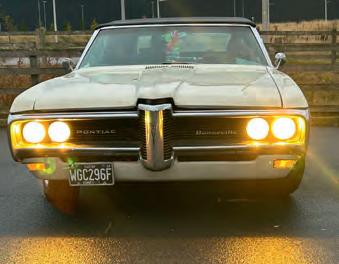
Laurence Macgillivray is a regular cruise attendee in his ‘68 Pontiac Bonneville
The cruisers enhance the picturesque Victoria Street, with its winding cobbles and colourful facades
Right: The Castle Cruise welcomes all manner of interesting vehicles from classic Yanks to muscle cars, VWs to hot rods, and everything in between
Albert Houston in his ’55 Buick was another calling in at St Andrew Square
Now owned by Adam Evans, this ‘68 Pontiac has a racing pedigree, having previously pounded the strip under the name of Boozy Suzie
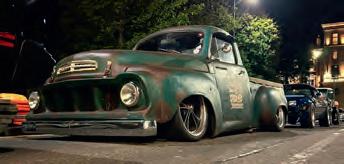
Scott Fairbairn is the man behind the wheel of the Hunwick’s Hot Rods Studebaker pick-up
■ Words: Olly Sack
■ Pics: Julian Hunt
And nally…
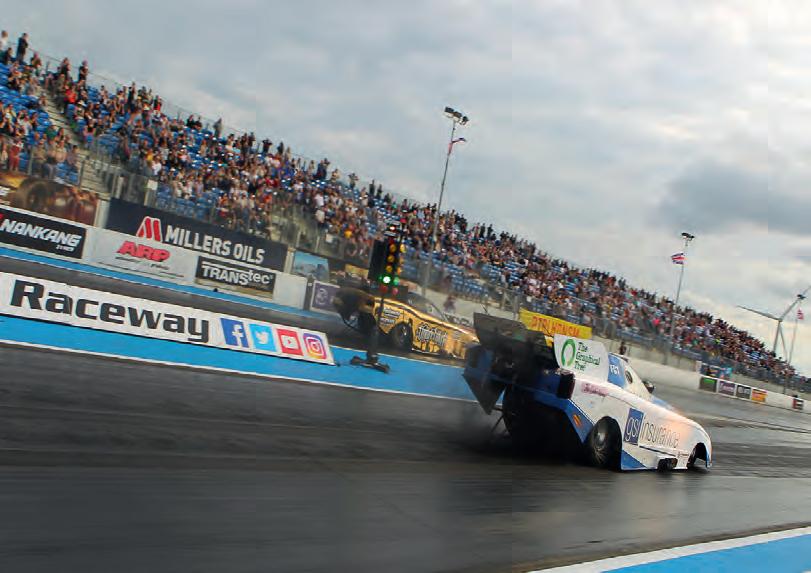
Europe descended on Santa Pod for the 2025 Euro Finals, as the FIA’s Drag Racing Championship came to a dramatic conclusion
With racers and fans coming from across Europe to witness the climax to the season’s pro drag racing season, the Euro Finals are Santa Pod’s biggest event of the year. Four full days of qualifiers and eliminations, plus a test day beforehand, makes for a festival of high-powered action lasting almost a whole week – and to make the most of it, this year the competition couldn’t have been tighter.
Of the four classes making up the FIA European Drag Racing Championship, only one was decided early in the elimination
Comp Eliminator
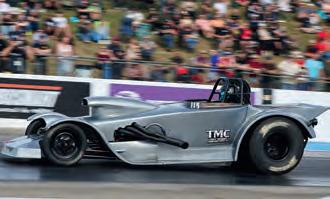
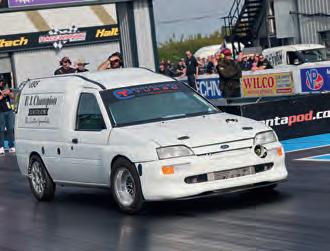
Comp Eliminator got underway on the Thursday afternoon, with Terry Newton posting the latest in a succession of record times aboard his Escort van – 8.6148/174.27 this time, meaning the world’s fastest front wheel drive Ford is now faster still. And he wasn’t the only one making waves, as a series of PBs from Ben
rounds. Even that was on the final day of the event, but the other three went still further. Believe it or not, the 2025 Pro Stock, Top Fuel and Top Methanol titles were all decided by the final pairing of the final event of the season. It certainly ensured that the action stayed as keen as ever as Sunday afternoon wore into evening.
In addition to those four FIA classes, there were eight sportsman categories – ensuring no shortage of variety. There might not be too many nostalgia racers on show, but those that do take part mix it
with everything from Pro Mod monsters to Junior Dragsters campaigned by the stars of tomorrow.
There was nothing more than the occasional sprinkling of rain to interrupt proceedings, and no significant incidents on the track. A few flirtations with the walls here and there and one or two wild rides, but mainly it was five long days of top quality racing. Congratulations to the FIA’s 2025 champions; they, and everyone else, are already well on their way to readying their cars for 2026 and another great season to come.
Mace culminated in his VW-engined Altered becoming the first of its kind ever to run in the 6s.
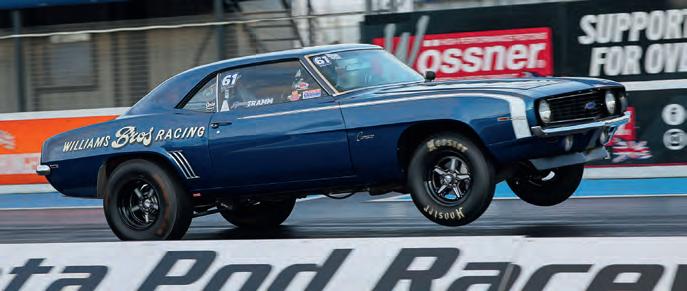
Emma Goddard was in the PBs during qualifying too, but then the second round of eliminations saw no-shows from both her and Mace, presenting walkovers to Spencer Tramm and Rouven Dawson respectively – not people you’d tend to
think of as needing any extra help. Dan Williams got a free pass too, when Luke Stevenson stalled at the tree. Lloyd Perkins then got a bye in the semis after beating Phil Norman in E3, but his car had had enough – meaning Williams, who had prevailed over Gary Carr in E3 and Tramm in their semi, was able to cruise to the win in the final.
Super Gas
Highlights of Super Gas qualifying included a 0.006 RT for Andy Harrison in Q2 and a monster wheelie for Sara Unsworth in Q3. Unsworth was out in E1, beaten by Wayne Hiscock, but Harrison made it as far as E3 before coming up against Marc Huxley.
Huxley’s opponent in the semi-finals, Bob Molden, was double-classing in Super Gas and Pro ET. He fell at the penultimate hurdle in each, however, as Huxley progressed to the final – where Dave Fulton’s 9.9902/127.98 was too much for him.
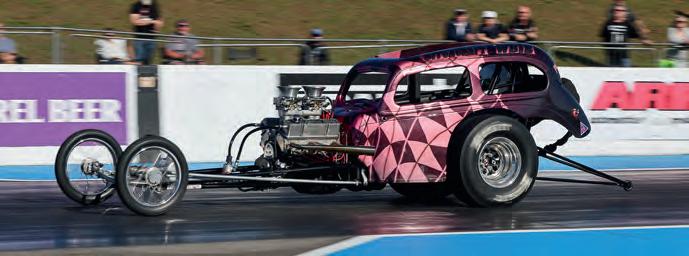
Terry Newton Ben Mace
Dan Williams
Dave Fulton
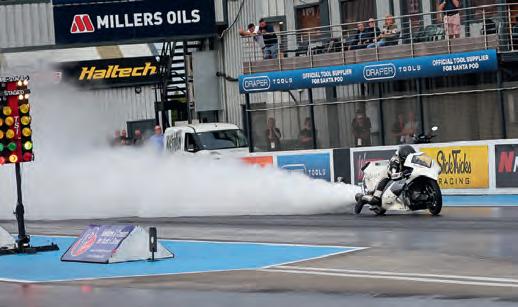
We don’t normally cover bikes, and we don’t normally cover demo runs either. But we’ll make an exception for Graham Sykes. Friday saw him take his Force of Nature steam bike to
Final Countdowns
The 2025 FIA European Drag Racing Championship reached its conclusion at the Euro Finals, with three of the four categories being decided by the last race of the season. As usual, the majority of the entries were from Scandinavia – though with enough competition from elsewhere on the continent, not to mention back home in the UK, to make sure the top dogs didn’t have it all their own way
FIA Top Fuel
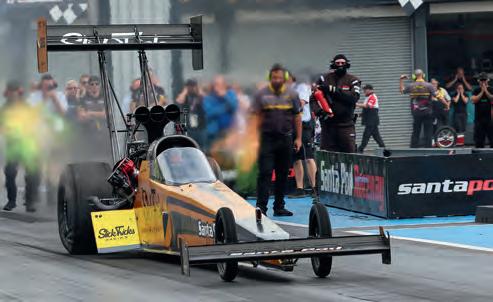
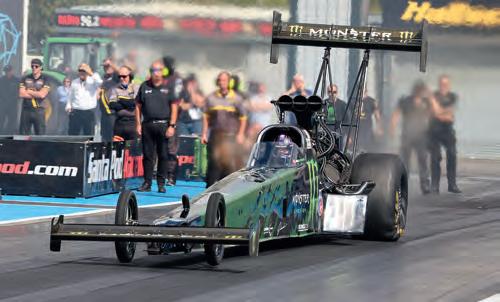
Top Fuel was the last of the four FIA classes to hit the track, with Jndia Erbacher putting on a hefty burnout to get the show started. She spent Friday night at the top of the qualifying list, too, a 3.8926/313.47 putting her ahead
of Britain’s Liam Jones by 0.0061 after the latter had gone fastest in Q1. The two traded the lead in Q3, but then Susanne Callin came through when it mattered, 3.8926/313.47 in the final round of qualifying giving her the bye in Sunday’s semi finals.
FIA Top Methanol
Tony Bryntesson set the early pace in the first couple of qualifying rounds, with reigning champ Jonny Lagg struggling to make traction. But when the going gets tough, and all that… by the end of Q4, the Swede was back in the groove and back on top, thanks to a 5.2601/273.83 PB. Belgium’s
Here, wheelspin for Jones saw Erbacher into the final – a winner-takes-all contest with Callin. Erbacher’s defence of her 2024 title foundered on a 4.3409/207.68 run, however, as Susanne Callin put in a 3.9456/271.79 pass to become European Top Fuel champion for the first time.
Sandro Bellio, who bookended the lockdown years by winning the title in 2019 and 2022, was lurking in second.
The following afternoon, E1 suffered a somewhat unusual interruption when the tree broke down and had to be replaced. Tina Host Nedregard had put Bryntesson on the trailer by now, and when his turn came Bellio did the same to Silvio Strauch.
The semis were a bit of an anti-climax, with Bellio taking a bye and Lagg winning by default when Nedregard aborted after the burnout with engine issues, but the final was a proper winner-takes-all dice for the title. And it was Bellio who took it, a 5.5509/259.66 run taking the honours as he replaced Lagg to secure the third title of his career.
Susanne Callin
Sandro Bellio
Jndia Erbacher
Jonny Lagg
FIA Pro Stock
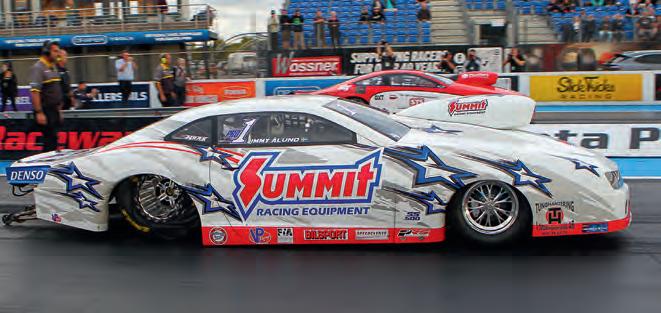
It was Jimmy Ålund first and Robin Norén second throughout qualifying, and both cruised through E1 – Norén when Michael Malmgren went into tyre shake and Ålund on a no-show by Henry Riehl. Ålund had a bye in the semis, while Norén was handed the win by a red light for Lasse Britsmar – but the final was the real deal.
As was also the case in Top Fuel and Top Methanol, the last race of the season decided the destination of the Pro Stock championship. Ålund knows all about winning it, with 13 titles in the bag so far – but the next one is going to have to wait, as Norén edged him out with a 6.6458/206.28 run to emerge triumphant from the battle of the Swedes.
FIA Pro Modified
Pro Mod was the only FIA class that didn’t go down to the final – and, coincidentally, Jere Rantaniemi was the only 2024 champion to retain their title. The Finn didn’t have it all his own way, with first Michel Tooren then Andres Arnover topping the list, but he got a gift in E1 when Jean Dulamon jumped the lights.
That put him on the brink of glory, and the destination of the 2025 Pro-Mod crown was decided in E2 when Rantaniemi defeated David Vegter and Marck Harteveld failed to make it past Andy Robinson. He wasn’t resting on his laurels, though, as he took Robinson out of the show in the semis
to set up a final against Arnover – where he celebrated with a 5.9017/248.12 pass to take victory on the day and for the season.
Super Comp
Stevie Gates was leading the way in Super Comp, with serial winner Leah Kellett just behind him, when rain started moving in from the shut down area midway through Q2. This was around half past seven on the Thursday night, so it’s no great surprise that they were back to finish the session the following morning. Now, the overcast skies had been replaced by bright sunshine – and pretty soon, Gates was replaced at the top of the list by Didier Billault. John Bean moved into the top three next time out – but it was all change in Q4 when Ellie May Brown produced a run of 8.9007 on 8.90 to take the Perfect ET gong and leap to the top of the table. Charlie Seward then slotted in behind her, with Warren Watts joining the fray in Q5 to bump Kellett down to seventh and shake up the order going into eliminations.
All the aforementioned drivers made it through E1, which made for some tasty pairings as the event progressed. It was Kellett, Gates, Seward and Brown who progressed to the semis, where Gates eased past Seward and Kellett took it narrowly ahead of Brown.
So after all that, we had the familiar sight of Leah Kellett lining up in the final. Gates gave it a good go but Bolton’s finest had too much, a 8.9173/170.45 run being enough to secure her a customary victory.
Jimmy Ålund
Jere Rantaniemi
Leah Kellett
Stevie Gates
Ellie May Brown
Pro ET
Philippa Turton ignited Pro ET in Q2 with a PB run that fired her to the top of the qualifying list. She improved on it next time out, too, albeit on a breakout run, before progressing comfortably from a 55-strong field peppered with big names.
Her challenge came to an end in E1 when Matt Dowdy proved too strong, while E2 saw Spencer Tramm make it past Guy King on a double breakout. Moments later, Bob Molden got a similar break when John Bean lit a cherry, but both rode that good fortune all the way to the semis. It kept going for Tramm when Collin Morrice also saw red, but Molden’s race was run here when Neill Watkins got closer to his index.
That put Watkins through to the final, where his 11.5056 (11.49) / 113.04 was no match for Tramm’s winning 11.3257 (11.32) / 110.14
Super Pro ET
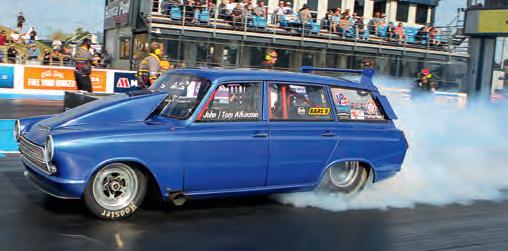
Five rounds of qualifying left Tom Atkinson on top of the Super Pro ET table – though the reward for his efforts was a pairing with Colin Millar, which can’t have felt like the easiest of rewards. His luck was in, though, when
E2 thanks to another cherry, this time for Larent Arnaud.
Elodie Dubois was seeing red too, though the silver lining was that the opponent progressing to E3 was… Fabien Dubois.
The next round saw further cherries, this
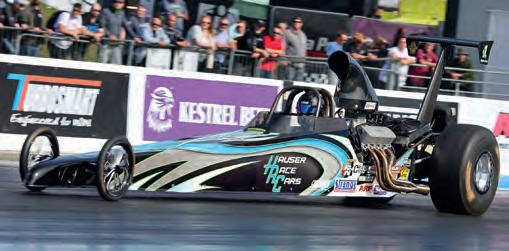
Ben Kennedy respectively; Hauser was where Atkinson’s challenge ended, whereas Kennedy succumbed to Mark Bailey – who had earlier seen off Dubois. The final wasn’t the tidiest thing ever, but a breakout 7.4097 (7.41) / 178.44 was enough to give Hauser the win when Bailey left 0.0005 too early and, yet again, the tree turned red.
Nitro Funny Car
A field of four, plus Andy Raw running licensing passes, went through a series of four qualifying rounds before, not entirely surprisingly, all making it through to the semi finals. These saw Kevin Kent victorious over Dale Leeks and, after a pesky rain break, Steve Ashdown seeing off Patrik Pers. The final was pretty cut and dried, Kent’s 4.2989 / 286.45 putting clear air between him and Ashdown.
Philippa Turton
Spencer Tramm
Scott Hauser
Tom Atkinson
Street Eliminator
Having got underway early, Street Eliminator had already seen two qualifying rounds completed by the time a shower of rain brought Thursday evening’s racing to an end. Joe Baxter was at the head of the qualifying list, having displaced early leader Michael De Souza with a couple of PB runs, but coming up on his heels was the always competitive Anthony Higgs – firing again after early teething troubles forced him to bale on Q1.
As if to prove the point, Higgs marked Q4 with a new speed PB as he roared to the front with a 7.2196/206.99 run. Victoria Smith posted a PB, too, though it must have been a bittersweet one – 7.4907 / 199.89 has got to count as one of those ‘so near yet so far’ moments.
Actually, it was a lot more near than far. Just a few hours later that same day, Q5 gave her another chance to join the 200 club – and she didn’t half take it, with a massive 206.11mph demolishing her previous speed PB. Perhaps surprisingly, Higgs relinquished the top spot here as Baxter climbed back ahead of him – but both were to make it through to the semis, setting up the prospect of a showdown in the final.
By now, Rob Slater had posted a 7.8837 / 178.5 run, giving him a new PB for speed and time alike. It might have been academic alongside an empty lane, following a no-show from Hazel Carter, but a record’s a record. A red light’s a red light, too, which
Junior Dragster
A Perfect Light Award came Molly Openshaw’s way in the second round of qualifying thanks to the 0.0008 RT that helped her leapfrog Chevrolet Checkett to top qualifying on Thursday night. Emmy Crundwell and Teddy Howe muscled in on the top three the following morning, with Ada Cassisi then getting in on the action before Chevrolet fought her way back up the list in the final session going into eliminations.
No mention so far of reigning champ Luke Mugridge, nor of Chloe Crundwell, who qualified in 15th and 24th places respectively. But they were clearly saving
is why Smith’s challenge ended here – De Souza being the beneficiary.
Also in the PBs was Nigel Hale, thanks to a 10.0998 / 136.45 pass – his fastest, though not fast enough to overcome Mark Sheridan – who also progressed to the semis, along with Slater’s nemesis Rob Carter.
And what’s that we were saying about Higgs and Baxter fighting it out in the final? Neither of them got there. Instead it was Sheridan, who recovered from a slow RT to beat Baxter in their semi, against Higgs’ conqueror Carter, with the latter taking home the trophy in his Passat.
their best for when it mattered. Chloe despatched Amelia Innes and Lola-Belle Kent, having first been given a free ride when Oscar Young saw red, before the performance of the semis saw her through to the final with a superb win over Ted Sullivan.
Luke, meanwhile, snuck through E1 on a double breakout win over Emmy Crundwell before seeing off Richard Wilcox and getting a bye into the semis. Here, a red light for Emily Phelps gave him another free ride to the final – where he kept Chloe at bay to take the win.
Phil Winstanley
Victoria Smith
Rob Carter
Anthony Higgs
Rob Slater
Michael De Souza
A TALE OF TWO
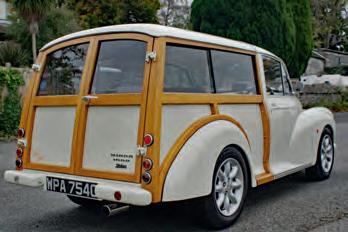
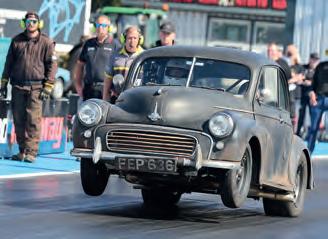
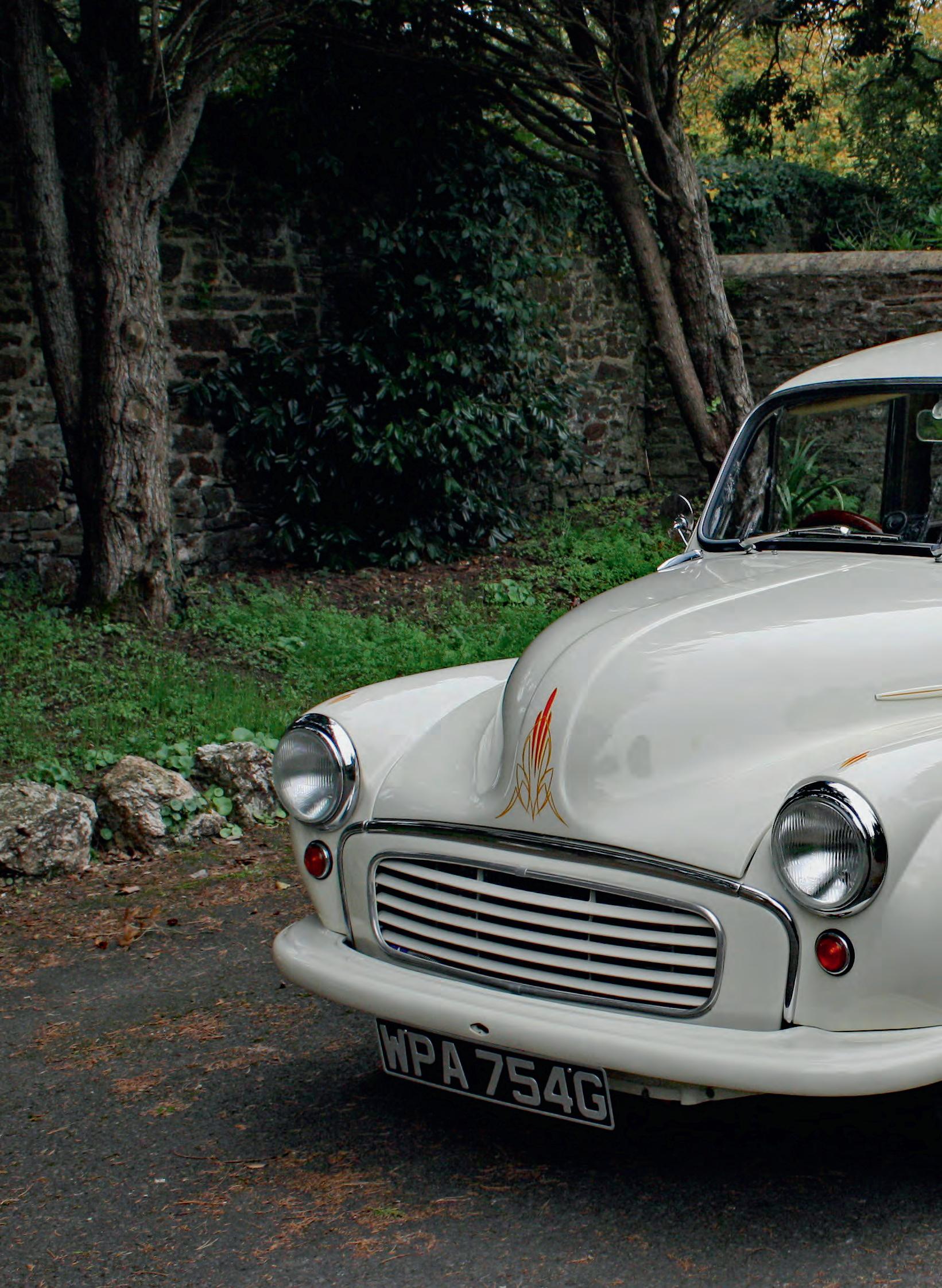
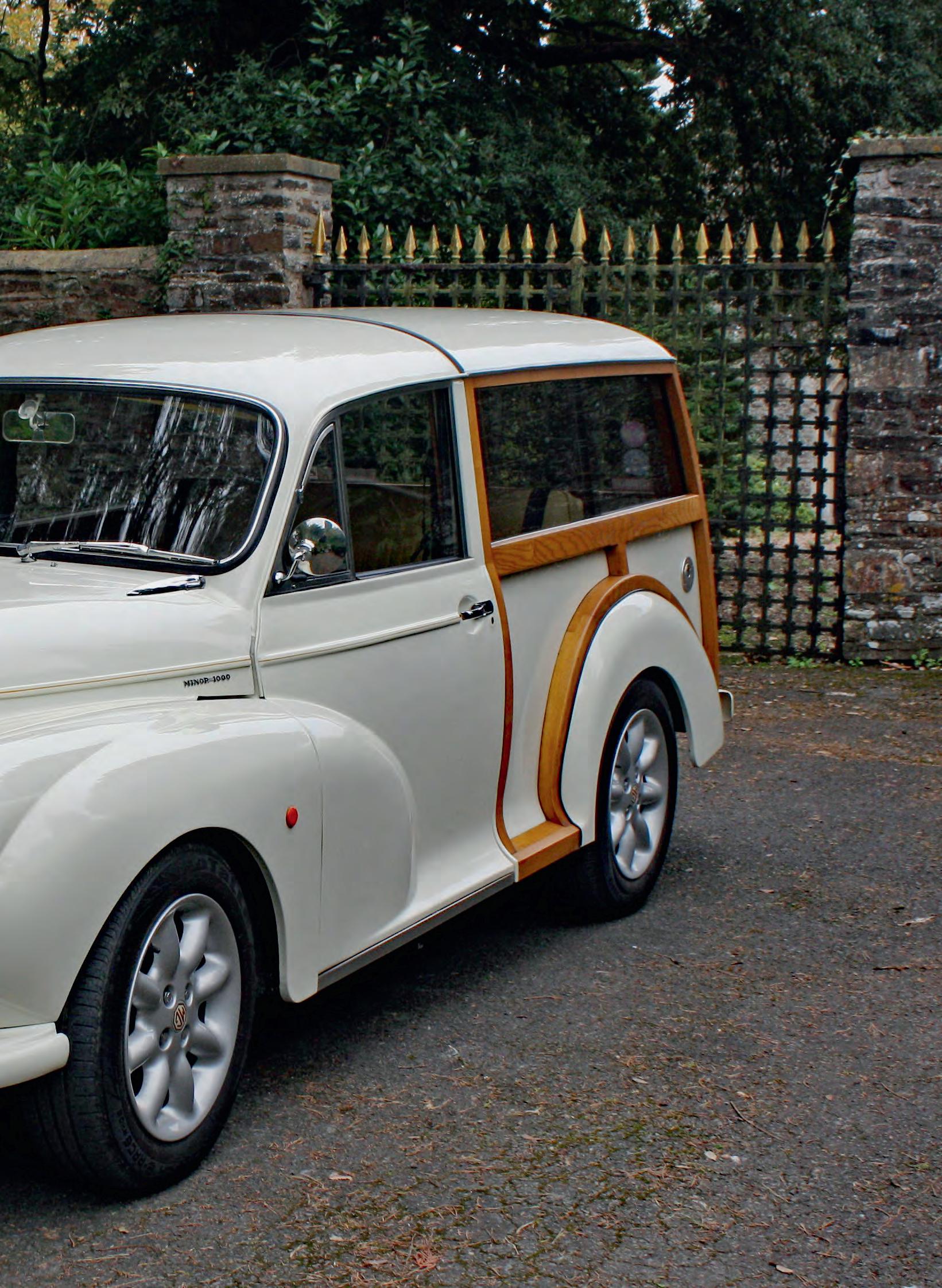
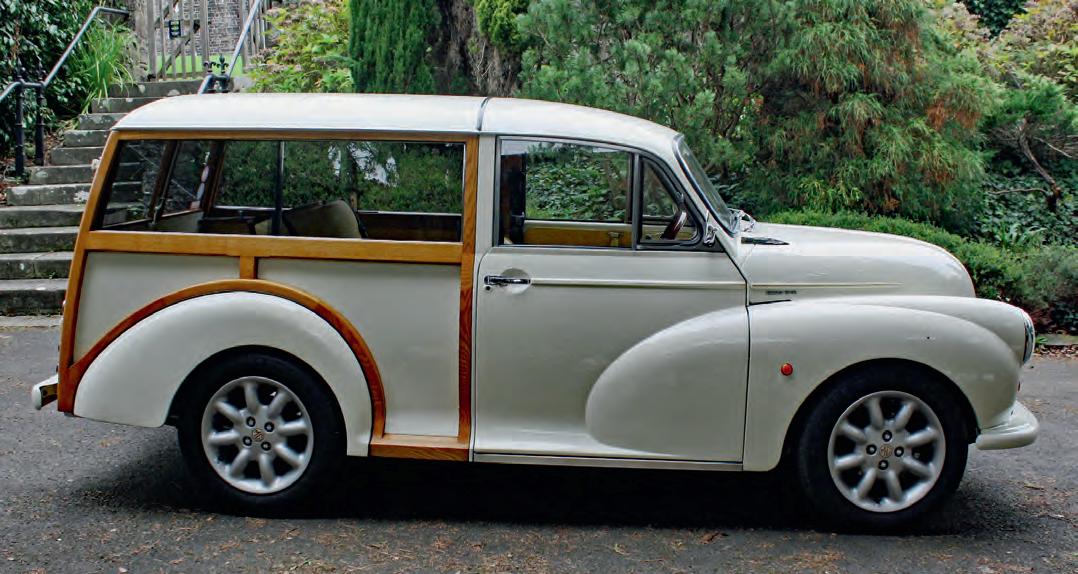
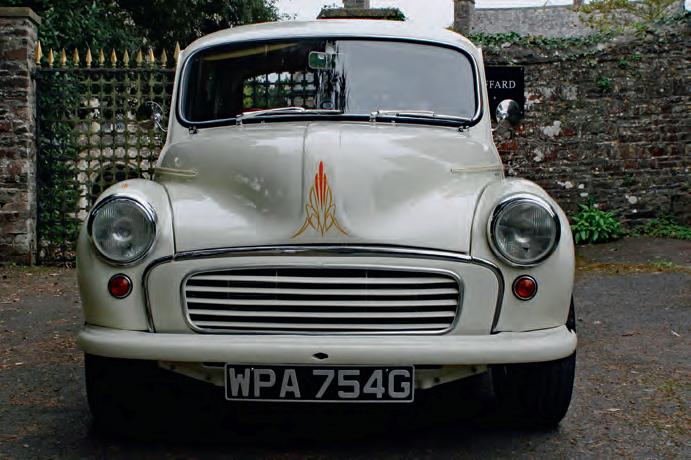
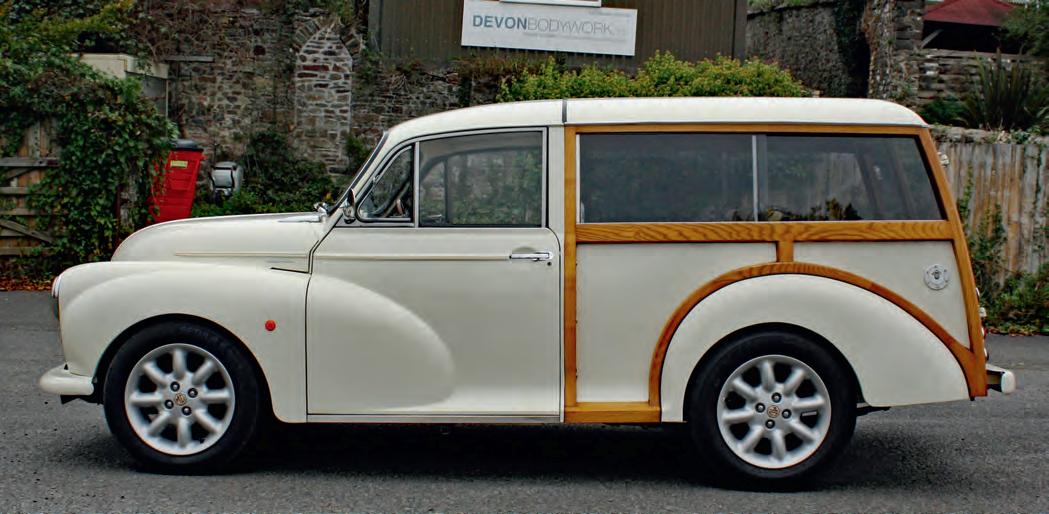
At first glance, Rob Price’s Morris Traveller looks like a nice resto with a set of wheels. But look closer and you’ll find that this is what happens when you mate a Moggy with a Puma
Words & Pictures: James Webber
Robert Price trained as an architectural draughtsman. So faced with a 1969 Moggy Traveller which had already had some work done to it, it would have been very easy for him just to quickly spruce it up.
Having had a look at some of his previous builds, that option would have seemed very appealing as Rob has had to overcome a few hurdles in life. One build in particular was a Wolseley Hornet which he decided to strip out and cut down into a shorty.
It’s to Rob’s credit that that car is still doing its thing out on the road today. But back to the Moggy – which has been a long time in the making. “Having had the infamous sabbatical around 2010,” he says, “I was in a position to buy something to tinker with. I came across this ’69 Traveller that had a Marina engine fitted, a Type 9 box mated to that and Marina axles front and rear. It looked pretty good, so I took a punt and went up to Leicester and drove it back down to Devon.
KITTIES
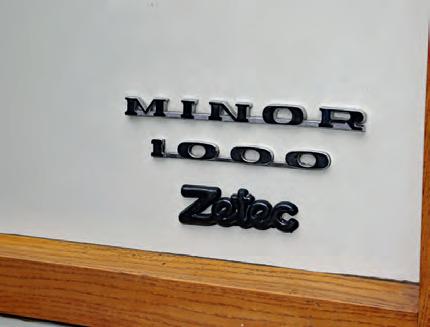
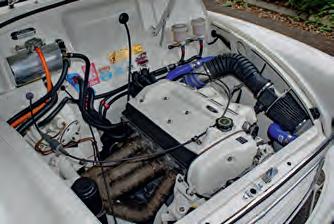
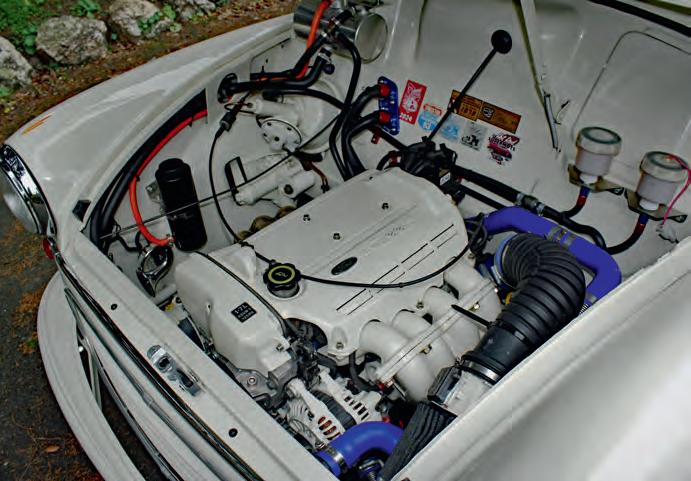
It’s only there for ‘cruising around’ but a 1.7-litre Zetec engine from a Ford Puma makes excellent use of the Moggy’s engine bay. That’s one clean installation, too. Rob painted the engine plastics and aluminium inlet in Old English White to match the body
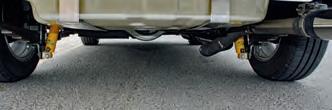
The Traveller was already running a Marina axle at the back and Rob saw no reason to mess with it. It holds the car up using fresh springs packs and Spax adjustable shocks, with lowering blocks giving it some stance and anti-tramp bars keeping it from twisting the leaves
“The original alterations seem to have been the work of Chris Street (CS Autoclassics) and Charles Ware.
“Once in the garage, it looked like the rear doors were rotten. There were few bits of rust here and there, so I set about sorting them out.
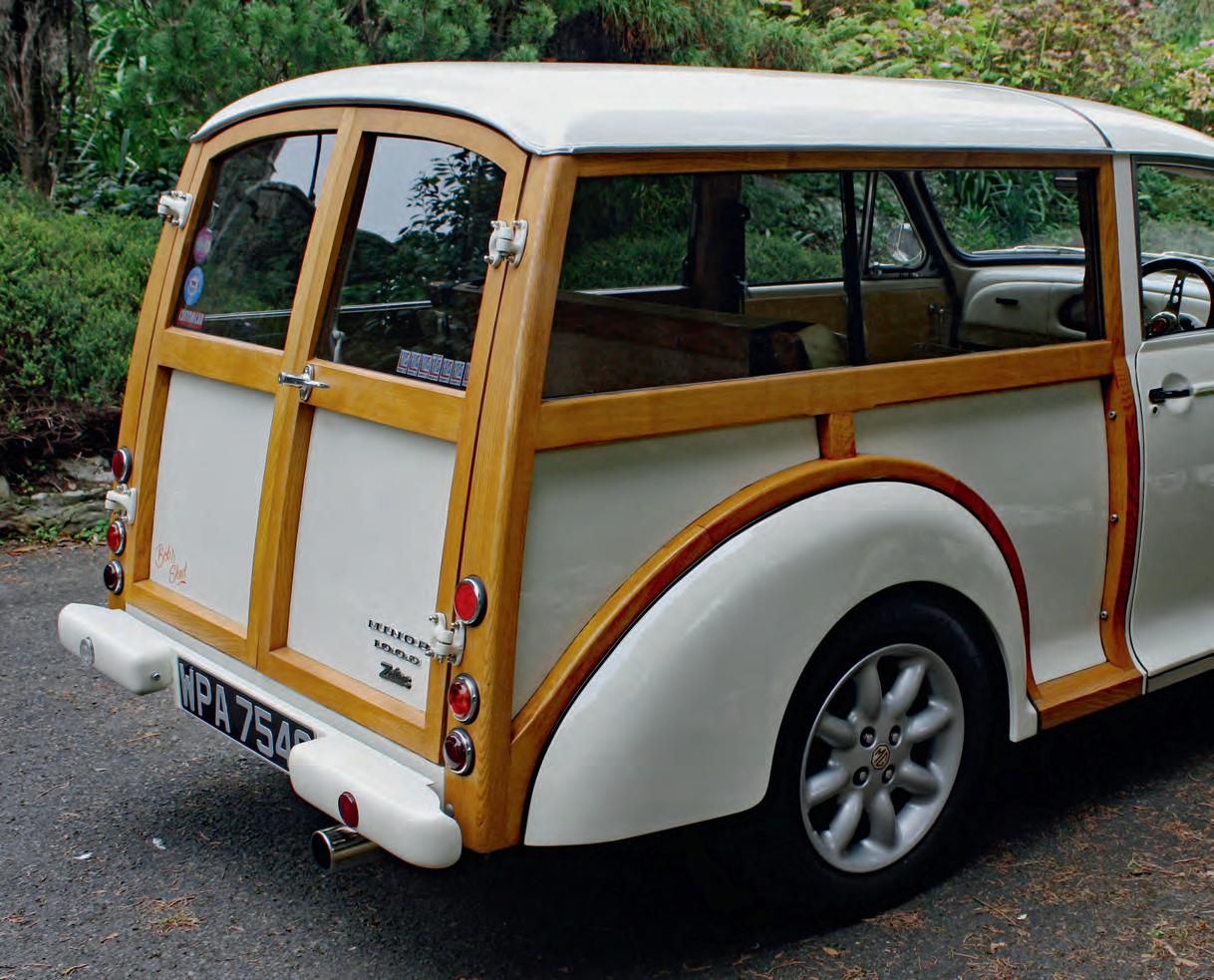
“Then it became apparent that not only did it have tin worm in places, it had woodworm too which was rotting out the rear. So I ripped all that out. After that, the sills looked like they were on the way out – and next thing was the whole car was in bits.
That’s life
“I welded in new floors and repaired some of the rust. But then life reared its ugly head
again and she lay dormant until 2018, when I was back in the game and back on it.”
Now, for a man who’s a dab hand with a welder and grinder, a lifelong hot rodder and a reader of Custom Car (good choice) and other publications, this was not going to be a refurb job. But it wasn’t going to be a V8 and Jag axle set up either. And by chance, having a brother who buys cars came into play.
“My brother had a Ford Puma that was rusting away on his driveway but was running fairly well. For those that do not know, Pumas still run a Zetec, but these are aluminium blocks and at 1.7 litres it was plenty for just cruising around.
“So I got it home and did some measurements and, after a bit of cutting, the
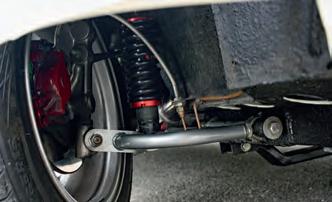
Rob fetched off the front suspension he had inherited with the car and replaced it with a custom kit from JLH Minors featuring adjustable A-arms and AVO coil-overs
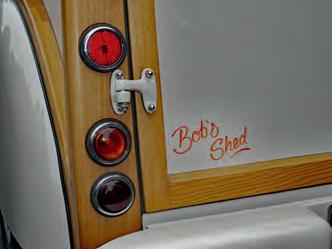
Most of us have dealt with plenty of rusty metal by now but when you’re building a Traveller you’ve got woodworm to worry about too. It took a lot of work before pinstriping wizard Tootall could be brought in to apply the finishing touches; bet he’s not been asked to monogram a whole lot of sheds before now…
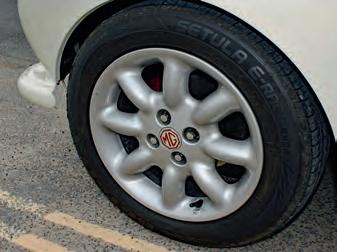
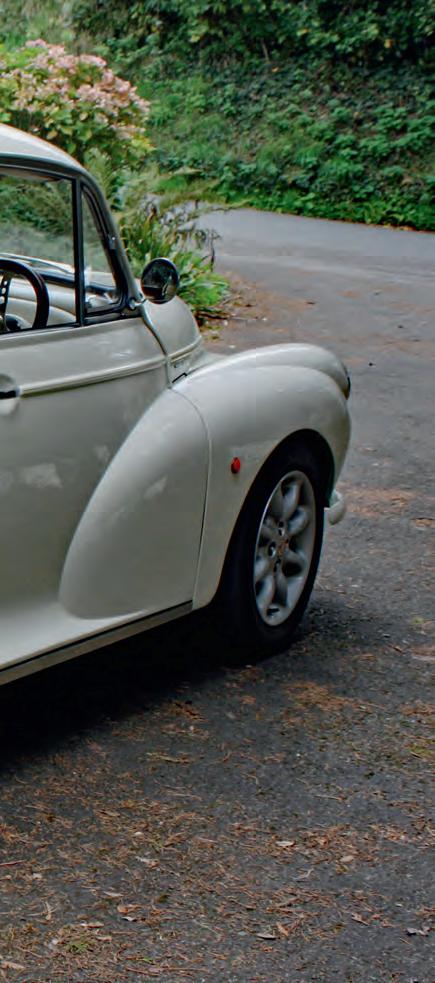
Right: From a distance, the Mog’s 15” MGF alloys are the first sign most people will see that not all is as it seems. They’re dressed in budget rubber measuring 175/65R15 up front and 185/65R15s out back
engine fitted in nicely. I also installed a new Puma fuel tank, which fits nicely after I cut out the boot floor.
I kept the Type 9 that came with the car and mated it to the Zetec. Apart from the Marina discs, I ditched the whole front suspension and bought a complete custom set-up from JLH Minors. It would have cost £1000 but this was their original show demo set-up, so I got it for a decent discount.
“It features adjustable A-arms and AVO coil-overs. The rear Marina axle was kept along with the drums, but fresh leaf springs were fitted along with Spax adjustable shocks, lowering blocks and anti-tramp bars. A custom prop was made to match the box and axle.”
Subtle changes
Next, Rob went back to finish addressing the bodywork, repairing and replacing any panels that were rotten or rusty and replacing all the wood that features on Travellers. Being a custom man at heart, however, he made some subtle changes along the way.
These included smoothing out the stock front bumper, which was then colour-coded to the rest of the car when it came to paint.
The rear bumper, meanwhile, he made from the rear quarters, which he smoothed out and adapted by fabricating a mount for the number plate.
Talking of paint, Rob settled on Old English White two-pack as his colour of choice. As well as the body itself, this extended to the engine plastics and aluminium inlet too. Finally, on went a set of 15” MGF alloys with budget 175/65R15s up front and 185/65R15s at the rear.
After that, it was time for Rob to turn his attention to the Moggy’s interior. Here, the Puma donated more goodies to the cause –as did another car we mentioned earlier on. Remember Rob’s Wolseley Hornet? “When I did the shorty, the front seats went into a room and were almost forgotten about. I found them again while I was doing the interior and had my father-in-law retrim them in leather.
“The rear seat is the original Moggy and I decided to put in 3-point belts. The fronts are universal but the rears came out of my old Alfa Romeo GT. The Puma donated its dash (fitted into a custom housing), all the wiring including the ECU, steering column and stalks, accelerator pedal and handbrake.
“The brake pedal is Moggy, but with a modified master cylinder, and the clutch
is a one-off converted to hydraulic with a concentric slave cylinder from a Mondeo.”
Tough stuff
Rob also replaced the rear windows using tinted and toughened glass. And in keeping with the belt-and-braces theme, all the nuts and bolts used throughout the car have been replaced by stainless steel – in both metric and British thread patterns where possible. “I made the headlining from ash door lippings,” Rob continues. “And at the back is a custom pull-out drawer which I can put some basic tools in to keep it neat and tidy. In the glove box is a stereo, and a small subwoofer lays underneath the driver’s seat.”
So there’s been a good bit of work done, custom and otherwise – perhaps more than you might realise at first glance. Yet
there are clues to help the eagle-eyed spot that this is no normal Traveller. Those MGF alloys are a big one but the clincher is the pinstriping and sign writing laid on by legendary brush maestro Tootall.
With that, the Moggy was on the road –but as always, there’s no such thing as a finished project. “She did need a fair bit of fettling,” admits Rob. “The engine needed work to remedy a few hiccups and get it running smoothly. The gearbox has also been out for a rebuild recently and I have had a stainless four-branch manifold built.”
But it wasn’t half worth all the effort, because the 2025 show season saw the Moggy out there getting used, turning up to meets – and picking up the odd award or two. “I would like to thank everyone who helped directly or indirectly in the build,’ says
Rob. I was over the moon to be awarded Best in Show at a local Devon event.” And who wouldn’t?
So this is a Traveller you might see on your, er, travels this coming year. Though still the project continues and Rob laid out his future plans to us.
“If funds allow, I would like to get throttle bodies on the engine. I’m looking at some different seats, too – the Hornet ones are nice but after a while I start to ache.”
At the time of writing, he had his eye on an MGF set that were available locally. That apart, though, it’s just going to be general maintenance and the odd minor item here and there (boom boom). Mainly, Rob’s plan is simply to enjoy it, and you can’t begrudge him that. It has, after all, been a long time in the making. CC
The rear is testament to the amount of work that’s gone into the car, even if the most custom thing about it is the drawer Rob installed under the floor to hold a selection of tools
Back in the day, Rob used a Wolseley Hornet as a project car. He’s had the seats in storage ever since, or at least he did but now they’ve been retrimmed in leather (by none other than his father in law) and given pride of place inside the Traveller
A modern stereo is tucked away in the glove box, with a small subwoofer similarly concealed beneath the driver’s seat. Next to it, a custom housing plays home to the instrument panel from the same Puma that laid down its life for the project
The rear seats are original to the car and were ready to go again – albeit with three-point belts from another of Rob’s old projects, an Alfa Romeo GT
Geoff Stilwell recently became the seventh fastest Brit of all time
Words & Pics: Tony Thacker
In 1997, Andy Green broke the sound barrier and, with a speed of 760.343mph, became the fastest man on earth while piloting Thrust SSC at the Black Rock Desert, Nevada – now famous as the home of the Burning Man festival. Andy heads a short but illustrious list of record holding Brits which recently added Geoff Stilwell to that roster.
In August 2025, Geoff, who lives near Maidstone, became the seventh fastest land speed racing Brit with a new record in his class, having recorded 289.239mph while driving his A/Blown Fuel Rear engine Modified Roadster (A/BFRMR). The GPS indicated an exit speed of 301mph, and Geoff’s now aiming to leapfrog Malcolm Campbell into sixth place.
A motorcycle drag racer in the early eighties, Geoff was introduced to land speed racing by his friend Ron Hope. Besides
driving his infamous ‘Rat Trap’ AA/Fuel Altered, Ron fielded a fleet of four land speed cars – one of which, a 1985 4WD Dodge Daytona, was used as a guest car that even the Earl of March and his son Charlie drove in 2014. Geoff got behind the wheel in 2016 and managed a rookie speed of 122.275, and the hook was in.
In 2017, Geoff planned to drive Ron’s son Brian’s Pro-Charged LS-powered rear-engine roadster, however unfortunately the car was plagued with mechanical problems and he never got behind the wheel. Nevertheless, he made plans to purchase the 7707 rear-engine roadster from famous drag racers Don Bowman, Mike Kuhl and Carl Olson. Bowman, Kuhl and Olson had purchased the car from Harry Hoffman in 2010 and installed a supercharged 490ci nitro burning Chrysler Hemi. The best speedOlson attained was 233mph, on methanol, in 2013.
The magni cent seventh
At the sharp end of prepping the engine, Scott Barnes torques up the big end bolts before eight gallons of 70cwt nitro oil are added
seventh
Meanwhile, Geoff had become fast friends with Bob ‘Freight Train’ Muravez, who back in the sixties drove under the pseudonym Floyd Lippencott III because his dad wouldn’t let him drag race. Bob knows everybody in the So Cal racing scene and quickly put a team together to prep 7707 for an attack on the salt in 2018.
It was a thrash but with the help of ‘Sparky’ Perry and a team of hot rod legends that included Ed ‘Isky’ Iskenderian, Geoff set a new A/BFRMR record at 258.569mph that August. It was an astounding first effort. Sadly though, he’d put a rod through the Keith Black cast aluminium block and was on fire when he finished his return pass.
Red target
A record is a record all the same. However, a record is not automatic membership of the Bonneville 200 MPH Club (2 Club), nor does
it get you the coveted red hat which is all that these racers race for.
In 1953, author/racer Dean Batchelor and Hop Up magazine editor Lou Kimzey schemed to form the Bonneville 200 MPH Club. Support came from Hop Up publisher Bill Quinn. Initially, the club recognised drivers who “drive a car two ways over a measured mile at a clocked speed of 200mph or better.” It said nothing about setting a record; maybe that was a given?
In 1955, Hop Up was sold to Petersen Publishing and became Motor Life. Sponsorship of the 2 Club passed to Grant Piston Rings, which supported it through to 1967. According to the 1968 Bonneville Speed Week programme, it took three runs to get a record; first, a pass to qualify to run for the record then, the next morning, two runs in opposite directions, the average of which had to exceed the existing record by two percent.
The 496 cubic inch Chrysler-derived Brad Anderson billet aluminium Hemi is blown by a 14-71 BDS supercharger and runs a 70% nitro/ methanol mixture. Claimed output is in the region of 5000bhp
In 2025, there were two courses, each nine miles long. Only the first five miles are timed, unless you have a car capable of more than 500mph. According to the timing slip, average speeds are computed for each mile: 1 to 2, 2 to 2.25 (cannot be used for record certification), 2 to 3, 3 to 4 and 4 to 5.
The final trap measures the last 132 feet of the fifth mile, giving an ‘exit’ speed which likewise cannot be used for record certification. Geoff typically runs to the fourmile marker.
Decisions, decisions
Geoff had decisions to make. Go home happy-ish with a record but no hat, or go for the hat. He chose the hat.
So Geoff reached out to fellow Brit Mick Jenkins of Mick’s Paint, Pomona, CA. At the time, Mick had two very talented New Zealanders on his payroll: ‘Kiwi’ Steve Davies and Robin ‘Silky’ Silk, who between them had years of experience, having worked together on the MG land speed record wagon and a fleet of record cars for General Motors. Geoff’s target was set at 300mph – which
would ensure a 2 Club red hat and also a 300mph blue hat.
Having established a target, work began on sourcing a stouter engine and the necessary fuel tank to hold 45 gallons of 70% nitro/ methanol mix. In order to lengthen the frame to accommodate the larger tank, Steve cut into the tubes and found them ‘oh too thin.’ Weight is your land speed racing friend and there is no need to use under-size tubing – in fact, quite the opposite is true, so why the original builder had chosen thin-wall tube is anybody’s guess. But Steve, who is the SCTA
Car Chief Inspector, had seen it and couldn’t unsee it, so the frame had to go.
A new frame had to be designed to accommodate a new 496 cubic inch Chrysler-derived Brad Anderson billet aluminium Hemi topped with a 14-71 BDS supercharger. The engine and two-speed B&J transmission is mounted in a pivoting cradle that also anchors the Winters quick-change rear axle.
Mick’s team was eventually joined by three more Brits: Nick Davies and Rob Loaring from I.C.E. Automotive Racing Engines, and Scott Barnes from 1320 Mini, and all were on full thrash to get to Speed Week 2019. Unfortunately, a lot of work had to be done on the salt, which is far from ideal, and it was all for naught because of a faulty trans linkage.
The following year, 2020, saw the arrival of Covid and the subsequent travel ban left Geoff and the UK team stranded in England. The situation remained the same in 2021.
Washed away
While the travel ban was lifted in 2022, Speed Week was a wash-out. The team arrived, pitted, went through tech and went to bed – only to wake up to the sound of running water cascading through the hotel ceiling and down the light fixtures. Eventually,
when they were allowed on the lake, they gathered their belongings that were floating ankle deep in brine, packed up and drove back to Pomona.
The following year was rained off again, however Geoff did manage one solitary run on a very bad course. How bad? The return road was so bumpy the fuel tank cracked, and that is bad.
And home they went again.
Things finally came together on August 5, 2024, when Geoff achieved a qualifying speed in the 4 mile of 276.767 mph. The SCTA suggested he make the backup run the same day (instead of the following morning) and after a quick turnaround he went 278.971 for a record of 277.869 mph – fast but not ‘hat’ fast.
The following day, Ro Yale of the Texas Hot Rod Hoodlums team took Geoff’s record with an average of 281.425 mph. Geoff had held it for all of one day.
When he’s not racing at Bonneville, Geoff races twice a year on the hallowed dirt of El Mirage, a dry lake 100 miles north of Los Angeles where they have been setting records since the 1920s. There is no existing record in his class but the minimum to get the ‘Dirty 2 Club’ hat is 250mph. So far, Geoff has gone 240.448 in the dirt – where the
Geoff’s achievement in breaking the A/BFRMR record and entering the 2 Club cannot be understated, though he’s still got a little way to go to reach the supersonic world land speed record set by Andy Green back in 1997
Geoff set his first record in 2018 but it wasn’t fast enough for entry into the 2 Club – and with it the coveted red hat. The club had reset its threshold for entry in the A/BFRMR class shortly before last year’s run – meaning his speed of 289.239 was enough to finally land him the elusive prize
“Geoff suits up and slides down into the seat, contemplating that long blue line snaking off towards ‘Floating Mountain’ and that elusive red hat”
“It was an astounding first effort, but he’d put a rod through the block and was on fire when he finished his return pass”
With the record set, the celebrations begin. Geoff races in memory of his son Matt, who died in 2023 at the age of 26
Having previously mixed the fuel and led the top-end crew in finally prepping the engine, Nick Davies provides last-minute instructions before Geoff sets out on his record run
course is 1.3 miles long with a short, onemile shut off.
Geoff and his team returned to Bonneville in August 2025, planning to take back their short-held record – and this time the gears aligned. The weather was good and the salt was hard – albeit as thin as anybody had ever seen it. The flats have been depleted over many years and a multi-agency agreement is in place for the local potash mining industry to replenish the salt by pumping in brine during the winter – but that’s another (long) story.
After the long, 700-mile drive up from Pomona, the team pitted (you’re not allowed to camp there overnight) and teched with no issues.
Starting sequence
The procedure for starting a blown nitro motor is a process. First, because of some prevailing con rod issues, Scott Barnes, the ‘diver’ (he who dives under the car to service the bottom end), torqued the big end bolts before the eight gallons of Red Line 70cwt nitro oil were added. Meanwhile, the top-end crew of Nick Davies and Scott Campbell inserted the push rods and adjusted the valves. Forty-five gallons of fuel previously mixed by Nick were added by Rob Loaring while Pauly Rivera and Gabriel Rubio gave the car a visual check before Dzus buttoning up the body.
Geoff donned his face mask, slid between the snug rails, clicked the wheel into place and checked the controls. Below the Racepak screen, the steering wheel contains a push button that shifts from first to second. On the right are two green buttons to
electronically release the parachutes (there are also two manual back-up parachute release levers inside the cockpit to the right).
On the left of the cockpit is a manual lever for engaging neutral. Ahead of the neutral lever are the manual fuel shut off, the red ignition kill switch and above them two toggle switches that isolate the magnetos. To the right are four manually operated fire extinguishers buttons.
Once the car has been run through its gears and deemed ready to run, the fuel is shut off and the engine is allowed to run down. The oil is then replaced, the fuel topped up, the plugs changed, the chutes checked and so on.
When all is ready, the car is towed the few miles down to the start line and then it’s hurry up and wait your turn. If you’re lucky, the line isn’t too long but some years they have waited as long as six hours for a run. Three cars back from the start line, Geoff suits up and slides down into the seat, contemplating that long blue line snaking off towards ‘Floating Mountain’ and that elusive red hat.
On August 3, out of the box, Geoff went 287.081 – which was faster than the existing record by almost 6mph and qualified him for the backup run. The crew towed to impound, where they had four hours to check things over, change the oil and 16 plugs, refuel and get ready for the next morning – when Geoff blistered through the 4 mile traps at 291.397, giving him a new record of 289.239mph.
Unbeknown to Geoff, the 2 Club had modified their minimums and reduced the speed in his class to attain entry from 290 to 285mph. Therefore, Geoff was shocked to hear that not only had he set a new PB, and a new record – but he had at last entered the 2 Club and got the red hat. Job done!
Well, not quite. Geoff calculated that he had become the seventh fastest Brit on land behind Andy Green, Richard Noble, Donald and Malcom Campbell, John Cobb and George Eyston. Heady stuff indeed. But further investigation revealed that if he could get the record up and over 300mph, and exceed Malcom Campbell’s record 301.337 set in 1937 at Bonneville, he could move up to sixth. And that’s now the goal. CC
At first, you almost don’t notice the trophy sat atop the car – but it’s definitely a look that suits it. And Geoff’s far from finished – he’s within touching distance of Malcolm Campbell’s 1935 record and this coming year’s plan is to move one place up the ladder and become the sixth fastest Brit of all time
Iam not quite sure how we have reached this point, but this is the 100th article I’ve done for Custom Car. Thirteen years ago, I fired some pictures off to then editor Dave Biggadyke, thinking he might be interested in a few nostalgia features for the magazine.
Somehow I still manage to come up with an eclectic mix of new and old items of interest to look into, and the trip has continued under the magazine’s more recent stewardship. So this seemed an appropriate time to take a little look back at some of the people and events which have stood out for me over the period – which all started with a piece about British-bodied funny cars.
The world has changed along the way, of course, what with the effect of Covid and
the follow-on pain of inflation. Not only has this been felt in all our pockets, but racers have really struggled in just trying to get hold of parts. But as they always have, somehow they find a way to overcome the problems.
Our track situation has changed; but not all for the worse, it is pleasing to note. The low point was the official confirmation, eight years back, that Shakespeare County Raceway had been sold for housing. York Raceway had closed shortly before, but happily this was reborn as Melbourne Raceway in 2020.
major strip upgrade as Santa Pod introduced a completely new concrete surface in 2018. Dragstalgia quickly blossomed into a major event in the Pod’s calendar and is the focal point for the nostalgia drag racing scene, flanked by the ever popular NSRA Nostalgia Nats and Hot Rod Drags. I hugely enjoy Dragstalgia, but the drive there is not so interesting without the company of Dennis Priddle, who I had got used to taking there. Watching him working on the tribute funny car of Paul Harris was a joy.
The grass roots scene has also benefitted from more recent events at Manston. Spitfire Raceway and Dakota Raceway also provide no-prep facilities in the south west. Meanwhile, the home of our sport received a
Unfortunately, we have lost too many of the founding fathers of the sport during these past 13 years. I guess it shouldn’t be so surprising, when one considers the fact that Santa Pod is now celebrating its 60th anniversary, but it doesn’t make the losses any less sad.
■ Words and Pics: Keith Lee Happy 100th!
Don Schumacher’s Stardust, along with Paula Murphy, kicked off the age of the funny car in July ’73 when they wowed fans with a smoky show
The Brit-bodied funnies had their own style – and the rear-engined Vauxhall GTX driven by US serviceman Ed Shaver was more different than most!
Dennis Priddle in the stands at Dragstalgia, maybe remembering some old battles on the quarter mile
One of those unrepeatable sights was watching Dennis Priddle fired up in Mister Six, before smoking the length of Brighton’s Madeira drive to a 7-second clocking! The police chief enjoyed it, but said “never again!”
Probably the only slingshot with front brakes, the restored Allard dragster was originally used by Sydney Allard to promote the sport – before it even existed in the UK! Sadly, Stu Bradbury (centre) and restoration leader Brian Taylor (far right) are no longer with us
goes for the wild Fuel Altereds, as these short wheelbase monsters are fabulous to watch, with the drivers fighting to tame their machines – and their numbers should be increasing during this year!
The heartening thing to me is that the mix of classes is just so right, with Nostalgia Funnies, Supercharged Outlaws, Gasser Circus, Nostalgia Super Stocks, Wild Bunch and more. It makes for an excellent show, with performances that somehow still keep improving. To all of the race teams and track crews that have put so much into their racing efforts over the years, a big thank you for making the sport so enjoyable.
The British Drag Racing Hall of Fame has grown in stature since its inception in 2006. Stu Bradbury was largely responsible for pushing the organisation forward, despite battling cancer in his final years. Sadly he passed in 2020, but he would be pleased and proud that the BDRHoF is doing well, along with the associated Benevolent Fund.
A true pioneer of hot rodding and drag racing, a flathead nut and such a nice guy! Ken Cooper, on right, still enjoys running a flattie-powered slingshot with son Bradley
We all have our favourite classes. For me, when we are talking about four wheels, it comes down to two. The head says fuel dragsters – especially the old-style slingshots. These race cars are the ultimate performers in the sport. However, the heart
Sadly, Andy Hadfield has understandably not been active recently on the strip, but he was always spectacular to watch in the crowdpleasing Twister
For now, I hope you enjoy the pictures – and I look forward to capturing more memories as the new season rolls around.
One of the high spots of the Hall of Fame gala a few years back was the afternoon Bench Racing sessions. A good number of top US names attended and the stories that came out were priceless. This photo includes Steve Gibbs, Ed McCulloch, Carl Olson, Tom Hoover and Ed Iskendarian among the group
One could not take a look back without including Slammin’ Sammy Miller, whose rocket cars lit up the track. An unforgettable character himself, his rockets were a major attraction. Pictured with Miss Santa Pod and flanked by a stellar line up of funnies
have managed to
he is acknowledging the fans as he returns from taking victory at Santa Pod in 1977
I never got to see the legendary Freight Train run, but the late Norm Wheeldon made me smile when he built his own twin-engined slingshot. There is just something special about watching his creation run. Nice to know that Nigel Charman will keep the car running
off the
the evil
in the background are
A name that will never be forgotten in our sport. Allan
Bradbury, as Allan kept his foot down!
I
insert the odd bike picture into CC along the way, and few are as unusual as the blown VW originally built by rocket scientist Clive Waye. Terry Homan brought Drag-Waye back to life, as seen at Dragstalgia
Don Garlits became something of a hero of mine after I saw him at Blackbushe in 1964. Here
‘Bootsie’ Herridge, fighting
Firefly
line. Watching
Nobby Hills and Stu
BRENTACRE
NB: We advise you to double check with organisers that the event or show as listed is still going ahead, to avoid any wasted journeys. To submit an event, email editorial@pistonpublications.co.uk
MARCH 2026
15 Breakfast with the Reapers Boar Inn, Moddershall, Staffs 07928 214543 / 07976 655636
19 VW Air-Cooled Night Ace Café, London. www.acecafe.com
22-25 The Main Event Santa Pod Raceway. www.santapod.co.uk
24 Great Eastern American, Classic, Vintage, Car, Scooter and Bike Show Lowestoft & Yarmouth RUFC. Paul: 07900 005871
24 Throttle Bicester Motion, Oxon. www.vhra.co.uk
24-25 Cars & Kirmes US Car & Oldtimers Show Germersheim, Rhineland-Palatinate, Germany
25 The Hop-Up Westerham Brewery, Westerham, Kent Facebook: Detonators CC
25-31 NSRA Fun Run Whitecliff Bay Holiday Park Isle of Wight. www.nsra.org.uk
29-31 Flat Caps and Ferrets Fire Up Auto Show Phoenix Sports and Social Club, Brinsworth, Rotherham Exhibitors: flatcaps.yas.25@gmail.com Traders: flatcapsNferrets@gmail.com
29-1 June VanJam Fir Tree Farm, Warmington. www.vanditos.co.uk
30 All American Cruise In Ace Café, London. www.acecafe.com
31 One-Off Custom Show Rising Sun, Hazel Grove, Stockport Facebook: Rainy City Cruisers
JUNE 2026
2 Hayling Hot Rods at the Beach. Hayling Island Seafront, Hampshire. Facebook: Hayling Hotrods at the Beach
3 Hot Rod Night Ace Café, London. www.acecafe.com
4-7 Hot Rods and Hills Park Foot Holiday Park, Penrith www.parkfootullswater.co.uk
4-7 Street Weekend Santa Pod Raceway. www.santapod.co.uk
5-7 Hot Rod Rumble The Camp, Ramsey, Huntingdon www.hotrodrumble.co.uk
6 Only Fools and Motors Tydd St Mary, Wisbech, Cambs Facebook: Only Fools and Motors
6-7 Bernie’s V8s and Historic Outlaws Brands Hatch (Speedfest) www.berniesv8s.com
6-7 Street Weekend Melbourne Raceway www.straightliners.events
6-7 Wheels Weekender Bottisham Airfield, Cambridgeshire Eventbrite: The Wheels Weekender
10 Full Throttle Monday Elvington Airfield, West Yorkshire www.straightliners.events
MOTORING 23-24 MAY 2026
100s of classic cars, bikes and commercials. Military vehicles, modified cars & hot rods Arena displays inc. JAMIE SQUIBB motorcycle stunt show Autojumble and Trade stands, Food stalls, Bar Fairground rides, Live bands, dancing & DJ both days PLUS - BRENTWOOD RC MODEL CAR CLUB RACING DISPLAYS
SAVE BY PREBOOKING YOUR PRE-2000 REG CLASSIC NOW £10 PER CAR INC DRIVER AND 1 PASSENGER (2 DAY PASS) visit whitewebbsmuseum.co.uk/pageant or from TicketSource
VEHICLE AND BIKE CLUBS WELCOME, NO VEHICLE AGE LIMIT CLUB STANDS AVAILABLE 25 x 12.5m
Public Admission - per day
jay.deepsouthkustoms@gmail.com
Over
Adults £14, accompanied children aged 5-12 £5, under 5s FREE. Family ticket, 2 adults & 2 children £33 Pay on gate or in advance from TicketSource Gates open 8am, Show starts 9am FREE PUBLIC PARKING
THE PAGEANT IS PURELY A FUNDRAISING EVENT FOR WHITEWEBBS MUSEUM OF TRANSPORT AND ALL MONIES RAISED ARE USED FOR THIS PURPOSE REG. CHARITY 275684 whitewebbsmuseum.co.uk office@whitewebbsmuseum.org 020 8367 1898
Enfield Playing Fields Great Cambridge Rd Enfield EN1 3PL
DECISIONS & PAYMENTS
Official Broker of the NSRA
Jack Petley’s stunning Chevelle is ready to hit Street Eliminator with 2000bhp and show car looks
PLUS LOA 24: Forty years on from the arrival of Pro Street in the UK, the ‘32 that kicked it all off rides again following an epic 25-year rebuild by Rob Shipley