Power tools: Respect your chainsaw... or watch out
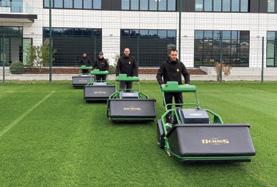
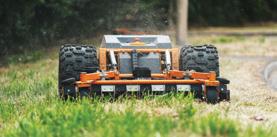
Mowers
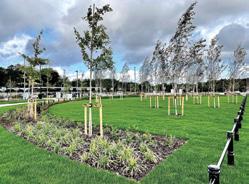
Fencing: privacy, performance and planet
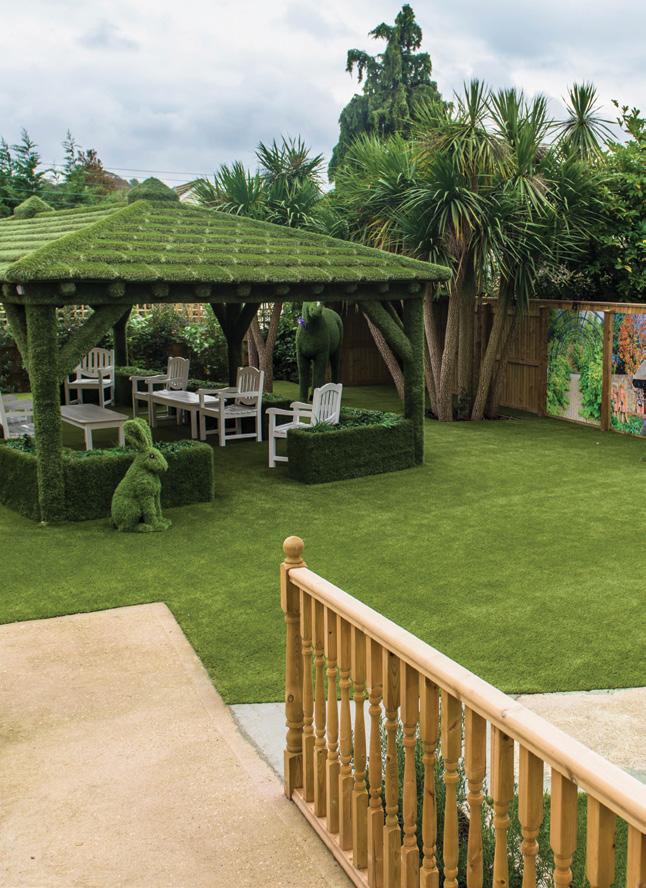
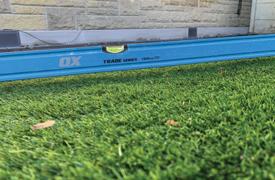
Synthetic turf: It can co-exist with climate considerations
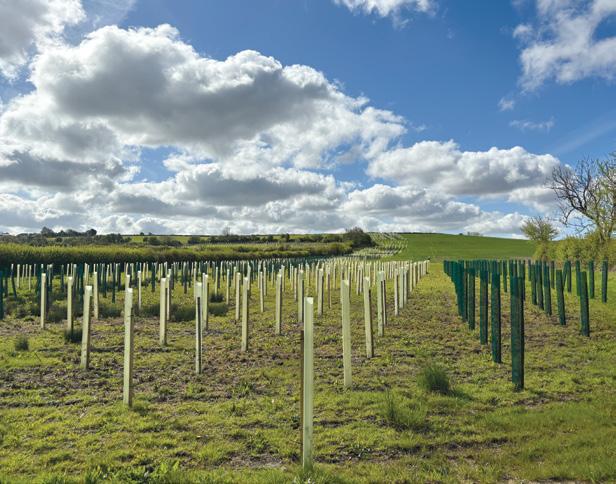
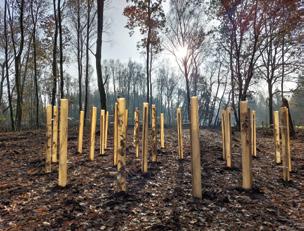
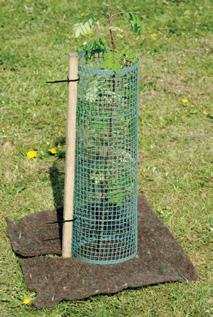
Green-tech o er a huge range of shelters, guards, spirals, stakes, canes and sundries.
With products in stock and ready for dispatch, we’re here to help with fast and exible delivery options, competitive pricing and excellent customer care as standard.
Biodegradable Tree Protection Recyclable Tree Protection
• Recycling Schemes
• Mulch Matting
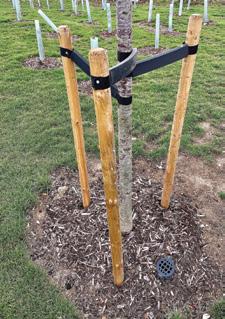
• Stakes & Canes
• Tree Ties & Belting
• Forestry Fertilisers
• Fencing Sundries
Criticism levelled at landscaping centres on the lack of a strict definition of its remit – the term spans several specialisms, all with their own educational structures.
Precious few universities or colleges offer a degree in landscaping and identifying ‘the tools of the trade’ have proven problematic.
In a bid to portray landscaping as a profession fit to a ract aspiring practitioners, the Landscape Institute will introduce a two-year apprentice course in January. The shape of things to come hopefully (page 4).
Today's professionals have plenty to shout about though. We look at the recent BALI winners (page 18) and delve into the garden that won a coveted award for an APL member (page 16).
Turf management show Saltex returns to the NEC on 12 and 13 November, offering a spread of innovations, including the Arcade Zone, to
Paula Warman | Gillian Taylor | Lynne Taylor | Paul Hadley
Advertising sales
Helena Hughes | 020 4539 3009 | landscaper@sheengate.co.uk
Design and production
www.lucas-studio.co.uk
Circulation and subscriptions landscaper@sheengate.co.uk
The Landscaper is
The Landscaper is an entirely independent magazine. It is not a member of any trade association or society.
Sheengate Publishing Ltd
Unit A4, Kingsway Business Park Oldfield Road, Hampton TW12 2HD 0208 939 5600
www.sheengate.co.uk
www.landscapermagazine.com
Publisher Con Crowley
a ract the sector. Ba ery tech will feature more prominently than ever, as the electric future powers forward. See our pick of exhibitors, starting on page 21.
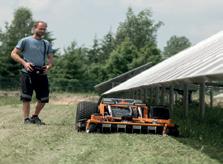
Fencing looks in fine fe le, as innovation is springing up there too, with solar panels starting to trend (page 40).
Greg Rhodes, Editor landscaper@sheengate.co.uk
Apprenticeship powers next generation of landscapers
Landscapers have few opportunities to gain qualifcations, as the sector lacks a formal, focused educational base. The issue lies in the ill-defned nature of landscaping, as under its umbrella lie specialisms as diverse as architecture, design, groundcare, garden design and project engineering.
That looks set to change next January when the frst cohort of the Level 3 Landscape Technician Apprenticeship, launched on 17 October, begins a twoyear journey to a new qualifcation.
The Landscape Institute (LI) has partnered with Engineering Skills College, part of London Design & Engineering UTC (LDE UTC) to develop the groundbreaking programme, created to equip the next generation of landscape professionals with the practical skills, technical knowledge and professional connections needed to shape greener, healthier, more sustainable places.
“The collaboration marks an important step in strengthening the profession’s talent pipeline,” said Kelli Cochran-Sharp, LI education manager (higher education and apprenticeships), “ensuring apprentices gain both high-quality teaching and industry-recognised professional support.”
Blending ESC’s facilities and teaching know-how with the Institute’s role in setting standards and connecting learners with employers, would build “a powerful pathway into landscape careers for the next generation of technicians”, she added.
Funded at £9,000 per learner through government support, the apprenticeship combines remote learning, in-person practical sessions and fnal end-point assessment, “enabling apprentices to earn a salary while gaining hands-on experience”, she said.
The programme offers training in design, planning, environmental management, and industry-standard software such as CAD and GIS, alongside creative and technical problem-solving skills.
Apprentices gain LI membership, progressing from student to technician level to give them access to professional events, resources and recognition, ESC providing expert teaching and modern facilities, while the LI ensures the programme meets professional standards and connects apprentices directly with employers across the sector.
“Working in partnership with the Landscape Institute will ensure we provide employer-led training where demand is high and future opportunities are strong,” said Sharna Rolle, ESC head of apprenticeships.
The LI is the chartered body for the landscape profession and an educational charity promoting the art and science of landscape practice.
https://www.landscapeinstitute.org
ESC is a high-tech, registered apprenticeship training provider delivering Level 3 and 4 standards in digital, construction, and mechanical engineering – working with more than 50 regional and national employers. https://www.engineeringskills.college
Putting the world to rights
If we are to confront and conquer climate change, we have to join up a multitude of dots.
Agencies and practitioners from a vast array of specialisms must understand how they ft into the global picture and cross-connect under a vision and strategy that can give us all a sporting chance to turn back what is currently a food tide of planetary damage.
Striving to deliver some answers was the recent Designing Cities for Climate Resilience event, run by Green-tech Specifer for landscape architects, specialists and specifers.
Fittingly staged at Manchester’s The Lowry, within one of Britain’s most ambitious docks transformation projects, the day delivered on its mission to unite sector movers and shakers in what was a pilot for what looks set to become a nationwide undertaking by the Origin Amenity Services provider.
Delivering environmental benefts through coordinated planning of urban landscapes was Seraya Sigsworth’s theme, which she warmed to with passion and insight, drawing plenty of audience feedback. Her presentation signalled all too clearly the scale of the challenge ahead.
Drawing on a rich vein of popularity among specifying councils, architects and designers was Georgia Gilbert of John Chambers Wildfowers, who outlined how widespread were the applications for annual and perennial planting and how thinking outside the box can bring major savings in groundcare costs.
The King’s College Cambridge project to create a wildfower meadow from an expanse of manicured lawn had brought fve-fgure reductions, Georgia reported.
‘Water, water everywhere and precious little reused’ was Rod Green’s takeaway message as he rolled out some startlingly worrisome stats on how we were failing to make the most of putting a vast volume of this vital resource to productive use. A presentation that left a bitter taste in the mouth, sweetened a little by some aspiring schemes his company, Pluvian Environmental, has completed across the country.
Wrapping up what had become an almost exhausting revelation of just how far we have to travel on the road to climate resilience was blue green infrastructure consultant Dr Tom Young, who gave delegates an academic’s take on how other countries were addressing climate issues.
His International Perspective on 21st Century Urban Water Management vividly portrayed how even desert environments can contribute to the greater good.
His PhD in green roofs and sustainable drainage systems, MSc in biological sciences and three years at environmental consultancy TEP certainly gave him the credentials to speak with authority on his theme. And he closed by summing up what many in the sector know only too well to be, that “Technology is not the problem but people arguing over the direction and point of it”.
Seraya Sigsworth
Georgia Gilbert
Dr Tom Young
Rod Green
Report reveals state of the sector
A deep dive into landscaping's current climate highlights market trends, challenges and future opportunities.
The landmark report is set to become an essential reference point for planning and strategy across the sector, states member body the British Association of Landscape Industries (BALI) which issued the work.
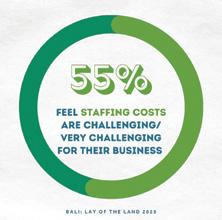
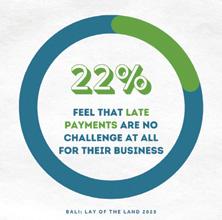
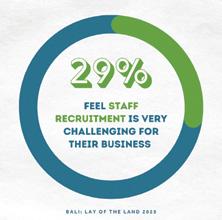
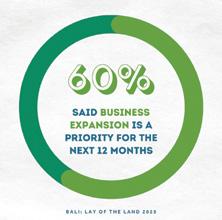
Insight into the outlook and sentiment for landscaping businesses reveals six in ten respondents are prioritising expansion in the next year, “though this is juxtaposed against the backdrop of 29% feeling staff recruitment is a challenge”, the report notes. And 55% say staffng costs are “challenging or very challenging”.
“We're thrilled to be able to bring this report out to government and industry on the importance of the landscaping sector,” said BALI head of policy and public affairs Amy Cobbett. "Landscaping is an exciting industry with plenty of opportunities for growth, as evidenced by the 60% of respondents saying business expansion is a
priority for them.”
However, government must work with industry to address some areas of concern, she added, “including employment and climate change, which will impact BALI member businesses in the future”.
The report was crucial in highlighting concerns and opportunities for the sector, she continued, “which is a key step in future-proofng the industry and continuing the innovation that can deliver across a range of government priorities, including skills and training, economic resilience, environmental enhancement and social growth”.
BALI supports, promotes and strengthens the landscaping sector by bringing professionals together.
View the report at bali.org.uk/help-and-advice/lay-of-the-land-2025
Alistair rises up Reesink ranks
Alastair Black is Reesink UK’s new technical support and training manager, replacing Lee Rowbotham, who becomes geolink and digital specialist.
With more than eight years’ experience at Reesink, he will oversee technical training across Reesink UK’s network to ensure internal teams and dealer partners have the knowledge and skills to optimise customer service. www.reesinkturfcare.co.uk
Key account manager role for Scott
In post for the sector's busy show time, Howardson Group key account manager Scott Reynolds brings more than a decade’ of turfcare experience and wide knowhow of professional grounds maintenance products. He will work closely with colleagues, dealers and end-users to drive sales across the Group’s three leading brands: Dennis, SISIS (including Syn-Pro) and Hunter Grinders, with a focus on strengthening dealer relationships and supporting sales growth across the sports facility, contractor and local council customer base. https://dennisuk.com
Mark leads Agrigem expansion CEO Allun's carrying forward Lawsons family tradition
With nearly 40 years’ sector experience, Mark Pyrah comes in as managing director of amenity, groundcare and horticultural products supplier Agrigem to “signal an exciting period of growth and development for the company and drive it through its next phase of expansion”.
“His impressive track record, strategic vision and commitment to customer success will be invaluable,” said Clive Whinnett, sports division managing director Origin Enterprises UK, which owns Agrigem. www.agrigem.co.uk
Century-old builders’ merchant independent Lawsons has appointed Allun Pittingale to, in his words, “carry forward the tradition of family values and professional service that has stood the test of time” and bringing with him a wealth of sector experience, including stints with Travis Perkins and the Independent Builders Merchant Group.
RAYMO CAN BE FOUND ON THE ISEKI STAND: C100
AI, drones and automation: The future of landscaping or just hype?
New tech is changing how landscapers survey sites, quote jobs and maintain gardens. The question is: are you ready to turn it into a business advantage?
When I talk to landscapers and garden designers, one question keeps coming up: “Is all this new tech really worth it for our industry?”
AI, drones, and automation are making headlines everywhere. But for many landscaping businesses, it’s hard to know if these tools are genuine opportunities or just hype.
The reality? Technology won’t replace the craft, skill and creativity that defne landscaping, but it is changing how smart businesses operate.
Drones for site surveys and design
Surveying large or tricky sites once took hours with tape measures and notepads. Now drones can capture detailed aerial images in minutes.
Even here in the UK, landscapers are using drones to:
• Survey sites more accurately
• Produce visuals that impress clients
• Track progress on big projects
Clients love them because they can see their dream garden from above before a shovel even hits the ground. For businesses, drones save time, reduce mistakes and elevate your professional image.
The caveat? You may need a commercial licence and the investment isn’t small. Treat drones as a business tool, not a gadget, and make sure they pay for themselves in time saved and jobs won.
AI in estimating and planning
Quoting can eat up evenings and weekends. AI-powered platforms are starting to speed this up by pulling in material and labour costs automatically, predicting project timelines, and even fagging where margins are getting tight.
It’s not about replacing your judgment but giving you better, faster data. The catch is that AI is only as good as the information you feed it. If your costs and systems aren’t accurate, the output won’t be either.
That’s why I help my clients get their foundations right first, so when they do use AI, it actually makes them money.
Automation in maintenance and operations
Robot mowers and smart irrigation systems are becoming more common in the UK, especially in highend domestic projects and professional sites where clients want low-maintenance gardens and effcient, controllable solutions.
For landscapers, that means two things:
1. You can upsell automation as part of a premium service 2. You can use automation in your own operationsscheduling, invoicing, CRM systems - to free yourself from admin and focus on growth
Paula Warman is the Landscapers' Coach, working with landscapers to develop and grow their businesses through her Levelling Up mastermind and 1:1 coaching package. If you need her help please get in touch on the details below to book in for a free discovery call. paula@thelandscaperscoach.co.uk | www.thelandscaperscoach.co.uk | @thelandscaperscoach Or, check out Paula's The Limitless Landscaper’s Podcast on your favourite podcast player.
Rather than replacing jobs, automation frees up skilled landscapers to do higher-value work: design, client care and problem solving.
So - hype or opportunity?
It depends how you use it. The landscapers who’ll thrive in the next decade will:
• Invest strategically. Every tool should save time, reduce costs, or help win work
• Get systems sorted frst. Technology only works if the business foundations are strong
• Stay human. Tech should support your creativity and client relationships, not replace them
My view . . .
My role is helping UK landscapers build businesses that are proftable, sustainable and future-ready. Tech has a role to play but only when it’s applied with purpose. In the right hands, AI, drones, and automation aren’t hype. They’re the next step in building a smarter, stronger landscaping business.
Explore how tech could ft into your business: www.thelandscaperscoach.co.uk
Is the (artificial) grass always greener?
Laying manufactured grass needs careful prepping, engineering and aftercare, writes
Lynne Taylor
Synthetic turf has become an increasingly popular request by homeowners, with expectations of this green material providing a manicured lawn effect with much less maintenance. But do these expectations live up to reality?
As a material that has been commonly installed in commercial settings, this surge in installations for domestic sites has left many landscapers struggling. With standards and guidance available for sports installations, there is nothing offcial in terms of installation in a domestic setting. However, many manufacturers do provide good guidance on installation, with some offering training.
Here’s my top fve reasons for synthetic turf disputes:
1. Sub-base
Commonly, the principles of a paving sub-base apply, with installation of drainage, compacted MOT Type 1 hardcore base and appropriate bedding layer for the material, in this case, typically an aggregate dust such as grano.
Some manufacturers include the recommendation of installing a non-woven geotextile. In practice, the installation of a non-woven geotextile is to provide a stabilising layer, helping to provide structure and prevent soils and sub-base materials from mixing.
While this is not an ‘offcial’ standard, it is something that should be considered before installing the hardcore to support any sub-base. A lack of adequate sub-base and compaction can create movement and voids under a synthetic turf fnish, resulting in customer complaints and disputes.
2. Synthetic turf materials
Not all materials are made equally. More often than not, a client’s budget does have a great impact on the fnal chosen synthetic turf, which can leave contractors vulnerable to disputes. With so many varieties on
the market, homeowners may be bamboozled and be infuenced purely on costs.
But with some materials offering UV stabilisation, different thicknesses and quality and suitability for different end uses, contractors should not be afraid to advise customers towards a different solution, or to clarify in writing concerns and responsibilities for potential issues.
3. Material installation
Batch numbers play an important aspect in the installation of synthetic turf, and it’s essential to ensure the rolls are from the same batch to avoid potential disputes. Care should also be taken when handling and storing the materials on site. Rolls of synthetic turf should be kept rolled and not folded for instance. The rolls can be heavy to handle and using the appropriate machinery and equipment is paramount to avoid damage.
4. Material joining
Installing rolls of synthetic turf may result in some areas where a join is required. Synthetic turf rolls are manufactured in a directional aspect, which conceals the join once installed, creating the illusion of one seamless section of material.
It’s important to have an understanding of this and the appropriate methods to create the correct fnish to avoid a patchwork effect. This, along with incorrect joining installation techniques. is a common reason for disputes in a domestic project.
5. Maintenance
While a synthetic turf may not require mowing or seeding, it does require maintenance. From brushing and washing to weeding, many consumers are unaware of the level of maintenance required.
Consumers should also be made aware of other hazards such as the damage refective or hot surfaces can cause. Ensuring this information is passed on to the homeowner from the contractor is a great way to reduce potential disputes from occurring.
Lynne Taylor is an independent landscaping expert witness, who has carried out various reports on landscape disputes for commercial and domestic projects.
KING FEEDERS UK
Time for us all to train up in green space
I was keenly interested in a recent study organised by the Royal Horticultural Society (RHS) which explored the state of gardening in Great Britain.
It found that more than 25 million of us do some gardening, even if it is just to keep our green space tidy but unsurprisingly fewer than one in four adults considered themselves gardeners.
I know from my interactions with customers within the garden centre that many of these visitors do not have a great deal of knowledge of plants or gardening techniques but most are keen to learn more.
This is defnitely an opportunity to help these people become more successful with their gardening, which would certainly see greater purchases as success defnitely breeds success.
Then there is the opportunity to create nice gardens for them as without some knowledge and imagination this is an area where it is hard to be successful. Again this would bring future sales as there would be a determination to maintain what someone had created for them.
Protecting green space
To maximise the benefts of cultivated green space and protect them for the future the RHS is urging:
1. Policymakers to guarantee “Space to Grow” in all housing and urban planning, so every household has access to a garden
2. Homeowners to consider robust planting and permeable paving for front garden driveways to help mitigate food risk and promote the cooling potential of gardens as well as support biodiversity
3. Local councils to ensure diversity in tree planting, prioritising those species that will respond best to climate change
4. Developers to design gardens with water channelling, capture and storage facilities to help futureproof them.
Those of us within the industry know that the autumn is the best time to plant new hardy plants as they develop good new root systems while the soil is warm and moist, giving them a great start once growing conditions improve in the spring.
However this is becoming ever harder to convince the gardening public that this is the case as spring-purchased impulse plants are now the norm. I also wonder if we need to do more education within our sales and landscaping teams to ensure they also are well aware of this and therefore promote it at every opportunity.
In both the retail and landscaping side of our industry there is not a great deal of formal training courses available to help here. Within the Garden Centre Association we have developed our own e learning platform, called GROW, Garden Retail Online Workshops, to try to fll some of the shortfall.
Colour and scent key for pollinators
Peter Burks, CEO of the Garden Centre Association, is a fully trained horticulturalist and has worked in directorial and senior management positions for garden centres nationwide for more than 40 years.
He ran garden centres with his parents until they retired. Three other family members also work in the sector.
Peter helped set up then ran the multi award-winning Sanders Garden World in Somerset for more than 10 years, being named GCA Garden Centre of the Year twice in that time.
He was southwest regional manager for Wyevale Garden Centres, before becoming general manager for Trelawney’s in Cornwall, and managing Fermoys Garden Centre in Devon, part of the Blue Diamond group of garden centres.
We currently have 98 different courses available to use, covering topics including horticultural skills, health and safety and compliance. Most are written by our own experts to ensure a good hands-on learning experience.
Courses relevant to the landscaping sector would include Lawns; Watering; Soil types; Compost; Peat free compost; Planting; Customer service and of course the heath and safety courses. These are available to any business who is either a GCA or HTA member.
Within our Association members we know from sales information that we collect in our Barometer of Trade that sales of hard landscaping products only make up about 2% of the average garden centres trade.
departments, catering, toilets and tills.
Patchy retail standards
As you can imagine, the busiest departments will get most of the labour resource and look great whereas those smaller departments at the back of the sales areas can be a little bit forgotten. This is where the hard landscaping department will usually be and we note quite a range in retail standards.
One of the benefts of being a GCA member garden centre is that you will get an annual, unannounced inspection from one of our team of fve inspectors. In 220 different questions this covers everything from the view from the road to all retail
Those departments that have a dedicated member of staff and make use of the excellent point of sale materials that many suppliers will now provide can be superb. Not a bit of litter or weeds in sight and inspirational displays.
The point of sale helps to give inspiration in how you might use the products and bring colour to what can be a drab display. Its good to report year to date sales in the department are nicely positive despite the diffcult weather.
Colour and scent key for pollinators
Future-proof planting merits award for APL Showcase garden
Hard and soft landscaping blended to fashion a design scheme worthy of its prize, writes
Gillian Taylor
Garden designer Sarah Plested of Bramley Apple Garden Design played a key role in the recent success of the APL Showcase garden at the Gardeners World Autumn Fair.
The hard landscaping was planned to highlight the skills of landscapers, so the complementary planting scheme was of crucial importance. The brief requested contrasting drought tolerant and lush areas for a predominantly sunny site. Sarah is always keen to include planting to encourage biodiversity, which was evident in this design.
Her use of vertical and self-supporting perennials and grasses enhanced the crisp lines of the decking and stone areas. Pollinator plants were present in abundance including sedum, verbena, echinacea and perovskia. The stipa grass seed heads provided movement and with their small footprint, these grasses are perfect for many smaller gardens.
Of particular interest were her three tree choices, all selected to cope with current weather patterns and future climate change.
In the architectural pots next to the pond, Sarah used Eucalyptus gunnii France Bleu. This dwarf gum tree grows to a maximum height of 2 m making it useful for smaller city gardens and container planting.
With its highly scented grey green foliage, it is extremely popular in Europe and is now widely available in the UK. Hardy to -15 degrees, drought tolerant and with flowers good for cutting, it deserves a place in designer’s plant lists.
Conifers are having a resurgence and here we saw Pinus mugo, the dwarf mountain pine. It is slow growing, compact and thrives in dry exposed sites with good drainage. A tree perfect for planting into gravel beds, it will be a great choice for modern gardens.
Finally the Liquidambar styraciflua, commonly called sweet gums, provided height and strong foliage interest with their cut leaves. This foliage gives outstanding autumn colour, changing from green to shades of red, orange and gold. An excellent cultivar is Slender Silhouette, as its columnar shape lends itself to small gardens and tight spaces.
The majority of the plants were provided by Premier Plants, Essex. It was the first time they had worked with Sarah and they were delighted with the outcome. Barcham trees supplied the Liquidamber.
Gillian Taylor
Eucalyptus gunnii France Bleu foliage
Liquidamber summer leaves
Pinus mugo dwarf mountain pine
Overall it was a great team effort and Sarah’s combination of colour, texture and sustainability is to be congratulated.
Gillian Taylor is a horticultural speaker, writer, gardener and belongs to the Professional Gardeners Guild and Chartered Institute of Horticulture.
Two machines helping turf care professionals quickly and effciently achieve clean, debris-free surfaces.
IMANTS RotoBlast A high-performance debris blower for leaves, clippings and litter, perfect for greens, fairways and pathways, with powerful airfow and easy tractor mounting.
IMANTS RotoSweep A effcient twin-brush collector and scarifer combo that removes debris and thatch without damaging turf. Fast, clean and reliable.
Campey supply industry-defning machinery that has changed the way natural and hybrid surfaces are maintained.
Call +44 (0)1260 224568 or visit campeyturfcare.com
Sarah Plested of Bramley Apple Garden Design
Drought tolerant planting
Saltex Stand: C050, CSZ1
Contrasting schemes triumph in BALI awards
Two markedly differing gardens were awarded the BALI National Landscape Award for Design Excellence this year, writes Gillian Taylor
This category, for projects with a budget of more than £100,000, recognises excellence in landscape design and construction and considers how the client’s brief and expectations were met.
Highly prized by designers, this award sets the benchmark for quality and celebrates the transformative power of landscaping across the country.
The rural Dorset Garden entered by Marcus Gilbert Studio and Landscape Design gave an opportunity for the design team to work in a beautiful countryside location at Grade 11 listed West Dorset cottage.
Their brief was to produce a new landscape around a renovated dwelling with a specifc wish list from the client. This included a request for a meadow with pathways snaking through large sweeps of prairie planting, a formal raised bed area and cutting garden plus the enhancement of views by the removal of a high wall. While revealing views over the valley, it was important to screen neighbours.
The feel was to be organic, soft and ‘country’. The project was as sustainable as possible, examples of this were:
• Limited paving
• No lighting (to reduce impact on bats)
• No irrigation
• Upcycling waste in lawn mounds
Marcus Gilbert Studio is based in London and Bath and established by Lynne Marcus, who now collaborates with her son Matthew Gilbert. The brief allowed them to explore the transitions of geometry from linear by the cottage to the curves of the natural landscape.
A wide palette of plants was used , including many native species for hedging and a high percentage of native trees. The evocative planting scheme provides seasonal texture, form, movement, colour and scent throughout the year.
‘’I was incredibly lucky to have worked with such a great team, helpful suppliers and trusting clients,” Lynne said. “I am delighted and honoured to receive this award.”
Project management: AM Landscaping
Suppliers included: Ham Hill Quarry, Sherborne Turf, Premier Plants, Hardy’s Cottage Garden Plants, Knoll Gardens
Photographs courtesy of Matthew Gilbert.
Suburban geometrics stand out
The Adam Vetere Landscape and Garden Design project in contrast was undertaken in a suburban setting near Basingstoke, designed around a home in which the client had lived for nearly 40 years. The Quilting Garden’s name came from the client’s interest in geometry and her love of quilting.
Inspiration for the fnal design came from a quilt started by her late mother, which Gill then completed. This strong emotional link is now laid out in the geometric design of the new garden and makes the space highly personal for her.
Adam’s team was delighted to be able to create a space which would be so meaningful and would allow her to reconnect with fond memories.
The brief requested multiple seating areas so that the garden could be enjoyed at different times of the day. Many existing mature trees and shrubs were to be incorporated and there was a request to encourage and support more wildlife within the space. The garden now acts as a wildlife corridor, linking the woodland at the back to that at the rear of the plot.
A panel from the quilt provided the geometry and this pattern was then aligned with the view from the client’s favourite seat in her conservatory to tie in with a majestic oak tree on the horizon.
Site ecology and biodiversity were massively improved with several new planting schemes, designed to thrive
in the multiple planting environments within the garden. Over 80% of the space was dedicated to soft landscaping.
All topsoil was recycled on site and because of the high clay content, a large grained locally sourced sand was added to assist drainage. All rocks, boulders and chippings were sourced from a local quarry, important to reduce the environmental impact of the project.
Planting beds in key areas were ‘banked up’ and raised, effectively lifting the planting zones by up to 300mm in places, allowing the plants a better chance of dealing with the changing climate. Many of the multi-stemmed trees were planted ‘high’ with the land sculpted up to them.
Adam Vetere, the winning designer, is based in Berkshire and enjoys producing innovative solutions for plots of any size.
‘Judges’ verdict: “A striking design with a heavy focus on geometry and an elaborate use of plants to create a stunning planting scheme delivered a garden which thrilled the client.’’
Project management: JJH Landscapes and Construction
Plant supplier: Premium Plants
Photographs courtesy of Ellie Walpole
Lastly, Rosemary Coldstream Garden Design also won for its London Courtyard Design.
Gillian Taylor is a horticultural speaker, writer, gardener and belongs to the Professional Gardeners Guild and Chartered Institute of Horticulture.
Gillian Taylor
RHS garners green skills at Wisley
A focus to showcase sustainable gardening practices and support hands-on education and training for the next generation of horticulturists has opened at RHS Garden Wisley.
Developed by the RHS Science and New Shoots teams and designed by award-winning garden designer Dave Green, the Greener Skills Garden brings together sustainability, public engagement and vocational training in a fully accessible space.
Acting as principal contractor on the outdoor learning space, landscaping specialist Blakedown Landscapes delivered the landscape construction for the garden, transforming a sloping site into a series of accessible, structured learning zones. Bulk earthworks reshaped the site, with all excavated materials retained and reused to support a circular construction approach.
Key hard landscape works included the installation of self-binding gravel and grano dust footpaths, reclaimed concrete fag paving, retaining walls and oak raised beds clad in galvanised steel.
The scope also included edging details, fencing, gates and timber posts to defne quiet areas. A new polytunnel and supporting infrastructure for drainage, water storage and composting systems formed part of
the contract, including enabling works for the RHS’s frst composting toilet.
Surface water from across the site is directed into a newly constructed wildlife pond and Wisley’s frst rain garden. Both features act as live teaching tools for sustainable water management.
Learn more about the Greener Skills Garden at RHS Garden Wisley at www.rhs.org.uk/education-learning/greener-skills-garden
SHOW TIME
The international event returns to the NEC as sector professionals gather to listen, learn and witness groundbreaking innovations across landscaping and turfcare.
The place to blend fun and games with business
12 and 13 November, NEC
Wednesday: 9am to 5pm
Thursday: 9am to 4pm
A rejuvenated Saltex kicks off at the NEC in a year dominated by tariffs, drought, battery technology and climate resilience.
More than 400 cutting edge brands set out their stall to attract a diverse audience of landscape contractors, sport, leisure and amenity groundcare professionals and specifers.
In data supplied by show owner and organiser the Grounds Management Association (GMA) nearly nine in ten Saltex attenders said the event was important to them, refecting perhaps the prowess and pedigree of a trade show launched in 1938.
Urging attenders to “power up your grounds, skills and network”, Saltex is focusing on seven themes:
• Technical insights
• Sustainable grounds management
• Careers and skills development
• Innovation in grounds
• Funding and resources
• Hands-on learning
• Case studies and best practice
More than 60 infuential speakers lead the seminar programme, always a major draw, delivering the thick edge of a day’s total industry knowledge and one “packed with insight, inspiration and actionable takeaways”. All in
all an opportunity to “connect, learn and power up”.
Saltex offers a place for sector players to unite and play their part in managing and maintaining outdoor spaces – whether volunteers and apprentices or head groundspeople, course managers, suppliers and decision-makers.
In a recent key announcement, the GMA is offering free parking to all visitors, who will hail the move as a major incentive to attend, given that they'd usually have to shell out around £20 or more daily.
Visitors can mix pleasure with business at the show, and enjoy the features in the Arcade Zone – new this year – “a dynamic and interactive space bringing gamifcation and play to the heart of the exhibition”, show promotion states.
Saltex 2025 “is gearing up to be the most forwardthinking event in the grounds management calendar, spotlighting the cutting-edge technologies and solutions redefning how outdoor spaces are maintained and managed”, it adds.
EV training
Training's the focus for the British Agricultural and Garden Machinery Association (BAGMA) on stand A030 where it features its EV training course plus other
member benefts, including networking in The Clubhouse from 3pm on day 1.
BAGMA’ teamed up with lecturers and industry partners to develop the practical one-day training course that it says is set to become the benchmark for those operating off-highway electric vehicles (OHEV) and electric outdoor power pquipment (EOPE). www.bagma.com
Japanese know-how assembles on stand E060, where Baroness (sharing with Kubota) displays maintenance solutions including the LM551B fairway, LM351 triple surrounds and LM56GC pedestrian mowers, alongside implements including the AgriMetal Turbine Blower TB-270. wwwbaronessuk.com
One-stop shop Kubota
Visit stand E060 to explore Kubota's RTV, compact tractor and mower portfolios, with its expanded zeroturn range promising a popular presence - the versatile Z4-541 54 in petrol, the fuel effcient ZD-1211 diesel and ZE-481 battery model with zero emissions at the point of use and signifcantly reduced noise output”.
In the Community Sports Zone, the EK1-261 HST for grassroots facilities – “an entry-level set-up promising unbeatable return on investment”.
Compact tractors and RTV utility vehicles join Terrako online ordering software for genuine parts. www.kubota-eu.com/
Tools and technologies
Stihl’s latest charging solutions and battery products including the PKA 30 battery pump head, SGA 30 sprayer and WSA 40 water container feature this time.
The CM 8 charging management system allows up to eight chargers to run from a standard 230 V socket. AP System RMA 7 mowers, BRA 500 and 600 backpack blowers and HSA 140 and 150 hedge trimmers appear too, plus live demos of the new GTA 40 pruner, MS 400.1 chainsaw and Function PPE (occasional use) and Advance for professional arborists and tree workers. www.stihl.co.uk
Centre stage on B120 is manufacturer EGO’s next gen Aura-R2 robotic mower range, featuring Path IQ technology blending advanced navigation systems, precision cutting technology and user-friendly smart features.
Major additions to the Pro X range for commercial and local authority users include EGO’s frst ever tabless cell battery – the 56V ARC Lithium Max - compatible with its existing tools, the single-sided hedge trimmer with 75 cm blade to tackle larger hedges in fewer passes and LMX7600SP 76 cm mower with dual battery ports.
For 2026 are four new mowers in the Power+ portfolio all of which have been upgraded with new features including an LED dashboard, improved power and grass collection performance.
And you can enter a competition to win an EGO lawnmower.
www.egopowerplus.co.uk
Two stands, a single solution
From turf management solutions and linemarking tech to sustainable water conservation, Origin Amenity Solutions (OAS) innovates once more in turf, ground and environmental management on D090 and D080.
Discover its seed, nutrition, disease and water management products on D090, alongside digital technology to make turf operations more effcient and sustainable.
D080, opposite, offers traditional pedestrian spray markers through to the TinyLineMarker GPS-guided robotic systems, while Impact paints feature enhanced ready-to-use formulations “for quality, consistency, and convenience”.
And you can win one for a year. Visit the stand and book a demo at your local venue to enter the prize draw, once you’ve completed it, then wait for the 1 December draw.
More than a century’s knowledge Stand E110's the place to view new mowers and frm favourites from Dennis - shaped by feedback from turf professionals and engineered for cut quality and robust build. Highlights include the new ES-34SL lightweight stadium fnishing mower, FT510 and G860, both with interchangeable cassettes, Razor Ultra and Simplex 610 and the E-Series battery range.
GKB Machines chalk up ten years of “innovation, growth and partnerships” in the UK this year on stand A080, where the new Deep Clean for synthetic surfaces debuts.
Central to its artifcial portfolio serving grassroots to elite venues, the enhanced and redeveloped unit is available in 1.2 m, 1.5 m and 1.8 m working widths, while offering improved cleaning and maintenance performance. Developed for grassroots facilities, the Combitool has four attachment slots for natural and hybrid surfaces. wwwgkbmachines.com
Iseki UK & Ireland will showcase their machinery on a new larger stand C100 with other displays across the halls. The new Raymo robotic mower with GPS will be centre stage featuring the 48 in Craft Deck, 150Ah battery and accessories.
A full line-up of tractors will be on display including the TG, TH, TLE, TM and the sub-compact TXGS with all-weather implements and loaders.
The SXG High Lift mid-mount mower will feature the new Handy hatch and Flip-up foor along with the SXG Mulch mower, SRA 950 Brushcutter and the SF5 and SF2 outfront mowers
The TLE3410 will feature in the sports hub, while the TM4270 partners with GKB, Hilltip and Tom Sidder across the venue.
Among the exhibitor line-up is Kersten UK, which unveils a redesigned weedbrush attachment for its pedestrian K-Series tractors. With larger brush diameter and repositioned axle, the new design improves balance and handling in tight or uneven areas.
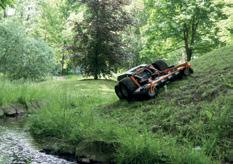
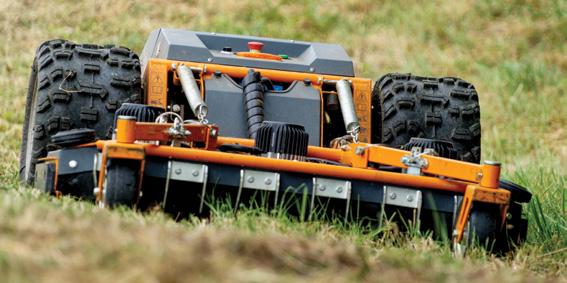
AriensCo introduces two professional mowers – the Summit Pro Series zero-turn mowers with cutting widths up to 183 cm for commercial and municipal use and built for service providers clocking up 500 to1,000 hours a season, and the AS-Motor AS 990 Tahr RC remote-controlled rotary to safely tackle steep slopes and challenging terrain. “We’re committed to solving real-world problems with purpose-built machines,” said general manager Sam Lewis.
Matabi presents its electric line sprayers, including the Evolution 15 LTC and e+ 7 - powered by lithium batteries, they offer up to 10 hours of autonomy, constant pressure and ergonomic design to advance sustainable, precision spraying, “offering greater comfort, effciency and sustainability for landscaping professionals, local authorities and green space managers looking to enhance effciency and reduce environmental impact”, said UK sales manager Keith Godfrey.
Among Trilo's vacuum sweepers on stand B042 will be the M3 Multipurpose, with interchangeable shaft options to transform the 3m3 collector into a machine for all seasons. The leaf and debris collectors range up to 30m3, combining powerful suction with smart, modular, robust construction, to remove leaves, pine needles and clippings
- speeding up tasks that can otherwise dominate autumn and winter schedules.
Long Rake Spar distributes Grantex Specialist Aggregates’ premium dried sports sand, a precisiongraded, kiln-dried infll to optimise synthetic sports pitches. The UK sourced naturally rounded sand enables "exceptional drainage and surface stability while meeting FIFA Quality Programme and World Rugby turf performance standards”.
Mansfeld Sand (stand F010) will explain how its silica sand-based products can enhance the health and performance of turf across sports, landscaping and equestrian applications.
Available are Fibre Reinforced, Fibrelastic and Fibresand rootzones, Sand Soil and Sand Compost Rootzones, Top Dressing and Mansil Silica Sand Sports Range.
www.mansfeld-sand.co.uk
SISIS reliability focus
Its proven line-up of pro turf maintenance machinery highlights solutions trusted by grounds teams across sports pitches, golf courses and fne turf venues worldwide.
The Quadraplay multi-task system, Auto Rotorake MK5 thatch, moss and organic matter remover, Multitiner and Dart aerators and Rotorake TM1000 tractormounted scarifer and linear aerator feature Osca 3 tractor-mounted, powered oscillating brush
designed for synthetic turf with sand or rubber infll, SSS 1000 towed sweeper and Twinplay single-pass maintenance system combines two implements satisfy all meet specialised pitch upkeep.
https://dennisuk.com/
A trio of innovations for advanced pitchcare are promised by SGL - TurfBase revamped data management dashboard with nine modules including Live Data, Lighting, Registration and Energy Monitor; TurfRobot fully autonomous UVC-powered unit to prevent and reduces grass diseases with minimal manual input, and advanced modular LED grow lights (LED60, LED30 and LED10) offering “compact, energy-effcient solutions” for various pitch requirements.
The lightweight Imants Recycling Dresser from Campey Turf Care Systems aerates turf vertically and horizontally - its smart rear fap improves soil displacement and drying time, while folding legs aid transport and storage. “The machine is engineered to promote sustainable practices, while the rear fap ensures better handling of displaced soil, reducing waste and maintaining turf integrity,” said director Lee Morgado. www.campeyturfcare.com
Grinding “precision and performance”
The Jupiter ATI ‘All in One’ grinder remains the professional choice for consistent, accurate cylinder work, claims Hunter Grinders, which can prove its point on E123.
Build quality and repeatability hallmark the fully automatic relief and spin unit, which restores cutting units “to exact manufacturer specifcations”. Solid cast bed and heavy-duty linear rails provide smooth, stable movement and precision, “accurate to within 0.05 mm (2 thou)”.
Liquid coolant manages heat and dust for a cleaner, safer workspace, while twin LED work lights provide excellent visibility throughout each grinding cycle. https://huntergrinders.com/
Win a Cramer Tools lawn mower
Register free at www.saltex.org.uk and be in with a chance of winning a Cramer Tools Lawn Mower, complete with charger and battery, worth £2,240.
Third Toro deal completes 15-year tie-up for Little Aston
High-ranking parkland course Little Aston has signed its third fve-year deal with Toro and Reesink Turfcare to complete a 15-year tie-up.
The £0.5m deal “guarantees the club longevity, reliability and durability for its turfcare equipment”, states course manager David Gibbons: “With no onsite mechanic, we need hardwearing machinery with a good fnish for the level of presentation you’d expect for a top 100 England golf course.
“Financially, the club needs to be happy with the price and overall deal and looks for solid warranties, discounts on parts, good machinery support and investment in the team with training and greenkeeper education,” he states.
Trust is the backbone of the relationship with Reesink,
he continues: “keeping us up to date with alternative or new machinery, help with demonstrations of new technology, and advice on new machines to do the job better.”
“For example, we have been building bunkers and found the Reelmaster 3100 with SideWinder technology is best for maintaining bunker banks, helping with the undulations and a front unit sliding control for safety when near the edges.”
And with machinery delivery spread over the years, “we have time to evaluate the current machine before the next term and adjust accordingly to changing priorities and projects under way,” David says. www.reesinkturfcare.co.uk
Electric Mowit Pro
“meets wide-area
Blending “sustainability, effciency and cutting-edge automation”, the fully electric Mowit Pro from lawn and garden equipment supplier Sabo targets wide-area operations.
Multiple operation modes include remote control, semi- and fully autonomous capabilities.
Drawing strong interest at GroundsFest, the mower will suit noise sensitive sites such as public parks, golf courses, schools and hospitals, the supplier says, adding that key advantages zero emissions, extremely low handarm vibrations, quiet operation, lower running costs and minimal maintenance.
demand”
Its 120 cm rear discharge and 132 cm mulching deck options allow easy transport in a variety of vehicles.
Operators can choose direct remote control for precision tasks, let the mower handle repetitive routes semi-autonomously or deploy it fully autonomously (upcoming release) optimum productivity and minimal management – a fexibility “ensuring safe, effcient, and tailored mowing solutions across parks, sportsfelds, campuses, and other large-scale landscapes”.
Remote control up to 250 m and GPS drive “enables precise, effortless manoeuvring and makes it easier to
navigate large areas with minimal operator intervention”.
Replaceable Li-ion batteries allow extended use and easy replacement, allowing longer operating without downtime.
Patent-pending steering via the front wheels improves manoeuvrability and control, “making it easier and more precise to navigate through tight spaces and varying terrain”. Pivoting and tilting cutting deck/unit allows effcient mowing, easy maintenance and simple cleaning and blade changing.
Two 2.5 kW brushless motors let’s the mower run up to 8 km/h, while a 52 IP protection imparts dust and water resistance. Device-independent web app gives easy access to autonomous and mapping functions.
Distributed solely by PSD Groundscare and its nationwide network of authorised dealers. www.psdgroundscare.com
Power and performance amid the peace
Tucked away in North London's green spaces, St Marylebone Crematorium has served as a place of remembrance and refection since 1937 – its dedicated grounds team tending the peaceful gardens and neatly kept lawns with care and precision.
Expanses of grass, tight access areas, many trees and memorial plots combine to create complex challenges for head gardener Alan Wilkins and gardener Lee Harris.
Approaching his second year here, Lee warms to the mowing with help from a compact Etesia Hydro 80 rideon, delivering precision, power and performance to keep the grounds pristine.
“It’s great for the tight areas between fower beds,” he says, “can access under trees, is fast, powerful, cuts and collects long and short grass and picks up really well, even in the wet.”
The machine’s 0.82 m width allows it to cut in tight spaces between memorials, while the 15 hp Kawasaki twin-cylinder engine, hydrostatic transmission and contoured deck, “deliver the power and performance expected from a much larger machine”, Etesia adds.
In post for just over a year, Alan soon decided to order the latest model of the mower after hearing of its predecessor’s performance over several years at the crematorium.
“The fnish compares to a rotary pedestrian in terms of fne quality of cut - rare for a ride-on,” he reports. “Anyone working in formal gardens would appreciate that. For us, the appearance of the grass is very important.”
With 80 cm cutting width, electromagnetic blade clutch and integrated 240 l grassbox (emptied from the
seat) the Hydro 80 includes anti-scalp rollers for uneven ground, fngertip controls and comfortable high-backed suspension seat. www.etesia.co.uk
Cullompton relies on Raymo
Cullompton Town Council maintains public spaces from grass verges and play parks to allotment sites and cemeteries.
The challenge for town clerk Dan Ledger’s team has been delivering consistent quality across different environments in the Devon authority while balancing workforce capacity, health and safety and sustainability targets.
Working with Iseki UK & Ireland and local dealer ABA Groundcare, the council invested in an electric Raymo robot mower equipped with the R42 Flex and R48 Craft cutting decks, connected through RayLink telemetry technology. Together, they help Cullompton deliver a smarter, safer, and more effcient service to residents.
While quietness and fully electric performance were key draws for Dan, RayLink has had the biggest impact, he says. “Monitoring in real time where the machine is invaluable for security and allows us to track machine movements and see how long the mower takes to cut an area. Programming work is now so much easier because we have an accurate, live point of reference.”
What once took a four-strong team four weeks to complete on the town’s grass verges takes half the time with just two operatives. These time savings and increased effciency help the council achieve more with fewer resources while maintaining higher standards.
Cullompton’s sites vary from fnely presented cemeteries to rough roadside verges, but the fexibility of the Raymo’s interchangeable decks allows the team to tailor the cut to the setting.
“In areas where we want a cleaner cut, for instance, the cemetery, it comes up almost like a bowling green,” says Dan. “Whereas next to the highways, where we need to take back growth and clear weeds, that rough cut
really benefts us. It’s about the service we give back to the public, and Raymo allows us to achieve that.”
Health and safety were another decisive factor. By eliminating the need for operatives to ride directly alongside busy roads, the Raymo provides an additional layer of protection for staff. At the same time, its environmental credentials align perfectly with Cullompton’s green agenda. Charged each evening at the council depot, the Raymo is powered entirely by the site’s solar panels, eliminating fuel costs and reducing emissions to zero.
“It was a large investment for the town, but we’re already on track to pay it back within 18 months through savings,” Dan explains. “People stop us on the street to ask about it and when we explain the health and safety benefts and that it’s fully electric, they’re genuinely excited.
“It’s not just about cutting grass more effciently, it’s about demonstrating that innovation in equipment can create safer workplaces, greener towns and a more engaged community.” www.raymoelectric.co.uk
Yellow rattle (Rhinanthus minor) - the friendly parasite
Isn’t sowing wild fowers in November and December a bad time? Not for yellow rattle. Get it in the ground before the end of December so the seed benefts from the damp winter chill to break dormancy for the best chance of success, grower DLF’s wildfower specialist Paul Hadley explains
Yellow rattle gets its name from the gentle sound made by the ripe seeds hitting the inside of the calyx when the summer breeze shakes the stem. Its distinctive yellow, tube-like fowers appear from May to September and it can grow to about 400 mm tall.
It is also defned as a hemiparasite – gaining some of its nutrition by latching on to the roots of the grass plant, in turn reducing grass vigour. In most land-based settings this is a bad thing - but essential in the long-term success of species rich wildfower grassland.
Avoid grass dominance
Often due to site and soil conditions, the grass component of the sward becomes too dominant and starts to outcompete the fowering species. Yellow rattle can help combat this if you can successfully establish a community over time.
Yellow rattle is not a cure-all however. It tends to perform better on lighter, thinner soils with a balanced mix of fner grass species and less well on heavy nutrient rich soils supporting more aggressive pasture grass species.
To give the plant the best chance to thrive, consider your ground preparation. If you are sowing into an existing sward, some soil disturbance, such as a light harrow, will be necessary to get the seed to soil contact needed and improve the chances of establishment.
Variable establishment
Work on a sowing rate of 1 g/m2 but remember, yellow rattle can sometimes be variable in establishment, so introducing new seed in autumn should be viewed as an ongoing operation until a community has built up.
As yellow rattle is an annual species, it must be allowed to fower and set seed in its frst year, which can be diffcult if you’re trying to manage a newly seeded project correctly by mowing and collecting arisings during its frst growing season. With an autumn sowing and the correct TLC, it will make a great addition to a meadow area in its second and subsequent years. www.dlf.co.uk/wildfowers
Respect your chainsawit could bite back
Worrying rise in accidents sparks drive to raise safety awareness
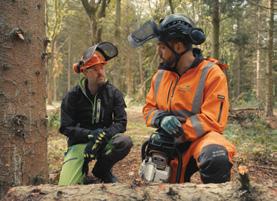
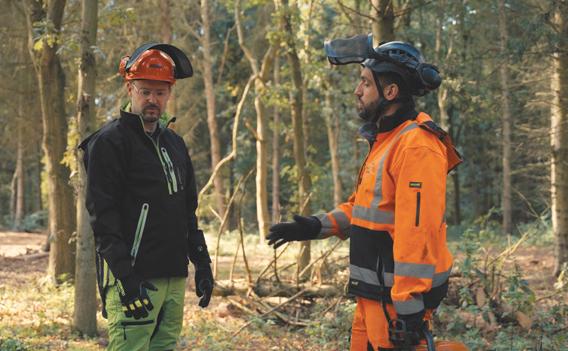
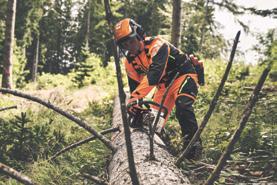
Chainsaws have the power to kill, if operators lack proper training and fail to wear personal protective equipment (PPE) a campaign highlights.
In a drive to educate professionals and the public on the critical importance of training and safety in using the power tools, land-based awarding and accreditation body Lantra points up the rising number of accidents involving the equipment.
Chainsaws are more accessible via low-cost supermarkets, the careers, skills and qualifcations organisation states in launching its awareness campaign.
"Middle aisle ‘specials’, purchases online and in DIY stores have helped create a worrying rise in accidents linked to improper use,” it states.
A freedom of information request to NHS hospitals in England, Wales and Scotland revealed that 3,144 people have attended A&E departments due to a chainsaw related injury in the last 10 years, with the trend increasing since 2020, Lantra reports.
Its Respect the Chainsaw campaign seeks to dispel myths, raise awareness and promote vital safety measures.
“We know that chainsaws can cause life-changing injuries within a split second,” said Clegg Bamber MBE,
Lantra head of communications. “Sadly, sometimes these injuries are fatal. Our message to all those who operate a chainsaw, or plan to, is chainsaws are dangerous. Training on how to use them is essential, and PPE is non-negotiable.”
Mandy Maynard, Lantra head of industry partnerships for forestry and arboriculture, added: “PPE can mean the difference between a close call and a catastrophic injury. It’s not an add-on but a necessity.”
Film highlights dangers Lantra has released a flm highlighting the importance of training, knowledge of how to use a chainsaw safely and the requirement to wearing protective clothing.
In it, arborist James Bingham summarises the dangers of the chainsaw and stresses the importance of knowing how it works, correct use, understanding risk of kickback and exploring how protective clothing comes into effect should it connect with a chainsaw.
“Whether working in a professional environment, pruning a tree in the garden or clearing a fallen tree from the driveway or work, safety must come frst, Lantra concludes.
NHS FOI data was requested in May 2025 to all hospital trusts in the UK that have provision of an emergency department, sometimes referred to as accident and emergency.
The data quoted is sourced from the 38 NHS trusts responding to a blanket FOI request to all UK trusts in May 2025. Data from other trusts was generalised to include other injury categories so were excluded from the quoted data.
A total of 3,144 attendances were recorded for 2015 to June, of which, 1,828 were in England, 649 in Scotland, and 667 in Wales. No data for Northern Ireland was provided as part of the request.
Lantra trains people to work safely, productively and sustainably in land-based and environment industries across sectors including landscape and vehicles, forestry and highways and horticulture and machinery. It develops and certifes specialist training and qualifcations. www.lantra.co.uk/chainsaw-safety
Saltex Stand: C028
Major players back Lantra campaign
News of the Lantra ‘Respect your Chainsaw’ initiative has brought robust support from key manufacturers in the sector.
“We sincerely appreciate and fully support the vital work Lantra does in establishing standards of safety and competence within the land-based industries,” said Joerg Bauerle, product manager at OPE maker EGO Power+.
“Lantra's focus on the informed and prepared user is the absolute bedrock of responsible tool operation,” he stated.
“It is precisely to support this professional commitment that we develop tools that actively reduce environmental and operator strain hazards [so that] a trainee already benefts from a modern, inherently safer platform that dramatically reduces health risks traditionally addressed in training.”
“Training improves working effciency” - Stihl Stihl said it was “pleased to support this professional initiative, promoting the correct use of PPE alongside safe working practices, and always recommends proper training and high-quality PPE.
“Therefore, it is important that professionals have access to courses that help them to use and maintain their equipment in the correct manner,” it added.
“Training not only enhances safety but also improves effciency when working with chainsaws. Furthermore, quality PPE should always provide essential protection, while keeping users comfortable, for maximum safety.”
Joerg concluded by emphasising the benefts of the OPE kit the manufacturer has developed.
• Vibration mitigation: No high, sustained vibration of petrol engines, signifcantly reducing risk of Hand-Arm
Vibration Syndrome (HAVS) and long-term muscular and vascular damage - key long-term health issues for trainees.
• Acoustic safety: Lower noise levels reduce need for mandatory, often cumbersome, hearing protection and mitigate long-term risk of hearing impairment.
• Fume elimination: No exposure to toxic emissions or fuel handling and storage hazards of mixing twostroke fuels.
“No technological feature can replace a professional approach, [which is why] we emphasise that our tools are designed to work in tandem with the essential practices taught in every Lantra course,” Joerg added.
“We design our tools to be powerful, compliant and intrinsically safer but it is training and best practices that ultimately equip the user to wield that power responsibly. We are committed to supporting instructors as the industry transitions to cleaner, safer battery technology.”
Power surge for Makita LXT cordless kit
More cells and boosted electrical capacity are the promise for OPE maker Makita UK's two latest batteries for its LXT cordless tools.
The BL1890 18V 9.0Ah and BL18120 18V 12.0Ah batteries will allow compatible LXT cordless tools to run longer to let operators work longer on one charge.
Building on the success of the LXT platform, the batteries have far more capacity than the 6.0Ah current ones, Makita says, allowing operators to raise productivity and reduce need for swap outs.
In addition to their increased capacity, the two new batteries come with improved impact resistance. By adopting a shock-absorbing structure equivalent to that of the 40Vmax XGT batteries, the new 18V LXT batteries offer reduced risk of damage from unexpected drops.
“Improving battery technology and capacity enables more people than ever to switch to cordless power tools,” said marketing manager Kevin Brannigan, “now the logical solution for more professionals than ever, regardless of their needs or the tools they use.”
The larger BL1890 and BL18120 may be incompatible with certain LXT cordless tools so check before buying, Makita advises. www.makitauk.com
Chainsaw tuned to tree work at height
A top-handled, high-performance chainsaw targeting arborists and forestry professionals is the latest offering from battery OPE specialist EGOPower+.
The lightweight 30cm CS1200E tool will suit treecare operators working off the ground. Equipped with
a 20m/s chain speed, the chainsaw has a thin chain for fne cutting trees, while reducing risk of disease spread as fungus is less likely to grow in cut grooves, the manufacturer states.
EGO responded to requests from its arb customers for a chainsaw tailored to work at height, said product manager Joerg Bauerle. “Small, lightweight and well balanced.”
The saw “easily cuts through branches and logs while providing stability, allowing professionals to be more controlled in a volatile environment”, he added. “Its chain brake system projects operators from kickback to provide extra safety.”
An oil level and translucent window helps users monitor the tool, which automatically lubricates the chain, fostering longer life and preserving it from damage. The 150 ml oil tank will need topping up, depending on work time.
Ideal for bar lengths of 30 cm, the CS1200E has 64 chain drive links and metal bumper spikes “for fast, effcient cutting”, while variable speed control permits “a tailored and controlled experience, instead of users having to switch between fxed settings”, EGO states. https://egopowerplus.co.uk/products/ chainsaws/cs1200e-top-handle-chainsaw
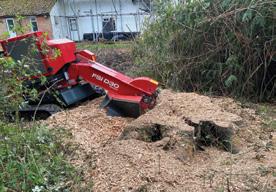
The Norfolk Arborist has certainly got its money's worth from the FSI B22 stump grinder owner Michael Lomax bought when he launched the company in 2017.
“Its reliability has been extraordinary. We must have made our money back on it ten-fold,” he gauges. The grinder has proved the go-to solution for stump removal in restricted-access, residential settings for the last eight years.
With various domestic clients and commercial contracts including the Ministry of Defence and several large landowners throughout Norfolk, Suffolk, Essex and Northamptonshire, no two weeks are ever the same.
“It’s versatile, and being self-propelled means we can send one van, equipped with a chipper and the B22 and the team will have everything to do the job. We must have clocked up close to 1,000 hours with the machine and have had next to no issues,” Michael reports.
For larger domestic and commercial projects, Michael turns to local FSI partner Stag Machinery, where he hires the D30, which can grind up to 120 two-foot stumps
Stump grinder “delivers tenfold payback” Specialist joins ERH as it adds Platipus
Landscaping and forestry specialist Aaron Grange includes Platipus Tree Anchors in his portfolio since East Riding Horticulture (ERH) became an approved distributor for them.
Arron has joined the team as landscape and forestry business development manager with nearly a decade’s experience at Green-tech.
His appointment is part of the family-run independent mission to strengthen its commitment to supporting professionals across the landscaping and forestry sectors, which he said he was looking forward to contributing to in a business whose name had been built on a reputation for quality products, customer service and a commitment
a day. “Its lighter footprint compared to others in this category allows us to move the unit over residential lawns, patios and other sensitive areas if needed without risk of causing damage.”
www.fsi-stumpcutters.co.uk
to helping landscapes and woodlands thrive for the future.
ERH has just launched its Northern Landscape Supplies division, which provides “a streamlined procurement experience for contractors, local authorities, forestry organisations and environmental consultancies to combine specialist knowledge with the robust logistical infrastructure of East Riding Horticulture,” a spokesperson said.
The ERH offering spans tree shelters, planting sundries, fertilisers, soil improvers, ground protection and solutions for erosion control, “designed to protect young plants, support strong establishment and ensure long-term growth and resilience in both rural and urban environments”, it stated. “Arron’s appointment marks an important step in our ambition to expand our support for the landscape and forestry sector,” it added.
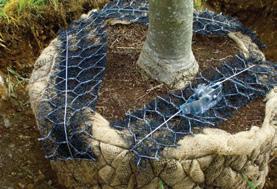
Platipus was a top brand delivering innovative and reliable solutions, the company said. “As an offcial distributor, we can provide direct access to these highquality products, backed by local stockholding and fast turnaround times.
“By holding stock, we can ensure landscapers and contractors receive what they need quickly and effciently,” Arron added. “Platipus solutions provide robust and sustainable anchoring for newly planted trees, helping ensure strong establishment and long-term growth in all environments.”
How to plant a bareroot hedge
Under its autumn campaign to raise awareness about how ‘green’ bareroot hedging is, British commercial grower Wyevale Nurseries is offering free expert advice. Its step-by-step guide issued just before lifting season starts in November helps promote the benefts of bareroot.
“For anyone planning on planting a hedge this autumn and winter, bareroot is the greener, smarter choice,” states sales director Kersten Catella, pictured right. “The hedge is sustainable, cost-effective and produces a highquality green boundary that provides shelter and food for a vast number of our native birds, insects and animals.”
Wyevale has supplied bareroot hedging stock to commercial and amenity customers for many years. “The plants are grown in open felds and lifted during dormancy, typically between November and March, making them eco-friendly – no plastic pots or peat/manmade mediums required,” she explains.
“They are also more economically friendly as they have lower production and shipping costs, which is good for the environment too, and they are hardy and resilient, as they are grown outdoors and are well-adapted to current UK conditions.
The plants create natural boundaries, wildlife corridors and privacy screens, whether in domestic gardens or large-scale landscaping projects.
Wyevale Nurseries has been growing trees, hedging, forestry, and other hardy plants, utilising innovative approaches to production and sustainability for 95 years.
Bareroot lifting season starts at the beginning of November for Wyevale, which supplies amenity and garden centre customers with the hedging from now until
spring, thanks to its 3,000 m3 cold store.
“Hedging plays a huge role in structure, biodiversity, even bird migration,” Kirsten adds, “and we want to raise awareness of [such benefts] and the importance of planting bareroot at this time of year.”
A booklet is available, designed to support confdent, informed decisions for those in the sector, exploring how to use hedging more intentionally for those wanting to fnd out which varieties are good to use when, where and why, and to give tips on how to plant well.
“It’s something you can keep open on your desk, onsite or in the garden shed, folded back on itself, covered in soil, and used without worrying about damaging it,” Kirsten says.
www.wyevalenurseries.co.uk
SSV and ATV workhorses “suit any site”
The groundcare and landscaping sector has long relied on all-terrain (ATVs) and side-by-side vehicles (SSVs) to move people, tools and materials from site to site across a multitude of terrains.
However, like any industry, job requirements are constantly evolving and businesses of all sizes are reviewing their feets.
Mike Loach, district commercial manager UK and Ireland for vehicle manufacturer Can-Am, spoke to The Landscaper about ATV and SSV usage in the sector, roadlegal ATVs and SSVs and how these vehicles are increasing effciency for the industry.
“An ATV was once the go-to machine for landscapers and grounds teams due to its compact size, agility and ability to make one person’s jobs easier and more effcient,” Mike notes.
“But jobs become larger and potentially more complex, resulting in a shift in what businesses are looking for in a vehicle. This pivot has led to businesses opting for SSVs, and the reason is simple,” he states.
“They have been designed and developed to carry more people, have larger towing and cargo bed capacities and they can support a broader range of attachments such as spreaders rollers and harrows, among others.
The combination makes them workhorse vehicles with the capacity to carry tools and equipment, Mike continues, “which means less downtime as the SSV does not have to go back to the site offce to collect new items and accessories, and when it comes to tackling multi-crew, multi-purpose work, SSVs have become the machine of choice”.
ATVs still have their space, he adds, especially on
smaller sites where they are a cost-effective option, particularly in areas where space may be limited.
Road-legal upswing
There’s a key trend afoot too, Mike reports. “Both the district commercial managers and dealerships in CanAm’s network have seen a concerted move towards road-legal ATVs and SSVs.
“This is especially important for businesses working across multiple sites because it provides them with a vehicle that they can simply drive on the road from one project to another.
“That in turn not only opens new opportunities but also makes the vehicle more versatile and effcient as there’s less downtime in not having to trailer vehicles to move them.”
By going down the road-legal route, he continues, businesses see it as an investment that not only improves logistics but also ticks several boxes when it comes to compliance and liability.
Customised vehicles to suit specifc tasks are coming into focus, Mike reports, and this is where a brand’s accessories portfolio is important, he points out. “We are constantly talking to the end user to understand their needs and requirements, so the R&D team can develop required accessories, such as racks and winches, which also need to be easily interchangeable because the less downtime a vehicle has from job to job, the better."
The rise of electric
In the last few years there’s been a rise in interest in electric ATVs and SSVs as businesses look at alternatives to petrol and diesel, Mike says, “driven by rising and fuctuating fuel costs.
“We know that the market for electric vehicles, like our new Outlander Electric, will continue to grow as fossil-fuel alternatives become more viable”.
But no matter how good the EV revolution is, it may take time for the industry to change, he believes. “For some customers, the change will happen quickly - for others it may take more time because of the old adage of 'If it ain't broke, don't fx it!'
“This is why it’s important to continue to educate the sector on the benefts of EV vehicles because the more users know, the more knowledge they have to make informed decisions on what type of vehicle suits their business in the short, medium and long term.”
Mike concludes: “In landscaping and groundcare, the versatility of a vehicle will be the crucial factor that drives purchasing decisions. However, it is still important to remember that the vehicle should match the machine to the work at hand, while ensuring it fts into the business’s wider strategy on cost, sustainability and job areas it might be looking to move into in the future.”
Cold snaps can drop on us any time from November, so site clearance to prepare for icy conditions makes sound sense. Three tasks are key to successful pre-winter preps to ensure grounds, gardens and estates are safe and compliant.
Clear leaves from roads, paths and car parks regularly as the most common leaf-related issues are blocked drains and gutters, hiding potholes and slip/trip hazards and untidy, messy appearance.
Ice often forms under leaves in freezing conditions, which can prevent winter gritting salt from reaching it, creating a treacherous surface.
Make drainage maintenance a year-round task though it’s especially important in autumn and winter. A blocked drain, poor drainage or ponding can cause major issues and standing water can cost dear to repair.
High-pressure water jetting and cleaning, drainpipe cleaning, no-dig drain repair and drain surveys and planned maintenance are all relevant actions.
And it pays to proactively and periodically walk the site to identify and attend issues.
Procurement teams and facilities managers face mounting pressure to manage costs, maintain compliance and deliver high service standards. Grounds maintenance, winter gritting and reactive works, are separate services, often sourced from different suppliers.
A fexible approach perhaps but a policy that can bring unnecessary complexity, time and cost. Bundling services with one provider can streamline procurement and improve effciency.
Managing multiple service contracts requires time, resources and co-ordination, creating separate contracts, service-level agreements, invoices, and
Complexity that can quickly escalate, particularly for organisations running several sites or more, leaving procurement and facilities teams stretched between administration and service delivery oversight. Risk rises too. Inconsistencies between suppliers can lead to service gaps, delays or compliance issues, affecting safety and operations.
Benefts of bundling
Unite landscaping, winter maintenance, vegetation management and reactive works under a single agreement and practical benefts result.
Financially, bundling can lead to economies of scale. Teams talk with one supplier, often achieving better overall value. Contract consolidation also means fewer invoices and purchase orders plus simplifed budget tracking.
Operationally, bundling allows service levels to be standardised to meet the same quality benchmarks, fostering a safe, professional environment throughout and compliance with health and safety or environmental norms. And one provider carries sole responsibility if issues arise, easing communication via a single point of contact.
Multi-site estate managers can manage a national portfolio through a single framework without negotiating with local contractors. Public sector facilities managers can simplify compliance and auditing, while small businesses outsourcing several services to one supplier save time, allowing them to focus on running core operations.
If bundling services appeals, consider provider capability, contract fexibility and service level clarity before you take that step towards smarter, more streamlined procurement that supports operational effciency and long-term value.
Information sourced from Outco.
Highfield clears the way to upkeep boost
A 500-acre estate is one heck of an undertaking when the task of winter clearance looms large. But Highfeld and Brookham School is enjoying a boost to its maintenance regime since replacing its existing Trilo S3 vacuum sweeper with the Multipurpose M3 earlier this year.
The switch is enabling grounds manager Jasper Marks and the team to not only conduct leaf clearance but also scarifcation and cut/collect tasks around the expansive grounds and estate.
Jasper took over the head role in 2022, having worked at the co-educational school as a groundsman since 2019, and is currently supported by a team of three grounds staff and a part-time gardener.
On the border of West Sussex, Surrey and Hampshire, the site is densely tree-populated which meant that the Trilo machine had always been a key item in the feet. The latest purchase looks set to carry on the tradition, bringing new-found versatility and productivity to maintenance tasks around the calendar, Jasper reports.
“The S3 was robust and effcient, which we used for leaf collection, road sweeping and general clearance of clippings and debris over the autumn and winter months. I then discovered the Multipurpose M3, which was capable of doing everything the S3 could, with the addition of fail and scarifying shafts to cut or scarify and collect all with one unit. It’s transformed the Trilo into a machine that we can fully utilise all year round.”
RoboBlast
makes debris clearance a breeze
Keeping landscapes debris free at this time of year presents tough challenges for contractors and grounds staff.
But it needn't be so much of a chore, says Campey Turf Care Systems, especially if you can turn tackling the aftermath of winter winds into a breeze.
The tractor-mounted Imants RotoBlast blower clears the way to leave sports and amenity areas free for action and enjoyment.
Typically used on greens and tees, fairways, pathways and other sportsturf areas, the blower shifts leaves, grass clippings, thatch, litter and other unwanted surface debris from sites requiring clear access or that need to be kept tidy.
Adding the RotoBlast to your maintenance feet delivers a lightweight machine, weighing only 100kg, which can be lifted and easily moved by the operator when unhitched from the tractor, Campey explains.
The unit is equipped with a powerful 3,750 rpm blower generating an air velocity of 130 m3/min and has been designed with the practical user experience in mind, it adds.
Productive for longer
Installed by dealers Lister Wilder and Trilo’s Jeremy Vincent, the machine is already demonstrating its versatility, Jasper adds: “We have a 9-hole golf course on the estate where the Trilo has been used to assist with cut and collect of the roughs. The large 3m3 hopper means we can cut for longer without having to make as many trips to our green waste area to empty. It’s keeping us productive, for longer.
“After that, we equipped it with the scarifer shaft for use on our sportspitches. We previously hired a machine for this which often meant we were scarifying in less than ideal conditions. Now we can do it ourselves whenever the weather or play schedule allows which will bring huge improvements to pitch quality.
“We traded in one machine and gained three in return but needed to fnd no extra space in the shed as the footprint is near enough identical,” Jasper adds. “It’s going to become a pivotal part of the team as we continue to drive up standards for our students and wider community to enjoy.”
www.trilo.com
Attached by a 3-point linkage, the blower is mounted on a wheeled chassis to enhance its ability to follow contours on undulating terrain while maintaining a constant nozzle height above the ground. You can invert the wheels and revert to fully mounted operation if you need to.
With 300 m2/min capacity and operating speed of 0.6 to 6.2 mph, the blower requires only 25 to 50 hp tractor power. wwwcampeyturfcare.com
Privacy, performance and planet: the drivers reshaping fencing demand
Over recent years, garden fencing has evolved from a simple boundary marker into a key design feature, writes Matt Watson , group marketing manager for Lawsons Group
UK homeowners continue to invest in home and garden improvements, and while sales of staple fencing products such as closeboard and lap panels remain strong - particularly in new-build markets – both trade and retail customers are increasingly seeking more design-led solutions.
With budgets under pressure, buyers are weighing long-term value alongside aesthetics. Here are some of the key consumer trends in fencing Lawsons have observed in the last 12 months.
Value – spending smarter
The cost-of-living squeeze hasn’t killed demand – it’s sharpened it. Trade and retail customers alike are increasingly focused on longevity: warranties, rotresistant materials and easily repaired designs. Consumers are shifting towards mid- to heavyweight
fence panels rather than entry-level options. They remain price-aware but not necessarily price-driven, adopting a ‘buy once’ philosophy.
Timber and concrete posts remain the most popular, but steel post systems such as DuraPost are rising in popularity - not only for their clean, contemporary aesthetic, but also for their durability and weather resistance.
Privacy without heaviness
Privacy will always matter but the look has moved on. Slatted, double-slatted, louvre and hit-and-miss panels, which allow airfow and light while maintaining seclusion, are now among our best-selling products.
Heavyweight trellis panels also continue to perform well in areas where privacy is less of a concern - often used to break up a solid run of fencing or to provide support for climbing plants.
Jacksons Fencing Jaksun panels
Weather resilience – from optional to essential
The UK’s increasingly turbulent winters are infuencing specifcation - customers who once accepted shortlife, budget panels are investing in heavier panels and reinforced posts.
As previously mentioned, slatted designs that diffuse wind load continue to be popular, providing far higher resistance to wind damage than a traditional fat panel.
The fence repair and reinforcement category continues to be important in an increasingly stormy climate, with consumers taking proactive steps to prevent fence damage – fence repair spurs, replacement arris rails and post supports.
Eco goes mainstream Eco-supporting features are now frmly in the mainstream. As consumers focus on water management, pollinator attraction and wildlife support in their gardens, products such as hedgehog-hole gravel boards and trellis extensions are increasingly popular.
Composite fencing, made from recycled plastics and timber waste, hasn’t achieved the mass-market breakthrough once predicted but it still provides a credible alternative to timber for low-maintenance buyers.
Fence panels and trellis are also being repurposed to create freestanding green walls, or walls around outdoor dining areas, offering shade, texture and plant support.
A notable eco innovation comes from Jacksons Fencing, whose Jaksun panels integrate solar technology within a hit-and-miss panel design - an attractive new way to generate renewable energy at the boundary line. With weather patterns becoming more extreme, could the next step be fences that harness wind power rather than simply withstand it?
Acoustic
and neighbour-friendly upgrades
As gardens become more social spaces and properties sit closer together, acoustic screening and dual-sided aesthetics are moving up the agenda. From purposebuilt acoustic panels to subtle upgrades - such as taller trellis, denser boards or planting used as a sound buffer - customers are seeking better noise control.
Equally important are panels that look good on both sides, simplifying neighbour discussions and encouraging shared-cost installations.
Style and colour
Visually, the market is moving away from uniform brown or green panels, once installation is complete. Warm neutral stains (oak, cedar, grey) and contrasting materials are in high demand, often coordinated with decking, paving and decorative aggregates.
Protek WS&P Silver Fir fence & shed
DuraPost - Anthracite Grey (wood panel)
Products such as Skyline cedar slats and slatted panels are increasingly sought after, providing an alternative texture and colour palette to traditional fencing. Natural landscaping materials, including railway sleepers and decorative aggregates, are also being used to introduce colour and texture.
The trend extends to fence treatments: brands such as Protek now offer stains in blues, greens, greys and even black, giving homeowners more scope for creative coordination.
The outlook
The UK fencing market is maturing fast. Homeowners no longer see fencing as a commodity purchase but as an investment in lifestyle, longevity and environmental performance.
Suppliers, merchants and contractors who adapt quickly - offering durable, design-led and eco-credible systems - will hold their ground as the sector continues to evolve.
Matt Watson is the group marketing manager for Lawsons Group – London and the South East’s largest independent timber, fencing and builders’ merchant – comprising Lawsons, AVS Fencing & Landscaping Supplies, Briants of Risborough, Oxford Fencing Supplies, Southill Sawmills, The Landscape Centre and Witham Timber. www.lawsons.group
KDM Slatted Panel
Palmer timber skyline cedar slats
Plaswood powers up Zest EV charging rollout
Electric vehicle charge point operator Zest Eco has selected Plaswood for its UK national network of charging site perimeter and infrastructure fencing.
Fashioned from at least 95% recycled plastic and recyclable at end of life where facilities exist, the fencing falls within Zest’s wider strategy to build lower impact EV charging locations.
As a Certifed B Corp with strong ethical and environmental credentials, Zest sought a solution aligning with its core environmental values while delivering durability, maintenance and installation performance.
Working with Zest's design team, Plaswood owner Amcor backed development of a product blending long service life with practical onsite benefts at unattended sites. Following prototype trials, the fnal design used tongue and groove boards slotted into concrete fence posts for fast, effcient assembly.
The specifcation enables Zest to bring EV sites online quickly its operations with confdence, the company says, while the low-maintenance fencing allows its team to focus on rollout and network growth rather than site upkeep.
In urban settings where wear, weathering and vandalism are high-risk factors, the fencing’s durability and resistance to rot and weather ensure performance and presentation are maintained without repeated
intervention, Zest stated, adding: “Our calculations showed that our operational and indirect customer experience costs would be lower over time if we used a modern alternative to wood.”
Plaswood is also supplying gates, “offering a uniform and long-lasting solution throughout each site”.
"In the design phase for our community EV charging sites, we recognised that wooden fencing solutions would require regular maintenance and cleaningespecially in many of the tougher urban locations we serve,” said Simon Wilcox, Zest Eco product manager.
Tackling climate change with resilient projects
Landscapers can design climate resilience into their projects using synthetic turf, amid increasingly frequent extreme weather events, states Stefan Diderich , director general/ CEO of EMEA Synthetic Turf Council (ESTC) who discusses how in his latest column
The results are in – summer 2025 was the warmest on record in the UK1. And there's no sign it'll stop there. Climate scientists from the Met Offce have stated that a summer as hot or hotter than 2025 is now 70 times more likely due to greenhouse gas emissions from human activity.
With such a warm summer, it’s easy to forget how sporadic the weather has been at times. This is perhaps best evidenced by August, which saw Storm Floris directly followed by a late summer heatwave.
Extreme weather events such as these are symptoms of the UK’s changing climate, with the Met Offce forecasting that winters will be up to 30% wetter, and summers up to 60% drier, by 20702
This changing climate naturally raises challenges for landscapers, with fooding and extreme heat particular challenges. Fortunately, there are ways this can be managed through measured specifcation and installation of synthetic turf.
Laying the groundwork
First and foremost, landscapers must consider the unique location, topography, and geography of their site. Even in a relatively small country such as the UK, the effects of climate change can manifest in vastly different ways.
For instance, a site on top of a hill is not likely to have the same challenges as one nestled at the bottom of a valley, while a location with loamy soil must be managed differently to a site built on clay.
Managing food risk
Working quite literally from the ground up, addressing the risk of extreme rainfall and subsequent fooding is a good starting point for any landscaper looking to climate-proof a garden - and it all begins with the sub-base.
Synthetic turf is well-known for its permeability, with the ability to quickly drain off compared to natural
grass. Therefore, the composition of the sub-base is often critical to how the system performs as a whole. A well-compacted sub-base, made of a material such as crushed granite, will allow water to fow through passively and prevent fash fooding below.
Taking this one step further, landscapers can create a French drain system by flling a trench with gravel and covering it with a permeable membrane, such as a piece of fabric. Add in a perforated pipe at the bottom
to carry the excess water away, and your French drain is complete. This can even be paired up with a water catchment system, allowing the water to be used for potted plants in greenhouses.
The result is a system that drains off quicky on top thanks to the synthetic turf layer, without the risk of causing fooding underground – the best of both worlds when it comes to managing wet weather.
Beating the heat
At the other end of the spectrum, landscapers must simultaneously plan around extreme heat and drought. Here, landscapers get what they pay for when it comes to quality. Artifcial grass from a reputable supplier, such as an ESTC member, will withstand the heat of the sun without discolouring for years to come. On the other hand, cheap products from unestablished suppliers may not fair so well.
Many ESTC members even offer specialist, UVresistant products that offer the best protection against overheating. While these are predominantly used in warmer climates at present, they are proving an increasingly popular option in the UK due to the growing challenge of extreme heat.
Finally, pairing your synthetic turf up with some savvy landscaping design can also help reduce surface temperatures. Trees and bushes that offer natural shade can help avoid heating of the surface through direct exposure, while adding refective materials throughout the garden can help decrease the overall temperature – a key consideration for urban areas, where the heat island effect is likely to be at play. www.estc.info