The Lamp: February-March 2026

Page 1


page 14

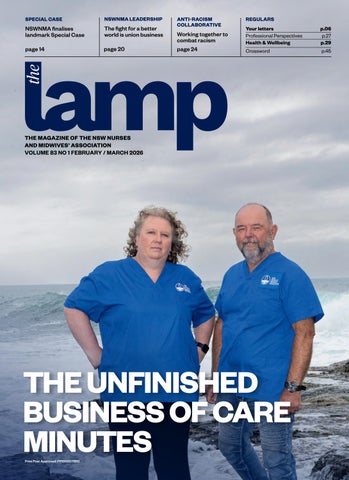
THE UNFINISHED BUSINESS OF CARE MINUTES

Contacts

NSW Nurses and Midwives’ Association

For all membership enquiries and assistance, including The Lamp subscriptions and change of address, contact our Sydney office.

Sydney Office

50 O’Dea Avenue, Waterloo NSW 2017 (all correspondence)

T 8595 1234 (metro) 1300 367 962 (non-metro)

F 9662 1414 E gensec@nswnma.asn.au W www.nswnma.asn.au

Hunter Office

8–14 Telford Street, Newcastle East NSW 2300

NSWNMA Communications Manager

Danielle Blasutto

T 02 8595 1234 (metro) T 1300 367 962 (regional)

For all editorial enquiries, letters and diary dates

T 8595 1234 E lamp@nswnma.asn.au

50 O’Dea Avenue, Waterloo NSW 2017

Produced by

Hester Communications T 0414 550 376

Press Releases

Send your press releases to: F 9662 1414 E gensec@nswnma.asn.au

Editorial Committee

Michael Whaites, NSWNMA General Secretary

Katrina Bough, NSWNMA Assistant General Secretary O’Bray Smith, NSWNMA President

Michelle Cashman, Long Jetty Continuing Care

Michelle Cutler, Tweed Hospital

Karen Hart, Wagga Wagga Base Hospital

Robyne Brown, Maitland Hospital

Printed by

Printed by IVE Group Sydney

Advertising

T 8595 2139 E nswnursescomms@nswnma.asn.au

Information & Records Management Centre

To find archived articles from The Lamp, or to borrow from the NSWNMA nursing and health collection, contact: Adrian Hayward, Coordinator. T 8595 2175 E gensec@nswnma.asn.au

The Lamp ISSN: 0047-3936

General Disclaimer

The Lamp is the official magazine of the NSWNMA. Views expressed in articles are contributors’ own and not necessarily those of the NSWNMA. Statements of fact are believed to be true, but no legal responsibility is accepted for them. All material appearing in The Lamp is covered by copyright and may not be reproduced without prior written permission. The NSWNMA takes no responsibility for the advertising appearing herein and it does not necessarily endorse any products advertised.

Authorised by S. Candish, General Secretary, NSW Nurses and Midwives’ Association, 50 O’Dea Avenue Waterloo NSW 2017

Privacy Statement

The NSWNMA collects personal information from members in order to perform our role of representing their industrial and professional interests. We place great emphasis on maintaining and enhancing the privacy and security of your personal information. Personal information is protected under law and can only be released to someone else where the law requires or where you give permission. If you have concerns about your personal information, please contact the NSWNMA office. If you are still not satisfied that your privacy is being maintained, you can contact the Privacy Commission.

Subscriptions for 2025

Free to all Association members. Professional members can subscribe to the magazine at a reduced rate of $30. Individuals $84, Institutions $140, Overseas $150

10

STORY Residents miss out on care as providers manipulate system

Many aged care providers are falling short of their obligations to provide mandated care minutes and an RN 24/7, says the NSWNMA.

COVER STORY

Members urge minister to act on care-minutes rort

NSWNMA members have given federal politicians first-hand accounts of how aged care operators are misreporting mandatory direct-care minutes.

14 SPECIAL CASE

NSWNMA finalises landmark Special Case

The NSW Industrial Relations Commission (IRC) heard final submissions in the Association’s historic work value case in December.

20 NSWNMA LEADERSHIP

The fight for a better world is union business

Big issues remain in our health and aged care systems, and under his leadership the NSWNMA will continue the fight to make our workplaces safer and our communities better, says new General Secretary Michael Whaites.

22 NSWNMA LEADERSHIP Nursing in the blood

The Lamp introduces our new Assistant General Secretary Katrina Bough who talks about her journey to leadership.

24 ANTI-RACISM COLLABORATIVE Working together to combat racism

A NSWNMA survey of racism in the workplace has led to a collaborative effort to confront the problem.

Editorial

COVER : Bronwyn Pillardth and Steve King Photographed by Sharon Hickey

WHAITES

New challenges, new fights

The world never stands still, and

The hearings for our Special Case wrapped up in December and we now await the findings from the Industrial Relations Commission (IRC). The full bench of the IRC indicated that our decision will be handed down in the first quarter of this year.

I would like to thank our legal team for the tremendous job they did. Thanks also to the 37 members who bravely shared their experiences with the IRC providing strong evidence of the realities of work in the contemporary healthcare environment (see p14). We are also grateful for the expert witnesses’ evidence that allowed us to put forward the strongest case possible.

They all did a fabulous job representing our professions, giving voice to our members’ claim for a pay rise that values the work they do and that addresses the historical gendered undervaluation of that work.

Regardless of the outcome of the special case, which will be final and binding on all parties, the fight for improvements in wages and conditions has to remain a constant focus for our union. Our determination to win improved wages and conditions for public sector members doesn’t stop with this decision. The economy continually evolves with changes in inflation, productivity and the cost of living all impacting on the buying power of your wages.

Similarly, new circumstances constantly arise in our workplaces. Our Special Case highlighted the significant changes in the scope and complexity of nursing and midwifery work over recent years, partly as the result of COVID-19, evolving professional standards, and changes in the complexity of patient care. There will inevitably be more changes. Healthcare is a dynamic sector and will continue to face new challenges whether they be due to the health consequences of climate change, the outbreak of new pandemics, improvements in technology and artificial intelligence, or other, yet unknown, developments.

neither can the Association if we are to achieve our goals.
Whether the special case delivers what we need or falls short of members' expectations, we will continue to fight for improved pay and better conditions for nurses and midwives.

We need to be prepared for any new challenges and ensure nurses, midwives and carers are rewarded for their role in meeting these challenges.

The work members do is incredibly important for the functioning of our society. They improve the health of our communities and make our economy stronger as a result.

They deserve pay and working conditions that reflect their contribution and allow them and their families to have a good quality of life while they are working and in retirement. As a union, we need to remain strong and united to ensure we win for members.

CARE MINUTES ARE THE UNFINISHED BUSINESS OF AGED CARE

Despite the enormous progress we have made in aged care in recent years there is still work to be done.

Decades of campaigning by our aged care members led to the Albanese government investing $16 billion in the sector.

That massive investment of taxpayers’ money was allocated to improve the care of residents, not to swell the profit margins of providers.

The clear feedback we are getting from our members in the sector (see p8) is that many providers are falling well short of their obligations to provide mandated care minutes.

This is backed up by research conducted by the NSWNMA and is even evident in providers’ own self-reporting.

The Association will continue to campaign for stronger requirements for transparency and more robust mechanisms for accountability around care minutes and the presence of RNs 24/7. We will also hold employers to account where care minutes are being erroneously allocated to non-direct care.

The Albanese government deserves credit for its commitment to the sector but without improved measures of accountability it risks endangering the progress we have made.

THE FIGHT AGAINST HATE AND BIGOTRY

The terrorist attack at Bondi, a clear act of antisemitism, surely makes it clear to all that it is crucial that we fight against hatred and bigotry, and stand strongly for peace, love and unity.

As a progressive organisation we embrace the fight against racism in our community: the racism experienced by Aboriginal and Torres Strait Islander people and all people of colour, the rise in anti-Semitism and Islamophobia, these must all be countered. This is something we have to urgently address.

In recent years we have implemented measures to ensure greater diversity in the voices that are heard within and from our union. Now we are reaching out to like-minded allies in the health and aged care sector to ensure our workplaces are safe as we fight against racism; if we do this work together we will have an impact not just at work, but within our communities.

I'm proud of the work that we've kicked off in collaboration with the Human Rights Commission (see p24). Curbing the right to protest is not the answer. Solidarity, education, and support for each other within our workplaces is the best way to influence our communities and rid our society of racism.n

Have your Say

Featured Letter

Wondrous experiences in PNG

This year I experienced the highlight of my career – amazing in my 30th year! I was asked to be involved in writing the paediatric subject for the Diploma of Nursing for 17 Nursing Colleges in Papua New Guinea (PNG) – an honour beyond words, particularly since half the population of PNG is under 18 years of age.

While creating the new paediatric subject, I addressed the transfer and administration of oral rehydration solutions and deciding whether the child needs a nasogastric (NG) tube and if so, can anyone insert one? I thought, if this skill were taught to all nursing students then the answer could always be yes.

Inserting an NG tube is difficult to master without a simulation doll: a rare asset in resource-poor countries. At the time, Kmart were selling a suitable doll with an ideal little nose. I purchased one and drilled into its head to give it nares that fit a size six NG tube perfectly. I drew some landmarks on the chest for accurate measurement, and the procedure was complete. But I needed 17 dolls and some spares!

Three Kmart store managers, on hearing my story, provided me with 25 dolls and charged me nothing. In addition to the nares and chest markings, I added guidelines for heel pricks on a baby by colouring in the appropriate areas on the soles of the feet.

The ‘SIM’ dolls were distributed to the nursing teachers at each college during a workshop they attended in Port Moresby. As their little bodies are soft, we were able to use them for teaching neonatal and paediatric basic life support as well. To sit with nursing colleagues in PNG and listen to their stories is both wonderful and heartbreaking. Their ingenuity and ability to adapt when there are little to no medications or equipment, as well as their eagerness to learn and improve healthcare in their country, is awe-inspiring. To think that I may have made a tiny but significant difference to that knowledge …. well, there are no words.

Pippa Cadwallader

Hard to hold back the tears

Now in my 80s, having worked 30 years as an RN in a nursing home happily in the ‘80s and ‘90s, the tears were hard to hold back as I read in the recent letter by Punam Sabba, RN in the December 2025 issue of The Lamp.

We have been let down by all governments. My first letter in The Lamp in the year 2000 was to complain about Prime Minister John Howard's change to the Aged Care Act 1997, when the matron and deputy resigned on the day of his announcement.

The once happy nursing home where I worked lost 76 hours per week of RN care for 40 residents. Providers increased profits while all staff cuts left overloaded workloads. Residents were left with compromised

care. Staff were left with no job satisfaction, making it very hard to return the next day.

My numerous letters to politicians and media over 20 years eventually may have at least helped to have a Royal Commission, where I stood before the Commissioner to reveal shortcomings, which only resulted in a few improvements. At least my stands in shopping centres to gain signatures for RNs 24/7 helped.

Fingers crossed on a good outcome

Readers of The Lamp will agree that nurses and midwives are skilled professionals deserving of a decent wage that reflects the expertise and responsibilities we have. Our labour forms the very backbone of the health system.

The NSWNMA have conducted a long campaign for a significant pay rise and better working conditions.

It's been a privilege to have played a small part in this campaign. I’ve been active in working with my colleagues in my branch: organising our contribution to industrial action, bearing witness by attending the NSW parliament in the public gallery, meeting with MPs, and attending hearings at the Industrial Relations Commission (IRC).

I attended the first and the final hearings at the IRC, and quite a few in between.

The proceedings were at times a bit dry – we heard very technical legal arguments about whether certain pieces of evidence could be admitted – and sometimes entertaining, for example to have NHPPD explained to the Commissioners, and their surprise with just how easily it can be manipulated.

At the same time, it was distressing to hear the legal arguments for the Ministry undervaluing our work, and quite frankly disappointing to witness senior nursing management testifying against our interests. On the other hand, I feel nothing but pride and admiration for our colleagues who took the stand and faced crossexamination. That’s not an easy thing to do.

I’m left feeling hopeful that we will receive a good outcome. Fingers crossed!

Advertise in The Lamp and reach more than 80,000 nurses and midwives. To advertise contact 02 8595 2139 nswnursescomms@nswnma.asn.au

Featured Letter

Grads at the Grounds – a fantastic day!

I recently attended the Grads at the Grounds event in Alexandria. I chose to attend the event as an opportunity to meet other new graduates who are excited for the beginning of our nursing careers.

It was a beautiful and informative day which started with visiting many of the stalls such as the Nurse Midwife Health Program Australia and learning about the many programs and support for nurses and midwives.

We began with some words from O’Bray Smith as she introduced our wonderful panelists Ellie, Priya, Elle and Alex. The panelists answered our questions and gave us words of wisdom to take with us in our career as nurses. One key takeaway from the panellists was that we are not alone in our careers.

Nursing is a team-based profession, and throughout your new graduate year you will have many teammates to support, teach, and guide you.

Furthermore, a highlight of the day for me was meeting and talking to the wonderful Ellie and Priya. It was an amazing experience to talk and learn from their own experiences as registered nurses and learn from that wealth of experience.

If there’s something on your mind, send us a letter and have your say. You could WIN scrubs to the value of $50 thanks to eNurse.

It was also exciting to receive a Figs scrub jacket from Ellie, a beautiful gift which I am so grateful to have received. Overall, it was a fantastic day filled with stories, laughter, memories and many valuable lessons which we will all take with us as we enter our new grad year. I would highly recommend this event to any new graduates, as you will meet many people and gain valuable life and career lessons.

Savannah Jackson, Nursing New Grad

The

Anti-racism Collaborative

matters

I write through the lens of lived experience and from within the health system I was born into—one that now remunerates me for the care I provide as a Registered Nurse.

As nurses and midwives, we work at the intersection of people and systems, and that places us in a powerful place to advocate for change.

Being part of the NSWNMA AntiRacism Collaborative matters to me because racism is finally being named. Too often, it operates quietly through systems of power and control, directing the narrative of who feels safe, respected, and heard. The same systems that uphold culturally unsafe workplaces for staff also compromise the quality of care provided to our communities.

Aboriginal and Torres Strait Islander peoples remain over-represented in health and hospital systems, alongside many people from culturally and linguistically diverse backgrounds. Many experience a loss of dignity through being treated as second-class citizens. When dignity is undermined, human rights are compromised, and health outcomes are affected.

This work asks us, to reflect on whose voices are marginalised and whose contributions are overlooked. It challenges us to question whether longstanding power dynamics continue to shape healthcare today and to actively interrupt them.

The Collaborative gives me hope. It signals a commitment to a future that does not allow old systems to continue growing unchecked—like a vine reinforcing the structures of racism—but instead creates space for new growth grounded in truth-telling, accountability, and justice.

Culturally unsafe care is clinically unsafe care. Anti-racism is not an optional add-on to nursing and midwifery practice—it is central to ethical, culturally safe, and human rights–based healthcare.

Michelle Cutmore, Registered Nurse

Residents miss out on care as providers manipulate system

Many aged care providers are falling short of their obligations to provide mandated care minutes and an RN 24/7, says the NSWNMA.

Aged Care workers throughout NSW are increasingly concerned that, rather than using government funding to increase direct care for residents and provide more skilled, better trained staff, many providers are manipulating the system.

NSWNMA General Secretary Michael Whaites says the government has invested “billions of dollars” to improve the sector but residents, staff and the government are not getting the full benefits because many providers are rorting the system.

“The Albanese government deserves credit for their historic reforms to require a registered nurse on duty around the clock (RN 24/7) and direct-care minutes to improve the quality of care delivered to residents, as well as substantial wage increases,” Michael said.

Only 62 per cent of providers are meeting their mandated care minutes obligations.

“But our members are reporting to us that both support roles and direct-care positions are being cut and increasingly replaced by ‘hybrid’ roles. This allows them to report nondirect care work such as laundry, kitchen and administrative duties as direct care and avoid their care minutes obligations.”

This is consistent with providers’ own self-reporting, which show only 62 per cent of providers are meeting their mandated care minutes

“Without stronger requirements for transparency and more robust mechanisms for provider accountability, care minutes and RN 24/7 will continue to be undermined.”

— NSWNMA General Secretary Michael Whaites

obligations and just over half (54 per cent) are doing so in metropolitan settings.

Not surprisingly, this ongoing lack of compliance has resulted in continued poor outcomes for residents, Michael says.

“Committed, experienced nurses and carers are increasingly frustrated and exhausted by inadequate staffing and dishonest care minutes reporting.”

In June 2025, an ANMF NSW survey of members from 27 residential aged care facilities in NSW run by a large, for-profit provider showed 43 per cent of members reported staffing had “stayed the same or gotten worse” since the introduction of care minutes.

A further 43 per cent agreed with the statement: “While staffing has improved since care minutes were introduced, understaffing still leads to significant stress for staff and inadequate resident care.”

In the same survey, 65 per cent of respondents were concerned that misreporting of care minutes meant residents were missing out.

Michael Whaites says the Royal Commission into Aged care recommended that care minutes be mandated.

“Without stronger requirements for transparency and more robust mechanisms for provider accountability, care minutes and RN 24/7 will continue to be undermined. “Our members are calling on the government to act and develop further measures to protect residents and enforce care minutes. The massive increase in taxpayer funding was intended to improve care for our loved ones,” he said. n

Aged Care Summit to

deal with the

unfinished business

of care minutes

The NSWNMA is planning for an Aged Care Members’ Summit in 2026. The summit will bring together member leaders from across aged care to discuss future campaigns around the unfinished business of care minutes, staffing and care time in the aged care sector.

The summit arises from a motion from Mercy Place Albury branch passed by Committee of Delegates in October 2025. n

Residents have rights under Aged Care Act

The Aged Care Act 2024, effective from 1 November 2025, grants residents rights when they access aged care services funded by the Australian government.

The Statement of Rights included in the Act sets out the right for every individual to have:

• respect for privacy and information

• person-centred communication and the ability to raise issues without reprisal

• advocates, significant persons and social connections. Providers have to ensure that their actions are consistent

The new Aged Care Act puts residents at the centre of aged care

Punam takes our case to Canberra

Punam Subba, an RN from a Central Coast aged care facility was part of a delegation of aged care nurses who met with federal MPs in December.

“I was able to share my experiences and challenges as a newly graduated Registered Nurse and (explained) how the providers have manipulated the care minutes and avoided their obligations, putting residents’ quality of life at risk,” she said.

“I got emotional as I shared how unsafe I feel working as a nurse, working short staffed

every single day because of providers failing to comply with the care minute reporting standards.

“I felt more confident and heard when the MPs engaged in the conversation and acknowledged our concerns.

“I believe we had a successful discussion, and this will contribute to changes we are hoping for in the near future around improving care minute expectations, so we will be able to give residents the quality time and care they deserve.” n

Members urge minister to act on care-minutes rort

NSWNMA members have given federal politicians first-hand accounts of how aged care operators are misreporting mandatory direct-care minutes.

Aged Care providers must regularly report direct-care minutes to the Department of Health, Disability and Aged Care (DoHDA).

However, there is no mechanism for staff members to verify whether their rostered time is being reported correctly or not.

A Union delegation met the Minister for Aged Care and Seniors, Sam Rae, and other MPs over two days at Parliament House in Canberra.

Among the delegation were Steve King and Bronwyn Pillardth, NSWNMA member leaders who work as Assistants in Nursing (AIN) at NSW South Coast residential facilities.

“We went to Canberra to shine a light on the lack of transparency around the calculating and reporting of care minutes,” Bronwyn said.

“This particularly applies to staff having multiple roles and care staff being allocated duties that are not direct care.”

“We highlighted a flaw in the reporting system where employers can make it look like what we are doing is direct care work when that is not always the case.”

Pillardth

She said her workplace role “on paper looks like it's 100 per cent direct care”.

“But I've had times where my whole 7.5-hour shift is spent working in the kitchen when they’re short-staffed. I do the dishes, serve meals and take water around to residents.

“On other days there might be two hours when I've had to sit in a funding meeting or attend education, for example.

“That should not be counted as direct-care time.

LACK OF TRANSPARENCY

“Due to a lack of transparency, I can't know for sure whether management has deducted that time from the direct-care minutes we are supposed to provide.

“I suspect it is all counted as direct care, because management have never asked me to account for how much time I spend on different tasks during a shift.

“We highlighted a flaw in the reporting system where employers can make it look like what we are doing is direct care work when that is not always the case.

“I told the Minister that if I as the worker don’t even know how my time is being reported, how can anybody else be assured that the reporting system is working.

“If the commission (ACQSC) comes in to do an audit they will look at how many staff are actually rostered on. On paper it might look like we’re fine.”

She said Minister Rae was “very receptive to what we were saying”.

“I feel like he understood what we were reporting to him. He saw the complexity and the severity and the full implications of it.

“He promised the government would look into it, which is no guarantee that action will follow to fix the problem.

COMMUNITY AWARENESS

“If there is no change, we will need to apply more pressure to try to hold them (providers and the government) to account.

“There has to be a greater level of community awareness. We may need to go out and explain to the community what is actually happening.”

Bronwyn said the number of directcare staff at her own nursing home had increased but so had the number of residents and those with higher care needs.

“There are more staff on the roster and turning up each day, but I hesitate to say whether that is actually delivering the required direct care minutes to residents every day,” she said. n

Aged care members ‘warmly received’ in Canberra

NSWNMA members have given federal politicians first-hand accounts of how aged care operators are misreporting mandatory direct-care minutes.

NSWNMA member Steve King said Aged Care Minister Rae and the Assistant Minister for Aged Care, Rebecca White – who had a separate meeting with the delegation – gave the Union delegates a warm reception.

“The minister was very supportive, though he didn't really give us any commitments,” Steve said.

Steve said the minister appeared to be unaware that providers were misreporting care minutes.

“I told him that they [providers] are claiming care minutes for things they shouldn't be.

“I got out the Department’s careminute guide and showed him the list of all the tasks considered to be non-direct care.

“I explained to the minister that, even though it is spelled out in black and white, operators are still avoiding their responsibilities by reporting these tasks as direct care.

“In my own case, I estimate I spend about 30 per cent of my time on nondirect care, and that would be one of the lowest percentages among the direct care staff at my facility.

“However, my employer is reporting my work as 100 per cent direct care, with absolutely zero non-direct care reported.”

OPAL DISPUTE

Steve works at a facility owned by Opal HealthCare, Australia’s biggest aged care provider, which was in dispute with the NSWNMA in the Fair Work Commission (FWC) when The Lamp went to press (see story page 13).

The Union took Opal to the Commission for breaching its enterprise agreement (EA) requirement to be “open and

“I explained to the minister that, even though it is spelled out in black and white, operators are still avoiding their responsibilities by reporting these tasks as direct care.” — Steve King

transparent” with staff over calculation and reporting of care minutes.

Steve said the Union had a “significant win” when departmental representatives confirmed in a meeting ordered by the FWC that a list of 42 tasks done by direct-care staff should be considered, and reported, as non-direct care.

“Opal vehemently fought for these 42 items to be included as direct care minutes, which strengthens our view that they are not reporting care minutes correctly.

“The list represents a significant amount of time that is being taken away from direct care.

“This is potentially industrychanging, in that we now have a list of 42 tasks agreed to by the Union, and the biggest operator, that have all been officially deemed non-direct care.”

“The Opal case in the FWC is not finalised, however Opal may have to employ more non-direct care workers in areas such as cleaning, catering and laundry, or hire more direct-care staff in hybrid roles.” n

Federal department backs Opal members in care minutes dispute

NSW aged care members working for Opal identified 42 duties in their workplaces that were not direct care. Opal accepted only four, claiming the rest counted towards direct care minutes. The Department of Health and Aged Care agreed with our members’ analysis on all 42 duties.

Members at seven Opal sites launched disputes about care minutes in the Fair Work Commission (FWC) using the new EA clause won in 2024. Over 40 Opal sites provided reports of their non-direct care duties to support the case at the FWC.

NSWNMA General Secretary Michael Whaites says at the heart of the dispute was a lack of transparency and accountability over how Opal records and reports care minutes.

“Opal reports 100 per cent of most of our members’ time as care minutes, even though our members spend a significant portion of their shifts on non-direct care duties.

“Residents miss out on getting the amount of direct care they are funded to receive under the care minutes legislation.” — Michael Whaites

“This means residents miss out on getting the amount of direct care they are funded to receive under the care minutes legislation,” he said.

Opal made some bizarre claims to direct care. They said:

• carers putting residents’ clean clothes away was direct care, rather than a laundry service

Carers have received a 40 per cent pay increase over the last 2 years

Aged care AINs/PCWs received their third and final pay rise from the landmark Aged Care Work Value Case in October 2025.

The October increase is the final outcome for AiNs/PCWs from the Aged Care Work Value Case commenced by the ANMF in 2021.

In this historic case the Union argued that the work of nurses and carers in the aged care sector had never been properly valued due to

“Fairer wages make aged care a more viable, attractive career path for workers entering the industry.”

— ANMF

gender-based undervaluation and that their work had increased in complexity and skill over the past decades.

The final pay increase builds on the initial 15 per cent awarded in 2023 and a 3.5 per cent increase in March 2025.

• carers scraping food from residents’ plates and returning the meal trays to the kitchen to be washed, was direct care.

The FWC involved the Department in the dispute, and it confirmed that all the duties in dispute should not be counted toward care minutes.

Michael Whaites says the Association will be seeking the assistance of the FWC to ensure our members time spent performing these duties is correctly reported by Opal, or that our members are no longer required to perform them.

“Either way, our members will have more time to provide the direct care to residents that they need,” he said. n

Just before the first Work Value Case increase on 30 June 2023, the Award rate of pay for a Cert III carer (AIN/PCW) was $24.76 per hour.

After the final Work Value Case increase for carers on 1 Oct 2025, the Award rate for a Cert III carer is now $34.59.

For members who are AIN/PCW on Award rates, this means the Work Value Case has contributed to a pay increase of 40 per cent in just over two years.

“These wage increases will help retain and recruit the nurses and carers desperately needed to work across the sector. Fairer wages make aged care a more viable, attractive career path for workers entering the industry,” said ANMF Secretary Annie Butler. n

Bolton Clarke members win impressive improvements in EA

Last year, the new Bolton Clarke Enterprise Agreement (EA) delivered healthy pay increases and a notable improvement in sick leave after 12 months of negotiations and campaigning by members.

The EA covers 21 Bolton Clarke aged care facilities and its home care business previously covered by three separate EAs with previous employers - Allity, RSL Care and Mackenzie.

Some of the EA highlights include:

• better pay – at least 10.25 per cent over three years, on top of Work Value Case increases

• a commitment to care minutes – Transparency means members can hold Bolton Clarke accountable for better staffing

• improved leave – a new twoday infectious diseases leave, improved annual leave and improved parental leave.

Our members campaigned hard for over a year, gathered more than 1000 signatures on a petition and garnered member pledges to take industrial action.” — ANMF

In terms of pay there is a guaranteed two per cent pay increase above Award rates, a 10.25 per cent increase over three years on top of Aged Care Work Value Case increases and large one-off ‘catch up’ increases for some RNs. At some sites that would mean a 13 per cent increase for some RNs.

NSWNMA Assistant General Secretary Katrina Bough says these outcomes were the product of a successful campaign by a “very active member bargaining team”.

“Our members campaigned hard for over a year, gathered more than 1000 signatures on a petition and garnered member pledges to take industrial action if it had been necessary during the bargaining period,” she said. n

Opal agrees to higher pay for new Cert IV specialist classification

The new Specialist classification is a product of the Work Value case and came into operation from 1 January 2025.

Opal had refused to pay its Med Comp AINs the new specialist rate, now called Level 5 - Specialist. This prompted our members to take the company to the Fair Work Commission (FWC) after dozens of Cert IV members confirmed they were not paid for their additional qualifications and duties.

Opal eventually agreed the new Specialist classification will be incorporated into the enterprise agreement. This change will be voted on by members in January/ February 2026.

Backpay will apply to January 2025, based on the difference between the Specialist rate and the rate members were paid (including medication allowance).

The table below shows the difference in the old rate and the Specialist rate from October 2025:

Some Med Comps will be reclassified as Specialists, while others will be paid higher grade duties based on what proportion of the shifts were medication shifts. n

Proportion of shifts that were med shifts Classification Outcome

60% or more of total shifts in first 6 months of 2025

Less than 60% of total shifts in first 6 months of 2025

Re-classification as Specialist

Higher grade duties: recognised as Specialist for medication shifts only

• Specialist rate for ALL shifts

• Specialist rate for ALL purposes (e.g., annual leave, personal leave, etc)

• Specialist rate for med shifts only

• Can apply for re-classification each 6 months if meet 60% threshold

NSWNMA finalises landmark Special Case

The NSW Industrial Relations Commission (IRC) heard final submissions in the Association’s historic Special Case in December.

The NSWNMA is asking the IRC to award a 35 per cent pay increase over three years on the grounds that the value of nurses and midwives’ work has risen because the nature of their work has changed.

Furthermore, nurses and midwives wages have been undervalued due to the female-dominated nature of the professions.

NSWNMA General Secretary Michael Whaites said the IRC’s Full Bench would consider the union’s evidence from a broad range of specialties, classifications and locations.

“Our legal team has done a great job ensuring that your voice has been heard by the IRC,” he said.

Michael spoke outside the Industrial Court building in Sydney, soon after the IRC finished hearing oral submissions in the historic case. He said, “We’ve argued that nurses and midwives have been undervalued for the work that they do because of the gendered nature of the work. “We've argued that the recruitment and retention levels in NSW help prove that they're not paid enough.

“We’ve also argued that the impact of inflation and productivity hasn't been recognised in the pay.

“And finally, we've argued that there's been a significant change in the value of the work that you do.

“All of these things we’ve put forward over many months of evidence, with lots of members giving their evidence and all sorts of experts backing us.

“Of course, the [NSW Health] barrister has argued that there has been no gendered undervaluation of your work, that there's been no increase in productivity and that the government simply can't afford to pay you what you're worth.

“This is an appalling argument to be made in 2025 that women should be undervalued because the state just can't afford it.”

A DECISION LIKELY IN FIRST QUARTER OF 2026

Michael said the IRC hoped to announce its decision in the first quarter of 2026.

He added that regardless of the outcome, “this union will continue to fight for improved wages and conditions because you deserve nothing less.”

“This is an appalling argument to be made in 2025 that women should be undervalued because the state just can't afford it.”—
NSWNMA General Secretary Michael Whaites

The NSWNMA case at the IRC included detailed written statements from 37 members reflecting the views and experience of nurses and midwives in a wide range of specialties, facilities and locations.

We publish excerpts from four of these statements on this and following pages.n

KRISTY WILSON

The outcome of our Special Case will be final and binding

The NSW Industrial Relations Commission (IRC) has heard all the evidence in our landmark Special Case for a 35 per cent pay increase over three years and is expected to hand down its decision in the first quarter of this year.

On 7 November 2025 the IRC finished hearing evidence in the NSWNMA’s historic Special Case – one of the biggest legal cases in NSW industrial relations in decades.

Final submissions from legal teams representing the NSWNMA and NSW Health were presented in early December.

The case was heard by two Judges and one Commissioner, referred to as the ‘Full Bench’.

The Association’s legal team compiled more than 17,400 pages of evidence, including statements from a dozen experts and academics and 39 witness statements from nurses and midwives.

The Ministry of Health’s evidence totalled about 6000 pages.

The NSWNMA presented compelling evidence of:

• the gendered undervaluation of nurses and midwives’ work

• the work value increase over the past 16 years

• the impacts of productivity and inflation

• recruitment and retention across the Public Health System.

Our legal team argued the following on behalf of our members:

• economic modelling showed a decrease in the value of members’ wages

• current wages caused recruitment and retention issues within the NSW public health system

• your work has changed and so has the value of this work

• your wages have been undervalued due to the female-dominated nature of the professions.

The IRC’s Special Case decision will be final and binding on all parties. Members don’t get the opportunity to vote on accepting or rejecting the decision.

Once a decision is handed down, any updated wage rates and clauses will be put into the new Award which will cover three years – 2024/25, 2025/26 and 2026/27.

General Secretary Michael Whaites said the NSWNMA had done everything possible to present a powerful legal case, after being unable to resolve its pay dispute by negotiation.

“It’s disappointing we weren’t able to settle our pay claim out of the courts, after almost two years of campaigning for a decent pay offer for our members,” he said.

“Our members ran a fantastic campaign throughout 2024 and early 2025. The actions of members led to massive community support and awareness, put pressure on the government and ensured that when we

“We were able to put the best possible case forward to deliver public sector nurses and midwives across NSW the recognition, pay, and conditions they rightly deserve.”

— NSWNMA General Secretary Michael Whaites

looked for support in our court case, many experts were eager to contribute having witnessed our fight.

“That meant we were able to put the best possible case forward to deliver public sector nurses and midwives across NSW the recognition, pay, and conditions they rightly deserve.

“In order to boost recruitment and retention and reduce workforce shortages, nurses and midwives must receive a competitive wage that addresses the wage stagnation our members have experienced under the previous Coalition government’s wages policy.”

“We will have to accept the outcome of the Special Case. But irrespective of the result, the fight for improvements in wages and conditions will remain a constant focus for our union and won’t stop with this decision.”n

‘Patients are now more frail, more heavy, more complex, and are requiring more medications and tend to be a lot older.’

A registered nurse (RN) since 1995, Colette Duff has worked across various hospitals in NSW and the United States, in roles from bedside nurse to Clinical Nurse Educator and Clinical Program Manager.

She is currently an ED nurse at Sutherland Hospital, a category B1 hospital in South Eastern Sydney Local Health District.

Her witness statement to the IRC included the following observations on the changing patient profile:

“Between leaving the bedside in 2009 to focus on patient safety and clinical governance and returning to clinical work in 2017, my observation is patients are now more frail, more heavy, more complex, and are requiring more medications and tend to be a lot older.

“The patients are more complex in that they have more medical problems. This makes things harder for me because decisions around what medications to give and their interactions, also become more complex decisions.

“For example, if there is a patient with heart failure on fluid tablet, some medications used to treat this can cause lower blood pressure. A lower blood pressure could prompt a decision to not give a medication or to give a lesser dose.

“These are all things I would need to discuss with the doctor, but I need to be alive to all these risks and contraindications. This increases my workload and responsibility when patients themselves are more complex to begin with.

“There has been an increase in patients presenting to ED from nursing homes.”

“There are also more medications that are available now compared with when I started in nursing … this means that when doing a drug round, it can take a lot longer.

“A further challenge is the patient profile is gradually getting older. This presents challenges because older patients will be more likely to be a falls risk patient.

High falls risks patients need closer monitoring and supervision.

“There has been an increase in patients presenting to ED from nursing homes following a fall as they need to have a CT scan done to rule out bleeding in the brain…

“There has also been a significant increase in demand on the paediatric service in ED since 2017. I would estimate it has more than doubled … meaning there is more work for the paediatric nurses to pick up.”n

The Importance of providing culturally safe midwifery

Jasmine Wannell (Jackson, Minjungbal-Bundjalung Nation) is a midwife who operates out of Mount Druitt Hospital, in Western Sydney Local Health District.

In her written statement, Jasmine gave evidence about her experience as an Aboriginal midwife and how her knowledge of Aboriginal culture assists with providing culturally safe care. In the following extract she discussed how important it is to provide this care and how it can impact cultural load.

“One of the main aspects of cultural care is that it exists outside of typical clinical settings. It is a matter of making sure that

“As an Aboriginal midwife, trusting my cultural practices and intuition can sometimes be just as important as my clinical decision making.”

an Indigenous women’s cultural needs are met. Being an aboriginal midwife is not a hospital role; it is a role that is embedded within the community.

care

“Because of this, I have an awareness that everything I do is part of the koori grapevine. I was at a funeral recently and someone introduced me as ‘our Aboriginal midwife’. There is a huge heavy weight of trust that is instilled in this role. It cannot be taught it has to be earned and respected.

“As an Aboriginal midwife, trusting my cultural practices and intuition can sometimes be just as important as my clinical decision making.”n

‘I am not extinguishing fires anymore; I am simply trying to control them.’

Kristy Wilson has worked in regional NSW since she started her nursing career in 1994. She is currently the Perioperative Nurse Unit Manager (NUM) at Griffith Base Hospital (GBH). This extract from her evidence relates to staff burnout and fatigue.

“I have observed burnout and fatigue to have become a real problem at GBH, and more specifically, within the surgical units. It is not uncommon for nurses on my unit to be working 16- or even 22-hour shifts.

“This includes me as the NUM, who is only rostered 8am to 4.30pm, Monday to Friday. One Monday […] I worked from 8am to 11:15pm. That is not uncommon.

“Most days I am sitting in my office until 6pm trying to get through reports or complete rosters. I am not paid for that additional time unless I am performing clinical work, which is not a primary component of my role as the NUM.

“I am not extinguishing fires anymore; I am simply trying to control them. I work as hard as I can, but there is not enough time in the day to get all my work done.

“I work as hard as I can, but there is not enough time in the day to get all my work done.”

“My unit has two OTs, but it is a 24/7 service. The unit is not funded for two theatres worth of staff. It is funded for 1.2 theatres of staff.

“As the NUM, I must staff 84 on-call shifts a month, with only 10 FTE. I need to have three staff on-call every day, meaning that staff need to do more than four nights a fortnight on-call.

“This has a significant impact on the staff’s home life as well as contributing to fatigue and burnout.

“For example, in January 2025 I had to be on call for a whole weekend, during my days off. Instead of enjoying time with my family and friends, I worked for 27 hours over that weekend…

“The amount of on-call and overtime staff are expected to do is a contributing factor which has come through in exit interviews as a reason for resignation.”n

“Since the time of the submission the profile for our theatres has increased. We are now funded and profiled to run 2 theatres permanently and have recruited to these positions. This recruitment has reduced the amount of on call and overtime staff are required to perform.”

Why our claim is a

‘special case’

NSWNMA’s barrister summarises our case for wage justice.

Over three days in December, highly regarded industrial relations barrister Leo Saunders summed up the evidence in support of the union’s main pay and conditions claims at the NSW Industrial Relations Commission (IRC).

They include a substantial wage increase, additional personal leave, and a right to request flexible work arrangements.

Mr Saunders said the Association’s claim was a “special case” that deserves to be considered outside the usual restrictive wagefixing principles.

He said the claim was justified by significant changes in the scope and complexity of nursing and midwifery work, partly as a result of the COVID-19 pandemic, and evolving professional standards.

His overarching argument was that nurses’ and midwives’ work has been historically undervalued, particularly due to gender-based factors, and that significant changes

in work value and the rising cost of living now require substantial improvements to pay and conditions.

He asked the IRC to consider a combination of several factors, including historical undervaluation, work value change, economic context, and recruitment pressures.

HISTORICAL UNDERVALUATION

The Association is seeking a 35 per cent increase (including interim increases already awarded) over three years.

Mr Saunders said the claim was justified by a combination of historical gender-based undervaluation and substantial changes in work value.

Nurses’ and midwives’ scope of practice has expanded to include more high-value tasks and time spent on complex duties.

He said that until recently, gender-based undervaluation of women’s work had been a feature of the Australian industrial relation system.

"We are talking here of … continuous improvement in technology, in science, in every aspect of health care and in interpersonal and cultural awareness.”
— Leo Saunders

Mr Saunders drew on expert evidence to show that caring and interpersonal skills, often associated with “women’s work,” have not been properly valued in past wagesetting processes.

These “invisible skills” were critical to nursing but had not been explicitly recognised in pay rates.

Mr Saunders urged the IRC to address this undervaluation and ensure fair recognition of the full range of nursing skills in wage outcomes.

A key witness for the Association on this issue was Professor Meg Smith, the Deputy Dean at the School of Business at Western Sydney University.

“Undervaluation of women's work is a thread which links together the three causes of the gender pay gap: occupational segregation, discrimination, and women's unequal share of family responsibilities,” she told the IRC.

“Undervaluation of women's work is a thread which links together the three causes of the gender pay gap: occupational segregation, discrimination, and women's unequal share of family responsibilities.”
— Professor Meg Smith

CHANGES IN WORK VALUE

Mr Saunders outlined how the nature of nursing and midwifery has changed dramatically over the past 15 years.

He pointed to increased complexity and acuity of patient care, advances in education and regulation, and the impact of the COVID-19 pandemic as drivers of intensified demands and responsibilities.

He argued that these changes are not merely evolutionary but represent a significant uplift in the skill, responsibility, and intensity required of nurses and midwives, justifying a substantial wage increase.

"We are talking here of … significantly over a decade of change in a field characterised by continuous improvement in technology, in science, in every aspect of health care and in interpersonal and cultural awareness,” he said.

ECONOMIC AND FISCAL CONSIDERATIONS

Mr Saunders said nurses have experienced a sharper decline in real wages than other sectors, and that restoring fair and reasonable conditions is both economically sound and just.

He said that between 2020 and now, Australia and NSW “experienced unanticipated and sharp inflation”.

Nurses’ wages in relation to inflation “did not come close to keeping up and fell faster in real terms than the others around New South Wales.”

He argued that while the wage claim for nurses and midwives is macroeconomically significant, the fiscal evidence presented by the government did not justify substantial wage restraint.

The government had exaggerated the negative fiscal impacts, he said.

He said the evidence does not demonstrate a need for significant wage moderation and urged the IRC to focus on “fair valuation rather than fiscal alarmism”.

RECRUITMENT AND RETENTION

Mr Saunders said ongoing workforce shortages demonstrate the need for improved pay and conditions.

He noted well-documented difficulties in recruiting and retaining staff, with data showing declining retention rates and challenges in filling vacancies, especially in regional areas.

This was supported by both statistical evidence and the lived experiences of senior practitioners.

He said staff shortages have a direct effect on the skill mix within teams, leading to increased pressure on existing staff.

When experienced nurses leave, the remaining workforce must take on more complex tasks and greater responsibility, which can further intensify workloads and contribute to burnout.

Mr Saunders argued that this cycle undermines the quality of care and the sustainability of the profession.

Mr Saunders pointed out that NSW nurses’ pay rates are falling behind their interstate and federal counterparts.

"Higher pay was essential to prevent nurses “voting with their feet” and to maintain a stable workforce.”— Leo Saunders

This comparative disadvantage made it harder to attract and retain staff, particularly in border regions where nurses may be tempted to move for better conditions.

Higher pay was essential to prevent nurses “voting with their feet” and to maintain a stable workforce.

He said one-off payments to attract staff to regional areas were not a substitute for systemic improvements in base pay and conditions. Sustainable recruitment and retention required long-term solutions that address undervaluation and work value changes.

He linked recruitment and retention directly to the ability of the health system to deliver safe, highquality care.

Persistent shortages and high turnover rates threatened the effectiveness of health services, increased reliance on overtime and agency staff, and could lead to gaps in care.

He argued that improving pay and conditions is not only fair to nurses and midwives but also essential for the public interest.

OTHER CLAIMS

The Association is asking the IRC to double personal leave entitlements, introduce a right to request flexible work arrangements, and introduce a meal allowance for patient transport nurses.

Mr Saunders framed these as necessary updates to bring nurses’ conditions in line with broader public sector standards and to address anomalies.

n

The fight for a better world is union business

Big issues remain in our health and aged care systems, and under his leadership the NSWNMA will continue the fight to make our workplaces safer and our communities better, says new General Secretary Michael Whaites.

Ionce heard a trade union leader say, many years ago, if you're at a meeting and you're representing workers and you say nothing at that meeting, then shame on you. I’ve always carried that with me. My number one job is to ensure that our members voices are heard and respected,” Michael Whaites told The Lamp.

Michael was voted in by NSWNMA Council as the new General Secretary following the resignation of Shaye Candish at the end of 2025. He comes to the position with a long history of union activism.

Michael says his grandparents and parents were active in volunteer community organisations “and that instilled in me that it was a good thing to be helping others, that it was something you should do, whether it was your job or not”.

This led him to choose nursing as a profession.

“I felt it was a job where you can make a valuable contribution so it just seemed like an easy decision.”

After he did his nursing studies, he worked in a number of nursing homes before enrolling to study midwifery, with his clinical placement at Nepean Hospital. Jobs followed in Sydney, initially at Ryde Hospital, and then Royal Prince Alfred Hospital.

“I just absolutely loved the work I was doing,” he says.

“I think when you are working in nursing or midwifery and you've been on a particular ward for a while, the trust that you have in each other … that’s a beautiful thing.”

“There are times when I absolutely miss it. It’s just incredibly rewarding when you can see that you've made a difference to someone's day and to someone's life.

“The thing that really stands out from my time at RPA was the crew that I worked with, at both the antenatal high-risk, but also across the maternity service - just a great bunch of people who made the work you do day in and day out enjoyable.

“When you are working in nursing or midwifery and you've been on a particular ward for a while, the trust that you have in each other, knowing that if and when things take a turn for the worse, when there's an emergency on the ward, you can look around and know that everyone knows what to do, when to do it and how to do it. You have that level of professional trust and teamwork. That's a beautiful thing.”

THE BIG PICTURE

Michael says he got his initial taste for union activism at Nepean Hospital where he did his postgraduate training for midwifery.

“After helping to re-establish the branch at Ryde Hospital, it was at RPA that I got heavily involved and where I held delegate and branch official positions. It was a very active branch at Royal Prince Alfred Hospital.

“We tried, but failed, to stop the closure of the nurses' quarters, the Queen Mary building. Now, when you note the housing affordability crisis for nurses and midwives and the recruitment difficulties that leads to for services, you see the lack of foresight by Health at the time. The cutting of services today, carries problems well into the future.

“When I was working at RPA, I really started to understand the problems facing our healthcare system. Even at a big tertiary centre of excellence in a wealthy nation, you’re still struggling for resources. That’s one of many signs that the system isn’t working.

“More often than not, it's about the funding of the health and aged care system itself , and the choices that governments make about priorities. That made me realise that if we really want to see change, in order to fix things locally, you have to fix things on a statewide level, at a national level, and, at times, at a global level”

Michael says this is what led him to get a job at the Union.

“I thought if I want to be part of winning real change at a state, national or global level, then maybe I should give that a go.”

In his earliest campaigns as an organiser Michael says he learnt a lot from branch leaders.

“Listening to them and their advice, learning from their expertise and knowledge, and bringing that all together for the collective effort is what being union is all about.

“The local branch know their community, and how to turn out those community members in order to show the local politicians exactly how they feel and what they wanted.”

“In order to fix things locally, you had to fix things on a statewide level, at times at a national level, and at times at a global level if we really want to see change.”

INTERNATIONAL EXPERIENCE

For three years Michael worked part time as an educator for the Association and part time for Public Services International, as the subregional secretary for Oceania, coordinating public sector union work across New Zealand, Australia and the Pacific Islands.

“That was an awesome opportunity. All our work is ultimately influenced by what's going on at a global level. When we talk about government being able to afford more nurses, more midwives, paying nurses and midwives more, they need tax revenue to pay for that. If we want improved health and aged care services, we have to fight national and global tax avoidance and evasion.

“One of the key things I did when I worked for PSI was coordinate a national public inquiry into privatisation across Australia. The other big project I undertook at PSI was helping to establish what is now called the Centre for International Tax Avoidance, (CICTAR) which is exposing tax avoidance by public

service providers, and through that exposure, leading to changes to tax rules and corporate behaviour.

The evidence CICTAR put to the Royal Commission into Aged Care was groundbreaking

Michael says despite all our significant achievements in recent years big fights remain.

“Nurses and midwives and carers deserve a pay rise that reflects their importance within our communities. We should be able to enjoy life while we’re working and in retirement.

“Issues around workload and pay are always going to be important for union members.

“But we also have to be looking at issues like affordable housing and making sure our superannuation system is fit for purpose. Looking at the effects of climate change is going to be key and so too is fighting against hatred and bigotry.

“The fight for a better world, at work, at home and in our communities is union business. It is a great honour to have been appointed as the General Secretary of the best union in the country, and I look forward to continuing the work with members as we win that better world.”n

Nursing in the blood

The Lamp introduces our new Assistant General Secretary Katrina Bough who talks about her journey to leadership.

Katrina comes from a family steeped in nursing.

“My mum and my grandma had long careers in ED nursing and midwifery,” she says.

“I grew up sitting around my grandmother's table, surrounded by nurses who were her colleagues and friends listening to their stories and was always in admiration of their profession. So, when I started my training, during my very first placement, when I sat in a tearoom for morning tea, it felt like sitting in my grandmother's house. I felt very comfortable, almost like I was at home.”

“In my early 20s, I decided nursing was what I wanted to do. I had three small children when I started my nursing journey.

“My grandmother used to travel up from Sydney to stay at my house so that my husband and I could both go to work because it was difficult with three children under the age of 10.

“I used to take my son to uni lectures when he was three or four, and he would sit and watch videos on a portable DVD player. Or in a tutorial, he would sit under the desk and play with his little figurines. He became a bit of a classroom favourite.”

A STRONG UNION ENVIRONMENT

Both her mother and grandmother were union members “and my grandfather was a very staunch union man”.

“I loved nursing, and I still love it.”

“He worked on the wharves. He was a clerk. He was very supportive of workers and their rights. He taught me a lot about being part of a collective and the camaraderie of being union.”

“And then when I started working and did my orientation and started working shift work, it became really apparent to me the importance of having that camaraderie on the floor. I worked in a unionised workplace where pay and conditions were discussed openly, so being in the union felt natural and an important part of everyday life.”

THREE GENERATIONS OF NURSES: KATRINA BOUGH WITH HER MOTHER DONNA JOEL AND HER GRANDMOTHER FRANCES CAROLAN WHO BOTH HAD LONG CAREERS IN ED NURSING AND MIDWIFERY.
“Being in the union felt natural and an important part of everyday life.”

Katrina says the thing about nursing she loves are the relationships with other people.

“When I started nursing, I spent a lot of my time focusing on my clinical skills. Working with people at their most vulnerable times, it is so important to be kind, compassionate and a really effective communicator. I worked in general surgical, then I went to ED. I worked as a casual for a long time so that I could work everywhere, from ICU to rehab to geriatrics. I often mentored nursing students and loved watching them succeed. I moved into Clinical Facilitation for my local University so I could continue to develop undergraduate nursing students to have job ready clinical skills and found this to be so rewarding.”

“I loved nursing, and I still love it.”

At the heart of this love affair with the profession is the relationship with nursing colleagues, she says.

“You always see nurses walking in groups. You'll see nurses walking to lunch in pairs or threes or fours. There’s that sense of camaraderie that you finish when everyone finishes, and you all get your bags and walk out together, and that kind of collective ‘I've got your back’. You celebrate together. You do everything together.”

A KEY WORKPLACE LEADER IN OUR EPIC FIGHT AGAINST PRIVATISATION

Katrina cut her campaigning teeth in the fight against the privatisation of five rural and regional hospitals - including Wyong Hospitalannounced in September 2016 by the then Liberal health minister, Jillian Skinner.

At the time Katrina had been the President of the Wyong branch for one week.

“It was really the beginning of my leadership journey. Wyong was a bit of a sleeping giant. It had a lot of Union members but hadn't been super active. The campaign really activated the members of that hospital.

“I learned so much from that campaign. I learned how to engage the community, how to engage my peers, how to talk to MPs.

“We had conversations with the community; we did letterbox drops.

A colleague created a Facebook page – ‘Wyong loves its public hospital’ – and we grew that page to have 13,000 supporters.

“We talked to community members at market stalls, and we did petitions. We put in the legwork, and we had conversation after conversation so that people understood what a risk the privatisation was.

“The community started out disappointed but then they became angry. The land had been purchased by coal miners and then gifted to build a hospital. People felt betrayed by a government that was going to sell a community hospital to make

money or reduce health care services in a lower social economic area.”

When the government backflipped on the privatisations, “it was overwhelming, exciting”, she says.

“I just remember sitting on the floor in the kitchen and I started crying because it had been 15 or 16 months of campaigning every weekend, after every shift with community events. It was really the nurses that drove that campaign.”

TIME TO IMPROVE THE LIVES OF NURSES

Katrina says when her father passed away, the timing felt right to move into a new space and away from bedside nursing and that the Association seemed like a good vehicle for improving the lives of nurses and midwives.

“It felt like the natural move to come and share my newfound skills with my fellow nurses and midwives across the State. I wanted to help care for the people who care for the people!

“I've learned that the thing that brings me most joy and the thing that excites me is seeing nurses and midwives find their voice and understanding their rights, and exercising them in a way that's productive and effective for them.”

“My new responsibility is to ensure that the members have a really bright future in nursing and midwifery. I want to work with them to do that, whatever that looks like to them that nurses have control over their own destiny in their workplace and in life.”n

KATRINA BOUGH WITH COLLEAGUES DURING THE ANTI-PRIVATISATION CAMPAIGN AT WYONG
A

Working together to combat racism

NSWNMA survey of racism in the workplace has led to a collaborative effort to confront the problem.

The NSWNMA and Australian Human Rights Commission have formed an alliance to work for safer health and aged care workplaces for Aboriginal and Torres Strait Islander workers and members of other racially marginalised groups.

Called the NSW Anti-Racism Collaborative, the new body is working with other stakeholders to reduce workplace racism as it is a cause of mental and physical harm.

The Collaborative is chaired by the Race Discrimination Commissioner, Giridharan Sivaraman, with the NSWNMA providing administrative support.

A wide range of organisations and individuals attended the first meeting of the Collaborative’s steering committee in December which discussed priorities for the next three years.

They included NSW Health, the private, aged care and primary health sectors, representatives from the Congress of Aboriginal and Torres Islander Nurses and Midwives (CATSINaM), government ministers, professional bodies, workplace health and safety regulators, experts in anti-racism and diverse workforce representatives.

NSWNMA General Secretary Michael Whaites said the Association had consulted with its Aboriginal and Torres Strait Islander Member Circle, and groups representing Fijian, Filipino and Nepalese health workers in Australia.

“We want to bring the voices of members who are racially marginalised to the Collaborative and to the work of the Association more broadly,” he said.

“We want to bring the voices of members who are racially marginalised to the Collaborative and to the work of the Association more broadly.”
— NSWNMA General Secretary Michael Whaites

“This also recognises the increasing numbers of migrant workers in the NSW nursing and midwifery workforce, and in the Association’s membership.”

SURVEY IDENTIFIES WORKPLACE RACISM

The Collaborative arose from a 2024 NSWNMA survey of racism in the health and aged care sectors.

It found that 70 per cent of nurses, midwives, AiNs, and care workers believe racism exists in their workplace.

Of those survey respondents who identified as having a culturally

and linguistically diverse (CALD) and/or Indigenous background, 64 per cent said they had been a victim of racism.

Forty per cent of workers affected by racism reported personal or physical harm, including mental health deterioration and financial loss.

One in five survey respondents said they had been verbally abused or insulted, one third reported bullying, and 27 per cent felt race affected their career progression.

More than a quarter of Aboriginal and/or Torres Strait Islander respondents reported feeling socially alienated at work.

RYAN PARK, MICHAEL WHAITES, DR ALI DRUMMOND, SHAYE CANDISH AND GIRIDHARAN SIVARAMAN

Tackling racism at work – recommendations

Standing Together Against Racism says racism compounds the regular day-to-day challenges faced by nurses, midwives, and AiNs/care workers, and this represents a genuine psychosocial risk for workers.

The report makes numerous recommendations, including a call for organisations to ensure all workers know about, and are supported to report, psychosocial hazards such as racism.

Training

Training should clarify reporting processes and provide support for those affected.

The aim is to reduce under-reporting and increase confidence in the system.

The report says employers must ensure all staff complete education that empowers them to intervene safely and effectively when witnessing racism.

Colleagues were cited as the main source of racist behaviour by 68 per cent of respondents. Managers were identified in 43 per cent of responses, with residents/patients pinpointed in 41 per cent of replies.

Seventy-three per cent did not report incidents of racism to management due to a lack of confidence in the system or fear of repercussions.

Eighty-eight per cent of nurses, midwives and carers who reported an incident of racism said they received no support.

LACK OF PROGRESS

The survey findings were published in a 2025 NSWNMA report titled Standing Together Against Racism. It points to a disappointing lack of progress in tackling racism since a 2019 NSWNMA survey highlighted the problem.

“It's time for all stakeholders to reflect, and work together with affected workers and organisations to address racism and its impacts in a more intentional way,” says the foreword to Standing Together Against Racism

“The NSWNMA adopts the position that racism should never be tolerated.”

The report says workplace safety hazards arising from racism often fall outside the usual scope of incident reporting, which has traditionally focused on physical harms.

Bystander education

It notes that bystander education is rare, but where present, it improves outcomes for victims and the workplace culture.

Anti-racism training should be co-designed with input from those with lived experience, especially CALD and Aboriginal and/or Torres Strait Islander workers.

The report also calls for employers to implement policies that promote diversity, equity, and inclusion.

Removing barriers

“The focus is on removing systemic barriers to career progression, fair workloads, and representation in leadership roles for CALD and Aboriginal and/or Torres Strait Islander workers,” it says.n

“We can’t tackle systemic racism in silos. Coming together to learn from each other, and hold ourselves accountable, is the only we will see meaningful and ongoing change.”
— Race

Discrimination Commissioner Giridharan Sivaraman

“Changes to the Work Health and Safety (WHS) legislative framework in NSW have further clarified that psychosocial hazards, including exposure to racism are WHS issues that must be managed holistically alongside the more traditional physical hazards.”

RACISM IS A PUBLIC HEALTH CRISIS

At the launch of Standing Together Against Racism in September 2025, Race Discrimination Commissioner Sivaraman thanked the NSWNMA for taking the initiative to tackle racism in health and aged care workplaces.

He described racism as a public health crisis that “also harms professionals in the system, who are left feeling unheard and unsupported”. He added, “The Collaborative brings together government, employers and the union to develop collective solutions that effect systemwide change.”

“We can’t tackle systemic racism in silos. Coming together to learn from each other, and hold ourselves accountable, is the only we will see meaningful and ongoing change.”n

Nurse-led wounds clinic addresses health gap

A belief in a wider scope of practice for nurses and an innovative mindset has garnered Melissa Freeman several prestigious health awards.

TTwo decades working in acute, emergency and anaesthetic nursing taught Melissa Freeman that as a nurse she had little power to implement individualised, patientfocused care.

“I was seeing really big gaps in the delivery of care, and people going home with sub-optimal care,” says Melissa, who established the Port Macquarie Wound Care Clinic, a nurse-led practice that is collecting accolades.

“I saw people go home without care I would give my friends and my family, and I decided to give it a go myself,” says Melissa, who received the Australian Primary Nurses Association's 2024 Nurse of the Year Award in the Positive Disruptor category.

Now in its sixth year, her clinic has expanded from a focus on postoperative care to a team of more than 20 nurses who provide care for a wide range of community health needs.

“I started looking after people in the community who needed a high level of care, and it just snowballed and I employed a team of nurses.”

“We provide care for people who are fitted with catheters, PEG tubes and stomas. We provide services for people with disabilities under the NDIS scheme, holistic home support, and palliative care that allows people to die respectfully.

“We look after everything someone needs to stay at home: delivering medications, helping people shower, allowing them to have their loved dog in their bed while we provide care if that is what they want.

"Care should always be kind and individualised… and this is what our model of care is based upon."

Seeking Medicare coverage for nurseled primary health care

Melissa’s philosophy is that primary health care needs to constantly evolve. “We can’t stay in the old model. People are changing and needs are changing, and people are getting sicker. It is harder for people to live in the community and harder for people to get to GPs.”

Her clinic looks after people within a 450 km radius of her clinic on mid-north coast, and her work was recognised in November when she was one of three finalists Australiawide in the Innovator of the Year category at the 2025 National Rural and Remote Health Awards.

Melissa said she can be flexible, innovative and responsive in her nurse-led clinic thanks to a lack of the kind of 'red tape' that holds back change in the public system.

One of her biggest goals is to achieve Medicare coverage for nurse-delivered primary health care services.

In the meantime, she has been made a fellow of the Australian College of Nursing, and she currently sits as the Chair of the Clinical Expert Advisory Panel (CEAP) of Wounds Australia.

“Almost half a million Australians each year suffer from chronic wounds, and the cost of each wound is approximately $4,000 per year. It’s important to equip people for early detection and early treatment.”

“I’m a huge advocate for scope of practice for nurses.”

— Melissa Freeman

While her nurse-led clinic is groundbreaking, she would like to extend the services her clinic can provide, including providing vaccinations, which her staff are qualified to deliver, but which they can’t offer unless a doctor is employed by her clinic.

“I’m a huge advocate for scope of practice for nurses. We work up to our scope of practice, we don’t work halfway. All the nurses in our team take on extra roles and extra training. I see nursing as a tool belt, and you add the tools you can to your belt.”n

Professional Perspectives

Gifts from patients and professional boundaries

Can I accept a gift from a patient or their family?

Generally, nurses and midwives should avoid accepting gifts from patients or their families, as it can blur professional boundaries and create a perception of bias. Small tokens of appreciation (like thank-you cards) may be acceptable, but anything of significant value should be politely declined or reported according to your workplace policy.

The Nursing and Midwifery Board of Australia’s Code of Conduct reminds practitioners to maintain professional boundaries and act in ways that uphold public trust. Accepting gifts that could influence or appear to influence your professional judgment may breach these standards. Always prioritise professional boundaries and document any gifts offered to ensure transparency and compliance with the Code.

Foot care needs proper training

I work in a General Practice (GP) clinic, and I have been asked to do foot care by my Practice Manager, but I haven’t done it before. Can I go ahead?

No. Nurses and midwives must only perform procedures that they are trained, competent and authorised to perform. Foot care carries risks, including injury to the skin and foot integrity, so performing it without the proper training can compromise patient safety and breach your professional obligations.

If asked to perform foot care:

• Decline until you have received appropriate training and supervision

• Ask a qualified colleague to perform it while you observe or assist

• Document your decisionmaking.

The Association’s professional team answers your questions about professional issues, your rights and responsibilities.

Patient safety and maintaining professional accountability must come first.

Safe delegation by midwives

As a midwife, am I allowed to delegate clinical tasks to an enrolled nurse or an assistant in nursing during a birth?

Yes, but only within the framework of safe delegation. Midwives remain accountable for the care provided, even when tasks are delegated. You must ensure that the person you delegate to is competent, supervised appropriately, and only performing tasks within their scope of practice.

If unsure, follow your local workplace policies and the Nursing and Midwifery Board of Australia’s decision-making framework. Document delegation decisions clearly to maintain professional accountability.

Facebook friend requests from patients

I work at a hospital and was caring for a patient. After they were discharged, I noticed they added me on Facebook. Can I accept their friend request?

No. Nurses and midwives must maintain professional boundaries with patients, even after the therapeutic relationship has ended. Accepting a patient’s friend request on social media can blur those boundaries and create risk around confidentiality, privacy and professionalism.

The Nursing and Midwifery Board of Australia’s (NMBA) codes of conduct and social media guidelines are clear: professional relationships should not extend into personal online spaces. Accepting a friend request from a patient can have serious professional ramifications for your registration, including complaints or disciplinary actions.

If you receive a request from a current or former patient, the safest course is to decline it.

Obligation to report a health condition

I have a mental health condition however it is stable and well managed by my clinicians and doctor. I have never practiced while unwell and haven’t made a declaration to Ahpra that I have an impairment. My doctor recently gave me a letter to say that I am safe to practice and has told me to submit this to the Ahpra. Do I need to do this?

The National Law defines impairment as ‘a physical or mental impairment, disability, condition or disorder (including substance abuse or dependences) that detrimentally affects or is likely to detrimentally affect your capacity to practice the profession.’

An illness or health condition that is safely managed is not the same as impairment, as these do not have detrimental impacts on your capacity to practice. There is no obligation for you to report your stable health condition to Ahpra. As your condition is safely managed by yourself, clinicians and your doctor it does not count as an impairment.

For further information on mandatory reporting, you can visit the Ahpra website: https:// www.ahpra.gov.au/Notifications/ mandatorynotifications/ Mandatory-notifications.aspx

A helpful article by the black dog institute can be located on this link: https://www. blackdoginstitute.org.au/theessential-network/faqs-for-ten/ faqs-for-mandatory-reporting/

health+wellbeing

A healthy nurse or midwife is a safe and effective nurse or midwife

Your transition from student to graduate nurse or midwife is an exciting and rewarding achievement. It can also be challenging, as you navigate the emotional intensity, steep learning curve and physical demands of your new profession. At this time, it is important to look after your physical and mental health.

Caring

for yourself is not just a personal choice

Staying well is part of our commitment to delivering safe patient care. Our Code of Conduct requires us to “promote health and wellbeing for people and their families, colleagues, the broader community and OURSELVES.” As nurses and midwives, we should apply the principles of public health, to manage our fatigue and stress, seek support early and avoid self-diagnosis or self-treatment.

Take

responsibility for your self-care

The first step to self-care is recognising that you are human first and a professional second. That long shifts, emotional encounters and the pressure to perform can lead to exhaustion or self-doubt.

Taking breaks, eating well, staying active and maintaining social connections are simple but powerful acts of self-care. Prioritising sleep and setting healthy boundaries, helps us to recover and thrive.

Stay well and keep everyone safe

risk of burnout and errors, affecting both staff and patient safety.

Seek support

Support is available, 24/7. Nurse Midwife Health Program Australia (NMHPA) and Nurse & Midwife Support (NMS) offer free, confidential, peer-to-peer support for nurses and midwives, including students and graduates. If you feel overwhelmed, anxious, or need someone who understands the realities of your work, these services will listen and help you find your feet.

Make self-care your graduate year resolution

As you embark on your graduate year, make your wellbeing a priority. Talk to your peers and mentors and use the support services available. A healthy nurse or midwife is a safe and effective nurse or midwife – and the best gift you can give your patients is a version of you that is well, balanced and resilient.n

Nurses and midwives who are well make clear decisions, communicate better, and provide highquality care.

Self-care is not selfish; it’s essential for safe, compassionate practice. Nurses and midwives who are well make clear decisions, communicate better and provide high-quality care. Conversely, stress and fatigue can increase the

Contact a specialist support service

Reaching out early can be a protective step – don’t have to wait until you’re not coping. One conversation can change things.

NMHPA 1800 001 060

www.nursemidwifehpa.org.au NMS 1800 667 877 www.nmsupport.org.au

Ask Katrina

Applying for Continuing Education Allowance

I have recently completed my postgraduate studies in Critical Care Nursing. I currently work in a NSW Health Critical Care Unit and would love to be able use my new skills and knowledge at work. I believe I am already offering my unit the benefits of my learning. Can my additional qualification be recognised and what do I need to do for this?

That’s a great question and congratulations on graduating! If you believe your recent postgraduate studies are relevant and beneficial to your unit, you can apply for the Continuing Education Allowance (CEA) via SARA, attaching evidence of your qualification. Please note that it will require approval from your manager, and your manager will need to be satisfied it is relevant to the skills and competencies of your role. For more information, you can access our Know Your Rights Guide to the CEA at Member Central. For detailed advice or to discuss your application, please contact NSWNMA.

Rostering my Accrued Day Off

I work full time with NSW Health and get an Additional Day Off (ADO) each month, which is very important to me. This year, for my Christmas roster, my ADO was set on the roster but then changed at short notice. Is this allowed?

Clause 4 (v) of the Public Health System Nurses’ and Midwives (State) Award obligates your manager to roster your ADOs each roster cycle in agreement with you having regard to their service provision.

Once set, clause 4 (vi) of the Public Health System Nurses’ and Midwives (State) Award obliges your manager not to change it unless there are genuine unforeseen circumstances prevailing.

When it comes to your rights and entitlements at work, NSWNMA Assistant General Secretary Katrina Bough has the answers.

Your manager should have obtained your agreement to change your ADO. Unless they did so due to genuine unforeseen circumstances, they should have obtained your agreement.

“I quit” and then had second thoughts

I recently had a heated conversation at work with my boss and told them “I quit”, but now I am having second thoughts. Am I able to withdraw my resignation?

Generally, an employer does not have to agree to allow an employee to retract their resignation once they have resigned. In some very specific circumstances, where an employee declares they ‘quit’ in the heat of the moment, this may not be the case. If it is not clear that an employee intended to resign, an employer is required to clarify if this was the employee’s intention once the heat of the moment has died down. If clarification is sought by the employer and the employee confirms that they do in fact resign, then the employment has likely ended by resignation, rather than a dismissal by the employer. If faced with this situation, please contact us to seek advice.

Concurrent registrations

I have been working as an Enrolled Nurse (EN) for five years and I have just completed my Registered Nurse (RN) degree and have now registered as an RN. As a result, I now seem to have both EN and RN registrations. Is this correct?

The short answer is yes. In accordance with national law, the Nursing and Midwifery Board of Australia recognises that some practitioners may hold both EN and RN registrations. This is referred to as concurrent registration.

You should be aware of the different registration requirements of both roles and the differences in responsibilities and scopes of practice between the roles.

You can continue to maintain both your EN and RN registrations, but you must complete your Continuing Professional Development (CPD) currently a minimum of 20 hours for each registration. You must also maintain your recency of practice obligations, currently the equivalent of 450 hours as an RN and 450 hours as an EN over the past five years.

Consideration should be given to whether retaining your EN registration is necessary given that problems can arise if your CPD is not completed and an audit is undertaken.

Further details and information about concurrent registration can be obtained by visiting the Nursing and Midwifery Board of Australia (NMBA) website or contacting the Association.

Time off in lieu instead of overtime

Recently I completed an overtime shift and my NUM indicated that if I liked, I could have time off in lieu instead of being paid overtime. Is this correct?

Clause 25(iv) of the Public Health System Nurses’ and Midwives’ (State) Award 2023 does permit a nurse to elect to receive time off in lieu instead of overtime payments. However, the time off must be taken within three months of it occurring, otherwise it will be paid out as overtime. Nurses and midwives cannot be compelled to take time off in lieu instead of overtime payment.

The consequences of dissing the boss online

I was a bit silly after a few drinks last night and posted a few choice words about my boss on Facebook. Can I get into trouble for this?

Yes, you can. You should delete the post immediately.

Facebook posts and other similar activity on social media are public, and employers are generally able to take disciplinary action in relation to such activity if there is a sufficient connection between the activity and your employment. You should be particularly careful if your employer is or can be identified through your social media activity, or if you are friends with any work colleagues. Even if you have not expressly named your boss in your post, there may be consequences if the identity of that person can be readily inferred.

If your employer directs you to attend a meeting to discuss this matter, you should contact the Association for support and advice.

Transferring long service accruals

I currently work for public health and have just been offered employment at the Medically Supervised Injecting Centre (MSIC) in Potts Point. I have heard that even though MSIC is run by Uniting Care, I can transfer my long service leave accruals from my current public health employer. Is this true?

Yes, when Uniting Care first became responsible for the day to day running of MSIC, Uniting and NSW Health agreed that MSIC will come under the umbrella of the War Memorial Hospital Waverly and as War Memorial is a schedule 3 listed facility (as per the Public Health Act 1997 ) employees of MSIC can transfer their entitlements.

Further information on this can be found in clause 18.1.4 of the Leave Matters Manual (PD2023_045).

Sufficient notice for a disciplinary hearing I work for a public hospital and have received a letter about allegations made against me. I have been asked to attend a fact-finding interview with less than 24 hours’ notice. Is this right?

It is the Association’s view that receiving less than 24 hours’ notice of a disciplinary interview with your employer, is procedurally unfair. Sufficient notice should be provided to you so that you can arrange a support person, contact your union, prepare for the interview and provide a considered response.

The relevant Ministry of Health policy directive (PD2025_021 Managing Misconduct, Serious Performance and Child Related Concerns) states that reasonable notice of an interview should be given in writing and that this should “usually ” occur 48 hours prior to the interview.

Failing to provide an employee with sufficient notice has the potential to taint the disciplinary process and render it unfair. You should seek additional time and contact the Association for further assistance.

Leave for ceremonial purposes

I am Aboriginal and work as a nurse in a small medical practice. There are several Aboriginal ceremonial days which I need to attend each year. Am I entitled leave to attend these?

Under clause 23 of the Nurses Award 2020 an employee who is legitimately required by Aboriginal or Torres Strait Islander Tradition to be absent from work for ceremonial purposes will be entitled to up to 10 working days’ unpaid leave in any one year, with the approval of the employer.

You apply for leave under this clause and make the purpose clear to your employer. Your employer should not unreasonably refuse such leave. If leave is not approved, contact the Association for assistance.

PROFESSIONAL EDUCATION CALENDAR 2026

Waterloo

WHS Conference –Occupational Violence

Thu 12 Mar, 9am – 4pm, 6 CPD Hrs

Cost: members $45 / associate student members $30 / non-members $60

The Deteriorating Patient

Tue 31 Mar, 9am – 4pm, 6 CPD Hrs

Cost: members $95 / non-members $190

Breaking the Age Barrier Workshops

Wed 15 Apr, 9.30am – 12pm, 1pm -3.30pm 2.5 CPD Hrs

Members only: Free

Wound Care: Wound Debridement

Thu 14 May, 9am – 4.30pm, 6 CPD Hrs

Cost: members $120/ non-members $240

Law, Ethics & Professional Standards in Nursing & Midwifery

Wed 20 May, Wed 9 Sep and Tue 10 Nov, 9am – 4pm, 6 CPD Hrs

Cost: members $95 / non-members $190

Midwifery Seminar

Fri 22 May, 9am – 4pm, 6 CPD Hrs

Cost: members $75 / nonmembers $150

Diabetes Workshop

Mon 25 May, 9am–4pm , 6 CPD Hrs

Cost: members $95 / nonmembers $190

Medications: How we do it better Fri 10 Jul, 9am – 4pm, 6 CPD Hrs

Cost: members $95 / non-members $190

Clinical Communication and Documentation

Wed 14 Oct, 9am – 4pm, 6 CPD Hrs

Cost: members $95 / non-members $190

Wound Care: Wound Care Essentials

Wed 18 Nov, 9am – 4.30pm, 6 CPD Hrs

Cost: members $120/ non-members $240

Ballina

Clinical Communication and Documentation

Wed 25 Feb, 9am – 4pm, 6 CPD Hrs

Cost: members $95 / non-members $190

Central Coast (Gosford)

Aged Care Nursing Seminar

Fri 25 Sep, 9am – 4pm, 6 CPD Hrs

Cost: members $75 / non-members $150

Coffs Harbour

The Deteriorating Patient

Wed 28 Oct, 9am – 4pm, 6 CPD Hrs

Cost: members $95 / non-members $190

Dubbo

The Deteriorating Patient

Thu 20 Aug, 9am – 4pm, 6 CPD Hrs

Cost: members $95 / non-members $190

Newcastle

Wound Care: Dressing and Fundamentals of Wounds

Tue 10 Mar, 9.30am – 4pm, 6 CPD Hrs

Cost: members $120 / non-members $240

Wound Care: Compression Assessment and Diagnosis of Lower Leg Wounds

Thu 13 Aug, 9.30am – 4pm, 6 CPD Hrs

Cost: members $120 / non-members $240

Port Macquarie

Wound Care: Wound Care Essentials

Thu 25 Jun, 9.30am–4pm, 6 CPD Hrs

Cost: members $120 / non-members $240

Queanbeyan

Medications: How we do it better

Tue 17 Mar, 9am – 4pm 6 CPD Hrs

Cost: members $95 / non-members $190

Shellharbour

Wound Care: Understanding Wound Care Products

Wed 1 Jul, 9am – 4.30pm, 6 CPD Hrs

Cost: members $120/ non-members $240

Taree

Medications: How we do it better

Wed 18 Nov, 9am – 4pm, 6 CPD Hrs

Cost: members $95 / non-members $190

Wagga Wagga

Clinical Communication and Documentation

Thu 11 Jun, 9am – 4pm, 6 CPD Hrs

Cost: members $95 / non-members $190

Register online at nswnma.info/education for these sessions and our free range of live webinars. Use the dropdown fields to search by topic, suburb or month

Queanbeyan • Tue 17 March

Medications:

How we do it better

Tuesday 17 March, 9am to 4pm

Breakfree Queanbeyan 11 Antill Street, Queanbeyan, NSW 2620

Cost: Members $95 / non-members $190 ANMF ACT Branch members may also register at member rates.

Speakers and topics:

This course focuses on medications in practice and what we can do as individuals to increase the safety of the people in our care. To explore the various causes of medication errors and provide you with the understanding and ability to help prevent errors from occurring in your workplace.

This workshop covers:

• Professional Obligations and Scope of Practice

• Clinical decision making

• The process of the medication cycle and the stages that errors can occur

• Revisit the principles of medication administration and unpack areas that commonly have presented errors

• Provide the importance of following policy and processes to maintain safety within the health care environment

• High risk medications, what precautions should we be taking

• S8 & S4D medications and your legal responsibilities around them.

nswnma.info/amt

Member Foundations

Who should attend? Both new and existing members, delegates, and Branch Officials. This is an ideal starting point for new activists and a valuable opportunity for experienced members to reflect and strengthen their skills. Join us to build a foundation for meaningful union involvement and collective action.

Ballina 23 – 24 Feb

Tamworth 11 – 12 Mar

Waterloo 13 – 14 Apr 6 – 7 May 22 – 23 Jul

Supporting and Representing Members + Negotiation and Issue Resolution

Gosford 23 – 24 Sep

Who should attend? Delegates, Member Leaders and Branch Officals seeking to enhance their confidence and capability in supporting members and resolving workplace issues. Through interactive discussions and practical exercises, you will refresh essential skills and explore real experiences of member representation. Members must have completed Member Foundations. Waterloo 10-11 Mar 13-14 May 21-22 Jul 9-10 Sept 10-11 Nov

Delegate Skills

Who should attend? Current and aspiring Branch Delegates who want to enhance their knowledge and engagement within the Association. You will gain a clear understanding of your responsibilities, the democratic processes within the Association, and the rules that guide your role. You will be equipped to actively contribute to our democratic structure.

Waterloo 17 Feb 17 Mar 29 Apr 16 Jun 13 Oct 8 Dec

Breaking the Age Barrier

Transforming age attitudes in health carea workshop for NSWNMA members

NSWNMA Office Waterloo Wednesday, 15 April 9.30am-12pm | 1pm - 3.30pm

Co-hosted by the Australia Human Rights Commission and the NSW Nurses and Midwives’ Association

Join us for this FREE interactive workshop that will examine the assumptions and stereotypes commonly associated with ageing and older people.

Free: NSWNMA members only

Morning session Afternoon session

Waterloo • Thursday 12 March

Join us for our annual Midwifery Seminar! Save the date or register now to secure your place.

The theme for 2026 is under development, topics and speakers will be published as they are confirmed.

Members: $75

Non-Members: $150

Work Health and Safety Conference

Thursday 12 March 2026, 9am – 4pm

Cost: members $45 / non-members $60 associate student members $30

NSWNMA , 50 O’Dea Avenue, Waterloo NSW 2017

Join us for this interactive conference where you will learn about the prevalence of violence and aggression in our industry, hear about some practical measures being taken to mitigate the risks associated with violence and workshop processes and procedures to minimise violence in the workplace and manage its effects.

Hear from a range of professional speakers, workshops on speaking up and managing occupational violence incidents in the workplace

Who should attend? Any nurse or midwife interested in learning more about occupational violence and how violence should be managed when working in healthcare.

nswnma.info/whs-conference

Positivity reigns at Grads at the Grounds

New nursing and midwifery graduates recently spent an afternoon quizzing RNs and social media stars Ellie Peach and Nurse Priya about what to expect as they embark on their new careers.

Ellie and Priya spoke alongside Elle Brown, a Peer Support Clinician with Nurse Midwife Health Program Australia, answering questions ranging from ‘who do I turn to when work gets tough?’ to ‘How do I cope with grief after a patient dies?’

Ellie (@_ellie. peach) shared the advice that helped her stay positive and confident throughout her new grad placement.

“Model the behaviour of nurses that you want to be,” Ellie said. ‘Keep a positive role model in mind, try not to get caught up in the negativity that exists. The culture changes with one person.”

Ellie said she was excited to meet the new grads at the event, many of whom follow her and Priya on Instagram and TikTok. “We don’t get to engage with them properly online,” said Ellie.

Nurse Priya (@priyaprosser), a radiology and travel RN, discussed the importance of team nursing, standing up to workplace bullying, and building a strong support system.

People asking questions were “on fire”, Nurse Priya said. “Sometimes I still feel like a new grad, and I think it is really important to remember that feeling never really goes away, and that’s a good thing because that means you are never going to stop learning.”

PROTECT YOUR ENERGY

She had some key pieces of advice for new graduates starting their career: “Don’t let anyone dull your sparkle. Protect your energy, take your breaks, drink your water and treat yourself regularly.”

Priya said while it is important to budget for necessities, she advised including some “spending money”

in your budget. “Otherwise, you are going to feel like ‘I can’t enjoy my life’.”

New graduate Mary, from Shell Harbour, said listening to the panel was a reminder that “each nurse has their own strengths”. It made us “feel like ‘we’ve got this’”, she said.

Amy, from Cooma, said the speakers taught her that “you don’t have to know everything”.

With this in mind, starting her new job in a rural nursing position was not as daunting as she had feared. And for new graduates yet to secure a position, the message was not to give up hope. One piece of advice shared was to contact a NUM where you did a placement, as you never know who might be short-staffed.

The NSWNMA’s Grads at the Grounds lunchtime event was held at The Grounds of Alexandria on 3 December last year. n

NURSE PRIYA AND ELLIE PEACH WITH GRADUATES

AUSTRALIA

Union wins help narrow the gender pay gap

Working women in states of Australia other than NSW are seeing the gender pay gap narrow thanks to new work rights, pay rises in undervalued sectors, and strong increases in award and collective agreement wages, the ACTU says.

The Workplace Gender Equality Agency data released in November revealed that the overall gender pay gap fell to 21.1 per cent, compared to 21.8 per cent in 2023–24.

Workers are exercising their new rights to collectively bargain with their employers, improving pay for undervalued femaledominated sectors like aged care and early childhood education.

Increases in minimum and award wages, the ability to request flexible working arrangements, and changes to fix our broken equal pay laws, are also delivering better pay and supporting women to remain connected to work.

“The continued narrowing of the gender pay gap shows that a wide range of reforms campaigned for by unions are working,” said ACTU Secretary Sally McManus.

“Key equal pay wins for workers in undervalued and femaledominated sectors, especially in health care and early childhood education and care, are already having a positive impact, with more significant lifts in pay expected in 2026.

“Workers on lower wages, who are disproportionately women, have seen their pay rise faster than workers in the top half, thanks to strong recent increases in award and collective agreement wages, won by unions.”

“The continued narrowing of the gender pay gap shows that a wide range of reforms campaigned for by unions are working.”

AUSTRALIA

Putting workers’ rights at the centre of an AI future

The ACTU has welcomed the Albanese Government’s announcement of a National AI Plan and an AI Safety Institute.

The National AI Plan clearly outlines the need for a strong worker voice through meaningful consultation, the ACTU says.

The ACTU says the plan manifests a clear recognition of the need to put working people’s rights, wages, conditions, and jobs at the centre of the future roll-out of AI technology.

“Workers aren’t afraid of AI but are rightly sceptical about letting it go unchecked, especially when the technology has already been used by big business to undermine wages, conditions, and to wipe out jobs,” said ACTU Assistant Secretary Joseph Mitchell.

“Creative and media workers have had their work stolen by large multinational tech companies with no payment. This isn’t fair and fails the pub test big time.

“Workers are tired of being told by large tech companies that AI will bring improvements in the far distant future, when our rights and our jobs are under threat right now.

“The AI Safety Institute will play an important part in holding tech companies accountable for the products they are developing and ensuring they comply with all Australian laws before being placed on the market.”

“Workers aren’t afraid of AI but are rightly sceptical about letting it go unchecked,”

— ACTU Assistant Secretary

Joseph Mitchell

PACIFIC ISLANDS

The Pacific’s health brain drain

A new report warns that unmanaged labour migration from Pacific Island nations to Australia and New Zealand is draining already fragile health systems and pushing the region towards a serious health workforce crisis.

The report, from Public Services International and the Centre for Future Work at The Australia Institute, found that poor pay, lack of career progression, unsafe working conditions and weak staffing in Pacific health systems are driving workers to migrate.

But once in Australia or New Zealand, many end up in low-paid roles below their skill level, while hospitals and clinics back home struggle to keep doors open.

In Australia, the report documents concerning patterns of exploitation, particularly in care work sectors where migrant workers constitute a significant portion of the workforce.

It found that temporary migrant workers, frequently experience underpayment, excessive working hours and substandard accommodation.

The report highlights cases where workers have been paid well below minimum wage, sometimes receiving as little as half the legally mandated rate, while facing threats of deportation if they complain.

The impact on the Pacific Islands has been severe, says NSWNMA General Secretary Michael Whaites.

“They are paying a premium price for our healthcare workforce shortages while struggling with their own crises. The federal government must take stronger action to stop the exploitation of workers arriving in Australia and must act in reciprocity towards the Pacific Islands through greater funding for healthcare and worker training,” he said.

“[The Pacific Islands] are paying a premium price for our healthcare workforce shortages while struggling with their own crises.”

— Michael Whaites

Global inequality reaches mindboggling levels

The top 0.001 per cent holds three times more wealth than poorest half of humanity, according to the World Inequality Report.

The report, compiled by more than 200 researchers led by world-renowned economist Thomas Piketty, found that the disparity was reflected across wealth and income.

The richest tenth of the world’s population now owns close to 75 per cent of all wealth, while the poorest half holds barely 2 per cent.

Income is split in a similar way. The top 10 per cent earn more than the remaining 90 per cent combined, while the poorest half capture less than 10 per cent of global income.

According to the research, a gender pay gap “persists across all regions,” with women capturing just over 25 per cent of global labour income, a share that has barely moved since 1990.

Poorer countries are squeezed by a global financial system tilted toward rich states, the study showed.

“We live in a system where resources extracted from labour and nature in low-income countries continue to sustain the prosperity and the unsustainable lifestyle of people in high-income economies and the rich elites across countries. These patterns are not accidents of markets. They reflect the legacy of history and the functioning of institutions, regulations and policies,” said Jayati Ghosh, an Indian economist and contributor to the report.

“Women capture just over 25 per cent of global labour income, a share that has barely moved since 1990.”

AUSTRALIA

Specialist care: a system without guardrails

Federal health minister Mark Butler says he is “determined“ to rein in non-GP specialist fees.

Australian taxpayers are increasingly subsidising high specialist fees through the Medicare Safety Net (MSN) as specialist charges rise much faster than rebates, forcing patients into huge out-of-pocket costs, leading to delayed care, a recent Guardian report found.

Established by Tony Abbott in 2010, the cost of the MSN has increased by $522 million since its inception. The government spent $850.4 million in 2024 compared with $324.9 million in 2010.

Experts say the system has two key problems. First, the costs are surging because it’s a badly designed subsidy with money going to fee-charging specialists and the wealthiest patients who can afford to repeatedly see them.

In addition, specialist fees are soaring, pushing more patients over the threshold each year.

Peter Beadon, the health director at the Grattan Institute, says fees have risen by 78 per cent since 2012 on top of inflation.

“Those fees mean a million Australians each year skip specialist care, risking delayed diagnoses, missed treatments and avoidable illness,” he said.

Federal health minister Butler told ABC Melbourne he will focus on the fees charged by non-GP specialists “because they are, frankly – I don’t use these words lightly – in some areas getting out of control”.

Butler has already committed to more transparency on medical fees and has now flagged the government will explore other options, including to “potentially control fees” themselves.

“Those fees mean a million Australians each year skip specialist care, risking delayed diagnoses, missed treatments and avoidable illness”

— Grattan Institute

AUSTRALIA

Some iron supplements have less iron than a slice of bread

Health experts say there has been a proliferation of “useless” and “ineffective” iron products sold online, in supermarkets and by other retailers.

They say the tablets contain minuscule amounts – 5mg or less per serve – of elemental iron but are marketed in a way that implies they can treat iron deficiency.

Professor Geraldine Moses, a doctor of clinical pharmacy specialising in drugs information, told The Guardian that some low-dose products market themselves as “gentle on the stomach”, when the real reason they don’t cause an upset is that “there’s barely any iron” in them.

“You see powders, liquids, tablets and even expensive sachets of so-called iron-infused water that have little more iron than a bowl of cornflakes or a slice of bread,” she said.

Royal Australian College of Physicians president Professor Jennifer Martin agreed, saying the Therapeutic Goods Administration (TGA) needed to introduce stronger oversight of supplements and their marketing.

“Many iron supplements are considered ‘foodsupplements’ or ‘listed medications’ by the TGA and, as such, there’s much less of a requirement to prove their efficacy compared to prescriptiononly or ‘registered’ medications,” she said

“There does need to be better regulatory oversight of supplements and the way they are marketed.”

“There does need to be better regulatory oversight of supplements and the way they are marketed.”

— Royal Australian College of Physicians president Professor Jennifer Martin

AUSTRALIA

ANMF welcomes expanded bulk billing

The federal government has injected $7.9 billion into Medicare to resuscitate bulk-billing, which has been in decline since the pandemic.

Changes designed to boost bulk-billing at GP practices came into from November 1, 2025.

There are around 6500 GP clinics nationwide and 1600 were previously fully bulk-billing. Another 1000 mixed billing practices (which use bulk-billing and private billing) indicated they would switch to full bulk-billing.

The government is banking on community pressure to get more uptake.

Clinics that sign up must publicly promote their participation in the scheme with signage on their doors, so it will be obvious which doctors are not taking part.

"I think general practices will start to see that the practice down the road or around the corner has moved to fully bulk-billing, and they take that more seriously themselves," Health Minister Mark Butler told the ABC.

He said he remained "confident" the government can get 9 out of 10 GP appointments bulk-billed by 2030.

ANMF Federal Secretary Annie Butler said the expansion of Medicare incentives would allow more people in the community to access timely, affordable healthcare.

“As nurses and midwives, we see the consequences of delayed treatment, so if more people can access affordable healthcare, it means they will be less likely to end-up in already overstretched emergency departments – taking pressure off the public hospital system.

“This is another signal that the government is committed to strengthening Medicare and supporting frontline healthcare.”

WORLD

Indigenous deaths in custody reach highest level since 1979

Australia has recorded the largest number of Indigenous deaths in custody since 1979–80.

Between 1 July 2024 and 30 June 2025, 33 Aboriginal and Torres Strait Island people died in custody – the largest number of Indigenous deaths in custody since records began.

Data from the Australian Institute of Criminology report showed that relative to their total population, First Nations people died in prison custody at more than 13 times the rate of non-Indigenous people.

In police custody they died at more than 10 times the rate.

New South Wales recorded the highest number of Indigenous deaths in prison custody of all states and territories.

The NSW government said the increase was "largely driven by rising remand rates as a result of the government’s reforms targeting violent offending".

Aboriginal or Torres Strait Islander people make up just 3.8 per cent of Australia's population but account for more than one-third of the country's prisoners.

First Nations people made up 29 per cent of all deaths in custody in 2024–25, up from 23 per cent the previous year and the highest proportion in more than two decades.

University of Melbourne Associate Professor of Criminal Law Amanda Porter told ABC News that the situation was a "national crisis" that required "leadership and political action".

"It's maddening to see the number of inquests that I attend, the number of funerals that families have to attend, and the fact that we are 30 years after the royal commission, and the situation is getting increasingly worse," she said.

Aboriginal or Torres Strait Islander people make up just 3.8 per cent of Australia's population but account for more than onethird of the country's prisoners.

“If more people can access affordable healthcare, it means they will be less likely to end-up in already overstretched emergency departments.”
— ANMF secretary Annie Butler

Branch Beat

Branch Beat with NSWNMA General Secretary Michael Whaites

For the first time ever, nurses and midwives at Riverina Private Hospital in Wagga Wagga have voted ‘No’ to a proposed enterprise agreement (EA). A recently formed NSWNMA branch played a vital role in achieving a ’No’ vote.

The employer, Calvary Health Care, failed to seriously negotiate the terms of a new EA and abruptly cancelled negotiations.

It then initiated a ballot and strongly pressured members to vote ‘Yes’.

The move was overwhelmingly defeated, with 80 per cent of nurses and midwives at the 100-bed hospital voting ‘No’.

The EA rejected by staff included an inadequate pay rise and cuts to existing conditions.

It would have forced nurses to do routine domestic work such as the kitchen tea trolley and undermined existing leave and penalty entitlements, rostering protections, consultation rights, and dispute resolution clauses.

Management refused to budge on key staff claims such as extending the 8-hour minimum break between shifts to 10 hours.

The result sent a clear message to Calvary that they need to do much better on pay, conditions and staffing during negotiations in 2026.

Starting a Union branch is easy – and essential

In 2024, the NSWNMA blocked an attempt by Calvary Riverina management to replace night-time security guards with cameras and remote monitoring systems.

Management’s disregard for staff safety contributed to a decision by several nurses and midwives to re-form the hospital’s NSWNMA branch, which had been defunct for several years.

“We were able to save our night duty security with Union support. This showed us that as a collective we can be heard and achieve change,” said Brooke Wichman, who became secretary of the new branch.

Brooke said forming the branch was easy.

“One of our members called the Union office and arranged for a NSWNMA rep to come and talk to staff about the benefits of being in the Union and having an effective branch.

“We decided to hold a meeting to explain to staff what the Union does and elect our branch officials.

“Our educators went around the wards encouraging people to attend and we put up posters in the tea rooms. Every member got a text message and email advising them of our first meeting.

“We got a good turnout and we elected a president, secretary, delegates and ward representatives.”

WINNING NEW MEMBERS

With EA negotiations between the NSWNMA and management about to begin, Brooke and Branch President April Mills set out to encourage more staff to join the Union.

Brooke said they wanted to involve as many members as possible in the campaign.

“April and I took membership forms around to all the wards and talked to people about the benefits of being in a strong union.

‘Management started doing ad hoc ward rounds that they’ve never done previously. They even came in at midnight trying to convince people to vote “Yes”, which also annoyed the staff.’

“We also approached every new staff member and encouraged them to join.

“Older nurses understand the role of the Union but they are a dying breed. It (unionism) is quite foreign to most of the new grads who first hear about it when they get on the job site.

“Talking to new staff about joining is part of the role of being a Union delegate or rep, and most people are happy to sign up.”

Their efforts were highly successful, with about 50 people becoming new members in 2025.

WARD REPS ARE VITAL

Brooke said the existence of a Union rep on every ward was vital to the success of the “No” campaign.

“The ward reps take the discussions and decisions from our branch meetings back to the wards, and we reinforce this with regular updates on the Calvary NSWNMA Facebook page.

“Also, the union office sends out updates to members via email and SMS.”

Brooke said members encountered hostility from regional and national management reps, who took down ‘Vote No’ posters in the tea rooms and replaced them with ‘Vote Yes’ posters.

“This got members’ backs up,” Brooke said. “We see the staff room as a safe haven where we go to have breaks. Also, the EA does not prohibit the display of Union posters.

“Nurses replaced the posters as quickly as they were taken down.

“Management started doing ad hoc ward rounds that they’ve never done previously. They even came in at midnight trying to convince people to vote ‘Yes’, which also annoyed the staff.”

During EA negotiations, management rejected almost all ANMF claims with minimal discussion, declared negotiations were at an impasse, and announced they would proceed to a vote.

‘Talking to new staff about joining is part of the role of being a Union delegate or rep, and most people are happy to sign up.’

BACK-PAY THREAT

In the lead-up to the ballot, management warned that a ’No’ vote would result in the loss of about 11 months back pay.

“Management were quite forthright in saying, if you don't vote ‘Yes’ you won't get back pay ever again; we're going to take that off the table,” Brooke said.

“The branch answered by pointing out that while voting ‘Yes’ might get us a couple of grand back pay – and briefly put us in front of the public sector by 2 per cent or so –our working conditions would only get worse.

We would be locked into the EBA for three years and management would not have to give us anything that the public sector got through the Union’s current special case.”

Calvary Riverina proposed rates are already behind Healthscope and Healthe Care and will fall behind Calvary facilities in Queensland in 2026.

Brooke said the branch was ready to resume EA negotiations in 2026.

The NSWNMA bargaining team that negotiates with management includes April and Brooke, five designated rank and file reps, and an organiser and industrial officer from NSWNMA head office.

NSWNMA PRESIDENT O’BRAYE SMITH WITH MIDWIVES FROM RIVERINA PRIVATE HOSPITAL

test your Knowledge

ACROSS

1 Passive immunisation agent used to provide immediate, short-term protection against lockjaw (7.6.8)

12 Lobe of the brain that houses the primary visual cortex (9)

13 Phrase difficult to articulate at speed (6.7)

14 Bones of the ankle (9)

16 Big hole at the base of the skull (7.6)

18 Belly buttons (7)

20 Goldenhar syndrome (1.1.1)

21 Drink in small quantities (3)

25 Steal (7)

26 Preventive or curative of scurvy (13)

29 Symbol for slyke (2)

30 Symbols for the radicals of d-glucose (1.1.1)

31 Providing (9)

33 Stertor (5)

34 Reactive angioendotheliomatosis (1.1.1)

35 The self (3)

37 Injection tool (7)

39 Uncharged atomic particle (7)

40 Change (5)

41 Neurovascular compression between the clavicle and first rib (1.1.1)

42 Digits of the feet (4)

43 Respiratory tract infection (1.1.1)

44 Dorsal muscle progenitor in embryos (7)

46 Southeast Asian economic and political association (1.1.1.1.1)

49 Simple; clearly evident (5)

50 Basic life units that make up all tissues and organs (5)

51 Imitator (7)

52 Sound produced by the vibration of the vocal cords (5)

53 Long-wave solar radiation (1.1.1)

54 Organ of vision (3)

55 Loss of emotional control (8)

56 Cerebral grooves (5)

58 Entity focused on a public mission rather than shareholder gain (9.12)

DOWN

1 Venous connection between the axillary and femoral regions (17.4)

2 Silent (5)

3 A brief sleep (3)

4 Feeling of fullness that signals the end of a meal (9)

5 Post-cataract vision corrector for near and far focusing (14.7)

6 Relating to the filtration of blood and waste excretion (7)

7 An island in Hawaii (4)

8 Hear with intent (5)

9 Of the large artery supplying the brainstem (7)

10 Sugar-binding protein (6)

11 Site where a motor neuron signals a muscle fiber to contract (13.8)

15 Electronic instrument using voltage-controlled circuits to create sound (6.11)

17 Therapeutic kneading device to aid circulation (8)

19 Cardiac wrapper's blood channel (11.4)

22 Immunochromatography (1.1)

23 Sources of mycetismus (9.5)

24 Chain of rod-shaped bacteria that cause rat-bite fever (14)

27 Having three points, prongs, or cusps (13)

28 Expressive language deficit caused by damage to the inferior frontal gyrus (5’1.7)

29 A health resort (3)

32 The state of being present (8)

36 An enzyme that is released when heart and liver cells are damaged (1.1.1)

38 Proceed (2)

45 Congenital malposition (7)

47 An instrument for retinal imaging (1.1.1)

57 Stomach-made protein essential for B12 absorption (1.1)

Turn static files into dynamic content formats.

Create a flipbook
The Lamp: February-March 2026 by NSW Nurses and Midwives' Association - Issuu