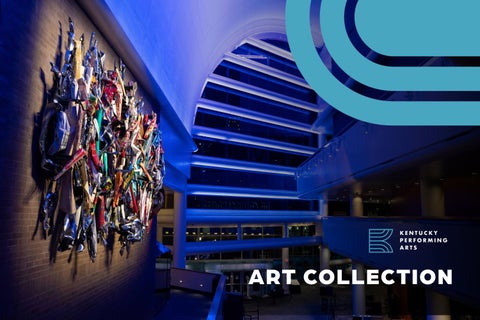
ART COLLECTION
TABLE OF CONTENTS 02
Introduction
03
The Coloured Gates of Louisville (The Inevitable Return of the Indefatigable Dr. Fahey): John Chamberlain
04
Hedge, Midnight Birds, Trace of Day: Vera Klement
05
Night Wave: Moon: Louise Nevelson
06
Tennessee Woods: Anne Peabody
07
Personnage: Joan Miró
08
The Red Feather: Alexander Calder
09
Last Will and Testament: LaVon Williams Jr.
10
Faribolus and Perceval: Jean Dubuffet
11
Rite of Passage: Malcolm Morley
12
Leitmotif: Mario M. Muller
13
Horizon/Fair Day: Guinever Smith
14
Ommato: Tom Lear
15
Gracehoper: Tony Smith
16
Portrait of Mary Anderson: Robert O. Skemp
17
Kentucky Robe: Jim Dine
18
Dancer: Barney Bright
19
Floodgates: Vian Sora
20
Madama Butterfly: David Kocka
21
Orchestra Luna: Rodney “Art Snake” Hatfield
22
Whitney Hall Autographs & Brown Theatre Caricatures
ABOUT THE COLLECTION Kentucky Performing Arts’ Art Collection contains a diverse array of 20th and 21st Century works on permanent public display at The Kentucky Center for the Performing Arts and the Brown Theatre. The collection features works by world-renowned artists such as Alexander Calder, John Chamberlain, Louise Nevelson, Joan Miró, Malcolm Morley, and Tony Smith. A number of local and regional artists’ works are also on display. Kentucky Performing Arts’ collection extends beyond our walls, as the Gracehoper by Tony Smith is on display in Louisville’s Waterfront Park. Acquisition of this distinguished collection was guided by Mr. Wendell Cherry and made possible by generous donations, reflecting a shared commitment to making contemporary art accessible to all.
The Coloured Gates of Louisville (The Inevitable Return of the Indefatigable Dr. Fahey), 1998 John Chamberlain (1927-2011, American) Painted automotive steel over chrome (18’ x 33’9” x 2’6”) Gift of The Mary and Barry Bingham, Sr., Fund, The Humana Foundation, Eleanor and Rowland Miller, An Anonymous Donor
In The Coloured Gates of Louisville, artist John Chamberlain compressed, compacted and rolled car bodies, which are arranged to create shifting configurations that vary from near flatness to billowing volumes. He composed the sculpture on the floor of his Florida studio, first laying down a base of chrome which reflects and enlivens the sheets in front. The evolution of the sculpture came as forms were added over the chrome. Finally the sculpture was welded together. The ten units of The Coloured Gates of Louisville are positioned diagonally on the wall, creating a lunging dance. The buoyant visual energy of the composition belies the rawness and weight of Chamberlain’s materials. Chamberlain believes that the knowledge art reveals is non-verbal and intuitive: “An artist makes a spiritual evaluation of the essence within a thing and then he gets it out; that is the outer appearance of the inner essence, and it is the point.”
03 | KENTUCKY PERFORMING ARTS: ART COLLECTION
Vera Klement Paintings Vera Klement (1929-2023, American) Hedge, 1993 Oil, wax and graphite on canvas (84”x 60”)
Midnight Birds, 1996 Oil, wax and paper/collage on canvas (84”x96”)
Trace of Day, 2002 Oil and wax on canvas (78”x 96”) These works are a gift to Kentucky Performing Arts from the artist
Vera Klement was born in what is now Gdansk, Poland. On the edge of the Baltic Sea, this small town was celebrated for its natural beauty. Klement writes in BLUNT EDGE The Making of a Painter that growing up there, the duality between the bright lights of the sea and the darkness of the silent forest beyond inspired a sense of light and dark in her work. Klement fled her hometown in Europe to escape the Nazis after Kristallnacht (the Night of Broken Glass) and arrived in New York in 1938. In her six decades as a painter, Klement referenced the Baltic Lands she left behind and reconciles that loss with her newfound identity as an American, a Feminist, and an immigrant. Her paintings draw upon music, literature, and her own memories to create the poetic images she is best known for.
KENTUCKY PERFORMING ARTS: ART COLLECTION | 04
Night Wave: Moon, 1984 Louise Nevelson (1899 – 1988, American) Black painted wood construction (12’ x 35’ x 20”) Gift of Mrs. George W. Norton
The profusion of imponderable trophies that makes up Louise Nevelson’s wall-sized environments was assembled in a purely intuitive linkage. Different levels of clarity, density and blankness, like different levels of depth within the sculptures, provide the visual equivalent of poetic rhythm and metaphor. The color black, which Nevelson called “the essence of the universe,” unifies the scrap components of her art. Mayan and Aztec hieroglyphs and architecture were particular influences on Nevelson’s art, and like her contemporaries, the American abstract expressionist painters, Nevelson used repetition to suggest obsessional imagery welling up from the subconscious. But ultimately the air of secrecy, the peculiar majesty and dream-like, mythic character of her art are strictly her own invention.
05 | KENTUCKY PERFORMING ARTS: ART COLLECTION
Tennessee Woods, 2020 Anne Peabody (Born 1967, American) Antique sterling silver leaf and gold sparkle spray paint on glass with a felt backing (8’ x 6’ -16 panels) A gift to Kentucky Performing Arts from Mr. Henry Heuser
Anne Peabody’s multidisciplinary practice involves correlating human experience and the natural world. She uses various organic and recycled materials, including plants, wood, glass, and metal, to expand and evolve a body of landscape-based art that includes installation, performance, sculpture, drawing, and textiles. Her artwork is intentionally difficult to capture through photography. The artist’s compositions are defined by the interplay of light and different materials, resulting in dynamic shifts in appearance that are influenced by the viewer’s position and environment. She began incorporating reflection and mirrors in her work after reading an architectural study that determined people will wait three times longer for an elevator without complaint if they can see themselves in a mirror in the waiting area. The work reflects Peabody’s memory of a camping trip with her husband and his family; years later, those same woods were destroyed by wildfires. “The fragility of the mirror mirrors the fragility of nature”, she said. “Things can disappear in a moment. My aim was to craft a tangible reminder to cherish loved ones and treasured moments while they are present.” Peabody’s path as an artist was shaped in part by childhood visits to see The Kentucky Center’s Art Collection in the 1980s, where Jean Dubuffet’s Faribolus and Perceval and Louise Nevelson’s Night Wave: Moon made a lasting impression. Night Wave: Moon holds special place in Peabody’s heart as her relative, Jane Norton, gifted the work to The Kentucky Center in 1984. For Peabody, having her own work share space with Nevelson’s is the fulfillment of a longtime dream. KENTUCKY PERFORMING ARTS: ART COLLECTION | 06
Personnage, 1972 Joan Miró (1893 - 1983, Spanish) Resin over steel armature, painted with polyurethane (88” x 135 3/4” x 63”) Gift of Betty and David Jones, Dorothy and Wendell Cherry
Joan Miró was already headed towards fantasy art when he was introduced to surrealism in 1922. Surrealism’s emphasis on irrationality and the importance of dreams prompted him to use childhood memories as inspiration. With whimsical freedom, he created an hallucinatory world of creatures whose bulbous shapes seem to have been a cartoon-like potential for constant change. It was Miró’s particular genius to give free rein to the products of his imagination rather than strictly guiding them. “I work like a gardener,” Miró explained. Despite its bottom-heavy stability, the two-sided Personnage possesses an odd disequilibrium. Its ballooning and receding convexities and concavities sprout multiple visual puns on male and female forms. Underlying Miro’s humor was a sense of wonderment and reverence for every kind of life, real or imagined.
07 | KENTUCKY PERFORMING ARTS: ART COLLECTION
The Red Feather, 1975 Alexander Calder (1896 - 1976, American) Black and red painted steel (11’ x 6’3” x 11’2”) Gift of The Mary and Barry Bingham Sr., Fund and The Humana Foundation
Although its four profiled planes stand firmly perpendicular to the ground, the illusion of motion pervades all of Alexander Calder’s work. The shapes are joined at oblique angles, skewing the viewer’s expectations. As one walks around the sculpture, its great wings and half-moons seem to billow and swell, coming in and out of view in unexpected perspectives. Its two colors of red and black aid in this sense of animation and provide an exuberant accent to the sculpture’s emphatic curves. Calder masks the careful calculation of his sculpture’s shifting spatial patterns through his underlying humor and witty suggestion in The Red Feather of some enormous, gawking bird-like creature. The sculptor walks a fine line between description and evocation, leaving the final definition of what The Red Feather depicts to each individual’s imagination.
KENTUCKY PERFORMING ARTS: ART COLLECTION | 08
Last Will and Testament, 2012 LaVon Williams Jr. (Born 1958, American) Sculpted and painted wood (55” x 24”) LaVon Williams Jr.’s Last Will and Testament was commissioned by Kentucky Performing Arts’ ArtsReach program for the 2012 Keepers of the Dream community arts celebration of Dr. Martin Luther King’s vision.
Lexington, Kentucky based artist LaVon Williams Jr. was introduced to carving by his older brother, Dave Wright, who was introduced to carving by their great uncle, Luke Wright. Williams considers himself to be an urban folk artist, drawing inspiration from blues and jazz that were tastes he absorbed from his father and from the multitude of clubs near his home growing up in Colorado. In high school he became an All-American basketball star and subsequently attended the University of Kentucky on an athletic scholarship. That team won the NCAA championship in 1978. Williams graduated from UK in 1980 with a degree in Fine Art. However, Williams did not pursue a career in sculpture until after a stint playing professional basketball in Italy and Japan. Williams was the 2006 recipient of the Kentucky Governor’s Awards in the Arts. Today, he is considered a preeminent southern folk artist.
07 || KENTUCKY 17 KENTUCKY PERFORMING PERFORMING ARTS: ARTS: ART ART COLLECTION COLLECTION
Faribolus and Perceval Jean Dubuffet (1901 - 1985, French) Faribolus, 1973 - 1982 Epoxy painted polyurethane, stainless steel armature (126” x 82” x 44”) Gift of the Humana Foundation
Perceval, 1973 - 1982 Epoxy painted polyurethane, stainless steel armature (119” x 82” x 44”) Gift of Mrs. W. L. Lyons Brown, Sr.
In 1962, Dubuffet began to make his “Hourloupes.” Inspired by a set of doodles in red ballpoint executed while talking on the phone, the Hourloupes present jigsaw puzzle figures whose outlined parts seem part of an anatomy that never quite fits together. Explaining the separateness of his imaginative creations from the real works, Dubuffet explained, “many artists begin with a pig and make sausages. I begin with sausages and make a pig.” Faribolus and Perceval are typical Hourloupes in their skewed, disjointed stance, and their boisterous, antic behavior.
KENTUCKY PERFORMING ARTS: ART COLLECTION | 10
Rite of Passage, 1989 Malcolm Morley (1931-2018, American) Oil on canvas (Oval 76” diameter) Gift in memory of W.L. Lyons Brown, Sr. and gift of Dorothy and Wendell Cherry
Malcolm Morley was educated in London at the Camberwell School of Arts and Crafts and the Royal College of Art. He moved to New York in 1958 and came to prominence in the 1960’s for his super-realist paintings derived from postcards. Morley believed paradoxically that the flatter he paints the more illusionistic the picture becomes, an insight he traces to Paul Cézanne. Despite the flatness, the viewer traces the flow and streams of paint, and so mentally enters into the summer seascape. The animated, almost violent, execution of the painting is a reflection of the discordant personal associations the artist brings to this idyllic view.
11 | KENTUCKY PERFORMING ARTS: ART COLLECTION
Leitmotif, 1993 Mario M. Muller (Born 1962, American) Acrylic on stucco (227’7” x 8’7” ten black and white panels & ten colored panels)
Commissioned as a part of The Kentucky Center’s 10th anniversary in 1993, artist Mario M. Muller’s charge was to work with the pre-existing format of the Drive-thru’s curved walls and obstructions, playing both with and against the elements, in essence to invigorate a space left unnoticed. Muller said the colored panels will serve to contrast with the black and white imagery of the silhouettes and shadow figures. “When I saw the length of the piece, I didn’t want to do all figures,” he said. “The colors create a visual rhythm, a motion, to alternate between the other panels. It is something to break them up, like a syncopated rhythm.” Some 83 gold propellers connect the various panels as they sweep along the 200 foot mural. The entire painting is illuminated by powerful lamps attached to the ceiling of the drive thru. Muller himself said, “A lot of people think of landscapes as rural, but I think they work in an urban setting as well”. The individuals in this work have shape and character through form, not through their features. This gives information to the viewer but it leaves a lot of details undefined, which the viewer may personally interpret.
KENTUCKY PERFORMING ARTS: ART COLLECTION | 12
Horizon/Fair Day, 1999 Guinever Smith (Born 1947, American) Oil on panel (32” x 72”)
In the tradition of 19th century European Realist and Impressionist painters, Louisville, Kentucky native Guinever Smith’s landscapes explore the dynamic nature of the landscape. Horizons are a prominent theme in her paintings. According to Smith, “Often our view is obstructed. Telephone wires, buildings, signs along the road rise up and interfere. But the horizon continues. If we move away from the city, if we walk in the woods, at some point we reach an opening, a place where we look out, and the land meets the sky, at the horizon.” This meeting of land and sky is the juncture where nature has the potential for repose, power, action, and beauty.
13 | KENTUCKY PERFORMING ARTS: ART COLLECTION
Ommato, 1982 Tom Lear (1947-2000, American) Bronze statue (72” tall x 46” wide x 16” deep at the base) Gift of Mrs. Jane Morton Norton
Tom Lear was a sculptor who lived and worked on Barrett Avenue in Louisville, Kentucky. Although it took him ten years to graduate, he finally received an art degree from the University of Louisville and declared himself a full-time sculptor in 1971. Although he is not a household name in Louisville today, this is likely because of his short illness and early demise at age 53. However, known philanthropist and artist, Jane Morton Norton, took Lear on as one of her protégés. The Norton Center at Centre college bears her name, and it was Tom Lear’s large sculpture, “Ex Astris” that added the final touch to the Norton Center. The subject property sculpture owned by the Kentucky Center was a gift of Jane Morton Norton. Lear’s other notable sculptures include the “Pole Star” or “North Star” at the James Graham Brown Cancer Center and “Big Red” on the Belknap Campus at the University of Louisville. Located in the Lexus Lounge
KENTUCKY PERFORMING ARTS: ART COLLECTION | 14
Gracehoper, conceived between 1961 and 1972 Tony Smith (1921 - 1980, American) Black painted steel (23’ x 22’ x 46’) Gift of The Humana Foundation in appreciation of Wendell Cherry’s leadership as first chairman of the board of The Kentucky Center for the Performing Arts
Tony Smith wanted his sculpture to serve as a springboard for the imagination. He believed his configurations of geometric shapes – rhomboids, tetrahedrons and octahedrons – could generate an infinity of associations which would vary with the experiences of the viewer. Smith believed his sculpture to be “speculations in pure form,” but of greater importance to him was an interest in myth and the creative powers of the subconscious mind. Gracehoper’s black steel sheathing and triangular limbs suggest the greatest feats of contemporary engineering, but at the same time evoke a lumbering prehistoric being. Gracehoper changes dramatically from every angle of viewing: because of its great scale and complexity, it seems animated and static at the same time, particularly as the viewer walks around it. Located in Louisville’s Waterfront Park
15 | KENTUCKY PERFORMING ARTS: ART COLLECTION
Portrait of Mary Anderson, 1983 Robert O. Skemp (1910-1984, American) Oil on canvas (76” x 47 ¼”)
Born in Sacramento, California, Mary Anderson (1859-1940) made her 1875 stage debut in Louisville as Juliet in Shakespeare’s Romeo and Juliet. She went on to a successful international career, praised for her great physical beauty and a clear voice. A statuesque woman with exceptional presence, Anderson starred in eighteen leading roles, never a secondary role. While critics had mixed reviews to the “tall, willowy” performer’s acting, she was an audience favorite, known as “Our Mary.” Her beauty was so exceptional that she appeared in numerous magazine advertisements and was a favored subject for artists. Robert O. Skemp executed this portrait of Anderson many years after her death, likely from photographic material. Skemp was trained at the Art Students League under such famed artists as Thomas Hart Benton and George Luks. But he is most known as an award-winning illustrator and portrait painter. He developed ad campaigns for such companies as Ford Motor Company and Coca-Cola, and he had a successful career painting pin-ups and glamour girls. Finally settling in Connecticut, he turned to portrait painting. Skemp’s portrait of Anderson portrays the beautiful actress in a strong profile and elaborate full-length gown. The profile resembles photographs of Anderson in repositories like the National Portrait Gallery. The pose, style, and elegant profile are reminiscent of famed American portrait painter John Singer Sargent who ably captured the spirit of his sitters through a painterly style with visible brushstrokes. Anderson appears confident, elegant, and sophisticated with her elaborate gown, long neck, and noble profile. Located in the Mary Anderson Room
KENTUCKY PERFORMING ARTS: ART COLLECTION | 16
Kentucky Robe, 1983 Jim Dine (Born 1935, American) Oil on paper (48 ¾” x 34”)
This luminous bathrobe suggests the aura of a human presence, yet there’s no one there. Transformed from an everyday article of clothing into a metaphor for the self, this quintessential Dine image radiates with a warm familiarity forged through years of experimentation and reinvention. By addressing the same themes over and over again using different media and techniques, Dine saturates his subjects with personal identity and makes them his own. Borrowing the robe image from a newspaper advertisement, Dine began using it as a template for a recurring self-portrait in 1964. When he returned to the robe motif over a decade later, the image evolved from its early sharply delineated form to assume the more sublime atmospheric qualities exhibited here. Located in the Wendell Cherry/C. Edward Glasscock Conference Room
17 | KENTUCKY PERFORMING ARTS: ART COLLECTION
Dancer, 1970 Barney Bright (1927-1997, American) Bronze Sculpture (17 ¼” x 9”)
Kentucky born artist Jeptha Barnard “Barney” Bright Jr.’s bronze sculpture captures the beautiful poise of the ballet dancer. Bright abstracted the female form, smoothing angles and elongating the neck, torso, legs, and arms, to emphasize the graceful figure’s elegant motion. The long curve of her body ends on the delicate point of her ballet shoe. Bright’s sculptures adorn many public spaces in Louisville, and he was an influential teacher to Louisville’s artists including Ed Hamilton. Bright’s enduring legacy among Kentucky artists and the public is based on such popular works as The Louisville Clock and River Horse. Located in the Mary Anderson Room
KENTUCKY PERFORMING ARTS: ART COLLECTION | 18
Floodgates, 1983 Vian Sora (Born 1947, Iraqi-American) Acrylic on canvas (66” x 84”)
Created during the early months of the COVID-19 pandemic, Vian Sora’s Floodgates reflects a moment when global crisis stirred memories of war, displacement, and survival from her life in Iraq. Visually and emotionally, Floodgates draws from water, weather, nature, and movement. Sora connects the work to walks through Cherokee Park during the pandemic, to the Ohio River, and to the changing atmosphere she observes from her Louisville studio. She describes her paintings as weather systems that gather energy, shift, collide, and slowly reveal themselves. Its gold and bronze surfaces also evoke ancient Mesopotamian art, linking Sora’s present life in Kentucky to the visual languages and histories of the place where she was born. Sora’s journey to becoming an artist began early in Baghdad, where she grew up in a family surrounded by art and artists. By age six, she knew she wanted to be a painter, though she chose not to attend art school, believing that the artistic community around her offered a richer education than a formal program could provide. Instead, she studied computer engineering in one of Baghdad’s early artificial intelligence programs, a path that sharpened the analytical side of her mind while intensifying her need for the creative act of painting. She continued making work throughout college and later built an international career. In 2009, Sora moved to Louisville with her husband, where she lives and works today. The trauma of war, the experience of creating, and Sora’s belief that art can transform challenge into possibility are brought together in Floodgates. At its heart, Floodgates is a painting about survival and renewal, finding beauty inside uncertainty, and insisting on hope even after profound loss. 19 | KENTUCKY PERFORMING ARTS: ART COLLECTION
Madama Butterfly, 1987 David Kocka (Born 1950, American) Bronze Sculpture (10” x 11” x 2 1/2”)
This emotive bronze was inspired by Madame Butterfly, a Puccini opera based on a short story by John Luther Long. Kocka combines a gesticulating female figure with abstract wing-like forms to create a petite yet poignant expression of human fragility. His loose modeling style conveys a sense of immediacy and certain vulnerability that lends itself to dramatic depictions of figures in extreme emotional states such as torment or ecstasy. Kocka draws no distinctions between art and spirituality, between the secular and the sacred. Working as both a sculptor and a Franciscan priest at the Mount St. Francis retreat center in nearby southern Indiana, he views the rituals of art, faith, and everyday life as inseparable. Located in the Mary Anderson Room
KENTUCKY PERFORMING ARTS: ART COLLECTION | 20
Orchestra Luna, 1997 Rodney “Art Snake” Hatfield (Born 1947, American) Acrylic on wood (20’ x 40’ backdrop, sound filter for the Bomhard Theater)
Louisville resident Rodney “Art Snake” Hatfield’s Orchestra Luna features a whimsical and rambunctious band of musicians playing by the light of the moon. The painting is attached to a screen that serves as the background for musical performances. Hatfield’s colorful compendium of characters is inspired by numerous sources including his childhood in rural Appalachian Kentucky, folk art, and music. A long-time harmonica player in bands, Hatfield often features musicians in his composition. Arranged in a pulsating, lively, and rhythmic configuration, the figures dance across the screen to visualize the music they play. Adorning the clothing of the figures are signs and symbols that seem to have a poetic and universal meaning. Located backstage in the Bomhard Theater
21 | KENTUCKY PERFORMING ARTS: ART COLLECTION
Whitney Hall Autographs When artists perform in Whitney Hall, The Kentucky Center’s largest theater, many leave something behind. A signature, or special stamp that shows “we were here”. Sanctioned artistic graffiti, if you will. These stamps are located high up in the Whitney Hall catwalk, and date back to the first performances when The Center opened in 1983. They stand as a time capsule to the tens of thousands of artists who have graced our stages, enriched our communities, and created both connection and inspiration through the arts.
Brown Theatre Caricatures Displayed in the Brown Theatre lobby, located at 315 West Broadway, is a collection of caricatures honoring stage personalities who have appeared there. The artist, George Joseph, was a longtime editorial cartoonist and caricaturist for The Courier-Journal and the Louisville Times. The collection includes drawings of Carol Channing, Roy Milland, Myrna Loy, Farley Granger, and Tallulah Bankhead.
KENTUCKY PERFORMING ARTS: ART COLLECTION | 22
To learn more about the artists and to see additional photos of the works in The Kentucky Center’s Permanent Art Collection, scan this QR Code or visit this link: bit.ly/KCAArtCollection
As a non-profit organization, Kentucky Performing Arts relies on community support to continue its mission. Scan here or visit bit.ly/KPAGive to make a donation. Each gift to the Kentucky Performing Arts Foundation helps us present world-class artists on our stages and provide greater access to the arts across our community.