GARDENER
Independently owned and operated since 1996
PUBLISHER
Michael Cavanaugh
EDITOR
Elizabeth Cavanaugh
CONTRIBUTORS
Amy Albright
Natalie Carmolli
Melissa Cotton
Lauren English
Markis Hill
Jesse Kirk
Lenora Larson
Tamra Reall
Anthony Reardon
Matt Sanning
Brent Tucker
Anne Wildeboor
Scott Woodbury
DISTRIBUTION
Publishers Delivery Solutions, Inc.
IF YOU WOULD LIKE TO DISTRIBUTE the magazine at your place of business, please contact Mike Cavanaugh at mike@kcgmag.com 913-648-4728
NEED MORE MAGAZINES? mike@kcgmag.com 913-648-4728
CONTACT US P.O. Box 8725 Prairie Village, KS 66208 913-648-4728
ADVERTISING
Mike Cavanaugh at mike@kcgmag.com 913-648-4728
QUESTIONS ABOUT EDITORIAL AND SUBSCRIPTIONS
Elizabeth Cavanaugh elizabeth@kcgmag.com 913-648-4728
HOW TO SUBSCRIBE
See details on page 35.
WEBSITE kcgmag.com


WGarden journal entry
hile we have been waiting for the perceived ‘all clear’ (weather-wise) to actively start gardening, Mr. Gardener and I have been following the antics of the local hawk. The neighborhood red-tailed hawk has made his presence known by vocalizing and flying from tree to tree. Since the trees remain leafless, the hawk has been easy to spot.
Intentional pause for this disclaimer: I am not an avian expert. For the purposes of my anecdotal story, I’ve made an assumption that this is a male hawk. Honestly though, I have no idea. I don’t even know if it is the same bird seen multiple times. Just so you know.
Continuing with my story… One early morning, Mr. Gardener and I saw him perched in the maple tree across the street. There live Peanutbutter and Jelly, two small wirehaired dogs who spend their days monitoring the activity of passersby through the large living room window. From the back of the couch, PB&J saw the hawk, and the hawk saw them. Unfortunately, what was seen next was the hawk flying into
the window aiming for PB&J. The homeowner was home at the time, and witnessed the whole thing. We are glad to report that the hawk flew away seemingly unharmed. In fact, a short time later, he appeared in the birdbath in our yard.
We could see him up close, and watched while he bathed. It was fascinating to observe this raptor remove leaves from the birdbath, one by one, tossing them aside. It was slightly comical and it led me to wonder if he simply was a fussy bird, or do all hawks behave in that domestic way. Either way, I made time to thoroughly clean the birdbath, so his next visit would be a five-star experience.
Have you been captivated by wildlife in your landscape? Living among them, we are naturally curious about their behavior and habits. Nesting squirrels and singing songbirds (and our resident hawk) capture our attention, distracting us from our yearning—to get back to the garden.
One of my favorite gardening quotes is from Margaret Atwood, “In the spring, at the end of the day,

you should smell like dirt.” I love that smell, along with muddy knees and dirty fingernails.
I’m reminded of a note received a few years back from Lucie in Kansas City sharing her comments on the magazine, and her life remembrances as a 90-year-old widow. Her words were gratitude filled—grateful to live on her own, and for the family that offers assistance when needed. With all that said, what I remember most is this, “I can’t even imagine how my life would be without my garden.” My sentiments exactly.
I’ll see you in the garden!


Ask the Experts
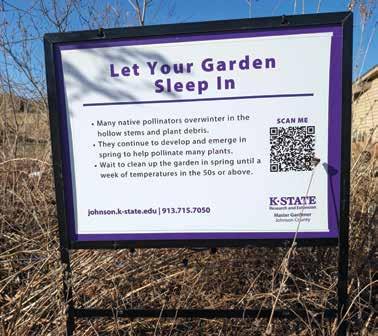
CLEAN UP GARDEN IN STAGES
Question: I have switched to a native garden to help pollinators. I kept all the plant material so there would be habitat for them overwinter. When is the correct time to clean up my flower bed?
Markis’ Answer: This question comes up frequently, especially since more people are gardening with native plants. There aren’t quick answers online, either, because it’s more complex than picking a day after a week above 50°F. Not all insects wake up at the same time.
Some pollinators are closely in sync with the plants they need to continue their life cycles. If that plant is not up and growing, that insect is also not flying. For example, we don’t see monarch butterflies before the milkweeds pop up. This is true for most specialist pollinators,

and many native plants don’t start growing until mid to late spring. These specialists are most at risk during early spring clean-up.
Instead of a clean-all approach, try cleaning in stages. Don’t remove all hollow flower stalks; just 1/3 at first. A few weeks later, remove some more. Leave a few standing all season. This ensures any critter getting a late start has a chance to emerge. To be extra careful, don’t cut stems all the way down; leave 12-18 inches above ground. Leaf litter can stay in flower beds much of spring, but remove any piles too thick for vegetation to push through.
If there is a rule of thumb for native garden clean-up, it’s don’t clean all at once. Leave a few areas “messy” each year. This reduces your spring workload and ensures more insects emerge from the habi-
tat you created. Having native plants is good, but it’s even better when you see the benefits of the habitat all the way through the life cycles.
TIME TO PRUNE BLACKBERRIES
Question: I know I should be pruning my blackberries around now, but I’m not sure what to cut without removing fruiting canes. Any tips?
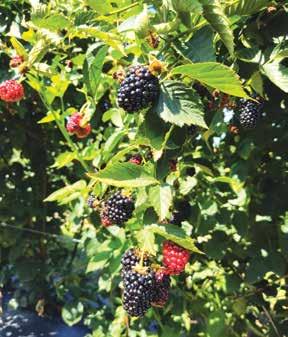
Anthony’s Answer: Blackberries fruit on biennial canes, which means the canes that sprouted last year are this year’s flowers and fruit. Any new growth this year will be next year’s harvest. The easy part about pruning blackberries is that after they have passed their fruiting season, the canes will gradually die back, leaving only dead wood. This should be removed now, if not already done, and can easily be identified by its rigidity and dull brown
color. From there, living cane should be pruned to about 2 feet in height before the growing season begins to allow structure and manageability to the plants.
YEP, ‘TOO MUCH COMPOST’ IS A THING
Question: I have made a habit of adding lots of compost and manure to my garden every year to maximize production, but recently someone told me this could be hurting it. Is this true? Have I done too much?
Anthony’s Answer: Compost and manure are two incredibly useful soil additives for amending both soil structure and nutrient content, respectively. However, there can be too much of a good thing. Both components constitute organic matter; very high levels of organic matter in certain soil profiles can result in hydrophobic soil conditions. In these cases, the soil becomes less able to retain water, allowing it to run off organic surfaces and flow away. The general rule of thumb when incorporating compost for the first time is to use no more than 40% compost and 60% topsoil. From there, 1"-2" per year is sufficient.
As for composted manure, adding too much to a garden can lead to a range of problems. These include burnt plants from excessive nutrient availability, low crop production, only leafy growth from high nitrogen, and salt accumulation. Typically, a half-inch layer of manure worked into the top 6"-8" of soil is sufficient. If adding both manure and compost, the total of the additions should be 1"-2", subtracting the half-inch of manure first.
MARKIS HILL | Horticulture Agents | ANTHONY REARDON
Markis Hill and Anthony Reardon are the horticulture agents for K-State Extension Johnson County, each specializing in ornamentals and edible crops, respectively. For free information fact sheets, visit www.johnson.k-state. edu, or call our Garden Hotline at 913-715-7050.

Signage reminder about garden clean up. Blackberries can be pruned after fruiting.














































Spring doesn’t arrive all at once. It sneaks in. First you notice a few gnats dancing over a puddle. Then a bee inspects the earliest flowers. A line of tiny ants appears on the sidewalk. Insects are some of the earliest signs that the season is changing, and if you’ve started noticing them around your home or garden, your observations are right on schedule.
Why do bugs suddenly show up when the weather gets warm? Were they hiding?
Great observation. And yes, many insects really were hiding. During winter, many insects enter a resting state called diapause. Think of it like pressing “pause” on their development. Their bodies slow down and they wait safely until conditions improve.
Different insects spend winter in different places. Some shelter under leaf litter, others hide in soil cracks or tree bark, and some spend the season sealed inside eggs or cocoons.
When spring arrives, insects don’t all wake up at once. They respond to environmental signals like soil temperature, day length, and moisture. That’s why you might see gnats or ants weeks before butterflies appear.
This staggered timing is important for nature. Early insects help feed returning birds. Later insects appear when flowers begin blooming. Predators, prey, and plants all follow the same seasonal clock. It’s one of the most impressive examples of nature’s timing system at work.

Kids Ask Dr. Bug Spring is buzzing
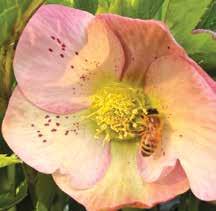
Insects and flowers are impressive examples of nature’s timing system at work.
Are those tiny flies in my face biting me?
Probably not. Many of the tiny flying insects you notice in early spring are non-biting midges, which are often mistaken for mosquitoes. Midges look delicate and mosquito-like, but they don’t bite or drink blood.
Instead, they gather in loose swarms, especially in sunny spots protected from wind. If you watch closely, the insects seem to hover and dance in the air. These swarms are actually mating gatherings.
Midge larvae live in water, where they play an important role as recyclers. They help break down decaying plant material, returning nutrients to the aquatic food web. Those nutrients support fish, amphibians, and many other organisms.
So while midges can feel annoying when they buzz around your face, they’re also a reminder that healthy ecosystems are waking up for spring.
I found lines of ants in my kitchen. Are they bad?
Most ants that wander into homes in spring aren’t dangerous. They’re simply searching for food and water. Ant colonies send out scout workers to explore. When one finds something useful, such as crumbs, sugar, or a drop of water, she leaves behind a chemical scent trail so other ants can follow. That’s why ants often appear marching in neat little lines.
Before reaching for a spray, try a prevention-first approach:
1. Remove the food source. Wipe counters, seal snacks, and dry sink areas.
2. Find the entry point. Many ants enter through tiny gaps around doors, windows, or pipes.
3. Use targeted baits if needed. Baits work with ant behavior. Workers carry the food back to the colony, which helps reduce future foraging indoors.
Outdoors, ants are actually helpful. They move soil, disperse seeds, and recycle organic material. Spring is simply when their busy season overlaps with ours.
Why do bees come out when it still feels cold?
Some bees are surprisingly well prepared for chilly spring weather. Early spring bees, including mining bees and bumble bee queens, are active when temperatures are still cool. Bumble bees even have a special trick. They can warm themselves by vibrating their flight muscles, almost like tiny heaters.
These early bees are incredibly
important pollinators because they visit the first flowers of the season, including early wildflowers and fruit trees. Many of these plants bloom before trees leaf out, which means their flowering window is short. Without early bees, many spring plants would struggle to reproduce.
The Bug Lab: Backyard Science Quests for Curious Kids (and Grown-Ups Too!) Backyard Science Challenge: Spring Insect Wake-Up Watch
Insects don’t appear everywhere at the same time. Some places warm faster, some stay cooler, and some offer shelter from wind.
This month’s Bug Lab turns you into a Spring Insect Detective. Your mission is to explore three tiny habitats, called microhabitats, and see where insects show up first.
Look for insects in:
• Sunny soil
• Leaf litter
• Early flowers

Scan the QR code for a printable two-page worksheet to map what you observe, draw or describe insects you see, and look for patterns in where they appear.
Watch the Kids Ask Dr. Bug video series: https://bit.ly/KADBvideos
Send your questions: https://bit.ly/ KidsAskDrBug
Play the firefly-catching game: https://bit.ly/CatchFireflies
Share feedback (we’d love to hear from you!): https://bit.ly/KidsAskDrBugSurvey
Dr. Tamra Reall (@MUExtBugNGarden) is a horticulture specialist for MU Extension— Urban West Region. For free, research-based gardening tips, call 816-833-TREE (8733), email mggkc.hotline@gmail.com, or visit extension.missouri.edu.
TAMRA REALL Horticulture Specialist












The Hidden Threat Beneath Our Trees Understanding Girdling Roots
Many of the most serious problems affecting landscape trees begin below the soil surface, out of sight and easy to overlook. One of the most common issues I observe when inspecting a declining tree is the presence of girdling roots. These roots slowly compress the trunk or structural roots of a tree, restricting the movement of water, nutrients, and carbohydrates. Over time, this constriction weakens the tree and can ultimately lead to decline or failure.
Fortunately, once you know what to look for, girdling roots often reveal themselves through a few consistent warning signs.
Signs to Watch For
Trees suffering from girdling roots often exhibit a slow, chronic decline rather than sudden failure. The canopy may appear thin or sparse compared to similar trees nearby. Leaves may be smaller or begin displaying fall color earlier than nearby trees of the same species.
Another common indicator is short internodal length, meaning the distance between annual terminal bud scars. This reflects reduced vigor and may be isolated to the portion of the canopy dependent on the compressed vascular tissue.
Healthy trees should exhibit a root flare, where the trunk widens and transitions into large structural roots that spread outward at the surface of the soil. When girdling roots are present, this natural flare is often missing. Instead, the trunk may appear to plunge straight into the ground like a telephone pole.

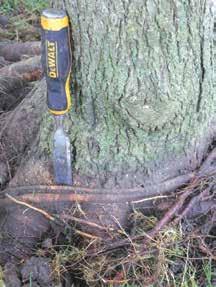
In many cases, the trunk will also develop a flattened side where the encircling root presses against it. This flattened area forms because the trunk cannot expand normally where it is being compressed.
When the soil or mulch is carefully removed from around the trunk, the cause often becomes obvious: a woody root circling tightly around the trunk or crossing directly over other structural roots.
Why Girdling Roots Form
A girdling root often begins in the nursery. Trees grown in containers for extended periods can develop circling root systems when they are not upsized into larger containers quickly enough. As the tree grows, these roots continue to spiral within the container rather than growing outward. If not corrected at planting these circling roots may continue growing in the same orientation.
Planting depth is another major factor. Trees planted too deeply of-
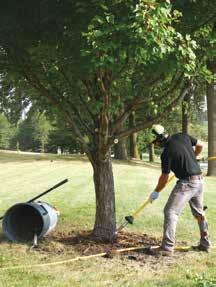
ten develop adventitious roots above the root flare which become future girdling roots. Structural roots that should spread outward at the soil grade instead remain buried where they have less access to moisture and nutrients and limited potential for gas exchange.
Over mulching also contributes to the problem. Thick layers of mulch piled against the trunk, often referred to as “mulch volcanoes,” can bury the root flare and encourage roots to grow upward into the mulch layer. These roots may eventually wrap around the trunk as they expand.
In many landscapes, these factors occur together: nursery-grown circling roots combined with deep planting and excessive mulch often result in a root that gradually tightens around the trunk like a slowmoving tourniquet. Just as the tree establishes and starts to contribute to your landscape, the root issues begin to cause it’s decline, diminishing its lifespan in your landscape.
Correcting the Problem
The good news is that girdling roots often can be corrected, especially when caught early.
For homeowners, the first step is to carefully remove soil or mulch from around the base of the tree until the root flare is exposed. This may require digging several inches down, particularly if the tree was planted too deeply.
Once the flare is visible, look for roots that are circling the trunk or J shaped. If a smaller girdling root is present, it can often be severed using a hammer and chisel or a reciprocating saw. Removing the offending root relieves the pressure on the trunk.
Care should be taken to avoid excessive damage to the trunk and surrounding roots and only constricting or poorly oriented roots should be severed.
For larger or more valuable trees, hiring a professional arborist is often the better option. Arborists frequently use air excavation tools, which use compressed air to safely remove soil without damaging roots. This allows the root system to be fully exposed so girdling roots can be properly identified and selectively removed. We typically perform this work in fall so that the tree has adequate time to compensate and form new roots ahead of the heat and moisture stress associated with Midwest summers. While the symptoms of girdling roots often appear in the canopy, the real story is usually unfolding underground. By paying attention to what lies beneath the soil surface, homeowners can protect the long-term health and stability of their trees.
JESSE
KIRK Master Arborist
Jesse Kirk is District Manager for Wellnitz Tree Care and a Registered Consulting Arborist and ISA Board Certified Master Arborist. A graduate of Kansas State University, he specializes in professional tree management, plant health care, and arboricultural consulting. Email him at Jkirk@wellnitztreecare.com or call 913-350-0050.











Diary of an Aspiring Green Thumb discovering the combined beauty of people and plants
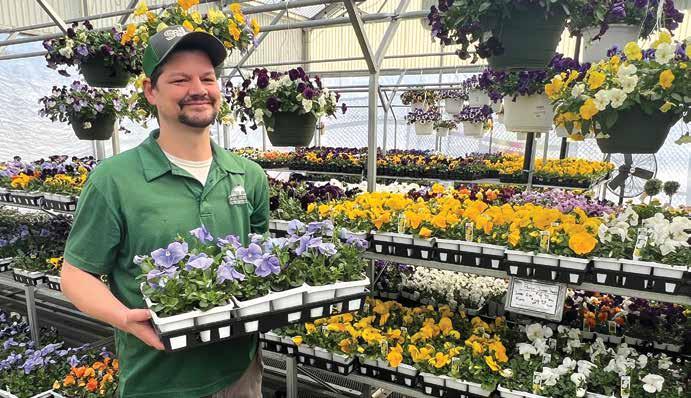
The pre-spring months at Soil Service Garden Center & Nursery are a special time of year. Gray skies and frozen ground create a collective restlessness that starts to settle in. Cabin fever is real for all of us. For those of us who work at a garden center, that feeling is mixed with something else: anticipation. Not only do we miss the plants we care for during Kansas City’s gardening seasons, we miss our customers most of all. The familiar faces. The conversations about what worked last year and what might thrive this season. Behind the scenes, this in-between season is anything but quiet. There’s a steady rhythm of preparation happening every day. Shipments

arrive loaded with soils, mulches, trees, shrubs, flowers, and herbs. Pallets are moved. Racks are assembled. Improvements to the walkways. The clanking of flower patio tables being assembled signals fresh bedding plants are arriving soon. Inventory counts…not to mention alphabetizing the perennials (talk about fun). It may not always be glamorous work, but it is purposeful. There’s something grounding about these routine tasks and the physical work feels good. It wakes us up with renewed sense of focus.
I haven’t been in the industry nearly as long as many of my peers, but those who have welcomed dozens of springs still can’t hide their excitement when the first shipment
MATT SANNING Grower/Designer
arrives, and how much they love tracking how early they field questions from customers asking for tomatoes and basil. (By the way, how impatient are we for Impatiens this spring?) This year, though, was my first time truly feeling that instant shift in mood when our first flowers and herbs came off the truck. I really missed all of this. One moment the patio was just concrete, snow flurries, empty benches; the next, it was alive with color. Flats of pansies and early annuals lit up the space. Trays of herbs are filling the air with that unmistakable but hopeful scent of rosemary and best intentions.
I suspect many garden center teams share this mix of exhaustion and excitement. The hours of prepa-
ration are balanced by the joy of seeing our welcoming back our customers; our friends. Truly rewarding watching someone discover a new plant for the first time, troubleshooting gardening issues, hearing customers describe how last year’s perennials are coming back stronger than ever, and especially when greeting a new face.
Garden centers are more than retail spaces; they’re gathering places. Where neighbors run into one another in the plant aisles. Where children pick out a first strawberry plant or see Fancy the cat lingering in the catnip on the patio. Where seasoned gardeners and first-time planters stand side by side, united by the simple desire to grow something. I stay and listen to seasoned gardeners as it is the best way to feel the passion… and get some fun successful tips to share!
In 2026, Soil Service Garden Center & Nursery celebrates its 92nd year in business. Our focus to prepare for spring is simple: be ready. Ready with healthy plants. With advice and encouragement. Ready with the supplies needed to bring your gardens, patios, and landscapes back to life. Whether you’ve been visiting for years, or this will be your very first trip, know that we look forward to seeing you. We want to hear about your plans, your questions, and your successes. There is something special about the start of a growing season, a shared optimism that is contagious.
Spring is here. The soil is warming. The color is arriving. And we can’t wait to welcome you back.
Matt Sanning is a customer service specialist at Soil Service Garden Center & Nursery. He takes joy in gardening, but loves garden center customers, as they shine a light in so many ways. His goal is to share humor and bring joy to others through stories in the field (pun intended).














The Healthy Gardener Gardening—a way manage stress
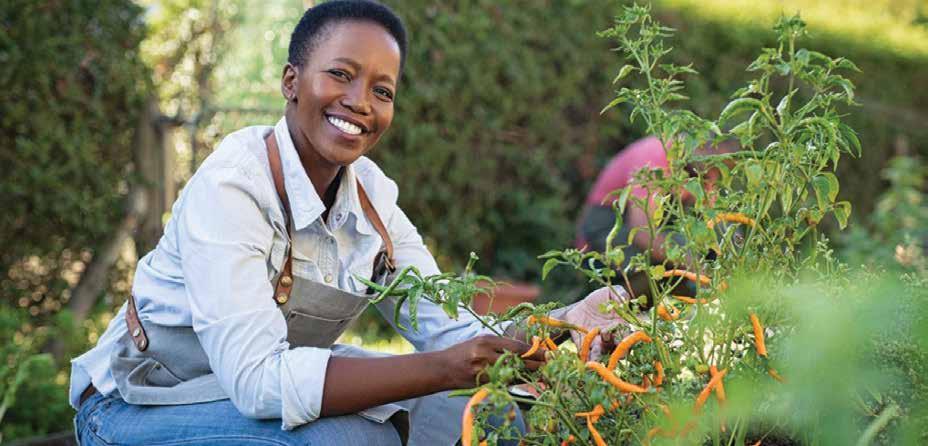
When it comes to health, many things can move us toward or away from feeling our best. One challenge many people face is stress. I see this in my own life and in the people I work with. Stress is a feeling of worry or tension caused by difficult situations. Everyone experiences stress at some point in life.
A little stress is normal and can even keep us focused and safe in certain situations. It is when stress lasts for a long time that it can cause harm to the body. Ongoing stress can weaken the immune system, cause sleep problems, and affect our mood.
Stress is a part of life, which is why it is important to build healthy ways to cope. Gardening is one helpful tool. It can improve our physical health, our diet, and our mental health.
Research shows gardening can

help manage stress and support mental health in several ways:
• It gets us outside – Spending time in nature can lower stress, anger, and anxiety. Regularly taking time to be outdoors and in green spaces has been linked to lower risk of depression.
• It helps us stay present – When we feel overwhelmed or anxious, working in the garden can help us focus on what is right in front of us. We feel less stuck in our thoughts and more connected to our bodies.
• It creates a sense of calm –Tasks like digging, planting, pruning, and weeding follow a steady rhythm. This can quiet our minds and give us a break from our worries.
• It gets us moving – Physical activity helps us reduce stress and improve mood. When we move
MELISSA COTTON Field Specialist
our bodies, they release chemicals that help us feel better. Strong bodies are better able to handle stress.
• It builds confidence – When we grow something from seed to harvest, we see what we are capable of. Meeting gardening goals can help us feel ready to meet other goals in life.
• It may improve sleep – Time in sunlight helps keep our body’s internal clock on track. Better sleep helps the body recover from stress. Even 30 minutes outside each day can help but remember to protect your skin with sunscreen.
If you do not have access to a full outdoor garden space, many of these benefits can still be gained through activities like container gardening, community gardens, houseplants, and growing your own herbs.
Keep in mind that everyone experiences stress differently. Signs of stress may include:
• Strong emotions like anger, sadness, frustration, or worry
• Trouble focusing, making decisions, or sleeping
• Changes in appetite or interests
• Aches and pains in the body Gardening is one helpful tool to manage stress. Other strategies include deep breathing, connecting with others, journaling, practicing gratitude, and taking breaks from social media.
Sometimes stress can feel too big to manage alone. It’s okay to ask for help. You can reach out to a mental health professional in your area. You can also call or text 988, or visit 988lifeline.org. Asking for support is a sign of strength. Taking care of yourself today may help you provide support for others tomorrow.
Melissa Cotton is a Field Specialist in Nutrition and Health Education with the University of Missouri Extension. She offers programming related to healthy aging, chronic disease prevention and management, and overall wellness in the Kansas City area. Email her at cottonmr@missouri.edu for more information.

Vines fill a unique niche in the landscape. Tumbling over a fence or arbor, they soften hardscaping and can accentuate an opening along a garden pathway. On a trellis, they’re useful for providing height in a narrow space. Allowed to amble about, they add drama and charm. Some offer pollen, nectar, or seeds for butterflies, bees, songbirds, and hummingbirds.
We celebrate each new year at Vinland Valley with the January arrival of our Clematis liners—the first potting for the coming season. With blooms in almost every color, size, and bloom time, there’s a cultivar to fit every garden. Clematis are easy to grow and surprisingly droughttolerant and self-sufficient once established. Plant perennials or shrubs around their base or locate them on the shady side of a structure to keep their roots cool, and they’ll happily climb anything rough enough for

Growing Up! Hardy Vines
their little tendrils to grab hold of. A few of our favorites include ‘Henryi,’ ‘Josephine,’ ‘Nelly Moser,’ and the old reliable ‘Jackmanii.’ All grow to around 8-10 feet.
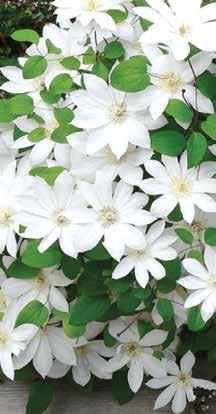
‘Henryi’ grows in our droughtprone shade display bed in tough conditions. It’s been thriving there for years and delights us each late spring with gigantic white flowers that tumble over evergreens, surprising us later in the season by reblooming. Ours is in almost full shade and looks beautiful with hostas, ferns, and false cypress. ‘Henryi’ flowers on old and new wood, and can be pruned in late winter to keep it neat. We don’t ever prune ours, preferring to let it ramble!
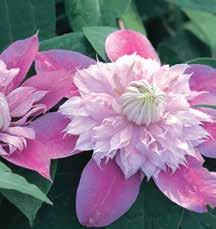
‘Josephine’ is equally resilient, with the most unusual pompom centers and rich antique pink color. Each of the many petals has a darker pink bar extending from the flower center to each petal tip. Summer-blooming
perennials like penstemon, coreopsis, and coneflower make a perfect complement. Ours is in full sun, and we’ve planted German bearded iris all around to provide some shade for the roots. ‘Josephine’ blooms on old and new wood and can be pruned in late winter if needed.
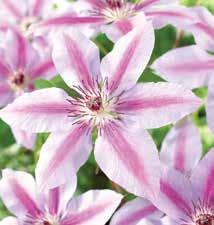
‘Nelly Moser’ is another shadetolerant favorite, producing large blooms composed of pale pink petals with dark pink bars. She pairs well near shrubs and perennials with blue foliage—particularly ‘Blue Mist’ or ‘Blue Shadow’ fothergilla and hostas like ‘Blue Umbrella’ or ‘Blue Muffin.’ In partial sun, little bluestem makes a nice companion in color and texture. Like those listed above, ‘Nelly Moser’ blooms on old and new wood.
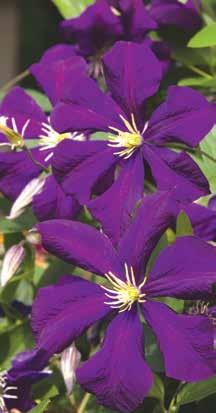
‘Jackmani’ has been around for years and is still our most popular cultivar. With striking deep purple petals surrounding a fringed white

center, they reliably bloom in early and late summer. Protect the ground in full to part sun with a planting of native downy phlox (Phlox pilosa), a dark purple coral bells cultivar, or the low-growing native eastern beebalm (Monarda bradburiana). ‘Jackmani’ blooms on new wood and should be cut to about 8-12" above the ground in late winter or early spring for an abundance of new growth. Some additional notable vertical growers can fill a variety of needs, including long bloom time or ecological value.
Climbing roses bring heirloom charm to gardens and floral arrangements. While not technically vines, the canes of these roses grow so tall that they require training onto a structure to hold them in place. We’re excited to bring ‘Perfume Breeze,’ a small flowering rambler with particularly fragrant blossoms, and ‘Peggy Martin,’ an heirloom rose that was
Amy Albright and her husband, Doug Davison, own Vinland Valley Nursery, a full service organic nursery and greenhouse that includes a huge selection of native plants and features a U-pick flower garden, workshops and a garden shop just south of Lawrence, KS. Their team includes experienced landscapers, plant growers, and artists, including their three daughters who grew up in the business.
Sorrel Vine
Climbing Hydrangea
Dutchman’s Pipevine
discovered as a survivor after Hurricane Katrina. I’ll be planting them both in gardens around the grounds this year. Like their shrubby cousins, climbing roses prefer full sun and well-drained soil.
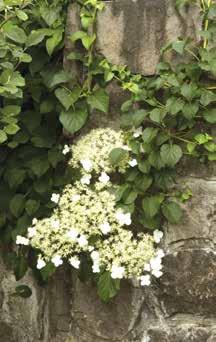
Climbing hydrangea (Hydrangea petiolaris) is a shade-loving vine that can grow 40-60 feet. They attach to surfaces by aerial roots, which can damage conventional siding materials. Plant on a large, sturdy structure, preferably with a stone or brick surface, or a mature shade tree for support. Unlike wisteria, they grow very slowly, which makes them manageable. The foliage is very striking, and the flowers resemble those on lacecap hydrangea shrubs.
Last but not least, three of our favorite native vines include Sorrel Vine, Dutchman’s Pipevine and Coral Honeysuckle.
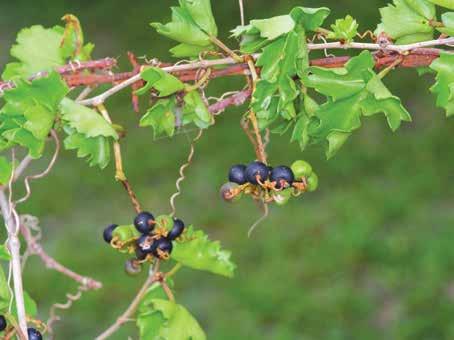
Sorrel vine (Cissus trifoliata) produces small, scalloped, succulent-like, bright green leaves along vines that weave to climb and ramble. Small yellow flowers are insignificant, but attract and feed pollinators. Bright green berries appear in summer and gradually ripen to purple-black by fall, providing food for songbirds. Also called possum grape, sorrel vine grows in full
to partial shade and pairs well with other shade plants. It’s a beautiful, low-maintenance, drought-tolerant, disease and deer-resistant vining native perennial.
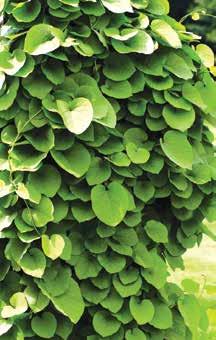
Dutchman’s Pipevine (Aristolochia macrophylla) is a fast-growing vine that provides habitat for pipevine swallowtail butterflies. The large, heart-shaped leaves create a gorgeous texture, and the unusual, light taupe blooms are shaped like an old-fashioned pipe and are somewhat hidden beneath the foliage. Plant this vine on a fence, arbor or other structure with lots of room to grow. Regular pruning will help keep pipevine in check, and you’ll be doubly rewarded with resident pipevine swallowtail butterflies and caterpillars.
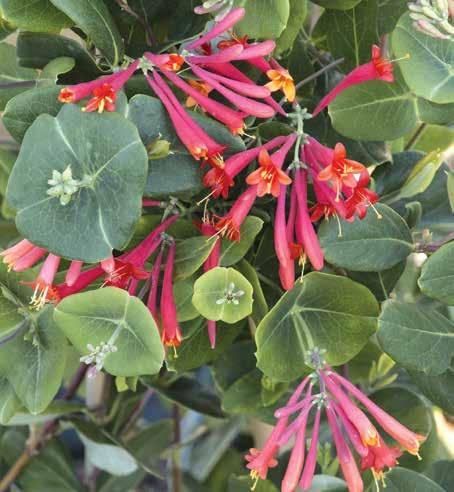
Our native coral honeysuckle (Lonicera sempervirens) is another fast-growing climber that attracts all sorts of pollinators and hummingbirds in late spring through early summer. While not aggressive like Japanese honeysuckle, these vines do cover some ground. This is another vine that works best on a fence, arbor or wall with a large trellis.
Add a vine to your garden this spring!
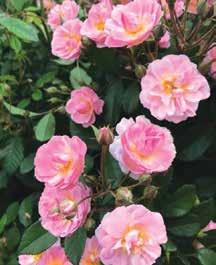
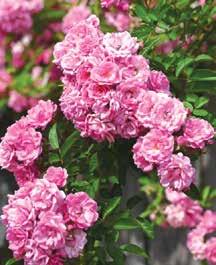
Climbing Rose Perfume Breeze
Clematis Jackmani Clematis Henryi
Coral Honeysuckle
Climbing Rose Peggy Martin
Clematis Nelly Moser
Clematis Josephine
Host Plant ‘Hat Tricks’
The upcoming Paola Plant Sale, by the Extension Master Gardeners, will offer almost 500 species of plants. How to choose from this wealth? I look for those multi-tasking “Hat Trick” plants to maximize my budget and the beauty of my gardens. Hat Trick is a sports term to describe events that occur in threes, such as three wins or three goals. However, I apply it to plants that contribute at least three garden virtues. Since I have a certified butterfly garden “Butterfly Host Plant” is the starting point for any candidate. If it also has nectar and pollen-rich flowers for pollinators, we have a “two-fer.” And if the plant has exceptional aesthetic value such as stunning flowers, brilliant foliage, interesting texture and/or extended bloom time, it is a Hat Trick. Here are three that will be available at the Plant Sale.

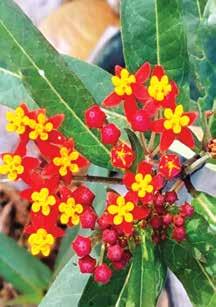
Tropical Milkweed Asclepias curassavica
Although all members of the milkweed family can serve as host plants for Monarchs, Tropical Milkweed, native to Mexico, Central and South America and the Caribbean is its preferred host plant because the Monarch is actually a tropical butterfly that evolved in these regions. This Hat Trick plant has an exceptionally long bloom-time from May through October and is a source of nutrition for many pollinators. Gardeners appreciate the beauty of the brilliant red and yellow or solid yellow flowers. While misled Monarch fans may object, leading lepidopterists and organizations such as Monarch Watch consistently recommend its use in the Midwest. I buy 12 plants at our Plant Sale each year to place in containers as well as in my garden beds.
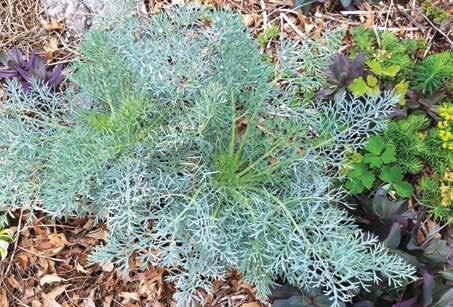
Moon Carrot Sesili gummiferum
Another Hat Trick plant, moon carrot is a drought-tolerant biennial that modestly self-seeds to act like a perennial. Fortunately, it is not invasive like dill and fennel. The common name, moon carrot, tells you that it is in the carrot family and serves as a favorite host for Black Swallowtail caterpillars. Plus you will see clouds of pollinators like flower flies, flower moths, wasps and small butterflies gathered on the huge white flowers that resemble Queen Anne’s Lace. The evergreen feathery blue foliage confirms its Hat Trick status. Full sun is a must and it prefers rocky, well-drained soil. Fortunately, moon carrot is earning accolades from gardeners throughout the Midwest and sells out every year at our Plant Sale.
These plants will be available at the Paola Plant Sale April 23–25. Details are in our ad on page 25 of this issue.
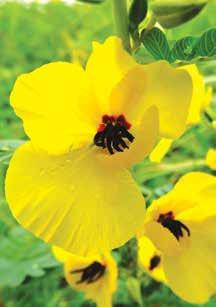
Partridge Pea Chamaecrista fasciculata
One of my favorite plants, I count six virtues so perhaps partridge pea is a GOAT, “Greatest Of All Time?” A native prairie annual, this sun-lover hosts Sulfur and Gray Hairstreak caterpillars. From July through September, the exceptionally showy yellow flowers provide pollen for bees. Uniquely, the nectar is produced only by leaf glands and attracts wasps and ants that protect the plant from herbivores. As a legume, Partridge Pea houses nitrogen-fixing bacteria that increase soil fertility. In the fall, birds relish the long thin pea pods. Once established, you’ll never have to plant partridge pea again because it enthusiastically self-sows. Truly a winner!
Marais des Cygnes Extension Master Gardener, Idalia Butterfly Society and Kansas Native Plant Society member, Lenora Larson gardens and hosts butterflies in the cruel winds and clay soil of Paola, Kansas. She may be contacted at lenora.longlips@gmail.com.
LENORA LARSON Butterfly Maven
Tropical milkweed combines beauty, pollinator power and is the preferred Monarch host.
Partridge pea flowers look like camelias despite being in the pea family.
Moon carrot’s foliage gleams an icy blue even in winter.
Debbie’s Lawn Busters













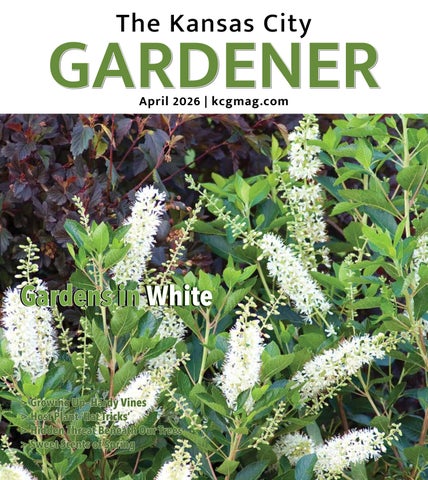
Six Shrubs Inspired by Pantone’s Color of the Year Gardens in White
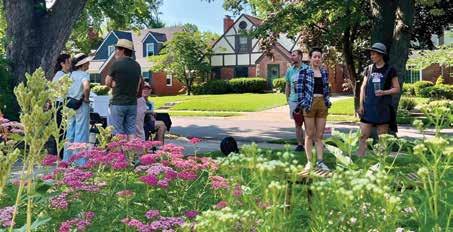
antone® has named Cloud Dancer its 2026 Color of the Year, marking the first time a true white has taken the honor. According to Pantone, Cloud Dancer is a soft, luminous white that conveys calm, clarity, and quiet optimism. It is described as a balanced shade that feels light and expansive, offering a sense of ease and openness in an often visually crowded world.
In Kansas City gardens, that sense of brightness can feel especially welcome. After a gray winter and into the intensity of a Midwest summer, white flowers and light foliage provide relief from heavy, saturated color. They act as neutral pauses in colorful plantings, allowing brighter hues to shine without overwhelming the eye. They also reflect light beautifully on warm

evenings when you’re enjoying the patio long after sunset.
It’s never too late to add whiteblooming shrubs to your Kansas City landscape. Unlike seasonal annuals, shrubs return year after year, standing up to hot summers, fluctuating spring temperatures, and cold winters. They deliver dependable blooms with minimal extra effort and bring the same sense of ease and balance that white naturally offers in the garden. And while Pantone’s Color of the Year will inevitably change, the benefits of white in the landscape remain timeless.
Here are six Proven Winners® ColorChoice® shrubs that capture the serene, uplifting spirit of Cloud Dancer while thriving in USDA Zones 5b–6b, where most Kansas City-area gardeners grow.
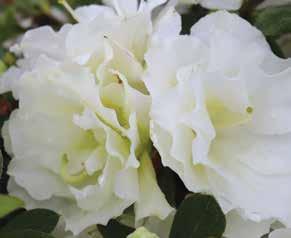
Perfecto Mundo® Double White Azalea
(USDA zone 6-9, H-W 2.5-3’/3-4’)
Few shrubs embody elegance quite like Perfecto Mundo Double White azalea. Its lush, double white blooms appear in spring and then return later in the season, extending the feeling of lightness and refinement well beyond the traditional azalea bloom time. The crisp white flowers pair effortlessly with colorful perennials or darker evergreens, creating contrast while maintaining a soft, calming presence in the garden.
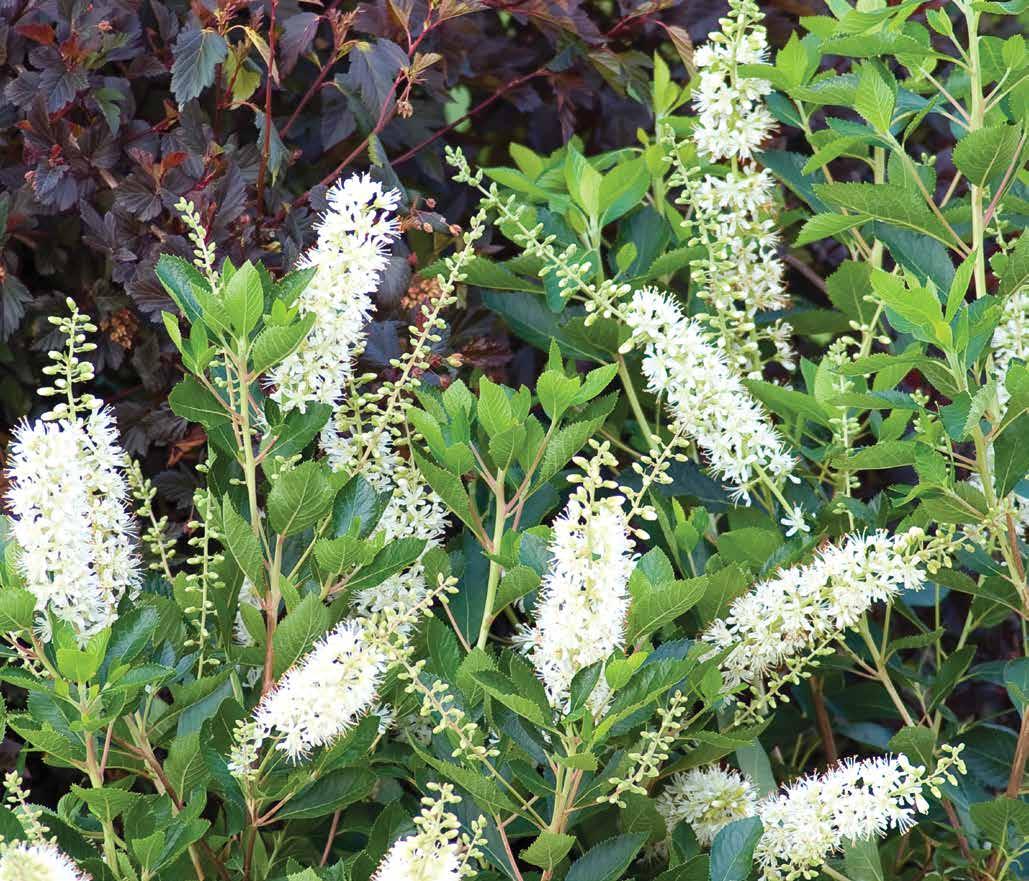
Vanilla Spice® Summersweet
(USDA zone 4-9, H-W 3-6’/3-5’)
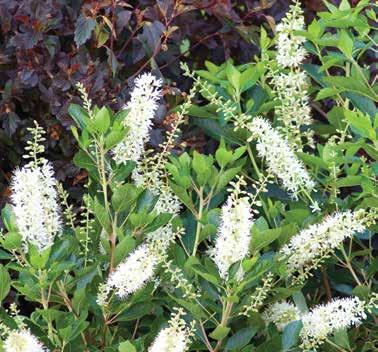
For gardeners who value both beauty and ecological benefits, Vanilla Spice Clethra is a standout choice. This North American na-
tive shrub produces fragrant white flower spikes in summer that attract pollinators while brightening the garden during the warmer months. Its clean white blooms and naturally graceful form align perfectly with the gentle, positive energy associated with Cloud Dancer, proving that native plants can be both resilient and refined.
Fairytrail White® Cascade Hydrangea®
(USDA zone 5-9, H-W 4’/4-5’)
For Kansas City gardeners looking for something truly special, Fairytrail White Cascade Hydrangea offers graceful, arching stems lined with pure white blooms in late spring to early summer. Exceptionally hardy and reliable in Midwest conditions, it performs beautifully in the landscape or large containers. Its naturally cascading habit also makes it an outstanding choice for hanging baskets, where the luminous white flowers can be enjoyed up close on patios and porches. Plant this early bloomer in well-drained soil with morning sun and afternoon shade for best results.
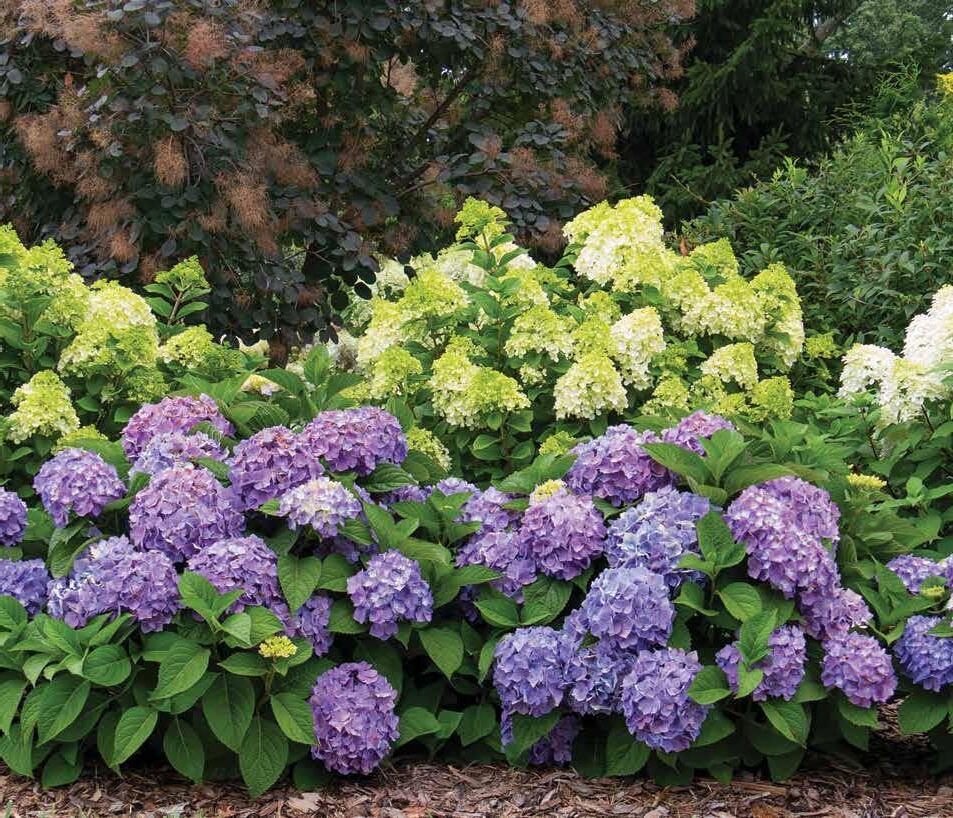
Incrediball Storm Proof™ Smooth Hydrangea
(USDA zone 3-8, H-W 3.5-4’/3-4’)
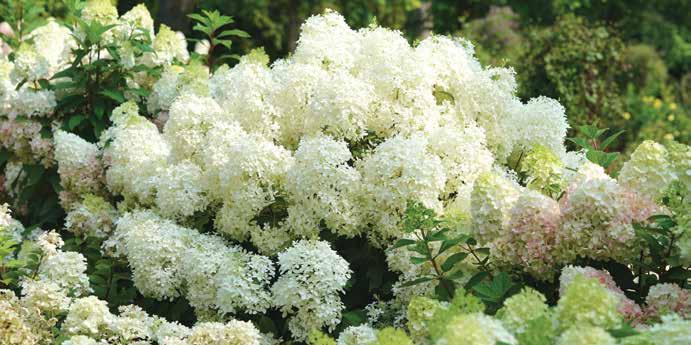
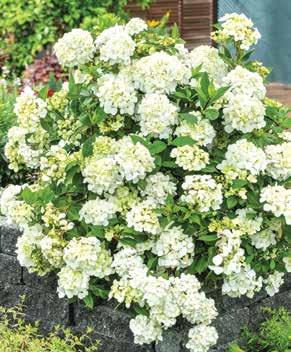
If Cloud Dancer represents calm strength, Incrediball Storm Proof Hydrangea arborescens is its garden equivalent. This shrub features massive, glowing white blooms held on exceptionally strong stems that stay upright through summer storms and heavy rain. The flowers act as bright
Natalie is rooted in horticulture, having worked in the family floral business until college, where she earned her degree in fine and theatrical arts. Now, an avid gardener, writer, and public speaker for Spring Meadow Nursery, Natalie delights in sharing her expertise and enthusiasm about the art of gardening, using Proven Winners® ColorChoice® Shrubs.
NATALIE CARMOLLI Shrub Expert
Puffer Fish Panicle Hydrangea
anchors in the landscape, offering visual stability and serenity even in challenging conditions. It is a perfect example of how white can be both soft and powerful in garden design.
Puffer Fish® Panicle Hydrangea
(USDA zone 3-9, H-W 3-5’)
With its rounded, cloud-like blooms, Puffer Fish Hydrangeas paniculata may be the most literal interpretation of Cloud Dancer in shrub form. The large white flower heads appear in summer, delivering fullness and softness to the garden while reflecting light beautifully. As the season progresses, the blooms transition to a greenish-white, adding dimension and maintaining interest without overpowering surrounding plants.
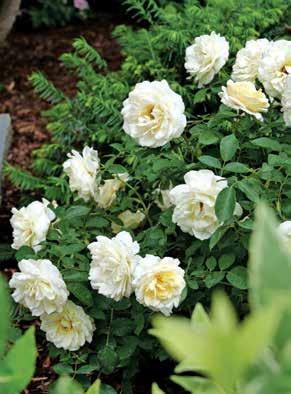
Reminiscent® Crema Rose (USDA zone 4-9, H-W 1.5-3’/2’)
Classic romance meets modern performance with Reminiscent® Crema rose. This elegant shrub rose produces fully double, creamy white blooms with a soft, nostalgic look that fits seamlessly into both traditional and contemporary Midwest landscapes. Bred for improved disease resistance and repeat flowering, it performs reliably, even in steamy Kansas City summers. Plant in full sun and well-drained soil and good air movement for the strongest performance and heaviest bloom.
Why White Will Always Belong in the Garden
White may be trending, but it is never temporary. In gardens, white:
• Creates visual breathing room among bold colors
• Enhances contrast and brightness, especially in shaded areas
• Plays a starring role in moon gardens, where white blooms reflect moonlight and glow after dark
Pantone’s Cloud Dancer simply reminds us of what gardeners have long known: white is not an absence of color, but a powerful design element that brings balance, beauty, and serenity to landscapes across the Heartland.
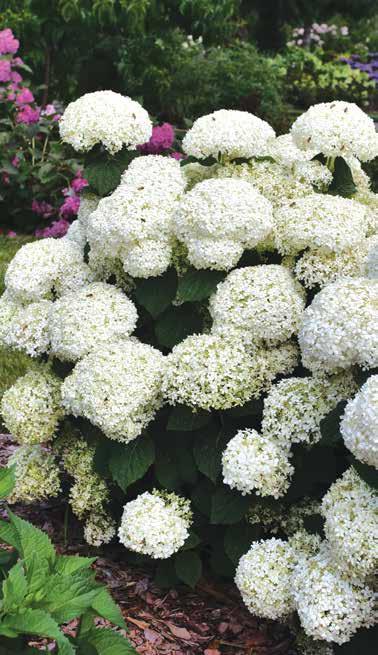
Incrediball Storm Proof Smooth Hydrangea
Reminiscent Crema Rose
Vanilla Spice Summersweet
Fairytrail White Cascade Hydrangea
Perfecto Mundo Double White Azalea
At Powell Gardens, conservation is in front of mind for just about everything we do whether that’s tending g plot of a federally listed threatened species of milkweed or preserving our prairie remnants. These are great things we can do for Missouri’s native species, but what if we’re working with a species that hails from other parts of the world?
Over four years ago, Powell Gardens launched our spring opening with Orchid Delirium to showcase our expanding orchid collection. In the years since that launch, we have identified orchid species within our collection that are listed as endangered in the wild or uncommon within the orchid trade. As these species come into bloom, we have an opportunity to think towards the future. By pollinating the flower to produce seeds and growing the seedlings, there is an opportunity to share plants and help preserve the species.
I want to put a spotlight on one species within our collection that has an interesting history for the species: the Butterfly Orchid.
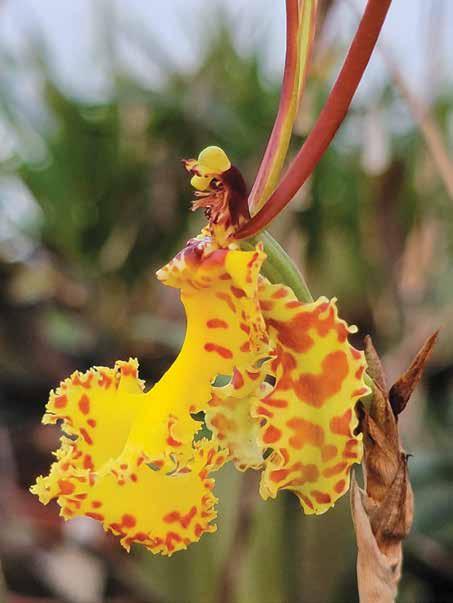
The Butterfly orchid (Psychopsis sanderae) was first described in 1910 from plants found in Peru. Subsequently, it was lost to cultivation. In the early 1960s a population of butterfly orchid was found in Peru, collected, and identified as Psychopsis sanderae, however it turned out to be a closely related species Psychopsis versteegiana rather than Psychopsis sanderae. All those plants collected during the early 1960s until 1989 that were misidentified as P. sanderae were distributed around the world and sold as the wrong species. Even today there are misidentified

Butterfly Orchids
plants being sold as Psychopsis sanderae but are either Psychopsis versteegiana or even hybrids.
In 1989, a population of the true species Psychopsis sanderae was discovered in the Department of Junin, Peru. However, the habitat was destroyed, and the species hasn’t been found again in other habitats. This makes them potentially critically endangered or extinct in the wild even
BRENT TUCKER Lead Horticulturist, Collections
though the species is not listed as such.
After searching for 25 years, a gentleman in Europe bloomed out plants of the true species Psychopsis sanderae and sent seed to an orchid company in Peru. Recently I purchased a plant of Psychopsis sanderae from this Peruvian orchid nursery to add to Powell Garden’s orchid collection!
In 2025, the plant grew and produced a flower spike but every time a bud formed it would abort and fall off so I wasn’t able to be sure we had the true species. This happened continually for over a year with buds falling off until the summer when two flower buds opened ... revealing the true species of Psychopsis sanderae. I was ecstatic!
To add to my excitement, I included our plant of Psychopsis sanderae in an exhibit for the annual Orchid Society of Greater Kansas City’s show in October 2025. At the show, the plant was pulled for award consideration by accredited judges of the American Orchid Society. They granted our plant a national award, the Certificate Horticultural Merit. This award is given to a plant that has outstanding aesthetic and horticultural qualities, such as aesthetic appeal and educational interest. An exciting achievement for a special plant in our collection!
My efforts to propagate the species have not borne fruit so far. (Pun intended!) I have made multiple attempts to pollinate the flower with its own pollen, but the seed pod withers after a week or two. Remember the gentleman in Europe? I wrote to him several months ago asking if he would share pollen from his plant Psychopsis sanderae. We received pollen from him in late October 2025, but wouldn’t you know it our plant hasn’t bloomed since its debut at the orchid show. The saga continues!
Our six-week orchid exhibit, Orchid Delirium, is open through April 19, so be sure to attend and see my favorite group of plants…. orchids!
Brent Tucker is Lead Horticulturist of Tropical Collections at Powell Gardens where he can realize his passion with orchids and tropical plants. Besides designing and building seasonal displays using tropicals and orchids he leads the annual Orchid Delirium exhibition.
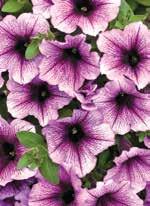
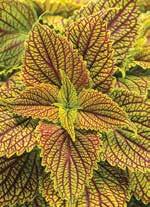
Come see what’s blooming at Enright We have everything you need from Azaleas to Zinnias.



2351 N. 400 Rd. • Edgerton, KS • Hours: 9am-6pm, Mon.-Sat. • Sun. noon-4pm 2 miles west of Edgerton on Hwy 56 to County Line, 2 miles north 1/2 west
Turner Community Gardens • 55th & Klamm Street • Turner, KS Mon.-Sat. 9am-6pm • Sun. noon-4pm
KCMO Farmers Market Location • 3rd & Walnut, Saturday only Stall 50 across (west) from the Arabian
Enright Gardens
No Ordinary Gardening Adventure gorgeous plants, wonderful staff, unique garden store www.enrightgardens.com NOW BLOOMING AT THESE 3 LOCATIONS

April 25, 2026
Swope Park Bandstand
12-3 PM | All Ages | Free
Celebrate our parks and our planet!
Enjoy an afternoon of educational performances, hands-on learning experiences, a fashion show and more!

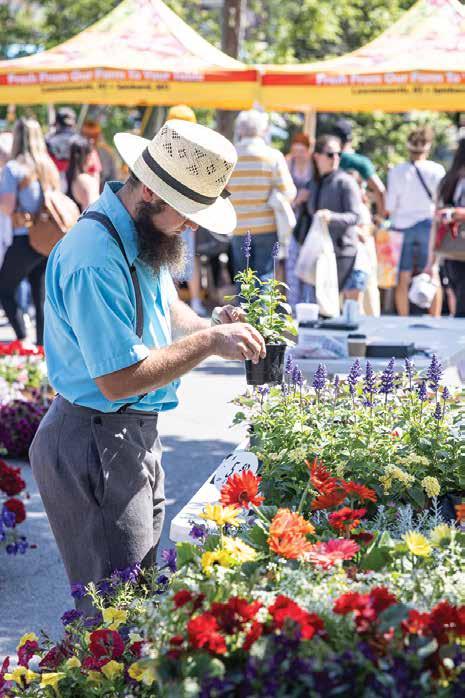
LEARN MORE
Opening April 18 Saturdays in April and May at Matt Ross Community Center. Visit our new location at Clock Tower Landing starting June 6.
Sweet Scents of Spring Flowers That Fill the Garden With Fragrance
Spring is in the air. The saying means different things to different people. It can be flowering trees, fresh cut grass, spring rain, fresh mulch, soil being worked after a long winter’s sleep. But what are some amazingly fragrant spring bloomers? Is the smell pleasing to you or not your cup of tea? I personally enjoy the fragrant smell of roses; my coworker thinks they are unpleasant. Everyone’s nose is different. Here are a few suggestions for your own smell test.
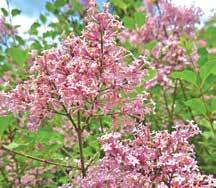
In some of the older Overland Park neighborhoods are beautiful, tall old fashioned Lilac bushes. They must be at least 10 feet tall. Lilacs have conical shaped blooms in varying shades of purple, lavender, vio-

let, indigo and white. In our area Lilacs are usually in bloom mid-April to May. When they start depends on how warm our spring temperatures are. Lilacs have a sweet, floral fragrance and can vary by variety.
‘Miss Kim’ is a small lilac variety that I have at my house. It is sweet, but has a little bit of spice in it too.
The ‘Bloomerang’ series has smaller, more open blooms, they are more of a spray vs a cone. They bloom in the spring and again later in the summer. They are also smaller in height. We are excited to have this variety at our Spring Plant Sale, April 24-26, at the Overland Park Arboretum & Botanical Gardens. Lilac’s do best in full sun to part sun with good air movement.
ANNE WILDEBOOR Horticulture Supervisor
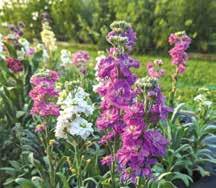
Stock is my all time fragrant spring annual. It is a linear shaped flower that comes in purple, pink, white, yellow, and peach. It has a spicy, sweet cinnamon fragrance. Stock performs well in pots and in the ground. Full sun to part shade are good light requirements for this. The foliage can be a bright green or a muted silver, it totally depends on the variety.
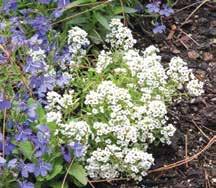
Lobularia is a type of Alyssum. It really is a summer annual, but it handles temperatures in the 40s with ease. It has a dainty cluster bloom that smells of honey. Just the right amount of sweet. It is a trailing plant, so a great spiller plant for containers or front of the border plant. The color selection on this
plant is as light as the blooms, coming in white, soft pink and lavender. I will caution that it can get a little scraggly in very dry conditions. So, as long as you are keeping moisture consistent it will bloom like crazy from April to November. No deadheading required!
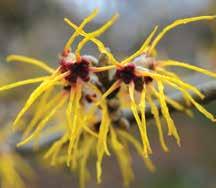
The Vernal Witch Hazel blooms in the late winter or early spring months. There is also its sibling, the Autumnal Witch Hazel that blooms in the fall. They come in a variety of colors such as orange, yellow, purple, red and pink. Witch Hazel blooms look like little fireworks or spiders. You should take into consideration where you are planting them so you can see the blooms. They do well as an un-
Anne Wildeboor, is long-time horticulturist at the Overland Park Arboretum & Botanical Gardens. She loves sharing her passion for plants with the public and working alongside dedicated staff and volunteers.
Lilac
Viburnum
Stock
Daffodils
Lobularia
Calendula
Witch Hazel
Nemesia
derstory shrub but you don’t want those dainty blooms to get lost. I love the bright yellow blooms of ‘Harlow Carr’ or ‘Wisley Supreme’ but the coppery orange blooms and the sweet fragrance of ‘Jelena’ are amazing. The Missouri Botanical Garden in St. Louis has a wonderful collection. They are old and majestic, some of them are probably 10 feet tall. If you haven’t visited this garden, it is spectacular in all seasons.
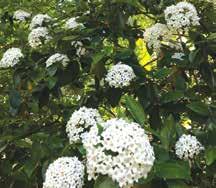
Viburnums are such a vast and diverse genus. They can offer beautiful foliage, bright berries, and large blooms. Some blooms can have an unpleasant fragrance. The Korean Spice Viburnum is the opposite, it has a wonderful sweet/ spicy fragrance from the white or light pink blossoms. In the right location, next to a patio or by a window, the lovely scent can be enjoyed. It is a smaller species only getting four to six feet tall and wide. Full to part sun is the best light for it to thrive.
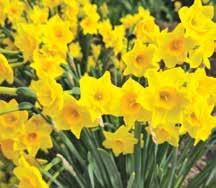
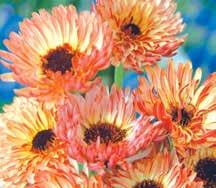
Did you know that there are fragrant daffodils (Narcissus)? So there are different “types” or “groups” of narcissus. Fragrance is not always a given within a group. For example in the Double group ‘Erlicheer’ and ‘Sir Winston Churchill’ have a sweet scent. ‘Manly’ and ‘Androcles’ are in the same group and have no fragrance. I personally love miniature narcissus, so many varieties are fragrant and I think they are just precious. They should be planted in groups at the front of the border so they don’t get missed. They truly are small, some only getting four to six inches tall. ‘Minnow’ is so sweetly fragrant and just adorable. Calendula or commonly called the Pot Marigold is a spring annual that does well into the early summer months. July and August can be a little tough on it temperaturewise. Used as a decorative flower or as an herb, Calendula can be used for healing wounds or reducing inflammation. If you don’t enjoy the scent of marigolds (Tagetes) then you probably won’t enjoy Calendula. Their scents are very similar,
a little herby with a touch of thyme or mint. Flowers come in orange, yellow, peach, white and rust. I am very excited for a variety we are growing this spring called ‘Strawberry Blond’. Check it out, I think it’s going to be gorgeous.
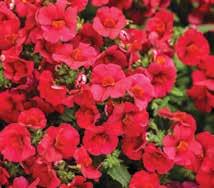
Nemesia is another spring annual that people are becoming more familiar with, but I still think that
Nemesia is underutilized. It comes in more than just the standard purple. We are talking about vibrant red, orange and yellow, but also softer pinks and white. A trailing kind of mounding plant, it looks great in containers and in the front of landscape borders. It has a sweet, delicate scent, kind of reminding me of grape soda.
I hope you will come out and explore the Overland Park Arboretum & Botanical Gardens this spring, put your nose in a few flowers, and see what tickles your fancy. Or head out to one of our local garden centers to find your favorite scented plant. Try to put your plant in a place where you can enjoy the lovely fragrance it gives.
Take the guesswork out of fertilizing
We are often asked, “Why should I get a soil test?” The first key to lawn and garden success is knowing soil fertility.
A soil test reveals the baseline nutritional values of your soil. A test can determine the type and amounts of fertilizer needed for optimal plant health. A good soil test also determines the pH level of the soil so corrections can be made.
Soil fertility is something that cannot be seen, felt or guessed. It varies from one yard to the next. In many cases the test shows that too many nutrients have been applied and additional chemical elements such as phosphorous and potassium may be harmful.
Phosphorous and potassium levels build up in KC soils. Excess can harm growth, or worse, leach out and pollute streams and lakes. Many garden resources recommend a balanced fertilizer such as 10-10-10 or 5-10-5. Long term use of these products can lead to chemical buildup. Soil testing takes the guesswork out of fertilizing.
A common misbelief is that our local soils need lime. Lime raises the pH, and most KC soils already have high levels. A simple soil test will determine soil pH. You’ll then learn the correct treatment options, saving you money.

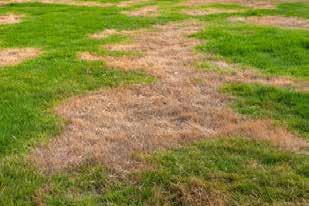
Extension recommends a soil test every three to five years. All local extension offices provide soil testing services. Soil samples brought or mailed to the Johnson County Extension office are sent to the Soil Testing Laboratory at Kansas State University in Manhattan. Our agents analyze the lab results and writ personalized recommendation. Your report is usually e-mailed to you within 4-6 weeks.
April is an excellent time to test the soil, especially if you are planning a fertilizer program. Save yourself time and money by getting your soil tested today.
It all starts with a soil test!
Rush the spring feed, and you'll pay the price. Summer grass won't look so nice.
• Fall fertilization is critical to your lawn’s health in spring
• Applying just the right kind and amount of fertilizer saves you money and protects our water quality
• JoCo Residents: Get one free soil test and a personalized recommendation for your lawn
• Funding provided by the Johnson County Stormwater Management Program. Limit one per Johnson County household.
Learn more at johnson.k-state.edu or call 913.715.7050

Rose Report Raised Beds and Patio Pots
Although spring arrived on March 20th, we all know winter sometimes refuses to leave until April 15. If you have started uncovering your grafted roses, keep your mulch or compost nearby in case you need to recover the base of your roses during a lastminute prolonged freeze. Otherwise, it is time to wake up your roses, prune away dead wood, water, fertilize and plant new roses. Click on the Growing Roses tab on our website at kansascityrosesociety.org for more spring rose help information.
Roses in Pots
If planting roses in the ground seems daunting, please consider a very easy alternative—roses in pots! They look great on a patio, porch, balcony or even in a garden bed. Your new potted rose needs at least 6 hours of sun. Pots for roses should be large and deep to accommodate extensive root systems, with a minimum size of 15-20 inches in diameter and up to 24 inches in depth. Larger pots prevent the soil from drying out too quickly. Miniature roses fit in a 5-gallon pot, typically 12 inches deep and 11-12 inches across. Create soil by adding half top soil and half compost. If your top soil is enriched with compost, use two-thirds top soil and one-third compost. Make sure your container (plastic pots are lighter) has a drainage hole in the bottom or drill one if necessary. Last year, I planted ‘Sunbelt® Savannah’ in an 18" x 18" pot. Fertilize your pot as you would any in-ground roses. I would recommend placing a decorative roll-

ing stand underneath the pot, so the rose can be moved easily to different sunny spots if needed. Also, my husband purchased a two-wheel dolly to move my fairly heavy potted rose to the un-heated garage for the winter months and to move it back to the patio in the spring.
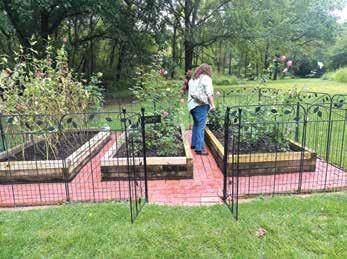
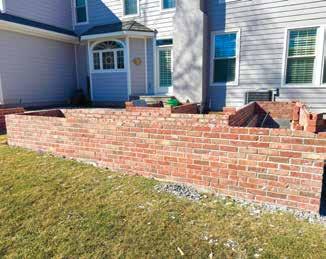
Raised Rose Beds
This month marks my first experience in creating raised beds for roses in my backyard. The brickwalled beds surround the new patio and will cultivate beauty and privacy. Many of you may have purchased or built your own rectangular wooden raised beds for vegetables or annuals. Why not plant roses too? As with all roses, choose an area that receives at least 6 hours of sun. My beds have 2 feet of mixed topsoil and compost and enough width to plant the roses side by side. I had the new soil tested before filling my beds. Roses generally enjoy a pH of
LAUREN ENGLISH Consulting Rosarian
6.0 through 6.9, with 6.5 being ideal. In other words, the soil should be just slightly acidic. When planning how many roses to fill your bed, take note of the size of each rose (mature height and width) and leave at least 2.5 feet of space between each rose to encourage good air flow and discourage black spot from spreading. Also, remember to use a lightweight tiller to break up the existing clay soil at the bottom of your raised bed before adding the top soil and organic matter. Our American Rose Society-trained local Consulting Rosarians are always available to help you through our Ask a Rose Expert email: rosehelp@kcrosesociety.org.
Please join me from 9:30-11:00 a.m. on April 11 at Village Presbyterian Church, 6641 Mission Road in Prairie Village, KS, for the second public Kansas City Rose Society series presentation, “How to Ensure Roses Flourish with Ease.” And, don’t miss the third talk, “How
to Control Pests and Disease with Ease,” at 9:30 a.m. on April 25th by Consulting Rosarians Jerry Dreyer and Gretchen Huebert. See Events Calendar on our website for May KCRS presentations.
FEATURED ROSE
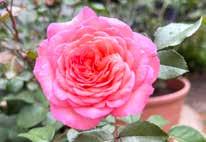
The Sunbelt® Savannah™ Kordesbred rose is a highly-rated, fragrant (citrusy) Hybrid Tea known for exceptional heat and humidity tolerance and long-lasting, 4-inch, salmon-pink blooms. It is diseaseresistant, with a mature height of 3 to 4 feet and a width of 3 feet. Savannah is available online and locally.
Lauren English is an American Rose Society Consulting Rosarian and a life-time member of Kansas City Rose Society. She can be reached at Ask a Rose Expert email, rosehelp@kcrosesociety.org.
Wooden rose, raised beds at the home of Joyce and Scott Blakesley
New backyard raised, bricked-walled rose beds
All equipment assembled, serviced and ready to go when you buy it.


Time to get your equipment in for a spring tune-up.
Stock up on your Lawn & Garden supplies, Pet supplies and Bird seed.
4807 N. Brighton, KCMO www.mowerpartskc.com 816-452-8393
Mon.-Fri. 9a-6p • Sat. 9a-1p (closed for lunch 12:45-1:30)
Missouri Wildflowers Nursery
573-496-3492 www.mowildflowers.net mowldflrs@socket.net 9814 Pleasant Hill Rd Jefferson City MO 65109
Meet us at one of these locations in the KC area. Give us your order at least 5 days before a sale, and we will bring it to the location.
Deep Roots Native Plant Sale at Anita B. Gorman Conservation Discovery Center, 4750 Troost Ave, KC MO 64110. April 11, 10 a.m. to 2 p.m. deeprootskc.org
Rotary Youth Camp Native Plant Sale at Rotary Youth Camp, 22310 NE Colbern Road, Lee’s Summit 64086. Friday, April 17, 4 p.m. to 6 p.m.
Missouri Prairie Foundation Native Plant Sale at Anita B. Gorman Conservation Discovery Center, 4750 Troost Ave, Kansas City MO 64110. April 18 & May 16, 10 a.m. to 2 p.m.
Shawnee Indian Mission Foundation - Native Plant Sale at 3403 W. 53rd St, Fairway KS 66205. April 25, 9 a.m. to 1 p.m. shawneeindianmission.org
Native Plant Sale by Burroughs Audubon at 6212 NW Barry Rd. KC MO 64154. Backyard Bird Center 816746-1113. Saturday, April 25, 10 a.m. to 2 p.m.
Deep Roots Native Plant Sale at City of Prairie Village Municipal Offices, 7700 Mission Rd. Prairie Village, KL 66208, May 9, 10 a.m. to 2 p.m.
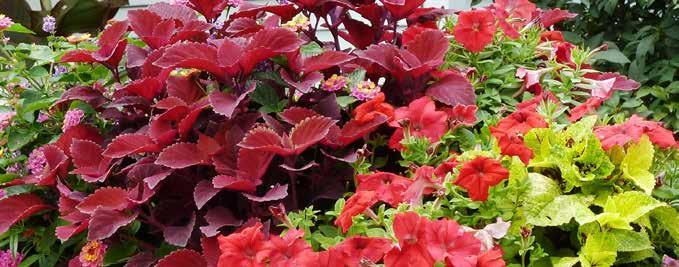
Indoor shopping !! Miami County Fairgrounds
Building #2 Building
Pesticide-free and Locally Grown
Butterfly host plants
Native plants ~ Pollinator flowers
Annuals ~ Herbs ~ Perennials
Hanging baskets ~ Veggies & berries Tropicals & Succulents
Cash, Credit Cards and Checks accepted For additional information call 913-294-4306, or visit www.maraisdescygnes.ksu.edu or follow us on www.facebook.com/mdcemg


Plants Establish at Different Rates know growth characteristics when selecting natives
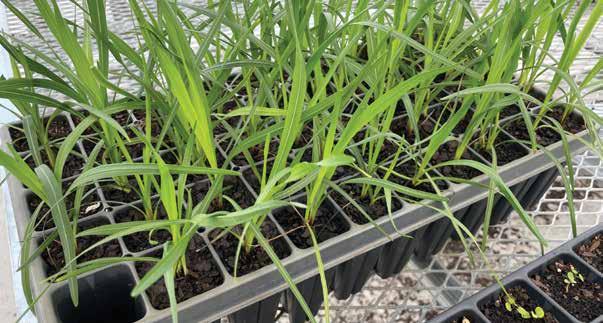
With the price of plants going up and up, it pays to buy smaller container sizes. That’s a no-brainer for robust plants like New England aster, ironweed, obedient plant, and orange coneflower. A petite, 2-inch pot of these species grows fast and will begin blooming decently after one year of growth. By comparison, a small pot of yellow wild indigo or goat’s beard may get lost in the garden and take two to three seasons to get big enough to fill out and bloom nicely. Wild hyacinth, wild leek, Michigan Lily, and lead plant

can often take even longer—three to four years because they develop more slowly.

Some people don’t mind the grow-in wait period. They often don’t have the will or wallet to pay higher prices for large containers either. Others can’t wait and feel like the price of a quart, gallon, or 3-gallon container is like buying time, the most valuable thing of all. This reminds me of the ancient Chinese proverb that goes something like this, “the best time to plant a tree is 20 years ago, the second best time is now.”
To help you plan your spring shopping list (and budget), I’ve or-
SCOTT WOODBURY Horticulturist
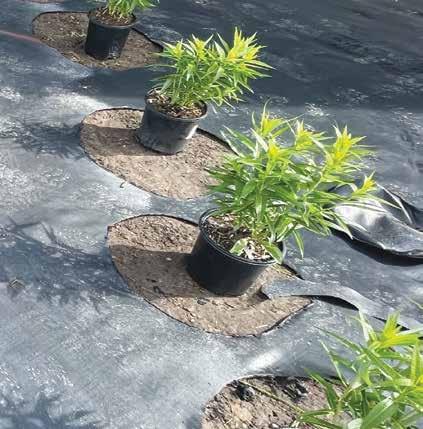
ganized common native landscaping plants into three lists according to their establishment rates. The first includes vigorous plants that lend themselves to starting with small containers (2-inch pots or plugs). The second list features plants with moderate growth rates (quart or gallon). The third comprises plants that are finicky and develop more slowly (gallon size or larger).
Quick-to-establish plants (one year; suggested target: two-inch pots or plugs):
groundsels (Packera spp.), spiderworts (Tradescantia spp.), coreopsis (Coreopsis spp.), garden phlox (Phlox paniculata), most sedges (Carex spp.), Jacob’s ladder (Polemonium reptans), obedient (Rudbeckia subtomentosa), mistflower (Conoclinium coelestinum), showy (Solidago speciosa), rough-leaved (Solidago rugosa), and cliff goldenrods (S. drummondii), greyhead coneflower (Ratibida pinnata), Ohio horsemint (Blephilia ciliata), sunflowers (Helianthus spp.), New England aster (Symphyotrichum novae-angliae), yarrow (Achillea millefolium), white sage (Artemisia ludoviciana), common milkweed (Asclepias syriaca), wild strawberry (Fragaria virginiana), wild bergamot (Monarda fistulosa), Helen’s flower (Helenium autumnale),
Scott Woodbury is the owner of Cacalia: Native Garden Design and Wilding, and he is a Grow Native! professional member. Find suppliers of native plants and seeds, as well as landscaping services at grownative.org.
Prairie blazing star plugs
Photos by Scott Woodbury.
Shining blue star in gallon container
river oats (Chasmanthium latifolium), ironweeds (Vernonia spp.), mountain mints (Pycnanthemum spp.), big bluestem (Andropogon gerardii), and switch grass (Panicum virgatum).
Moderate growth rate (two to three seasons; suggested target: quart minimum or possibly gallons):
onions (Allium spp.), celadine/ wood poppy (Stylophorum diphyllum), wild sweet William (Phlox divaricata), Joe-pye (Eutrochium spp.), wild geranium (Geranium maculata), Virginia bluebell (Mertensia virginica), prairie coreopsis (Coreopsis palmata), wild petunias (Ruellia spp.), crested (Iris cristata) and copper iris (I. fulva), wild ginger (Asarum canadense), rose turtlehead (Chelone obliqua), blue stars (Amsonia spp.), butterfly milkweed (Asclepias tuberosa), rose mallow (Hibiscus lasiocarpos), Culver’s root (Veronicastrum virginicum), cardinal flower (Lobelia cardinalis), blue lobelia (Lobelia siphilitica), poppy mallow (Callirhoe spp.), beardtongues (Penstemon spp.), blazing stars (Liatris spp.), Missouri evening primrose (Oenothera macrocarpa), aromatic aster (Symphytricum oblongifolium), prairie clovers (Dalea spp.), purple (Echinadea purpurea), yellow (E. paradoxa), and pale purple coneflowers (E. pallida) compass plant (Silphium laciniata), royal catchfly (Silene regia), rose verbena (Glandularia canadensis), Bradbury bee balm (Monarda bradburiana), rattlesnake master (Eryngium yuccifolium), southern prairie (Eurybia hemispherica) and sky blue asters (Symphyotrichum oolentangiense), skullcap (Scutellaria spp.), columbine (Aquilegia canadensis), fire pink (Silene virginica), pussytoes (Antennaria parlinii), Indian physic (Gillenia stipulata), little bluestem (Schizachyrium scoparium),
sideoats grama (Bouteloua curtipendula), and cedar sedge (Carex eburnea).
Slow growth rate/delicate firstyear seedlings (three to four years: suggested target: gallon minimum or larger):
blue (Baptisia australis), white (B. alba), and yellow false indigo (B. sphaerocarpa), Indian pink (Spigelia marilandica), Solomon’s seal (Polygonatum biflorum), Solomon’s plume (Maianthemum racemosum), wild leeks (Allium tricoccum), leadplant (Amorpha canescens), American spikenard (Aralia racemosa), Michigan (Lilium michiganense) and bunchflower lily (Melanthium virginicum), goat’s beard (Aruncus dioicus), prairie dock (Silphium terebinthinaceum), prairie dropseed (Sporobolus heterolepis), ferns, woody vines, shrubs, and trees.
Lastly, you will find a handful of nurseries that offer bare-root plants, mail-order plants sold without soil or pots, and usually packed/ shipped in peat moss. These plants tend to be inexpensive because they are field-grown in long rows. Their sizes can vary, but they are usually the best buy for your money. Bare-root plants may be somewhat dormant and/or desiccated, because they typically are dug in the fall and stored in refrigeration through winter. They should be shipped in early spring while dormant, and then soaked in a bucket of water for several hours just before planting, to rehydrate the roots. However, if you want bare-root plants, ensure they are nursery-grown. In recent years, unscrupulous plant dealers have been selling rhizomes/root stock poached from the wild, severely degrading original habitat.
I hope these growth-rate tips help you navigate through the many plants and sizes available in catalogs and nurseries this spring. And I hope it saves you money, too. Better get planting, y’all!

Gardeners Connect Free Speaker Series
Problem-Solving with Native Plants
Sat., April 18, 9:30 a.m.
Merriam Community Center
presented by Zack Callaway, KC Native Landscapes
Often gardeners choose native plants to benefit pollinators and for their durability in our climate. However, they also can be problem solvers in the landscape.
That’s the topic of the Gardeners Connect Free Speaker Series program planned for the morning of April 18.
The program is set to start at 9:30 a.m. at the Merriam Community Center, 6040 Slater, across from Ikea at Johnson Drive and I-35. Come early to enjoy coffee and some breakfast treats.
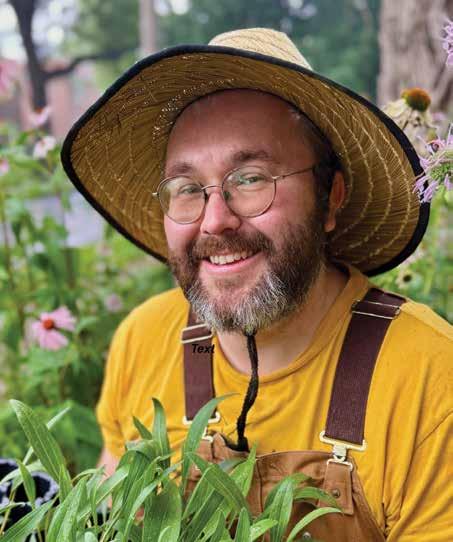
The scheduled presenter is Zach Callaway, who owns KC Native Landscapes, a native plant-based landscaping business serving the Kansas City metropolitan area. In this work, he provides beautiful and restorative landscaping options while educating clients on the ecological, functional, and aesthetic value of native plants.
His program is titled “Planting with Purpose: An Intentional Approach to Plant Selection.” The general theme is that we pick our garden plants for multiple reasons (aesthetics, site conditions, functional purpose, maintainability, and ecological role), and that the right native plant can serve all of these purposes.
Expect to see photos of examples from projects. The heavy focus will be on the ecological and maintainability benefits, and ways to use native plants in the place of common cultivars and exotic varieties.
Callaway has practical experience and advice-gathering from the
region’s local grower community. When he was the program manager at After the Harvest, a local gleaning nonprofit, he visited dozens of local farms and community gardens.
When helping to prep a site, harvest, or do winter clean up with these growers, it was a crash-course in all
of the different techniques and approaches you can take in each part of the growing season.
When he transitioned from a focus on agriculture to native plants and ecology, he did a deep dive using resources from local organizations like Deep Roots and Grow Native!
well as taking notes from other professionals and growers in the region.
“I was lucky to be able to use my own yard, and some friends’ and family’s, as testing grounds to build up my skills in native landscape practices,” he said.
During the past off-season, he has worked toward green stormwater infrastructure maintenance certification and pollinator steward certification.
“Heading into my third season as an independent contractor, I’m starting to see some of my first projects come into maturity, which is very rewarding,” Callaway said. “While I started with residential gardens and lawn replacement, I’ve had a chance to develop relationships with a few larger, public-facing projects, like Westport Presbyterian Church and KC Academy.”
Kansas City sits at the edge of the tallgrass prairie, Callaway noted in an interview with VoyageKC.com. He called it one of the most diverse ecosystems in the world but also one of the most depleted.
“While replacing a small section of your yard with native prairie flowers may seem like a small action, it can literally be life-saving for migrating pollinators, visiting birds, and native insects,” he said in the interview.
His goal is to educate and encourage his clients “to become stewards of their land in a way that helps repair the ecological damage done by modern land management.”
Join us for this free event.
Zack Callaway presents Planting with Purpose: An Intentional Approach to Plant Selection, April 18.





Salvia Ultra Violet Buddleia
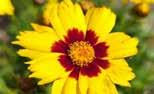
Coreopsis Makeup
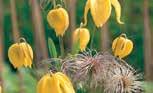
Clematis
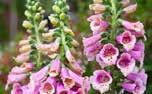
Digitalis Dottie ™ Warm Rose
Dianthus Scent First ® Orange Sparkler
Phlox Candy Cloud ™ Blue
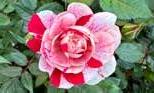
Rose, Miniature Parade Meri
Asparagus Purple Passion
Lewisia Sunset Rosy Pink
Master Gardeners’ Plant Sale in Paola Indoor Plant Shopping
The annual Paola Plant Sale returns to the comfort of indoor plant shopping at the Miami County Fairgrounds in Paola, KS, on April 23, 24, and 25. Sponsored by the Marais Des Cygnes District Extension Master Gardeners, a wide variety of over 7,000 plants will be available. We are located at the Miami County Fairgrounds, Building #2, 401 Wallace Dr., Paola, KS 66071. Cash, checks and credit cards are welcome. The doors open promptly at 9 a.m. each morning and close at 6 p.m. on Thursday, 5 p.m. on Friday and 1 p.m. on Saturday.
Exceptional Plant Selections
Our local grower uses only organic horticultural methods so no synthetic fertilizers or pesticides have been applied. This means that the plants are safe for humans, pets, butterflies and bees. Because these plants are grown in Kansas, buyers can be confident that their purchases will succeed in our Midwestern clay soil and unpredictable weather conditions.
The plants are organized into Groups by horticultural requirements and/or by function to assist shoppers in their search for the perfect plants. Large, colorful signs identify each Group, which is staffed by an Extension Master Gardener who specializes in that Group’s plant selections including planting and maintenance requirements.
For instance, the perennials are divided into three Groups: shade lovers, sunny ornamentals, and sunny natives. Edible plants are also divided into three Groups: vegetable starts, herbs, and fruits. The largest Group offers almost 40 species of the unique plants that host butterflies, organized by species of butterfly. Yes, we will have Milkweed for Monarchs but there are 60 other species of butterfly in our area that also require a special host plant to feed their caterpillars. The pollinators also have a Group devoted to their favorite flowers like Mexican Sunflower and Butterfly Bush. Gardeners who prefer native plants for visiting pollinators can shop on the adjacent row of native perennials.
Other Offerings
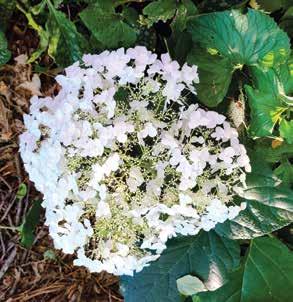
The Group of sun-loving annuals, including coleus and begonias, greets you at the door. At the rear of the building, ornamental and native shrubs await your perusal. This selection includes the award-winning native Hydrangea arborescens ‘Haas Halo’, which is recommended as the best hydrangea to meet the needs of both gardeners and hungry pollinators. And if you haven’t yet tried the new Oso Easy Roses, we will have them in multiple colors! Tender tropicals and succulents may be purchased for use as houseplants or planted in the garden as an annual with dramatic appeal. A large
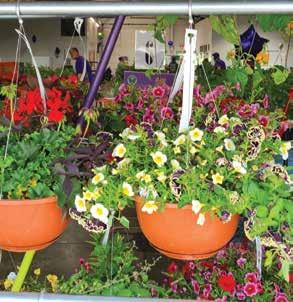
selection of flowering hanging baskets and patio pots can bring instant color to your yard or porch.
Help for Gardening Questions
Do you need suggestions for challenging sites like dry shade or that wet spot? Do deer and rabbit consider your garden to be their personal buffet? Which varieties of tomatoes or peppers produce best in our area? Extension Master Gardeners will be on-hand to answer your questions about plant selection and care. The recently released book, Gardening for Insects, co-authored by Lenora Larson and Vinland Valley Nursery’s co-owner, Amy Albright, will also be available for purchase. Last year we sold almost 90% of our available plants, so come early! See our advertisement with details on page 25. For more information, contact the Paola Extension Office at 913-294-4306.
FREE Garden Books!
Are your gardening bookshelves in need of pruning? Please bring gardening books in reasonable repair and participate in our “Free Book Table.”
Warning: some gently-used books may follow you home!
Racks of hanging baskets provide convenient access shopping.
‘Haas Halo’ Hydrangea lace caps are often 12" wide.
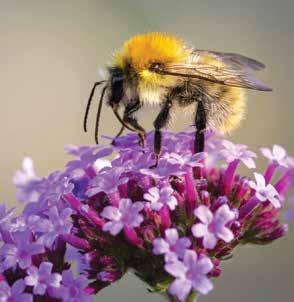
Tall Verbena, Verbena bonariensis, attracts pollinators like this Bumble Bee.








Upcoming Garden Events
The Garden Club of Shawnee Thurs, Apr 9, 7p; at Shawnee Town, 1929 Town Hall, 11600 Johnson Dr, Shawnee, KS. Our program will be “Hummingbirds–Jewels in Your Garden” presented by Ann Tanner, JOCO Extension Master Naturalist. We will serve drinks and snacks, and great door prizes will be given away. As always, visitors are welcome! Learn about us at gardenclubofshawnee.org and our Facebook page.
Greater Kansas City Iris Society
Mon, Apr 13; gather 6:30p; Meeting 7-9p; at Trailside Center, 9901 Holmes Rd, Kansas City, MO. Program: Preparing and Grooming Iris for Show and Iris Artistic Designs. Join us to learn the basics of how to enter named iris specimens in an Iris Show, and the Artistic Design Division for our judged Spring Show on May 16.
Kansas City Cactus and Succulent Society Sun, Apr 19, 1:30-3:30p; at the Trailside Center, 9901 Holmes St, Kansas City, MO. This month’s program will spotlight the fascinating world of Euphorbias and how they differ from true cacti. Members and guests are encouraged to bring a favorite Euphorbia and join the conversation about care, growth habits, and the incredible diversity within this vast group of succulents. All welcome; refreshments served.
Kansas City North Garden Club
Wednesdays in April, 10:30a-noon; at Kansas City North Community Center, 3930 NE Antioch Rd, KCMO 64117. Join us each Wednesday where we will plant seeds, maintain the raised beds and wildflower gardens, DIY craft projects, and hear from special guests from MU Extension and Platte County Master Gardeners. Contact Kendra Beaver, 816-513-7740; kendra. beaver@kcmo.org
Leawood Garden Club
Tues, Apr 28, 10:30a; at Colonial Church, 7039 Mission Rd, Prairie Village, KS 66208. Program: “FOUR SEASONS OF BIRDS AND PLANTS IN KANSAS CITY” By Elizabeth Stoakes - Starts at Noon. She will discuss why native plants are vital to birds and offer hints for successful wildlife gardening. She will showcase a selection of attractive native species that thrive in KC while providing food and shelter for birds and insects. Hint: it’s not all about seeds! She will also introduce some fascinating birds beyond our typical “feeder friends” and provide handouts and garden plans to help you create and enjoy your own “bird bonanza”.
Leavenworth County Master Gardeners Club Meeting / Advanced Training
Wed, Apr 8, 11a; at Riverfront Community Center, 123 Esplanade St, Leavenworth, KS 66048. Kansas City Rose Society Consulting Rosarian, Corinda Stallbaumer, will share “For the Love of Roses”: tips on placement, care and resources for flourishing roses in your garden. FREE. Vis-
itors are welcome. For more info contact Leavenworth Co Extension office at 913-364-5700.
Raytown Garden Club
Tues, Apr 7, 10a; at Blue Ridge Presbyterian Church, 6429 Blue Ridge Blvd, Raytown, MO 64133. The program will be “Beautifying and Updating our Raytown Parks” presented by Dave Turner, Raytown Parks Director. Guest are always welcome. For more information about our club, check out our Facebook page: www. facebook.com/RaytownGardenClub
Orchid Delirium
Through Apr 19; at Powell Gardens, 1609 NW US Hwy 50, Kingsville, MO 64061. Orchid Delirium returns to Powell Gardens this spring, inviting guests into a world where orchids take center stage. See more details and purchase tickets at powellgardens.org.
Tulip Fest
Apr 1-29; at Paula’s Petals, 33607 E 199th St (2nd entrance off the main road), Pleasant Hill, MO 64080. Come and see the beauty of spring! With over 10.5k spring bulbs planted it’s bound to be a beautiful spring. This is a month long Tulip festival. Pre-order spring bulbs as you walk the gardens. Flowers will be pre-picked for purchase. www.paulas-petals.com
Easter Weekend at Vinland Valley Nursery
Apr 4, 9a-5p and Apr 5, 11a-4p; at 1606 N 600 Rd, Baldwin City, KS 66006. Join us for a weekend of spring fun! Activities are self-guided, some are free, and you can walk-in any time during regular hours. We’ll also have everything you need for beautiful easter baskets—moss, bows, gardening goodies, small plants, and baskets! Hens & Chicks are buy-one-get-one-free all weekend. vinlandvalleynursery.com
Eat Local & Organic Expo
Sat, Apr 4, 9a-1p; at Lenexa Old Town Activity Center, 9301 Pflumm Rd, Lenexa, KS 66215. Kick off farmers market season at the Eat Local & Organic Expo! Shop with more than 30 KC Food Circle farmers who pledge to meet high standards for growing plants and mushrooms, beekeeping and raising animals. Sign up for weekly farm shares, buy transplants for your garden and get the freshest early spring products our region has to offer! Learn more at; https:// thefoodcircle.org/eat-local-organic-expo-2/
Deep Roots Native Plant Sale
Sat, Apr 11, 10a-2p; at Anita Gorman Conservation Discovery Center, 4750 Troost Ave, KCMO 64110. deeprootskc.org. Contact Missouri Wildflowers Nursery, www.mowildflowers.net, 573-496-3492, mowldflrs@socket.net, at least 5 days before, and they will bring your purchased plants.
Healthy Yards Expo
Sat, Apr 11, 9a-2p; at the Shawnee Civic Centre, Shawnee, KS. Learn simple, eco-friendly
lawn and garden practices through educational seminars, expert advice, and interactive activities. Features local vendors, nonprofits, free soil testing for Johnson County residents, kids’ activities, and resources to help protect water, soil, and the environment while creating a healthy yard. FREE family-friendly event.
40th Annual African Violet Show & Sale Sat, Apr 11, 9a-2:30p; at Loose Park Garden Center, 51st St and Wornall Rd, Kansas City, MO 64112. NO ADMISSION FEE. Sho-Me African Violet Club; “Reflections of Violets”
Overland Park Farmers Market Opening Apr 18. Saturdays in April and May at Matt Ross Community Center. Visit our new location at Clock Tower Landing starting Jun 6.
Earth Day Celebration
Sat, Apr 18, 10a-2p; at Lakeside Nature Center, 4701 E Gregory Blvd, Kansas City, MO 64132. Celebrate Earth Day with information about the wildlife of Swope Park, learn about preservation, explore the forest, pond, and marsh around the property, plus arts and crafts. Explore nature in the city and learn what you can do to support native wildlife in our area. Master Gardeners of Greater Kansas City Children’s Program will be teaching children how native plants support biodiversity and children will participate in an activity to pot a native plant in a decorated container to take home. For more information visit https://lakesidenaturecenter.org/event/earthday-a-native-wildlife-event-2/
Earth Day Event
Wed, Apr 22, 6:30-8:30p; at Green Street Event Center, 209 SE Green St, Lee’s Summit, MO 64063. Join Master Gardeners of Greater Kansas City for an Earth Day Celebration. Extension Master Gardeners (EMGs) will make seed bombs using native seeds and offer a demonstration on planting natives in containers. There will be children’s pollinator activities with pollinator plants and wildlife coloring pages. A library display will feature children’s gardening education on pollinators. EMGs will also have MU Extension publications, handouts, and free seeds. Sylvia Bailey Community gardeners and representatives from the Train Depot Pollinator gardens will share their experiences growing natives and pollinator plants. For more information, visit https://cityofls.net/green-street/ events. Free event. Children must be supervised by a parent or adult.
Paola Spring Plant Sale
Apr 23, 24, 25, INDOOR SHOPPING at the Miami County Fairgrounds Bldg #2, 401 Wallace Park Dr, Paola, KS. Thurs 9a-6p, Fri 9a-5p, and Sat 9a-1p. The sale will feature pesticidefree locally grown plants. In addition to the usual selection of butterfly host plants, pollinator flowers and native perennials, there will be ornamental annuals, perennials, herbs, succulents, hanging baskets, and veggies. Extension Master Gardeners, including butterfly expert Lenora Larson, will be on hand to assist shop-
pers throughout the sale. Credit Cards welcome! More info at www.maraisdescygnes.ksu.edu. Follow us on Facebook at www.facebook.com/ mdcemg or call the office: 913-294-4306.
Spring Plant Sale
Apr 24-26; at the Overland Park Arboretum Botanical Gardens Plant Sale. Johnson County Extension EMGs will be on hand to assist and answer questions. A fundraiser for: Friends of the Arboretum. Members shop a day early on Thurs, Apr 23. arbplantsale.org
Thyme for Kids Plant Sale
Apr 24-25; at Cornerstones of Care Ozanam Campus Greenhouse, 421 E 137th St, KCMO 64145. Fri 9a-6p, Sat 9a-4p. Stock up on plants for your home and garden, while helping children grow and thrive. Questions: Stephanie at Stefanie.caravella@cornerstonesofcare.org; cornerstonesofcare.org/plantsale
Raytown Garden Club Annual Plant and Bake Sale
Sat, Apr 25, 8a-12p; at 8701 E Gregory, Raytown, MO 64133. Annual plant, Garden Art, and Bake Sale. Annuals, perennials, vegetables, herbs, natives, and garden art. All grown, made, and baked by members. Mother’s Day is coming!
Open Gardens Day Wornall House Museum Sat, Apr 25, 9a-noon; at 6115 Wornall, Kansas City, MO. Free native plants and vegetable plants for visitors. Extensive Missouri native garden. Charming enclosed kitchen garden. Flowers, evergreens and flowering shrubs suited to our weather. Master Gardeners will be on site to answer your garden questions.
Spring Fling
Sat, Apr 25, 12-3p; at Swope Park Bandstand. All ages. Free. Celebrate our parks and our planet. Enjoy an afternoon of educational performances, hands-on learning experiences, a fashion show and more. Kansas City Parks & Recreation
Native Plant Sale
Sat, Apr 25, 8a-noon; at Lenexa Farmers Market, 17201 W 87th St Pkwy, Lenexa, KS 66219. Discover a vibrant variety of landscaping options. Browse grasses, flowers, and other plants from local vendors. For more information, lenexa.com/nativeplantsale.
Wy Co EMG Annual Plant Sale
May 1, 9a-5p, and May 2, 9a-2p; at the Wildcat Room of the Wy Co Extension Office, 1200 N 79th St, Kansas City, KS 66112. Tomatoes, peppers, herbs, berries, hanging baskets, annual flowers, and perennial flowers available. 913299-9300; wyandotte.ksu.edu
Heartland Peony Society – Spring Bus Trip
Sat, May 2, 7:30a-7p. Departing/Returning Leawood, KS bus trip to three gardens and two nurseries in Manhattan and Topeka, KS. $75 per person all-inclusive including donuts for break-
Upcoming Garden Events
fast, a box Lunch, Snacks and drinks. Space is limited; contact Bucky Will at buckywill@ gmail.com with questions.
Central MO Master Gardener Plant Sale
May 2 and 3, Sat 8a-1p; Sun 12-3p; at Master Gardener Greenhouses, 810 Sandstone, Jefferson City, MO. Central Missouri Master Gardeners annual Plant Sale is our biggest fundraiser for the organization. We are selling plants, including tomatoes, peppers and hanging baskets, grown in our greenhouses by master gardeners. We also have perennials, including natives, donated by our members for sale. It is a weekend long event at our greenhouses. Prices vary starting from $4. We have three greenhouses full of tomatoes, annuals, vegetables and herbs. Greenhouses located in North Jefferson City by the dog park. Service dogs are welcome, but we ask that you leave pets at home or in the dog park.
Liberty’s Town and Country Garden Club
Annual Plant Share
Sat, May 2, 8a-noon, at Rotary Plaza, downtown Liberty (100 W Franklin). We invite you to stop by for free garden plants from our members. We encourage you to share your own plants if you wish. No early birds please.
MGGKC Dig & Divide Plant & Garage Sale
Sat, May 2, 9a-3p; at 501 N Dodgion St (Next to ReStore), Independence, MO 64050. Master Gardeners of Greater Kansas City invite you to our HUGE Plant/Garage Sale event. We will offer perennials, annuals, vegetables, herbs, and houseplants for sale. MGGKC will also have garden items like pots and gardening tools, plus additional garage sale items specially chosen by Extension Master Gardeners. Take a break from shopping and attend our free class “Dividing Perennials” at 11:30a to learn how to divide perennials to encourage vigor and free garden expansion. Proceeds from this fundraiser support our local gardening projects and educational outreach programs that help Kansas City learn to grow. For more information contact mggkc. fundraiser@gmail.com
Platte County Master Gardeners Plant Sale Sat, May 2, 9a-3p and Sun, May 3, noon-3p; at Northland Career Center, 1801 N Branch St, Platte City, MO. Directions at: www.plattecountymastergardeners.org. Proceeds benefit the MU Extension Master Gardeners of Platte County. 1000s of Native, Annual & Perennial Plants, Herbs, Tomatoes and Peppers. E-mail plattemgs@gmail.com; Facebook — Platte Co Master Gardeners
Olathe Garden Club’s Annual Plant Sale Tues, May 5, 4-7p and Wed, May 6, 8a-12; at 18505 W 114th St, Olathe, KS 66061. *Credit and Electronic Payments Accepted in addition to cash/check!* Come get some great new plants for your outdoor and indoor spaces while helping us raise money, this is our annual fundraiser for all of our philanthropic and educational activities throughout the year. You may find perennials, annuals, herbs, vegetables, flowers,
pollinator-friendly plants, shade plants, sunloving plants, house plants, and local artisanmade garden decor. Come meet the members of Kansas’ oldest garden club; established in 1929. Plant love and knowledge will be freely shared!
Spring Open House and Plant Fundraiser Sat, May 9, 8a-2p; at Monarch Watch, KU West Campus, Lawrence, KS. Join us for Monarch Watch’s Spring Open House & Plant Fundraiser! Looking for plants for your spring garden?
Our Plant Fundraiser will have dozens of species available, including milkweeds, host and nectar plants for native butterflies, and other annuals and perennials. These plants support monarch and pollinator populations as well as add beauty and function to garden spaces. Other activities during our Open House will include garden tours, games, arts and crafts, monarch butterflies and caterpillars, and more. This will primarily be an outdoor event. Online plant ordering will be available in advance in April, and more details will be posted soon on our events page. Thank you for your interest and support! https://monarchwatch.org/events
Habitat Garden Tours
May 9, Jun 6, Jul 11, Oct 3. Highlighting Kansas City residents who understand why what you plant matters. These events are an opportunity for Deep Roots to recognize the native gardeners in different neighborhoods of Kansas City and showcase their beautiful gardens. The goals are to inspire locals to plant native, share knowledge on gardening maintenance and design strategies, and strengthen the native gardening community by bringing them together for a morning of plant talk, sunshine and laughter. See more at: www.deeproots.org/habitatgardens
Spring Iris Show
Sat, May 16; at Colonial Church, 7039 Mission Rd, Prairie Village, KS. Presented by Greater Kansas City Iris Society. Anyone may enter the Horticultural Division, with the correct American Iris Society approved name of a variety. Artistic arrangements can entered using unnamed iris as the dominant flowers in the design. Set up and entries: 8a, Judging starts 10:30a; Iris Show 12-4p. For complete Show Schedule, contact Carolyn Ash, Carolyn.Ash7@gmail.com. Mark your calendars for our Public Iris Sale later in the year, Aug 22, at the same location.
Native Plant Sale
Sat, May 23, 8a-noon; at Lenexa Farmers Market, 17201 W 87th St Pkwy, Lenexa, KS 66219. Discover a vibrant variety of landscaping options. Browse grasses, flowers, and other plants from local vendors. For more information, lenexa.com/nativeplantsale.
Sedgwick County Garden Tour
Fri, Jun 5, 9a-5p; Sat, Jun 6, 9a-5p; Sun, Jun 7, 12-4p. Six gardens throughout Sedgwick County will be available for the public to view. Tickets are $10 and are available at the gardens, at Sedgwick County Extension office, 7001 W 21st St, Wichita, KS 67205 or online
sedgwick.k-state.edu; 316-660-0100
Railroading in the Gardens
Sat, Jun 6, and Sun, Jun 7, 10a-4p. Visit the 2026 Garden Railroad Tour consisting of ten train gardens at homes in the Kansas City area. See how gardening and model trains blend together in a creative and colorful way. Each garden railroad is different and unique with the trains running among a variety of plants and landscaping in a miniature world of trees, bridges, tunnels, houses and water features. Hosted by MO-KAN Garden Railroaders, the admission cost for this self-guided tour is $15 a car to see all the gardens for both days. This event is always fun for both adults and kids, with partial proceeds going to Harvesters. For details, tickets and tour guide, go to www.mokangardenrailroaders.org.
Beekeeper’s FunDay
Sat, Jun 6, 8a-5p; at the Douglas County Fairgrounds, 2120 Harper St, Lawrence, KS 66046. The Northeast Kansas Beekeepers Association announces its Beekeeping FunDay! Cost is $50 includes lunch, beverages, and honey ice cream. Vendors available for purchasing beekeeping related equipment. A silent auction will also be included to raise youth and veteran scholarships. For more information or to register visit http:// www.nekba.org/bee-funday.html
Union Hill Neighborhood Garden Tour Sun, Jun 7, 10a-3p. Save the date; details to come.
JoCo EMG Garden Tour
Jun 12 and 13. Early Bird Ticket Sales open online on Mar 15. Questions? Contact us at 913715-7050 or garden.help@jocogov.org.
limited. RSVP by calling 785-842-3081.
Vermicomposting
Thurs, Apr 9, 6:30p; at Basehor Community Library, 1400 158th St, Basehor, KS 66007. Leavenworth Co Master Gardener, Mary Eberst, invites you to join this fun Q&A presentation, addressing several basic materials you will need, the pros and cons of vermicomposting, as well as common mistakes beginners make and how to avoid them! Vermicomposting is an ecofriendly, “cold” composting process that uses specialized worms to rapidly convert kitchen scraps, paper, and cardboard into nutrient-rich organic fertilizer (worm castings). It is an efficient, low-odor method for indoor or smallspace composting, producing high-quality soil amendments in 8-12 weeks. Class free; visitors are welcome. For information: Leavenworth County Extension office at 913-364-5700.
Ensure Roses Flourish with Ease
Sat, Apr 11, 9:30-11a; at Village Presbyterian Church, 6641 Mission Rd, Prairie Village, KS. Consulting Rosarian Lauren English will guide you on fertilization, watering and pruning to get your plants blooming at their best. FREE
Gardening As We Age
Sat, Apr 11, 11a-12:30p; at Vinland Valley Nursery, 1606 N 600 Rd, Baldwin City, KS 66006. Learn how to make adjustments to your mindset, your garden, your body, and your tools to keep you in the garden as long as you want to be. Presented by Douglas County Master Gardener Kevin Nelson, this free event is in conjunction with Be Well Baldwin City, a month-long celebration of health and wellness. 785-594-2966; vinlandvalleynursery.com
Top 10 Annuals & Perennials
Growing Tomatoes
Thurs, Apr 2, 6:30-7:30p; at Clinton Parkway Nursery, 4900 Clinton Parkway, Lawrence, KS 66047. Learn how to grow a great tomato whether it be a cherry or a beefsteak, in the ground, or in a container. Free. Space is limited. Please RSVP by calling 785-842-3081.
Garden Design 101
Sat, Apr 4, 1p; at Vinland Valley Nursery, 1606 N 600 Rd, Baldwin City, KS 66006. At this workshop, you will learn some tips and tricks for making any landscape look professionally designed and maintained – perfect timing for spring planting! Come with an idea of a new or existing area you would like to design and VVN staff will guide you through the process from start to finish. You will leave with new knowledge, a landscape template tool, and a garden design. $40 per person. 785-594-2966; vinlandvalleynursery.com
Creating a Pollinator Garden 101
Thurs, Apr 9, 6:30-7:30p; at Clinton Parkway Nursery, 4900 Clinton Parkway, Lawrence, KS 66047. Learn what it takes to create a garden that the bees and butterflies will love. Free. Space is
Thurs, Apr 16, 6:30-7:30p; at Clinton Parkway Nursery, 4900 Clinton Parkway, Lawrence, KS 66047. Learn about some of our favorite annuals and perennials and how to incorporate them into your landscape. Free. Space is limited. Please RSVP by calling 785-842-3081
Eco-Landscaping Courses
Starting May 13; at Johnson County Community College. Ready to dig into sustainable gardening? Discover how to transform your own yard into an eco-friendly, low-maintenance haven that attracts pollinators and helps the planet thrive. No application process—Just sign up and show up. Go to: jccc.edu/wdce; Questions? 913469-2323
List garden events, club meetings, plant sales, and more for FREE! Send details to: elizabeth@kcgmag.com. Deadline for the May issue is April 10.
CLASSES

GARDEN CALENDAR
April list of what to do in the garden.
• Be kind to the environment. Spot treat instead of spraying the entire yard for spring broadleaf weeds.
• Mow based on spring growth, 2-3 inches is recommended for bluegrass and tall fescue.
• Delay fertilizing zoysia until mid to late May.
• Avoid fertilizing bluegrass and tall fescue in April for improved summer health.
• Sharpen the mower blade if not already done.
• Repair mowers to reduce problems later.
• Don’t bag it! Let the clippings fall, returning valuable nutrients.
• Be water-wise; restrict watering now for increased summer resistance.
• Apply crabgrass control by Tax Day for best results.
FLOWERS
• Remove winter mulch from the perennial garden.
• Cut back last year’s growth from perennials.
• Remove mulch layers from roses; prune roses.
• Plant new rose bushes.
• Fertilize roses to promote strong growth and good flowers.
• Remove seedpods from spring flowering bulbs.
• Do not remove green foliage from bulbs to encourage good flowering next year.
• Plant annuals from transplants or seed.
• Divide overgrown perennials.
• Improve garden soil, add organic matter such as compost or peat moss.
• Make notes of areas for planting of bulbs in fall.
VEGETABLES AND FRUITS
• Plant carrots, onions, beets, and other salad crops.
• Thin seedlings to recommended spacing to promote good growth.
• Harvest asparagus until spear size decreases, about six to eight weeks.
• Harvest rhubarb leaves by pulling; remove seed stalks from rhubarb.
• Prune fruits if not already done.

• Plant fruit crops, tree fruits, strawberries, blackberries, raspberries, and blueberries.
• Remove mulch from the strawberry bed.
• Prune raspberry and blackberry plantings.
• Plant asparagus and rhubarb.
• Save the honeybees, avoid spraying insecticides when trees and plants are flowering.
• Cultivate soil to control weed growth by dragging the hoe below the surface.
• Hasten the compost pile by turning.
• Fertilize vegetable gardens before planting for good growth.
• Spray fruit trees on a regular basis for insect and disease-free fruit.
TREES AND SHRUBS
• Prune spring flowering shrubs after bloom to promote good flowering next year.
• Prune deciduous trees now for quick healing.
• Plant new trees and shrubs, but do not plant too deep.
• Mulch around the base of young trees and shrubs to conserve moisture and control weeds.
• Water newly planted trees and shrubs on a regular basis.
• Fertilize young trees to promote growth.
• Check pine trees for needle diseases and control.
• Remove dead or dying trees promptly to control insects and disease.
• Never top a tree as part of a pruning program.
HOUSE PLANTS
• Remove winter dust from leaves with a damp cloth or by placing in the shower.
• Repot older houseplants into a 1-inch larger pot with fresh soil.
• Start fertilizing for spring and summer growth.
• Fertilize amaryllis and keep in high light to encourage new leaves.
• Do not move plants outdoors until nighttime temperatures remain above 55 degrees.
K-State Extension Johnson County recommends environmentally-friendly gardening practices. This starts by identifying and monitoring problems. Cultural practices and controls are the best approach for a healthy garden. If needed, use physical, biological or chemical controls. Always consider the least toxic approach first. Markis Hill and Anthony Reardon are the horticulture agents for K-State Extension Johnson County, each specializing in ornamentals and edible crops, respectively. For free information fact sheets, visit www.johnson.k-state.edu, or call our Garden Hotline at 913-715-7050.


Hands On Gardening Help

Hotlines for Gardeners
CASS COUNTY
816-380-8194; Wed, 9am-noon; casscomg@gmail.com
DOUGLAS COUNTY
785-843-7058; dgcogardenhotline@gmail.com; Mon, Wed, Fri, 1-4pm
GREATER KANSAS CITY MISSOURI AREA
816-833-8733 (TREE); Mon-Fri, 9am-noon; mggkc.hotline@gmail.com
JOHNSON COUNTY, KS
913-715-7050; Mon-Fri, 9am-4pm; garden.help@jocogov.org
JOHNSON COUNTY, MO
660-747-3193; Wed, 9am-noon
LEAVENWORTH COUNTY
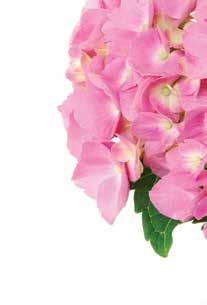
913-364-5700; Leave a message. A Master Gardener will contact you.
MIAMI COUNTY & LINN COUNTY
913-294-4306; Apr 1 thru Oct 1; Thurs, 8am-noon
WYANDOTTE COUNTY
913-299-9300; Mon-Fri, 9am-4pm
QUESTIONS ABOUT ROSES?
Ask a Rose Expert; rosehelp@kcrosesociety.org; www.kansascityrosesociety.org



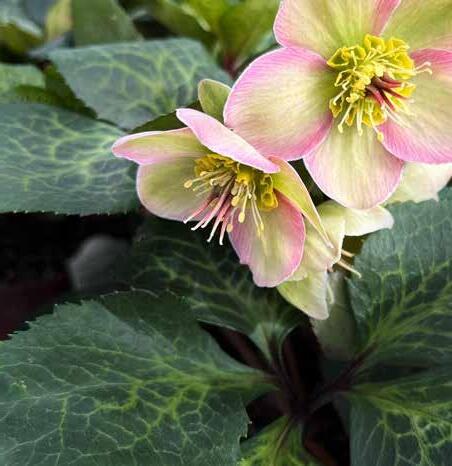
Time to
April’s the kickoff to a great growing season, and we’ve got the annuals and perennials to prove it. Come find your favorites at any of our locations and get your garden growing.
Summer Field Farms
Grown close to home and brought to you by Suburban Lawn & Garden, Summer Field Organic Soils are locally sourced and produced right here in the Kansas City area. Every bag is packed with rich, composted materials, blended for consistency so you get the same great results every time. More information at SuburbanLG.com
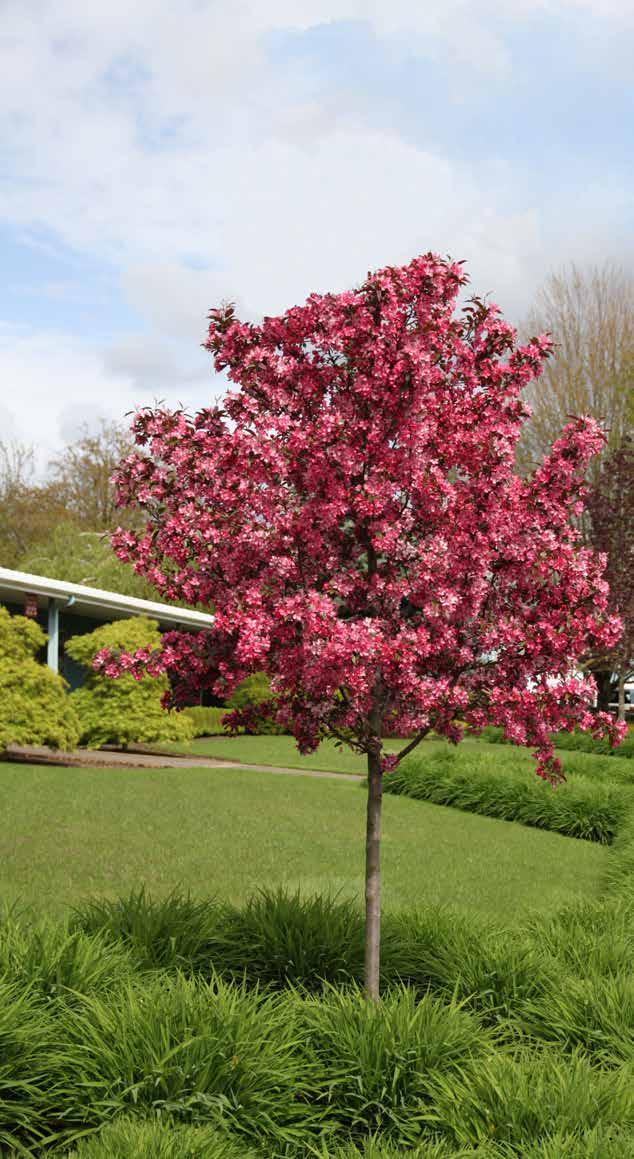
Trees arriving daily from our local farm. Find them at Martin City & Lenexa. Select shrubs at all three locations.
Royal Raindrops Crab Apple
Bayli’s Blush Hellebore