It is a battle over whether British Jews can continue to support Israel openly without fear of legal action, regulatory scrutiny or organised campaigns designed to intimidate our charities, synagogues and communal organisations into silence.
This week should be remembered as a watershed moment.
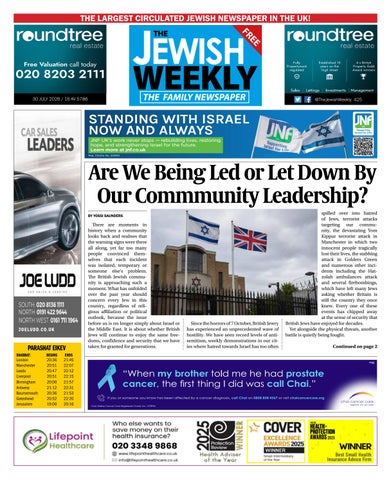
Following an emergency board meeting, ICR and Israel Canada, some of Israel’s largest real estate companies with a market value of billions of shekels, decided to cancel its planned London property exhibition. This was not a minor commercial decision. It was some of Israel’s largest companies concluding that, in the current climate, proceeding with the event had become too risky. If a company of that size feels unable to hold an exhibition in London aimed at British Jews, then something has fundamentally changed.
This was not a synagogue distancing itself from Israel. It was not suggesting that the event was unlawful. It was saying that the perceived consequences of hosting it had become too great.
One of the organisers behind the scenes told me yesterday that realising that Israel events can no longer be held in the UK and seeing how Britain has changed, was on par in his mind with his shock on October 7th when as a soldier, he personally fought in Kfar Aza, walking next to bodies of Jewish victims.
Nor is it an isolated case. We understand that another major Israeli company planning a significant technology exhibition has also suspended its plans for Britain and moved the event to the United States. Concerns over security costs, the increasingly hostile atmosphere and the uncertainty surrounding bringing Israeli participants to Britain all reportedly contributed to that decision. Britain risks gaining a reputation as a country where Israeli organisations simply decide it is easier to do business elsewhere.
The consequences are already being felt throughout our own community.
Following the Israel-related event held at Edgware United Synagogue several weeks ago, the United Synagogue has had to spend time and money defending its bold decision. Whether one agrees with the complaint or not, the message received by other synagogues has been unmistakable. Do not take the risk.
The organisers of subsequent Israel-related events have approached venue after venue only to receive rejection after rejection. Hotels have declined to host them. Community venues have declined. Synagogues have declined, due to fear of mob attacks and the charitiy commission. One venue cancelled only days before an event was due to take place, forcing organisers back to square one.
Perhaps the most heartbreaking response came from one synagogue, which wrote words that should concern every member of our community.
“We would love to host your event. We support Israel wholeheartedly. Unfortunately, we cannot justify the risk to our community.”
That sentence speaks volumes.
When Britain’s synagogues begin declining pro-Israel events because they fear complaints, legal costs or regulatory consequences, then we should stop pretending that this is simply another political disagreement. Something has changed. Nor is this confined to synagogues. Jewish charities, including organisations such as Mizrachi and JNF, have increasingly found themselves facing Charity Commission complaints and scrutiny over activities connected with Israel, including support for IDF-related causes following the atrocities of 7 October. Even remarks made by invited speakers have become the subject of complaints and regulatory attention. Money that should be funding Jewish education, welfare, Israel engagement and communal life is instead being diverted towards solicitors, barristers and compliance. Trustees are becoming increasingly cautious, not because they have lost confidence in their mission, but because they fear becoming the next target.
This should concern every British Jew.
The British Government has adopted a position that charities should not support activities connected with communities beyond the Green Line which it regards as illegal under international law. Many supporters of Israel fundamentally reject that position. Communities such as Gush Etzion, Efrat and Ma’ale Adumim are home to hundreds of thousands of Israeli citizens. They contain schools, synagogues, businesses and families who have built thriving communities over many decades. Israel itself rejects the legal interpretation adopted by Britain, and it should be defending its citizens far more robustly on the international stage rather than allowing others to define the narrative unchallenged.
But regardless of where one stands politically, one question demands an answer. Where does this end?
If an Israeli property exhibition cannot find a venue in London today, will charities tomorrow become afraid to fund bursaries for students studying in Gush Etzion? Will youth movements be advised not to take educational trips to parts of Israel, including the Kotel? Will schools quietly
alter itineraries? Will synagogues increasingly refuse speakers because their Zionist views are deemed too controversial? Will lawyers become a prerequisite for every Israel-related communal event?
These are no longer theoretical questions. They are becoming practical realities.
At moments like this, leadership matters. There is little value in photographs of communal leaders warmly embracing the Prime Minister if, at the very same time, Jewish organisations increasingly feel unable to carry out perfectly lawful activities because they fear the consequences. Maintaining relationships with government is important, but representation means far more than attending receptions and issuing carefully worded statements.
The Board of Deputies, the Jewish Leadership Council, and every major communal organisation should now be combining their political influence, legal expertise and financial resources to challenge these developments, lobby the Government and ensure that British Jews do not gradually lose freedoms that previous generations fought so hard to secure.
History reminds us that freedoms are rarely removed overnight. Jewish history, particularly the experience of European Jewry in the 1930s, demonstrates how rights can be eroded gradually, one concession at a time, until communities suddenly realise that the freedoms they once
took for granted have disappeared. We know only too well how devastating that road ultimately became, which is precisely why warning signs should never be dismissed or ignored.
This editorial is not really about one property exhibition, one synagogue or one Charity Commission case.
It is about the future of Jewish life in Britain.
If major Israeli companies no longer believe Britain is a welcoming place in which to do business, if synagogues increasingly conclude that hosting Israel-related events is simply too risky, if charities become afraid of supporting fellow Jews, and if our community begins accepting these developments as the new normal, then we will have surrendered something precious without a single law ever having expressly taken it away.
British Jewry now faces a choice. We can organise, lobby, challenge and defend our freedoms through every democratic means available, or we can remain complacent while the space for confident, unapologetic Jewish and Zionist life continues to shrink.
Future generations will ask whether the leadership did enough as the warning signs increased.
Let us ensure that they can look back with pride at how our leaders stood up and took the fight to the government.
Trump and Bibi Meet For New Phase Of War
BY MARTIN KENT
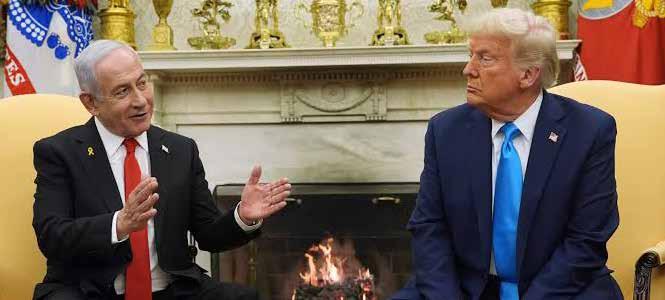
President Donald Trump and Israeli Prime Minister Benjamin Netanyahu have held a high-stakes White House meeting as the war with Iran enters a dangerous new phase, regional tensions spread beyond the original battlefield and Jordan increasingly finds itself caught in the crossfire.
The meeting, the first face-to-face discussion between the two leaders since the United States and Israel launched their joint military campaign against Iran in February, focused primarily on the future direction of the war. Despite reports of growing tensions between Washington and Jerusalem in recent weeks, officials described the discussions as productive.
Iran’s nuclear programme remained at the centre of the talks. Trump and Netanyahu reviewed a range of possible approaches, including renewed diplomacy, continued economic pressure and further military action. While military options were discussed, Israeli officials said Netanyahu did not press for an immediate new attack.
The meeting nevertheless exposed a significant difference in emphasis. Netanyahu remains deeply sceptical that diplomacy can produce a reliable agreement
and is believed to favour maintaining intense pressure on Tehran. Trump, meanwhile, has continued to speak of “good” and “deep” discussions with Iran while warning that strong military action could resume if negotiations fail.
The United States has paused some military operations to allow diplomacy another opportunity, but the conflict remains highly unstable. Iran has continued to challenge American and allied forces, while Washington has warned that the pause should not be interpreted as a permanent end to military pressure.
Jordan is becoming increasingly frustrated by the war’s expansion onto and
around its territory. Long regarded as one of the region’s most important Westernaligned partners, the kingdom has found itself exposed to missile and drone activity linked to a conflict it did not initiate and cannot control.
Recent attacks and military activity involving Jordan have heightened concerns in Amman that the country is being drawn into a wider confrontation between Iran, the United States and their regional allies. Iran reportedly launched ballistic missiles towards the Muwaffaq Salti Air Base in Jordan, while Jordan has also faced drone threats during the latest escalation.
For Jordanian leaders, the danger is
not only military. The conflict threatens regional stability, economic confidence and the country’s already sensitive domestic balance. Amman has repeatedly sought to avoid becoming a battlefield or a launching ground for a wider regional war, but its strategic location and security relationship with Washington make complete neutrality increasingly difficult.
The growing strain on Jordan underlines the wider problem facing Trump and Netanyahu. Decisions made in Washington and Jerusalem are now affecting countries far beyond Israel and Iran. Every new strike risks provoking retaliation, while every diplomatic pause creates uncertainty over whether negotiations can produce a lasting settlement.
The Trump-Netanyahu meeting may have eased immediate tensions between the two leaders, but it did not resolve the central question: whether Iran can be contained through diplomacy or whether the conflict is moving towards another major military escalation.
As Jordan’s patience wears thin and regional governments become increasingly concerned about being pulled into the war, the pressure on Washington and Jerusalem to define a credible path towards de-escalation is growing.
Turn your home into your golden years.
If you’re over 55 and own your own home, you can unlock its value with a Lifetime Mortgage. NO monthly payments required
Trump and Netanyahu in high-stakes meeting at the White House
Top Mistakes Foreign Buyers Make in Israel — And How to Avoid Them
BY BEN LEVENE
Buying property in Israel is thrilling — the charm of the neighborhoods, the buzz of the cities, the history, the lifestyle — but it’s not always straightforward for foreign buyers. A few common mistakes can turn a dream purchase into a stressful experience. Luckily, most of these pitfalls are easy to avoid if you know what to watch for. Let’s break it down.
1. Not Understanding the Payment Plan
Israeli pre-sale apartments usually come with staggered payment plans like 10/90 or 20/80. That means 10–20% upfront, and the rest on completion or handover. Add in VAT at 18% and municipal fees, and what seemed manageable can feel overwhelming. Many foreign buyers dive in thinking they can pay gradually without mapping out the full schedule — only to be surprised when multiple payments come due in quick succession. Planning ahead ensures your finances stay on track, and you can enjoy the thrill of buying without any nasty surprises. Treat the payment plan like a mini roadmap to your dream home — know what’s coming and when.
2. Forgetting Closing Costs
The purchase price is just the beginning. Foreign buyers often overlook closing costs, which can add a hefty 12–13% on top of the property price. This includes purchase tax — for non-residents, that’s 8% — plus broker fees (2% of the purchase price plus VAT), lawyer fees (1–1.25% of the purchase price plus VAT), and engineer or inspector fees (~2,500 NIS plus VAT). It’s easy to underestimate how much these costs can change your budget, so factor them in early. Being prepared lets you approach your purchase confidently and keeps the process smooth.
3. Skipping Legal Due Diligence
Israeli contracts have no contingencies — meaning once you sign, you’re locked in. Some buyers assume things can be fixed later, but that’s risky. A reputable real estate lawyer will check everything from permits to ownership to ensure the contract aligns with what’s promised. Skipping this step can lead to headaches, delays, or even financial losses. Doing your due diligence gives you peace of mind and protects your investment — and honestly, it’s one of the smartest moves you can make.
4. Ignoring Neighborhood Dynamics
A home isn’t just four walls and a roof; it’s the neighborhood, the schools, the
amenities, and the vibe. Israel’s neighborhoods change quickly, with gentrification, new transport projects, and infrastructure upgrades that can all dramatically affect property value. Buyers who overlook this often regret it later. Research before committing, and work with an agent who knows the area inside and out. Understanding the local trends can make a solid purchase into a brilliant one, and you’ll get to enjoy a neighborhood that fits your lifestyle perfectly.
5. Overlooking Financing Options
Many foreign buyers assume they must pay cash. Not true! Mortgages are available for non-residents, though the requirements are a bit stricter. Meeting with a mortgage broker early clarifies what’s possible and allows you to plan ahead. Knowing your options in advance prevents last-minute stress and opens up opportunities you might have missed if you assumed cash was the only route.
6. Not Planning for Taxes on Rental or Resale
If you’re thinking about renting out or reselling, taxes are a big deal. Rental income and capital gains are taxed differently for foreign buyers, and ignoring this can cost you more than you expect. A quick chat with a tax advisor experienced
with foreign buyers will save you headaches and ensure you stay compliant. Planning ahead keeps you in control and protects your investment.
The Bottom Line
Buying property in Israel as a foreigner is exciting, rewarding, and full of opportunities — but it’s no without its pitfalls. Understanding payment plans, budgeting for closing costs, hiring the right legal and financial team, and researching neighborhoods are all essential. Avoid these common mistakes, and you’ll be well on your way to owning a home in Israel that’s not only a beautiful place to live but also a smart investment you can enjoy for years to come.
Disclaimer: This article is not databased but rather based on Ben Levene’s personal market experience and opinions. No decisions should be made without thorough due diligence and professional financial advice.
Ben Levene, CEO of CapitIL Real Estate, brings over 15 years of expertise in the Jerusalem real estate market. For inquiries, reach out to him at ben@capitil.com.
Whether you choose a cozy one-bedroom just for you, or a sprawling 2,700 sq ft Villa in the sky, your VIDA memories will last forever. Private Shul | Shabbat elevators | Infinity pool | State-of-the-art gym | His/Hers sauna | Community room Business lounge | 24 HR Doorman | Just steps from the sea
Former Client Appointed Chair of Trustees
Resource, the Jewish community’s employment charity, has announced that Jamie Field will become its new Chair of Trustees in August 2026, succeeding Mike Beral, who is stepping down after six years in the role.
The appointment marks a full circle moment for Jamie, who first came to Resource as a client in 2007 before going on to build a successful career in the charity sector. Having benefited personally from Resource’s services, he has remained a committed supporter of the charity and has served as a trustee in recent years.
Today, Jamie is Head Of Change at Jewish Care, where he leads organisation-wide transformation across digital, culture and operations. He has led major service redesign and organisational change programmes throughout his career.
Alumni Network and was awarded the JLC Lead Fellowship Award in 2026 in recognition of his contribution to communal leadership.
Jamie said: “Resource played an important role in my own career journey, so it is a real privilege to take on the position of Chair of Trustees. Having experienced first hand the difference Resource can make, I am passionate about ensuring that many more people across our community can benefit from its support.
“The world of work continues to change rapidly and Resource has an important role to play in helping people navigate change, build confidence and achieve their career goals. I look forward to working alongside the Board, staff and volunteers as we continue supporting people towards brighter futures.”
the Jewish community navigate career change, job loss and the search for meaningful employment.
A long standing supporter of Resource, Mike has had a particular interest in raising awareness of the charity’s services to ensure that anyone who needs support knows where to turn. Before retiring, he worked as an internal consultant across business and IT for Computacenter, Europe’s leading independent provider of IT infrastructure services. He has also served as Chairman and Trustee of The Liberal Synagogue Elstree and worked on a number of projects for Liberal Judaism.
Although stepping down as Chair, Mike will continue his involvement with Resource as a volunteer offering guidance with Marketing and PR strategy.
Mike said: “It has been an honour to serve as Chair of Trustees and to work alongside such a dedicated team of staff, volunteers and fellow trustees. Resource changes lives by helping people regain confidence, develop new skills and move forward in their careers.
in their careers.
“Jamie brings a wealth of experience, energy and insight, and I am delighted to be handing over to someone who understands Resource’s impact both professionally and personally.”
Victoria Sterman, CEO of Resource, said: “We are enormously grateful to have had Mike Beral as our Chair of Trustees. Under his watchful, calm and confident leadership, Resource has continued to thrive and develop these past six years, bringing new and innovative services to help our clients more effectively in their job search. It has been a privilege to work with him, and I’m so delighted that he has agreed to continue supporting the organization as a volunteer. I am excited to see the fresh perspective that Jamie will bring to the role. I’m confident that his wealth of leadership experience, combined with his extensive network of connections within the community will be a huge asset to Resource.”
An alumnus of both the Charityworks Leadership Programme and the Dangoor Senior Leadership Programme, Jamie recently stood down as the founding Chair of the JLC Lead’s Senior Leadership
Mike became a Resource trustee in 2017 before being appointed Chair in 2020. During his time as Chair, he helped guide the charity through a period of growth and development, supporting its mission of helping even more people across
“While I am stepping down as Chair, I am delighted to be continuing my involvement with the charity as a volunteer. Resource’s work remains as important as ever and I look forward to continuing to support clients as they take the next steps
For more than 34 years, Resource has been the first port of call for members of the Jewish community seeking help with their job search. The charity supports more than 1,000 people each year through one to one guidance, workshops, webinars and practical job search support, all provided free of charge.
Jamie Field and Mike Beral Photo credit: Lauren Kayser
But this year, the questions being asked in Jewish homes across Britain are not the ones printed in the Haggadah. They are sharper. More uncomfortable. And frankly, more damning.
These are not questions about matzah and marror.
These are questions about what it now means to live as a Jew in the United Kingdom.
WHY DO MY MUMMY OR DADDY HAVE TO PUT ON A STAB-PROOF VEST AND STAND OUTSIDE MY SCHOOL AT PICKUP TIMES?
WHY DID MY DADDY USED TO WEAR HIS KIPPAH EVERYWHERE, AND NOW SOMETIMES REPLACES IT WITH A CAP?
Because visibility has become a risk calculation.
Not in theory. In practice.
For years, we told ourselves - and rightly so - that Britain was different. That Jews could live openly, proudly, without fear. That a kippah in the street was unremarkable.
Now, for many, that confidence has been shaken.
And yet - this is not a story of defeat.
Because the same parents in stab vests still show up.
The same families still fill our schools.
The same fathers still wear their kippot
“Going anywhere nice?”
Because Jewish life in Britain now requires protection.
When a father replaces his kippah with a cap before travelling, it is not a theological decision. It is not even a cultural one.
It is a safety measure.
Let’s not dress it up. Parents are not volunteering for school duty - they are stepping into a security role. The image of a Jewish parent in a stab vest outside a primary school should stop us in our tracks. It should provoke outrage far beyond our community.
BY RABBI GIDEON GOLDWATER
thinking about it at all.
And if that doesn’t concern us - and everyone else - it should.
And yet, it has become normal.
The real question is not why parents are doing this. The real question is: why is this necessary at all?
WHY CAN PEOPLE CALL TO “GLOBALIZE THE INTAFADA” IN THE STREETS OF LONDON?
Most of us have got the summer wrong. Including me, most years. Every July, sometime around the last week of term, the question starts. “Going anywhere nice for summer?” It is meant kindly. It is asked in shul, at the school gate, at the office. It is perfectly polite and, if we are honest, quietly loaded. For some families the answer is two weeks somewhere with a pool. For others
WHY CAN’T I GO TO ISRAEL ON HOLIDAY FOR PESACH THIS YEAR?
Because the Jewish state is at war - and because Jewish normality has been disrupted, again.
Shlomo HaMelech writes in Kohelet that there is a time for everything under the sun. A time for war and a time for peace. A time to plant and a time to harvest. Life is not one long uniform stretch. It comes in seasons, and each season has its own mission. The person who tries to plant during the harvest and harvest during the planting will fail at both. Knowing which season you are in is itself a Jewish skill. A critical one.
For a child, this question is simple. Israel is family. It is familiarity. It is where Pesach often feels most alive.
To tell them they cannot go is to introduce them, too early, to the reality
Then there is the line we say every time we carry the sefer Torah to and from the
Both take real effort. Both matter. A Jewish holiday does not mean letting go of who you are. It means changing gears. If most of the year is a season of doing, the summer, done properly, is a season of being. The Rambam pushes this further. He reads “bechol deracheha da’ehu”, (in all your ways know Him), to mean exactly what it says. There is no human activity that cannot become a way of knowing Hashem. Sleep. Rest. Sport. Eating. A walk along the coast. A quiet afternoon reading with a child. All of it, done with intention, becomes something real. All of it, done
The holiday is not the refuelling stop before the next year’s climb. Sometimes the holiday is the point. The reason we push so hard the rest of the year is not so that we can eventually collapse on a sunbed. It is so that we can stand somewhere quiet, look at what we have built, and actually feel the connection to Hashem, to family, to purpose, that all the running around was meant to be for.
So the real question is not whether you are going somewhere nice. It is whether, wherever you are, you have actually arrived.
-
ogy and an MA in Jewish Education and spent two years living in Birmingham as the Aish Rabbi on Campus. He went on to direct Aish’s national Campus programme aging Director of both Aish UK and Jewish Futures. He has overseen the expansion of
rently impacting over 20,000 young Jews
J E R U S A L E M
B a k a
D u p l e x
1 5 0 S Q M
3 b e d r o o m s p l u s m a m a d
2 s u k k a h b a l c o n i e s
P a r k i n g i n b u i l d i n g
Asking Price:
₪ 1 0 , 0 0 0 , 0 0 0
P
4
J E R U S A L E M
D a v i d ' s V i l l a g e
L u x u r y G a r d e n A p a r t m e n t
3 s p a c i o u s b e d r o o m s
2 4 - h o u r s e c u r i t y
P a r k i n g & s t o r a g e
P r i m e l o c a t i o n
P r i c e o n R e q u e s t
J E R U S A L E M
P r e s a l e s t a g e
O n l y 1 5 % d o w n
N e w p r o j e c t
2 , 3 , 4 b e d r o o m s
P o o l , d o o r m a n & g y m
E x c e l l e n t l o c a t i o n !
P r i c e o n R e q u e s t
J E R U S A L E M
M
3 , 7 5 0 , 0 0 0
Asking Price: ₪ 6 , 5 0 0 , 0 0 0
Asking Price: ₪ 5 , 3 5 0 , 0 0 0
Eretz Yisrael in Birkat HaMazon Weekly Dvar Torah FROM ERETZ YISRAEL
BY RABBI YOSEF ZVI RIMON
In Parashat Eikev, the Torah gives us the mitzvah of Birkat HaMazon: “And you shall eat and be satisfied, and bless the L-rd your G-d for the good Land which He has given you” (Devarim 8:10).
Although this blessing is said over the food we have just eaten, the Torah ties it to the Land of Israel. Chazal (Berachot 48b), establish: “Whoever did not say ‘a desirable, good, and expansive Land’... has not fulfilled his obligation.” This raises a question: if Birkat HaMazon is so focused on Eretz Yisrael, why do we recite it all over the world?
The Tashbetz (Part 2, Siman 161) holds that the text familiar to us today is not the original text. Chazal says that Yehoshua bin Nun instituted the blessing for the Land upon Am Yisrael’s entry into it.
The holy Alshich (Devarim 8:10) explains that Yehoshua’s text was, “We thank
You for having given us as an inheritance.”
In his view, the Torah warns us to keep the commandments so there be no exile. Then, we can always make a blessing over the Land.
Rav Chaim David HaLevi (Mekor Chaim HaShalem, chapter 81, Laws of Birkat HaMazon) writes that now we have returned to the Land and merited the beginning of the redemption, it would be fitting to say “for having given us as an inheritance,” or at least “for having given our forefathers and us as an inheritance.” We do not say this of course, but it is moving that we now have the privilege to be in our own land! Why did Chazal not institute a special blessing for the mitzvah of settling the Land of Israel, similar to the blessing “Who has sanctified us with His commandments and commanded us to dwell in the sukkah”?
Rav Chaim Shraga Feivel was Rav Tzvi Pesach Frank’s brother and rabbi of
Yemin Moshe. In his book Toldot Ze’ev (Part 2, p. 67, letters 12–13) he asks: why don’t we make a beracha over the mitzvah of settling the Land of Israel? He answers: we do! Every day, in Birkat HaMazon: “We thank You, Hashem our G-d, for having given our forefathers a desirable, good, and expansive Land.”
The privilege of reciting Birkat HaMazon in Eretz Yisrael, in Medinat Yisrael should fill us with great joy. Likewise, in Eretz Yisrael, we should have in mind how fortunate we are to live in a desirable, good, and expansive land.
Rav Mordechai Fogelman was the rabbi of Katowice, fled the Holocaust, and became the rabbi of Kiryat Motzkin in 1940. In his responsa Beit Mordechai (Part 1, Siman 28), he explores what blessing one should recite upon making Aliyah.
After saying no special blessing was instituted because the original beracha was already connected to Am Yisrael’s entry
Looking for best value for Private Health Insurance? Ask The Expert!
To get the best value from your private medical insurance, you should speak to an expert who is qualified to advise you on the right policy for you, and recommend the providers who offer the most competitive premiums.
This advice covers individual, family and company policies, and is always FREE.
As an independent health insurance expert, I work with the healthcare insurers to provide you with the appropriate and most affordable level of cover. So whether you have an existing policy or not, let’s have a chat.
into Eretz Yisrael, he adds that one should recite Shehecheyanu. Although the Ben Ish Chai advised not to recite Shehecheyanu, because troubles in Eretz Yisrael then were far harsher than those abroad, Rav Fogelman writes that today, thank G-d, now that we have a state, there is great joy in Eretz Yisrael, and so one should recite the blessing. (However, since there are other reasons not to recite it, it is worthwhile to wear a new garment and recite the blessing joyfully over one’s Aliyah.) And why is the blessing recited outside the Land as well? First, even there one must remember that abundance comes from Hashem, and the blessing over the Land, and the verses there, conclude with the warning not to forget: “Beware lest you forget Hashem…” Second, every time someone enjoys abundance overseas and recites Birkat HaMazon, they should remember that where they are is not their true home!
“We thank You... for having given our forefathers a desirable, good, and expansive Land.”
To Fear G-d
BY RABBI SHAUL YONATAN TAWIL
Bertrand Russell (a British philosopher and mathematician who was a foremost proponent of atheism in the early 20th century) once was asked what he will respond if after he dies, he meets G-d and He will judge him for his lack of belief.
Russell responded that he would ask G-d, why He didn’t provide sufficient evidence of His existence.
Hashem might respond, why didn’t you exercise your common sense and look beyond the secular surface of the world and see the overwhelming evidence of My existence and of My Holy Torah.
How could it be possible for such an orderly world to come into existence?
The oxygen levels in the air are exact, the beautifying scenery, the flowing sea, the lush fields, man’s intellect. All these are gifts from our Creator.
Belief in Hashem is one step, but the next step is to ask, what is it that Hashem desires from us?
In this week’s Parasha Moshe asks this exact question. The problem is that Moshe presents the petition as if it were a simple feat. He says, “And now Israel, what does G-d want of you? Only that you fear G-d your L-rd (Deuteronomy 10:12).”
Moshe makes it sound as though the fear of G-d is only a minor matter.
The Gemara Berachot asks: Is the fear of G-d such a small thing?
The Gemara relates how Rabbi Chanina said in the name of Rabbi Shimon Bar Yochai: The Holy One, blessed be He, has in His treasury nothing except a stockpile of the fear of heaven, as it says, “The fear of G-d is His treasure” (Isaiah 33: 6). Obviously if fear of G-d is so cherished by the Almighty, it must be very difficult to attain.
The Gemara answers: True! For it was Moshe who said this verse and for Moshe fear of G-d was a small thing. Rabbi Chanina said “This is comparable to a person who is asked for a large vessel which he has; it seems to him like a small vessel. A small vessel which he doesn’t have; it seems to him like a large vessel.” Yirat Shamayim is, indeed, a “large vessel,” and not something simple. However, since Moshe had already acquired this trait, he viewed it merely as a “small vessel,” and was able to say “only.”
Ok, so we know that for Moshe it was simple, but just because it was easy for Moshe, who says it is easy for us? So why does Moshe imply to the people that fear of G-d is simple. Surely he is relating the Torah to us, and for him it might be a walk over, but for us it is not!?
Rabbi Yitzchak Zilber, founder of Toldot Yeshurun, an organization that re-educates estranged Russian Jews about the heritage that was snatched from them, is known as the Father of contemporary Russian Jewry. A native of Kazan, Russia, Rabbi Zilber was born just before the Russian Revolution in 1917, but was discreetly taught Torah by his revered father and not only completed Shas several times during his years in Russia, but also taught Torah to many others. During World War II, he was imprisoned in Stalin’s gulag where, yet he managed to remain Shomer Shabbat despite the inhumane conditions. He later had to flee from the KGB, which wanted to arrest him for his Torah activities in Russia. In 1972, he immigrated to Israel. As he walked off the airplane on his arrival in Israel and embraced the custom agent.
“Chavivi! My dear one! Shouted Rabbi Zilber as he gave the man a bear-hug embrace. It is so wonderful to be here and talk to a Jew like a Jew!” The man offered a polite smile and a pleasant Shalom.
“Please tell me”, pleaded Rabbi Zilber with an intensity that seemed to announce a question whose answer would solve all the problems facing Jews for the millennia. “For years I am struggling with this problem. Please tell me, how did you understand the K’tzot HaChoshen on the Sugya of Areiv?” (The K’tzot HaChoshen is a classical commentary on the Shulchan Aruch Choshen Mishpat, Code of Jewish Law.)
“Ma zeh K’tzot haChoshen. (What is a K’tzot HaChoshen)?” Came the reply
Rabbi Zilber was puzzled. He tried another query.
“Maybe you can explain how you understood the Mishne in (tractate) Uktzin in the last chapter?”
“Mishne? Uktzin? K’tzot? What are you talking about?”
Rabbi Zilber, recalling the difficulties he had trying to teach and study Torah in Russia was mortified. In honest shock, he asked the man.
“How is this possible? You mean to tell me that you live here in Israel and have the ability to learn Torah. And you don’t know what the Ktzot is? You never heard of Mishne Uktzin?”
Rabbi Zilber began to cry. They say that the customs agent was so moved by Rabbi Zilber’s simple sincerity that he began to study Torah.
Perhaps the Gemara is telling us the simple truth. It was important for an entire nation to see the man to whom fear of heaven was considered the simplest and most rudimentary aspect of life. To Moshe, fear of Heaven was natural. As a leader, he had the imperative to impress the nation, with his sincerity. To us simple Jews, it is important to see someone whose Jewish observance is as simple and graceful as if it is second nature. To us it may be a struggle, but it is imperative that the benchmark of our goals is someone to whom fear
rabbi burman@bwkollel org
comes natural.
Rabbi Tawil is the Founder and Director of ‘Torah Action Life’ (TAL)
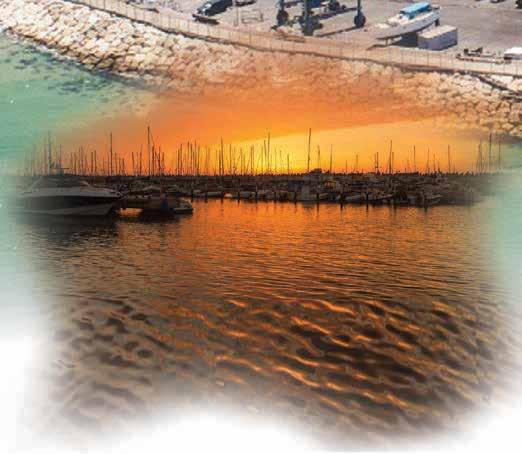
Smar t investoors have identified Ashkelon as the most promising area to buy proper ty now in Israel
Great sea view properties
• • • • • Slated to become the in Israel ocal University Garden city originally designed and built by South Africans! High speed trains linking the North to the South Golf course in the initial planning stages
Best t beaches in the countr y & lovely Marina 40 minutes to Tel Aviv and 60 minutes to Jerusalem
Growing vibrant Anglo community
Prices less than half of similar properties in Netanya!
• • • • 4th largest city L Contact us now for details! a s h k e l
KNOWING HOW TO LOOK AFTER YOURSELF AND OTHERS GIVES YOU THE POWER TO PREVENT A CRISIS.
Learn how to manage stress, understand wellbeing and mental health, and reach out to someone who’s struggling - because simple skills can change lives.
SKILLS CAN
WHAT IS MENTAL HEALTH?: The essentials everyone should know
Wednesday 16 SEPT 1.00pm
Tuesday 6 OCT 8.00pm OR
UNDERSTANDING MENTAL HEALTH CONDITIONS: Identifying and responding to common mental health issues
Wednesday 14 OCT 1.00pm
Tuesday 20 OCT 8.00pm OR
SELF-CARE AND STRESS MANAGEMENT: Boost your wellbeing and reduce stress
Wednesday 12 AUG 8.00pm
PRACTICAL RELAXATION: Master powerful techniques in 50 wonderful minutes
Wednesday 19 AUG 8.00pm
REACHING OUT TO SOMEONE WHO’S STRUGGLING: How best to show concern and o er help
Wednesday 28 OCT 1.00pm
Tuesday 3 NOV 8.00pm OR OR
Wednesday 11 NOV 1.00pm Tuesday 1 SEPT 8.00pm
Tuesday 17 NOV 8.00pm OR OR OR
Wednesday 25 NOV 1.00pm
Tuesday 1 DEC 8.00pm OR
www.projectlily.org.uk
Family Fun Parashat Eikev
Parashat Eikev continues Moshe’s final address to the Jewish people as he prepares them to enter the Land of Israel. Having reminded them of their unique covenant with Hashem, he now teaches that the greatest challenge will not be conquering the land, but remaining faithful once they have settled there. Moshe warns that prosperity and success can easily lead people to forget the source of their blessings, urging the nation to remain humble and grateful in every circumstance.
At the heart of the parashah is the command to serve Hashem “with
all your heart and with all your soul,” together with the promise that faithfulness to Torah will bring blessing to both the individual and the nation. Moshe repeatedly reminds the people that their achievements will not come through their own strength alone, but through Hashem’s guidance and kindness. True success is measured not by wealth or power, but by recognising that everything we possess is ultimately a gift from G-d.
One of the most well-known passages in the parashah is the second paragraph of the Shema
Word Wheel
(Vehaya Im Shamoa), which highlights the relationship between our actions and our responsibilities.
The Torah teaches that our choices matter. Living according to Hashem’s values shapes not only our personal lives but also the society we build, reminding us that privilege is always accompanied by responsibility.
Eikev also commands us to recite Birkat Hamazon after eating, the only blessing explicitly mandated by the Torah. This teaches that gratitude should become a daily habit rather than something reserved for extraordinary moments. By pausing
LOL
to acknowledge Hashem after even the simplest meal, we learn to appreciate the countless blessings that so often go unnoticed.
As we read Parashat Eikev, we are reminded that a meaningful Jewish life is built not only through moments of inspiration, but through consistency, gratitude and humility. By recognising Hashem’s hand in both the remarkable and the routine, we strengthen our faith and ensure that our blessings become a source of purpose, responsibility and spiritual growth.
The goal of a word wheel puzzle is to create as many words possible with the letters in the word wheel. Each word must contain at least three letters. You can only use each letter once and every word must have the letter in the centre of the wheel.
O E C C N C I V N
On the last day of camp, the counsellor asked everyone what they’d learned. One camper raised his hand.
“I’ve learned how to survive without my phone.” The counsellor smiled.
“And how did you manage?” The camper replied, “I borrowed everyone else’s!”
Sum UP
Circle specific digits in the grid so they sum up exactly to the target clues provided on the sides
החלצהב — and enjoy the puzzle!
Jokes
Q: Why did the kid bring a ladder to camp?
A: Because he wanted to reach new heights!
Q: Why did the sleeping bag get promoted?
A: Because it was always ready to roll!
Q: Why did the canoe blush?
A: Because it saw the lakes bottom!
Q: Why did the girl take a torch on camp?
A: Because it always brightened the mood!
Riddles
I shine in the darkness and help you find your way, but I slowly grow dim the longer you use me. What am I?