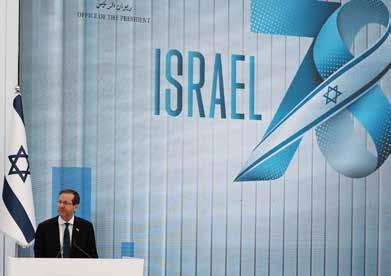
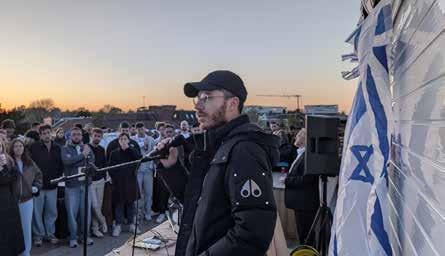
Israel celebrated its 78th Independence Day yesterday. Numerous events took place across the country as the IDF remain on high alert against Iran and its proxies. Tere were also events around the world in Diaspora communities where security was heightened due to global antisemitism.
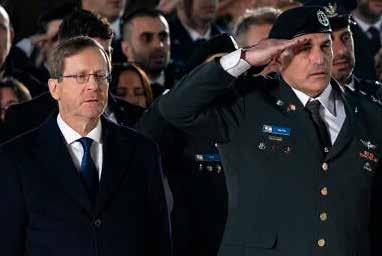
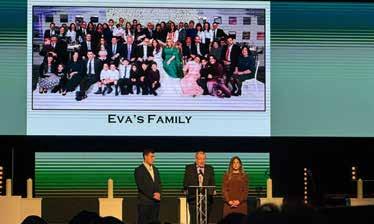
Kisch in attendance. Herzog also attended the
In Israel, President Issac Herzog presented the prestig
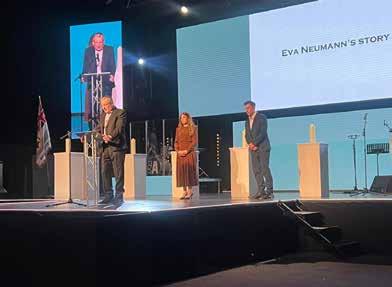
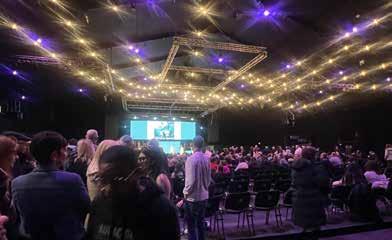
Convention Center. Former Gaza hostage Alon Ohel and Dvir Bublil, injured during the 10/7 confict, performed together in honour of the IDF soldiers. Herzog observed: “We all grew up on stories of heroism, but this
Photo GPO
Continued from page 1
At the diplomatic event, he commented: “Tese are historic times we are living in. Times of tectonic shifts in the Middle East that I pray will usher in a hopeful future. Tis is a time in which the choices made by leaders and nations, even at this very moment, can shape our region for generations to come.”
Herzog thanked US President Donald Trump for the unique Israel-US partnership in confronting the Iranian regime.
“Te war against Iran and its many proxies is not a war of choice,” he said. “Tere comes a time in which a country must fght for itself, fght to defend its people, and ensure its future. Iran aims to obliterate Israel, to dominate the Middle East, and to overthrow the values nurtured by the entire free world, so this is a battle for the future of all of our children.”
Herzog called for more countries to join the Abraham Accords.
He concluded: “Israel is eager to work with all of you to help shape a Middle East
Day (Yom Hazikaron) to remember fallen soldiers and victims of terrorism.
A total of 25,648 soldiers have fallen in war and 5,313 civilians murdered in terror attacks.
in which all of our sons and daughters can inherit opportunity instead of fear. Tat they inherit the promises of tomorrow, and not the conficts of yesterday.”
Israelis stood in silence on Monday at 11am as a two-minute siren sounded throughout the country for Memorial
Te past year has seen 172 soldiers and 56 civilians killed.
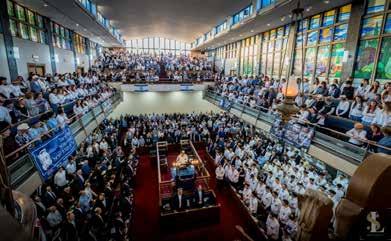
Herzog led Israel’s state commemoration at the Western Wall.
He said: “In this place, where generations of warriors have been sworn in to the IDF, let us all vow never to forget the fallen and from the pain and the difculty, and from the great achievements, we vow to continue to sing the song of life.”
Herzog also addressed the traditional memorial ceremony at Mount Herzl. “Troughout all these years, and even in recent weeks, acts of terror, as well as
murderous missile attacks from Iran and Lebanon, have tried to strike at us all, without distinction,” he said. “But in the face of these attacks, the covenant of growth grows stronger.
“Two and a half years since the start of the war, we stand before a new historic chapter. We have encountered disasters, and we have also ascended to peaks. We have absorbed blows, but we have defeated enemies and forged new alliances. Even now, we remember the goal for which we are fghting. Our victory is not measured solely by defeating the enemy. Victory will be complete in restoring life to its course. Victory will be our ability to continue to create, to grow, to learn, to build, and to rebuild. To make yet more deserts bloom and to fulfl yet more dreams.”
Te torch-lighting ceremony, broadcast live rather than prerecorded, marked the transition from Memorial Day to Yom Haatzmaut where overnight thousands attended concerts and events.
An Air Force fyover, however, was canceled due to the ongoing confict.
Trump, meantime, has extended the ceasefre with Iran, but will continue a blockade of Iranian ports.
In related news, Israel and Lebanon are set to meet in Washington today.
Foreign Minister Gideon Saar described the talks as “historic” and said Israel had no “serious disagreements” with Lebanon and border disputes could be resolved. Hezbollah are the “main obstacle to peace and normaliastion”, added Saar.
Community suffers spate of arson atacks
BY ADAM MOSES
Jewish leaders have condemned a spate of arson attacks on Jewish community institutions in London over the past week.
And they have called on Prime Minister Kier Starmer to act decisively following his latest statement after an incident at Kenton United Synagogue on Saturday night.
Starmer said attacks on the Jewish community were “attacks on Britain” but United Synagogue president, Saul Taylor, appealed for Starmer to “declare publicly” an “epidemic of anti-Jewish hate”.
“A synagogue is not just a building, it is a place of worship, community and, theoretically, safety,” Taylor raged. “To target it in this way is a deeply disturbing act that strikes at the heart of Jewish life.”
He added: “Te Kenton community and wider United Synagogue will not be deterred… We will not be intimidated, and we will remain strong and united in the face of hatred.”
Jonathan Metliss, Action Against Discrimination, observed: “Tese attacks are an evil trend but we have heard nothing but verbose condemnation and words from the Prime Minister and his colleagues without any action. Te police need to do far more to protect the Jewish community. Te Government should also immediately ban all pro-Palestinian marches and proscribe the Islamic
Revolutionary Guards Corps.”
Te We Believe Alliance added: “Te Prime Minister has responded with condemnation and promises of increased security but after repeated attacks in rapid succession, that is no longer sufcient.
“Te central issue remains untouched. Te pattern is clear. Te targeting is clear. Te drivers are increasingly clear. Tis is the reality of Islamist extremism having taken root within Britain, an environment in which hostility toward Jewish and Israeli targets is normalised. Yet still, Labour refuses to speak plainly about it. Instead, ministers fall back on familiar lines while avoiding the question in front of them.
“What is driving this escalation, and why it is being allowed to deepen? Tis is no longer a question of awareness. Te facts are known. Te pattern is visible. Repeated attacks on Jewish sites are being met with hesitation and deliberate ambiguity. What is being protected is not public safety, but political comfort. Tat is not a failure of circumstance. It is a political choice.”
Chief Rabbi Sir Ephraim Mirvis said there was a “sustained campaign of violence and intimidation” against the UK Jewish community and it was “gathering momentum”.
“Tis sustained attack on our community’s ability to worship and live in safety is an attack on the values that bind us all
together,” he noted. “No lives have been lost, but we cannot, and must not, wait for that to change before we understand just how dangerous this moment is for all of our society.”
Deputy assistant commissioner Vicki Evans said that anyone identifed in the Kenton attack could be prosecuted under the National Security Act, which carried “signifcant sentences and lifetime restrictions”.
Tousands of people are expected to participate in a rally organised by Campaign Against Antisemitism.
‘Britain’s March Against Antisemitism and Extremism’ in central London takes place on Sunday, May 10.
A CAA spokesman said there was a “cataclysmic failure of the state” to tackle antisemitic extremism.
“Britain is fundamentally a diferent country now,” CAA noted. “Still the Government refuses to proscribe the Islamic Revolutionary Guard Corps, an obvious frst step to address foreign radicalisation and interference. It is shocking that concern for the sensitivities of a violent Iranian regime is more important to the Government than the welfare of Jewish people in this country.”
Police continue to investigate Iranian links on a series of incidents, the latest a Jewish-owned shop in Watford on Tuesday.
A seventeen-year-old boy, meantime,
has pleaded guilty to arson not endangering life at Kenton US last Saturday night.
Te attack was claimed online by the Ashab al-Yamin Islamist group.
Two teens were arrested by police following an attack in Hendon at the former site of a Jewish charity whilst the Israeli Embassy was allegedly targeted by Harakat Ashab al-Yamin al-Islamia (HAYI), an Islamist group that claimed responsibility for the recent Golders Green arson attack.
Two people were also arrested after an arson attack against Finchley Reform Synagogue last week.
HAYI reportedly target Jewish and Zionist organisations with low cost arson attacks.
In recent months they have claimed attacks in Liege, Rotterdam, Amsterdam and Paris.
Met Police have increased patrols across northwest London.
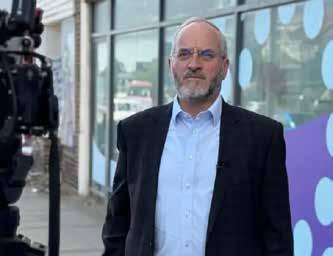
Earlier this week, community leaders and victims of antisemitism appeared in a BBC Panorama documentary ‘Antisemitism: Why British Jews are Afraid’.
Reporter Judith Moritz examined how abuse, intimidation and violence aimed at Jewish communities has become more widespread, leaving many British Jews feeling fearful and under threat.
Spend your retirement doing what you love - not worrying about money
Gaza hostages ‘Independence Day’ boost for IDF soldiers
BY DAVID SAFFER
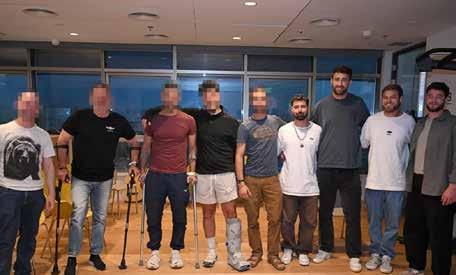
Former Israeli hostages in Gaza celebrated their frst Independence Day by visiting IDF soldiers wounded in southern Lebanon in a rehabilitation ward at Clalit-Beilinson Hospital.
Avinatan Or, Alon Ohel and Guy Gilboa-Dalal returned in October 2025 after over two years in Hamas captivity. Both were admitted to Beilinson for treatment.
Forever grateful for their care they met four soldiers from the Yahalom Unit and Battalion 890.
Te rehab department opened a month after 10/7 ofering individual programs for patients. Treatments include physiotherapy, occupational therapy, psychological support and hydrotherapy.
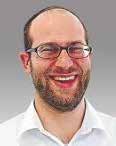
Department head Dr. Michael Bahar said: “Every soldier and returnee we have met is a whole world in themselves. Every step they achieve gives us the strength to continue and them the ability to return to lives interrupted by complex events. Tis meeting is another powerful milestone in the history of our department.”
Since 10/7, Israel’s medics have reached new benchmarks.
As Israel marks its 78th Independence Day, doctors and nurses from six continents at Clalit’s HaNotrim Clinic in Ra’anana are a living example of Jewish return, coexistence and resilience.
Twenty fve medical professionals are from Brazil, Germany, France, Russia,
South Africa and US. Others were born in Israel. Together, they represent a modern story of the Jewish state. Inside clinic hallways, visitors hear diferent languages but patients witness one language, compassion and care.
Leading the clinic is Israeli-born physician Dr Yair Tzruya with roots from Morocco, Germany and Poland.
“Our clinic is a small version of Israel at its best,” she noted. “When I look at my team, I see the same mosaic of people who built this country. Te fact that doctors leave comfortable lives abroad and choose to come here, especially during years of war and uncertainty, says everything about Israel’s strength. When talent and purpose come together, there is no limit to what we can do for our patients.”
chose a new life in Israel and joined the frontline of community medicine.
Alongside her works Dr Michelle Zuckerman, who immigrated from Brazil in 2020, along with Dr Charles Comin and Dr Rebecca Young from South Africa and the US respectively.
Another physician, Dr Liran Franco, immigrated from South Africa as a child and serves in active military reserve duty
and mutual respect.
A doctor newly arrived from Paris may consult with an Arab nurse about a longtime patient from the neighbourhood. A receptionist who immigrated from Russia works seamlessly beside colleagues whose families have lived in the region for generations.
“Tis shared work is our strength,” commented Dr Tzruya. “Patients see people from diferent backgrounds respecting one another and caring for them together. Tat creates trust. It creates hope. It shows what Israel can be.”
while continuing his medical work.
Dr Daniela Yana immigrated from Germany in 2023, the year of Gaza war. Rather than postpone her move, she
Cooperation between immigrant Jewish staf members and Arab-Israeli employees is noteworthy in global politics. In treatment rooms and staf areas, cultural and political divides are replaced by teamwork, professionalism
Te clinic’s nursing and administrative staf includes Sylvie Assiag, who immigrated from France, along with Natalia Kravchenko Kurish and Svetlana Shiftelnik, who came from Russia. Together with Israelis, they form a team where diversity is a daily reality.
As Israel approaches eight decades independence, HaNotrim Clinic is a reminder that the Zionist story is not only about borders and armies but about return, healing and a shared home.
“Te war reminded us that community is the backbone of national resilience,” commented Dr Tzruya. “When patients walk in and meet a team that speaks many languages and comes from so many places, they feel at home. Tat is our victory.”
INDEPENDENT ALIYAH CONSULTANT ONE PEOPLE ONE HEART
TO SCHEDULE A FREE IN-PERSON MEETING WITH DOV OR A MEETING OVER ZOOM PLEASE BE IN TOUCH
JTeen is a safe, confdential and anonymous support service for young people in our community who are struggling emotionally. it is led by psychotherapist Rabbi Yaakov Barr and guided by Rav S.F. Zimmerman Shlita.
Seeing each child for who they are and helping shape who they’ll become.
Chazak, 64 Brent Street, NW4 More room to explore & grow
MEET & GREET AT CHAZAK Come and meet the team, explore the space & see if we’re right for your family
SUNDAY 26 APRIL 2 - 2:45 PM OR 3 - 3:45 PM
WHAT WE OFFER
• A warm, caring jewish environment
• Full days 8:45 AM - 3:45 PM
• Lunches & snacks provided
• Registered for the 30 hours free childcare scheme NOW REGISTERING FOR SEPTEMBER 2026 form.hendonplaygroup.co.uk
This Time It’s Personal
BY RABBI YONASAN ROODYN, DIRECTOR OF EDUCATION, JEWISH FUTURES
Tere are moments when a headline stops being news and becomes personal.
Te attempted arson attack on the former Jewish Futures centre in Hendon was one of those moments for me. For close to thirty years, that building was not just a workplace, but a place of growth, connection, and impact. Tens of thousands passed through its doors: students, young professionals and families from all sectors of our community, many of whom left carrying with them a greater appreciation of Jewish life, learning, and identity. To hear that someone tried to set it alight, even though thank G-d they did not succeed in causing any serious damage, is deeply unsettling because of what it reveals. Tis was the third attempted attack in a single week. Each incident felt
personal: Starting a few weeks ago with the torching of the Hatzola ambulance feet that has always been there for my family.. Ten the Finchley Reform Synagogue that is located just down the road from my Finchley Federation community and most recently, Kenton United Synagogue, near Kingsbury where I grew up. Te Jewish Futures building, where I spent two decades of my life working day in, day out.
However, antisemitism is not - and never has been just a Jewish issue. It is very much a societal one.
When people are targeted simply for being who they are, for living openly and unapologetically as Jews, it becomes a test of the society around them. Will the wider community tolerate hate and intimidation in their midst, or will they confront it?
On Sunday morning, I stood outside our former ofces together with our local MP, senior police ofcers, and representatives of the CST. Tere was
professionalism, concern, and a clear commitment to protecting the community. Teir presence matters greatly because it reassures and reminds us that we are not alone.
But it also sharpens the question: what kind of society are we building, and what kind of society are we willing to defend?
Te Britain of my childhood prided itself on a long tradition of being a place of tolerance, dignity, and the rule of law. Yet those values do not sustain themselves.
Tey depend on clear leadership backed up with action and perhaps even more importantly on ordinary people who refuse to look away.
Te attempted arsons of the last week should concern anyone who cares about those values, but at the same time, our response cannot be shaped by fear alone. If Jewish history teaches us anything, it is that we do not allow those who seek to intimidate us to defne us. We have faced far darker moments than this, and yet we have endured, rebuilt, and continued to live with purpose.
So, the question is not only how we respond to those who hate us. Te deeper question is how we continue to live as Jews in the face of that hatred.
To my mind, the most powerful response is not retreat, it is resilience. It is the steady sound of prayer and learning flling our shuls and schools. It is the warmth of Shabbat tables alive with song and conversation, it is a vibrant communal life. It is the confdence with which we educate our children to take pride in who they are and where they come from.
It is uvacharta ba Chayim, choosing life, again and again. Tis is all the more important because there is something deeper still at stake here. Te biggest threat is not to buildings or institutions; there is another space that must be protected with equal determination: our headspace. Acts like this are not only about physical damage. Tey are attempts to instil fear, to narrow our sense of possibility, to make us feel vulnerable, hesitant, diminished or even, perversely, blame ourselves. If we allow that fear to take root, if we begin to see ourselves primarily through the lens of threat, then the damage has already been done, regardless of whether a match was lit or a fre took hold.
We must not give them that victory. Of course, we must protect our buildings. We must invest in security and take every necessary step to ensure safety. But the most important space we defend is internal. It is the confdence
with which we walk into shul. Te pride with which we live as Jews. Te clarity of purpose that drives our communities forward.
It is the refusal to let fear shape who we are. Tere is a real danger, in moments like these, of allowing antisemitism to become the lens through which we view our lives, of becoming reactive rather than proactive, defned by what we are against rather than what we are for. We must resist that temptation. We are a people with a mission. A mission to live lives of meaning, responsibility, and care. A mission to bring light into the world through the way we act, speak, and build. Te only appropriate response to anti-Jewish hatred is for Jews to be more Jewish.
Tat is what the building on Hendon Way represented. Not bricks and mortar, but the life within it: conversations that sparked growth, relationships that created connection, a vision of Jewish life lived fully and joyfully.
Tat is what must continue.
At the same time, resilience is not passivity. We must face the reality before us with clarity. Antisemitism, whether expressed through words, vandalism, or violence, must be confronted frmly and without hesitation. Law enforcement must act decisively. Political leaders must speak clearly and unequivocally against the epidemic of Jew hatred. Civil society must refuse to normalise or excuse it in any form, because silence is not neutrality, it is complicity. Within our own community, too, there is a responsibility, to stand together with a shared sense of purpose. Te diversity of Jewish life in the UK is a self-evident. At times like these, that diversity must be matched by unity. Tose who target us do not distinguish between our diferences. Tey see only that we are Jews. So, we must learn to see in one another not what separates us, but what binds us.
Personally, this moment has led me back to those years on Hendon Way, to the countless individuals whose journeys intersected with that space, and to the quiet, consistent work of building Jewish life. It is work that often goes unnoticed, rarely makes headlines, but shapes lives in ways that endure.
Tat work matters far more than the actions of those who would seek to destroy and the useful idiots who carry our hate crimes. Hatred is loud, but it is not lasting, it captures attention, but it does not create futures. What creates futures are the daily choices we make: to show up, to care, to teach, to connect, to live with purpose and truth.
Te attempted arson on Hendon Way was an attempt to intimidate a community. It will not succeed.
Because our strength has never come from bricks and mortar alone. It comes from something far deeper: a sense of identity, purpose, and connection that cannot be burned away.
And that, above all, is the space we will continue to guard.
FEEL BETTER, UNDERSTAND MORE.
HORMONES AND THEIR POWERFUL ROLE IN HOW WE FEEL
Our new season of free classes starts with a very special Wellbeing Webinar. Join guest speaker Dr Philippa Kaye for a fascinating and practical session on what women and men should know about hormones and how they afect our wellbeing from adolescence to menopause
• 8.00pm, Wed 6th May
• 50 minutes + Q&A
• Live on Zoom. Places Limited Book your free place today -
DR PHILIPPA KAYE
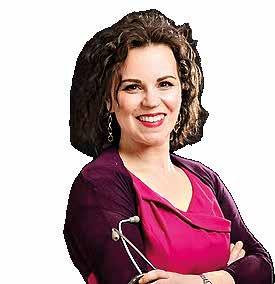
Dr Philippa Kaye is a London-based GP, author, and media medical expert working both in the NHS and privately, with experience across paediatrics, gynaecology, psychiatry, and general medicine. A bestselling author, her books include ‘The M Word’ (about menopause) and ‘Doctors Get Cancer Too’. She is a regular contributor to national media, appearing on television, radio, and in print. Known for her ability to explain complex medical topics clearly and accessibly, she helps people better understand their health and wellbeing.
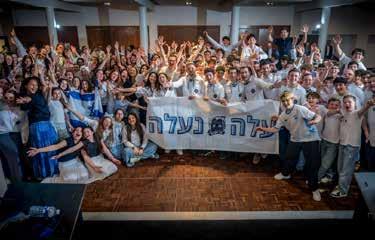
Bnei Akiva Hosts Powerful Yom HaZikaron and Yom HaAtzmaut Commemoration
Bnei Akiva UK brought together over 1,200 members of the community for a deeply moving and uplifting Yom HaZikaron and Yom HaAtzmaut event at Kinloss, marking the transition from remembrance to celebration with profound unity and spirit.
Te evening opened with remarks from the Rabbi of Kinloss, Rabbi Birnbaum, who warmly praised Bnei Akiva for its tireless dedication to strengthening the community and inspiring the next generation. His words set the tone for an event defned by both refection and pride.
Te Chief Rabbi delivered a passionate and stirring address, refecting on the past twelve months and their profound impact on both the immediate and global Jewish community. His message resonated deeply with attendees, capturing the emotional complexity of the moment and reinforcing a shared sense of responsibility and resilience.
was electric, as 1,200 voices joined together in powerful unison, singing praise and thanksgiving for the miracle of the State of Israel. Te energy in the room
refect on their own commitment to these values.
Following the formal programme, special thanks were extended to the Metropolitan Police and the Community Security Trust (CST) for their support in ensuring the safety and smooth running of the event.
Chazan Jonny Turgel led Maariv and Hallel in what became one of the defning moments of the evening. Te atmosphere
was palpable, embodying the spirit of Am Yisrael.
Mazkir Sam Niman of Leeds addressed the community with clarity and conviction, declaring:
“We have a vision, we have a purpose. We have Torah V’Avodah… Torah V’Avodah is not a slogan. It is a belief.”
His words captured the ideological core of Bnei Akiva and inspired attendees to
Te celebrations then continued as over 500 attendees moved to the Kinloss Suite for a festive dinner, expertly catered by Ben Tenenblat, accompanied by vibrant music from Eitan Freilich. Te transition from solemn remembrance to joyous celebration refected the essence of the Yom Hazikaron–Yom Ha’atzmaut experience.
Refecting after the event, Mazkir Sam Niman said:
“Tis event is a fxture in so many calendars each year, but this year carried a depth and intensity
that was truly extraordinary. Tere was a palpable ruach that flled the room — bringing together joy, heartfelt emotion, refection and an immense sense of pride. A ruach that was 10 times more than anything that can be heard in the Jack Charlton East Stand of Elland Road. It captured the spirit of our community in a way that was both powerful and unforgettable.”
Te evening stood as a testament to the enduring strength, unity, and faith of the community, and to Bnei Akiva’s continued role at the heart of Jewish life in the UK.
For British Jews, now might be the right time to come home
BY SHRAGA EVERS
Over the past few years, many in the UK Jewish community have quietly been asking difcult questions about their future. Tose questions have stemmed from a rise in antisemitism and a growing feeling that Britain isn’t the home to Jews that it once was. But in recent weeks, the feelings and questions have sharpened and intensifed in a way that feels diferent. Te attempted frebombing of the former Jewish Futures ofces in Hendon,
unprecedented levels of support from the government for new Olim. For many, the idea of moving to Israel is no longer abstract or something for “the future”, but a logical next step being considered seriously and for some, acted upon now.
At Shivat Zion, we have launched our Aliyah Programme, run in partnership with Carmay HaNadiv. Te programme was built from years of working with Anglo families looking to make Aliyah but who were held back by the same core challenges: uncertainty, lack of
Carmay HaNadiv is an exceptional community developed by Tzifha, a property company who have taken a longterm, thoughtful approach to building something that feels like a true community and not just another real estate project. It is a place that, for many, feels like coming home almost immediately. Tere is already a strong Anglo-Israeli community there; warm, welcoming and genuinely invested in helping new families settle and thrive. Life in Carmay HaNadiv has a natural rhythm, with strong schools and infrastructure and families gathering in the parks in the afternoons. Around the chagim and holidays, the community organises activities and events, bringing everyone together in meaningful and tangible ways and subsequently creating a supportive environment.
One of the most signifcant advantages, and something that is almost unheard of in Israel, is the housing itself. Families have the opportunity to move into part-furnished apartments that are ready to live in from day one. Typically, rentals in Israel come completely empty, without even basic fttings and furniture, so having furniture already in place from the moment you move in makes an enormous diference. It removes one of the key initial pressures of Aliyah and allows families to focus on settling in, rather than immediately having to build a home from scratch.
Tat is part of what we mean when we speak about a soft landing. Tis programme gives families the space to arrive, to breathe and to explore what their life in Israel could look like without feeling locked in to long-term decisions from the outset. After a year, families are in a far stronger position to decide what comes next, whether that means putting down permanent roots in Carmay HaNadiv or making another choice based on a year living in Israel.
For those who are thinking longer term, there is also a real opportunity here. Te option to invest in and purchase a brandnew apartment of-plan, ofers strong value, particularly as this development continues to grow in popularity both within Israel and internationally. It is a wonderful opportunity to build something for the future.
Situated in south-central Israel, Carmay HaNadiv ofers access to a wide range of services and infrastructure that come with being part of a larger urban area, while still maintaining a community feel. Te town is well connected, within reach of major cities and close enough to the coast to make everyday quality of life noticeably diferent.
What makes all of this work, however, is not just the place but the support around it. From the very beginning, families receive one-to-one guidance
from Shivat Zion advisors who have been through the Aliyah process themselves. We assist with paperwork, school applications and planning before the move and we remain closely involved after arrival, helping families navigate systems, connect with the municipality and settle into daily life. Tat support continues throughout the frst year, because we understand that integration takes time and that having someone to turn to can make all the diference.
We are very aware that Aliyah is a major life decision. It involves leaving behind familiarity, extended family and the life you have built. It is not something to be taken lightly. But we also believe that when the moment is right, it should not be made harder than it needs to be. What we are trying to create through this programme is what many people tell us they are looking for, which is a genuine soft landing. A way to arrive in Israel with support, with community and with a sense that you are not starting from zero. We will be at the Aliyah Fair in London on 10th May and we are also available to meet families beforehand for those can’t make the fair. For anyone who has been considering Aliyah or looking to fnd out more in investing in Carmay HaNadiv, this is an opportunity to ask questions, explore options and understand what a supported move like this could look like in reality and specifcally what Carmay HaNadiv can ofer.
For those planning to make Aliyah this summer, this programme ofers a rare opportunity to do it in a way that is structured, supported and grounded in community. With the 31st August deadline approaching, the window to join this group is limited. Sometimes, the diference between thinking about something and actually doing it comes down to having the right framework in place. Tis may be that moment.
To fnd out more visit – www.shivat-zion.com/come-home/
Or scan our QR code Shraga Evers, CEO Shivat Zion
Why Carmay-HaNadiv?
Start your new life in Israel in a thriving neighborhood in Kiryat Malachi, where you’ll feel at home from day one.
Join a warm, welcoming community of 1,100+ Israeli and Anglo families, with excellent schools, shops, and parks.
Prime location: 15 minutes from the beach, with easy access to Jerusalem & Tel Aviv.
Soft Landing with Shivat Zion
Shivat Zion is a charity that assists olim from the UK and Western Europe
Recognized by the Ministry of Aliyah & Integration, Shivat Zion offers a Soft Landing program with full support before, during, and after Aliyah—from paperwork and school placement to settling in with confidence.
Housing Options
Rent First with Full Support: Move into a part-furnished apartment in Summer 2026 (~£1,200/month) and receive full Soft Landing support.
Buy & Move In: Purchase your home for Summer 2026 and receive full Soft Landing support.
Invest / Off-Plan: Buy an apartment to rent to other olim, or secure an off-plan home (~3.5 years)
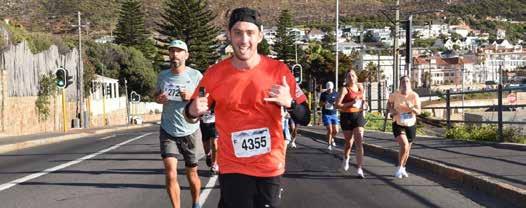
Running for Home: South African Quartet Take on London Marathon for Malki Foundation UK
Four runners are set to travel from South Africa to take on the TCS London Marathon this Sunday, 26 April 2026, in support of a cause close to their hearts.
Ricky Kruger, Talya Chemel, Talia Dadon and Josh Kaplan will join thousands of participants on the streets of London, not just to test their endurance, but to raise vital funds for the Malki Foundation UK. Te charity is dedicated to empowering parents of children with severe disabilities, helping them care for their children at home while accessing the paramedical therapies best suited to their needs.
Bayis Sheli is
Bayis Sheli, a care home for children with disabilities, is delighted to once again be awarded a rating of ‘Outstanding’ in all areas following their latest inspection by Ofsted.
Inspectors praised the high quality of care, strong leadership, and the positive outcomes achieved by the children, noting that “ Outstanding, child-centred care enables children to fourish, develop confdence and make signifcant progress in a home that feels safe, loving and truly theirs”.
Te report emphasises Bayis Sheli’s commitment to ensuring that children feel valued, listened to, and empowered
Teir journey refects a shared commitment to ensuring that families facing complex challenges are not forced to choose between care and togetherness. By supporting the Malki Foundation UK, the
runners are helping to provide practical assistance that allows children with signifcant disabilities to grow up within the warmth and stability of their own family environment.
Te funds raised will contribute directly to giving parents greater choice, independence and support, enabling them to focus on what matters most: raising their
‘Outstanding’
to reach their full potential. Te inspector observed the strong bonds between the children and their carers, highlighting that “children thrive in the trusting relationships that staf have built with them”. Registered Manager, Micki Herzog, said that “Tis exceptional result refects the unwavering dedication, compassion and professionalism of our staf team, who work tirelessly to provide a safe, nurturing and supportive environment for every child in our care. We are incredibly proud of this achievement and remain committed to maintaining the highest standards of care”.
Yanky
Sorotzkin, the home’s chair
The Money Skills All Children Should Learn
Mesila UK has launched a new practical guide to help parents teach their children healthy attitudes toward money from an early age. Te guide, How to Teach Your Kids About Money, has recently been distributed to Jewish schools across the UK and ofers families simple ways to introduce fnancial lessons at home. Research shows that children begin forming their attitudes toward money by the age of seven. Tis makes early conversations about spending, saving and giving especially important. Te guide helps parents turn everyday moments into learning opportunities. Grocery shopping, managing pocket money or saving for something special can all become practical lessons that build confdence and responsibility.
Designed to be clear and easy to use, the guide includes short explanations,
family activities and ideas for children of diferent ages. Parents will fnd tools to help children understand the diference between needs and wants, develop patience through saving and begin thinking about longer term fnancial goals.
Te guide also encourages families to talk about money in a calm and positive way so that children grow up seeing money as something to manage wisely rather than something stressful.
Mesila works across the community providing fnancial coaching, workshops and educational programmes that help families build long term fnancial stability.
Parents and schools can download the guide at https://mesilauk.org/guides/
of trustees, said: “We are thrilled that Ofsted’s recent report has recognised the hard work of the whole team at Bayis Sheli, let by Micki Herzog, who continue
children with dignity, hope and love at the centre of family life. As they prepare to cross the start line in London, the four runners carry with them not only the spirit of international solidarity, but a powerful message about the importance of accessible care and the strength of families determined to stay together.
to ensure the provision of the highest quality care and educational and therapeutic frameworks to all those living in the home”.
L-R Ricky Kruger, Talya Chemel, Talia Dadon
Josh Kaplan
Reflection, Remembrance and Joy at Pinner Synagogue
Te theme of the evening was ‘song’: the sombre mood of Yom Hazikaron brought members of the Pinner community together, remembering the fallen of past conficts, and those who perished in the atrocities of October 7th, amid a medley of Hebrew songs on video, composed during those dark times, featuring families and colleagues of the victims.
“It is impossible to celebrate Yom
Ha’Atzmaut without remembering the cost,” said one participant, recalling the oft-repeated statement that “Yom Hashoah is the price we paid for not having a Jewish State. Yom Hazikaron is the price we pay to have one.”
Te theme of ‘song’ then changed the mood to one of upbeat optimism, with more inspirational videos of communal singing across generations of Israeli families, as synagogue members
enjoyed a sumptuous barbecue supper, then sang and danced in celebration of Ha’Atzmaut, accompanied on the guitar by Avi Kleiman, son of Pinner Synagogue Rabbi Jason Kleiman.
“Here in Pinner we are geographically far, but so emotionally close to Eretz Yisrael,” commented one of the
attendees, adding, “but especially at such a difcult time, this evening was indeed a wonderful way to connect with
British girl takes top position in the International Bible Quiz
War with Iran didn’t stop British schoolgirl Leah Gittel Ostrof from reaching the top 13 in Israel’s International Bible Quiz. Leah, 16, Hasmonean High School for Girls, was watched by over 1 million people on Israeli TV, competing from her home in London via Zoom after being unable to travel due to the war. Selected to take part from the world’s top 50 most knowledgable youngsters from over 20 countries, were asked questions on more than 450 chapters of the Tanach
(over half the Bible). Another person to join the event via Zoom was Israeli Prime Minister Benjamin Netanyahu who was also able to attend due to security considerations.
Leah Kalmus, Chidon HaTanach UK coordinator said: “We’re so proud of Leah Gittel’s perseverance to take part, cheered on by more than 40 British school students who learnt Tanach and joined our organised social events to encourage young people to love Tanach
and be inspired by its stories.” Leah Gittel will attend an all expenses paid trip to Israel, along with the rest of the international participants, as a prize for reaching the international competition, once the war is over.
Over 1,000 Gather in Manchester for Powerful Yom HaShoah Commemoration
More than 1,000 people gathered in Manchester for a deeply moving Yom HaShoah commemoration, delivering a powerful message of unity, remembrance and resilience.
Te large turnout refected the strength and solidarity of the local Jewish community, as survivors, families, communal leaders and young people came together to honour the six million Jews murdered in the Holocaust. Trough candle-lighting
ceremonies, emotional testimonies and refective moments of silence, the event served as both a tribute to those lost and a call to action for the present.
Speakers shared deeply personal stories, highlighting not only the horrors of the Holocaust but also the courage and determination of survivors who rebuilt their lives. Teir words reinforced the importance of keeping these memories alive, particularly at a time when antisemitism is once again on the rise globally.
A particularly poignant element of the evening came from younger members of the community, whose participation symbolised continuity and hope. Choir performances and readings added a powerful emotional layer, reminding attendees that the responsibility of
remembrance now rests with the next generation. Community leaders stressed that Yom HaShoah is not only about looking back, but also about standing frm today. Te message throughout the evening was clear: in moments of despair, the Jewish people do not stand alone.
As candles fickered across the venue, they illuminated both memory and meaning — a collective commitment to unity, strength and ensuring that the promise of “Never Again” remains as urgent as ever.
Israel.”
Her name was Sara Gurewich
BY SHEINA COWAN
In December, I had the privilege of joining a JRoots trip to Poland through JFS. It was an experience that profoundly reshaped my understanding of the Shoah. I had studied it in school; I knew the facts, the dates, the numbers. But no textbook can prepare you for the raw reality of standing in a gas chamber, listening to survivor testimony, your eyes drifting to the futile scratch marks etched into the walls.
Te trip was carefully structured, providing historical context while leaving room for personal refection. Due to its emotional nature, everyone was able to fnd moments of signifcance, value and personal relevance. I kept waiting for my own- the moment that would go on to defne the journey. Eventually, it came. We were standing near the Warsaw
Sara, I’m Sorry
We raise our voices to Hashem choiceless choices chosen for them husband without wife, mother without child the bodies of our people burnt and defled they’ve tried to destroy us b’chol dor vador like haman’s decree and like paroh’s before 6 million brothers and sisters no more Sara, I’m sorry.
Tere are people who try and deny they claim that we lie about how many died
Umschlagplatz. A monument there bears hundreds of names carved into stone- the most common Jewish names in Poland at the time, our guide informed us. I walked slowly around it, reading them, attempting to pronounce some of the more difcult Polish names. Ten our guide asked a question that would entirely change the trajectory of the trip.
“How many of you,” she said, “can name a victim of the Holocaust who isn’t Anne Frank or a relative?”
Of course I could. Tere’s Viktor Frankl and Eva Schloss and Lily Ebert and… “To clarify,” she added, “someone who actually died in the Shoah. Not a survivor.”
Of course I could. Tere’s… Margot Frank? I stood there stunned. Out of six million lives, individual stories and stolen futures, I struggled to name even one. In a moment of desperation, I remembered something: for my batmitzvah, I had participated in the Yad Vashem twinning initiative. I had been given the name
“it never happened” and/or “it wasn’t enough” their logic is fawed contradictory rhetoric it’s called hatred just changes its garments as deniers experience cognitive dissonance as we stand here with empirical evidence our existence a miracle, proof of our permanence Sara, I’m sorry.
So ,we carry the light of the fames that were snufed we try remember the names; we don’t remember enough we cry for those who weren’t laid to rest zichronam livracha- may their
of a child who perished. Yes, her name was Sara, like my middle name. Sara… something. I couldn’t remember. Tasked with preserving just one name, I had forgotten it in just fve short years. As I got on the bus, I typed a quick message to my mum asking her for the name of the child whom I shared my batmitvah with. Sara Gurewich. I was so overcome with guilt. Sara- who never reached the age of twelve, whose life I knew almost nothing about- and yet even her name, the simplest and most sacred marker of her existence, I had failed to hold onto. I had let her down. I began writing an apology. Not yet a poem, but a raw and unstructured expression of guilt and grief.
My poem ‘Sara, I’m sorry’ was born from that apology. A central tension in the poem is the contrast between numbers and names. “Six million” is often used to convey the scale of the Shoah, but repetition of this number risks turning individual lives into an abstraction. A number, no matter how vast, cannot
memories be blessed Sara, I’m sorry.
Six million may not have survived but their memories, too, die if we don’t keep them alive Amalek didn’t vanish- just learnt to disguise from swords to gas, from pogroms to lies try name a victim of the Shoah if u can remember one who isn’t Anne Frank or a family member their names taken away- given a number by those with a wicked agenda but we also speak of a collective “six million” without putting it into
carry memory in the same way a name can. My poem deliberately challenges this by moving from the collective to the personal. In doing so, I try to restore, in some small way, the humanity behind the statistic.
Tis sense of responsibility feels particularly signifcant as a young Jew today. To live proudly as Jews is also to carry the memory of those who came before ustheir sufering, their resilience and also the immense loss endured by Am Yisrael. In a time when the number of Holocaust survivors is diminishing, organisations like JRoots are more important than ever.
Sheina’s poem was entered into the Jefrey Pinnick OBE JFS Poland Refections Competition. She was honoured to be asked to read out her winning entry at the UK Jewish Community’s National Yom Hashoah Commemoration outside Parliament this week.
perspective Sara, I’m sorry.
And so when I was asked to name a single soul who passed away the fact that I couldn’t has since weighed on me as I said “I can’t,” in a little whisper forgetting Sara Gurewich with whom I twinned for my batmitzvah u’vechol zot shimcha lo shachachnu I will always remember you and Sara, I’m sorry.
22nd April 2026
Statement from JTeen
Coming off the BBC Panorama programme on antisemitism, much of the focus has been on adults. But there is a quieter story.
At JTeen, we are not seeing panic. And that should concern us.
As a national charity supporting Jewish young people, with a dedicated support line, we see what others do not.
Young people adjusting.
Thinking twice about where they go.
Changing how they dress.
Hiding signs of being Jewish.
Not speaking about it.
Not reaching out.
This is the silent suffering.
When fear becomes normal, it stops being spoken about.
No young person should feel they need to hide who they are to feel safe.
To parents, this is the moment to check in.
Not just “Are you okay?” but “What has changed for you?”
Because silence does not mean everything is fine.
JTeen is here for any young person who needs support.
No Jewish young person should ever have to carry this alone.
Yaakov Barr CEO, JTeen - Helpline WhatsApp/ text number 07860 058823
Ve’ahavta and Tzelem Elokim
BY RABBI MOSHE TARAGIN
Tere are so many powerful pesukim in the Torah. Some speak of divine presence in this world, whether through creation or through supernatural intervention. Others describe the historical covenant forged between Hashem and His people, centered upon His land. And there are those that articulate fundamental beliefs, such as Shema Yisrael, which distills emunah into a few words. Finally, there are dramatic pesukim that trace the lives of our great Avos and leaders, Avraham and Moshe, capturing their struggles and heroics.
Yet the great Tanna, Rebbi Akiva, chose a diferent pasuk as the most essential in the Torah: “Ve’ahavta l’rei’acha kamocha.” Love your fellow as yourself. He places the center of Torah not in belief, but in the way a person turns toward others. Compassion, a readiness to step beyond the self, forms the bedrock of both human character and avodas Hashem. Without rachamim and compassion, piety slowly erodes, losing its moral core.
THE LANGUAGE OF ACTION
Te centrality of loving another as oneself had already been articulated generations earlier by diferent Chazal, an intellectual forerunner of Rebbi Akiva. Decades earlier, Hillel HaZaken had already placed this trait at the heart of avodas Hashem.
A potential but impatient ger approached Shammai, requesting “conversion on one foot,” what we would call “religion in ffteen minutes.” Shammai, quite understandably, turned him away. Torah and avodas Hashem cannot be absorbed in haste. Te greatest minds across generations have devoted entire lives to probing the depth and divine mystery of Torah.
Hillel responded diferently. He recognized that not everyone arrives with the same patience or intellectual endurance. Rather than dismiss the request, he ofered a point of entry. He directed the convert to focus on loving one’s fellow as the core of religious experience, a principle simple enough to begin with, yet one that can guide a person through the entirety of avodas Hashem.
Interestingly, Hillel did not merely identify love for another Jew as the central tenet of religious life. He gave it defnition and measure. Te command to love can remain abstract and difcult to grasp. People often hurt those they love. Love and hurt often walk hand in hand. Hillel redirected the convert toward action rather than emotion. “What is hateful to you, do not do to your fellow.” In reframing the command, Hillel made it concrete. It is not simple to feel love for every person. Jews, by nature, are
confdent and often stubborn. Diferences in outlook inevitably lead to friction. Hillel was not asking for perfect emotion; he was guiding behavior. Treat others with dignity and respect, even when you disagree, even when they irritate you. Use your own expectations as the standard. Do not impose upon others what you yourself would fnd hurtful. Instead of speaking in abstract terms, Hillel anchored the mitzvah in daily conduct.
Tis idea, to “treat others as you would wish to be treated,” has spread far beyond its source to many religions. Many assume it appears explicitly in the Torah, but the Torah speaks in the language of love. Hillel translated that language into behavior, into something lived and practiced.
Separated by only a few generations, Hillel and Rebbi Akiva arrived at a shared center. Treating others with dignity stands at the heart of Jewish identity. Among all the powerful pesukim in the Torah, this one emerges as central and can serve as a portal to growth in avodas Hashem.
THE IMAGE OF MAN
Yet this was not the only way to defne the center of Torah. Interestingly, there was a dissenting voice within Chazal. A diferent Tanna pointed to a very diferent pasuk as the most central in the Torah. Ben Azzai turned not to the command
in limited form.
It is precisely this distinction that defnes us. We stand apart from nature, and in that diference we refect our Creator, who stands beyond nature entirely. Our distance from the natural order is not accidental; it is the imprint of the tzelem Elokim within us.
By highlighting this pasuk instead of “Ve’ahavta l’rei’acha kamocha,” Ben Azzai introduced two important shifts. First, this pasuk is not a mitzvah but an assertion about human nature. Hillel and Rebbi Akiva identifed a formal mitzvah as central. Ben Azzai suggested that the axis of Torah values can emerge from a statement about who we are.
Avodas Hashem is shaped not only by obligation, but also by how we understand the human being, by the moral awareness embedded within us and by the way we see the world and our place within it. It is striking that, in Ben Azzai’s view, the central pasuk describes who we are rather than telling us what to do.
to love, but to a pasuk in Bereishis that describes the creation of man. In the ffth perek, the Torah presents man as having been created b’tzelem Elokim, in the image of Hashem.
Of course, this cannot refer to any physical likeness, as Hashem has no form or semblance. Rather, it points to a cluster of capacities that set human beings apart from the rest of the natural world. We possess emotion, bechirah chofshit, moral awareness, self-refection, creativity, language, and the ability to form deep relationships. Tese qualities are either absent in other creatures or appear only
Second, Ben Azzai widened the scope of compassion and respect from fellow Jews to humanity as a whole. Te command to love your neighbor is directed toward those who are your ideological neighbors, those who share your identity and way of life.
Te pasuk in Bereishis speaks more broadly. Every human being is created b’tzelem Elokim. Tat shared divine imprint demands a wider circle of respect. Honoring another person is, in efect, honoring the One who created him. When that respect is absent, it refects not only a failure toward others, but a failure in our regard for Hashem.
LOSING HOPE
It is not always easy to respect every human being and the tzelem Elokim within him. We stand at the edge of a major shift that may reshape how we understand ourselves. No one knows exactly where this is headed. Will AI elevate our sense of human dignity, as we begin to generate creativity itself? Or will this process
continue to erode what makes us distinct and chip away at our image of man? Tis process has been unfolding for centuries. Copernicus taught us that our planet is not the center of the universe. Darwin taught that we were not created as wholly distinct, but share an evolutionary branch with other primates. Freud taught that we do not fully possess bechirah, but are often driven, almost irresistibly, by darker psychological forces within us. With each step, something of human uniqueness felt diminished. Creativity remained one of the fnal markers of distinction.
If even that begins to fade, how will we understand ourselves? Tis question will take time to unfold, but it will shape how we see the human being and what it means to be created b’tzelem Elokim. Of course, even before any of this unfolds, the world already feels unmoored, gripped by hatred and drawn toward false narratives. Te hostility we face, and the poor judgment we see around us, can tempt a person to lose faith in humanity. So many seem unable, or unwilling, to recognize the moral clarity of our cause. It is easy, in a world flled with hatred and antisemitism, to give up on man, or to lose faith in human potential. Ben Azzai reminds us that every human being carries that potential. People do not always rise to it, and at times they distort it. Still, to live as a believing Jew is to hold onto faith in humanity, even when that faith is not easily earned.
Te writer is a YU-ordained rabbi at Yeshivat Har Etzion (Gush), a hesder yeshiva. His latest book, Reclaiming Redemption, Vol. II: Faith, Identity, Peoplehood, and the Storms of War, is available at mtaraginbooks.com
WHAT WORDS/// 3 DON'T BE AFRAID!
BY RABBI NAFTALI SCHIFF Don’t Be Afraid!
Tis past Friday night, an attempted arson attack was carried out against the former home of Jewish Futures on the Hendon Way, accompanied by explicit and personal antisemitic threats .
It was not random. It was not incidental. It was carefully calculated, not merely to damage a building, but to create something far more insidious- an atmosphere. A mood.
A quiet, creeping anxiousness and sense of unease that begins to settle into the hearts of ordinary, decent people, causing them to think twice about who they are, where they go, and how visibly they are prepared to live as Jews in this country.
Tat, after all, is the very defnition of terror. Not simply the act itself, but the emotional and psychological space it seeks to occupy.
it contracts. It diminishes. It reduces community and society.
Jewish people, Jewish societies were never meant to live diminished lives.
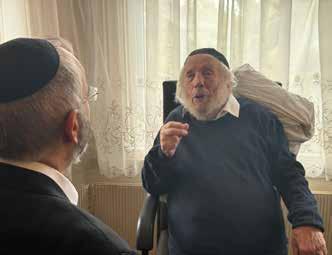
Just two days before this cowardly attack, I found myself sitting with a man who has lived through circumstances that
Don’t be afraid! Don’t be cowed!”
At the time, those words struck me as powerful. Two days later, they felt almost prophetic.
What does it mean to say “Don’t be afraid” in a world in which there are, quite clearly, things to be concerned about?
most of us cannot begin to comprehend, and yet who embodies a clarity and strength that cuts through all of the noise.
It does not mean ignoring reality. It does not mean behaving recklessly or irresponsibly. Nor does it mean dismissing the very real challenges that we face.
It means something altogether more demanding.
It means refusing to allow fear to become the lens through which we view life or the challenges we face.
And perhaps the clearest illustration of that came not in words, but in what has unfolded in the days since.
true or one that inspires.
Young people are not drawn to fear management. Tey are drawn to meaning, to purpose, to a sense that their Jewishness is a source of depth, of joy, of belonging, and of contribution.
Of course antisemitism is real, and it is rising. It must be confronted with clarity and seriousness.
But if it becomes the primary lens through which we defne Jewish identity, then we have, in efect, allowed those who hate us to determine how we see ourselves.
And that is a concession we cannot aford to make.
Te Jewish story has never been sustained by fear.
And so, whilst of course there are practical questions that must be addressed such questions of security, vigilance, and responsibility, the deeper question that confronts us is far more fundamental. How do we respond as a people? Not only in what we do, but in how we think, how we feel, and how we carry ourselves in the throes of the current spate of such fagrant violations of communal life in civil Britain.
Because, if fear becomes the dominant note in our response, then, in a very real sense, the objective of those who carried out the terror attack has already been achieved.
We must be absolutely clear. Responsibility for safety is non-negotiable. We are deeply indebted to the CST, to the police, and to the broader infrastructure of this country a genuine תוכלמ דסח לש , a benign government that works genuinely and with professionalism, to ensure the protection of our community.
But it would be a profound mistake to imagine that security alone constitutes a wholesome or enduring strategy.
Because if our instinctive response to violent acts of hatred is to retreat further behind ever higher walls and ever thicker fences, narrowing the space within which we live our lives, then we are, albeit unintentionally, conceding to the dictates of terror. Fear, when left unchecked, does not serve just to protect,
Reb Hershl Hershkovic, now close to one hundred years old, is the last survivor I interviewed for the book Miracle, from that group of 50 boys who were forced naked into the gas chambers in Auschwitz on Simchat Torah 1944 and, against all logic and expectation, were spared.
When one sits with such a person, one does not come armed with arguments or technical analysis. One gently probes and one listens.
Troughout our meeting last week, he returned again and again to a simple, unwavering refrain. “I davened then and K daven now. Tehillim. Chapter 91- בשוי ןוילע רתסב.”
Not as a slogan. Not as a soundbite or lecturing, rather a fact shared as a lived reality for nearly a century.
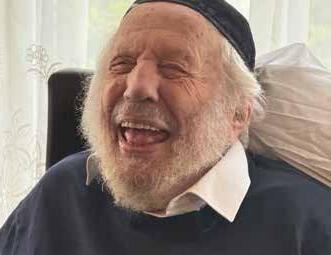
As I rose to leave, his carer brought him a drink. I wished him “L’chaim,” and he
responded immediately, with an energy that belied his years:
In the fve days following the attack, thousands of Jewish students have quite simply shown up - across schools, campuses, and young professional settings. Tey have come to learn, to connect, to engage, to show solidarity, to explore their Jewish identity with curiosity, openness and a fair bit of confusion.
Tey have not withdrawn. Tey have not disappeared from view. On the contrary, there has been a palpable sense of presence, of energy, of םייח
Tat response is not orchestrated. It is instinctive. Because we are family. Family does not abandon its own.
It has been sustained by a remarkable capacity for resilience, by clarity of purpose, and by an unwavering commitment to life- to building, to growing, to connecting, even, and especially, in the most challenging of circumstances.
Time and again, in moments that could have led to contraction, the Jewish response has been one of expansion - of creating, of teaching, of strengthening communal bonds.
And because somewhere deep within the Jewish psyche lies the recognition that the appropriate response to darkness is not retreat, but illumination and hope.
And here we must be honest with ourselves.
Tere is always a temptation, particularly in moments of threat, to frame our message in terms of survival alone. To speak primarily about security, about danger, about the need to protect.
All of that is necessary. But it is not sufcient.
Because if that becomes the totality of what we communicate, especially to a younger generation , then we risk presenting Judaism as something only to be defended, rather than something to be lived.
And that is not a message that is either
And so, in the aftermath of this attack, the choice before us is not between safety and recklessness, but between contraction and expansion. Between allowing fear to narrow our horizons, or allowing it to raise our aspiration and sharpen our resolve.
Between stepping back, or stepping forward with greater clarity and confdence.
“Don’t be afraid.” Said Reb Hershl. Tese are not simplistic words. Tey are not a denial of reality.
Tey are a discipline - an ongoing decision to hold two truths at once. Tat the world can, at times, be a dangerous place, and that we refuse to allow that danger to defne the essence of who we are.
At Jewish Futures, our mission has always been to create vibrant, meaningful pathways into Jewish life for young people from across the communal spectrum. To enable them to discover, in their own way, what it means to be part of an ancient and enduring story.
And what we have witnessed this week is something deeply encouraging.
Faced with an act designed to intimidate, the response has not been
withdrawal, but engagement. Not hesitation, but curiosity. Not silence, but presence.
Because when young Jews are ofered something real, something authentic and alive- they respond.
Terror seeks to isolate, to fragment and to make individuals feel small and alone.
Our communal response, therefore, must be rooted in the opposite impulse- in connection, in community, in confdence.
Not only for our own sake, but for the sake of the broader society of which we are a part. Because the values under pressure are not exclusively Jewish values, but fundamentally societal ones. Te opportunity and ability to live openly, to engage in dialogue and debate with other, to
practise one’s faith, to contribute without fear.
When we respond with dignity and quiet strength, we are not only standing up for ourselves; we are reinforcing
seriousness of the moment. But neither should we misunderstand it. Tis is not a time to shrink.
something essential within the fabric of the country we call home. We should not underestimate the
It is a time to stand proudly with a little more confdence, to live with a little more visibility, to engage with a little more depth.
To ensure that the answer to hatred is not absence, but presence.
“L’chaim! L’chaim!”
To life!
Not despite what has happened, but in response to it.
Because every attempt to intimidate must be met with a renewed commitment to build, to connect, to grow.
Don’t be afraid.
Not because there is nothing to fear, but because fear is not, and never has been, the defning feature of the Jewish people.
And if we can hold on to that - if we can respond not only with vigilance but with vitality - then we will not simply endure moments such as these. We will emerge from them stronger, more connected, and more deeply aware of the extraordinary privilege of being part of the ongoing Jewish story.
Shabbat Shalom
In this column Rabbi Naftali Schif refects upon 3 key words each week relating to contemporary and relevant issues.
All feedback is welcome- nschif@ jfutures.org.
Rabbi Schif is the Founder & CEO of the Family of Jewish Futures networks of educational organisations.
The Art of Influence: What the Torah Teaches Us About Winning People Over
BY RABBI ALEX WITTLER
Whether we realise it or not, every one of us is in the business of infuence.
It might be persuading a client, guiding a child, navigating a disagreement, or simply trying to be heard. We often think of infuence as a skill reserved for salespeople, leaders, or public speakers, but the Torah presents it as something far deeper: a refection of character.
In today’s world, I notice this most in everyday interactions. Whether it’s at home, at work, or just dealing with people day to day, there’s often a temptation to push a point or try to get through to someone quickly. I’ve found that the more you push, the less people hear. When someone feels pressured, they shut down, but when they feel understood, everything changes. Te Torah’s approach feels very diferent. It’s not about pushing your message, it’s about building a real connection frst.
One of the earliest and most powerful examples is Avraham. Te Torah
describes his tent as open on all sides, welcoming guests from every direction. Avraham didn’t build infuence through speeches or arguments. He created an environment where people felt seen, valued, and comfortable. Only then did he share his beliefs.
Tis is a striking lesson: true infuence doesn’t begin when we speak, it begins when others feel safe enough to listen. Contrast this with how infuence is often approached today. We focus on what to say, how to say it, and how to “win.” But Avraham teaches us that infuence is less about winning an argument and more about winning trust.
Another powerful example is Moshe. When he is frst called to lead, he resists, saying, “I am not a man of words.” By modern standards, Moshe might not have seemed like the ideal communicator. Yet he becomes the greatest leader in Jewish history.
Why? Because infuence is not about charisma, it’s about authenticity.
Moshe didn’t rely on polished delivery or persuasive tricks. He spoke with honesty, humility, and a deep sense of
responsibility for his people. Te Torah is teaching us that people are not looking for perfection; they are looking for sincerity. When someone feels that you genuinely care, your words carry far more weight.
Tis idea is reinforced in Pirkei Avot, where we are taught: “Who is wise? One who learns from every person.” At frst glance, this seems like a statement about wisdom. But it is also a guide to infuence.
Te most infuential people are not those who speak the most, they are those who listen the best.
When someone feels heard, they become open. When they feel dismissed, they become defensive. In many ways, the biggest barrier to infuence is not disagreement, it is the feeling of not being understood.
Tis has practical implications in everyday life. In business, customers are far more likely to engage when they feel you understand their needs. In parenting, children respond not to authority alone, but to connection. In relationships, progress happens not when one side “wins,” but when both sides feel respected.
We often think that infuence is about
changing someone else’s mind. Te Torah suggests otherwise. Infuence is about creating the conditions in which change becomes possible.
It begins with humility, the recognition that we don’t have all the answers. It grows through empathy, the efort to truly understand another person’s perspective. And it succeeds through consistency, showing up with integrity, time and again.
In a world that often rewards volume over depth, the Torah’s approach is both refreshing and challenging. It asks us to slow down, to listen more, and to lead by example.
Because in the end, the most powerful form of infuence is not what we say, but who we are.
Rabbi Alex Wittler studied at yeshivas in London and New Jersey before receiving semicha from Te Jerusalem Kollel under R’ Yitzchok Berkowitz. He is currently London Campus Aish Rabbi and passionate about empowering young people to reach their potential. Above all, he treasures time with his wife and two children.
ASK THE RABBI
TWENTY-NINE AND UNMARRIED. SHOULD I WORRY?
Dear Rabbi
My son of twenty-nine has told me in no uncertain terms that he is refusing to get married. I have tried to broach the subject with him many times and most recently I asked him straight out if he was gay. He just looked at me as though I’m insane. Neither my ex-husband nor I are able to get through to him. Should I worry?
Cynthia
Dear Cynthia
Of course you should worry! You’re a Jewish mother and that’s what Jewish mothers do! I would worry if you didn’t worry. But bear in mind that your persistent worrying, which, I get the distinct impression, translates into nagging, might be that which drives your son away.
Since you brought up your ex-husband, have you stopped to consider that there may well have been things your son saw in your home leading to your marital breakdown which makes him fearful of commitment? Because make no mistake about it. As much as we watch our kids to see what they are doing with their lives, they watch us to see what we are doing with ours. Te greatest gift we can ever give our children is to demonstrate to
them that Mom loves Dad and Dad loves Mom. Tat then fortifes them to go onto forming stable relationships as well. In the inevitable circumstance of divorce, I don’t know how old your son was when you divorced but I maintain it is imperative that when couples go through such trauma they ensure their kids (regardless of age) get some proper counselling in order for them to be able to put things in perspective without damaging their own confdence and attitude toward relationships later on. If that is a factor in your son’s reluctance to get married, then even now it would be worthwhile his talking this over with professional help. Te Jewish Marriage Council might be a good starting point.
A VANITY WORKOUT
Dear Rabbi
I’ve recently started going to the gym and noticed another Jew (there are several) yarmulke and all. He seems to spend more time taking selfes than actually exercising. His workout routine consists of adjusting his hair, fexing intermittently, and photographing himself from every conceivable angle. Isn’t this just gross vanity and halachically wrong?
Jeremy
Dear Jeremy Are you going to the gym to work on
your body, or to conduct surveillance on everyone else’s? I ask because you seem to have developed a remarkably detailed understanding of this man’s routine - which suggests that while he may be focused on himself, you are rather focused on him.
Now, you may well be right. It could very well be vanity. It could also be insecurity, or boredom, or simply a modern condition whereby a moment not documented for social media is a moment not lived. But before we issue a halachic ruling on his fexing technique, it might be worth considering that Judaism has always been at least as concerned with how we look at others as with how others look at themselves.
Tere is no specifc prohibition against a man taking a selfethough one could argue there ought to be a limit before it becomes a full-time career. Vanity, however, is not a new invention, even if the technology is. Te diference is that in previous generations it involved mirrors; today it involves followers.
But here’s a newsfash. Te Torah does not command us to fx other people’s
faws mid-workout. It does, however, take a dim view of unnecessary judgment. So, perhaps he should spend less time posing and more time perspiring. But you might consider spending less time observing and more time exercising. At the very least, one of you might leave the gym having achieved something tangible.
FJL has partnered with Birthright Israel and leading educators to create Parents Give Back — a meaningful volunteer and learning experience for parents.
STAND WITH ISRAEL. GROW AS A PARENT. GIVE BACK WITH PURPOSE.
Spend your days contributng meaningfully to Israeli communites, alongside a cohort of parents from around the world, while engaging in thoughtul learning and powerful conversatons that deepen your connecton to Jewish life and your role within it.
A TYPICAL DAY
MORNING:
Volunteering and contributon
AFTERNOON: Israel encounters and refecton
EVENING: Jewish learning, speakers, and discussion
WHO YOU’LL BE ENGAGING WITH
Ben Thwaites FJL Educator
Rabbi Efe Kleinberg FJL Educator
Yoetzet Stacey Goldman Scholar in Residence
FJL EDUCATORS & GUEST SPEAKERS
Past speakers across FJL programs have included The Chief Rabbi of Israel, President Isaac Herzog, Michael Eisenberg (Author and Venture Capitalist), Fleur Hassan-Nahoum (Israel’s Special Envoy for Trade and Innovaton and outgoing Deputy Mayor of Jerusalem), Joseph Gitler (Chairman at Leket Israel), Col. Richard Kemp, Yaakov (Jacques) Cadranel (Founder of SPPGrowth) and Trevor Asserson (Senior Partner, Asserson Law Ofces), among many others.
The Best Neighborhoods for Anglo Families Investing in Israel Real Estate in 2026
I am writing to provide an overview of the community and lifestyle in Carmei-Gat to help you determine if it is the right ft for you and your family.
Whether you buying for yourself your family as an investment , making Aliyah or considering options this is an excellent option to consider .
COMMUNITY PROFILE
Carmei Gat is a young, family-driven “startup community” where residents are actively building the culture from scratch. Te population primarily consists of families in their 20s to 40s. We are seeing a growing trend of parents moving to the area to be near their children and grandchildren.
Our local clients made Aliyah almost 10 years ago recently traded a life in Ra’anana for a beautiful cottage-style home here for half the price to be near children and grandchildren.
We also have a UK group that has purchased properties in a luxury Anglo Dati-Leumi focused project some for Aliyah, others for downsizing, some for luxury Villas in the project and others for investment purposes.
Te neighbourhood ofers growing local schools, including Mamlachti Dati and Torani-style options. While feedback is positive and the schools are improving rapidly, they do not yet have the same Anglo-tailored ecosystems found in more established cities.
KEY BENEFITS
- Afordability: Better housing value compared to central Israel.
- Infrastructure: New, clean, and modern facilities.
- Social Life: A strong sense of collective growth where children make friends quickly.
Some clients in the group have chosen near by similar projects that are ready now or in few months’ others have chosen other parts of Israel Netanya , Jerusalem , Ramat Beit Shemesh Neve Shamir and others are still working things out and looking at various options with us for various reasons and time frames. We have clients in Carmei Gat from Israel South Africa , UK , USA & Australia the area feels like a mix of Modiin Ramat Beit Shemesh Aleph , and a mix of other Anglo areas its a clean beautiful city and growing rapidly in popularity and becoming very sought after its fat and you can walk around Carmei Gat in an hour easily.
For more information on this group and projects or resale properties and rentals be in touch privately.
ANGLO PRESENCE
Te Anglo presence is signifcant and growing, with approximately 300+ English-speaking families from the UK, US, AUS , IL and South Africa as of 2025. While smaller than hubs like Ramat Beit Shemesh or Modiin, it ofers a tight-knit environment where it is easy to integrate and help build the community infrastructure.
EDUCATION
Tere is signifcant investment in the growth and expansion of Carmei Gat with Carmei Gat Tzafon ( North ) where already projects are available for sale and a visit to the area will show you advance construction of roads and services in place.
In summary, Carmei Gat is an excellent choice for families seeking space, value, and a community-centric lifestyle. Most of our clients have purchased in projects that will be ready in over three years for Aliyah or as rental investments.
Please let me know if you would like me to connect you with current residents to learn more about their experience or clients e have helped here and continue to work with .
CARMEI GAT
A Fast-Growing Community with Big Potential
Carmei Gat is one of Israel’s most exciting new neighbourhoods, located in the southern city of Kiryat Gat. Designed as a modern, family-oriented community, Carmei Gat ofers afordable housing, rapid development, and strong investment opportunities. With easy access to Israel’s central regions and growing infrastructure, it is attracting families, Olim Chadashim, and investors alike.
LOCATION AND SURROUNDINGS
Strategic Placement: Carmei Gat is located just outside Kiryat Gat, only 35 minutes from Tel Aviv and 40 minutes from Jerusalem by train.
Transportation Links: Excellent connectivity via Highway 6 and Israel Railways—the nearby Kiryat Gat train station links directly to Tel Aviv and Be’er Sheva.
COMMUNITY AND LIFESTYLE
Green Setting: Built with modern planning, Carmei Gat integrates wide streets, green parks, playgrounds, and open public spaces for family life.
· Young & Family-Oriented: Carmei Gat is designed for young families, with a large percentage of children and a dynamic community atmosphere.
· Diverse Residents: A mix of native Israelis, new immigrants, and young professionals seeking afordable housing near Israel’s economic centers.
· Religious & Secular Mix: Planned neighborhoods accommodate a broad spectrum of families, with synagogues, schools, and cultural centers under development.
· Olim-Friendly: With its afordability and accessibility, Carmei Gat is becoming an increasingly popular choice for Anglo Olim and investors looking for growth.
HOUSING & NEIGHBOURHOOD
· Modern Development: Tousands of new apartments are being built, with a mix of 3–5 room apartments, penthouses, and duplexes.
· Afordable Pricing:
o 3–4 room apartments: ₪1.6M – ₪2.0M
o 5 room/newer apartments: ₪2.1M
– ₪2.5M+
· Parks & Open Spaces: Te neighborhood was designed with wide boulevards, modern playgrounds, and recreational areas.
· Shopping & Dining: New malls and shopping centers are being developed nearby, while Kiryat Gat already ofers retail, supermarkets, and services.
· Active Lifestyle: Bike paths, walking trails, and easy access to southern Israel’s nature reserves encourage outdoor living.
· Economic Opportunities
· High-Tech Employment: Carmei Gat is minutes away from Intel’s Kiryat Gat semiconductor plant, one of Israel’s largest high-tech employers. Te region continues to attract global companies and startups.
· Commuter-Friendly: Fast train access makes commuting to Tel Aviv, Be’er Sheva, and Jerusalem practical and afordable.
· Local Growth: Retail, services, and education jobs are expanding rapidly as the neighborhood grows.
· Opportunities for Olim Chadashim: Afordable housing, municipal support, Hebrew Ulpan programs, and job placement assistance make Carmei Gat an attractive entry point for new immigrants.
· Transport & Mobility
· Highways: Direct access to Highway 6 and Route 35.
· Train: Kiryat Gat’s train station connects residents to Tel Aviv in under 40 minutes.
· Public Transport: Extensive bus routes serve the city and surrounding areas.
· Pedestrian-Friendly: Te neighborhood was planned with walkability in mind, ideal for families with young children.
o Penthouses/large units: ₪2.8M – 3.2M+
o Luxury New Villas ₪.5.4M – ₪6.4M+
· Investment Potential:
o Signifcant capital growth forecasted as the neighborhood matures.
o Strong rental demand from young families and professionals.
Close to Kiryat Gat’s hi-tech employment hub (Intel, HP, global R&D centers).
LEISURE AND CULTURE
· SCHOOLS AND EDCATION
· Education, Religion & Services
· Schools: Dozens of new schools and preschools are being established to serve the young population.
· Religious Life: New synagogues and Torah institutions are being built alongside secular schools, refecting the community’s diversity.
· Healthcare: Access to local kupot holim clinics, with hospitals and advanced medical services available in Kiryat Gat, Ashkelon, and Be’er Sheva.
· Why Carmei Gat?Carmei Gat combines afordability, growth potential, and strategic location, making it one of Israel’s strongest up-and-coming areas for families, Olim, and investors. With thousands of new units, excellent infrastructure, and proximity to Israel’s hightech corridor, it is poised for signifcant appreciation over the coming years.
L E T Y O U R J O U R N E Y
H O M E B E G I N W I T H U S
J E R U S A L E M
R a m o t B e t
S e m i - A t t a c h e d V i l l a
2 3 5 S Q M b u i l t
4 0 0 S Q M p l o t
7 b e d r o o m s
4 . 5 b a t h r o o m s
Asking Price: ₪ 9 , 2 5 0 , 0 0 0
N
L
R
B
P
S
Asking Price: ₪ 4 , 8 0 0 , 0 0 0
N E T A N Y
A
L u x u r y P r o j e c t S t e p s f r o
Asking
n s
B a l c o n y f o r e a c h u n i t
G o r g e o u s v i e w s
P a r k i n g i n c l u d e d
S h o p s , s c h o o l s a
ERETZ YISRAEL
Sense of Freshness While Fulfilling Tradition Wekly Dvar Torah
BY RABBI SHALOM ROSNER
“Aaron must enter the Ohel Moed and remove the linen garments that he wore when he entered the Holy of Holies, and leave them there” (Vayikra 16:23). In this week’s parasha we are informed of the Yom Kippur service in great detail. Tere are several warnings that any deviation from the prescribed ritual is a disaster, that any change is a calamity. Each year the manner in which the Yom Kippur service is to be performed in the Mikdash has to be exactly as it is described. Yet, there is one aspect that changes from year to year. Te Torah tells us, as cited above, that certain garments adorned by the Kohen Gadol are to be discarded and new garments are to be prepared each year. Tese were very costly linen garments (see Mishnah, Yoma 3:7). Why not just place them aside, clean them and reuse them the following year? Typically, Chazal are wary of wasting money as is stated in Yoma (39a): “Te Torah spares the money of the Jewish people.” What message is the Torah seeking to convey by demanding that the
four linen garments require sequestering or burial?
Rabbi Norman Lamm in Drashot L’Dorot cites Rabbi Mordechai Hacohen who ofers an insightful explanation. Te Torah wants us to avoid the danger of routine. Following tradition is of utmost importance. Consistency in religious practice is paramount. Nothing may difer in the performance of the Yom Kippur service. Yet, the Kohen Gadol must change his garments every Yom Kippur in the hope that the outward novelty will inspire and evoke from within a sense of freshness and enthusiasm.
the same exact text in the Haggadah. Yet, we are to enhance the discussion with new ideas and interesting divrei Torah to create a certain freshness to the evening. Each day we wrap ourselves in tefllin and we recite the same Amidah prayer three times. It can be a recipe for boredom, and we can fall victim to routine. We need to create a balance between adhering to our tradition
without deviation, while experiencing excitement. Perhaps if we better understood why we engage in these traditions, it would infuse our actions with enthusiasm.
our spouse, parents, and children. As David HaMelech requested: I would like to dwell in the House of Hashem. But then, he asks to visit the Temple. Does he want to dwell in the Temple or just visit? Perhaps his intention is to dwell there but that each moment he is present in the Temple he will feel the same enthusiasm and excitement as a frst time visitor! Te Kohen Gadol had to fulfll the Temple service on Yom Kippur without any slight deviation. Tradition is to be adhered to in a most precise manner. Yet, he is required to change his clothes each year. Te new garments would infuse a certain sense of freshness into this repetitive service. May we be able to establish the proper balance in our lives between adhering to our tradition while instilling a sense of excitement and enthusiasm.
Tis concept is applicable to both our spiritual and mundane pursuits. Each year we participate in the Seder, following
We often take our closest relationships for granted. It behooves us to stop for a moment every so often and appreciate
Rabbi Shalom Rosner is Rosh Beit Midrash of the Machon Lev English speaking program and Rabbi of the Nofei HaShemesh community. He is a member of the Mizrachi Speakers Bureau (www. mizrachi.org/speakers).
Who’s the Boss?
BY RABBI SHAUL YONATAN TAWIL
A cruel husband once approached his wife and told her “I’m the boss and you’re nothing.” She instantly replied, “Well I guess then... that makes you the boss of nothing!”
How much wisdom was captured in those few lines and wasted on a joke. Te wife’s response didn’t deny that he was the boss - in fact, she readily agreed with him. She merely explained to him over what he was the boss. In other words, if you treat a wife like she’s nothing, then you are the boss of nothing. Treat her like a person then you are the boss of a person. Treat her like a queen, then you are the boss of a queen – that is a King. Would you like to be a king? Fine – just treat her like a queen!
In this weeks Parsha we read one of the most famous statements that has resounded for generations - “VeAhavta LeReacha Kamocha – you should love your neighbour like yourself”. So famous is this statement that R Akiva said this is a Klal Gadol BaTorah – a great rule in the torah.
Tis is a profound mitzvah. We all love ourselves, very very much! Te torah seems to command that we take that same love and focus it on all those around us.
Yet the Ramban fnds this hard to accept. How can it be that you should love your friend equally to yourself? Tere is a rule in the Gemara: “Chayecha Kodmin.” –Your live always takes precedence.
Te Gemara Bava Metziah (62a) states that if two people in the desert fnding a canteen with enough water in it to keep only one person alive. Te one who has it uses it, and is not supposed to give it to his friend. He must tend to his own life frst, thus it seems he must love himself more than others.
Tus asks the Ramban how can it be that we’re instructed here to love a friend equally to our love for our self, when we know that the Torah supports a person’s survival instinct and says that ultimately your own life comes frst? What is the real meaning of VeAhavta LeReacha KaMocha?
Te Ramban explains that the Torah is commanding us here to love our friends also, in a similar way (Kamocha) that we love ourselves. Te Ramban takes the phrase Kamocha as an overstatement for emphasis. Tat desire that we have regarding ourselves, to live and be well, should carry over to others. Te Ramban supports his view by the fact that Torah doesn’t say “et reacha”, rather “lereacha.” “LeReacha means towards your friend, but not exactly the same. We know that we are not expected to love the person of our neighbour as much as we love our own self. However, we are expected to love our fellow in all areas, as we love all good for ourselves. Similarly the Rambam (Mada 6:3) writes that we should speak in praise of our neighbours, be careful with the honour and the property of others - as we are with our own.
VeAhavta LeReacha KaMocha is a very hard mitzvah to complete. It is a constant mitzvah, and requires much
self inspection before applying it to others. We meet so many people in our daily lives, and we immediately form views about them. We relate to diferent people diferently, yet we are told with one blanket statement –treat them all with love, put yourselves in their shoes and look out for their interests just as you would for your own.
Te Chida writes that this Mitsvah is most manifest between a husband and wife. In the outside world, it might be easy for us to show our kindness, after all, everyone is watching, so we need to impress. Yet when it comes to behind doors, that is when we are really being put to the test. When a man comes home from work he should not expect the dinner on the table, he should not view as the woman’s obligation, rather he should see it as kindness, she worked hard for it and spent quality time; put himself in her shoes. Similarly the women should not take for granted the husbands work, she should view it as Chesed.
We can now understand why this mitzvah was placed in the Parsha of Kedoshim.
What does holiness have to do with loving your neighbour. Ofcourse by doing the mitzvah you bring unity and happiness but does that lead to holiness. Te answer is that to acquire holiness two things need to occur. Te frst is to love your neighbour exemplify in Ben Adam LeChavero and the second is to do it in a manner of Kedusha.
A true Torah-observant home is certainly most conducive to the Divine Presence. However, we should remember that as important as observance of Mitsvot is, it is possible as Ramban says (19:2) for a person to be in technical compliance with every halachic requirement, and nevertheless be a vulgar person. Te Midrash (Vayikra Rabba 13:3) states that the Mitsvot were given to us for no reason other than to refne our characters.
to brush the
explained to the student, “Te Talmud says that the Shechina dwells amongst man and wife. Do you think it is respectful to be in the presence of the Shechina with a dusty garment?” If we were to approach married life with VeAhavta LeReacha KaMocha constantly on our minds, seeking the best for our partner as well as for ourselves, really understanding what they have been through that day, and infuse our relationship with Kedusha then we will ultimately become One.
Shabbat Shalom
Rabbi Jonathan Tawil
R Shhlomo Zalman Auerbach was accompanied by a student before he entered his home, R Shlomo Zalman paused
dust from his coat. He
CONSTANT TORAH STUDY AND GREEK WISDOM | MENACHOT 99b
BY RABBI YAKOV SCHONBERG
JEWISH EDUCATION IN A CHANGING WORLD - PART 1
Te Jewish religion has a distinctive approach to education, unlike that of other nations; it is a lifelong pursuit. Te study of Torah wisdom is not merely a means to becoming educated but an ongoing religious obligation even after one has mastered the entire spectrum of Jewish Law. Menachos 99b discusses three views on the pasuk (Yehoshua 1:8)
, which addresses the study of Torah by day and by night. Rabbi Shimon ben Yochai holds that reciting Shema counts as study and fulflls that obligation at some point each day. Rabbi Yishmael regards it as an ongoing obligation and thus excludes the study of Greek wisdom. Rabbi Shmuel bar Nachmani, citing Rabbi Yonasan, regards it as a blessing rather than an obligation. Te Talmud emphasizes Torah study as a constant duty. Yoma 19b states that one is prohibited from engaging in trivial conversation and must make Torah study one’s permanent occupation. Sanhedrin 99a teaches that one who refrains from Torah study when capable of doing so is characterized as one “who has denigrated the word of HaShem” (Bamidbar 15:31). Tese statements indicate that the mitzvah of Torah study is not discharged simply by reciting the Shema twice a day.
APPARENT CONTRADICTION
Rabbi Shimon ben Yochai’s leniency conficts with his own view in Berachos 35b, where he disputes the approach of Rabbi Yishmael, who argues that Torah study should be combined with earning a living. He advocates dedicating one’s life entirely to Torah and relying on Divine assistance, yet his stated opinion here is that reciting Shema twice sufces. Te Gemara concludes that Rabbi Yishmael’s approach is suitable for most people, whereas the latter approach is reserved for select exalted individuals. Rabbi Yishmael’s opinion can be reconciled because learning secular wisdom difers from earning a living, which justifes taking time of from Torah, yet full devotion to Torah remains a higher ideal. However, if Rabbi Shimon ben Yochai obligates one to devote one’s entire life to Torah study in Berachos 35b, how can he rule in Menachos that reciting the Shema twice daily sufces?
MINIMUM THRESHOLD
there’s no real dispute in the Gemara. All agree on the obligation to study Torah constantly, based on the pasuk (Shemos 33:11): “Tis Sefer Torah shall not depart from your mouth.” Te Gemara itself implies this, not indicating a confict between Rabbi Yishmael and Rabbi Shimon ben Yochai. Rabbi Shimon discusses the minimum threshold for fulflling this mitzvah. If someone doesn’t study Torah continuously, does part-time study fulfll any mitzvah? Or, is it like eating less than an olive-sized piece of matzah on Pesach, which isn’t considered a mitzvah? He teaches that, even if
FIXED STUDY TIMES
Te Chafetz Chaim discusses another difculty in Menachos 99b. According to Rabbi Ami, just as lechem hapanim could be removed before the new loaves were in place, studying one Torah passage in the morning and one at night sufciently fulflls the pasuk about studying Torah day and night. However, the Rambam, in Hilchos Temidin U’Mussafn (5:4) rules that loaves must remain in place at all times. Yet in Hilchos Talmud Torah (1:8), he agrees with R’ Ami that minimal daily
Rav Yitzchak Eizik Chaver explains that
someone studies minimally and isn’t fully fulflling the obligation, that amount still counts as fulflling the command to contemplate Torah day and night. Along the same lines, the Ritva (Nedarim 8a) writes that Rabbi Shimon ben Yochai is only discussing one who is preoccupied with earning a living, who can do nothing more than recite the Shema twice a day. Otherwise, he concedes to Rabbi Yishmael that one must study as much as possible. As Rav Chaver notes, Rabbi Shmuel bar Nachmani, quoting Rabbi Yonasan, does not dispute the obligation of constant Torah study, as in Devarim 6:7: “and you shall speak of them.” He only debates Rabbi Yishmael’s interpretation of Joshua: “you shall contemplate it day or night,” which he sees as a blessing, not a command (Or Torah, following his commentary to Maalos HaTorah) .
study sufces. Te Chafetz Chaim emphasizes that there is no real dispute; all agree on the requirement of constant Torah study. Rabbi Yishmael exempts the time required to earn a living but still insists on daily study, with the Heavenly Tribunal questioning whether he had fxed study times (Shabbos 31a). Menachos 99b debates whether minimal daily study fulflls the “shall not depart from your mouth” pasuk, with Rabbi Yose saying yes—it’s daily and nightly—while the Rabbis disagree due to lack of continuity throughout the day and night. Nevertheless, the Rambam rules that such study complies with the Sefer Yehoshua requirement (Zevach Todah, Likkutei Halachos, Menachos, s.v. midvarav shel R’ Yose).
SHULCHAN ARUCH HARAV
Rav Shneur Zalman of Liadi views Torah study as having two separate obligations. Firstly, the day-and-night obligation, stemming from the pasuk in Sefer Yehoshua, was debated by Rabbi Shimon ben Yochai and Rabbi Yishmael, as above. Te second obligation is to acquire and retain knowledge of the entire Torah, as in Kiddushin 30a, inferred from Devarim 6:7: םתְננשְ ו “And you shall teach them thoroughly,” requiring fuency to answer questions immediately. Ran notes that this can only be achieved through continuous study, not sporadic reading. As Shulchan Aruch Harav explains, the Gemara in Berachos 35b discusses this second obligation. Rabbi Shimon ben Yochai argues that one cannot fully learn all Torah parts if he interrupts to earn a living: “If a man plows at the time of plowing, and harvests at the time of harvesting... what will become of the study of Torah?” Rabbi Yishmael agrees in principle but believes that studying Torah while earning a modest income won’t necessarily hinder it, as he will merit Heavenly assistance. Tis second obligation applies only to those with the intellectual capability to study and retain Torah. Otherwise, they can prioritize their livelihood. Rabbi Shimon ben Yochai’s argument that earning a livelihood might interfere with Torah study doesn’t apply to him, since he can’t acquire the entire Torah in any
case. He’s only bound to the frst obligation from the verse “the Torah shall not depart from you day and night.” Unlike Rabbi Yishmael, he believes he can fulfll this by fxing time to study during the day and at night. As Shulchan Aruch HaRav continues, this obligation does not prevent a person who is not capable of acquiring knowledge of the entire Torah from earning more than his basic needs. In fact, it is preferable for him to earn a surplus of money, since he can use it to support those who are capable of acquiring the entire Torah (Hilchos Talmud Torah, Ch. 3 Kuntres Acharon).
WHAT IS GREEK WISDOM?
Menachos 64b and Sotah 49b distinguish between learning the Greek language, which is permitted, and Greek wisdom, which the Sages forbade, though its exact meaning is debated. Te prohibition arose following the tragic incident related in the Gemara during a siege of the Beis HaMikdash, in which an old man used “Greek wisdom” to advise the besiegers to stop the sacrifcial service at the Beis HaMikdash. Rashi and many Rishonim say that Greek wisdom involved aristocratic codes, riddles, and hints used by the elite, which were unclear to the masses. Te Ramah (Shitah Mekubetzes, Bava Kamma 83a) explains that it refers to predictions by stargazers. A third view
equates Greek wisdom with Greek philosophy. If Greek wisdom is a form of Greek culture, why did this man use specifcally Greek culture to give this evil advice?
THE BEAUTY GREEK
Rav Chaim Friedlander reconciles the diferent Talmudic sources regarding the Greeks (Sifsei Chaim, Moadim, Vol. 2). On the one hand, they admired the language, calling it beautiful (Megillah 9b) and permitting writing the Torah in Greek, aside from Hebrew, to the exclusion of other languages (Megillah 8b). On the other hand, the Gemara bans teaching Greek wisdom, indicating disapproval of Greek culture. Te translation of the Torah into Greek during Ptolemy’s time caused widespread darkness, highlighting this confict. How can we reconcile this paradox? Rav Friedlander explains that the answer may be found in the pasuk (Bereishis 9:27)
(Hashem will expand the mind of Yefeth, but will dwell in the tents of Shem). Te Greek language, as the most beautiful among Yefes’ descendants, can be used to serve Hashem when it dwells in Shem’s tents. Te Torah values beauty and its role in Divine service, permitting the use of the Greek language to teach Torah, provided it aligns with Torah and mitzvos. Te Sages banned
Greek philosophy because it saw beauty as an end in itself, promoting physical pleasures over spiritual growth. It did not view the world’s beauty as a tool to be used for coming closer to HaShem. Greek attempts to impose physicality on spiritual concepts and translate Torah into Greek aimed to distort its spiritual essence. Judaism accepts physical beauty but only for higher purposes, like beautifying Torah scrolls and the Beis HaMikdash, recognizing that worldly beauty can draw people closer to God. In contrast, Greek wisdom sought beauty for its own sake, distancing itself from the Divine. Tis story of the siege recounts an old man steeped in Greek culture, warning that as long as Temple oferings were brought, the attackers could not conquer it. From his Greek wisdom perspective, he opposed the sacrifcial service inside the Beis HaMikdash, seeing the act of bringing oferings to Hashem as contrary to Greek philosophy, which values using everything for its own sake rather than for a higher purpose. He argued that not only was bringing oferings pointless, but also that it wasted resources. Tis highlights the danger of Greek culture, which the Sages deemed incompatible with Judaism, leading them to forbid teaching these ideas (Ein Yaakov, Menachos 64b, Artscroll edition, Insight A).
SHULCHAN ARUCH
CLOSING DOWN SALE!!!
• Suits now from £69
• Overcoats from £49.50
• Knitwear from £10
• Casual Jackets from £29.50
• Sports Jackets and Blazers from £39.50
• Trousers £20 each 2 pair for £30 28-48 inch waist
• Shirts from £10
• Shoes from £15
Te Shulchan Aruch (Orach Chaim 155:1) rules that one should schedule one’s daily study session immediately after Shacharis. Te Mishneh Berurah explains that he will still be in a spiritual mood from his prayers, and if he starts his business, he will likely be caught up in his work, and his learning will not materialize. Te Shulchan Aruch refers to a fxed period of time for Torah study, and the implication is that it would be insufcient to study only a small portion. Earning a living is an accepted dispensation, but to what extent? Te Rambam discusses a typical day in which one apportions one’s schedule into nine hours of Torah study and three hours of work (Hilchos Talmud Torah 1:12). How does this translate into a curriculum for our children’s education? What is their obligation regarding continuous Torah study? To be continued in part two …...
To contact Rabbi Schonberg, please email, yschonberg@gmail.com To fnd out more, you can sign up at mercazdafyomi.com and receive a free gemoroh.