



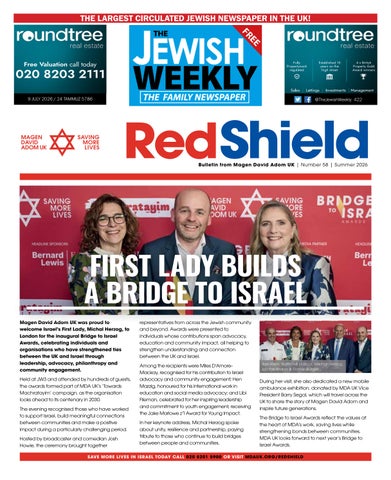






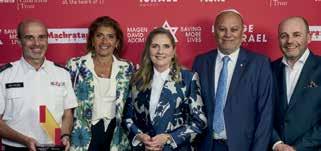
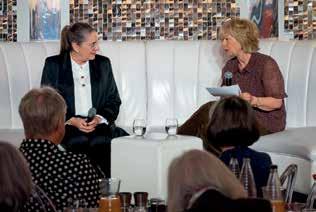
Magen David Adom UK was proud to welcome Israel’s First Lady, Michal Herzog, to London for the inaugural Bridge to Israel Awards, celebrating individuals and organisations who have strengthened ties between the UK and Israel through leadership, advocacy, philanthropy and community engagement.
Held at JW3 and attended by hundreds of guests, the awards formed part of MDA UK’s ‘Towards Machratayim’ campaign, as the organisation looks ahead to its centenary in 2030.
The evening recognised those who have worked to support Israel, build meaningful connections between communities and make a positive impact during a particularly challenging period.
Hosted by broadcaster and comedian Josh Howie, the ceremony brought together
representatives from across the Jewish community and beyond. Awards were presented to individuals whose contributions span advocacy, education and community impact, all helping to strengthen understanding and connection between the UK and Israel.
Among the recipients were Miles D’AmoreMackay, recognised for his contribution to Israel advocacy and community engagement; Hen Mazzig, honoured for his international work in education and social media advocacy; and Libi Fileman, celebrated for her inspiring leadership and commitment to youth engagement, receiving the Jake Marlowe z”l Award for Young Impact.
In her keynote address, Michal Herzog spoke about unity, resilience and partnership, paying tribute to those who continue to build bridges between people and communities.



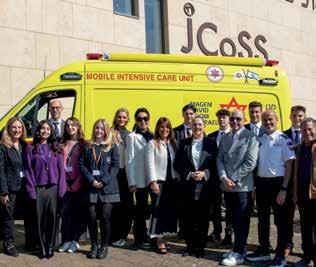
During her visit, she also dedicated a new mobile ambulance exhibition, donated by MDA UK Vice President Barry Segal, which will travel across the UK to share the story of Magen David Adom and inspire future generations.
The Bridge to Israel Awards reflect the values at the heart of MDA’s work, saving lives while strengthening bonds between communities. MDA UK looks forward to next year’s Bridge to Israel Awards.
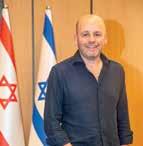
One of the greatest privileges of my role is witnessing the extraordinary connections between our community here in the UK and the people of Israel.
Over recent months, that connection was brought vividly to life during the visit of Israel’s First Lady, Michal Herzog. As Magen David Adom UK continues its journey Towards Machratayim, “the day after tomorrow”, Michal has become a passionate champion of the mental health and wellbeing programmes helping Israeli society heal and rebuild. Through our support of MDA Israel, we are proud to be investing not only in saving lives today, but in strengthening lives for tomorrow.
Her visit to Heaton Park Hebrew Congregation in Manchester is something that will stay with me for a long time. It was the community’s first major gathering of remembrance ahead of the first anniversary of the Yom Kippur attack on the synagogue. The atmosphere was one of resilience, unity and reflection.
On a personal level, it was also a privilege to accompany Michal to JCoSS. As a parent of children who attended the school, I was proud to see her experience fi rsthand the warmth, confi dence and vibrancy of one of our community’s greatest institutions. It was a reminder of the strength of our Jewish schools and the young people they help shape.
Machratayim is ultimately about making things better tomorrow than they are today, building a stronger society, supporting wellbeing and creating hope for future generations. These experiences reminded me how much there is to be optimistic about.

Daniel Burger Chief Executive Magen David Adom UK
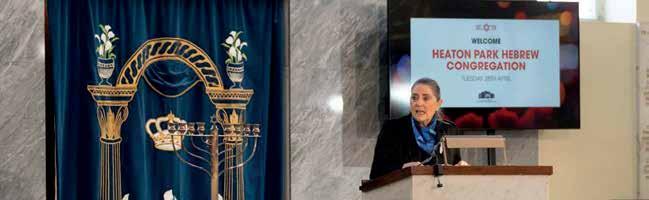
The congregation in Manchester came together for a moving day of reflection and remembrance, including firsthand accounts of the attack that took place at the synagogue on Yom Kippur 2025.
From the moment she arrived, it was evident how committed Mrs Herzog was to strengthening the bonds between Israel and Jewish communities around the world. Her visit was met with enormous warmth and appreciation, providing an opportunity to celebrate the enduring connection between the local community and Israel.
The purpose of the visit was the dedication of two Magen David Adom fi rst responder cars in memory of Adrian Daulby and Melvin Cravitz. The ceremony was a moving tribute, ensuring their legacy will live on through the saving of lives across Israel. The community was grateful to Michal Herzog for her time, generosity and support. It was a visit that strengthened the bonds between Manchester and Israel, showing how remembrance and hope can unite communities across continents.
Joining the First Lady were broadcaster and barrister Robert Rinder, members of the synagogue committee and Rabbi Walker. Together, they spent time with members of the community, listening to personal experiences and refl ecting on the challenges faced over the past year.
A particularly poignant part of the visit was hearing about the attack at the Synagogue on Yom Kippur 2025. Mrs Herzog and Robert were shown around the building and told of the horrors of that day. For many present, it was an important opportunity to refl ect on


the lasting impact the attack has had on families and the wider community, while recognising the strength and courage shown in its a ftermath.
One moment that stood out was Michal's emphasis on the importance of community, mutual responsibility and hope. Her remarks highlighted the role that strong communal bonds play in sustaining individuals and families through difficult periods and in building a brighter future for generations to come.


BY MARTIN KENT
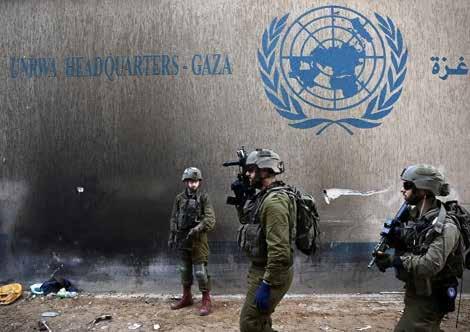
One thousand days after the October 7 Hamas massacre, Britain’s Jewish community has reacted with disbelief and anger to the UK Government’s decision to restore £23 million in funding to UNRWA. For many, the timing could hardly be more painful. As families continue to mourn the 1,200 people murdered by Hamas and pray for the return of the remaining hostages, the decision has reopened deep wounds and raised
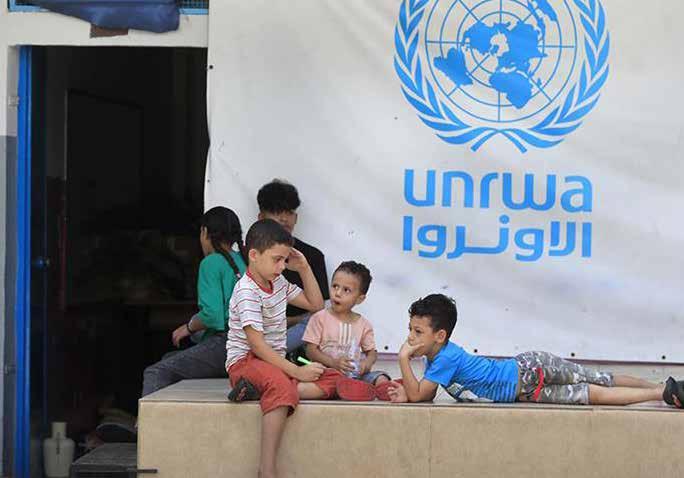
of UNRWA employees took part directly in the October 7 massacre. Further evidence has pointed to UNRWA staff allegedly assisting Hamas, while former hostages and Israeli intelligence have described terrorists using UNRWA facilities, with weapons and military infrastructure reportedly discovered beneath or close to schools and other UN buildings. Former hostages have also described being held in locations linked to UNRWAoperated facilities, while






Continued from page 1
Although UNRWA dismissed several employees and has announced reforms, many within the Jewish community believe the problems extend far beyond a handful of individuals. Critics argue that the organisation has failed to root out Hamas influence within its ranks and question how British taxpayers’ money can once again be channelled to an agency that has faced such serious allegations.
No one disputes the need for humanitarian aid for innocent Palestinian civilians. The question being asked by many British Jews is whether UNRWA is the appropriate organisation to receive that support. They argue that aid must reach those in genuine need without passing through institutions whose neutrality has been repeatedly called into question. The controversy comes as Israel and Jewish communities across the world marked 1,000 days since the darkest day in the country’s modern history.
Across Israel, memorial ceremonies, moments of silence and demonstrations remembered the 1,200 victims murdered by Hamas and renewed calls for the remaining hostages still being held in Gaza to be brought home. Families gathered to honour loved ones while continuing to demand that the international community does not forget those who remain in captivity.
For many Israelis, the milestone was not simply one of remembrance but also of frustration. There were renewed calls for accountability over the failures that allowed the attacks to happen, while hostage families once again pleaded for greater international pressure to secure the release of those still held by Hamas.
One thousand days may have passed, but for the victims’ families, survivors and much of the Jewish world, October 7 remains an open wound.
That reality is perhaps nowhere more powerfully conveyed than at London’s Nova Exhibition.
The immersive exhibition tells the story of the Nova music festival, where hundreds of young people had gathered to celebrate life before Hamas terrorists turned the event into one of the bloodiest scenes of the massacre. Through personal belongings, damaged vehicles, photographs, recovered artefacts and emotional testimony from survivors, visitors are confronted with the human stories behind the headlines.
Rather than simply presenting statistics, the exhibition gives faces and names to those whose lives were stolen. Visitors leave with a deeper understanding of the scale of the atrocities and the unimaginable trauma endured by survivors and bereaved families.
The exhibition has attracted thousands of visitors, including many from outside
the Jewish community, providing an important opportunity to combat misinformation and ensure the events of October 7 are neither denied nor forgotten.
That educational mission has become increasingly important as the world moves further away from the attacks. Many within the Jewish community feel that international attention has shifted almost entirely to Israel’s military response while the original massacre, the sexual violence committed by Hamas and the continuing plight of the hostages receive far less attention than they deserve.
The 1,000-day anniversary serves as a reminder that October 7 was not merely another chapter in the Middle East conflict. It fundamentally changed Israel, transformed Jewish life across the Diaspora and shattered any illusion that such atrocities belonged only to history.
The decision to restore funding to UNRWA has therefore struck a particularly raw nerve. For many Jews, it appears to symbolise a wider international willingness to move on before justice has been achieved, before every hostage has returned and before difficult questions surrounding organisations linked to Gaza have been fully answered.
Whether through the haunting testimony preserved at the Nova Exhibition, the continuing campaign to free the hostages or the fierce debate surrounding UNRWA, one message remains unmistakable.
One thousand days later, the Jewish people have not forgotten. They are still grieving, still demanding accountability and still determined that the truth of October 7 must never be erased.
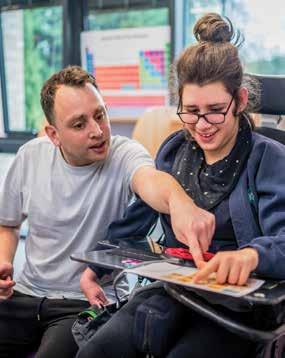
Kisharon Noé School has three exciting opportunities for a Deputy Headteacher (with Kodesh), SEN Class Teacher and Teaching Assistant to join their team in North West London.
These roles offer opportunities to work in a specialist SEND setting, supporting pupils with a wide range of additional needs to achieve their full potential academically, socially and emotionally.
Location: NW London Hours: Full Time
Closing date: 17 July 2026


P R O P E R T Y
M A N A G E M E N T








BY MARTIN KENT
A woman who launched an antisemitic attack outside a Jewish secondary school in north London has been convicted following a trial at Stratford Magistrates’ Court.
Syeda Khatun, 39, was found guilty of multiple racially aggravated offences after targeting Jewish children and parents outside the school on 10 May. The court heard that Khatun first shouted antisemitic abuse at a mother pushing a baby before turning her attention to pupils who had just returned from a school trip.
counts of racially aggravated assault, one count of racially aggravated assault occasioning actual bodily harm, and one count of using racially aggravated threatening or abusive words likely to cause harassment, alarm or distress.
The prosecution relied on eyewitness testimony and CCTV footage, with the Crown Prosecution Service authorising charges within 24 hours of receiving evidence from the Metropolitan Police.
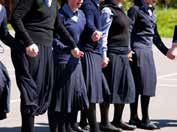
Witnesses said she aggressively swung her arms towards the children while continuing to hurl antisemitic insults. When the father of one of the pupils challenged her behaviour and asked why she was targeting children, Khatun struck him in the face, pulled his beard and continued shouting antisemitic abuse.
Magistrates found her guilty of three
Senior Crown Prosecutor Ragvesh Singh described the incident as a “shocking attack” in which Jewish children and families were deliberately targeted because of their faith. He said the successful prosecution demonstrated that hate crime would not be tolerated and that offenders would be brought before the courts.
Khatun is due to be sentenced later this month. The case has once again highlighted growing concern over rising levels of antisemitic incidents across the UK, particularly those directed at visibly Jewish communities and children.
If you’re over 55 and own your own home, you can unlock its value with a Lifetime Mortgage. NO monthly payments required NO income needed Turn your home into your golden years.




BY MARTIN KENT
Hundreds of thousands of mourners have taken part in funeral ceremonies for Iran’s former Supreme Leader, Ayatollah Ali Khamenei, in one of the largest public gatherings in the Islamic Republic’s history. The multi-day procession, which began in Tehran and passed through the holy city of Qom, has now moved into Iraq, where thousands gathered in Najaf before continuing to Karbala ahead of Khamenei’s final burial in Mashhad. Crowds lined the streets carrying Iranian flags and portraits of Khamenei while chanting anti-Israel and anti-American slogans. Senior Iranian government officials, Revolutionary Guard commanders and leading Shiite clerics joined the ceremonies, describing the late leader as a symbol of resistance and vowing to
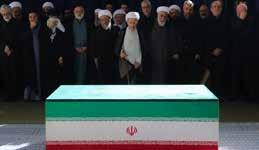
continue his legacy.
Security has been exceptionally tight throughout Iran and Iraq, with thousands of police and military personnel deployed along the funeral route. Iraqi authorities have also increased security around the holy shrines as pilgrims and mourners continue to arrive from across the region.
The funeral has become more than a religious event, with Iran’s leadership using the occasion to demonstrate unity and resilience following months of conflict and regional instability. The procession through Iraq’s most sacred Shiite cities also highlights Tehran’s close ties with influential Iraqi political and religious groups.
Supporters say the huge turnout reflects enduring loyalty to the Islamic Republic and its leadership, while critics argue the carefully organised ceremonies are intended to reinforce the regime’s authority during a sensitive period of political transition.
The funeral is expected to conclude with Khamenei’s burial at the Imam Reza shrine in Mashhad, ending several days of national mourning that have dominated events across Iran and much of the wider Middle East.










BY MARTIN KENT
A giant banner reading “Destroy Israel” has sparked outrage after it was unfurled during the opening of Spain’s famous San Fermín festival in Pamplona, best known for its annual Running of the Bulls.
The banner, which also showed an Israeli flag crossed out, was displayed above a packed crowd in the city’s main square as thousands gathered for the traditional start of the week-long celebrations. Footage of the scene quickly spread online, drawing condemnation from Jewish organisations and pro-Israel campaigners.
Critics said the slogan went far beyond legitimate criticism of Israeli government policy and amounted to a call for the destruction of the world’s only Jewish state. They warned that such language risks fuelling antisemitism and creating an intimidating atmosphere for Jewish visitors and residents.
Supporters of the protest said it was intended as an expression of solidarity with Palestinians amid the ongoing war in Gaza. However, opponents argued that
targeting Israel’s existence, rather than specific policies, crossed a dangerous line.
San Fermín is one of Spain’s most famous annual events, attracting hundreds of thousands of visitors from around the world. The controversy has raised fresh questions about the use of major cultural and sporting gatherings as platforms for political activism.
Jewish groups have urged organisers and public officials to condemn the banner, saying calls to “destroy” any nation should have no place at a public festival. The incident comes amid growing concern across Europe over antiIsrael rhetoric spilling into open hostility towards Jewish communities.

- 13th, 14th & 15th JULY

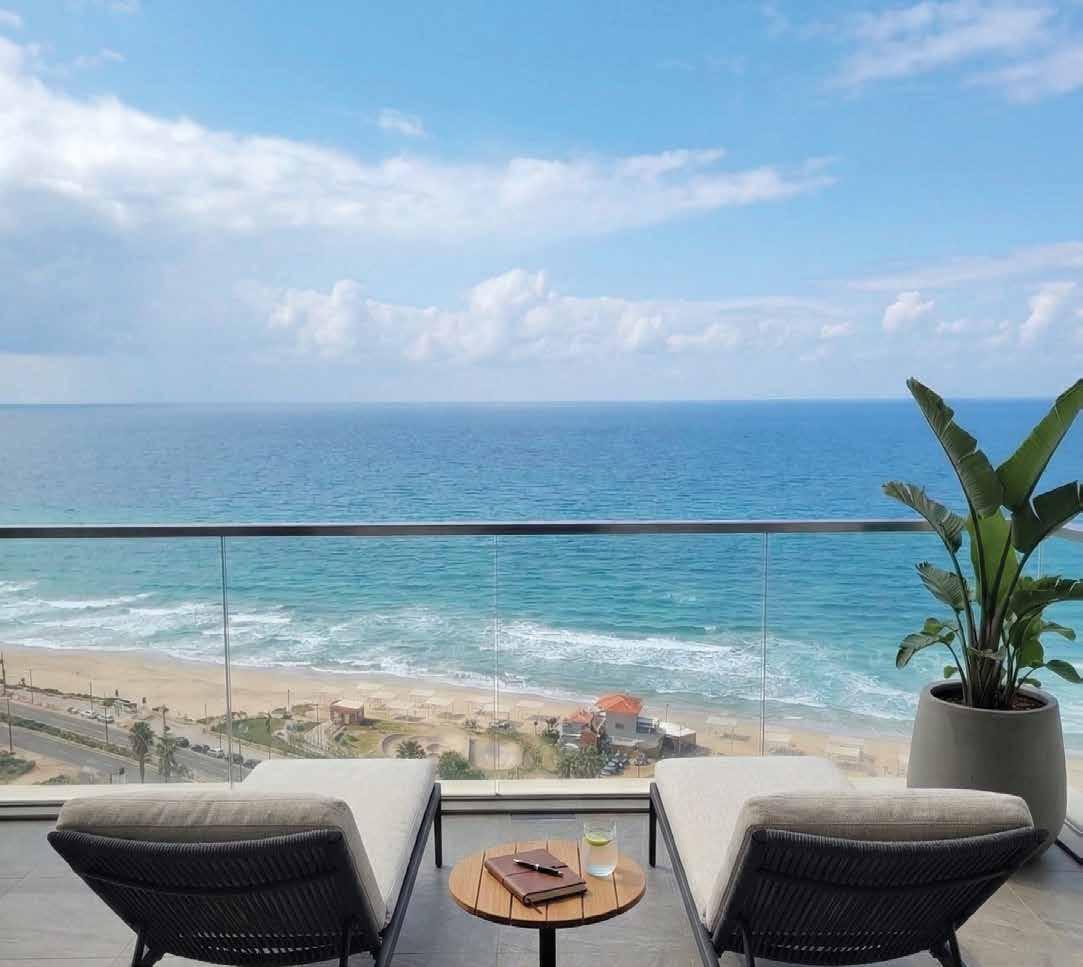
Whether you choose a cozy one-bedroom just for you, or a sprawling 2,700 sq ft Villa in the sky, your VIDA memories will last forever. Private Shul | Shabbat elevators | Infinity pool | State-of-the-art gym | His/Hers sauna | Community room Business lounge | 24 HR Doorman | Just steps from the sea
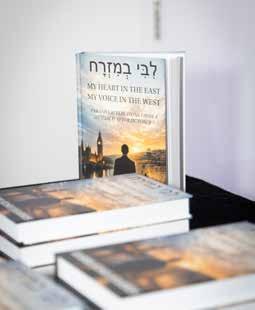
More than 150 people gathered on Sunday evening as Mizrachi UK hosted the launch of Libi B'Mizrach, a powerful new book by Rabbi Josh Harris, Community Rabbi of Kinloss (Finchley United Synagogue).
The event brought together members of the community to celebrate the publication of Rabbi Harris's collection of derashot, which chart the spiritual and emotional journey of the Jewish world following the atrocities of October 7 through the lens of the weekly Torah portion.
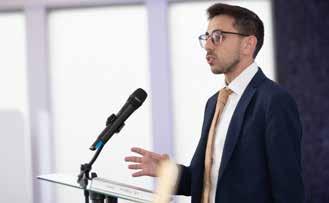
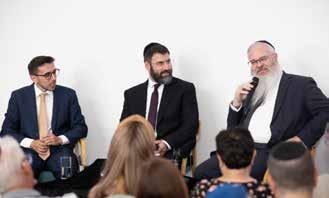
Following an introduction to the book, Rabbi Harris was joined in conversation by Rabbi Daniel Walker of Heaton Park Synagogue. Together, they explored the profound challenges of Jewish communal
leadership in the aftermath of October 7. Rabbi Harris reflected on how each week's parashah provided a framework for responding to the unfolding events in Israel, while Rabbi Walker shared his deeply personal experiences of the terror attack on Heaton Park Synagogue on Yom Kippur, describing the lead-up to the attack, the immediate aftermath, and the resilience of the community in the months since.
Born and raised in London, Rabbi Harris made aliyah in 2016, studying at Yeshivat Kerem B'Yavne before receiving semichah through the World Mizrachi Musmachim Programme. After seven years in Israel, he returned to the UK in 2023 as a Mizrachi UK Rabbinic Fellow to serve as Community Rabbi of Kinloss.
Addressing the audience, David Reuben, Executive Director of Mizrachi UK, reflected on the organisation's longstanding investment in developing the next generation of rabbinic leadership.
"Ten years ago, we launched the Mizrachi Fellowships Programme with a vision to identify, invest in and support
exceptional young rabbinic couples who would become the future spiritual leaders of Anglo Jewry. Rabbi Josh and Rebbetzen Tali are among the finest examples of that vision. Throughout their years at Kinloss and their contribution to the wider Jewish community, they have built relationships, inspired countless people and served as true shlichim—bridging communities, strengthening the bond between the Jewish people and Israel, and bringing the timeless values of Torah to life."
Jewish history.
The publication also features forewords by Chief Rabbi Sir Ephraim Mirvis and Rav Doron Perez, Executive Chairman of the World Mizrachi Movement, both of
In the introduction to Libi B'Mizrach, Rabbi Harris explains that he arrived in London just seven weeks before October 7, expecting to strengthen Jewish identity and deepen connections with Israel. Instead, the tragedy transformed both his rabbinic mission and the messages he shared each week from the bimah.
The book follows the Jewish community's journey from the shock and grief of October 7 through the challenges of war, the pain of the hostage crisis, rising antisemitism, and the resilience and hope that emerged in its wake. More than a collection of sermons, Libi B'Mizrach offers a moving reflection on what it has meant to live as a Jew in the Diaspora while remaining deeply connected to Israel during one of the most defining periods in modern
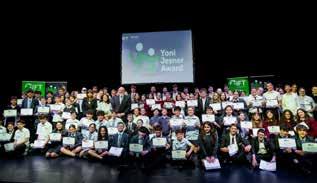
350 people gathered at Arts Depot in North Finchley for the annual Yoni Jesner Awards, organised by GIFT (Give It Forward Today) in conjunction with the Yoni Jesner Foundation.
Yoni Jesner was a remarkable student and youth leader whose life was tragically cut short in a suicide bombing in Tel Aviv in 2002, aged 19. In his 19 years he achieved more than most people achieve in 90. The awards were created by his family and they bear his name to ensure his spirit of selflessness and giving lives on, inspiring a new generation of young
people to do more and care more.
Students travelled from as far as Manchester and Brighton to take part, with 15 schools represented on the night. Every student celebrated had completed a minimum of 20 hours of volunteering, with many going further and achieving 50 or even 100 hours. There were 220 award completions and over 6,000 hours volunteered across a wide range of charities and community causes.
Yoni’s mother, Marsha Gladstone, opened the evening with a deeply moving address about Yoni and the remarkable legacy these awards have inspired. She urged the students in the room not to let this be the end of their volunteering journey, reminding them that the habits of giving they build now can shape who they become.
Chief Rabbi Sir Ephraim Mirvis spoke of how the family’s response to tragedy has never been one of anger or bitterness,
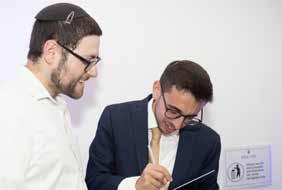
whom reflect on the significance of Rabbi Harris's work and the enduring bond between Torah, Israel and the Jewish people.
Copies of Libi B'Mizrach are available to purchase at www.mizrachi.org.uk/lb.
but one of inspiration. A conscious choice to take something devastating and turn it into something positive. The spirit of the evening, he said, was captured in a single phrase: “The joy of giving”.
A highlight of the evening was the presentation of the Yoni 1000 award, which recognises students who have gone above and beyond, not just completing their hours but making a lasting impact.
This year’s recipients were Kol Tov, a musical group who began their journey through the Yoni Jesner awards in 2012 as The Four Sons. Rather than stopping once they received their certificates, they continued and grew, eventually changing their name to Kol Tov, meaning ‘good voice’ and ‘all good’ in Hebrew, and raising over £100,000 for charity through music. The award was presented by Madam Mayor Zahra Berg, the Worshipful Mayor of Barnet. The group wowed the audience with an acapella performance. Performing on the night were Asher Levy, Noam Bernstein, Nathan Kelion, Gideon Caplan, Ben Caplan, Shimon Hurst, and
Yonah Citron.
The entire evening was down to the hard work of Barry Colman, GIFT’s High School Manager. As part of the programme, Yoni’s story has been shared with over 1,800 students, and inspiring lessons about Yoni and his life and legacy have been taught by Barry to students in year 8 at JFS, JCOSS, and Yavneh College. On the awards, Barry said “The atmosphere was one of pride, inspiration and excitement. These young people have given thousands of hours to support the vulnerable and strengthen our community, embodying the values Yoni Jesner lived by. It has been an enormous privilege to work alongside Marsha Gladstone, whose passion and commitment have ensured Yoni’s legacy continues to inspire a new generation.”
The next cohort of Yoni Jesner awards will be launched to students in year 8 in the 2026 Autumn term and plans for inspiring launches and classes are already underway. To find out more visit jgift.org/ yonijesner













BY REBBETZEN ANNA BERGSON
I wasn't going to share this upsetting antisemitic incident
I experienced last Shabbos afternoon in our usually peaceful Seaside kehilla of St Anne's but my husband happened to mention it during an interview on Love World TV and as the interviewer was shocked and the cat is out of the bag, so to speak, here goes...
So late last Shabbos afternoon my 12 year old son Naftali and I were enjoying a pleasant walk on the promenade. In fact there happened to be some sort of meeting for super cars (Ferrari's apparently) in the small car park near the Town Hall.
This was attracting quite a crowd of gawping passers-by with parents asking their children which was their favourite and people generally hanging around admiring.
Anybody who knows me will know that I am more ethereal minded so whilst these cars we not impressing me, I did 'go with the flow' and ask Naftali which was his favourite as we walked past.
Suddenly a woman, I would say in her 60's with her about 10 year old grandson in tow spotted me and Naftali, saw his kippah and called out 'Jew! Jew! There's Jews here, we're going!'.
I actually did not realise what she was saying, and thought I had mis-heard her.
We had decided to continue walking slowly down the Promenade to watch the sunset, making sure the lady was a good distance ahead of us. But she turned around and spotting us again started calling out 'Jew! There's Jews here, everybody leave! Move away there's Jews here, everybody move away!'
Now the penny had dropped and I could not believe what we were experiencing.
In fact, Naftali and I were whispering to each other 'Is she saying juice or Jews?' because we always want to give everybody the benefit of doubt and look for the good.
Sadly, she really was continuing to 'warn' everybody around (unfortunately it was quite quiet so nobody really paid her much attention) and I think she must have thought from her vile belief system she was doing a great public service.
I did make a mental note of which hotel
she walked into and considered following her and asking her politely if she would like to engage in a civilised conversation where I could perhaps educate her that our Torah values are universal based on respect and love for all mankind.
However, Naftali and I were so shocked we decided to stick to our original plan of watching the sunset.
The next day I told all our family and their response was to inform the CST.
Seeing as I always try to promote St Anne's as a beautiful sea-side resort to visit replete with a friendly shul, I felt loathe to inform them that inevitably antisemitism has reared it's ugly head on our shorelines...
Then again, if we do get plenty of Jewish visitors, especially as we are now in the summer season, and anything would happen to them, god forbid then it would be my duty to do the right thing to ensure the relevant data has been logged.
The CST took all the information and told me I must inform the Police.
The Police initially said they were sorry to hear about it and asked how my 'little one' is but they wouldn't really be looking to do anything about it.
However as the week has progressed I have had two phone calls back from the
Police saying they have now recorded a crime of public order offense and will be looking at the CCTV at the hotel I saw the lady enter.
As I am wating to hear any further information or updates, I just want to let you all know that in my opinion we must continue to go about our lives as normal, I will not be telling our boys to hide their kippot under caps - we respect the many Muslims on our streets who wear hijabs and burkas etc.
I hope this article one day reaches the Ignorant Lady who obviously thinks we Jews have some sort of disease and hope she can be open minded. I'd love to tell her that she'd unknowingly actually targeted the Rabbi's wife and son - and that she's hit the jackpot as our entire family see it is our special mission to spread light, love and peace!
In that vein, I thank her for giving me the chance to write this article where we can take an uncomfortable reality check but continue to stay strong and connected together.
With all my love and wishes for a peaceful Shabbos this week wherever you are!
Anna x

Nigel Farage has never been a conventional politician. Love him or loathe him, he has built his career on challenging the political establishment, saying what many others will not and appealing directly to voters rather than Westminster insiders. Yet the latest controversy surrounding his links to businessman George Cottrell once again raises an uncomfortable question that extends far beyond one politician: how much should character, judgement and the company we keep matter in public life?
For Britain’s Jewish community, that question has particular significance. Many Jewish voters have viewed Farage with increasing interest in recent years. His outspoken support for Israel following the October 7 atrocities, his repeated condemnation of antisemitism and his willingness to challenge antiIsrael rhetoric have earned him praise from sections of the community. At a time when many Jews felt politically homeless, Farage was one of the few senior politicians prepared to speak forcefully about Jewish security and Israel’s right to defend itself. That support should not simply
be dismissed. Friends of the Jewish community should be recognised when they stand with us, particularly during difficult times.
However, friendship does not mean abandoning scrutiny.
The latest questions surrounding George Cottrell are not primarily about Israel or the Jewish community. They concern judgement, transparency and accountability. Public figures inevitably attract wealthy supporters, advisers and donors, but they also carry the responsibility of ensuring those relationships can withstand public examination.
the people they choose to trust. None of this means guilt should be assumed before investigations are complete. Britain is rightly built upon the principle that allegations alone are not convictions. Every individual deserves fairness and due process, regardless of their political affiliation.

Jewish history perhaps makes us particularly sensitive to this issue. We know all too well the importance of integrity in leadership. Leaders are judged not only by the speeches they make but by the standards they set and
Farage has chosen to put his political future back into the hands of voters rather than waiting for Westminster processes to conclude. Whether one sees that as a principled act of accountability or a clever political calculation will largely depend on one’s existing view of the Reform UK leader.
For Jewish voters, however, there is a broader lesson.
Over recent years our community has learned not to place blind faith in any political party. Governments change. Leaders rise and fall. Today’s ally can become tomorrow’s disappointment, while yesterday’s critic may become an unexpected friend.
The Jewish community’s interests are ultimately best protected not by personalities but by principles: unwavering opposition to antisemitism, steadfast support for Israel’s security, religious freedom, strong community security and politicians whose conduct inspires confidence.
Where politicians champion those values, they deserve support. Where legitimate questions arise, they deserve scrutiny. The two are not mutually exclusive.
Perhaps that is the healthiest approach for any democratic society. Admire courage when it is shown. Welcome genuine friendship when it is offered. But never suspend critical judgement simply because a politician says things we want to hear.
As British politics continues to fragment and new political movements gain momentum, the Jewish community would do well to remember that our loyalty should never be to individuals alone. It should remain firmly rooted in values, integrity and the long-term wellbeing of our community.
In the end, politicians come and go. Principles endure.

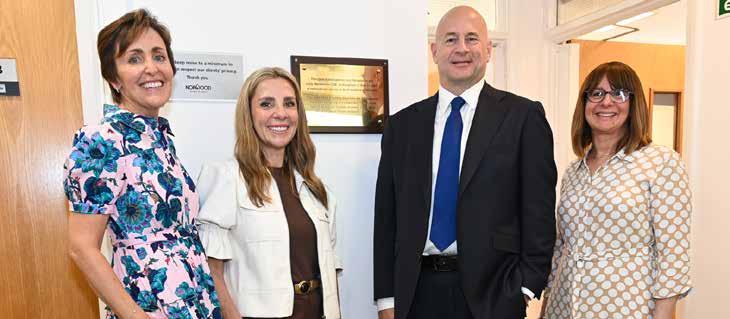
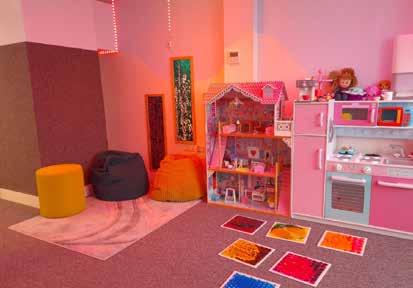
Norwood Trustees, senior leaders from the charity and guests gathered to mark the end of Lord and Lady Mendelsohn’s CBE 11 years of service as the charity’s co-Presidents, on Sunday 5th July, at the dedication of a room that hosts the new ‘We Connect Families’ service, at the Kennedy Leigh Centre in Hendon.
Paying tribute to their extraordinary contribution, Norwood Chair, Miles Webber, said:
“On behalf of the Board of Trustees, the people we support, their families, and Norwood’s staff and volunteers, I would like to thank Jon and Nicola for sharing their experience, passion and dedication with us throughout 11 years of outstanding service as Co-Presidents.
and families in need.”
Paying tribute to key achievements initiated by Lord and Lady Mendelsohn during their Presidency, Norwood’s Vice
Norwood’s extraordinary donors, volunteers and supporters, whose generosity, dedication and selflessness make this work possible every single day. Their
privilege of spending time with the people Norwood serves and their families. Their strength, resilience, warmth and spirit have inspired us beyond words. They have welcomed us into their lives, shared their journeys with us, and taught us more than we could ever have imagined.
We leave this role with immense gratitude, profound admiration, and memories that will stay with us always. It has been a privilege to walk alongside the people of Norwood, and we will be forever grateful for the opportunity to have been part of this extraordinary community.”
“With their support and guidance, Norwood has gone from strength to strength, building ever closer links with our supporters and the wider community. We are deeply grateful for their dedicated service and look forward to the next chapter in Norwood’s long and distinguished history.”
The dedication of the room that hosts the new We Connect Families service in honour of Lord and Lady Mendelsohn, is representative of the collaborative approach they championed in their roles. We Connect Families brings together 11 Jewish charities in the children and family support space, accessible through a single point of enquiry for Jewish families seeking support. We Connect Families is able to offer advice and guidance to any member of the Jewish community with questions or worries about parenting challenges, emotional wellbeing, SEND concerns or family relationships, enabling swift referrals to the most appropriate organisation that can support them.
Speaking of the significance of the dedication, Norwood Chief Executive Naomi Dickson said: “It couldn’t be more fitting than that our newest initiative, the We Connect Families service, a community initiative led by Norwood, should honour Lord and Lady Mendelsohn’s significant Presidency.
“Over 11 years of extraordinary service, their commitment to building closer links with our community inspired the partnership and collaboration that lies at the heart of We Connect Families, facilitating this essential service for Jewish children
Chair of Trustees Justine Harris said the couple would be remembered for “their interest in people and community”. Referencing Nicola Mendelsohn’s words when she opened up Norwood’s first smart home for adults with learning disabilities and said and spoke of Norwood creating homes “in the truest sense: a place for young adults to call their own, a place their proud of, a place where they have independence, a place where they are afforded opportunities comparable to other young adults who have left home”, Harris concluded: “I would like to thank you both for your vision for a Norwood where love, care and empathy are embedded into everything we do.”
At the event in their honour, Lord and Lady Mendelsohn had the opportunity to hear from service users whose families have benefitted from Norwood’s support for neurodivergent children and their families and people with learning disabilities, across a range of different life stages.
Speaking of their decision to step down from their honorary roles, Lord and Lady Mendelsohn said:
“It has been one of the greatest honours of our lives to serve together as Norwood’s Co-Presidents.
For almost 230 years, Norwood has embodied the very best of our community — a legacy built on compassion, service, and an unwavering commitment to supporting others. We have been deeply proud to play a small part in that remarkable story and to champion a charity that places kindness, respect, belonging and empowerment at the heart of everything it does.
Our heartfelt gratitude goes to
commitment is a powerful reminder of what can be achieved when a community comes together to care for one another.
Above all, we will forever treasure the
For further information, please contact Shari Ryness, PR and Communications Manager at Norwood. Email: shari. ryness@norwood.org.uk. Phone: 07512 616 417




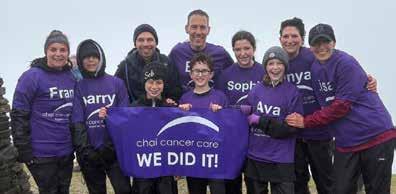
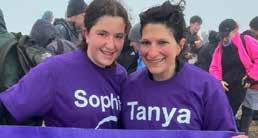
Five B'nei Mitzvah children and their parents took on an unforgettable adventure as they conquered both Blencathra and Helvellyn in the Lake District, raising £14,420 for Chai.
Over the course of the weekend, the group tackled two of the Lake District's most iconic peaks, encouraging one another across challenging terrain and celebrating every achievement together.
Seb Rose said: "I had a great weekend, a brilliant experience and so pleased I could raise money for an amazing cause in memory of my Uncle Dan."
Chai Cancer Care work the same way: their focus isn't the patient alone, but everyone travelling the journey with them - there to catch them at every fall. We chose Chai because the B'nei Mitzvah Challenge experience demonstrates to
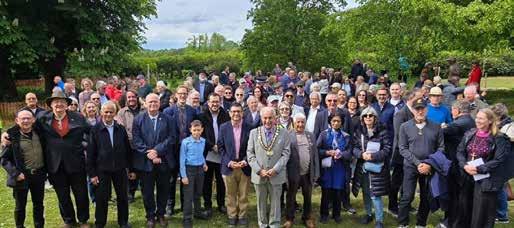
Watford United Synagogue held an interfaith vigil against antisemitism, which took place in Cassiobury Park Peace Garden and had 150 attendees. The vigil was organised by Watford Interfaith Association and was titled ‘Standing Together Against Antisemitism’.
For many parents, the challenge was about much more than reaching the summit.
Elli Morris, whose son Reuben took part, said: "The B'nei Mitzvah Challenge isn't the endurance-andself-achievement story most charity challenges are. We spent the weekend bonding as a group and then watched our children – in awe – scramble across cliff edges and ridges, then motivate each other (and their own struggling parents) through, celebrating only once the whole group made it.
our children exactly what it means to be a community: to experience highs and lows together, to feel affected when one person suffers, and to be there to catch them."
Harry Masser added: "The B'nei Mitzvah Challenge is incredible and it really is a challenge! If you're thinking of doing it next year, then I'd say to go for it 100 per cent. The leaders were amazing, the spirit was great and we all feel we massively accomplished something in addition to raising money for our charities. I'm proud to have done this for Chai."
The B'nei Mitzvah Challenge gives young people celebrating their Bar or Bat Mitzvah the opportunity to mark this important milestone by taking on a personal challenge while raising funds to support anyone in our community affected by a cancer diagnosis.
The next B'nei Mitzvah Challenge will take place from 2nd – 4th July 2027. If you would like to take on a challenge for Chai, please email talia.gordon@ chaicancercare.org to find out more.
There were a number of speeches from both religious and civic leaders, including Lord Lieutenant Robert Voss, Rabbi Mordechai Chalk of Watford Synagogue, MP Matt Turmaine, and Chief Inspector Dan Rainbird. All of the speakers lit a candle, and after attendees heard from them there was an opportunity to mingle and chat.
Asif Khan, speaking for the Watford mosques, said: “I believe deeply in the importance of standing together against hatred in all its forms. We gather here today to stand with the Jewish community and to say clearly
and without hesitation: antisemitism is wrong. It has no place in Watford, no place in our country, and no place in any civilised society. As Muslims, this solidarity comes from a very deep place within our faith and our shared history. To our Jewish community: You are valued, respected, and not alone. We stand beside you.”
Rabbi Mordechai Chalk said: “It was deeply moving to attend the Watford Interfaith Vigil, ‘Standing Together Against Antisemitism’. It was so heartening to see so many people give up part of their Sunday afternoon to stand in solidarity and support. The words of encouragement and unity from civic and faith leaders across the Watford community were both powerful and inspiring. Moments like these remind us of the strength that comes from communities standing together with respect, compassion, and friendship.”

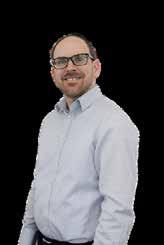
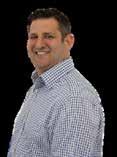
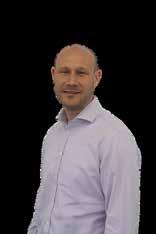







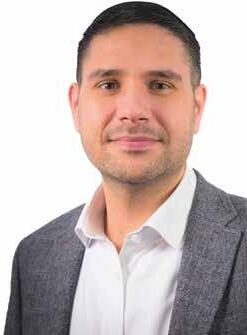
The Jewish Family Centre (JFC) is pleased to announce the appointment of Tamara Jacobson as its new Chief Executive Officer, marking the beginning of a new chapter for the charity in its 25th anniversary year.
Tamara joins the Jewish Family Centre from Noa Girls, where she has served as Director of Operations and People for the past four years. Prior to that, she was Head of Operations at Tribe, the United Synagogue's youth movement. She brings extensive leadership experience within the UK Jewish community, with a strong track record in organisational leadership, operational management and strategic development. Having worked across several leading Jewish communal organisations, she has a deep understanding of the needs of children, families and the wider community. Her appointment comes at a time when demand for the Centre's services continues to grow, with increasing numbers of children, parents and families turning to the charity for emotional, educational, financial and
practical support.
Founded 25 years ago by Sandy Weinbaum, the Jewish Family Centre has grown from a welcoming space for parents and children into the community's only holistic family contact and support centre. It provides counselling and therapy, family support, parenting guidance, advocacy with schools and statutory agencies, supervised contact visits and practical assistance under one roof.
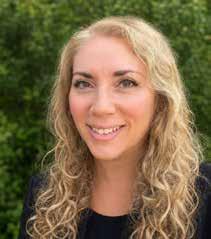
The Centre is also an Enhanced Accredited Contact Centre with the National Association of Child Contact Centres (NACCC), providing a safe, child focused environment where children from separated families can spend time with the parent they do not live with. This national accreditation reflects the Centre's commitment to the highest standards of safeguarding, care and support.
Today, the Centre plays a vital role in helping families through some of life's most difficult moments and building stronger, more hopeful futures.
Sandy Weinbaum, Founder and Honorary Director, said: "I am so proud to be handing over the leadership of the Jewish Family Centre to Tamara. She brings the experience, vision and compassion to lead the organisation into its next chapter and, with Hashem's help, I know the Centre will continue to flourish and grow".
Sandy added: "It has been an enormous privilege to build the Centre over the past 25 years, and I look to the future with great confidence, knowing it will continue to be there for every child and family who needs us. There is a reason that, once our clients find the Centre, they move forwards, not backwards.
I know that under Tamara's leadership, many more families will have the opportunity to do the same".
Tamara Jacobson said: "I have long admired the work of the Jewish Family Centre
and the difference it makes to so many children and families. It is a privilege to be joining the organisation at such an important time in its history and to build on the remarkable legacy Sandy has created over the past 25 years. I look forward to working with the Trustees, staff and volunteers to ensure the Centre continues to grow and respond to the changing needs of our community."
Tamara will take up the role from mid-September.
For more information about the Jewish Family Centre and its services, visit: https://jewishfamilycentre.org.uk or phone: 020 8209 1117
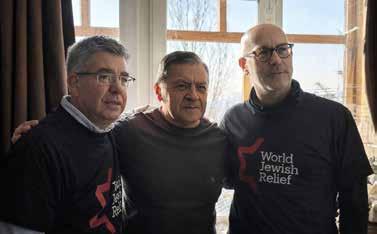
Across the 28th and 29th of June, World Jewish Relief launched a 36-hour fundraising campaign to raise vital funds for people facing war in Ukraine and Israel, raising over £540,000. The need for this support was highlighted overnight, as Kyiv was struck by hundreds of drones and ballistic missiles. At least 13 people were killed and 30 others injured,
and many Ukrainians spent the night sheltering from the strikes. A number of apartments and buildings have also been badly damaged. It is part of a broader escalation in the conflict.
Over 1,154 people donated to the campaign, helping the charity to provide further psychological support to thousands of Ukrainians and Israelis who are experiencing trauma through ongoing war and amid rising tensions.
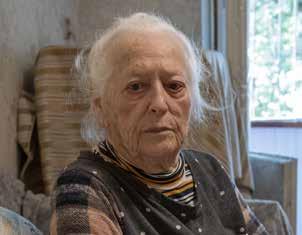
Alex Steen, a committed member of the Jewish community, former Scottish Regional Director of UJIA and former fundraiser for Jewish Care Scotland, raised a remarkable £45,000 and shared:
“I feel very proud and honoured to be one of the many ambassadors helping to raise vital funds for the superb work of World Jewish Relief. I feel very very sad and distressed to be raising money for trauma
counselling both in Ukraine and Israel, which is indeed a sad reflection of life in 2026. However, the empathy and solidarity from the community is both humbling and uplifting and also inspiring and an example to all.”
Alex was one of over other 100 ambassadors that included journalist and broadcaster, Emily Maitlis, alongside fellow The News Agents podcast host and journalist Jon Sopel.
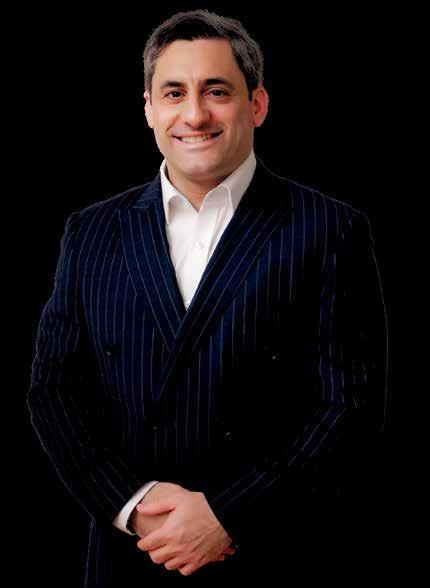
community’s support for people facing the horrors of war, and we know there is so much more to do.”
Paul Anticoni OBE, Chief Executive of World Jewish Relief, shared: “Last night’s attack brought yet more fear and trauma to Ukrainians who have faced almost four and a half years of war. Another night of sheltering, another night of anxiety. I am so proud of our
Since February 2022, the charity has supported over 400,000 Ukrainians across 389 towns and cities alongside their partners. In the UK, the charity has supported over 13,000 Ukrainians on their journey to learn English, find work and integrate into UK society.





Eleven leading Jewish charities came together to launch We Connect Families, a new community-wide service providing a single access point for Jewish families seeking support for children, young people and family life.
Created in response to growing demand for support and the increasingly complex challenges families face, We Connect Families makes it easier to find the right help at the right time. Led by Norwood and delivered in partnership with ten other trusted community organisations, the service brings together expertise from across the community, creating one clear route into support.
Rather than navigating multiple organisations to identify where to turn, parents or carers can access a pathway to support with just one call. We Connect Families advisors will listen, understand their circumstances and connect them to the most appropriate support.
The service supports families seeking guidance on a wide range of issues, including parenting challenges, emotional wellbeing, school or SEND
concerns, serious childhood illness, family relationships, and difficult life events such as illness or bereavement.
The We Connect Families partnership includes Norwood, Kisharon Langdon, Camp Simcha, Jami, Jewish Care’s mental health service, Jewish Women’s Aid, Jewish Family Centre, KEF Kids, Hand in Hand, Arts Therapies for Children, GIFT and Noa. Together, these organisations bring expertise across health, welfare, social care and community support.
The initiative represents a significant step forward in collaboration between Jewish charities, creating a more joinedup approach to family support. By working together, partner organisations are making the support landscape clearer and more accessible at a time when families' needs are becoming increasingly complex.
Naomi Dickson, Chief Executive of Norwood, said:
"We Connect Families was developed by community charities, for the community, in direct response to what
families told us. Many shared how confusing and overwhelming it can be to find the right support, particularly when they are already dealing with challenging circumstances.
"Our community is fortunate to have a wide range of outstanding organisations, but families told us they wanted a simpler way to access them. We Connect Families means families only need to reach out for support once. From there, we can help them find the right support quickly, confidently and with the benefit of a joined-up approach from across the community."
Daniel Gillis, Chief Executive of Camp Simcha added:
"We Connect Families is peoplefocused and driven by a shared purpose - serving the community's needs. By working in partnership and combining our expertise, our community organisations can offer a much better experience for families and stronger outcomes for the community as a whole.
“We Connect Families is a powerful example of what can happen when the
community works together - ensuring families can access the help they need when they need it.”
With just one call, families can share their story and be guided to the most appropriate support. We Connect Families advisors provide a listening ear, practical guidance and tailored signposting, helping families navigate challenges without having to work out for themselves which organisation to approach.
By creating one clear front door to a network of trusted charities, We Connect Families makes it easier for Jewish families to access support, reduces the burden of navigating multiple services and helps ensure they receive the right help at the right time.
Families can reach out by phone on 020 8264 6222, send an email to info@ weconnectfamilies.org.uk, or visit weconnectfamilies.org.uk for more information about the service and our partners, and to complete a web enquiry form

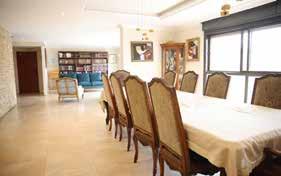
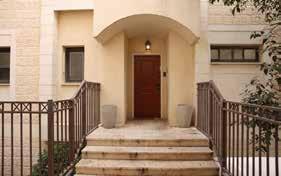

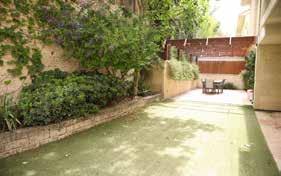




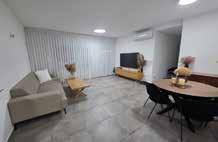
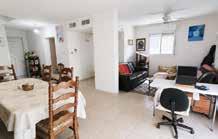
• Huge American style double sized house 10 bedrooms 600m of indoor space with 120m lush garden.
• Extra large salon and huge custom designed wood kitchen with pantry, large bedrooms, superbly designed.
• Located in a quality cul-de-sac modern orthodox neighborhood, a once in a lifetime opportunity.
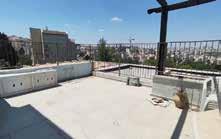

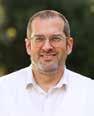


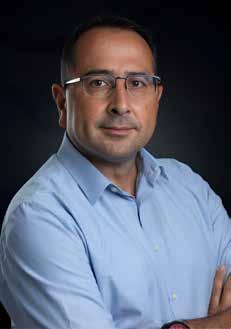
Jerusalem City Engineer, Eng. Yoel Even, outlines the ambitious plans reshaping Givat Hamatos, Derech Hevron and the renewed Talpiot district into one of the largest urban developments in Israel.
Anyone visiting the southern gateway to Jerusalem today cannot fail to notice the dozens of cranes dominating the skyline. Stretching from Givat Hamatos along Derech Hevron to the rapidly transforming Talpiot district, the area has become the city's largest concentration of construction activity, signalling one of the most significant urban renewal projects in Jerusalem's modern history.
Speaking to us, Jerusalem City Engineer Eng. Yoel Even described the development as nothing less than the creation of "a new city within Jerusalem."
Although Givat Hamatos has been discussed for many years, Even explains that the vision extends far beyond a single neighbourhood.
construction. Beyond it, existing neighbourhoods along Derech Hevron are undergoing extensive urban renewal through large-scale regeneration projects.
"The potential is already becoming reality," says Even. "Construction is well underway."
The numbers involved are remarkable.
The original Givat Hamatos neighbourhood will include approximately 1,500 new homes, while the adjacent "Derech Hevron Strip" development will add another 3,500 apartments, together with schools, childcare facilities, commercial space, offices, hotels and long-term rental housing.
"People often think only of Givat Hamatos itself," he says, "but we're really talking about the entire southern corridor linking Gilo, Derech Hevron, Talpiot and ultimately the city centre."
Unlike most of Jerusalem, where available land is extremely limited, the area around Givat Hamatos offers one of the last sizeable undeveloped sites suitable for major residential
Further north, additional mixeduse developments will contribute more than 1,500 further homes, while thousands more are planned through urban renewal projects stretching along both sides of Derech Hevron.
Meanwhile, the renewed Talpiot district alone is expected to deliver approximately 10,000 new residential units.
Taken together, the wider development corridor—from Talpiot through Derech Hevron to Givat Hamatos and Gilo—will ultimately create tens of thousands of new homes, accommodating an estimated 100,000 new residents.

"It's not simply another neighbourhood," Even explains. "We're effectively creating an entirely new urban centre in southern Jerusalem."
Perhaps the greatest concern for prospective
buyers is whether the city's infrastructure can support such dramatic growth.
According to Even, transportation has been central to every stage of the planning process.
The Blue Line of Jerusalem's expanding light rail network will run directly along Derech Hevron, linking Givat Hamatos with the city centre before continuing north to Ramot. Additional Purple, Green and Techelet lines will intersect nearby, creating one of the country's most comprehensive public transport systems.
Longer-term plans include a direct underground connection from southern Jerusalem to Highway 16 and Highway 1, significantly reducing congestion and improving access to central Israel.
Even also revealed ambitious proposals to extend Jerusalem's heavy rail network underground from Yitzhak Navon Station through the city centre to the First Station complex, allowing residents seamless access to Israel's national rail network.
"Within a few years," he says, "people living here will have some of the best transport links anywhere in Jerusalem."
The project has attracted significant attention not only from Israelis but also from Jewish communities abroad.
Even recently attended a major real estate conference in New York, where he witnessed growing interest among international buyers considering aliyah or investing in Jerusalem.
"We're seeing enormous demand," he says. "Many Jewish families around the world are looking towards Israel, particularly given the rise in antisemitism. Jerusalem naturally remains the city they dream of living in."
He believes the combination of new housing, modern infrastructure and Jerusalem's unique spiritual significance makes the city particularly attractive to overseas purchasers.
Beyond the impressive scale of development lies a remarkable historical legacy.
The name Givat Hamatos commemorates a dramatic episode from the Six-Day War. During fierce fighting in 1967, Israeli Air Force pilot Lt. Dan Givon was hit by Jordanian anti-aircraft fire. Refusing to eject while flying above populated areas, he steered his damaged aircraft towards an empty hill before crashing, sacrificing himself to protect civilians below.
Today, that once-empty hill is being transformed into a thriving residential
community.
"It's a moving closing of the circle," says Even. "Particularly for families making aliyah, there's something deeply meaningful about building homes on land with such a powerful history."
Givat Hamatos also offers one of Jerusalem's most spectacular vantage points.
Residents will enjoy panoramic views stretching from the Judean Desert and the Dead Sea on one side to the Old City, Temple Mount, central Jerusalem and Gilo Forest on the other. Nearby landmarks include Mar Elias Monastery and the Herodium.
The area also sits alongside one of Jerusalem's most important archaeological discoveries: the ancient aqueduct that once carried water from the Hebron hills into the city thousands of years ago.
"People won't just be buying an apartment," Even says. "They'll be living on one of the most historic routes in Jerusalem."
Construction is progressing rapidly. The first Israel Land Authority projects are expected to welcome residents within the next one to two years, while work on the major Derech Hevron developments is due to begin shortly.
Perhaps the biggest milestone will arrive in 2028, when the Blue Line light rail is expected to become operational, connecting Givat Hamatos directly to Gilo, central Jerusalem and Ramot.
For Even, however, the project is about much more than bricks and mortar.
"Our long-term vision is for a Jerusalem that successfully combines renewal with preservation," he says. "We are modernising neighbourhoods built in the 1950s, 60s and 70s while carefully protecting Jerusalem's extraordinary history, archaeology and green spaces."
He concludes with a message for Jews around the world considering aliyah.
"Jerusalem is Israel's next great success story. It is the only city that brings together 3,000 years of history with one of the country's most advanced transport networks, outstanding education, expanding employment opportunities and an exceptional quality of life. If you're dreaming of making Jerusalem your home, there has never been a more exciting time to be part of its future."



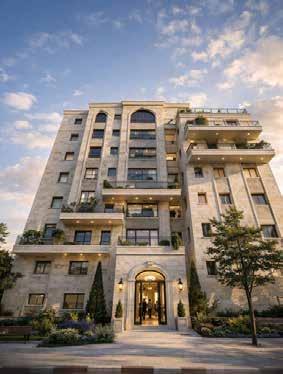
J E R U S A L E M
P r e s a l e s t a g e
R a m a t E s h k o l
L u x u r y n e w b u i l d i n g
O n l y 9 a p a r t m e n t s
O n t h e n e w l i g h t r a i l l i n e
R e a d y : 2 0 2 8
Starting Price:
₪ 3 , 4 3 2 , 0 0 0

B E I T S H E M E S H
R a m a t S h i l o
Gorgeous garden apartment
4 b e d r o o m s
B a l c o n y o f f t h e l i v i n g r o o m
O u t d o o r k i t c h e n
C o m p l e t e l y f u r n i s h e d
Asking Price:
₪ 5 , 5 0 0 , 0 0 0


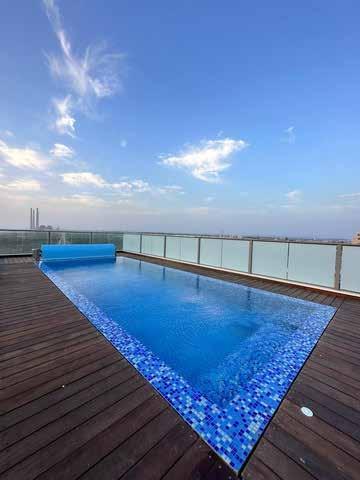
J E R U S A L E M
P r e s a l e s t a g e M e k o r C h a i m P r e s a l e s t a g e 2 , 3 & 4 b e d r o o m s a v a i l a b l e R e a d y : 2 0 2 8 P r i c e o n R e q u e s t

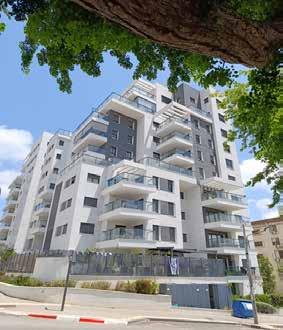
o s e t o E m e k R e f a i m
W a l k t o N i t z a n i m S h u l
Q u i e t r e s i d e n t i a l l o c a t i o n
P a r k i n g & s t o r a g e
V a r i e t y o f a p a r t m e n t l a y o u t s
Starting Price: ₪ 4 , 0 5 0 , 0 0 0
N
Asking Price:


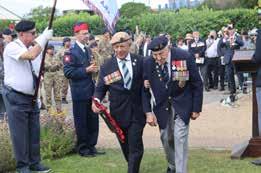
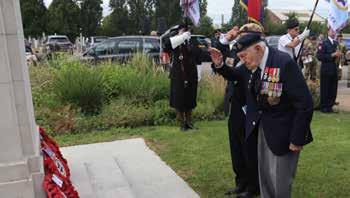
AJEX held its annual Service of Remembrance at the War Memorial in Willesden Jewish Cemetery, honouring the memory of more than 120,000 Jewish servicemen and women who served in the British Armed Forces in both World Wars, particularly those with no known grave.
This year's ceremony also marked the 90th anniversary of the Battle of Cable Street and the 110th anniversary of the Battle of the Somme, adding special significance to the Remembrance of those who served their country with courage and distinction, and those who stood against fascism in Britain and beyond.
Flight Lieutenant de Beck Spitzer, with the participation of community leaders, military representatives, cadets and descendants of those who served.
The service was led by AJEX National Chair Jon Tyler and Chaplain Rabbi
Wreaths were laid in memory of all Jewish servicemen and women, especially those with no known grave, by veterans Clive Boxer and Ivan Sugarman. A wreath was also laid by Fusilliers Major Mick McCarthy MBE and Major Paul Martin remembering all who have served in His Majesty's Armed Forces, while the Mayor of Barnet and Mayor of Brent jointly laid a wreath marking the 110th anniversary of the Battle of the Somme. The final wreath was laid by 101 year old
d-day veteran Mervyn Kersh along with Jon Tyler.
There were readings by Lord Alex Carlile KC CBE, AJEX Emeritus Chair Dan Fox, AJEX Honorary President, Mike Bluestone, Norman Grant, Ron Shelley MBE, Mei Sim Lai OBE, Lynne Kersh, Barbara Kober and Miriam Marson.
The ceremony then moved to the Commonwealth War Graves Plot, where Magen David markers were laid in remembrance by cadets
Many attendees continued to the adjacent Jewish Liberal Cemetery for further prayers led by Rabbi Nathan Godleman. Wreaths and poppy posies were laid at the memorial there.
Fiona Palmer, Chief Executive of AJEX, said: "Today we remembered not only those whose names are recorded on
memorials, but also the many Jewish servicemen and women who have no known grave. Their sacrifice must never be forgotten, and it is our duty to ensure their stories continue to be told for generations to come."
AJEX now looks ahead to its Annual Remembrance Parade on Sunday 15th November 2026, when the community will once again come together to honour the service and sacrifice of Jewish men and women in His Majesty's Armed Forces.
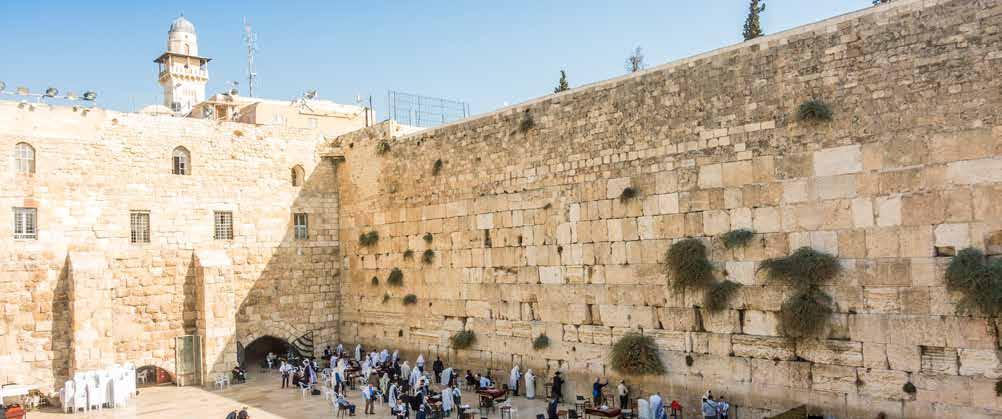
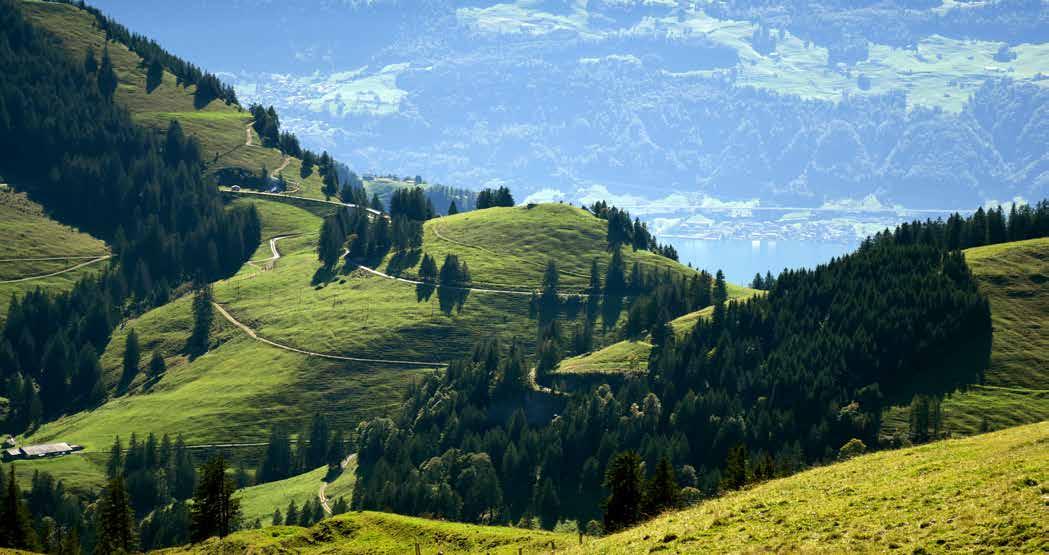
Imagine waking each morning to crisp mountain air, breathtaking panoramic views, emerald-green valleys, and crystalclear alpine lakes. Welcome to *Tignes*, one of the French Alps’ most spectacular destinations, where nature’s grandeur meets refined luxury in an unforgettable summer escape.
Nestled high in the heart of the Alps, Tignes is renowned for its dramatic mountain scenery, pristine landscapes, and endless opportunities for outdoor adventure. During the summer months, the region transforms into a paradise of wildflower-covered meadows, shimmering lakes, scenic hiking trails, and charming alpine villages. Whether you’re seeking peaceful relaxation or exhilarating adventure, Tignes offers an experience unlike anywhere else in Europe. Your home throughout this exceptional journey is the magnificent *Le Diamond Rock Hotel*—a world-class luxury retreat where contemporary elegance blends seamlessly with authentic alpine charm. Every detail has been thoughtfully designed to provide the highest levels of comfort and hospitality, allowing you to unwind in style after a day of exploration.
Enjoy beautifully appointed accommodations, exceptional service, an indulgent spa and wellness centre, an indoor pool, and outstanding facilities that make every moment a pleasure. With *Kosher Travelers, you can enjoy this extraordinary destination without compromising on your lifestyle. Throughout your stay, guests will be treated to **fully catered Glatt Mehadrin kosher cuisine*, prepared to the highest standards, allowing you to savour every meal with complete peace of mind. Our carefully curated program also includes a variety of *optional organised day trips and outdoor activities*, enabling you to experience the very best of the

French Alps at your own pace. Explore breathtaking mountain trails, picturesque lakes, scenic cable cars, charming villages, and unforgettable panoramic viewpoints. Whether you’re travelling as a couple, with friends, or as a family, every day presents a new opportunity to create lasting memories together.
The combination of premium accommodations and
seamless organization by Kosher Travelers, ensures a truly relaxing holiday from the moment you depart until you return home. Every aspect of the journey has been meticulously planned so you can simply relax, explore, and enjoy.
For more than three decades, Kosher
Travelers has been creating exceptional luxury kosher vacations around the world. Our reputation is built on outstanding service, meticulous attention to detail, and a commitment to providing enriching travel experiences in the world’s most spectacular destinations. This summer, discover the magic of the French Alps and experience a destination where luxury, nature, adventure, and kosher hospitality come together in perfect harmony.
*Reserve Your Place Today*
Availability is limited, and demand for this exclusive summer program is expected to be high. Don’t miss the opportunity to experience one of Europe’s most breathtaking alpine destinations with the comfort, quality, and personalized service that only *Kosher Travelers* can provide.
*Discover. Connect. Enrich.*
Join us in Tignes and create memories that will last a lifetime.




Have you ever felt overwhelmed by the constant stream of advice about what you should and shouldn’t be eating to maintain a healthy, balanced diet?
One week, we are told that carbohydrates are the enemy; the next, they are back on the menu. One week, saturated fats are something to avoid; the next, they are not so bad after all. Coffee is either a health hero or something to enjoy in moderation.
With nutrition advice constantly changing, is it any wonder many of us are unsure which dietary recommendations to follow? This new nutrition column will hopefully help make sense of the headlines and provide practical, evidence-based advice you can trust, helping you make healthier choices within a kosher lifestyle.
As a dietitian specialising in diabetes, I often meet patients
who feel overwhelmed by the sheer volume of conflicting nutrition information available. Many arrive at my clinics convinced that they need to cut out entire food groups or follow the latest dietary trend, only to discover that healthy eating is often far less complicated than the headlines suggest.
There is often a misconception that improving our diet means making drastic changes, forsaking our favourite foods or following strict rules that cost us in both money and time. In reality, it is often the small, consistent choices we make day after day that have the greatest impact on our long-term health.
With the Nine Days approaching and many of us sticking to mainly dairy menus, this is a good opportunity to think about how we can achieve balanced meals while avoiding meat and chicken. Many of us use cheese as our ‘go to’ but fish, eggs, beans, lentils, chickpeas, tofu, and some dairy products can all provide valuable sources of protein and can potentially be lower in fat too.
While cheese can certainly be included as part of a balanced diet, meals that rely too heavily on cheese or creamy sauces
can contribute more calories and fat to our meals than we may realise.
As an alternative, try to include a variety of the protein-rich foods listed above alongside plenty of vegetables, as well as wholegrain carbohydrates to help keep meals both satisfying and nutritious.
For example, a piece of grilled salmon served with Basmati rice and roasted vegetables or even a quick jacket potato topped with tuna and a side salad can make nutritious and satisfying healthy options.
By including a variety of different foods, we can ensure our meals are both enjoyable and nourishing throughout the Nine Days, without compromising our health.
Over the coming months, I will be exploring a range of further topics that are relevant to everyday Jewish life, from understanding food labels and managing blood sugar levels, to healthy tips on managing a Shul Kiddush.
I hope you will continue to join me on this journey as we explore nutrition together. If there’s a topic you would like covered or a nutrition question you have always wanted answered, I would love to hear from you.




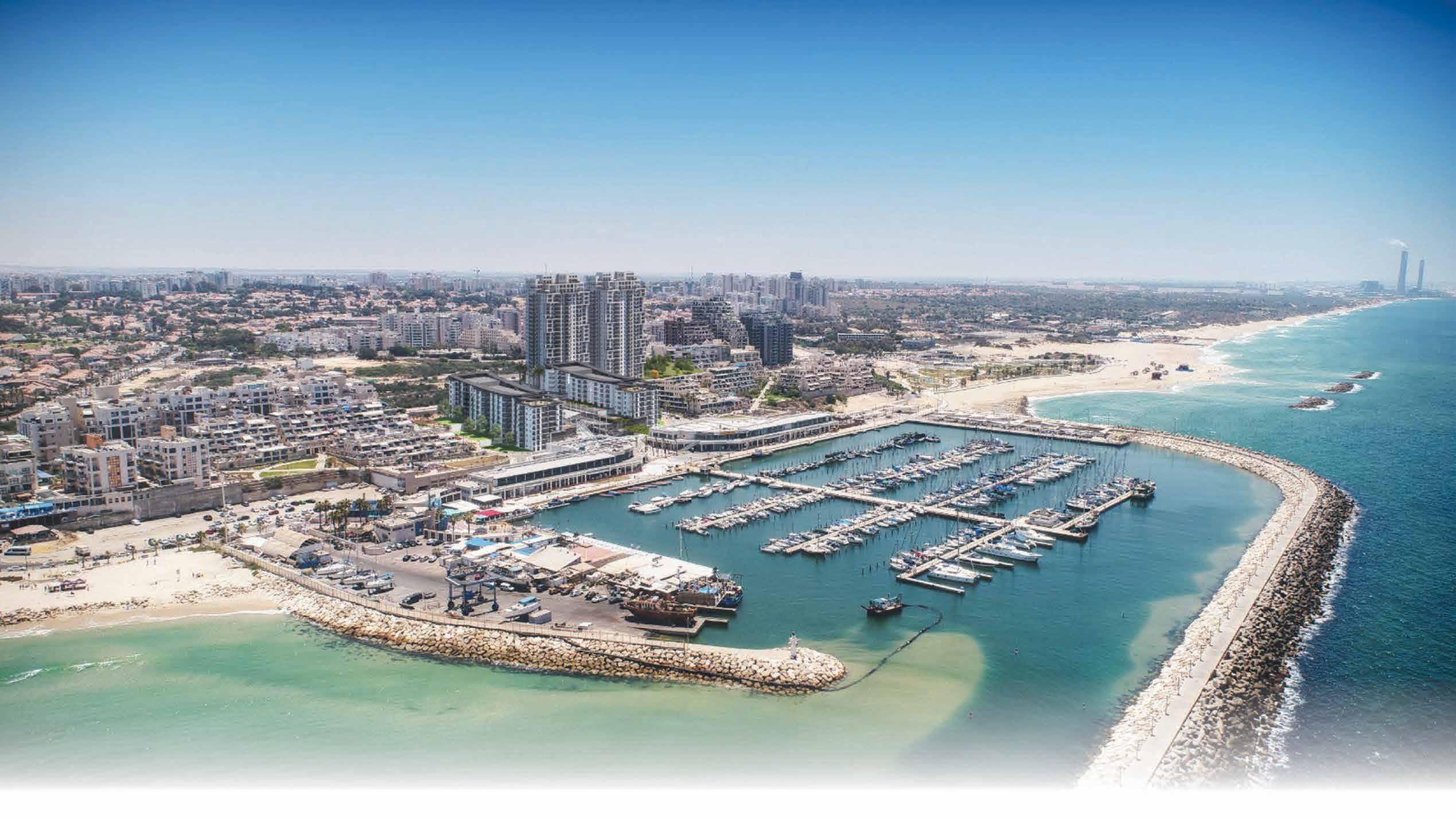
Smar t investoors have identified Ashkelon as the most promising area to buy proper ty now in Israel
Great sea view properties
• • • • • Slated to become the in Israel ocal University Garden city originally designed and built by South Africans! High speed trains linking the North to the South Golf course in the initial planning stages
Best t beaches in the countr y & lovely Marina 40 minutes to Tel Aviv and 60 minutes to Jerusalem
Growing vibrant Anglo community
Prices less than half of similar properties in Netanya!

• • • • 4th largest city L Contact us now for details! a s h k e l


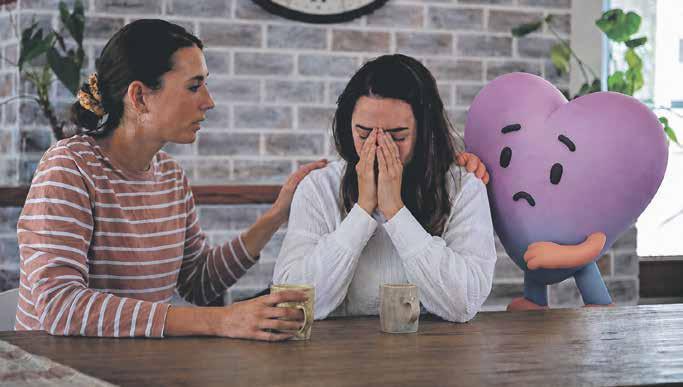
KNOWING HOW TO LOOK AFTER YOURSELF AND OTHERS GIVES YOU THE POWER TO PREVENT A CRISIS. Learn how to manage stress, understand wellbeing and mental health, and reach out to someone who’s struggling - because simple skills can change lives.
Special Session: ANTISEMITISM: Responding to Stress and Trauma WHAT
The
UNDERSTANDING MENTAL HEALTH CONDITIONS: Identifying and responding to common mental health issues
SELF-CARE AND STRESS MANAGEMENT:
Boost your wellbeing and reduce stress
PRACTICAL RELAXATION:
Master powerful techniques in 50 wonderful minutes REACHING OUT TO SOMEONE WHO’S STRUGGLING: How best to show concern and o er help


BY RABBI NAFTALI SCHIFF
One of the greatest gifts we possess, is the capacity to adapt. Without it, life would be unbearable. Every bereavement would remain as raw as the day it occurred. Every tragedy would imprison us forever. Every setback would rob us of hope.
Chazal recognised this extraordinary reality. Explaining why Yaakov Avinu refused to be comforted after Yosef disappeared, Rashi cites the Midrash:
(Rashi to Bereishit 37:35, citing Bereishit Rabbah 84:21.)
We have the capacity to “move on”.
Hashem implanted within us the ability gradually to recover from loss. Not because we should forget. But because we must live.
The Jewish people have relied upon an extra portion of such resilience for two thousand years. We have survived destruction, exile, expulsions, inquisitions, pogroms, the Holocaust, terrorism and relentless antisemitism. We have mourned whole communities and arisen to build new ones. We have rebuilt families from ashes. We have carried Torah across continents.
Resilience is one of the defining qualities of the Jewish people. However, resilience too, carries a hidden danger.
Adaptation can quietly become acceptance.
The abnormal begins to feel normal. The unbearable becomes bearable. The temporary starts to look permanent.
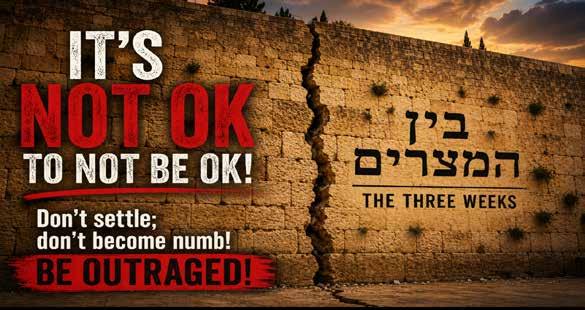
Every year we are reminded: No! It’s NOT OK.
It’s not OK that after almost two thousand years we still live a Jewish life that is fundamentally incomplete.
It’s NOT OK that Jews remain scattered across the four corners of the earth, dependent upon the goodwill of nations whose hospitality has so often proved painfully ephemeral.
It’s NOT OK that antisemitism in 2026 has become so commonplace that many Jews instinctively think twice before
Jew’s feelings, wellbeing or dignity.
It’s NOT OK that millions of Jews know little of the Torah that belongs to them, the heritage that is their birthright and the extraordinary calling that is their destiny.
It’s NOT OK that so many thoughtful Jews find significant parts of religious life inaccessible, alien or disconnected from the beauty and moral greatness that Torah is meant to radiate.
It’s NOT OK that we have become accustomed to a world without a Beit HaMikdash, without manifest connection
necessity of survival for the Jew. However, adapting to a perverted norm until it feels ordinary and acceptable — that’s NOT OK.
There’s a fine line between resilience and resignation.
Resilience is a virtue, but becoming acclimatised to a broken world is not. Adapting too well to a perverted norm is perilously close to surrendering to it. Accepting the unacceptable is how moral outrage quietly dies. We should be OUTRAGED at the state of our Peopleboth in Israel and the Diaspora. Because the greatest danger is not that we mourn too much, but that we stop mourning what ought to break our hearts.
displaying their Jewish identity in public.
It’s NOT OK that parents continue sending the best of their children into battle because there are still those committed to destroying the Jewish State.
It’s NOT OK that thousands of widows, bereaved parents and shattered families have become almost run of the mill headlines.
It’s NOT OK that so many of us have become so desensitised to our plight as a People bereft of its essence, that we struggle to recognise our own malaise.
that by birthright should be the very life and soul of our being.
It’s NOT OK that we have learned to live without the palpable presence of the Divine Shechinah.
It’s NOT OK that geulah and Mashiach have become abstract theological concepts instead of the daily longing of every Jewish heart.
The Three Weeks are our refusal to let us become too comfortable in the abnormality of exile.
Chazal teach:
“
That is one of the central messages we try to internalise over the Three Weeks.
The comfort of smooth adaptation is interrupted; our acquiescence to the normalisation of Diaspora living shaken; our acceptance of living in the ICU of healthy nationhood exploded.
It’s NOT OK that םניח תאנש, hatred and intolerance of the unlike fractures our people, today in 2026, perhaps more ominously than ever.
It’s simply NOT OK that suspicion so often replaces understanding and respect.
It’s NOT OK that we can be meticulous in our observance yet careless with another
The purpose of these weeks is not to make us miserable. It is to make us restless.
To remind us that survival is not the tikun olam for which we pray; that adaptation is not the same as fulfilment of mission; that resilience must never become resignation.
Even if we are not fully cognisant of the churban each moment, at least for one period in the year the Three Weeks interrupts our comfort and whispers into the soul of every Jew:
Don’t settle; don’t become numb; Don’t forget what we’re missing. Yes, be outraged; be unsettled; be agitated; be animated.
Because however successful, prosperous and secure Jewish life may sometimes appear…

”
(Ta’anit 26b). The mourning intensifies because our awareness is meant to deepen. We strip away, layer by layer, the emotional insulation that the rest of the year necessarily allows us to form.
This, not because resilience and adaptation are wrong. They are a tragic
It’s just NOT OK. In this column Rabbi Naftali Schiff reflects upon 3 key words each week relating to contemporary and relevant issues.
All feedback is welcome- nschiff@ jfutures.org.
Rabbi Schiff is the Founder & CEO of the Family of Jewish Futures networks of educational organisations.



BY RABBI SHAUL YONATAN TAWIL
What do you do when everything tilts against you— and you still hold the line?
The football World Cup in full play. A packed Azteca Stadium in Mexico. Deafening home crowd. A World Cup knockout match that swings from control to chaos in minutes. England strike twice, Mexico respond, a red card reduces England to ten men, and suddenly the game becomes survival under pressure. Every clearance matters. Every mistake feels fatal. And yet—somehow— England hold on: 3–2.
It feels like sport, but it also feels like something deeper: a test of discipline under collapse, where the real question is not who is stronger, but who can remain steady when everything destabilises.
That is exactly where Parashat Matot begins. Before wars, before national destiny unfolds, before conquest—Torah begins with speech: “If a man makes a vow to Hashem… he shall not break his word” (Bamidbar 30:3). Why open a parashah about nations, battles, and power with something as quiet as speech? Because the Torah is reframing what power actually is.
The Sforno explains that the warning is not only about breaking vows, but about something more subtle and more corrosive: cheapening your own speech. He explains that "ורבד לחי אל"(Bamidbar 30:3). means a person must never make his own words ordinary ("ןילוח"). When a person makes words casual, they turn something sacred into something disposable Speech is not just communication—it is identity. The way a person speaks shapes the kind of person they become. The Netziv adds another layer: a vow creates a self-imposed boundary, and that boundary is not a limitation but a form of freedom. Real autonomy is not doing everything you want, but choosing what you will not abandon even when desire pulls elsewhere (Bamidbar 30:3). Freedom, paradoxically, is structure you voluntarily accept.
Civilizations are built not on power but on trust, and trust is built on words that endure pressure. Speech, when honoured, becomes the architecture of society. When it collapses, so does moral order. That is why Torah begins here. Before you can hold a nation together, you must first hold your own words together. And then, immediately after this focus on vows, the Torah moves into war against Midian. The shift is not accidental. The message is that if you cannot govern yourself, you cannot govern anything else.
That is where the football match unexpectedly mirrors the Torah’s psychology of strength. When England went down to ten men, the match stopped being about talent and became about restraint. No space for indulgence. No room for ego. Every player had to operate within tighter boundaries, sharper discipline, clearer roles. The red card forced structure, but the real question was whether structure could hold under pressure.
This idea is captured well in Pirkei Avot: “Who is mighty? One who conquers his inclination” (Pirkei Avot 4:1). Might is not dominance over others—it is mastery over the self. Strength is not volume, but control. That idea sits underneath Matot entirely. Before Israel enters battle, the Torah insists on something counterintuitive: speech must be controlled first. If
words are unstable, action will be unstable. If promises are flexible, identity will be flexible. If commitment collapses internally, victory externally will not last.
In that sense, Matot is not about vows and war as separate themes— it is about the same discipline expressed at two levels. At the level of speech, “He shall not break his word” (Bamidbar 30:3). At the level of life, can a person remain consistent when pressure rises?
Suddenly the Azteca becomes a modern illustration of an ancient truth. A team reduced in numbers, a stadium pressing in, momentum shifting violently, every instinct pushing toward panic or collapse. And yet the game is held together— not by brilliance alone, but by discipline, structure, and the refusal to let emotion rewrite the plan in real time.
Pressure does not create character; it reveals whether character was built.
There is a moment like that in every life. When things shrink, when control narrows, when pressure rises faster than certainty, when instinct screams louder than principle. And in that moment, everything depends on what was built before the chaos arrived. Were your words trained to be reliable? Were your commitments trained to be real? Was your inner discipline trained to hold when it would be easier to fold? Because under pressure, you do not become someone new. You become what your speech has already made you.
That is the pulse of Matot: “If a man makes a vow to Hashem… he shall not break his word” (Bamidbar 30:3). Not because words are small, but because words are everything. Not because discipline limits life, but because discipline makes life hold together when everything else shakes. And not because victory belongs to the loudest moment, but because it belongs to the people who can still stand steady when the noise is at its highest, the numbers are















BY RABBI GIDEON GOLDWATER
I have just returned from Israel and it is impossible to ignore the tension in the air. It was there as we disembarked the plane, when a British woman began shouting at some chassidim, calling them leaches and screaming profanities, before anyone had even reached passport control. It is there in the language and slurs being hurled across the divide over army service and Torah learning, in the courts, in the media, and on the street. It is ugly, and it is ugly on both sides.
You might think that watching from the UK gives us a helpful outsider’s perspective. I have found the opposite. Distance does not soften what you see; it sharpens it. We all think we know what the problem is. What we struggle to find is a way of thinking about it that does not begin by declaring one side right and the other wrong. And if we cannot find that, what exactly are we saying about hundreds of thousands of our brothers and sisters, on whichever side we happen to have decided is the wrong one? That they are simply beyond the pale, not part of our family?
I want to suggest that many of us have not properly understood what has led us here. And there is a concept in halacha that, properly understood, changes the picture.
The Gemara speaks of a tinok shenishba, a child taken captive. Originally
this described a Jewish child kidnapped and raised under the influence of another religion. The halachic consequence is striking: such a person is not held responsible for failing to keep mitzvos, because they never had the chance to know better. Decades ago, this idea was extended to Jews who grew up without any Jewish education. They too “did not know better,” and they too could not be blamed for what they were never shown.
But I believe 2026 has produced a new kind of captivity, and it is not confined to the unaffiliated. It exists among the religious. This captivity is not a broken moral compass. It is something quieter: never having genuinely questioned, challenged or explored anything beyond the world one was raised in. Never having sat honestly with a perspective that feels foreign.
And what happens when two communities live side by side, and neither has ever seriously challenged their own comfortable positions? You do not need to imagine the answer. It is playing out on the streets of Israel and across the world’s screens, painting a bitter picture of our people at precisely the moment we can least afford it, in front of audiences already drowning in misinformation and only too ready to think the worst of Jews.
We are now entering the Three Weeks, the saddest stretch of the Jewish calendar, when we mourn a Temple that our Sages tell us was destroyed through baseless hatred. They add something more uncomfortable: any generation in which the Temple is not rebuilt is considered to have destroyed it again. That teaching has always felt abstract to me. This year it does not. Hatred between Jews is at boiling
point, and it is not cooling. I always wondered how and what could possibly lead to bloodshed between Jews. But this year, as painful as it is to say, I think I am beginning to understand.
So, what can be done?
Anyone who has encountered genuine narcissism in a workplace or a family knows the particular agony of it. From the outside, the problem is blindingly obvious. You find yourself asking, again and again, why can this person not see themselves? If only they could see what everyone else sees.
We are asking the same question of each other right now. Why can they not see themselves? But the honest answer is the one Rav Yisrael Salanter gave to those around him who dreamed of changing the world. Change your country first, he told them. And to change your country, change your city. To change your city, change your neighbourhood, then your family. And to change your family, you must begin with yourself.
Which brings the question home, where it belongs. The most important question of this moment is not whether they are children of captivity. It is whether I am. Have I ever genuinely challenged the comfort zone I grew up in? Have I sat with ideas, worldviews and ways of life that do not come naturally to me, not to defeat them, but to understand them?
Last week I merited to spend a few days back in the Jerusalem Kollel where I studied more than a decade ago, and heard Rav Asher Weiss put the challenge in the sharpest terms. Have we truly tried to feel the pain of those who have buried loved ones who fell defending the Jewish people, the guilt of those who lost friends, the
daily reality of those who lost limbs? And equally, have we tried to understand the depth of clarity and conviction of a young man prepared to sit in prison rather than surrender his right to learn Torah? Very few of us approach both sides with the same hunger to understand. Most of us extend our empathy in only one direction, and call it moral clarity.
My work in Aish brings this question to the forefront on a regular basis. We challenge our participants to explore world views, and ideas that they didn’t grow up with. But it is through this work, that me and my colleagues have been forced to explore these questions ourselves. Constantly reminded of the need to leave our comfort zones of thinking and push ourselves to find truth and humanity in others, even when we don’t see it easily. Perhaps that is the work of these Three Weeks. Not to solve a national crisis from our living rooms in London, which we cannot, but to do the one thing that is actually within our power: to step out of what is comfortable, to take one perspective we have always dismissed and sit with it seriously, and to make sure that whatever else we are, we are not children of captivity.
Rabbi Goldwater holds a BSc in Psychology and an MA in Jewish Education and spent two years living in Birmingham as the Aish Rabbi on Campus. He went on to direct Aish’s national Campus programme before taking on his current roles as Managing Director of both Aish UK and Jewish Futures. He has overseen the expansion of the teams and programming that are currently impacting over 20,000 young Jews across the UK.

Dear Rabbi
My son is turning thirteen while we’re living abroad. We’re moving back to England in a year, and we’d much rather celebrate his Bar Mitzvah with all the family then. Can we simply postpone it until he’s fifteen?
Josephine
Dear Josephine
You can postpone the party. You cannot postpone coming of age. A Bar Mitzvah is not something we make happen with bands, centrepieces and a dinner party. It happens automatically when a Jewish boy turns thirteen. From that day onwards he is obligated in mitzvot whether there are three hundred guests applauding or three pigeons watching from the roof.
By all means celebrate later if circumstances require it. But don’t miss the real milestone. Put on tefillin. Receive a call-up to the Torah in a local Synagogue wherever you are. Mark the occasion in whatever way you can. The cake can wait. Spiritual milestones can’t.
Dear Rabbi
I absolutely love a good steak. Every year the Nine Days arrive, and suddenly my barbecue goes into isolation. I understand mourning the Temple and the seriousness of the days, but does G-d really care whether I have a ribeye on Tuesday night? Surely, He has bigger things to worry about than what I eat at this time of year!
Carl
Dear Carl
First, my condolences. I realise this is a deeply emotional time for you. Somewhere in your freezer a lonely sirloin is wondering what it did wrong. You may be right that G-d has bigger things to worry about, but the question is whether we do.
The Nine Days are not a Divine campaign against brisket. They are Judaism’s way of reminding us that even when life is good, something is still missing. We deliberately make ourselves just a little less comfortable so that we don’t become too comfortable with a world that is still broken and in desperate need of salvation.
Think of it this way. If giving up steak for a week feels like a major crisis for you, imagine what it should feel like to have lived for nearly two thousand years without our holy Temple in our homeland Israel. Besides, if your greatest challenge during the nine days is choosing between salmon and schnitzel, your life is probably going rather well.
Dear Rabbi
Our shul used to be packed. Now people seem to have discovered a mysterious condition called a “lie-in.”
Everyone says, “I’m proudly Jewish, just not into shul.”
Why are so many people drifting away, and what can we actually do about it?
Dierdre
Dear Dierdre
You’re asking a question that keeps many Rabbis awake at night. The truth is that this isn’t just your shul. It has become the reality in many middle-ofthe-road synagogues across the Jewish world. COVID changed far more than our hygiene habits. During lockdown people discovered that if they missed a Shabbat in shul, lightning didn’t strike. For some, one missed week became two, then ten, and eventually a new routine was formed.
At the same time, we are competing in an age of endless distractions. Weekends are busier than ever. Sport, travel, family commitments and a hundred other attractions all compete for our attention. Shul is no longer the default destination it once was.
But that doesn’t mean the answer is simply to lament the past. Judaism has never survived by waiting behind a lectern hoping people will appear. It survives through relationships. A good sermon may inspire someone for an hour. A warm welcome, a meaningful conversation, or a genuine sense of belonging can bring someone back for years.
Perhaps we also need to ask ourselves
a difficult question. Are we giving people a reason to come beyond fulfilling an obligation? Does our shul offer not just a service, but an experience? Perhaps before asking why they don’t come to shul, each of us should ask ourselves whether we’ve reached out to someone who no longer does. After all, that is what kehillah is really all about.

BY RABBANIT SALLY MAYER
Parashat Masei records the death of Aharon HaKohen on Hor HaHar, offering an opportunity to reflect on who he was –and what it cost him to be that person. Hillel teaches in Pirkei Avot: “Be among the students of Aharon: love peace, pursue peace, love people, and bring them close to Torah.” It is a beautiful description, but what did it actually look like? Avot d’Rabbi Natan fills in the picture: Aharon would go back and forth between people in conflict, meeting privately with each one, softening resentment and removing jealousy from their hearts until reconciliation became possible. He did the same for husbands and wives. The Midrash notes that thousands of children in Am Yisrael were named Aharon because, had he not reunited their parents, those children would never have come into the world.
This quality defined him from the
beginning. The Midrash Tanchuma suggests that Moshe’s initial resistance to confronting Pharaoh stemmed from concern for Aharon. For eighty years, Aharon had served as the prophet of Bnei Yisrael in Egypt, and Moshe did not want to encroach on his brother’s role. Hashem reassures him that Aharon will not merely accept the change – he will rejoice in it.
“He will see you and be glad in his heart.”
Rabbi Shimon bar Yochai draws a direct connection between that inner joy and the urim v’tumim that later rested upon Aharon’s heart. The heart that rejoiced in another’s greatness became the heart that carried the word of Hashem. Yet this same quality – his humility, deference, and profound aversion to conflict – also lies at the center of chet haeigel. When the people demand a golden calf, Aharon cannot stop them. He delays, he attempts to redirect them, but ultimately he fails to prevent the sin. In Sefer Devarim, Moshe tells us that Hashem was
prepared to destroy Aharon because of that failure.
Moshe responds very differently. He descends the mountain, destroys the calf, rallies the Levi’im, and confronts the nation directly. Yet the contrast between the brothers is not as simple as strength versus softness. In Parashat Korach, Aharon runs into the midst of a deadly plague, standing between the living and the dead with the ketoret until the destruction stops. He loves the people deeply, and that very love saves them.
Aharon was not a lesser leader because of his gentleness; his gentleness was the source of his greatness. The Gemara in Ta’anit teaches that the Clouds of Glory accompanied Am Yisrael in his merit, and when he died, they disappeared. His presence itself was a form of shelter. The Midrash adds that all of Am Yisrael wept for him – men and women alike –whereas at Moshe’s death only the men are described as mourning. Aharon’s way
To get the best value from your private medical insurance, you should speak to an expert who is qualified to advise you on the right policy for you, and recommend the providers who offer the most competitive premiums.
This advice covers individual, family and company policies, and is always FREE.
As an independent health insurance expert, I work with the healthcare insurers to provide you with the appropriate and most affordable level of cover. So whether you have an existing policy or not, let’s have a chat.
You can contact me at 020 3146 3444 or 07956 244350 trevor.gee@patienthealth.co.uk
reached everyone.
Hillel understood this. Be among the students of Aharon – not despite his humility, but because of it. A person who is unconcerned with his own honor, who genuinely rejoices in the success of others, and who runs toward people rather than away from them can change the world quietly, one heart at a time. Such a person may not always succeed. At times, those very qualities may leave him vulnerable. But they are also the qualities that allow him to heal relationships, build communities, and bring people closer to one another – and to Hashem.
Rabbanit Sally Mayer serves as Rosh Midrasha at Ohr Torah Stone’s Midreshet Lindenbaum in Jerusalem. She is a member of the Mizrachi Speakers Bureau (www.mizrachi.org/speakers).

BY RABBI YAKOV SCHONBERG
Although scientists recognize the wild Asian jungle fowl as being the ancient ancestor of all modern chickens, that species had already been domesticated by the time of Moishe Rabbeinu. Even though the hen is not mentioned in the Torah, Nach mentions barburim served on the table of Shlomo HaMelech (Melachim I 5:3), which Rabbi Yochanan identified as chicken (Bava Metzia 86b).
The depiction of the hen on coins dating back to the first Beis HaMikdash and the ancient rooster mosaic, dating back over 2,000 years, look very similar to our heritage chicken. For thousands of years, chickens lived very different lives from those of today's commercial birds. They were small, active, and resourceful, spending much of the day scratching for seeds, insects, and vegetation. Growth was slow. A bird might take several months to reach a useful size for the table, and farmers generally kept dual-purpose chickens that supplied both meat and eggs. Throughout Europe, Asia, the Middle East, and Africa, numerous local breeds developed. Some were black, others white, brown, or speckled. Some excelled at laying eggs, while others produced more meat. Comb shapes, feather patterns, and body sizes varied enormously. Yet despite this diversity, nobody doubted that they were all domestic chickens. Their outward appearance differed considerably, but their essential identity remained unchanged.
In the 1860’s, there was a flurry of teshuvos concerning the importation of Cochin-China birds from the Far East into Eastern Europe. They were first imported into England in 1843 and then quickly spread across Europe. These birds were much larger than traditional European chickens, possessed feathered
legs, different combs, altered behavior, and distinctive voices. They arrived in Eretz Yisrael from the Island of Kivritz (identified as Cyprus) and became known as the “Kivritzer” bird. Whilst the Divrei Chaim refused to permit any new species without a known masores, he initially permitted the Kivritzer based primarily upon traditions from Tsfat and Jerusalem, although he later recommended further investigation. Indeed, he expended considerable effort and funds researching the situation in various countries and published no fewer than thirteen teshuvos on the subject (Orach Chaim 2:9, Yoreh De’ah 45-48, Even HaEzer 82, Choshen Mishpat 30:52, Likutim 42, Nosafos 7-9). Rabbi Yitzchak Meir Alter of Gur similarly relied upon trustworthy testimony from established communities, but authorities such as the Maharam Schick and the Beis Shlomo argued that even obvious chickens required an independent masores if they represented a distinct species. The Chasam Sofer, too, was consulted in the case of a cock without a clear masores that had mixed with a group of chickens of known pedigree. He ruled that since the offspring looked like the mother hen, it could be assumed that it was not from that cock (Yoreh De’ah 74). Rav Yosef Shaul Nathansohn permitted the imports since, in his view, the variations were minor and did not represent new species (Shoel Umeishiv 3:1 149, 5:1:9). He drew support from the Maharshal and the Pri Chadash, who ruled that where the three positive simanim are present, we can rely on the bird not being predatory. It is uncertain whether all the birds referred to in the poskim as kivritzer were, in fact, Cochin or another Asian chicken species. The Darchei Teshuvah (Yoreh De’ah 82) analyzed various responsa addressing the conflict of opinions regarding the permissibility of Cochin birds. He concludes that once the poskim observed successful hybridizations between the Cochin birds and other accepted breeds of chicken,
and knew that the offspring were fertile, they permitted the Cochin birds under the general masores of chicken. Meat birds used in the kosher market today were developed by hybridizing the Cochin chicken with regular chicken breeds.
The modern broiler is largely a creation of the twentieth century. Following the Second World War, demand for inexpensive poultry meat rose rapidly. Breeders responded by selecting birds that grew faster, converted feed more efficiently, and produced larger quantities of breast meat. A significant milestone came in the United States during the 1940s with the famous “Chicken of Tomorrow” competitions, which encouraged breeders to produce larger, meatier chickens for the expanding market. What followed was one of the most remarkable achievements in animal breeding. Generation after generation, breeders selected only those birds displaying the most desirable characteristics. No non-chicken species were introduced. Instead, naturally occurring traits within domestic chickens were progressively concentrated over many decades. Modern breeding companies refined this process even further. Rather than maintaining a single breed, they developed several specialized pedigree lines. Each line was selected for particular qualities - rapid growth, feed efficiency, fertility, skeletal strength, or breast yield - and these elite lines were crossed to produce the commercial broilers found throughout the world today. The

results have been extraordinary. A bird that once required four or five months to reach market weight can now do so in little more than five weeks while consuming proportionately less feed than its predecessors. This remarkable success, however, has not come without consequences. Today's broiler has been shaped almost exclusively for rapid growth and meat production. Its breast muscles are disproportionately large, while growth occurs so rapidly that the skeleton, heart, and lungs sometimes struggle to keep pace. We have previously discussed leg disorders that result in damaged tzumos hagidim (Daf Topics 269), while reduced mobility and the rapid spread of infectious diseases that require injections have become familiar challenges in modern poultry production. To many observers, these birds appear almost to be a new creation. Their proportions, behavior, and rate of growth differ so dramatically from the traditional farmyard chicken that comparisons between the two can be startling. Perhaps a classic example of chicken breeding might be the Roman fighting cocks. Roman historians describe how the sport of cockfighting was promoted by breeding specific strains of domesticated chickens for cockfighting. They did this by selectively breeding the cocks for aggression, courage, stamina, and powerful legs. This illustrates how extensive selective breeding can transform the appearance and physiology of the domestic chicken while remaining within the same species.
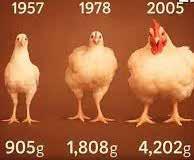
While the modern broiler's transformation appears to preserve its halachic status, recent developments raise a subtler question. What if changes extend beyond size or shape? What if a bird exhibits traits associated with non-kosher species? This issue surfaced after certain reports came to light concerning laying hens, particularly White Leghorn descendants. Unlike broilers bred for meat, Leghorns are selected for egg productionlighter, more active, with longer legs and feathers, producing over 300 eggs annually. Some reportedly perched with two toes forward and two backward, resembling predatory birds described by Chazal. Chullin 65a states that when there is uncertainty as to whether a bird is dores (claws its prey), we may stretch out a cord for
it and observe it perching. If it parts its toes with two toes forward and two backward, then we know it is non-kosher, as that is a sure sign it is dores. If it positions three toes forward and one backward, then it may be kosher. If the reported perching was true, this could imply these birds developed features linked to forbidden species. Initially alarming, closer examination revealed a more complex situation. Rav Chizkiyahu Cohen first publicized this phenomenon in his three-volume work, Avnei Chen. (Though rare to find, I bought my copy directly from the author during his visit to London nearly 25 years ago, when he showed video clips illustrating the birds’ problematic perch.) He emphasizes that casual observation is insufficient, as chickens frequently adjust their foot positions based on perch conditions, and even kosher chickens do this. Rav Amitai Ben David noted that the imbalance of the heavy weight of these birds could account for their stance. When Rav Chaim Loike conducted experiments in America,
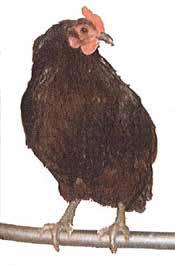
the Leghorn chickens he purchased from the meat market all perched on a pole with their toes in the two-two formation. Rav Loike’s further research revealed that the indoor confinement systems used to raise these overweight broilers caused continuous deterioration of their leg and foot health, and mistreatment of birds during transit, which injured their toes, explained why they perched irregularly. This revelation counters allegations that their problematic perching stance evidenced the bird’s tainted pedigree. Only a healthy bird whose natural, consistent stance resembles that of predatory birds raises a genuine halachic concern.
The Leghorn episode also highlights another often-overlooked feature of modern poultry production. There is no longer a single commercial “chicken.” Modern breeding companies maintain numerous highly specialized breeding lines, each selected for different purposes. Broilers have been bred
almost exclusively for meat production, while laying hens have been selected for egg production. Even within the White Leghorn itself, there are multiple commercial strains, each with its own genetic characteristics. For example, one of the characteristics sought in the selective breeding of the Leghorn was a reduction in the incidence of blood and protein spots in eggs. Whilst brown eggs often have an incidence of 20%, it is rare to find them in the improved Leghorn’s white eggs we buy nowadays. As a general principle, birds that clearly resemble chicken, behave like chicken, and breed successfully with accepted chicken have generally been included within the traditional permissibility of the domestic chicken.
Up to this point, all the changes we have considered have arisen through selective breeding - the patient selection of desirable traits already present within the domestic chicken. But modern biotechnology is beginning to offer possibilities that previous generations could scarcely have imagined. Gene editing and genetic engineering raise a fundamentally different set of questions. Instead of selecting characteristics already present within a species, scientists may be able to alter the genetic
code directly, potentially introducing traits that could never have arisen through conventional breeding alone. Many people confuse genetic selection, which does not involve alteration of genes and has been practiced for thousands of years, with the cutting-edge technology of genetic modification. To date, no genetic modifications have been performed on chickens outside the laboratory; therefore, no genetically modified chickens have entered the food market, though that may happen in the future. We can look forward to discussing the implications of genetically modified food in connection with crossbreeding discussed on Chullin 79a. In conclusion, one can be assured that if one buys poultry with a quality hechsher, the kashrus authority will have ensured that the shechitah is confined to acceptable chicken species.
To contact Rabbi Schonberg, please email, yschonberg@gmail.com
To find out more, you can sign up at mercazdafyomi.com and receive a free gemoroh.

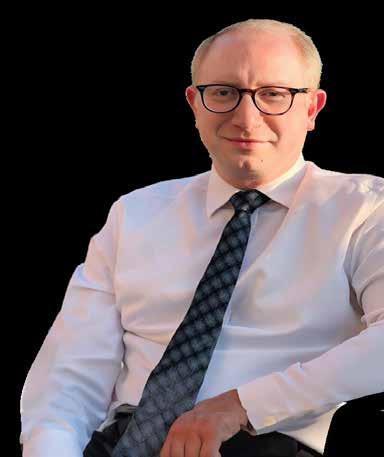

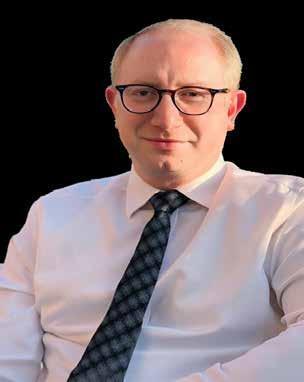

Parashat Matot–Masei brings the Book of Bamidbar to a close by looking both backwards and forwards. As the Jewish people stand on the banks of the Jordan River, they reflect on the extraordinary journey that has brought them to the threshold of the Promised Land, while preparing for the responsibilities that lie ahead. One of the most striking sections of the parashah is the detailed list of the forty-two journeys the Israelites travelled during their forty years in the wilderness. At first glance, it
seems repetitive. Why record every stop? Rashi, quoting the Midrash, explains that it is like a parent looking back over a difficult journey with a beloved child, recalling each stage with care and compassion. Every stop, even those marked by struggle or failure, formed part of the nation’s growth.
The parashah also highlights the importance of responsibility. The tribes of Reuven and Gad are permitted to settle east of the Jordan, but only after committing themselves to fight alongside
The goal of a word wheel puzzle is to create as many words possible with the letters in the word wheel. Each word must contain at least three letters. You can only use each letter once and every word must have the letter in the centre of the wheel.
their fellow Jews until everyone has inherited their portion of the land. Their story reminds us that our personal aspirations should never come at the expense of our communal obligations. Life is much the same. We often focus only on our destination, forgetting that the experiences along the way shape the people we become. The challenges we face, the detours we encounter and the people who accompany us all play a role in our personal and spiritual development.
As we conclude Sefer Bamidbar, Matot–Masei encourages us to look back with gratitude, forward with hope, and to recognise that every stage of our journey has meaning. With faith, responsibility and a shared commitment to one another, we prepare ourselves to enter the next chapter with confidence and purpose.
At the end of the school year, Jeremy proudly showed his dad his school report. His dad looked it over. He looked with intent, made sure to read every word and said, “Well, at least one thing is improving.” Jeremy smiled. “Really? My maths? My Geography?”
His dad replied, “No... your teacher’s handwriting!”
This unique twist on the classic Sudoku puzzle uses the Hebrew letters א through ט instead of numbers 1–9. The rules remain exactly the same: each row, each column, and each 3×3 box must contain every letter once — without repetition. החלצהב — and enjoy the puzzle!

Q: How did the picture end up in prison?
A: It was framed!
Q: What did the cop say to his belly button?
A: You're under a vest!
Q: Why did the frog take the bus to work?
A: His car had been toad away!
Forgive and Forget


1. Three frogs are sitting on a log. One decides to jump off. How many are left?
1. Three. The frog made a decision to jump off the log but took no action.
Answers





MDA UK supporters have once again gone above and beyond, raising vital funds through challenge events in support of Israel's national emergency service. Whether running, walking or playing padel, every participant played a part in supporting Magen David Adom's lifesaving work.
Our Manchester Padel Tournament saw 80 people compete, raising £21,750 towards a Magen David Adom motorbike.
Congratulations to padel winners Emma AveryGee, Sara Furnival, James Lindemann, Mike Filson and everyone who took part.
We also congratulate and thank our London Marathon runners, Ollie, Adam, Ricki and Zac, who raised £18,500, as well as everyone who took part in the MDA Fun Run and Lake District Challenge.
If you want to rise to the challenge and support MDA, visit mdauk.org/challenges for inspiration.
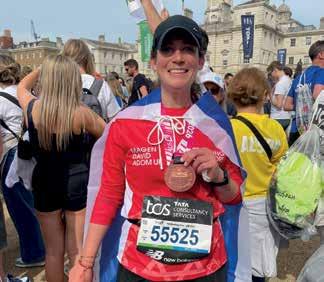



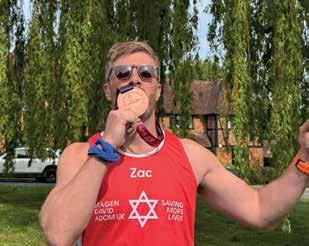

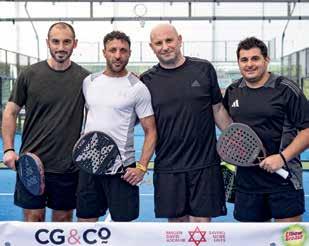
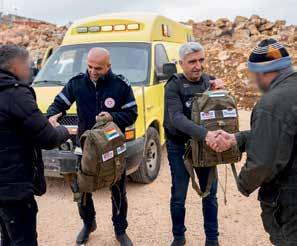
UK has supported the transfer of five decommissioned ambulances to assist Christian and Druze communities in southern Syria, in a humanitarian initiative developed in partnership with the International Fellowship of Christians and Jews.

The ambulances, formerly in service with MDA Israel, were refurbished and equipped with medical kits before being handed over to local emergency teams. MDA paramedics also provided hands-on training to Syrian responders to ensure the vehicles can be used effectively in life-saving situations.

The initiative reflects a long-standing commitment to standing with communities on Israel’s border who have shared the burden of living in a volatile region, and who have paid a heavy price for their identity and faith. It forms part of wider efforts to strengthen emergency medical response capacity in some of the most vulnerable areas of the region.













Thanks to the generosity of our supporters, a Mobile Intensive Care Unit and two First Responder Cars were dedicated, helping Magen David Adom continue its lifesaving work across Israel.
@Magen David Adom UK @mda_uk
Scan to donate
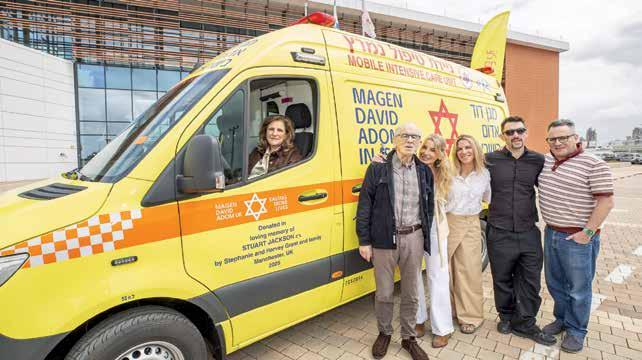

Magen David Adom UK was delighted to celebrate the 20th anniversary of Christian Friends of Magen David Adom UK (CFMDA UK) this year.
Founded in 2006, CFMDA UK has donated more than £1 million in support of Israel’s national emergency service, funding 12 Ambulances, Medicycles, a Bloodmobile and other lifesaving projects that have made an immeasurable difference across Israel.
MDA UK extends its deepest thanks to the Christian Friends, particularly Barbara Dingle and Reverend Mark Madeley, for their unwavering commitment and friendship, and looks forward to many more years of shared purpose and support for Israel.
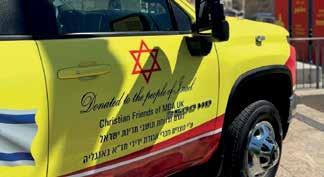
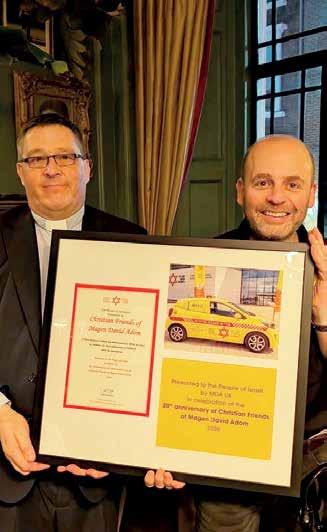
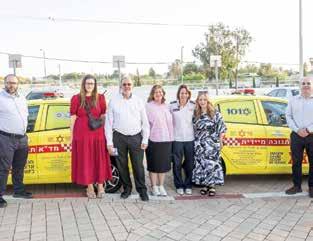


As missile sirens sounded across Israel on 28th February 2026, Magen David Adom teams responded immediately. MDA activated emergency protocols, with ambulances and intensive care units deployed across the country. During the Iranian missile attacks, MDA teams provided medical treatment to more than 2,390 people, with paramedics and volunteers treating the injured, delivering urgent care at the scene and transporting patients to hospital, while continuing to operate under threat.