Support our local Jewish community www.jca.org.au/donate
FREE VOL. 114 19 November 2024 // 19 18 Elul Cheshvan FREE VOL.Tuesday, 135 Tuesday, 1 Sept 2026 5786 5785
Fostering a closerJewish Jewishcommunity community Fostering a closer
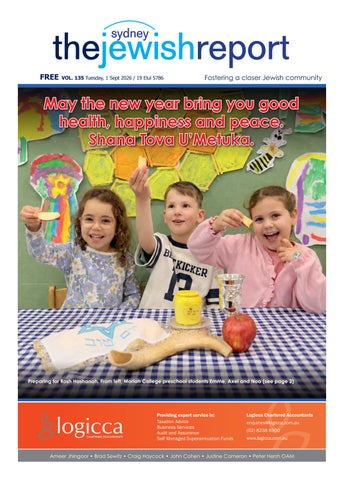
May the new year bring you good Kosher health, happiness and peace. FeatureShana Tova U’Metuka.
JDC (The Joint) Australia hosted a “We Sing As One, Jointly For Israel” concert at Kehillat Kadimah KING CHARLES Preparing for RoshIII Hashanah.PROTECTING From left, Moriah College preschool students Emme, Axel and Noa BEEN AROUND UIA(see page 2) synagogue (see page 8) CORONATION JEWS THE WORLD MISSIONS
Ameer Jhingoor • Brad Sewitz • Craig Haycock • John Cohen • Justine Cameron • Peter Hersh Ameer Jhingoor • Brad Sewitz • Craig Haycock • John Cohen • Justine Cameron • Peter Hersh OAM
2
the sydney jewish report | sept 2026
A RO UND
T H E
COMMUNITY
A shared vision for wellbeing
MORIAH COLLEGE Moriah College is taking a closer look at the many ways students are supported throughout their school years, building on what already works and exploring where its approach to wellbeing can be further strengthened. Student wellbeing has never been more important, as schools respond to increasingly complex mental health needs, the influence of technology and social media, and a growing understanding of how young people learn and thrive. Moriah is one of a select group of schools taking part in the Independent Schools NSW whole-school wellbeing initiative, a program combining research, professional learning and expert consultancy to help schools review and strengthen their approach to student wellbeing. An eight-member team from Moriah's Primary and High Schools is taking a close look at current practice, asking what works, what could work better and where there are opportunities to build stronger connections over time. "We're doing lots of really good things already," said High School Head of Student Life, Sue Foxcroft. "This gives us the chance to ask: What should we stop? What should we start? What should we keep doing because
From left, Moriah College Year 2 students Camilla, Evie and Libi it's making a real difference?" Classroom practice, student support, transitions, leadership opportunities and social and emotional learning are all part of that conversation. The team is also exploring evidence-based approaches that encourage teachers to look beyond behaviour and consider what might be happening beneath the surface, while maintaining clear expectations and boundaries. In Moriah's Primary School, wellbeing is already part of the rhythm of the school day.
Students explicitly learn how to recognise and regulate emotions, navigate friendships, solve problems and make thoughtful choices. They then have opportunities to put those skills into practice every day. Morning meetings build connection and belonging. Calm spaces and co-regulation strategies help children manage emotions, while buddy programs and leadership opportunities build confidence, empathy and responsibility. Jewish values are woven through these experiences, with kindness, respect,
responsibility, commitment and integrity lived through relationships, chesed initiatives and opportunities for students to contribute to those around them. "Wellbeing isn't a program we deliver or a lesson we teach once a week," said Primary School Deputy Head of Student Development and Behaviour Management, Nikki Grauman. "It's woven into the fabric of every school day, shaping every conversation, every classroom experience and every interaction." That same focus on connection is behind initiatives in the High School. Year 11 students are mentoring Year 7 students through a new Peer Support program. This was introduced following student feedback about wanting stronger connections between year groups. A new Student Representative Council for Years 7 to 12 is also creating more opportunities for students to have a voice in college life. Through the whole-school wellbeing initiative, Moriah is bringing these experiences, ideas and evidence into a broader conversation about what wellbeing can look like across a student's journey. The focus is on building on the strengths already there and continuing to create an environment where students feel known, connected and supported in order to thrive.
K O S H E R
CROSSWORD Apples YONI GLATT
Across 1. Apt apple for Benny Goodman or Artie Shaw? 5. Word by David or Asaph 10. Apple to eat under the Arch of Titus? 14. End in _ _ _ (stalemate) 15. Major heart part 16. On any occasion 17. F itting apple for William Shatner or Leonard Nimoy? 19. Put up two fingers, perhaps 20. L.A.P.D. part 21. Grain bit 22. Gershon and Hecht 23. Like Jonathan to David 25. Appropriate apple for Joseph in Egypt or Daniel in Babylon? 26. Movie house 29. "How Can _ _ _?" (Freddie Mercury) 31. Arabian Peninsula native 32. Israeli diplomat Abba 33. H ighest grossing film franchise in history, for short 36. Apple that might describe Chanukah gelt? 40. B & O stop: Abbr. 41. Puts on 42. Dish out gazpacho, e.g. 43. David who wrote "The Verdict" 45. Jason of "The Muppets" (2011), and others 46. Assyrian or Babylonian apple? 49. Aseret Hadibrot parsha 51. Tavern salute 52. Tai preceder 53. Article on Mont Blanc
56. Rocker David Lee 57. Ideal apple for Rosh Hashana? 61. "The Tourist" novelist Steinhauer 62. Cease to be separate 63. 613 or 770, e.g. 64. Apple served at a synagogue dinner? 65. Shalit of note 66. Apple of the 10th Commandment?
Down 1. Slayer of Sisera, in older Bibles 2. "... _ _ _ extra charge!" 3. Clearasil targets 4. It's zed Down Under 5. Mango alternative 6. Ish 7. Nusach _ _ _ 8. Army 1sts and 2nds 9. Fannie follower, in banks
10. Step down, in a way 11. Like most shofars 12. Fox of "Transformers" 13. Surrealist Max 18. Dormmate, affectionately 22. Kind of politics 23. Advance credit to 24. Apple eaten when the Israelites left Egypt? 25. Rice-a26. Machine parts 27. Sarah, Rivkah, Rachel and Leah 28. Simba's mate 30. Ladies 32. Music's Brickell 33. Function 34. Carefully select 35. Manipulates 37. Bris assignment 38. Religious figure 39. Bird voiced by Gilbert Gottfried 43. Crucial work of Judaism 44. The Jewish Museum features it 45. Remained 46. Purchase made around the chagim 47. Dough 48. Dev who starred in 53-Down 50. "... _ _ _ man with seven wives" 53. Creditor's security 54. Grandson of Avraham 55. Agile 57. What you might do when seeing a bro 58. Lechem _ _ _ 59. 0 60. Bakery selection ANSWERS PAGE 22
SHANA TOVA
שנה טובה
from Moriah College
A NEW YEAR IS A TIME TO LOOK AHEAD, EMBRACE CHANGE AND TAKE THE NEXT STEP TOGETHER .
Our five-year Strategic Plan is about building on what makes Moriah special, while creating an even stronger, more connected future for our community.
בסייד
4
the sydney jewish report | sept 2026
CO NS I D E RE D
OPINION
DR DVIR ABRAMOVICH I keep returning to this one image. On 31st January 2025, Gina Ferrer brought her child back to Mount Sinai College in Sydney. Overnight, the walls had been sprayed with the words “Jews are real terrorists” and “Jew dogs”. Police and private security were outside. And through that cordon walked small children, backpacks bouncing against their narrow shoulders, returning to class as if the world had not just tried to tell them that they did not belong in their own school. No student should need armed personnel to carry a pencil case through a gate. No parent should stand there wondering whether the simple act of sending their son or daughter to a Jewish school has painted a target on that small back. But Jewish children across the country are still strolling into classrooms, even as I write this, column. That is the story of the Jewish people since October 7 I want to tell. Yes, the hatred exploded into lecture theatres, workplaces, streets and the glowing screens of our phones. Jewish creatives had their names, photographs and workplaces published online. Some reported death threats. Synagogues were attacked. Students were spat at, blocked from parts of their university campuses, surrounded and told that the price of belonging was to cut away the part of themselves that loves Israel and their heritage. But this Rosh Hashanah, I will not write another catalogue of darkness. That is not the whole truth. The bigots wanted Jewish fear. What they got was Jewish organisation on a scale that has left me in awe. They demanded silence. We stood up and testified. They expected us to hide. We put the Magen David on our chests and wore it in public. They wanted Jewish life to shrink until it became a private memory, whispered behind locked doors. Instead, Australian Jews committed an act of communal refusal so stubborn and so alive that it deserves to be celebrated. After October 7, we could not simply return to who we had been on October 6. That world, with its assumptions about acceptance, friendship and safety, could not be restored. So, we, the October 8 Jews, fought back. Big time. That is why teshuvah is the right word for this New Year. This Hebrew word is often translated as repentance, but its deeper meaning is a return to the deepest part of ourselves, with our eyes open. The Jewish return after October 7 is not a return to innocence. It is a return to responsibility. We know more now about the cost of being Jewish in public, and yet we are choosing Jewish life with greater consciousness. I think of the hundreds of Jewish creatives and academics whose closed WhatsApp group was leaked in February 2024. A list identifying members, their professions, businesses, social-media accounts and images was published. Some reported death threats. Some businesses shut down, and some said career opportunities had dried up. They did not ask for pity. They documented the harm, organised support and demanded that the law change. In
They picked the wrong community to mess with
Dr Dvir Abramovich December 2024, federal offences targeting doxxing came into force. Three months after Adass Israel was firebombed on 6th December 2024, board member Benjamin Klein stood inside the damaged synagogue. The congregation was praying elsewhere, raising money and preparing temporary premises. Then Klein delivered the only answer the arsonists deserved: “We’re going to build bigger and better.” Those evil individuals lit the fire, but they did not get to write the ending. They wanted fear to decide the size of Jewish life. Our answer was simple and final. Not this year. Not any year. On 21st December 2025, up to 20,000 people returned to Bondi Beach. One week earlier, 15 people had been murdered at a Chanukah celebration there. The killers had tried to turn a Jewish festival into a date of terror. The community came back for the final night of Chanukah. The gunmen did not get to decide what the night meant. The Jewish calendar did. After protesters stormed Miznon for the crime of serving Israeli food, supporters filled the restaurant the following evening. One line captured the answer: “We are still here.” Then came the Year 12 students. Across our Jewish schools, they put their names to a statement ending with words that should make every Jewish parent stand taller: “Proud to be Jewish. Proud to be Zionist. Proud to be Australian. This is the generation the enemies of Jewish life never counted on. Prouder than we dared hope. Louder than we dared pray. We raised them to love being Jewish. They went one better. They declared it. And something else happened that has moved me deeply. Many Jews grew more Jewish. In the United States, 57 per cent of Jewish respondents told the American Jewish Committee that they felt more connected to Israel or to their Jewishness after October 7. In Britain, about one in three Jews reported becoming more involved in Jewish life, while only nine per cent
became less involved. The haters tried to make Judaism feel dangerous. Jews answered by making it feel precious again. Customs that had drifted into the margins became choices again. In France, a grassroots organisation arose with a clear pledge: Jews would no longer remain silent and would no longer hide. In Adelaide, a student helped establish a dedicated Jewish room on campus that had not existed before. In Argentina, young Jews built a union after October 7. Hamas terrorists turned the Nova festival into a killing ground. The Nova Exhibition, first shown in Tel Aviv and then taken to New York, Los Angeles, Miami, Buenos Aires, Toronto, Berlin and beyond, carried the names, faces and stories of the murdered across the globe, under a promise that was also a defiant vow: We will dance again. Antisemitism tries to take possession not only of Jewish space but of Jewish time. It wants every Friday night to become about security, every festival about danger, every gathering about whether we dare attend. Jewish ritual breaks that grip. A bar or bat mitzvah marks the next generation stepping forward. Rosh Hashanah comes because the Jewish year will not wait for the world to become kind. The antisemite says: today you will be afraid because I have chosen fear for you. The Jewish calendar answers: today we light the candles. Today we bless. Today we begin again. That is why Jewish joy in these years has carried such moral power. We decide what the day means. Rosh Hashanah demands an honest accounting. The shofar is not a soundtrack. It is an alarm. A summons. A demand that we wake up and tell the truth. So let us tell it. Jewish courage has been magnificent. The years since October 7 have exposed an ugly bargain many Jews never knew was being imposed on them. You may belong in Australia, but only if your Jewishness stays out of sight. You may enter the university,
the arts and the workplace, but only if you pass an ideological test. Only if you separate yourself from other Jews, Israel and Zionism on command. That is not equality. It is conditional citizenship. And refusing it has cost Jews invitations, friendships and career opportunities. In short, social exile. So be it. A place acquired through selferasure is not home. There is heroism in rejecting those poisoned terms because the price is often not physical danger but being frozen out of relationships, jobs and cultural circles. It is the courage to lose an invitation, a friendship, a professional opportunity. In this country, we are not guests on probation. Our belonging is not rented from a crowd or licensed by a government. It cannot be cancelled because we refuse to amputate part of ourselves. I am filled with a pride so deep that language struggles to contain it. After everything that has been thrown at us, our people have refused to shrink. Artists keep working. Families keep lighting Shabbat candles. Jewish Australians gather, teach, sing and insist on living openly as Jews. This is the quiet, daily and unyielding courage of those who love Australia and will not be driven from it. Israel belongs in this story not as a defence of every government decision, but as the great modern proof that Jewish helplessness would not be permanent. Antisemitism wants Jewish life smaller. We made it larger. The answer to antisemitism is that we remain Jewish in what we learn, practise, teach and pass on: memory, language, ritual, argument, obligation, humour and belonging. I do not want a generation that knows only how to defend Judaism. I want our children to inherit the faith, fire, wisdom, humour and joy that have made the Jewish people impossible to erase. Antisemites may force us to defend who we are. They will never be allowed to decide who we are. Living openly says: “We are here. ”Jewish knowledge and practice say: “And we know exactly why!” This new year, I want us to honour those who reclaimed, rebuilt and refused to disappear. They are the guardians of Jewish continuity. The antisemite has always had a plan for us: disappear. We have one for ourselves: STAY. This Rosh Hashanah, I will hear the shofar as the sound of a people refusing to whisper. Jewish tradition does not silence the shofar’s broken cry. It commands us to hear it. This is the judgment of Rosh Hashanah I want to carry into the year ahead: we bore terrible pain, but it did not make our souls smaller. Shana Tova to the bravest people I have ever known. They wanted you smaller. I have never seen you stand taller. You are the quiet army of Jewish continuity. May you be inscribed not only in the Book of Life but boldly, visibly and permanently in the story of the nation we call home. Dr Dvir Abramovich is Chair of the AntiDefamation Commission and the author of nine books. His latest is The Heart of Amos Oz: Love, War & Grief.
5
the sydney jewish report | sept 2026
IS RA E LI
NEWS
RAMONA FREEDMAN TELFED The New Year is a time of renewal, sweetness and growth. We gather with our nearest and dearest to celebrate all that was and all that will be, while dipping those Aussie Pink Lady or Granny Smith apples in bush honey. And this plays out simultaneously on both macro and micro levels. Over the past year, Telfed, an organisation based in Ra’anana with decades of Aliyah and absorption experience, has strengthened its longstanding connection with Jewish Australians. More conversations have given us the opportunity to listen, learn and continue expanding the support we offer, both to those considering Aliyah and to Australians already building their lives in Israel. In many ways, it has been a sobering and challenging year. The uptick in antisemitism on Aussie soil has been alarming, distressing and deeply concerning. The tragedy of the Bondi Beach terrorist attack was beyond
Rosh Hashanah dream heartbreaking. Devastating. The Royal Commission has brought important issues to the fore and yet has been exhausting for so many too. And sadly, so much more. Yet, the conversations we are having about Aliyah are not driven by fear alone. We are hearing from Australians who are looking towards Israel and seeing opportunity: school-leavers considering their next step, university graduates beginning their careers, young adults looking for adventure and connection, and couples and young families thinking about where and how they want to build their future. For some, recent events have brought Israel closer into focus. For others, Aliyah is a dream that has been taking shape for years. So many within the Telfed team have themselves made Aliyah, and each celebrates their own ‘Aliyahversary’. They know what it is like to move countries, to adapt to a new culture, a new landscape, a new world. And so, there is a seamless blend of both personal and professional perspectives that is warmly shared. This past year has been busy at Ben Gurion Airport. Week in, week out, members of the Telfed team have
Telfed assists olim to smooth the transition from Australia after making Aliyah
been welcoming Aussies and South Africans as they begin anew. Behind the scenes, Telfed has been building and developing tools to further expand its services in response to Aussie demand. Back in June, a Telfed representative participated in ‘Aliyah Week’ in Sydney, Melbourne and Perth. It aimed to shed light on all things Aliyah. Generous feedback was shared and, in response, Telfed has hosted webinars helping future Aussie olim prepare for their integration, both practically and emotionally. More webinars are planned to better equip those planning for a new life in Israel. As is often heard: you can only really talk the talk if you’ve walked the walk. Telfed Chairman Maish Isaacson recognised the value of having an Australian olah working directly with prospective olim. I joined the Telfed team as pre-Aliyah advisor for Australasia, bringing both my experience working within the Australian Jewish community and my own recent experience of making Aliyah from Sydney. Maish said: “Every person considering Aliyah comes to us with their own circumstances and their own
dream. Our role is to help translate that dream into a tangible plan. Ramona understands the Australian community and the journey too. That first pre-Aliyah conversation is not a one-off meeting. It is the beginning of an ongoing relationship with Telfed that continues as future olim prepare, arrive and build their lives in Israel.” So, you can tap into all that Telfed offers, from professional support to services and more, whenever you want and need, now and in the future. Is Aliyah always sweet like honey for all? Honestly “no”, not always. That’s why the free resources Telfed has to offer are so helpful for a new beginning in a new (yet biblically old) land. As our founder of modern Zionism stated, “Im tirtzu, ein zo agadah (If you will it, it is no dream.)” Telfed is here to translate that Rosh Hashanah dream for so many into a rewarding reality, in the land of milk and honey. To learn more about Telfed visit www.telfed.org.il To contact Ramona Freedman, Telfed’s pre-Aliyah advisor, email: aliyahprep@telfed.org.il
6
the sydney jewish report | sept 2026
CO NS I D E RE D
OPINION
Rawan Osman
DAVID SCHULBERG Rawan Osman is a Syrian-born German activist, writer, public speaker and content creator focused on advancing ArabIsraeli normalisation and confronting antisemitism in the Arab and Western world. In 2026, she received the Moral Courage Award at the Tel Aviv Stock Exchange in recognition for her advocacy and public engagement. She is also the recipient of multiple international honours for her work, including the White Rose Society Award in the United States and the Oppenheimer Medal in Germany. Rawan was recently in Australia as a guest of WIZO. She spoke with David Schulberg. David I want to know how you transformed from being an admirer of Hezbollah, who hate Jews, to becoming an Arab Zionist who loves the Jewish state. Rawan It's quite simple. I grew up in Lebanon. My mum is Lebanese Shia. My father is a Sunni Syrian from Damascus. They raised us in Lebanon and sent us to a French Catholic school. My family was secular and religion was irrelevant in my upbringing. Much of Lebanon distanced itself from religion because sectarianism ripped the country apart. It claimed the lives of tens of thousands of Lebanese, those who supported the Palestinian cause against those who were against it and thought Lebanon has nothing to do with it. Growing up, we were not religious. It wasn't a radical society. Nevertheless, everybody hated Israel, the Zionists and the Jews. I make sure wherever I speak that I mention those three terms because in the Arab world they are used interchangeably. We do not make a distinction between Jewish and Zionist, between old and baby. Every Jew is our enemy and they are treated as such. The only heroes in my mind when I was a teenager, who dared defy the enemy in the south were Hezbollah, and I should remind those who might not know, Israel occupied south Lebanon. This is why we saw Hezbollah as heroes. Nobody told us why Israel was in south Lebanon; they omitted a minor detail for more than a decade. Palestinian armed factions abused Lebanese territory, trained together with their supporters from around the world, radical Leftists, be it from Germany or Italy or Red Army factions from Japan. Three members flew all the way from Tokyo and committed the Lod massacre in today's Ben-Gurion airport, killing mostly Christian pilgrims from South America. I grew up with Israel occupying the south, not knowing that militants infiltrated the borders occasionally, men and women with Palestinians and nonPalestinians committing atrocities against Israeli civilians. Eventually, Israel decided to create a buffer zone in the south, something Israel is still trying to do until this day, hopefully this time around with the help of the Lebanese armed forces. Not knowing this, I believed Hezbollah were heroes but luckily I grew up to move to Europe, to live among Jews to understand they do not bite and to eventually relearn the history of our region and to realise that the Jews were not the aggressors. They were not the assailants, that they were indigenous to our region,
Rawan Osman (photo by Aaron Zajonc, courtesy WIZO Victoria) which becomes obvious once you realise that. The Bible talks about those Jews, the Quran talks on and on about those Jews, so they might as well come from our region. Then my worldview shattered, and I understood that my side, our people, were the assailants. It is that rejectionist, entitled, maximalist attitude that led to many wars with Israel. David While working with the ‘Centre for Peace Communications’ in the US, you became involved with Sharaka, an organisation to promote peace and normalisation between the Arab world and Israel. Do you want to tell us about your involvement with Sharaka and whether you are still involved with it today? Rawan No. However, the two organisations you mentioned were part of my work when I understood who the problem is and what the problem is behind the Arab-Israeli conflict. I worked with organisations and I should emphasise that most of these initiatives you hear about were Jewish or Israeli; they are invested in seeking peace. The approach of most of those organisations was appeasement, public diplomacy, reaching out to the other side, trying to build bridges, even if fragile at times. Especially after the historic signing of the Abraham Accords, many Jewish and Israeli organisations thought it is time we should seize this opportunity to reach out and introduce the Israeli narrative. Not to brainwash anybody. Not to bribe anybody. Just to introduce the Israeli narrative and try to build the basis the foundation for a new reality. With Sharaka, I was part of the first Arab delegation to Auschwitz with the international March of the Living. That changed after October 7th because I personally decided to change my approach and to switch to fighter mode. After October 7th appeasement is not enough and the fragile bridges no longer stood; they were obliterated and a decision was clearly made by the enemies of Israel to launch this final war, to kick start a process that would drain Israel economically and psychologically. I understood that having lived in four different Arab countries. I was extremely concerned knowing that this war was inevitably going to expand. I might sound a bit melodramatic, but from the first moment, I warned people who knew me and then people who did not know me, who know me only on social media, that this was going to expand. And this is what
the third World War looks like. This is what we are seeing unfold in the Middle East, unfortunately. But I think it is time to uproot the problem and to bring an end to the so-called axis of resistance, led by the Iranian regime. The Iranian people deserve better. The Syrians, the Iraqis, the Lebanese, the Israelis, the Gazans deserve better than this backwardness. I am optimistic, although it's counterintuitive. I believe we're heading in the right direction. David I understand that you're going through conversion to Judaism. What aspects of the Jewish faith have you found especially fortifying? Rawan Growing up in Lebanon meant growing up between Islam and Christianity. The Christians told us the Muslims are lying and the Muslims told us the Christians are lying. You know, secretly, behind closed doors, they tried to make you join the club. As a child, I concluded both are lying. But in retrospect, I think as a child I did not want to take sides. I did not want to take a side because they were both my family members and my friends. I distanced myself and I was an atheist. I did not believe the simplistic versions they taught us as children. In my mid-30s, I went to university to study Jewish studies and Islamic studies. I wanted to understand how we can reconcile both Muslim and Jewish claims to end the war in the Middle East. I fell in love with Judaism because I realised all my life I associated Judaism with Christianity and Islam, at least the versions I was taught in Lebanon and Syria. I thought that the Christianity and Islam I was exposed to were the update of Judaism, so I wanted nothing to do with it. When I attended university, I realised that I'm Jewish. I wanted to know more about it, but on a less religious note. I was fascinated by how realistic Judaism is. You don't need to grow wings to fly to the moon and back. The prophets are not superheroes; they're not stories from Marvel. They are normal human beings who have sinned and have to repent if they want to repent and then you allow them that redemption (teshuvah). They are normal characters. They tell a human story. The values in Judaism are reasonable. You are speaking to me as a human being. You're not expecting the unnatural from me. I'm a human being and I have faults, and I have to battle with my worldview, with
my relationship between human beings and with G-d, and I'm allowed to ask questions and to challenge everything. I think the most fascinating aspect of Judaism is it nurtures critical thinking. In the Talmud you find comments around a central paragraph. Often, you see contradictory commentary and you ask yourself, why? Or you ask experts, even better, why are contradictory commentaries kept on the same page for centuries? It nurtures critical thinking. I did not know about this tradition. Now I see it from the windows in Jerusalem, in Yeshivot. Students fight like enemies, but they are best friends. They fight because ideas are so important and you must examine a thought from every possible angle, not because you hate one another, but because we are loyal to truth. We seek truth and we are allowed to use our brain because we have agency. We are born free and Hashem gave us a choice and we are held accountable for our decisions, not because we're going to burn for eternity. We are held accountable because our words, our actions have a weight and consequences on the lives of others. October 7 was a pivotal moment that changed our global reality. I want the world to stop treating the Palestinians as senile, stupid children, incapable individuals. Hold them accountable. Stop infantilising them. Tell them violence will only, and always, lead to violence. Here is where we draw the line as adults in the room, as adults in the world. It's enough. We're not accepting that this happens to anyone anymore. I apply the same logic to myself. That is what I love about Judaism. No, you don't get away with murder. You don't get away with mistakes. You don't get away with something that causes the death of anyone. I know that those who disagree with me will start associating or applying what I'm saying to the IDF. Nobody in Israel wakes up in the morning thinking let's kill another Palestinian today. If you believe this, you are antisemitic. If you believe this nonsense, you're a conspiracy theorist. People in Israel want nothing more than peace when they put on their uniform, take their guns and drive to Gaza. They want nothing more than peace, but they also understand that this war has cost so much, so much even before it started on October 7th. This is not acceptable and this war will not end, short of toppling the Iranian regime and dismantling the axis of resistance that resists Israel's very existence. We owe that to our children, not only in Israel but also in Gaza and in Lebanon and in Syria and in Iran. See the beautiful young men in Iran hung on cranes. Who can imagine that this is a reality in 2026? Can you imagine your children arrested, tortured and hung from a crane publicly for protesting whatever your government does. Why do we allow this in Iran? Why is this allowed to happen to our people in the Middle East, in the name of the Palestinian cause? Enough already. This an edited extract from an interview with Rawan Osman that was aired on ‘The Israel Connexion’ program on J-AIR community radio. The full conversation is available as a podcast on the J-AIR website, on Omny Studio and other podcast platforms. David’s program can be heard weekly on J-AIR in Melbourne and 2TripleO in Sydney.
Perfect for Rosh Hashanah
Explore our range for Rosh Hashanah today. Visit woolworths.com.au/roshhashanah for participating stores and products.
8
the sydney jewish report | sept 2026
A RO UND
T H E
COMMUNITY CRAIG BOSS, CEO AUSTRALIAN FRIENDS OF MAGEN DAVID ADOM As we approach Rosh Hashanah, our community carries this year's High Holy Days with a heavier heart than usual. The Bondi massacre shook Sydney's Jewish community to its core, touching families, friends and neighbours across the country. In moments like these, grief can feel paralysing. But our community's response has shown again that we know how to turn pain into purpose. Earlier this year, Australian Friends of Magen David Adom (AFMDA) launched a campaign to fund two ambulances for MDA Israel, dedicated in honour of the victims, survivors and first responders of the Bondi attack. We are deeply moved to report that this campaign has been an outstanding success. Thanks to the generosity of donors across New South Wales, these ambulances will soon be on the road in Israel, saving lives every day – a living, moving memorial to those we lost and those who ran towards danger to help others. Why MDA, and why this way? Magen David Adom is Israel's only national emergency medical, ambulance and blood transfusion service. It is the third pillar of the International Red Cross and Red
From grief to giving: two ambulances, one community's response not to administration or overheads. This is why we believe supporting MDA is one of the most direct and impactful ways to help Israel and Israeli society. There is no more universal, non-partisan cause than saving a life. Every ambulance funded, every defibrillator delivered, translates into real people reaching hospital in time, real hearts restarted, real families kept whole.
Crescent Movement, bound by the same charter, and its name – Magen David Adom, the Red Star of David – reflects that proud affiliation. MDA is entirely non-partisan. Its paramedics and volunteers are Jews, Christians, Muslims and Druze, and it treats anyone in need, without exception. A question we're often asked is how the money is actually spent. AFMDA does not send cash to Israel. Instead, we purchase the specific, tangible
equipment MDA requests – ambulances, defibrillators and medical supplies – and arrange for it to be delivered directly to MDA Israel. This gives our donors full oversight and accountability: you know precisely what your donation has bought, and where it has gone. We are also proud to operate as a lean, efficient organisation. A remarkable 84 per cent of every dollar raised goes directly to the cause – to equipment that saves lives on the ground in Israel –
A Rosh Hashanah message As we enter 5787, we hold the memory of the Bondi victims close, alongside gratitude for the survivors and first responders whose courage inspired this campaign. May this new year bring healing to the wounded, comfort to the bereaved, and strength to our community. May the ambulances funded in their honour carry hope, and life, to those who need it most. On behalf of the AFMDA Board, staff and volunteers: Shanah Tovah U'Metukah – wishing you and your families a sweet, healthy, and peaceful new year. To support Magen David Adom's lifesaving work, visit www. magendavidadom.org.au
9
the sydney jewish report | sept 2026
A RO UND
T H E
COMMUNITY SHIR On Sunday, 25th October at the Sydney Opera House, former Israeli hostage Daniella Gilboa will perform her debut single, Where Everything Ends. She will appear as the headline act of UNBREAKABLE, a special evening celebrating Jewish music and culture, steeped in identity, resilience and hope, presented by SHIR. Gilboa's journey from captivity to freedom and healing has been followed globally. Now, through music, she is beginning to share another part of her story. At the heart of UNBREAKABLE is the idea that song can deliver stories that are difficult to express in words. For the audience, it will provide an opportunity to listen, reflect and connect. The concert brings together an eclectic group of performers, reflecting the breadth of Jewish musical tradition. The line-up includes acclaimed Australian pianist Simon Tedeschi AM, 2025 IFAC Handa Australian Singing Competition winner Sidra Nissen, awardwinning cellist Rebecca Herman and Carols by Candlelight vocalist Jemma Cher. Also on the program are Fiddler on the Roof star violinist and SHIR artistic director Ben Adler and the CHUTNEY ensemble, with guest violinist, SHIR assistant artistic
UNBREAKABLE: Jewish music and resilience
Daniella Gilboa director Lara Goodridge. UNBREAKABLE will have an extensive repertoire, spanning contemporary Israeli music, along with classical, liturgical, traditional and popular songs. The evening will also feature collaborations with guest artists
from Indian, Iranian and Christian backgrounds, reflecting the broader role of music in creating dialogue and connection between different cultural traditions. For Ben Adler, the title of the show carries two meanings.
"The concert is ‘UNBREAKABLE’ in reference to the unbreakable spirit of the Jewish people, epitomised by Daniella Gilboa, who has emerged from captivity and transformed into an extraordinary artist. And also in reference to the bonds that we share with our fellow citizens in this beautiful place I call home," he said. That idea of connection is central to SHIR, which celebrates Jewish music, culture, identity and connection through live performance, bringing together Australian and international artists to showcase the diversity and enduring power of Jewish music. Staging UNBREAKABLE at the Sydney Opera House positions Jewish music in one of Australia's most significant cultural spaces. The concert will also be staged three days earlier in Melbourne, namely on Thursday, 22nd October. At a time when questions of identity, belonging and cultural connection are deeply relevant, UNBREAKABLE offers an evening that brings together artists and audiences through the universal language of music. For more information and to buy tickets, go to https://www.shir.com.au/
THE AU ST RALIAN JEW ISH MU SI C FESTI VAL PR ESE N T S
S tar r i n g for m er H ostag e Dan i el la G i l boa
M E L BO U R N E R ECI TAL CE N T R E · T H U 2 2 O CTO BE R SYD N EY O PE RA H O U SE · S U N 2 5 O CTO BE R book Now shir.com.au Also featuring Simon Tedeschi AM, 2025 IFAC Handa Australian Singing Competition winner Sidra Nissen, award-winning cellist Rebecca Herman, Carols by Candlelight vocalist Jemma Cher, soul powerhouse and SHIR performer Sarit Michael, brothers Ezra and Menachem Israel, and Fiddler On The Roof star violinist and Director of SHIR Ben Adler and the CHUTNEY ensemble with guest violinist Lara Goodridge. Also featuring artists to be announced soon from Indian, Iranian, and Christian backgrounds.
10
the sydney jewish report | sept 2026
A RO UND
T H E
COMMUNITY
A strong program for JIFF 2026
JIFF Featuring more than 50 of the best new Israeli and Jewish-themed films, the Jewish International Film Festival returns to cinema screens in Sydney from 19th October to 26th November. The full JIFF 2026 program will go on sale on Wednesday, 16th September, at JIFF’s program launch screening of Cancelled. From acclaimed director Danny Ben-Moshe, Cancelled follows musician Deborah Conway, visual artist Nina Sanadze, writer Joshua Dabelstein and circus artist Talia Sofizade as they navigate a rapidly shifting environment following October 7 and culminating in the Bondi terror attack. The film forges an intimate portrait of a community and a wider reflection on the proliferation of antisemitism in the arts sector, exposing its impact on cultural life, freedom of expression and social cohesion. The screening includes a question and answer session with the director, featured writer Joshua Dabelstein and the film’s producers. Additional screenings of the film will be held throughout the festival, including a special event screening with JewishAustralian filmmakers. Details will be announced in the full program. JIFF opens
Cancelled
Just an Illusion in Sydney on Monday, 19th October, with the lively, crowd-pleasing comedy Just an Illusion, from the directing duo behind The Intouchables. The film tells an authentic and relatable story about family, friendship and growing up. Set in Paris in the 1980s, Vincent is on the precipice of his bar mitzvah – no longer a child and not yet an adult. He fumbles through life’s big questions about identity, friendship and first crushes, and tries to find his own rhythm in a family that feels out of sync. The opening night event includes drinks
on arrival, falafels from Pita Mix, and features live music before the screening from Ben Goldstein and the BEN Go band. JIFF features many special events, from community question and answer sessions to in-depth film discussions and a focus on Australian film and JewishAustralian filmmakers. To celebrate Mel Brooks’ 100th birthday, JIFF is presenting a retrospective of seven of his best films, including The Producers. So, check out the full JIFF program from September 16th at jiff.com.au
The Producers Sydney festival venues: Ritz Cinemas, Randwick Monday, 19th October – Thursday, 26th November Roseville Cinemas, Roseville Thursday, 29th October – Wednesday, 11th November
Experience over 50 of the best new Jewish-themed and Israeli films at the 2026 Jewish International Film Festival, screening only in cinemas from October 19. JIFF 2026 opens on Monday October 19 with the Australian Premiere screening of Just an Illusion, a tender family comedy set in 1980s Paris.
JIFF S CRE E NS AT —
Ritz Cinemas, Randwick
Roseville Cinemas, Roseville
OCT 1 9 — N OV 2 6 J I F F.C OM .AU TICK E TS ON SA L E SE PT E M B E R 1 6 Opening Film — Just An Illusion
11
the sydney jewish report | sept 2026
A RO UND
T H E
COMMUNITY
The sweetness of new beginnings
UIA As we prepare to celebrate Rosh Hashanah, dipping apples into honey reminds us of our hope for a sweet New Year. Yet, sweetness is not simply wished for – it is cultivated through patience, care and investing in the future. That lesson is being lived every day at the UIA-supported Hadassah Neurim Youth Village, which helps at-risk young people rediscover confidence, purpose and possibility. Many of the teenagers at Hadassah Neurim have experienced instability, struggled in traditional classrooms or lost confidence in their own potential. Through the village's agricultural centre, they discover a different way to learn – one grounded in responsibility, resilience and achievement. One of the centre's most inspiring initiatives is its honey project. Made possible through the generosity of UIA donors, the program is about far more than beekeeping. Students learn to care for hives, understand the rhythms of nature and experience the satisfaction of creating something of real value. As they harvest and bottle their own honey, they learn that patience is rewarded, hard work has purpose, and what they create is valued by others. In the process, they develop practical skills, emotional resilience and, perhaps most importantly, belief in themselves. The success of the project has now
Students inspired by the new honey project at the UIA-supported Hadassah Neurim Youth Village created opportunities for growth. With continued support from UIA donors, the program will expand to welcome more students, increase honey production and provide even greater opportunities for vocational learning and personal development. This Rosh Hashanah, the honey on our tables carries a deeper meaning. It reminds us that the sweetest
outcomes are not measured only by what we produce, but by the lives we help transform. For more than a century, UIA has invested in the People of Israel, creating opportunities where they are needed most. Whether helping young people rebuild their confidence, strengthening communities or supporting the next
generation, every act of generosity helps create a stronger, more resilient Israel. That is the true sweetness of the New Year – and the lasting impact of UIA. This Rosh Hashanah, support UIA projects like these by sending an e-card in lieu of gifts at uiaaustralia.org.au/ ecards
12
the sydney jewish report | sept 2026
CO NS I D E RE D
OPINION
NOMI KALTMANN COURTESY: THE JEWISH INDEPENDENT Imagine if a Melbourne councillor spent every council meeting debating Donald Trump’s immigration policy, or a New South Wales State MP made abortion law in Texas the centrepiece of their legislative agenda. Most Australians would rightly ask what any of that had to do with their jobs collecting rubbish, improving roads, maintaining local parks or approving planning permits for new buildings. Yet over the past few years, councils across Australia and MPs in state parliaments have spent hours discussing the Israeli-Palestinian conflict and the war in Gaza. Lobbying federal MPs on Australia’s position on the Israeli-Palestinian conflict, the war in Gaza or Australia’s position on Israel, is understandable. Federal elected representatives have some power to change Australia’s foreign policy positions. But local government and state MPs have no role in shaping Australian foreign policy on the conflict and the war in Gaza. State and local governments are there to maintain parks, open libraries, organise rubbish collections, approve planning permits and fix potholes. None of these jobs has any capacity to end a war more than 8,000 kilometres away from Australia. Their motions and resolutions on Gaza have never once shifted anything in Washington, Jerusalem or Gaza City. What these motions have done, consistently and measurably, is reshape the temperature for Jewish life in Australia. Recently, there have been two disturbing allegations of violence and threats against Jews in Australia. In Bentleigh, in Melbourne, a young, visibly Jewish student from Canada was assaulted on the street, punched in the stomach, threatened with a knife and antisemitically slurred. In Sydney, Alex Ryvchin, co-chair of the Executive Council of Australian Jewry and one of the country’s highest profile Jewish leaders, along with his employee Evan Zlatkis, who was shot and survived the Bondi Chanukah attack, were allegedly
From NY to Melbourne, local politicians are whipping up hate
antisemitically slurred by a woman at the site of the Bondi massacre. Since October 7, Australian antisemitism has surged to levels this country has never experienced before. We are more than eight months on from Australia’s worst terror attack, one that targeted Jews at a Chanukah party on Bondi Beach, and Jews still do not feel safe. The dynamic we are seeing in Australia is playing out across the world. New York Mayor Zohran Mamdani’s recently released a video on X saying he had reviewed New York City’s capacity to arrest Benjamin Netanyahu as a war criminal and called on the US government to enforce the International Criminal Court’s warrant against the Israeli prime minister. Viewed by more than 100 million people, the video was pure showmanship. As a local mayor in New York, he never had the jurisdiction to arrest Netanyahu, and he and his campaign team knew that perfectly well. So, what did releasing that video actually achieve? It whipped up a
frenzy. Within 24 hours of it going live, a visibly Jewish man was stabbed in the chest with a screwdriver in broad daylight in the middle of Manhattan. I can’t prove causation, and the attacker is reportedly experiencing serious mental health issues, but as Jews, we know the pattern by heart. When you incite against Israel from a position of no actual power to influence anything in Israel, the local Jewish population cops the fallout. Every time a council chamber in Australia spends an evening arguing over a symbolic motion on the Middle East, it tells everyone watching that this is an acceptable, even admirable, use of their time serving the public. It also blurs a line that should remain unmistakably clear: the difference between debating a conflict overseas and making Australia’s Jewish community endure the reaction of the heightened tension at home. I do not doubt that many councillors and MPs who moved these motions believed they were acting from a place of principle. I would simply ask them to sit with the consequences for the Jewish community that are not theoretical,
but real and measurable. No council resolution has ever changed the reality in Gaza, and no state parliament motion has changed Israeli policy, but here in Australia these kinds of symbolic motions have added fuel to the fire of antisemitism, which many Australian Jews already feel is out of control. In less than two months, Victorians will go to the polls in the state election. I hope those who are asking for our votes remember that their words do not disappear once their speeches are over. Rather, they continue to shape the culture all Australians having to live in together. When elected representatives repeatedly elevate a conflict thousands of kilometres away, they should also ask who bears the weight of those discussions here at home. For many Jewish Australians, we know we do. For those fuelling debate, it may be purely theoretical, but for us it means wondering whether today is another that our synagogues could need extra security and our children could be targeted at their Jewish schools. And, if may mean another day concerning ourselves about whether wearing something visibly Jewish is worth the risk. What I am saying is not paranoia. It is the product of living through attacks in places like Bondi, of seeing several of our Australian synagogues targeted, and of watching antisemitic incidents become an increasingly familiar part of Australian Jewish life. Elected officials at local and state government levels have an important role to play in our community. In fact, their policies and legislation usually have the biggest impact on our day-today quality of life. They are the people who make sure our roads are safe for cyclists, our streets are clean, and our parks are renovated and beautiful for our children. They should stick to the important jobs they have and leave the Israeli-Palestinian conflict, the war in Gaza and the problems of the Middle East to the people who were actually elected to deal with it.
13
the sydney jewish report | sept 2026
A RO UND
T H E
COMMUNITY JNF Rosh Hashanah encourages us to look ahead and ask what kind of future we want to create. For 125 years, the JNF Blue Box has embodied a powerful answer. A coin placed into a small blue box may have seemed like a modest act, but, when multiplied across generations, those contributions helped build the Jewish homeland – planting forests, securing water resources and establishing thriving communities. It was proof that extraordinary things happen when ordinary people act together. The devastation of 7 October went far beyond the destruction of homes and infrastructure. Communities were shattered, families displaced and thousands left carrying trauma that will take years to heal. “On 7 October, we lost so much that can never be replaced. But we cannot allow tragedy to define our future. Our responsibility is to rebuild our communities, restore hope and ensure that our children return to a stronger, more resilient Sha'ar HaNegev,” said Ori Epstein, Mayor of the Sha'ar HaNegev Regional Council. Epstein is visiting Australia as a special guest of JNF Australia, speaking at events in Sydney, Melbourne and Perth, and sharing firsthand the challenges facing the communities of Israel’s western Negev and the determination to rebuild. JNF Australia’s 2026 Annual Campaign is supporting the Sha'ar HaNegev Community Village, a visionary regional centre
Every generation has its Blue Box dedicated to the long-term recovery and resilience of communities in the region. Set across 15 acres in Ibim, the village is planned as the first permanent regional campus of its kind, serving more than 20,000 people annually from more than 30 border communities. It will bring trauma treatment, holistic therapies, community support, professional training and research together in one place. A dedicated animal-assisted therapy centre will be among its most inspiring spaces. For children experiencing profound trauma, words are not always enough. Connecting with a therapy dog or caring for a horse can help rebuild trust, confidence and a sense of safety. These therapeutic environments will support residents of all ages on their journey towards recovery. This project reflects a mission JNF supporters have carried forward for generations – one that has always been about more than planting trees and developing land. It is about planting hope, strengthening communities and helping build Israel’s future Every generation has had its Blue Box moment. For our grandparents, it was helping establish a homeland. For our parents, strengthening a young nation. For us, it is helping Israel’s communities heal, recover and flourish. This Rosh Hashanah, the Blue Box reminds us that lasting change can begin with one act of generosity and that together those acts can help build a stronger future. To support this vital project, please visit https://jnf.org.au/ac2026/
A boy from Sha'ar HaNegev making a friendship bracelet
JEWISH SONG SPELLING BEE
FOR A STRONGER ISRAEL
How many common words of five or more letters can you spell using the letters in the hive? Every answer must use the centre letter at least once. Letters may be reused in a word. Find the name of a well-known Jewish song using each letter at least once.
Chag Sameach & Shana Tova.
Proper names and hyphenated words are not allowed. Score one point for each answer and three points for the Jewish song that uses all seven letters. Rating: 9 = Good; 11 = Excellent; 14 = Genius
YE ARS
DONAT E TO
125
DONAT E TO W SC A N NO
Sha’ar HaNegev Community Village
W SC A N NO
In support of
Yoni Glatt has published more than 1,000 crossword puzzles worldwide, from the LA Times and Boston Globe to The Jerusalem Post. He has also published two Jewish puzzle books: "Kosher Crosswords" and the sequel "More Kosher Crosswords and Word Games". ANSWERS PAGE 22
14
the sydney jewish report | sept 2026
23
wish report | September 2024
CO NS I D E RE D
OPINION lling story on theAudrey big stageHepburn SHARONNE TIDHAR
When I think of Audrey Hepburn, I don't immediately think of the Holocaust. I think of little black dresses, strings of pearls and oversized sunglasses. Like countless other women, I've often wished I could wear a silk scarf with the effortless elegance she somehow made look so easy. While reading about her recently, I discovered another side to Audrey Hepburn's story that stopped me in my tracks. Perhaps it resonated more deeply because my own father survived the Holocaust by being hidden in different attics around Maastricht in the Netherlands. So, when I learned that Audrey Hepburn, born in May 1929, just Jeff Busby)five weeks before Anne Frank, spent the war helping the Dutch Resistance and families hidingshe Jews,unleashes I realised about a supporting Having transgressed, to her than h, which there forceswas thatfar aremore so destructive that at it's first like the Iteye. en. Now meets Vesuvius. explodes. It implodes. And Long Hollywood y's age, how thatbefore happens, why that discovered happens, is she was another we have Audrey really theHepburn, ultimate story of our production. girl significance trying to survive Nazimakes teenage What’s the of Yiddish in oung girl occupied Yentl? Europe. Like Anne Frank, she father's spent There’s in common the so warmuch in theYiddish Netherlands. Both an. She watched vernacular!their Largely because of comics childhoods disappear hip with under like Danny Kaye, occupation. Jerry Lewis, the German Yet,Marx as ecomes we Brothers andhistory you can go on anddifferent on and know, had very er male plans on withfor all ofeach the American, particularly of them. Audrey th both. Kathleen male comics, used Yiddish part van who Heemstra Ruston as came
AH G*
e!
of their shtick. Now, what Yentl does is explore Yiddish as a most complex language because when you do that you get to the very heart of what learning is. Because when Yiddish is used, as a way of thrashing out ideas, teasing out information, it does it in a way that is so deeply embedded in your soul, in your body, that it takes it to another level. Tell us about your character in Yentl. My character is called the “evil inclination”. Now, evil inclination didn't exist in Isaac Bashevis Singer's story as a character, but what does exist there that we needed to grapple with in our production is that Bashevis Singer's knowledge and world view is based on the kabbalah (Jewish mysticism). So, all the ghosts and the dybbuks, and the evil inclinations that filled his work, we drew into one character, and that character is me, somebody who is there as part of Yentl's psyche, saying to her/ him, keep going … follow what you want to do. Don't be put off. I'm not as benign as that. I'm often quite provocative and leading her the wrong way, directing the action, directing her traffic, in a way in which she builds and breaks and destroys relationships with from an her aristocratic family. HerAvigdor, Dutch the young man, and Hodes, the young grandfather was Baron van Heemstra, a woman.governor of Surinam and mayor former
of Arnhem, while her English father For bookings, gofrom to www.yentl.com.au claimed descent James Hepburn,
Wishing the community a happy, healthy, prosperous and sweet New Year.
Joseph Raskin
0423 376 667 joseph.raskin@sydneysothebysrealty.com
the third husband of Mary, Queen of Scots. It really does sound like the beginning of a fairy tale and, according to biographical accounts, her parents mixed with prominent British fascists, and even met Adolf Hitler in Munich in 1935. Her mother, Ella, reportedly wrote admiringly about Hitler before the realities of occupation transformed how she really saw things. Reading more, I learned that Audrey's ballet teacher, Winja Marova, was Jewish and was forced to conceal her identity. Then, in August 1942, the Nazis executed Audrey's beloved uncle Otto, a court prosecutor. His death shattered the family and, according to historians, became the turning point that drew her parents in the opposite direction, right into the Dutch Resistance. The family relocated to the village of Velp. Much of what we now know about Hepburn's wartime years comes from Robert Matzen's acclaimed book, Dutch Girl: Audrey Hepburn and World War II. Drawing on archival material, interviews and family records, Matzen describes how Hepburn reportedly carried messages for the Resistance and assisted Dr Hendrik Visser 't Hooft, who helped shelter hundreds of Jews. Being a young ballerina she also danced in private homes with the curtains drawn and the windows blacked out. These performances – known as “zwarte avonden” or "black evenings" – raised money for the Dutch Resistance and for families risking their lives to hide Jews, performances where applause could be fatal so everyone was quiet. Despite the extraordinary courage of the Dutch Resistance, the outcome was devastating. According to the United States Holocaust Memorial Museum, only around one in four Dutch Jews survived the Holocaust. While Audrey did, the Hunger Winter of 1944-45 left her severely malnourished. She later recalled surviving on tulip
bulbs. Those experiences stayed with her for the rest of her life. After the war, Audrey and her mother reportedly lodged in Amsterdam with an editor working on publication of Anne Frank's diary. In 1958, Hepburn was invited to play Anne in the film adaptation of The Diary of Anne Frank. She met Anne's father, Otto Frank, but declined the role because the story was too close to her own experiences. Years later, she said that revisiting Anne Frank's story was emotionally overwhelming because she felt an extraordinary kinship with her. Having lived through the same occupation, she came to think of Anne almost as the sister she never had. Perhaps all of this explains why, decades later, Audrey devoted herself to UNICEF, travelling to some of the world's poorest regions on behalf of children affected by war and famine. She understood something that cannot be learned from a script: children often pay the highest price for decisions made by adults. As we know, Audrey Hepburn became the Oscar-winning actress who charmed audiences in Roman Holiday, Funny Face, Breakfast at Tiffany's and My Fair Lady, but behind the pearls, glamour and fame was a young woman who had carried messages, danced for the Resistance, helped families hiding Jews and survived one of history's darkest chapters. As she once said, "As you grow older, you will discover that you have two hands, one for helping yourself, the other for helping others." Most people assume she learned that lesson in Hollywood. I suspect she learned it much earlier, as a frightened teenager living under Nazi occupation. If you'd like to read more about this remarkable chapter of Audrey Hepburn's life, I highly recommend Dutch Girl: Audrey Hepburn and World War II by Robert Matzen, with a foreword by Luca Dotti, Hepburn's son.
the sydney jewish report | sept 2026
CO NS I D E R E D
OPINION
After the slur
AB BOSKANY Antisemitism is easiest to condemn when it belongs to another century, another country or another political camp. At that distance, opposition costs very little. The harder test begins when hatred enters the ordinary world of friendship, work or neighbourhood, because recognition may then require something more expensive than opinion. A colleague finds a hateful slur across their desk. A Jewish student receives threats in a group chat. A neighbour finds their mezuzah torn from the door. Someone you know no longer feels safe wearing a Star of David in public. What should you do? Recognise what has happened. People hesitate because acknowledgement creates responsibility. Perhaps it was a joke, political anger or something else. Such thoughts become forms of retreat. Prejudice survives not only through those who practise it, but through those who avoid recognition when it would oblige them to respond. The immediate responsibilities are modest but important: acknowledge
15
Ab Boskany
the incident, preserve what may later be denied, and make sure the person is not left to confront it alone. Messages, photographs, dates, witnesses and screenshots may matter if a formal complaint or police report follow.
At work, school or university, offer to accompany the “victim” when the incident is reported. A Jewish person subjected to abuse should not suddenly be required to explain Israel. The intellectual error here is one of substitution: the individual Jew becomes a proxy for a government, an army or a geopolitical conflict in which he or she may have no part. Jewish people hold diverse political views, and none of them makes intimidation legitimate. Nor should antisemitism be quietly translated into something more comfortable. Threats become “passion”, conspiracy theories become “criticism”, Holocaust mockery becomes “humour”. Context certainly matters, but context does not abolish meaning. Calling hatred by a softer name does not make it less hateful. The problem is that it intensifies the moral language rather than deepening the thought. An intelligent paragraph needs an argument beneath the advice: it should identify the mechanism at work, expose a contradiction, or distinguish genuine solidarity from behaviour that merely resembles it. Practical solidarity begins with a simple test: who is being asked
to change? Check on the “victim” the next day. Sit beside them in the meeting. Challenge an antisemitic remark when they are absent. Do not make Jews responsible for explaining antisemitism; that turns prejudice into another burden for its target. Telling someone to remove a kippah or conceal a Star of David may be presented as concern for safety, but the source of danger remains untouched. The Jew changes; the environment does not. A society should be judged by whether minorities can remain visible without paying a price for being themselves. There is a second injury in antisemitism, quieter than the first. It is the moment a person discovers that the world around them has shifted by a few degrees: a joke is tolerated, an old friendship hesitates, a room grows careful, and belonging suddenly feels conditional. Hatred rarely arrives alone. It brings with it a small rearrangement of human relations, exposing who is still willing to see the victim as fully present, and who has already begun to look away.
Judgement vs opinion in psychology ANNE-MARIE ELIAS In therapy sessions clients are often reminded not to use judgement. This can cause confusion because, as psychologists, we do form opinions. So, what is the difference between the two? Is it simply semantics or is there a deeper meaning and relevance? Let’s explore some key differences and definitions. An opinion is a personal belief, view or interpretation about a person, situation or idea. Opinions are often influenced by an individual’s experiences, values, culture, emotions and background. For example, someone might have the opinion that a person who avoids social situations is unfriendly. This belief may be based on personal experiences, rather than psychological evidence. Opinions are not necessarily wrong, but they may not be supported by objective evidence. A judgement, on the other hand, involves assessing and reaching a conclusion about something or someone. In psychology, judgement is based on observations, evidence and professional knowledge, but it can also be influenced by personal biases. The distinction between judgement and opinion is also important in
everyday life. People are often quick to jump to judgement about others based on appearance, behaviour or limited information. These judgements may be inaccurate because they do not take into consideration the full context of a person’s experiences. Below are examples of judgements we see in our everyday lives: Frequent criticism: a person who points out flaws in others, such as criticising someone's clothing choices or lifestyle decisions, without understanding their circumstances. Making assumptions: when someone quickly assumes negative traits about a person based on first impressions – it could include thinking someone is unfriendly because they don’t smile.
Gossiping: engaging in conversations that undermine the reputation of others – an example of this may be spreading rumours. Exclusionary practices: judgemental individuals might avoid socialising with those they deem inferior based on superficial criteria, such as socioeconomic status or appearance. Shaming tactics: using humiliation, such as publicly calling out someone for their mistakes, to control or manipulate. Generalisations: categorising people as either "good" or "bad" without recognising the complexity of individual circumstances, leading to unfair assessments. Lack of empathy: judgemental individuals struggle to understand or relate to other peoples’ feelings, making it difficult for them to connect on a deeper level.
Defensive reactions: when challenged, a judgemental person may respond defensively, showing insecurity rather than openness to discussion. In contrast, opinions may include: Political views: Far Right, Right, Far Left, Left or somewhere in between – agreeing or disagreeing with current local, state or federal policies. Personal preferences: the right to make one’s own choices based on personal taste. Health decisions: a personal choice about what is important in all matters of health, include prevention and treatment. Cultural norms: opinions can shape societal norms, influencing how people perceive and interact with various cultural practices. Opinions can vary widely and reflect personal beliefs and experiences. Ultimately, we need to feel safe to express an opinion and not be judged for thinking or feeling that way. Consider that a judgement expressed by an expert in their respective field (medicine, law, horticulture etc.) is based on evidence. That is different from being personally judgemental, which can be hurtful to others and psychologically damaging. I take this opportunity to wish readers Shana Tova. May the year ahead bring you happiness, good health and peace. Anne-Marie Elias is a psychologist in clinical practice for 25 years.
16
the sydney jewish report | sept 2026
CO NS I D E RE D
OPINION
XYMENA MANASTERSKA COURTESY: AISH.COM
In Poland, even Winnie-the-Pooh has a Holocaust story
A childhood copy of Winnie-the-Pooh unlocks a hidden history: forged papers, buried names, and the Jews who survived the war in Poland by disappearing. The book is thin, the spine coming apart. On the cover is a bear every child in the world knows. Under the title is a name almost nobody knows: Irena Tuwim. She gave Polish children their Winniethe-Pooh. Her brother Julian gave us "The Locomotive", the poem I learned to read on. Their mother, Adela, was shot by the Germans during the liquidation of the ghetto in Otwock, outside Warsaw. I put the book back on the shelf. This is a story about the Polish Jews who did not die and did not leave. A minority survived the war here, on baptismal certificates forged by Catholic priests, hiding in other people's apartments, under other people's names. Many of them kept those names afterward. They did not tell their children, and in 1968, when the government turned on its Jews again, that silence proved to be the right call. Three generations later, their grandchildren are finding out the truth, in a culture their own families helped build, where almost no one can see a Jew standing in front of them. Not everyone died, and the ones who lived learned not to talk "Polish Jewry was destroyed." That sentence is true, but it’s not the whole truth. Before the war about 3.3 million Jews lived here – one in 10 citizens of the country. Warsaw alone held close to 370,000, making it the second largest Jewish city in the world after New York. Around 350,000 survived, most of them waiting out the war deep inside the Soviet Union. Many survivors kept their Jewishness a secret for the rest of their lives. A baptismal certificate was not a conversion Catholic priests issued baptismal certificates to people who were never actually baptised. There was no ceremony and no profession of faith; just a slip of paper and an entry in a parish register. Sacramentally, nothing happened. On paper, everything did. About a thousand priests took part in helping Jews. The parish office of All Saints Church on Grzybowski Square, a church that stood inside the Warsaw ghetto, issued hundreds of forged certificates and its parish priest, Marceli Godlewski, has been recognised as Righteous Among the Nations since 2009. Any Pole who helped a Jew faced the death penalty. Thirty priests were murdered for hiding Jews. The certificate worked on a German checking papers in the street. It did not work on a neighbour who remembered living with them in the building before the war. It did not work on a blackmailer. Krzysztof Kamil Baczyński, a poet Poles memorise in school, survived the occupation with his mother on Aryan papers. Stefania came from an assimilated family named Zieleńczyk.
Jewish status passes through the mother. Either you know the answer or you don’t. But for many Jewish Poles, the papers were destroyed and the traces covered so well that 20 years in the archives brings no clarity. Their grandparents hid it well, in order to survive. The Warsaw Jewish community, however, accepts anyone with a single Jewish grandparent – the standard of Israel's Law of Return. And anyone without papers is invited to sit down with a rabbi.
Baczyński himself was killed as a soldier of the Warsaw Uprising on August 4th, 1944. In 1942, in Lwów, today Lviv, in Ukraine, Zuzanna Ginczanka ran into a neighbour. He was the caretaker of her building and denounced her to the Germans, but she got away. She hid for two more years and in the spring of 1944 the Germans shot her at the Płaszów camp outside Kraków; she was 27. After the war a Polish court sentenced the caretaker to four years for collaborating with the Germans; the evidence was a poem in which Ginczanka had named him. Many survivors never went back to their own names. Author Jerzy Kosiński was born Józef Lewinkopf and survived the war on a certificate issued to him by a priest named Eugeniusz Okoń. The name from the forged papers stayed with him for good; he published "The Painted Bird" and "Being There" under it. 1968 proved that hiding had been the right call The ones who had not hidden their origins after the war learned, 23 years later, that they had made a mistake. On March 19, 1968, Poland's communist leader, Władysław Gomułka, spoke at the Palace of Culture in Warsaw and announced he would hand out exit passports to anyone who "considers Israel their homeland". He had already called the Jews who celebrated Israel's victory in the Six-Day War a "fifth column". That was the end of organised Jewish life in Poland. Between 1968 and 1971 about 13,000 Jews left the country. They did not get passports. They got a "travel document" stating that the holder was not a citizen of the Polish People's Republic. It was a one-way ticket. About 500 scholars left – the sociologist Zygmunt Bauman and the philosopher Leszek Kołakowski among them – along with some 200 journalists and nearly a hundred artists. One of them was Aleksander Ford, born Mosze Lifszyc. Eight years earlier he had directed "Knights of the Teutonic Order", still the best-attended Polish film ever made, with more than 32 million tickets sold. There is no more patriotic
picture in the history of Polish cinema. In 1968 the man who made it was thrown out of the country. Poland reads its Jews and does not see them Jews made a sizeable impact on Polish culture. The Tuwim siblings are only the start of a long list. After Pooh comes "Professor Inkblot's Academy" – a fairytale yeshiva run by a tzaddik (righteous sage) named Inkblot, written in 1946 by Jan Brzechwa, born Jan Wiktor Lesman, a cousin of the poet Bolesław Leśmian. Then "King Matt the First", which is to Polish children roughly what Peter Pan is to American ones, written by Janusz Korczak, born Henryk Goldszmit. Then, in high school, the stories of Bruno Schulz and the science fiction of Stanisław Lem. Warsaw's main artery is called Aleje Jerozolimskie, Jerusalem Avenue – after New Jerusalem, a Jewish settlement founded in 1775 and wiped out by court order six months later. The settlement lasted a few months. The name has lasted two and a half centuries. Almost every Polish town has a Tuwim Street or a Zamenhof Street, named for the man from Białystok who invented Esperanto. Many have a street named for the poet Antoni Słonimski. His grandfather Chaim Zelig founded "HaTsefira" in 1862, the first Hebrew weekly of popular science. Łódź has a monument to Artur Rubinstein and a room devoted to him in the museum that occupies the palace of the Poznańskis, a family of Jewish industrialists. In Poland we have a deeply Jewish culture in which Jews are almost invisible. They are looking for a name their grandparents did not leave I know people who, in the third generation, are starting to notice that something in the family story doesn't add up. A photograph in which no one can be named. A grandmother who would not say where she came from. A surname that stops somewhere. Some run toward Polishness to be left in peace. Others go looking for ancestors so they can stop being strangers in their own lives. Sometimes they live on the same floor. For the ones who go looking, a particular cruelty is waiting. In Judaism,
Poland feeds half of Europe kosher, and Warsaw has one store It is not easy to be a Jew in Poland today. There is not a single Jewish town left here, and barely a handful of working synagogues. The Jewish communities counted 1,704 members in 2021 and estimates of all the Jews in the country run from 8,000 to 40,000 – which means nobody knows. The Jewish Theatre in Warsaw has had no building of its own since 2016. In Warsaw, a city of two million, there is one kosher store, with prices that belong to a richer country. And Poland's chief rabbi does not eat meat. Meanwhile about 30 percent of Polish meat exports come from ritual slaughter, halal and kosher – a segment valued at close to $1.8 billion a year. Poland exports kosher and has almost none of it at home. Why I keep the book At my first Hebrew class, at the Moses Schorr Foundation, I sat wondering who the other students were and why they had come. Nobody volunteered it, and nobody asked. But when the teacher read the first words out loud, half the room had wet eyes. It is 2026. A party whose leader emptied a fire extinguisher into a Chanukah menorah in the Polish parliament and who is now on trial for inciting hatred against Jews, has been polling around 10 percent. My Hebrew class meets in the building beside the Nożyk Synagogue, and there is a guard at the door and a police patrol outside it. I understand generations of silence better than I did a year ago. And it frightens me. They were not traitors. They chose life, which is exactly what the Torah requires. I take the Winnie-the-Pooh book down off the shelf and read it to my little cousin. I don't explain yet who Irena Tuwim was, or what happened to her mother in Otwock –she is too small for that. But one day I will tell her everything. Xymena Manasterska studied Hebrew for three years at the Professor Moses Schorr Foundation in Warsaw and is beginning her studies in Hebrew and Jewish Studies at the University of Warsaw. Her interests include the history and culture of Jewish communities in Central Europe, both before the Holocaust and in contemporary society.
17
the sydney jewish report | sept 2026
CO NS I D E RE D
OPINION
Weaponisation of cultural heritage
DR HILLEL NEWMAN AMBASSADOR OF ISRAEL TO AUSTRALIA Recently, the Palestinian Authority (PA) submitted a dozen sites for UNESCO world heritage status, attempting to claim exclusive cultural custody over Jewish historical sites. This is an attempt to revise history and erase Jewish culture. Among the sites they try to claim, in a clear denial and distortion of history, are Sebastia, the fortress of Herodium and the Hasmonean palaces. Cooperating with these efforts to obscure Jewish ties to the ancient biblical land of Israel, the United Nations body UNESCO (UN Educational, Scientific and Cultural Organization) accepted the PA’s claim. This is an additional step in the pattern of distorting facts and history for political purposes. It is the politicisation and weaponisation of history. One may disagree with Israeli policies in Judea and Samaria, but one should not distort history for political reasons. Peace and coexistence cannot be based on lies, fabrications and the denial of Jewish cultural heritage. Let us remember the facts. This is a story approximately 3,000 years old. Sebastia, known as Samaria, is the historic capital city of the northern kingdom of Israel, built in the 9th century BCE. It appears in the Bible many times. The Book of Kings
Sebastia describes how the Jewish king, Omri, bought the hill where he built the city of Samaria, deciding to name it his capital, preserving the ancient name of Shemer. In the palace, archaeological artefacts like ostraca and pottery shards written in Hebrew were found. Later, it was expanded by the King Herod, the Jewish king of Judea, into a magnificent city. Any discussion of Sebastia must recognise explicitly the ancient Jewish presence and connection to this land.
The Palestinian submission deliberately ignores these historic facts. In doing so it seeks to erase the people of Israel’s connection to the land of Israel. The Hasmonean palaces were built in the first and second centuries BCE by the Maccabees. They house one of the oldest synagogues in the world. Herodium, the monumental palace fortress and burial site of Herod, is a crucial piece of classical Jewish and Roman history.
This UNESCO resolution highlights the hypocrisy of international bodies. The Palestinian Authority has caused damage to the ancient site of Samaria through construction projects, built a road and playground on parts of the site and has failed to prevent looting, yet the UN bodies were quiet. We did not see any resolutions of protection. For years the Hezbollah terrorist organisation systematically transformed the historic Beaufort Castle into a military stronghold, constructed a vast network of terror tunnels beneath the site, and launched hundreds of rockets, missiles and unmanned aerial vehicles against Israel from the compound. It is outrageous that UNESCO has ignored the systematic abuse of this site. The eternal connection of the Jewish people to the land of Israel will not be severed and distorted by Palestinian pressure and UN resolutions. This is a continuation of the long pattern of Palestinian attempts to disguise the fact that the people of Israel are indigenous to the land and to undermine the legitimacy of the existence of Israel as the national home for the Jewish people. Israel, on the other hand, remains fully committed to preserving the cultural heritage of all peoples and all faiths.
!!ומתוקה לשנה טובה ומתוקה
Wishing everyone a happy and sweet Jewish New Year!
May it be a year of healing, renewal and peace for the Jewish people, for Israel and for communities everywhere Subscribe to the Embassy of Israel in Australia newsletter for updates on current affairs, events, culture, innovation, and community news. To join our mailing list, email publicrelations@canberra.mfa.gov.il
18
the sydney jewish report | sept 2026
CO NS I D E R E D
OPINION
Yalla balagan
RAMONA FREEDMAN ALIYAH ADVENTURES Recently, I was quietly working at an openplan desk at the Telfed offices in Ra’anana. In case you haven’t heard, Telfed is the organisation that helps olim, people emigrating to Israel from Australia, New Zealand and South Africa. Meanwhile that summer afternoon, within the grounds of the Telfed building, Aussie and South African volunteers were busy setting up for a huge event to pack 1,000 back-to-school gift bags. Each was filled with stationery, fun surprises and treats for Grade 1 students. All are about to start school within frontline communities across northern and southern Israel, located in the Gaza Envelope, Northern Galilee and Kiryat Shmona. The aim was to unite and pack them in one go and the event was energised and effective. The thing is, it was also hot, Ra’anana hot! And periodically, some cute kids were guided into the office kitchen to get ice blocks. I smiled seeing their fresh, flushed faces and, as I worked, I was barely listening to their conversation. Each child was offered one of four flavours. Each without fail, chose the same one with certainty: Ramzor. My internal dialogue went like this: Ramona, here you are thinking you are consciously improving your Hebrew daily and you just heard (or think you heard) kids ask for a ‘traffic light’. This Ra’anana heat must be melting your Hebrew lexicon. I kept working and then went downstairs to help the cause. I was chatting with an Aussie mum who made Aliyah a few years ago. I could see her primary school-aged daughter was wilting a little. I felt quite empowered to tell her we had a cool solution. “Come with me.” When I showed her the four frozen varieties, she looked and me and emphatically chose … Ramzor. Okay, I whispered to her in English conspiratorially, you need to be my teacher. Why are you all talking about loving traffic lights so much? I don’t get it. She looked at me, then she laughed in that way kids sometimes do when they think adults are … quite daft. She said, Ramona this is the most popular flavour of all – it is three colours in a single ice block. The top third is red, the middle is orange and the bottom is green. Ramona, it’s a Ramzor! How could you not know that? How indeed? Kids here are quite amazing. Recently, a fantastic fresh fish shop was renovated in Ra’anana. It is my instant favourite, and I went in and waited my turn. In front of me a boy of about 11 was effortlessly flicking from Spanish to Hebrew and back. He was facilitating a transaction between his immigrant grandfather and the owner. The owner was telling them both the fish in question was barramundi. The grandfather looked dubious. Neither had any idea what it was.
Ramzor anyone? As an anonymous Aussie watching this unfold, no one was pronouncing it ‘right’ either. I wanted to jump up and say: “Hey, I’m from Australia. We know and love this white fish with a mild, slightly sweet flavour and a flaky, yet moist texture. Well, clearly I couldn’t rattle that off in Hebrew, so I just nodded and smiled at the boy. It reminded me of my father telling me how he used to do the same for his parents who had arrived in Australia post Holocaust, back in the late 1950s. They only knew Yiddish, Polish and a little Hebrew. At the time they didn’t even know the English word for ‘apple’. This summer, my machatunim (my daughter’s dear in-laws), moved to an area called Neve Daniel. It is located on a hilltop in Gush Etzion, five minutes from Efrat and 20 minutes from Jerusalem. The views are biblical and beautiful, and I spent Shabbat with them. I was invited to attend a women’s shiur at the shul on Shabbat afternoon. I was happy to go. I was marvelling at the abundance of fruit growing on the short walk there. I saw grape vines groaning with clusters of green and red grapes, fig trees, pomegranate trees and more. Sitting in shul, I quickly realised the entire talk was in Hebrew and pious women were nodding and absorbing every word. Okay Ramona, focus! Speed up that quasi-translation in your brain. I really tried. I caught the first part – ‘ladies, the King is in the field’. I had heard this one before. It was a famous metaphor used in Jewish thought to
describe the spiritual accessibility of God during Elul, the final month of the Hebrew lunar calendar, all in the lead up to Rosh Hashanah and Yom Kippur. After that, I confess, I lost the plot, but I could tell everyone else was appreciating it. As much as I try, I am not fluent in Hebrew yet. Against my will, my mind started wandering and I began marvelling at the different ways the women chose to cover their hair in this religious community. Wigs, scarves and everything in between. Then I realised that a lovely lady who had made Aliyah from Sydney a few years ago was sitting two chairs away from me. We chatted after. “Small world”, she said. “You want to hear how small?” I replied. “Your granddaughter is eating at my house in Ra’anana today with my kids and their friends.” Hebrew. Seemingly small wins are celebrated. I needed to book in to see a medical specialist. Sounds simple. Well, that requires going into the medical App of one’s health insurance and figuring it all out. All in Hebrew. Well, obviously I threw a few screenshots into Google Translate. I had to really concentrate. A few minutes passed and the appointment was secured. Jubilation. Celebration. I smiled to no one in particular and was in a good mood the rest of the night. Proud. The same thing happened with filling up the car’s petrol tank. In Ra’anana, at the local petrol station, there is a little friendly square on the petrol pump’s screen that says ‘English’.
A quick click and you are on your way. Easy peasy. Well, that Friday afternoon en route to Neve Daniel, I had forgotten to fill up in Ra’anana and had no choice. I stopped at a petrol station and cars were jostling to get ahead of one another to fill up quicker. No decorum. I couldn’t help but smile. Also, no English. Ramona, this is it. They have no patience for you to fumble. Read these Hebrew words and fill up that tank. Was it a balagan? Why, “yes”. Yet it was also my success. My tiny triumph. On the way back after Shabbat at a security checkpoint, it was practically comical to see six cars attempt to merge simultaneously into one lane. The two vehicles on my left and right were each approximately a single centimetre away from me, so I acquiesced. They both moved forward and I was honked mercilessly by the van behind me for being too slow. I munched on my chocolate snacks to keep me going. There’s a lot of talk about Christopher Nolan’s epic, recently released, actiondrama film, The Odyssey. There’s global chatter about how it was shot utilising cutting-edge, new IMAX film technology. Well, I determined, this must be seen in IMAX. A quick search revealed there are only three IMAX theatres in Israel. No problem, a second quick search revealed it would be in screened in English with Hebrew subtitles. Phew. Israel is so modern in so many ways. I proudly booked. But then it occurred to me: are all IMAX theatres around the world the same proportions? Let’s check. Another search revealed that the Israeli IMAX theatres are only approximately one-third of the size of purpose-built IMAX theatres. One-third! Oh, my! And yet, no one seems to be bothered. They are just so excited they can go to the movies with quiet skies, no war drama unfolding that day. Priorities. Of course, an entire candy bar filled with kosher treats doesn’t hurt either. And “yes”, the screen is bigger than a regular one. Having said that, if I were in Melbourne or Sydney, I’d opt to see it at a flagship IMAX theatre. Rosh Hashanah is almost here and what a year it has been. On the home front here in the Holy Land, are people organised with their New Year table menus, guests and plans? Not really. Will it be a balagan – undoubtedly. As my Sephardi dance teacher yells just before the first song is played in our Zumba classes: Yalla Balagan! Let’s go crazy. It’s the inimitable Israeli way. Chag Sameach. For now, it’s over and out from Ramona in Ra’anana. To learn more about Telfed visit www. telfed.org.il To contact Ramona Freedman, Telfed’s pre-Aliyah advisor, email: aliyahprep@ telfed.org.il
the sydney jewish report | sept 2026
A RO UND
T H E
COMMUNITY
A step closer to walking again
DAVID SOLOMON, CEO AUSTRALIAN FRIENDS OF TEL AVIV UNIVERSITY A year ago, The Jewish Report reported on an Israeli medical breakthrough that could one day enable people with spinal cord injuries to walk again. Now, the Tel Aviv University technology is taking another critical step towards its first potential use in a human patient. The significance is profound for more than 15 million* people worldwide living with spinal cord injuries. The spinal cord has no natural ability to regenerate, leaving people with serious injuries facing paralysis for which there is currently no effective restorative treatment. The objective is ambitious: to help people with paralysis stand, walk and regain greater independence. Israeli biotech company Matricelf has now signed an agreement with Loewenstein Rehabilitation Medical Center to begin identifying and evaluating suitable patients for what is intended to become the world’s first implantation of an engineered spinal cord. Blood samples will also be collected to start producing personalised neural implants. Once a suitable patient has been identified and agrees to participate, cells from their blood will be reprogrammed into induced pluripotent stem cells, which can develop into different
19
A Matricelf researcher at work cell types. These will form the cellular component of an implant engineered individually for that patient. The technology was developed in the laboratory of Professor Tal Dvir from Tel Aviv University. Professor Dvir also serves as Matricelf’s chief scientist. Using the patient’s own cells and tissues to create what researchers describe as a biological “spare part”, it is implanted at the site of the injury. The implant is designed to replace damaged spinalcord tissue and restore the connection
aftau.asn.au
The gift of a lifetime A promise today for Israel’s tomorrow
Discover how your values can live on. For a confidential conversation, please call David Solomon on 0418 465 556 or davidsolomon@aftau.org.au
through which the brain communicates with the body. Using the patient’s own biological material is intended to reduce the risk of rejection and improve integration. Producing each personalised implant takes several months. Beginning to collect blood samples now will allow implant production and the regulatory process to advance simultaneously. Matricelf estimates that, subject to meeting scientific and regulatory milestones as planned, treatment of the
selected patient could start in the first half of 2027. Loewenstein, Israel’s largest rehabilitation centre and a world leader in spinal-cord injury rehabilitation, will provide the clinical expertise needed to identify, assess and support potential participants. The agreement complements Matricelf’s collaboration with Sheba Medical Center, where the first implantation is expected to be performed. Dr Dianne Michaeli, deputy director of its Orenstein Spinal Cord Injury Rehabilitation Department said, “The collaboration connects Loewenstein’s clinical and rehabilitation expertise with innovative regenerative medicine technology. The partnership offers hope that new treatment options might eventually become available to people living with paralysis.” Matricelf noted that patient treatment can proceed once final approval has been received from Israel’s Ministry of Health. Success is not assured. But an idea that began in a Tel Aviv University laboratory is moving steadily towards a real patient – and towards testing whether an injury long considered irreversible might one day be repaired. * These are the numbers according to the World Health Organisation.
20
the sydney jewish report | sept 2026
CO NS I D E R E D
OPINION
75 date night ideas
SARAH PACHTER COURTESY: AISH.COM How to bring back the fun and romance back into your marriage, plus 75 affordable date night ideas. Every marriage, at times, falls into a rut and becomes less about love and more about logistics. Who’s picking up the kids? Who’s paying the bills? Did you call the plumber? You’re functioning as a couple, but where has the connection gone? That’s why you need to date your spouse. M. Gary Neuman, a rabbi, psychotherapist and New York Times bestselling author, discovered that the primary reason women are not happy in their marriage is because as a couple they spend so little time connecting and talking to each other. Date night is the solution. Neuman has two basic rules: Don’t talk about finances or the kids. Do something fun. Don’t just go to dinner. One of the biggest objections he hears is, “But what are we going to talk about if we can’t talk about the kids or money? That’s a symptom of the problem. If those are the only things you have to talk about, the issue isn’t that you need better conversation topics; it’s that you need more connection. When you know you’re going to be spending time talking to your spouse, your brain starts subconsciously logging things to tell them. It might be something profound. Or it might be, “You won’t believe what happened with the fire hydrant on Beverly Drive today.” It doesn’t matter. It’s the logging that matters. You’re creating a mental list of things to share with the person who matters most. That’s connection. Yes, you’re tired and busy, and it’s hard to get out. Do it anyway. Your marriage is worth it. Make it your priority. Sometimes date night will be a babysitter, a restaurant, and an evening out. And sometimes it will be a blanket on the floor after the kids are asleep, tea and snacks by the fireplace, and 20 uninterrupted minutes together. The point isn’t the price tag, it’s the prioritisation. Your spouse deserves to be courted. That means you don’t stop putting effort into how you show up simply because you’re married. Look your best because you want to communicate: You are worth my effort. Flirt. Be playful. Send the text. Put down your phone. Ask questions. Laugh. Create anticipation. And, most importantly, be present. A date where both spouses spend the entire evening checking their phones isn’t really a date. My top five date nights for connection You don’t need an elaborate holiday or expensive restaurant. My favourite date nights are the ones that create an opportunity to experience something together and then talk. 1. Relationship card game by the fireplace. Put down a blanket by the fireplace, grab meaningful relationship questions, and add strawberries and champagne, or tea, seltzer and snacks. The questions create conversation while the atmosphere creates intimacy.
2. Sunset hike or beach stroll. Go somewhere beautiful and walk together as the sun goes down. No errands. No agenda. Just the two of you. 3. Comedy club. Go somewhere that makes you laugh. Laughter is incredibly connecting and sometimes couples simply need to remember what it feels like to have fun together. 4. Paddleboarding or kayaking. Do something active and a little adventurous together. Trying something new gives you a shared experience – and something to laugh about afterward. 5. Day trip to a charming nearby town. Pick somewhere you’ve never explored. Walk around. Browse. Discover something new together. The point isn’t the destination; it’s that you’re experiencing it together. 75 date night ideas These range from completely free to more of a splurge. Free or Almost Free 1. Take a sunset walk. 2. Have a picnic in your backyard. 3. Sit outside and stargaze. 4. Make dessert together. 5. Have a living room dance party. 6. Watch the sunset from a scenic lookout. 7. Take a long evening drive. 8. Create a playlist of “our songs”. 9. Play a relationship card game. 10. Ask each other 20 questions. 11. Look through old photographs together. 12.Recreate your first date at home. 13. Have a technology-free evening. 14.Make each other a favourite snack. 15. Watch a documentary and discuss it. 16. Listen to a podcast together and discuss it. 17. Take a neighbourhood walk and explore streets you’ve never walked. 18. Have a candlelit dinner at home. 19. Write each other a short love letter. 20. Sit outside with tea or seltzer and talk.
21. Cook a meal using only ingredients you already have. 22. Play board games. 23. Do a puzzle together. 24.Look through your wedding album. 25. Share your favourite memories from when you first met.
61.B ook a hotel for a few hours and order room service. 62. Take a day trip somewhere you’ve never been. 63.Rent a tandem bike. 64.Go on a food tour. 65. Take a private or small group tour of
Low-cost adventures 26.Go to a comedy show. 27.Visit a farmers’ market. 28. Go bowling. 29.Play mini golf. 30.Go roller skating. 31.Take a pottery class. 32. Visit a museum on an admission-free day. 33.Go to a local art gallery. 34.Take a scenic hike. 35. Go kayaking. 36. Go paddleboarding. 37. Rent bicycles. 38. Explore a botanical garden. 39. Visit a local bookstore and pick out books for each other. 40.Get ice cream and take a walk. 41.Try a new coffee or tea shop. 42. Go to a local concert. 43.Attend a community event. 44.Take a cooking class. 45. Visit a nearby historic site. 46.Go fruit or flower picking. 47.Take a photography walk. 48.Explore a nearby beach. 49. Go to an outdoor movie. 50. Visit a charming nearby town you’ve never explored. Make it a little more special 51. Have rooftop drinks, or tea or seltzer, with a view. 52.Take a gondola ride. 53.Take a boat ride. 54. Have dinner somewhere you’ve never tried. 55. Go to a winery or take a vineyard tour. 56.Book a helicopter ride. 57.Take a dance class. 58.Go horseback riding. 59. Spend an afternoon at a spa. 60.Take a scenic train ride.
a local attraction. 66. Go to a live theatre performance. 67.Take a sunset cruise. 68.Book a couple’s massage. 69. Stay overnight at a charming bedand-breakfast. 70. T ake a weekend road trip. 71. Volunteer together at a food pantry or food-packing event. 72. Plan a surprise date for each other – without revealing the destination. 73. Recreate your honeymoon or favourite holiday day. 74. Take turns planning a “yes night”, where each spouse chooses one activity. 75. Once a month, check into a local hotel or bed-and-breakfast, even if you don’t stay overnight, and spend several uninterrupted hours together. The monthly challenge If you’re serious about strengthening your marriage, don’t wait for the perfect opportunity. Put it on the calendar. Every week, or at least twice a month, make a commitment to go on a real date. And remember: a date doesn’t have to cost $200 or even $20. What matters is that you’re creating intentional space for the two of you to stop being parents, employees, bill payers and schedulers. And remember that before you were all of those things, you were two people who fell in love. Marriage isn’t only about building a life together. It’s about making sure you actually enjoy the person you’re building it with.
21
the sydney jewish report | sept 2026
RABBI NI C
THOUGHT RABBI DR BENJI LEVY The Hebrew word for Rosh Hashanah comes from rosh, the head. Not new. Not fresh. The head. Almost every other culture marks its new year with a word for beginning. We mark ours with a word for thinking, and I don’t think that’s accidental. Each year, I find myself asking the same question in the days before this one arrives. Who would have ever thought, this time last year, that we’d be living through a year like this one? It never fails. Something always catches us off guard, some turn we didn’t plan for, some challenge that reshapes how we see the months ahead. The Rambam describes the sound of the shofar as a wake-up call: “uru yesheinim mishnatchem, wake up, you who sleep, look at your deeds, return.” Not a fanfare. An alarm. It isn’t meant to make us feel good. It’s meant to interrupt us, to cut through whatever we’ve been telling ourselves and force a moment of honesty. A head decides before the body acts. Nothing moves without the mind moving first. Rosh Hashanah holds that same place in the year. It is the decision before the doing, the pause before the motion.
Rosh Hashanah: the head of the year
Rabbi Benji officiating at a wedding in Israel recently In ordinary life, we rarely work in
once a year, and put the thinking back
that order. Most of us live reactively,
where it belongs. Before the doing, not
responding to whatever the day throws
after.
at us, rather than deciding in advance
Most years, that quiet thinking gets
who we want to be inside it. Rosh
crowded out. Food to prepare. Family
Hashanah asks us to reverse that, just
arriving.
happening around us that the day washes over us, instead of sinking in. We sing the melodies we know. We eat the apple and honey. We hear the shofar. We don’t always listen to it. There’s a difference between the two, and the difference is everything. Underneath the noise, one question is still waiting. “How do I want to be different this year?” Not a resolution we’ll forget by Cheshvan. A question worth sitting with long enough for it to actually change something. We can’t control what happens out there. What we can control is what happens in here, within ourselves, in the decisions we make before we act, rather than after. Let’s use the head of the year properly. Let’s take the time before Rosh Hashanah, and the day itself, to actually think. Not to perform reflection. To do it. To ask the honest questions and sit with the honest answers, even when they’re uncomfortable, even when we’d rather not. Shana Tova.
much
You can find more of my thinking on Rosh Hashanah at rabbibenji.com/ roshhashana
only a very small section of the larger picture. So much of what happens in our lives makes little sense to us. But nothing is random. Every occurrence, interaction, conversation and experience is part of a grand divine plan. Everything happens by G-d’s word. We intend to make honey, while G-d intends that, through us, apples will be made too. Indeed, the Hebrew word for bee is Devorah. It can be divided into Devar
Heh, meaning “the word of G-d”. There are no coincidences. It’s all by the word of G-d. So, if you ever feel that your wings are being weighed down by an unwanted load, remember, perhaps you are cross-pollinating someone else’s flower. Beautiful fruit may eventually grow from your toil, whether you see it or not. It was meant to bee.
A
packed
shul.
So
A Rosh Hashanah riddle RABBI ARON MOSS Here is a riddle that will catch most people out: What bee product do we make a blessing over on Rosh Hashanah night? I bet you said honey. Right? Wrong. We do not make a blessing over the honey. The correct answer is the apple. An apple is a bee product? In a sense, “yes”. An apple tree cannot produce apples without the help of bees. Yet the bees themselves have no idea that they are performing the vital task known as cross-pollination. It goes something like this. While busy feeding on nectar from a flower, an unsuspecting bee gets pollen stuck to its feet, legs and wings. The bee then flies to another tree in search of more nectar. As it lands on another flower, some of the pollen falls off. Quite unintentionally, that pollen reaches exactly the right place to pollinate the second flower, which will eventually bud and grow into fruit. The bee thought it was merely eating lunch. The pollen stuck to its feet seemed like nothing more than an unwanted nuisance, an irritating burden picked up along the way. No one watching the bee would ever guess that the fruit appearing weeks later was partly the result of its journey. Sometimes we are like that bee. We think we are making honey, when in fact we are also making apples. There is the life we consciously live: the tasks that
occupy us, the things we believe we need to accomplish and the immediate results we hope to achieve. Then there is the vast and mysterious web of life of which we are a part. Without even realising it, we contribute to that bigger picture, creating chain reactions the results of which we may never see. At the Rosh Hashanah table, we eat apples and honey. As the new year begins, we acknowledge that we see
22
the sydney jewish report | sept 2026
RABBI NI C
T H O U G H T Albanese and Wong’s remarks risk undermining RABBI MOSHE D GUTNICK RABBINIC ADMINISTRATOR THE KASHRUT AUTHORITY The tragic death of an Australian aid worker in Gaza has rightly prompted grief and calls for clarity. In such moments, political leaders bear a heightened responsibility to speak with precision, restraint and respect for due process. Recent public statements by Prime Minister Anthony Albanese and Foreign Minister Penny Wong have not met that standard. Whether intended or not, their rhetoric has contributed to a narrative that unfairly demonises Israel and undermines confidence in a democratic ally with a robust legal system. Israel’s military justice authorities have already issued findings. The Prosecutor General of the Israel Defense Forces stated that nothing the soldiers did was criminal, and Australia’s own representative who travelled to Israel reported that there was no intent to harm civilians. These assessments come from officials closest to the evidence, with access to operational details foreign governments do not possess. Despite this, Albanese and Wong have publicly described Israel’s decision as “outrageous”. They have done so without, as far as we know, access to classified material, without the benefit of Israel’s internal investigative record, and without any evidentiary basis to contradict the findings of Israel’s military
Israel’s legitimacy and inflaming division at home
justice system. The implication, however carefully phrased, is unmistakable: that Israel’s Judge Advocate General cannot be trusted, that the country’s legal processes are compromised, or that its conclusions are politically motivated. It is an extraordinary insinuation to level at a democratic nation governed by the rule of law. The double standard is equally striking. If the US JAG Corps or UK JAG issued a report clearing their soldiers of criminal
CANDLE LIGHTING TIMES Friday, Sep 4, 2026
5:43 PM
Friday, Sep 11, 2026
5:49 PM
Shabbat ends, Sep 5, 2026 Shabbat ends, Sep 12, 2026 Friday, Sep 18, 2026
Shabbat ends, Sep 19, 2026 Friday, Sep 25, 2026
Shabbat ends, Sep 26, 2026
6:41 PM 6:47 PM 5:55 PM 6:53 PM 6:01 PM 6:59 PM
Sydney Jewish Report Disclaimer: Except where expressly stated otherwise, content in The Sydney Jewish Report is provided as general informations only. The articles in this paper have been contributed by a third party. The opinions, facts and any media content here are presented solely by the author, and The Jewish Report assumes no responsibility for them. It is not intended as advice and must not be relied upon as such. You should make your own inquiries and take independent advice tailored to your specific circumstances prior to making any decisions. We do not make any representation or warranty that any material in the papers will be reliable, accurate or complete, nor do we accept any responsibility arising in any way from errors or omissions. We will not be liable for loss resulting from any action or decision by you in reliance on the material in the papers. By reading the papers, you acknowledge that we are not responsible for, and accept no liability in relation to, any reader’s use of, access to or conduct in connection with the papers in any circumstance. Photographs submitted by individuals or organisations are assumed to be their property and are therefore not otherwise credited. All articles in this paper have received the expressed consent of the author to publish in this paper. The Jewish Report; ISSN 2204-4639 Publisher: The Jewish Report Pty Ltd (ACN 167302981) Distributor: TJR Distribution Pty Ltd ACN 165158029 Comments or suggestions to: editor@thejewishreport.com.au Article submissions to: www.thejewishreport.com.au/article-submission-guidelines Advertising: editor@thejewishreport.com.au Website: www.thejewishreport.com.au Printer: Spotpress Pty Ltd
The consequences of such rhetoric extend far beyond diplomatic discomfort. They feed a broader narrative – one that has gained alarming traction – portraying Israel as a state that kills with impunity. This narrative is not merely inaccurate; it is dangerous. It echoes historical slanders long used to justify hostility toward Jews and the Jewish state. When national leaders imply that Israel’s legal system is corrupt or indifferent to civilian life, they lend legitimacy to those who seek to portray Israel as inherently malevolent. The Royal Commission into Antisemitism must recognise this dynamic. Political leadership does not merely fail to quell hatred; at times, it amplifies it. When elected officials speak carelessly about Israel, they embolden those who view Jews and the Jewish state as legitimate targets for anger. Words from the top matter. They shape public sentiment, media framing and the safety of minority communities. Israel is a democratic nation with an independent judiciary, a military bound by strict ethical codes, and a legal system that prosecutes wrongdoing when evidence demands it. To dismiss its findings without evidence is not principled criticism; it is reckless conjecture.
wrongdoing, would Australia summon their ambassadors for reprimand? Would our leaders publicly cast doubt on the integrity of American or British military justice? The answer is self evident. Israel alone is subjected to this reflexive scepticism. And treating Israel with this double standard is, by its very definition, discriminatory in a way that fuels antisemitism, because it singles out the Jewish state for suspicion not applied to any other democracy.
Spelling bee answers Jewish Song: TOV LEHODOT (Aryeh Kunstler/Six13 spelling). Here is a list of some common words (“yes”, we know there are more words in the dictionary that can work, but these words are common to today’s vernacular): DELVE, DELVED, DEVOLVE, DEVOLVED, DEVOTE, DEVOTED, DEVOTEE, EVOLVE, EVOLVED, HOOVED, HOVEL, LEVEE, LEVEL, LEVELLED, LOVED, TOVEL, TOVELLED, VELVET, VETTED, VETOED, VOLTED, VOTED and VOODOO. Questions/comments/compliments: email Yoni at koshercrosswords@gmail.com
Crossword answers
-
$
=
$
7
,
(
(
1
7
(
/
2
6
&
,
1
=
/
(
2
$
7
2
<
$
6
$
,
5
7
7
2
$
6
5 2
7
+
2
/
(
1
*
$
/
$
/
,
5
%
$
1
1
'
(
/
,
$
,
5
6
(
7
<
,
(
6
,
* 1
*
,
1
$
6
(
*
(
1
7
0 &
8
2 8
6
/
$
'
/
(
6
(
*
(
/
6
7
5 2
(
<
&
8
1
,
7
(
*
,
/
$
'
5
,
&
+ 2 1
9
,
(
0 $
5 2 0 (
* 2 2 1
(
0 $ 0 (
( 0 3
,
0
6
(
5
'
/
3
/
5
* 2
$
$
( 0 $
7
,
7
6
2 5
1
$
2 0 $
3
/
(
6
5
,
6
3
<
(
$
5
(
1
9
<
23 17
sydney jewish report | sept 2026 thethe sydney jewish report | November 2024
FOO D IE Apple kugel Apple and halvaStrawberry rhubarb kugel loaf with honey and maple CORNER Method:
REBBETZIN ESTY GUTNICK ALAN BENDER SOUL GOURMET Ingredients: When I was Smith researching 4-5 Granny applesa recipe for Rosh Hashanah, I came across a version of this 5 eggs one, but it used pears and pecan nuts, so 1/2 oilI started modifying withcup Yomvegetable Tom in mind 1it.cup plain flour with my kashrut rabbi Firstly, I checked nuts on Rosh(which Hashanah 1about cup white sugar can and be was advised against it. adjusted, if you want less sweetness) Then, I decided switch pears with 2 teaspoons bakingtopowder apples. And, after a big meat dinner, 1/2 cup orange juice no dairy, so I made a straight swap to Cinnamon sugar pareve ingredients. Before moving it to print, I tested it with some Shabbos guests and they loved it. Preparation time: 20 minutes Cooking time: 1 hour 30 minutes Number of slices: 10 to 12 Ingredients: Loaf 100 gms Nuttelex ½ cup honey ½ cup maple syrup 2 large free-range eggs 100 ml coconut cream 2 tsp vanilla extract 150 gms halva grated 1 cup self-raising flour 1 cup self-raising whole wheat flour ½ tsp salt ½ tsp cinnamon 500 gms peeled, cored and chopped Granny Smith apples
Crumble topping Peel and slice thinly the granny smith 60 gms melted Nuttelex apples. ½ cup self-raising whole wheat flour 2 tbspthem brown Place insugar two 9 x 9 inch baking Sprinkle sea salt such as Maldon dishes, or one 9 xflakes, 13 inch baking dish. Instructions: Mix1.all other the ingredients in a bowl. Preheat oven to 160C and spray When combined, pour apples with cooking oil. Lineover a large loafin tin with baking the baking dish. paper. 2. Melt the butter in a mediumSprinkle with cinnamon sugar. size pot and cook for about four Bakeminutes, at 180 degrees Celsius until it starts to for go 50-55 brown. Thenuntil addthe theedges honey,are syrup, coconut minutes golden cream, vanilla and apple. Let the brown. mix come to a gentle simmer. When simmering remove from the heat and allow it to cool. 3. Add the flour and crumbled halva and eggs. Then, mix with a whisk until smooth. 4. Empty the mixture into the lined loaf tin and spread it evenly with a spatula. 5. Make the crumble by mixing all the crumble ingredients in a bowl and spread this over the surface of the loaf batter. 6. Bake the loaf for one and a half hours or until the cake is done. The loaf should be firm to the touch. When a knife is inserted in the middle, it should come out clean. If it is not done, continue to bake until it is. If necessary, cover the top loosely with a piece of tin foil to prevent over-browning.
REBBETZIN ESTY GUTNICK Ingredients: Dough: 2 cups flour 1 teaspoon baking powder ¾ cup sugar 1 egg ½ teaspoon vanilla sugar ½ cup oil Filling: 1 bag frozen strawberries 1 bag frozen rhubarb
7. When cooked, remove it from the oven. When still a little warm, gently remove it from the tin by pulling it up with the baking paper. Then, place the loaf on a cooling
¾ cup sugar 1 tablespoon brown sugar 1 tablespoon vanilla sugar 1 ½ tablespoons cornstarch
Method: Mix together dough ingredients. Press down half the dough mixture to line the bottom of a greased pan. Mix together filling ingredients. Pour on top of the dough and bake at 180C for half an hour. Crumble remaining dough mixture on top and bake for another half hour.
rack to allow it to fully cool. If you are not using it that night, wrap it up with Glad Wrap and it will last about three days.
Rosh Hashanah greetings work is about much more than helping
BY DORRON KLINE How many common words of five or more letters can new olim (immigrants) settle into Israel. CEO you spell using the letters in the hive? Every answer It starts long before that, with expert TELFED must use the centre letter at least once. Letters may
The only Jewish Burial Society in NSW - Since 1817
Funeral Enquiries & Arrangements
Call 9363 2248
pre-Aliyah planning, and extends to be reused word. At least As we approach Roshin aHashanah, I one word will use all seven the Australian community havetoathe direct strengthening Jewish connection. would like to extendletters warmand wishes in Israel through our bi-weekly events. Jewish community of Australia on behalf Thanks to not our allowed. solid partnership with the Proper names and hyphenated words are of our Chairman, Maish Isaacson, staff Score one point for each answer and three points for a ZFA and Jewish Agency, over the past and our many volunteers across Israel. Jewish related word that uses all seven letters. 15 years Telfed has welcomed hundreds The Jewish New Year is a time of of olim from Australia, helping them find reflection, but also a time to look Rating: 6 = Good; 10 = Excellent; 13 = Genius forward. We ask ourselves what kind of homes, employment, education social year we hope to build – for ourselves, for networks and a sense of belonging. our families, for our communities and for We are proud that our relationship with the Jewish people. Australian Jewry continues to grow. For Israel, the past year has again As we enter 5787, may we all have reminded us of our people's strength, the courage to hope, the strength to resilience and extraordinary generosity. act and the compassion to support one The challenges have been enormous, but so too has been the commitment another. May the coming year bring of Australian and South African Jewry to peace to Israel, security to the Jewish stand with Israel and with one another. At people and renewed commitment to Telfed, we see this connection daily. Our Australian Aliyah. Shana Tova U’Metuka!
Cremations are strictly prohibited under Jewish law. The Sydney Chevra Kadisha alone provides services according to Jewish tradition and Halacha.
Cnr. Oxford & Wallis Streets, Woollahra Email: info@sck.org.au Website: www.sck.org.au
Yoni Glatt has published more than 1,000 crossword puzzles worldwide, from the LA Times and Boston Globe to The Jerusalem Post. He has also published two Jewish puzzle books: "Kosher Crosswords" and the sequel "More Kosher Crosswords and Word Games". ANSWERS PAGE 19
Telfed helps Australians who choose to make Aliyah
A NEW YEAR. A NEW CHAPTER. YOUR FUTURE IN ISRAEL. Perhaps this is the year you stop imagining life in Israel and start building it. Telfed is here to help turn the possibility of Aliyah into a plan, with free personalised guidance before you leave and support as you build your new life in Israel.
Prepare Create your personalised integration plan as you prepare for Aliyah.
Connect
Arrive Get practical guidance as you navigate your first steps in Israel.
Build your network through community groups and events.
This Rosh Hashanah, make Israel part of your new beginning. +972 58 687 8550 | ALIYAHPREP@TELFED.ORG.IL | WWW.TELFED.ORG.IL SPONSORED BY THE MINISTRY OF ALIYAH & INTEGRATION.