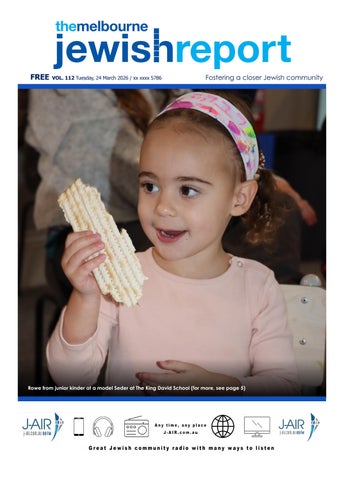
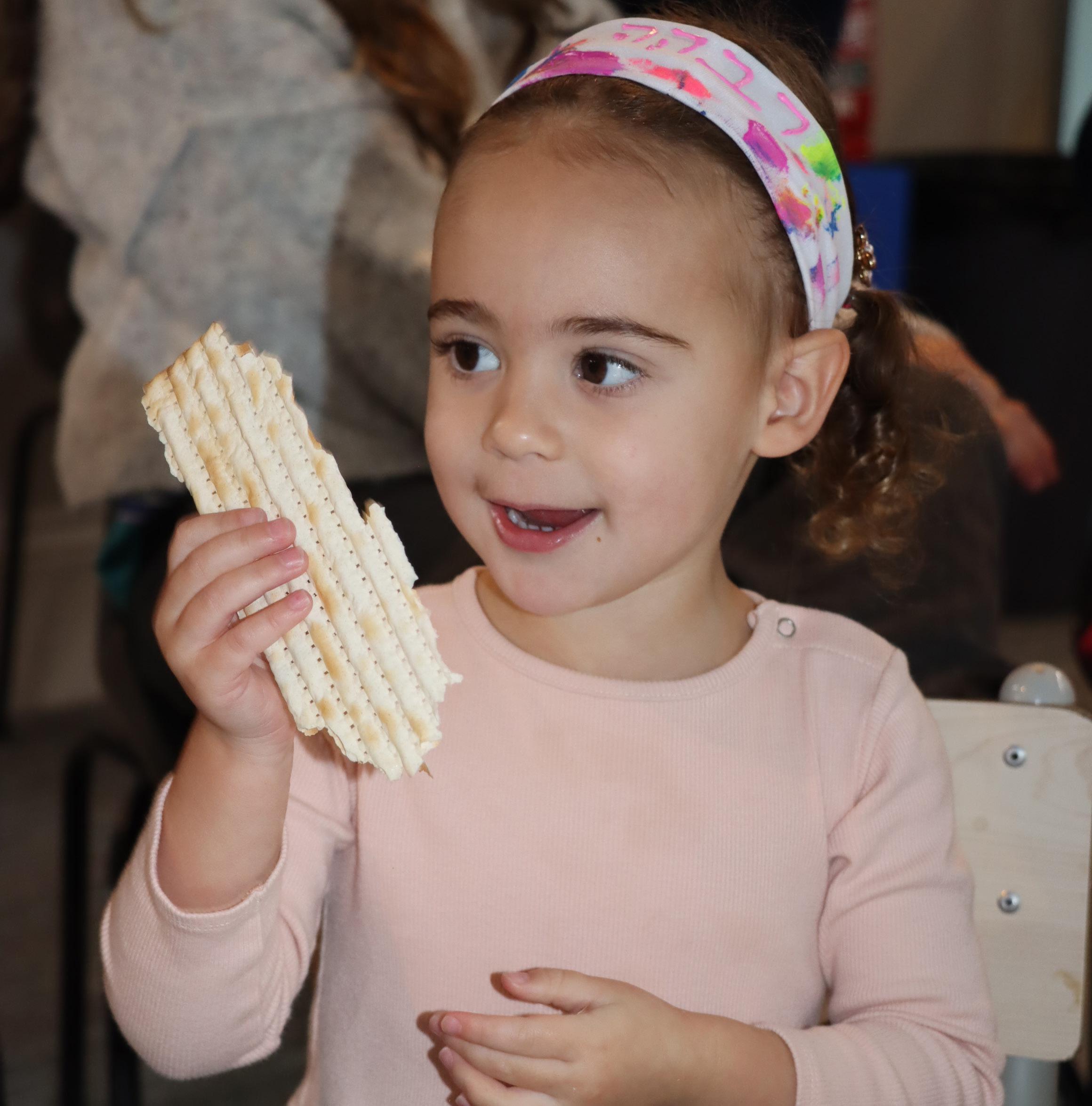
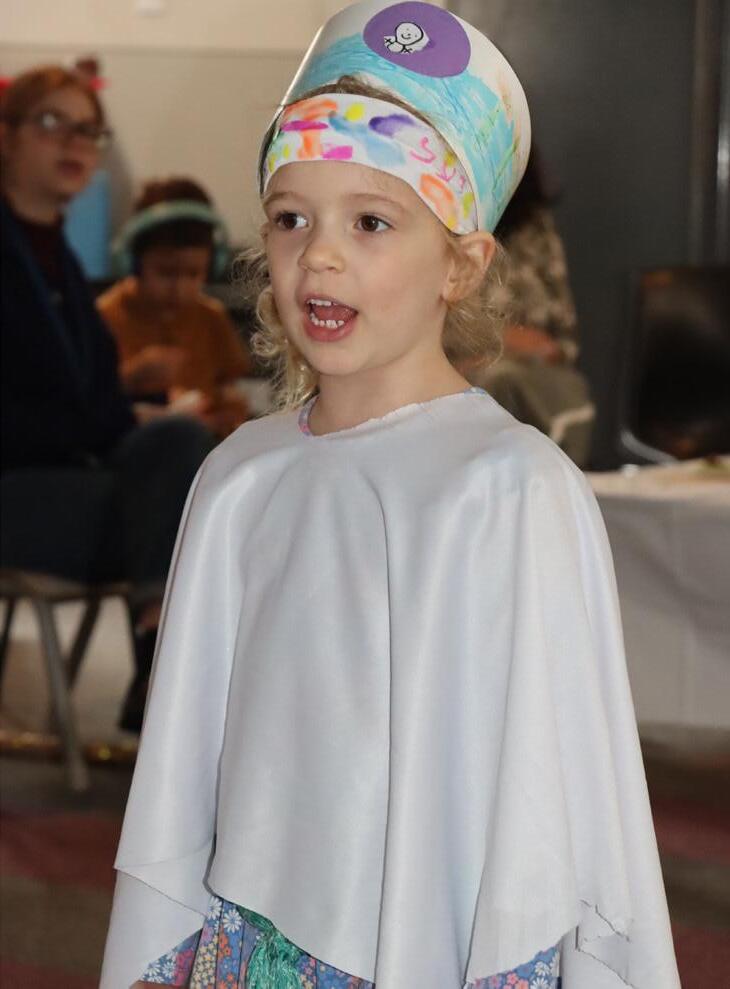
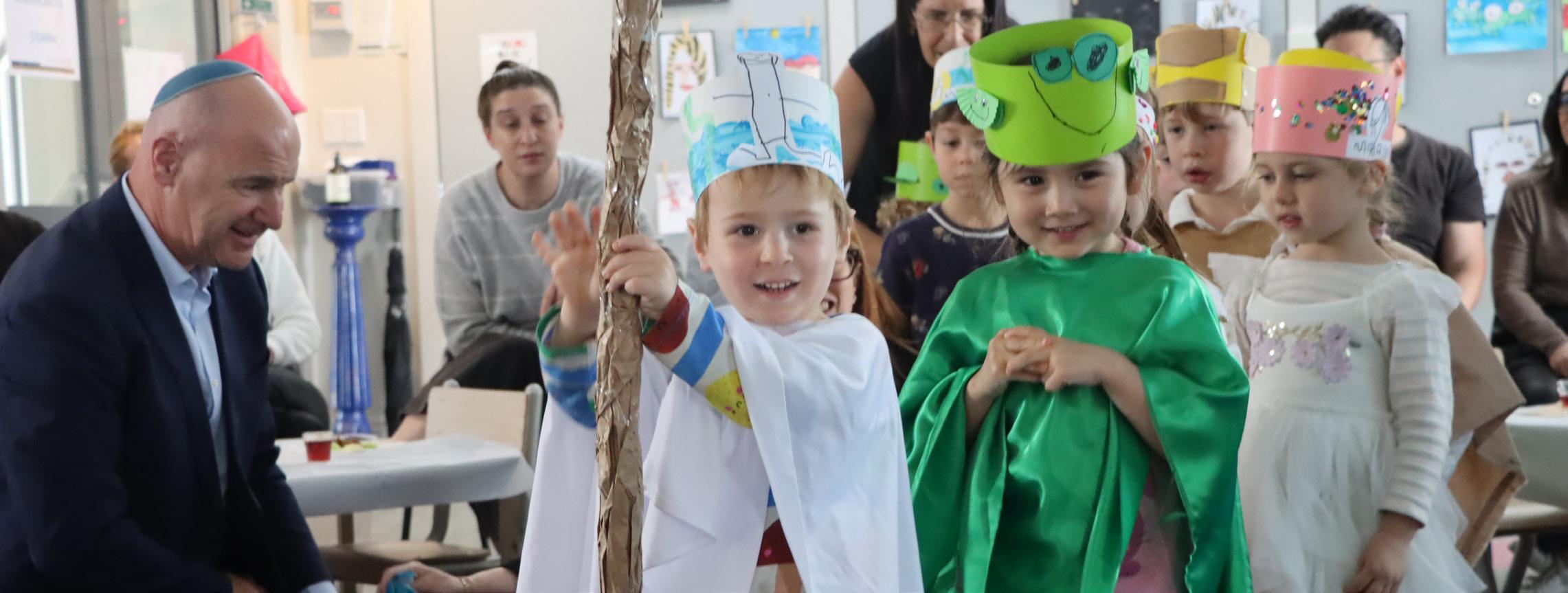
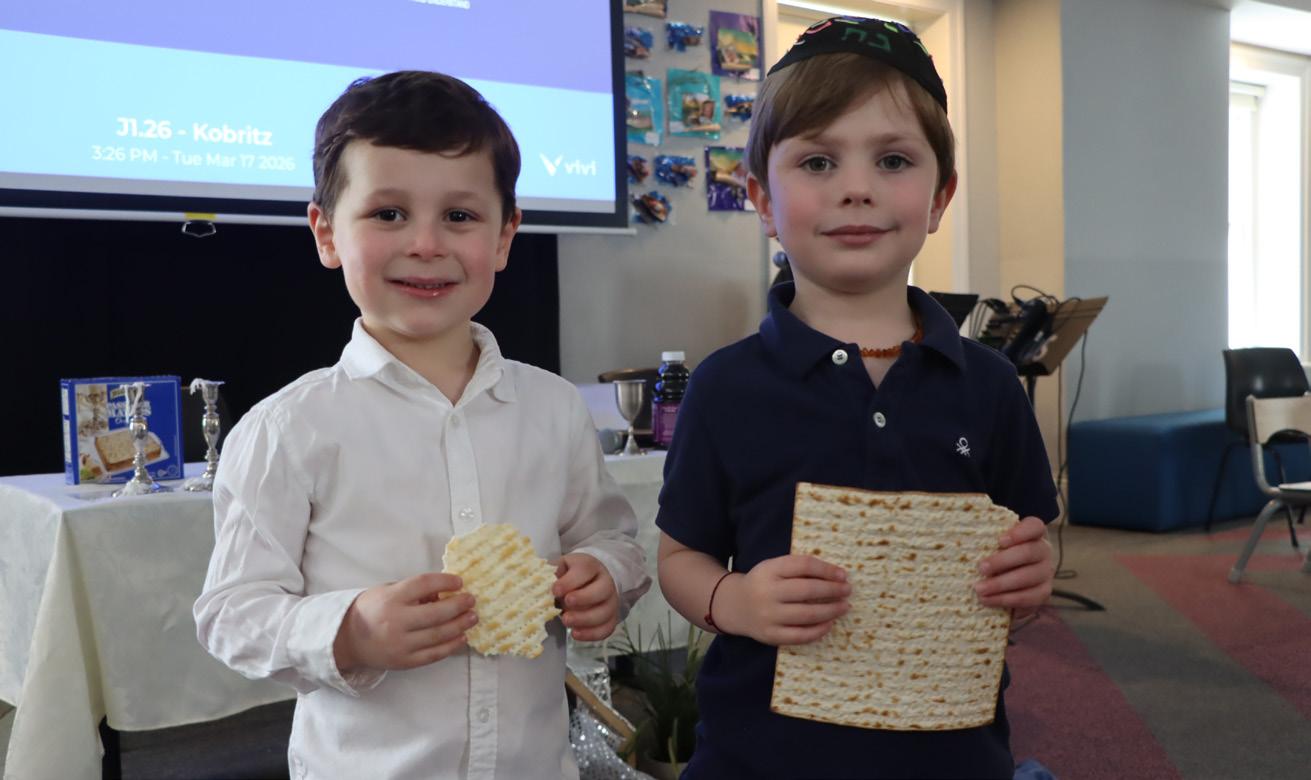
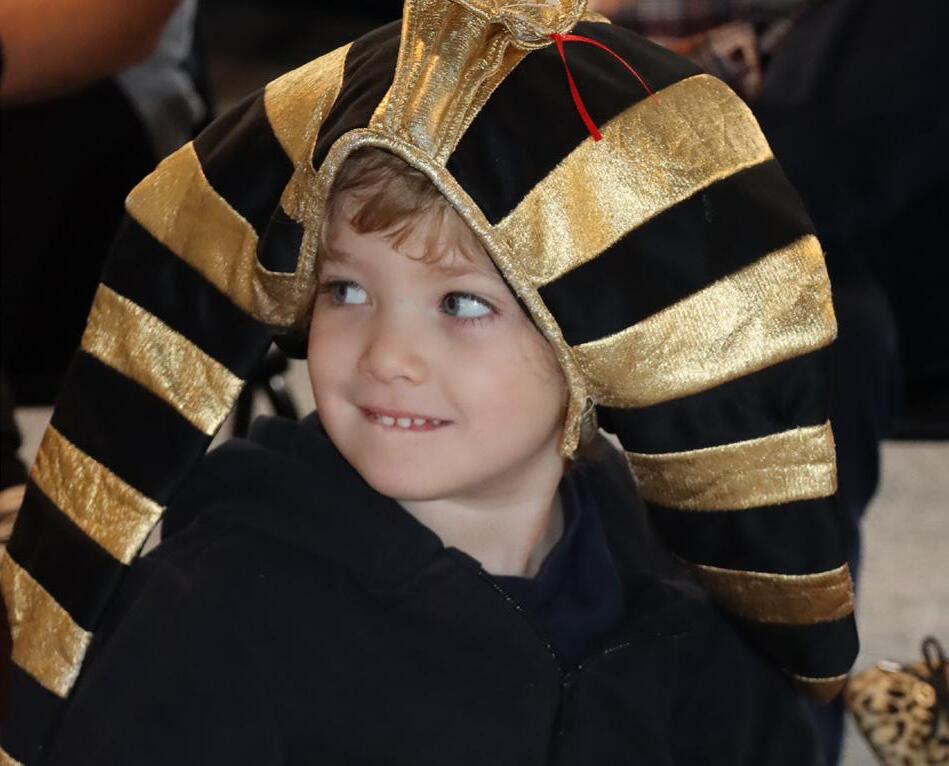
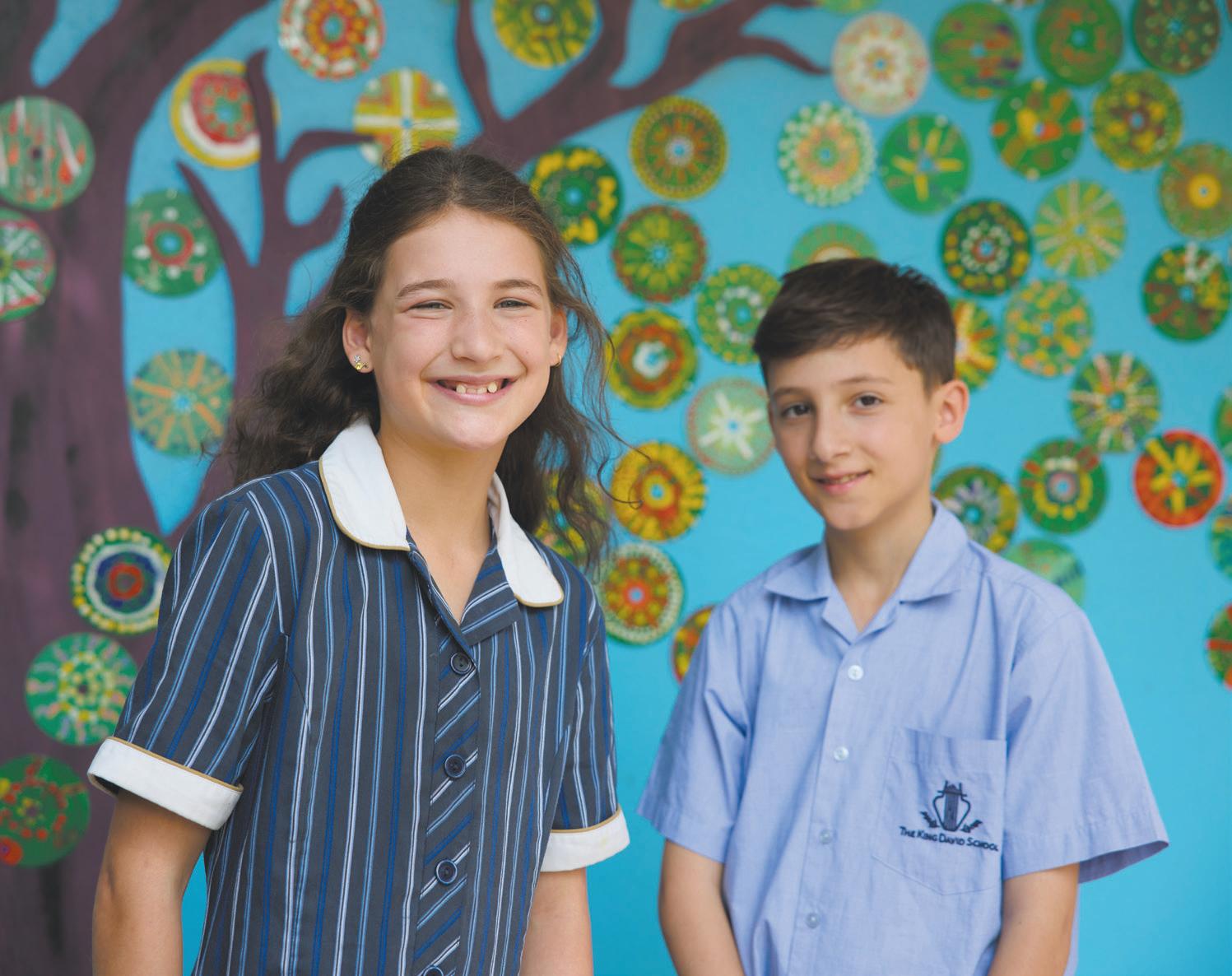
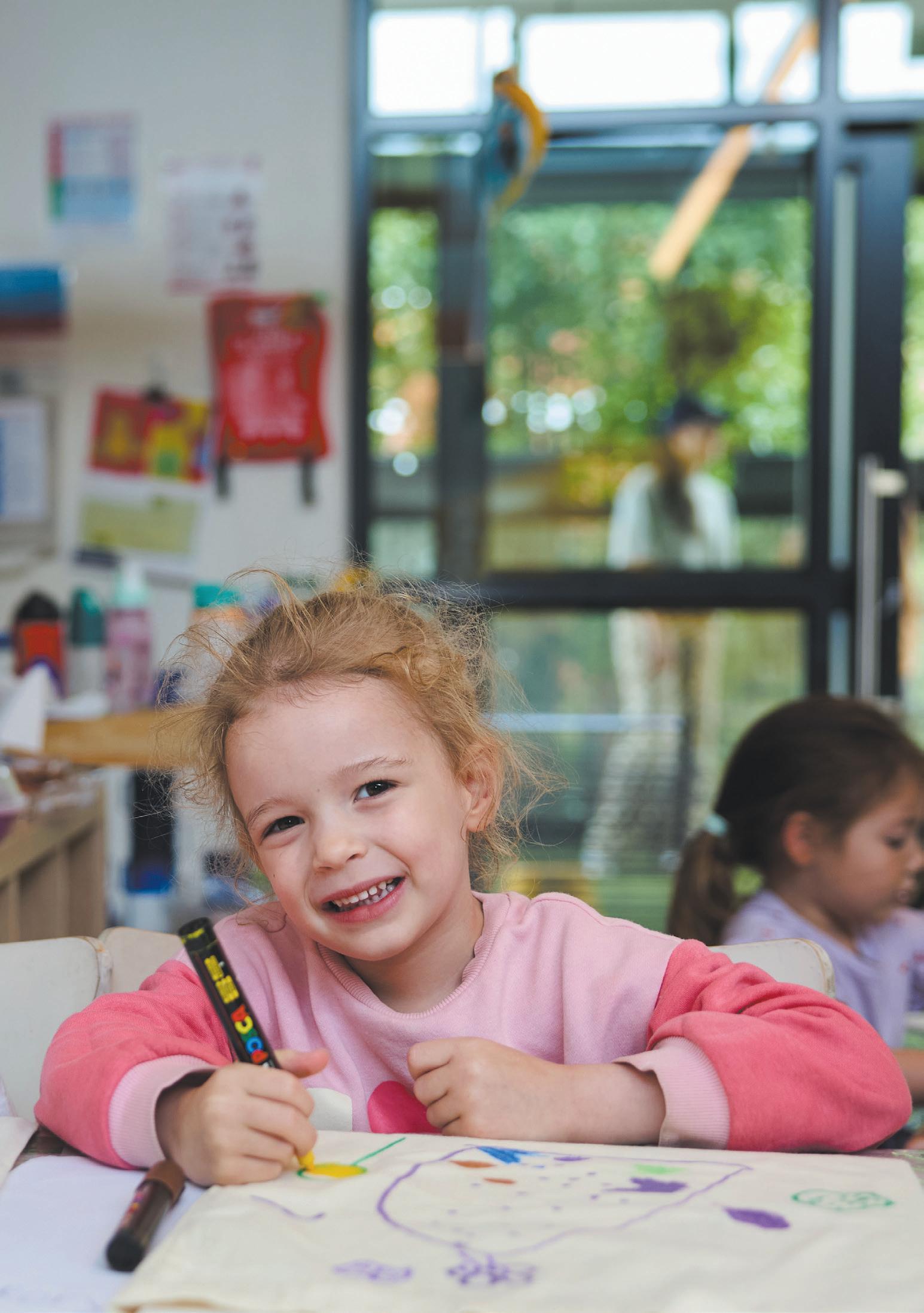
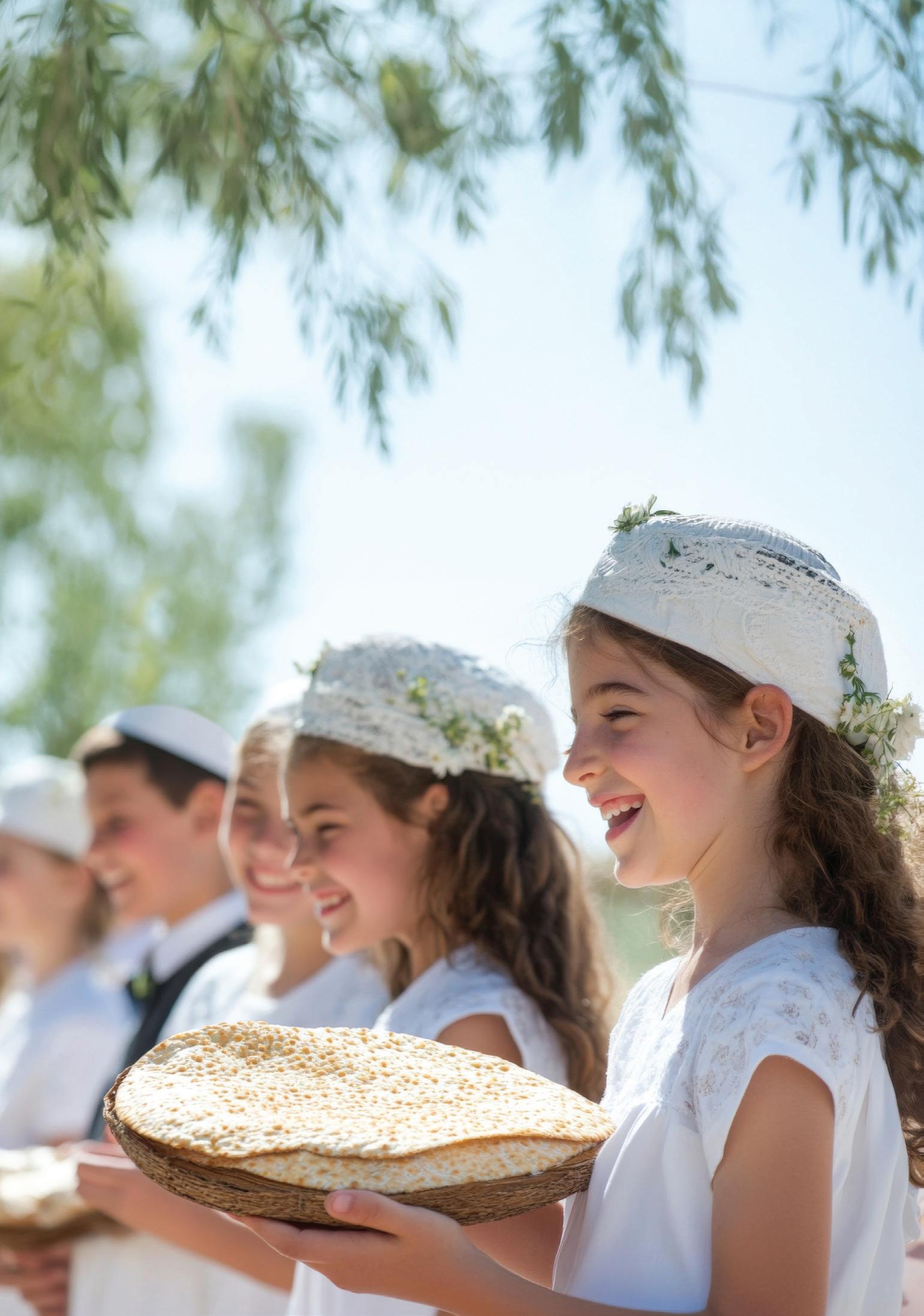
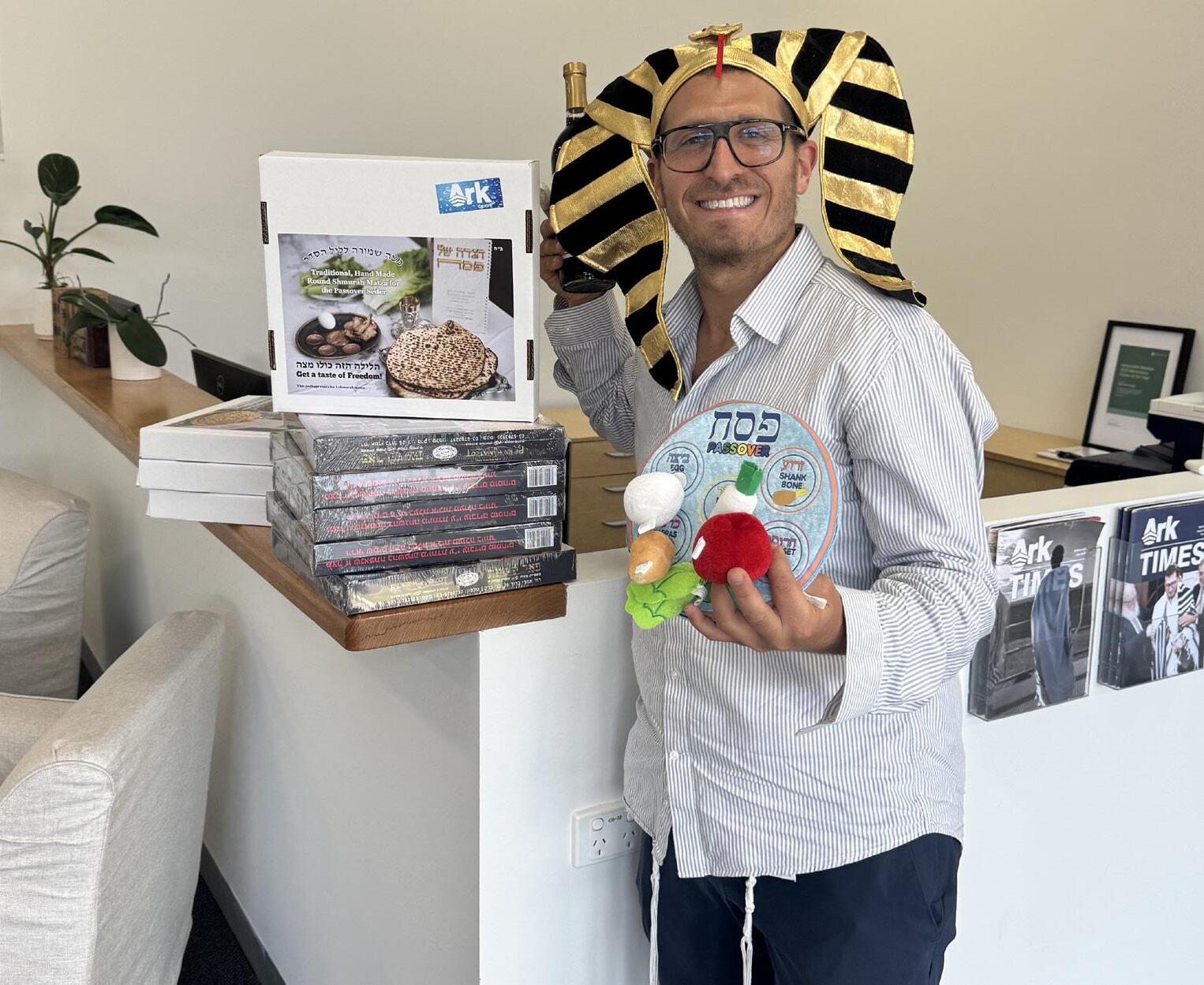
Rowe from junior kinder at a model Seder at The King David School (for more, see page 5)
TELFED
Based in Israel, Telfed is a dynamic organisation that exists to help new oIim (Jewish immigrants), from Australia and South Africa. Its powerful and personal mission transcends politics.
It doesn’t get more personal than what Telfed CEO Rabbi Dorron Kline recently experienced in his local area. Rabbi Kline and his family live about one kilometre from where a deadly Iranian ballistic missile struck in Beit Shemesh.
“The blast was so powerful that our entire building shook. We could clearly hear the explosion, even though we were inside our secure room. For perspective, a friend who lives one street away had the windows in his building blown out by the shockwave.
“This wasn’t a distant news story. This was our neighbourhood – people we know. The grandmother killed was one of the cashiers at our local supermarket,” Rabbi Kline said.
This terrifying reality is a stark reminder of just how destructive each missile is. The entire Jewish world is grateful for the extraordinary work of the Israeli Defense Forces (IDF).
With respect and gratitude to the Israeli Air Force, state-of-the-art defence systems and intelligence services, the vast majority of missiles are intercepted before they can cause devastation. Even so, as Rabbi Kline experienced on day 2 of this war, it only takes one direct hit to cause immense destruction.
The dedication of all involved with Telfed never wavers during times of peace or in times of war. As the entire Jewish world is hyper-aware, Operation Roaring Lion is a largescale military campaign targeting the Iranian regime's nuclear and ballistic missile infrastructure. Yet on Israeli soil, with Telfed’s headquarters based in Ra’anana, connections continue to be strengthened with Aussie Olim of every age. It is an ongoing purpose and priority.
Recently, we all celebrated Purim and yet somehow that now seems so long ago.
Together with Telfed
Brave lone soldiers are constantly on Telfed’s radar. In fact, each Aussie lone soldier recently received a Purim gift card for a hearty meal. This was useful as our brave heroes expend so much energy for the holy cause to which they are committed.
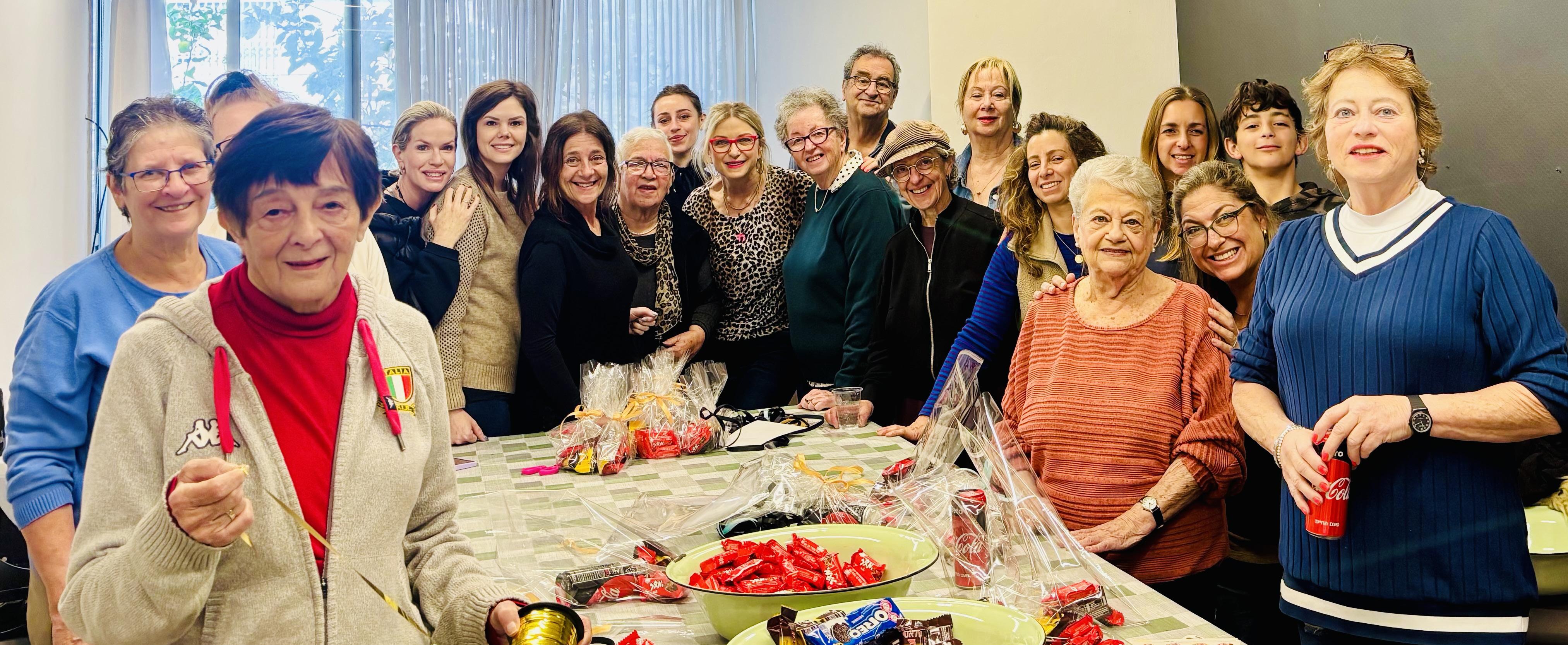
In addition, it was special that Aussie and South African volunteers united to assemble more than 300 mishloach manot packages for soldiers stationed in the north.
Yet, Telfed encompasses so much more. During this intense time, the team is reaching out daily to new olim. Hundreds of ‘wellness’ calls have been made.
Appreciating how much Australian and South African Jews value all-thingscommunity, Telfed is personifying the phrase “One People, One Heart”.
Operations continue day and night. Telfed also assists olim who find themselves outside Israel at this tumultuous time. The vast majority desperately want to return. Australian and South African olim feel that primal pull to our Holy Land.
Telfed is noted for cutting through the metaphorical ‘noise’. Australian olim living in Israel receive frequent English updates from Telfed about the latest home front command instructions. They also can click into clear and timely Telfed news briefings from official sources.
Recently, Aussie and South African parents of teenagers in Israel were offered a tailored ‘Let’s talk Army’ webinar. Another explained the future integrating artificial intelligence, which is directly applicable to careers, skills and opportunities in Israel.
Telfed is nothing if not practical and relevant. Shabbat table conversations of late have naturally turned to the stresses associated with being constantly in the firing line. So it is that Telfed arranged a talk on how to manage emotional eating during war.
Late last year, Rabbi Kline visited Sydney, Melbourne and Perth for an Aliyah Expo and he hopes to return soon. Despite the war, interest in making the move keeps rising and Telfed is ready to support Aussies with absorption and so much more.
Telfed works in cooperation with the Zionist Federation of Australia and the Jewish Agency for Israel. For information about the Aliyah process, contact the Aliyah Centre at aliyahaustralia@jafi.org
To prepare for integration in Israel, contact Sarah at aliyahprep@telfed.org.il
to schedule a personal meeting with Telfed’s klita (absorption) team.
If you have friends or family who live in Israel and need assistance during these challenging times, please ask them to call +972 9790 7801 or email
Telfed volunteers packing Purim mishloach manot for soldiers on the northern border
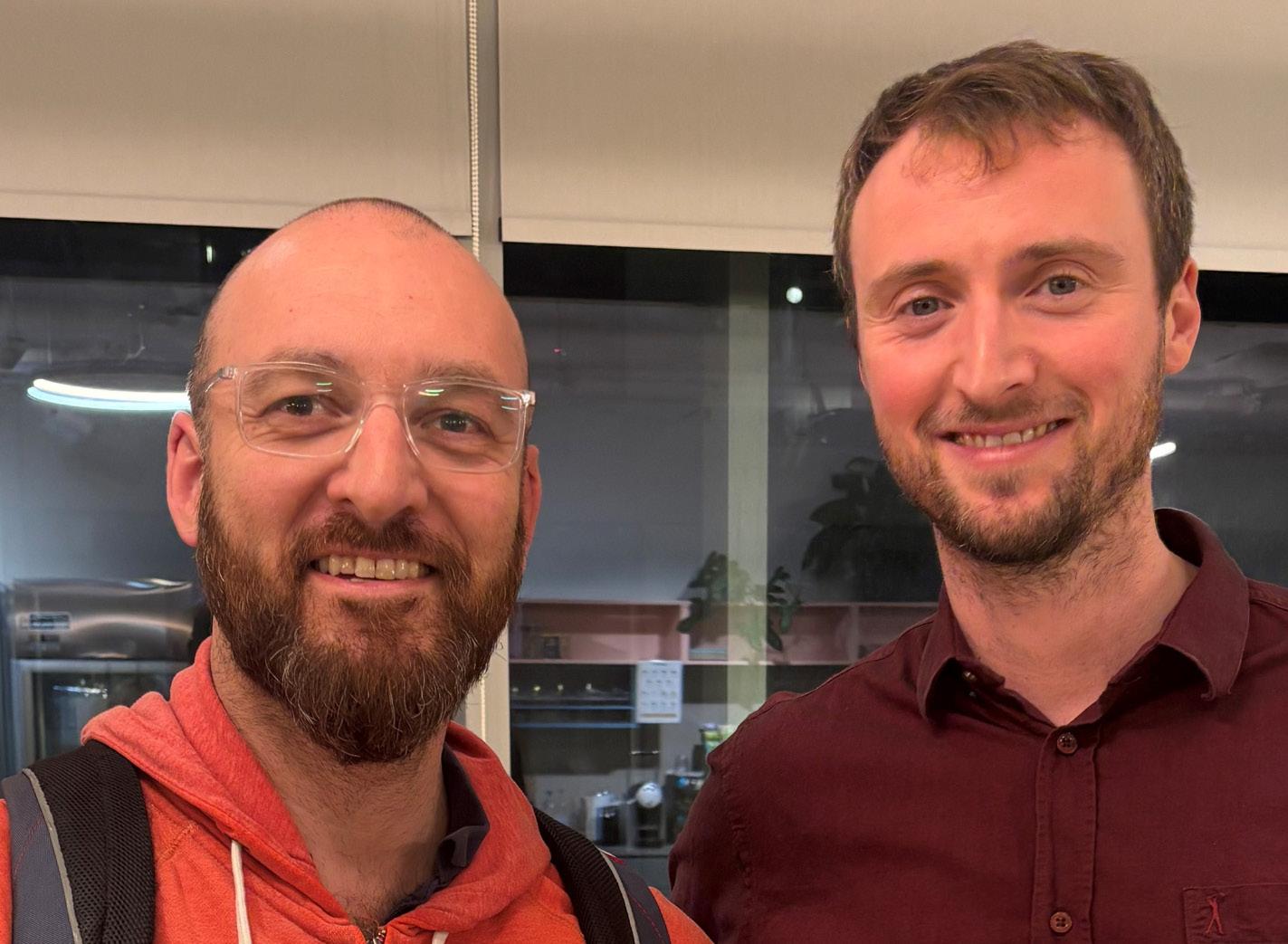
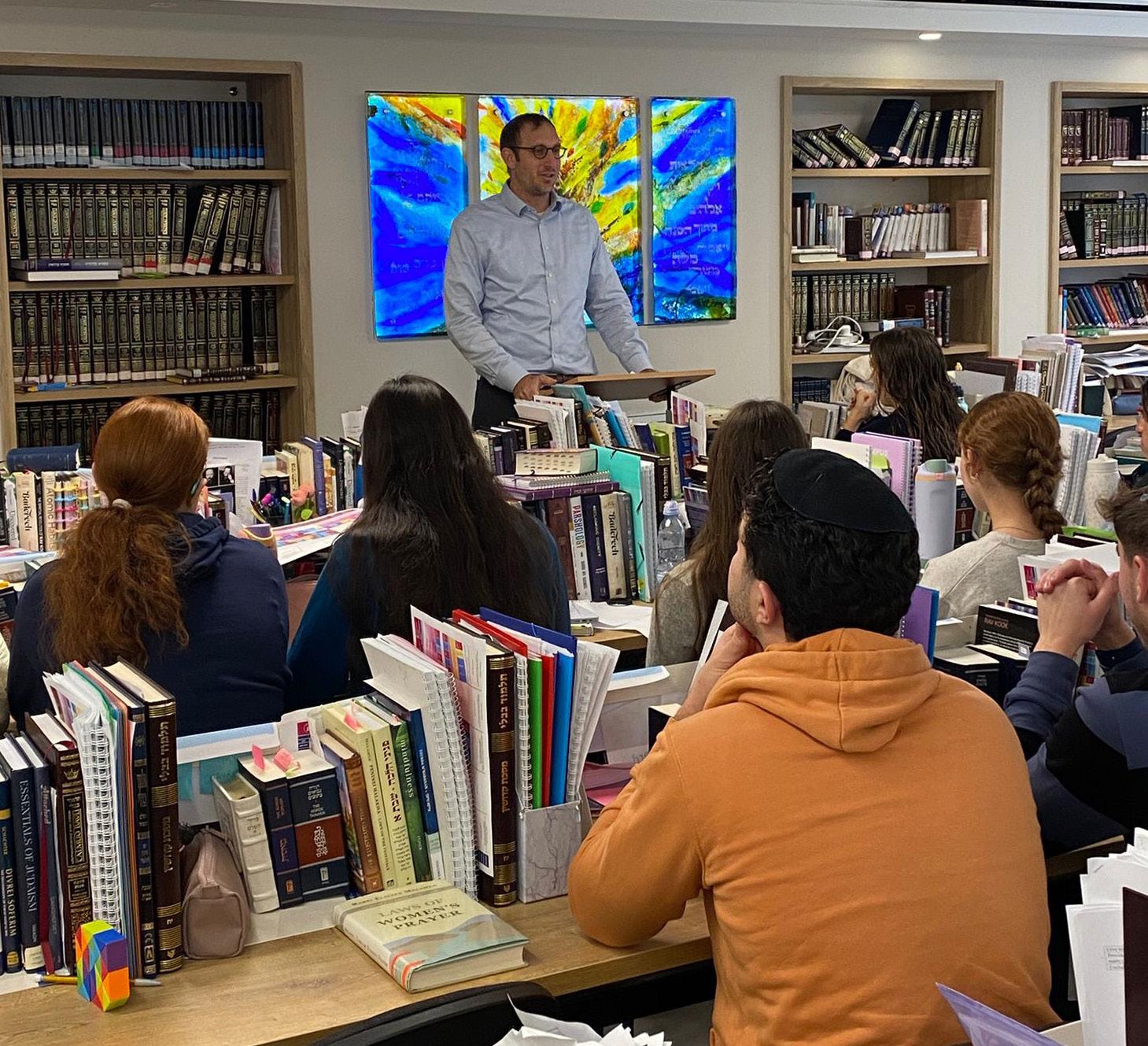
Tel Aviv-based workshop with Aussie oleh Avi Lewis (pictured right)
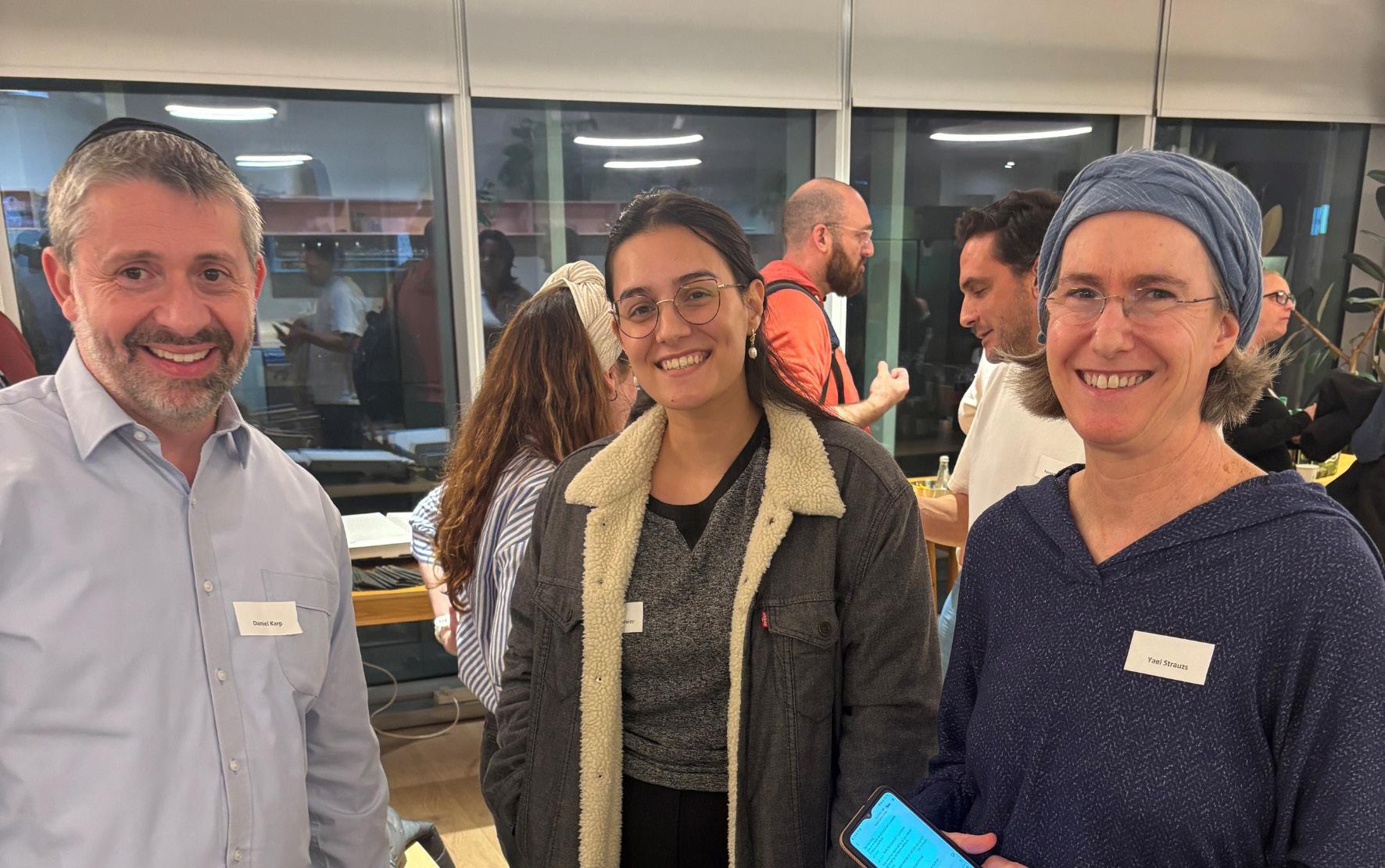
Other attendees at the Tel Aviv-based workshop on artificial intelligence in the workplace
DR DVIR ABRAMOVICH CONSIDERED OPINION
Earlier this month on SEN Radio, a former AFL champion did something that should not have been remarkable. Yet in today’s climate, it was.
Gerard Healy, Brownlow Medallist and Hall of Famers, a voice many Australians know not from parliament or the pulpit but from the warm, familiar rituals of sport, leaned into the microphone and spoke about Jews.
Not about geopolitics. Not about military strategy. Not about ideology. Not about the endless arguments that rage across television panels and social media feeds and dinner tables where people like to sound certain about places they have never seen.
He spoke about neighbours. About the Jewish fans sitting in the stands beside us at the footy. About the parents cheering on their kids at junior clubs. About the people who buy the same scarves and shout the same songs and live the same Australian lives as everyone else.
And he said something so plain, so decent, so unmistakably human that it cut through the noise.
Jewish Australians, he reminded listeners, are not responsible for wars overseas. They are not symbols of distant conflicts. They are not stand-ins for governments, armies, headlines or history. They are part of us.
For more than two years, he said, they have been targeted and blamed for things that have nothing to do with them. And maybe, just maybe, the rest of us could go out of our way to show them they are not alone.
It was not a speech filled with statistics. It was not crafted by a policy team. It was not padded with fashionable language or political caution. It did not hide behind abstractions.
It was the voice of a man who looked around his country and felt something was wrong. Sometimes history moves forward not with grand declarations but with moments like these.
A microphone. A pause. A person deciding to say what others know but hesitate to speak.
And perhaps that is why the moment landed with such force. Because Healy did not sound like a professional antiracism campaigner. He sounded like what he was: an Australian who had seen enough and decided that decency, at some point, must become audible.
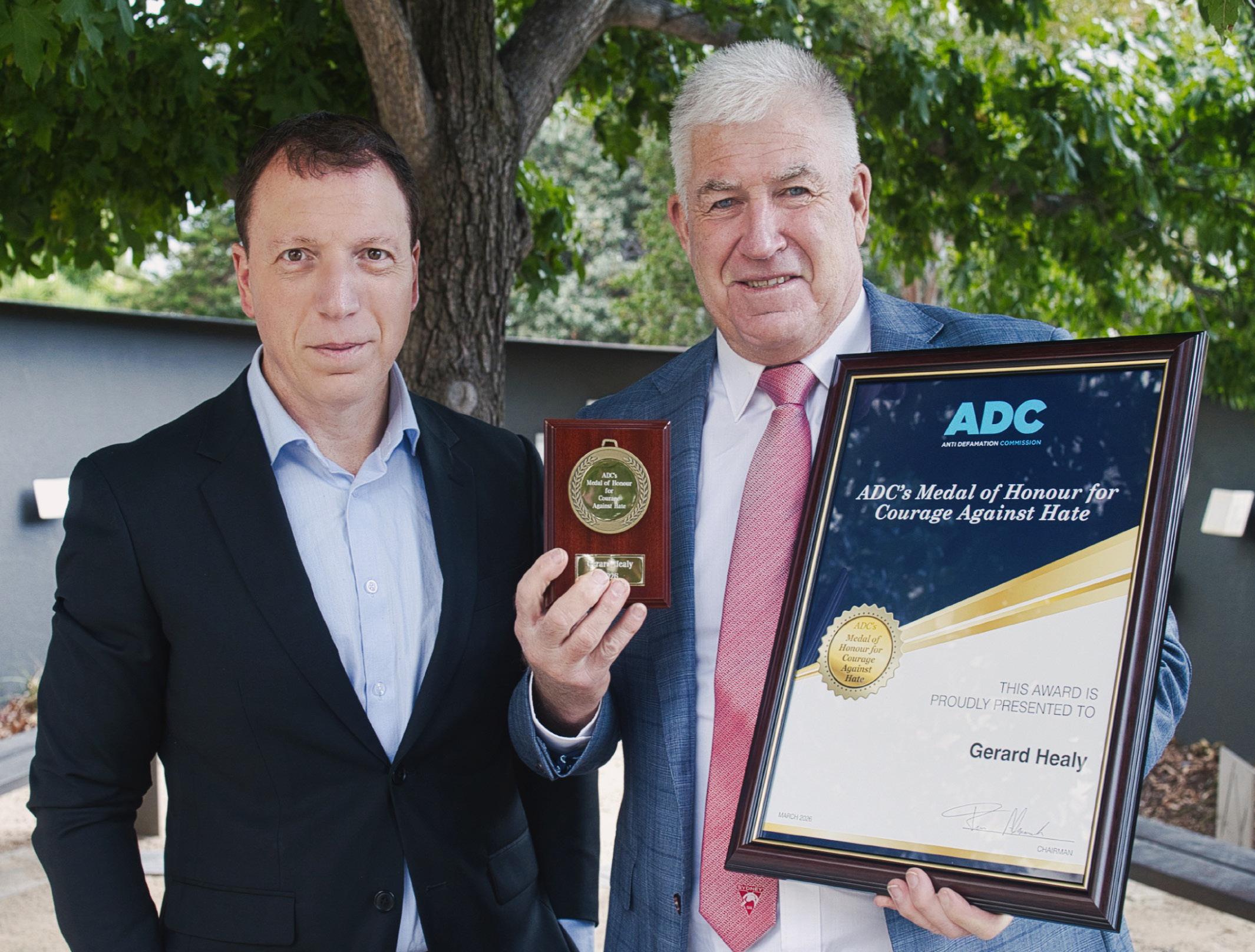
That is why the Anti-Defamation Commission’s decision to award Gerard Healy the inaugural Medal of Honour for Courage Against Hate mattered so much.
Awards can sometimes feel ceremonial, polished, dutiful. They can pass through the news cycle like another photograph, another handshake, another line in a press release.
This was not that. When I presented the medal, I was not merely thanking a broadcaster for a kind gesture. I was marking something deeper and rarer: the public significance of a person choosing conscience over comfort.
Healy had done what too many others with platforms had refused to do. He
The voice that broke Australia’s silence
had spoken clearly, when silence was easier. He had used a microphone not to protect himself, but to widen the circle of belonging for people who had begun to feel abandoned inside their own country.
I understood that. That is why the award carried such weight. It was not saying only that Gerard had been generous. He was saying that public courage matters. That in moments when hatred begins to seep into daily life, the person who breaks the silence performs a civic act. The person who says, out loud, that Jewish Australians are not to blame, that they are not alone, that they belong here, is not merely being nice. He is helping hold together the moral fabric of a nation.
A football figure who never set out to become a symbol was being recognised by Australia’s leading civil rights organisation fighting antisemitism. Two very different worlds met in that exchange: the stadium and the synagogue, the radio desk and the bruised heart of a community.
Healy, holding back tears, called it one of the proudest moments of his life. There was something disarming in that response. No grandstanding. No self-congratulations. Just a man who seemed genuinely affected by what he had stepped into and by what had been entrusted to him.
He said he had been enriched by the feedback he received. He spoke about learning more about Australia and about the beautiful Jewish community. He said he hoped that joy could return to Jewish life.
That word stayed with me. Joy. Not safety. Not just security. Not merely survival. Joy.
It is a word people use when they understand that hatred steals more than peace of mind. It steals ease. It steals confidence. It steals the ordinary happiness of moving through public life without fear.
And then he went further. He did not treat the medal as a closing chapter. He treated it as a promise. He said he would keep campaigning. He said he hoped others would speak out. He said
rarely does … In the years before the Holocaust, the most dangerous thing was not only the small number of Nazis shouting in the streets. It was the much larger number of people who adjusted. Who accommodated. Who rationalised. Who decided that speaking would cost too much. Who persuaded themselves that they were not part of the story. And so the shouting grew louder. Neutrality in the face of targeted hatred is usually just fear in formal clothes.
Martin Luther King Jr. wrote from a jail cell in Birmingham that “injustice anywhere is a threat to justice everywhere.” He was not speaking about Jews specifically. He was writing about segregation in the American South. But his insight was larger than the moment that produced it. King believed that societies are bound together in what he called an “inescapable network of mutuality”. When hatred is tolerated against one group, the moral ground beneath everyone begins to soften.
he wanted Jewish Australians to know that most Australians are behind them.
What Healy proposed on air was so modest that it almost sounded oldfashioned.
A handshake. A hug. A phone call.
A moment in a grandstand where someone turns to a Jewish supporter and says, “We’ve got your back.”
To modern ears, trained to think that only large systems matter, this can sound too small. But history suggests otherwise.
The struggle against hatred has never been fought only in parliaments and courtrooms. It has also been mounted in small, human gestures that interrupt the logic of exclusion.
When a Jewish child is mocked at school and another student says, “That’s not okay.” When a colleague refuses to laugh at a racist joke. These are the acts that alter a culture. They do not solve everything. But they change the emotional weather.
A person who receives one open gesture of solidarity walks through the world differently than one who receives none.
The bigot notices too. Antisemitism thrives on the impression that nobody will object. That the targeted person is isolated. That the room belongs to the aggressor. Public solidarity breaks that spell. And this is where Gerard Healy’s instinct was wiser than many polished institutional responses. He understood, perhaps intuitively, that antisemitism is not only fought by condemning the antisemite. It is fought by surrounding the Jew.
Elie Wiesel warned the world that the opposite of love is not hate. It is indifference. Hatred, at least, acknowledges the existence of another person. Indifference erases them.
The most dangerous sentence in a democracy is often not “I hate them.” It is “This has nothing to do with me.”
That sentence has an innocent sound. It might sound private, pragmatic, weary, but it opens the door to every moral collapse that follows. It allows cruelty to feel local and temporary. It lets people imagine that if they keep their heads down, ugliness will pass them by. It
In the months following October 7, many public figures treated antisemitism as an awkward subject. They were happy to speak about racism in general, intolerance in general and diversity in general. But when the targets were Jews, a certain paralysis often took hold. Healy chose differently. He spoke not as a politician but as a member of the football community.
That mattered. Because sport in Australia still retains something primal and democratic. It is one of the few places where strangers can belong instantly. You wear the colours. You nod at the person beside you. You celebrate together. You grieve together. For a few hours, you are not separate biographies. You are one noisy tribe.
He understood that if Jews could not feel safe in that shared Australian space, then something had gone badly wrong, not only for them but for all of us. He reminded listeners that footy divides us only by the teams we barrack for.
That should have been an obvious truth. But obvious truths sometimes need defenders.
At the end of his broadcast, Gerard Healy said something revealing. He admitted that for too long he had done nothing. But then he added a line that carried a quiet optimism. He believed that if people started with small gestures such as calls, conversations, handshakes, a word in a grandstand, a public sentence spoken without fear, those gestures could grow.
Little things, he said, kick more goals than you could imagine. That line captures both the humility and the grandeur of what he did.
He did not pretend to be a saviour. He simply decided not to be silent.
Gerard Healy reminded the Jewish community, and perhaps the nation too, that courage is still possible, that solidarity can still be spoken aloud, and that one person, in one room, on one ordinary evening, can still help a country remember how to be good.
Dr Dvir Abramovich is chair of the AntiDefamation Commission and the author of eight books.
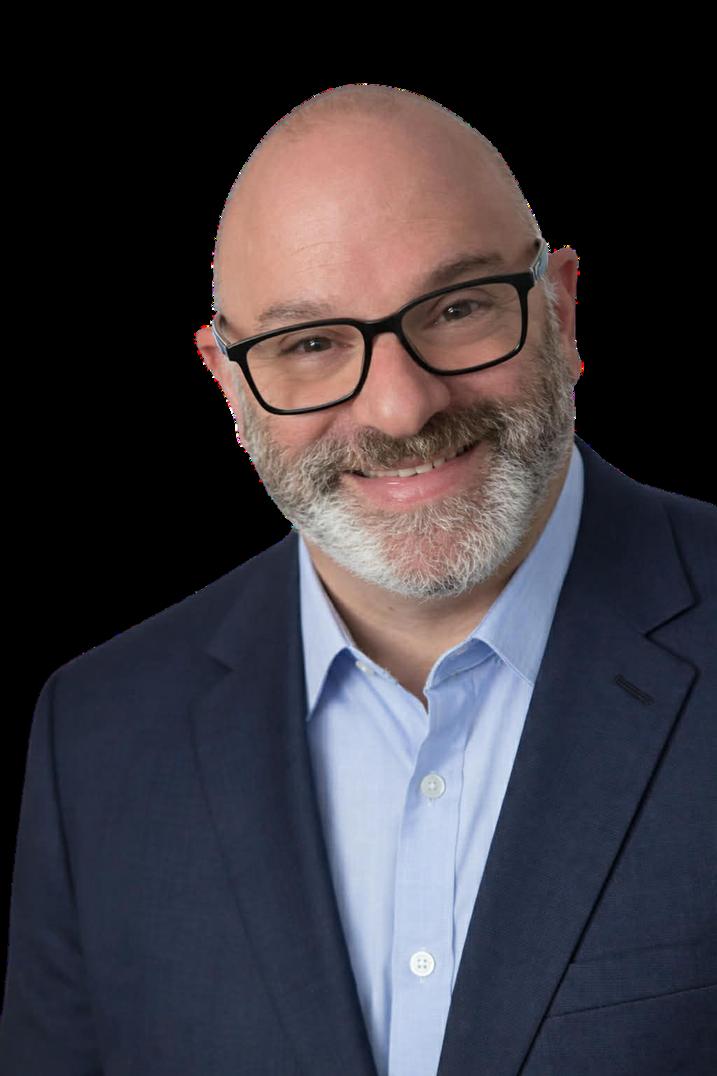
Dr Dvir Abramovich (left) with Gerard Healy
AROUND THE COMMUNITY
THE
KING DAVID SCHOOL
The King David School’s junior and senior kinder students lived out the Exodus in a whirlwind of Pharaohs, frogs and baby Moses, as part of a model Seder in the lead up to Pesach. They engaged in Passover-themed arts and crafts, including creating pieces for their Haggadah, singing songs and acting out the story of how the Jews fled Egypt in haste.
Bringing the Pesach story to life
Through
Book here for Friday 1 May tour:
From left: David Opat (Head of Junior School) with the first three children, being Raphael, Ava and Lulu, at a model Seder
Jacob (junior kinder)
Frances (senior kinder)
From left: Zander and Teddy (senior kinder)
CONSIDERED OPINION
RAMONA FREEDMAN
ALIYAH ADVENTURES
There has been so much ‘Breaking News’ of late here in Israel that no one can really keep up. Perhaps a new dramatic tagline needs to be created to grab immediate attention across a multitude of device screens. I wish I could come up with one, but perhaps I am a touch too sleep deprived at present to be too creative. In fact, just as I settled at my desk with my laptop (and obligatory cup of tea and chocolate) to start writing this article, I had only typed the title when … an Extreme Alert blared through my phone
I reactively jumped out of my seat, heart pounding. I knew what was coming. Yes, a handful of short minutes later sirens began wailing across Ra’anana and the entire centre of Israel. Incoming ballistic missiles. Iran. Again. The phone itself seems to become temporarily possessed and crazed in its urgency to inform us all. There are simultaneous alerts from the Home Front Command and other applications. The rule: get to your closest bomb shelter with whoever else is near you, family, friend or stranger. Close the heavy door. Then listen intently for the booms in the sky and count them. Israelis call them ‘boomim,’ (playing on the English word ‘boom’ and pairing it with a Hebrew plural suffix). Boomim we heard.
Most Israelis don’t have a dedicated bomb shelter room, known as a ‘mamad’ in their home. They often head underground to a collective one within their building, or to a public shelter. Or if it is closer, they may go down into the labyrinth of a train station below ground. War unites. Everyone here is in it together; everyone is helping the cause in some way daily. I am very moved by what I see – the care, the kindness, the giving.
I see young people through our Kehillat Lev Ra’anana (KLR) community volunteering to help babysit children whose fathers are away. All valiantly supporting the war effort on reserve duty. The poor mums! The poor kids! My daughter baked all afternoon for one family and then walked to deliver it all with love.
In many ways it is very COVID-esque right now here in Israel. All schools and universities have switched to zoom classes. Last week, all gatherings were banned, this week a maximum of 50 people are permitted to congregate. The news cycle is never-ending. It is hectic and hard hitting.
And yet … what are people on the ground here doing every day? Living life. Yes, they truly are. No one is planning ahead; they are living in the here and now.I have realised that there is a direct correlation between my mental health and movement. So, while we are not wearing masks, going out is a calculated risk. I know I always feel better after a Pilates class.
So, I take a gamble and join a class, knowing that at any moment it may
Living life
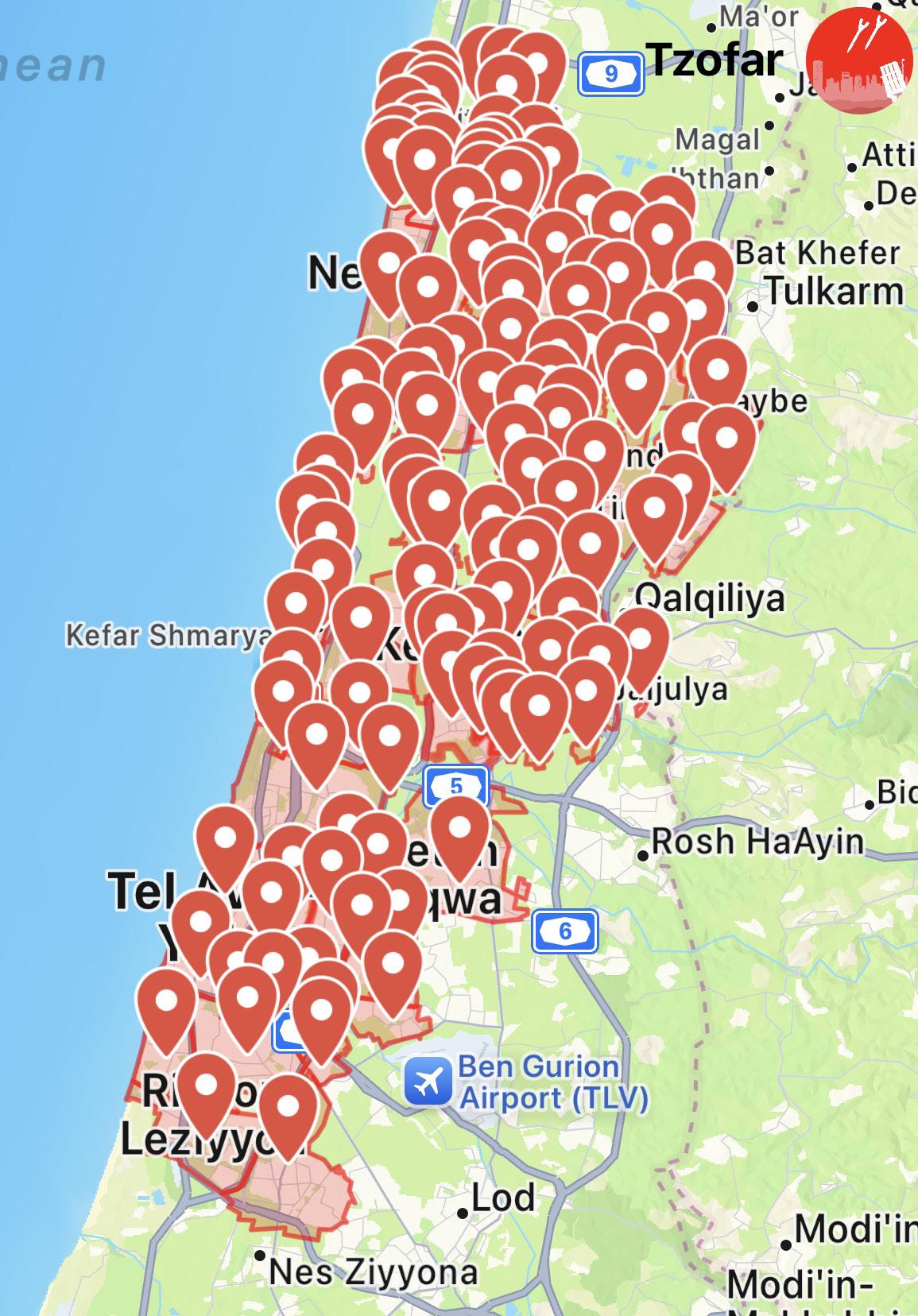
Danger zones identified due to incoming missiles, as seen on Ramona's phone many times since the war started
be interrupted. I position my shoes carefully so they can slip on easily. My phone is close. And on the days when the class concludes in a natural way (no screeching sirens and the rest), it is nothing short of a triumph. Take that evil enemies! Ramona Freedman along with a few French women have successfully completed a class that no one would normally attend. The 10:30am slot. Yet, it is full because no one could get out of bed early having been up half the night. How these ex-Parisians are so stylish even in a Pilates class during a war I’ll never know. Respect. Actually there was one other lady there from KLR. As she hastily left, she said, “Ramona, my doctor told me to get out of the house “to stay semisane”. Precisely.
Some days I am really wild and reckless. I venture to a large fruit shop and I buy a little more than needed. I always take note of where the bomb shelter is.
Then, when I really push it, I stop again (the chutzpah!) and buy my family their favourite treats from the most sensational nut and dried fruit shop in Ra’anana.
Let’s be honest, those expertly candied macadamias are all for yours truly.
That ‘excursion’ involves parking, walking, waiting in line and more. And when I walk back into the house it is as if I have just scaled Everest. Alone. It is true, we are living life, but I have had to make
destroy us all is travelling from further afield). Therefore, we will all need to go to this other shelter a bit further away.”
And then came the conclusion: “We are all just living a simple life right now, aren’t we? Nu, let’s dance!” Everyone laughed. Everyone danced.
That day there were no alerts, but three days later one from Iran dared to interrupt our sacred Zumba time. We all made it to the shelter, which was in a schoolteacher’s staffroom. We then sat around a large rectangular table. After catching our collective breaths, we each bestowed a beautiful blessing upon one loyal class member for her birthday that day. Peace. Joy. Health. I had tears in my eyes.
Farmers here are struggling. Large events are being cancelled and there is often a surplus of fruit and vegetables. Just last week Ra’anana rallied to help strawberry farmers who were desperately selling their oversupply to locals. In season, the strawberries here are sublime.
In my own house, on the first day of the war, my friend’s daughter and young husband moved in as their apartment building didn’t have adequate protection. We ate sweets together in the shelter. Bonding moments.
Soon after they left, others moved in. I had just enough time to wash the linen. The hottest commodity when it comes to property right now is a bomb shelter. I have lost count of how many times we have run into ours. Neighbours’ kids knock on my door often and say: “I am having a few friends over. Mum says they can only come if there is room for them in a shelter. If sirens wail tonight, can they come into yours?”Of course!
some changes. For example, there is an App here that is a bomb shelter locator. When out and about, it expeditiously helps one locate nearby bomb shelters in emergency situations.
With several Apps vying for prime position on my phone, I had to admit that I needed to prioritise this one over my banking. I have three Apps that sit side-by-side: Home Front Command, Bomb Shelter Locator and Tzofar, which provides alerts about sirens across Israel.
The news from Israel is not all doom and gloom though. We have ‘Michelle’, the new song selected for Israel’s Eurovision entry. It is currently sitting at number two on the Israeli charts and is a mix of Hebrew, English and French. Those fancy Frenchies are always in there somewhere.
A few days ago, I went to my Zumba class. Prior to the music starting, there was an announcement, which went something like: “Dear Ladies, we have been advised that if there is an incoming rocket from Lebanon, we won’t get any pre-alerts. Immediate sirens. We will only have 90 seconds. All will need to run to a nearby shelter under a staircase about fifty metres away.
“However, if there is an incoming ballistic missile from Iran, we require more protection and have a few more minutes (as the warhead aiming to
When it comes to Jewish festival preparation, Pesach is usually the belle of that ball. This year, there are so many other things on our minds. War. Travel restrictions. Altered plans. No one can give it the full attention it usually commands. Sitting with my chocolate snacks one evening I see an invitation to an upcoming Telfed Zoom session titled: How to manage emotional eating during war. Why yes, I believe I am a candidate for this one.
If you thought it was dramatic receiving Extreme Alerts while trying to type this column, the following happened only two hours earlier. With a bride-to-be in our midst, we went wedding dress shopping for the first time. Said bride was sparkling, radiant, glowing in a gown. Suddenly, piercing through that precious picture was a cacophony of phones blaring. The bride hastily removed the gown and with the seamstresses, attendants and other staff, we all filed down to the building basement. It housed hundreds of wedding dresses and we quietly stood in between.
The singing and praying last Friday night within the large KLR bomb shelter made our spirits soar. We are still living life. Am Yisrael Chai! For now, it is over and out from Ramona in Ra’anana.
To contact Ramona, please email: ramona@keshercommunications.com. au.
AROUND THE COMMUNITY
Rebuilding is our generation’s calling
Pesach tells the story of a people who did not simply survive a defining moment in history but rose to meet it. From slavery to freedom, from exile to nationhood. The Jewish journey has never been defined by what happened to us, but by how we responded. Together.
The story may be an old one, but the values endure. When faced with crises, we create. We build. We move forward. Together. In ancient times and in modern times.
In 1920, there was a fund to help establish a state.
In 2023, UIA’s Victims of Terror Fund helped the People of Israel endure its darkest hours.
In 2026, as families have again been living with fear and uncertainty during Operation Lion’s Roar, already carrying the scars of war and hardship, UIA is there to support Israel’s immediate needs.
At defining moments, our response has been clear and collective. Each generation has been asked a different question. Each time, we have answered
directs resources toward mental health and PTSD recovery, the rehabilitation
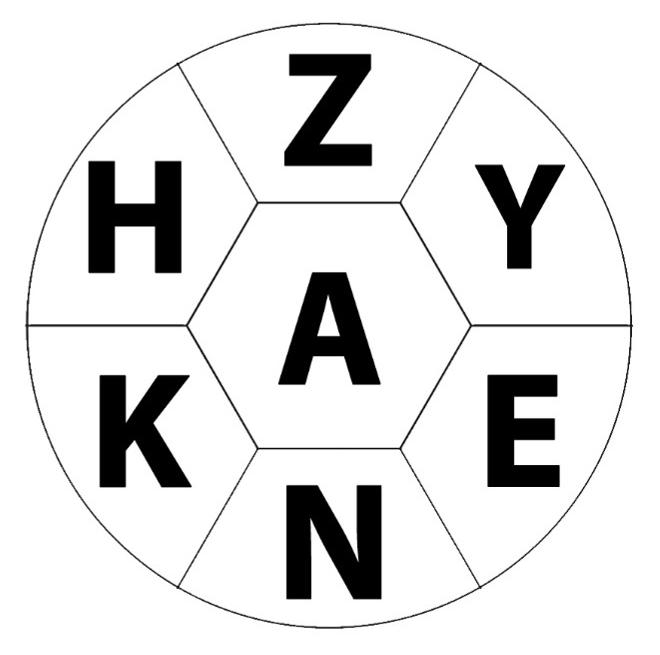
How many common words of five or more letters can you spell using the letters in the hive? Every answer must use the centre letter at least once. Letters may be reused in a word. At least one term will use all seven letters and have a direct Jewish connection.
Proper names and hyphenated words are not allowed. Score one point for each answer and three points for a Jewish related word that uses all seven letters.
Rating: 5 = Good; 7 = Excellent; 8 = Genius
ANSWERS PAGE 19
Pesach reminds us that redemption is not a single moment, but the beginning
shared calling. For the People of Israel. For life.
Israeli families are healing and rebuilding with the support of UIA Australia
Yoni Glatt has published more than 1,000 crossword puzzles worldwide, from the LA Times and Boston Globe to The Jerusalem Post. He has also published two Jewish puzzle books: "Kosher Crosswords" and the sequel "More Kosher Crosswords and Word Games".
CONSIDERED OPINION
DAVID SCHULBERG
Dr Einat Wilf is a leading intellectual and original thinker on matters of foreign policy, economics, education, Israel and Zionism. She was a member of the Israeli Parliament from 2010-2013, where she served as Chair of the Education Committee and a Member of the influential Foreign Affairs and Defence Committee. She is considered one of Israel’s most articulate representatives on the international stage, and has founded Israel’s newest political party, Oz.
David
Your aim is to pursue peace based on an Arab and Palestinian embrace of Zionism, which is a key facet of your party's political platform. How can Arabs be persuaded to embrace Zionism? This seems to me like a real long shot.
Einat
It derives from first principle thinking. As long as the Jewish people want to be sovereign, then it's in the land of Israel. Nowhere else is relevant for Jewish sovereignty. Jewish individual, even communal, life can be in other places. Jewish sovereignty can only be in the land of Israel.
Given that the 7th century Arab and Islamic conquests of the Levant have been hugely successful, it means that for as long as the Jews want to be sovereign, they are damned or destined. I like to emphasise 'destined' to remain a Jewish ethnic, linguistic, religious and national minority within an overwhelming Arab and Islamic Middle East. Going back to the dominant ideas of the Left, in the 90s, with respect to our region, to our enemies, there were two.
One was coined by Ehud Barak. It was this ‘villa in the jungle’, the notion that Israel has keep on being this advanced, modern, secular, wealthy, progressive state, surrounded by enemies, who hearken back to 7th Century ideas about family and community and governance, this kind of villain, the 'jungle idea’. Then there was Shimon Peres's idea of the 90s of a new Middle East based on economic cooperation and economic agreements.
Both have shown themselves to fall short dramatically in understanding our enemies and our place in the region. I would say that Barak's vision harkens back a bit to Jabotinsky's 'iron wall' – the notion of Israel being the 'soft fortress' among overwhelming hostile populations. What we saw in the most horrific way on October 7th is that if we just try to be this Iron Dome-protected, villain-in-the-jungle, the jihadi massacres and invasions come into our homes.
The other notion of a new Middle East, where we have economic agreements without real ideological transformation, has also failed to secure any kind of long-term arrangements and peace. My argument is that there is no alternative to going into the region with a message that requires and envisions ideological transformation to happen on the other
A new way of thinking about Israel/Arab relations
side. Sometimes people ask me, 'Well, you're expecting, demanding of the Arabs to go through an ideological transformation that actually deeply looks at their Arab identity, at Islam even, as something that needs to be supportive of Zionism?'
Why not a proud, forward-looking Arab identity that embraces Zionism, because that's what forward-looking nations do. Anti-Zionism, historically and globally, is always the mark of failed societies that prefer to drown in conspiracies and blame, scapegoating rather than solving problems. There's a new book that just came out by Hussein Abdel Hussein, ‘The Arab Case for Israel’, essentially making the case that if you want to be forwardlooking for the Arab world, then you embrace Israel, you embrace Zionism from within the Arab and Islamic identity.
People say to me that I constantly talk about their need for transformation, but ask what do you expect of us, of Jews of Israelis? Typically, when people say, what do you expect of us? they’re thinking of settlements, occupations, leadership.
My argument is that I expect of us the hardest thing of all, which is our transformation away from an exilic mindset. It's based on work that I did with scholars Liav Cherny and Aylon Manor that basically says that an exilic mindset is a mindset of weakness, of temporariness. It is not the kind of mindset that thinks for the long term, that plans transformation for the long term. My argument is that I am demanding of us the hardest thing of all, which is our own transformation, to steer away from this notion that the most we can afford is to buy just a few years of quiet from our enemies, instead
moving to one that actually comes with a backbone, with a sense of who we are, with determination, with strength, with courage, with spirit, that basically says that Zionism is good for the region, that Zionism is good for the Arab world.
Zionism has only brought a vision of future and prosperity. Anti-Zionism has only brought destruction and failure to the Arab world. I think it's a vision that emerges both from internal Israeli transformations, but ultimately, I think one that says that we didn't do our enemies any favors by engaging in the bigotry of low expectations. In other words, saying we can't expect them to embrace Zionism, that, at best they can just be the savages on the other side of the villa.
I don't think that's a good vision. I think we should expect of them to rise to the occasion, to be a forward-looking, future-seeking people. This is the vision that Israel has to have for the region, however long it takes.
David
This vision you say or a change in the Arab attitude has to come from their side. I mean, we see so many proposals, ideas that come from the Israeli side that seem to be driving any developments that are occurring. I shared with you a proposal from the Mitvim Institute, a think tank based in Israel. which is all about the implementation of a roadmap, which is putting the onus onto Israel to show a political will to change its approach towards the Palestinians and to make strides in a process directed at socioeconomic and political stabilisation in Palestinian society.
The Mitvim proposal says that the plan can only be implemented under an Israeli government that is willing to adopt a policy that is entirely different from the current government's policy. You call for an attitude change to emanate from the Palestinian side. So, is this more of the same, in a sense, coming from an Israeli NGO?
Einat
Of course, it is the classic of division between what I call feeling good and doing good. This is one of the main divisions that I came to realise over the years. Everyone claims to want to do good, but doing good often requires doing a lot of things that don't feel good. It requires making sure that your enemies understand, as was the case after World War II, that they are defeated, because only real transformation can emerge from the title of a book I've been referring to a lot on Japan, which is called ‘Embracing Defeat’.
Whether it's in personal or in collective lives, the notion that you draw a line on the past, that you actually embrace defeat. You understand that your ideology has led you to disaster and ruin. That is the fundamental basis for transformation.
After October 7th, I have come to name this ideology Palestinianism. Palestinianism is my name for the ideology that is singularly obsessed with the exclusion of everything else, with the non-existence of a Jewish state, prioritising the destruction of the Jewish state over building something positive and constructive for the Arabs. Any effort to do various shortcuts and walkarounds around this ideology is destined to fail because it is just one more way of running away from the core issue.
I will even say something further, even if Meretz – the most Left-wing Israeli, Zionist Israeli in politics – were in government tomorrow, they would fail, regardless of all the goodwill they propose, because they do not acknowledge that the issue has never been the Israeli willingness to compromise.
I always like to say that for the last century the Jews have agreed to every two-state proposal or solution, provided that one of the two is the Jewish state. And the Arabs have always rejected every two-state solution if one of the two is the Jewish state.
Rather than engage in performative, feel-good policies, how about we, for the first time, find out if the Arabs are truly willing to draw the line on the past and come to terms with Zionism.
This is a slightly modified extract from an extensive interview with Dr Einat Wilf, who was interviewed by David Schulberg on ‘The Israel Connexion’ program on J-AIR community radio. The full interview is available as a podcast on the J-AIR website. David can be heard weekly on J-AIR in Melbourne and 2TripleO in Sydney.
Einat Wilf
AROUND THE COMMUNITY
For 125 years, JNF has played a central role in building and strengthening the State of Israel.
Founded in 1901, long before Israel’s independence, JNF helped turn the dream of a Jewish homeland into reality by purchasing land, planting forests, developing water infrastructure and establishing agricultural communities.
Today, as Israel faces one of the most complex periods in its history, that same pioneering spirit continues.
Communities in the south and north are demonstrating extraordinary resilience, determined not only to rebuild after the devastation of war, but to emerge stronger, more vibrant and more secure.
In response to the recent conflict, JNF launched an Emergency Response Campaign to support Israel’s frontline responders.
Firefighters and rescue teams risk their lives daily and JNF is providing essential resources, including prefabricated bomb shelters, mobile firefighting command units and protective and communication equipment. At the same time, JNF remains deeply
Blue Box continues to strengthen Israel
committed to rebuilding communities in Israel’s south.
This Pesach, a key focus is Kibbutz Nir Oz in the Western Negev, where 117 of the kibbutz’s 384 residents were murdered or abducted on October 7 and 97 per cent of homes were destroyed.
JNF is helping revitalise the kibbutz’s historic botanical gardens, creating spaces for families to gather, children to play and healing to begin.
“This project is about much more than planting trees,” said Doron Lazarus, CEO of JNF Australia. “It is about planting hope.”
“As residents rebuild, these gardens provide solace, helping the community reclaim its past and future.
“By rehabilitating the communal heart of Nir Oz, JNF aims to ensure that families return, young people stay and new members are attracted to this thriving community on Israel’s southern border,” Mr Lazarus said.
By responding to crises and by empowering communities to grow and flourish, JNF is planting the seeds for a stronger tomorrow, just as it has done for more than a century.
To support the JNF Australia Blue Box campaign, visit JNF Australia - Blue Box Campaign 2026 or call 1300 563 563
The beating heart of Kibbutz Nir Oz, the botanical gardens
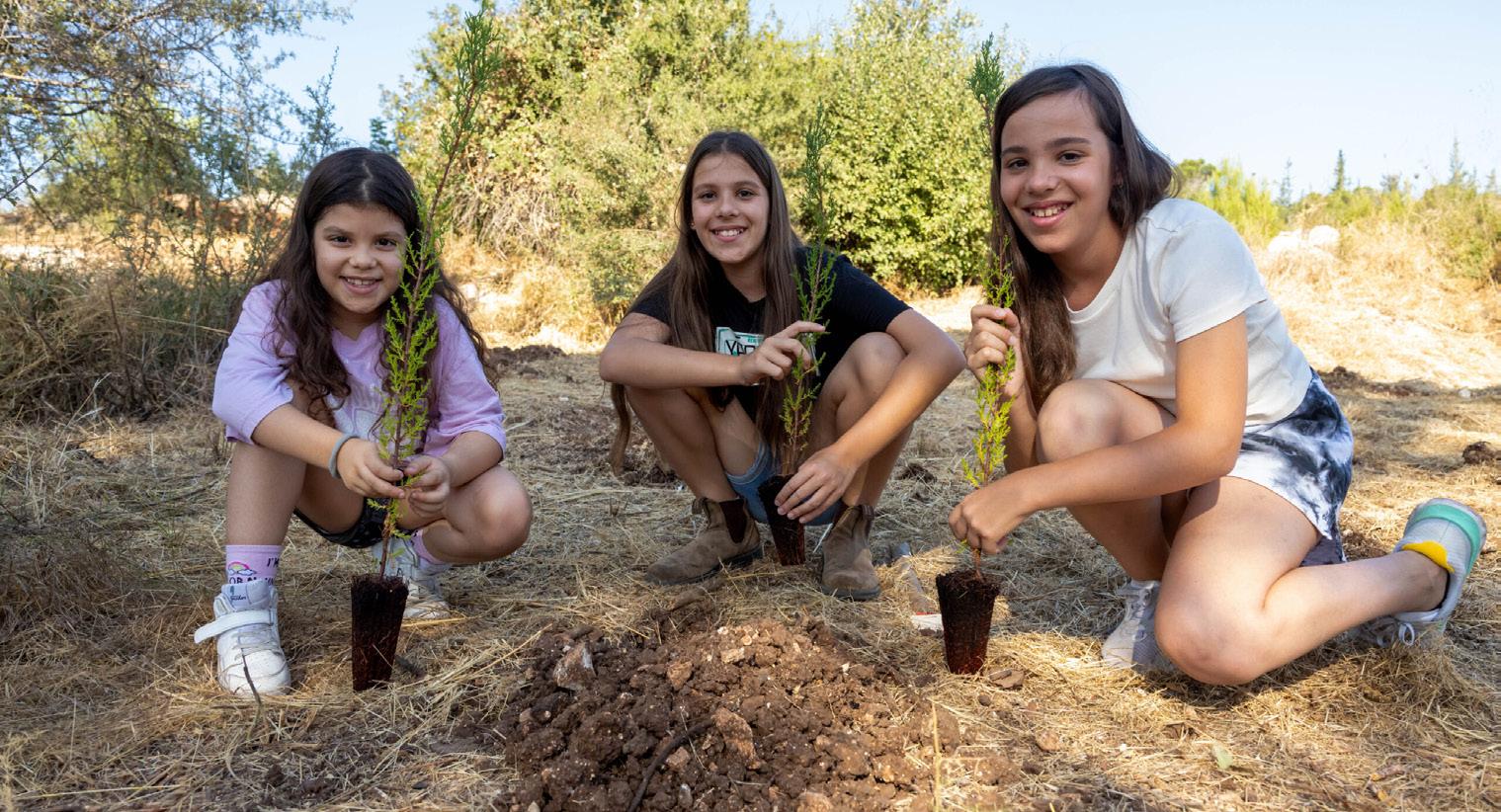
Children planting hope in Israel’s south
CONSIDERED OPINION
AB BOSKANY
As missiles travel from Tehran towards Tel Aviv, it is tempting to treat Pesach as a ritual pause in a season of war. In fact, the opposite is true. War is exactly the moment when Pesach becomes most urgent. The festival does not offer escape from politics or history. It speaks directly to both. Its central memory is not comfort but liberation under pressure, a people leaving bondage in haste, carrying with them fear, uncertainty and a command to remember.
Pesach is therefore not a gentle reflection on ancient suffering. It is a hard lesson in the cost of freedom. Matzah is not merely symbolic bread. It is the bread of haste and affliction. It reminds Jews that liberty did not arrive in calmness. It was forged in danger and sustained by vigilance. That is why the festival still carries political force. It binds the language of Exodus to the realities of sovereignty and national responsibility.
CANDLE LIGHTING TIMES
Pesach and the shadow of Iran
Friday, Nov 22, 2024 8:00 PM
Shabbat ends, Nov 23, 2024 9:04 PM
Friday, Nov 29, 2024 8:07 PM
who recognise restraint as a virtue. Yet Pesach also disciplines Jewish power and becomes a reason the festival has endured.
Shabbat ends, Nov 30, 2024 9:12 PM
Friday, Dec 6, 2024 8:13 PM
Shabbat ends, Dec 7, 2024 9:19 PM
Friday, Dec 13, 2024 8:19 PM
Shabbat ends, Dec 14, 2024 9:25 PM
Friday, Dec 20, 2024 8:23 PM
The Haggadah does not end with escape alone; it leads into law and obligation. Liberation is not licence. A people that remembers slavery must never become careless with power or indifferent to suffering. The maror – the bitter herbs – is a warning; it tells Jews that historical injury does not release them from moral responsibility.
Shabbat ends, Dec 21, 2024 9:29 PM
That is why Pesach remains so relevant in a time of confrontation with Iran. It affirms the necessity of strength, but it also asks what strength is for. Around the Seder table, families renew a demanding inheritance.
Except where expressly stated otherwise, content in The Melbourne Jewish Report is provided as general informations only. The articles in this paper have been contributed by a third party. The opinions, facts and any media content here are presented solely by the author, and The Jewish Report assumes no responsibility for them. It is not intended as advice and must not be relied upon as such. You should make your own inquiries and take independent advice tailored to your specific circumstances prior to making any decisions. We do not make any representation or warranty that any material in the papers will be reliable, accurate or complete, nor do we accept any responsibility arising in any way from errors or omissions. We will not be liable for loss resulting from any action or decision by you in reliance on the material in the papers. By reading the papers, you acknowledge that we are not responsible for, and accept no liability in relation to, any reader’s use of, access to or conduct in connection with the papers in any circumstance. Photographs submitted by individuals or organisations are assumed to be their property and are therefore not otherwise credited. All articles in this paper have received the expressed consent of the author to publish in this paper.
The Jewish Report; ISSN 2204-4639
Israel now confronts the threat of Iran, a regime whose hostility to the Jewish state is central to its ideological character. Its proxies press Israel on several fronts. Iran and its allies have cultivated instability with patience and intent. Here, sovereignty becomes the practical duty of a state to defend its citizens from missile fire, infiltration and terror. The moral confusion of much Western commentary becomes impossible to ignore. Sympathy for Israel often lasts only until Israel acts in its own defence. Then the language changes. The aggressor is recast as aggrieved and the defender as excessive. A democratic society at war is judged as though it were morally interchangeable with forces that glorify fanaticism and openly seek its destruction. This is moral deceit, sustained by the fantasy that all violence is morally equal and that the burden of restraint belongs to those
The power of prayer
NOMI KALTMANN COURTESY: THE AGE
I pray every day.
I know that in the 21st century that probably sounds unusual. I assume that for most people prayer feels like something from the past, or something only for the very religious. But for me, it has become part of the way I live.
I’m an Orthodox Jewish woman, a mother of several young children, I work as a lawyer and yet prayer is still how I choose to start each morning.
As I get my children ready for school, we sing the prayers together. In Orthodox Jewish tradition, prayer in the synagogue requires a quorum of 10 men over the age of 13. While women do not count towards the prayer quorum, we are still required to pray.
When I pray, I use a siddur, a Hebrew prayer book compiled almost 2,000 years ago by the rabbis after the destruction of the Jewish Temple in Jerusalem. My siddur is worn from years of use, the cover frayed, the pages soft at the edges. My siddur is so well used it falls open to the prayers I say each day. There is comfort in holding something that has accompanied me through so many stages of life.
Prayer, for me, is both deeply personal and part of something much larger. It gives me a few quiet moments before the day takes over. It reminds me that life is not only about my own plans or frustrations. The words in my siddur are ancient. I learnt them when I was five
years old and can recite them with my eyes closed. Some of the prayers I recite have specific requirements, like whispering a verse that Moses heard the angels repeating in heaven, to covering my eyes with my right hand for the holy Shema, the Jewish prayer expressing the oneness of God.
These melodies have carried my people through centuries of joy, sorrow and survival. To me, they are a living link with the past. Much of Jewish prayer is gratitude. I thank God each morning for returning my soul to my body. I thank God that my body works as it should. I thank God for clothing, for freedom, for shelter. These are simple words, but they change how I move through the day. When you begin with thank you, it sets you up for a better day.
Some prayers remind me of my obligations to others, to care, to act justly. Other prayers bring humility, the knowledge that I am part of something beyond myself. In a world that often feels noisy and self-centred, these prayers are a reminder to step outside my own concerns and into something higher.
Jewish people have held on to rituals like this for thousands of years. The strength to endure has come, in part, from these repeated acts of devotion. Personally, I do not worry if prayer is considered old-fashioned. For me, it’s meaningful. It grounds me, fills me with gratitude and connects me to the sacred before the day begins.
This article first appeared in The Age.
They teach that survival matters, that freedom must be defended. Empires have risen and vanished. The Jewish people have outlived many of them. Pesach explains why. Because they carried forward a memory formed by covenant.
Publisher: The Jewish Report Pty Ltd (ACN 167302981)
Distributor: TJR Distribution Pty Ltd ACN 165158029
Comments or suggestions to: editor@thejewishreport.com.au
Article submissions to: www.thejewishreport.com.au/article-submission-guidelines
Advertising: editor@thejewishreport.com.au
Website: www.thejewishreport.com.au
Printer: Spotpress Pty Ltd
So Pesach is not a nostalgic comfort; it is both shield and mirror. It reminds Israel why sovereignty matters and it asks what kind of nation sovereignty must serve. That is not a secondary question; rather, it is the question that has accompanied Jewish history from Egypt until now.
Ab Boskany
Melbourne Jewish Report Disclaimer:
KATHY KAPLAN OAM BET-OLAM AROUND THE COMMUNITY
In the lead up to Pesach, Jewish homes everywhere begin the quiet work of preparation. Cupboards are emptied. Corners are checked. Crumpled shopping lists, stray receipts and forgotten crumbs emerge from unlikely places. Bedikat chametz is more than cleaning; it is a ritual search, a gentle confrontation with what lingers unseen and unattended.
At Bet-Olam, we witness a different kind of searching every day.
When someone dies, it’s not just logistics and loss that families have to negotiate. Sometimes emotional remnants also need to be sifted through: words unsaid, regrets carried for years, beautiful moments they wish they could revisit. Grief has a way of bringing hidden crumbs to the surface.
When our ancestors stood at the edge of the sea, uncertainty lay ahead and fear and oppression stood behind them. The ground beneath their feet no longer felt stable.
When we experience the death of a loved one, we also stand at a real and irrevocable threshold between what was and what will be. The ground
Clearing the crumbs, crossing the sea, opening the door
beneath our feet shifts. At the Sea of Reeds, no one crossed alone. The people marched together into a moment that was both terrifying and necessary.
a theory of belonging; it is belonging articulated clearly and loudly.
Mourners also experience hunger, albeit a different type of hunger.
At times of loss, we hunger for steadiness, for comfort and for reassurance that we are not navigating grief alone. When community members show up with meals, stories – and sometimes far too much sponge cake – they respond to Pesach’s ancient invitation in the language of care.
Pesach and Jewish mourning customs both reject isolation. Both teach us to respond to existential moments through shared practice because belonging is experienced, not asserted.
Freedom is not only a historical memory but an ongoing practice –releasing what burdens the heart as we cross life’s thresholds. With community beside us, we may even find the courage to open the door – for Elijah and for one another.
Dignity, like freedom, is sustained through care.
Some jobs fill time
Ours fill hearts
Do you love helping people?
Are you looking for a meaningful and rewarding casual position? Are you mature, compassionate and well-presented?
Our Pesach Sedarim begin with an invitation: “Ha lachma anya – let all who are hungry come and eat.” It is not
At Bet-Olam, we understand how important accompaniment is. Our role is not to remove grief, but to steady the ground: to walk beside grieving families, to guide them with care and to ensure they don’t face the moment alone.
No one should have to make life’s hardest crossings alone.
That’s why Bet-Olam exists.
ELIYAHU FREEDMAN COURTESY: AISH.COM CONSIDERED OPINION
A new dawn for Iran?
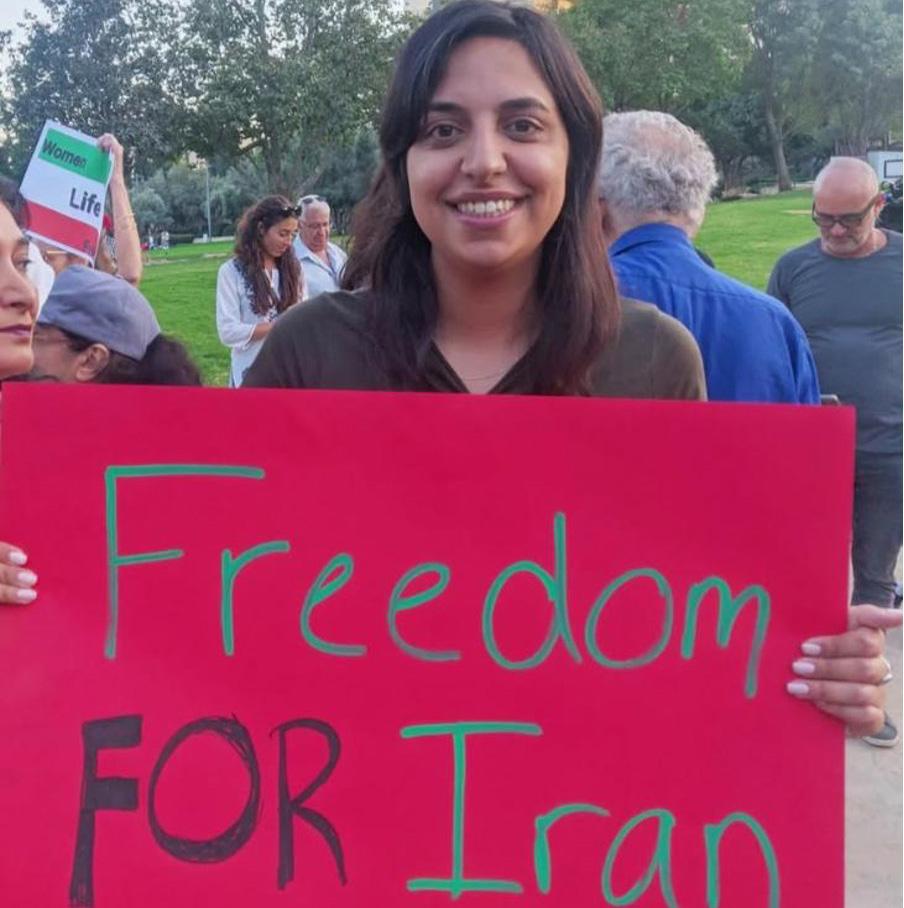
Weeks ago, on a bright afternoon along the Tel Aviv boardwalk, a group of Iranian-Israelis gathered beneath blue-and-white flags and the prerevolutionary lion-and-sun flag of Iran. They sang Hatikvah. They held signs reading “Free Iran” and “Trump Act Now”. And they marched toward the American and French embassies with a message that carried both urgency and hope.
For Yasmin Sayeh, who helped organise the march, the recent days have felt historic, a first step towards fulfilling her protest’s wishes.
“This is a new dawn,” she said. “A new day. We have to understand that the Iranian people need our support to end this regime.”
Sayeh, 35, lives in Modi’in. She was born in Israel – the first in her family to be – after her parents immigrated from Iran following the Islamic Revolution. Farsi was spoken at home and Iranian cultural holidays were celebrated alongside Jewish ones. “We are very Israeli and very Zionist,” she says, “but also deeply
connected to our roots.” That dual identity – Israeli and Persian, Zionist and culturally Iranian – gives her a unique
revolution, a small Jewish community remained in Iran. According to Sayeh, until recently many lived “relatively comfortably”, so long as they avoided any public identification with Zionism.
“There’s no problem being Jewish in Iran,” she explains carefully. “There’s a problem being a Zionist.”
Today, however, the situation is far more fragile. Sayeh cites staggering numbers of protesters killed and imprisoned in recent months. Independent verification of figures is difficult, but reports of mass arrests, executions and brutal crackdowns are widespread.
“Women want basic rights,” she says. “Young people want freedom. And the regime answers with hangings.”
For Sayeh, this is not only a geopolitical struggle. It is personal.
“My grandfather waited years to come to Israel,” she says. “Being Zionist is in our blood. All of my family members have Jewish names. This identity, it’s who we are.” Yet she speaks with equal warmth about Iranian culture. “Iranians are warm people.
vantage point on this moment. For nearly five decades, Iran’s Islamic regime has defined itself in opposition to Israel and the Jewish people. It has funded and armed Hamas and Hezbollah. It has called openly for Israel’s destruction. But Sayeh insists that the regime does not represent the Iranian people.
“The regime is not good for Israel. It’s not good for the Jewish people. But more than that – it’s not good for the Iranian people inside Iran. For 47 years, they have been suffering.”
In recent months, as protests inside Iran were met with violent repression, Sayeh began receiving messages from Iranians across the world. Many wrote in Farsi. Some were inside Iran itself.
“They say, ‘Thank you. We love Israel. We hope this brings something new.’ It’s very emotional for them,” she explains. “They grow up hearing that Israel hates them. And then they see Jews and Israelis walking in Tel Aviv, asking for freedom for the Iranian people. It moves them deeply.”
Not everyone in the Iranian-Israeli community felt safe attending the march. Many still have close family in Iran. Public identification with antiregime activism can carry real risks for relatives back home.
“For some, even having their photo taken at a protest is dangerous,” Sayeh says. “They support us, but they must remain in the shadows to protect their loved ones. If they can’t be the voice, then we must be the voice.”
That tension – pride mixed with fear – is woven into the Iranian-Jewish experience. Jews have lived in Persia for over 2,500 years, dating back to the time of Cyrus the Great. Even after the 1979
Positive people. We love our language, our food and our traditions. When we visit the Iranian-Jewish community in Los Angeles, it feels like the closest thing to Iran we can experience freely.”
Sayeh believes the stakes extend far beyond Israel. “This regime supports terror everywhere,” she says. “Ending it would change the Middle East. It would affect America. Europe. The whole world.”
At the same time, she does not romanticise the cost.
During our conversation, air-raid sirens sounded in parts of the country. An Iranian missile had struck a civilian building in Beit Shemesh, killing nine Israeli civilians, with dozens injured.
“We are strong,” she says quietly. “We will protect ourselves. But it has a huge price.” And so she looks outward, to Washington, to Europe, to what she calls the “liberal world.” “We hoped there would be change. We hoped the regime would fall.
We hope leaders will act. Every day they hang more people. They cannot continue like this.”
At the end of our conversation, Sayeh paused and offered a quiet prayer. “Ken yehi ratzon,” she said. May it be God’s will. Then, without hesitation: “Am Yisrael Chai.”
For Iranian Jews like Yasmin Sayeh, this is not a moment of triumphalism. It is a moment of yearning, that the ancient sun once emblazoned on Iran’s old flag might rise again, illuminating a free people and the dawn of a new peaceful Middle East.
Iranian by blood, Israeli by birth, Yasmin Sayeh says the Iranian regime is the enemy of both peoples.
Yasmin Sayeh
THE COMMUNITY
DAVID SOLOMON AUSTRALIAN FRIENDS OF TEL AVIV UNIVERSITY AROUND
For many people living with posttraumatic stress disorder (PTSD), memories are not simply recollections of the past. They return as vivid, intrusive experiences –flashbacks and thoughts that can make the trauma feel as though it is happening again, sometimes years after the event.
Researchers at Tel Aviv University now believe they may have found a way to weaken those memories at their neurological source. In a new study, scientists used non-invasive brain stimulation to intervene at the precise moment when a traumatic memory becomes temporarily “flexible” in the brain – significantly reducing the intrusive memories that lie at the heart of PTSD.
Targeting trauma at the moment it reopens
The research focussed on a key feature of the brain’s functioning when a memory is recalled. At that point, it briefly enters a state known as reconsolidation – a window during which the memory becomes “flexible”, before it is stored again. The study was conducted in the laboratories of Professor Nitzan Censor and Yair BarHaim from the School of Psychological Sciences and the Sagol School of Neuroscience at Tel Aviv University. Led by doctoral students Or Dezachyo and Noga Yair, they also collaborated with Tel Aviv Sourasky Medical Center (Ichilov) and the
Can traumatic memories be rewritten?
National Institute of Mental Health in the United States. The study was published in the scientific journal Brain Stimulation. The scientists asked a bold question. Could that moment be used to reduce the emotional intensity of traumatic memories?
A precise, non-invasive intervention
To test the idea, participants with PTSD first recalled their traumatic memory in a controlled setting. Immediately
aftau.asn.au
The gift of a lifetime
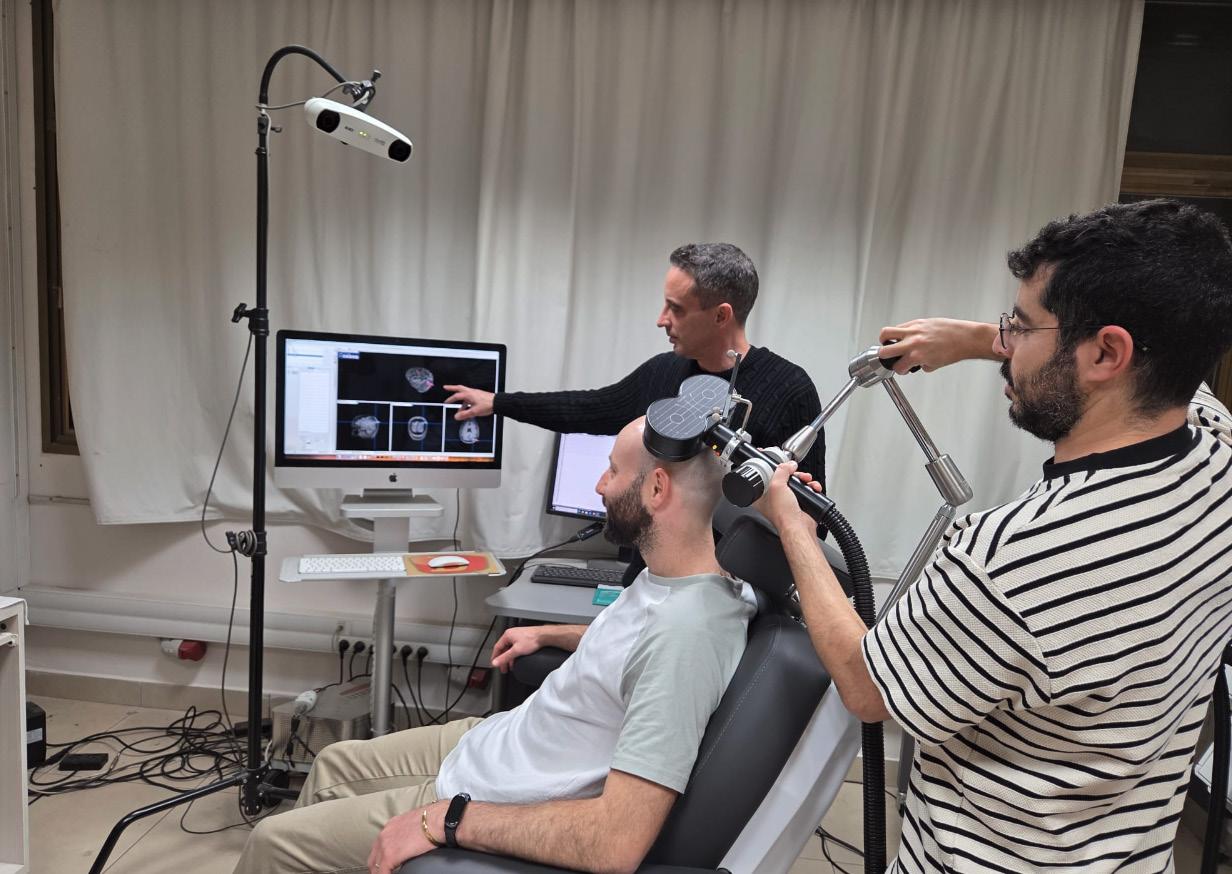
afterwards, the researchers applied transcranial magnetic stimulation (TMS) – a non-invasive technique that uses magnetic pulses to influence brain activity.
Because the hippocampus, a deep brain structure central to memory processing, cannot be directly stimulated without surgery, the team used brain imaging to identify surface brain regions connected to it. These regions were then
stimulated to indirectly influence how the memory was re-stored in the brain. Each treatment site was personalised using functional MRI scans, allowing the intervention to be tailored to each participant’s neural network.
Early results show real change Ten adults with PTSD participated in the preliminary study, undergoing five, weekly treatment sessions.
Participants reported a clear reduction in intrusive memories – one of the most distressing symptoms of PTSD. Brain imaging supported these findings, revealing reduced connectivity between the hippocampus and the stimulated regions, indicating measurable changes in brain activity.
A breakthrough with global relevance PTSD affects millions worldwide, including soldiers, survivors of terror attacks, accident victims and others exposed to trauma. Despite existing treatments, many patients continue to experience intrusive memories.
A short, non-invasive approach that directly targets the brain mechanisms behind those memories could represent a significant shift in treatment.
While larger clinical trials are already underway, the early findings of this bold neuroscience research show real potential to transform how traumatic memories are treated in the future.
A promise today for Israel’s tomorrow
Discover how your values can live on.
For a confidential conversation, please call David Solomon on 0418 465 556 or davidsolomon@aftau.org.au
Doctoral student Or Dezachyo (in the striped t-shirt) and Professor Nitzan Censor (in the black top) testing the hypothesis
CONSIDERED OPINION
ANNE-MARIE ELIAS
As we are about to celebrate Pesach in 2026, we continue to find ourselves living in troubled times. It may be, therefore be difficult to follow the key Passover messages of freedom, love, unity, responsibility and memory.
When we feel overwhelmed, stressed and unsure about the future it becomes increasingly difficult to maintain helpful thought processes.
Psychologically it follows that the environment influences and informs how we think, which, in turn, determines the outcome – what we feel and do.
When we are troubled, we can become subject to emotional overload.
To help manage this, US psychologist Marsha Linehan developed what she termed dialectical behaviour therapy. We need to engage in mindful living, which amounts to being focused on the present, as distinct from worrying about the future.
That involves being self-aware of our feelings, thoughts and body sensations. What is our body telling us? Is your breathing becoming short and shallow? Do you feel nauseous? Are your thoughts
KOSHER CROSSWORD
YONI
Hired gun, for short
Haza with the 1984 album "Yemenite Songs"
Illuminating dough?
.mpeg alternative
Former Giant's great Umenyiora 22. Free, with of
Having a meal?
Managing the thought/feeling connection
racing? When we become self-aware, we can change our thinking, become grounded and more content. For example, if you catch yourself saying “what if?” repeatedly, you can employ the present orienting words of “what”, “when”, “where” and “who”. Take deep breaths. Become aware of your environment. What can you see? What can you hear? Can you feel the ground under your feet? These techniques bring about calm and lessen anxiety. We need to let go of the fallacy of
fairness and being right. Richard Carlson, author of “Don’t Sweat the Small Stuff” suggests that to be happy we sometimes need to stop proving our “rightness”. When distress feels unmanageable, we can utilise distress tolerance techniques, such as radical acceptance. We can be our own worst enemies by railing against something that cannot be changed. Radical acceptance means to fully accept the reality of a situation, even if it is painful or difficult. We need to acknowledge what can’t be changed
Mitzvah mix-up
and focus on what we can control. We can learn to improve the moment (lessen the distress) by engaging in meditation, relaxation or prayer.
Let’s return to the Passover message of freedom, love, unity and responsibility. How can we incorporate these concepts into our daily lives?
Freedom was the liberation of the Israelites from slavery. Take a moment to consider what freedoms you have in your life. If you feel enslaved, what do you need to do to free yourself?
In your current relationships and interactions, do you give and receive love, respect and acceptance? If not, it is time to consider exiting those relationships and being with others who do love, respect and accept you.
I conclude with sentiments from psychologist Marsha Linehan, who encourages people to work with feelings, rather than against them.
These are her words: “Emotions are information, not commands. You don’t have to act on every feeling you have. Feelings love facts – give them accurate information.”
Anne-Marie Elias is a psychologist in clinical practice for 25 years.
13. "Di-dah" preceder
18. African nut tree
19. Prepares to fire
24. Crime scene finds, perhaps
25. Apple on one's desk, perhaps?
26. Alternatives to wraps
27. Letter worth 7
28. President that deported the most illegal immigrants
29. She's probably not Jewish
33. Ethiopia's Addis
34. A ___ omission
35. Strict
36. 20s provider, for short
37. Begun is known for one
39. Elusive needle locale
40. Ice cream choice
41. Not nyet
45. Mountain lake
46. E Pluribus ___
48. She hid the spies at Jericho
49. Big game name, formerly
50. Slangy potato
51. Moved like slime
52. A pro team might make one
56. Oscar/Emmy/Grammy winner
57. Her match?
58. B'nai B'rith advocacy org.
59. Title for Larry Ellison
60. Yam of note
61. Dip on 8 Av
62. American rival, once
General killed by Yoav
Song title words before Be or Ride
Fly ball trajectory
Paul who wrote "Taxi Driver" and "Raging Paul"
Contemporary of Moshe, Levi and Yitzchak
GLATT
AROUND THE COMMUNITY
Presidential support
that replicates driving a Mobile Intensive Care Unit ambulance.
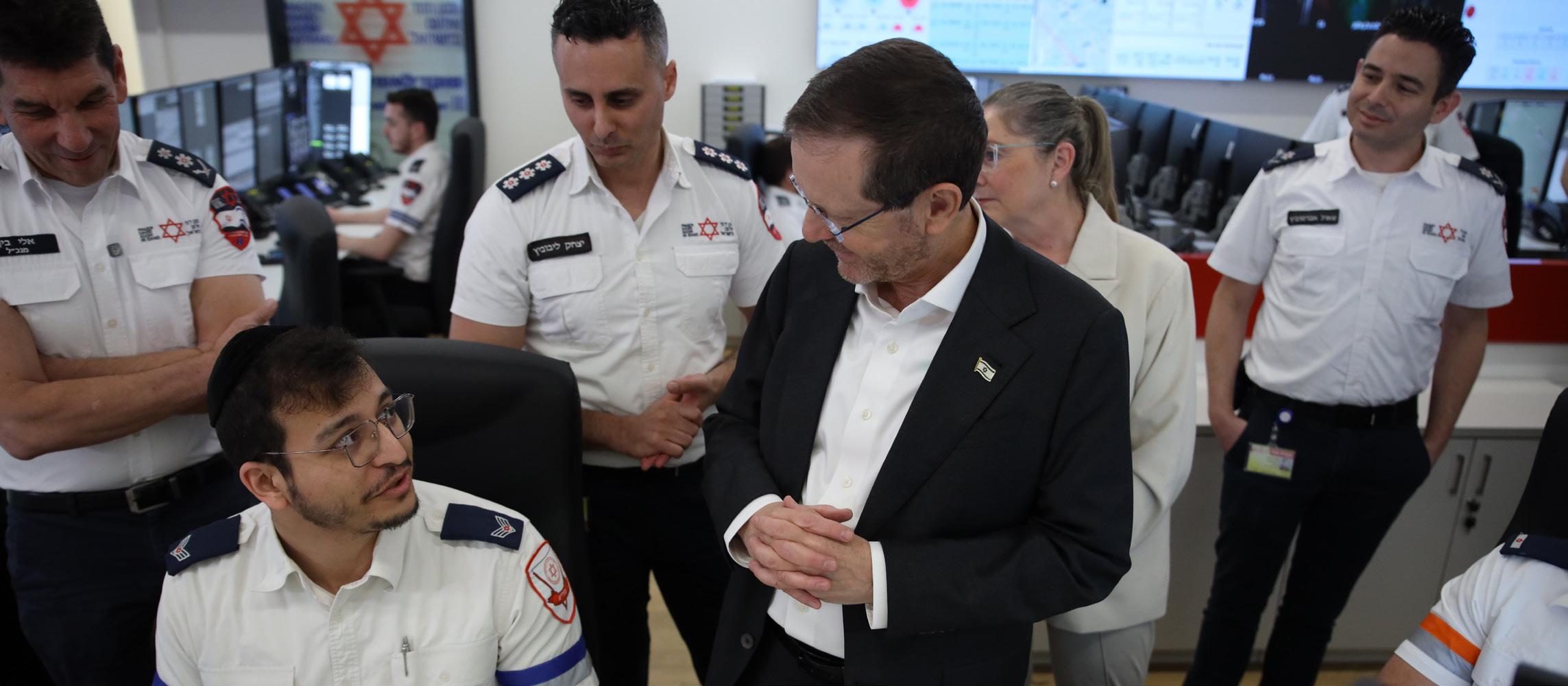
Israeli president Isaac Herzog and first lady Michal Herzog were recently presented with an overview of MDA’s operations and activities.
They met Nissim Salem, an MDA paramedic from Beit Shemesh who grew up in the neighborhood where an Iranian missile struck a synagogue and shelter. Salem was among the first responders, initially managing the incident and providing treatment to the injured.
His parents and relatives live near the impact site and, naturally, he was concerned about them, although he later found out they were unharmed.
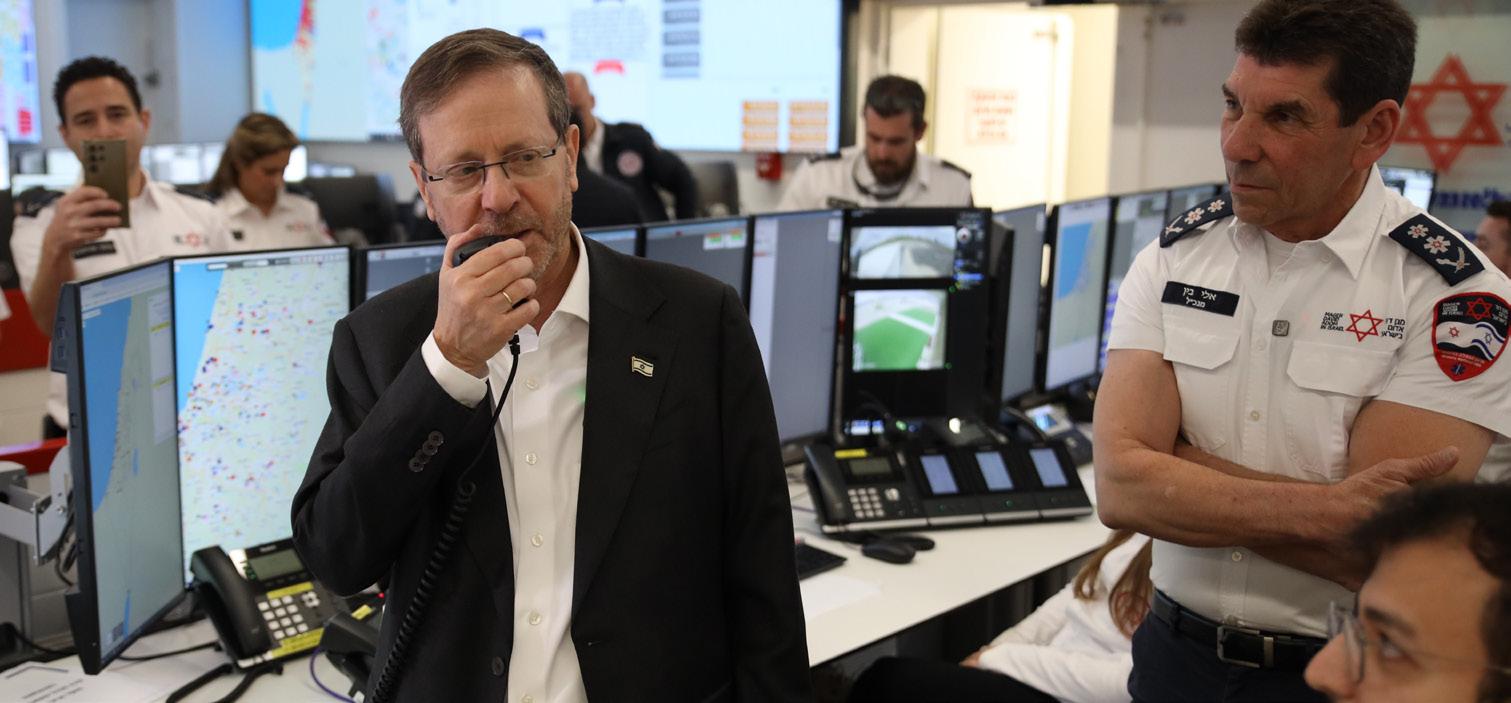
The president and first lady toured MDA’s National Dispatch Centre, where Mr Herzog addressed the organisation’s volunteers over the radio, offering them encouragement.
MDA has more than 40,000 employees and volunteers that operate around the clock and under fire.
“I thank you for saving lives, for working 24/7 … for your vigilance, dedication and professionalism,” the president said.
He and his wife also toured MDA’s new Simulation and Training Centre and visited its advanced training rooms.
The president experienced an augmented reality simulator, designed to treat patients at complex emergency scenes, as well as an advanced simulator
MDA director general Eli Bin thanked the couple for coming to support the thousands of paramedics, emergency medical technicians and blood services personnel working day and night to care for Israeli citizens during these challenging times.
“MDA’s volunteers and employees are prepared for every scene and every scenario. The moment a siren sounds, our teams don their protective gear and then head out to the scenes to treat and save lives,” Bin said.
ISRAEL ON ALERT
MAGEN DAVID ADOM
Israeli president Isaac Herzog during a recent visit to Magen David Adom
DAN RICH COURTESY: AISH.COM
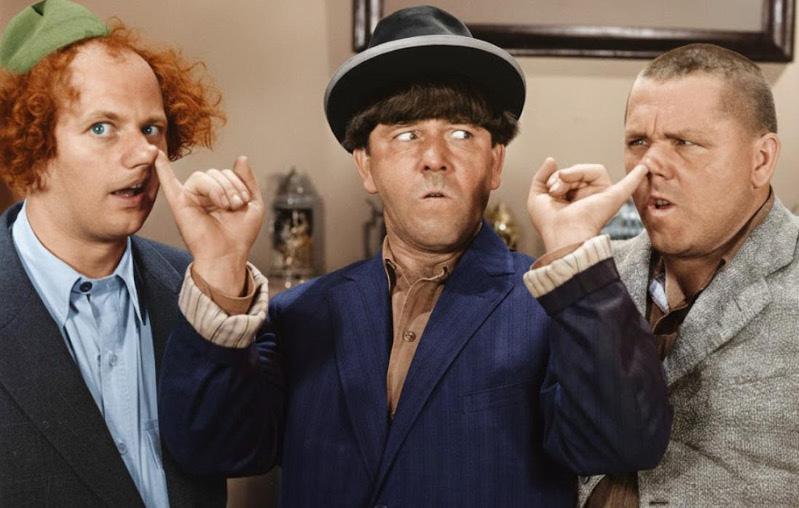
While Hollywood cowered, the Three Stooges mocked Hitler to his face.
People either howl with delight at the Three Stooges or stare in bewilderment that anyone could. But spend even a few minutes with their classic shorts and something becomes impossible to miss: their antics and banter are soaked in Jewish identity. And at one of the most dangerous moments in modern history, that identity became a weapon.
Who were the Three Stooges?
The classic Three Stooges lineup actually had four members, all Jewish.
Moses Horwitz (Moe Howard), his younger brother Jerome (Curly Howard) and his older brother Samuel (Shemp Howard) were born to Lithuanian Jewish immigrants. Louis Feinberg (Larry Fine) came from a Russian Jewish family. Moe and Larry were the constants; the third spot rotated between Curly and Shemp, depending on contracts and health.
Moe, Curly, and Shemp were the sons of Solomon and Jennie Horwitz, Lithuanian Jewish immigrants who settled in Brooklyn. Jennie built a thriving real estate business, despite barely speaking English; Solomon worked steadily as a fabric cutter. Larry was born in Philadelphia, the son of Russian Jewish immigrants Joseph and Fanny Feinberg, who ran a watch repair and jewellery shop.
All four came of age in the Yiddishspeaking world of early 20th century Jewish immigrant life – vaudeville circuits, crowded tenements, the bustling streets of New York's Lower East Side and Philadelphia. Their paths mirrored the broader Jewish immigrant journey in America. Moe (1897-1975), Shemp (1895-1955), Curly (1903-1952), and Larry (1902-1975) grew up in tight-knit Jewish communities where vaudeville was both livelihood and training ground, shaping their humour, hustle and world view.
As the act evolved, Joe Besser (19071988) and later Joseph Wardell, known as Curly Joe DeRita (1909-1993), each carried forward a comedy style rooted in that same cultural soil. Their overlapping lifespans stretch from the vaudeville era through Hollywood's golden age and into the dawn of television, but the sensibility never changed: the rhythms of Yiddish humour, the survival instincts of immigrant life, the irreverent wit forged on crowded urban streets.
Vaudeville and Yiddish theatre roots
The Three Stooges represent a fascinating chapter in American Jewish cultural history: immigrant kids who turned their community's humour into a universal language of chaos, timing and physical comedy.
They carried a deeply Jewish comedic sensibility, even when it wasn't explicit on screen. Moe's bossy persona was modelled on the Lower East Side tough guy he grew up as. His heavy-handed bark, Curly's musical gibberish and Larry's hapless charm all carried the cadence of immigrant Jewish neighbourhoods. Even as Hollywood pressured Jewish artists to downplay their identity, their humour carried unmistakable Jewish DNA. Their cultural background shaped their timing, their world view, their entire comedic language.
Their timing, musicality, and bits came straight out of Jewish vaudeville, Borscht Belt comedy, and the Yiddish theatre tradition. The rapid-fire banter, the mock authority figures, the exaggerated
How The Three Stooges humiliated Hitler
suffering – these were staples of Jewish stage comedy.
Yiddish words and accents slipped into their shorts constantly. Curly's nonsense syllables often had a Yiddish lilt. Gary Lassin – who heads The Three Stooges Fan Club, edits The Three Stooges Journal, and curates The Stoogeum museum in Ambler, Pennsylvania – has become a leading authority on all things Stooge. His research shows that about 40 percent of their shorts include some Hebrew or Yiddish.
Watch their films and the Yiddish words come fast: "biblach", "salamkum", "plotz" (to faint or burst from emotion) and countless other Yiddish-inflected nonsense lines. In "Pardon My Scotch" (1935), they shout "Vehr-ge-hargit!" as a toast, Yiddish for "drop dead." In another short, Moe promises to hock some belongings and Larry shoots back: "Hey, hock a chynick for me too, willya?"
The phrase literally means "bang on a teakettle" – idiomatically, to pester someone with nonstop chatter.
The Stooges' routines were pure slapstick – more punching, slapping and eye-poking than talking – and their soundtracks did double duty as amplifiers and audience cues. Exaggerated sound effects – ukulele plinks, twittering birds, boings, bonks, thuds, buzzing saws, whining drills, hissing blowtorches, scraping sandpaper, popping corks and ringing bells – turned every punch into a punchline.
Their body of work, 190 shorts over 25 consecutive years (1934-1959), embodied classic Jewish comedic archetypes: the bungling schlemiel (a hapless fool), the unlucky schlimazel (someone cursed with bad luck) and the pestering nudnik (an annoying, relentless bore). These hapless characters struggling against an indifferent world echoed the humour of immigrant Jewish life.
Anti-fascist Jewish humour
The Stooges knew their slapstick could be pointed and political. They took on the Nazis early with humour and ridicule.
This was a rare act in 1930s-40s Hollywood, where Jewish comedians working in a studio system that pressured them to hide their identity used that very identity as a weapon against fascism. Look closely and their Jewishness isn't incidental to the jokes – it's the engine that powers them. Jewish humour traditionally punches up at tyrants, pompous leaders and anyone
who demands obedience. The Stooges’ entire act is built on puncturing authority figures. When Nazism emerged, it slotted perfectly into a pre-existing comedic framework: the bully who deserves to be taken down a peg.
Raised in Yiddish-speaking homes, in neighbourhoods where Jewish humour –sharp, self-mocking, quick on its feet and forever suspicious of authority – was the air everyone breathed, that sensibility shaped their comedic instincts long before Hitler appeared on their radar.
Hollywood, meanwhile, was terrified of offending Germany. Studios tiptoed around anything that might upset the Nazi government.
Working under the Hays Office, the industry's self-imposed moral watchdog, studios followed strict rules limiting sexual content, profanity, drug use, excessive violence and ridicule of religion. But the Hays Office had another, quieter mission: avoiding conflict with Nazi Germany.
Major studios, many led by Jewish executives, were especially cautious about provoking the regime.
Before WWII, Germany was a major foreign market for American films. The Nazi government threatened to ban studios entirely if movies portrayed Germany negatively or showed Jewish characters sympathetically. These restrictions held until Hitler's aggression escalated and the tide began turning between 1939 and 1941.
This is exactly why the Stooges' shorts are so remarkable. They broke through the climate of fear and did what the major studios wouldn't: they mocked Hitler to his face.
You Nazty Spy
The Stooges' most legendary act of anti-fascist humour is their 1940 classic, You Nazty Spy.
Over a year before the United States entered WWII, and nine months before Charlie Chaplin's The Great Dictator, the Stooges released You Nazty Spy, and followed it with a sequel, I'll Never Heil Again in 1941.
Film historians recognise You Nazty Spy as the first American film to openly mock Hitler, created by Jewish comedians who understood the threat early. It is now studied in film schools as a landmark in American political satire. Just 18 minutes long, the short is packed with political commentary disguised as slapstick, directly attacking fascism at a moment
when isolationism was still running strong. Some theatres refused to show it. Others embraced it.
Moe based his Hitler impression partly on newsreels and partly on "a Jewish mother scolding her kids". His character, "Moe Hailstone" – a riff on "Heil" – is a razor-sharp Hitler parody: mock salute, blustering speeches, armband, military uniform, a moustache resembling a strip of black electrical tape and the absurd dictatorship of the fictional nation of Moronica. Fascist imagery gets twisted into slapstick: Hitler as buffoon, propaganda ministers reduced to caricature, militaristic pomp punctured by eye pokes and pratfalls.
Curly took on a dual role as Mussolini and Hermann Göring. Larry played Joseph Goebbels, the Nazis' Minister of Propaganda.
As for the plot: once in power, the Stooges’ first assignment was to launch a "beer putsch", which Curly helpfully explains as, "You putcher beer down and wait for the pretzels, Nyuk Nyuk." They seize control of the country and Moe Hailstone delivers a blisteringly funny speech to his "Morons", parodying Hitler's bombast, facial contortions and expansionist swagger.
A swastika appears, formed from two snakes, emblazoned with the slogan "Moronika for Morons". Back in the office, Moe orders Curly to burn all the books because "there are too many bookmakers – the bookies are overrunning the country." Nearly every line lands, whether for its pointed political references or its avalanche of puns and Yiddish expressions.
When their Nazi overlords appear, the Stooges snap to attention and bark a cheerful "Shalom aleichem!" (Hebrew for "peace be upon you"). Moe calls for a blitzkrieg and Curly eagerly chimes in, "I just love blintzes, especially with sour cream." A vamp named Maddy Herring slinks in with her temptations and Curly sighs with relief when Moe resists with these words: "You'd have been in some pickle with that Herring."
Their Jewish sensibility is unmistakable. Moe's rants slip into Yiddish rhythms, turning the dictator into a figure of ridicule. Curly and Larry spoof Nazi officials with broad, subversive humour. As sons of Jewish immigrants with family in Europe, they understood the stakes. Mockery became cultural resistance, using comedy to confront danger early, loudly and fearlessly.
The film is loaded with subtext. Mocking Hitler was itself a Jewish act of defiance. Moe's Yiddish-inflected delivery was a nod to Jewish audiences who instantly recognised the cultural in-jokes and a way of reclaiming power – a Jewish kid from Brooklyn openly ridiculing the dictator who wanted Jews erased.
One historian noted an interesting consequence: the Stooges, alongside Charlie Chaplin and Jack Benny, landed on Hitler's so-called "death list" because of their anti-Nazi propaganda films.
The Stooges didn't stop Hitler, but they refused to let fascism control the narrative. In a Hollywood that urged Jewish artists to blend in, they used their Jewishness as a weapon, creating some of the earliest and boldest American antiNazi satire and proving that laughter can be a form of defiance.
The Three Stooges in their heyday
RABBINIC THOUGHT
Every year, sometime between scrubbing the stovetop and hunting for crumbs behind my couch, I wonder where to find the joy in this festival. The lead-up to Pesach is demanding in every sense: physically, mentally and spiritually. The preparation is so intensive that it can feel like a festival of lists rather than a festival of freedom. Yet, without fail, by the time the Seder begins, something shifts. There is a quiet transformation. The exhaustion remains, but so does a powerful sense of meaning. In the stillness after the storm, I remember why we do this.
Preparing for Pesach is not only about cleaning our homes of chametz. It is about recalibrating our inner lives. The halachic requirement to remove leaven is both practical and symbolic. Chametz represents puffiness, ego and spiritual complacency. When I clean my home, I often find myself confronting parts of my life that have been left unattended. That corner where crumbs gather becomes a metaphor for the overlooked parts of my character. The work of preparation becomes a form of reflection. What have I accumulated that no longer serves me? What habits need to be reconsidered? What thoughts have I allowed to ferment unchecked? It is easy to think of Pesach as a holiday of extremes. The food is unusual.
Pesach
The cleaning is intense. The rituals are layered and detailed. But within this intensity lies a certain kind of clarity. Our ancestors were asked to leave Egypt at a moment’s notice. Their redemption came not when they were ready, but when they were willing. They stepped into uncertainty carrying only what they could.
In many ways, Pesach asks the same of us. It invites us to engage in a type of spiritual exodus, to shed what weighs us down and to move forward with what matters most.
One of the most powerful aspects of the Seder is the telling of the story itself. The Haggadah commands us to see ourselves as if we personally left Egypt.
It is not a passive history lesson. It is a living narrative. Each year, as I sit around the table with friends and family, I am struck by the way this story continues to resonate. We speak of freedom not as an abstract concept, but as something that must be pursued anew in every generation. The Seder table becomes a classroom, a sanctuary and a mirror, all at once.
There is also something profoundly communal about Pesach. Though each person’s preparation may differ, there is a collective momentum that carries us all. The entire Jewish world turns toward the same task.
Across continents and time zones, kitchens are being turned over, Seder plates arranged, and matzah purchased in bulk. This shared experience creates a sense of unity that transcends geography. Even in moments when I feel overwhelmed or alone in the process, I remember that I am part of something much larger. I am not the first to feel this way and I will not be the last.
Still, it is important to acknowledge that the lead-up to Pesach is not always joyful. It can be draining. It can be stressful. There are financial pressures, emotional burdens and the sheer logistics of it all. But within that struggle lies something sacred.
Chag kasher v’sameach.
Four perspectives on the four children
Pesach Seder is the most celebrated ritual across global Jewry, bringing together people from every walk of life. One of its most famous passages describes four children: “one wise, one wicked, one simple and one who does not know how to ask a question”. This passage is layered with meaning, offering insights into four stages of life, four types of educators and four successive generations. While these interpretations provide broad guidance, each illuminates the Seder experience and offers lessons for life beyond the table.
From a psychological perspective, the four children reflect stages of human development, similar to the theories of Jean Piaget. We begin life like the child who does not know how to ask, entirely dependent on caregivers. Curiosity then emerges, turning us into the "simple" child who seeks understanding through constant questions.
As we grow, we may challenge norms and test boundaries – sometimes from a "wicked" place – as we discover ourselves. Finally, we reach a stage of wisdom where we harmonise these earlier experiences in a lifelong pursuit of growth. Rabbi Yehuda Aryeh Leib Alter, the Sfat Emet, reminds us that these tendencies coexist within each person at all times and our task is to balance them.
Sociologically, the four children reflect a generational continuum. In this view, the wise child represents a generation steeped in heritage, while the "wicked" child represents those who rejected the past to pave a modern future. Their offspring, the simple child, grew up confused between the old and the new. By the fourth generation, a lack of clear
guidance results in a child who is unable to appreciate their heritage or even ask a meaningful question.
This progression reveals the "Fifth Child" – those who do not make it to the Seder table at all.
Mirroring the Midrashic teaching that one-fifth of the Israelites disappeared in the darkness of Egypt, this fifth child
symbolises those lost to the "darkness of assimilation" in today’s society.
Parents and educators also play a vital role in shaping these outcomes.
A domineering educator may leave a child feeling alienated and unable to ask, while a parent who prioritises universal identity over specific cultural roots may raise a "simple" child who does not understand their unique place in the world.
If there is a total lack of guidance or moral direction, a child may veer toward wicked tendencies. Ultimately, a wise role model inspires a wise child, as sincerity breeds sincerity.
In this context, the fifth child may be absent because the "fifth parent" – the guiding mentor – was absent from their life.
Philosophically, the repetition of the word “one” before each child signifies that every person has a rightful place at the Seder and that all four traits exist within every individual.
Life is rarely black and white and the ultimate lesson is to “educate according to his way”.
By engaging in rituals and meaningful conversations, we ensure that every person belongs at the table, regardless of their stage or label.
To learn more, visit RabbiBenji.com or follow @RabbiBenji on social media.
RABBI GABI KALTMANN
Rabbi Gabi Kaltmann
The
RABBI DR BENJI LEVY
Rabbi Benji teaching in Jerusalem
THOUGHT
RABBI YAAKOV GLASMAN RABBINIC
Earlier this month, I hosted a panel discussion at St Kilda Shule reflecting on the aftermath of the Bondi attack and the broader challenges facing Australian society. The event brought together a diverse group of voices. These included former federal treasurer Josh Frydenberg, former Labor defence minister Mike Kelly and Sheina Gutnick, whose father, Reuven Morrison, was murdered at Bondi. The moderator was journalist and author Rachelle Unreich. It was a serious, at times sobering, conversation, but one that also reminded me of the resilience and moral clarity that can emerge in moments from dark moments.
Hearing Sheina Gutnick speak about her father was deeply moving. She carried the pain of personal loss and the determination that her father’s memory should inspire meaningful change. She expressed the hope that the national inquiry into the events surrounding the attack will carefully examine what went wrong and ensure that lessons are learned. For families like hers, accountability transcends politics and is driven by a desire to ensure that
Australia at the crossroads
tragedies of this magnitude are never repeated. Josh Frydenberg spoke from the perspective of someone who has long been involved in public life and national security discussions. His message was that what Australia is confronting today is not an issue for one community alone. He said the rise of antisemitism and extremist hatred should concern every Australian. When prejudice and violence are allowed to grow unchecked, they eventually threaten
the fabric of society. He reflected on how the events surrounding Bondi did not emerge out of nowhere. There were warning signs that should have been taken more seriously.
He said that Australia has reached a critical moment in determining the direction of its civic culture. Leadership must be shown not only by politicians, but by institutions across the spectrum. Schools, universities, cultural organisations and community groups
Standing up for what we believe
Imagine being told as a teenager that one day you might struggle to get a job because of what you believe. Not because you did something wrong, not because you broke the law, but simply because you publicly supported Israel.
That was the question put to Sophie Basist, a young Jewish voice who began speaking out shortly after the horrors of October 7. Like many Jewish teenagers, she watched the events unfold with shock and heartbreak. But while most young people processed those emotions privately, Sophie chose a different path. She began using her voice publicly, standing up against antisemitism and speaking about Israel at rallies, online and in community spaces.
Someone once asked her whether she worries that when she is older, potential employers might see her activism and decide not to hire her.
Her response was immediate and disarmingly simple.
“If someone wouldn’t hire me because I support Israel, then I wouldn’t want to work there in the first place,” Sophie said.
In that moment, a teenager articulated something many adults struggle to say out loud.
We live in a time when people increasingly calculate the cost of speaking openly about their beliefs.
On university campuses, in workplaces and across social media, there is growing pressure to stay quiet about certain issues, particularly when it comes to Israel and Jewish identity. Many people respond by becoming cautious. Opinions are softened. Conversations are avoided. Silence becomes a strategy for navigating an uncomfortable environment.
But there is a danger in that approach. When identity becomes something we
all play a role in shaping the values that guide public life. One of the concerns he raised was that modern education sometimes emphasises rights without giving equal attention to responsibilities. For a democratic society to remain healthy, civic virtue must be actively taught and reinforced.
Mike Kelly, who is not Jewish, but highly supportive of the Jewish community and Israel, is someone deeply familiar with defence and intelligence matters. He emphasised the importance of ensuring that security agencies have the resources and capabilities they need to respond to emerging threats. He noted that there are often practical gaps that require urgent attention and proper funding if tragedies are to be prevented.
The discussion reinforced an important truth. While the Jewish community has felt the impact of rising antisemitism directly, what we are confronting is not confined to any single group. It is a national challenge that requires a national response. Moments like this call for moral courage, thoughtful leadership and a renewed commitment to the values that hold our society together.
Australia is at a pivotal juncture. The question is whether we will step up or allow hatred to fester.
feel we must hide or dilute, we slowly begin to lose confidence in it ourselves.
Sophie shared this story when she spoke at Caulfield Shule and what struck me was the clarity of her answer. Teenagers often see the world in simpler terms than adults. As we grow older, we become skilled at managing complexity, navigating sensitivities and weighing consequences. Yet, sometimes, that complexity can cloud something essential.
Jewish history has never been sustained by people who waited for universal approval. It has been carried forward by those that understood who they were and lived accordingly. From Avraham, standing against the beliefs of his generation, to Esther, speaking when silence would have been safer, Jewish identity has always demanded a certain inner clarity.
And perhaps that is the deeper lesson in Sophie’s response.
Life inevitably presents moments where we must choose between comfort and conviction. The easier path is often to soften our voice, avoid the tension and blend quietly into the background. The harder one is to live in a way that reflects our values, even when it may not be universally welcomed.
But a life built around hiding who we are is ultimately far more exhausting than one built around standing by it.
So, perhaps the takeaway is not about employment prospects or public advocacy at all. It is something far more straight forward and enduring. When we know who we are and what we stand for, the question of whether everyone else approves becomes far less important. Because belonging somewhere should never require abandoning ourselves. And sometimes it takes the clarity of a teenager to remind us of that truth.
RABBI DANIEL RABIN
From left: Sophie Basist, Rebbetzin Sarah Rabin and Rabbi Daniel Rabin at Caulfield Shule
From left: Rabbi Yaakov Glasman AM, Rachelle Unreich, Sheina Gutnick, Mike Kelly and Josh Frydenberg
ALAN BENDER SOUL GOURMET FOODIE CORNER
I would highly recommend that you buy a simple waffle baker just for Pesach.
The recipe is simple but with a little imagination and tweaking its very versatile.
Recipe:
Matzo meal 1 cup
Potato starch 2 heaped teaspoons
2 eggs
Water or milk 1½ cups
Sugar 3 heaped tablespoons or to taste
Oil or melted butter ¼ cup
Baking powder 1½ teaspoons
Cinnamon 1 good pinch
Salt 1 good pinch
Put all the ingredients into a bowl. Mix well and let it stand for 10 minutes. If it is too thick, add a little more liquid.
Spoon onto a hot waffle iron and bake for five minutes or until done.
Chef’s tips:
On Yom Tov, my wife and I put the waffle maker on a time switch. Just imagine fresh hot waffles with butter and strawberry jam. It gets the family out of bed every time.
I make my waffles with water, so they are pareve. It is so nice to take a little leftover chicken or meat and heat it up with any sauce available. Add a few pickles and it makes a great sandwich.
Pesach waffles
My wife likes milk, so that’s what we do at home.
Some other tested ideas that worked as additions to the batter:
• Take a waffle. Put a little tomato sauce on the base, then add some grated cheese and melt it for a pizza waffle.
• Fried egg on waffle.
• Add choc chips.
• Add any dried fruit.
• Tuna and melted cheese on top.
• Banana, honey and cream.
• Ice cream and chocolate sauce or syrup.
For a special dessert: ice cream cake: Line a foil roaster with plastic. Place a layer of waffles in the roaster, then spread ice cream (or instant pudding) over the waffles, with another layer of waffles on top. Before you serve them, remove the waffles from the foil roaster by lifting them with the plastic. Remove the plastic and place the waffles on a serving platter. Pour syrup over the top, add a sliced banana and a sprig of mint.
Choc chip waffle stack:
A stack of waffles drenched with maple syrup and served warm.
If you don’t want to buy a waffle baker, the same recipe works well in a pan with a little oil. Don’t try turn the pancake too quickly. It needs at least five minutes on a medium to low heat.
I wish you all a fantastic Yom Tov and may all our Seders be filled with joy and laughter.
CANDLE LIGHTING TIMES
Friday, Apr 3, 2026 6:53 pm
Shabbat ends, Apr 4, 2026 7:48 pm
Friday, Apr 10, 2026 5:43 pm
Shabbat ends, Apr 11, 2026 6:38 pm
Friday, Apr 17, 2026 5:33 pm
Shabbat ends, Apr 18, 2026 6:29 pm
Friday, Apr 24, 2026 5:24 pm
Shabbat ends, Apr 25, 2026 6:20 pm
Melbourne Jewish Report Disclaimer:
Except where expressly stated otherwise, content in The Melbourne Jewish Report is provided as general informations only. The articles in this paper have been contributed by a third party. The opinions, facts and any media content here are presented solely by the author, and The Jewish Report assumes no responsibility for them. It is not intended as advice and must not be relied upon as such. You should make your own inquiries and take independent advice tailored to your specific circumstances prior to making any decisions. We do not make any representation or warranty that any material in the papers will be reliable, accurate or complete, nor do we accept any responsibility arising in any way from errors or omissions. We will not be liable for loss resulting from any action or decision by you in reliance on the material in the papers. By reading the papers, you acknowledge that we are not responsible for, and accept no liability in relation to, any reader’s use of, access to or conduct in connection with the papers in any circumstance. Photographs submitted by individuals or organisations are assumed to be their property and are therefore not otherwise credited. All articles in this paper have received the expressed consent of the author to publish in this paper.
The Jewish Report; ISSN 2204-4639
Publisher: The Jewish Report Pty Ltd (ACN 167302981)
Distributor: TJR Distribution Pty Ltd ACN 165158029
Comments or suggestions to: editor@thejewishreport.com.au
Article submissions to: www.thejewishreport.com.au/article-submission-guidelines
Advertising: editor@thejewishreport.com.au
Website: www.thejewishreport.com.au
Printer: Spotpress Pty Ltd
Spelling bee answers
Jewish Answer: YAKNEHAS. Here is a list of some common words (“yes”, we know there are more words in the dictionary that can work, but these words are common to today’s vernacular): HANKY, HENNA, HYENA, KAYAK, NANNY and YANKEE.
Questions/comments/compliments: email Yoni at koshercrosswords@gmail.com
Crossword answers
Passover is fast approaching, so what better topic to write about than matzah.
At first glance the subject is as dry as the cracker itself.
But the more I thought about it, the more I realised – with a little help from the editor, but more of that shortly – that greater analysis was required.
Now, and this is no lie, just a few days earlier, I had thrown out last year’s unopened boxes.
Let’s be honest – although the matzah was sealed, it would have gone stale.
So, as I was saying, the editor asked me to “lean into the topic”.
Perhaps that was because when I told him I found matzah tasteless, he retorted with “matzah is great”.
He went on: “I am salivating about chicken soup with matzah balls and matzah smothered in crunchy peanut butter and banana.”
Oh my, we are poles apart on this subject.
As we are reminded every Seder, matzah is lechem oni – the bread of affliction. It is the food we eat to remember hardship: the haste of leaving Egypt and the taste of dough that did not have time to rise. Unadorned. Plain, dry and brittle by design.
it. Our beloved matzah …
If our non-Jewish counterparts were to ask me about it, I would have to admit that it has been compared – unfairly, but not inaccurately – to cardboard.
Texture is a bit of an issue, as it doesn’t crumble politely. It fractures. It splinters into airborne shards that land in improbable places – inside books, beneath table legs, and tucked mysteriously between sofa cushions. When it comes to taste, it is clear that comfort here is not the point.
Excess is not the point either. You need to remember and reflect.
There are also practical challenges because a week of eating dry crackers has consequences. “Matzah belly” is less myth and more predictable outcome. Prunes are discussed with surprising openness. Fibre content becomes a
topic of genuine interest. Liberation, it turns out, takes many forms … and not all of them are biblical.
But then there is matzah’s wonderful versatility. In Israel, the creativity reaches impressive heights. Bakeries flow with cakes, breads, rolls and biscuits, all somehow conjured from matzah meal.
That neatly brings me to my own personal coping mechanism – Nutella matzah.
I don’t nibble or drizzle; I lay it on thick. Hazelnuts are wholesome, cocoa has antioxidants and milk contains calcium. So, there you have it, my special way of making peace with the cracker.
And, of course, there is a serious side to matzah.
That first bite on Seder night carries weight – our grandparents’ voices and the rhythm of the Haggadah. The dryness interrupts comfort and insists on awareness.
Matzah may, in my case, require chocolatey reinforcement, but it reminds us that Pesach is not an ordinary week. And love it or loathe it, we don’t consume it because it tastes good. Mind you, on this point, the editor and I disagree.
I concede only that we eat it because it means something … even if we need Nutella to get through it.