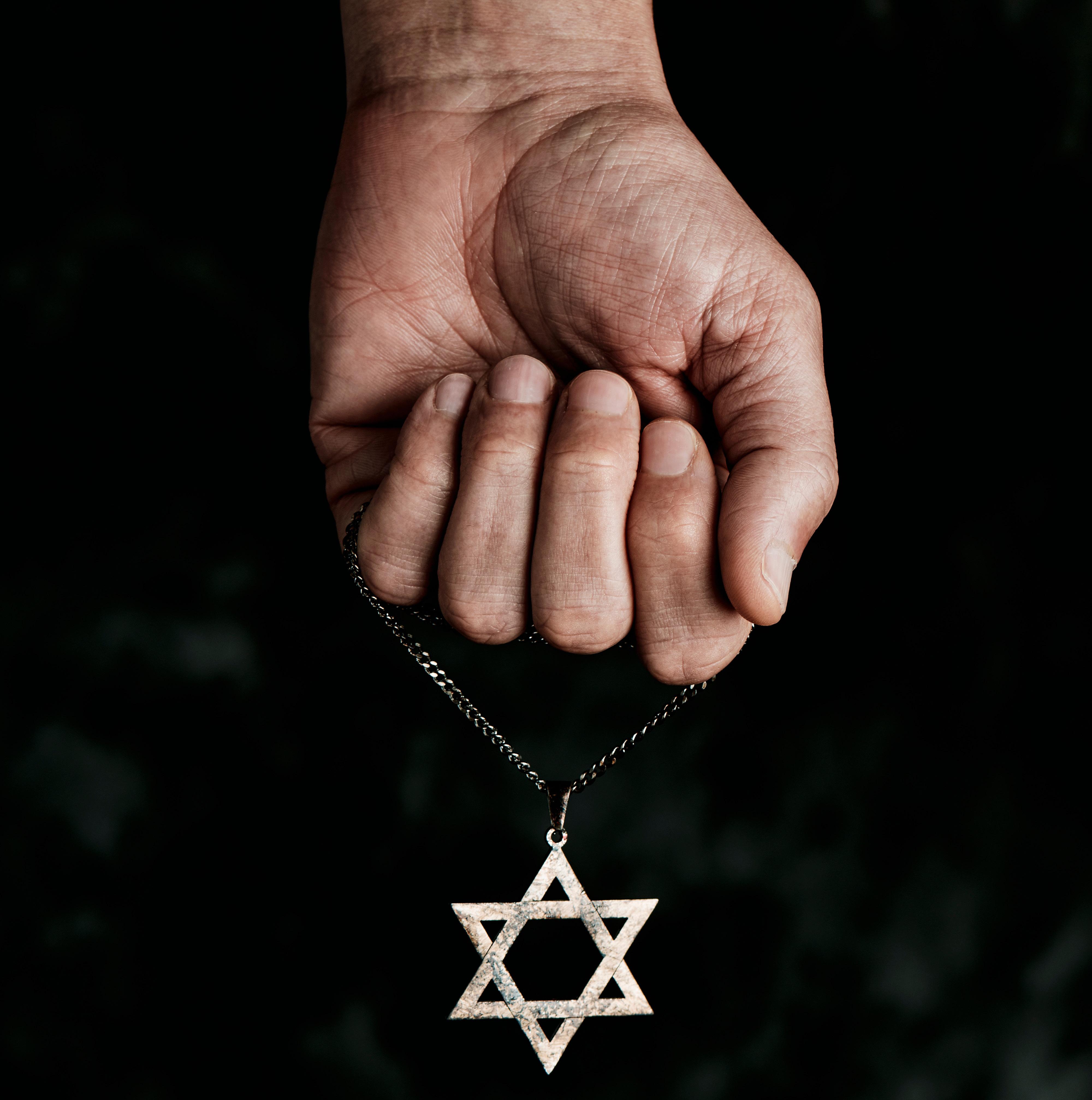
The time for hiding is over (see page 16)

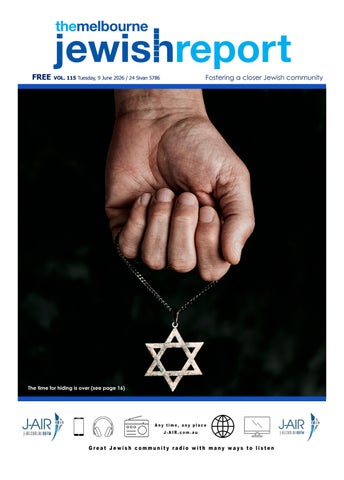
The time for hiding is over (see page 16)
ANNE-MARIE ELIAS
As we head into the winter months, our days are characterised by shorter days and less sunlight. With reduced light and circadian changes, people can experience a form of depression. The circadian rhythm is the body’s natural internal clock that responds to environmental cues, most importantly natural light and dark.
In this article, I will explore some of the ways to help you out of this funk. The winter blues are generally temporary and with engagement in lifestyle activities and self-care, this low mood state shifts. For some, though, the symptoms are more severe and persist. This is known as seasonal affective disorder (SAD), a winter-linked form of depression. The techniques that I am about to reference are helpful for managing SAD, but some may need to consult a doctor, who may prescribe antidepressant medication. With cold weather, miserable outdoor conditions and less hours of daylight our mood can shift, as well as our behaviour. Once winter hits, do you experience any of the following? Feeling low, changing energy levels, struggling to

get motivated, craving comfort foods and difficulty getting out of bed and getting going.
This is how we notice that your circadian rhythm has been affected … that you are not getting enough light and, potentially, too much melatonin. Your body clock is out resulting in a change in energy levels, which are lowered, your metabolic rate slows and you have an increased risk of illness.
These strategies will help to stave off the winter blues:
1. Get enough light, especially in the morning. Switch on a bright light and open the window furnishings. Make sure this happens upon
wakening and ensure that you have sufficient light during the day. Sit by a window, leave the lights on. This light will anchor your circadian rhythm and reset your clock.
2. Get active. Maintain an exercise program. If you can’t get outside, find an indoor exercise program, either at home, at the gym or at community run fitness facility. The recommended standard is 30 minutes of moderate exercise each day to help boost energy levels and release “happy hormones”.
3. Keep up your regular hours. The sleep/wake cycle needs to stay the same as during the summer months.
The same wake time stabilises circadian timing.
4. Keep up your nutrition. Winter may not induce a craving for salads, but hearty vegetable and legume soups, and a diet rich in protein will maintain energy levels and warm the body from within.
5. Maintain your social connections, especially in-person meet ups. It can be tempting to stay at home under a doona, but humans need contact. Social connection is one of the strongest protective factors against depression.
6. Maintain your practice of mindfulness – doing things by being in the moment, totally focused on the task at hand, rather than thinking about the grey weather.
7. Keep a schedule that enables you to engage fully in life year round.
8. Stay warm. Invest in a winter wardrobe and ensure you have adequate heating, so that you can embrace activities that maintain good mental and physical health. The author of Les Misérables, Victor Hugo put it well when he said: “Laughter is the sun that drives winter from the human face.”
Anne-Marie Elias is a psychologist in clinical practice for 25 years.
8. New Hampshire's motto, "Live Free or ___"
9. Siskel and Ebert, e.g.
10. The longest book of navi
11. "Superfood" berry
12. Fix
17. Common hotel worker
22. It's in a pen
24. Kind of worm
25. It means "singular"
27. Notable Parks
28. Couple in a column
29. Shake, rattle, or roll?
30. Stuff up
31. Har where 1-Across rests
32. The longest tractate of gemara
33. 2006 Disney-Pixar film
36. Water, for one
37. Fairy tale starter
39. Kosher 50-Down that's hard to come by
42. Brady considered a GOAT
43. No couch potato, him
44. Protector of Eretz Yisrael
46. Humans have two below the waist
47. Humans have two above the waist
48. Amazon transaction, e.g.
49. Pure, in halacha
50. See 39-Down
51. Brats
52. "Just for the fun ___"
56. Touro email ender
57. Yoko of song and art
BY DORRON KLINE CEO TELFED AROUND THE COMMUNITY
Amid growing national discussion around antisemitism in Australia, including the Royal Commission into Antisemitism and Social Cohesion, more Jewish Australians than ever have been reaching out to Telfed’s team. It continues to be an emotionally exhausting time for the community.
Many have shared that there has been a lot of ‘Telfed-talk’ around Australian Shabbat tables of late. That is because Telfed is here solely for you. As an Israel-based organisation working with the Zionist Federation of Australia and the Jewish Agency, Telfed’s mission is to guide Australians and South Africans through the Aliyah process, with successful integration into life in Israel as the overriding objective.
Enter Telfed’s experienced pre-Aliyah advisors. Offering free, personalised guidance, the team is sensitive to the many different circumstances, questions and life stories Australians bring with them. Advisors are available throughout the week and provide practical guidance on preparing for life in Israel, from understanding bureaucracy and employment realities to building community and navigating day-to-day
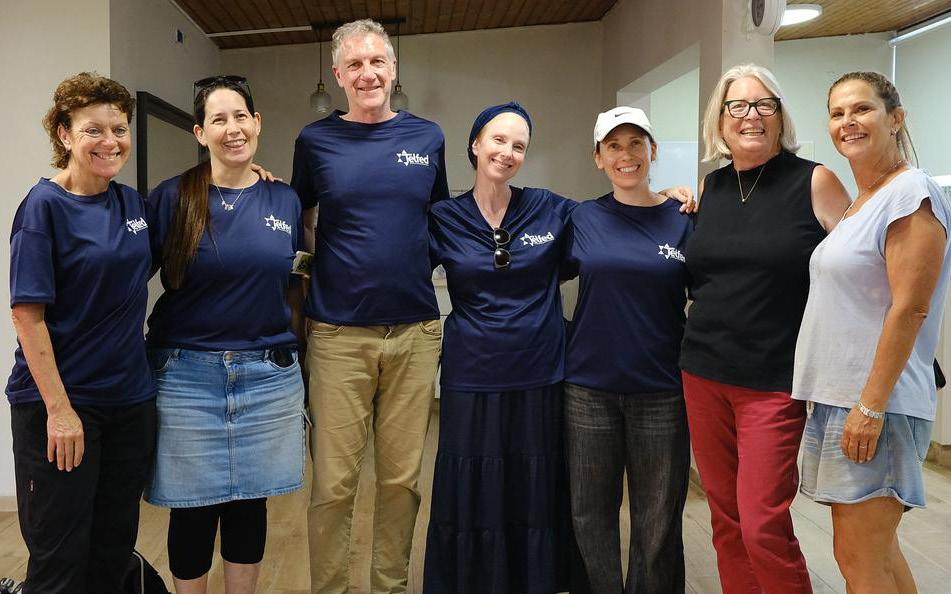
A team of Telfed volunteers, including a strong contingent of Australian olim, helped unpack and prepare homes for elderly residents returning to Kissufim after their evacuation on October 7
Australian on board at Telfed. I am talking about someone who understands the Australian mindset and the unique questions, concerns and expectations that come with Aliyah. We could not have found a better fit. Having been through the process herself, Ramona Freedman brings understanding, warmth, empathy and professionalism,
almost two years ago Ramona made Aliyah from Sydney. Today, she combines her own Aliyah experience with practical, up-to-date guidance to help other Australians prepare for the move.
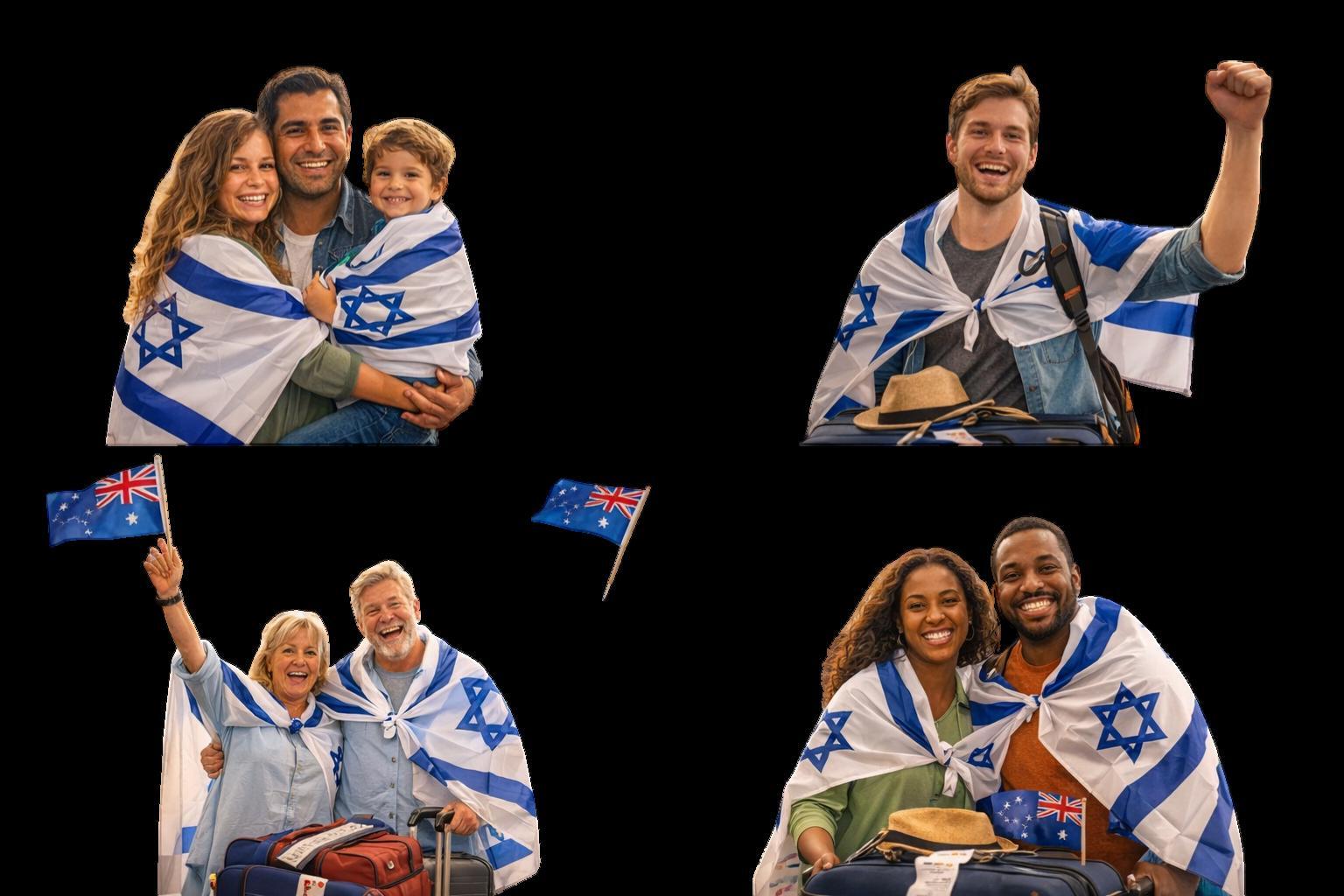
Despite the ongoing challenges facing Jewish communities post October 7, interest in Aliyah among Australians of
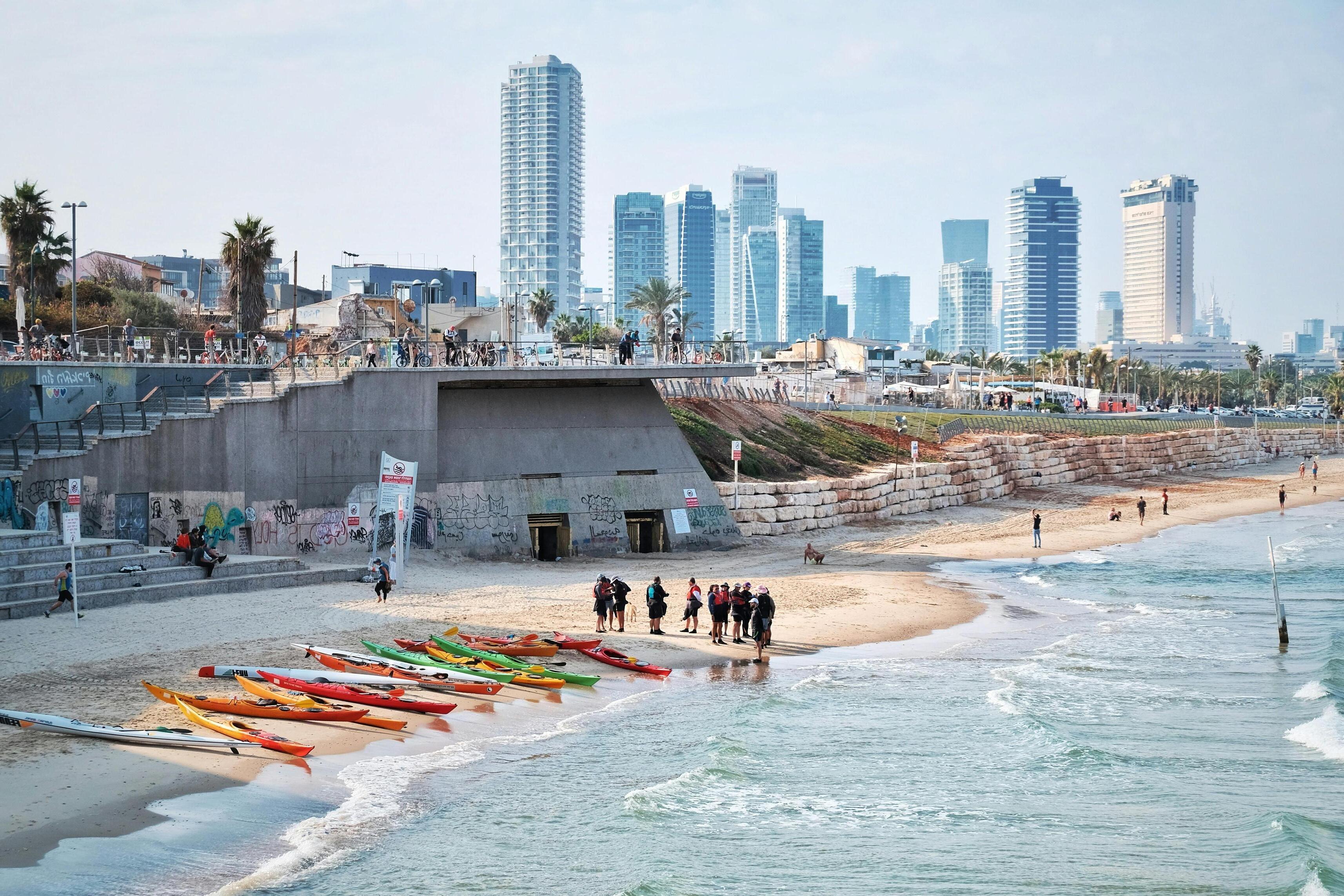
Based in Ra’anana, Telfed serves as a practical and welcoming hub for new olim. Services include employment guidance, support for lone soldiers, students, seniors and families, together with assistance navigating the realities of settling into Israeli life.
Telfed also offers subsidised rental accommodation, managing more than 100 apartments in Tel Aviv and Ra’anana. New olim benefit not only from affordable housing in central locations, but also from an immediate sense of community during the often overwhelming first years after arrival.
Students who make Aliyah from Australia can also apply for Telfed scholarships, while contributing to their local communities through volunteer service.
Across all areas of support, Telfed’s focus remains the same: helping olim integrate successfully, build meaningful


DR DVIR ABRAMOVICH
I need you to read this carefully. Australian Jews are leaving their religion blank on hospital admission forms because they are afraid of what happens while they are unconscious.
Not by accident. Not out of indifference. But because they have done a quiet, rational, devastating calculation.
I have heard this from many. But one woman captured it in 10 words more precisely than any of them: “When you are under general anaesthetic, you are completely vulnerable”
An Australian Jewish woman, in an Australian hospital, in 2026, is calculating whether it is safe to identify herself as Jewish while unconscious on an operating table.
This is not paranoia. This is not catastrophising. This is sound advice. And the fact that other Jewish Australians read those 10 words and nod is the most precise measure of what has happened to this country. And to this world.
Five years ago, this thought did not occur. Seven years ago, it would have been unthinkable. Today, it is a reflex. A reflex that was not there before. A reflex that did not grow from nothing.
Because something has changed. Something fundamental. And we need to talk about what it is and where it came from.
Jews are under attack everywhere. Not in one country. Not on one continent. Everywhere, simultaneously, all at once. They are being stabbed in London and murdered in Manchester. Their ambulances are being torched in Golders Green. Their synagogues are firebombed. Their children are told in the classroom corridors that they deserve the gas chambers.
Witnesses who appeared before Australia's Royal Commission on Antisemitism to tell their stories were met with an organised online campaign so savage – death threats, Holocaust glorification, calls for execution – that Commissioner Virginia Bell referred the matter to the Australian Federal Police. People who survived being targeted by antisemitism were targeted again for speaking about it.
In Caulfield earlier this month, Sarah and Avi Bendetsky were walking to synagogue when a man followed them down Glen Huntly Road, screaming “F Jews” and threatening to kill them. He physically attacked Avi. Sarah broke down on the street. Their crime was looking Jewish.
And from London to Paris, Berlin to Buenos Aires, Toronto to Melbourne, Jewish communities are conducting the same daily calculation – is it safe to be visibly Jewish today? That used to be unthinkable.
This is not a wave. Waves recede. This is a flood. And to understand it, you have to understand that two completely separate rivers of hatred have, for the first time in modern history, merged into a single, raging current. The first is Islamist extremism, which does not see the Jew as a political adversary, but as a cosmic enemy to be erased from the Earth. Bondi showed us what that looks like.
The second, and in some ways the most insidious, is a strand of progressive ideology that has recast the Jew as coloniser, oppressor, a figure who by definition cannot be a victim. A strand
that has migrated from campus seminar rooms to mainstream discourse and made antisemitism not just acceptable in certain circles, but righteous.
Two ideologies. Two vocabularies. One target. And they are both burning simultaneously.
You want to know what this looks like on the ground? In an Australian suburb? On a Central Coast community Facebook page in NSW someone asked a simple question: Should Australia have stronger ties with Israel? What followed was a window into how dark things have become. Jews called filthy dogs. A criminal race. Israelis called brainwashed animals. Israel called the modern-day Nazi state. Cartoons blaming Jews for 9/11, for communism, for the porn industry, for the world wars. Calls to nuke Israel. Claims that Australia is already run by the Zionist machine. Himmler-like slurs posted openly, proudly, without shame.
Not on the dark web, not anonymously, but under real names, with real faces.
The mask is off. The shame is gone. And it is not hiding anymore.
Now add the accelerant.
What was once legitimate criticism of Israeli policy has curdled into something darker and more dangerous: a hyperbolic, conspiratorial hatred that has corrupted Western institutions, media and moral reasoning. We can see it in real time.
The podcast has become the new printing press of antisemitism. Joe Rogan, whose show reaches listeners in more than 190 countries, with Australia specifically named as one of his major markets, gave his microphone to Ian Carroll, who claimed Jeffrey Epstein was “clearly a Jewish organisation working on behalf of Israel and other groups”, that Israel was founded by organised crime figures tied to the Jewish mob, and that Israel orchestrated 9/11. When Jewish critics objected, Rogan dismissed them as “paranoid”.
Tucker Carlson, whose show draws over 34 million downloads and views a month, has spent two years propagating
the warmongering lie. The claim that Jewish power hijacked American foreign policy. That Zionism is a respectable synonym for enemy. That Chabad is behind the war with Iran.
Candace Owens, with 5.7 million YouTube subscribers, has told her audience that America is controlled by “the people who call us goyim”, that Jews orchestrated the slave trade, and that Israel is an “occult nation”. Megyn Kelly, now the third-largest conservative podcast in America, declared that proIsrael Jews are “making antisemites”, blaming Jews for the hatred directed at them.
And comedian Dave Smith has appeared on the world's biggest podcasts promoting the Israel-draggedAmerica-into-war conspiracy, and declared that the word antisemitism itself is “just a bad word that doesn't even mean what people who use it are trying to say”.
Do not make the mistake of thinking this is America's problem. Every one of these voices streams directly into Australian homes, Australian cars and Australian earphones every day. The poison does not stop at borders. It travels at the speed of an algorithm. And it is already here.
So normalised has this become that a coalition of Republican lawmakers and Trump administration officials was forced to convene in Washington to confront what they described as a growing antisemitic influence emanating from the right-wing podcast world. The ideology has spread so far that its own political home is now mounting a counteroffensive against it.
Underneath every form of this hatred is one thing. One ancient, indestructible canard. The Jew is behind it all. The puppet master. The hand on every string.
And here is what is new.
Here is what is terrifying. This blood-libel is no longer whispered in dark corners. It is being broadcast. It is being packaged, polished and delivered to tens of millions of people by men and women with
microphones, studios and algorithms working in their favour. This is what rightwing antisemitism looks like in 2026. It does not wear a hood. It wears a suit.
It does not march through the streets. It sits in a podcast studio and tells its audience, calmly, confidently, with the language of a man who simply asks questions, that Jewish power hijacked America, that Jewish organisations engineered the war with Iran, that Jews control what you see, what you think and who leads your country.
And then it switches off the microphone. And 34 million people carry that thought home with them.
This is not commentary. This is not a debate. This is the systematic rehabilitation of the oldest conspiracy theory in human history, dressed up as free speech and beamed directly into the ears of a generation that is angry, frightened and hungry for an explanation as to why their world has fallen apart.
The explanation they are being given is the Jew.
And the people giving it to them know exactly what they are doing. They have always known.
And where were the institutions while this took hold? Australia's own intelligence chief testified to the Royal Commission that antisemitism had been “left unchecked” after October 7 and therefore “normalised”.
Not radicalised. Not imported. Normalised. By silence. By false equivalence. By leaders who issued statements and considered the matter closed. By the permission structure that every act of looking away quietly constructs.
And then there is this. Recently, the ABC and SBS announced they would not adopt the internationally recognised IHRA definition of antisemitism – the gold standard used across the democratic world – claiming they preferred a definition of their own. A definition that, as I am writing this, they have not published.
A secret standard. Applied in secret. To determine what counts as hatred against Jews. Our own public broadcasters, funded by Australian taxpayers, have decided that antisemitism means whatever they say it means, and they would prefer not to tell you what that is.
The woman who left that form blank is not a statistic. She is a signal. She is telling us that Jewish life in Australia has been quietly, incrementally diminished, not by decree, not by force, but by the accumulated weight of a world that has decided that Jewish fear is either exaggerated or deserved.
It is neither.
What is happening to Jewish people right now, here, and everywhere, is not a Jewish problem awaiting a Jewish solution. It is a test of what kind of civilisation we are. Jews are always the first. They are never the last.
History has never forgiven the people who understood that and said nothing. Where will this end? God only knows.
Dr Dvir Abramovich is chair of the AntiDefamation Commission and the author of eight books.
Heartfelt stories, fascinating artifacts and poignant reflections of the past
Over the past few months, The King David School’s Year 8 students have embarked on a journey into the past, delving into the rich tapestry of their lives and histories through the school’s signature Dorot (Roots) project.
Students researched their own family stories and interviewed family members to uncover a newfound appreciation for identity, heritage and diversity. They have brought to life the vibrant culture and traditions that shape who they are today.
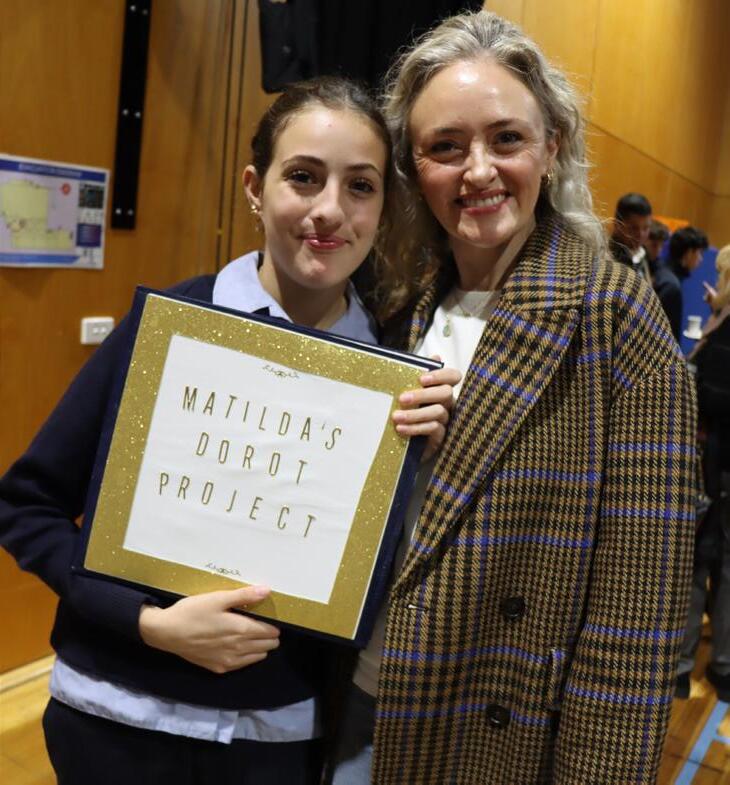
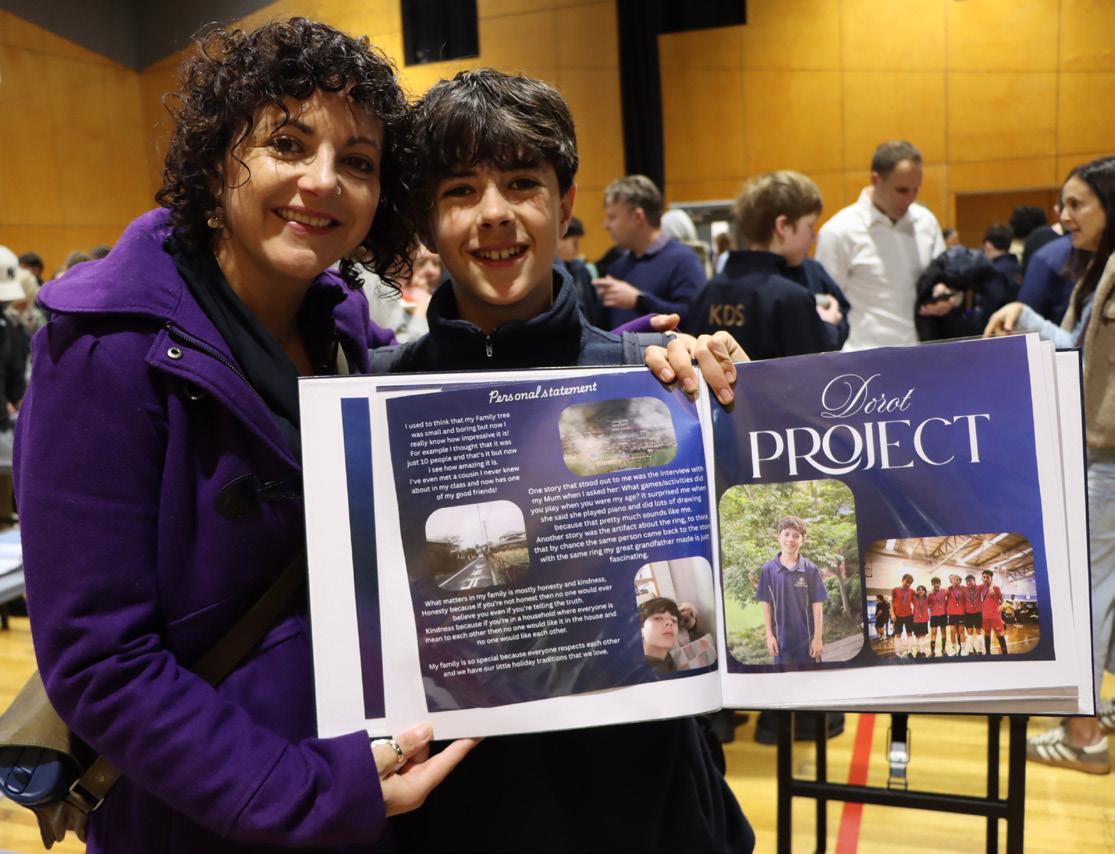
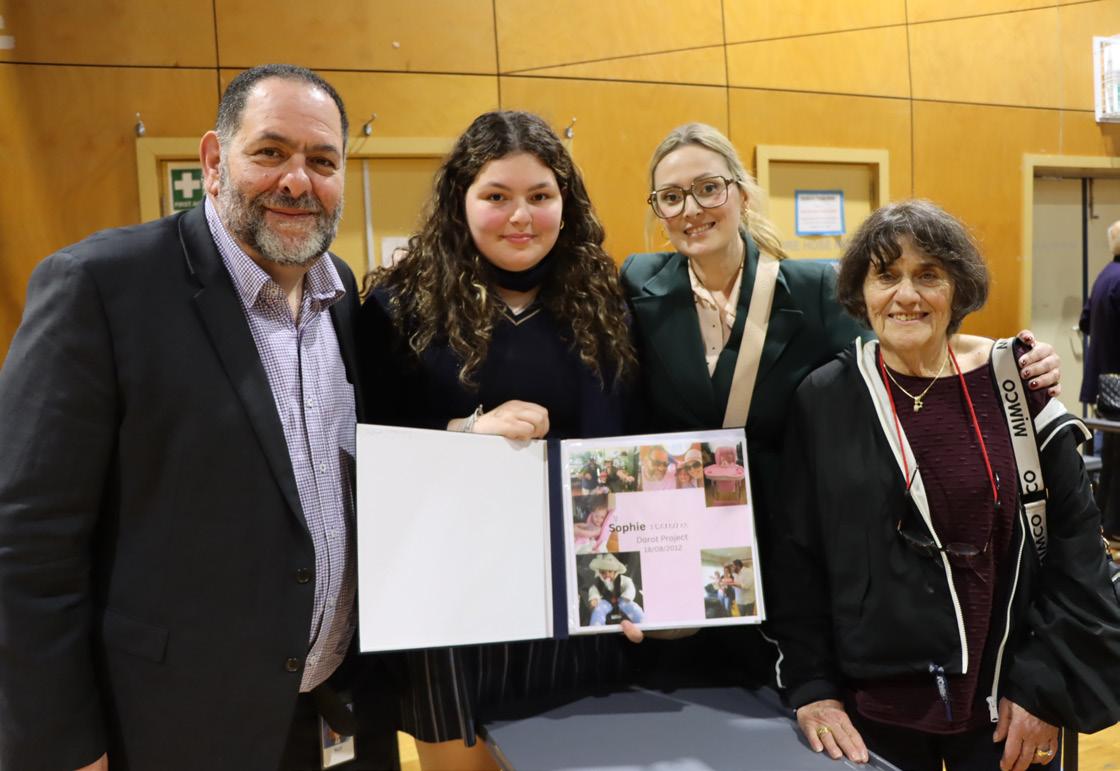
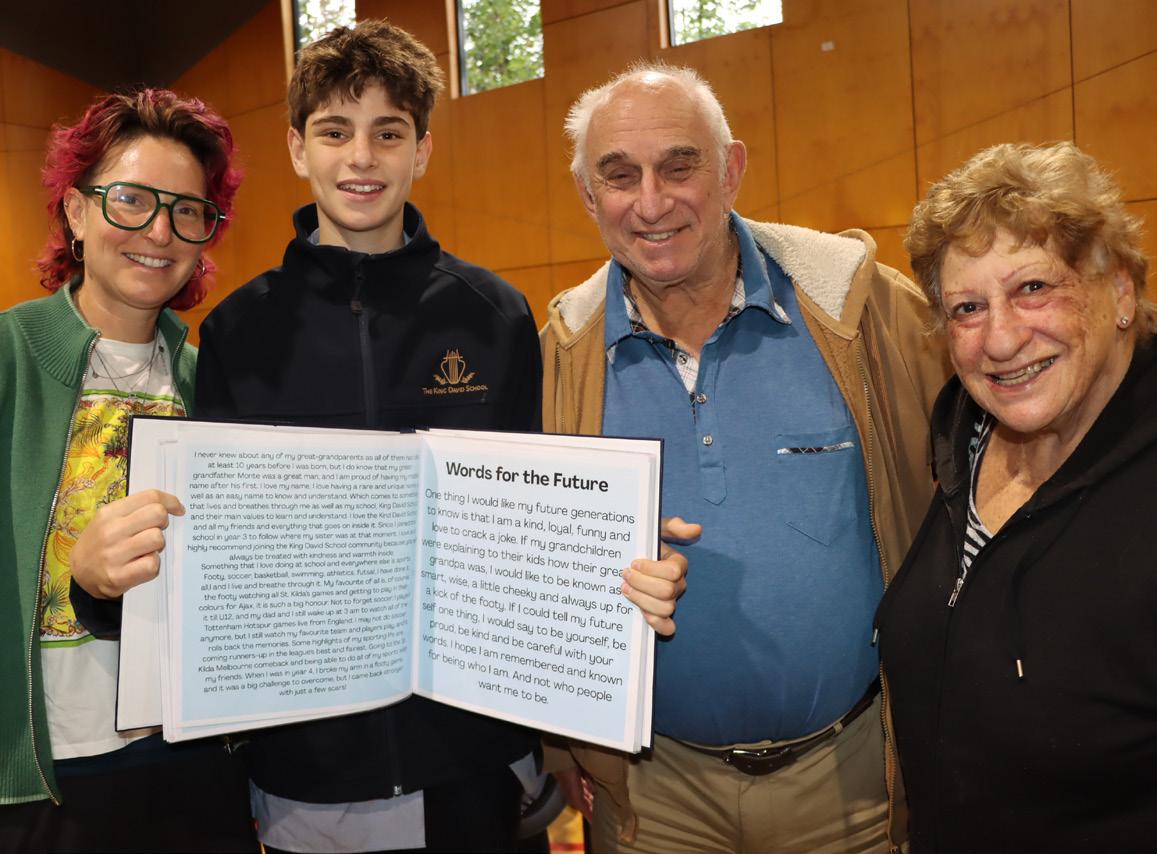
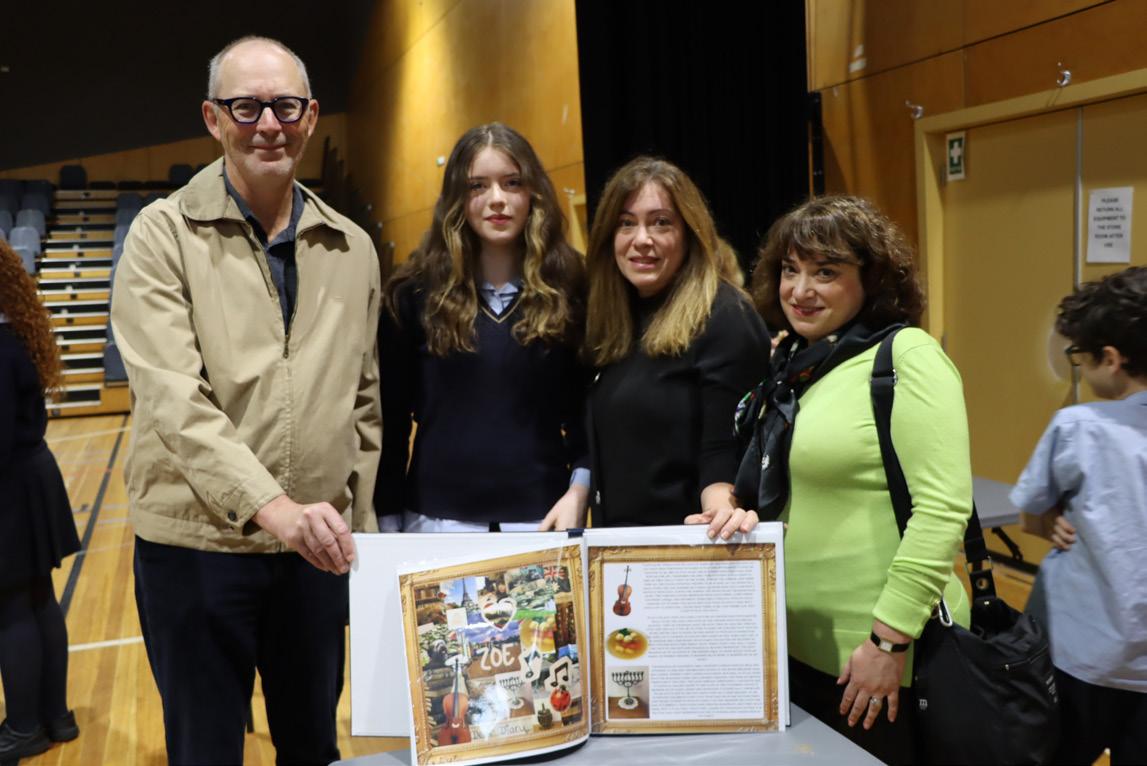
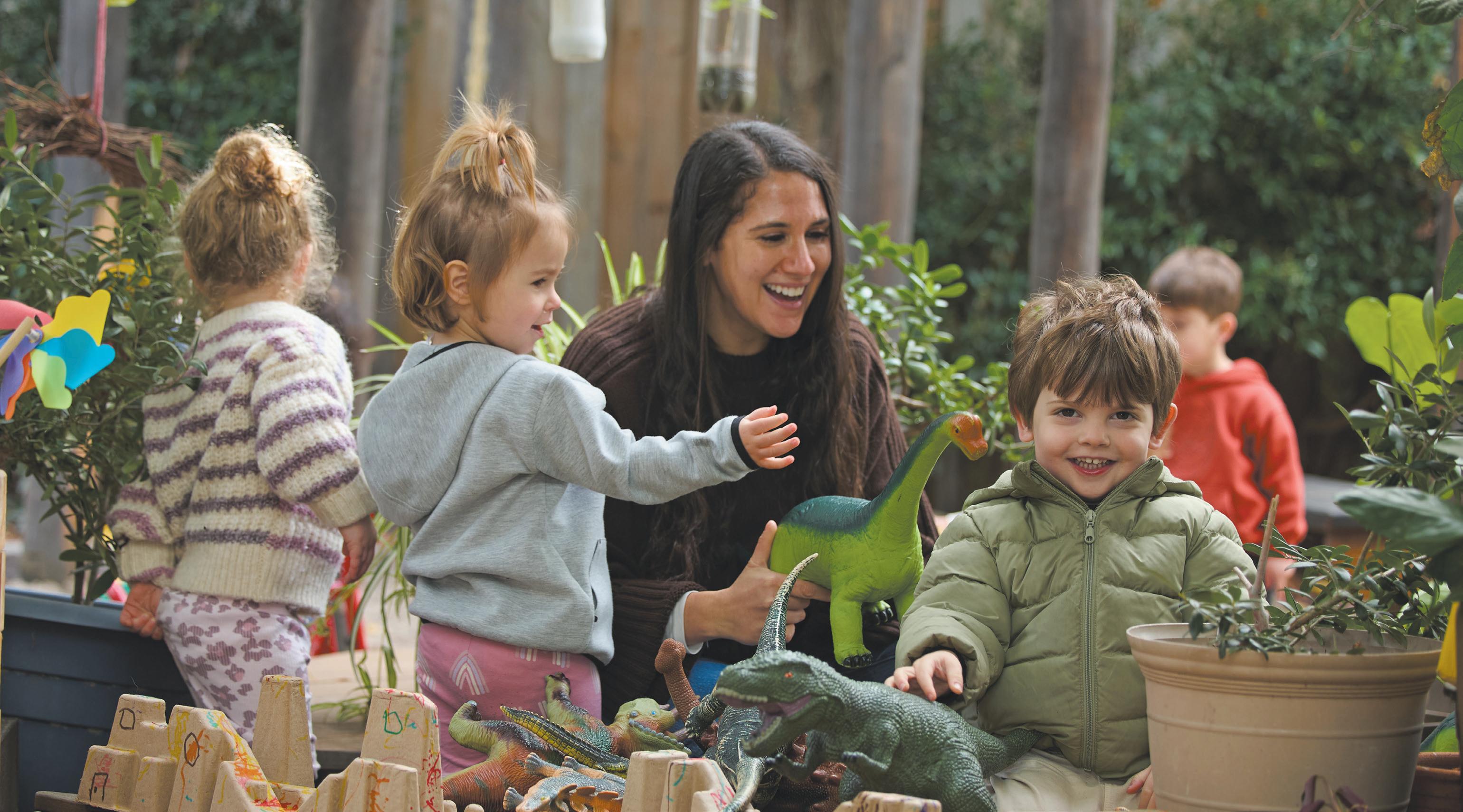
SHARONNE TIDHAR
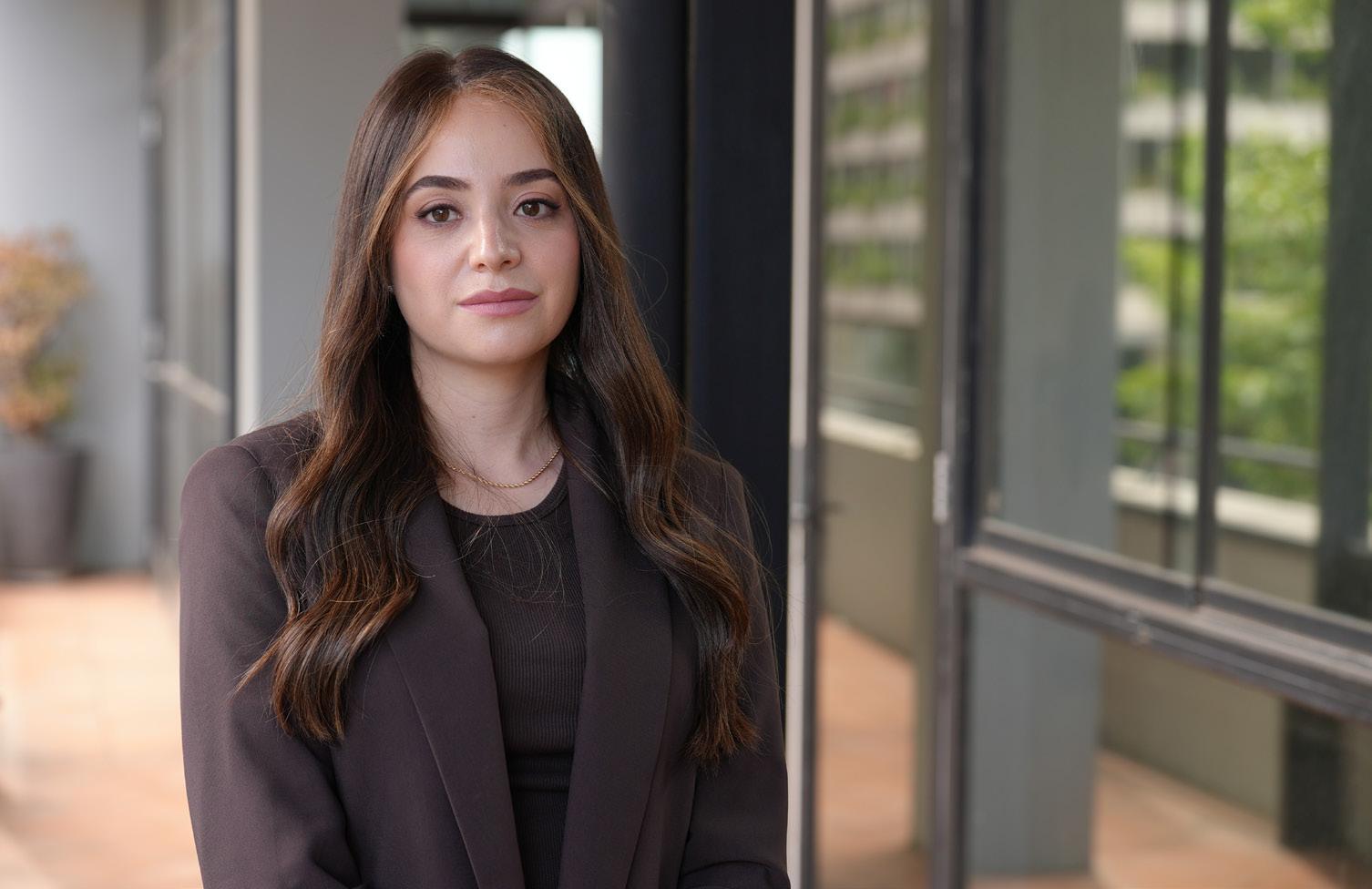
Sheina Gutnick arrived at the Royal Commission into Antisemitism and Social Cohesion in Sydney calm, composed and carrying unimaginable grief.
Sheina, whose father, Reuven was tragically murdered in the Bondi terror attack, gave evidence on 4th May. Behind the headlines was a daughter trying to explain what it now feels like to live openly as a Jew in Australia.
As she told the Commission, Bondi now holds both treasured memories and torment for her. It was where her parents met and where she spent happy childhood summers. And now, it also the place where her father died defending his people.
“Bondi holds many complicated and conflicting feelings for me,” she has said.
Reuven Morrison was one of 15 people slaughtered on 14th December 2025 when two alleged Islamic State-inspired gunmen attacked Jews celebrating Chanukah at a beachside gathering.
Morrison was reportedly killed after throwing bricks at the attackers in an effort to stop them.
But when I spoke to Sheina recently, what struck me most about her was not a feeling of anger. It was the exhausting balancing act she now carries every day.
“I can’t go on a train with my kids the same way anymore,” she told me.
There is, she said, an inherent contradiction Jewish Australians are now living with. On the one hand, “we need to be able to be who we are”. On the other hand, there is the constant awareness of safety, surroundings and risk. She spoke about not wanting her child to have to understand why wearing an Israel T-shirt into the city could suddenly become a consideration.
“There is something morally upside down about a country in which Jewish parents have to weigh pride against security before a family outing.” That line stayed with me long after our conversation
ended and, what’s more, Sheina said this awareness is not based on paranoia, but lived experience. “The reality is very much in the back of my mind,” she said.
“Way more than post October 7.” She described being in public places with her children and instinctively thinking about exits and escape routes if something were to happen. And yet, despite losing her father in such horrific circumstances, she refuses to live apologetically.
In many ways, she said, her father’s own outlook continues to guide her now. His approach, she explained, was always about trying to find the right balance:
being aware of the world around you, while never apologising for who you are.
That tension sits at the centre of modern Jewish life for many Australians. Be cautious, but do not disappear. Be aware, but do not surrender identity. Protect your children, but do not teach them shame.
And “yes”, there are Australians who have dismissed these fears as exaggeration or “victimhood”. But that criticism usually comes from people who have never had to mentally map escape routes before taking their children into the city. It comes from people who have never had to think twice about a symbol on a shirt, a necklace or a surname.
What was equally striking, however, was what Sheina said next.
When I asked whether she had been treated differently since speaking publicly, she said overwhelmingly the opposite had occurred. Support had flooded in from all corners of the country, including from many nonJewish Australians through messages, emails and private conversations.
Not only from Jewish mothers, she said, but from “all sorts of Australians”. That matters. Because this story is bigger than one community. It is about the kind of country Australians want.
This is where Sheina’s voice resonates so strongly. Because after unimaginable loss, she is still insisting on something profoundly Australian and profoundly Jewish at the same time: Be careful, but never apologise for who you are.
This is how the argument begins: “I am not antisemitic; I am only anti-Zionist.” It is presented as a moral disinfectant, as if the phrase makes the speaker incapable of prejudice. You are then invited to ignore what follows, even when it repeats accusations that have trailed Jews through centuries.
Zionism, plainly, is the belief that Jews are a people with the right to national self-determination in their historic homeland. It does not sanctify every Israeli government or policy. It says Jews, like other peoples, are entitled to sovereignty, rather than dependence on others’ permission.
Antisemitism is hostility to Jews as Jews; sometimes it is a shout. More often now it is an insinuation, the hint that Jews are manipulative, powerful and deserving of suspicion. It thrives on the idea that Jews are a collective with a single will. Anti-Zionism, in strict form, is opposition to Jewish national self-determination in that homeland, or to the legitimacy of the Jewish state as such.
It is possible to criticise Israel without being antisemitic, yet arguing that Israel alone must not exist moves beyond policy and makes Jewish nationhood itself the exception.
Ask a simple question and watch how quickly the rhetoric turns evasive. If you oppose nationalism, do you oppose it consistently, or only when Jews practise
it? If Israel has no right to exist, what happens to its people, including millions of Jews whose families arrived because the alternative was expulsion, pogrom or worse?
Here the overlap becomes visible; criticism turns into a theory of evil and collective guilt follows. The charge against Israel moves from policy flaws to
moral monstrosity, denying it the ordinary right to be imperfect and still exist. The hidden premise then moves from the state to the Jew. People who would not demand that an Australian Muslim answer for a foreign government’s crimes often demand that a Jew denounce Israel to earn inclusion. Then comes linguistic laundering: “Zionist”
becomes the approved substitute for “Jew”. When you speak of “Zionist control” of media, finance, universities and so on, and your “Zionist” behaves like the historic imitation of the Jew as secret operator behind the curtain, you have not escaped antisemitism. You have only updated its wording.
Here, the sloganist will protest: “But I am criticising Israel, not Jews.” Fine. Then let us see the criticism.
Is it aimed at a particular policy, law, military decision or leader? Or does it quickly become a story about Jews as a category? Does it allow for Israeli pluralism, dissent, protest, argument and democratic disagreement? Or does it reduce Israel to a single essence, always malignant, always illegitimate?
There is something broken in a politics that hears the Palestinian concerns with tenderness, but hears Jewish fear as an inconvenience to be erased. Your conscience should not become a border checkpoint where one people’s humanity is stamped valid only after another people disappears. Jewish sovereignty was not born from abstraction.
It rose from ships turned away, names erased and generations learning how fragile mercy can be.
MAUREEN BARTEN PRESIDENT PROGRESSIVE JUDAISM VICTORIA AROUND THE COMMUNITY
What if one of the most powerful tools we have against antisemitism isn’t security, but education?
That question sits at the heart of Jewish Life Beyond Bagels, a booklet written by Dr Philip Bliss OAM specifically for nonJewish audiences.
He seeks to do something very simple: build understanding and relationships. With rising antisemitism and increasing social division, these things matter more than ever.
For far too long Jewish identity has often been reduced to stereotypes, caricatures, headlines, humour or food. But Jewish life is far richer, deeper and more nuanced than the narrow perceptions through which it is so often viewed.
Recently, I participated in the JCCM Emergency and Crisis Management workshop and a 10-week course through Tel Aviv University focused on crisis management and community resilience. One message became increasingly clear throughout both programs: Prevention does not begin with taller fences or more security personnel.
Prevention begins with education.
Security may respond to danger, but education addresses the conditions that allow ignorance, misinformation and
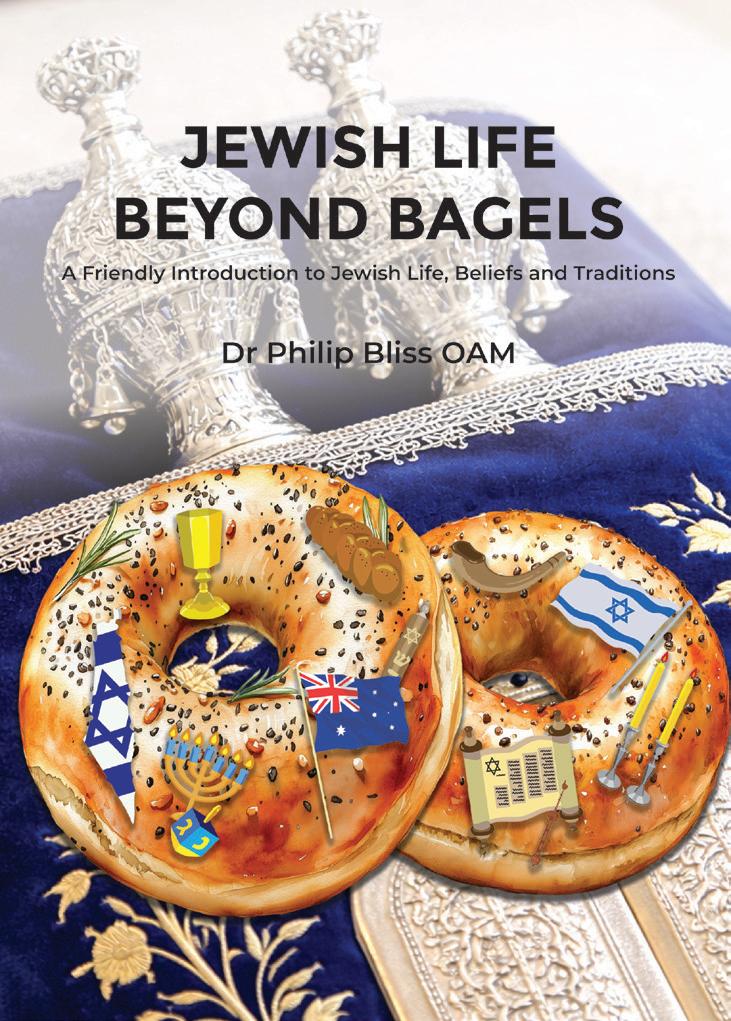
prejudice to grow in the first place. That is why initiatives like Jewish Life Beyond Bagels are so important.
Across our Jewish community, there are countless educational programs offered through community organisations, synagogues, schools, the Jewish Museum, interfaith groups and cultural events. Students, professionals, community leaders, neighbours and visitors are invited into Jewish spaces to
learn more about Jewish history, beliefs, traditions, values and identity. These programs open the door to conversation, questions, relationship-building and genuine human connection. But education should not end when the session finishes.
This booklet was designed to support those learning experiences by giving people something tangible to take with them – an easy-to-read resource they can revisit later, reflect upon or share with others. No QR codes to scan. No complicated research to do. No barriers to engagement. Just an accessible and thoughtful introduction to Jewish life.
I asked Philip why he chose to write this booklet and what he hoped it might achieve.
His answer was simple and deeply relevant. “We are living in a time where many people know very little about Jewish life, Judaism, Jewish history or the values that shape our community,” he said.
“When knowledge is absent, stereotypes and misinformation can easily fill the space. I wanted to create something accessible and easy to read that might help people better understand who Jewish people are beyond the headlines, assumptions and false narratives.”

“It’s about creating human connection,” he said. “Education helps dispel myths and misunderstandings. When people learn about each other properly, fear and suspicion often give way to understanding and respect. The aim of this booklet is to create dialogue, whether we agree with each other or not. Understanding is the goal.”
What makes this booklet particularly valuable is that it creates an entry point for dialogue.
It encourages curiosity, instead of fear, conversation instead of assumptions and relationships instead of division. Hate speech and prejudice often grow when understanding is limited. Education creates the opportunity to replace assumptions with knowledge and distance with human connection. We often speak about combating antisemitism through advocacy, security and policy, and they all matter. But lasting change requires human engagement, conversation and understanding. From there, so much is possible. Education remains one of the most powerful forms of prevention we have.
For more information or to request booklets, email: philipbliss@philipbliss. com or maureen@maureenbarten.com



JAMIE GELLER COURTESY: AISH.COM
Chen Schimmel photographed the homes, the funerals and the grief that followed October 7th. What she brought back is something the Jewish world needs to see.
There is a photograph in Chen Schimmel's book that has no title because there are no words. It's a portrait of a hostage's mother. Just grief, unmediated, staring back at you from the page. Chen looked at it for a long time. Then she left it untitled and moved on.
That instinct – to know when language fails and let the image speak alone – is at the heart of who Chen Schimmel is. She is a photojournalist who grew up in London, made Aliyah at 18, and spent years doing weddings and pregnancy shoots before a hunger for something more urgent sent her, first, to the earthquake in Morocco in September 2023, and then, one month later, to the worst massacre of Jews since the Holocaust.
On October 7th, Chen was asleep in Jerusalem when the sirens began. Her younger brother, newly drafted into the army, ran into the family's shelter and said the words none of them could process: "Dead bodies. Dead soldiers. Bodies everywhere." By the end of that day, her father had volunteered with Zaka, the Orthodox volunteer organisation that collects human remains so the fallen can receive a proper Jewish burial, and Chen had made the decision to go with him the next time he went south.
She didn't have a press vest or a helmet. She had her camera and her father, and that was enough to get her in. What she found in the burned homes of Kibbutz Be'eri, in the ruined rooms where families had lived and died, is documented in her book, October 7th: Bearing Witness. It's a coffee-table volume designed to be held, to be beautiful, to make people want to open it even knowing what's inside. Spare and gallery-like: one photograph per page, generous white space, almost no text. That was deliberate. "People relate to art," she told me. "I wanted them to pick it up. I wanted them to look." The proceeds go to injured soldiers.
The photo that won Tel Aviv
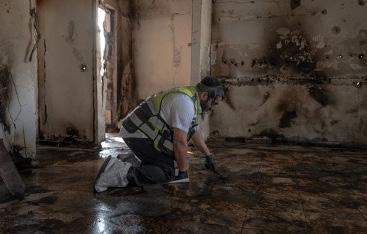
Her photograph "Holy Work" was named Photo of the Year at a major Tel Aviv competition, a city where the Orthodox are rarely seen in a flattering light, let alone celebrated. The image shows a Zaka volunteer on his knees, scrubbing blood from the floor of a home in Be'eri. Chen paired it with a line from Genesis, God's words to Cain after the murder of Abel: "What have you done? The voice of your brother's blood cries out to me from the ground."
When the judges called to tell her she'd won, she cried. "The win wasn't for me," she said. "It was for them. For the holy work they do. They go so unseen, so unheard." The fact that it happened in Tel Aviv made it mean even more.
The story she couldn't photograph
In the weeks after October 7th, Chen was working with the Jerusalem Post on a series about hostage families. Just before
Chanukah, she went to photograph the mother of a young woman named Eden who had been taken from the Nova music festival.
When Chen was done and about to leave, the woman asked her to stay for tea. They sat on the couch.
The woman made fresh mint tea and gently played with Chen's hair.
"Chanukah is coming," she said, "and I'm praying for a miracle. That on the last night, which is also my Eden's birthday, she comes home to me."
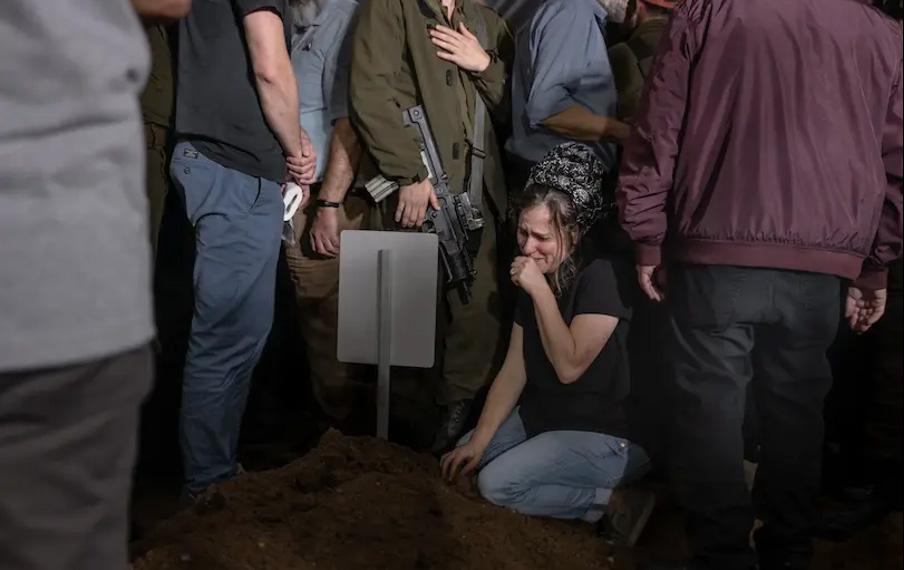
Four days later, the woman messaged Chen: "There is no miracle. Eden is coming home, but she's not coming home alive."
Chen went to the funeral. It was small and private, overlooking the sea. Eden was buried on her birthday. "It was excruciating," Chen told me quietly.
The things a camera can't capture She has photographed hundreds of funerals. She has been inside homes so saturated with dried blood that Zaka volunteers used toothbrushes and industrial chemicals to scrub floors for hours. She has documented hostage families at Shabbat tables with empty chairs, and amputee soldiers relearning how to move through the world.
There are two things, she says, she cannot photograph: the wailing sound
of a parent burying their child, and the smell that hung over the kibbutzim in those first weeks. "There are things that just stay with you that I can never portray through a photograph."
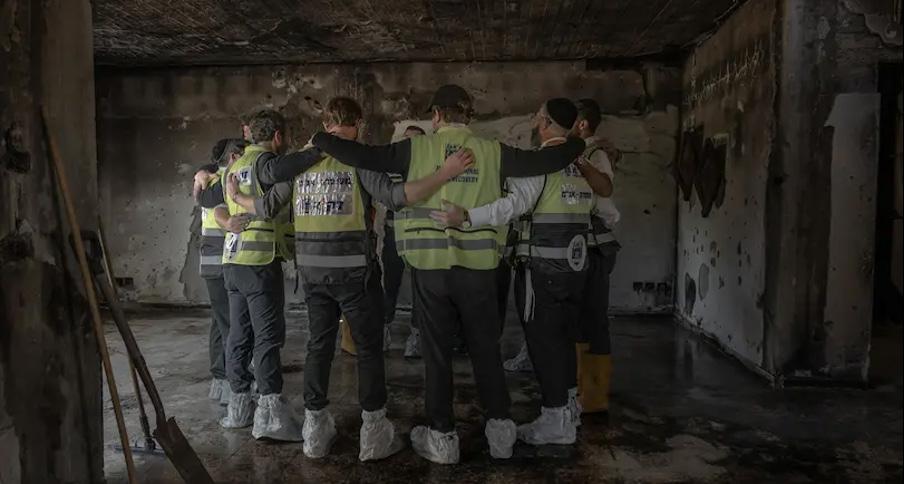
One of her most visceral memories came from a Zaka cleanup operation a full month after October 7th. The first rains of winter had fallen and washed away a layer of ash in a home in Be'eri, revealing blood that had been hidden since the massacre.
Chen had stepped outside for air when she heard something faint – a whisper that grew into voices, then into singing. She turned to find the Zaka volunteers on their knees, rising slowly, finding each other's arms, forming a circle in the middle of that bloodied floor, and belting out Ani Ma'amin – "I believe with complete faith" – at the top of their lungs.
"I have chills every time I talk about it," she said.
What she learned
Before October 7th Chen wasn't accustomed to reciting the morning prayer Modeh Ani – "I give thanks", the traditional words spoken upon waking, thanking God for returning your soul for another day. But she found herself saying it automatically after her first nights photographing down south. Coming home to darkness, waking up, and before anything else: gratitude that she was still here.
What the work taught her, ultimately, is something she arrived at slowly over two years of photographing in some of the hardest places a human being can go. It is not, she says, that light exists within darkness. It is that light and darkness exist side by side, always, inseparable.
"That's what we are as a people," she told me.
Chen Schimmel's book documents the first year following October 7th. All proceeds benefit injured Israeli soldiers.
This profile is based on her conversation with Jamie Geller on No Reservations, filmed at the Dan Family Center in Jerusalem.
For adolescents in northern Israel, the war did not end when they returned home. Many came back to communities still carrying the weight of evacuation, sirens, instability and fear. Schools reopened. Families returned. Streets began to fill again. But beneath the surface, many young people are still navigating anxiety, disrupted friendships, emotional strain and a fragile sense of safety.
UIA understands that rebuilding cannot only be measured in roads, homes or public buildings.
For teenagers who have lived through prolonged crises, recovery also means having somewhere safe to go. Somewhere structured. Somewhere they feel seen, needed and able to belong again.
That is why UIA’s end of financial
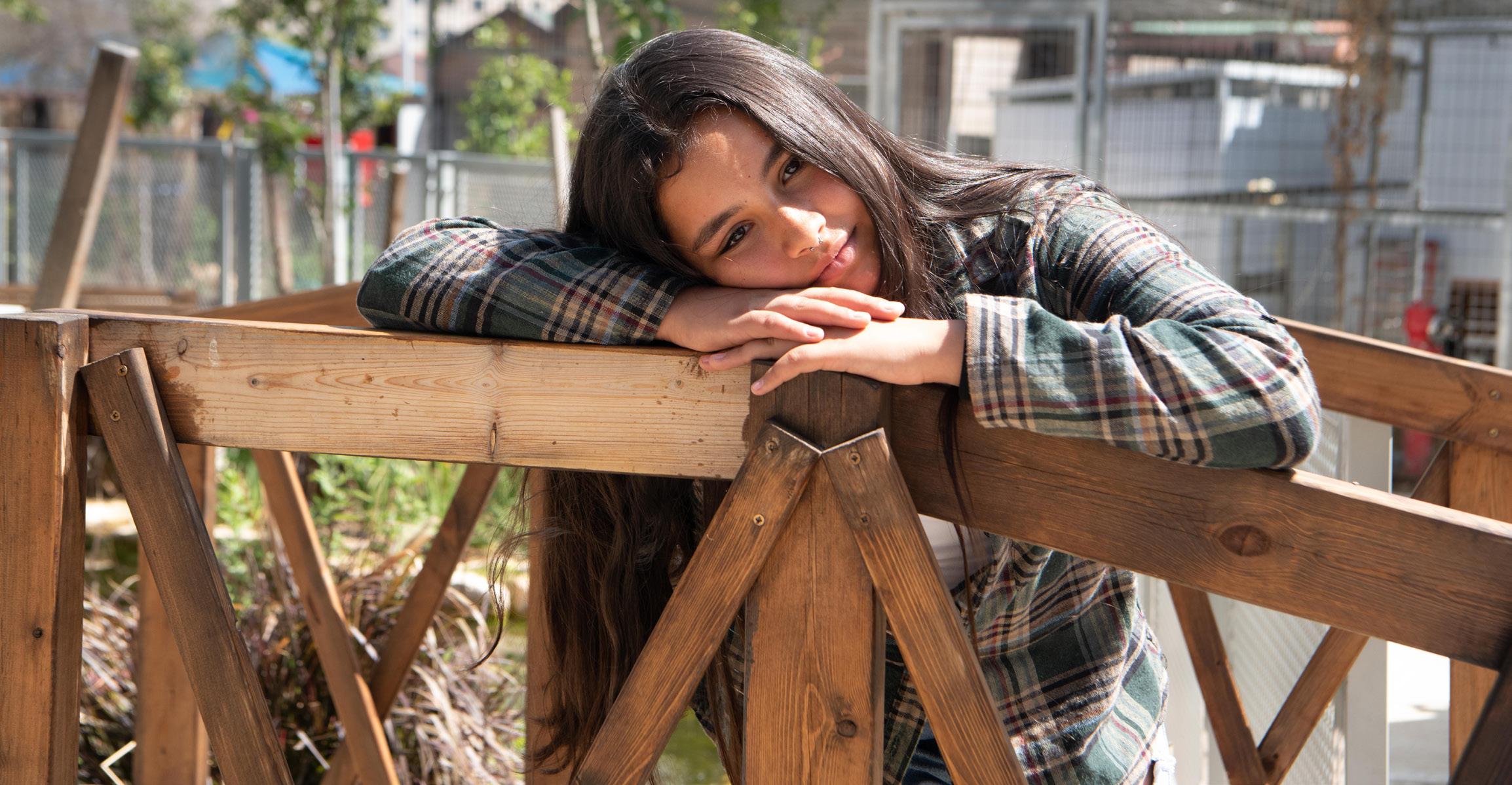
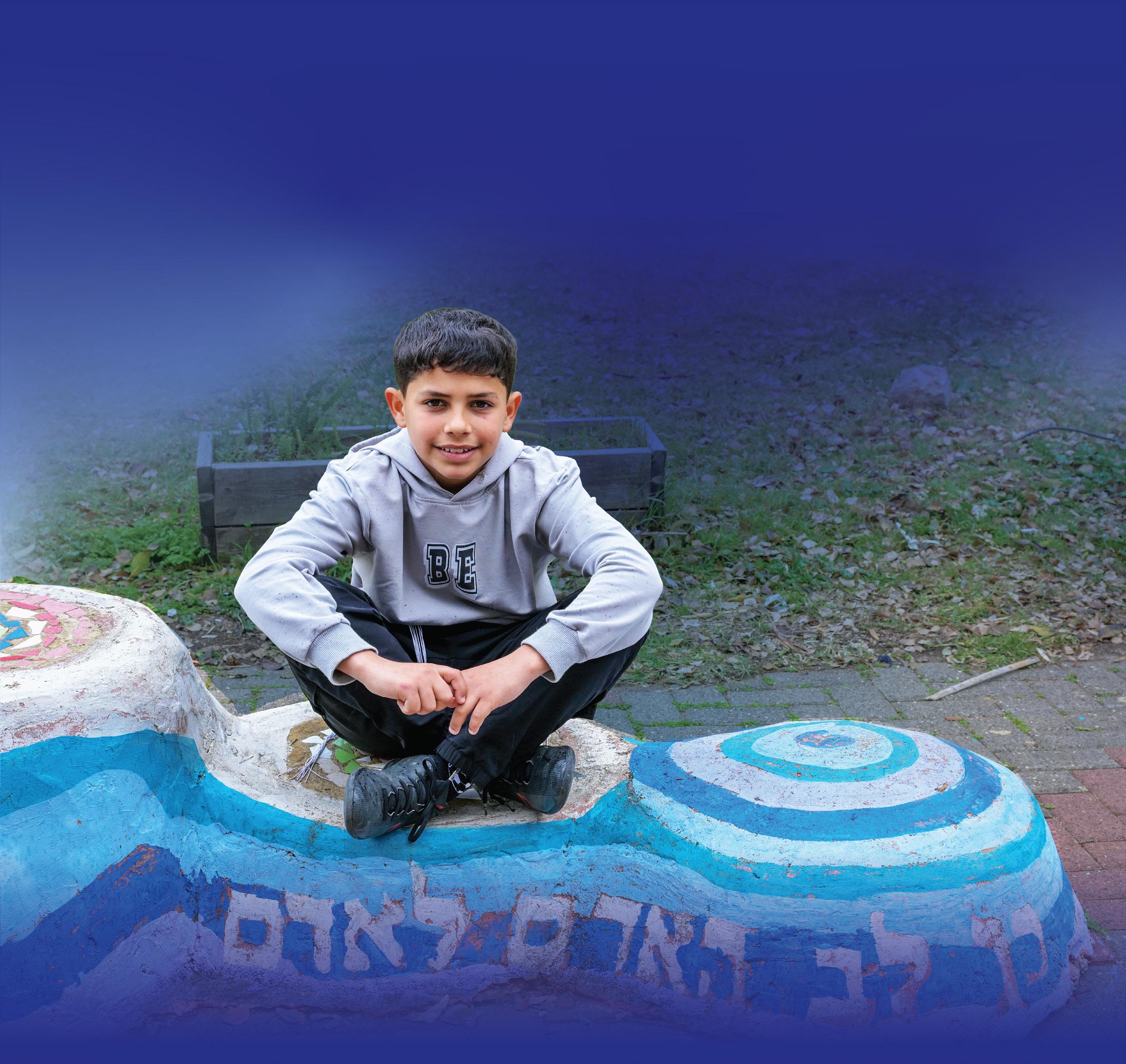
outdoor challenges, young people are given the chance to reconnect, express themselves and regain a sense of confidence. Through skillsbuilding workshops, they develop communication, teamwork and decision-making. Through guided emotional support delivered by trained staff, they are given tools to process
These are not ’nice to haves’, they are practical foundations for
One of the most powerful parts of the project is its focus on youth leadership. The centres give teenagers opportunities to lead community initiatives, volunteer, support others and take responsibility for projects that strengthen social
As one teenage resident, Noam, said: the youth centre was the place where he felt seen, heard and cared for. It taught him sensitivity, responsibility, teamwork and leadership. During Operation Lion’s Roar, those lessons became urgent, as young people helped pack
supplies, support younger children and create small moments of light during evacuation. “In a world that can feel chaotic and out of control, the youth centre is the place where we create the rules. It is our safe place,” Noam said.
This is how resilience is built. Not by telling young people to be strong, but by giving them the structure, support and confidence to become strong.
Your donation to UIA will help equip these dedicated youth resilience centres, provide professionally guided programming, enable youthled initiatives and support broader rehabilitation efforts across northern Israel.
Northern Israel’s recovery depends on more than physical reconstruction. It depends on the strength, confidence and leadership of the next generation. Please support UIA’s EOFY campaign and help rebuild the lives of adolescents in northern Israel.
Donate now to UIA’s EOFY campaign at https://uiaaustralia.org.au/donate/
For 40 years, I have had a certain idea of Australia.
Not a naïve one. Not a postcard. A deep, earned, bone-level conviction that this country was different. That something in its character, in its openness, its fairness, the particular generosity of its ordinariness, had made it a place where a Jewish family could finally stop running. Could finally put down roots deep enough to last. Could finally look at their children and say: here. “This is where we are safe.”
I am not sure I believe that anymore. And the not-believing is costing me something I cannot name and cannot get back.
Antisemitism is everywhere. It is not a surge. It is a transformation.
And the people who were supposed to stop it looked the other way.
That is what I cannot forgive. Not the haters. Haters have always existed. I can fight a hater. What I cannot fight, what breaks something in me that I do not know how to repair, is the silence of the people who knew better. The institutions that performed a disappearing act so complete it would have been impressive if it wasn’t so devastating.
The leaders who issued statements designed to say everything and change nothing. The broadcasters who decided

that Jewish fear required context. There is a particular kind of grief that belongs to people who believed they had found a permanent home in a country, who contributed to it, built within it, gave everything they had to it, and then watched it turn. Who remember a golden age – and I use that phrase
with the full knowledge of what follows golden ages – when being Jewish felt not just tolerated but celebrated. That age is closing.
The compendium of everything Jews gave to the societies that eventually turned on them has been written before. We know how that story ends.
Anti-Jewish hatred is now a cultural currency. It rewards those who trade in it. It spikes engagement. It builds audiences. It travels at the speed of a share, a like, a recommendation, landing in living rooms, in earphones and in the minds of the young who are inheriting a world we told them we had fixed.
This sickness has become normalised and part of our daily lives. I have written about it. I have warned about it. I have stood in rooms and said: “This is how it starts, not with violence but with permission. Not with the mob, but with the silence of the people who should have known better and looked the other way.”
Then, I was describing the past. Now, I am describing the present.
I still believe in Australia. I have not stopped. But I believe in it the way you believe in someone you love who has disappointed you so profoundly you can no longer pretend it did not happen. You stay. You fight. You refuse to leave.
But you are changed.
And some mornings, I wake up and I wonder what I would say to the man I was 30 years ago, the one who was so certain, so full of fight, so sure that this country would never make him feel what I feel now.
I would not know where to begin.
Sputnik Russian Cultural and Television Association will celebrate its 30th anniversary on television, and the life of co-founder Gregory Vaisman, with a free gala concert at Glen Eira Town Hall at 5pm on Sunday, 14th June.
Classical and popular works will be performed by an outstanding line up of musicians and singers, nearly all from the former Soviet Union. They include singers Alex Pokryshevsky and Nadezda Cherkasova, pianist Larissa Oberfeld, violinists Paige Wu and Bella Tai, and husband and wife duo Yuriy Mougerman on balalaika and Isabella Mougerman on piano.
Also on the bill are young performers from Inspiration – Melbourne Children’s Talent School and the Sunday Russian School. The concert will be hosted by singer Lara Khronovska.
Over the past three decades, Sputnik Russian Cultural and Television Association has produced about 3,000 weekly Russian-language Sputnik television programs on Channel 31 and organised 20 concerts, each of which attracted more than 500 people.
Anna Vaisman set up Sputnik in 1995, with her late husband Gregory Vaisman. They arrived in Australia with one of their three children in 1991, part of a large group of Jews who left Ukraine in the dying days of the Soviet Union. With 28 years’ experience as a
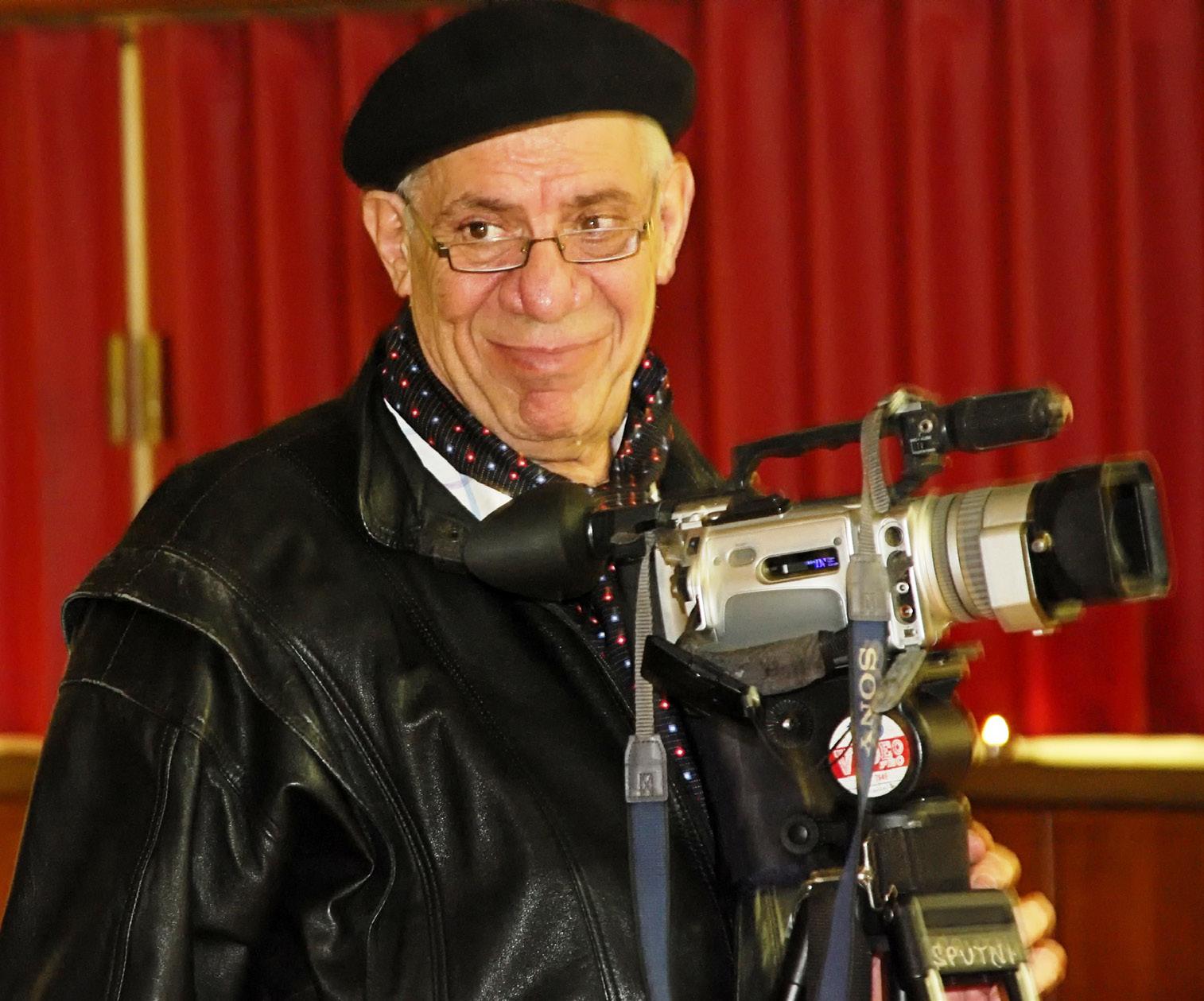
telecommunications engineer, Gregory expected to have no problems getting work.
However, with the recession, he couldn’t find a job. Nor could Anna, who was a science teacher.
That’s why they decided to set up Sputnik.
Gregory was an amateur with a camera, but had always wanted to make television. In 1958 – the year
after the Sputnik satellite went up – he applied to the television faculty at university, but though he scored 23 out of a possible 25 marks in the entrance exam, he was excluded. It wasn’t until he went to a gathering of students who had passed the exam but didn’t get in that he discovered why – it was because he was Jewish. Everyone else in the room also happened to be Jewish. In 1995, the Vaismans were able to take advantage
of a federal grants’ program for ethnic television programs to set up their Russian-language program on Channel 31. Over the years, they have secured grants from the Cities of Port Phillip and Glen Eira, the Victorian Multicultural Commission and other bodies. It is now the longest running program on Channel 31.
“Gregory was talented on camera and with editing and painting. He had golden hands and a golden heart,” Anna said.
Sputnik and the Vaismans have received a number of awards for their work – Government of Victoria Awards for Excellence in Multicultural Affairs for the program in 2008, for Gregory in 2009 and for Anna in 2010, and the Antenna Award to Sputnik for the ‘Best Culturally and/or Linguistically Diverse Program’ in 2019.
When Gregory passed away, Channel 31 invited Anna and her daughters to a special ceremony where Sputnik was presented with another award – the 2025 Antenna Award honouring Gregory. Gregory was also inducted to C31’s Hall of Fame.
The concert is free, but please book: https://www.trybooking.com/DKYWI Further information, contact Anna Vaisman at the Sputnik Russian Cultural and Television Association on 0411 560 880 or by emailing sputnikrctva@hotmail. com
DR HILLEL NEWMAN AMBASSADOR OF ISRAEL TO AUSTRALIA AROUND
Modern antisemitism disguises itself as virtue. Hatred dressed up as morality may be more difficult to expose, but it is identifiable. When so called moral activists resort to distorting reality, false facts and deceit, that is a sign.
When the flotilla participants are offered the opportunity to deliver aid via the legal mechanisms but refuse, that should ring a few bells. When they say that their goal is bringing humanitarian aid, but there is hardly any aid on the flotilla, that should raise suspicions. When they fake injuries, as evidenced in revealing pictures, that should raise some eyebrows.
The flotilla is an orchestrated political action designed for confrontation and media impact.
Since October 2023, Israel has facilitated more than 1.5 million tons of humanitarian aid, food, water and medical supplies to Gaza. On average, hundreds of trucks deliver assistance daily through coordinated international systems, involving dozens of organisations. At times, food entry has surged to four times the UN’s estimated needs. These operations are designed to ensure civilians receive essential supplies, while preventing diversion by armed groups. Where such risks exist, verification
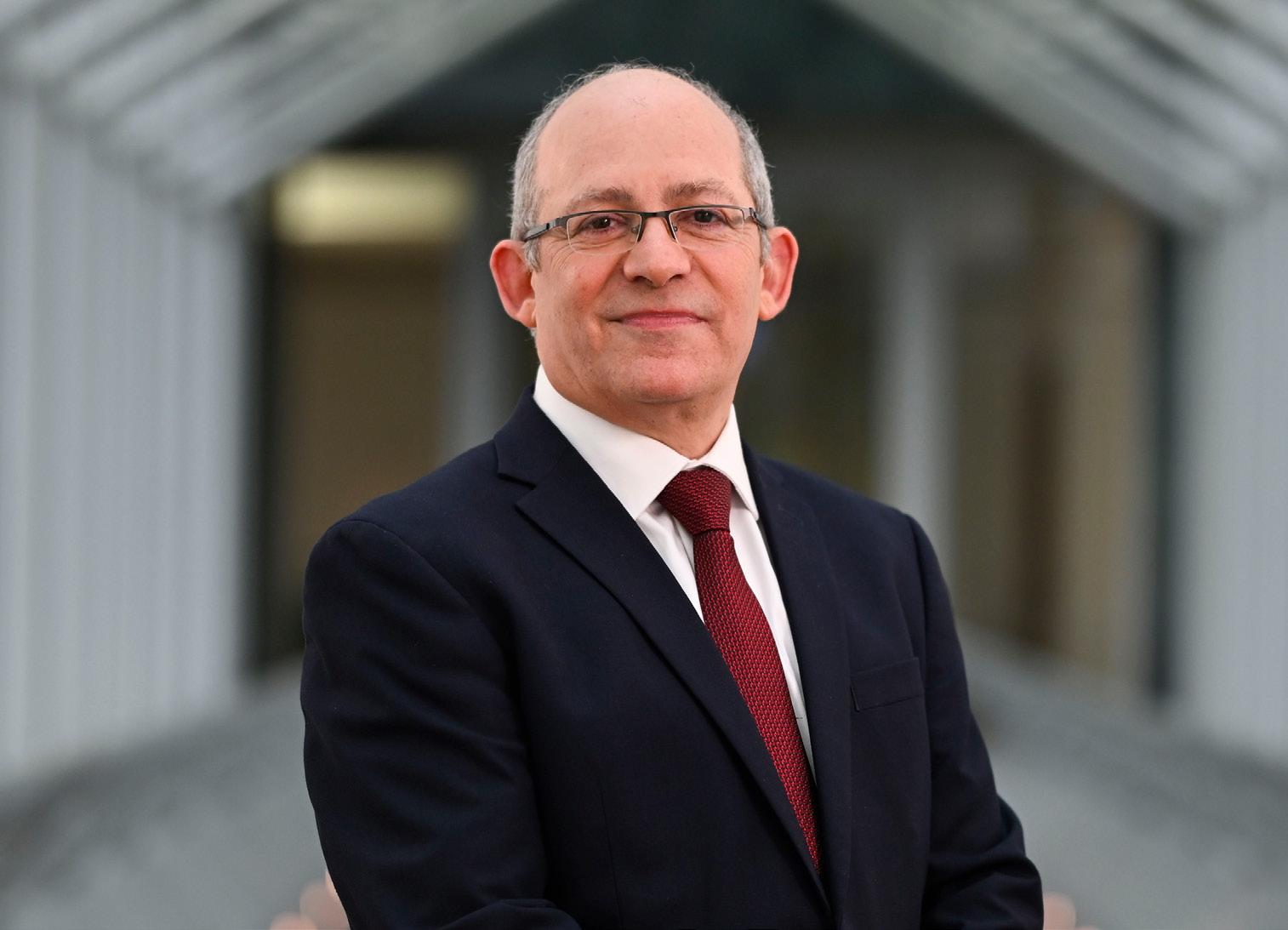
Ambassador of Israel to Australia
and monitoring systems are in place to protect humanitarian integrity.
While some participants were naïve, and motivated by genuine belief in humanitarian aims, others operate as professional provocateurs advancing a political agenda.
Several individuals and groups linked to the flotilla have documented ties to organisations connected to Hamas or designated as terrorist bodies in
multiple jurisdictions. Some are members of the PCPA (Popular Conference for Palestinians Abroad), a designated Hamas front. Others are affiliated with IHH (Insani Yardim Vakfi), a recognised terrorist group in several countries. The US Treasury has even sanctioned four of the activists associated with the flotilla.
A legal naval blockade is in place to prevent the transfer of arms and ammunition to terrorists. Under this
framework, vessels attempting to breach a lawful blockade may be lawfully intercepted, including in international waters, where applicable. The legality of the blockade has been internationally recognised, including in the 2011 Palmer Report.
Following deportation of flotilla provocateurs from Israel, headlines were flooded with false claims and accusations, including stories of heroism, physical attacks and allegations of sexual abuse. To be clear, the provocateurs were neither tortured nor raped, and no verifiable evidence has been presented. This is a smear campaign against the State of Israel. Any genuine evidence or complaint should be filed through the appropriate channels for examination by competent authorities.
Additionally, reports heavily amplified the conduct of National Security Minister Ben Gvir, which the President, Prime Minister and Foreign Minister of Israel publicly condemned, stating it does not reflect the values of the State of Israel.
The hypocrisy and double standards are clear. When many of the activists landed in Spain, they were severely beaten with batons and even forcefully undressed by local police for reasons that are still under review. However, reports did not find equal interest in this, proving more than anything that it is not humanitarian care that motivates their actions, but hatred of Jews and Israel.

NOMI KALTMANN COURTESY: THE JEWISH INDEPENDENT
A small but growing number of Australian families are taking up an Israeli government-funded program offering free high schooling in Israel.
By Year 12, Jewish school fees in Australia can exceed $40,000 a year per child, which, for many families, is simply not affordable.
In this context, an international program called Naale Elite Academy, offering teenagers the opportunity to complete high school in Israel from Year 9 to Year 12 at no cost, is becoming increasingly attractive to some parents.
The program is fully subsidised by the Jewish Agency and Ministry of Education in Israel.
Naale was founded in the 1990s, originally to help teenagers from the former USSR integrate into Israeli society, ahead of their parents making Aliyah, and it later expanded to students from around the world. An Australia–New Zealand office opened just before the pandemic.
Last year regional manager Anat Aloni placed five Australians in the program, but this year she already has 15 enquiries.
Naale affiliates with more than a dozen schools across Israel, including religious, secular, modern Orthodox and Chabad schools. Students are placed in on-campus boarding schools alongside teenagers from more than 70 countries, including other English-speaking countries such as the US, UK, South Africa and Canada, as well as their Israeli counterparts. Students complete the Israeli Bagrut high school certificate, which is internationally recognised and can be used to apply to Australian universities.
Australian applicants who attend the Naale program come from across the nation, including regional and rural areas, and from families with very different levels of religious observance.
Interested teenagers attend a full day of assessments, which includes group dynamics, written psychological tests and an evaluation by a team of Israeli clinical psychologists who fly in specifically for the process. Families must provide medical histories, family background and information about Jewish status. Students are interviewed to assess emotional readiness, academic potential and compatibility to the unique program settings.
“The transition can be so challenging and overwhelming. We must do everything we can so that the child has a good experience, so it is a very strict and thorough process,” said Aloni.
Once accepted, students spend their high school years on an Israeli student visa. Their initial flight to Israel is covered and they live in supervised dormitories with madrichim (program leaders), receive pocket money, and take part in after school activities and trips. Hebrew is not required on entry. Most Year 9 students spend much of their first year in intensive ulpan (Hebrew study), to bring
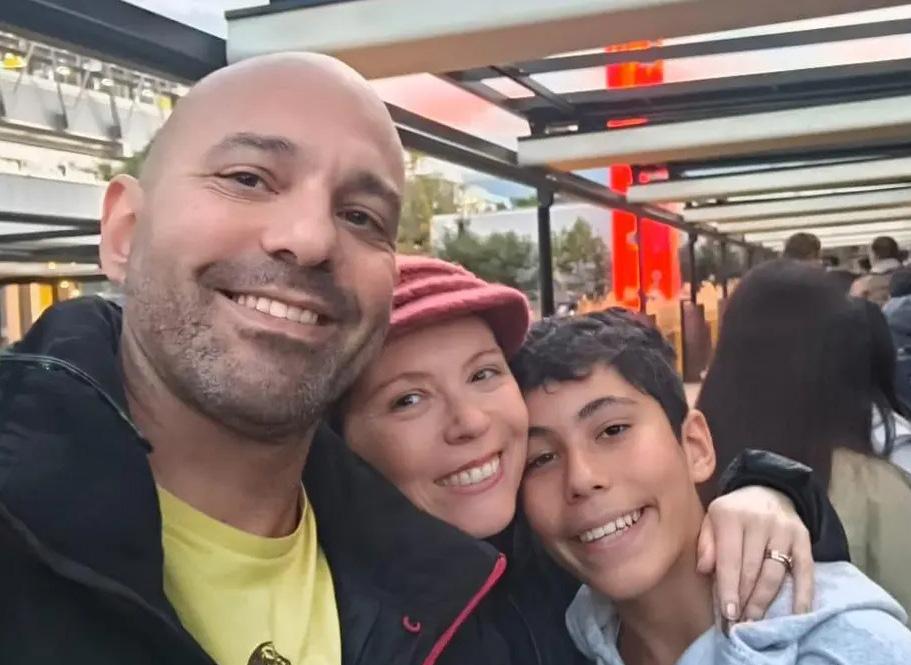
their language skills up to speed. Upon completion of high school, there is no obligation to remain in Israel. Students are free to return to their home countries.
A way to feel connected
Anna Feldman lives on the Coffs Coast, several hours north of Sydney, with her husband and son, who currently attends a local Anglican private school. With no Jewish school nearby, she began researching alternatives and came across Naale while searching online. Her son is currently applying to the program and hopes to be accepted to Naale this September.
“We are very Jewish spiritually and culturally, and we identify very strongly with Israel,” she says. “Obviously being so far away, the question is always, how can we find a way to be connected to our Judaism and for [our son] to be connected,” she says.
Feldman’s son had his Bar Mitzvah last year, but does not speak Hebrew, and has very few Jewish friends locally. But sending him to Israel, despite the distance from their home, is still attractive.
“We really want to give [our son] an experience and Jewish identity that you only get in Israel,” she says, adding that she and her husband are considering spending time in Israel themselves to see whether relocation could work for the whole family.
“And if we can coordinate ourselves to get a sublet in Israel, to spend time there, we will work out if we want to go more permanently.”
For Feldman, the cost of schooling was not the driving factor, but rather rising antisemitism contributed to her desire to send her son on the program.
“I don’t see a hugely great future for Jewish people in Australia,” says Feldman. “It would need to radically turn around for things and for me to feel like I would want to stay. I would want to feel that my grandkids would thrive here. Unfortunately, I just don’t have that confidence.”
Melburnian Liat Liderman recently sent her 15-year-old daughter to Israel through Naale. Her daughter had been attending a local Melbourne Jewish school, but wanted to experience life and school in Israel and was accepted into a culturally Jewish school affiliated with Naale. Liderman and her husband are Israeli and migrated to Australia more than 30 years ago.
“My daughter is having fun. For her, it’s the best thing. She’s very mature. She knows what she’s doing. For her it has been an amazing experience, alongside 50 other kids from around the world,” she says. While the burden of Jewish school fees was not the deciding factor, the financial relief is real.
“The toll of Jewish school, while it wasn’t a factor in our decision, it’s a big relief. It’s so expensive,” she says.
For Sydney parent Aviva, the benefit of Naale is also expressed by the experience her child is receiving.
“My child gets to experience Israel in a way that is beyond a holiday as an adult
or a Bar Mitzvah trip holiday. My child gets to connect with the country in a deeper way,” she says. She says her child has also seen rapid personal growth. “My child has matured a lot in the last few months and loves the independence. It is clear this program accelerates the rates of independence and the sense of autonomy. That’s a good thing.”
Odeya White, a Chabad rebbetzin in Perth, is currently applying to send her third daughter to Naale. A mum of eight, all of her children have attended the Carmel School – the only Jewish school in Perth – until Year 8. However, when they begin upper secondary, she wants them in a more Orthodox environment, with peers who share similar values.
“Carmel is a great school and in primary school they don’t really see a difference [between their peers]. But as they get older, they see a bigger gap, so it’s hard, its challenging. My kids want to be amongst friends like them, plus I can’t raise them Chabad here. It's a completely different social environment,” White says.
When asked why she did not send her children to Melbourne or Sydney where there are Chabad schools instead, she was clear.
“There's no dormitory. I want them to be under supervision, and I want to know what they are up to. Plus, I’m Israeli. Israel is my home and my heart. It’s important for them to be with family, so I’d rather they be in Israel,” she says.
RABBI GABI KALTMANN RABBINIC THOUGHT
Our country is facing a crisis, one that affects people of all ages, backgrounds and communities. Family, domestic and sexual violence continues to impact individuals and families across Australia. It is often hidden behind closed doors and compounded by fear, stigma, and isolation.
Domestic violence is not limited to physical abuse. It can include emotional, psychological, financial, social, sexual and spiritual abuse. Often, it is a pattern of controlling behaviour designed to dominate another person and erode their independence and confidence.
Within the Jewish community, organisations such as Jewish Care Victoria and JewishCare NSW have highlighted the prevalence of family violence and the unique barriers many victim-survivors face in seeking help. Research suggests that Jewish women often take longer to report abuse due to stigma, communal pressures and religious or cultural concerns.
As a community rabbi and someone with a Masters degree in Social Work, Rabbi Gabi Kaltmann has long advocated for breaking the silence around domestic violence within faith communities.
He believes that rabbis and community leaders must be equipped not only to
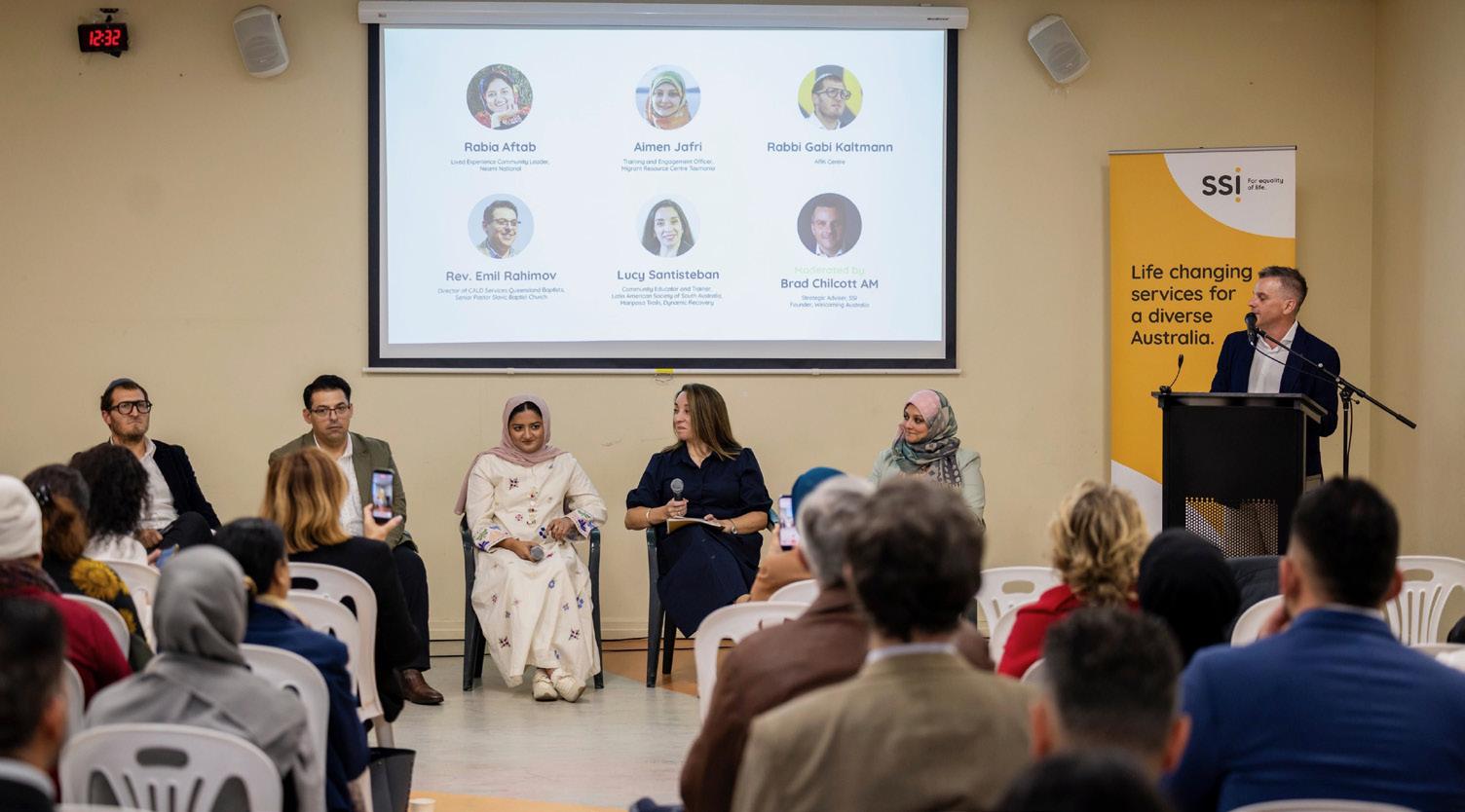
speak about these issues openly, but also to safely support those experiencing violence and abuse.
Rabbi Gabi has assisted in building the Train, Engage, Connect and Support (TECS) national project through Settlement Services International (SSI).
The TECS initiative aims to strengthen the capacity of multicultural faith and community leaders to effectively
support individuals experiencing family, domestic and sexual violence within their communities.
As part of this important initiative, TECS has developed a specialised online training package designed specifically for rabbis, rebbetzins and community leaders and members.
This free, self-paced online training provides practical tools and guidance to help leaders:
• Recognise signs of family and domestic violence
• Respond safely and appropriately
• Support victim-survivors with care and sensitivity
• Understand referral pathways and community resources
• Build safer and healthier communities
The training takes approximately three hours to complete, however participants can complete it gradually, in smaller sections, at times convenient to them. Upon completion, participants receive a certificate. They will also have the opportunity to join Learning Circles – collaborative spaces where faith and community leaders can share experiences, provide feedback and continue learning together.
Eliminating domestic violence requires all of us to play a role. We must continue promoting respectful relationships, challenge harmful attitudes and behaviours, and ensure that victims know they are not alone and that support is available. There is no excuse for abuse. Relationships should feel safe. If you or someone you know may be experiencing domestic violence, please reach out to a support organisation or trusted professional. Help is available.
https://diversity.ssi.org.au/faith-andcommunity-leaders-training
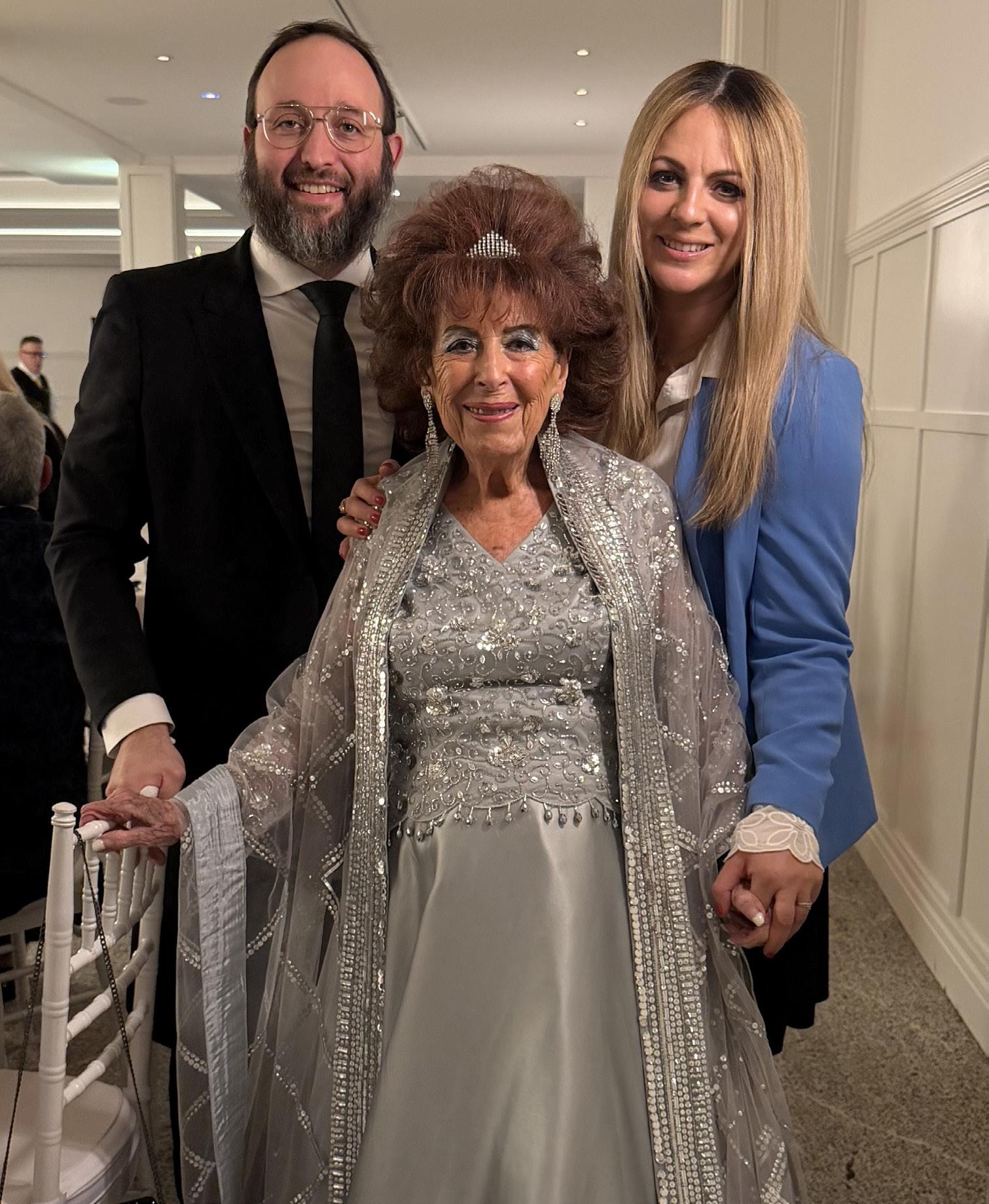
Earlier this month, my wife and I had the privilege of celebrating the 100th birthday of a remarkable woman named Lola Putt.
Just pausing on that number for a moment feels extraordinary.
Lola was born in 1924, long before television became mainstream, before mobile phones, before Google Maps, before online shopping, before social media and long before people photographed their breakfast. Over the course of a century, she has witnessed world wars, immense social change, technological revolutions and transformations in Jewish life that would once have seemed unimaginable.
And yet, at the celebration, what struck me most was not history. It was humanity.
Lola’s story reflects so much of the Jewish journey over the last hundred years. Born in Poland, as a young woman she survived the horrors of the Holocaust, enduring experiences that most of us can scarcely comprehend. After the war, she rebuilt her life with extraordinary courage, eventually making her home in Australia, where she became deeply loved by family, friends and community alike.
Spending time with someone who has lived through so much naturally invites reflection. In a world constantly chasing what is new, fast and trending, centenarians remind us of the quiet power of what endures. In Pirkei Avot, we are told: “At 70 comes fullness of
years, at 80 strength, at 90 a bending stature and at 100 it is as though one has transcended and passed from the world.” At first glance, this hardly sounds uplifting.
Yet, one interpretation suggests that the sages meant something far deeper: that at 100 years, a person carries a perspective beyond the ordinary noise and pettiness of life. In my speech at the celebration, I joked that Lola will easily make it to 120, so we may as well wish her all the way to 180.
But beneath the humour was something sincere. We were not simply celebrating longevity. We were celebrating resilience, memory, family, continuity and wisdom accumulated over an entire century.
We the Jewish people are a little like that too. We are an ancient people living in a modern world. We carry old traditions into new realities. We still gather around Shabbat tables, tell stories from generation to generation and hold tightly to values that have outlasted empires and ideologies.
Perhaps that is why moments like these feel so powerful. In a society that often glorifies youth, Judaism gently reminds us to honour experience. To listen to those who came before us. To value not only innovation, but endurance.
And maybe that is the deeper meaning of celebrating 100 years.
Standing beside Lola that evening, surrounded by generations of family and community, felt like standing in the presence of Jewish history itself. And perhaps it was also a reminder that despite everything our people have endured, we are still here, still building and still celebrating life.
RABBI ARON MOSS RABBINIC
Question:
I believe rabbis like you spend too much time chasing after wayward Jews. Why focus so much energy on those who’ve turned their back on us? Wouldn’t it make more sense to invest in the Jews who are committed? What message are you giving your children? Rebel and get attention. Be good and get ignored.
Answer:
I don't agree with you. Neither does G-d. If He did, we never would’ve had Moses.
The Midrash tells us that before Moses became the leader of the Jewish people, he was a shepherd. One day, a sheep ran away from the flock. Moses chased after it, tracked it down, and finally found it drinking from a stream.
Moses didn’t scold the sheep. He didn’t say, “How dare you abandon the flock?” He didn’t accuse it of being disloyal or ungrateful. He simply said, “Oh… you were thirsty.” Then he lifted the sheep in his arms and carried it back.
At that moment, G-d said: That’s the leader I want for my people.
Now think about this. Moses left the entire flock behind to chase one stray sheep. What kind of shepherd does
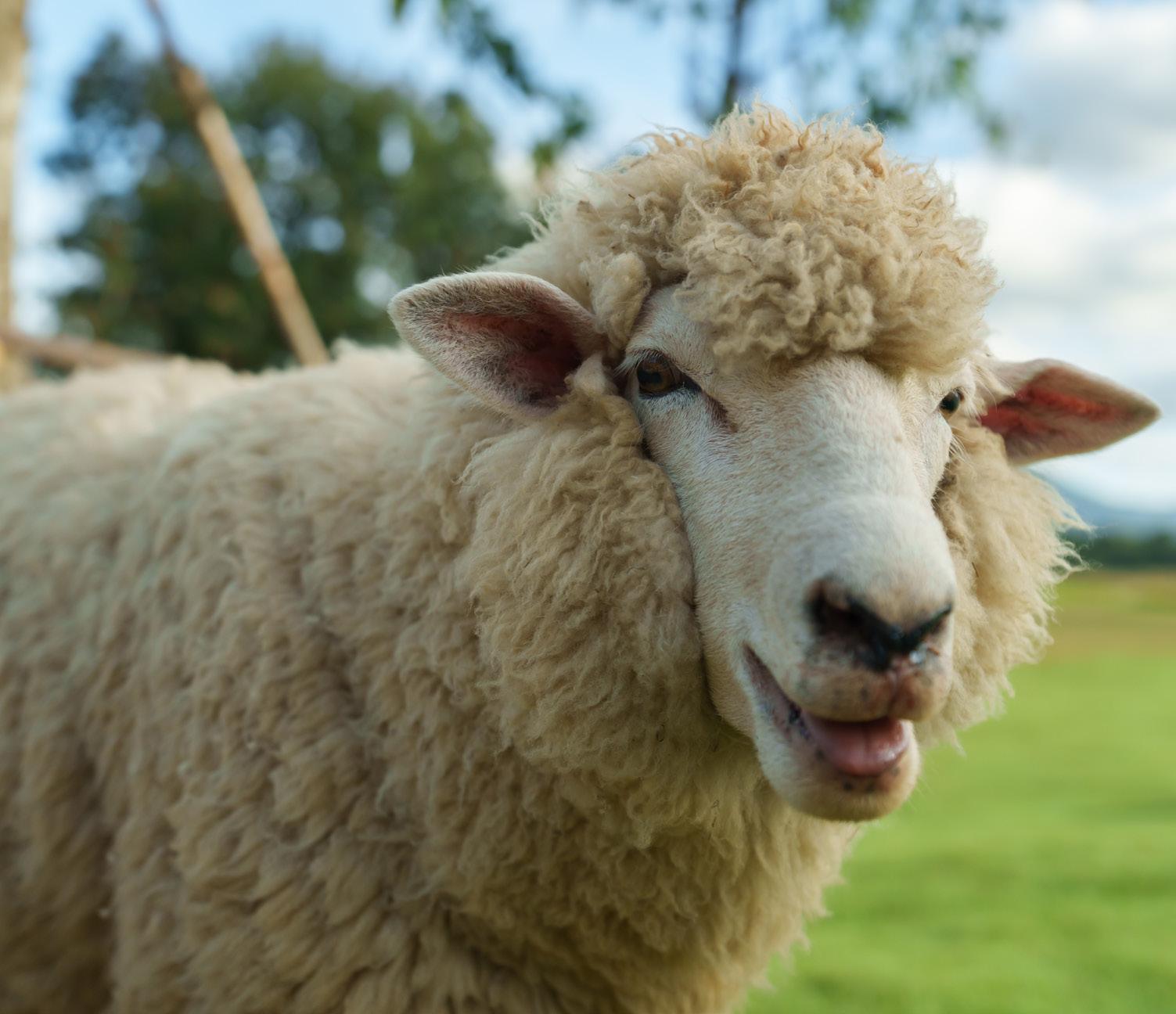
that? Should you sacrifice the entire flock for the sake of one rebel? The answer is: the sheep wasn’t rebellious. It was thirsty. Because Moses realised that, he was the right man to be a leader.
Most Jews who wander aren’t running away from Judaism. They’re running toward meaning, purpose, identity, spirituality, truth. They’re thirsty souls
looking for water. Sometimes they drink from strange rivers, foreign ideologies, fashionable movements, or empty philosophies. But it’s not because they hate Judaism.
It’s because they never properly explored it. They seek distant waters because nobody showed them the deep well in their own back garden.
Insights from a conversation between Rabbi Joey Rosenfeld and Rabbi Benji
Some speak about the soul. Others, like Rabbi Joey Rosenfeld, speak from the soul. A practicing psychotherapist specialising in addiction, Rosenfeld moves in a single conversation from Aristotle to the Arizal, from the twelve steps of Alcoholics Anonymous to Lurianic Kabbalah. What strikes me most is the coherence of his references. Everything he touches points to the same conviction: beneath the surface of every life, every text, every experience, there is something deeper waiting to be uncovered, and this search is not optional but essential.
We are all mystics by definition It would be easy to assume Jewish mysticism is reserved for select scholars. Rosenfeld rejects this. Everyone, he says, is a mystic by definition, because every soul carries a point perpetually tuned to the deepest elements of reality. Regardless of background, education or observance, a faculty within us is already attuned to the Infinite. The question is not whether we have access to that depth, but whether we have felt the urgency to look for it.
That urgency is almost always born from a crack, a loss, a moment where the functioning exterior of a life no longer holds. Mysticism, in this sense, can serve as spiritual medicine. Rosenfeld spent a decade treating addicts in St. Louis, Missouri, synthesising
It takes a Moses not to take it personally when a Jew walks away. A lesser leader says, “If they left, let them go. We don’t need them.” Moses says, “Maybe they’re just thirsty.”
And when Moses carried that sheep back, he wasn’t neglecting the flock. He was teaching them the most important lesson of all: You matter to me individually. Every sheep watching understood: “Moses loves me not just as another sheep in the flock. He loves me for who I am. If I ever get lost, Moses will come for me too.”
Far from rewarding rebellion, Moses was demonstrating loyalty. He was showing every member of the flock that no one is disposable. The sheep that stayed learned that they were valued. The sheep that wandered learned that they were valued. Everyone learned that belonging was not conditional. That’s why we never give up on a Jew. Not because the connected Jews don’t matter, but because every Jew matters. The committed deserve our attention, our teaching, our friendship and our care. But the struggling deserve those things too. And when our children see us embracing the distant, searching for the lost, and loving the disconnected, they learn something unforgettable: Judaism is not an exclusive flock that forgets the sheep who wander. It is a family where everyone is precious, and every lost sheep is carried home.
Torah and 12-step theory. Genuine spiritual opening, he found, comes only after one fully confronts their own helplessness. In Hasidic language, that is bittul, or self-nullification: not selfpunishment or shame, but the profound acknowledgment that I am dependent and not self-sufficient.
Breaking that builds
At the core of Rosenfeld's outlook is shevirat hakelim, the shattering of the vessels. In creation, God produced a structure of divine light, and it shattered. The broken pieces fell into disarray, and it is precisely among those fallen sparks that history and human experience take
shape. The work of every person is to find and raise them.
What moves him is what this teaches about trauma. The instinctive response is to mourn an original wholeness now disrupted. But Jewish mysticism teaches something different: "There was never an original whole. The only original whole is God. The moment God decides to create the world means we're no longer dealing with that original whole, and therefore the traumas that come out are not destructive; they're constitutive of the very thing."
The shattered vessels are not evidence that something went wrong. They are the raw material of everything that can
go right. The real work of the mystic is not to ascend to some rarefied altitude, but to descend into the broken places and discover the light there.
The deepest obligation
The greatest challenge facing the world today, Rosenfeld tells me, is a lack of belief in self, an unawareness of what we each carry within. Jewish mysticism asks us to re-enter the world with greater depth, and to meet others where they are broken and offer something real.
Rabbi Dr Benji Levy is host of 40mystics. com, CEO of SHARE.fund and global ambassador of Moriah College.
Friday, Nov 22, 2024 8:00 PM
Shabbat ends, Nov 23, 2024 9:04 PM
RABBI YAAKOV GLASMAN AM RABBINIC
Friday, Nov 29, 2024 8:07 PM
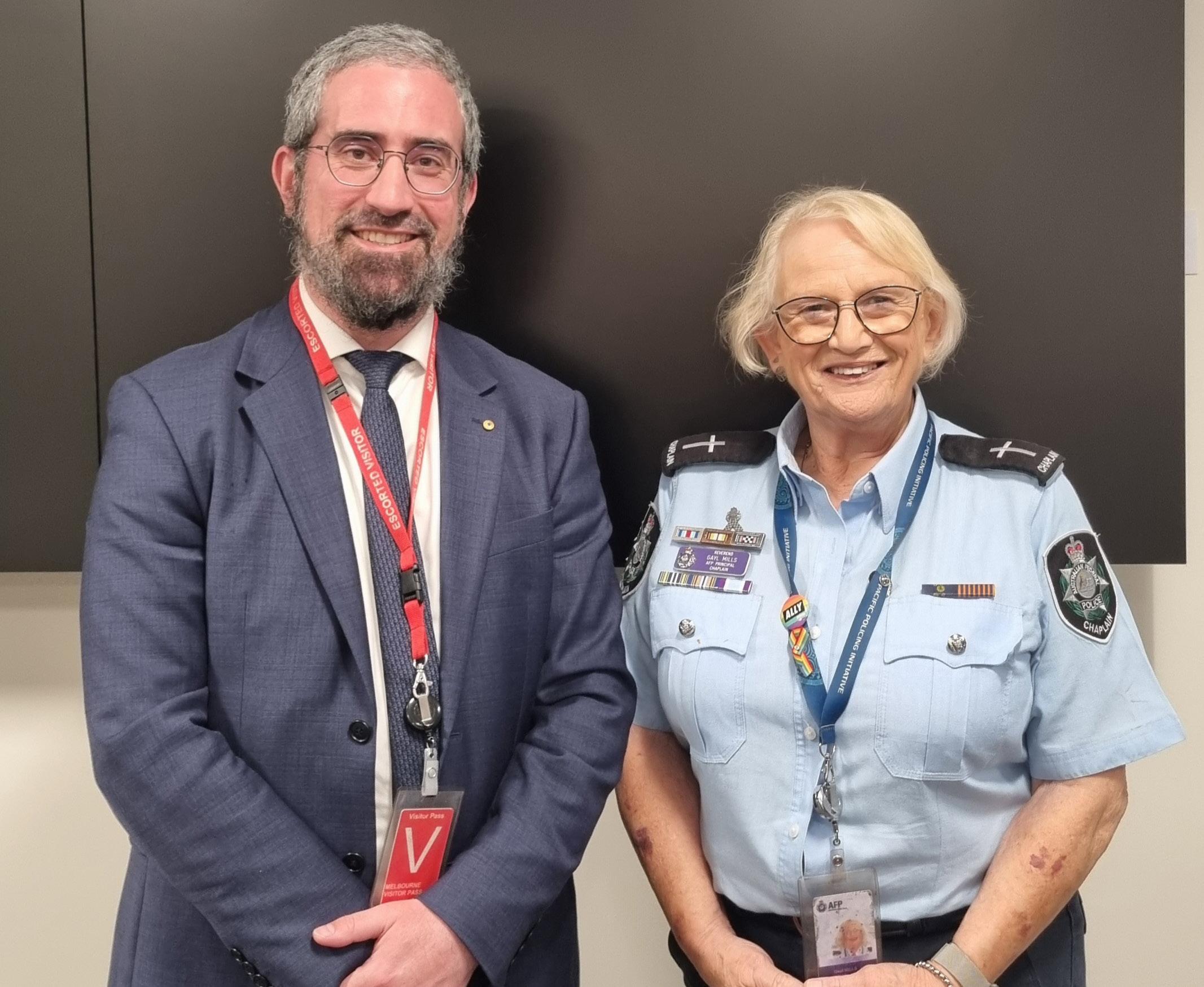
When I was recently appointed as an honorary chaplain to the Australian Federal Police, becoming the first Jewish chaplain in the organisation’s history, my initial reaction was one of humility and gratitude. Very quickly, however, that feeling gave way to a deep sense of responsibility and purpose. I began thinking less about the significance of the appointment itself and more about what I hope to contribute through the role.
Shabbat ends, Nov 30, 2024 9:12 PM
Friday, Dec 6, 2024 8:13 PM
Shabbat ends, Dec 7, 2024
Friday, Dec 13, 2024
Shabbat ends, Dec 14, 2024 9:25 PM
Friday, Dec 20, 2024 8:23 PM
Shabbat ends, Dec 21, 2024 9:29 PM
The AFP is made up of people who carry immense responsibility on behalf of the Australian public. Their work often involves high pressure environments, exposure to trauma, operational uncertainty and significant personal sacrifice. Behind every badge is a human being navigating the emotional and psychological demands that come with protecting others. One of my primary goals as a chaplain is to help create spaces where people feel able to speak openly, reflect honestly and access support without judgment.
Much of chaplaincy is not about providing perfect answers. It is about presence, trust and consistency. In a profession where resilience is expected, I would like to encourage development of a culture in which seeking support is seen as a strength, rather than a weakness. Sometimes the most meaningful contribution a chaplain can make is
Except where expressly stated otherwise, content in The Melbourne Jewish Report is provided as general informations only. The articles in this paper have been contributed by a third party. The opinions, facts and any media content here are presented solely by the author, and The Jewish Report assumes no responsibility for them. It is not intended as advice and must not be relied upon as such. You should make your own inquiries and take independent advice tailored to your specific circumstances prior to making any decisions. We do not make any representation or warranty that any material in the papers will be reliable, accurate or complete, nor do we accept any responsibility arising in any way from errors or omissions. We will not be liable for loss resulting from any action or decision by you in reliance on the material in the papers. By reading the papers, you acknowledge that we are not responsible for, and accept no liability in relation to, any reader’s use of, access to or conduct in connection with the papers in any circumstance. Photographs submitted by individuals or organisations are assumed to be their property and are therefore not otherwise credited. All articles in this paper have received the expressed consent of the author to publish in this paper.
The Jewish Report; ISSN 2204-4639

Publisher: The Jewish Report Pty Ltd (ACN 167302981)
Distributor: TJR Distribution Pty Ltd ACN 165158029
Comments or suggestions to: editor@thejewishreport.com.au
Article submissions to: www.thejewishreport.com.au/article-submission-guidelines
Advertising: editor@thejewishreport.com.au
Website: www.thejewishreport.com.au
Printer: Spotpress Pty Ltd
simply to listen intently, offer perspective and remind someone that they do not need to carry a difficult burden alone. I also hope to contribute to the wellbeing of AFP members in practical ways through pastoral care, relationship building and ongoing engagement across different areas of the organisation. Whether supporting individuals


member who may seek guidance, conversation or care, regardless of their background or beliefs. In an increasingly complex and often fragmented world, there is enormous value in human connection, mutual respect and genuine compassion.
I was inspired to pursue this path by friends and colleagues, whose longstanding chaplaincy work within the Australian Defence Force and Victoria Police demonstrated the quiet but significant impact chaplains can have in public institutions. Their example reinforced that service is often most powerful when carried out without fanfare.

through personal challenges, assisting members who have faced confronting experiences, or simply being available for informal conversations, my intention is to serve in a way that is steady, approachable and constructive.
Importantly, chaplaincy within the AFP is not limited to serving one faith community. My role is to support any
I also recognise the broader significance of this appointment. Jewish chaplains have served in other Australian institutions for many years. I hope this role further strengthens the sense of partnership between the Jewish community and wider Australian society. At a time when social cohesion and understanding are so important, visible cooperation between communities and national institutions matters greatly.
Above all, I approach this role with a strong sense of duty. The men and women of the AFP dedicate themselves to serving Australia every day. If I can contribute in some small way to supporting their welfare, then I will have done my job.
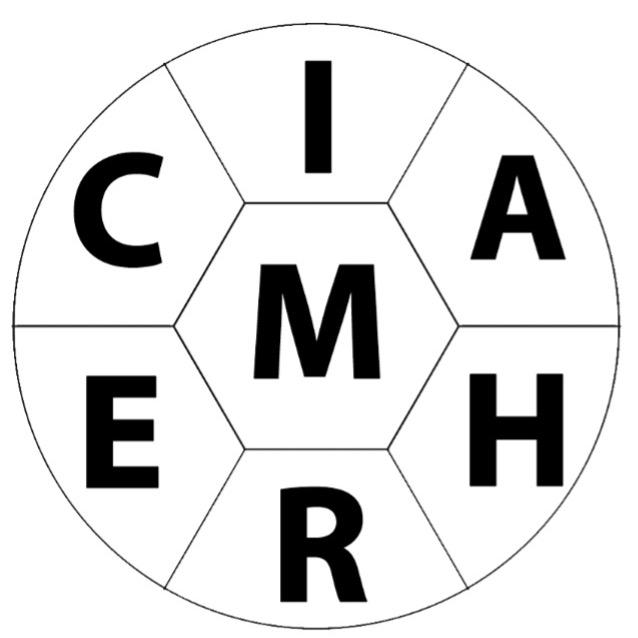
How many common words of five or more letters can you spell using the letters in the hive? Every answer must use the centre letter at least once. Letters may be reused in a word. At least one word will use all seven letters and have a direct Jewish connection.
Proper names and hyphenated words are not allowed. Score one point for each answer and three points for a Jewish related word that uses all seven letters.
Rating: 18 = Good; 22 = Excellent; 28 = Genius
ANSWERS PAGE 18
PROFESSOR JONATHAN M. SACKIER COURTESY: AISH.COM
A British surgeon survived school beatings, knife attacks and decades of quiet antisemitism. After October 7, he stopped pretending it was someone else's problem.
Life has been good to me. Surgeon, teacher, researcher, entrepreneur, writer. I've travelled, built things, met extraordinary people. But my good years were punctuated by something darker: antisemitism. Not the caricatured kind from history books or neo-Nazi marches. The quieter sort, bubbling beneath civilised surfaces. At school gates, on public transport, in professional settings, and increasingly, on British streets.
I grew up in London in a secular Jewish household. My father served with distinction in the British Army during World War II. He was immensely proud to be English, his East End roots, Tottenham Hotspur, Churchill, Dickens, and everything he believed Britain represented.
But beneath that pride sat permanent caution, always telling me to keep my head down, be invisible, never advertise my Jewishness. I did not understand why.
Around four years old, a child asked where I hid my horns and tail, genuinely believing Jews possessed both.
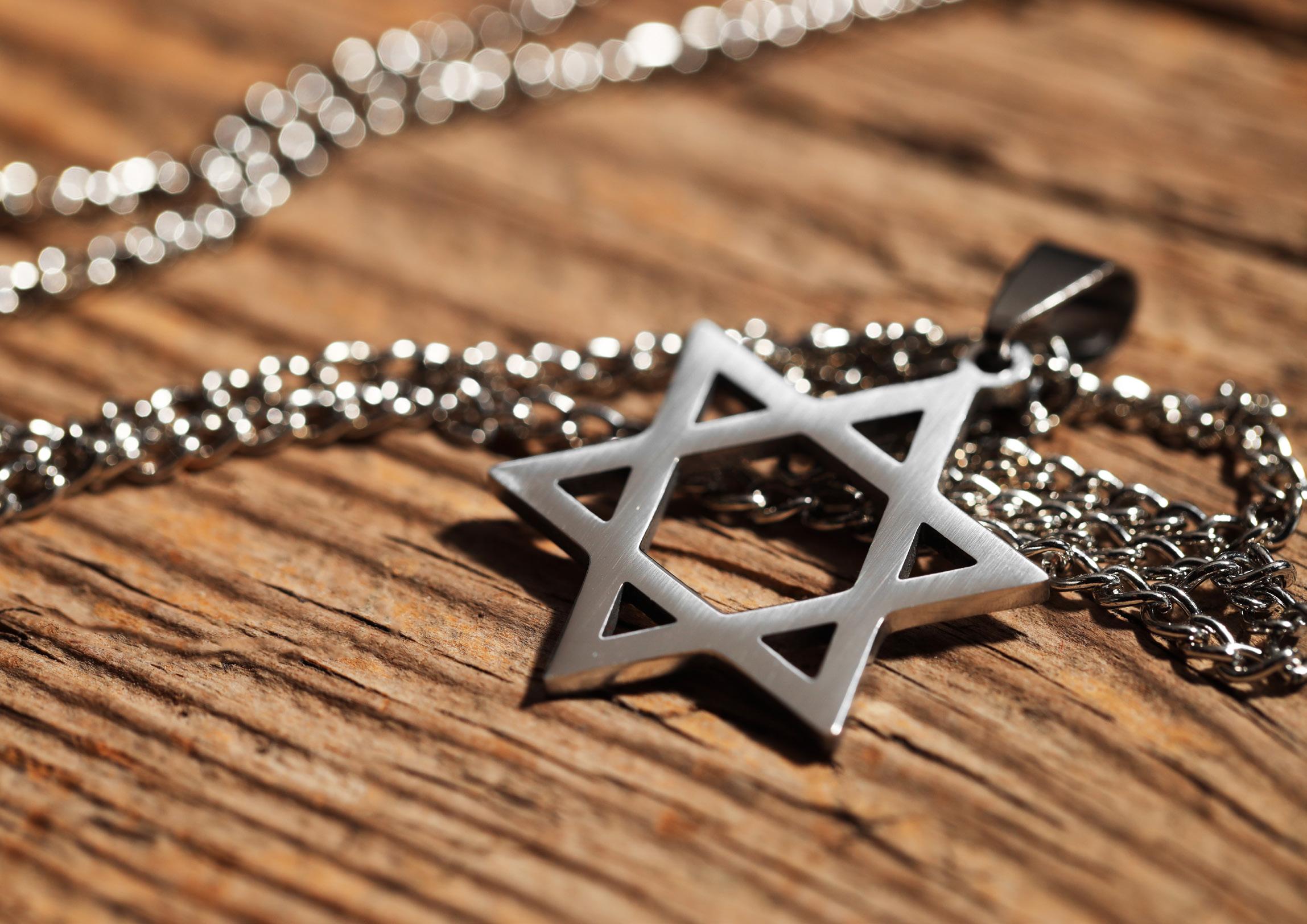
At primary school, my blazer bore a Star of David badge. Walking home often meant running the gauntlet of local boys who found this offensive enough to justify violence. I was repeatedly attacked by groups of five or six brave souls. Blaming football injuries for the bruises, I never told my parents the truth, both ashamed and because I sensed my father’s fear. Aged 10, one boy held a knife, cutting the badge from my blazer, threatening to cut me too.
At 12, travelling to a music lesson on the Underground, three boys approached, one knowing I was Jewish. They mocked me, asked where my violin was, smashed my guitar, and punched me repeatedly. Another “football injury,” my parents suggesting perhaps the sport was not for me, an ironic allegory for suppressing my Jewish identity.
At 16, after dropping a catch during cricket practice, I was greeted by shouts of “useless kike”.
At 17, on a London bus, I asked an elderly man to stop abusing the Southeast Asian conductor. He responded that I clearly was not “a Paki”, so perhaps I was a “filthy kike” instead.
As a young doctor, one night I attended a distressed patient. Noticing my Star of David necklace, he announced he did not want a “filthy Jew” touching him. Hearing I was the only duty doctor, he graciously accepted my help.
For decades I persuaded myself these were isolated experiences involving ignorant individuals rather than symptoms of something larger. Britain, after all, was tolerant, educated and democratic. I associated antisemitism with continental Europe, history and extremists. But history returns when societies grow complacent.
Since October 7 and the war in Gaza, antisemitism has become more visible, aggressive and socially acceptable than at any point in my lifetime. Synagogues require guards, Jewish schools operate behind barriers, cemeteries are desecrated with swastikas and slogans. Protesters chant inflammatory threats while police officers advise Jews not to be “visibly Jewish” or “provocative.” My late father, who helped defend Cable Street against fascists, would struggle to comprehend such passivity.
Meanwhile, ancient conspiracy theories have been casually rehabilitated. Recently, I treated myself to a manicure, chatting to the Italian manicurist who had lived here for six years. I asked whether she enjoyed life here. She replied that London had “changed”, was “full of Jews” and that “it would be better if they killed all the Jews”. All stated calmly and seemingly unabashed, even when I informed her that I was Jewish.
It is not merely the hatred that is alarming, but the normalisation of it. Old tropes have rapidly returned; Jews supposedly control finance, the media and orchestrate governments and global events. These myths are historically illiterate and factually absurd. Worldwide there are around 15 million Jews, less than 0.2 per cent of the population, and in the UK around 300,000 Jews, less than half of one percent. Yet this tiny minority purportedly controls banks, governments, media corporations and international politics. My, we are busy!
These myths have obvious origins. In medieval Europe, Jews were forbidden from owning land or entering many professions. Some entered moneylending because Christian doctrine restricted charging interest. A role forced upon Jews became
evidence of supposed Jewish greed and manipulation. Hitler denounced theoretical physics as “Jewish science” – perhaps history’s greatest intellectual own goal since this discipline ultimately led to the Manhattan Project. Why were many leading physicists Jewish? Simple: Jews had long been excluded from other fields. Meanwhile Werner Heisenberg, a Protestant Christian, was branded a Weißer Jude, a “white Jew”, merely for defending modern physics.
The Protocols of the Elders of Zion, fabricated by Tsarist secret police around 1903, falsely claimed to expose a Jewish conspiracy for world domination. Thoroughly debunked over a century ago, its themes still echo across social media and political discourse.
Antisemitism is remarkable for its ontradictions; Jews simultaneously characterised as communist revolutionaries and capitalist bankers, weak and all-powerful, rootless cosmopolitans and tribal separatists. Conspiracy theories are emotional rather than rational.
Yet Jewish civilisation has contributed enormously to humanity. Albert Einstein transformed physics. Jonas Salk helped eradicate polio. Richard Feynman revolutionised science. Mendelssohn and Mahler shaped classical music. Kafka and Viktor Frankl reshaped literature and psychology. Spielberg, Dylan, Billy Joel, Amy Winehouse, Mel Brooks and countless others enriched modern culture.
These achievements do not make Jews superior. They reflect a longstanding cultural emphasis on education, intellectual curiosity, debate and service.
Tikkun olam, “repairing the world,” is deeply embedded within Jewish culture. We inherit an ethic to learn deeply, contribute meaningfully and leave
things better than we found them. That principle shaped my life. As a surgeon and teacher, I tried to heal where possible, teach generously, innovate responsibly and contribute positively. Like many Jews of my generation, I rarely foregrounded my Jewish identity, preferring simply to think of myself as British.
But recent years have forced many of us to confront something uncomfortable: no matter how integrated or patriotic we may feel, antisemitism has a way of reminding Jews that others may still regard us as outsiders.
None of this means Jews are uniquely virtuous or uniquely victimised. Every group contains good and bad people. Criticism of Israeli governments, like criticism of any democracy, is legitimate and necessary. But antisemitism differs from ordinary political disagreement because it operates through conspiracy and collective blame, transforming individual Jews into symbols of imagined global evil.
History repeatedly demonstrates where such thinking leads. From medieval expulsions to pogroms, from the Dreyfus Affair to the Holocaust, antisemitic myths consistently precede violence. And antisemitism never ultimately threatens Jews alone. Whenever societies become comfortable with conspiracy theories, tribal hatred and dehumanisation, democratic culture itself begins to erode.
My father believed invisibility was the safest strategy for Jews. I understand why he thought so. But I have reached a different conclusion. I am proudly British. Proudly a Londoner, physician, teacher, innovator and citizen of a democratic society that should know better than to recycle ancient hatreds.
I am also proudly Jewish, and the time for hiding is over.
RAMONA FREEDMAN
First up, thank you to so many who have reached out to me in my new professional capacity as a preAliyah advisor for Telfed. This is an organisation based in Ra’anana that specialises in helping Australian and South African olim (immigrants) integrate and absorb into Israeli society.
On the one hand, the level of interest genuinely shocks me. On the other hand, given what has been going down … it doesn’t. It is an ongoing privilege to help Australians in this way, given it is so often such an overwhelming transition on all fronts.
It was most exciting to be here in Israel as the Eurovision Song Contest got underway. Everywhere you went, you heard the words “Michelle, Michelle”. Primary schools blared it through speakers during recess. Drivers belted it out (while mumbling through the French bits) in their cars and trucks.
Annually, this country is hyper-focused on the Eurovision Grand Final. So much so that the day after the results were in and we (I am Israeli now, apparently) came a stunning second, well, I arrived at my dance class quite elated.
After all, Delta Goodrem had been divine. I was beyond proud of my Great Southern Land coming fourth. Yes, I am also still an Aussie at heart.
But, it was no surprise that our dance teacher had choreographed a routine to the hit Israeli song, performed by the incredible Noam Bettan and his dance troupe.
As I was stretching and getting into the zone, a Sephardi woman named Simchah, replete with fluorescent leggings, approached me and started screaming. “Ramona, we gave you Australians 12 points from our Israeli professional jury, 10 points from our Israeli public televote, and you were the ONLY nation that didn’t award any points to Israel. Didn’t you tell all the Jews in Australia to vote for us?” As if it were up to me and me alone. It was so ludicrous it was funny.
In truth, if one were to conduct a vox pop here on the streets of Israel asking them to complete the following sentence: “Australia equals …?” they wouldn’t bat an eyelid before responding: “Easy. Australia equals Antisemitism.” They feel it. They see more and more Australians of all ages heading to expanding communities like the Kehillat Lev Ra’anana (KLR) shul. The Aussie ‘brand’ of The Lucky Country has definitely been tarnished.
Meanwhile, passionate Simchah flicked back to personifying what her name means: joy and happiness. She approached me after class smiling and said two words: ‘Kol Tov’ – all good. Evidently, there is too much drama here to hold friction or anger about one specific topic for more than the duration of a dance class.
After waiting six months for a carpenter to come to build shelves and

cupboards (long delays due to war and the rest), I was so excited to get a custom built wardrobe in my bedroom.
Igor the Carpenter, of Ukrainian descent, obviously, was in charge. He is such a lovely, hardworking guy. At the end of one long day, he shared how his Hebrew was so fluent, despite landing in Israel as a teenager. He explained that he arrived without one word of Hebrew and even though his family was not religious, his parents deliberately put him into the local religious school to force him to speak Hebrew. Like it or not, it is a sink or swim society.
He swam the equivalent of a marathon. Here he was, decades later, a successful family man, fully integrated into Israeli life. Conspiratorially he told me, “Ramona, I never told my parents, but I would walk over to the local public school and chat in Russian to kids there every day.” We both smiled.
As he was taking in my giant Bondi Beach portrait on a wall, he told me that after the December 14 terror attack, he had a serious chat with his wife. They discussed where they would go if they were forced to leave Israel.
This giant, Ukrainian, Tony Soprano lookalike, paused and said, “Ramona, then I thought about Golda Meir’s famous quote: ‘We Israelis have a secret weapon in our struggle with the Arabs: We have nowhere else to go.’ He smiled and then simply added: So, we stay here and make the best of it. Did Igor the Carpenter just quote Golda to me? Why yes, he did.
Igor insisted on packing and taking all his heavy tools home nightly. I told
short, I was told I didn’t read the fine print of the notice near the blueberries. Therefore, I paid a significant amount more than I had planned. Did I want to return them? Budget-wise, it would have been sensible, but then the exhaustion of launching into it all in our holy language, which is precious but not my Mother Tongue, seemed too much.
So, the overall expensive blueberries remained in my basket. Lesson learnt. As annoying as it might be, I need to pause and throw a sign with fine print into Google Translate. Israel.
Back to Eurovision, Israel’s Channel 11 had the exclusive coverage. As I watched the pre-show full of exciting banter, there was a sudden break in programming. They cut to a serious newsreader with a deep voice who looked squarely into the camera and said a version of: “We interrupt this broadcast to advise all in Israel of news just in. We inform you of the tragic death of a combat soldier, a hero who was only 20 years old. May his memory be a blessing.”
My heart sank; tears filled in my eyes. Silence on the screen, silence in my home.
A few seconds later, the coverage crossed back to Vienna, the epicentre of all-things Eurovision. Israeli reporters there were buzzing. They were in a frenetic party mode.
him he could keep them out … that I wouldn’t mind at all. He looked at me and said he needed to, “just in case war breaks out in the night and I can’t get back here.” Igor!
After a long week of daily construction in our home, I was so looking forward to a quiet Shabbat. Well, I was awoken early Shabbat morning to a large crash dangerously close to me. Oh, the internals of my new friend, my new cupboard, came crashing down. So Israel!
After Shabbat, when I sent Igor a message explaining what had happened, there was no immediate apology. No immediate concern. Just a ‘thumbs-up’ reply. Which I assume meant: Duly noted. Will sort it out. I’m onto it.
I truly try hard with learning Hebrew; I still loyally sit down and practise Duolingo Hebrew daily. But, I am not kidding myself, English will always be front and centre. Recently, I went into a supermarket and saw fresh punnets of blueberries very cheap.
Blueberries are typically quite expensive and, therefore, are a luxury here. I was so excited, I grabbed five perfect punnets. Yet, when I got to the ancient checkout with a disinterested dude at the register, I asked to double check the price. I couldn’t understand what he was saying. Something about three punnets, something about 50 shekels. I paid and then took a moment to review my receipt, only to find that I was charged full price for some.
Carrying a heavy bag, I asked a question about the price. Long story
The emotional swings here are wild. If Israel needed to be defined by a punctuation mark alone, there would only be one choice. One winner. The exclamation mark! It personifies drama. High drama. Every single day.
There is a beautiful song currently in the Israeli Top Ten. It is called Lev Lavan, which translates to White Heart. One day, at home, I heard a live performance of it from my window. I smiled and thought how sweet it was that a neighbour was throwing a party with live music and I started singing along. If you are driving in your car in Australia, put this song on, it is so special.
As it is in Hebrew, I know about a quarter of the lyrics and didn’t really think about it again. Then that Shabbat at the KLR Shul Kiddish (generous! impressive!) a friend said, “Hey did you hear the live performance of Shuli Rand this week? Right here in Ra’anana? “Live? You mean of the song, Lev Lavan? I thought it was just a random cover singer?” Turns out it was the artist himself. He had personally come to Ra’anana, to the home of a bereaved family who lost a soldier. Apparently, that young hero loved this artist and he went to comfort the family.
This country often leaves me speechless – from the crashing cupboard to the soulful singer; from the budget-blowing blueberries to the perfect pita, it is incredible … whether you comprehend the fine print or not.
For now it is over and out from Ramona in Ra’anana.
To contact Ramona as a Telfed pre-Aliyah advisor, please email: aliyahprep@telfed.org.il
This is the perfect dish for the coming winter days
It is based on a recipe from The Huis Genoot Potjiekos Cookbook (1987), which has been “jazzed up” a bit.
Ingredients:
2 to 3 tbsp vegetable or olive oil
1.5 kg stewing lamb, lamb neck chops, lamb rib chunks or a combination
thereof
Salt and freshly ground black pepper
2 large onions, finely chopped
2 cinnamon quills
4 cardamom pods, lightly crushed
6 whole cloves
1 tsp freshly ground white pepper (plus more to serve)
1 tsp ground ginger
½ tsp paprika
½ tsp ground cumin
2 tbsp tomato paste
3 cloves garlic, crushed
1 tbsp fresh ginger, finely grated
1.5 kg ripe tomatoes, roughly chopped or the equivalent in tinned crushed tomatoes
3 to 4 bay leaves
1 tbsp red wine vinegar
5 medium potatoes cubed (peeling optional)
Steamed basmati rice to serve

Instructions:
1. Pat the lamb dry with kitchen paper and season all over with salt and black pepper.
2. Heat a splash of oil in a large frying pan over high heat. Brown the meat in batches on all sides until deep golden brown – about 3 to 4 minutes per side. Do not crowd the pan. Set the browned meat aside.
3. In your casserole over medium heat on the stovetop, heat another splash of oil and sauté the onions until softened and lightly golden. That should take about 5 to 6 minutes. Scrape any sticky bits off the bottom.
4. Add the cinnamon quills, cardamom pods and cloves, and cook for one minute. Add the white pepper,
Friday, Jun 12, 2026 4:49 pm
Shabbat ends, Jun 13, 2026 5:50 pm
Friday, Jun 19, 2026 4:50 pm
Shabbat ends, Jun 20, 2026 5:51 pm
Friday, Jun 26, 2026 4:52 pm
Shabbat ends, Jun 27, 2026 5:53 pm
Friday, Jul 3, 2026 4:54 pm
Shabbat ends, Jul 4, 2026 5:56 pm
Melbourne Jewish Report Disclaimer:
Except where expressly stated otherwise, content in The Melbourne Jewish Report is provided as general informations only. The articles in this paper have been contributed by a third party. The opinions, facts and any media content here are presented solely by the author, and The Jewish Report assumes no responsibility for them. It is not intended as advice and must not be relied upon as such. You should make your own inquiries and take independent advice tailored to your specific circumstances prior to making any decisions. We do not make any representation or warranty that any material in the papers will be reliable, accurate or complete, nor do we accept any responsibility arising in any way from errors or omissions. We will not be liable for loss resulting from any action or decision by you in reliance on the material in the papers. By reading the papers, you acknowledge that we are not responsible for, and accept no liability in relation to, any reader’s use of, access to or conduct in connection with the papers in any circumstance. Photographs submitted by individuals or organisations are assumed to be their property and are therefore not otherwise credited. All articles in this paper have received the expressed consent of the author to publish in this paper.
The Jewish Report; ISSN 2204-4639
Publisher: The Jewish Report Pty Ltd (ACN 167302981)
Distributor: TJR Distribution Pty Ltd ACN 165158029
Comments or suggestions to: editor@thejewishreport.com.au
Article submissions to: www.thejewishreport.com.au/article-submission-guidelines
Advertising: editor@thejewishreport.com.au
Website: www.thejewishreport.com.au
Printer: Spotpress Pty Ltd
ground ginger, paprika and cumin, and stir for another minute, until fragrant.
5. Add the tomato paste, garlic and fresh ginger and cook for a further minute, stirring continuously.
6. Add the chopped tomatoes and bay leaves, and stir, combining everything well. Add the red wine vinegar.
7. Return the browned meat to the pot along with the cubed potatoes (if using). Press everything down so the meat and potatoes are as fully covered with the tomato mixture as possible.
8. Bring the mixture to a gentle simmer, cover with a tight-fitting lid, and cook over low heat for 1 hour 30 minutes to 2 hours, until the meat is completely tender and falling off the bone. Check occasionally and give it a stir, making sure nothing is catching on the bottom.
9. Once cooked, taste and adjust the seasoning. The gravy should be thickish and delicious. If it seems thin, simmer uncovered for a few minutes.
10. Serve with steamed basmati rice and plenty of white pepper.
Notes:
This recipe works best with lamb or mutton on the bone. Bone-in cuts add flavour and body to the gravy that
boneless cuts cannot replicate. Make sure to season the meat well with salt and pepper before and during cooking. Beef and chicken thigh pieces also work, if the lamb is too rich.
If the tomato is a little sharp, add a little extra sugar if necessary.
The potatoes are optional but traditional. They absorb the tomato gravy beautifully as they cook. Green beans and carrots can also be added to bulk up the dish. Add them with the meat for the full cook time.
Like all slow-braised stews, tomato bredie improves significantly the next day as the flavours deepen. It is an excellent dish to make ahead of time.
Storage: Allow to cool completely, then store in an airtight container in the fridge for up to four days.
Reheating: Reheat gently on the stovetop over low to medium heat, adding a small splash of water if the gravy has thickened too much. Or cover and reheat in the oven at 160°C/320°F for 20 to 30 minutes. Or cover and reheat in a microwave.
Freeze in airtight containers for up to three months. Thaw overnight in the fridge before reheating as above.
Servings: 6
Jewish answer: MECHIRAH. Other answers: ACHIM, AIMER, ARMCHAIR, CAMERA, CERAMIC, CHARM, CHARMER, CHEREM, CHIME, CHIMERA, CRAMMER, CREAN, CREAMER, CREAMIER, CRIME, EMCEE, HAMMER, HAMMERER, MACHER, MARIACHI, MEIMRA, MAHER, MAHIMAHI, MARCH, MARCHER, MERCH, MERRIER, MIMIC, RAMMER, REARM and REHEM.
Questions/comments/compliments: email Yoni at koshercrosswords@gmail.com
RETROGRADE (MTC), AT FAIRFAX STUDIO, ARTS CENTRE MELBOURNE ALEX FIRST THEATRE
The outrage I felt while watching events unfold here was palpable, just as it should be.
Racism, hatred, misogyny, political dirty dealings – it is all there in giant technicolour, so to speak.
At the centre of proceedings is a young actor still to make it, a man who would go on to become a giant of the screen.
I speak of Sidney Poitier (Donné Ngabo), who would, in time, become the first African American to win the Best Actor Oscar (in 1964 for Lilies of the Field).
Inspired by fact, Retrograde, by British playwright Ryan Calais Cameron, is set almost a decade earlier in the office of NBC TV heavyweight lawyer Mr Parks (Alan Dale).
The network is keen to sign up Poitier, who has been cast in a telemovie written by Bobby (Josh McConville).
Having appeared in Blackboard Jungle, Potier is still to find regular acting work, even though he just turned down another leading role on principle.
And for Bobby, who is a friend of Poitier’s, getting this movie made is important for his career.
But from the moment that Poitier enters Mr Parks’ office and meets him for the first time, it is clear that the lawyer has
strong racist (and misogynistic) views.
It sets Poitier back on his heels, but worse is to follow, as the McCarthy era rears its ugly head. Poitier appears to be on an FBI watch list.
Mr Parks’ expects him to denounce communism and with it one of his highprofile friends before NBC is prepared to do business with him.
As talks continue, power shifts between the three players. There is a great deal at stake, as all have a lot to lose.
With some striking dialogue, Retrograde doesn’t hold back, evocatively depicting a time when African Americans and political undesirables were harshly targeted.
Director Bert LaBonté has done an excellent job sheeting home the impact of that tumultuous period in general and upon Poitier in particular.
The acting is intense and passionate, led from the front by Donné Ngabo who bears a striking similarity to Sidney Poitier
All come across as heavily invested. Ngabo is seen as naturalistic and caring, Dale as suitably arrogant and bombastic, while McConville brings with him a ferocity of intent. The greatest compliment I can pay is that each of the actors morph into the characters they are playing.
They are also able to readily switch gears, generating light and shade, as is required in the production.
Notwithstanding a few dropped lines that Dale delivered, I bought what they were selling, hence the depth of feeling I experienced.
The set and costuming by Zoe Rouse are beautiful throwbacks to a bygone era. The former incorporates a lift and fly on the wall listening from outside Mr Park’s spacious office. Both nice touches.
The picture though wouldn’t be complete without impressive sound and lighting design from Jethro Woodward and Rachel Lee respectively.
Retrograde works away at our psyches, inhabiting our souls with the injustices being championed.
Mind you, I couldn’t help questioning whether we have taken to heart lessons learned from those intolerant times. Is the world in any better shape today?
Ninety minutes without interval, Retrograde is on in Fairfax Studio, Arts Centre Melbourne until 27th June, 2026.
struck up a conversation with the exotic, mysterious, attractive Anna X (Becca Galvin) at a party in New York in 2016.
From there, he couldn’t get enough of her. In short, he was smitten from the get go.
In her early to mid twenties, Anna proved to be aloof, revealing little, if anything, at the best of times. That only made him hungry to learn more.
She was Russian, fashionable and had a great interest in expensive art, having secured an internship at a magazine after she landed in New York.
She was also socially aware and was regularly talked about online.
He was 32 years of age and had drifted through his “disastrous” 20s with a “floundering career”.
Then he left his fiancé and moved to New York, having developed an exclusive dating app for the glitterati in less than a day that venture capitalists bought into.
Not afraid to party hard, Anna and Ariel mixed with the hoity-toity on the social and art scene.
She travelled regularly as part of her work and played hard to get.
But they grew closer and she started putting the hard word on him to invest in her ventures, which he began doing.

In fact, he was spending big money on her, but he didn’t seem to mind. And then came the day of reckoning.
The story of the illusive Anna X by English writer Joseph Charlton was inspired by the real-life tale of con artist and fraudster Anna Sorokin, aka Anna Delvey. The latter’s dirty dealings took place in New York between 2013 and 2017.
First performed at the now defunct VAULT Festival in London in 2019, Anna X had a West End run in 2021. Red Stitch’s production marks its Australian premiere. It is a compelling story of greed and social climbing, very well realised by Becca Galvin and Tom Stokes, who play multiple roles with distinction. In short, both milk their characters for all they are worth, on occasions with extreme accents.
Among other parts, Becca also plays Ariel’s former fiancé, while Stokes additionally assumes the persona of Anna’s pretentious magazine editor.
Dramatic and humorous, under the direction of Tait De Lorenzo, everything is amped up to project a resounding picture of excess and entitlement.
The evocative set design by Louisa Fitzgerald is largely constructed from a series of artistic building blocks of different shapes.
Fitzgerald is also responsible for the faux fur and enticing Anna costuming we witness in Act II.
While I recognise the value of the thumping, up tempo music to project the New York party scene, it made hearing the dialogue clearly difficult when it was turned up.
That was especially noticeable at the start of the play.
Still that is a relatively minor irritant, as Anna X is an alluring portrait of how one of the most human of traits is to believe what we would love to believe.
One hour 50 minutes including interval, it is on at Red Stitch Actors’ Theatre until 21st June, 2026.
For more of Alex First’s reviews, go to https://www.itellyouwhatithink.com
DAVID SOLOMON, CEO AUSTRALIAN FRIENDS OF TEL AVIV UNIVERSITY AROUND
Thousands of student reservists are returning to campus determined to serve their country in a different way
Recently, three Tel Aviv University students spoke to an Australian audience about their experiences since October 7.
Like thousands of young Israelis, they had seen their lives abruptly interrupted. Studies were paused. Careers were put on hold. Military service became an immediate reality. Each had experienced uncertainty, sacrifice and loss.
Yet what was most striking was not what they had endured, rather what they were focused on next. They spoke about returning to their studies. About contributing to their communities. About strengthening Israeli society. About helping build the future their generation will inherit. In a country still living with the consequences of war, that determination matters.
Since October 7, about 8,000 of Tel Aviv University's 30,000 students have been called up for reserve duty. Approximately 2,000 remain in active service today. Many have spent multiple months defending Israel, while postponing their own plans and ambitions. Others have returned carrying the emotional and physical burden of conflict. These

students offer a powerful reminder of why universities matter. For 70 years, TAU has educated generations of Israeli doctors, scientists, engineers, entrepreneurs, lawyers, educators and public leaders. Today, the next generation is already emerging.
Many are returning from reserve duty determined not simply to complete their degrees, but to contribute to Israel's recovery and future success. They understand that the country's resilience will depend not only on military strength, but also on scientific discovery, technological innovation,
economic growth, social cohesion and compassionate leadership.
Supporting these students has therefore become one of the university's most important responsibilities. Many face significant financial pressures after extended periods of military service. Others are coping with grief, trauma or the challenge of reconnecting with academic life. Through its Student Success Center, TAU provides scholarships, financial assistance, academic mentoring, psychological services and career guidance designed to help students overcome these
obstacles and realise their potential. Faculty-based counsellors across all nine faculties provide personalised support, while specialised programs assist students dealing with learning difficulties, anxiety and the ongoing effects of trauma.
The university's Career Center helps students prepare for professional life, and social impact initiatives encourage them to apply their talents for the benefit of the broader community.
Alongside these efforts, TAU has established Israel's most advanced posttrauma clinic, drawing on decades of world-leading research to support students struggling with PTSD and related conditions.
This commitment to students exists alongside the groundbreaking research for which TAU is internationally recognised. Recent breakthroughs in spinal cord injury treatment, trauma recovery, environmental health and energy-efficient computing demonstrate how the university continues to help solve some of society's most pressing challenges.
But behind every discovery stands a student preparing to carry that work forward.
The future Israel needs is already on campus. It is studying, serving, returning, rebuilding and preparing to lead. By supporting these students, we are investing not only in their future, but in Israel's.