community
chanukah
international
lifestyle
shuls/schools
sports
www.thesleepcoach.com.au
FREE
VOL. 42 Friday, 7 December 2018 / 29 Kislev 5779
Fostering a closer Jewish community
Free subscription to electronic copy go to www.thejewishreport.com.au
CLOWNING AROUND AT HADASSAH
PAGE 2
WHAT REALLY HAPPENED ON CHANUKAH?
PAGE 8
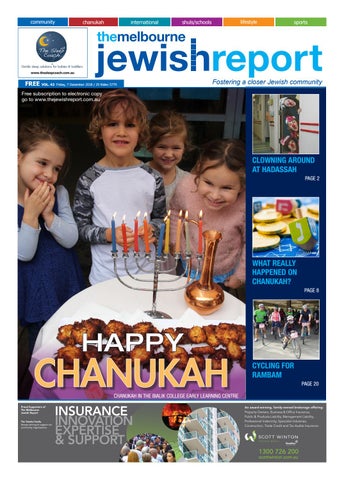
HAPPY
CHANUKAH
CYCLING FOR RAMBAM
PAGE 20
CHANUKAH IN THE BIALIK COLLEGE EARLY LEARNING CENTRE
8648 Scott Winton - Banner for Melb Jewish report (correct size).indd 1
26/3/18 9:49 am
2
community
December 2018
Hadassah Teaches Kids To Clown Around HADASSAH Clowning around in the classroom usually earns the culprit a detention, homework, or both. But not for a group of Year 10 students from Melbourne’s Mt Scopus College. The 15 kids who have just participated in medical clowning workshops at Jerusalem’s Hadassah Hospital were part of a larger group that was visiting the iconic institution during their Ulpan program. The purpose of the workshop, which grew out of a visit to Australian schools by Hadassah’s head medical clown, David ‘DuSH’ Barashi in 2016, is to introduce the students to the value of medical clowning to patients, their families and staff, and to the ethos behind the delivery of exemplary care offered by Hadassah. “Medical clowning was pioneered in Israel by Hadassah,” says Ron Finkel AM, President of Hadassah Australia. “Any reluctance to accept these medically-trained clowns quickly changed when it became obvious that their intervention proved to be significant in easing the in-hospital journey for young patients. “The economic benefits to the hospital are now a matter of record.” One of the Mt Scopus students, Emily, eloquently summarised the impact the first workshop had on the participants. “We learnt about the history of the (medical clowning) profession from one of the clowns, and then we participated in activities which gave us an understanding about how to interact with patients,” Emily said. Armed with a clown nose, the group was sent to the wards to put their new skills to the test.
“We were wary at the beginning. We tried to make the children laugh. We played games, gave gifts or talked with them. When one approach didn’t work we tried another. Some of the children were inviting, others were nervous and some were scared,” she said. “While some continued to maintain their distance, many began to smile, laugh and engage in what we were doing. While we were always aware that what we were doing was important, it was at this moment that I truly felt the impact of our actions. “Seeing the smiles on the children’s and on their parents’ faces and the connections between us growing, it was a truly special feeling and a unique experience.” Ruth Rosen, Executive Director of Hadassah Australia, said a lot of planning has gone into making sure the experience is valuable for the students and stakeholders
at Hadassah. “Medical clowns are present in every major hospital in Israel,” Ruth said. “But no hospital has the budget to employ them directly, so this service is totally dependent on donations. In some respects this is ironic, because the clowning program isn’t an afterthought; it’s a critical component in the hospital’s outreach to young patients and their wellbeing. “We want the Australian children to gain a deeper understanding of the hospital system in Israel through personal experience at Hadassah, and recognise why doctors, nurses and therapists use the clowns to assist in the treatment of various medical procedures.” These range from simple blood tests to the escorting of children to operating rooms, and from physiotherapy to HIV treatment and interactions in the emergency department.
Ms Rosen said that medical clowns are viewed as such as important element of treatment and healing, that Hadassah’s ‘DuSH’ accompanied the Israeli rescue delegation on the ground in Nepal following its devastating earthquake. He was by no means the only clown to be used in Israel’s offshore humanitarian operations. “Hadassah Australia will continue to engage with schools and provide a pathway for the children to experience Israel’s remarkable health system and its caring approach to patients and their families,” she said. For donations to Hadassah’s Medical Clowns program, please contact australia@hadassah.org or 1800 423 277. Information about Hadassah Australia is available at www.hadassahaustralia.org.
Bnei Akiva Yr 5’s Dream Big For Make-A-Wish MAKE-A-WISH AUSTRALIA & ISRAEL SHARED APPEAL Bnei Akiva Yr 5 Girls (Melbourne) and the Make-A-Wish Australia & Israel Shared Appeal, which is a partnership between Make-A-Wish Australia & Make-A-Wish Israel, recently teamed up as part of Bnei Akiva’s Project Achi. Make-A-Wish shared with the Bnei cohort an insight into the important work of MakeA-Wish, a charity which takes children and teenagers facing life-threatening illness on a carefully designed, unique wish journey where they anticipate and experience their most cherished wish coming true. MakeA-Wish explained how wish journeys are designed to complement a child’s medical treatment. From building anticipation to creating lasting memories – a wish gives really sick kids and their families, a sense of hope and future. Make-A-Wish highlighted the effect of a wish journey on kids who are constantly in and out of hospital, isolated from friends and peers, and generally missing out on the experience of just growing up and being kids. The group then had the chance to become Wish Designers for the afternoon – creating and designing wish journeys for two wish children –one from Israel and one from Australia. Guided by Make-A-Wish staff, they were asked to DREAM BIG and think of imaginative ideas – how to add excitement in the months leading up to the wish, ways to thrill on the wish day itself and how to
keep the memories of the wish day going. Their ideas were then sent over to the Wish Designers at Make-A-Wish Australia & Make-A-Wish Israel to be incorporated into those wish journeys. Sarah Singer, Philanthropy Coordinator for the Make-A-Wish Australia & Israel Shared Appeal reflected on the workshop by saying ‘It was really special to see this gorgeous group of girls so excited and keen to learn about the charity and to just use their imaginations so freely. Bnei should be so proud of them’ For information on the Make-A-Wish Australia & Israel Shared Appeal or to find out more about Wish Design Workshops, please contact Sarah Singer, Philanthropy Co-ordinator on 03 9426 0736 or 0458 133 280 or visit www.makeawish.org.au/sharedappeal
Bnei Akiva Melbourne yr 5 girls present their Wish designs
Bnei Akiva Melbourne Yr 5 girls brainstorm with Make-A-Wish for wish design ideas
Watching the story of a Wish Child’s wish journey
3
community
December 2018
Chabad Thailand CHABAD THAILAND Almost 25 years ago, a young Australian Rabbi, Yosef Chaim Kantor, and his American Wife, Nechama together with their two month old daughter Mushka, moved to Bangkok, Thailand. Their mission was simple. Sent by the Lubavitcher Rebbe, Rabbi Menachem Mendel Schneerson, they had instructions to provide for the Jewish community of Thailand and surrounding countries. They moved into the Thai Jewish Community Centre, Beth Elisheva, in Sukhamvit and began their operations. Thailand at the time was an up and coming regional centre of commerce and business, but it was still very different from the first world lifestyle that the young Rabbi Kantor, his wife and new baby had left in New York. The community in Thailand was made up of a small but cohesive number of families who were looking for a permanent Rabbi and spiritual leader. There was no readily accessible kosher food, shules, and kosher meat was a rarity! No one imagined, that just 25 years later, Chabad in Thailand would have grown into an enormous and well-oiled operation! Over 100,000 Israeli tourists pass through the border of Thailand each year, where they are welcomed by Chabad in Thailand with open arms. Tourists, backpackers and members of the Jewish community in Thailand can eat at one of the five Kosher restaurants in Bangkok, Phuket, Ko-Samui and Chiang Mai. Chabad in Thailand employs almost 100 Thai employees across their Shules, restaurants, bakeries, Kosher
store and orgnisations. Many of these backpackers are former soldiers, some who have fought in Israel’s recent wars and are looking for a place to unwind, heal their minds bodies, they find chatting with the local rabbi or being hosted for a Shabbat meal with hundreds of other Jews from around the world puts them in a relaxing mindset. Chabad in Thailand certainly has what to
offer for those who are seeking an uplifting Shabbat meal and Jewish experience! There are 11 permanent Rabbis and Rebbitzents or Chabad Shluchim (emissaries) that they are fondly known by, living with their families in Thailand, Laos and Mynamar providing a permanent and welcoming home away from home to those who seek their services.
Chabad in Thailand has been recognized by the royal house of the Kingdom of Thailand for their humanitarian services during natural disasters, pastoral care and support of Thai local communities. Rabbi Kantor, the head Chabad emissary and Chief Rabbi of the region, notes that when he first arrived in Thailand almost a quarter of a century ago, his wife Nechama would prepare a few big challahs, a pot of yellow rice, some cans of tuna and salads and they would head off into central Bangkok, hoping that they would be joined by a few backpackers and community members. Now there are over 2000 people that sit down for a Shabbat meal with Chabad every week! Chabad has become not just a place for tourists to sit, relax, eat and pray, but also a place to revitalize themselves spiritually and touch base with their faith. Anyone who passes through the doors of Chabad in Thailand notes the warm and welcoming atmosphere. These days, tourists, backpackers and visitors alike are welcome to join Chabad at any of their weekly Shabbat meals, shiurim, minyanim, and restaurants or just to pop into relax, unwind, meet other travelling Jews and enjoy the lounge have a coffee and use the free Wi-Fi. If you are travelling through Thailand, please feel free to check out Chabad in Thailand’s website at jewishthailand.com, Facebook page, or contact Rabbi Kantor via email at rabbi@jewishthailand.com for any of your needs.
Planning a Thailand Holiday? Sawadee! Chabad of Thailand welcomes you to enjoy the wide range of services we offer for travelers. Sensational Kosher restaurants, door to door delivery, Shabbat dinners and more.
For more info visit: www.jewishthailand.com
Bangkok | Phuket | Chiang Mai | Koh-Samui | Laos
4
community
December 2018
Gandel Young Leader Swims for A Cause STAND UP JACQUI DUBS Giselle Davey, the recipient of the 2018 Gandel Young Leader award, used her love for swimming to support a cause close to her and her family’s hearts. After completing the Stand Up ABC social justice journey, as part of her UJEB Bat Mitzvah program, Giselle decided to raise funds in support of the Ardoch Youth Foundation. Giselle raised over $1300 by challenging herself to swim as many laps as physically possible over the course of one hour, and managed to cover an amazing 4km through her efforts. The Ardoch Youth Foundation was founded by Giselle’s great aunt, Kathy Hilton (pictured), and is focused on improving educational outcomes for children and young people in disadvantaged Australian communities. The Gandel Young Leader Award is presented each year to outstanding young changemakers and future leaders who have completed the Stand Up ABC program in Melbourne and Sydney. “Each year we continue to see the positive impact that the Stand Up ABC B’nei Mitzvah Program is having on these young participants” says Grant Manager for Gandel Philanthropy’s Jewish and Israel programs, Nicole Brittain. “The engagement they develop and the personal growth they experience is quite amazing. Through the program these young students witness what is happening outside their own world. The program also allows them to learn and explore social justice, understand the importance of having a strong moral compass and importantly make a difference through their own ‘Social Justice Action Project’. On behalf of Gandel Philanthropy, I would like to congratulate Giselle for her outstanding contribution to making the world we live in, a better and safer place.” “I graduated out of Stand Up ABC wanting to make a change”, said Giselle following the award ceremony. “Making a change in the world is
Arnold Shmerling (Stand Up founder) & Giselle Davey (Gandel Young Leader Award winner)
possible even if you are not in a position of power. Doing something small for a few people is still a significant change. Swimming is something that I enjoy, and wanted to combine my passion with helping others. I raised money for the Ardoch Youth Foundation because everyone should have access to a good education and a bright future ahead of them. I am so grateful for the Gandel Young Leader Award and I hope I have inspired others to take action to help the community around us”. Through the generous support of Gandel Philanthropy over the past five years, the Stand UP ABC program has continued to grow in both Victoria and NSW, attracting hundreds of boys and girls from Jewish and non-Jewish schools. “It is wonderful to watch Jewish youth find their own voice on important social issues during the program, and develop confidence in their own abilities to activate change”, explains Stand Up CEO, Gary Samowitz. “Giselle has shown great skill in planning her swim-a-thon action project, and the perseverance and dedication to complete it so successfully. Well done!” Registrations for Stand Up ABC 2019 are now open.Visit www.standup.org.au/abc, email :education@standup.org.au or tel: (03) 9500 2206.
PRIME MINISTER
MESSAGE FROM THE PRIME MINISTER
THE HON BILL SHORTEN MP LEADER OF THE OPPOSITION SHADOW MINISTER FOR INDIGENOUS AFFAIRS AND ABORIGINAL AND TORRES STRAIT ISLANDERS MEMBER FOR MARIBYRNONG CHANUKAH It gives me great pleasure to send my well wishes to the Australian Jewish community for the celebration of Chanukah. Chanukah, the Festival of Lights, commemorates the cleansing and re-dedication of the Holy Temple in Jerusalem after the Maccabean war some twenty-two centuries ago.
CHANUKAH 2018 Chanukah is a significant and festive time for Jewish families everywhere, a moment to commemorate the miracle of the oil. For 2,000 years the Jewish people have reminded themselves of this story of faith and freedom through the best of times and the very worst. In the good times, it has reminded the Jewish people of their blessings and in the bad times, it sustained them. By retelling the Chanukah story, Jewish Australians remind themselves that our commitment to freedom must be continually tended and renewed. At home and abroad, Australia and Australians have always been a proud friend of the Jewish people.
Chanukah is an uplifting story of hope and liberation, and a time to celebrate with friends and family, give thanks for our blessings and reach out to those less fortunate.
As a free democratic people, we live in a land of peace and acceptance – a place where you are free to be whoever you want to be.
On behalf of the Federal Parliamentary Labor Party, I pay my deep respects to the Australian Jewish community during Chanukah. I honour your devotion and faith, which finds expression in important religious festivities like this as well as in the day to day Jewish traditions.
In our country, Jewish Australians have contributed mightily to our land and have lived out the call of Jeremiah to “pray for the people of the city for if it prospers so shall you prosper”.
Labor rejoices in our nation’s cultural diversity and we recognise that our collective strength lies in the peaceful rituals of our myriad cultures, faiths and traditions that have come to represent one story – our modern Australian story.
As Australia’s Jewish community gathers over the eight days of Chanukah, may each of you be strengthened and refreshed by your faith – and give thanks for the freedom of our shared home.
As the candles on the Menorah burn after the sun sets, may you all enjoy a Happy Chanukah filled with peace, love and joy.
Chanukah Sameach!
Chanukah Sameach.
Bill Shorten Leader of the Opposition
The Hon Scott Morrison MP Prime Minister of Australia December 2018
December 2018
5
community
Australians Must Stand Together Against Jihadist Terror MICHAEL DANBY Can you be concerned for Australia’s environment and also concerned for the safety of Australians? My answer is a definite “YES!’ I have deliberately withheld this strong policy attack on the Green Political Party’s weakness on counter-terrorism (see the attached advertisement). I did not want to politicize the issue of community security before the state election, especially given the very emotional angst widely felt throughout Melbourne about the murder of iconic café proprietor Sisto Malaspina (proprietor of Pelegrini’s). However, the Green Party must be criticized for their record in Parliament on counter-terrorism. The Green Party still has secret national and state conferences to which the media are not admitted. But it is their parliamentary habit of voting against all measures to enhance our counter-terror response that must be exposed to Australians. Green Party Senators have voted against all legislation on national security and counter-terrorism passed by the Australian Parliament since 9/11 when Al Qaeda murdered of 3000 people in the Twin Towers in New York. These major laws (some of the more significant recent examples set out below) have protected Australians from mass casualty attacks. Counter-terror laws have only passed with both Government and the Opposition voting together in the Senate. Otherwise, given the make-up of the Senate and the necessity for the legislation to be passed in both houses, these laws wouldn’t have come into existence. Yet, the Green Political Party has voted against every proposal in the Australian Parliament to protect the safety of Australians against many aspects the threat of terrorism, such as jihadists travelling in and out of Australia. Currently, we have the phenomenon of the return of former foreign fighters from Middle East battlefields, as IS (Da’esh, as it is known in the Arab world) is militarily defeated and geographically restricted to a small section of eastern Syria. Yet the Green Party has fought every attempt in the Federal Parliament, over the years that I have been a Member, to face up to these
responsibilities. Australians have not encouraged these terrorist plans or attacks in the streets of Melbourne. Australia and Australians are the terrorists’ potential victims. In Bourke Street an attacker drove a vehicle loaded with gas bottles, intending to blow it up in a crowded pedestrian area and then jumping out and stabbing random passers-by. This type of attack is an IS paradigm all over the world – from London to Kabul. IS doesn’t even need to direct orders at individuals. IS and Al-Qaeda just connect on the net with fanaticized followers to take these low-tech “opportunities” to cause maximum mayhem. There have been two potential and one actual attack in Melbourne in three weeks. We have, as a responsible national parliament, faced up to this ugly phenomenon. However, not the Green Party. Even before the Batman by-election, which Labor thankfully won, you would have thought that the Green Party would have been a bit more cautious and responsible. No. Their leader, Senator Di Natale, insisted on the ABC’s Q&A that foreign fighters and jihadists be allowed to return to Australia. The Green Party chief described these people as ‘good people who’ve made mistakes’. They are not. They are the enemies of Australia
and people who are a risk to the peace and security of ordinary Australians. The most fundamental human right that all of us have is the right to safety and the sanctity of human life. If anyone, for some gratuitous overseas political grudge, or ideology that idealizes the 6th century, says that they have the right to kill Australians, they do not. These are not “good people gone wrong”. Every weekend in my electorate, hundreds of volunteers work to protect the safety and security of local institutions. These people are selfless. They work very closely with the Victorian police and they’ve been highly successful—I won’t go into details—in preventing attacks in Melbourne. Just prior to the recent Bourke Street attack, TV and newspapers reported the court trial of a planned terrorist attack on Flinders Street station and St Paul’s Cathedral in Christmas 2016. Three were convicted. Court transcripts show they originally planned mass murder in the streets of St Kilda! These threats are ongoing and very local as far as we’re concerned. It should be crystal clear to the voters of Melbourne Ports, which will be renamed Macnamara, that this is a key difference between the Labor Party and the Green Political
Party at the next election. One, the ALP, is a responsible party that has, of course, a huge range of views on domestic matters that are strongly critical of those of the government but is responsible and wants to protect Australians’ circumstances, safety and lives. In contrast, the Green Party has voted against the following counter-terrorism legislation nonetheless passed by the Parliament in recent years: • 2014 - Counter-Terrorism Legislation Amendment (Foreign Fighters) Act. Responds to the threat posed by Australians engaging in, and returning from, conflicts in foreign states by providing additional powers for security agencies; strengthening border security measures; cancelling welfare payments for persons involved in terrorism. • 2015 - Australian Citizenship Amendment (Allegiance to Australia) Act. Provides explicit powers for the cessation of Australian citizenship in specified circumstances where a dual citizen engages in terrorism-related conduct. • 2016 - Counter-Terrorism Legislation Amendment Act (No. 1). This law allows control orders to be imposed on teenagers involved in terrorist acts. • 2017 - Telecommunications and Other Legislation Amendment Act. This law establishes a regulatory framework to manage national security risks of espionage, sabotage and foreign interference to Australia’s telecommunications networks and facilities. • 2018 - Defence Amendment (Call Out of the Australian Defence Force) Act. This law permits states to allow the Australian Defence Force (Counter Terrorism Command, SAS & commands) to be pre-authorised to respond to land and maritime threats, in addition to threats to aviation. If you take the protection of lives of Australians seriously, it’s absolutely clear you cannot support the Green Party. The Australian Labor Party has been proud to stand up for the security and safety of all Australians, as our voting record clearly shows. We will continue to do so.
6
community
December 2018
Cancer Research Spotlight: Pancreatic Cancer CURE CANCER
Cure Cancer and Can Too grant recipient Dr George Sharbeen shares fascinating information on his work in the field of pancreatic cancer, and urges further support for research into the deadly disease. I was always interested in a career in biomedical research, but my focus on a career in cancer research really began after my PhD. Up until then, my work was largely about understanding basic biological processes. As a scientist it was rewarding, but I was eager to do something that had a more direct impact on health in the country. My drive for a career in cancer research was solidified after seeing my uncle succumb to leukaemia and the hopelessness the family felt when there were no treatment options left. Why Pancreatic Cancer? Pancreatic cancer was a stand-out for me because of the lack of treatments and the lack of progress in patient survival. It ranks 10th out of the 10 most common cancers in the country but is the deadliest of this list, with less than 9% of patients surviving to 5 years post-diagnosis. Based on these dismal statistics, I felt that this was a cancer where my research could make the greatest impact for patients, so I embarked on a postdoctoral research project with A/Prof Phoebe Phillips at UNSW Sydney after completing my PhD.
Dr George Sharbeen I’ve since gained expertise in pancreatic cancer research, including a deep understanding of the pathology of the disease, hurdles to effective treatment, and mouse models that mimic clinical features of pancreatic cancer. We’re currently developing a potential novel therapeutic approach for pancreatic cancer, using nanomedicine to inhibit a DNA repair protein that is important for pancreatic cancer cell survival and resistance to chemotherapeutics. I’m passionate about the work that I do, but there are aspects of my job that can be frustrating. It can be really difficult to acquire competitive research funding to test our novel ideas, particularly for earlycareer researchers who have a limited track
record of success. It also takes a long time to see therapies taken from the bench to the bedside. As a cancer researcher, my ultimate goal is to have an impact on patient survival and quality of life, but the reality is that it can take over a decade to get through clinical trials. Nevertheless, the small successes along the way keep me going. Meeting cancer survivors and fundraisers is particularly inspirational, and a big driver of my work. What Does the Future Look Like? The last 5 years has been a very exciting time for pancreatic cancer research in Australia. We have had the first pancreatic cancer genomes sequenced as part of the Australian Pancreatic Cancer Genome
Initiative, opening avenues for personalised therapy, and we have seen the development of novel imaging platforms that have allowed us to see disease processes and the activity of chemotherapeutics in realtime. We also have made substantial gains in our understanding of how the tumour microenvironment contributes to pancreatic cancer progression, leading to current clinical trials that are harnessing the immune system and remodelling the tumour microenvironment to improve treatments for the disease. Nevertheless, pancreatic cancer patient survival has seen little improvement for the last four decades and is predicted to become the second leading cause of cancer-related death by 2030. What’s worse is that our current best treatments only extend survival by 2-4 months. Conventional therapies are clearly not working, so research into novel therapies is critical if we are to substantially improve pancreatic cancer patient outcomes. Despite this urgent need, the poor survivorship has meant we have had less public awareness and advocacy for this disease when compared to ‘higher profile’ cancers. As a consequence, pancreatic cancer research has received much less funding than many of the other top 10 cancers. Supporting pancreatic cancer research is essential to prevent it from becoming the cancer of our generation. To support the work of researchers like George, head to curecancer.com.au/donate
Shaare Zedek: The Future is Here AUSTRALIAN FRIENDS OF SHAARE ZEDEK INC MIRIAM PACANOWSKI Last month’s Jerusalem Post Diplomatic Conference featured 2 key speakers who outlined some of the innovative medical breakthroughs emerging from Shaare Zedek Medical Centre. Professor Halevy, Director General of Shaare Zedek Medical Centre was the first speaker at the prestigious event. “Running a hospital in 2018 is very different to running a hospital in 1902,” he said. “This conference is about innovation, and hospitals can contribute to innovation in the medical and scientific world.” There are 4 key responsibilities that a major hospital has, according to Professor Halevy. Hospitals cure diseases and save lives; eliminate physical and emotional suffering; train the next generation of medical and paramedical personnel; and contribute to medical research. He noted that when it comes to the fourth responsibility – medical research – Shaare Zedek is at the forefront. “Most modern medical achievements are accomplished through cooperation between universities, the pharmacological industry and hospitals,” he said. Shaare Zedek established a Medical Research Centre ten years ago. This centre cooperates with hospitals around the world to hold clinical trials and develop new medications and treatments to help cure the sick. “Shaare Zedek plays a central role in
Prof Jonathan Halevy, Director General of Shaare Zedek Medical Centre Jerusalem at the Diplomatic Conference. Shaare Zedek is at the forefront of medical research and innovation. Photo Credit: BJLife/Sharon Altshul
innovative medicine in the State of Israel,” Halevy added. “Israel\’s breakthroughs in the world of cardiology are revolutionary,” said Professor Michael Glikson, Director of Shaare Zedek’s Integrated Heart Centre who also addressed the conference. In his speech, entitled, “The Future is here: Innovations and Breakthroughs in Cardiology,” Professor Glikson said that Israel’s innovations in the world of cardiology is revolutionary.
Per capita, Israel is the world leader in medical patents and a significant number of these are in the field of cardiovascular disease. Often, said Prof Glikson, the successful discoveries that are conceived in Israel are then marketed by American and other companies around the world. He outlined major innovations being implemented at Shaare Zedek hospital that were born from Israeli innovation. The transcatheter aortic valve
replacement procedure for severe narrowing of the aortic valve which spares a patient from undergoing painful surgery and, using a catheter, brings a new valve into its place in the heart to restore normal flow. Similarly, the mitral valve can be repaired by a clip using the principle of a stapler that staples the two leaflets of the valve together Prof. Glikson demonstrated how pacemakers have continued to decrease in size, so much so, that it\’s possible to implant capsule – like pacemaker (leadless pacemaker) without a pacemaker box and leads, using the groin as an entry site without leaving any surgical scar. Another tiny chip-like device for monitoring heart rhythm (implantable loop recorder) is injected under the skin and performs like an EKG machine that can remain in the patient’s body for up to three years. Wearable monitoring vests, 3D Mapping algorithms, new stents for coronary and other vessel occlusions, and devices to protect the brain from blood clots that embolize from the heart are all new technologies used regularly in cardiology daily practice. The Australian Jewish community is benefitting from medical innovations at Shaare Zedek with a Gene Screening program currently being offered to the local community. For more information about this program visit jenescreen.com. au Shaarezedek.org.au Facebook.com/shaarezedek
December 2018
7
community
UIA Australia Launches 2019 Campaign UIA UIA Australia is excited to announce an outstanding line up of speakers for its 2019 Campaign, including The Rt Hon David Cameron - Former Prime Minister of the United Kingdom, The Honourable Julie Bishop MP - Former Minister of Foreign Affairs and Ziv Shilon - Former IDF Captain. General Division events will be headlined by David Cameron - Former Prime Minister of the United Kingdom (2010-2016) in Sydney, Melbourne and Perth. Regarded a true Zionist and friend of Israel, Cameron was seen as the most proactive British Prime Minister in his support for Israel. His unwavering commitment translated into policy change, developing a foreign policy addressing the new challenges of the Arab Spring. This ensured Britain’s strong stance on globally combatting ISIS. Cameron’s support for Israel was also demonstrated through his strong view on the BDS campaign and Israel’s right to defend herself. He believed in modern compassionate conservatism, and his leadership was underpinned by social justice and social action, increasing the rights of ethnic minorities and women. Rising to power at a time of economic crisis, Cameron significantly transformed the British economy. Deficit and unemployment rates reduced, with Britain becoming the fastest growing major advanced economy in the world.
Women’s Division events will be headlined by Julie Bishop - Former Minister of Foreign Affairs. A staunch and enduring supporter of Israel, Bishop was Australia’s first female Minister for Foreign Affairs serving from 2013 to 2018. She has been at the forefront of Australia’s determination to quash resolutions in international forums that condemn Israel; ensuring only ‘balanced’ UN resolutions receive its support. In her role, Bishop has overseen the single largest expansion of Australia’s overseas diplomatic presence in 40 years. Also speaking at the brunch in Melbourne will be the dynamic, vibrant, serial entrepreneur Tzameret Fuerst, Co-Founder
of a ground-breaking HIV preventive, the world’s only non-surgical male circumcision procedure publicly endorsed by Bill Gates and hailed by the head of UNAIDS as “a revolution in HIV prevention”. Ziv Shilon will be the guest speaker at Young Leadership and YoungUIA events, and a Community Event in Melbourne. Shilon was severely wounded during his last operational mission in the Gaza Strip in 2012. Undergoing over 14 surgeries and intensive rehabilitation, the story of his injury and recovery is a heroic and remarkable tale of the strength of one’s spirit and the ability to overcome challenges. Due to his immense motivation and willpower, he succeeded to rise above physical hurdles including those he thought were impossible. Shilon completed the Berlin Marathon and is now training for the Iron Man competition. Dr Zhudi Jasser, Founder and President of the American Islamic Forum for Democracy will also be speaking at the Community Event together with Shilon. Jasser is an outspoken supporter of Israel and believes that Muslim organisations and leaders need to be held to a litmus test to see whether they recognise Israel as a state. He specifically condemns groups such as Hamas and Al Qaeda and governments such as the Saudi and Syrian dictatorships. Our 2019 Campaign will once again focus on support for the most vulnerable people on the periphery in Israel. These events
will be a unique opportunity for the Jewish Community to come together and make a contribution in what should be some of Australia’s largest gatherings celebrating the People of Israel in 2019. UIA NSW CEO Yair Miller said: “As we reflect on the conclusion of a record breaking year for the UIA that further cements our unwavering partnership with the people of Israel, it is timely to have an incredible line of speakers for next year. We are always endeavouring to bring relevant, powerful and inspiring speakers who can inform and entertain our donors, as we continue to empower and enable our beneficiaries. Our events will remind us of the truly amazing scope and scale of the global UIA family, and deepen understanding of our outstanding programs across Israel.” Events will sell out and seating is limited, so ensure you dont miss out. Gala Dinner Tuesday 26 February 2019 YoungUIA Campaign Launch Wednesday 13 March 2019 Community Afternoon Tea Wednesday 13 March 2019 Women’s Division Brunch Wednesday 27 March 2019 Book online at uiaaustralia.org.au/our-events/vic or contact 1300 ISRAEL (1300 477 235)
8
chanukah
December 2018
What Really Happened on Hanukkah? The Maccabean revolt and the miracle of the oil. BY LESLI KOPPELMAN ROSS - MJL In 168 BCE, the ruler of the Syrian kingdom, Antiochus Epiphanes IV, stepped up his campaign to quash Judaism, so that all subjects in his vast empire — which included the Land of Israel — would share the same culture and worship the same gods. He marched into Jerusalem, vandalized the Temple, erected an idol on the altar, and desecrated its holiness with the blood of swine. Decreeing that studying the Torah, observing the Sabbath, and circumcising Jewish boys were punishable by death, he sent Syrian overseers and soldiers to villages throughout Judea to enforce the edicts and force Jews to engage in idol worship. When the Syrian soldiers reached Modin (about 12 miles northwest of the capital), they demanded that the local leader, Mattathias the Kohein (a member of the priestly class), be an example to his people by sacrificing a pig on a portable pagan altar. The elder refused and killed not only the Jew who stepped forward to do the Syrian’s bidding, but also the king’s representative. With the rallying cry “Whoever is for God, follow me!” Mattathias and his five sons (Jonathan, Simon, Judah, Eleazar,
and Yohanan) fled to the hills and caves of the wooded Judean wilderness. Joined by a ragtag army of others like them, simple farmers dedicated to the laws of Moses, armed only with spears, bows and arrows, and rocks from the terrain, the Maccabees, as Mattathias’ sons, particularly Judah, came to be known, fought a guerrilla war against the welltrained, well-equipped, seemingly endless forces of the mercenary Syrian army. In three years, the Maccabees cleared
the way back to the Temple Mount, which they reclaimed. They cleaned the Temple and dismantled the defiled altar and constructed a new one in its place. Three years to the day after Antiochus’ mad rampage (Kislev 25, 165 BCE), the Maccabees held a dedication of the Temple with proper sacrifice, rekindling of the golden menorah, and eight days of celebration and praise to God. Jewish worship had been reestablished. Perhaps the most famous part of the
story is what happened next: a tiny jar of oil kept the candles burning for the full eight days. However, this detail does not appear in any Jewish texts until 600 years later in the Talmud, mentioned in a larger discussion of why Hanukkah observance is so important. Reprinted with permission from Celebrate! The Complete Jewish Holiday Handbook.
9
chanukah
December 2018
The Menorah RABBI GABI KALTMANN The festival of Chanukah is globally one of the most well-known and best celebrated Jewish festivals. So well entrenched is the symbol of the Menorah, that in the 1989 US Supreme Court Case, Country of Allegheny v. ACLU it was ruled that the display of Chanukah Menorahs and other winterholiday season celebratory symbols did not form public endorsements of faith, but rather, a celebration of the festival season which had attained secular status in the United States. While the Menorah may have achieved “secular status” in the United States, in Judaism Chanukah is an important religious holiday. The festival of lights lasts for 8 days. During each of these 8 days we increase the number of candles lit on the Menorah, until
we reach the final day and the menorah in its entirety is lit. While the miracle of Chanukah lasted for 8 days and we light a corresponding number of candles, there are a total of 9 candleholders on a menorah. The extra candle hosts the “Shamash,” the “lighter” candle. The Shamash, (literally translated as “attendant”) is the candle that is used to kindle all the other lights of the Menorah. Each night, the Shamash is lit first, and then its role is to light all the other candles on the Menorah. What is the secret behind this extra candle called the “Shamash”? And what is its message for us in our contemporary lives? It is interesting to note that upon completing its role in lighting all the other candles on the Menorah, the Shamash stands separately to the other candles. In many ways, the Shamash teaches us
For the People of Israel
an important role about taking personal responsibility. The Shamash demonstrates that before we can go out to “light up” and tend to those around us, we must ensure that we have taken proper care of ourselves. Many times, people will help others and recognise needs that are lacking, before taking the time to assess the areas that they can personally develop and improve. We light the Shamash first, before the other candles, to teach us an important lesson in self-reflection and self-care. While it is easy to see flaws and issues in others, it is less easy to see our own areas for improvement or our qualities that need refining. While it is easier to help others, sometimes we have an unhealthy tendency to ignore our own problems. The Shamash does not enjoy a calm and relaxing stay on the Menorah like the rest of the 8 candles. The Shamash, instead plays
an integral role as a leader. However, the Shamash ensures that it is lit first and then goes about its role. This is a further metaphor for ensuring that we take care of our mental and physical health and then work to better the world around us. The Shamash teaches us that sometimes to be the best versions of ourselves, we have to put ourselves first. Although Chanukah is all about sharing the light, the Shamash reminds us that in order to inspire our families and help those around us, we must find ways to inspire ourselves too by learning Torah, taking care of ourselves and at times, putting our needs first when necessary. Wishing you and your families a Chag Sameach that is as light filled as it is enlightening.
10
chanukah
December 2018
Why is Hanukkah Eight Nights? The reasons this holiday lasts so long. RABBI PAUL STEINBERG When the Greeks entered the Temple they defiled all the oils and when the Hasmoneans prevailed and defeated them, they searched and found only one cruse of oil which lay with the seal of the Kohen Gadol. It contained only enough oil to light for one day, yet a miracle happened and they used it to light for eight days. It’s Miraculous This aspect of the Hannukah story, learned from the Talmud, is commonly taught to Jewish children in Hebrew and Sunday schools across America; and it is surely the most remembered part of the holiday narrative, told and retold throughout the world. Perhaps this miracle-centered version occurs so often because Jews are more familiar with the Talmud than with the Apocrypha where the historical books of the Maccabees are found. Or perhaps the frequency is inspired by the emphasis on the oil and the hanukkiah; they offer something tangible with which to express our deep connection to and appreciation for the valor of our ancestors. Most likely though, the recounting of the miracle is so dominant and popular because it focuses on the role of God in this story, as opposed to the Maccabees’ military accomplishments — a focus echoing a phrase from the biblical Book of Zechariah that is always chanted during Hanukkah: “Not by might, nor by power, but by My spirit…”
Whatever the reason, the talmudic legend remains the account of Hanukkah that most Jews know. Within it, however, are layers of items to ponder and criticize, and questions to answer. For example, even people who seem to accept the legend and not question the miraculous nature will ask why we must celebrate for eight days; after all, if there was enough oil for one day, then the duration of the miracle was only seven days not eight! The common response from the tradition is that the oil burned extraordinarily slowly, diminishing only a bit for each of the eight days, and therein lies the miracle. Beyond any symbolic explanations for the number eight lie some more practical, concrete, or commemorative explanations. One Rabbinic tradition says that the Hasmoneans (Maccabees) may have needed eight days to become purified, after being in contact with the dead on the battlefield. Purification consisted of being sprinkled with clean water that had been mixed with the ashes of an unblemished, sacrificial red heifer. The sprinkling would have occurred on days number three and seven, and only the next day could the Hasmoneans, now ritually cleansed, produce a new batch of purified oil. Another explanation, the one heard more often claims simply that it took eight days to obtain olives and crush them into oil. A lesser-heard explanation for the commemorative number of eight and the lighting of candles on Hanukkah is found in
Facebook Like Button
CMYK / .eps
Pesikta Rabbati, a collection of midrashim compiled in the ninth to 13th centuries. It says that when the Hasmoneans entered the Temple, they discovered eight iron rods. Into these, they carved grooves, filled the grooves with oil, and then kindled wicks in the oil. According to this tradition, the eight days of Hanukkah honor that specific moment when the Hasmoneans officially took control of the Temple. It’s Historical The questions surrounding the eightday miracle of the oil are fascinating, and Rabbinic literature discusses them at length. When we look at the purely historical sources, however, such questions are not part of the discussion. Flavius Josephus, the most significant historian living in the ancient Near East, makes no mention of a miracle in his account of the Hasmoneans and the rededication of the Temple. Nor is there any mention in the Apocrypha, which provides a basic narrative about Hanukkah. The First Book of the Maccabees (c. 100 BCE), believed to have been written in Israel, simply refers to Hanukkah as a holiday of thanksgiving and joy to be annually observed. The Second Book of the Maccabees (“second,” but slightly earlier, c. 124 BCE), written in Egypt, gives a plausible historical reason why Hanukkah is celebrated for eight days, yet clearly lacks any reference to a miracle: The sanctuary was purified on the 25th of Kislev, the same day of the same month
Why Every Home Needs Its Own Menorah BY RABBI ADINA ALLEN , MJL
The tradition of lighting Hanukkah candles in every household teaches that all of us have the power to lighten our little corner of the world.
us on Facebook for your monthly reminder to collect
as that on which foreigners had profaned it. The joyful celebration lasted for eight days, like the Feast of Tabernacles [Sukkot] and then they recalled how, only a short time before they had kept that feast while living like wild animals in the mountains and caves. So carrying garlanded wands and flowering branches, as well as palm fronds (i.e. the ritual symbols of Sukkot) they chanted hymns to the One who so triumphantly achieved the purification of his own temple. This version explains that Hanukkah was a belated celebration of the fall festival of Sukkot, because the Jews had not been able to celebrate that holiday during wartime. In the next verse of the same chapter, the text says that the celebration should be repeated every year to commemorate what happened in the Hasmonean era. Having eight days of Hannukah is as a parallel to the eight days of Sukkot (including Shemini Atzeret). This connection may also inform two related matters. One is a passage in the First Book of the Maccabees that refers to Sukkot as the holiday of independence, thus mirroring itself back onto Hanukkah. The other is the selection of the lulav(one of the four species used during Sukkot) as the symbol that was imprinted on Hasmonean coins of the period. Reprinted with permission from Celebrating the Jewish Year: The Winter Holidays, published by Jewish Publication Society.
Hanukkah invites each of us to make our own light. We are not instructed to do this in one gigantic central menorah, but rather we are commanded ner ish u-beito — a candle for each household. Following this teaching, Jewish tradition dictates that there is to be one menorah lit in each home. Our texts go further to teach that the mehadrin — the ones who go above and beyond to perform the mitzvah in the most splendid way — don’t just have one person in each household light the candles, but rather each person in each household kindles their own flames. In times of darkness it is important to rely not only on one centralized source to light the way. When all the light is concentrated in one spot, that place will be exceedingly bright while all that surrounds it will be in darkness. Should something arise from within or without that threatens the ability of that light to shine, there is the possibility
that all will be left without illumination of any kind. On Hanukkah, it is our great duty and joy to each kindle our own lights. Ner ish u-beito is both a democratization and an activation of the light-giving capacity within each of us. Rather than one menorah burning brightly, we are instead instructed to create countless tiny lights sparkling everywhere — in every home, in every city, across the world. Hanukkah teaches that, especially in seasons of darkness, each and every one of us has the power to brighten our little corner of the world. The light that each of us is uniquely capable of kindling makes a difference and it is the combined light of our individual flames that illumines the darkness for all. Hanukkah is a time for each of us to connect to the light within and, one candle at a time, to bring that light out into the world. It is an opportunity for us to support others in kindling their unique flame and for learning to appreciate the ways different lights glow. And it is a time for noticing what is possible when millions of little sparks are all lit up at once across the world.
11
international
December 2018
Jews don’t bend their knees JUSTIN AMLER Nobody says you have to agree with
always an important avenue, but what
fortunate to be at that very same school
In a time where anti-Semitism is
they did went beyond a different view on
many years ago, where passing through
rampant in the world right now, these
the world.
the gates under the Herzlia school
boys did not work for their people, but
everything your school stands for, but
Of course they will tell you, as I’ve
insignia, with its blue Magen David
don’t publicly disrespect the very ethos
heard myself, that their reasons for
proudly on display, would always give
of the place
doing so was because they don’t
me a sense of pride.
When two Jewish students at Herzlia
support what the Israeli government is
While they spoke of “conversations”
Middle School in Cape Town, South
doing and they will tell you that Herzlia
and “understanding the other,” Jewish
Africa, decided to “take a knee” during
tacitly restricts the information they give
kids their age and much younger were
the singing of Hatikvah, the Israeli
students. And they will also tell you
hiding in bomb shelters while the “other”
National anthem, at a prize-giving event,
about the supposed ‘huge divide’ in the
launched 500 rockets against them —
they probably felt a sense of pride in
Jewish community about whether you
each one designed and intended to kill,
what they were doing.
are “pro-Palestine” or “pro-Israel.”
to hurt and to destroy.
against them. They may not think it, but their actions will be used by the enemies of Israel and the Jewish people as a sign of a people who don’t believe in their own destiny. They will become the poster boys of Jews against the State of Israel. They didn’t help their people that day. They harmed them.
But what they won’t tell you is the
While they spoke of “huge divides” in
Now, they may continue to think they
deliberate, cynical and malicious way
the Jewish community, that community
are Jewish heroes, but they are the very
in which they expressed their views.
is currently under siege by a government
opposite of what Jewish heroes are.
Because they decided on their final
that is openly hostile against the State of
self-righteous,
Grade 9 farewell night of their Jewish
Israel. A government that has endorsed
smug and arrogant attitude clouded
school, a school that values Zionism
antisemitism
what they really should have felt —
and a love for Judaism and for Israel,
government that has fanned the flames
which is a sense of shame.
to humiliate those values by openly and
of hatred to the point that if anyone
publicly disrespecting the very ethos of
openly supports a pro-Israel position,
what that school stands for.
they will be subject to intimidation, both
They probably felt a sense of selfrighteousness too. Maybe they saw themselves as heroes for social justice. Unfortunately,
that
They embarrassed their school. They embarrassed their community. They embarrassed the Jews of South Africa.
And why would they even be at a
And quite frankly they embarrassed the
Jewish school such as Herzlia if they’re
entire Jewish people themselves.
against its very principles?
That’s not to say that people can’t
I know this, because I am also a
have different views and dialogue is
Jew from South Africa and I was also
through
the
BDS.
A
verbal and violent. Jews in South Africa feel less secure
Jewish heroes stand up for their people in the face of adversity. Jewish heroes stand up for their homeland in the face of attacks. And Jewish heroes stand tall — they do not bend their knees. Justin Amler is a South African born,
today than they’ve ever felt before,
Melbourne based writer who has lived
surrounded by a hostile government and
in South Africa, New Zealand and
an increasingly hostile environment.
Australia.
learn through play
It’s where I...
Early Learning at The King David School Give your child a great start with a King David Early Childhood Education. Limited places available for Pre-School in 2019. Pre - School:
From 5 Months 76 Alma Road, St Kilda
Kindergarten:
Junior & Senior Kindergarten 373 Dandenong Road, Armadale
Book a Discovery Tour: www.kds.vic.edu.au
Modern
|
Thinking
|
Judaism
12
international
December 2018
Recent sexual controversies and upheavals ISI LEIBLER While sexual attitudes are inclined to change from generation to generation, controversies relating to sexual behavior are ageless and even occupy a prominent role in the biblical narrative. Perhaps as an octogenarian there is a generational gap between me and younger people with respect to prevailing sexual attitudes. I am no prude and when, 50 years ago, it was fashionable to demonize homosexuals, I never joined the pack. I always maintained that consensual sexual relations were a private matter, I never discriminated against gays or lesbians, and I unhesitatingly employed quite a few. And despite the strict halachic prohibitions, I maintain that if gay people wish to be observant, they should not be ostracized from communal religious participation. At the same time, I oppose gays flaunting their sexuality (for example by participating in pride parades) or promoting their lifestyle as progressive while implicitly denigrating the traditional concept of a nuclear family. They should be free to live their lives as they deem fit and enjoy all civil rights extended to heterosexual couples. But I am not ready to concede that gay couples should be glorified, as they sometimes are on TV, for supposedly partaking in a superior alternative lifestyle. I feel that this encourages young people to experiment unnecessarily with their own sexuality. This brings me to the same-sex marriage issue, which has created such a global upheaval. The continuity of mankind depends on male-female intercourse. Marriage implies a heterosexual union and to religious people it is a sacred institution. While I fully support the legal system providing gay couples with rights identical to those of a heterosexual union, surely appropriate commitment ceremonies can be devised that do not imply bracketing such unions in the same category as traditional marriages. Jewish non-Orthodox bodies like the Conservative and Reform movements should at most be neutral on this issue, but unfortunately, they are at the forefront of calling for gay unions to be defined as traditional marriages. Meanwhile, Orthodox Jews are wrongly condemned for being homophobic when they praise the sanctity of marriage and do not endorse gay weddings as an extension of what is religiously accepted as a sacred union between heterosexuals. The gay marriage debate has descended into bullying and vilifying anyone who dares to defend traditional beliefs. But objecting to gay marriage is neither discriminatory nor homophobic. The slandering of all who oppose gay marriage has descended into a poisonous hate fest. The just campaign to ensure equal social and civic rights for gays has succeeded beyond all expectations. But it was never intended to promote a gay lifestyle at the expense of heterosexuality and the nuclear family. I do not endorse the belief that sexuality is fluid. Nor would I condone the silencing of traditional and religious values, which consider marriage between man and wife to be uniquely sacred. Putting aside the issues of LGBT rights and gay marriage, an entirely separate and unrelated aspect of the so-called sexual revolution is how we relate to predation and abuse. People who are in every other respect normal,
including those who occupy important social or political roles, sometimes engage in deviant and dark sexual behavior. This is probably one of the reasons why rabbis in the Middle Ages imposed needlessly extreme divisions between the genders and obliged women to cover themselves up to avoid tempting sexual predators. Many men, including rabbis, also regrettably regarded women as sexual objects whose primary role was to give birth to children. From the Victorian era – an era of sexual debauchery – to the early 20th century, public displays or discussions of sexuality were considered taboo. It is only in the last 60 years that sex has found its way into public discourse. The early 1960s featured ugly whispers, subsequently confirmed, about the exploits of the Kennedy brothers. Since then, exposés regarding the predatory behavior of powerful men have become commonplace. But the world was shocked when, beginning in the late 1980s, a flood of cases of horrific abuse of children in schools and churches was exposed. Alas, Jewish schools and yeshivot were not immune to such abuse. These tragedies were frequently compounded by rabbis and administrators who refused to report incidents and who covered up the issue by dispatching the offender to another institution where he could resume his monstrous activity. But the final turning point was when New Yorker magazine exposed the predatory sexual behavior of one of the world’s most famous movie moguls, Harvey Weinstein – which the district attorney failed to prosecute on the grounds of insufficient evidence. Last month, The New York Times published two investigative articles providing additional, detailed coverage of some of the horrendous sexual assaults he had allegedly inflicted on a host of actresses and employees. This triggered a reaction from dozens of women claiming that over a 20-year period, Weinstein had also sexually assaulted them. It also unleashed a flood of other harrowing stories of women abused or raped by others in the entertainment world. Many did not
testify because they had previously received huge sums to remain silent. Once the issue came into the public domain, the media was inundated by a flow of condemnations and moral outrage. Yet many of those condemning Weinstein had been aware of this disgusting behavior and the vast majority had until now silently stood by. This is a worldwide phenomenon and certainly not restricted to Hollywood or the entertainment industry. The current U.K. Tory government is on the edge of an abyss because a number of cabinet ministers and MPs have been forced to resign after having abused their positions to extract sexual services from their underlings or employees. As a byproduct, the overnight exposure of this obscene behavior unleashed hysteria from some women with an imagination, looking for retribution after a failed tryst, or just seeking publicity, to begin accusing all and sundry of abuse. In the current climate, the media publicized every accusation. Many, if not most, of the accusations were undoubtedly valid. But when Elie Wiesel, of blessed memory, is smeared and unable to defend himself, this is outrageous. A person who has passed away should not be subjected to such accusations unless clear evidence is tabled. People who claim to have been abused should be encouraged to immediately report the event to the authorities, so the courts can swiftly indict or exonerate the alleged offender. And it is crucial, though sometimes difficult, to distinguish between initiating a relationship, subjecting a person to a tasteless joke or an unwanted touch (as aging wheelchair bound former President George H.W. Bush has apologized for), and actual coercion. Otherwise this me too phenomenon creates a of a Salem like witch hunt atmosphere. One thing is clear: An employer should unquestionably be prohibited from engaging in a sexual relationship with an employee unless both parties first publicly announce their intention to become involved. The shock of the recent
NEW : ONLINE SUBMISSION FOR CONTENT 4 Log onto - thejewishreport.com.au 4 click on Submit Article in the top right hand corner 4 follow the prompts and submit the article You will receive an email confirming submission Any problems or queries please contact Bindi Bettman on prepress@melbournejewishreport.com
exposures will for the time being hopefully deter employers from indulging in such behavior. It remains to be seen whether a long-term change is in the offing. In any case, if we are to return to a normal society without becoming prudes and enable men and women to coexist naturally, we must also do something drastic with the visual media. I consider the major source encouraging such disgusting behavior to be the entertainment industry, particularly television, movies and the internet. While movies in Hollywood’s earliest years were relatively libertine, from 1934 to 1968 a puritanical production code was strictly enforced. It was even prohibited for a man and woman to be filmed sitting together on a bed. Today, the pendulum has swung to the opposite extreme. From ridiculous prudishness, we have moved into quasi-pornography. Movies and TV shows now regularly include detailed depictions of sex with few details left to the imagination. I must confess that if I watch some of these films with my grandchildren, I feel embarrassed almost to the point where ultraOrthodox bans on movies and the internet start to sound sensible. The shock waves triggered by Weinstein may well spur reform and create a healthier society. A shakeup is needed. The sexual depravity that surrounds us is sickening and utterly condemned by Judaism as well as Christianity. These sexual abominations reflect a decadent and corrupt society reminiscent of the biblical Sodom and Gomorrah. We must strive for a society that respects the right to privately live one’s preferred lifestyle without seeking to impose it on others – a society that respects women’s rights and harshly punishes abuse. It is not too late. The vast majority of people in democratic countries are sickened by this behavior and will support politicians reforming the system. Traditional Jews should be at the forefront of a public campaign to restore our sanity. This column was originally published in the Jerusalem Post and Israel Hayom
13
international
December 2018
Another round, not more extortion, is needed in Gaza HILLEL FRISCH – JNS.ORG Many want to avoid war and shower Gaza with economic aid before defeating Hamas. This would be an act of political delusion, not acumen. To urge a fourth round of warfare against Hamas is no easy matter, least of all at a moment when Israeli decision-makers were surprised to learn of an unanticipated fiscal gap of 3.6 percent between state revenue and expenditures. And wars are costly, not only in treasure but in lives. However, questions about the timing of a fourth round with Hamas must not blind us to the need for it. Only another such round can possibly bring the group to the conclusion the Arab states reached after four rounds of war with the Jewish state in 1948, 1956, 1967 and 1973—that the pain to be suffered is so great and the chance of eliminating the Jewish state so slim as to render further violence pointless. This realization on the part of the Arab states did not stem from a change of heart regarding Israel. In the most recent Pew poll, the most reliable survey of public opinion in the Middle East, the Egyptian public ranked as the most hostile public towards Israel in the Arab world. Yet this hostility has not translated into Egyptian war-making against Israel since 1973. Memories of the pain and sacrifice caused by Egypt’s wars against Israel remain so powerful that in the elections held in 2012 after the ouster of the Mubarak regime, only one of the 21 lists called in
its campaign platform to prepare Egypt for hostilities against Israel. That party, “Tomorrow,” secured less than 1 percent of the popular vote, proving that pain trumps deeply felt ideological and religious hatred of Israel. Hamas seems to be treading the same path the Arab states trod. Contrary to the mantra among politicians and media people that “after every round, we return to the same point,” after every round of massive fighting, Hamas has reacted with the launching of fewer missiles over time. The most telling was what occurred after the third round in 2014. Fifty missiles were launched during the ensuing three-and-ahalf-year lull compared to more than 2,000 missiles launched between the Israeli withdrawal from Gaza in 2005 and the first massive round of fighting in the winter of 2008-09, which was an even shorter interval. What Israel achieved against Hamas is what Gen. Doron Almog and other military thinkers call “accumulated deterrence.” Hamas was continuously more deterred even as it trained and became more lethal. Hamas, which is ideologically committed to destroying the Jewish state, tested Minister of Defense Avigdor Lieberman’s mettle by launching, eight months ago, weekly “marches of return” and daily incendiary balloons. Hamas called his bluff, and the Netanyahu government did not go to war. This paved the way for a careful strategy of extortion in which Hamas tries to inflict a minimum of violence for maximum dividends, staying just shy of the type of all-out war
it assiduously tries to avoid. This strategy annuls “accumulated deterrence,” and the dividends Hamas reaps are used to continue the violence and improve the lethality of its troops. The $15 million in cash recently distributed to Hamas by the Qatari envoy, with Netanyahu’s permission, highlighted the effectiveness of this strategy. This is a losing proposition that can only be changed by another massive round of fighting. The closer the intervals between wars with Israel, the greater the chance that Hamas will not only be deterred from warfare, but will experience the change of heart that affected the Arab states in the 1970s. There is no good reason to delay the next inevitable round of fighting. Consider the arguments made against another massive round. The focus on Iran was one of Netanyahu’s declared reasons for delaying another war with Hamas. This no longer makes sense, as the United States has taken major steps against Tehran. One can even argue that Israel’s weakness against Hamas goads Iran on rather than inhibits it. There was hope that pressure from the Gazan public would force Hamas into a quid pro quo—that concessions granted to Hamas for the sake of peace would result in the group being tamed in the way the Palestinian Authority has been tamed, at least to a degree. Yet after every concession (the latest in the form of pure cash), Hamas responds not with peace, but with bolder and more violent efforts at the fence, including
crossing it for the purpose of intelligence gathering, and, above all, more missilelaunchings. Rather than “accumulated deterrence,” which Israel achieved in the first three rounds, we are now in an extortion framework. We are seeing provocations increase, with Hamas and its allies launching more and more missiles over the past eight months. At the previous peak in May, a little more than a month after the “March of Return” campaign began, 200 missiles were launched over two days. Last week, 469 missiles were launched over the same period. One of the greatest acts of political acumen in recent world history was to reward West Germany with the Marshall Plan, as opposed to the sort of punishment that was meted out to a far more benign Germany after World War I. But this was only a wise move after the total defeat of Nazi Germany. There are many who want to avoid war and shower Gaza with economic aid before defeating Hamas. This would be an act of political delusion, not acumen. Solomon, the wisest of men, said there is a time for war and a time for peace. Now, alas, is the time for war. Professor Hillel Frisch is a professor of political studies and Middle East studies at Bar-Ilan University, and a senior research associate at the Begin-Sadat Center for Strategic Studies. BESA Center Perspectives Papers are published through the generosity of the Greg Rosshandler Family
Fee assistance for entry in 2019 and 2020 at Mount Scopus Mount Scopus is proud to assist parents to provide an immersive Jewish education to children during their formative primary years and in secondary schooling when they are consolidating their identity. Bursaries are available on a needs basis, open to current or new students.
Grow with Scopus primary bursaries (Prep entry) Open to current or new students entering Prep in 2020, these grants are awarded for Prep to Year 3 or Prep to Year 6. Applications close Friday 31 May, 2019
Ruben Fried Scholarship (Year 7 entry)
Open to students entering from government schools for entry in Year 7 in 2020, covering tuition fees for the six years of secondary school. Applications close Friday 8 March, 2019.
Scopus Values Excellence in Learning
Holistic Development
Jewish Identity
Community and Service
See our website for full details on these and other bursaries or contact Enrolments on 9834 0070 for a confidential discussion.
scottwinton.com.au
8647 Scott Winton - Melb Jewish Report ad 18.5cm h x 13cm w.indd 1
26/3/18 9:46 am
www.scopus.vic.edu.au
14
schools / shuls
Journey into adulthood KING DAVID SCHOOL
The Kabbalat Torah experience is an exciting milestone for our Year 7 students as part of their journey into Jewish adulthood. The Jewish custom of Bnei Mitzvah, recognises that as a child turns twelve or thirteen, they move from being a child, wholly dependent upon their parents, to a young adult, gaining independence with every new experience.
Each student participated in creative group presentations, producing original songs, artworks, technological displays, dance performances, dramatic adaptations, thoughtful written work and more. Students learnt how to lead formal Jewish prayer, focusing on the daily Maariv service. Each of these elements reflects why being Jewish matters, both to every individual and to the school community as a whole.
Savtas Go Back To School
BIALIK ELC
Bialik’s ELC students are involved in a heart-warming collaboration with Emmy Monash residents, which buddies savtas (grandmothers) with Prep classes. Two of the savtas in the program are greatgrandparents to children in the Prep group, which makes the pairing even more special. During their first session together, the savtas participated in Bialik’s acclaimed Dogs for Life program with their Prep friends. It was a delight to see the students interacting with the dogs and encouraging the savtas to join in the fun. The students were keen to show the Emmy Monash residents what they’d learned in previous Dogs for Life sessions and made sure that the savtas did not miss their turns to participate. The intergenerational relationship that is blossoming between the students and the residents is not only remarkable for the warmth, smiles and sense of community it brings to both sets of participants, but
Mazel Tov to some of our 4 year old graduates of Gan Gabi. We are very proud of you and wish you all the best in the future.
also for the way it promotes the exchange of knowledge between them. It is an acknowledgement that both sides have lots to share and so much to learn from each other. Bialik College has an ongoing relationship with Emmy Monash with other year-levels in the school and it is lovely to see this relationship extending to the Early Learning Centre. After the Dogs for Life session, the savtas and students enjoyed swapping stories and playing games. One of the savtas taught the Preps how to play the game “Rummikub”, which the children thoroughly enjoyed. In between visits, the children keep in touch with their Emmy Monash savtas by writing letters to them. The letters express the fun the children had together in previous sessions and how much they are looking forward to the savtas’ next visit. Going forward, the aim is to have the students visit Emmy Monash once a term so the children can see where the savtas live and participate in celebrations and chaggim together.
December 2018
Corporate Breakfast Supporting YBR
YESHIVAH - BETH RIVKAH COLLEGES
Yeshivah – Beth Rivkah Colleges and Parents’ Association were pleased to welcome over 200 guests to The River Room at Crown Casino for a Corporate Breakfast event in early November. Attendees enjoyed a morning of mingling mixed with illuminating and informative addresses – with His Excellency, Mr Mark Sofer in attendance as keynote speaker. The morning kicked off with Dr Miriam Munz welcoming the corporate guests, Rabbonim, dignitaries and politicians in attendance and was followed by recitation of Tehillim by Rabbi Yaakov Glasman and Mr Chaim Kingsley. An address from Rabbi Yehoshua Smukler (Principal of Yeshivah – Beth Rivkah Colleges) examined the benefits and challenges of technology in today’s age, highlighting that “at YBR we recognise technology as an integral tool and we
educate our students to become the techno-ethical leaders of tomorrow”. Speaking on the topic “Education and Technology in Israel”, it was a privilege to have His Excellency, Mr Mark Sofer, Ambassador of Israel to Australia attend as Keynote Speaker. He discussed the impact that Israeli technologies have had on the world and what we have achieved, and continue to achieve, despite our comparatively small population numbers on the world stage. Further, he delved into the question of how Israel has developed into the technological hub that it is today. Yeshivah - Beth Rivkah thanks all the generous supporters, attendees and sponsors of the event (Gold Sponsors – Wingate and Scott Winton; Silver Sponsors – Lowe Lippmann and Wilson Agents) who help Yeshivah – Beth Rivkah continue to provide a quality Jewish education to a broad cross-section of the Melbourne Jewish Community.
schools / shuls
December 2018
15
St Kilda Goes Healthy ST KILDA HEBREW CONGREGATION As part of its diverse offering of social and educational events, St Kilda Shule hosted a panel of experts in the area of wellness and nutritious eating in an event described by participants as “outstanding”. The panel included insights from a religious perspective followed by expert speakers in the areas of nutrition and mindfulness. The Shule’s senior rabbi Yaakov Glasman explored Maimonides’ outlook on wellness and the Biblical obligation to stay healthy. He explained the Jewish view that our bodies do not belong to us - they are on loan from G-d and it is our responsibility to look after it so we are able to work at our optimum enhancing our relationships with G-d and our fellow people. “Maimonides was a doctor”, Rabbi Glasman explained, “and although medicine has evolved significantly since his times and we are far more advanced in our scientific knowledge of the body, the core and underlying principle of staying healthy is and will always remain a Jewish mandate”, he said. Sandra Dubs, a wholefood nutritionist, natural food educator and cooking teacher, shared her knowledge about the imprtance of eating well and provided fascinating detail about what types of food we should ideally be consuming and which foods to try and avoid. Dubs is highly regarded in her field and has authored a book titled ’My Wholefood Community Cookbook’. Sandra Dubs was followed by doctor, mindfulness expert and social entrepreneur Elise Bialylew. Dr Bialylew is also the founder
Elise Bialylew, Karen Klein, Sandra Dubs, Rabbi Yaakov Glasman; Photo: Paul Topol of ‘Mindful in May’, the world’s largest online mindfulness meditation campaign that raises money to reduce the impact of global poverty and author of ‘The Happiness Plan’ about mindfulness and meditation. Dr Bialylew provided insight into the definition of mindfulness and the need to practice it more often, after which she lead participants
Our Shabbat table
MOUNT SCOPUS COLLEGE
Mount Scopus College students, staff, parents and grandparents at the College’s Fink Karp Ivany Campus have made a beautiful felting mural to express their love for Shabbat and Jewish life. Working with artist-in-residence Katrina Frazer, students from Upper Kinder to Year 2 learned the art of wet felting, building both fine and gross motor skills and created an amazing six panel artwork over several months. Titled ‘Our Shabbat Table’ it was recently unveiled to welcome students, staff and visitors to the campus. Students sought to depict what being Jewish means to them and developed ideas which were incorporated into the design. Featuring Shabbat images and a
OPEN NOW
dove holding an olive branch, as well as scenes from nature, the mural was a true collaborative project. Students learned what it means to work together, to persist with a project and to be proud of their heritage, as they created not only a piece of art that is museum worthy, but also memories that will stay with them forever. Just as the Shabbat candles welcome in the Shabbat each week, the Our Shabbat Table mural radiates a similar sense of warmth and belonging when you enter the campus. Proudly supported by a Principal’s Grant and the Mount Scopus College Parents’ Association, ‘Our Shabbat Table’ will be a source of pride and joy for many years. www.scopus.vic.edu.au
ACADEMIC SCHOLARSHIPS
Leibler Yavneh College is pleased to offer a limited number of scholarships awarded to students entering Years 7, 9 or 11 in 2020. These scholarships are designed to assist families seeking a first class Jewish education and will be awarded on the basis of academic and general excellence. Register for the scholarship exam at yavneh.vic.edu.au/scholarships You must be in Years 6, 8 or 10 in 2019 to be eligible for an academic scholarship. Exam date: Sunday 17 February 2019 To seek further information on any of our Scholarships or how to apply, please contact our Enrolments Administrator at enrolments@yavneh.vic.edu.au or 9528 4911. All enquiries are kept strictly confidential. yavneh.vic.edu.au
Living Judaism today. For tomorrow.
in a meditation exercise. “The event was very successful and the feedback was fantastic” said the event’s coordinator Karen Klein, who also serves on the Shule’s board. “There is a genuine desire in the community to learn how to live healthy lifestyle encompassing optimal nutritional health and wellbeing and
mindfulness” she said, “The speakers were clearly knowledgeable and imparted a lot of ‘food for thought’ and we look forward to similar events in the future”. St Kilda Shule hosts numerous social and educational events each year and engages a spectrum of different interest groups in the St Kilda Shule and wider Jewish community.
16
schools / shuls
December 2018
Thompson showcases acting prowess THE CHILDREN ACT (M) ALEX FIRST A moving and beautifully realised story of love and loss, it concerns a highly intelligent couple that has hit a fork in the road ... and a 17 year old Jehova’s Witness boy with leukemia. Fiona Maye (Emma Thompson) is an eminent High Court judge in London presiding with wisdom and compassion over ethically complex cases of family law. She works tirelessly, leaving no room for her husband. Her whole life revolves around making just and sound decisions at work. However, her fastidiousness and renown have come at a heavy cost to her personal life and the intrusion of her workload has pushed her marriage to American professor Jack (Stanley Tucci) to tipping point. Jack misses their companionship. In a moment of personal crisis, Maye is asked to rule on the case of Adam (Fionn Whitehead), a brilliant lad who is refusing on religious grounds the blood transfusion that will save his life. Adam is nearly eighteen but still legally a child. Some years ago writer Ian McEwan found himself at dinner with a handful of judges who were talking shop. He took note of what was being said and paid attention to the complex ethical questions.
A specific case involving Jehovah’s Witnesses followed three years later. A further five years on and McEwan’s novel “The Children Act” was published. That was September 2014. The novel’s title recalls the UK’s Children Act of 1989, which revolutionised the law relating to children by putting the welfare of the child above all else. Some months before the novel was published McEwan was discussing it with director and long-time friend Richard Eyre. They had previously worked together on The Imitation Game and The Ploughman’s
Lunch. Emma Thompson brings all the prowess that has made her the great actor that she is to her role. She feels deeply, but much of her character is internalised. Stanley Tucci has a tenacious charm in his representation of her husband. Fionn Whitehead channels wonderment and possibility into the youngster with such promise for his life ahead. His character’s head is filled with unanswered questions. As screenwriter, Ian McEwan has done a fine job translating his book to the screen,
The Jews who created Superman BY SIMCHA WEINSTEIN
Coming over from the old country, changing his name like that. Clark Kent, only a Jew would pick a name like that for himself. — The Amazing Adventures of Kavalier and Clay, by Michael Chabon Jerry Siegel and Joe Shuster, the two ordinary young men who created an extraordinary hero, lived 12 blocks apart from each other in Cleveland. The pair collaborated on stories for their high school newspaper and shared a passion for science fiction and pulp comics. It was the 1930s, and comic book publishing was in its infancy. Like many young Jews with artistic aspirations, Siegel and Shuster yearned to break into this fledgling industry. Comic book publishers actively hired Jews, who were largely excluded from more “legitimate” illustration work. The 1930s were also, arguably, the most anti-Semitic period in American history. Nazi sympathizer Fritz Kuhn of the GermanAmerican Bund led legions of rabid followers on marches through many cities, including Siegel and Shuster’s hometown. Radio superstar Father Charles E. Coughlin of the pro-fascist Christian Front was one of the nation’s most powerful men. And Ivy League colleges kept the number of Jewish students to a minimum, while country clubs and even entire neighborhoods barred Jews altogether So Siegel and Shuster began submitting treatments under the pseudonym Bernard J. Kenton, just to be on the safe side. Throughout the Great Depression, the two boys scraped together every penny they could just to cover postage. Shuster sketched on cheap brown wrapping paper. From these humble beginnings, Shuster and Siegel carved out a character that embodied their adolescent frustrations, served as a mouthpiece of the oppressed, and became an American icon. Many years
later, Jerry Siegel recalled the birth of Superman: The story would begin with you as a child on far-off planet Krypton. Like the others of that world, you had super-powers. The child’s scientist-father was mocked and denounced by the Science Council. They did not believe his claim that Krypton would soon explode from internal stresses. Convinced that his prediction was valid, the boy’s father had been constructing a model rocket ship. As the planet began to perish, the baby’s parents knew its end was close. There was not space enough for three people in the small model craft. They put the baby into it. The mother chose to remain on the doomed planet with the man she loved, and die with him. Tearfully, hoping that their baby boy would survive, they launched the craft toward the planet Earth. Shortly, Krypton exploded and its millions of inhabitants were destroyed The idea of for this new superhero came to them in 1934. It would take another four years before Superman would be transformed from a feverish dream to a fullfledged hero. In 1938, Detective Comics,
Inc., was looking for a character to launch its new magazine, Action Comics. They paid young Siegel and Shuster $130 for the first 13 pages of Superman. Action Comics #1 came out in June of that year. The issue sold out, and a star was drawn. In a brilliant stroke, Shuster and Siegel gave their superhuman hero a secret identity, that of an all-too human reporter, the meekly mannered Clark Kent. Practically speaking, this notion of “double identity” allowed for almost endless storyline twists and thematic depth. On another level, it added considerably to the “mythology” that would eventually accrue around this fictional crime fighter. Clark’s shyness undermines his courtship of his co-worker, the gutsy Lois Lane. Siegel and Shuster later admitted that the shy Clark struggling for a date reflected their own social challenges. Superman #1 was published in the summer of 1939. Across the Atlantic, in Germany, Adolph Hitler was exploiting his nation’s economic and social ills by scapegoating Jews. Living in a country that had stripped them of their citizenship yet
which Richard Eyre (Notes on a Scandal) has sensitively realised. The film features several memorable and highly charged scenes, which draw you in and hold you tight. The production values are sensational. It is a beautiful looking picture. The ending isn’t as easy to work out as most of the film. It requires some unpicking, but that didn’t unduly concern me. In summary then, The Children Act is not only thoughtful, but thought-provoking. Rated M, it scores an 8 out of 10.
perversely obstructed their exit, German Jews resorted to desperate measures. Just as the baby Superman was sent away from Krypton to avoid the mass destruction of his people, many Jewish children were sent on the Kindertransports to seek safety with families in England. After the attacks on Pearl Harbor in December 1941, America entered World War II, and so did Superman. In Siegel and Shuster’s comic, Clark Kent tries to enlist in the Armed Forces, but he fails the routine medical examination,. Clark accidentally uses his X-ray vision to read the next room’s eye chart. Distraught, he muses, “I’ve got the most perfect body the world has ever known, and through a sad trick of fate, the army turns me down as hopeless!” This feeling of desperation and despondency was felt across the country. As news of the Nazis’ murderous Holocaust plan emerged, American Jews felt utterly powerless to help their European brethren. Word of Superman and his ethnic undertones did not escape the enemy’s notice in real life. Josef Goebbels, the Nazi minister of propaganda, denounced Superman as a Jew. In April 1940, Das Schwarze Korps, the weekly newspaper of the Nazi S.S., attacked the comic and its Jewish writers: Jerry Siegel, an intellectually and physically circumcised chap who has his headquarters in New York. . . The inventive Israelite named this pleasant guy with an overdeveloped body and underdeveloped mind “Superman.. Here were Nazis wringing their hands over a cartoon character cooked up by a couple of boys across the sea. Yet this ideologically driven rant actually touched on something vital–the importance of Shuster and Siegel’s Jewish heritage...
CONTINUED ON PAGE 17
17
lifestyle
December 2018
The Jews who created ... FROM PAGE 16 Superman #1 begins with a brief synopsis of the hero’s escape from Krypton, which draws heavily on Jewish sources. Superman’s journey closely reflects the story of Moses. Like the people of Krypton who faced total annihilation, the Israelites of biblical Egypt faced the murder of their male offspring. To ensure her son’s survival, Jochebed places Moses in a reed basket and sets him afloat on the Nile. Her desperate decision is clearly echoed by Superman’s father, Jor-El, who launches the little rocket ship containing his son into outer space. Moses and Superman are eventually discovered and raised in foreign cultures. Baby Moses is found by Batya, the daughter of Pharaoh, and raised in the royal palace. Superman is found by Jonathan and Martha Kent in a Midwestern cornfield and given the name Clark. From the onset, both Batya and the Kents realize that these foundling boys are extraordinary. Superman leads a double life as the stuttering, spectaclewearing reporter whose true identity no one suspects. In the same way, for his own safety, Moses kept his Israelite roots hidden for a time. Superman’s original name on Krypton also
reveals biblical underpinnings. Superman is named Kal-El and his father Jor-El. The suffix “El” is one of the ancient names for God, used throughout the Bible. It is also found in the names of great prophets like Samuel and Daniel and angels such as Michael and Gabriel. We may never know whether Siegel and Shuster were aware of these precise Hebrew translations; nevertheless, the
name could not be more apt. While the invincible Superman may have stood the test of time, the lives of his creators were not as triumphant. From the beginning, Siegel and Shuster were so busy they had to hire assistants, but while DC Comics was making millions, Superman’s creators weren’t sharing the wealth. The two men were paid a salary, but their initial payment
back in 1938 had included all rights. They had sold their percentage of a goldmine for $130 and were eventually fired from their own creation. Lawsuits followed. None were successful. Siegel and Shuster tried and failed to create new characters. Their names were familiar only to comic book aficionados. Then, rumors began to circulate in the early 1970s that a big budget Superman movie was in the works. DC Comics received $3 million for the rights to film Superman. Once again, Siegel and Shuster were left out of the equation. This time, the two men tried a new approach. They bypassed their lawyers and went straight to the media. Newspapers across the world picked up the story of Siegel and Shuster, the poor boys who’d created an American icon, made DC Comics rich — and were now penniless and forgotten. That Shuster was now going blind added to the story’s poignancy. Legally, DC Comics owed Siegel and Shuster nothing, but bad publicity was costing the company dearly. A financial settlement was reached, and the names “Siegel and Shuster” appeared in Superman comics once more. In 2006, Superman returned to the big screen, and not a moment too soon–in today’s world, we need a hero more than ever.
www.thejewishreport.com.au
HOW TO GET ATTENTION ADVERTISE WITH US
- Most competitive rates - Extensive distribution - Free design work - Helpful, reliable and friendly sales staff - Economical packages for ongoing advertisers
Contact : Stacey on 0416 353 086
Email : advertising@thejewishreport.com.au
www.cherylthesleepcoach.com.au
18
lifestyle
Managing Sleep Disruptions Over The Festive Season THE SLEEP COACH CHERYL FINGLESON The Festive Season and holidays are almost upon us. This is a time for you to relax, have fun and enjoy time with family and friends. This may seem like an impossible dream with a newborn or toddler in the family. This needn’t be just a fantasy as I have some simple suggestions to help you through these wonderful and often crazy days ahead. There are three stages: preparation, the holiday and finally back to the normal routine. Stage 1: Preparation Make sure you do as much as possible in the weeks leading up to the holiday. Even with the best of intentions your baby’s routine and sleep patterns could be disrupted. Often, it’s simply the different hotel room, travel delays or just the noise of extra guests in the home that could cause an upset in the routine. • Prior to the holiday try to maintain a regular sleep routine. • Introduce a “bedtime” comforter if baby does not already have one. This may be a special song, blanket or music that baby associates with sleep time. Always have a spare comforter (or two) in case the original gets lost in travel! This will help your little one to recognise the sleep time routine. Take all baby’s bedtime comforts and toys you can to highlight the sleep patterns. • If you are travelling and there are time zone changes, try to get onto the new time as soon as possible. Stage 2: The Holiday • Be selective with planning and perhaps arrive early at the lunch/dinner so that baby can become accustomed to the environment and have the nap before the other guests arrive. Try maintaining the schedule as closely as possible. By planning the event ahead so the baby has had a nap before the visitors arrive, will often have a great outcome for everyone. • Babies are people too – some love company and some are delighted to be passed from aunt to uncle, some don’t! Others get cranky if they have too little sleep. Know what your baby’s likes and needs are and try to avoid situations that cause upset. • Ensure there is a quiet and safe spot for your baby, and often a Travel Bed is invaluable in these circumstances. I was often asked to keep the grandchild up so that Grandma could see baby when she arrives. By keeping your child awake way beyond the usual bedtime routine, does not mean a late sleep-in the next morning. This could spell disaster and backfire. Often the opposite occurs with your baby waking earlier and the roll-on effect lasting through the next day, and in exceptional cases I have seen this continue for a few days! • If possible accept invitations that compliment your child’s routine. • Inevitably there are sure to be disruptions. It does not mean all is lost never to be found
December 2018 news
again. Just stick as closely as possible to baby’s routine. • If there was a late night try to have an earlier nap the next morning so that you child does not get over tired. A little commonsense flexibility can go a long way to a happy holiday. • Don’t give up all the family fun to the rigid sleep routine. Your baby may be extra sensitive to changes, different faces and places so settling for a sleep might take a little longer. Be there with calm, loving support and patience. Take advantage of the guests that offer to baby sit so you too can have some time out for yourself. Holiday routines can vary from those at home so try never to miss a nap or make bedtime much later than usual. Stage 3: The Return to Routine Having returned from your holiday and settling back into your daily schedules may appear daunting. • Try to have the first days spent quietly at home with as few commitments as possible. This will help with getting over any jetlag as well, and will also give you time to get baby back into the correct routine again. • Remember your children have had your undivided attention 24/7 so take a little time to give them some quality extra attention during the day. It they are of an age explain that holidays are different but it is great to be back to their own home and beds, with all their toys, pets and books. • Sometimes this transition back to “normal” may have a few slips on the way. I have found that some take longer to go off to sleep, whilst others wake during the night. Take your cues from your child and rebuild towards the correct routines again. This should take much less time than you think. Although the points given may appear to be “common and garden stuff” – well, truly they are not! I cannot emphasise strongly enough that you are the one who knows your child best and a little flexibility, preparation and planning ahead will bring about a far more enjoyable experience for you and your family. Best wishes for the Festive Season! Happy Holidays! Cheryl ZZZ For more sleep tips and advice, please visit www.cherylthesleepcoach.com.au Or why not like our facebook page? www. facebook.com/thesleepcoach Cheryl Fingleson is a paediatric sleep consultant. As a mother of two, she very well knows the feelings of agony and desperation when you have a child that struggles to settle and sleep. She doesn’t believe in leaving babies or children to cry it out, nor in the practices of controlled crying. Her approach is to empower parents with the right tools and techniques to teach their babies and children to go to sleep calmly, happily and independently.
SHABBAT TIMES DATE LIGHT END CANDLES Friday, December 7, 2018 8:14PM 9:19PM Friday, December 14, 2018 8:19PM 9:25PM Friday, December 21, 2018 8:24PM 9:29PM Friday, December 28, 2018 8:26PM 9:32PM Channukah begins Sunday night December 2, 2018 and continues through Monday, December 10, 2018 Candle lighting times have been taken from www.chabad.org
T RS ON FI ITI ED FREE
VOL. 1
Friday, 5
opinions
community
lifestyle letters
December
reviews
sports
#Bne Showcaimitzvah Initiati ses Our ve Commun ity 2014 / 13
Kislev, 5775
Fostering
a closer
Jewish comm
unity
Pick up a
EMMA BOYAR JEWISH CARE VICTORI
A
Join us on a journey style, music back in time when Care’s aged and family care facilities, in-hand tradition with beehives went handin its disability cook with , puffed custom suits clients homes or sleeves isolated share a with matching and members lunch with Jewish Care tie and kippah. of the commun Appleby is celebratin said. ity,” Mr Mitzvahs across generatio g Bar and Bat Hugo Burstin, you to be ns and another Initiative involved. we want Bnei Mitzvah participan This time t, said: importan in our lives “I think t to support share. The is somethin look after local charities it’s memorie g we all my commun s stay with You may that ity. I was visit clients us forever. have read excited who use your parsha Melbourn to Jewish Care before my at the East e Synagog Bar Mitzvah services ue before the New a ‘posh do’ donation to really Empire Ballroom see how s are making at at Carlton my , or had a differenc Sam Lipski, synagogu a service e.’’ e in your CEO, The followed school uniform emphasise by herring Pratt s: “When Foundatio and cheeseca home. n Jewish families children celebrate ke at Jewish Care’s and their a Bar or Bat We recall B’nei Mitzvah a unique Mitzvah, they opportunit connects the nerves Initiative, prepared young Jewish we felt which more meaningfu y to make the celebration have our speeches participan as we and philanthr people to l by giving even t said: ‘Giving , the voice on the bimah, charity tzedakah.” opy. For “We believe cracking 13, the charity is time and the lollies students that young B’nei Mitzvah money to or the women’s importan aged 12pelting down 13 are Jews at t for me I was so gallery on Initiative from opportun ideal candidate age 12 and my is a unique We know ity to demonst excited Shabbat family. first-hand s for learning you are to have morning. their matched about how rate commitm smiling as my donation commun by the So hunt giving can you read ent to ity. Pratt Foundati s difference, an for those this. occasion make a Participa cherished and dust on on the be memorab experience which of my Batmitzv nts nominate off your memorie we hope ah.” le and stay Bill Appleby, albums, s their charity Jewish will to take a because with them We chose Care as of choice Jewish Care walk down it’s time total in later life. Jewish Care matching in lieu of memory CEO said amount Jewish of the for the Bnei gifts. lane. donated the Initiative not only Care is Mitzvah in the student’s The Pratt Foundati gift dollar for dollar will be matched creating because of anecdote a compilati by the tovim (good it does ma’asim on empower name dollar for s and deeds) but give it their on Foundati ed participan dollar by photos celebrate on. best effort. the Pratt ts to regardless of affiliation because it does Jewish Melbourn to share and so “There is All funds in all its or involvem e’s coming The program no program tradition donated ent. of age go and glory. is open through like this as it gives towards wherever Send your to in Australia this initiative youth the Jewish and in whatever all Bnei Mitzvah, , favourite unique opportun Care’s social experien programs memorab , funny families, way they, ce how such as le Bar/Bat ity to choose to justice or most their money and their first hand,”he Mitzvah celebrate counselli housing all those helps people of passage” photo captured this special ng, financial years ago. support, said. . rite services, and employm He explained The project Share your education ent, mental it offered hopes to Bar/Bat insight disability and photo an eye-open raise awarene health promotio Mitzvah into the amazing and health anecdote on Faceboo ss of n, through ageing services. s work of Jewish ing use the k or Instagram Ruby Alford, a structure hashtag Care and d volunteer Bnei Mitzvah #bneimitz targeting these to: vah, or experien specifica mitzvah@ Initiative email ce lly for this jewishca “Participa For more age group. re.org.au nts meet informati on on the residents Initiative, Bnei Mitzvah in Jewish call Emma Boyar on 5933 or visit (03) 8517 www.jew ishcare.o rg.au/mit zvah
Dalia Lemku s – Murde r to Peace
3
8 fascinating facts on Chanukah
93-95 Hawt horn Rd Caulfield North 3161 Ph: 9519 sales@sticko 7444 nsigns.com www.sticko .au nsigns.com .au
15
Jewish Roots of the ANZAC Legend
Serving the
community
17
A Person Report of al the Attack in Har Nof
since 1976
19
Shallow Water Blackout: know the facts!
23
FREE
copy of
Ph:9519 744
4
at any one of the following outlets: RETAIL
Astoria Paper Products Bagal 55 Bar Bambra Deli Booran Rd Newsagency Cafe Delish Cafe Uffizi Cambridge Cellars Chai Books Coles Balaclava Coles Bentleigh Coles Church Street Brighton Coles Glenferrie Road Coles North Brighton Community Pharmacy, Bennettswood Community Pharmacy, Glen Huntly Continental Kosher Butchery Daneli’s Danny’s @ 525 Discount Pharmacy, Ripponlea Dom’s Balaclava Fruit Mart Falafel Omisi Food Works, Caulfield South Gefen Liquor Glicks Carlise Street Glicks Centre Road Glicks Glenferrie Road Glicks Glen Hawthorn rd Golds World Of Judacia IGA X-press Ripponlea Kimberly Gardens Hotel Kleins Gourmet Foods Kosher Kingdom Kraus Foods Lennie’s Deli Shiloh Restaurant Loco Cafe Taboon Woodfire Bakery Mr Brightside Party Bazaar Pharmacy NEO, Malvern Central Sandwich Bar 55 Savion Cakes and Bagels Shemesh Vegetarian Pizza Simeon’s Florist Spot On Cafe Terry Whire Chemist: Centre Road Bentleigh The Fruit Shop Elsternwick The Shuk Victoria Fruit Palace, Ripponlea Woolworths, Bentleigh Woolworths Glen Huntly Woolworths Malvern Central Woolworths Middle Brighton Yumi’s
Zavdiels
OTHER
Arcare Buba Aged Care Caulfield (349-351 North Road Caulfield Recreation Centre IDF Training Krav Maga Michael Danby Community ORG Beth Weizmann C Care JBD JCCV Jewish Care Gary Smorgon House Jewish Care Montefiore Homes Community Residence Jewish Care Smorgon Family Nursing Home Jewish Holocaust Centre Jewish Museum Lamm Jewish Lbrary of Australia Maccabi Meals On Wheels National Council Of Jewish Women
JEWISH SCHOOLS
Bialik College King David School Leibler Yavneh College, Elsternwick Campus Yeshiva-Beth Rivka Colleges
SHULES
Beis Chabad Ohel Devorah Beit Aharon Synagogue Beis Menachem community centre Chabad Bentleigh Cecil Street Blake Street Hebrew Congregation Brighton Hebrew Congregation Caulfield Hebrew Congregation Central Shul Chabad Chabad House of Glen Eira Elwood Talmud Torah Kehilat Nitzan Mizrachi North Eastern Jewish Centre, Doncaster Shira South Caulfield Hebrew Congregation Spiritgrow St Kilda Hebrew Congregation Etz Chaim Progressive Synagogue The Ark
Melbourne Jewish Report Disclaimer: Except where expressly stated otherwise, content in The Melbourne Jewish Report, (“the paper”) is provided as general informations only. The articles in this paper have been contributed by a third party. The opinions, facts and any media content here are presented solely by the author, and The Jewish Report assumes no responsibility for them. It is not intended as advice and must not be relied upon as such. You should make your own inquiries and take independent advice tailored to your specific circumstances prior to making any decisions. We do not make any representation or warranty that any material in the papers will be reliable, accurate or complete, nor do we accept any responsibility arising in any way from errors or omissions. We will not be liable for loss resulting from any action or decision by you in reliance on the material in the papers. By reading the papers, you acknowledge that we are not responsible for, and accept no liability in relation to, any reader’s use of, access to or conduct in connection with the papers in any circumstance. Photographs submitted by individuals or organisations are assumed to be their property and are therefore not otherwise credited. All articles in this paper have received the expressed consent of the author to publish in this paper The Melbourne Jewish Report; ISSN 2204-4647 Publisher: The Jewish Report Pty Ltd (ACN 167302981) Comments or suggestions to: editor@thejewishreport.com Article submissions to: prepress@melbournejewishreport.com Advertising: Stacey email: stacey@melbournejewishreport.com Tel: 0416 353 086 website: www.thejewishreport.com.au Printer: Spotpress Pty Ltd
December 2018
19
lifestyle/sports
Meet the Jewish Woman Whose New Brooklyn Restaurant Trains Refugees WWW.HEYALMA.COM MOLLY TOLSKY On a recent Thursday night, I left my office to eat at Emma’s Torch, a new restaurant in Cobble Hill, Brooklyn that had taken over the space of a beloved fried chicken establishment. I indulged in blackeyed pea hummus with pita, an heirloom tomato salad, grilled branzino, a creamy cavatelli with summer squash, and a pistachio bread pudding so good I ate the entire serving even though I am kind of allergic to pistachios (what can I say, I’m a risk-taker). It was a lovely dinner in an equally lovely space, making it all the more impressive that Emma’s Torch was not just another seasonal Brooklyn restaurant with mason jar glasses, but a culinary training center for refugees. Indeed, everything I ate that night was cooked by refugees from all over the world who are students of Emma’s Torch, a non-profit that offers not only culinary training for refugees, asylum seekers, and survivors of human trafficking, but ESL classes, interview prep, and help with job placement in the restaurant industry. With a name inspired by Emma Lazarus, the Jewish American poet whose words are inscribed on the pedestal of the Statue of Liberty, the restaurant and training center was started by Kerry Brodie, a 27-year-old Jewish woman originally from Potomac, Maryland. Brodie quit her job in public policy, went to culinary school, and started Emma’s Torch all within two years. I had the pleasure of talking with Kerry about her journey into the non-profit world, how her own immigrant family inspires her work, and her *very* controversial bagel opinions. Where did the idea for Emma’s Torch come from? I was working in public policy and was really loving it — that was always what I wanted to do. But at the same time I was volunteering at a homeless shelter on my way to work a couple mornings a week, and I really liked this idea of direct service and also how feeding people can have value beyond just nutrition. I felt like there was something there. For a long time, I would joke with my husband that, “Someone should do this and I want to go work for them.” Eventually my husband was like, “Okay, who’s permission do you need? Who are you waiting for, and why can’t that person be you?” So, in a move that was very uncharacteristic, I took that question and ran with it. How do you actually go about starting a nonprofit? What was the first step? I’m very lucky: I have tough-love parents who I am very grateful for. When I told them this is what I wanted to do, they were like, “That’s cute, why you?” They also stressed, “Do your homework. The world doesn’t need another well-intentioned person. Do your homework and make sure you’re the right person to be doing this.”
So I spent a lot of time not fundraising, not actually starting anything, just becoming an expert on this idea. I talked to anybody who would talk to me about programs they created, how they created them, what worked, what didn’t, and what the community really needs. So that was the first three of four months. The end of that, I hit a point where I was like, now I actually have to set up the legal framework. The big turning point, when it went from “I might have something” to “oh, I have something,” was being accepted by the New York Lawyer’s Alliance, which means they took on all of our legal work, creating the non-profit structure, getting us IRS certification, all of that. Without that initial vote of confidence and support, it would have still been a crazy idea. And then I started culinary school. What was culinary school like for you? I had never been in that type of setting before. I had never learned something that in some ways is more about muscle memory than other skills. I can write you a paper about the importance of chopping things in the right manner, but getting my body to learn how to do it is very different. I had a Master’s degree, I graduated with honors, and I don’t say that to brag — I say that because I was bad at culinary school. I had to learn to rely on my classmates. I had to buy extra potatoes to
practice. It was really a wonderful experience of how amazingly food can bring people together, and I really valued that. Why did you decide to focus on refugee population? I had been working at the Human Rights Campaign where I was working with LGBTQ asylum-seekers, and it felt a lot like, “There but for the grace of God go I.” I’m a child of immigrants, my parents were immigrants from South Africa, but our immigration story was pretty easy in that sense. They came here, it was fine. But a generation back, the only reason I’m alive is that this country let in my great-grandparents during the Holocaust. I’m forever aware of that, and aware of the obligation of making sure that the world never sits back and let’s something like that happen again. I think that it’s important to remember that closing our borders has real ramifications. What did your Jewish upbringing look like? I am a very proud lifer from the Charles E. Smith Jewish day school. We were raised always coming together around the Shabbat dinner, and every holiday was always a chance to bring together our community and bring together our family. Every week we’d have a conversation around the table that was either loosely based on the
parsha [weekly Torah portion] or about an ethical dilemma, and I think that really strengthened how I think about things, how I debate things, just having that constant conversation about how lucky we are, how fortunate we are, and what obligation that bestows on us to do better in the world. nd all those examples revolves around food. Is that how you found meaning in focusing on food in particular? I grew up spending hours and hours in the kitchen with my mother and my grandmother and their friends. That’s why it feels like home to me, and it’s exciting to have a new space that can feel like home to other people. Who are some of the women you most admire? Emma Lazarus, we were named after her. She was just such a badass. She had real chutzpah and really fought to be heard at a time when she could have easily stayed in the background. I’ve also been really blessed with both of my grandmothers – one passed away two months ago, and the other is very much alive and I speak to her every day. Both of them quietly did so much in their communities. They were always the ones cooking for others. They were always the ones bringing people together and then taking a step back into the background. They taught me a lot about dignity and integrity — as well as a lot of fantastic recipes. I’ve been really blessed to be surrounded by strong, independent women, and women filled with lots of chutzpah. What’s your ideal bagel? This is pretty controversial: I like my bagels toasted. Cinnamon raisin bagel, toasted, with crunchy peanut butter. It’s really delicious. That’s really what I want to eat right now. Favorite dish on the current Emma’s Torch menu? Right now I am obsessed with our pistachio bread pudding. It is made with challah. It melts in your mouth. And I think it’s genius because Alex [Harris, culinary director] took a fundamentally not Middle Eastern, very American dessert, and he infused it with all of the flavors that you would find in baklava. On an intellectual level I love that, and on a deliciousness level, if you put it in front of me it will be gone in three seconds. What does your Jewish observance look like now? It’s a tough question. I was raised by parents who were basically like, learn about Judaism and make your own choices. Until running the restaurant, I was Shabbat observant. Opening the restaurant has made that impossible, temporarily. I’m probably one of those cautionary tales like, “Kerry thought she would go back, we’ll see what happens.” But I miss that. I’m actually trying to find ways to have the time off on Shabbat. My husband is a super, super secular Israeli, but we have our weekly Torah study together, and that’s part of our bonding. Whenever we can, we try to observe because we do find it meaningful.
Sumptuous and stunning period piece
COLETTE (M) ALEX FIRST
Utterly absorbing, mesmerising even. I was totally overwhelmed by the grandeur, elegance and excitement in undoubtedly one of the films of the year in Colette. Keira Knightley stars as the title character, a French novelist whose provocative debut based upon her own upbringing was falsely credited to her larger than life husband (a role filled by Dominic West). Colette arrives in Paris from the French countryside as a naïve, young bride to Henry Gauthier-Villars, known as Willy. Willy is an older literary entrepreneur, which means he has a stable of people writing for him and he puts out their work under his name. Colette is immediately swept into the flamboyant, libertine society in which Willy operates. At his prompt, when things are financially tight – as they always seem to be – she takes pen to paper and invents the loosely autobiographical “Claudine” novels that take the French capital by storm. The character of Claudine becomes a veritable
pop-culture icon, but Colette does not, as Willy takes credit as author. Before this is over though, Colette will find her own voice and go on to become one of France’s most important and ground-breaking 20th century writers. Her work bucked the societal constraints that were hitherto placed on women. Apart from the sumptuous setting and surrounds, it is the bravura performances and the storytelling that distinguish Colette the movie. Keira Knightley is majestic. At least one interchange near the end, which was very much about her character, was positively spine tingling. It is very much an Oscar turn and I was suitably awe struck. Dominic West matches Knightley stride for stride in a dominant and distinguished showing. Importantly, I had no idea where the story would take me. I long for that in a film. There were several dramatic high points and yet in amongst the drama there was fun and humour. Co-writer and director Wash Westmoreland (Still Alice) has crafted an elegant, feisty and captivating work that maintains a high level of interest and involvement throughout. Rated M, Colette scores an 8½ out of 10.
20
sports
December 2018
Cycling for Rambam MACCABI
On Sunday morning 4th November more than 80 riders joined the Maccabi Cycling Club for a 50 km ride created by John Gould. This bespoke trail took riders through backroads, wetlands and over number of bridges as a fundraiser in support of the RAMBAM HOSPITAL’s research into sudden cardiac arrest. The ride was kicked off at the Maccabi offices by local member David Southwick, and the Ambassador of Israel Mark Sofer who also rode to help raise funds for this amazing hospital in the North of Israel. At the brunch the Ambassador, a passionate supporter of the RAMBAM HOSPITAL said, “Rambam is one of the great hospitals of Israel and serving two million residents, it provides healthcare for almost a quarter of Israel’s population. Indeed, its centrality in the wellbeing of our society is almost unsurpassed. As the largest hospital in the north of Israel, it has a unique responsibility at times of heightened security tension in the region and in recent years and given its proximity to the human tragedy of the Syrian civil war, its importance has grown exponentially.” “On a personal note, I have a special affinity to Rambam, as two of my grandchildren were born there! I’m truly glad to be able to make a contribution to this wonderful medical institution.”
9 yr old Levi Wynne who completed the race, with the Ambassador in the background on the right. Rambam Health Care Campus has always fostered a multidisciplinary approach toward patient care. This is particularly critical for cardiovascular diseases. The Funds raised
will help heart patients to benefit from having all clinical and surgical treatments and healthy living programs—including patient counselling and rehabilitation—under one roof—the Eyal Ofer Heart Hospital.
A special thanks to the Australian Friends Rambam, Maccabi Victoria and Maccabi Cycling friends and volunteers who made this collaboration possible.
We proudly provide pre-paid and �ixed priced funeral plans, as well as burial services to the Jewish community from 24 branch locations across Victoria, including Malvern, Cheltenham and Doncaster. We have dedicated staff and facilities to ensure all customs are upheld and respected with careful observation. We have strong relationships with Victorian cemeteries, including Springvale Botanical Cemetery.
Your Will... Israel’s Future Bill Strickland, Brad Klibansky, Samantha Rennie, David Eden and Nic Waters
For 24 Hour Service and Enquiries:
(03) 8327 0036 www.tobinbrothers.com.au
Continue the legacy of the Founders and Leaders of Israel by leaving a Bequest or an Endowment Fund for OUR PEOPLE For a confidential discussion, please contact: Idan Goldberger Executive Director/Shaliach Idan.Goldberger@uiavic.org Estelle Wytwornik Planned Giving Co-ordinator Estelle.Wytwornik@uiavic.org or 1300 ISRAEL (1300 477 235)