FREE
Fostering a closer Jewish community
VOL. 61 Tuesday, 2 November, 2021 / 27 Cheshvan 5782
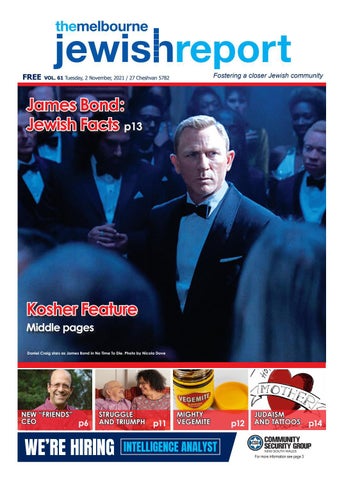
James Bond: Jewish Facts p13
Kosher Feature Middle pages Daniel Craig stars as James Bond in No Time To Die. Photo by Nicola Dove
NEW “FRIENDS” CEO p6
STRUGGLE AND TRIUMPH
p11
MIGHTY VEGEMITE
p12
JUDAISM AND TATTOOS
For more information see page 3
p14
2
the melbourne jewish report | November 2021
AROUND
T H E
COMMUNITY ANNE-MARIE ELIAS The Movember Foundation runs a global event during this month when men grow moustaches to raise awareness and funds to promote men’s health. Its goal is to "change the face” of men's health. From a mental health perspective, awareness raising, diagnosis and treatment are pivotal, and that includes the prevention of suicide. Q: Do men find it difficult to recognise that their health, in general, and mental health, in particular, is declining or deteriorating? Traditionally, men have found it difficult to admit that something is not right and seek help. The typical role of protector and provider is challenged through ill health and this may have accounted for their reluctance to act. But, with the help of media and highprofile public figures, the situation is changing. So much so, that almost 40% of my clients are now men. Workplaces are recognising and encouraging men to reach out for help with mental health issues.
JUD AIC A
QUIZ
RABBI DAVID FREEDMAN From the ancient to the modern and covering so much in between, this Judaica Quiz encapsulates so much and has become a firm family favourite around the Shabbat table. Thank you to so many who have reached out to communicate how much you are learning – and laughing along the way too. From the spiritual to the geographical, from local to international, from literature to contemporary music – there is a fluidity to the navigation of all-thingsJewish below as always. Our collective Yiddishkeit knowledge quest is ongoing, and Rabbi David Freedman is leading us on this journey – we are in safe hands! How many questions can you answer correctly? No time to waste – let’s begin! 1. Can you name the five Marx brothers? 2. What happened on July 4, 1976? 3. Who is the newly appointed Chief Executive Officer of the NSW Board of Deputies? 4. How many paragraphs make up Kriat Shema – 1, 3 or 5? 5. In the ancient Hebrew script (known
Movember Q: What signs do they need to look out for? Deteriorating mental health can be hard to detect. We need to watch for a change in appearance (dishevelled look, fatigue, weight gain or loss), refusing social invitations, not replying to calls, texts or emails and a withdrawal from other social contacts, such as hobbies and leisure activities and/ or social media. Other signs include working more, increased sick leave, being physically unwell and engaging in addictive behaviours, including alcohol, drugs or gambling. It is also important to note any significant life changes, such as the end of a relationship, withdrawal of access to children and serious physical health conditions like cancer and heart disease. Q: How can men recognise that they are more stressed? A little bit of science to explain this. The hypothalamic-pituitary-adrenal axis, which is the stress response system and the sympathetic nervous system go into overdrive. This response can lead to an increase in aggression and decreased immune functioning. The fight-flight response is also activated. Men will often turn to fight rather than flight and continue “soldiering on” rather than seeking help. Some signs may be increased worry, insomnia,
feeling insecure, loss of confidence and decreased productivity. As men often feel uncomfortable experiencing emotions, such as sadness and fear there is an internal mechanism that converts emotions. The emotion of anger, which is powerful and energising, is a more palatable emotion, hence the possible increase in aggression. By recognising these behaviour patterns and taking perspective, men can begin to recognise that they are not coping so well. Q: Overcoming the stigma – some high-profile people have talked about their own experience with mental health issues. Smashing the stigma, high profile individuals – from the British Royal family and professional sportspeople, to actors, musicians and politicians – have been willing to share their personal stories. This willingness to speak out and the media reporting what is being said shows we have come a long way. Mind you, there is still a long way to go. Q: How many men have mental health issues in Australia? One in seven Australian men experiences depression or anxiety or both in any given year. More specifically, 13.3% of Australian men aged 16 to 85 have experienced an anxiety and/or affective disorder in the past 12 months.
This is equivalent to at least 1.26 million Australian men. Australian men make up an average of seven out of every nine suicides on any given day. The number of men who die taking their own lives each year is nearly double the national road toll. Q: How can people get help? Don’t be afraid to ask someone whether they are coping or if they are okay. In the first instance, help is available from a GP, by calling a help line such as Lifeline or Beyond Blue or by making an appointment to visit a psychologist. Talking to a good friend can also help. Withdrawing and isolating increase depression and anxiety. Reaching out is vital. And, finally, a few words from Wayne Schwass, Mental Health Advocate: “It's time to challenge the old way ... it's a narrative that no longer serves us. It's not about blame or shame. It's about responsibility and opportunity. Manning up in the past was to suffer in silence; manning up now is to put your hand up. Fellas, it's okay to be in pain, it's okay to hurt, it's okay to be sad, but it's no longer okay to suffer in silence.” Anne-Marie Elias is a psychologist who has been in clinical practice for more than 25 years.
Test your knowledge as Palaeo-Hebrew or Proto-Hebrew script) what shape was the letter dalet? 6. Who wrote The Chosen and My Name Is Asher Lev? 7. Identify as many books of the Tanakh that you can that are read in their entirety during a single synagogue service? (There is a maximum of seven.)
11. Name the Jewish politician who ran as Vice President in the 2000 US Presidential election; for a bonus, can you name the presidential candidate on the same ticket. 12. “Mene, Mene, Tekel, Ufarsim” were the words that have become known nowadays as the ‘Writing on the Wall’.
Good luck. Enjoy. Hopefully, learn something new about your Jewish heritage and tradition.
8. What is housed in the Heichal HaSefer or the Shrine of the Book in Jerusalem? 9. Which Biblical prophet coined the phrase YAD VASHEM? 10. Complete the title of these four Billy Joel songs: a) Piano ... b) We didn’t start ... c) She’s always ... d) Uptown ...
At whose feast were these words seen and then deciphered by the Biblical personality, Daniel? 13. In Hebrew grammar what are the letters, aleph, hé, chet, ayin and resh collectively known as? 14. Name the Prime Ministers of Israel who served their term, retired or lost office, and then returned to serve as Prime Minister for a second time? (A clue – there are 5 of them.)
15. What are the following primarily made from: a) Hummus b) Tahini c) Baba Ganoush? 16. Which foreign nations have a) the shortest b) the longest border with Israel? 17. Which blessing is recited before eating pineapple? 18. In which book of the Bible is Moses mentioned by name for the first time – (for a bonus – in which chapter)? 19. Orach Chaim, Yoreh Deah, Even Ha’ezer and Choshen Mishpat are the four constituent parts of which famous 16th Century composition on Jewish Law? 20. How many Psalms begin with the words - Shir Hama’alot? 21. Born in Jerusalem on 9 June 1981, Neta-Lee Hershlag is better known by what name? 22. Mossad agents captured Eichmann at his home in which South American city and in which year? 23. With what would you associate the Yiddish words, Nisht (nothing), Gants (all), Halb (half), and Shtel ayn (put in)? 24. Who won the Nobel Prize for Literature in 1978? 25. Which two Israeli cities are connected by Highway No 1?
ANSWERS PAGE 15
the melbourne jewish report | November 2021
3
The impact of Mandelbaum House MANDELBAUM HOUSE This year Mandelbaum House, the Jewish residential college at Sydney University, celebrates its 25th birthday. Hundreds of students from Melbourne to Mozambique have found “a home away from home” at Mandelbaum. As a means of keeping alumni connected, Gina Abramowitz (2016 resident and Alumni President) and Sophia Kwiet (2015 resident and Mandelbaum board member) have recently partnered to revive Mandelbaum’s alumni community. Grateful for the invaluable experiences they had while residents at the college, Abramowitz and Kwiet are keen to give back to this very special community. “Having grown up outside the Jewish community, Mandelbaum was an incredible catalyst in my life,” said Kwiet. “I met fellow Jewish students for the first time and was exposed to the wonderful culture and traditions of Judaism, and the invaluable offerings of the Australian Jewish community.” “Mandelbaum offers so much more than a convenient location and catered meals. It gives students the opportunity to forge meaningful connections, celebrate cultural diversity and engage
in personal development as they enter this important phase of young adulthood,” Abramowitz said. These two passionate women want to form an extensive network of Mandelbaum alumni. Their vision is to create networking and mentorship opportunities, in addition to hosting social events and reunions. “There is so much potential to be harnessed within the alumni community. With such a diverse group of people working in different professions, it would be a shame to not utilise the skill set and talent available,” Abramowitz said. Both recognise that there is a real shortage of opportunities for Jewish community engagement for young adults after university. They hope that the Mandelbaum alumni network will facilitate connection and provide ongoing opportunities for cultural exchange and professional development. If you are a Mandelbaum alumni and would like to become involved or find out more, they would like to hear from you. Just email mandelbaumhousealumni@gmail.com To find out more about Mandelbaum House, contact Shana Kerlander at ceo@mandelbaum.usyd.edu.au or visit www.mandelbaum.usyd.edu.au
Studying at the University of Sydney next year? Live on Campus at Mandelbaum House. • Friendly home-away-from-home for 38 university students • Fully furnished bedroom including unlimited Wi-Fi & housekeeping • Onsite kosher kitchen serving healthy meat & dairy meals • Inclusive & supportive multicultural community
Applications now open! For more info, contact Shana at ceo@mandelbaum.usyd.edu.au www.mandelbaum.usyd.edu.au
The Role ▪ Lead the Intelligence Department and its deliverables, provide mentorship and training to the team of analysts. ▪ Drive the Intelligence Department’s strategic vision whilst contributing to and informing the broader organisational strategy.
CSG NSW are seeking an experienced Intelligence Analyst to join our highly regarded Intelligence Department. The success of this Department is critical to our organisation and essential to our mission. We are looking for a natural leader who possesses strong stakeholder management skills, who can affect and manage multiple priorities and is passionate about the Jewish Community. The Intelligence Analyst position would be best suited for someone wanting a Senior Leadership Position and wanting to work with real time intelligence in a technically advanced Security Operations Centre with world leading technology. We offer a competitive remuneration package, access to professional development, training and industry mentorship and flexible work arrangements. To Apply: Send your CV and cover letter to careers@csgnsw.org.au Location: Sydney, Australia Applications Close: 15 November
▪ Develop actionable intelligence assessments and products relating to the threat environment and identified risks to the NSW Jewish Community. ▪ Pursue ongoing excellence and continuous improvement of the Intelligence Department and its output. ▪ Maintain and enhance CSG’s relationship with key Law Enforcement and Intelligence stakeholders. Selection Criteria ▪ Knowledge of and experience in open-source intelligence. ▪ Exceptional report-writing and presentation skills. ▪ Proven leadership and management experience. ▪ Demonstrated experience in high-level communication and negotiation, particularly with sensitive information. ▪ Ability to utilise intelligence software and technology platforms. ▪ Minimum of 5 years of professional experience in intelligence, security or related fields.
4
the melbourne jewish report | November 2021
JE W S
OVERSEAS DAVID M. WEINBERG We must recommit to the truths he taught and morality he sought. Thousands around the world gathered in person and online last week to mark the first anniversary of the passing of Rabbi Dr. Lord Jonathan Sacks(1948-2020). His yahrzeit fell on 20 Heshvan, October 25-26. The erudite and eloquent Rabbi Sacks was a walking sanctification of God’s name, in both the Jewish and non-Jewish worlds – among kings, philosophers, theologians, politicians, congregants, and students alike. No one else in recent decades made Judaism more relevant on the world stage. In his lifetime’s last book, Morality: Restoring the Common Good in Divided Times (published March 2020), Sacks traced the escalating poisonous discourse in Western public life (including the rise of identity politics and extremism) to loss of a shared moral code and the elevation of self-interest over the common good. He argued that the secularization of knowledge, power, economy, and culture over the past 250 years was the root cause of these ills. He also linked today’s terrible upheavals – addiction to debt and drugs, high depression and suicide rates, child abuse and loneliness, even the growing gap between the superrich and the poor – to the breakdown of family cohesiveness, which for centuries has been associated with religious faith. “What the secularists forgot,” wrote Sacks, “is that Homo sapiens is a meaning-seeking animal.” Technology, the market, and the liberal democratic state “give us choices, but don’t teach us how to choose. They provide neither identity nor the set of moral sensibilities that are inseparable from identity: loyalty, respect and reverence.” Sacks’ distaste for the so-called “progressive” or “woke” identity juggernaut of recent years, and the “cancel culture” bulldozer which it uses to violently crush other perspectives – are on display in another book (published last week), and in one of his last major lectures. The Power of Ideas: Words of Faith and Wisdom (London: Hodder & Stoughton, October 2021) brings together a compelling selection of Sacks’ radio broadcasts, newspaper columns, House of Lords speeches, and significant lectures delivered around the world. Here, Sacks brings his solid grounding in Jewish theology and philosophy to bear on the grand debates underway in modern economics, social policy, psychology, political science, science, art, architecture, and engineering. And he clobbers today’s supposedly liberal social media mobs. Also notable is a pre-slihot (penitential poems and prayers before the Tishrei holidays) address he delivered at the Hampstead Synagogue in London in September 2019, called “An Unforgiving Age” (available on YouTube and at rabbisacks.org), Sacks calls instantaneous twitter-shaming and the “cancel culture” that characterizes today’s media and politics – wicked behaviour. “[We live in] a world of Facebook and Twitter and viral videos in which anyone can pass judgment on anyone without regard to the facts or truth or reflective
Realising the legacy of Jonathan Sacks
Chief Rabbi Jonathan Sacks (pictured right) with Rabbi Ephraim Mirvis in London in 2013. Photo by Toby Melville/Reuters moral judgment… This is what happens when an entire culture loses faith in God. All that is left is an unconscious universe of impersonal forces that doesn’t care if we exist or not. “… Has anyone heard of the word ‘justice’? Can you condemn someone with no trial, no evidence, no judicial process, no reflective moral judgment, no vedarashta vechakarta veshaalta haytayv (you shall seek and interrogate and inquire thoroughly) as the Torah tells us to do? Can you condemn someone without examining the evidence well and seeing whether emet nachon hadavar (whether the facts are true), as demanded in Deuteronomy 13:15?! “(Alas, we have) none of that. Just simple condemnation! Ours is an unforgiving age. “And what happens in an unforgiving culture? The people who survive and thrive are the people without shame. They become the powerful people, because they are the only people who survive in a world without forgiveness.” THE PIERCING vision of renewed morality for the modern age proposed by Rabbi Sacks begins, not surprisingly, with sliha, forgiveness. “At the heart of our faith is a G-d who forgives. We believe that God gives us a chance to acknowledge our mistakes and where, if we are honest about the wrong we have done, if we stand before God with a broken heart, if we are willing to have the guts to say, aval asheimim anachnu (we really did get it wrong), if we are able to say, like King David, chatati, (I sinned) then God gives us a second chance. “So, Jews have a unique calling to make the case for an understanding of human nature that names good and evil yet recognizes the inherent ability of human beings to repent and grow.” The second building block in Sacks’ recipe for repair is the building of “covenantal communities” based on a “we” consciousness (where people
share concerns for one another), rather than “I” awareness (individualism that atomizes society). He shows how tribalism can be balanced with universality; how spiritual and social cohesion can be synthesized with respect for liberty of conscience. A third element is “a sense of the sacred.” “What lifts us above instinct and protects us from our dysfunctional drives is respect for God. When human beings lose respect for God, they eventually lose respect for humanity.” A fourth element, especially for Jews, and especially for Jews in the Diaspora, is education. “The best, indeed the only, defence of a religious people is not military or political but educational.” And this does not mean learning only about the travails of Jewish history, like the Holocaust. “Holocaust education in itself offers no meaning, no hope, no way of life.” Rather, “Judaism is culture of study and debate, absorption in texts, commentaries and countercommentaries, devotion to literacy and life-long learning.” Sacks: “If there is one leitmotif, one dominant theme linking the various eras of the people of Israel, it is the enthronement of Jewish education as the sovereign Jewish value. The history of the Jews has been a history of communities built around schools. [DMW: Day schools!] That is the secret of our collective immortality.” And thus, Rabbi Sacks offers a path forward. For Jews: A path grounded in love for, and fealty to, God’s authentic teachings and to Jewish law, alongside commitment to universal verities and modern intellectual advances. For gentiles: A path grounded in Biblical morality, while embracing the history of liberty. Atop it all: “Courage to confront the nihilism that currently passes for enlightenment.” (Expansive readings on these themes can be found in two volumes of collected essays on the weekly Torah reading by
Rabbi Sacks, published posthumously: Studies in Spirituality and Judaism’s LifeChanging Ideas.) I SENSE that were Rabbi Sacks still alive and active today, he would be leading interfaith efforts to create a renewed global code of social-political morality based on the above principles. He would be driving toward a resurgence of religious faith, in a world where both liberal democracies and dictatorships have failed to sustain generosity of spirit and uphold essential restraints on passion and power. I bet that he would be capitalizing on the breakthrough Abraham Accords to generate Muslim-Jewish religious dialogue in the Middle East, like the Christian-Jewish dialogue in the West that slowly has gathered steam since the Second Vatican Council. Consider this clarion call for multi-faith synergies that Rabbi Sacks delivered to Pope Benedict XVI and his cardinals in 2010: “In the face of a deeply individualistic culture, we offer community. Against consumerism, we talk about the things that have value but not a price. Against cynicism we dare to admire and respect. In the face of fragmenting families, we believe in consecrating relationships. “We believe in marriage as a commitment, parenthood as a responsibility, and the poetry of everyday life when it is etched, in homes and schools, with the charisma of holiness and grace.” In his footsteps, Rabbi Sacks’s many admirers must recommit to the truths he taught and advance the moral society he sought. The writer’s diplomatic, defence, political and Jewish world columns over the past 25 years are archived at davidmweinberg.com.
5
the melbourne jewish report | November 2021
AROUND
T H E
COMMUNITY
IVF journey captured on film
AUSTRALIAN JEWISH FERTILITY NETWORK Last year, our community was introduced to Janine and Shimon Davidowitz through a world first mini documentary that screened at the Australian Jewish Fertility Network’s major annual fundraising event. Their complete IVF journey now features as part of the film “One in Six”, which will be shown during AJFN’s 2021 Major Event, before premiering on national TV and international screens next year. The film draws its title from the one in six couples who experience infertility. Janine and Shimon’s IVF cycle was funded with financial support from the community, following last year’s event. AJFN Chair Kerry Gonski describes the film as “raw, gritty, emotional and ultimately uplifting”. “We are right there with Janine and Shimon for the retrieval, the moment their little miracle is created, the embryo transfer and the agonising wait for the phone calls from the clinic
to tell you how things are progressing.” “For those who haven’t experienced infertility, it gives a frank and intimate insight into the journey,” Ms Gonski said. “We all know someone who has struggled to fall pregnant, but we may not understand their experience. Through Janine and Shimon’s bravery and openness, we can offer support by
better understanding and bringing the conversation into the open. “Janine and Shimon were in the studio for last year’s live streamed event, hoping and praying for a positive outcome. The power of the community coming together on the night was palpable,” Ms Gonski said. Shortly afterwards, the couple
Scholarships awarded The Jewish Orthodox Feminist Alliance Australia (JOFA) has recently provided 20 scholarships to Australian women from Sydney and Melbourne who wanted to become qualified Kallah teachers. They will learn via a 20-week world renowned course, offered on Zoom, by The Eden Centre in Jerusalem. This is the first time an all-Australian cohort has undertaken Kallah training via the centre, which focuses on enabling all women to have a personally meaningful and welcoming experience in the mikveh. “A strong theme, which emerged from the JOFA Australia launch in May, was that many Orthodox women in Australia felt that they lack the skills or training to take on leadership positions or get involved in conversations around Jewish law,” said JOFA Australia President Nomi Kaltmann. “Many women were concerned that at key critical lifecycle
moments, such as birth, Bar and Bat Mitzvah, marriage and death, women did not have the requisite Halachic knowledge to be adequately involved. Multiple attendees highlighted difficulty finding relatable Kallah teachers in Australia,” she said. In response, JOFA Australia decided to immediately address these concerns by seeking and actively recruiting Australia women interested in undergoing training via a scholarship program. “Originally we were unsure if we would get the minimum numbers to run an allAustralian cohort, but we were heartened that we had generous donors who wanted to fund the course for the benefit of all Australian women,” said JOFA Australia Vice President Sharona Jotkowitz. “We are pleased that as soon as we opened up recruitment for this program the interest was immense, with many applicants from
CANDLE LIGHTING TIMES Friday, Nov 5, 2021
7:41 pm
Shabbat ends, Nov 6, 2021
8:43 pm
Friday, Nov 12, 2021
7:49 pm
Shabbat ends, Nov 13, 2021
8:51 pm
Friday, Nov 19, 2021
7:56 pm
Shabbat ends, Nov 20, 2021
9:00 pm
Friday, Nov 26, 2021
8:04 pm
Shabbat ends, Nov 27, 2021
9:08 pm
*Provided by Chabad.org
diverse backgrounds applying from more than 12 synagogues across Melbourne and Sydney.” Despite the rigorous nature of the program, which includes 60 contact hours, tests and an exam, the new cohort of Australian Kallah teachers is excited about contributing back to the community. “It’s great to be able to access this course via Zoom and learn with a local group of talented and thoughtful women,” said participant, Tamar Adler. “I think it is important that Jewish women become empowered by the knowledge and experience of these laws that have been the foundation of Jewish family life for centuries,” she said. More information about the course and other opportunities for Orthodox women can be found on the JOFA Australia Facebook, Instagram page or website.
received the news that their treatment had finally been successful and they were expecting a baby. One in Six details their full journey (including the birth of their miracle baby), in half an hour. Reflecting on the arrival of their child, Ms Davidowitz said “what we have been given is the gift of a lifetime.” In the past year, eight AJFN babies have been born, bringing the total to 36 babies since the Network’s inception. “Each of these children play a very important role in not only their own families, but in continuing to build our community,” Ms Gonski said. This year there has also been an increase in demand due to lockdowns. Requests for AJFN’s financial and emotional support have risen by more than 300% in the past year. There are currently 29 couples who need AJFN’s help to give them a chance to try to achieve their dream of having a child. The 45-minute free, online event will take place on Monday 8th November at 8.00pm. It is free, but bookings are essential. Go to ajfn.org.au.
6
the melbourne jewish report | November 2021
AROUND
T H E
COMMUNITY
Tel Aviv Uni Friendship Circle
AFTAU In July, David Solomon assumed the newly created role of CEO of the national arm of the Australian Friends of Tel Aviv University. The Jewish Report wanted to find out what his responsibilities are. Congratulations on assuming your new role. What does it entail and how did Federal AFTAU come about? Clive Donner, the national Chair, who is also President of the Western Australian division of AFTAU, created the Federal body two years ago, under the auspices of Tel Aviv University. I am the inaugural CEO of Federal AFTAU and Clive hired me to liaise with Tel Aviv University (TAU) and co-ordinate activities in Australia. AFTAU has active committees in Victoria and New South Wales, as well as in Western Australia and we have plans to grow further. My key responsibilities are to: • Develop a strategy for a range of fundraising programs and other development opportunities with local pre-existing donors, potential donors and community members. Funds raised for the university are used to assist its educational and research goals and long-term development plans. • Raise the profile of TAU and Australian Friends of Tel Aviv University (AFTAU) in a broader community context, including academia, corporations and governments. This is done by publicising the university’s achievements and advancements in research, technology, humanities and innovation. • Promotion of Australian university and corporate relationships with TAU in the areas of academic and research partnerships. • Encourage student enrolment in courses at TAU, as well as exchanges between Australian universities and TAU. This includes creating scholarships to support learning and research, cultivate student and faculty exchanges, and recruiting Australian students to participate in the TAU International Program. We are part of a global network of Friends’ associations. What are your top three priorities, in order of importance? Narrowing it down is nearly impossible, but if I have to choose just three, they would be: 1. Understanding the full history of the university, of the Australian Friends and the many people that have built it in this country for more than four decades and to develop a strategy to engage the next generations of Australian supporters. 2. Meet and speak to as many existing and potential supporters, universities, corporations, other Israel-focused organisations and governments, with a view to advancing links to TAU. 3. To get to Israel as soon as travel conditions permit, to meet the academic and research staff at the university and learn much more about their groundbreaking work. What is your background? I have held various roles in business management, strategic
The Porter School of Environmental Studies Building at Tel Aviv University and operational consulting, business coaching, mentoring, leadership and executive search. This has been with listed multinational corporations and a number of successful start-ups. Most recently, I spent three years working as national philanthropy executive for Australian Red Cross. I also spent 13 years on the Board of the Australia Israel Chamber of Commerce during its rapid expansion period, as well as numerous other community organisations over the years. Obviously, you will be spruiking the merits of Tel Aviv University, so exactly what are they? If you can, talk to me about initiatives and innovation that may be of global significance. • TAU is very much a multi-disciplinary university and one of its key strengths is the way it brings together all the streams of academia and research to collaborate in “Centres” that are tasked with solving real-world problems. These include neuroscience, biomed & bioinformatics, quantum science & technology, nanotechnology, environmental studies, cyber and renewable energy. A recent example of this collaboration is The Centre for Combatting Pandemics, which had seed funding from Frank Lowy. • Students come from around the world to study at TAU and many of the courses are taught in English. The resulting melting pot of cultures spreads tentacles when students return to their home countries. TAU alumni are everywhere. • Two thirds of the students at TAU study at post-graduate level i.e. masters, doctorate and post-doctorate levels. • TAU is considered a world leader in several fields, such as entrepreneurship, cybertechnology and nanotechnology. • Other areas of global impact include water, medical technology,
David Solomon archaeology, classics, computer science, film & TV, education, engineering, geriatrics, linguistics, mathematics and theoretical economics. • There are some exceptional examples of life-changing developments coming out of the university. For example, TAU scientists printed the first ever 3D heart using a patient’s own cells. • The next big thing for TAU (and Israel) will be big data and artificial intelligence. How significant a university is Tel Aviv on the world stage? For a relatively young university (TAU was established in 1953), the institution punches well above its weight globally. A new study by Stanford University identified the top 2% of researchers in various disciplines worldwide. From a list of 160,000 researchers in 149 countries, 22 scientific disciplines and 176 subdisciplines, 333 Tel Aviv University faculty members are ranked among the top 2% of researchers in their respective fields.
The TAU cybersecurity course is ranked number one in the world. A TAU course on Islam has been ranked as one of the 50 best online courses of all time. Is there any formal tie in with Australian or Australian universities? If so, can you elaborate? TAU has bilateral agreements with approximately 500 institutions and universities in 40 countries worldwide and Australia is no exception. Most revolve around student exchange programs at undergraduate, masters and doctoral levels. There is also collaborative research being undertaken. A key objective in Australia is to expand these and create more. So, how can the Australian Jewish community help when it comes to Tel Aviv University? What do you desire from the community here? The best place to start is to learn more about the university – join the mailing list, log onto to a webinar, give me or anyone on the various state committees a call, or browse the TAU website. If you are going to Israel, make TAU one of your places to visit. There is so much to see, including the Steinhardt Museum of Natural History. I strongly believe that once you get to know a bit more, you will want to keep learning more about how TAU impacts Israel and, indeed, the rest of the world. If that then moves you to become involved philanthropically, we would welcome your help with the process of enabling higher education and Tikkun Olam. To enquire about Australian Friends of Tel Aviv University, please email davidsolomon@aftau.org.au
KOSHER LIVING F
E
A T
U
R
E
Rabbi Mordechai Gutnick at Woolworths Malven kosher launch
LESSONS FROM KASHRUT
JEWISH SURVIVAL
KOSHER CONSUMERS
YANKEL’S INSIGHTS
kosher living feature | November 2021
Lessons from kashrut of true greatness. The prohibition of cooking and eating
YERACHMIEL ISACOWITZ Eating kosher makes me feel good because I am upholding Torah law. The underlying principle of kashrut is that food influences our character. The halachic science of kashrut requires kosher animals to have no major health issues or broken limbs before slaughter. Further, they are killed with surgical precision, so one could argue that this is a more humane and less traumatic method of death for the animal. Nonetheless, kashrut is a chok (a manifestation of the Divine will.) By analysing this set of mitzvot, we can discovery spirituality by keeping kosher. Let’s look first at animals. The requirement of split hooves could allude to not getting too attached to the Earth, since each individual’s stay is only temporary. From chewing the cud, we can deduce that every bit of knowledge one obtains must be thoroughly processed before being digested (accepted). Meat is salted to ensure removal of all blood. Blood is the life source of animals and we want to minimise our animalistic drives. Fish require scales. From this, we can understand the importance of wearing an emotional "suit of armour” to overcome those who torment, abuse or
milk with meat is introduced in the Torah with the words: “Do not cook a kid in its mother’s milk.” A lesson we could take from this is not to use something given or said to us for our own benefit against the person that gave it to us. There is a vast science of halachah (Torah law) regarding taste transfer. Torah prohibits kosher food that has absorbed the taste of non-kosher through, for example, cooking. This could translate to a philosophy of human interaction. Depending upon how I interact with others, there will be an effect on me. I have to determine with whom I will interact and to what extent. We are not forbidden to eat creatures smaller than the eye can see, for example bacteria in non-pasturised wine, milk etc. We are also permitted to swim in the sea insult us. Kosher fish have fins, which may suggest that we should not hesitate to flee negative influences. Moving on to birds, there is a given principle that when the Torah enumerates anything, it is the minority that it turns to. From the fact that it lists all non-kosher birds, we can deduce that the majority of them are kosher. Nonetheless, we only eat those that we know have been consumed by previous
Kashrut – the key to Jewish survival KOSHER AUSTRALIA The laws of kashrut demonstrate the great wisdom of our Sages and their foresight in protecting the future of the Jewish People. The Talmud in Avodah Zarah (35b) relates a number of decrees and broadbased laws that were enacted that related to kashrut. These decrees were: 1. Stam Yenam – Kosher wine may only be produced by a Jew. 2. Chalav Yisrael – Kosher milk must be supervised by a Jew. 3. Gevinat Yisrael – Kosher cheese must be made by a Jew. 4. Bishul Akum – Kosher food must be cooked by a Jew. 5. Pat Akum – Kosher bread must be baked by a Jew. Though these decrees were enacted in a similar period (around the time of the destruction of the Bet HaMikdash and in the century following), they have different reasons for being. Chalav Yisrael (milk) and Gevinat Yisrael (cheese) deal with the very real concern that as it is almost impossible to tell the difference between milk or rennet derived from kosher or non-kosher sources, the only guarantee of kashrut is that a Jew supervises the entire activity.
Stam Yenan (wine), Bishul Akum (cooked food) and Pat Akum (bread) also have essentially the same reasoning – to prevent assimilation. The rabbis realised that relationships are nurtured when they are literally fed and watered. “Breaking bread”, having a meal or a glass of wine with your non-Jewish neighbour fosters a friendship that will eventually cross the borders of religion and potentially lead to intermarriage of offspring. These laws essentially erect a barrier that serves as a reminder to the Jew that while you can be cordial with a nonJew, that relationship may only go so far. Two millennia after being enacted, all of these laws are still in force. And we must recognise that without these decrees in all likelihood the Jewish people would not have survived the long Galut.
generations. We can say the lesson here is to place our trust in those who came before us and not rely solely on our own judgment. The whole of the plant kingdom is kosher and plants are the building blocks upon which all life survives. Plants are often not even given the same status as animals and yet the Torah recognises their unique properties. From this, we can say that humility is an essential element
with a chance of swallowing plankton. This teaches us to develop the outlook that not everything requires vigilance. In other words, let things go, don’t sweat the small stuff.
Yerachmiel Isacowitz is an Australianbased Jewish education specialist. Email: risacowitz@optusnet.com.au World Wide Web: torahconcepts.com Facebook: The Mem Channel
Kosher Consumers YANKEL WAJSBORT KOSHER AUSTRALIA Kosher Australia manage two Facebook pages, one of which is devoted to answering Kashrus questions. While many of the questions are clarifications if a product is kosher or not, some of the questions require more than a simple “yes” or “no” while others are not within our ability to answer. For example, we are frequently asked by consumers if we can investigate a certain product or product range. Admittedly, it would be great to wave a magic Kashrus wand and approve the product or product range, but this is not feasible because they either contain ingredients that are questionable or involve production methods that raise kosher concerns. Unless we already work with the manufacturer, we recommend that consumers reach out to the company involved, as they usually get a better hearing, whereas Kosher Australia rightly or wrongly are sometimes treated as “merely advocates” for kosher products. In fact, over the years, we have tracked the success of our “cold calls” to companies and the results have been disappointing. In most industries, making 100 “cold” or unsolicited contacts to potential customers results in a 10% success rate. We experience, perhaps, a 1%
conversion rate. We have theorised that this low success rate can be due to: • the perceived smallness of the kosher market (retail worth around $600 million annually in Australia); • the lack of general knowledge about kosher production; • the reticence of local manufacturers to look at new opportunities; or • the lack of will by manufacturers to undertake additional quality audits. Almost all the new companies that we certify each year have approached us for kosher certification. That is why the growth of kosher lies with consumers. Postscript: Since 2003, Kosher Australia has grown from certifying 30 companies and a few hundred products to working with 750 companies and certifying more than 30,000 products.
בס״ד
750 companies · 30,000 products · 84% of Australian Kashrus 2 Annual Kosher Guides · 24/7 Access to Website & App
Kosher Australia · Trusted · Reliable · Accessible www.kosher.org.au | info@kosher.org.au | 1300Kosher
kosher living feature | November 2021
Non-kosher in the kitchen cupboard Of course, we issued no such statement
BY YANKEL WAJSBORT KOSHER AUSTRALIA While I can be quite annoying at the best of times (just ask my kids), once I started working for Kosher Australia I stepped up a notch. My friends now refer to me as the “Kosher cop” as whenever I’m visiting I cannot help but look in their kitchen pantries and point out things that really shouldn’t be there. (Most of my friends take it with good humour – at least, the remaining ones do.) How does it happen that people who are Orthodox and strictly observe Kashrus end up with products that aren’t Kosher in their cupboard? There are a few reasons for this. Confusion #1. The Kosher guide is, on occasions, ambiguous. We do try to make things clear, but sometimes it’s just not possible (for example SPC Ardmona products, which require checking of date codes and container sizes) or we mess up (I admit, I’m only human). Confusion #2. Differences between what is in the Kosher Australia Kosher Guide and statements made by other Kosher authorities. Given the due diligence we put into what we list from both the food technology and halachic perspectives, we would like to think that we are correct. Each product goes through three levels of checking to ensure its approval or otherwise. If we’re
– someone listened into a conversation between Rabbis and assumed from the tone of the discussion that all was now fine. Rule of thumb – if a product is okay, we’ll advise via email, social media and public announcement. If there is no advice from us, then there is no change. Confusion #7. Of course, the “mother of all reasons” is that “we saw it at soand-so’s place and they are extremely strict”. The so-called Kashrus of “but everyone eats it”. For
any
of
the
above
reasons,
consumers erroneously purchase nonnot sure about a product, it does not go into the book. Confusion #3. Deleted products. Unfortunately, products come off the list for various reasons – manufacturers change the way they do things or make an error or find that sourcing Kosher ingredients sometimes is not economical. Just because the product was Kosher in 2011 doesn’t mean that it is still kosher in 2021. We had a very embarrassed call from a Jewish school that discovered that the vegetable oil they were using at their unsupervised camps was not Kosher. The head mistress noted that it had been kosher in 2002! Confusion #4. The shopkeeper said it was okay. We always advise consumers not to rely on the assurances
of the shopkeeper who may not be an objective party in your Kosher purchasing. Confusion #5. The manufacturer said it was kosher. Often manufacturers make this claim. When they do, ask for a copy of their current Kosher certificate so that you can check it. Quite often, their objective Kosher “certificate” is the company themselves claiming that they are “kosher”. Confusion #6. The rumour mill. People say that they heard that Kosher Australia had approved the product. For example, at a recent adult seminar a sign stated that all flavours of a certain brand of tea were now acceptable. (I found out that this had happened when people mentioned this to me a few days later.)
Kosher products. Jim (aka Dmitri), our head of maintenance at the Kosher Australia office who doesn’t keep Kosher for obvious reasons, receives “free” products that I inadvertently buy from the supermarket. As always, please check the current Kosher Australia Food Guide and/or the Kosher App first. You may discover something that you didn’t know. Yankel Wajsbort joined Kosher Australia in October 2003. Previously he was the Group IT Manager for an international manufacturer. He has also worked as a
manufacturing
and
management
consultant.
Kosher meat is better KOSHER AUSTRALIA A number of years ago, a YouTube film, “Koshermania”, became famous in Jewish circles. It shows ex world champion wrestler Hulk Hogan trying to organise a housewarming barbecue after moving to a new neighbourhood in Miami. In preparation for the party, Hogan and his wife knocked on doors and discovered that they’d bought into an area heavily populated by Orthodox Jews that kept kosher. Thus began Hogan’s (at the command of his wife) quest for the “kosher” housewarming party. Eventually Hogan and his son arrived at KosherWorld in Miami Beach and asked the yarmulke wearing attendant about the difference between kosher and nonkosher meat. The attendant patiently explained that kosher meat is slaughtered humanely and that diseased animals are not kosher. Hogan’s response: “Kosher meat sounds much healthier – I think I’ll always buy it.” A similar comment was made at an Austrade function attended by a number of Kosher Australia client companies. In chatting about buying habits, one client, the managing director of a very popular range of breakfast cereals, dropped what I thought was a bombshell. “I’ve always been interested in kosher food. We’ve even bought kosher meat for home use for the last five years.” She then confirmed that she shopped at Continental Kosher Butchers since she was married. When I pointed out that kosher meat was more expensive than non-kosher, she responded: “So what – it’s better quality.” Indeed, kosher meat is healthier for a
number of objective reasons: 1. In Australia, only glatt meat is allowed. “Glatt” or smooth refers to the absence of lesions in the lungs of animals and reflects the health of the animal that has been slaughtered. In rejecting nonGlatt, kosher animals are by definition healthier. 2. The kashering process must start within 72 hours of an animal being killed. This reduces the possibility of bacterial contamination. 3. Kashering involves the removal of blood, reducing another potential source of contamination. 4. Porging or treiboring means that many fats and gristle are removed, leaving a leaner cut. 5. The fact that all butchers in Australia are subject to full time supervision from the start of meat processing through to retail packing and sale limits the capacity for external shenanigans. This adds to the quality assurance of the meat. Unfortunately, each of these aspects as well as the manual nature of shechita (an automated, non-kosher production line can move hundreds of animals per hour as opposed to manual shechita that, at best, can be measure in the tens of animals) are factors in increasing the cost of kosher meat. The fact that kosher meat comes at only a 10% to 15% premium on like-forlike non-kosher meat demonstrates the efforts of kosher butchers and kosher authorities to keep prices manageable. Kosher Australia supervises the operations of Continental Kosher Butchers, one of the large kosher meat producers in the Southern Hemisphere.
11
the melbourne jewish report | November 2021
AROUND
T H E
COMMUNITY FRANCES PRINCE (DAVID’S DAUGHTER) David Prince should have died, along with other members of his family. But now, at 96 – 61 years after surviving the Holocaust and arriving in Melbourne – he has made a valuable contribution to the Australian Jewish community. David was born into a lower middleclass family in Lodz, Poland. Until the age of 14 he enjoyed a carefree childhood with his twin brother Heniek and his parents Frymet and Israel. As David tells school students visiting the Jewish Holocaust Centre, his pre-war life consisted of, “hanging around other kids, skating in winter, soccer in summer, running 400m and 800m races, indoor gym and chatting up girls.” This last activity always gets a snigger from his young audience. David’s uncomplicated and idyllic youth abruptly ended with the German invasion of Poland and the start of the Second World War. This kick-started the mandated wearing of the yellow star and the forced and forceful shifting into the confines of the Lodz Ghetto. He attempted to continue his education as long as possible. Then followed the allocation of workplaces, violence, food shortages, overcrowding and resultant illnesses and deaths. Within these broad brushstrokes of the experiences of the nearly quarter of a million Jews of Lodz, David, Heniek, Israel and Frymet clung together. Frymet worked in Klugman’s carpet factory, making carpets out of rags for the German nation. Israel firstly worked cleaning bricks from partially destroyed buildings and then landed a far better job, indoors, draughting building plans for the ghetto. (The contents of those plans were never clear to David.) David and Heniek worked at an electrotechnical shop. They operated lathes to rewind electrical motors. “We were repairers. We were not producers. We didn’t make anything, we just fixed things. I was good with my hands,” David said. All who survived the Lodz Ghetto remember the eight days in September 1942 that became known as the “szpera” (pronounced “shpera”). It traumatised and haunted all who were there. Every street and every building was suddenly blockaded and the entire population was told to assemble for a selection. Anybody who looked too old, too young, or too sick was separated and taken away, as we now know, to the Chelmno death camp. The remainder were told to return to their homes. So, home they went. Some without a mother, some without a father, some without their children. “During that event I lost my nana and cousins,” David said. By August 1944, the Lodz Ghetto was the last ghetto remaining in Europe. All the others had been “liquidated”. The 60,000 remaining Jews of Lodz were slated to be deported to AuschwitzBirkenau. David, Heniek, Israel and Frymet were on the last cattle-car train at the end of August that year. They weren’t supposed to be on that train at all. David’s small family of four was meant
David Prince – a life of Struggle and Triumph
to be part of a group of 500 (which eventually grew to more than 800 people) ordered to stay … not to be spared death, but death at AuschwitzBirkenau. The boss of the electrotechnical department where David and Heniek worked gathered all his labourers and their families to be the ones to stay behind and “clean up” the ghetto. This referred to the task of sorting through every room in every apartment in every building, collecting items that could be of use to the Germans. These belongings of the murdered Jews of Lodz were sent to Germany. David remembers distinctly what happened. “We all ended up sleeping at the factory for only one night. Some ‘toughs’, some low-lifes, maybe like mafia, came in. They threw us and others out of the building and took our places. And so, we were put on the next, the last, train to Auschwitz-Birkenau.” The horrendous cattle-car train journey, the disorientation and horrifying violence upon arrival at AuschwitzBirkenau and the wrenching separation from beloved family members is familiar to nearly everyone from Lodz who survived until liquidation. And so, this was David and his family’s experience too. His intact nuclear family was in complete shock at the brutal reception they received upon arrival. Ferocious bellowing accompanied the vicious emptying of the cattle cars’ human cargo. David grimaces while describing the scene. “Sheer hell broke loose. Raus!
Raus! (Out! Out!). It happened so quickly that I couldn’t really understand what was going on.” The separation from his mother was hasty, chaotic and fierce. David, Heniek and Israel were sent to the right and Frymet, linking arms with their elderly neighbour, Mrs Frankel, was sent to the left. “My mum was 47. She wasn’t old. She may have been able to survive Birkenau,” David said. Only recently has David talked about the possibility that had his mother not been arm-in-arm with elderly Mrs Frankel, and assisting her, she may have been selected to live, at least at that early stage. Maybe her kindness came at the ultimate price. Israel, David and Heniek spent one week in Auschwitz-Birkenau. A call for metal workers rang out across the fields of thousands of men. David grabbed Israel and Heniek and put up their hands to demonstrate that they were, indeed, metal workers. They were chosen, but unsure for what. It was then, on their way out of Auschwitz-Birkenau, that they faced a selection. Selections upon arrival are well known. But they faced a selection upon departure. David’s intuition told him to lie about his and Heniek’s ages. To this day, he can’t explain what motivated him. He told his brother quickly, “Let’s change our birth dates. I’ll make myself older and you make yourself younger.” They were twins. He had no idea that being twins in Joseph Mengele’s Birkenau was not a good thing.
They were transported to the Friedland labour camp where they made parts for airplane propellers. Liberation came on 8th May 1945. As David always laments, “on the very last day of the war.” A few months later the three of them made their way to Regensburg in Germany. Then David went to Munich. Under the most unlikely and little-known circumstances, David became a university student at the venerated and grandiose-sounding Ludwig Maximilian University. But that is a different story. During the long COVID-induced Melbourne lockdowns, David’s daughter, Frances, named after her grandmother Frymet, read to her father at her home, on her couch. She read mainly Holocaust memoirs to him. These prompted David to remember and talk about his own background. He talked about his early days growing up in Lodz, his experiences in the Lodz Ghetto, Auschwitz-Birkenau, Friedland labour camp, liberation, studying pharmacy in Munich, emigrating to Australia, requalifying as a pharmacist in Melbourne and more. Frances has now written a book about the experience of reading with her father. Titled “Gift of Time – Discoveries from the daily ritual of reading with My Father”, it is published by Real Film and Publishing and is available from Frances’ website www.francesprince.com, and at Avenue Bookstore, Thesaurus Books and The Antique Silver Co.
12
the melbourne jewish report | November 2021
CO NS I D E RE D
OPINION
James Bond: 5 Jewish facts
DR. YVETTE ALT MILLER COURTESY: AISH.COM 1. Bond’s creator was a known racist and anti-Semite. Ian Fleming wrote the 12 spy novels featuring James Bond, the British secret agent which formed the basis for the successful film franchise. Fleming was a fascinating and complex character. Born in 1908 into an upper-class British family (his father was a Member of Parliament), Fleming was educated in England, German and Switzerland. Before the Second World War, Fleming worked in Moscow as a journalist, then in Britain as a banker. During World War II, Fleming served as a high-ranking intelligence officer in Britain’s Royal Navy. One of Flemings’s greatest contribution to the Allied victory was his role in planning Operation Goldeneye, a topsecret spy operation aimed at ensuring that Nazi Germany did not invade Spain and Portugal and could not develop capabilities to spy on Britain’s territory in Gibraltar. After retiring from the Royal Navy, Fleming worked for the London Sunday Times, then moved for much of the year to an estate in Jamaica – named Goldeneye – where he wrote many of the Bond novels. He died in 1964. To modern eyes, the original James Bond novels are relics of a crueller and less politically correct past, replete with shockingly offensive descriptions of women, Black people and other ethnic groups. Fleming’s biographer Matthew Parker observes that “Fleming – and Bond – looked down on pretty much everyone who was not British and perceived people of all colours in terms of negative stereotypes of race and nationality” (quoted in Goldeneye – Where Bond Was Born: Ian Fleming’s Jamaica by Matthew Parker: 2015). Mordechai Richler, the Canadian Jewish writer, believed that Bond’s nemeses evoked anti-Jewish conspiracy theories that Jews are somehow driven by a superhuman lust for power or greed. Thus, Bond villain Auric Goldfinger says that “The day when we shall have made ourselves the sole possessors of all the gold in the world, the real power will be in our hands.” Sir Hugo Drax, the villain in Fleming’s book Moonraker, says “The surest means of attaining (power) is to have supreme control over all industrial, financial, and commercial operations.” Both these statements – and many others scattered throughout the James Bond novels – seem like the untrue slurs that have for countless generations been baselessly hurled against Jews. “My boys are crazy about the James Bond movies,” Richler noted. “They identify with 007, as yet unaware that they (as Jews) have been cast as the villains of the dramas.” 2. The Bond villain Goldfinger was named after Ian Fleming’s famous Jewish neighbour. The chilling villain of Fleming’s 1958 novel Goldfinger is Auric Goldfinger. Auric is Latin for Gold and, as his name implies, the character of Goldfinger is obsessed with gold – along with the power that
Daniel Craig stars as James Bond in No Time To Die. Photo by Nicola Dove. unlimited wealth could bring. Much of the novel describes James Bond thwarting Goldfinger’s plan to steal the gold reserves from Fort Knox in the United States. Fleming named this odious character – whose obsession with gold and wealth and power echoes anti-Jewish conspiracy tropes – on his real-life Jewish neighbour in the leafy neighbourhood of Hampstead in North London. This real-life Goldfinger was Erno Goldfinger, a noted Hungarian Jewish architect who moved to London in 1934. Ian Fleming seemingly loathed Erno Goldfinger, who threatened to sue Fleming after the book Goldfinger came out. 3. Jewish producers – including a war hero – helped bring James Bond to the screen. After reading the book Goldfinger, the Canadian-born Jewish film and theatre producer Harry Saltzman optioned the rights to make films of the James Bond books. He turned to his friend Wolf Mankowitz, a British Jew who grew up in the old Yiddish-speaking East End of London, for writing help. Mankowitz wrote much of the screenplay for the very first James Bond film, Dr. No. He was aided by the American Jewish playwright Richard Maibaum. Maibaum was already well known for his Broadway plays, including the early antiNazi play Birthright, produced in 1933. Maibaum helped in writing Dr. No, and then continued to help write nearly a dozen other Bond films. Journalist Seth Rogovoy explains that “More than anyone, perhaps even Fleming, Maibaum can be said to have created and sustained the mythical icon of Bond.” Jewish actor Joseph Wiseman played the ghoulish Dr. No, setting the stage for James Bond villains to be cartoonishly cruel and larger than life. Perhaps nobody was as instrumental
in creating the mystique of James Bond in the movies than a real-life war hero, Sir Ken Adams (born Klaus Hugo Adam in 1921). Adams was fascinated with art and design from a young age. His Jewish family fled Germany in 1934 after Hitler rose to power. When World War II broke out, 18-year-old Ken Adams was still a German citizen and thus not eligible to join the British army – yet he was determined to fight. Ken Adam in the pyramid control centre he designed for the 007 film Moonraker (1979). Adams joined the Pioneer Corps, the only branch of Britain’s service in which German-born men could enlist. He asked to fight for the Royal Air Force and became a RAF fighter pilot – only one of two German citizens to be allowed to. He was under particular danger: if he’d been shot down and was discovered to by the Nazis to be a Jew from Germany, Adams would have faced certain torture or death. After the war, Adams became an art director in cinema. He joined the James Bond project in 1962 with Dr. No. It was Adams who invented James Bond’s bulletproof Aston Martin car with its array of gadgets, including “Browning heavy machine guns, rams, tyre shredders, revolving number plates, smokescreen and oil slick projectors, a homing tractor, and an ejector seat,” according to Adams' obituary in The Guardian. One of Adams’ most memorable design features was the simplest: the tarantula that is dispatched to kill James Bond in Dr. No. “I think it is one of my favourite sets, because it is so simple and theatrical,” Adams explained. “I think I had 450 pounds left in the budget. So I really had to come up with something very quickly that was very easy to construct and at the same time create a very important effect.”
4. Goldfinger was temporarily banned in Israel. The movie Goldfinger was a hit around the world when it first came out in 1964, and Israel was no exception. Over a quarter of a million Israelis watched the film in its first six weeks in the cinemas. The film’s popularity was despite the fact that the German actor who played the movie’s arch enemy Auric Goldfinger, a beefy man named Gert Frobe, didn’t speak English. An English actor dubbed most of Frobe’s lines. Soon after the movie came out, the British Daily Mail newspaper ran a story titled “Of course I was a Nazi!” An Israeli journalist had asked Frobe what he’d done during World War II, and Frobe admitted that he’d joined the Nazi party in 1929 at the age of 16 because he was attracted to their policies. In 1956, Israel had passed a law banning any films that included wartime Nazis. Goldfinger stopped being played in Israel’s cinemas. Over the next weeks, more of the story came out. Even though he was a member of the Nazi party, Frobe had saved the life of a Jewish woman and her family during the Holocaust. He explained that he and the woman were both assigned to work in a hospital in Vienna in 1941. Realizing that she was in danger, he hid both her and her family in his apartment for the duration of the war. “The fact that I helped them was proved after the war before I was allowed to start work again,” he told The New York Times in December 1965. Soon, a man named Mario Blumenau went to the Israeli embassy in Vienna that his life and his mother’s life had likely been saved by Mr. Frobe. Within months, Israel allowed Goldfinger to resume
CONTINUED ON PAGE 13
13
the melbourne jewish report | November 2021
James Bond: 5 Jewish facts FROM PAGE 13 being shown in Israel. It was a case of truth being much more dramatic than the capers of the fictional spy thriller on the screen. 5. James Bond might have been modelled on a real-life Jewish spy. James Bond might have been modelled on a real British Jewish spy, Sidney Reilly, who bore some uncanny similarities to Ian Fleming’s creation. (As a former high-level intelligence official, Ian Fleming surely would have known about Sidney Reilly, who is sometimes called the most successful British spy of all time.) Born Shlomo (some say Sigmund) Rosenblum in 1873 in Ukraine, Sidney Reilly was recruited by the Special Intelligence Service (SIS), the forerunner of Britain’s famed MI6 intelligence service, and given the number ST1 – much as James Bond is known by his handlers as 007. A mysterious figure who spoke seven languages, Reilly was recruited to
CO NS I D E RE D
OPINION
help Britain battle Bolsheviks in the early 1900s. Known as the “Ace of Spies,” Reilly’s heroic actions seems like something out of a James Bond film. One notable adventure came in 1905, after an Australian miner named William D’Arcy discovered huge oil fields in the Persian Basin. D’Arcy needed a huge
investment to exploit the oil field and arranged a meeting with members of the French Rothschilds family to discuss financing the project. As D’Arcy and the Rothchilds conferred on the yacht, a priest suddenly barged in, asking for money for Catholic charity. In the course of the discussion,
No Time To Die, the 25th official 007 film in the franchise, releases in cinemas nationally on 11th November.
Judaism and Tattoos it. You know that it is temporary and not something you want to be permanently connected to. The same is true of any tattoo. There is a short-lived thrill of having a phrase, word or image indelibly etched in one's skin. But when the attitude to those marking changes, the ink still remains. People are dynamic beings, always changing and growing. According to recent studies, a large percentage of people ultimately regret their tattoos. 5. In ancient times, it was customary for idol-worshippers to tattoo themselves as a sign of commitment to their deity. Maimonides offers this as one of the possible reasons why the Torah bans tattoos (Mishneh Torah, Laws of Idolatry 12:11).
RABBI MENACHEM LEVINE COURTESY: AISH.COM “Rabbi, if I get a tattoo, can I be buried in a Jewish cemetery?” As a rabbi in Northern California, I’ve been asked this question many times. It’s a widespread misconception amongst American Jews that a tattoo bars one from being buried in a Jewish cemetery. The answer, in short, is that although the Torah does indeed forbid us from tattooing our bodies (see Leviticus 19:28), nonetheless, one who has a tattoo can still be buried in a Jewish cemetery. A person who violated the Torah, whether it was by eating non-kosher, working on Shabbos, stealing in business, or getting a tattoo, can still be buried in a Jewish cemetery. If transgressors were excluded from Jewish cemeteries, our cemeteries would be largely empty. Of course, there are still many other reasons for a Jew not to tattoo himself. Tattoos used to be taboo in many western circles and nearly unheard of in Jewish circles. In October 1994, Jon Anderson wrote in the Chicago Tribune, “Tattoo. What a loaded word it is, rife with associations to goons, goofs, bikers, tribal warriors, carnival artists, drunken sailors and floozies.” Today tattoos – renamed as “body art” – can be seen everywhere, a growing phenomenon amongst individuals of all socio-demographic backgrounds. Many Jews get tattoos because they think they’re cool or simply because they like the way they look. Some view tattoos as a creative way to express their individuality. They may even get tattoos with Jewish symbols or messages. There is no ill intent whatsoever in their actions. Nevertheless, the Torah is eternal, the
this “priest” managed to convince D’Arcy that the British could give him a better deal in exploiting the oil field. The priest was none other than Sidney Reilly, acting on orders from the SIS, and the eventual company that D’Arcy and the UK Government formed eventually became British Petroleum. During World War I, Reilly continued working for the British, infiltrating German lines on several occasions. He told people that he even attended a General Staff meeting during the war at which Kaiser William II was present. Like James Bond, Reilly was an inveterate gambler, womanizer and collector of high-end antiques. He married several times and went under an array of pseudonyms. He was finally captured in Russia in 1925 where he’d likely been sent by the British government to further their anti-Communist activities there and was executed near Moscow.
prohibition against tattooing included. So, with this in mind, here are a few reasons why not to get a tattoo. 1. Historically, slave-owners tattooed their slaves to prove ownership, just as cowboys branded their cattle. Perhaps that was a reason that the depraved Nazis tattooed human beings at Auschwitz. In addition to a practical solution that enabled them to keep track of prisoners, it also served to dehumanize their victims and strip them of their unique identity. The formerly-free individual was now nothing more than a number, mere property of the Reich. As human beings we have a desire for freedom and an innate sense of our uniqueness. Tattooing the body does not reflect that ideal. 2. Jews believe that the human body
is God’s creation and it is therefore unbefitting to mutilate God’s handiwork. 3. Our lives are given to us for a purpose and our time is meant to be used to accomplish our unique mission. Similarly, our body is on loan from our Creator to fulfill our job with it. Self-inflicted gashes, excessive body piercings or tattoos all bespeak a lack of respect and reverence for the body, and hence, for the body's true Owner and Designer. Tattooing one’s body can be compared to etching a name onto someone else's freshly-poured cement. It is defacing property that does not belong to us. 4. Tattoos often have only momentary relevance, yet the mark is permanent. It is unlikely that you would tattoo your phone number into your skin, no matter how hard a time you have remembering
But I Already Have a Tattoo If you already have a tattoo, it can become an insignia of honour when it marks a journey of return. Rabbi Hanoch Teller writes a story he personally witnessed regarding a young man, Jamie, who had recently become Torah observant and went to immerse in a busy mikveh in Jerusalem. As he walked towards the mikveh, he held his hands over his arms, attempting to cover his tattoos. As he stepped into the mikveh, he slipped and the lewd tattoos that lined his biceps were now exposed for all to see. At an earlier time, Jamie had viewed his tattoos with pride, but that afternoon he felt humiliation. An elderly Jew stepped forward and in a heavily accented English declared, “Look here, I also have a tattoo.” Stretching out his frail arm, the man pointed to the row of numbers from tattooed on his arm. “It seems we’ve both come a long way.” (From It’s A Small Word After All, 1997)
14
the melbourne jewish report | November 2021
CO NS I D E RE D
OPINION
Mighty Vegemite
NOMI KALTMANN COURTESY: TABLET MAGAZINE Recently, Sarah Hogarth – an AustralianIsraeli living in Jerusalem – had a major problem: Her supply of Vegemite, which she had been able to maintain for over a decade while living in Israel, was about to run out. Hogarth posted a picture of her last, almost empty, jar on the “Australians Living in Israel” Facebook group with the caption “How’s the timing? Brilliant!” The thick, black, salty, yeast-based spread was created in Melbourne in 1922 using leftover brewer’s yeast extract. It has a strong, malty, slightly bitter taste that gives it a unique umami flavour. Across Australia it is a firm favourite with millions of kids. For Australians living overseas, the global pandemic has caused mass upheaval and disruption. “Usually there is a network of people going back and forth between Israel and Australia, so my mum would send me jars of Vegemite in care packages. I would also get the odd jar from my friends who were traveling,” said Hogarth. “But the pandemic stopped virtually all flights, so it has been really hard to maintain my Vegemite supply. The mail has been appalling.” Hogarth knew she had to act fast to replenish her stock. “My daughter will only eat Vegemite on pita or toast. She won’t eat hummus, cheese or peanut butter, so it’s a real problem,” she lamented. However, Hogarth was in luck: Her post was spotted by no less than Australia’s ambassador to Israel, Paul Griffiths. “He sent me a private message on Facebook letting me know that he had seen my post and he had a few spare jars of Vegemite he would be happy to deliver to me!” she exclaimed. Hogarth was delighted. “There is nowhere to buy Vegemite in Israel; my last jar was from Poland,” she said. “My boss went there and we ordered it to where she was staying so she could bring it home for me; it’s an absolute necessity in our family.” When Hogarth finally met Griffiths to receive the goods in Jerusalem in early June, the ambassador posted a picture of their meeting on the Australian Embassy’s Facebook page. The post garnered many likes and comments, with one person commenting, “Americans in Israel can’t even get their passport appointments and Australians get this kind of service. Nice job.” Despite Vegemite’s popularity at home, Australians are used to the difficulties they face if they want to purchase it when they are living overseas. Ilia Benatar, a 28-year-old Australian, remembers the challenge of finding Vegemite in America. “I was living in New York City and at Zabar’s they were selling these tiny, imported jars for $14.99,” she said. Faced with no other choice, Benatar brought the jar back to her apartment, where she was subjected to horrified questions from her American roommates. “They asked me: What is
that black spread?! It smells like mouldy miso!” While she concedes that “if you didn’t grow up with Vegemite, perhaps it can be slightly off-putting,” Benatar tried to extoll the tastiness of the spread to her roommates, although her efforts were futile. “They didn’t get it,” she said. “One of my roommates who tried it even started gagging.” While among Australians Vegemite is a clear winner, elsewhere in the world the
my wife and I went out and bought about 35 jars. It has a good shelf life, but as the months wore on, people started running out and began checking to see who still had the kosher-certified jars of Vegemite available for trade.” During this bleak time, intense lobbying was underway. “Michael Danby (a Jewish MP at the time) raised the issue in parliament that an iconic food such as Vegemite should not be denied to
The black, yeasty spread is a tough sell for most consumers, but for Jews in Australia – and Aussies living abroad – it’s a kitchen staple. spread is subject to much debate and revulsion, with foreigners failing to see how such a spread could be so beloved. As one American recently told me, “The thought of Vegemite has me running for the hills!” But its popularity remains, especially among Jewish Australians. Vegemite has been kosher-certified since about 1980, barring a short period in the early 2000s when the certification was rescinded because the manufacturer began processing beef products on the same production lines. This brief pause in certification caused mass hysteria in the Australian Jewish community, with Vegemite panic-buying stripping supermarket shelves bare. “A baby has milk, an Aussie kid has Vegemite,” said Mark Chaskiel, a resident of Melbourne who is ‘crazy’ about the spread. “I remember when the kosher certification was taken way,
the kosher public,” said Yankel Wajsbort, the general manager of Kosher Australia, one of the country’s largest kosher-certifying agencies. Community members sprang into action, letter-writing campaigns were launched, and mainstream media covered the debacle. The intense pressure bore fruit and Vegemite had its kosher certification reinstated. “Initially only one size was approved, but over time we have been able to certify all sizes,” said Wajsbort. “As a knock-on effect of Vegemite being kosher, there are many retail products that are now kosher-certified.” Marsha Thomson, a Jewish former member of the Victorian parliament and minister for small business, recalled this Vegemite debacle. “There is no way that any Australian Jew would accept that Vegemite in any shape or form would not be kosher; it is inconceivable,”
she said. “Vegemite is fundamental to Australians who grew up here.” She was not surprised to hear that Ambassador Griffiths had hand delivered jars of Vegemite in Israel. “It is a very decent thing to do, to help out an Aussie in need,” she said. “Only an Aussie would understand the importance of having Vegemite delivered once you’ve run out.” Thomson is partial to eating Vegemite on matzo. “Strictly speaking, you’re not supposed to have Vegemite on matzo at Passover,” she said, because the spread is yeast-based. “I usually eat it after Passover on my leftover matzo.” For her, the allure of Vegemite is the salty, savory, umami full flavour. “I actually prefer it on matzo than on toast,” she said. Vegemite is so ubiquitous in Australia that it has entered mainstream Jewish cooking, with Jewish Aussies using it in cholent to add a salty flavour; in addition, the local supermarkets sell kosher-certified Vegemite cheese scrolls (“Cheeseymite Scrolls”). “You have to convince people to try Vegemite slowly,” said Maaryasha Werdiger, the owner and founder of Zelda, a popular kosher sourdough bakery in Melbourne. “You have to tell them to slather it with loads of butter on toast and then gradually increase the Vegemite,” she sagely advised. “Often if it’s slathered on thickly from the outset, people think it is chocolate and take a big bite and then you’ve lost them forever.” (For what it’s worth, Hugh Jackman even educated Jimmy Kimmel on how to properly eat it on American TV.) This story originally appeared in Tablet Magazine (tabletmag.com) and is reprinted with permission.
the melbourne jewish report | November 2021
MOV I E
REVIEW
15
Animal instincts
LAMB (MA) ALEX FIRST Following Nordic tradition, Lamb is a mystery that becomes more and more compelling the longer it goes. It is a slow-moving, supernatural drama that only comes into its own after an incident more than a quarter of an hour in. Maria (Noomi Rapace) and Ingvar (Hilmir Snaer Gudnason) are a hardworking, childless farming couple in remote, rural Iceland. They run sheep and appear happy and comfortable with their lifestyle. They deal seemingly effortlessly with the terrain and vicissitudes in weather, along with everyday hiccups, like a tractor that repeatedly breaks down, but are self-sufficient. A shock in the barn one day sees a change to their daily routine. Suddenly, they are nursing a tiny lamb, which Maria takes to like a babe in arms. In time, Ingvar too is “sold”. Named Ada, she sleeps in a child’s cot next to their bed. But this is no ordinary lamb, the pair distraught when Ada suddenly disappears. Things take a further turn after the unexpected arrival of Ingvar’s brother Petur (Bjorn Hlynur Haraldsson). Petur clearly has issues, a lack of
money amongst them. Ingvar invites him to stay for as long as he likes. Petur is immediately uncomfortable with the bond Maria and Ingvar have developed with Ada. More than that, he shows more than a passing interest in Maria, which makes her decidedly uncomfortable. Through it all, Ada continues to blossom. Lamb is the work of writers Sjon and Valdimar Johannsson, the latter of whom makes his feature film directorial debut. It draws much from Icelandic folk tales and the surreal.
Judaica quiz answers 1. Chico, Harpo, Groucho, Gummo,
15.
and Zeppo
a) Chickpeas
2. The raid on Entebbe 3. Darren Bark 4. 3
b) Sesame seeds c) Eggplant (mixed with tahini)
5. A triangle
16.
6. Chaim Potok
a) Lebanon 81 kms
7. Jonah and Ovadiah are recited
b) Jordan 307 kms
as haftarot. The Five Megillot: Esther (read on Purim), Song of Songs (on Pesach), Lamentations (on
17. Borei Pri Ha’adamah – Blessed is God … who creates the fruit of the
Tisha B’Av), Ruth (on Shavuot) and
earth
Ecclesiastes (on Sukkot)
18. Exodus (Chapter 2)
8. The Dead Sea Scrolls
19. The Shulchan Aruch (The
9. Isaiah (56:5). The idiomatic meaning is an everlasting memorial. 10.
Prepared Table) otherwise known as The Code of Jewish Law. It was
a) ... Man
written by Rabbi Joseph Karo
b) ... The fire
20. 14 (Note, there is also one psalm,
c) ... A woman
Psalm 121, that begins with the
d) ... Girl 11. Joe Lieberman and Al Gore 12. Belshazzar’s Feast The words
words Shir Lama’alot) 21. Natalie Portman
predicted the destruction of his
22. Buenos Aires (Argentina) 1960.
empire. Mene, Mene, Tekel, Ufarsim
23. These are the original Yiddish
–Numbered, Numbered, Weighed
gambling terms that equated to the
and Divided (i.e. destroyed) 13. The Gutterals 14. David Ben Gurion, Yitzchak
Hebrew letters Nun, Gimel, He and Shin – found on a dreidl
Rabin, Yitzchak Shamir, Shimon Peres
24. Isaac Bashevis Singer
and Binyamin Netanyahu
25. Tel Aviv and Jerusalem
It is undoubtedly a mind bender, as you pause to reflect upon exactly what is going on. I have deliberately left out significant plot developments, so as not to spoil the surprises, but even as the final credits roll, Lamb is a film that invites you to ponder just what the writers were getting at. I didn’t mind that, but there will be those that do (those that are looking for a logical explanation). Suffice to say, Lamb is about love, loss, sorrow and fulfilment. I appreciated the strength of the performances, which give the movie
credibility and pathos. Noomi Rapace, who shot to prominence in the Scandinavian crime drama The Girl with the Dragon Tattoo, is a shining light, equally adaptable at portraying light and shade and showing resilience. Cinematographer Eli Arenson does a fine job capturing not only the landscape but facial expressions, which shed light on the feelings of the key protagonists. It is not hard to see why Lamb won the Un Certain Regard prize for originality at the 2021 Cannes Film Festival. Rated M, Lamb scores a 7 out of 10.
16
the melbourne jewish report | November 2021
MOV I E
REVIEW
The Sopranos prequel
THE MANY SAINTS OF NEWARK (MA) ALEX FIRST In the wake of one of the most popular and critically acclaimed television series of the noughties comes a cinematic prequel. I speak in the first instance about The Sopranos (1999-2007) and in the second about The Many Saints of Newark. While the film is about the emergence of The Sopranos’ central character Tony, it is centred around his uncle, Dickie Moltisanti (Alessandro Nivola). It opens in 1967, when Dickie and Tony* are welcoming Dickie’s gangster father “Hollywood” Dick (Ray Liotta) and his beautiful trophy wife, Giuseppina (Michela De Rossi), who have just arrived from Italy. Dickie’s attraction to Giuseppina is instant. It is a volatile period in the US with the Newark riots among more than 150 race riots around the country at that time. Dickie and the extended family are doing nicely from the crime business, with plain envelopes full of money frequently coming their way. Dickie – whose father was prone to belting him around as a kid – has himself developed a short fuse. The irony is that he has aspirations of doing good and sees himself as a decent man. Among the storylines developed is the
rise of one of Dickie’s paid henchman, Harold McBrayer (Leslie Odom Jr), an African American destined to clash with Dickie when Harold decides to branch out on his own. Observing a portion of this is a boy who thinks the world of his uncle, none other than Tony Soprano. But before this is over their relationship will sour. Alan Taylor, who won an Emmy for his directing work on The Sopranos, is at the helm of the film. He is working with a screenplay by series creator David Chase and Lawrence Konner, based on characters created by Chase.
Several characters from the series appear in the movie. For my part, a confession up front. I didn’t watch The Sopranos. Just be aware that while an appreciation of that may make The Many Saints of Newark more meaningful, you can definitely follow and appreciate the film for what it is regardless. It features several big names in the cast and they do a good job. Nivola readily channels the two sides of his character. Jon Bernthal and Vera Farmiga give us the necessary “attitude” as Johnny and Livia Soprano. Liotta’s menace as Hollywood and his
estranged brother Salvatore is palpable. The same praise isn’t shared by a couple of the bit players, whose performances appear far more forced, indicative of caricatures as distinct from characters. While The Many Saints of Newark doesn’t reach lofty standards – it is solid, not spectacular – it is a decent crime drama that reflects turbulence and discontent. Rated MA, on occasions viciously violent, it scores a 6½ to 7 out of 10. *While Tony is played as a youngster by William Ludwig, as a teenager the role is filled by Michael Gandolfini, whose reallife father played Tony Soprano on TV.
Do you have what it takes to be a presenter? Do you have program ideas? Are you studying journalism and want to upskill? Are you interested in the technical side of radio? J-AIR has a position for you. Just send some details about yourself to info@j-air.com.au and we’ll get back to you. J-AIR is Australia’s ONLY Jewish community radio station, broadcasting on 88FM In Melbourne and on the world wide web.