community
international
shuls/schools
lifestyle
sports
www.thesleepcoach.com.au
FREE
VOL. 40 Friday, 12 October 2018 / 3 Cheshvan, 5779
Fostering a closer Jewish community
Free subscription to electronic copy go to www.thejewishreport.com.au
TIME FOR RENEWAL
PAGE 8
CUT FOR A CAUSE
PAGE 13
MADIBA IN MELBOURNE
PAGE 19
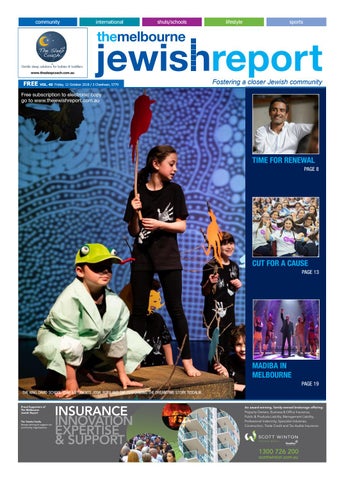
THE KING DAVID SCHOOL YEAR 3 STUDENTS JOSH, RUBY AND EMI PERFORMING THE DREAMTIME STORY, TIDDALIK.
8648 Scott Winton - Banner for Melb Jewish report (correct size).indd 1
26/3/18 9:49 am
2
community
October 2018
Keeping their voice alive to educate future generations THE SYDNEY JEWISH MUSEUM NADINE LEVINE
Photograph by Katherine Griffiths.
The first time I felt a connection to the Holocaust was through a Holocaust survivor with whom I developed a strong friendship on a tour to Poland that I organised. I am not a descendant of survivors, but the friendship that developed between myself and Gerda sparked within me a desire to continue to connect with and teach the Holocaust. After moving from South Africa to Sydney, I saw that the Sydney Jewish Museum was running a guide training course. It was serendipitous, and 15 years later I am still able to honour Gerda through weekly guiding of students through the Museum. Hearing from the Holocaust survivors and learning from their stories is always humbling. But probably, of equal importance, is the fact that within this space we make a difference on a daily basis. We plant seeds in the mind of thousands of school students, some of whom may never have met a Jewish person or heard of the Holocaust, and we ask them to think for themselves. We challenge the armchair response to the world’s turmoils with stories of the Holocaust. We make students question their own feelings of being a bystander or being able to speak up when they experience or see racism, bigotry or bullying. The need to remain vigilant in the fight against racism generally, and antisemitism in particular, has grown and the Sydney Jewish Museum remains the community’s
prime asset in this regard. Education is the Museum’s most important mission. With visitor numbers now over 50,000 per year, the Museum is truly the one community institution which engages and educates the broader public on the dangers and consequences of racial hatred and bigotry. The dream of the Holocaust survivors who founded the Sydney Jewish Museum almost 26 years ago was that the Holocaust never be forgotten. As time passes and there are fewer
Facebook Like Button
Holocaust survivors left, it is our responsibility to keep their voices alive, ensure that their traumatic histories are not forgotten, and educate future generations so that it cannot happen again. To do this, we need to be able to continue to expand the scope of our educational programs, enhance our archival storage so we can preserve more historical objects, and optimise our exhibition spaces to encourage more visitors to the Museum. The Sydney Jewish Museum is one of the
finest Jewish and Holocaust museums in the world. Our exhibitions and education programs are first rate. We challenge preconceived ideas and change people’s minds. We use the horrors of the past to improve the future for our children, our grandchildren and our great grandchildren. We are fulfilling the dream of the survivors who founded this Museum to keep their memories and voices alive, to never forget the Holocaust and to do our best to ensure it never happens again.
CMYK / .eps
us on Facebook for your monthly reminder to collect
scottwinton.com.au
8647 Scott Winton - Melb Jewish Report ad 18.5cm h x 13cm w.indd 1
26/3/18 9:46 am
3
community
October 2018
Australian gap year students saving lives in Israel ZIONIST FEDERATION OF AUSTRALIA STACY HAYMAN
Shake it, Deakin! AUJS DEAKIN MARIA GELVAN In the Torah, Sukkot is called ‘the time of our happiness’ for many reasons. One of the brightest moments during Sukkot is to spend time with friends & loved ones inside the sukkah, listen to the rabbi and share delicious food. This year Sukkot was celebrated at the Deakin University’s Burwood campus thanks to the efforts of AUJS Deakin in collaboration with Chabad on Campus (Melbourne). The sukkah-on-wheels was proudly brought to the campus so the students could do the mitzvoth of the holidays including shaking the Lulav & Etrog and having a bite in the sukkah near the classes and the library. Maria Gelvan, Public health student
and the secretary of AUJS Deakin: “This year was a fascinating journey to make Jewish life present at Deakin University and to welcome both domestic and international Jewish students. Among the highlights of the year were weekly kosher lunches provided to students free of charge, the launch of a portable Holocaust exhibition, the celebration of Eurovision and many more. Being an international student from Israel, I am very proud to be able to express my Jewish identity on campus and to unite students through celebrating the holidays together.” Rabbi Mendy Ajzenszmidt, Deakin university chaplain and the head of the Chabad on Campus (Melbourne): ”It is important to have a sukkah available to all Jewish students and have Jewish gatherings on campus”.
How many 19 year olds get the opportunity to save someone’s life in Israel? Well this is what our IBC Australian participants have been doing while volunteering as ambulance first responders for Magen David Adom as part of the 7 month IBC gap year program. They have made a difference to so many Israeli’s while on the forefront of emergencies in Israel! The highlight for many was working with Israelis and experiencing Israel from the inside as a full member of the MDA ambulance team. Working eight-hour shifts together with Israeli volunteers they created life long bonds with Israelis and the MDA
stations they worked for. Israel By Choice is a 5 or 10 month Masa Israel Journey program for high school graduates from Australia, New Zealand and South Africa who want to spend a creative gap year in Israel exploring the land, the people and their Jewish identity. Participants explore their own boundaries and interests through their choice of programme options and in forming relationships with Israeli students. IBC enables participants from a range of Jewish backgrounds to learn from each other and by experiencing first hand,the diversity of Israeli society Registration is now open for 2019/2020 Masa Israel programs. To find out more about our extensive range of gap year programs visit www.masaisrael.org or contact Michal at Israelprograms@zfa.com.au
4
community
October 2018
Why we need the Liberal Friends of Israel DAVID SOUTHWICK MP Just two months ago, along with my fellow patrons Tim Wilson MP, Federal Member for Goldstein, and Senator James Patterson, I had the pleasure of launching the Liberal Friends of Israel. Over 300 guests, representing the diverse communities of Victoria, joined the Victorian Jewish community and a large contingent of my state political colleagues to show their support for the State of Israel. We were fortunate to have the new Federal Treasurer and my good friend Josh Frydenberg MP launch this new group along with the Hon Matthew Guy MP, Leader of the Victorian Opposition and Dave Sharma, former Australian Ambassador to Israel and the new Liberal candidate for Wentworth. The Victorian Liberal Friends of Israel has been formed to build an even stronger relationship between Liberal party members and supporters and the State of Israel. It will also build on important advocacy work, such as campaigning against the consistent delegitimisation that Israel is almost uniquely subjected to. Furthermore, the launch demonstrated how the Liberal Friends of Israel was successful in engaging not just with the Jewish community, but other religious and cultural groups. This will be important in organising future events to attract
members of the Chinese, Indian, African and other communities to join along with people from different faiths who are all united in their support for Israel. Going forward, the Liberal Friends of Israel will be providing advocacy on a range of important subjects. A key issue is the need to move Australia’s Embassy in Israel. Already great work has been done on this front. At the state Liberal conference in April this year, the now pre-selected candidate from McNamara, Kate Ashmor, led the Caulfield Electorate Conference to put up a motion to move the Australian Embassy in Israel to Jerusalem. The motion passed unanimously.
Jewish Care Victoria and Maccabi All Abilities sign MOU JEWISH CARE VICTORIA Jewish Care Victoria and Maccabi All Abilities have recently signed a new memorandum of understanding, extending a long history of collaboration. As part of the agreement, the organisations have committed to continuing to work together to provide inclusive social, recreational and sporting activities to people living with a disability in the Victorian Jewish community. “We are thrilled to renew our commitment to working with Maccabi All Abilities to support people living with a disability to engage in sport and recreational activities,” said Jewish
Care CEO Bill Appleby. “Partnerships such as these strengthen bonds between communal organisations and enhance our ability to deliver person-centred support.” “As the program develops, it’s terrific to know the partnerships commitment will offer broader and more creative activities to engage people living with a disability in the community,” said Maccabi Victoria General Manager Sheryl Furman. Maccabi and Jewish Care currently collaborate to provide a range of sport and recreation activities to support people living with a disability in the Victorian Jewish community, including basketball, table tennis, fitness, and schmooze and groove.
Jewish Care CEO Bill Appleby, Maccabi Victoria General Manager Sheryl Furman, Back Row: Jewish Care Manager Disability Services Steve Lowe and Maccabi All Abilities Inclusion Coordinator Shari Cohen
The Liberal Friends of Israel will also be standing up against the abhorrent BDS (Boycott, Divestment and Sanctions Movement). Out of the 19 countries considered part of the Middle East, Israel is the only one considered to be a free and open democracy. Therefore, attempts to undermine and delegitimise the only liberal democracy in the Middle East, has been, and will continue to be, strongly opposed by the Liberal party. As a Member of Parliament, I have had the privilege of taking over 20 MPs to visit Israel. Most recently, I had the pleasure of accompanying Matthew Guy, the Victorian Leader of the Liberal Party, on his inaugural visit to Israel. It has been
amazing to educate our legislators about Israel, building on the Advocacy work and creating an opportunity to strengthen Victoria’s relationship with Israel, something that will be a key priority for a future Liberal government. In fact, we announced that if elected, a Matthew Guy government will be immediately opening a business office in Jerusalem to increase trade between the State of Victoria and the “Innovation Nation”. Initiatives such as these are a great source of advocacy as they help the broader Victorian community see a side of Israel not often depicted by the media through the cultivation of new apolitical relationships. This office would also support the Federal Governments trade office in Tel Aviv. In a time where democratic values are under threat across the globe, the Victorian Liberal Party have been the first to demonstrate their unwavering commitment to the democratic Jewish state. In the words of Matthew Guy at the launch of the Liberal Friends of Israel, “We are proud to say we are a Zionist political party”. I am proud to be a member of a party that always stands up for Israel, even when others seek to demonise it. I look forward to growing the Victorian Liberal Friends of Israel and welcoming new members to future events to build on this very important advocacy work.
October 2018
community
5
Liberals and Nationals Sink World Class Pianist and UIA Legislation that would have seen Success Story Coming Down Under Parliament Ban Live Sheep Exports UIA CARLI DVASH
MICHAEL DANBY MHR MELBOURNE PORTS During the last parliamentary session the Liberals narrowly defeated legislation that would have phased out live exports of sheep. After The Animal Export Legislation Amendment (Ending Longhaul Live Sheep Exports) Bill 2018 passed the Senate, Labor’s Shadow Minister for Agriculture, Joel Fitzgibbon, moved a motion to have legislation to ban live sheep exports come to the House immediately. Labor gave the House of Representatives the opportunity to phase out the live export trade of sheep and the Morrison Government failed the test. Sadly, a small group of conservative MPs who had pledged to vote against this cruel practice, Liberal MP’s Sussan Ley, Sarah Henderson and Jason Woods, reneged on their commitment to vote with us to phase out the live sheep trade. Sussan Ley and Sarah Henderson, when introducing their Private Members Bill to give effect to a phase out the live sheep trade, gave impassioned speeches. They talked about the horrors of this trade and said there were no other choices but to ban it and that the quicker it happened, the better off we would all be. The Labor spokesperson Joel Fitzgibbon said, “Sussan Ley and Sarah Henderson
gave up their convictions yesterday. They took their promotions in the new Morrison Government and they put those promotions ahead of the welfare of animals and, of course, ahead of the view of the Australian community. They should stand up, stand by their convictions, return to their original positions and join Labor in voting for the phase out of this trade.” The Abbott-Turnbull-Morrison Government’s record on animal welfare is appalling. They abolished the Inspector General of Animal Welfare and Live Animal Exports; they abolished the National Animal Welfare Strategy; they abolished the animal welfare unit in the Department of Agriculture; they abolished the CoAG Committee that deals with animal welfare issues; and they sent a clear signal to the regulator in the live export trade that “there is nothing to see here” and they should take a light touch approach. It is very clear now that there is only one way to phase out the live sheep export trade and that is to elect a Shorten Labor Government. In addition, there is only one way to restore government accountability and public accountability on animal welfare issues and that is to elect a Shorten Labor Government.
Victor Stanislavsky is a true success story. Having made Aliyah from Ukraine with his family as a young boy in 1990 with the support of the UIA and the Jewish Agency for Israel, Victor followed his passion for music in his new homeland. He began piano lessons at the Haifa Conservatory and by age 10, had won 1st prize at a young talent competition in Israel. He has since gone onto win more than 13 top prizes and awards in competitions in Italy, Andorra, China, the U.S and Israel. He served in the Israeli Defense Forces under the status of an “Outstanding Musician.” He is hailed as one of the most outstanding young pianists in Israel today. His international career has taken him all over the world to Europe, Asia, and to North and South America. In the past concert season, he has given over 70 performances as a soloist, recitalist and chamber musician and has appeared at major festivals such as Ravinia, Meet in Beijing, Shanghai Piano Festival and the Israel Festival. As an avid chamber musician, he has collaborated with such artists as violinists Christian Tetzlaff and David Garrett, cellist Gary Hoffman and Soprano Chen Reis. Victor holds both bachelors and masters
degrees summa cum laude, in music performance from the Buchmann-Mehta School of Music at Tel-Aviv University, where he studied with Daniel Gortler and Arie Vardi and where he now serves on the faculty himself. He spends his professional time also teaching, and despite his young age, he has already given master classes at the Shanghai Music Conservatory and at Calgary University. Ha’aretz reviewed him as “a breathtaking Virtuoso” while San Diego Art said, “he knew how to make the piano sing.” Victor will be performing at a UIA concert at Beth Weizmann Community Centre on Thursday 1 November 2018, 7pm. Tickets are $15 and are available online at www. uiaaustralia.org.au or contact 1300 ISRAEL (1300 477 235).
6
community
October 2018
Centre marks new era in Israel-Australia research MONASH UNIVERSITY A new Israel-Australia research centre involving a major collaboration with Monash University will be officially launched today in Tel Aviv, Israel. The Sagol Center for Epigenetics of Metabolism and Aging cements the relationship between Monash University and the Tel Aviv Medical Center, Israel’s largest health institution, where the centre will be based. The initiative was made possible by the generosity of the Sagol family in Israel and is the vision of philanthropist Sami Sagol. It is part of a collaboration that began last year, and will embed scientists from Monash’s Department of Diabetes, while Israeli scientists will be trained at Monash. Paul Zimmet AO, Professor of Diabetes at Monash, will become the centre’s Co-director (honorary) with Professor Naftali Stern, Director of the Institute of Endocrinology, Metabolism and Hypertension at Tel Aviv Medical Center. Epigenetics, a burgeoning new field, refers to changes in the genetic material surrounding genes that are induced by the environment. Professor Zimmet, an international leader in diabetes research, believes some of these translate into adult disorders such as ageing, obesity and type 2 diabetes and may be passed down between generations or acquired during a lifetime.
“If you think of type 2 diabetes, for example, everyone thinks it’s all genetic,” Professor Zimmet said. “But only about 20 per cent of risk of type 2 diabetes has been shown to be associated with genes. There’s a whole belief now that the role of environment makes up a considerable part of that risk.” The centre will aim to reveal epigenetic changes in body organs that contribute to ageing and disease, attempt to discover which changes are experimentally reversible then strive to develop practical therapies to reverse such changes to delay ageing and diseases such as type 2 diabetes. It is part of a network of research centres established in academic and medical centres by the Sagol family, focusing on the advancement of research on longevity and quality of life. Ambassador of Israel to Australia, Mark Sofer said the project catapults Australian-Israeli scientific medical collaboration into a new era. “One cannot commend highly enough the initiative of the Sagol Family and the amazing professionalism of Professors Paul Zimmet and Mark Cooper and their team at Monash University in Melbourne and of Professor Naftali Stern and his team at the Tel Aviv Medical Center,” Mr Sofer said. Victorian Minister for Innovation and the Digital Economy, Philip Dalidakis, said it
was wonderful to see Monash University spreading its knowledge and expertise all over the world. “Monash is a world leader in medical research and we’re proud to see this great University collaborating with other world leaders and further strengthening our relationship with Tel Aviv,” Mr Dalidakis said. The initiative was made possible by the generosity of the Sagol family in Israel and is the vision of philanthropist Sami Sagol. “Sami Sagol is a visionary philanthropist and a strong believer in the interchange of information and research between nations to strengthen relations between nations, as well as to improve scientific knowledge,” Professor Zimmet said. “We are now trying to raise funds from Australian philanthropic donors here to further support the Monash side of the program.” Dignitaries attending the opening include: • Professor Ronni Gamzu, Director General, Tel Aviv Medical Center • Mr Ron Huldai, Mayor of Tel Aviv • Mr Chris Cannan, Australian Ambassador to Israel • Mr Yuval Rotem, Director General, Ministry of Foreign Affairs and the former Israeli Ambassador to Australia • Mr Ken Ryan AM Agent to the United Kingdom Commissioner to Europe and Israel
Dr. Katie Allen – The Real Deal LIBERAL PARTY • Experience and leadership • Authentic local knowledge • Knows how to get things done Politics is about serving people. Throughout my life I have made that my vocation and that is why I am running as a candidate for Prahran. I want to bring real life experience to our Parliament – experience from my life in the workforce and raising a family. I have lived locally for 40 years. I have spent those years understanding and connecting with people from all walks of life and the issues that are important to them. • As a successful doctor in a public hospital I am trusted and respected by our community. • As a professional I understand the drive to get ahead in this fast-paced world. • As a local of 40 years I understand the issues that are important to us all. • As a family woman with four children I understand the juggle of work-life balance. Prahran matters There is no better place to live than in the world’s most liveable city. Living locally, my husband and I have built independently successful careers and together raised our family of four wonderful children. But Daniel Andrews has eroded Prahran’s vibrant lifestyle. And our local Greens MP has not been a strong voice for us in Spring St. Prahran has been ignored by Daniel Andrews and taken for granted by the
current local member. I want to make Prahran a safe and prosperous place for our kids and for generations to come. With your support, I will be a strong voice for our community in Spring St about the issues that are important to you. I want to help ensure that all Victorians prosper now and into the future. Over and again I hear from locals that they want a State member who can make a difference to the issues they care about. I am putting my hand up to be your elected member in State Parliament because Prahran needs a strong and authentic voice with the experience to get things done. I care deeply about our community, with a lifetime’s experience dedicated to children, their families and the issues of health and education. I want Prahran to become safe again, with a vibrant Chapel Street, beautiful heritage values, better public transport services and a fast and efficient connection to the CBD and broader Melbourne transport network. In November 2018, let’s make our vote count for the people of Prahran and the whole of Victoria. Vote for someone: - you can trust - who knows the issues - who can get the job done Let’s Get Prahran Moving Again by - Improving public transport - Keeping our citizens safe - Ensuring the best education for our kids - Improving health care services - Caring about local issues in Prahran - Building a sustainable future
• Professor Naftali Stern, Director of Endocrinology, Metabolism and Hypertension, Tel Aviv Medical Center • Professor Paul Zimmet AO, Monash University and Honorary President, International Diabetes Federation • Professor Mark Cooper AO, Head of Department of Diabetes, Monash University • Professor Stephen Jane, Head of Monash University’s Central Clinical School • Professor Sam El-Osta, Department of Diabetes, Monash University. Professor El-Osta, recognised internationally for his work in epigenetics, will play a large role in overseeing the research The Monash professors, and scientists from Tel Aviv University, spoke at a scientific symposium held after the opening ceremony. Professor Stephen Jane said, “This represents a wonderful opportunity for Monash University to establish meaningful collaborations with Tel Aviv Medical Center and Tel Aviv University, further enriching the rich relationships between Israel and Australia. Professors Zimmet and Cooper have been instrumental in this process, and further discovery into the causation of diabetes through the study of epigenetics has enormous therapeutic potential.”
ADVERTISEMENT
Dr Katie
Allen LIBERAL CANDIDATE FOR PRAHRAN
Let’s Get Prahran Moving Again by Improving public transport Keeping our citizens safe Ensuring the best education for our kids Improving health care services Caring about local issues in Prahran Building a sustainable future
0456 962 547
www.KatieAllen.com.au
Katie.Allen@vic.liberal.org.au Authorised by N Demiris, 104 Exhibition Street, Melbourne.
/KatieAllenForPrahran
community
October 2018
I can afford property in Israel!
7
SIMON SEITZ, ADV & NOTARY SIMON SEITZ With a little bit of help there is a property waiting for everyone in Israel, both investor and oleh alike. One idea is to look to the outskirts of cities where bargains can be found. In addition there are many cities that are not yet hot spots but are on the way to becoming one. Another idea is to buy property in government programs. One of them is called Mechir l’mishtaken. Mechir L’mishtaken is a program developed and backed by the government in order to try and reduce property prices and allow everyone to be able to purchase their own home. In this article we shall discuss what it is and who is entitled to it. What is Mechir L’mishtaken? In the governments battle to combat rising property prices the government is now directly marketing land to building companies. The government sets the size of the properties to be built, the price of the property to be sold by the company and the location. This ensures a fair price is paid. Once a builder has been found the government runs an online registration system where a family can register for the property
of their choice. After the registration deadline the government runs a lottery of who should purchase each property and the winner is notified to come and sign a purchase contract. So in short the program is designed to offer property at a lower than or fair market price. So who is entitled to register? Married or common law couples, singles over the age of 35, physically challenged people over the age of 21 are allowed to apply. Preference will be given to anyone who has been living in the locality for the last 3 years and most
Scopus Little Learners A new long day care program for two year olds. The first steps in your child's Scopus education.
OPENING JANUARY 2019
Inquire Create Explore An immersive Hebrew program which also develops each child’s sense of Jewish identity and belonging.
For further details about the Little Learners program, visit www.scopus.vic.edu.au/ ELC/Little-Learners To register your interest, please call Enrolments on 9834 0070 or email admissions@scopus.vic.edu.au.
EARLY LEARNING CENTRE at SCOPUS
important of all the applicant must not own any property in the last 3 years. Property includes, building rights, properties being built and those who own more than a third of rights in land zoned to become residential property. Recently the program has also been expanded to allow those looking to upgrade their homes to also purchase a home via the scheme. Conditions have been set by the government which are beyond the scope of this article. The policy does have some drawbacks.
However at the end of the day it does allow certain categories of the population to get their feet on the property ladder and own their own piece of Israel. Will the program be judged a success? Will the program bring down property prices? only time will tell. Simon Seitz is an Israeli real estate attorney and shall be running Israel Real Estate seminars in Sydney and Melbourne between Oct 30th- Nov 8th.For further information or questions please email simon@seitzlaw.net
8
community
October 2018
A Time for Renewal in Our Community ARK RABBI SHNEUR RETI-WAKS Recently I returned from a sabbatical in Israel which gave me time for introspection and reflection. At Rosh Hashanah, our time of renewal, I want to share some thoughts on the renewal of our community. In Israel there were many highlights. But there were some low points. The one most relevant to us right now is the alienation felt by Diaspora Jewry towards Israel. After millennia of horror, Western Civilisation has realised that the best way to avoid such horror is to allow everyone maximum freedom to do whatever they will so long as they cause no harm to others. ‘Live and let live’ is the foundation of modernity. A modernity in which Jews are great beneficiaries. Whilst so much has been going on in Israel there have been some positive developments in Melbourne where we, as a community, are seeking to address one of the greatest challenges for Jewish life – ‘marrying out’. Until recently the approach was the stick of punishment . A Jewish man can’t be called to the Torah if he marries out. A nonJewish parent is excluded from standing under the Chuppah or on the Bimah during family smachot. And, the most negative, when they came before the Beit Din to seek to convert they faced very high, almost insurmountable, walls. Now to the positive part. Over the past year there has been a real change in the attitude of the local establishment religious leadership. They have arrived at the same conclusion that many in the community have been espousing for a long time. Should we not, when approached by someone with a genuine desire to become a religious Jew, have the greatest imperative to do what we can to assist rather than alienate them? To effect positive change, you need to know facts, which is why a review
of the Melbourne Beit Din process was undertaken. Recent opeds in the AJN by Rabbis Genende and Glasman and an article on the work by Rabbi Mirvis provide a backdrop to this positive development. A few weeks ago we read Parshat Shoftim which unlocks the mystery of Jewish continuity and the power of the Torah in a way that guides our attitudes today in a most profound way. The Torah says that when you have a query concerning the application of the law or need for arbitration you should go to the judges of the cities who will be in those days. (Devarim 17:9) Rashi explains that these words suggest that even though your contemporary judge pales in comparison with the judges of earlier days, you must obey him — you have none else but the judge that lives in your days (Rosh Hashanah 25b). This interpretation is an absolute revelation and, when actually applied today, which I truly believe it must be, will have ramifications of epic proportions. The
revelation is that the Torah in its infinite wisdom not just identifies, but highlights, the need for a judge to be contemporary even if at the expense of historic wisdom and righteousness. Of course not all contemporary rabbis are to be followed. The Torah clearly stipulates the required qualities of judges of the day. Wisdom and righteousness are required but not enough. The central requirement is the strength and integrity to judge without bias. ‘You shall show no partiality nor take a bribe, for bribery blinds the eyes of the wise’. (Devarim 16:19) There is one further requirement - do they take seriously the charge to ensure that the Torah is being interpreted appropriately for their time? It must be applauded that rabbis have found ways to make changes over the centuries. We do not have to kill all men, women, and children belonging to Hamas and Hezbollah even though they are surely no better than the Amalekites or the seven
other nations whom we are explicitly instructed to annihilate when we enter the land. (Devarim 25:17, 20:16) They found a way and we are supremely thankful for that. And now they, indeed all of us who are Orthodox rabbis, must focus on dealing with a major crisis - the crisis of ‘The Vanishing American Jew,’ (Alan Dershowitz) really the vanishing Diaspora Jew. Remarkably, and testament to all who have come before us, many care so deeply about their Jewish identity, culture and religion that when the partner comes into the Jewish orbit he/she feels drawn in and wants to adopt Judaism as their own. But until now, they were met with harsh, negligent, and deeply suspicious responses to their request. So many turned away. It is to the credit of the Melbourne Beit Din that last year it undertook a comprehensive review of its conversion program. And what they found was something I have been advocating from the day I decided to work through an esteemed, independent Orthodox Beit Din in Israel led by Dayanim who were themselves responsible for penning the Israeli Chief Rabbinate’s conversion program. Conversion candidates yearn for warmth, a sense of inclusion, transparency, to have a sense of what to expect (to the extent that is possible), readily available assistance, and generally not be forced to complete a doctorate on top of a master’s degree. It is an exciting new development in the Jewish Life of Melbourne Australia. There is real hope now that the recommendations will have the desired effect that will help curb the tide of oblivion whilst immensely enriching our community with the diversity, intelligence, and sensitivity that converts bring. We will have a situation where our children who wish to create a Jewish family are no longer turned off or turned away but are taught, guided, inspired and embraced for their genuine desire to lead an Orthodox Jewish life.
Australian, Saul Kaye, to bring Cannatech Medical Cannabis Conference to Sydney CANNATECH CannaTech: Sydney - World’s Top Medical Cannabis Scientists and Business Leaders to Gather at Australia’s First Ever Medical Cannabis Conference October 28- 30 • Medical cannabis spending in Australia to grow from $52 million in 2018 to $1.2 billion in 2027 • Cannabis economy world’s fastest growing industry; Worldwide, medical cannabis spending will reach $19.1 billion by 2027 • 91% of Australians Support Medical Cannabis Use Sydney, Australia, 2nd October 2018, The world’s leading cannabis researchers and scientists, ag-tech, pharma experts, regulators, investors, and entrepreneurs will share their knowledge about the burgeoning medical cannabis industry at CannaTech Sydney, Australia’s first-ever international Summit for Accelerating Medical Cannabis Innovation. The main event will take place October 29-30 at Doltone House, Darling Island. The summit will be preceded on October 28 by a special Cannabis Business Symposium.
The cannabis economy is the world’s fastest growing industry, with an outstanding record of accomplishment in research and development and with significant contribution to a vast array of medical treatments. Economists foresee the potential overall cannabis and cannabis-related product market reaching tens of billions of dollars in the next decade. According to The Arcview Group, medical cannabis spending in Australia is expected to grow from $52 million in 2018 to $1.2 billion in 2027. Worldwide, medical cannabis spending will reach $19.1 billion worldwide by 2027. Companies, entrepreneurs, researchers, investors, and other stakeholders will meet at CannTech Sydney to connect and learn about opportunities in the booming medical cannabis market as well as the latest technologies and research in the field and the latest global regulatory developments. CannaTech Sydney attendees will hear from and meet the industry’s most serious thought leaders and market disruptors from around the world as well as Australian parents and patients who rely on medical cannabis for the well being of their children and themselves.
The Summit will cover the most current industry topics including Ag Tech & Innovation, Business & Finance, Policy & Regulation, Science & Medicine. Australian companies in the forefront of the industry are sponsors of the event including, MGC Pharma, Spectrum, CannaGroup, AusCann, MediFarm, Canngea, Little Green Pharma, Cresco, Everblue Capital, CannaTrek, Nutrition Care, BOD Australia, BioCeuticals, WHG. They join world-wide industry leaders New Frontier and Tilray. Explaining why CannaTech has chosen Sydney for their next event, Saul Kaye, Founder & CEO of iCAN:Israel-Cannabis and CannaTech says, “Australia is a key and growing player in the exploding cannabis field. Many Australian cannabis companies are on the cutting edge of the market and we are thrilled to bring some of the world’s leading companies and investors to Australia to meet with their counterparts to discuss a range of business and technological issues. “Mothers and citizens of all stripes are outraged over the lack of easy access to products for epilepsy, pain, and cancer treatments. As we have seen in other countries this is one of the biggest drivers towards better access for patients. In fact,
surveys indicate that 91% of Australians favour medical cannabis use.” As a native Aussie myself, I could not be prouder to bring CannaTech to my home country and work with like-minded professionals who understand the immense global health and business potential of medical cannabis moving forward.” To learn about iCAN, the Summit’s organizers, click here for the iCAN website. About iCAN: Israel-Cannabis iCAN is building the global cannabis ecosystem. iCAN identifies and accelerates innovative medical cannabis technologies and creates synergies and cooperation across the industry. iCAN uses its global network and reach to position Israel as the leading medical cannabis tech hub. About CannaTech CannaTech is powered by iCAN. CannaTech is the premier international cannabis summit held annually in Tel Aviv, and internationally in London, Panama, and for the first time in Sydney, Australia in October 2018 and Hong Kong in November 2018.
international
October 2018
Secrets of a lost village of ancient Israel come to light ISRAEL21C.ORG ABIGAIL KLEIN LEICHMAN Technology such as LiDAR and a dronemounted 4K camera have led to significant finds among layers of settlement spanning about 2,600 years. A vanished village, buried for centuries under the sands of time, is beginning to emerge in the cave-dotted lowlands southwest of Jerusalem. In typical old-new Israeli fashion, the work of revealing Beit Lehi-Beit Loya mixes painstaking manual labor with cutting-edge technology. Project leaders are now putting their fascinating discoveries on view to the public online in 3D, enlivened by virtual reality. First settled by Jews in approximately the late sixth century BCE, then abandoned and rebuilt by successive populations of pagans, Jews, Christians and Muslims through the 13th or 14th century CE, the remains of Beit Lehi-Beit Loya were first discovered in 1899 by R.A.S. Macalister on behalf of the Palestine Exploration Fund. The site went unexplored until the 1980s, when Hebrew University archeologist Yoram Tsafrir got funding from donors in Utah and uncovered the remains of a Byzantine church with intact mosaic floors. But Tsafrir’s work then shifted to the vast Roman ruins at Beit She’an and it wasn’t until 2005 that his former student Oren Gutfeld, now director of the Salvage Excavation Program at Hebrew University’s Institute of Archaeology, resumed exploring
Excavations at Beit Lehi-Beit Loya reveal a previously unexplored population center. Photo by Asaf Peretz
Beit Lehi-Beit Loya. His work is sponsored by the Utah-based Beit Lehi Foundation and is assisted each spring by faculty and students from Utah Valley University led by professors Darin Taylor and Michael Harper. “Beit Lehi” means “house of the jawbone” and may refer to the biblical site at which Samson slew a thousand Philistines with the jawbone of a donkey. The Church of LatterDay Saints, based in Utah, believes this was the home of an Iron Age prophet named Lehi mentioned in the Book of Mormon. (The Israeli name for the site, “Beit Loya,” refers to a type of ornament.) Gutfeld says less than 20 percent of the
It’s where I...
belong
These scholarships are made possible through the generosity of our donors to The King David School Foundation.
Opportunity and Inclusion scholarships
now available at King David We want to help remove financial barriers and give your child an opportunity to experience a quality Jewish education at King David. This means-tested program can offer long-term financial arrangements on a whole family basis. Available for entry in 2019 and 2020. For a confidential discussion, please contact Admissions on (03) 9527 0102 or visit our website and complete an enquiry form.
www.kds.vic.edu.au
Modern
|
Thinking
|
Judaism
large village has been excavated so far because access has long been limited to weekends, holidays and other times the military firing range in the area is idle. Already, however, there have been significant finds among the layers of successive settlements spanning close to 2,600 years. Underground LiDAR (light detection and ranging) scans and 360-degree cameras have led to many revelations. “We discovered one of the earliest mosques ever found in Israel, from the ninth century CE,” Gutfeld tells ISRAEL21c. “We’ve uncovered seven dovecotes, two of them with more than 1,100 niches;
9
eight oil presses, an underground stable, a water system, quarries, a Hellenistic-period dwelling with a watchtower, and three ritual baths.” The baths are decorated with graffiti of the seven-branched menorah that was lit daily in the Jewish Temple prior to its destruction by the Romans in 70 CE. Even before Tsafrir’s initial excavations it was clear that this region was rich in antique treasures. Nearby Beit Guvrin-Maresha National Park is filled with manmade caves harboring evidence of its significance as a district capital for many of the years between the Iron Age and the Byzantine period. In 1961, Hebrew University scholars identified seven sixth-century BCE Hebrew inscriptions in two ancient burial caves in this area, after they were accidentally revealed by road workers. One of them is the oldest inscription discovered thus far that mentions Jerusalem and the fourletter biblical name of God. These relics are housed at the Israel Museum. Since then, Gutfeld’s team has discovered more than 50 inscriptions throughout the site in ancient Hebrew, Greek and Arabic. Gutfeld is now interested in learning more about how the ruins of Beit Lehi-Beit Loya reflect what was going on in the greater region. To this end, together with Israel Antiquities Authority archeologists Michal Haber and Pablo Betzer, the Beit Lehi Regional Project was launched in 2017, assisted by some CONTINUED PAGE 10
10
international
October 2018
8 Israeli fashion designers that celebrities adore REBECCA STADLEN AMIR Stars from Rihanna and Beyoncé to Gigi Hadid, Halle Berry and Meghan Markle are wearing pieces from these talented Israeli designers. With fashion accessible at our fingertips via e-commerce, shopping apps and social media, the past few years have seen the rise of emerging designers from around the world. Along the way, a number of Israeli designers have won favor with the international fashion crowd, particularly celebrities and their stylists. With fashion accessible at our fingertips via e-commerce, shopping apps and social media, the past few years have seen the rise of emerging designers from around the world. Along the way, a number of Israeli designers have won favor with the international fashion crowd, particularly celebrities and their stylists. “I always say that talent has no geographical boundaries. If your vision is strong, the quality of your work is high and you know how to work with international markets, then your way to success is quick,” Israeli fashion blogger and Instagram influencer Roza Sinaysky tells ISRAEL21c. Sinaysky, known on Instagram as @moodyroza, says she has seen a change in the Israeli fashion scene over the last two to three years, where more people are interested in fashion and willing to support young designers. The designers, she says, also are more aware of trends and the needs of the industry thanks to social media. “The rise of social media made a huge difference in the fashion industry. For designers it opened a lot of doors. When everyone can see your work, you never know who might reach out,” says Sinaysky. Over the past few years, Israeli designers have been approached by Kensington Palace, Beyoncé, Serena Williams, Lady Gaga and many others to create custom pieces. “I think it’s so great that Israel is recognized as a place of talents, not just technology. It makes me very proud to see local designers do so well abroad,” says Sinaysky. Below are eight Israeli fashion and accessory designers making their mark internationally. Shahar Avnet Instagram: shahar.avnet What do Beyoncé and Netta Barzilai have in common? They both wear Shahar Avnet. The young Israeli designer made headlines recently when her custom-made, nude-colored tulle gown was worn by Beyoncé on stage during her current world tour with Jay-Z. Earlier this year, Avnet designed the multicolored kimono famously worn by Eurovision winner Netta Barzilai on the cover of her hit song “Toy.” “My garments are for confident women who are fearless, intelligent and chic. Women who are not afraid to be the center of attention and making a statement,” Avnet told Vogue Italy. The Tel Aviv-based designer’s tulle creations walk the line between art and fashion, often combining techniques such as drawing, embroidery and collage into a single dress. Avnet graduated from Shenkar College of Engineering and Design in 2016, receiving her first international exposure when her final project was chosen to represent the school at the International Catwalk during Graduate Fashion Week in London. Avnet’s bold colors and unusual, feminine silhouettes have caught the attention of celebrity stylists and magazines such as W and Elle Italy. Other celebrities who have worn Avnet’s dresses include American actress and singer Zendaya, Kelly Rowland and members of the Israeli band A-WA. Marei1998 Instagram: Marei1998official Designer Maya Reik launched Marei1998 several
Serena Williams surrounded by six attendants, all wearing Galia Lahav gowns, and her mother at her wedding on Nov. 16, 2017. Photo by Bob Metelus and Erica Rodriguez/Vogue Magazine seasons ago, almost immediately earning praise from the fashion world for her classic-modernist design sensibility — an unusually subdued approach for a designer her age (1998 refers to the year Reik was born). Drawing upon Reik’s love for European cities and vintage nostalgia, Marei1998 offers a twist on classic luxury, reviving traditional styles like the robe coat and wrap dress. The brand’s claim to fame is its faux fur coats, which have become a celebrityapproved go-to for a sustainable statement. Earlier this year, Marei1998’s eco-fur was spotted on model Bella Hadid and actress Priyanka Chopra. Marei1998 has presented its collection in Milan the past few seasons and has had several successful trunk shows with online retailer Moda Operandi, which says “the young Israeli is living proof that elegance doesn’t come with age.” A by Anabelle Instagram: byanabelle Anabelle Tsitsin, the 26-year-old designer behind celebrity-approved shoe brand A by Anabelle, drew upon her background in fine arts to launch a collection of luxury footwear in 2016 that features unexpected and playful embellishments like crystals, feathers and fur. All the shoes are made of Italian leather and fabrics in Parabiago, a town just outside Milan known for its history of footwear craftsmanship. The brand’s signature style features an architectural A-shaped heel, worn by celebrities like Victoria’s Secret model Josephine Skriver and actresses Katharine McPhee and Logan Browning. Last year, Halle Berry wore A by Anabelle’s laceup “starlette” shoes during an interview with Ellen DeGeneres on “The Ellen Show.” Although based in Israel, the brand has started to make its rounds on the international street style scene and social media thanks to influencers and fashion bloggers like Maja Malnar, Camila Carril, and Cristina Musacchio. Nili Lotan Instagram:Nililotan Israeli-born, New York-based designer Nili Lotan launched her namesake brand in 2003. The label, which revolves around timeless slip dresses, simple cargo pants and elevated basics, is tomboy meets luxury, making it a go-to for model-off-duty style. Though Nili Lotan has been a mainstay in Tribeca
since the store opened in 2006, it has been pushed toward the spotlight in the last few years thanks to an ever-expanding list of celebrity followers like Gigi Hadid, Rihanna, Jennifer Lawrence, Gwyneth Paltrow and Kaia Gerber. The brand has been referred to as Hadid’s “wardrobe secret weapon” by Vogue, with frequent images of the model in Lotan’s designs flooding Instagram. Galia Lahav Instagram: galialahav Best known for couture wedding gowns, Galia Lahav is one of the major players in the wave of Israeli designers making a mark on the international bridal industry. Led by Head Designer Sharon Sever, the brand’s embellished, forward-thinking designs have been famously worn by Beyoncé, Serena Williams, Ciara, Jennifer Lopez and many others. Most recently, Lahav made headlines when Beyoncé chose a dress from the label’s “Victorian Affinity” collection to renew her vows with husband Jay-Z. Another defining moment came last November, when the designer created six custommade, cream-colored gowns for Serena Williams’ wedding party. Dresses from Lahav’s line of evening-wear have made frequent red carpet appearances, with their plunging necklines and figure-hugging sequins adorning stars like model Shanina Shaik, actress Sarah Hyland, and singers Ciara and Halsey. Alon Livne Instagram: alonlivne While Alon Livne opened his Soho, NY atelier and ready-to-wear showroom just last year, he has been designing under the label Alon Livne since he founded his studio in Tel Aviv in 2010. With three separate lines – bridal, evening and ready-to-wear – Livne has gained a following of international brides, celebrities and lovers of bold, fearless fashion. Lady Gaga is among the brand’s A-list fans, having worn several custom gowns by Livne over the last few years. His avant-garde, innovative designs have also been worn by Beyoncé, Nikki Minaj, Jennifer Lopez, Naomi Campbell and many others. One of his dresses also made waves when
it was worn by actor Johanna Mason in the film ‘Mockingjay’, part of the four movie Hunger Games franchise. Inbal Dror Instagram: inbaldrorofficial Inbal Dror began designing wedding dresses in 2014, pioneering the style of the “red carpet bride” with her glamorous, figure-hugging styles that were new to the bridal industry at the time. Since then the brand has dressed high-profile brides around the world. Last year, Dror was contacted by the royal family about possibly making the wedding dress for Meghan Markle’s wedding to Prince Harry. Though the newly appointed Duchess of Sussex chose a different dress in the end, the famous inquiry solidified Dror as one of the biggest names in bridal. Dror had previously dressed Beyoncé for the Grammys in 2016, proving that wedding dresses aren’t just for brides. Tuxe When Meghan Markle wore a silk Boss bodysuit by Israeli designer Tuxe for an evening out with Prince Harry in February this year, the style was immediately backordered until May. Tuxe was founded by Tamar Daniel, who was born in Jerusalem, raised in London, and graduated from the Shenkar College of Engineering and Design in Ramat Gan. She founded her Philadelphia-based bodywear line in 2015, focusing on transforming the bodysuit, once a 1990s staple, into a chic, modern garment. Her collection includes a range of bodysuits with names like Boss, CEO, Pacesetter, Game Changer, and Expert, and has become particularly popular with professionals and religious communities, Daniel told Vogue in an interview. Prices range from about $80 for a simple sleeveless bodysuit to $463 for a cashmere turtleneck version. “We’ve been royally approved!” the brand posted on Instagram after Markle was photographed wearing the bodysuit. “We absolutely love Meghan for all she has done for women’s rights and are honored to be worn by someone who encapsulates what we stand for as a brand. She uses her spotlight to be an inspiration and she definitely is to us!”
Secrets of a lost village ... FROM PAGE 9
two dozen local university students and volunteers. Recently, additional finds were made by analyzing images from a UVU drone-mounted 4K camera that was sent aloft to survey a 36-square-kilometer area around the excavation site. The pictures pointed to the remains of “a monumental building one hill to the
north of Beit Loya – a distance of only about 1.5 kilometers – that we had never noticed before using our traditional survey methods,” says Gutfeld. The newfound building seems to be a Hellenistic-period palace or temple from the late third or second century BCE. “Inside we found a room containing delicate pottery and two incense burners
– one of which features a carved image of a bull standing at the entrance to a temple. This is a beautiful and rare find,” says Gutfeld. “Stylistically, the adorned incense burner displays a pagan image – possibly even Idumean, whose art we actually know very little about.” The team has not discovered any cultic artifacts in Beit Lehi-Beit Loya itself.
Possibly the ancient residents reserved their worship for the neighboring hill. In 2009, Gutfeld and Haber wrote a site guide that Utah Valley University digital media students have augmented and digitized for release as an online 3D magazine. This e-zine is expected to be updated each year to incorporate new discoveries at Beit Lehi-Beit Loya.
international
October 2018
11
Activist jounalism in the age of Trump MATTHEW HAUSMAN The media never seemed to care when Obama’s weak foreign policy enabled Russia’s takeover of Crimea and entrenchment in Syria. Donald Trump’s relationship with the media has become increasingly hostile as many journalists have aligned themselves with the anti-Trump “resistance” and sacrificed professional objectivity in the process. The president uses the term “fake news” to delegitimize the press and play to his base, while members of the mainstream media accuse him of criticizing them unfairly. Not all news is false, but it is not unreasonable to question when dubious stories are “fake” or merely slanted, whether there is a difference, and whether Mr. Trump bears any responsibility for instigating journalistic backlash. These are fair questions that demand honest responses, not rote denials by reporters who claim to be objective but cannot credibly refute the existence of bias, or who hysterically claim that Trump’s criticisms threaten their rights under the First Amendment. Journalists should make it their business to report on the doings of government, and the press is protected for that very reason by the First Amendment of the U.S. Constitution, which states: “Congress shall make no law … abridging the freedom of speech, or of the press.” But with great rights comes great responsibility, and the media’s responsibility is to be a nonpartisan watchdog of government. The Constitution does not delineate the press’s functions, but it does provide essential protections to enable journalists to report on government without interference. The founding fathers envisioned a press free of regulation because politicians and elected officials could not be expected to report on themselves objectively. The Constitution’s protections also apply to editorial opinions that are critical of government. However, journalists should maintain a bright line between fact and opinion to report truth as it is, not as they would like it to be. Unfortunately, journalists today are frequently blinded by ideological loyalties that undercut their neutrality; and news reports are often skewed to put this president in a negative light by ignoring his economic and foreign policy successes, offering political diatribes as objective analysis, and, yes, sometimes reporting false claims as news without
adequate (or sometimes any) fact checking. For his part, the president impugns media integrity by describing all news with which he disagrees as “fake” and responding with tweets that often contain more hyperbole than factual counterpoint. It is certainly possible to report news that is unflattering but accurate, and he would be better served by challenging stories he says are untrue and clearly articulating why. Unquestionably, some stories have been false (e.g., post-inauguration claims that he removed a bust of Martin Luther King from the White House) or based on uncorroborated sources without proper fact checking (e.g., multiple reports – later shown to be hoaxes – of unprovoked attacks perpetrated in his name against Muslims). Other stories have created false impressions by taking facts out of context (e.g., a tweet casting aspersions on an ICE employee by mischaracterizing his military tattoo as a Nazi symbol). Still others have presented opinion as objective reportage (e.g., stories drawing insupportable parallels between administration programs and Nazi policies). Some news organizations are vested in portraying this administration negatively, as reflected by an undercover interview last year with a CNN editor who admitted his network’s policy of pushing the Trump-Russia issue despite a knowing lack of corroboration. Likewise, it cannot be denied that journalists often write stories consistent with their own partisan sensibilities. One need only peruse direct news sources on the internet to see that many outlets are not fully reporting administration successes like the economic recovery, unprecedented GDP growth, record decreases in minority unemployment, key judicial appointments, and the reassertion of American authority abroad. This is not to say Mr. Trump is beyond criticism. Analyses questioning his policies, political relationships, beliefs, use of social media, and rhetoric are entirely appropriate. However, journalists should report the positive as well as the negative based on newsworthiness and not ignore stories that vindicate administration policy. News should be reported to convey facts as they occur, regardless of how writers and their editors might regard the president’s style, manner, or character. As brash as his tweeted comments may be, they do not obviate the media’s responsibility to report newsworthy events.
Though Mr. Trump certainly engages in hyperbole, his facility for audaciousness is more than matched by his opponents in the press. His public comments leading up to the summit with North Korea, for example, were reported as bellicose, inflammatory, and dangerous, until his strategy brought Kim Jong-Un to the table (though to what effect remains unclear), after which the media instead criticized his tactics as impotent and weak. He is also portrayed as obsequious towards Vladimir Putin, though his administration has imposed far greater sanctions against Russia than Barack Obama ever did and has challenged the Russians militarily in Syria. This president has also confronted Chinese economic belligerence and Iranian intransigence, and he constantly chastises the UN for its blatant and contemptible antiSemitism and unbalanced treatment of Israel. According to many journalists, however, these actions are reflective of mental instability. Ironically, the media never seemed to care when Obama’s weak foreign policy enabled Russia’s takeover of Crimea and entrenchment in Syria. Likewise, it had no issue when Obama seemed to ignore the threat of Chinese and North Korean cyberespionage, or facilitated the ascendancy of Islamic radicals throughout the Mideast – resulting in the election of the Muslim Brotherhood’s Mohamed Morsi in Egypt and empowerment of Libyan Islamists who waged civil war, attacked the US consulate in Benghazi, and killed Ambassador Chris Stevens. It may seem counterproductive when President Trump refers to all unflattering coverage as “fake news,” but his use of the term does not threaten any constitutionally protected rights, irrespective of the mainstream’s overwrought First Amendment concerns. Though Trump misses no opportunity to chide the media, he does not deny its right to publish what it wants, which distinguishes him from some of his predecessors, including Abraham Lincoln and Woodrow Wilson, who shut down hundreds of newspapers and jailed thousands without trial for seditious speech. The mainstream media’s newfound concern for the Constitution rings hollow given its penchant for delegitimizing conservative discourse, advocating regulation of political speech with which it disagrees, and belittling viewpoints that question progressive orthodoxy. Its recent editorial calls for civility are likewise
disingenuous for largely ignoring provocations by liberal pundits, such as those comparing Trump’s policies to Islamist terrorism. Yes, the president seems to focus excessive ire on CNN, but today’s media watchdogs did not seem to mind when President Obama did the same to Fox News, impugning its integrity, calling it an arm of the Republican Party, and attempting to stifle its correspondents. And where was their outrage when Obama’s Justice Department threatened journalists like James Rosen with subpoenas and indictments over their coverage of his White House? The misuse of government offices to bully journalists really did threaten the First Amendment; and yet the mainstream refused to confront such Obama-era abuses or defend Fox News’s speech and press rights. It was certainly troubling when President Trump excluded a CNN reporter from the White House correspondent pool, and even conservative networks that chastise CNN’s bias came to its defense. However, it was wrong when President Obama attempted to do the same to Fox News in 2009 – although most networks at the time remained silent and expressed no concern for the First Amendment. The propensity for many journalists to report selectively or untruthfully is not unique to their coverage of Trump. Rather, it is consistent with their record of bashing Israel, tolerance of progressive antiSemitism, exculpatory coverage of left-wing extremist movements like Antifa and Occupy Wall Street, and use of the progressive agenda as a compass to guide their reporting. Nevertheless, the way to combat the media’s abuses is not to shut it down, but to challenge it pointby-point. Indeed, this is exactly what the Committee for Accuracy in Middle East Reporting in America (“CAMERA”) does regarding dubious coverage of Israel and Jewish issues. In taking this approach, it’s important to recognize that the First Amendment prohibits only government from restricting speech and press. It does not constrain private citizens from asking questions or exempt the press from scrutiny for slanted reporting. Moreover, the Constitution does not preclude individuals, even sitting presidents, from voicing skepticism over content, but instead protects their right to do so. Perhaps reporters who profess concern for the First Amendment now, after ignoring it for eight years, should actually read it and take its lessons to heart.
KEEP CALM IT’S ALMOST SUMMER NEXT ISSUE
9 NOVEMBER
www.cherylthesleepcoach.com.au
LANDSCAPE DESIGN 900 glen huntly rd, caulfield south CONSTRUCTION W: www.ingejabaralandscapes.com.au GARDEN MAINTENANCE P: 03 9046 1966 pools GARDEN STYLING Also find us on: GARDEN EVENTS
12
schools / shuls
October 2018
Cut for a Cause YESHIVAH – BETH RIVKAH COLLEGES Tied into 4 loose plaits, the Great Chop inspired over 160 Beth Rivkah students to cut and donate their hair in the name of cancer treatment. Women and students from both the Primary and Secondary School took to the stage and bravely faced amateur hairdressers to give away locks of their hair. Following the success of the Great Chop in 2016, this year’s campaign readily captured the enthusiasm of students, parents, staff and alumni who promptly signed up to cut and donate their hair. Funds raised and piles of neatly plaited hair will again be donated to Zichron Menachem (an Israeli cancer charity) who provides wigs for children and young adults undergoing cancer treatment. The Hon. David Southwick MP, Member for Caulfield, opened the eagerly anticipated event (girls growing their hair for the last 2 years to participate) and commended students for focussing on tzedakah and giving something of ourselves to others. Highlighting the importance of hair and what it means to a women’s confidence
and self-esteem, Mrs Simona Weinstein and her daughter Chana gave a personal moving address. They spoke of their experience with Simona’s diagnosis of Non-Hodgkin’s Lymphoma and how an event such as the Great Chop can truly make a difference in a cancer patient’s life.
Organised by Beth Rivkah Tzedakah Captains, the afternoon was infused with excitement and energy. There was candy floss, several raffle draws and a myriad of squeals as girls held onto their cut plaits as well as vocal performances from Sarah Gross and Sarah Kisilevich. Thanks to the generosity of the
Celebrating a young woman’s Rite of Passage YESHIVAH – BETH RIVKAH COLLEGES Tears of pride formed in the eyes of mothers and grandmothers who sat brimming with nachus watching the Year 6 Bnot Chayil girls on stage. The evening was a celebration of Bat Mitzvah girls turning into beautiful young women. Women who have been nurtured to grow with pose, strong character and kindness. The theme of this year’s Bnot Chayil was family and chessed (kindness). Throughout the Bnot Chayil program the girls undertook acts of chessed including baking biscuits for Beit Raphael which would be delivered to sick Jewish
patients, listening to speakers and learning. The girls put on a wonderful evening performance including a choral verse about becoming Bat Mitzvah at 12, a slide show about family and singing some moving songs. The audience was then treated to a special performance of singing mothers! Together mothers and daughters decorated calico bags donated to C-Care who would be using them to deliver Rosh HaShanah meals. And then a delicious supper followed to end an important rite of passage in a Jewish girl’s life.
NEW : ONLINE SUBMISSION FOR CONTENT 4 Log onto - thejewishreport.com.au 4 click on Submit Article in the top right hand corner 4 follow the prompts and submit the article You will receive an email confirming submission Any problems or queries please contact Bindi Bettman on prepress@melbournejewishreport.com
community, Beth Rivkah is thrilled to report that they have exceeded their initial goal of raising $10,000 for Zichron Menachem and will be contributing over $12,000, plus the locks of hair. Donations to this worthy cause are still being accepted via https://chuffed.org/ project/the-great-chop
schools / shuls
October 2018
13
Scopus Pets MOUNT SCOPUS COLLEGE Mount Scopus College is home to more than students and staff, with a variety of pet animals living on each campus. Rabbits, guinea pigs, chickens, a blue tongue lizard, even mice and an incubator of butterflies call Scopus home. Our students gain so much from caring for and learning about our pets that they have become an important part of the school day. While some students are timid around the animals at first, once they are shown how to hold an animal correctly, their confidence soars and they are so responsible and absolutely love caring for their little friends. They enjoy watching the animals’ different personalities and have fun naming them all. Pet club sessions allow students to be responsible for the animals and help in keeping their enclosures clean, providing fresh food and clean water and grooming. Lots of cuddles with the rabbits and guinea pigs provide students with an opportunity for mindfulness and quiet observation and a break from classroom routines. When the female pets become pregnant there is much excitement before a new litter arrives, and students learn about the cycle of life, especially when a pet is lost through old age or failure to thrive. The children learn that this is a normal part
of life and discuss it with their teachers and peers. The resilience and acceptance from the children is amazing and they show great strength of character when dealing with these sad times. In garden class recently staff and students built a new two story enclosure for their guinea pigs from a kit, following instructions and using tools like screwdrivers. They worked as a team to assemble the components, as they learnt new skills and gained a deeper understanding of the interconnectedness of living things Recently, a group of children took the initiative to survey their friends to choose names for their newly arrived bunnies, while some classes housed chicken eggs in an incubator during their unit on life cycles and observed them hatch one by one. Students later collect eggs from the mature chickens in the hen house and these are used in kitchen garden cooking classes, along with the produce they harvest from the garden. Often it’s the times spent outside the classroom that students remember long after they leave school, and the animals at Scopus are definitely playing their part in creating special memories for our students. www.scopus.vic.edu.au
Monash Honored by his Shule ST KILDA HEBREW CONGREGATION St Kilda Shule recently hosted a lunch celebrating the 100 year anniversary of the knighting of Sir John Monash by King George V. Monash was St Kilda Shule’s highest profile member and served on its Board for eleven years. Messages of support were received from Governor General Peter Cosgrove, then Prime Minister Malcolm Turnbull, Federal Opposition Leader Bill Shorten, Victorian Premier Daniel and State Opposition Leader Matthew Guy. “Monash embodied the outstanding values we as Australians cherish and lifetime of service to this nation has left an indelible impression across the country and across Victoria in particular, as evidenced by the name one of our internationally acclaimed universities” said Mr Guy, who attended the lunch and addressed the audience. “But Monash’s commitment to, and pride in, his country was matched by the pride he exhibited in his Jewish heritage. The St Kilda Shule in particular wears as a badge of honour the longstanding association with Monash as one of its Board members.” “The legacy Sir John Monash left is truly unparalleled and so it is right that he be honoured at the Victorian Parliament” Guy said in his address. “The event was a tremendous success and ran meticulously under the sterling efforts of our Shule’s Vice President Harold Sternfeld” said the Shule’s senior Rabbi Yaakov Glasman, “It was extremely well attended and included a line-up of outstanding speakers including Major General Jeffrey Rosenfeld as well as representatives of VAJEX as well as its Federal body, FAJEX, who travelled interstate to join us at the lunch”.
Rabbi Yaakov Glasman presents a St Kilda Football Club Kippah to The Hon Matthew Guy MP Each speaker was presented with a unique gift but the crowd favourite appeared to be the presentation to Matthew Guy MP of a Kippah bearing the emblem of the St Kilda Football Club, of which Mr Guy is an ardent supporter. “You love the Saints and you love the Jewish community” Rabbi Glasman said to Mr Guy as he presented the Kippah “so we thought we can bring these themes together by commissioning a special Kippah that has the SKFC emblem on it and I expect that you’ll be wearing this at every Jewish function you attend henceforth”. The presentation was welcomed with laughter and applause by the audience and topped off a highly successful event for one of Melbourne’s leading Shules.
Mount Scopus students Isabella Weiss, Kiva Goldberg and Tali Haskin with some of the rabbits who live in the kitchen garden
Mount Scopus students Asher Mohr and Eden Kranz with the chickens
Bialik College Sukkot
14
schools / shuls
October 2018
Bialik Values The School Camp Experience BIALIK COLLEGE The immense value of teamwork, tolerance and leadership skills are some of the core benefits Bialik students gain from school camps. Camps are an integral part of Bialik’s holistic approach to education and provide a unique space for children to interact with teachers and other students. Camps provide the perfect environment for hands-on learning beyond the confines of the classroom. History, Art and Geography are some of the subjects that are carefully woven into the camp structure, giving students the opportunity to learn about maps and navigation by plotting their own course, or feel the sand between their toes while marvelling at rock formations or visit the Nation’s capital to truly understand what it means to be an Australian citizen. Bialik camps function like a community in which each student has a role to play. All camps have a Jewish Life element to them – a fun and engaging experience facilitated by Bialik’s talented and inspirational Jewish Life staff and student leaders. In Year 3, the first year that Bialik students embark on school camp, the campers learn fundamental life skills that will be built upon throughout their future camps. Self-care, cleaning up after themselves and sharing rooms and facilities eventually progress to cooking for themselves and negotiating a team approach to group activities and choices. Camps are outdoor based and include
a variety of activities, including bike riding, surfing, go carting, hiking, fishing, stand up paddle boarding, surf kayaking, high ropes, flying fox, raft building, canoeing and geocaching (an outdoor recreational activity in which the participants use a GPS device for treasure-hunting), to name a few. From Year 7 on, students also sleep in outdoor tents. Wilsons Promontory National Park, Mount Buller and Lake Dewar are just some of the magnificent locations visited by Bialik students over the course of their schooling. The Year 6s visit Canberra, where they are able to consolidate their understanding
of Civics and Citizenship and the Year 9 students have a truly unique experience at Zionist Seminar, which strengthens their connectedness to Israel and the Jewish people. Bialik College’s flagship Chavayah program for all Year 10 students involves a six-week exploratory tour of China and Israel, while the College’s Year 12 optional ‘Towards Autonomy’ Seminar provides the opportunity for students to give consideration to some big topics that they will be confronting as they approach the end of their schooling lives, such as identity, Israel advocacy, dreams and passions,
happiness, friendship, gap years and more. Apart from the annual year-level camps, there are also opt-in experiences like Hebrew Camp and Ski Camp, as well as Shabbatons, during which students have the chance to connect with the meaning and traditions of Shabbat in a uniquely Bialik way. There is no doubt that camps are an enriching and formative part of a student’s school career, which is why Bialik College offers such a diverse, intensive camp program for students from Primary School through to Year 12.
I am. You are. We are Australian - The King David School THE KING DAVID SCHOOL In a stunning display of all things iconically Australian, our Years 3 to 5 students performed Made in Australia recently. The students were clearly highly engaged in this production and convincingly portrayed a range of narratives that shape our culture. Year 3 students who have been studying Indigenous culture in the classroom, brought two Dreamtime stories to life in magnificent fashion, replete with wonderfully creative puppets. Inspired by Dorothy McKellar’s poem, My Country, Year 4 students
researched modern Australian poetry and performed their interpretation. Students created artwork to express the poems and these were majestically projected as a backdrop. The Gold Rush and the rise of the bushrangers was the focus of Year 5 students’ learning and they scripted their performance based on Tom Champion’s book, Cindy-Ella. Their performances were enhanced by authentic bush instruments they created. Jayne Wise as Director truly brought a rich cultural experience to families.
15
schools / shuls
October 2018
Shabbat is one of the best known and least understood of all Jewish observances. People who do not observe Shabbat think of it as a day filled with stifling restrictions, but to those who observe Shabbat, it is a precious gift from G-d, a day of great joy eagerly awaited throughout the week, a time when we can set aside all of our weekday concerns and devote ourselves to higher pursuits. In Jewish literature, poetry and music, Shabbat is described as a bride or queen, as in the popular Shabbat hymn Lecha Dodi Likrat Kallah (come, my beloved, to meet the [Sabbath] bride). It is said “more than the Jews have kept Shabbat, Shabbat have kept the Jews.” Shabbat is at the very center of Jewish consciousness. It is repeated more times than any other mitzvah in the Torah, more aliyot are given on Shabbat than on any other festival and it is the only ritual observance which is part of the Ten Commandments.
The Two Shabbat Commandments There are two central commandments which teach us how to observe Shabbat. The first commandment is not to work on Shabbat. The Torah says, “Six days you shall work, and the seventh day is Shabbat to the Lord your God. [On that day] you shall not do any melacha” (Exodus 20:9). (Melacha is a type of work which we will define later.) The second is a positive action commandment to rest on Shabbat: “And on the seventh day you shall rest” (Exodus 23:12). One commandment is not to do any melacha, and the second commandment is to rest. But why do we need both? If the Torah tells us “not to work,” obviously we’re going to get a lot of rest and relaxation. Why would we need a second, positive action commandment telling us to rest? f the Torah has to give us two separate commandments, then clearly, one is not the automatic, instantaneous result of the other. The fact that refraining from work is not sufficient to automatically include rest, implies that the “resting” we do on Shabbat must be something extra, something that goes beyond the natural outcome of not working. Apparently the goal of Shabbat is not simply to put our feet up, get a suntan and sip cocktails. So what is the real point of these commandments? Why “No Work” On Shabbat? In “Breakfast of Champions,” a novel by Kurt Vonnegut, the main character of the story is in a bar one evening nursing a drink. All of a sudden, he’s consumed by anxiety. Someone he very
much wants to meet, yet is somehow threatened by, has just walked into the bar and is coming closer and closer to his table. He turns to hide his face. Suddenly, he feels a tap on his shoulder. As he turns around, he comes face-to-face with the author of the book in which he is the main character. His deepest fears have just become reality.
Having cherished the hope that he is master of his own destiny, he now has to face the fact that he lives and dies by a stroke of the author’s pen. Vonnegut’s story depicts the conflict faced by every human being. On one hand, we all yearn to make contact with the reality of God’s existence, to be close to this All-Powerful Being Who created everything and sustains us daily.
On the other hand, we all live with the nagging fear of confronting the fact that we are not the captains of our ships. Each of us would like to be Number One. Our ego would prefer to see ourselves at the center of the universe, in total control of our own lives, our own destiny, and the world. So we try convincing ourselves that we are, and in the process we push away God. Shabbat is the Jewish tool to make sure we don’t misunderstand our place in the universe. Refraining from work is the first step toward accomplishing this goal. God gave mankind the power to manipulate and change the world. Because of this, we are easily lulled into thinking that we are in control of the world. Then comes Shabbat. Once every seven days, we step back from the world and make a statement to ourselves and humanity that we are not in charge of this world. We stop all creative work and acknowledge that it is God’s world, not ours. We can manipulate the world, but we don’t own it. God gives us clear guidelines for how we may shape the world, but it’s not ours to do with as we see fit all the time. When we refrain from work on Shabbat, we regain clarity and understanding as to Who is the true Creator.
The Primary Goal Of Shabbat Once we’ve extracted ourselves from the illusions of our own power and prominence (i.e. once we realize we’re not God), we free ourselves to reach out and experience the primary goal of Shabbat: getting in touch with God. While it is true that we can get in touch with God and spirituality during the week, it only happens if we make a particular effort to partake of these experiences. We have to fight off the influences of the mundane workday in order to break through to the spiritual. On Shabbat, however, the spiritual level of the world is intensified. God immerses us in a spiritual environment, and our perception of His closeness is heightened. It’s as if the static has been lifted. On Shabbat, as I cease to create, I no longer feel the need to compete with the world around me. I don’t drive my car, I don’t work my animal, I don’t even pluck a blade of grass. Instead
of imposing our will upon the world, we are in harmony with it. On Shabbat, we are all kings. We take advantage of the extra spirituality infused in the Shabbat day to focus on our spiritual goals, which we express through the prayer service, the learning of Torah, festive meals, and time spent with family and friends. For one day, there is no competition. There is only flow. This is what is referred to in the second commandment as “resting.” On Shabbat, the hard effort to get in touch with God comes naturally. The soul has what it’s seeking. It’s at rest. Shabbat is our break. It empowers us, not to discard our workaday world, but to retain our ability to be independent from it. Shabbat gives balance and perspective to our lives and to our week. A cube, which has six sides, receives form and substance from its solid center. So too, the six days of our week are balanced by Shabbat ― the inner dimension.
The Tabernacle Connection If we’re going to refrain from work on Shabbat, we need to know how the Torah defines “work.” The rules may surprise you: Lugging a 50-pound sack of potatoes from room to room on Shabbat is technically permissible, while flicking on a light switch is forbidden. It is not “work” which is prohibited on Shabbat; rather it is the special category of work called melacha. This term refers to the 39 types of creative activities which were used to build the Tabernacle, the portable sanctuary used by the Jews during the time of Moses and Joshua. These 39 activities include, for example, planting, cooking, and writing. The Tabernacle was the physical place where the experience of God was more directly tangible than at any other place on earth. Similarly, Shabbat is the period of time in which God’s presence is felt more intensely than at
any other time during the week. In other words, just as the Tabernacle is holiness in “space,” Shabbat is holiness in “time.” On Shabbat, therefore, the activities used to build the Tabernacle are completely unnecessary, since Shabbat is already a “sanctuary in time.” Shabbat has stability and permanence that transcend the limitations of space. It’s an anywhere-in-the-world, expensefree vacation ― no travel agent required. God’s presence is with us simply by virtue of the atmosphere Shabbat brings. This explains why on Shabbat we are not supposed to concern ourselves with any unfinished business left over from the weekday. Instead, we are supposed to feel that everything is complete. Shabbat itself marks a completion of our goals.
Content taken from eish.com
16
lifestyle
October 2018
Eishet Chayil
A special Shabbat song in honor of the Jewish woman.
The Song
LORI PALATNIK- AISH.COM The Jewish woman. If not for her, the Jewish people would still be enslaved in Egypt. When Pharaoh decreed that all first-born Jewish males should die, the men decided to refrain from relations with their wives so as not to bring any more children into this world. The women realized that God would indeed save them and bring them out of Egypt, so they went to their husbands in order to bring more Jewish children into the world. Their faith and foresight were said to have merited the redemption from Egypt of the entire Jewish people. The Jewish woman. The one who was offered the Torah first from Moses. After Moses received the Torah from God at Mount Sinai, he offered it first to the Jewish women, for he knew that if they accepted it, it would become part of the Jewish people for all time. The Jewish woman. Who, in the face of adversity, held steadfast to her trust in the Almighty, even when those around her did not. While the Jewish people wandered through the desert, the men repeatedly complained to Moses and even asked to go back to Egypt. And, when Jewish spies were sent in to the Land of Israel and came back with reports of great dangers, it was the men who refused to enter. Forty years later, only the women of that generation merited entering the land. The Jewish woman. Who time and time again saved the Jewish people through her insightfulness, virtue, and belief in God. There are many examples, one being Rebecca, who helped disguise her son Jacob so that her husband, Isaac, would bestow a blessing upon him and not upon Jacob’s brother, Esau. She knew that it was Jacob who had the character to become the father of the Jewish people. Later, it was his 12 sons who led The Tribes of Israel. The Jewish woman. In whose merit will come the Messiah and the final redemption of the Jewish people. (Talmud - Sotah 11) The Jewish woman, who today is the one entrusted with the responsibility of maintaining the three mitzvot central to the Jewish home: kashrut, Shabbat, and mikvah. If not for her, where would we be? There would be no home, no family... no Jewish people. On Friday night, she sits as the queen of her table,
while all those around her sing her praises. And rightly so. She is the Eishet Chayil, the Woman of Valor, who sets the tone of love, spirituality, and personal growth for all those around her. To know her is to appreciate her strength and talents. And, just in case you might happen to forget, “Eishet Chayil” is there as a weekly reminder. These words are found in the Book of Proverbs (31:10-31), and accredited to King Solomon. Sing it with feeling for your own Eishet Chayil, or to the Eishet Chayils that were the foundation of the Jewish people for thousands of years and continue to be so today. How To 1. Although only a custom, “Eishet Chayil” is sung at every Shabbat table throughout the world. 2. If no women are present, “Eishet Chayil” is still sung in praise of Jewish women everywhere. 3. If no men are present, the women sing it in praise of Jewish womanhood. In other words, no matter what, sing “Eishet Chayil”!
Eishes chayil mi yimtza ve-rachok mi-peninim michrah Batach bah leiv ba’alah ve-shalal lo yech’sar. Gemalas’hu tov ve-lo ra kol yemei chayeha. Dar’eshah tzemer u’fishtim va-ta’as be-cheifetz kapeha. Hay-esa ko-oniyos socheir mi-merchak tavi lachma. Va-takam be’od laila va-titein teref le-veisah ve-chok le-na’aroseha. Zamema sadeh va-tika’cheihu mi-peri chapeha nata karem. Chag’erah ve-oz mas’neha va-te’ameitz zero’oseha. Ta’ama ki tov sachra lo yich’beh ba-lailah neira. Yadeha shilchah va-kishor ve-chapeha tamchu falech. Kapah par’esa le-ani ve-yadeha shil’echah la-evyon. Lo sira le-veisa mi-shaleg ki chol beisa lavush shanim. Marvadim as’esa la sheish ve-argaman levusha. Noda ba-she’arim ba’ala be-shivto im ziknei aretz. Sadin as’esa va-timkor va-chagor nas’ena la-kena’ani. Oz ve-hadar levusha va-tis’chak le-yom acharon. Piha pas’echah ve-chachma ve-soras chesed al leshona. Tzofiyah halichos beisa ve-lechem atzlus lo socheil. Kamu vaneha va-ye’ash’eruha ba’ala va-yehal’elah Rabos banos asu chayil vi-as alis al kulana. Sheker ha-chein ve-hevel ha-yofi ishah yiras Adonoy hi sis’halal. Tenu lah mi-pri yadeha vi-haleluha ba-she’arim ma’aseha. A Woman of Valor, who can find? She is more precious than corals. Her husband places his trust in her and profits only thereby. She brings him good, not harm, all the days of her life. She seeks out wool and flax and cheerfully does the work of her hands. She is like the trading ships, bringing food from afar. She gets up while it is still night to provide food for her household, and a fair share for her staff. She considers a field and purchases it, and plants a vineyard with the fruit of her labors. She invests herself with strength and makes her arms powerful. She senses that her trade is profitable; her light does not go out at night. She stretches out her hands to the distaff and her palms hold the spindle. She opens her hands to the poor and reaches out her hands to the needy. She has no fear of the snow for her household, for all her household is dressed in fine clothing. She makes her own bedspreads; her clothing is of fine linen and luxurious cloth. Her husband is known at the gates, where he sits with the elders of the land. She makes and sells linens; she supplies the merchants with sashes. She is robed in strength and dignity, and she smiles at the future. She opens her mouth with wisdom and a lesson of kindness is on her tongue. She looks after the conduct of her household and never tastes the bread of laziness. Her children rise up and make her happy; her husband praises her: “Many women have excelled, but you excell them all!” Grace is elusive and beauty is vain, but a woman who fears God -- she shall be praised. Give her credit for the fruit of her labors, and let her achievements praise her at the gates.
Shabbat Light
The power of the Havdallah candle. LAUREN SHAPIRO - AISH.COM I found a box the other day inventively labeled “Stuff.” Six months after the wedding, my mother finally evicted me from my old room and in a hasty scramble to save the sentimental remnants of my past life I was a little injudicious with the packing. The boxes have since been industriously gathering dust in a heap in the back of the spare room cupboard (not unlike my mother prophesized, it must be admitted) and while searching for something extremely useful and necessary like my good luck troll-pencil, I stumbled across said box. Curiosity may have killed the cat, but I nearly purred with delight as I unpacked the evidence of my glorious year spent in Israel after high school. Exhibit A: my kibbutz T-shirt (tinted turquoise from the communal laundry system), with the neck and sleeves ripped as the fashion of the time dictated. Exhibit B: old bumper stickers proclaiming support for political parties no longer extant, a piece of a poster ripped off at a rally, and a badge of indiscriminate origin after its foray on the floor of a discotheque. Exhibit C: some nearly fossilized packets of Bamba (peanut-butter puffs eaten only in desperation when the vending machine had nothing else to offer). I can’t believe my mom wanted me to get rid of all this treasure! At the bottom of the box, I found something I hadn’t thought about in a while. It was a plaited stick of wax that had somehow managed to melt itself onto an empty Maccabi beer bottle without completely losing its shape: it was a Havdallah
candle. Havdallah – the closing ceremony of Shabbat – has always had a special place in my heart. It is so rich in symbol and ritual, and I have always enjoyed it on Shabbatonim and the odd communal Shabbat during my year in Israel. With the wine and the spices and the candle and the redolent melodies, I have always found the ceremony spiritually invigorating. The Havdallah candle, with its many strands woven together, is a complex symbol of Jewish heritage. The various threads – the mundane and the spiritual, the past and the future – come together to ignite a single burning purpose: the continuation of Jewish life. It also represents a family, in the way that the many individuals are intertwined to unite as a single flame that is brighter, stronger, and more enticing than the several smaller parts. But now here’s the catch: performing the closing ceremony only makes sense if we’ve kept the Shabbat. It’s entirely appropriate. The first thing God did during the Creation was to create light; the last thing He did was to rest (Shabbat), so the two have forever been linked. The Shabbat is seen in with candles, so it is fitting that it is seen out with candles. As a married woman, I now light my own candles on Friday nights. Both the ritual and the spiritual aspects appeal to me. I love the magnificent silver candlesticks from my grandmother. I love the ancient words, uttered by generations of Jewish women, inviting peace and holiness into our homes and our lives.
Nowadays it is all too easy to take for granted the power that light (in its various forms) plays in our lives. Shabbat is a constant reminder to be grateful for these things. Firstly, with no electricity (and of course that means no TV, DVD, VCR, or PVR, no computer, no car, no cell phone, no light available at the flick of a switch), we are left to contemplate life without these conveniences and to appreciate them. And I might say we are left feeling less powerful and haughty than our modern lives allow us to believe we are. Secondly, the Shabbat is a time to think about the things that bring real light into our lives – like family, friends, nature, and knowledge. And God. Without these, all the conveniences in the world couldn’t give our lives meaning. This in itself is a gift well worth accepting. I know haven’t properly observed the Shabbat for a long time. But perhaps I should. I know it’s difficult. It’s a challenge of – well – biblical proportions. But the rewards are great. The load may seem heavy, but the Havdallah candle reminds us that to carry it is light. As the symbolic light at the end of the tunnel, this special candle has bound the Jews together through centuries and it stands as a testament to our faith. I gently extricate the candle from the beer bottle, and tenderly place it in my display cabinet, beside my grandmother’s candlesticks. For me, the Havdallah candle will always stand as a symbol – a goal to which I strive personally and spiritually. And although I haven’t quite reached that level yet, I have at least – so to speak – seen the light. And I’m keeping my goal in sight.
October 2018
17
lifestyle
Music and Many Hearts COSMIC HARMONY FOUNDATION SHAMIR CAPLAN Music which comes from the heart enters the heart.” According to burgeoning local cantor Mordechai Levin, this simple truth is what drives him to participate in intercultural events such as the upcoming WE ARE THE WORLD Concert, scheduled for Sunday the 21st October in Melbourne Town Hall. Inclusive concerts such as these, that feature a broad selection of musical and dance styles from the cultural heritage of many ethnic communities in Melbourne, provide unique opportunities to see how music can truly bring people together. Levin will be joining individuals and groups from 20 different communities, including leading exponents of their art and professional musicians, choirs, vocalists, and instrumentalists in a twohour program. Apparently for the first time, Melbourne’s famous Federation hand-held bells will be rung between each performance. Levin will perform both Sephardi and Ashkenazi songs, with unique accompaniment. One will be with the Melbourne Chamber Choir, with David Kram conducting and the grand organ played by renowned organist Rhys
Arvidson. Another will be accompanied by Arman Habibi, santour player, author of the musical arrangement. When asked why he feels it is important to support such programs, he remarked that these events highlight “multicultural acceptance and diversity. We are truly blessed to [be in] Australia. Australia has welcomed religious and cultural freedoms
so that each [community] can celebrate their unique heritage. So In a way, by promoting and participating in the multicultural festivities we are acknowledging, respecting and celebrating the freedoms gifted to us by our beautiful country Australia.“ “Music brings an array of cultures, ethnicities and religions together, and that
should be enough reason to convince anyone to attend and promote such events!” Admission is by $20 recommended door donation at this family-friendly event. Detailed information is available on: http://www.livetraditions.net
Screw Up Waiting to Happen AMERICAN ANIMALS (MA) ALEX FIRST How not to plan and execute a heist. That is what confronts you when you settle down to watch a bunch of four totally clueless amateurs get involved in something they should never have attempted. Frighteningly, what you see is based on relatively recent reality. The story centres around unpredictable wild child Warren (Evan Peters) and aspiring artist Spencer (Barry Keoghan), two friends from the middle-class suburbs of Lexington, Kentucky. They are concerned that their lives aren’t going anywhere special, so on a mere suggestion from Spencer, Warren begins organising the brazen theft of some valuable books. Those tomes, including Audubon’s Birds of America, which – alone – is valued at US$10 million – are house in the special collections library of Spencer’s college. Along the way the prospective raiders feel the need to enlist a couple of others – a budding accountant, Eric (Jared Abrahamson) and a fitness fanatic, Chas (Barry Jenner). They plot, not very convincingly, they put on their game faces and they strike the library. The filmmaker is British-born Bart
Layton, whose documentary The Imposter won the BAFTA Award for Outstanding Debut in 2013. That was the story of a French conman who passed himself off as a missing Texas teenager. Now, writer and director Layton switches to a fictionalised narrative based upon the true story of a botched robbery in a Kentucky university town in 2004. Layton has, indeed, most cleverly
interwoven interview snippets of the real life quartet into the unfolding story as the drama develops. In fact, so much so that on occasions the actors complete the lines which begin to be delivered by the actual four … and it works seamlessly. Layton interviewed the crims once they had served their time and that formed the backbone of his screenplay. He saw the crime story’s cinematic
potential after reading about the theft of some of the world’s most valuable books from the special collections library of Transylvania University. Being novice criminals, they planned the crime by watching movies like Oceans 11 and Snatch and Googling how to orchestrate the perfect heist. The more they plotted, the more addictive it became. The parents of a couple of the kids are also interviewed, expressing their incredulity that their offspring would ever involve themselves in something so asinine. More than anything you sit there thinking this can’t possibly be happening. Surely boredom and disquiet can’t lead to this! As the robbery draws ever closer and specifically as it goes down the tension we – the audience – feel is palpable. The actors do a decent job filling their respective roles, with primary focus on Spencer and Warren. The production values in the film are strong. Still, the material felt stretched. It needn’t have all but nudged two hours. Nevertheless, I was intrigued and surprised at what I was seeing. Layton is clearly a most accomplished yarn spinner and filmmaker. Rated MA, American Animals scores a 7½ out of 10.
18
lifestyle
10 secrets that will ensure your child goes to sleep! THE SLEEP COACH CHERYL FINGLESON The most important thing to remember is that your child’s bedroom should be a sanctuary for the child. A restful night sleep forms a good foundation for the day ahead. Sleep is vital for growth and health, it is as important as water and food. The Sleep Coach shares her 10 sleep secrets: 1. Know how much sleep your child requires Know how much sleep your child needs in order for them to wake up refreshed. You can then set an appropriate bedtime. The question is how to determine this? School-age children need between 9 and 12 hours of sleep each night, but there’s a lot of variability in sleep needs and patterns. Most children have patterns that don’t change much, no matter what you do and will ask to go to bed. An early riser will get up early even on the occasions that they go to sleep late. A night owl won’t usually fall asleep until their body is ready. However with the correct help and training they can be taught to self-settle and fall asleep at a good hour, allowing them to have enough sleep. You can tell that children are getting enough sleep when they fall asleep within 15 to 30 minutes of going to bed, wake up easily in the morning, and don’t nod off during the day. 2. Sleep environment Make sure the bedroom is dark and quiet and the noise level in the house is low. If your child does not like a totally dark room, turn on a small night light, or leave the hall light on and the door to the bedroom open. Remember to turn off the night-light once the child is asleep, as the light interferes with the production of melatonin and the sleep hormone. As part of your child’s daily routine, tidy up the room. A clear neat space is ideal to sleep in and to wake up to. 3. Dress and room temperature It is a known fact that we all sleep better in a room that is cool but not cold. A rule of thumb is to dress your child as you dress yourself, keeping in mind that very young children often kick off the covers at night and can’t cover themselves. In winter try and get your child to wear bed socks. This will prevent them from getting cold if they kick the covers off. 4. Security object Bedtime means separation, and that can be easier for kids with a personal object, like a doll, teddy bear, or blanket. It provides a sense of security and control that comforts and reassures your child before they fall asleep. 5. Provide protection from fears Bedtime fears should be addressed rather than dismissed. If simple reassurance doesn’t work, you can try buying a special toy to stand guard at night or spray the room with “monster spray” before bed. (User an empty spray bottle and label it monster spray. 6. Reduce the focus on sleep Just like adults, kids can have trouble shutting their brains off for the night. I found that when I continually insisted that it’s time to sleep, everyone’s anxiety increased. Usually mine was worse than my kids. When I realised this, I focused more on the idea of relaxation
and calming my child. This really works and I recommend that you try this. 7. The Goldilocks rule - Not to hot and not to cold Our sleep cycle isn’t just dependent on light (or the lack thereof), it’s also sensitive to temperature. Melatonin levels help to regulate the drop of internal body temperature needed to sleep, but you can help regulate the external temperature. Don’t bundle your child up too tightly or set the heat too high; typical room temperature or a little cooler is better to promote deep sleep. 8. Routine, routine did I say ROUTINE. Everyone needs a routine. Kids love it, they thrive on it, and it works. One study found that a consistent nighttime routine improved sleep in children who had mild to moderate sleep problems. It helps your child learn to be self settling, just like reading in bed often puts adults to sleep. It also makes bedtime a special time. Your child will associate the bedroom with good feelings and give them a sense of security and control. There is no single routine that’s right for everyone, but in general, it should include all the things that your child needs to do before going to sleep. This includes: • Washing/bathing and brushing their teeth • Putting on their PJs • Having a drink of water • Special time - Your child may want to read a book with you, talk about the day, or hear a story. Whatever you choose to do, keep the routine short (30 minutes or less, not including a bath) and be firm about ending it when it’s time to sleep. 9. I want just one last thing From personal experience, I can guarantee that your child will always ask for that one last thing -- hugs, a drink of water, a trip to the bathroom, just one more book. Do your best to head off these requests by making them part of the bedtime routine. So for example, remind your child that before they get into bed, they need to make the trip to the bathroom and have a drink of water. Reading time should be preset and keep to this. Let your child know that once they is in bed, they need to stay in bed. If your child gets up, don’t react -- simply take them by the hand and walk back to bed. 10. Dealing with Sleep Problems Please bear in mind that if your child shows some of these signs, then consult your family doctor or contact Cheryl The Sleep Coach via www.tcherylthesleepcoach.com.au or on Facebook: The Sleep Coach. These problems can be: • struggling to fall asleep • waking up at night • snoring, stalling and resisting going to bed • having trouble breathing during sleep, and loud or heavy breathing while sleeping • problems with daytime behavior eg. child seems overtired, sleepy, or cranky during the day I am a phone call away. Cheryl The Sleep Coach Zzz Cheryl Fingleson is a paediatric sleep consultant. As a mother of two, she very well knows the feelings of agony and desperation when you have a child that struggles to settle and sleep. She doesn’t believe in leaving babies or children to cry it out, nor in the practices of controlled crying. Her approach is to empower parents with the right tools and techniques to teach their babies and children to go to sleep calmly, happily and independently.
SHABBAT TIMES DATE
October 2018 news
LIGHT
T RS ON FI ITI ED FREE
VOL. 1
Friday, 5
opinions
community
lifestyle letters
December
reviews
sports
#Bne Showcaimitzvah Initiati ses Our ve Commun ity 2014 / 13
Kislev, 5775
Fostering
a closer
Jewish comm
unity
Pick up a
EMMA BOYAR JEWISH CARE VICTORI
A
Join us on a journey style, music back in time when Care’s aged and family care facilities, in-hand tradition with beehives went handin its disability cook with , puffed custom suits clients homes or sleeves isolated share a with matching and members lunch with Jewish Care tie and kippah. of the commun Appleby is celebratin said. ity,” Mr Mitzvahs across generatio g Bar and Bat Hugo Burstin, you to be ns and another Initiative involved. we want Bnei Mitzvah participan This time t, said: importan in our lives “I think t to support share. The is somethin look after local charities it’s memorie g we all my commun s stay with You may that ity. I was visit clients us forever. have read excited who use your parsha Melbourn to Jewish Care before my at the East e Synagog Bar Mitzvah services ue before the New a ‘posh do’ donation to really Empire Ballroom see how s are making at at Carlton my , or had a differenc Sam Lipski, synagogu a service e.’’ e in your CEO, The followed school uniform emphasise by herring Pratt s: “When Foundatio and cheeseca home. n Jewish families children celebrate ke at Jewish Care’s and their a Bar or Bat We recall B’nei Mitzvah a unique Mitzvah, they opportunit connects the nerves Initiative, prepared young Jewish we felt which more meaningfu y to make the celebration have our speeches participan as we and philanthr people to l by giving even t said: ‘Giving , the voice on the bimah, charity tzedakah.” opy. For “We believe cracking 13, the charity is time and the lollies students that young B’nei Mitzvah money to or the women’s importan aged 12pelting down 13 are Jews at t for me I was so gallery on Initiative from opportun ideal candidate age 12 and my is a unique We know ity to demonst excited Shabbat family. first-hand s for learning you are to have morning. their matched about how rate commitm smiling as my donation commun by the So hunt giving can you read ent to ity. Pratt Foundati s difference, an for those this. occasion make a Participa cherished and dust on on the be memorab experience which of my Batmitzv nts nominate off your memorie we hope ah.” le and stay Bill Appleby, albums, s their charity Jewish will to take a because with them We chose Care as of choice Jewish Care walk down it’s time total in later life. Jewish Care matching in lieu of memory CEO said amount Jewish of the for the Bnei gifts. lane. donated the Initiative not only Care is Mitzvah in the student’s The Pratt Foundati gift dollar for dollar will be matched creating because of anecdote a compilati by the tovim (good it does ma’asim on empower name dollar for s and deeds) but give it their on Foundati ed participan dollar by photos celebrate on. best effort. the Pratt ts to regardless of affiliation because it does Jewish Melbourn to share and so “There is All funds in all its or involvem e’s coming The program no program tradition donated ent. of age go and glory. is open through like this as it gives towards wherever Send your to in Australia this initiative youth the Jewish and in whatever all Bnei Mitzvah, , favourite unique opportun Care’s social experien programs memorab , funny families, way they, ce how such as le Bar/Bat ity to choose to justice or most their money and their first hand,”he Mitzvah celebrate counselli housing all those helps people of passage” photo captured this special ng, financial years ago. support, said. . rite services, and employm He explained The project Share your education ent, mental it offered hopes to Bar/Bat insight disability and photo an eye-open raise awarene health promotio Mitzvah into the amazing and health anecdote on Faceboo ss of n, through ageing services. s work of Jewish ing use the k or Instagram Ruby Alford, a structure hashtag Care and d volunteer Bnei Mitzvah #bneimitz targeting these to: vah, or experien specifica mitzvah@ Initiative email ce lly for this jewishca “Participa For more age group. re.org.au nts meet informati on on the residents Initiative, Bnei Mitzvah in Jewish call Emma Boyar on 5933 or visit (03) 8517 www.jew ishcare.o rg.au/mit zvah
Dalia Lemku s – Murde r to Peace
3
8 fascinating facts on Chanukah
93-95 Hawt horn Rd Caulfield North 3161 Ph: 9519 sales@sticko 7444 nsigns.com www.sticko .au nsigns.com .au
15
Jewish Roots of the ANZAC Legend
Serving the
community
17
A Person Report of al the Attack in Har Nof
since 1976
19
Shallow Water Blackout: know the facts!
23
FREE
copy of
Ph:9519 744
4
at any one of the following outlets: RETAIL
Astoria Paper Products Bagal 55 Bar Bambra Deli Booran Rd Newsagency Cafe Delish Cafe Uffizi Cambridge Cellars Chai Books Coles Balaclava Coles Bentleigh Coles Church Street Brighton Coles Glenferrie Road Coles North Brighton Community Pharmacy, Bennettswood Community Pharmacy, Glen Huntly Continental Kosher Butchery Daneli’s Danny’s @ 525 Discount Pharmacy, Ripponlea Dom’s Balaclava Fruit Mart Falafel Omisi Food Works, Caulfield South Gefen Liquor Glicks Carlise Street Glicks Centre Road Glicks Glenferrie Road Glicks Glen Hawthorn rd Golds World Of Judacia IGA X-press Ripponlea Kimberly Gardens Hotel Kleins Gourmet Foods Kosher Kingdom Kraus Foods Lennie’s Deli Shiloh Restaurant Loco Cafe Taboon Woodfire Bakery Mr Brightside Party Bazaar Pharmacy NEO, Malvern Central Sandwich Bar 55 Savion Cakes and Bagels Shemesh Vegetarian Pizza Simeon’s Florist Spot On Cafe Terry Whire Chemist: Centre Road Bentleigh The Fruit Shop Elsternwick The Shuk Victoria Fruit Palace, Ripponlea Woolworths, Bentleigh Woolworths Glen Huntly Woolworths Malvern Central Woolworths Middle Brighton Yumi’s
Zavdiels
OTHER
Arcare Buba Aged Care Caulfield (349-351 North Road Caulfield Recreation Centre IDF Training Krav Maga Michael Danby Community ORG Beth Weizmann C Care JBD JCCV Jewish Care Gary Smorgon House Jewish Care Montefiore Homes Community Residence Jewish Care Smorgon Family Nursing Home Jewish Holocaust Centre Jewish Museum Lamm Jewish Lbrary of Australia Maccabi Meals On Wheels National Council Of Jewish Women
JEWISH SCHOOLS
Bialik College King David School Leibler Yavneh College, Elsternwick Campus Yeshiva-Beth Rivka Colleges
SHULES
Beis Chabad Ohel Devorah Beit Aharon Synagogue Beis Menachem community centre Chabad Bentleigh Cecil Street Blake Street Hebrew Congregation Brighton Hebrew Congregation Caulfield Hebrew Congregation Central Shul Chabad Chabad House of Glen Eira Elwood Talmud Torah Kehilat Nitzan Mizrachi North Eastern Jewish Centre, Doncaster Shira South Caulfield Hebrew Congregation Spiritgrow St Kilda Hebrew Congregation Etz Chaim Progressive Synagogue The Ark
Melbourne Jewish Report Disclaimer: END
CANDLES Friday, October 12, 2018
7:16pm
8:15pm
Friday, October 19, 2018
7:23pm
8:23pm
Friday, October 26, 2018
7:30pm
8:30pm
Friday, November 2, 2018
7:37pm
8:39pm
Candle lighting times have been taken from www.chabad.org
Except where expressly stated otherwise, content in The Melbourne Jewish Report, (“the paper”) is provided as general informations only. The articles in this paper have been contributed by a third party. The opinions, facts and any media content here are presented solely by the author, and The Jewish Report assumes no responsibility for them. It is not intended as advice and must not be relied upon as such. You should make your own inquiries and take independent advice tailored to your specific circumstances prior to making any decisions. We do not make any representation or warranty that any material in the papers will be reliable, accurate or complete, nor do we accept any responsibility arising in any way from errors or omissions. We will not be liable for loss resulting from any action or decision by you in reliance on the material in the papers. By reading the papers, you acknowledge that we are not responsible for, and accept no liability in relation to, any reader’s use of, access to or conduct in connection with the papers in any circumstance. Photographs submitted by individuals or organisations are assumed to be their property and are therefore not otherwise credited. All articles in this paper have received the expressed consent of the author to publish in this paper The Melbourne Jewish Report; ISSN 2204-4647 Publisher: The Jewish Report Pty Ltd (ACN 167302981) Comments or suggestions to: editor@thejewishreport.com Article submissions to: prepress@melbournejewishreport.com Advertising: Stacey email: stacey@melbournejewishreport.com Tel: 0416 353 086 website: www.thejewishreport.com.au Printer: Spotpress Pty Ltd
rosh hashana
October 2018
Freedom at a high price MADIBA THE MUSICAL ALEX FIRST Melbourne has hosted the English language opening of Madiba The Musical, after the show had previously opened in France, Northern Africa and the West Indies. Nelson Mandela’s triumph against the odds story is also reflected in a forbidden love affair between a black man and a white woman. While the former tale is most certainly true, the latter is a fictional parallel yarn. Mandela was born Rolihlahla Mandela on 18th July, 1918 and later given the name Nelson by a teacher. In 1952, he opened South Africa’s first black law firm. Six years later, he married his second wife, Winnie. The musical skips through much of the historical backstory but pinpoints several significant events, including The Sharpeville Massacre, in which 69 protestors were killed. Mandela was sentenced to life in prison for treason and sabotage on 12th June, 1964. He was freed after 27½ years in captivity on 11th February, 1990 … when aged 71. Four years on, Mandela became the first black President of South Africa. A talented and melodic 17-strong vocal cast breathe life into the celebration of a nation’s coming of age over 22 scenes in
two acts over more than two hours. The story is narrated, often in engaging hip hop fashion, by a dancer with no shortage of fancy moves, David Denis. South African Perci Moekesi channels the great man with dignity and sincerity, while Ruva Ngwenya, an Australianbased singer and actor of Zimbabwean decent, has a rousing presence as his wife Winnie. A significant portion of the show centres around a dog act at Sharpeville by a fresh-faced white policeman, Peter Van Leden (Blake Erickson), an arbitrary
19
action that will haunt him for the rest of his life. He is a dramatic force for division through much of the production. Working for him is a young black African woman Sandy (Tarisai Vushe), whose fiancé has been imprisoned. Her young brother William (Barry Conrad) is the one who falls for a white girl, Helena (Madeline Perrone), who just happens to be the daughter of the policeman I just referenced. Tim “Timomatic” Omaji is another of the noteworthy principals. He plays a black activist who meets Mandela in prison.
With music and lyrics by Jean-Pierre Hadida and book by Jean-Pierre Hadida and Alicia Sebrien, the English coadaptors are Dylan Hadida and Dennis Watkins. Pierre-Yves Duchesne and Dennis Watkins direct with musical direction by Michael Tyack and choreography by Johan Nus. A huge feature of the show is the staging, with a large variation of tableaux presenting a dynamic, ever changing visual curtain by way of a backdrop. It was singularly impressive throughout. Incidentally, the name of the production, Madiba, is drawn from the clan name of which Mandela was a member. While I am well familiar with the great man’s story, I dare say the musical will be illuminating for those that are not. I would class it as a populist and tabloid representation of part of reality. It is an unashamed crowd pleaser with some sparkling chorus numbers and moving solos … and the opening night crowd lapped it up. Madiba The Musical doesn’t have the depth or maturity of a classic work such as Les Miserable, but the diversity of musical styles and a compelling story line give it instant appeal. It is playing at the Comedy Theatre in Melbourne until 28th October.
The pressures on NASA to perform are extreme. Significant portions of the film are shot in extreme close up and that serves to heighten the tension. It is also a way of getting into the mind’s eye of the astronauts, Armstrong in particular. The claustrophobia and noise of space travel are well captured … and you can’t get away from the feeling that these guys are literally in combustible cans. More than that the G-forces at play must be enormous – the shuddering, the shaking, the thrusting, the pivoting – I reckon a good 30 minutes or more of
the film is devoted to these nauseating, nerve-jarring occasions. The film has an epic feel to it. Some will find it too long and drawn out, but I was intrigued and involved throughout. The more insights I gained, the more interested I became. It puts into context just how significant an achievement it was for man to fly safely to the moon and back. You can rightly say although we all know the outcome of the movie, this is a ride well worth taking. Rated M, First Man scores an 8½ out of 10.
To the Moon and Back FIRST MAN (MA) ALEX FIRST This is the gutsy story behind the first manned mission to the moon, focusing on Neil Armstrong and the decade leading to the historic Apollo 11 flight in July 1969. Told from Armstrong’s perspective, the film explores the triumphs and the cost – on Armstrong, his family, his colleagues and the nation – of one of the most dangerous missions in history. Based upon James R. Hansen’s book “First Man: The Life of Neil A. Armstrong,” First Man provides insights into his private life and previously unknown characterdefining moments. After receiving a PhD in the history of science and technology from Ohio State and spending more than 20 years writing and teaching about space and history, Hansen set out to write his first biography. It was in the year 2000 that the author first reached out to Armstrong and requested to tell the hero’s tale. After two months, Armstrong – who rarely agreed to interviews, much less entertained the idea of a lifelong documentation – politely declined. It would be two years before the pilot gave the go-ahead to pen his biography, after Armstrong’s family encouraged him to say “yes”. Highly regarding screenwriter Singer adapted the screenplay from Hansen’s
tome and has done a fine job with it. Not a movie for those that suffer vertigo, the dangers and complexities of landing man on the moon are brought into sharp focus in tense and detailed fashion by Damien Chazelle (La La Land). The key duo – Neil Armstrong and his wife Janet, as portrayed by Ryan Gosling (La La Land) and Claire Foy (Netflix’s The Crown) – are portrayed as intense and highly focused, often on edge. They have witnessed friends and colleagues killed. The risks are real and Chazelle has done his level best to portray just that.
20
lifestyle
How do kids know what is ‘true’? MOUNT SINAI COLLEGE PHIL ROBERTS The NSW Government is currently involving the many stakeholders in a review of the curriculum. One of the first questions principals have been asked is “What should the purpose of schooling be in the 21st century?” I’d say one of the main purposes is going to be to make sense of information. To make sense of what truth is. Not to do so could truly undermine our societies. One of the great paradoxes of our time is that politicians who are serially, sometimes spectacularly loose with facts are most often praised by their supporters as being ‘authentic’, ‘straight-talking’, even ‘truthful’. What is clear is that, for such people, ‘truth’ cannot be reduced to mere facts. This may seem like a particularly modern problem (“alternative facts”) but the problem of the relationship between truth and politics is as old as philosophy itself. (Politics is the realm of opinion which is to say, of relative or perspectival truth). Very few people seek verification of the truthfulness of what is said. And the search for what is ‘truth’ is not confined to politics. More generally it is becoming harder in a world of massive data overload to determine what truth is. How do we construct our understanding of the world out of all of this? How do children navigate this dilemma when they research and read? How will children know what to believe regarding so many issues? We seem to rely on ‘truth’ almost every moment of every day and it’s very
‘close’ to us. Yet it’s difficult to define because as soon as you think you have it pinned down, some case or counterexample immediately shows deficiencies. At times it all becomes a bit Orwellian. The wonderful thinker Yuval Harari wrote the following: “……….., in the 21st century we are flooded by enormous amounts of information, and even the censors don’t try to block it. Instead, they are busy spreading misinformation or distracting us with irrelevancies. If you live in some provincial Mexican town and you have a smartphone, you can spend many lifetimes just reading Wikipedia, watching TED talks, and taking free online courses. No government can hope to conceal all the information it doesn’t like. On the other hand, it is alarmingly easy to inundate the public with conflicting reports and red herrings. People all over the world are but a click away from the latest accounts
of the bombardment of Aleppo or of melting ice caps in the Arctic, but there are so many contradictory accounts that it is hard to know what to believe. Besides, countless other things are just a click away, making it difficult to focus, and when politics or science look too complicated it is tempting to switch to funny cat videos, celebrity gossip or porn. In such a world, the last thing a teacher needs to give her pupils is more information. They already have far too much of it. Instead, people need the ability to make sense of information, to tell the difference between what is important and what is unimportant, and above all to combine many bits of information into a broad picture of the world. In truth, this has been the ideal of western liberal education for centuries, but until now, even many western schools have been rather slack in fulfilling it. Teachers allowed themselves to focus on shoving data while
October 2018
encouraging pupils “to think for themselves”. Due to their fear of authoritarianism, liberal schools had a particular horror of grand narratives. They assumed that as long as we give students lots of data and a modicum of freedom, the students will create their own picture of the world, and even if this generation fails to synthesise all the data into a coherent and meaningful story of the world, there will be plenty of time to construct a good synthesis in the future. We have now run out of time. The decisions we will take in the next few decades will shape the future of life itself, and we can take these decisions based only on our present world view. If this generation lacks a comprehensive view of the cosmos, the future of life will be decided at random.” It makes quite sobering reading and yet Harari is right, it is not just a matter of determining what is true or half true but making sense of all the information. I am starting to believe that the one area in our lives that is not governed in any way, shape or form, has no restrictions of substance is the internet. Perhaps we need to think about this. Perhaps we also need to give high priority to teaching kids about what ‘misinformation’ is; what propaganda is; what opinion is; what information is being manipulated?; and by whom and for what purpose?; what is written by bots?; what is meant by ‘alternative facts’? etc. Going beyond the who and what to believe will be critical. In my view, knowing how to sift through the mass of information and develop a coherent sense of the world will be one of the main purposes of education in the 21st century.
We proudly provide pre-paid and fixed priced funeral plans, as well as burial and cremation services to the Jewish community from 24 branch locations across Victoria, including Malvern, Cheltenham and Doncaster. We have dedicated staff and facilities to ensure all customs are upheld and respected with careful observation. We have strong relationships with Victorian cemeteries, including Springvale Botanical Cemetery.
Your Will... Israel’s Future Bill Strickland, Brad Klibansky, Samantha Rennie, David Eden and Nic Waters
For 24 Hour Service and Enquiries:
(03) 8327 0036 www.tobinbrothers.com.au
Continue the legacy of the Founders and Leaders of Israel by leaving a Bequest or an Endowment Fund for OUR PEOPLE For a confidential discussion, please contact: Idan Goldberger Executive Director/Shaliach Idan.Goldberger@uiavic.org Estelle Wytwornik Planned Giving Co-ordinator Estelle.Wytwornik@uiavic.org or 1300 ISRAEL (1300 477 235)