FREE
VOL. 70 Tuesday, 19 July, 2022 / 22 Tamuz 5782
Fostering a closer Jewish community
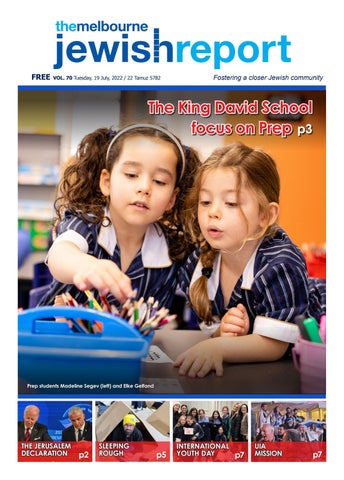
The King David School focus on Prep p3
Prep students Madeline Segev (left) and Elke Gelfand
THE JERUSALEM DECLARATION
p2
SLEEPING ROUGH
p5
INTERNATIONAL YOUTH DAY p7
UIA MISSION
p7
2
the melbourne jewish report | July 2022
AROUND
T H E
COMMUNITY
Who am I?
ANNE-MARIE ELIAS One of the common themes that regularly arises in therapy sessions has clients struggling with their identity. There are five key components to identity and each is equally important. 1/ Roles and titles. Take some time to consider what roles and titles you have. Some roles are that of family member, friend, colleague and/or teammate. You may have a professional responsibility, or fill a sporting role, or both. Titles refer to job descriptions and nicknames. Be careful not to invest all your time into one particular role, which could be work or personal related. When that role changes, we leave it or it leaves us, we may then be left feeling that we have nothing, no identity and no sense of self. 2/ Physical attributes. We inherit these attributes from our parents. You could say they are as a result of the luck of the gene pool. Sure, there are ways to change your appearance, but for most of us it is a question of developing an acceptance of how we look. If you struggle with body image, body dysmorphia or your appearance in general, then it is important to seek counselling. 3/ Personality type or structure. Again, you can start by thanking your parents. We undoubtedly “pick up” certain personality traits from our folks. I speak
of introversion/extraversion, relaxed/ anxious, submissive/aggressive, rule bound/rule breaker and leader/follower as but some examples. Psychologists use personality questionnaires to help people better understand themselves. This can also influence their employment choices. Whilst we cannot change our personality structure, we can change our behaviour. An introvert can become an accomplished public speaker. A rebel can learn to live comfortably in society and adhere to living within the law. This rule breaker may indulge their rebellious inner nature by following the road rules, but have a hobby or profession that satiates their “wilder” side e.g. racing car driver. It is vital for us to understand our personality traits, so we can make more informed decisions about how we live our lives.
4/ Strengths and limitations. Our strengths should make for a longer list than our limitations. Examples of both can be empathetic, kind, stubborn, creative, impatient, honest etc. Can some limitations be turned into strengths? “Yes”. One of my clients at first identified stubbornness as a limitation. Upon reflection though, he discovered that a part of being stubborn could be a strength when it was applied to something he truly believed in or was passionate about. 5/ Values and belief. These are the things that are important to you … that you believe in. They speak to your ethics and morals. Think of a value system as a jigsaw puzzle, in which all the interlocking pieces sit on a backing board. Don’t glue them down, as some values change over time. Our first value system is the one we adopt from our parents in childhood. As adolescents, we may start
to question this system. Some teenagers become rebellious at this stage of their lives. As adults we may also question and change some or, indeed all, of our value system. Sometimes this is called a midlife crisis, but that can happen at any time and may occur more than once. In fact, it is not a crisis at all, rather a reevaluation of our values and beliefs … what we hold to be true and valuable. These five components constitute the changing map that help forms our identity. Lyricists Benj Pasek and Justin Paul, who wrote the title song for the movie The Greatest Showman, gave “who am I?” voice, when they opined: “I’m not scared to be seen. I make no apologies. This is me.” Anne-Marie Elias is a psychologist in clinical practice for 25 years.
US and Israel sign strategic partnership joint declaration ARYEH SAVIR COURTESY: JWIRE.COM.AU US President Joe Biden and Prime Minister Yair Lapid met in Jerusalem earlier this month and adopted the historic Joint Declaration on the US-Israel Strategic Partnership, known as the Jerusalem Declaration. In the declaration, the US and Israel “reaffirm the unbreakable bonds between our two countries and the enduring commitment of the United States to Israel’s security.” The countries “further reaffirm that the strategic US-Israel partnership is based on a bedrock of shared values, shared interests, and true friendship.” Furthermore, the US and Israel “affirm that among the values the countries share is an unwavering commitment to democracy, the rule of law, and the calling of ‘Tikkun Olam,’ repairing the world.” The US reiterates its “steadfast commitment to preserve and strengthen Israel’s capability to deter its enemies and to defend itself by itself against any threat or combination of threats. The US further reiterates that these commitments are bipartisan and
President Joe Biden (left) and Israeli Prime Minister Yair Lapid sign the Jerusalem Declaration (photo: Koby Gideon/GPO) sacrosanct, and that they are not only moral commitments, but also strategic commitments that are vitally important to the national security of the United States itself.” The US “stresses that integral to this pledge is the commitment never to allow Iran to acquire a nuclear weapon, and that it is prepared to use all elements of its national power to ensure that outcome.”
“The United States is proud to stand with the Jewish and democratic State of Israel, and with its people, whose uncommon courage, resilience, and spirit of innovation are an inspiration to so many worldwide,” the declaration states. The declaration also touched on the Abraham accords, US military assistance to Israel, boycotts of Israel and antiSemitism, the diplomatic process with the
Palestinian Authority, and military and technological cooperation between the countries. “With this record of remarkable achievement and with a sense of the incredible promise that the unparalleled US-Israel relationship holds for the future, the United States and Israel warmly welcome entering the 75th year of this extraordinary partnership,” the document concludes.
3
the melbourne jewish report | July 2022
AROUND
T H E
COMMUNITY
Focus on Prep
THE KING DAVID SCHOOL Starting school can be challenging for young children and their families, as is the decision as to which school to enrol children for Prep. In recent years, The King David School has continued to see an increasing trend towards enrolments in the primary years (rather than the traditional intake in Year 7). The main influencing factor is the high academic standard and focus on numeracy and literacy at KDS. The School’s 2021 NAPLAN results show that 97% of Year 3 students are above the national standard for reading, writing, spelling, grammar and numeracy. Influenced by educational neuroscience, teachers use their understanding of brain development to inform their teaching. They use differentiated learning to help extend students when required and to provide support for those who need a boost. The attention King David gives to academic achievement is important in establishing strong foundations and learning behaviours. With a fun and meaningful Jewish life program, the School moves to the rhythm of the Jewish calendar. Balancing formal learning and experiential education,
Prep teacher Ashleigh Klooger and student Sophia Galak students develop a love for Jewish history and culture through songs, stories, role plays and hands-on learning activities in a non-prescriptive and non-judgmental environment. Prep students are paired with a Year 4 buddy to assist them to feel comfortable in their new environment.
KDS also offers a rich co-curricular program, including many lunchtime clubs and before-school sport training, as well as instrumental music lessons. King David’s commitment to environmental sustainability, respecting First Nations culture and tikkun olam (repairing the world) helps students foster respect and understanding of the world around them.
The warm and nurturing environment means that every student feels part of the school community and has many opportunities to shine. KDS is now enrolling for Prep 2023. Fee subsidies are available. For more information, please contact admissions on 9527-0102 or visit www. kds.vic.edu.au
– RARE –
ARGYLE PINK DIAMONDS
ARGYLE PINKS DIAMONDS as well as other COLOURED DIAMONDS are available at Ian Sharp Jewellery. Start your Pink journey with us today. There is nothing on earth quite like an Argyle Pink Diamond. The returns on pinks have outpaced the stock market and the Argyle mine has ceased production as of the end of 2020. With no more new supply, now is the time to get your rare Pink Diamond.
65 Toorak Rd, South Yarra, VIC 3141 P. 03 9866 4983 E: sales@iansharp.com.au www.iansharp.com.au
IanSharp_Advert_Feb21.indd 1
5/2/21 9:41 pm
4
the melbourne jewish report | July 2022
JUD AIC A
QUIZ
RABBI DAVID FREEDMAN With thousands of years of ‘material’ to draw from, it is no wonder The Central Synagogue’s Rabbi David Freedman has a plethora of options to choose from when it comes to selecting and crafting his well-known and much-loved monthly Judaica quiz! He warmly invites readers to explore Jewish traditions along with customs, prayers, festivals, entertainment, Australian cultural history and of course, bible knowledge too. From ancient times to modern and everything in between here it is below, fashioned for you to enjoy once again with family and friends. 1. Who is the current Prime Minister of Israel (as of July 2, 2022)? 2. Which cousin of Moses and Aaron, according to the Book of Numbers, rebelled against his cousins? 3. England recently beat Israel 3:1 in which international soccer final? 4. Lord Beaconsfield was born Jewish and became Prime Minister of England in 1868 – what was his original name?
Test your knowledge 5. Hebrew prayers written in the form of an acrostic known as Tashrak have what special feature? 6. Rabbi Joel Sirkis, born in Lublin in 1561, wrote a major work on Jewish Law called Bayit Chadash – by what name, relating to his composition, is he more commonly known? 7. Which famous director, writer, actor,
2017, it is the fourth largest city in Israel with a population of 254,384. 11. Which king of Israel succeeded King David? 12. Babi Yar is a ravine near which city? 13. In which year did the Palestine Post change its name to The Jerusalem Post?
Good luck. Enjoy. Hopefully, learn something new about your Jewish heritage and tradition. comedian, producer and composer was born Melvin Kaminsky on June 28, 1926? 8. Which synagogue in Jerusalem, with a seating capacity of 10,000, is credited with being the largest synagogue in the world? 9. Who owns Manchester United? 10. Which city in Israel matches this description: Founded in 1882 by Jewish immigrants from the Russian Empire, it was the second Jewish farm settlement established in Ottoman Palestine in the 19th century, after Petah Tikva. As of
CANDLE LIGHTING TIMES Friday, Jul 22, 2022
5:07 pm
Shabbat ends, Jul 23, 2022
6:07 pm
Friday, Jul 29, 2022
5:12 pm
Shabbat ends, Jul 30, 2022
6:12 pm
Friday, Aug 5, 2022
5:18 pm
Shabbat ends, Aug 6, 2022
6:18 pm
Friday, Aug 12, 2022
5:24 pm
Shabbat ends, Aug 13, 2022
6:23 pm
Friday, Aug 19, 2022
5:30 pm
Shabbat ends, Aug 20, 2022
6:28 pm
Friday, Aug 26, 2022
5:36 pm
Shabbat ends, Aug 27, 2022
6:34 pm
Friday, Sep 2, 2022
5:42 pm
Shabbat ends, Sep 3, 2022
6:39 pm
Friday, Sep 9, 2022
5:47 pm
Shabbat ends, Sep 10, 2022
6:45 pm
Friday, Sep 16, 2022
5:53 pm
Shabbat ends, Sep 17, 2022
6:51 pm
14. Founded in 1923 by East Prussian chemist Abraham Goldstein as the first independent kosher certification agency – by which two letters is it known today worldwide? 15. Mizmor Letoda (Psalm 100) is generally said on weekdays, however, on the eve of which two festivals is it not said? 16. According to Melachim II (2 Kings 12), who assassinated King Joash (Yehoash): a) his servants b) his wives or c) his sons?
17. Which Israeli Prime Minister is mentioned in the lyrics of a Pink Floyd song? 18. Which Chief Rabbi of Britain studied at Balliol College, Oxford, served as a Rabbi of Melbourne Hebrew Congregation in Australia from 1923 to 1937, and was the last British Chief Rabbi to be born in the 19th century? 19. In which decade was Glick’s founded in Melbourne? 20. Born in Budapest to parents Rabbi Mayer Sámuel Weisz and Cecília Steiner, Erik Weisz (1874-1926) became one of the most famous performers of all time. By what name is he better known? 21. According to the Talmud in Berachot 4b, which psalm do we need to say three times every day to be sure of life in the world to come? 22. Which of the following composers was Jewish: a) Franz Schubert b) Gustav Mahler c) Joseph Haydn? 23. During the 1967 Six Day War, which post was held by Mordechai (Motti) Hod? 24. The custom of ritual swaying during Jewish prayer is known by what Yiddish word? 25. What is a kamaya?
ANSWERS PAGE 10
Yoni Glatt’s JEWISH SPELLING BEE How many common words of five or more letters can you spell using the words letters inof the5hive? Every letters answer can How many common or more must use the centre letter at least once. Letters you spell using the letters in the hive? Everymay answer be reused in a word. At least one Jewish word will use all seven must use the center letter at least once. Letters may letters.
be reused in a word. At least one word will use all 7 Proper names and hyphenated words are not allowed. letters and have a direct Jewish connection. Score 1 point for each answer and 3 points for a Jewish term that uses all 7 letters.
Proper names and hyphenated words are not allowed. 6=Good; Excellent;and 12= 3 Genius Score 1 Rating: point for each9=answer, points for a Jewish related word that uses all 7 letters. Rating: 9=Good; 17= Excellent; 25= Genius
Yoni Glatt has published more than 1,000 crossword puzzles worldwide, from the LA Times and Boston Globe to The Jerusalem Post. He has also published two Jewish puzzle books: "Kosher Crosswords" and the sequel "More Kosher Crosswords and Word Games". ANSWERS PAGE 10
Here is a list of some common words (Yes, we know there are more words in the dictiona
5
the melbourne jewish report | July 2022
AROUND
T H E
COMMUNITY
Sleeping rough
RABBI YAAKOV GLASMAN AM Last month, for the first time, I participated in the annual Vinnie’s CEO sleepout. Each year business leaders from across the nation brace the cold and sleep rough to raise money and awareness around homelessness in the community. This was also the first year a Jewish faith community had participated in the sleepout. I was joined by St Kilda Shule’s Executive Director, David Marlow. It was a freezing cold night. We had no bed. No blanket. No heating. No pyjamas. No fridge. No microwave. No TV or laptop. No creature comforts. Just the clothes on our backs, a sleeping bag each and improvised pillows. I was deeply heartened by the support we received. We put out a call to our community for sponsorship and donations and exceeded our $10,000 target. The funds we raised will go a long way to help those most in need. But when lying down on the cold concrete that Thursday evening I knew that the night afterwards I'd be able to go back to my "normal", higher standard of living. I'd be sitting at the Shabbat table in a heated home with a fridge full of food, a hot meal and a comfortable bed. Sadly though, what I experienced
just once is experienced by thousands of fellow Victorians every day. For some it’s because they’ve run out of financial resources and have no one to turn to for help. For others it’s about fleeing domestic violence. For still others it’s because of severe mental health challenges, which leave them feeling vulnerable and alone, ashamed of seeking help and ending up on the streets. The causes are complex. The solutions are not straight forward. They require a combined effort between Government and community to properly address this most unedifying problem. But address it we absolutely must.
The main take away message for me was the importance of Tzedaka. Helping the poor has been a cornerstone of the Jewish religion since our inception. But there’s another lesson to be learned and that’s gratitude, or in Hebrew “Hakarat Hatov”, recognising that the simple things in life really are blessings. Never taking those blessings for granted ensures that we remain humble and grateful throughout our lives. Indeed, every morning many Jews recite the daily blessings in the Siddur (prayer book), expressing gratitude for the food we eat, the clothes we wear,
the roof over our heads and all our other basic human needs. We appreciate that we are not automatically entitled to anything in this world just by virtue of being born into it. So, when we are fortunate enough to live in a secure and loving environment, we must spare a thought for those who aren’t as fortunate. So, by all means, be grateful for what we have, but let’s strive to make this world a more equitable and kinder place to live, inspired by the teachings of the Torah and of humanity as a whole through Tzedaka, Chesed (kindness) and love.
Jewish numbers increasing RABBI GABI KALTMANN ARK CENTRE The newly released 2021 Census data provided a snapshot of Australia like no other. One of the key takeaways is that a growing number of Australians – nearly 40 per cent – no longer identify with a particular religion. That is the lowest number in Australian history. Contrast this with the data that showed 2021 was a bumper year for the Australian Jewish community. 99,956 said they were Jewish, the highest ever recorded and a jump of 9.8 per cent from the 2016 census. What does this mean? While I am not a demographer, rather an Orthodox rabbi deeply involved in multifaith and multicultural pursuits, I approach this question with anecdotal evidence to arrive at my conclusion. To me, it is clear our community is special. We have remarkable institutions – from synagogues and schools to welfare organisations and cultural hubs – that are the envy of the world. Mind you, this isn’t new. For centuries Jews have been investing in communal institutions. The Talmudic saying “kol yisrael aravim ze la ze” translates to “we are taught to look out for each other as family”. The Torah has many Mitzvot detailing the lengths we need to go to help and support each other. Since the Torah was given to us, Jews have been discussing and implementing the concept of caring for each other in tangible ways.
Rabbi Gabi Kaltmann
Australian Jews have been one of the most successful migration stories in Australian history, with very few barriers to success in “The Lucky Country”. Generations
have
been
able
to
assimilate into society, forge positive careers and prosper, while staying proud of their Jewishness. Jews have occupied almost all the highest positions in this country.
We are living at a time where around the world there is a torrent of rising antisemitism and safety concerns. Australia is certainly not immune from these threats, but is still largely better off. Through the dark days of COVID-19 lockdowns because our Jewish institutions were so well equipped they were well paced to provide that sense of kinship and community that was so desperately needed.
Demographers will spend months … even years unpacking the data, but I just know the core of our community is made of “the right stuff”. We are part of a wonderful network that will care for us, nourish us both spiritually and literally, and enrich our lives as a result. From cradle to coffin, there are organisations run by truly selfless people who are there to help. May that never change.
6
the melbourne jewish report | July 2022
CO NS I D E RE D
OPINION
What happened to the truth?
RABBI EFREM GOLDBERG COURTESY AISH.COM Destroying lives through false accusations, innuendo and distortions has never been easier. In his book Other People’s Money and How Bankers Use It, US Supreme Court Justice Louis Brandeis famously wrote: “Publicity is justly commended as a remedy for social and industrial diseases. Sunlight is said to be the best of disinfectants.” Shining a spotlight on an issue can expose and reveal corruption, dishonesty, fraud or abuse that otherwise might go unnoticed, ignored, or even excused. Brandeis wrote these words well before the internet was a thought in anyone’s mind and he likely could not have even dreamt of the sunlight it would shine and the accountability it would generate. The capacity for instant access to information also makes us better informed, allows us to think more critically and empowers us to ask crucial questions that make us safer, healthier and stronger. If you want to know more about your doctor’s education, read reviews of your landscaper, or see what your child’s teacher posts on Facebook. The endless information is now just a click away. Unfiltered sunlight can also be harmful, toxic, and cause cancer Brandeis was absolutely correct. Sunlight is indeed a great disinfectant. The internet has sanitised our world by holding people accountable for their behaviour, choices, actions, positions and writings. But what Brandeis didn’t mention is that unfiltered sunlight can also be harmful, toxic and cause cancer. There has never been a greater vehicle to disseminate gossip and slander than the internet. Lives have been literally destroyed because of false accusations, innuendo, distortions and untruths. Once upon a time thoughts, ideas and opinions were only printed if they had merit and were deemed worthy and carefully screened by a publisher. Journalists had to vet their stories and fact checkers confirmed all assertions before an article went to print.
While the system wasn’t perfect, the result was authors gained credibility and readership based on their education, expertise, experience and peer review. Today, anyone can publish his or her ideas and opinions and even his or her version of facts with no expertise or credentials and with no consequence or accountability. Readership and popularity are often a function of salaciousness and sensationalism, not truth and accuracy. Readers have an enormous burden to be vigilant and judicious before blindly accepting everything In his book The Death of Expertise: The Campaign Against Established Knowledge and Why it Matters, Thomas M. Nichols elucidates this concept. People are now exposed to more information than ever, provided both by technology and by increasing access to every level of education. These societal gains, however, have also helped fuel a surge in narcissistic and misguided intellectual egalitarianism that has crippled informed debates on any number of issues. Today, everyone knows everything: with only a quick trip through WebMD or Wikipedia, average citizens believe themselves to be on an equal intellectual footing with
doctors and diplomats. All voices, even the most ridiculous, demand to be taken with equal seriousness and any claim to the contrary is dismissed as undemocratic elitism. All of this places an enormous burden on us, the readers and consumers of information, to be vigilant and judicious before blindly accepting everything we come across in print, online, or in person. Especially in the information age, we must ask ourselves, who is the author or speaker of these words? What authority or credibility do they have? How does what they are saying match up with what I know about the person, place, or issue being discussed? Is there another side to this story? Do I have all the facts and information to draw a conclusion? The Torah instructs us to distance ourselves from falsehood. The Talmud says that God’s insignia is truth. To be Godly one must have ferocious loyalty and fidelity to the truth. Exaggerating, distorting and bending the truth distance us and alienate us from the Almighty. When it comes to lying, it isn’t enough to be committed to the truth and devoted to never lying, but one must distance themselves completely from lies and from liars. The burden of making sure that the internet functions as a disinfectant and not as a toxin is on the readers and consumers of its content. We must be judicious, careful, and extremely vigilant, not only in what we write, but in how we process and accept what we read. Is It your business? There is another danger of nonjudicious consumption of what is available on the internet. Even when what is being reported is true, is it our business? Dp we need to know? Will the knowledge help us or hurt others? The craving for salacious details and the appetite to know the story emanates from an unhealthy sense of inquisitiveness and our insatiable need to be in the know. This phenomenon expresses itself in many scenarios. When some hear about a couple getting divorced, their first response is “what happened?”, as if they are entitled to a report about
the most personal and private details of a couple and often children going through a difficult time. Many pay a shiva call and feel a need to ask, “How did he or she die?”. Certainly, the mourner is free to volunteer the cause of death, if they like, but is it really our business and do we truly need to know? When we ask, “why did he lose his job?” or “why did they break their engagement?” or “why is she still single?”, are we asking because we care about them, or is finding out somehow satisfying something in ourselves? Judaism places great value on people’s right to privacy For some, the “need to know” stems from a sense of “information is power”. Information is social currency and the more we know, the richer and more powerful we are. For others, the “need to know” stems from an inability to live with tension or mystery. And yet, for others, the “need to know” is similar to whatever draws us to slow down and look at the accident on the highway, even though it has nothing to do with us at all and only creates traffic for others. Judaism places great value on people’s right to privacy. Jewish law demands that we conduct ourselves with the presumption that all that we are told, even in pedestrian conversation, is to be held in confidence, unless it is explicitly articulated that we are free to repeat what we heard. We are forbidden to look into a neighbour’s property in a way that violates their privacy. We are instructed not to spread gossip, even if the information is absolutely true and entirely accurate. The Talmud (Bava Metzia 23b) goes so far as to tell us that we are permitted to distort the truth in circumstances that someone is prying for information that is none of their business and that they are not entitled to have. The internet can be a great resource and blessing in our lives, but the burden is on us to remain vigilant, not to assume everything we read is true, or to read even things that are true, just because they are available to us.
7
the melbourne jewish report | July 2022
AROUND
T H E
COMMUNITY
Embracing youth
DANIEL RABIN SENIOR RABBI CAULFIELD SHULE Next month, we celebrate International Youth Day. This year's theme is Intergenerational Solidarity: Creating a World for All Ages and, of course, we must leverage the potential of all generations. The subject is incredibly relevant to the direction shules, community organisations and the education system should be heading. In addition to youth-led initiatives, the theme highlights efforts to make education more relevant, equitable and inclusive for all youth. That includes leveraging the experience, wisdom and strengths of every age group. We should engage with our youth in a manner that mitigates three of the top ten issues that youngsters identify as their biggest concerns (Mission Australia Youth Survey 2021), namely mental health, body image and suicide. This cannot be addressed through tokenism. Years ago, I asked my shule board to encourage more youth to have a voice on the board. A few younger people did take up the offer. I know they hoped to make a difference, but – unfortunately – they were largely voiceless. Older members did not allow their opinions to be given “airtime” (I don't believe that was intentional, however it reflected a fixed mentality). Among the youth members, I could sense frustration building. As soon as they felt their voices were not being heard, they left the board, disillusioned and disappointed. Instead of looking at themselves and finding ways to mentor and share their experience, the stalwarts had erected a metaphorical wall. Having the power of all ages would have made a significant difference.
Batmitzvah teacher Gaby Steinberg (left back) and her Caulfield Shule students enjoying a session with Wizo Victoria, along with Rebbetzin Sarah Rabin (second to the right) and Wizo’s Ruth Kurc Growing up, perhaps many of us heard the expression "children should be seen and not heard". There are still some people who subscribe to this antiquated adage and its misguided attitude towards younger members of our society. This type of thinking and philosophy paved the way for appalling instances of child sexual abuse, which have now been exposed by survivors. One of the Victorian government’s child safe standards requires organisations to develop strategies that empower and involve children. It's not just about giving them a voice. You may not realise how wise our youth are and
how simply, authoritatively and eloquently they can express their views. Rabbi Chanina said: “I have learned much from my teachers, more from my colleagues and the most from my students” (Ta’anis 7a). Taking into account the voices of our young people will, no doubt, help us to set and achieve appropriate goals. Inclusion is equally important. It is not enough to make motherhood statements about inclusivity. There are way too many of these being espoused. Even if you preach all day about being inclusive and welcoming, without demonstrable actions showing youth that they truly belong in the community, they
won't feel included. I recall some years ago we witnessed the tragic reality of a young Jewish man taking his own life because he didn't feel he belonged. Every community leader (and perhaps every member) should have been shocked by this news. The fact that he wasn't the only one was even more devastating. We hear more and more about these types of incidents. Shules, schools and community groups should make our youngsters (and anyone else for that matter) feel welcome, secure and comfortable. While community leaders should lead by example, it is the entire community's responsibility to ensure this actually happens. A young person's life can be profoundly affected by harsh judgment, snide remarks and hurtful comments, from wherever these may come. Tractate Shabbat in the Talmud lists different questions we will be asked when we reach the Heavenly tribunal one day. A more contemporary version queries what we did to inspire and mentor the next generation. Did we meet their needs, or did we ignore them? Did we just look at what was good for ourselves, or did we try to benefit and help the next generation? Did we truly listen to the voices of our youth and respond to their messages? Did their voices seem insignificant or unimportant? Did we share our voice in a way that provided guidance and experience or was it simply a voice of judgment and instruction? Let's make sure we can answer these questions affirmatively. Make a real difference by doing whatever you can, for we can all do something. There is no such thing as a small deed. You never know, you might just play a helping hand in saving someone's life. We need to hear all voices – young, old and everyone in between – because only together can we make a real and lasting difference.
A once in a lifetime opportunity UIA With overseas travel back on the agenda, why not visit Israel with UIA? On our upcoming October mission and 2023 Yom Ha’atzmaut mission, you will experience Israel like never before – from its culture, history and security to its innovation, creativity and cuisine. Most importantly, you will see UIA’s lifesaving work firsthand. Here is a glimpse of what is in store: FEEL ISRAEL Enjoy the incredible food and energy of Israeli culture. The Yom Ha’atzmaut mission will provide the opportunity to commemorate Yom HaZikaron and celebrate Yom Ha’atzmaut in the Holy Land, which will be extra special on Israel’s 75th anniversary of independence. EXPLORE ISRAEL Enjoy first class accommodation and gain access to restricted areas, borders and military bases, as well as iconic Israeli sites. Examples include the Tel Nof Airforce Base, IDF tank base on the Golan Heights, Seam Line, Kotel Tunnels, Druze villages, Peres Centre for Israeli Innovation and the borders with Gaza, Syria and Lebanon. HEAR ISRAEL Hear from beneficiaries at UIA’s projects and see first-hand how powerful your impact is on the People of Israel. Some of the projects visited may include an Absorption Centre, Youth Futures, Net@ and Youth Village.
UNDERSTAND ISRAEL Meet high calibre analysts, politicians and military leaders who have shaped Israel from the fields of politics, security, culture and business. Past speakers have included Gil Hoffman – Chief Political correspondent at The Jerusalem Post, Avi Melamed – Middle East Geopolitical Intelligence Analyst and Gadi Ezra – director of Public Diplomacy in the Prime Minister’s office. Yom Ha’atzmaut 2022 mission participant Evie Gareb said: “[The mission] has given us such a wellrounded and new knowledge of how Israel has been able to win wars, protect its borders, absorb its immigrants and generally make Israel the most exciting, innovative and beautiful country it has become today. I strongly suggest you go on a UIA mission to get to know and experience Israel in a way you wouldn’t if you came on your own.” Bookings are now open for UIA’s October mission (25th October – 3rd November 2022) and Yom Ha’atzmaut mission (25th April – 4th May 2023). “UIA missions are unlike any other mission you may have participated in. They are innovative, engaging and offer unique access to people and places that are unparalleled. If you have the opportunity, make sure you sign up today as places are limited,” UIA Australia CEO Yair Miller OAM said. For more information about UIA’s missions, visit uiaaustralia.org.au, contact Minette in the UIA office on 9272-5533 or email info@uiavic.org.
For the People of Israel
8 AROUND
the melbourne jewish report | July 2022
T H E
COMMUNITY
“I’m not Jewish – I just feel like you” Eva is not the only non-Jewish employee at the synagogue. Jim Moustos is another who has been a longtime presence at Mizrachi Melbourne, working as a caretaker since 2009. He had a previous stint at Leibler Yavneh College as a “maintenance guy” from 1999 to 2004.
NOMI KALTMANN COURTESY: PLUS 21J MEDIA Nomi Kaltmann meets two Melbourne synagogue caretakers, aka “Shabbos goys”, who share the pleasure in their jobs and some strange discoveries. A Shabbos goy is the colloquial Yiddish term that refers to a non-Jewish person who is employed to perform work that is forbidden for Orthodox Jews on Shabbat. Most synagogues employ non-Jews to perform this specific work on Shabbat. It can be hard to find the right person to fill these roles, which requires a comprehensive understanding of Jewish culture and practices. But in Melbourne, there is a small group of employees who have stayed in their roles for decades. Eva Sarkissian has been working for the Mizrachi organisation for more than 20 years. Eva has been officially contracted to work as a cleaner and maintenance officer at the synagogue and associated school, Leibler Yavneh College, since 1998. However, her day job is immaterial to her legion of young fans. On any given Saturday morning, Eva is known as a distributor of treats and lollies. She doesn’t mind performing Shabbat duties for the synagogue, where she has been working for decades.
Despite growing up in Albert Park, just a few kilometres from the heart of Melbourne’s Jewish community in Caulfield, Jim says he had never knowingly met a Jewish person before he started working at Yavneh and Mizrachi. “My parents came to Australia from Greece in 1962,” he says. “My mum came here to find work and my dad came here to marry my mum.” Jim Moustos “I don’t know how to explain it. I like Jewish people, of course, and I always do my job properly, but I especially like every Saturday, when I get to be like a grandmother to little children,” she says. Born in Greece, Eva moved to Australia in 1974, when she was 25 years old. “After all this time, it’s like family for me, you know,” she says with a smile. Sometimes people say to me: “Eva you are Jewish, but I say ‘no, I’m not Jewish – I just feel like you’.”
He remembers meeting Sammy, the former non-Jewish caretaker at Mizrachi who had worked at Mizrachi for decades before Jim arrived. “After Sammy suffered a stroke, his son didn’t want to take over the business or contract at Mizrachi and that’s when Eva came and told me to come and help,” he recalls. After starting on a two-week shortterm contract, Jim decided to stay for good and 2022 marks his 13th year at the synagogue and almost 20 years of service, when including his time at the school.
He knows about the concept of a “Shabbos Goy” and says it doesn’t bother him at all. “I doubt they had air conditioning in the desert when they were following Moses, but I am always happy to help,” he quips. Working around Jewish people for so long has some added benefits, including the basic command of Hebrew words and what Jim deems “luck” from his close association with rabbis, including his favourite, former Mizrachi rabbi Ya’akov Sprung. “Every Friday I would go and shake his hand for luck and believe me, it works,” Jim says. “On Friday night I would go motorbike riding and shoot competitions and I would have the biggest stack … and I would come back alive on Monday. The rabbi told me he would pray for me. Also, after shaking his hand, I often won money at events.” Rabbi Sprung’s fondness for Jim endures to this day. “Jim was and, no doubt, continues to be a truly exceptional person, a gentleman of character, respect, work ethic and loyalty,” Rabbi Sprung says. “I genuinely enjoyed talking to him and often told my wife that if I was to be dropped in the jungle with one person of my choice, I would choose Jim for his brilliant ingenuity and friendship.”
J-AIR 88FM needs your membership so it can continue to provide great Jewish community radio programming. It is only $54 per year to become a member. Sign up is via the website. J-AIR is committed to diversity and inclusiveness for the Jewish and broader communities. www.j-air.com.au
the melbourne jewish report | July 2022
CO NS I D E RE D
OPINION
DANIELLA GUTERMAN COURTESY AISH.COM It’s easy to judge other parents. Perched on the park bench, our minds race with disapproving thoughts as that mum “permits” her child to tantrum or that father “lets” his son block the slide. I would never allow my children to behave that way, we tell ourselves. I caught myself doing this when I was out with my husband at an ice cream store, 11 pm, as a mother brought her toddler in to eat. Once I realised what my mind was doing, I made an active effort to suppress it. Perhaps someone in the family was ill and after a long day the child was being comforted, before finally going home. Maybe they were headed to the nearby airport for a late flight and needed something to eat. The possibilities were endless and it only took minimal effort to favorably reframe the narrative. Parenting is incredibly difficult. Why not try to build each other up, rather than tear each other down? I think back to a time when I felt supported, without judgment, by a fellow parent. As I was carrying his younger sibling in a heavy car seat, our then pre-schooler decided it was prime time to throw himself on the parking lot floor. We were parked down the block
9
Why parents enjoy mercilessly judging other parents and I was about to collapse under the weight of the car seat and the stress of my protesting child. A babysitter passed by with an eye roll, leaving me embarrassed. Just then, a friend drove by and offered to take our little activist to our car so that I could use both hands to schlep the car seat. My friend did not mock me, nor did she indicate that I was inept for needing her help. She allowed me to hang onto the last vestiges of my dignity. If supporting one another is such an incredible gift, why do parents judge one another instead?
We tend to look at ourselves through a magnifying glass. Remember how embarrassed we were to leave the house when, as teenagers, we had a tiny pimple? We were convinced it’s all that anyone would look at. Look at that enormous zit engulfing your face. You poor thing. In some ways, we aren’t so different from our teenage versions. We fear that everyone notices each of our parenting mistakes. Furthermore, we view our children as reflections of who we are, so when a child misbehaves, we feel like failures. It’s a lot easier to project our sense of incompetency onto others.
Projecting incompetency On a simple level, it’s hard to accept that people make alternative parenting choices. But the answer may run a bit deeper, relating to the psychological phenomenon of displacement (introduced by Sigmund and Anna Freud). To distract ourselves from our insecurities, we turn our attention to others. Misery likes company. If I can find fault in another’s parenting styles and choices, perhaps I don’t need to judge myself so harshly?
How to decrease the need to judge How can we foster an environment where we don’t feel the need to judge? Firstly, let’s try to give other parents the benefit of the doubt, just as I readjusted my response to the woman feeding her daughter ice cream late at night. Going further, let’s normalise parenting follies by allowing ourselves to be vulnerable and to vent our parenting frustrations. Rather than post pictureperfect experiences on social media, we can share our battles. Consider displaying an endearingly dysfunctional
family picture rather than that glorious garden photo that required a lot of bribery to achieve that shot. Let’s diffuse this need for parenting perfection and learn to laugh about our mistakes together. Rather than kicking ourselves for serving our children chicken nuggets for dinner again, we can joke with other parents about the nutritional merits of such food. When someone else’s child stands on a restaurant chair and gives an unwanted musical performance, we can replace that dirty look with a smile. We have the power to wordlessly tell the embarrassed parent, “I’ve been there. I get it.” With a sense of humour, we can show that we validate one another and break the cycle of judgment. There’s no shame in making mistakes, nor in choosing an easier option. And when we see our children engaging in questionable behaviours, rather than viewing it as a poor reflection of ourselves, let’s openly discuss it with other parents. Being more open and laughing about our mistakes will lighten the load. Our need to critique other parents to make ourselves feel better will shrink. And we’ll spend less time judging and more time offering our support to others.
10
the melbourne jewish report | July 2022
AROUND
T H E
COMMUNITY ST KILDA SHULE St Kilda shule has organised a special reunion event for mid-August. It aims to bring together participants of three St Kilda shule youth programs – scouts, guides and Hebrew school – that helped to shape the congregation in its early days. The shule’s Hebrew School was established in 1873, only two years after the congregation’s formation. After educating thousands of young students, it ceased operating in the 1980s. Melbourne’s first Jewish scout group, 3rd St Kilda, was formed in 1924 and later renamed 3rd St Kilda “Danglow’s
Judaica quiz answers 1. Yair Lapid 2. Korach 3. Euro Under-19 Championship 4. Benjamin D’Israeli 5. Tashrak stands for the final four letters of the Hebrew alphabet in reverse order – Tav, Shin, Resh and Kuf. A prayer written in this style has words beginning with the letters of the Hebrew alphabet in reverse order such as the prayer found in Shabbat Musaf (Additional Service) that begins Tikkanta Shabbat etc
A blast from the past Own”, after its founder and the shule’s spiritual leader Rabbi Jacob Danglow. It continued operating until 2017. Rabbi Danglow also founded the 4th St Kilda Girl Guides in 1930, which disbanded in 2010. Many scouts and guides were also students at the Hebrew School and the event promises to be full of fond and fun memories. The renunion will take place at St Kilda shule between 3pm and 4.30pm on Sunday, 14th August. Bookings are essential. Go to https://www. trybooking.com/BZSBO For enquiries, stkildashule.org
exec@
6. He is generally known as the Bach – after the initial letters of his major work 7. Mel Brooks 8. Belz Great Synagogue, Jerusalem 9. The Glazer Family 10. Rishon Letziyon 11. His son, Solomon 12. Kyiv, Ukraine 13. 1950 14. OU 15. Pesach and Yom Kippur 16. a) He was assassinated by his servants 17. Menachem Begin is mentioned in a
The scouts in 1957, when Rabbi Danglow was patron of 3rd St Kilda song from their 1982 album "The Final Cut" 18. Sir Israel Brodie 19. Glick’s was founded in the late 1960s by Mr Mendel Glick OBM, in a small retail shop on Kooyong Road, Caulfield 20. Harry Houdini 21. Psalm 145 otherwise known as Ashrei 22. b) Gustav Mahler 23. Head of the Israeli Air Force 24. Shokkeling (cf the German "schaukeln", to swing) 25. A kamaya is an amulet containing a special Kabbalistic formula for protection and salvation
Spelling bee answers Jewish term – GADOL HADOR. Here is a list of some common words (yes, we know there are more words in the dictionary that can work, but these words are common to today’s vernacular): ALOHA, AGGADAH, GADOL, GODHOOD,
HAGGADAH,
HAGGARD,
HALAL, HADOR, HOARD, HOODOO, ORLAH, ROADHOG Questions/comments
–
koshercroswords@gmail.com
Yoni
at
11
the melbourne jewish report | July 2022
THE AT R E
REVIEWS
Men behaving badly
9 TO 5: THE MUSICAL BY ALEX FIRST 9 to 5: The Musical, at State Theatre, Arts Centre Melbourne, as reviewed by Alex First 9 to 5 The Musical is energetic, sassy and colourful. What isn’t lost in this bright and breezy production though is the underlying point of it all. To see it played out makes one wince, just as it should. Franklin Hart Jnr (Eddie Perfect) is the misogynistic and pompous CEO of Consolidated Industries. He rides rough shod over everyone and treats women shamefully, belittling and sexualising them. Among his employees is 15-year veteran senior office supervisor Violet Newstead (Marina Prior), who is bringing up a teenage son on her own after her husband passed away nearly three years ago. She is also being pursued by a wellmeaning, younger junior accountant, Joe (Ethan Jones). Doralee Rhodes (Erin Clare) is a happily married country girl. She is targeted by the would-be philandering Hart for her looks and as a result is ostracised by the other female workers who believe the pair is having an affair. Judy Bernley (Casey Donovan) is newly separated, after her husband, Dick (Joshua Mulheran), left her for his 19-year-old secretary. Bernley has never worked before and cries a lot when things go wrong. And then there is Roz Keith (Caroline O’Connor), Hart’s memo-obsessed administrative assistant and “spy”, who lusts after her boss. Violet, Judy and Doralee to get their own back on the boss, with brings with it many laughs.
Photo: David Hooley The musical is based upon the 1980 movie and its continued relevance is unquestionable. In fact, it is a stirring reminder of what men have been able to get away with for far too long. The vocal audience reaction to the pithy one liners speaks volumes. With music and lyrics by Dolly Parton and a book by Patricia Resnick, 9 to 5 is a hoot. At times it is positively rib tickling. Some of the scenes are priceless. The characters are delightful and the strong cast really nail their performances. The show is slick and seamless. Vocally, the leads excel. Marina Prior commands attention as the walked over supervisor, who has had enough. Casey Donovan is adept at transitioning the naive recruit.
Erin Clare shows the blonde bombshell has smarts. Eddie Perfect revels as the sleazy, selfobsessed CEO. Caroline O’Connor is a scene stealer and don’t we just love her for it? She is jaw dropping brilliant. Top and tailing the musical is Dolly Parton, who played Doralee Rhodes in the film and sang the hit song, which is also a mainstay of this production. She appears on a circular video screen, being a watch face, the centrepiece of an imposing gold and glitter sign that reads “9 to 5”. Without missing a beat, she introduces the main characters and gives us their back stories. She is such a natural and effervescent talent.
The staging is superb. Using a large video screen as a backdrop, the stage is framed by dozens of simple faux televisions that regularly change solid colour. Props, which transport us to the various business and home settings, are wheeled in and out in seconds, as the piece unfolds at a decent clip. Directed
by
Jeff
Calhoun,
with
choreographer from Lisa Stevens, 9 to 5 is a triumphant, light-hearted musical that is heaps of fun, but still manages to convey an important message. 9 to 5: The Musical is playing at the State Theatre, Arts Centre Melbourne until 18th September, 2022.
Off with her head SIX BY ALEX FIRST Six, at the Comedy Theatre, as reviewed by Alex First A contemporary interpretation of the dastardly deeds of King Henry VIII, Six rocks. Its pop vibe is a sure-fire winner. The six wives of the Tudor sovereign are presented as modern-day heroines, complete with costumes and “moves” that would be at home in a superhero movie. They have all been wronged (two were beheaded, two divorced, one died and the other survived), but who deserves to be labelled the most aggrieved? That becomes the $64,000 question as they face off against each another competition style. They dance, prance and pout, deliver their back stories and diss each other. Irreverent and, at times, ribald, they play up to the raucous audience that laps up every delicious moment of tomfoolery. The subject may be heavy, but its treatment is strictly lightweight and decidedly amusing. The six principals have excellent stage craft and mean sets of pipes. Can these
Photo: James D. Morgan – Getty Images girls sing! They are also sassy. Each is attributed musical icons as “Queenspiration”. Married to Henry for 24 years, Catherine of Aragon (Phonex Jackson Mendosa) pays a nod to Beyonce and Shakira. Fluent in French, Anne Boleyn (Kala Gare) channels Lily Allen and Avril Lavigne. Jane Seymour (Loren Hunter), who claims she was the only wife Henry really
loved, gives Adele and Sia a run for their money. German-born Anna of Cleves (Kiana Daniele) doffs her cap to Nicki Minaj and Rihanna. Its Ariane Grande and Britney Spears for Katherine Howard (Chelsea Dawson), who lost her head for her promiscuity. Catherine Parr (usually performed by Vidya Makan, but on opening night by Shannen Alyce Quan) was the only
“survivor”. She draws inspiration from Alicia Keys and Emeli Sande. The up-tempo numbers (there are also a couple of soulful tunes) really hit the spot for me. The performers have ample opportunity to shine individually and that they most certainly do. They also harmonise magnificently with the unbridled support of a top notch four-piece band – the Ladies in Waiting. With book, lyrics and music by Toby Marlow and Lucy Moss, Six began as a student production in a 100-seat venue during 2017 and went on to claim two Tony Awards. Most recently, watched by a UK television audience of 13 million, the London cast performed live in front of the Royal Family. They were part of the Queen’s televised “Party at the Palace” celebrations to honour her Platinum Jubilee. Six is energetic, cheeky and cheery – a kick-butt, pop musical. Girl power lives. Rock on. Seventy five minutes without interval, it is playing at the Comedy Theatre until 21st August, 2022.