community
international
parenting
shuls/schools
lifestyle
sports
www.thesleepcoach.com.au
FREE
Fostering a closer Jewish community
VOL. 47 Friday, 5 July 2019 / 2 Tamuz, 5779
Free subscription to electronic copy go to www.thejewishreport.com.au
JEWISH CARE DONATION
PAGE 3
ACCESS INC POP UP
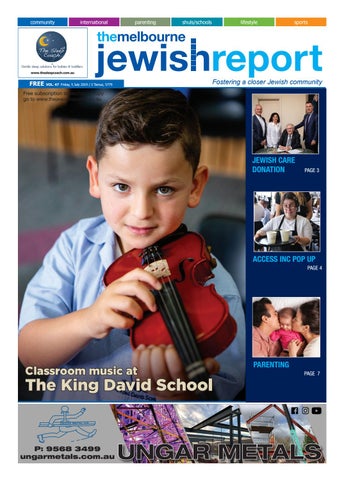
Classroom music at
The King David School
P: 9568 3499 ungarmetals.com.au
PAGE 4
PARENTING
PAGE 7
UNGAR METALS
2
community
July2019
Parliamentary Cocktails ZIONISM VICTORIA On 19 June 2019 Zionism Victoria and the Jewish Community Council of Victoria joined with the State Government of Victoria to host a cocktail party in honour of Israel’s 71st Independence Day. One of our most important events on the Jewish community calendar this event brings together leaders of the Victorian community with the Victorian Jewish community leaders and our state politicians at an event that affirms the importance of the strong bipartisan support of our Government and Opposition for the State of Israel. Zionism Victoria and the Jewish Community Council of Victoria are delighted that, as part of the evening, the State Government has announced that it will renew its financial support of this function for a further three years with a $30,000 funding grant. The Melbourne Jewish and Zionist communities are privileged to enjoy a strong, positive relationship with the State Government of Victoria, and we have no doubt that this mutually beneficial relationship will continue into the future. We greatly appreciate the assistance and understanding extended to our community by the Government which allows the vibrancy of multiculturalism to flourish. The Government’s generosity and support in hosting this event consistently over the past three years, and its announcement of continued support for the next three years, is very much appreciated by our organisations and by the Jewish community.
Local Charity’s work recognised in Queen’s Birthday Honours COURAGE TO CARE The work of Caulfield based charity B’nai B’rith Courage to Care (Vic) Inc. has been recognised in this year’s Queen’s Birthday honours with four of their volunteers receiving awards. Courage to Care aims to inform and educate about the dangers of prejudice, racism and discrimination by educating Victorians, in particular students, towards an understanding of the roles of the victim, perpetrator, and bystander by exposing them to the stories of survivors of the Holocaust and other genocides, and their rescuers. “I’m thrilled to have the contribution of our wonderful volunteers recognised in this way. The need for tolerance and understanding is needed more than ever in our society and our volunteers love going to schools and sharing with the students. In fact, this week we have a team of volunteers in Shepparton and we will have over one thousand students from the surrounding schools visit our exhibition. In total over seven thousand students will hear these positive messages this year” said
CEO Mike Zervos. Clockwise from top left: Les Kausman OAM: For service to sport and the community. Les serves as Courage to Care Vice Chair, workshop team leader and facilitator, and is a pivotal member in all the strategic and committee work. Prof. Gilah Leder AM: For significant service to higher education, and to the Jewish community of Victoria. Gilah continues to contribute to Courage to Care speaking to students in the workshop program. George Deutsch OAM: For service to the community in several roles. A longtime supporter of Courage to Care, George continues as a presenter in the workshop program. Eva Rathner OAM: For service to the Jewish community. Eva has contributed to nearly every Courage to Care activity and continues to serve in the workshop program and with myriad supportive tasks. For further enquiries please contact CEO Mike Zervos at ceo@couragetocare.org.au or 0412 319 156
July2019
3
community
Holckner Family Donates $5 Million to Jewish Care JEWISH CARE VICTORIA Jewish Care Victoria is thrilled to announce that it has received a $5 million donation from Charles Holckner OAM and his family as part of the organisation’s Growing. For our Community. Capital Campaign. In recognition of the Holckner family’s exceptional generosity, the site on St Kilda Road bordered by Punt Road, Raleigh Street and Union Street will be named The Holckner Family Senior Living & Community Precinct. It is envisioned that, once completed, the Precinct will become a leading aged care and community services hub for the Victorian Jewish community. The Holckner Family Senior Living & Community Precinct will be developed in two stages. Stage 1, the $90 million Hannah & Daryl Cohen Family Building, is due for completion in early 2020. The leading-edge residential aged care home is the largest of the Capital Campaign projects, and will comprise seven levels of residential aged care and two levels of community services. Development of Stage 2 of the Precinct is currently in the planning stages, with extensive research undertaken by Jewish Care to determine an optimal mix of aged care and essential services to support the community into the future. Charles Holckner was awarded an OAM in 2017 in recognition of his philanthropy and community support. He and his family have been long standing supporters of Jewish Care. When asked about his family’s motivation to give such a significant gift to Jewish Care, Charles explained that his family’s story is like so many others. “My
Charles Holckner OAM (seated), with (L-R) Jewish Care Board Member Jeffrey Appel OAM, Co-Vice President Susie Ivany OAM, and CEO Bill Appleby family arrived on these shores with nothing. Our success is due to many factors. But now that we have the means, I hope this gift will serve as a benchmark for future generations to follow.” The extraordinary gift is believed to be the equal-largest donation in the history of the Victorian Jewish community, equalled only by that gifted to Jewish Care’s Capital Campaign by the family of Hannah and the
late Daryl Cohen in 2016. Jewish Care CEO Bill Appleby thanked the Holckner family for their incredible gift, saying “We are honoured that the Holckner family have chosen to give such a generous donation to Jewish Care. Their support is indicative of the enormous confidence and genuine excitement of our community in the transformational work we are undertaking.”
To date, the incredible generosity of the Victorian Jewish community has helped to raise $29.6 million towards the historic suite of six projects. For more information about The Holckner Family Senior Living & Community Precinct or the Growing. For our Community. Capital Campaign, please contact Orlee Schneeweiss on oscheeweiss@jewishcare. org.au or 8517 5647.
4
community
July2019
Access Inc New Weekly Pop Up Café At Luigi’s ACCESS INC
Access Inc is proud and excited to announce the launch of our new WEEKLY Pop Up Café at Luigi’s! As some may know, Access has traditionally run a once a year Pop Up Café. This year, thanks to our partners, we have the opportunity to expand this to a weekly Wednesday lunch service. Another big change for our new Café is that it will be run out of an established restaurant – Luigi’s Restaurant & Pizzeria. Luigi and his partner Irene have been so selfless and enthusiastic in their support of our new Café. “Luigi’s is proud to partner with Access Inc on this project and we hope to inspire others in our community to celebrate ability and support employment opportunities for people with disabilities” states Luigi Matos, owner of Luigi’s Restaurant. The Café provides the work experience component for some of the Access Inc Hospitality Programs. All food is prepared by the Access Introduction to Commercial Cooking students, the coffees are made by students of the Access Barista Training Program and the Café is run by the Access Front of House students. “The Pop Up Café provides a unique opportunity for the participants to run a café and in doing so showcase, particularly to the wider community, their abilities, in the hope that they can obtain a job” says Nitza Marom, Hospitality Program Manager. Excited participants working in the Café are thrilled for the opportunity to practice their new skills and gain confidence and experience.
“I like dealing with customers and trying new things so I can get a job, maybe in a cafe” says Meir,a participant. For Jodi Block, Access Inc’s Participant and Life Learning Coordinator, “the Cafe has naturally created a more sustainable way to enhance participants’ hospitality skills and hopefully open doors to job-related opportunities in the community.” The official launch of the Café was attended by the project sponsors and partners, representatives of the Jewish Disability Network and families of the participants involved in running the Café. At the launch, Access Inc CEO Sharon Malecki thanked the project partners for investing in an employment pathway for people with disabilities. She mentioned that this Café “is more than a great new Kosher vegetarian dining experience, it also has the potential to change people’s lives. We hope that when members of the community, including local employers see participants in action, they will get a better understanding of the value of diversity in our community and in our workplaces. Most of all, we hope this Café will provide an opportunity for participants to recognise their potential and become their own strongest advocates.” The success of the Café will be reliant on the support of the community and we invite everyone to join us in celebrating this significant new initiative. Mayor of the City of Glen Eira Cr Jamie Hyams is encouraging everyone to visit the Café saying “it’s a great way to support a great cause and help some enthusiastic young and very capable people with
BB Vic Menorah Awards 2019 recognising volunteers
B’NAI B’RITH VICTORIA
Four noteworthy achievers in the Victorian Jewish community have been recognised for their exceptional work in the latest annual B’nai B’rith Menorah Awards. The honours, now in their 41st year, pay tribute to volunteers who work quietly behind the scenes making significant contributions to the community. Greg Blashki was recognised for his contribution to the financial management of various Jewish organisations for over 20 years, most recently in his capacity as Treasurer of Caulfield Shule where he streamlined processes for their data management that assisted the Shule’s communication and tailored programs. John Hillel received his award for his involvement in a number of different voluntary roles, including many years at TBI on the Board, as Shammas, directing Purim spiels and in their Social Justice Group, as well as volunteering at the Brotherhood of St Laurence Op Shop, and establishing and coordinating the St Kilda Repair Café. Barbara Lewis has been involved in voluntary work since the late 1960s when she was a cub leader for over a decade. Since 1970, she has worked behind the scenes at Etz Chayim
Progressive Synagogue, helping with the running of services and editing the weekly newsletter. She has also served on the committee of B’nai B’rith Unit Akiba for a number of years, and helps with the Showcase (formerly Eisteddfod) committee and doing data entry for the Impact for Women packing days. Lindy Spicer has contributed to many charities and organisations despite dealing with her own health issues over the last 20 years. She volunteers as an ambassador for the Ovarian Cancer Research Organisation, and uses her culinary skills to prepare meals for C Care, Fareshare Food Charity and Our Village Kitchen. She is also active in fundraising for UIA, Cancer Council Victoria and Second Bite. The 2019 awardees join some 160 who have been recognised by B’nai B’rith Victoria over the years. The keynote address was given by The Hon. Prof. Howard Nathan AM QC, who gave a lively historical overview of the influence of members of the major religious groups in Australia since the arrival of the First Fleet. BBVic invites nominations for next year’s awards from all members of the community. Nomination forms can be downloaded from tiny. cc/menorahawards or picked up from the BBVic.
John Hillel, Lindy Spicer, Evelyn Flitman, Barbara Lewis & Greg Blashki
Photo Credit: DC Photography disabilities on their path to employment.” The Pop Up Café is open for lunch every Wednesday 11am-2pm (except on Jewish and Public Holidays) at Luigi’s Restaurant (326 Hawthorn Rd, Caulfield South,) serving weekly salad and hot dish specials, sandwiches, brownies and hot drinks. It is thanks to the Port Philip Community Group and their offer to partner with us in a Victorian Government Learn Local grant
that we could even dream of a weekly Café. We could also not have made this happen without the dedication of our volunteers and the additional sponsorship and support of the City of Glen Eira, Gandel Philanthropy, Charidy and of course Luigi’s Restaurant. For more information or to make a booking, contact the Access office on 9272 5603 or admin@accessinc.org.au
Legacy of Entebbe H.APPLEBAUM It was June, 27, 1976, forty three years ago. The Palestine Liberation Organization (PLO) and radical left-wing Germans hijacked an Air France, Tel Aviv/Paris flight. At a stopover in Athens, four terrorists joined those already on board. The hijackers refueled in Libya and landed at Entebbe airport in Uganda. There, the syphilitic president, Idi Amin, surrounded by soldiers carrying machine guns, welcomed the passengers. Under delusions of glory, he offered his country’s resources to the hijackers. The PLO wanted Israel to negotiate for the hostages by releasing imprisoned Palestinian terrorists who had already murdered scores of Israelis. The first thing the hijackers did was collect the passenger’s identifying papers. Half the passengers were Jewish, most of them Israelis. Once they were herded into the large shed-like terminal, the passengers were separated. It was frighteningly like the concentration camp ‘selektions.’ NonJewish passengers were freed, but the 102 Jewish men, women, and children, were imprisoned in the terminal. I was visiting my grandmother in New York at the time. Grandma survived a pogrom, and had seen her husband shot during the robbery of his little store. We sat at the kitchen table and the newspaper headline stared at us. No country, no international force, was going to save the hostages. How could that be? Surely America, which stands for freedom, will send its’ forces, I thought. Or perhaps it will be France? “The world doesn’t care when a Jew is murdered,” Grandma said sorrowfully. I
didn’t agree with her. The world couldn’t be such a cruel place. I was innocent, naïve, and ignorant. My family, like many other Jewish families of the time, shielded children from the atrocities committed on Jews throughout history. My grandmother was right, though. No one cared, no country, organization or international force did a thing. A week went by and the Jews waited. They sang “Am Yisroel Chai,” and prepared themselves for death. They shielded the children, some as young as six. Who were the men who held little children at gunpoint, who threatened to kill them if their demands were not met? When they freed the non-Jewish hostages, they could have let the children go, but these men were not human beings. They were beasts, the same kind of beasts who murdered one and a half million Jewish children during the Holocaust. My grandma was right, but she grew up in a world before the state of Israel. She only knew of Jews as victims. Now there was a new player on the field. Our national pride was restored and we were masters of our fate. The world didn’t care and Israeli planes, against all odds, rescued the hostages. The world didn’t care, but it applauded the successful rescue and tried to hide its’ shame. The hero of the rescue was its leader, Yonatan Netanyahu, who was the only one of the force to be killed. Jews around the world celebrated, and Benjamin Netanyahu entered politics to honor his brother’s memory.
July2019
5
community
Shaare Zedek Models Coexistence AUSTRALIAN FRIENDS OF SHAARE ZEDEK INC MIRIAM PACANOWSKI Shaare Zedek Medical Centre is located in the heart of Jerusalem, crossroads of civilizations. Doctors, nurses, healthcare workers and patients of all races and religions leave their political allegiances outside the hospital and operate side by side to save lives and offer compassionate medical care to all. When recent media reports in Israel described the separation of Jewish Israeli women and Arab Israeli women on maternity wards in several Israeli hospitals, the response was immediate and powerful. A group of doctors established a forum “The Health System as a Model for Coexistence” and launched an initiative where medical teams from all sectors, irrespective of religion, race and gender, wore badges that stated “United. Not separated.” These doctors posed for photos together as part of a Facebook campaign to promote unity, tolerance, respect and awareness. Australian born and trained Dr. Shani Paluch-Shimon, Director of the Division of Oncology at Shaare Zedek Medical Centre spearheaded this effort at Shaare Zedek. Shani said, “The coexistence is felt in full force especially in Jerusalem, where there is a wide range of populations. We work together daily, side by side with a common goal of saving lives.” Fellow Australian doctor, Prof Nathan Cherny OAM was also involved in this significant initiative. As Jerusalem’s most central major hospital, Shaare Zedek has a long history of treating people of all races and religions
in an atmosphere of compassion and dedication to ethics. It has a zero tolerance policy for discrimination amongst the staff and patients of the hospital. Shaare Zedek’s Director of Medical Ethics, Prof Rabbi Avraham Steinberg will visit Australia in September this year and will open the Royal Children’s Hospital’s 11th National Paediatric Bioethics Conference. The theme of the conference is “Respecting Different Perspectives.” Prof Lynn Gillam, Academic Director and Clinical Ethicist, Children’s Bioethics Centre, Royal Children’s Hospital says, “Respect is a fundamental ethical principle – it seems that it hardly needs to be stated. But when there are differences in views and values, culture and religion, respect for each other in the face of these differences becomes ethically crucial. “This conference will focus on re-affirming the principle of respect, and working out how to put it into practice in the diverse, high-stakes environment of children’s health care. We are excited to have Prof Steinberg give the opening address of the conference and look forward to hearing more about this wonderful Shaare Zedek initiative.” Prof Agnes Bankier OAM, Chair of the RCH Human Research Ethics Committee and Deputy Chair of the AFSZ Inc notes, “Shaare Zedek is a unique hospital, located in the centre of the ancient city of Jerusalem. We are proud to host Prof Rabbi Steinberg during his forthcoming visit to Australia and look forward to a most worthwhile lecture tour. For more information about Prof Rabbi Steinberg’s lecture tour, subscribe to our e-newsletter at www.shaarezedek.org.au
It’s where I...
Will you be in Year 7 in 2021?
Connect Day
Current Year 5 students attending any school are invited to experience a taste of life and learning at The King David School.
Friday 16 August 8:35am - 3:40pm
Senior School Parent Information Evening Wednesday 14 August, 7pm
Senior School, 517 Orrong Road, Armadale Bookings essential. Contact the Admissions Department on 03 9527 0102 or admissions@kds.vic.edu.au www.kds.vic.edu.au Modern
|
Thinking
|
Judaism
6
community
July2019
Birthright Israel trip gears up for the summer season THE ZIONIST FEDERATION OF AUSTRALIA With the support of Gandel Philanthropy our Principal Australian Partner of eight years, the Zionist Federation of Australia will send 160 young Australians, of which Gandel Philanthropy supports 80, on a 10-day trip of a lifetime Taglit-Birthright Israel is a visionary program that provides the gift of a 10-day educational tour to Israel for young Jewish adults aged 18-26. It offers a unique opportunity to learn about their Jewish heritage, to connect them to Israel in a real and meaningful way and to foster their Jewish identity and bond to their own communities. The Zionist Federation of Australia (ZFA) is proud to be the Australian partner of Taglit Birthright Israel, managing the process and sending more than 300 young adults per year on this remarkable program. To date, Gandel Philanthropy has enabled more than 1000 young Jewish people to participate in this program. Excited participants met for the first time at pre departure sessions in Sydney and Melbourne. Each of the groups will include 40 Australian participants and will be joined for part of the trip by eight Israeli peers; adding a dimension of personal, relevant connection. Two of these groups, run through the ZFA’s Hagshama have been generously supported by Gandel Philanthropy the Principal Australian supporter of Taglit-Birthright Israel. . The generosity of Gandel Philanthropy since 2012 has enabled over 1000 young adults, many of whom were previously unaffiliated with the Australian Jewish community and had never visited Israel, to experience this life-changing program. The other two groups preparing to depart in July are led by AUJS, which through Birthright provides Jewish students a unique opportunity to connect with their Judaism and with Israel in this most intensive
Melbourne Hagshama participants with Gandel Philanthropy and direct way. “As Principal Supporter, Gandel Philanthropy is very proud that again this July, 80 young adults will be afforded the opportunity to participate in the life changing Taglit-Birthright program. Many of these young adults are largely unaffiliated with the Australian Jewish community and have never visited Israel. I was very pleased to be present at the Melbourne Taglit pre-departure session and meet with a number of the very excited participants,” said Nicole Brittain, Grant Manager – Jewish and Israel Programs, Gandel Philanthropy. Ben Janover is a Madrich (leader) who will be leading one of the Australian groups in July: “I have no doubt that the participants will have a great time. The group is intelligent, dynamic and really eager to dive into all that Birthright will offer them. The best part is seeing how it’ll all unfold over the 10 days.”
Research conducted by the Cohen Center of Brandies University indicates that 72% of TaglitBirthright Israel participants marry someone Jewish compared with 51% of non-participants. Taglit participants are 35% more likely than nonparticipants to feel confident in explaining the situation in Israel. It is remarkable that a 10-day trip to Israel can change not only a person’s future but that of the Jewish people. Taglit-Birthright Israel at first glance may be seen as a fun, free trip for young adults to travel and experience a foreign country. However it’s so much more than that– it is a gift from the Jewish world to the young generation. Through Taglit-Birthright Israel, 18-26 year olds have an opportunity to connect to the State of Israel, to discover the country in all its complexities and to develop their personal identification with the state. They emerge with friends they would otherwise never have met, they experience a shared history
and most importantly they make Israel a part of their present and their future. Professor Gil Troy, Chair of Birthright Israel’s international education committee commented in a recent article 2019 ‘The Real Birthright: Inheriting our Jewish Story’ The Jerusalem Post June 19, “Birthright Israel works well, because – surprise! – It’s countercultural. It’s insight-seeking not siteseeing; it’s non-partisan in a highly politicized age, it’s about community-building, emphasizing the “our” in tourism, not just the “I”; and it’s open and welcoming not authoritarian and programmatic.” Since its inception in 2000, more than 700,000 young Jews from 68 countries around the world and more than 100,000 young Israelis have taken part in the Taglit-Birthright Israel program. Every year, approximately 300 participants from all around Australia enjoy this experience. Over 5500 Australians have already participated in this program, of which 4200 were visiting Israel for the first time and 800 originated in small communities. 300 Australian young adults who had not previously celebrated their Bar or Bat Mitzvah did so whilst on their Birthright trips. ZFA Executive Director Ginette Searle says: - “Gandel Philanthropy have distinguished themselves as leaders of Jewish philanthropy. The vision and foresight of Mr and Mrs Gandel have enabled more than 1000 young adults to participate in this transformative program. The outcomes of Birthright are clear and backed by solid data – Birthright brings young people closer to Israel, to the Jewish community and to their own Jewish identity.” Pre registrations for the DecemberFebruary Taglit-Birthright Israel trips will open in August, including a new group for those aged 27-32. Please email taglitbirthright@zfa. com.au to express your interest or for further information.
Sydney pre departure session
Sydney AUJS participants
One day these children will be able to say, “I met a survivor” SYDNEY JEWISH MUSEUM The Sydney Jewish Museum announces the launch of a photographic book, I Met a Survivor. The photographs in this book, taken by awardwinning photographer Nadine Saacks, capture intimate, light-hearted moments shared between Holocaust survivors and children not yet old enough to understand or grapple with the Holocaust. The generation of Holocaust survivors is dwindling and when today’s young children are old enough to have a conversation about the Holocaust, they may not be able to actually meet a survivor and hear their testimony. I Met a Survivor captures the importance of the younger generation’s interactions with Holocaust survivors before it is too late. The concept for this book was borne from the ponderings of a member of the Jewish community who approached the Sydney Jewish Museum’s Community Stories department, wanting to initiate a project that could help her start a conversation about the Holocaust with her own, now very young, children. Introducing the Holocaust to young children can be difficult, but these photos, one day, can be a way to start that conversation. When these children, who are representative of all children,
are of an age to learn about the Holocaust, they will have the photos in this book to look back on, to make the connection, and say “I met a survivor.” I Met a Survivor features playful and
sentimental photographs of 52 Holocaust survivors with young children, and abridged versions of the survivors’ stories and inspiring quotes. The book is on sale now from the Sydney
Jewish Museum shop. To coincide with the launch of I Met a Survivor, the Sydney Jewish Museum is exhibiting the photographs featured in the book on its Ground Level.
7
parenting
July2019
Finding the off switch when kids worry MICHAEL GROSE Rumination is the ruination of a peaceful mind. If you’ve ever spent a sleepless night worrying then you’ll know how problems always seem bigger when you keep tossing them around in your head. It can seem like everything is stacked against you. When this happens you’ve got to find the off switch so you can get away from your worries for a while. The same principle holds for children and teenagers when they worry. Their problems just seem to get bigger and they need to turn them off or tone them down so they can ease their anxiety. There are eight easy-to-learn strategies that you can teach your kids to prevent them from ruminating – going over the same thoughts and worries over and over again. 1. Broaden their vision Kids get tunnel vision when they worry. They often can’t see the bigger picture. For instance, a young person may fret over minor work matters such getting the exact font match for an assignment they are working on, and neglect to get the sleep necessary for good learning the next day. Sometimes it takes a wise adult to remind children and young people about what really is important to them. 2. Put their attention elsewhere Placing attention away from worries is an
age old technique for parents and teachers. Commonly known as distraction, the act of focusing attention on something other than what causes them distress is vital for good mental health. Examples of distractions include – going outside, playing a game, shooting some basketball hoops or listening to music. 3. Give the worry a name Somehow giving a worry a name makes it feel less scary and more manageable. My favourite picture storybook for toddlers
‘There’s a Hippopotamus on our Roof‘ by Hazel Edwards personifies fear of the dark as a friendly hippo. Much more friendly and easier to boss around if you’re a child. 4. Put your worries in a jar Wouldn’t it be great to put all your worries into a safe and throw away the key? As an adult you may do this when you take time out to watch your favourite TV show; or lose yourself wandering for hours online. Children need something a little more practical. They can write their worries on some paper and lock them in away in a jar by the
side of the bed at the end of the day. It’s good to know that their worries can’t get out because they are locked up tight. 5. Limit talking time It’s good if kids can talk about what’s on their mind but talking needs to be contained to prevent their worries from dominating their lives. Set aside ten minutes a day to talk about their worries and then put worry time aside until tomorrow. 6. Normalise rather than lionise their anxiety Anxious kids are very sensitive to their parents concerns and worries. One way we build their concerns is by continually reassuring them that things will be fine. One reassurance should be sufficient most of the time followed by “I’ve already talked to you about that.” Continually going over old ground can allow worries to linger longer than necessary. 7. Give him the tools to relax My wife relaxes in front of the TV, which is sufficient for her to take her mind off her worries. Some people need a bigger set of tools including mindfulness and exercise to help us neutralise our worries. 8. Move baby move Get kids moving. Physical exercise is not only a great distraction but it release feelgood endorphins that help children and young people feel better and more optimistic about the future. www.parentingideas.com.au
The New Addiction: We need to stop our teens before the effects can’t be undone MORIAH COLLEGE, SYDNEY JAN HART
The use of e-cigarettes is on the rise, particularly among high school students, and, given that the use of these devices is a relatively new phenomenon, we felt it important to provide students and parents with some relevant background information. Electronic cigarettes are battery-operated devices that heat a liquid to produce a vapour that is inhaled. The fluid usually contains propylene glycol, glycerol, nicotine and added flavouring(s). The devices are designed to deliver the aerosol directly to the lungs. Some resemble conventional cigarettes, while more recently developed devices look like everyday items such as pens or USB memory sticks. The appeal of these flavoured e-cigarettes to adolescents has led to their rapid uptake around the world. The Australian National Health and Medical Research Council (NHMRC) is concerned that e-cigarettes have ‘renormalised’ smoking. A worryingly recent study has also found that e-cigarette users were three times more likely than non-e-cigarette users to subsequently become tobacco smokers. While the damaging impact of smoking tobacco is well known, the short and long-term health effects of e-cigarettes are still being researched.
ARDS
W
IT
A N C STA
N~
O
HUMAN
~R
SAFETY OF E-CIGARETTES Although the compositions of the e-cigarette liquids vary, they all contain a range of different solvents and flavouring agents which have the potential to increase the risk of developing cardiovascular, cancer and respiratory diseases.
ARIAN A
PRESENTED BY STAND UP
When overheated, the solvents propylene glycol and glycerine can produce dangerous levels of the carcinogens formaldehyde and acetaldehyde. The vapour can also contain: • Heavy metals such as aluminium, arsenic, chromium, copper, lead, nickel and tin, all of which cause adverse health effects. • Particulates at levels that have the potential to cause adverse health effects for both the user and for bystanders. The World Health Organisation has warned that exposure to any level of particulate matter may be harmful and that levels of exposure should be minimised. • Flavourings normally approved for use in food production e.g. cherry, cinnamon, vanilla and popcorn flavours which, when inhaled directly into the lungs, can be toxic and have been demonstrated to have a range of different deleterious effects. The NHMRC has found that users of e-cigarettes typically experience a low rate of adverse effects in the short-term, with mouth and throat irritation the most commonly reported symptoms. The most common symptoms reported by those passively exposed to e-cigarettes included respiratory difficulties, eye irritation, headache, nausea and sore throat or throat irritation. More serious adverse events have also been reported, with over 200 incidents in the US and UK alone of e-cigarettes overheating, catching fire or exploding, leading to disfigurement and life-threatening injury. The rising popularity of e-cigarette use internationally has also corresponded with an increasing number of reported nicotine poisonings due to skin exposure to or ingestion of e-liquids.
The newest and most popular vaping product is the JUUL, which resembles a USB memory stick. This device now accounts for three quarters of the market share in the United States and every JUUL product contains a large dose of nicotine. Many lawmakers and public health officials in the US have criticised the company’s marketing practices, believing them to have targeted teens through social media influencers and their promotion of fruity pod flavours, which are now only sold online. VAPING AND THE LAW IN NEW SOUTH WALES • E-cigarettes that do not contain nicotine are legal for use by adults. The sale and use of e-liquid nicotine is against the NSW Poisons and Therapeutic Goods Regulation 2008. • The sale of e-cigarettes or e-cigarette accessories to a person under the age of 18 is illegal. NSW Public Health (Tobacco) Act 2008. It is also illegal to use an e-cigarette in a car with a child under the age of 16. • Note: E-cigarettes have also often been found to be labelled incorrectly. Despite claims to the contrary, many do contain nicotine. Tests conducted by NSW Health in 2013 showed that 70 percent of the samples contained high levels of nicotine, even though the label did not state nicotine as an ingredient. Nicotine is known to be very addictive and can impact on brain development in teenagers, affecting memory, concentration, learning, selfcontrol, attention and mood. “While smokers build up a tolerance to nicotine, people exposed to nicotine for the first time may experience mild symptoms of nicotine poisoning.”
A NSW Health Fact Sheet on the safety of e-cigarettes states that, “While smokers build up a tolerance to nicotine, people exposed to nicotine for the first time may experience mild symptoms of nicotine poisoning.” VAPING AT THE COLLEGE AND COLLEGE EVENTS At Moriah College, students must not “possess, smoke, consume, use, or deal in tobacco, e-cigarettes, prohibited drugs, alcohol or assist another person to obtain, consume, use, or deal in such substances, on College premises including buildings, gardens, sports fields and car parks and at College sanctioned events, including camps, trips or tours conducted by the College.” ADDRESSING THIS MATTER WITH STUDENTS While education regarding the dangers of tobacco and e-cigarettes is part of Moriah’s normal Personal Development, Health and Physical Education program, over the next week, PDHPE staff will be addressing e-cigarette use specifically with all High School students. At Moriah College, the Wellbeing team is always on-hand to offer expert advice and assistance on these matters, and parents with any questions or concerns regarding their child’s health are encouraged to contact a member of the team for help and support..
8
parenting
July2019
Want to Be a Truly Responsible Parent? Do This BY KVELLER STAFF VIA JTA As a parent, you have a billion things on your plate, from packing lunches and scheduling doctors’ appointments to checking out Hebrew schools and figuring out how to save for college. But one of the most important things you can do for your family is often overlooked: It’s essential to have a plan in place for what happens to them if something happens to you. “I was in a meeting today with a woman who is 35, and two-and-a-half years ago she lost her husband,” says Sally Kaplan, program director at the Marlene Meyerson JCC in Manhattan. “She knows from experience how important it is to have documents set up that address this scenario — and what happens if you don’t.” It’s not a fun topic, but it’s a critical one. If you die, or your spouse dies, before your children become adults, it’s imperative that there is a record of who will care for the children. It’s also important to note how you want your kid to be cared for — for example, will they attend public school or a Jewish day school? Will they have a bar or bat mitzvah? Here’s what you — a responsible parent — need to do. 1. Designate Guardians No one wants to imagine they won’t get to see their children grow up, so deciding on guardianship of your kids is understandably an emotionally challenging decision. But if you don’t make this decision, a court will, so it’s in your best interest (and your kids’) to decide on a person you think is best, and then have a conversation with that individual to make sure they agree. Numerous dynamics — from lifestyle choices
to educational wishes to financial means — should factor into your decision, and it’s likely no single person is going to check every box perfectly: Maybe you want to ask your warm and loving sister, but she doesn’t do Shabbat. Or maybe you really like your brother-in-law, but his health isn’t great. If your kids have honorary godparents, they may be another good choice. The important thing is not to make a “perfect” match, but to make a good match with a person you know you can count on in an emergency situation. 2. Set Up a Will Wills are crucial documents that bequeath your assets — money, property, personal goods — as well as your guardianship choice. A will may include a family trust, which is money that is set aside and handled by an appointed trustee until your children become adults. You can also choose an executor to handle your affairs and a conservator who handles your children’s finances until they come of age. That person might be their guardian or another family member. The importance of a will can’t be overstated, as it is one of only a few legal documents a court will recognize if someone chooses to dispute proceedings after your death. 3. Consider a Financial Trust Drafting a financial trust for your children is an excellent way to ensure the money you set aside for them is protected from taxes, and that a responsible adult (the trustee) looks after their best financial interests. Work with your financial advisor or lawyer to decide how your money will be distributed to your children, at what age, and even for what purpose.
What Is Jewish Parenting?
RABBI BRADLEY ARTSON MYJEWISHLEARINING VIA JTA
One of the greatest mitzvot (commandments) in the , the very first command given to humanity, is that of bearing children. “Be fruitful and multiply” is the necessary underpinning of any Jewish community, since without renewed Jewish people, there can be no Torah, nor any Judaism either. But parenting is more than simple biology. Any animal can spawn, and most animals have the necessary instincts to guide their young through a relatively brief infancy before the new generation takes off on its own, guided by its own internal barometer. Humans are distinctive in the extraordinary length of our infancy and youth, the extreme degree of dependence of our young, and our lack of instincts on which to fall back to guide us in raising our children. Instead of biological drives, we rely on social norms and religious values to guide our parenting and to mold our children. Our friends, our parents, books, rabbis, magazines and popular psychologists all instruct us about how to raise our children and what standards and expectations we can
rightly apply to them. Human parenting, then, is executed within a network of other adults, and is guided by the cumulative experience of our own communities. In this sense, anthropologists also speak of the transmission of a traditional culture in similar terms. A culture is normally passed from one generation to another, from knowledgeable adult to learning child. Since the adult has imbibed the norms and practices of the culture from older acculturated adults, this transmission is often simply through exposure and through example — the stuff that memories are made of, i.e., watching Bubbe lighting Shabbat candles, sitting next to Zeyde at a Passover seder. The Torah records that point clearly in Parashat Bamidbar, Numbers 1:1 - 4:20. The Torah portion opens by noting, “This is the line of Aaron and Moses at the time when the Lord spoke with Moses on Mount Sinai. These were the names of Aaron’s sons . . . ” What follows is a list of Aaron’s children and grandchildren. This strange juxtaposition of Moses’ name with Aaron’s children raises an obvious question. In the words of the Midrash Bamidbar Rabbah, “Surely, ‘the line of Moses’
4. Create an Advance Directive This document allows you to make decisions about the type of treatment you want to receive if you are in a serious accident, say, or for endof-life treatment in cases of a terminal illness. Often people wonder what the difference is between an advance directive versus a living will, and while they are very similar, living wills tend to focus on issues such as when to resuscitate or when to take you off life support, while advance directives focus on nuances of the types of treatments you would be comfortable receiving. An advance directive allows you to express your values and desires if you are incapacitated. 5. File a Healthcare Proxy and Power of Attorney A healthcare proxy is a document that appoints a person of your choosing to make medical decisions if you are unable. Similarly, a durable power of attorney assigns someone to make financial decisions if you become incapacitated. They can be the same person, or different people, depending on your situation. Both of these documents are key for eliminating family fighting, and allow for a smooth process should something happen to you. 6. Buy Life and Disability Insurance Like death and taxes, talking about life insurance might sour your stomach, but it’s something every responsible adult should have. A life insurance policy is one of the best ways to financially protect your children in the unlikely event of your death. Likewise, disability insurance provides a lump sum payout in the event you become injured or ill and unable to work and can cover your family when you need it most. Talk with
is not required here! Why, then, is it stated?” The answer provided by the Midrash is that Moses’ name is listed alongside that of the natural father, Aaron, “out of respect for Moses, in order not to diminish any of his dignity.” Yet, we still must ask, what did Moses do to deserve being listed as a “parent” to Aaron’s children? The answer is found in the commentary of Rashi (France, 11th century). Rashi tells us that Aaron’s children “are called the line of Moses because he taught them the Torah. This teaches that whoever teaches Torah to the child of a friend, it is accounted as the bearer of the child.” Moses makes himself the equivalent of a parent by providing the Jewish identity of Jewish children. By teaching them who they are and where they belong, he really does perform the deeds of parenting. As the children watched Moses fast on Yom Kippur, study Torah, build a sukkah, care for widows and orphans, eat matzah on Passover, keep kosher, dispense justice and observe the Sabbath, they absorbed his Jewishness without even knowing it. By teaching them the Hebrew alphabet, how to pray, study and live as Jews, Moses assured the continuity of Judaism and the Jewish
your financial advisor about how big of a policy to purchase. 7. Name Your Beneficiaries For assets like 401ks, retirement accounts, life insurance policies, and brokerage accounts, be sure your beneficiaries are upto-date and create a single document that lists each account or policy with the name(s) of who it benefits when you pass. At least once a year, review your list of beneficiaries, and update accordingly as your family grows. 8. Write an Ethical Will An ethical will is a way to pass on your legacy and values to your children. It’s a place for you to record your hopes and dreams for the next generation, and recount personal stories that others can learn from. There is no right or wrong way to create an ethical will. “You can use whatever medium you prefer,” says Rabbi Abigail Treu, director of the Center for Jewish Living and the Sonabend Center for Israel at the Marlene Meyerson JCC in Manhattan. Journals, a series of letters, or a video are all valid approaches. “People usually receive a last will and testament when a loved one passes,” says Treu. “Imagine instead if the last piece of paper you receive from a loved one was a personal letter of what they hope for you, how they want your life to be, their values and a blessing for you.” Though you can include whatever you wish, Treu cautions against commands such as “become a doctor” or “invest the money here.” Instead, consider topics like, “lessons I forgot to teach you” and “what you mean to me.” Says Rabbi Treu,“This way, families can use it as a way of remembering and celebrating your life.”
People. Isn’t that precisely the role of the Jewish parent throughout time? Today, far too many of us live without the ability to be Jewish parents to our children. Instead of teaching Judaism to them, we learn from them what they have gleaned from religious school. In many homes, parents are unable to parent their children in this most important area of the child’s identity. How can we rectify that imbalance? Every synagogue in existence is really an empowerment center, dedicated to providing Jews with the ability and knowledge to create Jewish homes and to teach their children Jewish ways and Jewish values. Ignorance is no sin, unless it is the result of deliberate choice. Putting parenting back in the hands of Jewish mothers and fathers is precisely what rabbis, educators and adult education programs are eager to do. So, reach out to these potential parents of you and your children. Go and learn! Reprinted with permission from American Jewish University.
international
July2019
If only the Palestinian leadership really wished for peace ALEX RYVCHIN The economic component of the Trump administration’s intensely awaited plan to achieve an end to the conflict between Israel and the Palestinians has been released. Formally titled Peace to Prosperity, the proposal contains a three-pronged program of investment and reforms to transform the Palestinian economy and society through the injection of $US50 billion ($71.8bn) of foreign investment, opportunities for ordinary Palestinians in employment, education, even recreation, and the establishment of a transparent and competent Palestinian administration, without which businesses will have no confidence to invest and Palestinian institutions will continue to wither. The plan assumes, correctly, that peace building and viable Palestinian self-government will require far more than glamorous signing ceremonies on manicured lawns. In offering unprecedented opportunities while maintaining diplomatic and economic pressure on the bloated, inert Palestinian leadership, US President Donald Trump has overthrown the old discredited order of attempting to get the Palestinians to negotiate in good faith by extracting upfront concessions from Israel. Yet the latest proposal, astute as it may be, is destined to fail, just like more conventional diplomatic efforts of previous administrations. This is because the Trump plan, like all others, is founded on an irredeemable fallacy: that the Palestinian leadership wants to end the conflict. Long before the Trump plan was tabled or its contents were revealed, it was predictably rejected out of hand by the Palestinian leadership. Any plan that promises to “empower
the Palestinian people” and “improve the public sector’s ability to serve its people” is a threat to the status quo by which the leaders of the Palestinian movement have attained personal status and wealth while shedding all accountability to the people they claim to serve. Saeb Erekat, the perennial “chief negotiator” for the Palestinians, announced a boycott of the regional conference in Bahrain at which the plan is being presented. Erekat’s three-decade career as a negotiator has resulted in three rejections of a two-state solution, which would have delivered the Palestinians statehood over territory equivalent in size to 100 per cent of the area of the West Bank and Gaza, with a capital in east Jerusalem, an end to the blockade of Gaza and a solution to the Palestinian refugee problem. The equally longstanding and self-serving Palestinian legislator Hanan Ashrawi, who lauded Saddam Hussein for “standing up for Arab rights, Arab dignity, Arab pride” following Iraq’s invasion of Kuwait, and notoriously opposed the historic Oslo Accords because they recognised Israel, called the Bahrain conference “delusional, irresponsible” and “an insult to our intelligence”. Ashrawi has a Sydney Peace Prize to her name and the adoration of Bob Carr and parts of the global left, but not a single, tangible legislative or diplomatic achievement in three decades of public life. The petulant refusal of the Palestinian leadership to even consider a proposal intended to offer ordinary Palestinians an alternative to war, conflict and victimhood is a betrayal and a crime but is impeccably consistent with earlier Palestinian responses to international efforts aimed at giving them statehood.
When in 1937 the British first proposed resolving competing Jewish and Arab claims to the land through partition and the creation of a first-ever independent Arab Palestinian state, alongside a Jewish state on just 4 per cent of the British Mandate territory, the reaction of the Palestinian leadership was an outright “no”, backed by widespread violence and calls for the “liberation of the country and establishment of an Arab government”. When the UN held consultations throughout the country in 1947, again seeking to mediate peacefully rival claims to the land, the Arab leaders boycotted the proceedings. Periodically, some Palestinian leaders have admitted that their strategy of boycott backed by violence has been utterly ruinous. Palestinian jurist Henry Cattan admitted the 1947 boycott had been “unfortunate”. Palestinian unionist Majdi Shella admitted the Palestinians “have a long tradition of boycotting everything. Sometimes boycotting is the easier road. If you want to do nothing, boycott.” Yet the Palestinians have refined their instinct for rejection and political self-immolation to such an extent that they appear to know no other path. This is why Palestinian rioters destroyed greenhouses left to them by the Israelis following the unilateral Israeli withdrawal from Gaza in 2005. This is why last year Palestinians in Gaza set fire to the Kerem Shalom border crossing through which medicine, aid and consumer products intended for the Palestinians are transferred. Far from holding Palestinian leaders accountable for their betrayal of their own people, instead supporters of the Palestinian
cause in the West uncritically have backed the latest Palestinian boycott, thereby making themselves complicit in the entrenched culture of violence, corruption and bigotry of the Palestinian leadership. After all, just as Palestinian leaders have been enriched by their own obstructionism, one wonders what anti-Israel activists would do with themselves if the Palestinians ever chose peace and prosperity over perpetual conflict. Perhaps the most telling statement on the Trump proposal came from a senior Saudi diplomat who called the Palestinians “irresponsible” for refusing even to entertain a proposal intended to provide immense benefits for their own people. “History and Allah have brought a real opportunity,” the diplomat said. “The blood conflict had lasted too long. The Saudis and all Gulf states plus Egypt and Jordan realise that the age of war with Israel is over.” It took the Arab nations three failed invasions of Israel and decades of economic warfare and fruitless diplomatic skirmishes finally to recognise that the Jewish state is neither temporary nor a threat to their interests. One wonders how many more decades of boycott and bloodshed will be needed before Palestinian leaders finally chart a new and constructive course. Alex Ryvchin is co-Chief Executive Officer of the Executive Council of Australian Jewry and the author of The Anti-Israel Agenda – Inside the Political War on the Jewish State (Gefen Publishing House, 2017). Republished from The Australian
B'nai B'rith Victoria
MENORAH AWARDS
Do you know a volunteer who goes above and beyond? A 'quiet achiever' perhaps, who has made a significant contribution to the community. Why not nominate them for the B'nai B'rith Menorah Awards for 2020? Menorah Awards have recognised the community's quiet achievers since 1978, and they underscore the value of volunteering. B'nai B'rith is seeking nominees from all sections of our diverse Jewish community. Nomination forms can be obtained from the B'nai B'rith Office, 306 Hawthorn Road, Caulfield South, or can be downloaded from tiny.cc/menorahawards Completed forms should be sent no later than 30th September 2019 to either: The Chairperson Menorah Awards Committee B'nai B'rith Victoria Office 306 Hawthorn Road, Caulfield South 3162
NEW : ONLINE SUBMISSION FOR CONTENT 4 Log onto - thejewishreport.com.au 4 click on Submit Article in the top right hand corner 4 follow the prompts and submit the article You will receive an email confirming submission Any problems or queries please contact Bindi Bettman on prepress@melbournejewishreport.com
9
Email: council@bbvic.org
10
international
July2019
Postmodernism and Israel: Fluidity of words has real-world implications EITAN FISCHBERGER Any country with similar laws to the Jewish state would be considered democratic, yet only for Israel has democracy’s definition been altered. Is it a product of semantics or politics? The debate as to whether anti-Zionism is a form of anti-Semitism has been used to pummel Israel supporters into submission by claiming that criticism towards Israel is merely the former, even when the criticism transgresses all parameters of acceptable critique and veers into the territory of bigotry. Likewise, the phenomenon of “intersectionality” has been used to silence supporters of Israel by claiming that they are privileged oppressors, and therefore have no right to participate in the discourse. However, I believe that Postmodernism serves as a far deadlier weapon against Israel than even the former two, albeit far less obviously. Defining postmodernism is nigh impossible since defining it goes against its view that there are no objective definitions. Put simply, postmodernism is a multidisciplinary movement, characterized by skepticism, relativism and subjectivism. It rejects reason, objective reality, and more broadly, modern Western philosophy as built upon the foundations of the Enlightenment. Postmodernism has been weaponized against supporters of Israel through its assertion that language itself is not rigid, but malleable. In
other words, any word can have an assortment of different meanings, and no definition is more correct than the other. Through Postmodernism, certain keywords are used in a fluid manner in order to delegitimize Israel, even though they bear no relevance to Israel whatsoever. These keywords are essentially redefined, or the conditions for the word to apply are drastically lowered, solely for the sake of permeating society’s collective consciousness and distorting Israel’s image. That is how the word “apartheid” has become associated with Israel, despite Israeli Arabs, Druze and Ethiopians serving in the highest echelons of the Israeli government, parliament and judiciary. Sure, racism and discrimination are endemic to every society, and always will be, but labeling Israel an apartheid state is woefully inaccurate. Then there is the oft-heard contention that Israel is committing a Palestinian “genocide,” even though the Palestinian population in Judea, Samaria and the Gaza Strip continues to grow at a rapid pace. One of the most egregious perversions of language came courtesy of the United Nation’s 1975 resolution declaring that Zionism is racism. Although this resolution was subsequently nullified, its idea took root, and for many, Zionism will forever be synonymous with racism. A prime example of this trend is the redefinition of the word “refugee,” whereby every refugee in the world sheds this status once they resettle in another country, and
their descendants do not receive refugee status either. Only Palestinians are considered refugees even after resettling, and their descendants inherit this status indefinitely. Another example is the erroneous characterization of Israel as undemocratic. True, Israel has some controversial laws. However, it has also constitutionalized human dignity and liberty, has frequent and fair elections, holds its leaders accountable by law, and its LGBTQ citizens enjoy more rights than anywhere else in the Middle East. Any country with similar laws to Israel would be considered democratic, yet only for Israel has democracy’s definition been altered. Needless to say, numerous other examples of redefinition are available. This fluidity of words has real-world implications. It has prevented the adoption of universal definitions for words like “terrorism” and “anti-Semitism.” This allows organizations such as Jewish Voices for Peace to invite convicted terrorists like Rasmea Odeh to speak at their events, actors like John Cusack to either foolishly or maliciously tweet anti-Semitic drivel, and terrorist organizations like Hamas to operate relatively unobstructed on the international stage, since, as the old adage goes: “One man’s terrorist is another man’s freedom fighter.” Likewise, time is wasted debating whether Minnesota Rep. Ilhan Omar, Michigan Rep. Rashida Tlaib and British Labour Party leader Jeremy Corbyn are anti-Semitic or not, instead of simply relying on a definition, and then fighting the wretched anti-Semites wherever they rear their ugly heads.
Speaking of Omar, House Speaker Nancy Pelosi perfectly epitomized the postmodernism problem when she remarked that Omar “has a different experience in the use of words.” What does “different experience in the use of words” even mean? This ridiculous ambiguity of language has hijacked Western political discourse, which allows comments like these to be excused by the U.S. Speaker of the House and the public at large. None of the above is meant to absolve Israel of criticism, which it often deserves. Rather, it is meant to reaffirm the notion that although conflicting narratives and opinions may exist, there is still an objective reality. Israel took too long to understand the power of language to influence the collective consciousness and international law, and it is now paying the price. This phenomenon must be fought tooth and nail. Overcoming this challenge will be difficult. Words define the rules of the game, and the words are already stacked against us. However, we cannot win if we do not play. We need to start playing, and the restoration of objective language is as good a starting point as any. Eitan Fischberger, an intern at the Jerusalem Center for Public Affairs, is pursuing his bachelor’s degree at the Interdisciplinary Center Herzliya (IDC) in Israel. Previously, he interned at the Permanent Mission of Israel to the United Nations in New York. He is also a CAMERA Fellow for the upcoming academic year.
Palestinians and the Bahrain Conference: Condemning Arabs While Asking for Arab Money KHALED ABU TOAMEH In 2009, the late Saudi King Abdullah bin Abdel Aziz announced his country’s decision to donate $1 billion to contribute to the reconstruction of the Gaza Strip. The monarch made his announcement during an Arab economic conference in Kuwait. The Saudi pledge never materialized, mainly because of the continued dispute between the Hamas rulers of the Gaza Strip and Mahmoud Abbas’s Palestinian Authority (PA) in the West Bank. The king undoubtedly had good intentions and sought to help his Palestinian brothers, especially the two million residents of the Gaza Strip who remain in dire need of financial and economic assistance. When King Abdullah bin Abdel Aziz died six years later, the Palestinians did not hesitate to show their contempt for the Arab leader who had offered to help improve their living conditions and ensure a better future for Palestinian children. The contempt was so intense that Palestinian worshippers at Al-Aqsa Mosque in Jerusalem booed down a preacher, Ismail Nawahdeh, who mourned the death of the Saudi king. As Nawahdeh read the statement, hundreds of Palestinians began shouting slogans denouncing the late monarch. A decade has passed since King Abdullah bin Abdel Aziz offered the $1 billion donation to the Gaza Strip, but it seems that nothing has changed in the world of the Palestinians. The Palestinians are now incensed with Saudi Arabia and some other Arab states for agreeing to attend a US-led conference in Bahrain. The main purpose of the conference, held under the banner “Peace to Prosperity,” is to help the Palestinians build a prosperous and vibrant society. “With the potential to facilitate more than $50 billion in new investment over 10 years, the plan presents the most ambitious and comprehensive international effort for the Palestinian people to date,” according to the plan, which was
released on June 22 and will be presented to participants of the Bahrain economic conference. As expected, the Palestinians, who are boycotting the Bahrain conference, have rejected the plan, dubbing it a “bribe” to entice the Palestinians to relinquish their “national rights.” While the Palestinian rejection of the plan did not come as a surprise, their strong condemnations of the Arab states that have agreed to attend the Bahrain conference are an indication of the disdain in which the Palestinians hold Arab leaders and governments. In the past week, Palestinian officials and factions were unanimous in making a lastminute appeal to the Arab states to heed the Palestinian call for boycotting the economic conference in Manama, Bahrain. The largest Palestinian faction, Fatah, headed by Mahmoud Abbas, said in several statements that anyone who attends the conference would be considered a traitor. Fatah also went a step further by urging Arabs to stage demonstrations in front of Bahrain’s embassies in their capitals. The Palestinian strategy is clear: to incite the Arab masses against their leaders and governments. The Palestinian attacks are no longer directed against US President Donald Trump and his “Zionist” advisers, Jared Kushner and Jason Greenblatt and US Ambassador to Israel David Friedman. Now the targets are the Arab heads of state, particularly those who are seen by Palestinians are being in collusion with Israel and the Trump administration. The late Saudi King Abdullah bin Abdel Aziz, despite his desire and ambition to help the Palestinians have better lives, was ridiculed after his death. The Palestinian refusal to mourn him during Muslim prayer at Al-Aqsa Mosque is the most degrading act a Muslim can perform against a fellow Muslim. It is as if the Palestinians were saying that King Abdullah bin Abdel Aziz was a bad Muslim and a traitor -- and, as such, he did not deserve to be honored in a mosque. Such
disgrace is generally reserved for Muslims who commit the most serious sins and crimes. As the Palestinians were condemning Arabs for agreeing to attend the conference in Bahrain, Palestinian leaders repeated their appeal to the Arab states for financial aid. On the one hand, the Palestinians are condemning Arab countries for attending a conference aimed at boosting the Palestinian economy and improving living conditions in the West Bank and Gaza Strip. On the other hand, Palestinian leaders have no problem begging their Arab brothers for urgent financial aid. The Arabs, however, seem to have become familiar with Palestinian tactics and, other than lip service, they are not poised to part with their money in the near future in favor of the Palestinians. On June 23, Arab foreign ministers were scheduled to meet in Cairo to discuss the Palestinian appeal for a “financial security net” from the Arab states, on the pretext that Abbas and his government are facing a severe financial crisis and are unable to pay full salaries to their employees. This is not the first time that most of the Arab states meet to discuss the “financial crisis” facing the Palestinians. The Palestinians, for their part, are not pinning high hopes on the Arabs, particularly in light of the Arabs’ failure to fulfill previous promises of financial aid. The Palestinians are asking the Arabs to give them $100 million each month to help them “face political and financial pressure” from Israel and the US administration. In the coming days, the Palestinians are expected to step up their attacks and denunciations of the Arab states for being in collusion with Israel and the Trump administration. Mass protests planned in the West Bank and Gaza Strip during the meeting of the conference in Bahrain will also see Palestinians strongly condemning Arab “traitors” who attended the economic workshop.
The Palestinians realize that some of the key Arab countries, including Saudi Arabia, Egypt, Jordan and the United Arab Emirates, are no longer prepared to wait for them and have decided to board the train whose final destination is prosperity and economic opportunities for both Palestinians and Arabs. The Bahrain conference could mark the beginning of a “divorce” between the Palestinians and many Arab countries. The Palestinians may soon discover that their Arab brothers have priorities that supersede the Palestinians’ everlasting financial selfimmolation, priorities such as the Iran threat and their own new economic uncertainty. The Palestinians had nothing to lose by attending the Bahrain conference or accepting the economic plan. Instead, they chose to reject the billions of dollars the US economic plan is offering them and incite their people against Israel and the Trump administration. Even more serious is the Palestinian effort to incite Arab masses against their leaders – a step that is sure to aggravate tensions between the Palestinians and the Arab world. In a scenario that is best characterized as bizarre, the Palestinians’ denunciation of Arab heads of state as traitors comes at the very moment that they are banging down their doors, begging for cash. This time, however, the Arab leaders are refusing to be the Palestinians’ suckers. The image of the Palestinians’ posthumous humiliation of the late Saudi king is difficult to forget. The decision of six Arab states to attend the Bahrain conference despite the Palestinian boycott call shows that the Arabs have chosen to endorse a new direction – one that will leave the Palestinians to fend for themselves in a hell of their own making. For their choice to thumb their noses not only at the US but also at influential Arab states, the Palestinians are likely to emerge as the biggest losers. Khaled Abu Toameh, an award-winning journalist based in Jerusalem, is a Shillman Journalism Fellow at Gatestone Institute.
July2019
11
international
Sacks at 70: ‘I feel younger than five years ago’ JUSTIN COHEN Rabbi Lord Sacks remains on the cusp of creativity and innovation as he celebrates his 70th birthday When sitting down to interview the one of the world’s foremost religious thinkers – a sought-after voice on faith on the state of the world today – the songs of Ed Sheeran are surely among the least likely topics to crop up. Perhaps even more so when the interviewee is celebrating his 70th birthday today. But after the best part of an hour with the then 69-year-old Lord Sacks, that’s the unexpected turn our chat takes as he discusses the lyrics of the British hit-maker’s Castle on the Hill and I get a rare insight into the down time of the man beyond the orator. “Brahms is great to run to,” he says “but so is Ed Sheeran. Michael Jackson was also pretty good on running music. My iPhone has got terrific music; music to meditate by, chill to and music to run on my treadmill to”. I couldn’t conceal my mild amusement. But perhaps I shouldn’t have been surprised by his grasp of popular culture; his belief in a Judaism engaged with the world was after all at the very centre of his message on leaving the chief rabbinate four years ago. Since then Lord Sacks has taken that message to communities from Mexico to South America and to the wider public, including when he became the first religious figure to take the main stage at TED’s HQ – an experience he describes as “ one of the most nerve-wracking in my life”. That talk was streamed to 100,000 people in cinemas around the world and has been viewed more than 1.5m times online. The peer has also innovated on social media, where a series of viral whiteboard animations voiced by Lord Sacks attract hundreds of thousands of views. While Lord Sacks had long planned for post-chief rabbinate life – “as I said to the government when it asked for my support for the Iraq war ‘have you got an exit plan?’” – he didn’t predict the extent of the interest in his message “We couldn’t have foreseen the impact of social media and the development of the internet. This has created possibilities that never existed before, you can function globally in a way nobody could before, immediately and at low cost. It is also down to having the greatest team in the world.” But he suggests ever-developing technology – alongside weakening families and communities beyond religious groups – is one reason for increasing numbers of people turning to political extremes. “Humans can get used to almost anything: poverty, disease, war. What they can’t get used to is change. So they search for certainty and those certainties tend to lead them to extremes. When you’re trying to live by simple truths in a complicated world, you do become extreme.”
He sees this trend continuing. “We don’t know quite what the impact of, for instance, artificial intelligence is going to be. We are living in a very uncertain world and it’s going to become more uncertain. So it’s more and more important to safeguard support networks and there’s nothing more powerful than strong communities and families.” Lord Sacks is convinced that the religious voice is more crucial than ever. “When politics is divisive, religion has a duty to unite.” Despite having his eyes firmly trained on the future and having “made it an absolute point of principle” not to tread on his successor’s toes, he heaps praise on Chief Rabbi Mirvis for “creative” initiatives including Shabbat UK and education programmes for women. He also “salutes” the Chief Rabbi’s decision to go to Limmud, despite his own decision not to. “I knew that Limmud is a fraught issue in the Jewish community, rightly or wrongly. For all my 22 years in office I said every rabbi that wanted to go should do so with my blessing. The Chief Rabbi going has not ended the controversy and I knew that my going would not end it either.” He says restrictions are a natural byproduct of leadership. “I felt privileged for the whole of my chief rabbinate. But when you’re captain of the team you have to play by the rules of the team. That means you can’t always say and do what you would do as a private individual. So for the last four and a half years being able to speak in my own voice and make my own decisions without necessarily worrying about others has been exhilarating. People have noticed. I feel a lot younger than I did five years ago.” Having overseen an explosion in Jewish
school places under his chief rabbinate, education remains a key focus today – whether through the launch this week of a curriculum bringing together his teachings with classical sources or in America where leaders have asked for his help. “American Jewry will never be like Anglo-Jewry because it’s bigger and has a different political culture. But the bigger respect in which we’re different is that we’ve built day schools. In America now, outside the Orthodox community, the religion is haemorrhaging. In many ways British Jewry remains strong in a way that American Jewry has historically been strong, but today is beginning to weaken at the edges. We’re trying to tease through what would constitute a major campaign of the kind we did in AngloJewry under Jewish continuity.” Sticking with America, he said he “understood” the criticism over his key role in helping Mike Pence draft his much-lauded Knesset speech. But Sacks said that while “they were looking at a person”, he was focused on issues. “It was the vice-president of America delivering a message on behalf of the American government about recognising Jerusalem. Whoever had been the person I would, if asked to help, have done so.” As he hits the big 7-0, just ahead of the Jewish state, he praised the country as “young for a 70-year-old nation” that thrives “because it empowers the young”. Though the announcement last week of the first official Royal visit came as a surprise at a moment of political deadlock, he praised the “wisdom and courage” of the move during the birthday year. Though he understood the difficulties for the British authorities, he said the Royals “had probably wanted to go before”.
The country’s greatest challenge, he insists, remains to find a way to embrace and bring together Israelis of all religious levels. He said: “Israel’s president, a man I hugely admire, has been speaking in recent years about an Israel of four minorities: the secular, the religious, the ultra-religious and the Palestinians who do not share a common narrative. We are the world’s experts in creating narratives. Where is the vision in Israel of a society that embraces both some very holy people who are to Israel what the priesthood was in biblical Israel, plus a religious and secular public who, though they may be secular, are to a large degree very open indeed to Judaism if it is not forced on them. As for the birthday boy, there’s little sign of the “semi-retirement” for Lord Sacks that Prince Charles referred to back in 2013. He was recently honoured with a lifetime achievement award at Jewish News’ Night of Heroes, which he describes as “one of the best communal events I’ve ever attended because it lifted our moral and emotional horizons”. He insisted his “young team” keeps him fresh (he wears a Fitbit on his arm to track his healthy lifestyle) and says that continually moving outside his comfort zone – including comedy video with Ashley Blaker – keeps him from going stale. He is currently working on his chumash, “the biggest project I’ve ever undertaken”, and is promising a five-part series on BBC radio on the big moral issues facing humanity. “I’m looking after my health,” he says. “I’m exercising as hard as I can because this work needs to be done.”
Headstones smashed at Jewish cemetery in South Africa JTA MARCY OSTER Four headstones were knocked over and smashed at a Jewish cemetery in suburban Cape Town. It was the third incident of vandalized Jewish gravestones in South Africa in the last week, The Times South Africa reported. In the latest episode, the vandalized headstones were discovered in Strand
over the weekend. Stuart Diamond, head of the Cape Jewish Board of Deputies, told the newspaper that the vandalism is not believed to have been an anti-Semitic act. “I am concerned about antisocial behavior becoming pervasive in our cemeteries, which we want to keep sacred. But I do not believe that this was a deliberately anti-Semitic act,” he said. A police report was filed in the latest
incident. Israel Hayom reported Sunday that police fear the recent violence at the Jewish cemeteries is “the work of an active neo-Nazi cell.” “These incidents, unfortunately, spread like wildfire and have become a global trend, and these are very serious incidents that must be stopped immediately before they kill Jews,” the deputy chairman of the World Zionist Organization, Yaakov Hagoel, said in a
statement, Israel Hayom reported. “The South African police must stop these attackers, and it is the South African government’s responsibility to act accordingly against such incidents. If this is indeed the actions of a neo-Nazi cell, we must put an end to it, the sooner the better” In December, 39 gravestones were vandalized in the Jewish cemetery in Wellington, near Cape Town, in an antiSemitic attack.
12
schools/shuls
July2019
Learning Through The Arts At Bialik College BIALIK COLLEGE Media, art and design, music, and drama are the four areas of the arts studied at Bialik and have equal but distinct offerings. Artistic and creative endeavours are valued, according to Principal Jeremy Stowe-Lindner, as ‘essential in developing the balanced, rounded graduate of our forward-thinking school.’ Principal Stowe-Lindner also says that he is ‘proud of Bialik’s history of staging creative and impactful arts opportunities.’ The stage is seen as a platform for learning as well as for expression of creativity and the school production as a tool for bringing students together, expanding their repertoire of skills, teaching them the fine art of time management, helping to build tolerance and resilience and for students to appreciate the wonderful results and value of their hard work and commitment. This year’s offering, Seussical, was a glorious success that showcased the exceptional talent of Bialik’s performers, technical and backstage crew, and musicians. Head of Drama at Bialik and Director of Seussical, Eli Erez, expressed that the students were inspired by their stage experience and understood the value and importance of creative thinking – what he believes is a particularly important quality of Dr Seuss’ work. Erez added, ‘The other important themes and values that are explored in this musical - loyalty, kindness, empathy, determination and self-sacrifice – have been evident throughout our rehearsal process and in the interrelationships between our cast, crew and band.’ Other performance opportunities such as the various VCE Drama and Theatre Studies presentation evenings and the Year 7 Drama elective Italian Night are much-anticipated
annual events. Bialik College also provides an ongoing and comprehensive Music program that is frequently showcased through a series of early evening Soirees. Student musicians take up positions supporting drama performances and the annual Bialik Rising Star singing competition, which always plays to a full house. All types and abilities of artistic expression are celebrated annually during the Bialik Arts Festival, which provides an opportunity for all students from Years 2—12 to connect through arts practice. The Arts Festival offers a plethora of activities, workshops, exhibitions, events and performances for everyone to enjoy. Visual arts, too, have a special place at Bialik. Whether it’s photography, digital design, fine arts, film or multi-media, students’ ideas are nurtured and developed. There are many opportunities during the year for students to share their work. Creative projects are displayed throughout the school, students are commissioned to create the poster art for various school productions and, towards the end of the Term 3, a gallery-style event is held. This evening includes the Media Gala, during which the VCE Media films are screened and the Visual Art and Design Showcase, which represents every Art and Design student from Year 6 through to Year 12. It concludes with the Musica Bialika concert, a delightful music experience featuring the College’s brightest voices and musical talents. The Arts enrich the school experience and will continue to be an important part of life at Bialik for not only do artistic pursuits excite, challenge and inspire young minds but they also create lasting, positive memories of the school years.
Premier’s VCE Awards for Bialik Students BIALIK COLLEGE
Bialiks New Creche
BIALIK COLLEGE
Bialik College is delighted to announce the opening of its spectacular new Creche, the Judith Hellen Children’s Centre, on 1 July, 2019. The state-of-the-art facility warmly welcomes children as young as 3 months through to 3 years to its inclusive, nurturing community. Bialik is also thrilled to report the recent appointment of Creche Manager, Melanie Turkopp. Melanie comes to Bialik with 30 years of experience in the early childhood profession, working in many different roles including looking after newborn babies, Room Leader in Children’s Services, as well as Lecturer and Educational Leader both in Australia and overseas. Melanie also worked with VCAA (Victorian Curriculum and Assessment Authority) to create resources that highlight preschool children as confident, intelligent and active participants in their world. Melanie explains, “Infants and toddlers have
long been a focus of my attention, curiosity and pure amazement because of their innate ability to explore, discover and be involved learners.” Flexible and child-centred, the Bialik Creche is inspired by the Reggio Emilia approach, as well as Bialik’s Cultures of Thinking project, developed in collaboration with the University of Harvard, and which encompasses and reflects the whole school pedagogy, inclusive of our rich Hebrew and Jewish studies program. The Creche is part of Bialik’s award-winning ELC, which is renowned for its outstanding educators and excellent educational outcomes. It is in a stunning new building on the Bialik campus, a secure and safe environment with access to superb facilities like Bialik’s Gringlas Sports Centre, gyms, libraries and beautiful outdoor areas. The creche opens on July 1 and Melanie is now taking interested families. Please contact her on 03 9822 7982 to make a booking for a personal tour.
Four Bialik College students received top honours at the annual Premier’s VCE Awards ceremony, which took place on Monday 3 June. The College is thrilled to acknowledge Naomi Bagle-Zevin, Hannah Grodski, Lee Oz Lifschitz and Sienna Tugendhaft for their remarkable achievements. Naomi Bagle-Zevin earned the Study Award for her achievements in Religion and Society and Hebrew, Hannah Grodski for Religion and Society and English, Lee Oz Lifschitz for Religion and Society and Sienna Tugendhaft for Studio Arts. When asked how she felt about
receiving the prestigious awards, Naomi Bagle-Zevin said, “Winning the VCE Premiers Awards for Hebrew and Religion and Society made me feel not only extremely proud of myself and the hard work I put in, but also of Bialik as a school. Beyond doubt, my success can be attributed to my amazing teachers who guided and encouraged me throughout the whole year.” In 2018, Bialik College topped the State for VCE scores for the second time in three years. More than 250 of Victoria’s best and brightest students were recognised at this year’s Premier’s VCE Awards ceremony.
July2019
The future is unseen
schools/shuls
LIEBLER YAVNEH COLLEGE YIANNA PULLEN - HEAD OF PRIMARY GENERAL STUDIES
There is no doubt that education today, from our Early Years through to our Universities is undergoing radical change. The future is uncertain, goal posts keep shifting and the expectations for schools to be all encompassing, are placing incredible pressures on all stakeholders. There is a growing need for schools to deliver a vast array of programs that address the complexity of social/emotional platform of the 21st century along with the academic framework that is trying to realistically and respectfully embrace the technology revolution that is definitely here to stay. This year’s Prep children will be expecting to retire in about the year 2080, yet it is difficult to envisage what the world will look in five years, let alone 60: the question, then, is how do we best prepare them for the life and challenges that lie ahead. Governments, industry and academics the likes of Ken Robinson and Yong Zhao are telling us that the future of work is changing. A child of 12 today will experience many career changes during their working life. Gone are the days of a life-time career within the one industry, perhaps even with the same firm, such certainty and stability of employment are becoming an anachronism; instead, the world of the future will expect a more innovative, entrepreneurial generation of resilient young people who are flexible in their thinking and effective, life-long learners. Preparation for the future is more than workplace readiness, it’s about developing the whole child, recognizing the individual
and creating an environment that motivates, excites and fosters a self-sustaining love of learning. In response to this reality, curricula and instruction at Leibler Yavneh College is slowly but steadily undergoing a transformation. We are attempting to adopt a more student-centred pedagogy that allows for individual differences, passions and interests, harnessing opportunities to connect school and the learning to real life situations. Our approach to teaching learning is focusing more on understanding and thinking rather than on memorization, drill and practice. Teachers, supported by professional development and ongoing collaborative dialogue are creating learning environments that encourage students to be responsible, active learners. Class routines invite students to collaborate, and
Batmitzvah 2019 HEBREW CONGREGATION RABBI RALPH GENENDE OAM
When you think Exodus you think Moses; towering figure, saviour, law-giver, leader. When you think Egyptian story, you think Aharon, high priest, man of compassion. When you think Exodus you may think only of the mighty men of that generation; the princes and leaders. But think again, because without the heroism of women there would have been no Moses, no Exodus, no Torah. The disastrous story of the 12 spies which led to 40 years wandering in the desert was perhaps, because of who they were. The Torah says they were “all men” which prompts the 16th century commentator the Kli Yakar to retort: “you know why they failed: there wasn’t one woman on the mission”. In fact, if you read the Exodus story you realise that without 6 remarkable women, the story wouldn’t have been. Who were the 6? • Yochevet: mother of Moshe. A woman whose courage and resourcefulness saves her son • Miriam: sister of Moshe. A woman whose initiative, caring and confidence saves her brother • Pharaoh’s daughter: the princess Batya whose compassion and moral determination ensure Moshe’s and the people’s future • The 2 midwives: Shifra and Puah who refused to take part in crimes against humanity. Their civil disobedience and courage ensure the survival of the Jewish people
• Tzipporah: wife of Moshe who stands by, challenges and saves the life of her husband To all Batmitzvah girls today, I would say: Don’t let anyone tell you women are undervalued in the great story of Jewish history. They may often be unrecorded, often unrecognised but they are there. And you are lucky to be living in a community and society where women are valued. There may still be a way to go as the Me Too Movement and Handmaid’s Tale remind us. There is also still a way to go in the Jewish community. But look at the amazing global models from Jacinda Ardern to Cheryl Sandberg, Oprah to our Vic Governor Linda Dessau. In the Jewish world more women are becoming leaders. In our community JCCV, Zionism Australia and other organisations have women at the helm. In Israel I sat with a group of rabbis and women scholars who were equal in knowledge and ability but just not yet given the status they should be afforded. Go forward with confidence – the future belongs to you too!
curriculum documents include planning for the introduction and use of meaningful tasks and authentic materials with the objective being to foster a suite of core attributes consisting of: • Creativity and Innovation • Critical Thinking and Problem Solving • Collaboration • Communication • Citizenship (local and global) • Initiative and Entrepreneurship Our Prep children are exploring Living Things and Shelters and are deep in exploration and hands on experiences which will culminate in, with the help of one of our parents, the construction of a ‘bird box’. Year 2s have investigated daily technologies of our past and present, and how they have changed with time and effected the way we
13
live our lives. The Year 2s have questioned, hypothesized and tested their ideas each time a new, unfamiliar item was brought into the classroom; the mechanics of objects and use of the ‘old things’ was found to be truly fascinating. Science has been a dominant curriculum area with incursions organised where again, our ability to remain openminded, to question, to predict and challenge our ideas. has enriched our learning. Our Year 6s have used information gained through the interview process of their Living Historians Project to create virtual worlds which will be celebrated and shared later this month. Our inquiry projects not only foster students’ interests and passions but also invite and highlight the very engaging, social nature of learning. They create an enjoyable forum for interactive, peer-to-peer teaching, which in turn encourages greater understanding and respect of one another’s abilities. This approach to the teaching and learning allows one’s knowledge, skills, experiences, personal characteristics, and values to become invaluable resources that can be called upon and shared. The future is unseen, it is uncertain and is ever-changing but there is no doubt that Yavneh, through our approach to curriculum and learning and its powerful sense of identity, is well-placed to produce students that are primed and ready to meet the challenges that lie ahead and to enjoy the rewards of being a life-long learner. Learning environments that complement and facilitate this pedagogical approach require us to redesign and reconfigure the ‘traditional classroom’ and make them more conducive to creative, collaborative learning.
14
schools / shuls
July2019
Scopus students are Bridging the Gap MOUNT SCOPUS COLLEGE Mount Scopus College aims to promote excellence in learning, while developing students’ whole personality by offering a wide range of activities, inside and outside the classroom. In addition we provide Jewish learning and experiences, as well as engendering values, knowledge and skills so that students can play their full part in their communities – as members of the College, as Jews, as Australians and as citizens of the world. As part of this journey students undertaken community service and connect to the community throughout their schooling. This service involves learning about a community and its needs and connects community service into the curriculum Year 7 students partnered with Pekelach, an organisation that provides for those in crisis. They undertook a workshop on homelessness to gain a better understanding of this complex issue, before taking part in a cook off to help Pekelach’s clients. Having gained an insight into the specific needs of those sleeping rough, students also instigated a school wide toiletries drive to further assist people in need. The Bridging the Gap program sees our Year 9 students partner with Emmy Monash Aged Care. Students regularly visit residents to forge intergenerational links through shared activities like walks, art sessions, cooking, dance and discussions. Prior to Pesach students joined residents
for a sing-along of favourite Pesach tunes, then tested their knowledge with a Pesach trivia bingo game. They concluded by sharing their best loved parts of the seder and their special family traditions. Students and residents also enjoyed an Israel appreciation session to celebrate Yom Ha ’Atzmaut. Both groups reflected on what they love about Israel to make an Israeli flag artwork together and students
were fascinated to hear residents recall their memories of the declaration of the state of Israel. It was a great chance for the residents and students to get to know each other as they connected through their love of Israel. And in preparation for Shavuot, students made blintzes and learnt some cooking tips from residents, as well as enjoying the delicious dessert. As they cooked, both groups discussed their favourite part of the
holiday. In the senior levels, students widen their engagement with the world around them through the Year 10 Refugee Awareness Day and volunteering for Stand Up’s holiday program, Friendship Circle and Jewish Care, as well as helping at the annual C-Care packing bee for Purim. www.scopus.vic.edu.au
A Tribute to Private Gregory Sher o”bm ST KILDA HEBREW CONGREGATION FELIX SHER My name is Felix Sher, father of Gregory Michael Sher. Private Gregory Michael Sher, Gilon Michael ben Yona v Shlomo Halevy, was killed in a rocket attack in Oruzgan Province, southern Afghanistan, on Sunday, January 4, 2009 – Tevet 8, 5769. But during his life Greg made an impact on many lives. He was, indeed, most inspirational. Greg’s impact on his colleagues and contemporaries will ensure that what he believed in and so valiantly put into practise in his own life, will not die, but will endure. There were so many facets to Greg’s life, but all in one way or another pointed in the same direction – striving for growth as a man of ideals and principles and as a man of action, working on every skill and talent, whether mental, physical, emotional or spiritual, to fulfil his potential to be the best he could be in order to serve others. It was no coincidence that 17 years ago Greg was one of the founding serving members of the Jewish Community Security Group (CSG) – using all his skills and talents to benefit the group’s growth and progress. He remained an active member till his death. A huge portrait of him is clearly visible at CSG. With Greg you were a mate, no matter the context in which you met him -– school, CSG or the defence force – and like a golden thread, everyone felt the same about Greg. He joined the Victorian Association of Jewish ex-Servicemen and Women (VAJEX) as their youngest member two years prior to his death, where his special qualities and
contribution were greatly appreciated. Greg was interested in many subjects –- science, astronomy, psychology -– a very deep individual constantly striving for selfimprovement. He liked to read Pirkay Avot (Ethics of the Fathers). True to one of the teachings, he greeted everyone with a very beautiful smile. Greg had a wonderfully developed sense of goodness and integrity, always carefully weighing up right and wrong. His sense of responsibility motivated him to put up his hand for all kinds of training and tough assignments. His sterling qualities were certainly recognised by the military, which made sure that he was selected for the most elite of units not only to fight, but also to serve and protect and act as the glue that moulds, unifies and brings out the best in others. What contributed to making him the
excellent soldier that he was is the fact that not only did he get to know his weaponry and study his enemy, but Gregory knew how to be considerate towards people and care for them. All his actions in recent times were in preparation for this last trip. In October 2008 he was unwell and distraught that he thought that he may not be able to go to Afghanistan. But he worked hard at regaining his health and made his fateful deployment. Gregory was a proud soldier doing what he always wanted to do. He was in the Special Forces and achieved that through hard work and determination. He was not conscripted; he was not forced to go to Afghanistan. He was there because he wanted to be there, just as he was in East Timor in 2002. He was there of his own free will, to make a positive difference. An extremely important point to remember is that at the time of his death, Gregory was a
Jewish man helping Afghan Muslims. Greg’s love of Yiddishkeit, his Jewish pride, earned him the enduring love and respect of all – Jews and non-Jews. His army mates affectionately and respectfully called him “Super Jew”. Hours after his death, they built a Magen David for him at their desert base in Afghanistan so that he would not have his memorial service with a cross. That very beautifully made huge Magen David is now located in the shule at Lyndhurst Chevra Kadisha cemetery. A plaque at its base provides details of the non Jewish soldier that made it for him. There is no greater evidence of the camaraderie that exists amongst Special Forces soldiers than the building of the Magen David for Gregory. If, perhaps, you are thinking that the praises and appreciation of Greg Sher seem to be too good to be true -– if you are thinking, “How could anyone be that good?” I believe the true answer lies in the freely flowing tears of the hardened soldiers, his mates, who bore Greg’s coffin at the “ramp service” on Friday 9th January 2009 when his body was returned to us in Melbourne Australia in a giant RAAF C17and who, once again bore his coffin at his military funeral at Lyndhurst Victoria on Sunday, 11th January 2009. To sum it up in the words of the Prophet Zechariah 4: 6, “Not by might nor by power, but by My Spirit,” – such is the legacy bequeathed us by Private Gregory Michael Sher. May his memory be forever cherished and blessed. The above is an abridged version of a speech delivered by Felix Sher at St Kilda Shule in commemoration of Anzac Day.
July2019
15
school/shul
Achieving Excellence at Beth Rivkah YESHIVAH - BETH RIVKAH COLLEGES Beth Rivkah Ladies College is pleased to recognise two high-achieving graduates who were awarded Premier’s Awards for their outstanding results in VCE 2018. Both students received perfect study scores in their respective subjects - Tzivi Greenbaum for Classical Hebrew, and Leah Kinderman for Texts and Traditions. Tzivi Greenbaum commented, “I’m extremely honoured to receive recognition from VCAA for a subject that I consider an integral part of my Torah education. This award will inspire me to strive for excellence in all areas of my life and learning. What enabled me to achieve this was a passion for the subject, a very close partnership with my teacher, and a supportive and nurturing school and family environment.” These awards are testament not only to the hard work of the students, but to the exceptional and dedicated teaching staff at Beth Rivkah. Honour Roll and Recognition Beth Rivkah Primary has recently instituted a new system of encouragement and recognition for its students – an Honour
Roll system – with house points and certificates being awarded several times a year for students who meet and exceed school expectations. Students achieving Honour Roll status imbue school values of respectful behaviour and personal presentation, is a role model, and is kind, considerate and inclusive. Similarly, at Yeshivah Primary, a new monthly recognition program identified students who model exemplary behaviour – celebratory cards and certificates will be presented each month to worthy recipients, and bonus house points awarded. Students have shown enthusiasm towards these new programs and are working consistently to strive for these accolades!
Secondary School students in both Yeshivah and Beth Rivkah have also had Tzedakah and Chessed on their agenda recently. Year 9 Yeshivah College students visited Gary Smorgon House and participated in activities with the residents - helping brighten the day of both the residents and students, while an incredible effort by Beth Rivkah’s Tzedakah Captains raised over $3000 for Keren Malki, a
wonderful organisation in Israel that supports families of children with special needs. The Year 11 Beth Rivkah Tzedakah Captains coordinated and hosted the fundraiser – a Biggest Bargain Super Sale – selling clothing and homewares, and were ably assisted by Year 11 and Year 12 Beth Rivkah students who volunteered on the day of the sale to help ensure its success.
Giving Back Many Tzedakah initiatives have taken place at Yeshivah – Beth Rivkah in recent months. From the Gurewicz Early Learning Centre (YBR Pre-Schools) raising funds for the Cancer Council with a well-attended Australia’s Biggest Morning Tea to Yeshivah Primary Year 6 Tzedakah Committee arranging a Milkshake Day to raise money for Melbourne Jewish Charity Fund.
Facebook Like Button
CMYK / .eps
Politics Comes Alive At Beth Rivkah YESHIVAH - BETH RIVKAH COLLEGES To complement their studies, the Beth Rivkah VCE Australian Politics class was visited by newly elected Member for Macnamara (Labor) Mr Josh Burns MP. He was kind enough to spend over an hour with the students who were keen to discuss why he entered politics, his take on the election results, what he hopes to
achieve, the need for bipartisan support of Israel, climate change policy as well as specific policies the students have been focussing on as part of their VCE Australian Politics studies. Mr Burns commented that the students were “thoughtful and impressive” and the students are eager to welcome him back for another visit later in the year once Parliament resumes.
us on Facebook for your monthly reminder to collect
16
school/shul
Classroom Music at The King David School
THE KING DAVID SCHOOL LIZ HENDER JUNIOR SCHOOL MUSIC TEACHER
As part of The King David School’s Classroom Music Curriculum, all students at the Junior School are provided the opportunity to learn an instrument in an ensemble setting. This is a hands-on, immersive learning experience that challenges our students to develop complex new skills and allows for the practical application of their theoretical musical knowledge. The Years 2 and 3 Strings Program introduces students to the orchestral string instruments; violin, viola and cello. The Years 4 and 5 Wind and Brass Program provides the opportunity for all students to learn flute, saxophone, clarinet, trumpet, trombone, euphonium and horn. For many of our young students, ensembles are their first experience of practical musicianship, and for some, these
programs are a doorway to lifelong musical engagement. In these programs, students learn how to produce sound and play simple pieces in an ensemble setting. Through this program, our students in Years 2 to 5 are actively engaged in developing their memory, handeye coordination, fine motor, language and auditory skills as well as developing the confidence to perform in front of an audience.
Police Inspire The Next Generation
SOUTH CAULFIELD HEBREW CONGREGATION
The South Caulfield Hebrew Congregation Bar & Bat Mitzvah students recently enjoyed a very informative session with a member of Victoria Police as part of their Bar/Bat Mitzvah program. Sergeant Epstein talked to the group about the importance of making smart choices and also about the concept of consequences from our actions. He also discussed safety matters with them and that it is always important to feel safe and to inform their parents or other responsible if they don’t feel safe. He told them about his work with Vic Pol and there were many interesting and intelligent questions posed by the group. The highlight
was looking at the police vehicle and listening to the sirens! Rabbi Daniel Rabin said the group thoroughly enjoyed the talk and learned a lot from Sergeant Epstein. Our program focuses not only on learning about Jewish holidays and concepts but teaching the students about becoming responsible adults and also about how they can find their place in the world around them. Our 2019 program concludes in September and the 2020 program will commence in February. If you would like to find out more about joining the 2020 group feel free to be in touch with Rabbi Rabin. rabbirabin@schc.org.au
July2019
The Gen2Gen “Braiding It Together” ARK CENTER RABBI GABI KALTMANN The first intergenerational Gen 2 Gen challah bake was a huge success. The idea was first hatched by Rabbi Gabi of the Ark Centre along with Elena Lewin, Sharon Stone and Lani Brayer who run Gen 2 Gen to bring holocaust survivors and their offspring together to bake and pass down their recipes of challah. More then 200 people packed into Caulfield shules hall to bake challah and raise funds for CCare. Rebbezin Mushka KaltmannKantor spoke about the significance
of Challah making and baking and lead the participants though the braiding of their challah. Guest speakers were Maya Lee and Rachelle Unreich children of holocaust survivors spoke about growing up with parents that were survivors. The proceeds of the evening went to CCare a charity run by Rabbi Shlomo Nathenson which assist in poverty and isolation with food supplies and ready made meals. Picture is Gen 2 Gen founders with Rabbi Gabi handing over the proceeds from the challah bake to CCares Rabbi Shlomo Nathenson
3 good reasons to advertise with us: 1. Most competitive rates guaranteed. 2. Free design work. 3. Helpful, reliable and friendly sales staff. E-mail advertising@thejewishreport.com.au for a rate card
17
lifestyle
July2019
JEWISHLearning QUESTION OF THE MONTH:
WORD OF THE MONTH
The Traveler’s Prayer: What You Say Along the Way
Mi Sheberach ()מי שברך Pronounced MEE sheh-BAY-rahch, this Hebrew phrase literally means “may the one who blessed” and refers to a series of Jewish prayers beginning with those words, most commonly a prayer for healing. MYJEWISH LEARNING VIA JTA BY RABBI SIMKHA Y. WEINTRAUB
MYJEWISH LEARNING VIA JTA RABBI SHEFA GOLD In Judaism, it is the journey, not the destination, that matters. The Traveler’s Prayer — or Tefilat Haderech in Hebrew — is said as we embark on a journey. It is meant as an assurance of safety along the way. When we leave the comforts and familiar surroundings of home, it’s natural to feel a bit vulnerable or apprehensive, so it’s a good time to remember that we are ultimately safe, guided, and blessed. This prayer can be chanted at the onset of a journey by foot, car, bus, boat, train or plane. It can take us to a place of calm and spacious awareness. It reminds us that God is with us and to pay attention to the gifts that might otherwise be missed along the way. The foundational story of Judaism — which is remembered, celebrated and relived every single day — is the story of a journey. In the beginning, we journey into existence. Then we journey with Abraham into the unknown and then into the entanglements of family dramas. We journey from there down into Egypt and into the suffering and constriction of slavery (the Hebrew word for Egypt is Mitzrayim, literally “the narrow place.”). Our journey from slavery to freedom, from Egypt to the Promised Land, represents the journey of awakening. Major Jewish holidays celebrate important points on that journey. On Passover, we commemorate the leave-taking. On Shavuot, we celebrate the receiving of the Torah at Mount Sinai along the way. Sukkot reminds us of both our fragility and abundance as we journey forth. In fact, everything that is important to our spiritual development as a people happens along the way. There is a yearly cycle of readings from Torah that all Jews follow, which leads us from the very beginning of creation to the moment when we are about to arrive in the Promised Land. And then we never really get there. After all that anticipation, all that promise, we start over again. We’re right
back at the beginning. If the destination was the point of it all, then this might become very frustrating. But it is the journey that matters. We read this story again and again — discussing, analyzing, and extrapolating about it endlessly — because it is meant to be a mirror of our own soul’s journey. By reflecting on our journey, we are meant to wake up to both the wonder and magnitude of each and every step, and the amazing miracle of the whole journey in all its glory, absurdity and sweetness. There is a way that these two awakenings—to the miracle of the journey and to this step right here beneath our foot — are symbiotic. The moment when we can step back and marvel at the twists and turns, the synchronicities and blessings that have brought us to the here and now — that is the moment of realization that every step matters. Walking with that kind of awareness, deliberately opening to the grace of each step, enables a vision of the wide perspective of our whole amazing life’s journey. Each of us walks the path of a valiant hero on a remarkable journey, filled with the human adventures of birth, illness, romance, divorce, loss, triumph, heartbreak, healing and aging into wisdom. And yet we often just accept it all as boringly normal and tedious. Traveling is a reminder that all of life is an extraordinary adventure. Traveling awakens curiosity and wonder and brings those qualities to every step of life. Being awake in this way is a paradox. With each step, we arrive in the Promised Land and all there is to do is celebrate. Yet we are also always forever on our way there, stumbling, dancing, opening to all it means to be human, remembering that it is the journey that matters. Chanting the words of the Traveler’s Prayer blesses this journey, connecting to Holy One who sends us and opening to the possibility that wherever we think we’re going, the destination is in fact the fullness of life, joy, wholeness and peace.
One of the central Jewish prayers for those who are ill or recovering from illness or accidents is the Mi Sheberach. The name is taken from its first two Hebrew words. With a holistic view of humankind, it prays for physical cure as well as spiritual healing, asking for blessing, compassion, restoration, and strength, within the community of others facing illness as well as all Jews, all human beings. Traditionally, the Mi Sheberach is said in synagogue when the Torah is read. If the patient herself/himself cannot be at services, a close relative or friend might be called up to the Torah for an honor, and the one leading services will offer this prayer, filling in the name of the
one who is ill and her/his parents. Many congregations sing the version of the Mi Sheberach written by Debbie Friedman, a popular Jewish folk musician who focused on liturgical music. (That version can heard in the video, and its lyrics read, at the top of this article.) Increasingly, the Mi Sheberach has moved into other settings and other junctures. Chaplains, doctors, nurses, and social workers are now joining patients and those close to them in saying the Mi Sheberach at various junctures—before and after surgery, during treatments, upon admission or discharge, on the anniversary of diagnosis, and more. We present it to you here, in English translation and in transliteration from the Hebrew, as a resource for you as you confront the challenges of illness.
Mi Sheberach in Hebrew Transliteration The transliterated text below presents the prayer with correct pronouns for male and female patients. The word before the slash is for males, the one after for females. Mi Sheberach Avoteinu: Avraham, Yitzhak, v’Yaakov, v’Imoteinu: Sarah, Rivka, Rachel v’Leah, Hu yivarech virapei et hacholeh/hacholah _____________ ben/bat ______________ HaKadosh Baruch Hu yimalei rachamim alav/aleha, l’hachalimo/l’hachlimah, u-l’rap’oto/u-l’rap’otah, l’hachaziko/l’hazikah, u-l’chay-oto/u-l’chay-otah. V’yishlach lo/lah bim-hera r’fuah shlemah, r’fu-at hanefesh u-r’fu-at hagoof, b’toch sh’ar cholei Yisrael v’cholei yoshvei tevel, hashta ba’agalah u-vizman kariv, v’no-mar, Amen!
Mi Sheberach in English Translation May the One who blessed our ancestors - Patriarchs Abraham, Isaac, and Jacob, -Matriarchs Sarah, Rebecca, Rachel, and Leabless and heal the one who is ill: ________________ son/daughter of ________________ . May the Holy Blessed One overflow with compassion upon him/her, to restore him/her, to heal him/her, to strengthen him/her, to enliven him/her. The One will send him/her, speedily,a complete healing — healing of the soul and healing of the body —along with all the ill, among the people of Israel and all humankind,soon,speedily, without delay, and let us all say: Amen
18
lifestyle
July2019 news
T RS ON FI ITI ED
8 Tips For Better Sleep In Winter THE SLEEP COACH CHERYL FINGLESON In winter we are exposed to less sunlight, colder air and more carbohydraterich meals, and these can have a significant impact on the human sleep cycle. The change in light can have a big effect on the time and quality of your sleep. “Light directly impacts the pituitary, which secretes melatonin.” Melatonin regulates the body’s sleep-wake cycles. Lack of light can cause the body to produce more of the chemical, making the body feel tired and sluggish. For some prone individuals, the lack of light during the winter months or during the transition from autumn to winter can also induce seasonal affective disorder (SAD). SAD is categorised by full-fledged depressive episodes that take place regularly during times of seasonal change. Another significant factor affecting our winter-time sleep is the volume of hearty, dense carbohydrates that we bring to the table. The hormone leptin is affected by eating a surplus of these types of foods, and this is associated with metabolism and appetite. The change in the levels of leptin in the body ends up disrupting the sleep cycle, and these disruptions will cause the body to further alter hormone levels. Tips for getting great sleep in Winter 1. Don’t turn the heater on if you switch it on, only turn it on for a short period of time Chilly rooms make us want to switch on the heater, but this is not always the best thing to do when trying to get a good night’s sleep. We actually need our core temperatures to drop a little in order to fall asleep. What’s more, when the night air is too dry or too warm it will dry out the body’s mucus membranes and make the body more susceptible to illnesses such as the cold or flu. 2. Only eat carbs in moderation I recommend maintaining a moderate diet, avoiding excessive carbohydrates and ensuring that plenty of fresh fruit and vegetables as part of the winter diet. When our sleep cycle gets disrupted, we wind up craving these foods more but in fact they disrupt our hormones slightly, to the detriment of our sleep. This can become a vicious cycle. 3. Overheating can lead to less sleep, nightmares Many parents worry about their children and babies feeling cold. But in fact, little ones who are TOO warm won’t sleep well (adults don’t sleep well if they feel overheated either). In fact, toddlers and preschoolers who are too
warm at night may be more inclined to have nightmares and disrupted sleep. So avoid the urge to pile on fleece. 4. The magic number is 20. The ideal sleep temperature for most children and adults is around 20 degrees Celsius. 5. Do a skin check on your child ‘Skin check’ – feel the chest or stomach for the real temperature of your child, as the child’s face and hands should be comfortable to the touch and even a little cool but not cold. For newborns who are swaddled, I recommend a onesie or piece of footed clothing made from natural fabrics. Over top of this, parents can swaddle the baby in a cotton blanket. Just be sure that your swaddle is snug enough that your baby can’t kick the blanket loose, but not so tight that he or she can’t move his legs and breathe comfortably. For slightly older babies who are no longer swaddled, it is advisable for parents to consider a sleep sack. It provides warmth without the suffocation dangers associated with loose blankets. Once children can make a few independent choices, parents can lay a blanket across the bottom of their beds and fold it like a paper fan so they can just grab the top and pull it up if they feel chilly. 6. Invest in sheets Polar fleece sheets are a good investment and woolen underlays are great at regulating temperatures. 7. Insulate your home Installing thermal curtains on windows and external doors can help to keep the cold out, and good insulation can make a big difference. 8. Get out the humble water bottle A hot water bottle popped under the covers before bedtime can be both warm and comforting, to children and adults alike! Just don’t leave it in the bed overnight, use a cover, and be careful when filling and emptying “It is imperative that families take control of their sleep health, especially in winter,” inconslusion. “Good sleep is vital for growth, development, health and happiness. There are plenty of tools available to improve sleep and settling. And if parents can’t do it alone, there is professional help on hand too. Don’t be afraid to ask for help!” Here’s to healthy, happy sleeping for you and bub in the cold weather Warm Sleeping Cheryl Zzz For more sleep tips and advice, please visit www.cherylthesleepcoach.com.au Or why not like our facebook page? www. facebook.com/thesleepcoach Our Blog has gone live! Check it out at www.wordpress.com/cherylthesleepcoach Cheryl Fingleson is an international sleep consultant.
SHABBAT AND PASSOVER TIMES DATE
LIGHT
END
CANDLES Friday, 5 July 2019
4:55PM
5:57PM
Friday, 12 July 2019
4:59PM
6:01PM
Friday, 19 July 2019
5:04PM
6:05PM
Friday, 26 July 2019
5:10PM
6:10PM
Friday, 2 August 2019
5:15PM
6:15PM
Candle lighting times have been taken from www.chabad.org
FREE
VOL. 1
Friday, 5
opinions
community
lifestyle letters
December
reviews
sports
#Bne Showcaimitzvah Initiati ses Our ve Commun ity 2014 / 13
Kislev, 5775
Fostering
a closer
Jewish comm
unity
Pick up a
EMMA BOYAR JEWISH CARE VICTORI
A
Join us on a journey style, music back in time when Care’s aged and family care facilities, in-hand tradition with beehives went handin its disability cook with , puffed custom suits clients homes or sleeves isolated share a with matching and members lunch with Jewish Care tie and kippah. of the commun Appleby is celebratin said. ity,” Mr Mitzvahs across generatio g Bar and Bat Hugo Burstin, you to be ns and another Initiative involved. we want Bnei Mitzvah participan This time t, said: importan in our lives “I think t to support share. The is somethin look after local charities it’s memorie g we all my commun s stay with You may that ity. I was visit clients us forever. have read excited who use your parsha Melbourn to Jewish Care before my at the East e Synagog Bar Mitzvah services ue before the New a ‘posh do’ donation to really Empire Ballroom see how s are making at at Carlton my , or had a differenc Sam Lipski, synagogu a service e.’’ e in your CEO, The followed school uniform emphasise by herring Pratt Foundatio s: “When and cheeseca home. n Jewish families children celebrate ke at Jewish Care’s and their a Bar or Bat We recall B’nei Mitzvah a unique Mitzvah, they opportunit connects the nerves Initiative, prepared young Jewish we felt which more meaningfu y to make the celebration have our speeches participan as we and philanthr people to l by giving even t said: ‘Giving , the voice on the bimah, charity tzedakah.” opy. For “We believe cracking 13, the charity is time and the lollies students that young B’nei Mitzvah money to or the women’s importan aged 12pelting down 13 are Jews at t for me I was so gallery on Initiative from opportun ideal candidate age 12 and my is a unique We know ity to demonst excited Shabbat family. first-hand s for learning you are to have morning. their matched about how rate commitm smiling as my donation commun by the So hunt giving can you read ent to ity. Pratt Foundati s difference, an for those this. occasion make a experien Participa cherished and dust on of my Batmitzv ce which on the be memorab nts nominate off your memorie we hope ah.” le and stay Bill Appleby, albums, s their charity Jewish will to take a because with them We chose Care as of choice Jewish Care walk down it’s time total in later life. Jewish Care matching in lieu of memory CEO said amount Jewish of the for the Bnei gifts. lane. donated the Initiative not only Care is Mitzvah in the student’s The Pratt Foundati gift dollar for dollar will be matched creating because of anecdote a compilati by the tovim (good it does ma’asim on empower name dollar for s and deeds) but give it their on Foundati ed participan dollar by photos celebrate on. best effort. the Pratt ts to regardless of affiliation because it does Jewish Melbourn to share and so “There is All funds in all its or involvem e’s coming The program no program tradition donated ent. of age go and glory. is open through like this as it gives towards wherever Send your to in Australia this initiative youth the Jewish and in whatever all Bnei Mitzvah, , favourite unique opportun Care’s social experien programs memorab , funny families, way they, ce how such as le Bar/Bat ity to choose to justice or most their money and their first hand,”he Mitzvah celebrate counselli housing all those helps people of passage” photo captured this special ng, financial years ago. support, said. . rite services, and employm He explained The project Share your education ent, mental it offered hopes to Bar/Bat insight into disability and photo an eye-open raise awarene health promotio Mitzvah and health the amazing anecdote on Faceboo ss of n, through ageing services. s work of Jewish ing use the k or Instagram Ruby Alford, a structure hashtag Care and d volunteer Bnei Mitzvah #bneimitz targeting these to: vah, or experien specifica mitzvah@ Initiative email ce lly for this jewishca “Participa For more age group. re.org.au nts meet informati on on the residents Initiative, Bnei Mitzvah in Jewish call Emma Boyar on 5933 or visit (03) 8517 www.jew ishcare.o rg.au/mit zvah
Dalia Lemku s – Murde r to Peace
3
8 fascinating facts on Chanukah
93-95 Hawt horn Rd Caulfield North 3161 Ph: 9519 sales@sticko 7444 nsigns.com www.sticko .au nsigns.com .au
15
Jewish Roots of the ANZAC Legend
Serving the
community
17
A Person Report of al the Attack in Har Nof
since 1976
19
Shallow Water Blackout: know the facts!
23
FREE
copy of
Ph:9519 744
4
at any one of the following outlets: RETAIL
Astoria Paper Products Bambra Deli Booran Rd Newsagency Cafe Delish Cafe Uffizi Cambridge Cellars Chai Books Coles Balaclava Coles Bentleigh Coles Church Street Brighton Coles Glenferrie Road Coles North Brighton Community Pharmacy, Centre Road Community Pharmacy, Glen Huntly Continental Kosher Butchery Daneli’s Danny’s @ 525 Discount Pharmacy, Ripponlea Dom’s Balaclava Fruit Mart Fairkinks : 564 Hawthorn Road Falafel Omisi Food Works, Caulfield South Gefen Liquor Glicks Carlise Street Glicks Centre Road Glicks Glenferrie Road Glicks Glen Hawthorn rd Golds World Of Judacia IGA X-press Ripponlea Isaac Batzli Hair Hair Dresser Kimberly Gardens Hotel Kleins Gourmet Foods Kosher Kingdom Kraus Foods Lennie’s Deli Loco Cafe Taboon Woodfire Bakery Mr Brightside Party Bazaar Pharmacy NEO, Malvern Central Sandwich Bar 55 Savion Cakes and Bagels Shemesh Vegetarian Pizza Shiloh restuarant Simeon’s Florist, Glen Huntly Spot On Cafe The Fruit Shop Elsternwick The Shuk Victoria Fruit Palace, Ripponlea Woolworths, Bentleigh Woolworths Glen Huntly Woolworths Middle Brighton Yumi’s Zavdiels
AGED CARE
Arcare Bupa Aged Care Graceland Manor Aged Care Hostel Jewish Care Gary Smorgon House Jewish Care Montefiore Homes Community Residence Jewish Care Smorgon Family Nursing Home
OTHER
Caulfield Recreation Centre Michael Danby
COMMUNITY ORGANISATIONS Beit Weizmann C Care JBD JCCV Jewish Holocaust Centre Jewish Museum Lamm Jewish Lbrary of Australia Maccabi Meals On Wheels National Council Of Jewish Women
JEWISH SCHOOLS
Bialik College Buddies Early Learning Centre,Jasper Rd Buddies Early Learning Centre,Grange Rd King David School Leibler Yavneh College, Elsternwick Yeshiva-Beth Rivka Colleges
SHULES
Beis Chabad Ohel Devorah Beit Aharon Synagogue Beis Menachem community centre Chabad Bentleigh Cecil Street Blake Street Hebrew Congregation Brighton Hebrew Congregation Caulfield Hebrew Congregation Central Shul Chabad Chabad House of Glen Eira Elwood Talmud Torah Kehilat Nitzan Mizrachi North Eastern Jewish Centre, Doncaster Shira South Caulfield Hebrew Congregation Spiritgrow St Kilda Hebrew Congregation Etz Chaim Progressive Synagogue
Melbourne Jewish Report Disclaimer: Except where expressly stated otherwise, content in The Melbourne Jewish Report, (“the paper”) is provided as general informations only. The articles in this paper have been contributed by a third party. The opinions, facts and any media content here are presented solely by the author, and The Jewish Report assumes no responsibility for them. It is not intended as advice and must not be relied upon as such. You should make your own inquiries and take independent advice tailored to your specific circumstances prior to making any decisions. We do not make any representation or warranty that any material in the papers will be reliable, accurate or complete, nor do we accept any responsibility arising in any way from errors or omissions. We will not be liable for loss resulting from any action or decision by you in reliance on the material in the papers. By reading the papers, you acknowledge that we are not responsible for, and accept no liability in relation to, any reader’s use of, access to or conduct in connection with the papers in any circumstance. Photographs submitted by individuals or organisations are assumed to be their property and are therefore not otherwise credited. All articles in this paper have received the expressed consent of the author to publish in this paper The Melbourne Jewish Report; ISSN 2204-4647 Publisher: The Jewish Report Pty Ltd (ACN 167302981) Comments or suggestions to: editor@thejewishreport.com Article submissions to: prepress@melbournejewishreport.com Advertising: Stacey email: stacey@melbournejewishreport.com Tel: 0416 353 086 website: www.thejewishreport.com.au Printer: Spotpress Pty Ltd
19
lifestyle
July2019
Meet Rabbi Leivi Sudak, one of the inspirations behind Broadway musical Come From Away A global success story, Come From Away opened on Broadway to rave reviews in 2017 and has continued its record-breaking triumph with a second production in Toronto, a third production touring North America and a West End production that has just been nominated for nine Olivier Awards. Come From Away opens at Melbourne’s newly refurbished Comedy Theatre on Saturday 20 July. The ground-breaking new musical is based on the incredible real-life events in the wake of the September 11 tragedy when 38 planes carrying nearly 7,000 people from over 100 countries were redirected to Gander, Newfoundland, almost doubling the population of the remote Canadian town. Capturing the generosity and hospitality of the small community of Gander who invited the “come from aways” into their homes, it is an inspirational story of hope and humanity. One of the people featured in Come From Away is Rabbi Leivi Sudak, who is now head of Chabad of Edgware, outside London. On September 11, he was travelling from London to New York for one day to pray by the Lubavitch Rebbe Menachem Mendel Schneerson’s grave before Rosh Hashanah. When the rabbi’s plane landed in Gander, it sat on the tarmac for over 14 hours until the passengers were taken to Lakewood Academy in Glenwoods, a town 22 kilometres outside of Gander. There, Rabbi Sudak met two Israeli boys who also landed in Gander, ages 12 and 13, who were desperate for kosher food.
would have to stay in Gander over the High Holiday until Thursday. A local family, Carl and Eithne Smith, who Rabbi Sudak became close with during his time in Gander, drove him for five hours to an airport which allowed him to connect to a flight to New York and he made it to Brooklyn for Rosh Hashanah with seven minutes to spare. Come From Away begins previews from 3 July onwards and opens on July 20. For tickets and further information, please visit www.comefromaway.com.au The New York Times theatre critic Ben Brantley wrote, “A gale of good will blows out of this smart, robust musical. Even the most stalwart cynics may have trouble staying dry-eyed during this portrait of heroic hospitality under extraordinary pressure.” He sourced 13 kosher airplane meals and distributed them to the nine observant Jews staying at the school. Word spread that there was kosher food at Lakewood Academy and 28 Jewish people stranded from various flights congregated. The rabbi promptly koshered the school’s staff kitchen, bought new pots and pans, and kosher food, like produce and fish. Another story about Rabbi Sudak also features prominently in Come From Away. In one scene a local Holocaust survivor who had never told anyone, not even his wife, that he is Jewish, hears that a rabbi is among the passengers and asks to meet him. The
audience sees the two talk for a while, and then as they parted the survivor hands back the yarmulke the rabbi had given him. But instead, of taking it back, the rabbi gestures warmly with his hand back toward the man. Years later Rabbi Sudak found out later that the man was buried wearing his gifts the Rabbi had given him including the yarmulke and tallit. Rabbi Sudak’s flight was cleared to leave Gander on a Saturday, but he couldn’t travel on Shabbat. There was a short window of time he could fly, after Shabbat and before Rosh Hashanah – from Saturday night to Monday night. If he didn’t get on a flight he
Newsweek said “It does what all the best musicals do: takes you to a place you never want to leave. A funny, charming and uplifting celebration. One of the best ensemble pieces in years!” Chief Theatre Critic for The Times UK, Dominic Maxwell, said “... it takes all of ten seconds to be in its generous embrace. You stay there for the next 100 minutes: laughing, tapping your foot, wiping away tears, feeling good about humanity... without ever feeling you’re just being sold gloopy musical-theatre good cheer.”
Boys’ Own Adventure STORM BOY (MTC), AT SOUTHBANK THEATRE, THE SUMNER, ALEX FIRST Storm Boy (MTC), at Southbank Theatre, The Sumner, a reviewed by Alex First Brilliant staging and puppetry are hallmarks of this theatrical adaptation of Colin Thiele’s 1964 novel of the same name. The book has also been turned into two feature films, one in 1976 and the other earlier this year. This adaptation remains faithful to the story of a youngster (Conor Lowe), being brought up in isolation in a shack by the sea by his reclusive father, Hideaway Tom (John Batchelor). The location is a wild and remote area on South Australia’s Coorong. Possessing a kind heart and a natural curiosity, the boy is keen to explore his surrounds, but his dad is paranoid about them being discovered for he fears the harsh realities of city life. On one such excursion after a fierce storm, the kid is discovered by an aboriginal man, Fingerbone Bill (Tony Briggs) – who, like him, has a love of nature and the varied birdlife in the area. At that first meeting between the pair, Fingerbone rescues the lad from a venomous snake and he is the one who gives him the nickname Storm Boy.
Although the father is far from pleased – positively venomous, in fact – that the boy is in the company of another, his antipathy thaws as he can see the indigenous Australian has no intention of revealing their whereabouts. After the dad reluctantly gives his son the go-ahead to investigate the area with Fingerbone, Storm Boy discovers a nest containing three abandoned baby pelicans. Fearing the worst, Storm Boy implores Fingerbone and then his father that he be allowed to raise them, naming them Mr Proud, Mr Ponder and Mr Percival and he becomes particularly attached to the latter. Storm Boy, the play, is a moving journey
of friendship, fear and discovery. It is about love, loss and letting go. It has been beautifully realised by a talented cast, aided by the finest of work by three puppeteers who realise the wildlife in the area – penguins, a snake, pelicans and fish – through remarkably rendered plywood and aluminium puppets. Each of the largest pelicans has about 1,200 pieces to it. The intricate puppets created by the extraordinary endeavours of Dead Puppet Society are the brainchild of puppet director and the associate director of Storm Boy, David Morton. The puppeteers on stage – Ellen Bailey,
Emily Burton and Drew Wilson – also mimic the sounds of the birds. The set design by Anna Cordingley and Kris Bird is a work unto itself – sand, grass tufts, shells, a cobbled together small shack made of corrugated iron and sheeting, above which sits a lookout tower – transporting us to SA’s Coorong. Photographic and video footage of the area adds to the realism. The projection designer is Justin Harrison. I loved the performance of Conor Lowe who makes his professional stage debut as the wide-eyed young boy with a deepseated yearning to grow and experience more. It rang true. Tony Briggs brings a great sense of humanity and fun to his role as Fingerbone Bill. He is the teacher that Storm Boy needed. John Batchelor channels the deeplyrooted anger and fear in his character, Hideaway Tom. Superbly adapted for the stage by Tom Holloway and directed by Sam Strong, who is artist director of Queensland Theatre, with whom MTC’s production of Storm Boy is a collaboration, this is a mighty special piece of work – at once intimate and epic. It also reunites the creative team behind Jasper Jones. Do not miss it. Storm Boy is playing at Southbank Theatre, The Sumner until 20th July, 2019.
20
lifestyle
July2019
Israel’s Coastal Plain is the World’s Next Big Food Destination
The idea is for a food-driven travel story about Israel’s Northern Coastal Plains (Tsafon Mishor haHof), which is the stretch of coast that extends about 60 kilometers between Netanya and Haifa (20-70 minutes north of Tel Aviv). The region has not been covered internationally as a culinary destination, but there is a lot of really cool stuff happening there. Amos Sion (Helena Chef) is the one who initially told me about all these places, a few of which I’ve now checked out for myself and love. He attributes the recent boom in this area to a couple of factors: for one, chefs are being priced out of the city ,so they’re heading north to tackle their dream projects. But also, there are tons of farms and vendors of incredible quality in this area -- many of them generations-old Arab suppliers -- so chefs feel like they’re getting first pick of the country’s best ingredients. This area’s proximity to Tel Aviv by car or train makes it completely accessible for anyone visiting the city. Of all the spots listed below, the furthest is only about 45 minutes away TLV center. THAI MACHTERET (THAI UNDERGROUND) Bilu 10, Kibbutz Karkur On Wednesdays and Thursdays this couple opens up the backyard of their own private Kibbutz home, and serves exceptional Thai food to area fanatics. Local chefs, especially, are hitting it weekly — it’s kind of their unofficial Industry Night hangout. This place is about as underground as you can get, hence the name. YANAGI Kibbutz Sdot Yam Two seasoned sushi chefs from Minato Sushi in Herzliya left and opened a small sushi counter in the corner of the dining room of Kibbutz Sdot Yam. Sunday-Thursday, guests are treated to some of the tastiest & freshest sushi in the country, with views of the Mediterranean Sea. MARGALIT WINERY Inbar St 27, Caesarea Area sommeliers say Margalit is producing
Thai Machteret (Thai Underground)
the best wine in Israel hands down. It is the first boutique winery in the country and its wine has a unique quality that has captured the interest of wine drinkers across the country and abroad. The on-premise experience there is so lovely. Tastings and nibbles are offered in generous portion, and everyone is incredibly warm -- it’s a familylike experience.
array of breads, yeast cakes, pastries and sandwiches. He has a different approach to bread baking than most Israeli bakers. His breads have a shorter shelf life but, when consumed in short order, they are the otherworldly! (Debra this is legit one of my favorite spots in Israel! You should check it out regardless. The best bread of my life !)
TOFU AN Derech HaAtsmaut 74, Binyamina This is a Japanese Tofu Kitchen that makes its own silky soft tofu in house, and is said to be among the few restaurants in the whole country making authentic Japanese cuisine. It’s tiny, warm & friendly and a total local sensation. A reservation is a must!
HELENA RESTAURANT Ancient Port of Caesarea This seafood-centric Chef Restaurant is practically falling into the Mediterranean Sea it’s so waterfront. It’s located in the Ancient Port of Caesarea, but don’t call it “touristy” — it’s a thoughtful gem coveted by locals, and uses mostly ingredients sourced from local villages and vendors. Chef Amos Sion (and partner, the famous fishmonger Uri Jeremias) serves modern Mediterranean cuisine, house-smoked and house-cured meats & fishes — and he finishes off most dishes in their wood burning oven.
EL CHANAN BAKERY Kibbutz Mishmarot This beautifully rustic cafe & bakery by Eldad Shmueli is located at the entrance of Kibbutz Mishmarot and offers an incredible
El Chanan Bakery
Your Will... Israel’s Future Continue the legacy of the Founders and Leaders of Israel by leaving a Bequest or an Endowment Fund for OUR PEOPLE For a confidential discussion, please contact: Idan Goldberger Executive Director/Shaliach Idan.Goldberger@uiavic.org Estelle Wytwornik Planned Giving Co-ordinator Estelle.Wytwornik@uiavic.org or 1300 ISRAEL (1300 477 235)
www.cherylthesleepcoach.com.au