FREE
VOL. 68 Tuesday, 24 May, 2022 / 24 Iyyar 5782
Fostering a closer Jewish community
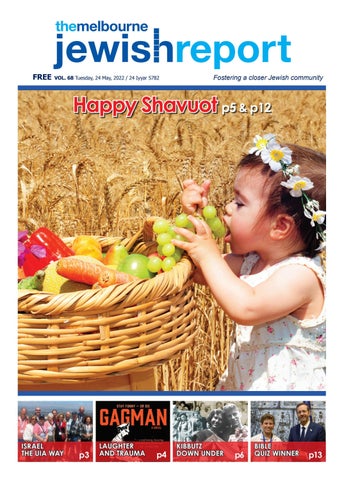
Happy Shavuot p5 & p12
ISRAEL THE UIA WAY
p3
LAUGHTER AND TRAUMA
p4
KIBBUTZ DOWN UNDER
p6
BIBLE QUIZ WINNER
p13
2
the melbourne jewish report | May 2022
AROUND
T H E
COMMUNITY
Relationship effectiveness
ANNE-MARIE ELIAS Humans are social beings. We require social connection in order to maintain wellness. This, in turn, requires interpersonal effectiveness. When interpersonal effectiveness is not there, interactions between people can be difficult and conflicted. In order to understand whether our connections with others have a positive or negative impact on us, we need to be aware of what occurs during the interactions. These are often referred to as green flags when the relationship is effective and red flags when it is not. We can use the flag system when forming a new relationship – being connectedness between two or more people – to help us determine whether to pursue the interaction and what boundaries may need to be set. Let’s talk about green flags. You Can Be Yourself. Not only do you feel that your true and authentic self can be seen, you also feel that you can be honest without fear, ridicule or judgment. You enjoy being with the other person/ people. You value their company. You can have a joke or a laugh. It is a relationship where you look forward to the next time you meet. In all relationships we need to feel respected. We need to feel safe to assert our requirements, make requests, say “no” and set limits. We need to be willing
to listen, take the time to understand the other person’s point of view and agree to disagree when necessary. There is no pressure to do something that goes against our moral and ethical code. Ask yourself whether you are all on the same page. Do you share common values and do you find the same things important? Conflict in a relationship can arise when your value system is not aligned. Consider when you have heard about a couple that separate and are told the main reason is because they are on different paths. Perhaps it is a work situation, where an organisation chooses a new direction and its resultant values may be out of sync with our own. At times this discord means that the relationship does need to end. On other occasions we may reboot or tweak our values because we consider the relationship is important enough to do so. We may want to preserve and maintain it and we do not see this as compromising ourselves, rather
changing our expectations willingly and with insight. It is vital to feel empowered and part of a team. We believe in each other and strive to ensure that each person can reach their full potential. Interestingly, in The Simpsons, Homer and Marge always support each other when one of them wants to try a new career or business opportunity and they both support Lisa in her endeavours. The team are your supporters and cheerleaders. The final green flag is commitment which involves sacrifice. You have to be willing to give up certain things when you commit to a relationship. However, you don’t have to give up everything. While compromise and negotiation are important, it is only compromise to a point of comfort. Some things are also nonnegotiable. To have a connection and interrelatedness, it is imperative to maintain an independent sense of self in a relationship.
Red flags as identified by American psychologist John M. Gottman are criticism, contempt, defensiveness and stonewalling. Criticism is an attack of another person’s character. When it becomes pervasive, it makes the victim feel assaulted, rejected and hurt. It often causes the perpetrator and victim to fall into an escalating pattern in which the criticism reappears with greater frequency and intensity, eventually leading to contempt. When we communicate with contempt, we treat others with disrespect, mock them with sarcasm, ridicule, call them names, and mimic or use body language such as eye-rolling or scoffing. The target of contempt is made to feel despised and worthless. Contempt goes far beyond criticism which attacks another person’s character. Contempt assumes a position of moral superiority. Defensiveness is typically a response to criticism. We can become defensive when we feel that we are under attack. When we feel unjustly accused, we fish for excuses and play the innocent victim so that our accuser will back off. Defensiveness is interpreted as blame and it won’t allow for healthy conflict management. Stonewalling occurs when the listener withdraws from the interaction, shuts down and simply stops responding to the other person. Stonewalling prevents open communication and conflict resolution. Take the time to consider whether your interactions are filled with green or red flags. Anne-Marie Elias is a psychologist in clinical practice for 25 years.
Warming the globe YERACHMIEL ISACOWITZ
Rashi (Rabbi Shlomo Yitzchaki – 11th century commentator) said that Torah – as the source of mitzvot (life instruction and obligations) – should have begun with the first mitzvah, namely sanctification and establishment of the months. He goes on to explain that the reason the Torah starts with the Book of Bereshit (Genesis) is to show how the Jewish People came to acquire Israel. So that when we are accused of stealing the Land from its inhabitants more than 3,000 years ago, we can answer, “Hashem created the world and can decide who gets it”. Still, outside the political ramifications of this concept, it is incredulous to say that the descriptions of creation, our forebears, Egyptian exile etc. could have been disregarded. Further, surely Torah should start with what, from our perspective, are the most
©123RF.com – sarayutsy essential mitzvot, i.e. do not murder, do not commit immorality etc. Why the setting of the month? It is actually this – which requires a knowledge of the cosmos – that, more than anything, illustrates the power we are given over the universe and our responsibilities.
The Jewish calendar is a combination of the lunar month and the solar year. Kiddush HaChodesh (the setting of the month) is ideally enacted through sighting of the new moon. The Beth Din is then entrusted to sanctify the new month, unless it has extraneous reasons, such as the timing of festivals, for not doing so. This, in turn, means that
the Mazalot (astrological influences over the universe) are put on hold until the declaration of a new month (each month has its own astrological sign). In the second paragraph of the Shema, said twice daily, the Torah states: “If you listen to My Mitzvot … I will give rain in your land in its time”. Herein lies an example of the intrinsic correlation between our moral actions and the physical consequences such as rain, famine etc. Both our physical and ethical behaviour affect the universe. So, it would be nice to see the discussion around climate change also more squarely focus on the issue of morality. Yerachmiel Isacowitz is an independent Torah educator. E: risacowitz@optusnet.com.au W: torahconcepts.com FB: The Mem Channel
Growth path: physically content, spiritually thirsty torahconcepts.com
The Mem Channel
the melbourne jewish report | May 2022
AROUND
T H E
COMMUNITY
Experience Israel the UIA way
UIA UIA was excited to relaunch its Israel missions in celebration of Yom Ha’atzmaut. Participants took off on a journey of a lifetime in May, absorbing themselves in the Israel experience. That entailed its culture, history, security, innovation, creativity and cuisine, as well as witnessing UIA’s lifesaving work. The mission included visits to Tel Nof Airforce Base, incorporating a full display of the might of the Israeli Air Force, the Seam Line, Ammunition Hill and Yad Vashem. There were trips to Menachem Begin Heritage Centre, Peres Centre for Israeli Innovation, Mahane Yehuda Market and visits to the Gazan, Syrian and Lebanese borders. A highlight was an inspection of an IDF tank base in the Golan Heights, where participants could climb inside an operational Merkava IV tank. There was also a tour of the Kotel Tunnels, the benefit of authentic Druze hospitality and viewing of the Tower of David’s light and sound King David Show. Mission participants heard from high calibre speakers in the fields of politics, security, culture and business. They included Gil Hoffman, chief political correspondent at The Jerusalem Post and Avi Melamed, a Middle East geopolitical intelligence analyst. Gadi
3
Recent participants in UIA’s Israel mission Ezra, the director of public diplomacy in the Prime Minister’s office also spoke to them. Those involved also saw the impact of UIA’s support for People of Israel. They visited various projects, including an Absorption Centre for Ethiopian Olim in Safed, Youth Futures in Kiryat Shmoneh, Net@ in Kfar Saba and the Hadassah Neurim Youth Village. Elliott Kaplan said: “The mission has been incredible … the emotional sadness of Yom HaZikaron, followed by the emotional highs of Yom Ha’atzmaut, as we feasted and danced. We visited strategic border sites and military installations with highly regarded and
knowledgeable speakers giving us insights into the security issues facing Israel. We dined with soldiers and heard their stories. We spent time at an Ethiopian Absorption Centre and at a school where children in need are matched with amazing mentors. We viewed agricultural innovation on kibbutzim, received political insights from a leading journalist and heard the heart-wrenching stories from recent Ukrainian war refugees taken in by Israel. These experiences have left an indelible impression. Add to that 5-star accommodation and amazing meals to boot.” Another mission participant Evie Gareb said: “If you have ever considered
participating in a UIA mission, think quite seriously about it now – do not put it off. We had heard how fantastic it was, but it is so much more than we could ever have dreamed of. I strongly suggest you undertake a UIA mission to get to know and experience Israel in a way you wouldn’t if you came on your own.” UIA Australia/NSW CEO Yair Miller OAM said: “It has been highly emotional returning to Israel. Sometimes it takes a break for you to truly appreciate what you have missed. Participating in a UIA mission is a unique experience, with each one being so enriching and enthralling. UIA missions are an incredible way to reconnect to our homeland.” UIA VIC CEO Jeff Feldman said: “I have been on tours in Israel before. The access to people and places, and insights provided by the speakers is something that can’t be replicated. The mission provides a look at Israel from the perspective of informed and knowledgeable insiders. The visits to our projects reveals the life-changing work that is supported by our donors.” Planning is underway for UIA’s next mission from 25th October to 3rd November, 2022 and the organisation is seeking expressions of interest. For more information, visit www.uiaaustralia.org.au, email info@ uiavic.org or call Minette on 9272-5533.
The mental health challenge DANIEL RABIN SENIOR RABBI CAULFIELD SHULE We were privileged to recently host Nadav Ellinson at Caulfield Shule for a talk titled "Mental Health and Halacha: A modern dynamic that is changing lives". Nadav is a co-founder of Israelbased Maaglei Nefesh, the Institute for Mental Health and Judaism. Maaglei Nefesh provides Jewish community leaders with training on how to apply Jewish law to mental health in a sensitive, empathetic and collaborative manner. Additionally, it provides support for those suffering from mental health, as well as raising awareness and reducing the stigma associated with mental illnesses. Nadav shared a number of anecdotes about people the organisation helped and many of those stories were similar to my own experience as a community rabbi. COVID-19 has had a significant impact on the mental health of the community in general and youth in particular. Unfortunately, it continues to have a significant impact. My recent meeting with an adolescent psychologist revealed how he is backto-back with appointments and he was not optimistic that this would ease any time soon. Despite the significant
Rabbi Daniel Rabin with his thesis “The Never Ending Session” in 2015
advances we have made in this space, both in the services available for mental health and in combating the stigma surrounding mental illness, there still remains much to be done. As well as highlighting the significant work needed to help those that require mental health assistance, Nadav's talk brought light to an issue that is often ignored or not even recognised.
I completed my Masters Degree in Counselling and Psychotherapy in 2015. My thesis project for the Master's program examined the effects of rabbis' ministry on their mental health. I discovered that many of the professions at the forefront of combating mental illness and caring for others – such as nurses, police officers and psychologists – are susceptible to mental illness
themselves. With clergy from other faith groups the impact of their work on their mental wellbeing has been well researched. It reveals burnout, compassion fatigue, vicarious trauma and many other problems. It has shown the need for ongoing supervision, exercise, holidays, caseload management and other strategies to prevent these risks. Mental wellbeing is now regarded as a standard practice in many of these professions. As a Victoria Police chaplain, I am continually pleased and impressed by how much emphasis is placed on the mental health and wellbeing of Victoria's finest. Many senior police officers have told me that this was not the case when they were younger officers. There is a whole department dedicated to wellbeing. There was a great deal of taboo surrounding these topics and they were pleased that there had been a shift in thinking. Although there are still many who are uncomfortable with discussing these matters, the fact that this is now in place is encouraging. In the past, my father z"l, who worked as a physician for more than 40 years, told me that doctors never talked about their mental health with their peers. Nor did they acknowledge that they were Continued on page 14
4
the melbourne jewish report | May 2022
A UTH O R
INTERVIEW
Laughter and trauma
JOANNE FEDLER Dov and Joanne Fedler have just published a decidedly different book about the Holocaust. Gagman is a graphic novel and a literary work. The Jewish Report spoke with Joanne. Tell me a little about Dov Fedler and Joanne Fedler. Dov was born and bred into the golden age of comics (the 1940s). He picked up a pencil at the age of four and has never stopped drawing. Johannesburg has been his home for 82 years. He was the Star newspaper’s political cartoonist for 50 years. On a trip to the US more than 40 years ago, he met with The Lubavitcher Rebbe who told him to “finish your book”. Dov believes Gagman is the book the Rebbe was referring to though at the time he hadn’t begun to write it. Joanne is a speaker, publisher, writing mentor and internationally bestselling author of 14 books including Secret Mothers’ Business, Things Without a Name and Unbecoming. She is Dov’s writing mentor, editor and middle daughter. Give me a snapshot of the book Gagman. What is it about? Gagman is a comedian in a Nazi concentration camp who survives by making the commandant laugh. He lives on the edge of madness. He escapes to the new world to find the meaning of life, post-hell, with a comic book of Superman in his hands. How did your father and you come to combine your skills to produce it? My dad has been working on Gagman for 35 years. I first heard him speak about it when I was 19. After writing a draft, he then began to draw images of the book burning in Berlin and of Gagman in the camps telling jokes to the commandant. Eventually, a project that has brewed for too long becomes habitually unresolved and can feel unresolvable. Too many drafts can dissipate the energy of an idea, making it impossible to tame. When my mother was diagnosed with cancer at the end of 2020, I knew I had to distract him while she was having chemotherapy and I realised that I had to put my hand up to finish this intergenerational project. Dov had all but given up on this book ever being birthed. He gave me complete control and I took all the drafts, forensically picked them apart and stitched together a coherent narrative. I made hundreds of difficult editorial decisions and came up with a “solution” to the “unfinishable” nature of the story. Why a hybrid tome, namely part graphic novel and part literary fiction? Why not one or the other? Dov is first and foremost a political cartoonist and after writing a first draft,
From left: Dorrine, Dov and Joanne Fedler (photo taken in South Africa in March 2020). Dorrine passed away in October 2021.
his pen began to itch with images to animate the text. The images become a sort of “commentary” on the text, which is also broken into comedian’s notes and literary chapters. It has taken your father 35 years to complete. Why so long? The book is Talmudic, Kabbalistic – it engages myth, comedic spiels, comic book culture, as well as the most difficult period in Jewish history. Some of Dov’s family died in the concentration camps, causing his mother to die of a heart-attack at
the age of 55. His father then married a Holocaust survivor who had lost her son and husband in the gas chambers. Dov had to wade through this intergenerational haunting to get to Gagman. Who do you think the book will appeal to? Anyone who is interested in the Holocaust or the role of humour in overcoming trauma. Its 47 illustrations evoke echoes of Maus by Art Spiegelman, but it is a rich literary text at the same time.
What would you like people who read the work to take away from the experience? Dov wants readers to have a rattling good read and emerge with a deeper understanding of racial discrimination and the horrors to which it can lead. He hopes the book instils a sense of hope about the power of the mind, humour and laughter to help us survive the unimaginable traumas of this world. Would you collaborate with your father again and if so, on what? This is the fourth book I have helped my father write. I coached him through writing his memoir, Out of Line. I wrote the content and published If You Can Write, You Can Draw and I mentored him through the writing of Starlite Memories, about a time when he wrote and directed a movie in Zulu despite not being able to speak the language. I think I have honoured my father sufficiently to say, “he’s on his own from here”. So, what is next up for Joanne Fedler? I am launching a mindful swimming program for women and am hoping to use my skills to help companies and movements that are fighting climate change. Also, my novel Things Without A Name has been optioned for a six part TV mini-series. You can buy Gagman by clicking onto this link: https://www.booktopia.com.au/ gagman-dov-fedler
5
the melbourne jewish report | May 2022
AROUND
T H E
COMMUNITY
Shavuot – a welcoming festival
RABBI GABI KALTMANN ARK CENTRE I recall that in one of my discussions with another faith leader they said: “Your religion seems to have so many festivals and feasts.” I replied that while many Jewish festivals are indeed joyous, there is a distinct difference between the “feasting” and “fasting” ones and not all are alike. Shavuot is truly representative of the best aspects of our religion. From engaging children through the dairy and ice-cream parties and adults by way of a mini festival of ideas and discussion inherent in the Tikkun Leil (all-night) learning programs, there is a distinctly festive mood. The Jewish people are known as “the People of the Book”. The term is derived from our dedication to text and scholarly pursuits, which are inherent in our festivals and lifestyle. Out of all the Jewish festivals Shavuot retains significance as one of the “Shalosh Regalim”, namely the three pilgrim festivals. The others are Pesach and Sukkot, in which one can be seen making a pilgrimage to Jerusalem to visit the Temple. Shavuot also coincides with the harvest season in Israel, a particularly joyous time marking the end of a long year of waiting for crops to mature. Shavuot ties itself to the exodus from Egypt through the confirmation of the Jewish people being chosen to receive G-d’s Torah. The Torah, the lifeblood of our religion and way of life, continues
to define our day-to-day lives, as well as our greater purpose. While previously we were slaves in Egypt and were chained to a slave-like mentality (where we did not think we deserved better), Shavuot represents the revelation in which we accepted the obligations of the Torah and the values it imbues. During Shavuot there are a number of customs. Dairy products are consumed, as the Jewish people had not yet received the Torah and were unsure of which animals were kosher. Many synagogues are decorated with flowers and greenery to represent the beauty that flowered on Mt Sinai as the Torah was given. It is also customary to read one of the five Megillot, namely the Book of Ruth. This book is linked to Shavuot through its setting during harvest time. It teaches timeless values of welcoming the widow,
For the People of Israel
taking care of the poor and needy, and loving the convert. The commentator Baal HaTosfos notes that the commandment to “love and care for the stranger and convert” is mentioned up to 46 times (depending upon how one counts) as a reminder of our history as people who were strangers and converted. Despite our tradition imploring us to welcome the stranger and convert, there is still work to be done. Leviticus 19:34 reads: “… the stranger that dwells with you shall be to you as the home-born among you and you shall love him as yourself …” This verse provides instruction on how we are to treat converts and strangers. We are commanded to show consideration and compassion to them. As a rabbi who works closely with multifaith and multicultural communities and runs a conversion program out
of the Ark Centre, I try to live my life by this commandment. While joining the Jewish people is a serious commitment and requires genuine consideration, that should not preclude people within our faith from welcoming the convert. Genuine converts, people who really want to join the Jewish people, encounter many obstacles. They question their own motivations. They feel crippling doubt about their choices and religion. They feel that they are inadequate and need to do more to prove themselves. Often, their families may feel like they are losing them, adding to their burden. For me, Shavuot will always primarily be about the deeper values that our religion has imbued. We dedicate so much of our time to providing for the sick, needy and poor because our ancestors and the Torah have shown us that this is the path to a good and meaningful life. We dedicate ourselves to loving people, even those that come from different places, because we recall our past as slaves and strangers. It is important to recall the most famous convert to Judaism, Ruth, who declared: “Your people shall be my people, your God, my God”. Our tradition commands us to be welcoming. Shavuot is our reminder. Being welcoming is not an exclusively Jewish value, but as Jews we have the extra requirement to welcome those who need it most, because we were once strangers.
– RARE –
ARGYLE PINK DIAMONDS
ARGYLE PINKS DIAMONDS as well as other COLOURED DIAMONDS are available at Ian Sharp Jewellery. Start your Pink journey with us today. There is nothing on earth quite like an Argyle Pink Diamond. The returns on pinks have outpaced the stock market and the Argyle mine has ceased production as of the end of 2020. With no more new supply, now is the time to get your rare Pink Diamond.
65 Toorak Rd, South Yarra, VIC 3141 P. 03 9866 4983 E: sales@iansharp.com.au www.iansharp.com.au
IanSharp_Advert_Feb21.indd 1
5/2/21 9:41 pm
6 AROUND
the melbourne jewish report | May 2022
T H E
COMMUNITY
The kibbutz down under
NOMI KALMANN COURTESY: TABLET MAGAZINE Australia’s Hachshara (Hebrew Training Farm) prepared a generation of young Zionists for life in Israel The kibbutz movement was founded in 1909. It combined Europe’s growing socialist movement with the new and exciting ideology of Zionism, billing itself as a new way of Jewish living. The movement spread like wildfire, with thousands of young people from around the world moving to British mandated Palestine to create kibbutzim, where they pooled their resources to overcome the hurdles facing new agricultural towns in the future Jewish homeland. Meanwhile, halfway across the world, a copycat community was created to foster Zionist spirit among young Jews and encourage immigration to Israel. From 1945-67 an Australian kibbutz – officially known as the “Hebrew Training Farm”, but more commonly referred to as “Hachshara” – was in operation. Located in Toolamba, a small farming community about 160 kilometres north of Melbourne, the kibbutz was owned by the Zionist Federation of Australia and was operated by idealistic Jewish youth movement leaders from the Australian branches of Habonim and Hashomer HaTzair. On Hachshara, young Aussies spent a year or two learning Hebrew and agricultural skills with the aim of inspiring Zionists to take the plunge and move to Israel. “My father, Aharon Kaploun, had an orchard in Toolamba; he sold it to the Hachshara in 1945. It had pears, peaches, apricots and plums, and a horse called Sandy,” recalls Aviva Oberman, an 87-year-old Australian Israeli who now lives in the Jerusalem Hills. “I was a kid then, maybe 12 or 13 years of age, and Toolamba was this little township of orchards. After he sold the orchard, my father stayed on for a few years … to teach the [participants] agricultural skills.” For 22 years, this orchard and property would serve as the pinnacle of Zionist activity among Australians and New Zealanders, the vast majority of whom ended up settling in the new State of Israel. Selina and Jack Beris, an Australian Israeli couple married for 62 years and now in their 80s, were both members of the Habonim youth movement in Australia. After spending time on Hachshara, they moved to Israel in 1961. Joining a group of 17 Aussies, all members of Habonim, Selina arrived on Hachshara in 1957; Jack arrived 12 months later. “We used to get up at about 6:30 in the morning. We had Ivrit [Hebrew] lessons – not that they did me much good – and, after, we would go to work in the orchards, picking fruit,” she said. “We also had cows and chickens. Later, the group would have lunch and dinner together.”
Habonim camps in Melbourne and Sydney in the late 1940s (photos courtesy Elie Lederman via Facebook) The conditions on the kibbutz were poor, with fibro sleeping huts and outdoor sheds for showering. Despite these tough conditions, the months spent on Hachshara were great fun and many of the original crew that Selina and Jack met there remain lifelong friends. “When we went on Hachshara in Toolamba, we were innocent young Zionists. We were totally absorbed in learning about how to build up the state of Israel,” Selina said. “Even though some [of the original Hachshara immigrants] went back to Australia, a lot are still here in Israel and whoever is here, we still get on really well.” Josie Lacey, an 87-year-old Sydney resident remembers visiting the Hachshara, along with a small group of friends, over the Australian summer about 70 years ago. She was a member of Habonim. “We were there to do fruitpicking,” she said. “I remember picking the apricots off the trees. It was rather exciting to be there, playing kibbutz.” Lacey did not end up making aliyah, but many of her friends who spent a year or two at Hachshara did move to Israel. “They were amazing people, the ones who went,” she said. Though it may seem unusual that a kibbutz to train and prepare youngsters to move to Israel was established in Australia, Lacey thinks that it reflected
the time. “In those days we did strange things to prepare ourselves for aliyah,” she said. “In Habonim, we would use a rope to cross a gully with heavy backpacks to prepare ourselves.” While many Hachshara participants learned orcharding skills, these were not particularly useful in Israel, where similar types of stone fruit trees do not grow. However, as the overarching purpose of Hachshara was to prepare Australians for life in Israel, the fact they were learning skills that were not necessarily directly transferable were inconsequential to fostering their Zionist spirit. Throughout the period Hachshara existed, some of the best and brightest Jewish Australians spent time there. Jack Cohen was in the final group of young Aussies at Hachshara from 196566. A technician by training, he undertook various roles including works manager, treasurer and maintenance, as well as cooking. “In the 1960s, for people living in Australia, leaving home and living 160 kilometres from Melbourne, in very poor conditions, that was one of the purposes of the kibbutz,” he said. “We learned how to live communally and the poor conditions prepared many of us for the conditions we met when we moved to the new State of Israel.” Cohen believes that Hachshara finally closed in 1967 due to a confluence of
factors. “Over the time it operated, the Hachshara could never make a profit, so essentially it imploded financially,” he said. “The Zionist Federation of Australia was eager to sell it.” Another challenge that contributed to its demise was a shift in Australian government policy in the 1960s, which made university free for all students. “Most of my friends who would have come to Hachshara took advantage of this and went on to university to study and become doctors and lawyers, because the degree was free,” Cohen said. Jeremy Leibler, the current head of the Zionist Federation of Australia, reflected on the importance of Hachshara in Australia. “Over many decades, the Zionist youth movements in Australia have used immersive, group experiences to develop knowledge, leadership skills and commitment to Israel and the Jewish community,” he said. “As international travel became more accessible, this local Hachshara program was replaced with shnat [yearlong] programs in Israel. Generations of youth leaders have participated … as current youth movement leaders still do.” Despite the closure of Hachshara in 1967, Habonim remains a popular choice for young Jewish Australians, with Gabriel Freund, the current federal mekasher of Habonim Dror Australia noting that it is the largest non religious Jewish youth movement in Australia. Freund reflected on the history of Habonim’s involvement in Hachshara with a sense of pride: “The Kibbutz Hachshara is one of the proudest chapters in Habonim Dror Australia’s history. The stories of those pioneering members who attended Hachshara and went on to make aliyah and live on kibbutz in Israel continue to inspire new generations of Habonim members today.” Jack Cohen made aliyah shortly after he finished up on Hachshara. He and his wife both lived in Israel for 50 years, before returning to Australia around eight years ago, after one of their Israeliborn daughters decided to emigrate back. In 2009, he took a group of current Habonim leaders to Toolamba to see the original property that housed the Hachshara kibbutz. The fibro huts that the participants used to sleep in were still standing, although the property had long been sold to new, non-Jewish owners. Despite being one of the last participants on the Australian Hachshara Kibbutz, Cohen reflects fondly of his time there. “Going to Hachshara broke the mould of how you lived in Australia,” he said. “It was great, and it was definitely character building!” This story originally appeared in Tablet Magazine (tabletmag.com) and is reprinted with permission.
7
the melbourne jewish report | May 2022
JUD AIC A
QUIZ
RABBI DAVID FREEDMAN When we think about the festival of Shavuot, we think about the giving of the Torah; we think about the Divine covenant between G-d and Israel at Mount Sinai. We also think about the wisdom garnered within the Book of Ruth and we can’t help but think about the delectable dairy delights that await. It truly is a joyous time. Rabbi Freedman’s sensational Shavuot quiz explores all this and so much more. Make sure you save this to enjoy with family and friends at your Yom Tov table. It has been cleverly crafted just for you! 1. Why is the festival of Shavuot given this name? 2. Which Shavuot custom is associated with Exodus 34:3: “No one is to come with you or be seen anywhere on the mountain (Mt. Sinai): not even the flocks and herds may graze in front of the mountain”? 3. Complete this name for Shavuot: Zeman Matan … (The Season of Giving …).
Test your knowledge 4. By what other name is Mt. Sinai known as in the Bible? 5. What blessing is recited each night between Pesach and Shavuot? 6. Which Shavuot custom is associated with these words from Isaiah 50:2: “When I came, why was there no one? When I called, why was there no one to answer?”
Commandments? How many times is it found? 11. Why do Jews have a tradition to eat cheesecake on Shavuot? 12. True or false - another name for Shavuot is “Atzeret” indicating it is the Concluding Festival? 13. Yetziv Pitgam is a poem that precedes the reading of the Prophetical
Good luck. Enjoy. Hopefully, learn something new about your Jewish heritage and tradition. 7. The Book of Ruth, read on Shavuot, is connected with which annual grain harvest? 8. Many opt to stand when the Ten Commandments are recited publicly in synagogue. This is not a universal custom – why do some Jews choose to remain seated? 9. In the Book of Ruth read on Shavuot, what was the name of Ruth’s mother-inlaw? 10. Which Hebrew word is the most common word in the Ten
YOUR GIFT TODAY WILL BE MATCHED DOLLAR FOR DOLLAR!
PLEASE HELP US STAMP OUT RACISM, BULLYING & PREJUDICE
reading (the Haftarah) on which day of Shavuot in the Diaspora? 14. Is Akdamut: a) a special Shavuot Cheese Blintz that originated in Iraq b) the name of the ritual connected to the offering of the First Fruits brought on Shavuot c) a liturgical poem recited annually on Shavuot? 15 Name the monastery that lies at the mouth of the gorge, located at the foot of Mount Sinai.
16. Film producer Cecil B. DeMille made two versions of the movie: The Ten Commandments – in which two years were they each released? 17. What are the following with the Yiddish names: ‘shevuoslach’ (also known as ‘shavuosl’) and ‘royzalach’ (also known as ‘raizelach’)? 18. Boaz and Ruth are a pair of paintings by Rembrandt dated 1643. According to art scholars, who is said to represent Boaz and Ruth in these paintings? 19. Shavuot occurs in the month of Sivan – what is its corresponding Zodiac sign? 20. In which book of the Bible is the actual name Sivan first mentioned? 21. What is the next festival in the Jewish calendar following Shavuot? 22. Which famous rabbi first came to the United States of America in the month of Sivan in 1941? 23. What was the relationship between Ruth and King David? 24. How many times does the name David occur in the Book of Ruth: a) once b) twice c) three times? 25. On the annual calendar, when was King David born and when did he die?
ANSWERS PAGE 12
Yoni Glatt’s JEWISH SPELLING BEE How many common words of five or more letters can
spellcommon using the letters the5hive? Every answer How you many wordsin of or more letters can must use the centre letter at least once. you spell using the letters in the hive? Every answer Letters may be reused in a word. must use the center letter at least once. Letters may At least one Jewish word will use all seven letters. be reused in a word. At least one word will use all 7 Proper words are not allowed. lettersnames and and havehyphenated a direct Jewish connection. Score one point for each answer and three points for a Jewish-related word that uses all seven letters.
Proper names and hyphenated words are not allowed. Score 1Rating: point28=Good; for each34= answer, and points for a Excellent; 40=3Genius Jewish related word that uses all 7 letters. Rating: 9=Good; 17= Excellent; 25= Genius
DONATE ONLINE AT: COURAGETOCARE.ORG.AU OR SCAN THE QR CODE
Yoni Glatt has published more than 1,000 crossword puzzles worldwide, from the LA Times and Boston Globe to The Jerusalem Post. He has also published two Jewish puzzle books: "Kosher Crosswords" and the sequel "More Kosher Crosswords and Word Games". ANSWERS PAGE 14
Here is a list of some common words (Yes, we know there are more words in the diction
8
the melbourne jewish report | May 2022
F O O D I E S'
CORNER YANKEL WAJSBORT KOSHER AUSTRALIA Kosher Cheese? One of the most well-known customs on Shavuot is to have cheesecakes and cheese products. Ta’amei Minhagim (written by Rabbi Avraham Yitzchak Sperling, published in 1890) explains that one of the names that Mount Sinai is known by is “Har Gavnunim” which bears a similarity to the Hebrew word Gevina, which means cheese. Here are some interesting cheese facts: Legend has it that the first cheese was discovered in the Middle East when milk was stored in skin flasks made from the stomachs of cows. The first production line cheese factory was set up in Switzerland in 1815. The US produces 29 per cent of the world’s cheese. In the United Kingdom alone, 700 different types of cheese are produced. There are nearing 2,000 varieties worldwide. Among the highest consuming cheese nations are France, Iceland, Finland, Denmark and Germany. The Guardian newspaper claims cheese is one of the most shoplifted items from supermarkets globally. How is cheese made? Usually cheese is produced by acidifying (souring) milk and adding rennet. The acidification is accomplished in a few cases by the addition of an acid-like vinegar (paneer, queso
Who doesn’t like cheese? fresco), but usually starter bacteria are employed. These starter bacteria convert milk sugars into lactic acid. The same bacteria (and the enzymes they produce) also play a large role in the eventual flavour of aged cheeses. Most cheeses are made with starter bacteria from the Lactococci, Lactobacilli or Streptococci families. Swiss starter cultures also include Propionibacter shermani, which produces carbon dioxide gas bubbles during aging, giving Swiss cheese or Emmental their holes. Some fresh cheeses are curdled only by acidity, but most cheeses also use rennet. Rennet sets the cheese into a strong and rubbery gel, compared to the fragile curds produced by acidic coagulation alone. It also allows curdling at a lower acidity, which is important because flavour-making bacteria are inhibited in high-acidity environments. In general, softer, smaller, fresher cheeses are curdled with a greater proportion of acid to rennet than harder, larger, longer-aged varieties. At this point, some cheeses are ready – they are drained of excess whey, pressed and packed. Some hard cheeses are heated to force out more whey. Salt can be added for flavour and as a preservative. Sometimes the cheese is stretched (e.g. mozzarella), washed in water or wine (edam, gouda or Colby) or cheddared (chopped up while liquid). Aging allows different enzymes to come into play altering the taste further. Pungent cheeses, such as Lindberg, are realised by allowing spoilage to take place.
12,000 products Traveller’s Guide Bug Checking … and more
The 2022 Kosher Food Guide is now out. To obtain your free copy call 1300KOSHER or email info@kosher.org.au Also get free access to the Kosher App
Kosher requirements The rabbis in the Talmud (Avodah Zarah 29b) cited up to eight different reasons why cheese produced by a nonJew (“Gevinas Nochri”) is prohibited. The most commonly accepted reason is that rennet from a non-Kosher slaughtered animal was usually used for the curdling process. As the rennet is a Davar HaMa’amid (something that preserves or drives the process), the rennet is significant, even though its percentage is small. Due to the difficulty in verifying the kosher status of the rennet and the likelihood that the source was not kosher, the rabbis of the time prohibited all hard cheeses from being given kosher status.
The only allowances where when either a Jew placed the rennet into the milk or the milk was owned by a Jew. As animal rennet is rarely used today (except for export to the Japanese market) and cheese production is usually controlled by microbial or vegetarian rennets, the prohibition remains in place. Recent distinctions were made between those cheeses that require rennet (“rennet-set cheeses”) and those that are softer and utilise acids (“acid set cheeses”). While rennet-set cheeses are prohibited, acid-set cheeses (e.g. cottage and cream cheese) are permitted, even if they do use rennet. Vegan cheeses While on the topic of cheeses, we are frequently asked about vegan cheeses. Vegan cheeses are made from various nuts, such as cashews or macadamias, or from other plant-based materials such as coconut milk. Other ingredients typically used are food gums, such as agar, carrageenan or xanthan gum, as well as tapioca, lemon juice and flavours to simulate regular cheese. Probiotic cultures are often used. An interesting point for discussion is whether vegan cheese can be actually be called cheese. For example, the European Union only allows “cheese” to be used when referring to dairy varieties. Vegan cheeses are not subject to the same rules of kosher dairy cheese production, but are governed by regular kosher rules as a number of the ingredients are kosher sensitive.
בס״ד
750 companies · 30,000 products · 84% of Australian Kashrus 2 Annual Kosher Guides · 24/7 Access to Website & App
Kosher Australia · Trusted · Reliable · Accessible www.kosher.org.au | info@kosher.org.au | 1300Kosher
10
the melbourne jewish report | May 2022
CO NS I D E RE D
OPINION
RABBI MORDECHAI BECHER COURTESY: AISH.COM I am not sure what Socrates would have made of the internet and social media, but in one of the dialogues recorded by Plato, Socrates criticises the art of writing as something that would destroy memory. “This invention of yours will create forgetfulness in the learners’ souls, because they will not use their memories; they will trust to the external written characters and not remember by themselves …”1 To some extent Jewish tradition agrees and this is one reason that for over 1,500 years most of Judaism was transmitted in an oral format, known as the Oral Torah.2 Eventually it became clear that due to the circumstances of exile, unless this information was committed to writing it would be lost completely. In about 170 CE Judah the Prince, a Rabbi and leader of the Jewish people, decided to write down the oral information in the form of a six-volume work known as the Mishnah.3 There is, however, one text that the Jewish people have preserved, copied and transmitted for over 3,300 years in a format unchanged since antiquity – the Torah scroll. The scroll, written on parchment in an ancient script, does not contain vowel sounds or punctuation, has variations in the spelling of words as either plene or defective, and has words that are pronounced differently than they are written. All this information is part of the Oral Torah. As the Talmud puts it, “Rabbi Yitzḥak said: The vocalisation of the scribes, and the ornamentation of the scribes, and the verses with words that are read but not written, and those that are written but not read are all laws transmitted to Moses from Sinai.”4 Concerned that this information would be lost, a group of scholars, known as the Masoretes, decided to write down everything in the Oral Law regarding the text of the Torah scroll. They vowelised the text (nekudot), recorded the cantillation notes which provide punctuation (taamei hamikra or tropp), listed every possible textual variation, and indicated every form of spelling and pronunciation of the sacred text. Because of our veneration for the Torah scroll none of this information may be recorded in the scroll itself – the scroll is pure, unadulterated, pristine, ancient Torah – nothing else.5 The Masoretes, primarily the Ben Asher family, lived in the 10th century in Tiberias, on the shores of the Sea of Galilee. At that time Tiberias was the scholarly, political, economic and cultural capital of Israel and Muslim conquest had brought with it the import of paper-making technology from China. The Masoretes were at the right time and place to engage in the monumental task of preserving the text of the Bible and its Oral traditions. They
The scandalous history of the Aleppo Codex
paid attention to every single letter, to spaces between paragraphs and chapters, to the text’s layout, differences between the written and spoken text and counted the occurrence of words throughout the entire Bible. After years of work they produced a codex, a book that contained all the above information both within the text and as marginal notes known as Mesorah.6 Eventually the codex, called the Crown, or Keter, was moved to Jerusalem sometime in the 11thcentury, but it was apparently stolen by Crusaders at some point. History gets a little murky here, but it seems that the codex was ransomed from the Crusaders at great cost to the Jewish community. In the 12th century the codex turned up in Fostat, (a city that eventually became Cairo) where there was a large, well-established Jewish community.7 The most famous sage of Fostat was Moses Maimonides, who saw the codex and wrote, “The codex on which I relied on for these matters was a codex renowned in Egypt, which includes all the 24 books [of the Bible]. It was kept in Jerusalem for many years so that scrolls could be checked from it. Everyone relies upon it because it was corrected by ben Asher, who spent many years writing it precisely and checked it many times.”8 In 1375, Maimonides’ great-greatgreat grandson, David, moved to Aleppo in Syria and it is believed that he brought the treasure with him. The codex became known as the Crown of Aleppo, Keter Aram Tzovah, and it was kept by the Syrian Jews in the Great Synagogue of Aleppo, under
intense security, brought out only for the occasional consultation or perusal of scholars. The Crown remained in the synagogue until November 1947. Due to the rise of Arab nationalism and the pro-Nazi sympathies of the Syrian regime, many believed that the Crown was in danger. Yitzhak Ben-Zvi, an historian and Zionist leader, who later became second president of the State of Israel, made attempts to bring the codex to Israel but was unsuccessful. In November 1947 the Syrian government instigated riots against the Jewish population and the Great Synagogue of Aleppo was burnt down. Rumours flew regarding the fate of the codex – some said it was destroyed, some said it was saved, some claimed that it was saved by one person, others claim a different saviour. Two eminent scholars of the codex, Chaim Tawil and Bernard Schneider, list no less than seven different accounts of the fate of the Crown.9 After the State of Israel was established and the border with Syria was closed efforts to recover the Crown became much more difficult. Yitzchak Ben-Zvi enlisted the aid of the Israeli security services and involved diplomats, spies and rabbis in returning the Crown to Israel. Unit 504, a top-secret section of the Israeli Military Intelligence specialising in infiltration of agents into Arab countries, was also involved (my security clearance is not high enough to confirm this). This was the unit that took part in obtaining the Dead Sea Scrolls later. Here again, there are many different versions of what happened, but
eventually the Crown, albeit with missing sections and damaged by fire and fungus, came back to its birthplace, Israel. Now the focus turned to preserving the Crown and researching the surviving parts. A manuscript written in Tiberias, Israel in the 10th century, travelled to Jerusalem, was “kidnapped” and ransomed, taken to Egypt, from there to Aleppo, Syria and from there back to Jerusalem. The Crown of Aleppo is a symbol of Jewish continuity, of Jewish devotion to the Torah and of the return of the Jewish people to its ancient homeland. For
further
reading:
The
Aleppo
Codex: A True Story of Obsession, Faith and the Pursuit of an Ancient Bible, by Matti Friedman 1. Plato, Phaedrus 14, 274c-275b 2. See Babylonian Talmud, Berachot 7b, Midrash Tanchumah (Buber), Parshat Noach 3 3. E. E. Urbach, “Introduction to the Mishnah and to One Hundred Years of Its Scholarship”, Scholarship in Jewish Studies, Vol. 2, (Jerusalem 5758) pp. 716738 4. Babylonian Talmud, Nedarim 37b 5. Code of Jewish Law, Yoreh Deah 274:7 6. Crown of Aleppo: The Mystery of the Oldest Hebrew Bible Codex – Hayim Tawil and Bernard Schneider – Jewish Publication Society, Philadelphia, 2010 pp. 15-27 7. Ibid. pp. 47-56 8. Maimonides, Mishneh Torah, Laws of the Torah Scroll 8:4 9. Crown of Aleppo pp. 82-83
11
the melbourne jewish report | May 2022
CO NS I D E RE D
OPINION
Abortion in Jewish law
DANIEL EISENBERG, M.D. COURTESY: AISH.COM The Union of Orthodox Jewish Congregations of America (Orthodox Union) recently issued the following statement regarding the US Supreme Court’s potential overturning of Roe v Wade: The Orthodox Union is unable to either mourn or celebrate the news reports of the U.S. Supreme Court’s likely overturning of Roe v Wade. We cannot support absolute bans on abortion – at any time point in a pregnancy – that would not allow access to abortion in lifesaving situations. Similarly, we cannot support legislation that permits “abortion on demand” – at any time point in a pregnancy – and does not confine abortion to situations in which medical (including mental health) professionals affirm that carrying the pregnancy to term poses real risk to the life of the mother. As people of faith, we see life as a precious gift granted to us and maintained within us by God. Jewish law places paramount value on choosing life and mandates – not as a right but as a responsibility – safeguarding our own lives and the lives of others by behaving in a healthy and secure manner, doing everything in our power to save lives and refraining from endangering others. This concern for even potential life extends to the unborn foetus and to the terminally ill. Abortion on demand – the “right to choose” (as well as the “right to die”) – are thus completely at odds with our religious and halachic values. Legislation and court rulings that enshrine such rights concern us deeply on a societal level. Yet that same mandate to preserve life requires us to be concerned for the life of the mother. Jewish law prioritises the life of the pregnant mother over the life of the foetus such that where the pregnancy critically endangers the physical health or mental health of the mother, an abortion may be authorised,
if not mandated, by halacha (Jewish law) and should be available to all women irrespective of their economic status. Legislation and court rulings – federally or in any state – that absolutely ban abortion without regard for the health of the mother would literally limit our ability to live our lives in accordance with our responsibility to preserve life. The extreme polarisation around and politicisation of the abortion issue does not bode well for a much-needed nuanced result. Human life – the value of everyone created in the Divine Image – is far too important to be treated as a political football.
Abortion in Jewish Law The traditional Jewish view of abortion does not fit conveniently into either “pro-life” of “pro-choice” camps in the abortion debate. Judaism neither bans abortion completely, nor does it sanction indiscriminate abortion "on demand”. A woman may feel that until the foetus is born, it is a part of her body and therefore she retains the right to abort an unwanted pregnancy. Does Judaism recognise a right to "choose" abortion? In what situations does Jewish law sanction abortion? To gain a clear understanding of when abortion is permitted (or even required) and when it is forbidden requires an appreciation of certain nuances of halacha (Jewish law) which govern the status of the foetus.1 The easiest way to conceptualise a foetus in Jewish law is to imagine it as a full-fledged human being – but not quite.2 In most circumstances, the foetus is treated like any other "person”. Generally, one may not deliberately harm a foetus. But while it would seem obvious that Judaism holds accountable one who purposefully causes a woman to miscarry, sanctions are even placed upon one who strikes a pregnant woman causing an unintentional miscarriage.3 That is not to say that all rabbinical authorities consider abortion to be murder. The fact that the Torah requires a monetary payment for causing a
miscarriage is interpreted by some rabbinical scholars to indicate that abortion is not a capital crime4 and by others as merely indicating that one is not executed for performing an abortion, even though it is a type of murder.5 There is even disagreement regarding whether the prohibition of abortion is biblical or rabbinic. Nevertheless, it is universally agreed that the foetus will become a full-fledged human being and there must be a very compelling reason to allow for abortion. As a general rule, abortion in Judaism is permitted only if there is a direct threat to the life of the mother by carrying the foetus to term or through the act of childbirth. In such a circumstance, the baby is considered tantamount to a rodef, a pursuer6 after the mother with the intent to kill her. Despite the classification of the foetus as a pursuer, once the baby's head or most of its body has been delivered, the baby's life is considered equal to the mother's, and we may not choose one life over another, because it is considered as though they are both pursuing each other. It is important to point out that the reason that the life of the foetus is subordinate to the mother is because the foetus is the cause of the mother's lifethreatening condition, whether directly (e.g. due to toxemia, placenta previa or breach position) or indirectly (e.g. exacerbation of underlying diabetes, kidney disease or hypertension).8 A foetus may not be aborted to save the life of any other person whose life is not directly threatened by the foetus, such as use of foetal organs for transplant. Judaism recognises psychiatric as well as physical factors in evaluating the potential threat that the foetus poses to the mother. The degree of mental illness that must be present to justify termination of a pregnancy has been widely debated by rabbinic scholars10 without a clear consensus of opinion regarding the exact criteria for permitting abortion in such instances.11 Nevertheless, all agree that were a pregnancy to cause a woman to become suicidal there would be grounds for abortion.12 As a rule, Jewish law does not assign relative values to different lives. Therefore, almost most major poskim (rabbis qualified to decide matters of Jewish law) forbid abortion in cases of abnormalities or deformities found in a foetus. Rabbi Eliezar Yehuda Waldenberg is a notable exception. Rabbi Waldenberg allows first trimester abortion of a foetus that would be born with a deformity that would cause it to suffer and termination of a foetus with a lethal foetal defect such as Tay Sachs up to the seventh month of gestation.14 The rabbinic experts also discuss the permissibility of abortion for mothers with German measles and Continued on page 12
12
the melbourne jewish report | May 2022
AROUND
T H E
COMMUNITY RABBI DR BENJI LEVY Our nation is only a nation by virtue of its Torah – Saadya Gaon Why do Jews transcend history? The astonishing survival, energy and creativity of the Jewish people across millennia has mystified the masses. Modern luminaries such as Mark Twain and Winston Churchill have eloquently expressed their wonderment at the seemingly endless capacity for perseverance and regeneration that characterises the Jewish nation. What is the secret formula that enables us to survive almost anything, emerging victorious and even optimistic? Through our preservation of our heritage, our heritage preserves us. The relationship between the Jewish nation and the Torah is unique, without precedent or parallel. Jewish scholars and lay people alike have spent countless centuries obsessing over every letter, every word and even gaps between the words. It has served as our lighthouse through stormy times, our inspirational muse during periods of joy and consistent anchor during eras of
Shavuot – the day that shook the world turbulence. Regardless of events in the outside world, Jews can always turn to our text, engaging with the celebrated ideas and personalities that live on through our great story. Empires rise and fall; civilisations conquer the world and fade into dust; plagues, war and revolutions ravage the landscape – and Jews still pore over their beloved pages, attempting to tease out the lessons in every section. This private dialogue with infinity and constant communion with a superior plane of reality has preserved an enduring sense of Jewish pride, identity and purpose, regardless of circumstances. There were Torah study groups in Auschwitz, just as there are Torah study groups in the corner offices of New York, London, Sydney and Melbourne today. Although some scholars may spend entire careers focusing over the works of a Shakespeare, a Dante or a Dostoyevsky, they will always find themselves confronted by the limitations … the simple mortality of the human author. It is precisely this point that sets the Torah apart. As a reflection of the Divine, the Torah is completely inexhaustible, containing infinite layers of meaning. Millennia of commentaries and super-commentaries have analysed and excavated every
Abortion in Jewish law From page 11 babies with prenatal confirmed Down syndrome. There is a difference of opinion regarding abortion for adultery or in other cases of impregnation from a relationship with someone biblically forbidden. In cases of rape and incest, a key issue would be the emotional toll exacted from the mother in carrying the foetus to term. In cases of rape, Rabbi Shlomo Zalman Aurbach allows the woman to use methods which prevent pregnancy after intercourse.15 The same analysis used in other cases of emotional harm might be applied here. Cases of adultery interject additional considerations into the debate, with rulings ranging from prohibition to it being a mitzvah to abort.16 I have attempted to distil the essence of the traditional Jewish approach to abortion. Nevertheless, every woman's case is special and the parameters determining the permissibility of abortion within Jewish law are nuanced, subtle and complex. It is crucial to remember that when faced with an actual patient, a competent halachic authority must be consulted in every case. 1. While there is debate among the rabbis whether abortion is a biblical or rabbinical prohibition, all agree on the fundamental concept that abortion is only permitted to protect the life of the mother or in other extraordinary situations. Jewish law does not sanction
abortion on demand without a pressing reason. 2. Igros Moshe, Choshen Mishpat II: 69B. 3. Shulchan Aruch, Choshen Mishpat, 423:1 4. Ashkenazi, Rabbi Yehuda, Be'er Hetiv, Choshen Mishpat 425:2 5. Igros Moshe, ibid 6. Maimonides, Mishneh Torah, Laws of Murder 1:9; Talmud Sanhedrin 72B 7. Oholos 7:6 8. See Steinberg, Dr. Abraham; Encyclopedia of Jewish Medical Ethics, "Abortion and Miscarriage," for an extensive discussion of the maternal indications for abortion. 9. Igros Moshe, ibid 10. See Encyclopedia of Jewish Medical Ethics. P. 10, for references. 11. See Spero, Moshe, Judaism and Psychology, pp. 168-180. 12. Zilberstein, Rabbi Yitzchak, Emek Halacha, Assia, Vol. 1, 1986, pp. 205209. 13. Rabbi Shlomo Zalman Aurbach and Rabbi Yehoshua Neuwirth cited in English Nishmat Avraham, Choshen Mishpat, 425:11, p. 288. 14. Tzitz Eliezer, Volume 13:102. 15. Rabbi Shlomo Zalman Aurbach and Rabbi Yehoshua Neuwirth cited in English Nishmat Avraham, Choshen Mishpat, 425:23, p. 294. 16. See excellent chapter in English Nishmat Avraham, Choshen Mishpat, 425 by Dr. Abraham Abraham, particularly p. 293. For more about Jewish medical ethics, go to www.daneisenberg.com
component, squeezing all possible meaning from these tantalizing texts. Yet – as any Torah scholar worth his or her salt will tell you – we have barely scratched the surface: every new reading yields further questions, explanations, advances or frustrations in our understanding. The hope of producing the final word, the conclusive explanation, of even the smallest element of the Torah is a fanciful dream. We can never hope to obtain finality; all we can strive for is to be part of the conversation. It is astonishing that Jews across cultures and eras have all sought and discovered, profound spiritual inspiration and moral instruction through the study of the same text. Could it be possible that Jews residing in the Rome of the Caesars, the Baghdad of the Caliphs and the Paris of Napoleon all believed that the Torah was talking directly to them, that it was prescribing a way of life that informed and enriched their own unique situation? Amazingly, the answer is a resounding “yes”. The Torah is both timeless and timely. Every person, regardless of physical, emotional, psychological or spiritual disposition, can discover and rediscover endless treasures in this unparalleled trove of textual treasure.
That includes us. Having spent many years studying with some of the finest scholars and expositors of our generation, I am convinced that the Torah speaks directly to us, perhaps more so than ever before. Our current generation – those whose lives will span the bulk of the 21st century – display a desperate need for spiritual content and contentment. Although our lives are being made progressively easier, safer, longer and more leisurely by the relentless advance of science and technology, many feel an inner emptiness, an absence of objective meaning that would imbue our existence with true direction and purpose. Many try desperately to fill it with anything, from sports teams and TV shows to protest movements and recreational drugs. While some may find temporary relief through some of these endeavors, they are all symptomatic of a greater cause: people are crying out for something beyond themselves, a greater truth or cause that will anchor their lives. But nothing temporal will ever be able to bridge the void in the human soul that reaches beyond. This sits at the heart of Shavuot and why we celebrate the greatest gift we ever received – the Torah. For more insights, https://www.rabbibenji.com
go
to:
Judaica quiz answers 1. Shavuot translates from the Hebrew as ‘Weeks’ – and this festival always takes place seven weeks after Pesach 2. This proves that Mt Sinai had foliage, hence the custom to decorate the shule and home with tree branches and greenery 3. Torateinu – Our Law 4. Mount Horeb 5. The Counting of the Omer - otherwise known as Sefirah 6. Tikkun Leil Shavuot – the night of learning on first night Shavuot. Instituted to remedy the fact that the Israelites slept through the night of G-d’s revelation. This is why according to Isaiah, G-d said: ‘When I came, why was there no one? When I called, why was there no one to answer?” 7. The Wheat Harvest 8. Some sit to differentiate Jewish customs from earlier groups such as the Karaites who opted to stand. Perhaps, it could be to reduce the importance of the Ten Commandments in the eyes of the general public because other religions such as Christianity insisted that these Ten Commandments were more special than all others. It could also be because when we learn, we typically sit and study, and listening to Torah reading is equal to attending a study lesson 9. Naomi 10. The Hebrew word for ‘no’ or ‘don’t’ – LO. It occurs 13 times. 11. On Shavuot the laws were given; so the Israelites learned about the laws of Kashrut (dietary laws) for the first time. Rather than consume the meat that had previously been prepared (not in line with the new dietary laws), they ate only dairy foods in the immediate aftermath of the giving of the Torah. We replicate this each year on Shavuot by eating some dairy produce 12. True. This festival in a sense concludes the festival of Pesach 13. Day 2 in the Diaspora
14. c) A liturgical poem recited annually on Shavuot 15. St Catherine’s Monastery 16. 1923 and 1956 17. One way that Ashkenazi Jews beautified their homes for Shavuot was by creating and displaying paper cuttings. Called in Yiddish, shevuoslach (or shavuosl) and royzalach (or raizelach) – literally meaning little Shavuots and little roses – the paper cuttings were mounted on windows, so they would be visible both indoors and out 18. Rembrandt and his wife 19. The Zodiac sign of Sivan is Gemini (twins). Following Aries (ram) and Taurus (ox), the Gemini (twins, te’omim in Hebrew) is the first Zodiac sign that is in human form (the only other is Virgo, the virgin). The sages explain that this is appropriate for the month when we received the Torah, as only a human can extol, clap and dance with joy over this momentous event 20. Esther 8:9 “Then were the king's scribes called at that time, in the third month, which is the month Sivan …” 21. Tu b’Av – the minor festival on the 15th of Av 22. After narrowly escaping the Nazi onslaught in France, the Lubavitcher Rebbe, Rabbi Menachem Mendel Schneerson (1902-1994), and his wife, Rebbetzin Chaya Mushka Schneerson (1901-1988), arrived in the United States of America on the 28th of Sivan in the year 5701 (1941) 23. Ruth was King David’s greatgrandmother 24. b) Twice 25. King David was born and also died on Shavuo
the melbourne jewish report | May 2022
AROUND
T H E
COMMUNITY EMILY GIAN COURTESY: JWIRE.COM.AU Yoni Moss from Leibler Yavneh College in Melbourne has been named the equal winner of the Diaspora Bible Quiz in Israel. Yoni won the National Bible Quiz in Australia and he, along with runner up, Yohanatan Shroot, also from Leilber Yavneh College, travelled to Israel to participate in a training camp and to fight for a spot in the final. 12 students from around the world advanced to the Diaspora Bible Quiz. Among other countries represented were Argentina, Germany, Brazil, France, Panama and South Africa. Yoni was declared the winner alongside Canada’s Liela Silbiger. The nail-biting event took place in the Jerusalem Theatre on Yom Ha’atzmaut and was broadcast live on the Ministry of Education’s Facebook page. The bible camp is a fun, intensive and unique experience attended by representatives from Jewish communities globally. It is an educational and social camp where participants learn about the bible and then have the opportunity
Australian student leads the way to explore and tour Israel. The Zionist Federation of Australia’s education chair Miriam Munz said: “There is something incredibly special about the training camp … being able to see firsthand the places and landmarks that they studied. The combination of learning about the ancient story of Israel and celebrating it on the modern day of Independence is always wonderful for our Australian participants.” “I send a hearty Mazal Tov to Yoni Moss on winning the competition and also commend Yehonatan Shroot for his efforts. Both young men were worthy participants representing the Australian Jewish community in Israel and have brought a tremendous amount of pride to their school, community and families.” Still riding the high after winning the Diaspora competition, Yoni Moss said: “Participating in the Bible Quiz was an amazing, a once in a lifetime experience. I really enjoyed making friends with like-minded kids from around the world. It was extra special to be able to do this while travelling around Israel for the first time.”
Top Israeli series returns CHAIFLICKS Season 2 of the hit show The New Black is now streaming exclusively on ChaiFlicks. Created by Eliran Malka and the late Daniel Paran, The New Black (titled Shababnikim in Hebrew) won four Israeli Television Awards (best series, actor, writing and director) for its first season. Set
at
Jerusalem,
a
prestigious
The
New
Yeshiva
Black
in
follows
four rebellious students as they try to reconcile their desire for modern life with their Orthodox upbringing.
13
The first season was the most watched program on Israel’s largest cable channel, HOT. The second season was the most viewed series on HOT since season 1 aired. Both seasons 1 and 2 are now streaming on ChaiFlicks. ChaiFlicks offers access to hundreds of movies, TV shows and documentaries focused on Jewish and Israeli culture, heritage and experience. All foreign language films are available with English subtitles. In Australia and New Zealand, ChaiFlicks is presented by the Jewish International Film Festival (JIFF). To subscribe to ChaiFlicks, go to www.ChaiFlicks.com
From left: Dov (Omer Perelman Striks), Gedaliah (Ori Laizerouvich), Meir Sabag (Israel Atias) and Avinoam Lasri (Daniel Gad) in The New Black
Yoni Moss with President Isaac Herzog
From left: Yehonatan Shroot and Yoni Moss at Ben Gurion Airport
14
the melbourne jewish report | May 2022
The mental health challenge From page 3
suffering from mental illnesses. In this area too there has been a shift in a positive direction, with many hospitals now investing significant resources to provide staff with the support they need to maintain a healthy lifestyle. The above examples should inspire us to realise and recognise that mental health and wellbeing are of utmost importance and can affect each of us. As a Jewish community we must provide a supportive environment for those who need it. People who need support should feel comfortable asking for it. Those seeking assistance should not be judged, spoken about or treated as if they have committed a crime. Numerous factors – including biological disorders, illness, financial loss, domestic violence, molestation, peer pressure, stress at
Spelling bee answers Jewish Answer: GEMATRIA. Here is a list of some common words (we know there are more words in the dictionary that can work, but these words are common in today’s vernacular) – AGGREGATE, AGITATE, AGREE, EAGER, EGGIER, EGRET, EMERGE, EMIGRATE, GAMIER, GARAGE, GRAMMAR, GRATE,
school or work – contribute to mental health problems. No-one is immune, so it could be you or a family member who requires the help and having a supportive community can make it easier for people to get the help they need. Mental Health Australia ran a campaign a few years ago titled “Do You See What I See?” It encouraged us to think about mental illness in a more positive light and to reduce stigma. My community and I are grateful for Nadav's talk and for the work Maaglei Nefesh does. Acknowledging that rabbis and other mental health workers are susceptible to the same risks helps normalise the subject. It allows us all to see mental illness in a more positive light. Through this, we hope to continue breaking the stigma of mental illness, encourage more people to seek professional support and assist them in their journey through GRATER, GREAT, GREATER, GREET, GREETER, GRIME, GRIMIER, GRITTIER, IMMERGE, IMMIGRATE, IRRIGATE, MAGMA, MARGARITA, MARRIAGE, MEAGER, MERGE, MERGER, MIGRATE, MIRAGE, MITIGATE, RAGER, REGGAE, REGRET, RETAG, RETARGET, TARGET, TETRAGRAM, TIGER, TRIAGE, TRIGGER Questions/comments – email koshercroswords@gmail.com
Yoni
at
CANDLE LIGHTING TIMES Friday, May 27, 2022
4:54 pm
Shabbat ends, May 28, 2022
5:53 pm
Friday, Jun 3, 2022
4:51 pm
Shabbat ends, Jun 4, 2022
5:51 pm
Friday, Jun 10, 2022
4:49 pm
Shabbat ends, Jun 11, 2022
5:50 pm
Friday, Jun 17, 2022
4:49 pm
Shabbat ends, Jun 18, 2022
5:51 pm
Friday, Jun 24, 2022
4:51 pm
Shabbat ends, Jun 25, 2022
5:52 pm
Friday, Jul 1, 2022
4:53 pm
Shabbat ends, Jul 2, 2022
5:55 pm
Friday, Jul 8, 2022
4:57 pm
Shabbat ends, Jul 9, 2022
5:59 pm
Friday, Jul 15, 2022
5:02 pm
Shabbat ends, Jul 16, 2022
6:03 pm
the melbourne jewish report | May 2022
MOV I E
REVIEWS
Worth the wait
TOP GUN: MAVERICK (M) BY ALEX FIRST Top Gun: Maverick is everything I wanted and more from a sequel 36 years on. It is tense, action-packed, antiestablishment and cheeky, with romance thrown in for good measure. After three decades, one of the Navy’s top aviators is still doing things his way, breaking rules and getting into trouble. I speak of Pete Mitchell, aka Maverick (Tom Cruise), whose “antics” see him unable to rise in rank beyond that of captain. After another such episode, apart from being chewed out (which is par for the course), he is unexpectedly summoned back to his previous base. That is at the behest of his former rival, now the Commander of the US Pacific Fleet, Tom “Iceman” Kazansky (Val Kilmer). Maverick is pumped, until he is told in no uncertain terms that he won’t be taking to the skies as a fighter pilot, rather becoming an instructor. And the man reading him the riot act, Admiral Beau “Cyclone” Simpson (Jon Hamm), further makes it clear this will be his final assignment. His task and that of his charges will be the toughest of their careers. An unnamed enemy has developed a uranium plant, which is heavily fortified, and poses a threat to allies in the region. The adversary has the benefit of advanced aviation technology and Maverick has three weeks in which to train the new crop of the best of the best fighter pilots.
15
They must seize the smallest window of opportunity before the plant becomes operational. The target is minuscule, surrounded by high mountains. If truth be told, what is being asked of these brave aerialists amounts to a suicide mission. Among their number is the son of Maverick’s former best buddy, Goose, who died in his arms. Bradley “Rooster” Bradshaw (Miles Teller) blames Maverick for not protecting his father and for shanghaiing his (Rooster’s) career by four years. Then there’s the cock sure Jake “Hangman” Seresin (Glen Powell), who keeps telling his cohort just how good he is. In fact, there are a dozen gun performers put up for the mission, only six
of whom will be given the nod, the rest remaining as backup. From day one, Maverick leads them a merry dance and, naturally, it is not all blue skies and sunshine. The Top Gun: Maverick script by Ehren Kruger, Eric Warren Singer and Christopher McQuarrie is a beauty. It is one that will appeal to both fans of the original and those without that history. Director Joseph Kosinski, who worked with Cruise on Oblivion, has done a fine job integrating the backstory into the present, enabling the characters to move forward. Even after all these years, Cruise is totally at ease wearing the hero’s bomber jacket and, dare I say, it still fits comfortably.
Around him the new fighter pilots also stand tall. Among the most noteworthy is the aggrieved Rooster. Miles Teller puts on a good show, while Glen Powell channels arrogance with distinction as Hangman. I also liked Bashir Salahuddin as Maverick’s right hand man, Bernie “Hondo” Coleman. Hondo knows all too well just how far Maverick is willing to push and is loyal to a fault. Salahuddin brings warmth to the role. As Admiral Solomon “Warlock” Bates, Charles Parnell traverses the fine line of trying to keep Maverick in line, while admiring his moxie. Jennifer Connelly more than holds her own as Maverick’s love interest, Penny Benjamin. She is a strong willed and independent woman, who Maverick has hurt before, but remains attracted to his charm and attitude. Visually, Top Gun: Maverick is stunning – the aerial manoeuvres in particular are, indeed, the stuff of dare devils. But that is not to undersell the sea shots and those on land. It is an exercise in accentuating the best out of each scene, the work of Claudio Miranda (Oblivion). There is also a throwback to footage from the Top Gun (1986), which is well worked into the story arc and a pleasant trip down memory lane. Musically too, the score by Lorne Balfe, Harold Faltermeyer and Hans Zimmer works a treat, delivering no shortage of pulsating, energetic numbers. So, there is a great deal to appreciate about Top Gun: Maverick, which remains true to the original concept. It captures bravado, with a capital “B” and is thoroughly entertaining throughout. Rated M, it scores an 8½ out of 10.
A precarious pursuit THE FORGER BY ALEX FIRST Based on a remarkable true story, The Forger concerns an eternally optimistic 21-year-old Jewish man who fends for himself in the midst of the horrors of the Holocaust. We are in Berlin in 1942. Cioma Schönhaus’ (Lewis Hofman) parents were rounded up and taken away. He now lives alone in their apartment, overseen by officious landlord Mrs Peters (Nina Gummich). A regular visitor, who becomes his roommate, is his good friend Det (Jonathan Berlin). Raided by a member of the German Criminal Investigation Department, all Cioma’s parents’ possessions become the property of the State. Cioma works in a factory – crafting the barrel of guns for the war effort – where, due to his religion, his boss barely tolerates him. In return, he receives food ration cards. Behind him are a couple of years spent studying graphic design. Then,
unexpectedly, an opportunity arises to forge identity cards simply by employing a fine brush, ink and a steady hand. Cioma’s modus operandi is to do his best to lead as normal a life as possible. With a smirk all but permanently on his face, he is bold and brazen – cavalier even. After forging the identity of a marine officer, he attracts the attention of a
young Jewish woman, Greta (Luna Wedler). But there are many potholes to navigate and Cioma risks life and limb in doing so. The Forger is a captivating look at the precarious times in which it is set. Writer and director Maggie Peren ensures there is tension throughout (from the opening scene), with fear being
the stock in trade. Hofman’s excellent characterisation is that of a man swimming hard against the tide. Often when Cioma appears on screen jaunty music (Mario Grigorov is responsible for that) accompanies him, hardly what one would expect in a Holocaust movie. I also appreciated the representations of the other key players. Berlin presents Det with youthful enthusiasm. Wedler gives Greta a pragmatic mercenary streak. Gummich sees Mrs Peters as tightly wound. Marc Limpach maintains pressure on Cioma as Mr Kaufmann, the person who engages him to create false documents. The Forger is yet another example of one of the many heroic stories woven from the darkest of times. It is playing as part of the German Film Festival, which runs until 19th June. For more information about the festival, go to https://germanfilmfestival. com.au The Forger scores a 7½ out of 10.
16
the melbourne jewish report | May 2022
AROUND
T H E
COMMUNITY
A celebration of teaching
UNITED JEWISH EDUCATION BOARD Recently the United Jewish Education Board (UJEB) celebrated another milestone – 127 years since inception. Created in April 1895, the not-for-profit community-based organisation has since educated more than 30,000 Jewish students in upwards of 100 Victorian public schools. UJEB’s executive principal Itzik Sztokman said the organisation runs programs that cater to children from foundation to year 12 and beyond. “UJEB’s mission is to provide the highest quality of formal and informal Jewish education to learners outside the Jewish day school system and to strengthen Jewish continuity, identity and involvement. “Over time our programs have adapted to the demographics and values of the community,” Mr Sztokman said. More families are turning to public schools. In response, UJEB continues to evolve its curriculum to include a vast array of Jewish experiential, immersive programs beyond a traditional classroom setting. These include trips to Israel, Bar and Bat Mitzvah journeys, camps and other community engagement events. UJEB parent Simone Zmood said knowing that the organisation provides
UJEB’s Jewish life program incorporates Purim, which this year was celebrated in 18 schools, including Caulfield Junior College, where this photo was taken. Jewish education made it easy for them to move a number of children to a nonJewish school. “UJEB partners with families and the community to make sure that children have the opportunity to access programs and gain an understanding of what being Jewish is, which students carry with them through their schooling,” Ms Zmood said. Recent UJEB graduate, Joseph Folwell, who is now on his gap year in Israel said he never went to a Jewish school,
“so UJEB was always the place that connected me to my Jewish identity and provided me with so many unique experiences that I would not have received otherwise.” “Nothing makes us prouder than when our UJEB alumni return as leaders to instil that same love they have for their Jewish identity in the next generation of UJEB kids,” Mr Sztokman said. “Since starting my role at UJEB, the students’ thirst for knowledge and excitement in developing a strong
Jewish identity has been truly inspiring.” The UJEB annual appeal – which runs throughout June – is looking to raise $180,000. The money will be used to increase resources for programs in non-Jewish schools and for community engagement activities. Donations over $2 are tax deductible and can be made at wwww.ujeb.org. au/donate To obtain further information, go to: UJEB Facebook, Instagram or YouTube.
"It's fantastic that UJEB can provide a Jewish cultural experience for our children at government schools."
Keren Loyer
Annual Appeal JUNE 2022 Support our Annual Appeal
ujeb.org.au/donate
ujeb@ujeb.org.au