FREE
VOL. 67 Tuesday, 29 April, 2022 / 28 Nissan 5782
Fostering a closer Jewish community
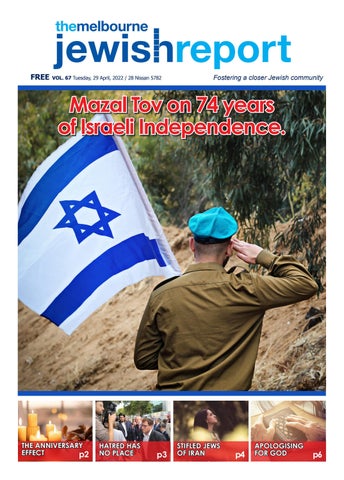
Mazal Tov on 74 years of Israeli Independence.
THE ANNIVERSARY EFFECT p2
HATRED HAS NO PLACE
p3
STIFLED JEWS OF IRAN
p4
APOLOGISING FOR GOD
p6
2
the melbourne jewish report | April 2022
AROUND
T H E
COMMUNITY
The anniversary effect
ANNE-MARIE ELIAS As we approach Yom Ha’atzmaut, we can pause to reflect on this anniversary of the declaration of independence of the State of Israel on 14th May, 1948. For Israelis, in particular, and Jews, in general, this is a day of celebration. Are all anniversaries celebratory? When they are, we experience joy and happiness. We acknowledge a significant event by getting together with others to create a shared experience of something positive. This is certainly true In Israel, where Yom Ha’atzmaut is a national holiday. Take a moment to reflect on anniversaries that you have celebrated. These may be religious days, personal days such as birthdays, or national public holidays. How did you feel and what did you do? But not all anniversaries are positive. Some, such as the anniversary of the death of a loved one or Holocaust Remembrance Day, are filled with sadness and trauma. Researchers call this the anniversary effect. These days are marked by feelings, thoughts and memories that occur on or around a date that marks a significant event. People could be feeling sad, anxious, irritable, anxious and/or emotionally shutdown. Some experience difficulty sleeping and lose
their appetite. We need to plan and prepare for such anniversaries. Here is how. Awareness Rather than trying to forget the day, remind yourself that the days or weeks leading up to these anniversaries could be tough for you. Practice selfcompassion. With an acceptance that this will be a difficult time, find ways to increase your self-care. Look after yourself by eating well and resting. If you anticipate that you may need more support, schedule time with friends or family. Let them know how you are feeling and what you require. If need be, take a break from work.
Talk about it If you have experienced an anniversary effect before and feel you might be vulnerable again, do your best to make sure your support network is there for you. This may be a time to reconnect with a therapist for a few sessions. Ensure that if you need to talk about the trauma, the people in your support network will let you do so and not try to shut you down. It is important that you have a safe space to open up and cry. Expressive therapy, such as writing, art or music, can also be helpful. Media If your anniversary is related to a public event, there will likely be media coverage. If you find this triggering, then
it is important to stay away from media or limit your access to it. Commemorate It can be helpful and important to honour your experience. Some ways to commemorate your anniversary, include: • Donating time or money to charity, especially if that charity aims to prevent (or help others that have experienced) trauma. • Organising a dinner with loved ones. You may choose to make this a reflective occasion or a loving, joyful one. Do what best fits your needs. • Visiting a meaningful spot, like a place that you associate with happiness or healing. • Planting a tree and bringing new life into the world. • Expressing your feelings through art, writing, dancing, or another activity where you can release your thoughts. • Making yourself laugh by seeing a funny movie or spending time with your most amusing friends. • Visiting the cemetery (when it involves a personal loss). • Participating in a public event, such as Anzac Day. Finally, remember what you are feeling is temporary. While adverse anniversary reactions can be very strong, they will usually pass within a week or two and you will come out the other side feeling lighter. If you don’t, by all means seek the guidance of a trained psychologist. Anne-Marie Elias is a psychologist in clinical practice for 25 years.
Land flowing with milk and honey YERACHMIEL ISACOWITZ Jewish liturgy is replete with mention of our homeland. At the seder we say, “now here, next year in the Land of Israel. Now slaves, next year free people.” What kind of freedom do we seek and what does that have to do with Israel? Modern history abounds with “freedom from” movements that have ended in dictatorships worse than the original. For example, in Russia freedom from the Tzar to Stalin, in China freedom from the Emperor to Mao and in Rhodesia (now Zimbabwe) freedom from minority rule to Mugabe etc. Judaism is a “freedom to” program. We strive to have freedom to live the life of spiritual responsibility (mitzvot) as outlined in the Torah. We see this as our purpose and we aim to continually better ourselves. Judaism is an all-encompassing, lifelong commitment. It incorporates the most sophisticated legal, ethical and ritual system. To fulfil our commitment, we need the freedom to adhere to its
Vvvita©123RF.com principles. While there have been many periods in Jewish history that we have had independent communities in the diaspora, there is no opportunity to live the model Torah life completely outside Eretz Yisrael. Israel is a special land. In fact, most of the 613 mitzvot in the Torah are dependent upon it.
There are general mitzvot, for example peah (leaving the corners of the fields for the poor), trumot and ma’asrot (dedications of percentages of crops to Kohanim, Leviim and the poor) and shmita (refraining from farming in the seventh year).
There are other mitzvot that apply only in Jerusalem, for example offerings in the Beit Hamikdash (The Temple), maase sheini (the third percentage of crops that must be eaten there) and aliyot haregel (pilgrimage to Jerusalem on three festivals). Israel has what is called kedushat ha’aretz (holiness of the land) that requires a heightened awareness of how we treat it, what we allow to be brought in and what behaviors are acceptable. So, for example, at the height of Jewish control over Israel, in the times of King David, idol worship was strictly forbidden. The utopian Jewish picture is living in Israel ruled by a King who is a model of Torah. Philosophically, this is the expression of belief in the control the One God has over the universe. Yerachmiel Isacowitz is an independent Torah educator. E: risacowitz@optusnet.com.au W: torahconcepts.com FB: The Mem Channel
Freedom is just a means to fulfilment of purpose. torahconcepts.com
The Mem Channel
3
the melbourne jewish report | April 2022
AROUND
T H E
COMMUNITY
Hatred has no place
RABBI GABI KALTMANN ARK CENTRE I decided to become an ordained rabbi because I wanted to serve my community. I have a naturally outgoing personality. I like people and enjoy textual study, so the profession seemed like a natural fit. Most days my job revolves around ritual: from leading daily prayers to officiating at weddings and funerals and being there for my congregants who can call me at any time for anything that they need My work is not limited to the Jewish community though. I sit on multifaith boards and advise state and federal governments. I founded the Pillar of Lights multicultural festival in Federation Square. I cherish my friendships with other communal faith leaders. That is why when hostilities flared between Israel and Gaza last month the reactions from my fellow faith leaders hurt. The gut punches hit me quickly and severely. Phone call after phone call, text message after text message. “Israel is an apartheid state.” “Israel is committing genocide.” The calls were from people I had worked with. They were from other faith and community leaders, from friends and professional colleagues. During the pandemic we had spent hours on the phone talking, trying to keep our places of worship open and safe for our congregants. And yet now, they were telling me that Israel was committing atrocities. Those calling me spanned all faiths. Most did not mention the recent terrorist attacks in Tel Aviv and Be’er Sheva, nor the stoning of buses in Jerusalem, nor the rocket attacks that never seem to cease. Somehow, though, they felt berating me as a community rabbi meant I had some shared responsibility for the Israeli government’s actions. Like most Jewish people around the world, I prayed for speedy resolution of this latest conflict. I am a millennial, a 30-year-old who joined social media at the age of 17, when Facebook was still in its inception. In the 13 years since, my generation has witnessed the way the platform has morphed from being fun and social to something far more sinister. It has become a place where fringe opinions gain traction to amplify their hate to a large audience. Denigration, abuse and conspiracy theories abound. In short, social media has become simply terrifying. In the past month, influenced by mass hysteria, people I know and respect felt validated to express positions that don’t acknowledge the long and complex history of the Middle East. Most people I follow felt that they had the right to weigh in on the conflict. While the comments were about Israel, they were addressed to all Jews. The hate on my feed was endless for the entirety of the duration of the fighting. It seemed to come from all sides and from everyday people, not just from the fringes of society, where you may expect to see such hatred to propagate.
Rabbi Gabi Kaltmann (in the forefront of the photo) with Prime Minister Scott Morrison at the Ark Centre recently We must learn how to combat this intolerable and incessant vile rhetoric. Social media animosity leads to devastating real-life consequences. My old rabbinical school in Caulfield was recently graffitied with the words “Free Palestine”. My son’s school was targeted with similar scrawl on the main driveway, next to the school building. These are Jewish places of worship and education, far from the conflict and not involved in any political activity. These places are where we, as Jews, want to feel safe to pass on our ageold traditions, but there is a deeply unsettling feeling brewing. Despite the anxiety that many Jewish people are feeling right now, I strongly believe that the solution is more dialogue and discussion, more education and empathy. Instead of blasting each other on social media or on impersonal platforms, we need to get personal with each other and talk face-to-face. I refuse to let this experience dampen my commitment to intercultural and multifaith work. There is so much good that can be done and I wholeheartedly believe that as long as we are committed to education and dialogue, hearts and minds can be shaped. I’m not pretending that the road ahead is easy. Sometimes the hate and prejudice can feel insurmountable, however we all need to start somewhere. If you have never met a Jewish person, it somehow feels easier to denigrate an entire people. Once I explained how Jewish people globally felt under attack due to hostilities in Israel and the Palestinian territories, many of my fellow faith and community leaders apologised. They still had their concerns, but they had a new understanding of what it meant to be a Jewish person living in the diaspora during a fraught period in Israel.
What is happening in Australia and around the world scares Jewish people more than you can imagine. The events in the Middle East are complicated, but intense emotions and discussions
on social media that demonise all Jews have repercussions. As we come together celebrating the Jewish State’s 74th birthday, let us take a moment to reflect that Australia is not immune.
PANADA Autumn/Winter Collections Now In-Store and Online
panada.com.au
1202 HIGH ST ARMADALE | 03 9576 1699
4
the melbourne jewish report | April 2022
CO NS I D E RE D
OPINION
BY CATHERINE PEREZ-SHAKDAM COURTESY: AISH.COM Iran’s small Jewish community lives under the shadow of institutionalised hatred, bound by fear and the threat of retaliation should they dare offer but a whisper of resistance. It is those voices I wish to air today, so that their cries find an echo in the silence which suffocates them. Shirin* is the daughter of a textile merchant from Isfahan, an affluent city in central Iran, a six-hour drive from the capital Tehran. Formerly home to a buoyant Jewish community, Isfahan is now home to an estimated 1,500 Jews and 13 synagogues, mostly located in an area dubbed the Jewish Passage, a far cry from the bustling community which once called the city home. “After Tehran, Isfahan had one of the most populous and thriving Jewish communities. Today things are very different. The streets of our neighbourhoods have gone increasingly quiet and so many of our family members have left for Europe, the United States or Israel. It has been difficult to feel a real sense of belonging now that we are cut off from one another. Even though we try to stay in touch with everyone through social media and WhatsApp, there is always the fear that our phone calls and messages could be misinterpreted by the regime and accusations of espionage or direct support to Israel made against us. “My cousin left five years ago for the UK and I’ve stayed in touch with her through journals. A family friend who is a trader often travels between Iran, Turkey and the UK and when he does I make sure to give him my journals so that Serena can read them … and vice versa. This way I get to share my innermost thoughts and everyday life without censorship. "It’s a bit lonely as I miss hearing my cousin’s voice but it’s the only safe way we have to maintain our close bond. “I wish we had the freedom to be ourselves and enjoy our families. I wish we didn’t have to hide ourselves away. I wish so many things for my community and my parents. Sometimes I wish Iran wasn’t my home.” A sister to her four brothers and an only daughter to her loving Jewish parents, Shirin is 27 years old. An avid reader of the French classics, Shirin dreams of teaching at La Sorbonne, a well-known French University in Paris, a dream she knows is unlikely to come true, as leaving Iran is not a simple matter. Shirin has an M.A. in French Language and Literature. She now teaches French privately, hoping soon to further her studies by pursuing a degree in western philosophy. “It hasn’t been an easy road for me. I had to work twice as hard as other students and every step of the way I had to justify to my professors and the faculty administrative body that my ambitions were purely academic and not politically motivated. “Jews in Iran live under permanent suspicion; everything we do is put under
Giving voice to the stifled Jews of Iran
Shirin*, who met the writer on social media, lives in constant fear. This is her story. Photo: Ardalan Hamedani, Unsplash.com a microscope. The most trivial matters can lead the authorities to question our motives. When I first applied for my B.A. in French Language my father had a visit from SEPA (Iran Intelligence Services) asking him why his daughter felt the need to study a foreign language when she could simply marry and limit herself to being a mother and a wife. “The fear was that I might develop links to French organisations through my studies and get involved in politics. “Bless them, my parents have been so supportive of me. I’m eternally grateful to my dad for standing up to government officials for me when it would have been so easy for him to demand that I give up. “I had to wait for an entire year for my application to be accepted. After that, I had to face daily beratings from my teachers and fellow students. I was also asked to systematically hand over my notes and research papers to a committee for verification before I could be allowed to attend the rest of my classes. I don’t know what they were looking for, but I had no choice in the matter and so I complied. “I was the only Jew in my classes and I found it difficult to make any friends. I tried, but most people kept away from me. It was a lonely experience, but I pushed through. My studies mean everything to me and without them I would have nothing.” On paper the Islamic Republic does not discriminate against its citizens on the basis of ethnicity or faith, but realities on the ground are very different – even more so for Iran’s small Jewish community. Fed by paranoia against the Jews, the State peddles the view that every Iranian Jew harbours feelings of sedition towards Tehran and that without proper monitoring they would either foment an uprising or enable foreign agents to sow discord within.
Such level of mistrust has fuelled many great tensions and fanned feelings of enmity against the Jewish communities, leaving the Jews of Iran to have to justify their actions under the watchful eyes of the State intelligence services. “I was told when I was very young not to mix with children outside our community as mixing could put my father and his business in jeopardy. There is no law preventing us from participating in social gatherings or even sports, but it’s very much frowned upon. All aspects of life in Iran are closely monitored by SEPA and the Basij (a paramilitary group close to Ayatollah Khameini, set up to serve as an auxiliary force engaged in activities such as internal security and enforcing state control over society). “Even our synagogues are watched and so many choose to practice at home rather than risk bringing attention to themselves. Being a girl makes things terribly difficult. "Women in Iran have a very limited space within which they can freely move and I have to contend with those limitations, on top of being an Iranian Jew. As a child I rarely went to the park with my mother and brothers to play. Even picnics, a favourite hobby among Iranians, had to be a well thought out affair. “I’m suffocating … I wish I could be free to choose how I want to live my life and my faith without thinking of all the ways I might put my family in danger.” “We live under the constant threat of arrest. Should the State decide that we acted against their interests, we face the risk of having our loved ones imprisoned and tortured. Jews cannot travel freely across Iran without arousing suspicion. The State may claim that we can, but it’s simply not true. The worst part is that there are no clear guidelines or rulebooks. Everything is up to the
intelligence services to decide. A simple text message to a friend could be misunderstood and lead to an arrest or a visit from Basij. “Jews are immediately flagged at the airport should we wish to leave the country for fears that we will contact opposition groups and help depose the regime. Our phones are tapped and our gatherings spied upon. “We also have to play a part in the State’s
propaganda
machine
by
sending representatives to vouch for the happiness of the Jewish community under the authority of the Ayatollahs. "Tehran’s claims that the Jews of Iran are safe is all a sham. We are paraded a few times a year so that State officials can
claim
diversity
and
inclusion.
They mock our rituals by forcing us to perform before their cameras to then congratulate each other for the tolerance of their institutions.” “What
could
we
ever
hope
to
achieve in resisting the wishes of the government? The whole system has been orchestrated in such a way that no matter what avenue we wish to pursue, we will fail. Our studies, our travels, our friendships, our businesses, our practices are put under a microscope and our ambitions curtailed to make way for regular Iranians. “Iran has put so many limitations on us that our only hope would be to leave and relocate elsewhere, but many of us do not wish to leave our homes and our communities. Iran has been our home for generations and we are waiting for things to get better. Only it’s not getting any better and the regime has systematically hardened its tone towards us."
5
the melbourne jewish report | April 2022
AROUND
T H E
COMMUNITY
What is so special about Israel?
BY DANIEL RABIN SENIOR RABBI CAULFIELD SHULE At the beginning of 2020, I eagerly anticipated visiting Israel twice. The first trip was scheduled for March and the second for late October. As with so many other plans I and others had that year, my travels did not materialise. Since then, I have been telling my family and friends over and over again that I cannot wait to revisit my original plans. Fortunately, the skies are open once more and I look forward to flying to Israel shortly after Yom Ha'atzmaut. Over the past week, the desire to return has only increased. In the wake of the recent terror attacks in Israell, seeing the distress and trauma that is occurring, there is an innate gravitational pull to want to be with our sisters and brothers there. The angst is heightened by media articles and news coverage, which seem to vilify Israel based on erroneous and distorted facts. I certainly pray and hope that all acts of violence and terror come to an end and that people from all walks of life can live in peace and harmony. I was thinking about why Israel means so much to so many people? Why does it hold a special place in our hearts when we live so far away? Considering the ongoing violence and tension in the country, why would I want to return? Truth be told, Jewish people today seem to be extremely divided when it comes to Israel, perhaps more so than
Rabbi Rabin leading a prayer service for fallen soldiers at Har Hertzel during a Taglit Birthright trip ever before. If you spend a few minutes on social media, you will see a plethora of views about what Israel is and what it should be. Additionally, as referenced above, we must also deal with the onslaught of criticism inside and outside Israel. In light of this, the question remains: why are we drawn to Israel? Why is so much attention paid to this tiny country? There is no single answer. People have multiple "entry points" – based upon their personal and prior experiences – in their relationship with Israel. Israel intrigues some as the land where biblical history unfolded. Some connect to it
geographically, others because of its religious significance. No matter what your link is, I encourage you to deepen that involvement. I would like to share one idea that I believe addresses the reason for Jews' strong attachment to the Jewish homeland. It might shed light on the fact that even with Israel facing formidable challenges to its very existence, so many of us care deeply and are so invested in what happens there. Rabbi Eliyahu Dessler expresses this idea beautifully in his work Michtav M'Eliyahu. He poses the very question I asked. Put
another way, what accounts for our love of the land despite more than 2,000 years of exile? He points out that Israel is not simply a centre of nationalism like. If that was the case, the Holy Land would have been forgotten … as many other nations have ditched their homelands after long periods of exile. Rather, the love of Israel is rooted in holiness. The holiness of Israel – where the Torah says God always resides – is the same holiness found within us all. Our souls contain an inheritance we received from our forefathers and foremothers after Hashem promised them this land. As the Torah tells us (Devarim 11:15), Israel is “a land that the Lord your God scrutinises constantly. The eyes of the Lord your God are always upon it, from the beginning of the year until the end of the year.” There is the special power of Israel, in that it is there where there is great opportunity for closeness to the Holy One. It is this holiness that inspires our souls to connect with this land. It is also important to note that this holiness comes with a higher responsibility. Israel needs to maintain enviable standards and be a shining light to the world at large. Moral guidance should be sought there. I am looking forward to celebrating Yom Ha'atzmaut with my community at Caulfield Shule. In the meantime, I pray for the welfare of Israel and its people. As we say at Pesach, Leshana Habaah Beyerushalayim (next year in Jerusalem).
בס"ד
– RARE –
ARGYLE PINK DIAMONDS
TERM 2: 27 MAY-22 JUNE
CAULFIELD
BUBS WEDNESDAYS / 9:30AM - 11:00AM $7 - CHILD OVER 6 MONTHS $3 - FOR EACH ADDITIONAL SIBLING
ARGYLE PINKS DIAMONDS as well as other COLOURED DIAMONDS are available at Ian Sharp Jewellery. Start your Pink journey with us today. There is nothing on earth quite like an Argyle Pink Diamond. The returns on pinks have outpaced the stock market and the Argyle mine has ceased production as of the end of 2020. With no more new supply, now is the time to get your rare Pink Diamond.
Hosted by Rebbetzin Sarah & Daniella from Beats & Babble Music *This is a nut free environment Please bring your own kosher snack For further information, email admin@caulfieldshule.com.au
65 Toorak Rd, South Yarra, VIC 3141 P. 03 9866 4983 E: sales@iansharp.com.au www.iansharp.com.au
IanSharp_Advert_Feb21.indd 1
5/2/21 9:41 pm
6
the melbourne jewish report | April 2022
CO NS I D E RE D
OPINION
BY RABBI MORDECHAI BECHER COURTESY: AISH.COM Many great thinkers consider the question "why do bad things happen to good people?" to be the most perplexing question in philosophy and theology. Are there any truly good answers? The life of a non-human animal research participant (a rat) running mazes in a psychology lab is not very meaningful. It presses one lever and receives food pellets; it presses another lever and gets an electric shock. It is eventually conditioned to press the appropriate lever (unless it is a really weird rat) and to run the maze in a specific path. Human life is much more risky, ambiguous and challenging. We may often make a morally correct choice and nevertheless lose out or suffer, and we may make an immoral choice and succeed and prosper. We are not creatures who merely react to stimuli or act only when cause and effect are obvious, rather we are beings that struggle with decisions and even struggle with our motivations and intent. This capacity for free will is crucial to understanding the question of why good people suffer and evil people prosper. First, some introductory remarks. Why good people suffer is a question that Moses asked of God. It is a question to which an entire book of the Bible, Job, is devoted and a question that religious and secular philosophers have discussed throughout history. The great German
Apologising for God philosopher Gottfried Wilhelm Leibnitz wrote a book on this subject, entitled “Theodicy” (from the Greek theós God and dík, justice). In other words, “justifying God”. If this question bothers you, that is a good thing. It shows that you are not indifferent to suffering and it also reveals that you expect there to be justice in this world. That expectation is based on the deep-seated belief that most of us have that there is a judge – a just and benevolent God and therefore there should be justice. The question, of course, is not applicable to self-inflicted suffering based on lifestyle and moral choices. Maimonides – the great Jewish philosopher, Talmudist, physician, and community leader of 13th century Cairo – believed that most suffering was a result of people blindly following their desires for money, power, materialism and honour. “For by following entirely the guidance of lust, in the manner of fools, man loses his intellectual energy, injures his body, and dies before his natural time; anxiety and worries multiply; there is an increase of envy, hatred, and violence for the purpose of taking what another possesses” (Maimonides, Guide for the Perplexed 3:33). Now let’s revisit our original question of theodicy. Jews, and indeed all monotheists, believe that God is perfect, complete in every manner and totally independent. The 20th-century Jewish
scholar Rabbi Aryeh Kaplan expressed that “God had absolutely no need to create the world. God Himself is absolute perfection and He has no need for anything, even creation. Thus, to the best of our understanding, we can say that God created the universe for the purpose of bestowing good upon people. God Himself calls His creation an act of goodness. It is for this reason that, at the end of the first six days of creation, after making Adam, the Book of Genesis says, “And God saw all that He had made and behold it was very good.” We are being told that the creation of the universe was an expression of His goodness.” (Rabbi Aryeh Kaplan, Innerspace, pg. 9). Rabbi Moshe Chaim Luzzatto (Italy, 18th century) explains that since God is perfect, His gift must also be perfect. The ultimate gift is, therefore, to be “God”. Since it is a logical impossibility for the creature to be the Creator, God enabled the creature to become as God-like as possible. Since God is independent and self-actualising, so too God created the human being with God-like qualities, one of which is self-actualisation or selfcreation. Through the power of free will, the human creates herself and is truly a creator, not merely a creature (Luzzatto, The Way of God, Section 1, Ch. 2). So free will is essential for the fulfilment of God’s goal. However, free will ability is not enough. There must also be an environment that enables the exercising
of free will. Imagine a world where every good decision was rewarded and every bad decision punished, honest businesspeople succeeded and every crook failed, the good guy always finished first and the bad guy last. Such a world would be like a maze in a psychology lab and we would be the rats. In a world like that, free will would be replaced by conditioned responses and instead of creating ourselves, we would be products of God’s intervention. The more God intervenes, the less free will we have. God wants us to have a meaningful life and be God-like creators, and he therefore interferes only when absolutely necessary. However, if God minimises his intervention, the righteous will often suffer and evildoers will often prosper. (There will be justice served in the afterlife, but that is a subject of another discussion.) To ask that God always intervene when there is injustice is to ask that humanity no longer exists as human, but rather as lab rats responding to stimuli and conditioned by immediate Divine intervention. And if God does intervene, where do we draw the line – murders only? children only? If we want a world where a saint is possible, then it must be a world in which a Stalin is also possible. If we want a meaningful life, we must have free will and in order to facilitate free will, the bad guys will sometimes win and the good guys will sometimes lose.
7
the melbourne jewish report | April 2022
AROUND
T H E
COMMUNITY MELBOURNE JEWISH BOOK WEEK After a couple of years on online programming, Melbourne Jewish Book Week returns to an in-person festival from May 28th to 31st. The four-day celebration of the written word features a host of local and international writers and guest speakers. They include Dr Norman Swan, Peter Doherty, Maria Tumarkin, Sarah
Turning the page Krasnostein, Zoya Sheftalovich, Simon Tedeschi, Gideon Haigh, Alice Zaslavsky and Dani Valent. David Grossman, Howard Jacobson and Rivka Galchen will appear live via video link. Panel discussions will range from the profound to the purely entertaining – everything from literature to politics, food to music. Of course, it is also an opportunity to acknowledge the talent of local authors. Opening night – titled In our Nature – will highlight writers, musicians and
David Grossman puppeteers. Hosted by writer and audio maker Jaye Kranz, it will take place at Memo Music Hall, 88 Acland Street, St Kilda from 7:30-9:30pm on Saturday, 28th May. The following day will see 12 diverse panels, interviews and discussions at Glen Eira Town Hall, kicking off at 10am. There is also a children’s program catering for all ages from pre-school upwards. Monday, 30th May (again at Glen Eira Town Hall) between 7:30 and 9:30pm is
called Love, Regardless and captures the essence of enduring love. The Classic cinema in Elsternwick at 7pm on Tuesday, 31st May is the venue for the closing night when David Grossman will speak via video link with Tali Lavi about love, vulnerability and home, his most recent novel and his life’s work. Full the full program and tickets, go to www.melbournejewishbookweek.com.au
ADVERTISEMENT
LIBERALS & LABOR ARE THE SAME FREEDOM FREEDOM FREEDOM FREEDOM FREEDOM FREEDOM Vote 1 United Australia Party Vote 1 United Australia Party Authorised by: Clive Palmer, United Australia Party, Level 17, 240 Queen Street, Brisbane 4000
UAP13469K7K
8
the melbourne jewish report | April 2022
JUD AIC A
QUIZ
RABBI DAVID FREEDMAN It is time to pause and explore Jewish history, literature, prayer and all-things-Israel. Below a spotlight also shines on famous Jews in the arts, sciences, politics, religious affairs and dives into the bible and so much more. This quiz has been warmly embraced by families and friends around Shabbat and Yom Tov tables across town and is brought to us by the erudite and engaging Rabbi David Freedman. 1. Which Israeli wrote 40 books, including: novels, short story collections, children's books and essays. This comprised works published in 45 languages - more than that of any other Israeli writer? 2. What is the collective name used to describe the seven Psalms: 24, 48, 81, 82, 92, 93 and 94? 3. What generic names were given to the rabbis who compiled the Babylonian Talmud? 4. Who served as the first female United States Secretary of State in U.S. history from 1997 to 2001 under President Bill Clinton? 5. Abe Attell was often referred to by newspapers as "The Little Hebrew".
Test your knowledge He was a boxer who became known for his record six year consecutive reign as World Champion from 19061912 – in which weight division did he compete: Flyweight, Featherweight or Welterweight? 6. True or false – Jacob and Amalek (Israel’s arch enemy) were related through marriage? 7. There are times we have someone else’s property in our possession. Jewish law identifies four categories
9. Marvin Hamlish, the famous Jewish composer, was one of only 16 people to win all four of which famous four awards? 10. Where in Israel is The Shimon Peres Negev Nuclear Research Centre located? 11. What does the Old French word ‘chalant’ mean? 12. The fictional character Leopold Bloom is found in which famous work of literature?
Good luck. Enjoy. Hopefully, learn something new about your Jewish heritage and tradition.
and discusses each one in respect to responsibility in law if the property is damaged. The first three categories include: the unpaid guardian, the paid guardian and the borrower. What is the fourth category of ownership? 8. In one of his paintings, Caravaggio depicts a young man holding someone’s head in his hand. Which famous Biblical story did this represent?
13. What is the name of the Israeli Trade Union Organisation? Who was elected as its General Secretary in 1921? 14. The Hebrew phrase Lifnim Mishurat Hadin refers to which concept in Jewish law? 15. Resigning from her position as United States Ambassador to the United Nations on December 31, 2018, who won the World Jewish Congress Theodor Herzl Award in November 2019?
16. In which biblical book would one find the words Oseh Shalom Bimromav (He who makes peace in His high places): Job, Nehemiah or Daniel? 17. What name is given to the palmshaped amulet with an eye on it that is most prevalent amongst Sephardi Jews? 18. The Second Arab-Israeli War is better known in the UK, USA and France as what? 19. Titus, who succeeded his father Vespasian as the general who led the attack on Jerusalem in the year 70 CE, was the first Roman emperor to do what? 20. What is the literal meaning of the word Mezuzah? 21. Where is Israel's richest agricultural area situated? 22. The Kimchis were a famous medieval rabbinic family. Did they come from Spain, Italy or France? 23. Brad Gilbert won a bronze medal at the 1988 Olympics and both gold and silver at the 1981 Maccabiah Games. In which sport? 24. Who wrote the short story, Yentl the Yeshiva Boy? 25. Brian Epstein, manager of The Beatles since 1962 until his death, was born on which Jewish festival in 1934?
ANSWERS PAGE 10
Yoni Glatt’s JEWISH SPELLING BEE How many common words of 5 or more letters can
spellcommon using the letters the5hive? Every answer How you many wordsin of or more letters can must use the the centre letter at may you spell using letters inleast theonce. hive?Letters Every answer be reused in a word. At least one word will use all 7 must useletters the center letter at least once. Letters may and have a direct Jewish connection. be reused in a word. At least one word will use all 7 Proper words are not allowed. lettersnames and and havehyphenated a direct Jewish connection. Score 1 point for each answer and 3 points for a Jewish-related word that uses all 7 letters.
Proper names and hyphenated words are not allowed. Score 1 Rating: point 6=Good; for each8=answer, 3 points for a Excellent;and 11= Genius Jewish related word that uses all 7 letters. Rating: 9=Good; 17= Excellent; 25= Genius
Yoni Glatt has published more than 1,000 crossword puzzles worldwide, from the LA Times and Boston Globe to The Jerusalem Post. He has also published two Jewish puzzle books: "Kosher Crosswords" and the sequel "More Kosher Crosswords and Word Games". ANSWERS PAGE 10
Here is a list of some common words (Yes, we know there are more words in the diction
the melbourne jewish report | April 2022
AROUND
T H E
COMMUNITY
9
Enduring success
UIA On Yom Ha’atzmaut, Keren HayesodUIA acknowledges the strength of its partnership with the State of Israel. David Ben Gurion, the first Israeli Prime Minister, said that “the merits and achievements of Keren Hayesod-UIA are engraved in the soil of the homeland and treasured in the soul of the nation.” Former Israeli Transport Minister MK Itzhak Ben-Aharon said that “Keren Hayesod-UIA was an Israeli fund before there was an Israel. The State of Israel would not have been established if not for Keren Hayesod-UIA … without its path of building the country and laying the foundations of a Jewish society.” For 102 years the organisation has helped build the infrastructure and institutions of Israel, always delivering on the national priorities of the State. Since its inception, aliyah and the needs of the Jewish people have always been its central tenets. That is evident in the 3.5 million olim Keren Hayesod-UIA has supported. Although the Israel of today looks very different to that of days gone by, the need for aliyah has not diminished. In fact, 2021 saw an increase of 30% on the previous year’s figure and in 2022 it is estimated that 50,000 people will make Israel their permanent home.
A Ukrainian refugee finds safety in Israel The situation in Ukraine and rising antiSemitism highlights the importance and relevancy of aliyah as a lifeline for many. In the past month, Keren Hayesod – UIA has welcomed 11,000 Jewish Ukrainian refugees, with a further 7,000 arriving soon. They are being housed and supported through various absorption programs in the hope that they will lead successful lives in Israel. They will now experience their first Yom Ha’atzmaut in Israel – a true celebration of their independence.
For the People of Israel
While simultaneously building the human capital of Israel, Keren HayesodUIA’s innovative and supportive programs for youth-at-risk and the elderly remain a high priority. For youthat-risk, particularly in the periphery, its mentoring and educational services, such as youth villages, Youth Futures and Net@ are turning disadvantage into opportunity. More than 7,500 low-income seniors, mainly Holocaust survivors and immigrants from the former Soviet Union, are cared for through the
organisation’s Amigour project. That provides affordable housing, enabling these people to live with dignity and respect. The reach of Keren HayesodUIA’s extended family enables it to act as the bridge for global Jewry and strengthen the diaspora’s connection to the Jewish homeland, highlighted through gap year programs such as Masa. With continued community support, the organisation will reinforce its partnership with the State of Israel and maintain its profound impact.
10
the melbourne jewish report | April 2022
MOV IE
REVIEW
Hard-hitting and true
HAPPENING (R) BY ALEX FIRST France in 1963 was a place where abortion was a dirty word. In short, it was illegal. Happening is a harrowing tale about a highly intelligent literature student who unexpectedly falls pregnant and has to keep it a secret for fear of what could happen to her. Her name is Anne Duchesne (Anamaria Vartolomei) and she is 23. She hangs around with her gal pals, Brigitte (Louise Orry-Diquero) and Helene (Luana Bajrami) and like others their age they talk about boys. Then when her period doesn’t come on time Anne pays a visit to a doctor, only to discover – much to her alarm (although by then she suspects it) – that she is carrying a child. At that stage she is only three weeks into her pregnancy. We follow Anne’s frantic endeavours to find a solution to her “problem” in the weeks and months that follow. She lives in a dorm and visits her parents regularly, but she can’t tell them that she is pregnant because anyone who aids Anne’s endeavours to abort faces jailtime, so even her closest friends abandon her. The guy who knocked her up in a casual encounter is no help and a male friend tries to take advantage of the situation. Anne’s studies, that she is so desperate to continue, suffer. Her literary professor Bornec (Pio Marmai), who saw her as a fellow
teacher in future, now can’t see her passing her university entrance exams. When he asks what is going on, she refuses to tell him. As she reaches the 10 and then 12week mark, Anne’s options have almost closed entirely. She feels increasingly isolated and abandoned. Happening is a compelling movie, but a very difficult watch. Anamaria Vartolomei is superb in the lead role, displaying the full range of emotions. We feel her frustration and fear, and metaphorically ride every bump.
CANDLE LIGHTING TIMES Friday, Apr 29, 2022
5:18 pm
Shabbat ends, Apr 30, 2022
6:15 pm
Friday, May 6, 2022
5:10 pm
Shabbat ends, May 7, 2022
6:08 pm
Friday, May 13, 2022
5:03 pm
Shabbat ends, May 14, 2022
6:02 pm
Friday, May 20, 2022
4:58 pm
Shabbat ends, May 21, 2022
5:57 pm
Friday, May 27, 2022
4:54 pm
Shabbat ends, May 28, 2022
5:53 pm
Friday, Jun 3, 2022
4:51 pm
Shabbat ends, Jun 4, 2022
5:51 pm
Sunday, Jun 5, 2022
5:51 pm
Monday, Jun 6, 2022
5:51 pm
Friday, Jun 10, 2022
4:49 pm
Shabbat ends, Jun 11, 2022
5:50 pm
We see her mood shift as door after door closes. I also appreciated the slice of life representation of the dutiful professor by Pio Marmai. His character tries to understand what is going on, but retains a professional distance. Based on a novel by Annie Ernaux about her own experiences, director and co-writer Audrey Diwan has given the film an appropriately claustrophobic feel. She has done a fine job “trapping” Anne and then tightening the screws.
In so doing, she has also commented on the rigid rules that constrained women at that time. This is dour, intelligent filmmaking that doesn’t let up from start to finish. Winner of the Golden Lion at Venice last year, there is much to appreciate about the way the subject matter is handled, as loathsome as what appears on screen may be. And a warning, some of it is not at all pretty. Rated R, Happening scores an 8½ out of 10.
Judaica quiz answers 1. Amos Oz 2. These are the seven daily psalms known collectively as Shir Shel Yom – The Psalm of the Day 3. The Babylonian Talmud includes the Mishna and Gemara – the Mishna was compiled by the Tannaim, the Gemara by the Amoraim. One may also include the Saboraim who edited the final version 4. Madelaine Albright 5. Featherweight 6. False – they were in fact related through family. Amalek was Esau’s grandson, which made him Jacob’s great nephew 7. The hirer 8. David and Goliath 9. He won the Emmy, Grammy, Oscar and Tony awards 10. Dimona 11. It means ‘warming’ and is the origin of the word Cholent 12. James Joyce’s Ulysses 13. Histadrut - David Ben Gurion 14. Going above and beyond the letter of the law, i.e. acting in the spirit of the law
15. Nikki Haley 16. Job 25:2 17. Hamsa. Depicting an open hand, hamsa (Arabic) is connected to the Hebrew word chamesh meaning five, because of the five fingers depicted on the hand 18. The Suez Crisis (1956) 19. He was the first Roman emperor to come to the throne after his own biological father (Vespasian) 20. It means a doorpost. It is said to be derived from the Hebrew verb, zuz, meaning to move or shift as the doorpost is a device which enables the door to move or shift 21. The Jezreel Valley 22. France. The family, including Rabbi Joseph Kimchi and his sons, Rabbi David Kimchi and Rabbi Moshe Kimchi, came from Narbonne in the Provence region of Southern France close to the border with Spain 23. Tennis 24. Isaac Bashevis Singer 25. Brian Epstein was born on Yom Kippur, 1934
Here is a list of some common words (yes, we know there are more words in the dictionary that can work, but these words are the most common):
Jewish Answer: CHUTZPAH. Other Answers: CATCHUP, CHAZZAN, CHUPPAH, CHATAN, HUZZAH, PAZAZZ, ATTACH, CATCH, CAPUT, HATCH, PATCH
Jewish spelling bee answers
Questions/comments – email Yoni at koshercroswords@gmail.com
11
the melbourne jewish report | April 2022
IS RAE LI
N E W S BY NOMI KALTMANN COURTESY: TABLET MAGAZINE Every year, young scholars gather in Israel for Chidon HaTanach, the International Bible Contest. Sometimes those who start as rivals end up under the chuppah. When Noah Notis and Atara Kelman got married in July 2020, due to the pandemic they had just 25 guests in Kelman’s backyard in Toronto. It was the culmination of a relationship that began four years earlier in Israel, where they’d originally been rivals. Both bride and groom were contestants at the Chidon HaTanach (International Bible Contest): Notis representing the United States and Kelman Canada. Each year, thousands of the brightest and best students from Israel and around the world compete in regional and national competitions to earn a coveted place in the Chidon finale. The competition, founded in 1958 by Israel’s first prime minister David BenGurion, aims to connect diaspora Jews with the bible and their Jewish heritage. Broadcast live on Israeli television at 11 am on Yom Ha’Atzmaut (Israeli Independence Day), it evokes cult status, even being parodied on Israeli television. With thousands of Israelis, religious and nonreligious alike, glued to their television screens, in most countries this would be akin to one of the biggest sporting events of the year. But at the Chidon, the competition centres around contestants being asked difficult questions about obscure facts and books in the bible. The quiz starts two weeks earlier when participants from as many as 30 countries arrive in Israel to participate in a preparatory camp and tour of the country. Competitors are treated like VIPs, meeting with dignitaries such as the Israeli prime minister, president and minister of education. “There is a certain common denominator for people coming to compete in the Chidon,” said Kelman. “While overall it is a very diverse group of people, those who are similar to you already have certain things in common, such as a commitment to learning Tanach seriously and taking on extra projects outside school hours.” Kelman and Notis are certainly not the only ones who have met their significant other at the Chidon. Amihai Bannett is the director of Chidon HaTanach at the Jewish Agency, which is in charge of overseeing and organising the Chidon. He also recruits, prepares and brings contestants from Jewish communities around the world to the two-week Tanach camp. Since starting his role in 2012, Bannett can think of six or seven couples who met at the Chidon and later got
When competition spurs romance Chidon HaTanach camp since 1991. That includes planning the program, selecting staff for the camp and ensuring the safety of all Chidon HaTanach
competitors
from
the
moment they arrive in Israel until they fly back to their home countries. He thinks that many couples who meet at the Chidon end up married because they share a common interest in the bible. “I think couples bond over the fact that they are outside their home [countries], in an intensive camp with competitors from different places, with common values and often a similar religious background,” he said. This was certainly true for Jenny and Matthew Disler, who met at the 2012 quiz. Jenny, from England and Matthew, from South Africa, met at the Chidon, with Jenny recalling that “we became friends over the two-week camp and spent lots of time together, sharing thoughts and ideas.” Jenny thinks the camp was a good place to meet. “Young, like-minded people came together from all four corners of the earth for their love of Tanach and Israel, which was amazing to see,” she said. “It was a safe space Yoni Halpern and Dani Lent Halpern at their wedding. Photo courtesy Dani Lent Halpern
where we had our independence to meet each other and develop
married … just in the past decade. “The [Chidon] is a meeting of likeminded people who are passionate about the Tanach and Israel,” he said. “This combination sparks wonderful connections.” Agreeing with this sentiment is another couple who met at the 2004
until many years later. Actually, we got more back in touch planning a Chidon reunion.” Dani thinks that the Chidon served as a wonderful backdrop to them meeting, as it “brings together young people who are serious about their Torah knowledge ... and [are] maybe
a friendship, which later became a relationship.” While Felhimer can recall many non-Israeli
couples
who
met
and
subsequently married over the years, he can only recall one Israeli couple who married. In 2018, Israelis Azriel Shilat and Oriah Cohen competed in the final round of the competition, with Shilat narrowly beating Cohen. A year and a half after they competed
Each year, thousands of the brightest and best students from Israel and around the world compete in regional and national competitions to earn a coveted place in the Chidon finale.
against each other, they were married. They have since welcomed their first child. “We just told our eldest daughter [who is] 7 years old that we met at a Torah contest and she was really interested in doing it when she got older,” said Dani Lent Halpern. “If any of our children wanted to participate, we would definitely support them, but
Chidon: Dani Lent Halpern from the United States and Yoni Halpern from Canada. Their romance was not immediate. Rather, it blossomed in the years after their initial meeting at the Chidon. Dani said: “We kept in touch intermittently after [the contest] and saw each other occasionally through mutual friends, but didn’t start dating
just a wee bit competitive. It gives you a chance to see people when they are focusing on something they really want, as well as when they are having fun because of how the program is structured. We both knew we were coming with similar values.” Itzhaki Felhimer is an Israeli who has been involved in running the
it is by no means mandatory.” In this vein, it is likely that the Chidon will continue to serve as a good place for couples to meet, with Jenny Disler saying she thinks “we would like to encourage [our children to participate], but with no pressure.” This story originally appeared in Tablet Magazine (tabletmag.com) and is reprinted with permission.
12
the melbourne jewish report | April 2022
MOV I E
R E V I E W
Tense Holocaust drama
FAREWELL, MR HAFFMANN (M) BY ALEX FIRST Farewell, Mr Haffmann concerns a Jewish small businessman in France caught up in the maelstrom as the Nazis spread their tentacles. It is May 1941 and Joseph Haffmann (Daniel Auteuil) runs a jewellery shop. He is noted for his fine craftsmanship. Haffmann sees the situation in occupied Paris worsening and understands the urgency of arranging safe passage out of the country for his wife and three children. Haffmann promises to follow behind shortly, but first he enacts a plan to hand ownership of the shop (and the residence attached to it) to his relatively new employee. That man, Francois Mercier (Gilles Lellouche), who walks with the aid of a calliper, is married to Blanche (Sara Giraudeau). The pair is very much in love and would like to have a baby, but she is having difficulty falling pregnant. Mercier aspires to open his own jewellery business one day, so while this unexpected arrangement with Haffmann comes out of the blue, he welcomes it … even though Blanche does not. The deal is that Mercier will take over and change the signage on the shop
to reflect his name, only to hand the business back to Haffmann after the war, when he is able to return. In return, Haffmann will help Mercier open his own shop. The deal done, Haffmann leaves with a handshake. But just as the Merciers are getting settled into their new lodgings, Haffmann reappears. There are Germans everywhere and his intended smuggler has gotten cold feet.
Mercier puts Haffmann up for the night, with Haffmann intending to try to make his getaway again the next day. Only that move is scuppered because the German presence has become overwhelming and a second approach to the smuggler receives a violent rebuke. Now, Mercier is stuck with Haffmann in his basement for the long term as the roundup of Jews starts.
Flirting with danger, Mercier sees the business do well thanks to the arrival of a German commandant (Nikolai Kinski) who admires his workmanship (in reality, it is Haffman’s work). Shocks follow as the dynamic between Mercier, his wife and Haffmann changes. While you could question certain plot elements, there is no doubt the story is compelling. Unease and discomfort are always close at hand. The key roles are well played. Auteuil is credible as a decent, hardworking man caught in a most undesirable and dangerous position. Lellouche captures the transition in Mercier, in a movie in which power shifts. Giraudeau shows vulnerability, compassion, fear and horror as Blanche. The screenplay by director Fred Cavaye and Sarah Kaminsky from a play by Jean-Philippe Daguerre maintains and builds interest. Intensity is the name of the game. The question is how will Haffmann and the Merciers end up? To find out, you will just have to buy a ticket to see Farewell, Mr Haffmann. Rated M, it scores a 7 out of 10.
Happy 74th Anniversary, Israel
ABN 44 060 518 729
DIRECTORS
MARK SHAW CPA RICHARD SHAW CPA WILSON ZHOU CPA ABHITHA PATHY CPA CONSULTANT
HENRY RUBIN CPA
P: (03) 8534 9500 Ground Floor, 122 St Kilda Road, St Kilda 3182 www.rubinpartners.com.au