community
pesach
shuls/schools
jewish learning
international
lifestyle
www.thesleepcoach.com.au
FREE
Fostering a closer Jewish community
VOL. 45 Wednesday, 10 April 2019 / 5 Nissan, 5779
Free subscription to electronic copy go to www.thejewishreport.com.au
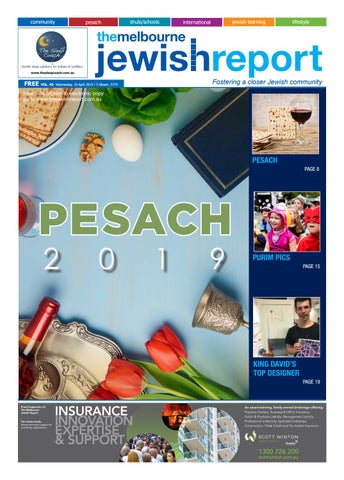
PESACH
PAGE 8
PESACH 2
0
1
9
PURIM PICS
PAGE 15
KING DAVID’S TOP DESIGNER
8648 Scott Winton - Banner for Melb Jewish report (correct size).indd 1
PAGE 19
26/3/18 9:49 am
2
community
April 2019
The Posh Opp Shoppe celebrated its 20th birthday POSH OPP SHOPPE The Posh Opp Shoppe celebrated its 20th birthday and thanked volunteers for their dedication and hard work, raising money so that children with disabilities have the opportunity to attend Jewish day schools. To sign up on-line, for 1 shift of 2 hours volunteering, go to FaceBook @ poshoppshoppe and sign up.
Anger over cycle lane plan sparks action group
SAVE INKERMAN
Caulfield residents have formed an action group to fight a proposed dedicated bicycle lane long one of its main east-west streets. The Save Inkerman group comprises residents who fear the bicycle lane will increase traffic congestion, will attract thousands of unwanted stranger-cyclists, will make it unsafe for residents, will decrease the limited sparking for residents on Inkerman Road and Inkerman Street and force it into the side streets. Save Inkerman members fear it will make it harder for residents to go about their normal daily business and will reduce the living amenity of Caulfield North in particular. Rates are likely to go up to pay for a dedicated cycle lane Caulfield Park and the thousands who use it daily will also be affected. They say a general loss of amenity will lead to a reduction in property prices, and that there is no demonstrated demand for a dedicated cycle lane along Inkerman. They say the current bicycle lanes are more than adequate for the handful of cyclists who use them. Some business owners along Inkerman Road believe that a cut in parking will be bad for business and have indicated they might have to move elsewhere. Glen Eira Council wants to promote healthy living by encouraging cyclists to use the Djerring Trail from Dandenong to the CBD along Normanby Road, Inkerman Road and Inkerman Street to Hotham Street, St Kilda East, so it can join the dedicated bike lanes along St Kilda Road. Save Inkerman has called on the council to investigate linking the Djerring Trail to St Kilda Road by using the plantation (tram) reserves along Dandenong Road to Chapel Street and along Wellington Street, St Kilda. A spokesperson for Save Inkerman said: \”We love this area as it is, and that\’s why we live here, but don\’t want to see it ruined with a
council plan that has not been thought through. “We have no idea what council plans to do, except that it wants to build a pilot cycle lane around June. We don’t know what shape this lane will take, what it will look like or whether it will be shared or dedicated to cyclists. We believe council wants to barricade it off somehow. “People in this suburb are not anti-cyclist, but common sense says they will not forsake their cars for bikes to visit parents and friends, take children to school, go shopping or even go to work. The very small minority who might behoves the council to investigate other streets to build a bike lane. “We believe the tram reserve along Dandenong Road would be ideal.” Glen Eira door-knocked and wrote to about 7000 residents inviting them to an information session at Caulfield Pavilion on 27 February. About 200 residents attended. Save Inkerman says at least 60 main and side streets (and rights-of-way) and about 50 businesses along the Inkerman corridor will be hurt by the building of the cycle lanes. Save Inkerman has a Facebook page at facebook.com/groups/saveinkerman. As of March 27 there were more than 290 members. Its email address is saveinkerman@gmail.com. Council has formed a community reference group to: • review phase one community engagement findings as well as research and data gathered by council; • ensure development of the draft corridor plan reflects community values and priorities; and • provide feedback and advice on potential issues and opportunities. Its online feedback closed on April 1. Save Inkerman urges residents to sign its petition, and protest by writing to council through its website and ward councillors, members of parliament and support groups such as Friends of Caulfield Park and the Glen Eira Residents Association.
Kadimah Welcomes New CEO
KADIMAH JEWISH CULTURAL CENTRE
The Kadimah is pleased to announce the appointment of Adam Kreuzer to the position of Chief Executive Officer (CEO). Adam brings to Kadimah a knowledge, sensitivity and understanding of the Melbourne Jewish Community, having previously held board positions at the Jewish Holocaust Centre and the United Jewish Education Board (UJEB). Adam’s role as CEO is to drive Kadimah’s mission of building a cohesive and connected community through the celebration and sharing of Yiddish and Jewish culture. “I am proud to be able to contribute to the enrichment and expansion of Jewish life in Melbourne,“ says Adam, “through strengthening Kadimah’s internal systems and processes to support an ever- growing, thriving and innovative agenda of cultural projects and initiatives.” The proposed Jewish Cultural and Arts Precinct (JCAP) in collaboration with Jewish Museum of Australia and Sholem Aleichem College, will also demand a key contribution from Adam in the planning, logistics and delivery of this major community initiative.
According to Adam, “as the proud grandson of Holocaust survivors, I experienced first-hand Yiddish being spoken in both their home and mine and understand how important language and especially mameloshn (mother tongue) is in building identity and connecting us to our past and our future.” Prior to joining Kadimah, Adam held management roles with some of Australia’s most prominent organisations including NAB, Coles Myer, Telstra and AXA in areas of human resources, strategy and operations. Adam has completed a Bachelor of Business (Management) and a Graduate Diploma in Industrial and Employee Relations, both at Monash University. “I am excited to represent Kadimah in the capacity of CEO going forward. Deepening our suite of offerings, leveraging our fantastic library resources and growing our appeal to a broader audience both within and outside the Jewish community are my immediate strategic priorities” says Adam. For more information about Kadimah, please visit www.kadimah.org.au
3
community
April 2019
A Record Breaking UIA Women’s Division Brunch UIA CARLI DVASH The 2019 United Israel Appeal Women’s Division Brunch was an inspiring event, celebrating and embracing the stories of strong women and acknowledging the need to come together to meet the challenges that face the People of Israel. Before a record-breaking crowd of 675 strong supporters at Brighton Receptions, the new Women’s Division Executive officially opened their first campaign. This year marks the 55th year of the Victorian Women’s Division, and therefore recognised all of the wonderful women over the years, past presidents and executive members who have contributed to the success of this division. Former Australian Foreign Minister The Honourable Julie Bishop MP highlighted the strong relationship between Australia and Israel, “Australia and Israel have been the staunchest of friends. Australia was the first nation to sign the UN Partition motion in 1948 and today Australia is one of a very small handful of countries prepared to stand up and vote against one-sided, anti-Semitic resolutions that find their way for a vote on the floor of the UN General Assembly.” Ms Bishop called for a greater female presence in leadership roles, noting that “attitudes need to change” and more “women need to support other women.” During her time in politics, she has learnt that no one but yourself should define who you are and what you can achieve. She saluted the UIA Women’s Division for the work they do for the People of Israel, and
acknowledged the Jewish communities’ support for her during her poltical career. Dynamic and vibrant serial entrepreneur, Tzameret Fuerst, who co-founded the revolutionary HIV prevention device Prepex, gave a passionate presentation about how one’s vision can become a reality. She highlighted the numerous obstacles she overcame in order to see her dream fulfilled, leaving the audience with the message to never giving up hope and to always fight for what you believe in. The Women’s Division is proud to support the Youth Futures project in Sderot. This program provides mentorship and rehabilitation to children growing up next to the Gaza border, who are stripped of a carefree childhood, living in the constant shadow of rockets and sirens. They are raised with post-traumatic stress disorder and a sense of hopelessness. Youth Futures Director Miri Rot acknowledged the important work of the Women’s Division in supporting the Sderot centre, especially during these times of unrest. According to the Women’s Division Executive, “we are overwhelmed by the response of the women in our community. We hosted close to 700 women - of which, a quarter were under the age of 45. It was inspiring to see this generational shift, whilst still honouring the organisation’s foundations. We were so proud for the women in the room to be inspired and engaged by our speakers’ paths to success”. The Executive extend a heartfelt thanks and appreciation to all of the table captains, sponsors, donors and volunteers for their support in ensuring this event was a success.
From L to R - Ashleigh Pyke, The Hon. Julie Bishop MP, Elissa Sharp, Amanda Jolson Photo Credit: Peter Haskin
The stunning setting of the brunch. Photo Credit: Izzi Goldman
Prep Entry in 2020 at Mount Scopus Grow with Scopus, with an immersive and experiential Jewish and general education in your child’s formative years.
Prep and Beyond Parent Information Session
Learn about the King David approach to: • School Readiness • Educational Philosophy • Junior School Program
Register for our Prep 2020 information evening being held in May. Applications are now open for ‘Grow with Scopus’ primary school bursaries of up to $10,000 per year, available for new or current students entering Prep next year. Applications close on Friday, 31 May, 2019. For more details, and to register, call Enrolments on 9834 0070 for a confidential discussion.
Scopus Values
Monday 13 May at 7:30pm 373 Dandenong Rd, Armadale BOOKINGS: Admissions Department (03) 9527 0102 or admissions@kds.vic.edu.au
Excellence in Learning
Holistic Development
Jewish Identity
Community and Service
www.kds.vic.edu.au Modern
|
Thinking
|
Judaism
www.scopus.vic.edu.au
4
community
April 2019
Diller Golan fellows take on Melbourne DILLER TEEN FELLOWS
The Melbourne Diller Teen fellows have been very busy with their Israeli Diller counterparts visiting Melbourne this April as part of the Jewish Community Mifgash (‘JCM’). The Diller Teen Fellows program is a global initiative which partners teens from Diaspora communities with those in Israel. Melbourne is partnered with the Golan region, whose 20 fellows and 5 staff visited Melbourne for 8 intensive days. During their stay in Melbourne, the Israeli fellows were home-hosted by the Melbourne Diller families. This is a significant part of their experience, and key in developing their understanding of the Jewish community and Australian culture. We are very fortunate to have a community willing to open their doors, host and entertain their billets, especially the week before Pesach! The JCM kicked off with an opening dinner in Princes Park. The host families were treated to an evening presented by the Melbourne fellows and alumni of the program. It was an opportunity for the fellows to implement their leadership skills in organising, and facilitating a meaningful event. Whilst feasting on Israeli food, the host families met their billets. Talia Davis, a Melbourne Junior Staffer, of Leibler Yavenh College said “it was amazing to watch the fellows begin to build and foster the relationships that will no doubt
continue well beyond the JCM”. The delegation was officially welcomed by the Diller Melbourne Supervisor and Zionist Federation of Australia CEO, Ginette Searle, ZFA President Jeremy Leibler, and Diller Lay-Leader Elana Lewin. Despite the jet lag, the enthusiasm and excitement for the forthcoming 2 weeks was palpable!
The aim of the JCM delegation was to get to know Melbourne and our Jewish community. A trip to Melbourne could not be complete without visiting cultural sites. Highlights of their cultural experiences included graffiti art workshops, a footy game at the MCG and a visit to Mornington Peninsula.
The program also focused on the diversity of the Melbourne Jewish community. The fellows visited Bialik College and Leibler Yavneh College, touring the schools and engaging with students. They were also privileged to hear from three community Rabbis: Rabbi Daniel Rabin of South Caulfield Shul, Rabbi Allison Conyer of Etz Chayim and Rabbin Yonaton Sadoff of Kehillat Nitzan, with insights about their congregations and the community. The visit to Emmy Monash was a highlight and saw the Israeli fellows delighting residents with songs, stories and laughter. A visit to the Jewish Holocaust Centre was particularly meaningful. Additionally, the fellows learned about Access Inc, and met with Access Participants over a tasty lunch they had made together. Melbourne Diller Coordinator Jacqui Cohen said ‘it is such a privilege to organise and facilitate a delegation like JCM. To be able to share with the Golan teens the special and unique elements of the Melbourne Jewish community, and our city, makes me very proud.” The Diller Teen Fellows program is opening Cohort 5 applications for students currently in Year 9 and 10 on April 29. For more information contact dillertf@zfa.com.au and come to the information night June 6, 7pm at Beth Weizmann.
WIZO Victoria’s #NoHungryKids Pesach Food Campaign
WIZO VICTORIA
This Pesach you can make a difference to a child’s life. Imagine not having a Seder this year and not being able to afford matzah. For most of us, Pesach is a time to enjoy holiday meals with family and friends, to eat matzah and special Yom Tov foods, celebrating our freedom. But if your stomach is growling and all you can think about is how hungry you are, there is no rejoicing. These are the children who live in poverty, with empty refrigerators and - far too often – empty stomachs as well. For this, WIZO Victoria has launched a #NoHungryKids Pesach Food Campaign to raise funds to feed thousands of hungry Israeli children and their families this Pesach. WIZO will ensure that families will have a meal pack for the Yom Tov days so that they too, can celebrate and rejoice this holiday.
WIZO serves 900,000 meals per month in Israel. Every day, WIZO serves free lunch and supper to children in our child care centres, schools, after care programs and youth villages. WIZO is, after the Government, Israel’s leading organization for education and social services, promoting an equal society for all, supported by a global network of Zionist women. To donate please go to: www.wizovic.org.au
community
April 2019
Genetics and The Four Sons of the Future AUSTRALIAN FRIENDS OF SHAARE ZEDEK INC MIRIAM PACANOWSKI Pesach is about our personal and communal heritage and our hopes for a strong and healthy future. As we sit around the Seder table and read about the four sons of the Haggadah, the questions that are raised are profound and challenging. The four sons of the Haggadah are archetypes, and the responses of the Haggadah to these sons are revelatory. But what if the four sons of the future could be different? What if we could use breakthroughs in medical technology to address the challenges of our genetic heritage? What if cloning were a real option? What about new innovations in IVF that draw genetic material from three parents to create one child? What if there were real choices we could make about our children’s genetic makeup that could affect every aspect of their being? What if knowing more about our own DNA could help us respond to the questions and challenges of our lives here and now? How should we respond to these serious questions? What are the ethical ramifications of these possibilities and how should the Jewish community contend with these real and pressing issues? Prof Rabbi Avraham Steinberg, world bioethics expert and director of Shaare Zedek Medical Center’s Medical Ethics
Unit is uniquely positioned to respond to the questions raised by these fundamental and revolutionary medical breakthroughs. Prof Rabbi Steinberg will visit Australia in September this year as a guest of the Australian Friends of Shaare Zedek Inc. and will deliver a fascinating series of lectures on a wide range of medical ethical issues to our local community. He will speak at a public event on Sunday
For the People of Israel
The UIA family wishes you and your family a
CHAG PESACH KASHER V’SAMEACH This Pesach, why not bring your hosts a UIA gift certificate instead of chocolates and flowers? Your support for UIA’s outcome driven programs strengthen vulnerable populations such as youth at risk, Olim and the elderly.
WWW.UIAAUSTRALIA.ORG.AU OR 1300 ISRAEL (1300 477 235)
8th September and will open Melbourne’s Royal Children’s Hospital’s 11th Bioethics Conference. Prof Rabbi Steinberg addresses issues including stem cell research, cloning, preimplantation genetic diagnoses (PGD), gender assignment, end-of-life issues, abortions, the definitions of mother/ father/human being and modern genetics and halacha amongst other important
5
issues related to complex and emerging medical innovations. Prof Rabbi Steinberg served as a Major in the Israeli Air Force, is a Paediatric Neurologist, ordained Rabbi and a world expert bioethicist who in 1999 was awarded the Israel Prize for his ground-breaking work as author of the Encyclopaedia of Jewish Medical Ethics. He has served as an advisor on medical ethics to the Knesset and the Chief Rabbinate of Israel and has chaired numerous committees on bioethical issues including the Israeli National Committee for evaluation of living organ donors, the National Advisory Committee to the Minister of Health for Enacting a Law Concerning the Terminally-ill, the National Ethics Committee in accordance with the Dying Patient Act – 2005, the National Advisory Committee for Amendments of the Anatomy and Pathology Act, and the National Forum Concerning Organ Donations in Israel. He also has been involved in halakhic aspects of modern medical issues with many prominent Rabbinic authorities. In 2016, Professor Rabbi Steinberg was appointed by Pope Francis to the Pontifical Academy of Life in the Vatican to advise on bioethical issues. For more information regarding Prof Rabbi Steinberg’s visit to Australia, please subscribe to our mailing list at www. shaarezedek.org.au for updates regarding this important tour. www.shaarezedek.org.au
6
community
April 2019
Valedictory Speech of Michael Danby MP MICHAEL DANBY MP Mr DANBY (Melbourne Ports) (12:09): Walking into this chamber representing the people of Melbourne Ports to serve the Commonwealth of Australia has been the greatest honour of my life, other than when my beloved Amanda, who’s sitting up there in the gallery, agreed to become my wife. We’re a bit eccentric. We were married in this building just after Labor was last elected. After 100 years, I’ll be the last member for Melbourne Ports. For two decades, Australian Labor gave me this privilege. I owe it and the people of my electorate everything. I gave the job my all. People sometimes disagree with me—well, not just sometimes—but few have doubted my sincerity or diligence to Melbourne Ports. I hope it was enough. I couldn’t have done more. For two decades, my precious wife, Amanda, my kids, Byron and Laura, who I am so proud of, who are sitting in the gallery, my brother Simon and his wife, Miriam, our wider family, led by David and Peppy Sherr, my friends and staff, and party workers and volunteers have been there for me. Could I have persevered without the Pinskiers, Kimberley Kitching, Sylvia and Maurie Freeman, Moishe Gordon, Ari Suss, the Zajacs and Nathan Shafir or my dear mate the late Con Sciacca? Could I have persevered without the friendship of Bunna Walsh the former member for Albert Park, lately Martin Foley, and Andrew Landeryou —a blood brother from university days who has always been there for me? Without all of them, without their support, their love, their belief in me and most importantly in the cause of Labor, or at least the Australian variety of it, I would not have been preselected four times or seven times re-elected. My name’s on the office door, but I’ve always been conscious of who put me there. I’m deeply, almost spiritually, satisfied to feel that I’ve repaid the opportunity I’ve been given by my loved ones, my comrades, my local community and my country. There are so many young people who’ve started their political life in my office, something I’m particularly proud of. I’m pleased that so many of my loyal and talented staff are here today in the gallery. How lucky I am that two of my Praetorians— Tonya Stevens, returned especially from Germany, and Jamie Bingham, who came back from Spain—to help me with the last eight months of transition. And young Alon has turned out to be a real gun in data and social media. God bless Kristen Barry— the Dee Dee Myers of Australia—my dear friend from the Griffo days, who moved from Sydney to Melbourne just in the nick of time to help with the last few months. A learned and respected Australian rabbi James Kennard once called me a yashar— literally ‘straight’. Okay, I’m a bit unbending. Sometimes I see issues as right over wrong, however inconvenient or costly it’s been to my political advancement. Since I joined young Labor 45 years ago, I’ve fought the good fight to ensure our party is united, centrist, progressive, economically responsible but principle driven, internationalist but patriotic—a fight that good people like Bill Shorten and the rest of this party have won. I’m an unfashionable internationalist. I stand up for human rights here and around the world provided the cause is principally non-violent. I’m here for the Kurds, the Armenians, the Uygurs, the Tibetans, the Dafuris, the Baha’is and prisoners in North Korean concentration camps. Yes, I happily wear the hair shirt, the member for lost causes. Some have tried, like Ulysses, to strap themselves blindfolded to the mast to avoid my siren calls about Beijing’s aggression as it laps our fateful
shores. No-one has had to alert me to confront rightist extremism in the virulent forms into which it frequently mutates. I’ve successfully sued LaRouchites. One Nation’s James Ashby I long made infamous before his current disgraceful behaviour. Even a bigoted local Liberal, the Basil Fawlty of Middle Park, I forced his expulsion from the local Liberal Party. I remember my first speech in this chamber like it was yesterday. Then, as now, Labor was on the wrong side of this chamber. Australian Labor distinctly, unlike other Labour parties, is not interested in the purity of powerlessness. We’re here to make a difference and to make the world a better place. I had worked for this parliament before the construction of this grand cathedral of democracy partially buried under a hill. In the old House, I worked for the late Barry Cohen, of blessed memory, and the equally brilliant Alan Griffiths. Their encouragement and nurturing fuelled my passion to serve. Soon after coming here, I understood the wisdom of Paul Keating’s aphorism that, when you get past the mezzanine floor, past rivalries melt away. So, prior to the passage of marriage equality, every year for 10 years, Anthony Albanese and I moved legislation for the equal treatment of same-sex couples under Commonwealth legislation—good working with you, Albo. For years, since being elected in 1998, almost every week I’ve been tasked to host some international delegation. I take them to the little-used balconies on the second floor to gaze at resplendent Canberra. How proud my folks, Margaret and Fred, would have been to see me standing under that massive Australian flag. Nothing prepared me for the day I was elected. In my first speech, I remembered my grandparents Margarette and Bruno Danziger, both murdered by the Nazis, and my presence here today is proof that the final solution failed. All those wog kids like me who are now members of parliament on both sides intrinsically appreciate that our presence also says something about the pluralistic, inclusive nature of most Australians. We all made it. As my brother, Simon, says, ‘Australia, what a country!’ Let me skip through the years. Fifteen years after election, Julia Gillard picked me as junior arts minister and Tony Burke kindly let me introduce my only piece of legislation, major changes to the Australia Council. But then Prime Minister Gillard sent me to Germany to supervise, with Indigenous elders, the return of stolen remains, a process ironically handled better in Germany
than in France or Great Britain. It was the most poignant moment of my days as an MP, representing our country in Germany. Our respected ambassador ambushed me. It was Anzac Day. He insisted that I, not he, was to speak at the ceremony at the Commonwealth war graves. Imagine me in Berlin, in the cemetery, with our Indigenous friends, in front of 700-plus diplomats, military attaches and soldiers of the Bundeswehr. I know that this parliament and Australians, who have always stood for freedom, would be pleased that, in a reunited German capital, I looked them straight in the eye and reminded them of the painful contrast between the treatment of two artillerymen. The first was my Australian grandfather Lieutenant John Peek, 4th Division Artillery Column of the 11th Brigade, who fought there in Amiens and all the way till the end in the first war. He was treated with honour by our country. By contrast my German grandfather Hauptmann Bruno Danziger, Iron Cross, First Class, 151st regiment of artillery, whose epaulettes are all that I have to remind me of him, was deported and murdered in Auschwitz by his own country. So an Australian minister reminded the current German state of that contrast, and that is a victory for all of us—all of us in Australia and all of those who suffered. As I left the Commonwealth cemetery, our Indigenous brothers and sisters were sitting at the gate, and they were smiling at me. One of them said to me, ‘We know where you’re coming from, brother.’ I’ve never had illusions that being an advocate of my electorate’s support for the Jewish state would be fashionable. I was warned of the perils of being stereotyped by the usual suspects as a Jewish MP overly concerned with the fate of Israel. I wrestled with that advice but, given my background, not for long. The truth is that, as Edmund Burke said in the days before genderinclusive language became the norm: Your representative owes you, not his industry only, but his judgment; and he betrays, instead of serving you, if he sacrifices it to your opinion. In this building, on both sides, in my own party, on its left and right, in my own local community—which is quite progressive and more interested in Middle Eastern cuisine than Middle Eastern politics—it’s not always politically convenient to stand up for the region’s sole democracy. They’re having one of their all-out democratic dust-ups just before we have ours, and I wish them well. It cost me votes; hopefully, it attracted some too. Certainly the psephological evidence is that it did. But the truth is that,
while everyone in this chamber is under an obligation to care about winning support, and I did, I would rather have lost every election, every preselection and every internal party contest if winning meant I had to corrupt my beliefs to the prejudices of the few who hate stiff-necked Jews like me. I’ve lost many platforms because I don’t believe in the ethos ‘whatever it takes’. Charlie Wilson was an American congressman who was able to make his imprint on history from the backblocks. Through my 21 years, there have been many events where I’ve felt I have successfully waged Charlie Wilson’s war and made that difference. Some will find it eye-glazing, but for seven years I waged a struggle, sometimes behind enemy lines, mostly without leadership approval, to free the Electoral Commission to allow it to automatically update the electoral roll. It gives me immense satisfaction that two million more Australians will vote in this election than would if we’d allowed the older system of snail-mail validation to persist— Charlie Wilson’s war. To Ukrainian Australians it was vital that this parliament resolve recognition of the Holodomor—the deliberate mass starvation of seven million Ukrainians, terribly described by Robert Conquest in his book, The Great Terror. Parliament passed a motion that I was honoured to propose. And Poland’s former foreign minister Radek Sikorski made me a minor Polish count in recognition of 30 years of campaigning— Mr Khalil interjecting— Mr DANBY: Don’t laugh, Peter. I’ve got the medallion; I can show it to you! It was for 30 years of campaigning for the restitution of Poland’s freedom and independence— Charlie Wilson’s war. My decade-long campaign to free Malaysian opposition leader Anwar Ibrahim will only be truly successful when he assumes the prime ministership, and I hope it’s soon. I’m so proud of the fact—and it’s so good for all of Australia—that he fondly remembers the 62 Australian members and senators and their major act of international solidarity to demand his freedom. Again, I’ve championed my friends from Darfur, the oppressed African Muslim people of Western Sudan. The record will show I’ve made more speeches on their behalf and schlepped them to more meetings at international conferences than I can remember—Charlie Wilson’s war. And who can forget Rebiya Kadeer and the brutally oppressed Uygur people of East Turkestan, occupied by China in 1949. After Beijing tried to wreck Ms Kadeer’s appearance at the Melbourne International Film Festival for her film, The 10 Conditions of Love, 6,000 people held a foot-stamping tribute to her in the Melbourne town hall which I co-hosted. It created such international publicity against the authoritarian oppression of the Uygur people that The New Yorker paid tribute to our solidarity in Australia with Ms Kadeer and the Uygurs, with the headline ‘We are all Melbournian’. I’ve always stood with the Baha’is, so terribly abused in Iran. In 2009 my little electoral office organised in Melbourne the ninth international conference on human rights in North Korea. Given my background, it was my duty to remember that there are 300,000 people in concentration camps, even as we speak, in North Korea. It was a special act of memory that I organised the first ever publication of a map detailing the names and places of these concentration camps which expose the Kim regimes for what they are. The map was published in The New York Times. CONTINUE PAGE 7
April 2019
community
Valedictory Speech of Michael Danby MP FROM PAGE 6 Last but not least, there’s my 20 years of devotion to the cause of the peaceful Buddhist people of Tibet, many of whom are sitting in the gallery. We took the first Australian parliamentary delegation to the Central Tibetan Administration in Dharamshala. I would’ve waged Charlie Wilson’s war alone for that moment in Dharamshala where the Dalai Lama asked me to speak to 5,000 saffron-clad Tibetan monks and their families. My dear friend Tenzin Atisha is here in the gallery, as is His Holiness’s representative Lhakpa Tshoko—I tell you: I’m not a Buddhist, but working for the Dalai Lama’s vision of a peaceful, autonomous ‘third way’ has given me more karma than anything that you’ve received in political support from me. Thank you. Given the treatment of the Uygurs, the Tibetans, the Mongols, many dissidents, including Australian citizens unjustly jailed there, and Labor union dissidents, it’s no wonder I was a happy warrior in my most current and minor official capacity as the deputy chairman of the Treaties Committee. It’s no coincidence that the Senate disallowed the extradition treaty with China. I’ll never regret using my capacity to articulate why it would be oppressive for Australia’s 900,000 Chinese Australians to be threatened with the prospect of being extradited to the tender mercies of Beijing. Some will remember my campaigns on Huawei and other CharlieWilson and Don- Quixote tilts at windmills. Actually, with Huawei being banned from the NBN and 5G, it seems that someone knocked over those windmills! Nor was I the apple of the eye of the former foreign minister Julie Bishop. I placed an enormous electronic billboard in St Kilda, knocking her government’s romance with Iran, but I’m proud of the fact that I forced the Turnbull government to hold an inquiry into the lifting of some of the government’s sanctions on Iran despite Iran’s notorious behaviour around the world. The committee conducted the inquiry, which was critical of the government’s approach in lifting sanctions without adequate safeguards.
Tomorrow we will welcome the new US Ambassador to this place. I’ve known the last seven US ambassadors to Australia. Anyone who reads my time line knows that I’m no big fan of the current US President. But whether it’s early rock ‘n’ roll—in particular, Chuck Berry—the better products of Hollywood or the civilised debate in the high-end US media, we need our friendship with the United States. Navigating our relationship with America is a basic bottom line for an island continent like Australia. Democracies need to stick together. And I pay tribute to the US Charge’ d’Affaires, Jim Caruso, who is in the gallery, for the fantastic work he has done in cementing relationships between our two great countries. I leave parliament, after nearly 20 years, a happy warrior, with my party in the best hands I’ve seen it. We have a well-led team, and Labor will, if elected, have the most accomplished and gender-balanced ministries in the history of the Federation. The immortal Australian actor Leo McKern, as Rumpole of the Bailey at his supposed retirement party, found his treatment so felicitous that he denied any suggestion he was leaving chambers. He accepted the clock he was being given as a moving tribute as evidence of how much they needed him. Like Rumpole, part of me desperately wants to stay. But I know it’s my time. I will be the last member for Melbourne Ports. It’s pleasing that my friend and former staffer Josh Byrnes, who subsequently served Premier Andrews, has stepped up, and I hope he’ll succeed me in the new seat of Macnamara. So I go out under my own steam, with a successor I approve, and I believe Labor will hold the seat. How many in politics win a trifecta like that? Bill Shorten’s Labor Party—his leadership—is a vindication of every fight, every victory and every sacrifice I’ve experienced on the battlefield of Labor politics since, as a 17-year-old, I wandered into the legendary final election rally at the St Kilda Town Hall in 1972. We can never be complacent, but this party has never been stronger, never more united, in all my years of observation. And I don’t say this lightly; I’ve been through many struggles over the
last 35 years. I believe the member for Maribyrnong will win the next election. He’ll be a Prime Minister in the mould of Bob Hawke, who set a high standard that has not been matched since. In Bill, we have the last great hope in international politics for the success of social democracy around the world. I feel a deep nostalgia for this place, and all it stands for, before I walk out the doors for the last time. As I pack the boxes and farewell the hardworking people who keep this grand building working—the attendants; the drivers; library researchers like Geoff Wade; and committee staff like Jerome Brown, Clarissa Surtees and Dr Anna Dacre—I feel a longing for all the unfinished business I leave here. Although I moved a first reading of the Magnitsky Act, it is not enshrined in our law. The government has come to favour having a legislative device for pushing back against corruption and human rights abuses by authoritarian countries. I say to this parliament that Magnitsky would allow us—like the US, Canada and the UK—to tell states like Russia that you can’t kill 38 Australians and get away with it. Unfortunately we seem to have run out of time. Facebook’s live streaming of a white supremacist snuff movie after Christchurch is the latest excess of an out- of-control online world where social media has been weaponised by both malevolent and anonymous trolls to threaten violence and defame opponents. Worse, it has been used by states in information wars, in interfering in the recent US and French elections. My suggestion to this parliament, which I hope you take up in legislation, is that social media must have real identities behind each Twitter, Facebook and Instagram account, and that will balance the world out. Then they will be treated like the normal media and be subject to the same rules of all countries, as they should be. Our country, in my view, is still unprepared for the challenge from Beijing. But I’ve seen such resistance and such united action across the aisles, and in the media, that I have every confidence that, in the future, we’ll handle that problem. As the clock
7
races down, can you see I miss parliament already. I miss the opportunity to help set the nation’s agenda. I miss all of you already. There’s a nobility of purpose to this building, even when debate is at its most robust or the behaviour, and some attacks, are lower than community expectations of us. But there’s a nobility of purpose that you don’t hear the press gallery talking about much, which is a shame, because that nobility extends to them too. We’re all here, a band of brothers and sisters, serving the country we love and the people who make it so worth loving. And, as I leave, I hope these words from Theodore Roosevelt are remembered by those serving in the next parliament, the 46th Parliament—they might sustain you in the lonely nights, the cold winters, after the crushing character assessments that come so freely to you from the fourth estate, the opposition and even your colleagues: It is not the critic who counts; not the man who points out how the strong man stumbles, or where the doer of deeds could have done them better. The credit belongs to the man who is actually in the arena, whose face is marred by dust and sweat and blood; who strives valiantly; who errs, who comes short again and again, because there is no effort without error and shortcoming; but who does actually strive to do the deeds; who knows great enthusiasms, the great devotions; who spends himself in a worthy cause; who at the best knows in the end the triumph of high achievement, and who at the worst, if he fails, at least fails while daring greatly, so that his place shall never be with those cold and timid souls who neither know victory nor defeat. You know, I don’t think I’ve changed one iota since I was that 17-year-old who walked the whole length of Balaclava Road from my grandmother’s house in Carnegie—where Bill used to live too—to attend that sweaty, sultry 1972 ‘It’s Time’ rally in St Kilda Town Hall. Surely my humble career shows that each of us, each parliamentarian, can make a difference. We can strive to make this wonderful ‘Straya’ a better place. Now I utter my final parliamentary words to Bill and the team—go, as Honest Abe said to his generals, and get me a victory!
8
pesach
April 2019
Making the Pesach Seder meaningful for the little ones AMY DEUTSCH This year I’m hosting my very first seder. My daughter is 2.5-years-old and I know for a fact that there’s no way she’s going to make it through the traditional seder in the hagaddah that we always use. And though I know handing her an Ipod or DVD player will distract her long enough to let her sit at the table with the rest of us—that’s not what Passover is about. I want my daughter to be able to participate in the seder as much as possible, because one of the most important parts of Judaism, to me, is teaching it to my children. So how am I going to reconcile this? I’m planning to make my own hagaddah. And when I say “make,” I really mean that I plan to look at a few different open-source hagaddahs, and then take the basics and make it work for our family. Though a traditional seder has many many steps (which I totally remember memorizing in Hebrew school: kadesh, urchatz, karpas, yachatz…there’s fourteen in all), the seder we plan to run in our home, designed for young children, certainly will not. Here’s what it boils down to—each of our steps, what it’s about, and why it’s important. 1. Setting Up The Table A seder table looks different than a typical Jewish festival table. From the multiple Kiddush cups to the matzah, it’s a special festive meal. I’m going to have my daughter help me set the table, and I’m going to talk to her about the seder plate itself. (Check out our primer on the seder plate.) We’ll chat about the importance of the holiday, and I’ll attempt to prepare her that after we sit down, there will be some talking before we eat. 2. Blessings Over Candles and Wine Jews light candles to sanctify time at the start of holidays, to mark that this time is holy,
different, and special. The blessing is similar to what we say each Shabbat (instead of ending with the word Shabbat, on Passover you end with the words yom tov, meaning holiday) so I know my daughter will try to join in. And then the blessing over wine—well, that’s a bit different, but it will still end with a sip of super-sweet grape juice, so I’m sure it will be appreciated. I know that she’ll be looking around for her challah afterward, so that’s going to be part of our pre-seder conversation—there’s no leavened bread on this holiday, little one! 3. Breaking the Matzah Ah, a perfect segue into the special bread we use on Passover. We’ll talk about how this is the same bread that our forefathers had when they left Egypt and became free people. We’ll all taste a little matzah, and most importantly, we’ll break off half of that middle matzah for the afikomen, to be hidden and found later in the seder. 4. Four Questions Of course my toddler is too young to really know the four questions. But we do have some Passover CD’s in the house, and I’m hoping that if I hum the tune in advance, she might hum along at the seder. I always liked the four questions, personally. I think it’s an easy place to take a pause and think about how this night is different than all other nights—both in comparison to our typical nights during the year, and in comparison to Passovers past. Who’s at the table with us, and who are we wishing could be with us? How will we continue to make Passover relevant this year and in the future? And I’m guessing my 28-year-old brother-in-law will get saddled with actually reciting the Four Questions. 5. Maggid: The Story Everyone loves a good story. The Passover story is really fascinating, and the theme
Love the Stranger RABBI MOSHE D GUTNICK KASHRUT AUTHORITY, NSW
The festival of Pesach arouses our emotions in a myriad of ways - we simultaneously remember the pain of our slavery and celebrate the sheer joy of our redemption. And the more acute the pain, the more jubilant we are upon its cessation. Our freedom from slavery didn’t merely apply to us as individuals, rather it also encapsulated our birth as G-d’s chosen nation, destined to receive the Torah at Mount Sinai and the Holy Land promised to our forefathers. The Seder is infused with the symbolism of both our oppression and our liberty. Leaning to the left and drinking the four cups of wine are signs of our freedom; eating bitter herbs jolts us into remembering the pain. Matzah is both the bread of our affliction and deliverance. There is another dimension to the Festival of Freedom that is sometimes overlooked, despite the Torah repeating it sixteen times. “You shall love the stranger, because you were strangers
in the Land of Egypt.” We know what it means to suffer as outsiders, to be discriminated against, persecuted and singled out as a minority. Therefore, we are commanded to love the stranger and constantly keep this at the forefront of our collective consciousness. In 1938, Germany wanted to expel its Jewish population and offered it to other nations, but doors remained tightly shut. Quotas were put in place in every western country limiting the number of refugees. Australia eventually allotted 15,000 visas to “victims of oppression,” yet only 7000 were deemed to fit the criteria. It was a desperately uneven scale: six million murdered versus 7000 immigrants permitted to land on our shores. At the Evian Conference in 1938, to Australia’s eternal shame, the Australian Minister for Trade and Customs, Lieutenant-Colonel Thomas W. White, stated, “It will no doubt be appreciated also that as we have no real racial problem, we are not desirous of importing one by encouraging any scheme of large-scale foreign migration.”
of slavery to freedom is one that resonates both for young children and adults. I might actually bring a picture book to the seder to use at this point (the Sammy Spider Hagaddah actually does a lovely job of telling the story with pictures). It will certainly help to engage my daughter, and it will serve the purpose of maggid too. As we read the section about the ten plagues, we’ll spill drops of wine from our cups (we lessen our own joy as we read about the plight of the Egyptians during the ten plagues). And we’ll be sure to sing Dayenu in there—because what’s a seder without a rousing rendition of Dayenu? 6. The Afikomen Now, traditionally the afikomen is supposed to be found after the meal. But when you’ve got a little one, sometimes it’s okay to bend the rules a little bit. Depending on our timing, we may let our daughter find the afikomen before dinner’s actually begun, or before it’s
over. She’ll get to trade it in for a present (I’m thinking about buying this inflatable matzah ball from Modern Tribe.com) and have her taste her afikomen, then the adults will eat their afikomen when they’ve actually finished the meal. 7. Quick Closing Blessing A seder usually ends with a blessing—next year in Jerusalem, and next year, may all be free. Maybe we’ll add our own blessings for each other, wishes for what we would hope for by next Passover. Or maybe the little one will be asleep and we’ll get to conclude our seder in the traditional way, with songs and prayers. Either way, I know we’ll have created something that works for our family, in this specific moment in time. Next year it will all be different, I’m sure—but that’s the beauty of Judaism. In making it our own, we make it meaningful. Chag sameach!
Thus, darkness enveloped the Jews of Europe. “You Shall Love the Stranger,” means we must do everything in our power to proactively lessen the plight of refugees. Too frequently, the alleged illegal immigrant and refugee is pitched as our national adversary, often viewed as a usurper and treated with derision and contempt. And yet we fail to recognise the real enemy is prejudice within ourselves. We must love the stranger and welcome the refugee. After all, when we were desperate, we were abandoned and only a pitiful few begrudgingly helped us. As a society we tend to pander to the xenophobia of the ignorant and racist where elections can be won or lost just by stirring the immigration debate. Anti-immigrant rhetoric has, albeit unintentionally, created an environment where the immigrant can be seen as an enemy and, G-d forbid, deserving of violence and abuse. As Jews, do we truly welcome and accept those of a different race, colour, faith or creed? Or does suspicion and fear triumph? We were
treated as less than subhuman. We must learn from our experience and consciously treat all humans as creations in His divine image. This year, when I sit at the Pesach Seder, I will rejoice for our freedom from Egypt, but I will also remember our suffering. Our suffering in Egypt to the lowest point in human history, the Holocaust (and everything in between). I will remember miracles that brought about our freedom – from the ten plagues and the crossing of the sea, to our re-birth in the State of Israel, the liberation of Jerusalem and the ongoing miracle that is seen every day in Israel. I will endeavour to ensure that our experiences as a people inform my behaviour toward every human being. I will dream of the final redemption, of the opportunity to live in a world free from all hate and prejudice, filled with love and hope. A time when peace will descend on Jerusalem, on all of Klal Yisrael, and will spread throughout the entire world.
April 2019
9
pesach
Dayenu: A Jewish Template for Gratitude ERICA BROWN This classic seder poem is not merely a reflection on Passover, but a model for true thanks. It’s rare to hear people say, when commenting on a blessing in their lives, “It’s enough.” When it comes to goodness, we are greedy. We want an abundance of happiness, and sometimes think of it as our due. But immediately after we tell of the exodus from Egypt in the Hagaddah, we break into a 15-stanza song where we sing jubilantly and in unison, Dayenu – It is enough. Even those who rush through the seder spend time on this song, luxuriating in its central refrain. Should we sing the chorus after each stanza or wait? It depends on the family ritual. Yet, when we get to the last stanza, we find ourselves holding the last note. Tightly constructed, Dayenu dates from the early medieval period. It is included in Seder Rav Amram, a prayer book created by Amram Gaon in the ninth century, though we do not know if Amram wrote the song or whether it was customarily recited in the Babylonia of his day. The 15 stanzas may mimic the 15 psalms, or songs of ascent, that were sung on the 15 steps of the ancient Temple. The song, just like the psalms, climb in holiness and significance. Dayenu’s first five stanzas have to do with leaving Egypt, thus its placement right after the retelling of the Exodus. The first one thanks God for freeing us, while the remainder look back to other features of the experience. We might have expected each stanza to praise a separate plague or have a line that speaks of all them cumulatively, but only one plague is mentioned: the death of the firstborn Egyptians. It is only this most awful plague that signaled a real step toward freedom. The other three stanzas sing of the redress of justice necessary for us to feel truly thankful. The next five stanzas focus on the wilderness experience and the unique miracles that God wrought for the Israelites during this transitional time. The first three concern the parting of the Sea of Reeds — first the sea split, then God escorted us through to dry land, and only then were the Egyptian pursuers drowned
in the chase. This event was so seminal that we pause and speak of it in detail and sing for each blessed facet of its salvific power. We then thank God for manna, heaven’s bread, and offer gratitude that God took care of our needs for those hard, long 40 years. As we ascend in holiness, we turn away from historical events and miracles to the staples of spiritual life that are foundational to Judaism. The final five stanzas express gratitude for Shabbat, Sinai, the Torah, Israel and the Temple. Each represents different portals of Jewish expression: rest, revelation, knowledge, homeland, and prayer. Just as we sing “Next Year in Jerusalem” when we remain terribly far from that reality, we conclude Dayenu with the Temple because our work is not yet done. Many commentators have observed that it would actually not have been enough if we had the manna but not Shabbat or the Torah or the Land of Israel. Judaism would be incomplete. But this perspective is exactly the opposite of the sentiment the song is meant to conjure. As the scholar Dr. Solomon Schimmel
has written, “One interpretation of the structure of this poem is that when we reflect on a benefit that G-d (or by extension, another person) has done for us, we should break it into its multiple components, meditating on each element.” Dayenu begins with an experience we had just been through, the exodus, and uses it to wax lyrical on a host of other experiences, asking us to see the interconnectedness of our blessings. It invites us to break each gift into its multiple components and then put them back together and stare in disbelief at our good fortune: I am grateful for this and for this and for this — until we become saturated with the unfolding of our prosperity and can think only of God’s myriad kindnesses. The writer Melody Beattie beautifully captures what Dayenu is really saying and what all deep gratitude looks like: “Gratitude unlocks the fullness of life. It turns what we have into enough, and more.” We don’t realize how lucky we are until we speak our blessings in detail. Dayenu is not merely a reflection on Passover, but a template for true thanks.
It’s all about
your
Imagine for a moment a thank-you note where instead of the usual clichés you had a note in the form of Dayenu, outlining several details of appreciation. Had the person done only one it would have been enough. Now imagine receiving such a note — highly personal, thoughtful and unique. It might the thank-you note you actually save. Dayenu suggests this very formula when thanking God. It is our detailed thank-you note to God — not only for saving us from the terrors of Egypt, but for giving us the instruments and experiences to form a life of Jewish meaning. It’s a wonder that we don’t recite it every day. But at our seder tables, we might take a moment after this jubilant song to turn to those at the table and, in detail, describe how blessed we are in their presence. Dr. Erica Brown is an associate professor at George Washington University’s Graduate School of Education and Human Development and the director of its Mayberg Center for Jewish Education and Leadership. She is the author of “Seder Talk: A Conversational Haggadah.”
Individual and relationships counselling and training for: Anxiety Adolescent Issues Couples Therapy Relationships Counselling Depression Disability related issues Dispute Resolution Self-esteem, self development
Zipporah Oliver OAM
13 Kurrajong Avenue East St. Kilda 3183 Victoria e people@zoliver.com.au p (03) 9527 3727 m 0438 345 770
facebook.com/ZipporahOliverOAMPsychologist
www.zoliver.com.au
Family & Relationship Issues Life/Personal Coaching Rabbinic Liaison Panic Disorder Phobias Psychosomatic Illness Stress, life changes Navigating crises Women’s Issues
Member Australian Psychological Society Registered Psychologist
Private health insurance and where eligible Medicare rebate Wheelchair friendly facility
10
pesach
April 2019
A Psychological Glimpse Into Pesach ZIPPORAH OLIVER O.A.M M.A.P.S We Jews are blessed with a Jewish calendar, which provides us with annual opportunities to address different areas for our psychological and spiritual health and development. I have likened the process of our calendar to the “program” given to an individual beginning a gym membership. The exercises target different parts of the body, the glutes, the biceps, the lower back etc, aiming to strengthen and enhance each body part and thereby promote overall wellbeing. Each festival and date in the Jewish calendar has specific themes which cover the full range of human emotions, from joy to sadness and everything in between. This program allows us to focus on developing a multi-faceted enhanced psychological, emotional and spiritual wellbeing. Pesach is an overflowing treasure chest of powerful Jewish messages and insights. In the preparation and observance of Pesach there is a tremendous preoccupation with attention to physical detail. However let us not lose sight of the fact that our psychological and spiritual growth in, and through the observance of Pesach, is paramount. Through my perspective as a Jewish psychologist, allow me to briefly explore with you two psychological messages from Pesach. The first message will segue into the second message. Pesach is the commemoration of when our nation went out of the 210 year slavery in Egypt of old. This event is seminal in Jewish thought, liturgy and observance. Daily in our prayers each one of us is enjoined to view ourselves as if we experienced leaving Egypt. Hence, this is far more than an historical commemoration. We are
commanded to have an ongoing experiential association with “Yetziat Mitzrayim” (Exodus from Egypt) So, how might this be relevant to me, living here in Australia in 2019? The Hebrew word for Egypt is “Mitzrayim”. The Hebrew letters are exactly the same as the word “Maytzarim”, meaning boundaries or limitations. Pesach is on one level celebrating our national Exodus from Mitzrayim, but on an individual level, being in the present, it requires us to work to leave our personal “Mitzrayim” whatever that may be. Each of us have limitations within our personality which may undermine and challenge us. One message of Pesach, which is relevant 12 months of the year and 24/7, is that we should strive to somehow go beyond our negative limitations. Introspection, an honest self-reckoning and consultation with a mentor, professional or a friend, can assist us in identifying the negative “Maytzarim” which we aim to some degree “leave behind” or diminish.
At the time of Pesach we are commanded to remove all of the “Chametz” from our homes and to not consume, own or derive benefit from Chametz. Chametz is any food product made from wheat, barley, rye, oats or spelt that has come into contact with water and that has been allowed to ferment and “rise”. On Pesach we are commanded to eat Matzah, “unleavened” bread which has remained flat without any raising agent. So, what is the message here for our personal development? Most personality traits are innocuous, having a part in the tapestry of our personality. However our traits may become negative when they are expressed in an inappropriate or extreme manner. Chametz is often likened to the expressions of personality where we become inflated with ego, leading to negative behaviours, such as anger, arrogance, jealousy, impatience, intolerance, prejudice, aggression and abuse. Anger can have a “healthy” manifestation such as when one is
enraged witnessing injustice. On the other hand, anger can become toxic when it gives rise to inappropriate behaviours, such as violence, abuse and cruelty. So, now I would like to bring these two concepts together, that of going beyond our limitations, our “Maytzarim”, and then removing the “Chametz”, the toxic ego and subsequently ingesting the Matzah. The latter hopefully fosters humility and introspective reflection, which leads to positive change. A psychological and spiritual goal of the observance of Pesach is to search out our personal “Chametz”, our personality failings. A subsequent goal is to rid ourselves of our negative behaviours through relating to “matzah”, which represents a healthy humility and holiness, which is an antidote to toxic ego. Wishing everyone a joyous and meaningful Pesach. May we each be successful to leave behind some of our personal Mitzrayim, achieving genuine “freedom” from our negative limitations. Zipporah Oliver O.A.M. M.A.P.S. is a psychologist in private practice and has over 25 years of experience in the field. She is committed to applying her skills to help her clients achieve their optimum outcome. Zipporah brings to her practice a personal dedication to integrity and a lifetime commitment to helping people cope with life challenges. In 2006 Zipporah was awarded the Order of Australia with a double citation for her honorary work in disability and for her broad-spectrum community service. If you would like to contact Zipporah feel free to call on 0438 345 770 or visit www.zoliver.com.au.
CHAG SAMEACH
The Business of Matzo Balls MATZOBALLS.COM.AU ANTHONY PERL
The matzo ball is a crazy idea when you think about it. Ever just wondered about who the first person was to come up with the recipe? We know it as a much beloved Pesach staple, where the same old chicken soup you have any time of the year becomes magical when you add the dumplings. Made with love and often some secret ingredient passed down through generations of your family, there is so much more to matzo balls. There are lots of important moments in the Pesach story which can result in lively discussion, but this year, pause for a moment after you read about the four sons and ask what they would make of the humble matzo ball? The wise son might look at the meaning behind it. When you consider the standard ingredients (according to Wikipedia - matzo meal, eggs,
water, and a fat, such as oil, margarine, or chicken fat), it is hard to know what you can read into this. Was it just a beautiful accident or was there a deeper concept of how to bring together primary ingredients to create something more hearty and special. The wicked son is probably asking for it not to be in his soup at all, claiming it serves no real purpose. Soup is soup, and you don’t need a collection of ingredients thrown together in a weird attempt at a ball - it just spoils the meal. The simple son will accept it as being there because it has always been there. He understands it is necessary and a characteristic part of the Passover meal, without really questioning why it is there. Are you relating to one of the above? Much like their role in the seder, what they think they know and what they choose to be stuck on belies the need to go deeper. For the son who knows not how to ask, you
can give this explanation. It is because this is a special festival. The matzo ball is part of our journey. The individual touches (quite literally when you make it as well as your secret ingredient - a bit of cinnamon perhaps) are symbolic of how we are part of this remarkable story. It reminds us of not just being led from Egypt, but how we have been shaped to be that something special we give to the world. The question I asked at the start about wondering who the first person was to invent the matzo ball and how that came about, while interesting is not the question you should ask. Instead ask, how did it go viral? Think about it for a minute - we talk about YouTube videos with millions of views, but this Pesach staple has the equivalent of billions of times more ‘hits’. It has spawned countless appearances in recipe books and videos not to mention a guarantee that on at least two days a year, millions of
people will be enjoying it. Any business or charity would love this sort of exposure. The strange delicacy that is the mazto ball is pure marketing genius. The message of the matzo ball has spread through generations because it makes people feel good and yet no two are ever the same. It resonates as personal and answers the desire to make the night special. If you find yourself sitting in the office enjoying some leftover soup with matzo balls, consider for a moment, does your brand have a matzo ball? The answer is you have the basis of it because otherwise, you would not still be around if you do not offer something people need. The challenge is turning it into a matzo ball. Chag Pesach Sameach from matzoballs. com.au - the home of marketing for Jewish businesses and charities.
$
2
45
1
$ 20
ea
ea
3
$
75 ea
SAVE $2.45
SAVE 30¢
SAVE 70¢
Jerusalem Matzo Meal Fine or Coarse 375g 77¢ per 100g
Menora Glass 26hrs Memorial Candle
Eskal Instant Potato Pancake Mix 170g $2.21 per 100g
$
5
$ ea
6
50 ea
$
9
35 ea
SAVE 80¢
SAVE $1.10
SAVE $2.35
Kedem Concord Grape Juice 650ml 77¢ per 100ml
Beit Yitzhak Jam Varieties 284g $2.29 per 100g
Yehuda Original Gefilte Fish 679g $1.38 per 100g
Available at Woolworths Bentleigh, Carnegie, Carnegie North, Casey Central, Chelsea, Doncaster, Westfield Doncaster, Glen Huntly, Hampton, Highett, Malvern, Middle Brighton, Moorabbin, Oakleigh South, Southland and Toorak.^
On sale from Wednesday 3rd April until Tuesday 9th April 2019 unless sold out earlier at Woolworths Bentleigh, Carnegie, Carnegie North, Casey Central, Chelsea, Doncaster, Westfield Doncaster, Glen Huntly, Hampton, Highett, Malvern, Middle Brighton, Moorabbin, Oakleigh South, Southland and Toorak. Limits per customer may apply, trade not supplied. Specials are not available online or at Caltex Woolworths co-branded fuel outlets. Woolworths Supermarkets: 1 Woolworths Way, Bella Vista, NSW 2153. ^Products and specials may not be available in all stores. CP010419V5MJR_R
12
pesach
April 2019
The doors of life don’t open automatically DANIEL RABIN One of the most enjoyable parts of Pesach (once all the cleaning and preparations are actually completed) is to sit down together with family, friends or community and enjoy the Pesach Seders. I find it so beautiful that there are so many family customs when it comes to various aspects of the Seder from the Matzah ball soup to the singing of Chad Gadya! Each year as the children get older and they begin to observe or notice different things at the Seder it adds to the special feeling one gets from the Seder. Last year, when we reached the point in the Hagaddah to open the door for Elijah (Eliyahu Hanavi) to allow him to come partake of his wine, we couldn’t find the key for the back door. My son then asked why we needed the key in the first place. Surely if Elijah could make his way to every Jewish home across the globe he could manage to get through the door without a key? It was in fact a very good question. Interestingly I recall that during my childhood years I would notice the wine in Elijah’s cup moving and my father would point and say ‘look he is drinking!”. It wasn’t till I got a little older and wiser that I noticed him bumping the table with his knee! In any event, the question asked by my son needs to be addressed. There are numerous symbolic actions that occur throughout the Seder, each replete with beautiful messages and meaning. The opening of the door for Elijah is no different. One answer to this question can be explained by somewhat of an unfortunate attitude that some people have when it comes to expecting things to happen for
them. Some might refer to this as a sense of entitlement. The world “owes me something” and I do not need to lift a hand in achieving any of my goals. Everything should be provided for me. When a person believes that things will just happen without effort and others will do the hard work, unfortunately they will eventually be left with a rude awakening. This type of thinking may creep its way in to the Pesach Seder too. We can sit back the entire night, talking about freedom, discussing the amazing miracles that occurred and erroneously believe that all this will just happen for us. Our great salvation and changing for the better will be gifted to us. This is truly an incorrect way of thinking. We open the door as a reminder that, yes indeed we want to be free, yes we want salvation and change and all the good things, but we need to actually get up and go open the door! It will not be delivered on a silver platter for us. So whilst Elijah could enter the house through the door, he wants us to make an effort too. If there is one underlying message on Pesach I believe it is the door opening for Elijah. We need to make sure that WE open the various doors in our own lives; the doors to successful relationships, improving our Jewish knowledge, raising children to be mentschen, staying healthy, making a living and the all the other important doors of life. Yes, although we have become accustomed to them being opened automatically at petrol stations and shopping centres, the doors of life require our effort to open!
Chag Pesach Sameach
As a proudly Jewish woman, may I wish you and your family a peaceful and joyful Passover. Chag Pesach Sameach!
KATE ASHMOR LIBERAL FOR MACNAMARA
Authorised by Simon Frost, Liberal Party of Australia (Victorian Division), 104 Exhibition Street, Melbourne VIC 3000.
Haimish home-away-from-home for 38 university students. Onsite kosher kitchen serving healthy meat & dairy meals. Fully furnished bedrooms including linen, housekeeping & Wi-Fi. Friendly & supportive multicultural community. Plenty of study & social opportunities.
Contact us to arrange a visit: (02) 9692 5200 or admin@mandelbaum.usyd.edu.au
CELEBRATING PASSOVER Friday 19th April to Saturday 27th April
9
$
3
50
$
ea
SAVE $6.50 WAS $16
Kedem Grape Juice Concord 2.84 Litre $3.35 per litre
25
ea
SAVE $2.20 WAS $5.45
Sniders Matzos 375g $0.87 per 100g
3
4
$ 30
$
ea
SAVE 90¢
75 ea
SAVE $1.40 WAS $3.80
Bnei Darom Cucumbers In Brine 560g $4.29 per kg
3
$ 60 ea
WAS $5.30
Aviv Matzos 450g $1.06 per 100g
8
8
$
$
25
ea
ea
SAVE $3.55 WAS $11.80
Progress Chocolates Cherry/Cappucino 135g $5.93 per 100g. While stocks last. Selected stores only
ea
SAVE $1.70
WAS $4.20
Lieber’s Pototo Chips Original 140g $2.36 per 100g
2
$ 40
Yehuda Gefilte Fish 680g $12.13 per kg. While stocks last. Selected stores only
Celebrate Passover at these supporting stores: • Balaclava • Brighton • Malvern • Bentleigh • Chadstone • Oakleigh
• Southland
On Sale until Tuesday 30th April 2019. Products only available at above stores, unless indicated otherwise. Not available at Coles Express or coles.com.au. While stocks last. Some products or varieties may not be available at all stores. We reserve the right to limit sale quantities. Savings, single sell prices and unit prices shown off regular selling prices.
Sniders Matzo Meal Coarse/Fine 375g $0.96 per 100g
8
$
ea
SAVE $1 WAS $9
Continental Kosher Butcher Frankfurts 500g $16.00 per kg
14
pesach
A Royal Speech for a Royal Wish CAULFIELD SHUL RABBI RALPH GENENDE OAM
Several years ago, the movie, “The King’s Speech”, about the speech impediment of King George VI and the man who helped him overcome it, the maverick Australian Lionel Logue, attracted a lot of acclaim, interest and awards across the world. Notwithstanding the criticisms about the historical veracity of some of the characterisations, the movie is a riveting portrayal of the profound humiliation George 6th suffers as a result of his stutter. David Seidler who wrote the script became interested in George because he too was a stutterer. While stuttering may have many complex causes, in the movie it is explicitly linked to early traumas; in George’s case the abuse he suffered at the hands of a nanny and the embarrassment he felt he felt in front of his family. In Seidler’s case he associates it with the emotional trauma of the Shoah in which his grandparents were murdered. Stuttering causes enormous pain and public shame to the stutterer, a pain that is accentuated for the King because of his very public role. Watching the movie I couldn’t help but think of one of the earliest recorded instances of a public figure who suffers from a speech impediment: Moses. When he is called by God to lead the Jewish people, he is agonised by the thought that he will have to become a public speaker, a voice for the oppressed: “Please, my Lord, I am not a man of words…for I am heavy of mouth and heavy of tongue” (Exodus 4:10). God provides Moshe with an ostensible solution; Aharon would be his spokesman. Despite this by the end of the drama it is Moshe who confronts Pharaoh on his own and who becomes an increasingly confident and eloquent advocate for his embattled people. By the time the people leave Egypt he is an orator and poet of distinction leading them in the brilliant song at the sea: “Az
yashir...” At the end of his life he delivers one of the longest and most powerful speeches on record: the Book of Devarim or Words. The man who stumbled with words has become the consummate word-smith. We are not told how Moshe transforms himself from stutterer to orator, but we could surmise his brother Aharon has something to do with it. Perhaps Aharon is his coach and therapist, his Lionel Logue. This could be supported by the words of the Midrash when Moshe says: “Just as you rejoiced when I rose to greatness, so I rejoice in your greatness.” We don’t know what caused Moshe’s impediment although the Midrash links it to an incident in Pharaoh’s court. One could surmise that Moshe suffered an early trauma in the Egyptian palace. After all, he was a child torn from his mother and brought up in an alien environment. The defiance of Batya, Pharaoh’s daughter, could have cost him a lot and caused him to suffer at the hands of the other children in the Egyptian court just as George 6th suffers at the hand of his brother. Ultimately the movie is about the triumph of George over his own handicap. The story of Moshe too is the ultimate story of triumph; one of how we can turn adversity into opportunity, weakness into greatness. It is the story of Moshe and of George 6th; it is the tale of everyone who has overcome a disability. And of course it is the epic of the Jewish people which we celebrate at Pesach time. Interestingly it is speech that is central to the pivotal celebration of Pesach – the seder meal. On Pesach night we open our mouths (Peh-sach – literally means the mouth that speaks) to tell a story. We orally transmit the adventure to the next generation. We are encouraged to speak at length (and hopefully eloquently) about the history of our people. This is a night in which the speech flows as liberally as the wine. It is also a night on which we are all royalty, enjoying our status as God’s chosen people. So we all get to make a king’s speech – it’s called the Haggadah! May our words be wise, interesting and articulate. Chag Sameach
April 2019
Pesach is a Holiday of Freedom.
Freedom is the ability to think and make free will choices What should we be thinking about at each of the steps of the seder.
REBBETZIN GAIL MICHALOWICZ FROM TORONTO KADESH - MAKE HOLY This teaches us that even the most everyday mundane activities can be made holy. When a person eats or sleeps for the correct reasons, he is serving Hashem. The words “kedoshim T’heue” – “You should be holy” teaches us that we should make every moment one of holiness. URCHATZ - WASHING What should we wash? We should wash away those thoughts that say “I can’t grow” We can all grow. In fact, we should have the drive to grow and remember that we are all in the Image of Hashem and therefore have infinite power to tap into. KARPAS – DIPPING A VEGETABLE IN SALT WATER Salt water represents tears. We should try to understand the pain of others we shouldn’t bleame them fro their problems. YACHATZ – BREAK THE MIDDLE MATZAH AND PUT ASIDE A PIECE OF LATER We all have many goals that cannot all be achieved at once. Some have to be reserved for later. But every act makes a difference. MAGGID – SPEAK Talk to others and take advice from others. Be open to listening. RACHTZO - WASH Wash away all those things that are in the way of achieving your goals.
MOTAZAI MATZAH – MAKE THE BRACHA AND EAT THE MATZAH Look at all the matzah and see what it means. We were slaves and then we were free. Any moment our exile could end, both personally and nationally. MAROR – BITTER HERBS Sometimes life doesn’t seem so sweet, but we can grown from every challenge and understand that Hashem’s plans are beyond our understanding. KORECH – SANDWICH OF MATZAH Sandwich yourself between good people, good friends help you grow. SHULCHAN ORECH – A SET TABLE Our Table is a code of laws – true freedom, comes with real boundaries. We look to the Torah – our instructions to living for the answers. TZAFUN - HIDDEN Find what is hidden. Although this refers to the Afikoman, we also learn it find what is hidden in people. People have strengths that we may not always see. BORACH – MAKING A BRACHA Always remember to thank Hashem for giving us the opportunity to do mitzvos. Don’t skip brachas. HALLEL – PRAISE Give praise to Hashem for giving us the Torah and such a meaningful life. NERZAH – CONCLUSION “It has been accepted”. May all of your Prayers be accepted and answered for the final geulah.
15
purim
April 2019
Purim snap shots Mount Scopus Memorial College
St Kilda Hebrew Congregation
Bialik College
16
purim
Purim snap shots Yeshivah Beth Rivkah Colleges
Leibler Yavneh College
April 2019
17
purim
April 2019
Purim snap shots Caulfield Shule
ARK Center
Reason to Celebrate At Yeshivah – Beth Rivkah YESHIVAH - BETH RIVKAH COLLEGES Following on from welcome events at the beginning of the new school year at each Yeshivah – Beth Rivkah (YBR) campus – ranging from BBQs to welcome Foundation students, to a YBR Pre-Schools BBQ with over 600 attendees – the YBR Parents’ Association hosted a vibrant dinner event in the lead up to Purim. Providing opportunities for families, teachers and children to meet and connect, the BBQ event entertained – with facepainting, craft activities and a magician performance – and launched the start of a year of celebrations as this year marks Yeshivah – Beth Rivkah’s 70th Jubilee, since the school opened its doors in 1949. The onset of the month of Adar was marked by spirited music and dress up days at school – with funny hats, socks, shirts, and shoes helping get everyone in the Purim spirit. In-class activities and learning in the lead up to Purim explored the Purim story and the mitzvot associated with the chag, ensuring a deep understanding and enhancing the day for all. In addition, a Purim morning of shiurim attracted a record crowd of parents to hear three inspiring YBR teachers share knowledge and insights into Purim at the annual Purim Yom Iyun. A Linking Generations Through Learning evening provided opportunity for generations to come together at Beth Rivkah Secondary for an evening of inspiration and learning. With close to 100 in attendance, fathers
and grandfathers joined their daughters and granddaughters to delve into the mitzvot of Purim. With source sheets (in three languages) provided by the school, everyone could truly be involved and gain from the experience. All attendees enjoyed the valuable one-on-one time together and it was as much a chance to strengthen bonds as it was to learn. Rabbi Yaakov Glasman addressed the crowd on ‘Simcha’ (happiness/ joy) – tying in the festive tone of Rosh Chodesh Adar on which the evening was held. The evening’s learning and connections certainly helped all “increase in happiness” as we are encouraged to do in the month of Adar. Purim day was a memorable morning of costume parades, lively dancing and spirited Megillah readings across the Yeshivah – Beth Rivkah school and Pre-School campuses. Students went to great lengths to dress up in creative and inventive costumes, and teachers got into the Purim spirit too! Students were entertained by Purim plays performed by both students and teachers, swapped mishloach manot that they had packed themselves and gave matanot l’evyonim (gifts for the poor). Parents weren’t left out of the YBR Purim festivities either, with Megillah readings across the campuses open for parents to attend and a barista coffee and hamantaschen event taking place at the Gurewicz Early Learning Centre (GELC) for all YBR parents.
18
schools / shuls
April 2019
MASTERCLASS OF LEADERSHIP
A personal reflection on the Christchurch tragedy LEIBLER YAVNEH COLLEGE YIANNA PULLEN
Listening to and reading about the tragic events that occurred in Christchurch last week and what has been repeatedly referred to in the media as a “Masterclass of Leadership” executed with such understanding and humility by New Zealand’s young Prime Minister Jacinta Ardern has restored my view of humanity and prompted deep reflection. I reflected firstly on my own initial reactions of shock, of extreme sorrow, of pain, of shame, of fear, of anger and then, like the rest of the world, on the careful words expressed, on the respectful actions, on the vulnerability and courage displayed by Jacinta Ardern. Prime Minister Ardern has bravely vocalised the thoughts of many, words that have resonated with people from one end of our troubled world to the other. Unlike many political leaders of the past who have taken the “O con noi o contro di noi”, You’re either with us or against us, stand, Jacinta Ardern has chosen her words carefully, adopting a position of openness, calling for unity, for people to be as one through shared stories, through tragedy and their shared grief. The sharing of stories allows for difference, for cultures to coexist, bringing all back to the baseline; a shared humanity. When visiting one of the local high schools, Jacinta Ardern was greeted by a solemn rendition of the Haka and, after she addressed the group and invited queries and concerns, “How are YOU?” was the question that came from one of the students. I was particularly touched by this expression of compassion and empathy suggesting that the words delivered by their leader reverberated strongly and were understood by her young audience as heartfelt and genuine. In previous writing, I have referred to the wisdom of Brené Brown and her perspective on
our great need as human beings to belong and to do so successfully requires, integrity, authenticity, and a personal commitment that we must carry in our hearts. Ardern’s address displayed true empathy, great courage and a level of respect and civility rarely witnessed by political leaders; traits identified even by the young. Jacinta Ardern has been an active participant, from the very moment she was given the terrible news of the tragedy staying very present daring to avoid hostility and negativity. The world’s response to the way this human tragedy has unfolded has affirmed my belief in people as inextricably connected and our yearning to be part of something bigger than us. How do we, as educators and significant adults in the lives of our young, instil the strength of character displayed by Jacinta Ardern? How do we help them develop these vital interpersonal skills, the ability to think critically and assist them in finding the courage to accept constructive criticism and think ‘we’, not ‘us and them’? The power of words to inspire and, sadly to hurt, along with the strength to resist the default position of ‘us and them’ is a daily challenge that exists beyond the classroom, beyond the playground and sometimes, into our community. This default position of ‘us and them’ rears its ugly head regularly in playground politics where little cliques of two or three band together to exclude others and create an inner circle for the chosen few. The way forward appears to be in instilling empathy and developing a shared humanity through compassion. Recognising the emotion and developing the skills to own and manage the actions that follow requires regular support and calm, yet firm intervention. Our staff are working closely with one another and our children to promote healthy, positive relationships. We ensure altercations between children, whether they occur in the classroom or in the playground, are dealt with openly and
South Caulfield Shule Bar/Bat Mitzvah program SOUTH CAULFIELD SHULE
honestly. Although young, our children have great capacity to recognise when one is hurting and, with careful guidance, can be helped to find the words and actions that can heal and repair. Identifying and regulating emotions and developing greater emotional literacy knowing when someone is upset, angry, frustrated is an ongoing focus for our staff and children. Restorative conversations, self-reflection and peer mediation are strategies we employ to assure our children that we are listening, that we understand their emotions and the feelings that well-up inside them. If your child has been overwhelmed by the event in Christchurch, or you are eager to help them better understand and cope with the many worldwide devastating events that have occurred of late, there are many websites and professionals to guide and assist. The following website was suggested by a psychologist. https://psychlopaedia.org/top-tips/tipsprotecting-children-conflict-terror/ Also, Michael Grose, parenting expert offers some sound advice on this very issue. He contends that “while we’d like to protect our children from such events, in reality it’s impossible, as the news coverage is so widespread and the event itself has impacted so many people. The personal nature of this particular tragedy makes it even harder to stomach than some recent natural disasters that have made the news, as awful as they have been.” https://www.parentingideas.com.au/blog/ responding-constructively-to-the-christchurchshooting/ His key recommendations found in the blog link above include: 1. Be available to your child. Let them know it’s OK to talk about the events in Christchurch. Listen to their thoughts and feelings. By listening you will work out if they have misunderstood and what more you need to explain. But don’t over
explain. They don’t need to hear more than they can readily process. 2. Actively engage in the news with older children. Older children will want to engage more fully. Be prepared for conversations that lead into other connected areas:- gun control, political will and decision making and the nature of media coverage may all be issues which emerge. 3. Filter the news. Michael Grose is certainly not advocating for censorship, but he does say we should take particular care about the exposure our children receive to news events. This relates particularly to the types of images they may see and the news often doesn’t give much warning when something confronting is about to be shown. Watching the news should be something a family does together so that the adults can help explain what is being heard and seen. 4. Manage emotions raised. Sometimes the news can be upsetting and parents need to be able to understand how they may be feeling. Statements like ‘It’s understandable to be angry when you hear news like this’, permit you to acknowledge their emotions. 5. Moderate your language. At school, we often hear our children make statements about events. These quite clearly are repeated from those things they hear said at home. The problem with this is that they may well not have the breadth of knowledge of the background to an event or an understanding of the implications of it, to determine if this is really their view at all. It is important to try and avoid ‘value-laden’ language when discussing events in front of your children. …and finally, seize every opportunity to tell your children how much you love them, give them a hug and add a prayer for the parents around the world who are have lost a family member and cannot hold them in their arms this evening.
Defying Gravity at Scopus
Kosher lesson and often it’s the hands on experience that are the greatest teachers”.
The South Caulfield Hebrew Congregation began it’s Bat & Bar Mitzvah program in February of this year and recently concluded its first term. The boys and girls have been learning a great deal about Judaism, life and their own personal development under the guidance of Rabbi Daniel & Rebbetzin Sarah Rabin. Rabbi Rabin said they have enjoyed working with a small group in the inaugural program and that it has been a very cohesive and fun group to teach! “I particularly enjoyed our excursion to the Pizza shop and supermarket as part of our
Term 2 begins on the 6th of May and there is a lot more to be covered. There are many more exciting lessons and excursions planned. Rebbetzin Sarah Rabin is already working on the graduation ceremony taking place in September and has equally enjoyed working with the group. Registerstion for 2020 can be booked through the Shule office and it is still possible to join for term 2 of 2019. Enquiries to South Caulfield Shule 9578-5922 or office@schc.org.au.
MOUNT SCOPUS COLLEGE The 2019 Mount Scopus College musical, Wicked, defied all expectations as the untold story of the Witches of Oz unfurled on and above the stage. Wicked pulled back the emerald curtain and delved deeper into the lives of the witches of Oz, in a tale of unlikely friendship in the enchanting world of Glinda the Good and the Wicked Witch of the West. Frank L Baum’s novel and the MGM film The Wizard of Oz introduced us to this mysterious land and its cast of enduring characters. Scopus’ production of Wicked was filled with passion and heart, and featured extravagant staging and a magical score that included the popular songs: For Good and Defying Gravity. Wicked reveals the previously untold story of the witches of Oz, with a plot that begins before and continues after Dorothy Gale’s arrival in Oz. Wicked is a tale that is more complex than one ever imagined, as Elphaba and Glinda struggle with their very different personalities and viewpoints, rivalry over the same love interest, the Wizard’s corruption and ultimately, Elphaba’s public fall from grace. Cast, crew, orchestra, costumes and
make up, back stage or front of house, each and every student involved in the show gained enormous satisfaction from their involvement. Being part of the musical fosters friendships across the year levels and enables students to develop their passion for theatre and performance. Year 12 student Zoe Damty starred in the role of Elphaba, the green skinned witch, with Year 9 student Abby Schwarz her foe, and later friend, Glinda, the good witch. Alongside them were Elphaba’s sister, Nessarose, played by Jessica Lenga, Headmistress Madam Morrible (Shani Borowick) and the Wizard, played by Riley Fleiszig. Complete with a talking goat Dr Dillamond (Benji Arndt), Boq the munchkin (Jasper Sherman) and host of flying monkeys, Wicked was truly a tale of good and evil. Following months of rehearsals, learning of lines, musical scores and dance moves, and in some cases learning to fly above the stage, students performed four sold out shows. Over 150 students from Years 7-12 presented this gravity defying spectacular in the newly refurbished Besen Family Performing Arts Centre at the College. www.scopus.vic.edu.au
April 2019
19
school/shul
Top designer at The King David School! KING DAVID SCHOOL Year 12 student, Ethan Engelander was nominated late last year for the VCE Season of Excellence - Top Designs, for his project he designed and built during his VCE Systems Engineering subject. To gain perspective, in 2018 there were over 1,000 students who undertook the VCE Systems Engineering 3 and 4 units, so this was a massive achievement. VCE Season of Excellence is a five-month annual arts festival showcasing outstanding senior secondary student work from Victorian schools. The Season presents works created by VCE students in design, technology, multimedia and the cinematic, visual and performing arts through exhibitions, screenings and performances supported by education talks, forums and panel discussions, catalogues, programs and online material. To be short-listed for VCE Top Designs (part of the VCE Season of Excellence), requires a project to score highly across all of the VCAA’s SAT criteria, and is a wonderful acknowledgement of a student’s capability to innovate. His project went on to be accepted into Top Designs which launched at the Melbourne Museum at the end of March and runs until mid July. This is an incredible achievement and huge honour. His is one of only eight projects from Systems Engineering state-wide to be selected. This award seeks to encourage and recognise our future innovators.
Despite Brexit woes, Theresa May is a hero to many British Jews CNAAN LIPHSHIZ As the United Kingdom’s political establishment continues its tailspin over Brexit, little can be said with certainty about either’s future. All bets are off as Prime Minister Theresa May, whose own survivability in office seems increasingly doubtful, continues a desperate balancing act meant to satisfy her own coalition’s many hardliners, the opposition and an unsympathetic European Union. Deeply unpopular among voters, May has faced successive defeats in the Parliament, where even members of her own Conservative Party oppose her deal for Britain leaving the European Union. The deadline for the divorce is April 12. She is so desperate to pass her deal that last week she offered to resign if it passes in the Parliament. So far it’s still a no-go. But for many British Jews, one thing is certain: If May goes, her departure will mean goodbye to one of the friendliest prime ministers that the Jewish community has had in the kingdom’s history. “Prime Minister May followed a line of what you might consider leaders who are attentive and friendly to the Jewish community, as well as to Israel,” said Jonathan Arkush, the previous president of the Board of Deputies of British Jews.
Yet May, he added, “distinguished herself” even against that background. Under May, the United Kingdom has taken unprecedented positions in favor of the Jewish people and Israel. Her Cabinet led the adoption of the International Holocaust Remembrance Agency’s definition of anti-Semitism, which some anti-Israel activists reject for the way it addresses how hate speech about the Jewish state sometimes cloaks anti-Jewish sentiments. It also has blacklisted the entire Hezbollah group rather than just its military wing. And the United Kingdom under May in 2017 said it would vote against a permanent article against Israel on the United Nations Human Rights Council. Last month, the rest of Europe followed in Britain’s footsteps in this regard. Last year, Prince William ended a decades-long unofficial perceived boycott on official visits to Israel by senior members of the British Royal House. May’s government had a central role in facilitating the visit. May has even clashed with the Foreign Office over Israel, imposing her own policies and successfully “diluting its institutional hostility toward Israel,” said Jonathan Hoffman, a North Londonbased blogger and former vice chair of the Zionist Federation of Britain. Diverging from the Foreign Office’s
attempts to appear impartial on the Balfour Declaration – a seminal document in the history of Zionism – May embraced it openly during the statement’s centennial anniversary in 2017. But one of her greatest gifts to British Jewry may have been what she appeared careful not to do: Namely, attempt to use the anti-Semitism crisis raging with the opposition Labour Party for the benefit of her own Conservative Party. Accusations of anti-Semitism directed at Labour officials exploded following the 2015 election of the far-left politician Jeremy Corbyn to lead the party. It was a traumatic turn of events for many British Jews, who had considered Labour their political home. Corbyn is an anti-Israel stalwart who has defended an anti-Semitic mural and said British-born “Zionists” don’t understand irony. He attracted thousands from the far left to join Labour. Discourse within the ranks became so toxic that many Jews left the party, including prominent Jewish lawmakers. Through it all, May resisted the temptation to exploit the issue for political gain, Arkush said. “It would have been very harmful had the fight against anti-Semitism become some sort of pawn,” he told the Jewish Telegraphic Agency. But as the ruling party, the Conservatives would have been wrong
to ignore the problem altogether, Arkush said. “We felt May had our back without leveraging the issue,” he said. Under May, the Conservatives limited their handling of the issue to the Parliament floor, where their representatives addressed the problem in queries and speeches. “It was just the right strategy,” said Hoffman, an economist who had worked with May when she was an employee of the Bank of England. But May’s own party has shown itself to be less than immune to racism and radicalization. Last month, 15 local Conservative politicians who had been suspended for posting anti-Muslim rhetoric were quietly reinstated. One of them called Saudis “sand peasants.” Another compared Asians to dogs. In December, a Conservative Party complaints panel cleared May’s former foreign secretary, Boris Johnson, of complaints after he compared women wearing burkas to mailboxes and bank robbers. Johnson’s comments did not go down well with Jewish community leaders. A spokesperson for the Board of Deputies of British Jews wrote on Twitter: “Solidarity with the Muslim community over rising anti-Muslim incidents. Totally CONTINUE PAGE 21
20
international
April 2019
Considering the national interest in the forthcoming elections ISI LIEBLER Despite the high-pitched abuse being exchanged between the principal contenders, Likud and Blue and White, paradoxically this election highlights the unity of the nation. There is barely a sentence in the political manifesto of Blue and White that differs materially from the policies of the current government. In fact, this election reflects the unprecedented consensus where the vast majority are in favor of separation from the Palestinians – providing this could be achieved while retaining security – an option that is currently virtually impossible. In addition, most Israelis oppose the creation of an adjoining terror state, which could be a springboard for Iran to threaten Israel’s existence. So, what is this election about? The bottom line: Are we willing to accept Prime Minister Benjamin Netanyahu for another term? Netanyahu’s principal asset is that his opponents, Blue and White co-heads Benny Gantz and Yair Lapid, aside from their inexperience, are largely perceived as “nice” guys but political lightweights lacking the ability to step into his shoes. Many Israelis who currently support Gantz are not enamored at the prospect of a rotating leadership that would provide Lapid the driver’s seat. The small parties upon which Netanyahu will be relying to form a majority are also problematic. The biggest obstacle to Netanyahu’s re-election appears to be mandates lost by right-wing parties not passing the electoral threshold (3.25% of valid votes). Netanyahu’s role in convincing Habayit Hayehudi to merge with the extremist Otzma Yehudit, headed by followers of the late Rabbi Meir Kahane, in order to avoid both parties falling below the minimum threshold, disgusted most Israelis, including many traditional voters of Habayit Hayehudi. That Netanyahu was forced to promote such an unholy union is the result of a dysfunctional political system. The solution would be to adopt a second party preference system whereby voters could elect a second party in the event that their first choice did not pass the threshold, but also raise the threshold to 5% or even 10%, thus limiting the power of small sectarian parties to hold the balance of power and exert undue influence on government policies. It is noteworthy that the High Court overturned the decision of the Central Elections Committee to disqualify the Arab parties that openly justified Palestinian terror and opposed a Jewish state, but at the same time, intervened and barred Otzma Yehudit head Michael Ben-Ari from running for the Knesset even though his candidacy was
approved by the committee. Although the High Court endorsed the position adopted by Attorney General Avichai Mendelblit, the clear bias of this ruling only serves to provide greater ammunition to those seeking to undermine the High Court’s standing. Amazingly, Gantz and Lapid foolishly praised the High Court decision, seemingly oblivious to the obvious double standards applied in the rulings. Netanyahu sparked an upheaval when he warned that if the right bloc does not obtain a clear majority, a Blue and White government could only be formed with the tacit support of the Arab parties. He described such a scenario as a catastrophe. He was accused of racism, which, under the current circumstances, is absurd. All the Arab parties support the elimination of Zionism. Some wish for the transformation of Israel into a state of all its citizens – a binational state that is a repudiation of Israel as a Jewish state. Others are even more radical, excusing terrorism and identifying with our adversaries in what could be considered treason. It is therefore totally legitimate for Netanyahu to highlight the fact that voters face the alternative of a Netanyahu government or a Gantz government that necessitates the tacit support of at least one of these extremist Arab parties. It is the proliferation of small parties that may well be disenfranchised by not reaching the electoral threshold that may lead to this outcome. There is also the phenomenon of Moshe Feiglin’s insane Zehut party which, in addition to promoting the legalization of marijuana, calls for a myriad of nutty policies. It is difficult to envision how he will join any coalition. Blue and White’s initial surge in the polls, subsequent to its highly publicized
launch and the announcement of the state attorney’s intention to indict Netanyahu, came as no surprise. Over the last week, after the initial euphoria, Likud and its rightwing allies seemed to be ascendant. So long as there are confused messages, Blue and White will likely continue to slip in the polls. And given the contradictory and irreconcilable positions of many of its personalities, it is difficult to see how the party will be able to retain any coherent policy. The hysterical response to the embarrassing exposure of Iran’s hacking of Gantz’s phone certainly did not improve his party’s public standing. The latest effort to cast aspersions on Netanyahu in relation to the submarine issue may have found favorable short-term coverage in the media desperately seeking to demonize him at any cost, but it is doubtful this can be sustained. If anything, it points to the lack of any real substance in the Blue and White campaign. Despite facing a very confrontational interviewer, Netanyahu’s performance at a surprise visit to the Channel 2 TV studio on Saturday night was calm and measured and he successfully presented his strong case. His mistake, however, was his failure to realize that that no matter how effective he was, the subsequent media reports would grossly distort the interview. Many are demanding that if Netanyahu is indicted, he should step down. Yet, no matter how unpalatable the prime minister’s hedonistic private behavior may be, noted civil liberties lawyer Alan Dershowitz, who could not be regarded as a right-winger, insists there is every likelihood that none of the charges will be upheld in court. Surely our legal system recognizes that a person charged with offences is deemed innocent until he has been tried and found guilty; there is no suggestion that a prime minister
be denied this right. That these indictments were released on the eve of the election, following years of endless leaks from the investigations scandalizing him and his family, may have the reverse effect of rallying his base. Whether substantiated or not, it is hard to refute the strong perception of bias. Ultimately, the election will be a referendum on whether the public will support Netanyahu despite the massive “just not Bibi” campaign. There are many reasons to reject him. There is a widespread feeling that, after 10 years, it is time for change. And how can a prime minister with the responsibilities of a state under siege apply himself to his task when his focus is constantly diverted to defend himself from accusations of criminal corruption? I have never written a column suggesting how my readers should vote. Today is an exception. While there appears to be a consensus on the basic direction for this country, the selection of our leader today is nevertheless crucial. Accordingly, I have no hesitation in stating that as of now, not one of the candidates for leadership can even remotely match the qualifications of Netanyahu. In a country not facing existential threats, voters should display their disdain of a candidate if they are offended by his behavior. And yes, nobody is irreplaceable and there is a time to retire. But when one reviews Israel’s amazing position on the world stage today, this is clearly the achievement of a diplomatically skilled leader of international standing and tremendous intellect. Just as Netanyahu adeptly confronted the pressures of U.S. President Barack Obama, so he has interfaced effectively and successfully with President Donald Trump. Nothing highlights this more than Trump’s recognition of Israeli sovereignty on the Golan. In addition, Netanyahu has created an unprecedented diplomatic relationship with President Vladimir Putin of Russia and has succeeded in initiating and developing Israel’s strategic ties with India, China, Latin America, Africa and even Gulf Arab states. It would thus be an awesome gamble at this time to replace Netanyahu with an inexperienced political leader. Israelis should set aside their personal feelings about Netanyahu and even those who despise him should recognize that his re-election at this time is in the national interest. This column was originally published in the Jerusalem Post and Israel Hayom
Focus on Netanyahu, Gantz missed real point of AIPAC conference Two weeks before Israel’s general elections, in the midst of explosive rhetoric and divisive discourse, the Americans did a zoom out and took a picture of us. The big picture. SIVAN RAHAV-MEIR What really happened last week at the annual AIPAC conference, apart from speeches by Benny Gantz and Benjamin Netanyahu? A friend of mine who was there told me that for her, the presentations by those two prime-ministerial hopefuls weren’t the high points of the conference at all. We are talking about a three-day-long, awe-inspiring salute to Israel. And the Americans chose exactly which Israelis they wanted to see and empower. While in Israel, relations with Israeli Arabs are turbulent, to AIPAC they brought Dr.
Yasmeen Abu Fraiha to tell her personal story. She was born in Tel Sheva in southern Israel and is now a doctor of internal medicine at Soroka Medical Center in Beersheva, as well as a revolutionary social entrepreneur in Bedouin society, especially among women. George Deek gave a remarkable lecture. He is the first Arab-Christian to be appointed as an Israeli ambassador; he will soon serve in Azerbaijan. He explained to the audience how he chose to exit the cycle of hatred and become an Israeli diplomat who fights the BDS movement. Rivka Ravitz, the chief of staff of the President’s Residence and a haredi mother
of 11, drew attention right alongside the many Israeli high-tech startups. Social startups were also presented: Yad Tamar has developed a communitysupport model for cancer patients. They call this optimistic accompaniment in treatment “sociotherapy,” a vital complement to those undergoimg chemotherapy. The “One Family” organization, established by Michal Belzberg at the age of 12 (!), helps families of terror victims. At AIPAC, they presented the empire that has sprouted up in the last two decades—they support 12,000 men, women and chidren with an impressive 500 volunteers—that provides assistance to those injured in terrorist attacks or wars. There are many other examples, even before we mention the enthusiastic speeches of the many American supporters
of Israel who got up onto the stage, as well as President of Honduras Juan Orlando Hernández and Romanian Prime Minister Viorica Dăncilă, who announced at AIPAC their desire to move the country’s embassy to Jerusalem. Two weeks before Israel’s general elections, in the midst of explosive rhetoric and divisive discourse, the Americans did a zoom out and took a picture of us. The big picture. Maybe we have to hold an event like this in Israel, too, for us to see ourselves. Sivan Rahav-Meir is an Israeli prime-time news reporter and TV host, as well as a sought-after speaker in Israel and overseas. Translated from the original Hebrew by Yocheved Lavon.
international
April 2019
21
Despite Brexit woes, Theresa May is a hero to many British Jews FROM PAGE 19
unacceptable, whether on the street or in our politics.” The chairman of the Jewish Leadership Council, Jonathan Goldstein, called Johnson’s comments “totally disgraceful.” Edie Friedman, the chief executive of the Jewish Council for Racial Equality, condemned what she called his “dog whistle racism.” British Jewish community leaders “traditionally support left-wing positions,” Hoffman said. “This prevents them from embracing May and the Conservative Party wholeheartedly.” Hoffman won’t vote for May, either, because of his preference for a more “centrist voice” and her conduct on Brexit, which she vowed to advance after succeeding David Cameron. Both May and Cameron were opposed to the idea that the United Kingdom should leave the European Union. But after Cameron resigned in the wake of a national referendum calling for Britain to leave the EU, May stepped up to replace him with the stated goal of securing for her country the best terms for leaving.
It hasn’t worked out well for May, at least in the House of Commons, the lower house of the Parliament. A majority rejected her plan three times. These and other setbacks have exposed May to scorn, hatred and misogyny. But true to her apparently endless ability to weather the abuse, May
owned the disdain shown to her on social media and elsewhere, when she literally (and woodenly) danced her way onto the podium at a party event last year. The ridicule may have partially backfired, producing sympathy toward her even among some of her critics. But her popularity is low. In a poll from December,
www.cherylthesleepcoach.com.au
NEW : ONLINE SUBMISSION FOR CONTENT 4 Log onto - thejewishreport.com.au 4 click on Submit Article in the top right hand corner 4 follow the prompts and submit the article You will receive an email confirming submission Any problems or queries please contact Bindi Bettman on prepress@melbournejewishreport.com
only 41 percent of respondents said she was decisive. It was the highest score she had received in polls since the 2017 elections, which she won narrowly. If May resigns, British Jews will find a friend in virtually all Conservative politicians likely to take her place, Arkush said. They include Foreign Secretary Jeremy Hunt, Home Secretary Sajid Javid and Environment Secretary Michael Gove. Despite Corbyn’s own image issues, he has increased Labour’s strength in the House of Commons by 12 percent. The Conservatives, meanwhile, have lost 4 percent of theirs. As for Hoffman, an economist, he said he can’t overlook May’s role in Brexit, which he calls “a tragedy if it happens.” Instead of May promoting the move, he and many other Britons want her to call a second referendum on the issue. If not for Brexit, Hoffman said he would have voted for May. “But right now that’s a bit ridiculous,” he said, “because British politics is all about Brexit — that’s the only thing on the agenda.”
22
lifestyle
April 2019 news
Help For Early Wakings if your bedtime ritual is overly stimulating,
THE SLEEP COACH CHERYL FINGLESON
your child’s going to be wound up and not ready for sleep. This, in turn, leads to
If you are like most parents, you have a certain time in the morning when you’re ready to face the day with your little ones again. Hopefully not the 5am time slot. So what can you do when your little one starts waking up before the crack of dawn? If you find early wakings are a problem in your home, it may be that your child’s schedule and bedtime routine are to blame. Here are some common causes of early waking, and the way you can make adjustments to help fix this problem. 1. Not Enough Naps Nap deprivation makes a child overly tired, and when a child is overly tired, she can’t sleep well on her own. Not only will she wake early, but she will also be grumpy when she wakes. The amount of nap your child needs depends on her age, but the 1-2.5-year-old age group, as an example, still needs a 1 1/2 hour nap during the day, on average. Even children as old as 4 and 5 need some scheduled quiet time and possibly a nap mid-day. 2. Napping Too Early If your child is napping, but is still waking early, it may be because he is napping too early in the day. The ideal wakeful window between naptime and sleep is about 6 hours. If your child wakes from his nap at 2, and you want to put him to bed at 8, that’s too many hours. Consider pushing the nap time back a bit to encourage a later bedtime and later morning wakeup time.
actual sleep being too late, and the same
VOL. 1
Friday, 5
community
lifestyle letters
December
reviews
sports
#Bne Showcaimitzvah Initiati ses Our ve Commun ity 2014 / 13
Kislev, 5775
Fostering
a closer
Jewish comm
unity
Pick up a
EMMA BOYAR JEWISH CARE VICTORI
A
Join us on a journey style, music back in time when Care’s aged and family care facilities, in-hand tradition with beehives went handin its disability cook with , puffed custom suits clients homes or sleeves isolated share a with matching and members lunch with Jewish Care tie and kippah. of the commun Appleby is celebratin said. ity,” Mr Mitzvahs across generatio g Bar and Bat Hugo Burstin, you to be ns and another Initiative involved. we want Bnei Mitzvah participan This time t, said: importan in our lives “I think t to support share. The is somethin look after local charities it’s memorie g we all my commun s stay with You may that ity. I was visit clients us forever. have read excited who use your parsha Melbourn to Jewish Care before my at the East e Synagog Bar Mitzvah services ue before the New a ‘posh do’ donation to really Empire Ballroom see how s are making at at Carlton my , or had a differenc Sam Lipski, synagogu a service e.’’ e in your CEO, The followed school uniform emphasise by herring Pratt Foundatio s: “When and cheeseca home. n Jewish families children celebrate ke at Jewish Care’s and their a Bar or Bat We recall B’nei Mitzvah a unique Mitzvah, they opportunit connects the nerves Initiative, prepared young Jewish we felt which more meaningfu y to make the celebration have our speeches participan as we and philanthr people to l by giving even t said: ‘Giving , the voice on the bimah, charity tzedakah.” opy. For “We believe cracking 13, the charity is time and the lollies students that young B’nei Mitzvah money to or the women’s importan aged 12pelting down 13 are Jews at t for me I was so gallery on Initiative from opportun ideal candidate age 12 and my is a unique We know ity to demonst excited Shabbat family. first-hand s for learning you are to have morning. their matched about how rate commitm smiling as my donation commun by the So hunt giving can you read ent to ity. Pratt Foundati s difference, an for those this. occasion make a experien Participa cherished and dust on of my Batmitzv ce which on the be memorab nts nominate off your memorie we hope ah.” le and stay Bill Appleby, albums, s their charity Jewish will to take a because with them We chose Care as of choice Jewish Care walk down it’s time total in later life. Jewish Care matching in lieu of memory CEO said amount Jewish of the for the Bnei gifts. lane. donated the Initiative not only Care is Mitzvah in the student’s The Pratt Foundati gift dollar for dollar will be matched creating because of anecdote a compilati by the tovim (good it does ma’asim on empower name dollar for s and deeds) but give it their on Foundati ed participan dollar by photos celebrate on. best effort. the Pratt ts to regardless of affiliation because it does Jewish Melbourn to share and so “There is All funds in all its or involvem e’s coming The program no program tradition donated ent. of age go and glory. is open through like this as it gives towards wherever Send your to in Australia this initiative youth the Jewish and in whatever all Bnei Mitzvah, , favourite unique opportun Care’s social experien programs memorab , funny families, way they, ce how such as le Bar/Bat ity to choose to justice or most their money and their first hand,”he Mitzvah celebrate counselli housing all those helps people of passage” photo captured this special ng, financial years ago. support, said. . rite services, and employm He explained The project Share your education ent, mental it offered hopes to Bar/Bat insight into disability and photo an eye-open raise awarene health promotio Mitzvah and health the amazing anecdote on Faceboo ss of n, through ageing services. s work of Jewish ing use the k or Instagram Ruby Alford, a structure hashtag Care and d volunteer Bnei Mitzvah #bneimitz targeting these to: vah, or experien specifica mitzvah@ Initiative email ce lly for this jewishca “Participa For more age group. re.org.au nts meet informati on on the residents Initiative, Bnei Mitzvah in Jewish call Emma Boyar on 5933 or visit (03) 8517 www.jew ishcare.o rg.au/mit zvah
Dalia Lemku s – Murde r to Peace
3
8 fascinating facts on Chanukah
93-95 Hawt horn Rd Caulfield North 3161 Ph: 9519 sales@sticko 7444 nsigns.com www.sticko .au nsigns.com .au
15
Jewish Roots of the ANZAC Legend
Serving the
community
17
A Person Report of al the Attack in Har Nof
since 1976
19
Shallow Water Blackout: know the facts!
23
FREE
copy of
Ph:9519 744
4
your evening routine simple, sweet and calm to avoid this problem. 5. Putting Children to Bed Asleep Another common problem mums and dads have is putting their child into bed when he’s already asleep or close to it. Going to bed too drowsy limits the body’s natural ability to fall asleep on its own. When the child then wakes early, he doesn’t know how to go back to sleep without being rocked or sung to, and therefore wakes up in search of his parents. Try putting your child to bed drowsy, but fully awake, so he learns how to go to sleep naturally. If your child’s waking too early, here’s what you can try: • Push naptime later by about an hour • Push bedtime earlier by about an hour • Put your child to bed drowsy, but awake • Calm down your bedtime routine • Ensure proper naps age appropriate are taken • After making these changes, be patient! It takes time for children to adjust to a new schedule and routine, but over time you should see improvement for your entire family as your child learns to sleep and starts to sleep later. Be consistent, and soon you will fall into a better and more restful routine for the entire family. Good Luck! Cheryl ZZZ For more sleep tips and advice, please Or why not like our facebook page? www.facebook.com/thesleepcoach Cheryl Fingleson is a paediatric sleep consultant. As a mother of two, she very well knows the feelings of agony and desperation when you have a child that struggles to settle and sleep. She doesn’t believe in leaving babies or children to cry it out, nor in the practices of controlled crying. Her approach is to empower parents with the right tools and techniques to teach their
4. Stimulating Bedtime Rituals Children thrive on rituals and routines, but
FREE
opinions
problems of a late bedtime develop. Make
visit www.cherythesleepcoach.com.au 3. Late Bedtime While it seems logical that the later you put a child to bed, the later she will sleep in the morning, this doesn’t typically happen. If you go to bed too late, your body is over tired, and an overly tired body has trouble sleeping. Why? Because being tired makes the body secrete hormones that actually make it more difficult to go to sleep and stay that way. Pushing the bedtime up a bit, as long as you don’t push it earlier than 7, could help.
T RS ON FI ITI ED
babies and children to go to sleep calmly, happily and independently.
SHABBAT AND PASSOVER TIMES DATE LIGHT CANDLES Friday, April 12, 2019 5:40pm Friday, April 19, 2019 Light Shabbat / Holiday candles at 5:31pm Saturday, April 20, 2019 Light holiday candles after from a pre-existing flame at 6:27pm Sunday, April 21, 2019 Holiday ends Thursday, April 25, 2019 Light holiday candles at 5:23pm Friday, April 26, 2019 Light Shabbat Holiday candles from a pre-existing flame at 5:22pm Satruday, April 27, 2019 Shabbat / Holiday ends Friday, May 3, 2019 5:13pm Candle lighting times have been taken from www.chabad.org
END 6:36pm
6:26pm
6:18pm 6:11pm
at any one of the following outlets: RETAIL
Astoria Paper Products Bambra Deli Booran Rd Newsagency Cafe Delish Cafe Uffizi Cambridge Cellars Chai Books Coles Balaclava Coles Bentleigh Coles Church Street Brighton Coles Glenferrie Road Coles North Brighton Community Pharmacy, Centre Road Community Pharmacy, Glen Huntly Continental Kosher Butchery Daneli’s Danny’s @ 525 Discount Pharmacy, Ripponlea Dom’s Balaclava Fruit Mart Fairkinks : 564 Hawthorn Road Falafel Omisi Food Works, Caulfield South Gefen Liquor Glicks Carlise Street Glicks Centre Road Glicks Glenferrie Road Glicks Glen Hawthorn rd Golds World Of Judacia IGA X-press Ripponlea Isaac Batzli Hair Hair Dresser Kimberly Gardens Hotel Kleins Gourmet Foods Kosher Kingdom Kraus Foods Lennie’s Deli Loco Cafe Taboon Woodfire Bakery Mr Brightside Party Bazaar Pharmacy NEO, Malvern Central Sandwich Bar 55 Savion Cakes and Bagels Shemesh Vegetarian Pizza Shiloh restuarant Simeon’s Florist, Glen Huntly Spot On Cafe The Fruit Shop Elsternwick The Shuk Victoria Fruit Palace, Ripponlea Woolworths, Bentleigh Woolworths Glen Huntly Woolworths Middle Brighton Yumi’s Zavdiels
AGED CARE
Arcare Bupa Aged Care Graceland Manor Aged Care Hostel Jewish Care Gary Smorgon House Jewish Care Montefiore Homes Community Residence Jewish Care Smorgon Family Nursing Home
OTHER
Caulfield Recreation Centre Michael Danby
COMMUNITY ORGANISATIONS Beit Weizmann C Care JBD JCCV Jewish Holocaust Centre Jewish Museum Lamm Jewish Lbrary of Australia Maccabi Meals On Wheels National Council Of Jewish Women
JEWISH SCHOOLS
Bialik College Buddies Early Learning Centre,Jasper Rd Buddies Early Learning Centre,Grange Rd King David School Leibler Yavneh College, Elsternwick Yeshiva-Beth Rivka Colleges
SHULES
Beis Chabad Ohel Devorah Beit Aharon Synagogue Beis Menachem community centre Chabad Bentleigh Cecil Street Blake Street Hebrew Congregation Brighton Hebrew Congregation Caulfield Hebrew Congregation Central Shul Chabad Chabad House of Glen Eira Elwood Talmud Torah Kehilat Nitzan Mizrachi North Eastern Jewish Centre, Doncaster Shira South Caulfield Hebrew Congregation Spiritgrow St Kilda Hebrew Congregation Etz Chaim Progressive Synagogue
Melbourne Jewish Report Disclaimer: Except where expressly stated otherwise, content in The Melbourne Jewish Report, (“the paper”) is provided as general informations only. The articles in this paper have been contributed by a third party. The opinions, facts and any media content here are presented solely by the author, and The Jewish Report assumes no responsibility for them. It is not intended as advice and must not be relied upon as such. You should make your own inquiries and take independent advice tailored to your specific circumstances prior to making any decisions. We do not make any representation or warranty that any material in the papers will be reliable, accurate or complete, nor do we accept any responsibility arising in any way from errors or omissions. We will not be liable for loss resulting from any action or decision by you in reliance on the material in the papers. By reading the papers, you acknowledge that we are not responsible for, and accept no liability in relation to, any reader’s use of, access to or conduct in connection with the papers in any circumstance. Photographs submitted by individuals or organisations are assumed to be their property and are therefore not otherwise credited. All articles in this paper have received the expressed consent of the author to publish in this paper The Melbourne Jewish Report; ISSN 2204-4647 Publisher: The Jewish Report Pty Ltd (ACN 167302981) Comments or suggestions to: editor@thejewishreport.com Article submissions to: prepress@melbournejewishreport.com Advertising: Stacey email: stacey@melbournejewishreport.com Tel: 0416 353 086 website: www.thejewishreport.com.au Printer: Spotpress Pty Ltd
23
lifestyle
April 2019
JEWISHLearning QUESTION OF THE MONTH:
What’s With the Fours?
WORD OF THE MONTH Shmatte ()שמּאטע Pronounced SHMA-teh, this Yiddish word refers to a rag or old garment.
The 22 Best Yiddish Words to Know A brief glossary of important and commonly used Yiddish words and phrases.
This number appears over and over in the Passover Haggadah. RABBI AVI SHAFRAN Despite the late hour and exhaustion (not to mention wine), many a Jewish mind has wondered long and hard during a Passover seder about all the Haggada’s “fours.” Four questions, four sons, four expressions of redemption, four cups. There’s clearly a numerical theme here. While some may superficially dismiss the Haggadah as a mere compendium of random verses and songs, it is in truth a subtle and wondrous educational tool, with profound Jewish ideas layered through its seemingly simple text. The rabbis who formulated its core, already extant in preTalmudic times, wanted it to serve as a tool for planting important concepts in the hearts and minds of its readers–especially its younger ones, toward whom the seder, our tradition teaches, is aimed. And so the authors of the Haggadah employed an array of pedagogical methods, including songs, riddles, and puzzles, as means of conveying deeper understanding. And they left us clues, too. When it comes to the ubiquitous “fours,” we might begin by pondering the essential fact that Passover is when the Jewish people’s identity is solemnly perpetuated. The seder is the ritual instrument through which each Jewish generation inculcates our collective history and essence to the next. Which is likely a large part of the reason that so many Jewish parents who are alienated from virtually every other Jewish observance still feel compelled to have at least some sort of seder, to read a Haggadah, or even–if they have strayed too far from their heritage to comfortably confront the original–to compose their own. (I once joked before an audience that a “Vegetarian Haggadah” would likely appear any year now, and someone in attendance later showed me precisely such a book, though it lacked the “Paschal Turnip” I had imagined.) And so the role we adults play on Pesach night, vis-a-vis the younger Jews with whom we share the experience, is a very
specific one. We are teachers, to be sure, but it is not information per se that we are communicating, but something more: identity. At the seder, we are seeking to instill in our children the realization that they are not mere individuals but rather part of a people, members of a nation unconstrained by geographical boundaries but linked by history and destiny. We seek to impress them with the fact that they are links in a shimmering, ethereal chain stretching back to the Jewish nation’s birth, to when it was divinely redeemed from mundane slavery in Egypt and entered a sublime servitude of a very different sort–to God–at Sinai. So, on Passover, as we celebrate the birth of the Jewish nation and plant the seed of Jewish identity in the minds of smaller Jews, we are in a sense ourselves “birthing”– giving life to the Jewish future. And, while it may be the father who traditionally leads the seder, he is acting not as teacher but rather in something more akin to a maternal role, as a spiritual nurturer of the children present. Jewish identity, indeed, is dependent on mothers. According to halakhah [Jewish law], or Jewish religious tradition, while a Jew’s tribal genealogy follows the paternal line, whether a child is a member of the Jewish people or not depends entirely on the status of his or her mother. It’s only speculation, but might the recurrent numerical theme in our exquisite Haggadah, employed each year to instill Jewish identity, be reminding us of that? After all, the book has its own numberdecoder built right in, toward its end, where most good books’ keys and indexes are found. It’s a little hazy once it’s reached, after four cups of wine, but it’s unmistakably there: “Echad Mi Yodea” or “Who Knows One?”–the song that provides Jewish associations with numbers. “Who knows four?” If you don’t, you can look it up. Reprinted with permission from Am Echad Resources.
Bissel (bisl)— A little bit, as in “I just want to eat a bissel right now.” Bubbe (bubby) — Grandmother Chutzpah —Nerve, extreme arrogance, brazen presumption, confidence, as in “It took real for him to ask for a raise when he kept showing up late for every appointment.” Daven — To pray Klutz — A clumsy person Kvell — To experience pride in someone else, typically one’s children, as in “David decided to go into oncology, and I’m just kvelling.” Kvetch — To complain, whine or fret, as in “He likes to kvetch at me when we serve kasha varniskes, because he doesn’t like it.” Mensch (mentsch)— Literally “man,” an honorable, decent, stand-up person, as in, “I don’t care who you marry, as long as he’s a mensch.” Meshuggeneh — Crazy, ridiculous, insane, as in, “He must be meshuggeneh to think he can wear that getup to a funeral.” (A related word is mishegoss, or craziness.) Mishpocheh (mishpokhe, mishpucha)— Family, or someone who is “like family”
Nosh — To eat or nibble, as in “I’d like something to nosh on before dinner.” Can also be used as a noun to mean any kind of food. Oy vey—An expression of woe, as in “Oy vey, we left the gefilte fish at the grocery store!” Putz —A jerk, or a self-made fool, but this word literally means penis. Schlep — To carry or travel with difficulty, as in “We shlepped here all the way from New Jersey.” Schmooze (shmooze)— Chat, make small talk, converse about nothing in particular. Schmuck (shmuck)—A jerk, or a self-made fool, but this word literally means penis. Shande (shanda, shonda) — A scandal, embarrassment. Shmatte — A rag or old garment. Tachlis —Nuts and bolts, practical, concrete matters. Tchotchke (tchatchke)— Knickknack, little toy, collectible or giftware. Tuches (tuchis) — Butt, behind, sometimes shortened to tush or tushy. Zayde (zaide)— Grandfather
24
lifestyle
April 2019
I Love Cruising KELLY HENDERSON When is the best time to book that cruise from Australia and get the most out of your dollar? Do you get in early to secure that dream voyage to the South Pacific or around New Zealand or the Mediterranean in case it sells out, or do you bide your time and then pounce when a special deal is released at the last minute? Both approaches have their merits, depending on your preferences in terms of itinerary, time of year or which ship and type of cabin you fancy. Keep in mind that it’s not only early or last-minute where you may pick up that bargain; if a cruise line is struggling to sell a particular sailing, promotional fares could be released at any time of the year. The truth is, trying to second-guess where and when the best value deal will crop up is becoming increasingly difficult. Technology has provided cruise lines with the ability to alter their fares on an almost daily basis so there is no exact science to bargain hunting. The fundamental rule is that if you’ve set your heart on a balcony cabin, an aft cabin or a suite of any kind , especially if you need to travel during peak periods, such as school holidays, it is almost imperative to book early - which means anything between six and 18 months prior to departure. But don’t worry. That doesn’t mean you’ll be paying through the nose. There are plenty of value-added deals designed to entice you to book this early. Fancy getting in early and splurging on your next cruise?
How about booking cabin #8320 on Royal Caribbean International’s Ovation of the Seas. This incredible space is the ‘Royal Loft Suite’. It comes with two levels of modern luxury taking up over 200 square meters of prime ocean front real estate on the stern of Ovation. That equates to roughly 14 x interior cabins and sleeps 6 people. The main level of the Suite is on Deck 8 with open plan living and dining for 6 with a
private bar. A sofa that converts to double bed, a separate Media room with another sofa that converts to queen bed. A full-size bathroom with panoramic shower and 50 sqm wrap around private terrace. On the upper level on deck 9 you will find a King size bed with luxurious furnishings, private bathroom with soaking tub and shower, huge walk in wardrobe (the size of an entire interior cabin) and private balcony
with dual whirlpool tub. Your every whim is catered to by a ‘Royal Genie’ concierge and of course all the suite benefits. When the time is right for you and your family to secure a dream cruise holiday, or this incredible suite full of luxurious inclusions, contact me to discuss the best options for you. Kelly Henderson, I Love Cruising – kellyh@ilovecruising.com.au
Premium Margaret River wine that's Kosher for Passover Special offers direct from the winery for fast local delivery. Available from independent liquor retailers, Liquorland, Vintage Cellars and Dan Murphy's.
List of outlets on our website.
Tel : (08) 9755 7402
www.kosherwine.com.au
We proudly provide pre-paid and �ixed priced funeral plans, as well as burial services to the Jewish community from 24 branch locations across Victoria, including Malvern, Cheltenham and Doncaster. We have dedicated staff and facilities to ensure all customs are upheld and respected with careful observation. We have strong relationships with Victorian cemeteries, including Springvale Botanical Cemetery.
Your Will... Israel’s Future Continue the legacy of the Founders and Leaders of Israel by leaving a Bequest or an Endowment Fund for OUR PEOPLE For a confidential discussion, please contact: Idan Goldberger Executive Director/Shaliach Idan.Goldberger@uiavic.org Estelle Wytwornik Planned Giving Co-ordinator Estelle.Wytwornik@uiavic.org or 1300 ISRAEL (1300 477 235)
Bill Strickland, Brad Klibansky, Samantha Rennie, David Eden and Nic Waters
For 24 Hour Service and Enquiries:
(03) 8327 0036 www.tobinbrothers.com.au