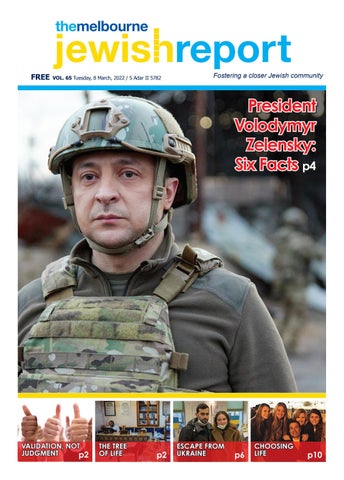
FREE
VOL. 65 Tuesday, 8 March, 2022 / 5 Adar II 5782
Fostering a closer Jewish community
President Volodymyr Zelensky: Six Facts p4
VALIDATION, NOT JUDGMENT p2
THE TREE OF LIFE
p2
ESCAPE FROM UKRAINE
p6
CHOOSING LIFE
p10
2
the melbourne jewish report | March 2022
AROUND
T H E
COMMUNITY
Validation, not judgment
ANNE-MARIE ELIAS People do not like to be judged. Evolution, however, has gifted us the ability to think critically, problem solve and form opinions. Our opinions can be interpreted as judgments. For example, a well-meaning person may pose the following question: “Do you think you should wear that shirt out rather than tucked in?” That individual believes the shirt would be better worn that way, but that is not how the one at whom the comment is aimed receives it. They interpret it as a judgment about their look. We are also master problem solvers of other people’s perceived issues … and we often get that approach wrong. Some time ago, in a staff meeting of psychologists, one of my colleagues spoke about a tough group therapy session. His colleagues automatically went into problem solving and advicegiving mode. Did you do this? Did you say that? And on it went. As the meeting ended, I noticed that the colleague that raised the issue looked frustrated and upset, so I asked him what was wrong. His reply: “I know how to run group therapy. I just needed
to vent. I wanted some validation about how tough my session was.” What is validation? It is acknowledgment and acceptance of someone’s experiences, thoughts, feelings and behaviours. Validation is seeing the wisdom in another's experiences, given their circumstances. Validation does not mean agreement or letting go of limits, or not allowing for contingencies or expectations. It is also not about convincing someone of another position. Validation is important because it provides empathy with and understanding of another’s experiences. It says to them that we recognise these as being “real”. Validation improves communication and relationships. People listen more to
what you are saying when they feel that you understand or, at least, are trying to understand their experiences. Some key steps to validation are: • Be present and pay attention. • Reiterate. That is, repeat what you believe you heard or observed. In the case of my colleague, someone could have said: “It sounds like your group gave you a hard time today”. • Acknowledge the other person’s feelings. • Be patient. • Be accepting and non-judgmental. In some circumstances we can validate by indicating that the experience someone is going through is common. An example is a feeling of anxiousness before a job interview … because interviews can be stressful. Stating that indicates to the person who has that sensation that they
are not alone. It is also important to be genuine – to stand alongside the person seeking validation as an equal (not as a superior). They are not necessarily fragile or incompetent, so do not treat them as though they are. Also, do not be defensive. Be willing to be corrected and apologise. Non-verbal communication is important and also expresses validation. For example, do not be afraid to tear up when you feel sadness or joy with another person. When validation is handled appropriately, the emotional intensity felt by the person seeking validation generally decreases and things slow down. When validation is handled inappropriately, the person seeking validation may experience an emotional eruption or a complete shut-down. Let me be clear, we impact one another profoundly. Validation tends to beget more validation. And, as a final note, do not forget about self-validation, while banishing self-flagellation. Please take a few minutes to watch a YouTube video on the subject: “It’s not about the nail”: https://www.youtube. com/watch?v=-4EDhdAHrOg Anne-Marie Elias is a psychologist in clinical practice for 25 years.
The Tree of Life (part 2) YERACHMIEL ISACOWITZ In the last issue of The Jewish Report, I explored the link between the Torah and the Tree of Life. Now it is time to look at the Torah as a dynamic legal and ethical system. Written Torah is constitution. It is divine in origin and therefore unchangeable, apart from emergency measures, which permit the sages of each generation to institute temporary overrides. An example of this is that the Torah prohibits making offerings on a bama (temporary altar) after the establishment of the mishkan (tabernacle) in Israel. Yet Eliyahu Hanavi (Elijah the Prophet) many years after this prohibition came into effect, in his fierce battle with the Jews who were worshipping idols, challenged them to make a fire descend from heaven through offerings on a bama. They took up the challenge but failed. This constitution is required because there are actions we take that may at first seem innocuous, but can have huge ramifications in the spiritual realm. With proper qualifications and using the appropriate tools of deduction, Torah sages extract the wisdom of the constitution to determine Torah law. Talmud is legislation based on the constitution. The laws of the Talmud are generally unchallengeable, but for exceptional circumstances.
Rishonim and Acharonim (post Talmudic sages) are the equivalent of precedence. They apply Talmudic law to practical events. A most intriguing concept is eilu ve’eilu divrei Elokim Chaim (these and these are the words of the Living God). What this means is that you can have two, diametrically opposed views and both can be correct as both are derived from the Torah. So, how can they both be right? This can be likened to a prism. White light enters and diffuses into colours. One can correctly state that the light is whatever colour one is looking at, depending upon the angle at which one is seeing it.
Where this is not possible is in the world of halacha lemaase (practical law). While, once again, you may have differing opinions, in the end the law comes down on one side or the other. Practical law is also influenced by contemporary events. So, a Posek (a rabbi that has the training and qualifications to determine Torah law) will consult experts, be that in medicine, science, technology etc,, in order to arrive at a conclusion. The Gemora relates that the great sage Rav spent 18 months with shepherds, becoming an expert in blemished animals (which could invalidate offerings on the altar in the Temple in Jerusalem).
He became so knowledgeable that his opinion was not accepted as halacha since no-one else was able to reproduce his understanding. So, like a tree that grows and prospers, the legal and ethical system of the Torah, works its way through the equivalent of the leaves, branches, trunk and root system to propagate new growth. Torah is the Eitz Chaim (Tree of Life) – dynamic, practical and ever present. Yerachmiel Isacowitz is an independent Torah educator. E: risacowitz@optusnet.com.au W: torahconcepts.com FB: The Mem Channel
the melbourne jewish report | March 2022
AROUND
T H E
COMMUNITY UIA Sunday, 20th March is a special day for UIA Women’s Division across Australia with a significant campaign event to be held between 3:15pm and 5pm. It will feature an inspirational guest speaker livestreamed from the US, in support of the People of Israel. Those participating will hear from award-winning American journalist, author and the former opinion editor at The New York Times, Bari Weiss. Guests have the option of watching from the Classic cinema in Elsternwick, where they can also enjoy an afternoon tea, or doing so in their own homes via Zoom. Weiss’ controversial resignation from The New York Times drew heated coverage. She accused the newspaper of “caving to the whims of critics on Twitter” and defended freedom of expression. Weiss is the author of “How to Fight Antisemitism” and hosts a weekly podcast, titled “Honestly with Bari Weiss”. In 2019, The Jerusalem Post named her the seventh most influential Jew in the world. She has won several awards, including the Daniel Pearl Award for courage and integrity in journalism and Reason Foundation’s 2018 Bastiat Prize. The latter honours writing that “best demonstrates the importance of freedom with originality, wit, and eloquence”.
3
Powerful Jewish voice headlines UIA women’s event In 2019, Vanity Fair called Weiss the “star opinion writer” of our times. UIA Victoria Women’s Division co-chair Amanda Jolson said she was pleased to unite with women across Australia and Israel to hear from such a powerful voice. Fellow co-chair Elissa Sharp said she looked forward to welcoming people to this innovative event, while simultaneously raising much-needed funds. The Women’s Division 2022 campaign in Sydney, Melbourne and Perth will focus on a project called “First-Line Families”. It aims to assist at-risk youth and their families, who attend Keren Hayesod-UIA supported Jewish Agency youth villages in Israel. UIA Australia and WA Women’s Division president Debbie Schaffer OAM said she was excited to be collaborating nationally for the first time. “Uniting to support a national project is also a first. It strengthens our efforts to provide those in need with significant help to navigate through the hardships that the pandemic has caused.” For more information, call 9272 5533 or email info@uiavic.org To book, go to events.uiavic.org/22WD You can also join UIA Victoria Women’s Division Facebook group for updates on its 2022 campaign: facebook.com/ groups/UIAVICWomensDivision
UNWANTED GOLD JEWELLERY
Trade in your unwanted diamond and gold jewellery for cash or remake it into something new!
IAN SHARP
JEWELLERY CRAFTSMANSHIP 65 Toorak Road, South Yarra, VIC 3141
P: 03 9866 4983 email: sales@iansharp.com.au www.iansharp.com.au
4
the melbourne jewish report | March 2022
W O R L D
N E W S DR. YVETTE ALT MILLER COURTESY: AISH.COM
President Volodymyr Zelensky: six facts being close to corrupt figures and was accused of bringing in members of his TV production company as key political advisors. Within days, Russia declared a major provocation, extending Russian citizenship to people living in eastern Ukrainian regions controlled by separatist insurgents whom Russia was backing in Donetsk and Luhansk. Zelensky responded to this major assault on Ukrainian territorial integrity with humour, posting on Facebook that he would extend Ukrainian citizenship to people in Russia and others “who suffer from authoritarian or corrupt regimes.”
Ukraine’s youthful and unconventional Jewish president is inspiring his nation. As the war in Ukraine continues, many people around the world are rallying around President Volodymyr Zelensky, Ukraine’s unconventional, Jewish, 44-year-old leader. Here are six facts about President Zelensky and the crisis in Ukraine today. 1. Grandson of Holocaust Survivors Volodymyr Zelensky was born on 25th January, 1978 in Kryvyi Rih, a city in eastern Ukraine. His family is Jewish and, like many Ukrainian Jews, was scarred by the Holocaust. (Zelensky has often drawn attention to the fact that approximately a quarter of all Jews murdered in the Holocaust came from Ukraine, a fact that’s not widely understood.) During World War II, the town of Kryvyi Rih was occupied by Nazi Germany. It was home to a sizeable Jewish community and in the years before the Nazi takeover of the town, many Jews fled eastward. Zelensky’s grandmother was one of the Jews who left. “My grandmother was living in Kryvyi Rih, in a part of south Ukraine which was occupied by the fascists,” Zelensky explained. “They killed all the Jews who remained. She had left in an evacuation of Jews to Almaty, Kazakhstan. Many people fled there. She studied there. She’s a teacher. After World II, she came back. That’s where I was born.” In 2020, when Zelensky travelled to Israel to mark the 75th anniversary of the liberation of Auschwitz, he told Israel’s then Prime Minister Benjamin Netanyahu stories about Ukraine during the Holocaust. Before he concluded, he said he had one more tale to tell, “about a family of four brothers”. Three of them, their parents and their families became victims of the Holocaust. All of them were shot by German occupiers who invaded Ukraine. The fourth brother survived. Two years after the war, he had a son and in 31 years he had a grandson. In 40 more years, that grandson became president, and he is standing before you today, Mr Prime Minister. 2. An “Ordinary Soviet Jewish Family” Zelensky describes his family as “an ordinary Soviet Jewish family.” He noted that since most instances of religious expression were banned in the Soviet Union, his family was not particularly
observant, but they were aware of their Jewish heritage. His family moved to Mongolia for a time while he was young, but returned in time for Zelensky to attend school in Kryvyi Rih. He grew up with Russian as his first language and also speaks fluent Ukrainian and English. In the early 1990s, after the demise of the Soviet Union, many Soviet Jews rushed to emigrate, moving to Israel or the United States. Approximately 1.5 million Jews fled in those heady years. Zelensky’s great aunt and her family moved to Israel in the 1990s, but he and his immediate family remained, joining several hundred thousand Jews who chose to stay in Ukraine and Russia. Zelensky attended the Kryvyi Rih Economic Institute, a branch of Kyiv National Economic University. He graduated in 2000 with a law degree. He met his wife, Olena Zelensky, a screenwriter and spokesperson for Ukrainian women’s rights, in college. (Olena Zelensky is not Jewish. President Zelensky has not commented on unsubstantiated rumours that he converted to Christianity.) Their daughter Oleksandra was born in 2004 and their son Kyrylo was born in 2013.
3. Career as a Comic Actor Zelensky never practiced law. He started acting in college and eventually founded his own production company called Kvartal 95 – “Neighborhood 95” – named after the area in Kryvyi Rih where he grew up. He turned to comedy and became a hit throughout the former Soviet Union, performing stand up and acting in some comic films. In 2006, he won Ukraine’s “Strictly Come Dancing” television competition. He also performed in Israel. He told an Israeli newspaper he’d done shows in “Tel Aviv, in Beersheba, in Haifa and in Jerusalem. In so many cities. So, I know Israel. I know people there.” In 2015 Zelensky began starring in a Ukrainian television show, Servant of the People. The year before, Ukraine’s unpopular President Viktor Yanukovych was forced out of office and President Petro Poroshenko was elected instead. It was a tumultuous time in Ukrainian politics: Russia invaded and later annexed Ukraine’s Crimean Peninsula in 2014; Russian-backed insurgents battled Ukrainian forces in the republics of Donetsk and Luhansk in the east of the country; and endemic corruption sapped Ukrainian’s confidence in their government. In Servant of the People, Zelensky played Vasiliy Goloborodko, a history teacher who shoots to fame after one of his students videos him railing against official corruption and becomes president. His character struck a chord with ordinary Ukrainians who longed for a plain-talking honest politician like Goloborodko. After years of playing President Goloborodko on television, Zelensky began to harbour political ambitions of his own. In 2018, he registered “Servant of the People” as an official political party. 4. President Zelensky Campaigning for the presidency, Zelensky relied on his comedy background, posting humorous speeches and skits on social media. His unusual campaigning style paid off: In Ukraine’s 2019 presidential election, Volodymyr Zelensky won an astonishing 73% of the vote. His path to governing wasn’t always smooth. He faced some accusations of
5. Recognizing Jewish History When Zelensky ran for office, the Chief Rabbi of Dnipro said to the New York Times: “He should not run because we will have pogroms here again in two years if things go wrong.” Those fears proved misplaced. Instead, Zelensky was open about his Jewishness in office. He oversaw an ongoing project to rename streets and monuments throughout Ukraine, erasing the names of Soviet figures and replacing them with Ukrainian heroes, including Ukrainian Jews in some cases. He began construction on a memorial at Babi Yar, the ravine outside Kyiv where Nazis murdered 100,000 Jews and other people. The Ukrainian city of Uman is the burial place of Rabbi Nachman of Breslov and a major site for Jewish pilgrims to come and pray. Under Zelensky’s administration, plans are in the works to create what Zelensky called “a historical museum … a big part and … reconstruct(ion) of the synagogue” that Rabbi Nachman prayed in. The monument is to be called “Little Jerusalem”. 6. Resolution in Wartime In the first hours of the Russian attack on Ukraine, President Zelensky vowed to remain in Kiyv, Ukraine’s capital. On a hastily recorded video made on a mobile phone, he declared, “We are all here. Our soldiers are here. The citizens of our country are here …We are all here protecting our independence, our country and it will continue to be this way. Glory to our defenders. Glory to our heroes. Glory to Ukraine.” In the days since that first video, Zelensky has continued to urge Ukrainians to resist the Russian onslaught and has rallied his people to resist. His anguished visage and stirring rhetoric have in many ways become the symbol of the war in Ukraine. He’s described himself as “Target Number One” and his wife and two children as “Target Number Two”. Despite the danger he is in, Zelensky has vowed to stay and fight. One political observer, Yulia McGuffie, editor in chief of Ukraine’s Novoye Vremya news site, opposed President Zelensky’s candidacy in 2019, regarding him as a neophyte with no political experience. Today, Zelensky commands a 96% approval rating in Ukraine and Ms McGuffie, like many Ukrainians, is enthusiastically backing their president. “Full support and respect came, I think, after Russia started its war,” she told the BBC. “All Ukrainians have closed ranks around Zelensky. He is playing a uniting and … inspiring role, partly by his own example. He is leading a government that is repelling Putin’s army and for that many people sincerely admire and respect him.”
5
the melbourne jewish report | March 2022
AROUND
T H E
COMMUNITY
Purim – ushering in change
RABBI GABI KALTMANN This week is one of the highlights on the Jewish calendar and is unparalleled in its joy. As a child, Purim was always one of my favourite festivals and I looked forward to it with great anticipation. The hamentashen baking, the mishloach manot (gifts of food) packing, the dressing up and, of course, the “booing” to Haman’s name during the Megilah, allowed for some of the best fun as a kid. However, as I get older and reflect on the Megillah, I find it hard to reconcile some of the themes in the story. In the first chapter alone, Queen Vashti is banished by the king, (Midrashic interpretation dictates that her head was cut off) for refusing to appear at his banquet naked to show off her beauty. Following the execution, King Achashverosh holds a beauty pageant to acquire a new wife and chooses Esther as his queen. When reading the Megillah it presents a dark and sordid story with a pervading culture of sexual misconduct and objectification of women. It begs these questions: Why is this story even part of our Jewish canon? What are the lessons that can be learned? What is the point of including such a story, in which women are subject to the whim of manipulative men who use their power to force them into a king’s harem for life and subject
them to domestic abuse and violence? The story of Purim represents “VeNahapoch Hu” (translated as “and it will turn around”). While a basic understanding of the story represents abuse of power, subjugation of women and sexual exploitation, it can also symbolise that such abuse can be overturned. To me, that is the essence of
what we are celebrating. Nothing about the Purim story is normal or expected. The Jews were not expected to survive. King Achashverosh did not mean to banish his wife Vashti, as shown by his later regret. Esther was not meant to be queen. However, when reading the story in light of the #metoo movement, it breathes new life into it.
In many ways, the Purim story holds up a mirror to the society in which we live, one in which sexual misconduct, exploitation and power abuse is rampant. Clearly, it is not something we can countenance. The #metoo movement sent shivers down the spines of those who had used their positions of power to subjugate women and minorities. It showed their time was up. Relating this back to Purim, if we do not address the underlying abuse of power, persecution follows. In light of this, it is important to note that Taanit Esther (the fast of Esther) has been designated International Agunah Day. Traditionally a woman was deemed an Agunah when her husband went missing and could not be located and was therefore “chained” to her marriage, unable to divorce or remarry. Today, women that are chained are often unable to remarry because their ex-husbands refuse to release them from their Gett. This has shocking ramifications. As an Unchain My Heart ambassador, I am passionate about the need to find a solution, so that women have agency over their marriages and divorces. As a rabbi, I am proud to be in the movement that is ushering in an era of change. Wishing you all a Chag Purim Sameach. Rabbi Gabi Kaltman, Ark Centre
2022 Catalogue Out Now
6
the melbourne jewish report | March 2022
W O R L D
N E W S
Escape from Ukraine
RABBI AVI BAUMOL Having managed a reluctant bus driver, exploding bombs, a seizure, and a dead car battery, Kseniia and Emre came to the Krakow JCC to help those who had it worse. In the past fortnight, the world changed. We had grown accustomed to a world which had learned the lesson of the 20th century and perhaps was earnestly trying to war less, to coexist more and to try to advance the world rather than regress. And then Mr Putin chose to unjustly attack the sovereign democracy of Ukraine, putting the lives of millions in peril. At the JCC Krakow, we are keenly aware of the plight of the Ukrainians and the existential threat Russia poses on Poland’s eastern border. With the intensity of evil wrought by an enemy regime, we also witness a groundswell of kindness exhibited by citizens all over Poland. The citizens as well as the government have mobilised to help those less fortunate, those displaced, those who managed to escape from the inferno that is Ukraine. We at the JCC have set up a help centre, with individuals coming in at all times to drop off supplies, food and toys for refugees and their families. I was sitting in the JCC and a young couple came in to see if they could help out. I asked them who they were and where they were coming from and they responded, quite emotionally, “From Ukraine. We arrived yesterday.” I asked them if they would sit down with me so I could write down their story to let the world hear first-hand of their frightening, yet inspiring, experience. Kseniia Stepanenko, from Kharkiv, in eastern Ukraine on the border with Russia, together with her boyfriend, Emre Demircan (from Turkey), arrived after having travelled one hour to get to a bus, 48 hours on the bus, four hours walking (20 kilometres) and another four hours hitchhiking the remaining distance to the border. Kseniia’s family is still in Kharkiv and she was visibly shaken during the interview, but nevertheless she was determined to tell her story. They were woken at 5am by an explosion outside their apartment and they realised that they needed to leave immediately. Taking what they could, they booked a bus that was set to leave the country a few hours later and ran to the subway to reach the bus. Luckily, they secured the last two seats on the bus, which normally was destined for Poland, but due to the situation, the driver was only going to Kyiv, the capital city of Ukraine, 500 kilometres away. At this point, Kseniia and Emre engaged in what was going to be a true test of their determination and reason for successfully escaping — they began to try to convince first the people on the bus and then the bus driver to travel to the border, rather than just the capital. They and the people on the bus collected money to pay the exorbitant demands of
Emre and Kseniia made it out of Ukraine and into Poland
the driver, they appealed to the driver’s conscience, begged, pleaded and cried in order to get him to take them to safety. The driver was initially not interested, but the more money he could make, the more willing he was to take the risk. The bus went through major cities in Ukraine, constantly slowing down to drop off some passengers and pick up others. They drove to Poltava, then Kyiv, Zhitomir, Rivne, Lviv and then through the border, Shehyni. Altogether, 48 hours on the bus, passing by tanks and soldiers, seeing explosions and bullets flying. Just to get out of Kyiv took four hours, as the streets were lined with cars and people. Everyone was so relieved to get out of harm’s way, but incredibly sad to leave behind loved ones. While they still had battery on their cell phones, they would get messages by the minute, as with every bomb or attack they needed to ensure that her parents were safe. At different times during the retelling of their story, Kseniia broke down: when she would recall her parents, or the graphic details of the trip, the people who were suffering on the way, or the feeling of having made it to safety while others were still in harm’s way. On the way from Kyiv to Lvov, at 10:30pm, while many were sleeping, the driver took a road off the beaten path, much to the chagrin and objections of Kseniia and Emre, who didn’t like the look of the route. Pretty soon they heard a big “boom” and saw an explosion of five to eight cannons. They hit the ground immediately. The soldiers told them to turn back straight away. After four hours going east, there was no longer any traffic and they finally relaxed, but then, after three more
hours, there were explosions again – this time from Belorussia. Twenty-five kilometres from the border, there was a long, long, long line of cars and at that point the driver said he was not going any further. Everyone had to get off the bus and start walking. Little did they know that it was the beginning of a five-hour trek alongside thousands of others trying to make their way to the border. On the road, it was a surreal sight, with people shedding their belongings as they marched on. They also saw fathers carrying their children on their shoulders for kilometre after kilometre, only to go back, having dropped off their children at the border, but not being allowed to cross themselves. Heartbreaking. Three kilometres from the border, Kseniia and Emre started seeing a whole bunch of people walking back. They were shocked and didn’t understand what was going on. The people explained that after waiting at the border for more than 26 hours they just couldn’t do so anymore. It was too difficult and too cold, as the temperature plummeted to below zero. They gave the young couple advice, which ultimately led to their success: “Try to find someone to take you in their car, because the lines for people walking amounts to tens of hours.” Out of the corner of her eye, Kseniia noticed a car trying to find its way. In it were a mother and her two children travelling to the border. Although it was far from easy, the mother finally acquiesced and Kseniia sat with a child on her lap, with Emre beside them. There was so much chaos at the border and if you missed one checkpoint, you
didn’t get a “golden ticket” – the ticket that would be required at all subsequent checkpoints. The mother did not get a ticket and for the rest of the trip Kseniia cajoled the border guards into letting them through. Reaching the final 150 metres, they were asked for their ticket. In her words: “We screamed at them and cried and begged. There were only three cars in front of us, but a lot of people who started moving forward pushed and pushed. Someone in the mob yelled ‘bomb!’ and people started running in different directions. We flung ourselves to the floor of the car to protect the kids. Our driver started having a seizure and Emre administered first-aid. Every few seconds there was banging on the car form people who were walking by. It was incredibly traumatic.” Because of her seizure, the border patrol took mercy on the woman. Then in between the two borders, the car’s battery died. Emre and Kseniia got out and literally pushed their car to safety. They then met the Polish border guard. Everything on the Polish side was so nice. Not one person was mean to them. They saw Polish soldiers carrying babies on their shoulders. From the border, they made it to Przemysl and from there to Krakow, in Krakow to the JCC to offer their support to other Ukrainians who are suffering worse than they did. Rabbi Avi Baumol is serving the Jewish community of Krakow as it undergoes a revitalisation as part of a resurgence of Jewish awareness in Poland.
7
the melbourne jewish report | March 2022
AROUND
T H E
COMMUNITY
Social Justice – Tikkun Olam
RABBI DANIEL RABIN CAULFIELD HEBREW CONGREGATION The Mishna (Sanhedrin 4:5) teaches us to have a seemingly selfish and egotistical attitude. Upon reflection, this is certainly not the intention. Rather, it depicts the most profound instruction for mankind. The teaching, familiar to many, is "Bishvili Nivrah Ha'olam” (for my sake was the world created). How are we to understand and interpret this message? One idea is to see it as a mission statement. The Mishna encourages us to recognise that we matter. God created everything specifically for us. It is a tremendous privilege for each of us. However, this comes with the responsibility to make this world a place that is a fitting and respectful abode for its Creator and creations. At times, humanity has sadly eroded this privilege and has not represented the type of place or space that would be suitable and appropriate for the King of Kings. Therefore, our duty is to restore the world to its intended stature and status. The name of this task … this mammoth job, is Tikkun Olam. The term is synonymous with acts of environmental awareness and social justice. The importance of these actions cannot be overstated. We are responsible for our environment and for righting injustices. Sustainability of life on Earth is our responsibility. Silence in the face of such travesties is an acceptance
of them. In fact, our Talmud teaches that "Shtika Kehoda'ah (silence) is acquiescence". Truth be told, Tikkun Olam encompasses a lot more. The concept is a hallmark of Jewish tradition. Tikkun Olam is not solely about fixing the world. It is about improving and perfecting the planet. The goal is to reveal the Godliness that has become obscured. Tikkun Olam improves the world, bringing it closer to its intended harmonious state. Think of Earth as a masterpiece. Sadly, as time progresses, it becomes more and more difficult to identify the "artist's" signature. Each act of Tikkun uncovers that signature. It creates meaning out of confusion, harmony out of noise. Each act ensures
the Creator is no longer hidden. How can we get involved? What can we do to improve our planet? In the first place, every human being can be a showpiece for Tikkun Olam. No matter your profession or political views, whether you are an adult or a child, a caregiver or a salesperson, we all have a role to play. In our everyday lives, we can do Tikkun Olam in countless ways. The Talmud in Sanhedrin also states: “Each person is a world unto themselves.” In other words, every positive act we perform (no matter how small or insignificant it may seem) has an effect on the entire world. Being respectful and honest at work, treating others with kindness and dignity, honouring and respecting our commitments and championing causes
that help those less fortunate are ways we can bring about the Creator's signature. Kabbalistic and spiritual perspectives teach that all of existence and every activity we perform contains a spark of divinity. Our job is to discover those divine sparks and reconnect them to their original, higher purpose. Each Mitzvah accomplishes this refinement. Shabbat candles and reciting Kiddush on a Friday night with family transform a mundane experience into a spiritual one. Through these actions, the Creator is again revealed. Let us reflect on this divine mission. It is a shared, valuable privilege and responsibility. Let us ensure that we do everything we can to achieve this goal. A positive act is valued and will make a difference.
ADVERTISEMENT
LIBERALS & LABOR ARE THE SAME FREEDOM FREEDOM FREEDOM FREEDOM FREEDOM FREEDOM Vote 1 United Australia Party Vote 1 United Australia Party Authorised by: Clive Palmer, United Australia Party, Level 17, 240 Queen Street, Brisbane 4000
UAP13469K7K
8
the melbourne jewish report | March 2022
New leadership for Kadimah
Jewish speakers’ bureau launched
KADIMAH
JEWISH ORTHODOX FEMINIST ALLIANCE AUSTRALIA
Rachel Chrapot is the new CEO of Kadimah. Formerly a lawyer, executive and educator, Ms Chrapot takes the helm as the centre celebrates 110 years of fostering Jewish culture in Melbourne. It is now also one of the organisations spearheading developing of the Jewish Arts Quarter in Elsternwick. Kadimah president Joe Tigel welcomed Ms Chrapot’s appointment. “Not only does Ms Chrapot bring her professional skills and experience to the role, but also a great ability to communicate with our diverse community. “Kadimah is a vital cultural centre, contributing to our modern Jewish continuity through performance, music, literature and language. Ms Chrapot said it was an exciting time for Kadimah, which was set up as a secular institution and Yiddish library in 1911. “We are emerging from a tumultuous period for the arts sector and are looking forward to a bright future.
The Jewish Orthodox Feminist Alliance Australia has established the first national Jewish women’s public speakers’ bureau. JOFA Australia president Nomi Kaltmann said 60 women from four states and territories have already signed up. Among their number are doctors, lawyers, accountants, teachers, rabbanits, professors, kallah teachers and advocates. The bureau addresses a long-term problem synagogues and community organisations have. That is looking for suitable, qualified Jewish women to present at events and on panels. “JOFA Australia hopes that by creating this resource it will multiply the opportunities available for Jewish women across Australia,” Ms Kaltmann said. Details can be found on the JOFA website: https://jofaaustralia.com/ speakers-bureau/ JOFA Australia is the second international branch of the Jewish
JUDAI C A
QUIZ
RABBI DAVID FREEDMAN The festival of Purim is a time of celebration – the story played out in ancient Persia – it involved danger, drama and the actions of the brave Queen Esther and her wise uncle Mordechai. It involved King Achashverosh’s wicked advisor who had evil plans to destroy the Jewish people. Esther intervened on behalf of all Jews and communicated Haman’s plot. The king reacted and the Jews were saved (of course, all is revealed in much more depth in the Book of Esther). Today, we revel, we rejoice, and we repeat this important chapter of our history. We also dress up in costume – kids and adults alike and we eat delicious triangular-shaped hamantaschen. We also send Mishloach Manot, or gift baskets, we give to those less fortunate and sit down to enjoy a sumptuous Purim seudah, or feast. Many readers have told us that this popular quiz is normally shared aloud at a Shabbat table – but in this edition this is … perfect for Purim! Rabbi Freedman has expertly woven
Rachel Chrapot “I’m
thrilled
to
be
part
of
an
organisation that is steeped in history and is now building on that deep experience
to
create
innovative
programs, which nurture Jewish culture and community engagement.” Arts Centre Melbourne is the venue for Kadimah’s staging of Yentil from 12th to 26th March.
Orthodox
Feminist
Alliance,
which
originated in New York City in 1997. The first was established in the UK in 2013. JOFA Australia aims to provide Jewish women with new opportunities. It promotes leadership and supports women’s
Torah
learning,
public
speaking, teaching and engagement in all areas of Orthodox life.
Test your knowledge questions together within the Purim framework. So, take a break from ‘hamantaschen overload’ and take part in this impressive Purim quiz! 1. In a Jewish Leap Year, does Purim fall in Adar 1 or Adar 2? 2. In which section of the Hebrew
is the Fast of Esther, what is the other? 8. Which German city established its own version of Purim in 1616 after a failed attempt to remove all the Jews from the city? 9. Who created the painting Esther’s Banquet in 1660? 10. What is the origin of the custom
Good luck. Enjoy. Hopefully, learn something new about the joyous festival of Purim and its traditions.
Bible (the Tanakh) would one find The Book of Esther? 3. How many times must the Book of Esther be read on Purim? 4. Did the story of Purim take place in the country currently known as Israel, Iran or Iraq? 5. What does the word ‘Purim’ mean? 6. Why do Jews fast on the day before Purim? 7. There are only two fast days in the year named after an individual - one
to make a noise whenever Haman’s name is uttered during the reading of the Megillah? 11. Besides Esther, which other queen is mentioned in the Book of Esther? 12. What was Esther’s Hebrew name? 13. In what context are Bigthan and Teresh mentioned in the Book of Esther? 14. The hanging of Haman’s ten sons is said to be connected to what event that took place on October 16th, 1946? 15. To which of the twelve tribes of
Israel did Mordechai belong? 16. What was the relationship between Esther and Mordechai according the Book of Esther? 17. The blessing Shehecheyanu is normally recited when we do something for the first time each year. How many times do we recite this blessing during Purim? 18. Besides reading the Megillah, name one of the other mitzvot associated with the festival of Purim? 19. What is Adloyada? 20. There is Purim, and there is Shushan Purim – what is the difference? 21. The prayer Al Hanissim (For the miracles) is added to which two prayers on Purim? 22. Under what circumstances, according to the Mishna, would the Megillah be read, as part of the Purim celebrations, three days earlier than normal? 23. The Book of Esther is known for not containing God’s name. Which is the only other biblical book that shares this feature? 24. In rabbinic literature there is a work known Esther Rabbah – what is the nature of this book? 25. Which composer wrote the oratorio entitled Esther in 1718?
ANSWERS PAGE 12
9
the melbourne jewish report | March 2022
W O R L D
N E W S
Ukrainian refugees pour across border
DAVID ISAAC COURTESY: JNS.ORG The lead grey skies suited the grim events on the ground as thousands of Ukrainian refugees streamed across Palanca, a sleepy border outpost in Moldova, as Russian forces stepped up attacks in southern Ukraine. Heavy snow followed by freezing rain added to the refugees’ misery as they pushed down a narrow, mud-lined road toward safety, suitcases trundling behind them, babies in tow and, often, loved ones left behind. The range of refugees was extraordinary, from Indian medical students to Odessan opera singers. As dusk gathered, a group of 140 Odessan Jews appeared, their rescue organised by the American Jewish Joint Distribution Committee (JDC). On hand to offer assistance were members of the International Fellowship of Christians and Jews (IFCJ), an Americanbased charity whose contributions have helped bolster numerous Jewish groups involved in rescue and Aliyah. Benny Hadad, IFCJ’s director of Aliyah and absorption, told JNS, “When events in Ukraine started heating up, we understood that people would go mainly to Moldova or Poland. So, we and The Jewish Agency [for Israel] decided to divide the work between us. The Agency took care of Poland. We took Moldova.”
Ukrainian refugees waiting for a bus (photo: David Isaac) Haddad said the IFCJ takes members of the Jewish community from the border into Moldova’s capital of Chisinau. “We find homes to put them up and have rented a space to house 240. It looks to me like we’ll need to rent another place now,” he said. Subscribe to The JNS Daily Syndicate by email and never miss our top stories Despite his 30 years of experience, Haddad said he has never seen anything like this. “I don’t believe what I’m seeing. I was in this place a month ago on a routine visit from Odessa to Chisinau. Everything was pastoral and quiet, and suddenly it
looks like a world war.” The Jewish group hailed from the Ukrainian city of Odessa, about 60 kilometres away. Members of the group told JNS they feared for the future and worried about family still in the country. Yana Kotlievich, an American citizen who left Ukraine decades ago, said this was the second time she found herself a refugee. Nearby, her sister, Angela, shivering in the cold, tears rolling down her face, stood with her two daughters and a grandchild. Yana explained that her sister’s husband had stayed behind in Odessa to fight the Russians.
Kotlievich, who had lived in San Francisco for 30 years, had come to Odessa a month ago to help her sick brother. Her brother, who had made it through the worst of his illness but was still too unwell to travel, insisted she leave. Yana said she plans to return to the US. She is unsure if she will be able to bring her sister and family, who are not American citizens. Anna Sydorova, 22, left behind her widowed mother and brother in Odessa. “My mum couldn’t leave because of grandma, who is 80. It’s very hard for her. She has a lot of diseases,” she told JNS. Sydorova said she had been volunteering in Odessa, helping make nets for tanks and bringing food to soldiers. “My mum, she was literally begging me to go. If anything happens to them, I will blame myself.” Sydorova’s brother, who lives in Israel and had returned to Odessa a week before the war began, decided to remain with their mum. “He had come back from Israel because he wanted to rest,” she said, noting the irony. Though none of the Jewish refugees JNS met spoke of returning to Odessa, neither did they have firm plans. Sydorova was debating whether to go to Europe or Israel, where she had lived before. “The only thing I know for sure is that I’m going to Moldova, but after that I don’t know where I will go. I wanted to explore the world and travel but not like a refugee,” she said.
3
$
50 ea
SAVE $1
Happy Purim
3
$
50 ea
3
$
50 ea
Foda Organic Pitted Kalamati 250ml $1.40 per 100ml
5
$
80 ea
3
$
50 ea
SAVE $1
SAVE $1
SAVE 35¢
SAVE $1.40
Foda Organic Mixed Olives Oregano 250ml $1.40 per 100ml
Foda Organic Pitted Green Olives 250ml $1.40 per 100ml
Kinor Grape Juice Natural Rose 750ml 77¢ per 100ml
Jerusalem Matza Meal Fine 375g 93¢ per 100g
Availale at Woolworths Bentleigh, Carnegie, Carnegie North, Doncaster Shopping Town, Glen Huntly, Hawthorn East, Highett, Malvern, Middle Brighton, Moorabbin, Oakleigh South, Southland and Toorak.^
On sale from Wednesday 2nd March until Tuesday 29th March 2022 unless sold out earlier at Woolworths Bentleigh, Carnegie, Carnegie North, Doncaster Shopping Town, Glen Huntly, Hawthorn East, Highett, Malvern, Middle Brighton, Moorabbin, Oakleigh South, Southland and Toorak. Limits per customer may apply, trade not supplied. Specials are not available at Woolworths Online, Metro or at Ampol Woolworths co-branded fuel outlets. Woolworths Supermarkets: 1 Woolworths Way, Bella Vista, NSW 2153. ^Products and specials may not be available in all stores.
10
the melbourne jewish report | March 2022
Choosing life: the Jewish roots of my will to carry on RON GOLD After a catastrophic spinal injury a decade ago, putting myself out there as a paraplegic was terrifying. I tapped into wisdom that helped me overcome fear. On Thanksgiving this past year, I “celebrated” the 10th anniversary of a near-death accident that left me a paraplegic with a spinal cord injury that meant I had to reassess my life values and priorities. Ten years later, I’m still at it. After a traumatic event, one’s religious path often veers toward one of the two extremes – to become Orthodox or just forsake God. Oddly, I’ve done neither. I was raised in a Jewish, Zionist family. There was little daylight between the two. This stems from my mum’s upbringing in the Zionist youth movement Hashomer Hatzair in her native Lithuania. She was lucky enough to flee Europe just two years before World War II, but her friends and relatives in Hashomer perished, along with many other family members. That survivor’s guilt always hovered as the backdrop to our family’s Jewish affiliation, but as for faith and prayer guiding my daily life, it didn’t then and it doesn’t now. I recently wrote a blog for this 10th anniversary and cited three aphorisms I choose to live by as a paraplegic. It strikes me that those maxims that help me push on with a crushed spine are also inherently Jewish: Why not me? Why not you? In that essay, I flipped around my initial, instinctive “why me?” self-pity to help energise myself and others. No excuses and no passes for any of us. Certainly, I was reformulating the well-known “if not now, when?” Hillel quote I heard frequently in our home to include the continuation: “if I am only for myself, what am I? We can’t change the hand we’re dealt, but we can play our best possible hand. I have met many in the disability community that believe their injuries happened for a reason. That conclusion gives them purpose. I’ve also found purpose in showing others how to cope and deal with adversity. But was that mission preordained by Hashem? Of that, I’m dubious. I hope He/She has more important things to worry about. I believe the essence of Judaism is how we live our faith and how we act, rather than believing God is micro-managing each of our actions. True leadership is leadership by example. That point is made explicit in Hebrew, which bases its word for leadership, “manhigut”, on the root of the word “behaviour” or “hitnahagut”. And that’s exactly what I learned as a teen in the Young Judaea Zionist youth movement. Setting an example for others, l’shamash dugma, or being
Ron Gold and family at the Western Wall in Jerusalem (photo: Gil Troy)
a “dugma ishit” was our key tenet for teaching leadership and influence. For me, the parallel goes further. Those who are Jewish and those who have spinal cord injuries represent a small sliver of the world’s population – between 0.1 and 0.2 per cent. Both groups are immersed in a seemingly inexorable struggle for acceptance of who we are, while confronting the adversity that
The motivational speaker Professor Brene Brown speaks about the courage to be authentic and vulnerable – putting oneself in the arena and fighting when the outcome is uncertain and unknowable. She speaks dismissively of those “in the cheap seats, without being in the fight” and maintains we should never let criticism and vitriol keep us from being
absorbed antisemitic attacks during COVID, as we always do in times of stress, but I’ve been heartened by our ability to connect and support each other while remaining resolute. Some of the hardest, and dare I say most courageous, things I’ve done have been to put myself out there as a paraplegic. After my accident and dozens of operations and procedures, re-engaging
“After my accident and dozens of operations and procedures, reengaging on a social level with friends was hard enough, but doing so on a professional level was terrifying.”
on a social level with friends was hard enough, but doing so on a professional level was terrifying. Before that drowsy driver hit my bicycle head-on in broad daylight without braking, I was a managing director on Wall Street. I was running a sales desk, covering clients around the country and flying to Asia quarterly. Yet, the first few times I entered a meeting in a wheelchair with a roomful of
comes along with the struggle. We’re both notable and at times extraordinary, but as far as either one being chosen for this lot, I’m not so sure. Blind mountaineer Erik Weihenmayer believes adversity is one of the most potent forces in life. It shapes our character, clarifies our priorities, defines our path and fuels our greatness. Considering that he climbed the Seven Summits and kayaked the Colorado River, he may be on to something.
who we are. It is in my vulnerability and my fight for authenticity that my two identities align. COVID has many feeling the stress and strain of being “immobilised”. By contrast, throughout this pandemic and during the eight years before it started, I continue to be amazed how others with disabilities adapt and achieve with grace. They do so in the professions, in business, in sports, as well as with family and friends. Likewise, as Jews, we’ve
strangers petrified me. I realise now that I was finally processing the new me and that was mortifying. I can now attest to the fact that after doing so numerous times I am stronger
and
more
resilient
for
it.
Weihenmeyer was onto something. If I can carry on day by day as a paraplegic, and if we as a people can endure through the toxic vitriol, then maybe, just maybe, we have the toughness to deflect almost anything.
11
the melbourne jewish report | March 2022
AROUND
T H E
COMMUNITY NOMI KALTMANN COURTESY: TABLET MAGAZINE For the past 30 years, Holocaust survivors have spoken at schools in four Australian states – Victoria, New South Wales, Queensland, and Western Australia. They are educating students with their powerful personal stories as part of B’nai B’rith’s Courage to Care. The Victoria branch alone has 30 survivors that share their testimony at more than 100 schools, reaching in excess of 10,000 children between the ages of 12 and 18 each year. Judy Kolt is one of those survivors who regularly retells her story to school children at the programs run by Courage to Care. Now well into her 80s, she became involved with the organisation about seven years ago, after the death of her husband, Hymie. “Courage to Care interested me because they teach that hate starts with just words. I think it is important to teach young people not to have prejudice against anyone, because it can lead to horrible things,” she said. “I find it extremely rewarding. I get some really good questions and the students really appreciate hearing my story.” When asked whether it is difficult for her to repeat her Holocaust experiences over and over again to so many different groups, Kolt highlighted the long-term trauma many survivors endure: “I relive the Holocaust every night. Whether I talk to children or not, I relive it. It’s actually a relief to pass it on to people.” Like Ms Kolt, almost all the survivors currently working with Courage to Care were children themselves during the Holocaust. But even this cohort is now in their 80s, which leaves Courage to Care facing an important question: How can they continue sharing firsthand testimonies in schools, when the remaining Holocaust survivors are reaching such advanced ages? At the core of Courage to Care’s educational activities is the “upstander” program. This is an immersive course conducted during school hours that teaches children about the importance of speaking up against any hateful or discriminatory conduct that they may witness. “We emphasise the people who helped me,” said Kolt. “There were at least 30 people who risked their lives to save me. Strangers. Some for money, some not. They risked their whole families. They were heroes. They were upstanders. They weren’t bystanders.” Janice Huppert is a long-time volunteer with the group – which has more than 150 such volunteers – and originally became involved, along with her late husband George, who was a Holocaust survivor. She has facilitated the upstander programs at schools across Melbourne. “We discuss the perpetrator, the victim, the bystander and the upstander,” she said. “We discuss prejudices and how the Holocaust happened, because of
The custodians of survivors’ stories
prejudging and intolerance. We want children to be involved in the conversation and to feel that they can do something if they see others being bullied or people who are being marginalised.” Ms Huppert thinks the program is a powerful way to educate Australian children, especially non-Jews. “We very rarely [do] the program with Jewish kids,” she said. “Some of the children have never ever met a Jewish person before and it’s important they know that being a bystander is not neutral.” While the COVID-19 pandemic has been difficult for Courage to Care, it didn’t prevent the organisation from forging ahead with its mission of creating a new generation of upstanders. “During COVID, we have had more bookings than we have ever had. Although many had to be postponed, we still managed to reach over 3,000 students with faceto-face and remote programs,” said CEO Mike Zervos, noting that face-to-face programs still provide a “deeper and richer experience” for both participants and the speakers. For teachers in the classroom, there can be no doubt about the impact of the programs that Courage to Care provides for Australian children. “The response of the children has always been the same: wide-eyed and amazed listening to the stories,” said Anna Redlich, an Australian teacher since 1978. “In year 5 and 6 the students are interested in Anne Frank and to be able to hear from an actual Holocaust survivor, they are like deer in the headlights. The message of being an upstander is really significant and emphasises the importance of the language we use.” She recalled a particularly poignant moment from one of the sessions she
witnessed two years ago: “The students were listening to Peter Gasper,” an Australian Holocaust survivor who speaks for Courage to Care. “It was so quiet; they were absolutely fixed on the story he was telling. At the end of the talk, a little boy walked up to Peter and asked: ‘Can I please shake your hand, Peter?’ “ But it’s not just the children who learn from the Holocaust survivors; the teachers in the classroom also benefit. “Even if they bring their laptops to catch up on administrative tasks during the Courage to Care sessions, in the end all the teachers stop dead in their tracks to listen to the Holocaust survivors,” Redlich said. “The teachers realise the wonderful teaching and learning opportunity it gives them to further consolidate the importance of being an upstander.” But as the number of survivors dwindles, Courage to Care is preparing for the next phase of delivering its important educational programs, using a new model: a “custodian” of a family’s Holocaust survival story. “Custodians are relatives of a Holocaust survivor who retell the story of survival to an audience,” said Zervos. “You have to try and keep the memories alive.” Allan Goodrich is one of these new incoming custodians, a child of two Holocaust survivors, Lodzia (Leah) and Abraham (Marian) Goodrich. They were Polish Jews who survived the war in Warsaw as a married couple before emigrating to Melbourne in 1947. Mr Goodrich’s father died in 1985 and his mother in 2002. Mr Goodrich, who has a professional background as an administrator, therapist and teacher, became interested in retelling his parents’ stories a few years ago. So far, his experience
as a custodian has been very healing. “I am now 70. I find it quite therapeutic to consider my parents’ story,” he said. “As a child of survivors, I have been impacted by family and cultural influences, and possibly also via epigenetics, which includes the biological trauma markers that may be passed on from generation to generation.” To date, Courage to Care has trained 10 custodian speakers. They come from a variety of backgrounds, but are mainly motivated by the organisation’s mission and a desire to keep their family’s Holocaust memories alive. It is expected that in the coming year, a growing number of children of survivors will become custodians. Mr Goodrich has done half a dozen presentations so far. “For the time being, as long as there are survivor speakers, out of respect to them and what they do, I believe it is important for them to have priority to tell their stories for as long as they can,” he said. Ms Kolt hopes that the children who hear her talk take away a powerful and important universal message. “Children still have to learn to stand up for others,” she said. “They must learn how to stand up for all marginalised people. For the alcoholic or drug addict. For the people that need help. For the refugees. That’s what I am trying to teach them. To the children, I stress not only my personal tragedy, but the fact that there are people that are willing to help and that each and every one of us should try to help someone that needs it.” This story originally appeared in Tablet Magazine (tabletmag.com) and is reprinted with permission.
12
the melbourne jewish report | March 2022
PESACH ACCOMMODATION North Bondi (Sydney)
A luxurious two-storey home and a self-contained granny flat is available to rent between 5th and 26th April. The main house has five bedrooms and four bathrooms, a formal dining area and large kosher kitchen, flowing into an open plan, casual meals area and living room with a gas fireplace. That opens onto a portico with a barbeque. The grassed backyard encompasses a swimming pool and gate access to the adjacent park. Centrally located, within easy walking distance of Bondi Beach and nearby coffee shops, a kilometre and a half in the other direction is the Rose Bay ferry and a beautiful harbourside walk. Enquiries to bondihouse18@gmail.com
Judaica quiz answers 1. B oth – Purim falls in Adar 2, but a minor festival known as Purim Katan, or the Lesser Purim, takes place in Adar 1 2. T he third section of the Bible known as the Ketuvim or the Writings. Within, Esther is found in the sub-section known as the Five Megillot 3. Twice 4. Iran 5. I t means: Lots – referring to how Haman randomly chose the day on which to exterminate the Jews in the Persian Empire 6. T raditionally Jews fast the day before battle, as such they would have fasted on Adar 13 in the days of Esther, prior to the battle to determine their fate on Adar 14. Others suggest it commemorates the three days that Queen Esther and the Jews of Shushan fasted before she approached the king to intercede for her people 7. The Fast of Gedaliah 8. Frankfurt 9. Rembrandt van Rijn 10. T his stems from the injunction in the Torah to erase the name of Amalek, who was Haman’s ancestor 11. Queen Vashti 12. Hadassah 13. M ordechai overheard these two men plotting to kill the king. By informing the king through Esther, he was able to thwart the plot. The two conspirators were apprehended and hanged, and Mordechai's service was recorded in the royal chronicles and rewarded by the king 14. A fter World War II, some of the surviving Nazi leaders were tried at Nuremberg. On October 1st, 1946, 12 of the German defendants were sentenced to death by hanging for their part in the atrocities committed against the Jews and others. One of those convicted was Martin Bormann, who was sentenced in absentia. A second was Hermann Göring, who committed suicide in his cell just hours before the executions. The
remaining 10 Germans were hanged on October 16th, 1946 15. The tribe of Benjamin 16. Cousins (And he brought up Hadassah, that is, Esther, his uncle's daughter Esther 2:7) 17. T wice. Before the reading of the Megillah in the evening and following morning. Note: in the morning one should also consider that the blessing is recited with the other Purim rituals of the day in mind 18. S ending food gifts known as Mishloach Manot; giving gifts to the poor – Matanot L’evyonim and holding or attending a Purim feast - Seudat Purim 19. T his is the term for a Purim carnival – it refers to the saying that on Purim one should celebrate to the extent that ad lo yada – one cannot distinguish between the two phrases: Mordechai is blessed, and Haman is cursed 20. P urim is generally celebrated on the 14th Adar, however within the walled city of Shushan (the country’s capital) fighting was more difficult and extended for an additional day. To this day in large walled cities such as Jerusalem, the festival celebrations are delayed for a day until Adar 15th – Shushan Purim 21. T he Amidah and Birkat Hamazon (Grace After Meals) 22. S ummarising Mishna Megillah 1:2 - If the 14th of Adar occurs on a Sunday, the villagers advance their reading to the preceding ‘market day’, i.e., three days earlier on Thursday, Adar 11th. Those in large towns read it on the designated day, Adar 14th, while those who live in walled cities read it on the following day, Adar 15th 23. T he Song of Songs otherwise known as Shir Hashirim 24. E sther Rabbah is part of a larger collection known as The Midrash Rabbah. These are ancient rabbinic homilies on a variety of biblical books 25. George Frideric Handel
J-AIR 88FM is Australia’s only Jewish community radio station. J-AIR would like to introduce new presenters and shows to its schedule. If you are interested, please write to us at info@j-air.com.au Listen to J-AIR anywhere, anytime via podcast or on the Internet.
13
the melbourne jewish report | March 2022
F O O D I E S'
CORNER DR. YVETTE ALT MILLER COURTESY: AISH.COM Classic Jewish foods have some compelling stories behind them. 1. The quintessential Jewish brunch: lox, bagels and cream cheese It’s the ultimate Jewish sandwich. It’s also the result of generations of Jewish innovation. Bagels have long been associated with Jewish cooks. Though they share similarities with other baked and boiled pastries in central Europe, bagels might have been an invention by Jewish cooks to get around anti-Jewish laws forbidding them to bake bread. In her book The Bagel: The Surprising History of a Modest Bread, Maria Balinska describes a 1267 decree by a committee of Polish bishops forbidding Christians from buying foods made by Jews, including bread. Since bread was defined as pastry that was baked, the thinking goes, some enterprising Jews got around this decree by boiling rolls instead. Making rolls with a hole in the middle allowed for more even cooking and the Jewish bagel – which is boiled then finished off in an oven – was born. Lox is similar to other smoked fish in northern Europe, but Jewish lox has a unique twist. Food historian Gil Marks notes, “At the beginning of the 20th century, Jews in America developed their own form of smoked salmon, soaking it in light brine or occasionally dry curing it with salt and sometimes brown sugar,
Why these foods are so quintessentially Jewish then cold smoking it.” (Encyclopedia of Jewish Food by Gil Marks.) This uniquely Jewish way of curing salmon results in lox’s characteristically silky texture. Even Cream Cheese has a Jewish story. Invented in upstate New York in the 1870s, cream cheese was at first a purely local delicacy. In 1907, a pair of Jewish brothers from Lithuania named Isaac and Joseph Bregstein who’d moved to New York, began mass producing cream cheese in Brooklyn. 2. Gefilte Fish and Horseradish Sauce It’s the ultimate Friday night first course. In fact, Shabbat is the reason why gefilte fish became so popular among Jews. It all started about a thousand years ago in Germanic lands, when chopping up fish with onions and spices, and then stuffing the mixture back into a fish skin became popular. (Gefilte means “filled” in Yiddish and old German.) Yet the dish caught on with Jews most of all, since gefilte fish is ideally suited to a Shabbat meal. (Today, it’s most often served in a loaf, not stuffed into fish skin.) For one thing, picking out fish bones from a meal is something that traditional Jews refrain from doing on Shabbat since separating items in that manner is prohibited on Shabbat. Gefilte fish solves the problem; there are no pesky fish bones to remove.
Gefilte fish can be made with any type of fish. The Talmud describes fish as part of the ultimate Shabbat meal. The sage Rav Yehuda is asked how to “delight” in Shabbat. His answer: “With a dish of beets, a large fish, and heads of garlic.” (Talmud Shabbat 118b:2). That same passage might help to explain why horseradish sauce is such a perfect accompaniment to gefilte fish. Also called chrain, which means horseradish in Yiddish, the Jewish version is sweet and slightly spicy. Horseradish root is grated, then mixed with sweet, grated beets. The resulting bright pink condiment can be found in the kosher section of grocery stores and makes a perfect accompaniment to gefilte fish. 3. The Ultimate Jewish Sandwich: Pastrami on Rye “One of the great inventions of the American deli was pastrami,” notes food historian Claudia Roden. While the name pastrami invokes other cured meats from the Balkans, such as “pastrama” in Romania or “pastirma” in Turkey, pastrami is a uniquely Jewish invention, which originated among Jewish immigrants in the Lower East Side of New York in the late 1800s. “The Jewish deli started when lone male immigrants were forced to buy kosher meals from Jewish neighbours,” Rodin says. “Soon there were hundreds
of small neighbourhood kosher delis catering to workers and families in which the women also worked.” (The Book of Jewish Food: An Odyssey from Samarkand to New York by Claudia Roden.) Jewish pastrami is made from brisket and is incredibly labour intensive. After being cured in brine, it’s then coated with spices including bay leaves, juniper berries, pepper, garlic, and paprika and left to “dry cure” for weeks, as the spices slowly cook the meat. It’s then smoked and, finally, either braised or steamed. The result is a silky, intensely spicy, delicious meat with a distinctive dark red hue. Pastrami is traditionally served on rye bread, another Jewish staple. While rye was and remains a popular grain in much of eastern and northern Europe, Jews became especially associated with rye bread. In many eastern European towns before the Holocaust, “Jewish bakers supplied both Jews and non-Jews with bread, bagels and other baked goods,” observes the Yidisher Visnshaftlekher Institut (YIVO), a historical association. “Jewish” rye was made with a distinctive sourdough starter called roshtshine, which resulted in a tangy, dense rye bread that kept for a long time. In the 19th century, Jewish bakeries commonly made huge loaves of rye bread that weighed anywhere from seven to 11 kilograms and had to be baked for between four and six hours.
Learn how to hear
torahconcepts.com m The Mem Channell CANDLE LIGHTING TIMES Friday, Mar 11, 2022 Shabbat ends, Mar 12, 2022 Friday, Mar 18, 2022 Shabbat ends, Mar 19, 2022 Friday, Mar 25, 2022 Shabbat ends, Mar 26, 2022 Friday, Apr 1, 2022 Shabbat ends, Apr 2, 2022 Friday, Apr 8, 2022 Shabbat ends, Apr 9, 2022
7:01 7:55 6:52 7:45 6:42 7:36 6:33 7:26 5:24 6:17
pm pm pm pm pm pm pm pm pm pm
14
the melbourne jewish report | March 2022
Jewish-themed musical “Jewface” blows up DRIFTWOOD – THE MUSICAL
BY LEE HARPIN COURTESY: LONDON’S JEWISH NEWS
The inspirational story of renowned Austrian/Australian sculptor Karl Duldig and his artist/inventor wife Slawa Horowitz-Duldig is captured in Driftwood – The Musical. It is based on Eva de Jong-Duldig’s memoir and will make its world premiere at Alexander Theatre and Chapel off Chapel in May. The book has been adapted for the stage by award-winning playwright Jane Bodie and directed by celebrated theatre maker Wesley Enoch. Musical direction and original music composition is by Anthony Barnhill, who has performed at opera houses around the world. Driftwood follows Karl and Slawa’s romantic and artistic lives in pre-war Vienna, Slawa’s invention of the foldable umbrella and their escape from the Holocaust. They lived out their lives as artists in Melbourne. The couple’s granddaughter, acclaimed soprano Tania de Jong AM, performs the lead role of Slawa. Actor and singer Anton Berezin, who recently performed with Opera Australia in Evita, plays the male lead role of Karl. Slawa’s sister Rella is filled by celebrated jazz songstress and musical theatre performer Fem Belling.
Actor Sir Ian McKellen questions if the “Jewface” row leaves him unable to play “straight parts”. The Lords of the Rings star was asked by BBC presenter Amol Rajan about the row over Israeli leader Golda Meir being portrayed by Dame Helen Mirren, who's not Jewish, in a forthcoming biopic. Sir Ian McKellen has offered his thoughts on the debate over whether Jewish characters are best played by performers who are Jewish themselves by asking: “Does that mean I can’t play straight parts?” In the revealing BBC2 interview with the 82-year-old Shakespearean actor, Rajan raised the argument around Mirren’s casting as an iconic Jewish figure, asking whether they meant gay people should play gay characters. Sir Ian – who played the role of fictional Jewish comic book character Magneto in the X-Men films – responded:” Well, there’s two things … Is the argument that a gentile cannot play a Jew? And is the argument therefore that a Jew cannot play a gentile? “And is the argument that a straight man cannot play a gay part? And if so, does that mean I can’t play straight parts and I’m not allowed to explore the fascinating subject of heterosexuality in Macbeth? Surely not. “We’re acting. We’re pretending.” But the Queen actor, who is not himself Jewish, then added: “Now, are we
Sara Reed, whose musical theatre credits include Fiddler on the Roof, opposite Anthony Warlow, is Eva. Troy Sussman (Les Miserables Australian and West End productions) has multiple roles and rounds out the all-Jewish cast. Tania de Jong described Driftwood – The Musical as a poignant work. “It explores the loss that families encounter when they are dislocated by war, whilst illuminating an immigrant experience that is uniquely Australian.” For more information and bookings, go to: www.driftwoodthemusical.com.au
For your FREE electronic copy of the Melbourne Jewish Report, register at www.thejewishreport.com.au
capable of understanding what it is to be Jewish? “Are we going to convince a Jewish audience that we are Jewish? Well perhaps we don’t need to, because we are just acting.” In January the latest “Jewface” row erupted after Dame Maureen Lipman (actress, writer and comedian) led a backlash against the casting of Dame Helen as the former Israeli Prime Minister. Dame Maureen said she wished Jewish actresses had been considered. The musical Falsettos had sparked an earlier “Jewface” row in August 2019 after complaints about the lack of Jewish cast members. The play followed a dysfunctional Jewish family as they come to terms with the AIDS crisis. More than 20 Jewish actors and playwrights, including Miriam Margolyes and Lipman, signed an open letter which said the producers demonstrated “a startling lack of cultural sensitivity and at worst, overt appropriation and erasure of a culture and religion increasingly facing a crisis”. The letter used the term “Jewface” to describe the casting of non-Jewish actors to play Jewish roles and said that “Jews are omitted from this important and necessary conversation.” Last October the comedian Sarah Silverman spoke out over the Hollywood “Jewface” row saying there is a “long tradition of non-Jews playing Jews, and not just playing people who happen to be Jewish but people whose Jewishness is their whole being.”
15
the melbourne jewish report | March 2022
MOV I E
REVIEWS
Darkness pervades
THE BATMAN (M) ALEX FIRST Gotham City is a cesspool of evil and corruption. For two years the caped crusader has been trying to clean it up, but to no avail. The situated has deteriorated further. Promises of renewal and change have fallen on deaf ears. Now a madman is on the loose. The Riddler (Paul Dano) has begun wreaking havoc, killing those who purported to be good, decent and fair, but were anything but. The first victim is the Mayor. More will follow. Top city officials are disposed of in nefarious ways. Early on, The Batman comes face to face with a dexterous young woman who has her own agenda. Selina Kyle/Catwoman, like Bruce Wayne/The Batman, has a distressing back story. But Catwoman is looking for vengeance in a way The Batman is not, a path that would see her cross over to the dark side. Mind you, The Batman also has his moments. The Riddler’s reign of terror starts on Halloween and his cryptic clues lead The Batman on an ugly trail of death and destruction. On his side is a senior policeman, Lt James Gordon (Jeffrey Wright).
Among those standing in their way is nightclub owner The Penguin (a faciallyscarred, unrecognisable Colin Farrell). Another criminal mastermind with connections to Catwoman is Carmine Falcone (John Tuturro). He knew and also had an association with Bruce Wayne’s father, Thomas. Andy Serkis portrays The Batman’s dutiful “protector” and confidante Alfred, who worked for Thomas Wayne. Dark, cold and humourless, The Batman has a hard edge.
It is not the first time, we have seen this approach to movie making involving the Dark Knight. Several actors, including Adam West, Michael Keaton, Val Kilmer, George Clooney, Christian Bale, Ben Affleck and now Robert Pattinson have donned the cape on the big screen. Likewise, Zoe Kravitz follows in the footsteps of Anne Hathaway, Halle Berry, Michelle Pfeiffer and Lee Meriwether. The lack of emotion – other than anger – displayed by Pattinson may be
his trademark in The Batman, but that started to wear thin after a while. Kravitz has a feistiness that suits the role. There is a pompousness about the representation of The Penguin. The Riddler has an appropriate deranged quality. I found the story reasonably compelling for the first two thirds, before I felt the film lost its way and became, in short, ridiculous and unnecessarily inflated. It did not need an all but three-hour running time. The script could readily have been tightened without losing any vital plot elements. In fact, I would argue doing so would have resulted in a better film. Among the highlights is a car chase involving The Batman and The Penguin, and the appearance of another motor vehicle at a significant public event. The production values are strong. Grunge and the seething underbelly of the city are well captured. In writer (with Peter Craig – The Town), director and producer Matt Reeve’s (War for the Planet of the Apes) Gotham City fear is a tool. I simply wish he had wielded a less is more approach. The Batman has several impressive moments of high tension and drama, but it is also overindulgent and bogged down with platitudes and excessive exposition. Rated M, it scores a 7 out of 10.
Little in stature, big in heart CYRANO (M) ALEX FIRST Savinien de Cyrano de Bergerac was a French novelist, playwright and duellist who lived in the early to mid-17th century. His life was fictionalised in a play written by Edmond Rostand in 1897. The theatrical adaptation drew attention to de Bergerac’s big nose. That was also the focus (if you pardon the pun) of the 1987 movie featuring Steve Martin and the 1990 film starring Gerard Depardieu. Now more than three decades later, de Bergerac has been reimagined as a little person (Peter Dinklage). He falls in love with a beautiful and intelligent young woman (Haley Bennett) who grew up in the same town as him. de Bergerac’s stature doesn’t hold him back from anything other than coming out and telling the lady, Roxanne, how he feels. He is not afraid to speak his mind, is a master swordsman and a member of the King’s guard. He is also a most witty and incisive poet. Roxanne is being courted by the powerful Duke De Guiche (Ben Mendelsohn), a man she is not the slightest bit interested in. But then she spots a new recruit to the guards, the handsome Christian (Kelvin Harrison Jr). She is immediately smitten and so is he.
Roxanne informs de Bergerac of her interest and asks him to ask Christian to write to her. Only, while Christian may be good with his fists, when it comes to wooing a woman he is all at sea. So, it is that with Roxanne requesting de Bergerac look out for Christian, de Bergerac pens letters for him, completely winning her over with his
turn of phrase. Things are set to get a lot hairier though after Christian and Roxanne meet and Christian is not the wordsmith he appears to be on paper. Once again, de Bergerac comes to the rescue. And such is the case too when Christian and de Bergerac are both sent off to war on the front line by the
vindictive Duke. The questions are will Roxanne ever learn the truth and will true love win out? Cyrano circa 2022 is a romantic and dramatic musical. Erica Schmidt (wife of the film’s star Peter Dinklage) is the writer responsible for the unique interpretation of the ageold story. The score is by Bryce and Aaron Dessner, Matt Berninger and Carin Besser. Joe Wright (Atonement) directs. I was particularly taken by Dinklage’s resolute representation of de Bergerac. His inner turmoil is written all over his face. He is particularly expressive throughout. His eyes speak wonders. Bennett makes for a charming if starry-eyed Roxanne. Kelvin Harrison Jr ensures we are in no doubt that Christian is way out of his depth in trying to engage with Roxanne. Mendelsohn plays the Duke as suitably arrogant and entitled. Bashir Salahuddin comes across as sympathetic as de Bergerac’s superior officer and friend, Le Bret. Musically, I found Cyrano easy to warm to. The settings are picturesque. The movie was shot in stunning Italian locales. The production design is a major feature. Cyrano is a story with heart (pun intended) that I enjoyed watching. Rated M, it scores a 7½ out of 10.
16
the melbourne jewish report | March 2022
AROUND
T H E
COMMUNITY JEWISH INTERNATIONAL FILM FESTIVAL Eddie Tamir is Artistic Director of the Jewish International Film Festival, which is on until April 4th. The Jewish Report asked him about the festival. What are the three films you would recommend everyone needs to see at this year’s Festival? Simone Veil, A Woman of the Century; Hallelujah: Leonard Cohen, A Journey, A Song and Dirty Tricks. Do you have a personal favourite film in the festival and what makes it your favourite? Usually, I don’t answer this type of question because I have many personal favourites for various reasons. A Radiant Girl highlights the power of optimism. Is there anything new about this year’s festival and, if so, what? Presenting premieres of three Australian films: Mother Mountain, The Narrow Bridge and Marianne Mathy & Her Legacy. Also cranking up live performance elements. How many Jewish International Film Festivals have you overseen? 10 What are the biggest challenges you face in organising such a festival? Confirming Australian premieres of the best Israeli and Jewish films of the year.
Films to make you laugh, cry and think This is challenging as there are 50 film festivals nationally, many of which are competing for the same films, because Jewish storytelling happens in many countries. How many films do you watch before determining which ones are in and which ones are out of a Festival? Lindy (Executive Festival Director) and I watch about 300 films annually to arrive at the 50/60 films we present. What makes an appropriate festival film and which ones don’t make the grade? Our patrons are between 20 and 90 years of age, both Jewish and nonJewish cinephiles. Appropriate festival films are ones that appeal to any of these audiences and don’t cross the line into incitement and/or deceit – from crowd pleasers, arthouse films and Holocaust themes to contemporary Diaspora and Israeli films. When you start with a clean slate, what are you looking for? Something that makes me laugh, cry and think, hopefully in the same film. Films that are authentic to the Jewish experience that resonate universally. For more details about the Jewish International Film Festival and to book, go to www.jiff.com.au
Eddie Tamir
See the best of Jewish-themed and Israeli cinema at the 2022 Jewish International Film Festival, screening only in cinemas from March 2.
HIGHLIGHTS INCLUDE —
Inspiring Opening Night Film Simone Veil, A Woman of the Century; rom-com Here Today, starring Billy Crystal; documentary Hallelujah: Leonard Cohen, A Journey, A Song, about the beloved performer; and Closing Night presentation The Beauty Queen of Jerusalem (pictured).
All tickets are now on sale jiff.com.au