community
education
international
shuls/schools
lifestyle
jewish learning
www.thesleepcoach.com.au
FREE
VOL. 43 Friday, 1 March 2019 / 24 Adar I, 5779
Fostering a closer Jewish community
Free subscription to electronic copy go to www.thejewishreport.com.au
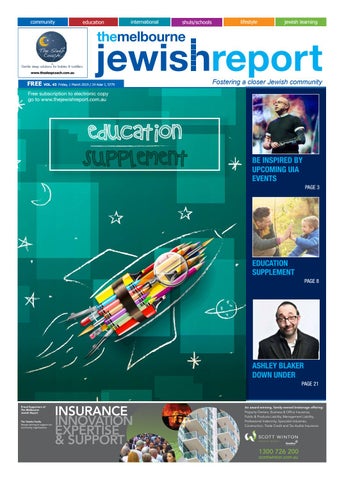
EDUCATION SUPPLEMENT
BE INSPIRED BY UPCOMING UIA EVENTS
PAGE 3
EDUCATION SUPPLEMENT
PAGE 8
ASHLEY BLAKER DOWN UNDER
8648 Scott Winton - Banner for Melb Jewish report (correct size).indd 1
PAGE 21
26/3/18 9:49 am
2
community
March 2019
New Holocaust education program for Adelaide Schools ADELAIDE HOLOCAUST MUSEUM AND STEINER EDUCATION CENTRE SUE DRENTH With the continuing support of the Adelaide Holocaust Museum and Steiner Education Centre’s (AHMSEC) principal funding partner, Gandel Philanthropy, the fit out of the AHMSEC museum is now underway and will be a dynamic multi-media space housing the permanent Holocaust exhibition, artefacts, travelling exhibitions and the stories of South Australian Holocaust survivors. As part of the AHMSEC development and with the support of South Australian Minister for Education, John Gardner, the Adelaide Holocaust Museum and Steiner Education Centre Inc (AHMSEC) is also delighted to announce a recent grant of $50,000 from the Department of Education that will enable a Holocaust education program to be developed and trialled across 12 Adelaide metropolitan secondary schools, targeting Year 10 History students and aligning with the national curriculum. Commencing in February, the education program will provide consistent and topic specific information, encouraging students to critically analyse themes from the Holocaust and understand their continuing relevance to contemporary social issues. Kerryn Langman, an Educator and Gandel Scholar will develop and deliver the pilot program with input from a Community of Practice group, comprised of History teachers and relevant
Fennescey House - new home of AHMSEC
stakeholders. An external evaluation will provide recommendations for the ongoing development of the program. At the conclusion of the pilot project, the education program will be delivered “in house” at the museum’s CBD location, Fennescey House, Wakefield Street,
Adelaide following its official opening later in the year. With the rise of anti-semitism around the world and increasingly in Australia, the AHMSEC Holocaust education program has a unique and important role in educating young South Australians about the history
of the Holocaust and the lessons to be taken from that in terms of encouraging a kinder and more compassionate society. All enquiries about the AHMSEC project or to make a donation should be directed to Sue Drenth, Project Manager at: sdrenth@ ahmsec.org.au or via phone 0419 486 476.
Inspiring Young Changemakers in the Holidays STAND UP JACQUI DUBS Stand Up ABC combines the fun and adventure kids want during their school holidays, with an enriching experience showing Bnei Mitzvah aged boys and girls how they can make a positive impact on the world. Highlights of the program in Melbourne and Sydney include the opportunity to hear firsthand the moving personal story of a recently arrived refugee, as well as the chance to walk with an Aboriginal Elder, and uncover the ancient history and cultural meaning behind local landmarks. “Our daughter was particularly moved by Mohsen’s story and really wanted to tell me about it and debrief about it herself afterwards”, reflected ABC parent Melanie, after the group met with an asylum seeker from Iran. “It was an excellent opportunity for our kids to see the human face of asylum seeker policy and develop compassion for and awareness of others in need. Thanks for giving them that opportunity”. Stand Up is a community led non-profit that has been dedicated to working with disadvantaged communities in Australia, and inspiring the next generation of Jewish changemakers, over the last 25 years. Using this knowledge, Stand Up’s team of passionate and experienced informal educators have designed the Stand Up ABC holiday program to be an interactive and stimulating experience for Bnei Mitzvah youth. In small friendly groups, participants explore the Jewish values of Tikkun Olam (repairing the world), Tzedek (justice) and Chessed (kindness), and how to apply these principles as they reach young adulthood. For many 11 to 13 year olds, the program marks their first step towards understanding the important social justice responsibilities in Jewish life. As part of this journey, participants also delve into contemporary social justice issues, such as homelessness, Indigenous
reconciliation, poverty and the protection of human rights. Each group has approximately 12 students, allowing every child’s voice to be heard, friendships to form, and the opportunity for each individual to generate their own ideas for making a positive and tangible difference in the community. In the words of Stand Up ABC participant, Claudia, “I really enjoyed Stand Up ABC and it taught me so much. I am now way more encouraged to help in my community and make a difference. I enjoyed doing the living on $2 a day challenge because it made me think about everyone who is less fortunate than us”. The program includes a finale celebration where participants use their leadership skills to take their family and friends on an interactive journey through what they have learned. Every child that completes Stand Up ABC is also eligible to receive the Gandel Young Leader Award, which honours the achievements of an outstanding participant from Melbourne and Sydney annually. “Stand Up ABC was a wonderful experience. It taught me that sometimes we take our privileged lives for granted, and we lose sight of how lucky we are”, said Ariella, a past Gandel Young Leader Award winner. Stand Up ABC runs programs during each school term, as well as the April and October holiday breaks. Through the generous support of Gandel Philanthropy and The All in Giving Circle, Stand Up ABC is offered at a discounted rate, and aims to be inclusive of everyone irrespective of financial circumstances. Over 740 Bnei Mitzvah youth have completed this dynamic course in Melbourne and Sydney over the last 7 years. Register for the Stand Up ABC Holiday Program (15 to 17 April) in MELBOURNE & SYDNEY at www.standup.org.au/ABC For more information contact education@standup.org.au, tel: (03) 9500 2206.
Stand Up ABC kids hearing the story of a Sudanese refugee in Melbourne.
Stand Up ABC kids meeting with an Iranian asylum seeker in Sydney
3
community
March 2019
Wounded former IDF captain to inspire at UIA events UIA UIA Australia is proud to host wounded Former IDF Captain and Iron Man competitor Ziv Shilon at a variety of events in Sydney, Melbourne and Perth as part of the 2019 Campaign. Ziv Shilon was severely wounded during his last operational mission in the Gaza Strip in 2012. Undergoing over 14 surgeries and intensive rehabilitation, the story of his injury and recovery is a heroic and remarkable tale of the strength of one’s spirit and the ability to overcome challenges. Due to his immense motivation and willpower, he succeeded to rise above physical hurdles including those he thought were impossible. Shilon completed the Berlin Marathon and is now training for the Iron Man competition. Shilon will inspire at our Young UIA event – ‘It’s Personal’ on Wednesday 13 March at 7.15pm. Additionally, he will address the ‘young at heart’ at a Community Afternoon Tea in Melbourne on Wednesday 13 March. Guests will also be treated to hearing from Dr Zuhdi Jasser, the Founder and President of the American Islamic Forum for Democracy. Jasser is an outspoken supporter of Israel and believes that Muslim organisations and leaders need to be held to a litmus test to see whether they recognise Israel as a state. He
regularly briefs members of the House and Senate on the threat of Political Islam and testified before the United States House of Representatives Committee on Homeland Security. UIA CEO Yair Miller said: “Ziv’s message of strength and ensuring you give back is so important for our younger generation of supporters. UIA prides itself on being inclusive and ensuring the next generation
of donors have the ability to connect with Israel in different and innovative ways. Ziv’s events across Australia will be empowering and ensure our unwavering partnership with Israel through the UIA is instilled in the next generation.” Events will sell out and places are limited. Follow UIA on Facebook for updates on our 2019 Campaign: facebook.com/uiaaus
For the People of Israel
2019 Community Afternoon Tea Wednesday 13 March 2019 1.45pm — 3.30pm
BOOK NOW FOR THESE AMAZING EVENTS YOUNG UIA EVENT Wednesday 13 March 2019, 7.15pm COMMUNITY AFTERNOON TEA Wednesday 13 March 2019, 1.45-3.30pm To book, contact 1300 ISRAEL (1300 477 235), info@uiavic.org.au or visit uiaaustralia.org.au
For the People of Israel
YOUR CHANCE TO SUPPORT THE PEOPLE OF ISRAEL
SUP
Y A D N U S R E 31 M A R C H
CAPTAIN ZIV SHILON FORMER IDF CAPTAIN
DR. ZUHDI JASSER
FOUNDER OF THE AMERICAN ISLAMIC FORUM FOR DEMOCRACY
Tickets: $25pp Includes entertainment, door prizes and afternoon tea
10A M –4 P M ISRAEL NEEDS YOU!
Bookings Essential: 9272 5533 or estelle.wytwornik@uiavic.org www.uiaaustralia.org.au WITH THANKS TO OUR SPONSORS:
To volunteer or donate, contact UIA on 1300 ISRAEL (1300 477 235)
4
community
The first Derech Eretz Aboriginal youth program in Toomelah and Boggabilla (2005)
March 2019
Stand Up\s pivotal volunteers. Ric Benjamin, Sandra Dudakov OAM, Ronit Prawer, Dr Arnold Shmerling, Ros Loff
Celebrating 25 years of Stand Up’s Impact STAND UP DR ARNOLD SHMERLING & RIC BENJAMIN As Paul Kelly famously sang, “from little things big things grow”, and so it has been for social justice organisation, Stand Up. On 29th July 1994, the Australian Jewish News reported on the launch of a community appeal to support the survivors of the Rwandan genocide, called “Keshet”. When describing what had motivated the establishment of Keshet, spokesperson Dr Mark Baker said, “Jews understand all too well what Elie Wiesel means when he says the opposite of love is not hate, but indifference”. This new organisation aimed to give expression to the Jewish ethic of active tzedek(justice) by providing an ongoing fund for humanitarian relief. And so Keshet which would later be known as Jewish Aid Australia, and today as Stand Up - was created! In the early years the organisation focused on fundraising for international emergencies. Man-made disasters in Rwanda, East Timor, and Kosovo, resulted in refugee crises that resonated deeply within the Australian Jewish community. Natural disasters caused by flood, drought and earthquake also prompted relief efforts that were generously supported by theJewish community. During the first six years, Stand Up also established ‘Annual Programs’ - including Homeless Youth (1995), Koori Education (1996) and Breaking the Isolation of the
Elderly (1999) - as well as a homework club for homeless people and families in crisis at Hanover Welfare Services (2000). As a result of these local activities, Stand Up’s volunteer base expanded swiftly and began to include groups of Jewish university students who provided weekly mentoring to people in need. In 2000, Stand Up’s founders decided that the organisation could create a greater impact on the communities it engaged with, and its own volunteers, by focusing on building deeper and more long-term partnerships. That year, the organisation also took on the challenge of creating a food rescue program. Melbourne City Harvest was established and Stand Up volunteers began picking up left over food from ‘simcha’ celebrations and delivering it to Hanover Welfare Services and the Salvation Army to distribute. The program and its reputation grew rapidly. By 2002, Melbourne City Harvest had merged with another food rescue start up called One Umbrella. This organisation is now called Fareshare, an entity that has also grown, and today delivers over 2.5 million meals annually to Melbourne and Brisbane’s hungry and homeless. In 2002 Keshet changed its name to Jewish Aid Australia, and in 2004 employed its first (and still going) employee, Lisa Buchner (Stand Up’s Refugee Programs Director). In 2004, strong ties also began to be forged with the Sudanese refugee communities in Melbourne and Sydney. In 2005, Shalom in Sydney began a holiday
program in a remote Aboriginal community in northern NSW called ‘Derech Eretz’ (Way of the Land). These original community partnerships continue to thrive today through Stand Up’s Refugee Support Department and Aboriginal Partnership Programs. Stand Up has also built a vibrant education department that today delivers innovative programs for youth and young adults on a range of contemporary global issues including Stand Up ABC, a popular social justice education program for Bnei Mitzvah aged students, and the Stand Up Fellowship, a social impact journey for emerging leaders aged 24 – 32. After being granted DGR status, the board raised funds to appoint the first CEO in 2009. Gary Samowitz moved down from Sydney and enthusiastically embraced the challenge of being Stand Up’s first CEO. Since then he has grown the organisation’s impact to new levels through his energy, compassion and drive. “Stand Up is proud to have been a catalyst for social change over the last quarter of a century”, he reflects. “We are looking forward to celebrating our 25th Birthday with our supporters, donors and volunteers; past, present and future. We also encourage the Australian Jewish community to show their support by getting involved in our ‘25 Challenge’, a fundraising initiative to help us meet the organisation’s future challenges and possibilities”.
Over the last 25 years Stand Up has been a transformative organisation for the Jewish community, turning skeptics into believers, and believers into doers. It has mobilized hundreds of volunteers to create a meaningful difference in disadvantaged communities. Its volunteers reflect the diversity of the Jewish community; in age, gender, skills, and religious affiliation, including those who feel they are on the ‘fringes’ of the community. Stand Up strives to break down commonly held stereotypes by connecting people from diverse backgrounds and allowing them to share special moments. Through these connections Jewish Australians have the opportunity to learn more about Australia’s diverse communities. And reciprocally, Jewish Australians have the chance to share their history and experiences with those who may never have met or befriended a Jew before. In 2019, Stand Up is proud to be running 18 different social justice programs with over 150 active volunteers, supported by 14 staff in Melbourne and 5 in Sydney - all of this is fuelled by over 1000 generous donors. Stand Up has mobilised the Australian Jewish community to be Upstanders, not Bystanders, and the organisation is looking forward to its next chapter of growth and pursuing social justice. For more information about Stand Up and to get involved in the ‘25 Challenge’ visit: www.standup.org.au/25
From Green Sunday to Blue Box, JNF Victoria Offers Hope in the Negev JNF VICTORIA More than 200 volunteers recently joined together for a day full of fun, education and community spirit in support of JNF’s Green Sunday Campaign. “Seeing our community come together like this was inspiring,” reflected Ronit Fraid, President, JNF Victoria. Volunteers of all ages came from across our community, representing their schools, Youth Movements, shuls and more. “The energy in the room was electric. Everyone was so enthusiastic because we were all working towards a brilliant project in Naveh”, Fraid said. A remote, pioneering community in Israel’s Negev, Naveh is situated just 1km from the Egyptian border and 6.5km from Gaza. Over the last 10 years, the community has grown from just 20 families to over 300 families with more than 1000 children. When the founders of Naveh arrived, the area was just sand dunes. However, after JNF successfully funded a pipeline to the treatment plant which provided water for irrigation in 2016, Naveh has become a blossoming town with a flourishing agriculture industry and the highly sought after Otzem premilitary academy. Program Development Manager and
Founder of Naveh, Rabbi Aharon Tzohar says
and thriving community centre and a true sense
“with faith, willpower and cooperation, you can
of normality. In this way, JNF is bringing life to
achieve anything in life”, and there is indeed
the desert and turning dreams into reality.
still more to do. That’s why the funds raised
JNF supports many inspirational Israelis
during the 2019 Green Sunday campaign will
who are working tirelessly to improve the
be directed towards the greening of Naveh’s
environment in Israel and are committed to
community centre. Together, we can help to
the welfare of her people. That’s why JNF
give them what they really need now - a lush
is proud to continue to support the growth
and development of Israel’s South with the upcoming Pesach Blue Box campaign. It was early April 2018 when balloons and kites first began to fall on Kfar Aza, setting alight crops that were soon due to be harvested. “This community has been my home for 53 years. But never have I seen such devastation” observed resident of Kfar Aza, Shai Hermesh at the time. Funds raised through JNF Victoria’s last Rosh Hashana Blue Box Campaign allowed the people of Kfar Aza to commence the rebuilding of their beautiful green spaces. Now, JNF’s upcoming Pesach Blue Box campaign will enable the continuation of this work - upgrading, landscaping and irrigating several areas in the kibbutz. Most importantly the restoration will also offer protection - “moist green grass can’t catch fire” notes Hermesh. With each campaign, JNF Victoria is proud to contribute to the strength and positivity of the Israeli people, and to help our youth to further understand the challenges our brethren in Israel face. For more information about Kfar Aza or to donate to the 2019 Pesach Blue Box Campaign, please visit www.jnf.org.au/blueboxvic.
Magnitsky Act ortant stralia Why Australia should pass a Global Magnitsky Law
. s t h g i R n & Huma
March 2019
community
tsky ActMICHAEL allows governments to target DANBY MP iduals involved in human rights enior officials downofficials to judges, policemen, Government connected with authoritarian have gotten tors such as CEOs governments and contractors.
away with their abuses of power without cludes freezing funds held in banks, sanction. These abusers use their illluxury villas and preventing corrupt gotten gains and status to travel abroad obtainingand visas. bask in the affluence of the West, purchasing and investing in assets ould bring to account those responsible overseas, sending their children to s as shooting down Flight MH17, killing expensive private schools and hiding their board - and Russian oligarchs using dirty ill-gotten gains in offshore bank accounts e with western elections. for the benefit of themselves, their families nd to beand more effective, Magnitsky Acts their cronies. d in severalIn other countries. the late 1980s, the USAustralia Senate passed the Jackson-Vanik amendment, which oble cause. pressured the then Soviet Union on the ne Ports Labor MP, Michael Danby issue of human rights. Jackson-Vanik was ternational Human Rights & Corruption emblematic of our Western willingness to ions) Bill into thepolicy Australian use foreign to free the Parliament, great Andrei tly being debated. Sakharov or Anatoly Sharansky. Since the fall of the Berlin Wall and the apparent end of communism, Russia and China were authoritarian outrages without going to admitted to the World Trade Organization. war. The Russian Federation general in Francis Fukuyama, in his End of History the 53rd anti-aircraft brigade who shot and the Last Man, said that this would down MH17 and the official in Khartoum ‘inevitably lead to democratisation’. With who sent the Janjaweed militia to murder China and Russia’s admittance to the the Muslim people of Western Sahara World Trade Organization, we lost most won’t like this legislation. At Labor’s of our human rights leverage over these national conference in Adelaide I named authoritarian states. Last year, Beijing Beijing’s viceroy in Xinjiang, or East contemptuously and unilaterally cancelled Turkestan, Chen Quanguo, who set our already ineffectual human rights up concentration camps for millions of dialogue with them. Uygurs in East Turkestan. He won’t like The International Human Rights and this legislation. Corruption (Magnitsky Sanctions) Bill Legislation has already passed in other 2018, which I introduced to the House democratic countries, like the United of Representatives the week before States, the UK and Canada. The aims Parliament rose last year, attempts to of the Magnitsky legislation in Australia rebalance and reinvigorate democratic are threefold. Firstly, it aims to prevent pushback, to prescribed foreign persons engaged give us, again, some instrument that in gross violations of human rights and will enable democracies to respond to corruption from visiting Australia and
5
countries that adopt such laws, the more jurisdictions that can be
made potentially out of bounds to
individuals such as those involved in the
shooting down of planes over Ukraine; the
expelling or killing of tens of thousands of Rohingya; or the starving, incarcerating,
torturing and executing of the poor citizens
of North Korea. Vladimir Putin hates these
laws. Observers were astounded that Putin gave these laws such salience at the Helsinki summit with President Trump.
If authoritarians are so antagonistic to such an approach, surely that is crucial
proof that these laws are potentially very effective.
This legislation received a great deal of
publicity all over Australia. It has support across all of the political parties, including spending or investing their money here. It enables the Governor-General, on the advice of the minister, to target individuals with immigration, financial and trade sanctions. Secondly, by imposing sanctions on these individuals they are exposed to the world and the people in their countries as pariahs in the international community. Thirdly, it is hoped that such sanctions and exposure will deter individuals in these authoritarian regimes from engaging in further gross human rights violations or corruption. As we know, sunlight can be one of the best disinfectants of political or corporate malfeasance. As I recently told the Sydney Institute, it’s now time that Australia joined this growing international movement and adopted a global Magnitsky law. The more
the crossbenches. I plead with the Prime
Minister: give us some time in the little time
that remains of this parliament to pass magnitsky.laborformacnamara.com such important legislation; to join the sister democracies of the United States, the UK and Canada; and to match our fierce
rhetoric about MH17 with action. Let’s show those arrogant, insolent dictators like Vladimir Putin that they can’t kill our
countrymen, our citizens, and get away with it. The global Magnitsky legislation
should be passed by this House because if we take ourselves seriously we cannot
let 38 Australians be murdered by the
Russian Federation, as was proved by the internationally respected investigation into this shoot down. The Global Magnitsky
legislation should be passed by the House of Representatives before Parliament rises.
Why a Magnitsky Act is important for Australia
. s t h g i R n & Huma
The Global Magnitsky Act allows governments to target sanctions at individuals involved in human rights violations, from senior officials down to judges, policemen, even private violators such as CEOs and contractors. Punitive action includes freezing funds held in banks, seizing assets like luxury villas and preventing corrupt individuals from obtaining visas. Magnitsky Laws could bring to account those responsible for such attrocities as shooting down Flight MH17, killing 38 Australians onboard - and Russian oligarchs using dirty money to interfere with western elections. To close the net and to be more effective, Magnitsky Acts have been passed in several other countries. Australia should join this noble cause. In 2018, Melbourne Ports Labor MP, Michael Danby introduced the International Human Rights & Corruption (Magnitsky Sanctions) Bill into the Australian Parliament, where it is currently being debated.
magnitsky.laborformacnamara.com
Happy Purim
2
$
90
SAVE 55¢
ea
Berman Hamen Tashen Cookie Varieties 175g $1.66 per 100g
1
$ 42 SAVE $1.43
ea
Cobs Popcorn 80g-120g
^Products and specials may not be available in all stores.
On sale from Wednesday 6th March until Tuesday 12th March 2019 unless sold out earlier at Woolworths Balaclava, Bentleigh, Carnegie, Carnegie North, Casey Central, Chelsea, Doncaster, Westfield Doncaster, Glen Huntly, Hampton, Highett, Kew, Malvern, Middle Brighton, Moorabbin, Oakleigh South, Prahran, Southland & Toorak. Limits per customer may apply, trade not supplied. Specials are not available online or at Caltex Woolworths co-branded fuel outlets. Woolworths Supermarkets: 1 Woolworths Way, Bella Vista, NSW 2153. bws.com.au | call 1300 138 297 *We support the responsible service of alcohol. Savings are based on BWS standard selling prices. Limit rights reserved. Specials may not be available in all stores. *Standard local call charges apply. At this great price no further discounts apply. CP250219V5MJRL
Specials start Wednesday 6th March Available at Woolworths Balaclava, Bentleigh, Carnegie, Carnegie North, Casey Central, Chelsea, Doncaster, Westfield Doncaster, Glen Huntly, Hampton, Highett, Kew, Malvern, Middle Brighton, Moorabbin, Oakleigh South, Prahran, Southland and Toorak.^
1
$ 40 ea
SAVE 30¢
14
$
SAVE
3
Malt Star Drink 330ml 42¢ per 100ml
3
$
$
80 ea
SAVE 70¢ Elite Turkish Coffee 100g $3.80 per 100g
King David Sacramental 750ml
CP250219V5MJRR
8
community
March 2019
Language of independence building MICHAEL GROSE Families always develop shared language around the values that have strong meaning for them. If independence and self-sufficiency are important then it will be reflected in your family’s proprietary language. In fact, it’s through shared language that culture exists. If you are looking to building a culture of independence in your family (or in your classroom) then creating your proprietary language around independence is a great way to start. The following twelve examples of independence-building language and principles behind them that will help you create your own family’s language. 1. “Never regularly do for a child the things a child can do for him or herself” Goal: Independence This is perhaps the original parentingfor-independence manifesto, and it’s a philosophy that guides many teachers and parents today. In effect, this sentence means that wherever possible we give children the skills and competencies to look after themselves physically and emotionally. It requires a great deal of patience, time and courage from parents and teachers as the sentence is easier to say than put to put into practice. But it’s a worthy guiding principle that leads to self-sufficiency in children, and ultimately redundancy as parents. 2. “Is this something you can do?” Goal: Self-help Independence takes many forms but perhaps the most common is the development of self-help skills. The confidence, pride and, for most, sheer pleasure that kids doing the simple things for themselves such a toddler tying his shoelaces or a child making his own lunch is immeasurable. Yet it is so easily denied by well-meaning parents and adults who see it as their job to do everything for children. Independence begins at home with the development of self-help skills. 3. “Have you checked the help roster today?” Goal: Contribution A great way to develop a sense of independence is to give kids opportunities to help out at home. There is no need to overburden children with jobs, but a sensible allocation of chores according to their age and study requirements is not only a great help to you, but fantastic training for them. It also builds accountability and a work ethic, both highly valued characteristics for continuing success at school and later in life. 4. “Which of these two would you prefer?” Goal: Decision-making Parents as wise leaders need to call the shots on how the family life is conducted and health and welfare issues such as appropriate bed and bath times. Some things are not up for negotiation. But there are areas where parents can rightfully hand autonomy to children and say, ‘It’s your call!’ Choice of clothes, how they keep their bedroom, what they eat and who they play with are the types of decisions they can make. Naturally, this is age-related and you do need to have some influence on their choices.
5. “How can you make this happen?” Goal: Problem-solving Kids get used to bringing their problems to parents to solve. If you keeping solving them, they’ll keep bringing them. A problemsolving approach relies on asking good questions, which can be challenging if you are used to solving your child’s problems. The first question when a child brings you a problem should be: ‘Can you handle this on your own?’ Next should be, ‘What do you want me to do to help you solve the problem?’ These questions are not meant to deter children from coming to you; rather, to encourage and teach them to start working through their own concerns themselves. 6. “We rely on you to do this?” Goal: Reliability Reliability is closely connected to responsibility and other aspects of independence. Every child over the age of five, at the eldest, should do something that someone else relies on whether it’s looking after a pet, clearing the meal table or emptying the garbage on a regular basis. Having others rely on you has its challenges is a learning curve. They’ll inevitably forget to put the rubbish bins out on garbage night, meaning your bin will be overflowing for the next week. They’ll need to be reminded about feeding the pet or clearing the table. Kids inevitably won’t get things right, but that doesn’t mean we should stop giving them responsibilities. 7. “What can you learn for next time?” Goal: Self-sufficiency Learning from mistakes is part of the independence-building process for children. Often adult impatience or unwillingness to put up with errors prevents us from giving kids the chance to do things for themselves or take real responsibilities. If independence is to be a major part of your family’s culture then it’s imperative that we help kids learn from their mistakes whether social,
behavioural or just messing up while helping out at home. 8. “How do you feel about this?” Goal: Emotional intelligence An often over-looked aspect of independence is the ability to self-manage your emotional state. Emotional selfmanagement starts with the recognition of how you feel about a particular event or action and then labelling that feeling. If possible prompt to identify their emotions before they act on them. You can also revisit events and ask children about the feelings that may have lead to a certain behaviour such as hurting or yelling at a sibling. 9. “When you muck up, you make up?” Goal: Accountability Kids of all ages will make mistakes. In fact, mucking up is part of the learning process. But kids will just repeat their mistakes unless they experience the consequences of their decisions. The use of behavioural consequences is a way of teaching children to take greater responsibility for their lives and to learn to make smarter choices. 10.“How will you fix this?” Goal: Restoring relationships Independent kids are usually sociallysmart kids who don’t operate in a bubble. They know that their behaviour impacts on others they are mindful of the thoughts, feelings and behaviours of others. They also make amends or restore relationships when their behaviour impacts negatively on others. Relationship restoration is a lifelong skill and involves the following: swallowing your pride, making up, giving something back, not holding a grudge and moving on. 11.“You need to do what’s right, not what’s easy.” Goal: Integrity A sense of integrity is important for a child’s independence because it’s the basis of reasoned and socially focused self-control and self-management. The job of parents is to move their children from ‘Me’ to ‘We’.
Integrity is the great socialising agent for a child. They may get by without courage, endurance and grit but they won’t get far socially without integrity. 12.“Let’s find a way to make this happen.” Goal: positive risk-taking One of the ways to develop independence is to work with them to build their skills and abilities to safely navigate an everbroadening environment outside of the relative safe confines of their home. Ideas include adults and kids doing things together such as catching public transport until they are ready to go it alone or with friends; and giving kids smaller freedoms that lead to bigger liberties such as allowing a young child to walk part of the way to school on their own and then extending the distance as they get more experience and feel more confident. Independence-building is vitally important for parents. It’s the pathway to children’s competency, confidence and creativity and the short cut to resilience and real learning. We’ve gradually retreated from this approach over recent generations much to our children’s detriment. It’s time to help kids reclaim their independence. Getting our language right is a good place to start as family change always begins with shared language. Michael Grose Michael Grose, founder of Parenting Ideas, is one of Australia’s leading parenting educators. He’s the author of 10 books for parents including Thriving! and the best-selling Why First Borns Rule the World and Last Borns Want to Change It, and his latest release Spoonfed Generation: How to raise independent children.
education
March 2019
9
Choose Bialik for All-Round Excellence BIALIK COLLEGE Bialik is committed to the pursuit of excellence in an enriching, nurturing environment. The College is dedicated to empowering students with the knowledge, skills, dispositions and values necessary to achieve their potential and to contribute meaningfully to the Jewish, Australian and global communities. Academically, Bialik leads the field not only in consistently outstanding VCE results – the school topped the State in 2018 for the second time in three consecutive years and has been in the top five in the State for a remarkable 22 of the last 23 years – but in innovative and cutting-edge programs that stimulate and engage students in myriads of ways. Whether it’s about learning to run a business, designing Apps or constructing robots and drones, through to using dogs as a conduit of learning in the Primary school, the College is quick to respond to new approaches and ideas. Bialik’s initiatives in STEM for instance have been so successful that there has been an exponential increase in girls studying forensic science and STEM electives into Senior school. The College’s approach to Judaism is unique amongst the Jewish Schools in Victoria. As a cross-communal Jewish school, Bialik has a pluralist ethos and all expressions of Judaism are welcomed and honoured. One way of articulating the College’s very strong Jewish ethos is with the statement: “we don’t preach, we teach”. A core value of Bialik College is to respect individual choice of
expression when it comes to Jewish identity. The teaching is expansive and inclusive, demonstrating to students the rich mosaic of our Jewish tradition that encompasses ideologies and practices across the full spectrum of mainstream Judaism – from Orthodox to Progressive and from Secular to Conservative. Students are empowered, from a knowledgeable base, to choose how to express themselves according to their own, and their family’s own preferences. Zionism and a love for Israel is infused into the culture at Bialik College. Hebrew is part of the Bialik student’s daily experience and is made accessible to all levels of ability. In addition, a Bilingual Hebrew Immersion Program operates in Years 4 and 5 at Primary School level, introducing students from a monolingual background to another
‘Education is the most powerful weapon which you can use to change the world.” - Nelson Mandela
Courage to Care
combating prejudice, racism and discrimination transforming bystanders to upstanders
Courage to Care offers workshops for schools, community groups and workplaces.
Talk to us to find out more Tel. 9533-0955 or email office@couragetocare.org.au
diverse culture and language. The College’s enriching Jewish Studies curriculum is supported through our relationship with Hebrew University’s Melton Centre for Jewish Education. This is further enhanced by the engaging and interactive Jewish programs run by the Jewish Informal Education Team in The Mifgash (Centre for Jewish Life). The College has also developed strong connections with schools in the Arava region of Israel and fosters close relationships between the Israeli and Australian students. These relationships begin in the Kinder and are strengthened when the Year 10 cohort visit the Arava as part of their 6 week Chavayah trip to Israel and China. Health and Wellbeing continues to be a key focus in 2019. From Prep to Year
12, students benefit from the College’s exceptional program that develops the student holistically and deals with building healthy relationships, healthy minds and healthy bodies. The program is carefully tailored to the individual age levels and includes, amongst others, sex education, respectful relationships, dealing with stress and conflict, yoga and meditation. Bialik offers a robust Visual and Performing Arts program ensuring that a wide range of co-curricular opportunities for both skill acquisition and creative expression are made available to all students throughout the academic year. The Sports program is equally impressive and runs out of the superbly appointed Gringlas Sports Centre. But perhaps the area in which Bialik shines brightest, is the family atmosphere and care that permeates the environment of the school. With everyone on one campus, from ELC to VCE, respectful relationships are ingrained into the fabric of the school with mentorship programs between older and younger students and leadership opportunities from Year 5 through to Year 12 that are based on individual students volunteering to take on more responsibility rather than being voted into position by others. A new addition to the Bialik family, the Bialik Creche, opens its doors in July. Places are filling fast so if you’d like to book a spot, contact creche@bialik.vic.edu.au
10
community
March 2019
Achieving With Yeshivah – Beth Rivkah YESHIVAH BETH RIVKAH Yeshivah – Beth Rivkah Colleges (YBR) is proud to be home to over 1300 students from crèche to Year 12. The campuses of YBR include the vibrant Pre-Schools (crèche and kinder), Yeshivah College (boys Primary and High School) and Beth Rivkah Ladies College (girls Primary and High School). YBR provides a warm and nurturing environment, and operates according to the ethos and values of Chabad, welcoming students from all facets of the Melbourne Jewish community. The dual Jewish and General studies curriculum provides a rigorous and engaging opportunity for all students to connect with their heritage and identity whilst inspiring them to pursue their life ambitions. Students develop a love of learning, and a deep appreciation of Yiddishkeit (their Jewish identity). Torah study and Mitzvah observance, Ahavas Yisrael (love for your fellow), love for Hashem, Chesed (kindness) and Tzedakah (giving) are the cornerstones of a YBR education. This is complemented and synthesised with a quality General Studies curriculum that expands students’ knowledge and understanding, and encourages them to challenge and explore the world around them. YBR graduates leave the College equipped to face the future as contributing members of society. The team of dedicated, enthusiastic and caring Jewish and General studies staff across the YBR Pre-Schools, Primary and Secondary are continuously developing their skills and work collaboratively to create exciting and engaging curricula and in-class
delivery. Outstanding educational and co-curricular offerings at YBR – including technological hubs, STEM centres and coding classes across the campuses – cultivate students’ imagination and creativity and develop critical and innovative thinkers. Coupled with extra-curricular opportunities such as camps, Shabbat getaways, school productions, sporting events and extra learning programs, Yeshivah – Beth Rivkah endeavours to support the individual achievement and personal growth of each and every one of our students. Principal of Yeshivah – Beth Rivkah Colleges, Rabbi Yehoshua Smukler, noted that “YBR reconciles the age old conundrum of how to live a Torah life, whilst critically engaging in a modern and everchanging world. We accomplish this by empowering our graduates to respect knowledge, critical analysis and thinking skills, whilst being grounded with a deep rooted faith and strong values to guide them through life”.
B’nai B’rith Courage to Care COURAGE TO CARE It is an exciting time for B’nai B’rith Courage to Care with our new CEO Mike Zervos settling in well and we are enjoying having the increased office space at 843A Glen Huntly Road. Recently we hosted representatives from NSW, Queensland and WA at our national conference themed “Courage to Care across Australia”. Over 60 delegates enjoyed the opportunity to interact and learn from each other. We remain an important initiative of B’nai B’rith. So, what do we do? Courage to Care aims to inform and educate about the dangers of prejudice, racism and discrimination. We do this by: • educating Victorians, in particular students, towards an understanding of the roles of the victim, perpetrator, and bystander by exposing them to the stories of survivors of the Holocaust and other genocides, and their rescuers. • empowering individuals, through Transforming Bystander Behaviour programs, to have the courage to combat bullying, racism and other forms of prejudice by being UPSTANDERS not BYSTANDERS. Through our major exhibitions, incursions (school visits) and other outreach programs we: • help preserve the memory of the
Holocaust by honouring the memory of the Righteous Among the Nations and their like. • use the actions of the Righteous as the model for moral and ethical behaviour to help challenge bystander behaviour in our communities today. Since we began in 1992, our programs have been shared with over 130,000 students across Victoria. We are planning to reach well over 6,000 students this year and have set ambitious targets to reach over 10,000 students by 2021. Schools Exhibitions In 2019, we are having three full exhibitions with integrated education
programs in Hamilton, Shepparton and Warragul. We will also be showcasing our programs at Alliance Francais in St. Kilda in July. Direct to School Incursions An Incursion is the delivery of our workshop program directly into an individual school. In 2019, we are planning incursions in over twenty-five schools. Victoria Police: Transforming Bystander Behaviour workshops While the school’s program will always be our primary focus, in 2018 our work with Victoria Police was our first foray into programming for the workplace and a fee for service model.
The program has exciting promise for the future, providing us with a template that can be used to develop effective training programs in transforming bystander behaviour for other organisations on a fee-for-service basis. None of our achievements would have been possible without the support of many very dedicated volunteers. They offer their time and experience in a variety of ways, and without their input the success this program has achieved would not have been possible. Both Gandel Philanthropy and the Victorian Department of Education have remained major supporters of the work we are doing. We think the teachers and students sum up our work best. “I think it has opened my eyes to how you can help even by doing something little. Stand by someone, listen and support them.” (Year 9 student, Northcote High School) “It makes history meaningful and relevant to the kids. It also helps them to examine their own lives, experiences and prejudices and gives them practical strategies to seek help and stand up for others.” (Teacher, Ballarat) If anyone is interested in finding out more about what we do or how they can contribute as a volunteer or donor please contact us on office@ couragetocare.org.au or 9533 0955
March 2019
Valuing the Person at Sholem SHOLEM ALECHEM COLLEGE
Each year at Sholem Aleichem College Principal Helen Greenberg chooses a theme that will guide, instruct and inspire the college for the entire year. Past year’s themes have included ‘Teaching with Creativity, for Creativity’, ‘I see... I think… I wonder…’ ‘Making a Difference’ and ‘Looking Beyond’ and the theme for 2019 will be ‘Value the Person’. In choosing this theme Principal Greenberg sought a strong tie in with the college’s overall value system and with its motto of ‘Make Mine a Mentsh’. As she explains, ‘We are very clear on the type of values we seek to instil in our children, knowing that values formed during early years are most likely to be the values that children hold onto as they grow and mature through adolescence and into adulthood. Some of these values include the importance of Jewish identity and community, improving the world around us, resilience, cooperation, ethical behaviour, lifelong learning, seeking excellence and more.’ Principal Greenberg goes on to say that ‘by making the college’s values the central focus of the year and linking it the theme of Value the Person we emphasise that it is important for each student to value themselves as an individual – for this is the cornerstone of self-worth and self-confidence – while simultaneously valuing and respecting all those around them. Furthermore for a child to excel academically, they need to value themselves as a person, and once they do this, and have a strong sense of identity and of who they are, then they can excel in the education process and achieve their very best results in subjects such as numeracy and literacy and beyond. This theme of ‘Value the Person’ correlates closely to the college’s commitment to the wellbeing of all in its community – students, teachers, parents, family and friends. We live in
11
community
Charlotte Preiss and Coby Burstin an age where there are ever increasing strains on our physical and mental wellbeing, and Sholem takes very seriously its responsibility to play an active role in promoting and increasing the wellbeing of community members, so that they can then be best placed to achieve at their full potential – academically, socially and personally. With this in mind, it is a good opportunity to reiterate Sholem Aleichem College’s ten core values that underpin everything that happens at the college. 1. We value Jewish identity We nurture a passionate, personal sense of Jewish identity. 2. We value being a part of the Jewish Community THE PAST – We instil a personal connection with our history, heritage and traditions. THE PRESENT – We foster a proud sense of identification with all Jewish people as an extension of ourselves and our families.
THE FUTURE – We develop a devoted commitment to building the future of the Jewish people. 3. We value improving our world We have a responsibility to leave the world a better place than the one we inherited in terms of social justice, the environment and inter-personal relations. This includes acts of loving kindness, giving charity and showing compassion for others. 4. We value respect and tolerance We demand of ourselves respect for others, tolerance of differences and forgiveness of failings. We encourage others to show the same tolerance for us. 5. We value lifelong learning We are a community that encourages the joys of lifelong learning in a fun and supportive environment. We value putting learning into action. 6. We value the seeking of excellence We expect we will never be satisfied with
less than our best; and that by word and deed, we will support and encourage all to strive to achieve their best as well. We value responsibility, leadership, standing up for what we believe in and being accountable for our behaviour. 7. We value resilience We nurture the capacity to be able to cope with everyday problems; being assertive rather than aggressive and cultivate the ability to “bounce back” after experiencing hurt, difficulty, disappointment, or significant change. 8. We value cooperation We develop the skills to work harmoniously with others; to give and receive ideas; to understand that together we can make a difference; to nurture a sense of common achievement; and to work for the common good. 9. We value happiness and security We champion the right of all people to expect to live in happiness and security with freedom, justice, equality of rights and a fair go for all. We value celebration of our festivals, of our own achievements and of the achievements of others. 10. We value ethical behaviour In all our actions, we consider the short and long term impact on others. We value honesty and integrity, the ability and willingness to recognize one’s mistakes; to speak the truth; to be trustworthy of the privacy of others; and to respect the property of others. Living as we do in times of challenges and uncertainty in Australia and in the world at large, instilling strong vales in our children is the very best gift that we can give them as educators. By instilling such values we ensure that our children are in turn optimally placed to thrive and succeed in all they do both in terms of academic success and in also in becoming the very best mentshen they can be.
Sholem Aleichem College Value the Person
For a personalised tour or more information please contact: principal@sholem.vic.edu.au or call 8527 3000 Sholem Aleichem College 11 Sinclair Street, Elsternwick www.sholem.vic.edu.au
Sholem Aleichem College
שלומ עליכמ שול
12
community
March 2019
UJEB engages our diverse youth from prep to year 12 UJEB Melbourne today is home to an increasingly diverse Jewish community. We are of numerous denominations, socio-economic, language and cultural backgrounds, and gender identities. This means that Melbourne’s young Jews connect to their own identities and to their community in many different ways. It is UJEB’s mission to cater to this diversity. UJEB aims to provide a space where young Jewish people from all walks of life can feel welcome and comfortable. For UJEB, being inclusive is vital in ensuring that our community remains strong into the future. Traditionally, UJEB has been known for its weekly Jewish education sessions in public schools. In recent years, however, a more holistic approach has evolved, broadening out to include programs tailored to all of the stages of a Jewish school student’s life. Participants now enter these programs from state schools, Jewish day schools and other private schools. As UJEB parent and current Vice President, Gabi Crafti, puts it, UJEB today is “a Jewish educational institution that provides a wide range of programs for Jewish youth ... across their student life journey.” For primary students, UJEB runs the weekly “Jewish Life” program in 18
schools, as well as intensive Hebrew classes and after-school centres in Bentleigh and Caulfield North. For high schoolers, UJEB facilitates Bar and Bat Mitzvah programs, a yearly camp, lunchtime “J-Lunch” sessions and an annual 6-week Israel trip which brings together Year 10 students from Victoria, NSW and WA. This February, for the first time, UJEB sent 5 high school students to Denver, Colorado for the B’nai B’rith Youth Organisation (BBYO) International Convention. There they joined more
Adventure with Alef is born HEBREW GEMS, CHABAD GLEN EIRA A Melbourne based Jewish after school program, Hebrew Gems of Chabad Glen Eira is making waves around the globe with its new Hebrew alphabet curriculum, Adventure with Alef. The curriculum was developed to help children who don’t receive a daily Jewish education and attend a weekly Jewish afterschool program to easy learn and remember the Hebrew Alphabet at a similar pace to those in Jewish day schools. Adventure with Alef uses smart mnemonics, along with vibrant and engaging illustrations that brings the Hebrew Alphabet to life. These methods allow students to easily recall the letters while enjoying Alef’s exciting adventures too. With Hebrew Gems international staff, word quickly spread of the incredible results it was achieving with its students and requests we’re made to make it available abroad. In 2018 Adventure with Alef was born as a US based educational distributor took the reins in making it available to other Jewish Schools abroad. Today, there are hundreds of Hebrew schools with thousands of students across the globe enjoying Alef’s weekly adventures. Hebrew Gems didn’t want to stop there, their final vision was to make learning the Hebrew Alphabet as engaging and as exciting as some of today’s applications children interact with, which led to the
For more information on UJEB programs visit www.ujeb.org.au or call 95236844. UJEB’s 2019 annual camp is from 11-14 April for years 3-12. According to Camp Coordinator Benji Prawer, “Camp is the pinnacle of the UJEB calendar which brings together students from all of the schools we work in. It is a fantastic opportunity to build lasting friendships and is the perfect way to spend your school holidays”. Register now at www.ujeb.org.au/our-programs/ camps/
The gift of the game
creation of the Adventure with Alef App. It’s a first-class app that captivates children, allowing them (and adults) to learn the Hebrew alphabet through digital flash cards and fun engaging games, it currently has 15,000 downloads. Hebrew Gems is looking forward to rolling out the Adventure with Alef program for its foundation class this year.
For more information Adventure with Alef, please www.adventurewithalef.com
than 4000 Jewish teens, educators and philanthropists from around the world, aiming to “declare to the world that it’s our generation’s turn to lead the way and tackle the biggest problems facing society today”. These students recently returned, eager to share what they learnt with their friends and the wider Jewish community. These are just a few examples of the many ways in which UJEB provides fun and exciting learning and social opportunities for our young people. Stay tuned to hear about more exciting UJEB developments in 2019 and beyond!
on visit
For more information on Hebrew Gems, please visit www.cgems.org.au/ hebrewgems
ANDY KILOV, SPEECH PATHOLOGIST
School is back and our children are returning to their school routines, extra curricular activities, and homework commitments. While a focused mood sets in as Term 1 unfolds, the fun fair from holidays does not need to end. In the words of Roald Dahl, “life is more fun if you play games”, and indeed, the entertainment and enjoyment of playing games certainly does make life more fun. What’s even better, is that whilst playing games and having fun, children and adults can also be enriching social activity, cognitive growth, and taking up opportunities to acquire new knowledge and hone new skills. Playing games with other people offers opportunities to be social. Whilst some games can be played solo, most games rely on a pair or a group of other players. The beauty of interactive games lies in the sequence of turn taking, adherence to shared rules, and social dialogue that occurs whilst the game is in motion. Players take turns to make a move or decision in response to a set of rules and options. As players make decisions and proceed with turns, the game invites cheers of victory, banter, and opinions from opponents, which revolve around a set of core phrases and game- specific vocabulary. So, in addition to facilitating social interaction, games also offer opportunities to extend our ability to learn new words, use new phrases, and justify or challenge our position in the game through vocalisations, gestures, or complex articulation sequences. And yet, when communication or other barriers
exist, we can still find ways to be inclusive in a game because after all… players are able to create new rules and adapt to new conditions of play. The scope of cognitive benefits offered through playing games is tremendous. There is a growing body of evidence to suggest that playing games improves brain health and brain function (Fissler, et al, 2015). When we play games, we are required to learn and remember a set of rules, and then act on these rules whilst the game unfolds in a (mostly) unpredictable manner. Players are continuously planning and evaluating outcomes of the game, and strategizing how to score the most points or simply ‘stay ahead’. This requires extensive use of concentration and memory, multitasking and problem solving, and activation of mental arithmetic, linguistic, and visual perception skills. As the game progresses, the demands and utilisation of these processes varies so that by the end of the game, cognitive strengthening has occurred incidentally whilst players reap social, emotional, and educational benefits of being a part of the game. There is a substantial assortment of games available in the classroom, on the sport field, using technology, and set up on the table top at home. Each game brings a unique set of rules, educational outcomes, cognitive challenges and social opportunity for any player… no matter how often the game is (or not) played! A game always has a gift to give, even when you don’t intend to indulge… so the next time you are watching or playing a game, take a few moments to consider what gifts have been bestowed upon you!
13
education
March 2019
Launching into the new school year at The King David School THE KING DAVID SCHOOL The King David School acknowledges that the Middle Years of schooling is a critical time in students’ personal development as they transition into the adolescent years between 10 -15 years of age. Middle Year students strongly identify with their peers and constantly seek greater independence, as they begin to develop their identities and express and experience new emotions. Our learning programs as such are tailored to meet the changing needs of these students. Launching into the new school year Our Years 6-8 students began the new school year participating in Launch Week. This program has been designed to encourage a standard of excellence in character, community and learning, all of which reflect the underlying values of The King David School. It is intended to grow our existing students and offer opportunity
to new students to transition into our school community. We use our values as a lens to build our program, placing particular focus on: • Teamwork / collaboration • Empathy / Compassion / Inclusion • Community / Jewish Identity / Egalitarianism • Respectful communication online / real world • Resilience / Innovation / Embracing Failure / Taking calculated risks • Social Justice / Looking outwards / Gratitude / Humility • Striving for excellence / Sense of pride / Preparation and planning / Organisation Some of the highlights from the week included the ribbon mural team challenge, the Year 7 “Amazing Race’, the “build your own go-cart Grand Prix”, guest speakers from Project Rock-it, 1000 steps, rock climbing as well as many other team building exercises.
Are Jewish Teachers Becoming Extinct? KESSER TORAH ROY STEINMAN
After more than 38 years in Jewish Education (25 of them as Principal of four Jewish Day Schools, in Australia and in South Africa) I can say with confidence that the most important factor in determining the successful education of our children, is the classroom teacher. And today, more than ever before, the teacher is an “endangered species” - along with the panda bear and the white rhino. It is the teacher who can and will impact the students in our schools in ways that will reverberate into each child’s future, well into adulthood - indeed, in many cases for the rest of that child’s life. For Jewish education to be successful - even transformational - more than state - of - the - art buildings, resources and “smart” technology, we need to ensure that those who teach our children, both in General Studies and even more so, in Jewish Studies, are passionate, highly skilled and intensely dedicated educators. It was Henry Adams who said that “a teacher affects eternity. You never know where his/her influence really stops”. When I stand in front of a class of Jewish children, whether at assembly, or in my English class, I don’t just see them – I see their grandchildren. We teach, not just for the present, but for the future. Certainly, when I reflect on the very successful results of our Jewish Day School graduates, I am more touched by the inspirational letters and cards that Year 12 students write to their teachers, thanking them, not only for helping and motivating them to achieve the excellent
results they did in the HSC, but thanking them for those life lessons they were taught that transcended the classroom. Inspiring teachers don’t just motivate – they transform. They guide and nurture their students out of their comfort zones by helping them discover greater dimensions of themselves. The greatest challenge to Jewish education, I believe, is not “affordability issues” even though this is certainly something that as a community we need to address in a proactive, creative and bold manner. While the cost of Jewish education needs to be very much on the communal agenda if we are serious about issues like continuity; Jewish identity and assimilation, the crisis in recruiting Jewish teachers (and not just anybody - but passionate, knowledgeable and inspired Jewish teachers) is the single most critical factor in our ability to provide the kind of education needed to transcend the present and impact the future. While each school needs to clarify for itself those specific “Jewish outcomes” that need to be achieved, in order to produce a certain minimum standard of “Jewish literacy, knowledge, skills and experience”, however, as Rabbi Adin Steinsaltz once said: “There is a critical body of knowledge that needs to be learnt. If less than that is taught, it is as if nothing has been taught.” Moreover, we need to find creative and innovative solutions, to improve both our recruitment and our retention of Jewish teachers who will “make the difference” to our children both inside and beyond the classroom.
learn through play
It’s where I...
Discover King David EXPERIENCE the Yavneh difference
Book a Discovery Tour:
www.kds.vic.edu.au or email admissions@kds.vic.edu.au
Modern
|
Thinking
|
Judaism
14
education
March 2019
Simplifying Childhood May Protect Against Mental Health Issues RAISEDGOOD.COM When my Dad was growing up he had one jumper each winter. One. Total. He remembers how vigilantly he cared for his jumper. If the elbows got holes in them my Grandma patched them back together. If he lost his jumper he’d recount his steps to find it again. He guarded it like the precious gift it was. He had everything he needed and not a lot more. The only rule was to be home by dinner time. My Grandma rarely knew exactly where her kids were. They were off building forts, making bows and arrows, collecting bruises and bloody knees and having the time of their lives. They were immersed in childhood. But the world has moved on since then. We’ve become more sophisticated. And entered a unique period in which, rather than struggling to provide enough parents are unable to resist providing too much. In doing so, we’re unknowingly creating an environment in which mental health issues flourish. When I read Kim John Payne’s book, Simplicity Parenting one message leapt off the page. Normal personality quirks combined with the stress of “too much” can propel children into the realm of disorder. A child who is systematic may be pushed into obsessive behaviours. A dreamy child may lose the ability to focus. Payne conducted a study in which he simplified the lives of children with attention deficit disorder. Within four short months 68% went from being clinically dysfunctional to clinically functional. The children also displayed a 37% increase in academic and cognitive aptitude, an effect not seen with commonly prescribed drugs like Ritalin. As a new parent I find this both empowering and terrifying. We officially have a massive opportunity and responsibility to provide an
environment in which our children can thrive physically, emotionally and mentally. So, what are we getting wrong and how can we fix it? THE BURDEN OF TOO MUCH Early in his career, Payne volunteered in refugee camps in Jakarta, where children were dealing with post-traumatic stress disorder. He describes them as, “jumpy, nervous, and hyper-vigilant, wary of anything novel or new.” Years later Payne ran a private practice in England, where he recognized many affluent English children were displaying the same behavioural tendencies as the children living in war zones half a world away. Why would these children living perfectly safe lives show similar symptoms? Payne explains that although they were physically safe, mentally they were also living in a war zone of sorts, “Privy to their parents’ fears, drives, ambitions, and the very fast pace of their lives, the children were busy trying to construct their own boundaries, their own level of safety in behaviours that weren’t ultimately helpful.” Suffering with a “cumulative stress reaction” as a result of the snowballing effect of too much, children develop their own coping strategies to feel safe. Parents and society are conscious of the need to protect our children physically. We legislate car seats, bike helmets and hover in playgrounds. But protecting mental health is more But, sadly, we are messing up. Modern day children are exposed to a constant flood of information which they can’t process or rationalise. They’re growing up faster as we put them into adult roles and increase our expectations of them. So, they look for other aspects of their life they can control.obscure. THE FOUR PILLARS OF EXCESS Naturally as parents we want to provide our kids with the best start in life. If a little is good,
we think more is better, or is it? We enrol them in endless activities. Soccer. Music. Martial arts. Gymnastics. Ballet. We schedule play dates with precision. And we fill every space in their rooms with educational books, devices and toys. The average western child has in excess of 150 toys each and receives an additional 70 toys per year. With so much stuff children become blinded and overwhelmed with choice. Simplicity Parenting encourages parents to keep fewer toys so children can engage more deeply with the ones they have. Payne describes the four pillars of excess as having too much stuff, too many choices, too much information and too much speed. When children are overwhelmed they lose the precious down time they need to explore, play and release tension. Too many choices erodes happiness, robbing kids of the gift of boredom which encourages creativity and selfdirected learning. And most importantly “too much” steals precious time. PROTECTING CHILDHOOD Similar to the anecdote of the heat slowly being turned up and boiling the unsuspecting frog, so too has society slowly chipped away at the unique wonder of childhood, redefining it and leaving our kid’s immature brains drowning trying to keep up. Many refer to this as a “war on childhood”. Developmental Psychologist David Elkind reports kids have lost more than 12 hours of free time per week in the last two decades meaning the opportunity for free play is scarce. Even preschools and kindergartens have become more intellectually-oriented. And many schools have eliminated recess so children have more time to learn. The time children spend playing in organized sports has been shown to significantly lower creativity as young adults, whereas time spent playing informal sports was significantly related
to more creativity. It’s not the organized sports themselves that destroy creativity but the lack of down time. Even two hours per week of unstructured play boosted children’s creativity to above-average levels. PARENTS TAKE CHARGE So, how do we as parents protect our kids in this new “normal” society has created? Simple, we say no. We protect our kids and say no, so we can create space for them to be kids. No, Sam can’t make the birthday party on Saturday. No, Sophie can’t make soccer practice this week. And we recreate regular down time providing a sense of calm and solace in their otherwise chaotic worlds. It provides a release of tension children know they can rely on and allows children to recover and grow, serving a vital purpose in child development. We filter unnecessary busyness and simplify their lives. We don’t talk about global warming at the dinner table with a seven year old. We watch the news after our kids are asleep. We remove excessive toys and games from our toddler’s room when they’re sleeping. We recreate and honour childhood. Our children have their whole lives to be adults and to deal with the complexities of life, but only a fleetingly short time in which they can be kids. Silly, fun loving kids. Childhood serves a very real purpose. It’s not something to “get through”. It’s there to protect and develop young minds so they can grow into healthy and happy adults. When society messes too much with childhood, young brains react. By providing a sense of balance and actively protecting childhood we’re giving our children the greatest gift they’ll ever receive.
Children need routines and rituals MOUNT SINAI COLLEGE PHIL ROBERTS Children need routines and rituals I read a book by Mason Currey last year entitled Daily Rituals: How Great Minds Make Time, Find Inspiration, and Get to Work. He makes mention of many figures past and present one of whom was Beethoven who rose each morning at dawn and made himself coffee made with 60 beans he counted out. He would compose to 2pm or 3pm and go for a long walk. Each night after supper he’d have a beer, smoke a pipe and go to bed at 10pm.Mozart ensured his hair was always done by 6am and by 7am and he was fully dressed. He then composed until 9am. From 9am to 1pm he gave lessons. Meanwhile, Japan’s greatest contemporary novelist, Haruki Murakami wakes at 4am every morning and works for 5 to 6 hours straight. In the afternoon, he runs or swims, reads and listens to music. Bedtime is 9pm. “I keep to this routine every day without variation” he said in interview. “The repetition itself becomes the important thing – it’s a form of mesmerism. I mesmerise myself to reach a deeper state of mind”. Currey’s point is simple. Most productive, creative people have daily rituals. These form the soil in which the seeds of their invention grow. Novelists, artists, religious leaders, sportsmen and women all have their routines and rituals which drive them. There are the daily rituals and then there are the milestone rituals but both serve
a purpose and give meaning to kids’ lives. No culture and few individuals live without ritual. Rituals exists on many levels - the inaugurations of presidents, student graduations, Bar and Batmitzvahs, the rituals of temples, mosques and synagogues, rituals when we lose someone or something that is close to us. While large, public rituals might be vulnerable to commercialisation, tedium or cynicism, they can also be freighted with significance. Ritual can be spiritually-centred or secular in nature. Daily ritual or routine can be synonymous with a level of self-control. A recent Scientific American article suggests that many of our most vexing problems, from overeating to not saving enough for retirement to not exercising enough have something in common: lack of self-control. Self-control is what gives us the capacity to say no to choices that are immediately gratifying but costly in the long term—that piece of chocolate cake (instead of an apple), that afternoon in front of the couch (instead of a visit to the gym). Despite our best intentions, we often fail to meet our lofty goals. Disciplined routines can assist in developing self-control. Daily rituals and routines can assist with motivation and become self-fulfilling. Footballers for example, often go through their own ritual before a game. Self-motivation theory is concerned with supporting our natural or intrinsic tendencies to behave in effective and healthy ways. People are centrally concerned with motivation — how to move
themselves or others to act. Everywhere, parents, teachers, coaches, and managers struggle with how to motivate those that they mentor, and individuals struggle to find energy, mobilize effort and persist at the tasks of life and work. People are often moved by external factors such as reward systems, grades, evaluations, or the opinions they fear others might have of them. Yet, just as frequently, people are motivated from within, by interests, curiosity, care or abiding values. These intrinsic motivations are not necessarily externally rewarded or supported, but nonetheless they can sustain passions, creativity, and sustained efforts. The interplay between the extrinsic forces acting on persons and the intrinsic motives and needs inherent in human nature is the territory of SelfDetermination Theory and it may well be that rituals form a part of those who have better intrinsic motivation. The saying is famous – genius is one per cent inspiration, ninety-nine per cent perspiration. The paradigm-shifting scientific discovery, the path-breaking research, the wildly successful new product, the brilliant novel, the award-winning film, the medal winning performance - are almost always the result of many years of long hours of ritualised practice and attention to detail. And developing routine and rituals helps in all of this development. Being creative - being good at one what does - involves extraordinary hard work and hard work needs to be ritualised. The
people who change the world, or their own lives for the better, whether in small or epic ways, are those who turn a great idea, a transformative thought, a glimpse of a project into daily routines, who know that the details matter, and who have developed the discipline of hard work, sustained over time. In terms of growing up, we sure need milestone rituals for our mental, emotional and spiritual wellbeing. While there has been a move away from some religious ceremonies, people still need milestone rituals to mark major points in their life. Ceremonies are an expression of culture mechanisms which express and generate love, forge and declare the bond between individuals, and establish and identify community. According to psychiatrist and author Abigail Brenner, “The simple act of participating actively in our own lives is a giant step toward taking back personal responsibility for how we choose to live, with who we choose to share our experiences and for how we choose to define ourselves in our community and in our world.” Rituals brings families together, to celebrate our histories and customs, to eat and share foods that remind us of our heritage, they usher us into adulthood and simply bring joy. Daily routines give kids the discipline they need to meet the daily challenges and makes them realise that endeavour and hard work equals outcome. And that’s no bad thing!
15
education
March 2019
The True Value of a Mount Scopus education MOUNT SCOPUS COLLEGE Mount Scopus College is a co-educational Jewish Day School, with over 1,500 students from two year old Little Learners to Year 12, located in Melbourne, Australia. On 8 February 1949, Mount Scopus Memorial College opened its doors to 116 students. Today, 70 years later, we salute the founders and visionaries who created a school which has changed the face of the Melbourne Jewish community and far beyond. Many thousands of graduates owe their Jewish and general education, their guidance towards adulthood and their sense of who they are to our school. With confidence bestowed by this upbringing, they have been able to make a vast contribution to their families, their society and the world. Today, Scopus remains true to the vision of its founders, and delivers timeless values in a modern milieu. Our students learn and grow across four campuses, forming lifelong friendships and a strong Australian Jewish Identity. The mission of Mount Scopus Memorial College is to provide each student with an education and an environment that: • promotes excellence in learning and academic achievement by means of inquiry and critical thinking and by creating a desire for lifelong learning • develops the student’s whole
personality by offering a wide range of activities, inside and outside of the classroom • provides Jewish learning, values and experiences, within a Modern Orthodox and Zionist framework, that enable each student to make an informed choice as to the meaning of their Jewish identity • engenders values, knowledge and skills so that students can play their full
A little bit about literacy…
KICKSTART KIDS THERAPY ANGELA LOWNDES
Many children are commonly referred to speech pathologists by parents and teachers for concerns with literacy. This can include challenges with phonological awareness skills (rhyming and sound identification), reading, spelling, oral comprehension and written comprehension. DID YOU KNOW... The building blocks of language and literacy form in the first three years of a child’s life? Early exposure to books has a direct effect on how children learn to read and write. So for those of you who have toddlers, please read to them! Engage them in fun books with lots of pictures, textures, and narrate in silly tones. These early moments will spark a love of learning and wanting to read more in order to learn even more! Much of the early foundational skills for literacy, including print awareness, rhyming, blending and segmenting sounds, and changing sounds to make new words, are learnt between 3-6 years of age. Children who have strong phonological awareness skills go on to be efficient, accurate and fluent readers. Reading and spelling occurs across two pathways - phonemic route (sound out the word, vowel rules) and sight words (words with no rules that need to memorised). In order to be a strong reader and speller, both pathways need to be working sufficiently. So many skills are required to be a proficient reader and speller, here’s just a few: strong knowledge of sounds and their matching letters, memory to recall the sounds, letter shapes, rules and high frequency words, knowing how to form the letter shapes, and
a good vocabulary! Next to develop is our ability to comprehend what we read, to paraphrase it into our own words and put our own spin on it, and also to create stories - both oral and written into exciting and engaging masterpieces. Visual comprehension - understanding the story based on the pictures, is the first step to developing strong comprehension skills. Chatting about and describing pictures in books is the best way to do this. Talking about what they can see, and asking questions like ‘what do you think will happen next?’ helps to build the visual image of the story line in their head. These skills support the later developing inferencing, predicting and evaluating skills that are necessary for critical thinking and creative writing. DOES YOUR CHILD HAVE... • Difficulty learning letter names • Difficulty learning letter sounds • Difficulty sounding out words • Avoidance of sounding out words or frequently guesses words when reading • A dislike of reading • Difficulty reading fluently • Poor comprehension/difficulty recalling information from the text • Difficulty spelling • Difficulty writing • Difficulty planning sentences or paragraphs • Difficulty with problem solving in maths If you or your child’s teacher have any concerns about how their literacy skills are developing, a speech pathologist can investigate these areas further to determine if any weaknesses are present and provide strategies for strengthening your child’s literacy skills.
part in their communities – as members of the College, as Jews, as Australians and as citizens of the world. Mount Scopus is an accredited world school for the International Baccalaureate Organization’s Middle Years and Primary Years Programmes. These programmes help develop independent thinking, positive attributes, responsibility and a global outlook
in students as they become active, compassionate and lifelong learners. Whilst incorporating the latest twentyfirst century technology and pedagogy, we remain true to our mission since 1949 – helping our students to grow into knowledgeable and proud bearers of their Jewish and Australian heritage, ready and equipped to play their full part in society. www.scopus.vic.edu.au
Prep Entry in 2020 at Mount Scopus Grow with Scopus, with an immersive and experiential Jewish and general education in your child’s formative years. Register for our Prep 2020 information evening being held in May. Applications are now open for ‘Grow with Scopus’ primary school bursaries of up to $10,000 per year, available for new or current students entering Prep next year. Applications close on Friday, 31 May, 2019. For more details, and to register, call Enrolments on 9834 0070 for a confidential discussion.
Scopus Values Excellence in Learning
Holistic Development
Jewish Identity
Community and Service
www.scopus.vic.edu.au
16
international
March 2019
QUICK READS: ILHAN OMAR APOLOGIZES TO JEWISH GROUPS FOR HURT CAUSED BY AIPAC TWEET JTA) — In a brief confidential conference call with Jewish organizations, Rep. Ilhan Omar apologized for any hurt caused by her tweets suggesting that AIPAC pays politicians to support Israel. “Let me reiterate my sincere apology for any actual hurt my words have caused,” Omar, a freshman Democratic congresswoman from Minnesota, said on Tuesday afternoon, according to someone present on the call. “I know there are a
Rep. Ilhan Omar speaks during a news conference on Capitol Hill, Jan. 24, 2019. (Alex Wong/Getty Images)
lot of people who in the last weeks have expressed support in trying to say this isn’t anti-Semitic or this shouldn’t be looked at in that way.” Omar came under fire last week for posting successive tweets suggesting that the American Israel Public Affairs Committee, the pro-Israel lobby, pays politicians to be pro-Israel. Democratic and Republican leaders condemned the tweets as echoing anti-Semitic stereotypes about Jews, money and power. The allegation is also false, as AIPAC does not donate to candidates or endorse them. Omar subsequently apologized for the tweets. The call Tuesday included a range of centrist and liberal Jewish groups including the Anti-Defamation League, the Jewish Democratic Council of America, the refugee resettlement agency HIAS, Americans for Peace Now and Bend the Arc. Omar kept her remarks brief but promised to meet face to face with the groups in the near future. She said the call was an opportunity “for you all to directly hear from me how I feel about my actions and for us to start the process of not only healing but building a relationship and getting to the process of politicking on our viewpoints on this.” Omar said it is up to the Jewish community to define anti-Semitism. “I do not want to give space or energy to
anyone who wants to minimize the hurt,” she said.
THOUSANDS PROTEST ANTI-SEMITISM IN MARCHES ACROSS FRANCE (JTA) — Thousands participated Tuesday in demonstrations against anti-Semitism across France. Protesters took to the streets in some 70 marches only hours after nearly 100 gravestones at a Jewish cemetery in the
eastern French village of Quatzenheim were discovered vandalized with swastikas. Some protesters held posters saying “That’s Enough.” “Whoever did this is not worthy of the French republic and will be punished,” President Emmanuel Macron said at a visit to the vandalized cemetery on Tuesday. The marches follow a wave of anti-Semitic incidents in Paris, spurring 14 political parties to urge a protest rally in response. Interior Minister Christophe Castaner said last week that anti-Jewish acts rose by 74 percent in 2018 over the previous year.
Protesters take part in a rally against anti-Semitism at Republique square in Paris, Feb. 19, 2019. (Thomas Samson/AFP/Getty Images)
For whom should you vote? ISI LEIBLER WORD FROM JERUSALEM Most of Israel’s previous elections have presented voters with meaningful choices, many with long-term implications on the security of the nation. The most extreme example was the dispute over the Oslo Accords, which fiercely divided the nation. To ratify the agreements, then-Prime Minister Yitzhak Rabin had to bribe three opposition MKs to join him. One of them, Gonen Segev, was convicted in the early 2000s of forgery, fraud, and drug smuggling, and in 2019 was convicted in a plea bargain of espionage on behalf of Iran. Had Rabin failed to bribe these opposition members, we would have been spared the disastrous outcome of the deal with the Palestine Liberation Organization and many Israeli lives would not have been lost. That is a stark contrast to the current situation. What are the contentious issues of today that confront the nation? Aside from personalities, this is an election where, in the absence of ideological divisions, the present government and the centrist opposition are conveying basically the same message. The reality is that if a new government were to replace the current Likud-led coalition, aside from speeches heralding nonexistent changes, the current security and foreign policies would remain in place. Prime Minister Benjamin Netanyahu’s successor would seek to maintain the warm personal and diplomatic links with the Trump administration and would work to retain the critical, delicate balance with Russia and strengthen burgeoning relations with India, China, Latin America and Eastern Europe. Likewise, the covert relations now emerging from the closet with the Arab states would continue to be pursued. There would be a few cordial words exchanged with the Europeans. But as long as the EU – especially the Western Europeans – continue sponsoring organizations whose principal objective is to demonize and ostracize Israel and supporting slanderous anti-Israel resolutions on the international level, the tension would continue unabated.
The policy toward the Palestinians would also remain unchanged. The consensus of most of the Jewish population is to separate from the Palestinians, reject further territorial concessions until we have a peace partner and avoid undermining our security by creating a new terrorist state. Any government would also keep confronting Iran if it continued creating bases in the region from which to attack us. And, like now, there would be minimal new settlement activity outside the existing settlement blocs. In terms of defense, any government would invest in strengthening the IDF. What, then, are these elections about? Nothing beyond personalities. In this context, the spotlight is on Netanyahu. Even his greatest adversary would concede that over the past two years he has succeeded way beyond expectations both in terms of diplomacy and defense. Despite continuous diversions to face endless corruption charges, his performance on the international level can only be described as exceptionally successful. Yet there is pressure for him to stand down for several reasons: • He is expected to be indicted on corruption charges but has made it clear that until found guilty he will not resign. Many of his followers have become so inured to the persistent daily media defamation concerning him and his wife’s alleged corrupt practices and hedonism that they no longer take the issue seriously. • Despite his gifted tongue and impressive talents, he has failed to groom a successor and derides potential leaders. It has been said that anyone of talent in Likud is likened to a moth attracted and consumed by the flame. • He has undermined the importance of cabinet responsibility by personally holding onto an unprecedented number of ministerial positions rather than fill them with appointees. • He has already served four terms as prime minister, and many say it is time for him to be replaced, especially in view of the probable indictment which would further divert him from concentrating on the challenges facing the country. He faces a new political challenge in Lt. Gen. Benny Gantz, the soft-spoken former military chief of staff, who has created the new Israel
Resilience Party. He was initially accused by Likud spokesmen of being left-wing but he has made great efforts to distance himself from the Left. He has partnered with Moshe Ya’alon’s Telem party, another new addition, also headed by a former chief of staff (and former defense minister) whom nobody could accuse of being a leftist. In his opening campaign speech, Gantz undertook to bolster all existing settlement blocs and pledged that Jerusalem would remain Israel’s undivided capital and that Israel’s eastern security border would remain the Jordan Valley. He declined Tzipi Livni’s offer to join him but did not rule out the possibility of serving in a government headed by Netanyahu. This is not the approach of a leftist. Current polls indicate that he could obtain up to 24 seats, a substantial vote. Together with Yesh Atid – with Yair Lapid reluctantly swallowing his pride and relinquishing his dream of becoming prime minister – the combined parties represent a formidable threat to Likud which is anticipated to get about 30 seats. Under these circumstances, Netanyahu would be obliged to overcome his personal antipathy for Naftali Bennett and Ayelet Shaked and join forces with their new party, the New Right. Many share the hope that the smaller parties will disappear and four main blocs would emerge – the center-Right headed by Netanyahu, the centrist bloc led Gantz, the haredim and the Arab bloc. The Left has become marginal and even the Labor party, the dominant force in Zionism from the 1930s to 1977, may be eliminated. If events move in this direction, the forthcoming election would be reduced to a personality conflict between Netanyahu and Gantz. In a one-on-one contest, Netanyahu would surely win because even many who detest him would feel apprehensive about empowering an unproven leader in these trying times, especially in light of Netanyahu’s impressive track record. But Netanyahu cannot take the future for granted. The primaries elected the best team Likud has had for a long time. Despite desperate efforts, Netanyahu’s bête noire, Gideon Sa’ar, whom he considers a threat to his leadership,
finished fourth in the primaries. Netanyahu is aware that, in addition to handling the indictments facing him and satisfying his own party members, he would also be obliged to juggle and provide concessions to Bennett and the haredim who would vigorously extort their demands. In order to occupy the balance of power, he might even be obliged to satisfy additional small parties on the Right that pass the electoral threshold. In a sense, we should all be appreciative that this election has come down to a battle for personalities because, in stark contrast to the struggle over the Oslo Accords, on the crucial issues there is a broad consensus – with the exception of the fringe far Left, the New Right and the Israeli Arabs. The New Right seeks to annex all the territories, but the vast majority of Israelis would vigorously oppose an action that forced us to incorporate another 2 million Arab citizens and ultimately transform Israel from a Jewish state into a binational state at best. We should also be relieved that, despite the daily upheavals, we cannot compare our current status as a nation to that of the Americans or Europeans. Indeed, despite our noisy debates, we Jews share a greater consensus as a people than most other nations who are bitterly divided. It is therefore impossible to predict the outcome. Does it really matter for whom you vote? Not in terms of policies. But I believe most Israelis share the hope that, whatever government is formed, we elect a seasoned leader to represent us. Who, of the potential incumbents, could fill Netanyahu’s shoes and have a relationship with Donald Trump, Vladimir Putin and other world leaders? As of this moment, most of us recognize that, like him or despise him, no one comes close to Netanyahu. The dream of many Israelis is for a government to be formed by the Likud together with Israel Resilience and Yesh Atid. The haredim and the New Right will be given the option to join but denied the ability to extort. Such an outcome is highly improbable but would certainly satisfy the majority and represent the best interests of Israel. This column was originally published in the Jerusalem Post and Israel Hayom
March 2019
17
schools / shul
Inclusivity and Inspiration at YBR Pre-Schools YESHIVAH - BETH RIVKAH COLLEGES A heart-warming video prepared by kinder teachers for their class end of year concert in one of the Yeshivah – Beth Rivkah kinder classrooms has been viewed thousands of times and received a flood of reactions (and tears!) after it was posted on Facebook late in 2018. YBR Gurewicz Early Learning Centre (GELC) was blessed to have 4 year old Mendy Cooper as a student last year. He has Angelman Syndrome – a rare genetic syndrome causing severe developmental delay, which makes speech and movement extremely challenging – however, the kinder teachers were pleasantly surprised at the ease with which Mendy’s fellow students accepted and welcomed him. The class kinder teachers commented that, “Although Mendy wasn’t able to do a lot of things that they could, he was just perfect to them.” She wanted to “Demonstrate what real inclusivity looks like” for the audience of parents and relatives at their kinder concert and set about putting together a video of highlights throughout the year depicting Mendy laughing, playing and interacting with his friends and classmates, with background vocals beautifully sung by Mendy’s older brothers. “We derived so much nachas (joy) from seeing all his peers being so caring, understanding and accepting, that we wanted all their parents to see and be proud and schep nachas too…[through the video]
we were able to capture little moments of complete inclusivity throughout the year and put them together.” Having Mendy as part of their kinder class was truly a blessing for his peers as it allowed them to learn how to extend kindness and care unconditionally to others. Throughout the year, parents and children commented on the value of Mendy being part of their lives. The video was shown to several other YBR kinder and school classes to allow them to “see how special and kind kids can be”. The love and compassion shown by the dedicated staff and students at Yeshivah – Beth Rivkah Pre-Schools (Gurewicz Early Learning Centre) shines brightly in this video. Menucha Cooper, Mendy’s mum, commented that she was overwhelmed and touched by the video and was “beyond inspired and speechless”. The video has sparked a multitude of heartfelt comments ranging from: “beautiful”, “filled my heart with so much joy”, “this is something else – incredible”, “wow”, to “what an amazing kinder”, “the morahs and classmates’ love for Mendy is palpable”. The video concludes with a short message to Mendy - “Thank you Mendy for bringing out the best in all of us. We love you”. To view this inspirational video head to the Yeshivah College, Beth Rivkah Ladies College or Magical Mendy facebook pages.
Rabbi addresses self-care at education conference
SOUTH CAULFIELD HEBREW CONGREGATION
““Help for the helper” was the theme Rabbi Daniel Rabin, Rabbi at South Caulfield Hebrew Congregation, addressed recently at the Clariden Global Mental Health Conference. He was invited to join as one of the guest presenters and to speak on a subject on which he is very passionate. A number of years ago he addressed the theme of ‘self-care in the rabbinate’ as part of his thesis component studying for his Masters in Counselling and Psychotherapy. The talk explored how all professions where empathy is a key component of that role, such as with teachers, police officers, doctors, nurses, psychologists and many other jobs, there is a risk to ones own mental health when carrying out those roles. If the provider of such services is fatigued, feeling flat or vicariously traumatised then they won’t be effective in their
role. Therefore it is not considered selfish to maintain one’s own self-care or to have selfcompassion. Implementing effective strategies to negate the risks that can be the cause of vicarious trauma, compassion fatigue or burnout is paramount and should not be considered a secondary priority. Rabbi Rabin remarked, “If you want to be able to provide support, guidance and care to others, it is doesn’t help if you don’t have the energy to do so. Trying to help the entire world when you yourself are burnt out will not help them or you!” There are many useful strategies that can be employed, ranging from peer support, caseload management, supervision, time off, exercise and mindfulness. A number of these strategies were explored during his talk. Whichever strategy people might employ the main thing is to make it a top priority!”
Tackling the Tough Issues ST KILDA HEBREW CONGREGATION No topic is out of bounds when it comes to Jewish adult education. That’s the mantra that drives the series of talks and shiurim delivered at St Kilda Shule and which sees large attendances at the many educational events it has on offer. The Shule’s President, Dr David Casper, expressed his delight at the sheer number of talks and the variety of classes Melbourne’s iconic Shule delivers each year. ”We are very proud at St Kilda Shule to be so actively involved in adult education covering a whole spectrum of religious and social issues” he said, “Our talks are very well attended by different audiences and address the contemporary and pressing issues affecting our community”. “I think the diversity of topics and the friendly and welcoming environment in which these topics are delivered is yet another factor that has led to the wonderful reputation St Kilda Shule has earned and we look forward to continuing these talks well into the future”. “St Kilda Shule has clearly transitioned to more than just a congregation – it is a community and a wonderful one at that”, Dr Casper noted. Topics covered by the Shule include embryonic stem cell research, cloning, cruelty to animals, cyber bullying, intellectual property theft, IVF and surrogacy issues, assisted dying, homosexuality in Judaism, feminism and
Rabbi Yaakov Glasman addresses 80 attendees on the question of matriarchal lineage in Jewish Law. Photo credit: Paul Topol
numerous other topics of relevance to the Jewish community. “Judaism has something to say on every topic” said Rabbi Yaakov Glasman, who presents many of the talks, “It’s about presenting the Torah’s view in a contemporary and relevant context and ensuring they’re delivered in a stimulating and engaging way”. The Shule has just launched its Introduction to Judaism course with renowned educator David Solomon. The course runs from February to December and is ideally suited to candidates for conversion to Judaism.
18
schools / shuls
March 2019
Happy Birthday Scopus MOUNT SCOPUS COLLEGE Mount Scopus Memorial College celebrated 70 years of outstanding Jewish education on Friday 8 February 2019, exactly 70 years since the school first opened its doors on 8 February 1949. The day marked the start of Jewish school co-education in Melbourne. 116 students and nine staff were present on day 1 and would be justly proud of the school today, with 1500 students across four campuses. Opening in a double story Italianate mansion at 414 St Kilda Rd, Melbourne, the
school quickly grew and in 1953 moved to the present site in Burwood. Quoted in the Jewish Herald in July 1947, first Principal Abe Feiglin said: “Australia can become a new seat of Jewish learning, in this great land where freedom and tolerance is the right of every human being…..we have the opportunity to help re-establish the great losses our people have sustained”. The College crest was soon created incorporating a symbolically strong lion, the motto Chazak V’ematz was adopted, translating as ‘Be Strong and of Good Courageous’. College colours were decided:
Students celebrated Scopus’ 70th birthday at all campuses
blue - representing the sky and freedom, black - to remind us of the 6 million murdered in the Holocaust, and gold - being resilient, valuable and durable. It took little time for the community to embrace and applaud the development of the College, which now enters its eighth decade and has proudly educated over 12,000 students who have made their mark in Australia and around the world. Today, Scopus remains true to the vision of its founders, and delivers timeless values in a modern milieu. More than 1500 students, from aged 2 to 18, learn and grow across our
campuses, forming lifelong friendships and a strong Australian Jewish Identity. In this, the 70th year the College welcomed two year old children for the first time as part of the new Little Learners program, a long day care program for children in the year before commencing Lower Kinder. Students at all campuses, including some whose own grandparents were students on day 1, enjoyed celebrating with birthday cake on Friday 8 February, with further celebrations planned for later this year. www.scopus.vic.edu.au
Noam White, Myer Brott and Robert Bontschek before opening day, 1949
Facebook Like Button
CMYK / .eps
us on Facebook for your monthly reminder to collect
19
lifestyle
March 2019
Father battles cancer, son battles career extinction In Loving memory of my father, friend and a special human being.
LANCE RUBIN Yes this is social media and I often focus on careers, business and learning so what does a blog dedicated to my recently deceased father have to do with this. It’s not facebook where people dedicate messages to loved ones, but this has a slightly different purpose. I learnt so much from him and the advice he gave me, even up to the last week before he passed, was so profound. I wanted to share his influence on me, so that it might help as many people as possible (including the many cancer sufferers) and his legacy of helping others can have an even greater impact. I see lots of similarities in the way he helped strangers to the way I am trying to help people through sharing my knowledge, experience and yes Excel models too. The reality is my father was such an incredible man who fought and battled cancer for over 32 years and had over 48 chemo treatments. The way he approached this death sentence when I was 11 yrs old and the way he threw me into challenges at early age shaped who I am today and I will be eternally grateful. It has shaped me as a father, husband and business owner. Never Give Up! You determine failure, nobody else. My father never got any formal education but amazingly managed to navigate a successful career solving problems relating to technology and building a family. He brought barcode scanning technology to South Africa for the Edcon group (largest SA retailer) and was also a bonsai sensei and executive for the Eastern Bonsai Society and fortunate enough to visit Japan last year (the origin of Bonsai). He also spent many days, alongside my mother, helping at Yad Aron for the poor and destitute. Not to mention helping the community security organisation manage and solve a range of logistic problems. He visited fellow cancer patients and spoke openly about his views on the subject, having beaten it multiple times. Sometimes even whilst being treated in the same hospital or treatment centre. I hope this blog post helps the many and ever increasing cancer sufferes in the world as well as those facing challenges in their careers, businesses and in life generally. WHAT HIS BATTLE WITH CANCER TAUGHT ME. My father had non-hodgkinson lymphoma, meaning his cancer was in his lymphatic system. It started in his neck 30 yrs ago and slowly progressed to other parts of his body slowly. It was treatible but not curable whilst it was a non agressive B cell. My father always said, as long as medical research continued as it was doing, he can continue to fight the battle and win. It remained as such for a long time despite spreading to his stomach and behind his eye. Whilst it appeared each time in a new place, he managed to beat it back into remission multiple
times and adding years to his life between episodes. At times as much as 10 years. When it had moved from the neck to the stomach it was classified as stage 4 over 20 yrs ago. However, 18 months ago it tranformed to an aggressively growing B-cell in the kidney which was never completely iradicated. In the last month before passing it went to the spinal column and then the lung faster than anyone could believe. Towards the end his time had ran out very quickly. Whilst many believed he would beat it again, this time I was really worried given its rapid spread into life critical organs. WHEN ENOUGH IS ENOUGH You need to know when enough is enough, its often not that easy to pick it, but fighting no matter what might not always be the best strategy. In the last months where he was in hospital still fighting, and possibly could be elsewhere. He was determined to fight all the way and the combination of heavy chemo, lumbar punctures and heavy cortezone ultimately killed a lot of his white cells resulting him unable to fight a simple chest infection. This was his life and his battle to fight, but towards the end it wasn’t the cancer directly but the medication that killed him. Who knows how much longer he would have lived at home vs in a hospital those last few months. Giving up was never an option for him. The price you pay for constantly battling and fighting can be costly. He never knew any other way. But perhaps things could have ended differently. One never knows. POSITIVE MINDSET IS VERY POWERFUL Face a threat with a positive attitude and an opportunity to appreciate what you have. Most people see chemo and the associated nausea as a death sentence in itself. He saw it as his medicine and helping him get rid of the illness. His cancer coming back time and time again was that anyoying friend you might have. You just deal with it the same way you did the last time and it will all work out fine. Only this last time his friend came back with a different persona and more than just annoying but deadly. He was very thankful that he had 32yrs of living with the disease when many of his fellow patients and friends died from the disease much earlier. This was the amazing thing, always seeing the positive side. MANAGE YOUR STRESS AND MENTAL HEALTH VERY CAREFULLY Manage your stress levels and try not get trapped. Education and knowledge is key. He was first diagnosed with cancer at 38 following working under extreme stress, not having options in his job and career as a result of no formal qualification and having to support a young family (my two younger brothers were 8 and 2yrs old). Being the major breadwinner without options for alternative employment was stifling. He was determined for none of his sons to ever be in that situation which is why we all got formal tertiary education in a field of our choice. I asked him what he personally thought was the
www.cherylthesleepcoach.com.au
cause of his cancer. There is cancer in the family so hereditary gene cannot be ignored. He feels being in the stressful position with no way out was a heavy contributor. He was not overweight, exercised and ate well in general. He hardly drank alcohol enjoying only the occasional stout beer or Guinness with me when watching rugby together. KEEP YOUR OPTIONS OPEN, NEVER GET BOXED IN Always have options, don’t allow yourself to be trapped. It might be doing you more damage than good, it’s just a job, not a death sentence. But if you not careful it could be. He allowed me to learn how to play and embrace technology from an early age. No apps here….DOS and other games with no graphics cards as well as the early stages of Windows… Windows 95 change being my most memorable. As a result of my Dad working within technology I was fortunate enough to get exposed to many great opportunities to learn to work with it rather than avoid it or be afraid of it (especially as an accountant). 1. He assigned me the job of fixing our dial up internet modem and making calls to tech support and updating TCP/IP codes and rebooting the connection. I soon was able to solve some of them without calling the helpdesk. Those days are long gone, we all have cable or ADSL today… thanks heavens. 2. He would never give me the answer to my issues or problems but point me in the direction to find the answer. He wanted me to learn the art of problem solving. Something few education courses gave me in formal education. 3. Assigned me to be in charge of all the handheld symbol laser scanners, containing stock barcode SKU data, for uploading at his first test site for the new technology. I managed to find out how to avoid the data loss issue where others didnt and had to do recounts.The data was wiped from the devices once they failed to load. 4. He made me load. exe files and clean up disk space and move files to backups in floppy and stiffy disk drives. Way before CD and DVD burners were even invented. These storage methods are now largely obsolete with 128gig USB sticks. Back when disk space was around 20mb for the hard drive. Whilst he never taught or introduced me to coding or Excel or anything else, the biggest thing he taught me was problem solving. Helping me to constantly realise there is no box. A skill I use every day of my life. MY KEY TAKEAWAYS FROM HIS LIFE 1) You simply cannot succeed without hard work, but too much hard work could kill you and your relationships. Having a qualification helps, but not applying it is a recipe for failure. He often brought work home and would work late at night, whilst still making an effort to attend our sporting events. 2) Never stop learning. If you don’t know the answers find someone who does. He knew the intricacies of his disease and the type of cells and medication. He was constantly on the hunt for
new knowledge in any way that helped him solve problems. Perhaps compensating for the lack of formal education. His knowledge was very broad. 3) Don’t knock it till you try it. He had a more experimental mindset when it came to challenges and opportunities in life. He never studied computers or coding yet I had the opportunity to load games in DOS on portable computers the size of a large suitcase when he got home. 4) He exposed me to his world. He would take me to his work regularly. Especially when I needed a place to study for uni exams. I would have entire meeting rooms at Edgardale head office whilst studying for my degree and later CA exams. He even arranged weekend access for me once I could drive. He would take me to his bonsai events and on trips to dig out would be bonsai tree out of nature. He showed me this green screen with the alphabet along the top and numbers down the left. Little did I know that was Lotus pre Windows and Excel. 5) Never give up! His will to live life despite the dreaded disease that kills many people was unbelievable. He really epitomised the saying when the going gets tough, the tough get going. 6) Don’t live life with too high expectations of others, that way you won’t get disappointed when they don’t do what you expect. This really blew me away. He gave time not expecting anything in return, despite this he would continue to help, whilst I would have been pissed off multiple times over. I still find this very difficult to live by. 7) Do not live your life with regret. Try your best to treat every day as if it were your last. Do the right thing by others and live with a clear conscience so that you know you did everything you could do to help. No doubt he was able to pass in peace knowing he absolutely achieved this, from my perspective anyway. Too many people live life with regret. I wish I had spent more time with family. Something I am committing to fixing this year. 8) Take control of your own shit, it’s the only shit you can control. You have a choice how you face adversity, nobody else. You can’t also blame others when things don’t go the way you want, thats just life. deal with it and move onto the next challenge. CONCLUSION My father wasn’t one for big talk, just action. Talk is cheap, action is priceless. He would often say, stop talking about it and just get it done. Get started. He didn’t have the energy to share his story about fighting cancer, I know he wanted to. I even asked him to write a book but he was too busy fighting the disease and helping or supporting others he never got around to it. In one of our last conversations he said he had written his story down and I should do whatever I feel is necessary with it. Rest in Peace Dad, your light will shine on us for many years to come.\
20
jewish learning
March 2019
JEWISHLearning QUESTION OF THE MONTH:
Why Are Rainbows Symbolic in Judaism? What’s the meaning behind the sign in the sky that God gives Noah?
THE JEWISH RAINBOW CONNECTION RABBI NOAH ARNOW One afternoon, a few years ago, I looked out my office window and saw a rainbow. I told our synagogue’s education director, and at her wise suggestion we gathered the Hebrew school kids to see and recite the blessing over it. (Blessed are You, Lord our God, Ruler of the Universe, who remembers the covenant, and is faithful to God’s covenant, and keeps God’s promise.) It was one of those perfect spontaneous educational moments that I’ll always remember. And remembering is really what a rainbow is about, at least for God. After the flood, God establishes a covenant with Noah and sets the rainbow as a sign of this covenant “between Me and the earth” (Gen. 9:13), says God: When I bring clouds over the earth, and the bow appears in the clouds, I will remember my covenant between Me and you and every living creature among all flesh, so that the waters shall never again become a flood to destroy all flesh. (Gen. 9:14-15) The rainbow, it seems, is a way for God to remember about the covenant not to destroy the earth. God, we suspect, will get angry at us humans, every so often, and perhaps desire to destroy the world again, but the rainbow is a reminder of God’s promise not to. But why is a rainbow the symbol of this covenant? And what should it mean to us? A rainbow is not just a rainbow, according to Rabbi Joseph Bechor Shor (12th-century France). Rather, it’s God showing God’s self. This is based on a verse from Ezekiel comparing God’s presence to a rainbow: Like the appearance of the bow which shines in the clouds on a day of rain… was the appearance of the semblance of the Presence of the Lord. (Ezekiel 1:28) We can assume God wouldn’t show God’s self if God intended to destroy the world, so us seeing a rainbow—the presence of God—is indeed a good sign! Actually, some say the rainbow itself isn’t the symbol, but rather, it’s the fact that the rainbow is seen in the clouds. Originally, suggests Rabbi Isaac Caro (a 15th-16th-century Sephardic scholar and uncle of Shulchan Aruch author Joseph Caro), rainbows couldn’t be seen from earth because they were obscured by thick clouds —and it was these heavy, thick clouds that produced the flood rains. But after the flood, Caro posits, God thinned out the clouds, rendering them incapable of producing floods of this magnitude, and allowing rainbows to be seen. So, the symbol is not only the rainbow and our ability to see it, but the clouds too. In another interpretation of the rainbow’s significance, Nahmanides (13th-century Spain) suggests it is a bow (as in a bow and arrow) that is no longer aimed at the earth. The flood was God taking aim at the earth, but the bow is now pointing away from earth, and it no longer has a string or arrows. Displaying this disabled weapon, is sort of like a ceasefire — holding your weapon pointing towards yourself, away from your initial target. In this sense, a rainbow is about God setting aside
God’s anger and making peace with us. Other Jewish scholars have seen the rainbow as a different kind of peace symbol. One medieval commentator saw a rainbow as a combination of fire and water, coexisting in perfect peace in the natural world. A more modern approach from Rabbi Samson Raphael Hirsch (19th-century Germany) suggests that each of the different colors of the rainbow represents a different kind of person. In this reading, red, the outermost ring of the rainbow, is closest to the heavens and related to Adam — the person who was created most directly and immediately in God’s image. (Adam and the Hebrew word for “red” [adom] share the same root: the letters aleph, daled and mem.) The other colors represent people and other life forms that are further and further from God’s image, but the entire spectrum together is pure white light, representing God’s purity. Thus, the rainbow becomes a symbol of unity for all life. Noticing that the rainbow is half of a circle, Rabbi Shlomo Riskin (a prominent American-born Orthodox rabbi in Israel) writes: The rainbow is a half-picture, lacking a second half to complete the circle of wholeness. God can pledge not to destroy humanity, but since God created humanity with freedom of choice, God cannot guarantee that humanity will not destroy itself. This is to say that God will take care of God’s part of the rainbow, but we have to do our part, to be God’s partners in caring for the world. I love this interpretation, because it gives us an important job, and computes with my own sense of reality, of us having freedom of choice with which God will not interfere. For me though, the rainbow is about seeing. As Kermit the Frog sang in The Muppet Movie, “Rainbows are visions, but also illusions. And rainbows have nothing to hide.” A rainbow is the refraction of light through water drops, breaking up the white light so that we can see the various colors in its visible spectrum. A rainbow allows us to see something that we cannot usually see. And we see a rainbow at the liminal moment when the rain has ended but the air is still damp with moisture, when we can sense both the rain and the sun, both danger and opportunity. We’ve all had moments in our lives when suddenly we see more clearly—when the clouds in front of our eyes are lifted, and we can see not just black and white, but many shades of color, of nuance. Maybe moral vision in the world was in black and white—good and evil, life or death, right or wrong, early in Genesis, throughout the stories of Adam and Eve, Cain and Abel, Noah and his generation. Suddenly though, after the flood, the clouds lift and both God and people can see colors they had never before seen. Suddenly, they can see nuance, and people are no longer all good or all bad. Maybe this is why there are so many songs about rainbows!
WORD OF THE MONTH Pikuach Nefesh ()פיקוח נפש Pronounced pee-KOO-ach NEH-fesh, this Hebrew phrase refers to the principle that virtually all Jewish laws are suspended when a life is at stake The preservation of human life takes precedence over all the other commandments in Judaism. The emphasizes this principle by citing the verse from Leviticus [18:5]: “You shall therefore keep my statutes…which if a man do, he shall live by them.” The rabbis add: “That he shall live by them, and not that he shall die by them.” (Babylonian Talmud, Yoma 85b) When life is involved, all Sabbath laws may be suspended to safeguard the health of the individual, the principle being pikkuah nefesh doheh Shabbat–[rescuing a] life in danger takes precedence over the Sabbath. One is not merely permitted–one is required to disregard a law that conflicts with life or health. “It is a religious precept to desecrate the Sabbath for any person afflicted with an illness that may prove dangerous;
he who is zealous is praiseworthy while he who asks questions sheds blood.” (Shulhan Arukh, Orah Hayyim 328:2) This duty to ignore the law, if necessary, to safeguard health is also stressed in connection with fasting on Yom Kippur. A sick person is obliged to break the fast. Neither the patient nor those attending him need atone when performing such acts that are forbidden under normal circumstances. In spite of the virtue of observing a fast, it is not virtuous to observe laws at the risk of one’s life. Such conduct is regarded as foolish, even as sinful. The Sages described this stubbornness as a “piety of madness.” Reprinted with permission from The Language of Jewish Life (Jason Aronson).
LOOK OUT for our Purim edition nex month
lifestyle
March 2019
Ashley Blaker down under
ASHLEY BLAKER
So at long last, after performing in the UK, USA, Israel and South Africa, I am about to finally arrive for my first shows on my fifth continent - Australia. And I couldn’t be more excited, mostly because I’ve spent the last couple of years answering the same question on social media again and again: ‘When are you coming to Australia?’, and I’m finally able to give a proper answer. All that’s left after this tour is South America and Antarctica, which I’m going to make happen one way or another, and those penguins are going to enjoy it. After all, they look like me; white shirt, black suit – they look Jewish! If you don’t know anything about me, no need to hang your head in shame, just fast this coming Monday and Thursday. But here’s a little about me to help get you familiarized ahead of my shows on March 23 (Sydney), 24 & 25 (Melbourne) and 26 (Perth). I am an Orthodox Jew. Some call me Charedi (aside from the Charedim, who call me Reform). Look, I wear a black hat and have payos; I have six children; and drive a minivan. If that’s not Charedi I don’t know what is. However I am definitely not the typical Orthodox Jewish man. For starters, I am a stand-up comedian, who has traveled the world performing my shows (‘Ungefiltered’, ‘Meshuga Frum’, ‘Strictly Unorthodox’ and now “Down Under’). I have my own show on the BBC – yes, the antiZionist BBC! – remarkably called ‘Ashley Blaker’s Goyish Guide To Judaism’. I also have my own production company called Black Hat Productions (see I told you, Charedi) and as a writer and producer I have worked with pretty much everyone in British comedy, including James Corden, John Oliver and Russell Brand, who used to come to our house. My wife would actually make them dinner. While I was in the house I should add.
So what can you expect from my show? Well, you’ll be pleased to hear that I have been through the show with a fine-tooth comb and every British word or phrase has been replaced. Every hello is now a G’day; and to get in character I’ve been calling my wife Sheila for months. But the good news is the subject matter hasn’t had to be translated at all. Because as I’ve discovered over the past few years, Jews are pretty much the same all over the world. In fact when videos of me performing have been posted online, many people have commented ‘wow, I thought that was just a Caulfield bagel belt thing’. That said, my show isn’t just about the universal stuff. I also talk a lot about the situations that I reckon are completely unique to me. Unless you’re also a strictly orthodox Jew working at a network like the BBC. I work in the touchy-feely world of media where everyone hugs and kisses each other and yet I don’t shake hands with anyone of the opposite sex apart from my wife. I would say that this is hugely difficult, but while it is, I am grateful that these issues have provided me with more than enough comic material to keep me going for a while. I also bet I’ve got to be the only person in the world who works in TV but doesn’t actually own a TV himself. I go to meetings and am completely clueless about the business I work in. So if I’m not trying to get out of shaking hands with women, I’m thinking how I’m going to explain why I’ve not seen the latest season of ‘Masterchef’. If it sounds completely nuts, that’s probably because it is. Let me tell you more at my shows. For ticket information have a look at www.ashleyblaker.com/oz
3 good reasons to advertise with us: 1. Most competitive rates guaranteed. 2. Free design work. 3. Helpful, reliable and friendly sales staff. E-mail stacey@melbournejewishreport.com for a rate card.
21
22
lifestyle
March 2019 news
The finer points of sleep comfort.
THE SLEEP COACH CHERYL FINGLESON
When it comes to teenagers, sleep can
As the business and distraction of modern life and parenting intensifies, it is good to be reminded of the value of sleep and its all-encompassing role in supporting wellness, development and health. Whether you are nurturing a newborn or wrangling an adolescent, its critical to consider whether he or she is getting enough of the right quality sleep, and to be reminded of why this is so fundamental. Newborns can require around 17 hours of sleep in a 24 hour period, a toddler between 10 and 14, a primary school child between 8 and 12 hours and an adolescent around 10 hours sleep a night. Every individual will have slightly varying sleep needs, but without exception all will benefit from a solid sleep routine, a clean and quiet place to sleep, a nutritious diet and learned relaxation techniques. Parents who are looking to address sleep issues should turn to a professional for help. I always stress the need to start with a consistent and predicable bed routine. Its impossible to underestimate how important this is. It allows little people to know what’s coming next, that sleep time is near and it helps them to unwind. Avoiding over-stimulating activities right before bed is crucial, as is keeping the child’s room dark, having clean natural linens and a safe comforting sleep environment. Most of the growing babies and children do takes place during the sleep phase. Sleep impacts young people’s mental and physical development, comprehension, memory, alertness and wellbeing. Rested children are more alert and happier, they are more eventempered and they have stronger immune systems. The sleeping brain produces a growth hormone, which is vital in stimulating muscles, organs, blood and bones. Research shows that growth can be slowed or even stunted if a child does not get sufficient sleep. Some children’s sleep is affected by nightmares, I understand how disruptive this can be. In most cases though, it’s a temporary phase. Parents need to remain patient and comforting, stay with their child for a short while until the fear passes, and to remind them that the dream is not real. Repetitive, soothing verbal prompts such as ‘I’m here, its just a dream, its not real, I won’t leave you’ can be helpful, as well as offering a comfort item like a toy or a blanket, leaving the bedroom door slightly ajar and a night light on or any
be just as much of an issue for families, but without the placebo of a magical spray to
T RS ON FI ITI ED FREE
VOL. 1
Friday, 5
opinions
community
lifestyle letters
December
reviews
sports
#Bne Showcaimitzvah Initiati ses Our ve Commun ity 2014 / 13
Kislev, 5775
Fostering
a closer
Jewish comm
unity
Pick up a
EMMA BOYAR JEWISH CARE VICTORI
A
Join us on a journey style, music back in time when Care’s aged and family care facilities, in-hand tradition with beehives went handin its disability cook with , puffed custom suits clients homes or sleeves isolated share a with matching and members lunch with Jewish Care tie and kippah. of the commun Appleby is celebratin said. ity,” Mr Mitzvahs across generatio g Bar and Bat Hugo Burstin, you to be ns and another Initiative involved. we want Bnei Mitzvah participan This time t, said: importan in our lives “I think t to support share. The is somethin look after local charities it’s memorie g we all my commun s stay with You may that ity. I was visit clients us forever. have read excited who use your parsha Melbourn to Jewish Care before my at the East e Synagog Bar Mitzvah services ue before the New a ‘posh do’ donation to really Empire Ballroom see how s are making at at Carlton my , or had a differenc Sam Lipski, synagogu a service e.’’ e in your CEO, The followed school uniform emphasise by herring Pratt Foundatio s: “When and cheeseca home. n Jewish families children celebrate ke at Jewish Care’s and their a Bar or Bat We recall B’nei Mitzvah a unique Mitzvah, they opportunit connects the nerves Initiative, prepared young Jewish we felt which more meaningfu y to make the celebration have our speeches participan as we and philanthr people to l by giving even t said: ‘Giving , the voice on the bimah, charity tzedakah.” opy. For “We believe cracking 13, the charity is time and the lollies students that young B’nei Mitzvah money to or the women’s importan aged 12pelting down 13 are Jews at t for me I was so gallery on Initiative from opportun ideal candidate age 12 and my is a unique We know ity to demonst excited Shabbat family. first-hand s for learning you are to have morning. their matched about how rate commitm smiling as my donation commun by the So hunt giving can you read ent to ity. Pratt Foundati s difference, an for those this. occasion make a experien Participa cherished and dust on of my Batmitzv ce which on the be memorab nts nominate off your memorie we hope ah.” le and stay Bill Appleby, albums, s their charity Jewish will to take a because with them We chose Care as of choice Jewish Care walk down it’s time total in later life. Jewish Care matching in lieu of memory CEO said amount Jewish of the for the Bnei gifts. lane. donated the Initiative not only Care is Mitzvah in the student’s The Pratt Foundati gift dollar for dollar will be matched creating because of anecdote a compilati by the tovim (good it does ma’asim on empower name dollar for s and deeds) but give it their on Foundati ed participan dollar by photos celebrate on. best effort. the Pratt ts to regardless of affiliation because it does Jewish Melbourn to share and so “There is All funds in all its or involvem e’s coming The program no program tradition donated ent. of age go and glory. is open through like this as it gives towards wherever Send your to in Australia this initiative youth the Jewish and in whatever all Bnei Mitzvah, , favourite unique opportun Care’s social experien programs memorab , funny families, way they, ce how such as le Bar/Bat ity to choose to justice or most their money and their first hand,”he Mitzvah celebrate counselli housing all those helps people of passage” photo captured this special ng, financial years ago. support, said. . rite services, and employm He explained The project Share your education ent, mental it offered hopes to Bar/Bat insight into disability and photo an eye-open raise awarene health promotio Mitzvah and health the amazing anecdote on Faceboo ss of n, through ageing services. s work of Jewish ing use the k or Instagram Ruby Alford, a structure hashtag Care and d volunteer Bnei Mitzvah #bneimitz targeting these to: vah, or experien specifica mitzvah@ Initiative email ce lly for this jewishca “Participa For more age group. re.org.au nts meet informati on on the residents Initiative, Bnei Mitzvah in Jewish call Emma Boyar on 5933 or visit (03) 8517 www.jew ishcare.o rg.au/mit zvah
Dalia Lemku s – Murde r to Peace
3
8 fascinating facts on Chanukah
93-95 Hawt horn Rd Caulfield North 3161 Ph: 9519 sales@sticko 7444 nsigns.com www.sticko .au nsigns.com .au
15
Jewish Roots of the ANZAC Legend
Serving the
fix it. Few Australian adolescents get the
community
17
A Person Report of al the Attack in Har Nof
since 1976
19
Shallow Water Blackout: know the facts!
23
FREE
copy of
Ph:9519 744
4
ten hours of sleep optimal for their age. The plethora of personal electronics hasn’t been helping this crisis, with teachers reporting many high school students as severely sleepdeprived, with a significant impact on their school performance and general wellness. Just like with babies, I recommend turning your teen’s bedroom into a quiet place, devoid of technology. Adopt a policy of handing these in at a certain time each evening, and retreating to a cool quiet room with blackout blinds if needed. Teenagers may benefit from a hot bath before bed, essential oils, learned meditation techniques (there’s an app for that!), sleeping on natural linens or cotton as well as a caffeine-free diet. In the mornings, open their curtains to allow natural light into the room. This provides vital cues for the brain to begin the circadian rhythms of waking appropriately. It is imperative that babies, children and teenagers all get the right amount of sleep, I concluded with the most important researched fact, sleep is vital for growth, development, health and happiness. I always advise my clients’ to take control of their children’s sleep routine regardless of their age or circumstances. It’s not worth deferring, as sleep loss and poor routine has been proven to have significant impacts on the wellbeing of these precious young people. There are plenty of tools available to improve sleep and settling. And if parents can’t do it alone, there is professional help on hand too. Don’t be afraid to ask for help! Wishing you peaceful nights and sweet dreams Cheryl The Sleep Coach Zzz For more sleep tips and advice, please visit www.cherylthesleepcoach.com.au, and like the facebook page. Cheryl Fingleson is a internationally certified sleep consultant. As a mother of two, she very well knows the feelings of agony and desperation when you have a child that struggles to settle and sleep. She doesn’t believe in leaving babies or children to cry it out, nor in the practices of controlled crying. Her approach is to empower parents with the right tools and techniques to teach their babies and children to go to sleep calmly, happily and independently.
SHABBAT TIMES DATE LIGHT CANDLES Friday, March 1, 2019 7:43pm Friday, March 8, 2019 7:33pm Friday, March 15, 2019 7:22pm
at any one of the following outlets: RETAIL
Astoria Paper Products Bagal 55 Bar Bambra Deli Booran Rd Newsagency Cafe Delish Cafe Uffizi Cambridge Cellars Chai Books Coles Balaclava Coles Bentleigh Coles Church Street Brighton Coles Glenferrie Road Coles North Brighton Community Pharmacy, Bennettswood Community Pharmacy, Glen Huntly Continental Kosher Butchery Daneli’s Danny’s @ 525 Discount Pharmacy, Ripponlea Dom’s Balaclava Fruit Mart Falafel Omisi Food Works, Caulfield South Gefen Liquor Glicks Carlise Street Glicks Centre Road Glicks Glenferrie Road Glicks Glen Hawthorn rd Golds World Of Judacia IGA X-press Ripponlea Kimberly Gardens Hotel Kleins Gourmet Foods Kosher Kingdom Kraus Foods Lennie’s Deli Shiloh Restaurant Loco Cafe Taboon Woodfire Bakery Mr Brightside Party Bazaar Pharmacy NEO, Malvern Central Sandwich Bar 55 Savion Cakes and Bagels Shemesh Vegetarian Pizza Simeon’s Florist Spot On Cafe Terry Whire Chemist: Centre Road Bentleigh The Fruit Shop Elsternwick The Shuk Victoria Fruit Palace, Ripponlea Woolworths, Bentleigh Woolworths Glen Huntly Woolworths Malvern Central Woolworths Middle Brighton Yumi’s
Zavdiels
OTHER
Arcare Buba Aged Care Caulfield (349-351 North Road Caulfield Recreation Centre IDF Training Krav Maga Michael Danby Community ORG Beth Weizmann C Care JBD JCCV Jewish Care Gary Smorgon House Jewish Care Montefiore Homes Community Residence Jewish Care Smorgon Family Nursing Home Jewish Holocaust Centre Jewish Museum Lamm Jewish Lbrary of Australia Maccabi Meals On Wheels National Council Of Jewish Women
JEWISH SCHOOLS
Bialik College King David School Leibler Yavneh College, Elsternwick Campus Yeshiva-Beth Rivka Colleges
SHULES
Beis Chabad Ohel Devorah Beit Aharon Synagogue Beis Menachem community centre Chabad Bentleigh Cecil Street Blake Street Hebrew Congregation Brighton Hebrew Congregation Caulfield Hebrew Congregation Central Shul Chabad Chabad House of Glen Eira Elwood Talmud Torah Kehilat Nitzan Mizrachi North Eastern Jewish Centre, Doncaster Shira South Caulfield Hebrew Congregation Spiritgrow St Kilda Hebrew Congregation Etz Chaim Progressive Synagogue The Ark
Melbourne Jewish Report Disclaimer: END 8:39pm 8:28pm 8:18pm
Candle lighting times have been taken from www.chabad.org
Except where expressly stated otherwise, content in The Melbourne Jewish Report, (“the paper”) is provided as general informations only. The articles in this paper have been contributed by a third party. The opinions, facts and any media content here are presented solely by the author, and The Jewish Report assumes no responsibility for them. It is not intended as advice and must not be relied upon as such. You should make your own inquiries and take independent advice tailored to your specific circumstances prior to making any decisions. We do not make any representation or warranty that any material in the papers will be reliable, accurate or complete, nor do we accept any responsibility arising in any way from errors or omissions. We will not be liable for loss resulting from any action or decision by you in reliance on the material in the papers. By reading the papers, you acknowledge that we are not responsible for, and accept no liability in relation to, any reader’s use of, access to or conduct in connection with the papers in any circumstance. Photographs submitted by individuals or organisations are assumed to be their property and are therefore not otherwise credited. All articles in this paper have received the expressed consent of the author to publish in this paper The Melbourne Jewish Report; ISSN 2204-4647 Publisher: The Jewish Report Pty Ltd (ACN 167302981) Comments or suggestions to: editor@thejewishreport.com Article submissions to: prepress@melbournejewishreport.com Advertising: Stacey email: stacey@melbournejewishreport.com Tel: 0416 353 086 website: www.thejewishreport.com.au Printer: Spotpress Pty Ltd
23
lifestyle
March 2019
A Taste Of Yiddish KADIMAH JEWISH CULTURAL CENTRE AND NATIONAL LIBRARY FAY BURSTIN
You don’t need a single word of Yiddish, just the curiosity for a taste, to immerse yourself in the joy of alanguage and culture that has produced Nobel Prize-winning literature, inspired iconic comedy from theMarx Brothers to The Nanny, and spawned more than a few handy curses. If you’ve ever wondered what a cheynik is or longed to relive the lullabies your Bubba sang, then A Taste Of Yiddish/ Mit A Yiddishn Tam is for you. This brand new day-long program of activities and entertainment, centred on the vibrancy of Yiddish language and culture, is set to take over the proposed Jewish Arts & Culture Precinct in Selwyn St, Elsternwick on Sunday March 31. Across three venues including the Kadimah, Sholem Aleichem College and the former ABC site, the program runs 10am-5pm in one-hour blocks. Activities include language workshops, drama classes, games, arts and crafts such as graphic design and card-making, films, cooking and pickling, conversation sessions and of course lots of music and singing! Children’s activities will be taken by Sholem Aleichem College teachers, drama workshops will be led by Kadimah Yiddish Theatre co-directors Evelyn Krape and Galit Klas and music sessions conducted
One night
o n ly
SUNDAY March 3
2019 7:00 pm
Mia Borowitz, Fay Burstin
by beloved Yiddish singers Karen Feldman and Freydi Mrocki. Mia Borowitz, 16, is part of a new generation of Yiddish enthusiasts joining a global resurgence of interest in Yiddish language and culture. Along with her afterschool VCE Yiddish language classmates, the Year 11 McKinnon Secondary College student will run a quiz as part of the day’s programming. “Yiddish is such an incredible language,’’ she said. “It has so many layers. I love the proverbs and the humour and the way you can express things that just can’t be translated.’’ Mia said learning Yiddish made her feel
PLAY ME A POEM
connected to her Jewish heritage and that A Taste of Yiddish was a great opportunity for people with a bit of Yiddish or even none at all to explore their Yiddishkayt in a relaxed and fun environment that was not intimidating to non-Yiddish speakers. “Even if you come away having learnt a few phrases to throw around, it’s a good thing. Yiddish is alive and well and so joyful to express, and by engaging with the language you’re helping it survive.” Program co-ordinator Ely Segal said participants could come for a half-day, a whole day or a single session and dip into in a program designed to be
intergenerational. Seeded by a Glen Eira City Council Community Service Grant, all of the program’s activities cater for people with little or no knowledge and experience of Yiddish, across all age groups from 1 to 100. Segal, who grew up speaking Yiddish at home, feels lucky to be part of such a vibrant Yiddish community and is keen to share the experience. “It feels very special to be able to reach out to people who may have had a connection to Yiddish or Jewish culture in their own past, in their family’s history or maybe just a keen interest today,’’ she said. “Yiddish is not only a Jewish language but something that carries its own unique cultural identity which can connect with people from all walks of life. While our knowledge of Yiddish may vary drastically, our connections and love come from the same warm place.” Sunday March 31, 10am – 5pm, Selwyn St Elsternwick Jewish Arts & Culture Precinct. Proudly co-presented by the Kadimah, Bund, Sholem Aleichem College, Monash University’s ACJC and the Penina Zylberman Foundation. Tickets: Adults $20 / Children under 18 free. Book here: https://www.trybooking. com/BALBY For more information visit: www.kadimah.org.au
IN ONE
VOICE jewish culture street festival
music community food family culture art
12-5PM - SUNDAY 17 MARCH 2019
SELWYN ST, ELSTERNWICK
DEBORAH CONWAY ✮ PAUL GRABOWSKY ✮ LIOR ✮ WILLY ZYGIER JOSH ABRAHAMS ✮ ADAM STARR ✮ SIMON STARR ✮ BONNIE LOVE JULIANA KAY & CHORAL EDGE ✮ TOMI KALINSKI ✮ JESS CORNISH
The National Theatre, 20 Carlisle St, St Kilda Tickets: nationaltheatre.org.au/PlayMeAPoem Box Office: 9525 4611
inonevoice.org.au | @InOneVoiceOz GOLDMAN & LAZARUS FAMILIES
24
lifestyle/sports
March 2019
Maccabi Australia Appoints New Executive Director MACCABI AUSTRALIA
In One Voice FOOD, FUN AND WORLD-CLASS MUSIC 17TH MARCH, 11.00AM TO 5.00PM This year’s In One Voice festival promises to be the most festive yet, with an incredible music line up including Klezmer funk sensation, Yid! fresh from the launch of their first album Space Klezmer, the poignant sounds of The Bashevis Singers and new to this year’s festival, legends of Israeli children’s music Yoni’s Giraffe. There will also be delicious food and a great range of stalls, exhibits and experiences. Visitors can enjoy some of the best Jewish food in Melbourne, or visit the Nosh Tent to meet with celebrity chefs, community favourites and our best amateur bakers on the food stage. Highlights include a session with foodie favourites, Ronnit Hoppe and Delia Baron who recently launched their first recipe book, Better Together Kitchen. The With One Brush exhibition returns to showcase the talents of community artists and this year, Purim/Persia will be the theme. The Kids Zone caters for children of all ages with activities, games and face
painting. In One Voice is the only community event dedicated to showcasing the entire spectrum of Jewish life and culture in Melbourne. More than 7,000 people attended the event last year. In One Voice is also inclusive. It is the only event within the Jewish community which actively supports and promotes all Jewish organisations and all expressions of Jewish life. Over 60 community groups – covering the full range of cultural, political, religious, social, educational, charitable, sporting and youth organisations – use the opportunity to make themselves and their work known. It is truly pluralist in nature, focusing on the cultural aspects of Judaism that unify the community. A vibrant display of Jewish culture In One Voice also demonstrates how the Jewish community contributes to Australian life. Entry to the event is free. For further info, go to www.inonevoice.org.au.
Your Will... Israel’s Future
President of Maccabi Australia, Jeff Sher, has announced today that Ryan O’Connor has been appointed Executive Director of Maccabi Australia and will commence duty on 25th February 2019. Ryan is an outstanding leader with strong relationship building skills. He is a professional sports administrator who has had an enviable record in coordinating and delivering effective sport development programs. He is well regarded in the sports industry and has had a remarkably successful career over 20 years as an AFL player and as an administrator holding a variety of senior management roles most recently with AFL Victoria as a Region Talent Manager and at the Coburg Football Club as the General Manager. As a footballer, Ryan represented both the Essendon and Sydney Swans Football Clubs at AFL Level and will bring a wealth of sports knowledge and team development to Maccabi. As a family man, he has two wonderful children Rory and Ruby, and he holds a Bachelor of Arts degree in Sports Administration. Ryan has played a role in ‘Not for Profit’ organisations and appreciates the role of the volunteer. He has been responsible for revenue raising and working with stakeholders to create sponsorship programs while fostering strong connections with the communities he has served. Jeff Sher said, “We are excited to attract a
sports administrator of Ryan’s calibre to our organisation and look forward to his passion for sport and the role he will play in leading our strategic objectives.” “Ryan will bring great enthusiasm to the role and with a strong set of humanistic values will lead from the front. He will be a strong advocate for the development of our sporting clubs. Ryan has demonstrated a great understanding of the community needs and the Maccabi strategic plan, which places particular emphasis on growing participation in sport as well as health and wellness activities.” He is well equipped to provide guidance to the development of our sports programs as well as lead the implementation of our Maccabi Life programs. With his array of skills, he will be more than able to support our members, volunteers and the greater Maccabi community across Australia.” Ryan expressed his delight in being able to work with Maccabi – “My partner Adriana and her family have been part of Maccabi for many years, and I have enjoyed my many and varied connections that I have had with the organisation over a long period of time. I am honoured to be appointed as the ED of Maccabi and to have the opportunity to work closely with a very forward-thinking and experienced Board, a highly skilled and dedicated staff and the 54 clubs spread across the length and breadth of the country. I look forward to working amongst the community to grow Maccabi to new heights.”
Party Bazaar is your location to find all your PURIM COSTUMES, ACCESSORIES and MISHLOACH MANOT
Continue the legacy of the Founders and Leaders of Israel by leaving a Bequest or an Endowment Fund for OUR PEOPLE For a confidential discussion, please contact: Idan Goldberger Executive Director/Shaliach Idan.Goldberger@uiavic.org Estelle Wytwornik Planned Giving Co-ordinator Estelle.Wytwornik@uiavic.org or 1300 ISRAEL (1300 477 235)
354 Glenhuntly Road, Elsternwick Tel : 03 9532 4588 | 0411 123 054 www.partybazaar.com.au
NEW : ONLINE SUBMISSION FOR CONTENT 4 Log onto - thejewishreport.com.au 4 click on Submit Article in the top right hand corner 4 follow the prompts and submit the article You will receive an email confirming submission Any problems or queries please contact Bindi Bettman on prepress@melbournejewishreport.com