FREE
VOL. 64 Tuesday, 15 February, 2022 / 14 Adar 1 5782
Fostering a closer Jewish community
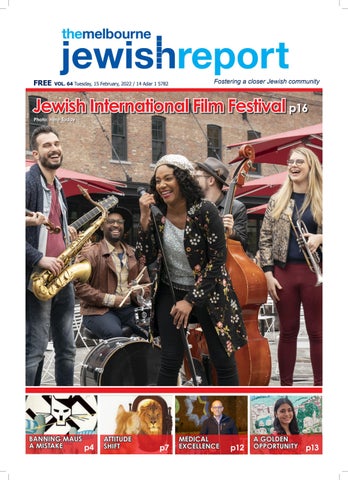
Jewish International Film Festival p16 Photo: Here Today
BANNING MAUS A MISTAKE p4
ATTITUDE SHIFT
p7
MEDICAL EXCELLENCE
p12
A GOLDEN OPPORTUNITY
p13
2
the melbourne jewish report | February 2022
A RO U ND
T H E
COMMUNITY
Summit UIA: Book now Gordis’ history of Israel, entitled Israel: A Concise History of a Nation Reborn,
UIA UIA is excited to share with the community news of its planned annual event for 2022: Summit UIA in February and March. Where UIA used to bring the community together for one communal event, Summit UIA expands the organisation’s offering to five nights of engagement, education and entertainment. The cause remains support for the People of Israel. From Sunday 27th February to Thursday 3rd March participants can join one night, three nights or all five in a series of UIA special events featuring a diverse line up of speakers and topics. Sunday, 27th February: Politics with a senior politician and member of Knesset Monday, 28th February: Culture with acclaimed actress Shira Haas, known for her roles in the hit Netflix shows Shtisel and Unorthodox. Tuesday, 1st March: Sport with Linoy Ashram and Omri Casspi Ashram is the first Israeli woman to win an Olympic gold medal in any sport and the first Israeli rhythmic gymnast to win an Olympic medal. Former professional NBA player for 10 consecutive seasons, Casspi was the first Israeli to play in the NBA. Casspi runs the Omri Casspi Foundation, which sponsors trips for NBA players, WNBA players and other celebrities to
received the 2016 National Jewish Book Award as Book of the Year. Thursday, 3rd March: Security with Yossi Cohen, former Director of Mossad and instrumental negotiator of the Abraham Accords Simply buy a Summit UIA pass online and join from the safety, comfort and convenience of your own home. Funds raised from Summit UIA will go towards UIA Australia’s continued support for Aliyah. The surge in global anti-Semitism along with social and economic instability as a result of the global pandemic has resulted in a rise in Aliyah as thousands of Jews from around the world seek better futures in Israel. With the help of the community’s generous donations, UIA assists new immigrants with the many challenges of rebuilding their lives, while at the same time realising their dream of making Israel “home”.
Actor Shira Haas Israel. He is also the co-founder and managing director of an early-stage venture capital fund focusing on the Israeli technology eco system.
Wednesday, 2nd March: Global Jewry with Israel advocate, author and creator of the popular blog and podcast, Israel from the Inside, Daniel Gordis.
Book now at summituia.org Follow UIA on Facebook and Instagram (@uiaaus)
for
updates
to
its
2022
Campaign.
The Tree of Life (part 1of 2) YERACHMIEL ISACOWITZ The Eitz Hachayim (The Tree of Life) was the tree in Gan Eden (the Garden of Eden) that gave those who ate from it eternal life. Torah is called Eitz Chaim. Why does it have a similar name and how is Torah similar to The Tree of Life? Torah is made up of a number of components. To begin with, we have Torah Shebichtav (Written Torah) and Torah Shebeal Peh (Oral Torah.) When Moshe received the Torah (in 1313 BCE), Hashem dictated the Written Torah in parts, stopping from time to time. This was when Moshe was instructed to refrain from writing and integrate into his mind the Oral Torah (explanations of the written content). In later generations, the Written Torah was expanded to include the books of the Neviim (Prophets) and Ketuvim (Writings) (circa 1273-300 BCE). Due to the spiritual/ intellectual decline of the generations, Rebi Yehudah Hanasi (circa 190 CE) was concerned that the Oral Torah would be forgotten if not committed to writing. So, he composed the six sections of Mishnah. Similarly, Ravina and Rav Ashi (circa 410 CE) wrote down the essential oral debates on the Mishnah, called Gemora (collectively their works constitute the Talmud.) Subsequently, we have more leading rabbinic authorities (primarily the Rishonim and Acharonim: 11th Century
– present day) proffering their thoughts
and understanding of The Chumash. We
and understanding.
cannot alter either of these.
Collectively, all these works are like the
The trunk is Mishna, the first stage of the tree that is above the ground,
make-up of a tree. The Chumash (the Five Books) is the
accessible and of some practical use.
seed. The roots are the rest of Written Torah
From the Mishna we gain the principles,
which
which lead to halachah (Torah law).
engender
deeper
knowledge
The branches are the Gemora, affording us much more interaction with the tree, be it for shade, climbing, hanging etc. The Gemora extracts the practical lessons from Mishnah. The leaves are the Rishonim. They provide oxygen. They distill the laws and lessons from all sections of Torah at an elevated, yet applicable level. Finally, the Acharonim are the fruit, the application of Torah in our modern world, be it in halacha (law) or hashkafah (outlook). Therefore, for instance, a Torah sage is able to give a definitive ruling on nanotechnology, even though this technology did not exist when the Torah was given. There is no valid halachah or Torah statement that can be made today that does not have roots in the Written Torah, Mishna or Gemora. Thus, the tree maintains its integrity and continues to provide boundless instruction. It is this structure that equates Torah with The Tree of Life. It is the vehicle by which, through toiling to attain understanding and as a guide to living correctly, we earn the eternal world to come. (Part 2 will appear in the next issue of the paper.) Yerachmiel Isacowitz is an independent Torah educator. E: risacowitz@optusnet.com.au W: torahconcepts.com FB: The Mem Channel
SUMMIT UIA 5 NIGHTS | 5 CONVERSATIONS
BOOK AT
28 FEB
To be announced closer to the date CULTURE WITH SHIRA HAAS
Israeli actress and star of the hit Netflix shows Unorthodox and Shtisel SPORT WITH LINOY ASHRAM & OMRI CASSPI
2 MARCH
Israeli Olympic gymnastics gold medallist & first Israeli NBA player GLOBAL JEWRY WITH DANIEL GORDIS Author and advocate for Israel
3 MARCH
1 MARCH
POLITICS WITH SENIOR ISRAELI POLITICIAN
SECURITY WITH YOSSI COHEN
Former director of Mossad
SUMMITUIA.ORG
FEET AT HOME, HEART IN ISRAEL
FEET AT HOME, HEART IN ISRAEL
?
27 FEB
LIVE ONLINE EVENTS FEATURING:
4
the melbourne jewish report | February 2022
C O NSI D E RE D
OPINION
DR. YVETTE ALT MILLER COURTESY: AISH.COM A Tennessee school board’s decision to remove the Pulitzer-prize winning book from its curriculum furthers the ever-increasing ignorance about the Holocaust. While much of the world prepared to mark International Holocaust Remembrance Day in January, 2022, one school district in Tennessee decided to remove the two-volume Holocaust graphic novel Maus: A Survivor’s Take from its school curriculum. Art Spiegelman, a prominent cartoonist and the son of Holocaust survivors, published the first volume of Maus in 1986 and the second volume in 1991. This unusual work, which describes Spiegelman’s father’s harrowing experiences during the Holocaust, won a Pulitzer Prize for best fiction, the first and only graphic novel to do so. All of the characters in Maus are drawn as animals. Jews are depicted as mice, Nazi as cats, Poles as pigs and Americans as dogs. The books toggle back and forth between an adult son’s conversations with his father, who is an unhappy, crotchety old man and the terrible memories his father describes. The effect is both to draw readers in with compelling illustrations and dialogue, while also providing some sense of distance from the terrible story within Maus’s pages. Reading Maus can be a gruelling experience. Volume I is subtitled “My Father Bleeds History” and begins with the son, an artist named Art, visiting his father Vlatek and his father’s wife Mala. The names are those of Art’s actual family. During the Holocaust, Art Spiegelman’s parents, Anja and Vlatek, endured terrible hardships and survived Auschwitz. Anja Spiegelman died by suicide in 1968. Vlatek begins to describe his once happy life in Poland in the 1930s, but his memories soon grow dark. After the Nazis invaded Poland, food grew scarce. Jews were forbidden from taking part in an increasing portion of public life. Maus depicts the growing horror in bold black and white sketches, which fit the sombre mood of the book. In one early panel, Vlatek returns home looking upset. “There was another riot downtown today,” he tells his wife and young son. “Everyone yelling, ‘JEWS OUT! JEWS OUT!’ … Even two people killed. The police just watched!” Vlatek and Anja watch as their friends and relatives are murdered one by one. They send their son Richieu away to live with his aunt in a different town, hoping he will be safe there, only to learn that when Anja’s sister discovered that all of the Jews in her town were about to be deported to Auschwitz, she poisoned herself, her two children, and Richieu. Volume II, subtitled “And Here My Troubles Began,” describes Vlatek’s experiences in Auschwitz, where he was forced to remove the remains of Jews who’d been murdered in the gas chambers. Novelist Umberto Eco observed that “Maus is a book that cannot be put down, truly, even to sleep … slowly
Banning Maus from schools is a mistake
A Tennessee school board’s decision to remove the Pulitzer-prize winning book from its curriculum furthers the ever-increasing ignorance about the Holocaust through this little tale comprised of suffering, humour and life’s daily trials, you are captivated by the language of an old Eastern European family …” When it first came out, the Los Angeles Times called it “enormously effective … an extraordinary accomplishment, a new way of looking at the experience” of the Holocaust. Maus’s raw power made it a natural choice for teachers in McMinn County, Tennessee, who have used it as an “anchor text” for their 8th grade English class’ months-long unit on the Holocaust. Yet there have long been some complaints in the district. Some parents objected to images of naked mice in the Auschwitz scenes. Some also complained about the book’s use of profanities in some of its dialogue. To assuage these concerns, teachers in the district covered up the images of naked mice and swear words in the text. Yet objections remained. McMinn County teachers were meant to begin assigning Maus to this year’s 8th grade students in January 2022, but they waited, sensing that the book might be banned. And that’s what happened after an acrimonious school board meeting on January 10. “It shows people hanging, it shows them killing kids,” complained school board member Tony Allman. “Why does the educational system promote this kind of stuff?” he questioned. “It is not wise or healthy,” Allman declared at the meeting. Some people present at the meeting defended Maus. “I was a history teacher and there is nothing pretty about the
Holocaust and for me this was a great way to depict a horrific time in history,” explained Julie Goodin, an instructional supervisor in the district. The district’s other instructional supervisor, Steven Brady, defended the book, saying “When we think about the author’s intent, I could argue that his intent was to make our jaws drop. Oh my goodness, think about what happened.” Their defence fell on deaf ears. In a unanimous vote, the 10-member McMinn County school board voted to remove Maus from the district’s curriculum. In a statement on Thursday, January 27, they defended their actions, explaining that Maus is inappropriate because “of its unnecessary use of profanity and nudity and its depictions of violence and suicide.” Yet Mr Brady and Ms Goodin captured why it is crucial that books like Maus are read. The Holocaust was a uniquely horrific event in history. It’s not easy or pleasant to study it. But if we don’t remember the Holocaust, if we don’t arm ourselves with the knowledge of what happened and honour the memory of the Holocaust’s millions of victims, then we have learned nothing. As the Allied forces advanced on Auschwitz 77 years ago in January 1945, the Nazis responded by desperately trying to erase evidence of their crimes. They dynamited the gas chambers in which nearly a million Jews had been murdered. They forced 60,000 Jews on death marches through the freezing January winter towards Germany, so that when Allied troops finally entered
Auschwitz they wouldn’t witness the full extent of the Nazis’ crimes. In many quarters, those attempts to erase and minimise the world’s knowledge about the Holocaust are still going on. Holocaust distortion and denial are rampant, and they’re having an effect. A 2020 survey showed that 63% of American millennials didn’t know that six million Jews were murdered in the Holocaust. Globally, only 54% of people have even heard about the Holocaust. Ignoring or minimising the Holocaust is being complicit in the Nazi effort to hide their depravity from posterity. When I heard about McMinn County’s school board removing Maus from the 8th grade curriculum, I asked my own son, who’s also in 8th grade, what he thought. To the objection of Maus’s nudity, he was incredulous: “They’re naked mice!” he pointed out, not people. “Maybe this was just an excuse,” he wondered. One school board member who objected to Maus at the meeting, Mike Cochran, said he didn’t object to students learning about the Holocaust in general. Maus was simply too disturbing a book for kids to read. Yet the Holocaust is disturbing. And with so much ignorance about the Holocaust today, it’s more important than ever that we ensure the Holocaust is being taught effectively in schools, and that we educate ourselves and our communities. Art Spiegelman’s two volumes of Maus is a good place to start.
5
the melbourne jewish report | February 2022
A RO U ND
T H E
COMMUNITY
Holocaust knowledge fractured
GANDEL FOUNDATION As countries around the world commemorated International Holocaust Remembrance Day on 27th January, Australia’s first national survey of Holocaust knowledge and awareness had some alarming findings. Notably, 24% of the population aged 18 years or older has little to no knowledge of the Holocaust, with that number rising to 30% among millennials. More than 70% know nothing about Australia’s own connections to the Holocaust. However, there is overwhelming agreement among Australians (88%) that “we can learn lessons for today from what happened in the Holocaust”. 78% of Australians think that Holocaust museums and memorials are valuable. Two-thirds (66%) believe it should be compulsory for schools to teach students about the Holocaust. The survey was commissioned by the Gandel Foundation, one of Australia’s largest independent family philanthropic funds. The Gandel Holocaust Knowledge and Awareness in Australia Survey was undertaken by a team of researchers at Deakin University. It was broadly based on similar research in the USA, Canada, the UK, France and Austria. The study was conducted in September 2021, followed by analysis of the findings.
There were more than 70 questions posed, with 3,522 responses from Australian adults across all states and territories. That made it the largest survey of its type yet undertaken. The sample matches key demographic parameters – including age, gender, education and geographic location – of the Australian population. A key objective of the Gandel Survey was to understand not just how much Australians know factually about the Holocaust, but also how aware they are of the catastrophe and its impact. While a number of findings were largely positive, there were still some critical gaps
identified. Overall, Australians of all ages showed comparatively high levels of Holocaust knowledge, with almost 70% correctly identifying that the Holocaust refers to the genocide of Jews. 80% knew that Holocaust occurred between 1933 and 1945, and just over half (54%) correctly identified that the number of Jews murdered was six million. Respondents also registered low levels of Holocaust denial and overt antisemitism. Only 25% of Australians have visited a Holocaust museum in Australia or overseas, while 81% have never heard an in-person talk or lecture from a Holocaust survivor.
The Gandel survey found that higher levels of knowledge about the Holocaust are associated with undertaking specific school courses or visiting museums, rather than general levels of education. Notably, the survey also found that, on average, those with comparatively higher level of Holocaust awareness had warmer feelings towards minority or disadvantaged groups. The research team made eight recommendations in the report. They included a call for the introduction of a consistent approach to Holocaust studies in schools across Australia, with proper and accredited teacher training. Further, there is a need for resources that explore Australia’s Holocaust connections and the development of strategies to drive engagement with Holocaust museums. Challenging antisemitic stereotypes through educational programs and enabling students to hear Holocaust survivor testimonies was also considered important. CEO of the Gandel Foundation, Vedran Drakulic OAM said while a lot has been achieved recently to strengthen Holocaust education, much work remains to be done. “The Gandel family is committed to continuing their decades-long support for the development of Holocaust education across Australia, to help build a more compassionate, cohesive and humane society.” The researchers would like to see the survey repeated in five and then 10 years.
– RARE –
ARGYLE PINK DIAMONDS
RELAUNCHING
CAULFIELD
BUBS WEDNESDAYS / 9:30AM - 11:00AM $7 - CHILD OVER 6 MONTHS $3 - FOR EACH ADDITIONAL SIBLING
ARGYLE PINKS DIAMONDS as well as other COLOURED DIAMONDS are available at Ian Sharp Jewellery. Start your Pink journey with us today. There is nothing on earth quite like an Argyle Pink Diamond. The returns on pinks have outpaced the stock market and the Argyle mine has ceased production as of the end of 2020. With no more new supply, now is the time to get your rare Pink Diamond.
Hosted by Rebbetzin Sarah & Daniella from Beats & Babble Music *This is a nut free environment Please bring your own kosher snack For further information, email admin@caulfieldshule.com.au
בס"ד
65 Toorak Rd, South Yarra, VIC 3141 P. 03 9866 4983 E: sales@iansharp.com.au www.iansharp.com.au
IanSharp_Advert_Feb21.indd 1
5/2/21 9:41 pm
6 A RO U ND
the melbourne jewish report | February 2022
T H E
COMMUNITY NOMI KALTMANN COURTESY: TABLET MAGAZINE In the early 1990s, Yehuda Kaplan was gravely ill with lymphoma and was urgently seeking a bone marrow transplant. That is a lifesaving procedure that removes blood-forming stem cells from a healthy donor’s bones and transplants them into a person who does not have enough healthy blood cells due to a serious illness. While the transplants are highly effective, they are quite rare, as they require both the donor and recipient to be a perfect genetic match. Kaplan said that in Melbourne, where he was living, there was “not a lot of awareness” about the procedure. “So, we went to the leadership of the Australian Jewish community, rabbis as well as doctors and specialists, and asked them to promote the idea of joining the bone marrow registry in the community.” In response to Kaplan’s public campaign, hundreds of Australian Jews responded to the call from community leaders, donating small vials of blood and joining the Australian Bone Marrow Registry. While Kaplan didn’t end up getting a bone marrow transplant because no match was found, the call for potential donors helped spearhead awareness of bone marrow transplants in Australia, particularly among Australian Jews. And Kaplan ended up surviving lymphoma using an experimental treatment. Now decades after this event, within Australia Jews continue to join the bone marrow registry in numbers disproportionate to the size of the community. From these donors, matches for gravely ill persons have been found all over the world, including in America, Europe and Israel. Soon after the positive response to Kaplan’s call for donors, and in response to growing global awareness that Jews were more likely to match with each other, Gift of Life Australia was created by Sydney-based Jewish geneticist Shula Endrey Walder. In response to multiple international requests for assistance to find bone marrow matches for sick Jews around the world, in the early 1990s she decided to encourage more Australian Jews to join the bone marrow registry. Prior to Gift of Life Australia, smaller organisations, such as Keren HaYeled in Melbourne, had been active in recruiting bone marrow donors in Australia. The original American organisation called Gift of Life was created by Florida resident Jay Feinberg. In 1991, when he was ill with leukemia, he launched a global search to find himself a match. “The collaboration [between Australia and America] started in the early days when Shula Endry Walder, of blessed memory, contacted Arlene Feinberg, my mother, and offered to run drives to help find a match for me,” Feinberg said. “Donors recruited are included in the Australian Bone Marrow Registry, which is a long time international colleague
Close to the bone How Australian Jews became blood marrow donors to the world
Esther Lever with Einat Zinger on her wedding day in 2016. The two remain friends after Lever donated her bone marrow to Zinger in 2006 (photo: Esther Lever) and partner of the Gift of Life Marrow Registry,” in the United States. “Bone marrow is the largest medical collaboration on the planet. If you are on the registry [somewhere], you are on the registry everywhere,” said Dovid Slavin, a rabbi who also holds a doctorate in philosophy, and who has been a board member of Gift of Life Australia since its inception. “In Australia, the bone marrow registry is run by the government, which subcontracts the collection of blood samples to the Australian Red Cross. Any sample collected by Gift of Life Australia is then given to the Red Cross and added to the Australian Bone Marrow Registry, which then hooks in with the global bone marrow registry.” At the time Gift of Life Australia was founded, the Jewish community was considered one of the “hard to match communities” in Australia. “There were not many people from our community on the registry,” said Debbie Redelman, another long time Gift of Life Australia board member. “So, the Australian Bone Marrow Registry contracted Gift
of Life Australia to collect samples [from the Jewish community] to increase the chance of finding matches.” Jewish donors are much more likely to be matched with other Jewish recipients because tissue type is inherited, so the best chance of finding a transplant is from someone with the same genetics (often family members) or from people of a similar ethnic background. In Australia, Slavin estimates that 10,000 Jewish Australians have been signed up to the registry by Gift of Life Australia and more than 30 have provided transplants to recipients around the world. For a community of approximately 100,000, this is quite a high number, considering that the Australian Bone Marrow Registry only performs a handful of transplants each year for the whole country. In America, Gift of Life operates differently. It is privately run and operates its own registry, which then shares its data with other bone marrow registries across the world. To date, it has recruited over 300,000 Jewish Americans to join the registry and has facilitated 20,974
matches and 4,012 transplants. Collecting DNA samples to the registry is also done differently, with the Australian register operated by the Red Cross, therefore requiring all Australians to provide a small blood sample to join the registry, rather than a cheek swab scraping, as is standard protocol in America. However, that is about to change. In Australia, the COVID-19 pandemic put a stop to almost all in-person collection drives and many prospective donors found it difficult to join the registry as many Australian cities locked down for months. As pandemic restrictions ease, there are plans for mail-order kits that will allow people to self-swab their cheeks and join the registry without the need for a blood sample. As this transition takes place and more people sign up to join the Australian Bone Marrow Registry, there is a greater chance of matches being created. That widens the chances that desperately ill people can find a perfect match from the Australian Jewish community. Esther Lever remembers lining up with her parents in Melbourne to donate a small vial of her blood in the early 1990s, in response to the community call for donations to help Yehuda Kaplan. She wasn’t a match, though, and didn’t think much about it after that. However, in 2006, more than a decade after donating her blood, she received a phone call out of the blue. “The Alfred Hospital received a phone call from the world bone marrow registry advising that I may be a potential match for someone,” she said. After undergoing further testing Lever was stunned to find out that her DNA was a genetic match, with one hematologist telling Lever that the odds of two nonfamily members having this kind of match were about “one in a million.” The transplant was a success. Eleven months later, Lever received a phone call from Schneider’s Children Hospital asking if she would be interested in meeting up with her beneficiary. She was and the coming together was emotional for both. Lever’s stem cells were transplanted into 15-year-old Einat Zinger, an Israeli who’d been battling cancer since she was 12. “When we met, we stood there and hugged, and everybody was crying,” said Lever. That night, the story of the miraculous match was the top news story in Israel. To this day Lever and Zinger remain friends, with Lever flying to Israel for Zinger’s wedding in 2016. Lever hopes that stories like hers will continue to encourage other Jews in Australia to join the registry. This story originally appeared in Tablet Magazine (tabletmag.com) and is reprinted with permission.
7
the melbourne jewish report | February 2022
A RO U ND
T H E
COMMUNITY
Attitude shift
ANNE-MARIE ELIAS The term “attitude” refers to an individual’s mental state, which is based on his/her beliefs or value system, emotions and the tendency to act in a certain way. A person’s attitude reflects how one thinks, feels and behaves in a given situation. Some of our attitudes are enduring, whilst others are subject to change. An attitude can be positive or negative. “Glass half full” or “glass half empty” is how we often categorise the way people see the world. Are they optimistic, hopeful, reliable and confident or pessimistic, resentful and doubtful? Some of our attitudes are explicit. That means they are conscious beliefs that can guide decisions and behaviour. For instance: “Junk food is unhealthy. I don’t keep any unhealthy food at home and will only eat at venues that offer healthy options”. Implicit attitudes are unconscious beliefs that can still influence decisions and behaviour. They are thought to reflect an accumulation of life experience.
An implicit attitude refers to something that is suggested or implied but never clearly stated. An example of an implicit attitude is when your partner gives you a dirty look when you drop your socks on the floor. Our attitude determines how we react to adversity, how we grow and learn, how we overcome challenges and create bonds with others. It reflects the way we see the world and how we live in it. It affects every aspect of our life – our happiness, relationships, health and wellbeing, and level of success. Developing a positive
attitude can change the way we live, regardless of the challenges or adversity we face. Attitude is a choice. It is the way we speak about someone, the way we act, even the way we say something. We can become better people when we have a positive mindset. And, of course, even people with a positive attitude can improve. In order to develop a positive attitude, we can take the following steps: Listen to our voice within. When faced with a negative thought, turn it around to make it positive. “I will never be able
to reverse park into that spot” can be flipped to “I will give it a go and try to park in that spot”. Interact within positive environments and with positive people. Are you surrounding yourself with those who are energy givers or energy takers? We can change who we interact with, how long we spend with them or how we think about them. We can change the environment we are in and how we think about that environment. Be of service to others. This may be reflected in a small random act of kindness, such as letting someone into your busy lane of traffic. Get pleasure out of the simple things in life. Take a moment to “smell the roses”. Ensure there is a connection to others through love, respect and approval. Our attitude affects others. A person who displays negative attitudes such as discontentment and boredom will behave accordingly. In a work environment, people with this kind of attitude can not only affect others, but reduce their own efficiency and effectiveness. Perhaps it is time for a change … for the better. Anne-Marie Elias is a psychologist in clinical practice for 25 years.
ADVERTISEMENT
Vote 1 United Australia Party Authorised by Craig Kelly, United Australia Party, Level 17, 240 Queen Street, Brisbane 4000
UAP13469K7R
Join the United Australia Party – go to unitedaustraliaparty.org.au
8
the melbourne jewish report | February 2022
JUDAI C A
QUIZ
RABBI DAVID FREEDMAN Over the past year, the popularity of quizzes has soared worldwide, and this has also been true for our Judaica Quiz. Thank you to all who reached out to let us know how many engaging conversations were initiated as a result of the questions below around happy (and sometimes heartfelt and heated!) Shabbat and Yom Tov tables. Rabbi David Freedman’s knowledge is impressive and extensive, and he expertly weaves his way across historical timelines, via geographically significant locations – think Jerusalem – and deftly brings in the Torah, arts, politics and so much more for this terrific trivia trek! Here we go – let’s see how many you and your crew get right! 1. Chazan Naftali Herstik and Chazan Chaim Adler served as cantors of which synagogue in Jerusalem? 2. Who established Aish HaTorah in Jerusalem in 1974? 3. According to the Book of Daniel what were the Babylonian/Chaldean names of the following three people:
Test your knowledge Hananiah, Mishael, and Azariah? 4. Dama ben Netina is mentioned in the Talmud as a non-Jew who was a role model in connection with which one of the Ten Commandments? 5. What is the purpose of the prayer known as Mi Sheberach Refuah Shelemah?
a) Shevat b) Adar or c) Nisan? 9. Which institution established the British Mandate for Palestine in 1922? 10. In the case referred to by the media as "History on Trial" who sued whom?
Good luck. Enjoy. Hopefully, learn something new about your Jewish heritage and tradition. 6. Which actor played Oskar Schindler in the movie – Schindler’s List? 7. On releasing an album, The Best Christmas Ever, which performer said that she had stuck to her religious beliefs by making sure that none of the songs mentioned Jesus: a) Carly Simon b) Barbra Streisand c) Paula Abdul d) Helen Reddy? 8. In which Hebrew month was the mitzvah of Machatzit HaShekel (donating a half shekel for the upkeep of the Temple) observed in Temple days:
11. Which of these Israeli towns is furthest north: a) Akko b) Karmiel or c) Tiberias? 12. Which two actors are Jewish: David Suchet (Poirot), David Jason (Frost), Stephen Fry (Qi), David Tennant (Dr Who), Daniel Craig (James Bond), Daniel Radcliffe (Harry Potter)? 13. Name three rabbis or sages who are mentioned by name in the Haggadah Shel Pesach. 14. In which decades were the following Sydney synagogues first
opened? The Great Synagogue, The Central Synagogue, Mizrachi Synagogue and North Shore Synagogue? 15. Hafuch is what type of drink found in Israel? 16. Was Jeffrey Hoffman a famous American Jewish: a) Olympian b) Astronaut c) TV presenter or d) Shopping centre magnate? 17. In which suburb of Jerusalem would you find the Knesset? 18. Where, according to legend, would you find the body of the Golem? 19. Name 5 Semitic languages. 20. In what year was Tel Aviv founded? 21. In which Biblical book do we find the expression ‘Tel Aviv’? 22. After Moses’ brother, Aaron died, what form of mourning took place? 23. Born Jacob Bruskin Gershowitz in 1898 in Brooklyn, he became America’s greatest composer. By what name is he better known? 24. What was composed by the ‘schools’ of Tiberias, Sepphoris and Caesarea? 25. What is a ‘Wandering Jew’: a) a small asteroid b) a species of fish or c) a type of plant?
ANSWERS PAGE 14
Jewish identity in Europe INSTITUTE FOR JEWISH POLICY RESEARCH The Institute for Jewish Policy Research (JPR) has analysed data from the largest sample of Jews ever surveyed in Europe and come up with some significant findings. The Institute’s researchers looked at responses from more than 16,000 Jews in 12 countries. The latter participated in the European Union Agency for Fundamental Rights survey conducted by JPR and Ipsos in 2018. These are the key findings:
• European Jews are much more likely to see themselves as a religious minority than an ethnic one, yet fewer than half of all Jewish adults across Europe light candles most Friday nights. • Jewish identity is strongest in Europe in Belgium, the UK, France, Austria, Spain and Italy, and weakest in Hungary and Poland. • The memory of the Holocaust and combating antisemitism played a more important part in people’s Jewish identity than support for Israel, belief in God or charitable giving. Rising perceptions of antisemitism may have stimulated a stronger bond with Jewish peoplehood.
• Only about half of all Jews in Europe identify with a particular denomination, although there are significant differences at the national level. • A higher proportion of younger Jews are religiously observant than older Jews. • Belgium has the largest proportion of Jews identifying as Orthodox in its Jewish population, followed by the UK, Italy, France and Austria. • Spain has the largest proportion of Jews identifying as Reform/Progressive, followed
by
Germany
and
the
Netherlands.
CANDLE LIGHTING TIMES
torahconcepts.com The Mem Channel
Friday, Feb 18, 2022
7:57 pm
Shabbat ends, Feb 19, 2022
8:55 pm
Friday, Feb 25, 2022
7:48 pm
Shabbat ends, Feb 26, 2022
8:45 pm
Friday, Mar 4, 2022
7:38 pm
Shabbat ends, Mar 5, 2022
8:34 pm
Friday, Mar 11, 2022
7:28 pm
Shabbat ends, Mar 12, 2022
8:23 pm
Friday, Mar 18, 2022
7:17 pm
Shabbat ends, Mar 19, 2022
8:13 pm
Friday, Mar 25, 2022
7:07 pm
Shabbat ends, Mar 26, 2022
8:02 pm
9
the melbourne jewish report | February 2022
A RO U ND
T H E
COMMUNITY The start of the school year is inevitably filled with excitement at the possibility of new beginnings and at the United Jewish Education Board that is no different. UJEB’s registrations for primary and secondary programs are filling fast. After six years of growth, UJEB – fulfilling a key strategic goal, has appointed Shlomi Hanuka as its first Deputy Principal Teaching & Learning. President of UJEB Gabi Crafti said the Board is delighted to have Dr Hanuka as part of the organisation. “He brings with him a huge amount of experience and passion for innovative Jewish education. Dr Hanuka is a dynamic and skilled leader in his field, and we are very fortunate to have him join the UJEB family. “We extend our gratitude to our supporters, especially the Lotti and Victor Smorgon Charitable Fund, which has helped us make this important appointment to our executive leadership team.” Education is at the core of UJEB’s purpose. It provides stud with a strong and meaningful Jewish future. Over the past three years, UJEB has implemented significant academic and curriculum improvements. “Dr Hanuka has a PhD in education, focussing on educational policy. He will help UJEB take its educational offerings to the next leve,” the Executive Principal of UJEB Itzik Sztokman said.
UJEB growing to serve
UJEB teens attending the BBYO conference
For his part Dr Hanuka said he was pleased to have the opportunity to join UJEB “is known for its more than a century long passion and commitment to the future of the Jewish community in Australia and beyond. “I have been dedicated to the field of education, both formal and informal, for 15 years. I have worked with students of all ages, creating curricula, teaching, mentoring staff and leading educational initiatives. I
feel fortunate to be able to bring my skills and experience to UJEB and support its continuing tradition of excellence and service.” UJEB has big plans to engage the Israeli community. Led by Rinat Shenfeld, UJEB’s Hebrew Programs Manager, the organisation is developing a Hebrew speakers’ program. It will be formulated in semester 1 and launched in semester 2. The program promises to be an immersive Hebrew experience,
incorporating performing arts and focusing on high level language skills. In the teen space, UJEB has nationalised and globalised its teen engagement offering. Last week, the Board, in collaboration with B'nai Brith Victoria, sent 10 students (seven from Melbourne and three from Sydney) to the BBYO International Conference. They will join more than 3,000 Jewish teens from 50 countries in Baltimore to connect and discuss the Jewish future and empower the next generation of leaders. UJEB will again partner with NSW’s BJE to send Year 10 students on “Nesiah” – a five-week interactive Israel experience. The program will see in excess of 120 students from across Australia make lifelong connections with Jewish people and the Jewish homeland. Participants will be able to take advantage of the Israel for Youth Foundations $5,000 grant towards the program cost. An information session will be held in Melbourne on March 6th. Registration details can be found on the Israel for Youth Foundation’s website: info@israelforyouthfoundation.org.au UJEB continues to provide the highest quality formal and informal Jewish educational experiences to students outside the Jewish day school system to strengthen Jewish continuity, identity and involvement. Visit the website ujeb. org.au for more information.
ENROLMENTS NOW OPEN UJEB'S Jewish Life UJEB'S Hebrew Immersion Program (HIP) Program
10
the melbourne jewish report | February 2022
C O NSID E R E D
OPINION
Russia/Ukraine crisis affects Israel
SHELDON KIRSHNER The undercurrents of Ukraine’s current border tensions with Russia are lapping ominously on Israel’s shores. With about 130,000 Russian troops and armour massed along Ukraine’s frontier, fears are growing that Russia may invade Ukraine. Russia denies the accusation, but the United States and its allies are sceptical and believe an invasion could be imminent. Russian President Vladimir Putin and his lieutenants claim that Russia’s security has been compromised by NATO’s expansion eastward into Eastern Europe since the dissolution of the Soviet Union in 1991. The Russians demand a guarantee from the West that Ukraine – formerly a Soviet republic that Putin deems to be an historic part of Russia – will never join the Western military alliance. Last summer, Putin said that Ukrainians and Russians are the same people and should unite, like Jews from different countries who emigrate to Israel. The two sides are currently at odds over this emotive issue, stirring apprehension that Europe could be engulfed by a war. The diplomatic impasse has rattled Israel, which has cordial bilateral relations with Russia and Ukraine, both of which have sizeable Jewish communities. In the past three decades, some 500,000 Ukrainian Jews and more than 400,000 Russian Jews have settled in Israel. At least two of Israel’s regional neighbours support Russia’s demands. Syria and Iran, two of Russia’s closest allies in the Middle East, are unreservedly proRussian. Turkey, which condemned Russia’s annexation of Crimea in 2014 and has sold attack drones to Ukraine, reportedly supports Ukraine’s desire to join NATO. By contrast, Israel has treaded carefully, trying to antagonise neither Ukraine nor Russia. Eight years ago, following Russia’s invasion of Crimea, Israeli diplomats at the United Nations walked out of the General Assembly to avoid having to vote on a resolution condemning Russia. And at Russia’s request, Israel has cancelled arms deals with Ukraine and Georgia, which was invaded by Russia in 2008. The Israeli government has offered to be a mediator in the standoff between Russia and Ukraine, but Putin has apparently declined. It is unclear how Vlodomyr Zelensky, Ukraine’s first Jewish president, has responded. But recently, Ukrainian Foreign Minister Dmytro Kuleba invited Israel to play a mediation role, as has U.S. Secretary of State Antony Blinken. Israel’s sensitivity to Russian interests is dictated by the hard realities of realpolitik: Israel has much more at stake in its relationship with Russia than with Ukraine. Compared to Ukraine, Russia – the successor state of the Soviet Union – is
Ukrainian Foreign Minister Dmytro Kuleba has requested Israel's Iron Dome anti-missile system
a superpower and a major player in the Middle East. Russia has very close relations with Syria, which has fought several wars with Israel and has been enmeshed in a civil war for the past decade. In 2015, Russia significantly expanded its military footprint in Syria to save President Bashar al-Assad’s Baathist regime from defeat on the battlefield. If not for Russia’s assistance, Syria would not have been able to recapture land it lost in the initial phase of the civil war. Russia is not Syria’s only ally on the ground. Iran and Hezbollah, two of Israel’s most formidable enemies, have worked with Russia to pummel Syrian rebels opposed to Assad’s rule. In the process, Iran has entrenched itself militarily in Syria, particularly on the Syrian side of the Golan Heights. Hezbollah has used Syrian territory as a land route from which to transport Iranian weapons to its base in Lebanon. The Israeli Air Force has launched hundreds of raids against Iranian bases in Syria and attacked Hezbollah convoys heading toward Lebanon. Despite its alliance with Syria, Russia has generally stayed aloof from Israel’s shadow war with Iran and Hezbollah, both of which have called for the destruction of Israel. Russia understands that Iran’s presence in Syria is provocative, causing instability and posing a clear and present threat to Israel’s security. Shortly after Russia reinforced its garrison in Syria, Israel and Russia signed a deconflict agreement to forestall the possibility of accidental clashes between Israeli and Russian aircraft. In general,
this arrangement has worked to Israel’s advantage, giving it air superiority over the skies of Syria. Israel’s former prime minister, Benjamin Netanyahu, was instrumental in establishing this arrangement, having conferred with Putin in Moscow no less than nine times to shore it up. His successor, Naftali Bennett, has adopted an identical policy. On January 24th, as tensions between Russia and Ukraine escalated, the Ministry of Defense in Russia made an important announcement, stating that Russian and Syrian aircrafts had carried out a joint patrol along Syria’s border with Israel. The Russians added that joint patrols would be a regular occurrence in the future. The news threw Israel’s deconfliction accord with Russia into doubt and triggered speculation that Israel would have to curtail its air campaign in Syria. According to reports, Israeli military officials contacted their Russian counterparts to clarify the situation. A week later, Israeli jets struck a Hezbollah base near Damascus, with no Russian response. As Russia’s conflict with Ukraine escalated, Kuleba told an Israeli reporter he was seeking greater cooperation with Israel. “We are interested in deepening cooperation on defence technology, in particular to air defence,” he said in an apparent reference to Israel’s Iron Dome anti-missile defence system. Early in February, Israeli Foreign Minister Yair Lapid expressed doubt that Russia would go to war with Ukraine. “I don’t think a world war is about to start there,” he said, implicitly bolstering Russia’s claim
that it has no aggressive intentions toward Ukraine. He added that Israel will proceed with “caution” in its dealings with Russia and Ukraine. Ukraine’s ambassador to Israel, Yevgen Korniychuk, was “deeply appalled” by Lapid’s remark. In a Facebook post, he chided Lapid, accusing him of failing to grasp the nature of Russian aggression against Ukraine, either now or in the past eight years in eastern Ukraine, where proRussian separatists have made territorial gains. As he put it, “Unfortunately, (Lapid) reiterates rhetoric of Russian propaganda and ignores the disturbing messages from (Israel’s) strongest allies – USA, Britain and the European Union – regarding the high possibility of a fullscale Russian invasion into Ukraine in the coming weeks.” By way of reaction, Israel’s Foreign Ministry summoned Korniychuk and reprimanded him. With tensions still simmering along the Ukraine-Russian border, Israel has adopted a neutral position with respect to the current crisis. But it is debatable whether Israel’s policy will be tenable or sustainable should Russia invade Ukraine. Certainly, the United States, Israel’s chief ally and benefactor, would expect Israel to fall into line with the West and express public support for Ukraine’s independence and sovereignty should Russian troops and tanks storm into Ukraine. Sheldon Kirshner is a journalist in Toronto. His online journal can be found at SheldonKirshner.com
11
the melbourne jewish report | February 2022
A RO U ND
T H E
COMMUNITY DANIEL RABIN, SENIOR RABBI, CAULFIELD HEBREW CONG. A most rewarding question a rabbi can receive is: “Would you be available to officiate our upcoming wedding?” The experience gives the rabbi the privilege of being part of a couple's most significant day. I find it extremely rewarding to spend time getting to know couples and watching them navigate the stresses and joys of a wedding as they make their way towards that magical moment under the Chuppah. As part of their preparations, I encourage my couples to look beyond the day itself. Even though you spend much time, effort and resources on the wedding ceremony and reception (when you mention weddings, costs rise), it is important to encourage and support the bride and groom as they prepare for their marriage. In addition to offering the traditional marriage preparation classes, I also believe it is most important for couples to take other preparatory classes that allow them to examine their relationship's strengths and potential weaknesses. These classes are beneficial for couples because they give them an opportunity to consider what happens on the “day after”, that is after the hustle and bustle of arranging a wedding. Do a Google search on “marriage books” and you will be inundated by the amount of literature that has been written on how to make a marriage work. It is probably only second in number to parenting books. I believe the reason for the abundance of information on these two subjects is that they are both extremely challenging. Here are a few ideas that I often share with brides and grooms about the key “ingredients” of a healthy relationship. Chuppah ceremonies contain many symbolic customs, traditions and laws, which reflect the energy and attitude the couple should carry with them as they begin their lives together. The custom of breaking the glass at the end of the ceremony is one of them. Besides reminding us of our still-to-bebuilt Temple in Jerusalem, it also sends a strong message to the couple. That message is that things are not always perfect. In my experience, the only couples who are perfect are those we don't really know well. It's okay if there are challenges. In fact, it is the imperfections within a relationship that lead to growth and maturity. From this platform of understanding – that life is filled with moments of "broken glass" – the couple can embark on the beautiful journey of life together. Communication is the second ingredient that can’t be overstated or overemphasised. To navigate through
Marriage – more than just the wedding day
Couples' class
the issues and difficulties of life, effective, respectful and open communication is crucial. Lack of communication is often the cause of relationships that have deteriorated. There are countless books available online that can assist in teaching and guiding effective communication. Today, there are also highly trained and competent professionals available if people need assistance in this area. When you don't communicate, your partner cannot acknowledge your feelings, respond to your wishes, or make the necessary changes you desire. Unless your spouse is a mind reader, make sure you say it. The third aspect requires a change in the way one thinks. I call it the JFK question. Ask not what your country can do for you, but what you can do for your country. Replace the word country with spouse. In order to maintain a harmonious relationship, one has to continuously ask, “What can I do for my partner?”. The Hebrew word for love is Ahava. In Aramaic, the middle letters form the word "huv", meaning “to give”. You should quickly shift gears to the mindset mentioned above if you are always asking: What can my partner do for me? Giving to others opens up a pathway to love and the more we focus
on improving the lives of those around us, the stronger and more fulfilling our relationships will become. There are many other important topics that can be discussed, but one that can’t be overlooked is the idea of having fun. It is amazing how many couples I know have forgotten how important this is. It is no wonder a relationship can become strained or unpleasant if marriage is viewed as just another chore. It's true that there are many chores involved in running a household, but the relationship itself should be seen as something enjoyable. Many strategies have been proposed or offered in this regard. Some advocate a weekly date night out, while others suggest a date night in. Regardless, the important thing is to ensure you are constantly seeking ways to make your relationship spontaneous, exciting, refreshing and enjoyable. Our sages teach us that the coming together of the bride and groom under the Chuppah is the reuniting of two half souls. Our faith celebrates this union as the most sacred. It is up to us to wake up each day and remind ourselves that it takes constant attention and effort to ensure that the two parts remain as one. Every bride and groom who chooses to get married with Rabbi Rabin and
Caulfield Shule receives an engaging, educational and fun pre-wedding program. From the practical to the spiritual dimensions, the program explores what a Jewish wedding or marriage means. Each couple will also learn about the laws of Taharat Hamishpacha/Family Purity, as well as what to expect on their wedding day. Some of the classes are taught by Rebbetzin Sarah, others by Rabbi Rabin. A number are group sessions. Additionally, Rabbi Rabin, a trained counsellor and Prepare-Enrich facilitator, offers –as part of the program – a special session that provides couples with tools to maintain a healthy and harmonious relationship long after the wedding. Additionally, couples and families have the opportunity to bake challah with Rebbetzin Sarah and to meet socially and informally with the Rabbi and Rebbetzin. The Caulfield Shule offers grooms a pre-wedding call-up, as well as the use of the Shule for the Chuppah. A wedding preparation program aims to provide guidance, support and inspiration during what is usually a stressful time. To book your wedding with Caulfield Shule, email admin@caulfieldshule.com.au or call Rabbi Rabin on 0430 770 115.
12
the melbourne jewish report | February 2022
IS RAE LI
N E W S SHAARE ZEDEK MEDICAL CENTRE In 2022, Shaare Zedek Medical Centre celebrates 120 years of delivering medical excellence in Jerusalem. In honour of this historic anniversary the walls of Jerusalem’s old city and iconic Strings Bridge were lit up with the hospital's logo. The hospital was established in 1902 with 20 beds and 40 cows providing fresh milk to patients. It has now grown to a world-leading hospital with 1,000 beds across two campuses, treating nearly one million patients annually. Shaare Zedek Director General Professor Ofer Merin said it was a tremendous honour to be part of such a remarkable heritage of caring and advanced medicine. “Even as we look back on this incredible accomplishment, our eyes are always focused on the future. “Our pledge is to continue to expand and embrace new areas of medicine, science and patient care on behalf of the people of Jerusalem, Israel and the global medical community." As a centre of both clinical and research excellence, Shaare Zedek
Medical excellence employs more than 4,000 medical professionals. The hospital has served the citizens of Jerusalem through war, terror attacks and the many medical challenges that face a thriving city. Shaare Zedek is one of the busiest maternity hospitals in the western world, with in excess of 20,000 births yearly. The
values
of
compassion
and
innovation have always been the hallmarks of the Hospital with a Heart. The
Australian
community
has
supported Shaare Zedek for many
Shaare Zedek Director General Professor Ofer Merin (photo: Arnon Busani)
decades. The late Mr Joseph Feiglin worked to raise funds to support the hospital in Jerusalem until his passing in 1988. Dr
Allan
Garfield
established
the Australian Friends of Shaare Zedek in 1991 and has served as Chairman since then. Now, as a health promotion charity, the AFSZ is focused on supporting the hospital and sharing the best of contemporary
medical
initiatives
between Israel and Australia. If COVID-19 has taught us anything, it is the increased need to promote healthcare
initiatives
across
international boundaries.
The walls of Jerusalem’s Old City were lit up in honour of Shaare Zedek Medical Centre’s 120th anniversary (photo: Arnon Busani)
Whoopi, what were you thinking? of the Jewish people – who they deemed
BY RABBI BENJAMIN BLECH COURTESY: AISH.COM In today’s world where just about anyone who has an opinion that somebody disagrees with is immediately shamed and shunned as a racist, Whoopi Goldberg “explains” on The View that “The Holocaust isn’t about race.” Then she went on The Late Show with Stephen Colbert” and actually defended her views, saying, “…Nazis were white people and most of the people they were attacking were white people. So to me, I’m thinking, ‘How can you say it’s about race if you are fighting each other?’” Somehow those guilty of mass exterminations of Jews manage to escape the horrific label of racist. Perhaps it may come as a shock to Whoopi Goldberg that there are hundreds of thousands of Jews who are coloured – Yemenites, Ethiopians, Sephardic Jews from many lands, converts of varying degrees of darkness – all of whom, by virtue of their Jewish identity, would have been victims of Nazi ideology. Goldberg’s claim that “the Holocaust is of no concern to persons of colour because it’s all about white people killing other white people” is nonsensical, not only because it ignores the primary racist motivation of Aryan worshiping Germans but seems totally unaware of the racial identity of so many of its victims. Hitler’s plan to rid the Aryan German population of its Jewish inhabitants –
to be an inferior race.’ I stand corrected. The Jewish people around the world have always had my support and that will never waiver. I’m sorry for the hurt I have caused.” ABC Network suspended her from The View for two weeks. Kim Godwin, ABC News’ president said in a statement, “While Whoopi has apologised, I’ve asked her to take time to reflect and learn about the impact of her comments. The entire ABC News organisation stands in solidarity with our Jewish colleagues, friends, family and communities.” I am gratified by the level of outrage sparked by Whoopi’s insensitivity and ignorance. Yad
Vashem,
Israel’s
Holocaust
Museum, has invited her to visit and learn and then to do the same eventually in the rest of the world – was openly and clearly dominated by his racism. The whole point of the Holocaust was to eradicate the Jewish “race” from the earth. Hitler repeatedly said, “The Jews are undoubtedly a race, but they are not human.” In the Yad Vashem Memorial to the victims of the Holocaust there is an extensive display of the racial categorisation the Nazi regime created. The guides demonstrate “a Nazi pyramid of the races”, with Aryans at the very top and “lesser” racial groups below. The Jews never made it to the pyramid. They didn’t
deserve even a bottom rung because, as the Nazis explained, “including a Jew in the pyramid would be like giving cockroaches a seat at your dinner table”. Jews simply were not considered human – just as Louis Farrakhan defended his hatred of Jews with the claim that he was not anti-Semitic, but rather “anti-termite.” After the firestorm erupted, she posted an apology online: “On today’s show, I said the Holocaust ‘is not about race, but about man’s inhumanity to man.’ I should have said it is about both. As Jonathan Greenblatt from the Anti-Defamation League shared, ‘The Holocaust was about the Nazi’s systematic annihilation
about the Holocaust. I sincerely hope she takes them up on the offer. Whoopi is not an anti-Semite; she’s ignorant, as is much of the world when it comes to the Holocaust. There are millions of people who are ethically and morally challenged by what they view as expressions of racism, yet remain silent and apathetic to the very real reappearance of antisemitism, both in America as well as the world at large. It is time for us to respond as vigorously and as forcefully to the dual threats to our democratic system, both of which made the Holocaust possible.
13
the melbourne jewish report | February 2022
A RO U ND
T H E
COMMUNITY With more free time than usual as a result of lockdowns over the past two years, Gaby Steinberg has turned her creative endeavours into a small Judaica business. The 21-year-old now produces and sells personalised Jewish-themed wedding designs, along with artworks and holiday cards. Her sister, Talia, was married in Melbourne the day after a lockdown lifted in July last year. Gaby created a monogram (a motif of two or more interwoven letters) using her favourite art form – micrography – that was used for her sister’s wedding invitation and the bentcher (a prayer book for after meals). Micrography involves minute writing to craft a design or image. In this case, the words of the Sheva Brachot made up two intertwining Hebrew letters, representing the bride and groom’s first names. Soon thereafter, a good friend asked Gaby to design her ketubah (Jewish marriage certificate). She hadn’t done anything like that before, but she saw it as a golden opportunity to expand her skill set. “Sometimes it's not until you invest in opportunities that you realise you are passionate about something new,” Gaby says. She says she loved the artistic endeavour. Next, she worked on a personalised front cover of a bentcher for another friend in Sydney. Around the same time, Gaby visited the local scribe to ask for advice about calligraphy, in which she was self-taught. He asked if Gaby could help out by filling in the details
THE AT RE
REVIEW
A golden opportunity
Gaby Steinberg for ketubot. Her requests for ketubot, bentchers and wedding monograms started increasing. A Beth Rivkah graduate, her artistic journey was heavily influenced by residing among the art galleries of Nachlaot in Jerusalem in 2011 and 2012. During a gap year after completing her VCE in 2018, she lived alongside the art-filled Cardo in the Old City. That same year, she received the Jewish theme prize in the B'nai Brith Jewish Youth Art competition for her main VCE artwork. Now she enjoys mixing micrography with calligraphy, watercolour creations, gold leaf designs and hand paper cut outs. To reach out to Gaby, email her at gabysteinberg@gmail.com or give her a call on 0468 495 271. Check out her artwork on Instagram: @gabs.artwork
Ketubah
Bentcher
Soldiers' Monogram
Monogram
Outstanding slice of life musical
FUN HOME REVIEWED BY ALEX FIRST A poignant and amusing slice of life musical, it is not hard to see why Fun Home received five Tony Awards for the original Broadway production. That included Best Musical, Best Book of a Musical and Best Original Score Now, fortunately, Melbourne Theatre Company and Sydney Theatre Company have picked it up and done a wonderful job with it. In fact, so much so, that it is amongst my favourite MTC productions of all time. It really is that good. Alison Bechdel (Lucy Maunder) is a 43-year-old lesbian cartoonist who is trying to make sense of the relationship she had with her father, Bruce (Adam Murphy). That involves looking back at her life when she was 10 (as played alternately by Flora Feldman, Sophie Isaac and Teja Kingi) and, again, as a newly minted college student (Ursula Searle). Through three generations of Alisons, we gain further insight, as she sets about finding her place in the world. Bruce was an intelligent and complicated man, driven by his sexual impulses. An English teacher and undertaker, who took pride in his work, home restoration and period detail was a passion for him, as was good literature. Alison and her brothers, John (played alternately by Luka and Sebastian Sero) and Christian (played alternately by Jai D’Alessandro, Edgar Stirling and Aidan Synan), grew up helping their father polish the caskets.
Photo: Jeff Busby When they were first married, Bruce and his wife Helen (Silvie Paladino) lived in Germany, where Bruce was in the army. A death in the family saw them move to Pennsylvania. Bruce had a “my way or the highway” approach. He insisted on his home being meticulously clean – a showpiece. He was a Dr Jekyll and Mr Hyde, prone to angry tirades and treated Helen shamefully. Still, Alison had an enduring respect for him and his intellect. She wanted to please him and they had more in common than she first thought. The nine-strong cast and six-piece band do a wonderful job bringing this fractured family tale to life. The narrative is driven both by spoken word and song
lyrics (I loved the flow between them) … and what magnificent material there is to work with. Based on a graphic novel by Alison Bechdel, published in 2006, the book and lyrics are by Lisa Kron, with music by Jeanine Tesori. Fun Home is both desperately sad and, at times, hilarious – the light critically important as a juxtaposition to the shade. The performances are first rate – all so polished. The elder Alison shadows her younger selves throughout and does so seamlessly. In fact, all three versions of Alison make a huge and favourable impression. Their timing and delivery are impeccable.
Murphy is able to readily channel the different sides of Bruce’s character as he walks closer and closer to the edge of a metaphorical cliff. Emily Havea is dazzling and delightful as Alison’s newfound gay friend. That leads me to reflect on the delicious, mirth-enduring representation of Alison’s first loving encounter with the same sex. A cheeky number by the children creating a promotional ad for the funeral home is among the many highlights of Fun Home. Among several standout solo performances that reach deep into our souls is Paladino finally letting loose as mother Helen. The set design by Alicia Clements (who is also responsible for the costumes) is superb. Upon entering the theatre, we see two tiers of the family home, including Bruce’s prized book collection, accessible via an impressive black metal spiral staircase. During the course of proceedings, the rotating stage also showcases the outside of the home, where a small tree is planted, the morgue and Alison’s dorm room. Fun Home is a magnificent theatrical production, helmed with distinction by director Dean Bryant. Musical direction is from Matthew Frank and choreography by Andrew Hallsworth. Fun Home is playing at the Playhouse at Arts Centre Melbourne until 5th March.
14
the melbourne jewish report | February 2022
Zionist Federations calls out Amnesty International ZIONIST FEDERATION OF AUSTRALIA The Zionist Federation of Australia has condemned an Amnesty International report released at the start of this month in the stronger possible terms. ZFA President Jeremy Leibler called the document, titled Israel’s Apartheid Against Palestinians, appalling. "It makes a mockery of both objectivity and the victims of Apartheid South Africa, who suffered under an evil regime that bears absolutely no resemblance to the Israeli-Palestinian conflict,” Mr Leibler said. He said the report is about Israel’s very existence, not about Palestinian rights or occupation. “Given Amnesty calls for an end to the Jewish majority of Israel, the inescapable conclusion is that Amnesty has come to the position that Jews, alone in the world, may not exercise the right to self-determination.” Mr Leibler said the report is a one-sided attack on Israel, where the conclusion of “apartheid” was predetermined and aspects of the conflict were selected on the basis that they could be made to fit that conclusion.
“If they couldn’t be twisted or decontextualised in a way to fit the apartheid lie, they were ignored. “In creating such a report, Amnesty will fuel the antisemitic attempts to hold Israel to a standard not applied to any other country and will further motivate those who enact violence against Israelis and Jews around the world,” Mr Leibler said. The ZFA President said full participation of Palestinian citizens of Israel is ignored or downplayed. “That Israel’s governing coalition has an Arab party, that there are Arab cabinet members, Arab High Court justices and more are all ignored by Amnesty, because they are unfortunate truths that would prove the lie of Amnesty’s claims. “What is tragic is that such an important organisation has allowed itself to be manipulated by key members who are much more interested in pursuing their ideological hatred of Israel than they are of pursuing human rights,” Mr Leibler said. He called on Amnesty International to withdraw the report and for those who want genuine Israeli-Palestinian peace to reject it.
Judaica quiz answers 1. The Great Synagogue
(1878); The Central Synagogue
2. Rabbi Noah Weinberg
1910s (1913), Mizrachi
3. Shadrach, Meshach and
Synagogue 1930s (1938) &
Abednego
North Shore Synagogue 1950s
4. Honouring one’s parents
(consecrated 1957)
5. It is a prayer for the recovery of
15. Cappuccino
someone who is unwell
16. b) First Jewish American male
6. Liam Neeson
astronaut
7. d) Helen Reddy (In 1968, she
17. Givat Ram
converted to Judaism before her
18. In the attic of the Altneuschul
marriage to Jeff Wald)
in Prague
8. a) Adar
19. Hebrew, Arabic, Aramaic,
9. The League of Nations
Akkadian, Assyrian, Coptic,
10. David Irving sued Penguin
Ethiopic, Ugaritic, Phoenician,
Books & Deborah Lipstadt
Syriac, Mandaic, Chaldean,
11. A) Akko - situated at 32.9331°
Amharic, Proto-Semitic or
(Karmiel 32.9147°; Tiberias
Canaanite
32.7959°)
20.1909
12. Stephen Fry and Daniel
21. Ezekiel
Radcliffe
22. Sheloshim - All Israel cried for
13. Eliezer, Yehoshua, Eleazar ben
one month
Azaryah, Akiva, Tarfon, Ben Zoma,
23. George Gershwin
Yehudah, Yosi Haglili, Gamliel and
24. Talmud Yerushalmi, otherwise
Hillel
known as The Palestinian Talmud
14. The Great Synagogue 1870s
25. c) A type of plant
15
the melbourne jewish report | February 2022
THE AT RE
REVIEW
Talented line-up shines
JAGGED LITTLE PILL REVIEWED BY ALEX FIRST The Oscar-winning writer of the powerful film Juno, Diablo Cody, has crafted another beauty, this time the storyline behind the stellar musical Jagged Little Pill. The result, a Tony Award, for Best Book of a Musical. Like Juno, Jagged Little Pill is a comedic drama, with inclusion at its core. And who can go past the acerbic tongue of Alanis Morrisette, whose songs the musical showcases and whose award-winning 1995 album inspired its creation. After nearly 20 years, Mary Jane (MJ) (Natalie Bassingthwaighte) and Steve Healy’s (Tim Draxl) marriage is in deep trouble. Living in Connecticut, they are reasonably well off. She is a highly competitive perfectionist who has become addicted to drugs after a car accident. He is a workaholic, who regularly bills 60 hours a week. They have two children, both at school. The elder, Nick (Liam Head), has just found out he has received a place at Harvard. MJ couldn’t be prouder of her elite swimmer son. Adopted 16-year-old African American daughter Frankie (Emily Nkomo), who writes poetry, has enormous trouble relating to her parents.
Photo: Daniel Boud She is a lesbian, who turns out to be bisexual, and is heavily invested in causes. She and her close “friend”, Jo (Maggie McKenna) are the only members of a club they have formed specifically for that purpose. Jo has in common with Frankie struggling to get her mother to understand her. Other kids at school make fun of the pair, but one day while reading out another poem Frankie attracts the interest of a new kid in class, Phoenix (Aydan). Quickly, Frankie’s head is turned too. Meanwhile, expectation weighs heavily on the “heroic” child Nick.
He unexpectedly attends a party, where something mighty heavy goes down involving a long-time friend, Bella (Grace Miell) … that he does nothing about. While MJ encourages him to keep quiet about it, the incident’s shattering impact affects not only the victim, but MJ, Nick and Frankie. The story is bookended by two deeply personal, ruthlessly honest letters about her previous 12 months that MJ has a habit of widely disseminating via email each Christmas. Wonderfully directed by Diane Paulus, Jagged Little Pill is a rolled gold winner on every level – pacey, pithy and pulsating. Not only is it a terrific story with excellent music, but the vocals are stupendous – rich
and powerful. Natalie Bassingthwaighte sets a high bar, matched by her younger contemporary in Emily Nkomo. Their voices are strong and pure. Maggie McKenna shines as Frankie’s friend, knocking her numbers out of the park. The timber in Tim Draxl’s voice adds weight to his characterisation. In fact, there are no weaknesses among the 19-strong exuberant cast, that sing and, at times, dance up a storm. In fact, so much so that one number (“You Oughta Know”) brings with it a well-deserved standing ovation during the second act. I assure you I was among the many on my feet. The choreography by Sidi Larbi Cherkaoui is spectacular (free flowing and athletic) and the staging a real feature. A multitude of props are wheeled in and out at will, with videos projections setting the scene and helping to transport the action. An excellent band, located on scaffolding at the back of the stage, give it their all, providing Morrisette’s Jagged Little Pill a new life. This is a musical that delights and moves audiences. The mix of light and shade is difficult to balance well in any artistic endeavour, but Jagged Little Pill most certainly has and much credit for that goes to Diablo Cody. Put simply, it is a must see jukebox musical. It is playing at the Comedy Theatre until 16th March.
J-AIR 88FM needs your membership so it can continue to provide great Jewish community radio programming. It is only $54 per year to become a member. Sign up is via the website. J-AIR is committed to diversity and inclusiveness for the Jewish and broader communities. www.j-air.com.au
16
the melbourne jewish report | February 2022
A RO U ND
T H E
COMMUNITY
Dozens of premiere films greatest opera singers. Japanese documentarian Mirai Osawa’s Where But Into the Sea shines a light on the underreported asylum process for Jewish people in wartime Japan and Japanese occupied Shanghai – many of whom made Australia their home.
JEWISH INTERNATIONAL FILM FESTIVAL 2022 JIFF 2022 (which runs from March 2nd to April 3rd) features 55 premiere films from 20 countries. The program includes 31 feature films, 25 documentaries and six short films. “Adapting to change has been a theme for all of us over the last two years and our selection of films only highlights the challenges that come with adapting to change, a story all too familiar to Jewish people,” says JIFF Artistic Director, Eddie Tamir. Opening the Festival is Olivier Dahan’s moving biopic Simone Veil: A Woman of the Century, which deals with the life and legacy of the French feminist icon through pivotal events of the 20th century. Closing night will see two episodes of Israeli period melodrama The Beauty Queen of Jerusalem. The series spans three generations of a family set against the backdrop of the Ottoman Empire, the British Mandate and the establishment of the Jewish state. Festival features Tales of unlikely and generation defying friendships are an important part of the program. They include the dramedy Here Today directed by and starring Billy Crystal and Tiger Within, which recounts the friendship between a Holocaust survivor, played by Ed Asner and a teenage runaway.
Photo: Simone Veil, A Woman of the Century The history and plight of the Jewish diaspora is highlighted in films including French filmmaker Sandrine Kiberlain’s directorial debut A Radiant Girl. The handsomely lensed black and white film Shadow Country is a unique account of life in a small Czech-Austrian village, examining the dire effects of nationalism in the aftermath of WWII. Haunting drama The Conference, shot on location at Wannsee Lake in Berlin, marks 80 years after the Nazi conference, which conceived the idea for the systematic mass murder of millions of Jews across Europe. Israel’s submission for Best International Feature Film at the 94th Academy Awards and winner of Best Film at the 2021 Ophir Award (the Israeli Oscars) is the bittersweet satire Let It Be Morning.
That is a snapshot of the IsraeliPalestinian tensions as seen through the eyes of a Palestinian-born Israeli man. Also nominated for Best Film at the 2021 Ophir Awards is acclaimed Israeli director Avi Nesher’s Image of Victory, an antiwar epic that tells the little-known story of the Battle of Nitzanim in Israel’s War of Independence. Australian stories Mother Mountain is the story of a young, restless Jewish mother and her family set in idyllic country at the base of a mystical and sacred Aboriginal mountain. Marianne Mathy & Her Legacy documents a momentous figure in Australian music history who, after emigrating to Australia from Germany in 1939, went on to train many of Australia’s
Documentaries Documentaries that reflect JIFF’s 2022 theme of heroes of change include Sigmund Freud, a Jew Without God, Hallelujah: Leonard Cohen, A Journey, A Song, Helmut Newton: The Bad and the Beautiful and I Am Here. The latter is about spirited South African Holocaust survivor Ella Blumenthal. Intimate profiles of past Israeli leaders include Upheaval, an incisive portrait of Menachem Begin, Shamir: War, Peace and a Dream and What If? Ehud Barak on War and Peace. Special Events JIFF’s film program will be accompanied with a Festival-long suite of special events spanning comedy, cabaret, script-reading and live music. 2022 Jewish International Film Festival Screening Dates 2nd March – 3rd April Classic Cinemas, Elsternwick 3rd March – 3rd April Lido Cinemas, Hawthorn Website: www.jiff.com.au Facebook: www.facebook.com/ JewishIFF Twitter: www.twitter.com/jewishiff Instagram: www.instagram.com/jiff_oz/
See the best of Jewish-themed and Israeli cinema at the 2022 Jewish International Film Festival, screening only in cinemas from March 2.
HIGHLIGHTS INCLUDE —
Inspiring Opening Night Film Simone Veil, A Woman of the Century; rom-com Here Today, starring Billy Crystal; documentary Hallelujah: Leonard Cohen, A Journey, A Song, about the beloved performer; and Closing Night presentation The Beauty Queen of Jerusalem (pictured).
All tickets are now on sale jiff.com.au