community
rosh hashanah
international
shuls/schools
lifestyle
W W W. J C A . O R G . AU
FREE
Fostering a closer Jewish community
VOL. 67 Friday, 27 Sept 2019 / 27 Elul, 5779
IVERY L E D E M O H FREE bscribe” or “Unsu E-mail “Subscribe” jewishreport.com ey n d sy s@ on ti p ri to freesubsc
Free subscription to electronic copy go to www.thejewishreport.com.au
SUCCAH BY THE SEA
PAGE 7
OUR YEAR IN PICTURES PAGE 10
ROSH HASHANAH PAGE 13
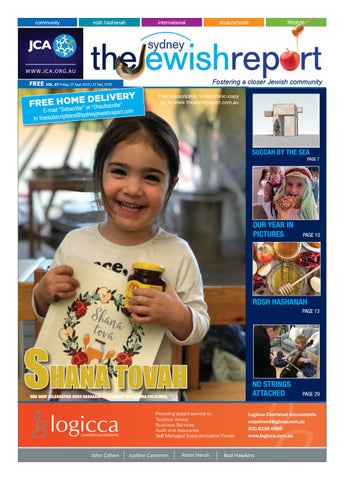
SHANA TOVAH NOA SHAY CELEBRATING ROSH HASHANAH AT EMANUEL WOOLLAHRA PRESCHOOL
CHARTERED ACCOUNTANTS CHARTERED ACCOUNTANTS
NO STRINGS ATTACHED PAGE 29
2
community
Rosh Hashanah 2019
‘Nursing’ our Ethiopian brethren to a better life HADASSAH AUSTRALIA RON FINKEL, PRESIDENT The world marvelled at Israel’s daring as it brought thousands of Ethiopians stranded in that war-torn country to Israel under cover of darkness. Operation Moses (1984) and Operation Solomon (1991) were emblematic of Israel’s commitment to Jews in distress. However, Israel’s Ethiopian community was recently thrust into the spotlight following the tragic death of a 19-year-old teenager in June this year. Solomon Teka of Haifa was shot by an off-duty policeman under controversial circumstances. I was in Israel when the event occurred and it was heartbreaking to see the anguish of the family, their friends and the wider Ethiopian community. Equally, I saw how the riots impacted many other Israelis who believe the social fracture may be difficult to heal. The challenges involved in integrating young Ethiopians into Israeli society are many. However, I was fortunate to witness a wonderful Hadassah program in Jerusalem which is going a long way towards integrating young Ethiopians into Israel’s healthcare system. That system, arguably one of the best in the world, has the capacity to change society for the better. Our interest relates to the number of Ethiopians attending university. Only 11 per cent of Ethiopian Israelis aged 22 to 35 have an undergraduate degree, compared with 42 per cent of all Israeli Jews of the same age.
Hadassah Australia, with the UIA, has decided to offer nursing scholarships for young Ethiopians. Together we are supporting an initiative called Achotenu (“our nurse”), which allows young EthiopianIsraelis to enrol in a Bachelor of Science in Nursing program at the Hadassah Henrietta Szold-Hebrew University School of Nursing. Significantly, all of the students currently enrolled were accepted without the requisite psychometric exam, which has been an impediment to students from Ethiopian and other marginalised communities from studying at Israeli universities. In place of the psychometric test, there is an alternative pathway program to ensure that important competencies for nursing are thoroughly addressed and assessed in a preparatory
year, qualifying students for entry into the mainstream university nursing program. Hadassah Australia and the UIA realised that we have an opportunity to assist the integration through the Ethiopian Nursing Scholarships. And we have “skin in the game”. Over the years, Australians have given generously to the airlifting and resettlement of Ethiopian Jewry, and we recognise that not only is the integration multi-generational, it is a key to the social and economic development of the Ethiopian community and to Israel more broadly. Importantly, many young Ethiopian-Israeli men and women have expressed a strong desire to become hospital nurses, seen as a respected and well-paid career. Nursing is part of Hadassah’s DNA.
Henrietta Szold, the founder and inspiration behind the Hadassah story, introduced westernised medicine to Palestine at the turn of last century, through the agency of nursing. And yet, the nation is struggling to produce enough qualified nurses to overcome a chronic shortage, with a recent OECD study revealing that nurse-to-patient ratio in Israel was ranked 31 of 35. While this is a disturbing statistic, it augurs well for the future of the Hadassah Ethiopian Scholarship program. The program provides the means by which Ethiopian-Israelis can fulfil their dreams of becoming qualified medical professionals while boosting overall nursing numbers to deliver quality care for patients.
World first underground national blood services centre AUSTRALIAN FRIENDS OF MAGEN DAVID ADOM LIMITED
“Yes you heard right” Sydney Jewish Report is delivering its paper for free to Jewish homes throughout NSW. Should you wish to subscribe or if you are currently subscribed and wish to unsubscribe, please go to www.thejewishreport.com.au or email freesubscriptions@sydneyjewishreport.com
Magen David Adom supplies 97% of the blood used by Israeli hospitals and 100% of the blood used by the IDF. It is MDA’s role to ensure all Israelis get the blood they need - when they need it. That is why Israel’s Home Front Command, and the country’s Defence and Public Security Ministries have made building a new secure blood bank and blood-services centre a national priority. It is the most important strategic construction project in Israel today. The old national blood bank and bloodprocessing centre located on the grounds of Tel Hashomer Hospital in Tel Aviv, was built in 1989. It is vulnerable to threats including terrorist bombings, missile attack, chemical and biological attack, earthquake and cyberattack all scenarios for which Magen David Adom must prepare daily. It is critical to have a safe and secure blood supply to ensure the survival of injured Israelis, including IDF soldiers. The current facility provides about 200,000 units of blood per annum but cannot process or store the future need of over 500,000 units of blood. As we look to the future, additional space for blood research and development laboratories will be critical to uncovering the complex issues underlying many diseases and treatments. The new centre will have the capacity and capabilities to supply and meet Israel’s future blood needs. The first underground blood centre in the world is under construction in Ramle, 20 miles southeast of Tel Aviv. There will be six floors - three top floors will be above
ground and the lower three floors, are below ground. The underground floors will be protected by special shielding designed by the Israeli Home Front Command and National Security Agency to house the processing, testing, storing and distribution of blood. There are thousands of stories of how blood saves lives, one is of Gilad Mezamer who survived a usually unsurvivable attack. An IDF soldier, Gilad was on patrol when a Palestinian terrorist sliced his carotid artery in a knife attack, an almost certain fatal injury. Magen David Adom arrived within minutes, but it was a 40-minute drive to the nearest Israeli hospital. MDA paramedics could maintain Gilad’s blood pressure by administering fluids, but without sufficient red blood cells, he would likely die from a lack of oxygen. While Gilad was being rushed to the hospital, a second ambulance carrying blood raced from Jerusalem to meet them halfway. In an unprecedented move, MDA performed a transfusion en route to keep Gilad alive, ultimately saving his life. Safe and secure blood supply is vital to the well-being of the people of Israel. The new National Blood Services Centre will ensure Israel’s needs for many years to come servicing a growing population from 8.6 million now to 11.8 million by 2039. On behalf of the President Tony Ziegler, Board and Staff of Australian Friends of Magen David Adom, MDA NSW, we wish our members, donors and the community a happy and healthy New Year.
Rosh Hashanah 2019
Forging ahead M BY MONTEFIORE
From the top floor of the residential care building at Randwick, future and prospective residents were treated to a bird’s eye view of the construction of M by Montefiore at a recent function. Guests mingled with Montefiore President David Freeman AM, CEO Robert Orie and representatives from Richard Crookes Construction and Jackson Teece Architects. Work on the new luxury retirement units is continuing on schedule, with foundations complete and the first residential floors and common areas now taking shape. Over the coming months, the outlines of the buildings will begin to emerge. A full display apartment is expected to be ready at the end of this year. To view the selection of apartments still available, contact Linda in the Display Suite on 1800 952 229 or visit mbymontefiore.com.au
community
3
4
community
Rosh Hashanah 2019
Kickstart Your Career with Masa Israel Journey ZIONIST FEDERATION OF AUSTRALIA Just imagine: You are in your early twenties, in your final years of Uni and you are starting to feel the hysteria surrounding work experience, internships and getting ahead of the pack in the competitive job market. You are spending your evenings filling out what feels like hundreds of internship or job applications and attending group interview after group interview just to receive another generic email saying ‘thank you but we had thousands of applications and you have been unsuccessful, we wish you the best of luck’. Well, luck is not what you need because your big break is waiting for you, halfway across the world – in Israel. Take Oliver Rose. Oliver was in his final year of a Medical Engineering degree when he stumbled upon Masa Israel Journey. Founded by the Prime Minister’s Office of Israel and the Jewish Agency for Israel, Masa Israel Journey offers young Jewish Adults from all corners of the globe the opportunity to Intern with some of Israel's leading companies and organisations, start - ups and multinational corporations across all fields and industries. Unlike the tedious internship applications in Australia, Oliver found the Masa Israel Journey application process easy and hassle free (no three-page essay questions or online psych tests.) With the Zionist Federation of Australia being Masa Israel Journey’s local partner Oliver also engaged with the local ZFA Israel Program representative who helped him source the right internship and assist him with the entire process. Oliver selected to intern at an in Israeli startup, LifeBEAM – a leader in bio tech and bio wearing technology. Oliver was thrown into the day-to-day operation of the business, integrating himself into the company. He was tasked with researching relationships between LifeBEAM sensors and body functions, designing trials
in the nearby Olympic Centre and developing the user experience. He also acted in a support role for the Chief Operations Officer, helping to redesign the company’s website, analyse website traffic, manage customer support and oversee product deliveries. Over the 6-month internship he gained invaluable experience from leading start-up minds and was mentored by his bosses and colleagues. Oliver said, “I wanted work experience where I would not be repeating the same task over and over. I wanted to prove my creativity, learn about starting and growing a business, and make a lasting impact. Israel’s start-up culture was the perfect opportunity.” “Israel is a hub of social, commercial and technological innovation offering exciting internship opportunities that are simply not available at comparative companies and organisations in Australia,” ZFA Israel Program Coordinator Sarit Braver said. ”Masa Israel internships provide young Jewish adults the opportunity to live in Israel like a local
and gain professional experience in their field. Israel has so much to offer in terms of business development, growth and industry advancements and these companies and organisations are eager to recruit interns from around the world. With Masa Israel being a project of the Israeli Government and Jewish Agency, it has the connections and network to offer impressive internship placements at some of the country’s most impressive companies such as Teva Pharmaceuticals, Jerusalem Post, Soda Stream, We Work and even Google.” Masa Israel offers research opportunities in all of Israel’s top Universities and institutions, hospitality internships at Israel’s leading hotels, architectural internships at some of Israel’s most well-known architectural firms and finance or accounting internships at the "Big Four". Masa Israel also offers Government Fellowships within Israel’s Ministries; an opportunity unheard of in Australia for those looking to advance their political career. Masa
Israel is about opportunities; - opportunities to advance your career, break away from the pack and give yourself the competitive edge you need to break into the workforce. The benefits of a Masa Israel internship are not only the work experience opportunities but the social ones as well. “I made friends for life, learned to live independently, and grew up emotionally. Masa added tremendous value to the internship program by providing enjoyable educational and cultural activities, including weekend tours around Israel, during which our group of 40 grew very close. I made friends from all over the world and will never forget swimming in the desert oasis at Ein Gedi, or rafting down the Jordan River,” said Rose. Upon returning to Melbourne to complete his Biomedical Engineering Degree at Melbourne University, Oliver was offered a part time job with LifeBEAM. He has watched and been a part of the company’s growth from its early stages. After 6 months working with the company, he was relocated to New York to open their first office abroad. “These Israel-based internship programs are a fantastic but untapped resource for the Jewish community. They provide valuable experience in a country that has the leading edge in so many fields. The 6 months I spent living and working in Israel was one of the happiest and most successful times of my life,” said Rose. Aside from internship opportunities, Masa Israel Journey also offers gap year, volunteer, service learning, university study and Jewish learning programs for young adults between the ages of 18 and 30 and provides generous funding for all of their programs. For more information on Masa Israel Journey and the internship opportunities available email masa@zfa.com.au
5
community
Rosh Hashanah 2019
The Shabbat Project is better than ever in 2019
THE SHABBAT PROJECT
Supermodel Karli Kloss, actress Mila Kunis, Big Bang Theory star Mayim Bialik and Donald Trump’s daughter, Ivanka have all extoled the virtues of Shabbat as a chance to carve out time to disconnect. Arianna Huffington, co-founder of successful global news site The Huffington Post, features in a recent article brandishing the headline “Arianna Huffington Wants a Shabbat Revolution”. Huffington’s Thrive Global site also features an area dedicated to Shabbat. Mention of Shabbat has even reached the pages of veritable fashion and lifestyle magazine Vogue, with Ariel Orkin, who penned the article ‘How to host a Shabbat dinner and why you should’ exclaiming that: “Shabbat – the concept of spending quality time with friends and family while taking a break from scrolling on Instagram – is for everyone.” Judging by the celebrity interest, Shabbat, in all its different expressions, is trendy. Lucky for us then that a cracker line up of events is currently being planned for the Shabbat Project in Sydney, as we get the opportunity to join Jews around the world who will unite together to experience Shabbat on 15 and 16 November. Now in its sixth year, the Shabbat Project has grown to include a vast array of events that bring the Shabbat experience to life. “The Shabbat Project has become a key part of the Sydney Jewish community,” said chairman Daniel Sekers. “We have been collaborating with community organisations to put on a diverse range of events that appeal to the whole community”.
“We know some people are highly connected to the community, while others may feel they haven’t quite found their place. But the Shabbat Project is an opportunity for us all to be involved.” “On this date Jews not only around Sydney, but also the world, unite in one common theme that has kept Judaism alive for generations.” Globally, the Shabbat Project will be celebrated in a staggering 1,516 cities across the world. “The Shabbat Project has a unique influence, like a fabric that binds the whole community together over 25 hours. It transcends the barriers that divide us in our
community,” added Sekers. In 2018, there were a record 125 events celebrated across the week. “We are such a diverse community with many backgrounds and varying levels of observance. This year, we are encouraging the community to “Experience Shabbat”,” said Sekers. “Get involved in the phenomenon that even non-Jews are intrigued by with an opportunity to disconnect from the day-today and immerse yourself in an experience of renewal, nourishment and reconnection with family, friends and what our community is really about.” In 2019, The Shabbat Project will be
There’s more to
That’s why there’s more to
1800 978 711 MONTEFIORE.ORG.AU
focussing on events that nurture innovation and communal collaboration. We have also had a particular focus on engaging those who may be unaffiliated with the community but looking for an opportunity to do so. This year, the Shabbat Project will also be headlining some exciting major events. On Thursday, 14 November, the Project has joined forces with UIA to bring the tastes, smells and sounds of Israel to our neighbourhood with a first-of-its-kind event (watch this space). To round off the Shabbat experience on a high note, we are working with the JNF to present a communal havdallah service and concert is being planned for Saturday 16 November. There will also a myriad of other events including young adult and family events. “There are so many exciting experiences on offer,” enthused Sekers. “You can attend one of the many events, experience a pop-up shul service or invite your family and friends over and host a Shabbat dinner or lunch. It is about finding ‘your thing’ and joining in with the rest of the community.” The Shabbat Project is brought to life together with strategic partner JCA, presenting partner UIA, communal partners Moriah College, Emanuel School, Mount Sinai College, JNF, Shalom, Wolper Hospital, media partner the Australian Jewish News and the generosity of private donors. Let’s experience Shabbat together! Stay tuned for more by following The Shabbat Project on Facebook and Instagram, as well through the website: www.shabbatproject.org.au.
“Dad says he has the best room in the house. We know he’s happy here as he’s making jokes and laughing again.” Ron’s daughter, Regina
6
community
JNF Annual Dinner
JNF
Former Head of the Israeli Air Force (IAF) and CEO of EL Al, Major General Elyezer Shkedy, together with world-renowned Israeli mentalist Lior Suchard, entertained a record crowd at the JNF Annual Dinner. Master mentalist Lior Suchard took the audience on an incredible journey through the wonders of the human brain, delving into their innermost thoughts and astounding even the most sceptical critics. Shkedy, regarded as one of Israel’s most popular military heroes, inspired audiences with stories of his military career and personal life, and his demonstrated commitment to Jewish unity and continuity. “Dare to do it, even the sky is not the limit,” was his final remark to 1200-strong crowd.
The 2019 campaign, in support of Kadesh Barnea on the Egyptian border, showcased JNF’s continued efforts to grow pioneering communities in the Negev, in realisation of Ben Gurion’s vision. Guests heard from Kadesh Barnea resident Hila Kaplan who expressed the economic, security and strategic importance of settling Negev communities. JNF NSW President David Moses remarked, “Almost 50 years before the modern state of Israel was established, JNF was there to pioneer and nurture a foundation for the future of the Jewish people. In 1948, we were there when that dream became a reality, and in 2019, we are still here, stronger than ever, and ready to continue and ready to continue our mission for many years to come."
Elyezer Shkedy, David Moses and Lior Suchard.
JIFF presents the first Australian screenings of Jojo Rabbit JEWISH INTERNATIONAL FILM FESTIVAL (JIFF) The Jewish International Film Festival (23 October – 21 November) will host a special Australian preview of Jojo Rabbit, the highlyanticipated World War II satire by Oscarnominated director Taika Waititi, as JIFF’s Closing Night film. Jojo Rabbit will have its first Australian screenings on Wednesday 20 November at Classic Cinemas, Elsternwick in Melbourne, and on Thursday 21 November at the Ritz Cinema, Randwick in Sydney, ahead of its national release on 26 December. The film will also close the Festival in Brisbane, Canberra and Perth on Sunday 17 November. Drawing on his own Jewish heritage and his experiences growing up surrounded by prejudice, writer-director Taika Waititi – whose mother is Jewish, while his father is Maori – makes a powerful statement against hate in his latest film. This World War II satire follows Jojo, a lonely German boy whose world view is turned upside down when he discovers his single mother (Scarlett Johansson) is hiding a young Jewish girl in their attic. Aided only
by his idiotic imaginary friend, Adolf Hitler (Taika Waititi), Jojo must confront his blind nationalism. “Fresh from its premiere as a Special Presentation at the 2019 Toronto International Film Festival, we are very excited to present Australian audiences’ very first chance to catch this incredible film from the storyteller behind Hunt for the Wilderpeople and Thor: Ragnarok,” said JIFF artistic director Eddie Tamir. “Based on the novel, the film boldly manages the delicate balance of tackling hate through satire. It’s one of the strongest films we have ever presented.” Tickets for JIFF’s Closing Night film Jojo Rabbit are available now online at www. jiff.com.au. Sydney’s closing night is on Thursday 21 November at the Ritz Cinema, Randwick. Drinks and live music will be available from 7:30pm ahead of the 8:30pm screening of Jojo Rabbit. The full JIFF program for Sydney is on sale from 23 September online and at participating cinemas. Visit www.jiff.com. au for the full program and dates in each capital city.
Rosh Hashanah 2019
Ordinary people, Extraordinary lives MANDELBAUM HOUSE JIAYIN FOO "If you don't ask, you will never find out about the potentially wonderful reward!\" was one of the many insightful takeaways from a night of whimsical, comical, and endearing recounts at the recent Mandelbaum House resident formal dinner. As we dive into award-winning journalist Fiona Harari's repository of fascinating stories, we seem to discover the unexpected in seemingly mundane lives. As Fiona shares her years of experience in her field, she also charts her career progression and encourages us to embrace the uncertainty in navigating a career. From interviewing businessmen to British spies, one of the most poignant stories shared that night, however, was the story of an ordinary man, Mr Paul Segal. Having lived a remote life, no one could describe his face, the sound of his voice, or name anyone he had loved or who had loved him. This nameless man seemed to be void of an identity, a voice, an acquaintance, or an existence even till the day of his death. But everyone has a story, and Fiona sought to piece the nebulous puzzle of Paul Segal\'s life into a picture. After extensive ground research and a deep dive into national archives, Mr Paul Segal was later discovered to be a violinist, an artist, and a World War II survivor. This was a story of a man of Jewish descent, born in Romania and travelled to Paris post World War II. He was a prolific artist, and his last point of contact was with an ex-girlfriend. It seemed that he loved people, but in limited ways, and chose to live the life he lived till the day he passed. As Fiona chronicled the unexpected intricacies of
a shadowed man, strangers who had heard of the story were moved and offered to pay for Mr Segal’s memorial, with 150 strangers turning up on the day of his funeral in Melbourne. “Stories that engage me the most, are from the most normal people.” This wholesome narrative was among many others, like the story of Mary Crawly, a 91-year-old woman who ran a pub, and even Fiona's cold calls for classified ads which has now made me glance twice at advertising columns. As Fiona relates the remarkably rewarding experiences as a journalist, her zealousness rejuvenates the minds of young inquisitives and reignites the vitality of life veterans. “Know whatever you do in life, always engage with people, you never know where you will end up” was a timely reminder to put things into perspective and to not let small moments pass one by. It reminds us to be bold and worldly lest opportunities slip through our fingertips. MANDELBAUM HOUSE is the Jewish residential college at The University of Sydney. Applications for 2020 are now open and the $100 application fee will be waived for readers of The Jewish Report. For further information, visit: www.mandelbaum.usyd.edu.au
7
community
Rosh Hashanah 2019
Reimagine your Judaism SUCCAH BY THE SEA SHALOM In October and November, Sydneysiders will have the opportunity to get involved with largest public display of Judaism to be held in Australia – possibly even the world! For the past two years Shalom has been working with Sculpture by the Sea, Bondi 2019 to create Succah by the Sea: a mini installation of six succot, designed by emerging architects from around Sydney. “This installation has been a highlight of my time at Shalom,” said Shalom’s director of programs Rabbi Alon Meltzer. “It allows our community to be displayed on one of the world’s biggest stage, and to be proud of our rituals and traditions, while highlighting key philosophical areas that are infused in this ancient practice, but are very much part of modern discourse.” Those key areas include the connection between the Succah and themes like homelessness, displacement, environmentalism, imperfection, and creating an outwards focussed society. By way of example, ‘Dune’ – one of the succot to be featured by artist and architect Lucy Humphrey – which uses a collaborative community building project to create rammed earth bricks to be used as part of the structure. This process is developed to highlight the need of homeless people and how easy it is to create temporary dwellings if we put our communal mind and might to it.
Or, Raffaello Roselli’s succah, ‘Sandstone’, which uses discarded materials to upcycle, and create a conversation around monument, impermanence and environmentalism. Shalom’s goal in creating this project was less about the succot, and more about the desire to get our community to think about reimagining their Judaism. Taking age-old rituals and ideas and applying modern concepts to them, only to come back to ancient texts and learnings that have been part of the broader Jewish conversation since the very beginning. “It doesn’t matter what ritual or tradition someone chooses, there is always a way to look at it, reimagine it, and make it relevant to the Jew of 2019,” said Rabbi Meltzer. “In doing so, one can enrich their own Jewish practice, take ownership of their Jewish learning, and enhance their Jewish identity,” Succah by the Sea, an installation at Sculpture by the Sea, Bondi 2019 – will be displayed at Marks Park from 24 October – 10 November. As part of the project Shalom have developed a website, an interactive guide (you can see part of it below), and a podcast series. You can learn more about the project by heading to www.succahbythesea.com. au or following them on Instagram: @succahbythesea
"Sandstone" by Raffaello Rosselli
“Supersuccah” by Supermanoeuvre
“A Portable Territory” by Urtzi Grau and Guillermo Fernandez Abascal
"Dune" by Lucy Humphrey Studios
1 Inside-Out Succah 3 Dune Environmentalism Judaism emphasises the need to preserve our natural resources and generate new ones for future generations. Jewish tradition encourages people and communities to reduce their waste, and value and respect the environment we live in. This sculpture was built with materials around the local area.
Open Home "A succah is a temporary dwelling or hut where ALL are equal and welcome to share shelter and food. Succot is a time when we should focus on the poor." - Rabbi Enoch Zundel ben Yosef Sit at the bench and share with the person sitting next to you your favourite succot moment.
5 A Portable Territory
Community Table
6 Sandstone Valuing Imperfection Rabbi Abraham Isaac Kook (1865-1935), the first Chief Rabbi of Palestine, takes at the idea of a succah and its imperfection further by thinking about how it can help us model other areas of our lives. We don't always need to strive for perfection. Touch the stone, feel its texture. Is it smooth or rough? What would it feel like after being outdoors for another 5 years?
IN ASSOCIATION WITH
SUPPORTED BY
Impermanence We are reminded of a time when the Jews were wandering the desert for 40 years without land or the ability to settle. During that time, we are reminded that there are still many millions in the world who are displaced, without a permanent home. How can we better demonstrate empathy toward the homeless or refugees? Do you know anyone who has moved to Sydney from another country? What do you think their challenges were?
4 Supersuccah 2 Monolitus Domum Reflecting One Place "All mankind will pass before You like a flock of sheep. Like a shepherd pasturing his flock, making sheep pass under his staff, so shall You cause to pass, count, calculate, and consider the soul of all the living." - Unetanetokef, Prayer for Jewish New Year
Design "The succah has some very basic requirements, but beyond these rules, its construction is left to one's imagination and creativity." - Rabbi Alan B.Lucas Can you see the text on the wooden planks of this sculpture? What words can you make out?
8
community
Rosh Hashanah 2019
Aussies in Israel making a real difference ZIONIST FEDERATION OF AUSTRALIA As thousands of Israeli kids started the new school year two Aussies, Lori and Gil joined them as two of the new fellows of the prestigious Masa Israel Teaching Fellows program. It was not an easy feat leaving friends and family for 10 months to teach English in an Israeli primary school but for Lori and Gil, it was about making a real difference to Israeli society by helping Israeli kids from disadvantaged communities, and giving them the best tool in life - an education. Masa Israel Teaching Fellows is a 10-month, hands-on service program which brings exemplary University graduates from English-speaking countries to teach English in Israel. The main objective of the program is to address Israel’s educational achievement gap and the widespread underperformance of youth in low-income communities. Fellows initially engage in an orientation in educational methods which is facilitated by Israel’s Ministry of Education. Seminars and discussions with top educators from across Israel provide pedagogical training and prepare the fellows for the Israeli classroom experience. While prior knowledge of Hebrew is not necessary to participate in the program, the Fellows do receive weekly Hebrew ulpan lessons. Lori, who is a 25-year-old from Bondi, had just completed her Bachelor of Education and was teaching casually when she decided that it was the right time to start the program.
She said, ”I chose to do the Masa Israel Teaching Fellows program after I went on Taglit Birthright a few years ago and fell in love with Israel. I knew I wanted to come back to do the program when I graduated.” Lori was placed at the Neve Oz Elementary School in Rishon Letzion. MITF is a partnership between Masa Israel Journey and Israel’s Ministry of Education. The Zionist Federation of Australia is the local partner for Masa Israel Journey, and recruits and markets MITF in Australia. The program is highly subsidised and costs $US 1000 for 10 months. The price includes accommodation and the fellows are paid a weekly salary of up to $1700 a month. They also receive a significant flight reimbursement upon completion of the program.
Happy Rosh Hashanah 5780 Wishing the whole community a sweet, happy, healthy year ahead From the Board, Volunteers, Members and Staff of COA
Stay Independent and Young at Heart with the Support of COA Services
Home Delivered Kosher Meals Activities six days weekly Social connection with peers Transport to COA activities Regular phone calls at home Volunteer opportunities Shopping assistance Home support services
Enquiries to 9389 0035 or email coa@coasydney.org or go online to www.coasydney.org for more information
The program is for qualified teachers but is also open to fellows with an undergraduate degree. The qualified teachers participate in what is called the ‘Teachers Track’ and receive extra educational pedagogical training. During the program, they also have the opportunity to study for their Masters in Education through Hebrew University. Of the opportunity, Lori said, “I am going with the hopes of making a difference to the education of Israeli students by using the teaching strategies I gained in Australia, to enable Israeli students to use English in order to become confident and competent global citizens. I also hope to learn a lot about myself personally, as well as develop skills that further my teaching practice and career
professionally.” “I am so excited to immerse myself in Israeli culture, and learn more about the “Israeli way” of education. Additionally, I get to live in Israel by the beach in Tel Aviv and meet like-minded young people from around the world, all while fulfilling my passion and pursuing my profession. What more could you want? All of this is possible thanks to the generous grant I received from Masa and Israel’ s Ministry of Education. I cannot wait for the journey and the authentic Israel experience that awaits”, Lori concluded. For more information on the Masa Israel Teaching Fellows program email masa@zfa.com.au
Spoilt for choice THE BURGER CENTRE “Spoilt for choice,” is how Burger Centre clients often describe their experience at this thriving seniors’ centre located next to Montefiore Randwick. Having just celebrated its 28th birthday, the centre continues to innovate and offer a range of programs and activities to stimulate a wide variety of interest. At the same time its warmth, charm and passion ensure it remains a centre of choice for seniors in the Jewish Community. The Burger Centre specialises in support and programs for people living with dementia and their families, and much more. Five days a week the Burger Centre opens and offers opportunities for social connection, mental stimulation, and avenues to learn new skills, foster hidden talents, learn from experts and get out and about in the wider community with support and ease. For those wishing to be more active, the Centre offers a Wellness Program that includes a monthly podiatry clinic, exercises run by trained exercise physiologists, Tai Chi, Hydro Cise and Dance for Parkinsons, to name a few. A joint operation between Jewish Care and Montefiore, supported by funding from the Commonwealth Government and the JCA, partnerships are a key to the success of the Burger Centre. Another of these partnerships is with Randwick Waverly Community Transport which
enables many to access the programs through their large fleet of community buses to cater for different mobility needs. Links with Central Queensland University allows the Centre to run a monthly Podiatry clinic at no cost, part of the established Wellness Program. The Centre is also accredited to run the Music and Memories and Dance for Parkinsons programs. If you’re looking for an Art space to express your creativity the Burger Centre has a light filled Art studio, with a large array of equipment on offer. From ceramics and mosaics to painting to drawing and everything in between there is something for everyone, recent projects have woodwork, gardening to a one off specially designed chess board and pieces. Snooker has become a very popular choice as is scrabble among the ever growing men’s group. More than just a place to meet others, the Burger Centre offers companionship, support and a sense of purpose for all. No matter your capabilities, your memory recall or your mobility, the Burger Centre can offer you an enjoyable and vibrant seniors’ program where your care, comfort, individuality and freedom of choice are priorities. For more information, contact The Burger Centre on p: 02 8345 9147 or email info@burgercentre.com.au
10
rosh hashanah
Rosh Hashanah 2019
JCA
Our Year in Pictures Bernard Henri Levy at JCA's fundraising evening of Insight and Illumination
JCA engages with the parents of schools in our community
Prielle Betito talking about the role of JCA in the community at the annual AUJS Ball
Jumpstarts Shark Tank event
JCA Brunch club
JCA President Stephen Chipkin Launches JCA's 2% bequest program
Jumpstart 10 x10 Fundraising event
Launch of JCA's new Allocation model, which enables program specific donations
B’ NAI B’ RITH NSW
WIZO
UIA
FOR THE PEOPLE OF ISRAEL AT UIA NSW 2019 CAMPAIGN EVENTS UIA NSW was proud to host over 3000 members of the Sydney Jewish community across its five main 2019 Campaign events in February and March, in support of the People of Israel. Events included the General Division Gala, Major Donor Dinner, Women’s Division Champagne Breakfast, Young Leadership event and Fun Run. Headline guest speakers included David Cameron - Former Prime Minister of the United Kingdom, The Honourable Julie Bishop MP, Ziv Shilon – wounded Former IDF Captain and Iron Man competitor, Arielle Di Porto - Acting Director Aliyah & Absorption at The Jewish Agency, Nataly Zagaya - UIA success story and David Koschitzky – Former Chairman, Keren Hayesod-UIA World Board of Trustees.
WIZO Chai cooking with Candy and Gaia
WIZO Kids Chanukah Sprinkle
Cooking for the community at OBK
WIZO NSW Sponsor a Child in Israel 2019
WIZO Kids Matzah Sprinkle
WIZO NSW Sponsor a Child in Israel 2019
WIZO NSW Gala Event 2019
WIZO Seniors Morning Tea
Events included; 75th Anniversary gala dinner and working with NSW BJE, B’nai B’rith Youth Organisation (BBYO) Exhibitions included: The Letters of Loss & Refuge Jewish Life in Norway 1851 – 1945
11
rosh hashanah
Rosh Hashanah 2019
Our Year in Pictures Teachers Tour
Eurovision Mission
Green Sunday
JNFuture
Purim in the schools
Miriam Peretz
Seniors in Uluru
Cocktail party to farewell Julia Golding OAM
COA
Annual Chanukah Luncheon Concert
COA’s Seniors Festival Cruise
Annual General Meeting award recipients
Dinner club with Dave Sharma
JEWISH MUSEUM
In the last year, the Sydney Jewish Museum has engaged the Jewish and wider communities through talks by Holocaust survivors and interesting speakers, commemorative events, and new exhibitions. The Museum marked the milestones of the late Lena Goldstein’s 100th birthday with the launch of her biography, and Eddie Jaku gave his testimony to a large, record crowd on his 99th birthday. The Community Stories department launched the books that explore the lives of survivors Kitty Lowinger, Egon Sonnenschein, Ilse Charny and Jacqueline Dale. ‘The Fate of Things’ and ‘Jukebox Jewkbox! A Century on Shellac and Vinyl’, brought diverse crowds from the arts and music worlds to these new, fresh exhibitions The Museum also welcomed almost 28,000 school students who participated in educational programs on the Holocaust, human rights and Judaism.
NCJWA
MUM FOR MUM, our signature program, continues to make a difference to the lives of recipient mums and babies. We also started a new program called Cuddle Bundles, where gifts of recycled babywear in excellent condition are given to mums in need from any community in Australia and overseas. We hosted successful Birthing Kit packing days, including one with Moriah College students, and these packs were sent to women in developing countries where clean birthing conditions are limited. Our Cancer Support Network continue to organise group meetings every second month, and our new program GeneCircle was launched this year. We have had a variety of well-attended events, with engaging speakers and lively discussion, and look forward to another great year ahead!
Volunteers and staff preparing and delivering Rosh Hashanah Parcels
JNF
Alon Ben-Gurion visit
Dancing at the Mid-Winter Social, a regular event held with Club 50
12
rosh hashanah
Rosh Hashanah 2019
JEWISH HOUSE
SHALOM BABY
Our Year in Pictures
Over 1,000 attended our Gala Chanukah in the Mall was Golf Day - More than 120 players joined us dinner in November to help us keep celebrated with more than 100 to raise funds to help people experiencing a personal crisis. children and their families 1,000 people off the streets.
The team at The Sydney Jewish Report wish all advertisers, contributors and readers
Shana Tova U’metukah
Yes We Can Food Drive - Coles supermarkets continued with an even bigger YES WE CAN food drive over this past year
Rosh Hashanah 2019
ROSH HASHANAH rosh hashanah
13
Rosh Hashanah 101 MJL
The Jewish New Year is a time of rejoicing and serious introspection.
Rosh Hashanah, the Jewish new year, is a fall holiday, taking place at the beginning of the month of , which is actually the seventh month of the Jewish year (counting from Nisan in the spring). It is both a time of rejoicing and of serious introspection, a time to celebrate the completion of another year while also taking stock of one’s life. The two days of Rosh Hashanah usher in the Ten Days of Repentance (Aseret Yemei Teshuvah), also known as the Days of Awe (Yamim Noraim), which culminate in the major fast day of Yom Kippur, the Day of Atonement. The Days of Awe represent the climax of a longer process. Starting at the beginning of the previous month, called Elul, the shofar is traditionally sounded at the conclusion of the morning service. A ram’s horn that makes a trumpet-like sound, the Shofar is intended as a wake-up call to prepare for the Tishrei holidays. One week before Rosh Hashanah, special petitionary prayers called Selichot are added to the ritual. Rosh Hashanah itself is also known as Yom Hadin or the Day of Judgment, on which God opens the Books of Life and Death, which are then sealed on Yom Kippur.
world was created, or of the day on which humanity was created. Another explanation can be found in the significance of Tishrei as the seventh month, hence the Sabbath of the year.
Rosh Hashanah History The origins of Rosh Hashanah may be sought in a royal enthronement ritual from biblical times, though the Bible itself never mentions the “New Year” or “Day of Judgment” aspects of the holiday. Even though Rosh Hashanah falls in the seventh month, later rabbinic tradition decided to designate it the beginning of the year. Although the origin of this tradition may have been adopted from the Babylonians, the rabbis imbued it with Jewish significance as the anniversary of the day on which the
Celebrating Rosh Hashanah At Home The challah (traditional bread) that is eaten for the Rosh Hashanah season is round, symbolizing the eternal cycle of life. The Challah is traditionally dipped in honey, symbolizing the hopes for a sweet New Year. The same is done with apples, which are made even sweeter with the addition of honey. Some people avoid eating nuts at this time, since according to a somewhat convoluted gematria (mystical numerical interpretation) the Hebrew words for nut (egoz) and sin (het) have the same
numerical value. Rosh Hashanah Liturgy The prayer book for the High Holidays is called the Mahzor. Three unique sets of prayers are added to the morning service during Rosh Hashanah. These are known as Malkhuyot, which address the sovereignty of God, Zikhronot, which present God as the one who remembers past deeds, and Shofarot, in which we stand in nervous anticipation of the future. Each of these sections culminates in the blasts of the shofar, the most potent symbol of the holiday. The shofar is alluded to in the most memorable Torah reading for the holiday, the Akedah or Binding of Isaac (Genesis 22). The story and the shofar serve as reminders of the covenant between
God and the people of Israel, carrying with them the message of sacrifice, hope, and continuity. Among the popular traditions associated with the holiday is a ceremony performed on the afternoon of the first day of Rosh Hashanah called Tashlich, when people throw crumbs or pieces of bread, symbolizing their sins, into flowing water. Rosh Hashanah’s Theology and Themes This is the time of year during which we are to atone for both our individual — and on Yom Kippur, our communal — sins committed over the course of the previous year, before God literally closes the books on us and inscribes our fates for the coming year. God’s rule over humanity and our need to serve God are stressed time and again over the course of the holiday.
14
rosh hashanah
Rosh Hashanah 2019
Re-imagining the shul experience KEHILLAT KADIMAH RABBI DOVY RAPOPORT We’ve all been there before. The high holy days are approaching. We know we should go to Shul. It is what our parents did, what their parents did and what we have been doing since we were kids. We have booked our seats, prepared ourselves mentally for the synagogue experience and can tick off all the boxes. Then we question ourselves. What is the point of this? True, we go to shul, we enjoy the schmoozing, we like the Chazzan, we are impressed by the choir and the Rabbi’s speech always has a good joke or an inspirational story, but what do we get out of it in the long term? When the children start grumbling that they get bored, our parental instincts kick in and we tell them that they have to go to shul because that’s what we do, whilst perhaps on the inside we resonate with their displeasure and frustration. Ultimately, a mixture of tradition and guilt wins over and we come to shul to fulfil our duties and life keeps going in similar cycles. This year, let us challenge ourselves to think differently; to try something new. Perhaps if we explore the purpose of the synagogue service, we can approach the high holy days with an alternative way of thinking.
Everything we do contains two elements that work side by side. There is the physical process and the associated paraphernalia, and secondly, there is the rationale and meaning behind the actions. Physically, we go for a run, wearing our preferred healthmonitoring device on our wrists, but more importantly we are attempting to boost our fitness thereby. Put differently, we have our physical activities that are enacted in concert with or as a response to the internalised and intangible meaning we create spiritually deep within ourselves. Metaphorically speaking, there is a body and a soul. A tangible element and an abstract element. Consider the difference between the physical eye and our subjective experience of vision. So too the traditions of Judaism contain an element of active
practice, yet these practices are in place to act as a starting point for the psychological journey one is supposed to take. Human beings are a beautiful and complicated mix of the tangible and abstract. In synagogue, we verbally recite the text of the liturgy; we stand, we sit, we bow, we proclaim, we respond, we sing. This is the physical activity of the body. But what of the soul of prayer? What is prayer supposed to achieve? This is where the meaning of prayer steps in. Different parts of the liturgy guide our thought in a particular direction, some of which we never even knew existed. Some prayers elicit our gratitude, some compel us to change and some promote profound moments of selfreflection. Some prayers coax commitments and confessions, whilst others allow us to unload emotionally and even invite us to
confront our mortality and relationship with G-d. If the physical actions are able to induce sincere internal work, then the individual can emerge transformed and with a new perspective on life and how to engage with the world around them. But why do we need to come to shul for this? Could we not achieve these goals through meditation in the privacy of our own home? Our Sages had the foresight and wisdom to appreciate that there needs to be a framework within which to anchor our spiritual needs and psychological meditations if they are to survive the test of time. The chaos of our everyday lives rarely permits the emotional luxury to practice mindfulness. And even if we do have the time, we don’t necessarily have the knowledge or inspiration. Thus the Sages compiled a liturgy and provided guidance for how one should pray in accordance with and in response to the basic, essential and ubiquitous needs of humanity. This would ensure that selfreflection and growth, through the medium of prayer would continue to live on throughout the generations. This they also instituted to be done as a community and not alone. Why? Because the body of a community outlives the individual bodies of its constituents. Perhaps this year we might encourage ourselves to gaze beyond the body of prayer onto its soul and thus come out rejuvenated and reinvigorated from the shul experience.
A day of joy, a time of hope, a year of peace and happiness. May Rosh Hashana be a time of inspiration for you and your family.
ומתוקה טובה שנה טובה וחתימה כתיבה ומתוקה טובה שנה ושלווה שלום שנת ושלווה שלום שנת Kesser Torah College
Members of the JCA Family of Communal Organisations
Happy JewisH NEW YEAR Rosh Hashanah 29 September - 1 October TH
st
630
240
$
$
ea
ea
Osem Honey Cakes 400g $1.58 per 100g. While stocks last
5
$
Berman Honey Coated Cookies or Honey Cookies 180g $1.33 per 100g. While stocks last
3
$
15 ea
ea
SAVE 1
SAVE 90¢
$
WAS $6.15
WAS $4.30
Kinor Rose Grape Juice or Muscat Grape Juice 750mL $6.87 per litre
5
$
60
ea
Shkedia Dark Choc Almonds 160g $3.50 per 100g. While stocks last
40
Cobs Organic Popcorn Lightly Salted Slightly Sweet 120g $2.83 per 100g. On sale 18/09 to 8/10
5
$
80
ea
Eskal Gift Box Mint Cremes 150g $3.87 per 100g. While stocks last
$
1150 ea
Coles Squeezy Pure Australia Honey 1kg $1.10 per litre
Celebrate Jewish New Year at these supporting stores:
Bondi Westfield • St Ives • Rose Bay • Bondi Junction • Maroubra Junction • Eastgardens • Edgecliff On sale from Wednesay 18th September 2019 until Tuesday 15th October 2019.
Products only available at above stores, unless indicated otherwise. Not available at Coles Express or coles.com.au. While stocks last. Some products or varieties may not be available at all stores. We reserve the right to limit sale quantities. Savings, single sell prices and unit prices shown off regular selling prices.
16
rosh hashanah
Rosh Hashanah 2019
New year: New beginnings CAREERSUPPORT365 GREG WEISS Often a New Year brings on new resolutions and the desire for change. In my field, that means career transitioning. But before you think of moving on in your career, be aware the recruitment landscape has radically changed in recent years. Whether you are a graduate coming into the job market for the first time, or are a more seasoned manager with a number of career moves under your belt, you will find changes to the way employers are now recruiting. This is going to change even more as attention is increasingly focused on the recruitment function mostly motivated to reduce errors, standardise processes, and drive the control of the process more so in-house. First impressions count The reality is that at best, recruiters and/or Talent Acquisition Managers will interview around eight people to yield a shortlist of
three to five qualified candidates. According to researchers, the human brain is binary. It instantly sorts all stimuli in to one of two tracks, good/bad; safe/unsafe; interesting/boring. The implication for applicants is that résumés, LinkedIn profiles and any interaction with recruiters or Talent Acquisition Managers need to be viewed as interesting, regardless of how strong the applicant is. Otherwise, the applicant risks being sorted into the pile of also-rans for that job. ATS Systems In the late 1980s, I recall manually sifting through résumés of hundreds of applications. The process was tedious, error prone, tiresome and time consuming. Then along came optical character reading (OCR) software that allowed résumés to be scanned for keywords. This revolutionised the recruitment process; the turnaround times plummeted, and job throughput spiked. Today, sophisticated Applicant Tracking Software (ATS) to streamline the résumé process are used by almost all employers and recruitment firms.
LinkedIn and Résumé keywords For applicants the key to getting a look-in by recruitment firms and employers is the strategic use of seeded keywords in their résumés and LinkedIn, where the keywords will be scanned by ATS software or by LinkedIn’s ‘Recruiter’ package to yield a long list of potential candidates. In essence, the more keywords are found in the résumé or LinkedIn profile, the higher the ranking of the applicant and the better the chances of gaining an interview.
to work for us?” • A technical question about your skills: “Give an example of when you have helped a customer?” • A personality question: “What would you do if you didn’t have to work for a month?” It pays to practice on Skype, Zoom or Facetime video and record it so you can see how you are perceived via this medium. Coopt a friend or significant other to assist and give critical feedback or get a career coach to help you.
Video Screening Video interview platforms, are designed to enhance the early stages of the interview process by giving potential employers a better view of applicants and facilitating a greater opportunity to differentiate from other job candidates. Questions at the video interview stage are intended to get a sense of the applicant and cut down the time to yield a list of qualified interviewees. In most video interviews, applicants can expect about three to four questions, which usually fall into four distinct categories: • An introductory question: “Tell us a little bit about you?” • A motivation question: “Why do you want
Insider information Finally, don’t expect to go into any interview completely blind. Applicants can visit Glassdoor.com for tips on what prior applicants have encountered at their own interviews and what to expect at an interview with a specific company. Greg Weiss is Australia’s Leading Career Coach. He is the author of “So You Got The Job! WTF Is Next?”: proven steps to succeed in any new role and “So You’re Career Confused!”: proven steps to pinpoint your ideal career direction. Find out more about the books at https://www.wtfisnext.wtf/
Shana Tovah from Wentworth! DAVE SHARMA MP The Australian Jewish community has contributed greatly to the development and progress of Australia, over many generations and in many spheres. And it is Wentworth that is the proud home of so many community figures who have given
so much to Australia. It is a true honour to represent such an esteemed community in the federal Parliament. Ensuring Australians can practise their faith and belief and traditions in peace and safety, without harassment or intimidation, is a core Australian value and one of the most important duties of any government. The Jewish community is an integral part of what makes the fabric of Australia so strong and rich. I will be a steadfast supporter of the Jewish community and Jewish life in Australia, including protecting
Shana Tova 5780
On behalf of the Executive, Board and Staff of National Council of Jewish Women of Australia NSW we wish all our members and friends a happy, healthy, sweet New Year.
the community from threats and supporting institutions which foster Jewish communal life. Rosh Hashanah marks the start of a new year and a new chapter in each and everyone’s lives. It is a time of redemption and renewal and hope for a new beginning. I’m delighted to join the Jewish community in coming together to pray and hear the blowing of the shofar, to reflect on the past year, and to look forward to the promises of the year ahead. On behalf of my family, Rachel and I would
like to wish you and your family a year of happiness, fulfilment and good health. May you be surrounded by friends and loved ones, as you renew your commitment to God and to yourself. Shana Tovah! Dave Sharma was elected this year to the Federal House of Representatives for Wentworth, and is a Liberal backbencher. If you would like to contact Mr Sharma, please email Dave. Sharma.MP@aph.gov.au or phone (02) 9327 3988.
Burger Centre wishes our volunteers, members and friends Shana Tova Umteukah and well over the fast. May you be written in the book of life. Thank you for your ongoing support, we look forward to a sweet and prosperous year ahead.
Shana Tova Miri Orden, Maxine Bachmayer, Janet Merkur Co-Presidents NCJWA NSW
T: 9363 0257
E: admin@ncjwnsw.org
W: www.ncjwansw.org.au
Providing opportunities for socialisation, connection with the community and encouraging people to stay mentally and physically active
Make this year your best ever! Do what you love, enjoy every day, find your joy. Read the book from Greg Weiss, Australia’s leading career coach.
A proven framework that has helped hundreds of Graduates, Managers and Executives. Available on Kindle, iBooks, or visit wtfisnext.wtf
17
rosh hashanah
Rosh Hashanah 2019
New beginnings in the electorate of Coogee
DR MARJORIE O'NEILL
I would like to take this opportunity to warmly wish all my Jewish constituents Shanah tova umetuka. A sweet New Year and may you be inscribed in the book of life! As Rosh Hashanah is a time of freshness and new beginnings, I would like to share that I too have embarked on a new beginning as your elected representative for the seat of Coogee. I have had the pleasure of meeting many of your inspiring community leaders and organisations including the impressive young adults at Youth HEAR at a Yom HaShoah commemoration; Moving Forward Together founder Ernie Friedlander at the
impressive Harmony Day Poster and Song Writing Competition; Rabbi Kastel of Jewish House as he briefed me on homelessness, Rabbi Slovin of Our Big Kitchen, the board of NSW Maccabi; Not to mention the impressive leadership at Moriah College, the Emanuel School and Mount Sinai. Thank you for welcoming me to your events, from Chanukah and Purim when I was just a candidate to Passover and Shavuot which I enjoyed at Coogee Synagogue with blintzes and a hearty l’chaim. At this time of year, I hope you all enjoy an abundance of delicious traditional foods and I look forward to sampling some! I know that at times of renewal, it is important to reflect on the things we can do strengthen our new beginnings. Considering how we as individuals can make the better place is one of those things.
I understand that in the Jewish religion, this concept of healing the world is referred to as tikkun olam. Over the past months I have been impressed at the plethora of Jewish organisations trying to do just this. From birth to death and each stage in between, there seems to be an organisation to support those who need it. I encourage your early childhood centres, schools, synagogues, charities and philanthropists to keep going- there is always more to do and you are doing a great job! It is also important to acknowledge all the young adults here and the rest of the diaspora who have given up their time and risked their safety to keep synagogues safe while others go inside to pray. I am saddened that there is a need for this and I hope there comes a day when those young adults can participate in prayer with the rest of their communities and no longer bare
this burden.
I would like you all to know that my door is always open. If you have any ideas to share or any concerns, please feel free to contact my office. If I cannot help, I can point you in the direction of the person or department that can. Wishing you a safe and easy fast and I look forward to meeting many more of you in the coming months! Dr Marjorie O'Neill is the Labor member of the New South Wales Legislative Assembly representing Coogee. If you would like to contact Dr O’Neill, please email coogee@parliament.nsw.gov.au, phone (02) 9398 1822, or find her on Facebook (MarjorieONeillCoogeeMP), Twitter (@MarjorieSONeill) and Instagram (marjorieoneillcoogee).
Help make Kfar Aza green again JNF AUSTRALIA Less than two kilometres from the Gaza border, Kfar Aza has been a regular target of rocket and mortar attacks, becoming one of Israel’s most vulnerable communities. The residents of Kfar Aza recently faced a
wave of extreme terrorism, with flammable balloons and incendiary kites destroying crops, livelihoods and beautiful nature reserves. This Rosh Hashanah, help make Kfar Aza green again. JNF’s Rosh Hashanah Blue Box Campaign is raising funds for
landscaping, irrigating and upgrading several of Kfar Aza’s communal areas. With your help, an even brighter future for the people of Kfar Aza is within reach. The green areas will lift the morale of the residents, enable the arrival of new families, support the community’s growth
and contribute to building a viable future for the residents along Israel’s Southern periphery. JNF’s support for communities such as these will help ensure the ongoing sustainability and security of Israel’s South – an area vital for the country’s future.
DR MARJORIE O’NEILL MP MEMBER FOR COOGEE MEMBER OF PARLIAMENTARY FRIENDS OF ISRAEL AND THE LABOR ISRAEL ACTION COMMITTEE
SHANA TOVA Wishing the Jewish community all the best for a happy and healthy new year SHANAH TOVAH UMETUKAH P: 9398 1822 E: coogee@parliament.nsw.gov.au A: 55 Frenchmans Road, Randwick NSW 2034 F: MarjorieONeillCoogeeMP T: @MarjorieSONeill I: marjorieoneillcoogee Authorised by Marjorie O’Neill MP using Parliamentary entitlements
שנה טובה ומתוקה The JNF Rosh Hashanah Blue Box Campaign is in support of one of Israel’s most vulnerable communities, Kfar Aza. Situated less than two kilometres from the Gaza border, the residents of Kfar Aza recently faced a wave of extreme terrorism, with flammable balloons and incendiary kites destroying crops, livelihoods and beautiful nature reserves. This Rosh Hashanah, please help make Kfar Aza green again.
Please donate at www.jnf.org.au or call 1300 563 563
18
rosh hashanah
Rosh Hashanah 2019
We wish you a sweet new year... You Are Good.
THE KASHRUT AUTHORITY RABBI MOSHE GUTNICK
Honey, the ubiquitous sweetener, is the hero food of Rosh HaShanah and features in a myriad of delicious symbolic dishes. Our sages find a mystical connection between the foods we consume and our mazal moving forward. At this time on our calendar it’s a simple equation: We eat sweet foods and this leads to a sweet new year. So why honey? Why not another sweet substance like sugar? Firstly, crystallised sugar as we know it, is a relatively new invention. Sugar cane syrup was not known in the Middle East in biblical times, nor even in Talmudic times. The beginnings of crystallised sugar were formed in India in the first century, and it made its way to Europe around the tenth century traded as an expensive ‘spice’. It did not become the common foodstuff it is today until the 1800s when the first commercial crystallised beet sugar plant was established by Franz Karl Achard in Germany. Even then it remained relatively expensive and only in the twentieth century did it become freely available for every household. In short, there was never a custom to utilise sugar on Rosh HaShanah because there simply wasn’t any. Having said that, sweetening dishes or desserts using cane sugar; xylitol; maple syrup; stevia, agave nectar or coconut sugar (and the rest!) does contribute to a sweet new year, they simply weren’t the go-to sweeteners chosen (or even known) to perpetuate customs over the last few thousand years. Enter: Honey. In sharp contrast to sugar, bee’s honey has been a sweetener from biblical times. The first mention of bee’s honey is in Shoftim (Chapter 14:8). Samson discovered a swarm of bees and honey in the carcass of a lion. Hang on I hear you say, Samson? That is the first mention of honey?
What about the land flowing with Milk and Honey we read about in the Chumash? Well much to most people’s surprise, that honey is not bee’s honey at all – the commentaries explain that instead it is, in fact, date honey. Once the fruit growing on a date palm ripens, it becomes so succulent and rich that sweet syrup was literally seen oozing from the hanging dates. Yes, a land flowing with honey – just date honey, also known as silan! How do we know that the Torah is referring to date honey and not bee’s honey? The answer is really quite simple. Archaeologists tell us that there were no native honey bees in the Land of Israel. The bees that did make the honey in Israel came from either Syria or Turkey. The Syrian bees were not prolific honey producers; the Turkish bees more so. Either way, this honey is not a unique blessing for our Promised Land. In contrast, date palms covered the Land of Israel and the date honey did flow directly from them. So when it comes to the minhag, or custom, for Rosh HaShanah. Why bee’s honey? For the last two thousand years dates oozing with honey were no longer the norm in the Middle East and certainly not anywhere else. So what was the sweetener that was most freely available? It was and is the honey we are used to – bee’s honey. Perhaps there is also another reason. Life is inevitably filled with tough times. Each of us has our own load or ‘peckel’ as we say in Yiddish – sometimes as harsh as the sting of a bee. But even the bee, with its ability to painfully puncture, also has the capability to produce one of the sweetest substances on earth. With that knowledge, we pray that all our troubles should turn to honey and wish each other a sweet new year.
The KA wishes all
Chag Sameach & Shana Tova U’Metuka
Phone: 1300 KASHRUT / (02) 9365 2933 Email: info@ka.org.au • Website: www.ka.org.au Find us on
Kashrut Authority of Australia & NZ
You Are Very Good.
NEFESH RABBI MOSS Question: Dear Rabbi Moss, We have this silly debate every year. Do we eat apples dipped in honey only on the first night of Rosh Hashana, or also on the second? I think it is just the first but I can't remember why... Signed, Confused Dipper Answer: You can eat apples and honey any time you like. But the custom is to eat them on the first night of Rosh Hashana only. Perhaps we can suggest a deep reason why. Rosh Hashana is the day Adam and Eve, the first humans, were created. So what was G-d doing the night before? He was about to introduce into the world a dramatic and unprecedented phenomenon - free beings who will be able to determine their own destiny and impact the direction of the world. The long and turbulent relationship between G-d and man was about to start tomorrow morning. So what was going on that fateful night? The Midrash teaches that on the day man was created, there was a stormy debate in heaven. Some angels were all for the idea, and others were dead against. The Angel of Love supported the creation of man, because people will do acts of love. The Angel of Truth opposed, because people will be full of falsehood. The Angel of Justice argued for the affirmative, claiming that man will bring justice. But the
Angel of Peace countered that people will be argumentative and fight all the time. But all these arguments were useless. G-d had already made up His mind the night before. He declared, "Man is very good." Not just good, but very good. He anticipated the sweetness that humans would generate, and He could already taste the apples (good) and honey (very good) of human goodness. So He created us. G-d saw the incredible beauty that only humans can create. Yes, we are fallible and imperfect beings, but that just makes our achievements even more special. Every day all over the world, ordinary people do extraordinary things. A busy mother delivers a meal for a family going through a crisis. A group of teenagers bring a smile to their unwell classmate's face. A community comes together to raise funds for a needy couple. A family sits around their kitchen table, and in all the messiness and noise of life, they share the warmth of human caring and goodness of a life with purpose. This is the sweetness G-d tasted before He made us, which is why He made us. So like G-d, we eat apples and honey the night of the new year. We declare in advance that things are going to be good. Very good. Our life is very good. Our world is very good. Our children are very good. And we are very good. If G-d believes in us, knowing our imperfections, we can believe in ourselves too. May you be inscribed in the book of life for a good and sweet new year!
5779 – A Year of Connections, Opportunities, and Activities COA SYDNEY The last 12 months have seen some major changes to COA Sydney, enabling the organisation to provide even more of the services and events which the community counts on. The first big event of 5779 was the day CEO Julia Golding OAM stepped down after 35 years of service to the community. Julia was the longest-standing CEO of any Jewish organisation in Sydney, and her passion for COA clients was, and continues to be, her driving force. Julia still volunteers with COA, giving the benefit of her community knowledge whenever asked. New CEO Rachel Tanny is equally passionate about COA services, and has dedicated her time in and out of the office to raising the profile of the organisation. There has been renovation throughout the building, improving hall facilities, creating more storage in the centre, and rebuilding the COA offices. But even through COA looks a little different, the staff and volunteers are the same, the services have only grown, and the centre has the same inclusive, joyful, family atmosphere as always. Another caterer has also been added to the Kosher Meals-on Wheels program, making four caterers in total. Grunfelds have come on board, providing a new and vibrant vegetarian menu to complement the existing menu for Mondays. COA’s outreach volunteers have delivered parcels for major Jewish holidays to hundreds of seniors around Sydney – sent with every meal delivery made, given to
every senior attending the COA centre for social activities, and provided through the Hannah Meyer Project to Jewish residents living in non-denominational aged care facilities. COA’s volunteers have also spent the last 12 months giving social connection and genuine care to some of the most isolated and housebound seniors in the community. COA celebrated the NSW Seniors Festival with a cruise on Sydney Harbour and an Open House, where even local MP Gabrielle Upton came to dance. COA held its famous Annual Seder in the weeks prior to Pesach, with almost 100 people seated at the Seder table. COA held a community art show together with B’nai B’rith NSW which saw over 70 artists ages 6 to 101 contribute work. There was an inaugural Melbourne Cup afternoon tea, an Australia Day BBQ, Purim spiels, a Challah Bake, and a Mid-Winter Social which was considered by many to be the best event they had attended in the last year. And of course there were weekly concerts from artists like Dahlia Dior, Len Mahemoff, and Robert Teicher, while the bi- monthly Dinner Club saw speakers such as Dr Kerryn Phelps, Dave Sharma MP, and Dr Eva Lowy addressing up to 90 people at a sitting. It has been a momentous year at COA Sydney, so they are looking forward to taking the High Holidays to catch their breath and prepare themselves to do it and more - again in 5780. The Board, Staff and Volunteers at COA send you all the best wishes for a sweet, happy, healthy year!
19
rosh hashanah
Rosh Hashanah 2019
Rosh Hashanah - the centrality of history GLOBAL AMBASSADOR, MORIAH COLLEGE & CEO, MOSAIC UNITED RABBI BENJI LEVY If you were to stand at the base of a mighty mountain, at the front door of an extravagant palace, or an inch away from a sweeping tapestry, you might know that you were standing in the presence of something special, but you would fail to grasp its greatness. A single stone of the Kotel or a solitary chunk of rock at the base of Mount Everest can fail to impress. Retreat to a point at which you can take in the magnificence in its entirety and only then will you be able to truly appreciate what your eyes behold. On Rosh Hashanah, we spend a great deal of time mentioning remembrance. Indeed, a centerpiece of the main prayer service is called Zichronot, or remembrances, during which we invoke many heroic deeds of our ancestors in the Bible (such as the righteousness of Noah, the self-sacrifice of Isaac and the ironclad faith of the Jews in the Desert). We beseech God to remember these great individuals - and in their merit, to remember us too. Like all compositions of prayer, these paragraphs are not addressed solely to God - they are equally written with the intention of impacting each of us. While we will never be able to fully comprehend the notion of God ‘remembering’, this focus
on memory and on memories teaches us a crucial lesson about the underlying meaning of Jewish living. To be a Jew is to remember. To actively remember. Zachor. This principle constitutes the essence of our existence and permeates throughout the contours of our calendar. Every Friday night we lift a glass of wine to remember that there is a Creator behind creation, every Seder Night we engage our senses to relive and remember the salvation from oppression of the Exodus, every Tisha B’av we remember and commemorate the tragedies of a long, painful history, and every Yom Ha’Atzmaut, we remember and celebrate our miraculous national resurrection. To be a Jew is to set aside time for intense and active remembrance - affording us an opportunity to reflect upon our history, our mission, and our lofty purpose in this world. As Jews, we must learn the art of contextualization - to orient our internal paradigms until we perceive ourselves not only as individuals (which is important in and of itself), but as an essential element of an enormous tapestry of breathtaking beauty and irreducible meaning. Rosh Hashanah, as the first moment of the Jewish year, represents the opportunity to put this into action. This is the time to step back and contextualize. The ‘memories’ that we invoke in our prayers compel us to recalibrate, to take the time to remind ourselves to see beyond our own interests and understand our larger contexts as we create new memories. This process reminds
us that we do not stand alone before God rather, we are linked to vast networks that imbue our lives with purpose, significance and commitment. We remind ourselves that we are part of a global Jewish community that lives in a time of both obstacles and opportunity, and therefore we pray for the strength to overcome the challenges. We remind ourselves that we are part of the magnificent Jewish story, a narrative replete with heroines and heroes, whose faith and righteousness serve to guide our own decisions in the service of God and our people. We remind ourselves, finally, that we are part of humankind as a whole, whose peace and prosperity we yearn and pray for every day. Through remembering the greater context in which we live our lives, we give meaning to our existence that exceeds the fleeting
pursuit of our own individual ends alone. This expanded consciousness and broadened perspective enables us to connect to something infinitely greater than ourselves. May we merit, this Rosh Hashanah, to truly grasp the greatness of our existence, to experience this deeper level of meaning throughout the upcoming year, and to spread our light throughout the entire world. Rabbi Benji Levy is the CEO of Mosaic United, a partnership between the State of Israel and the global Jewish community dedicated to addressing wide-ranging approaches to Jewish engagement and raising the playing field to ensure a stronger Jewish future. A recent Oleh from Australia, he previously served as the Dean of Moriah College and now is their global ambassador.
JCA wishes you and your families Shana Tova U’metukah
20
rosh hashanah
Rosh Hashanah 2019
Rabbis Message - Rosh Hashana 2019 RABBI YOSSI FRIEDMAN MAROUBRA SYNAGOGUE How has the past year turned out for you? Was it a good year? Did you experience success at work? Joy in your family life? Did you marry off a child or see the birth of a grandchild? Or was it a challenging year? Were there health hardships or relationship issues? Did you get laid off at work or see a child move out of home? Or did you experience a year of both challenge and achievement, pain and joy? One of the only certainties in life is that you will experience uncertainty. No one knows what the future will bring. So how do we wake up every day with a bounce in our step, ready to overcome whatever life may throw at us? This is one of the great themes of Rosh Hashana. Rosh Hashana encourages all of us to reflect on our frailties and to set a plan of action for the upcoming year. On the second day, we read about Abraham’s great test in the binding of his only son, Isaac. Human sacrifice is seen as abhorrent in the Torah, yet G-d wants to Abraham’s loyalty and gives him this most difficult task. Abraham doesn’t hesitate, in fact we are told he wakes up early the next morning, eager, to fulfil his mission. It is only at the very last moment, as his knife is raised ready to strike,
does the angel give the stop order. Each year I reflect on how difficult this must have been for both Abraham and Isaac. Isaac was Abraham’s only heir and the love of his life. The test seems like an impossible test. So it is with us. When presented with a trial, it may be difficult to see a way through. Yet we know that some way or another, we must prevail. We must find the strength to go on.. But what’s the point of a test? I test my students to discover their level of knowledge. I test my boyfriend to find out if he is a mensch. G-d certainly knew where Abraham stood. Why the test? Every person, says our tradition, has two dimensions to his or her personality: who I am and who I can be. There is the “self” I am aware of, and there is the “self” the way
it is the mind of the One who conceived me. Many of us may never touch that dimension of self. We may not even know it exists. Sometimes we live okay lives, achieve success at work, we figure that as long as I am not hurting anybody and people seem to like me, I must be O.K. But as years pass we discover that the deepest parts of our identity have gone unexplored. How do I travel from my lower self to my higher self? How do I discover my inner depth and live a grand, overflowing life? For this, Judaism gives a challenging answer. “V’Haelokim Nisah es Avraham,” “G-d tested Abraham.” The Hebrew word for test, or challenge, is “nisah,” nisayon,”. It comes from the word “nes,” which means an elevated banner. What’s the connection? You hoist a flag, so too through being tested, we become hoisted to higher and higher
levels. “G-d tested Abraham” can now be read as “G-d exalted Abraham.” When Moses says “G-d is testing you,” it can now be translated as: “G-d is elevating you.” Life offers us this opportunity each day of our lives by providing us with tests or challenges—some of them easier, some of them real curve balls. To be sure, many of these challenges remain mysterious and incomprehensible. Why do some of us endure challenges so disturbing, painful, and shattering? Nobody knows. I stand in awe before some of those whom have opened up to me about what they have been through during the last year. We don’t know why. All we know is what our calling and response must be. The function of every challenge, small or large, is to invite us to go much deeper into ourselves where we will discover the resources and potential we need to muster, to face these tests and triumph over adversity. Life is like being on an elevator. If you’re not going up, you are being pulled down. This year, let’s dig deeper within ourselves. Let’s hoist that flag higher than it has ever been. Let’s do one more positive contribution than we have in the past to our community. Let’s reach out to another person with sincere gestures and friendship, allowing them to feel that they are not alone in their tests and challenges. In return, may your efforts be rewarded as you experience a Shana tova - a year of only joy, peace and prosperity.
Desire in 5780
CONNECT ENRICH PTY LTD MIRAH TEICHTAHL
What if you could have what you desire in the coming year? What if you could cocreate with G-d the reality that you yearn for? I am referring to deep, eternal desire that emanates from your soul (such as that for authenticity, alignment, connection to G-d, more joyous, loving and peaceful relationships with self and others, contribution,… or the confidence, health and prosperity needed for these lofty goals) as opposed to temporary desires that emanate from your body (such as food), or desires that emanate from your ego (such as craving honour and respect). Consider for a moment that these deep desires are given to us by G-d, and are therefore achievable because our potential is known to the Creator who is kind and only gives us desires we can fulfil. Consider that by acknowledging these desires and that by partnering with G-d, we can attain them even if that seems to be an impossible feat for our logical mind. The energy of every year is completely different: The Slonimer says in “Yesod HaAvodah” (Vol.4 Chapter 1) quoting the Arizal, “Since the creation of the world every day and every single moment is utterly unique, every person is utterly unique, and no-one has the capacity to repair what his fellow repairs.’ The way in which one performs
one’s mission of ‘selecting the holy sparks’ is determined according to the particular year, day, moment and the nature of the individual.” Our will is the driving factor: “In the way that a man wants to go, in that way, he will be led,” or, to be specific, “in that way they will lead him”, meaning that our will creates angels who help us discover how to fulfil it. Nothing stands in the way of will. Overcome your beliefs that it can’t happen. Stay focussed on it. Connect to your desire by envisaging yourself in the fulfilment of it and see how you are different in the acquisition of it compared to how you are being in the present. Now, what do you need to do to get there? How do you need to be? By engaging with our desires and overcoming the obstacles in the way, we can work with Gd to get what we want. Life can be easier and more enjoyable but that doesn’t mean that we don’t have to work hard. It means we can choose to put our efforts into building what we do want rather than blaming or fighting what we don’t want to take up space in our reality. What becomes possible if you overcome or learn how to deal with your current challenges and begin working proactively towards creating the life you want? We can connect to our desires safely and enrich our lives manyfold. The first step is often to learn to manage that ‘out of control’ feeling in our current reality. I find people benefit from the six minute Finding Composure Meditation on my website. I invite you to try it.
From Our Family To Yours Masada College wishes you a Shana Tova
ELC-Yr 12 College Campus: 9-15 Link Road, St Ives Contact us for a personal tour of our nurturing Jewish Day School Call 9449 3744 or email enrolments@staff.masada.nsw.edu.au
21
rosh hashanah
Rosh Hashanah 2019
Celebrating Rosh Hashanah Hug-a-Bub Bondi
Emanuel Woollahara
Moriah College
22
rosh hashanah
Rosh Hashanah 2019
Celebrating Rosh Hashanah Emanuel Grandparents Day
Masada
KTC Mum and Bubs
Mount Sinai
rosh hashanah
Rosh Hashanah 2019
Celebrating Rosh Hashanah BJE
Yeladim Early Learning Center
Maroubra Junction Cameray
Castle Cove
Woollahra
Lane Cove
23
24
rosh hashanah
Rosh Hashanah 2019
The sound of the shofar
SUSAN SARA FEIGA ZIMMERMAN What we see is more immediate in a physical sense than what we hear hence the saying ‘seeing is believing’. However, sound can have a spiritual dimension capable of reaching the depth of our souls. A beautiful piece of music relaxes and uplifts the listener as does the sound of a waterfall or a gentle breeze rustling the leaves on a tree. One of the most awe filled experiences of sound on this planet emanates from the throat of a small Australian creature called the Lyrebird. A born mimic, it imitates all the other bird calls it has heard, magnifying them three-fold. Several decades ago, I was fortunate enough to be in a Victorian forest near Tarra Valley National Park together with my family. It was springtime and we were able to walk through the habitat of a lyrebird, and actually heard it calling to its mate. The sounds of its throat echoed throughout the length and breadth of the forest track, bird melodies reverberating in quick succession like trills and arpeggios on a gigantic pipe organ played by a concert maestro. All this from a brown-grey bird hardly bigger than a chicken, standing on the forest floor. It danced in the clearing among emerald green ferns underneath the spidery canopy of silver gum trees. Its tail like white gossamer strings was shaped like a man-made lyre. There is only one other sound I have experienced that contains within it such powerful ‘animalistic’ grandeur and ethereal splendour at the same time. It is the sound of
a simple ram’s horn blown by man. As the breath flows into the small end of the Shofar it escapes into the air through the larger end which is held upward. Symbolically this reflects the human desire to move from a place of trouble or restriction to a place of tranquillity or expansion, from suffering to joy, from entrapment to freedom. The sound of the shofar soars upward to the heavens. It is the call of the soul of the nation of Israel to G-d.
The ram’s horn is G-d’s creation not ours but we breathe into it as G-d’s breath gave us life. The sound is primitive, unconfounded and unbounded by words. It seems to echo a natural cry from the depth of our collective souls. The short, broken sounds in particular seem to come from a place of brokenness, of crying, the long resilient sounds from a place of victory. It creates a sense of awe. On Rosh Hashanah, as we listen to the sound of the Shofar, we remember the
ram, caught by its horns entangled in the thicket, at the Akeidah (the binding of Isaac) (Bereishit 22:13) The Shofar’s sound has been heard at times of great significance throughout Jewish history. It was heard at Sinai before the giving of the Ten Commandments: “On the third day, as morning dawned, there was thunder, and lightning, and a dense cloud upon the mountain, and a very loud blast of the horn; and all the people who were in the camp trembled” (Shemot 19:16), while seven rams’ horns blown in unison brought the walls of Jericho down: “And when a long blast is sounded on the horn….all the people shall give a mighty shout. Thereupon the city wall will collapse.” (Yehoshua 6:4-5). The soul-filled sounds of the Shofar awaken our Rosh Hashanah prayers with yearning and joy. Our Yom Kippur davening (praying) ends with the sound of the Shofar that brings celebration, completeness and relief. A new light of thankfulness comes into the world each new year accompanied by the sound of the shofar. The material about the shofar in this article was sourced from a shiur by Yasmin Swartz, a talented young Torah scholar, who in turn sourced her material from a book called Shofar by Rabbi Yonatan Emmett. Susan Sara Feiga Zimmerman is a published author of two books, Journal of Disability to Ability and Like Streams in the Negev. She is also a committee member of the Australian Jewish Association (AJA). Find out more about the AJA at https://jewishassociation.org.au/
Braided, Twisted Babke SHARON GLASS DOUGH 2¼ cups flour ¼ cup sugar 20g (2 packets) yeast pinch of salt 4 tbs (60g) unsalted butter, softened 1 jumbo egg ½ – cup warm milk Mix the dry ingredients together in a mixmaster. Then whisk the milk, eggs and melted butter together. Add them to the dry ingredients and knead until the dough is smooth and sticky. Leave to rise for about 1 hour. FILLING cup cinnamon cup sugar ½ cup cream cheese 2 tbs melted butter Combine the cinnamon and sugar together. Line a medium loaf tin with baking paper. Roll out the dough into a rectangle. Brush with the cream cheese and sprinkle the cinnamon sugar over the cream cheese. Roll up into a log. Place the dough in the fridge for about 15 minutes. Then cut it in half
lengthwise. Take the two pieces and loosely twist together, leaving the cut side up. Place the twists in the baking paper lined bread tin, cut side up. Drizzle with the melted butter. Sprinkle with more cinnamon sugar. Squish the ends in. Let the loaf rise until doubled, about 30 minutes. Preheat oven to 170°C and bake for 40-45 minutes until browned. Allow to cool before serving.
ׁ הַשָּׁנָה רֹאשNew Year greetings from AJA The Australian Jewish Association wishes all our members, supporters and the entire Jewish community a happy, healthy, fulfilling new year. May this new year bring peace, health and success to Jews and good people everywhere, particularly throughout all Eretz Yisrael, the Land of Israel. כְּתִיבָה וַחֲתִימָה טוֹבָה Be inscribed and sealed for a good year Now how about a “New Year’s Resolution” to come to Israel with AJA!? We have planned a special tour 17-25 March 2020, in conjunction with Israel News Talk Radio, which will address ancient and modern history, security and political issues and connect you with wonderful people knowledgeable and passionate about Israel.
For information on the AJA Israel tour itinerary, inclusions, costs and booking link, simply go to the tour web page: http://www.truth2u.org/israel-tour/
EARLY BIRD SPECIAL is available now! Join us for the experience of a lifetime in Israel!
international
Rosh Hashanah 2019
Former Israeli ambassador: Why we have to prepare for war and peace
MICHAEL OREN
Israeli forces are on high alert after members of the Iran-backed Lebanese terrorist group Hezbollah launched anti-tank rockets at a military post and vehicle along the border. Israel responded by firing 100 mortar rounds into Lebanon. At the same time, Israeli Prime Minister Benjamin Netanyahu is purportedly urging President Donald Trump not to negotiate with Iran. Americans may not be fully aware of the severity of the crisis -- but for Israel it is acute. While trying to avoid war and discourage diplomacy, it must urgently prepare for both. The countdown to crisis began over a year ago when President Trump withdrew from the Joint Comprehensive Plan of Action (JCPOA) -or Iran nuclear deal -- and reimposed punishing sanctions on Iran. The decision effectively undermined Iran's grand strategy of exploiting the international contracts and legitimacy granted it by the Iran deal to conquer much of the Middle East. The JCPOA enabled Iran to maintain key parts of its nuclear infrastructure, to preserve its blueprints for producing atomic bombs, and to develop the intercontinental ballistic missiles (ICBMs) capable of carrying them. With many of the deal's provisions expiring in less than a decade, Iran could have eventually carried out plans to make hundreds of nuclear weapons and mount them on ICBMs. Overnight, Iran would become a global power. Only one obstacle remained. The Israelis, of course, would not have sat passively by while Iran nuclearized and threatened their existence. But Iran clearly had another plan: to surround Israel with tens of thousands of terrorist rockets and proxies. Any Israeli attempt to stop an Iranian nuclear breakout would inevitably be met with devastating fire from Lebanon, Syria, Gaza,
and Iraq, as well as from Iran itself. Paralyzed, Israel would be helpless to prevent the Islamic Republic's emergence as a nuclear power. Then came Trump's decision to end the nuclear deal, followed by Secretary of State Mike Pompeo's demands on Iran -- including an end of all support for terror, withdrawal from Syria, and the cessation of the ICBM program. With its economy buckling under the sanctions, Iran had to choose between negotiating under Pompeo's severe terms or proving that it could plunge the entire Middle East into chaos. Whether Iran assumed that Trump would be reluctant to take on the Iranian militarily ahead of the 2020 election or believed that he would fail to win a second term, the regime apparently concluded that provocations would suffice to lift the sanctions. The results: Iran's harassment of US forces, seizure of a British oil tanker in the Persian Gulf, accelerated enrichment of uranium, and heightened hostilities against Israel. Such actions were ostensibly designed to show the United States that Iran could exact a price for sanctions in terms of regional stability and global oil prices. But this strategy is also primed to fail. With a Trump reelection looking feasible, the Iranians face the specter of at least five more years of sanctions. Hopes that Europe might help Iran circumvent the sanctions have proved futile. The Israelis, meanwhile, repeatedly bombed Iranian bases in Syria and destroyed some of Hezbollah's missile-production machinery. Israeli forces also retaliated against Hamas and other Iranian-back terrorist groups in Gaza that fired rockets into Israel. Tensions escalated in August and nearly erupted when Israeli jets preempted an Iranian drone attack from Syria that could easily have triggered a war. The possibility of a war is still considerable. And should war erupt, it could be Israel's most desperate clash since the 1973 Yom Kippur War -- and far bloodier. In Lebanon, alone,
Hezbollah has placed some 130,000 rockets in as many as 200 villages -- some inside homes, schools and mosques. Israel Defense Forces have predicted that 1,000 rockets could hit Israeli cities every day -- enough to knock out Israel's airports and other vital facilities, and overwhelm defense systems. Israelis would have no choice but to employ devastating means to defend themselves Rising civilian casualties on the Lebanese side would inevitably result in accusations of war crimes against Israel -- precisely what the Iranians want -- and boycotts that can strangle the Jewish state economically. Those dire prospects no doubt contributed to French President Emmanuel Macron's initiative to restart US-Iranian negotiations. President Trump seemed open to the idea. "If the circumstances were correct or right I would certainly agree," he said about a potential meeting with Iranian President Hassan Rouhani at last week's G7 summit. Trump even suggested easing some of the economic pressure on Iran. Israelis were nonplussed. While gearing up for a potentially catastrophic war, they had to grapple with the prospect of talks between Washington and Tehran. While these conversations might result in harsher restrictions on Iran and its nuclear program, the conciliatory nature of negotiations means that at least some of Secretary Pompeo's conditions are unlikely to be met. Having enthusiastically supported those demands, and applauded the renewal of sanctions, Israelis could be left with an American president engaging with his Iranian counterpart much as he did with Kim Jong Un -- and an Islamic Republic still uncontained. That is why Israel must act now, unambiguously and on the record. If the continuing sanctions do press Iran into war, Israel should seek pledges of unconditional military support from the United States,
25
including the resupply of vital ammunition. America should also provide Israel with what could be called a diplomatic and legal Iron Dome, committing in advance to veto Security Council resolutions condemning Israel and to block decisions to boycott Israel by the International Criminal Court. Should fighting break out on other fronts such as Gaza, the US, together with its allies in the Gulf, should undertake to rebuild any area successfully freed from terrorist rule. And if, instead of embarking on war, the Iranians return to the negotiating table, Israel must state its expectations unequivocally. These should include the verifiable dismantling of Iran's nuclear facilities, the rescinding of any recognized Iranian "right" to enrich uranium, and the complete exposure of Iran's previous bomb-building projects. No more ICBMs or guided missiles for Hezbollah; no more base construction in Syria or rocket shipments through Iraq. And no more Iranian support for terror and efforts to kill Jews both in Israel and abroad. The sanctions, Israelis must insist, will remain in effect for as long as it takes to achieve these objectives. Any lessening of pressure on Tehran will, at this critical time, only reward its aggression. Israel should do everything in its power to avert the outbreak of war but should employ all means necessary to defend its citizens. It can only welcome a negotiated removal of the Iranian threat if it a deal proves ironclad, substantive, and permanent. But whether girding for war or bracing for diplomacy, Israel must be prepared. Michael Oren, formerly Israel's ambassador to the United States and a member of Israel's government, is a consultant for the law firm of Kirkland & Ellis. The views expressed in this commentary are his own. https://michaeloren.com/
Henry Kissinger’s War Against Rabin MOSHE PHILLIPS Until now, the controversy over inviting Henry Kissinger to speak at an upcoming Jewish conference in Manhattan has focused on his actions during the Yom Kippur War, his hostility to Soviet Jewry, and his mistreatment of Ambassador Daniel Patrick Moynihan. But there is another important aspect to the debate: Kissinger’s harsh and vulgar treatment of Israeli Prime Minister Yitzhak Rabin. The details of Kissinger’s mistreatment of Rabin are set forth in Prof. Gil Troy’s recent book, Moynihan’s Moment. Basing himself on previously unpublished internal memoranda and transcripts of Kissinger’s conversations with his aides, Troy presents a side of Kissinger that is not widely known—but should be. The story began in early 1975. Kissinger undertook what was termed “shuttle diplomacy,” and it was aimed at getting Israel to make one-sided concessions to Egypt. He demanded that Prime Minister Rabin surrender the Mitla and Giddi mountain passes, two of the most strategic points in the entire Sinai Peninsula. Kissinger also
insisted that Rabin surrender the Abu Rudeis oil fields in Sinai, which had the potential to make Israel energy-independent. And what did Kissinger offer in exchange? A vague five year pledge of “nonbelligerency” from the Egyptians. In other words, Israel would give up vital, tangible assets, and Egypt would be free to invade the Jewish state again in five years. No wonder Rabin hesitated to agree to those outrageous terms. Kissinger was furious that Rabin was not immediately surrendering to all his demands. Israel was “bringing the world to the edge of war for three kilometers in the Giddi and eight kilometers in the Mitla,” Kissinger complained to his aides, according to Prof. Troy. Yes, the secretary of state accused Israel of provoking World War Three. Kissinger’s ego was on the line. He wanted the shuttle diplomacy to produce a “success,” and whether it harmed Israel or not clearly did not matter to him at all. So Secretary Kissinger went to President Gerald Ford to announce that he was “outraged at the Israelis,” and he wanted Ford to be outraged, too. Kissinger accused Rabin of being “irresponsible” and even “fomenting anti-Semitism.” Prof. Troy reports that “in one of many White House tantrums,”
FREE HOME DELIVERY
Kissinger denounced Rabin and his aides as “fools,” “common thugs,” and “the basic cause of the trouble.” Think about that. Because Rabin didn’t immediately give in to all of Kissinger’s demands, he was, in Kissinger’s view, “a common thug.” The secretary of state also said of Rabin, “I have never seen such cold-blooded playing with the American national interest.” Believe it or not, there’s more. The nearly hysterical Kissinger could not contain his seething hatred of Rabin. He called the Israeli prime minister and his cabinet “a sick bunch” and “the world’s worst s—ts.” Kissinger finally got his way, of course. He convinced President Ford to announce that the United States would undertake a “reassessment” of its relationship with Israel. The “reassessment” consisted of a total cutoff of U.S. arms shipments to the Israeli army and air force. After two months, Rabin capitulated to Kissinger’s pressure. It’s not shocking that public officials sometimes lose their temper in private. Henry Kissinger is not the first U.S. secretary of state to use vulgarities behind closed doors when he became frustrated. What’s shocking is who he used them against—Yitzhak Rabin, the moderate Labor
Party leader of America’s only reliable and democratic ally in the Middle East. Rabin was not some champion of “Greater Israel” or a builder of large numbers of Jewish communities in Judea-Samaria. This was the flexible, conciliatory Rabin who was ready to make concessions—if only the Arabs would reciprocate. But that was too much for Kissinger. Rabin struggled to defend Israel in the face of Kissinger’s brutal pressure. Kissinger’s mistreatment of him and Israel was disgraceful. The decision by the Jewish Leadership Conference to invite Kissinger to be the featured speaker at its conference in November is a grave mistake—and an insult to the memory of Prime Minister Rabin. But, it’s not too late to rescind the invitation and correct this mistake. Moshe Phillips is national director of Herut North America’s U.S. division; Herut is an international movement for Zionist pride and education and is dedicated to the ideals of pre-World War Two Zionist leader Ze'ev Jabotinsky. Herut's website is https://herutna.org/
Subscribe or Unsubscribe to the Sydney Jewish Report, send “Subscribe” or “Unsubscribe” to freesubscriptions@sydneyjewishreport.com
26
international
Rosh Hashanah 2019
With Putin cracking down on democracy, Russian Jews are increasingly moving to Israel CNAAN LIPHSHIZ
(JTA) — Less than a year after he immigrated to Israel from Russia, Dima Eygenson has already voted twice in his adopted country. In April, Israeli voters cast ballots in an election that resulted in a virtual tie between the longtime incumbent prime minister, Benjamin Netanyahu, and political newcomer Benny Gantz. On Tuesday, they were back at the polls because Netanyahu couldn’t cobble together a governing coalition. “I’m a seasoned voter by now,” Eygenson, a 39-year-old marketing specialist, told the Jewish Telegraphic Agency. “It’s pretty exciting and new to me that voting could actually make a difference, lead to a real change in the country’s fate. You can vote in Russia, but it will make no difference.” The sense that Russia is growing increasingly illiberal is helping drive a surge of emigration by Jews there to Israel in the past four years. Since 2015, nearly 40,000 of them have arrived in Israel. In the entire decade prior to 2015, only 36,784 Russian Jews had come. That’s not the only reason for the current wave of immigration: among other causes are economic woes and a persistent crime problem. Yet many observers and immigrants see those issues as merely contributing factors to an exodus pushed largely by the significant deterioration in personal freedoms under President Vladimir Putin, a phenomenon some have begun to call the “Putin aliyah.” For Eygenson, who had a thriving business in Russia, the draw of Israel was largely spiritual. While visiting the mystical northern city of Safed several years ago, he experienced a “sudden and deep connection” to his Jewish identity. But Putinism and its consequences was a decisive factor in his decision to move along with his 14-year-old daughter and nonJewish wife, who gave birth to a second child in Israel earlier this year. “Ninety percent of Russians really love Putin. They admire him, they think he’s doing the right thing, focusing on hating minorities and gay people,” Eygenson said. “The other 10 percent, to which I belong, don’t feel free to say what we think about this.” Marina Shvedova, a Jewish translator from Moscow, left five years ago to study in the United States and never returned. “I felt I couldn’t live anymore surrounded
Immigrants from Russia on their way to Israel at Helsinki airport in November 2018. (Courtesy of International Christian Embassy Jerusalem) by insane people wearing stupid Putin T-shirts,” she told JTA. Peter Pomerantsev, a London-based Jewish journalist, left Moscow in 2010 “to escape Putin’s assault on reason,” as he wrote in The Guardian last week. “I wanted to live in a world where words had meaning.” Grigory Zisser, a 32-year-old programmer who immigrated in 2017 to Bat Yam, near Tel Aviv, told JTA that he made the move because “when I start a family, I want my kids to grow up in the free world.” Russia’s repression of the media and political opposition has been building for years and has been painstakingly documented by international human rights groups. Tanya Lokshina, the associate director of Human Rights Watch’s Europe and Central Asia division, said that a “turning point” came with the 2012 jailing of Pussy Riot, a rock band whose three members were convicted of hooliganism for performing a song criticizing the Orthodox Church’s support for Putin. Putin’s return to the presidency that year “ushered in a new period of accelerated repression,” Freedom House wrote in its report for 2012. In 2014, the year Russia invaded and annexed Crimea, the annual Russian immigration to Israel passed the 4,500 mark for the first time in a decade. In 2018, the number of arrivals topped 10,000, and likely will reach 15,000 this year, according to Israeli government projections. In addition to the general feeling of insecurity shared by many Russian liberals, Russian Jews are beginning to see signs that they are
again being singled out in a significant way as an ethno-religious minority. In 2013, the corruption trial of a Jewish teacher in a rural area was tainted by allegations that the judge and prosecutor resorted to anti-Semitism to discredit the defendant. In 2015, Russian prosecutors confiscated books from a Jewish school affiliated with the Chabad Hasidic movement in Yekaterinburg following complaints that its students were being taught to hate non-Jews. In 2017, a court in Sochi blacklisted a book by a 19th-century rabbi about the Jews’ struggle to resist forced conversion to Christianity. Also that year, authorities kicked out a rabbi from the Chabad movement and labeled him a security threat without providing evidence to back the claim. About a dozen Chabad rabbis – all of them foreign nationals working in Russia — have been evicted from Russia in recent years for various reasons. Meanwhile, anti-Semitic incidents, while still rare in Russia compared to Western Europe, seem to have escalated in severity. Last month, nationalists broke into a synagogue in Krasnodar, near the Black Sea, to conduct an illegal “search” for evidence of what they said was a terrorist plot. The group stole documents, local congregants said, and police have not intervened. These incidents have prompted vocal protests by the Chabad-affiliated Federation of Jewish Communities of Russia, or FJCR, the largest and most prominent Jewish group in the country. Rabbi Boruch Gorin, a senior spokesman for FJCR, said the government’s “positive
attitude” toward the Jewish community has not changed and that the emigration may owe to political issues, but not to antiSemitism. Russian authorities continue to help Jewish communities — especially those led by Chabad rabbis – carry out an precedented revival of Jewish life in the country. Since 2012, at least a dozen synagogues were opened or returned to Jewish communities across Russia, including in Moscow, Tomsk, Perm, Syzran, Kaliningrad and Archangelsk. In 2012, a $20 million Jewish museum was opened in Moscow with government assistance. Kosher restaurants and Jewish cultural events are still popping up across Russia, making many Jews feel more at home than they have in decades. According to Gorin, the expulsion of rabbis is part of a larger crackdown on foreign clergy, while the labeling of some Jewish texts as extremist is part of a wider policy to curtail religious extremism. He said Jews are collateral damage of both policies. Still, some of those who experienced state-sponsored anti-Semitism under communism say they are encountering growing reminders of it in Putin’s Russia. One of them is Rabbi Yosef Mendelevitch, who in 2012 began giving talks to Jewish audiences about his role in a 1970 attempt to hijack an airplane and fly it to Israel. Mendelevitch was captured and spent 11 years in a gulag. Earlier this year, a local newspaper characterized him as a terrorist and criticized his appearance at a Chabad synagogue in Novosibirsk. Soon after, he said, demonstrators began showing up at his talks with placards reading “Mendelevitch is a terrorist.” The terrorist language eventually found an outlet in the national media and Mendelevitch’s popular talks came to an abrupt end. Mendelevitch told JTA that when he traveled earlier this year to Moscow to inquire why his tour had ended, he learned that Jewish organizations “were told not to host me any longer.” Mendelevitch declined to elaborate, citing the “safety of everyone involved.” Gorin said Jewish communities canceled Mendelevitch to avoid picketing. “We have had no message from authorities about Mendelevitch, though the agitation around him clearly came from somewhere,” Gorin said. “We are also asking ourselves where from.”
Rosh Hashanah 2019
schools/shuls
The Masada College 30-Day Challenge
MASADA COLLEGE
As the month of Elul draws near, Jews around the world prepare themselves not only to welcome the New Year, but with the process of introspection and internal auditing. It is the point in the year in which we need to decide if who we are and how we are living our lives resonates most deeply with us. In one sense, each of us must look inwards and answer this question alone. On the other hand, we are part of a community and our actions impact others as we look to the future together and seek ways to strengthen our collective identity. The sound of the shofar is a call to action, a reminder to take up this life-changing challenge of introspection, self-judgment and commitment to growth. With this in mind, all of our students, from the Early Learning Centre (ELC) through to Year 12, heard the Shofar from one of our campus Rabbis - Rabbi Lewin, Cohen or Kunin. An apple tree was also displayed at the entrance to our ELC for the month of Elul with a basket of plastic apples next to the tree. Parents were encouraged to write a mitzvah that their child had done that day or week and stick it onto the apple. By end of Elul, our tree was filled with apple mitzvot. Over and above this, Masada College also launched a 30-Day Challenge for our staff and students, which aimed to give everyone the opportunity to introspect, analyse and assess who they are and how they can achieve their personal goals. How it worked The challenge began in Elul. Each class
27
was given a notice board to display in their classroom and a word or theme to focus on for the month. Our aim was to have 30 days of: ● Awareness for our staff ● Happiness for the ELC ● Kindness for Year K ● Gratitude for Year 1 ● Politeness for Year 2 ● Perseverance for Year 3 ● Willingness for Year 4 ● Thoughtfulness for Year 5 ● Positivity for Year 6 ● Appreciation throughout our High School Each day, our teachers were asked to find ways for their classes to incorporate this theme into their day. Our students went home with a challenge relating to their word or theme and parents were encouraged to get into the spirit of introspection and community building with our school. The staffroom also had its own noticeboard. Each day, one teacher was rostered on to set a challenge for the staff, which included ideas like saying good morning to a new staff member or taking five minutes to sit and be still without a phone. “The 30-Day Challenge was a simple way to drive home the complex and thoughtprovoking ideals that Elul brings. It was wonderful to see the student’s engagements and thoughts around topics like behavior and self-awareness,” said College Principal Martin Tait. “In this way, Masada College was able to grow together as staff, school and community- something we are constantly striving for.”
HAVE YOU HEARD ABOUT THE MASADA COLLEGE OFFER FOR NEW STUDENTS?
Year K – Year 2: $7,500 p.a. Year 3 – Year 6: $9,000 p.a. Year 7 – Year 12: $10,000 p.a. Deadline for enrolments:
Offer expires 31 October 2019. Offer is not means tested and applies to the students entire school life at Masada College. If you are interested and want to know more information, go to: masada.nsw.edu.au/masada-limited-time-offer
28
schools and shuls
Rosh Hashanah 2019
Central Synagogue Youth Opening THE CENTRAL SYNAGOGUE The Paul and Eva Lederer Youth Campus and Art Garden was officially opened on Sunday 15 September at The Central Synagogue. It is the culmination of years of planning and the realisation of a collective dream. A dream to offer a modern, multi-purpose Judaica-inspired safe space to our youth of all ages. In addition to the campus being available to Central's youth on Shabbat and weekends, it will also be a mid-week hub for homework, research and as the kids say in their own words, “just chilling”. And it will all take place in this magnificent informal setting, always in a very secure and warm Jewish environment. The new campus does not feel like a separate addition, rather it flows naturally from the rear of the Shule, a synergistic space that houses 2 beautiful libraries – one with a curated book collection for toddlers and younger readers, with a section for their parents including excellent resources on parenting. The library on the 3rd floor is for young adults with a range of interesting and relevant reading material. The libraries can be used for other purposes including housing a mini-Shule each Shabbat The ground floor of the three-storey building houses a small art gallery hall
with magnificent Judaica on display. Here, members of Central can have a kiddish lunch or celebrate a life cycle event “at home” in their Shule. There is a playground, a grass area, an amphitheatre, a quiet courtyard and an aspirational youth leadership wall – a tribute to the younger generation who have already made a significant commitment to the Synagogue. The outdoor area is magnificent with references to Jewish history, culture and Israel. The Western Wall replica is a masterpiece in craftsmanship and is a warm and inviting surround for much of the area. There are Judaic artworks depicting everyday objects like a siddur or Shabbat candles, a Torah wall depicting Jewish literature, a Jewish Heritage timeline and magnificent large sculptures are scattered around the open area. The sculptures are unique and were specifically created for the campus to allow the younger generation to explore their history and Yiddishkeit. Magen Shoah is a place for children to contemplate what the Shoah means to them today; whilst Unity Point focuses on Jewish Identity and IsraelDiaspora relationships. “Though primarily for the youngest members of our community, this is a space for all of us” said president Danny Taibel.
Use your privilege EMANUEL SCHOOL TIA ROSE MALLINICK I am graduating from Emanuel School in little over a week. I recently had a discussion with my best friend about privilege in society (because what else would two 18-year-olds be talking about?). I commented that it is so necessary for us to recognise our privilege – that we are studying at a private school, are planning our Year 12 formal and even have a bit of disposable income whether earned, or kindly provided by our parents. She responded that it’s more than that. We must use our privilege to make positive change in our world. The concept of using our privilege may seem hard, because on the one hand, we really do have the capacity to make drastic changes in the world every single day. But on the other, shouldn’t we be able to live comfortably, spend our money freely and use our privilege to our own benefit? Using your privilege means making changes, little, seemingly insignificant changes for the benefit of something or someone else – changes like eating vegan for a month, a week, or even a day to alleviate the immense stress that a westernised diet places on the land and the animals. The privilege to consciously choose our meals is one often taken for granted, but in the grand scheme of things, is not eating that steak really detrimental to you? Using your privilege to aid humanitarian issues is more of a grey area, because obviously, we’re not going to go overturn the government and the regulations they implement in our spare time. Well, at least I’m not. But we have so many opportunities to give,
not only material things, but our time, to help those disadvantaged. We are all passionate about something, and whether it is visiting Villawood Detention Centre with our School or going to hand meals out to the homeless, your privileged voice and actions make a difference. And not to be blunt, but what about sheer laziness? Our world has adapted to suit our increasingly lazy lifestyles. Most things you do likely have a more environmentally friendly alternative. Actions like bringing a keep cup and reusable bag are methods of using your privilege of choice, in a way that makes a difference by sending a vital message to these big, controlling corporations that change is needed. After all, what is more important? Our immediate yet short-lived comfort, or the preservation of this planet? So, if you take nothing else from this, remember – utilise the resources you have. Educate yourself on global issues, be vocal, attend rallies and share things on social media to spread awareness. Remember that not all people have the privilege of choosing their food – they eat what is put on their tables. They do not have the privilege to walk freely, to buy new clothes, drink clean water, use social media, live in a democracy, the list goes on. Use your voice, because even if it is at the same volume, it is probably being heard way louder and clearer than someone else’s. And if you’re still thinking, “hmm, but I just want to watch TV in all of my spare time and buy new clothes every weekend – you know, things that benefit me,” know that the feeling you get for doing something selfless – something as small as bringing a reusable container, picking up someone else’s rubbish, or even speaking about an issue you are passionate about – is one of immeasurable, and indescribable value. Think about your little actions, because from little things, big things grow.
Dr Alan Finkel at Emanuel Synagogue
EMANUEL SYNAGOGUE
Australia's Chief Scientist, Dr Alan Finkel In Conversation with Rabbi Jeffrey Kamins in front of a packed house at Emanuel Synagogue recently. The topic was The Future of Energy but the conversation and Q&A covered a wide range of subjects. It was a highly informative and enjoyable evening. Photo credit: Robert Klein
29
schools and shuls
Rosh Hashanah 2019
A unique program with strings attached
MORIAH COLLEGE
Any family with young children can relate to being woken up at 6:00am by a five-yearold, ready to start the day. What’s unique about Zachary’s family, is that his household is waking up in the early hours to the sound of Zachary enthusiastically practising the Cello. The Moriah College Early Learning Suzuki Strings Program is giving students the opportunity to start their instrumental journey from the age of three, and the children and parents are loving every minute! “It was very exciting to start the Suzuki strings program at our Early Learning Centre last week,” says Toby’s mum Tracy. “The lesson was very engaging, and the environment created made my son feel confident and enthusiastic about learning. From the very start he was actively involved and felt a sense of achievement. We’re both looking forward to the next lesson!” Music education within a school
environment is a hot topic with undeniable scientific research of the benefits to children as advocated by individuals such as the late Richard Gill, legendary conductor, teacher and tireless advocate for music education in Australia. In 2018, Musica Viva together with ABC TV and the Salvation Army launched a major national campaign to promote the importance of music in classrooms. With Guy Sebastian as spokesperson, the program encouraged donations of money and instruments so that every child within all schools can receive the benefit of learning and loving music. The introduction of a formal Strings program at Moriah College from an Early Learning intake is a Sydney first and builds on the school’s established and internationally acclaimed instrumental program in the Primary and High School. “Starting from the age of three is the best start for children musically, as they build skills during a period of immense growth and development,” said Roberta
Nefesh Shabbaton
NEFESH
Around 100 people attended the annual Nefesh SHabbaton at Jambaroo Resort on the South Coast. The weekend featured a number of fun activities, bushwalks, delicious meals, a musical Havdalah and a hypnotist show. Photo credit: Noel Kessel
Goot, Moriah’s Director of Music and Cocurricular. “Through the Suzuki Program, the children are developing fine motor skills, concentration, discipline, respect and a love of learning. These are skills that are essential for all areas of education.” Suzuki Method educator Tracy Lynch further explains the far-reaching benefits of the Program: “Dr Suzuki's guiding principle was ‘Character first, ability second’. Using the same foundation as learning language from birth, the Suzuki Method combines music teaching with a philosophy, which embraces the total development of the child. It nurtures a love of music and the development of character rather than just the mastering of an instrument.” Today there are over 8000 Suzuki teachers worldwide and more than a quarter of a million children learning by the Suzuki Method. Parents play a crucial role, including attending each lesson, taking notes and guiding children through their practice at
home. “As parents need to be involved in the process, the lessons run very smoothly and everything is explained so clearly,” said Zachary’s mum, Julie, who is also a Music educator. “It encourages and acknowledges how important it is to have a positive relationship and an environment of co-operation between the child, the teacher and the parent.” As well as individual lessons, students participate in group lessons, which help to develop early ensemble and social skills and encourage playing with confidence, spirit and enthusiasm. As the group lessons are a mix of age groups, they also encourage friendships to be established. With the introduction of this Suzuki Program, Moriah now offers a full instrumental program from Early Learning through to Year 12 and the students are reaping the benefits. Most importantly, these young musicians are having bucket-loads of fun!
Vic Alhadeff at Kehillat Kadimah KEHILLAT KADIMAH More than 60 people attended the address by NSW Jewish Board of Deputies CEO Vic Alhadeff who spoke on the subject of antisemitism in Australia and outlawing incitement to violence. It was a very informative evening with much discussion on these very relevant topics for our community.
30
lifestyle
Sleep tips from tiny tots to teens THE SLEEP COACH CHERYL FINGLESON One question I am constantly asked is: How much sleep does my child need? The amount of hours can vary from person to person, this only a guide! Newborns need approximately 17 hours per day; toddlers between 10 and 14 per day; primary school aged kids need 8-12 hours per night; and a teenager needs approximately 10 hours sleep per night. Tips to help parents get the sleep your child needs 1. Keep it boring and predictable The most important part of establishing great sleeping habits is predictability and consistency. It allows little people to know what’s coming next, that sleep time is near and it helps them to unwind. 2. Keep it clean and quiet Avoiding over-stimulating activities right before bed is crucial, as is keeping the child’s room dark, having clean natural linens and a safe comforting sleep environment. 3. Sleep boosts your child’s immune system and mood Most of the growing babies and children do takes place during the sleep phase. Sleep impacts young people’s mental and physical development, comprehension, memory, alertness and wellbeing. Rested children are more alert and happier, they are more even-tempered and they have stronger immune systems. 4. Sleep helps your child to grow The sleeping brain produces a growth hormone, which is vital in stimulating muscles, organs, blood and bones. Research shows that growth can be slowed or even stunted if a child does not get sufficient sleep. 5. Dealing with nightmares and fears Some children’s sleep is affected by nightmares, which can be disruptive. In most cases though, it’s a temporary phase. Parents need to remain patient and comforting, stay with their child for a short while until the fear passes, and to remind them that the dream is not real. Repetitive, soothing verbal prompts
such as ‘I’m here, its just a dream, its not real, I won’t leave you’ can be helpful, as well as offering a comfort item like a toy or a blanket, leaving the bedroom door slightly ajar and a night light on, as well as producing a hastily re-labeled bottle of ‘anti-nightmare spray’ (a water diffuser with glitter in it) which can do wonders. 6. Teenagers need no technology before bed I recommend turning your teen's bedroom into a quiet place, devoid of technology. Adopt a policy of handing these in at a certain time each evening, and retreating to a cool quiet room with blackout blinds if needed. 7. Teenagers need sleep guidance too! Teenagers may benefit from a hot bath before bed, essential oils, learned meditation techniques (there’s an app for that!), sleeping on natural linens or cotton as well as a caffeine-free diet. In the mornings, open their curtains to allow natural light into the room. This provides vital cues for the brain to begin the circadian rhythms of waking appropriately. Sleep is vital for growth, development, health and happiness. I always advise my clients to take control of their children’s sleep routine regardless of their age or circumstances. It’s not worth deferring, as sleep loss and poor routine has been proven to have significant impacts on the wellbeing of these precious young people. There are plenty of tools available to improve sleep and settling. And if parents can’t do it alone, there is professional help on hand too. Don’t be afraid to ask for help! Sleeping makes a happy family. Cheryl Zzz For more sleep tips and advice, please visit: www.cherylthesleepcoach.com.au Or why not like our Facebook page? www.facebook.com/thesleepcoach Our Blog has gone live! Check it out at www.wordpress.com/cherylthesleepcoach Cheryl Fingleson is a paediatric sleep consultant. As a mother of two, she very well knows the feelings of agony and desperation when you have a child that struggles to settle and sleep. She doesn’t believe in leaving babies or children to cry it out, nor in the practices of controlled crying. Her approach is to empower parents with the right tools and techniques to teach their babies and children to go to sleep calmly, happily and independently.
YOM TOV AND SHABBAT TIMES DATE LIGHT CANDLES Friday, Sep 27, 2019 5:37 pm Eve of First day Rosh Hashanah Sunday, Sep 29, 2019 5:38 pm Eve of Second day Rosh Hashanah Monday, Sep 30, 2019 6:34 pm Shabbat Friday, Oct 4, 2019 5:42 pm Eve of Yom Kippur Tuesday, Oct 8, 2019 6:45 pm Shabbat Friday, Oct 11, 2019 6:47 pm Eve of First day Sukkot Sunday, Oct 13, 2019 6:48 pm Eve of Second day Sukkot Monday, Oct 14, 2019 7:45 pm Shabbat Friday, Oct 18, 2019 6:52 pm Eve of Shemini Atzeret Sunday, Oct 20, 2019 6:54 pm Eve of Simchat Torah Monday, Oct 21, 2019 7:51 pm Shabbat Friday, Oct 25, 2019 6:58 pm Shabbat Friday, Nov 1, 2019 7:05 pm
Rosh Hashanah 2019 news
opinions
community
lifestyle
letters
BAYIT
reviews
sports
SUPPLEM INSIDE ENT
Page 37
FREE
opinions
news
VOL. 11 Friday, 5 December 2014
/ 13 Kislev, 5775
WHY JERUSALEM IS community
lifestyle
letters
reviews
sports Fostering a closer Jewish
Fostering a
closer Jewish
community
munity By the com munity m for the co Speak now
see out to up to another the Sydney Jewish community As you will to build, of interest for we have set we hope that on, and helps the multi-faceted report on issues to Israel, experiences, will be there to encourage edition, we The aim, that both reports their Sydney information, Community. a deep attachment Identity Jewish Report for news, those with and to witness our Jewish voice of the whose Jewish the us as a • Be a forum endevours is to be the as for those that through We have their quite simply, opinions affecting to strengthen . We hope well as well we in other areas. ideas and on a local as and by so doing, how achievements will attend events that finds expression community thinking and Jewish community - both issues from of us about; stimulate spectrum of a year more level. have known covered a connections, dedicated to to become and global Dalia We are not otherwise Lemkus issues and social as national is being slated new ideas. will debate Legislative organized might South Israel cultural, religious encourage and friends fresh, fascinating through • Enrich the that–isMurder A personal y hub to a getaway that families of us might to a community that each reform have given carrying content diverse of it becomes the features. cyber-securit We hope matter; and Peace – opened life of our report of Circle. We a father different, simply who that reviews and and entertaining. by the Friendship 8 fascinating conversion out to someone Shallow Because articles, interviews, Jewish household teenagers and allow members the to rabbis, Har their story. Water of the reach Nof staple of every platform to leafed through within voice by the response factsbecause on we now know • Create aprocess upon arrival, is about. Blackout: over substructure been touched continually immediately hasattack needs. AndChanukah are what community each Jewish afternoon and unified and stories to his child’s know the facts! source of to be more on a Shabbat community multitude of month as a capture a our community more aware during the ultimately, photographs referred to 30 thus, involved and events, especially aims are of information. news and language, our of overall In more formal
3
6
31
34
to: CHARTERED ACCOUNTANTS
president Egypt’s new - what it means for Israel
2
The intermarriage debate
4
Back to healthy eating
Is anything
20
Strength in diversity
8
Pick up a
community
SO EXPLOSIVE
AARON DAVID MILLER
is above all a matter of faith, of belief and of religion. The notion that the three Abrahamic faiths -- Islam, Christianity and Judaism -share common values concerning peace, Even back in the days when you could still social justice and humanity may well be use the term “peace process” true. But that has never with a straight been the case when face, the odds of solving the Jerusalem issue it comes to this city. History is filled with were already pretty long. Then, I would have claims, conquests, crusades, occupations, put those odds a bit north massacres and violence of impossible and in the name of a little south ofI 14, 5774 Things hopeless. possessing Jerusalem, are even 2014 / Adar not sharing it. worse now. Friday, 14 February And nowhere has the religious complexity FREE VOL. 1 I remember day eight of the Jerusalem issue of the Camp David been clearer than summit in July 2000, when on the question of who discussion turned controls and what to Jerusalem. That day, will happen to the Haram it was clear to me al-Sharif (Noble that as far Camp David Enclosure) and Har was concerned, it Habayit (Temple was game over. There Mount). That platform, were some intriguing situated within the moves on Israel’s part, walls of Jerusalem’s Old but nothing that could City, is in essence a have settled the issue. physical manifestation Indeed, Ehud Barak, of overlapping sacred but globally, too; and as Yasser Arafat and Bill the last few months space. Clinton could have but not always a result suggest, it is also fallen into the yawning of the perception a matter of security Atop activities gaps that separated sits the goldened Dome among Palestinians Tu B’Shevat of the Rock, fraught and framed now Israelis and Palestinians that including Israel is trying aNSW by an intimacy of Boardcentury Islamic seventh on this issue and to change the activities, shrine built by by the killing reflected in the never have been heard status of some slayings of Israeli and aspect of the Caliph Abd al-Malik from again. a project initiated Jerusalem. The and that houses the Palestinian teens this Fast forward a decade reason for this latest past summer and of round foundation and a half, and stone, a massive rock that figures of tensions, violence of Deputies. last week’s savage Palestinian being a part not much has changed. and ourselves on Jerusalem is still attack on a a perfect is prominently in Jewish and Islamic pride bloodletting report but synagogue in west Jerusalem. tradition. storm of We weAnd insoluble we it now seems factors that include on which news’ butand nearby there’s a site of the more explosive sense of isolationtheand communities even greater news is good then ever.inSoa what don’t pretend frustration on theandsignificance is it about Jerusalem/ that They say ‘no -- the al-Aqsa mosque part of the Palestinians be everywhere We believe PROXIMITY CAN BE started Yerushalayim/al-Quds we can’t of East Jerusalem by Caliph Abd lot DEADLY. that makes it so think differently. there is a al-Malik in the seventh who don’t have the know everything. Ben Franklin quipped that community potentiallyitcontentious to benefit of the social century.bravery, to the will proximity breeds and deadly? thriving Jewish services and economic Quran, it is reputed a story of dedication, According children, and contempt, Three things stand out: and that sharing If there’s advantages of towhich too. In this regard, be theinspires ascension point where Israelis in the west; Israel’s of good news; even further. the Prophet achievement, Jerusalem is unique in or to effort that it is one of the Mohammed expand also leadership our community inspire others. rose to heaven on his Jewish their communities and strengthen it will only places where Israelis growing Night IT’S A PERFECT STORM OF been chances are and Palestinians Jerusalem; in East Journey. a vibrant and Below you, presence COMPLEXITY. (the you’ve the platform are the remains Sydney has connected Hamas’ efforts to know. vast majority who aren’t Similarly, if Jerusalem us are is a microcosm of almost Arab citizens the flames; forgotten Let us incite and fan of both temples, which housed or Jewish but few of or all of Israel) mix and the grim the the community issues in the Israeli-Palestinian bureaucracy, every day and have realization relationships that over by the Ark of theIf Covenant there’s and the Holy almost future seems immediate packed conflict unrestricted of Holies. know. almost walked certain to be more access to one another. beyond our into While letofus The one small place that is participate. area is so the It is a the same. With marked stunning by the system, in which we by a big to a sector of sensitive to Jews that they the Israel-Gaza testament to the pragmatism be well war sub-groups were until or enjoined not campaign a over enable us history. It combines territory (who self-interest and the next round, ourto set foot on the Mount cause, throw internet a and and will the should of control West often Israelis and Palestinians Bank relatively out of fear that they could the news we areland in the east and west, not you think we -- as quiet, it’s Jerusalem be treading on that citizens’, well as the imbalance And if you community to mention that has emergedlet know. ground. the four quarters -of power -- that the as us sacred informed ‘global Jewish, city has remained the epicenter of unrest. what is happening or want to weight behind, unaware ofMuslim, Armenian, as quiet and functional down Christian -- of the It is quite completely some advice extraordinary that despite as old it has these many few Ithouses living a city). involves have a solution, years given such passions incidents community political identity (conflicting Telling of violence -- October important an to someone OVERLAPPING to bridge!). and politics. 1990, SACRED claims to the city as a your voice over the add SPACE. September 1996, September to change capital); it is driven by Things in Jerusalem would (never mind 2000 and of But it should be no us know. course one way letenough be bad (see below) involving surprise that given if stories isreligion and children what’s and debate, transpired in recent not just Jews, those shuls the perfect each other’s year --begins storm were driven weeks politics and passions Muslims and Christians new by attend different that the themselves thatmembers As the only Jerusalem area has not been a proximity as well as nationalist Report, in the Middle East, has often become scene of this. alike are opening a bloodywhen and political and strengthen flash point, often conflict. Sydney Jewish adults the and and But that inaugural enlighten was not to be. Jerusalemchapter of learning Continued on page In compiling of schools. create a newspaper 34 from this, our • Connect, Page 20
36
FREE
copy of
22
Meet Sid Sledge
ge?
tant than chan
more cons
... 13... See page 19
at any one of the following outlets: COMMUNITY ORGANISATIONS B’nai B’rith Retirement Village The Burger Centre COA Sydney JCA JEM’S Jewishcare Kashrut Authority KM Cares NSW Jewish War Memorial Centre NSW Jewish Board of Deputies Our Big Kitchen Print 35 Shop Sir Moses Montefiore Jewish House House United Israel Appeal WIZO Wolper Hospital Ku Ring Gai council RETAIL OUTLETS Bianca’s Grub Store Coles Eastgate Coles - Lindfield Coles- Rose Bay Coles - Westfield, Bondi Junction Cruises and honeymoons – Bondi Junction Gaslight Pharmacy- Rose Bay The Bagel Co Golds Bookshop Krinskys Kosher supermarket Lewis Continental Kitchen Medani Bakery Pita Mix
Romeos Supa IGA - St Ives Savion Savta – Bondi Junction Stanley St Cafe Eden Café Stanley Street Butcher Plaster Master Fun Waverley Library SCHOOLS Clyde Street Day Care Coogee Preschool Emanuel School Ganeinu Long Day Care & Preschool Hug-A-Bub - Bondi Hug-A-Bub - Rose Bay Kesser Torah College Masada College Mount Sinai College Moriah College SYNAGOGUES Central Synagogue Chabad House of the North Shore Cremorne Synagogue Dover Heights Synagogue Jewish Learning Centre (JLC) Kehillat Kadimah Kehillat Masada Synagogue Maroubra Synagogue Mizrachi Synagogue North Shore Synagogue North Shore Temple Emanuel Ohr Hatzafon Sephardi Synagogue
END 6:32 pm Sydney Jewish Report Disclaimer: 6:35 pm 6:38 pm 7:41 pm 7:43 pm
7:46 pm 7:50 pm
7:52 pm 7:56 pm 8:03 pm
Except where expressly stated otherwise, content in The Sydney Jewish Report is provided as general informations only. The articles in this paper have been contributed by a third party. The opinions, facts and any media content here are presented solely by the author, and The Jewish Report assumes no responsibility for them. It is not intended as advice and must not be relied upon as such. You should make your own inquiries and take independent advice tailored to your specific circumstances prior to making any decisions. We do not make any representation or warranty that any material in the papers will be reliable, accurate or complete, nor do we accept any responsibility arising in any way from errors or omissions. We will not be liable for loss resulting from any action or decision by you in reliance on the material in the papers. By reading the papers, you acknowledge that we are not responsible for, and accept no liability in relation to, any reader’s use of, access to or conduct in connection with the papers in any circumstance. Photographs submitted by individuals or organisations are assumed to be their property and are therefore not otherwise credited. All articles in this paper have received the expressed consent of the author to publish in this paper. The Jewish Report; ISSN 2204-4639 Publisher: The Jewish Report Pty Ltd (ACN 167302981) Distributor: TJR Distribution Pty Ltd ACN 165158029 Comments or suggestions to: editor@thejewishreport.com.au Article submissions to: www.thejewishreport.com.au/article-submission-guidelines Advertising: advertising@thejewishreport.com.au Website: www.thejewishreport.com.au Printer: Spotpress Pty Ltd
From the Armchair: A sweet year AMANDA GORDON
On Rosh Hashanah, we wish everyone we meet, “A sweet year”. A quaint phrase in English – what are we really hoping for them? In my mind, the honey should also be thought of in the context of the bread and the apple which we dip into it. The bread could perhaps be seen as life itself, mostly stolid fare, studded at this time of year with fat sultanas, extra sweetness and joy of family gatherings, song, new starts, but mainly just life. From time to time during the year our life may be completely joyous and sweet as honey but much of the time it is just bread. A
life of mere survival is one thing, but may it be sweeter than that, throughout this coming year. The apples – they remind us of our connection with the natural world. The apple and honey together are to be as new sweet beginnings and connections. Bite into the apple – its crispness should not be overwhelmed with the sweetness of the honey. We need to be sharp and thoughtful in our connection with the world. Psychologists spend much of our time with people assisting them to find a life balance. I believe that at this time of the year we can really apply some thought to the way we balance our lives. It is important to not drown the bread or the apple in the honey. If we avoid dealing with the ordinary things in life, flitting from flower to flower, we will miss out on the depths of life that are the
Jconnect Speed Dating JCONNECT
On Monday the 2nd of September, a group of 26 young Jewish singles (between the age of 25-35), met at The Sheaf for a chance to start 5780 with someone special. It was quite the relaunch to Jconnect’s popular speed dating after a 3 year hiatus, with a total of 169 mini dates in just a few hours. Attendants had such a great time, many of the dates had trouble keeping to the allocated 6 minutes. They just wanted to keep chatting and connecting. Jconnect’s speed dating events have always had incredible results, thanks to the careful consideration that goes into selecting each group of attendees. At least 3 marriages and 5 babies, with another on the way, have come directly from couples that connected at Jconnect’s speed dating events. In the past, there was an impressive 80% mutual match rate. This event broke previous records, with an incredible 89% of attendees having mutual matches. This meant that almost every person who attended came away from the evening having made at least one new connection
31
lifestyle
Rosh Hashanah 2019
which hopefully will flourish. Jconnect is the premier service for Australian Jewish singles to find quality connections and long-term love. They are committed to helpin of volunteer ‘connectors’, who are passionate about helping singles find their partner in love and life. So far, Jconnect has been responsible for at least 58 weddings, 9 engagements & de facto couples, and 65 babies, with more on the way. Jconnect is a community-based service staffed by a team of passionate volunteers with the purpose of creating a positive experience for Jewish singles. With two more speed dating events in Sydney scheduled for October, equating to at least another 338 mini dates, we hope that the year 5780 will be full of new beginnings and some real, genuine connections that will last for many years to come! Special thanks to The Orah Fund for sponsoring the Jconnect speed dating events, and making these connections possible. If you are interested in Jconnect speed dating, register today at jconnect.org.au/ speed-dating.
rich connections we need to attain real joy. Masking the feelings other than sweetness and not facing them will eventually cause distress and no amount of honey will save it. Balancing our lives of course can be seen as ensuring that we take time for ourselves, for our family and other social commitments, putting energy into work and into play. Balancing can be tough, as many people – especially those with young families but increasingly those baby boomers who may still be working, supporting aging parents and helping out with the grandchildren – are just exhausted with the daily tasks ahead of them, and may not have much space to think. However, taking the space for yourself, to ensure you are truly living and experiencing life and connections – the bread and the apples – will allow you to make choices about the way you are living and your place in the
world. Once you take the time to breathe, to acknowledge the breadth of your existence and even revel in it, you will no doubt find that sometimes the challah without sultanas, the rawness of emotions that prove we are human, is worth facing. When you allow the complete range of emotions to be part of your life, you will have more honest connections with the world and with yourself. As a psychologist, I think about the message of sweetness and fresh beginnings, of mindfully connecting in the world and not just plodding within it. As we dip our bread in the honey, or lavishly pour honey over our bread, let’s also allow for honest connectivity. Dr Amanda Gordon is a psychologist and the Clinical Director of Armchair Psychology, based in Edgecliff, Sydney.
The Madness Locker EJ RUSSELL
EJ. Russell serves up an icy revenge tale that spans Nazi Germany to modern day for this thrilling debut. Drawn from a disturbing true crime, E.J. Russell' s sen sation a l debut weaves a tale which resonates from 1940s Germany to present day Sydney and will leave a reader comp elled to solve this perplexing puzzle that the police - to this day- still can't... On Christmas Day, 1986 a seventyyear-old widow's body wasdiscovered inside a wheelie bin in the Eastern Suburbs of Sydney, Australia. Despite a long and intensive investigation, the police fail to unearth a motive or identify a suspect. Lacking any clues, the police file it as a cold case. Some half a century earlier the Third Reich ramps up its offensive to arrest and deport to the East the Nazi regime's classification of undesirables. As part of the sweep, a young girl is arrested along with her parents. They are placed in a box car and forced to endure a three-day harrowing train journey. The final stop: Auschwitz. On arrival she is separate d from her parents to never see them again and is forced to suffer years of punishing labour, near-starvation and daily horrors. She is freed six years later when the Russian army invades Poland and
liberates Auschwitz. Vindicated by her survival she sets out on a journey all the way around the world to Australia , in search of the one p erson that she bla mes for her ordeal in Auschwitz. Is that the clue that the police missed in trying to solve the crime ? The author based his novel on a crime that actually occurred in Sydney in 2006. "The intriguing and ignominious nature of this homicide took my fancy and I started to write from that," explains E.J. Russell. "The more I got into the story the more I found to delve into events that preceded my time but nevertheless held my imagination and fascination."
For your FREE electronic copy of the Sydney Jewish Report register at www.thejewishreport.com.au
NEXT ISSUE: 8 NOVEMBER
32
lifestyle
Rosh Hashanah 2019
Jockeying for position
RIDE LIKE A GIRL (PG) ALEX FIRST
I am delighted to say that I got a lump in my throat when I watched Teresa Palmer as Michelle Payne atop 100 to 1 shot Prince of Penzance cross the line to become the first female jockey to win the Melbourne Cup. That is despite knowing and remembering a great deal about that fateful day on the first Tuesday in November 2015 and its aftermath. I was actually concerned that that knowledge may detract from my enjoyment of the film, but to be frank it didn’t. Make no mistake, it is an against the odds crowd pleaser and it makes no attempt to be anything but. Many will know the backstory of how Michelle and her nine siblings were brought up by their father after their mother tragically died in a car accident when Michelle – their youngest – was only six months old. Further, that eight of the siblings entered the racing industry. Much is understandably made of an accident Michelle had while in the saddle at the end of a race ... an accident that for the vast majority would have ended their careers. What shows through is her determination and courage. I thought Palmer was well cast in the title role as she straddles Payne’s familial and professional responsibilities.
We learn little about many of her siblings, save for strapper Stevie, who plays himself. Veteran actor Sam Neill ensures he plays down Michelle’s father Paddy. He is represented as an insular persona, loved and respected by his clan but someone who – like Michelle – has a strong stubborn streak. Sullivan Stapleton makes a lasting impression as Darren Weir, the now disgraced trainer of the Melbourne Cup winner. Magda Szubanski is hard to forget as a sister wanting Michelle to continue her education at the Ballarat Catholic secondary school she attends, only to land a lucky wager later in the piece. I really like how the film transitions from a documentary start (only a couple of minutes) to a straight narrative. The story arc – as written by Andrew Knight (Hacksaw Ridge) and Elise McCredie – is well set up that way. It is also the first time Academy Awardnominated actor Rachel Griffiths (Hilary & Jackie) has sat in the director’s chair and she makes a fair fist of it. While Ride Like a Girl hardly presents any surprises, it is a solid family film with a strong message about female empowerment. Rated PG, it scores a 7 out of 10.
SUKKAHMART SHOP
BESt pricES!!
NOW OPEN AT 285A CARLISLE ST
unBEAtABLE vALuE
(next door to Lichtenstein’s)
DERI Lulavim Mehudar Sukkahs
from $50
CALABRIAN SETS from $160
WeatherProof, Modular & Free Duffle bag
New Super Sukkah now available! from $399
LULAV & ETROG SETS MEHUDAR
Bamboo Permanent SCHACH From $79
Safari Popup SUKKAH
prE r”h EArLY orDErS
noW onLY $79!
$149
FREE DUFFEL BAG WITH EVERY SUKKAH
Blowout Early Bird SALE!
DEcorAtionS & much morE orDEr onLinE noW!
www.sukkahmart.com.au
www.cherylthesleepcoach.com.au
Selling your home? Use my expertise & experience to your advantage
D SOL
Vendor Advocate specialising in helping you choose the right agent
Contact Neville Katz obligation free:
My job is to provide expert, independent advice you can trust for a smoother, less stressful sales journey & a better result.
neville@katzproperty.com.au www.katzproperty.com.au
I’m on your side, from helping select the right agent & negotiating their agreement, costs & commission to guiding & advising you to a successful sale of your property at the right price – and the best part is it’s no cost to you!
VENDOR ADVOCATES