Support our local Jewish community www.jca.org.au/donate
FREE VOL. 90 Tuesday, 20 September, 2022 / 24 Elul 5782
Fostering a closer Jewish community
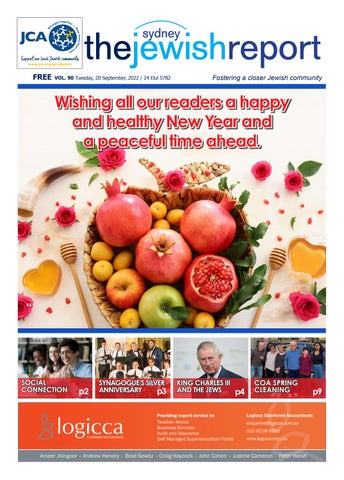
Wishing all our readers a happy and healthy New Year and a peaceful time ahead.
xx
SOCIAL CONNECTION
p2
SYNAGOGUE’S SILVER ANNIVERSARY p3
KING CHARLES III AND THE JEWS p4
COA SPRING CLEANING
p9
2
the sydney jewish report | September 2022
AROUND
T H E
COMMUNITY
Social connection
ANNE-MARIE ELIAS As we approach the new year, it is hard not to reflect upon just how unusual the past couple have been due to the COVID-19 lockdowns. Fortunately, more recently we have moved back to a more normal way of living and we can consider again just how important it is for us to have social connections. Here are a few comments from my clients: • “I enjoy being with other people.” • “I love being with my family and friends, and miss them terribly when we needed to isolate.” • “Everyone says I’m a social butterfly. I flit from one engagement to another.” • “During lockdown I really missed seeing people and having companionship.” Psychologically, social connection is the feeling that you belong to a group and are close to others. Research has found that social connection is a core psychological need, essential to feeling satisfied. When we connect, we receive a dopamine hit. The pleasure centre of our brain registers a feel-good moment.
JUDAIC A
QUIZ
RABBI DAVID FREEDMAN There is so much to look forward to this year, with synagogue doors mercifully open and guests permitted at our Yom Tov tables. It is post-pandemic in the most positive way! One dimension of the sweetness – beyond the apple and honey – will be the gantze mishpochah – the whole family - answering these quiz questions below. This edition of the quiz is firmly focused on all-things-Rosh Hashanah and there is truly a marvellous mix of questions for the young – and the notso-young too! Through a Jewish lens we explore this special time of year delving into history, sport, politics, culture, customs and so much more! Make sure you keep this printed copy handy, so generous hosts and grateful guests alike can join in to have a collective crack at the range of Rosh Hashanah questions below! 1. Which ritual associated with Rosh Hashanah is first mentioned in the writings of the Maharil, Rabbi Yaakov Moelin (Germany 1365-1427)? 2. On festivals such as Rosh Hashanah and Yom Kippur we read from a Machzor (a festival prayer book) as opposed to a Siddur (a daily prayer book). The word Machzor is derived from the Hebrew word la-ch’zor – what does this mean?
During isolation and lockdown we were unable to activate this important element of our chemistry. Many younger people, in particular, missed out on forming vital relationships at school and university as studies went online only. Depression and anxiety were rife. The need for connection, inherent in our evolution as a species, starts to explain the huge uptake in psychological counselling.
Researcher Laurie Hare-Duke developed a five-element CIVIC framework for connectedness. He identified these as closeness, identity and common bond, valued relationships, involvement and care. One of my clients recently announced that he had done some “spring cleaning” of his friends, sticking with those that made him feel good and valued. A common theme from ex-military and emergency services personnel is that they no longer feel involved. Their
primary network of colleagues is absent and they seek re-engagement with likeminded people. With the High Holydays upon us, now is again the time to embrace social connection. Doing so helps lower anxiety, regulate emotion, increase empathy and improve our immune systems. In other words, the hard wiring of our brains can work as intended. Anne-Marie Elias is a psychologist in clinical practice for 25 years.
Test your knowledge 3. What dish made from carrots, cinnamon, sweet potatoes, prunes, and honey, is a traditional Rosh Hashanah food? 4. What custom on Rosh Hashanah is related to the tears of a non-Jewish woman who mourned and cried over the death of her son, a Canaanite general in conflict with the Israelites? 5. True or false – Rosh Hashanah always coincides with a full moon? 6. On which days of the week can Yom Kippur never occur? 7. What problem did the inhabitants of Tzfat (Safed) face when they wished to perform Tashlich, and how did they overcome this difficulty? 8. What cycle of study began on First Day Rosh Hashanah back in 1923? 9. Which US President included the following words in one of his annual Rosh Hashanah greetings: “This year, Rosh Hashanah comes at a particular difficult time for many across the globe as we mourn the loss of former Israeli President and Prime Minister Shimon Peres.” 10. What kind of food, traditionally eaten on Rosh Hashanah, is known as Lekach? 11. Which famous American member of the judiciary died on Erev Rosh Hashanah, September 18th 2020? 12. The following is a quote from which movie: "My son came to me in my dreams—he sang Kol Nidre so beautifully. If he would only sing like that tonight—surely he would be forgiven."
13. The name Rosh Hashanah does not occur in the Torah – by what other name or names is this festival known within the Five Books of Moses? 14. In July 2020, Rabbi David Lau, the Chief Rabbi of Israel, along with Rabbi Chaim Kanievsky, called for which prayer, often associated with Rosh Hashanah and Yom Kippur, to be recited twice daily in response to the spread of coronavirus in Israel? 15. The following relates to which one of these three famous Jewish philosophers? “Under the influence of his cousin and close friend Eugen RosenstockHuessy, he considered converting to Christianity. Determined to embrace the faith as the early Christians did, he resolved to live as an observant Jew first, before becoming Christian. After attending Yom Kippur services at a small Orthodox synagogue in Berlin, he underwent a mystical experience. As a result, he became a Ba’al Teshuva. Although he never recorded what transpired, he never again entertained converting to Christianity.” a) Martin Buber b) Franz Rosenzweig c) Franz Kafka 16. According to the sages, why is the traditional shape of a Shofar curved and not straight? 17. True or false – Isaac and Ishmael (the two sons of Abraham) are both mentioned within the Torah reading for First Day Rosh Hashanah?
18. ‘Elul’, the month preceding the High Holy Days, is an acronym for which phrase from the Song of Songs, which is meant to describe the close relationship between the Jewish People and G-d? 19. Why did Dudi Sela, at the time he was Israel’s Number One ranked male tennis player, quit his quarter-final match in the third set of the 2017 Shenzhen Open forfeiting a possible $34,000 in prize money and 90 rankings points? 20. What activity, often enjoyed on Shabbat afternoons, is according to custom discouraged on Rosh Hashanah? 21. What particular type of food should not be eaten on Rosh Hashanah because the numerical value of its Hebrew letters is close to chet, meaning sin? 22. Given that we kneel on Rosh Hashanah and Yom Kippur, why do we not kneel during prayer at other times of the year? 23. Which Jewish community, now resettled in Israel, uses the horn of a kudu antelope instead of a ram’s horn for Shofar blowing? 24. What name is given to the personal introductory prayer recited by the chazzan/cantor immediately before Mussaf/the Additional Service? 25. What is the greeting offered to another Jew, immediately after Rosh Hashanah has ended?
ANSWERS PAGE 16
the sydney jewish report | September 2022
Synagogue’s silver anniversary African-born,
DOVER HEIGHTS SHULE Three
hundred
people
filled
concert
to
Dover
mark
chazan
rabbi and chazan Menachem Feldman,
Heights Shule on 29th August for a spectacular
London-based
Yudi Cohen, Great Synagogue assistant
the
the Great Synagogue choir and the Ben Adler and Friends Ensemble. The musical arrangements and piano
synagogue’s 25th anniversary. Among
accompaniment
those performing were renowned South
Raymond Goldstein.
The golden sounds at the silver anniversary concert
was
provided
by
Menachem Feldman in full voice
3
4
the sydney jewish report | September 2022
I N T E R N AT I O N A L
NEWS
King Charles III and the Jews miss him more than words can say … He taught us how to listen to others and how to learn from them without compromising the convictions of either party; he taught us to value participation in the common life of the nation and through it all he taught us the need to respect the integrity and harmony of God’s Creation.”
DR YVETTE ALT MILLER COURTESY: AISH.COM With the passing of Britain’s beloved Queen Elizabeth II at age 96, the longest serving monarch in the United Kingdom’s history, her eldest son Prince Charles has become Britain’s newest monarch. Here are six facts about King Charles III, Jews and Israel. Circumcised by a Rabbi King Charles III has something in common with thousands of British Jews. He was circumcised by Rabbi Jacob Snowman (1871-1959), a brilliant physician and one of London’s leading mohelim (Jewish ritual circumcisers). It is widely believed that the tradition dates back to the early 1700s, when Britain’s King George I – who was born in Germany – imported the custom of German noblemen to have mohelim circumcise their sons. Though some have disputed this account, claiming that this royal practice is far newer. It is unclear why this became a tradition, but some speculate that their extensive experience reassured anxious parents that their sons would be safe during the procedure. Charles’ mother Queen Elizabeth wanted only the best for Charles, so she turned to Rabbi Snowman, who was well known in London’s Jewish community. Visiting Israel Unlike Queen Elizabeth II, who never visited Israel in all her long years on the throne, her son Charles has made trips to the Jewish state. One emotional visit occurred in 2016, when he travelled to Jerusalem for the funeral of former Israeli Prime Minister Shimon Peres. While there, Charles visited the grave of his grandmother, Princess Alice of Greece, who saved Jews during the Holocaust and was named Righteous Among the Nations by Yad Vashem. She is buried in the Mount of Olives in Jerusalem. Born in 1885, Princess Alice was the great granddaughter of Britain’s Queen Victoria. She married Prince Andrew of Greece and moved to Athens with her new husband. She was intensely
unhappy. A religious Christian, Alice watched as her husband drifted into a life of dissolution. With the rise of Nazism in the 1930s, her three daughters all became ardent Fascists and married Nazi officials. Only her son Philip, King Charles’ father, defied Nazism, moving to England and fighting with distinction in the British Air Force during World War II. Princess Alice remained at home in Athens alone; her husband had long since left her and was completely devoted to a life of drinking and gambling. During the Holocaust, Princess Alice invited a Jewish family she was friends with, the Cohens, to move into her apartment with her. Her building was next to the Gestapo’s Athens headquarters and at one point Princess Alice was even brought in for questioning, but she refused to divulge the fact that she was sheltering Jews. Alice founded a religious order and died in 1969. Her wish was to be buried in Israel. At first her family ignored her request, but in 1988 the Royal Family arranged for her remains to be reinterred in Jerusalem. On his 2016 visit to her
grave, Charles brought purple flowers – her favourite – that had been grown in Scotland and placed them on her grave. King Charles visited Israel again in 2020, when he attended the World Holocaust Forum in Jerusalem, commemorating the 75th anniversary of the liberation of Auschwitz. There, Charles lingered, speaking with Jewish Holocaust survivors at length and hearing their stories. “He was very interested in how it was in Auschwitz and how we managed to survive,” explained survivor Marta Weiss, who met the newest monarch during his visit. “He was very sympathetic. He came across as genuinely interested, not just doing it for the sake of it.” He Owns His Own Personalised Kippah King Charles III owns his own personalised kippah: a blue velvet yarmulke adorned with the official royal crest of the Prince of Wales, his previous title, embroidered in gold and white thread. One of the first sightings of the royal kippah was at the installation of Britain’s Chief Rabbi Ephraim Mervis in 2013. Charles was the first member of the Royal Family to attend an installation of a chief rabbi. Friends with Leading Orthodox Rabbi King Charles and Rabbi Lord Jonathan Sacks, the former Chief Rabbi of Britain, of blessed memory, forged a close bond, brought together by their public roles as community leaders and their shared commitment to making the world a better place. When Rabbi Sacks died in 2020, Charles delivered an emotional eulogy for his friend and teacher. Rabbi Jonathan Sacks “and I were exact contemporaries, born in the year of the foundation of the State of Israel, and, over many years, I had come to value his counsel immensely. He was a trusted guide and inspired teacher and a true and steadfast friend. I shall
Adding Portraits of Holocaust Survivors to the Royal Collection Last year, King Charles commissioned seven major new paintings to add to the official Royal Collection of art, displayed in Buckingham Palace: seven paintings of Holocaust survivors. The project was part of the Prince’s long-standing aim of educating future generations and ensuring that the horrors of the Holocaust are never forgotten. King Charles himself wrote an introduction to the exhibit’s catalogue: “Behind every portrait is a unique story of a life lived, of love, of loss. However, these portraits represent something far greater than seven remarkable individuals. They stand as a living memorial to the six million innocent men, women and children whose stories will never be told, whose portraits will never be painted. They stand as a powerful testament to the quite extraordinary resilience and courage of those who survived and who, despite their advancing years, have continued to tell the world of the unimaginable atrocities they witnessed. They stand as a permanent reminder for our generation – and, indeed, to future generations – of the depths of depravity and evil humankind can fall to when reason, compassion and truth are abandoned.” Touched by Jewish Prayers for the Royal Family Each week, Jews across Britain and the Commonwealth pray for the welfare of the monarch and their near relations in synagogue on Shabbat. In 2019, at a royal Chanukah party at Buckingham Palace, King Charles praised Britain’s Jewish community and formally thanked them for their prayers. “I say this from a particular and personal perspective because I have grown up being deeply touched by the fact that British synagogues have, for centuries, remembered my family in your weekly prayers. And as you remember my family, so we too remember and celebrate you.” King Charles III is consoling his nation from the depths of his own grief. It is a testament to his commitment to a life of service and giving to others. After Queen Elizabeth II's death, Britain's Chief Rabbi Ephraim Mirvis noted that "throughout her extraordinary reign, she conducted herself with grace, dignity and humility and was a global role model for distinguished leadership and selfless devotion to society … Every week in synagogue we have prayed for her welfare, well-being and wisdom and she never let us down." “We wish those very same qualities for her son, Britain's new king, and extend our deepest sympathies and our wishes for a long a successful reign.”
5
the sydney jewish report | September 2022
Your community still needs you IAN SANDLER JCA The pandemic seems to have eased and life has returned to normal. We see people going about their daily tasks, only a few wearing masks. Restaurants are busy and our shopping centres are full of life. It is easy to get lulled into a false sense of security – into a feeling that everyone and everything are okay. We are also seeing the rising cost of living and people struggling financially. The gap is widening between what we raise and what our member organisations ask for. With 25 supported organisations providing programs and services to our community and some people relying on those daily services just to be independent it is unthinkable that we wouldn’t be there to assist. As JCA president, I know that our raison d’etre is to ensure that we look after those that need it most. This doesn’t happen without the support of many. Working on the frontline doesn’t only mean assisting those that are vulnerable. Our community is always susceptible to attack and with the recent rise of antisemitism reported extensively in the media we cannot be complacent. It would have been difficult not to have seen extensive commentary by Darren
Bark, CEO of the NSW Jewish Board of Deputies, in mainstream media like The Sydney Morning Herald and The Australian. We are fortunate to have such advocacy for our community guiding how best to move forward as a society that won’t tolerate racism. Again, this doesn’t happen without communal support. While our campaign is tracking well, we still have a long way to go (almost $4 million) to meet our target this year of $15 million. Even if this is achieved, we will still fall short of the current ask by our supported organisations by approximately $5 million. This year we have appealed to the whole community to step up and support us. A large or small donation can make a difference. It also means we know that we have the strength of the community behind us. With economists predicting uncertain times, I know that JCA will be there for our community. It is certainty that makes our community one that is held in high esteem worldwide – one that is known as a thriving and vibrant place for Jewish continuity and identity. It is a community we can all be proud of. Let us work together to make our community one that continues to grow and thrive. And, as JCA, our promise to you is to always work in your very best interests. Wishing you and your loved ones a Chag Sameach and Shana Tova Umetukah.
Yoni Glatt’s JEWISH SPELLING BEE How many common words of 5 or more letters can you spell using the letters in the hive? Every answer How many common words of 5 or more letters can must use the centre letter at least once. Letters may you spell using letters in one the word hive?willEvery be reused inthe a word. At least use allanswer 7 must useletters the center letter atJewish least connection. once. Letters may and have a direct
be reused in a word. At least one word will use all 7 Proper names and hyphenated words are not allowed. letters and have a direct Jewish connection. Score 1 point for each answer and 3 points for a Jewish word that uses all 7 letters.
Proper names and hyphenated words are not allowed. 6=Good; Excellent;and 10= 3 Genius Score 1 Rating: point for each8=answer, points for a Jewish related word that uses all 7 letters. Rating: 9=Good; 17= Excellent; 25= Genius
Yoni Glatt has published more than 1,000 crossword puzzles worldwide, from the LA Times and Boston Globe to The Jerusalem Post. He has also published two Jewish puzzle books: "Kosher Crosswords" and the sequel "More Kosher Crosswords and Word Games". ANSWERS PAGE 16
Here is a list of some common words (Yes, we know there are more words in the dictio that can work, but these words are the most common): Jewish Answers- TRADITION, ORDINATION. Other words: ADORATION, RADIATION, ADDIT RADIATOR, DONATION, DONATOR, RADIANT, ANDROID, TORNADO, ORDAIN, INDOOR, INR DOODAD, TORRID, INDIAN, ADROIT, RADAR, TRIAD, RONDO, RADII, RADIO, DONOR, DRA ARDOR, DROIT, ADORN, DINAR, NADIR Questions/comments- email Yoni at koshercroswords@gmail.com ‘
6
the sydney jewish report | September 2022
AROUND
T H E
COMMUNITY
Family roots
LAUREN SHAPIRO Little did Brian Lurie know that at the time of his death a search was going on around the world that would result in information that would alter his family history. Brian was born in Johannesburg in September 1943 to an unmarried woman and was put up for adoption. “In those days, having a baby out of wedlock was frowned upon,” said Ora Villalobos, Brian’s biological sister. “She was 19. People do what they think is right. Perhaps she had old-fashioned values. Perhaps she was frightened of being judged.” Brian was adopted in Durban by Cessie and Alec Lurie. Although he knew that he was adopted, he knew nothing about his biological family. His biological mother, Clare Friedland, went on to marry Nathan Wollach in 1945 and raised four daughters in her native Cape Town. The girls knew nothing about the brother that had preceded them. “As kids we always felt like there was some kind of secret. Our mother carried an invisible burden, but not in a billion years would we have guessed what it was,” Ora said. Around seven decades later, a cousin in London accidentally spilled the beans in a conversation with Ilana Gaash, Ora’s younger sister. “She blurted out
Ora Zoe Villalobos something about our brother. Ilana had no idea what she was talking about, but as soon as the truth dawned on her, things started to make sense,” Ora said. The sisters, now living in the US and Israel, started a mission to find their long-lost brother, but they had very little information to go on. “We didn’t even know his name. We just knew that he was born in Johannesburg in the early forties,” Ora said. “We hired an attorney and a social worker that specialises in this kind of thing and we had to sue the Department of Social Development to get access to the files. Luckily, permission was granted.”
At the same time, across the globe, Brian’s daughter, Joanne Lurie, was also researching her past. “By some amazing coincidence, Joanne picked us out on a community forum about adoption. What luck and karma was that,” Ora said. They ran DNA tests, which confirmed a match. They had found family. Perhaps the saddest part of this story is that Brian passed away just a month before they found him. “Because the family secret was kept for all those years, we never got to meet him,” said Ora. “It was very hard to swallow. It was extremely frustrating.” Ora says she is not angry with her family for keeping the secret from her. “We can’t really blame anyone,” she said. “People did what they thought was best, but it was frustrating, especially the timing. However, we have to look at the positive: we finally got the truth.” After COVID restrictions were lifted, Ora made the journey to South Africa to attend the unveiling of Brian’s tombstone. “It was a wonderful trip and a celebration of Brian’s life,” she said. “We finally got to meet Brian’s family and embraced them.” With Joanne living overseas, Ora met her brother Wayne and his eightyear-old son Alec in Johannesburg. “It felt completely natural,” Ora said. “He invited me to stay in his home, never having even met me and it just worked.” The quest is still on to find more
members of the long-lost family. “We keep hearing stories and names and we’re pursuing every lead,” Ora said. They still don’t know who Brian’s biological father is. It is unlikely he is still alive, but there may be descendants of his that would want to know about the family. With so many South African Jews having made their way to Australia, that is the next logical place to look. Ora used two global databanks in her search for her family, namely www. myheritage.com and www.ancestry. com. “You send for a test kit and mail back a swab of cells from the inside of your cheek. The company then analyses it and loads it into the database. If someone related to the family loads data, it will match,” Ora said. At this point, the process has done everyone “an amazing amount of good,” Ora said. “Secrets are not healthy. We’re so happy to have had the opportunity to set the record straight.” Ora and her sisters are determined to pursue the hunt for Brian’s paternal family. By raising awareness they hope to be able to piece together more of the puzzle. Anyone who may have any information can contact Ora at orazoe@icloud.com
SEEKING Father & Family Looking for any information regarding the father of a male child named Brian Lurie, born in Johannesburg, South Africa, on 19th September 1943 to Clare Brenda Friedland of Cape Town and adopted by a Durban couple in 1945. Please respond to:
orazoe@icloud.com Brian Lurie
7
the sydney jewish report | September 2022
AROUND
T H E
COMMUNITY DARREN BARK NSWJBD It has been an honour and a privilege to lead the NSW Jewish Board of Deputies for the past year, helping to build an inclusive and safe New South Wales and a united and connected Jewish community. These past 12 months have not been short of challenges. Last year’s High Holy Days were an unprecedented time for our community. Shules and schools were closed and our entire state in COVID-19 lockdown. Despite these extraordinary circumstances, the NSWJBD was able to unite our community and bring everyone together to hear the shofar on Rosh Hashanah and participate in COVIDsafe outdoor services on Yom Kippur. The NSWJBD liaised directly with the state government, NSW Health and NSW Police to ensure we could continue our traditions, while abiding by the health orders. Sadly, antisemitism continues to rear its ugly head every day. According to CSG, there were 490 antisemitic incidents in Australia in 2021. That was a 38 per cent increase on the year before. NSW experienced the highest reported number of antisemitic incidents of any state in the country.
Ensuring a safe, inclusive and vibrant community
Top row, from left: NSW Jewish Board of Deputies vice-president David Ossip, Holocaust survivor Eddy Boas, Hindu Council of Australia vice-president Surinder Jain and NSW Jewish Board of Deputies CEO Darren Bark. Bottom row, from left: Gabrielle Upton MP, Mark Speakman MP, Mark Coure MP, NSW Jewish Board of Deputies president Lesli Berger and vice-president Nathalie Samia. Photo courtesy of Noel Kessel It is a constant reminder that the things
give evidence before a parliamentary
we love to do are not possible without a
inquiry. We urged the government to
safe and secure home to do them from.
ban the public display of Nazi symbols.
Earlier this year, the NSWJBD worked
I am proud to say, it listened. A bill
with the Hindu Council of Australia to
passed both houses of parliament with
unanimous support last month, one we championed collaboratively with our interfaith brothers and sisters. It enhances the safety of not just the Jewish community, but Australian society. Nazi symbols are a gateway to violence and are used as a recruitment tool by extremists. Banning their display is long overdue and much needed in our state. The perpetrators will finally be held to account. Meanwhile, I recently returned from a NSW trade mission to Israel as part of a partnership with the AustraliaIsrael Chamber of Commerce (NSW) and Business Western Sydney. Also in attendance was the Minister for Enterprise, Investment and Trade, and Science, Innovation and Technology, Alister Henskens SC MP. Israel is a world-leader in the technology, defence and startup industries and I look forward to the partnership opportunities that lie ahead. This is an exciting time for the Board and the community. Our core focus is on ensuring we have a safe, inclusive and vibrant community. We will continue to engage with our members and constituent organisations to deliver what matters most to our community.
Quality cinema at JIFF JIFF A movie that received a seven-minute standing ovation at the Cannes Film Festival will headline the upcoming Jewish International Film Festival. Armageddon Time, starring Anthony Hopkins, Anne Hathaway and Jeremy Strong, will have its Australian premiere
on the opening night of JIFF. Written and directed by James Gray (who was responsible for the Brad Pitt vehicle Ad Astra in 2019), the one hour 55-minute drama is a deeply personal coming of age story. JIFF will run from 25th October to 28th November at the Ritz and Roseville cinemas. For tickets, go to www.jiff.com.au
SHANA TOVA THE NSW JEWISH BOARD OF DEPUTIES WISHES YOU AND YOUR FAMILY A SWEET, HAPPY AND HEALTHY NEW YEAR.
WWW.NSWJBD.ORG.AU
8
the sydney jewish report | September 2022
IS RAE LI
NEWS
BY NOMI KALTMANN COURTESY: TABLET MAGAZINE In Jerusalem, Shabbat Shelach maintains a focus on both queer identity and religious practice. Nicole Kaufman Grubner wasn’t publicly out as a lesbian in her hometown of Vancouver, but after she made aliyah in 2013, she began to share her identity more widely. She started looking for a community in Israel where she could meet other people like herself. She was thrilled to find Shabbat Shelach , a group that aims to build community for lesbian, bisexual, and transgender women … around the Shabbat table. Shabbat Shelach was founded in 2016 by two Americans, Sarah Weil and Ariel Hendelman. “We had nowhere to go,” said Weil. “The religious Jewish world accepted our Judaism, but rejected us as gay. And the gay world accepted our gayness, but rejected our Jewish values. We were stranded between worlds and so we created a new space, where we could live authentic Jewish lives as gay women. For me, Shabbat Shelach became my supportive community for living a Torahcentred, God-centred life and building a real future as a gay Jewish woman.” At least once a month, the group hosts potluck Shabbat dinners in private homes in Jerusalem, attended by Jewish women from around the country. On average about 10 women attend each Shabbat meal, but if the host has capacity, it can be larger. “There are a lot of LGBTQI+ groups that focus exclusively on queer identity and often people with a religious identity have to pick one identity over the other,” said Kaufman Grubner, who has been a member since 2016. “Shabbat Shelach was founded to say we want to have both parts of our identities and that is why the organisation is centered around the Shabbat table.” The group differentiates itself from other lesbian support groups in Israel, such as Bat Kol, because most of Shabbat Shelach’s members are Englishspeaking olim who come from religious or spiritually inclined backgrounds. While the group does not specifically identify as Orthodox, many of its members, including Kaufman Grubner, are from observant or spiritually inclined homes and have an affinity and deep familiarity with religious practices. “We have members who live in fully ultra-Orthodox cities, who are not out, and they come to Shabbat Shelach. We have members who are atheist who are connecting around Shabbat. All the meals we put on are kosher and the food must be prepared in a kosher kitchen. We want everyone to feel that comfort,” said Kaufman Grubner. From this simple premise, the group, which numbers close to 200 members, created a lesbian support community that many were seeking. Its members include Americans, Canadians, Australians, New Zealanders and Europeans. A few Israelis have also
Building community over Friday night dinner yet out to their families and friends in religious communities. For Tova F., who asked that her last name not be used because she is not out to her grandparents, Shabbat Shelach provided a welcome to a community that she had not previously realised she was a part of. Growing up in New York in a modern Orthodox family, she went to an all-girls’ school. She said “we definitely weren’t talking about LGBTQI rights in my home or school.” “In Israel I was more open, in Israel I was experimenting with coming out. I realised that I needed people. I grew up without role models” in the LGBTQI+ community. The first time Tova came to Shabbat Shelach, she felt that she had found a place where she could really belong. Shabbat
Shelach
attracts
women
who are looking for a familiar religious experience their
while
queerness
being and
proud
this
of
provides
an unexpected side benefit for all attendees: matchmaking. In just over six years of operations, it is estimated 10 couples have met through Shabbat Shelach. Naavah Vesley, a 25-year-old who made aliyah from New York met her partner, Jules, through the group. While these days, the two of them and their baby live in Sydney, they owe their partnering to Shabbat Shelach. “At Shabbat Shelach we have a pretty good shidduch rate,” said Vesley, using the Yiddish term for matchmaking. “It is joined their programs. Members range in age from their early 20s to their 60s. “Shabbat is really the epitome of this idea of welcoming, gathering, sharing food and Torah and stories, opening our homes to each other,” said Hendelman. “In Shabbat we found the secret to community. It fills me with so much
Before the COVID-19 pandemic, the group was gaining momentum around its programs and a growing number of women who were pleased to find their niche in the active LGBQTI+ scene in Israel. In addition to regular Shabbat meals, the group hosted a Passover Seder with a grant from the Schusterman
one of the most beautiful communities I have ever been part of. We are proud of who we are. We are Jewish and queer. We are different. We are two minorities.” Before joining Shabbat Shelach, Vesley had been searching for a community where she belonged. “Before I moved to Israel (in 2018) I came to terms with the fact I’m a lesbian – a
“Shabbat is really the epitome of this idea of welcoming, gathering, sharing food and Torah and stories, opening our homes to each other.”
religious lesbian. I grew up in a
closed religious Orthodox community in New York. I did not know what a lesbian was until I was 16,” Vesley said. “I made friends in Shabbat Shelach that I never thought I would make.” “When we started Shabbat Shelach, we were looking to fill a need – especially among anglo LGBTQI+ women – for
joy and pride that now, six years later, Shabbat Shelach is still going strong. It is such a blessing and shows how much it was needed.” While the majority of members are lesbians, the group includes those who don’t identify as lesbians but are gender nonbinary or transwomen. “We are women-aligned,” said Kaufman Grubner. “If you identify as a woman and are assigned female at birth, or you are gender queer, you can attend.”
Foundation and hosted a Shabbat dinner for the wider community at the Shalom Hartman Institute. “There is a need for this type of connection and community, and I see it as part of my religious service,” said Kaufman Grubner. “To have a space that is religiously Jewish and not to feel any shame to participate in it with our full selves is really important.” Among the members of Shabbat Shelach there are women who are not
connection
and
community,”
said
Kaufman Grubner. “Today we have that community, but we also attend each other’s weddings, get together for meals and meet at the park to play basketball. Shabbat Shelach has created a space to meet friends and potential partners, and connect over shared values.” This story originally appeared in Tablet Magazine
(tabletmag.com)
reprinted with permission.
and
is
9
the sydney jewish report | September 2022
AROUND
T H E
COMMUNITY
Spring cleaning
COA SYDNEY In the best Springtime tradition, COA Sydney undertook a long awaited, preHigh Holidays cleanse of its Woollahra headquarters. After 19 years occupying the Krygier Centre there had been a slow but steady accumulation of items that made their way to COA. That happened as clients downsized their living arrangements or found a treasure during their own household cleanups, which they could not bear to simply throw away. Although COA loves to receive useful items from members, it also does not have the heart to discard “gifts”, even if they present no real value to COA. In the past many staff have been emotionally invested in these “goodies” as they brought back memories of past COA clients and volunteers. That is the reason the accumulation of items went on for many years. So, with trepidation, a date was settled upon and a trailer hired for the cleanup. It took staff more than a week to prepare for the big day. They dived under stages, delved into large storage spaces and emptied every cupboard in an effort to divest the COA
Pictured, from left, are George Glasel, Michael and Susan Moses, Michelle Frank, Michael and Yvonne Shapiro OAM, with COA’s Volunteer Coordinator Ranmalie de Silva. in the load. And after the trailer was packed as full as possible, everyone relaxed over a pizza lunch. Thereafter, CEO Sabina Kovadlo, her partner Brad and development officer Sandy Matrai drove the packed trailer to the Lucas Heights tip.
Centre of unnecessary clutter. Anything out of date, broken or no longer required was marked ready for disposal. Sunday, 18th August saw three COA staff and 10 volunteers running laps to the parking lot with armfuls of boxes, furniture and random items for inclusion
Recrui ng
It was a cathartic experience and a fitting end to a hallenging but successful year at COA. The organisation looks forward to welcoming 5783 with clear hearts and minds … and a very clean centre.
CANDLE LIGHTING TIMES Friday, Sep 23, 2022
5:34 pm
Shabbat ends, Sep 24, 2022
6:30 pm
Friday, Sep 30, 2022
5:39 pm
Shabbat ends, Oct 1, 2022
6:35 pm
Friday, Oct 7, 2022
6:44 pm
Shabbat ends, Oct 8, 2022
7:40 pm
Friday, Oct 14, 2022
6:49 pm
Shabbat ends, Oct 15, 2022
7:46 pm
Friday, Oct 21, 2022
6:55 pm
Preferred: Current LR driver's license
Shabbat ends, Oct 22, 2022
7:53 pm
Essen al:
Friday, Oct 28, 2022
7:01 pm
Shabbat ends, Oct 29, 2022
7:59 pm
Friday, Nov 4, 2022
7:08 pm
Training is available for: LR license - if one is not already a ained, cost to be covered by COA Manual Handling
Shabbat ends, Nov 5, 2022
8:06 pm
Friday, Nov 11, 2022
7:14 pm
For a full job descrip on, further informa on on selec on criteria and renumera on for the role, or to apply for the posi on please contact:
Shabbat ends, Nov 12, 2022
8:14 pm
Friday, Nov 18, 2022
7:21 pm
Shabbat ends, Nov 19, 2022
8:21 pm
DRIVER + REPAIR & MAINTENACE, COOKING, AND MORE PERMANENT PART TIME POSITION (30hours p/w), SALARY AND CONDITIONS AS PER “SCHADS” AWARD, SALARY PACKAGING AVAILABLE EASTERN SUBURBS LOCATION
Are you the ul mate all rounder? Come and join the small but dedicated team at COA Sydney as we provide services for the frail and aged in our community. If you are versa le, reliable, friendly and courteous, with an affinity for helping seniors get the most out of life, and capable of some heavy li ing on occasion, then we need you! Working out of our Seniors Centre in the Eastern Suburbs Monday to Friday, you will be required to drive a minibus both transpor ng seniors and bringing goods to COA, and oversee volunteers making lunch on Mondays, as well as; occasional handyman tasks, shopping, delivery of Kosher Meals on Wheels, cleaning and set up tables and chairs in the COA Centre, care and cleaning of minibuses, and other tasks required. A posi ve can-do a tude A commitment to working with the frail aged Ability to aid seniors in and out of minibus Able to fulfill physical requirements of posi on Ability to follow direc ons Ability to work well as part of the team or autonomously
Sabina Kovadlo, Chief Execu ve Officer Ph: 9389 0035 Em: opera ons@coasydney.org Only suitable candidates will be contacted by COA.
10
the sydney jewish report | September 2022
RABBINIC
THOUGHT RABBI DR BENJI LEVY “People hearing without listening” are the immortal words from the song Sounds of Silence by Paul Simon. In a rabbinic context, what do these words really mean? At the conclusion of the central thematic development of the Mussaf prayer on Rosh Hashanah, we declare: ki ata shomeya kol shofar uma’azin trua, meaning: “for you hear the voice of the shofar and listen to its sounding”. Rav Yosef Teomim, the 18th century author of the pri megadim highlights an apparent redundancy. What is the difference between kol shofar, “the voice of the shofar” and trua, “its sounding” and similarly, what is the difference between shmiya, “hearing” and haazana, “listening”? My Rosh Yeshiva, Rav Aharon Lichtenstein, explained that hearing the voice of the shofar refers to the background passive noise that passes one by. On the other hand, listening is an active exercise that requires concentration on the content and mindfulness of the context of the symphony that is life. It is for this reason that hearing in the prayer refers to the plain sound that the shofar makes, the single tekia, whereas listening is said in relation to the trua, the triad of blasts that incorporates moments of silence between the sound. Joshua Bell, one of the 21st century’s finest classical musicians was asked – as a social experiment – to busk in a thoroughfare outside a metro
Don’t just hear the shofar – listen! station with his finest violin, crafted by Antonio Stradivari. At 7:51am on the 12th January 2007, Bell opened his violin case, threw a few dollars in and started to play. Bell performed six masterpieces that he usually fills concert halls with and gave it everything he had. For 43 minutes 1,097 people walked by the virtuoso. Only seven stopped to hear the music for more than a minute and 27 tossed in some money before hurrying on. The rest rushed by on their way to their next engagement. This was recorded in an article in The Washington Post. Upwards of 1,000 comments were received. More than 10 per cent wrote that the article made them cry. Cry that is for the sedated souls that couldn’t stop to appreciate the beauty that surrounded them. Cry for the lost moments, the opportunities that slip through our hands, never to return. Cry for the rush of life that goes by so fast that we don’t stop to listen to the music. The primordial cry of the shofar can pierce the mire of mediocrity where we sometimes find ourselves. Rosh Hashanah, the head of the Jewish year, encourages us to incorporate shmiya and ha’azana – to hear and listen to the sound and silence of friends, family and those around us in order to better ourselves and the world at large. This year, don’t just hear the shofar – listen! Wishing you, your family, your community and all of humanity a sweet and successful new year – shana tova umetukah!
For your FREE electronic copy of the Sydney Jewish Report, register at www.thejewishreport.com.au
11
the sydney jewish report | September 2022
AROUND
T H E
COMMUNITY
Support the People of Israel
UIA Having witnessed the worst humanitarian crisis in Europe since WWII, UIA NSW is proud to stand with the People of Israel. Tens of thousands of Jews displaced from the Ukraine, Russia, Belarus and other former Soviet Union (FSU) countries have sought, and continue to seek, refuge in Israel. UIA’s global family – a Jewish international collective – works to further the national priorities of the State of Israel through its many projects. There are campaigns in 40 countries and nine languages, across 22 time zones. UIA projects place special emphasis on advancing weaker communities, nurturing disadvantaged and marginalised youth, connecting young Diaspora Jews to Israel and Jewish life, and encouraging aliyah. With community support, UIA can help new immigrants to realise their dream of making Israel their home. UIA’s strategic partner, The Jewish Agency for Israel, continues to work tirelessly on the front lines, rescuing thousands of Jewish refugees. The global UIA family has provided financial support to assist this emergency operation, yet the need continues.
More than 18,000 immigrants from the FSU have already made aliyah. That represents 86 per cent of all olim so far this year. These olim are being supported in Israel through absorption services and programs provided by Keren Hayesod-
UIA (KH-UIA), in partnership with The Jewish Agency. More are expected to arrive. Moving from the emergency phase to the long-term planning phase requires substantial funding to address demands.
KH-UIA is proud to be part of this operation and is continuing to focus on providing these olim with tools to ensure they become productive members of Israeli society. This is evident through the plethora of absorption programs and services provided. These include Ulpan Hebrew classes, fast tracking professional qualifications, mentoring services and integration support. UIA is grateful for the generosity of its supporters who enable it to perform its life-saving work. This emergency campaign is in addition to KH-UIA’s daily work. That involves supporting 6,000 at-risk youth, 7,000 elderly Holocaust survivors, 11,000 Masa Israel Journey participants and hundreds of lone soldiers and single mothers. As we approach Rosh Hashana, a time for reflection and new beginnings, a valuable way to continue to show support for the People of Israel – including the new olim who have been rescued from war – is by contributing to UIA. The UIA thanks the community for its unwavering support for the People of Israel and wishes all a Shana Tova! To support UIA, you can purchase e-cards at uiaaustralia.org.au/aboutus/e-cards, email info@uiansw.org.au or call 9361-4273.
Bringing in the New Year with a smile Year and their wish for the recipients.
BJE
Jwave families (that is those outside the NSW Jewish school system) will
Jewish students attending non-Jewish schools throughout NSW recently had the opportunity to create Rosh Hashanah cards for the elderly and less fortunate. The key was personalisation. They wrote what they liked about the Jewish New
volunteer
alongside
COA
packing
Rosh Hashanah hampers and handing out the cards at a lunch, the point of which is to encourage intergenerational community connection. Jwave is an initiative of BJE.
SHANA TOVA ON BEHALF OF THE PEOPLE OF ISRAEL, THE UIA FAMILY WISHES YOU AND YOUR FAMILY A PROSPEROUS, SWEET AND HEALTHY YEAR. WE LOOK FORWARD TO YOUR CONTINUED SUPPORT AND PRAY FOR A SAFE 5783 GLOBALLY.
שנה טובה ומתוקה
Naomi Efron
Paisley Michaels
12
the sydney jewish report | September 2022
RABBINIC
T H O U G H T Scaling the spiritual summit
end-goal for humans. G-d requires our participation in our creation, and therefore in our creation as spiritual beings – this harks back to the plural ‘us’. Teamwork. I am reminded of a powerful story that is so apt about Sir Edmund Hillary the famed explorer, philanthropist, and the first person to conquer Mount Everest. He was duly named by TIME magazine as one of the 100 most influential people of the twentieth century. Hillary failed in his first attempt at Everest, and after that abortive mission
he addressed the Science Academy in England. Mid-speech he paused, turned toward the large mural of Everest that was on the wall and declared: “Next time I will succeed because I am still growing and you, Everest, have stopped.” He was on-point and is now famous historically. His story had a fortuitous ending – he vanquished that mountain and scaled that summit. To be a human is to grow and ultimately plant that metaphorical flag at the peak! Indeed, Teshuvah is not merely about facing the past and repenting. It encompasses our aspirations for spiritual and intellectual growth. What personal goals have we set for the year to come? How do we want to develop as a parent, partner, child, professional, Jew, and communal member – to name a few dynamics? On the sixth day of Creation, G-d said, “Let us make humankind.” That process continues today; we are not yet whole. Unlike any other part of creation, we alone are blessed to eternally partner with G-d to complete the unfinished work of bettering ourselves in the most profound way. Rosh Hashanah is the birthday of humankind – let’s use this precious prechag window to examine the year that was and assess if we are exercising our share of this precious partnership. Wishing all blessings and Shana Tova.
council, representing citizens from the entire land, for him to be formally proclaimed king. As our sages say, “there is no King without a people” – after all, the people make the proclamation. On Rosh Hashana, Hashem is our king whether we declare Him so or not. He ruled before we came into existence and will do so after. Yet as there is no King without a people, we, the Jewish people, proclaim him so on Rosh HaShana. The adage, ‘no one does pomp and ceremony like the British’ is so apt. At a time like this, every manner of traditional
uniform is displayed, a veritable showcase steeped in centuries-old history. Not merely to entertain, rather to fill participants and spectators with a sense of awe and splendour. Every proclamation is preceded and followed by the sound of trumpets with royal-appointed heralds holding sceptres – a call to attention; a call to action. We, too, come to shule dressed in our finest, but also with our age-old uniform - a Tallit and Tzitzit. The Shofar blasts accompany our proclamation of Hashem as king as it too has done for millennia. We hold our ‘sceptre’ - the lulav and etrog - on Sukkot. On reflection, the most poignant moment for me was when the herald proclaimed: “Whereas it has pleased almighty G-d to call to his mercy our late Sovereign lady Queen Elizabeth II of blessed and glorious memory, we now proclaim Charles as King. We beseech G-d, by whom kings and queens do reign, to bless His Majesty with long and happy years to reign over us.” In a world filled with secularism and denial of faith, what an extraordinary declaration of belief in G-d’s providence over all of us and a recognition that we are all dependent upon his mercy. Everything is in His hands - G-d Save the King. May the King of Kings reign over us forever unto eternity.
RABBI LEVI WOLFF CHIEF MINISTER THE CENTRAL SYNAGOGUE We now find ourselves coming towards the end of the meaningful month of Elul. With each day, Rosh Hashanah draws evercloser and becomes more of a reality. The excitement is palpable, heightened here in Sydney by the freedom felt for the first set of Yamim Noraim, High Holy Days, post-pandemic lockdowns. The descriptive phraseology within the Torah is often intriguing, yet always intentional. G-d said, “Let us make humankind.” Us – plural. Nowhere else in the account of Creation do we find G-d employing that collective language. It begs several questions: Who was the Creator referring to? Whose participation was He seeking and in what context? The Baal Shem Tov, the inspirational founder of Hasidic Judaism, offered an insightful explanation. He expounded that all other living things were created complete – that is, with a pathway genetically mapped out. Animals and insects are not required to voluntarily exert themselves to change. Consider that a caterpillar becomes a butterfly because this metamorphosis – the trajectory to transform - is inbuilt.
The only living beings that must consciously employ a voluntary effort to soulfully shift and evolve is us, humans. By our own efforts, we must channel our energies into changing ourselves from self-preserving animals into spiritually enlightened human beings. In Jewish mysticism, or Kabbalah, angels are referred to as, “holy animals” because, like earthly beasts, their actions are governed by the nature hard-wired into them by G-d. Angels are created as spiritual beings and that is the desired
G-d save the king RABBI MOSHE D. GUTNICK RABBINIC ADMINISTRATOR THE KASHRUT AUTHORITY I unabashedly admit that I am a monarchist. I believe in a constitutional monarchy with the head of state being the king or queen or their representative, together with a parliament that is the second arm of government. In fact, it is the structure that most mirrors the form of government the Jewish people enjoyed during the entire First Temple period and for much of the Second Temple era. There was the head of state, the king, and then there was the Sanhedrin – an assembly of elders appointed to sit as a tribunal - at whose head was usually the prophet of the times. The king had absolute power - almost, yet that was mitigated by G-d’s will directly expressed via the prophet and Sanhedrin. My father told me that during the reign of King George V, my grandfather would take him at any opportunity to see the king, specifically to recite the blessing, “Who gave of His honour to a person of flesh and blood.” Our sages recognised that the monarchy had within it a glimpse of the glory and sovereignty of Hashem. Whatever honour is bestowed upon a king must be viewed as just a peek into
the splendour of Hashem. As the sages say, “Kingship in our earthly world is akin to kingship in the Heavenly abode.” I chronicle these words in the days following the accession of King Charles III to the throne. Simultaneously, at this time we prepare to reproclaim Hashem as our King over the universe on Rosh Hashana. There are some striking parallels. Charles, Prince of Wales, became the king the moment his mother, Her Majesty the Queen, passed away. However, there still had to be a gathering of members of the privy
13
the sydney jewish report | September 2022
AROUND
T H E
COMMUNITY AUSTRALIAN FRIENDS OF THE HEBREW UNIVERSITY Join AUSTFHU’s fully sponsored Legacy Mission Australian Friends of the Hebrew University (AUSTFHU) has facilitated 200 bequests to the university since its inception in 1926. These have helped ensure Hebrew University is ranked in the top 100 internationally. Bequests provide for the future of the university. Seizing new opportunities relies upon income from bequests because regular funding channels are not enough. Bequests allow for: • the creation of endowment funds to assist serving students; • the establishment of centres of excellence for research and study; and • the development of new buildings and wings to attract new students to the university’s six campuses. Bequestors’ names are forever perpetuated and over the years they have come from virtually every corner of Australia. Thanks to the generosity of a donor, AUSTFHU is now offering the chance to see firsthand what support for Hebrew University achieves through its free 2023
A bequest can make a world of difference
Legacy Mission. That fully sponsored visit to Israel will occur in May next year, between the country’s 75th anniversary Yom Ha’atzmaut celebrations and Shavuot.
It includes business class flights, excellent accommodation, meals and a complete program of activities. Participation is dependent upon a minimum legacy to the university.
Those interested in the 2023 Legacy Mission should contact AUSTFHU’s CEO Rob Schneider on (02) 9389-2825 or email him at ceo@austfhu.org.au
Australian Friends of The Hebrew University Our passion for progress
Wishing the community a happy, healthy, prosperous and sweet New Year.
Joseph Raskin
0423 376 667 joseph.raskin@sydneysothebysrealty.com
14
the sydney jewish report | September 2022
I N T E R N AT I O N A L
NEWS
BY SARA YOHEVED RIGLER COURTESY: AISH.COM In Munich, President Frank-Walter Steinmeier spoke as if he had studied Maimonides’ five steps of teshuvah. In the Jewish calendar, tis the season to do teshuvah – to repent for past wrongdoings. Rabbis and spiritual mentors are discoursing on the steps of teshuvah outlined by Maimonides, the great 12thcentury expositor of the concept. But, ironically, it is the president of Germany who has given the world a stunning example of repentance. The weeks leading up to the 50th anniversary of the 1972 massacre of 11 Israeli athletes at the Munich Olympics were fraught with dissension. The families of the victims announced that they would boycott the commemorative ceremony because the German government had for 50 years lied to them, refused to share the archive of thousands of files and hundreds of forensic pictures that revealed what had happened to their loved ones and offered a pittance of a financial compensation. Although it was Arab terrorists who had murdered the athletes, the families of the victims rightly accused the Germans of failure to protect the athletes (even refusing Israeli security offers), the botched rescue operation and the cold, mendacious way the German government handled the affair afterwards. Finally, German President Frank-Walter Steinmeier offered to fly to Israel to work out an agreement and the families agreed to attend the ceremony. In Munich, amidst the dark grief of commemorating the tragedy, a beacon of light shone forth from an unlikely source. President Steinmeier spoke as if he had studied Maimonides’ five steps of teshuvah. 1. The first step of teshuvah is admitting one’s failure, without rationalisations or excuses. Here’s how President Steinmeier began his address: “Today’s act of remembrance can only be sincere if we are prepared to recognise painful facts – if we acknowledge that the story of the Olympic attack is also a story of misjudgments and of dreadful, fatal mistakes: of, in fact, failure. We are talking about a great tragedy and a triple failure. The first failure regards the preparations for the Games and the security strategy; the second comprises the events of Sept. 5 and 6, 1972; and the third failure begins the day after the attack: the silence, the denial, the forgetting.” 2. The second step is to regret one’s wrong action. President Steinmeier acknowledged that it was Germany’s responsibility as the host of the Games to protect all the athletes, especially those from Israel. In a poignant admission, tinged with remorse, he confessed: “There were survivors of the Shoah among the athletes and their coaches. Their safety had been entrusted to us. What a great vote of confidence it was
President’s stunning act of repentance
German President Frank-Walter Steinmeier to take part, after the crimes against humanity of the Shoah, in Olympic Games hosted by the country of the perpetrators … We were not prepared for an attack of this kind and yet we ought to have been; that, too, is part of the bitter truth … Honoured family members, I cannot fathom what suffering, what pain you’ve been through, how can life go on. For five decades, that gnawing pain has been with you.” 3. The third step is undertaking to act differently in the future. After five decades of Germany denying the existence of the archives and evading their obligation to the victims’ families, President Steinmeier announced that the German government would establish an IsraeliGerman commission of historians to “shed light onto that dark chapter”. Directly addressing the families, he declared: “You have a right to finally know the truth, to finally receive answers to the questions that have tormented you for decades. And they include the question of why you were left alone with your suffering, your pain, for so long.” 4. The fourth step (if another person has been hurt) is to ask forgiveness. President Steinmeier did exactly that, declaring: “As the head of state of this country and in the name of the Federal Republic of Germany, I ask your forgiveness for the woefully inadequate protection afforded to the Israeli athletes at the Olympic Games in Munich and for the woefully inadequate investigation afterwards.” 5. The fifth step (if property is involved) is to make restitution. The German government, after its long refusal to do so, offered the victims’ families a compensation package of 28 million dollars. Teshuvah, our sages assert, actually changes the past. The damage remains, but the person who has done
genuine teshuvah is no longer the same agent of wrongdoing. By transforming oneself, through admitting, regretting, resolving to act differently in the future, apologising and making restitution, the
progenitor of the evil has become an agent of light. President Frank-Walter Steinmeier deserves credit for showing us all how to do it.
The only Jewish Burial Society in NSW - Since 1817
Funeral Enquiries & Arrangements
Call 9363 2248
Cremations are strictly prohibited under Jewish law. The Sydney Chevra Kadisha alone provides services according to Jewish tradition and Halacha.
Cnr. Oxford & Wallis Streets, Woollahra Email: info@sck.org.au Website: www.sck.org.au
15
the sydney jewish report | September 2022
AROUND
T H E
COMMUNITY
A life’s journey
SYDNEY JEWISH MUSEUM Over the years artist Camille Fox and her family have celebrated Rosh Hashanah at many tables, across different continents, but their love of the festival remains. The Sydney Jewish Museum recently commissioned Ms Fox to paint a representation of her family’s Rosh Hashanah table. The result encapsulated many vibrant memories. “As a small child in our villa in Alexandria, Egypt, our extended family would gather around a large table laden with crystal and silver. We would follow ancient Jewish traditions to enjoy the delectable cuisine of my grandmother and aunts,” she said. “After our expulsion from Egypt, we celebrated Rosh Hashanah on our desert outpost in Southern Israel. We had a modest makeshift table lit by kerosene lamps with some of us sitting on wooden crates and others on milk cans. The joy and excitement of this family gathering not diminished by our circumstances. “Several years later in our cramped flat in Bondi, with our extended family
Photo caption: This artwork by Camille Fox was commissioned by the Sydney Jewish Museum and funded by a donation in memory of the Chotiner, Kraemer and Schifter families. around us, we celebrated the same
words from several languages in one
comfortable in the late afternoon of life.
traditions.
sentence.
The traditions remain the same and the
We had the same delicious foods, the
“Finally, we have celebrated from a
animated conversation, peppered with
vast terrace overlooking Sydney Harbour,
h a u v ’metu o t a n a k h a s h ’ L
Wishing you and your family a sweet and happy new year from the Sydney Jewish Museum. sydneyjewishmuseum SydneyJewishMuseum Artwork by SJM Head Curator, Roslyn Sugarman
joy has never diminished. My painting reflects this journey.”
16
the sydney jewish report | September 2022
F O O D I E S'
CORNER SWEET CHICK KA-CERTIFIED
Rosh Hashanah honeycomb rocky road
In this New Year edition we are delighted to feature a perennial pleaser – Sweet Chick’s legendary Rocky Road with honeycomb as the ‘hero’ ingredient – so perfect for this festive season. Actually, it is so loved it is included all year round! This Honeycomb Rocky Road will be enjoyed this Rosh Hashanah by so many who have pre-ordered as it is a feature within the Sweet Chick Rosh Hashana range, nestled in a decadent and delicious gift and dessert box, and of course, is also available as a standalone option. This best seller can be enjoyed as a dairy (not Chalav Yisrael) treat and also there is a pareve option too, which is appreciated by our community (and the wider public) and perfect to enjoy
as part of a Yom Tov feast. Conveniently, it lasts up to a fortnight and can be refrigerated. The best news is that now you have this recipe to keep and make at home on repeat! KA-certified Sweet Chick makes the most exquisite biscuits, cakes, tarts, slices – savoury and sweet options galore – the team is ever mindful of offering both dairy free and gluten free options for those who need. Oh and one more delight this New Year will be enjoying the ‘Shana Tova’ giant round custom cookie cakes in two varieties: yellow/bee and green/apple. The good news keeps rolling as you can order from a tailored Sweet Chick menu for pre- and post-Yom Kippur
(website details below). The Sweet Chick team wish all a Shana Tova!
Judaica quiz answers
of completing the entire Talmud every seven-and-a-half years 9. Barack Obama 10. Honey cake 11. Ruth Bader Ginsburg 12. The Jazz Singer (1927) 13. Yom Teruah – The Day of Blowing, or Yom Zichron Teruah – The Day for Remembering the Blowing 14. Avinu Malkeinu 15. Franz Rosenzweig 16. In order to represent how we bend before the Almighty and demonstrate a submissive will during the Days of Repentance 17. FALSE in the sense that Isaac is the only one of the two sons mentioned by name in the Torah reading - the name Ishmael is conspicuous by its absence
18. The letters that make the word Elul – alef, lamed, vav, lamed – are the opening letters of the four words – ‘ani ledodi vedodi li’ – I am for my beloved, and my beloved is for me 19. So he could begin observing Yom Kippur by the time the sun set 20. An afternoon nap, known on Shabbat as a Shabbat Schluf 21. Nuts (Hebrew – Egoz) 22. Prostration as a form of worship was adopted by Christians. Following this, Jews felt uncomfortable continuing to do what appeared to them as a strong Christian practice, and applying the law of Chukkat Hagoy – ‘avoiding the customs of non-Jews’, they abandoned kneeling except for these few exceptionally holy days of the year
1. Tashlich – The casting away of one’s sins 2. To go around in a cycle – in this case, the cycle of the year 3. Tzimmes 4. Blowing 100 notes per day on the Shofar 5. False – it coincides with the New Moon 6. Sunday, Tuesday and Friday 7. Sefad has no streams or rivers, the only way Tashlich can be recited is to stand on one of the nearby hilltops that has a view of the Kinneret, the Sea of Galilee 8. The novel idea of Jews in all parts of the world studying the same daf, or page, of Talmud each day, with the goal
3. Pour cooled melted milk or dark chocolate over the top and spread to cover the surface of the baking dish.
INGREDIENTS: 400g milk or dark chocolate, melted 300g marshmallows 100g honeycomb, broken into pieces 100g plain biscuits, broken into pieces 100g white chocolate, melted METHOD: 1. Melt milk or dark chocolate in a heatproof bowl over a pot of boiling water; set aside to cool. 2. While chocolate cools, combine the marshmallows, honeycomb and biscuit pieces in a bowl; transfer this mixture to a baking dish (20cm*30cm) lined with greaseproof paper.
4. Melt white chocolate in a microwave for 30 seconds and drizzle over the top. 5. Refrigerate for one hour or overnight. Cut into pieces. Top Sweet Chick tip: when you make, you can add all sorts of interesting ingredients to your Rocky Road – nuts, lollies, dried fruit and more! To contact Sweet Chick for all enquiries and orders call 0426 750 025 and e-mail: orders@thesweetchick.com.au. Visit
www.thesweetchick.com.au
to
see the entire range – Sweet Chick is located at 75 Fitzroy Street, Surry Hills.
23. Temani – Yemenite 24. Hineni 25. G’mar chatimah tovah - May you be sealed for good [in the Book of Life] or G’mar tov which roughly translates as “a good seal”
Spelling bee answers Jewish answer: CHAZZANUS. Here is a list of some common words (yes, we know there are more words in the dictionary that can work, but these words are common to today’s vernacular): ANACHNU, CHAZAN (CHAZZAN), HAUNCH, HUNCH, NACHAS, NUSACH, SAUNA, SAUNAS, SCANS, SHUNS. Questions/comments – email koshercroswords@gmail.com
Yoni
at
17
the sydney jewish report | September 2022
AROUND
T H E
COMMUNITY RABBI BEN ELTON COURTESY: JWIRE.COM.AU The Governor of NSW Margaret Beazley invited Rabbi Dr Benjamin Elton, the Chief Minister of Sydney’s The Great Synagogue, to write in the Book of Condolence at Government House. He was honouring the late Queen Elizabeth II on behalf of the Jewish community. Rabbi Dr Elton also spoke by way of tribute to the Queen. He said: “Queen Elizabeth II was the Head of State of Australia and of her other realms for over seven decades, but her life of service went back even further than that. "She was dedicated to duty from her teenage years and begged her father to allow her to serve in the Armed Forces in the Second World War, and indeed she joined the Auxiliary Territorial Reserve. She enjoyed just a short apprenticeship for Monarchy and had to assume the mantle of Queen while only 25 years old. From that moment onwards she accepted her awesome task without flinching and she lived for others and her responsibilities to them. She was still at work just a few days before she passed, playing her part in the constitutional stability of Britain. “The Queen was a long-standing and steadfast friend to the Jewish community.
Rabbi’s recognition of the Queen’s years of service discussions may have happened or may
take
place
about
Australia’s
constitutional arrangements, everyone recognised the personal qualities of the Queen. "She, in turn, supported Australians finding our own way to the political institutions that suit us best. That was another example of her graciousness. I hope we will be equally gracious in the debates that may follow. “The
Queen
was
wise,
she
was
sympathetic and kind, she stood for decency and integrity and had an instinct for unity and reconciliation, standing above politics to be a symbol of what all people have in common. She combined majesty and humility and lived with grace and deep faith. Indeed, she was a consistent supporter of healthy and stable multiculturalism across the board. When she acceded to the throne, Britain was still the centre of an empire. "It spent the next 70 years transitioning to a new role and place in the world and developing a new society at home.
The Queen was a bedrock of support and security in those difficult processes. “The Queen loved and respected Australia and Australians and that was reciprocated. "I have been struck by the warmth and dignity of the responses from Australians of all political opinions. Whatever
"I will end by quoting her own words, which can guide us all: ‘I know that the only way to live my life is to try to do what is right, to take the long view, to give of my best in all that the day brings and to put my trust in God.' “Yehi zichra baruch. May her memory be a blessing.”
SHANAH TOVAH May the year 5783 bring you and your family good health and much happiness President, Board of Directors and Staff Wolper Jewish Hospital Wolper Jewish Hospital Health Foundation
18
the sydney jewish report | September 2022
F O O D I E S'
CORNER
Kosher KApers
RAMONA FREEDMAN THE KASHRUT AUTHORITY The excitement is building with each day that brings us closer to our meaningful and festive New Year – the first one postpandemic when we can come together and feast on the finest fare b’yachad – together! Our KA-certified caterers, bakers and specialists have released their menus, orders have now been placed for sweet and savoury delicacies and we offer a heartfelt thanks for the efforts expended by each terrific team! Every round, sweet challah, every nuanced take on a honey cake, every Rosh Hashanah-themed dish is made with love and extraordinary expertise and all for our community to indulge and enjoy. Kol Hakavod and thank you all! Given the sweetness of the season, this is the perfect moment to introduce three new KA-certified Chef’s Choice products, adding to the vast kosher range. The first is Honey with Nuts, which packs flower honey with peanut, pistachio, hazelnut and almond and contains no artificial flavours, colours, sugar or preservatives. It is also gluten free and has the KA logo conveniently located on the label. In addition, the Chef’s Choice Raw Artisan Honeycomb
Fress Rosh Hashana Sweet Tooth Grazer
(400g) and the Multiflower Honey (1kg) is also KA-certified! The magnificent Marquis Macadamia company now offers several KA-certified products including Honey Roasted Macadamia kernels (1kg). These are expertly dry roasted and coated with honey toffee. They are always fresh as they are sealed in nitrogen flushed foil pouches – no KA logo is required on the packaging. The KA is excited to advise that Jesse’s Food Truck ‘Meat Me Here’ is now open three days per week – on Wednesdays and Thursdays from 3pm and on Sundays from midday. It is located adjacent to Jesse’s bakery and you can order Southern Fried Chicken; Classic Shoestring Fries; Beef Burgers; Falafel Burgers; Kids Burgers; Chicken Nugget meals and more. Keep in mind that you can get creative weaving the simanim – the symbolic
foods of the New Year – into your magnificent meals. For example when you think juice … think pomegranate, a fruit containing a multitude of seeds, symbolising the many merits we can create with our mitzvot over the next year. Enjoy the KA-certified Chef’s Choice 100% Pomegranate juice which is cold-pressed and harvested at peak ripeness for full flavour and nutrients and is naturally rich in antioxidants (e.g. available at Krinsky’s and Harris Farm markets). Spirit de Bondi, a KA-certified expert boutique distiller in our midst, has so much on offer to help you celebrate this New Year! Enjoy a new batch of the unique, local hand-crafted apple brandy Pomme de Bondi – solely extracted from Australian apples. Or perhaps sample the fabulous fruit brandy, Nectarine de Bondi and savour the flavour of this first-ever refined release. All perfectly timed for the festive season – a gift your Rosh Hashanah guests or hosts will love! L’Chaim! Finally, The KA wishes a huge mazel tov to a valued member of our KA Family - Falcones Bakery - for winning three prestigious awards at the Sydney Royal Fine Food Show 2022: a Gold for 9 Grain sliced; Silver for Smooth Wholemeal and Bronze for Fibre Plus (all 700g)! Enjoy all the delicious KA-certified catered and baked treats on offer around town! Shana Tova from The KA team!
Here’s a snapshot of kosher news around town: • KA-certified Serendipity ice cream and sorbet flavours can currently only be purchased at Krinskys, as the new factory located in Kingsgrove is not open to the public yet. The KA will advise about more stockists. • Upper Heights now offers five varieties of home-style salads and dips daily (each 210g). These include beetroot salad; egg salad; potato and onion; roasted capsicum and tuna mayonnaise and pickle. Visit 155 Military Road, Dover Heights. • The huge online range of KA-certified DJ&A products has been restocked and updated. Visit www.dja-au.com or purchase many varieties in store at Krinsky’s. • Several varieties of Coles tuna tins which previously had an OU logo
no longer have that kosher status. Please note: some tins are still in the marketplace with this hechsher – please double check each tin before purchase. • All mini bagels at The Bagel Co. are mezonot except the wholemeal variety. • The Sydney Jewish Museum shop stocks a Rosh Hashana range including Urban Beehive Inner East honey which is raw, unheated and minimally filtered. To purchase this and more seasonal gifts visit: www.sydneyjewishmuseum.com.au. • Village Finest now offers a free pick up point at The Bagel Co. TuesdayFriday weekly. To order visit www. villagefinest.com.au. • To purchase the Spirit de Bondi
fruit brandies as well as OU-certified wine and brandy, visit Krinsky’s and Kemeny’s and other independent liquor stores in Sydney and Melbourne. For more information, contact Levi Menaker on 0407 226 602 or email: info@spiritofbondi.com.au. • Visit www.premiumgourmetfood. com.au to purchase the three new KA-certified Chef’s choice honey products. • To purchase kosher Marquis Macadamia products, visit: www. marquis.com/buy-macadamiaproducts • Visit https://meat-me-here.square. site/s/order to place your orders for Jesse’s Food Truck.
KA PRODUCT UPDATES • Two new varieties of Whittaker’s chocolates are now kosher: Oat Milk Chocolate (Pareve) and Blondie – caramelised white chocolate (Dairy, not CY) – both available in Coles supermarkets • Cadbury Caramilk share packs are acceptable (Dairy) • The following products within the Marquis Macadamia range are now KA-certified: o Cold pressed virgin macadamia oil o Dry roasted and salted macadamia o Dry roasted macadamia o Honey roasted macadamia o Macadamia paste o Raw macadamia nuts • Paesanella Filone Pizzarella cheese 1kg is KA-certified – only when bearing the KA seal • Frooze Balls plant-powered Pareve vegan energy balls - all flavours acceptable with a Kiwi Kosher logo on the container. Flavours include Choc Hazelnut and Raspberry Dark Choc, both available at Woolworths • Queen Natural Vanilla Extract – Low Alcohol • Dollar Sweets Ready to Roll Black Fondant 250g – must be Made in United Kingdom • Barkers New Zealand – the following four Pareve products are acceptable: Beetroot Relish 250g; Peach & Mango Chutney 260g; Sweet Chilli Relish 260g and Traditional Tomato Relish 240g • Coles Asian Fusion Salad Dressing with code A0619 ‘Thai Style Lime & Chilli Salad Dressing’ • The following cheeses are now available at Krinsky’s and Woolworths Bondi Junction; St. Ives; Eastgardens, Double Bay and Belconnen in the ACT: The Dutch Amstelvelder range Gouda Classic Slices; Gouda with Chives Slices; Pepperjack Slices; Muenster Slices; Edam Slices and the new Goat Cheese slices. In addition to the Bertinelli Italian Parmigiano. KA CLARIFICATIONS • The Le Purée product ‘Pumpkin, cauliflower, carrot, chicken & liver and fennel’ features an unauthorised OU logo. Corrective action is being taken and The KA advises to immediately cease using this product, including any utensils used • CC’s Original Corn Chips are not acceptable • Snappy Mixed Nibbles (250g) – crispy and savoury rice crackers with seaweed, baked not fried are no longer acceptable • The following Gatorade products are no longer produced: o G2 Low Sugar Citrus Blast o G2 Low Sugar Glacier Freeze o G2 Low Sugar Raspberry o Perform Lemon Lime o Perform Orange Ice o Perform Watermelon Chill • Heritage Mill Salted Caramel Hazelnut Clusters, Wholegrain Oats, Hazelnuts, Seed Sea Salt is no longer produced • Waterfords Lite & Fruity Sparkling natural mineral water Lemon Lime Bitters is not acceptable.
From left: Sweet Chick “Shana Tova” Cookie Cake, Spirit of Bondi “Pomme de Bondi”, Chef's Choice Honey with Nuts and Bartinelli Parmigiano Reggiano
the sydney jewish report | September 2022
MOV I E
REVIEWS
19
Sugar and spice
TICKET TO PARADISE (M} BY ALEX FIRST Their chemistry remains strong. I speak of heavyweights Julia Roberts and George Clooney who work together for the sixth time on the feel good, romantic comedy Ticket to Paradise. Twenty-five years ago a love story between David (George Clooney) and Georgia (Roberts) played out, which saw them marry and soon after have a child. That daughter, Lily (Kaitlyn Dever), is about to graduate with a law degree. Her parents separated acrimoniously five years after they married and although they strictly keep their distance, that is not happening at the graduation ceremony. They continue to take pot shots at one another, even though they both love their daughter dearly. Now Lily is headed for a holiday to Bali with her best friend and roommate Wren (Billie Lourd). Once there, Lily falls heads over heels for a local seaweed fisherman, Gede (Maxime Bouttier), which totally upends her life … in a good way. Next thing you know, Lily has given up her starting position at a law practice and decided to wed the man of her dreams and live in Bali.She invites her parents to the wedding, which they intend to shanghai by sleuth. Hijinks abound.
In the process, David and Georgia come to realise that their spark hasn’t been totally extinguished. Ol Parker (Mama Mia! Here We Go Again) is the co-writer (with Daniel Pipski) and director of Ticket to Paradise. The script is filled with sugar and spice and all things nice (and predictable). Nevertheless, there were a number of times I found myself laughing aloud.
Clooney is debonair and makes everything look effortlessly simple. His smile charms and disarms. Roberts seems to enjoy her barbed back and forth showcase lines with Clooney and she certainly gives as good as she gets. A gorgeous looking picture, cinematographer Ole Bratt Birkeland has done himself proud. Ticket to Paradise was primarily shot in the Whitsundays, which substituted for Bali. Hopefully both tourist destinations benefit enormously
as a result. I am a sucker for this kind of lightweight, by the book, fare. I say that because though it is make believe, the romantic in me simply wishes this style of “happily ever after” was true. Ticket to Paradise is easy on the eye – a pleasant distraction, a soft, entertaining romp. Female skewed (am I even allowed to proffer an opinion on that in 2022?), it should attract an appreciative audience. Rated M, it scores a 7 out of 10.
That starts with the less is more script and extends to the fine acting. It is reflected in the striking cinematography by Kate McCullough and musical accompaniment from Stephen Rennicks. There is magnificent restraint in all that unfolds. Catherine Clinch is superb as the quiet and neglected girl, her piercing eyes and gentle demeanour hit the mark perfectly. She is complemented by the four other key figures in the piece. I will long remember the performance of Carrie Cowley as a woman who has
much love to give. Andrew Bennett well straddles the arc required of the standoffish husband. Michael Patric captures the brutish, ever-so-menacing father, while the weight of being expected to do it all shows on Kate Nic Chonaonaigh’s face. She plays his long-suffering wife. This is a film where patience is well rewarded. The Quiet Girl is a slow burn, accomplished piece of movie making that has understandably claimed many international film festival awards. Rated M, it scores an 8 to 8½ out of 10.
Patience is rewarded THE QUIET GIRL (M) BY ALEX FIRST A deeply affecting work, I had tears running down my cheeks on the final scene. We’re in rural Ireland in 1981. Aged nine, Cait (Catherine Clinch) is one of five children who keeps to herself, says very little but observes much. There is no love shown to her at home and she is struggling with reading at school. Her father is a lay about who drinks too much and gambles. Money is scarce. It is no family environment to be brought up in. As summer arrives and with a new baby about to add to this dysfunctional environment, Cait is sent to live with relatives on a farm three hours’ drive away. Her father drops her off, but all she has is the clothes on her back, because he forgets to take the suitcase she has packed out of the boot of the car. Eibhlin (Carrie Cowley) is a kind and caring woman who takes Cait under her wing and treats her gently. At first, her husband, Sean (Andrew Bennett), appears to want nothing to do with her. But, in time, he gets to greatly appreciate the person Cait is.
In a house supposedly where no secrets are kept, there is one dark and painful truth that will unfold. The Quiet Girl is an Irish-language adaptation of a story Foster, written by Claire Keegan. First published in The New Yorker and named “Best of the Year” by the magazine, it was expanded and published as a standalone book in 2010. Writer and director Colm Fairead first read Foster in 2018 and determined he would adapt it for the screen. The subject matter – neglect and grief – is beautifully and sensitively handled.