community
rosh hashanah
international
lifestyle
shuls/schools
sports
W W W. J C A . O R G . AU
FREE
VOL. 66 Friday, 6 Sept 2019 / 6 Elul, 5779
IVERY L E D E M O H FREE bscribe” or “Unsu E-mail “Subscribe” jewishreport.com ey n d sy s@ on ti p ri to freesubsc
Fostering a closer Jewish community Free subscription to electronic copy go to www.thejewishreport.com.au
FEELS LIKE HOME
PAGE 3
THE CHALLENGE OF JEWISH REPENTANCE
PAGE 14
IS THIS NETANYAHU’S LAST HURRAH? PAGE 17
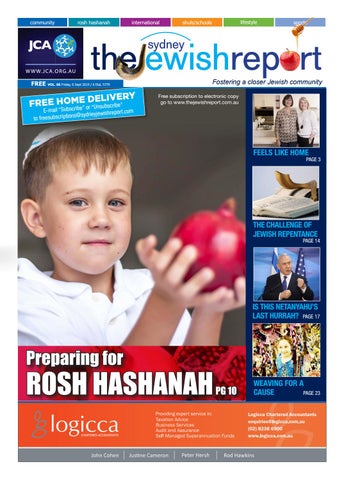
Preparing for
ROSH HASHANAH CHARTERED ACCOUNTANTS CHARTERED ACCOUNTANTS
PG 10
WEAVING FOR A CAUSE PAGE 23
2
community
September 2019
Australia’s leading pancreatic cancer charity launches Remember September AVNER PANCREATIC CANCER FOUNDATION KRISTJAN PORM Pancreatic cancer is predicted by experts to be the second biggest cancer killer in Australia in coming years and the disease currently claims virtually the same amount of lives as breast cancer. Raising funds is vital for investing into research to improve health outcomes. Remember September encourages giving up all liquids except water for an entire month, and is the brainchild of brothers David and Ben Wilheim who set up the challenge after losing their father to Pancreatic Cancer in 2014, a year after the disease also claimed their cousin Danielle at age 33, surviving just 6 weeks post diagnosis. “Pancreatic Cancer caused so much anguish for my family. We were astounded at the dire statistics around this disease and realised something needed to be done”, David said. “The Remember September challenge is simple, but far from easy, by drinking nothing except water all month it’s like an extreme version of Dry July! The challenge gives you an opportunity to talk to your networks – to help raise much-needed funds and awareness for this terrible disease. During the challenge I often crave a coffee, and I like that it makes me think of my dad and cousin.” In its fifth year, the Avner Pancreatic Cancer Foundation’s Remember September campaign is rolling out in all major capital cities as well as regional centres around
Australia, and in 2019, the campaign aims to reach the fundraising target of $50,000. “The campaign focuses on positive lifestyle changes and keeping healthy, but people take the challenge for different reasons,” says David, “Not just to raise awareness and funding for vital research, but for personal reasons. I like that we can give that to all Australians.” The Foundation’s CEO, Michelle Stewart, said, “The 5-year survival rate for the disease is very low at 9.8 per cent compared to other cancers, which now exceed 90 per cent
survival. The disease receives little or no government funding so we are desperate to raise more funds through alternative means, to continue funding the best researchers in Australia”. The Remember September Challenge has raised almost $180,000 for pancreatic cancer research to date, and we encourage people to take the challenge or support a challenger. We provide a “Purple Pass” which will give you a night off the challenge for a special event.
The Avner Pancreatic Cancer Foundation is the only charity in Australia exclusively dedicated to Pancreatic Cancer, with a mission to drastically lift survival rates for sufferers of the disease. We aim to achieve this by raising awareness and funding ground-breaking medical research at leading institutions around Australia. Registration & more information: www.rememberseptember. gofundraise.com.au
A special exhibition at St Vincent’s gallery The work of Turkish-Jewish painter Gul Tan is being honoured with an exhibition of her work at St Vincent’s Hospital this month. Gul, whose first name is Turkish for ‘rose’, is a self-taught painter, highly accomplished in oil painting as well as watercolours. Her technical excellence, combined with her assured and integrated focus, produces canvases and watercolours of great vibrancy, always imbued with Gul’s personal vitality. In August 2018 Gul underwent spinal surgery at St Vincent’s Private Hospital under the care of Dr Timothy Steel. When she first got home, she was unable to work at her easel. Not to be prevented from expressing her joy at finding herself back in the midst of life, she turned to her block-pad and watercolours, recording the irises of Spring 2018. Last November, she was able to finally
resume oil-painting in November, and St Vincent’s Hospital is now exhibiting many of her works. Gul’s
subjects
reflect
her
deep
response to Place and Nature. While every landscape she depicts is known to her ‘in real life’, she expresses her felt and considered response to it. When Gul turns to depicting her love of flowers — whether in oils, acrylic, or watercolour —she instinctively evokes a cultural tradition of celebration of nature’s abundance and diversity in deceptively simple arrangements of a profusion of exquisitely coloured, jewellike specimens. Gul Tan’s exhibition is at the Xavier Art Space on Level 3 at St Vincent’s Hospital, Sydney until 19 September 2019.
September 2019
Feels like Home MONTEFIORE An innovative model of support and newly renovated, home-like living spaces have come together for residents living with dementia at Montefiore Randwick. An exciting next step for Montefiore’s dementia living is now underway at its Randwick Residential Care campus, with a complete renovation transforming the highcare Special Care Unit (SCU). The all-new interiors have been redesigned into several smaller, domestic-scale living, dining and kitchen areas with the feel of an elegant private home. Watching residents relax in a comfortable lounge, or family members make tea at the stone-clad island in one of the two open kitchens, it’s clear that the welcoming new environment is already having an impact on quality of life. “We really want families to be involved, allowing residents to feel like they have continuity of their past life in terms of sharing meal times together and being with their loved ones,” explains Janine Grossman, Director of Professional Services. The changes go deeper than the cosmetic improvements to the space, as SCU is also a testing ground for the new Montefiore Dementia Model (MDM) that will ultimately be extended across the organisation. Grossman has spent several years researching leading dementia living environments and best practice support, alongside on-staff Dementia Specialist Dr Jacki Wesson.
community
The MDM is a tailored application of this knowledge, combining domestic-scale living spaces, the latest behavioural support techniques, and new ‘homemaker’ staff who bridge traditional care, dining and lifestyle roles. “The advantage of integrating this style of living within existing residential care campuses,” Grossman adds, “is the continued access to the breadth of Montefiore’s other leading nursing, clinical and allied health services and staff.” According to Dr Wesson, the MDM is based around encouraging people with dementia to be more actively involved with familiar daily activities. “Home-based activities – cooking, cleaning, gardening, laundry – are often familiar tasks that are relatively easy to participate in for people with cognitive impairment,” she says. For Executive Care Manager of Randwick’s dementia care units Rebecca Saidman, the proof is in the daily interactions and feedback she’s already seeing in the new SCU. “One family member told me recently that she’d never seen her mother so happy and settled. As these are our highest care residents, they spend the majority of their time here in SCU, so it’s wonderful to see them comfortable and enjoying their new surrounds.” For more information on the new Randwick Dementia Living area or to arrange a tour, please contact Justine Spies, (02) 8345 9135 or email residential@montefiore.org.au.
3
Montefiore’s Dr Jacki Wesson and Janine Grossman in one of the new dementia living unit kitchens
Michelle Baskin and her mother, resident Resident Gary and Homemaker Barbara Hilda Gottlieb
4
community
September 2019
Israeli Ambassador opens B’nai B’rith’s new exhibition B’NAI B’RITH NSW VIVIENNE RADOMSKY His Excellency Mark Sofer, Ambassador of Israel to Australia, opened B’nai B’rith NSW’s exhibition ‘Jewish Life in Norway 1851 – 1945’ at the B’nai B’rith Centre on Sunday 25 August 2019. During his speech, Ambassador Sofer spoke fondly about his three-year post in Norway, in which time his youngest daughter was born. Sidsel Levin, immediate past director of the Oslo Jewish Museum, also travelled to Sydney for the opening and addressed the audience about the concept of the exhibition. Levin explained that many of the Jews who emigrated to Norway in this time were from Lithuania and surrounding countries. Jewish immigration was made possible by Norwegian poet Henrik Wergeland who fought to abolish a law that denied Jews access to Norway, the law was changed in 1851. The exhibition at B’nai B’rith explores a fascinating time in Norwegian Jewish history and gives an overall picture of Jewish Life in Norway for 100 years. On Sunday 1 September, there will be a music recital by Norwegian Violinist Ole Bohn and pianist Daniel Herscovitch, playing music by Norwegian and Swedish Jewish composers. The exhibition is open until 22 September at the B’nai B’rith NSW Centre. Opening times are Monday to Thursday, 10am – 4pm. To book please call the B’nai B’rith office on 9321 6317 or email council@bbnsw.org.au
L-R: Sidsel Levin, Ambassador Mark Sofer, Anna Marks OAM, and Ole Bøhn
L-R: Anna Marks OAM, Ambassador Mark Sofer, President of Sydney Jewish Museum Gus Lehrer, and Sidsel Levin
Norwegian Consular General Robert Lord (left) with B’nai B’rith President Anna Marks OAM
L-R- Jeffrey Cohen, Ellaine Cohen, Melissa Havas, and Andrew Havas OAM Photo credit: Vivienne Radomsky
Jewish House host a foster care information evening JEWISH HOUSE Jewish House works with local family services to promote the importance of keeping kids in the community. They will be hosting an information evening on Thursday 19th September for those who are interested in opening up their hearts and homes to children in need. Guests will hear from local foster care families who will talk about their experience and the impact on the child. We will also have representatives from the Department of Family & Community Services, and Settlement Services International who will provide information on the process of application and accreditation to becoming a foster carer. “Every child has the right to a safe and happy life. We believe that keeping children within the care of their community brings about the best possible childhood by preserving their culture and heritage while helping them feel comfortable and
secure surrounded by familiar settings,” said Rabbi Mendel Kastel OAM, CEO Jewish House Jewish House has been working to support individuals and families experiencing a crisis in our community for more than 35 years. During this time, for a number of reasons they’ve had Jewish children here in our local community requiring foster care accommodation. Foster carers provide a safe environment for vulnerable children and young people in out-of-home care by opening the doors of their family home and welcoming them into their lives. EVENT DETAILS: Thursday 19th September 7:30 pm Jewish House 17 Flood Street, Bondi For more information or to RSVP, contact Jewish House on 02 9386 0770 or reception@jewishhouse.org.au
Dive in for your share of $60K JCA Jumpstart Shark Tank, powered by JCA, is gearing up for its biggest pitch event yet with $60,000 on offer for the most innovative social-purpose initiatives that directly impact the local Jewish community. Now in its fourth year, Jumpstart Shark Tank continues to bring out the best and brightest of our community. They’ll be pitching their ideas to a notable panel that this year includes, among others, serial entrepreneur and TV personality, Andrew Banks, and entrepreneur, philanthropist and influencer Richie Harkham. Last year’s event was a full house with more than 500 in attendance to hear five inspirational Jewish social entrepreneurs share their ambitions and pitch for a share of the prize money. It also gave their programs valuable exposure to the community as well as ideas and insights from the judges. The first prize of $30,000 was awarded to a remarkable 25 year old, Madeleine Buchner (OAM), who was nominated for the Young Australian of the Year in 2018 and awarded an Order of Australia Medal for her work supporting young people who care for sick siblings or parents. Madeleine started Little Dreamers at the age of 16 as she realised there was a gap in support for young people like herself dealing with and caring for chronically ill family members. Little Dreamers was already established in Melbourne and the win allowed them to expand their program to the Sydney community. Gali Blacher and Madelyn Jones from The Good Box received the second prize of $15,000 for their social enterprise that sells
care packages of toiletries, essential supplies and comfort items that people can purchase and give directly to those experiencing homelessness or hardship in our community. The People’s Choice award of $5,000 was presented to Romy Wolman from The Single Sock Solution. Romy’s 11 year old daughter has cerebral palsy and while she cannot do much with her hands, she can weave. This inspired Romy to create The Single Sock Solution which finds a meaningful purpose for all those stray socks we collect. They all come together in weaving workshops where disabled, abled and aged community members transform them into magnificent, unique art pieces, rugs and blankets to sell, with profits being returned to the community. JCA’s Jumpstart provides a focus for engagement for our younger community members through innovative initiatives that enrich and energise our vibrant local community. Find out more at www.jca.org.au/jumpstart.
5
community
September 2019
Michael Danby addresses 74th Board of Deputies AGM NSW JEWISH BOARD OF DEPUTIES The 74th Annual General Meeting of the NSW Jewish Board of Deputies (NSW JBD) took place last month, featuring special guest speakers and the election of a new executive team. The Hon. Michael Danby delivered his first significant speech since retiring from politics at the AGM. Mr Danby, who is longest serving Jewish member of federal parliament, covered a range of topics including the media, Israel, human rights issues and the Jewish values that inspire him to stand up for people of persecuted faiths around the world. The AGM also heard from Greg Schneider, Executive Vice President of the Conference on Jewish Material Claims Against Germany. Mr Schneider had recently returned from negotiations with the German government. A new executive for the NSW JBD was elected at the AGM, including Lesli Berger (President), Cr Isabelle Shapiro OAM (Vice President), David Ossip (Vice President), Melissa McCurdie (Hon. Secretary), and Sam Zweig (Hon. Treasurer). The following Deputies were elected as Executive Members: Dane Stern, Michelle Filler, Yosi Tal, Joshua Moses, Yaron Finkelstein, Dr George Foster, Liam O’Callaghan, Natalie Rubinstein, Daniel Hochberg, Eric Roozendaal, and Sandy Hollis. All photos courtesy of Giselle Haber.
The Hon. Michael Danby
Liam O’Callaghan (left) and Dane Stern
L-R: The Hon. Justice Stephen Rothman AM, NSW JBD CEO Vic Alhadeff, and Danny Hochberg
Greg Schneider
L-R- Jill Segal AM, Sam Zweig, and Isabelle Shapiro OAM
Care your way Enjoy the freedom and confidence to live your best life independently with Help at Home by Montefiore. Discover expert aged care and disability support delivered into your home, from one of Australia’s leading care specialists. Your personal coordinator will help you to choose from a wide range of services, available when and where you need them.
24/7 HOTLINE
TRUSTED HEALTH TEAM
PERSONAL APPROACH
DOMESTIC SUPP ORT
WELLNESS SERVICES
CDC, NDIS & PRIVATE CARE
CONTACT US FOR YOUR FREE CONSULTATION 1800 251 537 334 NEW SOUTH HEAD RD, DOUBLE BAY MONTEFIORE.ORG.AU
6
community
September 2019
When the Claims Cure Cancer launches Conference came to call World’s Biggest Dinner
COA RACHEL TANNY, CEO
During August Greg Schneider, the CEO of the Conference on Jewish Material Claims against Germany, (better known as the Claims Conference) came to visit Sydney. The Claims Conference is the organisation that redistributes restitution monies from Germany to Holocaust Survivors around the world by funding services for them and providing packages of care. As COA has quite a high number of Holocaust Survivors on our books, we are one of only two organisations in Sydney whom the Claim Conference funds. Their support covers a few dollars of every meal sent to a recipient who is a Survivor. Recently, we have started the process of requesting additional funding from the Claims Conference to help support out social support program, which runs 6 days a week all year round, and attracts more Survivors than our meals program. So that Greg had a fair idea of what COA offers he visited our activity centre on Monday 19th August to address our audience. He arrived to a packed hall, with over 90 people in attendance, and when he asked the question “How many Survivors are there with us today?” More than half the hands shot up. And then Robert Teicher and the Daydream Believers choir started singing Yiddishe favourites, and Greg joined in as our audience danced and sang along. It was a fantastic vibe and showed our COA family at it’s very best, connecting, laughing, and enjoying themselves together. The very next day COA threw a luncheon at B’nai B’rith’s Princess Gardens retirement village for residents of the village and some Holocaust Survivors.
CURE CANCER AUSTRALIA
Claims Conference CEO Greg Schneider with founder of Grunfeld’s catering Esther Grunfeld. Photo credit: COA The luncheon was made up of selections from our Kosher Meals-on-Wheels menu. We were fortunate to have several special guest speakers. In addition to hearing form Greg, we heard from some of the Survivors currently receiving meals. One was even a delivery driver herself for 18 years! We also heard from Esther Grunfeld, who in addition to being a Survivor herself, has also re-joined our group of Meals caterers, with 5 new exciting vegetarian offerings. Finally, we heard from one of our Meals delivery drivers who spoke about how meaningful it is to forge bonds with the Survivors he delivers to. It was moving to hear all of our Survivors speak and we are grateful that Greg was there to participate and see firsthand what our services mean to people.
Last month Cure Cancer Australia officially launched their World’s Biggest Dinner campaign – an annual national fundraising initiative, encouraging people to host a dinner to raise vital funds for life-saving cancer research. Aiming to raise $100,000 this year, the World’s Biggest Dinner campaign aims to bring people together over dinner – regardless of culture, background, or favourite cuisine – to have fun, and fund crucial cancer research while doing so. These vital funds will support an earlycareer cancer researcher with a yearly grant to continue their life-saving research. One Australian dies every 12 minutes from cancer. At the forefront of the national effort to reverse startling statistics like this is a team of world class researchers who have dedicated their lives to finding a cure for cancer. Paying tribute to their efforts, Cure Cancer CEO Nikki Kinloch said: “Our long-standing investment in brightest early-career researchers across all cancer types, and all areas of cancer research, has had a profoundly positive impact on people’s lives.” “As we get closer to finding a cure, we need to do everything we can to support their work. That’s why we’re asking everyone to host a World’s Biggest Dinner and, with the support of their friends, families and workmates, help fund these dedicated, brilliant, early-career researchers in their quest to find a cure. It’s that easy!” Carlo Tonini, businessman and long-time fundraiser for Cure Cancer, championed this fundraising initiative in 2016 to raise funds for life-saving cancer research. Mr Tonini’s contribution to fundraising for
cancer research started in a pub in early 2010, while sharing a beer with a close friend. His friend bet him that he wouldn’t be able to run a marathon. Ever keen for a challenge, Carlo then committed to making it into The Marathon Grand Slam Club by completing a marathon on each continent (eight in total), including the Arctic, and fundraising in the process. Carlo’s fundraising from fitness challenges and the World’s Biggest Dinner has amassed an incredible $271,316 to date, and the World’s Biggest Dinner continues to grow and evolve into a well-loved campaign. “It is amazing the impact this horrid disease is having worldwide, not only on the patient but also the toll it takes on family and friends,” says Mr Tonini. “I have lost people close to me that have succumbed to this horrible disease, so with the World’s Biggest Dinner I am hoping to assist by raising much needed funds towards assisting researchers in helping to find a cure and rid the world of cancer.” The World’s Biggest Dinner runs until the end of November. To become a host, to donate, or for more information, visit www.curecancer.com.au/ worldsbiggestdinner
Join us for a live concert from one of our communities most respected women of song
Dahlia Dior
accompanied by Shirley Politzer OAM 12:45pm Monday 16th September
COA Krygier Centre, 25 Rowe St, Woollahra For enquiries call 9389 0035, or email operations@coasydney.org
community
September 2019
7
Morning Inspiration MERKOS WOMEN MICHELLE MITCHELL I was brought up not knowing that I’m a Jew and so the majority of my learning in life has had nothing at all to do with Judaism. My Mother passed away in 2013 and it was then that I met a Rabbi for the first time. I started visiting Melbourne (from Adelaide), often. Imagine my surprise and delight when I inquired and was graciously received into the morning classes at Merkos Women! I shall attempt to describe how profound this has been for me. It has been such a pleasure to be able to attend Merkos Women in my visits to Melbourne. My progress in my personal Yiddishkeit journey is a direct result of my attending classes at Merkos. Rabbi Yehuda Hoch is the teacher in the morning classes. I had never known such clarity and depth from a teacher previously. I learned in those classes about what it means to be an observant Jew, and I have learned how to be a better person, how to live a better life, and how to look out for fellow Jews. There have been mornings during and after class when my perspective on life as I have always known it has shifted just one degree. This in turn has shifted my whole perspective on living life, and how to live observantly. The guidance and expanse of knowledge
from Rabbi Hoch matches how he lives his life. He is a brilliant example. Complex and simple questions from the class to the Rabbi bring forth the most satisfying truths that resonate so very deeply in my soul. My transition from ‘outside life’ to comprehending the ‘inner world’ of my Jewish neshoma has given me a deeper understanding of life in general, living it with purpose and serving G-d. I have not experienced such profound depth of understanding and comprehension in any of my previous studies including psychology, professional counselling,
Theosophy and metaphysics. It has been my privilege and a Blessing to me from the very first lesson where I could hardly believe that I was receiving answers to the tricky questions of life I’d wanted to know since childhood. I had searched my whole life, and here now were the answers. I now had an avenue and access to the Truth. I’m an ‘older person’ and am a living example of how it is never too late to learn, to change and to adapt. Thank you to the Kornhausers in Melbourne, Australia for creating the special
Kosherworld’s move to Kirrawee KOSHERWORLD The NSW Food Authority has awarded a full licence to Kosherworld, the operator of Hadassa Butchery and Katzy’s, to produce a wide range of kosher products at its new Kirrawee facility. This makes Kosherworld the only kosher food operator in NSW to hold this particular licence, and follows a concerted effort over the past several months on the part of Kosherworld to relocate and consolidate its Hadassa butchery, and Katzy’s wholesale food production, operations to a modern, highly functional production facility. “Our licence is one of the hardest and highest food licences a food business can obtain,” said Kosherworld General Manager Jeff Renfrew, who has spearheaded the process of obtaining the Meat Processer Ready To Eat licence.
“We were awarded this licence because we are able to demonstrate strict food safety and compliance, sound processing and manufacturing practices, and high levels of expertise across all areas of our operations.” With this licence, Kosherworld will be able to butcher, process and manufacture kosher products at its new Kirrawee facility – ranging from raw meat (chicken, beef, veal and lamb), ready-to-eat products (both cooked and smoked, such as sausages, specialised cold cuts and polonies), to the expanding range of Katzy’s cooked traditional, deli and pie products. “Our vision has always been to put together an integrated, high quality, kosher meat and food operation which will benefit the Sydney and NSW Jewish communities, and to make quality kosher meat and ready to eat products more accessible to the
B”H
B”H
----------------------------
Shanna Beis
Learning Shlichus Program 5780 - - - - - - - - - - - - - - - - - - - - - - - - - - - for Post Seminary Students in Melbourne, Australia Participation in our learning program Organising special events and Fabrengens Participating in special trips and projects Shlichus opportunities in the wider Melbourne community Merkos Women offers excellent living and learning conditions. Applicants must have completed at least one year of seminary. References are essential.
-----------------------------------------------------------------------------------------
For more information please contact Merkos Women E: info@merkos.com.au W: www.merkoswomen.org
T: +61 4070 18 613 WhatsApp
consumer,” said Kosherworld CEO Avron Rayman. “Setting up Kirrawee and getting this licence is a very big deal in terms of delivering this vision.” “It opens up a world of opportunity.” The KA will be working with Kosherworld on the development of the new Kirrawee site. “We believe this will take kosher meat and food production to the next level in NSW, offering the highest standard of Kashrut together with the highest standards of food production,” commented Rabbi Moshe Gutnick, Rabbinic Administrator of The Kashrut Authority (KA). Baron Revelman, KA President, added: "We are confident the community will embrace this elevation to a new level, and we wish Kosherworld hatzlacha in this new stage of their business.”
gentle Merkos Women environment where it is pure pleasure to learn. The first thing that I organise for myself when I come to Melbourne is to make sure that I can attend the class “as usual” and to be ready and receptive for the morning class. I can no longer imagine how my life would be if it were not for what I have learned in the classes at Merkos. I’m no longer interested in ‘other’ studies outside Judaism. The things that once fascinatef me now seem boring and ‘fabricated’... like guess-work. I sense that my joyous and surprised outbursts in class of “I so get that!” and “I’d always wanted to know that!” have been entertainment to others in the class. The classes have been a wondrous start to the day and have set the tone of serenity, wonderment and gratitude for the rest of the day for me. When my (adult) daughter, Sharon visited me in Melbourne, after her first visit to a synagogue (ever), Luba Kornhauser invited and welcomed her to class while she was visiting. It was Lag B’oemer and a lot of fun for Sharon. She has now had a ‘taste’ and knows where to come back to when she is ready for her own Yiddishkeit education. I’ve been able to keep in touch with the progress of the younger women who have attended Merkos Women... their simchas, their growth, and meeting their babies have been delightful. I’m forever grateful.
8
community
September 2019
Australians transforming cancer care at Shaare Zedek AUSTRALIAN FRIENDS OF SHAARE ZEDEK INC MIRIAM PACANOWSKI The Australian Friends of Shaare Zedek are working to support Australian born and trained doctors who are at the frontline of the prevention and treatment of cancer at the hospital in Jerusalem. These innovative and highly respected doctors are creating a comprehensive cancer service at Jerusalem’s most central and fastest growing hospital.This year, the AFSZ’s annual appeal is dedicated to supporting Australians at Shaare Zedek in their significant work. Dr Shani Paluch-Shimon was born and educated in Melbourne and is the Director of the Department of Oncology at Shaare Zedek. Shani directs the Talya Centre at Shaare Zedek, a unique program dedicated to young women who have been diagnosed with breast cancer. Young women confronting this disease have specific needs that include concerns about fertility, genetics, relationships, parenting, and career development. It also includes clinical research to help explore and tailor care to the needs of young women with breast cancer including topics related to psychosocial issues and the biology of breast cancer and more. Shaare Zedek’s medical staff also specialize in breast cancer diagnosed during pregnancy and in helping women achieve healthy pregnancy after treatment for breast cancer.
contribute significantly towards research into disease. Your donations this year will also enable Shaare Zedek to upgrade the facilities for cancer patients so that they can receive treatment
in
a
dignified
WIZO believes that each child deserves an equal opportunity. WIZO’s six Youth Villages across Israel bridge the gap for less privileged youth within a secure, warm home environment. WIZO dormitories house the youth, providing frame works to ensure their physical well-being, care for their emotional and educational needs, and bolster their self-esteem and social abilities. These young people need a space of their own in order to turn their lives around, full circle. The WIZO Youth Village creates a space for an education that knows no boundaries. WIZO Youth Villages’ life-changing work takes place everywhere: in classrooms and the playgrounds, in laboratories or the dorm lounges. WIZO is committed to providing the environment that helps launch young people to new levels of vital expression, achievement and interaction. WIZO ensures that these facilities are up to date and inviting, functional and safe. It is an ongoing, cyclical process. You might think of a dormitory room as the bare minimum. But in truth, it means the world to a newly-arrived teen. It sends the message that we care about them, that they have a space that is their very own in which to adjust to the new surroundings, to their peers and to themselves. Good housing is the essential foundation to feeling confident and secure. An innovation unique to Israel and mirroring the miracle of Israel’s rebirth, WIZO Youth Villages and their special programs act to augment a troubled teen’s sense of worth and help create a miraculous transformation. These
healing
environment. Shaare Zedek Medical Centre conducts all its operations in an atmosphere of compassion and inclusion.
Prof Rabbi
Avraham Steinberg, Director of Shaare Zedek’s Department of Medical Ethics will visit Australia during the annual campaign and will open Melbourne’s Royal Children’s Hospital’s 11th Bioethics Conference. The Dr Jordana Hyman, another Australian expat is an IVF specialist. Her work at Shaare Zedek includes helping young women with cancer preserve their fertility into the future. Prof Nathan Cherny AM is a highly respected pioneer in his field. He is an award-winning thought leader in palliative care. Prof Cherny AM has led international working groups to determine the applications of emerging therapies. The Australian Friends of Shaare Zedek Inc are a health promotion charity, working to support and promote the innovative treatment emerging from Shaare Zedek. Shaare Zedek Medical Centre was involved in discoveries that associated with the connection between BRCA mutations and an increased risk of certain cancers. Funds raised this year will enable
continued crucial medical innovation. There are several important areas where donations from the Australian community will help save lives. Shaare Zedek needs a new oncology biobank to facilitate research and its translation to the best in patient care. As Director of the Department of Oncology, Dr Shani Paluch-Shimon also plans to develop a smartphone app that will enable cancer patients to input their symptoms, receive prompts regarding their treatment and to enable more detailed analysis of their medical needs. The use of apps such as this has been proven to have measurable benefits to patients. Donations this year will enable the translation of this app into Hebrew and Arabic and will enable training in its use for patients unused to the technology. The information gleaned from this app will also
theme of the conference is Respecting Different Perspectives. The AFSZ Inc together with AJMF and Friends of Wolper would like to invite the community attend Prof Rabbi Steinberg’s keynote Sydney address at 7.30pm on Sunday 8 September at Jewish Care. The lecture entitled “The Voluntary Assisted Dying Act: What are the Ethical Implications? For more information and essential RSVP, visit www.trybooking.com/BDFDC. More information about Prof Steinberg’s visit and speaking engagements is available at www.shaarezedek.org.au The AFSZ Inc are proud of the crucial contributions made by Australians at Shaare Zedek. Please donate generously on our Giving Day on 15 September 2019. www.charidy.com/SZ
WIZO helps Israel’s youth at risk and changes lives
WIZO DIANE SYMONDS
and
young people have untapped potential to become tomorrow’s leaders. The enriching extra-curricular experiences at a WIZO Youth Village instil values, teach life skills and promote social responsibility. One of the programs WIZO implements is the Hosen Program. Hosen (Hebrew for ‘resilience’) is a special program for youth who reside in WIZO youth villages and schools who suffer from personal, social and developmental problems. Those affected often come from deprived backgrounds where they have experienced poverty or witnessed domestic violence or the effects of terror. They do not have the coping skills to deal with these challenges and tend to develop anxiety, high levels of duress and post-traumatic stress disorders. The Hosen program addresses these problems, providing young people and their educating teams with the crucial tools to deal with stress and crisis-related events, in both emergencies and everyday life. The program is based on the understanding of emotional processes related to crisis and its processing and seeks to strengthen adaptive coping strategies. Education is the most powerful force for change in the life of any individual. Every year, WIZO transforms the lives of thousands of young people for the better. WIZO helps women & children in Israel thrive! No matter how disadvantaged or troubled your background may have been, one can turn one’s life around. That is the WIZO way. To support WIZO and the vital work done call the office on 9387 3666: or online at: www.wizonsw.org.au
Our second Rosh Hashanah edition will be released 27 September.
This will be a space for promoting programming and special offers throughout the Chagim and
October, as well as for "Shana Tova and Chag Sameach" messages
to the Sydney Jewish community. Content is due 16 September, so contact Eli at
editor@thejewishreport.com.au to organise your Yom Tov message today!
September 2019
9
community
Securing The Future – MDA’s 2019 Campaign Dr Asher Moser, Deputy Director of MDA Blood Services explained that the new blood centre has been deemed by Israel’s Australian Friends of Magen David Adom Homefront Command and the Security recently held their Annual Campaign which Ministry as the most strategically important attracted over 400 people across three infrastructure project in Israel today. It is events - the President’s Major Donor Dinner, the first underground blood centre in the world with 3 floors underground and 3 YoungMDA and General Event. Supporters were taken on a unique journey above ground. It is being built to withstand across Israel, filmed directly through the earthquakes, missile attacks and chemical lens of MDA Emergency Response Teams and biological attacks thus ensuring the sharing the heartbreaks and successes continuous and safe supply of Israel’s blood for now and the future. experienced by MDA teams daily. We thank everyone who attended the Racheli Ikar Cohen, MDA Paramedic, told of her personal tragic story and what drove functions for their support and those who her to become a paramedic saying, “It is not were unable to be there in person but wished to contribute. Magen David Adom saves just a vocation it is a way of life.” Thanks to generous sponsors and donors, precious lives 24 hours a day, 365 days a funds raised will be used to purchase year. The Board and Staff of the Australian emergency response vehicles, lifesaving Friends of Magen David Adom wish our equipment and help to build the new MDA supporters and the community a Sweet and Happy New Year, Shana tova. National Blood Services Centre. AUSTRALIAN FRIENDS OF MAGEN DAVID ADOM LIMITED
Ovarian cancer and genetic testing for the Jewish community CANCER PREVENTION OVARIAN CANCER AUSTRALIA Around 1 in 500 people in the general population carry a BRCA1 or BRCA2 mutation, which causes a person to have an increased risk of developing ovarian, breast or prostate cancer. However, in the Jewish community, 1 in 40 people carry one of three specific BRCA1 or BRCA2 mutations. Ovarian cancer has a poor prognosis with a five-year survival rate of only 44%. The majority are not detected until late stage, when the cancer has already spread. There is no screening test and symptoms are vague and often associated with other conditions. Therefore, prevention of ovarian cancer is the best alternative. People who are aware that they carry a BRCA mutation can take preventative action and significantly reduce their risk.
JeneScreen is a free online BRCA1 and BRCA2 testing program now offered to all members of the Sydney Jewish community. This is being carried out by Prince of Wales Hospital in collaboration with Ovarian Cancer Australia and Wolper Hospital. All information is provided online, including consent. Participants will be sent a DNA collection kit in the mail and results will be returned by a genetic counsellor either via email or through the clinic. This testing is being offered to all eligible Jewish people free of charge, irrespective of a family history of cancer. To learn more about the project, please go to www.jenescreen.com. au and click on the Sydney tab or visit the Facebook page https://www. facebook.com/JeneScreenSydney/ or contact Nicole Cousens on Nicole.cousens@health.nsw.gov.au.
Celebrating another successful year at NCJWA NSW’s 96th AGM NCJWA NSW This year’s National Council of Jewish Women Australia NSW (NCJWA NSW) AGM was a chance to reflect on the many highlights from the past year, with special recognition for NCJWA NSW’s signature program MUM FOR MUM. There are currently 65 mums volunteering and mentoring younger mums around the Eastern Suburbs with Nadene Alhadeff as coordinator, and 35 on the North Shore under the supervision of Lyn Brand. In recognition of this program’s role in creating resilient families, MUM FOR MUM was awarded the prestigious NAPCAN Play Your Part Award from the National Association for the Protection of Children Against Child Abuse and Neglect at Parliament House in October 2018. The AGM also heard updates on the full spectrum of NCJWA NSW’s programming, including the JWBCN and NCJWA Cancer Support Network programs, and Birthing Kit packing days to send vital medical supplies to women in developing countries. It was also a night for awards at the AGM, to acknowledge the hard work of NCJWA NSW volunteers. Dr Graeme Cohen presented the Susan Cohen
L-R: Celia Trakman, Ella Lizor and Michele Brandenburger. Photo credit: Wendy Lessick Bookatz
Community Services Award to Ruth Shteinman, who has brought a new program called Days for Girls to NCJWA NSW, and Miriam Levy was awarded the Dr Fanny Reading award for her contribution to NCJWA over many decades. All MUM FOR MUM volunteers were recognised with the presentation of the Jeannette Lesnie Group Excellence Award to the team of volunteers, presented by Peta Lesnie in memory of her late mother Jeannette Lesnie. Appreciation certificates were awarded to the team behind Cuddle Bundles, a new NCJWA NSW initiative. Led by Michele Brandenburger, Nadene Alhadeff, Ella Lizor, Celia Trackman, and Joanne Gross, Cuddle Bundles provide gifts of recycled babywear in excellent condition to mums in need from any community in Australia and overseas. The new Board of the NCJWA NSW was also elected at the AGM: Maxine Bachmayer (Co-President), Miri Orden (Co-President), Janet Merkur (Co-President), Barbara Shotland (Honorary Treasurer), Zena Grevler (Assistant Honorary Treasurer), Karen Schwartz (Secretary), and the following Directors: Victoria Nadel OAM, Ruth Osen, Miriam Levy, Merle Ware, Suzy Wolanski, and Ruth Shteinman.
L-R: Barbara Shotland (Hon. Treasurer), Janet Merkur (Co-President), Peter Wayne (Hon. Solicitor), Maxine Bachmayer (Co-President) and Miri Orden (Co-President) Photo credit: Wendy Lessick Bookatz
10
ROSH HASHANAH rosh hashanah
September 2019
The Fear of Fear GLOBAL AMBASSADOR, MORIAH COLLEGE & CEO, MOSAIC UNITED RABBI BENJI LEVY
Fear is one of the most powerful emotions in the human experience and presents itself at some of the most critical junctures in our lives. Whether one is on the brink of making an important decision, waiting to hear news of a loved one or embarking on a new professional path, that familiar, often crippling sentiment courses through a person’s veins and preys on the mind, rendering clarity at that moment almost impossible. The Torah, which speaks ‘in the language of mankind’, recognises and addresses this. When preparing for war, a carefully selected priest would approach the soldiers and give the following exhortation, ‘Listen, O Israel, today you are drawing near to wage war against your enemies – let your heart not be faint, do not be afraid, do not panic, and do not be broken before them.’ The children of Israel are not to fear as God is among them. However, the priest who is responsible for assuaging fears and for building up the nation’s bravery and determination then makes a most surprising announcement, exempting
three categories of people from military duty: he who is engaged to a woman, but has not yet married her; he who has built a house, but has not yet lived in it; and he who has built a vineyard, but has not yet drunk from its wine. Although they have to contribute to the war effort through supplying food and water, these people are not allowed to serve on the front line. What is it about these three groups that exempts them from battle? As Abraham ibn Ezra points out, the Torah is teaching us a deep lesson about the nature of facing fear, one that applies to our routine lives as much as it does to the soldiers on the battlefield. Wars are waged in our hearts and minds, just as much as on the battlefields. The Torah is showing us the critical role that our emotional psyche can play in impacting our performance on the battlefield and whether or not our heart is in it is what makes all the difference. Two soldiers can be standing next to each other facing their enemy, both feeling the same primordial feelings of physical and psychological terror that accompany mortal danger. The first one is absolutely committed to the mission – he knows that what he is doing at this moment is of cardinal importance to his people, and he is able to confront the fear head-on. Despite his trepidation, he knows that there is
nowhere else he should be; and it is precisely this single-minded devotion that gives him the courage to fight. The second soldier, standing in exactly the same position, feels the same fear. He is just as aware as his counterpart, on a cognitive level, that his military task is important. But his heart is elsewhere – perhaps he is thinking about his fiancée, or the fine house he has just finished building, or the financial success that he is about to enjoy from his new vineyard. One who is preoccupied is unable to confront his fear head-on and it is as if he is not truly there. He is constantly seeking comfort through thoughts of his newly acquired life back home. He repeatedly attempts to mentally escape the danger he is facing through letting his mind wander rather than focusing on what is right in front of him. And a soldier whose heart is not strong and whose mind is not present is a liability not just to himself, but to all those around him. In our own lives too, we often attempt to deal with our challenges (especially those that induce tremors of fear) through avoidance – conscious or otherwise – and through escaping into our various constructed realities, online or otherwise. While this may allow us to avoid confrontation in the short term, it dooms us in the long term. No soldier can defeat an enemy through retreat
Plunging into the new Jewish decade NORTH SHORE TEMPLE EMANUEL RABBI NICOLE ROBERTS
The Talmud teaches that, along with the many other ways that Jewish parents prepare their children for the future, they must teach their children how to swim (B. Kiddushin 29a). While certainly sage advice from a practical standpoint, there is also a spiritual dimension to this injunction. How will our children stay afloat when the challenges of teenagehood and adulthood unmoor them? What will serve as their floatation device, life vest, or raft through the sometimes raging waters of life? Introducing our children at an early age to rituals, helping them know they are part of an extended “family,” teaching them solid values, and introducing them to God are all part of preparing them to ride the waves of life with buoyancy. For those who find the day to day challenges of child rearing notso-conducive to imparting these spiritual swim lessons, the High Holy Days present a great opportunity for families to take a deep dive and get started. Many congregations offer special, ageappropriate worship experiences and
activities for Rosh Hashanah and Yom Kippur. Making these part of an annual ritual with your children provides them with lifelong memories of “sacred time” with you. While there, children begin to see themselves as part of a “shul family” and a people. They hear “God language” which sparks their imagination. They learn, in child-friendly terms, what is hard and what is easy about forgiveness and apology. They contemplate, perhaps for the first time, how the world came to be. On Rosh Hashanah, their senses are introduced to the sound of shofar and the taste of apples and honey. And they learn the unique feel of receiving a blessing. Experiencing tashlich--the traditional casting away of “sins”--as a family is also a special opportunity at this season. Children love casting crumbs into a moving body of water and watching them float away--a great lesson in letting go and not being able to control every outcome. Let them see you do the same. Explain what the moment means to you, and to God. Bring along a picnic and make an afternoon of it; it will be unlike any other. Jewish sacred days are ushered in with
the lighting of nerot (candles). Lighting candles with children is a magical moment to stand in together as a family--often the only peaceful one of the week! On Rosh Hashanah, families can take the opportunity to teach the children why we say shel yom tov instead of shel Shabbat-what makes a day a yom tov? How is it a little like Shabbat, and also a little different? In all these ways and more, the new Jewish year can be a time of renewal for your family. Don’t be afraid to take that deep dive, introducing new rituals into your family life, and revisiting old ones as your children grow and change. Show them how you swim, and then take their little hands and lead them into the water. They will be amazed in years to come at how the lessons you taught them help them stay afloat. For those families in NSW ready to take the plunge, the North Shore Temple Emanuel offers High Holy Day Family Services and family-friendly activities throughout the chaggim. On Rosh Hashanah and Yom Kippur mornings, there is a service and activity
and similarly no challenge can be solved through avoidance. In order to overcome the obstacles we face in life, we must be bold enough to tackle them head-on with crystal-clear determination. ‘Courage,’ as Mark Twain said, ‘is the resistance to fear, mastery of fear, not absence of fear.’ Through the section describing the preparations for war, the Torah teaches us that escapism is more dangerous than any mortal enemy. Our diversions will render us incapable of dispelling the fears that threaten to cloud our lives. But in the words of Franklin D. Roosevelt, ‘the only thing we have to fear is fear itself.’ We must confront our challenges and battles whole-heartedly, secure in the knowledge that this is the only way to grow. Only then, as the priest anointed for warfare reminds us, will God’s presence enter our lives and join with us in our battle. Rabbi Benji Levy is the CEO of Mosaic United, a partnership between the State of Israel and the global Jewish community dedicated to addressing wide-ranging approaches to Jewish engagement and raising the playing field to ensure a stronger Jewish future. A recent Oleh from Australia, he previously served as the Dean of Moriah College and now is their global ambassador.
for children under 8 years old, led by Rabbi Misha Clebaner in partnership with the Apples & Honey Preschool in our brand new Preschool classrooms, as well as another service for families with school-aged children (K-6) in the recently renovated, bright and welcoming Frank Wolf Community Hall. The building is serviced by a lift, facilitating access for prams and senior members of the family, not to mention weary parents! On Rosh Hashanah, the children will enjoy apples and honey after the family service, then head over to the main sanctuary for the sounding of the shofar led by our Year 7 students. On Shabbat Shuvah, members of all ages will gather in a local park for Tashlich and a picnic. On Erev Succot, families are invited to decorate the NSTE succah in the newly refurbished Isaac Givorshner courtyard. Contact the NSTE Office for details about our family events for High Holy Days and chaggim, at 02 9419 7011 or info@nste.org.au or see our website www.nste.org.au
Happy JewisH NEW YEAR Rosh Hashanah 29 September - 1 October TH
st
630
240
$
$
ea
ea
Osem Honey Cakes 400g $1.58 per 100g. While stocks last
5
$
Berman Honey Coated Cookies or Honey Cookies 180g $1.33 per 100g. While stocks last
3
$
15 ea
ea
SAVE 1
SAVE 90¢
$
WAS $6.15
WAS $4.30
Kinor Rose Grape Juice or Muscat Grape Juice 750mL $6.87 per litre
5
$
60
ea
Shkedia Dark Choc Almonds 160g $3.50 per 100g. While stocks last
40
Cobs Organic Popcorn Lightly Salted Slightly Sweet 120g $2.83 per 100g. On sale 18/09 to 8/10
5
$
80
ea
Eskal Gift Box Mint Cremes 150g $3.87 per 100g. While stocks last
$
1150 ea
Coles Squeezy Pure Australia Honey 1kg $1.10 per litre
Celebrate Jewish New Year at these supporting stores:
Bondi Westfield • St Ives • Rose Bay • Bondi Junction • Maroubra Junction • Eastgardens • Edgecliff On sale from Wednesay 11th September 2019 until Tuesday 15th October 2019.
Products only available at above stores, unless indicated otherwise. Not available at Coles Express or coles.com.au. While stocks last. Some products or varieties may not be available at all stores. We reserve the right to limit sale quantities. Savings, single sell prices and unit prices shown off regular selling prices.
12
rosh hashanah
September 2019
Beautiful Days in a Beautiful Place: High Holidays at The Great Synagogue THE GREAT SYNAGOGUE
The High Holidays are about inspiration, beauty and warmth, and you can find them all at The Great Synagogue. We want to invite you to celebrate Rosh Hashanah and Yom Kippur with us this year. Everyone knows how amazing The Great Synagogue is as a building, and on these special occasions there is nowhere like it. That is combined with a wonderful service and a friendly, welcoming congregation to make the experience unforgettable. The traditional prayers of Rosh Hashanah and Yom Kippur are set to beautiful music. This year we will be joined by a brilliant young cantor from Israel, Chazzan Chaim Stern. He is a rising star of the new generation of cantors, and you can catch some of his performances on YouTube. As always, our large and talented male choir will inspire us. This year we are bringing back many old musical favourites as well as adding outstanding new items to the repertoire. Rabbi Benjamin Elton will deliver all the High Holiday sermons. He has gained a reputation for thoughtful, sensitive and engaging ideas, which are just what we all need at this holiest time of the Jewish year. He will also be presenting his Shabbat Shuva Derasha on the Shabbat before Yom Kippur.
A True Gift
B&H SUKKOT
It was very common during medieval times for members of the community to contribute a small amount of money to a fund in order to jointly own one esrog. In those times, esrogim were difficult to find and would often cost a small fortune. Tosafot even records that: “The community has a custom, to buy an esrog in partnership – and we instruct them that each individual should give their portion as a gift on condition that it be returned…” (Tosafot, Sukkah 41b). However, it is important to note that partial ownership is not sufficient to do the mitzvah properly. On the first day of Sukkot, a person must use a set of Arba’as HaMinim that belongs
Rabbi Phil Kaplan (left) and Rabbi Benjamin Elton. Photo credit: Ezra Wexler This is an annual lecture on a profound topic connected to the High Holidays. It will take place between the end of the service and the Kiddush. It is so important to engage our youth, especially at this time of year. We offer youth programming for all ages, from toddlers to teens, so that all ages enjoy a rewarding
to them. This is derived from the passuk: “U’Lakachtem LA’CHEM Ba’yom HaRishon - And you shall take for yourself on the first day…” (Vayikra 23:40) Our rabbis teach that “La’chem - for yourself” implies “MiShelechem - belonging to you”. Therefore, a person may not use a borrowed set to fulfil his obligation. Some rabbanim are also of the opinion that one must own their own Arba’as HaMinim on the second day as well. If someone doesn’t own a set, they must acquire it from their friend as a gift (with a stipulation that they return it). Thus, in communities who jointly owned their lulav and esrog set, when it came time for each individual to shake the four species, everyone else had to “gift” their share of the esrog temporarily.
experience. You can enjoy everything the service has to offer, knowing that your kids are being well cared for. If you are not yet a member of The Great Synagogue, they you can purchase a ticket that covers all three days for $150. All members are entitled to a High Holiday seat. Membership is $500. If you become a full
In our own time, it also isn’t always obvious to people with more resources how difficult it can be for the people with fewer resources to participate in the mitzvos we can often take for granted. B&H Sukkot was started with the goal of making the mitzvos of Sukkot accessible to as many Jews as possible by reducing the price but not the quality thus enabling the community to fulfil the mitzvah of Arba’as HaMinim with beautiful, high quality sets. With Rosh Hashanah 5780 fast approaching, B&H Sukkot are now open for business, again offering the largest range of high quality Arba’as HaMinim for the lowest prices in Australia. Our range includes products at 5 grades of quality, ranging from regular to Meyuchad (Grade AA), and come in either easy-to-
seatholder a brass plaque will be attached to the seat of your choice. Before the holidays begin, our Associate Rabbi, Phil Kaplan, will be offering a threepart series of classes at his home on the customs of the High Holidays. This will be a chance to learn in a relaxed environment with people of all levels of knowledge and observance. Everyone is welcome but you need to book through The Great Synagogue office. We should not forget about Succot! There will be a communal dinner on the first night, a choral service on the second night and on Shabbat, a beautifully decorated succah, events during the week for young and old and wonderful celebrations for Simchat Torah. There will be early dancing and super for kids and their parents and more dancing and a festive dinner for the adults later in the evening. We would be delighted for you to be a part of our congregation during this High Holiday season, and to join us in prayer, song and celebration. Bookings are essential for High Holidays at The Great Synagogue. For all enquiries, please contact Ilana on (02) 9267 2477 or at ilana@greatsynagogue.org.au\
pick pre-designed combinations (‘SelectA-Set’) or as part of a fully customisable set (‘Build-A-Set’) where you can mix-andmatch to build a beautiful high-quality set to suit your minhagim and budget. Please let us know if you need help picking the right set for you. Finally, whether you call it an etrog or esrog, B&H Sukkot wishes everyone in the community to be inscribed in the book of life for a happy, healthy and blessed year, a year of giving and solidarity! Orders close on Erev Rosh Hashanah (29 September 2019), so don’t leave it to the last minute – go to www.lulav.com.au today.
13
rosh hashanah
September 2019
This Rosh Hashanah, we need to listen to this biblical feminist story RISHE GRONER (JTA via Alma) -- Rosh Hashanah is almost upon us, and with it brings the age-old Jewish tradition of not feeling good enough, wondering what we’ve done wrong and judging ourselves more harshly than God ever could. Not my favorite tradition, let’s be honest, because isn’t it time we all learned to live freely and lovingly in our female bodies with an optimistic perspective on the world we are here to transform? Along with honey and self-examination, Rosh Hashanah brings some other traditions less known. One of them, which you might know about if you pay extra careful attention at services, is the story of Hannah. In our Alma tradition of presenting badass women of the Bible, I present to you the lady who wouldn’t be silenced by patriarchy, a woman whose emotional outburst was the catalyst for national transformation through subsequent historic events. Hannah was the mother of the prophet Samuel, but her introduction in the first chapter of the book of Samuel, famously read on the first day of Rosh Hashanah, is an important story not only of the power of prayer but the dynamics of privilege when the one crying out is a woman. Hannah, the text tells us, traveled each year with her husband, Elkanah, and her sister-wife Peninah to the sanctuary in Shiloh (a sort of miniTemple before the formal Jerusalem structure was built) for the annual pilgrimage holidays. While Peninah, her rival, had a posse of kids to share the barbecue that ensued after the ritual sacrifices, Hannah was childless and sat out of the party feeling some epic FOMO, even though, being the favorite wife, she got the pick of the spareribs and her husband’s sweet talk. When Elkanah’s “Come on honey, aren’t I better than 10 sons?” wheedling got too much for her, Hannah stormed out into the sanctuary, where she fell apart in tears and prayer. She cried, she trembled, she poured her heart out, and she did it in that terrible silence of a woman so broken she can’t even find her voice. Her whispered prayer was deep and real. The text
Hannah at prayer (Wilhelm Wachtel) tells us how she begged for a child, even cutting a deal with God in that way we all try when searching for a parking space, but this one involved offering to dedicate her future child to a life of service in the Temple, if only she could give birth to him. Feminist critiques on the centrality of the motherhood theme aside (and I would argue it is just as feminist to pray for a child as it is to ask for any other awesome achievement in life — to each their own), Hannah’s prayer was unique because, back then, nobody prayed silently, nobody prayed emotionally and nobody prayed alone. You showed up at the sanctuary with your family, said some blessings over the cow or sheep you intended to sacrifice on the altar and went on your way. Hannah’s agency in setting her own prayer was groundbreaking — and totally against the norms of the time, as the old patriarch Eli the Priest made clear when he came upon her. While Hannah’s prayer is a benchmark throughout the Jewish tradition for a real live heartfelt cry, it wasn’t good enough for Eli, who
demanded she remove her drunken self from the place until she sobered up. “How much longer are you planning on this spectacle?” he asked her, kinda like that dude at work who wants to know why you can’t just get on with the presentation instead of taking a minute to cry it out in the ladies room. “Go home, lady, you’re drunk.” Hannah wasn’t having it, and in a dialogue that would pass the biblical version of the Bechdel test — a woman talking back to a man about her fate rather than submitting (see also: Tamar, Esther, Sarah, daughters of Tzelophchad) — she let Eli know. “I’m a woman of broken spirit, and I’m just here to pray. I haven’t had a drop to drink … I’m just in touch with my emotions in that healthy way that means when my heart is breaking and all I want is one thing, I’m going to damn well show up and pray my guts out to God, ‘cause isn’t that what this place is for, after all?” Hannah said. “Don’t take me for a crazy fool, a Godless woman — I’m here to pray, and you can help here by blessing
4
$ Happy Rosh Hashanah $
3
50 kg
Pink Lady Apples
$
2
ea
me that my prayers are answered, actually.” I may be paraphrasing. Eli does bless her, and (spoiler alert) she does indeed conceive, birthing the prophet Samuel, who is key in restructuring the biblical Israelites from tribal into a monarchy. Hannah is remembered as one of the seven prophetesses (there must’ve been more, but alas, male scribes …) and as a benchmark for true emotional expression, prayer that transcends social norms to get to the heart of the matter. Hannah’s story is a lesson for silenced women — and the men who need to listen harder without judgment. How often are men standing up claiming allyship, yet smearing their judgments and honking their own voices above the sound of the silent, broken-spirited, deeply prayerful woman? When women rise into their power, how often are even the wokest of woke dudes standing up to shut her up under the guise of accolades because heaven forbid the room be filled with the sound of women for more than a few minutes? Peoples of all genders, it’s time. It’s time to listen and make space. It’s time to step up and be heard. It’s time for the silenced ones to be honored, and the old paradigms that have chastised them to be put in their place. For Hannah’s sake, inspired by her prayer, let’s call that in this new year. Around the Rosh Hashanah table, listen for the silenced voices. Invite them to share, to speak, without judgment. Advocate for those who don’t speak. Listen when they struggle to formulate the words. And remember that the silence can be just as telling as prayers that scream and shout. This Rosh Hashanah, it’s time. Rishe Groner is the creator of The Gene-Sis, a post-Hasidic movement toward embodied experience and personal growth through Jewish mystical texts. Groner is a writer, strategist, marketer and teacher, and her work has appeared in Lilith, Tablet, The Wisdom Daily and on www.thegene-sis.com.
80 ea
SAVE $1.20 Kinor Grape Juice 750ml 64¢ per 100ml
$
380
$
ea
340 ea
SAVE $1.05
SAVE $1.10
SAVE 45¢
Eskal Dill Pickles 540g 37¢ per 100g
Eskal Mini Soup Croutons 400g 95¢ per 100g
Osem Bamba Snack 100g $3.40 per 100g
Available at Woolworths Bondi Junction, Double Bay, Eastgardens & St Ives.^
On sale from Wednesday 4th September until Tuesday 1st October 2019 unless sold out earlier at Woolworths Bondi Junction, Double Bay, Eastgardens & St Ives. Limits per customer may apply, trade not supplied. ^Products and specials may not be available in all stores. Specials are not available online or at Caltex Woolworths co-branded fuel outlets. Woolworths Supermarkets: 1 Woolworths Way, Bella Vista, NSW 2153.
CP020920N5SJR
14
rosh hashanah
September 2019
The Challenge of Jewish Repentance RABBI LORD JONATHAN SACKS
The Ten Days of Repentance are the holy of holies of Jewish time. They begin on the evening with Rosh Hashanah, the Jewish New Year, and culminate 10 days later with Yom Kippur, our Day of Atonement. At no other time do I feel so close to God, and I suspect the same is true for most Jews. These days constitute a courtroom drama like no other. The judge is God himself, and we are on trial for our lives. It begins on Rosh Hashanah, with the sounding of the shofar, the ram’s horn, announcing that the court is in session. The Book of Life, in which our fate will be inscribed, now lies open. As we say in prayer, “On Rosh Hashanah it is written, and on Yom Kippur it is sealed, who will live and who will die.” At home, we eat an apple dipped in honey as a symbol of our hope for a sweet new year. On Yom Kippur, the atmosphere reaches a peak of intensity in a day of fasting and prayer. Repeatedly we confess our sins, whole alphabetical litanies of them, including ones we probably had neither the time nor the imagination to commit. We throw ourselves on the mercy of the court, which is to say, on God himself. Write us, we say, in the Book of Life. And at the end of a long and wrenching day, we finish as we began 10 days earlier, with the sound of the ram’s horn—this time not with tears and fears but with cautious yet confident hope. We have admitted the worst about ourselves and survived. Beneath the surface of this long religious ritual lies one of the more transformative stories of the human spirit. The sociologist Philip Rieff pointed out that the movement from paganism to monotheism was a transition from fate to faith. By this he meant that in the world of myth, people were pitted against powerful, capricious forces personified as gods who were at best indifferent, at worst hostile, to humankind. All you could do was try to propitiate, battle or outwit them. This was a culture of character and fate, and its noblest expression was the literature of Greek tragedy. Jews came to see the world in a completely
different way. The book of Genesis opens with God making humans “in his image and likeness.” This phrase has become so familiar to us that we forget how paradoxical it is, since for the Hebrew Bible, God has no image and likeness. As the narrative quickly makes clear, what humans have in common with God is freedom and moral responsibility. The Jewish drama is less about character and fate than about will and choice. To the monotheistic mind, the real battles are not “out there,” against external forces of darkness, but “in here,” between the bad and better angels of our nature. As the religion writer Jack Miles once pointed out, you can see the difference in the contrast between Sophocles and Shakespeare. For Sophocles, Oedipus must battle against blind, inexorable fate. For Shakespeare, writing in a monotheistic age, the drama of “Hamlet” lies within, between “the native hue of resolution” and “the pale cast of thought.” The trouble is, of course, that faced with choice, we often make the wrong one. Given a second chance, Adam and Eve would probably pass on the fruit. Cain might work a little harder on his anger management. And there is a straight line from these biblical episodes to the destruction
left by Homo sapiens: war, murder, human devastation and environmental destruction. That is still our world today. The key fact about us, according to the Bible, is that uniquely in an otherwise law-governed universe, we are able to break the law—a power that we too often relish exercising. This raises an acute theological dilemma. How are we to reconcile God’s high hopes for humanity with our shabby and threadbare moral record? The short answer is forgiveness. God wrote forgiveness into the script. He always gives us a second chance, and more. All we have to do is to acknowledge our wrongs, apologize, make amends and resolve to behave better, and God forgives. It allows us to hold simultaneously to the highest moral aspirations while admitting honestly our deepest moral failings. That is the drama of the Jewish High Holy Days. At the heart of this vision is what the postHolocaust writer Viktor Frankl called our “search for meaning.” The great institutions of modernity were not constructed to provide meaning. Science tells us how the world came to be but not why. Technology gives us power but cannot tell us how to use it. The market gives us choices but no guidance as to which choices to make. Modern
democracies give us a maximum of personal freedom but a minimum of shared morality. You can acknowledge the beauty of all these institutions, yet most of us seek something more. Meaning comes not from systems of thought but from stories, and the Jewish story is among the most unusual of all. It tells us that God sought to make us His partners in the work of creation, but we repeatedly disappointed Him. Yet He never gives up. He forgives us time and again. The real religious mystery for Judaism is not our faith in God but God’s faith in us. This is not, as atheists and skeptics sometimes claim, a comforting fiction but quite the opposite. Judaism is God’s call to human responsibility, to create a world that is a worthy home for His presence. That is why Jews are so often to be found as doctors fighting disease, economists fighting poverty, lawyers fighting injustice, teachers fighting ignorance and therapists fighting depression and despair. Judaism is a supremely activist faith for which the greatest religious challenge is to heal some of the wounds of our deeply fractured world. As Frankl put it: The real question is not what do we want from life but what does life want from us. That is the question we are asked on Rosh Hashanah and Yom Kippur. As we ask God to write us in the Book of Life, he asks us, what have you done with your life thus far? Have you thought about others or only about yourself? Have you brought healing to a place of human pain or hope where you found despair? You may have been a success, but have you also been a blessing? Have you written other people in the Book of Life? To ask these questions once a year in the company of others publicly willing to confess their faults, lifted by the words and music of ancient prayers, knowing that God forgives every failure we acknowledge as a failure, and that He has faith in us even when we lose faith in ourselves, can be a life-changing experience. That is when we discover that, even in a secular age, God is still there, open to us whenever we are willing to open ourselves to Him.
Sticking Together: Sourcing Pure Honey for Local Jewish Parents
www.lewiskosher.com
We’re making Sydney’s Kosher Rosh Hashanah Order now … you won’t be disappointed!
LET US HELP YOU CELEBRATE A SWEET NEW YEAR! Ask us for a menu, or place your Rosh Hashanah order now: Ph: (02) 9365 5421 • orders@lewiskosher.com 2 Curlewis Street, Bondi NSW 2026
BUBBY KAYE
Perhaps you remember the great Australian honey crisis of 2018, where Macquarie University scientists tested 100 honey samples found in local food shops (including 38 Australian brands) and found that up to 20% of honey sold in local shops were mixed with other ingredients such as rice syrup. Most of the adulterated honey was sourced from outside of Australia. According the authors of the report, this is not surprising, as honey is believed to be the world’s third most adulterated food. Disappointingly, this report was published in October 2018, several weeks after Rosh Hashanah, the Jewish New Year, where it is customary to use honey during the holiday meal (e.g. apples dipped in honey, challah dipped in honey, honey cake, etc.). As you can imagine, there are significant kashrut implications concerning honey mixed with other non-honey substances. This year, in preparation of the Jewish
New Year, local mother-daughter team, Chayah and Atara Kaye, are sourcing 100% pure raw, organic, Aussie-grown honey for the local community. The duo, partnering with several Jewish schools, are now offering honey to local parents, with a contribution of sales from parents going to the school P&Fs. Participating schools this year are Mt Sinai, Kesser Torah and Yeshiva. Honey can be purchased from Chayah and Atara at their website: www. bubbykaye.com. Gift jars as well as bulk jars are available.
15
international
September 2019
Celebrate Rosh Hashanah, support the People of Israel through UIA UNITED ISRAEL APPEAL NSW
RACHEL PATTISON
Rosh Hashanah represents a time of personal and communal soul-searching. These days of reflection take on a special meaning for us in the Diaspora. As part of the local Jewish community, UIA NSW is proud to continue to stand with Israel and support The People of Israel. In partnership with the global Jewish community, we work to further the national priorities of the State of Israel through our many projects, with special emphasis on advancing weaker communities; nurturing disadvantaged and marginalised youth; encouraging Aliyah, and connecting young Diaspora Jews to Israel and Jewish life. These projects include Net@ - an after-school program which empowers disadvantaged high school students from Israel’s geographic and socio-economic periphery through technology education; Young Communities - where idealistic young people serve as volunteer agents of social change and strengthen Israel’s underdeveloped areas; and Profession for Life – programs offered to Olim which provide them with the knowledge and professional training (in fields such as medicine) needed to achieve absorption into their new life in Israel. Another key project is Youth Futures. With the help of mentors who serve as role models and confidants, Youth Futures helps at-risk children aged 6-13 to bridge educational, social and cultural gaps. The personalised
This Apple Cake recipe is a perfect dessert for Rosh Hashanah if you or your guests are gluten-free! (JTA via The Nosher) -
attention, positive social experiences and educational enrichment empowers young people in all sectors of Israeli society, and provides positive reinforcement for their families. As we approach the New Year, a wonderful way to show your support for Israel and her People and at the same time give a meaningful gift, is to purchase a UIA gift certificate to help those less fortunate. As you sit around the table with your family this Rosh Hashanah, take the opportunity to reflect on how you could help support these young people and their families living on the periphery through UIA, so they too can enjoy chagim in the same way. UIA thanks you for your unwavering support ‘For the People of Israel’! SHANA TOVA! To purchase a UIA gift certificate, please contact UIA NSW on 9361 4273, info@uiansw.org.au or visit uiaaustralia.org.au
The KA wishes all
Chag Sameach & Shana Tova U’Metuka
Phone: 1300 KASHRUT / (02) 9365 2933 Email: info@ka.org.au • Website: www.ka.org.au Find us on
A Gluten Free Rosh Hashanah delight
Kashrut Authority of Australia & NZ
INGREDIENTS: 1/4 cup coconut sugar or brown sugar 1 cup extra-virgin olive oil 2 large eggs, room temperature 2/3 cup honey 1 teaspoon vanilla extract 2 1/2 cups gluten-free baking flour 1 teaspoon baking powder 1 teaspoon baking soda 1 teaspoon ground cinnamon 1 teaspoon salt 1/8 teaspoon allspice 3 apples, peeled, cored and chopped into 1/4-inch pieces (I recommend using a mixture of green and red apples) 2/3 cup walnuts, finely chopped (optional) Unsweetened plain almond milk (optional) Directions: 1. Preheat oven to 126 C. Grease and lightly flour a 9-inch bundt pan (nonstick, if you have one). 2. In a stand mixer, beat together the sugar and olive oil. Beat in the eggs, then the honey and vanilla. Turn off the stand mixer. 3. In a separate large bowl, stir together the gluten-free flour, baking powder, baking soda, cinnamon, salt and allspice. 4. Turn the stand mixer back on, and very slowly add the flour mixture to the wet
ingredients. Use a spatula to scrape down the sides of the bowl, ensuring that all the ingredients become well incorporated. 5. Fold in the diced apples and walnuts. If you find that the mixture is too thick, you can add some almond milk, 1 tablespoon at a time, not to surpass 1/4 cup. 6. Pour the batter into the prepared bundt pan and bake in the oven for 1 hour. Check the cake at the 50-minute mark. It is done when a toothpick inserted comes out clean. Once done, allow the cake to cool in the bundt pan for 15 minutes. Then place a cake I plate on top of the bundt pan, and while holding the pan and the plate together, very carefully flip the bundt pan so the cake lands directly onto the cake plate. 7. Allow the cake to cool completely and then dust lightly with confectioners’ sugar. Serves 6-8. Rachel Pattison is a healthy food blogger living in Los Angeles. You can find more of her recipes on her blog, www.littlechefbigappetite.com.
16
international
September 2019
What Trump really (maybe) meant by calling Jewish Democrats ‘disloyal’ ANDREW SILOW-CARROLL (JTA) — If you are a Jewish Democrat, I think President Trump just called you a bad Jew. That’s not the prevailing interpretation of the remarks made by the president on Tuesday, when he told reporters, “I think any Jewish people that vote for a Democrat — it shows either a total lack of knowledge or great disloyalty.” A lot of the Jewish leaders who exploded over the comment felt the president was touching on that classic anti-Semitic canard: that Jews aren’t sufficiently loyal to the countries in which they reside. “It’s unclear who @POTUS is claiming Jews would be ‘disloyal’ to, but charges of disloyalty have long been used to attack Jews,” AntiDefamation League CEO Jonathan Greenblatt tweeted. “If this is about Israel, then Trump is repeating a dual loyalty claim, which is a form of antiSemitism,” said Halie Soifer, executive director of the Jewish Democratic Council of America. Trump’s lack of clarity certainly makes it possible that he was conjuring up dual loyalty. But here’s the thing with Trump: He doesn’t think dual loyalty is necessarily a bad thing. Back in April, he referred to Israel’s leader, Benjamin Netanyahu, as “your prime minister” in an address to a group of Jewish Republicans. Critics heard the dual loyalty charge, but it is clear in context that he thought it perfectly natural that a group of hawkish Jewish Americans would regard Israel’s prime minister as “theirs.” If anyone in the room objected, there is no record of it. So if not dual loyalty, what else was Trump thinking? It’s possible that Trump considers Jewish Democrats as disloyal to him. “Disloyal” is a curse in Trump’s famously limited rhetorical vocabulary. He has deployed it against fellow Republicans who don’t show him sufficient fealty, against corporations that oppose his policies — and, this is key, against opponents who appear disloyal to each other. (He once disparaged Hillary Clinton as disloyal because she undercut Bernie Sanders.) He regards disloyalty as a character flaw. Trump watchers, like the Washington Post’s Marc Fisher, suggest that Trump takes his cue from real-life and movie mobsters, learning that “the way to insulate himself from the betrayals and
backstabbing of the business world was to place a premium on loyalty.” Andrew McCabe, who briefly replaced James Comey as FBI director, once referred to Trump‘s “kind of overwhelming or overriding focus on loyalty and sorting everybody out immediately — like you’re either with us or you’re against us.” Trump has famously complained that evangelical Christians have shown him more gratitude than American Jews for moving the U.S. Embassy to Jerusalem from Tel Aviv. “I’ll tell you what,” the president told Mike Huckabee last year, “I get more calls of ‘thank you’ from evangelicals, and I see it in the audiences and everything else, than I do from Jewish people. And the Jewish people appreciate it, but the evangelicals appreciate it more than the Jews, which is incredible.” Trump gave credence to this interpretation of his remarks in a tweet storm Wednesday morning. He quoted at length the conservative talk show host, conspiracy theorist and selfdescribed “Jew turned evangelical Christian” Wayne Allyn Root, who wondered why American Jews don’t show the president more respect. “Thank you to Wayne Allyn Root for the very nice words,” Trump tweeted before quoting Root: “President Trump is the greatest President for Jews and for Israel in the history of the world, not just America, he is the best President for Israel in the history of the world … and the Jewish people in Israel love him
… like he’s the King of Israel. They love him like he is the second coming of God … But American Jews don’t know him or like him. They don’t even know what they’re doing or saying anymore. It makes no sense!” Later Wednesday morning, however, Trump appeared to change course in attempting to clarify what he meant. “If you vote for a Democrat,” he told reporters, “you’re being disloyal to Jewish people and you’re being very disloyal to Israel.” First, the Israel thing: In context, it does makes more sense if Trump were saying Tuesday that Democratic Jews were being disloyal not to America but to Israel. Again, consider the context: Trump had been attacking Reps. Ilhan Omar and Rashida Tlaib, two Democrats who have been harshly critical of the Israeli government and who support the boycott Israel movement. Omar had talked the day before about cutting off aid to Israel for its treatment of the Palestinians. “I can’t even believe that we’re having this conversation. Five years ago, the concept of even talking about this — even three years ago — of cutting off aid to Israel because of two people that hate Israel and hate Jewish people. I can’t believe we’re even having this conversation,” Trump fumed. “Where has the Democratic Party gone? Where have they gone where they’re defending these two people over the state of Israel? And I think any Jewish people that vote for a Democrat — I think it shows either a total lack of knowledge or great
disloyalty, alright? So that’s three possibilities as to what Trump meant by “great disloyalty”: disloyal as Americans, disloyal to Israel or disloyal to Trump — and maybe four if you add the possibility that even Trump wasn’t sure what he meant. But Trump adds a fifth interpretation, which may be the most convincing: Jews are being disloyal to “Jewish people.” That’s what the Republican Jewish Coalition insisted in a tweet Tuesday. “President Trump is right, it shows a great deal of disloyalty to oneself to defend a party that protects/emboldens people that hate you for your religion,” the RJC wrote. “Disloyalty to oneself.” The RJC has every reason to make Trump look as good as possible, and Trump may be eager to cast himself as Defender of the Jews. It is not clear, however, that accusing Jews of self-hatred is any less offensive than accusing them of dual loyalty. Perhaps Trump, and the RJC, thinks there is a right way to be Jewish, although at the moment it is not the way most American Jews identify as Jews. The Jewish majority tends to be liberal on social and economic issues and immigration. Nationalism, as opposed to patriotism, makes them nervous. They support Israel even when they are critical of its government and policies, and don’t believe Omar or Tlaib speak for them or the party. They want a pro-Israel president and Congress, but consider Israel as one among a number of factors in deciding which politicians and policies they support. As a result, American Jews vote overwhelmingly for Democrats, as they did in 2016 and 2018. Big Jewish districts tend to deliver mainstream pro-Israel liberal Democrats like Florida’s Debbie Wasserman Schultz and New York’s Jerry Nadler. They tend to want to see their pluralistic, democratic values reflected in Israel. And polls have shown that they, like most Democratic voters, see support for Israel and criticism of the Israeli government’s policies as totally compatible. Few Jews appreciate others, including fellow Jews, telling them how they should be Jewish. If they are loyal to anything, it is to the idea that all Jews get to decide for themselves what kind of Jew they want to be.
Stop saying women convert to Judaism just for marriage KYLIE ORA LOBELL LOS ANGELES (JTA) — Whenever a celebrity decides to convert to Judaism, headlines like this abound: “Karlie Kloss confirms conversion to Judaism to marry Joshua Kushner.” “Zooey Deschanel joins these other stars who changed their religion for love.” “Converting for Love (Like Natalie Portman’s Husband)? The Talmud Forbids It.” Written in this way, these headlines — and the articles that follow — perpetuate the idea that people, especially women, convert to Judaism in order to get married. This framing puts conversion on the same level as, say, a prenup, or, in a more cynical light, an ultimatum. There are some people who convert to Judaism for marriage — maybe at the demand of an in-law or even a partner — but I’ve never met a convert like this. Converting to Judaism is complicated. It requires a complete overhaul of your belief system, along with rigorous study, the giving up of familiar rituals and sometimes familial relationships, and an acknowledgment of the fact that you are joining a people who have been hated, for no logical reason, ever since they came into existence. I would know because I am a convert. And, like most converts, I didn’t convert for marriage. I converted for myself.
My now-husband Daniel introduced me to traditional Judaism when we met nine years ago. He took me to a Chabad house for a Friday night dinner, and from there, I was so intrigued that I ended up going to Jewish classes and decided to convert through an Orthodox beit din. For the next five years, I kept learning, took on a kosher diet, started celebrating Shabbat and the holidays, and slowly increased my observance. I was an atheist with absolutely no religious background prior to this, so it wasn’t an easy adjustment at times. But I kept on pushing through, because when I went to Friday night dinners, I felt a part of the Jewish people. When I read the Torah, I felt a sense of calm wash over me. When I learned the laws, they made sense. When I saw other observant married couples, I knew this was the life I wanted. Throughout my process, people would ask me, “Are you converting for Daniel?” I’d say, “No. Are you kidding? I’m doing this for me.” The beit din assesses your sincerity when you’re converting. I had to meet with my rabbi several times, over the course of several years, before he determined I was ready to go to the mikvah, or Jewish ritual bath. When I was at the mikvah, he asked me if I was prepared to take on all the mitzvot (commandments) to the best of my ability. He asked me if I was aware that the Jewish
people are so widely hated. “What would you do if there was another Holocaust?” he said. I told him, “I’d go with my people.” Even though it is offensive, I can understand why some would question converts. The history of the Jewish people is so rife with tragedy that it can lead people to be pessimistic or skeptical. However, those who convert for disingenuous reasons are not truly converts. If you are not sincere when you go to the mikvah, your conversion is automatically invalid. This was a famous ruling from Rabbi Yitzchak Schmelkes, who wrote in 1876, “If he undergoes conversion and accepts upon himself the yoke of the commandments, while in his heart he does not intend to perform them — it is the heart that God wants and [therefore] he has not become a proselyte.” The Torah clearly tells us to love converts and to not make them feel like they are strangers, like we were in Egypt. When you accuse someone of converting for somebody or for marriage, you are diminishing their devotion and labeling them as an “other.” You are not welcoming them in with open arms. If you look at what Karlie Kloss has said about converting, it’s beautiful, and I could not have said it better myself: “It wasn’t enough to just love Josh and make this decision for him … This is my life and I am an independent, strong woman. It was only
after many years of studying and talking with my family and friends and soul searching that I made the decision to fully embrace Judaism in my life and start planning for a future with the man I chose to marry.” While falling in love can be the catalyst for this lifestyle, ultimately, it is up to the convert to continue on with it. And while they’re taking the steps, and certainly once they have taken them, it is up to us to make them feel welcome and at home. I am very open about being a convert, and thankfully, most of the people I’ve encountered in my community have been not only welcoming to me, but have treated me like I’m part of their families. There are times when I do feel like the other, like when I go to a wedding and I don’t know any of the Israeli songs people are singing along to, or I can’t find an English siddur in a shul. But I just stop and remind myself how little time I’ve been a Jew in comparison to everyone else. I still have a long way to go and a lot to learn. When it comes to how we talk about converts, we have a long way to go as well. Instead of talking about conversions in the context of marriage, and instead of judging, let’s be openhearted. Converts strengthen the Jewish people. They love us. And we should love them, too.
17
international
September 2019
Is this Netanyahu’s last hurrah? WORD FROM JERUSALEM ISI LIEBLER Although Benjamin Netanyahu has now become Israel’s longest-serving prime minister, projections suggest that MK and former defense minister Avigdor Liberman will achieve his objective and bring about Netanyahu’s political demise. If, as appears almost certain, Liberman’s strident antiharedi (anti-ultra-Orthodox) positions will gain him additional seats, he will continue to hold the balance of power. His role is strengthened with polls predicting another deadlock with neither Netanyahu nor Blue and White head Benny Gantz able to cobble together sufficient seats to form a government. On top of that, should Netanyahu be indicted, it is likely that Likud would be divided as to whether he can retain his position as party leader. Paradoxically, Netanyahu is currently at the peak of his achievements. He courageously overcame the stormy, confrontational era of former US President Barack Obama with subsequent events totally vindicating him. He has managed to expand the alliance with the United States to an all-time high, while simultaneously developing an unprecedented positive relationship with Russia’s President Vladimir Putin (despite his support of Syria). He has advanced relations with India and deftly penetrated barriers and created relationships in South America, Africa and Asia including China. He has also broken through what seemed an insurmountable barrier and developed covert and even not so covert associations with the Saudis and moderate Sunni states. Israel today, largely due to Netanyahu’s diplomacy, has better relations with the international community than at any time since its inception. In addition, he can take much of the credit for Israel’s booming economy and for the country being ranked as one of the world’s most successful high-tech innovators. Under his leadership, the
IDF has achieved new peaks and is capable of defeating any threat from Israel’s adversaries. But after Netanyahu’s 13 years in office – extraordinary longevity for any elected leader – many Israelis seek a change. This attitude is exacerbated by a media that has unceasingly demonized him personally as well as politically in a manner unprecedented in any democratic country. His hedonistic lifestyle, which the court is unlikely to deem a crime, has intensified public opposition. His constant kowtowing to extremist haredi demands, particularly outraging Israelis with his concessions on draft exemptions, has created a backlash and, according to the polls, diverted many voters to Lieberman’s party since he is perceived as the only one standing up to haredi extortion. Unless the merger with the New Right led by Ayelet Shaked can change the environment, a Netanyahu government including haredim will ensure that religious extremism will intensify, even beyond their efforts to enforce total gender separation and imposing obstacles
to conversion. Even more critical has been the exclusion of all secular elements from their core educational agenda, making most graduates unfit for anything other than the most menial work. Their ever-expanding population will lead to dire consequences when the state is economically unable to finance the increased demand for social services for those unable or unwilling to engage in productive labor. To make matters worse, the formerly moderate religious Zionism has now become largely dominated by “national haredim” – hardal – who, while fully supportive of national goals, ally themselves with the extremist haredim on questions of religious observance. Netanyahu has also been accused of eliminating those with the potential to displace him as head of the party. Getting close to the prime minister is likened to a moth attracted to a flame and leads to destruction. A striking example of his pettymindedness was his decision to sack Shaked and Naftali Bennet from their cabinet positions and his frenzied efforts to destroy them. Under current circumstances, even if Likud gains more seats than Blue and White and Netanyahu overcomes his legal problems, if none of the opposition parties or enough individual MKs can be seduced into joining him, we could face an ongoing deadlock. Neither side may be able to obtain a majority. Lieberman’s Yisrael Beytenu party could double its previous electoral strength because of the attractions of its anti-haredi stance and will continue to hold the balance of power. The only solution is for Likud to propose a national unity government, offering Gantz a rotating premiership with Netanyahu retiring at the end of his term. But this will fail if Blue and White remains true to its pledge not to consider serving under Netanyahu under any circumstances. If that happens, the president could step in and invite Gantz to form a government. Likud would then have no alternative but to oblige Netanyahu
to step down. And once he does, Likud under a new leader would negotiate a unity government with Blue and White – with or without the inclusion of Yair Lapid’s Yesh Atid. This should pose no obstacles because Gantz shares the same basic policies as the current government in relation to security and defense. Most Israelis would be relieved by such an outcome, which would help unite the nation and bring an end to haredi extortion. Such a merger would also destroy the current distorted perception that Israel is governed by an “extreme” right-wing government but enjoys the overwhelming support of the Israeli people. There remains one problem with such a solution: Does Gantz possess the qualities to lead the country? Could he, like Netanyahu, successfully walk the diplomatic tightrope between Trump and Putin? Gantz displays neither charisma nor a strong leadership image. A big question mark hangs over his ability to effectively lead the country over the next 12 months, when critical decisions will need to be made. And if not Gantz, who in either party does have the qualifications to lead? The brutal truth is nobody! This is why, despite the fact Netanyahu does not endear himself to most Israelis, at the same time polls show that even today many consider him the only competent candidate for prime minister. Indeed, there are many who detest him but would still opt for him to retain the reins of leadership over the coming crucial year. So, while many are predicting that this is Netanyahu’s last hurrah, they could be wrong. Today the odds are against him but on previous occasions he used his extraordinary political skills and overcame what seemed to be hopeless situations. Don’t write him off yet! This column was originally published in the Jerusalem Post and Israel Hayom
Supreme irony of Omar and Tlaib crying foul at Israel ban ECAJ ALEX RYVCHIN
It is difficult not to savour the irony of two United States congresswomen who advocate boycotts of Israel crying foul at being denied entry into the very country they seek to erase. Rashida Tlaib and Ilhan Omar, two members of the Democratic Party’s “Squad” of neophyte congresswomen from the Party’s radical left faction, have made their names by seeking to collapse decades of bipartisan support for Israel in US politics and using America’s democratic ally in the Middle-East as a wedge issue to divide their Party. Omar, who courted Jewish support during her election campaign by declaring her opposition to organised boycotts of Israel, before promptly embracing them upon her election, has brandished virtually every antisemitic slur imaginable in her brief political career. She accused Israel of “hypnotizing the world” and called on “Allah to awaken the people” to Israel’s evil. She accused American Jews who support the Israel alliance of dual loyalties. She accused American Jews of buying political influence. And she has declared her support for boycotts, divestment and sanctions of Israel artists, academics, and businesses, a campaign which in the words of its framers seeks the “complete and total isolation of Israel”, and the end of a Jewish state within any borders whatsoever. Her congressional colleague Rashida Tlaib,
openly supports a “one-state solution” to the conflict by which the solitary Jewish state is replaced by what would be the 22nd majority Arab state, and has recently taken to falsifying history, claiming that good-hearted, kindly Arab Palestinians opened their homes to Jewish interlopers fleeing the Holocaust. In fact, the majority of Israelis are from the MiddleEast and have no historical connection to Europe. More so, the Palestinian leadership sought at every turn, through violence and political maneuvering, to block entry into the land by fleeing European Jews. Their leader, Haj Amin-Al Husseini was a key Nazi collaborator and recruited Muslims to the Nazi killing squads, and called on them to “kill Jews wherever you find them, this pleases God, history and religion.” To be sure, the decision to bar entry into Israel to Congresswomen Omar and Tlaib is a fraught one which will have immense political implications for Israel. For decades, the imperative of American Jewish leaders has been to ensure that support for Israel transcends party politics. While some US Presidents and Congresses have been more sympathetic to Israel than others, baseline support for the peace and security of Israel has been remarkably resilient, even as politics has become more bitter and divided. But the decision of the Israeli Government, which (although now said to be unconnected) followed a Twitter statement from Donald Trump that “it would show great weakness if Israel allowed” the congresswomen entry, will only serve to
For your FREE electronic copy of the Sydney Jewish Report register at www.thejewishreport.com.au
rally the Democratic Party around the antiIsrael congresswomen and position them as the popular symbols of opposition to Donald Trump. Just last month, despite intense lobbying by Omar and Tlaib, the US Congress adopted a resolution by a whopping 398-17 that rejected the anti-Israel boycott campaign, affirmed the twostate solution and calling for increased military aid to Israel. But seeking to travel to Israel was a clever gambit by the congresswomen, who have carved out a unique ability to at once advance their agenda by using their power as influential public figures, while decrying the “privilege” of opposing political forces that supposedly keeps them in subservience. A leaked itinerary for the congresswomen confirmed that they weren’t scheduled to meet with any mainstream Jewish groups or political figures and were being chaperoned by the NGO Miftah, which has accused Jews of using the blood of Christian children for Passover rituals and regularly praises Palestinians who kill Israeli civilians as “martyrs”. If Israel allowed them entry, the congresswomen would have without question used the opportunity to advance their aim of turning public and political opinion against Israel by embarking on a carefully choreographed and live tweeted escapade showcasing the noble Palestinian struggle against the insatiable blood-lust of Jewish Israelis. But by refusing entry, Israel inevitably opens itself up to criticism of being, at best, glass-
jawed, and at worst, non-democratic. The former is a judgement call, but the latter is a spurious claim, given that countries routinely bar entry on character grounds, even to elected politicians of friendly countries (Dutch MP Geert Wilders was initially denied entry to Britain in 2009). Only in the case of Israel does this lead to the country’s democratic character being called into question. The claim appears more dubious still when it is advanced by those who support the Palestinian national movement, the leadership of which is split between the wholly corrupt Fatah, whose President Mahmoud Abbas is currently luxuriating in the fourteenth year of a four-year term, and the Islamist Hamas, which regularly takes to tethering political opponents, suspected homosexuals and trade unionists to the backs of motorcycles and dragging them through the streets of Gaza. The long-term implications of the Israeli Government’s decision on public opinion in the United States and Democratic Party support remains to be seen, though the alliance has spanned seven decades and has withstood far greater challenges than this. But with both a pro-Israel US President and the anti-Israel congresswomen cynically using the Jewish State in their campaigns to divide and conquer, it is difficult to envisage a scenario in which this latest skirmish ends well for Israel and those who support it. This article was first published in the Herald Sun.
Next Edition of Sydney Jewish Report: 27 Sep 2019
18
schools / shuls
September 2019
Look At Yourself And Understand Your Challenges And Blessings MORIAH COLLEGE LYNDA FISHER The voice of the child is the most important voice at Moriah College Primary School. Frequently, students visit with me during their lunch breaks to chat about a topic of their choice. Sometimes students raise the concern that they just don’t feel right inside; something is challenging them. Together, when we unpack the scrambled emotion, a simple concern is uncovered. We work collaboratively so that the visiting student locates strategies to overcome the challenge at hand and influence his/her life positively. In order for students to become the leader or positive influencer of themselves, they need to develop an understanding of the areas of concern that circle around in their minds and permeate their being in order to increase their influence over their worries. This process is called Balancing the “Circle of Concern” with the “Circle of Control” or Influence. An ongoing education program on this very concept is extended to every student in the Primary School to ensure that they
walk around with the capacity to regulate those worries which incapacitate them. This Monday’s assembly embodied such an education session and I urge parents to echo the language of empowerment used across our wellbeing discourse. What Do We Teach? 1. We all walk around with various concerns. These can include aspects such as: I am too tall. I feel shy. Nobody wants to be my friend. I get nervous in a test. I am not good at maths. I don’t like the colour of my eyes. I am scared to speak in public. 2. It is important to unpack our list of concerns and separate them into two lists. The first list details those things that we cannot change and simply need to learn to love and live with. So, from the list of concerns above, these would be: I don’t like the colour of my eyes; and I am too tall. The second list details those things we can change. This would include: I feel shy. Nobody wants to be my friend. I get nervous before a test.
I am not good at maths. I am scared to speak in public. 3. In order to move each aspect detailed in the “circle of concern” (the second list), into the “circle of control”, certain bridging skills need to be purposefully developed to meet our individual challenges. These skills could include: Rehearsing social interactions and testing them out in guided situations to build confidence and the knowledge of how to establish connection with others. Using simple breathing exercises to eliminate nerves and access a calm space. Analysing trigger points that cause conflict in relationships in order to locate an alternate behaviour that replaces conflict with compassion and ultimately good companionship. Identifying what makes a learning area challenging and building skills to progress performance.. Building public speaking skills by initially communicating with a small audience via a simple presentation and building capacity gradually using a range of skills to increase capacity. How We Use What We Teach In order to encourage our students to use this model whenever they come to us with an identified concern, or the educators observe
a concern, a collaboration is conducted to address the concern and locate a positive influence to overcome the difficulty. We even use a diagram to guide our discussion. Ultimately, the child is encouraged to become assessment capable. This means he/she can identify his/her own concerns and match it with a skillset to be developed in order to overcome the challenge. What existed in the child’s circle of concern now enters the circle of control. What Parents Can Do Parents are partners in this process of growing Moriah students to be the best version of themselves. I invite them to share the discourse used by the educators and refer to this model in order to assist their children. You could possibly share the Moriah College TED-style talk (click here) to assist with this and then branch into a more personalised discussion. The importance of getting our internal emotions well regulated so that the external manifestations of self are the best they can be is critical to the success of each person in our learning community. It is evident that we share the same dreams as we grow our children together to become positive “influencers” of their own world as well as the world of others.
Emanuel School hosts two innovative conferences for educators EMANUEL SCHOOL It was an inspiring few days at Emanuel School, with two educator conferences hosted and attended by over 120 teachers from all over NSW. The Project Zero PuzzleMeet saw like-minded educators openly sharing educational challenges and collaboratively solving issues such as recognising and encouraging critical and deep thinking in the classroom. The Project Zero Sydney Network (PZSyd) is a network of Sydney educators inspired by Project Zero ideas from the Harvard Graduate School of Education. Emanuel School is one of two Jewish Schools on the Steering Committee, led by Deputy Principal (Teaching & Learning) K-12, Adam Majsay, who is also one of the founding members of the PZSyd Network. Adam commented: “PuzzleMeet is such an inspiring and innovative professional learning event. Having teachers from so many different contexts come together to share insights gleaned from their experience and to learn from each other really highlights what teacher professional development can be like. Our guest facilitator, Cameron Paterson, from Shore School, captured it so succinctly – ‘the knowledge is in the room’ – and that knowledge was so generously shared. One of the participants summed it up perfectly when he said, “It’s actually a gift to have
Participants at the iTaLAM Hebrew and Jewish Studies Educators Conference held at Emanuel
that feedback from your peers”. The Project Zero Sydney Network Steering Committee, comprising nine schools, continues to share their passion for education with others by providing free professional learning opportunities to teachers in public and independent schools in NSW. In 2020, Emanuel School will host the Project Zero Sydney Network annual conference. Another exciting opportunity at Emanuel for educators was the iTaLAM Hebrew and Jewish Studies Conference for Hebrew teachers. iTaLAM, is a leading
FREE HOME DELIVERY
developer and implementer of cuttingedge, technology-supported curriculum for teaching Hebrew language and Jewish heritage. The organisation invests in teacher training, ensuring that educators working with the curriculum are familiar with the material and motivated to ensure its success in their classrooms. Hagit Bar-On, Head of Hebrew Years K 6 at Emanuel School and the iTaLAM liaison in Australia and New Zealand, worked with iTaLAM to organise the day to ensure that Hebrew teachers are given the opportunity
to collaborate and provide students with engaging, dynamic and creative lessons. She hopes it is the beginning of an ongoing relationship between the Hebrew and Jewish Studies teachers at schools throughout Sydney and was thrilled with the interactive participation of attendees through the day. Attendees of both conferences provided positive feedback, expressing how the conferences provided them with tools to optimise their student’s learning experiences.
Subscribe or Unsubscribe to the Sydney Jewish Report, send “Subscribe” or “Unsubscribe” to freesubscriptions@sydneyjewishreport.com
September 2019
19
schools / shuls
Is this the start of THE year? NSTE Welcomes Rabbi Clebaner
MASADA COLLEGE RABBI PAUL LEWIN - CAMPUS RABBI
Rosh Hashanah is the start of a new year. In Australia it is the start of Spring and a sense of freshness and newness fills the air. We all know about the New Year’s resolution - the new year brings opportunity to reflect and set goals for the coming year. There is a very powerful verse in the Torah that highlights what this period of time means. The verse reads: Deut 11:12 It is a land which the LORD your God looks after, on which the LORD your God always keeps His eye, from the year’s beginning to year’s end. The verse relates to the special status of the Land of Israel and contains in it a hidden but beautiful gem. In Hebrew grammar the word for year is SHANA. If we add the letter H - a definite article- to the word it changes the word to HASHANA - which means THE YEAR. Based on this word change we can derive a lesson for ourselves: When we start the year we are excited that this will become THE year to achieve. However, when we look at the end of the verse which says “year’s end”, we see that the definite article H is missing. The year that began with so much potential has now become just another year. This is the challenge that we all face. How do we make this year THE YEAR without losing momentum so that it becomes just another year? When I reflect
on the year to date at the College, I notice that the students are all excited about the start of the year, but as time goes on some become even more engaged whereas others lose steam. It is those who have set achievable goals, that constantly push themselves to improve and to involve themselves in new endeavors, that find that the year is filled with “firsts”. We need to approach our year with the same motivation. The goals we set must be achievable. They need to be age, intellectually and spiritually appropriate. May the coming year be THE year from beginning till the end.
We wish you and your family a Shana Tova Umetuka.
NORTH SHORE TEMPLE EMANUEL North Shore Temple Emanuel (NSTE) Board of Directors and Senior Rabbi Nicole Roberts welcome Rabbi Misha Clebaner as Rabbi and Director of the Meah Hebrew & Religion School program for years K-6. Rabbi Clebaner is a Rabbi-Educator, recently ordained at Hebrew College in Boston having completed not only a rabbinical program, but also additional studies to earn his Masters degree in Jewish Education. Prior to entering rabbinical school, Rabbi Clebaner graduated from Emory University with a degree in Sociology and Religion. He has served with AmeriCorps as well as the American Jewish World Service (AJWS) in India and has also studied at the Hebrew University and Conservative Yeshiva of Jerusalem. Born in the Ukraine, Rabbi Clebaner migrated to the US as a child and is looking forward to making his home in Australia on Sydney’s north shore. “In America, it is said that California is the land of exploration and new beginnings. I am eager and excited to bring the pioneering spirit from my roots in San Francisco and to continue my journey of exploration - both spiritual and of beautiful landscapes - to the land down under. I am humbled to be taking on the position of Rabbi and to be joining the incredible team at NSTE under the tutelage of Rabbi
Nicole Roberts. I look forward to working with my Jewish colleagues across Sydney and to learn with and from my brothers and sisters of the clergy across religious faiths.” In addition to his role as Director of the Hebrew School, Rabbi Clebaner will be supporting Senior Rabbi Nicole Roberts in serving the congregation’s lifecycle, pastoral care, adult education, worship, and other needs, while also particularly working with young families, teenagers and adults in their 20s and 30s. He will hit the ground running as he leads NSTE’s Family High Holy Day services for tots and primary school children which will take place in the newly renovated Frank Wolf Community Hall on NSTE’s integrated campus on Chatswood Avenue. (Contact the office at NSTE for details.) Rabbi Nicole Roberts said, “I am elated that Rabbi Clebaner and his partner, Anabelle Harari, will soon be joining our NSTE family. Rabbi Misha brings not only a wealth of Jewish wisdom to bear on his work, but also an abundance of creativity, warmth, energy, and personability. He is, above all, a mensch, and I am really looking forward to working together with him.” “Many members of our community who met Rabbi Clebaner and Anabelle when they visited us earlier in the year commented how taken they were with them both and are looking forward to welcoming them into our community. We look forward to introducing them to those they haven’t yet had the opportunity to meet over the High Holy Day period,” added NSTE President Gwen Harrison.
A Shabbat of Learning with Torah scholars from Israel
OR CHADASH
Or Chadash was honoured to host visiting Torah scholars Rabbi Shmuel and Judy Klitsner for a Shabbat of Learning last month. Students of the late Torah scholar Nechama Leibowitz, both Rabbi Shmuel and Judy are popular speakers around the world – including in America, where they are both originally from, and Israel, where they now live. Rabbi Shmuel addressed the Or Chadash community on Shabbat morning on the topic of recent developments in women’s spiritual leadership in Israel. A graduate of the semicha program at New York’s Yeshiva University, Rabbi Shmuel has taught Bible, Talmud and Philosophy of Halacha since 1987 at Jerusalem’s Midreshet Lindenbaum. He also directs the Susi Bradfield Women’s Institute for Halachic Leadership, and has served as Head of Jewish Studies at Emunah’s School for Torah and the Arts. Rabbi Shmuel is the author of Wrestling Jacob - Deception, Identity and Freudian Slips in Genesis. At a Seudah Shlishit that same Shabbat afternoon, Judy Klitsner shared a shiur entitled “Echo Chambers Instead of Conversation: The Biblical Roots of our Divided Society” with a packed room of attendees. Judy is a senior faculty member of the Pardes Institute for Jewish Studies in Jerusalem, where she has taught Bible and biblical exegesis for more than twenty years. She is the author of Subversive Sequels
in the Bible: How Biblical Stories Mine and Undermine Each Other. True to her engaging style Judy weaved together traditional exegesis, modern scholarship and her own original interpretations, informed by close readings of the text. “To have the calibre of Rabbi and Judy Klitsner join the community and share their depth of knowledge was an immense privilege,” said Or Chadash’s Rabbi Alon Meltzer. “We are so lucky, that despite being a small community we can attract such strong talent. We are looking forward to continued opportunities, and partnering with other communal organisations in the future.” Or Chadash will host another Shabbat of Learning on Saturday 7 September with Rabbi Adam Mintz and Sharon Liberman Mintz, who will be speaking on Shabbat morning from 9:15am at Or Chadash and during Seudah Shlishit at a private home in Bellevue Hill respectively. For more information, email info@orchadash.org.au or visit www.orchadash.org.au
From Our Family To Yours Masada College wishes you a Shana Tova
ELC-Yr 12 College Campus: 9-15 Link Road, St Ives Contact us for a personal tour of our nurturing Jewish Day School Call 9449 3744 or email enrolments@staff.masada.nsw.edu.au
Rabbi Shmuel Klitsner (Photo: Ohr Torah Stone), Judy Klitsner
20
lifestyle
September 2019
Entertaining tips: what to make and how to control yourself from over eating
as you know our eyes are bigger than our stomachs. HOW TO PORTION-CONTROL IN SOCIAL SETTINGS: 1. Take small portions of the protein and carbohydrate-based dishes and fill up your plate with the green salads and vegetables.
ME NUTRITION MONIQUE ETKIND
As I always say to maintain a healthy weight but still enjoy food, we need to learn habits that complement our lifestyle. As we live in a very social society, we need to be able to integrate eating at functions into our everydaylife. Obviously, when entertaining your portions may be slightly bigger than usual, but this is usually sporadic so if you maintain healthy eating habits throughout the week a one-off meal here and there won’t make a difference to your weight or general well-being. ENTERTAINING TIPS: 1. Always menu plan to make sure you have the right number and balance of dishes according to the number of guests attending. You don’t want to make too many dishes as too much choice results in waste.
2. If in your home, set food up away from the dining table, to avoid picking unnecessarily at the left- over food. 3. Drink lots of water 4. If there is dessert, try go for the fresh fruit option or just have a taste of what’s on offer. Follow this up with a herbal tea so whilst everyone else may be over indulging you will be in control. 5. When packing up make sure you don’t pick at the food as you will have another meal without realising it. Sucking on a mint is a great way to stop this from happening. Happy entertaining everyone!
2. Make sure there is at least one major protein source e.g. Side of Salmon or a Roast Chicken or Meat dish with smaller protein options like feta or hummus in a salad. Try to ensure that all the flavours of the side dishes are complimentary.
based salad or a roasted vegetable platter. I find when the salads are dressed, they are more likely consumed, but leaving them undressed also helps to reduce waste as you can use the leftovers for meals during the week.
3. I insist on two salad or vegetable-based dishes. This could be a green or cabbage-
4. Always make a healthier alternative to the higher calorie dishes so you don’t feel like
you are depriving yourself. For example, when making oven baked roast potatoes, I will always make a tasty roast cauliflower dish which satisfies me and reduces the temptation to pick at the potatoes. 5. Display your food well on wooden boards or in handmade clay/glass bowls. This often entices your guests to try the dishes because
Monique is a Sydney based Dietitian (APD) and nutritionist, who believes one should eat everything in moderation. She runs a private practice in the eastern suburbs of Sydney. All her plans are individually based to ensure that they attend to the nutritional needs of both adults and children, by facilitating the processes of fat loss and management of related medical diseases.
Standing out: why soft skills in the workplace matter GREG WEISS
“Yes you heard right” Sydney Jewish Report is delivering its paper for free to Jewish homes throughout NSW. Should you wish to subscribe or if you are currently subscribed and wish to unsubscribe, please go to www.thejewishreport.com.au or email freesubscriptions@sydneyjewishreport.com
As a portfolio manager for financial markets, Don possesses a lot of technical ability. In fact, in this regard, he is significantly better than others who hold the same role and enjoys being recognised for this. But suddenly, Don finds himself let go due to a restructure. Despite the setback, Don figures this situation has provided him with the opportunity to try moving up the ladder at a different company. In every job application, every interview, Don plays up his technical skills. But there are no bites, and he can’t figure out why. He knows he is excellent at what he does, but 18 long months pass by without any offers. Have you ever felt like you missed out on a job, but can’t understand why? Technical ability isn’t everything Technical or hard skills are tangible, easily defined and verifiable. In the past, hard skills were the type most valued by employers. After all, they can be more clearly demonstrated and are easy to list on a resume. But, hard skills aren’t always front of mind for employers anymore. Why you should highlight your soft skills in the workplace Soft skills are intangible; that is, you
can’t see them at play. Rather, you get a sense of them. In contemporary times, soft skills are rising in importance in the eyes of employers. A Manpower survey of 2,000 US employers showed “61% of American companies rated such “soft” abilities as communication, collaboration and problem-solving as the most desired skills in prospective hires.” With ongoing developments in technology and the changing nature of the workforce today, these skills are essential. And because of this, and the need to remain employable long-term, it’s important to make sure prospective employers know about your competence with soft skills. This was clearly a blind spot for Don. But, with career coaching, he came to see that moving up the ladder would require a heavy focus on soft skills, like influence and internal selling. Adjusting his approach, by making his soft skills clear to potential employers gave him the direction he needed to land the opportunity he was looking for. It’s easy to get caught up with demonstrating hard skills to potential employers. Greg Weiss is a leading career coach, and founder of CareerSupport365. He is the author of So You Got The Job! WTF Is Next?, and will soon be releasing So You’re Career Confused! WTF is Next?
September 2019
21
lifestyle
The first step for improved communication between couples ARMCHAIR PSYCHOLOGY AMANDA GORDON When asked their goal of therapy, most couples sitting in my room will talk to me about improving their communication. “If only we communicated better”, they say, “we’d be able to have a happy marriage.” These couples are quite right. Communication is a cornerstone of any good relationship. However, it is rare that I meet a couple where communication is the core problem. Many are communicating exactly how they feel to each other, and they are understanding each other perfectly. The real problem seems to be WHAT they are communicating – and that is, lack of respect. Their words, their non-verbal cues, their facial expressions are screaming: “I don’t respect you!” There is no doubt that if you communicate disrespect, it’s very hard for the other person to hear anything else you may be saying, except through that filter. Psychologists know that good relationships take hard work – that the better the relationship, the more work has been put into it. And we know that when you are working at a relationship you have to be looking for the good in the other person. That is, you find the things that you like and build on them, and support the other person in growing through their own
difficulties to become even more worthy of your love. Considering that, in most cases, relationships begin with immense respect between the couple, you would think that as the work of the relationship continues on both sides, each would feel only increasing respect for the other. Love is only part of the necessary ingredients for a good relationship – in my opinion, respect actually trumps love as THE most important part of the relationship equation. So perhaps this explains the problem of disrespect in so many relationships. Couples believe that all they have to do is love the
other person and the relationship will take care of itself. They don’t think about the hard work that the best relationships take, because we don’t really talk about that. We talk about relationships that seem good and relationships that fail, without understanding that they only don’t fail when we put in the hard work. And I should add that it is the only work that makes you feel less tired, more energised, afterwards than beforehand. The work is of having your partner’s back, looking out for their needs, with the confidence that they are doing the same for you. The work is not about household
chore sharing (although that can contribute to overall contentment). I am talking about putting the other person’s needs first in the relationship, being attuned to their moods and soothing rather than aggravating the other. I am talking about risking doing good things for the other person, even though they may not be noticed, and allowing yourself to feel good In the doing, rather than waiting for acknowledgement and building resentment when it doesn’t arise. So, to return to communication. The first thing is to be aware of what you are actually communicating. Are you being respectful of your partner and their needs? Are you trying to communicate something important when they are immersed in watching their very favourite TV series or sport (not respectful of them) and getting angry and resentful when they don’t listen? Are you being disrespectful of your partner’s need to talk now, and refusing to listen because it is interrupting your show, or are you acknowledging that your partner must really need you right now or they wouldn’t ask? The very timing and manner of your communication should be respectful and of course the words need to also convey respect. Being respectful is my first step for improving communication. With mutual respect will come reciprocity, you will each give to the other the time that is needed to share important things with each other. Amanda Gordon is a psychologist and the Clinical Director of Armchair Psychology, based in Edgecliff, Sydney.
Chilling account of early Australia THE NIGHTINGALE (MA) ALEX FIRST One of the most harrowing, traumatising and evocative movies I have ever seen, The Nightingale is seared into my psyche for all time. It is a period revenge drama. Through a personal story it reveals the true extent of the barbarism, cruelty and deprivation involved with Australian settlement, the treatment of aborigines and convicts. The year is 1825. The British are in charge and we are in Van Diemen’s Land. Clare (Aisling Franciosi), a 21-year-old Irish convict, having served her seven-year sentence, is desperate to be free of her abusive master, Lieutenant Hawkins (Sam Claflin). But he refuses to release her from his charge, riding roughshod over her. Clare’s husband, Aidan (Michael Sheasby), retaliates and the consequences are massive. Suddenly, Clare is on a perilous journey through the rugged wilderness with an Aboriginal tracker named Billy (Baykali Ganambarr). The Nightgale is brutal. It takes no prisoners, if you pardon the pun. Extreme violence begets more violence. I am talking rape and murder. It is the work of writer and director Jennifer Kent, whose first feature, The Babadook, was also intense. She paints an ugly picture of the country with the arrival of the British, the exploitation of slave labour and the mass slaughter of Indigenous Australians. In fact, you anticipate the outcome early
on, but that matters not for the film is about how we get there. The performances are outstanding leading you to despise some of the characters. This is nothing if not a deeply passionate film. In an unforgettable performance, Franciosi ensures Clare turns from subservient to empowered, unfortunately empowered by the vile acts perpetrated against her when there is nothing left to lose.
Ganambarr breathes life into a proud aboriginal man whose life’s course and misfortunates have been equally severe. During the course of their journey together their mutual respect grows from a decidedly shaky beginning, borne of fear and ignorance on Clare’s part. Sam Claflin excels in his role as evil incarnate cloaked in an air of superiority, which he uses to exploit others. So, too, Damon Herriman whose character
is also bad to the core as well as a cowering wimp. The Nightingale will undoubtedly spark strong reaction. I dare say it will be too much for some, perhaps many. I admired the lack of self-censorship adopted by Kent in trawling the depths of despair, ruin and savagery. At 2 hours 16 minutes it is a long sit and some prudent pruning wouldn’t have gone astray, but it remains chilling. Rated MA, The Nightingale scores an 8 out of 10.
22
lifestyle
Routine can be fun! THE SLEEP COACH CHERYL FINGLESON Does the thought of having a strict routine make you shrug, thinking you’re taking away all the fun of having a family? If you’re like me, the idea of having a routine for my children was great. What I learned was that children love and need routines, and they will often find their own one, so don’t be afraid to learn from each other and you find the best routine for your family. To help our children feeling safe and secure, a routine is an excellent tool, and research shows that families that practice a daily routine and structure, are more successful in creating a secure environment for their children to develop assurance and confidence – something that is crucial for young children who are learning, growing and developing social and emotional skills. Having structure will create some simplicity and balance and makes its easier to remember the things you need to. Routine will also help a young child understand what is expected of them and what is to come, something that will help staying calm and prepared, as it creates safe boundaries where they recognise familiarity. Research has also shown that children who have experienced regularity and consistency in their everyday lives are more likely to be well adjusted, confident, organised and effective later on in life. Those that have had a lifestyle of being unsure of what to expect in their early years, for example, going to bed or eating meals at irregular times each day or not participating in any structured regular activities, may struggle with adjustment, self-confidence and stability later in life. So yes, having structure and routine is proven to be highly beneficial but – it doesn't mean that every activity should be structured and there’s no room for play or flexibility. Routines can be made fun and very personal to you and your child. Three nose kisses before tucking into bed, bounces on the knee before a story, spinning a special handcrafted toy every morning, or any special unique quirks you share, can be incorporated into your regular routines, making them special moments to cherish forever for you and your child. Routines are good for establishing boundaries and implementing guidelines and developing good habits that we want to instill in our children for the future. Whilst a good routine is important, a very strict, regimented routine can have adverse effects. Some flexibility in a routine is a good idea so that a child is not thrown and over-wrought when something
different occurs. Life is unpredictable and not everyday can be like the last. As much as you may try, other unforeseeable factors will require changes to be made. Stuck in traffic, sickness, appointments and a whole host of other events will need adaptability from all involved. It’s important and good for both parents to share the running of daily activities with kids so that they don’t become too accustomed to it always being with one. That way if one is unable to be present for carrying out the usual morning or evening activities, it will be ok for the other to do so. If you have to make a permanent change to routine for any reason, always use positive reinforcement to make your child feel comfortable with changes. If works shifts are changing and someone other than a parent, like grandparents or a babysitter, is required to pick up and feed kids during the week, then introduce them to the new way slowly with you present and reinforce with “wasn’t it fun having Nanna around to pick you up and give you dinner?” In situations where you are going away from the home for a weekend or a holiday, try to stick to the usual routine timings and take a few familiar items (favourite bath toy, teddy for sleeping or child’s cutlery) with you to make different surroundings feel more comfortable. It’s all about having your own personal take on the routine you want to provide. There is no one way that every parent should establish routines with their child, but there are some very good reasons for having one in place. Keeping your daily family life balanced with structure and fun will help to create good harmony and a smoother more relaxed family life. Enjoy your family time over Rosh Hashanah. One or two late nights wont make a difference, if you get back to your routine as soon as possible. L’Shanah Tova Tikatevu Cheryl Zzz For more sleep tips and advice, please visit www.cherylthesleepcoach.com.au Or why not like our facebook page? www.facebook.com/thesleepcoach Check out part One of This article @ at www.wordpress.com/ cherylthesleepcoach Cheryl Fingleson is a paediatric sleep consultant. As a mother of two, she very well knows the feelings of agony and desperation when you have a child that struggles to settle and sleep. She doesn’t believe in leaving babies or children to cry it out, nor in the practices of controlled crying. Her approach is to empower parents with the right tools and techniques to teach their babies and children to go to sleep calmly, happily and independently.
SHABBAT TIMES DATE
LIGHT
END
CANDLES Friday, Sep 6, 2019
5:22 pm
6:18 pm
Friday, Sep 13, 2019
5:27 pm
6:23 pm
Friday, Sep 20, 2019
5:32 pm
6:27 pm
September 2019 news
opinions
community
lifestyle
letters
BAYIT
reviews
sports
SUPPLEM INSIDE ENT
Page 37
FREE
opinions
news
VOL. 11 Friday, 5 December 2014
/ 13 Kislev, 5775
WHY JERUSALEM IS community
lifestyle
letters
reviews
sports Fostering a closer Jewish
Fostering a
closer Jewish
community
munity By the com munity m for the co Speak now
see out to up to another the Sydney Jewish community As you will to build, of interest for we have set we hope that on, and helps the multi-faceted report on issues to Israel, experiences, will be there to encourage edition, we The aim, that both reports their Sydney information, Community. a deep attachment Identity Jewish Report for news, those with and to witness our Jewish voice of the whose Jewish the us as a • Be a forum endevours is to be the as for those that through We have their quite simply, opinions affecting to strengthen . We hope well as well we in other areas. ideas and on a local as and by so doing, how achievements will attend events that finds expression community thinking and Jewish community - both issues from of us about; stimulate spectrum of a year more level. have known covered a connections, dedicated to to become and global Dalia We are not otherwise Lemkus issues and social as national is being slated new ideas. will debate Legislative organized might South Israel cultural, religious encourage and friends fresh, fascinating through • Enrich the that–isMurder A personal y hub to a getaway that families of us might to a community that each reform have given carrying content diverse of it becomes the features. cyber-securit We hope matter; and Peace – opened life of our report of Circle. We a father different, simply who that reviews and and entertaining. by the Friendship 8 fascinating conversion out to someone Shallow Because articles, interviews, Jewish household teenagers and allow members the to rabbis, Har their story. Water of the reach Nof staple of every platform to leafed through within voice by the response factsbecause on we now know • Create aprocess upon arrival, is about. Blackout: over substructure been touched continually immediately hasattack needs. AndChanukah are what community each Jewish afternoon and unified and stories to his child’s know the facts! source of to be more on a Shabbat community multitude of month as a capture a our community more aware during the ultimately, photographs referred to 30 thus, involved and events, especially aims are of information. news and language, our of overall In more formal
3
6
31
34
to: CHARTERED ACCOUNTANTS
president Egypt’s new - what it means for Israel
2
The intermarriage debate
4
Back to healthy eating
Is anything
20
Strength in diversity
8
Pick up a
community
SO EXPLOSIVE
AARON DAVID MILLER
is above all a matter of faith, of belief and of religion. The notion that the three Abrahamic faiths -- Islam, Christianity and Judaism -share common values concerning peace, Even back in the days when you could still social justice and humanity may well be use the term “peace process” true. But that has never with a straight been the case when face, the odds of solving the Jerusalem issue it comes to this city. History is filled with were already pretty long. Then, I would have claims, conquests, crusades, occupations, put those odds a bit north massacres and violence of impossible and in the name of a little south ofI 14, 5774 Things hopeless. possessing Jerusalem, are even 2014 / Adar not sharing it. worse now. Friday, 14 February And nowhere has the religious complexity FREE VOL. 1 I remember day eight of the Jerusalem issue of the Camp David been clearer than summit in July 2000, when on the question of who discussion turned controls and what to Jerusalem. That day, will happen to the Haram it was clear to me al-Sharif (Noble that as far Camp David Enclosure) and Har was concerned, it Habayit (Temple was game over. There Mount). That platform, were some intriguing situated within the moves on Israel’s part, walls of Jerusalem’s Old but nothing that could City, is in essence a have settled the issue. physical manifestation Indeed, Ehud Barak, of overlapping sacred but globally, too; and as Yasser Arafat and Bill the last few months space. Clinton could have but not always a result suggest, it is also fallen into the yawning of the perception a matter of security Atop activities gaps that separated sits the goldened Dome among Palestinians Tu B’Shevat of the Rock, fraught and framed now Israelis and Palestinians that including Israel is trying aNSW by an intimacy of Boardcentury Islamic seventh on this issue and to change the activities, shrine built by by the killing reflected in the never have been heard status of some slayings of Israeli and aspect of the Caliph Abd al-Malik from again. a project initiated Jerusalem. The and that houses the Palestinian teens this Fast forward a decade reason for this latest past summer and of round foundation and a half, and stone, a massive rock that figures of tensions, violence of Deputies. last week’s savage Palestinian being a part not much has changed. and ourselves on Jerusalem is still attack on a a perfect is prominently in Jewish and Islamic pride bloodletting report but synagogue in west Jerusalem. tradition. storm of We weAnd insoluble we it now seems factors that include on which news’ butand nearby there’s a site of the more explosive sense of isolationtheand communities even greater news is good then ever.inSoa what don’t pretend frustration on theandsignificance is it about Jerusalem/ that They say ‘no -- the al-Aqsa mosque part of the Palestinians be everywhere We believe PROXIMITY CAN BE started Yerushalayim/al-Quds we can’t of East Jerusalem by Caliph Abd lot DEADLY. that makes it so think differently. there is a al-Malik in the seventh who don’t have the know everything. Ben Franklin quipped that community potentiallyitcontentious to benefit of the social century.bravery, to the will proximity breeds and deadly? thriving Jewish services and economic Quran, it is reputed a story of dedication, According children, and contempt, Three things stand out: and that sharing If there’s advantages of towhich too. In this regard, be theinspires ascension point where Israelis in the west; Israel’s of good news; even further. the Prophet achievement, Jerusalem is unique in or to effort that it is one of the Mohammed expand also leadership our community inspire others. rose to heaven on his Jewish their communities and strengthen it will only places where Israelis growing Night IT’S A PERFECT STORM OF been chances are and Palestinians Jerusalem; in East Journey. a vibrant and Below you, presence COMPLEXITY. (the you’ve the platform are the remains Sydney has connected Hamas’ efforts to know. vast majority who aren’t Similarly, if Jerusalem us are is a microcosm of almost Arab citizens the flames; forgotten Let us incite and fan of both temples, which housed or Jewish but few of or all of Israel) mix and the grim the the community issues in the Israeli-Palestinian bureaucracy, every day and have realization relationships that over by the Ark of theIf Covenant there’s and the Holy almost future seems immediate packed conflict unrestricted of Holies. know. almost walked certain to be more access to one another. beyond our into While letofus The one small place that is participate. area is so the It is a the same. With marked stunning by the system, in which we by a big to a sector of sensitive to Jews that they the Israel-Gaza testament to the pragmatism be well war sub-groups were until or enjoined not campaign a over enable us history. It combines territory (who self-interest and the next round, ourto set foot on the Mount cause, throw internet a and and will the should of control West often Israelis and Palestinians Bank relatively out of fear that they could the news we areland in the east and west, not you think we -- as quiet, it’s Jerusalem be treading on that citizens’, well as the imbalance And if you community to mention that has emergedlet know. ground. the four quarters -of power -- that the as us sacred informed ‘global Jewish, city has remained the epicenter of unrest. what is happening or want to weight behind, unaware ofMuslim, Armenian, as quiet and functional down Christian -- of the It is quite completely some advice extraordinary that despite as old it has these many few Ithouses living a city). involves have a solution, years given such passions incidents community political identity (conflicting Telling of violence -- October important an to someone OVERLAPPING to bridge!). and politics. 1990, SACRED claims to the city as a your voice over the add SPACE. September 1996, September to change capital); it is driven by Things in Jerusalem would (never mind 2000 and of But it should be no us know. course one way letenough be bad (see below) involving surprise that given if stories isreligion and children what’s and debate, transpired in recent not just Jews, those shuls the perfect each other’s year --begins storm were driven weeks politics and passions Muslims and Christians new by attend different that the themselves thatmembers As the only Jerusalem area has not been a proximity as well as nationalist Report, in the Middle East, has often become scene of this. alike are opening a bloodywhen and political and strengthen flash point, often conflict. Sydney Jewish adults the and and But that inaugural enlighten was not to be. Jerusalemchapter of learning Continued on page In compiling of schools. create a newspaper 34 from this, our • Connect, Page 20
36
FREE
copy of
22
Meet Sid Sledge
ge?
tant than chan
more cons
... 13... See page 19
at any one of the following outlets: COMMUNITY ORGANISATIONS B’nai B’rith Retirement Village The Burger Centre COA Sydney JCA JEM’S Jewishcare Kashrut Authority KM Cares NSW Jewish War Memorial Centre NSW Jewish Board of Deputies Our Big Kitchen Print 35 Shop Sir Moses Montefiore Jewish House House United Israel Appeal WIZO Wolper Hospital Ku Ring Gai council RETAIL OUTLETS Bianca’s Grub Store Coles Eastgate Coles - Lindfield Coles- Rose Bay Coles - Westfield, Bondi Junction Cruises and honeymoons – Bondi Junction Gaslight Pharmacy- Rose Bay The Bagel Co Golds Bookshop Krinskys Kosher supermarket Lewis Continental Kitchen Medani Bakery Pita Mix
Romeos Supa IGA - St Ives Savion Savta – Bondi Junction Stanley St Cafe Eden Café Stanley Street Butcher Plaster Master Fun Waverley Library SCHOOLS Clyde Street Day Care Coogee Preschool Emanuel School Ganeinu Long Day Care & Preschool Hug-A-Bub - Bondi Hug-A-Bub - Rose Bay Kesser Torah College Masada College Mount Sinai College Moriah College SYNAGOGUES Central Synagogue Chabad House of the North Shore Cremorne Synagogue Dover Heights Synagogue Jewish Learning Centre (JLC) Kehillat Kadimah Kehillat Masada Synagogue Maroubra Synagogue Mizrachi Synagogue North Shore Synagogue North Shore Temple Emanuel Ohr Hatzafon Sephardi Synagogue
Sydney Jewish Report Disclaimer: Except where expressly stated otherwise, content in The Sydney Jewish Report is provided as general informations only. The articles in this paper have been contributed by a third party. The opinions, facts and any media content here are presented solely by the author, and The Jewish Report assumes no responsibility for them. It is not intended as advice and must not be relied upon as such. You should make your own inquiries and take independent advice tailored to your specific circumstances prior to making any decisions. We do not make any representation or warranty that any material in the papers will be reliable, accurate or complete, nor do we accept any responsibility arising in any way from errors or omissions. We will not be liable for loss resulting from any action or decision by you in reliance on the material in the papers. By reading the papers, you acknowledge that we are not responsible for, and accept no liability in relation to, any reader’s use of, access to or conduct in connection with the papers in any circumstance. Photographs submitted by individuals or organisations are assumed to be their property and are therefore not otherwise credited. All articles in this paper have received the expressed consent of the author to publish in this paper. The Jewish Report; ISSN 2204-4639 Publisher: The Jewish Report Pty Ltd (ACN 167302981) Distributor: TJR Distribution Pty Ltd ACN 165158029 Comments or suggestions to: editor@thejewishreport.com.au Article submissions to: prepress@sydneyjewishreport.com Advertising: advertising@thejewishreport.com.au Website: www.thejewishreport.com.au Printer: Spotpress Pty Ltd
23
lifestyle
September 2019
Weaving for a cause
SINGLE SOCK SOLUTION
Single Sock Solution began with a bag full of useless single socks and a disabled child, who was unable to do much with her hands. When we discovered that our daughter could weave, and what it meant to her to accomplish something creative and significant with her hands, the Single Sock Solution was born. The sold-out Single Sock Solution launch event ‘Weave and Breathe’ last month was a rip-roaring success and so beautiful! It was a real community enrichment experience with people of all abilities coming together to breathe and weave spectacular wall hangings. Creativity flowed and the energy was positive and exuberant. It just goes to show how something which began with a single, lost sock has evolved into all fabrics, which would otherwise be heading for landfill, being transformed into these gorgeous art pieces. Hosted by master weavers, who created a truly inclusive workshop, it was wonderful to see people working collectively and creatively turning reject fabrics into saleable handmade art – thus making philanthropy sustainable. We are here to disrupt the world of social responsibility. Single Sock Solution’s model disrupts what it means for disabled and disadvantaged people to contribute to society in a meaningful way, and provides something from which corporates can gain. Single Sock Solution is also where
sustainability meets inclusion and social connection. Weaving itself is therapy, and it is a way of making people feel worthwhile and contribute. Indigenous and non-Indigenous master weavers are provided a platform to continue teaching the ancient art of weaving. The ultimate dream of those behind Single Sock Solution is to curate creative workshops that can benefit the recipients in direct ways and change how charities, corporates and brands are communicating. The group aims to create real change in the world of social responsibility because, as human beings, we are responsible for each other. The profits from the art sold directly impact people and charities at a grassroots level, and uplift communities in so many ways. Single Sock Solution offers customised packages to host weaving workshops for corporations and brands wanting to weave social responsibility into the fabric of their company’s culture and truly make a direct positive impact. By providing a connection bridge for inclusion, creativity, collaboration and innovation, the Single Sock Solution provides the answer for how you can give to charity and make money for your brand – so that you can give more back to communities in need! Please contact Romy at singlesocksolution@gmail.com to discuss how can you align with a charity that will actually add significant value to your company.
A Kabbalah tour of Israel to lift your spirits ELISE HAWTHORNE For the second time in as many years, I’ll be embarking on the 11-day Land and Spirit Kabbalah Tour of Israel, and I’m counting down the days. Along with my lucky tour mates, we will visit spiritual and holy sites including the desert landscapes of the south, historical Jerusalem, the Galilee and Tsfat in the north and Tel Aviv on the shores of the Mediterranean. Dr Rabbi Orna Triguboff will once again be leading this unique tour accompanied by some of the best Kabbalah artists, musicians and teachers in the world. Dr Rabbi Triguboff recently said that travel is the best way to learn: “Rabbi, in Hebrew, means ‘my teacher,’ I try to live up to that definition in various ways including taking tour groups to Israel, which I lead alongside a local Israeli tour guide and educator.” “As a religious and educational experience, there is nothing like actually visiting ancient biblical cities. What better way to experience Jewish tradition than enjoying a communal Shabbat dinner hosted by families of spiritual artists in the mystical Galilee town of Tsfat.” “The story of Bathsheba and King David
come to life when we visit Jerusalem, and
Old City Walls will be a first for many. The
meditating on a rooftop overlooking the
walking tour of the four quarters of the Old
Western Wall helps deepen our experience
City includes meeting a Kabbalah teacher
when we stand next to it.”
who specialises in Jewish mythology
The
tour
begins
with
participants
experiencing the festival of Tabernacles,
and the Zohar mystical text, a unique experience for all.
Sukkot, in the holy city of Jerusalem. Taking
Participants will exchange their Bible for
a walking tour of the alleyways of Nahlaot,
a flashlight and wade through Hezekiah’s
one of the neighbourhoods outside of the
water tunnel, built 2700 years ago to
protect Jerusalem’s water supply from invading armies. To follow will be the unique experience of taking the newly opened Pilgrims’ Road up to the Western Wall. The tour will pop into the hot springs of the Golan Heights and learn spiritual teachings about the Waters of Life. Visiting Kibbutz Sde Eliyahu, we will see how a kibbutz works. Having lunch in a Druze village, we will learn about this monotheistic religion. Experiencing an early morning sunrise hike up to Masada, the desert fortress built by King Herod is not to be missed. Floating in the Dead Sea is on the agenda as is meeting with Bedouins in the Negev and meditating in the starlit desert. “This kind of experience enriches the soul, it definitely can’t be gleaned off Google,” said Dr Rabbi Triguboff. Bring on October, I say! The Land & Spirit Kabbalah Tour of Israel is offered by Neshama Life, Emanuel Synagogue and Keshet Tours. People from all backgrounds and with all levels of knowledge are welcome to join this tour. Email orna@neshamalife. org for the full details.
24
sports
‘HaGal Sheli’: NGO helping at-risk youth given a new home in Tel Aviv-Jaffa HA GAL SHELI HaGal Sheli (meaning “my wave” in Hebrew) is a unique Israeli NGO which uses wave-surfing as an educational tool to take at-risk youth off the streets, and to empower them, and turn them into qualified surf instructors. The organisation was founded six years ago by Omer Tulchinsky and Yaron Waksman (whose father, Haim Waksman, was born in Australia). Omer and Yaron met during their academic studies, where they became the best of friends. Between surfing waves and studying, they came up with the idea of combining their two greatest loves – educating youth at-risk and surfing. To turn their dream into reality they started by voluntarily teaching 10 teenagers how to surf. Omer and Yaron both fell in love with the project, and left their jobs to devote themselves wholly to HaGal Sheli. Today, HaGal Sheli works with 800 at-risk teenagers each year. Its success can be measured to date by the 3,000 graduates of the program who have taken part in its activities at one of its three centres along Israel’s coastline – Bat Yam, Tel Aviv Jaffa, and Kfar Galim. HaGal Sheli operates various educational programs for teenagers between the ages of 13 and 18 from all walks of Israeli society – Jews, Muslims and Christians; secular and non-secular Israelis; immigrants; and
boys and girls alike. By facing the unique forces of the sea and overcoming the challenge of surfing, the participants are instilled with the selfconfidence and sense of achievement necessary to propel them through equivalent life challenges. The program uses the unique ‘headbody-head’ teaching method which consists of a theoretical lesson (head), surf practice in the water (body), and a discussion of conclusions and ways to implement and integrate the theoretical information experienced in the water (head). In order to ensure the teens’ success does not just stay in the ocean but continues in their day to day life, HaGal Sheli always works in conjunction with the staff of each teenager’s school and welfare team. HaGal Sheli continues to measure the results of its programs which show that: 86% of its participants report improvement in self-esteem, and 95% report an increase in persistence ability. Now ‘Hagal Sheli’ faces an exciting new opportunity which will enable it to broaden its impact even further. The Tel-Aviv Jaffa Municipality has given the organisation an opportunity to receive a new home in a heritage seafront building next to the Jaffa port which can accommodate up to 200 teens each day. The building will be called the AustraliaIsrael Surfing Education Centre..
Budapest plays host to 15th European Maccabi Games
MACCABI AUSTRALIA The Hungarian Jewish Community were ecstatic to welcome almost 3,000 athletes from 42 countries as they played host to the European Maccabi Games. Head of Delegation for Australia, Tom Goldman OAM said, “It was a phenomenal experience being a part of this open celebration of Jewishness in Hungary.” Maccabi Australia sent Tom Danos and Robert Kohn to represent Australia and they enjoyed the opportunity to compete at
www.cherylthesleepcoach.com.au
September 2019
the highest level in the over 65’s Master’s Tennis category. Both men put up a good performance, winning their first round matches and fighting hard in their second rounds, but falling short to miss out of progressing into the next round. These games, together with the Pan American Maccabi Games in Mexico City brings to a close the two regional games. Maccabi World Union now looks ahead to the next games on the events calendar, the Maccabiah Games in Israel in July 2021.