international
community
shuls/schools
lifestyle
sports
W W W. J C A . O R G . AU
FREE
Fostering a closer Jewish community
VOL. 65 Friday, 9 Aug 2019 / 8 Av, 5779
ERY V I L E D E M O FREE H nsubscribe”
Free subscription to electronic copy go to www.thejewishreport.com.au
or “U E-mail “Subscribe” com dneyjewishreport. sy s@ on ti p ri sc b to freesu
A QUIRKY NEW COMEDY PAGE 4
FIRST SPEECH IN PARLIAMENT PAGE 14
THE JEWISH WHITE ZULU PAGE 16
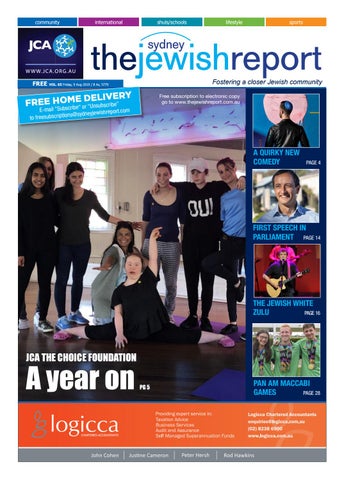
JCA THE CHOICE FOUNDATION
A year on CHARTERED ACCOUNTANTS CHARTERED ACCOUNTANTS
PG 5
PAN AM MACCABI GAMES PAGE 28
2
community
August 2019
A Fond Farewell to Bruce Goldsmith Ethan Singer completes Australian JCA Outback Marathon and raises over After three years at the helm of JCA, and $15K for Save a Child’s Heart three successively productive annual fundraising campaigns, Bruce Goldsmith has decided to step down as CEO in order to pursue a new business endeavour. Through his tenure, Goldsmith helped JCA along its continuing journey of change, culminating in the introduction of JCA’s new donor-choice fundraising model which enables giving on a community-wide basis as well as to specific programs that donors connect with most. This significant change in JCA’s fundraising approach was a key element of the success of the recent and widely acclaimed Insight & Illumination 2019 Fundraising Event. Goldsmith has been passionate about community and the relationships that are forged through JCA’s network of constituent organisations. He is particularly proud of the success of the third annual fundraising event under his leadership - Insight & Illumination. Goldsmith said, “The spirit of the community was palpable on the night and it is that aspect of my tenure that has been one of the greatest rewards of being a part of JCA.” On behalf of the organisation’s Executive Committee, JCA President Stephen Chipkin, commended Goldsmith, saying, “Bruce has led with maturity, integrity and passion on behalf of JCA’s member organisations and always with the best interest of this
community at heart.” Stepping into the role of Acting CEO is JCA’s Chief Operating Officer, Alain Hasson, who will work with Goldsmith to ensure a seamless transition over coming months. With six years’ experience at JCA, Hasson has served on a number of JCA Committees – Building & Capital, Planning, Status, and Allocations – where he has worked closely with community leaders, JCA member organisations, key stakeholders, and major donors. He brings invaluable experience to his new role as a next-generation leader for JCA and the local Jewish community.
Congenital heart disease has single handedly taken more children’s lives than any other birth defect, and although surgery is often the critical factor to saving a life, in many developing countries around the world it isn’t always available. Save a Child’s Heart (SACH) is an Israeli based Humanitarian program dedicated to performing life saving cardiac surgery on children from around the world and training medical personnel from these countries to have the competence of delivering quality care within their home communities. Sydney local, Ethan Singer, has chosen to dedicate an unbelievable 42 km marathon run around Uluru to saving a child’s life. He embarked on the ‘Australian Outback Marathon’ just last week, raising crucial funds in the hope that his efforts will be enough to pay for life-saving surgery. Ethan has become a local hero, successfully raising over $15,700 for Save a Child’s Heart, a much needed contribution that has given a very worthy family the hope they’ve been searching for. The inspiration for Ethan’s journey around Uluru was found when he volunteered with Save a Child’s Heart
in Israel back in 2015, and what kept him going despite the challenging sandy terrain, was his dream of saving a child’s life. “I was very fortunate to spend a day volunteering at its base centre in Holon as part of Israel By Choice program. Since then, the children treated at SACH have always had a very special place in my heart”. Ethan’s tireless persistence and dedication has not only fulfilled his own dream of saving a child’s life, but has in turn given the opportunity to a very special child on the other side of the world, to dream as well. To date, Save a Child’s Heart has saved over 5000 children from 61 different countries and continues to expand with a new hospital said to be completed in 2020 in Holon, Israel. Hopefully, Ethan’s inspiring story encourages others to get involved in Save a Child’s Heart’s Australian community and if it has inspired you, please contact Hannah Wollan, Australian SACH CEO, at hwollan@ saveachildsheart.org.au with an expression of interest - there is always someway to help or dona today at https://donate.mycause.com.
New York encounters at Mandelbaum MANDELBAUM HOUSE A particularly strong New York theme is being taken up by upcoming Mandelbaum Scholars in Residence, New York couple Rabbi Adam Mintz and Sharon Liberman Mintz, who will jointly feature during their stay in August and September. Curator of Jewish Art at the Library of The Jewish Theological Seminary, Sharon Liberman Mintz specializes in the fields of Illuminated Hebrew manuscripts and rare printed books. Over the course of 32 years at the Library, she has curated more than 45 exhibitions. Across this same period, she has consulted with Sotheby’s, cataloguing and appraising Hebrew books for Judaica sales worldwide. In both roles, she is held in the highest regard. In ‘The Art of Matrimony’, she brings her expertise to the Sydney Jewish Museum, examining ketubbot from its collection dating from the 12th through 21st centuries as microcosms of Jewish culture and testimony to the creativity and artistic heritage of the Jewish people. These sumptuously decorated marriage contracts have been integral to Jewish weddings for centuries and represent a magnificent expression of tradition in Jewish art. Based on her experience at Sotheby’s for more than 20 years, her lecture ‘Judaica Treasures at Sotheby’s’ delves into some of the most exciting Judaica discoveries and auctions of the last decade as well as intriguing stories behind the magnificently
illuminated Hebrew manuscripts, rare printed books, exceptional silver and paintings and the collectors who vie for these treasures. Rabbi Adam Mintz is most well known as the Director of 929 English, an online program of daily Bible study dedicated to creating a global Jewish conversation around issues anchored in, based on or inspired by the formative text of our common Jewish heritage – the Tanakh, the Hebrew Bible. Contributors to 929 include our own Rabbi Ben Elton and Rabbi Alon Meltzer, as well as previous Mandelbaum scholar in residence Professor Gary
Rendsburg. With his academic strength in Jewish history, Rabbi Mintz has held Adjunct Professor positions in several New York colleges, and at Rutgers University in New Jersey. Rabbi and founder of Kehilat Rayim Ahuvim, a Modern Orthodox community on the Upper West Side of Manhattan, he is thus eminently well placed to deliver his lecture ‘Migrations and Milestones: The Jews of New York’. Jews first arrived in New York in 1654 and he will consider how the community developed and the challenges faced over the centuries while also integrating into the economic
and social framework of this growing metropolis ‘Rabbinic Creativity in the 21st Century’ identifies that the realities of the twentyfirst century are not the realities of Mt. Sinai, where Jewish law was transmitted from God to Moses. Rabbi Mintz raises the question have the rabbis utilized the basic tenets of Jewish law to adopt and adapt to the changing realities of each generation? During their Sydney visit, the Mintz’s will lecture at Mandelbaum House, the University of Sydney, the Sydney Jewish Museum and at The Great Synagogue, Or Chadash and Maroubra Synagogue.
3
community
August 2019
A step change for the Sydney Jewish Report SYDNEY JEWISH REPORT DION COHEN
It has been over 5 years since we published our first Jewish free-to-street newspaper. From its humble beginnings as a small Jewish community newspaper covering only Sydney’s North Shore, it has progressed to offer both Sydney & Melbourne editions, released monthly, and which are distributed through over 80 distribution points. The mission of the paper has always remained the same - to foster a closer Jewish community through the sharing of news and ideas, the broadcasting of events & community initiates and keeping the community informed. Over the years we have experimented with a number of strategies to achieve the paper’s mission. We have introduced an electronic version of the paper, which is currently circulated to over 1,000 subscribers, we have broadened our distribution to schools and have introduced new distribution points. As of this month, The Jewish Report is pursuing a strategy of mailing out its Sydney edition for free to community members. This is aimed at increasing its reach and accessibility, in order for its impact to be more inclusive. Underpinning this strategy, is the deep belief in the importance of the Paper, as well as the fact that exposing as many community members as possible
to what the paper offers is an essential element in its mission of inclusion. We believe community papers will continue to play an important role in the circulation of news within our community, despite the digital age that we find ourselves in. The web provides us with an almost infinite choice of readership topics that appeal to an individual’s unique interest; be it political, religious, economic, etc. It is masterful in its presentation of articles and webpages, ensuring perfect matches with our reading preferences based on our interests, as mined from our digital footprint. However, the very brilliance in the tailored presentation of web-based reading material is a dichotomy to what being part of a community represents. In order to engender a community perspective, we need to broaden our reading consumption to include a range of issues that impact, interest and/ or bind the community as a whole. In order to feel part of a community we need to move from the “I” to the “We” in our acquisition of knowledge, to move away from a narrow range of reading exposure, to broader, community encompassing reading experiences. There are many Jewish web-sites that are extremely effective and powerful in disseminating information regarding the Jewish community. These are invaluable to our community. However, as is the structure of websites, certain of the content is
pulled by the user based on his/her interests through the mechanisms of menu choices and links. The objective of the Jewish Report is not only to be a platform for information attainment, but an instrument engendering inter-connection and cohesion as a community. To be part of a community, we need to understand where our community as a whole is at, how all its diverse components come together to form a single phenomenon, being the Jewish community of our home city. We need to be exposed to all its achievements & challenges, the current offerings available to our families, and a broad context for what our community members are involved in. It is through this exposure that we elicit the feeling of community, and all the emotions associated with the collective: the pride we feel in the achievements of our fellow Jews, of community organisations, and of the State of Israel; the communal concern over security; the discourse over the education of our children; and the excitement in the strategies for and achievements in the care of our sick, elderly or more challenged of our community members. This is what the Jewish Report aims to elicit - a mindset change of thinking beyond one’s own personal, unique set of interests to a collective mindset. We therefore believe strongly in the continued importance of a community paper, and that there will always be
a meaningful place for its existence amongst the plethora of web-based information sources. Our aim is to improve its accessibility and relevance, so that more and more community members can glean the benefits as espoused above. It is in pursuit of this objective that we have introduced the free-to-home mailing of the newspaper. We have also recently restructured the operation of the paper and introduced focus groups to improve content. I would like to extend our sincere gratitude to our content contributors and advertisers who have continued to support the paper over many years. We would also like to invite all members of our community to engage with us over our paper. Please view the Jewish Report as a bulletin board for the entire community - its individuals as well as its organisations. We will appreciate your content contributions, respond to your feedback and welcome any suggestions from our readers on how we can improve and further develop our paper. Please feel free to email us at editor@thejewishreport.com.au. And lastly, should you wish to have this paper delivered to your house free of charge, or alternatively do not want to be included in our monthly distribution list, please go to www.thejewishreport.com. au or email us at freesubscriptions@ sydneyjewishreport.com.
New Double Bay office Meet your local home care experts Discover expert aged care and disability support that gives you the freedom and confidence to live independently. As one of Australia’s leading care specialists, we can help you choose from a wide range of services, available when and where you need them.
24/7 HOTLINE
TRUSTED HEALTH TEAM
PERSONAL APPROACH
DOMESTIC SUPP ORT
WELLNESS SERVICES
CDC, NDIS & PRIVATE CARE
CONTACT US FOR YOUR FREE CONSULTATION 1800 251 537 334 NEW SOUTH HEAD RD, DOUBLE BAY MONTEFIORE.ORG.AU
4
community
A quirky comedy to premiere in Sydney
SHALOM
The scene is Skokie, Illinois in 1977. American-Jewish journalist Isaac Adams learns of a plan for a group of neo-Nazis to stage a demonstration in Skokie. Isaac, raised in a non-observant Jewish home, wonders what, if anything, his involvement should be. To date, Isaac’s Jewishness had been of no relevance to him – “being Jewish meant no more than being right-handed”. He is determined to find the truth. Isaac’s quest leads him to explore Jewish heritage, a journey that threatens to take a toll on his relationships with both his mother and the non-Jewish wife whom he loves. So is the premise of American playwright James Sherman’s play The God of Isaac, which premieres in Australia this September. Co-produced by Shalom and Moira Blumenthal Productions, and in association with Darlinghurst Theatre Company, The God of Isaac is directed by Moira Blumenthal herself. “The God of Isaac is a quirky comedy telling a very important story about a young man’s search for his identity,” said Blumenthal. “Isaac goes on a quest to get answers to his question ‘What is it to be Jewish’. Nobody has the full answer.” Portraying Isaac’s journey is the cast of Annie Byron, Lloyd Allison-Young, Tim McGarry, Claudia Ware, and Alexis Fishman.
Fishman, a graduate of Moriah College, has returned to Sydney after performing on Broadway in New York. The God of Isaac is Shalom and Moira Blumenthal’s sixth production together, following five successful productions including Coming to See Aunt Sophie, My Name is Asher Lev, and last year’s The Man in the Attic. “Shalom is excited to co-produce The God of Isaac,” Rabbi Alon Meltzer, Director of Programs at Shalom told the Sydney Jewish Report. “Firstly, it is a comedy which is something our audiences asked for.” “Secondly, and most importantly, it deals with a topic of significant relevance, the search for identity in the face of rising antiSemitism.” Commenting on her work with Shalom, Blumenthal said: “It’s great to be working with people with the same cultural commitment and the same passion for making connections through community.” The God of Isaac runs from Thursday 5 September to Sunday 22 September 2019 at the Eternity Playhouse, Darlinghurst. For more information and bookings, visit https://www.darlinghursttheatre.com/ whats-on/the-god-of-isaac or call (02) 8356 9987.
August 2019
Beyond Borders: from the IDF to Sydney University
MELTON
How does a former IDF soldier wind up in the University of Sydney’s Peace and Conflict Studies Department, long considered a hotbed of the BDS movement? Oren Thaler credits his four-and-a-halfyear service in the IDF with giving him the drive to devote much of his time and efforts to work for peace between Israel and its neighbours. After the IDF, Oren participated in many people-to-people peace-building initiatives, but felt that these efforts must also be complemented by acquiring a greater knowledge and understanding of the history and causes of the conflict. So, for the past 15 years Oren has been learning and teaching about the conflict. After earning a bachelor’s degree from the Hebrew University of Jerusalem in Middle East Studies and Jewish Philosophy, Oren then taught in Jerusalem and worked as a facilitator in Jewish-Arab programs, until coming to Australia where he now teaches at Emanuel school, alongside his studies at Sydney University. His Master’s thesis explores alternative solutions to the conflict. Oren is not deterred by the support for the BDS movement he experiences in his department at Sydney University. “It actually allows me to gain an insider’s view to the workings of this movement,”
Oren says. “Extremists always put their own agenda before reality and distort the picture to suit their beliefs. This is not helpful for anyone.” “Although the Israeli-Palestinian conflict has been going on for a century, it is a dynamic conflict and has been changing forms and taking surprising twists and turns along the way,” Oren reflects. “Many people feel they just don’t get it. Those who feel they do understand it must remain very alert and flexible in their views to accommodate new developments, as last year’s solution may not be relevant anymore.” “Each group I teach – whether Jewish, Arab or Australian, right or left, young or old – helps me further reshape my understanding.” Oren now also brings his passion for teaching about the Arab-Israeli conflict with depth and nuance as a teacher for Melton’s adult education program. Beginning 5 September and running for ten weeks, Oren Thaler will lead a Melton course entitled “Beyond Borders”, which explores the history of the conflict using primary source material and contemporary media. For more information, contact Hinda Young at hinda.young@sydney.edu.au or check out https://cce.sydney.edu.au/ course/HAIC
20-26 August Bondi Pavilion Book at shalom.edu.au
The
GOD of ISAAC 5 - 22 September Eternity Playhouse, Darlinghurst Book at darlinghursttheatre.com
For your FREE electronic copy of the Sydney Jewish Report register at
www.thejewishreport.com.au
August 2019
community
Almost a Year On, Much to Celebrate JCA THE CHOICE FOUNDATION
It has been almost a year since Taryn and Andrew Boyarsky launched JCA The Choice Foundation as a platform to deliver innovative programs that benefit people in our community living with a disability. The Foundation provides grants for organisations to create innovative projects that support, champion and enrich the lives of those who live with disability, and in turn the whole community. The goal has been to address gaps and enhance services in five key areas – education; vocation; housing; social; and respite for families. With a mission “to have a strong, inclusive community where every member can contribute by ensuring that a person with disability has the same opportunity to reach their potential as anybody else,” four grants have been awarded to programs that set out to bring this mission to life. Maccabi’s Education through Experience program is striving to make systemic changes in the community enabling them to understand and respect inclusion by facilitating immersive experiences that foster empathy both on and off the sports field. Recently, a group of Moriah year 6 boys heard a personal story from a Paralympian, gaining an insight into his life and the
difficulties that he faces. They then tackled the challenge of playing sport without using their legs in a game of wheelchair basketball, allowing them to start to comprehend the daily obstacles faced by people with a physical disability. This program is being rolled out to other schools in NSW with Mount Sinai next on the list. The Maccabi Dance Project (All Abilities) is a program that is creating an inclusive dancing environment for those with special needs to dance with their peers. Various styles of dance including Latin, jazz, tap and modern are being taught by professional teachers with these classes building
pathways to engage able bodied children to participate, dance and perform with diverse students Kesser Torah College (KTC) has received matched funding through the Foundation to enable the recruitment of specialist teachers in their high school to assist and support students who are experiencing difficulties accessing the mainstream curriculum. While KTC has had an excellent support mechanism in their primary school, this will be a first for their high school students and will greatly benefit their students and teachers. College principal Roy Steinman commends JCA The Choice Foundation for
5
their crucial support citing the Carrick Review (1991) on education that states “The aim of education is to assist in the development of each child’s potential. The provision for helping children of different abilities is not a luxury but a necessity.” The Sydney Jewish Museum aims to create a meaningful experience for all visitors, and while the Museum already attracts visitors with diverse needs, there is potential to make it more accessible and inclusive. Thanks to the generous support of the Foundation, the Museum has been able to engage Ernst and Young Human Services to conduct research that will uncover any deficits, report on global best practices and make recommendations to ensure that the Museum understands, and where possible, caters to the needs of all its visitors. The last program that has received funding thus far is Jewish Care’s JJOBS which will initially be providing paid employment opportunities to people with a disability within the JCA’s 23 constituent organisations, before broadening its reach. The initiative will identify potential JJOBS candidates and match them up with vocational opportunities to suit their abilities, with ongoing support being provided. JCA The Choice Foundation is calling on the community to bring their creative and innovative ideas that fall within their mission and to help give all people more choice in how they live their lives. Visit www.thechoicefoundation.org.au for more information, second round applications open in September.
6
community
August 2019
JNFuture Leaders
JNF
Fourteen young Australians have returned from Israel inspired, motivated and excited to contribute to Israel and our local Jewish community. Coinciding with the Eurovision Contest being held in Israel, these young adults joined thirty participants from around the world on a JNFuture leadership mission. “We are trying to build the next generation of active Jewish leadership” JNF’s Education Shaliach, Yigal Nisell described the purpose of the delegation. “We want to establish a cohort of young Jewish leaders who are willing to commit their time, leadership, talent, and resources to strengthen the work of the JNF, Israel and to give back to our local Jewish community.” For ten days, the delegation toured the length and breadth of the country, soaking up Israel’s rich and fascinating history and culture. The real highlights were the opportunity for young adults to network with likeminded individuals from around the world, join exclusive meetings with leaders in innovation and entrepreneurship, immerse themselves in a variety of environmental and Zionist projects and take part in the Eurovision celebrations. “The only way to really understand
Israel and support it wholeheartedly is to come and visit it,” said participant Talia Katz. It was in the Negev region that the participants got a strong sense of the pioneering spirit, agriculture and Zionism in the modern era. From abseiling the Ramon Crater, to visiting the new JNF supported community of Sheizaf, the delegates witnessed the challenges, opportunities and magic that the desert offers. In Sde Boker, on the final day of their visit, delegates went to pay their respects at the tomb of Israel’s first Prime Minister, David Ben-Gurion. JNF is committed to fulfilling BenGurion’s dream of settling the Negev, given its national, economic and strategic importance. Tali Greenstein laid a wreath on behalf of the delegation, saying, “Together we must continue to make Ben-Gurion’s dream and vision a reality.” By the time the action-packed ten days drew to a close, the delegates had experienced Israel in a unique way and had been inspired by all that Israel has to offer. Reflecting on the mission, Speedy Shatari commented “I am certain that the things I have learnt on the JNFuture trip will allow me to continue to give back and contribute to the Jewish community, a community which I love being a part of.”
“Yes you heard right” Sydney Jewish Report is delivering its paper for free to Jewish homes throughout NSW. Should you wish to subscribe or if you are currently subscribed and wish to unsubscribe, please go to www.thejewishreport.com.au or email freesubscriptions@sydneyjewishreport.com
Eat Well Every Day
COA Kosher Meals-on-Wheels Nutritious menu Makes food preparation simple Delivered by friendly COA volunteers 37 years experience and over one million meals delivered
Enquiries to 9389 0035 or email coa@coasydney.org or go online to www.coasydney.org for more information
August 2019
7
community
WIZO’s Project Jonas - Saving the dormitory means saving lives WIZO NSW DIANE SYMONDS, PRESIDENT WIZO NSW WIZO’s leading-edge work in Israel in every aspect of education for all ages provides the basis for creating a brighter future for young people by developing their true potential. WIZO will continue to help ensure that even the most disadvantaged and problematic youngsters will emerge with confidence, self-esteem and purpose, ready to make their contribution to Israeli society. WIZO Ahuzat Yeladim is WIZO Australia’s flagship project in Haifa. Attended by psychiatrically abused children WIZO offers the children hope for a normal life as a contributing Israeli citizen. This therapeutic and post hospitalization residential school located is for children aged 7-18. The children come from all over Israel and are referred to the school by the Department of Welfare. The majority of students come from highly dysfunctional families and have been removed from their home by court order. They suffer from behavioural, emotional and psychiatric problems and have special educational needs. This school is their last hope for a normal life. The Jonas Dormitory is one of 4 special “homes” at this Boarding School. Built almost 60 years ago, the Jonas Dormitory is now deemed to be below acceptable living standards. As such, the Israeli Ministry of Welfare recently ordered the renovation of this building so it adheres to licensing requirements and to continue to receive government funding. The Jonas Dormitory will be closed down if the renovation does not take place.
To meet the needs of today’s standards and qualify for government funding, the entire indoor structure of the dormitory must be renovated. This includes bedrooms, washrooms, showers, common areas, kitchens and staffrooms. Each student has a unique therapeutic program designed especially for them by the therapeutic staff, with their individual needs and circumstances top of mind. This post-hospitalization unit provides the students with only the best support. Here they receive formal education in a way that is specially tailored to answer their needs, they receive psychological and psychiatric treatment, and they have leisure activities
and educational trips. Traditional and non-traditional forms of therapy are used together, considering their individual needs and circumstances. Traditional therapies consist of psychological and psychiatric treatment, while non-traditional therapies include art therapy, music therapy, gardening therapy and animal assisted therapy. Each youth participates in two hours of therapy per week. Once a week, they attend psychiatric checks. Additionally, they join regular group meetings in the frequency the social workers find appropriate. 100% of the boys at Jonas successfully become productive and well-functioning members of Israeli society. IDF enlistment
rates and matriculation rates of the boys in Jonas dormitory are exceptionally high. WIZO Australia is committed to making the renovation of the Jonas Dormitory at WIZO Ahuzat Yeladim possible. A renovation that simply must happen! All donations will enable generations of children to get the maximum benefit from the learning process, and to enjoy their education in newly renovated, modernized facilities. If you would like to support WIZO and help us make this happen: call 9387 3666 or online www.wizonsw.org.au
ENROL NOW: ELC AND PREP 2020 Start your journey with us now!
4 year olds
3 year olds
2 year olds
(Prep)
(Early Learning Centre)
(Early Learning Centre)
Social competence Emotional wellbeing Emerging autonomy Sense of belonging Resilience
Fine motor development Communication expansion Mastering cognitive skills Developing a disposition for learning
School readiness /pre writing skills Becoming capable and independent learners Developing a range of skills and processes such as problem solving, inquiry and experimentation
Limited places remain for Year K 2020
Enquire now: Rachel Schwartz rschwartz@mountsinai.nsw.edu.au
JCA Member Organisation
8
community
August 2019
Kosher Food is Comfort Food
COA RACHEL TANNY
What is kosher, really? Is it only about the laws in the Torah and rabbinic oversight? Ask this question at COA Sydney and you will quickly learn that there is more to it. We all know the power of comfort food. Whether it’s your mum’s famous chicken soup or the chocolate cake you had at every birthday party as a kid, we’ve all experienced the feeling of food changing our mood. But this isn’t just anecdotal – there is scientific evidence to back it up. According to psychologist and neuroscientist Professor Hadley Bergstrom, “Taste memories tend to be the strongest of associative memories that you can make.” Food does more than just provide sustenance to our bodies – it connects us to our past. Connections are exactly what COA Sydney gives the seniors of our community, and Kosher Meals on Wheels is just one of the programs COA offers to deliver these connections. For COA, kosher doesn’t just mean delivering KA certified meals (although they do), it’s also about the positive emotions those meals bring. With offerings like beef goulash, chicken schnitzel, and matzah ball soup, COA helps seniors reconnect with the foods they most love. Every delivery is
more than just a meal – it’s a memory and an emotion. While Kosher Meals on Wheels also come with the option of ordering dessert or soup, every meal is delivered with something extra sweet free of any charge – a bonus helping of love. Every meal is delivered by trained volunteers, who often sit with the recipients to have a chat and a cuppa. Deep and
meaningful friendships result. If a volunteer is out sick one week, their meal recipients often call COA to ask if they’re okay! Whether recent retirees who want some meals in the freezer for an easy night off, or those who are no longer able to cook for themselves, COA’s Kosher Meals on Wheels are neither ordinary kosher nor
are they ordinary Meals. To COA, kosher means both certification and comfort. With every meal COA Sydney truly delivers Connections, Opportunities, and Activities. If you would like to be part of this amazing service as a meal deliverer, please contact COA today on 9389 0035, and connect to your community in a tangible and meaningful way.
Masada College Ivrit Scholarship and High Potential Learners Scholarship High Potential Learner classes cater differently for students who have the ability to work beyond the standard curriculum. Scholarships are offered to students in Years 5 and 6 in 2020. Ivrit Scholarships are offered to Junior and/or Senior School students who have a passion for Hebrew and desire to excel in a nurturing Jewish environment.
Test date: 27 August 2019 For more info: Go to masada.nsw.edu.au
ELC-Yr 12 College Campus: 9-15 Link Road, St Ives T +61 2 9449 3744 E
August 2019
Fertility preservation at Shaare Zedek for a healthy future AUSTRALIAN FRIENDS OF SHAARE ZEDEK INC MIRIAM PACANOWSKI At the heart of every Jewish Simcha is the desire for a healthy future. And after experiencing challenges, the joy of life’s milestones is especially meaningful. Australian born and trained Dr Jordana Hyman works as a senior consultant in IVF at Shaare Zedek Medical Centre Jerusalem. Her work includes helping young women with cancer preserve their fertility and look forward to a healthy future. Jordana says, “I am an Australian born and trained doctor, living in Jerusalem and working in Shaare Zedek Hospital. I made aliyah with my husband and daughter after finishing university and internship. “We settled in Jerusalem and I started residency in obstetrics and gynaecology in Shaare Zedek. “I now work at Shaare Zedek as a senior consultant in IVF. This work involves a mix of procedures (egg collections and embryo transfers) clinics, treatment planning, and academic research. “The IVF unit in Shaare Zedek is amazing, the staff are very dedicated and passionate about their work and it’s a great work environment. “One of my passions is working with
9
community
oncology patients to provide fertility preservation treatment, which involves freezing eggs or embryos for future use before a woman or girl begins chemotherapy, which may render her infertile in the future. “Shaare Zedek’s Oncology Department, especially young women with breast cancer, has rapidly expanded in recent times. As a result, we have a lot more women being referred for fertility preservation. “I was always interested in obstetrics and gynaecology, but the focus on IVF came later. About halfway through my residency I had a rotation in IVF and from very early on in the rotation I felt it clicked and I had “come home”. I am blessed to be a mother to my amazing children, and I think it motivates me to want to help every woman and couple struggling with challenges of fertility. Sometimes, Jordana meets women who have babies after enduring chemotherapy. When this happens, she says “It’s a really amazing experience to see the fruits of our work, especially after everything these women have been through. “It is very, very rewarding. I feel very blessed to have such meaningful and rewarding work and to be able to contribute to the future of our people.” Australian born and trained Dr Jordana Hyman is helping women with cancer preserve their fertility at Shaare Zedek so that they can look forward to a healthy future.
UIA supporting Aliyah for almost a century
UIA
For nearly 100 years, the United Israel Appeal (UIA) has focused on its core work – supporting the People of Israel. UIA is known as Keren Hayesod (KH) in Israel and other countries, which translates to ‘The Foundation Fund’ and encapsulates our work as the official fundraising arm for the People of Israel. At the Zionist Organisation conference in London in 1920, KH-UIA was born. After the establishment of Israel, KH-UIA became one of the most recognised national institutions, with the KH Law being passed in 1956 in the Knesset recognising this unique status. More than 60 campaigns in 47 countries operate globally to advance the national priorities of the Jewish People in order to strengthen Israeli society. In close cooperation with the Israeli Government and The Jewish Agency, we ascertain what these priorities are and identify opportunities at a national, Jewish and strategic level for the People of Israel. Since 1948, we have assisted with the immigration and absorption of over 3.5 million new immigrants. We have funded the establishment of more than 900 communities in Israel and the creation of EL AL, Zim, the Israel Electric Company, the Philharmonic Orchestra, Bezalel and other establishments. In the 1970s, we assisted with the regeneration of over 100 neighbourhoods, and in the 1980s and 1990s we focused on the immigration and absorption of hundreds of thousands of Ethiopian immigrants. With the final collapse of the Soviet Union, approximately 1 million Jews immigrated to Israel during this decade thanks to UIA, and we have continued to support many special campaigns to assist the People of Israel during times of unrest. In the last two decades, with the peak of the ‘start-up nation’, Aliyah and Absorption remained vital for UIA. However, new social revolutionary projects were also developed in response to the
needs of those living on the periphery to close social and educational gaps, and ensure everyone can realise the dream of rebuilding a better future in Israel. Most recently, Israeli leaders including Sam Grundwerg, Keren Hayesod-UIA World Chairman welcomed over 200 new immigrants from France, Brazil, Argentina, Venezuela and Russia at a festive reception at Ben-Gurion International Airport in July. Among those who arrived from France were 80 Parisians who planned on settling in Jerusalem, Netanya and Tel Aviv. The youngest on the plane was only 2 months old, with the oldest, 79. 80 new immigrants flew in from Russia, mainly from Moscow, including 25 schoolchildren. Most of these families plan to settle in Ashdod, Rishon Letzion and Tel Aviv. Isaac Herzog, Chairman of The Jewish Agency also welcomed the new Olim. Herzog expressed his joy and excitement of the new immigrants who “will soon begin a new chapter of life in their historic home.” To learn more about UIA’s vital projects supporting Aliyah and Absorption visit uiaaustralia.org.au/our-projects/aliyahand-absorption or contact 9361 4273, info@uiansw.org.au
NEW SCHOLARSHIPS & BURSARIES FOR
YEAR 5, 2020
Our innovative Years 5 & 6 program gives every child the opportunity to experience transformative, personalised learning and ensure a successful transition into High School.
• Cutting-edge, contemporary and dynamic educators • Integrated, immersive Jewish life programs • Targeted intervention, enrichment and extension, including an Academically Selective offering • Innovation, leadership, creativity and critical thinking as core focus areas • Agile learning spaces and access to specialist High School teachers and resources • Wellbeing and mindfulness programs to build resilience, self-awareness, and a love of learning To register your interest visit www.moriah.nsw.edu.au or contact Director of Admissions, Vicki Farkas (02) 9375 1807 | vfarkas@moriah.nsw.edu.au Scholarship registrations close 20 August 2019
Queens Park Road, Bondi Junction, Sydney, Australia Tel: (02) 9375 1600 | Fax: (02) 9387 3490 Email: info@moriah.nsw.edu.au | www.moriah.nsw.edu.au
10
community
August 2019
Inspiring dreams and paths of passion at Jewish social justice summit PLUS61J MICHAEL VISONTAY
IT was something rarely seen at an Australian Jewish communal event – a crowd with lots of young people, genuinely interested in listening to what the speakers had to say. The thirst for inspiration, insights and experiences from those who have tried to make a difference, created a powerful buzz on Sunday at the second Australian Jewish Social Justice Summit, a joint initiative of social justice organisation Stand Up and Plus61JMedia, along with Shalom and the Emanuel Synagogue. The talks and sessions delivered at Bondi Pavilion ranged from big politics to grassroots campaigns, national leaders and committed individuals. All the speakers were Jewish and all of them have focussed their energies outside the community. Hence, the summit’s name, Beyond The Tribe. In the morning the former member for Wentworth, Kerryn Phelps, chronicled the evolution of the Medivac legislation she spearheaded through Federal parliament, and the moral shame Australian governments must bear over asylum-seekers. In the afternoon Sydney mother Anna Buch, speaking on a panel titled Local Heroes, talked about the support group she co-founded that spends every Thursday at Sydney’s Villawood detention centre, escorting a group of visitors who bring comfort and support to asylum seekers. Similarly, the CEO of Greenpeace Australia David Ritter delivered a powerful address about the future of the environment: “on the great challenges of our age – the climate and extinctions emergency, the new technologies and the scourge of rising inequality – we have just re-elected a federal government that is offering nothing.” Meanwhile, Melbourne historian and climate advocate Rebecca Forgasz reflected on how she and her sister Rachel were driven to start a grassroots Jewish climate action group in their lounge room. The summit was distinguished by this combination of corporate innovation and homespun wisdom. Sydney school friends Error! Hyperlink reference not valid.
discussed how they started their pioneering charity, Humanitix, a ticketing platform that redistributes profits to 30 partner charities. Danielle Chiel, the founding CEO of global knitwear business KOCO (Knit One, Change One), reflected on how her company has transformed the lives of hundreds of women who work as knitters in villages across the state of Tamil Nadu in southern India. Gidon Goodman and Oscar KaspiCrutchett inspired with their tales of how they individually agitated to change government policy – Oscar started a notfor-profit in support of marriage equality, and organised various student strikes for climate change – and Gidon’s advocacy pushed the government to remedy exorbitant parking
fees at hospitals. By the end of the day, these and other speakers had lit up paths to helping others that may not have been visible before. They did it with a charge of passion and conviction that inspired everyone who attended. Jewish community leaders have long talked about its willingness to help others in need. This summit opened many people’s eyes to the different ways that individuals can pursue this yearning, and the practical paths they can choose to improve the lives of others. This article was originally published by Plus61JMedia (plus61j.net.au)
Four weeks, four major historical moments MELTON Do you love learning but between travel, grandchildren duties, and other commitments you just don’t have the time to take a ten-week course through Melton? Have you always wondered what Melton is, but never been able to take a course? There is now an opportunity to take a four-week Melton course this November. Before the silly season, get your intellectual fix with Sydney’s own Professor Suzanne Rutland OAM. She lives in Jerusalem half the year, so this is a unique opportunity to study with Professor Rutland. The course material is sure to captivate. We Are What We Remember explores the relationship between memory and history and asks why Jews remember
certain events and how they do so. Suzanne will explore with the cohort four major historical moments in Jewish history and how they have been embedded in Jewish thought and life. You will start with the instruction to remember the ancient enemies of the Israelites, Amalek (later connected to Haman and even Hitler), the expulsion from Spain in 1492, life in Poland before and during the Shoah and the establishment of the State of Israel. Each of these moments transformed the experience of the Jewish People. Amalek attacked at our very beginnings as a nation. The Jews who left Spain and Portugal in the fifteenth century spread around the Jewish world bringing new ideas everywhere they went. The world of Eastern Europe before the Holocaust was vibrant and exciting,
and now exists only as a memory. The State of Israel has changed what it means to be a Jew whether we live in Israel or the Diaspora. “This is going to be a fascinating course taught by an acclaimed scholar and educator,” guarantees Melton Director Hinda Young. “The Melton environment is always warm and welcoming, with discussion and reflection encouraged and supported.” “Whoever attends We Are What We Remember is guaranteed a memorable experience!” For more information on We Are What We Remember, contact Hinda Young at hinda.young@sydney.edu.au
August 2019
community
Warming ourselves without warming the globe JEWISH ECOLOGICAL COALITION (JECO) SHARON FLITMAN Winter is here… and not just to Game of Thrones. And heat-seeking has returned to the forefront of many minds. Unfortunately, many means of self-warming are also means of changing the climate. While fossil fuels remain our primary power source, turning on heaters whenever it gets a bit nippy is simply not sustainable. Remember that we are here to take care of G-d’s creation, not to exploit and destroy it. As Midrash Ecclesiastes Rabbah puts it, ‘When G-d created Adam … G-d told him: … Do not corrupt the world, for if you do, there will be no-one to set it right after you’. Fortunately, producing lots of emissions through heating is not the only way to keep warm. Here are a few hot tips to help save the world and save money. Hot tip #1: Layer up Do you turn up the heating when you could just put on an extra jumper? This makes neither sense nor cents. Power costs increase 5-10% for every 1◦C increase on the thermostat. Layer up with a woolly jumper, warm pants, snug slippers and even a beanie to stay cozy while cutting your power costs. Hot tip #2: Keep it contained If winter woollies are not enough, ask yourself how much of your house actually needs to be heated. Instead of roasting every room, can you switch it on only in the room/s you’re using? Even a house-wide
ducted system has vents that can be closed off. Closing internal doors can keep the heat from leaching out into vacant areas. Hot tip #3: Don’t dissipate… insulate! Without adequate insulation, heaps of your heat seeps out through windows, ceilings and walls. To help keep the heat inside, consider: • Foam strips to seal gaps around doors and windows • Door snakes to prevent chill at entrance
ways • Drawing curtains at night • Pelmets over windows • Checking your insulation • Installing double-glazed windows. Hot tip #4: Pump it up Reverse cycle air conditioners (aka heat pumps) are a smart alternative to coal, gas and oil heating. Rather than independently generating heat, they pump it in from outside – even on really chilly days. This uses only
11
about a third of the energy required by the gas/coal/oil counterparts. Heat pumps can also provide hot water, also using only about a third of the energy of a standard electric hot water heater. Hot tip #5: Catch some rays Australia has more sunshine per square metre than any other continent1, and rooftop panel prices have dropped by 58% over the past 6 years despite reduced government rebates2. Solar panels pay for themselves within 6 years or less in Melbourne and even faster in sunny Sydney. With the average cost for a 5kW system being $5,100 - what are you waiting for? This winter, you’ve got the power to really ramp up the Tikkun Olam. And really, it’s a win-win - saving the planet and your finances in one fell swoop. And best of all? You’ll feel good… warm both inside and out! References 1Geoscience Australia and ABARE (2010). “Australian Energy Resource Assessment” Canberra: Geoscience Australia 2 https://www.choice.com.au/homeimprovement/energy-saving/solar/ articles/solar-panel-payback-times For more sustainability tips see www.jeco.org.au
BEST BURGERS IN BONDI KOSHER OR NOT, COME AND SEE WHY OUR CUSTOMERS RATE US THE BEST BURGERS IN BONDI.
10% OFF* ANY BURGERS OR PIES *10% discount on any Katzy’s burgers or pies, when original ad is presented in-store. Valid for 30 days from date of publication. One time use only. Maximum discount cannot exceed $20.
Shop 2, 113-115 Hall St, Bondi 2026 www.katzys.com.au Call (02) 9130-6755
12
community
Remembering the names
August 2019
SYDNEY JEWISH MUSEUM Elie Wiesel said “Without memory, there is no culture. Without memory, there would be no civilisation, no society and no future.” Oral history is a central part of Jewish culture; a way of passing down the stories that form the foundations of the culture to help define the moral compass of future generations. The future of Jewish culture is reliant upon these stories being embedded in the memories of generations over years, decades and centuries. Remembering the Holocaust was a keystone in the reason for the establishment of the Sydney Jewish Museum, and 27 years since its inception remains the reason why the Museum continues to preserve and tell the stories of this important event in history. The Museum tells these stories in many ways so that they are never forgotten. One space in the Museum that is dedicated to the memories of victims of the Holocaust and those who survived but are no longer here to tell their stories, is the Sanctum of Remembrance. This contemplative space honours more than 500 individuals and families, who were in some way connected to Sydney’s Jewish community, by eternalising their names on dedicated plaques. Many of these plaques commemorate the lives of people who
have no known grave, with the Sanctum of Remembrance being the only place that their name is formally inscribed. Late last year, three generations of descendants of Isi and Mala Sonnabend gathered in the Sanctum of Remembrance to dedicate a plaque to honour their parents, grandparents and great grandparents. At the dedication Miri Sonnabend, one of Isi and Mala’s grandchildren, spoke about how important the names of their murdered
A call-out for photographs from Arab lands
SYDNEY JEWISH MUSEUM
A call-out for photographs from Arab lands Sydney Jewish Museum The Sydney Jewish Museum is curating an exhibition on the diverse histories and cultures of Jews from Arab lands and Iran, and we need more photographs from these communities to make up part of the exhibition. The exhibition will start with the story of the destruction of the First Temple and the exile of the Jews from Babylon, and will trace the history of Jewish communities as they spread throughout the region until today.
Relatively unknown to even the mainstream Jewish community, this exhibition will explore the unique identity of this community. If you are from the Middle East, Asia Minor or North Africa with Jewish descent, the Museum’s curators would love to see photographs of your family, either in your country of origin or here in Australia. If you have any photographs that you would like to be part of this special exhibition, please contact curator Shannon Biederman at sbiederman@sjm.com.au or 02 9360 7999. Image credit: Courtesy Helene Cadry
family members were to her grandparents. “The names allowed my grandparents to remember. And now that they are gone, it is incumbent on us to remember the names, and keep their memory alive.” Each year, prior to Rosh Hashanah, the community gathers at the Museum for a special ceremony where family members read the names of their loved ones who they have dedicated plaques to and Kaddish is recited. At this year’s ceremony Aboriginal elder Uncle Michael
Welsh will speak about the importance of storytelling and passing down the names of ancestors in the Aboriginal community. You are invited to attend the Reading of the Names Ceremony at the Sydney Jewish Museum on Sunday 8 September at 11am. To RSVP or to find out more information about the Sanctum of Remembrance, please contact Rita Prager on 9360 7999 or rprager@sjm.com.au
‘Let My People Grow’, or… AUJS JOSHUA GOODMAN If you wanted to give the leaders of tomorrow a leg up, how would you do it? This is the question the Susan Wakil Fellowship team has been grappling with since its inception three years ago. Breaking down the question further can help guide us to a reasonable solution. Without a doubt, any approach should involve imparting some kind of wisdom or knowledge, either through providing them with experiences or teaching them directly. This is where the Latin term a posteriori can help us. The literal meaning of the term is, ‘from what comes after,’ referring to the knowledge gained after experiencing something. In layman terms, a posteriori knowledge is the kind of knowledge one can only gain from experience. Needless to say, our humble Jewish community has a lot of it. So, in answering the opening question, I propose that we have to make an intentional and measured effort to provide our university students with suitable a posteriori knowledge from stakeholders 5 to 50 years their senior. In extracting that level of knowledge over the course of one year, one can either choose to mine deeply from one single source, or to survey from a diverse range of many sources. At the Fellowship, principally a political program, we’ve designed a model that incorporates both. At one end of the spectrum, we fill our workshops and political tours with amazing minds. Whether it’s a 20-something digital pioneer, or a world-renowned Professor of Public Policy. This year, for example, the Fellowship took the Fellows to New York City for a jampacked tour of meetings with not-for-profit
CEO’s, think tank presidents, lobbyists, politicians, fundraisers, ambassadors and media professionals. At the other end of said-spectrum, however, the Fellows also experience a more focused, specialised and long-term set of relationships. Dedicated Sydney- and Melbourne- based Fellowship Directors, who curate their program and check in with them weekly, are complemented by yearlong professional mentors who provide a richer, longer exposure. Between these experiences is woven a delicate thread, illuminating the lessons, knowledge and connections harnessed from contact with each and every stakeholder. What can we hope to teach our leaders of tomorrow? There are hard skills and facts, certainly. Project management, how to discuss ideologies, the nature of Australian politics and how to execute an impactful social media campaign. But then there are the softer skills: how to talk to people, building meaningful networks, and identifying worthwhile stakeholders. While the Apple Watch has made the aesthetic of a machine less imposing in the 21st century, it takes a large, well-designed machine to solve the question posed in the opening paragraph. The Susan Wakil Fellowship is not only a vital gear in that machine, but a vital gear in the future of our community’s leadership. Joshua Goodman is a Fellowship Director for AUJS’ Susan Wakil Fellowship. Applications for The Susan Wakil Fellowship 2020 cohort open 19 August 2019. Email swf@aujs.com.au if you or someone you know would be interested in making an impact in the world and leading our community from the front.
13
community
August 2019
AJA 2020 Vision Israel Tour AUSTRALIAN JEWISH JONO VANDOR
ASSOCIATION
The Australian Jewish Association and Israel News Talk Radio have partnered to create a special tour, a refreshing and genuine Israel experience that enables you to side-step the fake news and view Israel with perfect clarity on the 2020 Vision Israel Tour. The 2020 Vision Israel Tour will highlight ancient and modern military history, current security strategies, as well as common sense politics and policies within the miracle that is the Jewish homeland. The tour will connect you with local residents, security and military experts, rabbis, commentators and political figures. The tour includes staying in the only Jewish hotel in the Shomron, visiting Ramat Trump [Trump Heights] in the Golan, walking the recently opened Pilgrim Road to the Temple Mount and receiving exclusive briefings from Israel security experts and other commentators during dinners and on the tour bus. We will also experience some of the best in Israeli cuisine and wines and will visit an Israeli distillery in the Golan. Breakfasts, dinners, accommodation, entry fees are included in the tour price. On the tour you will travel with some special people: Dr David Adler is the president of the Australian Jewish Association. He has a medical degree from the University of NSW, where he also received the medical faculty prize for general proficiency and leadership.
Ross Nichols, Jono Vandor, Rabbi Tovia Singer He is the former Deputy Medical Secretary of the Australian Medical Association, a role which provided him with an excellent background in policy and advocacy. David is also an active member of Sydney’s orthodox Jewish community. He writes frequently on political issues, is a highly sought out speaker at Jewish community events, and a regular guest on radio and television programs. He is known to be outspoken on issues affecting the Jewish community and is a staunch advocate for Israel.
Reflections on an important trip to the Ukraine for B’nai B’rith ALAN MILLER After many years of supporting charitable projects in Ukraine, 21 members of BBUK set off earlier this year to see the projects for themselves, to learn about the history and the rich Jewish culture, and to meet the people of a land that played such a large part in our Jewish history. Kiev In the evening when we attended the beautiful Kiev Opera and Ballet House where we saw a stunning performance of Rimsky Korsikov’s Sheherazade. Our visit to Babi Yar, the ravine on the edge of Kiev where up to 100,000 Jews were slaughtered, was a place for reflection and prayer – but the fact that the ravine has been filled in and is used as a public park made it difficult to imagine the enormity and horror of the crimes. One of our most chilling experiences was the next day when we visited the town of Bratslav. We were taken by the grandson of a Righteous Gentile to the most beautifully picturesque riverside and stood by the memorial to the 250 Jewish children who, one freezing February night in 1942, were marched naked from the orphanage and thrown into a hole made in the ice of the river. Those who did not initially die of the shock of the freezing water were clubbed or shot by the Nazis and assisting Ukrainian police collaborators. Odessa Several of us went to The Great Choral Synagogue for Kabbala Shabbat service, which unusually for Eastern Europe, was absolutely packed out and utterly vibrant in the congregation’s enthusiasm to pray. We then walked to the Opera House, the Potemkin Steps and the magnificent tree
Tamar Yonah is the owner/manager of Israel News Talk Radio. She is known for her no-nonsense delivery style which brings passion, humour, and fire to the mic. She has been a vocal beacon of light since beginning a prolific career in radio. The “Tamar Yonah Show” continues to be Israel’s most popular English language radio talk show. Tamar served in both the Israeli Army and the Air Force, and then became an advocate and activist for the Jewish State. In addition to the tour\’s primary hosts, Jono Vandor, a proud member of the AJA and INTR crew, co-hosts the INTR
radio show “Israel On My Mind” with Ross Nichols, a vice-president of United Israel. They, together with the author of Let\’s Get Biblical, Rabbi Tovia Singer of Outreach Judaism, have conducted multiple Israel tours together. The 2020 Vision Israel Tour, 17-25 March next year, will be an experience you will never forget. The tour web page provides more information, itinerary, costs and a link to book now for the Early-Bird Discount, but hurry, this is a small group tour and tickets are limited!
AN EXPERIENCE OF A LIFETIME: COME ALONG FOR THE FIRST AJA ISRAEL TOUR, 17 – 25 March 2020
“2020 VISION ISRAEL TOUR” In conjunction with Israel News Talk Radio
lined boulevards of the grand City of Odessa, which once boasted a 40 percent Jewish population. Our guide brought to life the lives of Shalom Aleichem, Bialik, Jabotinsky, Isaac Babel, Golda Meir, and showed us the House of the Palestine Committee where Zionism was born in the late Nineteenth Century. With our guide we also visited memorials to the unspeakable horrors of both the Nazi and Soviet regimes. On a personal level, this trip demonstrated the vital importance of B’nai B’rith as an International force for good. We saw the direct benefit of our projects, unique to B’nai B’rith, which allows all Jews to feel that they are part of one unified community. This trip inspired us all to try to enthuse every Jewish person with the message that B’nai B’rith is not only “A Global Voice of the Jewish Community”, but one that actually delivers Benevolence, Brotherly and Sisterly Love, and Harmony. Alan Miller is the National President B’nai B’rith UK.
Only US$2595 per person twin share after sponsored US$200 per person discount only for bookings before Rosh Hashannah, 27 September. More information and bookings: http://www.truth2u.org/israel-tour/
14
community
August 2019
First Speech in Parliament BY DAVE SHARMA Like many who call Australia home, my story starts on the other side of the world. My father was born to an Indian family in the West Indies, the youngest of nine children. His family, of modest background and means, worked hard and saved in order to send him to university in London. He arrived just after the war ended, becoming the first in his family to receive a formal education. It was in London that he met my mother, an Australian girl from Sydney. Like many of her generation, she had sailed to London in the early 1960s for an adventure. They fell in love, married, and started a family together. My elder twin sisters were born in Trinidad and Tobago. I was born in Canada. Before going any further, I do wish to reassure you Mr Speaker, and everyone else here, that I am — absolutely — no longer a Canadian citizen. I am honoured to be here representing the electorate of Wentworth, one of the most diverse electorates of any in the country a place of breathtaking beauty, and the home to many Australian icons: from the lapping waves of Watson’s Bay to the roaring surf of Bondi Beach; from the test match crowds at the SCG to the glitz and colour of Oxford Street. Wentworth’s wealth is more cultural than material, woven from the waves of migrants – Jews, Greeks, Russians, South Africans – who have found sanctuary and a home there, and a tolerance that finds further expression in a large and vibrant gay community. I am not native to Wentworth. Indeed, I am not native to Australia. But in the best
traditions of many before me, my family and I have made it our home. I wish to thank the people of Wentworth deeply for the trust they have placed in me. My family arrived in Australia in the 1970s and settled in Sydney. A happy childhood was altered abruptly when my mother, Diana, was diagnosed with breast cancer. Mum fought bravely, but she succumbed to cancer when I was 12. These were not easy times for my dad, my sisters and me, or indeed for my mum’s family — many of whom are here this evening; each of whom lovingly helped with the job of raising me once my mum had departed. I was the beneficiary of a great public education at my local high school. My former principal is here this evening, as are some of
Tisha B’Av
my oldest and dearest school friends. I did well enough at school to be offered a place at Cambridge University, which I took up with relish. After three years there, I was driven by a sense of service and duty to give back to the country that had given me and my family such opportunities. So that brought me back to Australia, and into the Department of Foreign Affairs and Trade. My first assignment was with the Australian Defence Force in Bougainville, Papua New Guinea, where we had a peacekeeping force. I was stationed in Bougainville and in Port Moresby for over three years, spending my days in negotiations with militants and separatists and my nights often in a stretcher bed under a mosquito net. Working as part of team Australia, we
helped achieve a durable peace to the most bloody conflict the Pacific had seen since World War Two. Australia has unique responsibilities towards this part of the world, and I am pleased to see the focus on our near neighbourhood increasing under this government. After my time in Papua New Guinea I worked for Alexander Downer during the Howard Government, one of the longestlasting and most productive partnerships of Australian foreign policy. I went on to serve at the Australian Embassy in Washington DC in the post 9-11 era, before helping lead the international division in the Department of Prime Minister and Cabinet during Julia Gillard’s time as Prime Minister. It was from here, and by a Labor government, that I was appointed Australia’s Ambassador to Israel. My four years in that role left me with a high degree of admiration and respect for the state of Israel and the Jewish people, and all they have achieved under tremendously trying circumstances. It also gave me a deep affection for the Australian Jewish community, which has made an outsized contribution to all spheres of Australian life, and the nation we are today. It is one of Australia’s great institutional strengths that we have an independent federal public service, which at its best is creative, a rich source of ideas, blunt in its advice, but unswervingly loyal to the government of the day. I learnt from many of Australia’s most experienced and formidable public servants during my career, amongst CONTINUED ON PAGE 15
Eat Drink and be Merry…
KASHRUT AUTHORITY RABBI MOSHE D. GUTNICK Admittedly, it may appear rather strange to give an article such a festive title given this was written during the Nine Days and is all about Tisha B’av, the saddest day in the Jewish calendar. It is the day during which we recall every calamity that befell the Jewish People starting from biblical times until today. Yet this year on Tisha B’Av we are commanded to eat, drink and be merry – how can this be? Before we explore the answer, it is important to understand the significance of Tisha B’av. The first misfortune we recall, is the sin of the spies. Moshe Rabbeinu sent twelve men, the leaders of each tribe, on an espionage mission into the Land of Israel in preparation for their entry into the Promised Land. While two remained faithful to G-d, ten did not and returned with a dire report that the land was unconquerable and any attempt would be suicidal. In response, the people became fearful and cried that it would be better to return to Egypt. The people wept through the evening, and Hashem pledged to transform that night into a night of weeping for all generations to come. Additionally, that generation was punished to wander in the desert for 40 years. The worst events to fall on that particular day included the destruction of
the First Temple and then the destruction of the Second Temple. This was followed by a long and bitter exile which tragically culminated in the Holocaust – the greatest catastrophe to ever befall the Jewish People. Jewish historians note that World War II and the Nazi drive for world domination was a direct result of World War I - which began on the ninth of Av. No people on Earth has suffered as we have. No people on Earth has wept as we have. At the same time, no people on Earth has hoped as we have. No nation on earth has survived as we have. And if you doubted G-d’s hand even for a moment, never in the history of all of humankind has a nation returned to its Promised Land, let alone in the extraordinary and
miraculous manner that we have. As Mark Twain wrote: “The Egyptian, the Babylonian, and the Persian rose, filled the planet with sound and splendour, then faded to dreamstuff and passed away; the Greek and the Roman followed; and made a vast noise, and they are gone; other people have sprung up and held their torch high for a time, but it burned out, and they sit in twilight now, or have vanished. The Jew saw them all, beat them all, and is now what he always was, exhibiting no decadence, no infirmities of age, no weakening of his parts, no slowing of his energies, no dulling of his alert and aggressive mind. All things are mortal but the Jew; all other forces pass, but he remains. What is the secret of his
immortality?” The secret to our immortality has always been the covenant we have with Almighty G-d. It is our hope in Him that we remember every Shabbat when we acknowledge Him both as the G-d of creation and G-d of history. It is a promise re-visited that we are His eternal people and Israel is our land. This year, Tisha B’Av falls on Shabbat. The mourning is pushed off because on our holy day there is never sadness, only hope and promise, and it is precisely that hope and promise that permits us to see mere dreams fulfilled in our lifetimes. This will ultimately culminate in the coming of Moshiach and the rebuilding of our Temple. Eat, drink and be merry, the time is near.
August 2019
community
15
First Speech in Parliament FROM PAGE 14
them Dennis Richardson, Nick Warner and Duncan Lewis. I hope the public service continues to nurture and support leaders like this, with big intellects and forceful personalities – because we are better as a nation for it. There are many other stories like mine throughout Australia. Many of these are more impressive and dramatic than my own. But my story, and all the other stories out there like it, would – I am quite certain – only be possible in Australia. In my own case, to go from being an immigrant to Australia, of Indian background, to an ambassador for Australia, and now a member of our federal parliament, within one generation. Together, these stories are what makes our country so great. That everyone is given an opportunity to get ahead; that individuals are judged on their merit and the content of their character; that the possibilities are endless for people who are determined and work hard; and that no-one is imprisoned, or has their fate preordained, by the modest circumstances of their birth or the postcode of their childhood. That no matter the language you speak at home or the religion in which you are raised, you can achieve great things and be welcomed whole-heartedly as an Australian; that your gender and your sexual orientation play no part in defining the possibilities of your life. Let us never lose sight of the fact that this is what makes Australia so great a country. We must always strive to do better, but truly we are a land of opportunity.Twenty years spent representing Australia overseas taught me two important lessons. First, that Australia is the best country in the world – without question. Second, that nations are fragile – and we can never afford to take Australia’s success for granted. I marvel daily at the sheer audacity that is Australia. We are a small group of people laying claim to a vast and resource-rich continent, with much of our population having arrived only quite recently, and from the four corners of the globe. In the historical blink-of-an-eye, we have transformed ourselves into a nation which is united, harmonious, prosperous and secure. We are one of the oldest continuous democracies in the world. In our indigenous Australians, we have one of its oldest continuing civilisations. We have one of the world’s largest middle classes, which, as Aristotle first noted, is an essential component for the political stability of democracies. Social and income mobility in Australia are high. Yes, we have our imperfections — amongst them, ensuring Australia’s original inhabitants are fully participating in the life of the nation – but we are one of this planet’s
most successful and envied countries. Our sheer and uninterrupted success as a nation tends to foster a belief that somehow this is all pre-ordained. You only need to arrive in Australia with the fresh eyes and grateful heart of an immigrant to comprehend that this is not so. Indeed, it is complacency that poses one of the greatest risks to us as a nation. The world beyond Australia is changing rapidly. Not only is global economic and strategic weight shifting but the system which governs the interaction of states — the world order, if you like — is coming under strain. In Australia, three pillars have underpinned our security, and guaranteed our freedom, since our emergence as a modern nation. First, our splendid isolation has given us a large measure of security. As an island nation at one end of the globe, not sitting astride major trading routes, our borders are highly defensible. Whilst the tyranny of distance has been an obstacle to overcome for our economic development, in strategic terms it has been a blessing. Second, we have enjoyed strategic alliances with the major naval powers of the day, first Great Britain, and today the United States. These allies have safeguarded the seas and our major trading routes, allowing us to trade freely and underwriting much of our prosperity. Third, we have been the beneficiary of a world order which has guaranteed the rights of all nations, not just the powerful. This global order was created under the leadership of the United States and its allies at the end of the Second World War. It remains one of the most enlightened and benign exercises in global leadership by a great power. It feels so much like the furniture that we often forget that the alternative — where, in the words of Thucydides, the strong do what they will, and the weak suffer what they must — is the form of order which has governed the interaction between states for much of human history.
A Mezuzah for Josh ARK CENTRE GABI KALTMANN
When Josh Burns MP was accused of not being a proud Jew by another Jewish candidate running for the same seat of the very jewishly populated seat of McNamara because he didn’t have a Mezuza on the door post of his office. The community leaders and Rabbis spoke out in defense of the Mount Scopus graduate that recently became the youngest Jewish members of parliament. Josh extend a invite to his long term friend and Rabbi of the Ark Centre Gabi Kaltmann to
join him in Canberra for his induction speech and proudly hang a Mezuzah on his office door. Accompanied by about 60 well-wishers and fellow MPs, including federal member for Cowen Dr Anne Aly, Josh and Rabbi Gabi attached the Mezzuzah. Rabbi Gabi explained to the small crowd of well-wishers the importance of a Mezzuzah and how it symbolizes faith in G-d’s protection. With cheers of L’chaim to Josh, and a small simcha dance of Siman Tov, the youngest MP in Parliament stands in good stead to continue being a strong community leader while undertaking his important role in Canberra.
Each of these three pillars is now under some strain or challenge. Australia’s remoteness is no longer the security buffer it once was. The dependence of our modern economy and modern society on digital and communications platforms means that foreign actors have many more tools at their disposal to disrupt or attack Australia from afar. The changing nature of statecraft too, with blurred divisions between war and peace, and the growing use of “active measures” and grey-zone operations, makes an open and free society like Australia especially vulnerable. An adversary no longer needs to be able to physically reach Australia in order to coerce, threaten or influence us. As geopolitical power is redistributed, the relative power of the United States – the margin it enjoys over others – is declining, even if it will remain the dominant global actor for the foreseeable future. In East Asia in particular, we see challenges to US supremacy. Of equal concern is the risk of a diminished US appetite for global leadership: of a United States that is less willing to underwrite the foundations of the current global system, and more inclined to cherry-pick it, focusing more narrowly on its own national interests. This is a legitimate choice for the American people and their government to make. It nonetheless changes the outlook for Australia considerably. Finally, the post world war two order is coming under strain. We see this in the South China Sea, where long-standing rights and norms such as freedom of navigation and the features that give rise to territorial waters, are being bluntly ignored. We see this in trade, where the idea of rules-based trade and an independent umpire to settle trade disputes – the World Trade Organisation – is being sidelined. More generally, we see an approach where the relative power of nations dictates
Rabbi Gabi Kaltmann, Dr Anne Aly and Josh Burnes
the outcome of disputes between them — a Hobbesian order, where “might is right”. Such an order will never serve the interests of a country like ours well. What does all this mean for Australia? Our strategic holiday is over. Our neighbourhood is getting tougher; the certainties on which we’ve depended for decades are no longer so certain; and we will need to rely more on ourselves, and less on others, in safeguarding our freedoms and our independence. This has implications for the share of resources we devote to defence and national security, which will surely need to increase over time; the posture of our defence and diplomatic services, both of which must become more capable and more active in safeguarding our interests; and our ability to rely on global supply chains to meet key needs. In our external affairs, we will need to mature into more of an actor, and less of an observer. It also has implications for the choices we face as a nation. At times, we may need to pay an economic or political price — a trade opportunity foregone, a market missed, a bumpy period in diplomatic relations — in order to retain our freedom of action as an independent and sovereign nation, or to stand up for values we support, or to uphold key principles in the current global order. We need to be prepared for tough decisions and trade-offs that may lie ahead. In Australia, we are now in our 28th year of continuous economic expansion. Two generations of Australians currently in the workforce, my own included, have not known a recession. This is a remarkable achievement. But for Australia to remain a high-living standard, high-wage economy, with a generous social safety net — what we have all come to expect — then our productivity needs to be high, and we need to be operating at the upper end of the value chain. The rapid advance of technology is changing the nature of wealth creation in advanced economies such as our own. In 1967, the largest US companies by market capitalisation — and the main drivers of US prosperity — were General Motors, Standard Oil, Kodak, AT&T and IBM. 50 years later, the top ranks of the Dow Jones are dominated by technology companies: Apple, Alphabet, Microsoft, Facebook and Amazon. These companies are about data rather than goods; about services rather than products; and about spaces rather than places. A quick glance at the ASX20 suggests we are yet to make this transition. We have a lot CONTINUED ON PAGE 25
16
international
August 2019
Remembering the Jewish ‘white Zulu’
TALI FEINBERG Clegg died on recently at the age of 66, after a fouryear battle with pancreatic cancer. Ziona Levin, who grew up across the road from Clegg’s aunt, recalls him being “different from most of us. His dad wasn’t around. He was at his aunt [where he was most exposed to Judaism] a lot. He was part of my childhood along with his sister.” “He was proud of his Jewishness, and he wrestled with it at times,” says his close friend of 35 years, Anthony Chait. “Once, when performing at Sydenham Shul in 2008, he quipped that ‘in the first instance I’m a Zulu, then a Jew’, but he never forgot his Jewish identity, and never hid it or suppressed it.” After this performance, singer Choni G and Rabbi Yossy Goldman went to Clegg’s home to affix a mezuzah with an African casing that they gave him as a gift. Clegg came from a humble background. Born in Britain in 1953, his Jewish mother took him to Israel, Zimbabwe, and Zambia before they settled in South Africa. He grew up in Yeoville with his family struggling financially at times, says Chait. Decades later, when Chait accompanied Clegg on tour in Australia, he was approached by a man who asked to meet the musician. It turned out that when Clegg matriculated from Yeoville Boys High, his family couldn’t afford the blazer needed for the ceremony, so this same man, now Dr Andy Garfagnini, had lent him his blazer. “Johnny was so humbled, and remembered immediately,” recalls Chait. He says Clegg’s mother, Muriel, was a jazz singer, and the musical gene was definitely passed down to her son Johnny, and later to his son Jesse. “As a teenager, Clegg accompanied his crime reporter stepfather to the townships, and encountered the city’s Zulu migrant workers’ music and dance,” says Chait. “He was really an activist with a guitar – he could quite easily have gone into politics, but music was his preferred language, and his tool for stirring the social conscience,” says writer Gus Silber, who interviewed Clegg over the years. “Discovering aspects of traditional Zulu migrantlabour culture enabled me to create an African identity for myself,” said Clegg in an interview with Howard Feldman on ChaiFM in 2017. “It was
a very intense journey for me. I discovered Zulu street guitar music when I was 14. I realised it was a unique genre of guitar music, like the blues in America. I thought, ‘This guitar style exists only here, and I want to learn to play it.’ It gave me an amazing window into another life.” In the ChaiFM interview, Clegg said his mother would say, “the Zulus have stolen you away from me” as he spent all his time with them, even being arrested in a hostel when he was 15. But Clegg was smitten, searching for an African identity, and his place in this world. Under the tutelage of Charlie Mzila, a cleaner who lived around the corner from him, Clegg mastered the Zulu language, and the maskandi guitar and isishameni dance styles of the migrants. He formed the band Juluka with Sipho Mchunu. After their song Scatterlings of Africa became a smash hit, Clegg had to decide if he was going to follow the path of an anthropologist or a musician. “It was a fork in the road,” Clegg said in the ChaiFM interview. Jewish youngsters at King David Linksfield were introduced to Clegg’s musical prowess when a then Grade 11 pupil, Alain Soriano, organised for Juluka to perform at a King David School Battle of the Bands. “It was 1981, and I wondered how it would be received,” says Soriano, who had seen Clegg perform at venues around Johannesburg. “Juluka had just become a full band, and people had no idea what they were about to hear. It completely threw them for a loop, and the crowd went so wild, I had to beg Johnny to do an encore.”
Another King David pupil at the time, Gary Rutstein, remembers this performance, saying “raw energy rippled, creating a sound wave and cultural sonic boom which awoke us all and became part of our lives through thick and thin”. Writer, researcher and media commentator Arthur Goldstuck was the South African correspondent for Billboard music magazine during the 1990s. “Every encounter with Johnny was memorable. It started at Wits [the University of the Witwatersrand] when this offbeat anthropology lecturer was invited to give a guest lecture to our psychology class. Even in that dry academic setting, he was captivating, and his enthusiasm infectious,” he recalls. “As a music journalist in the 1980s and 1990s, it was a privilege to get to know him,” says Goldstuck. “On one occasion, I went with him to the home of another pioneering musician, Paul Clingman, where Sipho Mchunu was living ‘illegally’, pretending to be a gardener because he was barred by the Group Areas Act from living in a white suburb. The interview was inspiring and sobering, highlighting their struggle not only to make music together, but simply to be friends. “Possibly the strangest memory of that day was giving Johnny a ride from his home to Sipho’s in my first car, a beaten-up old Beetle, because he didn’t have a car at the time. For me, the memory symbolises the extent to which his rise to fame was never easy, and the extent to which his humility was always a defining character,” recalls Goldstuck. “This was when the Universal Men album had already shaken up South African music, and Johnny and Sipho were iconic figures, but had not yet become international stars.” Clegg’s record-breaking and award-winning musical career followed, including his cross-cultural band Savuka selling more than a million copies of its debut album. “It’s a cliché, yet true to say that his music transcended human and musical barriers. But it wasn’t merely that he crossed over genres and political obstacles. He infused his cross-cultural vision with a powerful sense of pride, hope, and love,” says Goldstuck. “It was no accident that so many people adored Johnny and Sipho: they spoke to the deepest of our most positive emotions.” Clegg was declared a Chevalier des Arts et des Lettres by the French government in 1991, an order
Need
a
of merit that recognises significant contribution to the arts. He also received an Order of the British Empire, and Chait remembers that he was not entirely comfortable with all the pomp and ceremony. In 1993, Savuka’s last trademark album was nominated for a Grammy Award for best world music album. Clegg’s alma mater, Wits University, conferred on him its highest honour, the degree of Doctor of Music honoris causa, saying that, “Johnny Clegg’s life and productions give meaning to the multiculturalism and social integration South Africans yearn for.” In 2007, he won the Art Award at the Absa Jewish Achiever Awards, and a few years later, he returned to present awards. Two weeks ago, the national executive council of the South African Jewish Board of Deputies (SAJBD) unanimously chose Johnny Clegg to be the recipient of the Rabbi Cyril and Ann Harris Human Rights Award at its upcoming national conference in November. Sadly, that award will now be given posthumously. SAJBD National Chairperson Shaun Zagnoev says that the board’s decision was motivated by “the bold, innovative, and in many ways unique role” that Clegg played in furthering the cause of democracy and human rights in South Africa. Chait says that his friend always remained hopeful that he would beat pancreatic cancer, buoyed by the positivity of his medical team. He did rounds of chemotherapy until the end, but in many ways accepted that his “crossing” was imminent. Chait says Clegg decided his final resting place would be Westpark Jewish Cemetery where his mother is buried. Speaking to the SA Jewish Report in December 2018, Clegg reminded readers that they could always find him through his music. “All artistic and cultural expression elevates our sense of self, and puts us into a different quality space. This can be momentary, or last a lifetime, like a life-changing book or a song that captures a moment in the listener’s life, and presents it back in a new way, forever linking them to that time or moment.” First published in South African Jewish Report on 18 July 2019
nudge
to
write?
Surprise stimulates creativity. So I've created 24 unique writing exercises (1 a week for 24 weeks) to tickle you into putting words on the page.
L
J
NA R U O
No pressure.
Just
a
Touch.
For more information, visit: www.joannefedler.com/courses
August 2019
international
17
It can’t be anti-Semitism if you’re not an anti-Semite, right? Right? ANDREW SILOW-CARROLL It can’t be anti-Semitism if you’re not an anti-Semite, right? Right? The problem is that even if the speakers don’t think they are trafficking in hate, the haters are just as glad for the boost to their ideas JTA — Earlier this month — or 16 years ago in Trump years — the White House disinvited a cartoonist named Ben Garrison to a meeting of right-wing media influencers. It had been pointed out that Garrison had once drawn a cartoon that could be interpreted as antiSemitic. The cartoon depicts two administration officials being manipulated by a puppeteer labeled “George Soros,” who is in turn having his strings pulled by a puppeteer labeled “Rothschild.” Soros, the Jewish financier, often figures in far-right anti-Jewish conspiracy theories. But he also spends millions promoting liberal causes, so I suppose demonizing him can be construed as something other than antiSemitic. But the Rothschilds, the famed European Jewish banking family and target of anti-Semitic fantasias since the 19th century, are barely relevant today. The only people talking about them as a potent political force are anti-Semitic conspiracy theorists. Garrison disagrees. He told my colleague Josefin Dolsten that the Rothschilds were “instrumental in the behind-the-scenes creation of the Federal Reserve” (they weren’t) and thus, according to the logic of the cartoon, ultimately responsible for the “globalists” who are undermining Trump. “All of this is not conspiracy theory, it is historical fact,” he said. “Yet nowadays anyone who even mentions the ‘R’ word is smeared as anti-Semitic.”
Rep. Ilhan Omar, left, and Sen. Josh Hawley have both received criticism for their perceived use of anti-Semitic tropes in recent months. Their intentions matter less than who those tropes might inspire. (Getty Images, via JTA) I have no doubt the cartoon is anti-Semitic. As for Garrison, who can say. Because I think we have come to a point where anti-Semitism and anti-Semitic tropes have become part of the political discourse, and are being adopted by people who may not even understand the vicious precedents for such words and imagery. Is this good news, when what sound like anti-Semitic messages are so divorced from their original targets that they stop being about Jews? Perhaps. I suspect, however, there is an insidious mainstreaming of toxic ideas that undermines our ability to call out anti-Semitism when we see it.
Almost 30 years after the Holocaust, the Austrian Jewish journalist Paul Lendvai described the anti-Jewish obsessions of postwar Communist leaders as “anti-Semitism without Jews.” In 1980, writing about Austria, the sociologist Bernd Marin took this a step further, writing about “anti-Semitism without anti-Semites.” Average Austrians understood it was socially and politically unacceptable to express hatred for Jews after the Shoah. But people still held on privately to what Marin called “anti-Semitic mystifications” that were embedded in the collective unconscious. Today, we can talk about “anti-Semitism
without anti-Semitic intent.” In recent years, Jews have seen fringe and mainstream politicians use anti-Semitic tropes even as they proclaim their devotion to Jews and Israel. Trump’s 2016 presidential campaign warned about a global financial conspiracy by elites, and singled out four Jews in their closing ad. Rep. Ilhan Omar tweeted that it was “all about the Benjamins baby,” using slang to suggest that campaign donations bought US support for Israel. Last week, Sen. Josh Hawley of Missouri gave a speech decrying the “cosmopolitan elite” whose members live in the United States but “identify as ‘citizens of the world.’ They run businesses or oversee universities here, but their primary loyalty is to the global community.’” In each of these instances the speakers have plausible deniability. Didn’t Janet Yellen and Lloyd Blankfein represent elite, moneyed interests at the expense of the little guy? Doesn’t campaign spending distort public policy? Hawley said he was drawing on mainstream political science, not age-old conspiracy theories starring Jews, and gave his talk at a conference whose organizers are both Jewish. Those accused of anti-Semitic dog-whistling also often point to their own affinity for Jews. After all, say Trump’s defenders, if the president allegedly trafficked in anti-Semitic memes and tropes, what accounts for his unflinching support for Israel and his administration’s pledge to combat anti-Semitism? And aren’t his daughter, son-in-law and grandchildren Jewish? If Hawley was tapping latent anti-Semitism in his “cosmopolitan elites” speech, why would he go on to talk about his commitment to “the Jewish people, their greatness, their history,
CONTINUED ON PAGE 18
Israel Lacks Separation Between Synagogue And State SHAULI BAR-ON Why a First Amendment would benefit both the citizenry and organized religion Earlier this July, the city of Ramat Gan, Israel passed legislation that would allow public transportation to operate on Shabbat, the Jewish holy day of rest, a day traditional Jewish practice teaches it is forbidden to drive. The move drew large rebuke from Orthodox politicians. Many of Israel’s official laws are based on religion. Israeli laws sanction private entities with heavy taxes for violating Shabbat and they require businesses to be issued work permits if they want to operate on Saturday. There are some in the Israeli parliament that envision a state which forbids non-kosher food or any other violation of Jewish law. Tel Aviv, the cultural center of Israel, harbors the most anti-religious sentiments in the country. It is the most liberal area of Israel and is one that constantly challenges the Orthodox religious establishment. When I was in Israel earlier this summer, I saw some artistic graffiti in Tel Aviv. There were many beautiful pieces including murals, cartoons and patterns. But the one piece that most caught my attention was a graffiti line that read, “if I forget you, Jerusalem, it is because of Tel Aviv.” The graffiti is a parody of Psalm 137, one of the most famous verses in the book of psalms: “If I forget you, Jerusalem, may my right hand cease to function. May my tongue stick to the roof of my mouth if I don’t
remember you.” The verse is read aloud in every Jewish wedding. It reminds Jews to never forget their roots and to constantly recognize their Jewish identity. So what is the message of the parodied graffiti? One interpretation is this: the greatest danger to the Jewish religion is not an external threat but rather an internal one. The fear is that Judaism will seek to exist because Jewish secularism will overtake the Jewish religion. It’s a reasonable fear to have. But the remedy to alleviate this fear is not to impose religion. In fact, forcing the practice of religion is a catalyst for ensuring this prediction will come true.
The common counter to this argument is that religion protected the Jews for thousands of years before the Jewish people had a homeland. Jews were scattered in the diaspora and had nothing to unite them besides their common religion. But while the traditional halachic teaching is that the Torah and commandments protected the Jewish people, perhaps it was the other way around. It wasn’t the commandments that protected the Jews. It was the Jews who protected the commandments, which in turn preserved the Jewish identity. Jews would have assimilated had they not endeavored to safeguard the Torah. The Jewish identity
remained robust not because the Torah was forced upon the Jews, but rather because Jews chose to keep their identity. Identity is meaningless if it is forced. Identity exists only when individuals choose it and choose to maintain it. Time and time again, it has been proven that Judaism is strongest when Jews desire to practice their religion and decide to do so willingly. In the State of Israel today, several government mandates take away the free-will choice to practice religion. They force it. Many of Israel’s domestic problems CONTINUED ON PAGE 18
18
international
August 2019
Push…and pull VICKI CABOT
Arrive in Tel Aviv and the energy pulsates. From the short flight from Eilat to Ben Gurion on a small plane packed with chattering passengers, to the shuttle from runway to terminal jammed with kids and backpacks and roller bags, we’re jostling for space and grabbing for straps to remain upright. A mad dash inside, noise level rising, and outside, the heat and humidity nearly as suffocating as the closeness of the transport. Ah, Tel Aviv, it lives up to its name, alive and throbbing. If Jerusalem evokes sublime visions of heaven, Tel Aviv brings us right back down to earth. And what an earthly place it is, a once barely habitable Middle Eastern outpost remade into a thriving 21st century urban center. A jumble of buildings and overgrown greenery, construction everywhere, 1950s and 1960s buildings getting a face life and brand new soaring towers spiking the skyline leaving only slivers of blue sky peeking through. A constant stream of traffic, cars, taxis, buses, motor bikes, the young and not so young on scooters careening from one lane to the next, bicycles, skateboards, strollers, runners, you name it. I walk down the street of our Tel Aviv neighborhood, dodging the bicycling dog walker with no less than four pooches on leash, the dad on wheels, with one child in a seat behind him, a second perched on the handlebars, both nibbling breakfast bars on the way to school. At the bus stop, a group of yeshiva boys are rough housing as they wait for the bus, a tattooed young woman in flowing black skirt and ear buds plays with her phone, pausing
only to greet a friend with a tight hug when he arrives. Tel Aviv’s diversity is as energizing as the thrum of activity, an urgency to make the most of each day, to wring it of all it has to offer. It is a city that seems to never stop, but just keeps on keeping on. In a place that was founded as refuge for those fleeing oppression, persecution, or worse, pushed to make a new home in a new land, there is the incessant pull to remake it and make it their own. Creativity abounds, art, music, dance, technological innovation and business entrepreneurship. There is a vibrancy that infuses life here, a vitality that comes from a deep appreciation of life, and its fragility, from a deep understanding of its preciousness,
It can’t be anti-Semitism ... FROM PAGE 17
their safety, and the State of Israel”? And in an op-ed this week accusing Trump of racism, Omar wrote that the “chants of ‘Jews will not replace us,’ shouted at a rally in Charlottesville in 2017 by white supremacists, whom this president tacitly accepted, are a direct attack on the values of religious freedom central to the founding of our nation.” Whether you accept these explanations and protestations depends a lot on your own politics, I’m guessing. Omar apologized for her “Benjamins” tweet and thanked the “Jewish allies and colleagues who are educating me on the painful history of antiSemitic tropes,” which suggests she wasn’t familiar with centuries-old canards that rapacious Jews manipulate governments. If you are no fan of Omar, you probably don’t believe her, just like Trump’s critics don’t believe he and his circle don’t understand the painful history of the tropes they have used. Partisans on both sides have weaponized anti-Semitism in attacks on the other, and tend to be more forgiving of the bigotry heard on their own side. You don’t have to take sides to wonder whether, given the rise in actual threats to Jews, including blatant attacks on social media, cemetery vandalism and murder, we shouldn’t be distracted by ambiguous and perhaps unintentionally bigoted remarks and tweets. If those who have been accused of trafficking in anti-Semitic memes are so willing to accept and defend us, maybe we should stop complaining about “tropes” and “echoes” and “dog whistles” and focus only on direct, unambiguous threats to the Jews.
The problem is that even if the speakers don’t think they are trafficking in hate, there are plenty of people out there who think otherwise. Internet trolls and lone wolves and bands of unabashed white supremacists don’t care that your argument draws on political science or that you believe your conspiratorial worldview has nothing to do with Jews, especially the ones in your family. The haters just appreciate the boost that their ideas are getting in the real world. Consider the “Great Replacement,” the once fringe conspiracy theory that insists white people face a demographic “genocide” from non-white and Muslim immigration. Mainstream politicians and pundits offer the “acceptable” version that they are merely defending “European” or “Judeo-Christian” culture. In 2018 Trump warned Europeans that “you are losing your culture” as a result of immigration from Muslim countries. But the white supremacists who hold by the theory also say the process of replacement is “deliberately engineered and controlled by a Jewish conspiracy to destroy the white race,” as the Anti-Defamation League explains. Those chants of “the Jews will not replace us” at Charlottesville? That’s what the neo-Nazis were going on about. Both the Poway and Pittsburgh shooters espoused a version of replacement theory that blamed Jews. History tells us what kinds of ideas serve as tinder, and what kinds of words act as the match. “Anti-Semitism without anti-Semitic intent” is the oxygen that allows noxious ideas to burn on.
and of its precariousness. Families are revered, one, two, three generations stroll the promenade along the sea in the evening, new little ones are especial cause for celebration, bar mitzvahs and weddings marked with undue joy. They gather each Shabbat and holiday, around tables in apartments or blankets on the beach. There is a palpable sense of gratitude for each other, even as they kibbitz and tease and argue, the conversation as fast paced as their lives. There is a compelling intensity that comes from a shared commitment to the ongoing project of nation building and crafting their own lives as part of the project. And it radiates, even as we escape Tel Aviv’s clamor, driving an hour or so outside the city limits. North, south, east, west, the
road opens up and the traffic abates, the landscape stretches out before us, scrubby expanses that give way to groves of dark green olive trees and tall pines, then fields of corn, flowers, pomegranates. Rocky outcrops, and in the distance, rolling hills, and the sky, pale blue and dotted with puffs of white. It conjures visions of priests and kings in the distance, of desert dwellers and hilltop settlers, of pioneers and builders, of a nation that was once only a dream, now made real with the work of their hands. A refuge, a homeland, a home. Pulsing with energy, the push and pull incessantly propelling the country ahead. The realization of the promise of Zion, and the making of the miracle of the Jewish state
Israel Lacks Separation ... FROM PAGE 17
and divisions stem from the fact that the country has no First Amendment. There is no separation between church — or rather, synagogue — and state. The phrase “separation between church and state” can be traced back to an 1802 letter written by Thomas Jefferson that was published in a Massachusetts newspaper. The letter in part reads: “Believing with you that religion is a matter which lies solely between Man & his God … I contemplate with sovereign reverence that act of the whole American people which declared that their legislature should “make no law respecting an establishment of religion, or prohibiting the free exercise thereof,” thus building a wall of separation between Church & State.” There is no denying that the founders of the United States did not leave their homeland to escape religion; they left in order to practice their religion without persecution. The founding fabric of America is not freedom from religion but rather freedom to religion. However, the founding fathers maintain that religion “is a matter which lies solely between Man & his God.” For this reason, the First Amendment not only forbids creating laws against religion, but it also forbids laws forcing any one religion, “establishing” one, as the text says. Therefore, in a country where the spirit of the First Amendment is maintained, religious disagreement should not be a political matter. That’s certainly not the case in Israel. The reason there is a sharp division between
secular and religious Jews in Israel (resulting in a distaste for religion as a whole) is that the disagreements between the two groups are played out in the political arena. Israeli Jews must choose between religious and secular groups and political parties, with few middle grounds. Of course, it is unreasonable to argue that the “Jewish homeland” should have an absolute separation from Judaism. What is reasonable is for the government to adopt a more hands-off philosophy toward religion. Perhaps a more libertarian “you do you, I do me” approach is what the country needs. I am not claiming to have all the answers, but a debate on where to draw the religiouspolitical line is certainly necessary. Should the government have the power to tell private businesses to follow strict Jewish law? Should the laws of marriage and divorce be governed by the Chief Rabbinate? These are questions worthy of public debate. Despite Israel’s domestic issues, this column in way argues that the Jews do not need a homeland. Before the State of Israel was founded, the noun most frequently paired with the word “Jewish” was “refugee.” Antisemitism based on Jewish religion and culture reveals that we need a home country where Jews can live freely under the protection of their own military. What this column is shedding light on, though, is that because of religion being infused in Israeli politics, the Jewish homeland today ironically harbors some of the most fierce anti-Orthodox Jewish sentiment in the world.
August 2019
19
international
200 immigrants celebrate their arrival in Israel ELIANA RUDEE (July 18, 2019 / JNS) Israeli leaders welcomed more than 200 new immigrants (olim) from France, Brazil, Argentina, Venezuela and Russia on Wednesday at a festive reception at BenGurion International Airport. Kicking off this year’s “season of aliyah,” in which thousands of new immigrants from all over the world arrive in Israel during the summer months, the Jewish Agency for Israel, the Israel Ministry of Aliyah and Integration, and the Keren Hayesod-United Israel Appeal held the welcoming ceremony for the olim. Among those who departed Flight 100 from France were 80 Parisians who planned on settling in Jerusalem, Netanya and Tel Aviv. The youngest on the plane was just 2 months old, with the oldest, 79. Of the new immigrants from France, 35 children will join the Israeli education system this fall. French brothers Gabriel, 16, and Netanel Zeitoun, 17, told JNS that they are making aliyah “for their future.” Netanel, who will be participating in a Masa program in Jerusalem before joining the Israeli Defense Forces, said “we both think that if making aliyah is going to give us a lot, we have to give back to the society that accepts us and gives us so much.” Passengers on the plane also included Brazilian and Argentinian singles participating in the Jewish Agency’s aliyah program for young adults. From the airport, the group departed to Jerusalem, where they will participate in intensive Hebrewlanguage study classes (ulpan) for several months, and then begin employment and higher education programs in Israel. Ary Korenvais, a 31-year-old computer engineer from Buenos Aires, said he is excited to “start a very nice, new life” in Israel. He will be enrolling in Ulpan Etzion in Jerusalem to learn Hebrew. “I feel at home in Israel,” he told JNS. “I have family from both sides there. People are nice, and it’s a better place for high-tech and data science.” Carolina Hidalgo, 28, from San Juan, Argentina, said she has “always felt more Israeli than Argentinian,” especially after living in Israel for four months with her family when she was 12. “I fell in love [with the country],” she told JNS. Hidalgo will be enrolling in Ulpan Etzion in Jerusalem and hopes to pursue a career in acting. “I’m looking forward to expanding my mind, learning and being more spiritual,” she said. ‘There is something special about Israel’ At the same time, another 80 new immigrants came in from Russia, mostly from Moscow, including a year-old baby and 25 schoolchildren. Most of these families plan to settle in Tel Aviv, Ashdod and Rishon Letzion. Olga Pasechnik, who will move to Rishon Letzion from Moscow with her husband and three children, decided to immigrate to Israel after “learning about Jewish culture and discovering in ourselves a strong Jewish identity.”
“I’ve always wanted to get to Eretz Yisrael [‘Land of Israel’]; it was my dream,” she told JNS. “Russia is Russia, but there is something special about Israel.” Concurrently, seven new immigrants arrived from Venezuela as part of a continuation of the mass exodus of Jews fleeing a country that has seen violence, a failing economy, lack of food and protests against Venezuelan president Nicolás Maduro. According to CAMERA’s Daniel Kosky, “AntiSemitic language was often used by the former President [Hugo Chávez] to deflect from criticism of the country’s financial situation. This antiSemitism convinced many Jews to flee the country but the recent crisis has continued the trend.” Kosky noted that “the current Jewish population of the South American country is now just 9,000, compared to 25,000 in 1999,” with the majority of Jews leaving for Israel or the United States, particularly Florida. Deborah Silvera made aliyah with her 14-yearold daughter from Caracas, citing economic and security conditions that “wouldn’t allow us to stay.” While she maintained that the Jewish community in Venezuela’s capital city is “great,” the doctors are “the best,” and “there are good people there,” she told JNS that “it’s hard to be there—food is expensive, you can’t grow a business there, it’s dirty, and it’s dangerous to be out on the street past 7 p.m. or even while you’re on the phone.” “The president doesn’t like Jews; he is proPalestinian,” added Silvera. Despite Venezuela’s dangerous streets and anti-Semitic leaders, said Silvera, “I don’t come to Israel because I have no other choice; I’m choosing to go,” she said. “I love Israel, and finally, it’s our country.”
Welcoming them at Ben-Gurion International Airport on July 17, 2019. Credit: Eliana Rudee. Carolina Hidalgo, 28, from San Juan, Argentina, said she has “always felt more Israeli than Argentinian,” especially after living in Israel for four months with her family when she was 12. “I fell in love [with the country],” she told JNS. Hidalgo will be enrolling in Ulpan Etzion in Jerusalem and hopes to pursue a career in acting. “I’m looking forward to expanding my mind, learning and being more spiritual,” she said. ‘There is something special about Israel’ At the same time, another 80 new immigrants came in from Russia, mostly from Moscow, including a year-old baby and 25 schoolchildren. Most of these families plan to settle in Tel Aviv, Ashdod and Rishon Letzion. Arrivals of all ages are starting new lives in Israel. Photo by Eliana Rudee. According to CAMERA’s Daniel Kosky, “AntiSemitic language was often used by the former President [Hugo Chávez] to deflect from criticism of the country’s financial situation. This antiSemitism convinced many Jews to flee the country but the recent crisis has continued the trend.” Kosky noted that “the current Jewish population of the South American country is now just 9,000, compared to 25,000 in 1999,” with the majority of Jews leaving for Israel or the United States, particularly Florida. Deborah Silvera made aliyah with her 14-yearold daughter from Caracas, citing economic and security conditions that “wouldn’t allow us to stay.” While she maintained that the Jewish community in Venezuela’s capital city is “great,” the doctors are “the best,” and “there are good people there,” she told JNS that “it’s hard to be there—food is expensive, you can’t grow a business there, it’s dirty, and it’s dangerous to be out on the street
past 7 p.m. or even while you’re on the phone.” “The president doesn’t like Jews; he is proPalestinian,” added Silvera. Despite Venezuela’s dangerous streets and anti-Semitic leaders, said Silvera, “I don’t come to Israel because I have no other choice; I’m choosing to go,” she said. “I love Israel, and finally, it’s our country.” Silvera and her daughter will move to a Jewish Agency-subsidized absorption center in Ashdod, where it is her hope that “my daughter will flourish in Israel, where she can be like a child— developing, learning and eventually get married.” Joining the ceremony to greet the new arrivals were an additional 200 people—young adults, ages 18 to 35, who recently arrived from 27 countries, and who are participating in special programs for new immigrants sponsored by the Jewish Agency, and the Ministry of Aliyah and Integration. Also welcoming those departing El Al airlines were chairman of the Jewish Agency Isaac Herzog; Minister of Aliyah and Integration Maj. Gen. (Res.) Yoav Gallant; Chief Sephardic Rabbi of Israel Yitzhak Yosef; and Sam Grundwerg, world chairman of Keren Hayesod-UIA. As the primary organization fostering aliyah and absorption, the Jewish Agency has brought more than 3 million immigrants to the Jewish state. Herzog expressed his joy and excitement of the new immigrants who “will soon begin a new chapter of life in their historic home.” In the coming months, he noted, “the Jewish Agency plans on welcoming thousands of additional olim to our absorption centers throughout Israel and will assist their integration into the mosaic of Israeli life.”
Jewish Identity excluded from Identity Politics MATTHEW M. HAUSMAN, J.D. A recent survey by the Jewish Electorate Institute indicates that 71% of registered Jewish voters disapprove of the way President Trump handles anti-Semitism and 73% feel less secure since he took office. Clearly, many associate him with bigotry in spite of his staunch support for Israel, warm relationships with Jewish colleagues and family members, and policy of challenging Jew-hatred at the United Nations and around the globe. Though Jewish Democrats can disagree with Mr. Trump’s politics, personality, or confrontational style, he has no known connections to anti-Semitic or anti-Israel organizations, churches or ideologues – unlike
Barack Obama, whom they pronounced “good for the Jews” despite a questionable background that would have disqualified any Republican in their eyes. Curiously, they expressed little concern when thousands of anti-Semitic acts and hate-crimes were committed, and violent assaults against Jews nearly doubled, during Mr. Obama’s presidency. The fears voiced by Jewish Democrats regarding Mr. Trump’s supposed bigotry seem disingenuous considering their party’s tolerance for anti-Israel advocacy and progressive anti-Semites. And in advocating a partisan agenda that impugns Israel’s national integrity and rationalizes ancient stereotypes as political expression, they betray heritage, tradition, and common sense. Many define themselves through identity politics, but the identity they assert is not really Jewish. Instead, they espouse a grievance-based platform that glorifies radicalism, devalues Jewish history, and fosters hatred against their people and
ancient homeland. Democratic Party membership today includes BDS activists and classical conspiracy theorists who are not shy about pushing their anti-Israel agenda, and yet liberal Jews continue sitting in the same tent. They were ambivalent during the 2016 election cycle as party radicals burned Israeli flags, and they remain so today when Congressional Democrats spew hateful or ignorant rhetoric. True, some expressed outrage when Ilhan Omar asserted classical stereotypes against Jewish organizations, Rashida Tlaib questioned the allegiance of pro-Israel legislators and claimed Palestinians gave “safe haven” to Holocaust survivors, and Alexandria Ocasio-Cortez asserted the Israeli “occupation” myth and praised anti-Semitic British politician Jeremy Corbyn. But their umbrage was shortlived, and there was no outcry when Democrats stripped a House resolution of language solely and specifically condemning anti-Semitism.
Party leaders have only compounded the problem by labeling as racist, Islamophobic, or misogynistic those who criticize House Reps. Tlaib, Omar, Ocasio-Cortez and others for such egregious comments. Though liberals accuse Trump of prejudice, today’s epidemic of Jew-hatred began under Obama, who pandered to antiSemitic progressives and validated the BDS movement. In contrast, claims of pervasive conservative bias have been exposed by surveys indicating far less Jew-hatred – and far greater support for Israel – among Republicans than Democrats. Consistent with these findings, Congressional voting patterns reflect solid support for Israel from House and Senate Republicans. Conversely, there is no dispute that anti-Israel movements, programs, and events (e.g., BDS, Israel Apartheid Week) are endorsed by Democrats, progressives, and CONTINUED ON PAGE 20
20
international
August 2019
Jewish Identity excluded from Identity Politics has far different priorities. Likewise, though the Reform and Conservative movements elevate “social justice” over traditional observance, Islamists, but spurned by conservatives and most Israelis question their relevance. And Republicans. whereas Americans believe that excoriating Those who accuse Trump of anti-Semitism Trump and adulating Obama are Jewish are hard-pressed to corroborate their claims. mandates, Israelis tend to disagree. In fact, His relationships with Jews and Jewish many appreciate Trump’s admiration for Israel institutions over the years have been positive, and stance against global anti-Semitism, but and his treatment of Israel exemplary. In wonder how US Jews could have supported contrast, Barack Obama had a troubling record Obama despite his relationships with Israel that Jewish Democrats simply ignored. He haters, apologetic views on radical Islam, and sat in the pews of Jeremiah Wright’s church apparent disdain for the Jewish State. More for twenty-two years, reportedly hobnobbed fundamentally, many are baffled that American with members of Farrakhan’s Nation of Islam Jews would trade ancestral loyalty for political in Chicago, counted among friends and causes that are extraneous to or inconsistent colleagues people like Rashid Khalidi and with traditional Judaism (e.g., transgender Edward Said, and treated Israel and Prime activism, Palestinian advocacy). Minister Netanyahu disrespectfully throughout As observed by the late Prof. Daniel J. his presidency. Elazar more than twenty years ago, most The tendency of liberals to ignore Democratic non-Orthodox Israelis, whether identifying as anti-Semitism suggests they are not serious traditional or secular, incorporate observance about confronting it. If they were, they would into their lives to varying degrees. And while make a priority of denouncing bigotry on the left some might not oppose official recognition as conservatives have done on the right since of liberal Judaism, “except for a minuscule the 1990s. Their obsession with phantom handful, they do not seek it for themselves nor Republican prejudice stems from their flawed do they respond to it positively,” he wrote then, understanding of Jewishness as progressive noting further: “It is not just that the religiously metaphor and endorsement of ideologies that Orthodox Jews in Israel have not found contravene traditional Judaism as authentically satisfaction in those two diaspora-originated Jewish. The resulting absurdity is exemplified movements [i.e., Reform and Conservative], by their reluctance to condemn Democratic but, perhaps especially, neither have the bigots the way ish Jews have denounced religiously moderate traditional or secularist Corbyn and the Labour Party. They prefer to Jews.” (“Why Reform and Conservative blame Republicans for anti-Semitism – much Judaism have Not Worked in Israel,” www. of which comes from the left – over putting their jcpa.org/dje/articles2/whyreform.htm.) Though own house in order. not all Israelis are stringently observant, most Jewish progressives cannot tolerate Trump’s seem to accept the validity of Jewish tradition. relationship with Netanyahu, whom they These observations are no less relevant despise, but this disdain reflects the projection of today, as American liberals and their their political values onto an Israeli society that movements have distinguished themselves by FROM PAGE 19
Winter Getaway JEMS CTEEN
As the teens started loading the buses there was alot of excitment in the air. Teens were all trying to guess which activieties are happening and asking when, where and how. We got off the bus to a great Lunch waiting for us and then off to the Camp fun! Absailing, Gaint swing, Caving , Army Course was just a few of the amazing excursions. the food was great the jewish pride and spirit was felt the whole time and during tiffilah we even got to have a mini
Bar mitzvah. Every Holidays JEMS Cteen has getaways and day trip during holidays for teens in all schools. This winter Getaway we had teens from 7 diffrent schools and the bonds that were made are incredible. Everyone came back with new friends and a great experiance. Jems cteen offers alot of programs for teens in schools and out of school. Humanitarian project, Honey cookie bake, honey cake bake, Bar mitzvah course and volunteering are some things we are doing in term 3. For more info feel free to email Volunteer@jems.org.au.
(a) seeking to impose sociopolitical standards on Israel that most Israelis find irrelevant and (b) promoting causes that many believe threaten their country’s sovereignty and Jewish character. Nothing illustrates this more than the liberal American propensity for dialoguing with Islamist front groups posing as moderate, supporting organizations like J Street, and legitimizing Palestinian national claims that negate Jewish history – all while demanding that Israel kneel before the altar of progressivism. Not surprisingly, many Israelis reject liberal Judaism for its ethical relativism as much as its lenient ritual orientation. Unlike their Israeli counterparts, US Jews seem to suffer from identity erosion influenced by declining observance, substandard Jewish education, and the sacralization of liberal politics. Though many claim their Jewishness requires them to reject Trump, they conflate identity with secular ideals that defy Jewish tradition. Liberals can dislike Trump for any reason or none at all, but they cannot claim their disdain is Judaically-mandated. Nor can they ignore how Trump has reversed his predecessor’s course of demeaning Israel, enabling Islamic radicalism, empowering Iran, and whitewashing leftist anti-Semitism. Jewish history is replete with examples of those who rejected heritage and community. During the Hellenistic period, many emulated Greek culture and repudiated their ancestors, while during medieval times some accepted baptism and sought to lead others astray. The apostate Nicholas Donin in 1240 denounced the Talmud to Pope Gregory IX, inflamed Dominican ire, and instigated public disputations and Talmud burnings. Similarly, Johannes Pfefferkorn in 1509 advocated expelling Jews from German lands, kidnapping
and baptizing their children, and burning Hebrew texts. During the eighteenth and nineteenth centuries, many joined European radical movements, abandoned Judaism, and discouraged education and observance. Whereas yesterday’s apostates renounced religion and culture, today’s progressives claim fealty to tradition while falsely equating Jewish identity with non-Jewish priorities. They misuse terms like “tikkun olam” and “Mussar” to imply Judaic authenticity, though doing so only illustrates their distance from tradition. True tikkun olam involves the promotion of societal harmony through Halakhic observance, while authentic Mussar calls for ethical character development through Torah study, mitzvah observance, and personal introspection. Neither promotes ideals that are alien to Judaism. Many American Jews today know little of their heritage and attempt to fill the gaps with agendas that bear no resemblance to the Judaism of their ancestors. Though Jewish voters can certainly support any policies their consciences may dictate, tradition does not require them to be liberal Democrats – or conservative Republicans. As for President Trump, they can support or oppose him for any reason. But they cannot claim that hatred for the man reflects Jewish virtue – and certainly not in light of his support for Israel and condemnation of global antiSemitism. Nor can they oppose him based on dubious claims of prejudice, especially when they ignore or excuse flagrant anti-Semitism within the Democratic Party. Whatever moral authority they claim to possess is only diluted when they condemn Jew-hatred where it doesn’t exist but grant a pass where it does.
Rabbi invited to induction of Air Marshal Mel Hupfeld Chaplain (Rabbi) Yossi Friedman was invited to lead the invocation prayer and sound the Shofar as part of the induction ceremony for the incoming Chief of the Royal Australian Air Force, Air Marshal Mel Hupfeld. Although not Jewish, the Rabbi and the incoming Chief developed a relationship following a defence Chanukah party the Chief attended back in 2015. The Shofar was historically sounded at coronations of Kings and leaders of eminence so it was deemed a fitting symbol and was sounded at the induction. Below is the prayer that was recited. Almighty G-d, when the Biblical King Solomon was tasked with leading a nation, You asked him what blessing he would like to receive. He asked for wisdom, and that request was granted. The ancient Jewish Sages describe wisdom as the power to foresee the consequences of one’s choices and actions. As we stand here today, at the induction of our new Chief of the Royal Australian Air Force, we ask you, Almighty G-d, to bless Air Marshall Mel Hupfeld and his leadership team with that same wisdom. The wisdom to lead our capable team of men and women with courage and with a commitment to truth and peace. Supreme G-d, guide AM Mel Hupfeld in the process of taking up his new role and adjusting to new responsibilities. Bless, protect and watch over him as he goes
about his daily tasks both at home and overseas. Grant him success in all of his endeavours and may his service bring blessing to all those that he serves. In this technological age, may he harness new capabilities to keep our country safe and preserve the precious ideals that we all share. May he bring out the best in the people whom he commands and project a clarity of vision that will unite and inspire. Bountiful G-d, may the words of the holy Priests that served in Solomon’s Temple be fulfilled: May G-d bless you, may he keep you. May G-d’s face shine towards you and be gracious to you May G-d raise his countenance upon you and bestow upon you Peace. Amen
21
schools / shuls
August 2019
Benefits of Preparatory at MSC MOUNT SINAI COLLEGE As a parent, your two biggest drivers are to protect and prepare. Arguably, one of the biggest decisions you will need to make in preparing your child for their future is choosing the correct schooling for them. Statistics show that when a child enters a school from a preparatory schoolreadiness program (age 4-6) they are not only well ahead of their peers in transitioning into the academic aspects of year K and their formative school years, but they feel more secure and are more prepared to integrate socially. The personalised and individual attention they receive at this very early stage of their educational journey builds an intangible confidence which is pivotal to future success. Hazel Gruskin, current Kindergarten teacher at Mount Sinai College (MSC) says, “With over 20 years’ experience in teaching this year group, the main thing I’ve noticed with a cohort who has come directly from MSC prep is the social resilience and familiarity. They settle within the first week, they know where the library is, the bathroom, the routines etc. It’s a huge bonus!” Schools such as Mount Sinai College that have a preparatory program argue that, by their very nature, they provide
a guaranteed value-add to a child’s education. This is achieved through the consistency of teaching staff throughout the child’s school life, the employment of specialist staff, extensive co-curricular programs and embedding the school’s core values and principles from the outset. Mount Sinai College Early Learning Centre (ELC) and Preparatory Director Jill Allison, says “Often the transition from ELC straight into Kindergarten can come as quite a shock for children. Prep schooling is the next step from an ELC, yet an alternative to the standard primary
A new Assistant Rabbi at The Great Synagogue THE GREAT SYNAGOGUE The Great Synagogue has welcomed to Sydney a new Assistant Rabbi, Phil Kaplan, and his wife Abra Kaplan. After an extensive worldwide search and a visit from Rabbi Kaplan and Abra during last year’s High Holidays, Rabbi Kaplan was offered the position of Assistant Rabbi. “It is very exciting to welcome Rabbi Phil and Abra to our shule,” said Rabbi Benjamin Elton, senior rabbi of The Great Synagogue. “They bring huge talent, energy and dynamism to our congregation.” “Rabbi Phil is well-trained as a teacher, cantor and in pastoral care. Abra will be joining with Rabbi Phil in being a friendly face in shule and welcoming members to their home.” After receiving semicha and getting married last month in New York, Rabbi Kaplan is eager to begin work in Sydney. “As I embark on my rabbinate, I feel so blessed and privileged that my first formal rabbinical position will be among a community that reveres our tradition while remaining so warm and inclusive,” Rabbi Kaplan told the Sydney Jewish Report. “One of the things Abra and I are most looking forward to after getting settled in, is opening our home for festive Shabbat and Yom Tov meals. Hospitality is a core Jewish value that we hope to embody in our new life as a married couple, and we look forward to seeing many members of the community at our table in the coming years.”
“As I begin my role at the Great, there are three aspects of shule life in particular that I’m excited to be a part of and support as a member of the clergy: the Pastoral Care Committee, youth programming for Festivals, and the Young Great.” “I look forward to working with lay leadership to strengthen and grow these important initiatives, and I’m also looking forward to establishing more learning opportunities for the congregation.” Reflecting on Rabbi Kaplan’s appointment, Rabbi Elton added: “This new appointment reflects the level of activity at the Great, which now needs an extra pair of rabbinic hands.” “With events for kids, teens, young adults, and people of every age, we needed to expand the rabbinic team, and I am looking forward to the support.” “We are lucky to have found someone of great ability and sincerity, who I am confident will make a significant contribution, both to The Great Synagogue and the wider community.”
situation, with a similar structure and environment pervading the entire school experience.” The Mount Sinai preparatory school readiness year is a rarity amongst Sydney Jewish schools. Situated on their main campus, the College offers the preparatory year as a transition into primary education. The program is full-time, 5 days a week with a structured numeracy and literacy program to promote school readiness, all while adhering to the Early Learning Framework. Further, the complementary informal and formal Jewish and Hebrew
learning along with specialised music and sport lessons makes for a seamless transition into Kindergarten and later years. The Mount Sinai College Preparatory Educators have obtained recognised Early Childhood Qualifications and are led by experienced University qualified Early Childhood Teachers. This educational cohort continuously enriches their practices through ongoing professional development. Each Prep child is paired with a Year 5 buddy as part of the ‘Big Friend Small Friend’ initiative. This relationship, which is nurtured through formal and informal activities, gives a real sense of belonging. Current prep parent Nicole Goodman says, “my child flourished at MSC ELC and has further excelled at prep where she is in a focused environment for children between the ages 4-5. We are continuously surprised at the level of education and her love for learning. Located on the main campus the children feel like they are included in certain school events, have lessons with the school’s teachers such as Rabbi Yossi and Coach Joel, and group activities with the school students such as the “buddy program”. She already knows many of the older kids at the school and they all excitedly greet her in the morning. ”
Emanuel School students engineer their way to space EMANUEL SCHOOL As a perfect start to the term, in connection to the upcoming National Science Week celebrations and to complement the School’s established innovation strategy, Emanuel hosted ex-NASA JPL Engineer, now Amazon Lab126 Product Engineer, Christine Fuller. Christine, who is in Australia to celebrate the 50th anniversary of the lunar landing, inspired Emanuel School primary students with her experiences over the past five years of developing robots for NASA Jet Propulsion Laboratory. Drawing from her experience as a mechatronic engineer, Christine shared the science and engineering behind the development of the rovers sent to Mars and the robots assisting the astronauts living on the International Space Station. “Christine explained that humans grow weak in zero gravity and how this can affect astronauts,” commented Year 6 student Daliah Smagarinsky. “This means that we need to send rovers and robots into space because they can survive in conditions that humans can’t survive in.” Fellow Year 6 student Ashley Cohn was enthralled by the robots that the space engineer had developed: “Christine demonstrated three NASA robots which she helped build which use Gecko Adhesive and Microspine technology.” “Gecko Adhesive works using Van der Waals’ forces, which is weak, but if you have enough you can climb up a variety of surfaces including glass and metal.
One robot that she demonstrated, called LEMUR, a robot with replaceable feet, uses both of these technologies. Another robot she brought with her was D.R.O.P.; a robot that, let’s just say, keeps climbing up… and then realises that it can’t go down. Hence its name.” The Year 5 cohort attended a followon workshop with Christine where she discussed different grippers discovered by the NASA team. The students made their own, using concepts from Mathematics, Science and Engineering. Two lucky students interviewed Christine about her favourite robots for the next edition of Emanuel News. What a way to start the new term!
Christine Fuller with Year 4 students Zarah Gorelik, holding LEMUR and Archie Ernster, showing D.R.O.P
22
schools / shuls
August 2019
Blue Skies for Masada College MASADA COLLEGE “Don’t tell me the sky’s the limit when there are footprints on the moon”. These words, by artist Paul Brandt, summarise Head of Senior School, Ms. Megan Laing’s goal: to empower Masada College students to be responsible individual thinkers with a strong sense of social justice and confidence in their ability to determine their own future. With this in mind, Ms. Laing, together with other Senior School staff, has recently launched Blue Sky a transition to Senior School initiative that enhances the current curriculum and programs, focused on Year 7 and 8 students. With many years of teaching experience behind her, Ms. Laing realised the need to close the gap of transition between Primary and Senior School. “I see students starting Senior School with higher anxiety and stress levels than necessary as they make the massive adjustment from a small cohort and familiar teachers in Junior School, to an unknown environment with triple the amount of teachers, classrooms and peers in Senior School,” she says. While Masada College students have the advantage of attending both Junior and Senior School on the same campus, the College still felt compelled to examine how they could make Senior School more age- appropriate for Year 7 and 8 students. Part of this includes moving staff, patrons and learning-support teachers closer to the students. “This means we will have a staffroom located
between the years so that they are able to facilitate and help students whenever necessary,” says Ms. Laing. Ms. Laing also plans to introduce compulsory co- curricular activities in the areas of sport, music and academics which will run after school. Year 7 and 8 2020 students can also look forward to new social justice initiatives focusing on less fortunate children and animal rights as well as project- based learning, which will integrate and extend into the academic curriculum. “We’re also working on engaging students in more physical activities during
recess and lunch so as to encourage them to be on their phones and devices less. While we’re not going to ban mobile phones all together, we will limit usage to what we deem appropriate,” she says. “We’re also delighted to be introducing High Potential Learner (HPL) classes for Physical Science, whereby students will be grouped together and taught at a more complex level.” Masada College currently has students across Years 5 and 6 who have been identified to work within the HPL program, which continues into Years 7, 8 and 9 with dedicated streams for English and/or Maths. Blue
Sky will also offer mentorship and /or life coaching as well as drama classes. “For us, Blue Sky is really about giving students an exceptional education today which will give them the edge they need for tomorrow,” says Ms. Laing. In this way, Masada College continues to fulfill their Mission Statement of engaging and instilling a genuine love of learning with a quest for excellence in their students, through Jewish values and a nurturing community. To enrol or find out more about Masada College, contact masada@staff.masada.nsw.edu.au
12 over 12: a Great chance to finally have a bat mitzvah THE GREAT SYNAGOGUE CAROLINE LEWIS Call me selfish, but I’d never had a Batmitzvah and I really wanted to have one. I wanted to walk up onto the Bimah, surrounded by friends and family, and to experience the role of a woman in a Shul service. So, with the approval of Chief Minister Rabbi Ben Elton, and the support of Shelley Einfeld, Eli Levi and Judith Levitan of the Sydney Women’s Tefilah Group, I set about creating a new initiative at The Great Synagogue, coinciding with the ‘Women Of Worth’ (WOW) Weekend. And so ’12 Over 12’ was borne: 12 women over the age of 12 celebrating and marking their bat mitzvah in a meaningful way. It didn’t take long for me to fill the spots, as many women had been overlooked for their bat mitzvah. For these women, when they were 12 it wasn’t deemed fashionable for girls to have a bat mitzvah, or it was seen as an opportunity only for boys. The ages of the women ranged from 31 to 84 years, and the reasons for marking their Bat mitzvahs were broad and deep. For me, it was for my mum, who was on the Kindertransport at age 13. In 1938 my mum watched Kristallnacht in her city of Vienna before escaping the Nazi invasion. She had rarely celebrated her
LEFT TO RIGHT - Caroline Lewis, The Great Synagogye’s general manager Lynn Niselow and WOW co-convenor Lauren Ryder at WOW’s Sunday program. Photo - Nadine Saacks birthdays and a bat mitzvah was definitely not on the cards. When I thought about what she was doing at 12, I wanted to stand up there for her, and for all the women during that era who weren’t able to celebrate their childhood – let alone participate in a milestone like this. Some of my ’12 over 12’ peers also wanted to honour their parents or loved
ones, many lost in the Holocaust; and others in the group, including two women who had completed conversions to Judaism, saw having a bat mitzvah as their chance to engage in a deeply meaningful religious experience. All of us came with our own expectations, and all left feeling elated.
Our oldest participant, Ruth Port, commented afterwards: “I truly don’t have sufficient words to explain what a wonderful, emotional, enjoyable, delightful and supportive experience it was for me to have celebrated my bat mitzvah with a group of such wonderful women.” During the Sydney Women’s Tefilah Group-led Mincha service, each woman was given a role to perform in the running of the service. More than twenty-five male supporters were permitted to sit in the ladies’ gallery to observe, but not participate in the service. It was a wonderful feeling having our supporters there, lollies raining down on us on the Bimah as we danced in a circle to ‘Siman Tov u’ Mazal Tov’. Afterwards, my husband David, came back down saying he really experienced first-hand, the isolation women must feel in the gallery, being so far away and unable to feel a part of the service. For those of us having our bat mitzvah, though, it was such a joyous experience and I hope to continue studying with my amazing 2019 group ’12 Over 12’s, now we are bat mitzvah! Caroline Lewis is the Vice President of The Great Synagogue and co-convener of the WOW Weekend & ’12 Over 12’ 2019
lifestyle
August 2019
Can You Conquer Your Cravings? ARLENE NORMAND Science says Cravings are defined as ‘strong desire for a particular food’ – as opposed to general hunger, when any type of food will fit the bill. When they hit – and many of us experience them frequently – cravings can seem like an unstoppable force. This is all perfectly normal, with research showing that as many as 97% of women and 68% of men experience food cravings. Females between 18-35 have been found to be particularly susceptible. The big question is why? There is no answer. Certain physiological and hormonal factors have been shown to have a role, and then there are psychological aspects to consider. Then there is the fact that, for some people, exposure to environmental cues is enough to trigger a craving. Whatever, don’t fall for the myth that it is your body’s way of telling you it needs something. Researchers from all over the globe have debunked that theory, finding that a nutritional deficiency is not necessary for a food craving to be present (which is probably why we crave chocolate rather than something good for us, like beans or carrots. So what is really to blame? Craving is a habit, not Hunger Less than 40% of cravers say they are actually hungry when a craving strikes. On the habit side of things, researchers have found that when food cravings take place, they activate a part of the brain called the caudate nucleus, which is instrumental in habit formation. What that means is that we learn to associate certain foods with certain situations,
which explains why we crave popcorn as soon as we step into a movie theatre – even if we’re stuffed from just eating dinner. It is habit. People completely underestimate how much their environment impacts on their behaviour. We are very influenced by our environment and also by foods that evoke happy memories. Beat it by: Keeping a food diary, noting down what you eat, in which situations, with which people and how you were feeling at the time is a good start. It will help you develop an awareness of the fact that, for example, you tend to eat chocolate whenever you are in front of the television, and awareness is the first step in making a change. Consciousness of eating habits, encouraged by diary keeping, is associated with lower consumption of high fat snacks. Once you have figured the triggers, don’t rely on willpower to overcome them or you may be setting yourself up for failure. Instead you may need to change your routine. Physical locations are some of the most powerful cues to behaviour. Actually changing the environment is a better tactic than just relying on willpower alone to overcome a craving. You are under stress Most of us have been here – craving chocolate (or anything) as a result of stress. It has been proves that stressful situations can indeed make people opt for high fat, high sugar snacks, rather than healthier food options. Stress caused by events like arguing with a colleague, friend or family member, was enough to cause people to eat more inbetween snacks. But stress is not the only emotion capable of causing cravings – when another group of researchers monitored two groups of people, one watching a happy feel good movie and the other watching a ad movie, they found that those in the second group consumed 36% more popcorn as a result. Even your gender can influence which emotions spark cravings. While women are more likely to crave a particular food when
Being Jewish means… RABBI MEIR RABI Some years back I was on a business trip with my non-Jewish associate, Terry. We arrived at JFK airport in New York and were waiting for the driver Terry had carefully arranged beforehand. After some lengthy waiting and failed phoning, we had pretty much concluded that possibly a major planning error or probably a major mess-up had interfered with Terry’s meticulous planning. Either way, we were physically drained from the arduous flight, brain-weary as only long flight economy travellers understand, and yet we were charged with enthusiasm and wonderfully excited at the prospects we had travelled, and were praying for. So, what can we do? It came as no surprise, at least in hindsight, that I should spot a fellow Jew in the large space of the airport who, after excusing myself from Terry whilst he was still fiddling with his phone, I approached and began a conversation with. It went something like this: “Shalom. My name is Meir Rabi. I have just arrived from Australia and I and my associate are in a bit of a pickle.” Of course, Benny, as he immediately insisted I address him, interjected with: “Are you from Melbourne or Sydney? Do you know ‘So and So’? Shalom to you indeed. Do you want a ride into Manhattan? I’d be happy to assist you.” It wasn’t quite in that order or clarity, but I’m sure you get a feel for the conversation. This part so far is not surprising - for
us at least; but what did surprise me was Terry’s response when I advised him that I had arranged a lift into Manhattan, to our hotel. He was incredulous. “What do you mean? Did you make that arrangement with the fellow you were talking to? Do you know him?” And on and on he went. Terry just could not believe that I did not know Benny, and that we had only met then and there for the first time in our lives. He could not process two strangers meeting, with nothing more than a common religious belief to link them, and yet be able to instantly form a bond and establish a rapport that so brazenly broadcast warm and trusting friendship. Terry later told me that when he observed me chatting with Benny in the airport, we looked like two old long-lost friends dusting off, polishing up and continuing some old discussion we had left off some time back. What seemed so unsurprising, ordinary and normal to me was, from another’s perspective, a completely baffling and indecipherable experience. How does one meet a complete stranger and yet engage them almost immediately in a friendly and personal fashion? In a nutshell, it seems we crave friendship and sharing. Being Jewish contributes to having a shared heritage linking us to one another, though I believe we are much more than just a group who share a common religious foundation. We are known as BeNey Yisrael - the Sons and Daughters of Jacob. We are a family.
they are depressed or sad, it is when men are happy that their cravings usually escalate. Beat it by: Finding other ways to deal with your emotions. Once you have recognised which emotions might be triggering your cravings with the help of a food diary, try to add some other coping mechanism to your repertoire, so you have got things to turn to other than food when you experience emotions which typically cause you to eat. So what is the best coping mechanism to choose? Exercise. Just a simple 15 minute walk was sufficient to significantly reduce food cravings for chocolate. You are Dieting It seems that old saying about wanting what you can’t have is true. Researchers have found that people deprived of chocolate experience more food cravings than unrestrained eaters and are more likely to subsequently eat the craved food when they are finally exposed to it. It gets worse for those people cutting carbs in an effort to lose weight. Women who were asked to cut carbs for three days reported stronger food cravings, which then translated into them eating 44% more kilojoules from carb-rich foods on the fourth day. Beat it by: Work out how to incorporate your food of choice into you diet, without letting it get out of control. Practice portion control. Allow your self a little piece of chocolate each day, enough to satisfy your craving – in terms of long term success it is much better than trying to go cold turkey. Don’t try to blind eye your cravings. You Think Too Much And mainly about the food in question. Research has shown that even when environmental or emotional cues aren’t present, just thinking about the food you love is enough to spark a craving. Mental imagery is a key element in sparking a food craving, but the better our ability to recall and imagine the food, the stronger the urge to eat it in real life.
23
Beat it by: Thinking about something else – sounds simple and it works. If that doesn’t work try sniffing some peppermint. Research in the US found that people who were regularly exposed to a peppermint aroma were better able to ward off those daily slumps that cause us to seek out a sugar hit. Avoiding these cravings equated to eating at least 11500 less kilojoules a week! Reason enough to keep some peppermint close by. Addictive food The food you eat could be addictive. If the object of your desire is heavily processed then you might have an addiction on your hands. That is because these foods I cause blood sugar levels to spike sharply - a ‘rush’ that seems to stimulate the same areas of the brain involved in nicotine addiction. Beat it by: Trying to make smarter snack choices the next time a craving hits is the key. There is no point in fooling yourself that a celery stick will do the trick if what you really want is a bar of chocolate. But you can be clever by choosing a snack that has a similar taste and texture, but less kilojoules. So if it is chips you are craving, pop some plain popcorn and add a bit of salt. Or make a hot chocolate drink or a chocolate ice block which has the flavour but takes a longer time to consume. And of course fruit is a much healthier way than lollies to satisfy a craving for something sweet. A sweet trick to ward off that after lunch snack attack is to chew gum. Sleep has a lot to do with it! Poor sleep affects the hormones that control appetite. While leptin, the hormone that is responsible for telling the brain there is no need for food, decreased with lack of sleep, ghrelin, which flicks the switch to let the body know it is food time increased. And not only do you want more food, but you crave food that is high both in kilojoules and carbohydrate – biscuits, chocolates, cakes, chips, pasta.
24
lifestyle
August 2019
Ruthless World of Late Night Talk TV LATE NIGHT (M) ALEX FIRST A dramatic comedy with sizzle and bite, Late Night pokes the eye of a flawed television talk show host who has been sacked after a decade of plummeting ratings. After almost 30 years on the box, legendary entertainer Katherine Newberry (Emma Thompson) – a pioneer in her field – is losing her touch. She dismisses contemporary guests in favour of those who are rock solid, old school and have some intellectual rigour. She chooses to play it safe. She is also ruthless (adopting a “my way or the highway” approach) and treats her all male writing team – members of which haven’t even met her – with contempt. Her whole approach displeases the network head, who tells her this will be her last season. Eventually, Newberry discovers she will be replaced by a younger, edgier model, but Newberry is not about to give in without a fight. She had already impulsively hired a woman, Molly Patel (Mindy Kaling), to join her team of writers, someone with no television experience who previously worked as a chemical plant efficiency expert. The sparks continue to fly as a secret from Newberry’s recent past comes back to haunt her. Much like the Newberry character, Mindy Kaling is an entertainment industry pioneer, breaking down barriers by becoming the first woman and first person of colour to write for the TV hit sitcom “The Office”. She then created and starred in her own
show, “The Mindy Project” and penned two best-selling books. Now, the creative dynamo has channelled her own career experiences into her first feature screenplay, which takes a behindthe-scenes look at the world of television comedy. As a college intern, Kaling got an up-closeand-personal view of late-night comedy on “Late Night With Conan O’Brien”. She decided that male-dominated world would be a natural backdrop for a film, with one important “what if.” Her protagonist is a woman. Kaling’s writing is spot on, the acting exceedingly strong from the two leads, who are ably supported by the bit players. Emma Thompson delivers another virtuoso performance and Kaling is the perfect counterpoint. The pair work together and bounce off each other effortlessly. John Lithgow adds a quiet dignity to the piece as Newberry’s ailing husband. I really liked the mix of humour and pathos. It ticked all the right boxes. I laughed and I felt plenty. Importantly, I quickly invested in the characters and their journey. This is a movie born of the #MeToo and culturally appropriate generation … and political correctness gets a right going over. It also makes a statement about the vacuous and the substantial, and what is regarded as entertainment. Directed by Nisha Ganatra, Late Night is one of those movies that you walk out of with a nod of approval. I felt like I had seen something fresh. Rated MA, it scores an 8 to 8½ out of 10.
How to Answer: “What Do You Do?” GREG WEISS Hannah has just arrived at a networking event. As expected, the first person who approaches her, asks “so, what do you do, Hannah?” After being made redundant from her six-year stint as an administrator in the construction industry, Hannah is here because she is looking for new job opportunities. And yet, the words that seem to tumble unbidden from her mouth are: “oh, I’m an office administrator, but I’m in between jobs right now.” Hannah’s lacklustre response, which she repeated throughout the event didn’t seem to inspire any connections with those she spoke to. And in the end, she felt rather deflated. But, is it really any surprise that Hannah didn’t get out of this event what she was hoping for? After all, Hannah offered her listeners only the barest of facts in her response. There was nothing to wow and intrigue. Nothing to remember her by. How have you answered the same question in the past? People want stories not facts When someone asks, “What do you do?” it’s a pretty standard approach. But that doesn’t mean they expect a standard answer. In fact, when people ask you this, what they are really wanting is to be wowed. The best way to achieve that is with a storied approach. Stories can: • Help you make a positive impression, quickly • Hint at the best parts of your nature,
without having to brag • Distinguish you from the crowd - it’s good marketing! • Help others get inside your head more than words on a page can • Inspire others to join you and get on board with your career move Use a core story to highlight selfdiscovery There’s no better time to have a core story than during a career transition. And the stories that are most successful under these circumstances are those that promote your own realisations of self-discovery and dedication to lifelong learning. A core story is a way to wrap up elements of your achievements, skills, interests, values and motivations for you to articulate as your personal brand. After we spoke on this, Hannah developed a story that she has since used at other networking events and, to her delight, landed her an exciting job opportunity. Here is Hannah’s core story: I am fascinated with colour, modern design and architecture. While working in admin for a construction company, I realised I was limiting my own life enjoyment by working in the right industry, but the wrong role. It has occurred to me to relaunch myself into interior design and reset my career in this area, which is why I’ve been studying a design course in my spare time for the past six months. Could you benefit from a better answer to the question: “what do you do?”
Greg Weiss is a leading career coach, and founder of CareerSupport365. He is the author of So You Got The Job! WTF Is Next?.
Next Edition of Sydney Jewish Report: 6 September 2019
My Grief Story
AMANDA GORDON
I lost my mum more than eighteen months ago, after a two year period during which she deteriorated such that she was rarely lucid, could not get out of bed, and seemed to spend the day in her own head, unable even to listen to music or watch a screen. It was tragic to see such a vibrant, intelligent, curious, active woman reduced to this. Even though I knew she was never going to recover, and indeed that she had no quality of life at all, (except on those rare occasions when she responded to a visit by a grandchild or great grandchild and appeared to be joyful), her death hit me in unexpected ways. I kept functioning, did not become overwhelmed by sadness, but her absence was in my mind. She did visit me in dreams – not always kindly, though she seemed to be finding a way to have her say. There were times that I would have loved to share with her or to confide in her, and I still get a shock when I look in the mirror and see her there. However, I’m writing this some fifteen months after her death. It is timely to reflect back, because over the last couple of months I’ve felt differently again. It is as if she was in my head all the time for three years, as I went about my daily business. I knew she was dying and then I knew she was dead. It wasn’t as if I was fooling myself. And now she’s still there, in my head, but in a less intrusive and non-distressing way. I have forgiven the way she treated me when she was ill – I had known that she
didn’t mean it, but when she was alive it still hurt me when she was mean, as I was only doing my best to support her. It is only now, though, that I can think of that time and not be hurt. It makes it easier to bring her back into my thoughts, knowing that I can recall both the good and the bad times without falling in a heap. I can now identify with her again, without feeling undermined, and smile when I am told how much I look like her. Grief is a strange creature. As a psychologist I have dedicated much of my career to supporting people who are grieving and am well aware of how everyone has to grieve in their own way. I know that it is a lonely business, even when we have people who love and support us. I have helped people tolerate themselves and their feelings, and supported them through the darkest times. I have been blessed in my own life – to have never lost a loved one until now. I am a grandmother who until fifteen months ago had both my own parents, as well as my parents-in-law in my life. Yet as a psychologist, I am now even more blessed. I have been able to experience grief of my own and grow through the process, just as so many of the people I have worked with over the years have done. I am confirmed that we come through the tunnel and the sun feels warm on our skin again, the smiles and laughter become untarnished, yet we don’t forget. Our hearts have been broken and the scar remains. For me, it feels like I am in a new stage in my life, and the scar is a support now, rather than a pain. Amanda Gordon is a psychologist and the Clinical Director of Armchair Psychology, based in Edgecliff, Sydney.
August 2019
lifestyle
25
A Tangled Web of Intrigue OPHELIA (M) ALEX FIRST I thoroughly enjoyed the modern interpretation of Shakespeare’s Ophelia, in which she is painted as a strong willed, moral and virtuous woman in a court full of vipers. She first enters the Queen’s orbit as but a child. The monarch admires her pluck and takes her in as a lady in waiting. Although the Queen “cleans her up”, her spirit will not be tamed. Ophelia thinks nothing of throwing off her finery and taking a dip in the river near the castle. Whilst she is not popular among her fellow female attendants, Ophelia has learned to read (her brother taught her, even though women are forbidden from entering the library) and as a result the Queen prevails upon her to do just that for her one night. Mind you, the Queen’s choice of reading matter is rather salacious, not the religious text Ophelia was expecting. The Queen, though, is a troubled woman in more ways than one and relies upon a potion from a purported witch who resides well outside the castle grounds to put her to sleep at night. She sends Ophelia to that sorceress to collect the drug and the more she does so, the more Ophelia learns about and from the woman, who bears a striking resemblance to the Queen. Nothing if not intelligent and resourceful,
Ophelia also catches the eye of the Queen’s son, Hamlet, but the path to true love is far from a straight forward one. When the Queen’s power-hungry brother assumes the throne, the obstacles will be greater than ever. In fact, both Hamlet and Ophelia are in mortal danger. I was totally captivated by Daisy Ridley’s strong performance in the lead, as Ophelia has to find a way through all the manipulation, betrayal and subterfuge that is taking place around her.
First Speech in Parliament FROM PAGE 14
of good companies which employ technology in their operations; we don’t yet have a lot of good technology companies. In Australia we have a highly skilled workforce. We have great research institutions and universities. We have deep and sophisticated capital markets. We have not yet got the policy settings right, however, or made this a sufficient national priority, to help combine all these elements together, so that we commercialise and scale more Australian ideas in Australia, so that we create an environment which is more supportive of start-ups and disruptive, technology-oriented companies. If my time as ambassador to Israel taught me one thing, it is how valuable a thriving technology sector can be for the dynamism and health of the rest of the economy. This isn’t about job losses … it’s about capturing the jobs of the future – in areas such as quantum computing, cyber, artificial intelligence, space, clean energy, defence technology, and automation. The nature of value creation is changing, and the Australian economy needs to keep up. Of equal importance is making the best use of the assets we have, including our workforce. The reality of modern family life is that both partners usually work. Once children come along, the cost and availability of childcare, the interaction between the tax and transfer systems, and the norms of workplaces, usually force one parent to make a choice. My wife Rachel and I have faced such a choice ourselves. One parent — usually, the mother — either cuts back their hours, takes a job
for which they are overqualified but which offers flexibility, or opts out of the workforce altogether. This is not just a tough reality for those who would like to continue working and pursuing their career. It is also a lost economic opportunity for the country. The rate of female participation in the Australian workforce is ten percentage points lower than it is for men. Halving this gap between male and female workforce participation would be one of the most impactful and meaningful economic reforms we could pursue. During my time as Australia’s ambassador to Israel, I dealt with only one Israeli Prime Minister, but I served four different Australian Prime Ministers. This level of political instability has not served Australia well. It has eroded public trust in the political class. It has made crafting effective and responsible policies on long-term challenges like climate change more difficult. I hope we have now, through internal party reforms, put this behind us. If we are serious about preserving the stability of our political system, however, and encouraging better governance, then four-year parliamentary terms should be our goal. With three-year terms, a federal election is always just around the corner. The steady drip of opinion polls and a relentless media accelerates this cycle. Good policies often do not have the time to yield visible results, and political survival takes precedence. All state parliaments now have four year terms, as do most benchmark international parliaments. Constitutional change would be required to effect this, and I do not underestimate the difficulty involved in doing this. But as part
It is quite clearly Ridley’s movie. Hers is the driving force, while Naomi Watts assumes the twin roles of the Queen and the witch. Clive Owen is cast as the Queen’s dastardly brother, who cares for naught but satisfying his own desires. George MacKay is Hamlet, all het up about extracting revenge. Semi Chellas, who produced The Romanoffs’ TV series and co-wrote one episode takes writing credits, adapting
Lisa Klein’s book. Australian Claire McCarthy, who wrote and directed The Waiting City in 2009, is in the director’s chair and makes sure we all know there is more than a little rotten in Shakespeare’s Denmark. Never mind that the language has been updated, a new generation can surely appreciate a new take on a classic.
of a broader set of constitutional reforms, I believe it is worth considering. Wentworth has produced some esteemed parliamentarians, and I do wish to pay tribute to one predecessor in particular, Malcolm Turnbull, who served the community of Wentworth, and his nation, with passion and distinction. I stand here not only as a representative of Wentworth, but also as a member of the Liberal Party. Though no political party enjoys a monopoly of wisdom or virtue, I believe that in our party’s support for the rights and aspirations and dignity of individuals, in our view that we should seek to govern for all Australians, and that the country succeeds when we all do well, in the priority we place on economic management and national security as the foremost duties of any government, we remain the party most relevant to the demands and needs and aspirations of modern Australia. No partnership could be more important to me than that I have shared with my wife, Rachel, for almost 15 years. Together we have seen much of the world, brought into being three wonderful daughters — Diana, Estella and Daphne — and shared many an adventure along the way. We have enough tales – of drama, tragedy, comedy and sheer excitement – to already fill a book, but my love for her, and indeed our marriage, feels as fresh as the day we married not far from where I am standing now, in the rose garden of Old Parliament House. In addition to being an accomplished practitioner of international law and a wonderful mother, Rachel’s claims to Wentworth are, in fact, better than mine. It was one of her ancestors, Owen Cavanaugh, who dragged Captain Phillip’s launch ashore
at Camp Cove as dark approached on the 26th of January, 1788. She frequently drags us all out to Ebeneezer, the family burial place, to pay homage to this lineage. The result in Wentworth was hard fought, with two elections held within the space of seven months. I cannot thank enough the many volunteers who turned up and turned out to support me as a candidate throughout this long campaign. From the Prime Minister to the Treasurer and other senior Ministers, federal and state MPs and Senators, local party members, and the party organisation. We had literally hundreds of volunteers — many politically active for the first time in their life; some from interstate, some even from overseas — involved in this campaign. They gave unstinting support, without qualification. I thank them all from the bottom of my heart. I said to friends and supporters at my campaign launch, many of whom are here this evening, “let’s get it done, Wentworth”. Well, we did get it done. And I promise to work tirelessly to repay the trust the voters of Wentworth have placed in me I must also make a special thanks to the Australian Indian community, who have embraced me warmly, despite my poor command of Hindi and below-average cricket ability, and who have made such an enriching contribution to our national fabric. I am conscious that many of my colleagues here leave this place and go on to become ambassadors. I seem to be undertaking the journey in reverse. Perhaps they know something I don’t. Perhaps I know something they don’t. Regardless, I hope my transition to parliamentary life is as seamless as theirs to diplomatic life. Thank you, Mr Speaker.
Rated M, Ophelia scores a 7½ out of 10.
26
lifestyle
Children In Their Own Bed! THE SLEEP COACH CHERYL FINGLESON Whilst many families remain happy to co-sleep with their children at all stages of development, others find that it’s not restful or sustainable. I would like o share some simple tricks and strategies to help parents getting their children to sleep in their own bed and stay in their own bed all night. It is crucial that parents establish a routine that will put a stop to the late night migration and the spare-bedroom-musicalbed-palaver that so many households face. Here are ten easy tips to cope with the transition: 1. Talk it through before hand Explain to your child (in age appropriate language) what will happen when they wake and come into your bed in the middle of the night. Let them know, clearly and gently, that they will be helped back to their own room 2. Play it out Try role playing the scenario with your little one. Choose a calm, daytime moment to “pretend” that it is night-time and let them pull the covers on them self. Explain that this is what is going to happen from now on, regardless of the time of day or night. 3. Consistency is key Routine is very important for young children. Consistency and lots of patients is the key to succeed. Like most big changes, it can take time, allow a week or two for the change to take effect. If your son or daughter throws a tantrum and ends up back in your bed don’t change your plan, walk them straight back to their bed. 4. Let them play in their room during the day A child’s bedroom often becomes a night-time only venue if all they do there is sleep. This can lead to them associating it with being alone or being in the dark. By allowing them to spend an hour or so in there a day, they’ll begin to relax and associate it with positive things. Make sure you spend daylight quality time in there together. 5. Listen to your child Listen to what your child says when you put them to bed. They will tell you why they are coming to your room. Try not to have any negative talks. Always have happy chats or read a happy book before bedtime. If your child says it is too dark, get a night light. Soothing nightlights can be a big help
for anxious children who are scared of the dark. If thy prefer the door open that is ok. 6. Their bed and your bed Explain to your child that their special big bed belongs to them and mum and dad are not allowed to sleep in their bed. Mum and dad have their own bed and they CANNOT sleep in their bed. Don’t be tempted to let them sleep in your bed in the early morning (even for a cuddle), young children can not tell the time and they will start coming to your bed earlier and earlier. 7. Remain calm and be supportive For some little ones, the first few nights alone in a big bed might induce a bit of separation anxiety, or even some rather upsetting tantrums. In these emotional moments children don’t readily process instruction or rational thought and so you don’t need to say much. “I’m close,” or “you are safe,” are simple and supportive words that you might try as you remain close by. 8. Make sure you take care of yourself as well Believe it or not, this like any major milestone in your child’s life can have an impact on the parents and carers too. I advise my clients to take charge of their children’s wellness and embrace good sleep habits. Teaching little ones to stay in their own bed is a common struggle amongst parents. It is important to know that some tantrums at bedtime, night waking and wanting to come into your bed are all normal behaviour. It is the adult’s response that can change the outcome. If you feel stuck and you are looking for some sleep solutions, there are professionals available if you need help to cope with this critical milestone. Cheryl Zzz For more sleep tips and advice, please visit: www.thesleepcoach.com.au Please like our facebook page: www. facebook.com/thesleepcoach Cheryl Fingleson is a paediatric sleep consultant. As a mother of two, she knows only too well the feelings of agony and desperation when you have a child that struggles to settle and sleep. She doesn’t believe in leaving babies or children to cry it out, nor in the practices of controlled crying. Her gentle approach is to empower parents with the right tools and techniques to teach their babies and children to go to sleep calmly, happily and independently.
SHABBAT AND FAST TIMES DATE LIGHT CANDLES
END
Friday, 9 August 2019 Saturday, 10 August 2019 (Fast of Tisha B’Av ) Friday, 16 August 2019 Friday, 23 August 2019 Friday, 30 August 2019
6:00pm
5:03pm 5:22pm 5:08pm 5:13pm 5:17pm
5:49pm 6:04pm 6:09pm 6:13pm
Candle lighting times have been taken from www.chabad.org
August 2019 news
opinions
community
lifestyle
letters
BAYIT
reviews
sports
SUPPLEM INSIDE ENT
Page 37
FREE
opinions
news
VOL. 11 Friday, 5 December 2014
/ 13 Kislev, 5775
WHY JERUSALEM IS community
lifestyle
letters
reviews
sports Fostering a closer Jewish
Fostering a
closer Jewish
community
munity By the com munity m for the co Speak now
see out to up to another the Sydney Jewish community As you will to build, of interest for we have set we hope that on, and helps the multi-faceted report on issues to Israel, experiences, will be there to encourage edition, we The aim, that both reports their Sydney information, Community. a deep attachment Identity Jewish Report for news, those with and to witness our Jewish voice of the whose Jewish the us as a • Be a forum endevours is to be the as for those that through We have their quite simply, opinions affecting to strengthen . We hope well as well we in other areas. ideas and on a local as and by so doing, how achievements will attend events that finds expression community thinking and Jewish community - both issues from of us about; stimulate spectrum of a year more level. have known covered a connections, dedicated to to become and global Dalia We are not otherwise Lemkus issues and social as national is being slated new ideas. will debate Legislative organized might South Israel cultural, religious encourage and friends fresh, fascinating through • Enrich the that–isMurder A personal y hub to a getaway that families of us might to a community that each reform have given carrying content diverse of it becomes the features. cyber-securit We hope matter; and Peace – opened life of our report of Circle. We a father different, simply who that reviews and and entertaining. by the Friendship 8 fascinating conversion out to someone Shallow Because articles, interviews, Jewish household teenagers and allow members the to rabbis, Har their story. Water of the reach Nof staple of every platform to leafed through within voice by the response factsbecause on we now know • Create aprocess upon arrival, is about. Blackout: over substructure been touched continually immediately hasattack needs. AndChanukah are what community each Jewish afternoon and unified and stories to his child’s know the facts! source of to be more on a Shabbat community multitude of month as a capture a our community more aware during the ultimately, photographs referred to 30 thus, involved and events, especially aims are of information. news and language, our of overall In more formal
3
6
31
34
to: CHARTERED ACCOUNTANTS
president Egypt’s new - what it means for Israel
2
The intermarriage debate
4
Back to healthy eating
Is anything
20
Strength in diversity
8
Pick up a
community
SO EXPLOSIVE
AARON DAVID MILLER
is above all a matter of faith, of belief and of religion. The notion that the three Abrahamic faiths -- Islam, Christianity and Judaism -share common values concerning peace, Even back in the days when you could still social justice and humanity may well be use the term “peace process” true. But that has never with a straight been the case when face, the odds of solving the Jerusalem issue it comes to this city. History is filled with were already pretty long. Then, I would have claims, conquests, crusades, occupations, put those odds a bit north massacres and violence of impossible and in the name of a little south ofI 14, 5774 Things hopeless. possessing Jerusalem, are even 2014 / Adar not sharing it. worse now. Friday, 14 February And nowhere has the religious complexity FREE VOL. 1 I remember day eight of the Jerusalem issue of the Camp David been clearer than summit in July 2000, when on the question of who discussion turned controls and what to Jerusalem. That day, will happen to the Haram it was clear to me al-Sharif (Noble that as far Camp David Enclosure) and Har was concerned, it Habayit (Temple was game over. There Mount). That platform, were some intriguing situated within the moves on Israel’s part, walls of Jerusalem’s Old but nothing that could City, is in essence a have settled the issue. physical manifestation Indeed, Ehud Barak, of overlapping sacred but globally, too; and as Yasser Arafat and Bill the last few months space. Clinton could have but not always a result suggest, it is also fallen into the yawning of the perception a matter of security Atop activities gaps that separated sits the goldened Dome among Palestinians Tu B’Shevat of the Rock, fraught and framed now Israelis and Palestinians that including Israel is trying aNSW by an intimacy of Boardcentury Islamic seventh on this issue and to change the activities, shrine built by by the killing reflected in the never have been heard status of some slayings of Israeli and aspect of the Caliph Abd al-Malik from again. a project initiated Jerusalem. The and that houses the Palestinian teens this Fast forward a decade reason for this latest past summer and of round foundation and a half, and stone, a massive rock that figures of tensions, violence of Deputies. last week’s savage Palestinian being a part not much has changed. and ourselves on Jerusalem is still attack on a a perfect is prominently in Jewish and Islamic pride bloodletting report but synagogue in west Jerusalem. tradition. storm of We weAnd insoluble we it now seems factors that include on which news’ butand nearby there’s a site of the more explosive sense of isolationtheand communities even greater news is good then ever.inSoa what don’t pretend frustration on theandsignificance is it about Jerusalem/ that They say ‘no -- the al-Aqsa mosque part of the Palestinians be everywhere We believe PROXIMITY CAN BE started Yerushalayim/al-Quds we can’t of East Jerusalem by Caliph Abd lot DEADLY. that makes it so think differently. there is a al-Malik in the seventh who don’t have the know everything. Ben Franklin quipped that community potentiallyitcontentious to benefit of the social century.bravery, to the will proximity breeds and deadly? thriving Jewish services and economic Quran, it is reputed a story of dedication, According children, and contempt, Three things stand out: and that sharing If there’s advantages of towhich too. In this regard, be theinspires ascension point where Israelis in the west; Israel’s of good news; even further. the Prophet achievement, Jerusalem is unique in or to effort that it is one of the Mohammed expand also leadership our community inspire others. rose to heaven on his Jewish their communities and strengthen it will only places where Israelis growing Night IT’S A PERFECT STORM OF been chances are and Palestinians Jerusalem; in East Journey. a vibrant and Below you, presence COMPLEXITY. (the you’ve the platform are the remains Sydney has connected Hamas’ efforts to know. vast majority who aren’t Similarly, if Jerusalem us are is a microcosm of almost Arab citizens the flames; forgotten Let us incite and fan of both temples, which housed or Jewish but few of or all of Israel) mix and the grim the the community issues in the Israeli-Palestinian bureaucracy, every day and have realization relationships that over by the Ark of theIf Covenant there’s and the Holy almost future seems immediate packed conflict unrestricted of Holies. know. almost walked certain to be more access to one another. beyond our into While letofus The one small place that is participate. area is so the It is a the same. With marked stunning by the system, in which we by a big to a sector of sensitive to Jews that they the Israel-Gaza testament to the pragmatism be well war sub-groups were until or enjoined not campaign a over enable us history. It combines territory (who self-interest and the next round, ourto set foot on the Mount cause, throw internet a and and will the should of control West often Israelis and Palestinians Bank relatively out of fear that they could the news we areland in the east and west, not you think we -- as quiet, it’s Jerusalem be treading on that citizens’, well as the imbalance And if you community to mention that has emergedlet know. ground. the four quarters -of power -- that the as us sacred informed ‘global Jewish, city has remained the epicenter of unrest. what is happening or want to weight behind, unaware ofMuslim, Armenian, as quiet and functional down Christian -- of the It is quite completely some advice extraordinary that despite as old it has these many few Ithouses living a city). involves have a solution, years given such passions incidents community political identity (conflicting Telling of violence -- October important an to someone OVERLAPPING to bridge!). and politics. 1990, SACRED claims to the city as a your voice over the add SPACE. September 1996, September to change capital); it is driven by Things in Jerusalem would (never mind 2000 and of But it should be no us know. course one way letenough be bad (see below) involving surprise that given if stories isreligion and children what’s and debate, transpired in recent not just Jews, those shuls the perfect each other’s year --begins storm were driven weeks politics and passions Muslims and Christians new by attend different that the themselves thatmembers As the only Jerusalem area has not been a proximity as well as nationalist Report, in the Middle East, has often become scene of this. alike are opening a bloodywhen and political and strengthen flash point, often conflict. Sydney Jewish adults the and and But that inaugural enlighten was not to be. Jerusalemchapter of learning Continued on page In compiling of schools. create a newspaper 34 from this, our • Connect, Page 20
36
FREE
copy of
22
Meet Sid Sledge
ge?
tant than chan
more cons
... 13... See page 19
at any one of the following outlets: COMMUNITY ORGANISATIONS B’nai B’rith Retirement Village The Burger Centre COA Sydney JCA JEM’S Jewishcare Kashrut Authority KM Cares NSW Jewish War Memorial Centre NSW Jewish Board of Deputies Our Big Kitchen Print 35 Shop Sir Moses Montefiore Jewish House House United Israel Appeal WIZO Wolper Hospital Ku Ring Gai council RETAIL OUTLETS Bianca’s Grub Store Coles Eastgate Coles - Lindfield Coles- Rose Bay Coles - Westfield, Bondi Junction Cruises and honeymoons – Bondi Junction Gaslight Pharmacy- Rose Bay The Bagel Co Golds Bookshop Krinskys Kosher supermarket Lewis Continental Kitchen Medani Bakery Pita Mix
Romeos Supa IGA - St Ives Savion Savta – Bondi Junction Stanley St Cafe Eden Café Stanley Street Butcher Plaster Master Fun Waverley Library SCHOOLS Clyde Street Day Care Coogee Preschool Emanuel School Ganeinu Long Day Care & Preschool Hug-A-Bub - Bondi Hug-A-Bub - Rose Bay Kesser Torah College Masada College Mount Sinai College Moriah College SYNAGOGUES Central Synagogue Chabad House of the North Shore Cremorne Synagogue Dover Heights Synagogue Jewish Learning Centre (JLC) Kehillat Kadimah Kehillat Masada Synagogue Maroubra Synagogue Mizrachi Synagogue North Shore Synagogue North Shore Temple Emanuel Ohr Hatzafon Sephardi Synagogue
Sydney Jewish Report Disclaimer: Except where expressly stated otherwise, content in The Sydney Jewish Report is provided as general informations only. The articles in this paper have been contributed by a third party. The opinions, facts and any media content here are presented solely by the author, and The Jewish Report assumes no responsibility for them. It is not intended as advice and must not be relied upon as such. You should make your own inquiries and take independent advice tailored to your specific circumstances prior to making any decisions. We do not make any representation or warranty that any material in the papers will be reliable, accurate or complete, nor do we accept any responsibility arising in any way from errors or omissions. We will not be liable for loss resulting from any action or decision by you in reliance on the material in the papers. By reading the papers, you acknowledge that we are not responsible for, and accept no liability in relation to, any reader’s use of, access to or conduct in connection with the papers in any circumstance. Photographs submitted by individuals or organisations are assumed to be their property and are therefore not otherwise credited. All articles in this paper have received the expressed consent of the author to publish in this paper. The Jewish Report; ISSN 2204-4639 Publisher: The Jewish Report Pty Ltd (ACN 167302981) Distributor: TJR Distribution Pty Ltd ACN 165158029 Comments or suggestions to: editor@thejewishreport.com.au Article submissions to: prepress@sydneyjewishreport.com Advertising: advertising@thejewishreport.com.au Website: www.thejewishreport.com.au Printer: Spotpress Pty Ltd
27
lifestyle
August 2019
You Could Make This Place Beautiful BY JOANNE FEDLER ‘It is hard to work out what makes sense anymore, isn’t it? I know I’m not the only one trembling at the idiocy, greed and self-interest of our politicians and those in power, as we stumble onwards, losing species daily, adding more and more carbon to our world, robbing our children of a future. I am distracted from writing my new book by news of children held in detention, refugees self-immolating on Manus, whales washed up on shores, ravaged from the inside by plastic. And those are just the headlines on any given day. Just breathe. Go for a swim. Read a fucking poem, I self-soothe. I find I have to turn away intermittently from the media lest I get crushed by it all. Humans were not meant for this level of bombardment; this torture of always-beingin-the-know. I’m about to try hibernate for some weeks to finish writing my new book, The Sabbatical. I’m afraid of all the terrible things that will happen while I’m not looking – which must be the height of some inflated omnipotent fantasy (that things will fall apart while I’m not on watch, as if I have any control over any of it… ) Before I do, I wanted to share a story that always gives me strength and faith to keep
working for a better world, even when it seems pointless and hopeless. It’s the story of the 100th monkey, which I love because it reminds me that we don’t need everyone to make a change, just enough people to tip the scales. Many years ago, I rewrote the 100th monkey story as the introduction to a book I began (and didn’t finish). Here is my version: The year is 1952. On the island of Koshima, scientists were, as they had been for thirty odd years, observing the native Japanese monkeys in
their wild habitat. As scientists do, they had to fuck with nature. They dropped sweet potatoes in the sand to see what the monkeys would do with them. The monkeys liked the taste of the sweet potatoes, but it was clear, they didn’t enjoy the dirt that stuck to them. In comes Imo. A female (naturally), who took her sweet potatoes to a nearby stream, washed them, and was satisfied. Sweet potatoes taste so much better without dirt on them. She taught this technique to her
mother. Her friends and playmates soon learned to do the same and they taught their mothers and friends. The monkeys slowly taught one another to wash the potatoes, and the scientists watched. Between 1952 to 1958 monkeys who came into contact with those who had learned to wash their potatoes, began to wash them too. Then something happened. It was not a small thing. On a certain autumn day, when a critical mass of potato-washing monkeys had been reached, suddenly every single monkey on the island began to wash his or her potatoes – whether taught or not. What is even more startling is that colonies of monkeys on neighbouring islands and the mainland troop of monkeys at Takasakiyama also began to wash their potatoes. Did you get that? It means that when a certain critical number achieves a particular awareness, this new awareness creates a new reality. This reality is communicated at an energetic level. In other words, when enough of us get it right, that’s when things will change. Only then. Joanne Fedler is an internationally bestselling author of 10 books, writing mentor and publisher. She runs writing retreats all over the world and has three signature online writing courses for aspiring authors.
Travel memoir SYDNEY SCHOOL OF ARTS & HUMANITIES NICKY GLUCH ‘Numbers and letters swirl in Hebrew. Each letter has a numeric value so that words can be read as sums, codes analysed, meaning sought. 5774 thus becomes tshad: 400+300+70+4, or, reading the words now formed, teisha + d: 9+4 =13. The number of fate and faith. Those who know such things hoped it was a symbol of peace. They found the bible verse that corresponded, the prophet’s voice which did declare: “And I will appoint a place for My people Israel, and will plant them, that they may dwell in their own place, and be disquieted no more; neither shall the children of wickedness afflict them anymore, as at the first. And so the children of the prophet prayed for his words to become truth. But I, while praying, began to ask, ‘Who is Israel?’ And was it the same as the world chooses to see?’ So opens the second chapter of my memoir, ‘The Universal Language’ (pub. Sydney School of Arts & Humanities), recently launched at Ariel Booksellers in Darlinghurst, Sydney. The memoir charts the six months I spent in Israel in 2013/14 and how my time there led me to pursue a career in music but, as the extract shows, it is also a book about Israel. Which makes it a far more complex
endeavour … It was not long after I’d returned to Sydney that Israel’s war with Gaza broke out. Perhaps naively, I was surprised when several of my friends denounced me simply for having lived in Jerusalem. It was not their hostility, however, that was most hurtful but rather their adamance and lack of interest in hearing of my experiences. Never before had I found myself voiceless, but I attributed this in part to the fact that I do not see Israel as a black and white situation. And in a world of tweets and Facebook ‘likes’, shades of grey are often lost with confrontation triumphing over nuance. Much happened in the world, and my own life, between 2015 and 2018. After writing a piece about my experiences volunteering at Hadassah Hospital for a university course, I came to believe that story telling might hold the answer. I had pages and pages of emails I’d sent my mother during my time abroad and, when the opportunity presented itself, I took the chance to turn them into a book. ‘The Universal Language’ is the result. As I write in the Introduction, the book unfolds through fragments, ‘snapshots which at the end I hope will provide a complete picture, yet one that makes you want to look more closely at the pieces.’ I do not aim to be polemical, rather I hope that I might open up conversation. The medium is story, the message is music and the hope is peace. ‘The Universal Language’ is available as a print book from Ariel Booksellers and as an e-book from Apple and Amazon. $1 from each book sold is being donated towards the expansion of Hadassah’s Paediatric Intensive Care Unit.
CHARTERED ACCOUNTANTS
28
sport
August 2019
Australia’s Medal Haul at the Pan American Maccabi Games MACCABI
The warmth and hospitality of the Mexican Jewish Community embraced the 138 members of Australian Maccabi Delegation with open arms. Hitting the ground on 3rd of July, the delegation entered pre-camp to begin training at altitude in preparation for the games which began on 5th of July and ran for two weeks. With a delegation aged 14 to 87 years old, the multi-generational team was led by Head of Delegation Barry Smorgon OAM, under the expert management of General Manager Sam Gamsu, Giselle BerlinskiDeputy General Manager-Juniors, Simone Cohen- Deputy General Manager Open/ Masters/Supporters and Sport ManagerLaurence Miller. The team left Australia ready to compete at the highest level in their range of sports. The opening ceremony brought the patriotic Australian spirit to the forefront with rounds of the familiar Aussie, Aussie, Aussie, chant out in force. The team was led by Captain Barry Carp, (Masters’ Swimming champion who went on to win 5 gold medals). The Mexican Community showed off their various sporting and community facilities during the games including the Centre Deportivo Israelita, known as the CDI. The largest Jewish sporting facility in the world,
which hosted many of our teams and where much of the success took place. Mixing with the 3,800 athletes from 23 nations proved to be a culturally immersive experience enjoyed by all, with the ritual activities of swapping uniforms and pins taking place, akin to a marketplace for memorabilia. Our team enjoyed the sites, culture and history of Mexico through the activities arranged by the organising committee and in their limited free time, including the Aztec pyramids, the ballet and various markets. Shabbat was celebrated in the Sephardi tradition at the magnificent Beit Moshe Synagogue in Polanco, followed by a memorable Sephardi dinner. The hard work and dedication of our athletes was rewarded with 51 medals, in one of the smaller of the delegations to compete at the games. Finishing fourth of the medal tally, Australia, as always continued to punch above its weight and deliver medal winning performances that will endure. Maccabi Australia look forward to continuing the tradition of taking a strong team to the Maccabiah Games in 2021, less than two years from now in Israel, with the Pan American Maccabi Games a prelude to these games and by all accounts an indication of the sporting talent that lies within the community and our proud nation.
Selling your home? Use my expertise & experience to your advantage
www.cherylthesleepcoach.com.au
D SOL
Vendor Advocate specialising in helping you choose the right agent
Contact Neville Katz obligation free:
My job is to provide expert, independent advice you can trust for a smoother, less stressful sales journey & a better result.
neville@katzproperty.com.au www.katzproperty.com.au
I’m on your side, from helping select the right agent & negotiating their agreement, costs & commission to guiding & advising you to a successful sale of your property at the right price – and the best part is it’s no cost to you!
VENDOR ADVOCATES