shavuot
community
international
shuls/schools
lifestyle
sports
W W W. J C A . O R G . AU
FREE
Fostering a closer Jewish community
VOL. 50 Friday, 10 June 2019 / 7 Sivan, 5779
Free subscription to electronic copy go to www.thejewishreport.com.au
JNF HEADLINES FOR CAMPAIGN DINNERS
PAGE 6
SHAVUOT
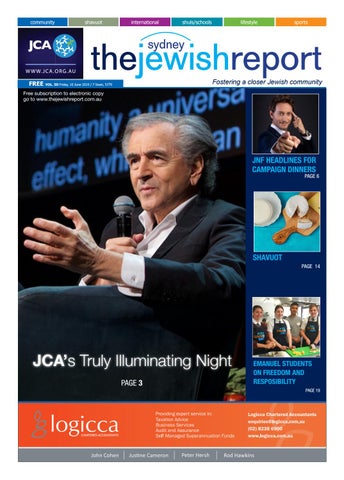
JCA’s Truly Illuminating Night PAGE 3
CHARTERED ACCOUNTANTS CHARTERED ACCOUNTANTS
PAGE 14
EMANUEL STUDENTS ON FREEDOM AND RESPOSIBILITY
PAGE 19
2
community
June 2019
A new way to remember COURAGE TO CARE NSW HEZIE LAZAROV On Yom HaShoah over 400 people met at 15 homes across Sydney to hear directly from survivors of the Holocaust in a program jointly curated by Shalom and Courage to Care called Zikaron baSalon, Memories in the Living Room. Founded in Israel in 2011, Zikaron BaSalon has grown exponentially. Each year, over half a million people participate in Zikaron BaSalon evenings in Israel and around the world. What is remarkable about Zichron B’Salon is the fact that it is a social initiative that anyone, anywhere can embrace and bring into their own living rooms. The structure of a Zikaron BaSalon evening is comprised of three parts which bring together the participants. The evening starts with a testimony, which can be filmed or personal; told by a Holocaust survivor, second generation or an expert in the field. The second part of the evening is the expression which can be done by reading a poem, inspirational texts; expression through music or any other way participants want to express their feelings through a creative lens. The third and final part of the evening is the discussion part which is facilitated and focuses on the memory of the Holocaust and its significance in our lives today. Bringing survivors like Eva Engle, Lena Goldstein, John Grushka, Joe Hofmanis, Cathy Valer Gordon and others into these intimate settings brings the community together in a unique way. A Courage to
Care volunteer said “My role was to act as a support for the survivor. I have heard John’s story quite often before but it was great that he had more time and could relate in more detail. It was very encouraging to see so many of our young people there. After all, they are our future and hopefully will keep the memory of the Holocaust alive”. Not meant to take away from large annual ceremonies, it allows people who want to connect more deeply to the stories and
Students representing Australia at the International Bible Quiz in Israel! ZIONIST FEDERATION AUSTRALIA Emanuel Cohavi, his sister Hodaya and Shani Spielman from Kesser Torah College in Sydney represented Australia in the 56th International Bible Quiz in Jerusalem on Yom Ha’atzmaut. The Quiz a global project which brings together students from across the world. This year the theme was “preserving unity, maintaining uniqueness.” Having succeeded at the ZFA’s National Bible Quiz, the three young scholars were given the opportunity to participate in the Chidon Tanach camp as well as gaining places in the quiz. The 2019 winner in the open category was Yonatan Weissman, 18 from Jerusalem. Emanuel Cohavi excelled and ranked in the top 16 of the Olami (world) competition, along with with contestants from Canada, South Africa, Mexico, the US and Argentina as well as Israel. The quiz is run by the Education Department of the Israel Defence Force and was founded over 50 years ago by David BenGurion. It has become a highlight of the Yom Ha’atzmaut celebrations in Israel with the Quiz televised live and the winners of the Israel and Diaspora quizzes receiving scholarships to top universities in Israel, presented to them by Prime Minister Benjamin Netanyahu. Ginette Searle, ZFA CEO said: - “It is inspiring to witness the contestants’ impressive level of knowledge and their commitment to the Bible Quiz. Their preparation was extraordinary and the ZFA is proud to have had them participate and represent us on the world stage in Israel.” The International Bible Quiz (chidon tanach) is an opportunity for students from all over the world to compete on their knowledge of 400 pages of the Tanach and they are given the
chance to take part in a Tanach Camp prior to the quiz with other participants from all over the world. They were also taken on tours through Israel and had the occasion to meet people from across the globe. College Principal of Kesser Torah College, Roy Steinman commented: “My grateful thanks to the Zionist Federation of Australia for their facilitation and organisation of this very important and worthwhile competition. Having attended the Finals in Yerushalayim last year I can understand the incredible pride one feels when our Australian candidates answer the questions put to them, with the Australian flag displayed behind them in front of a packed auditorium and televised live to the whole of Israel on Yom Ha’atzmaut. Besides which, the educational value in studying the Tanach with such rigour in preparation for the competition is something they will value for the rest of their lives. Kol Hakavod to all our students from all schools who participated. Let’s try to make next year’s competition even stronger.” We wish Shani, Hodaya and Emanuel Mazal Tov for their extraordinary effort in the Quiz!
Emanuel Cohavi (bottom right) who placed 9th in the Olami competition
memories of the survivors to do so. One participant said “It is far more intimate and meaningful to host a survivor in a home as opposed to a museum or theatre. It also allowed my family and I to commemorate Yom Hashoah”. As we reach a point in history where our survivors are sadly fewer each year, it is imperative that we think of varied ways to engage in Holocaust memory and storytelling so that our next generation will
truly understand what ‘never again’ means. As a survivor shared ““Was so lovely to be surrounded by such young people engaged from the community” Both Shalom and Courage to Care look forward to seeing the continued growth of this important program in the coming years. Courage to Care is an initiative of B’nai B’rith
Upton Secures $2M For Safety Upgrade In Jewish Community GABRIELLE UPTON The NSW Liberals and Nationals Government has provided $2 million to improve the Jewish community’s network of CCTV cameras, control room and crisis centre at more than 30 places of worship, aged-care facilities and schools, Member for Vaucluse Gabrielle Upton has announced. Ms Upton joined Attorney General Mark Speakman and Minister for Multiculturalism John Sidoti to present a cheque to leaders of the NSW Jewish community in Sydney last night. “The government funding, committed during the election campaign will enable the Jewish community to strengthen its security infrastructure to better guard against threats from those who would do it harm,” Ms Upton said. Ms Upton said the Jewish community had been closely consulted on the security upgrade project as well as the new incitement laws. “I thank the Jewish Board of Deputies for working with the government on initiatives that improve community safety, condemn discrimination and promote tolerance and harmony in NSW,” Mr Speakman said the funding reinforces the Government’s commitment to the safety of our diverse and vibrant community. “Recent attacks on places of worship
in New Zealand, Sri Lanka and the United States highlight the need for vigilance as we work to protect our state from a small number of individuals who seek to divide us and disrupt our way of life,” Mr Speakman said. “We have also legislated to punish those found guilty of publicly inciting or threatening violence against people for their race, religion or membership of other protected groups. The laws strike a balance between preserving free speech and keeping the community safe.” Mr Sidoti said the government would not tolerate behaviour that puts community safety at risk. “Everyone in NSW should be able to go about their daily life without fearing for their safety. It’s the diversity in our community that make us stronger,” Mr Sidoti said.
3
community
June 2019
JCA’s Truly Illuminating Night JCA JCA promised an unforgettable night of insight and illumination and that’s exactly what they delivered to more than 1,700 in attendance at its sold out event on Sunday 26 May. The energy in the room was a testament to a vibrant and engaged community. Guests were treated to a sumptuous street-style Mediterranean meal inspired by internationally acclaimed Israeli restaurant Miznon. Seated at long shared tables, dinner felt intimate even among the record turnout. An incredible display of over 3,000 tomatoes and 1,000 heads of cauliflower gave the décor a rustic ambience and the edible décor and any leftover food was donated to those in need. The formal proceedings began with seven spotlight speakers, members of the Jewish community with stories as moving as they were diverse, recounting how JCA and its member organisations have brought light into their lives. Ginette Matalan, who has been legally blind for 18 years, opened the evening in a darkened Hordern Pavilion. “When your world is dark,” she said, “you become much more aware of your other senses like hearing and touch. And touch isn’t just a physical sensation, it’s the connections we have to each other.” Expressing the overwhelming sentiment of those who attended Sunday’s event, she concluded, “Being a part of JCA’s fundraising night is very special. It connects all of us together. We’re part of a brilliant,
vibrant network” JCA President, Stephen Chipkin, spoke to the vital importance of Jewish community. He placed its origins in our collective past. “Through our many exiles and escapes we have learned the secret of community making: to provide our children and grandchildren with a sense of belonging.” And he spoke to the future. “When our children or grandchildren ask: Why is Jewish identity and community so important to you? Tell them that community is our Legacy to them. It is their responsibility to cherish it.” Chipkin also introduced JCA’s new fundraising and allocations approach.
In response to the trend for increased transparency and greater insight into the impact of giving, JCA has stated up-front the funding needs of the 33 community programs JCA is supporting in 2019. Collectively, the target to fully fund all these programs is $15 million, an annual uplift of 14%. And this year, donors have more choice – to make their communal donation, that JCA will allocate where most needed, and to donate towards specific programs closest to their heart. Ideally, Chipkin noted, donors were encouraged to maintain their JCA communal donation and to increase their giving by supporting individual programs.
As an example of the increased local funding need, Chipkin spoke of the imperative for our community to invest heavily in security and advocacy after the tragedies at synagogues in Pittsburgh and San Diego and the attacks on Muslins in Christchurch and Christians in Sri Lanka, the costs of these set to rise over $4m this year. He urged not to wait for a crisis before we respond. The gathering threat of antisemitism was put into global perspective by worldrenowned French philosopher, activist and author Bernard-Hénri Levy. He attributes modern-day antisemitism to three widelyheld lies that go beyond the purely racist rationale of the past. These three factors, all easily disproved, include a steadfast hatred of the State of Israel and a belief that it is a fascist entity; denial of the Holocaust; and then those who resent the fact that Jews continue to keep the memory of the Holocaust alive, supposedly overshadowing the suffering and tragedies of others. Levy’s antidote to antisemitism was clear and concise. “We need to respond,” he said, “with pedagogy, strength, strong communities, strong organisations and a strong Israel.” According to Levy, we need to be inhabited by our Jewish values, ethics and studies, to be humble but very proudly Jewish and that by shying away from our Jewishness we expose ourselves to increased antisemitism.
Mount Zion $10,000 Bursaries now available Your child’s gateway to Moriah College Enrolments open for 2020
When your child attends Mount Zion’s full-time day care for two years, they will automatically qualify for the $5,000 per-year Bursary for their first 2 years at Moriah College from Year K. Note: The Bursary is not means-tested. Pro-rata Bursaries are available for children who attend part-time or choose a pre-school option.
For further information call:
9387 4023
www.mountzion.nsw.edu.au
4
community
JCA’s Truly Illuminating Night
June 2019
5
community
June 2019
Putting a new spin on old vinyl JEWISH MUSEUM
Putting a new spin on old vinyl With a rich century of Jewish music to celebrate, the Sydney Jewish Museum’s series of musical programs brings their new feature exhibition, ‘Jukebox Jewkbox! A Century on Shellac and Vinyl’, to life. From a solo concert by Lior – his only one in Sydney this year! – to a screening of the classic 1976 film ‘A Star is Born’, there is plenty to tune in to. The Museum has invited an experimental performance by Daniel Biederman and a selection of composers from Sydney Conservatorium of Music to re-interpret the iconic records on display in the exhibition for a live audience. We sat down with Daniel to find out more about what you can expect to hear at his performance, ‘New Spin on Old Vinyl’, at the Museum on 24 October… What can people expect to hear at your performance, ‘New Spin on Old Vinyl’? Daniel Biederman: This concert will feature new works performed by a modern string quartet in response to music featured in the Jukebox Jewkbox! exhibition. Each of the composers involved in this performance, chosen from the Sydney Conservatorium of Music, has been charged with the responsibility to take inspiration from their record of choice. From cantors to comedians, jazz and classical, rock, pop, punk, hip hop, folk. Anything in the exhibition is fair game. Each composer will offer a brief talk prior to their piece, illuminating the inspiration
they’ve taken from the exhibition, and a snippet of the original piece will be played on vinyl. It will be a wonderful confluence of history and new music. Which familiar songs from Jewish music history have inspired your performance? Daniel Biederman: Each composer participating in this concert will have his or her own story to share and music that inspired them. Personally, my work will focus on the Hebrew and Jewish folk songs of Mark Olf. My PhD is focused on a former volunteer from the Sydney Jewish Museum, Dr. Solomon Bard. My goal is to bring his biography to life through music. Solomon’s experiences were far-reaching,
spanning nearly a century. I often find myself compositionally stuck, to be perfectly honest. This concert has provided me with fruitful inspiration for the earliest part of Solomon’s story; his Russian childhood. After several hours of hunting through the exhibition, I found Olf’s Smithsonian Folkways Recordings. Mark Olf was born in Russia at the same time as Solomon, in the early 20th century. The Smithsonian recordings of Olf have been nourishing for my compositional process.
parents’ record collection: I grew up on Dylan, Barbara and Blondie albums, all of which happens to be in the exhibition. Arnold Schoenberg’s ‘A Survivor from Warsaw’ has been an additional source of inspiration on my music composition, however obliquely. His piece is a tribute to Holocaust victims, combining a live narrator, men’s chorus and orchestra. This work effectively conveys the emotional content of the subject matter; it is not a comfortable piece of music to experience.
Which records in ‘Jukebox Jewkbox! A Century on Shellac and Vinyl’ excite you most? Daniel Biederman: I’m a product of my
For more information about ‘Jukebox Jewkbox!’ and to book into one of the Sydney Jewish Museum’s musical events, visit sydneyjewishmuseum.com.au
Care your way Enjoy the freedom and confidence to live your best life independently with Help at Home by Montefiore. Discover expert aged care and disability support delivered into your home, from one of Australia’s leading care specialists. Your personal coordinator will help you to choose from a wide range of services, available when and where you need them.
CONTACT US FOR YOUR FREE CONSULTATION
24/7 HOTLINE
TRUSTED HEALTH TEAM
PERSONAL APPROACH
DOMESTIC SUPP ORT
WELLNESS SERVICES
CDC, NDIS & PRIVATE CARE
1800 251 537
MONTEFIORE.ORG.AU
6
community
From Oy to Joy
MOSAIC UNITED RABBI BENJI LEVY, CEO AT MOSAIC UNITED AND GLOBAL AMBASSADOR FOR MORIAH COLLEGE
There is a dissonance between the Jewish story and narrative. We are a people who have demonstrated an inverse relationship between numbers and impact for thousands of years and represent an unparalleled catalyst for curiosity and growth. We recently celebrated the 71st year since our rebirth, the State of Israel has achieved mind-boggling feats, against seemingly insurmountable odds and this is just part of the incredible story we have to tell. Still, with ongoing anti-Semitism at heights unseen in ages, victimization and crisis are deeply ingrained within our national narrative. Too many seem to focus on reactively extinguishing fires rather than proactively sowing seeds and planting trees. In Sydney, Australia, where so many in the community are descendants of “survivors,” the Holocaust has always been a core component of the community’s Jewish identity. The Gen17 Australian Jewish Community Survey found that 95% of participants saw remembering the Holocaust as important to their personal Jewish identity, marking it as the highest factor. Similarly, the 2013 Pew Report revealed that a staggering 73% of U.S. Jews see remembering the Holocaust as essential to their sense of Jewishness, and there are many other studies that reflect the same global trend. Threats to one’s Jewish identity often provoke an instinctive reaction of protectiveness but just as the current generation feels less relevance to the destruction of the Temples or the Spanish Inquisition, this approach is becoming less effective as the distance from events such as the Holocaust widens as time marches on. The establishment of the State of Israel has been coupled with significant general improvements for global Jewry, and many Jews have not been directly exposed to anti-Semitism and the powerfully emotional tribalism it can induce. Instead, as Jewish millennials are welcomed with open arms into Western societies, they have become increasingly disengaged from a heritage with which they struggle to relate. Desperately attempting to re-establish these stirrings of Jewish pride, I have seen many Jewish educators double down on Jewish victimhood, limiting their educational impact
by focusing on instilling a responsibility to lead Jewish lives purely because the victims of prior generations could not. To me, this underscores a lack of confidence in our ability to inspire positivity and pride. When teaching Jewish history, the Holocaust must, of course, be given due attention, but it should not become an emotional crutch alone. The most effective Jewish teachers also focus on the incredible array of Jewish cultures and traditions that emerged over the last 2,000 years, helping young Jews realize that traditions have continued relevance and can be built upon in modern Jewish practice. While this narrative continues to inspire a sense of Jewishness, it has generally not been strong enough to translate emotion into action in a consistent and pervasive way. As such, this negative narrative is becoming increasingly ineffective and yet crisis remains the dominant narrative for Israel as well. The Israeli timeline, as taught and discussed, is often dotted with wars. The years 1948, 1967, and 1973 are, in the Jewish psyche, some of the most powerful dates in modern Jewish history and often synonymous with Israel, despite its many other achievements. Following Holocaust Remembrance Day, Memorial Day and Independence Day, and as we approach Jerusalem Day, four days that embody the complex duality of tragedy and triumph, we must consider how to shift this balance towards the positive. We must stand tall and say that we are proud to be Jews, not
because of terrorism, violence in places like Pittsburgh of Poway, or Israel’s enemies, but in spite of them. One of my favourite scientific studies shows why this positive approach, in which Judaism’s life-affirming, beneficial value becomes the standard, is more crucial now than ever before. In the late 1960s, Stanford psychology professor Walter Mischel conducted a series of experiments on delayed gratification known as the Marshmallow Test. Mischel was trying to understand how age and cognitive development affect one’s ability to delay gratification in order to receive a greater reward. Particularly fascinating for psychologists today are the follow-up studies, decades later, which found that childhood ability to delay gratification correlated with higher Scholastic Aptitude Test scores, professional success and better physical health. Writing for Forbes, Justin Daab, president of Magnani Continuum Marketing, an experience, design and strategy firm in Chicago, challenges the notion that delayed gratification results in increased success in life, stating that “millennials are rationally maximizing their long-term value by sampling a bit of marshmallow today.” As millennials grow up, they are witnessing the collapse of the long-term security once offered by traditional institutions, older generations losing their entire accumulated wealth, debts rising and job prospects and job security declining. As a result (whether consciously or not), they assign
June 2019
greater social value to experiences – memories that are guaranteed to last. Hence, when sharing Judaism with young Jewish women and men, positive, transformative experiences are vital and, therefore, serve as a guiding principle of Mosaic United. As Daab explains, “for millennials, past performance is no guarantee of future performance.” Judaism, when lived fully, includes enriching, positive substance that can make a far more enduring impact on the individual than the declining sense of obligation to marry Jewish and the uninspired schlep to a synagogue on the High Holidays. On the other hand, exposure to the Shabbat experience, for example, can lead to an appreciation that supposedly disruptive restrictions can grant the freedom and headspace to value the truly important things in life. Jewish teachings about charity and hospitality allow one to appreciate how an ancient moral compass can enhance quality of life for the most vulnerable members of modern society. And a deeper understanding of the vibrant, nuanced, multi-faceted reality of Israel can allow one to acknowledge its issues while seeing past its falsified reputation and appreciate the truth of its inclusivity and flourishing democracy. A healthy Jewish communal body cannot thrive on a diet of tragedy alone. It cannot devolve into a skeleton devoid of bone marrow based on external threats, and instead must celebrate the inner beauty of Jewish life. To move from oy to joy, we need a paradigm shift in our pedagogy. The impetus for Jewish living must come from inside the Jewish world, being proactive rather than reactive. We must begin by truly believing that the Jewish story is worth telling and then reconsider how we tell that story. After all, our children no longer want to hear how not to leave. They need to experience why they must stay. The writer is a recent immigrant to Israel from Australia and the CEO of Mosaic United, dedicated to creating meaningful Jewish connections for millennials ages 12-35. He previously served as dean of Moriah College. www.rabbibenji.com www.facebook.com/RabbiBenji/ www.instagram.com/rabbibenji/
Lior Suchard and Elyezer Shkedy to headline JNF’s Annual Campaign Dinners JNF Lior Suchard and Elyezer Shkedy to headline JNF’s Annual Campaign Dinners Former Head of the Israeli Air Force (IAF) and CEO of EL Al, Major General (Res.) Elyezer Shkedy, together with world renowned Israeli mentalist Lior Suchard, will appear exclusively in Australia at JNF’s Annual Dinners in early September. Prior to serving as CEO of El Al, Shkedy served as the fifteenth Commander of the IAF, culminating a distinguished career as a fighter pilot and in several command positions. This included heading up the Iranian Command, tasked with coordinating Israeli military operations and intelligence gathering against that country and its proxies. During his service, Shkedy played a pivotal role in a number of complicated missions, many of which remain classified and led the IAF through the second Lebanon War. In 2007, Shkedy was tasked with one of the most important operations ever assigned to the IAF, the strike on a Syrian nuclear reactor, known as Operation Outside the Box. The destruction of the Al-Kibar nuclear facility constitutes one of Israel’s most important and sensitive military-strategic achievements this century. Lior Suchard’s performances have earned
him international acclaim as the world’s leading mentalist, entertaining sold out audiences around the globe and appearing regularly on top rating TV shows, such as The Tonight Show with Jay Leno and The Late Late Show with James Corden. His dedicated following include many A list celebrities, business and political leaders and a broad cross section of society. Lior recently performed at the Eurovision Final in Tel Aviv in front of a television audience of almost 1 billion people. JNF National CEO Dan Springer commented that “building upon the strong momentum of previous JNF dinners, we decided to mix it up this year, bringing together one of Israel’s most popular military heroes with one of its most internationally celebrated entertainers, for a memorable night of miracles. The 2019 campaign, in support of Kadesh Barnea on the Egyptian border, will continue JNF’s work to grow pioneering communities in the Negev, in realisation of Ben Gurion’s vision.” Suchard and Shkedy will headline JNF’s Annual Campaign Dinners in Sydney on September 3 and Melbourne on September 5. Shkedy will headline the Perth function on September 8. For more information or to book, please contact your local JNF office on 1300 563 563 or at www.jnf.org.auºº
June 2019
7
community
Our UIA Yom Ha’atzmaut Israel Experience
UIA JUDY AND ROGER KAYE
For frequent visitors to Israel, as many of us are, any skepticism about what one can learn on a UIA Mission would be totally unfounded. The access and range of visits we experienced on our first Mission was extraordinary. There was outstanding geopolitical commentary, visits to military bases and exposure to heart-warming UIAsupported social projects. We travelled from North to South; East to West of the country, which left us with a more intimate detailed appreciation of Israel that could never be achieved on our own. The Mission commenced with an insightful overview of the geopolitical situation in the Middle East and its impact on Israel. Together with the visit to the Israel intelligence Heritage Commemoration Centre, this confirmed the extraordinary role that Israel’s Intelligence Agencies have played and continue to play in the affairs of Israel, and were just some of the highlights of our journey. A visit to Mt Herzl - the site of Israel’s national cemetery reminded us of the extraordinary sacrifice that so many Israelis have made to ensure the birth and survival of Israel. This point was further reinforced by our attendance at a moving Yom Hazikaron ceremony at the Latrun Armoured Corps Base. Our visit to Yad Vashem and the Valley of Communities reinforced the importance of Israel to the entire Jewish community. It was with relief and joy to then celebrate Yom Ha’atzmaut with Keren Hayesod-UIA friends in Israel. Participating in iconic tourist activities
with exceptionally gifted and knowledgeable guides was another feature of the Mission. We visited the Old City, prayed at the Kotel for Kabbalat Shabbat, spent time in the City of David - which brought bible stories to life, admired Tel Aviv’s graffiti in Florentin, explored the ancient city of Acre and Safed; and had lunch with a Druze family and a family at a Moshav. A rewarding element of the Mission was our visits to the many social projects supported by KH-UIA. These included Amigour in Bat Yam, a program that provides low cost housing for seniors who would likely be homeless otherwise; an absorption centre in
Kiryat Gat that facilitates the integration of Ethiopian immigrants, and an Ayalim student village - where in return for housing and academic scholarships students undertake volunteer work in local communities throughout Israel’s periphery. We saw the Youth Futures program in action where atrisk primary-aged children are mentored. At Net@, we saw how technological training is provided to disadvantaged high school students to attain IT certification as well as dignity, social skills and self-respect. Experiencing Israel’s hi-tech industry, including a visit to the SodaStream factory, inspired on so many levels.
We also had significant exposure to Israel’s defence forces, such as observing the Gaza border from 200 metres away, and witnessing soldiers launching drones for operational missions and manning the Iron Dome. We had a briefing by the Israel border police spokesperson, visited an army base in the North and toured the Lebanon Border. A special feature of our contact with the military personnel was the openness and warmth with which they treated us. They made us feel like family and reinforced the understanding that all Jews are as one. We met with a number of Lone Soldiers who inspired us with their dedication and determination as defenders of Israel, and learnt about the importance of the Keren Hayesod-UIA program which helps them transition from army life as a soldier to civilian life in Israel. Additionally, we were privileged to spend time with a young special forces veteran of Operation Cast Lead who is now a Human Rights Attorney and an expert on the rules of war, who gave extraordinary insights into the care Israel takes to avoid civilian injury in war. The Mission participants arrived in Israel as strangers and left as friends, all in awe of this great country. For more information about UIA Israel Missions, contact Philippa: 9361 4273, missions@uiansw.org.au or visit uiaaustralia.org.au
10
community
June 2019
Continued support for improving paediatric medical care in Israel
AUSIMED The Lowy Foundation has continued its commitment to supporting the clinical and research training of Israeli paediatricians in Australia by extending a multi-year grant for the AUSiMED Lowy Paediatric Fellowships Program. Since 2015, AUSiMED has arranged six Lowy Paediatric Fellowships for Israeli paediatricians at major teaching hospitals and research institutions in Melbourne, Sydney and Perth. The most recent Lowy Fellow is Dr Oded Breuer who returned to Israel in March this year after completing two years of clinical and research training in Cystic Fibrosis at the Princess Margaret Hospital and the Telethon Kids Institute in Perth. During his Fellowship Oded joined the Australian research team working on the AREST CF program which seeks to improve the detection, prevention and treatment of early respiratory disease in young children with cystic fibrosis. Oded’s research focused on developing new and innovative ways of assessing early lung disease. This important research will lead to improving clinical outcomes and quality of life for children with cystic fibrosis and their families. Oded was closely mentored by Professor Stephen Stick, Director of the Telethon Kids Institute Respiratory Research Centre. Professor Stick said, “The culmination of Oded’s work here in Perth is an invitation to
present his data at the May 2019 American Thoracic Society annual meeting in Dallas, USA. This is the de facto world congress and will be attended by 20,000 clinicians and scientists.” Oded has formed new collaborations with researchers in Australia and abroad that will allow transfer of knowledge and skills and enhance Cystic Fibrosis research in Israel. In addition, Oded is bringing new treatment techniques to Israel with the potential to greatly improve outcomes for cystic fibrosis patients. Reflecting on his Fellowship in Australia, Oded explained, “I believe that my experience in Australia has made me a better doctor and will allow me to better educate younger physicians and broaden their clinical views.” AUSiMED’s Chair, Mr Antony Cohen, says, “Renewal of the multi-year funding from the Lowy Foundation ensures that AUSiMED can continue to facilitate training for future leaders of child healthcare in Israel. Many new and exciting training opportunities exist in Australia for Israel’s most talented medical practitioners and researchers.” AUSiMED is improving global health by building partnerships between some of Israel and Australia’s top doctors and scientists. These collaborations facilitate the discovery of new medical treatments and foster knowledge sharing. To learn more about the AUSiMED Fellowships Program, contact Dr Karen Teshuva: karen@ausimed.org
MDA youth volunteers take part in training simulation MDA
An exhibition of works by Jewish Artists
At the B’nai B’rith Centre UNSW, Barker St, Kensington (next to Shalom College)
Sunday 23th June - Sunday 7th July OPENING HOURS
Monday to Thursday 10am - 4pm, Sunday 11am - 4pm Gold Coin Entry Contact B’nai B’rith or COA Sydney for further details. 9321 6307 www.bnaibrith.org.au
9389 0035 www.coasydney.org
The “First 7 Minutes” is a community emergency medical response training program devised by Magen David Adom in Israel to address the rise in mass casualty incidents caused by explosions, shooting and stabbing attacks, often carried out in places of worship. Magen David Adom’s ‘First Seven Minutes’ course draws on MDA Israel’s unique experience of dealing with multiple casualty incidents and aims to help communities in Australia prepare for similar events. This is a unique workshop for congregants that could mean the difference between life and death. MDA Instructor and International Relations Coordinator Raphael Herbst started the course with the goal of teaching communities around the world lifesaving skills for the crucial first seven minutes prior to the arrival of an ambulance. “One of the worst feelings is when people are put in a situation in which they do not know what to do – people become frustrated if they are not equipped to help. We tell them that there is something they can do and it’s quite simple”. It takes just a few hours to teach “ordinary” community members, the seven principles of lifesaving: how to quickly and effectively respond to multiple casualty incidents. The sessions use theory, interactive activities and hands-on simulations to teach these basic lifesaving principles which are:
• Ensure the safety of the scene • Call for help • Pinpoint their location • Assess the scene & victims • Stop bleeding and treat wounds • Report to emergency services and • Assist response teams. The course is for congregants, regardless of medical background. One person on their own can treat one or two people but if they work as a team, many more lives can be saved by utilising the vital skills learnt. “The First Seven Minutes course is just another example of fulfilling our mission of saving lives, both in Israel and our local community. And for that, we are extremely proud.” – Doron Lazarus, CEO, Australian Friends of Magen David Adom, NSW. For more information please phone Doron, 9358 2521 or 0487 340 092.
June 2019
11
community
A great philanthropic investment AUSTRALIAN FRIENDS OF SHAARE ZEDEK INC MIRIAM PACANOWSKI Recent changes to fundraising legislation have transformed the Australian charity landscape. With newly acquired tax deductible DGR status, charities are required to report regularly about their goals and operations. As a donor, you should carefully consider your options when planning your charitable donations. There are important considerations when conducting your research. What are the goals and purposes of the organisation? Where will the money be directed? How effectively will the money be spent? What impact will your donation have on society? The Australian Friends of Shaare Zedek Inc have welcomed these changes and the transparency that they have brought. We believe that due to our agile and adaptable operating model we offer great value to our philanthropic investors. Our board is comprised of members of our community who are leaders in the medical, legal and commercial arenas and who offer their dedicated services to the AFSZ on a pro bono basis. We pay no rent for office space and have no full-time paid staff. All professional services are provided externally as required. In the past year, your philanthropic investment in the AFSZ Inc has yielded significant returns in both Australia and
Israel. Your investment has funded a gene sequencer at Shaare Zedek Medical Centre. Discoveries in genetics are revolutionising medicine and the research conducted at Shaare Zedek is saving lives in Israel and around the world. Shaare Zedek is actively involved in cancer research that is especially relevant to people of Jewish heritage who may be at higher risk of certain cancers due to genetic mutations. Your investment in AFSZ Inc has enabled us to bring the best of innovative medical
research emerging from Israel and apply it to save lives in our Australian community. A key project of AFSZ Inc is our support of the Jenescreen project which is offering free genetic testing for BRCA mutations to 1000 people in each of Melbourne and Sydney. This year, your investment in AFSZ Inc will continue to yield tangible benefits both here and in Israel. Shaare Zedek is uniquely positioned as Jerusalem’s most central hospital and has a profound commitment to innovative medical research that can be applied to people
around the world. We are continuing to support important discoveries in cancer care at Shaare Zedek and bring the latest medical breakthroughs to our local community. When planning your tax-deductible contributions, you need to ensure maximum return on your investment. We believe that the Australian Friends of Shaare Zedek offers optimal benefits in terms of effectiveness, value and tangible returns. www.shaarezedek.org.au
FROM ELC TO YEAR 12
Offer your children an exceptional education today which will give them the EDGE they need for tomorrow
A ravishing novel of pre-war Hungary and modern Australia inspired by a true story Inspired by the story of Miriam Sved’s grandmother Marta, A Universe of Sufficient Size charts a course through both the light and dark of human relationships: a vivid recreation of Hungary before German occupation, this is a novel about two friends and the selfless power of the human heart, even years and worlds apart. ‘The best kind of storyteller . . . hypnotic, startling almost’
Clementine Ford ELC-Yr 12 College Campus: 9-15 Link Road, St Ives To enrol email enrolments@staff.masada.nsw.edu.au or call 9449 3744
‘Plotted with the precision of a complex Venn diagram . . . poignant and breathtaking’
The Australian
12
community
June 2019
The World’s Happiest Man MANDELBAUM HOUSE BENJAMIN LEADBETTER At our mid-semester formal dinner on 1 May 2019, Mandelbaum House hosted my favourite guest: Eddie Jaku, the selfproclaimed ‘World’s happiest man’. Eddie is a Holocaust survivor who lived in Germany throughout World War II. I have heard him speak several times over the years, first at the Jewish Museum when I was a young boy. This made his presence at our dinner, having just turned 99, seem surreal. As always, I gained something new from his words. A fellow Mandelbaum resident told me that the night she first heard Eddie talk of his experiences, his loss and yet his positivity had such a profound impact on her that it will always be one of the most memorable of her life. She is far from alone in this. Eddie began by telling us about his school days, when he had a passion for engineering and was a proud German boy with many friends. His story of what came next – separation, flight, capture and survival – will stay in the minds of everyone listening. You could see it happening in their faces. While Eddie was speaking to us, I sometimes looked around the room at the residents and college staff. They all had a similar expression of just being lost in his story. At the end of Eddie’s talk, he paused for reflection and encouraged us to never forget our history and the history of humanity. He said we must all remember what has
Celebrating Eddie’s 99th birthday at Mandelbaum House happened, so that events like the Holocaust do not happen again. He finished with a lesson and a mindset that has helped me so much in my own life that I can never thank him enough: ‘When you are sad, think of me.’ I do not see this as Eddie asking me to compare his experiences with mine; rather, I see it as him simply asking me and everyone else to just smile. Inspiring is too small a word to describe
Eddie’s profound impact on the Mandelbaum residents and others he has spoken to over the years. After his talk there was an extra glow throughout the college and between everyone, reflecting our immense admiration. If you have not yet heard Eddie speak, I cannot encourage you enough to do so. I promise that it will change so much about how you think and how you react to the relatively minor challenges of daily life.
In honour of Eddie Jaku, Mandelbaum House established an annual prize last year, awarded to a resident who is a ‘mensch’ – meaning someone who demonstrates integrity and honour. The prize will be presented again later this year to a resident who, I am sure, has been touched by Eddie’s words and has chosen to act on his advice. Mandelbaum House is the Jewish residential college at the University of Sydney.
70th Thanksgiving Ceremony of the Luciana Manara LUCIANA MANARA 70 years ago, on 21 May 1949, the Luciana Manara landed on the shores of Sydney. The Luciana was a cargo boat that had a quick refurbish into a passenger boat to transport war torn holocaust survivors, some with small children to a new beginning in Australia. There are thousands of descendants from boats that arrived after the war to Australia and the Luciana Manara was such a boat. Lag baomer this year marks 70 years since its arrival. From the Sydney families of the 350 passengers the Lederman, Stark, Bobker and Siderowitz families were amongst the most traditional. Some of the Melbourne families on this boat were the Ernst , Polak and Lederberger families. Velvel Lederman recollects some of the stories his parents told him of their experiences; Pesach began two days after getting onto the boat and the American joint committee provided matzah for them to eat. Another famous episode was when the arrival of the boat into Sydney happened to fall on a Shabbes. Although the conditions were terrible and they could not wait to get off the ship, the frum passengers would not get off the boat on Shabbes. Reb Moshe Lederman told his wife that now that he had come to a new land he wanted his first steps in Australia to be in accordance with Halacha.
Last month the descendants of the original passengers on the Luciana Manara boat met for a reunion at the very wharf where the boat docked 70 years ago. The ceremony began with all 50 participants standing under Wharf 5 where Velvel welcomed all the attendees. A highlight of the ceremony was having 3 of the original passengers there to mark the occasion. Michael Siderowitz, Max Siano and Judy Amzalak ( née Stark) were all children on the boat.
Velvel lederman was overwhelmed by the response to the meeting. A prayer of thanksgiving was read out to the almighty for bringing the survivors safely to Sydney and then a prayer for the wellbeing of the Australian government was recited. Spontaneous music then erupted as all joined in a round of Siman Tov umazel Tov and Am Yisrael Chai. Velvel said it was a highly emotional event and very heartwarming, especially to see the new generation of children there.
June 2019
13
community
Collaborating to Connect our Community coffee carts, live music, and more. Want more detail? Visit the COA website www. coasydney.org for updates.
COA One of these things is not like the others; one of these things does not belong: The Montagues and the Capulets, the Lannisters and the Starks, the Rebel Alliance and the Galactic Empire, the Jews and the‌ Jews? It should be abundantly obvious which of these four is the odd one out. We Jews are a small and united community, contrary to what some people might try to say. Still not convinced? Let’s consider a few current examples of local Jewish organisations working together cohesively and I guarantee that by the end you’ll see that our community is no Borg – Federation battle but is instead more like Pumbaa, Timon, Simba, and Nala all working together to make our Pride Rock a better place. Schmooze Room COA and WIZO NSW are joining forces to present an informal morning of socialising, with a speaker to spark conversation, plus a tasty morning tea. The first of these monthly events will be held on Thursday 6th June at the COA’s Krygier Centre, with speaker Phillip Feinstein talking about his work with “Music for Refugeesâ€?. Want to
know who’s speaking on July 4? You’ll have to come along and find out! ABC Community Art Exhibition Not all collaboration is new, though! Take the annual art show put on by COA and B’nai B’rith NSW, where artists from the Jewish community put forward their works for display and purchase. A whopping 70
Jewish artists from all walks of life and from ages 7 to 101 will show off their works, both professional and amateur. The exhibition will run from Sunday 23rd June to Sunday 7th July, and will be open for viewing from Sunday through Friday for the two weeks. Each of the three Sundays will feature something special for audiences: talks,
Mid-Winter Social Did you know that not only are COA and JewishCare both members of the JCA, but they also collaborate on programming throughout the year? On Sunday 7th July, COA and JewishCare’s Club 50 will be holding a social dance for seniors at the Mill Hill Centre in Bondi Junction. There will be live music with a klezmer feel and an active dance floor with dance competitions. Afternoon tea will be served and we are enlisting the amazing volunteers from Kids Giving Back who will help with coffees and dance with attendees. Their young energy is always welcome, and makes this a one-of-akind intergenerational event in Sydney’s Jewish landscape. Plus, 7th July is International Chocolate Day so if you’re over 65 grab your dresses and suits and come check out COA’s delightful chocolate fountain! Don’t wait to get involved! Come to one of these events (or all of them!) and show your support for our collaborative, cohesive, connected community!
JNF ANNUAL DINNER
3 SEPTEMBER 2019
“In Israel, in order to be a realist, you must believe in miracles� - David Ben-GurioO
BOOK NOW www.jnf.org.au or 1300 563 563
14
shavuot
Why Shavuot Has Few Rituals RABBI ISMAR SCHORSCH MY JEWISH LEARNING VIA JTA If observance were a function of theology, Shavuot would be the most widely observed of Jewish holidays. But precisely the opposite is the case among modern Jews. No major festival suffers from greater neglect. Yet Shavuot, which caps the period of seven weeks since the second Passover seder and simply means “weeks,” is rife with gravity. As the liturgy for the day constantly reminds us, Shavuot commemorates the divine gift of Torah received at Mount Sinai, in consequence of which Judaism spawned a text-centered religious community, possibly the first in human history. Shavuot, then, is about the essential and unique nature of Judaism, a portable religion based on a canon susceptible to unending interpretation. At Sinai, freedom from slavery was recast into fidelity to law and literacy. But that defining content is not enough to imbue Shavuot with power or popularity. And the reason tells us something about the workings of Judaism. Shavuot is ritually bereft. Unlike Passover or Sukkot, it lacks a set of distinctive practices that would convey experientially its meaning and message. There is nothing comparable to the seder or sukkah for Shavuot, no absorbing home ritual that might unite family and friends in preparation and observance. The commemoration of revelation is largely confined to the synagogue. The few paragraphs devoted to Shavuot in the Shulchan Aruch [Jewish Code of Law] deal solely with the adjustment of the liturgy (Orah Hayyim, 494). Nothing ever came to replace the bringing of first fruits to the
Temple on Shavuot, which expressed the festival’s older agricultural meaning. To shift the impact of Shavuot from nature to history did preserve its character as a day of thanksgiving, but without the ritual choreography that could engage the solitary Jew. Disembodied theology has never been the fare of popular religion. In short, Shavuot begged for ritual enhancement and this is the need increasingly met by the custom of Tikkun Leil Shavuot, the practice of spending the first night of Shavuot awake in the study of Torah in heightened anticipation of the anniversary of its revelation. Usually done together with at least a minyan [quorum] of participants, the rite, like the seder, is one of re-enactment. With the first crack of dawn, group study turns to communal prayer, culminating in the reading of the Ten Commandments given at Sinai in the unnamed third month of Sivan after the exodus (Exodus 19:1). The combination of extraordinary acts — an all-nighter followed by a sunrise service — created exactly the kind of experiential ritual able to express the particularity of Shavuot. In the last decade both in Israel and America, the ritual in one form or another has caught on among nonOrthodox Jews in ever widening circles. Many synagogues are now lit throughout the night and have multiple services in the morning for early birds and regulars. The ritual itself is post-talmudic, originating most likely in Kabbalistic [mystical] circles in medieval Spain. The Zohar, which seems to know of the practice, attributes it to early pietists who perhaps sought to distinguish themselves from their ancient ancestors. According to one midrash [commentary],
the latter slept nonchalantly through the night preceding the event and had to be roused by lightning and thunder. Forcing ourselves to go sleepless the night before the commemoration of that momentous event thus constitutes an act of rectification (hence Tikkun). Another Zohar explanation suggests the image of marriage. At Sinai, the Torah as bride and Israel as groom were joined in eternal union. To recall the feverish preparation of the night before the wedding, pietists reenacted the vigil and labor by studying through the night (Magen Avraham, O.H. 494; J.D. Eisenstein, Otzar Dinim u-Minhagim, p. 393). In time, the ritual gave rise to an extensive collection of texts, which stressed completeness rather than appropriateness. During the course of the night, the group was to recite (rather than study) a few verses from every portion in the Torah and every book of the Bible, including all of Ruth, a few passages from every tractate of the Mishnah, and the passage from the Zohar describing revelation as union. The final text of the Tikkun lists the 613 commandments of the Torah as compiled by Maimonides. What is unfurled in this sprawling canvas teeming with texts is the implicit affirmation that each and every aspect of Judaism is but a branch of the original tree of life planted by God at Sinai. The freedom to interpret the infinite meaning of God’s words is the sap that has sustained and yielded this luxuriant growth. Indeed, the Torah became the bedrock of Judaism not so much by assertion as by ritual. Liturgy reinforced the claim to canonical status. The progressive chanting (not reading) of Torah from beginning to end
June 2019
every Shabbat in the synagogue, whether annually as in Babylonia or triennially as in Palestine, transformed the Jews into a people imprinted by a book. Its narrative functioned as the unifying metahistory of the nation and the building blocks of public discourse, even as its legislation garnered widespread acceptance and adherence. The synagogue developed into the national theater in which Scripture and liturgy converged to reenact weekly the awesome transmission of Torah at Sinai. Every aspect of the ritual was meant to convey the numinous quality of the original drama. In the Ashkenazic rite [which is practiced by Jews with Eastern European roots], after the Torah has been set down to read, but before the first aliyah, the gabbai recites four verses from Scripture (Psalm 19:8-9, 29:1, 2 Samuel 22:31) that enunciate the conviction that our Torah is just, pure, and perfect, and its divine author without blemish. As the gabbai finishes, the congregation affirms in unison with another verse that “Those of you who hold fast to the Lord your God are still alive this day” (Deuteronomy 4:4). This prologue amounts to a creedal declaration explaining the ritual. Nothing less than the embodiment of God’s will, the Torah is the Jewish key to salvation. The constant reading of Torah in the synagogue made of every Shabbat Shavuot. It is inconceivable to me that the Torah would ever have become the dominant and pervasive text of Jewish life without it. The diffusion of theology requires ritual. Modern Jews are at risk not because they have lost their faith, but because they have lost their appreciation for ritual.
Savory Cheese Kugel Recipe for Shavuot BY LIZ RUEVEN MY JEWISH LEARNING VIA THE NOSHER
Shavuot, the Festival of Weeks, marks the end of the seventh week counting of the Omer from the start of Passover. It’s significance is really agricultural, according to Gil Marks in The Encyclopedia of Jewish Food. Marks explained that the holiday celebrates the beginning of the wheat harvest in Israel, and a time when first fruits of the season were brought to the Temple.
INGREDIENTS 2 cups dry measure wide egg noodles 6-8 dried porcini mushrooms, soaked in 3/4 cup room temp water. Reserve liquid. 120 grms cremini mushrooms (or any mushroom without gills), wiped clean and thinly sliced 100 grms clean organic spinach 3 Tbsp flat leaf parsley, finely chopped 1 large shallot, finely chopped 3 scallions, white ends discarded, chop the rest 3 eggs, room temperature and beaten 4 Tbsp butter, melted and divided into half 225grms sour cream,full fat 225grms cottage cheese, 4 % fat 115grms cream cheesefull fat (brick, not whipped), room temperature 1⁄2 tsp salt and pepper to taste 1 tsp lemon zest 1 1/3 – 1 1/2 cups shredded parmesan for topping DIRECTIONS Butter pan well on bottom and side. Preheat oven to 350 degrees F. Bring salted water (1⁄2 – 1 tsp salt) in medium size pot. Cook noodles according to instructions on package but be sure they are al dente. Drain, rinse in very cold water, shake excess water off and pat dry while in colander. Don’t worry if it looks like you don’t have
So what’s up with the kugels, blintzes and cheesecakes that we associate with Shavuot? We commemorate the giving of the Torah at Mount Sinai on this date which makes this holiday of profound historical significance. Once the laws of kashrut were given in the Torah, the Jews turned to dairy as a way to avoid the meats and utensils which were suddenly rendered treif (unclean). But Marks goes a step further and shares another interesting legend that
enough noodles. You do. After soaking dried mushrooms, remove from water and reserve liquid. Pat mushrooms dry and chop very well. They will measure approximately 2 packed tablespoons. Pour the mushroom soaking liquid into a bowl or cup using a paper towel as a filter. Measure 1⁄4 cup of filtered mushroom water and put aside. Salt the spinach (1⁄2 teaspoon will help it to maintain its bright green color) and steam in microwave for 4-5 minutes. Cool, pat dry, chop well. It will yield only a bit but that’s ok. In a large mixing bowl, mix eggs, melted butter, sour cream, cottage cheese, cream cheese, liquid from mushroom soak, salt and pepper. Use a stiff whisk to be sure the cream cheese is broken up and integrated. Add to bowl: Spinach, scallions, parsley, shallots, both kinds of mushrooms and lemon zest. Mix. Gently stir in cooked pasta. Pour mixture into prepared pan, distributing liquid and pasta as evenly as possible. Smooth the top. Drizzle remaining melted butter over the top of kugel and dust with shredded parmesan. Bake, uncovered, for 40 -50 minutes until top is golden and tester comes out dry. Cut into squares and serve warm. This kugel may be reheated in oven. Do not use microwave. whole pan (v)
explains that when the Jews came back to their camp after receiving the Torah, “they found that their milk had soured and turned to cheese.” Lucky for us, we have a perfectly good excuse to eat an abundance of cheese and sour cream in cheesecakes, blintzes, knishes and kugels as we celebrate this joyful holiday. This cheesy kugel is inspired by a traditional Eastern European sweet cheese lokshen kugel that many of us grew up eating. This super easy recipe migrated from community to community
until it seemed that most of my Ashekenazi friends were eating the same sweet dairy kugel. But my family prefers savory flavors so I’ve riffed on that kugel of my youth by eliminating any trace of sweet. I’ve layered umami flavors including two types of mushrooms and a parmesan crust. Any sharpness from scallions and shallots bakes into the cheesy batter resulting in a mellow and altogether different savory delight.
June 2019
shavuot
Shavuot grazing plate inspiration
If you believe in inspiring young minds, creating critical-thinking, confident, engaged learners, encouraging innovation and creativity and building strong community connections, your family belongs at Moriah College. High School Open Days 18 June & 19 August 2019 Visit www.moriah.nsw.edu.au to register
Queens Park Road, Bondi Junction, Sydney, Australia Tel: (02) 9375 1600 | Fax: (02) 9387 3490 Email: info@moriah.nsw.edu.au | www.moriah.nsw.edu.au
15
16
international
June 2019
The case for enlisting ‘haredi’ men into the Israeli military ALEX TRAIMAN Among key issues that have collapsed the 21st Knesset before its ministers have even been sworn into their positions is the enlistment, or lack of, haredim serving in the military. As part of legacy agreements established and signed at the creation of modern-day Israel between leading rabbis and founding father and the country’s first prime minister, David Ben-Gurion, strictly religious males were granted exemptions from mandatory military service so they could pursue Torah study in Jewish learning institutions. At the time of these foundational agreements, strictly religious communities that didn’t send males to serve represented a relatively small fraction of the total Israeli population. Yet with birth rates well above the rest of the nation, these communities now account for close to one quarter of the total population. In a country in which military enlistment for all other Jewish males (and for females) is compulsory, these exemptions unfairly distribute the burden of military service. In addition, it has become clear that these exemptions do not necessarily support serious Torah study in many cases. So it is reasonably understandable why those forced to serve and send their children to defend the Jewish state have grown tired of the exemptions. A law passed in 2012, known as the Tal Law, further entrenched the exemptions. Yet Israel’s High Court, as it often does, ruled to overturn the legislation and has forced the government to replace it with alternative framework to increase the number of religious conscripts. Towards the end of the last government, a new law was proposed that would slowly increase those numbers while penalizing individuals and communities that refused to serve with steep fines and even incarceration. The law passed its first reading in the Knesset prior to the calling of early national elections. Following the polls, the religious United Torah Judaism and Shas parties emerged as the strongest parties prepared to enter Benjamin Netanyahu’s incoming governing coalition. They have demanded that the law be adjusted to further loosen the enlistment target numbers, as well as the penalties for refusing to serve. Yet during the current negotiations, the smaller Yisrael Beiteinu Party led by former defense minister and right-wing Netanyahu-rival Avigdor Lieberman has
demanded that the new law be passed as is and implemented as a pre-requisite to entering the government. Unable to forge a compromise, Netanyahu is thereby unable to form a majority governing coalition. And with no other likely Knesset members able to form a governing coalition, including the Blue and White Party led by Benny Gantz and Yair Lapid, the Knesset is voting to quickly disband itself and send the country into snap elections for the second time in less than six months. The irony of the crisis is two-fold. First, the issue of religious enlistment, while important, is far down on the list of immediate national security and economic priorities. Second, it is the High Court’s deadline for passage of a new enlistment law that has forced the government to contend with the issue at a time when it otherwise would be more than willing to kick the can down the road. Having more haredi soldiers serving in the military would benefit Israel in numerous ways. In an army that depends on the intelligence of its soldiers and decisionmaking abilities at all levels, strictly religious soldiers are highly likely to succeed and ultimately strengthen the military. As students of Tanach (Torah, Prophets and Writings) and the Talmud, strictly religious males are knowledgeable about the historic geography of the Jewish state.
To them, cities like Hebron, Bethlehem and Shechem (referred to by Arabs as Nablus) have unique religious significance as the burial grounds of Jewish forefathers and foremothers Abraham, Sarah, Isaac, Rebecca, Jacob, Leah, Rachel and Joseph. The Torah itself has many specific laws regarding when and how the Jewish nation is obligated to go to war. Serving and adhering to those laws can be considered a biblical commandment. Haredi males, and the rabbis who guide them, have opted against military service for several reasons. The first is that although it is a Jewish army, the IDF is by no means a religious army. Its guiding principles and leadership do not inherently lend themselves to creating an especially religious (aka religious-friendly) environment. The integration of women into the military, and particularly their roles as trainers of men in handling weapons and in national recruitment offices, creates an uncomfortable situation of immodesty for strictly religious men. In addition, army units do not facilitate daily Torah learning, while also establishing (sometimes important) exemptions from religious laws that contradict with military duties. As such, penalizing religious males for skipping the army makes complete sense from a level of fairness, if the issue was
being waged in a vacuum. Fining and/or jailing religious males from opting out of army service, however, fails to address the very reasons they are avoiding the army to begin with. If the government was serious about increasing the number of strictly religious conscripts, it would seek to address these issues head on and create a better framework for service—building on the already successful concept of Nahal Haredi religious units, for example. Founded in 1999, Nahal Haredi incorporates approximately 1,000 soldiers at any given time. The government should continue to develop structures within the IDF to offer haredi males the opportunity to spend half of each day learning during their service in a fully segregated environment, and to give the leaders of the religious communities significant input into how to alleviate other concerns. If the court and non-religious parties determine how and when these religious men are to serve in the military, then government crises like the one dooming Netanyahu’s barely elected government will persist as an issue well into the future. Alex Traiman is managing director and Jerusalem Bureau Chief of Jewish News Syndicate.
Miss Iraq to receive Ambassador for Peace award in Geneva for promoting tolerance ELIANA RUDEE Geneva-based non-governmental organization United Nations Watch has announced that Sarah Idan, who as Miss Iraq in 2017 faced death threats for posting a photo of herself with Miss Israel, will receive the Swiss organization’s Ambassador for Peace Award. In recognition of her courageous and extraordinary actions to promote tolerance, build bridges for peace and spread a message of hope and unity, the prize will be presented to Idan at a Geneva ceremony attended by senior diplomats
of the U.N. Human Rights Council, during U.N. Watch’s 2019 annual gala dinner on June 13. Previous winners of the award include Nobel Peace Prize Laureate David Trimble; French Prime Minister Manuel Valls; Spanish Prime Minister José María Aznar; Turkish journalist Yavuz Baydar; Chinese dissident Yang Jianli; Antonio Ledezma, the Mayor of Caracas and former political prisoner; Russian dissident and world chess champion Garry Kasparov; Dr. Massouda Jalal, Afghanistan’s first Minister for Women’s Affairs; and Esther Mujawayo, an activist for victims of the
genocide in Rwanda. By awarding Idan with this honor, U.N. Watch executive director Hillel Neuer hopes that the United Nations and humanrights agencies in Geneva will learn from Idan. “Sadly, today, there are too many people, and especially on social media, who are only increasing polarization, hostility and isolating one community from another,” Neuer told JNS. “Sarah Idan is the opposite.” “In all of her public activities, she is someone who is seeking only to bring people together and to underline our
common humanity,” he said. According to Neuer, Idan exemplifies an “Ambassador for Peace” in her public speeches and in her courageous November 2017 Instagram photo with Miss Israel Adar Gandelsman, as well as her 2018 visit to Israel, where she reunited with Miss Israel and bonded with Israeli Jews who fled Iraq decades ago. Idan explained that she first approached Gandelsman at the Miss Universe competition, “when she told me she was afraid to approach me because our CONTINUED ON PAGE 17
17
international
June 2019
Miss Iraq to receive Ambassador for Peace award in Geneva ... FROM PAGE 16 countries were enemies. I wanted to give her hope and show the world, too, that there is hope for peace between our countries.” Idan continued this message during her visit to Israel, which she found especially meaningful “to be able to deliver her message of peace before thousands and many world leaders.” “I was received very warmly,” she told JNS, “and I didn’t want to leave.” Furthering peace between Judaism and Islam Although Idan is not the first public figure in the Arab world to make a statement by posting a picture with a Jewish Israeli, unlike many others, posed Neuer, when Idan received hostile criticism, hateful comments and even death and rape threats directed at her and her family for these actions, she “doubled down” in the best sense of the word. Miss Iraq Sarah Idan’s selfie with Miss Israel in 2017. Credit: Screenshot. Even when Idan and her family, Iraqi Muslims, were forced to flee Iraq to the United States, she has continued to empathize with the Jewish people and to do so quite publically. During the most recent round of hostilities between Israel and Hamas, Idan tweeted against Hamas rocket attacks on civilians, unwavering in her condemnation of Hamas and diligently working to correct the record on Hamas aggression, contrary to mainstream media in the Arab world.
Meet people who have shaped Israel’s history
She has also taken on Hamas apologists like “Women’s March” leader Linda Sarsour, musician Roger Waters and former CNN correspondent Marc Lamont Hill, calling out Sarsour for “defending terrorism,” Waters for using his power to “boycott an entire country” rather than using his power “for good to bring people together,” and Temple University professor Hill for denying Israel’s right to exist. According to Idan, her early experiences in Iraq—understanding what it is like to live under a terrorist regime—led her to speak out against Hamas, and for the people of Gaza and Israel. She explained, “I remember living under [Saddam Hussein’s] regime in Iraq during the war with the U.S. [He] used to place his military and missiles in civilian areas, even in a school one block from our home. When
See first-hand the work of the UIA
Visit Israel’s main attractions
a U.S. airplane would fly by, the military would fire at it, and we would just pray that [the Iraqi military] would stop because if the airplane fired back, many homes would be destroyed and many innocent families would end up dead.” “This is the exact situation in Gaza,” Idan posed—“an oppressive terrorist group firing at Israel, aiming to kill innocent people and at the same time, they endanger the lives of families living in Gaza. After seeing the photos of people injured and dead, how can I remain silent?” At age 18, Idan worked as a linguist and interpreter for the U.S. military in Baghdad, which she said taught its soldiers to be “selfless, courageous and ethical.” Her experience in the army has also given her perspective on the Israeli Defense Forces’ code of conduct and safety
procedures, which she says are a lot less aggressive than the U.S. army’s: “When I see videos of IDF soldiers fighting with Palestinians who push their weapons or try to hit them, I’m a bit surprised Palestinians can get this close to a soldier,” said Idan. “In Iraq, U.S. convoys had signs that said if you move closer than 100 meters, we will shoot you. No Iraqi would risk to even touch a U.S. soldier unless the soldier initiated it.” From her experiences in Iraq, with the U.S. army and in Israel, Idan knew that this would only be the beginning of her commitment to connecting Muslims and Jews, Arabs and Israelis—beyond borders, differences in faith and age-old conflicts, and united in amity and common ground. To achieve her vision of peace, she founded the organization Forward Humanity and serves at its CEO. Idan voiced her hope that receiving this award “will not only empower me by knowing I don’t stand alone when I fight for peace, but also it’s a testimony to why others should join me in my cause and help further peace between the two religions.” Additionally, she hopes that this recognition will “give courage to more people, and especially Muslim women who follow my life through social media, to follow in my footsteps, show how it is possible for them to make a difference, knowing their opinion matters, and that their good efforts can be recognized and rewarded.” “More needed in today’s world than ever before,” noted Neuer, “Sarah Idan is a true Ambassador for Peace.”
18
schools / shuls
June 2019
Cultivating a culture of thinking MASADA COLLEGE Cultivating a culture of thinking for teachers and students at Masada College: Ryan Gill, Head of Learning and Teaching in the Senior School, explains what it means to make thinking visible in our classrooms. I was first introduced to the idea of prioritising thinking in our classrooms as a student teacher while studying in the UK, where there was a focus on thinking, learning and metacognition - the process of thinking about thinking. I was hooked on this idea of how we can transfer thinking into learning. So when I came to Masada College some eight years ago, and the late Mrs. Wendy Barel told me of Masada’s early forays in building a culture of thinking in the school, I knew I had come to the right place. At its core, a culture of thinking is something we are and become, not a program or set of tools to acquire. It’s based on the principle that learning is a consequence of thinking and therefore, we as educators need to constantly provide a platform for thinking within the classroom and our school. At Masada College, our culture of thinking has two goals: to nurture students’ thinking dispositions and to deepen their understanding of subject content. We help our students develop curious, reflective and critical mindsets, encouraging them to notice thinking and learning opportunities and become eager to take them. Our aim is to ultimately help children become more curious and intellectual risk takers with a growth mindset. More recently, we formed Project
Masada College staff with Tina Blyth Zero Sydney, a not-for-profit network of educators inspired by ideas emerging from the Project Zero team at the Harvard Graduate School of Education. The central aim of our network is to share our passion for learning and teaching with as many educators as possible. A core idea of Project Zero is that whatever we want for our children, we need to provide for our teachers as well. Both students and teachers need to be immersed in a culture of thinking in order for it to become a pedagogical approach that is more than a program. That’s why we offer professional
learning opportunities for teachers. During these courses, which are NESA accredited, we give teachers the opportunity to become reflectors of their practice and allow them the time to ask themselves how these newly learnt ideas can evolve their practice. This term, Masada College hosted our third Project Zero Sydney Network conference with acclaimed author and researcher on education at the Harvard Graduate School of Education, Tina Blythe. Central to Tina’s research and teaching is how to create and sustain learning environments that support understanding. Over 400 educators from
across Australia gave up their hard-earned Sunday to listen and engage with one another - a testament to the dedication of our teachers in this country. For me, one of the highlights of the day was seeing educators from all walks of life, from different religions and demographics, collaborate and explore a fundamental principle of Project Zero: understanding each other with the purpose of helping our students make sense of their world. For more info on professional learning opportunities at Masada College, go to Masada.nsw.edu.au
Raising money for important causes MORIAH COLLEGE
We are so proud to have had two teams of Moriah runners participate in the Sydney Morning Herald Half Marathon last month. Both teams spent months training and raising money for incredibly worthwhile causes that have personal significance. RUNNING FOR CARLI For Moriah teacher Yang Weinberger, it all started with a simple suggestion from a colleague as they crossed paths on school grounds: “you should do the Sydney Morning Herald half marathon with us,” said Corey. Yang laughed and shook her head. She liked to run a couple of times a week, 2-3km at a time. A 21km half marathon, though? “No. Not happening,” Yang laughed in reply. Yet, later that night, the conversation kept coming back to her. “I always preach a growth mindset to my students,” says Yang. “And I thought it was time to start putting that into action myself. So, I looked up the SMH half marathon online and I was delighted to discover there’s a relay component, where you can split the distance between two people.” After talking a friend into doing the relay with her, Yang had another important task to complete before starting her training; deciding which of the 900 charities to run for. Not for the first time, her thoughts turned to her close friend and former colleague, Carli Freiberg. Carli, who was an ex-student and teacher at Moriah, sadly lost her ongoing battle with mental illness in December last year. “Throughout her life, she’d always been
very vocal about breaking the stigma around mental health issues,” says Yang. “She’d worked with an organisation called Batyr whose mantra is to let the ‘elephant in the room’ be spoken about, to talk about mental health. Because the more we talk about it, the more we normalise it.” Yang did a quick search for Batyr on the SMH half marathon website and was thrilled when she found it was one of the charities listed. At school, Yang shared anecdotes about her training with her students. “They started asking me what run I was doing and who I was running for,” Yang says. “When I told them I was running to honour Carli’s memory, they were really touched. Carli had been their House mentor when they were younger and a few of them asked if they could join the team. Of course, I said ‘the more, the merrier’.”
The team, who chose the name ‘Running for Carli’, included four Moriah staff members and four students. On Sunday, 19 May 2019, they collectively ran more than 100km in honour of their former colleague and teacher, and to raise funds for Batyr. For every $20 raised, a young person will be able to participate in Batyr’s school program The team has raised more than $33,700, and the journey to the start line wasn’t all smooth sailing. “We were all sick during training and I was injured at one point,” says Yang, still smiling in spite of it all. “For 10 days shortly before the run, I couldn’t do any training at all. Normally, I would beat myself up about it, but I thought, ‘you know what? It’s ok. It’s fine. I’ll get there. Because there’s always an alternative, there’s always an option B. Always.’”
RUNNING FOR PREMATURE BABIES Year 8 student, Gabriel Ben, is a young man with a big heart, whose start in life wasn’t easy, and came far sooner than expected. You see, Gabriel was born two months and two weeks premature. He and his family were immediately taken to a different hospital, which had the equipment needed to save his life. That is why he committed to running the 11.5km relay component of the Sydney Morning Herald’s Half Marathon - to help raise vital funds for the charity, Running for Premature Babies. “The charity provides specialist equipment, like incubators to hospitals to help premature babies and their families,” explains Gabriel. “This is the third year I’ve run the Half Marathon for Running for Premature Babies. My parents have run it for the last six years.” This year, Gabriel’s mum, Marsha, ran the full 21km instead of the relay. When asked if he trained with his mum, though, Gabriel shook his head. “Mum can’t keep up, so I trained with the boys on my team,” he said. “I couldn’t do the long distance like she does, though.” Gabriel’s five teammates were also Moriah students, and the six boys pulled out all the stops to prepare for the challenge of the Half Marathon and raise more than $4,300 for the charity. “I think no matter what charity you run for it’s good, because it’s going somewhere where it’s meaningful,” said Gabriel. “And this charity is meaningful for my family.”
June 2019
In the Dark Spaces CAULFIELD HEBREW CONGREGATION RABBI RALPH GENENDE OAM Like many children I was scared of the dark. One of my earliest memories is of running down the shadowy, seemingly endless passage of our home in Bulawayo. Darkness touches our deepest fears; it’s about the unknown, the primordial forest, the blackness hovering over the depths of Creation. The second verse of Genesis tells us that this was how it all began: “the earth was astonishing empty and darkness was on the surface of the deep…” (Gen 1:2). Soon after, God gives this terrifying blackness a name and it is called “Night” which is countered by “Light” called “Day” (7:5). God may call it “Night” but human beings soon discover that they can create a condition of darkness in daylight, murkiness to counter clarity, opacity where there should be transparency. Despite this, we long for the simplicity of pure light, where ‘right is right’ and ‘wrong is wrong’, where evil wears a blackas-night cape and good a shimmering coat of starlight. We hunger for human beings to be simple and obvious in their goodness and identity. We regularly go through periods in our history as homosapiens when we reduce complex issues into clear-cut, simple categories. American journalist Susan Faludi suggests that the contemporary Western obsession with identity may be a reflection of this need for easy simplification: “I wonder”, she says “if a lot of it is a kind of nostalgia for a past when, supposedly, people felt connection to each other.” She adds: “the greater battlefield of our time, is identity whether it’s Trumpism, or Brexit, or Isis… these are all manifestations of some kind of out-of-the-box, pasted-on
identity”. These comments of Faludi are from an interview about an astonishing book that she wrote a few years ago called “In the Darkroom”. In this challenging biographical journey she enters into the darkroom of her father’s identity and discovers that life and identity is never black nor white but a frustrating, tense and tenuous dance between night and day and also a playful show of shadows. In 2004, Susan Faludi, the Pulitzer prizewinning reporter, received an email from her estranged father Steven (they hadn’t spoken for 27 years) with the subject “Changes – a bit of interesting news” The “bit” of news was that he had undergone gender reassignment surgery in Thailand and was now known as Stephanie. She gets on a plane to Budapest where Steve had returned after the fall of communism and so begins the book. This is a beautifully written book, sparse and succinct in its observation, incisive, and compelling in its narration; profound humorous and unsettling. It’s not a book for the squeamish nor for those seeking simple solutions to the complex issues of today. This is no sensationalist account of what it means to be ‘trans’ or adopt a new gender, not the bland ‘when-did-you-first-start-thinking-you-werea-woman’ kind of revelation (to adapt Rachel Cooke’s phrase). It is rather a deeply thoughtful meditation on Western, American and Jewish identity as well as a “tricky meditation on the construction of gender roles”. (David Samuels) It’s about contemporary Jewish identity because Steven Faludi, (hence the darkroom) a photographer, was born Jewish in Hungary, suffered as a teenager with the onset of the war, dramatically rescued his parents from certain death but also lost most of his family
A Vision of Inclusion
NORTH SHORE TEMPLE EMANUEL
In a ground breaking event on Saturday 8 June, the eve of the Jewish holiday of Shavuot, the North Shore Temple Emanuel (NSTE) in Chatswood will devote the festival to raising awareness about Autism Spectrum Disorder and learning how faith communities can best support members on the Autism spectrum and their families. The program, called “We All Stood At Sinai - A Vision of Inclusion,” features special guest speaker Marissa Ely (pictured), who has a long time affiliation with the Jewish community and was diagnosed as an adult with Level 1 Autism Spectrum Disorder (ASD). Following her speech, a panel discussion of family members of people on the Autism spectrum will be moderated by Rabbi Nicole Roberts, Senior Rabbi of the synagogue. Traditionally an evening of study to celebrate the giving of the Torah at Mount Sinai, the event, referred to as a tikkun leil Shavuot, will also feature Jewish learning, the chanting of the 10 Commandments, an adapted festival service, and - in keeping with the holiday’s custom of serving dairy foods - NSTE’s 3rd annual cheesecake competition, with “tasting breaks” throughout the evening. About the evening, Rabbi Roberts says, “All are welcome—from within and beyond NSTE—to come learn how to create more welcoming, inclusive spaces of worship and community. The theme of the evening is based on an incredibly inclusive moment in the Torah, when everyone gathered around Mount Sinai to experience Revelation. It
19
schools/shuls
in the Shoah. Some of his family including his parents made it to Israel while he settled in America. The book explores the complex layers of Steven’s/Stephanie’s identity. It poses difficult and uncomfortable questions as much about the fluidity of gender identity as about the shifting sands of Jewish identity. It’s about the denial of identity and it’s about the affirmation of identity. For much of his life Steve tried to escape his Jewishness; there is self-loathing and derision of Judaism. When he returns to Hungary he plays down the alarming rise of antisemitism, the black-shirted youth marching through Budapest’s public squares, the violent attacks on Jews and Roma. Susan Faludi, who throughout the book is on her own investigation of Jewish identity doesn’t accept easy explanations. She is suspicious of those quick ‘out-of-the-box’ labels. She is unconvinced that psychological ambiguity can be turned into “certainty in the flesh”. She will not accept the idea that the past is simply past. One of the most dramatic moments comes at the end of the book when parent and child go to see the exhibit at the National Museum on the fate of Hungarian Jews during the Holocaust: Most of the exhibition mounted by the right-wing government for PR reasons, is about German culpability for the deaths of 565,000 Hungarian Jews; just two small plaques evasively make mention of the Arrow Cross. It’s only in the basement (one of the “Darkrooms” of the book) they find hidden away some portraits of Hungarian survivors and their descendants including the Friedman/Faludi family by Israeli photographer, Aliza Auerbach. “Let the people in Hungary look at them” my father burst out “They turned their backs. They said, wow, it’s none of our business. They never looked at who was taken. These people were
Emanuel Students on Freedom and Responsibility
EMANUEL SCHOOL
should be an eye-opening evening for us all—challenging and inspiring.” The evening is part of NSTE’s ongoing efforts to reach out to, welcome, and serve those often on the margins of Jewish life. In 2017 and 2018, those efforts included the formation of an Inclusion and Diversity Task Force, improvement of physical accessibility with the addition of a lift, an “Expanding the Conversation” speakers series on topics of diversity and inclusion, acquisition of large print and lightweight prayer books and worship materials, the synagogue’s inaugural LGBT+ Pride Shabbat, the bat mitzvah of a teenager with Down syndrome, and liturgical moments in High Holy Day services designed to widen participation. “Our Progressive movement has always seen ‘keeping people in the fold’ as a key part of its purpose and mission,” says Rabbi Roberts. “We are doing what we can to help achieve this ideal.”
just like them. They spoke the same language. They were your neighbours, they were your friends. You let them die. These were the ones you allowed to die. Let them look so they can go home and not sleep in peace”. Erik Erikson, Harvard psychologist who wrote extensively on identity, admits on the very first page of his famous work that he really has no idea of what identity is. (And he sure was confused about it as he changed his Jewish name and had a large cross on his office wall!). Identity today and especially Jewish identity is infuriatingly difficult to define and rightly so. We have a tendency, in our thirst for verisimilitude and definitiveness, to write out many Jews because they don’t fit our categories. Even the Halacha, known for its austerity, allows for the fluidity of identity. We need to be extremely cautious in our dismissal of other Jews. If we could spend as much energy on trying to bring Jews in as we do on trying to keep them out, we would be a richer, stronger community. The Torah, in the Book of Exodus, touches on the tremulous darkness, the םירצמ ךשח, the ninth plague, that of blackness, in the land of Egypt. It’s a palpable, tangible darkness that immobilises the Egyptian people. But perhaps its’ worst characteristic is that it cuts people off from one another “nobody could see their brother” (Ex 10:23); it breaks down communication and the capacity for empathy, for sharing the sorrow. This is the darkroom of the human soul, the dark night of the soul. But there was light in the Jewish home and hearts. In a world of shadow and fog we need to constantly seek the sparks or at least the comfort of the half-light, and the reassurance that the mix of light and dark is the essence, the chiaroscuro of the human heart.
Emanuel School’s Year 9 students took part in an interactive and informative day about refugees and the quest for freedom as part of their course on Freedom and Responsibility within our Jewish Tradition. The students took part in an interactive workshop with Kids Giving Back. One of the facilitators shared her experiences as a volunteer in a Syrian refugee camp in Lebanon’s Bekka Valley. In response, the Year 9s made puppets that will be sent to young refugee children the Bekka Valley camp for use in drama, play and therapy. Lilly Goldberg, Year 9 student, was grateful for the opportunity to help: “We would like to thank Kids Giving Back for coming to teach us so much about the plight of refugees and giving us the opportunity to make a small
difference to some of the children affected by war.” The students also heard from Housen, a Syrian refugee, who made the trecherous journey through six different countries to finally arrive in Australia at age 22. Emanuel School student, Lily Berger, said: “Housen’s journey was moving and one we will never forget. Unfortunately, his story is not so unique and as of 2017, 65.6 million individuals have been forcibly displaced worldwide because of persecution, conflict, violence, or human rights violations.” Housen and the students then made Makloubeh together, Housen’s favourite dish from his childhood. Rabbi Daniel Seigel, Head of Jewish Life at Emanuel School said: “As Jews we understand that freedom is the responsibility of us all as no one is truly free if anyone is not free.”
Emanuel students making Makloubeh with Syrian refugee, Housen
20
schools/shuls
June 2019
JEWISHLearning QUESTION OF THE MONTH:
WORD OF THE MONTH Kavod Hamet ()כבוד המת Pronounced KAH-vode hah-MET, this Hebrew phrase literally means “respect for the dead” and refers to a range of Jewish end-of-life rituals and practices meant to preserve the dignity of a deceased person. MYJEWISH LEARNING VIA JTA BY RABBI LAWRENCE A. HOFFMAN
Why Do We Read The Book of Ruth on Shavuot The connections between this story and the spring harvest festival. MYJEWISH LEARNING VIA JTA
RABBI RONALD H. ISAACS In traditional settings, the Book of Ruth is read on the second day of Shavuot. The book is about a Moabite woman who, after her husband dies, follows her Israelite mother-in-law, Naomi, into the Jewish people with the famous words “whither you go, I will go, wherever you lodge, I will lodge, your people will be my people, and your God will be my God.” She asserts the right of the poor to glean the leftovers of the barley harvest, breaks the normal rules of behavior to confront her kinsman Boaz, is redeemed by him for marriage, and becomes the ancestor of King David The custom of doing this is already mentioned in the Talmudic tractate of Soferim (14:16), and the fact that the first chapter of the Midrash of Ruth deals with the giving of the is evidence that this custom was already well established by the time this was compiled. [Tractate
Soferim is one of the latest books of the Talmud, probably dating no earlier than the eighth century.] There are many explanations given for the reading of Ruth on Shavuot. The most quoted reason is that Ruth’s coming to Israel took place around the time of Shavuot, and her acceptance into the Jewish faith was analogous of the acceptance of the Jewish people of God’s Torah. A second explanation relates to genealogy. Since the Book of Ruth ends with the genealogy of David, whose forbearer Ruth was, it has been suggested that it is read on Shavuot because there is a legend that David died on Shavuot. Another reason for the reading of Ruth on Shavuot is that its story takes place at harvest time, and Shavuot also occurs at the time of the spring harvest. Excerpted with permission from Every Person’s Guide to Shavuot (Jason Aronson, Inc).
Preparing for the deceased and seeing to the needs of their mourners are not the same thing; they may even be in conflict with each other. Whether a culture conceives of death as a problem for the deceased or as a difficulty for the next of kin makes considerable difference in terms of what it mandates ritually. To be sure, no culture may easily ignore the physical reality of an actual body requiring burial, but if it attends preeminently to the living, it may choose to dispense with the corpse quickly and without solemnity, whereas if it interprets the crisis as focusing on the dead, it may pay much attention to burial but ignore mourning. Modern North American culture, for instance, isolates the individual (not the group) as the object of attention; and it defines the individual as a body with a mind (or psyche) that begins functioning at birth and ceases with death. It thus disregards what happens after death, there being no self any more, and hence, no “after death” period worth pondering. As birth is held to be our beginning, so death is considered our end, and what attracts society’s attention about that end is how the individual handles its impending arrival and how other related individuals then manage the mourning that follows in its wake. In both instances, the problem is defined as psychological: when the body dies, so too does the psyche, and (therefore) the problem, as far as that individual is concerned. Not so classical Judaism. Psychology as a religious rationale is distinctly a later overlay of modern interpreters seeking to justify ancient ritual regulations. It plays almost no role in the thinking of the rabbis who initiated the regulations in question. Unlike us, the rabbis did not begin with the idea of a self who disappears at the moment of death. They held instead that despite the body’s demise, the essential person housed in the body still enjoyed some beyond-the-grave existence, so that proper burial and continued respect for the deceased were required. Funeral ritual is thus preeminently designed as an act of k’vod ha-met, “honoring the dead.” A corpse may not be subject to autopsy, for instance, nor may it be embalmed, except under unusual circumstances where not to embalm would dishonor the
dead even more–as in preparing a body for burial far away, by which time if it has not been embalmed, it would putrefy; and even then, the embalming procedure must retain the body intact. With their attention fastened on honoring the dead, the rabbis give relatively little explicit attention to the psychological needs of the mourners. Regulations sometimes seem to address the pain of bereavement: sumptuary rules that limit exorbitant funeral expenses, for instance. But they are prompted not by the fear that inordinate cost may trouble the living, but by the aversion to the embarrassment that such expense may cause the deceased. They worry that wealthy people will receive a banquet in their honor, but poor people will not. Their rules democratize death, making sure that no one will have a poor funeral repast relative to others, and no one will thereby be dishonored simply because they had the temerity to die without leaving an estate behind. Similarly, the rabbis passed regulations designed to prevent conflicts of religious responsibility during the time of mourning. But here too, rabbinic legislation worried less about psychic trauma than about the breach of honor due the dead, were mourners to allow the full gamut of daily responsibilities to interfere with the requirements of the recently deceased. The classic Jewish burial rite should thus be understood as a ritualized interpretive gloss on a rabbinic view of death that focused on the needs of the dead. Rabbis could legislate only for the living, of course; their ritual seems therefore to have the living in mind; but their decisions derive from their dogmatic belief in life after death, and, therefore, their almost axiomatic insistence that customs associated with death affirm the continuing dignity of those who die. In the 19th century, this theological hermeneutic came under attack, particularly by German Reform Jews, and Jews today have widely supplemented or even replaced rabbinic attitudes with modernity’s ubiquitous psychological justification for burial practices. Still, the notion of honoring the dead is evident, much as it was 2,000 years ago. Reprinted with permission from Life Cycles in Jewish and Christian Worship (The University of Notre Dame Press).
lifestyle
June 2019
21
Cruising New Zealand Wineries - “Ripe & Ready to drink” I LOVE CRUISING KELLY HENDERSON Get onboard with Azamara Club Cruises for an intensive 16 night ‘Food & Wine’ voyage around the Sauvignon rich ports of New Zealand. Not just a themed cruise with a loosely given ‘food & wine’ title. Azamara’s destination emersion mantra will surely deliver an authentic ‘taste of’ NZ experience that will not only delight the senses, but also to cater the self educational elements passengers are looking for. As well as being stunningly picturesque, New Zealand’s rain trapping Western mountain ranges and sheltered valleys to the East are geographically unique, providing ideal temperature fluctuations suited to the temperamental sauvignon vines. If you’ve been considering taking a cruise to NZ but perhaps thought (like many do) “there’s plenty of time for that, New Zealand will always be there” think again! Right now is such a great time to go, especially if you have an interest in viticulture, or even just enjoy the occasional glass. The country is young and fertile, as are its wine makers and just like the general population in NZ, they see themselves as the underdogs, fighting hard to be heard in a huge world. Airport hassles removed and a pleasant two days of reasonably calm cruising across ‘the ditch’, on the floating boutique Hotel - Azamara Quest, delivers its passengers into another world of jagged alpine peaks, capped with melting summer snow that feeds gigantic water falls cascading into the deep fjords below. This place is Milford Sound. Apparently incorrectly named as it is indeed a true fjord and every bit as impressive as the mighty fjords of Norway or Alaska. Gently gliding into Fjordland National Park is like hitting the restart button and regeneration of the soul. It’s breathtakingly beautiful and fortunately nearly every cruise to NZ visits here as the first or last port of call. Azamara offer an overland / overnight shore excursion to the next port of Dunedin (via Queenstown) and if you’re up for a couple of long but incredibly rewarding days traveling via coach through even more sublime mountainous countryside, then this is add-on is an absolute must. The cruise will then track north through more
lush green coastal gems like Akaroa before pulling into the sleepy little town of Picton. Tucked away at the end of the incredibly pretty Marlborough Sounds on the northern most tip of New Zealand’s rugged South Island, the sail into Picton is definitely not to be missed. Pre-plan an early night so you can be up on deck at least 2 hours before docking. You can enjoy a leisurely alfresco breakfast in the appropriately named Windows Cafe for the scenic sail in through misty pine covered hills and islands on lake like waters only broken by pods of Orca. Picton is where any wine appreciation quest really gets interesting and a little pre-planning can serve you well. To self tour here, you’ll find a few car hire places in town, just a short stroll from the ship and for around $150 + fuel for the day, your wine odyssey is sorted. Azamara also offer excursions to the wineries. One stops at three very different cellar doors for back to back wine tasting and another just to the one well known vineyard with a renowned restaurant and lunch included. Both are perfect if you’re not confident driving foreign roads or perhaps plan on actually drinking the tasting samples. An easy half hour drive on a single road up over the hills and you’ll find yourself in the grape vine capital of New Zealand - The Marlborough Valley. Home to all the major wine labels that literary put Sauvignon Blanc on the ‘world of wine’ map. The epicentre of the Marlborough is the town of Blenhiem. Stop at the iCenter, pick up a cellar door map and spend the rest of the day exploring the surrounding countryside where seemingly every available ‘section’ of land is planted with pretty symmetrical rows of Pinot, Chardonnay and Sauvignon vines. Driving these back roads past all the
impeccably manicured cellar doors is like walking down the white isle of your local Dan Murphy’s. Well known brands like Brancott Estate, Whither Hills, Giesen, Forrest Estate are all within a 15 minute radius including the one that really put this region on the map. The iconic Cloudy Bay. After a day touring the stunning vineyards and windy lush green roads you’ll get back onboard, where the amazing crew of Azamara are preparing to host their signature ‘White Night’ event, which fits in perfectly after the rather ‘White’ day in the Marlborough. Nothing to do with wine however, this alfresco extravaganza is where all the poolside deck chairs are replaced with brilliant white dining tables and festive flags overhead. The entire ship turns up also wearing white and sits under the setting sun. Multiple selections of flame grilled meats and freshly prepared salads, all cooked and served right there on the pool deck, before the band kicks off for a party into the evening. Being a luxury cruise line, it goes without saying that the food onboard Azamara is exceptional. Some other cuisine focused brands can tend to serve quite rich and delicate dishes that although are lovely occasionally, might become less favourable night after night. Chef Colin onboard Azamara Quest however prefers to serve his guests simpler, less heavy fare, focusing on freshness and inspired by the local produce of the region, once again delivering on their destination immersion ethos. He caters to all tastes on board and his team only cook in small batches or to order, rather than the usual ships galley of ‘on mass’ cooking methods. With the two main South Island wine regions of Central Otago and the Marlborough Valley adequately explored and tasted, Azamara sets
course for the well known Art Deco port of Napier on the North Island. What’s not so well known though is the town of Napier is just 30 minutes drive from another of New Zealand’s most cherished wine producing districts, Hawkes Bay. Very different in landscape and soil to the more lush Marlborough, where the earth is softer and easy for the vines to kick back, relax and sink their roots into the nutrient rich glacial soil. Hawkes Bay is rugged and dryer, with an almost French Provincial feel and driving down the coast past the Oleander trees or Bougainvillea you’d be forgiven for visualising the Cote’d’ Azur is over the very next hill. Here the vines have to work much harder to bed down through sand and clay seeking out vital nutrients. That romantic notion of a struggling grape vine spreading it’s roots far and wide to overcome agricultural adversity and produce an awarding winning wine is actually the reality here. Nature on this land needs to prioritise to our benefit. Instead of producing a canopy of lovely to look at but undrinkable leaves, all the plants energy is directed to the roots for finding food and ultimately intensifying the sugars of the grape in a last minute attempt to attract birds and reproduce before what the vine assumes is imminent plant death. Fortunately, the vines survive and we get the intensely sweet grapes before the birds. The result? The prefect Sauvignon Blanc. A visit to this truly gorgeous Estate simply must be added to your New Zealand cruise day trip itinerary. Allow a few hours to really absorb the impeccably manicured grounds and work your way through the wine tasting samples, followed by lunch with a glass of your favourite. Ultimately Good wine making is all about Great weather, soil, grapes and people. All of which New Zealand has in barrel loads. Don’t postpone that planned NZ cruise anymore. Alaska and the Med can wait, they will always be there, but New Zealand is ready to drink and to be enjoyed right now. Azamara’s Summer 2019 / 2020 intensive New Zealand program is now available for booking through me. Contact me on 0406267716 today.
Wishful Thinking ALADDIN (PG) ALEX FIRST Aladdin is loosely based on a Middle Eastern folktale from “One Thousand and One Arabian Nights”. The streets of Agrabah are home to Aladdin (Mena Massoud), a lovable street rat who is eager to leave his life of petty thievery behind. Across town, the Sultan’s daughter, Princess Jasmine (Naomi Scott), harbours dreams of her own. She longs to experience life beyond the palace walls and use her title to better serve the citizens, but her father (Navid Negahban) is overprotective. He is intent on finding a suitable royal partner for her. As for his advisor, Jafar (Marwan Kenzari), he is a snake in the grass, desirous of the throne for himself. Aladdin first meets Jasmine when he comes her rescue after she visits the Agrabah marketplace disguised as a commoner. He is immediately struck by her beauty
and fiery spirit, having no idea of her true identity. Following her back to the palace, he gets caught up in Jafar’s evil scheming. He comes into possession of a magic oil lamp intended for Jafar and accidentally conjures up the Genie (Will Smith) inside, which entitles him to three wishes. A lavish production with magnificent sets and costumes, this live fantasy musical version of Aladdin doesn’t measure up to the spectacular 1992 animation. I recall when I first saw that, which starred the incomparable and manic Robin Williams as Genie, I thought it was the best animated feature I had seen. It wasn’t until Toy Story came along three years later, along with its subsequent instalments, that I felt it was bettered. So, Will Smith has taken over Williams’ pivotal role and while he cracks a number of jokes and plays out some sight gags, he is serviceable rather than brilliant. Let’s put it this way ... he tries hard, but for one thing he’s not a singer. His singing voice barely passes muster. Aladdin circa 2019 is more about the
power of visual effects and visualisation than it is about compelling story telling. The writers are John August (Charlie and the Chocolate Factory) and Guy Ritchie (The Man from UNCLE). I enjoyed and appreciated the cleancut Mena Massoud as Aladdin and Naomi Scott as the beautiful, intelligent and empathetic Princess Jasmine. Not so much Marwan Kenzari as the evil and manipulative Jafar. I felt he lacked vocal gravitas. As far as rubbing the lamp and wishes
were concerned, it all got a bit confusing as to what were counted as wishes and what Genie handed out as freebies. Aladdin feels long. It is ... at 2 hours and 8 minutes. Guy Ritchie’s needed to tighten his direction or get a lot more ruthless in the editing suite. It is bright, colourful and energetic, but I still felt somewhat let down. I dare say younger audience members who didn’t see the original will get more out of it than I did. Rated PG, Aladdin scores a 6 out of 10.
22
lifestyle
The finer points of sleep THE SLEEP COACH CHERYL FINGLESON As the business and distraction of modern life and parenting intensifies, it is good to be reminded of the value of sleep and its allencompassing role in supporting wellness, development and health. Whether you are nurturing a newborn or wrangling an adolescent, its critical to consider whether he or she is getting enough of the right quality sleep, and to be reminded of why this is so fundamental. Newborns can require up to 17 hours of sleep a day, a toddler between 10 and 14, a primary school child between 8 and 12 hours and an adolescent around 10 hours sleep a night. Every individual will have slightly varying sleep needs, but without exception all will benefit from a solid sleep routine, a clean and quiet place to sleep, a nutritious diet and learned relaxation techniques. I always stress the need to start with a consistent and predicable bed routine to parents who are looking to address sleep issues. Its impossible to underestimate how important this is. It allows little people to know what’s coming next, that sleep time is near and it helps them to unwind. Avoiding over-stimulating activities right before bed is crucial, as is keeping the child’s room dark, having clean natural linens and a safe comforting sleep environment. Most of the growing babies and children do takes place during the sleep phase. Sleep impacts young people’s mental and physical development, comprehension, memory, alertness and wellbeing. Rested children are more alert and happier, they are more even-tempered and they have stronger immune systems. The sleeping brain produces a growth hormone, which is vital in stimulating muscles, organs, blood and bones. Research shows that growth can be slowed or even stunted if a child does not get sufficient sleep. Some children’s sleep is affected by nightmares, which can be disruptive. In most cases though, it’s a temporary phase. Parents need to remain patient and comforting, stay with their child for a short while until the fear passes, and to remind them that the dream is not real. Repetitive, soothing verbal prompts such as ‘I’m here, its just a dream, its not real, I won’t leave you’ can be helpful, as well as offering a comfort item like a toy or a blanket, leaving the bedroom door slightly ajar and a night light on, as well as producing a hastily re-
labeled bottle of ‘anti-nightmare spray’ (a water diffuser with glitter in it) which can do wonders. When it comes to teenagers, sleep can be just as much of an issue for families, but without the placebo of a magical spray to fix it. Few Australian adolescents get the ten hours of sleep optimal for their age. The plethora of personal electronics hasn’t been helping this crisis, with teachers reporting many high school students as severely sleep-deprived, with a significant impact on their school performance and general wellness. Just like with babies, I recommend turning your teen’s bedroom into a quiet place, devoid of technology. Adopt a policy of handing these in at a certain time each evening, and retreating to a cool quiet room with blackout blinds if needed. Teenagers may benefit from regular routine, hot bath before bed, essential oils, learned meditation techniques (there’s an app for that!), sleeping on natural linens or cotton as well as a caffeine-free diet. In the mornings, open their curtains to allow natural light into the room. This provides vital cues for the brain to begin the circadian rhythms of waking appropriately. It is imperative that babies, children and teenagers all get the right amount of sleep. Sleep is vital for growth, development, health and happiness. I always advise my clients’ to take control of their children’s sleep routine regardless of their age or circumstances. It’s not worth deferring, as sleep loss and poor routine has been proven to have significant impacts on the wellbeing of these precious young people. There are plenty of tools available to improve sleep and settling. And if parents can’t do it alone, there is professional help on hand too. Don’t be afraid to ask for help. Prioritize sleep! Cheryl Zzz For more sleep tips and advice, please visit www.cherylthesleepcoach.com.au Or why not like our facebook page? www.facebook.com/ cherylthesleepcoach Check out part One of This article @ at www.wordpress.com/ cherylthesleepcoach Cheryl Fingleson is a paediatric sleep consultant. As a mother of two, she very well knows the feelings of agony and desperation when you have a child that struggles to settle and sleep. She doesn’t believe in leaving babies or children to cry it out, nor in the practices of controlled crying. Her approach is to empower parents with the right tools and techniques to teach their babies and children to go to sleep calmly, happily and independently.
SHABBAT AND PASSOVER TIMES DATE LIGHT CANDLES
END
Friday, 7 June 2019 4:35pm Saturday, 8 June 2019 (light holiday candles after, from a pre-existing flame) 5:34pm Sunday, 9 June 2019 (light holiday candles after, from a pre-existing flame) 5:34pm Monday, 10 June 2019 (holiday ends) Friday, 14 June 2019 4:35pm Friday, 21 June 2019 4:36pm Friday, 28 June 2019 4:38pm
5:34pm
Candle lighting times have been taken from www.chabad.org
5:34pm 5:34pm 5:35pm 5:37pm
June 2019 news
opinions
community
lifestyle
letters
BAYIT
reviews
sports
SUPPLEM INSIDE ENT
Page 37
FREE
opinions
news
VOL. 11 Friday, 5 December 2014
/ 13 Kislev, 5775
WHY JERUSALEM IS community
lifestyle
letters
reviews
sports Fostering a closer Jewish
Fostering a
closer Jewish
community
munity By the com munity m for the co Speak now
see out to up to another the Sydney Jewish community As you will to build, of interest for we have set we hope that on, and helps the multi-faceted report on issues to Israel, experiences, will be there to encourage edition, we The aim, that both reports their Sydney information, Community. a deep attachment Identity Jewish Report for news, those with and to witness our Jewish voice of the whose Jewish the us as a • Be a forum endevours is to be the as for those that through We have their quite simply, opinions affecting to strengthen . We hope well as well we in other areas. ideas and on a local as and by so doing, how achievements will attend events that finds expression community thinking and Jewish community - both issues from of us about; stimulate spectrum of a year more level. have known covered a connections, dedicated to to become and global Dalia We are not otherwise Lemkus issues and social as national is being slated new ideas. will debate Legislative organized might South Israel cultural, religious encourage and friends fresh, fascinating through • Enrich the that–isMurder A personal y hub to a getaway that families of us might to a community that each reform have given carrying content diverse of it becomes the features. cyber-securit We hope matter; and Peace – opened life of our report of Circle. We a father different, simply who that reviews and and entertaining. by the Friendship 8 fascinating conversion out to someone Shallow Because articles, interviews, Jewish household teenagers and allow members the to rabbis, Har their story. Water of the reach Nof staple of every platform to leafed through within voice by the response factsbecause on we now know • Create aprocess upon arrival, is about. Blackout: over substructure been touched continually immediately hasattack needs. AndChanukah are what community each Jewish afternoon and unified and stories to his child’s know the facts! source of to be more on a Shabbat community multitude of month as a capture a our community more aware during the ultimately, photographs referred to 30 thus, involved and events, especially aims are of information. news and language, our of overall In more formal
3
6
31
34
to: CHARTERED ACCOUNTANTS
president Egypt’s new - what it means for Israel
2
The intermarriage debate
4
Back to healthy eating
Is anything
20
Strength in diversity
8
Pick up a
community
SO EXPLOSIVE
AARON DAVID MILLER
is above all a matter of faith, of belief and of religion. The notion that the three Abrahamic faiths -- Islam, Christianity and Judaism -share common values concerning peace, Even back in the days when you could still social justice and humanity may well be use the term “peace process” true. But that has never with a straight been the case when face, the odds of solving the Jerusalem issue it comes to this city. History is filled with were already pretty long. Then, I would have claims, conquests, crusades, occupations, put those odds a bit north massacres and violence of impossible and in the name of a little south ofI 14, 5774 Things hopeless. possessing Jerusalem, are even 2014 / Adar not sharing it. worse now. Friday, 14 February And nowhere has the religious complexity FREE VOL. 1 I remember day eight of the Jerusalem issue of the Camp David been clearer than summit in July 2000, when on the question of who discussion turned controls and what to Jerusalem. That day, will happen to the Haram it was clear to me al-Sharif (Noble that as far Camp David Enclosure) and Har was concerned, it Habayit (Temple was game over. There Mount). That platform, were some intriguing situated within the moves on Israel’s part, walls of Jerusalem’s Old but nothing that could City, is in essence a have settled the issue. physical manifestation Indeed, Ehud Barak, of overlapping sacred but globally, too; and as Yasser Arafat and Bill the last few months space. Clinton could have but not always a result suggest, it is also fallen into the yawning of the perception a matter of security Atop activities gaps that separated sits the goldened Dome among Palestinians Tu B’Shevat of the Rock, fraught and framed now Israelis and Palestinians that including Israel is trying aNSW by an intimacy of Boardcentury Islamic seventh on this issue and to change the activities, shrine built by by the killing reflected in the never have been heard status of some slayings of Israeli and aspect of the Caliph Abd al-Malik from again. a project initiated Jerusalem. The and that houses the Palestinian teens this Fast forward a decade reason for this latest past summer and of round foundation and a half, and stone, a massive rock that figures of tensions, violence of Deputies. last week’s savage Palestinian being a part not much has changed. and ourselves on Jerusalem is still attack on a a perfect is prominently in Jewish and Islamic pride bloodletting report but synagogue in west Jerusalem. tradition. storm of We weAnd insoluble we it now seems factors that include on which news’ butand nearby there’s a site of the more explosive sense of isolationtheand communities even greater news is good then ever.inSoa what don’t pretend frustration on theandsignificance is it about Jerusalem/ that They say ‘no -- the al-Aqsa mosque part of the Palestinians be everywhere We believe PROXIMITY CAN BE started Yerushalayim/al-Quds we can’t of East Jerusalem by Caliph Abd lot DEADLY. that makes it so think differently. there is a al-Malik in the seventh who don’t have the know everything. Ben Franklin quipped that community potentiallyitcontentious to benefit of the social century.bravery, to the will proximity breeds and deadly? thriving Jewish services and economic Quran, it is reputed a story of dedication, According children, and contempt, Three things stand out: and that sharing If there’s advantages of towhich too. In this regard, be theinspires ascension point where Israelis in the west; Israel’s of good news; even further. the Prophet achievement, Jerusalem is unique in or to effort that it is one of the Mohammed expand also leadership our community inspire others. rose to heaven on his Jewish their communities and strengthen it will only places where Israelis growing Night IT’S A PERFECT STORM OF been chances are and Palestinians Jerusalem; in East Journey. a vibrant and Below you, presence COMPLEXITY. (the you’ve the platform are the remains Sydney has connected Hamas’ efforts to know. vast majority who aren’t Similarly, if Jerusalem us are is a microcosm of almost Arab citizens the flames; forgotten Let us incite and fan of both temples, which housed or Jewish but few of or all of Israel) mix and the grim the the community issues in the Israeli-Palestinian bureaucracy, every day and have realization relationships that over by the Ark of theIf Covenant there’s and the Holy almost future seems immediate packed conflict unrestricted of Holies. know. almost walked certain to be more access to one another. beyond our into While letofus The one small place that is participate. area is so the It is a the same. With marked stunning by the system, in which we by a big to a sector of sensitive to Jews that they the Israel-Gaza testament to the pragmatism be well war sub-groups were until or enjoined not campaign a over enable us history. It combines territory (who self-interest and the next round, ourto set foot on the Mount cause, throw internet a and and will the should of control West often Israelis and Palestinians Bank relatively out of fear that they could the news we areland in the east and west, not you think we -- as quiet, it’s Jerusalem be treading on that citizens’, well as the imbalance And if you community to mention that has emergedlet know. ground. the four quarters -of power -- that the as us sacred informed ‘global Jewish, city has remained the epicenter of unrest. what is happening or want to weight behind, unaware ofMuslim, Armenian, as quiet and functional down Christian -- of the It is quite completely some advice extraordinary that despite as old it has these many few Ithouses living a city). involves have a solution, years given such passions incidents community political identity (conflicting Telling of violence -- October important an to someone OVERLAPPING to bridge!). and politics. 1990, SACRED claims to the city as a your voice over the add SPACE. September 1996, September to change capital); it is driven by Things in Jerusalem would (never mind 2000 and of But it should be no us know. course one way letenough be bad (see below) involving surprise that given if stories isreligion and children what’s and debate, transpired in recent not just Jews, those shuls the perfect each other’s year --begins storm were driven weeks politics and passions Muslims and Christians new by attend different that the themselves thatmembers As the only Jerusalem area has not been a proximity as well as nationalist Report, in the Middle East, has often become scene of this. alike are opening a bloodywhen and political and strengthen flash point, often conflict. Sydney Jewish adults the and and But that inaugural enlighten was not to be. Jerusalemchapter of learning Continued on page In compiling of schools. create a newspaper 34 from this, our • Connect, Page 20
36
FREE
copy of
22
Meet Sid Sledge
ge?
tant than chan
more cons
... 13... See page 19
at any one of the following outlets: COMMUNITY ORGANISATIONS B’nai B’rith Retirement Village The Burger Centre COA Sydney JCA JEM’S Jewishcare Kashrut Authority KM Cares NSW Jewish War Memorial Centre NSW Jewish Board of Deputies Our Big Kitchen Print 35 Shop Sir Moses Montefiore Jewish House House United Israel Appeal WIZO Wolper Hospital Ku Ring Gai council RETAIL OUTLETS Bianca’s Grub Store Coles Eastgate Coles - Lindfield Coles- Rose Bay Coles - Westfield, Bondi Junction Cruises and honeymoons – Bondi Junction Gaslight Pharmacy- Rose Bay The Bagel Co Golds Bookshop Krinskys Kosher supermarket Lewis Continental Kitchen Medani Bakery Pita Mix
Romeos Supa IGA - St Ives Savion Savta – Bondi Junction Stanley St Cafe Eden Café Stanley Street Butcher Plaster Master Fun Waverley Library SCHOOLS Clyde Street Day Care Coogee Preschool Emanuel School Ganeinu Long Day Care & Preschool Hug-A-Bub - Bondi Hug-A-Bub - Rose Bay Kesser Torah College Masada College Mount Sinai College Moriah College SYNAGOGUES Central Synagogue Chabad House of the North Shore Cremorne Synagogue Dover Heights Synagogue Jewish Learning Centre (JLC) Kehillat Kadimah Kehillat Masada Synagogue Maroubra Synagogue Mizrachi Synagogue North Shore Synagogue North Shore Temple Emanuel Ohr Hatzafon Sephardi Synagogue
Sydney Jewish Report Disclaimer: Except where expressly stated otherwise, content in The Sydney Jewish Report is provided as general informations only. The articles in this paper have been contributed by a third party. The opinions, facts and any media content here are presented solely by the author, and The Jewish Report assumes no responsibility for them. It is not intended as advice and must not be relied upon as such. You should make your own inquiries and take independent advice tailored to your specific circumstances prior to making any decisions. We do not make any representation or warranty that any material in the papers will be reliable, accurate or complete, nor do we accept any responsibility arising in any way from errors or omissions. We will not be liable for loss resulting from any action or decision by you in reliance on the material in the papers. By reading the papers, you acknowledge that we are not responsible for, and accept no liability in relation to, any reader’s use of, access to or conduct in connection with the papers in any circumstance. Photographs submitted by individuals or organisations are assumed to be their property and are therefore not otherwise credited. All articles in this paper have received the expressed consent of the author to publish in this paper. The Jewish Report; ISSN 2204-4639 Publisher: The Jewish Report Pty Ltd (ACN 167302981) Comments or suggestions to: editor@thejewishreport.com Article submissions to: prepress@sydneyjewishreport.com Advertising: Stacey Potash e-mail: stacey@sydneyjewishreport.com, Phone no: 0416 353 086 Website: www.thejewishreport.com.au Printer: Spotpress Pty Ltd
23
lifestyle
June 2019
How to sell your home with less stress, particularly in a difficult market. KATZ PROPERTY Selling your home is one of the most important transactions you will ever make. Don’t leave it to chance. Choosing the right real estate agent is the best first step to a successful sale. How do you know who is right for you? Enlist help to ensure you’re informed. Vendor advocacy is a free service to help you find the right agent. If you are not 100% confident in the process of choosing an agent, you cannot afford not to have the support of a vendor advocate. Real estate agents are good at marketing themselves and persuading sellers to list their homes with them. Most sellers believe that if an agent is great at marketing themselves, they’ll be equally adept at selling their home too. Wrong! To sell a home for the best price, an agent needs to be able to read the market, correctly assess the potential purchasers and be a good negotiator. Don’t assume every agent has these skills. Many don’t. Selling a property in a cooling market is difficult. Homes that don’t sell at auction and remain on the market longer
require an agent with proven negotiation skills and persistence. Home-owners selling in less-thanfavourable conditions need patience, resilience and good advice. Not selling at or before auction is not a disaster. It may well be a blessing as the right buyer for your home may not have been in the market during the short marketing campaign. Agents should be encouraging you, rather than pressuring you to sell. Never feel obligated to use an agent because they are a friend or relative or because they reach out to you offering appraisals. Beware of agents who provide unrealistically high estimates of what your home is worth to secure your listing, or who try to persuade you to list with them because they have the perfect buyer/s for your home. If you’re feeling pressured to sign with them, they are most likely to continue to pressure you after you have signed. Always obtain at least three appraisals and opinions and remember that there is no such thing as a standard contract (make sure you read the fine print and that you have flexibility to terminate the agency agreement after a reasonable period). If you don’t have the experience, expertise and skills to evaluate your options and negotiate the best outcome for yourself or
you aren’t 100% sure, you can’t afford not to use a professional vendor advocate. What is a vendor advocate? A vendor’s advocate helps you select the right person to sell your home. Independent of any real estate agent, agency or group, an advocate provides unbiased advice, acts on your behalf, and supports you from agent selection through to settlement. A vendor advocate’s role is to get you the best outcome and price with the least stress and ensure that your decisions are made after evaluating all options, and it won’t cost you a thing! How vendor advocacy works 1. The vendor advocate meets with you in your home. Together, you identify criteria for selecting an agent. 2. The vendor advocate recommends a shortlist of agents based on your needs and invites up to three agents to meet with you and appraise your home. If you already have agent preferences, they can be included in the process 3. Each agent recommends a sales approach and price expectation. The vendor advocate will be present and help you evaluate each presentation. 4. The vendor advocate gives you feedback and recommendations to assist
you in choosing an agent. 5. The vendor advocate negotiates the terms of the agency agreement, costs and agent’s commission on your behalf. 6. You work directly with your selected agent during the sales campaign. The vendor advocate is available throughout the campaign to discuss any questions or concerns you may have, buyer feedback, offers received and auction strategies suggested by the agent, and to attend the auction with you or on your behalf. Services provided by a vendor’s advocate are free to you as the selected agent pays the advocate a standard referral fee. Working with an vendor advocate may also save you money, as the vendor’s advocate negotiates the agent’s agreement, costs and commission on your behalf. Selling a home can be a stressful experience, but your vendor advocate is there to hold your hand every step of the way, making the process an easy and successful one. It is a simple choice to make! Don’t leave it to chance. If you don’t have the time or skills to do your own research, check references and get a feeling for the market, then you can’t afford not to use a Vendor’s Advocate. To learn more about vendor advocacy contact Neville Katz at 0401 224 422, (02)
What is the price of fame? ROCKETMAN ALEX FIRST
Taupin. While deeply respectful, I thought
While Elton John has produced some of the finest music of our times, his life of excess and indulgence is stripped bare in this moving biopic. As is common in the music business, it is a riches to rags tale that, in this case, blurs the boundaries between fantasy and reality. The story unfolds in flashback as Elton checks himself into a rehab clinic decked out in an outrageous winged and horned bright orange “look at me” costume. Rocketman tells of the lowlights that accompany the journey of transformation from shy piano prodigy Reginald Dwight to international superstar Elton John. Writer Lee Hall (Victoria & Abdul) and director Dexter Fletcher (Eddie the Eagle) had a rich tapestry as source material. The narrative is punctuated by the songs (at times just parts thereof) we all know and love ... sung by the actors and not Elton. While they (Elton is represented by two boys and an adult, as we pick through his life) can mostly hold a note, they still don’t hold a candle to the real thing. Taron Egerton (Kingsman) is compelling in the lead, moving seamlessly from reverential to prattish. Jamie Bell (Billy Elliot) plays second fiddle as Elton’s creative partner Bernie
for a smarmy villain as Elton’s exploitative
his character could have had more impact. Richard Madden (Bastille Day) makes
CHARTERED ACCOUNTANTS
manager John Reid. Steven Mackintosh (Underworld) has no problems inhabiting Elton’s cold and distant father Stanley (you quickly hate him). Bryce Dallas Howard (Jurassic World) leaves an indelible impression as Elton’s self-absorbed mother Sheila. Interestingly, the filmmakers chose to end the movie before we see Elton get together with David Furnish. The latter has been his partner for the past quarter century and the pair shares two children. Rather, the film focuses on Elton relationship
with
his
parents,
his
breakthrough years, his climb to fame and fortune and subsequent downfall. His collaboration with his master lyricist is another important ingredient. I, for one, though would have liked elements of the more recent co-existence included. Still, overall, I am pleased those behind the project didn’t opt for a soft sell ... in fact far from it. The way Rocketman is presented leaves you asking the question “what price fame?”. It scores a 7 out of 10.
24
sport
June 2019
Maccabiah 2021 - Launches At Maccabi World Union Congress MACCABI Maccabi Australia joined the global community at the Maccabi World Union Congress in Israel in May and as part of an extensive agenda the Maccabiah 2021 was launched. Not only was the logo unveiled, a really exciting and innovative games program was released which will see the inclusion of new sports such as surfing, skateboarding, boulder climbing, beach football and beach rugby to name a few. MWU look forward to welcoming almost 90 countries and 10,000 athletes from 20 July to 3 August 2021. Australia will be looking to send a strong delegation of Juniors, Open and Masters athletes. With Maccabiah 2021 just over two year away, Simone Cohen (General Manager) and Barry Smorgon, OAM (Head of Delegation) are preparing to build the Australian team - From Management to Athletes and call on anyone interested in being part of this exciting event to make contact. The official launch in Australia will be held in due course but in the meantime if further information is required contact Simone Cohen at simone@maccabi.com.au.
Pictured: Left to Right – Barry Smorgon OAM (Head of Delegation and Maccabi Australia Board Member), Simone Cohen (Australian General Manager Maccabiah), Jeff Sher (President of Maccabi Australia) and Tom Goldman OAM (Vice President of Maccabi World Union and Board of Governors Maccabi Australia).
Chag Sameach from
For your FREE electronic copy of the Sydney Jewish Report register at www.thejewishreport.com.au www.cherylthesleepcoach.com.au
Selling your home? Use my expertise & experience to your advantage
D SOL
Vendor Advocate specialising in helping you choose the right agent
Contact Neville Katz obligation free:
My job is to provide expert, independent advice you can trust for a smoother, less stressful sales journey & a better result.
neville@katzproperty.com.au www.katzproperty.com.au
I’m on your side, from helping select the right agent & negotiating their agreement, costs & commission to guiding & advising you to a successful sale of your property at the right price – and the best part is it’s no cost to you!
YOUR COMMUNITY CRUISING SPECIALIST Kelly Henderson
CLIA Accredited Cruise Specialist Phone: 0406 267 716 Email: kellyh@ilovecruising.com.au
VENDOR ADVOCATES
ilovecruising