Support our local Jewish community www.jca.org.au/donate
FREE
VOL. 85 Tuesday, 29 April, 2022 / 28 Nissan 5782
Fostering a closer Jewish community
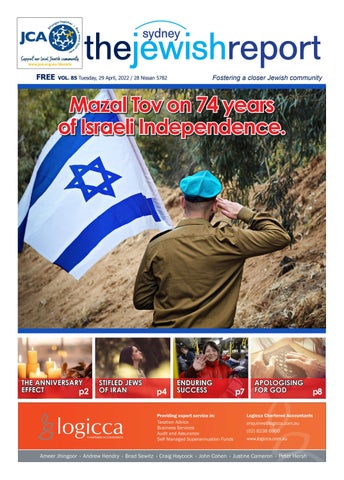
Mazal Tov on 74 years of Israeli Independence.
THE ANNIVERSARY EFFECT p2
STIFLED JEWS OF IRAN
p4
ENDURING SUCCESS
p7
APOLOGISING FOR GOD
p8
2
the sydney jewish report | April 2022
AROUND
T H E
COMMUNITY
The anniversary effect
ANNE-MARIE ELIAS As we approach Yom Ha’atzmaut, we can pause to reflect on this anniversary of the declaration of independence of the State of Israel on 14th May, 1948. For Israelis, in particular, and Jews, in general, this is a day of celebration. Are all anniversaries celebratory? When they are, we experience joy and happiness. We acknowledge a significant event by getting together with others to create a shared experience of something positive. This is certainly true In Israel, where Yom Ha’atzmaut is a national holiday. Take a moment to reflect on anniversaries that you have celebrated. These may be religious days, personal days such as birthdays, or national public holidays. How did you feel and what did you do? But not all anniversaries are positive. Some, such as the anniversary of the death of a loved one or Holocaust Remembrance Day, are filled with sadness and trauma. Researchers call this the anniversary effect. These days are marked by feelings, thoughts and memories that occur on or around a date that marks a significant event. People could be feeling sad, anxious, irritable, anxious and/or emotionally shutdown. Some experience difficulty sleeping and lose
their appetite. We need to plan and prepare for such anniversaries. Here is how. Awareness Rather than trying to forget the day, remind yourself that the days or weeks leading up to these anniversaries could be tough for you. Practice selfcompassion. With an acceptance that this will be a difficult time, find ways to increase your self-care. Look after yourself by eating well and resting. If you anticipate that you may need more support, schedule time with friends or family. Let them know how you are feeling and what you require. If need be, take a break from work.
Talk about it If you have experienced an anniversary effect before and feel you might be vulnerable again, do your best to make sure your support network is there for you. This may be a time to reconnect with a therapist for a few sessions. Ensure that if you need to talk about the trauma, the people in your support network will let you do so and not try to shut you down. It is important that you have a safe space to open up and cry. Expressive therapy, such as writing, art or music, can also be helpful. Media If your anniversary is related to a public event, there will likely be media coverage. If you find this triggering, then
it is important to stay away from media or limit your access to it. Commemorate It can be helpful and important to honour your experience. Some ways to commemorate your anniversary, include: • Donating time or money to charity, especially if that charity aims to prevent (or help others that have experienced) trauma. • Organising a dinner with loved ones. You may choose to make this a reflective occasion or a loving, joyful one. Do what best fits your needs. • Visiting a meaningful spot, like a place that you associate with happiness or healing. • Planting a tree and bringing new life into the world. • Expressing your feelings through art, writing, dancing, or another activity where you can release your thoughts. • Making yourself laugh by seeing a funny movie or spending time with your most amusing friends. • Visiting the cemetery (when it involves a personal loss). • Participating in a public event, such as Anzac Day. Finally, remember what you are feeling is temporary. While adverse anniversary reactions can be very strong, they will usually pass within a week or two and you will come out the other side feeling lighter. If you don’t, by all means seek the guidance of a trained psychologist. Anne-Marie Elias is a psychologist in clinical practice for 25 years.
Land flowing with milk and honey YERACHMIEL ISACOWITZ Jewish liturgy is replete with mention of our homeland. At the seder we say, “now here, next year in the Land of Israel. Now slaves, next year free people.” What kind of freedom do we seek and what does that have to do with Israel? Modern history abounds with “freedom from” movements that have ended in dictatorships worse than the original. For example, in Russia freedom from the Tzar to Stalin, in China freedom from the Emperor to Mao and in Rhodesia (now Zimbabwe) freedom from minority rule to Mugabe etc. Judaism is a “freedom to” program. We strive to have freedom to live the life of spiritual responsibility (mitzvot) as outlined in the Torah. We see this as our purpose and we aim to continually better ourselves. Judaism is an all-encompassing, lifelong commitment. It incorporates the most sophisticated legal, ethical and ritual system. To fulfil our commitment, we need the freedom to adhere to its
Vvvita©123RF.com principles. While there have been many periods in Jewish history that we have had independent communities in the diaspora, there is no opportunity to live the model Torah life completely outside Eretz Yisrael. Israel is a special land. In fact, most of the 613 mitzvot in the Torah are dependent upon it.
There are general mitzvot, for example peah (leaving the corners of the fields for the poor), trumot and ma’asrot (dedications of percentages of crops to Kohanim, Leviim and the poor) and shmita (refraining from farming in the seventh year).
There are other mitzvot that apply only in Jerusalem, for example offerings in the Beit Hamikdash (The Temple), maase sheini (the third percentage of crops that must be eaten there) and aliyot haregel (pilgrimage to Jerusalem on three festivals). Israel has what is called kedushat ha’aretz (holiness of the land) that requires a heightened awareness of how we treat it, what we allow to be brought in and what behaviors are acceptable. So, for example, at the height of Jewish control over Israel, in the times of King David, idol worship was strictly forbidden. The utopian Jewish picture is living in Israel ruled by a King who is a model of Torah. Philosophically, this is the expression of belief in the control the One God has over the universe. Yerachmiel Isacowitz is an independent Torah educator. E: risacowitz@optusnet.com.au W: torahconcepts.com FB: The Mem Channel
Freedom is just a means to fulfilment of purpose. torahconcepts.com
The Mem Channel
Wishing Israel Mazel Tov on its 74th Anniversary and a future of peace and prosperity Authorised by Dave Sharma MP, Suite 302, Level 3, 179-191 New South Head Road, Edgecliff, 2027.
4
the sydney jewish report | April 2022
CO NS I D E RE D
OPINION
BY CATHERINE PEREZ-SHAKDAM COURTESY: AISH.COM Iran’s small Jewish community lives under the shadow of institutionalised hatred, bound by fear and the threat of retaliation should they dare offer but a whisper of resistance. It is those voices I wish to air today, so that their cries find an echo in the silence which suffocates them. Shirin* is the daughter of a textile merchant from Isfahan, an affluent city in central Iran, a six-hour drive from the capital Tehran. Formerly home to a buoyant Jewish community, Isfahan is now home to an estimated 1,500 Jews and 13 synagogues, mostly located in an area dubbed the Jewish Passage, a far cry from the bustling community which once called the city home. “After Tehran, Isfahan had one of the most populous and thriving Jewish communities. Today things are very different. The streets of our neighbourhoods have gone increasingly quiet and so many of our family members have left for Europe, the United States or Israel. It has been difficult to feel a real sense of belonging now that we are cut off from one another. Even though we try to stay in touch with everyone through social media and WhatsApp, there is always the fear that our phone calls and messages could be misinterpreted by the regime and accusations of espionage or direct support to Israel made against us. “My cousin left five years ago for the UK and I’ve stayed in touch with her through journals. A family friend who is a trader often travels between Iran, Turkey and the UK and when he does I make sure to give him my journals so that Serena can read them … and vice versa. This way I get to share my innermost thoughts and everyday life without censorship. "It’s a bit lonely as I miss hearing my cousin’s voice but it’s the only safe way we have to maintain our close bond. “I wish we had the freedom to be ourselves and enjoy our families. I wish we didn’t have to hide ourselves away. I wish so many things for my community and my parents. Sometimes I wish Iran wasn’t my home.” A sister to her four brothers and an only daughter to her loving Jewish parents, Shirin is 27 years old. An avid reader of the French classics, Shirin dreams of teaching at La Sorbonne, a well-known French University in Paris, a dream she knows is unlikely to come true, as leaving Iran is not a simple matter. Shirin has an M.A. in French Language and Literature. She now teaches French privately, hoping soon to further her studies by pursuing a degree in western philosophy. “It hasn’t been an easy road for me. I had to work twice as hard as other students and every step of the way I had to justify to my professors and the faculty administrative body that my ambitions were purely academic and not politically motivated. “Jews in Iran live under permanent suspicion; everything we do is put under
Giving voice to the stifled Jews of Iran
Shirin*, who met the writer on social media, lives in constant fear. This is her story. Photo: Ardalan Hamedani, Unsplash.com a microscope. The most trivial matters can lead the authorities to question our motives. When I first applied for my B.A. in French Language my father had a visit from SEPA (Iran Intelligence Services) asking him why his daughter felt the need to study a foreign language when she could simply marry and limit herself to being a mother and a wife. “The fear was that I might develop links to French organisations through my studies and get involved in politics. “Bless them, my parents have been so supportive of me. I’m eternally grateful to my dad for standing up to government officials for me when it would have been so easy for him to demand that I give up. “I had to wait for an entire year for my application to be accepted. After that, I had to face daily beratings from my teachers and fellow students. I was also asked to systematically hand over my notes and research papers to a committee for verification before I could be allowed to attend the rest of my classes. I don’t know what they were looking for, but I had no choice in the matter and so I complied. “I was the only Jew in my classes and I found it difficult to make any friends. I tried, but most people kept away from me. It was a lonely experience, but I pushed through. My studies mean everything to me and without them I would have nothing.” On paper the Islamic Republic does not discriminate against its citizens on the basis of ethnicity or faith, but realities on the ground are very different – even more so for Iran’s small Jewish community. Fed by paranoia against the Jews, the State peddles the view that every Iranian Jew harbours feelings of sedition towards Tehran and that without proper monitoring they would either foment an uprising or enable foreign agents to sow discord within.
Such level of mistrust has fuelled many great tensions and fanned feelings of enmity against the Jewish communities, leaving the Jews of Iran to have to justify their actions under the watchful eyes of the State intelligence services. “I was told when I was very young not to mix with children outside our community as mixing could put my father and his business in jeopardy. There is no law preventing us from participating in social gatherings or even sports, but it’s very much frowned upon. All aspects of life in Iran are closely monitored by SEPA and the Basij (a paramilitary group close to Ayatollah Khameini, set up to serve as an auxiliary force engaged in activities such as internal security and enforcing state control over society). “Even our synagogues are watched and so many choose to practice at home rather than risk bringing attention to themselves. Being a girl makes things terribly difficult. "Women in Iran have a very limited space within which they can freely move and I have to contend with those limitations, on top of being an Iranian Jew. As a child I rarely went to the park with my mother and brothers to play. Even picnics, a favourite hobby among Iranians, had to be a well thought out affair. “I’m suffocating … I wish I could be free to choose how I want to live my life and my faith without thinking of all the ways I might put my family in danger.” “We live under the constant threat of arrest. Should the State decide that we acted against their interests, we face the risk of having our loved ones imprisoned and tortured. Jews cannot travel freely across Iran without arousing suspicion. The State may claim that we can, but it’s simply not true. The worst part is that there are no clear guidelines or rulebooks. Everything is up to the
intelligence services to decide. A simple text message to a friend could be misunderstood and lead to an arrest or a visit from Basij. “Jews are immediately flagged at the airport should we wish to leave the country for fears that we will contact opposition groups and help depose the regime. Our phones are tapped and our gatherings spied upon. “We also have to play a part in the State’s
propaganda
machine
by
sending representatives to vouch for the happiness of the Jewish community under the authority of the Ayatollahs. "Tehran’s claims that the Jews of Iran are safe is all a sham. We are paraded a few times a year so that State officials can
claim
diversity
and
inclusion.
They mock our rituals by forcing us to perform before their cameras to then congratulate each other for the tolerance of their institutions.” “What
could
we
ever
hope
to
achieve in resisting the wishes of the government? The whole system has been orchestrated in such a way that no matter what avenue we wish to pursue, we will fail. Our studies, our travels, our friendships, our businesses, our practices are put under a microscope and our ambitions curtailed to make way for regular Iranians. “Iran has put so many limitations on us that our only hope would be to leave and relocate elsewhere, but many of us do not wish to leave our homes and our communities. Iran has been our home for generations and we are waiting for things to get better. Only it’s not getting any better and the regime has systematically hardened its tone towards us."
5
the sydney jewish report | April 2022
AROUND
Sticker book collection returns
T H E
COMMUNITY JNF JNF’s My Israel Passport (MIP) collectable sticker book is back … in celebration of Israel’s birthday. Kicking off on Yom Ha’atzmaut, this popular craze is again bringing Israel to primary students across the country. Think Stikeez, Ooshies and Little Shop, but recyclable and with meaning. My Israel Passport is the latest must-have sticker book collection with 36 stickers in the following categories: environment, animals, desert areas, Israel’s milestones, Israeli innovations and influential Israelis. Don’t be surprised when your child asks to trade the Negev for Eli Cohen! Sticker books will be handed out at Jewish day schools and will be freely available at a variety of outlets for students attending nonJewish schools (details at jnf.org.au/mip). Those other outlets include a wide range of Kosher restaurants and Jewish institutions. To complete your passport, request a pack of six stickers each time you make a purchase from one of the participating vendors. Then, when your passport is complete, submit proof online to enter the draw for a prize. JNF NSW’s Education Officer Yigal Nisell applauded the initiative. “The JNF My Israel Passport is a wonderful opportunity for our
211222 - Gazelle.pdf
MIP_Sticker_56x37_20
school children to be educated about Israel in an informal and exciting way. This project, which coincides with Yom Ha’atzmaut,
For more details on the collectable sticker books, visit www.jnf.org.au/mip or contact JNF at education@jnf.org.au
:08 PM 1 11/01/2022 2:56
20111 6x37_202
rs_5
MIP_Sticke
MIP_Stic
celebrates Israel’s incredible achievements, innovations and growth over the last 74 years,” Mr Nisell said.
ker_56x3
7_202112
5 PM 22 3:42:1
1/20 f 1 11/0
- Negev.pd
22 - Oliv
es.pdf 1 22/12/20 21
3:07:13 PM
My Isra Passpo el r is back! t
Get your Passport and stickers at schools and participating stockists. Trade and collect all 36 stickers. Enter the draw to win amazing prizes! For more information and a complete list of stockists visit
www.jnf.org.au/mip
JNF_MIP_Jewish_Report.indd 1
19/04/2022 3:04:30 PM
6
the sydney jewish report | April 2022
P O LIT I C AL
SPOTLIGHT DAVE SHARMA Elected to the House of Representatives in 2019, Liberal MP Dave Sharma is up for re-election in the seat of Wentworth at the May federal election. The Jewish Report put a number of questions to him. How and why did you get into politics? My motivation is public service, and to give back to the country that has given me and my family such opportunities. Only in Australia could someone go from being an immigrant to an ambassador and then a Member of Parliament within the space of a single generation. As a career diplomat for two decades, I worked closely in vital relationships Australia has with Israel, the United States, Papua New Guinea and many other countries to protect and advance Australia and the prosperity and security of Australians. I see my role as an MP as a continuation of that vocation – ensuring Australia remains a strong, prosperous country, which affords opportunities to all. What has surprised and shocked you about the job? What has surprised me is the genuine collegiality of the parliament. Not many people see this as it is the adversarial part of parliament that is usually televised. But behind the scenes and in committee, we work closely across the aisle with Labor MPs in a cooperative and collaborative fashion. What has shocked me is the lack of civility shown by some members of the public towards politicians. I accept that we should be scrutinised and criticised, but too often that turns into personal, ad hominem and hateful attacks. It is quite corrosive to our political system and it discourages good people from putting up their hands for elected office. Has the job been harder than you imagined and, if so, in what respect? The time away from family is difficult and a challenge to manage. My wife Rachel works full-time and has her own career and we have three school-age children. Parliament keeps me away in Canberra at least 20 weeks of the year. Then there is domestic and overseas travel, and usually a heavy schedule of social commitments in the electorate and other demands on your time. What are your proudest achievements as a politician thus far? There are a number. When it comes to Israel and the Jewish community, they include ensuring parliamentary support for a double taxation agreement with Israel, helping launch free trade agreement negotiations with Israel, the listing of Hamas and Hezbollah in their entirety as terrorist organisations, adopting the IHRA definition of antisemitism, ensuring support for the security needs of the Jewish community and securing the extradition of alleged child sex offender Malka Leifer.
Liberal MP: one-on-one
Dave Sharma, Sharon Lord and daughters Beyond that, I am proud of having helped to steer through parliament the first treaty under the AUKUS arrangement to enable our pursuit of nuclear-powered submarines, campaigning for the release and return of Kylie Moore-Gilbert from Iran and delivering bipartisan support for our free trade agreement with Indonesia. I have also helped spearhead a campaign to update and improve consent education in schools, secured more money for domestic violence support organisations and helped improve local infrastructure in the eastern suburbs. This includes federal support for the Hakoah White City redevelopment, support for North Bondi, Bronte and Tamarama surf clubs and improving cycleways, pedestrian crossings and transport infrastructure throughout the east. What have been your greatest frustrations as a politician thus far? There are so many issues that are worthy of attention and involvement but only limited time available. Inevitably, you need to focus on some and be across others. If you are re-elected in May, what would you – personally – look to achieve in your next three-year term? I am keen for Australia to accelerate our transition to a low-carbon future and do more to capture the opportunities from a low-carbon global economy, including for our farmers (soil carbon) and our regions and resource hubs (green hydrogen, low-emissions steel and aluminium) and to lessen our
dependence on imported liquid fuels, with the national security risks this entails. I will also remain an advocate for upgrading our defence capabilities and strengthening our national security, including the acquisition of more advanced capabilities and the development of a sovereign defence industry. I would like to help better position Australia r for the industries of the future, from cyber to advanced manufacturing, crypto to clean tech. I am also keen to preserve our unique way of life here in the eastern suburbs, including by opposing overdevelopment and preserving our green and open spaces. Look into your crystal ball and tell me how Australia will be different in three years’ time. We will live in a more dangerous and uncertain world and region. We will need to take our defence and national security needs more seriously. Addressing climate change will no longer be a partisan issue, but a broadly shared national objective and we will begin to see the immense benefits to Australia in such a global transition to a new energy system. There will be a mature discussion and openness to Australia generating nuclear power for civilian needs. Antisemitism appears to be on the rise in Australia. Can you explain why you think that is and what you would like to see done to combat that? The reasons are multiple and complex, but I think in general terms we have found
that antisemitism, which was traditionally associated with the nationalist right, is increasingly embedded in the progressive left. Being anti-Israel and often antisemitic has almost become a badge of identity for activists on the progressive left. People who profess ignorance on all other complicated international disputes will somehow declare, with great moral clarity, the rights and wrongs of the Arab/ Israeli conflict. That is why we increasingly see antisemitism on university campuses and in far left political movements. Combating this is not easy, but I think the adoption of the IHRA definition of antisemitism will help. We need to ensure our main media outlets, including the ABC, as well as our university campuses, adopt this definition, so that antisemitism is no longer allowed an uninhibited voice in the public domain. We also need to continue to call out antisemitism whenever it appears and make clear that it is symptomatic of a broader intolerance, which threatens a free society, regardless of whether or not you are Jewish. What are your passions outside politics and do you find time to pursue them? I am a keen cyclist and runner and generally find time to pursue these early in the morning. I am also an avid reader, of fiction, non-fiction and current affairs. This is harder, but I generally manage to get through 20 to 25 books per year. I am a keen traveller and amateur historian. These are the hardest to find time to pursue.
7
the sydney jewish report | April 2022
AROUND
T H E
COMMUNITY
Enduring success
UIA On Yom Ha’atzmaut, Keren HayesodUIA acknowledges the strength of its partnership with the State of Israel. David Ben Gurion, the first Israeli Prime Minister, said that “the merits and achievements of Keren Hayesod-UIA are engraved in the soil of the homeland and treasured in the soul of the nation.” Former Israeli Transport Minister MK Itzhak Ben-Aharon said that “Keren Hayesod-UIA was an Israeli fund before there was an Israel. The State of Israel would not have been established if not for Keren Hayesod-UIA … without its path of building the country and laying the foundations of a Jewish society.” For 102 years the organisation has helped build the infrastructure and institutions of Israel, always delivering on the national priorities of the State. Since its inception, aliyah and the needs of the Jewish people have always been its central tenets. That is evident in the 3.5 million olim Keren Hayesod-UIA has supported. Although the Israel of today looks very different to that of days gone by, the need for aliyah has not diminished. In fact, 2021 saw an increase of 30% on the previous year’s figure and in 2022 it is estimated that 50,000 people will make Israel their permanent home.
A Ukrainian refugee finds safety in Israel The situation in Ukraine and rising antiSemitism highlights the importance and relevancy of aliyah as a lifeline for many. In the past month, Keren Hayesod – UIA has welcomed 11,000 Jewish Ukrainian refugees, with a further 7,000 arriving soon. They are being housed and supported through various absorption programs in the hope that they will lead successful lives in Israel. They will now experience their first Yom Ha’atzmaut in Israel – a true celebration of their independence.
While simultaneously building the human capital of Israel, Keren HayesodUIA’s innovative and supportive programs for youth-at-risk and the elderly remain a high priority. For youthat-risk, particularly in the periphery, its mentoring and educational services, such as youth villages, Youth Futures and Net@ are turning disadvantage into opportunity. More than 7,500 low-income seniors, mainly Holocaust survivors and immigrants from the former Soviet Union, are cared for through the
organisation’s Amigour project. That provides affordable housing, enabling these people to live with dignity and respect. The reach of Keren HayesodUIA’s extended family enables it to act as the bridge for global Jewry and strengthen the diaspora’s connection to the Jewish homeland, highlighted through gap year programs such as Masa. With continued community support, the organisation will reinforce its partnership with the State of Israel and maintain its profound impact.
ADVERTISEMENT
LIBERALS & LABOR ARE THE SAME FREEDOM FREEDOM FREEDOM FREEDOM FREEDOM FREEDOM Vote 1 United Australia Party Vote 1 United Australia Party Authorised by: Clive Palmer, United Australia Party, Level 17, 240 Queen Street, Brisbane 4000
UAP13469K7K
8
the sydney jewish report | April 2022
U K R A I N E
I N S I G H T BY DOVID MARGOLIN COURTESY: JWIRE.COM.AU As she lay dying in a Mariupol basement, freezing and pleading for water, Holocaust survivor Vanda Semyonovna Obiedkova wanted to know only one thing: “Why is this happening?” Ill and emaciated during the last two weeks of her life, the 91-year-old could not even stand up. She died on 4th April, not peacefully of old age in her own bed, but as a victim of the horrific 21st-century war that has engulfed her hometown. “Mama didn’t deserve such a death,” says Obiedkova’s daughter, Larissa, through tears, just hours after arriving with her family in a safe location. She had watched helplessly as her mother’s life ebbed away, remaining at her side until the last moment. After her mother passed away, Larissa and her husband risked their lives to bury Obiedkova, amid non-stop shelling, in a public park less than a kilometre from the Azov Sea. “The whole Mariupol has turned into a cemetery,” says Rabbi Mendel Cohen, director of ChabadLubavitch of Mariupol and the Ukrainian port city’s lone rabbi. Obiedkova and her family had long been active members of Mariupol’s Jewish community, the matriarch regularly receiving medical aid from Cohen’s synagogue. “Vanda Semyonovna lived through unimaginable horrors,” says the rabbi. “She was a kind, joyous woman, a special person who will forever remain in our hearts.” Since the war began, Cohen
C O NS I D E RE D
OPINION
Holocaust survivor perishes in Mariupol store basement
Vanda Semyonovna Obiedkova has been working full-time to evacuate community members from the inferno, working the phones even on Shabbat and most recently, Passover. Last week he was able to evacuate Larissa and her family. Vanda Obiedkova was born in Mariupol on 8th December, 1930. She was 10 years old in October 1941 when the Nazis entered Mariupol and began rounding up the city’s Jews. When the SS came to the family home and took away Vanda’s mother, Maria (Mindel), the little girl managed to evade arrest by hiding in a basement. “She couldn’t scream; that’s what saved her,” says Larissa. On 20th October, 1941, the Germans executed between 9,000 and 16,000 Jews in ditches on the outskirts of Mariupol, including Obiedkova’s mother and her mother’s entire family. The
little girl was later detained, but family friends came and convinced the Nazis that she was Greek. Her father, who was not Jewish, then managed to get her checked into a hospital, where she remained until Mariupol was liberated in 1943. Obiedkova gave a full account of her life and Holocaust experience to the USC Shoah Foundation in 1998. “We had a VHS tape of her interview at home,” says Larissa, who notes that her mother retained a measure of Yiddish until the end. “But that’s all burned, together with our home.” Obiedkova married in 1954 when Mariupol was known by the Soviet name of Zhdanov and spent her entire life in the city. In recent years, she lived with Larissa. “Mama loved Mariupol; she never wanted to leave,” she says. When the shelling and bombings began at the beginning of March, the family moved into the basement of a neighbouring heating-supply store. The only assistance the family received throughout that time came from Cohen’s synagogue and community centre. “There was no water, no electricity, no heat and it was unbearably cold,” she says. Larissa spent all her time caring for her immobile mother, but “there was nothing we could do for her. We were living like animals!” Two snipers had set up positions near the closest sources of water, making every trip there intensely dangerous, aside from
This story originally Chabad.org/News
appeared
in
Apologising for God
BY RABBI MORDECHAI BECHER COURTESY: AISH.COM Many great thinkers consider the question "why do bad things happen to good people?" to be the most perplexing question in philosophy and theology. Are there any truly good answers? The life of a non-human animal research participant (a rat) running mazes in a psychology lab is not very meaningful. It presses one lever and receives food pellets; it presses another lever and gets an electric shock. It is eventually conditioned to press the appropriate lever (unless it is a really weird rat) and to run the maze in a specific path. Human life is much more risky, ambiguous and challenging. We may often make a morally correct choice and nevertheless lose out or suffer, and we may make an immoral choice and succeed and prosper. We are not creatures who merely react to stimuli or act only when cause and effect are obvious, rather we are beings that struggle with decisions and even struggle with our motivations and intent. This capacity for free will is crucial to understanding the question of why good people suffer and evil people prosper.
the bombs raining down from the skies. “Every time a bomb fell, the entire building shook. My mother kept saying she didn’t remember anything like this during the Great Patriotic War [World War II].” ‘It’s all gone’ Back in 2014, when the war began and Mariupol was hit particularly hard, Larissa and her family joined Mariupol’s Jewish community in evacuating with Cohen to a Chabad campground outside of Zhitomir, in Western Ukraine. They returned when things quieted down, but Larissa says there’s no going back this time. “I’m so sorry for the people of Mariupol,” she says, as she breaks down once again. “There’s no city, no work, no home, nothing. What is there to return to? For what? It’s all gone. Our parents wanted us to live better than they did, but here we are repeating their lives again.” The one, lonely bright spot, Larissa says, has been Rabbi Cohen and the Chabad of Mariupol Jewish community, which has been a lifeline throughout the last eight weeks of hell. “Thank Gd, we have our Jewish community,” says Larissa, noting that her mother loved participating in festivities over the years, including Passover. “People need community … family, during this time. That’s all we have left.”
First, some introductory remarks. Why good people suffer is a question that Moses asked of God. It is a question to which an entire book of the Bible, Job, is devoted and a question that religious and secular philosophers have discussed throughout history. The great German philosopher Gottfried Wilhelm Leibnitz wrote a book on this
subject, entitled “Theodicy” (from the Greek theós God and dík, justice). In other words, “justifying God”. If this question bothers you, that is a good thing. It shows that you are not indifferent to suffering and it also reveals that you expect there to be justice in this world. That expectation is based on the deep-seated belief that most of us
have that there is a judge – a just and benevolent God and therefore there should be justice. The question, of course, is not applicable to self-inflicted suffering based on lifestyle and moral choices. Maimonides – the great Jewish philosopher, Talmudist, physician, and community leader of 13th century Cairo – believed that most suffering was a result of people blindly following their desires for money, power, materialism and honour. “For by following entirely the guidance of lust, in the manner of fools, man loses his intellectual energy, injures his body, and dies before his natural time; anxiety and worries multiply; there is an increase of envy, hatred, and violence for the purpose of taking what another possesses” (Maimonides, Guide for the Perplexed 3:33). Now let’s revisit our original question of theodicy. Jews, and indeed all monotheists, believe that God is perfect, complete in every manner and totally independent. The 20th-century Jewish scholar Rabbi Aryeh Kaplan expressed that “God had absolutely no need to create the world. God Himself is absolute perfection and He has no need for anything, even creation. Thus, to the best of our understanding, we Continued on page 9
9
the sydney jewish report | April 2022
AROUND
T H E
COMMUNITY
COA giving
COA SYDNEY Passover means two things at COA: Pesach Parcels delivered across Sydney and the annual Model Seder at the COA Centre in Bondi Junction. In accordance with tradition, COA held its Model Seder a few weeks before Pesach. Each year the organisation provides a Seder experience with all the trimmings. Thanks to a host of COA volunteers and staff, this year’s service was again a huge success. Working to make an authentic, delicious meal takes days of preparation and it was particularly gratifying to look at the smiles on the faces of the COA members that attended. The service was led by Mordechai Levin, who has moved from his counselling role in COA Social Work to program and present Club COA on Mondays and Wednesdays. Levin is blessed with a cantorial trained voice. He read portions from the Haggadah, explained the significance of the Seder symbols and sang Pesach songs. Although COVID-19 kept some people away, those who were there had a wonderful time celebrating with their COA family of friends. A week later the organisation was ordering kosher for Passover ingredients for its annual Pesach Parcels. These parcels came in two varieties.
Volunteers Eva Glaser and “Papa” Sam The first was a small token of Pesach delivered to members attending the COA Centre, along with those receiving Kosher Meals on Wheels and others obtaining weekly bags of fresh produce from COA Fresh. Parcels were also delivered – by a combination of COA and Jewish House volunteers – to Jewish residents in nondenominational aged care facilities, as part of the Hannah Meyer Project. The second variety was a more substantial parcel, delivered as part of the Heart of Golding initiative, specifically
for people in the community suffering financial hardship. Some recipients are COA members while others are not, but if a Jewish senior requires a little help to enjoy a kosher Pesach, the organisation will deliver to them regardless of membership. None of these parcels would have been packed and delivered without the effort of volunteers from the All In Giving Circle. That is a grassroots organisation of 13 families that want to teach their children about “Tikun Olam” by supporting projects for those in need. It is
not looking for recruits, but encourages other groups of families to do as it does and provide Tzedakah to those who need it, be they refugees or those living locally. This year, the All In Giving Circle sent a group of year 12 students from Moriah College and Reddam House that worked together to prepare the parcels, label them and help deliver them across Sydney. They spread the joy of this special festival and helped many people in the community feel included and cared for.
Apologising for God From page 8
Delivering kosher Meals-on-Wheels to the North Shore and in the Eastern Suburbs. Visiting residential aged care facilities on Friday as part of Hannah Meyer Project Shabbat candle lighting team, families welcome to join. COA kitchen producing and serving lunch at Club COA on Monday and Wednesday. Hall hosting at Club COA Monday and Wednesday, make coffee, join in games, talk to members, support diversional therapist.
Volunteer Coordinator: overseeing all of COA’s volunteer programs. Permanent Full Time 5 days weekly. Driver for Mini Bus: day outings and transport to and from COA. Permanent Part Time 2 days weekly with potential for 4 days weekly. Office Administration: Microsoft programs and exceptional organisational skills. Permanent Part Time 15 hours weekly.
for yourself or for a friend about staff roles, please contact Sabina Kovadlo at operations@coasydney.org or phone on 8367 5030, and for volunteer roles contact Sam Peirson at s.peirson@coasydney.org or phone 8367 5023.
can say that God created the universe for the purpose of bestowing good upon people. God Himself calls His creation an act of goodness. It is for this reason that, at the end of the first six days of creation, after making Adam, the Book of Genesis says, “And God saw all that He had made and behold it was very good.” We are being told that the creation of the universe was an expression of His goodness.” (Rabbi Aryeh Kaplan, Innerspace, pg. 9). Rabbi Moshe Chaim Luzzatto (Italy, 18th century) explains that since God is perfect, His gift must also be perfect. The ultimate gift is, therefore, to be “God”. Since it is a logical impossibility for the creature to be the Creator, God enabled the creature to become as God-like as possible. Since God is independent and self-actualising, so too God created the human being with God-like qualities, one of which is selfactualisation or self-creation. Through the power of free will, the human creates herself and is truly a creator, not merely a creature (Luzzatto, The Way of God, Section 1, Ch. 2). So free will is essential for the fulfilment of God’s goal. However, free will ability is not enough. There must also be an environment that enables the exercising of free will. Imagine a world where every good decision was rewarded
and every bad decision punished, honest businesspeople succeeded and every crook failed, the good guy always finished first and the bad guy last. Such a world would be like a maze in a psychology lab and we would be the rats. In a world like that, free will would be replaced by conditioned responses and instead of creating ourselves, we would be products of God’s intervention. The more God intervenes, the less free will we have. God wants us to have a meaningful life and be God-like creators, and he therefore interferes only when absolutely necessary. However, if God minimises his intervention, the righteous will often suffer and evildoers will often prosper. (There will be justice served in the afterlife, but that is a subject of another discussion.) To ask that God always intervene when there is injustice is to ask that humanity no longer exists as human, but rather as lab rats responding to stimuli and conditioned by immediate Divine intervention. And if God does intervene, where do we draw the line – murders only? children only? If we want a world where a saint is possible, then it must be a world in which a Stalin is also possible. If we want a meaningful life, we must have free will and in order to facilitate free will, the bad guys will sometimes win and the good guys will sometimes lose.
10
the sydney jewish report | April 2022
JUD AIC A
QUIZ
RABBI DAVID FREEDMAN It is time to pause and explore Jewish history, literature, prayer and all-things-Israel. Below a spotlight also shines on famous Jews in the arts, sciences, politics, religious affairs and dives into the bible and so much more. This quiz has been warmly embraced by families and friends around Shabbat and Yom Tov tables across town and is brought to us by the erudite and engaging Rabbi David Freedman. 1. Which Israeli wrote 40 books, including: novels, short story collections, children's books and essays. This comprised works published in 45 languages - more than that of any other Israeli writer? 2. What is the collective name used to describe the seven Psalms: 24, 48, 81, 82, 92, 93 and 94? 3. What generic names were given to the rabbis who compiled the Babylonian Talmud? 4. Who served as the first female United States Secretary of State in U.S. history from 1997 to 2001 under President Bill Clinton?
Test your knowledge
5. Abe Attell was often referred to by newspapers as "The Little Hebrew". He was a boxer who became known for his record six year consecutive reign as World Champion from 19061912 – in which weight division did he compete: Flyweight, Featherweight or Welterweight? 6. True or false – Jacob and Amalek (Israel’s arch enemy) were related through marriage? 7. There are times we have someone else’s property in our possession.
someone’s head in his hand. Which famous Biblical story did this represent? 9. Marvin Hamlish, the famous Jewish composer, was one of only 16 people to win all four of which famous four awards? 10. Where in Israel is The Shimon Peres Negev Nuclear Research Centre located? 11. What does the Old French word ‘chalant’ mean? 12. The fictional character Leopold Bloom is found in which famous work of
Good luck. Enjoy. Hopefully, learn something new about your Jewish heritage and tradition. Jewish law identifies four categories and discusses each one in respect to responsibility in law if the property is damaged. The first three categories include: the unpaid guardian, the paid guardian and the borrower. What is the fourth category of ownership? 8. In one of his paintings, Caravaggio depicts a young man holding
literature? 13. What is the name of the Israeli Trade Union Organisation? Who was elected as its General Secretary in 1921? 14. The Hebrew phrase Lifnim Mishurat Hadin refers to which concept in Jewish law? 15. Resigning from her position as United States Ambassador to the United Nations on December 31, 2018, who
won the World Jewish Congress Theodor Herzl Award in November 2019? 16. In which biblical book would one find the words Oseh Shalom Bimromav (He who makes peace in His high places): Job, Nehemiah or Daniel? 17. What name is given to the palmshaped amulet with an eye on it that is most prevalent amongst Sephardi Jews? 18. The Second Arab-Israeli War is better known in the UK, USA and France as what? 19. Titus, who succeeded his father Vespasian as the general who led the attack on Jerusalem in the year 70 CE, was the first Roman emperor to do what? 20. What is the literal meaning of the word Mezuzah? 21. Where is Israel's richest agricultural area situated? 22. The Kimchis were a famous medieval rabbinic family. Did they come from Spain, Italy or France? 23. Brad Gilbert won a bronze medal at the 1988 Olympics and both gold and silver at the 1981 Maccabiah Games. In which sport? 24. Who wrote the short story, Yentl the Yeshiva Boy? 25. Brian Epstein, manager of The Beatles since 1962 until his death, was born on which Jewish festival in 1934?
ANSWERS PAGE 13
Yoni Glatt’s JEWISH SPELLING BEE How many common words of 5 or more letters can
spellcommon using the letters the5hive? Every answer How you many wordsin of or more letters can must use the the centre letter at may you spell using letters inleast theonce. hive?Letters Every answer be reused in a word. At least one word will use all 7 must useletters the center letter at least once. Letters may and have a direct Jewish connection. be reused in a word. At least one word will use all 7 Proper words are not allowed. lettersnames and and havehyphenated a direct Jewish connection. Score 1 point for each answer and 3 points for a Jewish-related word that uses all 7 letters.
Proper names and hyphenated words are not allowed. Score 1 Rating: point 6=Good; for each8=answer, 3 points for a Excellent;and 11= Genius Jewish related word that uses all 7 letters.
Executive Assistant to the Chief Rabbi
Rating: 9=Good; 17= Excellent; 25= Genius
Minimum of 3+ years of experience as an Executive Assistant or similar position Microsoft Office skills, with an ability to become familiar with firm-specific programs and software Proficiency in social media, Facebook and Instagram Strong organisational skills with multi-tasking abilities Exceptional interpersonal skills Friendly and professional demeanour Strong written and verbal communication skills Some event planning experience will be a bonus
To apply for this position please send your Resume to:
Yoni Glatt has published more than 1,000 crossword puzzles worldwide, from the LA Times and Boston Globe to The Jerusalem Post. He has also published two Jewish puzzle books: "Kosher Crosswords" and the sequel "More Kosher Crosswords and Word Games". ANSWERS PAGE 13
Here is a list of some common words (Yes, we know there are more words in the diction
11
the sydney jewish report | April 2022
RABBINIC
THOUGHT
Heading to the Holy Land
RABBI LEVI WOLFF CHIEF MINISTER THE CENTRAL SYNAGOGUE After a two-year hiatus due to the Covid-19 global pandemic and under the shadow of war in neighbouring Ukraine, March of the Living is scheduled to take place in late April this year. This has been an important journey undertaken for so many Australian Holocaust survivors and their families over the decades, always commencing in Poland and concluding in our Holy Land. Thus marking the lowest and highest points in modern Jewish history. One year pre-pandemic, given a state of economic downturn, a decision needed to be made by a family: with limited funds, should the Poland or Israel component be cut out of their itinerary? In a perfect world, of course, neither. However the question broadened to encompass the priority of Yom HaShoah, Holocaust Remembrance Day or Yom Ha’atzmaut, Israeli Independence Day? I gave it genuine thought and then said that given these circumstances, experiencing Israel was more important. Understandably, not all agreed with this suggested course of action. Many felt it was more essential to examine our tragic wartime experiences. I recognised that given all we have endured, this focus has become part of the Jewish mindset – evident by just how many Hollywood Holocaust movies have been released, compared with films, for example, about all-things-Israel. For a while post-war, there was a stunned silence, an inability for the global Jewish community to confront the horrors. Slowly, the Holocaust became the epicentre of Jewish activity. This is important: Zachor – remember; al tishkach – we must never forget! As a proud grandson of survivors, the Shoah was all-encompassing. Whilst my Zaida shed tears about the Holocaust during each Yizkor sermon delivered, equally, he was openly emotional marveling in the modern miracle we call Israel!
It’s a fine line. Jewish loyalty in our children is not guaranteed simply with the education of our tragic past facing anti-Semitism repeatedly. There is the important flip side: the love of Judaism and Israel. We were once privileged to have a senior rabbi from Israel visit The Central Synagogue. He had been a child during the Holocaust and gave a deeply moving speech about Jewish continuity. An audience member had experienced similar harrowing circumstances and was distraught that his daughter planned to marry out of our religion. He wanted the senior rabbi to communicate how much loss was witnessed all because they were born Jews. The rabbi acquiesced and spoke to the fellow survivor’s daughter. She chose to proceed with her Catholic wedding regardless. Despite how poignant the rabbi’s words were, echoed throughout her upbringing by her father, they didn’t penetrate her heart. I ruminated about this greatly. And then I read a speech given by Dr. Alfred Sabin, the inventor of the live polio vaccine. He said, “Judaism came to me through my left eye. When I was a child in Poland, non-Jewish children threw stones at me, and I became blind in my right eye.”
This is the story of so many, Judaism was viewed via a damaging prism of anti-Semitic hatred. Whilst education is vital, we cannot expect the youth of today to marry Jewish simply from having been taught about violent atrocities of the past. We need both eyes wide open – one eye absorbing all that occurred at Auschwitz and beyond and the other locked on Jerusalem.
It is often human nature to focus on pain not joy; loss not love; death not life. Simultaneously, we can be grateful for what we have and both sensitive and respectful of where we have come. As we recently experienced with the order of the Passover Seder, we go from genut to shevach – from being downtrodden to being proud and free. Negative to positive. L'Shana Haba'ah B'Yerushalayim – Next year in Jerusalem!
For the People of Israel
12
the sydney jewish report | April 2022
MOV I E
REVIEWS
Tense Holocaust drama
FAREWELL, MR HAFFMANN (M) BY ALEX FIRST Farewell, Mr Haffmann concerns a Jewish small businessman in France caught up in the maelstrom as the Nazis spread their tentacles. It is May 1941 and Joseph Haffmann (Daniel Auteuil) runs a jewellery shop. He is noted for his fine craftsmanship. Haffmann sees the situation in occupied Paris worsening and understands the urgency of arranging safe passage out of the country for his wife and three children. Haffmann promises to follow behind shortly, but first he enacts a plan to hand ownership of the shop (and the residence attached to it) to his relatively new employee. That man, Francois Mercier (Gilles Lellouche), who walks with the aid of a calliper, is married to Blanche (Sara Giraudeau). The pair is very much in love and would like to have a baby, but she is having difficulty falling pregnant. Mercier aspires to open his own jewellery business one day, so while this unexpected arrangement with Haffmann comes out of the blue, he welcomes it … even though Blanche does not. The deal is that Mercier will take over and change the signage on the shop
to reflect his name, only to hand the business back to Haffmann after the war, when he is able to return. In return, Haffmann will help Mercier open his own shop. The deal done, Haffmann leaves with a handshake. But just as the Merciers are getting settled into their new lodgings, Haffmann reappears. There are Germans everywhere and his intended smuggler has gotten cold
feet. Mercier puts Haffmann up for the night, with Haffmann intending to try to make his getaway again the next day. Only that move is scuppered because the German presence has become overwhelming and a second approach to the smuggler receives a violent rebuke. Now, Mercier is stuck with Haffmann in his basement for the long term as the roundup of Jews starts.
Flirting with danger, Mercier sees the business do well thanks to the arrival of a German commandant (Nikolai Kinski) who admires his workmanship (in reality, it is Haffman’s work). Shocks follow as the dynamic between Mercier, his wife and Haffmann changes. While you could question certain plot elements, there is no doubt the story is compelling. Unease and discomfort are always close at hand. The key roles are well played. Auteuil is credible as a decent, hardworking man caught in a most undesirable and dangerous position. Lellouche captures the transition in Mercier, in a movie in which power shifts. Giraudeau shows vulnerability, compassion, fear and horror as Blanche. The screenplay by director Fred Cavaye and Sarah Kaminsky from a play by Jean-Philippe Daguerre maintains and builds interest. Intensity is the name of the game. The question is how will Haffmann and the Merciers end up? To find out, you will just have to buy a ticket to see Farewell, Mr Haffmann. Rated M, it scores a 7 out of 10.
Hard-hitting and true HAPPENING (R) BY ALEX FIRST France in 1963 was a place where abortion was a dirty word. In short, it was illegal. Happening is a harrowing tale about a highly intelligent literature student who unexpectedly falls pregnant and has to keep it a secret for fear of what could happen to her. Her name is Anne Duchesne (Anamaria Vartolomei) and she is 23. She hangs around with her gal pals, Brigitte (Louise Orry-Diquero) and Helene (Luana Bajrami) and like others their age they talk about boys. Then when her period doesn’t come on time Anne pays a visit to a doctor, only to discover – much to her alarm (although by then she suspects it) – that she is carrying a child. At that stage she is only three weeks into her pregnancy. We follow Anne’s frantic endeavours to find a solution to her “problem” in the weeks and months that follow. She lives in a dorm and visits her parents regularly, but she can’t tell them that she is pregnant because anyone who aids Anne’s endeavours to abort faces jailtime, so even her closest friends abandon her. The guy who knocked her up in a casual encounter is no help and a male friend tries to take advantage of the situation. Anne’s studies, that she is so desperate to continue, suffer. Her literary professor Bornec (Pio Marmai), who saw her as a fellow
teacher in future, now can’t see her passing her university entrance exams. When he asks what is going on, she refuses to tell him. As she reaches the 10 and then 12week mark, Anne’s options have almost closed entirely. She feels increasingly isolated and abandoned. Happening is a compelling movie, but a very difficult watch. Anamaria Vartolomei is superb in the lead role, displaying the full range of emotions. We feel her frustration and fear, and metaphorically ride every bump.
We see her mood shift as door after door closes. I also appreciated the slice of life representation of the dutiful professor by Pio Marmai. His character tries to understand what is going on, but retains a professional distance. Based on a novel by Annie Ernaux about her own experiences, director and co-writer Audrey Diwan has given the film an appropriately claustrophobic feel. She has done a fine job “trapping” Anne and then tightening the screws.
In so doing, she has also commented on the rigid rules that constrained women at that time. This is dour, intelligent filmmaking that doesn’t let up from start to finish. Winner of the Golden Lion at Venice last year, there is much to appreciate about the way the subject matter is handled, as loathsome as what appears on screen may be. And a warning, some of it is not at all pretty. Rated R, Happening scores an 8½ out of 10.
13
the sydney jewish report | April 2022
IS RAE LI
N E W S BY NOMI KALTMANN COURTESY: TABLET MAGAZINE Every year, young scholars gather in Israel for Chidon HaTanach, the International Bible Contest. Sometimes those who start as rivals end up under the chuppah. When Noah Notis and Atara Kelman got married in July 2020, due to the pandemic they had just 25 guests in Kelman’s backyard in Toronto. It was the culmination of a relationship that began four years earlier in Israel, where they’d originally been rivals. Both bride and groom were contestants at the Chidon HaTanach (International Bible Contest): Notis representing the United States and Kelman Canada. Each year, thousands of the brightest and best students from Israel and around the world compete in regional and national competitions to earn a coveted place in the Chidon finale. The competition, founded in 1958 by Israel’s first prime minister David Ben-Gurion, aims to connect diaspora Jews with the bible and their Jewish heritage. Broadcast live on Israeli television at 11 am on Yom Ha’Atzmaut (Israeli Independence Day), it evokes cult status, even being parodied on Israeli television. With thousands of Israelis, religious and nonreligious alike, glued to their television screens, in most countries this would be akin to one of the biggest sporting events of the year. But at the Chidon, the competition centres around contestants being asked difficult questions about obscure facts and books in the bible. The quiz starts two weeks earlier when participants from as many as 30 countries arrive in Israel to participate in a preparatory camp and tour of the country. Competitors are treated like VIPs, meeting with dignitaries such as the Israeli prime minister, president and minister of education. “There is a certain common denominator for people coming to compete in the Chidon,” said Kelman. “While overall it is a very diverse group of people, those who are similar to you already have certain things in common, such as a commitment to learning Tanach seriously and taking on extra projects outside school hours.” Kelman and Notis are certainly not the only ones who have met their significant other at the Chidon. Amihai Bannett is the director of Chidon HaTanach at
Judaica quiz answers 1. Amos Oz 2. These are the seven daily psalms known collectively as Shir Shel Yom – The Psalm of the Day 3. The Babylonian Talmud includes the Mishna and Gemara – the Mishna was compiled by the Tannaim, the Gemara by the Amoraim. One may also include the Saboraim who edited the final version 4. Madelaine Albright 5. Featherweight 6. False – they were in fact related through family. Amalek was Esau’s grandson, which made him Jacob’s great nephew
When competition spurs romance
Yoni Halpern and Dani Lent Halpern at their wedding. Photo courtesy Dani Lent Halpern the Jewish Agency, which is in charge of overseeing and organising the Chidon. He also recruits, prepares and brings contestants from Jewish communities around the world to the two-week Tanach camp. Since starting his role in 2012, Bannett can think of six or seven couples who met at the Chidon and later got married … just in the past decade. “The [Chidon] is a meeting of like-minded people who are passionate about the Tanach and Israel,” he said. “This combination sparks wonderful connections.” Agreeing with this sentiment is another couple who met at the 2004 Chidon: Dani Lent Halpern from the United States and Yoni Halpern from Canada. Their romance was not immediate. Rather, it blossomed in the years after their initial meeting at the Chidon. Dani said: “We kept in touch intermittently
after [the contest] and saw each other occasionally through mutual friends, but didn’t start dating until many years later. Actually, we got more back in touch planning a Chidon reunion.” Dani thinks that the Chidon served as a wonderful backdrop to them meeting, as it “brings together young people who are serious about their Torah knowledge ... and [are] maybe just a wee bit competitive. It gives you a chance to see people when they are focusing on something they really want, as well as when they are having fun because of how the program is structured. We both knew we were coming with similar values.” Itzhaki Felhimer is an Israeli who has been involved in running the Chidon HaTanach camp since 1991. That includes planning the program, selecting staff for the camp and ensuring the safety of all
7. The hirer 8. David and Goliath 9. He won the Emmy, Grammy, Oscar and Tony awards 10. Dimona 11. It means ‘warming’ and is the origin of the word Cholent 12. James Joyce’s Ulysses 13. Histadrut - David Ben Gurion 14. Going above and beyond the letter of the law, i.e. acting in the spirit of the law 15. Nikki Haley 16. Job 25:2 17. Hamsa. Depicting an open hand, hamsa (Arabic) is connected to the Hebrew word chamesh meaning five, because of the five fingers depicted on the hand
18. The Suez Crisis (1956) 19. He was the first Roman emperor to come to the throne after his own biological father (Vespasian) 20. It means a doorpost. It is said to be derived from the Hebrew verb, zuz, meaning to move or shift as the doorpost is a device which enables the door to move or shift 21. The Jezreel Valley 22. France. The family, including Rabbi Joseph Kimchi and his sons, Rabbi David Kimchi and Rabbi Moshe Kimchi, came from Narbonne in the Provence region of Southern France close to the border with Spain
Chidon HaTanach competitors from the moment they arrive in Israel until they fly back to their home countries. He thinks that many couples who meet at the Chidon end up married because they share a common interest in the bible. “I think couples bond over the fact that they are outside their home [countries], in an intensive camp with competitors from different places, with common values and often a similar religious background,” he said. This was certainly true for Jenny and Matthew Disler, who met at the 2012 quiz. Jenny, from England and Matthew, from South Africa, met at the Chidon, with Jenny recalling that “we became friends over the two-week camp and spent lots of time together, sharing thoughts and ideas.” Jenny thinks the camp was a good place to meet. “Young, like-minded people came together from all four corners of the earth for their love of Tanach and Israel, which was amazing to see,” she said. “It was a safe space where we had our independence to meet each other and develop a friendship, which later became a relationship.” While Felhimer can recall many non-Israeli couples who met and subsequently married over the years, he can only recall one Israeli couple who married. In 2018, Israelis Azriel Shilat and Oriah Cohen competed in the final round of the competition, with Shilat narrowly beating Cohen. A year and a half after they competed against each other, they were married. They have since welcomed their first child. “We just told our eldest daughter [who is] 7 years old that we met at a Torah contest and she was really interested in doing it when she got older,” said Dani Lent Halpern. “If any of our children wanted to participate, we would definitely support them, but it is by no means mandatory.” In this vein, it is likely that the Chidon will continue to serve as a good place for couples to meet, with Jenny Disler saying she thinks “we would like to encourage [our children to participate], but with no pressure.” This story originally appeared in Tablet Magazine (tabletmag.com) and is reprinted with permission. 23. Tennis 24. Isaac Bashevis Singer 25. Brian Epstein was born on Yom Kippur, 1934
Spelling bee answers Here is a list of some common words (yes, we know there are more words in the dictionary that can work, but these words are the most common): Jewish Answer: CHUTZPAH. Other Answers: CATCHUP, CHAZZAN, CHUPPAH, CHATAN, HUZZAH, PAZAZZ, ATTACH, CATCH, CAPUT, HATCH, PATCH Questions/comments – email Yoni at koshercroswords@gmail.com
14
the sydney jewish report | April 2022
CO NS I D E RE D
OPINION
Desecration of holy sites
GATESTONE INSTITUTE BY BASSAM TAWIL Palestinians have once again been caught lying to the world by claiming that Jews are "desecrating" the Islamic holy sites, in particular the AlAqsa Mosque in Jerusalem. If anyone is desecrating the mosque and other holy sites it is Palestinians themselves. In 2002, Palestinian terrorists stormed into the Church of the Nativity in Bethlehem, but the global Christian response was muted. The terrorists stayed inside the church for 39 days and left behind dirty blankets and mattresses, lighters and cigarette butts and "the reek of faecal matter." One priest complained that the terrorists had also desecrated the church by smoking and drinking alcohol. On Friday morning, April 15th, hundreds of Palestinian "worshippers" barricaded themselves inside the Aqsa Mosque and clashed with Israeli police officers. The rioters, armed with rocks, iron bars and fireworks, arrived at the mosque early in the morning and were seen bringing rocks into the mosque and blocking its main gate with wooden and metal barriers. The "worshippers" arrived at the mosque because their leaders had lied to them – told them, incorrectly, that Jews were planning to "storm" the mosque and "defile" its courtyards. As soon as the rioters entered the mosque compound on the Temple Mount and before clashing with the police, they raised flags and banners of Hamas, a Palestinian group designated as a terrorist organisation by the US, European Union, Canada, Australia, Japan and other countries. Apparently, Palestinians do not consider bringing rocks, iron bars and other light weapons into a mosque an act of desecration. Apparently, Palestinians do not consider hoisting the flags and banners of a terrorist organisation at a holy site an act of desecration. Apparently, Palestinians do not consider hurling rocks and glass bottles at people at the nearby Western Wall, the most sacred site in the world, used by the Jewish people for prayer, an act of desecration. Apparently, Palestinians do not consider throwing rocks and shooting fireworks at police officers in the mosque compound an act of desecration. The riots that were initiated by the Palestinians at the Temple Mount on April 15th were completely unprovoked. The violence erupted after Palestinian leaders and groups falsely claimed that "Jewish extremists" were planning to conduct a ritual of animal sacrifice at the site to celebrate the Passover holiday. Israel denied the allegations and sent messages to the Palestinians assuring them that Jews would not be permitted to carry out any "provocations" on the Temple Mount. Even senior Hamas official Saleh al-Arouri admitted, hours before the violence broke out, that his group did
receive such assurances. According to al-Arouri, the Israeli message was relayed to Hamas through unnamed "mediators." Yet all the attempts by Israel to refute the false allegations of the Palestinians did not help. The Palestinian blood libel concerning the alleged desecration of the Islamic holy sites by Jews originated several years ago with Palestinian Authority President Mahmoud Abbas himself. In 2015, Abbas said: "The Al-Aqsa Mosque and the Church of the Holy Sepulcher are ours. They are all ours, and they [Jews] have no right to defile them with their filthy feet. We salute every drop of blood spilled for the sake of Jerusalem. This blood is clean, pure blood, shed for the sake of Allah. Every martyr will be placed in Paradise and all the wounded will be rewarded by Allah." Shortly after Abbas's speech, Palestinians launched a wave of terrorist attacks that included stabbings, shootings and car rammings. The Palestinians who set out to murder Jews thought they were heeding the call of their president to defend their mosque against the "filthy feet" of Jews. By murdering dozens of Jews for the sake of the mosque, the terrorists were actually themselves defiling the sanctity of the Aqsa Mosque. How? They invoked the name of the mosque to justify a murder spree against innocent Jews. The small number of Jews who have peacefully toured the outdoor Temple Mount area in the past few years have never even set foot inside the Aqsa Mosque or on the nearby Dome of the Rock. The Jewish visitors do not go there to assault or humiliate Muslims. They go there as part of organised tours that are coordinated with the Israeli authorities. If anyone is assaulted, harassed or degraded, it is the Jewish visitors. Videos
of Palestinians cursing and shouting at them have been circulating for years on social media platforms. In addition, Palestinians have attempted to physically attack the Jewish visitors. Notably, the renewed Palestinian claims about Jews desecrating the Islamic holy sites came even as Palestinians vandalised Joseph's Tomb in the Palestinian city of Nablus. The site, where according to Jewish tradition the biblical figure Joseph is said to be buried, was attacked and vandalised twice by Palestinian rioters over just a few days. This was not the first time that Palestinians had attacked and damaged Joseph's Tomb. Although some reports claimed that the Palestinian Authority promised to help renovate the site, in the end it was the Israeli army that had to send large forces to repair the damage. Joseph's Tomb was targeted by Palestinians for one reason: to prevent Jews from arriving there to pray. Two religious Jewish men who tried to go to the site after learning of the vandalism were shot and wounded by Palestinians. The vandalism and the attempt to deny Jews access to Joseph's Tomb is actual desecration of a holy site, as opposed to peaceful tours of Jews to the Temple Mount and the free access Muslims have to all their mosques in Jerusalem. The international community, meanwhile, continues to ignore the Palestinian desecration of holy sites. Journalists are reporting how Israeli policemen "raided" the Aqsa Mosque compound on Friday morning, without pointing out that Palestinian rioters had filled the mosque with stones and iron bars hours before the police entered. The Palestinian claims that Jews are defiling the holy sites are intended not only to incentivise Palestinians to
carry out terrorist attacks, but also to rally all Muslims against Israel. The false accusations promote antisemitism and provide fuel to Israel-haters around the world, especially, sadly, on US university campuses. This is all happening while the Biden administration airily disregards endless Palestinian blood libels and vicious incitement against both Israel and the Jews. During a recent visit by US Secretary of State Antony Blinken to Ramallah, the de facto capital of the Palestinians, he said: "We'll work to prevent actions by either side that could raise tensions. That includes settlement expansion, settler violence, home demolitions, evictions, payments to people convicted of terrorism and incitements to violence." Blinken's remarks show that he considers the construction of new homes for Jews more dangerous than the murder of Israelis on the streets of Israeli cities. Prominently, Blinken did not threaten to suspend US financial aid to the Palestinians over the payments to the families of terrorists who murdered Jews and the ongoing incitement to attack Israelis. Take note: as long as Blinken considers the construction of apartments for Jews a greater threat than shooting and stabbing Israeli men and women at shopping malls and bars, Palestinians will not cease their blood payments and murderous incitement. Unless the US administration makes it unmistakably clear that the Palestinians will pay dearly for continuing to reward terrorists and their families, the Palestinians will not slow down either desecrating holy sites or committing their terror attacks. Bassam Tawil is a Muslim Arab based in the Middle East.
15
the sydney jewish report | April 2022
F O O D I E S'
CORNER
Meatballs with herb couscous
SOUL GOURMET Recipes within this newspaper from KAcertified Soul Gourmet, with talented chef Alan Bender at the helm have been so popular, requests have come in for another meat meal to add to a fleishig feast! Following is his signature meatballs with herb couscous, originally shared with the audience of popular radio station Chai FM in South Africa. This delicious dish is infused with Moroccan Sephardi flavours and will be warmly embraced by family and friends! (Serves 4) INGREDIENTS Meatballs: 500gm beef 1 onion, grated 1 garlic clove, crushed A pinch of dried chilli flakes (to taste) 2 Tbs Dukkah 1 tsp ground cumin Salt and pepper (to taste – be generous!) Vegetable oil for frying Sauce: 1 onion, finely chopped 2 cloves of garlic crushed 2 x 400gm tins of crushed tomatoes 200ml chicken stock 1 tsp cumin 1/2 tsp cinnamon
1 tsp chilli flakes salt to (to taste) Fresh coriander/cilantro to garnish Herb couscous: 200gm couscous, A spash of olive oil 350ml chicken stock 1/2 bunch parsley chopped (2 T of chopped) 1/2 bunch coriander/cilantro chopped (2 T of chopped) METHOD Place all the meatball ingredients in a bowl and using your hands mix to combine. Roll into smallish meatballs.
Heat the olive oil in a non-stick pan and fry the meatballs in batches until nicely browned on all sides and then set aside. Lightly fry the onions, garlic and spice ingredients for the sauce in the meatball pan (with a dash more olive oil) until softened – about 5 minutes. Add the tomatoes and the stock Bring to the boil and then reduce to a simmer – cook for about 10 minutes until slightly thickened Add the meatballs back into the sauce and allow them to finish off cooking – about 8 – 10 minutes depending on how big your meatballs are.
The only Jewish Burial Society in NSW - Since 1817
Funeral Enquiries & Arrangements
Call 9363 2248
Cremations are strictly prohibited under Jewish law. The Sydney Chevra Kadisha alone provides services according to Jewish tradition and Halacha.
Cnr. Oxford & Wallis Streets, Woollahra Email: info@sck.org.au Website: www.sck.org.au
To make the couscous, pour the hot stock and olive oil over the grains in a bowl. Cover and allow to stand until all the water has been absorbed. Fluff up with a fork and mix in the freshly chopped herbs to serve Scatter over some roughly chopped coriander to add more freshness. This dish is nicely spicy, a little bit sweet and fragrant, with the nuts and sesame seeds in the dukkah adding some terrific texture. Enjoy! To contact Alan Bender about this dish or to place an order with Soul Gourmet, call 0422 553 493 or visit www.soulgourmet.com.au
CANDLE LIGHTING TIMES Friday, Apr 29, 2022
4:59 pm
Shabbat ends, Apr 30, 2022
5:54 pm
Friday, May 6, 2022
4:52 pm
Shabbat ends, May 7, 2022
5:48 pm
Friday, May 13, 2022
4:46 pm
Shabbat ends, May 14, 2022
5:43 pm
Friday, May 20, 2022
4:42 pm
Shabbat ends, May 21, 2022
5:39 pm
Friday, May 27, 2022
4:38 pm
Shabbat ends, May 28, 2022
5:36 pm
Friday, Jun 3, 2022
4:36 pm
Shabbat ends, Jun 4, 2022
5:34 pm
Sunday, Jun 5, 2022
5:34 pm
Monday, Jun 6, 2022
5:34 pm
Friday, Jun 10, 2022
4:35 pm
Shabbat ends, Jun 11, 2022
5:34 pm
Friday, Jun 17, 2022
4:35 pm
Shabbat ends, Jun 18, 2022
5:34 pm
16
the sydney jewish report | April 2022
AROUND
T H E
COMMUNITY ZIONIST COUNCIL OF NSW BY MATAN DANSKER “The shadows lengthen, evening is falling and soon Memorial Day will begin. On this special day, our entire nation will come together to embrace the bereaved families in a feeling of sorrow, solidarity and a shared fate. Your pain is our pain and your grief is our grief, because all the fallen are our dear children and it was for our sake they gave their lives. It is to them we owe our eternal gratitude and praise. The crowning glory of Israel, her years of independence and unprecedented achievements are due to them and to their sacrifice." – Ariel Sharon, former Israeli Prime Minister Yom Hazikaron, Israel’s Memorial Day, honours all Israel's fallen soldiers since 1860. It also recalls all those murdered in acts of terror – a list which unfortunately has recently lengthened. On this day, we remember fathers and mothers, sons and daughters, brothers and sisters. In Israel it is customary to gather with family to hear the stories of the fallen that come from every walk of life and from many nations. They all came to serve in the Jewish homeland. As we turn the page from Yom Hazikaron to Yom Ha'atzmaut, we transition from grieving with Israel to celebrating our homeland. On Yom
Yom Hazikaron and Yom Ha’atzmaut
Ilan and Shira Lavan and family celebrating Yom Ha'atzmaut at the Zionist Council of NSW annual carnival (photo taken pre-COVID-19) Ha'atzmaut we can appreciate firsthand the achievements of Israel and reconfirm our obligation towards her. It is a time for us and our families to understand more deeply the significance of our Jewish community in Australia and to appreciate the importance of having a strong and sovereign country
(Israel) that serves as the cultural centre for Jewish communities worldwide. Therefore, both these days are unique in shaping our Jewish and Zionist identity. Memorial Day, along with Independence Day, represents the Israeli culture and Israel experience. Precisely because of this, the Zionist Council of
THE ZIONIST COUNCIL OF NSW INVITES THE COMMUNITY TO
NSW sees tremendous importance in marking these days in Sydney. From experience, we know that joining us in these events is a meaningful experience. It will give us all an opportunity to show gratitude to those who fell in the name of protecting Jewish freedom and to connect more deeply to Israel’s stories, culture and achievements, which bind us together. The Yom Hazikaron Ceremony will be held at the Moriah College auditorium.on Tuesday, 3rd May at 6:30pm To register go to: https://events.humanitix.com/zcnswyz The Yom Ha'atzmaut family carnival will be held at The Venue, Alexandria on Sunday 8th May between 11am and 2pm. The free family event will feature food, drinks, coffee, market stalls, rides (yes, the rides are free too), games, other activities and more. The Zionist Council of NSW has also secured exclusive hire of Archie Brother Cirque Electric (adjacent to The Venue). You can purchase an all access pass for $18. Each entry ticket will give you one hour of unlimited game time. To register for a free ticket or to purchase an access pass for Archie Brothers go to: https://events.humanitix.com/zcnswcarnival
Y OM
HONOURING ISRAEL'S FALLEN & VICTIMS OF TERROR
HA' A T Z M A UT TZM UT FAMILY CARNIVAL Israeli Food
Market Stalls Israeli Music
Games
Jumping Castle
Community Organisations
Youth Movements Craft Activities
Coffee Cart
and More!
ENTRY
11am - 2pm Sunday May 8th The Venue, Alexandria
FREE
ARCHIE BROTHERS CIRQUE ELECTRIC $18
6:30PM TUESDAY 3RD MAY 2022
MORIAH COLLEGE AUDITORIUM
Please preregister your attendance https://events.humanitix.com/zcnswyz
Unlimited Games All Access 1 hour Pass Only $18 Arcade Games
Bumper Cars
Virtual Reality
To preregister for your free entry or to buy tickets to Archie Bros: events.humanitix.com/ZCNSWCarnival
Laser Tag
MAJOR SPONSOR
UIA NSW
Bowling