community community
international yom hashoah
simcha yom ha’atzmaut
FREE 1 Sept 10 2017 / 2019 10 Elul FREEVOL. VOL.36 49Friday, Wednesday, May / 55777 Iyyar, 5779
internationalschools shuls/schools lifestylelifestyle
sports sports
Fostering a closer Jewish community Fostering a closer Jewish community
community
FREE
yom hashoah
yom ha’atzmaut
international
shuls/schools
lifestyle
sports
Fostering a closer Jewish community
VOL. 49 Wednesday, 10 May 2019 / 5 Iyar, 5779
Free subscription to electronic copy go to www.thejewishreport.com.au
RABBI AT ANZAC DAWN SERVICE
PAGE 4
MODERN ISRAEL AT A GLANCE
PAGE 3
CHARTERED ACCOUNTANTS CHARTERED ACCOUNTANTS
PAGE 18
MACCABI LIFE DEMENTIA WALK
PAGE 28
2
community
May 2019
MDA Connects With Professionals
MAGEN DAVID ADOM
Magen David Adom and the Australasian Jewish Medical Federation held two joint Medical Forums in recent months. The first, with guest speaker Prof Dr Enrico Coiera at the home of Dr Billie Whiteson Glass was on the topic “Will Artificial Intelligence (AI) take over the Doctor’s role?” A packed house enjoyed a thoroughly thought provoking, stimulating and sometimes, controversial evening raising the question of whether we will still need doctors in the future. The second Medical Forum had guest speaker Dr Ingrid van Beek AM who spoke on the controversial subject of “Contemporary approach to illicit drug related harms”. Other Forums are planned
for later in the year. Enquiries should be directed to Rivkah Lazarus on 9358 2521 or events@magendavidadom.org.au. Solicitors, Barristers & Accountants attended the Annual Luncheon for Professionals in March. Guest speaker was the Hon Ruth McColl AO newly retired as Justice of the Court of Appeal. Her topic of “How appealing? Appellate advocacy and the art of persuasion” was most enlightening and well received by the audience as evidenced by the lively Q & A which followed. Special thanks are extended to MDA’s Hon Solicitor, Keith Bethlehem who, once again, readily made the offices of Colin Biggers and Paisley available for the function.
New Exhibition Featuring the Sounds of a Century Recorded on Shellac and Vinyl SYDNEY JEWISH MUSEUM The Sydney Jewish Museum presents a new interactive exhibition that takes visitors on a musical journey through the records that changed lives and the technology that made it happen. Jukebox Jewkbox! A Century on Shellac and Vinyl celebrates the rich history of Jewish contributions to music in Australia and abroad – and music’s influence on Jewish life. Visitors to Jukebox Jewkbox! will travel through musical history since the 19th century invention of the gramophone and the vinyl record by German Jewish immigrant to the US, Emil Berliner. See early examples of gramophones and phonographs, and walls of close to 500 record covers. Listen to iconic music from throughout the ages from Jewish musicians, composers, music producers and songwriters, at the interactive listening station. Learn about the unique footprint that Jewish involvement has left on the Australian music scene through
stories of some of our home-grown music heroes, including Renee Geyer, Ben Lee, The Potbelleez and Tinpan Orange. Museum curator, Shannon Biederman says “From beloved songs to unknown gems and our own Australian stories, Jukebox Jewkbox! captures a century of music that has both shaped and been shaped by Jewish life. The exhibition takes visitors on a captivating visual and aural journey through nostalgic and some unexpected genres of music.” There is a dynamic line-up of public programs scheduled alongside the exhibition, including a performance by Lior, and screenings of the documentary film on Amy Winehouse’s life and the 1973 version of ‘A Star is Born’. This exhibition was developed by the Jewish Museum Hohenems, Austria, in collaboration with the Jewish Museum Munich. Exhibition open until January 2020. Photography by Jarrod Bryant
3
community
May 2019
Speakers to inspire at JCA’s fundraising event JCA Bernard-Henri Lévy, described by the Boston Globe as “perhaps the most prominent intellectual in France today” has a unique vantage point of the rising tide of antisemitism and extremist ideology in Europe, the United States and now surfacing in Australia and New Zealand. Speaking for the first time in Australia, for one night only at the JCA event, Lévy warns that “Antisemitism is back. Everywhere. Openly.” The philosopher, activist, filmmaker and author of over thirty books, including The Genius of Judaism, is an outspoken advocate for the responsibility that thinking Jews have as a moral force for light in a darkening world. He believes in the unique moral contribution that Jews have bestowed upon the world. In his book The Genius of Judaism Lévy describes the ″defence of a certain idea of man and God, of history and time, of power, voice, light, sovereignty, revolt, memory, and nature – an idea that contains what I call, in homage to one of the few really great French writers to have understood some of its mystery, the genius of Judaism.″ Lévy recognises Jewishness throughout the ages as a powerful source for good and morality in the world, which is once again under extreme threat. Andrew Kuper, Australian founder and CEO of Leapfrog Investments is a worldleading pioneer in social-impact, for purpose investing who believes we have the power
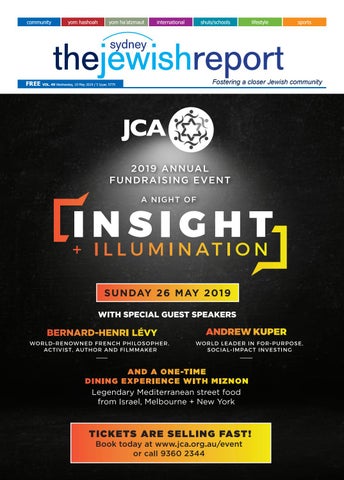
JCA’s Annual Fundraising Event on Sunday 26 May is an opportunity to share in the Insight and Illumination of two important guest speakers whose message is timely and compelling for the Jewish community.
to change the world through the choices we make. His “profit with a purpose” bridges the worlds of money and meaning. Born and raised in South Africa, and imbued with a sense of social responsibility from an early age by his anti-apartheid campaigner parents, Kuper was educated at Wits, Cambridge and Harvard Universities. He has authored books on governance and globalisation and is the recipient of numerous
awards for his work and his vision to “bring together things that were supposed to be kept apart: profit and purpose, money and meaning, global and local, developing and developed, investment and poverty relief”. Kuper has tapped into a changing mindset that he believes will become the norm in the next ten years and speaks to the aspirations and ideals of our future generations. Bernard-Henri Lévy and Andrew Kuper
are part of a very special night that will change the way we see our community and the world around us. Tickets for JCA’s 2019 Annual Fundraising Event on Sunday, May 26 – an extraordinary night of “Insight and Illumination” – are available online at www.jca.org.au/event or by calling JCA on 9360 2344.
Together, we join with Israel to celebrate 71 years of independence.
yl nd Vin
a hellac S n o ry Centu h s i w e AJ
Come on a musical journey featuring the records and iconic music that changed lives, and the technology that made it happen. Discover the rich history of Jewish contributions to music in Australia and abroad.
PEN NOW EXHIBITION O um.com.au muse sydneyjewish Jukebox, Jewkbox! A Jewish Century on Shellac & Vinyl is an exhibition of the Jewish Museum Hohenems, in collaboration with the Jewish Museum Munich.
www.mountsinai.nsw.edu.au
www.masada.nsw.edu.au
www.moriah.nsw.edu.au
www.emanuelschool.nsw.edu.au
www.kessertorah.nsw.edu.au
Proud members of the JCA family of organisations
4
community
May 2019
Eastern Suburbs Rabbi at Anzac Dawn Service ANZAC DAY Maroubra Synagogue’s Sydney-born Rabbi Yossi Friedman (who holds the rank of Flight Lieutenant in the Royal Australian Air Force) has made a historic participation in the annual North Bondi RSL Sub-Branch’s Bondi Beach Dawn Service on Anzac Day 25 April. In what is believed to be a first official Jewish participation in an Eastern Suburbs Anzac Dawn Service Commemoration, Rabbi Friedman delivered a message of unity , laid a wreath on behalf of the Royal Australian Air Force and sang the final prayer for peace. In what has seen growing attendance each year and in front of the estimated presence of some twenty thousand people, David Sims of the North Bondi RSL Sub-branch introduced the service and set the theme of inclusion and diversity for the morning. “The Anzacs who lost their lives in battle represented all cultures”, he said. Rabbi Friedman gave a detailed account of the Jewish participation in WWI until today and singled out Private Greg Sher from the 1st Commando Regiment who was killed in Action in Afghanistan exactly ten years ago. He stressed the importance of not just valuing peace but pursuing peace. “Peace”, he said, “will come about when we learn to accept each other despite our backgrounds, beliefs and differences. Peace will descend upon us when we learn how to live together in a spirit of mutual respect and understanding”. Rabbi Friedman impressed upon the assembled the importance of a strong and united ADF and also how each and every person could become a “modern-day Anzac” by standing up to lies, hate and injustices when they occur. This theme took on special significance this year given the daubing of swastikas on artworks along the Bondi promenade
only a week prior and the increase in hate and religious attacks that have taken place recently around the world. Rabbi Friedman commented prior to the event that participating in the Anzac Dawn Service meant a great deal to him. “A significant number of Jewish servicemen fought in WWI and in all wars since. With the additional knowledge that I follow a long line of Jewish Chaplains (there was a Jewish Chaplain at Gallipoli), I feel deeply humbled and honoured to be actively participating in such a significant service, on Australia’s most auspicious day of remembrance.” Born and raised in the Eastern Suburbs of Sydney, educated at Sydney Boys’ High and the University of NSW, Rabbi Friedman completed his studies at rabbinical colleges in both Australia and Israel before his ordination in 2008. He served at Central Synagogue Bondi and Cremorne Synagogue before accepting the positions of Chief Minister at Kingsford Maroubra Hebrew Congregation and College Rabbi to Mount Sinai College. Rabbi Friedman became a Chaplain to the Royal Australian Air Force in 2013.
Speech of Chaplain, Rabbi Yossi Friedman (RAAF Flight Lieutenant) I am deeply humbled to be reciting this morning’s final blessing, as we stand here together as one. My Jewish tradition informs me that to achieve peace we must learn to value peace, and actively pursue it. Peace will come about when we learn to accept one another despite our backgrounds, beliefs and differences. Peace will descend upon us when we learn how to live together in a spirit of mutual respect and understanding. You see, what unites us, is that we are all Australian –one fabric with many threads - fighting for the same values, ideals and freedoms. I stand before you today as a proud Jewish member of our Australian Defence Force. I stand before you on the shoulders of many Jewish Chaplains who have served our country since the inception of our ADF. On the very shores of Gallipoli there was a Jewish Chaplain by the name of David Isaac Friedman, known affectionately as ‘the ANZAC Rabbi’ and he provided ministry, compassion and dedicated service to all regardless of faith. In fact, he served alongside another Jew who would go on to become one of the War’s outstanding commanders – General Sir John Monash.
The total number of Jews who served in the Australian and New Zealand Forces in
WW1 is estimated at close to 1800, which, at that time, was around 10% of the Jewish
population! Since Federation, some 9,000 Jewish men and women have served and continue to serve in the ADF. 341 have given their lives, including in 2009, private Greg Sher from the 1st Commando Regiment, killed on Op’s in Afghanistan and whose family attends this Dawn service each year. I share with you these numbers to demonstrate the highly valued and multicultural threads that are woven through the fabric of the 3 branches of our ADF. Our ADF represents who we are as a nation so it is crucial that we have a strong and united ADF. This is important as much today as it ever was. Sadly, actions of hate take place almost daily around the world and our serving members do all they can to ensure that we can live our lives freely and without fear. Yet all of us can become modern-day Anzacs and not sit idly by. You don’t need to serve or have service in your family to stand-up to lies, hate and injustices when they occur. And know that when you do stand up, you are continuing the legacy of our ANZACs in ensuring that our Australian way of life, our values and our freedoms remain protected for generations to come. For we are one.
May 2019
community
Anzac Day in Israel 2019
THE ZIONIST FEDERATION OF AUSTRALIA HAYLEY HADASSIN
The Embassy of Australia in Israel held the annual commemorative service for Anzac Day at the Commonwealth Military Cemetery, Mt Scopus in Jerusalem on Monday 29th April. This ceremony has become an important occasion not only for Australian and New Zealand diplomats serving in Israel, but also for Australian olim and Australian gap year participants to show respect for those who fell at Gallipoli and in various military actions and service since then. Each year, the Zionist Federation of Australia organises for Australian gap year participants to attend and actively participate in this ceremony. This year over 120 were present with representation from the Australian Zionist Youth Council, Lone Soldiers, Bnei Akiva, Betar, Netzer, Hineni, Habonim and Israel By Choice (IBC.) Each of these movements and organisations laid wreaths at the ceremony. Australian Ambassador to Israel, Chris Canaan said: “Remembering ANZAC Day is, of course, not about glorifying war. It is about remembering and honouring, the sacrifice of fellow countrymen and women who put their lives on the line for something larger than themselves - our nations, our interests and our values. They sacrificed on the rocky shores of
Gallipoli, on the plains of Beersheba, in the rugged hills of Jerusalem, and in so many other corners of the globe, so that we may live. Today, we remember their contributions, which stand the test of time.” Nicky Retman from Hineni in Melbourne said: - ”To be in Israel and commemorate ANZAC Day together with fellow Australians and Israeli’s is an experience I will never forget. It was an honour to have been part of the ceremony and represent my youth movement and my country in my Homeland.” There was a large crowd in attendance of diplomats, ambassadors and representatives from Australia, the United Kingdom, United States, Canada, Turkey, France, Germany and New Zealand; Zionist youth, Israel’s Foreign Ministry, the Israel Defence Forces, Members of Australian Armed forces serving in the United Nations Truce Observation Forces in the Middle East and the Australian Zionist Federation, along with Australian and New Zealand olim living in Israel. ZFA Israel Office Director Yigal Sela, laid the wreath on behalf of the ZFA, he said: - “I am very proud to represent the Zionist Federation of Australia and for so many of our Australian gap year participants to be here today. They felt a need and responsibility to be present at such an important ceremony here, in Israel. It symbolises more than anything else, the very close relationship between Israel and Australia, and especially the Jewish community there.” Lest We Forget.
5
6
community
May 2019
Remember The Yom REMEMBER THE YOM The RememberTheYom team of Robyn Pakula and photographer Larnce Gold who released the stunning image in 2017 of the recreation of the late Joseph Pakula’s Auschwitz Number on Bondi Beach have teamed up again to create another powerful image for Yom Hashoah 2019. On March 24th, 2019, over 120 survivor family, friends and the great survivor himself Sam Goldman, 80, descended upon Sydney’s, Australia’s Diamond Bay Reserve to create a powerful image in honour of Yom Hashoh. The goal was to make a seated formation of a Chai. Everyone was asked to wear white. The was a recital of the beautiful song ‘Ani Ma’amin’ which was originally composed by a Rabbi in a train on his way to the camps. Only a handful of locals were present to witness this one-off performance including another survivor, Eva Streichler, 85 who thoroughly enjoyed the performance. ‘As the years go by and survivors are passing-on, second and third generation of survivors are realising how important it is to continue the memory’, says Robyn Pakula, co-founder of RememberTheYom. ‘We aim to create dialogue. A great image is our way of getting people to talk about the Holocaust in a positive meaningful way.’ ‘The overwhelming feedback after previous years from those who engaged in the creation of the image was that it was an extremely powerful and moving experience and helped them to connect with their
emotions and to take a moment to remember what their parents or grandparents went through many years previously and how lucky we are now to be living in such a beautiful country and area such as Sydney, says Gold. Rabbi Benji Levy added. ‘It is getting more important than ever to commemorate the lives and legacies of those that perished in the Shoah and creative engaging ways are the most educationally impactful. I was inspired to be involved the first year and
seeing the image ‘come to life’ in video form this year takes this concept to the next level so that we can truly remember the yom and beyond.’ In 2019, Yom Hashoah, (Holocaust Remembrance Day) falls on the 1st May. RememberTheYom is a project created to help remember & honour Yom Hashoah, ‘Holocaust Remembrance Day’ and to inspire and encourage others to create a meaningful and relevant dialogue to help them process and engage in remembering
the day. Please help in joining us to like, upload, repost and share these images and hashtag #remembertheyom to your Instagram accounts and Facebook page.
May 2019
7
community
Masada College
Emanuel Woollahra Preschool
Care your way Enjoy the freedom and confidence to live your best life independently with Help at Home by Montefiore. Discover expert aged care and disability support delivered into your home, from one of Australia’s leading care specialists. Your personal coordinator will help you to choose from a wide range of services, available when and where you need them.
CONTACT US FOR YOUR FREE CONSULTATION
24/7 HOTLINE
TRUSTED HEALTH TEAM
PERSONAL APPROACH
DOMESTIC SUPP ORT
WELLNESS SERVICES
CDC, NDIS & PRIVATE CARE
1800 251 537
MONTEFIORE.ORG.AU
8
community
May 2019
Mount Sinai College MOUNT SINAI COLLEGE The nachas factor was record high over the Pesach period as Mount Sinai College ELC to Year 6 welcomed family and friends to their demonstration Sederim. It was certainly one to remember as our children lead the ceremony with great confidence and gusto! We hope your children displayed this Yiddishkeit again at your family Sederim.
BJE
BJE
At Rose Bay and Bellevue Hill we held a ‘Pesach Extravaganza’ where the Hebrew and Extension students played games related to Pesach. At Lane Cove, Woollahra, Anzac Park, St Ives North, St Ives Public, Clovelly, South Coogee we held interactive Demonstration Sederim for the parents to showcase our learning!
Coogee Synagogue Matzo Baking
Guilfoyle Gardens: latest edition to B’nai B’rith B’NAI B’RITH The mission of B’nai B’rith Retirement Villages, (BBRV) is to provide financially accessible accommodation in Sydney for independent Jewish Seniors, age 55 and over. BBRV is a not-for-profit organisation, supported by a volunteer Board of Directors, which has been serving seniors in the Jewish community for 56 years. With that aim in mind, the BBRV has widened its range of accommodation options to include a completely refurbished three-storey apartment block in Guilfoyle Avenue, Double Bay. “Guilfoyle Gardens is a building of artdeco vintage which we have completely renovated it to a high standard, both internally and externally. There is a gently graded entrance and a lift which means we can offer accommodation to people in wheelchairs” said General Manager Leon Fredkin. “We have two bedrooms, two bedrooms with sunroom and a one bedroom with sunroom apartments available for immediate occupation” he told J-Wire. The apartments are finished to an as-new condition and feature all the innovations, safety measures and amenities to be found in a modern apartment building including blinds, carpets, appliances, airconditioning and ceiling fans. The building
9
community
May 2019
is also NBN ready. BBRV remains responsible for the complete maintenance of the building including residents’ apartments. A modest monthly maintenance charge is levied which ensures BBRV can continue to properly maintain its villages. This charge is fixed to the government pension rate and adjusted once a year in January. Fredkin explained that all residents enter the Village under a licensing arrangement. A resident is not purchasing an apartment but paying a license fee which is considerably lower than the cost of purchase would be. This means that overseas residents (subject to making their own enquiries) may be able to access these apartments as the entry contribution arrangement varies from the normal Strata-Torrens title purchase restriction. “We have already had some interest from people living overseas” he said. Guilfoyle Gardens residents can access the functions and amenities available at BBRV’ s Princess Gardens Village in Rose Bay where a full-time village manager is employed. Any property related requests including emergency maintenance are supported by the Princess Gardens property manager, who is also a BBRV fulltime employee. See www.bbrv.org.au for more information on BBRV.
A Universe Of Sufficient Size
A ravishing novel of pre-war Hungary and modern Australia inspired by a true story Inspired by the story of Miriam Sved’s grandmother Marta, A Universe of Sufficient Size charts a course through both the light and dark of human relationships: a vivid recreation of Hungary before German occupation, this is a novel about two friends and the selfless power of the human heart, even years and worlds apart. Budapest, 1938. In a city park, beneath a bleakly looming statue, five Jewish mathematicians gather to share ideas, trade proofs and whisper sedition. Expelled from the university and persecuted by the state’s laws, they lead an uneasy existence, comforted only by each other’s friendship. Sydney, 2007. Illy has just buried her father, a violent, unpredictable man whose bitterness she never understood. The very next day, Illy’s mother gifts her a curious notebook. Its faded pages are a mix of personal stories and mathematical discovery, all recounted by a young woman seemingly blind to Europe’s oncoming storm. A woman very different to the mother and grandmother everyone thought they knew... For readers of Anna Funder’s All That I Am, Heather Morris’s The Tattooist of Auschwitz and Anthony Doerr’s All the Light We Cannot See.
10
community
May 2019
For the People of Israel at UIA NSW 2019 Campaign Events UIA NSW UIA NSW was proud to host over 3000 members of the Sydney Jewish community across its five main 2019 Campaign events in February and March, in support of the People of Israel. Events included the General Division Gala, Major Donor Dinner, Young Leadership event, Fun Run and Women’s Division Champagne Breakfast. The General Division Gala and Major Donor Dinner were headlined by David Cameron - Former Prime Minister of the United Kingdom, who addressed the audience about his strong connection with and support of Israel, Israel’s right to exist, condemnation of antisemitism and Islamist extremism, and the extraordinary integration of the Jewish people into the broader
community. Special guest David Koschitzky Chairman, Keren Hayesod-UIA World Board of Trustees and Nataly Zagaya - UIA success story also spoke at these events. The Honourable Julie Bishop MP inspired at the sold out Women’s Division Champagne Breakfast, alongside guest speaker Arielle Di Porto - Acting Director Aliyah & Absorption at The Jewish Agency. Ziv Shilon – wounded Former IDF Captain and Iron Man competitor captivated young adult supporters with his personal story of triumph at the Young Leadership Campaign event, joined by Nataly Zagaya, who also moved the audience with her story. Shilon participated in UIA NSW’s inaugural Fun Run, attended by people of all ages from the community. Many of the speakers also addressed
hundreds of Jewish day school students across Australia. With guidance from Sydney Friendship Circle, UIA NSW provided various offerings for the first time at its Gala to enable all members of the community to attend and connect to Israel through the UIA. These included live closed captioning of the speeches to support those with hearing impairments and designated seating to accommodate those with physical disabilities. Following the success of the inaugural childminding service offered at last year’s Gala event, it was offered again this year, enabling parents with young children to attend. “UIA supports Israel’s greatest asset – her People. Our mission and values have been consistent for the last 99 years and we will ensure continued long-term support for the
hundreds of programs and tens of thousands of people we support every day across Israel. It is this support that demonstrates our commitment to Jewish continuity, and appreciation and acknowledgement of the sacrifices our Israeli brothers and sisters make on our behalf, defending our right to exist as the Jewish People in the world. For this we can be immensely proud, we continue to do our part,” UIA NSW President Andrew Boyarsky said. UIA NSW 2019 Campaign is once again focusing on support for the most vulnerable people on the periphery in Israel. To donate to UIA NSW 2019 Campaign, please visit uiaaustralia.org.au/donate-now Follow UIA on Facebook for updates on our 2019 Campaign: facebook.com/uiaaus
UIA NSW 2019 General Division Gala UIA NSW hosted over 1500 Sydney supporters at its 2019 General Division Gala event on Sunday 24 February, headlined by David Cameron - Former Prime Minister of the United Kingdom (2010-2016).
May 2019
UIA NSW Fun Run & Picnic With Ziv Shilon UIA NSW hosted a Fun Run & Picnic with Ziv Shilon – wounded Former IDF Captain and Iron Man competitor on 10 March at Centennial Park.
community
11
UIA NSW Young Leadership 2019 Campaign Event ‘It’s Personal’ UIA Young Leadership hosted over 400 supporters at its 2019 Campaign event, ‘It’s Personal’ with Ziv Shilon – wounded Former IDF Captain on 7 March.
12
UIA NSW Women’s Division 2019 Champagne Breakfast UIA NSW Women’s Division hosted 600 women at its 2019 Champagne Breakfast on 24 March at Doltone House Jones Bay Wharf with guest speaker Julie Bishop MP.
community
May 2019
UIA NSW Major Donor Dinner UIA NSW hosted over 300 Sydney supporters at its 2019 Major Donor Dinner on Monday 25 February, headlined by David Cameron - Former Prime Minister of the United Kingdom (2010-2016)
13
community
May 2019
Health Keeps Faith With Israel’s Founding Philosophy HADASSAH Health is one of the few areas of civil society where Israelis and Palestinians meet on equal terms and in mutual respect. This is evident in the corridors, treatment rooms and operating theatres of every major hospital in Israel. It is the principle that underpins the work of Project Rozana, a global initiative that began in Australia and which builds bridges to better understanding between Israelis and Palestinians through health. As we celebrate Yom Haatzmaut, is it reasonable to ask how the founding fathers (and mothers) would have responded to Project Rozana? None of the signatories to the Declaration of Independence were under any illusions about the conflicted relationship with the Palestinian population and surrounding Arab states. But equally, all of them understood that the future wellbeing of Israel required a rapprochement with all communities living within and beyond Israel’s borders. What Project Rozana has done with its three core principles of Transport, Treatment and Training of Palestinians living in the West Bank and Gaza, is to highlight the importance of leveraging Israel’s world-first healthcare system for the benefit of these Palestinians, and how capacity-building of the Palestinian healthcare system lessens demand on Israel’s overstretched system. “It is a win-win situation that recognises the intrinsic value of every human life,” says Ron Finkel AM, Chair of Project Rozana Australia and the International Board.
Israeli and Palestinian health workers during a training session in the paediatric ward
“Importantly, Project Rozana doesn’t concern itself with politics, but supports the philosophy of Henrietta Szold, founder of Hadassah Hospital. She argued that medical needs of patients must be prioritised over any other consideration, be it religion, gender, nationality, political affiliation or financial status. “Project Rozana has enhanced that position by supporting free transport of chronic and critically-ill Palestinian children from the checkpoints to hospitals in Israel. On the Israeli side, around 2,000 Road to Recovery volunteers give their time to a service that operates 24/7. On the
Palestinian side, Project Rozana supports a West Bank equivalent so that the transfer from home to hospital and return is a seamless experience.” Ruth Ramone Rosen, the Executive Director of Project Rozana, said the organisation also funds the training of Palestinian doctors, nurses and therapists in Israeli hospitals, primarily in areas of specialisation not currently offered in the Palestinian healthcare system. “Project Rozana’s philosophy of ‘train local, stay local’ is helping to build the capacity of the Palestinian health system so that over time there will be less dependence on Israeli
hospitals and health workers.” She said that the third principle – treatment of Palestinian children – was directed to patients whose medical requirements were unable to be met by the current Palestinian system because of the complexity involved, such as peritoneal dialysis, or surgeries for disorders of sex differentiation (DSD). “We don’t talk of peace; what we do and the results that are flowing from that, shows that people are open to seeing the ‘other’ when there is a common purpose. And that is consistent with the principles underpinning Israel’s Declaration of Independence.”
Enriching the Lives of Jewish Seniors
Stay Independent and Young at Heart with the Support of COA Services
Home Delivered Kosher Meals Activities six days weekly Social connection with peers Transport to COA activities Regular phone calls at home Volunteer opportunities Shopping assistance Home support services Enquiries to 9389 0035 or email coa@coasydney.org or go online to www.coasydney.org for more information
Yom HaAtzmaut Concert Join fantastic vocalist
accompanied by
Shirley Politzer OAM
for a live concert celebrating Eretz Yisrael
Wednesday 8th May 12:45
COA Sydney Krygier Activity Centre, 25 Rowe St, Woollahra $5 per person. Contact COA on 9389 0035 for more details
OUTREACH COA SYDNEY Some people are not familiar with the word “outreach” and what it conveys, but it is a truly the most descriptive of terms. Outreach means to ….reach out. It’s what COA does on a daily basis; reach out to seniors who are ill at home or in hospital, reach out to seniors who are socially and geographically isolated from the community, reach out to Jewish residents in non-denominational aged care facilities, reach out to Jewish seniors who want to get out of their homes and do something at the COA’s activity centre, reach out to people who need kosher meals-on-wheels. And the majority of this outreach is done by the volunteers of COA, who outnumber paid staff at a rate of ten to one. Every meal that leaves COA as part of the kosher meals-on-Wheels program is delivered by a volunteer. These volunteers add value by delivering more than just meal, spending time with recipients, entering their homes to put the meals in the fridge, and observing the client
and their surroundings for safety issues. Kosher meals volunteers alert COA social workers to changes that may require a client reassessment. Every phone call which goes out to isolated housebound seniors as part of the 30 year old Shalom Connect program is made by volunteers who speak to the same people each week, sometimes on a daily basis, to engage and connect them with community, and also to monitor their needs as they arise. Every Jewish senior who lives alone and needs companionship or services should know they can contact COA and find dedicated, compassionate, community spirited volunteers to drop in and talk as part of the Tea for 2 program, or help with weekly shopping through COA’s shopping volunteers. If you are recently retired, or the kids have left home, and you are at a loss for things to do, consider joining the COA’s volunteer corps and help reach out to more seniors who are in need of social and cultural connection.
14
yom hashoah
May 2019
YOM HASHOAH I’m not Jewish - which is why I had to join the March of the Living WWW.THEJC.COM Lord Shinkwin, Conservative peer, explains why his bond with the surgeon who saved his life compelled him to take part “I don’t understand why you went, to be honest”. It was a perfectly reasonable response from a concerned family member. I had not long returned from Poland with March of the Living. In the space of five intensive days spent with that remarkable charity, I had learnt more about the Holocaust than most people would ever choose to know. What I witnessed left me traumatised by the scale of the tragedy and uplifted by the evident triumph of the human spirit despite it. So why did I put myself through it? What compelled me to choose to learn more about such an abomination? After all, unlike many of those who accompanied me on the trip, I am not Jewish. I did not lose any of my family to the Holocaust. So what has it got to do with me? In the Commons debate on antisemitism, Luciana Berger told how more than 100 members of her family, aged four to 83, were killed in the gas chambers of Treblinka, Sobibor, Mauthausen, Bergen-Belsen and Auschwitz — and that was just on her mother’s side. She concluded: “The time for action is now.” I am conscious of the question which her call for action poses to me and to each of us: what action can any of us take — especially those of us who are not Jewish — which will actually make a difference? And this is the nub, because immediately I am distinguishing myself. I am different from “them”. I am not Jewish. What is happening now with the return of “mainstream” antisemitism may be terrible — but it is happening to them, not me. It is happening to other people. For, quite apart from the Holocaust’s incomprehensible magnitude and unfathomable depravity, that instinct to separate is perhaps one of the most pervasive legacies of the Nazis’ virulent antisemitism and, indeed, of the Holocaust itself. It happened to the Jews, not to me, not to my family, not even to friends of my family. Tragic, yes. Relevant, no. Wrong! I believe the Jewish people’s almost immeasurable loss — when one looks beyond the statistics — was a shared loss: it was humanity’s loss, too. Given its colossal scale, how could it not be? That is the first lesson I learnt on March of the Living — that the tragedy that befell the victims of the Holocaust directly befell us all indirectly, too. It is relevant to all of us because it is quite simply the greatest single crime ever to have been perpetrated by — and the greatest single tragedy ever to have befallen — humanity. It was only when I went on March of the Living that I fully appreciated the enduring human cost of almost three-and-a-half million of Poland’s citizens being lost to the Holocaust and, with them, a vibrant Jewish culture and the significant contribution that its Jewish community made to so many aspects of its national life. Unsurprisingly, the attempted annihilation of Europe’s Jewish population left a gaping wound which affected — and still affects — Europe as a whole. And yet, incredibly, I learnt that the Nazis planned for it to be worse, to the tune of a further five million deaths. 330,000 of them were to come from what the Nazis described as England (presumably the UK, as its component parts were not listed separately). As the film, The Guernsey Literary and
Peopel take part in the annual March of the Living to commemorate the Holocaust (Photo: PA)
Potato Peel Pie Society reminds us, it did actually happen on British territory; people were removed from the Channel Islands and sent to their deaths for being Jewish. The second lesson I learnt on March of the Living is that personalising this is crucial to appreciating both the loss and its relevance to all of us. My own personalisation of that loss and, thus, my decision to accept the invitation to join March of the Living 2018 was due to one man, someone who almost lost his life because he was Jewish and who went on to play a very important part in my life: my doctor. His story is quite extraordinary. It starts in Nazi-occupied Prague. The teenager’s father, Alfred, had got to Britain first where he found safety for his family by obtaining guarantors for Hanus and his mother, Mary, thereby enabling them to join him here. Nonetheless, it was still touch and go. They only just made it on to the very last train out of Prague before the Nazis closed the borders. How different life would have been had they failed to make it, for him — and for me. Not one of his relatives who came to wave them off that day survived the Holocaust. Hanus Weisl would have simply become another grisly statistic, one of the six million Jews murdered by the Nazis. Instead, through finding refuge in this country, he became one of the most important people in my life. Fast forward to 1971. By the time I was born that June, he had already established himself as a well-respected consultant orthopaedic and trauma surgeon; I was to be under his expert care for the next 13 years. My brittle bones meant that I was barely out of hospital for much of my childhood. One year, I managed to be in traction, recovering from yet more fractures, for both Christmas and my June birthday. Throughout, Hanus’s obsession with perfection, his compassion and his respect for his patients and their families meant that the care I received from him was second to none. When I was only one year old, he broke with all medical convention and let my mother take me home with my leg still in a splint; he would complete his ward round at our house on his way home. On one occasion, he had me wheeled back down to theatre for my leg to be reset because he was dissatisfied with the x-rays following
surgery performed in his absence the previous day. As a tearful ten-year old, I did not thank him for his diligence, but I do now. Thanks to Hanus Weisl, I had the best possible medical start in life. He made my legs straight when my bones kept on snapping and insisted I continue weight-bearing (crucial to maintaining bone density), no matter how often I had to learn all over again how to walk after months in bed. Most importantly, he taught me, by example, never to lower my expectations because I had a disability. He was light years ahead of his time. His progressive attitude and radical partnership-based approach are perhaps best summed up in a Christmas card I treasure. Written shortly after his retirement in 1992, it reads: “I was most touched by your note of thanks for whatever I tried to do. However, I am convinced that whatever the surgeon does, it is the patient who makes it work (or not).” Hanus Weisl, the teenage refugee from Prague, whose dedication helped transform the life chances of a non-Jewish boy, a boy who would one day sit in the House of Lords and recall on the floor of that house his old orthopaedic surgeon with heartfelt gratitude. It could have been so different. He and his mother might still have got the necessary visas only to discover that the last train out before the borders were closed had already left. The Nazis had already shown their bestial true colours by 1939. Yet no one foretold the Holocaust, and no one would have been believed had they done so. How could any human being possibly have conceived and then participated in the implementation of such a programme? And confronted with the evidence and the tragic legacy of the Final Solution, as I and 11,000 other participants of March of the Living were in Poland, how could we begin to understand how it could have happened in a country only a few hours away by plane? These were the questions I took with me on what was in many ways a personal pilgrimage, both to honour the memory of my former doctor and the war-time victims of antisemitism and reflect on the lessons of their suffering. And these were just some of the questions I came home with. For another crucial lesson I learnt during those five intensive days was that the deeper you delve, the less you understand
and the more you realise that the clinical, brutal belief system underpinning the Holocaust should never make sense. In fact, it would be disturbing if it did. Now I am home, I am haunted by guilt at having returned so easily from camps deliberately designed to be places of no return. But what next? On the penultimate night, we were encouraged to make a personal pledge of at least one follow-up action. Top of the list was telling people about what we had witnessed. Processing what I learnt is proving to be the hardest part. For while a temporary immersion into an alien world of institutionalised, racist sadism, appalling suffering and methodical mass murder is tough, re-entry into our comfortable Western world of respect for human rights and freedom from fear is tougher still. I found the exposure to such a different, desolate world deeply traumatising. Nothing prepared me for the shocking, tangible realisation of the enormity of the Final Solution. Auschwitz is not the Holocaust, and the Holocaust is not Auschwitz, but if evil has a physical infrastructure, I saw it there and particularly at Birkenau, where the watchtowers and the many buildings of perhaps the most infamous of concentration and extermination camps stretched as far as the eye could see. I was horrified to learn that the Nazis had plans to build a sixth crematorium. Even without it, the capacity of the existing crematoria and outdoor cremation pits in the summer of 1944, when 437,000 Hungarians were deported there, was 20,000 a day. It was a sobering thought that had the Nazis killed all 11,000 of us who converged on Birkenau for a moving ceremony on the closing day of our visit, they would still have been only half-way through their daily quota of death. I want to keep my pledge to bear witness. Yet I ask myself, how exactly am I meant to tell family and friends about either the unspeakably sad suffering or the indescribably gratuitous sadism? How can I tell them what it feels like to know that the dust I carried home on my shoes and clothes was the dust of death, that it is everywhere at Auschwitz and Birkenau because that is all that is left when you burn more than 1,000,000 individuals — their ashes? The answer for me is that I cannot go into the detail because it would reduce those I love to tears, as it did me on a few occasions and still does. I reproach myself for weeping: what right do I have to cry when no one in my non-Jewish family suffered? What I learnt was that, while I may not feel I have as much of a right to lament the horrific loss caused by the Holocaust, my position, both as a beneficiary of a Jewish refugee doctor’s dedication and as a member of the Lords, means I most definitely have a duty to confront the poison of antisemitic prejudice which fuelled it. I may not feel able to share the graphic details of barbarity but I can nevertheless keep my pledge if I bear witness by my actions, by writing this article, by speaking on related issues in the Lords and by supporting a strong and secure Israel. Each of us owes it to the dwindling number of survivors to ensure no one has to endure what they did. CONTINUED ON PAGE 17
May 2019
15
yom hashoah
I Got Pregnant the Day I Went to Auschwitz AMANDA MARKOWITZ We had just visited Auschwitz, and I was ovulating. We had spent the day touring barracks where people — including our grandparents — lived in terrible conditions, and gas chambers where people took their final breaths. After such an emotionally and physically draining day, we got back to our hotel in Krakow, and sat there speechless, tears streaming down our faces. And yet, my husband and I had been trying for a baby, and it was time to do the deed. It seemed incredibly jarring to go from something so horrifying into something so intimate. Auschwitz isn’t exactly something that gets you “in the mood.” My husband and I are the grandchildren of eight Holocaust Survivors — six of whom survived Auschwitz. Being grandchildren of survivors was deeply ingrained within our childhoods, helping to define who we are today. The Holocaust was something we had always heard about, though it was impossible to fully comprehend. The word “Auschwitz” itself carried so much weight. It was the place that many of our family members were murdered, the place where our grandparents were tortured and starved, the place we never wanted to go to, but felt we had to see. After years of indecision we finally signed up for the International March of the Living, a trip to Poland to learn more about the Holocaust and to examine the roots of prejudice, intolerance, and hatred. One of the most significant parts of the trip is the march — alongside thousands of Jews from around the world — down the threekilometer path leading from Auschwitz I to Auschwitz II (Birkenau) on Yom HaShoah, Israel’s Holocaust Remembrance Day. The timing was somewhat tricky, because by the time the trip rolled around, my husband and I were actively trying to have a baby. After five years of marriage, “When are you going to have children?” had become the first question that everyone asked us. Nobody knew that we had been trying
without success, and, if I’m being truly honest, I wasn’t convinced that we were ready. I think I hadn’t fully accepted wanting to get pregnant and my body knew that. I was highly focused on my career as an actor and producer — I thought that getting pregnant and starting a family would derail that. But on that day in April, when we visited Auschwitz, something changed. On the train tracks of Auschwitz, I stood exactly where my bubbe’s hand was torn from her little sister’s, whom she would never see again. Her father had told her that she would be the only one from their family to survive. It was a chilling prophecy, and he was right. On the train tracks of Auschwitz, I stood where my Nana was separated from her mother by an SS Officer. Her mother told her to go, and that they would see each other again soon… but that was the last time she saw her mother. On the train tracks of Auschwitz, my husband and I stood silently together, tears streaming down our faces, contemplating how this had happened and wondering how our grandparents had the strength to survive. And in those dark moments, something clicked. Thinking about all the families that were lost — mine included — I felt such a strong desire to start my own. And for the
first time, I completely and wholeheartedly wanted a baby. As we stood together at Auschwitz, we truly realized the importance of sharing these stories with future generations, so that the voices of those lost continue to be heard. With our hands clasped, we dreamt aloud of having our own children so we could pass the stories along to the next generation. This meant that, in one of the darkest moments of our lives, we had to find the light and bring life out of all the death that surrounded us. And so, there we were in our little hotel room in Krakow. It wasn’t exactly romantic, but my husband I were connected completely. After seeing Auschwitz with our own eyes, having children felt more important than ever — and as my eyes locked with his, no words were needed. We understood the incredible amount of love we had for each other. The next morning, I didn’t think too much about it — given our history, I wasn’t particularly confident that I would actually get pregnant. When the tour in Poland ended, we continued our personal journey on to Prague, where my grandfather went after the war. This grandfather died before I was born, but I knew that after the war, he and my bubbe saved all the money they could and, in 1947, they opened a restaurant near
Yom Hashoah at Moriah College
Prague’s Old New Synagogue. I set out to find it. All I knew was it was near the synagogue, and that its address was number 18, an important spiritual number in Judaism. In the past, my family members had gone there and were unable to go inside, because the building is now under strict security, as it now used as offices by the Jewish community of Prague. Like my relatives, my husband and I were turned away at the door. We waited outside until a woman walked out. We told her our story; she kindly offered to go back inside and she took some photos with my phone. I figured this was the closest we would get. But as we waited, we struck up a conversation with an Israeli man who was a member of the community. We told him our story and he said we had to go inside. He spoke to another man, and that man took us inside and gave us a tour of the entire building. I was in tears as I thanked him. I couldn’t believe I was standing in the same place where my grandparents started their lives together, more than 70 years ago. And it so happened that I was wearing my bubbe’s scarf that day and, while I didn’t know it at the time, I was also carrying our child inside of me. A few days later, we returned home, and the following week I took a pregnancy test. Within moments there were two pink lines. I emerged from the bathroom with a smile on my face, and told my husband that we were having a girl. There was no way to know it was a girl, of course, but I felt it — just as I had felt ready to have a baby as we stood on those train tracks. Our baby girl was born in January. We named her Hazel Aubrey; Hazel is after my grandfather Herman, who opened that restaurant at number 18, and Aubrey is after my husband’s grandfather, Abraham, a survivor of Auschwitz. One day, we will tell her the story of her namesakes, and about all eight of her great grandparents who survived the Holocaust. Through their stories, all those voices will continue to be heard, and all those who perished will never be forgotten.
16
yom hashoah
Dear Mirele: This genuine document is reprinted by courtesy of Rabbi L.D. Sandler and Gila Sandler, Brooklyn, NY
Dear Mirele, I can’t believe I have one night to stuff a lifetime of love into this letter. Tomorrow morning – if 4a.m. can be called morning, I am giving you up. I am taking you, Mirele, to the back entrance of dear, brave Hermann’s grocery and the child rescuers will be waiting there for you and the thirty-two other children under the age of three. They’ll inject you with a sedative so you won’t cry and then they’ll slip off in the predawn with you – my life, my love, out of this barbaric country to safety. We pushed it off, Mirele. We didn’t want to believe we would have to give up our child, probably never to see her again. But this is the last child rescue. After this there will be none left to rescue, because tomorrow, our informers tell us, is the last big round up. Tomorrow they come for men, women and children. And I’ve been convinced by these words, spoken by our trusted informer, Hermann, the brave gentile doctor, “Any child they take away either dies immediately or dies on the way to the death camp” The word death three times in one sentence! We were the last ones to be convinced to be give up our child. He said, finally, with the deepest sadness in every exhausted wrinkle in his face, “I cannot force you. But if you keep her with you, she will be dead in a month. They have no use for babies, she cannot work for them. If you want to give her to us, bring her to the back entrance of my grocery at 4a.m.. No belongings, whatever food you have. Goodbye.” Mirele, do you see why I have to give you up? He said no belongings, but I will beg, I will plead that this letter be allowed to go, sewn into your undershirt. And then, I will pray to G-d that the letter stays with you until you are old enough to read it. You must know that we love you. Your
must know why you are alone, without parents. Not because they didn’t love you . . .but because they did! It’s eerie to think that by the time you read this I will probably be dead. That’s what Hermann says is going on. People either die immediately or on the way or after a week or two of forced labour and no food. But I won’t have lived in vain, Mirele, if I know that I brought you into the world and you will live and survive and grow big and strong and you will be happy. You can be happy, Mirele, because we loved you. What makes a difference in the lives of adults, its seems, is if they had secure childhoods. Secure, with lots of love and acceptance and needs fulfilled and predictable routine and the like. You’ve had that up to this minute. You’ll have it up till 4a.m.. But then you won’t. Who knows who will end up taking care of you? Some family who will take you in for the money Hermann will pay them? They will surely be kinder to their own than to you. Here is where pain mixes with rage! I rage at the animals who are making it possible for you to cry and I won’t be there to comfort you. But you will have this letter, and this letter will make you feel secure, if G-d answers my prayers. You have us, Mirele, even though you don’t see us, we’re with you. We’re watching you and praying for you. Every time you have troubles we are pounding on the door to G-d’s very throne room, insisting on an audience and demanding mercy for our Mirele down on earth, alone, without her parents. And G-d will listen to us. We won’t leave Him alone until he agrees that you deserve health, love and happiness. Mirele, you’ll wonder what your first two years were like. You’ll wish you could remember. Let me remember for you right now, tenderly, on this piece of paper. You like hot cereal in the morning, with lots of milk and sugar. Except that there is no milk and sugar
now, none in the whole city. But I make your cereal anyway and you eat it with big smiles between every bite. Then you come ready for your nap, so I rock you, after putting the rocker where the sunlight will fail on it. I rock you until you fall asleep and then I put you in my bed. You sleep well there, you like my smell. What will you smell tomorrow night? Surely nobody will rock you tomorrow, not even in the shade. Oh G-d? I cannot do it! I will do it. For you, Mirele, so you will have at least a hope for life. Mirele, do me a favour. After you’ve grown, after this dirty, nightmarish war is over…I know there will be those who underplay the tragedies going on here every day. They will say, “A war is a war. It was just a war”. Mirele, tell them about this agony! Tell them how you felt secure in my arms rocking to sleep in the sunlight. Tell them how your father ran, one night, a year ago, to get you medicine, past sentries, while breaking the curfew. He risked his life to ease your pain, Mirele. And now the three of us are being torn apart. “Just a war”..?! Tell them, Mirele, that all wars in the world don’t add up to the agony in my heart right now as I write this. G-d it’s 2a.m. already. Only two more hours with my love, my baby, my life, my Mirele. I’m going to hold you now, Mirele, for two hours. Your father and I are going to wake you, feed you and tell you over and over how much we love you. You’re barely two years old, but maybe, if G-d is good, maybe, you’ll remember it and maybe you’ll keep this letter until you’re old enough to read it. There will be bad times for you, Mirele, I know. But just think about me holding you, rocking you to sleep in the sunlight. Keep that sunlight in your heart always. I love you. Your father loves you. May G-d help us all. Mama
Prince William Just Gave This Jewish Grandma a Very Special Honor EMILY BURACK Recently at Buckingham Palace, Prince William honored an 89-year-old Holocaust survivor and educator named Vera Schaufeld (née Lowyova) with an MBE for services to Holocaust education. An MBE denotes a Member of the Most Excellent Order of the British Empire, which is a Very Big Deal Indeed. In May 1939, when she was 9, Vera fled Czechoslovakia on the the Kindertransport, which brought thousands of young Jewish refugees to Great Britain between 1938 and 1940. “My last sight of my parents was as they stood behind the barrier, waving their handkerchiefs, while I looked at them out of the train window,” Vera recounts to the Holocaust Memorial Day Trust. Her parents were murdered in Treblinka. After the war ended, Vera moved to Israel to live on a kibbutz. There, she met a man named Avram Schaufeld, a Polish Jew who survived Auschwitz and Buchenwald. Avram and Vera married in 1952; they have
two children and four grandchildren. Avram sadly passed away in 2017. Regarding her honor, “I couldn’t have been more surprised,” Vera said. “It’s absolutely amazing to get this honor. My husband was ill for two years before he died in 2017. Before that I did a lot of talks in schools and colleges, but when he died I didn’t work for a long time so I didn’t expect anything like this. It really is amazing — I’m most grateful.” Vera helped establish the National Holocaust Center — the only center dedicated to Holocaust remembrance and education in the United Kingdom — and worked with the Holocaust Memorial Day Trust to share her story. Britain’s Jewish News reported that “Vera said she was amazed when William told her he would make sure his children would be aware of what had happened and of the Kindertransport.” “That was really amazing,” Vera said. “It was really incredible to hear it meant something to him and he knew and he understood.”
May 2019
FROM MIRELE: Miracles do happen – my mother’s letter stayed with me, sewn into my undershirt and now I am getting old myself and have decided to share it with you. After almost fifty years of keeping it private, why did I translate it from the Yiddish and decide to share it with you now? A few reasons… Firstly, one doesn’t hear much about the Holocaust anymore very much these days. There are even those who claim it was made up, not true, a brilliant Jewish ploy for sympathy. My mother asked me to remind you that it wasn’t “Just a war”. It was a monstrosity. Secondly, my mother’s faith in G-d, even at that dreadful hour, never ceases to amaze me. Even though she was almost certain that she would soon die, as indeed she did, she believes firmly in G-d to whom she can turn both before and after her earthly life ends. This strengthens my faith and perhaps it will strengthen yours. And lastly – I know I’m from a different generation. Nowadays I’m told, all mothers work. But sometimes I look out my window and see little children, just two years old. That’s how old I was when my mother was forced to give me up to strangers. And I look out my window and see these two year olds cry because they want to stay with their mothers, but their mothers are putting them on the bus because they want to be free of them – and something doesn’t seem right. You mothers who are lucky enough to have babies – raise them too. Don’t throw them out before they’re ready. Don’t leave them before they’re ready. Go now. Rock them in the sunlight. For my mother. Miriam bas Leiba (In my mother’s letter, she didn’t leave her name, but I always think of her as Leiba – “Love”. I’m lucky. Many of the children rescued with me don’t even know their own names.)
17
Yom Hashoah
May 2019
Yom Hashoah Commemoration 2019 JEWISH BOARD OF DEPUTIES DANIEL HOCHBERG
The Sydney Community held a number of functions to commemorate Yom Hashoah. This year’s theme for the Sydney Yom Hashoah Commemoration was “Memorials and Memories”. How do we keep history alive in our communities? With the slow demise of our dear and cherished Holocaust survivors, how will we continue to remember the six million Jews murdered for who they were–and not for what was done to them? How to represent a tragedy that is characterized by absence, from the missing bodies to the destroyed gas chambers, the absence of names and archives? Memorials and monuments reflect, in part, the ways that communities and individuals have answered these questions. All around the globe, including here in Australia, people have built memorials to commemorate the Holocaust. Each tries to preserve the collective memory of the generation that built the memorial and to shape the memories of generations to come. Communal Commemorations were held at the Clancy Auditorium at the University of NSW and in the North at Masada. There was also an inaugural Youth Commemoration organised by Youth HEAR (HEAR stands for Holocaust Education and Commemoration). At the time of writing, it should be noted that the traditional commemoration at the Martyrs Memorial in Rookwood, is due to take place this coming Sunday 5th at 10.30am. With the addition of the Youth Commemoration, which attracted over 400 young people aged 18-25 years, and standing room only in the North and East, participation in Shoah Commemoration will be just over 2000 people! This is probably the largest number directly participating, in recent memory. In addition, the Zachor Project of the NSWJBD, and sponsored by Woolworths, will see Shoah Commemoration kits (Which include a yizkor candle; a kadish prayer and the card of a victim murdered in the Holocaust) distributed to a further 3000 households through Synagogues, Jewish organisations and schools.
Dr Brendan Nelson AO, Director of the Australian War Memorial and former Defence Minister addresses the Eastern Suburbs commemoration on April 28 at Clancy Auditorium (UNSW)
The key note speaker for the Communal Commemorations was the Director of the Australian War Memorial, Dr Brendan Nelson AO. As the caretaker of one of the most important museums and memorials in the country, few people are better qualified to talk to the theme of Memorials and Memories. And Dr Nelson did not disappoint. At both Commemorations, he received a standing ovation. At times, he was visibly moved as he spoke to the audience of his respect for the Jewish Community, his compassion for the survivors, and the importance of commemoration, particularly in a world that is experiencing a resurgence of antisemitism and other hate crimes. In his introduction to Dr Nelson, NSW JBD Holocaust Commemoration Chair Danny Hochberg spoke of his families own experience of memorials, through the laying of Stolperstein, or stumbling blocks in memory of his grandparents, outside the residences where they once lived. NSWJBD Lesli Berger
I’m not Jewish ... FROM PAGE 14
For me, the first step is to recognise our common humanity, rather than draw on distinctions and to acknowledge that antisemitism, as well as being a poignant reminder of past tragedy, is a racist threat to our inclusive values and our British way of life. It is perhaps natural for some to ask what there is to be gained by raking over the misery. What is left after all the pain, the fear and the tears? The only answer I have is that what remains is what makes us unique as human beings — the ability to decide that we cannot allow such intense hatred to consume us ever again. The bigger question for me though is whether, as a society, we seek revenge in the conventional sense or exact it through making the choices which deliberately defy the perverse, poisonous values of the Nazis. The fact is that, although Nazism may have been defeated militarily 73 years ago, the vile vision of antisemitism that the Nazis propagated needs still to be defeated by all of us every day because the roots go so deep. For Hitler knew, as we do, that his genocidal Final Solution was perpetrated by human beings who were never born to be cruel, debased or inhuman. And yet their capacity to do the unspeakable sprang from an inherent human flaw — hatred of the other — which he exploited to its fullest. However sophisticated we believe modern society to be and however unrepeatable we feel the horrors of the Holocaust are, the choice remains the same. History tells us
that passivity in the face of evil does not pay, that unimaginably terrible things can and do happen when bystanders shrug and reassure themselves that those awfully sad things are happening to someone else, to someone different, to the other. We only need to look at how we have become desensitised to the interminable suffering of the Syrian conflict to know how true that is. It is so easy to feel powerless, and yet there are small, practical steps which I know non-Jews like me can take — in addition to deciding not to distinguish between them and us — so that we instead stand in solidarity and empathy with members of Britain’s Jewish community and MPs like Luciana Berger and Ruth Smeeth. So that when Iran’s regime threatens Israel with destruction, we remember that the Jewish people know more than anyone what destruction, what annihilation, looks like. So that before rushing to lay all the blame for the situation in Gaza at Israel’s door, we reflect on the brutal reality of its terrorist Hamas regime, which suppresses all dissent, oppresses women and LGBT people, diverts aid to arms, uses children’s flaming kites to destroy Israeli crops and refuses even to recognise Israel’s right to exist. So that when someone at a dinner party peddles another Jewish conspiracy theory, we politely point out that antisemitism is racism. Perhaps reading this article will prompt some to find out more about March of the Living and the exciting Jewish Community Centre in Krakow. I know I am privileged to have been able to do both, prompted by the debt I owe to Hanus
Candle lighters from the North Shore commemoration at Masada College on April 29 from left - Judy and Peter Gyenes, Kathrin Stein, Peter Nash, Yola Schneider, Richard Wolf
and CEO Vic Alhadef both spoke about the need for continued vigilance against the rising tide of antisemitism. In a moving gesture, President Lesli Berger called for a moments silence for those murdered in recent hate crimes including Pittsburgh, Christchurch and more recently Sri Lanka and San Diego. Ellie Zinsmeester lit a candle for the Righteous Among the Nations in honour of her parents, Willem Lodewijk Zinsmeester and Elisabeth Petronella Zinsmeester who hid Dutch Jews in their attic at great personal risk to themselves. Six candles, representing the 6 million murdered were lit by survivors. In the East : George Grojnowski , Dr Elizabeth Levy , Eugen Klein , Assoc Prof Richard Haber, Lena Goldstein OAM , Lilly Berger; and in the North: Judy and Peter Gyenes, Peter Nash, Kathrin Stein, Yola Schneider, Richard Wolf. The highlight of this year’s commemorations was the inaugural Youth Hear Commemoration. Sponsored and supported by the NSW JBD, The SJM and the Wakil
Foundation, it attracted an unprecedented response for the Communities Youth Youth HEAR– co-founded by Jared Engelman, Julia Sussman, Harry Rosen, Jesse Lenn and Joel Grunstein – is dedicated to bridging an identified gap between Australian youth and the memory and awareness of the Shoah. They achieved this admirably on Sunday. As Hochberg said “Those of us who have been engaged in Shoah Commemoration are excited and proud of these young adults. Their talent, dedication and leadership bodes well for Shoah Commemoration, and indeed for our whole community”. Harry Rosen represented them at the Communal Commemorations with a very strong presentation of his own personal journey to Shoah Commemoration activism, which was yet another highlight of the events. The Communal Shoah Commemorations were organised by Hochberg and his Committee supported by NSW JBD staff member Suzanne Green and her team.
Weisl. I also realise that not everyone will share the bond that we did, which ironically is actually far more profound than just that between doctor and patient. By virtue of the Nazi’s poisonous prejudice, we would both have been classified as Untermenschen and thus both destined for death. It is highly unlikely that either of us would have survived the Holocaust — he because he was Jewish, I because I am disabled. Indeed, as a doctor, he must have known that the Nazis first perversely perfected their gassing techniques on disabled children as part of their Aktion T4 programme, which Hitler personally authorised 78 years ago. Hanus, by complete contrast, had a particular interest in using his medical skills to care for, rather than kill, disabled children. Despite the, at times, almost suffocating sadness, I have many positive memories of my personal pilgrimage with March of the Living. A particularly poignant one sticks in my mind. We had just come from seeing the crematorium at Majdanek concentration and extermination camp. Unlike at Birkenau where the SS had blown up the crematoria in a futile attempt to cover their tracks, the Soviet advance had been so rapid that at Majdanek the crematorium today is as it was 74 years ago. The realisation that everything — the valves, the gas pipes, the oven doors, even a stretcher to tip bodies into the flames — appeared at first glance in good working order, as if ready for the furnace to be reignited, affected me deeply. In a state of shock at what I had just seen, I headed for the exit, but as I approached a
Soviet-era mausoleum through which one had to walk to get out, it became apparent that wheelchair access was not part of the design. A call of nature meant that retracing the long route back to the main entrance was not an option. So without further ado, two young Jewish men grabbed my chair and carefully carried me up the steep flight of steps. The contrast was stark. On the one hand, there was the numbing knowledge that an estimated 50,000 Jews had lost their lives at Majdanek in conditions of indescribable cruelty. On the other, there was the instinctive kindness shown to me, a non-Jew, when two people, whose Jewish faith would only 70 odd years ago have condemned them to death, quite literally carried my life in their hands. That one moment was hugely significant. Quite apart from the obvious proof that good is stronger than evil even in a place which still reeks of it, their kindness reminded me of a simple, timeless truth. All of us have the power to choose whether to love or to hate, to discriminate or to disavow racism. Moreover, that choice is made in the same place in each of us: our hearts. But it also made me realise something else. When I set out , the overarching question was how they — the Nazis — could have done this to the Jews. By the time I left, it was how could we have done this to ourselves. That is the single, most important thing I learnt and that, in retrospect, is why I went. However painful the experience, I am glad I did.
18
yom ha’atzmaut
May 2019
Modern Israel at a Glance
An overview of the Jewish state and its many accomplishments and challenges.
I
srael is a small country, covering roughly 8,000 square miles and home to 8.65 million people. But it plays a disproportionately large role on the world stage — a function of its longstanding conflict with its Arab neighbors, its vast accomplishments in the high-tech sector and its religious significance for the world’s three monotheistic religions. And while its population is overwhelmingly Jewish, it is also extremely diverse, representing a wide range of religious and ethnic identities.
Religious Outlook Of Israeli Jews (Self-Identified)
Religious Identity of Israel’s NonJewish Citizens
Traditional: 37 percent
Christian: 9 percent
Religious (Orthodox): 11 percent
Druze: 9 percent
Haredi (Ultra-Orthodox): 9 percent
Other: 4 percent
Secular: 43 percent
Muslim: 82 percent
DEMOGRAPHICS
S
eventy-five percent of Israel’s citizens are Jewish, and 25 percent are nonJews, of which most are Arab. Since its founding, Israel has welcomed millions of Jewish immigrants from all over the world, with large immigration waves from Europe in the late 1940s, from North Africa and the Middle East in the 1950s, from Ethiopia in the 1980s and ’90s and from the former Soviet Union in the ’90s. All Jews who settle in Israel are entitled to citizenship under the Law of Return.
ECONOMY I
DISTINCTIONS
srael has a highly developed industrial economy with a GDP of $311 billion in 2016, the 35th largest in the world. Its GDP per capita is nearly $35,000, ahead of several European countries. Its dominant sectors include hightechnology, where the “start-up nation” has emerged as one of the world’s most dominant players, attracting many of the largest tech companies to establish research facilities. Israel is also among the world’s largest exporters of military hardware and technology and is a major center for diamond cutting and pharmaceuticals.
• Israel was the third country to elect a female head of state, Golda Meir, who served as prime minister from 1969-1974. (The first two were Ceylon [now Sri Lanka] and India, in 1960 and 1966 respectively.) • Israel’s largest city, Tel Aviv, is considered an international hub for LGBTQ culture. Its annual gay pride celebration, which draws tens of thousands of Israelis and tourists, lasts a full week , with a parade that attracts more than 150,000 and is the largest such parade in Asia. In 2016, Tel Aviv was pronounced “the gayest city on earth” by the Boston Globe.
Thanks in large part to its rich history and numerous biblical and other archaeological sites, Israel enjoys a vibrant tourism industry. It has welcomed approximately 3 million tourists annually in recent years, although the number fluctuates significantly depending on the political situation and the level of violence and terrorism.
CULTURE
I
srael’s official languages are Hebrew and Arabic. The country boasts several internationally translated writers, and has a diverse array of cultural institutions, such as orchestras, dance troupes, theater companies and museums — the highest number of museums per capita in the world. The country’s film and television industries have gained international attention in recent years, with several TV shows adapted into American programs or broadcast internationally via streaming services like Netflix. Israeli cuisine, with its mix of cultural influences and use of fresh Mediterranean produce, has also become popular in many Western countries. Sports in Israel is dominated by soccer, but basketball, tennis and other sports also enjoy sizable followings.
GOVERNMENT I
srael is a parliamentary democracy in which parties are awarded legislative seats based on the proportion of votes received. Individual parties rarely earn enough votes to form a legislative majority, and coalition politics are the norm. Elections must take place by law at least every four years, though in practice they occur more often. Israel has no formal constitution, relying instead on a series of Basic Laws that govern the essential functions of state institutions. The executive branch is headed by the prime minister and legislative authority is vested in the parliament, known as the Knesset , which has 120 seats. Israel has an independent judiciary whose highest authority is the Supreme Court.
• Israel has more vegans per capita than any other country. A 2014 survey found that 8 percent of Israelis are vegetarian and nearly 5 percent are vegan, meaning they abstain from all animal products. Just .05 percent of the world’s population is vegan. • Israel has the world’s highest rate of venture capital investment as a percentage of GDP. • Israel ranks 15th globally for overall number of Nobel Prize laureates • Israel is home to both the lowest spot on earth, the Dead Sea, and the world’s lowest freshwater lake, the Sea of Galilee. • After Canada, Israel was the world’s thirdbest educated country in 2017, according to the Organisation for Economic Cooperation and Development (OECD).
Jewish Population By Country/Region of Birth Native born: 70 percent Former Soviet Union: 12 percent Africa: 6 percent Europe: 5 percent Asia: 3 percent North and South America: 3 percent
May 2019
yom ha’atzmaut
Lori Gilbert-Kaye, 60, killed in Poway attack, said to have shielded rabbi from bullets JTA GABRIELLE BIRKNER & MARCY OSTER POWAY, California (JTA) — Lori GilbertKaye, who was killed in the attack at a Chabad synagogue near San Diego, is credited with jumping in front of the synagogue’s rabbi to shield him from the gunman’s bullets. Gilbert-Kaye, 60, of San Diego, is survived by her husband and 22-year-old daughter. “Lori you were a jewel of our community a true Eshet Chayil, a Woman of Valor,” her friend Audrey Jacobs, a community activist, wrote in a post on Facebook. “You were always running to do a mitzvah (good deed) and gave tzedaka (charity) to everyone. Your final good deed was taking the bullets for Rabbi (Yisroel) Goldstein to save his life.” That account, describing Gilbert-Kaye shielding the rabbi, was also reflected in reporting by the San Diego Union-Tribune, which quoted witnesses. However, the Chabad news site said Kaye was not in the sanctuary, but in the lobby, “to check on the children’s group in the playground when the attacker burst into the building and shot her. Kaye, a woman remembered for her kindness, sensitivity, enthusiasm and generosity, spent her last minutes on earth in the lobby of the synagogue and community center she had done so much to see into reality No one was quite so thoughtful as GilbertKaye, said Lisa Busalacchi, her friend since second grade. “It’s not like she gave a million dollars for a building, but if someone was sick or someone died, she was the first one there with food or asking what she could do,” Busalacchi told the Jewish Telegraphic Agency in an interview.
Lori Gilbert-Kaye was murdered protecting her rabbi at the Chabad of Poway shooting that occurred on Passover and Shabbat of April 27, 2019 (Facebook) Busalacchi said that Kaye was deeply committed to the congregation, and had recently traveled to New York to attend the wedding of Rabbi Goldstein’s daughter. “It made sense that she was [at Chabad]; it was her whole life,” she said. The rabbi was shot in both of his index fingers and required surgery. He reportedly continued speaking even after being shot, and prayed for unity and peace, and talked about remaining strong in the face of adversity and hate, Chabad.org News reported. The rabbi also serves as a Jewish chaplain at the San Diego Police Department. “Anti-Semitism is real and is deadly,” Jacobs also wrote. “Hate crimes are real and are deadly. Lori would have wanted all of us to stand up to hate. She was a warrior of love and she will be missed. May Lori’s memory be a blessing.”
Gilbert-Kaye was in synagogue on Saturday morning, the last day of Passover, to remember her late mother during Yizkor, a memorial service held on major Jewish festivals, the San Diego Union-Tribune reported. Her husband, a physician, was in synagogue with her. When he started to perform CPR on a victim and realized it was his wife, he fainted, according to the report. “God picked her to die to send a message because she’s such an incredible person,” her friend, Dr. Roneet Lev, told the newspaper. “He took her for a higher purpose to send this message to fight anti-Semitism.” The rabbi told Lev that Gilbert-Kaye saved his life, according to the report. Apropos of nothing, Gilbert-Kaye would drop off gifts at her friends’ homes, Busalacchi said. And she didn’t send one card for a birthday or anniversary, she sent three or four.
19
“Literally it was no less than three cards for every occasion,” Busalacchi said. Rare was the Friday night that the Kayes did not have Shabbat guests — often there were 10 or more people at the table. She would invite friends to the family’s sukkah on Sukkot, and host a break the fast after Yom Kippur. She made her own challah, and recently forwarded a Passover carrot kugel recipe to Busalacchi. Gilbert-Kaye loved to garden — “we’re talking eight different kinds of lettuce and five different kinds of tomatoes” — and to talk politics, her friend recalled. “She was a devout Trump supporter,” Busalacchi said. “When he was running for office, she would toast” the president, “and after he won she would toast to that.” “Lori Gilbert-Kaye z’l [of blessed memory] is a Jewish hero, and will be remembered as a hero in Jewish history,” Naftali Bennett, Israel’s minister of Diaspora Affairs, said in a statement. “She sacrificed her own life, throwing herself in the path of the murderer’s bullets to save the life of the Rabbi. But it is clear that such heroism and good deeds are not only characteristic of dear Lori in death, but this is the way she lived her life — at the heart of her community, constantly doing charity and good deeds for those in need.” Bennett also called her “a true Hero of Israel.” Gilbert-Kaye’s Facebook page is filled with posts raising funds for groups and individuals in need. Dozens of people, mostly strangers, left messages of condolence on her latest post raising funds for the Jewish charity Chai Lifeline, where her sister works as West Coast director.
Netanyahu: More similar to Thatcher than Erdogan BY YOAV J. TENEMBAUM It should be stressed also that Thatcher was never suspected of having been involved in any illegal activity, whereas Netanyahu has three legal cases pending against him. The results of the elections in Israel highlighted the singular, central role played by Benjamin Netanyahu in Israeli politics. His stunning success in being elected for the fifth time as prime minister, notwithstanding three legal proceedings pending against him, has impressed both his supporters and detractors in Israel and abroad. In a few months’ time, Netanyahu will beat the record of Israel’s first premier, David BenGurion, by serving for a longer period as prime minister than he did. Contrary to what some of his critics claim, Netanyahu has not turned into an Israeli version of Recep Tayyip Erdogan. Far from it. Israel is endowed with a stable and vibrant parliamentary democratic system. Its judiciary, notwithstanding the criticism levelled against it by prominent members of the Israeli Right, is independent and well-respected. Elections in Israel are free, and freedom of expression is equal to none in the Middle East. Further, whether one agrees with his policies or not, there is little doubt that in foreign affairs, Netanyahu has secured more friends and created less enemies than Erdogan has. A more valid comparison would be with Margaret Thatcher, who served as Britain’s prime minister from 1979 to 1990. To be sure, for that comparison to be valid, one would have
to stress not only the similarities between the two, but also the differences. Thatcher was the longest-serving British prime minister of the 20th century. Netanyahu will soon become the longest-serving Israeli PM. Thatcher was a singularly charismatic leader, representing the center-right and right-wing of her country, as Netanyahu is. Indeed, the “Iron Lady” was adored by her supporters and disdained by her critics, as Netanyahu is. Thatcher was an ideologue, as Netanyahu is, though she could be pragmatic to attain her ideological objectives, as Netanyahu can. Both are identified with a free-market economic outlook, seeing the virtues of a dynamic economy based on private enterprise and competition. Thatcher managed to lead her Conservative Party to a singularly impressive three consecutive electoral victories. Netanyahu, for his part, led his Likud Party to a stunning four consecutive electoral victories. Thatcher adopted a critical attitude towards the traditional socio-political and academic elites in Britain, partly in response to a hostile posture displayed by them toward her. In 1985, for instance, a considerable majority of the governing assembly, the Congregation of Oxford University refused to grant her an honorary doctorate. She was only the second person in the 20th century (at least until then) to be refused such a distinction. IT WAS a snub that resonated widely in Britain. As a student at Oxford University then, I recall vividly the unprecedented impact of that decision, and the fierce debates that ensued in
its wake. Netanyahu, for his part, has shown a similar critical attitude toward the elites in Israel, particularly toward the media and intellectual elites. In this context, a clear difference has to be drawn between the two. Thatcher was never openly critical of the law and order authorities in Britain, whereas Netanyahu has criticized either directly or through other prominent Likud members, the police and even, albeit in a more subtle manner, the attorney-general. There are central elements in the right-wing in Israel that are critical of the Supreme Court, seeing it as too activist, allowing itself to get involved in political matters beyond its purview. The line between legitimate criticisms levelled at decisions handed down by the Supreme Court, and a disdainful attitude toward it, are not always preserved. Although Netanyahu has been careful not to engage directly in such verbal assaults, he has not come out against them either. Another distinction that can be made in this regard relates to the blurring between the private sphere and the public realm. Thatcher made no effort to introduce her family into the political province, nor did her husband or children endeavor to get involved in it. Netanyahu, on the other hand, appears in public more often than not with his wife, who is reported to be directly involved in politically related issues, and his elder son is reported to be engaged in shaping policy, on occasion making his views known in public. It should be stressed also that Thatcher was
never suspected of having been involved in any illegal activity, whereas Netanyahu has three legal cases pending against him. Whether he is to be tried or found guilty, his life style, contrary to Thatcher’s, has been the subject of criticism. He and his wife are widely reported to live at the expense of rich friends, asking them for expensive gifts and being reluctant to spend their own money, even though they are financially well off. Of course, in any comparison of this sort, the different internal and external circumstances within which the two prime ministers operated must be taken into consideration. The renowned British politician Enoch Powell used to say that every political career ends in failure. Thatcher’s certainly did as she was forced to resign by key members of her own Conservative Party. How will Netanyahu’s political career end? The writer is a lecturer at the Diplomacy Studies Program, School of Political Science, International Affairs and Government, Tel Aviv University. Of course, in any comparison of this sort, the different internal and external circumstances within which the two prime ministers operated must be taken into consideration. The renowned British politician Enoch Powell used to say that every political career ends in failure. Thatcher’s certainly did as she was forced to resign by key members of her own Conservative Party. How will Netanyahu’s political career end? The writer is a lecturer at the Diplomacy Studies Program, School of Political Science, International Affairs and Government, Tel Aviv University.
20
international
May 2019
A U.S. demonstration on behalf of the liberation of Soviet Jews (Rick Maiman/Sygma via Getty Images)
The liberation fight for Soviet Jews was a miracle. Most of us didn’t know about it. JTA IZABELLA TABAROVSKY (JTA) — In 1989, as the Soviet bloc was falling apart at the seams, the sea parted for our family, and we, along with 2 million other Soviet Jews, walked to freedom. This modern-day Exodus, which writer Cynthia Ozick described as one of the “great liberation strivings of the twentieth century” along with the civil rights movement in America and the end of apartheid in South Africa, was the culmination of a 25-year struggle by the global Jewish community in which American and Israeli Jewry played a leading role. But most of us ordinary Soviet Jews knew very little, if anything, about it. Ensconced behind the Iron Curtain, we had no idea that American Jews had taken concerted political action to put pressure on Soviet leadership to let the Jews emigrate. The Soviets were terrified of the campaign for Soviet Jewry and made it a taboo for the state-controlled press to report on it. Unless you were part of a tight-knit circle of refuseniks, had access to “samizdat” literature or regularly listened to foreign broadcasts – dangerous activities that could have dire consequences – you remained in the dark. In the Soviet Union, casual anti-Semitism was the stuff of daily life. You could be insulted for being a Jew — a judgment passers-by made based on your facial features — anywhere you went. In a country that was the site of nearly half of the Holocaust deaths (2.7 million), memory of the Holocaust was suppressed. The central principle of Jewish life – the passing of memory, religion and tradition to the next generation – was explicitly subverted. Jewish communal and religious life was absent, and formal religious and
secular Jewish education was prohibited. The KGB harassed those who came together informally to study Hebrew, and the teaching of Hebrew could land you in jail. Jewish quotas were instituted throughout universities and various professions, shrinking our educational and professional opportunities. Between 1965 and 1976, the number of Jewish university students declined nearly 30 percent. My family wanted to leave, but for a long time the doors were closed from the inside. Applying for emigration was itself dangerous business. Applicants were treated as traitors of the state. If you applied and were rejected, you became a refusenik, lost your job and were pushed to the margins of society. We had the vague sense that decisions about our emigration were tied to Cold War politics, but most of us knew nothing about American Jewry knocking on every door imaginable to demand that Moscow “let my people go.” Our family was finally able to leave in October 1989. I was 19 years old. Our journey to the United States ran through the transit stations of Vienna and Rome, where representatives of HIAS, the Hebrew Immigrant Aid Society, processed us. In Italy, we had to find a place to stay and wait to be interviewed by U.S. government representatives. No one knew how long the wait would be, nor what would happen if you were rejected. Some people we met had been there for six months. We had left the USSR with $50 per person (the maximum allowed) and so needed financial assistance throughout the wait period. The supplement came in regular installments, just enough to pay for modest food and housing. Where did that money come from? We didn’t really know. When we finally did arrive in America, four months after our journey began, the
encounter with those who had fought for us was awkward. The cultural gap between Soviet and American Jews was enormous. After 70 years of religious prohibition, most of us didn’t rush to fill the synagogues. When we did, it could be a disconcerting experience. I remember one of my early attempts, a Shabbat service for young professionals. Being at the service felt foreign, as the Marxist moniker for religion as “the opiate of the masses” suddenly sprang to my mind. The study session that followed was even stranger. I was in a room with American Jews in their mid-20s, and everyone was engrossed in a sheet of paper with paragraphs of small-print text dancing around a larger-print block of text in the middle. The teacher kept repeating the name Rashi, and everyone beside me seemed to know who he was and spoke with great authority about him. How could I convey my Soviet Jewish experience to this self-assured group of young American Jews? It was so different from theirs. Our Jewish identity was strong, but it was purely ethnic. We couldn’t see what religion had to do with being Jewish. When it came to our spiritual tradition, we were like the fourth child at the Passover seder, the one who doesn’t know enough to ask a question. Perhaps because it felt so hard in those early years – or perhaps that is how refugee experiences go – rather than reclaiming our Judaism, we were preoccupied with the basics: What’s a checkbook and how do you use it? How do you pick a brand of milk from a dozen varieties on the supermarket shelf? What’s the point of saving for retirement when life is so unpredictable? But I was determined to make this difficult spiritual journey for all those in my family who couldn’t – my grandparents and others
who were persecuted as Jews but in fact knew little about Judaism and Jewish culture and tradition. This Passover, it occurred to me that if I’d found myself at a table where the Haggadah was read only in Hebrew, I’d actually be fine. It took nearly 20 years before I began to think about what and who specifically had helped shepherd us along with 2 million other stateless refugees across international borders and resettle us in new lands. When I finally knew what questions to ask, the answers overwhelmed me. All around me – at every Jewish event, at every synagogue – were people who had contributed to the campaign to liberate us: had given money, marched, written letters, and had bar mitzvahs and bat mitzvahs in honor of the Soviet Jewish children who couldn’t. I learned how hard American Jews had worked to keep refuseniks’ names in the headlines. I learned about the campaign’s highest point, the Freedom Sunday rally on the Washington Mall in December 1987, when a mind-boggling quarter of a million people came together to demand freedom of emigration for Soviet Jewry. Only a person who left the unfreedom for freedom can fully appreciate the meaning of that journey. I never take my freedom for granted. I feel deeply grateful to all who helped us along the way – those who fought for us, led us on our own trek through the desert, taught us how to live in this American life and, when we were ready, patiently and lovingly showed us the way back to our tradition. All those who were God’s mighty hand and outstretched arm on our passage from slavery to freedom. The campaign for Soviet Jewry was a glorious episode in the history of American and global Jewish history. It’s a story we would do well to remember.
May 2019
international
2019 parenting trends you should know WWW.PARENTINGIDEAS.COM.AU BY MICHAEL GROSE Parenting Ideas always keeps a close eye on parenting trends so we can help keep you ahead of the curve. With this in mind Parenting Ideas founder Michael Grose will guide you through eight new parenting trends for 2019. 1. The normalisation of anxiety Amazingly, when Australia conducted the first Child and Adolescent Survey of Mental Health and Wellbeing in 1998 anxiety wasn’t listed in the list of disorders that impacted kids. It wasn’t on the radar in the same way that major depressive disorders and ADHD were. With one in seven Australian kids in the 4-18 age group experiencing a mental health disorder, it’s fair to say anxiety is on the radar now. The last few years have seen the rise in the normalisation of anxiousness across all strands of the community. People from all walks of life are talking about it and there’s more knowledge about its management. 2. Unearthing kids strengths The Positive Psychology movement has been a strong influencer on school wellbeing practices for many years, but it’s struggled to have cut-through with parents – until now. The huge success of Professor Lea Waters’ book ‘The Strength Switch’ has seen parents start to embrace the strength-based approach with their families. The holistic nature of this approach appeals to parents who are able to use knowledge of their children’s strengths to motivate, boost confidence and better manage their behaviour. We’re thrilled to have presented Prof. Lea Waters in her webinar on this topic recently – Switching on your child’s strengths . 3. Integrating digital technology into family-life The rise of digital technology has been biggest game-changer in my three decades in parenting, bringing problems to families such as cyber-bullying, online safety and kids’ overuse. We know that parents want knowledge and information about children’s digital technology use beyond mere cease and desist tactics that many experts present. Successful integration of children’s technology use into family-life is trending as a topic. Parents want kids to experience the benefits of digital technology, while staying safe. They also want to know how digital technology approach can enriching family-life rather than detract from it. 4. Wellbeing as a way of life, not merely a fad The wellness industry has been thriving for years now and it’s beginning to make its mark on families. ‘Find a balance’, ‘Don’t over do your studies’, ‘Make sure you choose at least one subject you enjoy.’ The language kids hear is beginning to reflect the move toward mental health practices as a normal part of life, for happiness and wellbeing, and not just for optimal school success.
Parents will continue this year to look for the latest research, information and strategies to support the mental health and wellbeing of their families. Schools, as a trusted source of information, have a significant role to play in educating parents about this trend. 5. Balancing extra-curricular activities Has the student extra-curricular activity trend reached its nadir? Has kids’ busyness peaked? For many years the benefits of kids being involved in extra-curricular activities has been spruiked, while ignoring the cost in terms of overworked kids, frantic parents and stretched family time. Now get ready to hear the word ‘balance’ replace the terms ‘benefits’ when extracurricular activities are considered. The potential stresses that student overload can cause on family-life and parent wellbeing is now a common concern. In this increasingly competitive educational climate parents are yearning for more balance. This year Parenting Ideas well-being expert Dr. Jodi Richardson is conducting a practical webinar to help parents
strike the right balance between kids’ activity, their mental health and family-life. 6. Healthy rites of passage As a community we’ve struggled for many years to create rites of passage for young people. Once a young person’s first job, or their twenty-first birthday were significant markers of maturity, offering a sense that they were entering into the adult world. Community changes have largely eradicated these traditional markers, which makes it harder for a young person to know when they’ve become an adult. There are many healthy ways to recognise a young person’s growing maturity and mark their journey into adulthood. Many families are now creating their own to mark events such as the end of primary school, the move into the teenage years, and different stages of adolescence. This year Dr. Arne Rubenstein will show parents how to create 21st Century rites of passage in a webinar he’s conducting at Parenting Ideas. We hope this trend is here to stay.
Year 11 student Yehoshua Shellim received an Honourable mention KESSER TORAH COLLEGE Our year 11 student Yehoshua Shellim received an Honourable mention in the 16-18 year olds category of the 2019 Young Archie competition! There were over 2100 entries in this seventh Young Archie competition: 33% in the 5-8 year category, 44% in 9-12 year, 17% in 13-15 year and 6% in 16-18 year. Of the total, 74% were from girls. The ten finalists from each age category are displayed at the Art Gallery of NSW and the honourable mentions at the SH Ervin Gallery. Winners will be announced on 10 August 2019.
The competition was judged by the Gallery’s community engagement manager and the guest judge – artist Marikit Santiago, herself an Archibald Prize finalist in 2016. The Young Archie competition is supported by presenting partner ANZ and S&S Creative. Results were released last week. Yehoshua has been drawing and taking drawing seriously for as long as he can remember, but only started his YouTube channel one year ago. He is tackling the Youth Archie prize next year, not the full Archibald painting prize. His sumbission is entitled ‘My Saba’
(grandpa) His fine lines testify to storms weathered, surviving cancer, diabetes and two strokes. His smile reflects his spirit, kindness and compassion. I pictured him in his crisp blue shirt and suspenders, answering ‘I’m very well today, thank you’, between a dribble, yet in the most dignified and resolute manner. I drew Saba with a goatee, a symbol of his youthful and positive spirit filled with faith and hope. Saba is always there for me, despite him being the one in so much need, deep down I know that I need him much more.
21
7. Understanding the body clock Sleep has been high on most school’s ‘must reinforce with parents’ lists for the last few years. And rightfully so, as Australian kids haven’t been getting enough of this performanceenhancing, mental health-boosting activity. Most sleep messages provided to parents have focused on the development of good sleep habits, with regularity and routine being the major strategies. These are slim picking indeed in the light of recent sleep findings from the world of neuroscience. The 24-hour body clock (circadian rhythm) until now has been thought to regulate feelings of sleepiness and wakefulness over a 24-hour period. Recent findings show that the body clock drives the timing for so much of our bodily and brain functions as well. Working with the body clock means not only does a child or teen get a good night’s sleep, but it also helps them maintain optimum body and mental performance. Work against it and not only is their mental health affected but daily tasks are more difficult to perform. The most remarkable finding though, is that we can reset our body clocks every day. That’s exciting as it’s easier than we first thought for kids to get the proverbial good night’s sleep. It’s a matter of making the body clock work with them, rather than against them. 8. Conversations that influence. A decade ago the British did something simple yet profound. Realising that parents needed to converse with their kids if they were to influence their behaviour and thinking they conducted a nation-wide campaign to encourage parents to regularly share meal times with their children. So successful was this campaign that it saw a significant increase in shared mealtimes, and has been attributed to giving back to parents the ability to have influence, which was previously considered to be lost, over their children’s behaviour. In Australia, parent-child conversations have been promoted as a relationship-builders, rather than ways to impact on children’s and young people’s behaviour and thinking. As our world is becoming increasingly chaotic and fast changing, parents are once more seeing the benefits of two-way exchanges with children about a range of issues. The meal-table, something so central to traditional Australian parenting, and in later years somewhat neglected, is now making a comeback. And we’re thrilled about that. Awareness of trends influences our work at Parenting Ideas, and we believe it should influence the reading and learning of parents. It’s our observation that the most savvy and confident parents are those that keep one step ahead rather than always playing catch-up with what children and teenagers are thinking and doing.
22
schools / shuls
May 2019
Anxiety MOUNT SINAI COLLEGE PHIL ROBERTS The Federal budget provided more resources for mental wellbeing and it often appears that the growing crisis of mental health will necessitate ever-growing expenditure in this critical area. With 2 million Australians affected by anxiety this is one of our country’s growing mental health concerns. High Mackay’s latest book – Australia Reimagined – Towards a more compassionate, less anxious society provides a penetrating insight into some of the conditions and precursors that are creating these levels of anxiety. Having a sense that we are not in control or have no ability to control some of the factors that give rise to anxiety is anxiety- inducing itself. We know that anxiety can be familial but there is often not a lot of thought that goes into thinking about the existential factors that see us gripped by anxiety. For example, as our economies move towards a way of working that is based on people having temporary jobs or doing separate pieces of work, each paid separately, rather than working for an employer with workers eking out a living in the gig economy, doing odd jobs whenever they can is incredibly destabilising for those involved and for parents who worry whether their child will find meaningful employment in a world of rapid technological and international change. We also have no control over the obvious threats that climate change presents and even less control over political inertia in response to this. These existential issues are certainly anxiety- inducing. Mackay says that two ways in which we distract ourselves from anxieties, insecurities and uncertainties are to indulge consumerism and nostalgia. In 1991, the Library of Congress listed Man’s Search for Meaning as one of the 10 most influential books in the United States. Now, over twenty years later, the
book’s ethos - its emphasis on meaning, the value of suffering, and responsibility to something greater than the self - seems to be at odds with our culture, which is more interested in the pursuit of individual happiness through consumerism than in the search for meaning. “To the European,” Frankl wrote, “it is a characteristic of American culture that, again and again, one is commanded and ordered to ‘be happy.’ But happiness cannot be pursued; it must ensue. One must have a reason to ‘be happy.’” Research has shown that having vision, purpose and meaning in life increases overall well- being and life satisfaction, improves mental and physical health, enhances resiliency, enhances selfesteem, and decreases the chances of depression. On top of that, the singleminded pursuit of happiness is ironically leaving people less happy, according to
recent research. “It is the very pursuit of happiness,” Frankl said, “that thwarts happiness.” Man’s Search for Meaning is a 1946 book by Viktor Frankl chronicling his experiences as a prisoner in Nazi concentration camps during World War II, and describing his psychotherapeutic method, which involved identifying a purpose in life to feel positively about, and then immersively imagining that outcome. Consumerism is an opposing concept to Frankl’s. It informs us that happiness is found through quick-fix retail therapy – the next iPhone, new car etc – but this becomes an endless quest that drives us into every increasing states of unhappiness and anxiety in that quest. Forever borrowing so we can spend more and being on the endless treadmill that falsely lures us into believing we’ll reach
a consumer nirvana is deeply unsettling. The dark secret of consumerism is that its success rests entirely on making us feel discontent. “Whilst appearing to satisfy our wants and needs, it must also ensure that those wants and needs are never satisfied” (Mackay, 2018) Many people handle consumerism well but in reality it is designed to reinforce the anxieties it is pretending to allay. This is really acutely felt with digital consumerism with our inability to grapple with and interpret the monstrous amount of data which truly raises anxiety levels. Not being able to resist the temptation of emails and texts and fearing that you need to view the screen because you may miss something important raises anxiety enormously. It is worth reflecting on the ones that are existential and not so directly correlative in our day to day lives.
Two outstanding sportsmen at Masada College
www.cherylthesleepcoach.com.au
Jay Maltz (Year 5) has made the Combined Independent Schools (CIS) soccer team.This is the first time Masada has had a student achieve this incredible level at such a young age.
Zac McNeil (Year 8) has been selected for the Junior Waratahs Academy in rugby.
May 2019
Emanuel School Historians
EMANUEL SCHOOL
Emanuel School’s Year 1 students recently transformed their classrooms into a museum, displaying ‘artefacts’ from years gone by. Showcasing what they had learnt in their History unit of Technology in Family Life: Now and Then, the students enthusiastically collected items from their families, dating back to the 20th century. From dial-up telephones to clunky computers, typewriters to record players, the students were delighted with their discoveries. Attics, grandparents’ cabinets and deep cupboards housed treasure troves, ready to be found. After studying their historical finds, the students then created videos about them to make the displays interactive. Parents and grandparents, as well as Years K and 2 students, enjoyed the displays and had the opportunity to find
23
schools/shuls
out more about life two decades ago. The Year 1 students also presented a ‘Me Box’ consisting of precious objects relating to their personal histories. Visitors were also able to view a video each of the students made on their iPads about the history of household technology. Tali Strous, one of the Year 1 historians, was excited to share the morning with her family: “I loved having my mum there because she gave me a hug and watched my video about artefacts. Andrew Watt, Principal, said: “I was so impressed by the students’ enthusiasm and deep knowledge of the items on display. They put a lot of effort into this unit of study and were very excited to share what they had learnt. I want to acknowledge the exceptional teachers who worked so hard with the students to bring the Museum to life.”
One school, one campus, one place to begin your school journey MASADA COTTAGE From purpose-built facilities designed with the interests of little ones at heart, to a unified, community feeling in the classroom, there’s something warm, inviting and nurturing about Masada Cottage Early Learning Centre. “Part of it comes from having our entire College on one campus,” says Masada Cottage coordinator, Robyn Cohen. “Children thrive in the familiar environment that becomes their second home from the age of two, when our ELC begins, until they reach Year 12,” she says. Being on one campus also means that little ones become familiar not only with their environment, but with teachers as well, as Masada Cottage ELC students have lessons in Hebrew, sport and music with the specialist Junior School teachers. This means that both teachers and students can build a rapport with each other before more formal schooling begins. “Our ELC is also included in Junior School events like Mother’s Day and Father’s Day breakfasts, Yom Ha’atzmaut celebrations and special assemblies throughout the year. This encourages the development of friendships between different age groups - something that’s quite unique to Masada College,” she says. Masada College also hosts a monthly Year K-2 and ELC combined Shabbat experience, which is another way that ELC students are given a smooth transition to “big school”. Of course, it goes without saying that
Masada Cottage Coordinator Robyn Cohen Masada Cottage offers a comprehensive school-readiness program and a supportive teaching environment, which allows for ELC teachers to prepare and advise Junior School teachers on the needs of the students. “We are a really cohesive team,” says Robyn. “A lot of the staff have been at the school for a number of years which makes coming to work feel like you’re getting to see your friends,” she says. And long daycare hours combined with an extensive preschool program that caters to the needs of the students, means that Masada Cottage ELC is able to give each child the support they need to truly reach their potential. For enquiries, contact enrolments@staff.masada.nsw.edu.au
Dignity Clothes Sort at Masada College
MASADA COLLEGE ANILA BONFIL
FROM ELC TO YEAR 12
Offer your children an exceptional education today which will give them the EDGE they need for tomorrow
ELC-Yr 12 College Campus: 9-15 Link Road, St Ives To enrol email enrolments@staff.masada.nsw.edu.au or call 9449 3744
On the 3rd of April, over a dozen volunteers from Year 7 to Year 12 gathered to help make a difference within our community. The work they set out to do was to help sort 37 boxes of donated clothing for the organisation Dignity. Dignity is an Australian organization that provides safe refuges for those experiencing homelessness or domestic abuse. They shelter around 220 guests per night while helping them get back on their feet. Part
of their hospitality involves providing their guests with clothing sets, as many who are in their positions do not have anything to their names. Our diligent volunteers sorted through the bundled clothing, mostly loose stock donated by various large retailers such as Target and K-mart, and packed them by gender and size so that those who need them will be able to access the correct clothing as quickly as possible. Their tremendous effort meant that this enormous task was completed in just an hour and a half, definitely a feat for all to be proud of.
24
schools/shuls
May 2019
JEWISHLearning QUESTION OF THE MONTH:
What is the meaning in the Omer?
A time to prepare for receiving the Torah. LESLI KOPPELMAN ROSS For the Israelites, the holiday of Shavuot was the culmination of the process of transcending innate, animal nature to liberate the human being. As we learn at Passover, the release from physical bondage alone is not freedom. True freedom is knowing what you want to do — what you truly want being what is good for both the body and soul — and having the discipline to achieve it, which means being able The period that connects the two levels of freedom, Sefirat Haomer (counting of the Omer), began with the cutting of the first sheaf of barley that ripened. Barley is animal fodder. An animal is a being whose consciousness consists of the immediate situation. Having no vision of what is beyond the self is the least Jewish of attitudes. As we count the days representing the duration of the barley harvest, we rise toward the start of what was the wheat harvest. Wheat is human food, a symbol of hokhmah, intelligence (based on the rabbis’ dictum that a child does not utter its first word until it has tasted bread). The offering brought to the Temple at the start of the Omer was meal ground from the barley grain, a raw material representing the first step in the production of leavened bread, which was the offering at the end of the Omer, on Shavuot. The message is that without Torah, which gives us the insights to recognize what we want, and the moral standards and social ethics to guide us to accomplish it, we are like animals who respond to instinct. Raw barley needs to give way to the refined wheat, the grain to meal and bread. Raw natural intelligence needs to be refined to become the wisdom through which potential can be reached. Once our animal selves, which are always present, are under control, we are ready to learn how to get the most out of life. That is why counting the Omer continued even after the development of a standard calendar eliminated its initial necessity: to let the majority of people — farmers occupied with field work — know exactly when to make pilgrimage to Jerusalem. It remained an opportunity to help us move out of enslaving patterns of thought and behavior. For the ancient Israelites, each day was a step away from the defilement
of Egypt and a step toward spiritual purity. Like the Israelites who began to get ready for their encounter at Mount Sinai as soon as they crossed the Reed [or Red] Sea , we use the seven weeks beginning on Passover to similarly prepare ourselves for the arrival of Shavuot. During this time, we are supposed to evaluate our behavior and work to improve ourselves, particularly by being more faithful to God and dedicated to His ways, more humble, and unified with all other Jews (Exodus 19:2). The sages devised a construct to help us follow in the Israelites’ footsteps. It is based on seven Divine qualities in the kabbalistic design of the universe, which were represented by the illustrious leaders of Israel (in one variation): love (Abraham), respect (Isaac), compassion (Jacob), efficiency (Moses), beauty (Aaron), loyalty (Joseph), and leadership (David). These virtues, in their extreme, become vices (lust, fear, indulgence, obsessiveness, vanity, submissiveness, and stubbornness) that we have to strive to avoid. So the sages dedicated each week of the Omer to one of the characteristics and each day of the week to one of them. The unique combination on each of the 49 days (love-love, love-respect, love-compassion… respect-love, respectleadership, and so on) helps us gain insight into our own behavior in relation to them, and focus our efforts on self-improvement, to make each day of the Omer important. Torah study in general is customary and appropriate. Some people read portions from every book of the Bible, and review of the Ten Commandments is common. Many read Pirkei Avot (Ethics of the Fathers), a particularly accessible section of Talmud. Study culminates in the Tikkun Leil Shavuot [all-night studying on the first evening of Shavuot], meant to make up for omissions or deficiencies in our devotion to Torah during the preceding year. It helps us to be particularly receptive to the body of law we will be given the next morning. Excerpted from Celebrate! The Complete Jewish Holiday Handbook. Reprinted with permission from Jason Aronson Inc.
What Is Lag B’Omer? FRANCINE KLAGSBRUN This minor holiday is known for bonfires, weddings and haircuts. Lag B’Omer is a minor holiday that occurs on the 33rd day of the Omer, the 49-day period between Passover and Shavuot. A break from the semi-mourning of the Omer, key aspects of Lag B’Omer include holding Jewish weddings (it’s the one day during the Omer when Jewish law permits them), lighting bonfires and getting haircuts. Why We Celebrate There are a few explanations why we celebrate Lag B’Omer, but none is definitive. The Omer is a time of semi-mourning, when weddings and other celebrations are forbidden, and as a sign of grief, observant Jews do not cut their hair. Anthropologists say that many peoples have similar periods of restraint in the early spring to symbolize their concerns about the growth of their crops. But the most often cited explanation for the Jewish practice comes from the Talmud, which tells us that during this season a plague killed thousands of Rabbi Akiva‘s students because they did not treat one another respectfully. The mourning behavior is presumably in memory of those students and their severe punishment. According to a medieval tradition, the plague ceased on Lag Ba’Omer, the 33rd day of the Omer. (The Hebrew letters lamed and gimel which make up the acronym “Lag” have the combined numerical value of 33.) As a result, Lag Ba’Omer became a happy day, interrupting the sadness of the Omer period for 24 hours. Rabbi Akiva and the Bar Kochba Rebellion The Talmudic explanation makes most sense when put into historical context. The outstanding sage Rabbi Akiva became an ardent supporter of Simeon bar Koseva, known as Bar Kochba, who in 132 C.E. led a ferocious but unsuccessful revolt against Roman rule in Judea. Akiva not only pinned his hopes on a political victory over Rome but believed Bar Kochba to be the long-awaited Messiah. Many of his students joined him in backing the revolt and were killed along with thousands of Judeans when it failed. The Talmudic rabbis, still suffering under Roman rule and cautious about referring openly to past rebellions, may have been hinting at those deaths when they spoke of a plague among Akiva’s students. Possibly, also, Lag B’Omer marked a respite from battle, or a momentary victory. A completely different reason for the holiday concerns one of Rabbi Akiva’s few disciples who survived the Bar Kochba revolt, Rabbi Simeon bar Yohai. He is said to have died on Lag Ba’Omer.
Rabbi Simeon continued to defy the Roman rulers even after Bar Kochba’s defeat, and was forced to flee for his life and spend years in solitary hiding. Legend places him and his son Eleazar in a cave for 12 years, where a miraculous well and carob tree sustained them while they spent their days studying and praying. When they finally emerged, Simeon denigrated all practical occupations, insisting that people engage only in the study of Torah. For this God confined the two to their cave for another year, accusing Simeon of destroying the world with his rigid asceticism. But Rabbi Simeon’s otherworldliness resonated with mystics in his own time and later, so much so that tradition ascribes to him the Zohar, the key work of the Kabbalah (although critical scholars attribute it to the 13th-century Spanish kabbalist Moses de Leon). And in Israel, on Lag Ba’Omer, people flock to the site of his tomb in the village of Meron in the Galilee, near Safed, where they light bonfires and sing kabbalistic hymns. Hasidic Jews follow the custom of bringing their 3-year-old sons to Meron to have their hair cut for the first time. (The custom of not cutting the child’s hair until his third birthday, when it is done in a ceremony called an upsheren, is probably an extension of the law that forbids picking the fruits of a newly planted tree during its first three years.) Lag B’Omer Customs Unrelated to Rabbi Simeon, the kabbalists also give a mystical interpretation to the Omer period as a time of spiritual cleansing and preparation for receiving the Torah on Shavuot. The days and weeks of counting, they say, represent various combinations of the sefirot, the divine emanations, whose contemplation ultimately leads to purity of mind and soul. The somberness of this period reflects the seriousness of its spiritual pursuits. Finally, on yet another tack, some authorities attribute the joy of Lag Ba’Omer to the belief that the manna that fed the Israelites in the desert first appeared on the 18th of Iyar. Though its origins are uncertain, Lag Ba’Omer has become a minor holiday. (For Sephardic Jews, the holiday is the day after Lag B’Omer.) Schoolchildren picnic and play outdoors with bows and arrows — a possible reminder of the war battles of Akiva’s students — and in Israel plant trees. It is customary to light bonfires, to symbolize the light Simeon bar Yohai brought into the world. And every year numerous couples wed at this happy time. Reprinted with permission from Jewish Days: A Book of Jewish Life and Culture (Farrar, Straus and Giroux).
May 2019
lifestyle
25
Israeli shows to binge watch now that you’re done with ‘Shtisel’ LIOR ZALTZMAN From Netflix to Amazon, it seems the world is onto the fact that Israel makes some truly incredible TV Kveller via JTA — I love “Shtisel,” you love “Shtisel,” everybody loves “Shtisel”! The Israeli show, about a haredi Orthodox family of the same last name, is taking American audiences by storm. Streaming on Netflix, this show has been covered by The New York Times and even has a Facebook fan group with more than 6,000 fans. I totally get the hype — “Shtisel” is truly an impeccable show. Its only flaw? It is only two seasons and unlikely to have a third season. If you’ve already plowed through the series, what’s a mom with insomnia supposed to binge watch now? Well, dear reader, do not fret. From Netflix to Amazon, it seems the world is onto the fact that Israel makes some truly incredible TV. These days, there is a delightful array of Israeli content on all your favorite streaming platforms. Seriously, it’s an embarrassment of riches. What’s even better is that many of these shows have cast members in common with “Shtisel” — Israel is a small country, after all. So grab your snacks of choice, put those kids to bed (or if they’re older, plop them on the couch by you), and get ready to binge your heart out. ‘THE BEAUTY AND THE BAKER’ (AMAZON PRIME) High production value, a gorgeous cast, lots of DRAMA, and even one cute overbearing Yemeni Jewish mom. What doesn’t this soapy show have?!? In this star-crossed romance, poor pita baker Amos meets Noa, an international supermodel and actress, and an explosive romance ensues. But Noa’s agent and Amos’s ex band together to try and break the two apart. Will true love conquer all? Watch and find out! As Britain’s Channel 4 presenter Walter Izzuliuno says, “If TV is a drug, then this is an addictive, delicious medicine that’s guaranteed to make you feel better.” I concur! And of course, as with any good Israeli show, ABC has a pilot based on this thoroughly enjoyable show in production. ‘FALSE FLAG’ (HULU) “False Flag” is terrific, and a total nailbiter. In its first season, five Israelis wake up one morning to find that they are implicated in the assassination of an Iranian politician. They’re teachers, new immigrants, and a bride on her wedding day — not really folks you’d expect to be involved in a complicated Mossad mission. The news wreaks havoc on their lives and puts them under scrutiny from the media and the police. But are they as innocent as they profess to be? Watch this show to find out. No, seriously: Watch it. (And yes, there is an American adaptation in the works.) ‘WHEN HEROES FLY’ (NETFLIX) This drama features some familiar (and handsome!) faces for lovers of Israeli dramas. First off, there’s Michael Aloni who plays Akiva (Kiveh) in “Shtishel,” and Tomer Kapon, who audiences know as Boaz in “Fauda.” They each star as veterans of the Second Lebanon War, dealing with its trauma in different ways. Along with two other former teammates from the army, they go to search for Yaeli, who is the sister of one of the soldiers
and the ex-girlfriend of Kapon’s character. Yaeli was believed to have been killed in a car accident in Colombia but was recently spotted by a photographer there. Despite their socio-economic and religious differences, the four band together to find out what happened to her. Based on an incredible book by Amir Gutfreund, the show has been renewed for a second season. And, you guessed it, there’s an American adaptation in the works. Don’t miss it. ‘HASHOTER HATOV’ (NETFLIX) This delightful comedy’s title is Hebrew for “The Good Cop.” It’s been kept in Hebrew because Netflix bought an adaptation for it, “The Good Cop,” starring Josh Groban and Tony Danza (!), which somehow was not as good as you would expect it to be. But the Hebrew counterpart is one of my favorite shows in a long, long time. There’s just something so satisfying about a really good, juicy comedy with wonderful acting and poignant dramatic moments. It stars comedian Yuval Semo as a rough-around-the-edges cop who comes from a family of petty criminals. This show is not the most politically correct, but the humanity with which it treats its characters is endearing. ‘HOSTAGES’ (NETFLIX) I swear I watched the entire first season of this show in one evening. Ayelet Zurer, who you might know as Elisheva from “Shtishel,” stars as a surgeon about to get the gig of a lifetime: She’s going to operate on the Israeli prime minister! But alas, her family gets taken hostage, and in order to secure their release, she must do one thing: ensure the prime minister does not survive the surgery. How’s that for drama? Will she do the right thing? Will she rescue her family? Will there be some steamy illicit romance? (The answer to that last question? Yes.) The suspenseful drama did get an American adaptation, starring my fav, Toni Collette, but unfortunately, was canceled after its first season. Le sigh. But you can watch its two seasons on Netflix right now. ‘A TOUCH AWAY’ (AMAZON PRIME) I was slightly obsessed with this show
as a teen. If you’re a fan of “Shtishel,” this show also explores the life of an observant family — in this case, in the religious city of Bnei Brak. However, it is very, very different. “A Touch Away” is a Romeo and Juliet love story about the secular son of a Russian immigrant and the daughter of a haredi Orthodox family. It’s a touching story of forbidden love, but it also has a great portrayal of what it’s like to be a Russian immigrant in Israel and to feel like a second-rate citizen in many ways. Unlike “Shtishel,” which handles the religious world with sensitivity and nuance, this drama can be a bit heavy-handed, but it’s still an enjoyable viewing experience. ‘PRISONERS OF WAR’ (HULU) If you liked “Homeland,” I think it’s safe to say you’ll enjoy the two seasons of this very different but just as suspenseful show — in fact, “Homeland” is based on “Prisoners of War.” In this show, two captured soldiers are released from Lebanon, to the delight of their family and the country, which embraces them and tries to help them recover from the trauma of 17 years in captivity. But when their stories don’t really match, things get complicated — and make for some really outstanding television. ‘SRUGIM’ (AMAZON PRIME) I like to say “Srugim” is like the religious version of “Friends” — if the show took place in Jerusalem and was actually good (sorry, I’m a “Friends” hater). This delightful drama, which is three seasons long, explores the dating lives of observant singles, the complexities of wanting both to date and be deliberate about life, and the pressing need and pressure to get married from your family and you know, the world. ‘MOSSAD 101’ (NETFLIX) This show’s first season is melodramatic and hilarious in the best of ways. Focusing on a group of people training to become Mossad agents, this show features comedian Hana Laszlo — who you may know as Menukha Kenigsberg in “Shtishel” — as an aspiring agent at the prestigious and secretive intelligence
agency. Its second and last season takes itself perhaps too seriously but is still highly worth the watch. ‘MEKIMI’ (AMAZON PRIME) This show is a secret gem. It’s based on an autobiographical story of the same title written by Noa Yaron-Dayan, a former TV and radio personality who joined the Breslov Hasidic sect. In the series, Alma falls in love with Ben, who, in turn, slowly falls in love with religion. Is there room for all three in this love triangle? Watch this short series that really tugs at the heartstrings to find out! ‘FAUDA’ (NETFLIX) Seriously — if you haven’t watched “Fauda” yet, remedy this ASAP. This series has everything going for it. With both Palestinian and Jewish fans, the drama, which has two seasons so far, was created by and stars Lior Raz, and is loosely based on his army experiences in the Duvdevan Unit, known for its covert operations. It’s about secret agents, targeted killings, suicide bombings and so much more, but it explores these topics with depth and sensitivity. ‘JUDA’ (HULU) This vampire show is coming to Hulu soon and I really can’t wait. I’ve watched the first two episodes, which are available to stream (quite legally) in Hebrew through the Hot YouTube page, and I can say that it is just a fun, campy and dramatic vampire show — and, I mean, it’s been a while since “True Blood” ended. This show, which was created by and stars Israeli comedian and musician Tzion Baruch, is a sort of dramatic comedy. A dramedy, if you will. And there’s nothing like a vampire show that doesn’t take itself too seriously. Plus, it’s the first ever Jewish vampire drama and it is super Jew-y (it takes Juda eight days to fully unleash his power. Get it, eight days?)
26
lifestyle
Is Sleep Training Safe? THE SLEEP COACH CHERYL FINGLESON How much sleep are you getting? If you’re like most young parents, the answer is very little. If you are waking night after night to soothe your baby back to sleep, you may be thinking that it’s time to do something about it. You may even be noticing that the lack of sleep is affecting your relationship with your partner and your other children. Yet, it doesn’t take long to read an article or two or three about the dangers of sleep training. So, is sleep training safe, or does it cause undue stress for your baby? The answer may surprise you. What Is Sleep Training? Sleep training or sleep coaching is based on the belief that sleep is a learned skill. Your baby needs to be taught to put herself to sleep without your continued assistance. Going to sleep on your own is an important life skill, and sleep training gives you the tools to teach your baby. When Can I Start? Sleep training can begin when your baby is around four – six months. Keep in mind that all babies are different, and you will want to check with your child’s doctor before making the decision to sleep train. As long as there are no underlying medical issues, most babies are developmentally ready at four to six months to start sleeping through the night or at worst have one feed, so this is the ideal time to start. How Can I Sleep Train? To teach your baby how to fall asleep on her own, you need to start by creating a simple and consistent bedtime routine. Place the baby in the cot drowsy but awake, and sit next to the cot. If your baby needs reassurance, a gentle word and an occasional touch, provide it, but encourage the baby to go to sleep on her own. Pick her up if she becomes hysterical, but don’t rock her to sleep. As your baby adjusts to your new routine, start moving farther from the cot every couple of nights as she gains confidence to fall asleep unassisted. Soon you will be outside of the room. Eventually you should find that your baby no longer relies on your presence and support to go to sleep. This form of gentle sleep training is in contrast to the more intense sleep training methods that involve allowing your baby to cry it out (CIO) or controlled crying which means you go in and out the room for a length different periods and at the end she collapses from exhaustion. A gentle sleep technique teaches self-
soothing, while also giving you the ability to provide support and love when it’s needed. This is a method most mums are comfortable with as they seek to get back their sleep and teach their babies this important life skill. Once your baby learns to go to sleep without any sleep crutches, you will find that she is able to soothe herself when she wakes in the middle of the night. Will My Baby Cry? Yes, babies will cry while learning how to self-soothe. This does not mean they are in distress or are suffering. Crying is a baby’s way of telling you that something isn’t what is expected or isn’t what she wants. A little bit of fussing or whimpering, not complete hysteria or distressed, is fine and healthy during this process, and it won’t have a long-term negative affect on your baby. What is Toxic Stress? What exactly is toxic stress? Toxic stress results from frequent and prolonged abuse and/or neglect. According to Harvard University’s Centre on the Developing Child, this kind of prolonged activation of the stress response systems can disrupt the development of brain architecture and other organ systems and increase the risk for stress-related disease and cognitive impairment. Scary, right? This myth is especially cruel because it’s frightening. Fortunately, you can put your mind at ease, because in loving, healthy families, this simply will not happen. Best Result Your baby learns to self settle, sleep and stay asleep. You regain your sleep and have the ability to keep your family and your marriage strong. For further information on my gentle technique don’t hesitate to call Cheryl The Sleep Coach. We all love sleep!! Cheryl ZZZ For more sleep tips and advice, please visit www.thesleepcoach.com.au Or why not like our facebook page? www.facebook.com/thesleepcoach Cheryl Fingleson is a sleep consultant. As a mother of two, she very well knows the feelings of agony and desperation when you have a child that struggles to settle and sleep. She doesn’t believe in leaving babies or children to cry it out, nor in the practices of controlled crying. Her approach is to empower parents with the right tools and techniques to teach their babies and children to go to sleep calmly, happily and independently.
SHABBAT AND PASSOVER TIMES DATE
LIGHT
END
CANDLES Friday, 10 May 2019
4:49pm
5:45pm
Friday, 17 May 2019
4:44pm
5:40pm
Friday, 24 May 2019
4:40pm
5:37pm
Friday, 31 May 2019
4:37pm
5:35pm
Candle lighting times have been taken from www.chabad.org
May 2019 news
opinions
community
lifestyle
letters
BAYIT
reviews
sports
SUPPLEM INSIDE ENT
Page 37
FREE
opinions
news
VOL. 11 Friday, 5 December 2014
/ 13 Kislev, 5775
WHY JERUSALEM IS community
lifestyle
letters
reviews
sports Fostering a closer Jewish
Fostering a
closer Jewish
community
munity By the com munity m for the co Speak now
see out to up to another the Sydney Jewish community As you will to build, of interest for we have set we hope that on, and helps the multi-faceted report on issues to Israel, experiences, will be there to encourage edition, we The aim, that both reports their Sydney information, Community. a deep attachment Identity Jewish Report for news, those with and to witness our Jewish voice of the whose Jewish the us as a • Be a forum endevours is to be the as for those that through We have their quite simply, opinions affecting to strengthen . We hope well as well we in other areas. ideas and on a local as and by so doing, how achievements will attend events that finds expression community thinking and Jewish community - both issues from of us about; stimulate spectrum of a year more level. have known covered a connections, dedicated to to become and global Dalia We are not otherwise Lemkus issues and social as national is being slated new ideas. will debate Legislative organized might South Israel cultural, religious encourage and friends fresh, fascinating through • Enrich the that–isMurder A personal y hub to a getaway that families of us might to a community that each reform have given carrying content diverse of it becomes the features. cyber-securit We hope matter; and Peace – opened life of our report of Circle. We a father different, simply who that reviews and and entertaining. by the Friendship 8 fascinating conversion out to someone Shallow Because articles, interviews, Jewish household teenagers and allow members the to rabbis, Har their story. Water of the reach Nof staple of every platform to leafed through within voice by the response factsbecause on we now know • Create aprocess upon arrival, is about. Blackout: over substructure been touched continually immediately hasattack needs. AndChanukah are what community each Jewish afternoon and unified and stories to his child’s know the facts! source of to be more on a Shabbat community multitude of month as a capture a our community more aware during the ultimately, photographs referred to 30 thus, involved and events, especially aims are of information. news and language, our of overall In more formal
3
6
31
34
to: CHARTERED ACCOUNTANTS
president Egypt’s new - what it means for Israel
2
The intermarriage debate
4
Back to healthy eating
Is anything
20
Strength in diversity
8
Pick up a
community
SO EXPLOSIVE
AARON DAVID MILLER
is above all a matter of faith, of belief and of religion. The notion that the three Abrahamic faiths -- Islam, Christianity and Judaism -share common values concerning peace, Even back in the days when you could still social justice and humanity may well be use the term “peace process” true. But that has never with a straight been the case when face, the odds of solving the Jerusalem issue it comes to this city. History is filled with were already pretty long. Then, I would have claims, conquests, crusades, occupations, put those odds a bit north massacres and violence of impossible and in the name of a little south ofI 14, 5774 Things hopeless. possessing Jerusalem, are even 2014 / Adar not sharing it. worse now. Friday, 14 February And nowhere has the religious complexity FREE VOL. 1 I remember day eight of the Jerusalem issue of the Camp David been clearer than summit in July 2000, when on the question of who discussion turned controls and what to Jerusalem. That day, will happen to the Haram it was clear to me al-Sharif (Noble that as far Camp David Enclosure) and Har was concerned, it Habayit (Temple was game over. There Mount). That platform, were some intriguing situated within the moves on Israel’s part, walls of Jerusalem’s Old but nothing that could City, is in essence a have settled the issue. physical manifestation Indeed, Ehud Barak, of overlapping sacred but globally, too; and as Yasser Arafat and Bill the last few months space. Clinton could have but not always a result suggest, it is also fallen into the yawning of the perception a matter of security Atop activities gaps that separated sits the goldened Dome among Palestinians Tu B’Shevat of the Rock, fraught and framed now Israelis and Palestinians that including Israel is trying aNSW by an intimacy of Boardcentury Islamic seventh on this issue and to change the activities, shrine built by by the killing reflected in the never have been heard status of some slayings of Israeli and aspect of the Caliph Abd al-Malik from again. a project initiated Jerusalem. The and that houses the Palestinian teens this Fast forward a decade reason for this latest past summer and of round foundation and a half, and stone, a massive rock that figures of tensions, violence of Deputies. last week’s savage Palestinian being a part not much has changed. and ourselves on Jerusalem is still attack on a a perfect is prominently in Jewish and Islamic pride bloodletting report but synagogue in west Jerusalem. tradition. storm of We weAnd insoluble we it now seems factors that include on which news’ butand nearby there’s a site of the more explosive sense of isolationtheand communities even greater news is good then ever.inSoa what don’t pretend frustration on theandsignificance is it about Jerusalem/ that They say ‘no -- the al-Aqsa mosque part of the Palestinians be everywhere We believe PROXIMITY CAN BE started Yerushalayim/al-Quds we can’t of East Jerusalem by Caliph Abd lot DEADLY. that makes it so think differently. there is a al-Malik in the seventh who don’t have the know everything. Ben Franklin quipped that community potentiallyitcontentious to benefit of the social century.bravery, to the will proximity breeds and deadly? thriving Jewish services and economic Quran, it is reputed a story of dedication, According children, and contempt, Three things stand out: and that sharing If there’s advantages of towhich too. In this regard, be theinspires ascension point where Israelis in the west; Israel’s of good news; even further. the Prophet achievement, Jerusalem is unique in or to effort that it is one of the Mohammed expand also leadership our community inspire others. rose to heaven on his Jewish their communities and strengthen it will only places where Israelis growing Night IT’S A PERFECT STORM OF been chances are and Palestinians Jerusalem; in East Journey. a vibrant and Below you, presence COMPLEXITY. (the you’ve the platform are the remains Sydney has connected Hamas’ efforts to know. vast majority who aren’t Similarly, if Jerusalem us are is a microcosm of almost Arab citizens the flames; forgotten Let us incite and fan of both temples, which housed or Jewish but few of or all of Israel) mix and the grim the the community issues in the Israeli-Palestinian bureaucracy, every day and have realization relationships that over by the Ark of theIf Covenant there’s and the Holy almost future seems immediate packed conflict unrestricted of Holies. know. almost walked certain to be more access to one another. beyond our into While letofus The one small place that is participate. area is so the It is a the same. With marked stunning by the system, in which we by a big to a sector of sensitive to Jews that they the Israel-Gaza testament to the pragmatism be well war sub-groups were until or enjoined not campaign a over enable us history. It combines territory (who self-interest and the next round, ourto set foot on the Mount cause, throw internet a and and will the should of control West often Israelis and Palestinians Bank relatively out of fear that they could the news we areland in the east and west, not you think we -- as quiet, it’s Jerusalem be treading on that citizens’, well as the imbalance And if you community to mention that has emergedlet know. ground. the four quarters -of power -- that the as us sacred informed ‘global Jewish, city has remained the epicenter of unrest. what is happening or want to weight behind, unaware ofMuslim, Armenian, as quiet and functional down Christian -- of the It is quite completely some advice extraordinary that despite as old it has these many few Ithouses living a city). involves have a solution, years given such passions incidents community political identity (conflicting Telling of violence -- October important an to someone OVERLAPPING to bridge!). and politics. 1990, SACRED claims to the city as a your voice over the add SPACE. September 1996, September to change capital); it is driven by Things in Jerusalem would (never mind 2000 and of But it should be no us know. course one way letenough be bad (see below) involving surprise that given if stories isreligion and children what’s and debate, transpired in recent not just Jews, those shuls the perfect each other’s year --begins storm were driven weeks politics and passions Muslims and Christians new by attend different that the themselves thatmembers As the only Jerusalem area has not been a proximity as well as nationalist Report, in the Middle East, has often become scene of this. alike are opening a bloodywhen and political and strengthen flash point, often conflict. Sydney Jewish adults the and and But that inaugural enlighten was not to be. Jerusalemchapter of learning Continued on page In compiling of schools. create a newspaper 34 from this, our • Connect, Page 20
36
FREE
copy of
22
Meet Sid Sledge
ge?
tant than chan
more cons
... 13... See page 19
at any one of the following outlets: COMMUNITY ORGANISATIONS B’nai B’rith Retirement Village The Burger Centre COA Sydney JCA JEM’S Jewishcare Kashrut Authority KM Cares NSW Jewish War Memorial Centre NSW Jewish Board of Deputies Our Big Kitchen Print 35 Shop Sir Moses Montefiore Jewish House House United Israel Appeal WIZO Wolper Hospital Ku Ring Gai council RETAIL OUTLETS Bianca’s Grub Store Coles Eastgate Coles - Lindfield Coles- Rose Bay Coles - Westfield, Bondi Junction Cruises and honeymoons – Bondi Junction Gaslight Pharmacy- Rose Bay The Bagel Co Golds Bookshop Krinskys Kosher supermarket Lewis Continental Kitchen Medani Bakery Pita Mix
Romeos Supa IGA - St Ives Savion Savta – Bondi Junction Stanley St Cafe Eden Café Stanley Street Butcher Plaster Master Fun Waverley Library SCHOOLS Clyde Street Day Care Coogee Preschool Emanuel School Ganeinu Long Day Care & Preschool Hug-A-Bub - Bondi Hug-A-Bub - Rose Bay Kesser Torah College Masada College Mount Sinai College Moriah College SYNAGOGUES Central Synagogue Chabad House of the North Shore Cremorne Synagogue Dover Heights Synagogue Jewish Learning Centre (JLC) Kehillat Kadimah Kehillat Masada Synagogue Maroubra Synagogue Mizrachi Synagogue North Shore Synagogue North Shore Temple Emanuel Ohr Hatzafon Sephardi Synagogue
Sydney Jewish Report Disclaimer: Except where expressly stated otherwise, content in The Sydney Jewish Report is provided as general informations only. The articles in this paper have been contributed by a third party. The opinions, facts and any media content here are presented solely by the author, and The Jewish Report assumes no responsibility for them. It is not intended as advice and must not be relied upon as such. You should make your own inquiries and take independent advice tailored to your specific circumstances prior to making any decisions. We do not make any representation or warranty that any material in the papers will be reliable, accurate or complete, nor do we accept any responsibility arising in any way from errors or omissions. We will not be liable for loss resulting from any action or decision by you in reliance on the material in the papers. By reading the papers, you acknowledge that we are not responsible for, and accept no liability in relation to, any reader’s use of, access to or conduct in connection with the papers in any circumstance. Photographs submitted by individuals or organisations are assumed to be their property and are therefore not otherwise credited. All articles in this paper have received the expressed consent of the author to publish in this paper. The Jewish Report; ISSN 2204-4639 Publisher: The Jewish Report Pty Ltd (ACN 167302981) Comments or suggestions to: editor@thejewishreport.com Article submissions to: prepress@sydneyjewishreport.com Advertising: Stacey Potash e-mail: stacey@sydneyjewishreport.com, Phone no: 0416 353 086 Website: www.thejewishreport.com.au Printer: Spotpress Pty Ltd
27
lifestyle
May 2019
Destination Focus: Conflict Islands I LOVE CRUISING On most Papua New Guinea cruise itineraries the final port of call will most likely be to the alluring privately owned Coral Sea paradise of the Conflict Islands. Your cruise ship will slip in through the middle of this ancient underwater volcano, (the rim of which forms the 21 sandy atolls that make up The Conflict Island group) and arrive at the only inhabited island of Panasesa. Conflict’s Australian owner, Ian has set out to create the ultimate ‘tropical day on the beach’ for cruise passengers and he has invested heavily ensuring this will be a highlight of your cruise. First and foremost was installing the new floating tender dock on the leeward side of the island. The trade winds in these parts can be relentless, often causing missed visits due to unsafe tendering operations. Now, this quite ingenious structure extends 200m or so out over the shallow reef to the sudden caldera drop off. So deep in fact that cruise ships are unable drop anchor and instead rely on a ‘virtual anchor’ technique using GSP coordinates together with bow and stern trusters to keep the vessel stationary for 8 hours. So just what can you expect on a visit to Conflict? Once ashore you will be treated to all the stereotypical ‘Fantasy Island’ elements of white sand, Palm trees, and a warm turquoise coral fringed lagoon. Pop your shoes back in your bag and take a few barefoot steps to a series of thatched wooden huts all with a specific purpose offering the essentials for your day ashore; Snorkelling equipment: $20 per hour Stand up paddle boards: $20 per hour Clear perspex (see through) kayaks: $20 p/hr Beach chairs: $5 per day This is a cashless island so first you will need to exchange $AUD for ‘Conflict Island dollars’, which is an easy voucher system to purchase anything
Photo Credit: Tim Faircloth - I Love Cruising
ashore. You can also use Credit Card to buy the vouchers or even exchange any left over PNG Kina. My tip would then be to pick up a few beach chairs for the day and find a shady spot under a Palm down the beach towards the sandy spit, (turn right after arriving). The further to go from the tender wharf, the less people you will share your piece of paradise with. In fact just a 10 minute walk will ensure you have a whole section of beach to yourself. Snorkelling is without doubt an absolute must on Conflict. Being privately owned, the waters here are not commercially fished, ensuring this pristine marine environment remains teaming with thousands of colourful fish, along with turtles and small (harmless) reef sharks. To make the most of this however you will need to swim out to the drop off where the shallow reef gives way to a 50 meter coral wall and deep blue ocean beyond. If you are snorkelling with the kids, another
tip would be to hire a Stand up Paddle board for a couple of hours to take with you as a floating rest point. This also comes in very handy to skim across the very shallow reef on the way out and back in. When lunch roles around there’s no need to return to the ships buffet either, as there are a couple of huts back near the wharf that make up the aptly name ‘Coconut Kitchen’. On offer is a small but perfectly adequate and delicious menu. The food quality and hygiene on this island was of no concern at all. You will also find a bar in this area, but don’t forget the new ‘Due South’ open air Bar about 15 mins walk towards the sand spit, where you can grab a cold local beer or a cocktail, along with soft drinks and meat pies, while taking in the cooling ocean breeze and amazing view away from the crowds. If your feeling energetic after lunch, I suggest heading off on foot for a partial island circumnavigation. Just head North, (left if you are
arriving on the floating wharf) and follow the sandy pathway towards the grassy airport runway. Walk straight down the landing strip to the tiny terminal hut and back along the other side of the island’s beautiful beach to the main resort. Here you will find toilets, the turtle hatchery and also hidden in the jungle off the path is ‘Sam’s Garden’ where most of the islands produce is grown. A short walk through the centre will deliver you back at the wharf just in time for one last refreshing dip before the last tender of the day. The entire walk should only take you 1 to 1.5 hours even with the kids and plenty of stops along the way. There are of course many Shore Excursions available like snorkelling tours or guided island walks, but in our opinion, the extra expense is not necessary as pretty much most on offer can easily be done on your own, with the exception of boat charters and tours. Kelly’s tips: 1. Don’t forget your reef shoes, the coral can be rather hazardous to unprotected feet. We purchased some onboard the ship for a very reasonable price. 2. Get on the first tender ashore and the last back in the arvo. This really is a paradise like no other and you’ll need every bit of the 7 or so hours to make the most of the day. 3. Take with you some bottled water, plenty of sunscreen and if you have one, an underwater camera like a GoPro to capture some stunning images of the colourful underwater world. 4. Say “G’day” to the islands very approachable billionaire owner, Ian. You may catch him wandering around with a beer in one hand and a cuban cigar in the other. P&O Australia, Princess Cruises, Holland America and Seabourn all have planned itineraries calling at The Conflict Islands. For further information or to book your own trip to this tropical wonderland, please contact your cruising specialist, Kelly Henderson from I Love Cruising. 0406 267 716
CHARTERED ACCOUNTANTS
8646 Scott Winton - Sydney Jewish Report ad 18.5cm h x 13cm w.indd 1
26/3/18 9:43 am
28
sport
May 2019
Maccabi LIFE - Dementia Walk a Huge Success MACCABI NSW
Last Sunday’s first Maccabi LIFE-Dementia Australia Memory Walk-Fun Run was a fantastic event attended by 150 people, on a beautiful Sunday morning with the sun shining on Centennial Park. Maccabi LIFE is a new initiative, focused on promoting a healthy & active lifestyle to the Jewish community. Maccabi partnered with Dementia Australia to hold this event, to raise funds to help the fight against Dementia, and to promote healthy living for Maccabi supporters & members. Thanks to Olympian Steve Solomon, who was our event ambassador and took the crowd through a brief warm-up session prior to starting the fun run. All up, nearly $9,000 has been raised, which will go to Dementia Australia and partly also towards Maccabi LIFE programs. Donations are still open, if you’d like to support. Thanks to all who took part in this great event and for helping to make a difference for a great cause. Thanks also to the many volunteers who helped to make this event happen! See more pics on our Maccabi NSW Facebook Page
For your FREE electronic copy of the Sydney Jewish Report register at www.thejewishreport.com.au
YOUR COMMUNITY CRUISING SPECIALIST Kelly Henderson
CLIA Accredited Cruise Specialist Phone: 0406 267 716 Email: kellyh@ilovecruising.com.au
ilovecruising
Selling property? Get a partner on the inside
D
SOL
Vendor Advocates specialising in Eastern Suburbs real estate
Contact Neville Katz obligation free:
Our job is to provide expert, independent advice you can trust for a smoother, less stressful sales journey & a better result.
ä{ä£ÊÓÓ{Ê{ÓÓÊUÊäÓ®Ê äÎäÊäÎÈä neville@katzproperty.com.au www.katzproperty.com.au
We’re on your side, from helping select the right agent & negotiating their agreement, costs & commission to guiding & advising you to a successful sale of your property at the right price – and the best part is it’s no cost to you!
WIZO NSW wishes the State of Israel Mazaltov on her 71st Birthday VENDOR ADVOCATES
www.wizonsw.org.au
9387 3666