community
FREE
pesach
shuls/schools
jewish learning
international
lifestyle
Fostering a closer Jewish community
VOL. 49 Wednesday, 10 April 2019 / 5 Nissan, 5779
Free subscription to electronic copy go to www.thejewishreport.com.au
STRONG JEWISH CARE TEAM
PAGE 3
PESACH
PAGE 8
PESACH 2
0
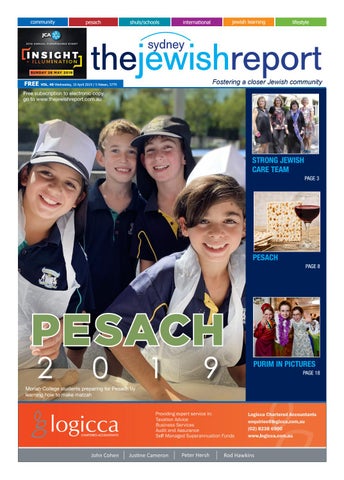
Moriah College students preparing for Pesach by learning how to make matzah
CHARTERED ACCOUNTANTS CHARTERED ACCOUNTANTS
1
9
PURIM IN PICTURES
PAGE 18
2
community
April 2019
Cocktails with ZDVO ZDVO
ZDVO recently hosted Sunset Cocktails to raise funds for much needed ongoing
hydrotherapy and physiotherapy treatments for its members in Israel’s Beit Halochem rehabilitation centres.
“He was my Saba, but he belonged to the people.”
JNF
Alon Ben-Gurion had the community hanging on his every word. Nearly 300 JNF supporters were captivated by stories Alon shared about his famous grandfather David Ben-Gurion. Stories of a brilliant man, who was a pragmatist as well as a dreamer. “He was, for me, a grandfather,” Alon says. “To other people, he was the prime minister and the leader of Israel. I always knew his greatness, but as time passes, you see what a giant he was.” Alon recalls a time near the end of his grandfather’s life where he visited a primary school South of Beer-Sheva. A student asked him, “Were you ever satisfied in your life?” “He said, ‘Satisfied? No, never. If you’re satisfied in your life that brings complacency. No, I will never be satisfied because the job is never done.” Alon spoke about the Negev’s strategic importance to Israel and praised JNF
Australia for continuing to follow in his grandfather’s footsteps. He recognised the instrumental role JNF plays in realising his grandfather’s vision of settling the Negev, a region David Ben-Gurion referred to as the “cradle of Israel”. Alon never gets tired of speaking about his grandfather. “He lived his life for one thing – to build a state, a place where all Jews would come”. Alon said if he could ask his grandfather one question today he would ask him “if Israel was on the right path? “I think I know the answer he would say – stay the course.” JNF Australia paid tribute to the outstanding service of both their National President Peter Smaller OAM and NSW State President Pam Krail who complete their terms in 2019. Their contribution to the State of Israel and the Jewish Community is to be celebrated and highly commended. JNF welcomes incoming NSW President David Moses.
April 2019
community
Strong Jewish Care Team Ensures Our Community Is Well Supported JEWISH CARE In a recent survey done by communal organisation JewishCare NSW with their employees, CEO Claire Vernon wasn’t expecting to see an improvement in results from the one done two years prior. “With already great outcomes in 2016, we honestly didn’t think it could get any better. But, staff perceptions about organisational performance increased by another 9% in 2018.” Facilitated by JewishCare’s HR Manager Andy Kellahan and Voice Project, the survey comprised two main components – passion – which represents the level of engagement and progress - which reflects staff perceptions about organisational performance. The survey indicated that 89% of staff were engaged with the organisation and satisfied with the organisations progress and success in delivering outcomes. Compared to the Community and Advocacy Services benchmark, JewishCare’s results were 12% higher than is typical at other organisations working in the same sector in terms of passion and 7% higher for progress compared to the previous survey. “Over the last decade, Voice Project have seen a sustained effort by JewishCare to continually improve the work environment and conditions for staff. The last couple of years have seen even further improvements to place JewishCare among our top performing organisations, becoming a finalist in our Change Challenge Awards for the most positive change achieved and eligible for our ‘Best Workplace’ award. This is consistent with the feedback from 95% of staff who said they would recommend JewishCare as a great place work.” Louise Parkes, Voice Project. JewishCare provides services to members of the community in the areas of aged care, disability, mental health and wellbeing, and child and family support. It is critically important that clients receive strong support
3
from staff who are in turn strongly supported by the organisation. 89% of staff also felt that they had the right resources to do their work effectively. “We not only ensure that our staff are good at their jobs, we ensure that they have the tools to do their jobs well”, continued Vernon. Zimra Segall has worked with JewishCare in Aged Services for almost 18 years together with her colleagues Iris Schwartzmann and Lana Kofman who have been with the organisation for 28 and 29 years respectively. With the myriad of changes in the aged care sector over the years - through government initiatives and constantly changing legislation - the organisation has had to be dynamic, sometimes experiencing additional changes before existing one’s have even been completed. It is here that JewishCare have an outstanding record of implementing change well – maintaining the systems and implementing policy changes so as not to compromise clients, or staff. “Ensuring that our policies and procedures are correct is pivotal however we have never lost that heart and caring for the individual client. While receiving services as part of an NDIS package or resources through JewishCare, our team embraces them as a whole person and as a whole family to be guided by the JewishCare team,” said Zimra. Lana Kofman has been with the organisation for 28 years and has seen it develop from a small welfare provider to a place that services the community across all sectors. “People ask me why I have stayed for so long. This is a challenging profession and I love challenges – I face something new every day and being able to make a difference is very important.” With over 80 years of experience supporting some of the most vulnerable members of our community, JewishCare NSW can be contacted on 1300 133 660.
MORIAH COLLEGE BURSARY PROGRAM 2020 ‘Jewish Education is the lifeblood of Jewish survival’
Golda Meir, former Israeli Prime Minister
We believe that every Jewish child deserves the opportunity to access a Moriah College education. Through the generosity of our community and support of The Moriah Foundation, Moriah College is offering a limited number of bursaries, granted on the basis of financial assessment, for students wishing to join us in 2020. PRIMARY SCHOOL Entry into Years K-4 for the duration of a Moriah College Primary School education HIGH SCHOOL Entry into Years 7-9 for the duration of a Moriah College High School education Applications close 3 May 2019 To register your interest please visit
www.moriah.nsw.edu.au If you have any questions please contact Stan Goltsman, Fee Support Analyst (02) 9375 1703 or sgoltsman@moriah.nsw.edu.au
4
community
April 2019
The Inclusive Community Centre COA At times the Jewish community in Sydney appears to be splintered, divided across lines of religious practice, cultural background, age group, and socioeconomic status. But the one thing we all have in common is that we identify as Jewish. Regardless of whether one speaks Hebrew or lights Shabbat candles, we are all part of one tribe, one big Jewish family. COA Sydney has a long history of inclusivity, welcoming all the varied community members at their centre, providing a place where these differences cease to be of any importance. The main aim is social connection with peers, regardless of cultural or language backgrounds. Even as a seniors’ centre, COA encourages people of all ages to come contribute and connect, and frequently sees people of all ages – from children on up – coming to participate in and help seniors enjoy a variety of activities. For many years Rabbi Ingram OAM has provided shiurim from a modern orthodox standpoint on Mondays at COA, while Rabbi Mendel Kastel OAM holds his monthly “Bondi Shul” in COA’s hall. Recently COA arranged
for the clergy of Emanuel Synagogue to present on Wednesdays, welcoming a progressive Jewish point of view. Although diverse, these programs are all flavours of the one thing we share Judaism. COA provides member-driven language
groups including Hebrew, Yiddish, and French. Why French? Because there were some members who spoke it as a first language, and many more who studied it at school, whether the school was in China, Scotland, Australia, or Egypt. They wanted to have Wednesday
afternoon tea together and COA made it so. This group has now been meeting for over a decade and welcomes new participants with open arms. Most recently COA has started to reach out to members of the Russian Jewish community. In Sydney, there are several excellent “Russian Groups” delivered in the Russian language. But when two Russian-speaking COA staff members spoke to their families and friends, they discovered a sense of cultural and social isolation. They wanted to be welcomed and made a part of Sydney’s wider Jewish community. These staff members have put great effort into inviting members of the Russian community to attend COA’s usual large group activities, so they can feel the benefit of being among peers from different language groups and backgrounds, with an aim to extend their interactions in the community outside their usual circles. This egalitarian and inclusive atmosphere has resulted in many new native Russian speakers joining COA’s “family of friends.” So don’t be shy! Whatever your language, background, or level of religious observance you are welcome at COA’s Activity Centre, where everyone is “mishpacha”!
Enriching the Lives of Jewish Seniors
The Hannah Meyer Project Shabbat & Festival Candle Lighting
Bringing a taste of Yiddishkeit to Jewish residents in Nondenominational Aged Care facilities across the Eastern Suburbs. A COA initiative coordinating volunteers from COA and JNF, Kids Giving Back, Jewish House, B’nai B’rith, and JEMS.
KMOW Template
For enquiries call 9389 0035 or email coa@coasydney.org or go online to www.coasydney.org for more information
Enriching Jewish Seniors Seniors Enriching the the Lives Lives of of Jewish
Eat Well Every Day
COA COA Kosher Kosher Meals-on-Wheels Meals-on-Wheels Nutritious Nutritious menu menu Makes food Simple food preparation preparation simple
Delivered by friendly COA volunteers Delivered by friendly COA volunteers 37 years experience and over one 37 years experience and over one
million million meals meals delivered delivered
Enquiries Enquiries to to 9389 9389 0035 or email coa@coasydney.org or go online to www.coasydney.org www.coasydney.org for more information
Haimish home-away-from-home for 38 university students. Onsite kosher kitchen serving healthy meat & dairy meals. Fully furnished bedrooms including linen, housekeeping & Wi-Fi. Friendly & supportive multicultural community. Plenty of study & social opportunities.
Contact us to arrange a visit: (02) 9692 5200 or admin@mandelbaum.usyd.edu.au
community
April 2019
WIZO NSW recognises its members and supporters PRESIDENT DIANE SYMONDS - WIZO NSW WIZO NSW held it 76th Annual General Meeting on Wednesday 27 March 2019. Here, WIZO reflected on its wonderful successes in 2018. WIZO members take pride in their shared vision, shared ideals and a belief that a strong Israel is essential for all. This is more relevant than ever with the rise of antisemitism throughout the world. WIZO in Israel encourages and supports people to help themselves break out of the cycle of poverty, educates and equips them with the life skills and support systems they need. WIZO gives Israeli women and children the opportunity to excel. Through thick and thin, war, peace and poverty WIZO continues to believe that education is the passport to life. An educated person gives back to society, an educated person passes on the importance of education to her children, thus breaking the cycle of violence and despair. With the elections imminent in Israel, guest speaker Dr Ron Weiser AM gave the audience a thought provoking, informative and insightful view of the current political situation. Definite highlights of the evening were the award presentations when WIZO recognised various individuals. WIZO acknowledged the children who shared their Bar or Bat Mitzvah with WIZO. These children are special in that they understand the intrinsic value of giving to those who have less than they do. They chose to share a portion of their Bar or Bat mitzvah gifts with WIZO. These gifts give many children in Israel the opportunity to participate in and celebrate this momentous time in their lives. The children who supported the program in 2018 were: Joshua Samuel, Nathan Bognar, Toby Akres, Yshai Turgeman, Alice Milner, Abby Potash and Mayim Gerdis. WIZO honoured each of them with a certificate for their deeper understanding of Tzedakah and the importance of giving to those less fortunate than themselves.
An award given in memory of the late WIZO Executive Director, Denny Govendir, went to Janette Kay, President of WIZO Tsafon, a group on the North Shore. Janette’s active participation in WIZO has made her an inspiration and role model. The Lifetime Service Award was presented to Rachel Wahlhaus, who has dedicated over 40 years to being both State Treasurer of WIZO NSW and Treasurer of her group WIZO Darom. This she has done with great success and pride. WIZO NSW honoured Elza Levin, a true WIZO woman, an Eshet Chayil, a woman who has given most of her adult life to a cause she has believed in so strongly and with such passion. To honour this WIZO Matriarch, a new award was created in her name, “The Elza Levin Volunteer of the Year Award”. Each year this award will be presented, in perpetuity, to an outstanding volunteer of the year. Elza is herself a volunteer whose devotion and commitment know no bounds. She has been Co-President and President of WIZO Darom for over 40 years. Her energy and vitality is amazing at 90 years young. This first time award was presented to Avril Rom who volunteers her time and assistance weekly to the WIZO office. A WIZO AGM is an opportunity to express gratitude to all members and supporters. WIZO volunteers are not paid, not because they are worthless, but because they are priceless.
www.wizonsw.org.au Tel 9387 3666
5
6
community
April 2019
Genetics and The Four Sons of the Future
AUSTRALIAN FRIENDS OF SHAARE ZEDEK INC MIRIAM PACANOWSKI
Pesach is about our personal and communal heritage and our hopes for a strong and healthy future. As we sit around the Seder table and read about the four sons of the Haggadah, the questions that are raised are profound and challenging. The four sons of the Haggadah are archetypes, and the responses of the Haggadah to these sons are revelatory. But what if the four sons of the future could be different? What if we could use breakthroughs in medical technology to address the challenges of our genetic heritage? What if cloning were a real option? What about new innovations in IVF that draw genetic material from three parents to create one child? What if there were real choices we could make about our children’s genetic makeup that could affect every aspect of their being? What if knowing more about our own DNA could help us respond to the questions and challenges of our lives here and now? How should we respond to these serious questions? What are the ethical ramifications of these possibilities and how should the Jewish community contend with these real and pressing issues?
Prof Rabbi Avraham Steinberg, world bioethics expert and director of Shaare Zedek Medical Center’s Medical Ethics Unit is uniquely positioned to respond to the questions raised by these fundamental and revolutionary medical breakthroughs. Prof Rabbi Steinberg will visit Australia in September this year as a guest of the Australian Friends of Shaare Zedek Inc. and will deliver a fascinating series of lectures on a wide range of medical ethical issues to our local community. He will speak at a public event on Sunday 8th September
and will open Melbourne’s Royal Children’s Hospital’s 11th Bioethics Conference. Prof Rabbi Steinberg addresses issues including stem cell research, cloning, preimplantation genetic diagnoses (PGD), gender assignment, end-of-life issues, abortions, the definitions of mother/father/ human being and modern genetics and halacha amongst other important issues related to complex and emerging medical innovations. Prof Rabbi Steinberg served as a Major in the Israeli Air Force, is a Paediatric
Neurologist, ordained Rabbi and a world expert bioethicist who in 1999 was awarded the Israel Prize for his ground-breaking work as author of the Encyclopaedia of Jewish Medical Ethics. He has served as an advisor on medical ethics to the Knesset and the Chief Rabbinate of Israel and has chaired numerous committees on bioethical issues including the Israeli National Committee for evaluation of living organ donors, the National Advisory Committee to the Minister of Health for Enacting a Law Concerning the Terminally-ill, the National Ethics Committee in accordance with the Dying Patient Act – 2005, the National Advisory Committee for Amendments of the Anatomy and Pathology Act, and the National Forum Concerning Organ Donations in Israel. He also has been involved in halakhic aspects of modern medical issues with many prominent Rabbinic authorities. In 2016, Professor Rabbi Steinberg was appointed by Pope Francis to the Pontifical Academy of Life in the Vatican to advise on bioethical issues. For more information regarding Prof Rabbi Steinberg’s visit to Australia, please subscribe to our mailing list at www. shaarezedek.org.au for updates regarding this important tour. www.shaarezedek.org.au
Creating a Career—An Entrepreneurial Success Story MANDELBAUM HOUSE DARRYL YOUNG (MANDELBAUM RESIDENT) A month into classes, students at the University of Sydney have adapted to early mornings, all-nighters and caffeine jitters. With deadlines and mid-semester exams looming, Mandelbaum residents took a night off on March 27 to welcome David Vitek to Mandelbaum House for our second formal dinner of Semester One 2019. David Vitek, a Moriah College graduate, started his career as a software engineer at IBM before eventually launching a start-up with Roby Sharon-Zipser, now known as hipages. Focusing on the home improvement sector, this incredible venture fittingly—and like many successful start-ups—started in a garage. It has a business-to-consumer model that involves providing homeowners with access to tradesmen to fix home problems. Vitek explained- “We started hipages because we noticed that it was so easy to buy a product anywhere in the world online, yet it was still hard for someone to find a good tradie in their local area.” Fast forward nine years and they had
over 40,000 tradies listed on their directory and had entered into a partnership with IKEA, locating tradespeople who could help customers install their cabinets and kitchen benches. In 2017 over 100,000 jobs were posted on hipages every month and the company had over 100,000 tradespeople listed. This generated $2 billion of work for Australian tradespeople. The evening was also resident Kacy’s 18th birthday, so after introductory announcements the night started by singing her a happy birthday in over
10 different languages. Then resident Thomas performed a magnificent acoustic rendition of American Tune by Paul Simon. This was followed by a brilliant meal served by Chef Robert and the amazing kitchen and wait staff. After dinner, David Vitek talked to us about how to be a successful entrepreneur. We learned that hipages was carefully planned out, effectively solved a problem and had a large enough market to grow a successful business, but that when you have a business you need to keep
innovating if you want to continue to grow. After his presentation, he was showered with questions from residents. Two questions stood out: What’s the most important characteristic of a successful entrepreneur? The response: “passion and resilience”—because you have to be passionate or you will never want to accomplish the impossible, but you also have to be resilient and keep trying, even when things are not going your way. As an entrepreneur, when did you realise you made it? The response: “I’m still making it. Every now and then I look up and think, oh, look what I’ve created, but then I just get right back into it.” After thanking David Vitek for taking time out of his busy schedule to talk to us, we finished up by celebrating Kacy’s birthday again—this time with cake. Mandelbaum House is the Jewish residential college at the University of Sydney. Applications for semester two 2019 are now open: https://www. mandelbaum.usyd.edu.au/apply
We thank all our customers for their continued support
AND WISH YOU A HAPPY PESACH
April 2019
community
UIA NSW Women’s Division Champagne Breakfast With Julie Bishop MP UIA NSW UIA NSW Women’s Division hosted 600 women at its 2019 Champagne Breakfast on 24 March at Doltone House Jones Bay Wharf with guest speaker Julie Bishop MP.
7
8
pesach
April 2019
Making the Pesach Seder meaningful for the little ones AMY DEUTSCH This year I’m hosting my very first seder. My daughter is 2.5-years-old and I know for a fact that there’s no way she’s going to make it through the traditional seder in the hagaddah that we always use. And though I know handing her an Ipod or DVD player will distract her long enough to let her sit at the table with the rest of us—that’s not what Passover is about. I want my daughter to be able to participate in the seder as much as possible, because one of the most important parts of Judaism, to me, is teaching it to my children. So how am I going to reconcile this? I’m planning to make my own hagaddah. And when I say “make,” I really mean that I plan to look at a few different open-source hagaddahs, and then take the basics and make it work for our family. Though a traditional seder has many many steps (which I totally remember memorizing in Hebrew school: kadesh, urchatz, karpas, yachatz…there’s fourteen in all), the seder we plan to run in our home, designed for young children, certainly will not. Here’s what it boils down to—each of our steps, what it’s about, and why it’s important. 1. Setting Up The Table A seder table looks different than a typical Jewish festival table. From the multiple Kiddush cups to the matzah, it’s a special festive meal. I’m going to have my daughter help me set the table, and I’m going to talk to her about the seder plate itself. (Check out our primer on the seder plate.) We’ll chat about the importance of the holiday, and I’ll attempt to prepare her that after we sit down, there will be some talking before we eat. 2. Blessings Over Candles and Wine Jews light candles to sanctify time at the
start of holidays, to mark that this time is holy, different, and special. The blessing is similar to what we say each Shabbat (instead of ending with the word Shabbat, on Passover you end with the words yom tov, meaning holiday) so I know my daughter will try to join in. And then the blessing over wine—well, that’s a bit different, but it will still end with a sip of super-sweet grape juice, so I’m sure it will be appreciated. I know that she’ll be looking around for her challah afterward, so that’s going to be part of our pre-seder conversation—there’s no leavened bread on this holiday, little one! 3. Breaking the Matzah Ah, a perfect segue into the special bread we use on Passover. We’ll talk about how this is the same bread that our forefathers had when they left Egypt and became free people. We’ll all taste a little matzah, and most importantly, we’ll break off half of that middle matzah for the afikomen, to be hidden and found later in the seder. 4. Four Questions Of course my toddler is too young to really know the four questions. But we do have some Passover CD’s in the house, and I’m hoping that if I hum the tune in advance, she might hum along at the seder. I always liked the four questions, personally. I think it’s an easy place to take a pause and think about how this night is different than all other nights—both in comparison to our typical nights during the year, and in comparison to Passovers past. Who’s at the table with us, and who are we wishing could be with us? How will we continue to make Passover relevant this year and in the future? And I’m guessing my 28-year-old brother-in-law will get saddled with actually reciting the Four Questions. 5. Maggid: The Story
We wish all our clients, volunteers and friends a meaningful Pesach.
Chag Sameach from all the Staff at The Burger Centre For more information about our services and programs please contact us by phone : 8345 9147 or email info@burgercentre.com.au
Everyone loves a good story. The Passover story is really fascinating, and the theme of slavery to freedom is one that resonates both for young children and adults. I might actually bring a picture book to the seder to use at this point (the Sammy Spider Hagaddah actually does a lovely job of telling the story with pictures). It will certainly help to engage my daughter, and it will serve the purpose of maggid too. As we read the section about the ten plagues, we’ll spill drops of wine from our cups (we lessen our own joy as we read about the plight of the Egyptians during the ten plagues). And we’ll be sure to sing Dayenu in there—because what’s a seder without a rousing rendition of Dayenu? 6. The Afikomen Now, traditionally the afikomen is supposed to be found after the meal. But when you’ve got a little one, sometimes it’s okay to bend the rules a little bit. Depending on our timing, we may let our daughter find the afikomen
before dinner’s actually begun, or before it’s over. She’ll get to trade it in for a present (I’m thinking about buying this inflatable matzah ball from Modern Tribe.com) and have her taste her afikomen, then the adults will eat their afikomen when they’ve actually finished the meal. 7. Quick Closing Blessing A seder usually ends with a blessing—next year in Jerusalem, and next year, may all be free. Maybe we’ll add our own blessings for each other, wishes for what we would hope for by next Passover. Or maybe the little one will be asleep and we’ll get to conclude our seder in the traditional way, with songs and prayers. Either way, I know we’ll have created something that works for our family, in this specific moment in time. Next year it will all be different, I’m sure—but that’s the beauty of Judaism. In making it our own, we make it meaningful. Chag sameach!
�����w����w��������w ���������r���r����������r������� r r �������r���r���r������r�������r�r�����r������r
����������������������������l l ����l����l����l
April 2019
Love the Stranger RABBI MOSHE D GUTNICK KASHRUT AUTHORITY The festival of Pesach arouses our emotions in a myriad of ways - we simultaneously remember the pain of our slavery and celebrate the sheer joy of our redemption. And the more acute the pain, the more jubilant we are upon its cessation. Our freedom from slavery didn’t merely apply to us as individuals, rather it also encapsulated our birth as G-d’s chosen nation, destined to receive the Torah at Mount Sinai and the Holy Land promised to our forefathers. The Seder is infused with the symbolism of both our oppression and our liberty. Leaning to the left and drinking the four cups of wine are signs of our freedom; eating bitter herbs jolts us into remembering the pain. Matzah is both the bread of our affliction and deliverance. There is another dimension to the Festival of Freedom that is sometimes overlooked, despite the Torah repeating it sixteen times. “You shall love the stranger, because you were strangers in the Land of Egypt.” We know what it means to suffer as outsiders, to be discriminated against, persecuted and singled out as a minority. Therefore, we are commanded to love the stranger and constantly keep this at the forefront of our collective consciousness. In 1938, Germany wanted to expel its
9
pesach
Jewish population and offered it to other nations, but doors remained tightly shut. Quotas were put in place in every western country limiting the number of refugees. Australia eventually allotted 15,000 visas to “victims of oppression,” yet only 7000 were deemed to fit the criteria. It was a desperately uneven scale: six million murdered versus 7000 immigrants permitted to land on our shores. At the Evian Conference in 1938, to Australia’s eternal shame, the Australian Minister for Trade and Customs, LieutenantColonel Thomas W. White, stated, “It will no doubt be appreciated also that as we have no real racial problem, we are not desirous of importing one by encouraging any scheme of large-scale foreign migration.” Thus, darkness enveloped the Jews of Europe. “You Shall Love the Stranger,” means we must do everything in our power to proactively lessen the plight of refugees. Too frequently, the alleged illegal immigrant and refugee is pitched as our national adversary, often viewed as a usurper and treated with derision and contempt. And yet we fail to recognise the real enemy is prejudice within ourselves. We must love the stranger and welcome the refugee. After all, when we were desperate, we were abandoned and only a pitiful few begrudgingly helped us. As a society we tend to pander to the xenophobia of the ignorant and racist where elections can be
A ADNO
D E N TA L
won or lost just by stirring the immigration debate. Anti-immigrant rhetoric has, albeit unintentionally, created an environment where the immigrant can be seen as an enemy and, G-d forbid, deserving of violence and abuse. As Jews, do we truly welcome and accept those of a different race, colour, faith or creed? Or does suspicion and fear triumph? We were treated as less than subhuman. We must learn from our experience and consciously treat all humans as creations in His divine image. This year, when I sit at the Pesach Seder, I will rejoice for our freedom from Egypt, but I will also remember our suffering. Our suffering in Egypt to the lowest point in human history, the Holocaust (and
everything in between). I will remember miracles that brought about our freedom – from the ten plagues and the crossing of the sea, to our re-birth in the State of Israel, the liberation of Jerusalem and the ongoing miracle that is seen every day in Israel. I will endeavour to ensure that our experiences as a people inform my behaviour toward every human being. I will dream of the final redemption, of the opportunity to live in a world free from all hate and prejudice, filled with love and hope. A time when peace will descend on Jerusalem, on all of Klal Yisrael, and will spread throughout the entire world.
DON’T PASS OVER THEM THIS YEAR
Wishing all my patients a Chag Sameach and well over the fast. From all the Staff atTA Adno Dental DEN L
A
Wishing allADNO my patients a Chag Sameach for Pesach www.adnodental.com.au Phone: 93639213
Today, one in three Israeli children live below the poverty line. That means they go without adequate food, shelter, education and other basic needs.
Premium Margaret River wine that's Kosher for Passover Special offers direct from the winery for fast local delivery. Available from independent liquor retailers, Liquorland, Vintage Cellars and Dan Murphy's.
List of outlets on our website.
Tel : (08) 9755 7402
www.kosherwine.com.au
As Passover approaches, let’s help these children, many of whom won’t have a Seder table to sit at. With over 800 facilities across Israel, WIZO is best placed to help. But we can’t do it alone. We need your help. For just $3 a day, you can sponsor a child in Israel and give these children the chance to survive and thrive. Simply visit www.wizonsw.org.au or call WIZO on 9387 3666 to sponsor a child today
10
pesach
April 2019
Dayenu: A Jewish Template for Gratitude ERICA BROWN This classic seder poem is not merely a reflection on Passover, but a model for true thanks. It’s rare to hear people say, when commenting on a blessing in their lives, “It’s enough.” When it comes to goodness, we are greedy. We want an abundance of happiness, and sometimes think of it as our due. But immediately after we tell of the exodus from Egypt in the Hagaddah, we break into a 15-stanza song where we sing jubilantly and in unison, Dayenu – It is enough. Even those who rush through the seder spend time on this song, luxuriating in its central refrain. Should we sing the chorus after each stanza or wait? It depends on the family ritual. Yet, when we get to the last stanza, we find ourselves holding the last note. Tightly constructed, Dayenu dates from the early medieval period. It is included in Seder Rav Amram, a prayer book created by Amram Gaon in the ninth century, though we do not know if Amram wrote the song or whether it was customarily recited in the Babylonia of his day. The 15 stanzas may mimic the 15 psalms, or songs of ascent, that were sung on the 15 steps of the ancient Temple. The song, just like the psalms, climb in holiness and significance. Dayenu’s first five stanzas have to do with leaving Egypt, thus its placement right after the retelling of the Exodus. The first one thanks God for freeing us, while the remainder look back to other features of the experience. We might have expected each stanza to praise a separate plague or have a line that speaks of all them cumulatively, but only one plague is mentioned: the death of the firstborn Egyptians. It is only this most awful plague that signaled a real step toward freedom. The other three stanzas sing of the redress of justice necessary for us to feel truly thankful. The next five stanzas focus on the wilderness experience and the unique miracles that God wrought for the Israelites during this transitional time. The first three concern the parting of the Sea of Reeds — first the sea split, then God escorted us through to dry land, and only then were the Egyptian pursuers drowned in the chase.
This event was so seminal that we pause and speak of it in detail and sing for each blessed facet of its salvific power. We then thank God for manna, heaven’s bread, and offer gratitude that God took care of our needs for those hard, long 40 years. As we ascend in holiness, we turn away from historical events and miracles to the staples of spiritual life that are foundational to Judaism. The final five stanzas express gratitude for Shabbat, Sinai, the Torah, Israel and the Temple. Each represents different portals of Jewish expression: rest, revelation, knowledge, homeland, and prayer. Just as we sing “Next Year in Jerusalem” when we remain terribly far from that reality, we conclude Dayenu with the Temple because our work is not yet done. Many commentators have observed that it would actually not have been enough if we had the manna but not Shabbat or the Torah or the Land of Israel. Judaism would be incomplete. But this perspective is exactly the opposite of the sentiment the song is meant to conjure. As the scholar Dr. Solomon Schimmel has
Travel through time RABBI LEWIN
Every year we sit down at the Pesach Seder we see a table beautifully set. Cups for wine and a special plate filled with different foods. What do the cups and plate represent? The Seder night has two functions: the first is to tell the story of the Exodus. The second is to celebrate our freedom. On Seder night, we move between these two experiences, oscillating between the pain of the slavery and joy of the freedom. This is experienced not only
through the story but also through the foods we eat. The author of the Haggadah declares: “In every generation a person is obligated to see oneself as if one has left Egypt.” We are obligated to see ourselves as if we personally have experienced the Exodus. We taste the bread of affliction- ha lacham aniya and the bread of freedom -the matzah. We taste the bitterness of the exile with the maror, the mortar through the charoset. On the other had we have the greens of spring- the parsley. The festive sacrifice and Paschal sacrifice –symbolised by the egg and the shankbone and the eating of the Afikoman. We drink four cups of wine, leaning as free men and women drinking to our freedom. Two experiences, slavery and
written, “One interpretation of the structure of this poem is that when we reflect on a benefit that G-d (or by extension, another person) has done for us, we should break it into its multiple components, meditating on each element.” Dayenu begins with an experience we had just been through, the exodus, and uses it to wax lyrical on a host of other experiences, asking us to see the interconnectedness of our blessings. It invites us to break each gift into its multiple components and then put them back together and stare in disbelief at our good fortune: I am grateful for this and for this and for this — until we become saturated with the unfolding of our prosperity and can think only of God’s myriad kindnesses. The writer Melody Beattie beautifully captures what Dayenu is really saying and what all deep gratitude looks like: “Gratitude unlocks the fullness of life. It turns what we have into enough, and more.” We don’t realize how lucky we are until we speak our blessings in detail. Dayenu is not merely a reflection on Passover, but a template for true thanks.
freedom interwoven. Seder night transports us through history and we join the Mesorah community, an eternal community. The Jew lives within time, throughout time and transcends time. We sit at our Seder in 2019. Yet at the same time we are transported to the first Seder, as we anticipate the Exodus from Egypt. We celebrate with our family, as was done in the days of the Temple in Jerusalem, when Jews from all over the world would go up to Jerusalem to eat the Paschal lamb with family. At the same evening we transport ourselves to the future. We are fully redeemed and living in complete freedom, secure in our homeland. What a night! Emotions run
Imagine for a moment a thank-you note where instead of the usual clichés you had a note in the form of Dayenu, outlining several details of appreciation. Had the person done only one it would have been enough. Now imagine receiving such a note — highly personal, thoughtful and unique. It might the thank-you note you actually save. Dayenu suggests this very formula when thanking God. It is our detailed thank-you note to God — not only for saving us from the terrors of Egypt, but for giving us the instruments and experiences to form a life of Jewish meaning. It’s a wonder that we don’t recite it every day. But at our seder tables, we might take a moment after this jubilant song to turn to those at the table and, in detail, describe how blessed we are in their presence. Dr. Erica Brown is an associate professor at George Washington University’s Graduate School of Education and Human Development and the director of its Mayberg Center for Jewish Education and Leadership. She is the author of “Seder Talk: A Conversational Haggadah.”
wild. When we sit at the table and look at the scene before us. We see not only our table, we also see the Seders of yesteryear. We are sitting as a child at our grandparents table hearing their thick accents reading the hagadah. We can see our grandparents smiling as we retell the story that we had heard from them. We are sitting at the seder of our children’s grandchildren listening to the stories of how their great grandparents conducted a Seder. On this night we enter the world of the mesorah – we join the community and collective conscience of the Jewish People. Is there any night that quite compares to Seder night? Wishing you a Chag Kasher vesameach.
April 2019
pesach
11
A Royal Speech for a Royal Wish CAULFIELD SHUL, MELBOURNE RABBI RALPH GENENDE OAM Several years ago, the movie, “The King’s Speech”, about the speech impediment of King George VI and the man who helped him overcome it, the maverick Australian Lionel Logue, attracted a lot of acclaim, interest and awards across the world. Notwithstanding the criticisms about the historical veracity of some of the characterisations, the movie is a riveting portrayal of the profound humiliation George 6th suffers as a result of his stutter. David Seidler who wrote the script became interested in George because he too was a stutterer. While stuttering may have many complex causes, in the movie it is explicitly linked to early traumas; in George’s case the abuse he suffered at the hands of a nanny and the embarrassment he felt he felt in front of his family. In Seidler’s case he associates it with the emotional trauma of the Shoah in which his grandparents were murdered. Stuttering causes enormous pain and public shame to the stutterer, a pain that is accentuated for the King because of his very public role. Watching the movie I couldn’t help but think of one of the earliest recorded instances of a
public figure who suffers from a speech impediment: Moses. When he is called by God to lead the Jewish people, he is agonised by the thought that he will have to become a public speaker, a voice for the oppressed: “Please, my Lord, I am not a man of words…for I am heavy of mouth and heavy of tongue” (Exodus 4:10). God provides Moshe with an ostensible solution; Aharon would be his spokesman. Despite this by the end of the drama it is Moshe who confronts Pharaoh on his own and who becomes an increasingly confident and eloquent advocate for his embattled people. By the time the people leave Egypt he is an orator and poet of distinction leading them in the brilliant song at the sea: “Az
yashir...” At the end of his life he delivers one of the longest and most powerful speeches on record: the Book of Devarim or Words. The man who stumbled with words has become the consummate word-smith. We are not told how Moshe transforms himself from stutterer to orator, but we could surmise his brother Aharon has something to do with it. Perhaps Aharon is his coach and therapist, his Lionel Logue. This could be supported by the words of the Midrash when Moshe says: “Just as you rejoiced when I rose to greatness, so I rejoice in your greatness.” We don’t know what caused Moshe’s impediment although the Midrash links it to an incident in Pharaoh’s court. One
could surmise that Moshe suffered an early trauma in the Egyptian palace. After all, he was a child torn from his mother and brought up in an alien environment. The defiance of Batya, Pharaoh’s daughter, could have cost him a lot and caused him to suffer at the hands of the other children in the Egyptian court just as George 6th suffers at the hand of his brother. Ultimately the movie is about the triumph of George over his own handicap. The story of Moshe too is the ultimate story of triumph; one of how we can turn adversity into opportunity, weakness into greatness. It is the story of Moshe and of George 6th; it is the tale of everyone who has overcome a disability. And of course it is the epic of the Jewish people which we celebrate at Pesach time. Interestingly it is speech that is central to the pivotal celebration of Pesach – the seder meal. On Pesach night we open our mouths (Peh-sach – literally means the mouth that speaks) to tell a story. We orally transmit the adventure to the next generation. We are encouraged to speak at length (and hopefully eloquently) about the history of our people. This is a night in which the speech flows as liberally as the wine. It is also a night on which we are all royalty, enjoying our status as God’s chosen people. So we all get to make a king’s speech – it’s called the Haggadah! May our words be wise, interesting and articulate. Chag Sameach
12
pesach
Pesach Message
THE GREAT SYNAGOGUE RABBI DR BENJAMIN ELTON
There are so many preparations before Pesach that when the yom tov arrives it can feel like a climax and a completion. We close our Haggadot after the second Seder and say ‘well that’s over for another year’. But of course that’s not true. Most obviously, most of the festival takes place after the first two nights, with important moments during the last two days, including the Song at the Sea on the seventh day, and Yizkor on the eight day. But there is a second sense in which the arrival of Pesach is not an end, but a beginning. On the second evening we begin the count down to Shavuot. Uniquely, Shavuot does not have a date given in the Torah. Instead we are told to count seven weeks from the second day of Pesach and to celebrate Shavuot on the fiftieth day. This count, known as Sefirat HaOmer, takes us from liberation to revelation, from shedding our slaves’ chains to accepting with joy the Torah at Mount Sinai. The Omer itself was a barley offering brought in the Temple from the second day of Pesach onwards, which gave thanks for the barley harvest. On Shavuot there was a parallel, as we brought an offering of wheat, to celebrate the wheat harvest. Although originally, and still today, the Omer is a time for spiritual preparation, it has also become a time of mourning. In the times of the Mishna, twenty four thousand
students of Rabbi Akiva died during the Omer period. One account is that they died in a plague, because they did not show each other proper respect. This might be a coded way of saying they died in the Bar Kochba revolt of 135 CE, which failed to overthrow the Roman government of Palestine. In the medieval period, many European Jewish communities were slaughtered between Pesach and Shavuot, as crusaders departed for the Land of Israel. The result is that for at least some of the Omer each year we do not conduct weddings, take hair cuts or listen to live music. There is an elaborate liturgy for counting the Omer. It is a mitzva to count so there is a blessing, but this has been augmented by mystical texts recited before and after the count. Perhaps because other forms of music were unavailable, the texts for the counting of the Omer were sung as part of lengthy and sophisticated compositions. Outstanding examples were by Cantor Pierre Pinchik (1900-1971) and Cantor Yossele Rosenblatt (1886-1933). My favourite is by Samuel Alman (1877-1947). Every year at The Great Synagogue, Cantor Josh Weinberger and the Choir perform Alman’s three-part composition on the seventh night of Pesach, which this year falls on Thursday 25 April. The service will begin at 6 pm, and everyone is very welcome to attend.
JNF FAMILY MISSION
26 DECEMBER 2019 - 3 JANUARY 2020 5SFBU ZPVS GBNJMZ UP *TSBFM T SJDI IJTUPSZ NPEFSO DVMUVSF BOE OBUVSBM CFBVUZ PO B NVMUJ HFOFSBUJPO UPVS
•
&YQFSJFODF *TSBFM UIF GBNJMZ GSJFOEMZ XBZ XJUI GVO JOUFSBDUJWF BOE FEVDBUJPOB* BDUJWJUJFT BOE UPVSJOH
•
&OKPZ TUJNVMBUJOH TJHIUT TPVOET BOE UBTUFT GSPN /PSUI UP 4PVUI XJUI MFBEJOH GBNJMZ UPVS HVJEFT
•
7JTJU TVTUBJOBCMF DPNNVOJUJFT BOE FYDJUJOH QSPKFDUT TVQQPSUFE CZ +/'
'PS NPSF JOGPSNBUJPO PS UP CPPL QMFBTF DPOUBDU &UUZ PO PS FUUZ!KOG PSH BV
April 2019
The Business of Matzo Balls
MATZOBALLS.COM.AU ANTHONY PERL
The matzo ball is a crazy idea when you think about it. Ever just wondered about who the first person was to come up with the recipe? We know it as a much beloved Pesach staple, where the same old chicken soup you have any time of the year becomes magical when you add the dumplings. Made with love and often some secret ingredient passed down through generations of your family, there is so much more to matzo balls. There are lots of important moments in the Pesach story which can result in lively discussion, but this year, pause for a moment after you read about the four sons and ask what they would make of the humble matzo ball? The wise son might look at the meaning behind it. When you consider the standard ingredients (according to Wikipedia - matzo meal, eggs, water, and a fat, such as oil, margarine, or chicken fat), it is hard to know what you can read into this. Was it just a beautiful accident or was there a deeper concept of how to bring together primary ingredients to create something more hearty and special. The wicked son is probably asking for it not to be in his soup at all, claiming it serves no real purpose. Soup is soup, and you don’t need a collection of ingredients thrown together in a weird attempt at a ball - it just spoils the meal. The simple son will accept it as being there because it has always been there. He understands it is necessary and a characteristic part of the Passover meal, without really questioning why it is there. Are you relating to one of the above? Much like their role in the seder, what they think they know and what they choose to be stuck on belies the need to go deeper.
For the son who knows not how to ask, you can give this explanation. It is because this is a special festival. The matzo ball is part of our journey. The individual touches (quite literally when you make it as well as your secret ingredient a bit of cinnamon perhaps) are symbolic of how we are part of this remarkable story. It reminds us of not just being led from Egypt, but how we have been shaped to be that something special we give to the world. The question I asked at the start about wondering who the first person was to invent the matzo ball and how that came about, while interesting is not the question you should ask. Instead ask, how did it go viral? Think about it for a minute - we talk about YouTube videos with millions of views, but this Pesach staple has the equivalent of billions of times more ‘hits’. It has spawned countless appearances in recipe books and videos not to mention a guarantee that on at least two days a year, millions of people will be enjoying it. Any business or charity would love this sort of exposure. The strange delicacy that is the mazto ball is pure marketing genius. The message of the matzo ball has spread through generations because it makes people feel good and yet no two are ever the same. It resonates as personal and answers the desire to make the night special. If you find yourself sitting in the office enjoying some leftover soup with matzo balls, consider for a moment, does your brand have a matzo ball? The answer is you have the basis of it because otherwise, you would not still be around if you do not offer something people need. The challenge is turning it into a matzo ball. Chag Pesach Sameach from matzoballs. com.au - the home of marketing for Jewish businesses and charities.
The Board and Staff of The Kashrut Authority wishes the entire Community a Chag Pesach Kasher v’Sameach. May this Pesach bring you and your families peace and good health
Phone 1 300 KASHRUT | 02 9365 2933 www.ka.org.au | info@ka.org.au keeping kosher made easy
$
2
45
1
$ 20
ea
ea
3
$
75 ea
SAVE $2.45
SAVE 30¢
SAVE 70¢
Jerusalem Matzo Meal Fine or Coarse 375g 77¢ per 100g
Menora Glass 26hrs Memorial Candle
Eskal Instant Potato Pancake Mix 170g $2.21 per 100g
$
5
15 ea
$
6
50 ea
$
9
35 ea
SAVE 80¢
SAVE $1.10
SAVE $2.35
Kedem Concord Grape Juice 650ml 79¢ per 100ml
Beit Yitzhak Jam Varieties 284g $2.29 per 100g
Yehuda Original Gefilte Fish 679g $1.38 per 100g
Available at Woolworths Bondi Junction, Double Bay, Eastgardens, Gordon, Hornsby, Neutral Bay, Northbridge and St Ives.^
On sale from Wednesday 3rd April until Tuesday 9th April 2019 unless sold out earlier at Woolworths Woolworths Bondi Junction, Double Bay, Eastgardens, Gordon, Hornsby, Neutral Bay, Northbridge and St Ives. Limits per customer may apply, trade not supplied. Specials are not available online or at Caltex Woolworths co-branded fuel outlets. Woolworths Supermarkets: 1 Woolworths Way, Bella Vista, NSW 2153. ^Products and specials may not be available in all stores. CP010419N5SJR_R
14
pesach
Moriah College celebrates Pesach
April 2019
CELEBRATING PASSOVER Friday 19th April to Saturday 27th April
3
9
$
$
50
25
2
$ 40
ea
ea
SAVE $2.20
SAVE $6.50
WAS $5.45
WAS $16
Kedem Grape Juice Concord 2.84 Litre $3.35 per litre
Sniders Matzos 375g $0.87 per 100g
3
4
$ 30
$
ea
SAVE 90¢
75
ea
SAVE $1.40 WAS $3.80
Bnei Darom Cucumbers In Brine 560g $4.29 per kg
3
$ 60 ea
ea
SAVE $1.70
WAS $4.20
WAS $5.30
Lieber’s Pototo Chips Original 140g $2.36 per 100g
Aviv Matzos 450g $1.06 per 100g
8
8
$
$
25
ea
ea
SAVE $3.55 WAS $11.80
Progress Chocolates Cherry/Cappucino 135g $5.93 per 100g. While stocks last. Selected stores only
Yehuda Gefilte Fish 680g $12.13 per kg. While stocks last. Selected stores only
Sniders Matzo Meal Coarse/Fine 375g $0.96 per 100g
8
$
40 ea
SAVE $1 WAS $9.40
Continental Kosher Butcher Frankfurts 500g $16.80 per kg
Pesach Food Drive for people in need. Look out for our food donation
boxes at selected stores. Please buy a non-perishable food item and place it in the box provided. Celebrate Passover at these supporting stores: • • • • •
Eastgate, Bondi Junction Bondi Westfield Chatswood Chase East Village Edgecliff
• • • • •
Kaleen Lindfield Macquarie Manuka Maroubra Junction
• • • •
Randwick Rose Bay Pagewood St Ives
On Sale until Tuesday 30th April 2019. Products only available at above stores, unless indicated otherwise. Not available at Coles Express or coles.com.au. While stocks last. Some products or varieties may not be available at all stores. We reserve the right to limit sale quantities. Savings, single sell prices and unit prices shown off regular selling prices.
16
pesach
Include Israel Through UIA at Your Pesach Table This Year UNITED ISRAEL APPEAL The United Israel Appeal’s programs have proven for almost a century to be effective in meeting the challenges and national priorities of Israel. Keren HayesodUIA’s ability to evolve and respond in a contemporary way has sharpened the focus on constantly transforming our programs, and collaborating even more closely with our global UIA family. UIA will expose you to some of these challenges and opportunities, demonstrating why your unwavering support is even more relevant today in order to strengthen Israel’s most vulnerable populations. While there are still many vulnerable people facing challenges and living on Israel’s periphery, the infrastructure and UIA’s programs are meeting the people’s needs to a great extent and ensuring a brighter future. These programs include Youth Futures - which helps at-risk children bridge educational, social and cultural gaps; Net@ - which advances the technological skills of those living on the periphery and Young Communities - where idealistic young people serve as volunteer agents of social change and strengthen Israel’s underdeveloped areas. When we reflect on the connection
April 2019
Pesach is a Holiday of Freedom.
Freedom is the ability to think and make free will choices
What should we be thinking about at each of the steps of the seder. between Pesach and the UIA, we draw reference to the miracle of triumph. With motivation, determination and the community’s continued support, nothing stands in the way of ensuring that every Jewish person can fulfil their potential and feel empowered. This is the essence of UIA’s vital work in ensuring that the most vulnerable are supported by providing the necessary tools to succeed. We invite you to join our journey and include Israel at your seder table by considering a donation to UIA in lieu of gifts. Through your contribution, you are enabling those less fortunate to have the opportunities and assistance they need. Your support is For the People of Israel! To purchase UIA gift certificates, please contact UIA on 9361 4273, info@uiansw.org.au or or visit uiaaustralia.org.au
REBBETZIN GAIL MICHALOWICZ FROM TORONTO KADESH - MAKE HOLY This teaches us that even the most everyday mundane activities can be made holy. When a person eats or sleeps for the correct reasons, he is serving Hashem. The words “kedoshim T’heue” – “You should be holy” teaches us that we should make every moment one of holiness. URCHATZ - WASHING What should we wash? We should wash away those thoughts that say “I can’t grow” We can all grow. In fact, we should have the drive to grow and remember that we are all in the Image of Hashem and therefore have infinite power to tap into. KARPAS – DIPPING A VEGETABLE IN SALT WATER Salt water represents tears. We should try to understand the pain of others we shouldn’t bleame them fro their problems YACHATZ – BREAK THE MIDDLE MATZAH AND PUT ASIDE A PIECE OF LATER We all have many goals that cannot all be achieved at once. Some have to be reserved for later. But every act makes a difference. MAGGID – SPEAK Talk to others and take advice from others. Be open to listening. RACHTZO - WASH Wash away all those things that are in the way of achieving your goals.
MOTAZAI MATZAH – MAKE THE BRACHA AND EAT THE MATZAH Look at all the matzah and see what it means. We were slaves and then we were free. Any moment our exile could end, both personally and nationally. MAROR – BITTER HERBS Sometimes life doesn’t seem so sweet, but we can grown from every challenge and understand that Hashem’s plans are beyond our understanding. KORECH – SANDWICH OF MATZAH Sandwich yourself between good people, good friends help you grow. SHULCHAN ORECH – A SET TABLE Our Table is a code of laws – true freedom, comes with real boundaries. We look to the Torah – our instructions to living for the answers. TZAFUN - HIDDEN Find what is hidden. Although this refers to the Afikoman, we also learn it find what is hidden in people. People have strengths that we may not always see. BORACH – MAKING A BRACHA Always remember to thank Hashem for giving us the opportunity to do mitzvos. Don’t skip brachas. HALLEL – PRAISE Give praise to Hashem for giving us the Torah and such a meaningful life. NERZAH – CONCLUSION “It has been accepted”. May all of your Prayers be accepted and answered for the final geulah.
18
schools / shuls
April 2019
Purim snap shots BJE
Emanuel School
Hug-A-Bub
Emanuel Synagogue
X Saf
19
schools/shuls
April 2019
Purim snap shots Kehillat Masada
Masada College
Moriah
20
schools/shuls
April 2019
Mount Sinai
Kehillat Kadimah
JNF Blue Box
Nefesh
Mr Blue box had a busy Purim visiting Moriah, Emanuel, Mount Sinai, Kesser Torah and Masada students. Mr Blue Box is a wonderful symbol for children to learn about the importance of Israel and their Jewish Identity. JNF Australia and Mr Blue Box work
tirelessly to strengthen the bonds of our youth to Israel, their heritage and the environment, fostering the leaders of tomorrow. Through their education and outreach programs, JNF demonstrates the tangible contributions being made to improve life in Israel and around the world.
Mizrachi
Living Judaism: The ethos of Masada College Senior School MASADA COLLEGE “Be deliberate in judgment, raise up many disciples, and make a fence around the Torah.”(Pirkei Avot 1:1) In this Mishna there is much discussion centred on the concept of what “raising students” means. The Mishna deliberately states that the community must raise students rather than teach students. This difference highlights the need to raise or impact each student and develop his or her ability to become leaders in the community of their generation. Each generation requires its own unique approach to the issues and challenges facing society at the time. At Masada we strive to facilitate educational experiences in line with the teaching of this Mishna. When it comes to Jewish Life classes, we have a thriving mainstream curriculum which deepens our students’ understanding of their Jewish heritage and the issues they need to confront in the world today.
At the same time, our renowned Torah Stream offering has recently been expanded to include students in years 7 and 8 who want the challenge of learning Halacha, Jewish History and Philosophy from the Talmudic texts. Our year 9 and 10s continue to be challenged by Ethical Issues grounded in Jewish Text and our Year 11 and 12 cohort now study seven modules which arm them with the understanding and skills required to stand up to the challenges of our time: growing antiSemitism, human rights abuses, healthy adult relationships as well as building an awareness of their individual responsibility to commit their time, resources and expertise to our communal organisations under the JCA, which ensures the continuity of our Australian and Sydney Jewish community. In this way, both our Jewish Life and Torah Stream curriculum enable us to continue producing young men and women who embody a ‘living Judaism’ – students who guarantee the continuity of Judaism through practice, understand their communal responsibilities and are proud of their connection to the State of Israel and their heritage.
SciTech 2019 MASADA COLLEGE Kol Hakavod to our Year 10 student, Justin Xia,who has been selected to participate in SciTech 2019, together with six other Australian students and 60 worldwide! SciTech is run by Technion - Israel Institute of Technology. ןוינכטה in Haifa and is a 3-4 week program combining scientific research, cultural and social activities. Participants work on a research project of their choice, supervised by members of the Technion’s research staff and conducted in the Technion’s state-ofthe art research facilities. Justin will be going to Haifa in July, following in the footsteps of Ran Ashkenazi and Olivia Chen who have participated in the program in previous years. Mazaltov Justin!
21
schools/shuls
April 2019
New Sculpture Stands Tall MOUNT SINAI COLLEGE Mount Sinai College set out on a mission: to create a large symbolic sculpture that characterises and embodies the school’s values and ethos. The sculpture would need to represent the strength and vitality of what the school describes as a growing and thriving Jewish community. Industrial designer Joel Adler felt he could deliver on such an important request, and single handedly develop a piece of art from concept into reality. The sculpture, named Tree of Life, marked the end to a year-long staged process of renovations to rebuild a College campus with state-of-the-art facilities and classrooms. Joel graduated from UNSW with a Bachelor of Industrial Design and continued his passion by working at his father’s metal factory, Ogis Engineering, as an Industrial Designer and Draftsperson. Gaining experience in metal fabrication and design, Joel was ready to take on his first large scale project for Mount Sinai College. He created several concepts for this brief however his 3D interpretation of the Kabbalistic Tree of Life was the obvious choice. “From the onset I wanted to imbue the sculpture with Jewish symbolism without the use of text. The Magen David motif is created using overlapping metal latticework and the resulting shadows on the wall and floor of the building created a wonderful Magen David pattern,” says Joel. Before construction began, Joel built
a 10:1 scale model to check that all dimensions and construction methods were appropriate. Construction of the final sculpture began in December 2018 and Tree of Life was installed at the school in 2 parts, the base (trunk) and the top half. These parts were fused together on site using a temporary scaffold. To match the name of the sculpture (Tree of Life) and overall aesthetics of the school, Mount Sinai plan on intertwining vines around and inbetween the sculpture. “The new developments at Mount Sinai are jaw dropping and I feel very honoured to be asked to contribute. I’m very excited to come back in a couple years and see the vines established,” says Joel.
Kesser Torah Wine Fair KESSER TORAH COLLEGE
The Sam Moss library at Kesser Torah College was recently buzzing with energy as the community was brought together for a prepesach wine tasting and sale. Three different kosher wine distributors came along and showcased a variety of wines from all Israel, Italy and France. The distributors included; Krinskys Kosher Supermarket, along with Chaim Eisman, Boutique Cellars and My Kosher Wines. This is the second year that the KTC P&F has put together this event for the Sydney Jewish Community, the evening was thoroughly enjoyed by all who attended..
MASADA COLLEGE SENIOR SCHOOL
TORAH STREAM
Based on the success of the Torah Stream curriculum in the Junior School, Senior School students in Years 7 and 8 can now opt-in to this innovative program.
ELC-Yr 12 College Campus: 9-15 Link Road, St Ives To enrol email enrolments@staff.masada.nsw.edu.au or call 9449 3744
22
schools/shuls / international
April 2019
MASTERCLASS OF LEADERSHIP
A personal reflection on the Christchurch tragedy LEIBLER YAVNEH COLLEGE, MELBOURNE YIANNA PULLEN
Listening to and reading about the tragic events that occurred in Christchurch last week and what has been repeatedly referred to in the media as a “Masterclass of Leadership” executed with such understanding and humility by New Zealand’s young Prime Minister Jacinta Ardern has restored my view of humanity and prompted deep reflection. I reflected firstly on my own initial reactions of shock, of extreme sorrow, of pain, of shame, of fear, of anger and then, like the rest of the world, on the careful words expressed, on the respectful actions, on the vulnerability and courage displayed by Jacinta Ardern. Prime Minister Ardern has bravely vocalised the thoughts of many, words that have resonated with people from one end of our troubled world to the other. Unlike many political leaders of the past who have taken the “O con noi o contro di noi”, You’re either with us or against us, stand, Jacinta Ardern has chosen her words carefully, adopting a position of openness, calling for unity, for people to be as one through shared stories, through tragedy and their shared grief. The sharing of stories allows for difference, for cultures to co-exist, bringing all back to the baseline; a shared humanity. When visiting one of the local high schools, Jacinta Ardern was greeted by a solemn rendition of the Haka and, after she addressed the group and invited queries and concerns, “How are YOU?” was the question that came from one of the students. I was particularly touched by this expression of compassion and empathy suggesting that the words delivered by their leader reverberated strongly and were understood by her young audience as heartfelt and genuine. In previous writing, I have referred to the wisdom of Brené Brown and her perspective on our great need as human
beings to belong and to do so successfully requires, integrity, authenticity, and a personal commitment that we must carry in our hearts. Ardern’s address displayed true empathy, great courage and a level of respect and civility rarely witnessed by political leaders; traits identified even by the young. Jacinta Ardern has been an active participant, from the very moment she was given the terrible news of the tragedy staying very present daring to avoid hostility and negativity. The world’s response to the way this human tragedy has unfolded has affirmed my belief in people as inextricably connected and our yearning to be part of something bigger than us. How do we, as educators and significant adults in the lives of our young, instil the strength of character displayed by Jacinta Ardern? How do we help them develop these vital interpersonal skills, the ability to think critically and assist them in finding the courage to accept constructive criticism and think ‘we’, not ‘us and them’? The power of words to inspire and, sadly to hurt, along with the strength to resist the default position of ‘us and them’ is a daily challenge that exists beyond the classroom, beyond the playground and sometimes, into our community. This default position of ‘us and them’ rears its ugly head regularly in playground politics where little cliques of two or three band together to exclude others and create an inner circle for the chosen few. The way forward appears to be in instilling empathy and developing a shared humanity through compassion. Recognising the emotion and developing the skills to own and manage the actions that follow requires regular support and calm, yet firm intervention. Our staff are working closely with one another and our children to promote healthy, positive relationships. We ensure altercations between children, whether they occur in the classroom or in the playground,
are dealt with openly and honestly. Although young, our children have great capacity to recognise when one is hurting and, with careful guidance, can be helped to find the words and actions that can heal and repair. Identifying and regulating emotions and developing greater emotional literacy knowing when someone is upset, angry, frustrated is an ongoing focus for our staff and children. Restorative conversations, self-reflection and peer mediation are strategies we employ to assure our children that we are listening, that we understand their emotions and the feelings that well-up inside them. If your child has been overwhelmed by the event in Christchurch, or you are eager to help them better understand and cope with the many worldwide devastating events that have occurred of late, there are many websites and professionals to guide and assist. The following website was suggested by a psychologist. https://psychlopaedia.org/top-tips/tipsprotecting-children-conflict-terror/ Also, Michael Grose, parenting expert offers some sound advice on this very issue. He contends that “while we’d like to protect our children from such events, in reality it’s impossible, as the news coverage is so widespread and the event itself has impacted so many people. The personal nature of this particular tragedy makes it even harder to stomach than some recent natural disasters that have made the news, as awful as they have been.” https://www.parentingideas.com.au/ blog/responding-constructively-to-thechristchurch-shooting/ His key recommendations found in the blog link above include: 1. Be available to your child. Let them know it’s OK to talk about the events in Christchurch. Listen to their thoughts and feelings. By listening you will work out if they have misunderstood and what more
you need to explain. But don’t over explain. They don’t need to hear more than they can readily process. 2. Actively engage in the news with older children. Older children will want to engage more fully. Be prepared for conversations that lead into other connected areas:- gun control, political will and decision making and the nature of media coverage may all be issues which emerge. 3. Filter the news. Michael Grose is certainly not advocating for censorship, but he does say we should take particular care about the exposure our children receive to news events. This relates particularly to the types of images they may see and the news often doesn’t give much warning when something confronting is about to be shown. Watching the news should be something a family does together so that the adults can help explain what is being heard and seen. 4. Manage emotions raised. Sometimes the news can be upsetting and parents need to be able to understand how they may be feeling. Statements like ‘It’s understandable to be angry when you hear news like this’, permit you to acknowledge their emotions. 5. Moderate your language. At school, we often hear our children make statements about events. These quite clearly are repeated from those things they hear said at home. The problem with this is that they may well not have the breadth of knowledge of the background to an event or an understanding of the implications of it, to determine if this is really their view at all. It is important to try and avoid ‘value-laden’ language when discussing events in front of your children. …and finally, seize every opportunity to tell your children how much you love them, give them a hug and add a prayer for the parents around the world who are have lost a family member and cannot hold them in their arms this evening.
Focus on Netanyahu, Gantz missed real point of AIPAC conference Two weeks before Israel’s general elections, in the midst of explosive rhetoric and divisive discourse, the Americans did a zoom out and took a picture of us. The big picture. SIVAN RAHAV-MEIR What really happened last week at the annual AIPAC conference, apart from speeches by Benny Gantz and Benjamin Netanyahu? A friend of mine who was there told me that for her, the presentations by those two prime-ministerial hopefuls weren’t the high points of the conference at all. We are talking about a three-day-long, awe-inspiring salute to Israel. And the Americans chose exactly which Israelis they wanted to see and empower. While in Israel, relations with Israeli Arabs are turbulent, to AIPAC they brought Dr. Yasmeen Abu Fraiha to tell her personal story. She was born in Tel Sheva in southern Israel and is now a doctor of internal medicine at Soroka Medical Center in Beersheva, as well as a revolutionary social entrepreneur in Bedouin society, especially among women. George Deek gave a remarkable lecture. He is the first Arab-Christian to be appointed as an Israeli ambassador; he
will soon serve in Azerbaijan. He explained to the audience how he chose to exit the cycle of hatred and become an Israeli diplomat who fights the BDS movement. Rivka Ravitz, the chief of staff of the President’s Residence and a haredi mother of 11, drew attention right alongside the many Israeli high-tech startups. Social startups were also presented: Yad Tamar has developed a communitysupport model for cancer patients. They call this optimistic accompaniment in treatment “sociotherapy,” a vital complement to those undergoimg chemotherapy. The “One Family” organization, established by Michal Belzberg at the age of 12 (!), helps families of terror victims. At AIPAC, they presented the empire that has sprouted up in the last two decades—they support 12,000 men, women and chidren with an impressive 500 volunteers—that provides assistance to those injured in terrorist attacks or wars. There are many other examples, even before we mention the enthusiastic speeches of the many American
Former Israel Defense Forces Chief of Staff Benny Gantz addresses the 2019 AIPAC Policy Conference in Washington, D.C., on March 25, 2019. Credit: Screenshot. supporters of Israel who got up onto the stage, as well as President of Honduras Juan Orlando Hernández and Romanian Prime Minister Viorica Dăncilă, who announced at AIPAC their desire to move the country’s embassy to Jerusalem. Two weeks before Israel’s general elections, in the midst of explosive rhetoric and divisive discourse, the Americans did a zoom out and took a picture of us. The
big picture. Maybe we have to hold an event like this in Israel, too, for us to see ourselves. Sivan Rahav-Meir is an Israeli primetime news reporter and TV host, as well as a sought-after speaker in Israel and overseas. Translated from the original Hebrew by Yocheved Lavon.
April 2019
23
international
Considering the national interest in the forthcoming elections ISI LIEBLER Despite the high-pitched abuse being exchanged between the principal contenders, Likud and Blue and White, paradoxically this election highlights the unity of the nation. There is barely a sentence in the political manifesto of Blue and White that differs materially from the policies of the current government. In fact, this election reflects the unprecedented consensus where the vast majority are in favor of separation from the Palestinians – providing this could be achieved while retaining security – an option that is currently virtually impossible. In addition, most Israelis oppose the creation of an adjoining terror state, which could be a springboard for Iran to threaten Israel’s existence. So, what is this election about? The bottom line: Are we willing to accept Prime Minister Benjamin Netanyahu for another term? Netanyahu’s principal asset is that his opponents, Blue and White co-heads Benny Gantz and Yair Lapid, aside from their inexperience, are largely perceived as “nice” guys but political lightweights lacking the ability to step into his shoes. Many Israelis who currently support Gantz are not enamored at the prospect of a rotating leadership that would provide Lapid the driver’s seat.
The small parties upon which Netanyahu will be relying to form a majority are also problematic. The biggest obstacle to Netanyahu’s re-election appears to be mandates lost by right-wing parties not passing the electoral threshold (3.25% of valid votes). Netanyahu’s role in convincing Habayit Hayehudi to merge with the extremist Otzma Yehudit, headed by followers of the late Rabbi Meir Kahane, in order to avoid both parties falling below the minimum threshold, disgusted most Israelis, including many traditional voters of Habayit Hayehudi. That Netanyahu was forced to promote such an unholy union is the result of a dysfunctional political system. The solution would be to adopt a
second party preference system whereby voters could elect a second party in the event that their first choice did not pass the threshold, but also raise the threshold to 5% or even 10%, thus limiting the power of small sectarian parties to hold the balance of power and exert undue influence on government policies. It is noteworthy that the High Court overturned the decision of the Central Elections Committee to disqualify the Arab parties that openly justified Palestinian terror and opposed a Jewish state, but at the same time, intervened and barred Otzma Yehudit head Michael Ben-Ari from running for the Knesset even though his candidacy was approved by
the committee. Although the High Court endorsed the position adopted by Attorney General Avichai Mendelblit, the clear bias of this ruling only serves to provide greater ammunition to those seeking to undermine the High Court’s standing. Amazingly, Gantz and Lapid foolishly praised the High Court decision, seemingly oblivious to the obvious double standards applied in the rulings. Netanyahu sparked an upheaval when he warned that if the right bloc does not obtain a clear majority, a Blue and White government could only be formed with the tacit support of the Arab parties. He described such a scenario as a catastrophe. He was accused of racism, which, under the current circumstances, is absurd. All the Arab parties support the elimination of Zionism. Some wish for the transformation of Israel into a state of all its citizens – a binational state that is a repudiation of Israel as a Jewish state. Others are even more radical, excusing terrorism and identifying with our adversaries in what could be considered treason. It is therefore totally legitimate for Netanyahu to highlight the fact that voters face the alternative of a Netanyahu government or a Gantz government that CONTINUE PAGE 24
Despite Brexit woes, Theresa May is a hero to many British Jews CNAAN LIPHSHIZ As the United Kingdom’s political establishment continues its tailspin over Brexit, little can be said with certainty about either’s future. All bets are off as Prime Minister Theresa May, whose own survivability in office seems increasingly doubtful, continues a desperate balancing act meant to satisfy her own coalition’s many hardliners, the opposition and an unsympathetic European Union. Deeply unpopular among voters, May has faced successive defeats in the Parliament, where even members of her own Conservative Party oppose her deal for Britain leaving the European Union. The deadline for the divorce is April 12. She is so desperate to pass her deal that last week she offered to resign if it passes in the Parliament. So far it’s still a no-go. But for many British Jews, one thing is certain: If May goes, her departure will mean goodbye to one of the friendliest prime ministers that the Jewish community has had in the kingdom’s history. “Prime Minister May followed a line of what you might consider leaders who are attentive and friendly to the Jewish community, as well as to Israel,” said Jonathan Arkush, the previous president of the Board of Deputies of British Jews.
Yet May, he added, “distinguished herself” even against that background. Under May, the United Kingdom has taken unprecedented positions in favor of the Jewish people and Israel. Her Cabinet led the adoption of the International Holocaust Remembrance Agency’s definition of anti-Semitism, which some anti-Israel activists reject for the way it addresses how hate speech about the Jewish state sometimes cloaks anti-Jewish sentiments. It also has blacklisted the entire Hezbollah group rather than just its military wing. And the United Kingdom under May in 2017 said it would vote against a permanent article against Israel on the United Nations Human Rights Council. Last month, the rest of Europe followed in Britain’s footsteps in this regard. Last year, Prince William ended a decades-long unofficial perceived boycott on official visits to Israel by senior members of the British Royal House. May’s government had a central role in facilitating the visit. May has even clashed with the Foreign Office over Israel, imposing her own policies and successfully “diluting its institutional hostility toward Israel,” said Jonathan Hoffman, a North Londonbased blogger and former vice chair of the Zionist Federation of Britain. Diverging from the Foreign Office’s
attempts to appear impartial on the Balfour Declaration – a seminal document in the history of Zionism – May embraced it openly during the statement’s centennial anniversary in 2017. But one of her greatest gifts to British Jewry may have been what she appeared careful not to do: Namely, attempt to use the anti-Semitism crisis raging with the opposition Labour Party for the benefit of her own Conservative Party. Accusations of anti-Semitism directed at Labour officials exploded following the 2015 election of the far-left politician Jeremy Corbyn to lead the party. It was a traumatic turn of events for many British Jews, who had considered Labour their political home. Corbyn is an anti-Israel stalwart who has defended an anti-Semitic mural and said British-born “Zionists” don’t understand irony. He attracted thousands from the far left to join Labour. Discourse within the ranks became so toxic that many Jews left the party, including prominent Jewish lawmakers. Through it all, May resisted the temptation to exploit the issue for political gain, Arkush said. “It would have been very harmful had the fight against anti-Semitism become some sort of pawn,” he told the Jewish Telegraphic Agency. But as the ruling party, the Conservatives would have been wrong
to ignore the problem altogether, Arkush said. “We felt May had our back without leveraging the issue,” he said. Under May, the Conservatives limited their handling of the issue to the Parliament floor, where their representatives addressed the problem in queries and speeches. “It was just the right strategy,” said Hoffman, an economist who had worked with May when she was an employee of the Bank of England. But May’s own party has shown itself to be less than immune to racism and radicalization. Last month, 15 local Conservative politicians who had been suspended for posting anti-Muslim rhetoric were quietly reinstated. One of them called Saudis “sand peasants.” Another compared Asians to dogs. In December, a Conservative Party complaints panel cleared May’s former foreign secretary, Boris Johnson, of complaints after he compared women wearing burkas to mailboxes and bank robbers. Johnson’s comments did not go down well with Jewish community leaders. A spokesperson for the Board of Deputies of British Jews wrote on Twitter: “Solidarity with the Muslim community over rising anti-Muslim incidents. Totally unacceptable, whether on the street or in our politics.”
24
international
April 2019
Despite Brexit woes, Theresa May is a hero to many British Jews FROM PAGE 23
The chairman of the Jewish Leadership Council, Jonathan Goldstein, called Johnson’s comments “totally disgraceful.” Edie Friedman, the chief executive of the Jewish Council for Racial Equality, condemned what she called his “dog whistle racism.” British Jewish community leaders “traditionally support left-wing positions,” Hoffman said. “This prevents them from embracing May and the Conservative Party wholeheartedly.” Hoffman won’t vote for May, either, because of his preference for a more “centrist voice” and her conduct on Brexit, which she vowed to advance after succeeding David Cameron. Both May and Cameron were opposed to the idea that the United Kingdom should leave the European Union. But after Cameron resigned in the wake of a national referendum calling for Britain to leave the EU, May stepped up to replace him with the stated goal of securing for her country the best terms for leaving. It hasn’t worked out well for May, at least in the House of Commons, the lower house of the Parliament. A majority rejected her plan three times. These and other setbacks have exposed May to scorn, hatred and misogyny. But true to her apparently endless ability to weather
the abuse, May owned the disdain shown to her on social media and elsewhere, when she literally (and woodenly) danced her way onto the podium at a party event last year. The ridicule may have partially backfired, producing sympathy toward her even among some of her critics. But her popularity is low. In a poll from December, only 41 percent of respondents said she was decisive. It was the highest score she had received in polls since the 2017
elections, which she won narrowly. If May resigns, British Jews will find a friend in virtually all Conservative politicians likely to take her place, Arkush said. They include Foreign Secretary Jeremy Hunt, Home Secretary Sajid Javid and Environment Secretary Michael Gove. Despite Corbyn’s own image issues, he has increased Labour’s strength in the House of Commons by 12 percent. The Conservatives, meanwhile, have lost
4 percent of theirs. As for Hoffman, an economist, he said he can’t overlook May’s role in Brexit, which he calls “a tragedy if it happens.” Instead of May promoting the move, he and many other Britons want her to call a second referendum on the issue. If not for Brexit, Hoffman said he would have voted for May. “But right now that’s a bit ridiculous,” he said, “because British politics is all about Brexit — that’s the only thing on the agenda.”
Considering the national interest ... FROM PAGE 23
necessitates the tacit support of at least one of these extremist Arab parties. It is the proliferation of small parties that may well be disenfranchised by not reaching the electoral threshold that may lead to this outcome. There is also the phenomenon of Moshe Feiglin’s insane Zehut party which, in addition to promoting the legalization of marijuana, calls for a myriad of nutty policies. It is difficult to envision how he will join any coalition. Blue and White’s initial surge in the polls, subsequent to its highly publicized launch and the announcement of the state attorney’s intention to indict Netanyahu, came as no surprise. Over the last week, after the initial euphoria, Likud and its right-wing allies seemed to be ascendant. So long as there are confused messages, Blue and White will likely continue to slip in the polls. And given the contradictory and irreconcilable positions of many of its personalities, it is difficult to see how the party will be able to retain any coherent policy. The hysterical response to the embarrassing exposure of Iran’s hacking of Gantz’s phone certainly did not improve his party’s public standing. The latest effort to cast aspersions on
Netanyahu in relation to the submarine issue may have found favorable shortterm coverage in the media desperately seeking to demonize him at any cost, but it is doubtful this can be sustained. If anything, it points to the lack of any real substance in the Blue and White campaign. Despite facing a very confrontational interviewer, Netanyahu’s performance at a surprise visit to the Channel 2 TV studio on Saturday night was calm and measured and he successfully presented his strong case. His mistake, however, was his failure to realize that that no matter how effective he was, the subsequent media reports would grossly distort the interview. Many are demanding that if Netanyahu is indicted, he should step down. Yet, no matter how unpalatable the prime minister’s hedonistic private behavior may be, noted civil liberties lawyer Alan Dershowitz, who could not be regarded as a right-winger, insists there is every likelihood that none of the charges will be upheld in court. Surely our legal system recognizes that a person charged with offences is deemed innocent until he has been tried and found guilty; there is no suggestion that a prime minister be denied this right. That these indictments were released
on the eve of the election, following years of endless leaks from the investigations scandalizing him and his family, may have the reverse effect of rallying his base. Whether substantiated or not, it is hard to refute the strong perception of bias. Ultimately, the election will be a referendum on whether the public will support Netanyahu despite the massive “just not Bibi” campaign. There are many reasons to reject him. There is a widespread feeling that, after 10 years, it is time for change. And how can a prime minister with the responsibilities of a state under siege apply himself to his task when his focus is constantly diverted to defend himself from accusations of criminal corruption? I have never written a column suggesting how my readers should vote. Today is an exception. While there appears to be a consensus on the basic direction for this country, the selection of our leader today is nevertheless crucial. Accordingly, I have no hesitation in stating that as of now, not one of the candidates for leadership can even remotely match the qualifications of Netanyahu. In a country not facing existential threats, voters should display their disdain of a candidate if they are offended
by his behavior. And yes, nobody is irreplaceable and there is a time to retire. But when one reviews Israel’s amazing position on the world stage today, this is clearly the achievement of a diplomatically skilled leader of international standing and tremendous intellect. Just as Netanyahu adeptly confronted the pressures of U.S. President Barack Obama, so he has interfaced effectively and successfully with President Donald Trump. Nothing highlights this more than Trump’s recognition of Israeli sovereignty on the Golan. In addition, Netanyahu has created an unprecedented diplomatic relationship with President Vladimir Putin of Russia and has succeeded in initiating and developing Israel’s strategic ties with India, China, Latin America, Africa and even Gulf Arab states. It would thus be an awesome gamble at this time to replace Netanyahu with an inexperienced political leader. Israelis should set aside their personal feelings about Netanyahu and even those who despise him should recognize that his re-election at this time is in the national interest. This column was originally published in the Jerusalem Post and Israel Hayom
25
lifestyle
April 2019
Help For Early Wakings if your bedtime ritual is overly stimulating,
THE SLEEP COACH CHERYL FINGLESON
your child’s going to be wound up and not ready for sleep. This, in turn, leads to
If you are like most parents, you have a certain time in the morning when you’re ready to face the day with your little ones again. Hopefully not the 5am time slot. So what can you do when your little one starts waking up before the crack of dawn? If you find early wakings are a problem in your home, it may be that your child’s schedule and bedtime routine are to blame. Here are some common causes of early waking, and the way you can make adjustments to help fix this problem. 1. Not Enough Naps Nap deprivation makes a child overly tired, and when a child is overly tired, she can’t sleep well on her own. Not only will she wake early, but she will also be grumpy when she wakes. The amount of nap your child needs depends on her age, but the 1-2.5-year-old age group, as an example, still needs a 1 1/2 hour nap during the day, on average. Even children as old as 4 and 5 need some scheduled quiet time and possibly a nap mid-day. 2. Napping Too Early If your child is napping, but is still waking early, it may be because he is napping too early in the day. The ideal wakeful window between naptime and sleep is about 6 hours. If your child wakes from his nap at 2, and you want to put him to bed at 8, that’s too many hours. Consider pushing the nap time back a bit to encourage a later bedtime and later morning wakeup time.
4. Stimulating Bedtime Rituals Children thrive on rituals and routines, but
opinions
community
lifestyle
letters
BAYIT
reviews
sports
SUPPLEM INSIDE ENT
Page 37
opinions
news
VOL. 11 Friday, 5 December 2014
/ 13 Kislev, 5775
WHY JERUSALEM IS community
lifestyle
letters
reviews
sports Fostering a closer Jewish
Fostering a
closer Jewish
community
munity By the com munity m for the co Speak now
see out to up to another the Sydney Jewish community As you will to build, of interest for we have set we hope that on, and helps the multi-faceted report on issues to Israel, experiences, will be there to encourage edition, we The aim, that both reports their Sydney information, Community. a deep attachment Identity Jewish Report for news, those with and to witness our Jewish voice of the whose Jewish the us as a • Be a forum endevours is to be the as for those that through We have their quite simply, opinions affecting to strengthen . We hope well as well we in other areas. ideas and on a local as and by so doing, how achievements will attend events that finds expression community thinking and Jewish community - both issues from of us about; stimulate spectrum of a year more level. have known covered a connections, dedicated to to become and global Dalia We are not otherwise Lemkus issues and social as national is being slated new ideas. will debate Legislative organized might South Israel cultural, religious encourage and friends fresh, fascinating through • Enrich the that–isMurder A personal y hub to a getaway that families of us might to a community that each reform have given carrying content diverse of it becomes the features. cyber-securit We hope matter; and Peace – opened life of our report of Circle. We a father different, simply who that reviews and and entertaining. by the Friendship 8 fascinating conversion out to someone Shallow Because articles, interviews, Jewish household teenagers and allow members the to rabbis, Har their story. Water of the reach Nof staple of every platform to leafed through within voice by the response factsbecause on we now know • Create aprocess upon arrival, is about. Blackout: over substructure been touched continually immediately hasattack needs. AndChanukah are what community each Jewish afternoon and unified and stories to his child’s know the facts! source of to be more on a Shabbat community multitude of month as a capture a our community more aware during the ultimately, photographs referred to 30 thus, involved and events, especially aims are of information. news and language, our of overall In more formal
3
6
31
34
to:
actual sleep being too late, and the same problems of a late bedtime develop. Make
president Egypt’s new - what it means for Israel
2
The intermarriage debate
4
Back to healthy eating
Is anything
20
Strength in diversity
8
Pick up a
community
SO EXPLOSIVE
AARON DAVID MILLER
is above all a matter of faith, of belief and of religion. The notion that the three Abrahamic faiths -- Islam, Christianity and Judaism -share common values concerning peace, Even back in the days when you could still social justice and humanity may well be use the term “peace process” true. But that has never with a straight been the case when face, the odds of solving the Jerusalem issue it comes to this city. History is filled with were already pretty long. Then, I would have claims, conquests, crusades, occupations, put those odds a bit north massacres and violence of impossible and in the name of a little south ofI 14, 5774 Things hopeless. possessing Jerusalem, are even 2014 / Adar not sharing it. worse now. Friday, 14 February And nowhere has the religious complexity FREE VOL. 1 I remember day eight of the Jerusalem issue of the Camp David been clearer than summit in July 2000, when on the question of who discussion turned controls and what to Jerusalem. That day, will happen to the Haram it was clear to me al-Sharif (Noble that as far Camp David Enclosure) and Har was concerned, it Habayit (Temple was game over. There Mount). That platform, were some intriguing situated within the moves on Israel’s part, walls of Jerusalem’s Old but nothing that could City, is in essence a have settled the issue. physical manifestation Indeed, Ehud Barak, of overlapping sacred but globally, too; and as Yasser Arafat and Bill the last few months space. Clinton could have but not always a result suggest, it is also fallen into the yawning of the perception a matter of security Atop activities gaps that separated sits the goldened Dome among Palestinians Tu B’Shevat of the Rock, fraught and framed now Israelis and Palestinians that including Israel is trying aNSW by an intimacy of Boardcentury Islamic seventh on this issue and to change the activities, shrine built by by the killing reflected in the never have been heard status of some slayings of Israeli and aspect of the Caliph Abd al-Malik from again. a project initiated Jerusalem. The and that houses the Palestinian teens this Fast forward a decade reason for this latest past summer and of round foundation and a half, and stone, a massive rock that figures of tensions, violence of Deputies. last week’s savage Palestinian being a part not much has changed. and ourselves on Jerusalem is still attack on a a perfect is prominently in Jewish and Islamic pride bloodletting report but synagogue in west Jerusalem. tradition. storm of We weAnd insoluble we it now seems factors that include on which news’ butand nearby there’s a site of the more explosive sense of isolationtheand communities even greater news is good then ever.inSoa what don’t pretend frustration on theandsignificance is it about Jerusalem/ that They say ‘no -- the al-Aqsa mosque part of the Palestinians be everywhere We believe PROXIMITY CAN BE started Yerushalayim/al-Quds we can’t of East Jerusalem by Caliph Abd lot DEADLY. that makes it so think differently. there is a al-Malik in the seventh who don’t have the know everything. Ben Franklin quipped that community potentiallyitcontentious to benefit of the social century.bravery, to the will proximity breeds and deadly? thriving Jewish services and economic Quran, it is reputed a story of dedication, According children, and contempt, Three things stand out: and that sharing If there’s advantages of towhich too. In this regard, be theinspires ascension point where Israelis in the west; Israel’s of good news; even further. the Prophet achievement, Jerusalem is unique in or to effort that it is one of the Mohammed expand also leadership our community inspire others. rose to heaven on his Jewish their communities and strengthen it will only places where Israelis growing Night IT’S A PERFECT STORM OF been chances are and Palestinians Jerusalem; in East Journey. a vibrant and Below you, presence COMPLEXITY. (the you’ve the platform are the remains Sydney has connected Hamas’ efforts to know. vast majority who aren’t Similarly, if Jerusalem us are is a microcosm of almost Arab citizens the flames; forgotten Let us incite and fan of both temples, which housed or Jewish but few of or all of Israel) mix and the grim the the community issues in the Israeli-Palestinian bureaucracy, every day and have realization relationships that over by the Ark of theIf Covenant there’s and the Holy almost future seems immediate packed conflict unrestricted of Holies. know. almost walked certain to be more access to one another. beyond our into While letofus The one small place that is participate. area is so the It is a the same. With marked stunning by the system, in which we by a big to a sector of sensitive to Jews that they the Israel-Gaza testament to the pragmatism be well war sub-groups were until or enjoined not campaign a over enable us history. It combines territory (who self-interest and the next round, ourto set foot on the Mount cause, throw internet a and and will the should of control West often Israelis and Palestinians Bank relatively out of fear that they could the news we areland in the east and west, not you think we -- as quiet, it’s Jerusalem be treading on that citizens’, well as the imbalance And if you community to mention that has emergedlet know. ground. the four quarters -of power -- that the as us sacred informed ‘global Jewish, city has remained the epicenter of unrest. what is happening or want to weight behind, unaware ofMuslim, Armenian, as quiet and functional down Christian -- of the It is quite completely some advice extraordinary that despite as old it has these many few Ithouses living a city). involves have a solution, years given such passions incidents community political identity (conflicting Telling of violence -- October important an to someone OVERLAPPING to bridge!). and politics. 1990, SACRED claims to the city as a your voice over the add SPACE. September 1996, September to change capital); it is driven by Things in Jerusalem would (never mind 2000 and of But it should be no us know. course one way letenough be bad (see below) involving surprise that given if stories isreligion and children what’s and debate, transpired in recent not just Jews, those shuls the perfect each other’s year --begins storm were driven weeks politics and passions Muslims and Christians new by attend different that the themselves thatmembers As the only Jerusalem area has not been a proximity as well as nationalist Report, in the Middle East, has often become scene of this. alike are opening a bloodywhen and political and strengthen flash point, often conflict. Sydney Jewish adults the and and But that inaugural enlighten was not to be. Jerusalemchapter of learning Continued on page In compiling of schools. create a newspaper 34 from this, our • Connect, Page 20
CHARTERED ACCOUNTANTS
36
FREE
copy of
22
Meet Sid Sledge
ge?
tant than chan
more cons
... 13... See page 19
your evening routine simple, sweet and calm to avoid this problem. 5. Putting Children to Bed Asleep Another common problem mums and dads have is putting their child into bed when he’s already asleep or close to it. Going to bed too drowsy limits the body’s natural ability to fall asleep on its own. When the child then wakes early, he doesn’t know how to go back to sleep without being rocked or sung to, and therefore wakes up in search of his parents. Try putting your child to bed drowsy, but fully awake, so he learns how to go to sleep naturally. If your child’s waking too early, here’s what you can try: • Push naptime later by about an hour • Push bedtime earlier by about an hour • Put your child to bed drowsy, but awake • Calm down your bedtime routine • Ensure proper naps age appropriate are taken • After making these changes, be patient! It takes time for children to adjust to a new schedule and routine, but over time you should see improvement for your entire family as your child learns to sleep and starts to sleep later. Be consistent, and soon you will fall into a better and more restful routine for the entire family. Good Luck! Cheryl ZZZ For more sleep tips and advice, please visit www.cherythesleepcoach.com.au
3. Late Bedtime While it seems logical that the later you put a child to bed, the later she will sleep in the morning, this doesn’t typically happen. If you go to bed too late, your body is over tired, and an overly tired body has trouble sleeping. Why? Because being tired makes the body secrete hormones that actually make it more difficult to go to sleep and stay that way. Pushing the bedtime up a bit, as long as you don’t push it earlier than 7, could help.
news
FREE
Or why not like our facebook page? www.facebook.com/thesleepcoach Cheryl Fingleson is a paediatric sleep
consultant. As a mother of two, she very
well knows the feelings of agony and desperation when you have a child that struggles to settle and sleep. She doesn’t
believe in leaving babies or children to cry it
out, nor in the practices of controlled crying.
Her approach is to empower parents with the right tools and techniques to teach their
babies and children to go to sleep calmly,
at any one of the following outlets: COMMUNITY ORGANISATIONS B’nai B’rith - Rose Bay The Burger Centre COA Sydney JCA JEM’S Jewishcare Kashrut Authority KM Cares NSW Jewish War Memorial Centre NSW Jewish Board of Deputies Our Big Kitchen Print 35 Shop Sir Moses Montefiore Jewish House House United Israel Appeal WIZO Wolper Hospital Ku Ring Gai council RETAIL OUTLETS Bianca’s Grub Store Coles Eastgate Coles - Lindfield Coles- Rose Bay Coles - Westfield, Bondi Junction Cruises and honeymoons – Bondi Junction Gaslight Pharmacy- Rose Bay The Bagel Co Golds Bookshop Krinskys Kosher supermarket Lewis Continental Kitchen Medani Bakery Pita Mix
Romeos Supa IGA - St Ives Savion Savta – Bondi Junction Stanley St Cafe Eden Café Stanley Street Butcher Plaster Master Fun Waverley Library SCHOOLS Clyde Street Day Care Coogee Preschool Emanuel School Ganeinu Long Day Care & Preschool Hug-A-Bub - Bondi Hug-A-Bub - Rose Bay Kesser Torah College Masada College Mount Sinai College Moriah College SYNAGOGUES Central Synagogue Chabad House of the North Shore Cremorne Synagogue Dover Heights Synagogue Jewish Learning Centre (JLC) Kehillat Kadimah Kehillat Masada Synagogue Maroubra Synagogue Mizrachi Synagogue North Shore Synagogue North Shore Temple Emanuel Ohr Hatzafon Sephardi Synagogue
happily and independently.
SHABBAT AND PASSOVER TIMES DATE LIGHT CANDLES Friday, April 12, 2019 5:19pm Friday, April 19, 2019 Light Shabbat / Holiday candles at 5:10pm Saturday, April 20, 2019 Light holiday candles after 6:05pm Sunday, April 21, 2019 Holiday ends Thursday, April 25, 2019 Light holiday candles at 5:03pm Friday, April 26, 2019 Light Shabbat / Holiday candles from a pre-existing flame at 5:02pm Saturday, April 27, 2019 Shabbat / Holiday ends Friday, May 3, 2019 4:55pm Candle lighting times have been taken from www.chabad.org
END 6:13pm
6:03pm
5:57pm 5:51pm
Sydney Jewish Report Disclaimer: Except where expressly stated otherwise, content in The Sydney Jewish Report is provided as general informations only. The articles in this paper have been contributed by a third party. The opinions, facts and any media content here are presented solely by the author, and The Jewish Report assumes no responsibility for them. It is not intended as advice and must not be relied upon as such. You should make your own inquiries and take independent advice tailored to your specific circumstances prior to making any decisions. We do not make any representation or warranty that any material in the papers will be reliable, accurate or complete, nor do we accept any responsibility arising in any way from errors or omissions. We will not be liable for loss resulting from any action or decision by you in reliance on the material in the papers. By reading the papers, you acknowledge that we are not responsible for, and accept no liability in relation to, any reader’s use of, access to or conduct in connection with the papers in any circumstance. Photographs submitted by individuals or organisations are assumed to be their property and are therefore not otherwise credited. All articles in this paper have received the expressed consent of the author to publish in this paper. The Jewish Report; ISSN 2204-4639 Publisher: The Jewish Report Pty Ltd (ACN 167302981) Comments or suggestions to: editor@thejewishreport.com Article submissions to: prepress@sydneyjewishreport.com Advertising: Stacey Potash e-mail: stacey@sydneyjewishreport.com, Phone no: 0416 353 086 Website: www.thejewishreport.com.au Printer: Spotpress Pty Ltd
26
jewish learning
April 2019
JEWISHLearning QUESTION OF THE MONTH:
What’s With the Fours?
WORD OF THE MONTH Shmatte ()שמּאטע Pronounced SHMA-teh, this Yiddish word refers to a rag or old garment. The 22 Best Yiddish Words to Know A brief glossary of important and commonly used Yiddish words and phrases.
This number appears over and over in the Passover Haggadah. RABBI AVI SHAFRAN Despite the late hour and exhaustion (not to mention wine), many a Jewish mind has wondered long and hard during a Passover seder about all the Haggada’s “fours.” Four questions, four sons, four expressions of redemption, four cups. There’s clearly a numerical theme here. While some may superficially dismiss the Haggadah as a mere compendium of random verses and songs, it is in truth a subtle and wondrous educational tool, with profound Jewish ideas layered through its seemingly simple text. The rabbis who formulated its core, already extant in preTalmudic times, wanted it to serve as a tool for planting important concepts in the hearts and minds of its readers–especially its younger ones, toward whom the seder, our tradition teaches, is aimed. And so the authors of the Haggadah employed an array of pedagogical methods, including songs, riddles, and puzzles, as means of conveying deeper understanding. And they left us clues, too. When it comes to the ubiquitous “fours,” we might begin by pondering the essential fact that Passover is when the Jewish people’s identity is solemnly perpetuated. The seder is the ritual instrument through which each Jewish generation inculcates our collective history and essence to the next. Which is likely a large part of the reason that so many Jewish parents who are alienated from virtually every other Jewish observance still feel compelled to have at least some sort of seder, to read a Haggadah, or even–if they have strayed too far from their heritage to comfortably confront the original–to compose their own. (I once joked before an audience that a “Vegetarian Haggadah” would likely appear any year now, and someone in attendance later showed me precisely such a book, though it lacked the “Paschal Turnip” I had imagined.) And so the role we adults play on Pesach night, vis-a-vis the younger Jews with whom we share the experience, is a very
specific one. We are teachers, to be sure, but it is not information per se that we are communicating, but something more: identity. At the seder, we are seeking to instill in our children the realization that they are not mere individuals but rather part of a people, members of a nation unconstrained by geographical boundaries but linked by history and destiny. We seek to impress them with the fact that they are links in a shimmering, ethereal chain stretching back to the Jewish nation’s birth, to when it was divinely redeemed from mundane slavery in Egypt and entered a sublime servitude of a very different sort–to God–at Sinai. So, on Passover, as we celebrate the birth of the Jewish nation and plant the seed of Jewish identity in the minds of smaller Jews, we are in a sense ourselves “birthing”– giving life to the Jewish future. And, while it may be the father who traditionally leads the seder, he is acting not as teacher but rather in something more akin to a maternal role, as a spiritual nurturer of the children present. Jewish identity, indeed, is dependent on mothers. According to halakhah [Jewish law], or Jewish religious tradition, while a Jew’s tribal genealogy follows the paternal line, whether a child is a member of the Jewish people or not depends entirely on the status of his or her mother. It’s only speculation, but might the recurrent numerical theme in our exquisite Haggadah, employed each year to instill Jewish identity, be reminding us of that? After all, the book has its own numberdecoder built right in, toward its end, where most good books’ keys and indexes are found. It’s a little hazy once it’s reached, after four cups of wine, but it’s unmistakably there: “Echad Mi Yodea” or “Who Knows One?”–the song that provides Jewish associations with numbers. “Who knows four?” If you don’t, you can look it up. Reprinted with permission from Am Echad Resources.
Bissel (bisl)— A little bit, as in “I just want to eat a bissel right now.” Bubbe (bubby) — Grandmother Chutzpah —Nerve, extreme arrogance, brazen presumption, confidence, as in “It took real for him to ask for a raise when he kept showing up late for every appointment.” Daven — To pray Klutz — A clumsy person Kvell — To experience pride in someone else, typically one’s children, as in “David decided to go into oncology, and I’m just kvelling.” Kvetch — To complain, whine or fret, as in “He likes to kvetch at me when we serve kasha varniskes, because he doesn’t like it.” Mensch (mentsch)— Literally “man,” an honorable, decent, stand-up person, as in, “I don’t care who you marry, as long as he’s a mensch.” Meshuggeneh — Crazy, ridiculous, insane, as in, “He must be meshuggeneh to think he can wear that getup to a funeral.” (A related word is mishegoss, or craziness.) Mishpocheh (mishpokhe, mishpucha)— Family, or someone who is “like family”
Nosh — To eat or nibble, as in “I’d like something to nosh on before dinner.” Can also be used as a noun to mean any kind of food. Oy vey—An expression of woe, as in “Oy vey, we left the gefilte fish at the grocery store!” Putz —A jerk, or a self-made fool, but this word literally means penis. Schlep — To carry or travel with difficulty, as in “We shlepped here all the way from New Jersey.” Schmooze (shmooze)— Chat, make small talk, converse about nothing in particular. Schmuck (shmuck)—A jerk, or a self-made fool, but this word literally means penis. Shande (shanda, shonda) — A scandal, embarrassment. Shmatte — A rag or old garment. Tachlis —Nuts and bolts, practical, concrete matters. Tchotchke (tchatchke)— Knickknack, little toy, collectible or giftware. Tuches (tuchis) — Butt, behind, sometimes shortened to tush or tushy. Zayde (zaide)— Grandfather
27
lifestyle
April 2019
Psychological Tendencies in Commercial Negotiations LEWIS KING BLUMBERG We are hardwired for fast reactions based on intuition and emotion, rather than thought and reason. In ancestral times, this was crucial. Spending time thinking when faced with a vicious predator, could be dangerous. Even in modern times, more often than not, these reactions are beneficial. Intuition is however fickle, emotions can get out of control and feelings can be manipulated. In commercial negotiations, it’s best to adopt a more rational approach. This requires awareness of psychological tendencies that may lead to misjudgements in negotiations, including the following. • Reciprocation: We are social animals and tend to repay in kind what others have done for us. We make concessions to people who have first made concessions to us. Before you make concessions, consider the merits of the matter and what you want to achieve. On the other hand, it is very hard to move negotiations along unless you are willing to make concessions. The skill is in conceding points which won’t hurt you, to build up the tendency in the counterparty to grant you favours on key points. This requires experience and judgement to identify the key points and deal with the negotiation in an order and manner which facilitates the desired outcome. • Doubt-Avoidance: We are programmed to remove doubt by quickly reaching decisions. This is especially true when
under stress of negotiations. It may be better to reserve your position and revert at some future time. Resist the temptation to agree points to remove doubt. On the other hand, repeatedly reserving your position is unlikely to allow negotiations to progress. Again, it is important to have the experience and judgement to identify important issues and if these are not satisfactorily dealt with, to reserve your position rather than agreeing to an unsatisfactory outcome. • Reason Respecting: When people ask for a favour, we are more likely to comply if they give us a reason, even if we don’t
understand the reason or it is wrong. We respect reasons and have a need to make sense of explanations. It’s important to give reasons when requesting something in the course of a negotiation. Conversely, don’t just accept reasons. Interrogate the logic behind a given reason. • Consistency: Once we have made a commitment, we want to remain consistent. We want to feel that we’ve made the right decision to preserve our self-image and we want to avoid the embarrassment of changing our minds. Psychological tendencies working together
You can really get into trouble where two or more of these psychological tendencies combine and pull you in the wrong direction. For example, to avoid doubt under stress of a negotiation and on the strength of a dubious reason, you may quickly concede a point and then, to remain consistent, agree to a number of subsidiary points which are also unfavourable to you. Despite your misgivings, you don’t revisit these issues, because to do so would embarrass you in front of your colleagues.
CHARTERED ACCOUNTANTS
8646 Scott Winton - Sydney Jewish Report ad 18.5cm h x 13cm w.indd 1
26/3/18 9:43 am
28
lifestyle
April 2019
I Love Cruising KELLY HENDERSON When is the best time to book that cruise from Australia and get the most out of your dollar? Do you get in early to secure that dream voyage to the South Pacific or around New Zealand or the Mediterranean in case it sells out, or do you bide your time and then pounce when a special deal is released at the last minute? Both approaches have their merits, depending on your preferences in terms of itinerary, time of year or which ship and type of cabin you fancy. Keep in mind that it’s not only early or last-minute where you may pick up that bargain; if a cruise line is struggling to sell a particular sailing, promotional fares could be released at any time of the year. The truth is, trying to second-guess where and when the best value deal will crop up is becoming increasingly difficult. Technology has provided cruise lines with the ability to alter their fares on an almost daily basis so there is no exact science to bargain hunting. The fundamental rule is that if you’ve set your heart on a balcony cabin, an aft cabin or a suite of any kind , especially if you need to travel during peak periods, such as school holidays, it is almost imperative to book early - which means anything between six and 18 months prior to departure. But don’t worry. That doesn’t mean you’ll be paying through the nose. There are plenty of value-added deals designed to entice you to book this early. Fancy getting in early and splurging on your next cruise?
How about booking cabin #8320 on Royal Caribbean International’s Ovation of the Seas. This incredible space is the ‘Royal Loft Suite’. It comes with two levels of modern luxury taking up over 200 square meters of prime ocean front real estate on the stern of Ovation. That equates to roughly 14 x interior cabins and sleeps 6 people. The main level of the Suite is on Deck 8 with open plan living and dining for 6 with a
private bar. A sofa that converts to double bed, a separate Media room with another sofa that converts to queen bed. A full-size bathroom with panoramic shower and 50 sqm wrap around private terrace. On the upper level on deck 9 you will find a King size bed with luxurious furnishings, private bathroom with soaking tub and shower, huge walk in wardrobe (the size of an entire interior cabin) and private balcony
with dual whirlpool tub. Your every whim is catered to by a ‘Royal Genie’ concierge and of course all the suite benefits. When the time is right for you and your family to secure a dream cruise holiday, or this incredible suite full of luxurious inclusions, contact me to discuss the best options for you. Kelly Henderson, I Love Cruising – kellyh@ilovecruising.com.au
www.cherylthesleepcoach.com.au
Selling property? Get a partner on the inside
D
SOL
Vendor Advocates specialising in Eastern Suburbs real estate
Contact Neville Katz obligation free:
Our job is to provide expert, independent advice you can trust for a smoother, less stressful sales journey & a better result.
ä{ä£ÊÓÓ{Ê{ÓÓÊUÊäÓ®Ê äÎäÊäÎÈä neville@katzproperty.com.au www.katzproperty.com.au
We’re on your side, from helping select the right agent & negotiating their agreement, costs & commission to guiding & advising you to a successful sale of your property at the right price – and the best part is it’s no cost to you!
YOUR COMMUNITY CRUISING SPECIALIST Kelly Henderson
CLIA Accredited Cruise Specialist Phone: 0406 267 716 Email: kellyh@ilovecruising.com.au
VENDOR ADVOCATES
ilovecruising