W W W. J C A . O R G . AU
FREE
Fostering a closer Jewish community
VOL. 74 Tuesday, March 16 2021 / 3 Nisan 5781
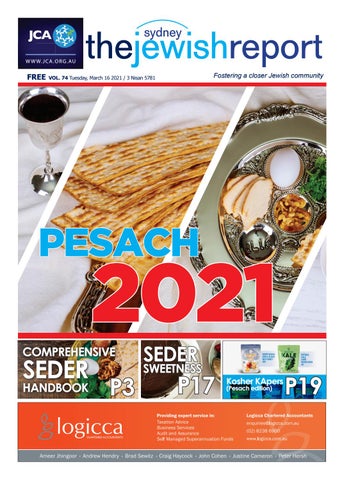
PESACH
2021
COMPREHENSIVE
SEDER
HANDBOOK
P3
SEDER
SWEETNESS
P17
Kosher KApers (Pesach edition)
P19
2 ARO UND
the sydney jewish report | march 2021
T H E
COMMUNITY
Constant companions MONTEFIORE Help at Home by Montefiore is here to support your independence living in the community, as well as offering companionship and care to people living in residential and respite care. Throughout the past year, Help at Home has successfully adapted not only to the many additional precautions and procedures necessitated by COVID-19, but to the changing needs of its client base. Now, with increased government funding for aged care on the horizon in the wake of the Royal Commission, the service is well placed to offer clients (CDC subsidised, fee-for-service and NDIS) everything from 24/7 nursing care to specialised allied health including physiotherapy, domestic support and companionship. "Social isolation was a major factor that COVID restrictions really highlighted for older members of the community," explains General Manager Amanda Guinane, who has seen a growth in companionship visits over the past few months. Care Coordinators work closely with each client to plan their care and ensure they're paired with the same regular carers as much as possible, allowing staff to form meaningful personal connections as well as an understanding of individual needs. Increasingly, Help at Home and
Montefiore Residential Care are working closely together to support clients who are transitioning back home from a respite care stay. “We’ve had a number of success stories recently involving people who have made the most of a respite stay in Montefiore Residential Care to get their health and wellbeing back on track,” explains Amanda. “Our care coordinators will then work with the client, their family and the residential care team to set them up for a seamless transition back home, with the added support they need to continue to live independently.”
Private companions are also available to visit clients already living in residential care – providing social engagement and assistance with outings when loved ones are unable to be there. "Although clients are already in Residential Care, using a trained Help at Home companion offers peace of mind, as all staff undergo rigorous employment checks and training, including COVIDsafe practices." To find out how Help at Home can support you, ph: 1800 251 537 or visit: montefiore.org.au/home-care-services
3
the sydney jewish report | march 2021
Comprehensive Handbook to How to Run a Seder
AR OUND
T HE
COMMUNITY
RABBI BARUCH FRANKEL Seder literally means "order." The activities and mitzvot of Passover night were codified into a specific order of 15 steps. While going through the 15 steps of the Seder, we actually perform seven different mitzvot: 1. Demonstrating acts of freedom and aristocracy – e.g. sitting with a pillow cushion and reclining to our left as we eat and drink, and beginning the meal "with a dip." 2. Drinking the Four Cups of wine 3. Telling the Exodus story 4. Eating matzah 5. Eating Marror (bitter herbs) 6. Eating the Afikomen (a piece of matzah for dessert as a reminder of the Passover offering) 7. Saying Hallel (Psalms of praise). Before we go through the actual Seder, let me share with you some tips. We try to start the Seder after nightfall1, and since the Seder can be long, it is important to have everything ready ahead of time so that you can start immediately. So what do you need? Haggadah Book: The main part of the Seder is telling the story of the Exodus, so it is important to have a good translation of the Haggadah book so you can understand what you are saying. Matzah: Three matzahs should be placed on the table – either under or in front of the Seder plate. The Matzohs should be covered and separated from each other by a napkin or cloth. Make sure to have extra matzah for the special ‘sandwiches’ during the Seder. For the Seder, it is ideal to use shmurah matzah. This type of matzah has been carefully guarded against any contact with water during the reaping, grinding, kneading and baking. Seder Plate: The Seder plate should be located to the right of the leader. The plate has six designated places for the following specific items: Chazeret (a piece of romaine lettuce), a Karpas vegetable (options include potato, radish, celery or parsley), Beitzah (a hard-boiled egg), Zero'ah (a roasted bone – you can use a chicken wing), Charoset (a paste made from apples, nut and red wine), Marror (pure ground white horseradish). The items on the Seder plate are placed in a specific order. These differ between customs but one such order is as follows: Starting from the bottom, and going clockwise, the order is: Romaine lettuce, Karpas vegetable, hard-boiled egg, roasted bone, Charoset paste, and in the
center is the horseradish. Red Wine: At the Seder, each person drinks four cups of wine. It is customary not to pour your own wine, but each pours for another – as if we are royalty. It is best to use red wine, since this alludes to the blood spilled by Pharaoh, the blood as part of the Ten Plagues, and the blood the Jews put on their doorposts the nights before they left Egypt. Someone who has difficulty drinking wine can use grape juice, but try to add a little wine. Everyone should have their own wine cup and try to drink the entire cup of wine for each of the Four Cups. If it’s too difficult to drink the full cup, then drink at least a majority of the cup. As an expression of freedom, we recline to the left side while drinking the Four Cups of wine. Salt Water: Place a bowl of salt water on the table, near the Seder plate, as a reminder of the bitter tears. THE 15 STEPS OF THE SEDER As we mentioned, the Seder is organized into 15 steps. We will now go through the steps. 1. Kadesh – The Blessings Sit down to recite Kiddush over a glass of wine. This counts as the first of the Four Cups of wine. We say a special
Shehechianu blessing which covers all the various mitzvot of Seder night. Recline to your left and drink if not the full cup then at least a majority of the cup of wine. 2. Urchatz – Wash Your Hands Everyone washes their hands in the manner of washing for bread, but WITHOUT a blessing. It is customary to bring the leader of the Seder a bowl and cup so he can wash at the table. 3. Karpas – The Opening “Dip” Everyone should have a small piece of Karpas vegetable which they will dip into salt-water. Options include radish, celery, parsley or potato. This symbolises spring, as Passover is the “holiday of spring”. One should try not to eat too much (I know it’s difficult!). Before eating, a blessing is recited and this blessing will also cover the Marror eaten later. 4. Yachatz – Break the Middle Matzah The leader of the Seder breaks the middle matzah in two. The smaller piece is put back in between the other two matzahs. The larger piece is wrapped up and becomes the Afikomen to be eaten right at the end of the Seder.
Seder literally means "order." The activities and mitzvot of Passover night were codified into a specific order of 15 steps
CONTINUED ON PAGE 9
YOUR E XCLUSIVE INVITATION
Join us at M By Montefiore You’re invited to a special Information Session to discover more about Sydney’s most spectacular new seniors’ living development over lunch in the stunning M by Montefiore function space. Learn more about retirement community living and financial information including new contract options Hear about changes to the Retirement Villages Act and new regulations Tour the five-star facilities and explore the display apartments Have your questions answered by our team and a panel of residents WHEN:
April 14 & 29, May 12 & 26
TIME:
10.30am — 1.30pm, includes lunch & refreshments
WHERE:
M by Montefiore, 110 King St, Randwick
RSVP:
Essential — space is limited. Call 1800 952 229
AVAILABLE NOW – 1, 2 & 3 BEDROOM APARTMENTS FROM $1.15M TO $3.7M
or email mbymontefiore@montefiore.org.au
mbymontefiore.com.au | 1800 952 229
COMMUNITY
LIFESTYLE
LUXURY
ootnotes
Indonesia: A Relatively Safe Haven For 3,000 Jews 4
AROUND
T H E
COMMUNITY
the sydney jewish report | march 2021 By Deborah Katz
Indonesia: A Relatively Safe Haven For 3,000 Jews
zens) – had not been interned, Wohlthat was appalled On August 15, 1945, the Japanese surrendered. and applied pressure on the Japanese government to Two days later, pressure from Indonesian radical and be harsher. political groups led Achmed Sukarno and Mohammad “In September 1943, all Jewish women and their Hatta to proclaim Indonesia’s independence. A fourchildren were ordered to meet at a police station on and-a-half-year battle followed between the Indonethe following day at 10:00 am. When we arrived, we sian militant nationalists and the Dutch who tried were ordered to return the next day unsuccessfully to reclaim their coltch East Indies – an archipelago with our house keys and all our ony. outside under the boiling hot sun for the DEBORAH KATZ and two money 8 islands – was inhabited by ap- valuables, including March to September whole “From day without receiving any food or 1945, water. we returned to our dormitories, Jews, some Dutch, others Iraqi (or suitcases each that we could carry. we After were in Adek Prison with apSeventy-nine years ago this week – on the culprit remained outside. In the middle day, we– were herded onto were called). Their numbers grew The next proximately 2,000 Dutch, European, May 10, 1940 Germany invaded the of the night we heard her piercing cry.” Netherlands. tryingstation, to defendand their taken toWhile a train e to an influx of refugees from Na- trucks, andAugust Baghdadis. the moment a On 15, 1945,From the Japanese country from the Nazis, the Dutch were surrendered. Two days later, pressure from placed onworried trains that had blackedes. Japanese or Indonesian soldier was also about their colonies in the Indonesian radical and political groups led Pacific – then called the Dutch East Indies, s. Thea Riesel, who spent the war out windows. spotted by us, we had to bow very low Achmed Sukarno and Mohammad Hatta today called Indonesia – which were “From September 1943 to March h East Indies recently spoke with avoid eye contact; otherwise we to and proclaim Indonesia’s independence. being invaded by the Imperial Japanese A would fourand-bea-half-year followed my mother and I were in “I am an only child who was born 1944,Army. severely battle punished. between the Indonesian militant In 1921, the Dutch When East Indies an Prison. we –ar” she began. “My father, Heinrich Tanah-Tinggi “On and August 22, 1945, everyone nationalists the Dutch who tried archipelago consisting of 17,508 islands were greeted by British ncy for hardware goods and stain- rived,– we felt perplexed. There was no roll call unsuccessfully to reclaim their colony. was inhabited by approximately “From March to September 1945, we 2,000 Jews,were some well-dressed Dutch, others Iraqi (or who and e went to work in Sumatra, Indo- women and many rumors circulated, one were in Adek Prison with approximately “Baghdadi” as they were called). Their make-up. This was done to couldn’t return to Vienna because wearing of which was that we did not have 2,000 Dutch, European, and Baghdadis. numbers grew in 1941 to 3,000 due to an into thinking thatoccupied life in , so he stayed in Sumatra until the deceive to bow longer. Two days infl us ux of refugees from NaziFrom the deeply moment any a Japanese or Indonesian wascamp spotted byordered us, prisonterritories. was fine. Jews were separated later thesoldier whole was to One woman, Mrs. Thea Riesel, who spent we had to bow very lowand avoid eye other British, Ameriarried my mother, Ernestyna (nee from the assemble in the courtyard of the priswar Dutch, years in The Dutch East Indies contact; otherwise we would be severely recently spoke with civilians. The Jewish Press. “I Australian 34 we fulfilled my parent’s life-long can, and on. On the stage in front of us stood punished. am an only child who was born in Vienna “On August 22, an 1945, everyone felt “We slept on a row of woodng to Palestine. After struggling to a Japanese, Indonesian, and our in 1924,” she began. “My father, Heinrich perplexed. There was no roll call and en planks against a wall with 100 h, my parents decided to return to forewoman. Frankel, had an agency for hardware many rumors circulated, one of which was goods stainless steel cutlery. He went inandeach dormitory. Each a, in 1939 where my father found women After the Japanese soldier that we did not have to bow deeply any spoke, to work in Sumatra, Indonesia, in 1911 and longer. Two days later the whole camp person was entitled to a space of 55 welry shop. Six months later, when the Indonesian translated his speech couldn’t return to Vienna because World was ordered to assemble in the courtyard War I started, so he stayed in Sumatra until women had brought matmy family moved to Batavia [now cm. Some into Malay and our forewoman transof the prison. On the stage in front of us the end of the war. tresses “In with them. Mattresses wider lated it into an Dutch. Theand forewoman stood a Japanese, Indonesian, our 1921, he married my mother, forewoman. cm had have the fiinlling a surprise attack on the United than 55 told us to remain very calm and not Ernestyna (neetoPordes)…and 1934 rewe at Thea 10:00 am. Whenand we arrived, we were After the Japanese soldier spoke, the Riesel her parents. fulfi lled my parent’s life-long dream by r 7, 1941, leading the Dutch gov- moved and made into a mattress for ordered to return the next day with our Indonesian show any emotion to the news she translated his speech into immigrating to Palestine. After struggling to house keys and all our valuables, including whoa did not have one.” London to declare war on Japan those earn was about to tell us: ‘A great loss had Malay and our forewoman translated it into living, though, my parents decided money and two suitcases each that we to return to Surabaya, Indonesia, in 1939 Dutch. The forewoman told us to remain Due to a dearth of food, dirty drinking month later, on January 10, 1942, been suffered couldwater, carry. Theand next day, we were herded by the Japanese who have now had to where my father found employment in a very calm and not show any emotion to onto trucks, taken to a surrender.’ train station, and heat, many became malnourished and sufed the Dutch East Indies, taking intense There was not a sound from anyone. jewelry shop. Six months later, when I was the news she was about to tell us: ‘A great placed on trains that had blackedout from dysentery, and other ailments. y’s natural resources: coffee, tea, fered 15 yearsmalaria, old, my family moved to Batavia “The forewoman continued, ‘Because the surrender loss had been suffered by the Japanese windows. [now Jakarta].” who have now had to surrender.’ “From March 1944 to March 1945,“From we were in, and oil. was sudden, the Japanese have agreed toThere look after September 1943 to March 1944, Japan launched a surprise attack on was not a sound from anyone. my mother and I were in Tanah-Tinggi Tangerang Prison Camp s made the Japanese virtually ternedtheinUnited us in the camp until the Allied forces come to relieve States on December 7, 1941, with Baghdadis “The forewoman continued, ‘Because When we arrived, we were greeted leading the Dutch governmentin-exile Prison.from who had been transferred Surahe dominant power in the Pacific. and Europeans them.’ She also reported that Indonesians were gothe surrender was the sudden, the Japanese in London to declare war on Japan the by British women who were well-dressed have agreed to look after us in the baya. This was to independence against the Dutch. shipped to fidone ght for following day. A month later, on January and wearing make-up. ing us into thinking that life in prison camp until the Allied forces come to 10, 1942, the Japanese invaded the Dutch “We sleptdeceive on two-tiered als and “When we returned to our dormitories, someone sugwas fi ne. Jews were separated from other relieve them.’ She also reported that East Indies, taking control ofbunk the colony’s beds with women tion and gested that we sing the Dutchwere anthem. HungarDutch,24 British, American, and Australian the Indonesians going We to fi had ght for From the moment a Japanese or coffee, tea, coconut, natural resources: civilians. independence against the Dutch. in a room. Our food consists were ians in our group, so one of them suggested that they tin, rubber, and oil. “We slept on a row of wooden planks “When we returned to our dormitories, These resources made the Japanese ed of rice with weevils and do the same. After they began singing, they became so hout the Indonesian soldier was spotted by us, virtually self-suffi cient and the dominant against a wall with 100 women in each someone suggested that we sing the Dutch a type of coffee, which was dormitory. Each personemotional was entitledthat to they couldn’t nish their anthem. anthem. We hadfiHungarians in our group, power in the Pacific. Since the Japanese a space of 55 cm. Some women had so one of them suggested that they these raw materials and food actually burned corn. There 130,000 “In September 1945, we were liberated bydo the Britwe had to bow veryshipped low and abroad, starvation and material shortages brought mattresses with them. Mattresses the same. After they began singing, they was no real coffee or tea betralian, ish but remained interned. The Indonesians wider than 55 cm had to have the fi lling became so emotional that they couldn’t firose up were widespread throughout the colony. removed and had made into a mattress avoid eye contact; otherwise we 130,000 Dutch, cause British, the Japanese iving in and fought for ferociously against Dutch1945, colonists. Approximately, nish their anthem. “Inthe September we who did not have one.” Australian, and U.S. citizensburned living in the were liberated by the British but remained all those the coffee and nterned “In central Java, there was a women’s prison proDue to a dearth of food, dirty drinking colonies were interned by the Japanese. interned. The Indonesians rose up and would be severely punished. tea plantations. tected by only a few Japanese guards. One day, they water, and intense heat, many became “In early 1943 my father was interned in fought ferociously against the Dutch and a suffered a camp. Mother and I rented a“Someone room in malnourished had bought y father were suddenly informed that a group of Indonesians colonists. from malaria, dysentery, and other Jakarta.” “In central Java, there The was awomen women’sbecame violin into the camp and, as a camp. were on their way to attack them. Hastily-converted warehouses, ailments. prison protected by only a few Japanese “From March 1944 to March 1945, we a musician, I was permitted practice one hour every frightened and didn’t know what to do. The Japanese d a room in Jakarta.” universities, army barracks, to churches, Tangerang Prison Camp guards. One day, they were suddenly hospitals, prisons,while schools,we andhad blocks of were internedmin a short a cultured Japanese d warehouses, universities, army day. For soldiers commanded them to immediately put on their with Baghdadis and Europeans who had informed that a group of Indonesians houses throughout the archipelago were onas their waycould, to attack them. The loudly who Areas oversaw us. off Hewith made me perform , hospitals, prisons, schools, and commander clogs, stamp hard they and shout been transferred from Surabaya. “We sleptas were used as camps. were sealed women became frightened and didn’t on two-tiered bunk beds with 24 women barbed interned wire and plaited bambooinwalls. musicians an amateur concert in a deep voice behind the prison walls. hroughout the archipelago were with other in a room. Our food consisted of rice with know what to do. The Japanese soldiers Men and women were separated. eas were sealed off with barbed for him. “When the Indonesians approached, they thought In 1942-1943 Jewish male prisoners, weevils and a type of coffee, which was commanded them to immediately put on actuallyvegetable burned corn. There no was real atheir clogs, stampofasmen hard behind as they could, “Intogether the front of the Asian, prison we Dutch, had a small mboo walls. Men and women were that was there whole army in the priswith 260,000 British, coffee or tea because the Japanese had and shout loudly in a deep voice behind Australian, and U.S. prisoners of war were patch that we attended to. We were forbidden to eat on and ran away.” transported under inhumane conditions to burned all the coffee and tea plantations. the prison walls. “When the Indonesians the produce. wish male prisoners, together with any ofBurma 27, 1949they the Netherlands formally “Someone had bought a On violin December into the approached, and Thailand to construct a railway thought that there was From the moment camp and, as a musician, I was permitted through the jungle known as the Burma a wholeindependence army of men behind in the prison “The prison was surrounded by a high fence, but accepted Indonesia’s tish, Dutch, Australian, and U.S. and withdrew. to practice one hour every day. For a and ran away.” Railway. a Japanese at the back of the prison was a section where inmates ere transported under inhumane or Approximately 30,000 Europeans died in IndoneDuring construction, 12,621 prisoners short while we had a cultured Japanese On December 27, 1949 the Netherlands commander who oversaw us. He made traded items for food with local Indonesians on the sia in Japaneseformally a and Thailand to construct a rail-was died. In mid-1943, Dr. Helmuth Wohlthat, internment camps, and an additional Indonesian soldier accepted Indonesia’s me perform with other interned musicians Hitler’s economic adviser, together with independence died and withdrew. outside. This activity was illegal. One day a lady was ngle knownspotted as the Burma Railway. four million Indonesians during the Japanese by us, we had a German delegation arrived in Java to in an amateur concert for him. Approximately 30,000 Europeans died in caught smuggling food into the camp. were all punn, 12,621 prisoners died. occupation. the front of the prison we had a small coordinate economic cooperation with We“In Indonesia in Japanese internment camps, to bow very low and vegetable patch that we attended We war, Thea Riesel moved to Holland Japanese. Upon discovering that under by being made to stand outside the boiling . Helmuth Wohlthat, Hitler’s eco- ished the After to.the and an additional four million Indonesians Jews – as Jews (as opposed to Jews who were forbidden to eat any of the produce. eye contact; during the Japanese occupation. for the whole day without receiving any food or ther with aavoid German delegation ar- hot sun while her parents in Indonesia. In the early “The prison was surrounded by a high diedremained happened to be Dutch citizens) – had not After the war, Thea Riesel moved to joined fence,the but culprit at the back 1950s, of the prison was been interned, Wohlthattowas appalled water. After we returned our dormitories, rdinate economic cooperation with she moved to Australia, and her parents otherwise we would Holland while her parents remained in a section where inmates traded items for and applied pressure on middle the Japanese outside. In the of the night we heard n discovering that Jews – as Jews remained herononce she was settled. has ashedaughter, twin Indonesia. In theShe early 1950s, moved to food with local Indonesians the outside. government to be harsher. be severely punished. cry.” Australia, and her parents joined her once s who happened to be Dutch citi- her piercing sons, and eight grandchildren. “In September 1943, all Jewish women This activity was illegal. One day a lady was
ars ago this week – on May 10, vaded the Netherlands. While trycountry from the Nazis, the Dutch about their colonies in the Pacific utch East Indies, today called Inre being invaded by the Imperial
es
and their children were ordered to meet at a police station on the following day
from
BICYCLE SAFETY
caught smuggling food into the camp. We were all punished by being made to stand
she was settled. She has a daughter, twin sons, and eight grandchildren.
◗ Carefully look both ways before entering a street.
1
$ 65 ea
2
$
50 ea
3
$
50 ea
SAVE 20¢
SAVE 90¢
SAVE $1.40
Nerzion Memorial Candle Tin 80g 31¢ per 100g
Eskal Cucumbers Dill 540g 46¢ per 100g
Jerusalem Matzo Meal Coarse 375g 65¢ per 100g
6
$
90 ea
8
$
9
$ ea
50 ea
SAVE 60¢
SAVE $1
SAVE $3
Jerusalem Organic Spelt Matzos 454g $1.28 per 100g
Kedem Concord Grape Juice 946ml $1.48 per 100ml
Eskal Gefilte Fish 570g $1.76 per 100g
Available at Woolworths Bondi Junction, Double Bay, Eastgardens, Neutral Bay, Northbridge and St Ives.^
On sale from Wednesday 3rd March until Tuesday 30th March 2021 unless sold out earlier at Woolworths Bondi Junction, Double Bay, Eastgardens, Neutral Bay, Northbridge and St Ives. Limits per customer may apply, trade not supplied. Specials are not available at Woolworths Online, Metro or at Caltex Woolworths co-branded fuel outlets. Woolworths Supermarkets: 1 Woolworths Way, Bella Vista, NSW 2153. ^Products and specials may not be available in all stores.
6
the sydney jewish report | march 2021
ARO UND
T H E
COMMUNITY
Include Israel Through UIA at Your Pesach Table This Year UIA The United Israel Appeal’s programs have proven for over 100 years to be effective in meeting the challenges and national priorities of Israel. Keren Hayesod-UIA’s ability to evolve and respond to the challenges the People of Israel are facing during this global crisis has sharpened the focus on constantly transforming our programs,
and collaborating even more closely with our global UIA family. Your unwavering support is even more relevant today in order to strengthen Israel’s most vulnerable People. There is continued motivation to make Aliyah due to the global pandemic and growing anti-Semitism. The Aliyah process currently requires even more intensive care and funding during this challenging time, particularly due to the quarantine process. The cost of each Oleh has increased significantly due to the increase in the price of flights and required quarantine period. However, UIA is committed more than ever to helping every Jew come home without delay, and has continued to support thousands of new Olim with Aliyah preparation, flights, 14-day quarantine accommodation and Absorption Centre costs in Israel. Many vulnerable people continue to live on Israel’s periphery, facing challenges which have intensified due to the pandemic and its economic, social and health impacts. UIA’s programs and vital support have continued regardless, ensuring them a brighter future. These programs include Youth Futures - which helps at-risk children bridge educational, social and cultural gaps; Net@ - which advances
the technological skills of youth at risk living on the periphery and Young Communities - where idealistic young people serve as volunteer agents of social change and strengthen Israel’s underdeveloped areas. When we reflect on the connection between Pesach and UIA, we draw reference to the miracle of triumph. With motivation, determination and the community’s continued support, nothing stands in the way of ensuring that every Jewish person can fulfil their potential and feel empowered. This is the essence of UIA’s vital work in ensuring that the most vulnerable are supported by providing the necessary tools to succeed. We invite you to join our journey and include the People of Israel at your seder table by considering a donation to UIA in lieu of gifts. Through your contribution, you are enabling those less fortunate to have the opportunities and assistance they need, particularly during this challenging time. Your support is For the People of Israel! To help support the People of Israel by considering a donation to UIA in lieu of gifts, please contact UIA on 9361 4273, info@uiansw.org.au or visit uiaaustralia. org.au
Giving Philanthropists the Chance to Give More RABBI DR. BENJI LEVY AND MICHAEL BLOCH
Israel has one of the highest numbers of nonprofits per capita in the world, active in every sphere of society. However, the landscape in this sector has changed dramatically in recent times. The coronavirus pandemic has exacerbated a multitude of social and economic challenges, created new ones and left the future feeling more uncertain for so many. Just one year ago, Leket, an Israeli food collection and redistribution organization, fed 175,000 Israelis per week. Since the onset of the pandemic, that number has skyrocketed to 246,000 people a week, with thousands who have never stood in line to receive handouts before forced to turn to soup kitchens in order to feed their families. Latet, another important organization in this space, has seen a similar surge in demand in line with its recent Alternative Poverty Report, which revealed that 268,000 more households in Israel are now living beneath the poverty line. The pressure to deliver on these essentials is acute, highlighting the need for them to rethink and scale their strategy and operations accordingly. Many philanthropists are particularly conscious of these shifts and have
stepped up to help, with donations increasing dramatically and many even coming unsolicited. However, the philanthropic world has also experienced fundamental permutations in recent years. One of these is the growing focus on transparency and agency. Now more than ever, donors are keen to understand exactly where their dollars are going on a granular level and ensure that their donations are making what they perceive as a real impact on the causes they care deeply about. While philanthropists want to give and organizations want to strive, it is the business world that by and large generates the most efficient and effective processes for maximum gains. This got us thinking: how can we ensure that philanthropic investments can help scale-up nonprofits to increase their impact and social return in the same way that financial investments do? After using our expertise to advise philanthropists and nonprofits, we saw this opportunity first-hand and realized that there was a great need to build bridges to allow both sides to learn from one another. It was in the context of these pressing challenges and potential development opportunities that we founded Israel Impact Partners. One of us began in Europe
and brings over two decades of experience working at McKinsey & Company (one of the top global management consulting firms), advising senior executives and boards of large corporations, the other from Australia with experience of leading large Jewish organisations, such as Moriah College (one of the largest Jewish schools in the world) and Mosaic United (a historic partnership between the State of Israel and global philanthropists), and we converged in Israel. Our complementary experience allows us to help link these worlds, partnering with leaders and bold thinkers to optimize and grow the initiatives that matter most to them. There is no reason in our minds why more nonprofits shouldn’t develop best-practice approaches to strategy, growth, financial models, business processes, fundraising, social media and the many other needs of any great organization today. Israel’s nonprofit sector has much to gain from looking at the example of how hi-tech start-ups, which began with a big idea but little means, succeeded in growing into international powerhouses in their respective fields. We believe that with the support of philanthropists, many more of Israel’s nonprofits can continue to improve, reaching their potential and enabling Israel to
develop a leading model of social innovation for the rest of the world. It is no secret that successful businesses make considerable investment in the strategies and people required to produce the profit margins, revenues and client satisfaction that differentiate between success and failure. Applying this mindset to the partnership between philanthropists and nonprofits is instrumental in breeding the same success. The stakes, however, are arguably higher. The gap between success and failure goes beyond the balance sheet. It can mean the difference between a family having food on the table, a young couple taking control of their financial destiny and a disadvantaged child getting a world-class education. Israel Impact Partners is working to build bridges and forge a new path to allow more donors and lay leaders the opportunity to support a stronger and more sustainable society for Israel and beyond. Michael Bloch is a former Senior Partner at McKinsey & Company and Rabbi Dr. Benji Levy was the previous CEO of Mosaic United. Together they founded Israel Impact Partners. For more information see www.IsraelImpact.com
7
the sydney jewish report | march 2021
How Biden will end the Trump sugar high for Israel and Saudi Arabia AARON DAVID MILLER & RICHARD SOKOLSKY Elections have consequences. And nowhere are the consequences of Joe Biden’s election more worrisome than in Jerusalem and Riyadh. In the past week, the president has signaled to Israeli Prime Minister Benjamin Netanyahu and Saudi Crown Prince Mohammed bin Salman—the region’s two biggest egos—that the sugar high of the Trump years is over. Biden isn’t interested in fundamentally altering these relationships. But he is looking to rebalance the Israeli and Saudi accounts, restore Israeli and Saudi respect for U.S. interests absent during the Trump years, and signal to Bibi and MBS—who are now wondering where they stand among Biden’s priorities—that they are no longer the center of America’s world and should think very carefully before they take actions to undermine U.S. interests. Biden isn’t looking for a fight. And whether he takes tougher actions against Israel and Saudi Arabia will depend on whether they willfully ignore or undermine U.S. interests in creating greater security and stability in the region. It’s still stunning to reflect on the fact that Trump’s initial stops on his first foreign trip as president in May 2017 were to Saudi Arabia and Israel. From that point on, Trump’s presidency was a gift that just kept on giving. Never in the history of U.S. relations with either country has so much been given with so little asked for in return—and with so much bad behavior swept under the rug. Without making Israel earn U.S. favors with any concessions of its own, the Trump
administration orchestrated a campaign of maximum pressure on Iran; declared Jerusalem Israel’s capital and opened an embassy there; turned a blind eye to Israel’s settlement expansion; recognized Israeli sovereignty over the Golan Heights; promulgated a peace plan that all but conceded 30 percent of the West Bank to Israel before negotiations with Palestinians had even begun; downgraded U.S. diplomatic relations with the Palestinian Authority; drastically curtailed U.S. assistance to the Palestinian people; and perhaps most significantly, made a major effort to facilitate normalization between Israel, the Gulf states and other Arab countries. The Saudis also got in on the action. The Trump administration gave a blank check to Riyadh to pursue its disastrous military campaign in Yemen and aided and abetted it with U.S. military assistance for Saudi operations; acquiesced in MBS’s repression at home and covered up his role in the murder of journalist Jamal Khashoggi; and lavished arms sales on the Saudis over Congress’ objections. If Trump made Israel and Saudi Arabia top foreign policy priorities, Biden seems intent on downgrading their importance. Much has been made of the nearly one month delay in Biden calling Netanyahu; Trump’s third call was to Netanyahu, and former President Obama reached out to then-Prime Minister Ehud Olmert on day one. One delayed call does not a relationship make or break. But Biden was sending a message nonetheless: I’m busy with domestic recovery and the Middle East is not a top priority, he was saying. I’m pro-Israeli, but not necessarily a pro-Netanyahu president. Biden has also set out to put some
I SR AE L
NEWS
distance between the U.S. and Saudi Arabia. Candidate Biden issued some very strong words about the Kingdom on the campaign trail, describing it as a pariah nation on human rights and promising to end U.S. support for its catastrophic campaign in Yemen. Days after Biden’s inauguration, the administration declared an end to American support for Saudi operations in Yemen and pledged to review current arms sales to Riyadh. And in an unmistakable sign of displeasure with the reckless and ruthless Crown Prince, White House press spokesperson Jen Psaki spoke of “recalibrating” U.S. relations with Saudi Arabia and indicated Biden will be speaking with his counterpart King Salman not MBS. Biden is sending an unmistakable message: We can still be friends but it has to be with more benefits for the United States. Given my focus on domestic and other foreign policy priorities, I may not have a great deal of time to focus on your problems; don’t make it harder for the United States in the region or things between us will get complicated. Biden’s early warning signals to Israel and Saudi Arabia don’t necessarily mean he is seriously prepared to make significant changes in either of these relationships. If the president, provoked by troublesome behavior by Jerusalem and Riyadh, decided to fundamentally alter rather than adjust these relationships, he would need to be far more assertive and bold. With Israel, the reset would likely focus on injecting real accountability for actions Israel Originally published: Politico.com CONTINUED ON PAGE 8
After years of getting everything they wanted, the Middle East’s biggest egos will have to learn to do with less as the new president focuses on crises at home.
8 AROUND
the sydney jewish report | march 2021
T H E
COMMUNITY
What makes COA’s volunteer program unique is that your passion is COA’s passion. Volunteers go to COA to share their culture, skills, and passions with the wider community.
What can you bring to the Community? COA SYDNEY Retirement is an amazing time, a time to explore options; all those things we have put off till another day, whether that’s learning a skill, finding a peer group, or just playing bridge with friends. In fact, did you know the NSW Seniors Card is available for anyone over age 60? There’s even an app for it, listing lots of opportunities and discounts. Another bonus is the annual NSW Seniors Festival, celebrating being a senior, with hundreds of organisations providing opportunities to entertain and educate retirees across the state, including COA Sydney’s annual Harbour Cruise. But what is the secret to a happy retirement? After working so hard your whole life you deserve to spend your kids’ inheritance on fancy holidays and shopping splurges, but will that really give your life meaning? When Sydney’s Jewish seniors go to COA the veil is lifted, as they seize opportunities to engage with peers in hobbies, participate in further education, or revel in the sheer fun of dancing with abandon. And for recent retirees not looking for entertainment there are opportunities to give back to the community through a myriad of volunteer roles, utilizing a retiree’s life lessons and personal passions to provide comfort, inspiration, and new skills to others. Before you know
it, these individuals have become part of the COA family of friends, supporting their peers, showing compassion to one another, sharing personal stories, and finding that we are all so different, yet when it comes to retirement we have the same wants and needs, we are human, and we crave a community of peers and a meaningful life. What makes COA’s volunteer program unique is that your passion is COA’s passion. Volunteers go to COA to share their culture, skills, and passions
with the wider community. Whether you love to make mosaics or jewelry, enjoy cooking, or love walking the myriad beaches of Sydney – any and all of these loves are accommodated by COA Sydney. So if you have free time in retirement, turn your enthusiasm into the energy shaping your local community by sharing your skills and passions with COA Sydney and its hundreds of very active local seniors. Contact COA Sydney’s energetic Volunteer Manager Robbie Clifford today at 9389 0035 or r.clifford@coasydney.org
Granddaughter of a Slave and Daughter of a Refugee ZOË DAVIS
Associate Professor Dr Lilon Bandler, is the Principal Research Fellow for the Leaders in Indigenous Medical Education Network, the chair of the National Patient Blood Management Advisory Committee, a Board member of the Far West Local Health District, and a GP with the Royal Flying Doctor Service. She was also the guest speaker at Mandelbaum House’s first Formal Dinner for 2021. Despite her incredible list of
accomplishments, Lilon is very modest, crediting her ascent to the rank of Associate Professor to "luck" and the support of faculty colleagues. She emphasises the impact her parents had on her, noting their stories with pride. Her mother, Faith Bandler, was a well-known activist pivotal in the Australian civil rights movement. She was also the daughter of Wacvie Mussingkon, who was taken from Vanuatu and brought to Australia as a slave. Lilon acknowledges this when she introduces herself as the granddaughter of a slave and the daughter of a refugee. Lilon's father, Hans Bandler, was born in Vienna in 1914. A Jewish man and proud political activist, he was taken to the concentration camp at Dachau in 1938 and was later moved to Buchenwald. His Aunt paid a costly bribe to obtain travel papers for his release. Although he never spoke of his time in those camps, Lilon understood from a young age that it was not something to be asked about. "It shaped how he thought about the world", she tells us. Hans journeyed to Australia by boat, carrying with him a German typewriter and a ring which Lilon wears to this day. Hans also carried with him his education, something that was of great importance to him. “He understood that education could
change his life", Lilon explained. When asked how she decided to pursue medicine, Lilon tells us that growing up in her household, to "be of service and to help people was important". She also notes that it was not a quick decision, beginning her medical studies at 25. Now she is completing a PhD, researching student support with a particular focus on Aboriginal, Torres Strait Islander and Mori people. Lilon's academic journey has not exactly followed the standard linear progression that one may expect of someone so advanced in her field, and she emphasises to us that one's educational journey never truly ends. Since beginning medicine she has "never been bored" and loves working with patients across Australia. As young people who are all currently pursuing our own academic paths, it was inspiring to hear how education can be followed in different ways, and how it can be used to better the world around us. After a night of fine dining, fancy dress and an incredible talk from guest speaker Lilon Bandler, the residents of Mandelbaum House left the first Formal Dinner of 2021 feeling entertained, gratified and inspired. We thank Lilon for taking the time to speak with us and look forward to the next opportunity for another night as enjoyable as this.
9
the sydney jewish report | march 2021
A year of Pandemic at Jerusalem’s Hospital with a Heart
AR OUND
T HE
COMMUNITY
MIRIAM PACANOWSKI It has been over a year since the Covid 19 pandemic changed our world as we know it. For Shaare Zedek, Jerusalem’s most central major hospital, the changes have been all encompassing and critical. The hospital recently released its figures for 2020 and they are confronting. Shaare Zedek Medical Center treated 3,432 Corona Patients across its specially designated Keter wards which it opened at the beginning of the pandemic in Israel. The hospital provided 69,316 Corona Hospitalization Days and 1,225,284 hours of Assisted Respiration in the Corona Wards. The pandemic affected every aspect of the hospital’s operations. The focus on the pandemic caused a temporary reduction of services in some areas of the hospital as a result of governmentimposed departmental closures. There was also an overall reduction in patients due to lockdowns and other factors outside of the hospital’s control. There will be long lasting medical effects from the pandemic which will potentially affect many areas of human health in years to come. Nevertheless, Shaare Zedek continued to offer important medical services to the citizens of Jerusalem and surrounds. During 2020, Shaare Zedek conducted 34,944 surgeries, and provided 846,017 outpatient visits. There were 138,043 emergency department cases, 2,310 cardiac procedures and 1,325 neurological procedures. This was despite the fact that many people delayed coming to hospital because of the fear of catching the virus.
With 1000 beds across 2 campuses, Shaare Zedek provided 406,936 hospitalization days and 262,289 imaging scans in its cutting edge medical imaging departments. Shaare Zedek is one of the busiest maternity hospitals in the Western World, and in 2020 there were 22,150 babies babies born at the hospital, sometimes to Covid affected women. One of these was Bat El Ben-Chamo, who tested positive for Corona, just prior to giving birth to her new born son last month. She stood behind the glass partition of of the Corona Nursery at Shaare Zedek, at a safe distance and lovingly looked at her son. Bat El said “While I know I have the option to the baby and hug him, I’m scared that I could infect him and he’s just so small…
In a couple of days. I’ll be confirmed as recovered and then I’ll have the chance to be with him.” Dr Allan Garfield, Chairman of the Australian Friends of Shaare Zedek Inc. says, “Shaare Zedek Medical Center has played a critical role in the response to the Covid 19 pandemic and continues to be at the forefront of new discoveries relating to the ongoing effects of the virus. “The effect of vaccinations is now changing the trajectory of the pandemic in Israel and Shaare Zedek will provide crucial information and studies that will impact our health and that of Jerusalem’s citizens for years to come.” www.shaarezedek.org.au
“The effect of vaccinations is now changing the trajectory of the pandemic in Israel and Shaare Zedek will provide crucial information and studies that will impact our health and that of Jerusalem’s citizens for years to come.”
Comprehensive Handbook ... FROM PAGE 3 5. Maggid – Recounting the Exodus Story Refer to your Haggadah book for a full list of what is customarily recited at this point. This is a list of titles to some of the popular highlights (refer to your Haggadah book for their full text). • Ha Lachma Anya – This is the Bread of Affliction Uncover the three Matzahs and raise them for all to see whilst reciting the paragraph. Then cover the three Matzahs and pour the Second Cup of wine. • The Four Questions - It is customary for the youngest person at the Seder to recite the Four Questions. • Avadim Hayeenu – We Were Slaves. Uncover the three Matzahs before reciting this. • Vi-Hee She-Amda – God Redeemed Us. As an expression of joy, cover the three Matzahs and raise your wine glass while reciting this. Then uncover the three Matzahs and leave them uncovered for the duration of the Exodus story. • Ten Plagues - Dip your "pointer finger" in the wine and spill a total of drops – three for "blood, fire and pillars of smoke," ten for the plagues, and another three for the three-word mnemonic “detzach, adash, be-achav”. Every time one of these are mentioned, spill a drop. This reminds us that our cup of joy is not complete because people had to die for our salvation. After all the drops have been spilled, the cup should be refilled. • Dayeinu – It Would Have Been Enough. It is customary to sing the Dayeinu paragraph responsively. • Pesach, Matzah, Marror – The Pascal Offering, Matzah, Bitter Herbs. Recite the paragraphs corresponding to the Pascal offering, Matza and Marror (bitter herbs). When you reach the Matzah paragraph, lift the Matzahs as you recite it. When you reach the Marror paragraph, point to the Marror on the Seder plate as you recite it.
• Lifikach and the Second Cup – Therefore We Give Praise . Cover the matzahs, raise the cup of wine, and recite the paragraphs of joy aloud and joyfully. Keep the cup raised and make a blessing on the wine drink at least a majority of the cup without interruption and don't forget to recline to the left. 6. Rachtza – Wash Your Hands. Wash your hands in the same manner as you did earlier at Urchatz, but this time recite the blessing usually recited when washing for bread. It is customary to bring the leader of the Seder a bowl and cup so he can wash at the table. From this point onward, we try not to talk until we have eaten the matzah. If you can, try not to get involved in any side-talk until after you've finished eating the Marror (bitter herbs) and the Korech sandwich (steps 7-9). 7. Motzi – Making the First Blessing on the Matzah. The leader lifts all three Matzos from the Seder plate and recites the Hamotzi blessing. 8. Matzah - Making the Second Blessing and Eating the Matzah Aside for the regular Hamotzi blessing on bread, we recite a second blessing over matzah.21 You may remember that on Shabbat we dip the Challah bread into salt. However, at the Seder we do not dip the matzah in salt, so that we can taste the matzah entirely by itself. Make sure that everyone receives enough matzah. Each person should eat roughly two thirds of a square matzah, or one half of the hand-made round matzah. Since there is probably not enough to give everyone the full amount from the leaders matzahs, give everyone at least a small piece of both these, supplementing it with other matzah. Recline to your left and eat the Matzah without speaking and interruption. 9. Marror – Bitter Herbs You can use either pure horseradish (not "red horseradish" which is actually a mixture of
beets and horseradish), or Romaine lettuce or a mixture of both. If horseradish is used, take 2 heaped tablespoonsful, if Romaine lettuce is used, take a couple of large leaves. Dip the Marror into the Charoset as an "antiseptic" to dilute the harsh effects of the Marror. Recite the blessing, which also relates to the Marror that what will be eaten in the "Korech- sandwich" coming up next. Eat the Marror without interruption. You DO NOT recline while eating the Marror. 10. Korech – Sandwich (of Matzah and Marror) Take the bottom matzah (from the original three) and make a sandwich with the Marror. For this use smaller amounts. Take one-third of a square matzah, or onefourth of a round matzah, and one leaf of Romaine lettuce, or one heaped tablespoon of horseradish. Dip the sandwich into the Charoset. There is no blessing. Recline to your left and eat the sandwich without interruption. Say the paragraph of "Remembrance of the Temple." 11. Shulchan Orech – The Meal What everyone has been waiting for, the festive Passover meal! We don’t serve roasted meat, to distinguish our meal from that of Temple times when the "Pascal lamb" was eaten roasted. It is traditional to begin the meal with an egg, which symbolizes the Chagigah (Festival) offering which was offered in the Temple. I know this may sound crazy, but for some families the Seder can last till 2 or 3 am. The actual meal should preferably end before midnight, in order to eat the Afikomen by that time. Eat away but make sure to leave some room for our special Seder deser 12. Tzafon – The Afikomen Desert For dessert, in case you haven’t had enough yet, we serve Matzah! The leader
should give everyone at least one small piece of the larger of the Matzah that was broken in Step 4 and make up the remainder from other matzahs. Give each person roughly two thirds of a square matzah, or one half of a hand-made round matzah. If by this point it’s too difficult for you to eat that much, then eat half that amount. The Afikomen is eaten while reclining to the left and without interruption. This should be the last thing we eat tonight (aside for the remaining two cups of wine), unless you need a drink of water. 13. Barech – Bless ("Grace After Meal") Fill each other’s wine glass for the Third Cup to drink at the conclusion of Grace. The master of the house leads, but everyone lifts their wine glass and joins in reciting "Grace". After grace, make a blessing on the Third Cup of wine and don't forget to recline to the left while drinking at least a majority of the cup. Pour the Fourth Cup and also an extra cup for Elijah the Prophet. Open the front door to the house and say Shefoch Chamascha (found in your Haggadah book). 14. Hallel – Singing Praise After closing the door, the Hallel prayers (praises of God) are recited while holding the Fourth Cup of Wine. Refer to your Haggadah book for the prayers. At the conclusion of the Hallel prayers, the Fourth Cup of wine is drunk. Recite a blessing on the wine and don’t forget to recline to the left and drink at least a majority of the cup. 15. Nirtza – The Conclusion Sing songs like “Chad Gadya” and “Who Kows One”. Refer to your Haggadah book for a full list. We finish the Seder with the declaration “Next Year in Jerusalem.” Originally published: Aish.com
10
the sydney jewish report | march 2021
IS R AE L
NEWS
Passover and the Three Phases of Life RABBI YISROEL ROLL Life is made up of three distinct phases that repeatedly occur. Knowing how these three phases work gives you a deeper understanding in how to live more meaningfully. Phase One is an exciting, euphoric, high moment which is a gift – a freebie – an undeserved handout which was unearned. Phase Two is the moment when the euphoria, high excitement and high feeling dissipates and the “high” turns to a mundane, difficult and trying time. Phase Three is the return of the high feeling, only now it is mine, deserved and earned rather than having been a handout or freebie.
Precisely at the moment when the excitement and euphoria of Phase One begins to wane is the moment to hang in there and invest more energy and effort in making it work.
Here are a few examples: Phase One: Your eyes meet across a crowded room. Instant attraction. Fireworks. Chemistry. You keep hearing the theme song of the Titanic playing as you walk down the street together. Infatuation. Courtship. Romance. Falling in Love. This phase is a freebie. It’s an unearned gift. Enjoy it! Phase Two: Commitment. Then a ring. Then marriage. Then reality sets in. Why did you leave the cap off of the toothpaste? Why didn’t you call to say that you would be late? Why can’t you be more supportive of me when I’m “down.” You don’t bring me flowers anymore. This is the trying phase – when the excitement of the courtship/honeymoon period wears off in order to give the couple the chance to work through issues and make the relationship work, through their own efforts.
It is at this point when many couples in our immediate gratification society break up. When the romance, the good times and the fun of the relationship are not “good” for me anymore – I walk. The secret is to work through the differences in our respective upbringing and think of how to “make things work.” Phase One was a gift in order to taste how good the relationship could possibly be. Then the magic is taken away – on purpose – to allow the couple to work for and earn the gift of the relationship. They work on “themselves” and the relationship and make it their own. Phase Three: The couple achieve a working modus operandi in the relationship whereby they begin to understand each other and their respective needs. The couple learns to be giving to each other rather than being “takers.” They learn to understand the way the
other person thinks and thus learn to respect one another while not necessarily agreeing with each other. The relationship begins to bond and gel. It flows. The relationship now “belongs” to the couple. They have earned the success in the relationship through hard work, each working on his or her own personality and personal self-control. It may take three, five or ten years. They recreate the feelings they experienced in Phase One, only now, the feelings are more grounded and based in reality rather than infatuation and fantasy. Precisely at the moment when the excitement and euphoria of Phase One begins to wane is the moment to hang in there and invest more energy and effort in making it work. CONTINUED ON PAGE 11
How Biden will end the Trump sugar high ... FROM ON PAGE 7
takes on the ground toward Palestinians and some conditionality with respect to U.S. assistance should Israel ignore American expectations. Biden would call for a comprehensive settlement of the Israeli-Palestinian conflict, opposing all construction beyond the 1967 lines, including east Jerusalem, as inconsistent with international law. The U.S. would not expend effort defending Israel in the U.N. and other international organizations from actions resulting from its settlement activities. And Washington would enforce its longstanding determination that no U.S. government funds could be used to support settlement activity and establish a monitoring mechanism to ensure compliance with this requirement. Biden would also make clear that any Israeli initiative designed to annex territory would result in severe consequences, including a potential cut-off of assistance or recognition of Palestinian statehood. Biden also has plenty of options to make life unpleasant for Saudi Arabia if it attempts to sabotage a new nuclear agreement with Iran. These include slapping sanctions on MBS and his hatchet men for their complicity in the killing of Khashoggi; permanently cutting contacts with MBS; making it clear that the United States will not stand in the way of others bringing the Saudis to the International Criminal Court for committing war crimes in Yemen; mounting a major campaign of public criticism of Saudi human rights abuses; halting all new arms sales to the Kingdom; withdrawing the U.S. ambassador to Saudi Arabia and treating the Saudis as diplomatic pariahs; upping public pressure on the Saudi government to cut way back on its carbon emissions; and twisting Saudi arms to open a dialogue with Tehran on regional security issues. It’s highly unlikely that Biden would move in these directions with either Israel or Saudi Arabia unless their behavior leaves him no alternative. The president’s overriding
priority is domestic recovery; he would prefer to avoid problems that might undermine progress toward that goal. Indeed, his presidency will succeed or fail based primarily on what occurs at home, not abroad, and he has much bigger foreign policy challenges in dealing with China and Russia. Israel is the tougher problem and whether he can get what he wants from the wily and ever-suspicious Netanyahu isn’t clear. Biden isn’t Obama; he’s more like Clinton, whose support for Israel was baked into his political DNA. Biden will be much harder for Netanyahu to attack. He will expect Bibi to refrain from an active campaign to undermine his diplomatic efforts with Iran, as Netanyahu did in 2015 by end running the Obama White House and making his case directly to Congress and mobilizing the Gulf Arab states against Iran. But Netanyahu is much weaker at home and in Washington than he was in 2015 and Biden is boxing him in on Iran, not with threats necessarily but, paradoxically, with kindness. By coordinating and consulting with Jerusalem, he is not giving the Israeli prime minister an easy justification to openly oppose the American approach on Iran; for example, he informed Netanyahu in advance of last week’s announcement by the U.S. and Europeans about starting negotiations with Tehran, and at every turn mentions the importance of a longer and stronger agreement to address the deficiencies in the Joint Comprehensive Plan of Action. That would include addressing extended sunset provisions in the JCPOA, as well as Israel’s concerns about Iran’s ballistic missile programs and its efforts to expand its influence in the region. If Israel cries foul, undertakes some political effort to sabotage the negotiations, or launches an unwarranted military move against Iranian assets that triggers an escalation, it will be Netanyahu who’s isolated by actions that will be seen as a blatant effort to kill the U.S. negotiating initiative. On the Israeli-Palestinian issue, Biden’s
expectations for Netanyahu are pretty low. Unlike Obama, who pressed Netanyahu on both Iran and progress toward a twostate solution with Palestinians, Biden will not make waves, knowing full well that prospects for significant progress are slim. In a nod to Netanyahu, he has praised the Abraham Accords negotiated by the Trump administration and appears willing to support the benefits the Trump administration has offered the UAE (F-35s) and Morocco (U.S. recognition of its sovereignty over Western Sahara) for concluding the agreement. Netanyahu won’t be happy with the administration’s intention to upgrade relations with the Palestinians but won’t fight it. If there is conflict, it will be over Biden’s focus on changing the situation on the ground and restoring cooperation and some measure of trust between Israelis and Palestinians. Biden will expect Netanyahu to refrain from moving ahead with major infrastructure and high profile settlement projects, on the West Bank or Jerusalem, let alone the annexation of territory. Should Netanyahu win the upcoming elections on March 23 and form a narrow right-wing government, however, the stage could be set for a major confrontation with the administration on these issues. Unless the Saudis attempt to scuttle a new nuclear agreement with Iran—or pursue other regional policies that are destabilizing and detrimental to U.S. interests—Biden’s actions will follow the path he’s already outlined. The dialogue with Saudi Arabia will be structured and disciplined, not left to presidential relatives who were given a blank check to kowtow to MBS’s reckless activities. Biden will continue to press Riyadh on human rights. And the anticipated release of the Intelligence Community’s report on MBS’s role in the murder of Saudi journalist Jamal Khashoggi will provide a focal point for the administration to press for the release of Saudi dissidents. Biden will also press Saudi Arabia to do its part in ending or at least tamping down the violence in Yemen. The administration has rightly undertaken
a review of at least two arms sales to the Kingdom. Whether it will go farther or not is unclear. But it should. For years, administrations have supplied Saudi Arabia with weapons that it wants rather than weapons it needs to address the real military threats the Kingdom faces. Helping the Saudis to improve their defenses against Iranian missile attacks on critical infrastructure and cyber and terrorist attacks is perfectly appropriate and legitimate. The same cannot be said, however, for providing weapons systems that would improve Saudi capabilities to project force beyond its borders and especially against Iran. The Kingdom does not face a credible threat of a large-scale conventional attack by Iran or any other countries in the region. The world has seen the havoc the Saudis have wreaked in Yemen with advance combat aircraft and munitions, and the Saudi military was missing in action in the battles against ISIS in Iraq and Yemen. Joe Biden is no revolutionary—at home or abroad. As a cautious moderate Democrat, he’s more interested in remodeling the house than in tearing it down. And that applies to Saudi Arabia and Israel, too. Saudi Arabia isn’t a U.S. ally; but it is an important partner— at least until the rest of the world weans itself off Arab hydrocarbons and America benefits from U.S.-Saudi cooperation on counter-terrorism. And Israel, the region’s only democracy—however imperfect—is the one state in the region that shares any real coincidence of both interests and values with the U.S., and is a subject fraught with domestic political risks for any U.S. president. After four years of one-way street relationships, Biden is right to want to inject real reciprocity and a measure of conditionality into the U.S. relationships with Israel and Saudi Arabia. He may well succeed if he simply recognizes that these two countries need America a hell of a lot more than we need them—and if he is prepared to use U.S. leverage to advance our national interests if Originally published: Aish.com
11
the sydney jewish report | march 2021
Evidence for the Exodus PROF. JOSHUA BERMAN Thanks in no small part to the Internet and the ubiquity of social media, popular exposure to the findings of biblical criticism has increased exponentially. And much of it focused on one issue: the historicity, or especially the non-historicity, of the biblical exodus. Here I’d like to offer an academic defense for the plausibility of the exodus event. The case against the historicity of the exodus is straightforward, and its essence can be stated in five words: a sustained lack of evidence. Nowhere in the written record of ancient Egypt is there any explicit mention of Hebrew or Israelite slaves, let alone a figure named Moses. There is no mention of the Nile waters turning into blood, or of any series of plagues matching those in the Bible, or of the defeat of any pharaoh on the scale suggested by the Torah’s narrative of the mass drowning of Egyptian forces at the sea. No competent scholar or archaeologist will deny these facts. Case closed, then? For those who would defend the plausibility of a historical exodus, what possible response can there be? Let’s begin with the missing evidence of the Hebrews’ existence in Egyptian records. It is true enough that these records do not contain clear and unambiguous reference to “Hebrews” or “Israelites.” But that is hardly surprising. The Egyptians referred to all of their West-Semitic slaves simply as “Asiatics,” with no distinction among groups – just as slave-holders in the New World never identified their black slaves by their specific provenance in Africa. More generally, there is a limit to what we can expect from the written record of ancient Egypt. Ninety-nine percent of the papyri produced there during the period in question have been lost, and none whatsoever has survived from the eastern Nile delta, the region where the Torah claims the Children of Israel resided. Instead, we have to rely on monumental inscriptions, which, being mainly reports to the gods about royal achievements, are far from complete or reliable as historical records. They are more akin to modern-day résumés, and just as conspicuous for their failure to note setbacks of any kind.
We’ll have reason to revisit such inscriptions later on. But now let’s consider the absence of specifically archaeological evidence of the exodus. In fact, many major events reported in various ancient writings are archaeologically invisible. The migrations of Celts in Asia Minor, Slavs into Greece, Arameans across the Levant – all described in written sources – have left no archeological trace. And this, too, is hardly surprising: archaeology focuses upon habitation and building; migrants are by definition nomadic. There is similar silence in the archaeological record with regard to many conquests whose historicity is generally accepted, and even of many large and significant battles, including those of relatively recent vintage. The AngloSaxon conquest of Britain in the 5th century, the Arab conquest of Palestine in the 7th century, even the Norman invasion of England in 1066: all have left scant if any archaeological remains. Is this because conquest is usually accompanied by destruction? Not really: the biblical books of Joshua and Judges, for instance, tell of a gradual infiltration into the land of Israel, with only a small handful of cities said to have been destroyed. And what is true of antiquity holds true for many periods in military history in which conquest has in no sense entailed automatic destruction. Actually, there is more to be said than that. Many details of the exodus story do strikingly appear to reflect the realities of late-second-millennium Egypt, the period when the exodus would most likely have taken place – and they are the sorts of details that a scribe living centuries later and inventing the story afresh would have been unlikely to know: There is rich evidence that West-Semitic populations lived in the eastern Nile delta – what the Torah calls Goshen – for most of the second millennium. Some were slaves, some were raised in Pharaoh’s court, and some, like Moses, bore Egyptian names. We know today that the great pharaoh Ramesses II, who reigned from 1279 to 1213 BCE, built a huge administrative center out of mudbrick in an area where large Semitic populations had lived for centuries. It was called Pi-Ramesses. Exodus (1:11) specifies that the Hebrew slaves built the cities of Pithom and Ramesses, a possible reference to Pi-Ramesses. The site was abandoned
by the pharaohs two centuries later. In the exodus account, pharaohs are simply called “Pharaoh,” whereas in later biblical passages, Egyptian monarchs are referred to by their proper name, as in “Pharaoh Necho” (2 Kings 23:29). This, too, echoes usage in Egypt itself, where, from the middle of the second millennium until the tenth century BCE, the title “Pharaoh” was used alone. The names of various national entities mentioned in the Song at the Sea (Exodus 15:1-18) – Philistines, Moabites, Edomites, et al. – are all found in Egyptian sources shortly before 1200 BCE; about this, the book of Exodus is again correct for the period. The stories of the exodus and the Israelites’ subsequent wanderings in the wilderness reflect sound acquaintance with the geography and natural conditions of the eastern Nile delta, the Sinai peninsula, the Negev, and Transjordan. The book of Exodus (13:17) notes that the Israelites chose not to traverse the Sinai peninsula along the northern, coastal route toward modernday Gaza because that would have entailed military engagement. The discovery of extensive Egyptian fortifications all along that route from the period in question confirms the accuracy of this observation. Archaeologists have documented hundreds of new settlements in the land of Israel from the late-13th and 12th centuries BCE, congruent with the biblically attested arrival there of the liberated slaves; strikingly, these settlements feature an absence of the pig bones normally found in such places. Major destruction is found at Bethel, Yokne’am, and Hatzor – cities taken by Israel according to the book of Joshua. At Hatzor, archaeologists found mutilated cultic statues, suggesting that they were repugnant to the invaders. The earliest written mention of an entity called “Israel” is found in the victory inscription of the pharaoh Merneptah from 1206 BCE. In it the pharaoh lists the nations defeated by him in the course of a campaign to the southern Levant; among them, “Israel is laid waste and his seed is no more.” “Israel” is written in such a way as to
I SR AE L
NEWS
The following is adapted from
the
author’s
new
book, Ani Maamin: Biblical Criticism, Historical Truth and the
Thirteen
Principles
of
Faith (Maggid, 2020).
CONTINUED ON PAGE 12
Passover and the Three Phases of Life FROM PAGE 10
At the moment when many people give up on a relationship, when I might say, “This is not for me,” that is exactly the moment to keep going and keep trying. Otherwise the relationship is not “mine.” I have to make it mine by digging deep into my spiritual center, and reflecting on how I can change myself, rather than change the situation or my partner. The challenge is sent to me not to break me but to re-create me. It is up to me to recreate myself. To walk away without a full, concerted and spirited effort is to miss the point of the challenge. Designed by God God gives us the freebie in the first place, allowing us to taste how sweet romance can be by introducing us to our future soul mate, “falling in love,” the wedding and honeymoon. Then, no sooner than we taste the sweetness of being in love, God purposely brings us down to the reality of setting up a home, bills, and “how come you don’t pick up after yourself.” It is God Who removes the euphoric honeymoon feeling so that we can start earning the right to the original free handout. When we work through the issues, then we earn the success of the relationship through our own efforts and arrive at a new level of understanding in the relationship. The same three-phase model applies to a new job or project. Even though I got good grades in school, secured positive recommendations and got some good
work experience, at the end of the day I’ve got to be in the right place at the right time, and that usually has nothing to do with my own deserving efforts. At first I am offered the job having been headhunted or chosen from among many applicants. Congratulations! Did you earn this opportunity? It is a freebie. That’s Phase One. Then deadlines set in. I have to make the success happen. I have to earn the freebie. That’s Phase Two. Then, when I meet the deadline and achieve success, the job or project become “mine.” That’s Phase Three. As soon as we feel the euphoria of Phase 1 waning, it is precisely then that we must realize that God is challenging us to maintain our faith and to begin earning our undeserved handout so that we can arrive at Phase 3, which is a new and even more rewarding level. Passover’s Three Phases The source of this model can be found in Passover. Phase 1: The Israelites were taken out of Egypt by God’s outstretched arm through the Ten Plagues and the Splitting of the Sea, even though they did not deserve to be redeemed. They had forgotten the ways of their forbears, Abraham, Isaac and Jacob and engaged in the worship of idols much the same as their Egyptian overlords. God gave them an undeserved handout by redeeming them, anyway. He did this because of His original promise to Abraham that He would one day redeem Abraham’s descendants and bring them to the Promised Land. Phase 2: After experiencing the
Splitting of the Sea and the euphoria of freedom from their oppressors, the Israelites had to face the prospect of living in the harsh Sinai desert. Although the Clouds of Glory protected them from the elements to a great extent, nevertheless, they had to face their share of difficulties. They had to come to terms with their freedom by maintaining their faith in God despite their ordeals, thereby earning their previously undeserved freedom. Phase 3: After wrestling with their faith in God in the desert, the Israelites arrived at Mount Sinai to receive the Ten Command- ments from God. They earned their right to receive this Blueprint of Life after their struggle through the desert which earned them their spiritual redemption. Receiving the Ten Commandments was their spiritual reward. Many people throughout history have been inspired by the Israelites’ Exodus from slavery in Egypt. Thomas Jefferson wanted to use the Exodus scene as the motif of the founding of the United States of America. The Civil Rights movement identified their quest for equal rights as a reenactment of the Israelites’ quest for freedom. We are in fact the most free society in history. The question we must ask ourselves is: what are we doing with our freedom? Are we making use of our time in this world constructively or are we just passing the time? When God challenges us with crises like the worldwide coronavirus pandemic, He is speaking to us and is urging us to rethink our priorities. He is challenging us to work
on ourselves and to redouble our efforts to make our lives count. Splitting of the Sea The Midrash tells us that Moses had a “dialogue” with the Red Sea as the Israelites approached it when they were being chased by the Egyptians. Moses told the sea to split. The sea responded that it would not as it was fulfilling God’s will by flowing in its natural state. But when the sea saw the coffin of Yoseph Hatzaddik – Joseph the Righteous – approaching, the Book of Psalms states, “hayam raah vayanos – The sea saw and it fled” (Psalms 114:3). Joseph is called righteous because he went against his natural inclination and resisted the seductive advances of Potiphar’s wife. The Torah states: “But he left his garment in her hand, and he fled…” (Genesis 39:12). The sea saw that Joseph rose above his “nature” – so it too could go against its “nature” and stop flowing naturally – to allow the Israelites to cross through the sea. Since Joseph “fled,” the sea too “fled” – and split, measure for measure. We were created in order to develop and refine our natural tendencies, not to become entrenched in them. Our purpose in life is to overcome and to grow in character and personal refinement. We cannot say: “Well, that’s the way God made me. I’m short tempered, lazy, unmotivated, it’s just the way I am.” We Originally published: Aish.com
12
the sydney jewish report | march 2021
IS RAE L
NEWS
WJC President Ronald S. Lauder applauds Pope Francis’ unprecedented visit with Holocaust Survivor WORLD JEWISH CONGRESS
“I have come here to thank you for your testimony and to pay homage to the people martyred by the insanity of Nazi populism,”
NEW YORK —Today, Pope Francis made a Shabbat visit to Edith Bruck, an 89-year-old Hungarian-born Holocaust survivor, at her home in Rome. “I have come here to thank you for your testimony and to pay homage to the people martyred by the insanity of Nazi populism,” the pope told her, as shared by the Vatican. World Jewish Congress President Ronald S. Lauder applauded the Pope: “I am deeply appreciative of Pope Francis’ tremendous compassion in visiting Edith Bruck, who survived the horror of several Nazi concentration camps, lost her family who were murdered in the Holocaust, and has bravely shared her story. The Pope has demonstrated a sincere commitment to both personal kindness for the experiences of others and to the urgency of continuing to draw attention to the inhuman atrocities of genocides including the Holocaust. At a time when neo-Nazism, antisemitism, and other bigotries are resurgent in many parts of the world, Pope Francis’ moral integrity and sense of history set the standard for other faith, political and community leaders to
follow. “My gratitude goes as well to Mrs. Bruck for her courage in telling the world about her trauma, and in dedicating her life to educating people about the horrible truths of the Holocaust. As survivors age, their testimonies become increasingly priceless, and
Evidence for the Exodus FROM PAGE 11 connote a group of people, not an established city or region, the implication being that it was not yet a fully settled entity with contiguous control over an entire region. This jibes with the Bible’s description in Joshua and Judges of a gradual conquest of the land. To sum up thus far: there is no explicit evidence that confirms the exodus. At best, we have a text – the Tanakh – that exhibits a good grasp of a wide range of fairly standard aspects of ancient Egyptian realities. This is definitely something, and hardly to be sneezed at; but can we say still more? I believe that we can. One of the pillars of modern critical study of the Bible is the so-called comparative method. Scholars elucidate a biblical text by noting similarities between it and texts found among the cultures adjacent to ancient Israel. If the similarities are high in number and truly distinctive to the two sources, it becomes plausible to maintain that the biblical text may have been written under the direct influence of, or in response to, the extra-biblical text. Why the one-way direction, from extra-biblical to biblical? The answer is that Israel was largely a weak player, surrounded politically as well as culturally by much larger forces, and no Hebrew texts from the era prior to the Babylonian exile (586 BCE) have ever been found in translation into other languages. Hence, similarities between texts in Akkadian or Egyptian and the Tanakh are usually understood to reflect the influence of the former on the latter. Comparative method can yield dazzling results, adding dimensions of understanding to passages that once seemed either unclear or self-evident and unexceptional. As an example, consider how at the Seder table we recall how God delivered Israel from Egypt “with a mighty hand and an outstretched arm.” Most would be surprised to learn that this biblical phrase is actually Egyptian in origin: Egyptian inscriptions routinely describe the Pharaoh as “the mighty hand” and his acts as those of “the outstretched arm.” Why would the book of Exodus describe God in the same terms used by the Egyptians to exalt their pharaoh? We see here the dynamics of appropriation. During much of its history, ancient Israel was in Egypt’s shadow. For weak and oppressed peoples, one form of cultural and spiritual resistance is to appropriate the symbols of the oppressor and put them to competitive ideological purposes. In contemporary times a good example of this
was seen in Israel during Operation Protective Edge, the last round of conflict with Hamas in 2014. Hamas leaders in Gaza produced a Hebrew language propaganda video aimed for the Israeli home front. Featuring a jingle “Arise! Attack!,” it displayed Hamas terrorists launching missiles at Israeli civilian targets. But the video backfired. Israelis immediately began producing spoofs of “Arise, Attack,” in soulful piano, and a capella. “Arise!, Attack!” was a mustplay track at weddings. Israelis were demonstrating the dynamics of appropriation: taking the symbols and propaganda of those who threaten them, and re-employing them as tools of cultural resistance. But in its telling of the exodus, the Torah appropriates far more than individual phrases and symbols. In fact, it adopts and adapts one of the best-known accounts of one of the greatest of all Egyptian pharaohs. The paramount achievement of Ramesses II (reigned 1279-1213 BCE) – known also as Ramesses the Great--occurred early in his reign, in his victory over Egypt’s arch-rival, the Hittite empire, at the battle of Kadesh: a town located on the Orontes River on the modern-day border between Lebanon and Syria. It is believed to have been the largest chariot battle in history. Upon his return to Egypt, Ramesses inscribed accounts of this battle on monuments all across the empire. Ten copies of the work, known as the Kadesh Poem, exist to this day. These multiple copies make the battle of Kadesh the most publicized event in the ancient world. Many Egyptologists believe that the Kadesh Poem was a widely disseminated “little red book,” aimed at stirring public adoration of the valor and of Ramesses the Great. Some 80 years ago, scholars noted an unexpected affinity between the biblical descriptions of the Tabernacle and the illustrations of Ramesses’ camp at Kadesh in several bas reliefs that accompany the Kadesh Poem. In the image below of the Kadesh battle, the walled military camp occupies the large rectangular space in the relief’s lower half: The camp is twice as long as it is wide. The entrance to it is in the middle of the eastern wall, on the left. (In Egyptian illustrations, east is left, west is right.) At the center of the camp, down a long corridor, lies the entrance to a 3:1 rectangular tent. This tent contains two sections: a 2:1 reception tent, with figures kneeling in adoration, and, leading westward (right) from it, a domed square space that is the throne tent of the pharaoh. All of these proportions are reflected in the prescriptions for the Tabernacle and its surrounding camp in Exodus 2527, as the two diagrams below make clear: To complete the parallel, Egypt’s four army divisions at Kadesh would have camped on the
four sides of Ramesses’ battle compound; the book of Numbers (ch. 2) states that the tribes of Israel camped on the four sides of the Tabernacle compound. Some scholars suggest that the Bible reworked the throne tent ideologically, with God displacing Ramesses the Great as the most powerful force of the time. With my interest piqued by the visual similarities between the Tabernacle and the Ramesses throne tent, I decided to have a closer look at the textual components of the Kadesh inscriptions, to learn what they had to say about Ramesses, the Egyptians, and the battle of Kadesh. What I realized is that the similarities extend to the entire plot line of the Kadesh poem and that of the splitting of the sea in Exodus 14-15. It is reasonable to claim that the narrative account of the splitting of the sea (Exodus 14) and the Song at the Sea (Exodus 15) reflects a deliberate act of cultural appropriation. If the Kadesh inscriptions bear witness to the greatest achievement of the greatest pharaoh of the greatest period in Egyptian history, then the book of Exodus claims that the God of Israel overmastered Ramesses the Great by several orders of magnitude, effectively trouncing him at his own game. The two accounts follow a similar sequence of motifs and images seen nowhere else in the battle accounts of the ancient Near East. Here are the main parallel elements: Ramesses’ troops break ranks at the sight of the Hittite chariot force, just as Israel cowers at the sight of the oncoming Egyptian chariots. Ramesses pleas for divine help, just as Moses does and is encouraged to move forward with victory assured, just as Moses is assured by God. Bas reliefs depict the Hittite corpses floating in the Orontes River: Most strikingly, Ramesses’ troops return to survey the enemy corpses. Amazed at the king's accomplishment, the troops offer a victory hymn that includes praise of his name, references to his strong arm, and tribute to him as the source of their strength and their salvation. Likewise, The Israelites survey the Egyptian corpses and offer a hymn of praise to God – the Song of the Sea in Exodus 15 – that contains many of the same motifs found in the hymn of praise by Ramesses’ troops. Ramesses consumes his enemy “like chaff” (cf. Exodus 15:7). Both the Kadesh Poem and the Exodus Sea account conclude with the “king” (Ramesses and God respectively) leading his troops peacefully home, intimidating foreign lands along the way, arriving at the palace, and being granted eternal rule. The latest copies of the Kadesh Poem in our possession are from the reign of Ramesses himself,
we owe our understanding of the very worst of humankind to the individuals who have taken it upon themselves to bear witness to all they have endured. Through such comprehension, we pray that such evil shall never happen again.” Originally published: worldjewishcongress.org
and there are no references to it, or clear attempts to imitate it, in later Egyptian literature. There is no evidence that any historical inscriptions from ancient Egypt ever reached Israel. This suggests that it is unlikely that an Israelite scribe living centuries later would have known about the Kadesh Poem, let alone borrow from it to inspire his own people. Proofs exist in geometry, and sometimes in law, but rarely within the fields of biblical studies and archaeology. As is so often the case, the record at our disposal is highly incomplete, and speculation about cultural transmission must remain contingent. We do the most we can with the little we have, invoking plausibility more than proof. The parallels I have drawn here do not “prove” the historical accuracy of the Exodus account, certainly not in its entirety. But the evidence adduced here can be reasonably taken as indicating that the poem was transmitted during the period of its greatest diffusion, which is the only period when anyone in Egypt seems to have paid much attention to it: namely, during the reign of Ramesses II himself. In appropriating and “transvaluing” the well-known composition of the Kadesh Poem of Ramesses II, the Torah puts forward the claim that the God of Israel had far outdone the greatest achievement of the greatest earthly potentate. While all this may be compelling as an argument for the historicity of an Exodus event – is it kosher? Can we actually say that God borrows pagan texts – even if only to polemicize against them – and incorporates them into his Holy Torah? Maimonides, for one, believed so. Maimonides writes that he searched high and low to learn as much as he could about the ancient Near East, and in his Guide to the Perplexed bemoans the fact that he didn’t know more about the subject. For Maimonides many of the mitzvot pertaining to sacrificial worship in the Temple, were, in fact, adaptations of pagan practices. Maimonides believed that the Torah took forms of worship that were familiar to the Israelites in Egypt and tweaked them in a way that bring them closer in line with monotheistic belief. The medieval exegete R. Levi b. Gershom (Ralbag) states that the Torah God wrote was written utilizing the literary conventions of the times (commentary to the Torah, very end of Sefer Shemot). And Rabbi Abraham Isaac Kook, was fully comfortable with the idea that there may have been inspiring stories and just laws that pre-existed the Torah, that were then chosen by God for inclusion in his holy Torah. When we gather on the night of Passover to celebrate the exodus and liberation from Egyptian oppression, we can speak the words of
Originally published: Aish.com
13
the sydney jewish report | march 2021
Where was God when millions died of the coronavirus?
I SR AE L
NEWS
SHMULEY BOTEACH This April my new book, Holocaust Holiday: One Family’s Descent into Genocide Memory Hell, will be published. The book is the story of how, in 2017, I decided to take my family on a European holiday. But instead of seeing the sights of London or Paris, I took our reluctant and at times complaining children on a harrowing journey though Auschwitz, Treblinka, Warsaw, and many other sites associated with Hitler’s genocidal war against the Jews. My purpose was to impress upon my children the full horror of the Holocaust, so they would know and remember it deep in their bones. In the process, my children and I learned a great deal about the scope and nature of the European genocide and the continuing effects of global hatred and antisemitism. The resulting memoir is a unique blend of travelogue, memoir and history – alternately fascinating, terrifying, frustrating, humorous and tragic. Perhaps the question that most troubled my children as we toured a continent-wide genocide was the most obvious: How did God watch all this in silence? If even the stones of the Warsaw Ghetto cried out at the murder of children, and there was no response from God, it follows that God was either dead, no longer imposing His will in human affairs
the way He did in the Torah, or angry at the Jews for sin and mollified only by the slaughter of six million of them and the destruction of their culture as part of European society – but no one can figure out why. This is the biggest question surrounding the greatest genocide in the history of the world. WHILE THE Holocaust is a unique and unprecedented tragedy in world history, to which nothing else can be compared, the same question about God’s silence can be asked about the coronavirus. Where was God when 500,000 people died of COVID-19? This is an especially relevant question, given that last week was the Sabbath of Remembrance, on which we read of Amalek’s attack against the Jewish people when they emerged from Egypt.
Like Amalek, COVID-19 most attacks the weak, the vulnerable and the infirm. We are obligated to annihilate Amalek, to annihilate any enemy that attacks the most defenseless. So why is God allowing the coronavirus? Jews had three responses to the Holocaust: 1. Abandon God, in the belief that God abandoned man. 2. Submit to the idea that God is always right, and we are always wrong. We brought the destruction on ourselves through – pick your poison – a lack of sufficient piety, a substitution of secularism for faith, a pursuit of the Zionist dream of a Jewish state before the arrival of the
Perhaps the question that most troubled my children as we toured a continentwide genocide was the most obvious: How did God watch all this in silence?
CONTINUED ON PAGE 14
Help us bring Koda the Kelev home to Israel Hi, I’m Aleeza Ben Shalom. I’m a wife and a mother of five children and one sweet, loving dog – Koda the Kelev. I’m heading to the airport this Sunday, February 28th for the culmination of a lifelong dream: aliyah to Israel. Moving, or rather returning my soul, to the country that the Jewish people longed to go to for more than 2,000 long years. We don’t have a house in America. We don’t have a car in America. It’s all sold. All of our possessions are in a shipping container making their way across the ocean to Israel. Everything but our physical bodies is in Israel. For months, Israeli officials told us that our sweet mini Aussie doodle, Koda, could move with us to Israel. We paid for Koda’s space on our aliyah flight. We got a permit from vet services. We also paid for Koda’s certification from American authorities. Over a thousand dollars and tens of hours. As the smallest member of our family, Koda is a light load — she weighs less than 7 kilos. Big things come in small packages, right? We got Koda the Kelev to help us through the pandemic before we were approved to make aliyah. My kids were struggling with not seeing friends and having no in-person school. We know social distancing will continue in Israel and we are prepared to face that… with Koda by our side. Koda was the missing piece in our family. She brought the light back to my kids’ eyes. She snuggled us when we were down and Koda helped us adjust to a new difficult life. She made our family whole, she is our beloved new addition. Koda is everything I am proud my kids have grown to be — welcoming, friendly, and makes you feel loved. She prefers Shabbat table scraps to her own dog food. Koda is a Ben Shalom! She is a part of our family and she wants to make her home in Israel! With a black tail, brown body and 3 white paws… the 4th one is brown, she is sure to warm your heart. She just turned one on February
18th and Aliyah was her birthday present! Or so we thought. And now, at the very last moment, a roadblock has been put up that is keeping our sweet Koda off that flight. Help us #BringKodaHome Here’s our story: I dreamt of making aliyah for over 25 years. When dating, my husband and I pledged to one another that we would make aliyah together. Had he not agreed…well, I wouldn’t have picked him. That’s how important aliyah is to me. Last year, at the beginning of the pandemic, we finally got the nerve to make our dream happen. We submitted our aliyah forms. We got up-to-date passports for all the kids. And we completed mountains of paperwork to authorize us to come. We are uprooting our family. We are leaving our beloved relatives and dear friends. And we’re doing that with Koda
by our side. Or so we thought. Now, here’s the dilemma: On Wednesday morning, we were told: “The Committee” changed its mind. Koda could no longer accompany us to Israel. Your first question was ours too — who IS this Committee?! Who are these mystery people who hold our fate in their hands, who changed this decision with no explanation? We don’t know. All offices are closed or don’t answer the phone. All emails are either not replied to or have auto-replies. We have no idea who you are, Committee, who upended our plan one year (really 25 years… really, 2,000 years!) in the making. I know you are not Nefesh B’Nefesh, whose mission is to make aliyah easier. NBN, you have been fighting to get all of us to Israel. Thank you. You have been amazing and truly have made my process easier. I know you are not the founders of the State of Israel, the scrappy idealists who came and
made the desert bloom. I know you are not the current leaders of Israel, who welcomed 20,000 new residents from 70 countries during a global pandemic. This flight we are booked on is special. An anonymous donor, an angel here on earth, financed a special aliyah charter flight for this Sunday. This is the only flight scheduled before Passover, and there is no guarantee any will be scheduled after Passover either. If there is one thing I know about Israel, it’s DIFFICULT! Nothing is easy and you need to be tough to make it. And it should be hard. Nothing good is easy. We know that. So here we are, courageous, tough, leaving everyone and everything we know. There are no other flights. There are no pet carrier options. Our two teenagers are already in Israel, waiting for us. Waiting for Koda. So we’re pleading: Let Koda the “kelev” fly with us. Koda is “already Israeli” — she eats bamba and falafel and barks her mind when she has something to say. She is ready to fly with us this Sunday on a special rescue mission like so many that Israel has undertaken before. We ask you to reconsider and help us bring Koda home! A friend of ours is all set to pick up Koda at Ben Gurion airport since we can’t have her in our quarantine hotel. Every inconvenience, every form to fill out, we are fine with all of it. Just let her fly. Bring Koda home! This week’s Torah portion, Tetzaveh, is the one where God instructs Moses on how to build an eternal light, a lamp that burns continuously. Israel’s national anthem is Hatikvah, which means “hope”. The hope of the Jewish people is that undying and persistent flame, which burned through years of exile and strife, that we would someday return to the land of Israel. Committee, whoever you are, whatever agency or entity you represent, we are ready to return. We ask you to welcome the Ben Shaloms, human and canine alike. Please allow all of my family to come home.
14
the sydney jewish report | march 2021
TORAH
THOUGHT
The Pesach Seder - Passing the Baton of Judaism RABBI LEVI WOLFF THE CENTRAL SYNAGOGUE
Our time is now; we are running our own race. It is up to each of us to ensure younger generations are excited to open their collective palm and receive that beloved baton of Judaism for them to hold and treasure with pride and with joy.
In 1936, a young Mr. David Ben-Gurion, then chairman of the executive committee for the Jewish Agency of Palestine, appeared before the United Nations Peel Commission, established by the British. He argued for the creation of the State of Israel and his insightful remarks focused on the overarching challenges and drama of Jewish history, with the Passover theme at its core. He referenced the Mayflower, a ship that set sail for the New World over three hundred years prior, landing at Plymouth Rock – significant and historic for both England and America. He asked the British members if they knew the specific date the Mayflower had embarked? He asked the Americans if they could recall the names of the leaders involved and what their diet was like on board? Ben-Gurion paused in response to their blank looks. He continued, “More than three thousand, three hundred years ago, long before the Mayflower set sail, the Jews left Egypt. Every Jew in the world, wherever they are, knows what day they left - the fifteenth of the month of Nissan. Every Jew knows what food they ate, and we continue to eat that very same food until today. We also know who led our people. Every year we retell the Exodus story to our children and grandchildren, in order to guarantee that it will never be forgotten.” He concluded by underscoring how powerful it was to transition from slavery to freedom. Ben-Gurion expressed the fundamental concept of the Seder. More than one hundred generations of Jews over three millennia have diligently taught their history and destiny to
their children on this night. This helped to ensure the continuity and strength of the Jewish people, even during long periods of exile and dispersion. Ben Gurion’s observation alluded to a deeper truth concerning the transmission of knowledge. The Passover Seder is audible and tactile and thereby allows participants to relive the Exodus, as opposed to merely employing abstract research. We eat matzah, the unleavened bread the Jews ate in their haste to leave. We taste the bitter herbs of slavery. We drink four cups of wine. We sing songs and unite to examine and analyse texts, attempting to immerse ourselves in the thoughts and feelings that infused our ancestors. The over-arching message of the Passover Seder is that the only way for us to truly pass the ‘Judaism baton’ from one generation to the next is to live it! We don’t cogitate about creation by studying theoretical notions; we bring it to life by blessing the food we eat, thus acknowledging G-d as the Creator of all we enjoy. We don’t merely study Jewish history over the holidays, we reenact it, making it our own personal, family experience. That is how we forge a connection between our ancestors, linking the past, present and future. This is far broader than Passover. When we keep Shabbat, our ‘palace in time,’ we celebrate all that it is and all that it represents, thanking G-d for what we have, instead of endlessly chasing what we do not yet possess. Protecting our rest as a sacred space is the secret of how to teach our children to sanctify time. When it comes to repairing the world, Judaism has never held its ideals as mere lofty aspirations. Instead, it translated them into real experiences, in the shape of mitzvot. In this way, we continue to bring heaven down to earth and into our homes. David Ben-Gurion’s speech was masterful
and echoed the truth spoken thousands of years prior by Moses. When the Jews stood at the brink of the Exodus, Moses instructed the Israelites on just how to prepare for the momentous events ahead. The pep talk of all pep talks! You would expect to hear about liberty and the Promised Land. Not so. Instead, he spoke about parents’ responsibility to pass Judaism on to future generations via instructing children to perform experiential mitzvot. Long before the Mayflower set sail, or Captain Cook arrived at Botany Bay, or so many other colonial undertakings, our battered, yet brave nation exited Egypt and that anniversary is Seder night. We make blessings. We eat Matzah. We taste the bitter herbs. We study Torah and we drink four cups and more. All this culminates to reveal the great lesson of the Passover Seder: Judaism is active, not passive, embodying what we do and how we live daily. Descartes, one of the founders of modern philosophy said, “I think, therefore I am.” In Judaism it is more apt to say, “I experience (and do mitzvot), therefore I am.” There is a depth, resilience and fortitude amongst us as a people; it is so uplifting to witness the enthusiasm and determination to not just recognise, but recreate the holiday of Pesach for all in our midst. Our time is now; we are running our own race. It is up to each of us to ensure younger generations are excited to open their collective palm and receive that beloved baton of Judaism for them to hold and treasure with pride and with joy. And just as David Ben-Gurion and so many other Zionistic pioneers were ultimately triumphant with the birth of the modern State of Israel, so too can we learn from and live the most profound Pesach experience.
Where was God when millions ... FROM PAGE 13
Messiah, or a desire to assimilate among the Germans and cease being Jewish. 3. Engage God, even if it involves expressing righteous indignation. Continue a relationship with God, but one that had substantially changed. Whereas before, He was God and we were His obedient servants, there was now greater equality in the relationship. We were no longer obedient. Rather, we were furious. We believed in You. We continue to believe in You. So how could You? How could You just watch the crematoria? We’re not going to simply let You off the hook by pretending You don’t exist. No, You do exist. You are all-powerful. And we are a righteous nation, not to mention the 1.5 million blameless children who were massacred. So where were You? You told us the righteous would prosper, and yet they were not protected from the Nazis. Is it any wonder people question Your existence and essential goodness, if You do not seemingly live by Your own moral code? We’re angered and shocked at Your seeming dereliction of responsibility as Creator and Ruler of the universe. Of all the possible responses, only the last makes any sense to me, and I have dedicated two books to fleshing it out. The first, written while I was rabbi at Oxford University, is called Wrestling with the Divine. The second, penned just a few years ago, is The Fed-Up Man of Faith. Both titles capture the essence of religious righteous indignation in the face of the Holocaust, and the same follows
for any cataclysmic event that claims the lives of untold numbers of innocents. The very name Israel means “one who wrestles with God.” Whereas Islam means to submit, and Christianity, in the words of Kierkegaard, demands “a leap of faith,” Judaism teaches us to challenge and wrestle with the Creator. After the Holocaust, we remain a people of deep, uncompromising faith. But we are fed up. Fed up with a God whom we love, and to whom we have been particularly devoted, while He has allowed terrible atrocities to befall His people. And we demand that God correct the injustice, just as we demand that he banish the coronavirus. We reject the theodicy of the simpleminded and the religiously arrogant who would somehow find divine casual meaning in a terrible catastrophe. There is no conceivable place in the universe where the murder of six million innocent people would make sense. And there is no theology that would somehow find redemption in the coronavirus. There is no God worthy of the name who could ever wish for such immoral destruction. And there is no sin that could ever be committed that would warrant death by gassing of millions of people. Likewise, there is no sin of which the elderly in the United States, Brazil, and Europe could be guilty that would lend meaning to the vile effects of the coronavirus. For my son Yosef, even this theological response to the Holocaust was inadequate. The only thing that makes sense is the creation of a Jewish army. “We need Jews who know how to defend themselves,” he told me after the trip. Last year he moved to Israel to join
the IDF. I responded by telling Yosef he’s right. We cannot rely on faith alone when there are Hitlers in the world. But it is our faith in life and its infinite value that give us the inspiration to fight evil in the first instance. Likewise, it is my Judaism that prevents me from letting God off the hook for the Holocaust. My faith commands me to put God’s children before God Himself, as every parent would want. The Holocaust gives us a reason to show righteous indignation toward God, but not to abandon Him. Likewise, our love of life inspires us to create hospitals and search for vaccines to defeat a deadly virus. My daughter Rochel Leah had a crisis of faith in the killing fields of Europe. Ultimately, she came to terms with God and said she recognized that the Holocaust was not some form of punishment. Rather, she felt that those who continued to believe in God after the Holocaust were forced to alter their theology. “They had to decide God isn’t so powerful, and that morality is in their own hands.” But after first feeling theologically defeated by the Holocaust, Baba would later embrace the ferocious response of intensifying a defiant faith that would see Judaism flourish against all odds. I am proud that Rochel Leah is now, along with her husband, a Chabad emissary in Florida, teaching Judaism. She has since achieved a certain social media celebrity as the creator of The Thirsty Souls Series, where she inspires people with life-affirming spirituality, making sure people know God is with us, and teaching Torah to the masses.
FOR US Orthodox Jews whose theology insists on God’s omnipotence, a diminished God who was powerless in the face of the Holocaust was not in the cards. Nor can there be a diminished God in the face of the coronavirus. God is fully and obviously capable of defeating the virus, whether it’s directly or through the agency of heroic medical professionals to minister to the weak and develop a vaccine. For what is a God who stands powerless in the face of evil, other than pathetic and unworthy of worship? No, God is omnipotent. God is good. And God, therefore, should never have allowed the Holocaust to occur. The same God who destroyed the legions of Pharaoh should have annihilated the Gestapo and the SS before they could annihilate the Jews. God’s omnipotence obligates Him. If you’re all-powerful, then you have to protect the weak and the vulnerable. God had the same obligation during the Holocaust. We have a right to demand that He uphold the same moral standards that He imposes on His world. It follows that a global pandemic – while on the one hand wholly different, as it is not an evil caused by human agency, and a virus is, of course, morally blind; but similar in its taking of human life on a vast scale – can be vanquished by God. We humans must demand of God that it be so. The coronavirus has killed 500,000 too many. It’s time that God remove this plague from the earth and return us to a world filled with laughter, love and hope.
15
the sydney jewish report | march 2021
In Every Generation RABBI MOSHE D. GUTNICK THE KASHRUT AUTHORITY
On Seder night, one of the most pivotal moments during the recitation of maggid, the storytelling of the Exodus, is vehi sheamda – a passage about G-d saving the people of Israel from all enemies, outlining how “this” sustained us through exile. It goes further to state, “In every generation they rise up against us … and the Holy One, Blessed Be He, saves us from their hands”. What specifically does “this” reference? The Haggadah is unclear. The verses preceding this declaration outline the Exodus from Egypt. However, upon a thorough analysis, one sees the clear message of hope emanating from vehi sheamda and from those verses expounding the story of the covenant that G-d made with Abraham. “Know that your children will be exiles in a land not theirs … and they will be afflicted …. But I will Judge the nation that enslaved them and they (the Jews) will leave (that land) with great wealth”. Our sages have unanimously declared that this covenant is not just referring to the Exodus from Egypt
but encapsulates the entire span of time. G-d warned Abraham that his descendants would be persecuted; outlining how in every generation a darkness would descend. Simultaneously, G-d promised Abraham that they would always escape the darkness, stronger, more resilient and more powerful. The pronoun “this” is the promise. The vow G-d made to Abraham that his children would always be saved by HaShem. During the Seder, we raise a cup of wine to this comforting reality – our security in knowing that beginning with our forefather, Abraham, and all subsequent generations, He would always save us. The above is a powerful explanation. However, the author of the Haggadah left “this” deliberately vague, inviting a multitude of explanations. One of them stems from the world of Kashrut. It is well known that our sages instituted many stringent laws, including those surrounding kosher wine, to protect us from intermarriage. These laws apply even in modern times when idol worship in many countries is uncommon. Wine is the most important of beverages and as such, must be made in a manner that emphasises the uniqueness of our faith community. In every generation, the Jewish People are challenged with not just
ASK
T HE
RABBI
physical annihilation, but spiritual destruction. In ancient times, attempts were made to force us to deify false gods, with threats of violent physical repercussions if we did not convert. Today, the challenge is more subtle. It is not aimed at our physical wellbeing per se, rather, it is the era of new faceless false gods, namely, humanism and secularism, which spout, amongst other things, that morality is relative and that our G-d and His commandments need to be swept along in a wave of ‘cancel culture’ – or in this case, creed. So, we raise the cup of kosher wine at the Seder and say, “this has sustained us”. The cup of wine represents all the rabbinic laws and teachings that have fortified us in the face of any and every onslaught. Torah is our not-so-secret weapon, our sages, experienced generals. In every generation our foes have taken aim and have tried to destroy us spiritually. Mercifully, our Torah and sages have thwarted those nefarious attempts. Time and time again, G-d has saved and delivered us from the hands of our enemies, both physical and spiritual. At Pesach we pause; we acknowledge; we give thanks, and we rejoice. And here we are – from darkness to light. Chag Pesach Kasher V’Sameach
In every generation, the Jewish People are challenged with not just physical annihilation, but spiritual destruction.
Two Australian Day School Choirs Make International Debut MELANIE ROSENBERG The KTC and Mount Sinai College school choirs made an international singing debut in last week’s first Boys Town Jerusalem (BTJ) International Virtual Choral Festival. For the past 13 years, the annual Boys Town Jerusalem Choral Festival, in support of the Israeli school’s underprivileged students, has been held in London. This year, the pandemic compelled the creation of a
“virtual” festival, opening the event to participation by choirs from Jewish Day Schools across the globe. The young Mount Sinai singers, under the baton of Mrs Elana Shatari, presented a medley of songs of hope, while KTC’s Boys Choir performed the song “Avinu Malkenu.” Mrs Ilana Kaplan, BTJ’s Australian Development Coordinator, noted that the KTC and Mount Sinai singers were joined in the festival by school choirs from England, South Africa, Hong Kong, the United States and Israel.
Mrs Kaplan expressed special thanks to The ORAH Fund, under the direction of Mrs Carole Pillemer and Mr Dean Weinbren, the Event Sponsors of the landmark BTJ International Festival which drew a rapt audience on five continents. The event can be seen on BTJ Australian
Friends
Youtube
channel
https://youtu.be/ezy93zd4xcM For details: Ilana Kaplan ilana@btj.org. au, phone 02 8006 0249.
16
the sydney jewish report | march 2021
FOO D I E S
CORNER
Pesach Caribbean Connection REBBETZIN CHANIE WOLFF THE CENTRAL SYNAGOGUE
There is something so special about Pesach recipes. Typically, they can be found on stained pieces of paper tucked into well-thumbed cookbooks or in carefully stored boxes. Recipes reused are often reminiscent of early years – bottom line is we become so excited for Seder and it is all about togetherness. And this week it is more emotive than ever, given how compromised it all was last year due to COVID-19! The Central Synagogue’s Rebbetzin Chanie Wolff fondly recalls minhagim, or customs, kept in her childhood home, and each Pesach when it is time for dessert, she can’t help but smile when she thinks of enjoying applesauce with her many siblings. Chanie loves the momentum this prePesach window of time brings and like so many others, doesn’t experience this in isolation. Instead, she checks in daily with her dear sister, Rebbetzin Rochi Zarchi, who is based at the Chabad of Puerto Rico in the capital city, San Juan. They compare recipes, plan
"Rebbetzin Chanie Wolff (Right) with her sister, Rebbetzin Rochi Zarchi, based at the Chabad of San Juan Puerto Rico"
menus and together with her soul sista, it just lightens the load. In that spirit, Rebbetzin Chanie is excited to share two of her sister Rochi’s recipes, one sweet and one savoury. Rochi (aka Rachel) has kept her family’s favourite Pesach brownie recipe close to her heart (and Pesach kitchen) for over a quarter of a century and this Pesach, she gladly shares it with you!
Her Pesach brisket is a winner every time and when the skies open once again, all are welcome to visit the Chabad Rohr Jewish Center in Puerto Rico, proudly serving all Caribbean Islands (www.jewishpuertorico.com). In the meanwhile, here in Sydney – enjoy these two winning Pesach recipes!
Rachel’s Famous Pesach Brownies - ‘Caribbean Paradise’ Ingredients: 4 large eggs 2 cups of sugar 1 cup of vegetable oil 1/2 teaspoon of salt 3/4 cup pure cocoa powder 1 cup of potato starch Method: Preheat the oven to 175 degrees Celsius Spray a 28cm x 18cm baking dish with non-stick cooking spray.
In a bowl of an electric mixer, beat the eggs and sugar until smooth. Then add the oil and the salt, continue to mix in the cocoa and potato starch until the batter is smooth. Scrape down the sides with a spatula. Pour into the prepared pan, allow to bake for 35-40 minutes. Allow to cool before serving. Delicious on its own or can be served KLP vanilla ice cream and garnished with berries.
Rachel’s Famous Brisket A taste of Pesach from the Caribbean Islands … Ingredients: 1 onion diced 8 Tablespoons olive oil 1.5 cup brown sugar 1/3 cup lemon juice 3 cups of tomato sauce 2 Tablespoons chilli powder 2 teaspoons hot sauce (optional) 1 teaspoon red or white prepared horseradish 1 teaspoon crushed garlic Salt to taste
Method: Sauté the onion in the olive oil until translucent in colour. Add all the remaining ingredients and gently simmer ... Prepare a large piece of brisket (approx. 2.5 kg) in an oven proof tray. Pour all of the marinade over the brisket. Cover tightly with aluminium foil. Bake at 135-140 degrees Celsius for approximately 3 hours. Allow time to cool before carving. Cover and reheat the Pesach brisket with all the gravy after carving Enjoy
17
the sydney jewish report | march 2021
Seder sweetness
FOODI E S
CORNER
MONTEFIORE
Montefiore Residential Care is thrilled to be welcoming residents’ families back to dining rooms this Pesach for special Seder dinners at Randwick, Woollahra and Hunters Hill. An individual version of this feather-light walnut cake, scented with cinnamon and orange, will appear on the menu, but this version to share will work well at home, and is delicious with chocolate ganache.
Walnut & cinnamon cake with chocolate ganache Serves 10-12 Ingredients 7 eggs 300g caster sugar Finely grated zest of 2 oranges, and juice of 1 orange 135g potato flour (potato starch) ¼ tsp salt 100g ground walnuts 1¼ tsp ground cinnamon Chocolate ganache 120g dark chocolate, chopped 240ml thickened cream (or coconut cream for a dairy-free alternative) Method
1. Preheat the oven to 160°C (fanforced) and grease and line an 1820cm springform cake pan. 2. Separate 6 of the eggs and set the whites aside in a mixing bowl. 3. Combine the yolks and the remaining whole egg in another large bowl and beat using an electric mixer on medium speed for 6-8 minutes until pale & fluffy. Gradually add 250g of the sugar, beating constantly, followed by orange zest and juice. Switch to low speed and gradually add the potato
flour. 4. Using clean beaters, whisk the eggwhites with a pinch of salt on medium speed until glossy peaks form, then set aside. 5. In another bowl stir together the walnuts, cinnamon and remaining 50g sugar, then gently fold the walnut mixture and the eggwhites into the yolk mixture. Pour into the prepared pan. 6. Bake for about 50 minutes (without opening the oven during cooking) or until a skewer inserted in the centre
comes out clean . Cool for 15 minutes on a wire rack, then turn onto a serving platter. 7. For the ganache, heat the cream in a small pan over medium heat to just below boiling point, add to the chocolate and stir gently until melted and smooth. Allow the ganache to cool slightly, then pour over the cooled cake and spread with a palette knife. Refrigerate until needed. Visit: montefiore.org.au
OUR COMMUNITY YOUR PAPER
Be part of it! Share your news, advice, updates, opinions, ideas. go to www.thejewishreport.com.au
COLES
(BONDI JUNCTION)
WOOLWORTHS (BONDI JUNCTION)
COLES
(MAROUBRA JUNCTION)
WOOLWORTHS (EASTGARDENS)
COLES (ST IVES)
WOOLWORTHS WOOLWORTHS (ST IVES)
(DOUBLE BAY)
KRINSKYS
(BONDI BEACH)
18
the sydney jewish report | march 2021
HE ALT H
&
FITNESS
Screen time can affect development CHERYL FINGLESON
Cheryl Fingleson is a paediatric sleep consultant. As a mother of two, she very well knows the feelings of agony and desperation when you have a child that struggles to settle and sleep. She doesn’t believe in leaving babies or children to cry it out, nor in the practices of controlled crying. Her approach is to empower parents with the right tools and techniques to teach their babies and children to go to sleep calmly, happily and independently.
There is no doubt that there are some great children’s television shows, apps and precious bonding moments when video calling. But too much screen time can be harmful for children. Early indications from a first longterm study on how screen time affects children's brains shows that as little as two hours per day could do damage, particularly on tests focusing on thinking and language skills. The study also investigated the question of whether there’s an addiction that develops or not. Although a full picture of the screentime effects won't be possible until years to come, when the long-timtudy of 11,000 children is complete, the first brain scans from the study have been analysed, and researchers have concluded that children who spend more than seven hours a day on screens experience premature thinning of the cortex, the part of the brain containing nerve cell bodies and is critical for cognitive functions such as perception, language, memory and consciousness. Paediatric guidelines for limiting screen time are vital as negative effects occur as children cannot translate twodimensional skills learned on a screen to the real, three-dimensional world. They cannot learn virtually and then adapt it to the real world, the learning simply has to start all over again. Thinning of the cortex affects thinking and language development, memory and consciousness. The newest screen-time guidelines stress the importance of face-to-face communication and suggest parents avoid screen time for toddlers between the ages of 18 and 24 months, with
www.cherylthesleepcoach.com.au
the exception of video calling. The guidelines also suggest parents accompany young children whenever they are using screens. "Co-viewing is best when possible and for young children they learn best when they are re-taught in the real world what they just learned through a screen," the guidelines noted. This means all screen time should be with an adult present. For example, watching a show together about birds and trees, then reading a book about the garden and then going out and picking flowers or planting seeds, is a great way to incorporate screen time in learning. You can enhance the learning experience by listening to a song about bees and building a house with a garden out of LEGO or blocks. Healthy viewing habits come down to two questions: 1. Is the program age-appropriate and do you feel comfortable with your child watching it? 2. Are you watching with your child?
The latter, co-watching, is helpful because you know what they're viewing and it can be a positive way for your child to learn. There are times of course, like traveling, when you may need some reprieve and iPad time can be a short-term saviour, however, like anything you want best for your child, it comes down to modelling the right behaviour. So, if you want to limit your child's screen time, think about unplugging yourself. Read more about healthy habits that will help you sleep better: https:// www.cherylthesleepcoach.com. au/2018/08/02/how-many-of-thesesleep-mistakes-will-you-make-this-week/ If you have sleep challenges with your child, take control. Give me a call, don't wait! “Chag Pesach kasher vesame'ach!” Cheryl ZZZ For more sleep tips and advice, please visit www.cherylthesleepcoach.com.au Or why not like our facebook page?
19
the sydney jewish report | march 2021
Kosher KApers RAMONA FREEDMAN THE KASHRUT AUTHORITY
With Passover, our festival of freedom, almost here, now is the perfect time to give our full attention to all that is on offer around Kosher Sydney. From KA-certified Kosher le Pesach (KLP) products to Pesach caterers to so much news around town, we have so much to share. Conveniently accessible (at no charge), the entire community can view two important Pesach guides. The first is The KA’s 5781/2021 Pesach Guide, with the hard copy version found at dozens of locations – from Krinsky’s to supermarkets to synagogues to schools. Within you will find the entire Pesach product list; a guide to kashering; an important section devoted to the mitzvah of disposing of chametz; a comprehensive account relating to the Pesach Seder and so much more. The second is a comprehensive guide to help navigate just what to do this year, when for the first time since 2008, Erev Pesach March 27th falls on Shabbat. This is quite rare and there is so much within to assist. For example, important times are given and when eating a Shabbat meal at a Pesach table, we must not bring our bentchers, or Grace After Meals booklets used throughout the year, to the table. Also, it explains that typically, the Fast of the First Born is an obligation for males on the eve of Pesach (unless they complete a tractate of Talmud) but this year it will be on Thursday March 25th. Pesach is a time of questions – after all, the most famous four questions are asked during Seder – Rav Gutnick helps answer the many questions asked at this joyous time – including an explanation of when the search for Chametz should be and so much more. The KA shines a spotlight on the extensive Kosher for Passover range offered this year from DJ&A Products (27 in total). It features products under the brands DJ&A, Back to Basics & Three Chefs and includes muffins, par-fried and baked potato, taro and sweet potato chips, baked-dried kale chips; crispy baked apple slices with honey, veggie crackers; cookies; almond clusters; macaroons and more. This entire range is made locally and is a one-of-a-kind, guaranteed to be loved by all whatever age and stage, enhancing Pesach in a true sense.
In the last edition of Kosher KApers, the newly KA-certified company, Foda International was introduced. The KA advises that within the Foda range, eight products are designated as Kosher for Passover comprising of six varieties of Foda Organic Olives: whole and pitted green olives; whole and pitted kalamata olives; green olives stuffed with almonds; green olives stuffed with garlic and pitted green olives. In addition, under the brand Haoma Foods, you can find three organic products: raw hazelnuts, apricots and figs. All are Pareve and require no kosher symbol on the packaging. It has never been so easy to order Kosher for Passover fish in Sydney. The last few months has seen a real emergence of kosher seafood offerings at Harris Farm Rose Bay. Every kosher fish item offered during the year with be available for the upcoming festival, including fish mince and tuna, kingfish and salmon sashimi – for the first time this will also be available on the Upper North Shore at Harris Farm St. Ives. Once again, The One That Got Away, located in the heart of Bondi, will have KLP fish options under The KA’s strict supervision. Kosher consumers can also purchase pre-packaged KLP fish from both Coles Westfield Bondi Junction and Coles St. Ives. Ze’ev Aronstam, aka The Fruit Man has also got so much to offer the community at this time of year, it is all fresh and so helpful when so many are genuinely time poor! Wearing two hats and running Rimon Catering and The Fruit Man, the option to send your host or hostess a KLP fruit basket is such a fantastic gift choice and always so appreciated. Here are some examples of time-savers in your kitchen: you can pre-order: washed cos lettuce, mix salad and baby spinach; peeled carrots, onions, sweet potatoes, potatoes, pumpkin and beetroot. In addition, raw walnuts and almonds are available (with or without shell). You can also opt for date syrup, otherwise known as silan (try this spread with ground walnuts on matzah!) and it is incredibly versatile used in so many Sephardic recipes. Have you heard of IN2FOOD? This is another company under The KA’s supervision at this time of year, The KA supervises a production of peeled and washed fruits and vegetables. Sydney’s Pesach news continues! The KA is pleased to announce that three flavours of fresh Nectar Cold Pressed Juice are Kosher le Pesach for the first time – Tropi Cool; Orange and Apple. These juices contain no added
Pesach Edition
sugar and are proudly pressurised not pasteurised. It's great news for the coffee connoisseurs and hot chocolate lovers within our midst, as KA-certified Cap Away Coffee Cart will be ready to serve best quality coffee, decaf and hot chocolates over the Pesach period set up conveniently at Krinsky’s. The news gets even better as you can order almond milk with any beverage too – with talented barista, Daniel Barukh, at the helm, this is the perfect Pesach pickme-up. Solomon’s is a KA-certified kosher icon in our midst, with dedicated owner Ron Saltoon and his committed team working tirelessly to ensure we have all our Pesach staples. Doors first opened back in 1890 and Sydney’s kosher landscape has been enhanced and enriched ever since. This year, there is a multitude of KLP products on offer including matzah, matzah meal; whole and ground nuts, vegetable oil, spices, crushed garlic, chilli and horse radish, along with Super Bee honey and Verity prunes (all KA-certified for Passover). All are invited to join The KA’s Facebook Group, “The Kashrut Authority of Australia & NZ”. Over the past month, every single KA-certified caterer offering a Pesach menu has been featured. All caterer details are available at www. ka.org.au within the online Pesach Guide. An incredible array is on offer from foods covering the Seder plate, traditional fare to more modern options, both savoury and sweet are delicious and will add so much. Many supermarkets around town currently stock dedicated KLP items, The Kashrut Authority reminds all that it is important to check each product is designated for Pesach, as with the constant additions and restocking of shelves, the possibility of other items thrown in the mix is real. Despite this being a truly hectic time, take a moment to double check all that you buy. And finally drink a L’Chaim (or more apt to drink four cups) of KA-certified Harkham Wines – enjoy Aziza’s Rose, Semillon, Chardonnay and Shiraz; Hark Angel Shiraz 2019 or the preservative free “Shibuya Meltdown” Semillon – and more – well deserved all round. After the challenges facing us all at Pesach last year, it will certainly be an extra special festival, now that we are permitted to connect with family and friends - a perfect time to fress on Sydney’s kosher le Pesach best.
KOSHE R
KApers CERTIFIED
PESACH PROVIDERS
It really will be such a special Pesach with the help from: * Grunfeld Catering * Katzy’s Kosher World * Soul Gourmet * L’amour Catering * Lewis’ Continental Kitchen * Mila’s Kosher Catering * Millee’s/Kosherlicious * Rimon Catering * Hadassa Kosher Butchery * Cap Away Coffee Cart * COA Meals on Wheels * M&M Poultry (For more information, visit www.ka.org.au under the Pesach Guide category) For further information: · Please note you can find The KA’s 5781/2021 Pesach Guide at www.ka.org.au – check in daily as updates are included and adjusted in real time. · The KA also offers a kashering service for all your Pesach kitchen needs – please call 02 9365 2933 or email: office@ka.org.au · The KA’s Rabbinic Administrator, Rav Moshe Gutnick, will be hosting a Pesach Q&A – all communal members are welcome to join. It will focus on Pesach and Cooking on Shabbat and Yom Tov – Sunday March 21st 8pm-9pm Zoom meeting ID: 88480458381. If you would like to send questions ahead of time, use the Subject Header ‘Pesach Zoom’ and email: kapesach18@gmail.com. · The DJ&A range can be found in NSW at: Krinsky’s; Parisi’s; Fruitologist Bondi; St. Ives Greengrocer; AM Mart St Ives; Taste Growers Market Zetland; The Growers Market Top Ryde Shopping Centre; The Divine Grocer Bondi Junction & select Harris Farm Markets. In VIC: Foodworks Caulfield; Kosher Kingdom; Dainty foods Australia; Lewis and Sons. · The Kosher for Passover Haoma products can be found at Krinskys, Harris Farm Rose Bay, St. Ives, Bondi Junction and Bondi Beach. These products are also available at five Woolworths stores: Double Bay; Bondi Junction; St. Ives; Neutral Bay & Eastgardens. · To order the Harris Farm Kosher for Passover fish options, including fish mince, call 0422 429 512. · To order KLP fish from The One That Got Away, call 02 9389 4227 · To put your Pesach order in for The Fruit Man, call 0403 258 921, orders must be received by Tuesday, March 23rd with completed order forms sent to: orders@thefruitman.com.au. · Peeled and washed fruit and vegetable orders for IN2FOOD must be placed by Monday 22nd March. Please call 02 9550 4655 or email orders.auburn@in2food.com.au. · To find the newly KA-certified (KLP) Nectar Cold Pressed Juices, you can order directly from the website: www.nectarcoldpressed. com.au, or find at Krinsky’s and Harris Farm markets. · Cap Away Coffee Cart will be open at Krinsky’s on Friday March 26th 7:30am-2pm; Chol Hamoed Tue March 30th, Wed March 31st and Thu April 1st 8am-3pm and Friday April 2nd 7:30am-2pm. For additional information, contact Daniel Barukh on 0431 914 104. · To view the complete range of Kosher for Passover Solomons Foods products, visit www.solomonsfoods.com.au, to order or to find the closest retail outlet stocking Solomon’s KLP products, call 02 9316 4133 or email: info@ solomonsfoods.com.au. You can find these products at Krinsky’s, Coles, Woolworths, IGA and many other locations around Sydney.
20
the sydney jewish report | march 2021
CCP PERSECUTION OF THE UYGHURS A moral imperative to speak out DAVID ADLER With the liberation by the Allies of the Nazi concentration camps at the end of WWII, the horrors of the Holocaust were fully apparent. The principal moral lesson to which the civilized world supposedly committed, was “Never Again”. At a minimum this means not being silent, not looking away, but calling out and intervening whenever major ethno-national or religious persecution occurs. Given the history of the Jewish people, there is a moral imperative for us to speak out. So, the Australian Jewish Association (AJA) held a virtual event on 2 December with Ramila Chanisheff, President of the Australian Uyghur Tangritagh Women's Association, an intelligent, articulate and indeed courageous woman who has become by default an advocate for the Uyghurs suffering under Chinese Communist Party (CCP) authority. It is estimated more than 1,500,000 Uyghurs in East Turkistan, also known as Xinjiang Province, have been rounded up by CCP officials into re-education, detention, or concentration camps. While the Holocaust stands alone in nature and magnitude, there are some disturbing characteristics of what is happening to the Uyghurs today which are reminiscent of the Holocaust. The Australian Strategic Policy Institute (ASPI) estimated in September 2020 that there are 380 suspected detention facilities in the Xinjiang region based on analysis of satellite imagery, interviews with eyewitnesses, media reports and official documents. The Chinese statecontrolled newspaper Global Times has since reported that ASPI contributors Clive Hamilton and Alex Joske have been banned from entering the country. In July last year, US Customs and Border Protection intercepted a 13ton shipment from China of products suspected of being made of human hair harvested from the Uyghurs. A CNN investigation found a website in China openly selling Uyghur hair. Mr Nury Turkel, US Commissioner on International Religious Freedom in a television interview in September, spoke of a deliberate Chinese policy to “stamp
out Uyghur’s ethno-national identity”. Allegations have emerged of Uyghur families being forcibly separated, Uyghur mosques, cultural and community facilities being destroyed, and children sent to schools for focused Chinese only education. Investigative journalists have taken videos of Uyghur children singing and calling out slogans of loyalty to the Chinese communist leaders and regime. Official Xinjiang figures show a decline in the Uyghur birth rate although Chinese authorities deny stories of forced sterilisations. There are harrowing testimonies of some who have left detention facilities, often dual national who have made it into Kazakhstan or Turkey. They relate experience of family separations, forced or slave labour and intense re-education. The Turkic language and Uyghur culture are prohibited and replaced by Han Chinese and the need for complete CCP loyalty. There are firsthand reports of gross mistreatment of the detained Uyghurs including allegation of rapes of both women and men by camp guards. The allegations and evidence of an organ harvesting industry in China are particularly chilling. Radio Free Asia has reported in detail of the conversion of a hospital into a detention facility in Aksu in northwest China’s Xinjiang Uyghur Autonomous Region. Analysis of images suggest the creation of a “green corridor” for possible rapid transport of organs to Aksu airport as well as construction of a nearby crematorium and cemetery. In mid-2019 an independent tribunal sitting in London concluded that the killing of detainees in China for organ transplants is continuing, and victims include imprisoned followers of the Falun Gong movement. The China Tribunal was chaired by Sir Geoffrey Nice QC, who was a prosecutor at the international criminal tribunal for the former Yugoslavia and it delivered a unanimous conclusion that forced organ harvesting was occurring. Both former Falun Gong and Uyghur inmates gave testimony of undergoing repeated medical testing including blood tests. Waiting times for transplantation offered by hospitals in China were extraordinarily low, the tribunal noted, often only a couple of weeks. Although Uyghurs are predominantly Muslims, not one Islamic country has offered asylum to their brethren in China. Why? The only explanation we have received is, as Australia is
www.cherylthesleepcoach.com.au
experiencing, China has considerable economic muscle and is prepared to use it aggressively. Many of the detention facilities are located nearby major manufacturing plants where goods are produced for export to Western consumers. A Business and Human Rights Resource Center report has identified 83 major brands implicated in use of forced labour from ethnic minorities in Xinjiang. Industries involved include clothing and fashion, footwear, electronics, motor vehicle parts and others. This matter is about to become an issue for Australian legislators. Draft legislation spearheaded by Senator Rex Patrick would ban products made by Uyghur slave labour. On 10 December, the Senate referred the Customs Amendment (Banning Goods Produced By Uyghur Forced Labour) Bill 2020 to the Senate Foreign Affairs, Defence and Trade Legislation Committee for inquiry. AJA is the ONLY Jewish organisation to have made a submission. On 15 March, a Motion on Notice in the Australian Senate proposes that Australia should join the US and Canada in recognising a genocide. These are important initiatives which will test the moral fibre of our parliament. When the AJA event was held on 2 December it was attacked by one of the “Zoom-bomb” techniques. During the event we received hundreds of obscene, abusive messages. Who would do this? We have been advised that local “ChiComs” are very active and well resourced and the sort of people in Australia loyal to the CCP who would disrupt a demonstration on any of our university campuses in support of Hong Kong democracy, were the likely culprits. Numerous aspects of what is happening to the Uyghur community in China is clearly in breach of the Universal Declaration of Human Rights and therefore a crime against humanity. So, it is also nothing short of disgraceful that on 14 October 2020 China was reelected to the UN Human Rights Council. Dr David Adler is President of the Australian Jewish Association