community
purim
international
jewish learning
shuls/schools
lifestyle
W W W. J C A . O R G . AU
FREE
VOL. 48 Friday, 22 March 2019 / 15 Adar II, 5779
Fostering a closer Jewish community
Free subscription to electronic copy go to www.thejewishreport.com.au
UIA GALA
PAGE 3
PURIM FEVER
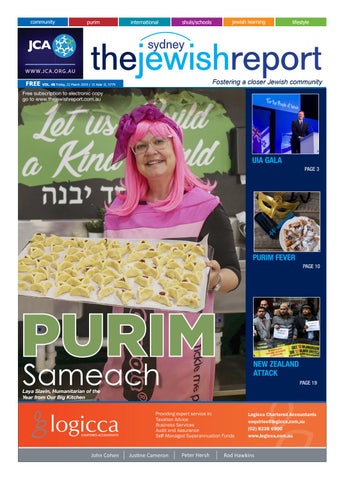
PURIM Sameach Laya Slavin, Humanitarian of the Year from Our Big Kitchen
CHARTERED ACCOUNTANTS CHARTERED ACCOUNTANTS
PAGE 10
NEW ZEALAND ATTACK PAGE 19
2
community
March 2019
Mosaic United and Jewish Agency Launch Global Jewish Service Initiative for Millennials ‘Shalom corps’ aims to make Jewish service experiences more attractive and accessible to young Jewish women and men, rebrand social action as a core Jewish value. MOSAIC UNITED Jewish Agency Chairman Isaac Herzog: “This is a program that will enable expression of the Jewish value of ‘Tikkun Olam’ and will connect the young generation from around the globe to their Jewish identity and to Israel.” (JERUSALEM, Israel – February 26, 2019) During the closing plenary of the Jewish Agency for Israel’s annual Board of Governors meeting in Jerusalem, Isaac Herzog, Chairman of the Jewish Agency for Israel, and Rabbi Benji Levy, CEO of Mosaic United (mosaicunited.org), a partnership between the State of Israel and the global Jewish community, announced the launch of ‘Shalom Corps,’ a joint initiative that aims to dramatically increase the number of young Jews from around the world engaging in meaningful, ethical and sustainable service experiences that also provide opportunities for the exploration of Jewish identity. Leveraging the Jewish Agency’s expertise, global reach and longstanding mission to connect Jews around the world to their Jewish identity and Israel, Mosaic United’s commitment to addressing the numerous wide-ranging approaches for Jewish engagement, and the support of Israel’s Ministry of Diaspora Affairs and international stakeholders, Shalom Corps will
Time to Join
make existing Jewish service experiences more attractive and accessible to Jewish millennials while also strengthening, optimizing and broadening their reach and incorporating Jewish service learning and Israel engagement authentically within the volunteer programming. “Our humanity is inextricably linked to our identity and our deeds, so it is through giving to others in times of need that we can truly explore who we are as individuals and as Jews. Through the development of Shalom Corps, we will create a movement that heals the fractured world around us while simultaneously investing in our greatest asset: our Jewish youth,” said Mosaic United CEO Rabbi Benji Levy. “Shalom Corps will make meaningful service learning opportunities accessible to more young Jews than ever before, empower the incredible organizations working in this space to do even more, and change the way we all think about Jewish values and the endless good that our young people can unleash in this world.” Recent data reveals that while 72% of Jewish millennials around the world are committed to volunteer work and actively seek out service experiences, only 18% choose to give back through Jewish organizations, as most don’t see their Jewish identities as particularly relevant to
COA Sydney!
Discover opportunities to entice, engage, and connect to community COA’s Krygier Activity Centre Stimulating Programs Transport to and from the Centre Delivered Kosher Meals Home Help and Social Services Volunteer Opportunities COA is committed to bringing support, stimulation, and joy to Jewish retirees. To discuss your needs, and options, or to pledge your financial support, please contact us. COA Krygier Centre 25 Rowe St, Woollahra, Phone 02) 9389 0035 Email coa@coasydney.org
their lives. As an added challenge, even the most impactful Jewish service programs have funding and capacity issues, with some programs limiting acceptance and others struggling to cover the cost of recruitment efforts. Mosaic United and the Jewish Agency believe that Shalom Corps can shift the numbers, grow the field and rebrand social action as a core Jewish value and expression. “We are bringing a new message to young Jews in Israel and the Diaspora. The Jewish Agency, together with Mosaic United, an initiative of the Ministry of Diaspora, will enable expression of the wonderful Jewish value of ‘Tikkun Olam’ in communities in need throughout the world,” said Jewish Agency Chairman Isaac Herzog. “While serving as ambassadors of our people in these communities, the thousands of young Jews set to participate in this program will also be strengthening their own Jewish identity and connection to Israel. I’m grateful to Mosaic United CEO Rabbi Benji Levy and Chairman Gary Torgow for the tremendous cooperation in bringing about this initiative that promotes Jewish values and helps connect young Jews to Israel at this time of crisis in our relationship.” Shalom Corps will launch in cooperation with OLAM – a platform promoting global Jewish service and international
development – whose experience and expertise has, and will continue, to deeply influence the design of this initiative. The initiative will proudly partner with IsraAid, an Israel-based humanitarian aid agency that responds to emergency crises and engages in international development around the world. Shalom Corps will provide immersive Jewish volunteer organizations with recruitment and marketing resources, purimal resources and Senior Jewish Educators, professional training, research and best practices, funding to help grow their numbers and increase affordability of their service experiences, alumni engagement resources and more. Shalom Corps will begin accepting grant applications from volunteer service providers this summer and will kick-start its field building, strategy and planning, and marketing later this year. The first local service pilot program is set to launch later this year in Toronto, Canada, in partnership with the UJA of Greater Toronto, and a special project with IsraAid that aims to unite volunteer responders from Israel and the Diaspora to provide disaster relief will be piloted within the first year of operation.
A snapshot of Kangarusski THE ZIONIST FEDERATION OF AUSTRALIA HAYLEY HADASSIN On the 17th February, Kangarusski presented the photography exhibition of Daniel Kuczko, 17 a graduate from Waverley College. The opening of his HSC photography exhibition A Study of the Jewish Métier in Sydney was held at the Sydney Jewish Museum. His images told the story of the Russian speaking Jewish community; the Kangarusski community. Kangarusski is the Russian Speaking Jewish Community (RSJC) department of the Zionist Federation of Australia (ZFA), engages the Russian speaking members of the community with both Jewish and Israel issues. Daniel’s exhibition captured his family history; their culture and traditions. It is a story of three generations. His grandfather David Binder; a Holocaust survivor, told the story of his childhood: - “It was a sad story with the happy ending: When I close my eyes, I often speak to my loved ones whom I lost during the war, but then I hear the kookaburra laughing and I open my eyes. I see photos of my children and grandchildren smiling at me from the wall and the incredible happiness fills my heart. I survived so they could live a great life and achieve their goals.” The exhibition represents and also celebrates their life. Every image captures
members of the Jewish community at work in traditional Jewish professions. For Daniel it celebrates who he is as a young man in Australia by exploring the traditions and customs of his parents and grandparents. He says: - “My mother’s parents are Holocaust survivors. I come from a mixed ethnic background, my first language is Russian, and Judaism is an COA is committed to bringing supp important part of my cultural and religious joy to Jewish retirees. To discuss heritage. options, to pledge For these reasons, or it was important your fina for me to tell the story of the Russiancontact u please Jewish community in Sydney, Australia. The Nazis tried to wipe out our family line, but the miraculous survival of my grandparents is the reason that I am here, and the reason that I was able to capture ordinary photos of Jews living their daily lives in their adopted home of Australia. My photographs represent the endurance of Jewish culture. The medium of photography allows us to interpret the meaning behind each face in our own unique way.” Anna Maylis, ZFA Kangarusski coordinator said: - “It is so important to educate young adults about their Jewish history, where they come from and their heritage and to encourage involvement in community life.” For more information about Kangarusski please contact Anna Maylis anna@kangarusski.org.au The exhibition runs at The Sydney Jewish Museum until March 2019
March 2019
3
community
For The People of Israel at UIA NSW 2019 General Division Gala UNITED ISRAEL APPEAL UIA NSW hosted over 1500 Sydney supporters at its 2019 General Division Gala event on Sunday 24 February, headlined by David Cameron - Former Prime Minister of the United Kingdom (2010-2016). Cameron addressed the audience about his strong connection with and support of Israel, Israel’s right to exist, condemnation of antisemitism and Islamist extremism, and the extraordinary integration of the Jewish people into the broader community. Second guest speaker and UIA success story, Nataly Zagaya was born in Israel to Ethiopian parents who made Aliyah as part of Operation Moses. As a successful participant and representative of UIA’s flagship project Net@, she shared her story of triumph and gratitude to UIA and its supporters. Special guest David Koschitzky Chairman, Keren Hayesod-UIA World Board of Trustees reinforced the importance of the Diaspora’s continuous support of Israel and its prosperity and security, and how we cannot take Israel for granted. “UIA supports Israel’s greatest asset – her People. Our mission and values have been consistent for the last 99 years and we will ensure continued long-term support for the hundreds of programs and tens of thousands of people we support every day across Israel. It is this support that demonstrates our commitment to Jewish continuity, and
appreciation and acknowledgement of the sacrifices our Israeli brothers and sisters make on our behalf, defending our right to exist as the Jewish People in the world. For this we can be immensely proud, we continue to do our part,” UIA NSW President Andrew Boyarsky said. Over 20 members of parliament attended the Gala, including former Prime Minister Tony Abbott.
UIA NSW was proud to offer a more inclusive environment at this year’s Gala, in order to make it more accommodating and enable all members of the community to attend and connect to Israel through the UIA. With guidance from Sydney Friendship Circle, various offerings included live closed captioning of the speeches to support those with hearing impairments, designated seating to accommodate those with physical
disabilities and a professional childminding service. Our 2019 Campaign is once again focusing
on
support
for
the
most
vulnerable people on the periphery in Israel. Follow updates
UIA on
on our
facebook.com/uiaaus
Facebook 2019
for
Campaign:
4
community
March 2019
Sponsor a Child in WIZO’s care in Israel WIZO NSW PRESIDENT DIANE SYMONDS WIZO NSW The Sponsor a Child in Israel program is an initiative of WIZO, the Women’s International Zionist Organisation. WIZO is the largest welfare organisation in Israel and has the proper infrastructure and facilities to help those children in need. With over 800 facilities on the ground, we have the experience and the knowledge to combat the war against poverty. Today, WIZO is recognised by the United Nations as a NonGovernment Organisation, with consultative status on ECOSOC and UNICEF. Currently 250,000 members strong, WIZO is the main agent of social change in Israel. Each year many of us give generously to causes close to our hearts. And one of those causes is helping children in impoverished parts of the world. So the question has to be asked: Why not a child in Israel? Israel has the second highest poverty rate amongst OECD countries, ranking behind Mexico, according to reports by the United Nations Agency for Children. Right now, one third of Israeli children go without adequate food, shelter, education and other basic needs we take for granted. There are many stories WIZO can share. Here are but a few: Ari and his mother are trying to make ends meet on their own. After his father abandoned them both, Ari was enrolled in a WIZO Day Care Centre close to his mother’s work where he receives care, education and hot meals. Ari’s mother receives assistance through WIZO’s Single Parent Family Programs as she struggles to make ends
meet. Then there is Ayelet. Ayelet’s young life is already a complicated one. After her sister was killed in a terrorist attack her mother began suffering from bouts of depression and her father simply couldn’t cope. Ayelet is often neglected and has become very withdrawn. Her WIZO Multipurpose Day Care Centre offers her a special one-on-one development program providing her with the warmth, love and care that she desperately needs. And one other is Natan. Natan’s childhood has been traumatic. Not only does his mother have a disability, but his father displays violent behaviour towards them both. Natan presented with learning difficulties at his WIZO Multipurpose Day Care Centre. The staff arranged for a number of tests to be performed. They discovered that Natan had a hearing problem. He now receives subsidised care and a one-on-one educational program. Donating to WIZO’s Sponsor a Child in Israel program is your way of making a positive impact on the life of a child in Israel. By supporting this program today, you actively ensure a successful, strong and flourishing Israeli society for generations to come. WIZO NSW is rolling out its annual Coffee Cup Campaign at various coffee shops around Sydney. For just $3 a day, or less than a cup of coffee, you have the power to change a child’s life in Israel. If you want to Sponsor a Child in WIZO’s care in Israel visit: www.wizonsw.org.au or call WIZO NSW on 9387 3666
The problem with ‘dating’ apps Enriching the Lives of Jewish Seniors
Connect to Your Community at the COA Centre Live entertainment every Monday and Wednesday, and a huge variety of small group activities 6 days a week.
Sasha Pak
Concert of World Music
Monday 8th April, 12:45
$7 per person for lunch and concert, $3 per person for transport (booking required), $5 per person for those arriving after lunch
Wednesday 10th April at 11:45am Come celebrate Pesach together with COA members and friends. Enjoy a Seder style lunch, prepared by our volunteers, with Haggadah reading led by the Rabbi Ingram, and matzoh kneidlach for all! $12 per person for COA members, $15 for non-members Booking preferred on 9389 0035
COA Krygier Centre, 25 Rowe St, Woollahra For enquiries call 9389 0035, email coa@coasydney.org or go online to www.coasydney.org for more information.
J-JUNCTION These days, our phones are the gatekeepers to our social lives, our memories, and especially if you’re single or early in a relationship - our romantic lives. You would think that with all of the dating apps out there (and yes, there are plenty), that meeting the man or woman of your dreams would be a numbers game. In theory, the more people you meet the more likely you are to find the one, right? And surely with all of those physical connections, something deeper would come along. The sad truth that we’re discovering though, is that the numbers seem to be working against us settling down. No one wants to ‘settle’, but we all want someone to ‘settle down’ with. Unfortunately, even the best relationships have issues. We’re all human. But when you chose to really commit to someone, issues can be resolved. In fact, problems that arise between two people who are truly committed to each other actually often strengthen a relationship. Learning to compromise and put someone else’s needs and feelings on equal ground to your own is something that’s difficult to learn, but vital to anyone wanting to develop a loving, long-term relationship. If you’re not fully committed, any small problem could be the end. Committing to just one person facilitates discovering depths that just aren’t possible when you’re thinking about what else is out there. So how can we get out of the numbers game and find the one? It’s pretty simple. We need to use some
old school methods. Family and friends could get involved to connect you with another eligible bachelor or bachelorette. It’s a bit of an embarrassing way to go when everyone’s trying to set you up but we all know someone that it’s worked out well for. You could sign up for OKcupid or one of those other serious dating websites… not ideal if you want to marry Jewish though. Or for those of us sick of Grandma getting too involved in our non-existent love life… Well, we do have a pretty amazing community organization that is focused on helping you out. JJunction does use algorithms to find couples that would match on paper, but there’s a lot more to it. Members are interviewed by connectors who then have a more intuitive sense of who would make a good couple. It’s real people forging real connections because our members come to us when they’re ready to find someone to settle down with to find a beautiful, lasting relationship.
community
March 2019
5
All Things Ancient Israel MANDELBAUM HOUSE
It seems that Professor Gary Rendsburg loves Australia almost as much as his love of Ancient Israel! Embarking on his third tour as Mandelbaum Scholar in Residence, he is lecturing in Sydney in March and April. He defines his field as “…All things ancient Israel, and then I sub-classify that into Language and Literature, History and Archeology.” “I have opened a wonderful fusion between the linguistic approach and the literary approach and the intersection between these as I study ancient texts – the Bible, the Dead Sea Scrolls, texts written by the rabbis in the post-biblical period.” “You always have to know the cultural context so I’m always mixing in the history and the archeology and the broader horizons. So, it’s not just Israel per se. It’s the neighboring lands – Egypt, Canaan, Mesopotamia, even Greece across the Mediterranean. That’s how I envisage the field that I teach.” Professor Rendsburg’s main research interests are the literature of the Bible, the history of ancient Israel, the historical development of the Hebrew language, the relationship between ancient Egypt and ancient Israel, the Dead Sea Scrolls, and medieval Hebrew manuscripts. He also teaches courses and offers lectures on the whole breadth of Jewish history and religion, with a special focus on the development of Judaism in the post-biblical period. He has travelled extensively in the Near
Professor Gary Rendsburg page East and participated in excavations at Tel Dor and Caesarea, and he has visited all the major archaeological sites of Israel, Egypt, and Jordan. “I’ve been to Qumran on a number of occasions and, where possible, I weave evidence from the site back into to my teaching.” This visit, Rendsburg will deliver the Alan Crown Lecture, named in honour of prominent biblical researcher and academic Emeritus Professor Alan Crown. These annual lectures were set up to showcase the usefulness of academic work in Biblical Studies and Ancient Judaism. To be held
Genesis manuscript on Thursday 28 March and titled “The First Diasporas: Egypt and Babylonia”, Rendsburg shows how the Jews successfully reconstructed their lives in exile following the destruction of the First Temple. Other lectures in his Sydney series comprise: Septuagint, Synagogue, and Symbiosis: The Jews of Hellenistic Egypt where the impact of Alexander the Great’s conquest has the Jews fully integrated into the Hellenistic society and the economy. The Jews of Arabia, considering the network of Jews who populated the Arabian
Peninsula between the destruction of the Second Temple in 70 C.E. and the rise of Islam during the 7th century C.E. The narrative reminds us how time and again the historian of Judaism needs to have the broadest cultural and geographical horizons. England as a Custodian of the Jewish Past: To put it plainly: No other country in the world possesses both the quality and the quantity of Hebrew manuscripts in its library collections – almost all of which were collected by Christian scholars (and not Jews). Why is this so and how did it happen?
6
community
March 2019
Our Big Kitchen’s Hamantashen drive OBK
OBK’s annual Hamantashen drive has kicked off in a big way this year! The recipe for success is 200kg of flour, 80kg sugar, 125kg Jam, 900 eggs, 900l of oil, and hundreds of incredible volunteers. Every day over 25 volunteers of all ages have attended OBK to bake and pack Hamantashen. And most days over 30 students have been attending hamantashen baking programs, Mega teen bakes, and family days. As well as many organisations
have been involved in coming to OBK and baking. All the hamantashen are distributed to shelters, charities, nursing homes and hospitals in and around Sydney. A Big thank you to some of our key volunteers for making this initiative happen Kim Alster and Bev Brandon. This community drive of goodwill creates connections, and a positive energy before such a fun holiday. OBK has always believed that through giving you receive, and by sharing positive energy with our community it creates a true sense of love.
Bondi International Women’s Learning from the Day Awards – Laya Slavin Legends of our Past Humanitarian of the Year
OBK
For Women’s Day 2019, The Bucket list Bondi, hosted “Bondi’s 2019 International Women’s Day Awards”. The MC was Paula Joye, and guest speakers for the evening were Dr Kerryn Phelps AM MP | Federal Member for Wentworth and Pippa Hallas (CEO Ella Bache) & entertainment by Kristie Mercer. It was a wonderful initiative where women connected and bonded together. Women supporting women, and achieving amazing things in our community. Our Big Kitchen very special Laya Slavin won the award for Humanitarian of the Year for her incredible work she does for the community. A Big Mazaltov to all the nominees and winners in the other categories. These included: Humanitarian of the Year - Laya Slavin - Our Big Kitchen - www.obk.org.au/ Bondi Mother of the Year - Annabelle Peacock www.bondiweddingcelebrant.com/ Bondi Health, Beauty and Wellness Woman of the Year - Caroline Groth www.carolinehgroth.com.au/ Bondi Environmentalist of the Year Rebecca Veksler, Sol Cups www.solcups.com/ Bondi Business Woman of the Year Brenda Miley, Lets Go Surfing
www. letsgosurfing.com.au/ Our Big Kitchen and Laya were so honoured to have been voted this award, and are privileged to be a part and be able to help our special community. Thank you to everyone who voted! “We are well aware that this privilege comes with responsibility – and we look forward to continue and further develop our work, particularly with some of the other wonderful contestants. Thank you again for your friendship support and your vote.” – Laya Slavin
MANDELBAUM HOUSE CLAIRE THOMPSON (MANDELBAUM RESIDENT)
Mandelbaum House residents were excited to welcome Professor Lisa Jackson Pulver AM and her husband Mark to the first formal dinner of the new year. A Wiradjuri Jewish woman, she was made a Member of the Order of Australia (AM) in the Queen’s Birthday 2011 Honours list. Professor Jackson Pulver was the first Aboriginal person to obtain a PhD in medicine from the University of Sydney. Last year, she became the university’s Deputy Vice-Chancellor, Indigenous Strategy and Services. This position adds to her already impressive resume as a researcher and educator in the field of Aboriginal health and wellbeing. Working with Aboriginal populations has a personal meaning for Professor Jackson Pulver as her ancestors descended from Aboriginal as well as Scottish and Welsh backgrounds. Professor Jackson Pulver began her intriguing discussion by acknowledging the Aboriginal and Torres Strait Islander people as the original owners of the land. She then proceeded to enlighten us on the astonishing lives of three Aboriginal women who made significant contributions to society. Sister Alison Bush was one of the first Aboriginal nurses and midwives and established many opportunities for Aboriginal people to access health care. Aunty Ali Golding taught Aboriginal children to read and write in a time when they may have otherwise been denied
an education. Aunty Mavis Robinson’s work as a schoolteacher paved the way for Aboriginal people looking to begin a career in education. Professor Jackson Pulver taught us that “Aunty” and “Uncle” are terms of respect used towards elders in the Aboriginal community. Additionally, we learned about the serious adversities the Aboriginal people have faced over the decades including diseases, genocides and assimilation. The Aboriginal population suffered a severe loss in the mid 1800s and has only recently begun to recover according to local census measures. The population increase may be due to individuals discovering their true heritage or people finally feeling safe enough to expose their true identities within society. To this day, the Aboriginal community has a shorter life span than the rest of the Australian population, and many Aboriginal people still lack the healthcare and education they deserve. Programs such as the Close the Gap Campaign are working to combat such inequities, but Professor Jackson Pulver reminded us that it is up to all members of our society to do our part and ensure that everyone has equal rights. Regardless of where we come from, we must remember to listen to those around us in order to guarantee that our world is one founded on equality. Mandelbaum House is the Jewish residential college at the University of Sydney. Applications for semester two 2019 are now open: https://www. mandelbaum.usyd.edu.au/apply
March 2019
community
Bridging the generation gap MONTEFIORE
By linking some of our oldest community members with the very youngest, Montefiore’s Intergenerational Program fosters special connections at its Hunters Hill, Randwick and Woollahra campuses. Partnering with many local schools including Emanuel School, Moriah College, Masada College and Kesser Torah as well as Academy BJE, the program is rich and varied. “Spending time with young people brings our residents so much joy,” says Melanie Lindenberg, “but it’s equally rewarding for the children, who learn so much from interacting with our treasured older generations. Along with our broader one-on-one Student Volunteer Program with Jewish and local schools, it’s an integral part of what we offer to both our residents and the community.” Woollahra Montefiore residents enjoy gardening and reading sessions in the beautiful grounds with Emmanuel Woollahra Preschool children, with residents Doreen Stokes and Julian Markovich also visiting the kindy campus weekly. These visits recently inspired the handy Julian to spend many hours creating something special, supported by wife Fay and Montefiore’s Leisure and Lifestyle team. The delight was clear on both sides when he presented each child with ‘The House that Jack Built’, allowing
them to choose their own colours, doors and windows. At Hunters Hill, residents look forward to Kabbalat Shabbat with Masada College primary school children, as well as concerts and sharing in living history projects with older high school students. Academy BJE has recently partnered with the Montefiore Spiritual and Cultural Department to share Shabbat Project and Purim initiatives across all sites. “The Shabbat Project was really heartwarming,” says Montefiore’s Lynda Dave, “with residents and students making challah together and exchanging special memories.” Randwick residents also enjoy regular Kabbalat Shabbat visits with Moriah preschool students, while the Intergenerational Program’s youngest participants are the babies and toddlers who attend a playgroup there with their mothers on Wednesdays. This year early learning expert Rose Fekete will join Rene Ichilcik and the Montefiore Community Relations team as a volunteer to help enhance the fortnightly sessions. If you are interested in joining the playgroup with your child, please contact Rene on (02) 8345 9114 or richilcik@montefiore.org.au.
Montefiore Woollahra resident Julian Markovich with Emanuel Woollahra Preschool’s Aidan Shapiro.
7
8
community
March 2019
Shaare Zedek: Your Generosity is Saving Lives AUSTRALIAN FRIENDS OF SHAARE ZEDEK INC MIRIAM PACANOWSKI The recent fundraising project conducted by the Australian Friends of Shaare Zedek Inc is having tangible benefits for both the community in Australia and Israel. During last year’s campaign, funds raised by the Australian community purchased a gene sequencer at Shaare Zedek Medical Centre Jerusalem in memory of the late Ron Tatarka. Ron was a true visionary who supported many important communal causes. His family members have continued their involvement with Shaare Zedek. Their generosity and that of their family and friends have been a real tribute to his memory and are continuing to have a powerful effect on the healthy future of our community both here and in Israel. Sara Tatarka and her daughter Dina recently toured the Royal Children’s Hospital’s Genetics Laboratory as part of a group hosted by clinical geneticist and Australian Friends of Shaare Zedek Inc Deputy Chair Prof Agnes Bankier OAM. During their tour, they saw the gene sequencer at the RCH and heard about the latest developments in gene therapy. Professor Martin Delatycki described scenarios where a patient can have a disease and be hospitalised in Intensive Care. Diseases that in the past were a mystery can now be identified within days
Dr Damien Bruno, Dina and Sarah Tatarka, Prof Martin Delatycki, Prof Agnes Bankier OAM at the Victorian Clinical Genetics Services Laboratory. Genetic Therapy is transforming medicine. using gene sequencing and targeted therapies can be prescribed. The lifesaving effects of gene sequencing and therapy are transforming the delivery of medical care. Shaare Zedek plays an important role in this medical revolution. As Jerusalem’s most central hospital treating hundreds of thousands of patients year after year, it has a database that has serious ramifications for specific ethnic communities around the world. Genetic studies at the hospital are directly applicable to our local Jewish community. Shaare Zedek’s Medical Genetics Unit is actively involved with studies surrounding
Friendship Circle’s Shabbaton Get Away On Friday 8 March the Sydney Friendsip Circle held a very successful weekend away where 45 buddies and kids with diasbilities got together to learn from each other and share a very meaningful Shabbat in Berema.
the increased risk of certain cancers in people who carry the BRCA 1 and 2 genetic mutations. Based on these studies, the AFSZ is currently working to support JeneScreen. com.au, a research project conducted by Prof Martin Delatycki offering free genetic testing for BRCA mutations to the Jewish community in Melbourne and Sydney. This year, the Australian Friends of Shaare Zedek will build on these important advances. Innovations invariably raise new challenges and Shaare Zedek has always operated within a framework of Jewish medical ethics. Prof Rabbi Avraham Steinberg will visit
Australia as a guest of the AFSZ. Prof Rabbi Steinberg is the Director of Medical Ethics at Shaare Zedek. He will deliver the opening address of the 11th Bioethics Conference at the Royal Children’s Hospital later this year. Prof Agnes Bankier OAM says, “We would like to thank the Tatarka family and the wider Australian community for their wonderful support of this outstanding project. “By helping Shaare Zedek in its crucial role, you are furthering our understanding of disease, helping to save lives in Israel as well as having a real effect on the health and wellbeing of our local community.” www.shaarezedek.org.au facebook.com/shaarezedek
9
community
March 2019
Autumn at COA COA
Autumn is here, and with it comes a special beauty, as the leaves turn and the humidity drops away. It’s the perfect time to get out and enjoy the stunning views and locations that Sydney has on offer. COA can help with outings now running on Tuesdays and Thursdays to mystery destinations, which could find participants strolling on Balmoral beach, discovering the landscape of La Peruse, or relaxing over coffee at a local RSL club. The outings are a three-fold experience. Of course there is the physical activity of taking a walk, but in a context where one can walk at one’s own pace, with a mobility aid if needed. There is also the social aspect of being part of a group, with the opportunity to talk and enjoy each other’s company and partake lunch together at a cafe. Finally it is a chance to explore destinations around our beautiful city that one may not be familiar with. If autumn brings a chill wind, it’s always warm inside the COA, with myriad activities, volunteer opportunities, and connections on offer. From Sunday through Friday there is always something to do. One way to stay warm in autumn is to get up and dance, an activity which we encourage for all ages and mobility, because it is simply the best way to exercise mind, body and spirit. There is a school of thought that dancing to live music is the best possible workout for the mind, as it can stave off the onset of dementia and mental deterioration. The exercise afforded by dance means that we do not overtax ourselves, as is possible with other exercise regimes, but move only
as much as is comfortable. What is not measurable but is clearly visible is the sheer joy that comes from dancing with peers to music we know and love. Every Monday and Wednesday the COA Centre rings with the sounds of live music and members are actively encouraged to join the crowd dancing. It is the happy smiles, the laughter and singing along, the fun exchanges on the dance floor which are indescribable. One other reason to meet autumn gleefully is that it heralds one of our most popular annual events, our Model Seder luncheon, which draws a crowd of up to 100 people. There is nothing quite like a
Seder celebrated with so many people; it connects us to each other more closely through our shared culture and heritage. The preparation for this event starts weeks before, as we source all the items needed to make the Seder. In the days prior our volunteer team of in-house caterers gather to make matzoh kneidlach, Charoset, and fruit compote. On the day the team arrive early to prepare individual Seder plates, one for every 6 people at the luncheon, and to be on the ready to serve course after course of much loved traditional fare. The Seder is led by Rabbi Ingram OAM, with participants asked to help with readings. Sometimes Ma
Nish Tanah is recited by the oldest person in the room, sometimes it is recited by the whole group together, which is a truly lovely experience as some have not recited it since childhood. The beautiful part of this event is that it feels just like a huge family Seder because, at heart, the COA members are a family of friends, supporting and relying on each other. So revel in autumn, and join us for outings, for dancing, for special events, and for companionship and cultural connection 6 days a week at the Krygier Centre. Inside or outside, there’s always something on at COA.
If you believe in inspiring young minds, creating confident, engaged learners, nurturing the whole child and building community connections, your family belongs at Moriah College. Apply now for Year K 2020 Open days 1 April & 7 May 2019 Visit www.moriah.nsw.edu.au to register
Queens Park Road, Bondi Junction, Sydney, Australia Tel: (02) 9375 1600 | Fax: (02) 9387 3490 Email: info@moriah.nsw.edu.au | www.moriah.nsw.edu.au
10
purim
March 2019
Purim in the Community
The megillah reading, mishloach manot and more Jewish communities around the world celebrate Purim as a holiday of feasting and gladness, gift-giving and tzedakah (charity), revelry and imbibing. It is one of the most popular Jewish holidays for families and children. The celebration of Purim is based on the story found in the biblical Book of Esther. A tractate of the Mishnah (and hence the Talmud) is devoted to it as well. Purim is a time when Jewish communities, like the community in the Book of Esther, become particularly aware of the fragility and even the danger of living in the Diaspora, as a people “scattered abroad and dispersed among the peoples” (Esther 3:8).
The Megillah Reading
The primary communal observance connected to Purim is the mitzvah (commandment) of reading the Book of Esther, called the Megillah (the scroll). It is supposed to be read in the synagogue with a minyan present. The scroll is read twice, once in the evening after the Amidah of Ma’ariv and once after the Torah service during Shaharit. The Megillah is in the form of a parchment scroll, handwritten like a Torah. The Book of Esther has a special cantillation used only for that book, and the reading is preceded by three blessings. During the reading, it is customary for the congregation to drown out the name
of Haman by making noise, usually using a special noisemaker called a gragger, whenever the reader utters the villain’s name. Another custom is to read the verses listing the ten sons of Haman (found in chapter 9) in one breath. One theory regarding the significance of this practice says that it is done to symbolize how the brothers all died together, while a second theory suggests that we should not draw out the reading of the names so as not to gloat over their fate. Traditionally, an additional Torah reading, in addition to the weekly reading, is inserted on the Sabbath preceding Purim. Called Shabbat Zachor (the Sabbath of Remembrance), the additional reading is one of the four special parashiyyot leading up to Pesach (Passover). This excerpt from the Book of Deuteronomy (25:17-19) discusses the battle with Amalek. Jewish tradition views Amalek as the ancestor and in some ways the precursor of Haman. Both sought to annihilate the Jewish people, and both were thwarted in their plans. Besides the reading of the Megillah, the only liturgical additions for the day of Purim are the addition of the Purim Al Hanissim (“for the miracles”) both in the Amidah Prayer and in the Birkat Hamazon (grace after meals). There are a number of explanations for why Hallel (Psalms of Praise) is not recited on Purim as it is on other joyous holidays. Among them is the
theory that on Purim, unlike on Passover or Hanukkah, the redemption is not complete. On Passover and Hanukkah, the Jews are completely delivered from a foreign king, while on Purim the Jews are still subjects of Ahasuerus. The reading of the Megillah is seen to achieve the same purpose as Hallel. Also, Hallel is generally not said for events that took place outside the land of Israel.
Fast of Esther
Another traditional feature of Purim observance is the Fast of Esther (Ta’anit Esther). It is one of the four statutory public fasts in the Jewish calendar. All of these other fasts are connected with tragic events related to the destruction of Jerusalem or to the loss of the Jewish state. The fast of the 13th of Adar, the day preceding Purim, is related rather to the threat to destroy the Jewish people. When Mordecai told Esther about Haman’s plan to kill all the Jews, she asked him to proclaim a three-day fast. It is in commemoration of this that some Jews still fast on this day. There is another unique feature to communal Purim observance. Purim is celebrated in most of the world on the 14th of Adar. However, in Jerusalem it is observed on the 15th of Adar, because of the interpretation of Esther 9:18-19, “But the Jews that were in Shushan assembled together on the 13th day thereof, and on the
BJE staff preparing for Purim at OBK
14th thereof; and on the 15th day of the same they rested, and made it a day of feasting and gladness. Therefore do the Jews of the villages, that dwell in the unwalled towns, make the 14th day of the month of Adar a day of gladness and feasting.” The sages concluded that Purim was celebrated on the 15th of Adar, as in Shushan, in cities that had been walled since the days of Joshua. In a leap year, when there is the additional month of Adar II, it is traditional to do everything that must be done in Adar during the first Adar. Purim is the exception to this rule and is celebrated during the second Adar.
Mishloach Manot
On Purim the Megillah mandates that we give gifts to friends (mishloach manot), usually of food, and to the poor (matanot l’evyonim). It is a tradition for congregations to collect money in memory of the half shekel collected in ancient days for the upkeep of the Temple. Purim is a time for carnivals and parties and masquerades. Most Jewish congregations hold special carnivals for children, and children dress in costumes that commemorate the various characters of the Purim story. They perform humorous plays called Purim shpiels, which more often than not mock both the characters in the story and leaders in the Jewish community.
purim
March 2019
11
Purim – the Deeper Meaning EMANUEL SYNAGOGUE RABBI DR ORNA TRIGUBOFF Joy, Nature, Rising Above Duality to Experience Oneness I use to think of Purim as a festival only for children, with memories of fancy dress pageants, the first one being when I was 5 years old, in the very first year Masada College was founded - a parade of costumes. Yet, the sages have written numerous commentaries on the festival of Purim, and here are some of the them that speak to me, as an adult. Finding Miracles in the Ordinary The name of God is not mentioned once in the Scroll of Esther (the part of Tanach which recounts the Purim story). Why? Sages of the Talmud state that the answer lies in the name of Queen Esther. The Hebrew word Esther is connected to the word Hesther, meaning ‘hidden’. This leads to the idea that the divine is hidden in the Purim story rather than being revealed. There are no supernatural miracles in the account of Purim, for example, the sea is not parted as it was in the Exodus story of Pesach, and there is no miraculous revelation of Torah as there is for the festival of Shavuot. The Purim story is one that happens in a regular way. Therefore, sages such as the Gerre Rebbe, state that a key theme for Purim is that we should look for holiness and divinity within everyday life. Mindfulness of the Masks we Wear – and our Essence at their Core R. Zalman Schachter-Shalomi states that the custom of masquerading has a deep
Emanuel Synagogue has a wide range of exciting activities planned for Purim: Hamentaschen Baking Sunday March 17th from 10:00am Fun for all of the family as we make hundreds of Hamentaschen in preparation for Purim! Bring family, friends, your children and an apron and we’ll supply everything else! Get your hands floury and jammy and poppy seedy and sticky! Everybody welcome! Batmensch Purim Spiel Join Batmensch & Rivkah as our kippa-ed crusaders fight the evil Haman. Will they thwart Haman’s evil plan and save the Jewish people from destruction? Join us at Emanuel’s Purim Spiel to find out!
spiritual meaning. Throughout the Hebrew month of Adar, we are invited to reflect on the various masks we wear in our life, to be mindful of the roles we play and how each role brings out different aspects of our personality and requires different talents. How are we different with each role? When we are in our professional role (or mask), how are we different to when we are in our parent role or sportsman role, or movie-buff role or the traveller. Each mask is necessary for us to function in our daily lives, each mask reveals a different aspect of our psyche. And by exploring this, we can deepen our understanding of ourselves. On Purim, when we dress up we might explore an aspect of ourselves we don’t usually express, it can be a fun and freeing experience.
Primary School Open Day Discover why Emanuel School is small enough to know your child and big enough to make a difference Meet our staff, take a tour, visit classes and enjoy displays Wednesday 27 March 2019 9.30am - 11.00am 20 Stanley Street, Randwick Bookings can be made at www.emanuelschool.nsw.edu.au/visit For further information contact Gail MacKenzie on 8383 7333 or enrolments@emanuelschool.nsw.edu.au
Emanuel School is a member of the JCA Family of Organisations
This Purim Process of Mindfulness also leads us to connect with our essence, which is who we are beyond the roles we play in our life – the Neshama. Purim the festival of Expanded Consciousness The tradition of getting into a state where one cannot distinguish between the evil of Haman and the goodness of Mordecai (from the Talmud) is often associated with getting drunk. However, there are alternate sages who direct us to achieve this state of expanded consciousness in other ways. The focus is on getting to that feeling of Oneness – beyond good and evil – in a joyful and healthy way. In the spirit of Purim this can be done through “letting yourself go” by laughing, dancing, meditating etc.
Same Purim Time, Same Purim Channel On Wednesday March 20th Megillah reading at 6:15pm followed by the spiel Children’s Purim Celebration Thursday March 21st from 4:00pm Come dressed in fancy dress and enjoy crafts and activities followed by a re-telling of the Purim story. Emanuel Synagogue, 7 Ocean St, Woollahra Purim Kabbalat Shabbat at the Beach with Music & Picnic Friday March 22nd from 7:00pm with live music on the sand followed by a picnic on the grass. Children welcome. Please email orna@emanuel.org.au for the location in Sydney
12
purim
March 2019
Things You Didn’t Know About Purim MJL With costumes, spiels and lots of drinking, Purim, which in 2018 starts at sundown on Wednesday, Feb. 28, is one of Judaism’s most raucous holidays. You might know about beautiful Esther thwarting evil Haman’s plans, the custom of getting drunk and what hamantaschen are. But we’re guessing there’s a few things about this holiday that might surprise you. 1. Esther was a vegetarian (or at least a flexitarian). According to midrash, while Queen Esther lived in the court of King Ahasuerus, she followed a vegetarian diet consisting largely of legumes so that she would not break the laws of kashrut. For this reason, there is a tradition of eating beans and peas on Purim. (After all, you’ll need something healthy after all the booze and hamantaschen.) 2. You’re supposed to find a go-between to deliver your mishloach manot, the gift baskets traditionally exchanged with friends and family on Purim. The verse in the Book of Esther about Mishloach Manot stipulates that we should send gifts to one another, not just give gifts to one another. As a result, it’s better to send your packets of goodies to a friend via a messenger, than to just give them outright. Anyone can act as a go-between, so feel free to recruit the postal service or even that nice guy in the elevator to help you deliver your gifts.
3. The Book of Esther is the only biblical book that does not include God’s name. The Book of Esther also makes no references to the Temple, to prayer, or to Jewish practices such as kashrut [keeping kosher]. 4. Hamantaschen might have been designed to symbolize Haman’s hat — or his ears or pockets. Or something a little more womanly. Some say these cookies represent Haman’s ears (the Hebrew name for them, oznei Haman, means just this), and refer to a custom of cutting off a criminal’s ears before his execution. Another theory is that the three corners represent the three patriarchs whose power weakened Haman and gave strength to Esther to save the Jews. Yet another theory: Because the German word tasche means “pouch” or “pocket,” the cookies could signify Haman’s pockets and
PESACH
EDITION Pesach is almost here and The Jewish Report will be publishing our Pesach edition on 11 April 2019 Don’t miss this opportunity to send a Yom Tov greeting to the community or advertise what your business or
Contact Stacey on 0416 353 086 or by email stacey@sydneyjewishreport.com Release date 11 April (material due date 1 April)
the money he offered the king for permission to kill the Jews. 5. In 1945, a group of American GI’s held belated Purim services inside Nazi propagandist Joseph Goebbels’ confiscated castle. According to JTA coverage at the time, the Jewish chaplain “carefully arranged the candles over a swastika-bedecked bookcase in Goebbels’ main dining room,” and Jewish soldiers explained to their Christian comrades in attendance “about Haman and why it was so fitting that Purim services should be held in a castle belonging to Goebbels.” 6. The Book of Esther, which many scholars theorize is fictional, may be an adaptation of a Babylonian story. Some scholars argue that the Book of Esther adapted stories about these pagan gods — Marduk becoming Mordecai and Ishtar
transformed to Esther — to reflect the realities of its own Jewish authors in exile 7. The Jewish calendar has a regular leap year with two months of Adar (but only one Purim, which falls during the second Adar). To ensure that the holidays remain in their mandated seasons, the Jewish calendar was ingeniously adjusted to accommodate the 11-day difference between the lunar and solar years. In the 4th century C.E., Hillel scheduled an extra month at the end of the biblical year, as necessary. The biblical year begins in spring with Nissan (Exodus 12:12) and ends with Adar. Hillel, in conjunction with the Sanhedrin (Jewish supreme court) chose to repeat Adar (Adar I and Adar II) every 3rd, 6th, 8th, 11th, 14th, 17th, and 19th year over a 19-year period. 8. Purim is celebrated one day later inside walled cities than it is everywhere else. The Book of Esther differentiates between Jews who lived and fought their enemies for two days within the walled, capital city of Shushan and those who lived in unwalled towns, where only one day was needed to subdue the enemy. The Rabbis determined we should make that same distinction when memorializing the event. Accordingly, if a person lives in a city that has been walled since the days of Joshua (circa 1250 B.C.E.), as Shushan was, Purim is celebrated on the fifteenth of the month of Adar, a day referred to as “Shushan Purim.”
March 2019
13
purim
Vashti and Esther: A Feminist Perspective
BY WENDY AMSELLEM
Although Vashti and Esther never meet, the relationship between them is integral to understanding the events of the Book of Esther. Vashti disappears by the end of the first chapter, but she casts a long shadow over the rest of the book. As we encounter Vashti in chapter one, we learn the following about her: She is beautiful and headstrong. She throws a good party. She refuses to have her appearances before the king regulated solely by his desires. For this last offense, Vashti pays dearly, losing her crown and incurring perpetual banishment from the king’s presence. At the close of chapter one it is clear that a woman in Ahasuerus’s court would do well to be dutiful and to come before the king as he commands. The essentiality of female obedience is further confirmed by the final verse of the chapter in which a missive is sent to all of Ahasuerus’s subjects reminding them in no uncertain terms that “every man must rule in his household.” By contrast, Esther is presented at first as the perfect foil to Vashti. Whereas Vashti was willful and independent, Esther is passive and submissive. The reflexive use of the Hebrew word “LaKaKH” is constantly applied to her. She is “taken” in by Mordechai as a foster daughter, “taken” to the king’s harem, and “taken” before the king. She does not reveal her identity at the palace, “for Mordechai had commanded her not to tell.” She requests nothing at the harem, only accepting whatever Hagai, the king’s eunuch, chooses to give her. Even after she is crowned queen, we are told that Esther continues to obey the commands of Mordechai as she had done under his care.
It is no surprise that Ahasuerus loves Esther. She is the model of docility, an exact antidote to Vashti. Esther understands very well her role as Ahasuerus’s queen. When Mordechai commands her to appear before the king and intercede on behalf of the Jews, Esther responds that everyone knows that those who appear before the king unbidden are condemned to die. She has learned from her predecessor’s fate that the queen’s job is to come when she is called. Mordechai insists to Esther that it is her responsibility to plead for her nation. This is a moment of crisis for Esther. She is caught between conflicting obediences to her foster father and husband. In addition, to come before the king unsummoned is an abnegation of her role as Vashti’s replacement. She was chosen to be queen since she represented the antithesis of Vashti’s persona. Esther’s
position, her identity and quite possibly her life are all closely tied to her obedience to the king. In this moment of fate, Esther looks into her mirror and discovers that she does not look quite so different from Vashti after all. She takes matters into her own hands and stands up to both sources of authority. Esther assumes control of Mordechai’s plan, changing and amending as she sees fit. Like Vashti, she will appear before the king only when she decides that the time is right–in this case after three days of fasting. Instead of following Mordechai’s suggestion and simply making her petition, she will throw a series of parties as Vashti did. In order to succeed, Esther realizes that she must take on aspects of the repudiated former queen. Of course, we do not actually know why Vashti refused to appear before the King. It could have been out of modesty as the Midrash in Esther Rabbah suggests. Or as the Babylonian
Talmud describes, she may simply have been unhappy with her appearance that day (a sudden case of leprosy according to Rabbi Yossi bar Chanina or the surprise sprouting of a tail according to a beraita). Perhaps she was being capricious. Perhaps she was a protofeminist fighting for a sense of independent integrity. In any event, Vashti’s disobedience brings her career to an abrupt end and her fate is quite deliberately meant to serve as an object lesson to women everywhere. As Esther marshals her strength to save her nation, she must revisit the experiences of her shunned predecessor and learn from them. Esther is more calculated, more subtle, (more divinely inspired) and ultimately far more successful than Vashti. Yet, in order to triumph, Esther must confront the image of Vashti and incorporate (or perhaps discover) the attributes of Vashti in herself. As Orthodox feminists, we are constantly confronted with taboo images of dangerous women from whom we are told to distance ourselves. A is too radical, B has gone too far, C has made too many enemies. We struggle to draw our borders, to be open and yet traditional, free and yet constrained within halacha. Purim is a holiday in which we explore and challenge our boundaries. We dress up as other people. Some of us drink to the point where differences become blurred. In the spirit of this holiday and following the legacy of our ancestor Esther, I encourage us to reexamine whom we emulate and from whom we shy away. We may discover as Esther did that we are not so different from those whom we fear and that the most important lessons can be learned from the unlikeliest of teachers.
MoɉnɃ ȠȏȞaȎ ɎȢlȗeȈȩ kȏǷȼ doȝ’Ʉ bȗeȞd Ȏȝ.
Theɘ ȼtȀȝǶ Ȣut.
Opeȝ ǶȀyȻ @ MȠɎ ApȸiȘ 3rǷ | YeȀrȻ ȶ-6 ɓwɒ.ɄrɘǻoȡkȏȝȈ.coȚ/BɗȿPA 4tȊ | ELɑ taȗȕs ɒɓw.ɃȹyǼoȡȕȏnȇ.Ǹom/BAȆȁG 5tȊ | Preȥ ɓwɒ.ɄrɘǻoȡkȏȝȈ.coȚ/BɗȿPȐ EnȫuȎȹǵ noɒ: RȀǸhǵȗ SǸhɒaȹtɛ ȹsǹȋwaȸɄz@ȚȡɊȞtȻiȞȀȏ.nȻɓ.edɉ.ǽu
JCA Member Organisation
14
schools / shuls
Clean Up Australia Day 2019 MORIAH COLLEGE Year 8 students at Moriah College supported Clean Up Australia Day, working in groups to pick up litter around Queens Park and the school grounds and learning how to make the world a better place along the way. “We need to consider the impact we are
all having every day on the environment, individually and as a school,” said Moriah’s Coordinator of Sustainable Practice, Nicole Lewis. The students showed excellent community spirit, rolling up their sleeves and lending a hand to help keep our environment clean.
Olive Picking on campus MORIAH COLLEGE
Moriah College Year 7 students went olive picking from the school’s very own olive trees on campus, as part of a Food and Agriculture project. They will spend the next few weeks soaking, bottling and pickling the olives to see the production process through from start to finish.
March 2019
March 2019
schools / shuls
Emanuel School students take a stand EMANUEL SCHOOL
On Wednesday 13 March 2019, over 150 Emanuel Primary and High School students rallied to voice their concerns about the global climate crisis. The student-led event, which was held at Emanuel School, was an outstanding success with Primary and High School students passionately sharing their feelings and research about the crisis. The Hon. Dr Kerryn Phelps AM MP joined the rally and congratulated the students on their insights, passion and courage to stand up and make a difference. The Primary School’s Green Team, a group of Primary students who are passionate about addressing climate change and other environmental concerns, worked hard to develop the event concept, create posters for the rally and spread the word to their peers. Lia McLellan, Year 5, eloquently shared her feelings with the gathering: “We are experiencing extremely hot summers, excruciatingly cold winters, rising water levels like never before, and it’s all thanks to us. Our actions are costing the world. “As kids, we don’t have a huge say in what happens. We look to our parents and leaders to make the important decisions in our world. Right now it seems that they’re doing a really bad job. In fact, they’ve completely failed us when it comes to ensuring that we have a bright future ahead. Some grownups don’t think climate change is real. Some grown-ups just ignore it because it’s not their future or their problem. So, we need to take action because they aren’t. I want to act now. But I can’t act alone. We all need to work together to change the future. So, let’s act now Emanuel!”
Dr Phelps was impressed by the students’ deep concern for the planet: “What stood out to me is that our kids want to be heard. They understand that the future of our planet is on the line and they are worried that nobody is listening. Young people are now way ahead of the current Government – they don’t think it’s funny when the Prime Minister brings a lump of coal into the Parliament to taunt those who want to see a focus on renewable energy.
“In addition to policy settings that lower our carbon emissions and encourage a path towards a clean energy future, collective ambitions such as minimizing waste and ensuring we have clean air and water should not be too much to ask. We owe it to our children and grandchildren. “As a doctor, I have been scientifically trained to look at the evidence and make a diagnosis. The science tells us that climate change is real. I want science to be taken
15
seriously again.” Andrew Watt, Emanuel School Principal, is a staunch supporter of the students’ actions. He spoke to the students at assembly this week: “New terms, such as ‘climate justice’ have emerged recently, as many of our young people cry out for genuine and swift action. This rally is our way of supporting the global climate strikes happening this week. I believe in the power of student agency – the power of your voice – in changing the way the world responds to the climate change crisis. “With both the NSW election and a Federal election coming up in the next few months, this is a good time to let the leaders of our state and our country know that we understand climate change and want them to take appropriate action. I am proud of you all for taking this stand and of your support of a movement that can only prosper with a youth-led voice.” After the rally, Dr Phelps was interviewed by two Primary students for Emanuel School News Network. They asked Dr Phelps the important questions of: “Why do you think climate action is important?” and “Do you think it is important for students to be involved in events like this?”. Dr Phelps responded: “I think it is essential for young people to be switched on to what is happening in their world. For students at Emanuel School and around the world this week, to be engaged in an issue that is this important is vital to our future because a lot of the politicians aren’t listening. Now I can take your message from Emanuel, back to Canberra. I can tell them about what you have done here today and that will help politicians to understand how strongly young people feel about what needs to be done.”
Children’s Moral Development PHIL ROBERTS A woman was on her deathbed. There was one drug that the doctors thought might save her. It was a form of radium that a chemist in the same town had recently discovered. The drug was expensive to make, but the chemist was charging ten times what the drug cost him to produce. He paid $200 for the radium and charged $2,000 for a small dose of the drug. The sick woman’s husband, Heinz, went to everyone he knew to borrow the money, but he could only get together about $1,000 which is half of what it cost. He told the chemist that his wife was dying and asked him to sell it cheaper or let him pay later. But the chemist said: “No, I discovered the drug and I’m going to make money from it.” So Heinz got desperate and broke into the man’s laboratory to steal the drug for his wife. Should Heinz have broken into the laboratory to steal the drug for his wife? Why or why not? This very famous moral dilemma above (derived from moral philosopher Lawrence Kohlberg) will be responded to in different ways depending on the stage of the child/young person in his/her moral development. These stages of moral development have always captivated my interest and it is really very endearing to hear kids justify their stance. (I do wonder whether we can unintentionally hinder moral development
through a neglect in conversation). From a theoretical point of view, it is not important in the tale above what the child thinks that Heinz should do. Kohlberg’s theory holds that the justification the child offers is what is significant, the form of their response. Below are some of many examples of possible arguments that belong to the six stages: Level 1 (Pre-Conventional) 1. Obedience and punishment orientation (How can I avoid punishment?) 2. Self-interest orientation (What’s in it for me?) (Paying for a benefit) Level 2 (Conventional) 3. Interpersonal accord and conformity (Social norms) (The good boy/girl attitude) 4. Authority and social-order maintaining orientation (Law and order morality) Level 3 (Post-Conventional) 5. Social contract orientation 6. Universal ethical principles (Principled conscience) The understanding gained in each stage is retained in later stages, but may be regarded by those in later stages as simplistic. You can have a lot of fun asking kids these questions. A five year old will typically say (at stage 1) that Heinz should not steal the medicine because he will consequently be put in prison which will mean he is a bad person. Or: Heinz should steal the medicine because it is only worth $200 and not how much the chemist wanted for it; Heinz had
even offered to pay for it and was not stealing anything else. A more sophisticated response (at the higher 6 end) would be more typically that Heinz should steal the medicine, because saving a human life is a more fundamental value than the property rights of another person. Or: Heinz should not steal the medicine, because others may need the medicine just as badly, and their lives are equally significant. However, have we anchored generations to a more juvenile level of moral development? I often wonder whether the portrayal of moral issues through entertainment and social media has shaped this negatively coupled with a decline in reading books. It is my view that whilst families still represent the main channels through which moral development is transmitted, schools play a significant role. I don’t see Jewish education as simply (or only) about the transmission of knowledge and facts but about challenging kids to develop their moral character through rituals, readings and good discussion. Governments historically have provided check lists of what constitutes moral values. However, that’s like mandating patriotism – it’s so elusive and impossible to achieve. The focus must always shift from the pretence of teaching moral values
(character education) to assisting or supporting the moral development of children. Character education seeks to cultivate good character as the true aim of education whereas Kohlberg’s moral education focuses on promoting the development of children’s moral judgment. Kohlberg believed that the aim of moral education was to stimulate students’ development of moral judgment. Kohlberg criticized traditional ‘character education’, which only focused on training of good ‘habits’ of honesty, responsibility, etc., through example, reward, or punishment. Kohlberg’s dilemma discussions encouraged students toward a higher stage of moral reasoning through peer discussion and the interactive exchange of ideas. This is what happens in English (when studying novels) and Jewish Studies. It is my view that Jewish education does this well. There is much more inherent debate and even polemic that characterises our schools as places of moral judgement. A Rabbi’s talk, parables, the table conversations and fabled stories guide a Jewish child’s conscience. Our kids are exposed to moral challenges and dimensions that enrich their moral judgement and development but I also believe we need to be aware of how easily this can be undermined by fatuous shows which intentionally revel in idiocy.
16
schools/shul
March 2019
NSTE celebrates re-opening of preschool and community building NORTH SHORE TEMPLE EMANUEL Nearly 200 people attended the ceremony to celebrate the re-opening of the Max Joseph Building at North Shore Temple Emanuel (NSTE) on Sunday 24 February. In dedicating the new space following extensive renovations, Rabbi Nicole Roberts, Senior Rabbi of NSTE, acknowledged the key role that benefactors, donors and volunteers have played in achieving this milestone, thanking them for helping build the community and strengthening the NSTE family. The community hall has been named after Dr. Frank Wolf OAM (z”l) in recognition of his unwavering support for North Shore Temple Emanuel, the Jewish Progressive Movement and the wider Jewish Community. He had also been the Patron of the capital appeal for the project. In unveiling a plaque in honour of Frank Wolf, Rabbi Roberts referred to the tradition that there should be one piece of every new Jewish building left unfinished. In addition to its traditional meaning, Rabbi Roberts said that the single loose stone in the renovated building was also a reminder that Frank did not get to celebrate the completion of this building project he felt was so important to NSTE’s future, and would serve to remind her and the office team to strive each day for the fulfilment of his vision for the community. The renovations have resulted in a new welcoming space for the Apples and Honey Preschool with new classrooms and learning areas, a community hall, a space
BJE Kindy Orientation
for youth including Netzer (the Progressive movement’s youth group), and modern office space for clergy and office staff. The upgrade included a lift and accessible bathroom facilities. Recognising the connection with NSTE’s founders, President Gwen Harrison noted that the re-opening was taking place on almost the same day as the laying of the original foundation stone by then President Max Joseph (z”l) in a ceremony officiated by Rabbi Brasch (z”l) on 26 February 1961. It has been the current community’s privilege to build on this strong foundation, taking the dream of the founding members into the
future. The Hon Paul Fletcher MP, Member for Bradfield spoke about the importance of diversity in Australia over many years and the contribution of the Jewish community. In providing funding for NSTE through the Safer Communities Program, the Commonwealth Government recognised the importance of prevention and security infrastructure to protect community organisations that may be facing specific risks. Willoughby Council Deputy Mayor Judith Rutherford expressed appreciation for the contribution of NSTE to the wider Willoughby community over many years. The Council
KTC Wine sale KESSER TORAH COLLEGE
BJE
On Thursday 28th February, and Friday 1st March, BJE had their annual Year K Extension Orientation at Rose Bay Public School and Bellevue Hill Public school respectively. Students attended with their parents and everyone enjoyed getting to know each other. Jewish stories, craft, and a Shabbat party were on offer, and a lot of fun was had by all attended! If you would like your child to join these classes, please call BJE (9365 7900) to find out more.
had been pleased to support the accessible bathroom facilities in the renovated building through the NSW Government’s Community Building Partnership Program. The renovations have been funded by generous contributions of NSTE members and some in the wider community through the “Building our Future” capital appeal. Mark Ginsburg, Appeal Chair announced in order to achieve the appeal target, generous benefactors are matching any new donations or pledges made by 30 April, 2019. Donations can be made through the NSTE website, nste.org.au
Following on from last years successful pre pesach wine event, Kesser Torah College Will once again be presenting their pre pesach wine sale. The whole community is invited to come and taste wine from 3 different kosher vendors. This is an amazing opportunity for the Sydney Jewish community to
sample many different kosher wines and support local kosher businessesKrinskys, Goulburn wines and Boutique Cellars. Each company is offering discounts on their products and also a percentage of their sales will go to KTC. Looking forward to welcoming the community on the night! Sunday 31st March 2019, 7-9 pm at Kesser Torah College
17
schools/shuls
March 2019
7 Habits and 7 Leaders to guide ONE school: Masada College MASADA COLLEGE If there’s one thing most people know about Masada College, it’s our renowned Leader in Me program. Based on Stephen Covey’s 7 Habits of Highly Effective People, one of our core focuses at Masada College is to equip students with the tools to develop skills and traits that will guide them through life in the 21st Century. We believe that incorporating the language of the 7 Habits into the curriculum as well as into playground activities not only deepens our students’ understanding of the values that underpin the college, it gives them the EDGE they need when they leave the comfort of Masada’s doors. And now, this “edge” has been brought to life in the form of graphic mural. Situated in the entrance to the school, a graffiti-esque artwork that combines 7 noted world leaders with Stephen Covey’s 7 Habits, now not only catches the eye, it also stirs the mind and heart. “Each of the leaders chosen have their own narrative and have made a difference in some shape or form to our lives,” says College Principal Martin Tait. After weeks of intense discussion amongst both staff and students, the following men and women were selected to represent Covey’s 7 Habits
of Highly Effective People: David BenGurion, Queen Esther, Elie Wiesel, Nelson Mandela, Mahatma Gandhi, Kath Walker (Oodgeroo Noonuccal) and Hannah Senesh. “We all know that leadership is the ability to turn ideals, dreams and desires into a reality,” says Mr. Tait, “so the idea of having such influential people, who not only stood for an ideal but in many cases changed the world, as representations that can inspire our students to do the same in their own world, with their own skills and talents, really spoke to us.” Preempting a lot of debate around the choices of leaders as well as avantgarde artistic style, Mr. Tait encourages everyone to come to the school, see the mural and engage in discussion - after all, effective communication, resolving conflict and taking responsibility are all pillars of the 7 Habits of Highly Effective People and therefore fundamental beliefs of the College as a whole. Masada College will be hosting Alon Ben-Gurion at a special senior school assembly on Friday 29 March, 12 – 1pm, followed by an official opening of the Seven Distinguished World Leaders mural.
Established 1971 - 100% Australian Owned
LEWIS’ CELEBRATING 49TH PESACH FIRST NIGHT SEDER - FRIDAY 19 APRIL DON’T MISS OUT ON YOUR PESACH FOODS BEST GEFILTE FISH IN SYDNEY Boiled / Fried Or Baked As A Log With Carrots & Fish Stock
MASADA COLLEGE
OPEN DAY and SUBJECT EXPO Date: 3 April 2019 | Time: 4-6pm
TASTY SOUPS
• Chicken Or Vegetable • Parve Matzo Balls
• FRIED FISH Fillet / Half Fillet Or Cocktail Size • CHICKEN SCHNITZELS Whole Breast / Half Breast Or Tenderloin size • PARVE CAKES Hazelnut / Walnut / Almond / Orange & Almond Sryup / Chocolate With Nuts
• Chopped Liver • Mocked Cray Fish • Chopped Egg & Shallots • Roast Chickens / Roast Beef • Cabbage Rolls Beef / Vegetarian
• Sweet Apple Matzo Kugel Delicious Hot Or Cold
PLUS LOTS MORE... Order your Kosher le` Pesach food early so you don’t miss out Lewis’ look forward to seeing you again
ELC-Yr 12 College Campus: 9-15 Link Road, St Ives To enrol email enrolments@staff.masada.nsw.edu.au or call 9449 3744
Check out Lewis’ web page www.lewiskosher.com or Please ring for a price list Phone 9365 5421 E-mail orders@lewiskosher.com
BUY KOSHER -
OFTEN CHEAPER THAN NON KOSHER
18
jewish learning
March 2019
JEWISHLearning QUESTION OF THE MONTH:
Why Do Different Cities Celebrate Purim on Different Days? Shushan Purim is the day when residents of walled cities, like Jerusalem, observe the holiday.
WORD OF THE MONTH Spiel (ּ)שפיל Pronounced SHPEEL, this Yiddish word literally means “play” or “game” and refers both to an extravagant or funny story and to a humorous performance on the holiday of Purim The Purim Spiel
RABBI PAUL STEINBERG Among all the Jewish holidays,Purim has the singular distinction of having its date determined by whether or not a person lives in a city surrounded by a wall. The distinction is derived from a passage in the Megillah (Book of Esther): “But the Jews in Shushan mustered on both the 13th and 14th days and so rested on the 15th and made it a day of feasting and merrymaking. That is why village Jews who live in unwalled towns observe the 14th day of the month Adar and make it a day merrymaking and feasting and as a holiday and an occasion for sending gifts to one another.” -Esther 9:18-9 Who Celebrates What and When? The story differentiates between Jews who lived and fought their enemies for two days within the walled, capital city of Shushan and those who lived in unwalled towns, where only one day was needed to subdue the enemy. The Rabbis determined we should make that same distinction when memorializing the event. Accordingly, if a person lives in a city that has been walled since the days of Joshua (circa 1250 B.C.E.), as Shushan was, Purim is celebrated on the fifteenth of the month of Adar, a day referred to as “Shushan Purim.” Those who live in unwalled cities celebrate on the 14th, the day referred to as just “Purim.” The sages considered making Shushan Purim conditional on whether a city was walled from the time of Ahasuerus; but they did not wish to honor a Persian city over one in the Land of Israel, given that Israel was in ruins at the time of the Purim miracle. Joshua was chosen because, in the Book of Exodus, he is the general who begins the effort to annihilate the descendants of Haman’s ancestor, Amalek. In addition, the time of Joshua is related to the Israelite conquest of the Land of Israel, the memory of which reinforces Purim’s theme of Jewish victory. For Jews who have been living in the Diaspora, the observance of Shushan Purim is not even a consideration, because we know of no cities in these countries that were walled 3,000 years ago. Anyone visiting Jersualem, though, should be prepared to celebrate a joyous Shushan Purim. Leap of the Seasons Besides knowing whether or not we are
celebrating Purim in a walled city, we need to know whether or not we are experiencing a leap year according to the Hebrew calendar. The Jewish calendar, unlike the secular (Gregorian) calendar, follows the lunar cycle rather than the solar. In a 12-month year, the solar calendar has 365 and one-half days, while the lunar calendar has 354 and onethird days (more than 11 days shorter). The particular dilemma about this discrepancy is that the holidays are bound to their respective seasons. According to biblical statute.” Passover must occur in spring, Shavuot in summer, and Sukkotin fall. The 11-day difference, if not accounted for, would cause these holidays to fall 11 days earlier each succeeding year. Eventually, they would occur in the opposite season. To ensure that the holidays remain in their mandated seasons, the Jewish calendar was ingeniously adjusted to accommodate the 11-day difference between the lunar and solar years. In the 4th century C.E., Hillel II scheduled an extra month at the end of the biblical year, as necessary. The biblical year begins in spring with Nissan (Exodus 12:12) and ends with Adar. Hillel II, in conjunction with the Sanhedrin (Jewish supreme court) chose to repeat Adar (Adar I and Adar II) every 3rd, 6th, 8th, 11th, 14th, 17th, and 19th year over a 19-year period. This method accommodates the 207-day discrepancy that adds up between the lunar and solar calendar every 19 years. In seven out of every 19 years, a “leap month” of Adar II is included in the Jewish calendar. When a leap year occurs, Purim is celebrated in Adar II. Because both Purim and Passover recount a deliverance of the Jewish people, the Talmud sees the seasonal bond between the two holidays and notes that it must be preserved. Consequently, the tradition concludes that Adar II is the “main” Adar, wherein we observe yahrzeits (anniversaries of deaths) and celebrate bar and bat mitzvahs (commandments related to birthdays. Yet many of the observances associated with the traditional joy of Adar are practiced in Adar I as well, to uphold the Rabbinic principle that forbids “postponing fulfillment of precepts.” There is even a Purim Katan (“little Purim”) observed on the 14th and 15th of Adar 1, making these days on which things denoted as mournful, such as fasting and eulogizing, are prohibited.
Spiel is a Yiddish word meaning a “play” or “skit.” A Purim spiel is actually a dramatic presentation of the events outlined in the Book of Esther. Featuring the main characters, such as King Ahasuerus, Mordecai, Esther, and the wicked Haman, the Purim spiel was a folk-inspired custom providing an opportunity for crowds to cheer the heroes (Mordecai and Esther) and boo the villains (Haman). It is a staple of many modern synagogue Purim celebrations for children to attend the ritual chanting of the Book of Esther and Purim carnivals dressed in costumes depicting these main characters. Often, a synagogue religious school will hold a costume contest and organize a parade of all the costumed children. While it is traditional to masquerade as characters from the story of Esther, many Jewish families celebrate Purim as an alternative to Halloween, with children dressing in non-traditional costumes and masks. There is no “right” or “wrong” costume for Purim. Many synagogues hold special family or children’s services on Purim, or make a point of including families in the chanting of the Book of Esther so that the children will be able to not only attend in costume, but shake their noisemakers and contribute to the merriment through making lots of noise. In fact, a growing custom is to hold an arts-and-crafts session for the children in advance of the Purim festivities so that children can make their own graggers and masks to wear. Purim shpiels have evolved over time into the presentation of humorous skits not just about the story of Purim, but also about leaders and well-known people in the community. In synagogues, members may write and act in funny skits gently mocking the rabbis, cantor, president, and other people. In Jewish
religious day schools, no teacher ever escapes the mocking attention of their students in such Purim shpiels. Purim spiels also include popular songs sung with new, creative funny lyrics lampooning community leaders. Some congregations go to elaborate lengths in producing spiels, sometimes writing mini-musical plays, or with some people renting expensive outrageous costumes. It is also traditional for religious leaders to deliver “Purim Torahs,” which are farcical, sometimes nonsensical, sermons about ridiculous topics. Often, the synagogue bulletin for Purim will be a special joke edition with many funny, ludicrous articles. Blowing Off Steam Dr. Jeffrey Rubenstein, a professor of religion at New York University writes that Purim is a holiday characterized by “liminality,” that is, a day in which traditional social boundaries and rules of etiquette are deliberately blurred. Purim is a day for a community to “blow off steam” by celebrating this ancient escape from destruction. Therefore, it is a day of topsy-turvy antics, especially in the Purim shpiel. In addition to drinking more alcohol than usual, well-respected leaders are lampooned, children dress up as adults and, especially in Israel, men often dress up as women and vice versa. It is a day in which society as we know it is turned upside down. But the celebrations of Purim are ultimately for a religious purpose — to celebrate the unseen presence of God who saved the Jewish community in Persia thousands of years ago. While Purim shpiels and graggers may seem to diminish the spiritual importance of the holiday, they are part of an ongoing celebration of good over evil, and a festival celebrating God’s presence in Jewish history.
March 2019
19
new zealand
New Zealand Jews ‘sickened’ by mosque shootings that killed 49 CNAAN LIPHSHIZ (JTA) — Jewish groups from New Zealand and beyond expressed their horror at the slaying of at least 49 people at two mosques in Christchurch last Friday. The New Zealand Jewish Council is ”sickened and devastated” by the attacks, in which at least one armed individual killed dozens of people by shooting them at close distance with a semi-automatic rifle. Footage of the carnage, which the killer filmed and streamed live, shows victims huddling and moaning as the killer fires into the crowd. “We offer our full assistance and support to the Muslim community and stand united with it against the scourge of terrorism and racism, which we must do all we can to banish from New Zealand,” Stephen Goodman, the president of The New Zealand Jewish Council told the Jewish Telegraphic Agency. Statements of support also came from the Holocaust Centre of New Zealand, the Rabbinical Council of Australia and New Zealand and other leading organizations in New Zealand. World Jewish Congress President Ronald S. Lauder expressed “horror and revulsion” at the attacks in a statement. Brenton Tarrant, a 28-year-old fitness trainer from Australia, was charged with murder in connection with the shootings. He had in the past described himself as a “regular white man, from a regular family.”
People attend a funeral ceremony in absentia for the victims of twin terror attacks on New Zealand mosques in Christchurch, New Zealand, March 15, 2019. (Omer Urer/Anadolu Agency/Getty Images) Two other men and one woman are also in custody. Police also found multiple explosive devices in a car belonging to one of the suspects, the BBC reported. The attack, which came around the time people were attending the mosques for Friday prayers, was the deadliest in the
nation’s history. U.S. politicians on Twitter drew comparisons between the mosque massacre and last October’s deadly shooting at a synagogue in Pittsburgh, where 11 people were killed by a gunman who had ranted against Jews and immigration. “Charleston, Pittsburgh, and now
Christchurch,” tweeted Sen. Elizbath Warren (D-Mass.), a candidate for the Democratic presidential nomination. “Everyone should have the right to worship without fear, and an attack on a place of worship is terrorism perpetrated against all of us. My heart goes out to the people of New Zealand today.” “Pittsburgh, Charleston, Quebec, New Zealand — no one should have to fear going to their place of worship,” said California Gov. Gavin Newsom. “The hate that has fueled these horrific and cowardly acts MUST be called out. CA stands with New Zealand and Muslims everywhere. Within hours of news of the killings, the Jewish Federation of Greater Pittsburgh set up a New Zealand Attack Emergency Relief fund to support the Muslim community there. The federation said it is in the process of identifying an international partner for distributing the donations. President Donald Trump also offered his condolences. “My warmest sympathy and best wishes goes out to the people of New Zealand after the horrible massacre in the Mosques. 49 innocent people have so senselessly died, with so many more seriously injured. The U.S. stands by New Zealand for anything we can do. God bless all!” he tweeted.
Press Conference from our Prime Minister The Hon. Scott Morrison MP TRANSCRIPT OF PRESS CONFERENCE PRIME MINISTER: Australia and New Zealand are not just allies, we’re not just partners, we are family. As family members with our New Zealand cousins, today we grieve, we are shocked, we are appalled, we are outraged and we stand here and condemn absolutely the attack that occurred today by an extremist, right-wing, violent terrorist that has taken the lives, stolen the lives, in a vicious, murderous attack, that has claimed so many New Zealanders. This attack reminds us of the evil that is ever-present and would seek to strike out at any time. I particularly want to convey my heartfelt sympathies not only to all New Zealand people, as I’m sure all Australians would join me in doing, but I particularly want to express my sincere prayers and thoughts for those New Zealanders and indeed Australians of Islamic faith today, who have been the subject of this vicious and callous right-wing extremist attack. The New Zealand authorities are conducting that investigation and I have just concluded a briefing with our own authorities and agencies here. It is for New Zealand, who are obviously leading the investigation, to be able to confirm details of any individuals and certainly the number of casualties. I will leave it to them to make those announcements. I have already been in contact with Prime Minister Ardern. She is obviously caught up in many briefings today. She described it as their darkest day and I agree with her absolutely. Australian authorities have already put in place all the necessary responses and precautions that are necessary here in Australia. Our agencies are working closely with New Zealand authorities and have prepared other capacities to be stood up to support New Zealand as and when requested.
I can confirm that the individual who was taken into custody, I have been advised, is an Australian-born citizen and obviously that element of the investigation Australian authorities are involved in. They will be proceeding with their investigation, which has already been stood up, involving all the relevant agencies. We will keep Australians safe in every way possible we can. We will work with our partners in the region, our family in the region in New Zealand, to do everything we can to support them to keep their people safe as well. But right now there is a numbness. There is just a still shock that has laid upon us all, as we thought would be unthinkable in a place like Christchurch. But it has happened and it is such a sad and devastating reminder of the evil that can be ever-present around us. Happy to take a couple of questions, but in terms of the details of the investigations
they are properly addressed by the New Zealand authorities. We are obviously being kept abreast of developments in those investigations, but I want to assure all Australians that the immediate responses that are required to ensure the security and safety of Australians, have already been actioned. Our authorities are working together - ASIO, the AFP, State police - to ensure that those arrangements are in place. I have also contacted the Leader of the Opposition. He has been offered a full briefing on these matters and I’m sure as we just discussed, he would join me in the sentiments I have expressed. JOURNALIST: Prime Minister was the Australian man already known to authorities? PRIME MINISTER: The information I have available to me at the moment is that he was not. JOURNALIST: Does it concern you that a man who was not known to authorities is capable of something like this? PRIME MINISTER: It concerns me that this horrific and appalling attack was capable of any human being. But sadly it is and in the quietest of places. That’s why we take the steps we do. That’s why we put in place the capacities that we have to seek to try to keep Australian safe and work with our partners and allies and family across the ditch and within the region to keep their citizens safe as well. It is a truly saddening day. JOURNALIST: What else do we know, what else do we know about the man, what else can you divulge? PRIME MINISTER: At this stage I’m not in a position to be able to communicate anything further about this individual, other than to say that he is an Australian-born citizen. That obviously leads to an Australian -based investigation and all of our inquiries here will be absolutely shared and communicated with New Zealand authorities.
JOURNALIST: Is there an elevated level of risk to Australian Muslims? PRIME MINISTER: That decision has not been taken and Australia’s settings have not been altered. But I can confirm that Australian authorities and police have been working closely together at a State level and at the Commonwealth level to ensure that an inappropriate response and upgrade to ensure Australians’ safety has already been actioned. JOURNALIST: [Inaudible] greater vigilance at mosques, would that be sound advice or not? PRIME MINISTER: I think that is a responsible action. I do know that in New Zealand some more specific warnings have been provided as you would expect. But here, I think obviously people should act with caution, but police around the country have all been advised and are being updated on these events and they will be taking the necessary precautions. But this should always be the case, Australians should always be alert, they should always be aware. These horrible and sickening events in New Zealand are just a terrible reminder of the need for that and there are people who live in our community who hold some appalling, disgusting and abhorrent views that have nothing to do with our way of life and our values. It’s important that we assist our authorities at all times to ensure that they’re best placed to be able to understand where that threat exists. Terrorism, as we’ve seen today, can be visited upon anyone, anywhere and it is not unique to one particular world view. In this case, as I said, it was a radical, violent, right wing extremist terrorist who has done this and I am appalled and sickened.
20
new zealand
Message from ACT Chabad CHABAD ACT RABBI SHMUELI FELDMAN “We are deeply pained by the senseless acts of hate and murder that took place today at Mosques in Christchurch. Our thoughts and prayers are with the victims, their families and friends in the Muslim community and beyond. An attack at a place of worship, indiscriminately targetting civilians, is just pure evil and an affront to all those who cherish life and freedom. Whilst we are shocked and shaken by everything that has happened, we are also grateful to the NZ police and all of the first responders for their heroic efforts. The grand Chabad Rebbe, Rabbi Menachem M. Schneerson, of righteous memory, taught of the need to turn tears into action. I ask all Synagogues, especially
throughout Australia and New Zealand, to dedicate prayers this Shabbat for the healing of the victims in this heinous attack. As we will continue to pray for the speedy recoveries of the many victims and their families, let us take courage from the age-old Jewish adage “a little bit of light will dispel a great deal of darkness”. It is an indisputable reality: when light and goodness encounter darkness and hate, light and goodness will -without fail- prevail Lastly, across the globe, people of all faith and persuasions, let us join together, in ensuring that the lives of the victims live on. We do this by continuing the unity being displayed in fighting hate and by the enormous outpouring of love and prayer, in our own homes, respective places of worship and communities and, indeed, in the world at large.
A message of support to our neighbours in Christchurch ZIONIST FEDERATION OF AUSTRALIA Friday, 15 March 2019 Tonight around our Shabbat tables, please spare a thought to our neighbours in Christchurch, New Zealand. 45 innocent worshippers. Gone. As Jews we know all too well what it is like to live in fear. The Tree of Life
massacre in Pittsburgh is still fresh in our minds. We demanded action then and we demand action now. The Jewish community stands with the Muslim community in this shocking act of terror and racially motivated hate crime. May their memories be a blessing. Shabbat Shalom.
Message of Peace NORTH EASTERN JEWISH CENTRE S. STERN
Rabbi Menachem Sabbach, rabbi of the North Eastern Jewish Centre and associate Dayan of the Melbourne Beth Din, delivered a message of peace in the presence of faith- leaders and MP’s at the International Home Peace Run, which took place early this month. The event was hosted by the Sri Chinmoy Oneness-Home Peace Run which promotes international friendship and took place in Federation Square. The aim of the torch run is to promote understanding and the harmonious relationship between the peoples of all nations, faiths and cultures. The team of international runners carried a torch as a symbol of friendship commencing its Australian journey in Brisbane on 12 February, following an inland route through central NSW, the ACT and Victoria and finishing in Melbourne on
1 March. The Peace Run has thus far taken place in more than 100 countries. Rabbi Sabbach culminated his remarks with the traditional Jewish song “Ose Shalom”. The strong crowd joined in by clapping to the beat and a strong sense of collective unison was felt by all. Following the event, Rabbi Sabbach noted “I am privileged to represent Judaism and proud to stand with fellow faith leaders for the International Peace Run in Melbourne’s CBD. Now more than ever, it is critical for faith leaders to unite in peace notwithstanding our differences and various religious beliefs. Regardless of our backgrounds or traditions, ultimately, it is my fundamental belief that compassion—the natural capacity of the human heart to feel for another human being, constitutes a basic aspect of our nature, equally shared by all human beings irrespective of our beliefs. Each religion is like a different ‘path’
March 2019
New Zealand killer says his model was Oswald Mosley, Nazi-allied British fascist RON KAMPEAS
WASHINGTON (JTA) — The Australian charged with participating in the killing 49 worshippers at two New Zealand mosques said his main inspiration was Oswald Mosley, the British fascist anti-Semite who was close to the Nazis. Brenton Tarrant, 28, posted a 73-page manifesto on social media before the attacks Friday in Christchurch. His overriding motive in carrying out the massacre is to remove non-Europeans from European lands. “I mostly agree with Sir Oswald Mosley’s views and consider myself an Eco-fascist by nature,” he writes. Mosley, an anti-Semite who led a fascist movement and who sought to reconcile Britain and Nazi Germany before the war, was interned by the British during much of the war. Tarrant, an Australian, denies being an anti-Semite so long as Jews live in Israel. “A jew living in israel is no enemy of mine, so long as they do not seek to subvert or harm my people,” he writes. A similar view of Jews was held by Anders Behring Breivik, the white supremacist who killed 77 young people in Norway in 2011 and whom Tarrant names as a role model. “The invaders must be removed from European soil, regardless of where they came from. Roma, African, Indian, Turkish, Semitic or other,” Tarrant writes. At least three other people have been
up the mountain. Each path travelled is different and may require unique climbing skills but eventually we all reach the top of the mountain.” Before the event began, Amad Kazi (UMMA Mosque, Doncaster), took a selfie with Rabbi Sabbach and posted on Facebook. He captioned the picture “at the end of the day, we are all brothers”.
LONDON, ENGLAND - People hold up signs with the words ‘This will not divide us’ as they attend a vigil at the East London Mosque for the victims of the New Zealand mosque attacks on March 15, 2019 (Jack Taylor/Getty Images) detained in relation to the attacks. Jewish groups, including the AntiDefamation League and the Simon Wiesenthal Center, identified the attack as part of a growing threat from white supremacists. “This attack underscores a trend that ADL has been tracking: that modern white supremacy is an international threat that knows no borders, being exported and globalized like never before,” ADL CEO Jonathan Greenblatt said in a statement.
Jewish community launches campaign to support Christchurch NSW JEWISH BOARD OF DEPUTIES The Jewish community of NSW has launched a crowdfunding campaign for the Muslim community of Christchurch. The target is $108,000, which is divisible by 18, given that the number 18 denotes “life” in the Hebrew language. The NSW Jewish Board of Deputies has launched the campaign with a donation of $1800. Statement from NSW Jewish Board of Deputies president Lesli Berger and CEO Vic Alhadeff: “The NSW Jewish Board of Deputies stands in solidarity with the Muslim communities of Christchurch, New Zealand and Sydney in condemning this act of wanton slaughter. The massacre occurred at a time when people were at their most vulnerable - at prayer in a house of worship - and all humanity is profoundly the poorer today. We remember the attacks on the mosque in Quebec, on the synagogue in Pittsburgh, on the church in Charleston. An attack on one faith is an attack on us all. We extend our heartfelt condolences to the families of the victims of this terrible massacre, as well as to our Muslim friends and colleagues, and pray for an end to racism, bigotry and terrorism.” The crowdfunding website is: https://www. gofundme.com/christchurch-appealnsw-jewish-board-of-deputies Lebanese Muslim Association Australian Muslim Women’s Association Australian National Imams Council
lifestyle
March 2019
Weaving Long-Term Magic
HARRY POTTER AND THE CURSED CHILD PARTS 1 AND 2 ALEX FIRST Harry Potter on stage rocks. It re-writes the rule book when it comes to what is possible in a play and is set for a long, long run in Melbourne. Two years is guaranteed. Beyond that, we shall see. First the UK, then the US and now Australia – the third territory outside our two allies to pick it up. Harry Potter and the Cursed Child Parts 1 and 2 – the eighth story in the series and the first official tale to be presented on stage (there has been the unofficial spoof Puffs) – arrived with much promise and I am here to tell you it hasn’t been overhyped. It well and truly delivers, although be prepared for a long sit – more than four and a half hours – if you are going to see both parts in one day. You don’t have to be totally familiar with the Potterverse to appreciate just what is on show here, although that certainly wouldn’t hurt. If you weren’t one of those who eagerly queued up to buy the latest JK Rowling Potter novel when it was released or weren’t the first to see the eight movies, don’t fret. The easiest way to familiarise yourself with at least most of the characters is to purchase a copy of the excellent program, which provides plenty of background material, without giving away any of the spoilers. Or else, you could simply Google “Harry Potter” and scroll through Wikipedia’s plot descriptor for the seven books. Then if you do see the play, as the
characters appear you can nod knowingly to yourself about just where they fit into the Pantheon of Potter. Mind you, on opening night the squeals of shock and delight from the audience – especially the young – were certainly noticeable as the plot unfolded in front of the largely converted. I speak of those who clearly are as familiar with Potter, arguably more so, than with their own family tree. With no shortage of twists and a series of cliff hanger curtain calls in between acts and parts, the show sparks and sizzles – it is slick and stylish and oh so professional. “Yes” it is magical, in more ways than one. The “tricks” (Jamie Harrison is responsible) – of which there are many – concern appearances, disappearances, transformations and movement … and just keeping on coming. They delight time and again, more often than not being met with healthy applause. The production design is user friendly. Hogwarts School of Witchcraft and Wizardry, Kings Cross train station and other locales are readily realised through suitcases, bookshelves, beds, staircases, doors and archways. With capes and wands forever at the ready, the 42-strong cast carries the considerable load with relish. The angst-riddled story – much of which centres around parents and their relationship with their children and those same offspring forging their own paths – is moving, dark and amusing. The narrative arc picks up 19 years after the ending of Harry Potter and the Deathly Hallows – the last tome. Harry (Gareth Reeves) is now married
to Ron Weasley’s younger sister Ginny (Lucy Goleby) and the pair has three children. The second of those, Albus Severus Potter (Sean-Rees Wemyss), is about to start at Hogwarts. Living under the massive legacy of his father – the most famous of all wizards – was never going to be easy, but they just don’t see eye to eye … on most things. Of course, Albus was expected to follow in Harry’s sizeable footsteps by being assigned to his dad’s alma mater the house of Gryffindor, but that is not how it turns out. Further, Albus’ incompetence in the magic arts sees him become the subject of ridicule. And he chooses as his best friend the son of Harry’s arch enemy Draco Malfoy (Tom Wren), Scorpius (William McKenna) – who, too, has father issues. As the past comes back to haunt Harry, Albus and Scorpius must learn to think and do for themselves, but along the way they – like Harry – will take plenty of missteps. Let’s just say Harry’s parenting skills aren’t exactly top shelf … while the sinister figure of dark wizard Lord Voldemort continues to hang over his head and over all those who populated, and continue to populate, the wizards and witches’ world. They naturally include Harry’s best friends, Hermione Granger (Paula Arundell) and Ron Weasley (Gyton Grantley) – now married with two children of their own. The narrative is the work of Harry Potter author JK Rowling, Jack Thorne and John Tiffany, the latter of whom also expertly directs this production. The mix of adventure, foreboding,
family and friendship, humour, hijinks and illusion is a heady one that works wonderfully from the get go. Of course, it is the characters and their interactions that make it so. At some point all are troubled. Gareth Reeves channels the torn Harry well, there is no mistaking the serious figure of Hermione Granger in Paula Arundell’s portrayal, while Gyton Grantley provides comic relief as Ron Weasley. So, too, William McKenna as the nervy Scorpius, who is given some of the best lines in Harry Potter and the Cursed Child and has a most engaging and entertaining style of delivery. Sean-Rees Wemyss has big shoes to fill in the pivotal role of Albus Potter and plays a winning hand, combining vulnerability with persistence in revealing his character’s heart. Gillian Cosgriff is a total scene-stealer as Moaning Myrtle – one of my undoubtedly highlights – while David Ross Paterson milks the persona of Severus Snape for all it is worth and triumphs in so doing. Madeleine Jones is also highly deserving of praise – effusive and enthusiastic as Albus’ friend Delphi Diggory. She isn’t the only one who is enthusiastic though. I dare say everyone in the theatre will be, as Harry Potter et al have cast a wide spell that isn’t likely to be broken any time soon. Harry Potter and the Cursed Child Parts 1 and 2 is showing at Princess Theatre in Melbourne for the foreseeable future. The first part runs for about 2 hours 40 minutes, including a 20-minute interval, and the second is approximately five minutes shorter.
Selling property? Get a partner on the inside
www.cherylthesleepcoach.com.au
D
SOL
Vendor Advocates specialising in Eastern Suburbs real estate
Contact Neville Katz obligation free:
Our job is to provide expert, independent advice you can trust for a smoother, less stressful sales journey & a better result.
ä{ä£ÊÓÓ{Ê{ÓÓÊUÊäÓ®Ê äÎäÊäÎÈä neville@katzproperty.com.au www.katzproperty.com.au
We’re on your side, from helping select the right agent & negotiating their agreement, costs & commission to guiding & advising you to a successful sale of your property at the right price – and the best part is it’s no cost to you!
21
VENDOR ADVOCATES
22
lifestyle
Is There Really Such A Thing As Baby Brain? THE SLEEP COACH CHERYL FINGLESON “Baby brain”, the mental fog many women say they experience during pregnancy and shortly after childbirth, is a genuine, measurable ph en o m en o n , according to a recent Australian study by Deakin University. This found overall cognitive functioning was poorer in pregnant women than in non-pregnant women. A similar study conducted by Leiden University in the Netherlands focused on the post-birth phase, and found that the volume of grey matter decreases in certain areas of a women’s brain after she’s been pregnant, and those changes last for around two years after she has given birth. Many pregnant women and new mothers are familiar with the symptoms of baby brain, like forgetting appointments or constantly losing small items, struggling with memory tasks and zoning out of conversations. Medical experts attribute ‘baby brain’ to the chemical changes in the body during pregnancy and childbirth, I believe that sleep, or lack thereof, is a significant contributor too. “Doctors will say that pregnant women have grey matter reduction because they’re recruiting those areas to the critical tasks of child rearing, bonding, and social cognition”. There is no doubt that expanding bellies, hormonal changes and the arrival of an infant also play a critical role in a woman’s sleep, and changes in sleep patterns are known to impact memory, motor skills, cognition and wellness. After birth, responding to the round-theclock demands of an infant naturally causes mayhem to the adult sleep cycle. The effect of this fragmented sleep experience goes beyond a tired body, but also impacts how you think and cope. I constantly explain to my clients “With this kind of sleep deprivation, you’re not just shortchanged on deep sleep; you’re also getting less dream sleep, which affects new parents more than they might realize”. “Dreams play a surprisingly important role in our ability to think clearly. During Rapid Eye Movement (REM) sleep, the brain sorts memories and processes the day’s events. Lack of REM sleep almost certainly causes memory lapses and makes the day’s tasks more difficult, leaving you feeling scattered, forgetful and foggy.” For new mums, this makes a range of daily activities problematic - from staying on top of the household bills to summoning the patience to deal with a cranky toddler.
For many women the ‘baby fog’ is just something else to adjust to during the maelstrom of new parenting, but there are a few valuable tips that might help reclaim at least some of your pre-baby clarity: • Sleep when you can. Over a short period of sleep deprivation, it’s possible to compensate for some of what you’ve missed. When you nap, your brain will make up both deep and REM sleep. Sleeping a bit more on the weekends – about two or three hours -- can be beneficial. But don’t let a little extra dozing turn into a sleep binge. Overdosing on sleep can start a whole new cycle of deprivation, because then you won’t be tired at bedtime. • Trade the middle-of-the-night feedings. If its practical, rotate feeds or nights with your partner. Breastfeeding mothers might consider pumping milk so Dad can take care of at least one night time feed with a bottle. • Turn down the monitor. Babies are active sleepers. You don’t need to respond to every restless or noisy whimper from the nursery, and its best not to create any expectation that you always will. Put your baby to bed while he or she is still awake, try not to use nursing or rocking strategies to settle them every time they wake. It may take a few nights to implement these changes, but your sleep and your brain will thank you for it in the long run. • It is imperative that pregnant women, new mothers and everyone around them gets the right amount of sleep. Sleep is vital for overall function, development, health and happiness. I always advise my clients’ to take control of their sleep routine regardless of their circumstances. It’s not worth deferring, as sleep loss and poor routine has been proven to have a significant impact on all of our wellbeing. There are plenty of tools available to improve sleep and settling. And if parents can’t do it alone, there is professional help on hand too. Don’t be afraid to ask for help! Enjoy your precious babies! Cheryl The Sleep Coach Zzz For more sleep tips and advice, please visit www.cherylthesleepcoach.com.au, and like the facebook page. Cheryl Fingleson is a paediatric sleep consultant. As a mother of two, she very well knows the feelings of agony and desperation when you have a child that struggles to settle and sleep. She doesn’t believe in leaving babies or children to cry it out, nor in the practices of controlled crying. Her approach is to empower parents with the right tools and techniques to teach their babies and children to go to sleep calmly, happily and independently.
SHABBAT TIMES DATE
LIGHT
March 2019 news
opinions
community
lifestyle
letters
BAYIT
reviews
sports
SUPPLEM INSIDE ENT
Page 37
FREE
opinions
news
VOL. 11 Friday, 5 December 2014
/ 13 Kislev, 5775
WHY JERUSALEM IS community
lifestyle
letters
reviews
sports Fostering a closer Jewish
Fostering a
closer Jewish
community
munity By the com munity m for the co Speak now
see out to up to another the Sydney Jewish community As you will to build, of interest for we have set we hope that on, and helps the multi-faceted report on issues to Israel, experiences, will be there to encourage edition, we The aim, that both reports their Sydney information, Community. a deep attachment Identity Jewish Report for news, those with and to witness our Jewish voice of the whose Jewish the us as a • Be a forum endevours is to be the as for those that through We have their quite simply, opinions affecting to strengthen . We hope well as well we in other areas. ideas and on a local as and by so doing, how achievements will attend events that finds expression community thinking and Jewish community - both issues from of us about; stimulate spectrum of a year more level. have known covered a connections, dedicated to to become and global Dalia We are not otherwise Lemkus issues and social as national is being slated new ideas. will debate Legislative organized might South Israel cultural, religious encourage and friends fresh, fascinating through • Enrich the that–isMurder A personal y hub to a getaway that families of us might to a community that each reform have given carrying content diverse of it becomes the features. cyber-securit We hope matter; and Peace – opened life of our report of Circle. We a father different, simply who that reviews and and entertaining. by the Friendship 8 fascinating conversion out to someone Shallow Because articles, interviews, Jewish household teenagers and allow members the to rabbis, Har their story. Water of the reach Nof staple of every platform to leafed through within voice by the response factsbecause on we now know • Create aprocess upon arrival, is about. Blackout: over substructure been touched continually immediately hasattack needs. AndChanukah are what community each Jewish afternoon and unified and stories to his child’s know the facts! source of to be more on a Shabbat community multitude of month as a capture a our community more aware during the ultimately, photographs referred to 30 thus, involved and events, especially aims are of information. news and language, our of overall In more formal
3
6
31
34
to: CHARTERED ACCOUNTANTS
president Egypt’s new - what it means for Israel
2
The intermarriage debate
4
Back to healthy eating
Is anything
20
Strength in diversity
8
Pick up a
community
SO EXPLOSIVE
AARON DAVID MILLER
is above all a matter of faith, of belief and of religion. The notion that the three Abrahamic faiths -- Islam, Christianity and Judaism -share common values concerning peace, Even back in the days when you could still social justice and humanity may well be use the term “peace process” true. But that has never with a straight been the case when face, the odds of solving the Jerusalem issue it comes to this city. History is filled with were already pretty long. Then, I would have claims, conquests, crusades, occupations, put those odds a bit north massacres and violence of impossible and in the name of a little south ofI 14, 5774 Things hopeless. possessing Jerusalem, are even 2014 / Adar not sharing it. worse now. Friday, 14 February And nowhere has the religious complexity FREE VOL. 1 I remember day eight of the Jerusalem issue of the Camp David been clearer than summit in July 2000, when on the question of who discussion turned controls and what to Jerusalem. That day, will happen to the Haram it was clear to me al-Sharif (Noble that as far Camp David Enclosure) and Har was concerned, it Habayit (Temple was game over. There Mount). That platform, were some intriguing situated within the moves on Israel’s part, walls of Jerusalem’s Old but nothing that could City, is in essence a have settled the issue. physical manifestation Indeed, Ehud Barak, of overlapping sacred but globally, too; and as Yasser Arafat and Bill the last few months space. Clinton could have but not always a result suggest, it is also fallen into the yawning of the perception a matter of security Atop activities gaps that separated sits the goldened Dome among Palestinians Tu B’Shevat of the Rock, fraught and framed now Israelis and Palestinians that including Israel is trying aNSW by an intimacy of Boardcentury Islamic seventh on this issue and to change the activities, shrine built by by the killing reflected in the never have been heard status of some slayings of Israeli and aspect of the Caliph Abd al-Malik from again. a project initiated Jerusalem. The and that houses the Palestinian teens this Fast forward a decade reason for this latest past summer and of round foundation and a half, and stone, a massive rock that figures of tensions, violence of Deputies. last week’s savage Palestinian being a part not much has changed. and ourselves on Jerusalem is still attack on a a perfect is prominently in Jewish and Islamic pride bloodletting report but synagogue in west Jerusalem. tradition. storm of We weAnd insoluble we it now seems factors that include on which news’ butand nearby there’s a site of the more explosive sense of isolationtheand communities even greater news is good then ever.inSoa what don’t pretend frustration on theandsignificance is it about Jerusalem/ that They say ‘no -- the al-Aqsa mosque part of the Palestinians be everywhere We believe PROXIMITY CAN BE started Yerushalayim/al-Quds we can’t of East Jerusalem by Caliph Abd lot DEADLY. that makes it so think differently. there is a al-Malik in the seventh who don’t have the know everything. Ben Franklin quipped that community potentiallyitcontentious to benefit of the social century.bravery, to the will proximity breeds and deadly? thriving Jewish services and economic Quran, it is reputed a story of dedication, According children, and contempt, Three things stand out: and that sharing If there’s advantages of towhich too. In this regard, be theinspires ascension point where Israelis in the west; Israel’s of good news; even further. the Prophet achievement, Jerusalem is unique in or to effort that it is one of the Mohammed expand also leadership our community inspire others. rose to heaven on his Jewish their communities and strengthen it will only places where Israelis growing Night IT’S A PERFECT STORM OF been chances are and Palestinians Jerusalem; in East Journey. a vibrant and Below you, presence COMPLEXITY. (the you’ve the platform are the remains Sydney has connected Hamas’ efforts to know. vast majority who aren’t Similarly, if Jerusalem us are is a microcosm of almost Arab citizens the flames; forgotten Let us incite and fan of both temples, which housed or Jewish but few of or all of Israel) mix and the grim the the community issues in the Israeli-Palestinian bureaucracy, every day and have realization relationships that over by the Ark of theIf Covenant there’s and the Holy almost future seems immediate packed conflict unrestricted of Holies. know. almost walked certain to be more access to one another. beyond our into While letofus The one small place that is participate. area is so the It is a the same. With marked stunning by the system, in which we by a big to a sector of sensitive to Jews that they the Israel-Gaza testament to the pragmatism be well war sub-groups were until or enjoined not campaign a over enable us history. It combines territory (who self-interest and the next round, ourto set foot on the Mount cause, throw internet a and and will the should of control West often Israelis and Palestinians Bank relatively out of fear that they could the news we areland in the east and west, not you think we -- as quiet, it’s Jerusalem be treading on that citizens’, well as the imbalance And if you community to mention that has emergedlet know. ground. the four quarters -of power -- that the as us sacred informed ‘global Jewish, city has remained the epicenter of unrest. what is happening or want to weight behind, unaware ofMuslim, Armenian, as quiet and functional down Christian -- of the It is quite completely some advice extraordinary that despite as old it has these many few Ithouses living a city). involves have a solution, years given such passions incidents community political identity (conflicting Telling of violence -- October important an to someone OVERLAPPING to bridge!). and politics. 1990, SACRED claims to the city as a your voice over the add SPACE. September 1996, September to change capital); it is driven by Things in Jerusalem would (never mind 2000 and of But it should be no us know. course one way letenough be bad (see below) involving surprise that given if stories isreligion and children what’s and debate, transpired in recent not just Jews, those shuls the perfect each other’s year --begins storm were driven weeks politics and passions Muslims and Christians new by attend different that the themselves thatmembers As the only Jerusalem area has not been a proximity as well as nationalist Report, in the Middle East, has often become scene of this. alike are opening a bloodywhen and political and strengthen flash point, often conflict. Sydney Jewish adults the and and But that inaugural enlighten was not to be. Jerusalemchapter of learning Continued on page In compiling of schools. create a newspaper 34 from this, our • Connect, Page 20
36
FREE
copy of
22
Meet Sid Sledge
ge?
tant than chan
more cons
... 13... See page 19
at any one of the following outlets: COMMUNITY ORGANISATIONS B’nai B’rith - Rose Bay The Burger Centre COA Sydney JCA JEM’S Jewishcare Kashrut Authority KM Cares NSW Jewish War Memorial Centre NSW Jewish Board of Deputies Our Big Kitchen Print 35 Shop Sir Moses Montefiore Jewish House House United Israel Appeal WIZO Wolper Hospital Ku Ring Gai council RETAIL OUTLETS Bianca’s Grub Store Coles Eastgate Coles - Lindfield Coles- Rose Bay Coles - Westfield, Bondi Junction Cruises and honeymoons – Bondi Junction Gaslight Pharmacy- Rose Bay The Bagel Co Golds Bookshop Krinskys Kosher supermarket Lewis Continental Kitchen Medani Bakery Pita Mix
Romeos Supa IGA - St Ives Savion Savta – Bondi Junction Stanley St Cafe Eden Café Stanley Street Butcher Plaster Master Fun Waverley Library SCHOOLS Clyde Street Day Care Coogee Preschool Emanuel School Ganeinu Long Day Care & Preschool Hug-A-Bub - Bondi Hug-A-Bub - Rose Bay Kesser Torah College Masada College Mount Sinai College Moriah College SYNAGOGUES Central Synagogue Chabad House of the North Shore Cremorne Synagogue Dover Heights Synagogue Jewish Learning Centre (JLC) Kehillat Kadimah Kehillat Masada Synagogue Maroubra Synagogue Mizrachi Synagogue North Shore Synagogue North Shore Temple Emanuel Ohr Hatzafon Sephardi Synagogue
Sydney Jewish Report Disclaimer:
END
CANDLES Friday, March 22, 2019
6:47pm
7:40pm
Friday, March 29, 2019
6:37pm
7:31pm
Friday, April 5, 2019
6:28pm
7:22pm
Candle lighting times have been taken from www.chabad.org
Except where expressly stated otherwise, content in The Sydney Jewish Report is provided as general informations only. The articles in this paper have been contributed by a third party. The opinions, facts and any media content here are presented solely by the author, and The Jewish Report assumes no responsibility for them. It is not intended as advice and must not be relied upon as such. You should make your own inquiries and take independent advice tailored to your specific circumstances prior to making any decisions. We do not make any representation or warranty that any material in the papers will be reliable, accurate or complete, nor do we accept any responsibility arising in any way from errors or omissions. We will not be liable for loss resulting from any action or decision by you in reliance on the material in the papers. By reading the papers, you acknowledge that we are not responsible for, and accept no liability in relation to, any reader’s use of, access to or conduct in connection with the papers in any circumstance. Photographs submitted by individuals or organisations are assumed to be their property and are therefore not otherwise credited. All articles in this paper have received the expressed consent of the author to publish in this paper. The Jewish Report; ISSN 2204-4639 Publisher: The Jewish Report Pty Ltd (ACN 167302981) Comments or suggestions to: editor@thejewishreport.com Article submissions to: prepress@sydneyjewishreport.com Advertising: Stacey Potash e-mail: stacey@sydneyjewishreport.com, Phone no: 0416 353 086 Website: www.thejewishreport.com.au Printer: Spotpress Pty Ltd
23
lifestyle
March 2019
69th Speedo NSW Jewish Championships Some 80 swimmers participated in last Sundays 69th Speedo NSW Jewish Championships. A range of participants from 6 years old to 60, fun day had by all records broken and a few swimmers even qualified for the upcoming NSW State competition where they will represent Maccabi Swimming Club.
CHARTERED ACCOUNTANTS
8646 Scott Winton - Sydney Jewish Report ad 18.5cm h x 13cm w.indd 1
26/3/18 9:43 am
24
sports
March 2019
69th Speedo NSW Jewish Championships
Photos by: Ofer Levi
Item Description
Dietary Pack Size P-Pareve M-Meat GF-Gluten Free V-Vegetarian NF-Nut Free
Soups Chicken soup Vine ripened tomato and saffron soup Roasted root vegetable and oregano soup Starters Fish balls Matzo balls Marinated mushrooms NY style pickles Salads and sides Caramelised beet, cabbage and pomegranate salad Spiced roast cauliflower and quinoa salad Pavilion dressing Citrus vinaigrette dressing Lemon roasted potatoes with sage Potato kugel Autumn roast vegetables with herbs Mains Slow braised beef Cottage pie Crispy chicken schnitzel Harissa salmon fillets Balsamic glazed butterflied roast chicken Beef goulash Sicilian style meatballs with marjoram Mediterranean style shoulder of lamb Chicken cacciatore with olives, bell peppers and chardonnay Aubergine, Sebago potato and mushroom moussaka Vegetable lasagne Sweet Pear and rhubarb tart Chocolate hazelnut mousse cake Frozen lemon roulade Tropical sorbet Assorted biscuits Carrot and walnut cake Meringue swirl
Price inc GST
M P P
GF NF V NF V GF NF
1 litre 1 litre 1 litre
$19.50 $19.50 $19.50
P P P P
NF V NF V NF GF V NF
pack of 10 pack of 6 serves 10-12 1 kg
$40.00 $16.50 $44.00 $20.00
P P P P P P P
V GF serves 10-12 V serves 10-12 NF 1 litre GF NF 1 litre V GF NF serves 6-8 V NF serves 6-8 V GF NF serves 6-8
$55.00 $71.50 $24.75 $16.00 $44.00 $44.00 $50.00
M M M P M M M M M P P P P P P P P P
NF GF NF GF GF GF NF NF GF NF NF V NF V NF
GF NUT GF GF NUT GF NF
serves 6-8 serves 6-8 pack of 6 10 pcs (100g each) 1 chicken serves 6-8 serves 6-8 serves 6-8 serves 6-8 serves 6-8 serves 6-8
$165.00 $71.00 $70.00 $85.00 $35.00 $99.00 $59.00 $133.00 $69.00 $48.00 $60.00
serves 10-12 10” round 10” round 1.5 litre small tray (36) 10” round pack of 6
$65.00 $75.00 $60.00 $45.00 $80.00 $60.00 $27.50
2019 Kosher L’Pesach Menu Selections
Please place your orders online at
www.amazeintaste.foodstorm.com Deliveries will take place on Good Friday to bring you the freshest food Place your order online before 29 March to receive our early bird discount Orders close 5pm April 8th 2019