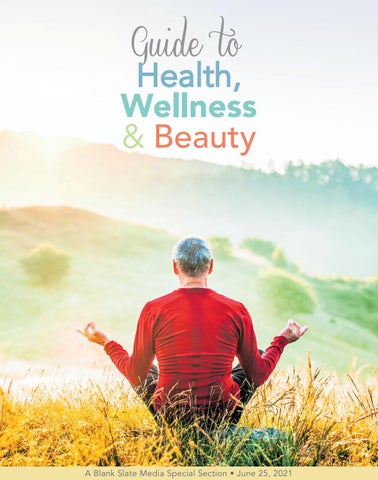
Guide to Health, Wellness & Beauty
A Blank Slate Media Special Section • June 25, 2021
24 Blank Slate Media Newspapers, Friday, June 25, 2021
How meditation can help combat work-life imbalance
J
uggling a family and a thriving career is no small task. It's easy to become overwhelmed when faced with responsibilities at home and at the office, and it's even easier to fall victim to a work-life imbalance. Such an imbalance can have troubling short- and long-term consequences. More than 40 percent of working professionals who were recently surveyed by the United Kingdom-based Mental Health Foundation noted that they are neglecting various aspects of their life because of work. The MHF notes that such an imbalance can make professionals more vulnerable to mental health problems. In fact, the same survey found that more than half of all workers who work long hours feel irritable, while 27 percent acknowledged feeling depressed. Various strategies can help working professionals overcome the negative side effects of work-life imbalance. In addition to exploring ways to work fewer hours and find more time for their families, professionals who feel their life lacks balance can seek ways to overcome the stress associated with such an imbalance. Meditation is one such option. What is meditation? The Mayo Clinic notes that meditation dates back thousands of years. Modern meditation often aims to help people relax and reduce stress. When meditating, people focus their attention as they attempt to eliminate jumbled thoughts. That can be especially valuable to adults who are feeling overwhelmed by their many personal and professional responsibilities.
The National Center for Complementary and Integrative Health notes that there are many types of meditation, but most require four common elements: · a quiet location to meditate where distractions are limited · a specific, comfortable posture · something people can focus their attention on while meditating, such as a set of words or an object · an open attitude How does meditation benefit the mind and body? Meditation advocates note that the practice can provide a sense of inner peace and help people rebalance their lives. That can pay dividends for both physical and mental health. The NCCIH notes that evidence suggests meditation can help reduce blood pressure. High blood pressure has been linked to both heart disease and stroke. A small study by the NCCIH also found that a form of meditation known as mindfulness-based therapy for insomnia helped reduce instances of chronic insomnia in adults. According to the NCCIH, a 2013 review of three studies suggested that meditation may help slow, stall or even reverse age-related changes in the brain. Adults confronting a work-life imbalance may feel as though they don't have the time to address their concerns in a healthy, effective way. Meditation need not take up much time each day, but it can be an effective tool in the fight against work-life imbalance.
Blank Slate Media Newspapers, Friday, June 25, 2021
Add more exercise to the workday
M
any people can benefit from more exercise. But after a long day at work and tending to obligations at home, making time for exercise can be an uphill battle. Come nighttime, there may be little energy or time left to be active. However, failure to engage in regular physical activity can be detrimental to one's health. The World Health Organization lists inactivity as the fourth biggest risk factor for global adult mortality. Plus, long periods of sitting inactively may lead to increased risk for diabetes, cancer, heart disease, and obesity. Psychology Today also says studies indicate mental ability is directly linked to physical activity. Without regular exercise, one may have decreased concentration, poor memory, reduced mental stamina, and a lack of creativity. Finding time to exercise while at work can help people reap the rewards of a physically active lifestyle. The American Heart Association says taking advantage of little opportunities to move more throughout the day can add up to a significant amount of exercise. Here are some ways to exercise during the workday. · Ride or work a portion of your commute. People who live close enough to the office can ride their bikes or walk there. If the office is too far, think about getting off the bus or train a stop earlier and walk the rest of the way. You even can park further away if you drive to the office.
· Switch out your desk. Desks come in different configurations and you may be able to opt for a tall or adjustable desk to enable you to stand and move around a bit while working. If that's not possible, stand up and do some balance or strength exercises while on long calls. · Take the stairs. Skip the elevator and go up and down the stairs each day. Doing so when coming in, going in and out for a lunch break, and when leaving in the evening can add up over the course of a day. · Start a walking club. Get together with coworkers who also want to exercise and use your lunch hour to walk around. You can always eat at your desk before or afterwards. · Schedule walking meetings. Whenever possible, host walking brainstorming sessions or meetings. Take the meeting outdoors if the weather cooperates; otherwise, take laps around the building. · Store some workout gear at work. During breaks, do a few arm curls with dumbbells or use resistance bands to work inner and outer thigh muscles while sitting at your desk. · Volunteer to run errands. Step out for coffee or snacks during the day, making a concerted effort to walk when going for your daily jolt of caffeine. Exercise can be included in the work day by making some minor changes that really add up.
25
+Y 4HYSLUL 3 3L]` 7O+ 3*:> +((74 *VU[HJ[!
&/,1,&$/ +<3126,6 36<&+27+(5$3< $Q[LHW\ 6WUHVV 0DQDJHPHQW 3DLQ 0DQDJHPHQW 5HODWLRQVKLS 7KHUDS\ ,QGLYLGXDO DQG )DPLO\ ,VVXHV
&DOO
,Q 3HUVRQ $SSRLQWPHQWV RU 7HOHWKHUDS\ LI SUHIHUUHG
35(6,'(17 )$&8/7< ³7KH 1HZ <RUN 6RFLHW\ RI &OLQLFDO +\SQRVLV´ 1<6&+ 25* ',3/20$7( )$&8/7< ³$PHULFDQ $FDGHP\ RI 3DLQ 0DQDJHPHQW´ &HUWL¿HG 7HOHKHDOWK &HUWL¿FDWLRQ ,QVWLWXWH 1HZ <RUN 6WDWH /LFHQVHG IRU RYHU \HDUV 3D\PHQW =(//( &DVK RU &KHFN
758( 675(1*7+
75$,1,1*
VIRTUAL WORKOUT AVAILABLE VIA ZOOM
ONE-ON-ONE REHABILITATION IN THE COMFORT OF YOUR HOME
0$66$*( 7+(5$3< Licensed Massage Therapist Swedish • Deep Tissue • Trigger Point • Sports Enhance mobility flexibiity balance weight loss or maintenance
Following COVID -19 Saftey Practices
ANDERSON GOURDET • (917) 612-0460 andersongourdet@gmail.com
26 Blank Slate Media Newspapers, Friday, June 25, 2021
3 strategies to protect mental health
I
mproving one’s overall health and maintaining that health over the long haul can have a profound impact on quality of life. For example, the Harvard Medical School notes that regular exercise can slow the natural decline in physical performance that occurs as people age. That means routine exercise can serve as something like a fountain of youth that allows people to keep their cardiovascular fitness, metabolism and muscle function on par with their younger counterparts. When attempting to improve long-term health, it’s important that people emphasize mental health as much as they do their physical health. The Anxiety & Depression Association of America notes the importance and effectiveness of preventive efforts in relation to depression and anxiety. In regard to mental health, prevention efforts can function in much the same way that exercise serves physical health. Routine exercise helps people to maintain healthy weights, reducing their risk for various conditions and diseases. Preventive efforts designed to improve mental health can significantly reduce a person’s risk for anxiety and depression. Various techniques and strategies can be utilized to promote mental health, and these three are simple and highly effective. 1. Get enough sleep. According to the Primary Care Collaborative, a not-for-profit member organization dedicated to advancing an effective and efficient health system, sleep and mental health are intimately related. Sleep loss can contribute to emotional instability. The amygdala is the part of the brain responsible for humans’
Respect. Tradition. Compassion. For four generations, New York’s Jewish Community has turned to Sinai Chapels for guidance and comfort in their time of need. We honor and respect all Jewish traditions and customs, attending to every funeral detail according to each family’s personal and religious preferences.
To learn more, contact us today:
718.445.0300 | 800.446.0406
emotional responses. When an individual does not get enough sleep, his or her amygdala goes into overdrive, leading to more intense emotional reactions. The prefrontal cortex is another part of the brain that needs sufficient sleep to function properly. Without it, the prefrontal cortex, which is integral to impulse control, cannot function properly. Adults can speak with their physicians about how much sleep they should be getting each night. Those needs change as individuals age. 2. Eat a balanced diet. A balanced, healthy diet doesn’t just benefit the waistline. According to the ADAA, a balanced diet that includes protein, healthy non-saturated fats, fiber, and some simple carbohydrates can reduce the likelihood that mental health issues like fatigue, difficulty concentrating and irritability will arise during the day. 3. Volunteer in your community. A 2020 study published in the Journal of Happiness Studies found that people who volunteered in the past were more satisfied with their lives and rated their overall health as much better than people who didn’t volunteer. Perhaps the most noteworthy finding in the study was that people who began volunteering with lower levels of well-being tended to get the biggest boost from volunteering. Volunteering provides opportunities to socialize, which can help ward off the loneliness that can sometimes contribute to anxiety and depression. Mental health is important, and protecting it should be part of everyone’s health care regimen.
Blank Slate Media Newspapers, Friday, June 25, 2021
27
CSTL’s dinosaurs exhibit expands The Center for Science Teaching & Learning’s expanded Dinosaurs! and Animal Adventure exhibit, featuring four new animatronic dinosaurs, is open and welcoming families and groups. New to the exhibit are five animatronic dinosaurs that are located both inside and outside the exhibition hall. New additions include a mother Triceratops and baby, Citipati (CHITT-uhPUTT-ee) and Parasaurolophus (Pearuh-sore-AWL-oh-fus). A grand re-opening and expansion ceremony with state and local elected officials, VIPs and business leaders, was recently held to mark the occasion. Dinosaurs! And Animal Adventure is the only tourist and educational attraction of its kind on Long Island. Over the past two years, even during the pandemic, the exhibit has become a very popular family-friendly attraction. “The expansion of the Dinosaurs! and Animal Adventure marks the latest step in our mission to inspire and educate. We are certain that everyone that visits our expanded exhibit will be impressed and enjoy our new dinosaurs. Our exhibit will continue to bring tourists and economic activity to Rockville Center and Nassau County,” said Dr. Ray Ann Havasy, executive director, CSTL. The exhibit focuses on how animals adapt and survive. This is demonstrated
through a unique intermixing of dinosaur models and live animals together. It is housed at CSTL’s 35,000 square foot WAC Lighting Hall of Science at its Tanglewood Preserve headquarters located at 1450 Tanglewood Road, in Rockville Centre. School children and families from the New York region and beyond are expected to visit this exhibit annually to experience more than 80 unique displays. As a science and STEM educationfocused not-for-profit organization, CSTL is dedicated to providing people of all ages with a place to engage in both formal and informal learning. CSTL also creates signature corporate programs and delivers educational workshops. Dinosaurs! and Animal Adventure is open every day except Wednesday from 10 a.m. to 4 p.m. Tickets are $15 for anyone 13 and older, $12 for children 1-12 yrs. old. Tickets can only be purchased on site. For special group rates and programs for special events, birthday parties, camps trips and school field trips call (516) 764–0045 or email helpdesk@cstl.org. For more information about CSTL, special events and Dinosaurs! and Animal Adventure visit www. cstl.org.
YOUR VOTE COUNTS!
VOTE DAILY IN EVERY CATEGORY FOR YOUR FAVORITE BUSINESS, SERVICE, PROFESSIONAL OR VENUE NOW THROUGH JULY 2 CHECK OUT ALL THE CATEGORIES IN ALL THE GROUPS Arts/Entertainment • Automotive Bars/Nightlife • Food/Restaurants Health/Wellness/Beauty • Home and Design Kids • Pets • Retail/Shopping • Services Sports and Recreation • Weddings
THEISLANDNOW.COM/CONTEST2021
PHOTO COURTESY OF CSTL
The Center for Science Teaching & Learning in Rockville Centre held a ribbon cutting marking the expansion of their Dinosaurs! exhibit on June 16, 2021. At the ribbon cutting were: Gerri DiSalvo, AAA Northeast; Rockville Centre Village Trustee Nancy Howard; Mayor Francis X. Murray, Village of Rockville Centre; Nassau County Legislator Debra Mulé; NYS Sen. Todd Kaminsky; Town of Hempstead Councilwoman Dorothy Goosby; CSTL Executive Director Dr. Ray Ann Havasy; Nassau County Parks Commissioner Eileen Krieb; Brianna McEnroe, Discover LI; RVC Chamber President Brian Croutier.
NEW HYDE PARK NEW HY D E PA R K
HeraldHerald Courier Courier Manhasset ManhassetTimes Times Great Neck News Great Neck NewsWilliston Times RoslynRoslyn TimesTimes Port Washington Times Port WashingtonTimes