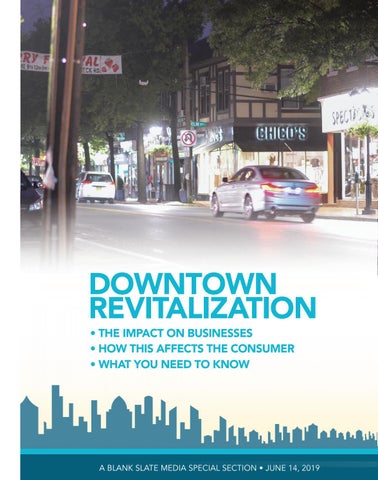
&1906190 4'8+6#.+<#6+10 r 6*' +/2#%6 10 $75+0'55'5 r *19 6*+5 #(('%65 6*' %1057/'4 r 9*#6 ;17 0''& 61 -019
Ƃ Ƃ - Ƃ/ Ƃ -* Ƃ - / " U 1 £{] Ó䣙
36 DOWNTOWN REVITALIZATION • Blank Slate Media Newspapers, Friday, June 14, 2019
Permits a steep hurdle for businesses BY T E R I W EST When the owners of a bakery left a Greenvale shopping center, an antiques seller took over the lease. He had no plans to modify the structure, just to move in his mosaics and candelabra and start business. But after signing the lease, there was about half a year of back and forth between the landlord and the Town of North Hempstead before the store was given all its permits. To this day, leaseholder Scott Defrin said, he does not have permission to put up a second exterior sign. Business owners and brokers on Long Island say one thing makes this area a uniquely difficult place to open a business: bureaucracy. Between the number of distinct municipalities one can find in a 10-mile radius and the procedures for legally opening a brick and mortar business, making it to the ribbon cutting can be a nightmare, business owners say. Opening in Greenvale was an endlessly frustrating process, said Defrin, who moved his antique store from Manhattan. There were three different safety inspections, aspects that kept coming back as noncompliant and periods of waiting. “I was losing patience,” he said. “I wanted to open up, I wanted to be legal and it just seemed like they were sort of stretching the rubber band to the point where it was sort of unnecessary.” To open a business, entrepreneurs need building department approval, either from a village if the area is incorporated or the local town if it isn’t. Should the project require an exception to be made, it heads to the planning department in search of variances. About 5 percent of projects in the Town of North Hempstead do, said town Planning Commissioner Michael Levine. In total, the town budgeted $4.375 mil-
lion in building permit revenue for 2019, which helps fund the department itself, Levine said. Aggregate fees for businesses going through the permitting process typically run from $3,000 to $5,000, Levine said. But the need for architects and other contractors can bring simple projects up to tens of thousands of dollars, said broker Bradley Diamond, a principal at Great Neck’s Lee & Associates office. Defrin’s application required plans demonstrating that the physical space would remain the same, in turn requiring an architect. The architect essentially drew what already existed, Defrin said. The system can be a deterrent for business owners to venture into the area in the first place, Diamond said. “People have to have the money and the financial stamina to wait six to eight months to up to a year for the permitting process,” he said. The number of local jurisdictions provides an extra challenge for chains seeking
to open more than one location on Long Island, Levine said. “You want to go through identical processes, but every zoning jurisdiction has a completely different way of doing essentially the same thing,” he said. Many of the permits local towns and village require are for safety measures regulated by the state. New York determines requirements for sprinkler systems and fire extinguishers, for example, which municipalities then enforce. “The Building Department does not make decisions as to if something’s a smart idea or are they personally in favor,” Levine said. “They are purely code-compliant, so if you comply with the code, you get the permit.” Code compliance came into Roslyn Village Veterinarian owner Dr. Mario Vezza’s life after a car crashed into his building. While he shifted his operation to a temporary trailer, he began planning to repair and expand the building, but not his client capacity.
His business had seven parking spaces. It only hosts up to three clients at a time, Daniel Winkelman of VHB Engineering told the Roslyn Zoning Board of Appeals at a January hearing, according to the minutes. With an expansion that would approximately double its square footage, village code required it to have 22. Though Vezza planned to expand parking to 12 spaces, the remaining 10-space difference required a variance. As per village code, he was charged $2,000 for each of the 10 missing spaces. One solution for the business community, Diamond and Levine said, would be to have a single zoning code for Long Island similar to how New York City operates. That, however, is a very distant and unlikely goal, they both said. Perhaps building departments could start by prioritizing new developments, or village boards could meet more frequently than once a month if they’re receiving applications, Diamond said. Levine said that over the course of his 24 years as planning commissioner he has gained the ability to influence the Town Board when he sees a need for a change in code. The board annually revises the code to modernize outdated requirements, he said. “The process is streamlined where you can, but if something’s taking a while because of a heavy backload that’s not really a legislative fix,” Levine said. In a time where physical establishments are competing with internet-based operations, extra hurdles in opening are the opposite of what is needed, Diamond said. “It’s very frustrating and frustrating because it’s so hard to find somebody who actually wants to open up a business in today’s climate,” Diamond said. “Then they have to wait for months and months and months. Who wants to do it?”
Stores fight to survive in Amazon era BY JA N E LL E C L AUS E N It is a sight Francesca Carlow, president of the Nassau County Council of Chambers of Commerce, sees often. Someone comes into Trio Hardware, her family’s hardware store in Plainview in business for 50 years, and asks what the best product for a certain job is. The person looks at the price. Then he whips out a phone, Carlow said, and finds it a few dollars cheaper on Amazon. “Our older customers still, I would have to say 80 to 90 percent, come to the store because they want to know they’re going to have the right product for the right job,” Carlow said, “but you do look around now and there are fewer and fewer retail [outlets]. Even clothing stores are closing because people are shopping online.” Carlow is one of many retailers that have been adjusting to the changing nature of retail as they seek to survive in the era of e-commerce behemoths like Amazon.
And while business has gone up and the overall vacancy rate appears to have gone down in the Long Island retail market, according to NAI Long Island, a commercial real estate firm that studies the Long Island and Queens real estate markets, some areas have not fared as well. The firm found that in the fourth quarter of 2018, western Nassau had a retail vacancy rate of 4.4% and northern Nassau had a rate of 6.4%. At the same time in 2017, the rates were 2.8% and 4.2%, respectively. Jay Corn, a founder of the Great Neck Plaza Business Improvement District, said the stores that are succeeding right now are national retailers with name power and more user-friendly policies. Additionally, Corn said, retailers have made a shift toward something Amazon cannot bring: an experience. “The nature of retail is changing drastically and it appears that the businesses that are replacing the retailers are service-oriented,” Corn said. “There’s
certain things you can’t just get from Amazon. That’s the direction we’re going in.” Hooshang Nematzadeh, the former Chamber of Commerce president in Great Neck and head of Nemat Development Group, said there are unique challenges when it comes to doing business in Nassau County. There are high taxes that make up to half of the rents, he said. There is also little room for error in doing business, considering small businesses are trying to compete with Amazon and online shopping in general. Nematzadeh said the continued loss of retailers requires major action and cooperation among entities, new programs and possible tax abatements to spur development. “I believe that the problem of this magnitude requires input and cooperation from the county, town and villages together,” Nematzadeh said. “This is a multi-pronged problem.” Bradley Diamond, a real estate bro-
ker who does retail work on Long Island and Queens, said he’s come to know first hand how difficult it is for businesses to open in the first place. For some entrepreneurs, simple applications could run into the tens of thousands of dollars because of a combination of fees, needing to hire attorneys and architects, and the differing requirements of municipalities, Diamond said. “People have to have the money and the financial stamina to wait six to eight months to up to a year for the permitting process,” Diamond said, adding that the “lack of streamlining” is acting as a deterrent. Harold Citron, a retail analyst from Great Neck, which is trying to revitalize its downtown, said there is considerable talk about taxes and a lack of foot traffic being the issue. But, Citron said the bigger factor is that people are either going to a mall like Roosevelt Field or the Americana Shopping Center or going online. Continued on Page 37
Blank Slate Media Newspapers, Friday, June 14, 2019 • DOWNTOWN REVITALIZATION
37
Turn to transit-oriented development BY J E S S I C A PA R K S Nassau County, one of the nation’s first suburbs, is experiencing an aging population as younger people are moving away in search of more affordable homes. To address this problem, many villages and local communities are implementing a transit-oriented development approach, with housing and commerce centered on a railroad station. A December report from Nassau County Comptroller Jack Schnirman disclosed that since 2000, Nassau County’s population has experienced an 18 percent decline in 25-to-44-year-olds. Furthermore, 71 percent of Long Islanders between the ages of 18 to 35 have indicated plans to leave the island as a result of property taxes and housing costs. “This has major impacts on the economy and the ability for government to provide necessary services to residents,” Schnirman said. “We must work to make our neighborhoods and the whole deal of living on Long Island attractive to young professionals seeking affordable housing options in centrally located downtowns to remain competitive with other regions.” “That means creating affordable, transit-oriented housing, supporting our local economy, and modernizing government so that it is able to serve the needs of the people who live here now, not the 1950s,” he said. The Transit Oriented Development Institute, a Washington D.C.-based project spearheaded by the U.S. High Speed Rail Association, identified the key components of transit-oriented development as an area with a walkable design that prioritizes pedestrians. Also, a train station must be incorporated into the town’s center with a mixture of commerce in close proximity.
“Our young people want a different neighborhood vibe,” Nassau County Executive Laura Curran said in her 2019 State of the County address. “They are attracted to walkable downtowns with apartments, restaurants and entertainment.” Andy Kunz, president and chief executive officer of the Transit Oriented Development Institute, described the development approach as “a New York City lifestyle on a town scale.” He said it creates a community of people and raises demand for commerce because people are spending more time in one place. In her State of the County address, Curran commended several village mayors who have recognized that “the suburbs of the past don’t adequately address the needs of our future generations” and “have focused on developing transitoriented development housing and retail options in vibrant walkable downtowns.” Among the several village mayors that Curran recognized were Scott Strauss of Mineola and Jean Celender of Great Neck Plaza. Over the past few years, Mineola’s vacant buildings have been transformed into luxury apartment buildings that have attracted retail stores and restaurants. And to support the incoming apartment-dwellers, within walking distance of the Mineola train station one can find an artisanal coffee shop, Urban Brew, and the Roman-style pizza parlor Taglio Pizza. In an interview, Taglio Pizza owner Robert Cervoni, 36, said he was attracted to open the shop in Mineola because he recognized the increasing development and popularity of the area. Another village on a similar course is New Hyde Park, which is expected to conduct a complete downtown revital-
ization in conjunction with the MTA’s third track expansion project, in which a third electrified rail will be constructed between Floral Park and Hicksville. While aiming to stay away from Mineola’s high rises, New Hyde Park Mayor Lawrence Montreuil said at a past board meeting that the goal is to develop a pedestrian-friendly downtown environment while maintaining the village’s suburban feel. Currently, the area surrounding New Hyde Park’s LIRR station is predominantly industrial. Late last year, the village board modified its zoning law to allow for mixed-use development around the train station. Originally, the code allowed only commercial and industrial uses. The adjustment derived from negotiations with the governor’s office and 3TC, the firm building the third track, as a condition for the village securing a $5 million grant from the state. At an April 30 village meeting, however, residents piled into Village Hall with concerns over the zoning law and how it will transform the area. Kunz said he always sees resistance to development in the areas he works with and “rightfully so.” For the past 50 years with car-oriented development, he said, surrounding residents’ lives were made worse every time something opened because there was increased traffic with cars heading to a location with only one use. “Transit-oriented development is the reverse of that,” Kunz said. “It is the solution.” He said by concentrating development in one area with a train station at its center, it is actually eliminating cars from the road. Instead, people are traveling on foot from place to place to complete their errands instead of having to drive from one location to another.
Kunz said the key is to increase density in the hub area around the train station while not affecting the low-density housing nearby. Kunz pointed to a development in Arlington County, Virginia, that boasts 30 years of economic success as a case study for the benefits of transit-oriented development. The Rosslyn Ballston Corridor is a development that stretches over five Metro stops and inhabits a formerly aging commercial strip. A “bull’s-eye zoning” method was implemented for the project, where density gradually decreases as it moves further away from the center. The highest density buildings are situated close to the train, while low-density housing sits just outside the bull’s-eye. Kunz said “that did two things: it concentrated the development and tapered it down to the neighborhood level by the time it got down to the edge.” He said the neighborhoods surrounding the developed area have seen their property values double because of their walkable distance to a bustling downtown. Kunz said a study on the area found that 70 percent of its public transportation riders are commuting to the train by foot. Additionally, Kunz said that Arlington County has had no need to increase property taxes following the creation of the corridor due to increased tax revenue from businesses. The decrease in motor vehicle use has also reduced the need for tax revenue to be allocated toward expenses such as the widening of roads to accommodate more traffic. Kunz added that transit-oriented development is not a new approach but in fact a return to a pre-suburban age that ended in the 1950s when many sought a nonurban lifestyle.
Stores fight to survive in Amazon era Continued from Page 36 “It’s a mix and match these days,” Citron said. “Young people are more comfortable with online purchases. They’re more comfortable with the blind transaction rather than developing the relationship you would have with a local shop.” Still, Citron said the shift doesn’t mean the end of communities or downtowns. Horses and carriages were replaced by cars, for example, and the idea of being a programmer or video game maker was unimaginable just a few decades ago. “There is still a market demand for businesses, for services, and the question is what comes next,” Citron said. “There’s always something that’s going to come next.” Carlow said the Nassau Council of Chambers of Commerce has been work-
ing hard to try and even the playing field, lobbying for the taxation of third party internet sales to keep money local. Developers and landlords are also starting to see the problem, she said. “Developers and landlords are finally getting the picture that you cannot be charging $45 per square foot and be expecting someone to pay,” Carlow said. Despite the challenges, Carlow said she believes the smaller stores can pull through and encouraged people to shop local because the money would support the community. “I think there will always be a place for mom and pops, but you also have to adapt and make a strategy,” Carlow said. “When I go to a different city or a different anyplace, I like to go to a ‘greasy spoon.’ I like to go to a local establishment so you can get a flavor of where you are.”
PHOTO BY JANELLE CLAUSEN
Local experts say that downtown retailers face unique challenges as the very nature of retail is changing, thanks to e-commerce and Amazon.
38 DOWNTOWN REVITALIZATION • Blank Slate Media Newspapers, Friday, June 14, 2019
65 ;/, 9,*69+
)($785(' 3$1(/,67 6
*644<50;@
-69<4
)UDQFHVFD &DUORZ
%UDGOH\ 'LDPRQG
5DOSK (NVWUDQG
$VVHPEO\PDQ $QWKRQ\ 'ō8UVR
3UHVLGHQW RI 1DVVDX &RXQW\ &RXQFLO RI &KDPEHUV
:+2 :,// 6$9( 285 '2:172:16"
Ř :+$7 %86,1(66(6 &$1 '2 Ř :+$7 *29(510(17 &$1 '2 Ř :+$7 <28 &$1 '2
7+856'$< -81( S P
1DVVDX &RXQW\ 9LOODJH 2IƓFLDOV $VVRFLDWLRQ 3UHVLGHQW
-XGL %RVZRUWK
&RPPHUFLDO 5HDO (VWDWH %URNHU /HH $VVRFLDWHV
5LFKDUG 1LFROHOOR
1RUWK +HPSVWHDG 7RZQ 6XSHUYLVRU
1DVVDX &RXQW\ /HJLVODWXUH
&KULVWLQH 6LOOHWWL
6FRWW 6WUDXVV
8QLWDULDQ 8QLYHUVDOLVW &RQJUHJDWLRQ DW 6KHOWHU 5RFN 6KHOWHU 5RFN 5RDG LQ 0DQKDVVHW +RVWHG E\ %ODQN 6ODWH 0HGLD DQG WKH 8QLWDULDQ 8QLYHUVDOLVW &RQJUHJDWLRQ DW 6KHOWHU 5RFN
6WHYHQ %ODQN
$ZDUG ZLQQLQJ MRXUQDOLVW DQG %ODQN 6ODWH 0HGLD SXEOLVKHU 6WHYHQ %ODQN ZLOO SRVH WRSLFDO TXHVWLRQV IROORZHG E\ DQ DXGLHQFH TXHVWLRQ DQG DQVZHU SHULRG
([HFXWLYH 'LUHFWRU %D\VLGH 9LOODJH %XVLQHVV ,PSURYHPHQW 'LVWULFW
(GLWRU DQG 3XEOLVKHU RI %ODQN 6ODWH 0HGLD
6HDQ 6DOOLH
$'0,66,21 ,6 )5(( 3OHDVH UHJLVWHU WRGD\ WR UHVHUYH \RXU SODFH ZZZ WKHLVODQGQRZ FRP FRPPXQLW\IRUXP 5HIUHVKPHQWV ZLOO EH VHUYHG IROORZLQJ WKH IRUXP Event sponsored by:
0D\RU 9LOODJH RI 0LQHROD
Presented by:
'HSXW\ &RPPLVVLRQHU RI WKH 1DVVDX &RXQW\ 'HSDUWPHQW RI 3XEOLF :RUNV
(ULF $OH[DQGHU 'LUHFWRU 9LVLRQ /RQJ ,VODQG