THE BUSINESS OF ACCOMMODATION IN ASIA-PACIFIC
Vol.30 No.1
Bi-monthly
February 2026

![]()
THE BUSINESS OF ACCOMMODATION IN ASIA-PACIFIC
Vol.30 No.1
Bi-monthly
February 2026

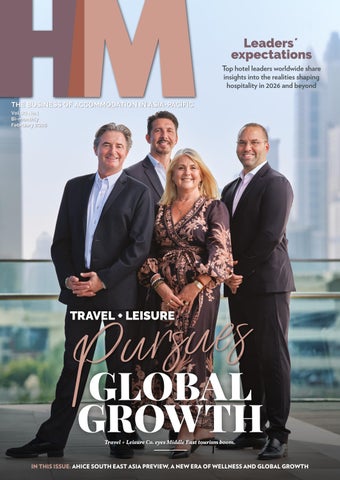
Top hotel leaders worldwide share insights into the realities shaping hospitality in 2026 and beyond


Here’s how it works:


rive bookings for your ser vices
Add your own channels


Minor Hotels reveals major
IHG Hotels and Resorts embarks on a mega triple-branded hotel project in Japan.
The Ascott Limited Chief Financial and Sustainability Officer, Beh Siew Kim, reveals the motives behind creating one of the world’s first open-access holistic disability inclusion playbooks.
Accor lays strong foundations for
Your preview of the upcoming AHICE South East Asia conference.
HM’s 24th Industry Leaders Forum features the biggest names in
2026
Capella Sydney General Manager, Marc von Arnim, talks about their latest development, The Lands by Capella.
Small Luxury Hotels Senior Vice President Asia Pacific, Mark Wong, discusses sustainability in a bid to encourage more hotels to operate in mindful ways.


James Wilkinson unpacks the global development pipeline for 2026.
Snapshot


Every January, the world’s leading hotel chains report their global pipeline growth and excitingly, 2026 is shaping up to be yet another record year for Hilton, Marriott, Hyatt, BWH Hotels and more.
The pipeline announcements for the United States-based chains all come around the Americas Lodging Investment Summit (ALIS) in Los Angeles (Jan 26-28) and as this latest edition of HM went to the printers at the same time, there were announcements aplenty, showing global demand for the hotel industry continues to soar.
Hilton reported a very strong year of growth in 2025, adding nearly 800 hotels and 100,000 new rooms to its global portfolio during the year, representing full-year net unit growth of 6.7%.
Hilton President and CEO, Chris Nassetta, said owner appetite for Hilton’s brands, increased conversion activity and outsized demand for luxury and lifestyle products continued to drive strong growth for the company’s development pipeline.

Hotels around the world capturing our attention this month.
The company signed more than 1,000 new hotels in 2025, or almost 140,000 rooms and Hilton now has more than 3,700 hotels under development, totalling more than 520,000 rooms.
“We continue to strengthen our network effect and strategically expand into destinations around the world,” Nassetta said. “We’re also adding new brands, with more to come in 2026, which is a testament to our commitment to innovate and meet evolving guest demand.
“With a robust pipeline and industry-leading commercial engines, we expect net unit growth of 6% to 7% in 2026.”
Marriott International grew net rooms over 4.3% in 2025, adding over 700 properties and nearly 100,000 rooms to the system, including over 630 properties added through organic deals, representing more than 89,000 rooms.
“2025 was a defining year for Marriott, marked by bold expansion and global milestones,” said Marriott International President and CEO, Anthony Capuano.
“We scaled our iconic brands to new markets around the world, strengthened our portfolio across every segment, and opened doors to destinations that inspire travellers worldwide.”
Marriott’s Asia Pacific excluding China (APEC) region saw an all-time high of 187 deals and the company continues to have strong momentum with conversions, according to Capuano.
Hyatt Hotels Corporation reported a new record pipeline of approximately 148,000 rooms as of year-end 2025, representing a 7% increase in Hyatt’s pipeline compared to 2024.
“2025 was a milestone year for Hyatt as we thoughtfully expanded our portfolio, using market insights, World of Hyatt member spend, and owner feedback to identify the right growth opportunities for Hyatt,” said Hyatt President and Chief Executive Officer, Mark Hoplamazian, who added the company saw particularly strong signings activity in the United States and Asia Pacific.
BWH Hotels revealed the company added more than 200 hotels in 2025 and has more than 230 properties in its international pipeline, led by the Asia Pacific region.
“This past year brought meaningful expansion across our brands, underscoring the value of our proven delivery systems and hotelier support,” said BWH Hotels President and CEO, Larry Cuculic.
“As we enter 2026, we will continue reaching new destinations and evolving our business to meet the needs of current and future guests.”
With the global pipelines solid, 2026 is shaping up to be a fantastic year for the accommodation industry and right across this special Leaders Forum edition of HM, we have in-depth coverage of what to expect locally and globally by some of the most esteemed leaders in the business.
Enjoy the latest issue and I look forward to seeing you at an AHICE event soon.
Yours in hospitality,
James Wilkinson Editor-In-Chief,
HM Magazine Chair and Group President, AHICE global conferences

ONE:

TWO: Park Hyatt Auckland @parkhyattauckland

THREE: The Singapore EDITION @singaporeedition

FOUR: Oval Hotel, Adelaide @ovalhotel


It’s been a privilege to step into the Editor’s chair for HM, taking the reins from Ruth as she begins her journey into motherhood. While I may be new to the role, the past few months have been anything but quiet. Instead, the thoroughly energising learning curve has reminded me just how dynamic this industry is.
My career has spanned travel and tourism, with hospitality a fundamental pillar; so, my return has been met with a familiar undercurrent. It’s also been a pleasure to reconnect with industry leaders and operators.
And what an issue to lead with.

This edition is anchored by the HM Industry Leaders Forum, now in its 24th year. It has once again brought together senior decision-makers from across the globe to share high-level insights into the realities shaping hospitality today. True to form, nothing was left unturned. From the biggest challenges of the past year to the rewards hard-won through adaptability and grit, the Forum offers rare insight into how leaders are navigating an increasingly complex operating environment.
Several key themes stood out. Artificial intelligence continues to move from concept to application, with a strong focus on how it can be used to enhance guest personalisation without losing the human touch. Sustainability remains firmly at the top of the agenda and is no longer a ‘nice to have’, but a commercial and operational imperative. Meanwhile, discussions around talent shortages and rising costs highlighted the ongoing pressure placed on productivity, performance and long-term growth.
Throughout this issue, you’ll find perspectives that are honest, strategic and grounded in real-world experience, reflecting an industry that is evolving rapidly and with purpose.
I hope you enjoy this issue as much as I’ve enjoyed putting it together. It’s been an inspiring introduction to the role, and a reminder of the collaboration that underpins hospitality.
I look forward to the conversations ahead.
Managing Director Simon Grover
Publisher James Wells
Editor–In–Chief James Wilkinson jwilkinson@intermedia.com.au
Editor Daisy Melwani dmelwani@intermedia.com.au
Group Commercial Manager Tara Ducrou tducrou@intermedia.com.au
Production Manager Jacqui Cooper jacqui@intermedia.com.au
Graphic Designer Ryan Vizcarra
Photography Cover photographed by Jure Ursic, Phocrea Photography Service Co. L.L.C.
Daisy Melwani Editor, HM Magazine

Subscription enquiries 1800 651 422
Subscribe to HM Magazine –6 issues for AU $88 (inc. GST) subscriptions@intermedia.com.au
Published by
41 Bridge Road, Glebe NSW 2037, Australia. (PO Box 55, Glebe NSW 2037, Australia)
Tel: +61 (0) 2 9660 2113 Fax: +61 (0) 2 9660 4419 ABN 940 025 836 82 In association with


2026 is the Year of the Horse according to Chinese tradition. The horse is said to be a symbol of strength, vitality, and freedom. It is believed to represent speed and perseverance, often associated with success and progress.


The essential hotel and travel industry news and trends from across the globe.
Read more at HotelManagement.com.au

Èliva debut signals the next phase of growth for Salter Brothers Hospitality.
SBH HAS UNVEILED Èliva, an exclusive day spa and wellness brand debuting in 2026 across three flagship locations across NSW and a further three in the pipeline.
The first three bespoke wellness destinations will open at Ardour Milton Park Bowral, InterContinental Sydney Coogee Beach and Ardour Lilianfels Blue Mountains with a strategic rollout planned throughout the year.
“Èliva signals our next phase of growth,” SBH Chief Executive Officer, Tash Tobias said.
“As wellness-led travel surges globally, we’re blending holistic wellbeing with world-class
hospitality to create a distinct, future-focused luxury offering.
“It reflects our commitment to innovation, diversification and value as we continue expanding with leading hotel brands across Australia,” Tobias said.
Developed with leading spa and wellness experts, Èliva is said to combine world-class hospitality with holistic wellbeing practices, delivering a complete wellness eco-system.
SBH Chief Development Officer, Raphael Antonini said Èliva presents a compelling growth proposition for partners.
“Èliva is a scalable, premium wellness brand that responds to increasing demand for wellbeing experiences within luxury hospitality. Its flexibility across resort, retreat and urban hotel environments creates strong opportunities for partners to integrate a distinctive wellness offering to enhance asset value, guest appeal, repeat visitation and longterm performance.”
Each day spa will feature oil-blending bars, treatment rooms, thermal spa, recovery lounges and fitness offerings designed for their destination.
Minor Hotels reveals major global growth plans for 2026.
MINOR INTERNATIONAL’S GROUP CEO, Dillip Rajakarier, has outlined the company’s extensive global growth plans for 2026, which will see Minor Hotels roll out new brands and expand others extensively.
Rajakarier has revealed the company will pursue a focused approach to growth in 2026, building on a year of record development momentum to prioritise market depth, portfolio diversification and capital-efficient expansion.
The group signed 40 new hotel contracts and master agreements in 2025 – its highest annual total to date – and expects to secure a further 25 signings in the first quarter of 2026, highlighting sustained owner demand and signalling another record growth year ahead.
With its strongest pipeline to date and a portfolio of more than 640 properties globally,
and operator, marked by targeted asset-light expansion and supported by the addition of four new hotel brands and a strengthened global platform under the Minor Hotels master brand.
“The pace of recent signings reflects strong owner confidence in our brands and platform,” he said.
“Driving growth through a higher mix of HMAs and franchising allows us to scale with discipline, while our continued role as owners keeps us closely aligned to hotel performance and brand standards.
“As we add depth to our brand portfolio in 2026, this combination of global reach and an owner’s mindset gives us the insight needed to really tailor solutions to different assets and owner ambitions,” Rajakarier said.
Of the 25 new deals that Minor expects in Q1, more than 60% will be in the Middle East and Asia, a move to balance its strong presence

Tivoli Muscat Hotel and Residences exterior rendering. Branded residences remain a core growth pillar for Minor Hotels

in Europe, which currently accounts for more than half of the group’s portfolio.
Rajakarier said franchising will play a central role in its next phase of growth, with the approach forming a core part of the group’s asset-right strategy.
The luxury portfolio expansion will also extend into Australia, where Minor Hotels already operates more than 60 properties, mostly under the Oaks and Avani brands.


Ozone Hospitality Services, in a joint venture with two Time Olympic Gold Medalist Nova Perris OAM OLY, former Labor Senator have now launched the Supply Nation Certified Bawaka Services.
Blending national housekeeping expertise with culturally grounded service delivery, the partnership creates spaces that are cared for with intent, while opening meaningful pathways for Indigenous participation and long-term community impact.


Deal worth a reported AU$1.2 billion delivers Blackstone one of Australia’s leading hospitality assets.

Global alternative asset manager
Blackstone has entered into an agreement to acquire Queensland’s Hamilton Island from the Oatley family.
The deal, subject to customary regulatory approvals, will see Blackstone take control of five hotels, more than 20 restaurants and bars, 20 retail outlets, an 18-hole championship golf course on neighbouring Dent Island, a marina and a commercial airport.
The move, worth a reported AU$1.2 billion according to the Australian Financial Review, expands Blackstone’s Australian portfolio, which includes Crown Resorts properties in Melbourne, Perth and Sydney, and AirTrunk, the largest data centre platform in Asia Pacific.
“Hamilton Island is an exceptional destination, and we are honoured to build on the vision and dedication that the Oatley family has brought to investing in its transformation and add a standout asset to our portfolio,”
Blackstone Chairman of Asia Pacific and Head of Real Estate Asia, Chris Heady said.
“Hospitality and leisure is a key investment theme at Blackstone globally including in the Asia Pacific region, where we’ve brought scale
and operational expertise to invest in and build leading brands.
“We are committed to investing in the longterm success of Hamilton Island, its people, and its local businesses and community,” he said.

Hamilton Island is located in the Great Barrier Reef and the acquisition will see Blackstone take over more than 2,800 acres across two islands, around 70% of which remains undeveloped.
“We would like to thank our Board and Management for achieving this outcome and welcome the new owners Blackstone. Hamilton Island has a special place in the hearts of many Australians,” Sandy, Ian and Rosalind Oatley said.
“For more than two decades the family’s passion, led by Bob Oatley, has made significant investments to transform the island into one of Australia’s most loved and visited destinations, renowned for its natural beauty, variety of world-class accommodation, amenities and experiences, and ensuring its place as Australia’s Tropical Island.
“We are delighted to have a partner of Blackstone’s calibre and resources to continue the legacy, while supporting our people and island community.”

Blackstone is one of the leading investors in hospitality and leisure globally and its key investments include an eight-hotel portfolio from Kintetsu Group Holdings in Japan; a joint venture with Panchshil Realty on Ventive
Hospitality, which owns and manages a portfolio of luxury hotels in India, the Maldives, and Sri Lanka; and Great Wolf Resorts, a leading owner and operator of family-oriented entertainment resorts in the United States.

engineered to perform year-round
Sleep Cooler This Summer Cooler sleep,
The King Koil Platinum Experience features premium stretch knit fabric with Adaptive® temperature regulating technology for enhanced comfort.

Qantas expands Perth hub with new global flights.
Qantas has launched direct services linking Perth with Johannesburg and Auckland and marking a significant expansion of the airline’s western international hub.
“This marks a significant milestone for Perth as our direct service to Johannesburg takes off and we welcome the arrival of the first direct flight from Auckland,” Qantas International, Chief Executive Officer, Cam Wallace said.
“The inaugural flight to Johannesburg was almost full and we’re seeing positive forward bookings, so we know there is strong appetite for direct travel between the West and South Africa, as well as Auckland.
“These routes unlock more options and greater choice for all Australians to connect to the world through our growing network, including to popular cities like Cape Town through our partnership with Airlink in South Africa and for West Australians to New York via Auckland,” he said.

The milestone reinforces the growth of Qantas’ expanding international western hub, connecting three continents and adding more than 150,000 seats in and out of Perth each year

Accor Plus serves up an enviable exclusive with tennis star, Alex de Minaur.
Accor Plus hosted select ALL Accor+ Explorer members in Melbourne to a ‘money-can’t-buy’ experience, proving not all of the Australian Open action was held courtside.
The premium travel loyalty subscription invited 60 members and guests to hear from Alex de Minaur, currently ranked 6th in the world, prior to his Australian Open campaign.
The intimate gathering at The Como Melbourne was joined by Adrian Williams, Chief Operating Officer of Accor in the Pacific region, who hosted a Q&A with the tennis pro, before guests enjoyed a private meet-and-greet.
The Australian Open proved a powerful drawcard for the group, with Accor’s 33 Melbourne hotels reportedly close to full occupancy during the first week of competition.
The latest on the new Crystalbrook Sam.
Crystalbrook Collection’s first South Australian hotel has inched closer to its slated late 2026 opening after reaching its full height last month.
The new 12-storey luxury hotel in Adelaide’s Halifax Street has officially entered its next phase having topped out, with local Adelaide firm PACT Architects alongside the build team to now transition from major structural works to façade installation and detailed interior fit-out.
Crystalbrook Sam is expected to feature design-led accommodation, signature dining and elevated wellness experiences. The hotel’s 196 rooms and suites, along with a Level 12 restaurant with sweeping panoramic views, are expected to lure locals and visitors alike when it opens this year.
The hotel will also introduce Eléme Day

Spa to Adelaide for the first time, bringing Crystalbrook’s wellness philosophy to the city. The spa will sit alongside a gym, sauna, and swimming pool. Crystalbrook Sam will also feature a ground-floor café and bar and flexible meeting and event spaces for over 100 attendees, across three meeting rooms and two conference spaces.
“Topping out brings us another step closer to opening Crystalbrook’s first hotel in South
Australia. Adelaide’s hospitality scene is evolving with enormous energy, and we’re excited to contribute to that momentum with a hotel that brings Crystalbrook’s forwardthinking luxury to the city for the first time. Crystalbrook Sam is taking shape beautifully, and we’re looking forward to revealing more of the experience as we move toward opening in late 2026,” Crystalbrook Collection, Chief Executive Officer, Geoff York said.

Go beyond siloed guest insights with Intelligent Guest Profile technology across Agilysys solutions, including Versa PMS. Share with teams across your property comprehensive guest preferences and activity, so your staff can know and serve guests more personally, creating memorable moments that matter.

Learn how powerful personalisation PLUS optimal data sharing can increase Revenue per Guest.

From flying high to feeling immediately grounded – the cuttingedge design for the Pullman Perth Airport sets a new benchmark for airport hotels globally, with a high-end resort concept that
a strong sense of place.

Pullman Perth Airport’s resort-style unveiled.
Acutting-edge design for the Pullman Perth Airport is expected to elevate Perth’s first airport hotel into a destination rather than a stopover.
Being touted as a retreat for visitors to relax and soak up the resort-style environment just steps from major terminals, the new hotel is scheduled to commence construction in 2026.
“The new Pullman Perth Airport hotel will be a world-class facility located at the front door to our major terminals. It will make it even more convenient for international and interstate visitors, providing a place to stay and relax during connections,” Skyfields by Perth Airport Chief Property Officer, Dan Sweet said.
“Travellers can also use it as a base to explore Perth’s iconic attractions – it’s just 15 minutes to the CBD, Optus Stadium or wineries in the
Swan Valley, and 30 minutes to spectacular beaches along Australia’s western coast.”
The 240-room hotel features an aerodynamic form with metal fins that echo aircraft panels and its curved shape is said to be designed to maximise views of either the airfield or the Perth city skyline from upperlevel rooms.
The hotel will be complete with a rooftop pool and bar to reinforce the resort feel, with guests entertained by watching aircraft take off and land.
“Pullman is defined by spaces that are purposeful, contemporary and designed to provoke exchange, and Pullman Perth Airport will be a compelling expression of that philosophy. Every element, from architecture and interiors through to the rooftop experience, has been intentionally


crafted to serve the needs of today’s lifestyles,” Accor Pacific Chief Operating Officer, Adrian Williams said.
“By blending Pullman’s global perspective with design cues inspired by Western Australia, the hotel will offer an experience that is globally connected yet locally grounded, where design actively shapes how guests engage, connect and move through the destination,” Williams said.
DKO Architecture is behind the design and aims to strike a balance between the two worlds of aviation and resortstyle destinations.
“The brief from Skyfields was for the hotel to make guests feel instantly grounded, relaxed, and immersed in Western Australia’s identity – all while delivering the sophistication of a global Pullman flagship,” DKO Architecture Director, Dennis Chew said.
Guests will be met with a garden environment outside the hotel forecourt, with the space connecting to the airport’s existing Skybridge with a 30-metre canopy walkway leading to the terminal.


“A critical priority is building a stronger pipeline of skilled hospitality professionals to support Australia’s long-term tourism competitiveness,” he said.
“The new Tourism Australia MD has a


The Middle East is one of the most compelling growth stories our industry has seen in decades. The numbers alone tell a powerful story. International arrivals to the Middle East finished 32 per cent above 2019 levels in 2024, the strongest performance of any region worldwide. Travel and tourism across the Gulf Cooperation Council (GCC) countries contributed approximately US$247 billion to GDP in 2024 and has continued to expand last year This is structural momentum underpinned by investment, ambition and a clear appetite for premium leisure experiences.
With this in mind, Travel + Leisure Co. sees the Middle East as a priority area of expansion. Vacation clubs are made for the Middle East, because GCC travellers value experiences, flexibility, quality and the ability to accommodate intergenerational and group travel. Strong private wealth and sovereign capital support sustained demand for trusted, high-quality leisure products and the company’s acquisition of Accor Vacation Club provides a platform to expand through hospitality brands people know and trust.
“Our decision to establish an office in the region is both strategic and deliberate, In years to come, we expect the Middle East will not be an outpost, but a core growth market that will help shape the future of vacation clubs globally,” said Barry Robinson, President and Managing Director, International Operations.
“Our ambition is to lobby governments and regulators to ensure any vacation club legislation or regulatory framework is robust, transparent and benefits both consumers and the industry as a whole.”


“With an established track record in the US, the South Pacific and, more recently, Asia, we view the Middle East as another phase in our global growth journey,” he said.
A central part of this story is the emirate of Ras Al Khaimah (RAK), an emerging destination that combines natural beauty, adventure and accessibility. Tourism revenues in the emirate rose by nine per cent in the past year alone, reflecting growing demand. Its leisure identity will be forged in adventure, wellness, family travel and longer stays – all elements that suit vacation clubs. Just as the upcoming opening of the emirate’s first casino is a game-changer, a Middle East vacation club could be a game-changer for how locals and expats holiday.
“RAK is also a market where we see strong alignment between government ambition, tourism development and private sector innovation – an alignment that gives us confidence in the destination’s long-term potential,” said Robinson.
The Travel + Leisure Co. International team can bring the world’s most trusted vacation club experiences to the Middle East, combining more than 25 years’ experience in vacation clubs with globally recognised brands. For example, Accor Vacation Club offers members choice and flexibility across a diverse portfolio of destinations and travel styles, supported by service standards and a people-first approach that resonates strongly with GCC expectations.
The Travel + Leisure Co. vacation club model is designed to provide flexibility and long-term value in a market where daily accommodation rates continue to rise. Members purchase points that renew annually for the duration of the club term. Brand name products guarantee consistent standards of service and memorable experiences. Families and multi-generational travellers can enjoy larger villas and suites, adjoining rooms, kids’ facilities and holidays together without compromise.

Travel + Leisure Co. vacation clubs are asset-backed. Unlike a typical accommodation booking, vacation club members purchase an interest in the club itself. At the end of the club term, any club properties are sold and members share in the net proceeds – in the way they might if they owned a portion of a holiday home.
However, travel in the Middle East is about more than accommodation alone – but how travel integrates into everyday life, whether that is a long weekend locally or a weeks-long adventure to another continent.
“Our vacation club model is able to cater for the flexible accommodation needs of GCC residents,” said Robinson. “Our members can access accommodation networks and personalised travel experiences globally, supported by partnerships with leaders in vacation exchange, hotel networks, and trusted travel brands and loyalty programs.”
Ultimately, the Travel + Leisure Co. expansion into the Middle East is about leadership and long-term vision. This region presents an opportunity to establish a benchmark for vacation clubs: one built on scale, trust, flexibility and genuine understanding of how GCC residents travel. For Travel + Leisure Co., the Middle East is not just a growth opportunity, but a chance to help define the next chapter of the industry. n


Bamurru Plains Wild Bush Luxury is an all-inclusive Australian safari camp in the Northern Territory’s tropical Top End
Intrepid scales up accommodation portfolio, buys two luxury lodges.
In a bid to strengthen its premium lodges range, Intrepid Travel has acquired Experience Co’s Wild Bush Luxury business, which includes two Luxury Lodges of Australia properties.
The expansion marks a major step in Intrepid’s strategy to expand premium, nature-based experiences and includes lodges Arkaba Walk and Homestead in South Australia’s Flinders Ranges and Bamurra Plains in the Northern Territory, alongside two Great Walks of Australia.
“This acquisition is an important step in our ambition to lead low-impact, naturebased travel and invest in the future of Australian tourism. Travellers are increasingly seeking meaningful ways to connect with land, wildlife and culture, and by expanding our portfolio with iconic guided walks and premium lodges, we’re offering

experiences that immerse them in some of the country’s most extraordinary landscapes,” Intrepid Travel ANZ Managing Director, Brett Mitchell said.
Last year, Intrepid added the 20-room Edge of the Bay resort in Tasmania and a 17-room

EThe lifestyle hospitality company has surpassed its 200th hotel milestone.
nnismore is set to open over 35 hotels and over 20 food and beverage venues in 2026, coinciding with the group surpassing its 200th hotel opening milestone, doubling its network in just four years.
Expanding its Asia-Pacific footprint with its Hyde brand brings new hotel
Riad in Marrakech to its lodging portfolio, intending to grow to 20 properties worldwide in the next three years.
The latest premium walks and properties will officially join the Intrepid portfolio in February 2026.
openings in Perth and Bali later this year. The move follows the launch of Hyde in Australia in 2025, with the opening of Hyde Melbourne Place.
Ennismore’s additional flagship openings in Australia last year included Mondrian Gold Coast and 25hours Hotel Sydney The Olympia.
“2026 marks a defining moment for Ennismore as we continue to scale our platform globally while staying true to the individuality and creativity that define our brands,” Ennismore Co-CEO Gaurav Bhushan said.
In the Americas, the reopening of Delano Miami Beach is slated for March, and in Mexico City, Ennismore will introduce two new brands, Hyde and Mama Shelter.
In Europe and Africa, Delano will open in London, Mama Shelter in Lake Como and Cape Town, while Morgans Originals will debut in Paros and Mumbai – also signalling the group’s move into Greece and India.
Within the All Inclusive Collection, Rixos will debut in the Americas with Cancun, launching its first Asian destination, Rixos Phu Quoc in Vietnam, and opening Rixos Murjana in Saudi Arabia.

Port Vila icon Grand Hotel and Casino set to return.
The Grand Hotel and Casino is nearing completion of its major restoration following the December 2024 earthquake in Vanuatu, resulting in damage along Port Vila’s waterfront.
The property’s casino operations resumed in December, with the hotel to follow in March. The restoration ‘rebuilt for resilience’ is one of the most significant projects the hotel has embarked on, collaborating with designers Kas Makohon, Lukas Design, Vancorp, and expert structural teams from Vanuatu and New Zealand.
“The Grand has always been part of Port Vila’s heart. This renewal is about more than buildings. It’s about confidence, continuity, and rekindling the magic that makes this place unforgettable. With its structural soul restored, The Grand is now ready to unveil
its next chapter, a sanctuary of elegance, indulgence, and connection,” Grand Hotel and Casino Vanuatu, Managing Director, Bettina Mahieu said.
Perched on the edge of the Port Vila harbour, once reopened, all 74 rooms and suites will offer uninterrupted harbour views with generous balconies as well as European marble en-suites and floor-toceiling windows. Re-imagined conference and events spaces are also part of the renewal, with five modular event spaces to be unveiled.
“We want to ensure The Grand doesn’t just return. It rises stronger, more beautiful, more alive. This isn’t a comeback, it’s a renewal, and it’s only the beginning,” Director of Zagame Corporation, the resort operators, Robert A Zagame said.
The Grand Hotel and Casino is slated to re-open in March


Render of a guest suite. All 74 rooms will offer uninterrupted harbour views


IHG Japan triple-branded hotel project breaks ground near Universal Studios Japan.

IHG Hotels and Resorts embarks on a mega triple-branded hotel project in Japan.
IHG Hotels and Resorts has broken ground on its biggest new-build hotel agreement in Osaka near Universal Studios Japan.
The project is being developed in partnership with Sakurajima Kaihatsu LLC, a consortium of four companies – including Kajima Corporation, Japan Post Real Estate Co., Ltd., SMFL MIRAI Partners Company, Limited, and Keihanshin Building Co., Ltd –and it marks IHG’s first triple-branded hotel development in Japan.
The collaboration will bring InterContinental, Kimpton and Holiday Inn Resort to the prime riverside location near Asia’s most visited theme park, offering guests an exceptional stay experience in close proximity to Universal Studios Japan.
The hotels’ location is a 10-minute boat ride or drive from the new Integrated Resort in Yumeshima.
“This agreement marks an important double growth milestone for IHG – our largest newbuild hotel deal in Japan, and our first triplebranded project in the country,” IHG Hotels and Resorts Managing Director, Japan and Micronesia and CEO of IHG ANA Hotels Group Japan, Abhijay Sandilya said.

“As the only international hotel company operating in this area of Osaka, we can’t wait to introduce our InterContinental, Kimpton and Holiday Inn Hotels and Resorts brands to guests, who will enjoy easy access to Universal Studios Japan while being within easy reach of its many neighbouring attractions, including the new integrated resort at Yumeshima.
“IHG’s growth continues apace in Japan where we have 57 open hotels across 10 brands and 20 pipeline properties. This trio of exceptional new-build hotels will expand our current portfolio of 10 properties in Osaka and
12 in the wider Kansai region,” Sandilya said.
Totalling 817 keys, this trio of adjoining properties will be Universal Studios Japan official hotels, and the only internationally branded properties in the area, when they open in 2029.
Surrounding infrastructure developments include the extension of JR Sakurajima Line and the opening of new ferry terminals, while Kansai International Airport recently increased its passenger capacity to 40 million annually following a major renovation of Terminal 1.


ANCHORED BY CAPELLA SYDNEY, THE LANDS BY CAPELLA HAS TRANSFORMED ONE OF SYDNEY’S MOST SIGNIFICANT HERITAGE BUILDINGS INTO A WORLD-CLASS LUXURY PRECINCT. A SWANKY PRIVATE MEMBERS CLUB AND MICHELIN-LED RESTAURANT ARE AMONG ITS FIRST TENANTS WHEN IT OPENS THIS MONTH. CAPELLA SYDNEY GENERAL MANAGER, MARC VON ARNIM, DELVES INTO THE NEW DEVELOPMENT WITH DAISY MELWANI.
Capella Sydney has become one of the most talked-about hotels in the city. How are you evolving bespoke luxury hospitality in 2026?
At Capella Sydney, bespoke luxury is defined by care, intention, and relevance rather than excess. As we look at the year ahead, our focus is on continuing to ensure every guest experience feels genuinely personal and thoughtfully curated, from the moment someone begins

their journey with us. Our guests are central to everything we do, and a big part of that is helping them connect with Sydney in an authentic way. That might be through food that reflects the city and its stories, such as our new Arcana and Alchemy experience at McRae Bar, or through evolved wellness offerings that support balance and longevity rather than quick fixes. Ultimately, luxury today is about how an experience makes you feel, and our goal is to create moments that stay with our guests long after they’ve left.
With the anticipated launch of The Lands by Capella, how will this new precinct impact business, and how are you reshaping the MICE experience for high-end clients?
The launch of The Lands by Capella is a very exciting milestone for us. It gives us the opportunity to bring our approach to bespoke hospitality into the events space in a way that feels genuinely new for the city. From a business perspective, it significantly strengthens our MICE and celebrations offering, but more importantly, it changes how we think about what an event can be.
Rather than viewing meetings or celebrations as standalone moments, we are now able to create complete, connected journeys where events, dining, wellness, and accommodation flow seamlessly together. This is what high-end clients are increasingly looking for. They want experiences that feel immersive, flexible, and considered. The Lands delivers this through its remarkable heritage setting, contemporary technology, and the service philosophy that defines Capella Sydney. It feels like a very natural next step for the hotel.
What are your key priorities for 2026 and what do you see as opportunities for Capella Sydney as competition increases?
Looking ahead, our priorities are very much centred on guest experience, wellbeing, and purposeful growth. A key focus for us will be the introduction of a new wellness initiative through our partnership with The Longevity Medicine Institute, which builds naturally on the success of our collaboration with Fluidform. Holistic wellbeing continues to be an important part of how guests travel today, and we see this as an opportunity to offer experiences that support longevity, balance and overall quality of life in a meaningful way.

From a commercial perspective, driving MICE and wedding business will be a core focus, particularly as we prepare for the opening of The Lands by Capella. This represents a significant opportunity to position Capella Sydney as a leading destination for celebrations and events, offering something truly distinctive in the market. As competition increases, our strength lies in staying authentic – continuing to deliver depth, care and originality rather than chasing scale.
As guest expectation rises, what strategies are you implementing to increase personalisation in the guest experience?

Personalisation starts with listening. We take the time to understand our guests – their preferences, routines and what they value – so we can anticipate needs rather than simply respond to requests. While technology helps us capture and support these insights, it’s our people who truly bring them to life. Our team is empowered to be thoughtful and creative, whether that’s tailoring a wellness journey, adjusting the pace of service or creating a small, unexpected moment that feels entirely individual. That human connection remains at the heart of what we do.
Winning the 2024 and 2025 HM Awards for Best Luxury Hotel and Australian Hotel of the Year are big achievements. How does Capella Sydney benefit from these acknowledgements?
I’m incredibly proud of what these awards represent for our team. They’re a reflection of the passion, care and consistency our people bring to work every day. The awards reinforce Capella Sydney’s position on both a national and international stage, helping us build trust with guests, partners and planners alike. But perhaps most importantly, they motivate us. Recognition is never an endpoint, it’s a reminder to keep evolving, keep questioning and keep striving to deliver experiences that feel truly exceptional. n
Independent hygiene research, operational efficiency and strong sustainability credentials position SmartCare as the future-ready dispenser solution for Australian hotels.
Bathroom amenities were once treated as a purely functional decision. Today, they play a far more visible role in shaping guest perception, brand standards and operational performance. With hygiene expectations permanently elevated and sustainability now part of mainstream travel behaviour, hotels are reassessing the infrastructure that supports everyday guest experiences.
For Australian hotels reviewing their amenities strategy, SmartCare addresses a long-standing challenge: delivering premium amenity presentation at scale without compromising hygiene. Supported by independent hygiene validation, the system has seen strong uptake across international hotel portfolios, particularly among brands seeking consistency, compliance and sustainability alignment across multiple properties.
Hygiene and sustainability without compromise
Independent hygiene testing conducted by the Institute Rhine-Waal in Germany confirmed the effectiveness of SmartCare’s patented membrane technology, which prevents backflow contamination and enables controlled, hygienic dispensing. Combined with the system’s Safe Lock Seal — a visible tamper-protection feature — SmartCare delivers a level of product integrity that aligns with modern guest expectations and internal compliance standards.
“Sustainability is not an image campaign. It is an ongoing journey that calls for continuous decisions, adjustments and transparency,” says Lutz Hübner, CEO of ADA Cosmetics. “Our customers, partners and employees expect more than words — they expect action. We are committed to an open, honest approach that relies on facts, not promises.”
This philosophy is reflected not only in hygiene performance, but also in SmartCare’s sustainability credentials. Sustainability was embedded into the system’s design from the outset, with a mono-material cartridge that supports full recyclability and significantly reduces plastic waste compared to single-use amenity bottles. For hotels working toward ESG targets, SmartCare provides a practical pathway to reduce environmental impact without compromising aesthetics, brand standards or guest experience.

Hygiene performance, environmental impact and housekeeping efficiency were key factors in Dorsett choosing to adopt the SmartCare system
Designed for real hotel operations
From an operational perspective, SmartCare delivers tangible benefits for hotel teams, particularly during high-turnover periods. Reduced refill times, simplified handling and improved stock control support labour efficiency and workplace safety, an increasingly important consideration in a tight labour market.
What Australian hotels are seeing on the ground
Australian hotels already using SmartCare are reporting measurable improvements across both operational efficiency and sustainability outcomes.
As part of its Silver EarthCheck Accreditation, Dorsett Melbourne has exceeded auditable sustainability standards and demonstrated an ongoing commitment to managing environmental impact and improving the planet.
This certification forms part of the wider Dorsett Hospitality International Sustainability Policy which guides environmental and social responsibility across its portfolio – including a strong focus on responsible sourcing. Supported by internal sustainable procurement guidelines, this framework provides consistency across locations and as part of this approach, Dorsett Gold Coast and Dorsett Melbourne partnered with Swisstrade and luxury spa brand Elemis, making a deliberate decision to offer the SmartCare system as their in-room amenity solution — demonstrating that sustainability can coexist with refined design and a premium guest experience.
Dorsett Melbourne’s General Manager Stephen Cane stated that, “the decision was driven by hygiene performance, environmental impact and housekeeping efficiency. The system offers faster bottle changes, reduced storage requirements and improved workflows supporting day-to-day operations, while removing hundreds of thousands of travel-sized amenities from landfill every year. We’ve calculated that since opening, Dorsett Melbourne has prevented approximately 35 tonnes of single-use plastic from entering landfill.”
Collectively, these outcomes position SmartCare as more than a dispenser upgrade, reinforcing its role as a practical infrastructure investment that delivers value across housekeeping workflows, sustainability targets and guest-facing standards.
As the Australian hospitality sector continues to evolve, infrastructure decisions are increasingly viewed as long-term investments rather than short-term upgrades. SmartCare represents a shift away from disposable amenity thinking toward integrated systems that deliver consistency, compliance and lasting value. With local implementation and supply now firmly established, SmartCare is positioned as a future-ready dispenser solution for hotels looking to strengthen guest confidence while supporting teams behind the scenes. n
For enquiries or to request a free trial contact Swisstrade. swisstrade.com.au


THE ASCOTT LIMITED HAS RELEASED ONE OF THE WORLD’S FIRST OPEN-ACCESS HOLISTIC DISABILITY INCLUSION PLAYBOOKS, SETTING A NEW BENCHMARK FOR INCLUSIVE HOSPITALITY. CHIEF FINANCIAL AND SUSTAINABILITY OFFICER, BEH SIEW KIM REVEALS THE MOTIVE BEHIND THE MOVE TO DAISY MELWANI.
The new guide covers five key pillars of disability inclusion – Inclusive Training, Spaces, Hiring, Digital Interfaces and Programmes – in a move to empower accommodation providers to provide welcoming and inclusive stay experiences for guests, while fostering inclusive hiring and training practices.
“At Ascott, we believe disability inclusion is at the heart of hospitality – creating spaces where everyone, regardless of ability, feels welcome, valued and respected. Yet for over 1.3 billion people who live with permanent disabilities, travel often feels out of reach. We knew we could – and should – do more,”
The Ascott Limited Chief Financial and Sustainability Officer, Lodging, CapitaLand Investment and Managing Director, Japan and Korea, Beh Siew Kim told HM.
“In 2024, we set out to bridge this gap by partnering with SG Enable, Singapore’s focal agency for disability and inclusion, to strengthen inclusion across our global portfolio and elevate accessibility standards across the industry. As we progressed on this journey, we saw a clear need for a comprehensive and practical guide for all our properties to take meaningful, immediate action, regardless of their starting point – so we could go further, together. That’s
how the Disability Inclusion Playbook for the Accommodation Sector was born.”
Developed in collaboration with disability inclusion specialists Colourful Earth and grounded by the lived experiences of nearly 20 global experts, the group realised the Playbook could be an invaluable resource for the industry, making it openly accessible to help other hospitality operators embrace disability inclusion holistically.
“The Playbook offers a clear, practical framework to embed accessibility across the entire guest journey. It also addresses inclusive training and hiring to build teams that are more resilient, diverse, and compassionate,” Kim reveals.
Ascott is bringing the Playbook to life through a set of measurable commitments across its global portfolio, spanning over 230 cities in more than 40 countries.
“Real inclusion requires more than guidance – it calls for action, accountability and shared learning. As we work towards our new goals, this Playbook will serve as a unifying guide for our teams worldwide,
ensuring consistency across diverse markets,” Kim said.
Key commitments include standardised accessibility profiles for every property in its global booking platform, DiscoverASR.com, detailing features such as room measurements, barrier-free access and transport options. Each country will also host community programmes dedicated to disability inclusion, and the group plans on reporting on the hiring of persons with disabilities.
By 2027, the group plans to achieve 100% disability awareness training for frontline associates worldwide, and by 2028, it will ensure all guest-facing digital platforms meet Web Content Accessibility Guidelines.
“These commitments build on our existing efforts to make inclusion part of how we design, hire, train and serve – from Quest becoming the first multi-site hotel brand to achieve Accessible Accommodation’s highest accreditation in Australia to launching Singapore’s first hospitality-specific disability inclusion training with SG Enable,” Kim said.
“As our Playbook reminds us: ‘Nothing

Ms Beh Siew Kim, Chief Financial and Sustainability Officer, Lodging, CapitaLand Investment, announced a comprehensive set of commitments, structured around the Disability Inclusion Playbook’s five-pillar framework.
about us without us’. When people with lived experience are part of the design process, every accessibility touchpoint becomes more meaningful, relevant and impactful.”
A new Ascott Disability Inclusion Committee will also be formed, comprising regional representatives and associates with disabilities to ensure groupwide consistency and local relevance.
“At Ascott, our mission is to enrich global living with heartfelt experiences. Delivering on this promise starts with understanding –because accessibility isn’t one-size-fits-all. Guests with physical disabilities, sensory differences or neurodiverse needs experience travel in unique ways. That’s why meaningful engagement is critical. By listening and involving these voices at every stage – from design to delivery – we ensure accessibility is not generic, but genuinely relevant and respectful,” Kim explains.
“I’ve always believed that hospitality can be a real force for good. If we unite in our efforts, I believe we can make inclusion in travel and hospitality the norm – not the exception.” n


CHAMPIONING SMALL, INDEPENDENT AND FAMILY-OWNED HOTELS IS AT THE CORE OF SMALL LUXURY HOTELS OF THE WORLD. IT NOW TURNS TO SPOTLIGHT SUSTAINABILITY IN A BID TO ENCOURAGE MORE HOTELS TO OPERATE IN MINDFUL WAYS, SENIOR VICE PRESIDENT ASIA PACIFIC, MARK WONG TELLS DAISY MELWANI.
Small Luxury Hotels’ new Call-to-Action Report marks your biggest commitment to sustainability and coincides with the brand’s 35th anniversary. What are the most urgent takeaways you want boutique and luxury hotels to act on right now?
The most urgent takeaways are to prioritise measurable action over aspiration –sustainable initiatives have evolved from “good to have” to “non-negotiable”. Adopt transparent knowledge sharing as there is no competitive advantage in withholding sustainability expertise. We’re encouraging hotels to share solutions openly, learn from one another and raise industry standards collectively.

To embrace regenerative hospitality as sustainability is no longer just about reducing harm, it’s about restoring environments, cultures, and communities. Boutique hotels are uniquely positioned to lead this shift because their scale allows for innovation, agility, and deep local connection.
Tell us about The Considerate Collection and what practices are distinguishing the next generation of truly sustainable and regenerative luxury hotels.
The Considerate Collection is our benchmark for the world’s most progressive sustainable luxury hotels. It’s merit-based and each hotel must meet the highest categories within SLH’s Sustainability Criteria.
The growth to 82 hotels, including 24 new additions this year, across 40 plus countries reflects a rising global movement toward accountable luxury. These hotels demonstrate innovation far beyond traditional eco-certification.
Our new Considerate Connections series gathers sustainability-leaders globally to share regenerative hotel practices and accelerate change across the portfolio.
This collection sets the standard for where luxury is going next – purposeful, place-based, and transparently accountable.
SLH’s 10 Minimum Standards must be met by all 650 member hotels by 2027. What challenges are hotels raising, and how is SLH supporting them through operational realities? Every hotel – regardless of size, geography or budget – now has a practical, achievable blueprint for water and energy efficiency, community engagement, DEAI and ethical sourcing. These standards ensure no hotel is left behind as sustainability expectations accelerate.
Common challenges we’re hearing include data collection and measurement and from an operational capacity many boutique hotels work with lean teams and need accessible guidance. Furthermore, every hotel faces unique environmental constraints and transitioning procurement practices can take time.
To support them, SLH is providing clear, achievable roadmaps with tangible examples and implementation pathways as well as oneto-one advisory support.
Our goal is progress over perfection, ensuring every independent hotel can meaningfully advance, no matter where they start.
Lon Retreat and Spa features seven individually designed suites, with a focus on slow living and connection with nature

“APAC’s diversity is its strength; the region is primed for independent hotels that reflect place, culture and sustainability with authenticity.”
Mark
Wong, Small Luxury Hotels of the World
Tell us more about the partnerships SLH has with OutThere and IncluCare for better inclusivity.
We partnered with the award-winning LGBTQIA+ travel journal to audit SLH’s brandwide practices, ensuring we meet the needs of all travellers – from inclusive marketing to zero-tolerance governance policies.
IncluCare’s verification programme is now being adopted by a growing number of SLH hotels worldwide, helping hotels elevate service for guests with physical, sensory, neurodivergent, visible or invisible exceptionalities.
These partnerships help ensure our hotels are not only luxurious, but meaningfully inclusive, setting a standard for what modern hospitality should embody.
With the rise of wellbeing-led travel, how is SLH balancing the importance of authentic, holistic offerings with guest expectations and operational considerations?
The creation of our new Wellbeing Collection is our response to this global shift. Wellness must be meaningful, not performative as today’s guests can easily distinguish between a genuine holistic programme and “wellness-washing”.
Our Wellbeing Collection hotels weave wellness into architecture, design, cuisine,
culture and community. It’s not about adding a new spa menu – it’s about creating restorative environments. From sophrology to forest bathing to local healing traditions, our hotels offer depth, not distraction.
With your vast experience across the APAC region, which markets are showing the strongest potential for growth in 2026, and what development trends are emerging? APAC’s diversity is its strength; the region is primed for independent hotels that reflect place, culture and sustainability with authenticity.
A few markets standout such as Vietnam showing strong demand for nature-first, culturally rich wellness stays in the region and in Japan, lesser-known destinations are attracting travellers seeking slow travel, wellness, and regional immersion.
In Australia and New Zealand, boutique luxury continues to evolve with properties like Lon Retreat and Spa in Victoria reflecting growing demand for hyper-local, restorative travel.
Key trends we’re seeing are transformational travel with more travellers wanting to come home changed, as well as human connection over technology – the counterbalance to AIdriven life with EI. n
Accor recently secured a 20-year renewal of

Accor lays strong foundations for sustained growth.
Across the Pacific, Accor continues to strengthen and expand its extended-stay and branded residences footprint, reaffirming confidence in a segment that has consistently demonstrated resilience, adaptability and strong owner returns. As travel patterns evolve and lifestyles shift, demand for space, flexibility and service-led living continues to grow.
This momentum is reflected in the volume of new contracts and longterm renewals secured over the past three years, as owners continue to partner with Accor for sustained performance. Since 2022, Accor has signed 50 building management and caretaking agreements across Australia, representing 7,000+ keys, reinforcing the Group’s position as a trusted operator of apartments and mixed-used communities.
These agreements span a wide range of destinations and brands, from leisure-led coastal assets to urban extended-stay properties. A standout example is the recent 20-year renewal of Pullman Port Douglas Sea Temple Resort and Spa, a flagship strata resort in Tropical North Queensland. Other notable addresses include Mantra Sun City Surfers Paradise, Peppers Salt Resort and Spa Kingscliff, The Sebel Noosa and Pullman Quay Grand Sydney Harbour.
“Apartments, branded residences and extended-stay living are becoming central to how people want to travel, stay and live today,” said Adrian Williams, Chief Operating Officer for Accor in the Pacific. “Our role is to deliver quality services to guests, residents, and owners, while bringing confidence through professional management and a long-term partnership mindset.”
Demand for apartment-style accommodation remains strong due to longer stays, multi-generational travel, and blended business and leisure trips.
Accor’s extended-stay brands – including Peppers, The Sebel and Mantra – combine independence with hotel-quality service, loyalty reach and professional management. The Sebel is synonymous with refined apartment living in Australia, with over 60 years of experience in creating spacious suites and apartments in 30 prime urban and resort locations. Mantra is the country’s largest home-grown brand with 75 domestic addresses and has become a familiar name for family holidays, often located in leisure destinations. Peppers, Australia’s original retreat brand, is known for its experiential stays in distinctive regional settings, with over 20 addresses across Australia and New Zealand.
With more than 125 hotels across Accor’s extended stay portfolio in the Pacific region, Accor is the region’s most established extended-stay operator. For owners, this scale delivers tangible advantages: diversified demand channels, professional facilities management, and access to Accor’s global distribution and loyalty ecosystem, ALL Accor, which drives repeat visitation.

Accor’s growing

“Apartments, branded residences and extended-stay living are becoming central to how people want to travel, stay and live today.”
Adrian Williams, Accor
Accor takes pride in caring for buildings and communities, overseeing facilities management, caretaking and shared spaces. This mindset ensures assets are maintained for long-term value, while resident owners and guests benefit from environments that are welcoming and well-managed.
Accor continues to explore opportunities to take its apartment and extended-stay brands into new growth markets. The planned expansion of The Sebel in China, through its partnership with Sunmei Hotels Group, represents a natural progression of a model that has resonated strongly with travellers seeking space, flexibility and trusted service.
Complementing its apartment and extended-stay strategy is Accor’s growing leadership in branded residences – a sector that sits between traditional apartment models and new ways of living.
“The lines between lodging and living are increasingly blurring,” said Adrian Williams. “We are seeing growing appetite for spaces that combine
the comfort and permanence of home with the service, design and expertise of hospitality. Branded residences allow people not only to stay in a hotel, but to truly live in one.”
Following the success of projects such as Mondrian Residences Gold Coast – part of Ennismore, the fastest growing lifestyle hospitality company - Accor is building momentum in this space, with additional addresses set to be announced in the coming year. These developments combine private ownership with hotel-style services, offering residents access to amenities such as concierge support and room service, while also unlocking the opportunity to participate in Accor’s global distribution and loyalty ecosystem when residences are placed into rental pools.
Supported by the Accor One Living platform, these developments benefit from a fully integrated approach that spans concept creation, design guidance, operational expertise and long-term asset management. This enables Accor to work closely with developers to shape communities that balance residential comfort with hospitality excellence.
With a growing portfolio across apartments and branded residences, Accor is helping redefine how people live, stay and invest. By bringing together scale and a partnership-led approach, the Group is setting new benchmarks for performance in mixed-use and residentialled hospitality.
“Apartments and residential-led assets are central to the industry’s future,” said Adrian Williams. “Our focus remains on delivering a high level of service and support for owners, confidence for investors, and spaces that genuinely reflect how people want to live and travel today. That is what underpins our growth, and what will continue to differentiate Accor in this space.” n


At Hostplus, we put our members at the centre of everything we do. That’s why Finder has named us Super Provider of the Year 2025.
Awarded for strong performance, low fees and great investment options, a win for us means a win for our members.
An award-winning super fund. That’s a plus.

OVER 600 DELEGATES AND 150 SPEAKERS WILL DESCEND UPON SINGAPORE IN MARCH FOR THE EVENT.
The fourth annual Asia Hotel Industry Conference and Exhibition South East Asia edition (AHICE South East Asia) is shaping up to be held in front of a record crowd, with over 600 delegates and 150 speakers from across the globe set to attend the event at Pan Pacific Singapore on March 10-11, 2026.
AHICE South East Asia will be held alongside the South East Asia INN Tech Hotel Technology Summit and the 2026 Design INN South East Asia Symposium as part of a hotel industry ‘super week’ in Singapore that is attracting global interest.
The leading hotel investment and operations conference in the region is attracting executives from across the globe for the event, including ALAN WATTS (Hilton President – Asia-Pacific), RAJIT SUKUMARAN (IHG Hotels and Resorts’ SVP and MD EAPAC), JEFF WAGONER (Outrigger Hospitality Group President and CEO), JAMES WILKINSON (HM Editor-In-Chief and AHICE Group President),

LADA SHELKOVNIKOVA (Partner, Hotels and Hospitality, Watson Farley and Williams), JESPER PALMQVIST (Senior Director Asia Pacific, STR), RODGER L. POWELL (Managing Director, THSA), PAUL GORMAN (General Manager Business Development and Head of Golf, Luxury Escapes), MATTHEW BURKE (Regional Director – Asia Pacific ex China, STR), KATHERINE CAMERON (Director, Enzyme Consulting), ANDREW ING (COO, OUE Restaurants), BOBBY CAREY (Studio Ryecroft), EVELYN CHEN (former Regional Academy Chair, Asia’s 50 Best / World’s 50 Best), SANDY RUDD (Founder, The Global
Collective Singapore), CRAIG BOND (Senior Vice President – Head of Operations, Pan Pacific Hotels Group), OLIVIER BERRIVIN (Vice President – APAC, BWH Hotels), CYRILL CZERWONKA (Managing Director Development APAC, BWH Hotels), ANMOL (AB) BHOJWANI (Head of Development, Asia Pacific and Middle East, Generator), DAVID KAYE (Director of Branding and Marketing, Wink Hotels), LUKE MORAN, (Chief Executive Officer, LA/Co), LEE LIN (Regional Director – Asia Pacific, NOBU Hospitality), ROBERT WILLIAMS (Head of Hotels and Hospitality Asia Pacific, Watson Farley and Williams),


ADAM MOGELONSKY (Partner, Hotel Mogel Consulting Limited), SCOTT BOYES (Chief Executive Officer, Trilogy Hotels), ANDREW CAMERON (Founder and CEO, Enzyme Consulting), DAVID THOMPSON (CoFounder and Chief Executive Officer, Myma. ai), CHRISTOPHER HARTLEY (Global Hotel Alliance Chief Executive Officer), FRANK SORGIOVANNI (Vice President, Development Asia Pacific, SH Hotels and Resorts), KEVIN CROLEY (Chief Development Officer, Global Hotel Alliance) and more to be announced.
The second annual INN Tech Hotel Technology Summit is also attracting several of the world’s leading brands and is shaping up to
be another must-attend event during AHICE.
Global technology leaders Agilysys, Encore, Infor, Lightera, Myma.ai, Nokia, SiteMinder and Vingcard Assa Abloy are all sponsoring the event and will have key executives on stage alongside leading hotel owners, operators and asset managers, to provide key insights and industry updates.
INN Tech will be held from 8:45am to 10:10am on Wednesday March 10 and sessions will include AI, on-property technology, the intelligent guest journey and a keynote from one of the leading futurists in Asia.
AHICE also includes the 2026 Design INN South East Asia Symposium (held on March 10
from 9am-2pm), which will feature the region’s leading architects and interior designers talking about new and renovated projects across Asia.
AHICE South East Asia is headline sponsored by Principal Partners IHG Hotels and Resorts, Marriott International, Pan Pacific Hotels Group and Travel + Leisure Co.; Diamond Sponsors EVT and Global Hotel Alliance; Emerald Sponsor Wyndham; Platinum Sponsors Agilysys, La Vie Hotels and Resorts, Mymai, Outrigger and Tourism Western Australia; Gold Sponsors 1834 Hotels, BWH Hotels, Far East Hospitality, FutureLog, Hilton, JLL, Lightera, Luxury Escapes, Nokia, South Australian Tourism Commission, STR, Tourism Fiji, Tourism New Zealand and Vingcard Assa Abloy; Silver Sponsors Drifter, infor, SiteMinder, Trilogy Hotels; and AV Partner Encore.
Affiliate Partners of the event are the IHG Owners Association and the Maldives Association of Tourism Industry (MATI). n
Book your tickets now at ahiceconference.com


ahiceconference.com/asiapacific


“Hotel management today is about more than operations. It’s about stewardship.” “2025 reaffirmed something deeper: hospitality is a people business anchored in impact.” “Time and again, Accor has shown how we set the gold standard for operational excellence and brand leadership.” “Forecasts indicate that Asia Pacific’s economic growth will outpace the global average in 2026.” “Despite ongoing economic and geopolitical uncertainty, travel demand remains resilient.” “We know owners want greater collaboration and support and that’s what sets BWH Hotels apart.” “2026 will be defined by continued growth and deeper collaboration with our owners.” “Looking ahead, traveller expectations will increasingly centre on value, authenticity, and flexibility.” “For us, technology is not a replacement for hospitality, it’s a powerful enabler.” “The economics of new hotel projects remain difficult, and yet the true entrepreneurs keep finding ways through.” “By staying attuned to market trends and relentlessly innovating, we aim to redefine what third-party management means in this region.” “Asia Pacific’s expanding middle class continues to fuel demand for quality, value-driven accommodation.” “The revenge travel that immediately followed the pandemic has given way to experiential travel.” “The Year of the Fire Horse symbolises intense energy, fast-paced change and bold action. It is a fitting reflection of today’s hospitality industry.” “A major milestone was our long-term portfolio announcement with Salter Brothers, representing more than $1b of investment.” “2026 will be a defining year for La Vie.” “2026 will be a notably active year.” “Expanding beyond capital cities into regional locations remains a key part of our strategy.” “Despite ongoing cost-of-living pressures, consumers are still prioritising travel.” “Business travel is anticipated to remain cautious, placing greater emphasis on differentiation.” “Travellers today are seeking more than movement. They are seeking meaning.” “Across the industry, we see conservative growth with oversupply tapering off to drive greater demand.” “Outrigger is evolving from a traditional hospitality operator into a global lifestyle brand.” “I believe the future does not go to the biggest or the loudest. It belongs to those who keep it real.” “Looking ahead to 2026, our focus remains on disciplined growth and thoughtful investment.” “Autonomy is now central – keyless access, digital journeys and low-friction interactions are fast becoming guest expectations.” “In Australasia specifically, 2025 marked a year of tangible progress and momentum across our pipeline.” “The hotel management landscape itself is evolving.” “One significant initiative is the return of Regent Hotel to Australia, from the InterContinental Melbourne The Rialto to the Regent Melbourne.” “2026 will see us accelerate growth, strengthen our footprint, and secure standout assets in key leisure markets.” “Domestic leisure and events have been a key focus of the SFC hotel network in recent years, and we have invested to maximise this sector’s potential.” “Uncertainty will continue to shape travel – from geopolitics to rising operating costs.” “Taken together – growing tourism activity, major events, improved connectivity and a stabilising economy – the signs point to the worst being behind us.” “Labour challenges will persist across the region, particularly in high-cost markets.” “Hospitality is evolving faster than ever, and at TFE, we don’t believe you can just keep pace –you have to strive to set the standards.” “Our competitive advantage is our flex-hybrid model, seamlessly serving both extended-stay and transient guests.” “We know that in today’s world, our guests expect connection, they demand speed, they crave customisation.” “Technology is set to play a greater role in our engagement with club members and guests.” “The medium-term outlook for Australian hotels is exceptionally positive.” “Construction cost escalation remains the most significant impediment to new hotel supply.” “A significant milestone for us this year has been the announcement that we will be joining Journey Beyond, Australia’s largest and leading experiential tourism group.” “Brand alignment remains a key focus.” “Hotel management today is about more than operations. It’s about stewardship.” “2025 reaffirmed something deeper: hospitality is a people business anchored in impact.” “Time and again, Accor has shown how we set the gold standard for operational excellence and brand leadership.” “Forecasts indicate that Asia Pacific’s economic growth will outpace the global average in 2026.” “Despite ongoing economic and geopolitical uncertainty, travel demand remains resilient.” “We know owners want greater collaboration and support and that’s what sets BWH Hotels apart.” “2026 will be defined by continued growth and deeper collaboration with our owners.” “Looking ahead, traveller expectations will increasingly centre on value, authenticity, and flexibility.” “For us, technology is not a replacement for hospitality, it’s a powerful enabler.” “The economics of new hotel projects remain difficult, and yet the true entrepreneurs keep finding ways through.” “By staying attuned to market trends and relentlessly innovating, we aim to redefine what third-party management means in this region.” “Asia Pacific’s expanding middle class continues to fuel demand for quality, value-driven accommodation.” “The revenge travel that immediately followed the pandemic has given way to experiential travel.” “The Year of the Fire Horse symbolises intense energy, fast-paced change and bold action. It is a fitting reflection of today’s hospitality industry.” “A major milestone was our long-term portfolio announcement with Salter Brothers, representing more than $1b of investment.” “2026 will be a defining year for La Vie.” “2026 will be a notably active year.” “Expanding beyond capital cities into regional locations remains a key part of our strategy.” “Despite ongoing cost-of-living pressures, consumers are still prioritising travel.” “Business travel is anticipated to remain cautious, placing greater emphasis on differentiation.” “Travellers today are seeking more than movement. They are seeking meaning.” “Across the industry, we see conservative growth with oversupply tapering off to drive greater demand.” “Outrigger is evolving from a traditional hospitality operator into a global lifestyle brand.” “I believe the future does not go to the biggest or the loudest. It belongs to those who keep it real.” “Looking ahead to 2026, our focus remains on disciplined growth and thoughtful investment.” “Autonomy is now central – keyless access, digital journeys and low-friction interactions are fast becoming guest expectations.” “In Australasia specifically, 2025 marked a year of tangible progress and momentum across our pipeline.” “The hotel management landscape itself is evolving.” “One significant initiative is the return of Regent Hotel to Australia, from the InterContinental Melbourne The Rialto to the Regent Melbourne.” “2026 will see us accelerate growth, strengthen our footprint, and secure standout assets in key leisure markets.” “Domestic leisure and events have been a key focus of the SFC hotel network in recent years, and we have invested to maximise this sector’s potential.” “Uncertainty will continue to shape travel – from geopolitics to rising operating costs.” “Taken together –growing tourism activity, major events, improved connectivity and a stabilising economy – the signs point to the worst being behind us.” “Labour challenges will persist across the region, particularly in high-cost markets.” “Hospitality is evolving faster than ever, and at TFE, we don’t believe you can just keep pace – you have to strive to set the standards.” “Our competitive advantage is our flex-hybrid model, seamlessly serving both extended-stay and transient guests.” “We know that in today’s world, our guests expect connection, they demand speed, they crave customisation.” “Technology is set to play a greater role in our engagement with club members and guests.” “The medium-term outlook
PRESENTING THE 24TH EDITION OF THE HM INDUSTRY LEADERS FORUM. AN INFORMED VIEW ON THE YEAR AHEAD, SHAPED BY EXPERT INSIGHT AND PERSPECTIVES FROM LEADING HOTELIERS, TOURISM PROFESSIONALS, AND SUPPLIERS ACROSS ASIA PACIFIC AND BEYOND. THEIR TAKE ON WHAT 2026 HOLDS. EDITED BY DAISY MELWANI.
Larry
President and CEO

A strengthened portfolio fuels optimism about opportunities ahead.
ACROSS THE GLOBAL hospitality industry, 2025 was a year of resilience, evolving traveller expectations, and rapid innovation. For BWH Hotels, it was also a year of meaningful growth and deeper connections with our hoteliers and guests, all driven by our unwavering commitment to being the most welcoming brand in hospitality. We are focused on meeting every guest with appreciation and ensuring that our teams showcase what makes their hotels and neighbourhoods unique. All with the goal of creating experiences that feel personal.
In 2025, BWH Hotels added more than 200 hotels worldwide and continued to strengthen our portfolio of 18 brands spanning luxury, boutique, extended stay, and economy. The Middle East and Saudi Arabia, in particular, are high-priority growth regions for us. With Vision 2030 driving transformational investments in tourism, we see a significant opportunity to align with the Kingdom’s goals. With several hotels already open in the Middle East and more in the pipeline, we are positioning ourselves for the region’s bright future.
Last year, we were proud to welcome several remarkable new properties. Highlights in Asia include The Longemont Shenyang in China, part of our WorldHotels Elite collection, and T Pattaya in Thailand, a SureStay Plus property. We also celebrated a record year in Latin America with exciting additions like the Acueducto Hotel in Guadalajara, Mexico, part of our WorldHotels Crafted collection. These openings represent more than new hotels – they’re opportunities to create unforgettable experiences and deepen our presence in vibrant communities around the world.
Looking ahead to 2026, major global events like the World Cup and Winter Olympics are expected to fuel a surge in international travel, creating strong tailwinds for our industry. At BWH Hotels, we are well-positioned to welcome these travellers across our portfolio of more than 4,000 hotels in over 100 countries. This year brings exciting additions to our portfolio, including Essensia Sky and Parkway Saigon WorldHotels Residences in Ho Chi Minh City, the WorldHotels Long Beach Resort Phu Quoc in Vietnam and the Best Western Plus Jeddah Hotel in Jeddah, Saudi Arabia. We are also expanding into distinctive glamping and wellness destinations, ranging from riverfront cabins in Asheville, North Carolina, to the Soul Spring Sanctuary in Xochitepec, Mexico.
We know owners want greater collaboration and support and that’s what sets BWH Hotels apart. Strong relationships are at the heart of everything we do. We

“We know owners want greater collaboration and support and that’s what sets BWH Hotels apart.”
Larry Cuculic, BWH Hotels
empower our regional teams and hoteliers with the flexibility to operate in ways that work best for their markets, because they know their communities and regions better than anyone. Our focus remains clear: thoughtful growth, customer-centric innovation, and a steadfast commitment to welcoming travellers worldwide. We’re optimistic about the opportunities ahead and grateful for the trust and collaboration that make this progress possible. n

Bai
Hotel Cebu is part of the WorldHotels Elite Collection, attracting travellers seeking memorable experiences.
BWH HOTELS
Year the company was founded: 1946
Year first hotel opened: Globally 1946; APAC 1987; ANZSP 1975
Number of brands in the organisation: 18
Current number of hotels and rooms (Global): 4,300+ hotels
Current number of hotels and rooms (APAC): 200+ hotels
Current number of hotels and rooms (ANZP): 80 hotels
Head office locations: Phoenix, Bangkok, Sydney
Executive Officer

Enhancing guest experiences and sharpening brands are part of a long-term growth strategy.
WE ENTER 2026 following a year of steady progress, centred on preparing the business for what lies ahead. This was reflected in the three clear priorities that shaped much of the past 12 months: enhancing guest experience, sharpening our brands and strengthening the capabilities that support long-term growth.
One of the more tangible ways these priorities were addressed was through technology, specifically a series of initiatives designed to make it easier for guests to engage with our hotels and for our teams to work more effectively. Chief among them was our new AI toolkit that supports guest enquiries and internal knowledgesharing. This was rolled out alongside several other technological initiatives, including our property management system expansion and test programmes for new digital interfaces, such as mobile keys and online check-in terminals – all of which are designed to make stays more seamless without losing the human warmth that defines our brands.
Brand-building also remained central to our 2025 efforts. For The Langham, the Your Story – Our Legacy campaign reinforced our namesake’s cultural lineage and served as a springboard for this year’s 160th anniversary celebrations and our inaugural Langham Pink Run and Langham Gala. For Cordis, the launch of the Let Your
“2026 will be a notably active year.”
Bob
van den Oord, Langham Hospitality Group
Heart Rule initiative marked the brand’s first global refresh since inception, broadening its positioning around purpose, wellbeing and personal connection. As for Eaton, our mission-driven lifestyle offering continued to express its values through culture-led programming, including World Pride activations, while Ying’nFlo built momentum through the opening of three new hotels in mainland China. To complement these activities, we additionally launched several operational branding programmes designed to create more clarity and consistency across our portfolio’s touchpoints –particularly those at The Langham, Pasadena, where an extensive renovation project is nearing completion.
Looking ahead, 2026 will be a notably active year, marked by the continued rollout of our digitisation plans; added investment in our loyalty platform, Brilliant by Langham; the launch of new dining concepts in London and Sydney; and the opening of several new hotels, including a much-anticipated branch of The Langham in Bangkok. Together, these plans reflect a business entering its next chapter with an active and ambitious agenda. And while that inevitably brings its own challenges, the groundwork laid in 2025 gives us a solid platform from which to execute well, capture opportunity and deliver sustainable progress. n

Year the company was founded: 2003
Year first hotel opened (Globally): 1865
Number of brands in the organisation: 4
Current Number of Hotels and Rooms (Globally): 33 hotels; 11,708 rooms
Current Number of Hotels and Rooms (Asia-Pacific): 26 hotels; 7,949 rooms
Current Number of Hotels and Rooms (ANZP): 4 hotels; 1,463 rooms
Head office location: Hong Kong
Jerry Xu Chief Executive Officer


AS WE REFLECT on 2025, I am filled with immense gratitude and pride for what we have achieved together. This year marked a period of strong momentum – defined by strategic growth and, most importantly, driven by our exceptional people who made it all possible.
We welcomed 11 new hotels and added 1,671 keys to our portfolio, making 2025 our strongest growth year to date. These milestones represent far more than scale; they reflect the trust our partners place in us and the shared future we continue to build together.
We also strengthened our regional support capabilities with the opening of two new offices in Guangzhou, China, and Manila, Philippines – reinforcing our long-term commitment to the Asia-Pacific region. Our Guangzhou office supports our growing property portfolio and recognises China’s importance as a key feeder market, while our Manila office now manages finance operations across our network, further enhancing efficiency and scale.
While these achievements are significant, numbers alone never tell the full story. At La Vie Hotels and Resorts, our people have always been – and will always remain – at the heart of our business. I am incredibly proud of our team. Their dedication, passion, and unwavering commitment are the true engine of our success. The close collaboration between our teams and owners is what ultimately drives operational excellence and delivers strong outcomes and returns.
In 2025, we also saw the continued evolution of travel patterns and guest expectations. Travellers are increasingly experience-driven, seeking authenticity, flexibility, and wellness-focused offerings. Blended business and leisure travel continues to accelerate, while technology has become a critical enabler of personalisation, operational efficiency, and sustainable practices. These shifts are shaping how hotels must operate and how value is delivered for both owners and guests.
Operationally, the hotel landscape remains challenging – rising costs, workforce constraints, and increasingly complex regulatory environments. At La Vie, we view these challenges as opportunities to innovate. By leveraging data-driven insights, agile management strategies, and
“2026 will be a defining year for La Vie.”
Jerry Xu, La Vie Hotels and Resorts
a people-first culture, we continue to maximise the potential of every asset while maintaining a clear focus on profitability and long-term sustainability.
Looking ahead, 2026 will be a defining year for La Vie. Our vision is focused on setting new standards, pushing boundaries, and strengthening our leadership as the leading independent hotel management company across the region. We have a number of exciting openings planned across multiple countries and brands, alongside continued investment in our infrastructure to further strengthen our platform. This ensures we deliver on our promises and achieve sustainable growth – with the right properties, the right partners, and enduring relationships.
As we move into 2026, we do so energised and focused. Our path forward is clear: to continue elevating hospitality through a people-first culture, to unlock the full potential of every asset we manage, and to advance our vision as a leading, sustainable independent hotel management company across APAC. n

La Vie was appointed to operate a new five-star hotel on Queensland’s Lindeman Island, with an international luxury brand to be selected
Year the company was founded: 2015
Year first hotel opened: 2016
Number of brands in the organisation: 16
Current number of hotels and rooms (Globally): 23 hotels; 2,909 rooms
Head office locations: Sydney, Bangkok, Singapore, Dubai, Guangzhou, Philippines
Entering a pivotal stage of growth with new brands to debut in 2026.

AS GROUP CEO of Minor International, the parent company of Minor Hotels, I have the privilege of witnessing firsthand the rapid evolution of global travel, an industry shaped not only by economic forces, but by shifting human priorities. Across our 600+ properties and growing pipeline, one thing is clear: travellers today are seeking more than movement. They are seeking meaning. This insight sits at the heart of our inaugural Minor Hotels Travel Trends Report, Travelling Deeper: A Search for Lasting Connection, which explores how emotional, cultural and personal connection is redefining the future of hospitality.
As we look ahead to 2026, the global travel landscape is undergoing a profound shift. Travellers are no longer seeking only destinations, they are seeking depth. Our inaugural Travel Trends Report reveals a decisive move toward experiences that enrich. This marks an important evolution for our industry, from facilitating journeys to enabling meaning.
“Travellers today are seeking more than movement. They are seeking meaning.”
Dillip Rajakarier, Minor International

The data is clear. Despite economic uncertainty, enthusiasm for travel remains remarkably strong, with the vast majority of travellers planning to maintain or increase both the frequency of their trips and their investment in them. Yet the motivation behind travel is changing. Guests are prioritising quality over quantity, carving out space for wellbeing, choosing more conscious ways of exploring, and using travel as a vehicle for connection.
Togetherness continues to define modern travel, with multigenerational escapes and shared adventures at the forefront. At the same time, travellers are equally seeking restorative solitude, wellness practices and nature-based experiences that nourish. Taste, culture and community are also shaping decisions, with food emerging as the most powerful gateway to authentic local immersion. Importantly, responsible hospitality has become a loyalty driver, as travellers increasingly choose brands whose sustainability commitments mirror their own values.
This shift aligns seamlessly with Minor Hotels’ longterm vision. As a global organisation rooted in service, culture and connection, we see these trends as both validation and inspiration. We are entering a pivotal stage of our growth, launching four new brands, The Wolseley Hotels, Minor Reserve Collection, Colbert Collection and iStay Hotels, to expand our presence. These brands will open doors to new markets and broaden the ways we deliver distinctive hospitality.
SNAPSHOT: MINOR HOTELS
Year the company was founded: 1978
Year first hotel opened (Globally): 1978
Number of brands in the organisation: 12
Current number of hotels and rooms (Global): 640* hotels; over 87,000 rooms
Head office locations: Bangkok, Brisbane, Madrid
*Property count includes operating properties as well as committed developments through ownership, joint ventures, signed leases and management agreements.
Our strategy remains decidedly asset-right, with more than 90% of our pipeline anchored in management and franchising opportunities. Nearly 300 new properties are slated to open by the end of 2027, supported by the continued rise of branded residences under Anantara and NH Collection across Europe, Australasia, the Middle East and Africa. Alongside this, we are expanding our portfolio of experiences, restaurants, bars, and wellness offerings to meet travellers where meaning is found.
At Minor Hotels, we believe the future of hospitality is about shaping journeys that leave a lasting imprint. In 2026 and beyond, we remain committed to creating experiences that are not only memorable, but transformative. n
Jeff Wagoner President and CEO
Steering a sustained reinvestment strategy to elevate long-term asset value.
AS THE GLOBAL hospitality sector moves beyond recovery and into a phase of recalibration, success today is defined by disciplined decision-making, operational agility and a clear strategic focus.
Leisure demand remains resilient, yet profitability is under pressure from rising labour costs, fluctuating currencies and increasing operational complexity. In this environment, clarity of focus and consistency of execution have become critical.
For Outrigger, 2025 reinforced the importance of maintaining commercial discipline while staying true to our brand identity as we allocate capital, prioritise markets and deliver results across our portfolio. That discipline is reflected in a sustained reinvestment strategy. More than US$450 million is being deployed through 2026 to elevate product, programming and long-term asset value. These investments strengthen both the guest experience and asset performance, while ensuring each resort transformation honours local culture and delivers a modern, premium experience.
Luxury itself is evolving. Today’s traveller is seeking comfort, authenticity and a genuine sense of place. Outrigger is evolving from a traditional hospitality operator into a global lifestyle brand, refining our signature expression of “barefoot luxury”. Design and programming blend relaxed style, authentic storytelling and ocean-centric experiences, with the goal that every property globally delivers a consistent Outrigger standard. The upcoming Outrigger Phi Phi Island Resort, opening in 2026 following a total transformation, will serve as our next flagship expression of this philosophy.
Experiential travel continues to be a powerful driver of demand. Across our portfolio, locally rooted experiences create meaningful differentiation and repeat visitation. On O‘ahu, ʻAuana by Cirque du Soleil delivers contemporary cultural storytelling, while at Outrigger Kona Resort and Spa, guided manta ray snorkelling connects guests directly with Hawai‘i’s marine environment. Cultural centres, live music and culinary experiences such as Duke’s on Sunday at Outrigger Waikīkī reinforce community connection and authenticity.
Looking ahead, growth will remain disciplined and intentional, with a focus on APAC and the Indian Ocean – markets aligned with our 100% beachfront identity. Innovation in wellness, marine conservation and cultural immersion will continue to deepen guest engagement. Equally important is investment in people, culture and sustainability. Guided by The Outrigger Way: caring for hosts, guests and place – purpose-driven leadership

“Outrigger is evolving from a traditional hospitality operator into a global lifestyle brand.”
Jeff Wagoner, Outrigger Hospitality Group
anchors every decision. As experiential and regenerative travel move from trend to baseline expectation, boutiquescale authenticity paired with global standards will define the next decade of elevated hospitality. n
Year the company was founded: 1947
Current number of hotels and rooms (Globally): 31 hotels; 5,600 rooms
Current Number of Hotels and Rooms (APAC): 8 hotels; 1,000 rooms
Head office location: Honolulu

Girish Jhunjhnuwala Founder and CEO
Looking back to leap forward.
AS WE REFLECT on 2024, it was a year of recalibration and strategic focus for Ovolo Group. In late 2023, we began reallocating capital to reinvest in high-growth markets where our brands have strong resonance. This strategy led to the successful divestment of The Sheung Wan by Ovolo in Hong Kong and The Woolstore 1888 by Ovolo in Sydney, enabling us to prioritise expansion in Southeast Asia. Supported by favourable macroeconomic conditions in hospitality and tourism, Thailand and Indonesia remain key markets where we are actively seeking expansion opportunities. Notably, we are focusing on growing our Mamaka brand in South East Asia, with our recent acquisition of the Hilton Garden Inn Phuket through Trio Capital, marking an exciting first step.
Australia presented unique challenges throughout 2024, as markets moderated, and the full recovery of long-haul leisure travel remained elusive. To adapt, we broadened our appeal beyond leisure travel. Our portfolio agreement with Small Luxury Hotels (SLH), bolstered by their partnership with Hilton in mid-2024 has been instrumental in enhancing our distribution and expanding Ovolo’s reach to a broader global audience, enabling us to remain competitive while continuing to deliver the tailored, experiential stays that define our brand.
Looking ahead, 2025 is poised to be a year of growth and innovation for Ovolo. Beyond real estate investments that have fuelled our success, we are diligently exploring asset-light initiatives and enhanced distribution frameworks to scale our presence across the AsiaPacific region.
At the heart of our strategy is bringing to market unique properties characterised by bespoke design and tailored to the evolving needs of the modern traveller. This ethos, rooted in our core pillars, continues to guide our approach, from creative design to reimagined guest services, consistently redefining what it means to feel at home, away from home.

“I believe the future does not go to the biggest or the loudest. It belongs to those who keep it real.”
Girish Jhunjhnuwala, Ovolo Group
From a broader industry perspective, as the hotel management landscape evolves, we are embracing key trends driving change in the industry. Personalisation remains at the forefront, as travellers increasingly seek curated, one-of-a-kind experiences tailored to their preferences. The rise of bleisure travel presents a significant opportunity to create spaces that balance productivity with relaxation and functionality with inspiration. Additionally, sustainability is becoming a non-negotiable, with travellers demanding eco-conscious options like zero-waste initiatives, renewable energy integration, and self-sustaining hospitality solutions, all of which align with Ovolo’s long-term commitment to reduce our environmental footprint.
With a proven track record of blending modern design, exceptional service, and a playful, guest-first ethos that sets us apart in the boutique hotel space, we are well-positioned to lead in these areas. In 2024, our bold, creative marketing campaigns across Hong Kong, Australia, and Bali reinforced Ovolo’s position as a disruptive force in hospitality. These efforts, combined with the industry accolades we earned for our properties, people, and partnerships, reflect our ability to connect with guests in meaningful ways and set new benchmarks in guest experience and innovation.
As we enter 2025, Ovolo Group stands ready to embrace the opportunities and challenges ahead. Building on the momentum of 2024 and focusing on personalisation, sustainability, and innovation, we remain steadfast in our mission to lead through bold ideas, pushing the envelope further and setting the stage for another transformative year. n
Year the company was founded: 2010
Year first hotel opened: 2010 Number of brands in the organisation: 2
Current number of hotels and rooms (Globally): 9 hotels; 924 rooms
Current number of hotels and rooms (Asia-Pacific): 4 hotels; 470 rooms
Current number of hotels and rooms (ANZP): 5 hotels; 454 rooms
Head office location: Hong Kong

Choe Peng Sum Chief Executive Officer

THE PAST YEAR has been an important one for Pan Pacific Hotels Group (PPHG) as we focused on strengthening the foundations that will support our next phase of growth. In a world where travel patterns are evolving and operating complexity continues to rise, our priorities have been clear: invest ahead of demand, grow with intention, and ensure our portfolio remains relevant for the long term.
A key focus this year has been our Asset Enhancement Initiative (AEI) and the continued rollout of our Version 2.0 strategy which started with Pan Pacific London in 2020. To date, more than 20 hotels have undergone transformation as part of the AEI, including Pan Pacific Perth which reopened in May 2025 after extensive renovation. Together, these programmes reflect a belief that sustainable growth is not defined solely by new openings, but by the consistent elevation of the experiences we offer across our portfolio. Importantly, many of these investments were planned well before the industry’s recovery gathered pace, allowing us to open and reintroduce assets with confidence as demand returned. This forward-looking approach has ensured that our hotels are better aligned with how guests travel, meet, and stay today.
Expansion has continued across priority markets, guided by a clear view of where long-term opportunity lies. In Japan and Southeast Asia, new openings in Kyoto and Jakarta have reinforced our presence in key gateway cities. In China, the opening of Pan Pacific Dalian marked our first entry into the coastal city and our seventh
property in the country. Dalian is gaining momentum as a next-wave urban centre, with tourism recovering strongly and increasing activity in trade and investment, underscoring our conviction in China’s domestic travel potential and the importance of its rising cities.
Meetings, incentives, conferences and exhibitions remain a core pillar of our business as demand for inperson connection continues to strengthen. Across our portfolio, we are seeing renewed momentum as organisers place greater emphasis on flexible venues, integrated technology and reliable delivery. In Australia, the transformation of Pan Pacific Perth reflects this focus. As our largest property in the market, it now features Perth’s largest convention floor, equipped with advanced event and audiovisual capabilities to support the evolving needs of clients in the sector.
At the same time, serviced suites have emerged as a significant growth opportunity. The launch of Parkroyal Serviced Suites Hanoi reflects changing travel and lifestyle patterns, as demand grows for longer stays driven by business travellers, relocating executives, and multigenerational travel, with guests seeking larger living spaces and greater flexibility. With strong occupancy levels in key cities and sustained growth forecast for the serviced apartment market across Asia-Pacific, this segment has become a strategic pillar of our Version 2.0 approach.
Looking ahead to 2026, our focus remains on disciplined growth and thoughtful investment. By strengthening our assets, expanding selectively, and building across hotels, MICE and serviced suites, we believe PPHG is well-positioned to deliver enduring value in an increasingly dynamic hospitality landscape. n

Year the company was founded: 2007
Year first hotel opened: 1976
Number of brands in the organisation: 3
Current number of hotels and rooms (Globally): 50+ hotels; 15,000 rooms
Current number of hotels and rooms (Asia-Pacific): 40+ hotels
Current number of hotels and rooms (ANZP): 6 hotels; 2,037 rooms
Head office locations: Singapore, Melbourne
Owners are more data-driven, and financial partnerships matter more than ever.
LOOKING BACK AT the past year, I am struck by how much the travel landscape has shifted – and how quickly our industry has learned to adapt. Globally, tourism continued its strong rebound, with international arrivals matching pre-pandemic levels. It has been encouraging to see Japan, one of our most important markets, surge ahead. The country welcomed over 40 million visitors in 2025, the highest on record. Other regions paint a more mixed picture. The Middle East remains one of the fastest recovering global regions. Meanwhile, the UK continues to wrestle with economic headwinds, including higher travel costs and persistent currency uncertainty. Whilst Asia Pacific had mixed results by region in 2025, Q4 was particularly positive in our hotels.
Against this backdrop, our own business has been steadily reshaping itself. 2024 was about stabilising the foundations. In 2025, we shifted our mindset – laying the groundwork for smarter growth and strengthening our technology platforms. Now, 2026 is the year we accelerate forward.
We have seen strong performance across our existing hotels, and opening Prince Hotel Da Nang has been a standout moment. Our luxury flagship, The Prince Akatoki London, continued to hold its own in a crowded market with exceptional growth. We also launched our new global service philosophy, Service from the Heart inspired by the spirit of the Japanese philosophy ‘Omotenashi’, which has helped refocus our teams on what matters most: creating moments guests genuinely value.
On development, competition has never been fiercer. Owners are more data-driven, and financial partnerships

“Uncertainty will continue to shape travel – from geopolitics to rising operating costs.”
Lee Richards, Seibu Prince Hotels and Resorts

matter more than ever. Yet opportunities – particularly across Southeast Asia – remain optimistic. Our October 2025 acquisition of Ace Hotel Group signals our seriousness to grow to 250 hotels globally via management agreements, joint ventures and acquisitions.
Looking ahead, uncertainty will continue to shape travel – from geopolitics to rising operating costs. But I am optimistic. AI and automation will help us operate smarter, including our own Business Transformation team, which is already redesigning how we work –streamlining systems, platforms, and processes so we can focus more of our energy on guests.
At the end of the day, standing out in a crowded market comes back to something simple: making people love staying with us. And that is exactly where we are heading in 2026. n
Year the company was founded: 1920
Year first hotel opened: 1920
Number of brands in the organisation: 11
Current number of hotels and rooms (Globally): 95 hotels; 25,825 rooms
Current number of hotels and rooms (APAC): 76 hotels; 22,273 rooms
Current number of hotels and rooms (ANZP): 12 hotels; 858 rooms
Head office locations: Tokyo, Bangkok, Sydney
Gavin Faull Chairman and President

2025 WAS A transformative year for Swiss-Belhotel International and for the global hospitality industry. Despite sustained cost pressures, shifting labour markets, and uneven recovery patterns across regions, travel demand continued to strengthen across both leisure and corporate segments. For our Group, this momentum translated into improved operating performance, renewed investor confidence, and strong progress toward our long-term growth strategy.
Looking back, the year was defined by being able to pivot. Markets such as Indonesia, Vietnam, the Middle East and Australasia each moved at different speeds, but our diversified brand portfolio and owner-focused management approach allowed us to meet these conditions with resilience and growth. We continued to strengthen our operational systems, enhance customer experience delivery for our guests, and build deeper partnerships with our owners – foundations that position us strongly for the next decade.
2026 will be an exciting, positive year, and our strong recently completed 2026 budgets confirm our optimism.
Development opportunities across Asia-Pacific and the Middle East remain compelling and positive. We see strong investor appetite in secondary cities, resort destinations and mixed-use projects, with Indonesia, Vietnam, Saudi Arabia and Australia all presenting highpotential pipelines. Our focus in 2026 is to accelerate growth across these markets through flexible branding solutions, competitive management structures, and a clear commitment to delivering sustainable commercial returns for owners.
2026 sees Swiss-Belhotel International returning to the huge market of Greater China. Experienced and professional executives have been recruited in our offices in Beijing and Shanghai will be expanded. Several alliances and management opportunities in China are under negotiation and positive announcements will be made in Q1 of 2026.
Traveller expectations continue to evolve. Guests are seeking authenticity, seamless technology, and more personalised experiences. At Swiss-Belhotel International, we are investing in digital transformation – from guestfacing platforms to back-of-house efficiencies – while ensuring that human connection and genuine hospitality remain at the heart of our service culture – Passion and Professionalism.
Swiss-Belexecutive card has proved to be a huge success, and this global loyalty program now has almost 4 million members and in 2026 will reach in excess of 6 million members.
Labour challenges will persist across the region, particularly in high-cost markets. Addressing this requires rethinking talent pathways, strengthening training and development, and harnessing technology to support operational productivity without compromising guest experience. AI is being developed throughout SwissBelhotel International and is already extensively used at corporate and analysis levels of the company. This will not reduce our personalised guest experience services or affect staffing training and employment numbers. However, as Swiss-Belhotel International expands, AI will be part of staff efficiency and productivity.
The hotel management landscape is also undergoing rapid evolution. Owners are increasingly focused on transparency, agility, and measurable value. As an independent global group with more than 150 hotels and 18 brands, we are committed to delivering handson leadership, speed of decision-making, and tailored solutions that larger chains often struggle to provide.
“Labour challenges will persist across the region, particularly in high-cost markets.”
Gavin Faull, Swiss-Belhotel International
Our outlook for 2026 is one of confident expansion. With new openings planned across Asia-Pacific and the Middle East – including key projects in Vietnam, Australia, Saudi Arabia and China – Swiss-Belhotel International is entering its next phase of strategic growth. We will continue to build a company that is commercially strong, culturally grounded, and deeply committed to delivering exceptional value for our owners, partners and guests. We expect to open at least 30 hotels in 2026. n

Swiss-Belsuites Pounamu, Queenstown. The Swiss-Belexecutive loyalty program is expected to reach in excess of 6 million members in 2026
Year the company was founded: 1987
Year first hotel opened: 1987
Number of brands in the organisation: 18
Current number of operating hotels and rooms (Globally): 114 hotels; 15,569 keys
Head office location: Hong Kong
Antony Ritch Chief Executive Officer
Travellers are increasingly seeking curated, experience-driven stays over traditional formats.

AT TFE HOTELS, we seek to always evolve, and in 2025, we have been accelerating that focus across our three strategic pillars: People, Products, and Platforms.
2025 marked some nice milestones for the team as A by Adina went global, taking our premium apartmentstyle concept to Europe, while Adina hotels debuted in the UK. We’re also in advanced negotiations for our first MM:NT properties, a lifestyle brand designed for modern travellers seeking flexibility and community. Our Collection by TFE portfolio continues to expand with design-led hotels that celebrate individuality and local character, including our newest opening, Hannah St Hotel in Melbourne’s arts precinct. These hotels aren’t just places to stay – they’re destinations in their own right, earning recognition from Michelin Keys and even featuring in the World’s 50 Best. This signals a broader industry trend: travellers are increasingly seeking curated, experiencedriven stays over traditional formats.
At its core, it’s important to always remember that hospitality remains a people business. The definition of a great host, however, is changing. Generational shifts and tech adoption are reshaping guest expectations, with personalisation and authenticity at the forefront. At TFE, we’re empowering our teams to be true hosts, blending human warmth with digital capability. This approach ensures that even as automation grows, hospitality retains its soul.
Behind the scenes, our team is building a future-ready digital ecosystem. Our platform rollout leverages bestin-class software to streamline operations and enhance

“Hospitality is evolving faster than ever, and at TFE, we don’t believe you can just keep pace – you have to strive to set the standards.”
Anthony Ritch, TFE Hotels
Year the company was founded: 2013
Year first hotel opened: 1982
Number of brands in the organisation: 8
Current number of hotels and rooms (Globally): 81 hotels; 11356 rooms
Current number of hotels and rooms (Asia-Pacific): 60 hotels; 8092 rooms
Current number of hotels and rooms (ANZP): 58 hotels; 7746 rooms
Head office locations: Sydney, Auckland, Berlin
guest engagement. From AI-driven insights to smarter booking systems, we’re positioning TFE to better deliver experiences and operational efficiencies. Industry-wide, I believe the leaders will be those who successfully marry tech innovation with human touch, and that’s where we’re investing.
As we look ahead, the future of hospitality isn’t about choosing between tradition and innovation; it’s about bringing them together. And at TFE, that’s exactly what we aim to do. n
Chief Growth Officer

Versatility has enabled growth beyond traditional strongholds in serviced residence and business travel into new formats and destinations.
The momentum extends across our brand portfolio. Citadines surpassed 200 properties globally; Lyf gained traction in Europe and China; The Unlimited Collection attracted new signings in Europe; and The Crest Collection entered East Asia and the Middle East. Each leverages our flex-hybrid DNA while serving distinct guest profiles.
As owners seek faster returns, conversions have become strategic accelerators. Lyf Shibuya Tokyo exemplifies this approach, delivering accelerated market entry, optimised layouts, increased capacity and green certification through reimagining an existing asset. Our enhanced franchise framework is now scaling this conversion playbook across Asia Pacific and Europe, supported by robust systems and disciplined brand stewardship.
Looking ahead to 2026, our flex-hybrid model remains the primary growth engine, with robust serviced residence and hotel pipeline expansion underway. This proven foundation unlocks adjacent opportunities: extending into resort destinations to capture bleisure demand and deepening our branded residence pipeline where affluent buyers seek our lifestyle services. In a volatile environment, white space emerges for operators with versatility and execution strength, and Ascott is positioned to lead. n
2025 RESHAPED HOSPITALITY, and the forces driving that change will intensify in 2026. Travellers are increasingly blurring the lines between business and leisure, demanding flexible formats. Rising business costs are pushing owners towards faster time-to-market strategies. In this environment, owners are more discerning than ever, prioritising brands with a clear point of view, strong commercial fundamentals and the ability to perform across cycles.
Through these shifts, one truth stood firm for Ascott: sustainable growth demands strategic clarity, bold positioning and disciplined execution. This mindset guided us through 2025 and continues to shape our plans for 2026 as we pursue our vision to be the preferred hospitality company for owners and guests, enriching global living with heartfelt experiences.
Our competitive advantage is our flex-hybrid model, seamlessly serving both extended-stay and transient guests, which has evolved from niche innovation to a mainstream accommodation solution. Under our multitypology brand strategy, this operational versatility now extends across multiple formats – serviced residences, hotels, resorts, branded residences and social living –meeting diverse guest needs while unlocking multiple revenue streams for owners.
This versatility has propelled Ascott beyond our traditional strongholds in serviced residence and business travel into new formats and destinations. We have expanded into over 50 sought-after resort destinations across Asia, the Middle East and Europe, applying our flex-hybrid expertise to leisure settings. We are also growing our branded residence pipeline, with upcoming projects in Malaysia, Thailand and China.
“Our competitive advantage is our flexhybrid model, seamlessly serving both extended-stay and transient guests.”
Serena Lim, The Ascott Limited

Year the company was founded: 1984
Year first hotel opened: 1984
Number of brands in the organisation: 14
Current number of hotels and rooms (Globally):
Over 1,000 properties; nearly 177,000 rooms*
Current number of hotels and rooms (Asia-Pacific):
More than 900 properties; 156,000 rooms*
Head office location: Singapore
*both operating and pipeline properties.
and Managing Director, International Operations

AS WE HEAD into 2026, our business is entering an exciting phase of growth and evolution. We are focused on expanding our presence, enhancing our products, and delivering long-term value for our owners, guests, and partners.
A major milestone in 2025 was the launch of Accor Vacation Club Asia Pacific – an important step forward in our premium vacation ownership strategy. We also expanded Club Wyndham South Pacific by 13 properties, significantly growing our footprint and giving our South Pacific owners more choice and flexibility. Each new destination strengthens the value of our clubs.
Momentum is building across Asia. Shared ownership is more widely understood and readily embraced, and we expect this to translate into strong growth, as a rising proportion of Gen Z and Millennials look for smarter, more flexible ways to travel. We remain focused on expanding within our established markets of Indonesia, Japan and Thailand, while assessing new markets as opportunities emerge.
We have our eyes firmly on the Middle East, a region with enormous potential. We are taking a careful, considered approach, providing industry expertise to local authorities who are developing vacation club legislation to allow tourism growth while ensuring consumer protections. This groundwork is critical for sustainable future growth in this region.
A key trend shaping our strategy is the continued rise of high-end, experience-led travel. Guests are increasingly seeking immersive, premium experiences – which plays directly to the strength of our upscale vacation ownership brand, Accor Vacation Club. We expect to see this brand continue its upward trajectory.
Technology is set to play a greater role in our engagement with club members and guests. Artificial Intelligence will become more prevalent – not as a replacement for the human touch, but as a tool that allows us to better personalise experiences, streamline services, and enhance the overall guest journey.
Our Property Development team plays a huge role in the product our members and guests enjoy – and the team has a busy year ahead. Annual refurbishments across our portfolio remain a core part of our model, and ensure our properties stay fresh, competitive, and contemporary. Vacation ownership enables this reinvestment cycle and provides meaningful long-term value to property partners.
We are always open to discussions with owners and developers exploring vacation ownership as part of their diversified property portfolio. With upfront capital from Travel + Leisure Co., and higher year-round occupancy, vacation ownership can help developers hedge against tourism volatility and reduce risk.
Looking forward, our focus remains clear: disciplined growth, delivering exceptional experiences, and building sustainable value across our business. n

Club Wyndham Mission Beach recently underwent a multi-million-dollar refurbishment
Year the company was founded in Australia: 2000
Year first hotel opened in Australia: 2001
Number of brands in the organisation: 20
Current number of resorts and rooms (Globally): 275+ resorts; 28,000+ apartments
Current number of resorts and rooms (APAC): 89 hotels, 6,200+ apartments
Current number of hotels and rooms (Asia-Pacific): 100+ hotels and resorts; 6,300+ apartments
Current number of hotels and rooms (Australia, New Zealand and South Pacific): 66 hotels; 3,760 apartments
Head office locations: Dubai, Gold Coast, Orlando

Navigating the next chapter: strategic growth and resilience across MEA APAC in 2026.
LOOKING TOWARDS 2026, the path ahead for our MEA APAC Premium, Midscale, and Economy segments couldn’t be clearer. We’re talking about relentless strategic growth and unwavering resilience. This region isn’t just another part of our portfolio; it’s the powerhouse, representing 30% of Accor’s entire Global PME network. Frankly, it’s absolutely pivotal to our worldwide ambition, and I can tell you, what we’re building here in MEA APAC is nothing short of extraordinary.
The past year has been a real testament to the dynamic spirit across these diverse markets. Time and again, Accor has shown how we set the gold standard for operational excellence and brand leadership. That momentum? It’s what fundamentally equips our partners and owners with a definitive competitive edge. Our current footprint in MEA APAC is truly impressive: 1,089 hotels and 220,000 keys across 40+ countries. That’s a serious presence.
We’ve been incredibly deliberate in how we’ve positioned ourselves: a full third of our MEA APAC network is Premium, and in MEA itself, that figure soars to 50% Premium. The Middle East remains a global tourism beacon – just look at the UAE’s strong performance and the incredible adaptability we’ve seen in markets like Saudi Arabia, Egypt, and South Africa, all delivering significant RevPAR lifts. Down in the Pacific, Australia and New Zealand aren’t just resilient; they’re markets
“Time and again, Accor has shown how we set the gold standard for operational excellence and brand leadership.”
Duncan O’Rourke, Accor
Year the company was founded: 1967
Year first hotel opened: Globally 1967, APAC 1982, ANZSP 1991
Number of brands in the organisation: 45+
Current number of hotels and rooms (Globally): 5,700+ hotels; 854,600+ rooms
Current number of hotels and rooms (Asia-Pacific): 900+ hotels; 180,000 + rooms
Current number of hotels and rooms (ANZP): 400+ hotels; 64,500+ rooms
Head office locations: Paris, Singapore, Sydney
where Accor utterly dominates, whether it’s luxury, our collection brands, extended stay, or airport hotels. Across broader APAC, we’ve skilfully navigated stabilisation, pushing occupancy hard through smart investment in Japan, Korea, and Singapore. The surge in global aviation is a genuine game-changer, channelling demand directly into our key hubs. This calls for a powerful dual strategy: absolute rate integrity in the GCC, paired with astute revenue management and personalised value across APAC. Make no mistake, our market position isn’t just advancing; we are actively seizing greater share in every key growth area.
Development across this region is simply exploding. Our MEA APAC pipeline alone accounts for nearly 40% of our Global PME pipeline – that’s 317 planned hotels. Saudi Arabia represents a generational opportunity, unlike anything we’ve seen. Africa, especially Egypt, is charting record growth. In APAC, I see investors aggressively pursuing value-add and conversion projects. Our Pacific development strategically aligns perfectly with evolving guest preferences, clearly evident in the surge of branded residences and our expansion in Aerocities. And the signing of the 1,538-key Mövenpick Manila, set to be our largest globally? That’s a bold declaration of our ambition. Our scale is undeniable.
Guest behaviours are also shifting dramatically, and we’re right there with them. Major events are now potent demand drivers for unique experiences, culinary journeys, wellness escapes, and sports tourism. Extended stays, authentic experiences and sustainability-led decisions aren’t just fleeting trends; they are core drivers, areas where Accor inherently excels. We’re also actively leading the charge in leveraging AI for trip planning, we’re not just watching; we’re fundamentally shaping the future of distribution and guest engagement.
Ultimately, I believe hospitality is a people business, driven by the profound impact we have. With over 100,000 Heartists across this region, our people-first approach isn’t just a slogan; it’s central to Accor’s very purpose. As we step into 2026, my focus is unwavering: absolute operational excellence, responsible growth, and delivering unparalleled value for our owners through the collective might of our brands, our people, and our powerful ecosystem. We’re ready. n

A strengthened portfolio fuels optimism about opportunities ahead.
THE ASIA-PACIFIC REGION entered 2025 with a varied but encouraging tourism recovery. While some destinations rebounded more rapidly than others, the overall trajectory remains firmly upward. A key driver of this momentum is the continued rise of intraregional travel, which is reshaping demand patterns and strengthening the sector’s resilience.
At BWH Hotels Asia-Pacific, 2025 has been a year of purposeful expansion across strategic markets, particularly Thailand and Vietnam. Key milestones included the signing of Aiden Surawong Bangkok –introducing our Aiden brand to Thailand for the first time, and the region’s first WorldHotels Residences in both Hanoi and Ho Chi Minh City. In Japan, the signing of our first managed hotel marked a pivotal step in advancing our long-term nationwide strategy.
Pakistan has emerged as one of our dynamic growth markets. With new openings in major urban centres such as Multan, Rawalpindi, and Gujranwala, each home to more than a million residents, BWH Hotels has quickly become one of the country’s leading international hospitality companies. This early presence gives us a significant first-mover advantage in a nation, laying a solid foundation for long-term success.


“Forecasts indicate that Asia Pacific’s economic growth will outpace the global average in 2026.”
Olivier Berrivin, BWH Hotels
Sustainability continues to redefine the global hospitality agenda, and BWH Hotels has embedded environmental and social responsibility into the core of our operations through our “Earth, People, Community” (EPC) commitment. This year, our Best Western and SureStay properties in Southeast Asia achieved GSTC certification, underscoring our dedication to responsible travel and strengthening our appeal among the growing segment of eco-conscious guests.
Looking ahead, we remain optimistic. Forecasts indicate that Asia Pacific’s economic growth will outpace the global average in 2026, bolstering business confidence and supporting continued expansion in international travel. As traveller expectations evolve, demand is shifting toward hotels that offer personalised experiences, distinctive identities, and meaningful local connections.
With 18 unique brands across three hotel groups, BWH Hotels is exceptionally well-positioned to serve today travellers, whether they seek urban boutique hotels, authentic culturally-rooted resorts, or the comfort and convenience of residential-style accommodations.
As we reflect on 2025 and the progress we’ve made, we also look toward 2026 – our 80th anniversary year – with great anticipation. Since the world’s first Best Western opened in California in 1946, BWH Hotels has grown into a trusted global hospitality group. In 2026, we look forward to unveiling a series of celebrations that honour our heritage while showcasing our vision for the future. n
Year the company was founded: 1946
Year first hotel opened: Globally 1946; APAC 1987; ANZSP 1975
Number of brands in the organisation: 18 brands
Current number of hotels and rooms (Global): 4,300+ hotels
Current number of hotels and rooms (APAC): 200+ hotels
Current number of hotels and rooms (ANZP): 80 hotels
Head office locations: Phoenix, Bangkok, Sydney
Choice Hotels is focused on delivering value in 2026.
AS WE LOOK ahead to 2026, our industry stands at a defining moment, shaped by accelerating change, evolving guest expectations, and new opportunities across AsiaPacific. Reflecting on the past year, I’m reminded that true progress is not only measured by growth, but by our ability to anticipate shifts, adapt with agility and create enduring value for both our guests and our franchisees.
2025 was a year defined by meaningful expansion and transformation across our Asia-Pacific portfolio. In China, our distribution and master franchise agreement with SSAW Hotels and Resorts unlocked significant scale, bringing over 70 upscale hotels into the Ascend Hotel Collection immediately and opening new pathways for the growth of our Comfort and Quality brands. At the same time, we broadened our reach in Japan and India through new hotel openings that reinforce our presence in key markets and demonstrate the strength of collaboration, local market expertise, and shared longterm value creation.
Closer to home, our Australia and New Zealand portfolio continued to expand, welcoming new properties and celebrating significant milestone anniversaries with long-standing franchisees. These milestones are more than moments of recognition; they are a testament to enduring performance, collaborative growth, and

“Looking ahead, traveller expectations will increasingly centre on value, authenticity, and flexibility.”
Trent Fraser, Choice Hotels Asia-Pac
the stability our owners depend on. Together, these achievements reinforce the strength of our network and provide a solid foundation for driving future expansion across the region.

Year the company was founded: 1939
Year first hotel opened: Globally 1939; APAC 2002
Number of brands in the organisation: Globally 22; APAC 6
Current number of hotels and rooms (Globally): 7,500 + hotels; 650,000 rooms
Current number of hotels and rooms (Asia-Pacific): 360+ hotels; 32,000+ rooms
Head office locations: Maryland, Melbourne
Innovation has also been central to our progress. The introduction of MainStay Suites to Australia marked a significant evolution in our portfolio and the brand’s first expansion beyond North America. In collaboration with Extended Stay Australasia, we responded to a clear market opportunity: rising demand for high-quality, long-stay accommodation that enables guests to truly live like home.
Our partnership with the NBL and NBL1 has amplified Choice Hotels’ profile on a national stage, connecting us with elite athletes and teams across 10 NBL clubs and 76 NBL1 clubs. Beyond brand exposure, this collaboration is generating meaningful commercial outcomes for our franchisees – boosting visibility, generating demand, and strengthening ties within the communities they serve. Looking ahead, traveller expectations will increasingly centre on value, authenticity, and flexibility – accommodation that balances experience with affordability. With our refreshed Choice Privileges loyalty program, expanded redemption options, and continued investment in direct booking channels, we are wellpositioned to meet and exceed these evolving needs. By staying agile and focused on delivering meaningful value, we will continue to enhance the guest experience and support sustainable, long-term growth for our franchisees. n
Director of Hotels and Resorts Operations

Investing in AI has delivered tangible improvements, with more to come in 2026.
IT WAS A clever touch from HM to include a link to the 2025 Leaders Forum alongside their invitation to contribute for 2026. There’s a certain satisfaction in revisiting last year’s words and predictions and seeing that we were on the mark. Reading back over my previous submission, what stands out is how much has stayed the course, while at the same time so much has shifted around us.
One change that is especially pleasing to report is that the “record year” I mentioned for EVT has already been overtaken. We exceeded that benchmark and delivered another record result in FY25, a result that underscores the resilience of our business and our teams.
While some pressure on discretionary spending has become evident, particularly within the leisure segment, the overall trajectory across most markets remains positive. A key driver of this resilience is the way travel has evolved in people’s lives. For many of our guests, both business and leisure travel are no longer viewed as optional extras, but as an essential part of how they live, work and connect. With that comes a more demanding
customer, which is a challenge we actively welcome. At EVT, the focus is on ensuring our brands do not simply look compelling online, but genuinely deliver on their promise in our hotels, restaurants, bars and conference spaces.
At the development end, the economics of new hotel projects remain difficult, and yet the true entrepreneurs keep finding ways through. They navigate rising costs, complex approvals and shifting demand, and still manage to bring exciting new properties to market. EVT Hotels and Resorts is proud to be partnering with some of these visionaries on projects such as Atura Oran Park, QT Parramatta, Ivory Lane Brisbane and The Florin Sydney, alongside our own pipeline of developments including QT Queenstown and LyLo Gold Coast.
Perhaps the most striking omission from last year’s Leaders Forum, at least in terms of word count, was artificial intelligence. Over the past year it has become the most talked about theme across industries, hospitality included. EVT has moved decisively in this space, investing heavily in AI-driven tools and platforms. Already, these investments are delivering tangible improvements in both margins and service levels, and there is much more to come. This time next year, that brief mention of AI in the Leaders Forum may well feel like the opening line of a much bigger story. At EVT we welcome the benefits that AI brings while reiterating that the success of our hotels will continue to rely on meaningful human connections – that’s what will always underpin our focus. n
“The economics of new hotel projects remain difficult, and yet the true entrepreneurs keep finding ways through.”
Norman Arundel, EVT

Atura Adelaide Airport Snuggy room. Atura Oran Park, in Sydney’s southwest, is slated to open in 2026.
Year the company was founded: 1910
Year first hotel opened: 1980
Number of brands in the organisation: 5
Current number of hotels and rooms (Globally): 100 hotels; ~16,000 rooms
Current number of hotels and rooms (Asia-Pacific): 1 hotel; 134 rooms
Current number of hotels and rooms (ANZP): ~ 100 hotels; ~16,000 rooms
Head office location: Sydney
Luxury and lifestyle portfolio is on track for continued growth in the coming years.

ASIA PACIFIC’S HOSPITALITY sector demonstrated remarkable resilience and dynamism throughout 2025, and Hilton’s performance reflects that momentum. We enter 2026 as the region’s fastest-growing hospitality company, having expanded our trading estate to more than 1,200 properties with the addition of over 250 hotels and two new brands.
A major highlight has been the continued strength of our luxury and lifestyle portfolio, which is on track to exceed 250 hotels in the coming years. This growth is reflective of the demand volume from increasingly affluent, culturally proud customers in Asia Pacific – who increasingly seek out brands with a defined point of view. This year, we are anticipating several firsts for the region, including NoMad Hilton Singapore and Signia by Hilton Tainan, which will each make their Asia Pacific debut. We will also continue to deepen our luxury and lifestyle presence in other gateway cities in the next two years, including Kuala Lumpur, Tokyo, Sydney, Bangkok, Bangalore and Hanoi.
Year Company was founded: 1919

“The travel outlook for 2026 remains positive with robust demand.”
Alan Watts, Hilton
Year first hotel opened: Globally 1919, APAC 1963, AUA 1975
Number of brands in the organisation: 26 globally
Current number of hotels and rooms (Globally): 9,000 hotels; 1,328,821 rooms (Trading)
Current number of hotels and rooms (Asia Pacific): 1,217 hotels; 225,870 rooms (Trading)
Current number of hotels and rooms (ANZP): 47 hotels; 7,407 rooms (Trading)
Head office locations: McLean, Singapore, Sydney
The travel outlook for 2026 remains positive with robust demand despite some broader economic uncertainty.
We’re seeing record highs in domestic travel within China and India. Inbound travel to Japan and South East Asia continues to perform strongly, while outbound travel from India is set to accelerate further, deepening resilience in some of the region’s largest economies.
Several trends will shape the year ahead. Experiential and multi-generational travel continues to gain traction as guests prioritise cultural immersion and human connection. On the development side, owners, facing high construction costs, are gravitating towards trusted brands and conversions that unlock value. Finally, we see competition for talent intensifying. Closing skills gaps and strengthening retention will be critical as the industry expands to meet travel demand.
At Hilton, we are focused on the fundamentals we can control: a world-class culture – recently recognised as the world’s best workplace – powerful brands, exceptional guest experiences and a commercial advantage –all of which underpin our ability to deliver best-in-class owner returns. As we journey to make Hilton the best place to work and the best place to stay, consistently delivering on these fundamentals will make all the difference. n

Luxury and lifestyle lead Hyatt’s offerings, set apart by tailored experiences.
A SUSTAINED TRAVEL recovery in Asia Pacific through 2025 has powered growth in the hospitality industry, accompanied by new trends in the luxury and lifestyle space. International arrivals in the region grew 8% in the first three quarters of the year, reaching 90% of 2019’s total by the end of September. Within this resurgence, Hyatt’s luxury brands outperformed in 2025, generating the highest RevPAR growth among its portfolio globally.
While we see strong demand and high-end consumer resilience, habits are changing: the revenge travel that immediately followed the pandemic has given way to experiential travel. Guests’ growing appetite for culinary, cultural and wellness offerings show they are seeking ways to immerse themselves more deeply in a destination.
As more travellers seek trips rooted in authentic experiences, bespoke offerings and an empathetic approach have become essential differentiators in an increasingly competitive market. Hyatt’s diverse brand portfolio delivers distinct experiences for every type of stay: from the calm, understated luxury of Park Hyatt to the modern tranquility of Alila and the locally inspired vibrancy of Andaz. Together, these brands enable a thoughtfully tailored approach to caring for guests’ needs at every level.
Hyatt’s openings in 2025 exemplified this shift: Park Hyatt Kuala Lumpur opened in Merdeka 118, the tallest skyscraper in Asia Pacific, while the iconic Park Hyatt Tokyo reopened after a comprehensive, property-wide refinement. Thompson Shanghai Expo debuted the lifestyle brand in Asia, matching the city’s energy with the Thompson brand’s distinct cultural authority. While these full-service brands continue to attract travellers, Caption by Hyatt is also gaining momentum with the opening of Caption by Hyatt Central Sydney and Caption by Hyatt Kabutocho Tokyo. As part of our Essentials portfolio, Caption by Hyatt hotels blend lifestyle elements with a strong sense of place, offering guests a more accessible entry point into the Hyatt experience. Looking ahead, Hyatt anticipates continued growth with 90 luxury and lifestyle properties slated to open over the next five years. In 2026, the pipeline includes notable additions such as new Andaz properties in Shanghai and Australia’s Gold Coast, the debut of The Unbound Collection by Hyatt in Thailand with The

Barai, and the introduction of Park Hyatt Phu Quoc, the first Park Hyatt resort in this emerging destination in Vietnam.
“The revenge travel that immediately followed the pandemic has given way to experiential travel.”
Stephen Ho, Hyatt
While growth and scale are important, what truly differentiates Hyatt is our loyalty program, World of Hyatt, which is deeply rooted in care. World of Hyatt continues to be the fastest-growing major global hospitality loyalty program, with membership having increased nearly 30% annually since 2017. Today, we have more than 40% more members per hotel compared to our next closest competitor, clear proof of the deep engagement and strong preference we’ve earned from high-end travelers. As we expand into new segments and markets, we believe the power of World of Hyatt will continue to drive preference and long-term value creation well into the future.
These new, renewed and upcoming offerings speak to a strong and growing appetite in the region for unique and refined experiences among discerning travellers. With strong momentum in our business and the standout performance of our brands, we remain highly optimistic about the road ahead. n
Year the company was founded: 1957
Year first hotel opened: Globally 1957; APAC 1969; ANZSP 1986
Number of brands in the organisation: 36
Current number of hotels and rooms (Globally): More than 1,450 hotels and allinclusive properties; over 366,000+ rooms
Current number of hotels and rooms (Asia-Pacific): 347 hotels; 84,000+ rooms
Current number of rooms (ANZSP): 13, 3700+ rooms
Head office locations: Chicago, Hong Kong, Melbourne

A growing trend of conversions, as owners seek the reach of larger and more established global operators.
AS WE BID farewell to 2025, we reflect on a strong year of growth across the region, with deal activity across all segments, from mainstream to upper luxury. This momentum is giving travellers greater choice and providing owners with expanded opportunities to grow and diversify their portfolios.
Looking ahead to 2026 and the Year of the Fire Horse, there is much to be excited about across East Asia and Pacific. As our Global CEO, Elie Maalouf, has highlighted growth is increasingly shifting east, underpinned by strong fundamentals including faster GDP growth, rising populations and the continued expansion of the middle class.
Closer to home in East Asia and Pacific, several trends have continued to build momentum.
First, there is an increase in cross-border capital movement. We are seeing this firsthand, through partnerships with ownership groups expanding internationally. Recent examples include Japan’s GHS KK, in partnership with PT Mustika Adiperkasa, which will open the first Kimpton in Indonesia, Kimpton Suntaya Bali Ubud, later this year; HPL’s acquisition of InterContinental Auckland last year; Malaysia-based conglomerate Berjaya, which opened a Crowne Plaza in Okinawa in 2025, as well as Salter Brothers’ continued expansion across the region.
Second, is the continued acceleration of luxury and lifestyle growth, driven by rising demand for experiencerich stays. IHG is the number one in luxury and lifestyle signings share across EAPAC*, supported by landmark deals including Six Senses Bangkok, the return of the Regent brand to Australia, and our first triple-branded deal in Japan near Universal Studios Japan.
Third, there is the growing trend of conversions from independent and branded hotels across all brand segments, as owners seek the reach, distribution strength and enterprise systems of larger and more established global operators. With teams on the ground across the region, we are well positioned to work in partnership with owners to unlock value from existing assets. In the
Year the company was founded: 1777 (as Bass)
Year first hotel opened: Globally 1946; ANZSP 1962
Number of brands in the organisation: 20
Current number of hotels and rooms (Globally): 6,845 hotels; 1,010,756 rooms
Current number of hotels and rooms (EMEAA): 1,441 hotels; 280,030 rooms
Current number of hotels and rooms (ANZP): 81 hotels; 16,431 rooms
Head office locations: Windsor, Sydney
“The Year of the Fire Horse symbolises intense energy, fast-paced change and bold action. It is a fitting reflection of today’s hospitality industry.”
Rajit Sukumaran, IHG Hotels and Resorts
year ahead we will open InterContinental Penang Resort converted from the iconic Mutiara Beach Resort. In the premium segment, we are expanding Crowne Plaza into new locations in Japan through the conversion of Crown Palais hotels, and looking forward to the upcoming launch of IHG’s new collection brand in this fast-growing space.
The Year of the Fire Horse symbolises intense energy, fast-paced change and bold action. It is a fitting reflection of today’s hospitality industry and the opportunities ahead as we navigate a dynamic and rapidly evolving market. n
*according to Lodging Economics data

HPL acquired InterContinental Auckland in 2025

Year the company was founded: 1960
Year first hotel opened (Globally): 1960
Number of brands in the organisation 10
Current number of hotels and rooms
(EMEA and APAC): 1004 hotels; 171,513 rooms
Current number of hotels and rooms
(Asia-Pacific): 440 hotels; 55,777 rooms
Head office locations: Brussels, Singapore, Sydney
also creating opportunity particularly for well capitalised partners and conversion led strategies. Key markets of interest include Australia, New Zealand, India, Southeast Asia, and select resort destinations across the Pacific, where demand fundamentals remain compelling.
Lifestyle-led urban hotels, mixed-use developments, and resorts that cater to both leisure and bleisure travellers continue to attract the greatest investor interest.
Chief Development Officer
Asia Pacific Development activity remains active, but selective.
THE PAST 12 months have reinforced the resilience and adaptability of the Asia Pacific hospitality sector. Despite ongoing geopolitical uncertainty, cost pressures, and capital market constraints, travel demand across the region has remained strong. In many markets, we are now operating at or above pre-pandemic performance levels supported by the return of international travel, robust domestic demand, and improved airline capacity.
For Radisson Hotel Group, the year has been defined by disciplined growth, performance optimisation, and the continued strengthening of our platform for owners and investors. Across Asia Pacific, we progressed our development strategy with a focus on quality over quantity, signing projects that are well-located, commercially sustainable, and aligned to market demand. At the same time, our operational performance has benefited from targeted investments in technology, revenue systems, and distribution capabilities, ensuring top-line growth continues to translate into strong bottom-line results.
Looking ahead to 2026, development activity remains active but selective. Rising construction costs, financing constraints, and extended approval timelines continue to challenge new projects. However, these pressures are
“The hotel management landscape itself is evolving.”
Ramzy Fenianos, Radisson Hotel Group
Technology has become a defining differentiator in today’s hotel management landscape. At Radisson Hotel Group, our focus has been on deploying advanced revenue management, data analytics, and digital guest engagement platforms that enhance decisionmaking and operational efficiency. These systems allow us to respond dynamically to market conditions, optimise pricing and inventory, and drive stronger GOP performance for owners. Importantly, technology is not viewed in isolation, it is embedded across our commercial, operational, and guest experience strategies.
From a demand perspective, several travel trends are shaping the year ahead. Intra-regional travel continues to outperform long-haul in many markets, while premium leisure and experiential travel remain strong. Guests are increasingly seeking hotels that offer flexibility, authenticity, and social connection, further reinforcing the appeal of lifestyle and upper-upscale brands. Sustainability is also moving from aspiration to expectation, with owners and guests alike prioritising energy efficiency, responsible development, and longterm asset value.
The hotel management landscape itself is evolving. Owners are more informed, performance-driven, and focused on transparency than ever before. This has accelerated a shift towards management partners who can demonstrate not just brand strength, but also operational expertise, technology leadership, and proven profitability. Our role is increasingly that of a long-term asset partner supporting owners across the full lifecycle of the investment.
As we look to 2026, we remain optimistic. Our pipeline across Asia Pacific is well positioned, with several exciting developments set to progress in both urban and resort markets. Supported by strong brands, leading systems, and a clear focus on performance, Radisson Hotel Group enters the year confident in our ability to deliver sustainable growth and long-term value for our partners across the region. n
Joon Aun Ooi President, Asia Pacific

LOOKING BACK ON 2025, the Asia Pacific travel sector showed steady recovery alongside longer-term structural growth. Demand continued to normalise across most markets, while investor interests remained resilient despite cost pressures and uneven economic conditions. For Wyndham, the year was marked by disciplined expansion and portfolio development aligned with these market dynamics. We recorded our strongest first-half signing performance in five years, executed 94 franchise and management agreements across the region, and continued to broaden our brand presence with the introduction of Ovolo, a Wyndham Hotel and the regional launch of Baymont by Wyndham.
These developments reflect changing expectations on both sides of the market. Travellers are increasingly drawn to hotels that offer character, consistency, and convenience, while owners are seeking brands that can deliver visibility, distribution, and operational support in a competitive environment. Balancing these needs remains central to our approach.
Looking ahead to 2026, Asia Pacific continues to present a plethora of opportunities, though conditions will vary by market. Growth will be shaped by three priorities: further refining our brand portfolio, continuing to strengthen owner and partner relationships, and enhancing our response to a more complex operating landscape.
Brand alignment remains a key focus. From soft-brand platforms such as Trademark Collection by Wyndham to established midscale and upscale brands including Ramada and Wyndham tier brands, each brand plays a defined role in meeting local demand. In Singapore,
Asia Pacific continues to present a plethora of opportunities.

“Brand alignment remains a key focus.”
Joon Aun Ooi, Wyndham Hotels and Resorts
Year the company was founded: 2018
Number of brands in the organisation: 25 brands
Current number of hotels and rooms (Globally): 8,300 hotels; 855,000 rooms
Current number of hotels and rooms (Asia-Pacific): 1,777 hotels, 233,121 rooms*
Head office locations: Parsippany, Singapore, Shanghai *By the end of December 2025
for example, the opening of our first Trademark Collection property and the signing of Days Inn by Wyndham Singapore Novena – alongside the Wyndham Singapore Hotel – create a diversified presence in a strategically important gateway market. Across the region, our partnership with Ovolo will progress into its next phase, extending this lifestyle offering into additional destinations where demand for differentiated experiences continues to grow.
Owner engagement is equally critical. Through our Owner First philosophy, we are continuing to invest in commercial systems and tools designed to support performance and scalability. On the demand side, partnerships such as the collaboration between Wyndham Rewards and Singapore Airlines’ KrisFlyer program help connect key travel hubs with our regional network and strengthen guest loyalty.
As the hotel management and franchising landscape continues to evolve, success in 2026 will depend on clear positioning, operational discipline, and the ability to adapt. We look forward to building on this momentum and sharing the next phase of our journey across Asia Pacific in the year ahead. n
Chief Executive Officer


IT’S PLEASING TO report the accommodation sector moves into 2026 in a much better position than we were at this time last year – especially in the major capitals.
‘Gateway’ cities such as Sydney and Melbourne have benefited in the first few weeks of the year from a ‘Summer of Events’ from the Ashes to the Australian Open, which have seen tourists pouring in.
This is on the back of good occupancy figures in December in Sydney in particular, with an average occupancy across the whole city of 81.3% (up 2.8% on last year) – that’s 84.3% in the CBD (up 2.5%).
Melbourne was more strongly up 10.3% with occupancy at 76.9% and Adelaide up 9% with Hobart, Perth and Brisbane are all up about one to two per cent. These figures bode well for the first few months of 2026.
The tourism spend in Sydney alone for its ‘Summer of Events’ is $250 million, with accommodation hotels, pubs, restaurants, retailers and transport providers all benefiting.
We all know every major event means more tourists, more tourism dollars, more hotel rooms filled, more tables in cafes and restaurants booked – that means more jobs and a thriving sector.
Of course, the cloud on our horizon as we head into what I hope will be a bumper year is the chronic shortage of skilled workers.
There’s been a 160% increase in key positions like chefs and cooks advertised since COVID.
There were 37,700 hospitality job vacancies as of last August.
Where are these skilled workers to come from?
The hospitality industry already employs more than 1.33 million Australians, including 200,000 cooks, chefs and bakers.
Regional jobs are a third of the sector, and no matter what efforts are made to hire locally, job vacancies remain stubbornly high, especially when it comes to skilled chefs, the most sponsored occupation in 2024-25.
We all want to hire Australian workers first, and where we can we do, but the skilled workforce is already at capacity.
One example – in a survey conducted by the Australian Hotels Association in Western Australia, more than 73% of respondents indicated they were experiencing staff shortages.
And that’s reflected nationwide with kitchens and restaurants closed on some weekdays, especially in the regions.

That’s why we want to work closely with the Federal Government and all sides of politics on common-sense measures to improve the situation.
Hopefully, this is the year where we really make some headway.
Accommodation Australia recently made a submission to the Joint Standing Committee on Migration.
“The cloud on our horizon as we head into what I hope will be a bumper year is the chronic shortage of skilled workers.”
James Goodwin, Accommodation Australia
Key recommendations to bring relief to struggling members include retaining pathways for temporary skilled migrants to gain permanent residency, increasing employer-sponsored permanent skilled migration places, improving visa processing times, and allowing all occupations classified as skilled to be sponsored by employers for both permanent and temporary skilled migration. Also, reducing the Core Skills Income Threshold (CSIT) for regional employers to deal with salary barriers.
Other recommendations made by AA – and the AHA – include simplifying labour agreements, halving the Skilling Australia Fund (SAF) levy, and prioritising training funding for industries contributing to the levy.
Other key points addressed the issue of short-term rental accommodation, which ironically makes it almost impossible for hospitality workers to find a place to live, especially in the regions.
Accommodation Australia wants to be part of the solution and looks forward to working with the Albanese Government – and all sides of politics – on a skilled migration program that really works for our industry. n
James Doolan Chief Executive Officer

New Zealand: Why 2026 should be the turning point.
FOR YEARS, PREDICTIONS of a rapid rebound for New Zealand tourism have come thick and fast. “V-shaped recovery,” “pent-up demand,” “next season will be the one.” The reality? A slow, hard climb. But as 2026 kicks off, there’s finally reason to believe the upcycle is near.
International arrivals are trending upward. By November 2025, visitor numbers had reached 93% of pre-COVID levels. Australia remains the largest source market for NZ, but growth from the US, UK, India and even China suggests recovery is broadening. It’s not yet perfect; ideally, we’d be near to 130% to match new hotel capacity and major investments like convention centres. Auckland and Wellington still face headwinds, but confidence is building.
Government action is helping. Tourism Minister Louise Upston has made a positive impact in her first year, launching a $70 million package for major events and regional marketing, and setting an ambitious goal to double tourism spend by 2034. These moves, combined with a clear focus on attracting international visitors, are injecting optimism into the sector.
“Recent high-profile hotel transactions signal growing investor confidence.”
James Doolan, Hotel Council Aotearoa
Recent high-profile hotel transactions signal growing investor confidence. In October, Auckland’s brand-new Hotel Indigo changed hands for NZ$160 million, setting a record hotel sale price per square metre. Likewise, the InterContinental Auckland, which opened in 2024, fetched NZ$180 million in an off-market deal – the largest single hotel asset sale ever in the country.
There are headline-grabbing new marketing initiatives, too. The Michelin Guide’s arrival will put New Zealand’s food and wine scene on the global stage, giving our chefs and producers the recognition they deserve. Meanwhile, Auckland’s long-awaited International Convention Centre is set to open, promising a surge in high-value conference visitors and a much-needed boost for the CBD.
Challenges remain. Travel costs – airfares, visas, border charges – are still high, and Air New Zealand’s engine issues have been disruptive. But with new aircraft coming online and maintenance backlogs clearing, capacity should improve. That’s why Hotel Council Aotearoa continues to advocate for sustainable tourism funding and a national register for short-term rentals to ensure an even playing field for all accommodation providers.
Is it time to celebrate? Not quite. But winter 2026 looks to me like the start of the next genuine growth cycle.
Here’s to progress, resilience, and maybe a few Michelin stars along the way. n


Demand spikes for Les Clefs d’Or Concierge across Australia.
LOOKING BACK ON 2025, Les Clefs d’Or Australia has had a very strong year. We welcomed seven new members to our ranks, boosting our total membership to over 50 members across the country for the first time since 2020. There has been high demand for Les Clefs d’Or Concierge across Australia, and we continue to train and develop prospective members to meet this demand.
2025 has seen concierge service in strong demand across traditional face-to-face methods, and increasingly via technology. The evolution in how guests interact with concierge was at the forefront, high technology demands high touch, and guests want efficiency without losing the personal warmth and local network of a Les Clefs d’Or Concierge. This has seen our members more engaged technologically than ever before. The rise and expectation of instant messaging and, therefore, instant answers have increased the workload across the board. We continue to work with our industry partners to innovate in this space, and partners at Alliants have been leaders in providing holistic technological solutions for hotels with a concierge with a people focus at their core. Platforms like this assist concierges to reduce the administrative burden to focus their energy on their core mission of assisting our guests face-to-face.
We also saw a persistent lack of skilled local hospitality workers – concierge is a specialised position and experience, training, mentoring and ethics matter. As we see from the numbers in Forbes Luxury Travel Guide, hotels with a Les Clefs d’Or Concierge average 5 points higher in guest service than those without. Investment in your concierge and their career ultimately boosts the bottom line of the hotel. We work with several universities, hotel schools, TAFE and other tourism bodies to highlight concierge as a career path;

“Recent high-profile hotel transactions signal growing investor confidence.”
Dean
our members conduct talks and are often called upon to speak to students about our role. We also mentor and develop new concierge by networking with new talent, running workshops which provide best practices, ethics, and pathways for membership.
Looking forward, 2026 will be a milestone year for Les Clefs d’Or Australia, as we welcome 550 concierges from across the globe to our 70th International Congress to be held in Sydney over 5 days in April. This is the first time the congress has been held in Australia in 31 years and is truly a once-in-a-lifetime event for our members. Our focus is to showcase the best of Australian hospitality, from our industry leaders in the education component through to the food and beverage across the events. n


AS I LOOK back on 2025, it stands out as a year of recalibration for hospitality. Operators have navigated tighter budgets, cautious investment decisions and evolving guest expectations, while maintaining service standards in an increasingly competitive environment. What’s been clear is that progress hasn’t slowed, it’s become more deliberate.
One of the most significant shifts over the past year has been how hotels think
Market growth looks promising in 2026.
2025 CONTINUED TO throw a range of challenges at Australian manufacturers, with a tightened development pipeline, some challenging market conditions and financial pressure on hoteliers and consumers alike all impacting us.
2025 saw Matthew Beard, a 5th generation member of the Beard family, assume the role of CEO of our business, continuing our Australian, family-owned story.
We spent the year focusing on building on our already strong partnerships with leading brands and operators like IHG, Accor, EVT, Nightcap Hotels, Choice Hotels amongst others.
We added another chapter to our long relationship with Mulpha Group, delivering new beds to the beautifully refurbished Intercontinental Sydney.
about revenue and guest value. We’ve seen growing momentum around predictive intelligence and unified guest data, enabling hotels to move beyond understanding who their guests are to anticipating what they’re likely to want next. As investment priorities continue to sharpen, technology that improves accuracy, optimises resources and drives incremental revenue without heavy upfront spend has become essential.
Looking ahead to 2026, I believe this evolution will accelerate. Predictive intelligence will redefine how hotels drive performance, with revenue strategies increasingly focused on lifetime guest value versus in-stay spend alone. As RevPAG evolves into a more dynamic, relationship-driven measure, hotels will be better positioned to grow profitability through smarter, personalised engagement across every touchpoint.
Notably, people remain at the heart of this transformation. As AI and automation handle administrative tasks, teams are becoming experience curators – combining data insight with genuine human connection. Investing in data literacy, commercial awareness and emotional intelligence will be critical as hotels seek to do more with leaner teams.
The opportunity ahead is clear. Hotels that balance intelligent technology with empowered people will be best placed to strengthen loyalty, protect margins and lead with confidence into 2026. n

Another long-term customer Baillie Lodges refitted their NZ property Huka Lodge, complete with their signature Baillie Beds.
Midway through 2025, we added the Serta brand to our existing King Koil and AH Beard brands. Serta, one of the world’s leading hospitality bedding brands helps to grow our partnerships with hotel brands like Marriott, Hyatt and Accor even further and we are seeing Serta being enthusiastically embraced as we work to reintroduce it to our market after a period of inactivity.
2026 looks promising in terms of market growth as Australia starts to prepare for major events in the sporting and arts spheres, and major hotel groups look to continue to expand via acquisition and rebranding particularly.
As always, our focus remains on delivering the highest quality product and service to our customers. These powerful principles have driven us for 126 years and will continue guide us. n

FEW WOULD BE left unstruck by how quickly expectations for the accommodation sector have continued to shift in just the last year alone. Guests now assume every part of their stay will feel connected, intuitive, personalised and secure, which has placed new pressure on property operators to unify systems that traditionally sat in silos. At Vingcard, one of our biggest achievements has been meeting this demand
Bringing the future of the hospitality industry into focus.
by accelerating our evolution into a fully integrated solutions provider that hoteliers around the world can trust for any technology-based need.
The pace of technological advancement combined with rising cyber-security requirements and growing demand for cloud-enabled services has made it clear that incremental upgrades are no longer enough. Hotels need ecosystems where access control, energy management, network infrastructure, and property operations communicate as one. Recognising this urgency has shaped much of Vingcard’s strategy, particularly our investment in platforms that simplify complexity and strengthen interoperability at scale.
As we head into 2026, I believe the greatest opportunities lie in helping operators bridge the gap between where their infrastructure is today and where it needs to be for the future. Digital wallet compatibility for mobile key services, smarter in-room environments, and more robust connectivity standards are already reshaping guest expectations. The operators who thrive will be those who can tie these elements together in a cohesive, secure, and efficient way. Vingcard therefore remains focused on serving as a trusted partner, delivering the integrated, future-ready solutions that allow hotels to operate confidently and deliver exceptional experiences for every guest. n
Rebuilding capacity, and converting it into capability.
2025 WAS THE year our industry rediscovered its stride – and its pinch points. Demand rebounded strongly, yet staffing challenges remained the constraint. SaCSA’s Workforce Plan Update underscores what we all felt on the ground: employment growth lagged the visitor economy; domestic VET pipelines softened while international enrolments rose; and shortages persisted across key roles, particularly front-line to supervisor and leadership pathways.
At Blue Mountains International Hotel Management School (BMIHMS) we responded through our Return to Growth strategy. We rebuilt our flagship Bachelor of International Hotel Management course that will ensure our graduates are equipped with the skills and knowledge to tackle our ever-changing industry. We relaunched our Graduate Privileged Partner (GPP) program and focused on attracting higher-intent domestic students to support the pipeline into graduate roles. Both our Leura and Surry Hills campuses have undergone major refurbishment aligning to our curriculum requirements and the corporate luxury positioning of our brand.
Looking ahead to 2026, three themes shape opportunity for our industry. First, staff retention through training and development: structured mentoring, micro-credentials, and supervisor/leadership mentorship to close the transition gap from front-line to management. Second, a focus on digital and data fluency: revenue, distribution

and AI-enabled service design now sit beside classic operations, which will be applied in our new curriculums. Third, purpose and inclusion: culture, training and development, sustainability, and community partnerships are fast becoming employer differentiators and graduate magnets.
For BMIHMS, our outlook is confident. We’ll open refreshed Leura and Surry Hills teaching spaces, launch partner-embedded scholarships, and continue to graduate cohorts who are skilled and industry-ready. If 2025 was about rebuilding capacity, 2026 is about converting it into capability – together with industry. n

Uniforms as brand language: reflecting on a defining

OVER THE PAST year, we’ve seen a clear shift in how hotels and hospitality operators are thinking about uniforms – and it’s been one of the most encouraging developments in our industry. At Dallen Uniforms, we’ve delivered several successful uniform rollouts across Australia, but more importantly, we’ve been part of broader conversations about what uniforms now represent.
Uniforms are no longer just about practicality or consistency. They’ve become a visible extension of brand, sitting alongside architecture, interiors, service style and storytelling. Guests form impressions quickly, and uniforms are often one of the first visual cues they encounter. When they’re considered properly, they communicate confidence, clarity and intent before a single word is spoken.
One of the most rewarding aspects of the past year has been working with visionary operators who truly understand this. We genuinely value clients who are willing to think beyond convention and see uniforms as a strategic asset rather than an afterthought. These partnerships consistently lead to better outcomes – not only visually, but culturally. When staff feel great in what they’re wearing, it shows in how they move, how they engage and how they represent the brand.
A core belief at Dallen is that staff will want to wear their uniforms with pride. That only happens when garments are comfortable, thoughtfully designed and clearly connected to the identity and positioning of the business. Uniforms shouldn’t feel imposed; they should feel considered. When they do, teams carry themselves differently – and guests notice.
From a design perspective, our focus has been on balancing relevance with longevity. Uniforms can feel current – in silhouette, fabric and attitude – but they shouldn’t chase trends so aggressively that they date quickly. Hospitality uniforms need to withstand daily wear and still look appropriate years down the track. Designing with restraint and purpose has been key to the success of many projects this year.
We’ve also spent a lot of time encouraging clients to move away from off-the-shelf, cookie-cutter solutions. In one recent conversation, a hotel operator told us they had purchased uniforms straight off the shelf, only to discover another property had exactly the same look. That’s a missed opportunity. In a highly competitive market, a lack of differentiation can undermine even the strongest brand story.
Guests today are more visually literate and brandsavvy than ever. They notice quality, coherence, and originality, even if they don’t consciously articulate it. A distinctive, well-designed uniform plays a quiet but powerful role in shaping how the overall experience is perceived.
One of the great joys of our work is hearing feedback after a rollout – particularly when clients tell us guests are commenting on the uniforms or even asking where they can purchase them for themselves. It’s a clear sign that when uniforms are designed with intention, they move beyond function and become aspirational.
“Uniforms shouldn’t feel imposed; they should feel considered. When they do, teams carry themselves differently – and guests notice.”
Paul Fitzpatrick, Dallen Design
As the hospitality landscape continues to evolve, we believe uniforms will play an increasingly important role in brand expression. Our message to operators is simple: be bold, think outside the square and don’t underestimate the impact of what your team wears every day. In a crowded market, it’s often the smallest details that make the strongest impression. n
Dallen focuses on design that balances relevance with longevity

New features to enhance guest and operator experience are on the horizon.

THROUGHOUT 2025, WE marked the commencement of the new AFL broadcast rights, delivering exclusive ‘Super Saturday’ matches across multiple states. During the year, we also expanded our content offering with the introduction of new content services, including Nightlife video music channels. We delivered the seventh major upgrade to our Business iQ platform, introducing enhanced personalisation across Video On-Demand, smoother content distribution, strengthened security, and meaningful sustainability improvements. To support these enhancements, we expanded our support capabilities and launched a Business Class Concierge Team, dedicated to helping accommodation partners build and manage their digital compendiums, maximise platform utilisation, and add tangible value to their guests’ stays.
Looking ahead, several exciting new features will be rolled out throughout Q1. These updates enhance both the guest and operator experience. Guests will be able to access Hotel Loyalty Apps directly from the Business iQ home screen, while hotel operators gain new capabilities within the management portal including QR code analytics, multi-property content scheduling, scrolling video promotions, and an AI-powered self-service chatbot. Our commitment to enhancing guest experiences in Australia is unmatched.
Business iQ continues to be recognised as the leading in-room entertainment and guest technology platform within the Australian accommodation market. This confidence in our product translated into another strong year of sustained growth throughout
2025. Significant new installations throughout the year included Shangri-La Sydney, The Star Sydney, Swissôtel Sydney, InterContinental Adelaide, Pullman Melbourne on the Park, voco Melbourne Central, Mövenpick Hobart, and Crowne Plaza Alice Springs Lasseters, alongside continued rollouts across Minor Hotels and Travel + Leisure Co. As we move into the year ahead, our focus remains on deepening these partnerships, delivering ongoing innovation, and creating additional value for both our newest customers and our long-standing client base.
Following the exciting ownership transition to DAZN, we faced a series of operational challenges that required agility and precision. The first involved the migration of legacy SD decoders, with thousands of units removed from the field. This required our technicians to cover significant distances around the country to upgrade sites. We also undertook a large-scale satellite transition, moving all services from Optus D3 to Optus 10. Satellite remains the most reliable and scalable way to deliver broadcastquality live content nationwide, particularly for major sporting events. Despite the scale of this transition, our teams executed the work seamlessly, ensuring minimal disruption and maintaining a consistently high standard of service for customers.
“Business iQ continues to be recognised as the leading in-room entertainment and guest technology platform within the Australian accommodation market.”
Scott Wiedemann, Foxtel
The accommodation industry outlook for 2026 is positive, supported by expanded international flight capacity and a strong events calendar. At Foxtel, we are acutely aware of the ongoing cost pressures faced by hotels, which is why our focus remains on enabling operators to market more effectively and maximise revenue generation opportunities. Through continued innovation, our long-term strategy is to deliver an operationally efficient platform that supports deep personalisation and the ultimate in-room experience for guests. In addition, we have several exciting partnerships on the near horizon that will deliver enormous value to operators and the wider industry.
In the technology space, with Chromecast hardware approaching the end of life, we are exploring appbased delivery of Business iQ as a complementary option to our existing satellite services. This allows us to reduce reliance on ageing third-party devices while giving hotel partners greater flexibility in how the platform is deployed, depending on their connectivity, infrastructure and operational needs.
I’ve always believed that at the heart of great hospitality is the ability to make guests feel welcome, comfortable and cared for. Earlier in my hospitality career, I saw how powerful that emotional connection can be in driving loyalty and long-term relationships.
As the industry continues to evolve, I see the greatest opportunity in using innovation to support hotels in delivering experiences that feel personal, effortless and meaningful, while also meeting the operational demands of today’s environment. The hotels that do this well will be best positioned to stand out in an increasingly competitive market. n
Chief Executive Officer

Reflections, resilience, and the road ahead: Ozone in 2026.

THE PAST 12 months have been some of the most demanding – and rewarding – of my professional life. Across Ozone Hospitality Services, Ozone Linen Services, Bawaka Services, and our growing international footprint, we’ve continued to build something that goes far beyond cleaning and housekeeping.
We are building systems, people, leadership, and a global platform for long-term value in the accommodation industry – one that is commercially strong, socially responsible, and future-focused.
This year, our greatest achievement hasn’t just been growth – it’s been how we’ve grown.
Ozone Hospitality Services strengthened its footprint across Australia, deepened key hotel partnerships, and continued to professionalise its operations. We invested heavily in leadership, compliance, training, and technology – often quietly, behind the scenes, but with long-term impact.
Ozone Linen Services has been one of our standout success stories. The market response has been exceptional. Hotels are actively seeking vertically integrated, reliable, and transparent linen solutions – and we’ve been able to deliver exactly that.

IN TODAY’S ACCOMMODATION market, the bed is no longer a background item. It sits at the heart of the guest experience, influencing reviews, repeat visitation loyalty, and how a property is remembered. Regardless of segment, guests expect a great night’s sleep, and when it is delivered consistently, it shows.
Over the past 12 months, these expectations have continued to rise. New international brands entering Australia are raising the standards, while established operators are taking a sharper approach as to how bedding choices support both guest comfort and longterm performance. For us at Sealy Posturepedic, this has
Ozone Singapore has also been a huge win. The reception in-market has exceeded expectations.
This year, we also launched and scaled Bawaka Services – our Indigenous engagement arm. Bawaka represents meaningful participation, genuine partnership, and longterm opportunity creation for Indigenous communities.
Margins across the industry have been under pressure. Labour shortages, rising wages, cost inflation, and regulatory complexity have made traditional models increasingly unsustainable.
Our response has been deliberate: redesigning workforce models, productivity benchmarking, automation and smarter equipment, standardised training, stronger leadership layers and improved forecasting systems. We are shifting from reactive operations to predictive operations.
Next year will be about quality of growth, not just speed. Our focus will be margin improvement, leadership maturity, scalable systems, smarter mobilisation and better data visibility.
2026 will also mark major global expansion for the company into Dubai and New Zealand. We will also continue our growth in Singapore and further roll out Ozone Linen as well as the national scaling of Bawaka Services.
I didn’t start Ozone to be the biggest – I started it to be the best. The best for our clients, the best for our people, the best for the industry, and the best for the communities we operate in.
2026 will be our strongest year yet. n
Why the mattress you choose is quietly shaping your guest experience.
reinforced the importance of listening closely to our partners and continually earning our position as the leading mattress brand of choice across openings, refurbishments, and portfolio upgrades nationwide.
One area where we continue to deliver real value is local manufacturing. Every Sealy Posturepedic mattress is made to order right here in Australia. This removes reliance on international supply chain issues and allows us to deliver consistent quality, reliable timelines, and strong value. It means a mattress built to your specification, supplied when you need it, and designed to perform over the full life of the asset.
Looking ahead in 2026, these insights come together with the launch of our new commercial bedding range. Designed specifically for today’s accommodation environment, the range has been shaped by direct client feedback, with a focus on durability, consistency, and practical in-room performance. It will feature the latest mattress technology, engineered to deliver both comfort and support at scale.
For accommodation leaders, the opportunity is clear. Treat guest sleep as a strategic decision. Invest in solutions designed for your market, backed by local manufacturing and proven capability. Our role is simple, to help you create positive and memorable sleep experiences for every guest who sleeps on a Sealy Posturepedic in your property. n


Damien Cameron

Conservative growth with oversupply tapering off to drive greater demand forecasted.

OSCARS GROUP ENTERS 2026 with a positive outlook, underpinned by the realisation of significant strategic capital investment across several assets.
A key milestone has been the refurbishment and rebranding of The Brighton, Sydney, now operating under the MGallery Collection. Historically a strong conferencing hotel, the asset has been strengthened through the enhancement of its resort-style amenities. This positions The Brighton as one of the few remaining true resort hotels within the Sydney metropolitan area.
In Brisbane, the Group will launch Ivory Lane, part of the EVT Independent Collection, located in Fortitude Valley. The refurbishment will reposition the property into the luxury segment, offering a premium waterside hotel complemented by an outdoor pool deck and alfresco dining.
These developments, alongside the completion of Crowne Plaza Shell Cove Marina, are already generating strong forward demand and will spearhead the Group’s growth into 2026, where we see guests searching for more than a conventional lodging experience.
The Group’s underlying BAU performance continues to be supported by its geographic and market diversification. Smaller-room-count hotels have delivered strong growth, particularly those with proximity to airports and major sporting and event precincts such as Sydney Olympic Park.
While leisure and FIT demand within the Sydney drive market softened in periods throughout 2025, the Group’s focus on curated events and social programming has delivered early green shoots and a positive outlook for 2026.
The Gold Coast, at times, endured a pricing battle within the mid-scale segment, where it was a race to the bottom with bulk discounting. In contrast, the area worked to establish itself as a national conferencing hub, supported by high utilisation of the Gold Coast Convention and Exhibition Centre. With the emergence of major sporting events, festivals, and touring
“Across the industry, we see conservative growth with oversupply tapering off to drive greater demand.”
Damien Cameron, Oscars Group
Year the company was founded: 1987
Year first hotel opened: 2011
Number of brands in the organisation: 7
Current number of hotels and rooms: 14 hotels; 2111 rooms
Head office location: Sydney
productions, the Gold Coast is proving itself to be more than a domestic holiday hotspot.
Cairns continues its upward trajectory with the region showing RevPAR growth of 6.8% and forecasts indicating a further 5-10% increased volume through 2026. Other regional centres the Group has a presence in, including Tamworth, recorded 7.2% occupancy growth over the past 12 months, with visitation trends indicating continued YoY upside with no increase to supply pipeline on the immediate horizon.
Across the industry, we see conservative growth with oversupply tapering off to drive greater demand. The strategic focus for Oscars will be on operational efficiency and business improvement, whilst also maintaining margin despite rising costs across the sector. n

A
milestone has been the refurbishment and rebranding of The Brighton, Sydney, now operating under the MGallery Collection

Year the company was founded: 2014
Year first hotel opened: 2015
Brands in the organisation: 4
Current number of hotels (Globally): 44 hotels (owned and managed)
Current number of rooms (Globally): over 6,500 rooms (owned and managed)
Head office locations: Melbourne, Sydney, Brisbane, Singapore, Tokyo
The repositioning represents more than $1 billion of capital investment, deployed with a disciplined focus on initiatives that generates measurable returns. Premium room upgrades, food and beverage concepts, wellness facilities and experiences that support sustained rate growth and stronger asset performance.


Unlocking value through active hospitality investment in Australia.
THE GLOBAL LUXURY travel sector continues to demonstrate resilience, underpinned by demand for high-quality, experience-led assets in gateway cities and resort markets. This trend is favourable for investors seeking to incorporate this asset class into their investment portfolio.
For Salter Brothers, 2025 emerged as a pivotal year. With a clearly defined value-add strategy it focussed on its strategic plans by acquiring and repositioning highquality hospitality assets where targeted investment, operational optimisation and brand alignment can materially enhance earnings, asset quality and longterm value.
Central to Salter Brothers’ strategy is the identification of assets with strong underlying fundamentals – prime locations, scale and quality that are under-optimised relative to their market potential. Through capital investment, strategic rebranding and operational enhancements, these assets can be repositioned into higher-performing segments, driving uplift in RevPAR and EBITDA margins.
Salter Brothers’ long-standing partnership with IHG is a clear example of this approach in action. The partnership enables the rebranding and repositioning of a portfolio of landmark assets under globally recognised luxury brands, providing immediate access to international distribution, loyalty networks and pricing power.
“For Salter Brothers, 2025 emerged as a pivotal year.”
Paul Salter, Salter Brothers
One significant initiative is the return of Regent Hotel to Australia, from the InterContinental Melbourne
The Rialto to the Regent Melbourne. This repositioning targets the higher luxury segment, where supply remains constrained and demand is driven by high-net-worth travellers and global corporate demand.
In Sydney, the recent opening of InterContinental Sydney Coogee Beach has demonstrated strong early operating performance, validating the investment fundamentals around irreplaceable coastal locations within major gateway cities. Further value-add is planned in early 2026. These initiatives are designed to increase revenue streams and support yield growth across both leisure and corporate segments.
The partnership with Rick Stein has proven that destination dining remains a powerful driver of hotel performance and early trading results from Rick Stein at Coogee Beach underscore the ability of globally recognised culinary brands to lift performance.
Australia’s proximity to Asia, combined with notable global events, including the Brisbane 2032 Olympic Games, and the new Western Sydney International Airport set to launch in late 2026 supports projections for medium and long-term growth. These structural tailwinds create an attractive environment for investors. n


Continually investing in product to maintain and diversify in key markets.
IF I WAS to sum up the year in one word it would be “consolidation”. The reality is that the hotel industry is still not quite back to 2019 levels or trading patterns.
For instance, the inbound, business and conference market segments are still under performing, which has meant reliance on events and domestic leisure travel to soak up the new hotel supply and maintain/grow rates.
Fortunately, domestic leisure and events have been a key focus of the SFC hotel network in recent years, and we have invested to maximise this sector’s potential.
Travellers come to destinations for experiences, and hotels such as Fairmont Resort Blue Mountains, Rydges Hunter Valley Resort and Paradise Resort Gold Coast deliver complete resort experiences. We are investing in significant upgrades at both Fairmont Resort and Paradise Resort, with new pools as well as a special adults’ retreat area for the latter.
It would have been easy to have just said “we already do enough” at Paradise Resort, given it was voted Australia’s ‘Best Family Resort’ for the 15th year in succession, but if you want to maintain and diversify that market – especially against intense competition – you need to continually invest in your product.
Year the company was founded: 1973
Number of hotels and rooms (Australasia): 15 hotels; 4,400 rooms
Brands in the organisation: 9
We are also doing a full refurbishment of all rooms at Ibis Sydney Barangaroo and Rydges Newcastle.
One of our biggest projects for 2026 is the integration of the former Blue Mountains International Hotel School and Leura Gardens Resort, which will take on Choice’s Comfort hotel branding and distribution.
Leura Gardens Resort will grow to a 190-room hotel with the addition of 100 rooms from the International School. The rooms will be upgraded and offer good value accommodation in a prime destination where it is almost impossible to add new hotels.
“Domestic leisure and events have been a key focus of the SFC hotel network in recent years, and we have invested to maximise this sector’s potential.”
Dr Jerry Schwartz, Schwartz Family Company
Hotel Etico, which pioneers disability vocational training and career development, will work out of the combined hotel and campus, with their pupils working at Leura Gardens and Fairmont.
Hotel Etico will expand in 2026 to Canberra, where we will host a campus at the Mercure Canberra.
Our goal is to make our hotels as accessible and inclusive as possible for guests and staff alike, which is why I was very proud that amongst all the awards Paradise Resort has received, the Champion of Accessibility Award from the Gold Coast Business Excellence Awards was a much coveted addition.
With events and experiences driving domestic tourism, I’ve grown my complementary hospitality and tourism interests. We will operate the Canberra Craft Beer and Cider Festival and Hunter Valley Wine Festival this year, and we will be reimagining the GABS beer festivals for a relaunch in 2027.
With six hotels in Sydney, our full purchase of Sydney Seaplanes as well as expansion of our Sydney Brewery brewpubs in Alexandria and Rozelle will allow us to effectively cross-market and build on the strength of the Sydney tourism market. n

Focus sharpens on excellence, responsible growth and delivering value through insight-led strategy.

AS WE LOOK toward 2026, I’m energised by the momentum our region has built and the clarity of purpose guiding our next steps. The past year demonstrated the resilience of the tourism industry across the Pacific, delivering strong results despite a turbulent global economy.
For our teams at Accor, 2025 was certainly very dynamic. We accelerated development activity, launched landmark projects, and strengthened our leadership across several categories, including luxury, collection brands, extended stay and airport hotels. This breadth reflects a deliberate strategy: to offer owners and guests a portfolio that responds to different travel needs and investments.
Travel behaviours continued to change at pace. Guests are increasingly seeking experiences that feel purposeful and personal. Food-led journeys, wellness escapes, cultural programming and live entertainment are playing a greater role in how trips are planned and experiences, reflecting a desire to connect more deeply with place and community.
Sports and entertainment tourism served as a powerful driver of demand, filling hotels across cities such as Auckland and Sydney and reinforcing the need for a strong pipeline of world-class events to fuel the visitor economy. At the same time, demand for extended stays remained resilient, as travellers blend work, leisure and lifestyle more fluidly. Local discovery and sustainability-informed choices also continued to influence decision-making, with guests increasingly conscious of how and where they travel – trends that align closely with Accor’s diversified portfolio and longterm strategy.
Our development pipeline mirrors this shift. The rise of branded residences gained momentum, following the sell-out success of Mondrian Gold Coast Residences, with additional projects advancing across the Pacific. We continued to strengthen our presence in Aerocities, supporting major airports as they reshape the traveller journey, with recent openings including Te Arikinui Pullman Auckland Airport, Novotel and ibis Styles

and
And Pullman, the largest and fastest-growing premium brand in the region, entered a new era with exciting projects announced for Hamilton and Perth.
“2025 reaffirmed something deeper: hospitality is a people business anchored in impact.”
Adrian Williams, Accor
Beyond performance indicators, 2025 reaffirmed something deeper: hospitality is a people business anchored in impact. Across the Pacific, teams continued to activate meaningful social care initiatives; supporting communities, advancing Indigenous partnerships, expanding local procurement programs, and accelerating sustainability commitments. These actions are integral to how Accor operates and to the role hospitality can play in creating positive, long-lasting outcomes.
Today, Accor’s network spans more than 350 hotels across Australia, New Zealand is on track to reach 50 hotels this year, and we have four properties in Fiji. This scale provides stability and opportunity for owners, while allowing the Group to invest with confidence in people, brands and innovation.
In 2026, our focus remains clear: operational excellence, responsible growth, and delivering enduring value through insight-led strategy, strong partnerships and a deep understanding of how travel continues to evolve. n

2025 REPRESENTED A year of momentum and delivery for the hospitality industry, as travel demand normalised across key segments despite ongoing inflationary pressures, elevated operating costs and global uncertainty. For BWH Hotels Australasia, strong and consistent Occupancy, ADR and RevPAR performance across the portfolio reinforced the resilience of our network. While seasonal softness remained evident during traditional shoulder and winter periods, hotels successfully capitalised on peak demand windows, driving ADR premiums and delivering revenues that exceeded historical benchmarks.
A key highlight of 2025 was the strong performance of our BWH distribution channels, supported by continued growth in Best Western Rewards, with both channels showing over 9% year on year growth. These channels remain critical to driving high-quality demand, increasing guest loyalty, improving net revenue outcomes for our hotels and lowering the cost of acquisitions in an increasingly competitive distribution landscape.
BWH Hotels continued its disciplined expansion strategy throughout 2025, strengthening its presence in priority markets by successfully signing and activating 11 new hotels across Australasia. This growth reflects the confidence owners and developers continue to place in our brands, our flexible commercial models and our ability to deliver long-term value. Our development pipeline remains robust as we move into 2026, underpinned by strong enquiry across both new build and conversion opportunities.
Hotel investors are increasingly drawn to BWH’s brand architecture and value proposition. As hoteliers ourselves, we understand the importance of balancing independence and individuality with the advantages of global scale – including distribution, revenue optimisation, loyalty programs and marketing expertise. This understanding has shaped a new phase of development for BWH Hotels Australasia. Supported by a strengthened development and operations team, BWH is now actively offering flexible operating models, either through 3rd-party management providers or directly via Hotel Management Services Agreements (HMAs). Recent HMA signings and 3rd-party partnerships in 2025 signal a substantial evolution in our regional strategy and an exciting new chapter for the brand.
Sustainability continued to move from aspiration to action in 2025. Our focus on responsible hospitality was reinforced through the rollout of GSTC certification, positioning the network to achieve full certification across all hotels in early 2026. This work builds on our broader Earth, People, Community (EPC) framework, embedding practical sustainability initiatives that support both operational efficiency and evolving guest expectations for authentic and responsible travel experiences.
“Despite ongoing economic and geopolitical uncertainty, travel demand remains resilient.”
Rod Munro, BWH Hotels
Engagement across the network also reached new highs in 2025. We delivered our most successful BWH Hotels Australasia Conference to date, strengthening collaboration between hotel owners, managers, partners and the BWH team. This was reflected in a hotel satisfaction rating of over 92%, highlighting the strength of our support, communication and shared commitment to performance.
Looking ahead to 2026, despite ongoing economic and geopolitical uncertainty, travel demand remains resilient, with guests continuing to prioritise meaningful, local and sustainable experiences. With a strong development pipeline, evolving management models and a clear strategic vision, BWH Hotels Australasia is well-positioned for continued growth. By empowering our partners with needs-based commercial agreements and forward-thinking solutions, we are setting the stage for the next era of collaboration and expansion across the region.
With the dedication of our hotel owners, managers, teams on property, valued partners and the BWH Hotels Australasia team, the future of our brands has never looked stronger. n


Expansion through new developments and strategic takeovers are in sight for 2026.

2025 WAS A year of strong growth and strategic positioning for Capstone as we entered our second decade in business. Building on the momentum of our 10th anniversary in 2024, we continued to reinforce our leadership as New Zealand’s locally owned and operated white-label hotel management company, delivering tailored solutions for property owners and investors across the country.
The white-label management model is now firmly established in Australasia, with more owners recognising the benefits of combining global brand reach with hyperlocalised management expertise. This hybrid approach remains a cornerstone of Capstone’s success, enabling us to deliver authentic guest experiences while maximising profitability for our partners.
Our portfolio expanded significantly in 2025. Highlights included the successful launch of The Clements Hotel in Cambridge, the rebrand of Nugget Point Hotel to Coronet Ridge Resort in Queenstown following a multi-million-dollar refurbishment, and the addition of two iconic nature-based properties: Wilderness Lodge Arthur’s Pass and Wilderness Lodge Lake Moeraki. These lodges, renowned for their unique blend of luxury and wilderness experiences, further diversify our portfolio and strengthen our presence in New Zealand’s adventure and eco-tourism sector.
We also strengthened our capability by expanding our Sales and Marketing teams across both Auckland and Nelson offices, adding senior expertise in marketing and strategic partnerships. This investment ensures we can deliver tailored solutions for each property, optimise distribution channels, and drive stronger market positioning for our owners.
Year the company was founded: 2014
Year first hotel opened: 2014
Current number of hotels and rooms (ANZP): 19 hotels; 819 rooms
Head office locations: Auckland, Nelson
A standout achievement was Delamore Lodge on Waiheke Island being awarded a Michelin Key, a prestigious recognition that underscores our commitment to exceptional guest experiences and luxury standards. In addition, at the 2025 HM Awards Aotearoa-Pacific, Ratanui Lodge, a boutique ten-room lodge in Golden Bay, was named New Zealand Regional Property of the Year, further testament to the quality and individuality of our managed properties.
While international arrivals improved in 2025, the market remains competitive with increased hotel supply and lingering economic pressures. Domestic travel softened slightly due to reduced air connectivity, and we continue to advocate for greater investment in tourism infrastructure and major events to stimulate demand.
As we build on the momentum of an exceptional year, 2026 will be defined by continued growth and deeper collaboration with our owners as we reinvest in the quality and performance of their assets. Our focus remains on expanding our NZ portfolio through new developments and strategic takeovers, while strengthening the foundations that enable long-term success. This includes ongoing investment in technology and systems that enhance operational efficiency, as well as developing the talent within our hotel teams to safeguard the future capability of our industry.
We are also proud to have been selected as the management company for The Alfred Hotel in Marlborough, a 123-room development scheduled to open in Q4 2027. This is an exciting addition to our South Island portfolio.
From iconic destinations like Delamore Lodge to boutique regional properties and wilderness lodges, our commitment remains the same: to deliver exceptional guest experiences while driving long-term value for owners and investors. With several exciting projects already underway and more on the horizon, 2026 promises to be another transformative year for Capstone and the properties we proudly manage. n
“2026 will be defined by continued growth and deeper collaboration with our owners.”
Clare Davies, Capstone Management
Chief Executive Officer

Accelerating growth through smart management agreements is a priority for 2026.
AFTER SEVERAL YEARS of volatility, 2025 marked the welcome return of stability for the Australian hotel sector. For the first time in a long time, we saw equilibrium between strong domestic demand and the resurgence of international travel, giving the industry a sense of momentum and confidence again.
For Crystalbrook Collection, the year was defined by purposeful growth. Breaking ground on Crystalbrook Aurora signalled a new chapter for Canberra’s tourism and hospitality landscape, while the topping out of Crystalbrook Sam marked our first step into South Australia – a milestone we are tremendously proud of.
Strategically, 2025 was about sharpening our focus. We doubled down on an asset-light growth model, prioritising Hotel Management Agreements and joint ventures over full ownership. This shift opens the door to new partnerships, reduces capital intensity, and positions us for selective expansion both domestically and internationally in 2026 and beyond.
It’s been encouraging to see Australia’s short-term international visitor arrivals back at September 2019 levels this year, but supply has moved materially: across the ten major hotel markets, around 18,000 new rooms have opened since 2020. To return demand to where it should have been had pre-COVID growth continued, Australia now needs approximately 17% year-on-year growth in international arrivals for the next two years, not just a return to baseline.
But the year also reinforced a core truth: as global pressures and the pace of life increase, so too do guest expectations. Travellers are no longer satisfied with a place to stay – they’re seeking seamless, restorative, highly personalised escapes. Exceptional service is now the baseline, and we continue to invest accordingly to ensure our properties deliver depth, meaning, and memorable moments.
A key focus area for us in 2025 was food and beverage. We significantly honed our culinary offering by investing in a dedicated food and beverage team, tasked with elevating our 16 existing bars and restaurants and shaping new dining concepts. This capability will be central to the launch of Crystalbrook Sam and Crystalbrook Aurora, in 2026 and 2027 respectively, and to strengthening our reputation as a hospitality group where dining is a defining part of the guest experience.

“For us, technology is not a replacement for hospitality, it’s a powerful enabler.”
Geoff York, Crystalbrook Collection
Looking ahead, this same mindset extends to innovation more broadly. The rapid evolution of AI is reshaping how travellers plan, book, and engage with brands, and the industry must adapt faster than ever. For us, technology is not a replacement for hospitality, it’s a powerful enabler. Streamlining and automating appropriate processes will allow our teams to focus where human connection matters most: curating extraordinary guest experiences.
As we move into 2026, our priorities are clear: accelerate growth through smart management agreements, embed innovation to drive operational efficiency, and continue elevating the guest journey to ensure Crystalbrook Collection stands as the destination of choice for Responsible Luxury. n

Year the company was founded: 2017
Year first hotel opened (ANZSP): 2018
Number of brands in the organisation: 3
Current number of hotels and rooms (ANZP): 8 hotels; 1,476 rooms
Head office location: Sydney


Building on a strong momentum sets the stage for an exciting 2026.
THIS YEAR MARKED a pivotal moment as we launched EVT Connect Hospitality, a dynamic thirdparty management platform, cementing EVT’s status as the second largest hotel operator in Australia and New Zealand.
Seeded with 15 hotels under globally recognised brands, our growth strategy is clear – deliver operational excellence and unlock value for owners through innovative solutions and a guest-led approach. The response has been overwhelming, and the momentum we’re building sets the stage for an exciting 2026.
The hospitality landscape in 2025 has been shaped by evolving traveller expectations and macro trends that demanded agility. We saw a surge in experiential travel, with guests prioritising authentic, local experiences over traditional stays. Sustainability moved from being a ‘niceto-have’ to a non-negotiable, influencing everything from design to supply chains. Digital convenience dominated, as travellers embraced frictionless booking, mobile check-in, and personalised engagement powered by insights.
For EVT Connect Hospitality, these trends validated our strategic direction. Leveraging EVT’s extensive experience and strong focus on delivering operational excellence for hotel owners, we are delivering tailored solutions that meet the needs of both owners and guests. Our ability to integrate flexible brand partnerships and independent
Year the company was founded: 2025
Year first hotel opened: 2016
Number of brands in the organisation: 4
Current number of hotels and rooms (ANZP): 15 hotels; 3200 rooms
Head office location: Sydney
management capabilities gives us a unique edge in a market hungry for choice and adaptability.
As we look ahead to 2026, the outlook is bright and ambitious. The Australasian market is ripe for growth, with domestic travel remaining strong and international arrivals rebounding at pace. Owners are increasingly seeking partners who can navigate complexity while driving profitability, and EVT Connect Hospitality is positioned to lead that charge. Our focus will be on expanding our portfolio, deepening our tech capabilities, and continuing EVT’s position as a leading operator with flexible management solutions for hotel owners.
The hotel management landscape is evolving rapidly. With new interest in hybrid approaches that prioritise flexibility, insight driven decision-making, and guest personalisation, EVT Conne00ct is not just keeping pace with this evolution – we’re shaping it. By staying attuned to market trends and relentlessly innovating, we aim to redefine what third-party management means in this region.
The future of third-party management in Australasia is evolving, and EVT Connect Hospitality is ready to lead it. n
“By staying attuned to market trends and relentlessly innovating, we aim to redefine what third-party management means in this region.”
Mat Duff, EVT Connect Hospitality

Paul Hutton
New hotel openings and pursuing ambitious growth strategies are on the horizon.

AS WE LOOK ahead to 2026, I’m proud to reflect on just how transformative this past year has been for Hilton in Australasia and across Asia Pacific. Fifty years ago, Hilton made its debut in the region with the opening of Hilton Sydney. Today, that pioneering spirit continues to guide us as we pursue one of the most ambitious growth strategies in our history, backed by the confidence of our owners and the strength of Hilton’s global engine.
Australasia has been a standout. We now operate 47 hotels across five brands, with a robust pipeline of 11 projects under planning or construction. As our owner community evolves, so too does our approach. Franchising is accelerating quickly in this region, offering owners flexibility while allowing them to tap into Hilton’s commercial expertise, supply chain, and awardwinning brands.
Asia Pacific’s expanding middle class continues to fuel demand for quality, value-driven accommodation, and our focused service portfolio, particularly Hilton Garden Inn and Hampton by Hilton, is well positioned to capture this momentum. Following successful openings in Albany, Darwin, and Busselton, we will more than double Hilton Garden Inn’s footprint in Australasia over the next five years, with new properties underway in Australia, New Zealand and Fiji.
Luxury travel is also surging across APAC as travellers seek memorable, wellness-led, and design-led experiences. Hilton’s luxury portfolio – from Waldorf Astoria and Conrad to LXR, NoMad, and Signia – is expanding into some of the region’s most sought-after destinations. We are excited to introduce the first Waldorf Astoria to Australia with the opening of Waldorf Astoria Sydney in 2027, while our partnership with Small Luxury Hotels of the World will bring even more one-of-a-kind properties into our ecosystem. Our majority acquisition of Sydell Group also marks an exciting entry into luxury lifestyle travel, anchored by the future expansion of NoMad Hotels.
With that in mind, our growth creates opportunity. Over the past two years, 16,000 Team Members in APAC have advanced their careers, and we expect to welcome at least 30,000 additional hires in the region over the next five years. Being named the World’s #1 Best Workplace, and the #1 hospitality company to work for in Australia, only reinforces what we’ve long believed that when we take care of our people, they take care of our guests.
With major openings on the horizon, including Hilton Garden Inn Suva in Fiji, DoubleTree by Hilton Auckland Albert Street in New Zealand, and the highly anticipated Hilton Palm Cove Cairns Resort and Spa in Australia – we’re entering one of our most dynamic growth periods yet, spanning three countries and three distinct opportunities to elevate the way guests experience Hilton.
Alongside the debut of Waldorf Astoria Sydney, these developments underscore a new era for Hilton in Australasia, one defined by thoughtful expansion, a deep commitment to service excellence, and unwavering confidence in the future of travel. As we continue to evolve our brands, invest in our people, and create meaningful opportunities for our teams and partners, our ambition remains unchanged – to be the world’s best place to stay. n
“Asia Pacific’s expanding middle class continues to fuel demand for quality, value-driven accommodation.”
Paul Hutton, Hilton


Focus remains on disciplined growth through conversions and new developments, and strengthening performance for owners.
2025 SET A strong foundation for the industry and for IHG Hotels and Resorts across Australasia and Pacific.
Travel demand remained steady across leisure, corporate and events, and together with our owners we continued to prioritise performance, operational efficiency and brand strength. It was a year of purposeful growth, strengthened partnerships and a unified Masterbrand presence.
Our development activity reflected this confidence. Across the year we secured several landmark agreements, including InterContinental Brisbane, InterContinental Barossa Resort and Spa, Crowne Plaza Parramatta, Crowne Plaza Maroochydore, Holiday Inn Townsville, Voco Darwin Suites, Hotel Indigo Canberra and Kimpton Mayfair Adelaide. A major milestone was our longterm portfolio announcement with Salter Brothers, representing more than $1b of investment and enabling the repositioning of several high-profile assets. This agreement also sees the return of the Regent brand to Australia for the first time in 28 years, alongside the transformation of three properties into InterContinental hotels and the creation of a new Hotel Indigo in Canberra.
It was also a strong year for openings. We saw the debut of IHG’s first dual branded property in Australia, Holiday Inn Bourke Street Mall and Hotel Indigo Melbourne Little Collins, along with Crowne Plaza Sydney Macquarie Park and Voco Gosford. Crowne Plaza Melbourne Carlton, Crowne Plaza Geelong and Crowne Plaza Shell Cove Marina are set to open in early 2026.
A standout moment of 2025 was our partnership with the British and Irish Lions Tour to Australia. The collaboration reached over 23 million global viewers and delivered memorable experiences for IHG One Rewards members, demonstrating the power of our global scale when matched with strong execution on the ground and our ability to connect guests and members to experiences that go beyond the hotel stay.
Purpose continued to guide how we operate and the impact we seek to make beyond our hotels. Through our long-standing partnerships with OzHarvest and KiwiHarvest, and initiatives such as Stay for Good, we reached the milestone of delivering more than one million meals over the life of the partnership. This commitment extends beyond food rescue through programmes such as OzHarvest’s Nourish initiative, which provides young people facing barriers to employment with accredited hospitality training, life skills, and pathways into the workforce.
Looking to 2026, there is genuine momentum across the market. Travellers continue to prioritise high-quality, locally connected experiences and loyalty is playing an increasingly influential role in booking decisions. Our focus in the year ahead will be on disciplined growth through conversions and new developments, strengthening performance for owners through our commercial engine, including revenue management strategies to provide a lower cost of delivery, and continuing to invest in our people, brands and loyalty ecosystem to deliver consistently strong guest experiences. We enter 2026 well positioned to create long-term value and sustainable returns across Australasia and Pacific. I look forward to working closely with our partners as we build on this momentum together. n
“A major milestone was our longterm portfolio announcement with Salter Brothers, representing more than $1b of investment.”
Matt Tripolone, IHG Hotels and Resorts

IHG
Julian Clark Chief Executive Officer
Focusing on experience-led hotels backed by a strong property pipeline.
LOOKING BACK ON 2025, it was a solid year for the hotel industry. Demand across many markets was good, but it needed to be, given ongoing inflationary pressure across labour, energy, insurance and food. Performance was uneven. Boutique and higher-end hotels generally outperformed, while more price-sensitive segments became increasingly competitive, especially in domestic leisure markets. Taking a longer-term view, demand fundamentals remain strong, and we expect that to hold through 2026 and beyond.
At Lancemore, we saw strong demand across our regional hotels. Brisbane remained solid and we wish we had more exposure in the thriving Sydney market. It’s also been encouraging to see Melbourne’s second strong year of growth in a row. The city’s recovery is increasingly structural – driven as much by a tapering of new supply as by the return of events, corporate travel and international segments. There is clear momentum, translating into improved performance across both leisure and midweek segments.
Development remains complex, but it’s also where we see compelling long-term opportunity. We currently have two hotels under construction – Lancemore McLaren Vale and MH Hotel Port Adelaide, part of our LMG Collection – both due to open in 2027. These projects reflect our focus on experience-led hotels with strong food, wine and lifestyle credentials. We’re also at term agreement stage on several exceptional hotels we’re not yet able to announce, giving us confidence in the quality of our forward pipeline.
Within the boutique and premium end of the market we predominantly operate in, travel trends continue to evolve. Guests are increasingly intentional. Trips may be shorter, but expectations are higher. Wellness has expanded beyond the spa to influence design, nature, sleep and food, while genuine hospitality – warmth, intuition and personal connection – is increasingly valued in an otherwise digital world.
Looking ahead to 2026, the biggest challenges remain margin pressure and talent depth. It’s a tough environment in which to win new management agreements, but a strong one in which to own welllocated, high-quality assets.
Our outlook for 2026 and beyond is very positive. At Lancemore, we have a constant drive to improve for our guests, people and owners, and to get better each year. Alongside continued investment in leadership

“There is clear momentum, translating into improved performance across both leisure and midweek segments.”
Julian Clark, Lancemore Group
capability, we’re evolving the business through smarter systems, better data and technology that supports stronger execution. The business is performing well, the pipeline is strong, and we believe we’re well positioned to capitalise on long-term industry trends while remaining practical, grounded and focused on delivering great hotels. n

CBD
SNAPSHOT: LANCEMORE GROUP
Year the company was founded: 1986
Year first hotel opened: 1986
Number of brands in the organisation: 3
Current number of hotels and rooms (Globally): 8 hotels; 540 rooms
Current number of hotels and rooms (Asia-Pacific): 8 hotels; 540 rooms
Current number of hotels and rooms (ANZP): 8 hotels; 540 rooms
Head office location: Melbourne
Nuell Area
Celebrating a record-breaking year in 2025.

AS I MOVE towards my second year leading the talented Marriott team in the region, I’m proud to reflect on 2025 – a record-breaking year for Marriott International across Australia, New Zealand, and the Pacific. Together as a team, we achieved some of the most outstanding results on record with several months delivering double-digit RevPAR growth and unprecedented results in Marriott Bonvoy member room night production.
One of the highlights was introducing the first Marriott Bonvoy hotel to the Northern Territory with the opening of Courtyard by Marriott, Darwin. Despite the challenges in Australia’s construction landscape, particularly the high cost of building, our development team delivered a record year with eight new signings. Expanding beyond capital cities into regional locations remains a key part of our strategy, giving our 260 million global Marriott Bonvoy members the choice they seek when travelling.
Luxury travel continued to shine in 2025, with our Luxury properties achieving strong uplift in ADR. Travellers are increasingly seeking authentic, high-end experiences, and our world-class properties such as W Sydney, The Ritz-Carlton Melbourne, JW Marriott Gold Coast Resort and Spa, The Tasman, Hobart – a Luxury Collection hotel and more, delivered just that. Many of our ANZP luxury properties earned awards and accolades – a testament to the exceptional experiences we offer.
Looking ahead to 2026, my focus turns to the local economy and ensuring we maintain a diverse portfolio of brands to meet every traveller’s needs. Leveraging our global network of members and marketing power will be critical to attracting international travellers and diversifying markets.
Initiatives including
Year the company was founded: 1957
Year first hotel opened (Globally): 1957
Number of brands in the organisation: Over 30
Current number of hotels and rooms (Globally): Over 9,700; 1.75M rooms
Current number of hotels and rooms (APAC): Over 660; 148,800+ rooms
Current number of hotels and rooms (ANZP): 46 hotels; 11,154
“Expanding beyond capital cities into regional locations remains a key part of our strategy.”
Jason Nuell, Marriott International

Workforce development is another priority. We encourage associates to start and build a career journey where they Begin, Belong, Become. Staffing hotels with skilled associates is essential to delivering the high guest satisfaction we’re known for, and we need to keep innovating to be an employer of choice. Initiatives like the new Marriott Culinary Academy will help us recruit and train chefs, offering long-term career growth around the globe with Marriott, and the opportunities that come with over 10,000 properties worldwide. Retaining and growing our talent will remain central to our success, and we’ll continue to lean into our 99-year culture of putting people first.
The hotel management landscape is evolving, and so are we. Owners and developers are exploring new ways to do business, and partnerships with third-party operators are enabling us to introduce brands to new markets. Our commitment to strong commercial performance and delivering returns for owners remains unwavering.
2026 promises exciting developments. We’ll open several new hotels across ANZP, including Sheraton Stanley Hotel and Suites in Port Moresby, Apartments by Marriott Bonvoy in Melbourne, and the fully transformed Westin Fiji Golf Resort and Spa. Construction milestones for halo projects are also on the horizon, with work beginning soon on Marina Mirage, a Luxury Collection Resort on the Gold Coast, and The Ritz-Carlton, Gold Coast expected to start in Q2.
It’s an exciting era of growth and evolution for Marriott International in ANZP, and I look forward to building on this momentum as we continue to grow, innovate, and deliver exceptional experiences for our guests and career pathways for our people. n
Strategy remains firmly focused on Australia.
FOR OUR BUSINESS, performance has been exceptionally strong. Occupancy remained steady YoY however, we have seen rate growth throughout the year, supported by consistent leisure travel, robust corporate bookings, and event-driven peaks. Our spacious suites and premium locations positioned us well to capture both short-stay and extended-stay travellers. As a result, we continued to outperform market expectations with a consistently high occupancy level to maintain healthy revenue growth.
Looking ahead to 2026, the region presents a mix of development challenges and significant opportunities. One of the most compelling opportunities is the opening of the Western Sydney International (Nancy-Bird Walton) Airport in 2026. This major infrastructure milestone is expected to reshape travel patterns, unlock new visitor flows, and stimulate economic activity across the region. As the airport becomes a new gateway for both domestic and international travellers, accommodation demand in nearby corridors is set to rise significantly.
Our hotel in Liverpool is perfectly positioned to capitalise on this growth. Its strategic location places it at the forefront of the expanding South West Sydney region, directly benefiting from increased connectivity, airportdriven visitation, and the area’s broader commercial and residential development. Liverpool remains a key location of interest as it evolves into one of Sydney’s most important metropolitan centres.
Across both the broader market and within our business, several strong travel trends have emerged over the past 12 months. Travellers continue to prioritise comfort, flexibility, and value, with a clear shift toward larger, apartment-style accommodation that supports
Year the company was founded: 1963
Year first hotel opened: 2003
Number of brands in the organisation: 1
Current number of hotels and rooms: 23 hotels; 8,386 rooms
Head office location: Sydney

longer stays, family travel, and work-friendly environments. Demand for premium room types, including penthouses and multi-bedroom suites, remains high as guests look for elevated, experience-driven stays.
A noticeable change in consumer behaviour is the shift in consumption habits – people are choosing to spend on experiences and memories rather than material items. Guests are seeking hotel accommodation that enables connection, celebration, exploration, and meaningful moments, whether through spacious living areas, well-equipped kitchens, or proximity to major events and local attractions.
Despite ongoing cost-of-living pressures, consumers are still prioritising travel. In fact, travel has become non-negotiable for many. Research shows that Millennial and Gen-Z travellers, in particular, are willing to reduce or forgo everyday expenses in order to save for travel. This reinforces the strong demand for high-value, experienceled stays and highlights the importance of offering flexible, spacious, and memorable accommodation options.
The hotel management landscape has continued to evolve, with many operators expanding their portfolios by looking overseas for growth opportunities. This trend reflects a broader shift toward international diversification, new market acquisition, and global brand visibility.
In contrast, our strategy remains firmly focused on Australia. As an Australianowned company, we see significant long-term potential in the domestic market and are committed to investing locally rather than pursuing offshore expansion. By concentrating our efforts here at home, we can maintain greater operational control, uphold our service standards, and continue developing properties that align with the needs of Australian travellers and the communities we operate in.
Our local-first approach ensures that growth is sustainable, strategic, and aligned with our vision – strengthening our portfolio, enhancing the guest experience, and supporting local jobs and local investment.
The outlook for 2026 is highly positive, with strong growth expected across our major markets. Continued momentum in international arrivals, combined with consistent domestic demand, positions the hospitality sector for another robust year.
A major focus for 2026 will be our planned program of property refurbishments, beginning with Waterloo. These upgrades will further enhance the guest experience, ensuring our suites remain modern, functional, and aligned with evolving traveller expectations.
With a strong and aligned SLT driving a unified vision, we are well positioned to build on this momentum and continue taking the business from strength to strength. n
Recent
strong performance translates to clear opportunities ahead.

AS CHIEF OPERATING Officer of Minor Hotels Australasia, I am fortunate to be leading the business at a time when strong recent performance is translating into clear opportunities ahead. While 2025 was a year of growth and progress, we focus now on seeing that momentum carry us into 2026 and beyond.
In 2025, Minor Hotels Australasia recorded its strongest growth in recent years, with a record number of signings and five hotels entering the portfolio. These included our first alpine resort, Oaks Lake Crackenback Resort, and our first HMA property in New Zealand, Oaks Auckland Hotel. It was also the year of our largest development pipeline expansion since pre-COVID, with six new-build hotels entering the pipeline. This growth reflects the strength of our brands, the depth of our partnerships, and the experience we have built over four decades in hospitality.
We look forward to the next phase of growth, welcoming additional Minor brands into the region, including NH Collection and NH Hotels, alongside the opening of our first full-service Avani. The arrival of NH Collection Sydney on Wentworth Street in Q4 2026 will be a significant milestone, reinforcing our long-term commitment to premium experiences in prime locations. Across the market, travel demand continues to evolve. Leisure travel remains the primary performance driver as guests increasingly seek rewarding, experience-led stays. Corporate meetings and events activity remains selective, with many organisations retaining hybrid approaches. This challenges hotels to think creatively about space utilisation, programming and guest engagement.
“Business travel is anticipated to remain cautious, placing greater emphasis on differentiation.”
Craig Hooley, Minor Hotels
One of the most notable demand drivers has been the rise of major live events. Large-scale concerts have increasingly replaced conventions, with event nights delivering ADR premiums of approximately 20 per cent. Following the momentum generated over the past two years, the steady flow of international touring artists is expected to continue into 2026.
Looking ahead, business travel is anticipated to remain cautious, placing greater emphasis on differentiation. Hotels that succeed will be those that curate compelling experiences, particularly through wellness initiatives and quality food and beverage, while building loyalty to drive leisure spend year-round. While booking lead times are expected to remain short, these enhancements are forecast to support double-digit TRevPAR growth in 2026.
As the hotel management landscape continues to evolve, increased interest in white-label management and franchising reflects a broader global shift. For Minor Hotels, this evolution aligns with our focus on building strong brands, fostering lasting partnerships and delivering exceptional experiences wherever our guests’ journeys may lead. n


THE AUSTRALASIAN HOSPITALITY sector delivered another strong year in 2025, continuing its post-pandemic shift into a more resilient, diversified, experience-led market. Domestic travel remained a stabilising force, while international visitation accelerated as air capacity normalised and long-haul markets returned with confidence. Sydney, Melbourne, Brisbane, Queenstown and Auckland all recorded healthy ADR and occupancy, supported by sustained demand for lifestyle, upper upscale and premium full-service hotels.
Investor sentiment stayed positive throughout the year, particularly in markets where demand growth continues to outpace new supply. That imbalance underpinned strong trading conditions and created an encouraging backdrop for Radisson Hotel Group’s growth across Australasia and the Pacific.
Technology also continued to reshape the guest journey in 2025, from discovery and booking through to on-property experience. Mobile-first behaviour rose again, and seamless digital touchpoints are no longer a differentiator, they’re expected. At Radisson Hotel Group, digital innovation remained central to how we strengthen guest satisfaction and deliver stronger returns for owners.
Across 2025, we progressed key initiatives that make travel planning and stay personalisation simpler and more intuitive. Radisson+, expanded virtual tools and enhanced localisation features helped guests plan, explore and tailor their stays with greater ease. Our website and app are now available in nearly 30 languages, widening our reach across core feeder markets into Australasia and the Pacific.
Our loyalty ecosystem also continued to perform strongly. The ongoing evolution of Radisson Rewards
“In Australasia specifically, 2025 marked a year of tangible progress and momentum across our pipeline.”
Lachlan Hoswell, Radisson Hotel Group
supported higher engagement and increased direct bookings, while the Radisson Hotels App, recognised by Google for best-in-class performance, surpassed 1.3 million annual downloads and maintained an industryleading position for conversion and mobile engagement.
Personalisation remained a key focus. In 2025, we delivered targeted content across more than 60 global markets, driving double-digit conversion growth and click-through rates well above industry benchmarks. In Meetings and Events, our Book It Easy platform and VR visualisation tools continued to streamline planning and elevate the customer journey, with more than 185 hotels now equipped to offer virtual walkthroughs.
In Australasia specifically, 2025 marked a year of tangible progress and momentum across our pipeline. Radisson RED Auckland advanced significantly through construction and is now preparing for an opening in late 2025 or early 2026, bringing a bold lifestyle product to the market with keyless entry and guest-centric technology at its core. Park Inn by Radisson Melbourne Carlton moved through its final pre-opening stages and is positioned to launch a fresh, modern midscale offering in one of Melbourne’s most dynamic urban precincts. Radisson Individuals Samoa was formally signed in 2025, reinforcing our focus on partnering with strong local operators across the Pacific. Radisson Blu Fiji, Naisoso Island progressed through construction and is emerging as one of the South Pacific’s most exciting resort developments.
These milestones reflect both the momentum of our portfolio and the trust our partners place in Radisson Hotel Group. With healthy fundamentals, strengthening international demand and continued appetite for quality hotel product, we enter 2026 with confidence.
Year the company was founded: 1960
Year first hotel opened: 1960
Number of brands in the organisation: 10
Current number of hotels and rooms (EMEA and APAC): 1004 hotels; 171,513 rooms
Current number of hotels and rooms (Asia-Pacific): 440 hotels; 55,777 rooms
Looking ahead, our focus remains clear: deliver standout guest experiences, technology-enabled efficiency and strong commercial performance for our owners. With multiple openings and developments underway, 2026 is set to be a meaningful growth year for Radisson Hotel Group across Australia, New Zealand and the Pacific, and we’re excited about what’s next. n
Chief Executive Officer


Turning potential into performance.
THE LAST YEAR has been one of real momentum for Panache Hotel Group. We’ve grown to seven hotels across Perth, Melbourne and Sydney, with two notable additions late last year – The Sebel Sydney Chatswood and Mantra 100 Exhibition Street – marked our foray into Sydney and expanded our footprint in Melbourne, strengthening our partnership with Accor alongside Peppers Docklands and Mantra on Hay.
As the development landscape shifts, the opportunity set is changing with it. With new supply slowing, the real upside isn’t only in building from scratch, but in transforming underperforming assets and overhauling operating models that no longer serve today’s market. Our bias is towards secondary markets and fringe CBD corridors where we can buy or lease well, rework the asset, and lift both performance and experience. New Zealand remains a major growth priority as we progress towards our ambition to roughly double the portfolio by late 2026.
That strategy is already delivering clear results. Performance has stepped up a gear, with consistent outperformance in RGI, MPI and ARI across all properties. A standout example is Peppers Docklands, where a targeted, data-led refurbishment has delivered meaningful payback in rate, mix and food and beverage.
At the same time, guest expectations continue to evolve at pace. Autonomy is now central – keyless access, digital journeys and low-friction interactions are fast becoming guest expectations. Our serviced-apartment weighting and multi-bedroom inventory give us a structural advantage as extended stay and hybrid travel continue to grow. And while Melbourne’s recovery remains event-led, sport, entertainment and cultural calendars across Melbourne and Perth continue to drive strong peaks in demand.
That’s where our pre-event ‘Oasis’ concept – a buzzing bar complete with barbecue, music and lighting that shifts with the city’s event calendar – is a shining example of how we’ve transformed food and beverage into a high-performing revenue engine on game and concert nights. It shows how smart design and disciplined operations can unlock new value.
Industry pressures are real: rising wage, insurance and utility costs, and ongoing talent constraints – but we see them as design and discipline challenges, not

“Our servicedapartment weighting and multi-bedroom inventory give us a structural advantage as extended stay and hybrid travel continue to grow”
William Bao, Panache Hotel Group
barriers. Better productivity, an improved back-of-house experience and clearer career pathways will be critical. Owners, too, are looking for more flexible, performancedriven partnerships, which is exactly where our lanchise model resonates – a hybrid of lease and franchise that aligns risk and reward without requiring a full lease every time.
Independent and third-party managers are now firmly mainstream, and owners are shifting from brand prestige to performance pragmatism. That’s the side of the trade we’re proudly on.
We enter 2026 with a live, advanced pipeline. Growth will remain disciplined, focused on value creation and better guest experiences. PHG is building a nextgeneration operating platform that blends the mindset of an asset manager, the capability of a third-party operator and the reach of strong brand partnerships.
And we’re only getting started. n
Year the company was founded: 2019
Year first hotel opened: 2019
Number of brands in the organisation: 3
Current number of hotels and rooms (Globally): 7 hotels; 500 rooms
Head office location: Melbourne

Investment in skills, sustainability and tourism essential for 2026.
AS I REFLECT on the past year, it’s clear that the New Zealand tourism economy has endured another period of volatility, yet the underlying trajectory has remained encouraging. We continue to see a positive recovery trend, even if it hasn’t manifested evenly across the country. Wellington and Auckland have been tough battlegrounds for hoteliers, with little to no RevPAR growth. In contrast, much of the rest of the country –especially the South Island has benefited from a resilient rural sector and steadily improving international visitation in key tourism regions.
Looking toward summer and beyond, the outlook is increasingly optimistic. As interest rates ease, the domestic economy is beginning to re-energise, and our hotels are already feeling an uplift through increased corporate travel, conferences and stronger mid-week demand. Support from the central government has been welcome, particularly investment in major events and destination marketing, which has played an important role in driving visitation.
International Tourism continues to strengthen in line with New Zealand’s strong export performance and the appeal of our comparatively weak dollar. Holiday arrivals have finally reached full recovery, with Australian visitor numbers up 11%, the US by 6% and China remaining stable. We’re hopeful Chinese arrivals will grow further following recent policy changes allowing Chinese citizens holding a valid Australian visa to visit New Zealand for up to three months.
Year the company was founded: 2000
Year first hotel opened: 2000
Number of brands in the organisation: 7
Current number of hotels and rooms (APAC): 8 hotels; 1,358 rooms
Head office location: Auckland
Auckland continues to benefit from rising international demand, but this has been offset by a significant increase in hotel inventory, elevated operating costs and a softer local economy – creating the most challenging trading conditions the region has seen in decades. However, two major developments will reshape Auckland’s visitor landscape. The New Zealand International Convention Centre (NZICC), formally handed over to SkyCity in late 2025, with the official opening scheduled this month. CBD hotels are already reporting substantial forward business tied to its launch. The City Rail Link (CRL), the country’s largestever transport infrastructure project, will also open in 2026, dramatically improving access and overall visitor experience across the CBD.
Taken together – growing tourism activity, major events, improved connectivity and a stabilising economy – the signs point to the worst being behind us. In an industry so vulnerable to Black Swan events, it’s always risky to declare a turning point, yet after several difficult years, the current momentum feels both positive and deserving of acknowledgement. Long may it continue. n
“Taken together – growing tourism activity, major events, improved connectivity and a stabilising economy – the signs point to the worst being behind us.”
Les Morgan, Sudima Hotels

The Sudima Queenstown Five Mile has benefited from a resilient rural sector and improving international visitation to the region
Tash Tobias Chief Executive Officer

Driving innovation and growth, Salter Brothers Hospitality charts a bold path for 2026.
2025 MARKED A landmark period of growth for Salter Brothers Hospitality building strong momentum as we enter 2026, another pivotal year. In an increasingly competitive market, we’ve reinforced our position as an industry innovator and strategic investments in talent, technology, and partnerships to lay the foundation for sustainable growth and elevated guest experiences.
Our development focus remains on Australia’s most compelling tourism destinations with priority markets, VIC, NSW, WA and QLD. We are actively targeting existing hotels that can benefit from our luxury and lifestyle expertise, centralised and regional commercial support structure, wellness turnkey solution, brand services, and standardised training protocols. We will also partner with developers to conceive and deliver iconic, designled hotels that enhance portfolio value. 2026 will see us accelerate growth, strengthen our footprint, and secure standout assets in key leisure markets.
Among our most significant milestones is the launch of Ardour Hotels and Estates, our new luxury brand debuting in 2026. Ardour’s arrival will be headlined by the grand reopening of two iconic properties following extensive renovations: Ardour Milton Park Bowral and Ardour Lilianfels Blue Mountains. These transformations signal a new era for regional luxury hospitality, one that is deeply connected, authentic to place and uncompromising in design and service.
We also unveiled Èliva, our luxury day spa and wellness brand, set to roll out across flagship locations this year, including Ardour Milton Park Bowral, Ardour Lilianfels Blue Mountains and InterContinental Sydney Coogee Beach. Èliva introduces a new generation of holistic wellness and performance driven spa therapies setting a new vision for integrated luxury wellness in the hotel environment. The brand represents a pivotal step in shaping our approach to wellness as we enter the highgrowth sector.
By integrating world-class hospitality with holistic wellbeing, we are creating a distinctive offering that enhances our portfolio and positions us at the forefront of luxury travel.
In December, we launched Worlds-Apart (worldsapart.club), a sophisticated booking gateway uniting our portfolio of hotels, dining, wellness and events under one intuitive digital experience. Worlds-Apart reflects our vision for connected, elevated travel journeys and sets the stage for our new loyalty program, scheduled to launch in 2026.
Culinary excellence remains central to our brand. We extended our partnership with world renowned Chef, Rick Stein beyond our Bannisters hotels, bringing his celebrated seafood dining to Sydney’s Coogee Beach and welcomed acclaimed chef Jake Kellie to Kingsford The Barossa in South Australia. In 2026, Horderns Restaurant at Ardour Milton Park Bowral will be yet another showcase of culinary excellence for the portfolio.
Looking ahead, demand for personalised, experience-driven stays continues to rise. We are expanding curated local experiences, integrating advanced digital solutions and embracing emerging trends including wellness-focused stays, ‘bleisure’ travel and technology-driven guest services.
While 2025 has reinforced the importance of adaptability, collaboration, and a forward-thinking mindset ultimately, it’s about people. I am proud of the team behind our achievements and grateful for their passion and commitment. Together we are shaping the future of luxury hospitality and positioning Salter Brothers Hospitality for a prosperous 2026. n

Year the company was founded: 2023
Year first hotel opened (Australia): 2023
Number of brands in the organisation: 3
Current number of hotels and rooms (Australia): 19 hotels; 619 rooms
Head office locations: Brisbane, Sydney, Melbourne
Chief Executive Officer

Australia is embracing third-party and white-label management.

THE PAST YEAR has confirmed just how amazing and exciting the Australian hotel market has become, and Trilogy Hotels is excited to play our role in promoting change in our wonderful industry. As international travel returns in full force and domestic demand remains strong, owners, teams, and guests are all leaning into a new era of growth, opportunity, and possibility.
Across Australia, hotel performance strengthened again in 2025, with major cities recording solid gains in occupancy, rate and RevPAR on the back of significant events and a full calendar of leisure and corporate travel. For Trilogy, that backdrop supported a rapid ramp-up of our platform, with a growing portfolio of managed hotels now spanning over 15 hotels and more than 3,000 rooms across multiple global brands.
This scale has enabled us to demonstrate the value of an independent management model that is laser-focused on EBITDA, owner alignment, and on-the-ground agility. Owners are increasingly looking for partners who can move quickly, make local decisions, and still tap into the power of big brands via franchise – that is precisely the gap Trilogy was created to fill.
On the back of a strong level of growing demand through broader Sydney, Western Sydney has become one of the most compelling hotel investment stories in the country, and it is a core focus for Trilogy. With Western Sydney International Airport set to open in 2026 and major cultural and sporting infrastructure coming online, the region is poised to welcome millions of additional visitors, requiring thousands of new rooms over the coming years.
Beyond Greater Sydney, markets such as Brisbane, Perth, and key leisure destinations continue to post strong trading, creating opportunities for conversions, repositioning plays, and new-build select-service hotels. The common theme is that owners seek flexible structures that protect returns in a higher-cost environment while still delivering an elevated and appropriate guest experience and value, as room rates continue to rise.
Three travel trends reshaping demand are standing out across our portfolio. Experience led travel is no longer niche; guests want local stories, thoughtful food and beverage and an authentic connection with place. Bleisure is firmly established, driving longer lengths of stay and stronger demand for shoulder nights, particularly in gateway and event cities. Longevity vs traditional wellness is also a theme playing out for leisure stays, and sustainability and value are at the forefront of travellers’ minds, with travellers rewarding hotels that are transparent about their environmental impact, service promise, and overall value proposition.
These shifts play directly to the strengths of an agile manager who can tailor concepts and outcomes on an asset-by-asset basis. At Trilogy Hotels, we believe in and deliver individual focus, attention, and strategy, while leveraging global brand and distribution platforms to provide the best possible outcomes for owners, teams, and guests.
Looking into 2026, there are some headwinds alongside the incredible optimism. Wage and compliance pressures remain elevated, new supply will be added into some markets faster than demand, and global economic uncertainty is likely to test both rate growth and financing conditions.
Trilogy’s answer is to double down on three things: smarter use of data to make practical and effective real-time decisions to optimise mix, price and value; disciplined cost management that protects guest experience; and deep investment in our people so that service levels remain a genuine point of difference.
By keeping decision-making close to the asset and empowering hotel leaders, we can respond more quickly than traditional models when market conditions shift.
Regarding the changing management landscape, Australia is embracing third-party and white-label management, similar to that of North America and Europe, which have been doing so for years. Brands are increasingly comfortable separating franchise operations from day-to-day activities, and owners are seeing the benefits of having an independent advocate at the table who is wholly aligned with the owner’s outcomes.
This evolution is beneficial for the entire ecosystem: brands can expand their footprint, owners gain transparency and control, and talented hotel teams have clearer career pathways within high-performance operating platforms. Trilogy’s goal is to be the partner of choice in that space – measured not by how many flags we fly, but by the returns, culture and guest advocacy we help create.
With international visitation forecasted to surpass pre-pandemic levels over the next two years, and with major infrastructure such as Western Sydney International coming online, the medium-term outlook for Australian hotels is exceptionally positive.
Trilogy will continue to build its footprint in Australia and other maturing markets. We will focus on the markets we have a desire to be in and explore appropriate international expansion. In all cases, we want to be where our model can genuinely scale with quality and add value to our stakeholders.
Above all, our priority is to continue delivering for the three groups that matter most to us: our owners, our teams, and our guests. If 2025 was about proving the strength of our platform, 2026 will be about scaling that impact – hotel by hotel, market by market, with a relentless focus on partnership and performance. n
Year the company was founded: 2023
Year first hotel opened: 2024
Number of brands in the organisation: 9
Current number of hotels and rooms (ANZP): 18 hotels; 3,200 rooms
Head office location: Sydney
David Mansfield
Managing Director

From
ACROSS THE ACCOMMODATION sector, we’re all navigating the same tension as we head into 2026: how to deliver the superior experiences our guests seek while managing costs that are growing higher.
We know that in today’s world, our guests expect connection, they demand speed, they crave customisation. True service means hyperpersonalisation. We are moving beyond the era of simple digital enablement and into a period where technological intelligence is an essential asset.
At the same time, as James Shields, Ascott Australia’s General Manager of Growth and Capital, noted earlier this year, “the cost and temperamental nature of construction has resulted in the toughest period I’ve experienced in my career”.
Balancing these two critical factors is the key to a profitable future. To address developmental and operational costs, Ascott Australia takes a highly consultative approach to identify cost savings and value-manage projects for feasibility without ever compromising on our high standards.
And to meet and exceed our guests’ expectations, we have launched a strategic five-year digital transformation program that will drive intelligent automation and loyalty, unlock revenue across the network and future-proof our operations. Because at Ascott Australia, we recognise that legacy systems and siloed data only work against the business model that is essential for the decades to come.
“We know that in today’s world, our guests expect connection, they demand speed, they crave customisation.”
David Mansfield, Ascott Australasia
This isn’t about tech for tech’s sake. It’s about removing friction, enhancing the customer experience and adopting smarter, more scalable systems.
Our five-year digital transformation is more than an efficiency upgrade; it is a foundational shift that will position Ascott as a leader in property and hospitality technology.
By streamlining guest moments, such as pre-arrival and after-hours check-in, our dedicated staff on the ground will be able to focus on delivering meaningful guest engagement and ultimately fully realise our brand belief: everyone deserves a place to be themselves; we go further to create the moments that matter.
And while achieving an unmatched guest experience is the target we all aim for, using advanced AI is also key to realising stronger revenue generation, making increasingly targeted decisions across our portfolio, and ensuring our properties are highly valued with a clear competitive advantage. By making these strategic investments, we are laying the essential groundwork for delivering long-term value to our investors. n

Chief Executive Officer

Reduced office demand drives office-to-hotel conversions.

OVER THE PAST year, the Australian travel market has recorded modest growth in domestic travel, supported by a strong calendar of major events, alongside continued robust growth in international visitation. Against this backdrop, the Veriu Group has focused on consolidating and stabilising hotels opened in 2024, while delivering strong like-for-like revenue growth across our established portfolio.
Over the past year, we have commenced construction on eight new projects nationwide, spanning regional centres such as Albury and Shepparton, suburban Melbourne and Sydney locations including Ryde and Epping, and a flagship CBD development in Adelaide on King William Street. In parallel, we have progressed significant refurbishment programs at Punthill Essendon and Punthill Williamstown, representing more than $2 million in investment and scheduled for completion by early 2026.
Construction cost escalation remains the most significant impediment to new hotel supply. Over the past five years, per-room build costs have risen by more than 30%, driven by sustained labour shortages, large-scale public infrastructure investment, mining activity and major events like the Brisbane Olympics, compounded by elevated interest rates and tighter financing conditions.
At the same time, structural shifts across adjacent sectors present clear opportunities. Strong demand for residential development, including build-to-rent and social housing, is supporting mixed-use schemes incorporating short-stay accommodation. Population growth in regional centres continues to drive demand beyond metropolitan markets. Additionally, reduced office demand – particularly in B- and C-grade assets –
Year Company was founded: Veriu 2016, Punthill 1995
Year first hotel opened: 1995
Number of brands in the organisation: 2
Current number of hotels and rooms (Australia):
25 hotels; 3000+ rooms
Head office location: Melbourne

has created compelling conversion opportunities, building on the successful delivery of Punthill Tuggeranong. Veriu currently has two further office-to-hotel conversions under construction. Despite current constraints, we anticipate construction activity across approximately 15 projects during 2026.
Looking ahead, 2026 presents favourable trading conditions. A weaker Australian dollar is expected to support ongoing growth in international arrivals, while cost-ofliving pressures are likely to encourage domestic leisure travel. Potential interest rate easing should further stimulate demand. On the supply side, pressure on housing availability may reduce short stay ‘shadow inventory’, supporting ADR growth for established accommodation providers.
Technology continues to reshape guest engagement and operations. We are actively preparing for greater adoption of AI and alternative digital discovery channels, while enhancing our guest experience through self-service kiosks and our proprietary Veriu and Punthill App, offering mobile check-in, in-app communication and personalised services. 2026 is set to be a pivotal year of growth for the group. We anticipate the opening of at least three, and potentially four, new hotels as projects currently under construction reach completion. This expansion will further strengthen our national footprint and support continued momentum across our portfolio.
We currently operate 25 hotels and we’re maintaining a strong pipeline of more than 15 projects scheduled to open over the next two to three years. Key developments are planned across Melbourne, including South Yarra, Docklands, Epping, Bundoora, Richmond and Geelong, with construction at Geelong expected to commence early next year. These strategically located projects will deepen our presence in priority markets and respond to the evolving preferences of both business and leisure travellers.
The past 12 months have marked another strong chapter for the group, underpinned by the ongoing expansion of our apartment hotel model. Since 2019, Veriu has added 11 hotels, representing network growth of 78% and a 137% increase in room inventory, from 771 to more than 1,827 rooms nationally. With projected openings ahead, we’re on track to operate over 40 hotels and more than 4,000 keys nationwide within the next three years. n

Chief Executive Officer

International markets’ return set to drive revenue and growth.
AS WE LOOK ahead to 2026, I feel incredibly optimistic about the future of Australian tourism and the powerful role cultural tourism will continue to play in shaping the industry.
Travellers are seeking meaningful connections and distinctive experiences that deepen their understanding of this remarkable country. Now more than ever, that is exactly what Australia does so well and makes us truly unique.
For Voyages, the past year has been one of our strongest on record. During the peak winter 2025 period at Ayers Rock Resort, Uluru, we achieved record-breaking revenue and welcomed back international markets with real momentum.
A significant milestone for us this year has been the announcement that we will be joining Journey Beyond, Australia’s largest and leading experiential tourism group. Together we have an even greater capability to showcase extraordinary places and cultural experiences while strengthening our positive impact in community and on Country. It marks a new chapter of growth and opportunity for our teams, Traditional Owners, and our guests.
Looking ahead, 2026 will mark a major milestone for Field of Light as we celebrate its 10th anniversary. Originally conceived by acclaimed artist Bruce Munro as a temporary installation, it has become one of Australia’s
most in-demand and enduring tourism experiences. Its success has far exceeded expectations, drawing guests from around the world to witness the desert come alive after dark. Field of Light also paved the way for the more recent Wintjiri Wiru and Sunrise Journeys, developed in partnership with Traditional Owners and redefining what immersive cultural tourism looks like on Country.
Like many operators, staffing remains one of our greatest challenges, especially in remote locations. This is why we’re so committed to delivering meaningful employment pathways for Indigenous Australians through the National Indigenous Training Academy (NITA). Many NITA graduates go on to work for us – we’re really proud that over 25% of our workforce at Ayers Rock Resort identify as Aboriginal or from the Torres Strait Islands, and we currently employ more Anangu than we ever have before (Traditional Owners at Uluru).
We are also encouraged by traveller sentiment. According to Tourism and Transport Forum research, interest in Indigenous tourism experiences is growing strongly. Six percent of Australians have already booked an Indigenous experience in the next 12 months and 35% are considering doing so. Younger travellers are leading the way, with more than 40% of people aged 25 to 44 expressing interest. Most importantly, 60% of Australians believe it is important to engage with Indigenous tourism. Meanwhile, we see a wealth of opportunity to grow our visitors from markets like Japan, China, and Korea, reminding us of the global appetite for Australia’s natural beauty and rich cultural story.
With demand rising, strong business performance and a proud commitment to community and culture, together with joining the Journey Beyond Group, Voyages is entering 2026 with confidence and excitement for what lies ahead. n

Sails in the Desert is the premier 5-star hotel and one of several accommodation options within Ayers Rock Resort
Year the company was founded: 1984
Year first hotel opened (ANZSP): 1984
Number of brands in the organisation: 2
Current number of hotels and rooms (Australia): 7 hotels; 1000+ rooms
Head office location: Sydney
Bullock Chief Executive Officer
New developments are anticipated for several markets in 2026.
AS WE REFLECT on 2025, I’m proud to say the hotel sector has shown remarkable resilience and momentum.
For 1834 Hotels, last year was about delivering for our owners, ensuring their assets not only weathered the challenges of rising costs and labour shortages, but also capitalised on the strong demand we’ve seen across some markets.
Our portfolio performed strongly in 2025, with Western Australia and Queensland leading the way. Perth and Brisbane have been standout markets, driven by corporate recovery and major events, while regional destinations like Broome and Cairns benefited from international arrivals and domestic leisure travel.
For our owners, this translated into meaningful growth in RevPAR and asset value, supported by disciplined operational management and targeted investment.
Yes, construction costs remain high and planning approvals are slow, but the opportunities for investors are undeniable.
In Western Australia, we’re seeing investor appetite for CBD lifestyle properties and regional eco-tourism lodges. Meanwhile in Queensland, Brisbane’s pipeline is robust, with new projects aligned to infrastructure growth and the city’s expanding global profile as it looks toward the Olympics.
Our role at 1834 is to guide owners through these opportunities, ensuring capital is deployed wisely and returns are maximised. But development trends only matter if they meet the expectations of the guests driving demand, and those expectations are changing too.
Guests are travelling differently. They want experiences, they want quality, and they’re willing to pay for it. That’s why we’ve focused on repositioning assets to meet demand, whether through refurbishments, new food and beverage concepts, or technology upgrades that enhance the guest journey.
We can’t ignore the pressures ahead: inflation, wages, and global uncertainty. But the solution lies in smart investment and sharper management. For 1834, that means leveraging data to drive pricing, investing in efficiency upgrades, and continuing to work hand in hand with owners to protect margins and grow asset value.
Hotel management today is about more than operations. It’s about stewardship. Owners expect us to be strategic partners, balancing immediate performance with long-term positioning. That’s the standard we hold ourselves to at 1834 Hotels.

“Hotel management today is about more than operations. It’s about stewardship.”
Andrew Bullock, 1834 Hotels
Looking to 2026, I’m optimistic. Western Australia and Queensland will remain growth leaders, and we’re excited to bring new developments online in a number of markets. For our owners, the message is clear: the opportunities are there, and with disciplined management, we’re ready to seize them. n

1834 Hotels has assumed management of Kingfisher Bay Resort
Year the company was founded: 2008 Number of brands in the organisation: 4
Current number of hotels and rooms: 61 hotels; 4107 rooms
Head office locations: Adelaide, Sydney, Tasmania

