SPLASH 165 April-May 2026

Page 1


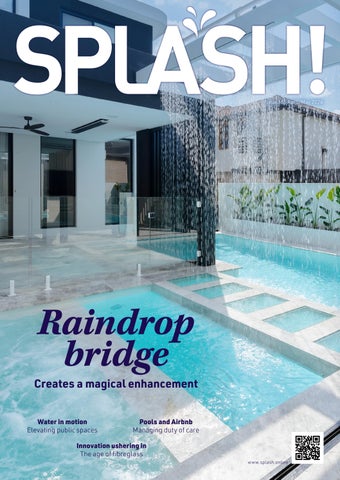
Raindrop bridge

Industry leading heat pump technology

Complete range for every pool and budget

Residential and commercial solutions

Guaranteed, accurate pool heating evaluations

Quick and easy installation

Support you and your customers can rely on

Dedicated after sales support

#1 In HEAT PUMP TECHnOLOGY

For more than 15 years, EvoHeat has specialised exclusively in heat pump technology. It’s the only thing we do and the only thing we’ve focused on perfecting. That singular expertise is why EvoHeat delivers better pool heat pumps, backed by superior reliability and expert support.

1300

Published by

The Intermedia Group Pty Ltd

ABN 940 025 83 682

41 Bridge Road, Glebe, NSW, 2037 Australia

Ph: (02) 9660 2113 Fax: (02) 9660 4419

On behalf of The Swimming Pool & Spa Association of Australia Ltd (SPASA Australia)

Managing Editor: Chris Maher

Phone: +61 412 048 639

Email: chrismaher@intermedia.com.au

Contributors: Veda Dante, Kristin Brookfield, Ben Makepeace, Declan McGuire, Spiros Dassakis, Patrick Handley.

Advertising enquiries: Gillian Doreian

Phone: +61 488 983 102

Email: gillian@spasa.com.au

Graphic Designer: Jacqui Cooper

Production Assistant: Tazlin Cantrill

Subscriptions: 1800 651 422

Email: subscriptions@intermedia.com.au

Copyright All material in this publication is copyright to the publisher and/or its contributors. No material may be reproduced without the express permission of the publishers.

Disclaimer: This publication is published by The Intermedia Group Pty Ltd (the “Publisher”) on behalf of SPASA Australia. Materials in this publication have been created by a variety of different entities and, to the extent permitted by law, the Publisher accepts no liability for materials created by others. All materials should be considered protected by Australian and international intellectual property laws. Unless you are authorised by law or the copyright owner to do so, you may not copy any of the materials. The mention of a product or service, person or company in this publication does not indicate the Publisher’s endorsement. The views expressed in this publication do not necessarily represent the opinion of the Publisher, its agents, company officers or employees. Any use of the information contained in this publication is at the sole risk of the person using that information. The user should make independent enquiries as to the accuracy of the information before relying on that information. All express or implied terms, conditions, warranties, statements, assurances and representations in relation to the Publisher, its publications and its services are expressly excluded save for those conditions and warranties which must be implied under the laws of any State of Australia or the provisions of Division 2 of Part V of the Trade Practices Act 1974 and any statutory modification or re-enactment thereof. To the extent permitted by law, the Publisher will not be liable for any damages including special, exemplary, punitive or consequential damages (including but not limited to economic loss or loss of profit or revenue or loss of opportunity) or indirect loss or damage of any kind arising in contract, tort or otherwise, even if advised of the possibility of such loss of profits or damages. While we use our best endeavours to ensure accuracy of the materials we create, to the extent permitted by law, the Publisher excludes all liability for loss resulting from any inaccuracies or false or misleading statements that may appear in this publication. This issue of SPLASH! magazine published by The Intermedia Group Pty Ltd (Intermedia) may contain magazine or subscription; offers, competitions, forms and surveys (Reader Offers) which require you to provide information about yourself, if you choose to enter or take part in them. If you provide information about yourself to Intermedia, Intermedia will use this information to provide you with the products of services you have requested and may supply your information to contractors that help Intermedia to do this. Intermedia will also use your information to inform you of other Intermedia publications, products, services and events. Intermedia may give your information to organisations that are providing special prizes or offers that are clearly associated with the Reader Offer. Unless you tell us not to, we may give your information to other organisations that may use it to inform you about other products, services or events or to give it to other organisations that may use it for this purpose. If you would like to gain access to the information Intermedia holds about you, please contact Intermedia’s Privacy Officer at The Intermedia Group Pty Ltd, PO Box 55, Glebe, NSW 2037.

Copyright © 2026 - SPASA Australia.

Proudly supported by

The views expressed in this magazine do not necessarily represent those of the above supporters, nor should any product advertised in SPLASH! magazine be seen to be endorsed by the above.

editorial

The excitement of water in motion

The cover of this edition features something a little unusual – a raindrop waterfall enhancement that not only provides sound and movement, but is designed to be walked through, offering a sensation akin to walking through rain.

An aluminium roof over the bridge allowed the opportunity for an elevated feature, but with a bit of lateral thinking, the builder installed two parallel features, designed in such a way that the water flow resembles a friendly sun shower. There is more on this pool on page 22.

Chris Maher Managing Editor chrismaher@ intermedia.com.au

This is yet another reminder of the ingenuity that our industry excels in, and of the fact that a pool can be much more than simply a body of water for floating in passively, or for racing up and down doing laps. It can be a feature in itself, especially when its properties are tapped to bring many of our senses to life: vision, through lighting and effects such as infinity edges; sound through moving water such as fountains and flowing features; and tactile sensations through heating, jets and blowers.

We have more on water features on page 56, where we get expert advice on bringing out the latent excitement of water.

This issue we also look at the rise of fibreglass swimming pools. Once the cheaper cousin to concrete pools, fibreglass is now the preferred form of backyard pool for most Australians. We look at the innovations that have led to its rise on page 30.

Of course, it’s a difficult time at the moment for the industry – as well as all other industries and the population in general.

The Iran War has sent ripples of economic woe far and wide, but we cling to the hope it will be over before too long, that the fuel and other products again flow freely, and everyone can get back to doing what they love and what feeds their families.

I wish everyone in the industry the strength and resilience to overcome these trying times.

The Intermedia Group takes its Corporate and Social Responsibilities seriously and is committed to reducing its impact on the environment. We continuously strive to improve our environmental performance and to initiate additional CSR based projects and activities. As part of our company policy we ensure that the products and services used in the manufacture of this magazine are sourced from environmentally responsible suppliers. This magazine has been printed on paper produced from sustainably sourced wood and pulp fibre and is accredited under PEFC chain of custody. PEFC certified wood and paper products come from environmentally appropriate, socially beneficial and economically viable management of forests.

The cover

The raindrop bridge is the key visual and aural feature of this Tectonic Pools project that won the 2025 Enhancement of the Year Award. There is more on this pool on page 22. Photography by David Pisani.

Discover the NEW Pentair Pool Experience.

Pentair Pool has unveiled its redesigned Australian website, delivering a fresh digital experience built specifically for the discerning pool & spa owner and pool & spa professionals across Australia. The redesigned interface is intuitive and responsive, whether you’re browsing on a desktop or pulling up specs on your phone poolside.

Come and see the way to the perfect pool pad at pentairpool.com.au

18 Seasons of change

Kristin Brookfield looks at the seasonal nature of the swimming pool and spa world, and outlines SPASA’s activity during the summer to promote the industry.

22 Raindrop bridge creates a magical effect

Zac Dejanovic tells us about the intriguing, dynamic project that won his business the 2025 Enhancement of the Year Award.

26 Ruthenium shock: why salt chlorinator prices are under pressure

Declan McGuire outlines the supply issues with this critical element in the production of electrodes, and why that is leading to price pressure on salt chlorinators.

30 Fibreglass coming of age

Veda Dante looks at how innovation, improved design and more efficient manufacturing processes have reshaped Australia’s fibreglass pool market.

42 Latest update in regulation changes and advocacy

SPASA policy manager Ben Makepeace updates us on changes to warranty schemes, pool safety reforms and tax office requirements.

44 Service technician’s obligations relating to non-compliant pools

Spiros Dassakis offers advice relating to pool service technicians and their obligations and liability when encountering non-compliant backyard swimming pools.

46 Where and when did humans start swimming?

Without swimming, there’d be no need for swimming pools. But how and when did it all begin? Historian Karen Eve Carr takes us back more than 100,000 years to the southern tip of Africa.

56 Water in motion elevates public spaces

Patrick Handley explains the ideas behind making exciting water features that the community and the client embrace.

60 Liability when small holiday lettings include swimming pools

What are the compliance requirements where owners of short-stay accommodation have a swimming pool onsite, and what is their exposure to failures in pool safety and water treatment where guests may be adversely affected?

Latham Group acquires Freedom Pools for $US17 million

The Nasdaq listed Latham Group (Nasdaq: SWIM) has acquired Australian fibreglass pool manufacturer and installer Freedom Pools.

The transaction was completed on February 26, 2026.

This makes Latham the largest designer, manufacturer and marketer of inground residential swimming pools in North America, Australia and New Zealand.

Latham Group had acquired Narellan Pools in 2019, another major Australian fibreglass pool manufacturer. The combination of the two manufacturers gives them national coverage in Australia, and enhances its ability to execute a direct-to-consumer strategy through Freedom’s display centres, where prospective customers can experience fibreglass pool models firsthand and receive expert guidance.

Narellan and Freedom will operate under a dual-brand strategy going forward.

The acquisition is expected to be immediately accretive to Latham’s earnings, adding approximately $US20 million in net sales and approximately $US4 million in adjusted EBITDA, on an annualised basis, before

acquisition synergies. The purchase price was approximately $US17 million (approximately $AU24 million) and the transaction was fully funded with cash on hand.

Sean Gadd, president and CEO of Latham Group, says they are pleased to partner with such a highly regarded company as Freedom Pools.

“Their award-winning reputation reflects a deep commitment to product quality, innovation and service excellence – values that strongly align with those of Latham,” he says.

“This transaction expands our presence in Australia and New Zealand – markets where fibreglass pools have a strong foothold and provides a strategic entry into new markets in Western Australia, including Perth – the fastest-growing city in the country.”

With more than 50 years of history, Freedom Pools is one of Australia’s longest standing and most highly awarded fibreglass pool builders. The company designs, manufactures, and exports a broad range of fibreglass pool models and spa products, with operations in Australia and New Zealand.

Freedom Pools operates manufacturing facilities in Perth, Adelaide and Brisbane, supported by display centres across Australia, while in New Zealand the company currently partners locally to deliver its extensive pool collections.

General manager Grant Craig – who is staying on at the helm of Freedom Pools – says that since their founding in the 1970s, Freedom Pools has been a pioneer in fibreglass pool manufacturing and has proudly grown into one of the leading players in the Australian and New Zealand markets.

“By leveraging Latham Group’s scale and experience, and given our shared commitment to delivering high-quality fibreglass pools, this partnership positions Freedom to enter its next phase of growth,” he says.

Latham Group Inc, headquartered in Latham New York, is the largest designer, manufacturer and marketer of in-ground residential swimming pools in North America, Australia and New Zealand. In North America, Latham has a coast-to-coast operation consisting of approximately 1850 employees across approximately 30 locations.

The Freedom Pools Kenwick location

industry.

The blockage of the Straits of Hormuz has created a worldwide shortage of fuel and petrochemicals, including many that are used in the swimming pool and

Price pain as war bites

The repercussions of the war in Iran are being felt around the world, following the blocking of the Strait of Hormuz, through which 20 per cent of the world’s oil and liquified natural gas flows, as well as 30 per cent of the world’s fertiliser.

Importantly for the swimming pool and spa industry, as much as 40 per cent of polyethylene (PE) and polypropylene (PP) also comes from the Middle East, with much of that passing through the strait.

Since the blockade, supply of these petrochemicals has been severely restricted, and global polyethylene exchange prices have surged by 37 per cent at the time of writing.

The CEO of plastics giant Dow Chemicals, Jim Fittering, told Reuters that global logistics have become uncertain, with up to 50 per cent of polyethylene supply either offline, constrained or being impacted following the events in the Middle East.

These petrochemicals are vital for the production of PVC and HDPE pipe and fittings, which are required for most pool installations, as well as resins for the manufacture of fibreglass swimming pool shells.

Vinidex, Polypipe and Pipemakers Australia have told customers that prices for plastic materials had jumped by up to 50 per cent for April delivery compared to March, and as a result, local suppliers have put up the prices of pipe and fittings by as much as 29 per cent for PVC and 36 per cent for HDPE.

On top of the raw material cost, freight and fuel costs are also higher, adding to the price of the finished product.

Significant price increases have already been factored in by suppliers, with future prices uncertain at the moment but expected to continue to rise unless a resolution is quickly reached.

Fibreglass pool shell prices have already risen on the back of a 30 per cent increase in the cost of resin. Further increases are expected.

Grant Craig, CEO of Freedom Pools, says the immediate issue right now is the increase in pricing of raw materials and transportation.

“Prices will definitely increase almost immediately, and the ceiling for this is unknown and changing weekly. Fortunately, at the moment we have good levels of supply for all raw materials.”

On top of those issues, almost all members of the industry are dependent on fuel for trucks, deliveries and onsite machinery, and the increase in petrol and diesel pump prices will affect all businesses.

At the time of writing, a tentative ceasefire was enacted, and there is hope the hostilities will be resolved and the Strait of Hormuz will reopen. However, that eventuality is still uncertain and even if the strait does reopen, it would still take up to two months for the fuel to find its way through Asian refineries to Australia.

One possible positive for the industry amid this turmoil is that, as both local and overseas travel is becoming more expensive due to supply and cost of petrol, diesel and avfuel, more Australians and New Zealanders may be staying at home and using their pools more.

Separately and unrelated to the war, a vital element in the production of chlorinators, ruthenium, is also experiencing a price hike. See page 26 for more on that issue.

Available pool DA figures from Cotality for the three months from January to March show applications down by 13 per cent, while the annual numbers for the 12 months to February show an improvement of four per cent.

The three-monthly numbers show New South Wales steady at plus one per cent, while all other states are down: Queensland down by seven per cent, Western Australia down by 12 per cent, South Australia down by 24 per cent and Victoria down by 44 per cent.

The national annual DA numbers show slight improvement when compared to the previous 12 months, with New South Wales up by 20 per cent, Queensland up by 14 per cent and Western Australia up by eight per cent, while South Australia is down by three per cent and Victoria is down by 32 per cent.

spa
Image: AdobeStock/AI

Safety Consultation summary published for the model WHS laws

Safe Work Australia has published a summary of feedback received during public consultation for the Best Practice Review of the model Work Health and Safety (WHS) laws.

Safe Work Australia (SWA) received 1055 written responses, of which 118 were written submissions and the rest were survey responses. SWA visited each capital city and two regional centres (Bunbury in Western Australia and Geelong in Victoria), and held over 100 meetings – gathering insights from employers, industry associations, unions, regulators, government agencies, academics, WHS professionals, community organisations, individuals and families affected by workplace fatalities and serious injuries.

The consultation summary outlines key themes and issues raised through submissions, surveys and meetings.

The key messages are:

• Strong ongoing support for the model WHS laws and the goal of national harmonisation – but growing concern about jurisdictional variations.

• Differences in compliance and enforcement are undermining harmonisation and creating complexity.

• Unions want to improve worker consultation, representation and participation rights.

Scams

• Businesses want WHS laws that are simple to understand and industry based.

• There needs to be a greater focus on emerging risks, including digital work, artificial intelligence and climate related hazards.

• The feedback provided will inform the final report to WHS ministers, which will be provided for consideration in August 2026.

Crane consultation

SWA has opened public consultation on the impact of potential updates to crane licensing under the model WHS laws.

The High Risk Licensing Framework under the model WHS laws aims to prevent injuries and fatalities by ensuring crane operators are properly trained, qualified and competent.

Public consultations held in 2022 and 2024 on proposed crane licensing changes informed SWA’s development of several potential changes to the licensing system. Following these consultations, SWA Members considered options for broader updates to the High Risk Work Licensing Framework.

Based on these decisions, the Agency prepared a draft impact analysis covering seven possible changes. These proposed changes include introducing new types of licences and updating the requirements for existing crane licences.

Best practice consultation summary

Further potential changes to crane licensing will be addressed through a similar process later in 2026.

This consultation process seeks feedback on the impact analysis as well as seeking further evidence around the costs and benefits of each option. SWA seeks submissions from anyone with an interest in crane regulations – submissions can be on all, or only some, of the options that may affect you or your organisations.

The feedback will form part of a Regulatory Impact Statement (RIS) that will be considered by WHS Ministers.

Who should participate?

Anyone with an interest in crane regulation including workers, employers, business owners, suppliers and manufacturers, industry and peak bodies, WHS regulators, WHS professionals and academics.

The consultation is open until 11:59 pm (AEST) Monday 4 May 2026.

Contact: www.safeworkaustralia.gov.au

ACCC warns about paid online reviews

The Australian Competition and Consumer Commission (ACCC) has repeated warnings about businesses offering inducements for positive online reviews.

This follows the PhotobookShop paying $39,600 in penalties for posting allegedly misleading influencer reviews on Instagram.

The investigation into PhotobookShop began when an influencer reported concerns to the ACCC about a written agreement PhotobookShop presented to them that requested that they did not

Keep informed by subscribing to the free online newsletter.

Latham Group acquires Freedom Pools for $US17 million

The Nasdaq listed Latham Group acquired Australian fibreglass pool manufacturer and installer Freedom Pools in February.

disclose they had been gifted a photobook in exchange for a review.

“Businesses must not mislead consumers by posting misleading reviews or failing to disclose when an influencer has been paid to create social media content, whether that payment is free gifted products or services, or money,” ACCC Deputy Chair Catriona Lowe says.

“Influencers can be a powerful marketing tool, and the Australian Consumer Law applies as much to the digital world as it does to bricks and mortar retailers.”

Top five online news stories

The online stories that made the news over the past two months.

PAL Lighting acquires WaterBlade Australia

PAL Lighting has acquired WaterBlade Australia, the long-established Western Australianbased manufacturer of waterfalls and water feature solutions.

Two new appointments at Fluidra Commercial

Natsuki Murata was promoted to the role of special projects engineer, and John Xagoraris was appointed NSW/ACT business development manager for Fluidra Commercial.

Important changes to Victorian domestic building insurance

From 1 July 2026, Victorian Domestic Building Insurance will be issued by the new Building and Plumbing Commission.

IRLearning delivers on-site Aquatic Technical Operator program in Sydney

In February, IRLearning delivered its Aquatic Technical Operator program to the team at Raging Waters Sydney.

Upcoming events

2026

May 16-17 Pool Spa Life Expo Brisbane

June 6 Awards of Excellence NZ Awards Night

June 12 Awards of Excellence ACT Awards Night

June 13 Awards of Excellence NSW Awards Night

June 20 Awards of Excellence Qld Awards Night

June 25 Awards of Excellence NT Awards Night

June 27 Awards of Excellence SA Awards Night

July 11 Awards of Excellence WA Awards Night

July 18 Awards of Excellence Vic Awards Night

Aug 11-14 Expolazer & Outdoor Living, Sao Paulo, Brazil

Aug 19 Australasian Awards of Excellence Gala, Gold Coast

Aug 18-21 SPLASH! 2026 Trade Expo, Gold Coast Convention & Exhibition Centre, Broadbeach, Queensland

Aug 25-27 SPARK 26, Gold Coast

Sep 2-3 RLS Pool Managers Conference, Mudgee

Sep 10-12 Asean Patio Pool Spa Expo, Kuala Lumpur, Malaysia

October 6-8 Interbad, Stuttgart, Germany

Nov 17-20 Piscine Global, Lyon, France More details at www.splash.online. Dates are subject to change and should be checked with the relevant organisation. Send calendar submissions to info@splashmagazine.com.au

In Brief

The death of a New Zealand baby has led to calls from a coroner and assistant coroner to ban portable pools 400mm to 1200mm high. However, the Minister for Commerce and Consumer Affairs, Scott Simpson, quickly shut down the discussion about a ban, saying that, as with all product safety regulation, there is a need to balance safety with allowing people to use products of their choice. The baby drowned after the portable pool collapsed inwards, and he was not able to climb out.

Meanwhile in the US, after the drowning death of a two-year-old, the Consumer Product Safety Commission has encouraged owners of a pool float called Relaxing Baby to destroy it. At least one death has been reported, but the overseas manufacturer hadn’t responded to requests for a recall. The blue and green inflatable swim floats are meant for small children ages three months to 36 months. The child sits in a seat in the centre of the float, secured with a buckle. Certain models also include a detachable rear float. It was found that the Relaxing Baby swim floats, sold largely on Amazon and other websites, can flip over and/or submerge the occupant, especially posing a drowning risk to infants and toddlers. The agency urged consumers to puncture the plastic wherever it can inflate and dispose of the floats immediately. “Do not sell or give away these hazardous swim floats,” it said in its warning.

Tradie

Moving for your MATES to prevent suicide

MATES has announced the return of the MATES Big Lap for April 2026, inviting Australians to get active, connect with others and support suicide prevention across the construction, mining, energy and manufacturing industries.

Now in its fourth year, the national movement encourages participants to walk, run, ride, wheel or move however they can because conversations about mental health happen more naturally when people are side-by-side rather than face-to-face.

The initiative brings together workers, workplaces, families and communities to strengthen connections and raise funds for lifesaving support services delivered by MATES.

MATES Australia CEO Jørgen Gullestrup says the event works because it creates the right environment for people to talk. “People (especially men) don’t sit down across a table and decide to talk about how they’re feeling. But walk beside each other, work beside each other or ride beside each other and the conversation changes. The MATES Big Lap is about creating those movements and moments. Every metre or

Legal

kilometre is not just exercise, it’s an opportunity to check in with a mate, and that can save a life.”

Physical activity also plays a powerful role in mental health and suicide prevention. Research consistently shows regular movement helps reduce stress, improve mood and increase social connection, all protective factors against suicide and mental ill-health. Even short bursts of activity can have measurable mental health benefits. For industries where workers often struggle to open up, movement removes barriers and creates safer spaces for conversations that might not otherwise happen. Walking together, riding together or simply getting outside often lowers the guard and makes it easier to talk.

Register now at matesbiglap.org.au or check out the MATES merch store.

Nick Stevens found guilty of deceptively charging families for undelivered swimming pools

Landscaper, unlicensed pool builder and former AFL footballer

Nick Stevens has been found guilty of deceptively charging families tens of thousands of dollars for pools they never received.

He faced trial in the County Court of Victoria, accused of defrauding six families in Mildura of $171,000 for incomplete or undelivered swimming pools. Stevens was charged with obtaining a financial advantage by deception, using a false document and theft laid as alternatives. He pleaded not guilty to all charges.

However, the jury in the County Court of Victoria in Melbourne found Stevens guilty on 12 counts of obtaining a financial advantage by deception and one charge of using a false document. He was found not guilty on one charge of obtaining a financial

advantage by deception, relating to the first victim.

He was refused a bail extension by Judge Fiona Todd and was remanded in custody until his plea hearing in May.

Prosecutor Toni Stokes had alleged that Stevens deceived the six families into paying him $171,000 for pools that were either illegally installed or not provided.

The court heard that Stevens had previously run a landscaping business, and had legally installed some fibreglass pools under supervision. However, the prosecutor alleged that he decided to go out on his own, knowing he was unlicensed.

It was alleged he received tens of thousands of dollars in payment from six families despite knowing he was not qualified as a registered builder and needed a major building contract and

Stevens will return to court on May 21 for a plea hearing.

domestic building insurance.

The prosecution alleged that three families were left with illegally and shoddily installed swimming pools, while three others were left with “giant holes in their backyards”.

One family received a full refund of $26,500, while another received a partial refund of $10,000.

The court case had a hiccup when the jury was dismissed following issues with videos containing the questioning of witnesses from Stevens’ first trial – which had itself been aborted because a judge could not continue in the case. But a new jury was sworn in and the case continued.

Stevens will return to court on May 21 for a plea hearing.

Since launching, the MATES Big Lap has rapidly grown into a national participation event supporting workplace mental health across the country.

SPASA team member Suzy Wilson appointed Anzac Day 2026 Ambassador

Victorian SPASA team member Suzy Wilson has been invited by RSL Victoria to serve as an ANZAC Day 2026 Ambassador.

In this role, she will participate in and lead the Melbourne ANZAC Day March, and complete a lap of honour at the MCG alongside fellow Ambassadors prior to the ANZAC Day AFL match.

As a First Gulf War veteran, and one of the first seven women to serve in a combat role in the Australian military, this recognition reflects her service and dedication.

The 2026 RSL Victoria ANZAC Day March will be focused on peacekeeping operations in the Middle East, including Iraq and Afghanistan. Six Ambassadors have been appointed to represent veterans, families and locally employed workers, such as interpreters.

Wilson has been appointed as Ambassador for First Gulf War veterans and will be joining the other Ambassadors in leading the march down St Kilda Road to the Shrine of Remembrance.

One of the first front line serving women

When Wilson was serving as a radio operator on HMAS Westralia in the Middle East in 1991, the ship received an unusual flashing light signal from the Argentinian Navy ship, The Almirante Brown during a refuelling.

The Westralia and the Almirante Bown were both part of the Multi-National Force fighting in

the First Gulf War to push Saddam Hussein’s Iraq back out of Kuwait. But the message from the Argentinian vessel was not related to the war.

“They wanted to know if we really had women on board,” Wilson says.

Just prior to Wilson joining the Westralia, the Australian government had overturned a ban on women being able to serve on the front lines. She and six other women on the Westralia were the first Australian women to serve in a combat zone.

“The men on the Westralia made me take my long hair out, which I was not happy about,” she says. “Just so the Argentinians could see I was a woman through their binoculars.”

The Australians signalled back to the Argentinians that they had seven women on board, something that not even the United States Navy had at the time.

“The Argentinian’s answer was very sweet though,” she says. “They signalled back: Seven to us is the world.”

When she joined the Navy, the Sex Discrimination Act had just been passed by the Federal Government, leading to a radical shake up in the way women served in the armed forces. As with any change there was some resentment, particularly from the men who would now be competing for roles with the women for the first time. But for Wilson it presented the opportunity to do the sort

of technical work she loved, such as being a radio operator.

“There was so much to learn, I could already touch type but there were so many codes and different types of radio equipment, so it was a really interesting technical role.

“Going out to sea and doing the job I was being trained for as a radio operator at sea, was always the dream for me,” she says.

Wilson says she is immensely proud to have been selected to be an Ambassador for the 2026 ANZAC Day march and wants to use the opportunity to talk about the things that should be at the very heart of what the RSL is in the 21st century.

“To me it is about advocacy. I want to use this opportunity to talk about the fundamental role of the RSL. It is about the RSL advocating for the right and entitlements of veterans and their families. I am so proud to represent all the veterans of the First Gulf War and to shine a light on the men and women that served there”.

This article draws on extracts from Steven Baras-Miller’s article on the RLS Victoria website. For the full article go to: https://rslvic.com.au/news

Suzy Wilson RSL ANZAC Day Ambassador –First Gulf War Veterans. Photographer Matthew Martin
Scan here for the Davey Pool & Spa Range

Clark Rubber is looking for a general manager

Retailer Clark Rubber is looking to appoint a new general manager for their Pool & Spa Division.

CEO Anthony Grice says that Clark Rubber is continuing to build on their more than 80 years of success as one of Australia’s most iconic retail brands, and they see the Pool & Spa Division is a key part of that future.

“Over recent years, this division has delivered record growth, and we see a significant opportunity to take it even further. With a clear strategy in place, we are focused on scaling the business nationally – across retail, franchise, and our growing mobile service network,” he says.

“We’re now looking for a commercially driven, strategic leader to take on a true end-to-end business leadership role.”

This is an executive position reporting directly to the CEO, with full accountability for:

• P&L performance.

• National growth and expansion.

• Franchise network performance.

• Product, supplier and marketing strategy.

• Continued rollout of the mobile service model.

Clark Rubber is looking for someone who has:

• Proven experience leading a retail, franchise, or multi-site business at a senior level.

• Proven experience in a service business, with mobile service operations.

• Strong track record of P&L ownership and delivering commercial outcomes.

• Experience driving growth, expansion, and operational performance.

• Background in merchandise, buying, or category management.

• Strong leadership, stakeholder management, and influencing capability.

• Commercially astute, analytical, and results-driven.

• Pool and spa industry experience is preferred but not essential.

“This is a rare opportunity to lead and scale a division with strong momentum, clear investment, and significant upside.”

More information is available at seek.com.au.

Dependable Pool Solutions

Create a pool that’s effortless to enjoy.

• Intelligent automation puts control at your fingertips

• Quiet performance designed for comfort and peace of mind

• Built for Australian conditions with proven reliability

Whether it’s for the family splash zone, the lap pool, or the ultimate backyard oasis - there’s a Davey solution to suit.

The Clark Rubber store at Halls Head

ASEAN Patio Pool Spa Expo 2026 to be held in KL

The ASEAN Patio Pool Spa Expo 2026 will be held on September 10 to September 12 this year at MITEC in Kuala Lumpur, Malaysia.

Spanning 10,000 square metres, the expo will showcase the full industrial chain, including patio landscaping, pool equipment, spa systems and smart control solutions. More than 200 leading companies will present more than 5000 cutting-edge products and technologies.

Approximately 10,000 professional visitors from more than 70 countries are expected to attend, including real estate developers, hotel procurement teams, resort planners, industry distributors and other industry professionals.

The event will also feature expert-led forums and summit sessions, providing insights into the latest trends and innovations in the swimming pool and spa industry.

The exhibit categories include:

• Pool equipment, bath facilities and technology;

• Spa, sauna and bath leisure facilities;

• Water park equipment and facilities;

Acquisitions

PAL Lighting acquires WaterBlade Australia

PAL Lighting has acquired WaterBlade Australia, the long-established Western Australian-based manufacturer of waterfalls and water feature solutions.

With more than a decade of presence in the Australian market, WaterBlade has built a strong reputation for quality, innovation and reliability.

PAL Lighting has partnered with WaterBlade in the United States for many years, introducing the brand to the US market alongside PAL’s extensive portfolio of lighting and water technology solutions.

PAL head of production Brodie Vine says the brand is trusted by landscape architects, pool builders and designers nationwide, and the acquisition further strengthens PAL’s water feature category on both sides of the Pacific.

“This creates a unified supply chain, expanded product development capabilities, and new opportunities for innovation,” he says.

“WaterBlade’s success is driven by its commitment to premium materials, precision engineering and consistently stunning performance across both residential and commercial applications. Its sleek, contemporary designs have helped shape water feature trends throughout Australia.”

Vine says the acquisition also represents a significant leap forward in PAL’s manufacturing capabilities.

• Landscape design and horticultural products;

• Patio and garden facilities, barbecue equipment, and outdoor furniture.

The expo is organised by the Guangdong Grandeur International Exhibition Group and Compass Exhibition from Thailand, while being supported by the Malaysian Swimming Pool Association and the Malaysian Association of Wellness and Spa.

Contact: www.aseanpoolspaexpo.com

“We are committing a major investment into dedicated production lines and advanced resource management to support what is becoming one of the most dynamic illuminated water features in the global market.

“By integrating WaterBlade into our existing infrastructure, we are ensuring that every unit meets the precision engineering our clients expect. This expansion allows us to scale production while maintaining the rigorous quality control standards necessary for high-end architectural and aquatic environments.”

Online

Pentair launches updated Australian website

Pentair has officially launched its redesigned Australian website, aiming to deliver a fresh digital experience built specifically for the pool and spa owner as well as pool and spa professionals across Australia.

Pentair’s senior marketing manager Peter Kolomyjec says the new platform combines a clean, modern design with powerful functionality, making it easier than ever to find products, access technical knowledge, and connect with local experts.

He says the redesigned interface is intuitive and responsive, whether you’re browsing on a desktop or pulling up specs on your phone poolside. Navigation has been streamlined so that products, resources and tools are just a click or two away.

One of the standout additions is the Find a Dealer function, where homeowners can search for their nearest Authorised Pentair dealer, and trade professionals can source products quickly.

There is also a suite of tools designed to simplify everyday tasks. From pool volume calculators to pump sizing, these tools help take the guesswork out of system design and product selection.

Contact: www.pentairpool.com.au

The new platform combines a clean, modern design

L&V Pools
Exhibitors from a previous expo

Jim’s Pool Care reaches 160 Australian mobile pool shops

Jim’s Pool Care has reached a significant milestone, surpassing 160 mobile pool service franchisees operating across Australia.

CEO Brett Blair says that the achievement reflects strong national demand for professional mobile pool services, with more than 20 new franchisees joining the network in 2025.

He is forecasting continued expansion, with a further 20 new franchisees expected to launch in 2026 and aiming for 200 locations by the end of 2027.

Jim’s Pool Care began in Western Australia in 2004 before entering a

Clarity. Perfected.

Bringing control and simplicity together, Davey Lifeguard helps create a pool experience that feels effortless every day.

The Davey Lifeguard is the ultimate plug-and-play pool and chemistry controller, designed for simplicity, connectivity and complete peace of mind. With its intuitive, user-friendly app, you can easily monitor and automate your pool’s chemistry, filtration schedules and temperature, all from your phone.

The Davey Lifeguard system adjusts dosing, chlorination and heating automatically, even alerting you when salt or minerals run low. If Wi-Fi isn’t available, local control from the unit is easy.

With seamless integration with Davey’s Nipper, and compatibility with Davey heat pumps, Davey Lifeguard makes pool care effortless, so you can spend less time maintaining and more time enjoying.

new era of growth when Brett and Kelli Blair took ownership in 2008. Over the past 17 years, the Blairs have focused on strengthening the franchise system through improved training programs, stronger supplier partnerships and enhanced support structures.

“The result is a thriving national network where franchise owners benefit from shared knowledge, collective buying power, and the trusted reputation of the Jim’s brand,” says Blair.

Jim’s Pool Care is part of the Jim’s Group, which now has more than 5000 franchises nationally.

Jim’s Pool Care franchisees at a recent conference

Seasons of change

Many people have shared with me that the pool and spa industry is a highly seasonal industry and that SPASA members would be focused throughout the spring and summer season with serving their customers. As I reach the end of my first summer season, this has very much been my reality.

It’s no surprise that summer brings the opportunity for people to enjoy time in the water. If you don’t have a pool or spa, you want one; if you do, you want to make the most of it.

For SPASA, the summer season has been a busy one with a focus on one of our three core tenants – to promote the swimming pool and spa industry, principally through our Pool Spa Life activities.

Pool Spa Life brings together online information, consumer expos, awards magazines and our TV show to showcase the benefits of pool and spa ownership and support homeowners to learn about pool maintenance and pool construction.

From January to May, we promote pool and spa ownership through our Pool Spa Life expos. The expos give SPASA members an opportunity to connect with qualified consumers across Australia and New Zealand. Thank you to all the members who have been a part of this year’s events.

The second season of Pool Spa Life Australia aired on 9Life in January. The show provides a unique way for SPASA to showcase members and remind consumers about the value of “choosing a SPASA member”. Over eight episodes, a range of pool projects, pool builders, manufacturers, suppliers and retailers have brought pool ownership to life, inspiring and informing people.

SPASA’s awards of excellence are also an important part of our promotion of the industry to consumers. Our 2025 winners have been showcased in the Pool Spa Life magazine, distributed at the expos since January. Entries closed in March with judging now underway to recognise the 2026 award finalists and winners.

The 2026 awards will kick off in New Zealand on June 6 and conclude on August 19 with the Gala event at SPLASH!. We look forward to joining members to celebrate the industry’s efforts over the past year.

While we work to promote the industry, it is also clear that the summer 2026 season has not been without its challenges.

The ongoing extreme weather across the country has impacted builders and retailers alike, bringing with it highs and lows. We also know

“The industry is strongest when it works together to tackle these types of challenges.”

that the industry continues to be challenged by the changing regulations, such as the reforms in Victoria related to building insurance and registration, and the long awaited release of NCC 2025 in May.

Finally, the global tensions affecting fuel supply have clearly had an immediate impact on every part of the industry. SPASA released a member alert on managing material cost increases, along with a guide note to support members when managing the costs associated with pool building contracts. The most important advice we can provide is to remain engaged with your customers and be open about the information you are receiving from suppliers and contractors.

The industry worked through these types of challenges during covid and it’s disappointing to face such extreme pressure again.

The Pool Spa Life expos bring people together to promote and grow the industry

However, it is also clear that the industry is strongest when it works together to tackle these types of challenges. While there are no quick fixes, SPASA will continue to monitor how governments respond, and will work to ensure that the swimming pool and spa industry is recognised as a key sector in the construction industry. n

Underwater Lighting Specialists

Aqua-Quip designs and manufactures in Australia, innovative underwater LED lighting systems for use in concrete and fibreglass swimming pools, spas, water features and catch tanks for the Australian and international pool markets.

Lights are compatible with all popular pool controllers and home automation systems. The innovative InstaTouch™ Smart Lighting Controller provides instantaneous control via a water-resistant handset to enhance the evening atmosphere in your pool and spa.

Raindrop bridge creates a magical effect

Zac Dejanovic, principal of Tectonic Pools, describes the project that won his business the award for 2025 Enhancement of the Year.

This build shows the benefits of customer service and customer loyalty for both the builder and the end user.

Six times Tectonic Pools had built a pool for this extended family of brothers and cousins over various properties, and clearly they were very happy with them all. So, when they needed a seventh pool, there was no question who they would turn to.

“Because of our long and successful association, we didn’t need to waste time establishing confidence in our ability with the owners,” says Tectonic Pools owner Zeljko (Zac) Dejanovic.

“This meant we could immediately shift the focus onto the technical aspect of the build – and

also what challenges we may confront.

“The pool structural plans were presented to me and immediately I identified a couple of details that were out of the ordinary, so we contacted the structural engineer to set a meeting and discus options,” he says.

Leaning heavily on his practical experience building swimming pools, Dejanovic had identified some elements that would cause a problem during the construction process, and he detailed them to the structural engineer and to the client.

“I pointed out that, in the structural plans, the use of pool piers could be deleted upon confirmation of the excavation. In my opinion the piers should not be deleted, based on the fact

that entire area is positioned on highly reactive Cumberland soil,” he says.

“I have knowledge of two separate pools in close proximity to this home with structural problems with the pool shell. One with minor defect and one with major defect that eventually led to pool being demolished completely.”

After the discussion, the client and the structural engineer agreed with Dejanovic’s appraisal and decided to proceed with the build based on his informed knowledge.

His second concern was the position of columns supporting the roof of the alfresco and cabana area.

“The pool is subject to constant internal water

movement and especially when it is in use by many children. I suggested to the engineer to have pool structurally independent rather than supporting the alfresco and cabana area, in order to avoid any structural stress and frictions of the walls and slabs,” he says.

Dejanovic believes a pool should be free standing wherever possible, and told the engineer and client that doing so would not require any additional money or additional time.

“Both the client and engineer were open to my suggestions, and were happy to make the adjustments. Personally, I was glad to see pool not being compressed between two major structures, and we were able to continue with our construction work.”

Ultra-modern appeal

Dejanovic says the home was being built with a highly modern aesthetic, which required a pool to match. This involved a complementary colour palette and well as stylish enhancements that would elevate the modern aspects.

“The owners explained to me that most of the houses they had seen would deliver a certain style, which would then cease as soon as you step out to the backyard,” he says.

They wanted to avoid that happening on their property, so they needed a pool and landscape that would flow stylistically from the home to the outdoor space. Dejanovic and his team were tasked with finding the most suitable materials and colour combinations that would continue the modern ambience while transitioning to the outdoors.

“Together we scoured numerous publications and images for the right

You can walk over the rain bridge without getting wet .
Photography for this series of images by David Pisani
A3D graphic of the modern house, showing the location of the swimming pool
The pool, spa and bridge

materials to deliver the prefect result. In the end, the owners settled for two types of tiles: one being external grey sandblasted limestone positioned in a herring-bone pattern; and the second was an internal Metallica Nickel glass mosaic – a brand new mosaic style by the world renowned Spanish company Ezarri.”

Dejanovic says he is proud that Tectonic’s pool project was one of the first instances of Metallica Nickel being used in Australia, and it received an enthusiastic response on global social media.

Protecting the bridge

A bridge was constructed over the pool with a semi-open aluminium roof structure. This bridge was custom-made onsite from galvanised profiles. Architectural details and structural engineer specifications were followed to the closest detail. Co-ordinating the tiling finish and the welding and installation of the bridge were all carried out at same time, so there was no mistake in lining up the alfresco, pool and cabana floor levels.

“On my request, the galvanised bridge structure was to be earthed for two reasons as additional protection. One was equipotential bonding,” he says.

Equipotential bonding involves the connection of metal components which ensures they all have the same electrical potential and can be earthed. This will protect the pool user from being electrocuted from the electrical current if a fault was to occur. It is a requirement under AS3000:2018 that equipotential bonding is implemented to all pool metal elements to an arm reach of 1250mm from the pool water, and effectively bond metal parts to a common grounding point.

The second reason was to prevent galvanic corrosion.

“This is also known as electrolysis or dissimilar metal corrosion. It is a process where two different metals in contact with each other undergo accelerated corrosion due to the flow of electrical currents. This phenomenon occurs when metals with different electrochemical properties are immersed in an electrolyte, such as pool water.”

The use of dissimilar metals in close proximity within a pool environment can trigger galvanic corrosion, including common examples such

as stainless steel ladder anchors attached to an aluminium pool wall, or copper pipes connected to steel equipment.

Pool water acts as an electrolyte, facilitating the flow of electrical currents between metals. Factors like pH, temperature and chemical balance can influence the corrosive potential of the water.

“For this reason, we have additionally grounding on the galvanised bridge with other metal protection such as sealing, rust protection, painting and tiling,” he says.

The enhancement

The award-winning raindrop waterfall enhancement provides an amazing visual and aural effect. Not only does it look and sound enthralling, but it is designed to be walked through, offering a sensation akin to walking through rain.

“The aluminium roof over the bridge offered the opportunity for a unique pool water feature,” he says.

“We opted for not one but two water blades with a vertical drop, creating a raindrop effect. When both blades are on, and you are walking along the bridge, it provides the specific feeling similar to walking through rain without getting wet,” he says.

Dejanovic and his team visited the factory as it was making the aluminium structure, taking the purchased water blade with them so the aluminium profile could be cut to fit perfectly.

“The aluminium roof over the bridge offered the opportunity for a unique pool water feature.”

The water blade has a handheld remote controller to change LED colours from anywhere in the backyard, adding to the visual possibilities of the feature. Additionally, it is visible not just from the house, but also from the street.

“This pool, with its unique design and features, creates a wow factor and certainly enhances the aim of bringing families together to entertain in and around the pool,” he says.

The pool equipment is by AstralPool, and is controlled by a touch-screen pad in the cabana,

Top left: The plumbing set out for the spa
Top right: The bridge install
Above: Detail of installing the bridge

and remotely via the phone app. This manages the control of water temperature, chemistry levels and light colours.

Another piece of equipment was the Madimack i80 robotic pool cleaner, which includes Madimack’s enhanced inverter technology, InverMAC, engineered to support inverter motor operation.

Tectonic Pools

Dejanovic established Tectonic Pools in 2006 with a vision for a swimming pool construction company that would offer a deeper, more personal relation with the client in constructing quality customised pools, rather than just executing engineering plans and moving onto the next project.

Dejanovic says this approach required a full understanding of the client’s specific vision and creating a unique design, tailoring each pool to the client’s request as well as full collaboration with architects, designers and engineers.

Tectonic Pools focuses on visually stunning completed projects and word-of mouth recommendations from clients. The company has a portfolio of hundreds of projects, ranging from

“Together we scoured numerous publications and images for the right materials to deliver the prefect result.”

simple pool maintenance and rectification work to highly complicated newly built swimming pools.

The list of specialised work includes deep excavations, steel reinforcement work, master technique of pneumatic concrete placement, pool plumbing and filtration assembling, tiling work and pool chemistry treatments.

Over the years, Dejanovic has built on his general construction education and practical skills by continually adopting modern techniques and products, having successfully completed several courses within the construction industry. He is an accredited certifier in swimming pool safety barriers, and carries out inspections on both residential and commercial swimming pools in New South Wales.

Tectonic Pools have won several awards for their pool constructions over the years. This pool won the 2025 SPASA Australasian Enhancement of the Year as well as an MBA award for concrete pools between $100,000 and $200,000.

“I am grateful to the industry bodies for recognising our work,” says Dejanovic. “Team Tectonic is always striving to bring out the best in each and every project.”

Contact: www.tectonicpools.com.au

This was one of the first pool projects in Australia to feature the Ezarri Metallica Nickel mosaic tiles
Lighting makes the pool stunning in the evening
The rain feature in the daytime
The rain feature in the evening

Ruthenium shock: why salt chlorinator prices are under pressure

Declan McGuire of Pool Controls outlines the current issues with supply of a critical element involved in the production of chlorinator cells, and why that is leading to price pressure on salt chlorinators.

Over the past 12 months, the global pool industry has been quietly facing a major supply-chain challenge for a material that most pool owners will never see but which sits at the heart of every saltwater chlorinator cell.

That material is ruthenium, a rare precious metal essential for the coatings used on saltwater chlorinator electrodes.

In the space of just one year, the market price of ruthenium has increased from $US476 to approximately $US1550 per troy ounce (as of March 13). That represents a 225 per cent increase – more than tripling the price in a very short period of time.

For manufacturers of saltwater chlorinators, this is not a minor fluctuation. It is a fundamental shift in production cost.

Unlike many industrial metals, ruthenium is not mined directly. Instead, it is produced exclusively as a by-product of platinum and nickel mining, which means the global supply cannot easily increase when demand rises.

Global production of ruthenium is extremely small – approximately 30 tonnes per year worldwide. The primary producing countries include South Africa, Russia and Canada.

The largest consumer of ruthenium globally is not the pool industry – it is the electronics sector. Ruthenium plays a key role in the manufacturing of magnetic storage disks used in conventional hard disk drives (HDDs). The metal is used as a coating layer that allows disks to store greater amounts of data.

Hard drives are still widely used in applications where massive amounts of data must be stored reliably, including data centres, cloud storage infrastructure and enterprise computing systems.

As global data demand continues to grow exponentially, the electronics industry has been consuming increasing quantities of ruthenium — placing further pressure on an already limited supply.

The

escalating price

The chart on page 28 illustrates the dramatic increase in ruthenium prices over the past 12 months.

In the pool industry, ruthenium is critical to the performance of saltwater chlorinator cells.

The metal is used as part of a ruthenium-based catalytic coating applied to titanium electrode plates inside the salt cell. This coating allows the electrolysis process to occur efficiently, converting salt (sodium chloride) into chlorine to sanitise pool water.

In simple terms: no ruthenium coating means no salt chlorinator cell.

The price increase is particularly significant because the salt cell is the most expensive component of a chlorinator system. For many manufacturers, more than 50 per cent of the total chlorinator manufacturing cost is tied to the salt cell alone. When the price of ruthenium triples, the impact flows directly into the cost of producing the cell itself.

This means manufacturers are now facing a scenario where the core component of a chlorinator has effectively doubled in cost.

Put simply, when the price of ruthenium rises sharply, the cost of the entire chlorinator system follows. With only around 30 tonnes produced annually worldwide, even small shifts in demand can have dramatic pricing consequences.

As things stand today, the industry is entering a period where salt chlorinator manufacturing costs are likely to remain volatile, and price adjustments may become unavoidable.

One thing is certain: we are in for a bumpy ride.

only 30 tonnes are produced each year

“As global data demand continues to grow exponentially, the electronics industry has been consuming increasing quantities of ruthenium."

Above: Ruthenium is produced exclusively as a by-product of platinum and nickel mining, and

Source: Johnson Matthey https://matthey.com

Inside a salt cell: why ruthenium matters

While the recent rise in ruthenium prices is affecting the entire chlorinator market, understanding how salt cells are manufactured helps explain why this rare metal is so critical.

Every saltwater chlorinator cell begins life as bare titanium plates, typically around 1mm thick. Titanium is used because it is highly resistant to corrosion and can withstand the harsh electrochemical environment inside a salt cell.

These plates are the electrodes, consisting of cathodes (positively charged) and anodes (negatively charged). Manufacturers coat the titanium plates with a mixture of ruthenium oxide and iridium, suspended in an acidic base solution that allows the material to be applied to the titanium surface through a coating process similar to electroplating or painting.

Once coated, the plates are baked in a high-temperature oven to permanently bond the catalytic layer to the titanium surface.

This process is repeated multiple times, gradually building up the coating layer on the plate.

A high-quality salt cell typically involves 15 or more coating cycles, which is generally considered 100 per cent coating thickness.

Each coating stage involves applying the ruthenium/iridium mixture; baking the plate in an oven; repeating the process again and again. This layered structure creates the catalytic surface required for efficient electrolysis.

A fully coated cell will normally deliver more than 10,000 hours of operation, which in real-world pool conditions typically equates to four to five years of life, depending on factors such as pump run time, chlorinator sizing relative to pool volume, and water balance.

Pressure on manufacturers

With ruthenium prices increasing by so much, manufacturers across the industry are facing difficult decisions.

Because ruthenium is the most expensive component in the coating, reducing the amount used can significantly reduce manufacturing costs. Some manufacturers are now reducing coating thickness, sometimes by half or more, in order to maintain price competitiveness.

Ruthenium is used mainly in the electronics industry, but it is also crucial for salt chlorination production

The problem is that coating thickness directly affects cell life. If the coating is reduced by 50 per cent, the longevity of the cell can be reduced by a similar proportion.

One of the biggest challenges in the market today is that coating thickness cannot be seen. A salt cell with 100 per cent coating and one with 30 per cent to 50 per cent coating will look virtually identical to the naked eye.

To a pool owner – or even a pool technician – the two cells can appear exactly the same.

However, the real difference may only become apparent years later when the cell fails prematurely.

Currently, there is no universal industry standard that measures or certifies salt cell coating thickness or expected operational life.

As a result, buyers have very few ways to assess the true quality of a chlorinator cell.

In practice, the only reliable indicators tend to be manufacturer reputation, warranty length, and product price.

In many cases cheaper chlorinators and shorter warranties can indicate that less coating material has been used, which ultimately means the end user may find themselves replacing cells more frequently. n

Perspective from an anode manufacturer

Elena Gosse, CEO of AIS Water, offers her perspective on the ruthenium shortage, from her position as the only Australian anode manufacturer – the part of the cell that is coated in ruthenium – as well as a manufacturer of pool water treatment products .

The escalation in ruthenium pricing is creating significant disruption across the water disinfection and chlorination industry. Over the past 13 months alone, ruthenium has increased from around $US460 per ounce to approximately $US1750 per ounce, a shift that can no longer be viewed as temporary.

While many initially believed the spike would stabilise, broader global pressures – including energy costs, geopolitical uncertainty, supply constraints and growing demand from emerging technologies such as AI – all point to a new pricing reality. The industry must now adjust accordingly.

We are seeing some manufacturers delay price adjustments, either relying on earlier stock purchases or absorbing short-term cost increases for the current season.

Others are reducing costs by using lower-grade anode materials. At AIS Water, we will not compromise product quality to offset raw material volatility. Our products are built on high-grade anode materials designed for longevity, safety and reliability and that commitment remains unchanged.

Historically, our margins have been modest because we prioritise quality and long-term performance over short-term gain. We believe customers who value reliability, reputation and long-term investment will continue to support manufacturers who stand behind their products and their partners.

For those hoping ruthenium prices will return to previous levels, I sincerely hope they do. I would welcome being proven wrong. However, all current indicators suggest we must prepare for sustained higher input costs and adapt to this new reality.

Consumers routinely accept paying thousands of dollars for devices they replace regularly such as mobile phones.

Yet pool water disinfection systems, which protect swimmers from bacteria and disease for many years, remain undervalued. As an industry, we must recognise the true value of safe, reliable water treatment and price accordingly.

Graph showing the recent dramatic escalation of the ruthenium price.

The original &

BENEFITS OF A DAISY SOLAR POOL COVER

best

Save money.

Higher quality. Better design. Lasts longer.

Reduces evaporation by 99%.

Daisy Pool Covers™ has been Australia’s favourite brand for pool covers and rollers since 1983.

Daisy Pool Covers™ provides the largest and best range of pool cover and roller designs in Australia, manufactured using the highest quality materials, specially formulated to protect swimming pools all year round.

The experienced team at Daisy Pool Covers™ can provide cover and roller solutions for any pool type or shape.

Reduce the cost of maintaining a warm, sustainable swimming pool with the original and best Daisy Pool Covers™.

Fibreglass coming of age

How innovation, improved design and more efficient manufacturing processes have reshaped Australia’s fibreglass pool market.

Fibreglass pools have undergone a significant transformation within Australia’s swimming pool industry, evolving from a value-driven alternative into a widely adopted and increasingly sophisticated form of backyard swimming pool.

Over several decades, advances in materials, manufacturing processes and design options have reshaped both performance and perception, positioning fibreglass as a credible and competitive option alongside traditional concrete.

“In the early days, fibreglass was often seen as the budget option,” says Janelle Emmett of Masterbuilt Pools in Braemar, NSW. “There was a perception that you were sacrificing design and long-term performance compared to concrete.”

That perception has shifted considerably. Improvements in composite materials, structural engineering and surface finishes have strengthened durability and visual appeal, while factory-controlled production environments have delivered greater consistency across installations. These changes have addressed many of the early

concerns associated with fibreglass, particularly around longevity and finish quality.

“Once people started seeing how these pools actually performed over time, confidence grew quickly,” Emmett says. “The quality of finishes, the structural integrity and the overall longevity have all improved dramatically.”

Practical considerations have also played a defining role in fibreglass adoption. Faster installation timelines reduced on-site disruption and lower ongoing maintenance requirements have broadened its appeal across both residential and project-driven builds.

For builders, this has translated into improved project efficiency and scheduling certainty. For homeowners, it has reduced both upfront complexity and long-term upkeep.

Australia is now widely regarded as a global leader in fibreglass pool innovation. A strong domestic pool ownership culture, combined with rigorous standards and sustained investment in composite technologies, has enabled local manufacturers to refine both product and process at scale.

“We’ve focused heavily on materials and engineering,” Emmett says. “That’s allowed fibreglass to move into a more premium space, rather than being viewed as an alternative.”

Despite this growth, adoption has not been uniform across the country. Western Australia and Queensland emerged as early strongholds, driven by favourable site conditions, demand for faster installation and a focus on value. In contrast, New South Wales and Victoria – where concrete pools historically dominated – have seen a more gradual shift.

“That gap is definitely closing,” Emmett says. “As designs have become increasingly sophisticated, more clients are recognising that fibreglass can deliver both performance and aesthetics.”

Design evolution has been central to this transition. Early limitations around shape and depth have largely been overcome through advances in mould design and manufacturing precision. Today’s fibreglass pools offer a broad range of configurations, incorporating integrated features such as tanning ledges, benches and spa zones. These inclusions not only enhance usability but also align more closely with contemporary outdoor living trends.

“Today’s fibreglass pools are a completely different product to what they were decades ago,” Emmett says. “You’re seeing much sharper finishes and far more considered design.”

At the same time, improvements in gelcoat technology have enhanced both appearance and durability. Modern finishes deliver greater colour depth, UV-resistance and long-term surface integrity, addressing issues that previously limited consumer confidence.

These refinements, combined with structural advances, have repositioned fibreglass as a product capable of meeting both aesthetic and performance expectations.

Scaling quality and reach

As the fibreglass pool sector has matured, manufacturers have focussed on scaling production while maintaining quality and consistency. For companies such as Barrier Reef Pools, this has involved balancing volume growth with ongoing investment in manufacturing capability and distribution networks.

Founded more than 30 years ago, the company initially addressed a gap in the market for fibreglass pools capable of withstanding Australia’s harsh environmental conditions and long transport distances. At the time, misconceptions around durability and design flexibility limited broader adoption.

“However, from an installer and practical standpoint, fibreglass offered clear advantages – faster installation times, lower maintenance, a smooth non-abrasive surface and consistent factory-controlled quality,” says dealer support manager Nicole Maxwell.

“As manufacturing techniques improved and more high-quality products entered the market, consumer perception began to shift.”

Historically, fibreglass pools represented a relatively small share of the market, estimated at around 20 per cent to 30 per cent. Over time, that share has grown significantly as product quality and consumer awareness have increased.

“Fibreglass is no longer seen as a secondary option. It’s now recognised as a premium, reliable solution, driven by advances in manufacturing, design, and gelcoat technology,” Maxwell says.

“Today, fibreglass pools represent a significant portion of the Australian inground market, estimated at 55 per cent to 65 per cent nationally, with adoption strongest in Queensland and Western Australia at 65 per cent to more than 75 per cent.”

Advances in composite construction and surface finishes have played a central role in this

“The high level of accountability in Australia has helped build trust in
Fibreglass pools can look as sophisticated and inviting as traditional concrete pools.
Image: Barrier Reef Pools
Balancing volume growth with ongoing investment in manufacturing capability and distribution networks has proved a successful fibreglass strategy for Barrier Reef Pools
fibreglass as a category.”

growth, enabling fibreglass pools to compete more directly with concrete across both aesthetics and performance.

“Modern pools offer a wide variety of shapes, colours and integrated features such as splash decks, benches and spa zones,” she says.

“Advances in composite construction and gelcoat finishes also means fibreglass now competes directly with concrete in both aesthetics and performance.”

Barrier Reef Pools operates national manufacturing facilities in Queensland and Western Australia, supported by an extensive dealer network across Australia and New Zealand. This combination of local production and distributed installation capability has enabled the company to scale while maintaining quality control.

“Our strongest markets are Queensland and Western Australia, where fibreglass pools have a particularly high adoption rate. We also have a strong and growing presence in New South Wales, Victoria, and South Australia, supported by both our dealer network and our own retail operations in key locations,” Maxwell says.

Product development continues to respond to evolving consumer expectations, particularly in relation to space constraints, functionality and integrated technology.

“Our goal has been to combine design flexibility, practical functionality and long-term reliability,” she says.

“Customers want options that suit their backyard, budget and lifestyle. And we aim to deliver that without compromise.”

“Once people started seeing how these pools actually performed over time, confidence grew quickly.”

Engineering confidence in fibreglass

While market acceptance has grown, the early development of fibreglass pools was defined by the need to address fundamental technical challenges. For manufacturers, success depended not only on competing with concrete, but on proving fibreglass as a reliable, long-term solution.

“For us, the challenge was never just competing with concrete,” says Anthony Cross, CEO of Compass Pools Australia. “It was about solving the technical issues within fibreglass itself and proving it could be a reliable, long-term product.”

Early inconsistencies in materials and manufacturing processes limited performance, with issues such as osmosis highlighting the need for improved chemical stability and production control. These challenges prompted significant investment in research and development, particularly in resin systems and laminate construction.

“The turning point came when the industry started to address those problems at a material level,” he says. “Moving to epoxy vinyl ester resins created a far more stable barrier and significantly improved durability.”

This shift marked a critical step in the evolution of fibreglass pools, enabling manufacturers to deliver more consistent and reliable products. Structural innovation followed, with composite laminate designs incorporating core materials to improve stiffness and reduce deflection.

“These weren’t incremental changes,” Cross explains. “They fundamentally improved how the pool shell performs under real-world conditions.”

Additional refinements, such as the use of ceramic microspheres, further enhanced moisture resistance and curing stability, contributing to long-term performance. At the same time, surface technologies continued to evolve, moving beyond basic gelcoats to more advanced decorative and protective finishes.

“As the product improved, so did confidence,” he says. “That’s when you started to see longer warranties and a shift in how fibreglass was positioned in the market.”

Australia’s emergence as a global leader in fibreglass pool manufacturing has been shaped by this sustained focus on performance. A strong regulatory environment, combined with industryled innovation, has helped establish consistent standards across the sector.

“There’s a high level of accountability in Australia,” says Cross. “That, combined with ongoing innovation, has helped build trust in fibreglass as a category.”

A large fibreglass pool for all the family.
The Daintree 11 fibreglass pool kit.
Image: Complete Fibreglass Pool Kits

Manufacturing itself has become more controlled and repeatable. Advances in resin application, curing methods and quality assurance processes have reduced variability, while factory environments allow for tighter process control than traditional on-site construction.

“We’re applying best-practice manufacturing principles to what was traditionally a very hands-on process,” he says. “That includes partnerships with research organisations and new approaches like digital twin manufacturing.”

Installation quality has also improved through the development of established builder and dealer networks, which play a critical role in ensuring consistent outcomes.

“Builder networks are critical,” says Cross. “They’re the link between the product and the end result, and consistency there is just as important as what happens in the factory.”

Supporting the DIY wave

In parallel with traditional builder-led models, the fibreglass sector has also expanded into the owner-builder and DIY market, offering alternative pathways to pool ownership. This segment reflects a broader shift towards greater consumer involvement and flexibility in project delivery.

“When we started, fibreglass was already well accepted as a cost-effective alternative to concrete,” says Rohan Taylor managing director of Complete Fibreglass Pool Kits.

“The conversation had moved on from ‘is fibreglass good enough?’ to ‘does this option suit my goals, budget and design vision?’ Our niche was clear: the DIY segment needed support, education, and systems to get a great result.”

Product offerings in this space range from shell-only purchases to comprehensive kits and customised packages, allowing customers to select a level of involvement that aligns with their capabilities and preferences. Installation pathways vary from fully owner-managed builds to hybrid approaches incorporating professional support.

“We support all three pathways. Importantly, all warranties remain fully intact regardless of who installs the pool, which gives customers peace of mind,” he says. “That’s a key difference, as it has been historically perceived that a DIY installation will void manufacturers structural and cosmetic warranties.”

Demand within this segment is particularly strong in regional areas, where access to full-service pool builders may be limited and project timelines extended.

“Our core market is the DIY and owner-builder segment,” says Taylor. “We see strong demand in regional areas where access to full-service pool builders can be limited, or lead times are long. In metro areas, it’s more of a mix between ownerbuilders and customers who engage installers.

A Fastlane fibreglass pool for fitness enthusiasts.

Image: Compass Pools Australia

25 years of proven field history, proudly manufactured in Australia, and exported all over the world.

High Performance

Surface Coating

Market leading cosmetic finishes with exceptional durability

High Quality Pigments Vibrant and long-lasting colours

Outstanding UV Protection Aquaguard® X protection for extreme environments.

Excellent Chemical Resistance Extensively tested for fade resistance to maximise the lifespan.

1800 789 607 www.allnex.com sales.compositesau@allnex.com

Product Features Benefits
Pool gelcoats, designed for harsh outdoor conditions

“A simple way to think about it is the difference between hiring a bathroom renovation company to manage everything for you, versus going to Bunnings and doing the renovation yourself,” he says.

“Both are completely valid, but they suit very different people.”

To support this approach, DIY pool kit providers have developed systems and resources designed to guide customers through the installation process, including documentation, technical support and digital content. This emphasis on education helps reduce risk while maintaining product integrity.

Compliance remains a critical consideration, with DIY installations required to meet the same regulatory standards as professionally managed projects.

“The main thing for customers to understand is that while the process isn’t overly complicated, it does require a bit of planning and realistic timeframes. The most common issue we see is people underestimating how long council approvals can take,” Taylor says.

The sand state advantage

Grant Craig, general manager at Freedom Pools, estimates the overall Australian share of the new pool market for fibreglass is around 65 per cent, but in Western Australia it is more like 75 per cent.

The discrepancy is in part due to the fact that fibreglass is far easier to install in the “sand states” like Western Australia, South Australia, Queensland and the Northern Territory than in states with a predominance of clay soils.

“Sand states offer far easier installation, which also mean lower installation costs,” he says. “This makes for an ideal market for fibreglass. States with clay soils are substantially more expensive to install, and therefore the price gap with concrete is less.”

Freedom Pools began in 1974, and two years ago celebrated its 50th anniversary.

“Fibreglass was a new concept back at the start. It was in the 1980s that fibreglass really took hold of the market, particularly in West Australia where fibreglass began to dominate market share.”

Above left: The Hayman 9 fibreglass pool kit.

He says the improvements in quality and techniques were instrumental in its rising popularity, where it challenged and eventually overtook concrete as the most popular form of backyard swimming pool.

“In the early days, concrete was considered a stronger and superior product. That perception has now changed due to the quality of modern fibreglass pools, and some manufacturers are providing lifetime warranties as a show of quality. Fibreglass is now market dominant across Australia.”

He adds that new and innovative colour and surface choices also helped attract new customers, as did increased advertising and the advent of larger display centres with fully operational pools.

Some of the innovations from Freedom include Pool Armour Protection Technology made up of three manufacturing processes: TransTech to ensure all air is removed between manufacturing layers to guarantee blemish free pool surface; FloTech, an additional coating placed on the outside to protect against ground contaminants; and MarbleTech, a high pigment marble-like finish that leads to substantially less surface fading.

“Most manufacturers include their own technologies for market differentiation,” he says.

“Moving to epoxy vinyl ester resins created a far more stable barrier and significantly improved durability.”
A Senator pool in Turquoise from Freedom Pools

AIan Mewett, this image taken during an interview with SPLASH! Magazine at the 2014 SPLASH! Expo on the Gold Coast

Chasing quality through chemistry

fortunate stroke of serendipity set Ian Mewett on the path to the fibreglass pool industry, though the foundations had been laid earlier. After leaving school to join the Royal Australian Navy, he developed an appreciation for discipline, process and the importance of doing things properly the first time. Boat building followed, providing practical experience with fibreglass construction at a time when composite materials were emerging across many industries.

The professional journey that followed was inseparable from his partnership with his wife, Kerri. The two married young and assumed responsibilities early, building their working lives alongside raising a family. When Compass Pools was established in 1980, it was the continuation of a shared endeavour that had already begun shaping both their lives.

Like many small manufacturers, the company grew through experimentation, persistence and a willingness to confront technical challenges as they arose. For Ian and Kerri, the challenge was never simply to compete with concrete pools, which at the time held the lion’s share of the market.

“Quality was our competitor,” says Mewett. “We chased quality through chemistry rather than chasing concrete.”

One of the early challenges was osmosis – a major source of warranty claims – arising when water penetrates the protective gelcoat.

“The shift from polyester resins to epoxy vinyl ester chemistry was a turning point,” he says. “It gave us a far more stable barrier against water ingress.”

The improvement was expensive – introducing epoxy vinyl ester chemistry increased material costs by approximately 20 per cent, but the enhanced performance significantly reduced the likelihood of osmotic blistering and lowered warranty claims.

As product reliability improved, the company gained the confidence to extend its warranty offering, strengthening consumer confidence in fibreglass pools as a durable, longterm alternative to concrete.

Structural design also became part of the solution. A fibreglass pool shell must withstand the combined forces of soil pressure, groundwater movement and the weight of the water it contains. Increasing panel stiffness became essential to minimise deflection under load.

Drawing on principles familiar from marine composites, the company developed laminate structures incorporating a core layer to improve stiffness without significantly increasing weight.

“We were young and learning as we went,” Mewett says. “One of the discoveries that made a difference was the use of ceramic microspheres. They don’t absorb moisture and remain stable within the laminate. They work surprisingly hard for what is essentially an inert filler.”

Within the pool structure, these materials performed several functions: reinforcing the corrosion barrier within the laminate, improving resistance to moisture migration, and supporting more controlled resin curing during manufacture. Continued refinements in formulation and application enabled the company to offer lifetime guarantees against structural failure.

For the Mewetts, each improvement was part of a larger objective – building a pool that could serve families reliably for decades.

Surface performance and appearance became another focus as the company refined its pool structures. Rather than relying on standard formulations, Mewett and his team developed their own gelcoat system, incorporating decorative chips to add visual depth and improve durability. Achieving consistent application required collaboration with equipment manufacturers. The company worked with Robinson, a manufacturer of chopper-gun systems, to adapt spraying equipment to suit the viscosity and density of the new formulation.

Much of the development occurred through experimentation.

“Some of it happened by accident,” Mewett recalls.

The resulting technology, later branded Crystite, combined decorative chips within the gelcoat with a customised application system designed to achieve consistent thickness and surface integrity. Building on this work, the company later introduced Bi-luminite, representing a further evolution of its surface technology in response to increasing competition in international markets.

While surface technology continued to evolve, these material and process developments were complemented by systemlevel innovations, including the introduction of the Vantage self-cleaning system. The integrated in-floor cleaning system improved water circulation and directed debris towards collection points within the pool. Over time, this became a defining feature of the company’s product offering. Today, Mewett notes, around 70 per cent of Compass pools incorporate self-cleaning systems, reflecting changing expectations among pool owners.

As the company matured, attention turned beyond Australia.

In the United States, fibreglass pools – often referred to as one-piece pools – historically represented only a small share of the overall market, leaving significant room for growth. However, entering the United States market proved both an adventure and, at times, a misadventure.

Mewett first connected with Viking Pools in California, a manufacturer whose approach to fibreglass pools felt familiar despite the distance.

“They were kindred spirits,” he says. “We shared an interest in improving the technology. They were taken with our colour range – vibrant blues and greens that glittered in daylight and under night lighting. We were also ahead in the way the pools were configured, incorporating features moulded into the shell itself rather than added later.”

The relationship led to a technology transfer arrangement that helped introduce Compass surface technology into the United States.

The experience brought valuable lessons about international business and the complexities of operating in unfamiliar markets. Viking had ambitious expansion plans at the time, targeting significant annual production volumes, which made the business an attractive acquisition alongside Compass technology.

New Zealand became an early export destination, with hundreds of pools shipped across the Tasman. The business continues today through a dedicated distributor and dealer network, with the New Zealand market remaining an established part of the company’s international footprint.

Mewett notes that Australia’s geography meant many manufacturers operated in separate regional markets rather than competing directly – an environment that encouraged collaboration, stronger industry relationships and the gradual building of consumer confidence in fibreglass pools. That

collaboration extended to state governments, Standards Australia and the Swimming Pool & Spa Association (SPASA), contributing to the development of a comprehensive regulatory and training framework covering construction standards, installation licensing, safety requirements and certification. Often referred to as the “Australian model”, it helped build consumer confidence and subsequent international attention.

Innovation continues as manufacturers respond to changing lifestyles and housing patterns. Smaller plunge pools, suited to compact urban blocks and easier transportation, are emerging as a new area of development and are likely to open further export opportunities.

Although Ian Mewett retired from the business more than 10 years ago, Compass Pools continues under the stewardship of Anthony Cross, CEO, guided by the values established at its founding. What began as the shared endeavour of a young couple learning their trade has grown into an international business, yet it still carries the character of the family enterprise they founded. n This article was written by Kerryn Caulfield, executive director of Composites Australia Inc

“Additions to fibreglass like graphene and carbon have been seen advertised.”

Additionally, modern computerised monitoring ensures their pools are made to exact specifications, ensuring fewer imperfections, less wastage and an improved bottom line.

While Freedom’s exports are mainly to New Zealand and the Reunion Islands, there is potential for growth into the European and American markets in the future.

“The biggest issue is transport. Both cost and availability are problems at the moment, but we are searching for freight solutions.”

Regarding the current supply chain issues resulting from the Iran War and consequent closing of the Strait of Hormuz, Craig says the immediate issue right now is the increase in pricing of raw materials and transportation.

“Prices will definitely increase almost immediately, and the ceiling for this is unknown and changing weekly. Fortunately, at the moment we have good levels of supply for all raw materials.”

Freedom Pools has major manufacturing facilities in Perth, Brisbane and Adelaide, and was recently purchased by the Latham Group. For more on the acquisition see page 8.

Western Australia’s early adoption

As mentioned above, Western Australia has long been one of the strongest markets for fibreglass pools, shaped by a combination of practical, economic and environmental factors. The state’s early adoption reflects both industry capability and consumer preference, with fibreglass establishing itself as a mainstream solution earlier than in many eastern states.

“The WA market was already booming when we moved into manufacturing,” says Kellie Groves, office manager at WA Fibreglass Pools in Neerabup.

The advent of larger display centres with fully operational pools helped promote the popularity of fibreglass.
Image: Freedom Pools
At work on a pool at the Freedom Pools manufacturing facility

“The business started in resurfacing, so there was already a clear understanding of the product and where the demand was heading.”

This foundation provided valuable insight into both product performance and customer expectations, enabling manufacturers to refine their approach as demand accelerated. Unlike markets where concrete maintained a dominant position, fibreglass gained early traction in Western Australia due to its speed of installation and relative affordability.

“It’s always been popular here because of how fast and easy it is to install,” she says. “Price has also been a big factor. Fibreglass has consistently offered a more affordable option compared to concrete.”

Over time, that initial value proposition has been reinforced by improvements in design and materials. As product ranges expanded, fibreglass pools began to appeal to a broader segment of the market, including customers seeking more customised and visually refined outcomes.

“There’s now a huge range of designs, along with world-leading materials and colours,” Groves explains. “That’s given customers a lot more flexibility in what they can achieve.”

Competition between manufacturers has played a significant role in this evolution. In Western

Australia, ongoing investment in tooling, mould development and product innovation has driven continuous improvement, with manufacturers seeking to differentiate through both design and performance.

“Manufacturers here have been refining their ranges for years,” she says. “There’s a constant push to bring new designs to market.”

Advances in gelcoat technology and production processes have further strengthened the category, improving durability while extending warranty confidence.

“Those improvements give customers peace of mind,” explains Groves. “They know they’re investing in something that’s built to last.”

Changing housing patterns have also influenced design direction. As block sizes continue to shrink, demand has shifted towards more compact and space-efficient pool models.

Manufacturers have responded by adapting dimensions and configurations to suit smaller backyards without compromising functionality.

“Backyards are getting smaller, so pool designs are evolving to suit,” she says. “At the same time, equipment has come a long way, with automation, lighting and heating now expected as part of the package.”

These integrated systems have become

When a Standard Pool Won’t Work, You Still Can.

Tank Pools are the perfect filler pool shell that solves space, time, weather, access, and price issues...not to mention they look great.

Freedom Pools founders Bob and Rona Biernat with general manager Grant Craig celebrating 50 years in business

an increasingly important part of the overall offering, aligning with broader consumer expectations around convenience, efficiency and lifestyle integration.

Looking ahead

The next phase of growth for the fibreglass pool sector is expected to be shaped by a combination of innovation, market expansion and increasing expectations around performance and sustainability. As the category matures, differentiation is shifting from basic functionality to more nuanced considerations, including design flexibility, environmental impact and longterm reliability.

Hybrid construction methods are emerging as one area of development, combining fibreglass shells with concrete elements to enable more complex architectural outcomes while retaining the efficiencies of prefabrication.

“Fibreglass and concrete are no longer competing in the same way,” says Janelle Emmett of Masterbuilt Pools. “They’re being used together to create pools that are faster to build but still highly customised.”

At the same time, compact pool designs are gaining traction in response to shrinking block sizes, while advances in materials and integrated systems continue to enhance both performance and user experience.

International demand is also expected to play a growing role. Markets such as New Zealand remain stable, while regions where fibreglass pools are still emerging present longer-term opportunities for Australian manufacturers.

“There’s a real opportunity in markets that are earlier in their adoption curve,” says Anthony Cross, CEO of Compass Pools Australia. “What we’ve developed in Australia translates well internationally.”

“We’re already supplying into New Zealand, and there’s strong potential for further growth,” says Kellie Groves of WA Fibreglass Pools. “With the range of models now available, there’s a solution for almost every backyard.”

As adoption increases, so too does scrutiny. Installation quality, long-term durability and consistency across products and markets are becoming more important differentiators.

“The next phase will be defined by consistency and trust,” Cross says. “Manufacturers that can demonstrate long-term performance will continue to lead.”

Sustainability is also moving up the agenda, with growing interest in lower-impact materials, more efficient manufacturing processes and the integration of recycled or alternative inputs.

“There’s a real push toward reducing environmental impact without compromising performance,” Emmett says. “That’s where we see a lot of future development.”

www.aqualeisure.com.au

www.barrierreefpools.com

www.compasspools.com.au

www.completefibreglasspoolkits.com.au

www.freedompools.com

www.masterbuiltpools.com.au

www.wafibreglass.com.au

Taken together, these developments point to a sector that has moved beyond its origins as an alternative construction method. Instead, fibreglass pools are increasingly defined by their ability to adapt to changing market conditions, incorporate new technologies and deliver consistent outcomes at scale – both in Australia and internationally. n

An Entertainer pool in Alabaster. Image: Freedom Pools
A WA Fibreglass Pool design in Hawaiian Sand
A Director pool in Alabaster. Image: Freedom Pools

From Western Australia to Alabama

An interview with the managing director of Aquatic Leisure Technologies, Lynley Papineau

On the edge of the Indian Ocean, where hot, dry summers define the climate, Aquatic Leisure Technologies (ALT) has been part of the Australian backyard lifestyle through the manufacture and distribution of fibreglass pools for 50 years.

Founded in Western Australia, the familyowned manufacturer operates far from its largest markets. Around 60 per cent of production leaves the state for the eastern states and export markets, a reality shaped by both demand and distance. This has led to the development of systems for marketing, customer service, handling and transport that support longdistance distribution.

The company is led by managing director Lynley Papineau, continuing the leadership of the family business. Its portfolio of brands is led by Aqua Technics Pools and supported by display centres in Joondalup, O’Connor and Mandurah as well as six other displays representing the brands of Sapphire Pools, Buccaneer Swimming Pools and Riverina Pools.

The dealer network spans all Australian states, as well as Canada, New Zealand, the United Kingdom and Reunion Island.

Aquatic Leisure Technologies entry into the United States extended this model further. The initial market entry relied on supplying American distributors and dealers directly from Australian production facilities, a structure that, while effective, involved extended lead times and logistical complexity. As demand increased, manufacturing closer to the market became a practical requirement.

Following a two-year site search, Aquatic Leisure Technologies secured a 5200-squaremetre facility on a nine-hectacre site in Opp, Alabama, which serves as the company’s North American manufacturing base. The facility has been configured to operate with the same manufacturing systems, material specifications and quality assurance procedures used in the company’s Australian operations. The site’s scale provides capacity for immediate production requirements and future expansion.

Opp is located in Covington County in the southern part of the state. The town sits inland from the Gulf Coast, with road connections

to regional centres and to the Port of Mobile, Alabama’s only deepwater seaport.

ALT’s portfolio of patented materials and process technologies, developed over many years of research and development, is a strategic asset in a highly competitive market. The US facility will manufacture Aqua Technics Pools using the company’s PoolColourGuard and Graphene Nano-Tech systems, developed and refined in Australia.

“Technology is one of the anchors of our internationalisation,” says Papineau. “Our Graphene Nano-Tech integrates advanced nanomaterials into the composite structure, delivering improvements in surface durability, colour stability and long-term structural performance. These performance properties are particularly relevant in high-UV, high-temperature environments such as the southern United States, where pool finishes are exposed to sustained environmental stress.”

PoolColourGuard complements this by providing a patented surface protection system designed to resist UV degradation and chemical exposure, supporting long-term colour retention and surface integrity.

“The challenge is not simply transferring technology across borders. It is doing so while maintaining consistency in materials handling, lay-up processes, curing regimes and inspection. That level of control is essential to ensuring that the same performance outcomes are achieved in a new manufacturing environment.”

Internationalisation at this scale depends as much on people as on plant and equipment. With its US expansion, ALT is recruiting and training a locally based manufacturing workforce, supported during commissioning by experienced Australian specialists. This combination enables technical knowledge developed in Australia to be transferred to the new operation, balancing local employment with structured knowledge transfer to maintain manufacturing consistency. It signals ALT’s longer-term commitment to US production rather than a limited assembly or finishing presence.

The expansion into the US coincides with Aquatic Leisure Technologies’ 50th year as a family-owned business, linking the company’s next phase of international manufacturing with five decades of Australian production. n

The Aquatic Leisure Technologies Alabama team

Lynley Papineau

Latest update in regulation changes and advocacy

From 1 July 2026, Victorian Domestic Building Insurance (DBI), often referred to as Builders Warranty Insurance, will no longer be issued by privatised insurers such as Berkshire Hathaway (via AB Phillips).

Instead, insurance will be issued exclusively by the new Building and Plumbing Commission (BPC). As such, the management of any existing Builder’s Warranty Insurance will be transferred from the existing insurer to the new government run scheme.

It is essential to connect with your broker to get ahead of the transition process.

If you have existing insurance you need to connect with your broker and complete the necessary applications to have your cover transferred.

To assist with this transfer, AB Phillips has appointed CCM Insurance Group (CCM), an approved BPC Distributor, to assist with completing the application for DBI Eligibility.

Transfers from AB Phillips to the BPC are not automatic and will be manually coordinated via CCM based on the submission of your application.

CCM has over 15 years of commitment to delivering insurance solutions to the construction and property sectors, CCM is one of Australia’s largest construction specialist insurance brokerages and currently services more than 3500 builders. CCM is one of only four authorised DBI distributors on behalf of the BPC and is committed to providing clients with the highest level of service available.

Submission and assessment process

• Complete your Application for DBI Eligibility (Statutory Declaration).

• You will need to nominate CCM as your appointed distributor.

• Please note, the application form is a statutory declaration that needs to be completed fully, accurately and signed. An application with missing information or containing adverse information/history (e.g. outstanding debts, disputes, previous claim history) may take longer to assess.

• Obtain and provide a copy of your current Letter of Eligibility

(LOE). This can be downloaded via the Berkshire Hathaway Portal accessed via the following link: AB Phillips Builders Warranty Portal at https://warranty.abphillips.com.au.

• Send completed materials via email to CCM: dbi@ ccminsurance.com.au

• AB Phillips advises builders not to delay acting on this important process. Builders are accountable and must take action to ensure their DBI eligibility is transferred to the BPC.

• All private insurers will exit the Victorian DBI market by 1 July 2026.

• Eligibility is not automatically granted. The BPC reserves the right to decline any application.

• Any terms issued will be interim and subject to a full financial review within 6 months of terms issued by the BPC.

How to get ready for Payday Super

From 1 July 2026, employers must pay their employees’ super each payday instead of at least once every three months. The Australian Taxation Office (ATO) has released new factsheets, checklists and videos at ato.gov.au/PaydayResources to help you prepare for this change. These include:

• How to get ready for Payday Super;

• Key changes to super guarantee, providing a comparison between the old and new super systems;

• Qualifying earnings (QE) – the new base for calculating super contributions, replacing ordinary times earnings;

• Upgrades to SuperStream – the standards for the way all employers pay super guarantee.

The ATO will regularly update their page as more resources are published.

The Small Business Super Clearing House (SBSCH) is closing permanently from 1 July. Refer to the ATO’s checklist on how to transition to a new provider on its resources page or find more detail at ato.gov.au/SBSCH.

It’s important to get it right to avoid interest and penalties. In the first year of Payday Super, the ATO will recognise that employers who are making genuine efforts to comply should not be the focus of compliance action.

Important changes to Victorian domestic building insurance

You can read more about the ATO’s compliance approach at ato.gov.au/PDScompliance.

Changes to ACT home swimming pool safety reforms scheme

SPASA has recently been informed of some changes to the home swimming pool safety reforms scheme that are now in effect through the notification of the Building and Construction Legislation Amendment Act 2026.

The Amendment Act includes amendments to the Building Act 2004 and the Building (General) Regulation 2008 in relation to the scheme, with specific changes outlined below.

What’s changed? (Building Act 2004)

Amendments were made to the Building Act 2004 to make the swimming pool safety process clearer and easier to understand by updating terminology, explaining exemptions, and setting out straightforward requirements. This includes:

• Renaming “compliance certificate” to the more accurate “compliance status certificate”;

• Introducing clear definitions for complete and partial exemptions and the documents needed to prove compliance;

• Providing simpler instructions and deadlines for when pool owners must obtain and lodge certificates, particularly ahead of 1 May 2028;

• Clarifying that failing to get or submit these documents may be an offence.

Renaming “compliance certificate” to the more accurate “compliance status certificate”.

• This change is intended to make it clear that a compliance certificate can show both compliance and non-compliance;

• This has no impact on compliance certificates already issued, as it only involves changing the name of the certificate;

• The content of the certificate, and what determines its status as a compliance certificate, remains unchanged

• Existing certificates will remain valid and enforceable, and there is no change to their legal effect. Introducing clear definitions for complete and partial exemptions and the documents needed to prove compliance. This change introduces definitions for “complete exemption” and “partial Ministerial exemption”. This change clarifies that:

• There is a requirement for a “compliance status certificate” when a Ministerial exemption does not cover the entire regulated swimming pool (i.e. the pool has a partial Ministerial exemption); and

• There is no requirement for a “compliance status certificate” when the regulated swimming pool has a complete exemption.

• This change clearly establishes that “relevant documents” include the building approval and the certificate of occupancy, both of which can serve as proof of compliance with safety standards for a regulated swimming pool’s safety barrier.

• This does not change any requirements for regulated swimming pools or obligations for pool owners, but is simply a clarification of the existing requirements and obligations under the scheme.

What’s changed? (Building (General) Regulation 2008)

Amendments were made to the Building (General) Regulation 2008 to simplify the rules for when a spa is exempt from pool barrier requirements. Specifically establishing a standing exemption for all spas that have a lockable, child-resistant lid, regardless of their date of installation:

• This change removes the “built before 1 May 2023”

date for standing exemptions on spa lids;

• Previously, only spas installed before a certain date were automatically exempt if they had a lockable, child resistant lid;

• The amendment removes this date restriction, meaning all spas with a compliant lockable lid now fall under the standing exemption, regardless of when they were installed.

• The ACT Government will provide updated templates and communications material reflecting the above changes. SPASA will provide further updates for members as these templates and communications materials are published and circulated.

Members can also contact epsddbuildingreform@act.gov.au if they have specific questions relating to these changes.

Queensland Building Regulation Renovation Reform Update

The Queensland Building and Construction Commission’s (QBCC) implementation of the latest phase of the Queensland Government’s Building Reg Reno reforms has continued, with Tranche 3 commencing on 1 February 2026.

These reforms provide the QBCC with an opportunity to refine the way they regulate and to make improvements that are intended to reduce red tape, create efficiencies for their customers and make it easier to build in Queensland.

In response to customer feedback, Tranche 3 has enabled the QBCC to make changes to the licensing application processes, continuing their shift towards digital licensing with the following updates:

• License forms can be submitted via email.

• Digital signatures will be accepted.

• Simplified ID and photo requirements (replacing certification and introducing a simpler witness process).

• Credit card fields removed and introduced new secure payment methods.

Staying connected with the QBCC

Email is now the QBCC’s preferred way of issuing notices and important correspondence. This includes legislative decisions for licensing, defective work and the Queensland Home Warranty Scheme.

Other traditional methods of communication, such as post, may still be used in certain circumstances.

Licensees now have a requirement to keep their email and other contact details current and to notify the QBCC within 14 days of any changes. A penalty of up to 10 penalty units may apply if they fail to do so.

Changes to notifiable incidents reporting

Under the reforms, it is now easier for licensees to meet notifiable incident reporting requirements.

Licensees now only need to report notifiable incidents to Workplace Health and Safety Queensland (WHSQ). WHSQ will share this information with the QBCC so they can maintain safety oversight.

Reporting requirements remain the same, and licensees must still report any contravention of a notice or injunction under the WHS Act or Electrical Safety Act to the QBCC.

Tougher penalties for reporting non-compliance

Penalties for failing to report a notifiable incident have increased from 80 penalty units to 100 penalty units, highlighting the importance of timely and accurate reporting.

The Department of Housing and Public works has a dedicated Building Reg Reno webpage with all the latest information on these changes at www.qbcc.qld.gov.au/licences/licensingreforms/deconstructing-building-reg-reno n

Pool tech’s obligations and liability relating to non-compliant pools

Spiros Dassakis from NextGen Experts offers advice relating to pool service technicians and their obligations and liability when encountering non-compliant backyard swimming pools.

Swimming pool and spa service technicians occupy a unique position in Australia’s aquatic safety ecosystem. They are often the first, and sometimes the only professionals to routinely visit a pool, giving them an important front-row view of compliance issues that property owners may overlook or ignore.

But what happens when a technician discovers a pool that fails to meet Australian safety or water quality standards? What are their obligations, and are they personally at risk if they stay silent?

This article explores the legal and practical responsibilities of pool service professionals operating across Australia.

Australia does not have a single national standard for swimming pool water quality and safety. Instead, regulation is split across state and territory governments, local councils, and Australian Standards. The key frameworks include:

• Australian Standards;

• State and territory legislation;

• Public health regulations;

• Guidelines and codes.

When service technicians notice non-compliances

When a service technician identifies a noncompliant swimming pool and/or spa, best practice under both legal and professional standards requires the following steps:

1 . Document everything

• Create a detailed service record that includes:

• Date and time of the inspection;

• All water chemistry test results;

• Photographs or video of the pool condition, equipment, and any barrier deficiencies;

• Description of any safety hazards observed (e.g., damaged fencing, missing signage, malfunctioning suction outlets);

• The name of the person notified and the method of communication.

Documentation is your primary protection in any dispute or legal proceeding.

2 . Notify the property owner or manager in writing

Verbal warnings are difficult to prove. Service technicians should follow up all identified issues with a written communication that:

• Clearly identifies the standards not being met;

• References the relevant Australian Standard or

state legislation where applicable;

• Explains the health and safety risks to users;

• Specifies the corrective actions required;

• Sets a reasonable timeframe for remediation;

• Recommends engagement of a licensed pool builder or inspector for structural or barrier issues.

If you identify something that appears to be wrong but are unsure, you should note that professional advice should be sought, in the interests of safety.

3 Escalate if the owner refuses to act

If a property owner fails to remediate a known serious hazard, the service technician has further options:

• Decline to continue servicing the pool, documenting this decision and the reasons for it;

• Report the non-compliance to the relevant authority, this may be the local council, state building regulator;

• Seek advice from an expert.

Liability risks for pool technicians

Australian negligence law requires that a professional take reasonable care to avoid acts or omissions that could foreseeably cause harm to others.

A service technician who is aware of a serious hazard and takes no action could be found negligent if a third party is subsequently harmed.

1 Contractual liability

Most pool service arrangements are governed by a verbal or documented

Jims Pool Care Redland Bay technician checking for barrier compliance

service contract. If the contract specifies that the service technician will test, maintain or report on certain parameters, and they fail to do so, this may constitute a breach of contract. Property owners could claim damages for losses flowing from that breach.

2 Australian Consumer Law (ACL)

Under the Competition and Consumer Act 2010 (Schedule 2 – Australian Consumer Law), services must be rendered with due care and skill. If a service technician’s services fall below this standard, the property owner may have a right to a remedy under the ACL, including compensation for any resulting damage (consequential damage).

3 . Licensing and professional obligations

Licensing requirements for service technicians vary across jurisdictions. However, the absence of a licensing requirement in some states or territories is no justification for working without appropriate skills, knowledge or competency.

Professional capability matters. Whether developed through formal qualifications, trade training, continuing professional development or structured on-the-job learning, improving technical skills strengthens both individual practice and the industry’s ability to meet the demands of an increasingly competitive marketplace.

Working outside the scope of a licence, undertaking work without appropriate qualifications or competency, or failing to meet expected professional standards may expose a service technician to disciplinary action, licence suspension, fines, civil claims, and in serious circumstances, criminal liability.

4 . Work Health and Safety (WHS) obligations

Under the Work Health and Safety Act 2011 (Commonwealth model legislation adopted across most states), Service Technicians have duties to take reasonable care for their own safety and the safety of others who may be affected by their work. Handling pool chemicals, in particular, involves obligations under state WHS regulations relating to hazardous chemicals.

Risk mitigation strategies

• Obtain and maintain relevant trade qualifications and licences for your state.

• Use clear, written service agreements that define your scope of work and reporting obligations.

• Conduct thorough tests at every service visit using calibrated, regularly serviced equipment.

• Communicate all findings in writing and retain copies.

• Take and store dated photographs of pool conditions as part of your service records.

• Obtain public liability insurance and professional indemnity insurance appropriate to your work.

• Stay current with SPASA training, bulletins and state regulatory changes.

• Know your limits, recommend licensed pool builders, engineers, or pool safety inspectors for matters beyond your expertise.

Key takeaways

Service technicians should stay technically up to date through qualifications, training and CPD.

The cost of an email documenting a safety concern is negligible. The cost of a negligence claim, particularly one involving injury to a child can be catastrophic.

Service technicians who document their observations, communicate issues clearly in writing, and escalate when owners fail to act are in a far stronger legal position than those who say nothing and hope for the best. n

Contact: www.nextgenexperts.com.au

DISCLAIMER: This article is intended to provide general guidance only. The applicable local law should always be checked. SPLASH! recommends individuals obtain independent legal advice depending on their specific situation.

Warning to check for defective pool fencing

According to Brett Blair, CEO of Jim’s Pool Care Australia, most homeowners assume their fence is fine because it looks intact, but underneath that, there are issues that could allow a child to access the pool area in seconds, especially if gates do not self-latch.

Blair says many defects are not immediately visible but pose significant risks. One of the most common is garden build-up next to fences and pot plants in the non-climb zone. Even small mounds of soil, potted plants, decorative items or creeping vegetation can create climbing points for children.

“People don’t realise that plants, pots or even a few inches of raised garden bed can make a fence climbable,” he says.

“If a child can get a foothold, they can get over.”

Other frequent problems include loose or weakened fence rails that can be pushed apart, gate latches that no longer self-lock, gates held open accidentally by toys and hinges that have lost tension over time, allowing a child to push the gate open regardless of the latch position.

“Most parents would be shocked to learn how quickly a child can enter a pool area due to something as simple as a misaligned latch or a toy jammed in the doorway,” he says.

He believes the problem is getting worse because a surge in outdoor renovations is making fences unintentionally unsafe.

“As families add new pot plants, garden beds, furniture or decorative

pieces around the pool area, they often create objects a child can climb or push up against the fence. As people beautify their yards, they’re unknowingly compromising their pool barrier,” he says.

Blair says the rise in fence failures is deeply concerning and often goes unnoticed.

“A fence or gate that doesn’t close or lock properly is a silent, deadly risk,” he says. “Homeowners rarely test their gates and it only takes one moment of failure for a tragedy to occur.”

Blair is urging homeowners to walk the perimeter of their pool fence and look for anything a child could climb, test the gate to ensure it self-closes and self-latches, check that the latch cannot be pulled open and observe any wobbling, rust, movement or loose rails. Removing toys, furniture or other items leaning against the fence is also essential.

“Fence safety is not optional, it’s the most important part of owning a pool,” he says.

“If in doubt, get your fence checked by a professional. These issues can be fixed quickly, but only if they’re found.

“We’re reminding homeowners that a pool fence isn’t something you install and ignore. It requires maintenance, adjustment and regular testing. Your pool water might look perfect, but if your fence isn’t safe, your family isn’t safe.” n

Where and when did humans start swimming?

Without swimming, there’d be no need for swimming pools. But how did it all begin?

This intriguing book plots the birth of swimming all the way back to the ice age, in an original and comprehensive history of humans surviving and thriving in water.

Shifting Currents by Karen Eva Carr also examines the tension that arose when non-swimming peoples met other cultures that had embraced swimming.

Carr is an associate professor emerita at Portland State University and has traced human swimming beyond 100,000 years ago.

Recent archaeological excavations in Italy found the remains of a group of Neanderthals with a very unusual growth in the bones of their ears that could only be put down to serious infections of otitis externa – better known as swimmer’s ear.

Swimmer’s ear, naturally enough, comes from swimming, and the theory is these people who lived by the Mediterranean Sea were diving to the bottom of a cove where they lived, bringing up shells from which to fashion tools. She says similar damage to earbones in other locations leads archaeologists to believe that most early people – both modern Homo sapiens and Neanderthals – knew how to swim.

Although our relatives in the primate world are poor swimmers, it is believed humans started by wading along the banks to collect mussels, prawns, white lotus and other foods.

The first depictions of swimming appear in rock paintings in southern Algeria, far out in the Sahara – a desert now, but back after the end of the Ice Age, the Sahara held meadows and forests, with creeks and ponds running through it.

Painted images on these rock walls show people hunting, sitting and dancing. In the cave, figures are painted parallel to the ground, with their arms outstretched – swimming! This location is now known as the Cave of the Swimmers.

Once Egyptians invented hieroglyphic writing they were able to leave us clearer information, including this poem about a young man swimming across the crocodile-infested Nile to reach his girlfriend (“sister” is a euphemism in this poem):

My sister’s love is on the far side.

The river is between our bodies; The waters are mighty at flood-time, A crocodile waits in the shallows.

I enter the water and brave the waves,

My heart is strong on the deep;

The crocodile seems like a mouse to me, The flood as land to my feet.

What better reason to learn to swim!

The book is broken into four sections: Part I: Learning To Swim, looks at the ancient world and the earliest evidence of swimming humans; Part II: Forgetting How To Swim looks at the medieval world and Asia; Part III: Still Swimming investigates Africa, the Americas, China and the Pacific; while Part IV: Changing Places looks at swimming in the modern world.

Shifting Currents by Karen Eva Carr is published by Reaktion Books. Contact: https://reaktionbooks.co.uk/work/shifting-currents

In the cave, figures are painted parallel to the ground, with their arms outstretched – swimming!

Cover of Shifting Currents by Karen Eva Carr
The first known image of people swimming, in the Cave of the Swimmers, Wadi Sura, Western Desert, Egypt, circa 8000 BCE. Photography by Roland Unger. Wikimedia Commons.

Commercial & Aquatics

Autism Swim launches

Neuroinclusive Aquatics Academy 54

Hi-tech answer to improved park guest experience 54

New Mexican housing development to get own surf park 55

Water in motion elevates public spaces 56

Duty of care for small holiday lettings swimming pools 60

Industry moves

Two new appointments at Fluidra Commercial

There has been a promotion and a new appointment at Fluidra Commercial Australia.

Natsuki Murata

Natsuki Murata has been promoted to the role of special projects engineer, following the recent transition of Ole Hoskinson from the position.

In this role, Murata will be responsible for major projects requiring specialist design, fabrication, installation supervision and commissioning.

Fluidra Commercial ANZ marketing manager Yvette Audet says that Murata progressed through the organisation from junior engineer to a highly skilled and respected team member, working closely with senior engineers to deliver complex aquatic infrastructure projects across Australia.

Over the past two years, Murata played a key role in the successful delivery of several landmark installations including bulkheads, Swimwalls and

John Xagoraris

John Xagoraris has been appointed NSW/ACT business development manager for Fluidra Commercial, bringing more than two decades of experience across residential and commercial aquatic systems.

Audet says that Xagoraris is widely respected within the industry for his deep technical knowledge, practical operational experience and strong customer relationships.

His career spans warehouse operations, internal sales, customer service leadership, and statelevel sales management – providing him with a comprehensive understanding of the full supply chain and lifecycle of aquatic equipment and water treatment systems.

Most recently, Xagoraris spent more than 13 years with Waterco Limited, including seven years as NSW sales development manager, where he played a key role in strengthening the company’s market presence, supporting trade partners, and driving strategic growth across the state.

movable floors at aquatic centres in Oran Park (NSW), Carnegie (VIC), Lismore (NSW), Fawkner (VIC), PLC (VIC), Inverell (NSW) and Kawana (QLD). These projects have introduced innovative solutions such as flotation-only movement bulkheads, articulated movable floors and integrated accessibility features.

Additional projects recently installed and awaiting handover include facilities at North Sydney Olympic Pool, Beenleigh Aquatic Centre, HBF Arena in Western Australia, Yeppoon Aquatic Centre, and a specialised movable floor platform lift at Taronga Zoo’s Sea Turtle Hospital.

Murata will work closely with Fluidra’s commercial engineering and project teams to continue delivering innovative aquatic infrastructure solutions for communities across Australia.

Prior to this, he held multiple leadership roles at AstralPool, progressing from warehouse manager through to NSW customer service manager. His tenure there saw him lead internal sales teams, oversee technical support and service coordination, mentor staff and manage complex customer solutions across residential and commercial markets.

Audet says that Xagoraris’s early career in warehouse and operational management laid a strong foundation in logistics, stock control, systems management and team leadership – experience that continues to inform his practical and solutions-focused approach today.

With extensive hands-on technical acumen and a strong understanding of both builder and operator needs, Xagoraris is well positioned to support consultants, contractors, councils and commercial facility operators throughout NSW and ACT.

Audet says his appointment reinforces Fluidra Commercial’s commitment to strengthening local expertise and delivering end-to-end aquatic solutions backed by industry-leading knowledge and service.

Dogs ease stress for competition swimmers at Australian Open

In a first for Australian sport, Swimming Australia, in collaboration with Guide Dogs Queensland, has introduced trained support dogs on the pool deck. The initiative began at the Australian Open on the Gold Coast from in April and is designed to support athlete wellbeing by providing a calm presence in a high-pressure environment. Inspired by the US gymnastics team that used therapy dogs

at their Olympic selection trials, Swimming Australia national wellbeing and engagement manager Linley Frame pitched the idea to trial “Dogs on Deck” at the Australia Open.

Olympic gold medallist Shayna Jack is already a Guide Dogs Queensland Ambassador, so it seemed a natural fit. Frame says high levels of stress can impact athletes and contact with animals can lower this stress.

“Interacting with animals even briefly can raise the brain’s level of oxytocin and we want to explore creating an environment for athletes to escape the hype and anxiety that may come with competition,” says Frame.

Guide Dogs Queensland CEO Jock Beveridge says they are proud to be supporting Swimming Australia and its athletes, and the collaboration provided an opportunity to

Natsuki Murata
John Xagoraris

Home of swim stars gets new Olympic pool

A new Olympic-sized swimming pool in Beenleigh, delivered by Logan City Council, is set to give budding young gold medallists a headstart on their careers.

The 50-metre, eight-lane pool opened in March at the Beenleigh Aquatic Centre. It is the second in the City of Logan that is Olympic-sized.

Mayor Jon Raven said the $24.7 million redevelopment could be the starting point for future local Olympians.

“The City of Logan is where the likes of Mollie O’Callaghan and Jodie Henry started their Olympic journeys. Now, the next generation of local Olympians will have the same opportunity to swim in elite conditions,” he says.

“The upgraded Beenleigh Aquatic Centre has arrived well ahead of the 2032 Games and will

showcase some of their highly trained dogs in a meaningful wellbeing context, supporting swimmers before and after events.

“Our dogs have undergone extensive training at our Queensland campus and have been carefully selected for this environment based on their temperament and ability to remain calm and responsive in busy, high-energy settings,” he says.

service our city well into the future.

“This milestone is a win for our entire community, not just our competitive swimmers. Between new barbecues and a play area for the kids, our new Beenleigh Aquatic Centre will be an attraction for families to enjoy on weekends, school holidays and hot days.”

The upgrade includes an expanded children’s water play area, shaded seating areas, barbecues, modern changeroom facilities, a kiosk, and accessible and family-friendly amenities.

New solar panels have been installed and stormwater harvesting enabled to ensure the centre is sustainable into the future.

The new centre also has additional accessibility features for people living with a disability, with a pool ramp designed to

“Our services extend beyond guide dog mobility to include orientation and mobility, psychology, occupational therapy, assistive technology support, and community programs, all designed to enhance independence and quality of life.

“And our presence during the Australian Open on the Gold Coast supports a simple but powerful goal: helping athletes perform at their best by supporting their wellbeing.”

improve safety, independence and compliance.

The $24.7 million project was funded through the SEQ Liveability Fund under the SEQ City Deal, with Logan City Council investing $15 million, alongside a combined $9.7 million in funding from the Australian Government and Queensland Government.

The centre’s previous pool was the city’s oldest. Built in 1964, the non-metric pool was just 33-and-a-third yards long, or about 30 metres.

At the time, completing three lengths of the pool was the equivalent of the then Olympic 100-yard race.

The Beenleigh Aquatic Centre, located on City Road, is now open and operated by City Venue Management.

Contact: www.logan.qld.gov.au

The guide dogs are helping athletes perform at their best by supporting their wellbeing.
Image by Delly Carr
The new Olympic-sized swimming pool in Beenleigh

Hi-tech answer to improved park guest experience

Enchanted Parks, the newly formed US organisation that operates eight properties including Six Flags parks, Schlitterbahn Galvaston, and Enchanted Forest Water Safari, has adopted Vantage as its enterprisewide guest engagement and unification platform.

The deployment, spanning all eight Enchanted Parks venues, represents one of the most comprehensive guest technology integrations in the attractions industry is expected to go live in Q2 2026.

The Vantage platform will serve as the central nervous system, connecting every touchpoint of the guest journey. From ticket purchase and park entry to in-park spending, loyalty rewards, and post-visit engagement, Vantage will create an effortless, personalised experience for guests.

Enchanted Parks integrated end-to-end technology stack will include:

• TicketSpice (Ticketing) – powering seamless ticket sales and distribution across all venues.

• TCPOS by Zucchetti (Point of Sale) – powering fast, reliable transactions for food, beverage, and retail through mobile ordering, kiosks, self-checkout, and traditional cashier stations.

• Lodgical by Zucchetti (Property Management System) – managing resort operations from guest check-in to back-office, with integrated distribution and a robust API for unified property-wide data.

• VersioPay (Payments) – enabling secure,

Swim schools

Vantage works across ticketing, POS, check-ins and payments

omni-channel payment processing throughout the parks.

Vantage connects separate systems through its integration layer, ensuring that data flows freely across the platform and that every guest interaction, whether purchasing a ticket, checking into a resort, or buying lunch, is part of a unified, real-time profile.

Enchanted Parks guests will benefit from:

• SmartPay — Frictionless cashless payments that speed up transactions and reduce wait times across all venues.

• MyCart – In-app e-commerce enabling guests to easily add upgrades, merchandise, and experiences from their mobile device.

• MyPerks – A gamified loyalty experience that rewards guests across the entire portfolio of parks, driving repeat visits and deeper engagement.

• GuestVue – A white-labeled, multi-park mobile app available on Google Play and the Apple App Store, serving as the guest’s digital companion.

Guests will be able to download the Enchanted Parks app powered by Vantage from Google Play and the Apple App Store ahead of roll out across all eight Enchanted Parks venues by Quarter 2 2026.

Industry moves Waterlink’s new southern sales manager

Waterlink Equipment has appointed Travis Cavey as sales manager for the Southern Region. Cavey will be responsible for supporting customers across Victoria and surrounding areas with product selection, system design and ongoing technical guidance.

Waterlink says this appointment strengthens their commitment to providing responsive, local support to commercial aquatic facilities, helping operators implement reliable and efficient water treatment solutions.

Waterlink specialises in Australian-made commercial pool equipment and systems, supplying cost-effective, energy-efficient water treatment solutions to swim schools, aquatic centres, hotels, gyms and councils across Australia.

Cavey can be contacted at travis@waterlink.com.

Autism Swim launches Neuroinclusive Aquatics Academy

Australian organisation Autism Swim has launched the Neuroinclusive Aquatics Academy – a world-first learning hub designed to equip everyone with the knowledge and tools to create neuroinclusive aquatic environments.

For more than a decade, Autism Swim has worked alongside aquatic and allied health professionals, and the broader community, to make the water safer and a place where everyone can belong.

The Academy brings this knowledge together in one place – offering learning designed specifically for anyone who supports neurodivergent people in and around the water. The Neuroinclusive Aquatics Academy learning is neuro-affirming, shaped by lived experience of neurodivergence, with research backed by expert clinicians, including occupational therapists, behaviour support practitioners and physiotherapists.

The Neuroinclusive Aquatics Academy includes a range of flexible, selfpaced options to support people at every stage of their neuroinclusive aquatics learning journey, including:

• The Neurodiversity + Aquatics Certification: Autism Swim’s flagship, globally recognised Certification, designed to support best practice in neuroinclusive aquatics.

• Short Courses: Standalone modules designed to help families, the community, and aquatic professionals build additional knowledge and practical skills.

• Extension Courses: A deep dive in specialised topics to support advanced professional learning in neuroinclusive aquatics.

Autism Swim is a charity with a simple but urgent goal: to ensure that everyone, regardless of their neurotype or support needs, has the right and opportunity to access water safety and aquatic participation.

Contact: https://learn.autism-swim.org

Everyone has the right to access water safety and aquatic participation. Image: Autism Swim

At the residential development’s core is a private Endless Surf wave basin capable of producing hundreds of customisable waves per hour

New Mexican housing development to get its own surf park

Cabo Real Surf Club, a new private residential club coming to Los Cabos in late 2026 that will centre around the first Endless Surf wave basin in North America.

Designed for a generation of home buyers prioritising sport, longevity and family time, the community pairs advanced surf technology with championship golf and a comprehensive wellness program.

At the club’s core is a private Endless Surf wave basin capable of producing hundreds of customizable waves per hour – with rides up to 25-seconds long and controllable wave height up to seven feet – suitable for beginners through to experienced surfers. Beyond surf, amenities include:

• A Robert Trent Jones II-designed championship golf course currently undergoing multi-million-dollar enhancements and golf clubhouse.

• Private oceanfront beach club with pool at one of Los Cabos’ top swimmable beaches.

• Racquet sports center with Padel, tennis and pickleball.

• A wellness and recovery spa with steam, sauna, cold plunge and red-light therapy.

• Extensive network of single-track mountain biking and hiking trails.

• Altitude training and performance coaching.

• Beach Club and multiple food and beverage venues.

The real estate project is being developed by Meriwether Companies, whose partners include Michael Schwab and the Sanchez Navarro familyw, one of Los Cabos’ pioneering landowners.

Surf parks

Water in motion elevates public spaces

In an era where placemaking and sensory experiences are key to how people engage with public spaces, water – in all its forms –remains one of the most powerful elements designers can leverage. From quiet ponds that reflect sky and structure to dynamic streams that invite playful interaction, decorative features have become pivotal in bringing life, identity and value to commercial spaces across Australia.

Recent installations by Waterscapes Australia for Mini Golf Creations and Swing Factory showcase how thoughtfully integrated water –even at a smaller scale – can redefine a place. Across several leisure destinations nationwide, commercial mini golf streams bring movement, sound and visual delight to course settings. These meandering waterways don’t just serve aesthetic purposes; they subtly guide visitor flow, enhance thematic design, and provide calming contrast to the buzz of gameplay.

At the other end of the scale, larger Aquascape decorative fountainscapes – featuring sculptural stacked slate urns, spheres, walls and elegant bowls – are anchoring multi-use developments such as the Q Centre and Aqualand in Chicago. These installations elevate public plazas and entry courts, offering destinations within destinations; places to pause, gather and be present.

But how do designers, developers, and landscape architects craft these water feature moments successfully? Here are design insights, trade tricks, and creative tips born of real-world commercial projects.

Designing with purpose: putting water at the heart of space

Water should never be an afterthought. At its best, it:

movement

Patrick Handley is the principal of Waterscapes Australia, a Queensland-based business that designs and builds bespoke natural water features for home, corporate and municipal landscapes.

He is a horticulturist, permaculturist and environmentalist with more than 25 years of global experience in the natural water feature industry. He was the first to bring Aquascapes technology to Australia, and has been importing it from the US since 2008. In 2014, Aquascape Australia began running autonomously, leaving Waterscapes to focus solely on water feature construction.

Here, Handley explains the ideas behind making exciting water features that the community and the client embrace, including how to inspire commercial spaces with Aquascape decorative features.

He says that he is happy to share his knowledge, because helping ensure water features are done right and function properly is good for the whole industry.

• Frames circulation: water can subtly guide pedestrian movement without barriers.

• Sets identity: streams and fountains become signature elements that people remember and photograph.

• Enhances comfort: the sound of water masks noise pollution and introduces tranquillity.

• Supports biodiversity: ponds and planted banks can become micro-habitats in urban settings.

Tip number one: start with context, not components

Begin by asking:

• What is the site’s primary function – leisure, retail, office, transit?

• How will people move through and around the feature?

Sound and
are crucial elements of water features

• Will the water be seen from key vantage points like lobbies, plazas or adjacent streets?

In the mini golf installations, streams are integrated into play zones so that water becomes part of the course narrative rather than a separate accessory. At plazas like the Q Centre, bold focal elements such as urn fountains anchor gathering points and provide visual layering against architecture.

The design process: from concept to commissioning

Commercial projects require rigorous coordination. Here’s a proven process that helps smooth integration.

Conceptual visioning

• Sketch early ideas in plan and elevation to understand scale.

• Test water in movement: will it cascade, ripple gently or pool reflectively?

Technical feasibility

• Engage industry designers who understand all aspects of water features.

• Engage engineers early on hydraulics, drainage and structural supports.

• Understand filtration requirements and access for maintenance.

Material Selection

• Choose finishes that complement surrounding architecture: natural stone, corten steel, patinated bronze or glazed ceramic.

• Prioritise durable options for high-traffic commercial environments.

Prototyping and detailing

• Model key components in 3D where possible –especially for complex geometries like spheres or custom urns.

• Confirm water depths, pump capacities, and lighting placement before construction.

“Water does more than decorate: it connects people to place, enriches sensory experience and turns ordinary spaces into memorable destinations.”

Installation and commissioning

• Work with experienced contractors who understand waterproofing, submersible pumps, and electrical safety around water.

• Fine-tune flow rates and lighting effects during commissioning to achieve the desired ambience.

Trade tricks: secrets from the field

Here are some practical tricks that designers and installers often use to elevate the end result.

Hide the tech, reveal the magic

Mechanical elements such as pumps, filters and control panels should be concealed yet accessible. Strategically placed plantings, rock work and service panels make maintenance easy while keeping visuals clean.

Control splash and noise

In playful settings like mini golf streams, water momentum might lead to splash zones. Subtle

Above: Aquascape decorative fountainscapes can include large flowing urns, adding height and interest

Below: The water feature brings life, movement and sound to the public space

Penrith City Park Fog & Water Displays by Waterforms International

Waterforms International is a New South Wales based business that designs, constructs and maintains water themed projects for commercial, government, urban and residential clients both nationally and internationally.

Their work ranges from interactive waterplay parks, water displays, water features, water walls and sculptural artworks to swimming pools, spas, rivers, ponds and streams. They have designed and constructed water exhibits for zoos to create water enrichment for animals, horse exercise and remedial therapy pools for racehorse trainers, as well as water displays for advertisements and movie sets including The Great Gatsby. Waterforms International won the 2025 SPASA Commercial Water

rock ledges or sloped beds absorb splash and reduce noise, making features more comfortable for users.

Day-to-night transitions

Lighting transforms water features after dark. LED lights beneath flowing water or uplights behind spheres can turn simple elements into dramatic focal pieces. Use warm light to create intimate spaces and cooler tones for bold architectural statements.

Think in systems, not pieces

Water features don’t operate in isolation. They must be tied into site stormwater management, irrigation systems and electrical infrastructure. Coordinating with civil and landscape engineers early saves costly revisions later.

Inspiration in motion

Whether it’s the playful trickle guiding golfers through a whimsical course, or the sculptural splendour of urns and spheres in a public plaza, Aquascape decorative features bring vitality to commercial landscapes.

These installations remind us that water – carefully designed – does more than decorate: it connects people to place, enriches sensory experience and turns ordinary spaces into memorable destinations.

As commercial projects increasingly prioritise emotional engagement, sustainability and multi-sensory design, water features will continue to be a compelling tool in the placemaker’s kit. n

Contact: www.waterscapesaustralia.com.au

Display for the Penrith City Park’s water displays which created three different and uplifting experiences.

The Global Pool is a calm, reflective oasis with gentle jets providing soothing movement and sound. The Cascading Stream creates visual drama as jets arc from one pool to the next while connecting weirs create cascading waterfalls. The Fog Display is cooling for passers-by and fun for children to play in.

After dark, lighting brings an extra layer of visual spectacle and creates a welcoming space for all seasons.

Contact: www.waterforms.com.au

In mini golf installations, streams are integrated into play zones so that water becomes part of the course narrative rather than a separate accessory

A chain reaction of fountains at the Cascading Stream
The Global Pool as the park nears completion

What is the duty of care

when small holiday lettings have swimming pools on the property?

What are the compliance requirements where owners of short-stay accommodation have a swimming pool onsite, and what is their exposure to failures in pool safety and water treatment where guests may be adversely affected?

Alek Olszewski is the senior manager for aquatic industry services with Life Saving Victoria.

He says this is a very interesting part of the aquatic safety/legal landscape because smaller pools in hotels, holiday parks, motels and short-stay accommodation sit across several different regulatory frameworks at once, and they do not always align neatly.

“At a high level, there are three main lenses in Victoria, and this is similar across Australia, with various similar legislative frameworks in other jurisdictions,” he says.

“The first is the Public Health and Wellbeing Act and Regulations, which deal with water quality and public health risk. These provisions are typically enforced by local government environmental health officers and apply to many accommodation-based pools where paying guests or members of the public are using the facility. It also requires that all pools are registered with Councils and for publicly accessible pools, a Water Quality Risk Management Plan is submitted.”

The second in Victoria is the Occupational Health and Safety Act, which creates a broader duty of care.

“Under OHS law, pool operators must ensure –as far as reasonably practicable – that people are not exposed to risks to health and safety arising from their operations.

“If a hotel, caravan park or similar venue provides a swimming pool as part of its service, then the water quality, equipment and surrounding environment all fall within that responsibility.”

The third layer is the Building Act and Building Regulations. From a building classification perspective, many accommodation facilities fall under Class 3 buildings (such as hotels, motels and hostels). That framework primarily deals with construction and barrier safety, but it can and does give the impression that a pool is essentially

Above: Once a pool is being used by unrelated paying users, the question becomes whether it should still be treated purely as a residential pool or public health and safety legislation should apply.

Image: AdobeStock. Illustrative only

“residential”, even when it is being used by multiple unrelated guests and is attached to a commercial operation.

Overlapping systems

Olszewski says that when those three systems overlap, you end up with a situation where a pool may appear residential from a building classification perspective, but still carries public health obligations and broader duty-of-care responsibilities under the relative acts.

“These are not regularly enforced, if at all, as there is a gap as to who is accountable for the enforcement,” he says.

“Is it Council? Is it the Health Authorities? Does WorkSafe have jurisdiction over a communal pool in a hotel/hostel?

“The answer yes on all counts! They all have the responsibility under the Acts, as do the business owners who include an aquatic environment in their operations such as pools, ponds, spas, bathtubs and fountains.”

Alongside legislation, the industry also relies on recognised guidance documents that define good practice in pool management.

In Victoria, two key references are:

• The Victorian Safer Public Pools Code of Practice.

• The Guidelines for Safe Pool Operations (GSPO). While primarily written for public aquatic facilities, they are widely recognised benchmarks for safe pool management and are often referenced by regulators, insurers and investigators when assessing whether reasonable steps were taken to manage risk.

“The challenge is that many smaller pools sit somewhere between a residential amenity and a commercial aquatic environment,” Olszewski says.

“A hotel pool, for example, may technically sit within a residential-style building classification, but it is still being used by large numbers of unrelated paying guests.”

“There is also a newer grey area emerging around short-stay accommodation and pool-sharing platforms.”

Lack of expertise

Olszewski points out that many operators are not aquatic specialists.

“They may be running a hotel, an Airbnb, a caravan park, a hospital hydrotherapy pool or an aged-care facility. Pool management can be one small component of a much broader operation,” he says.

He says that where issues arise, they are often fairly practical:

• Limited understanding of their obligations under the various Acts/Regulations.

• Limited understanding of water chemistry and treatment.

• Irregular testing or poor record keeping.

• Reliance on contractors without internal oversight.

• Poorly maintained or incorrectly configured equipment.

• Limited oversight by Council EHOs.

• Lack of enforcement.

“There is also a newer grey area emerging around short-stay accommodation and poolsharing platforms such as Swimply, where private homeowners are effectively renting out access to their pools. Once a pool is being used by unrelated paying users, the question becomes whether it should still be treated purely as a residential pool or public health and safety legislation should apply. At the moment the regulatory settings are still catching up with that shift.”

He says that, from a safety perspective, it is worth noting that genuine public pools remain one of the safest aquatic environments in Australia.

In the most recent national drowning data there were 357 drowning deaths recorded in 20242025, with only 35 occurring in swimming pools nationally.

The majority of those pool incidents (84 per cent) occurred in communal/residential pools, particularly involving young children and older adults, while only nine per cent occurred in public swimming pools, which have strongly established systems for protecting members the public.

“In Victoria we saw a year with no drownings in public swimming pools but 14 deaths in private/ home pools or bathtubs. That reinforces the point that consistent safety management matters across all pool settings, not just public aquatic centres.”

The liability test

“Liability is relatively untested, although reputational damage is perhaps more likely and I am aware of several successful litigations in the civil context,” he says.

One such case was in 2024 with WorkSafe successfully prosecuting the Education Department and a private operator. This followed the tragic death of eight-year-old Cooper Onyett

while on a school camp activity at the Belfast Aquatics Community Pool in Port Fairy in 2021.

“From our perspective at Life Saving Victoria, there is a real opportunity to support smaller operators who may not have the in-house expertise that larger aquatic facilities do,” he says. This can include practical assistance such as:

• Water quality and operational guidance and plans.

• Aquatic risk assessments.

• Staff training and competency development.

• Advice on supervision, signage and emergency planning.

“Most operators genuinely want to do the right thing,” Olszewski says.

“The difficulty is navigating a regulatory landscape that was largely designed around either fully public aquatic facilities or private residential pools, while many modern accommodation settings sit somewhere in between.”

Consumer expectation of legal compliance

Spiros Dassakis, director at NextGen Experts, points out that because a swimming pool is often promoted as a premium feature of a hotel, motel, resort or short-term rental (STR), guests are entitled to expect the pool offered is safe, properly maintained and legally compliant.

“That consumer expectation is important,” he says. “When a guest books accommodation with access to a pool, they are not entering into a casual private arrangement. They are relying on the owner, operator or host to have exercised proper judgment, proper maintenance and proper control over the pool and surrounding facility. In practical terms, the guest regards the owner or operator as the expert. If the pool is unsafe, contaminated, chemically imbalanced or otherwise non-compliant, the legal consequences can be significant.”

Dassakis points out that there is a lot for pool owners and operators to understand including water chemistry, circulation, filtration, bather load, incident response, chemical storage, barrier integrity and staff knowledge.

Smaller pools in holiday parks, motels and short-stay accommodation sit across several different regulatory frameworks at once.

Image: AdobeStock. Illustrative only

“Outsourcing servicing does not outsource responsibility. An owner or operator may engage a contractor to test the water, maintain equipment or service dosing systems, but that does not remove the occupier’s or facility manager’s overarching obligation to ensure that the pool is safe, hygienic, properly

Just calling accommodation Airbnb does not avoid the need to consider public health requirements, barrier laws, consumer law obligations, local planning requirements and insurance issues.

controlled and, when necessary, closed.”

Across Australia, negligence law is concerned with foreseeable risk and reasonable precautions. Although the statutory language differs from state to state, the central principle is consistent: a person breaches their duty where the risk was foreseeable, not insignificant, and a reasonable person in that position would have taken precautions against it.

“That framework readily applies to swimming pools and spas,” he says.

“Unsafe water chemistry, contaminated water, defective barriers, malfunctioning gates, unsafe surrounds and unmanaged plant failures are all well-known risks. They are not novel or unexpected hazards.”

He says the law does not require perfection, but it does require active risk management, competent systems and prompt intervention when conditions fall outside safe limits.

Additionally, in many jurisdictions, pools associated with guest accommodation may fall within regulatory frameworks applying to public or semi-public aquatic facilities, particularly where the pool is made available to paying guests.

Dassakis says that simply describing the property as an “Airbnb”, “holiday home”, “guest retreat” or “short-stay villa” does not avoid the need to consider public health requirements, barrier laws, consumer law obligations, local planning requirements and insurance issues.

Four areas of exposure

The first area of exposure is regulatory. Health authorities and local councils may inspect, issue notices, require rectification and, in serious cases, direct that the pool be closed.

The second is civil liability. If a guest suffers illness or injury because water quality was poorly managed, a hazard was left unaddressed, or the facility remained open when it should have been closed, a negligence claim may follow. Whether the harm involves infection, chemical injury, slips arising from poor maintenance or barrier failure, the key question will usually be whether reasonable precautions were taken against a foreseeable risk.

The third is consumer law and contractual risk. If a pool is promoted as an amenity but is unsafe, unavailable due to non-compliance, or materially below reasonable expectations, guests may seek refunds, compensation or other remedies. Under the Australian Consumer Law, accommodation-

related services are expected to be provided with due care and skill and to be reasonably fit for purpose.

The fourth is workplace safety. Pool chemicals and plant systems create real risks not only for guests, but also for employees and contractors. Personnel handling pool chemicals or involved in plant operation should be appropriately trained, and chemical storage and handling must be managed carefully.

Poor training and costcutting increase risk

Owners and operators are often under pressure to reduce labour, energy, water and chemical costs. However, Dassakis says that savings achieved through inadequate staff training, reduced oversight, deferred maintenance or weak incident-response systems are often false economies.

“Poor practice can quickly become expensive. Failures in water treatment, neglected plant and equipment, unmanaged contamination events and inadequate staff knowledge do not merely increase health risks; they also increase downtime, remediation costs, reputational harm and evidentiary difficulties if a complaint, investigation or claim later arises.

“A defensible owner or operator does more than react when something goes wrong. They appoint a responsible person, ensure that staff or contractors are competent, maintain reliable testing and maintenance records, keep barriers and gates compliant, store chemicals correctly, and implement a written incidentresponse procedure that includes immediate pool closure where water quality or safety cannot be maintained.

“Most importantly, owners and operators should recognise that a pool in a paid accommodation setting is not a decorative extra. It is part of the service being sold. The paying guest is entitled to expect that the operator has undertaken the technical, legal and operational work necessary to make that facility safe,” he says.

“Whether the property is a five-star hotel, a motel, a resort apartment, a hosted Airbnb room or a standalone short-stay house, the same commercial reality applies: if you offer a pool to paying guests, you must manage it as a safetycritical facility.

“In many cases, the law may treat it as a public or quasi-public aquatic environment. In every case, the consumer will treat the owner or operator as responsible for ensuring that it is safe, compliant and properly maintained.” n

Contacts: https://lsv.com.au; www.royallifesaving.com.au; www.nextgenexperts.com.au

DISCLAIMER:

This article is intended to provide general guidance only. The applicable local law should always be checked. SPLASH! recommends individuals obtain independent legal advice depending on their specific situation.

BUILDING EXCELLENCE THROUGH ACCREDITATION, ENGAGEMENT, DISCIPLINE, AND IMPACT.

V Lock now available in Summer Stone

Aquea’s award-winning V Lock skimmer lids are made with a non-conductive polymer construction, removing the need for electrical bonding, while the secure locking mechanism ensures compliance across all inlay thicknesses and materials.

To meet the growing demand for warmer, brighter pool deck finishes, Aquea has introduced a new colour to the V Lock range: Summer Stone – designed to complement natural, warm toned inlays. For cooler or more neutral palettes, Aquea recommends the classic Cement Grey.

Summer Stone will be available from early June 2026 across all single key V Lock models (10mm to 32mm inlays) including Aquea’s popular VS Combo kits for fibreglass pools.

Contact: 0436 365 041; indigo@aquea.com.au

Solar-powered pool surface cleaner

Maytronics Australia has launched the Dolphin Skimmi 200 and 300 automated pool surface cleaners. These robotic skimmers are powered by the sun, requiring no cords or plugs and removing the need for manual skimming.

The Dolphin Skimmi automatically seeks the sunniest spots in the pool to recharge, enabling continuous cleaning without plugs or docks.

Smart sensors guide it around walls, pool hardware, ladders and obstacles for complete surface coverage.

Cleaning modes include Leaf Catch, Edge-Free and Eco Mode, while the Maytronics One app lets users schedule cleanings, change modes and call the unit to the pool edge with a tap.

The Dolphin Skimmi 300 offers expanded features such as customisable cleaning sessions and an enhanced edge-cleaning mode for larger or more debris-prone pools.

Contact: www.maytronics.com.au

HydroFusion smarter in-floor cleaning

Waterco has unveiled the HydroFusion Pool Drain – new infloor cleaning technology that optimises pool maintenance, boosts circulation and delivers VGBA-compliant safety.

Designed by Blue Square Manufacturing and distributed exclusively by Waterco, HydroFusion is designed to integrate with the Q360 Blue Square infloor cleaning system and Waterco’s Trimline Leaf Trapper.

Its innovative channel design directs debris straight to the centre, while the widened openings handle large leaves and twigs that previously caused blockages.

Waterco’s in-floor cleaning specialist, Adam Shelley, says that builders will appreciate a system that integrates seamlessly with different pool layouts, while homeowners enjoy a pool that’s easier to maintain.

Its flush, low-profile design prevents stubbing toes and avoids obstruction for robotic pool cleaners. It is compatible with 50mm and 65mm (with coupling) plumbing setups and supports flow rates up to 780 lpm.

Contact: www.waterco.com.au

Waterco to distribute Swim Jet P Series

Waterco will distribute the Swim Jet P Series, an award-winning system recognised in the Time Best Inventions 2025 for its advanced water propulsion technology.

Designed to bring professional-grade resistance swimming to domestic pools, the P200 and P240 models allow users to train, exercise, rehabilitate or play without needing a full-length lap pool. Their powerful adjustable current turns almost any pool into a versatile space for fitness, hydrotherapy and recreation.

Powered by a next generation permanent magnet motor delivering up to 1250W, the stainless-steel system produces water flow of up to 240m3 per hour. Its patented Flow Channel design accelerates water velocity to 4.2 metres per second, reducing drag and creating a smoother, stronger swim current.

Contact: www.waterco.com.au

Subscribe to

Tax

invoice

Please find enclosed my cheque/money order for $_________ payable to The Intermedia Group Pty. Ltd. OR please charge my:

Mastercard Visa Amex

Cardholder Name:

Expiry Date: __ __ / __ __ Signature:

Suburb/Town: Postcode:

Ph: Fax:

Yes! I wish to receive SPLASH! magazine

Within Australia *

$AUD65.00 – 1 year, 6 issues

$AUD104.00 – 2 years, 12 issues – Save 20%

$AUD136.50 – 3 years, 18 issues – Save 30%

* Prices quoted include GST

Overseas Rates

New

$AUD75.00 – 1 year, 6 issues Asia

$AUD80.00 – 1 year, 6 issues

$AUD90.00 – 1 year, 6 issues

We are committed to handling your personal information in accordance with the privacy act. Please Select one of the following: Yes No - Please send me information about special offers and or events from SPLASH!

Turn static files into dynamic content formats.

Create a flipbook