RETAIL BEAUTY ISSUE 86 2026

Page 1


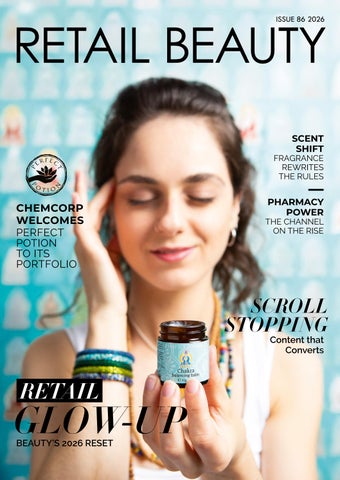
CHEMCORP WELCOMES PERFECT POTION TO ITS PORTFOLIO

SCENT SHIFT FRAGRANCE REWRITES THE RULES

PHARMACY POWER THE CHANNEL ON THE RISE

MARKET IN

MOTION

Welcome to the latest issue of Retail Beauty.

Inside, as always, you’ll find a magazine packed with the latest news, trends, features and interviews shaping the beauty industry across Australia and beyond. From pharmacy to fragrance, digital influence to global market insights, this issue explores the ideas, innovations and people moving the industry forward.

One of the strongest themes running through this edition is the continued evolution of the pharmacy channel. Our coverage of this year’s APP Conference captures the scale, themes and energy of the industry’s largest gathering, along with the innovations and conversations set to influence the next phase of growth.

That momentum is reflected in our cover story, which explores Chemcorp’s decision to bring iconic Australian natural brand Perfect Potion into pharmacies across Australia and New Zealand. It’s a strategic move that speaks to a broader shift within the channel, where consumers are increasingly seeking brands that combine natural credentials with credible, resultsdriven formulations.

Consumer behaviour is also shifting at remarkable speed. Younger shoppers — particularly Gen Z and Alpha — are redefining what value means in beauty retail. Rather than simply chasing price, they are trading up within mainstream channels, embracing ingredient transparency and discovering brands through digital communities.

Of course, none of this can be discussed without acknowledging the role of social media. Platforms like TikTok continue to transform how beauty trends emerge and how brands connect with audiences. In an ecosystem where attention spans are short and scrolling is constant, standing out requires creativity, agility and authenticity.

We also explore the rise of “trend fatigue” and what it means for brands navigating a market where consumers are becoming more selective about which trends — and products — truly deserve their attention.

Across the issue, we also examine the evolving conversation around skin health and ageing. As the industry moves away from the traditional language of “anti-ageing”, Dr Nel Wijetunga shares insights into why a more holistic and empowering approach to ageing well is gaining momentum.

Fragrance, meanwhile, continues to flourish as one of beauty’s most expressive categories, with new olfactive directions emerging globally. At the same time, changing attitudes around body autonomy and personal choice are reshaping established categories such as shaving — proving that even the most familiar areas of beauty can be reimagined.

This issue also brings together perspectives from some of the industry’s most interesting voices. We speak with Suzanne Pengelly, President of Skincare at e.l.f. Beauty, about leadership, innovation and building one of the fastest-growing brands in the world.

Makeup artist Michael Brown shares his creative approach to a dramatic Wuthering Heights-inspired beauty look, while Icy Ling reflects on what styling Chinese clients has taught her about cultural nuance, and how those insights can help retailers connect with consumers more effectively.

We also catch up with Nathan Kake, Clarins Australia and New Zealand’s Head Make-Up Artist, whose career spans more than three decades across retail, fashion and television. Ricky Allen takes us inside the expanding world of serums, one of skincare’s fastest-growing and most innovation-driven categories, while

Delta Goodrem joins us for a quick-fire conversation about fragrance, beauty, creativity and confidence.

Finally, we take a broader global view through emerging insights from Cosmoprof Asia. New data reveals how Asia’s leading beauty markets are influencing product innovation, retail strategies and growth worldwide, offering valuable perspective for brands navigating an increasingly competitive landscape.

Together, these contributions reflect the diversity, creativity and expertise that continue to drive the beauty industry forward, and remind us just how dynamic and exciting this space truly is.

In an industry that never stands still, we’ll see you right here next issue. Thank you, as always, for being part of the Retail Beauty community.

Contributors

MICHAEL BROWN

Growing up as a dancer, Michael Brown was quick to learn the ‘art’ of makeup artistry. His career as a travelling make-up artist for some of the industry’s biggest brands saw him leave Perth for Sydney where he became a national makeup artist and trainer. His creative flair and great communication skills gave him exposure within the Australian celebrity and media scene. Michael is now not only a celebrity makeup artist, but also presenter, educator and brand ambassador with regular appearances on Channel 9’s Today Extra

ICY LING

Ni Hao (‘Hello’ in Chinese). My name is Icy Ling, known as @icybutterfly to my 61,000 instagram followers. I founded IC&Co in 2020 to promote communication and cultural dissemination between Australia and Chinese at home and abroad, and provide a wider promotion for international and Australian brands.

RICKY ALLEN

Ricky Allen, the former anti-ageing and special beauty projects editor for Vogue Australia, brings her extensive experience to various facets of the beauty and cosmetics industry. She serves as a nurse consultant in plastics and cosmetic enhancement, a health psychologist, a beauty therapist, and an international educator specialising in cosmetic enhancement, business development for skincare companies, and the psychology of sales and customer service. Her expertise extends to enhancing profitability and revitalising struggling businesses. Ricky has shared her knowledge through training sessions in the United States, New Zealand, and Australia.

LILY TWELFTREE

Lily Twelftree is a beauty data analyst behind Barefaced Media and founder of Unfiltered, a consumer insights platform turning beauty reviews into predictive intelligence.

JOSIE GAGLIANO

Josie Gagliano was a long-time magazine and beauty editor, and her blogger presence Josie’s Juice spans the past 15 years. She then co-founded PR and talent management agency RoJo Consulting ten years ago, specialising in profiling lifestyle talent, as well as PRing events and brands. She can’t let the decades-long love affair with writing go,

Accord is the national industry association for the Australasian hygiene, cosmetic and specialty products industry representing the full range of products from luxury cosmetics and fragrances to industrial specialties. In keeping with the strong scientific basis of this industry, Accord also adopts a principled, evidence-based approach to policy inputs and representation with governments.

70

COVER STORY

10 A Natural Fit

Why Chemcorp is bringing Perfect Potion to pharmacies in ANZ.

FEATURES & INTERVIEWS

24 Interview: Suzanne Pengelly, President of Skincare, e.l.f. Beauty

On leading accessible, science-led skincare across global and ANZ markets.

26 Beauty’s Retail Reset Why the next generation is rewriting the rules of where beauty wins.

30 5 Minutes With… Delta Goodrem On scent, identity and the evolution of celebrity beauty.

50 Nick Law, Founder, Beauty Love Where beauty influence really lives.

52 Interview: Rowena Bird, Co-Founder, Lush Brand activism, innovation and staying culturally relevant.

62 Have You Met… Nathan Kake, Head Make-Up Artist, Clarins ANZ

On skin-first beauty and a career spanning retail, runway and TV.

64 Ageing Well – Dr Nel Redefining the narrative around ageing in modern beauty.

TRENDS & INSIGHTS

32 Fragrance Trends Dupe culture, niche growth and the shifting value of scent.

40 Capturing Attention in a Fast-Scrolling World Creative strategies that convert in a scroll-first environment.

42 Pharmacy Beauty: Five Trends Defining 2025–26 Clinical credibility, masstige growth and treatment-led categories.

44 APP 2026

Pharmacy’s biggest event signals what’s next for the channel.

66 Cosmoprof Asia Trends Key insights shaping global beauty innovation.

CATEGORY FOCUS

46 Shaving Report – Josie Gagliano

Precision tools and skinfirst formulations reshape a legacy category.

CATEGORY FOCUS

38 Lily Bareface, Founder, Bareface

Chemcorp’s partnership with Perfect Potion strategically strengthens its ANZ portfolio with a heritage, family-owned wellness brand that delivers proven, education-led aromatherapy solutions aligned to accelerating pharmacy demand for natural, benefit-driven products. By combining Perfect Potion’s 30-year brand equity and established hero SKUs across sleep, stress, immunity and emotional wellbeing with Chemcorp’s distribution scale, retail execution and category expertise, the partnership is positioned to drive incremental growth and long-term value in the pharmacy channel.

CONTACT DETAILS

RETAIL BEAUTY

Owner & Publisher Nicci Herrera

M: +61 (0)426 826 977

E: nicci@retailbeauty.com.au

Editor-in-Chief

Michelle Ruzzene

M: +61 (0)402 277 286

E: michelle@retailbeauty.com.au

Director of Brand Partnerships

Jessica Hewson

M: +61 (0)467 170 081

E: jess@retailbeauty.com.au

Art Director Katy Brack

Mailing Address

RETAIL BEAUTY P.O. Box 55, Glebe, NSW 2037 Australia

Subscription Rates

$132.00 per annum (Aus)

$167.70 per annum (NZ)

$205.20 per annum (Int)

All rates are inclusive and AUS$.

Articles that appear in Retail Beauty may not be reproduced without permission of the publishers. The opinions expressed in Retail Beauty are not necessarily those of the publishers.

Trend fatigue and how the beauty cycle is changing.

60 Michael Brown, Celebrity MUA

The Autumn beauty trend everyone’s blushing over.

68 Icy Ling, Content Creator

What I learned from styling my Chinese clients.

70 Ricky Allen, Expert

The evolution of modern serums.

Published by Percolate Media Pty Ltd

ACN: 629 613 583

Subscribe to Retail Beauty online newsletter for the latest industry news, peer conversations, trends and launches.

WWW.RETAILBEAUTY.COM.AU

A NATURAL FIT

WHY CHEMCORP IS BRINGING PERFECT POTION TO PHARMACIES IN ANZ

CAN YOU SHARE A BRIEF HISTORY OF THE PERFECT POTION BRAND?

Perfect Potion was founded in 1991 by husband-and-wife team Salvatore Battaglia and Carolyn Stubbin, qualified aromatherapists, naturopaths and acupuncturists with a deep passion for natural therapies. What began as a small, hands-on aromatherapy practice in Brisbane has grown into one of Australia’s most respected natural wellness brands. From the very beginning, Perfect Potion has been guided by a clear vision: to help

people reconnect body, mind and spirit through nature. More than three decades on, the brand remains Australian, familyowned and values-led, with a strong focus on education, sustainability and integrity. That longevity and consistency is a powerful signal of trust in today’s wellness landscape.

WHAT IMPRESSED CHEMCORP ABOUT PERFECT POTION AND LED TO THE PARTNERSHIP?

What stood out immediately was the heart behind the brand. Perfect Potion was created

by founders who are deeply passionate about natural wellbeing, and that passion is evident in everything they do. It’s a brand built on genuine belief, not trends.

Just as importantly, Perfect Potion has remained true to its purpose for more than 30 years. Like Chemcorp, founded in 1988, it is a family-owned business built on quality, trust and long-term relationships.

WHY ARE CHEMCORP AND PERFECT POTION SUCH A GOOD FIT?

At their core, both Chemcorp and Perfect

Potion are family businesses built on trust, longevity and shared values. With more than three decades of experience each, both companies understand the importance of building brands responsibly, not quickly. We share a long-term mindset, and a commitment to doing business the right way. That shared mindset makes this partnership not just strategic but deeply aligned.

HOW DOES PERFECT POTION COMPLEMENT CHEMCORP’S EXISTING PORTFOLIO?

Perfect Potion adds a strong, authentic natural wellness pillar to our portfolio. At retail, the brand fills an important space, offering aromatherapy that is premium yet accessible, educational without being intimidating, and products built on decades of credibility.

WHY IS NOW THE RIGHT TIME TO EXPAND PERFECT POTION ACROSS AUSTRALIA AND NEW ZEALAND IN THE PHARMACY SPACE?

Interest in wellbeing, mindfulness and natural solutions continues to grow, with shoppers increasingly looking for products that offer clear benefits and transparent formulations.

Perfect Potion is ideally positioned to meet this demand. With established hero products, a loyal customer base and a strong, value-led brand story, it is well

placed for expansion across Australia and New Zealand, particularly within the pharmacy channel.

CAN YOU TALK US THROUGH SOME OF THE PERFECT POTION RANGES THAT CHEMCORP WILL DISTRIBUTE AND THEIR BENEFITS?

CHAKRA & ENERGY BALANCE RANGE

Designed to support energetic alignment, emotional balance and mindfulness rituals, this range strongly resonates with wellnessfocused consumers.

Products include:

• Chakra Balancing Mist (best-selling SKU)

• Chakra Balancing Essential Oil Blend

• Chakra Balancing Balm

• Chakra Balancing Aromatherapy Pulse Point

RELAXATION & SLEEP RANGE

Focused on calming the nervous system and supporting rest, this range is ideal for customers managing stress, anxiety or sleep challenges.

Products include:

• Relax Essential Oil Blend

• Relax Aromatic Mist

• Relax Aromatherapy Balm

• Relax Aromatherapy Pulse Point

• Sweet Dreams Essential Oil Blend

• Sweet Dreams Pillow Mist

• Sweet Dreams Aromatherapy Balm

ACTIVE & MUSCLE RELIEF RANGE

Designed to support physical wellbeing, recovery and movement, this range appeals to active consumers and those seeking natural relief.

Products include:

• Active Muscles Spray

• Active Aromatherapy Balm

RESPIRATORY & IMMUNE

SUPPORT RANGE

Targeted blends and balms designed to support breathing, clarity and seasonal wellbeing.

Products include:

• Breathe Easy Essential Oil Blend

• Breathe Easy Aromatherapy Balm

• Clear Head Aromatherapy Pulse Point

• Echinacea & Manuka Honey Throat Spray

MOOD & EMOTIONAL WELLBEING RANGE

Blends created to support emotional balance, positivity and mental clarity.

Products include:

• Happy and Calm Essential Oil Blend

• Focus Essential Oil Blend

• Positive Vibes Essential Oil Blend

• Hug Time Essential Oil Blend

LIFESTYLE & SIGNATURE BLENDS RANGE

Experiential blends inspired by travel, nature and sensory escape.

Products include:

• Eros Essential Oil Blend

• Spa Escape Essential Oil Blend

• Thai Fusion Essential Oil Blend

• Great Outdoors Essential Oil Blend

• Refresh Essential Oil Blend

NATURAL PROTECTION RANGE

Everyday natural solutions designed for outdoor living.

Products include:

• Natural Insect Repellent: Outdoor Body Spray

WHAT DOES CHEMCORP BRING TO THE PARTNERSHIP?

Chemcorp brings scale, retail expertise and strong relationships across Australia and New Zealand. Our role is to ensure Perfect Potion reaches more consumers without compromising the integrity that defines the brand.

We are focused on thoughtful distribution, strong retail execution, supporting both retailers and consumers to truly understand the brand and its benefits. ■

Cosmoprof Asia 2025:

WHERE GLOBAL BEAUTY CAME TO DO BUSINESS

Walking the floor at Cosmoprof Asia 2025, one thing was immediately clear: global beauty is back in motion—and Asia-Pacific remains firmly at the centre of it.

Held from 11 to 14 November across AsiaWorld-Expo and the Hong Kong Convention & Exhibition Centre, the 28th edition of Cosmoprof Asia delivered scale, substance and a renewed sense of optimism that was felt across every hall. This year’s show welcomed 64,761 industry professionals from 140 countries and regions, with international attendance up 6.5% year-on-year, reinforcing the event’s role as the premier B2B gateway into Asia-Pacific beauty markets.

Retail Beauty was on the ground throughout the show — meeting with brand founders, manufacturers, retailers, distributors and suppliers — and what stood out most was not just the size of the

event, but the quality of conversations taking place. From early-stage indie brands to global beauty powerhouses, the focus was firmly on commercial readiness, scalability and long-term opportunity.

A TRULY GLOBAL BEAUTY MARKETPLACE

Cosmoprof Asia’s international reach continues to expand, with 2,688 exhibitors from 46 countries and regions showcasing innovation across the full beauty value chain. Notably, 40% of exhibitors came from outside China, Hong Kong and Taiwan Region, highlighting the show’s growing appeal as a neutral meeting point for global beauty trade.

Visitor growth from key strategic regions highlighted that momentum. Attendance surged from South America (+45%), Africa (+38%), the Middle East (+24%), North America (+21%) and Europe (+13%), reinforcing Cosmoprof Asia’s relevance well beyond its immediate geography.

SUPPLY CHAIN INNOVATION TAKES CENTRE STAGE

Nowhere was this more evident than at Cosmopack Asia, which once again proved itself the engine room of the show. Attendance at Cosmopack Asia grew 17% compared to 2024, as brand owners, R&D teams and product developers searched for next-generation solutions across ingredients, machinery, packaging, contract manufacturing and private label.

From refill systems and sustainable material innovation to biotech ingredients, microbiome research and exosome-led development, the supply side of beauty is evolving rapidly — and exhibitors were keen to demonstrate not just innovation, but scalability and compliance.

Retail Beauty observed a clear shift towards flexible manufacturing models, faster prototyping and partners capable of supporting brands across multiple markets simultaneously — a direct response to the increasingly global ambitions of both indie and established beauty players.

FINISHED GOODS, FRAGRANCE AND BEAUTY TECH IN FOCUS

At Cosmoprof Asia, the finished goods halls reflected the diversity and maturity of the Asia-Pacific beauty landscape.

Skincare, makeup, haircare, fragrance and beauty tech all featured prominently, with a noticeable emphasis on clinical credibility, sensorial experience and differentiated brand storytelling.

Fragrance, in particular, emerged as a standout category. Dedicated activations including Fragrance Avenue, 5C Fragrance Experience, and the Asia debut of Explorers by Esxence signalled the growing appetite for niche, artisanal and high-performance scent across Asian and global markets.

From gourmand profiles and longlasting extrait styles to storytelling rooted in provenance and craftsmanship, fragrance felt less like an adjacent category and more like a central growth engine — especially among younger consumers and emerging markets.

RELATIONSHIPS, NOT JUST REACH

Beyond the exhibition floor, Cosmoprof

Asia 2025 doubled down on its role as a relationship-driven business platform. Business matchmaking reached new heights with approximately 300 hosted buyers participating in curated meetings, while the Elite Circle brought together more than 70 CEOs, founders and senior executives for strategic dialogue.

Key discussions focused on sustainability, innovation, regulation, omnichannel retail and cross-border expansion — themes that echoed throughout the show. The message was clear: growth in beauty is no longer about speed alone, but about building resilient, adaptable and globally relevant businesses.

More than 2,060 attendees also participated in CosmoTalks, a series of expert-led discussions covering macrotrends, consumer behaviour, retail strategy and beauty tech innovation.

A CONFIDENT INDUSTRY LOOKS AHEAD

What Cosmoprof Asia 2025 ultimately delivered was confidence. Confidence in the Asia-Pacific market. Confidence in innovation. And confidence in face-to-face connection as a catalyst for growth.

For Retail Beauty, being on the ground reinforced just how critical this event remains — not only as a trend barometer, but as a commercial launchpad for brands looking to scale across borders. The energy on the floor, the calibre of participants and the seriousness of business discussions all pointed to a global beauty industry that is recalibrating — and moving forward with intent.

Following such a successful edition, the industry will reconvene in Hong Kong from 10 to 13 November 2026, with expectations already high.

www.cosmoprof-asia.com

Jess brings a rare end-to-end understanding of how brands are built, sold and sustained. Her experience spans media, advertising, retail, distribution and product development, giving her a genuine appreciation for both the creative and commercial sides of the industry. She began her career in television advertising and print media, before founding and publishing a Canberra-based home magazine and leading high-performing sales teams — an early grounding that shaped her sharp commercial instincts. Her move into fragrance and beauty deepened that perspective. Jess became the Australian importer and distributor for US fragrance brand Root Candles, before going on to create, scale and retail her own wholesale brand — managing everything from product development and storytelling to distribution and in-store execution. She has also worked within prestige beauty with Swiss skincare brand Juvena, further strengthening her understanding of premium positioning and brand equity.

What truly sets Jess apart is her ability to see the full ecosystem — from the shop floor to the boardroom — and to translate that into meaningful, resultsdriven partnerships. With a deep passion for fragrance, soap and beautifully crafted products, she understands that strong brands are built on both numbers and narrative.

Jess joins Owner and Publisher Nicci Herrera and Editor-in-Chief Michelle Ruzzene, adding further depth to Retail Beauty’s leadership team and reinforcing the platform’s commitment to helping brands build awareness, secure distribution and scale with purpose.

We’re thrilled to have Jess on board and look forward to the insight, energy and strategic thinking she brings to Retail Beauty. jess@retailbeauty.com.au

Jessica Hewson

BEAUTY BRANDS ENTER THE SPORTING ARENA

The crossover between beauty and sport is accelerating, with brands and retailers increasingly partnering with major leagues, teams and events to reach younger audiences and tap into the growing cultural influence of women’s sport.

Once largely confined to fashion and entertainment, beauty is now appearing courtside, trackside and centre stage at major sporting moments. From tennis grand slams and basketball arenas to Formula One circuits, sport is emerging as a powerful platform for experiential marketing and brand visibility.

In Australia, Mecca has been among the most visible beauty players entering the sporting arena. The retailer has strengthened its presence at the Australian Open, returning as the tournament’s official beauty and SPF partner with activations across Melbourne Park, offering

“Internationally, Sephora has also aligned with WNBA expansion team Golden State Valkyries, integrating the brand into player facilities and fan experiences.”

express makeup services and product discovery experiences for fans.

Mecca has also tapped into motorsport culture through activations linked to the Formula One Australian Grand Prix, reflecting the sport’s growing appeal among younger audiences and female fans.

Globally, Sephora has also stepped into the sporting arena through partnerships with women’s basketball. In Australia, the retailer has partnered with the Women’s National Basketball League (WNBL), becoming the competition’s official beauty partner from the 2026–27 season.

Internationally, Sephora has also aligned with WNBA expansion team Golden State Valkyries, integrating the brand into player facilities and fan experiences.

Rihanna’s Fenty Beauty has also entered sport through its partnership with WNBA team New York Liberty, marking the brand’s first team sponsorship and including in-arena activations and branded player apparel.

Motorsport has also attracted beauty brands. Luxury skincare brand Elemis recently partnered with the Aston Martin Formula One Team, while Charlotte Tilbury became the first beauty brand to sponsor F1 Academy, the all-female Formula One development series.

The rise of beauty-sport partnerships reflects the increasing cultural influence of athletes and the growth of women’s sport. Brands including Glossier, L’Oréal and Maybelline have also collaborated with athletes and major sporting events, recognising the influence of sports figures as lifestyle role models.

For beauty brands, sport offers global audiences, cultural relevance and immersive experiences that extend far beyond traditional retail environments.

Sephora x Women’s National Basketball League.
Tennis Australia CEO Craig Tiley and Mecca Founder & Co-CEO Jo Horgan.

Australia’s First Insulated, Spill-Proof Makeup Bag

BRINGS PRACTICAL LUXURY TO EVERYDAY ROUTINES

In today’s fast-moving beauty landscape, consumers are investing more than ever in high-performance skincare, premium makeup and results-driven formulations. Yet the humble cosmetic bag has remained largely unchanged—often flimsy, difficult to clean and ill-equipped to protect what sits inside it.

That disconnect is exactly what inspired Nicole Newman to create KOLD, Australia’s first insulated, spill-proof makeup and toiletry bag. Designed to keep beauty essentials clean, organised and protected from the chaos of everyday life, KOLD reframes storage as an essential part of the beauty ritual — not an afterthought.

“Women are spending real money on their beauty routines,” Newman says. “But they’re still throwing those products into soft pouches that don’t protect them from heat, leaks or bacteria. I wanted to create something that respects that investment.”

FROM GYM BAG TO GLOW-UP

KOLD was born out of lived experience — the gym locker that overheats, the foundation bottle that leaks, the makeup brushes crushed at the bottom of a tote.

The result is a considered design that merges functionality with a polished aesthetic. Each KOLD bag features an insulated interior to help shield products from temperature fluctuations, a waterproof zipper engineered to prevent spills, and an anti-bacterial lining that addresses hygiene concerns without compromising style. An internal pouch keeps smaller items accessible, while the easy-clean fabric allows for a quick wipedown between uses.

“Life doesn’t slow down,” Newman explains. “Your beauty routine shouldn’t feel chaotic because of that. KOLD transitions seamlessly from spin class to boardroom to dinner — keeping everything fresh, organised and ready to go.”

Sized at 18.5cm in length, both formats comfortably fit standard makeup brushes, a practical detail that highlights the brand’s focus on real-world usability.

TRAVEL, REIMAGINED

As travel rebounds and consumers return to carry-ons, weekend escapes and long-haul flights, portability has become a defining factor in product choice. Cream blushes, SPF, serums and hybrid complexion products are increasingly sensitive to heat and handling, while airport security trays and hotel bathrooms are notorious spill zones.

KOLD’s insulated construction and waterproof closure are designed with these realities in mind.

“Beauty never takes a break,” Newman says. “Whether you’re heading interstate for work or overseas for a holiday, you want your essentials protected and exactly where you left them.”

The design speaks to women who expect both efficiency and elegance — those who move between settings without sacrificing their routine.

THE GOLDEN HOUR EDIT

KOLD launches with The Golden Hour Edit, a capsule collection inspired by long days that melt into warm, luminous evenings. The aesthetic leans into metallic finishes that capture light and elevate an everyday essential into a design statement.

Available in two sizes — the Mini (RRP $60) and the Midi (RRP $75) — the bags come in four distinct tones. Gold delivers warmth and radiance; Bronze evokes sun-kissed softness; Rose offers a romantic metallic glow; and Chrome brings a cool, modern edge reminiscent of city lights after dark.

“I didn’t want it to feel clinical,” Newman says. “Yes, it’s insulated. Yes, it’s anti-bacterial. But it also had to feel beautiful. Hygiene, but make it fashion.”

The metallic palette ensures the bags function as both practical organisers and statement accessories — equally at home in a gym tote, carry-on suitcase or everyday handbag.

THE CLEAN BAG CONVERSATION

As “clean beauty” continues to evolve, the conversation is expanding beyond ingredient decks to encompass packaging, storage and hygiene. Consumers are increasingly aware that brushes, sponges and cosmetic surfaces can harbour bacteria, particularly when stored in warm, enclosed spaces.

KOLD’s anti-bacterial lining addresses this concern head-on, while the easy-clean interior supports ongoing maintenance. The insulated structure adds an additional layer of protection, particularly for temperature-sensitive products.

By elevating storage to the same level of consideration as formulation, KOLD taps into a broader shift toward intentional, holistic beauty routines — where every detail, including how products are stored, matters.

AN EVERYDAY ESSENTIAL, ELEVATED

Founded in Australia, KOLD bridges the gap between practical necessity and design-led accessory. It answers a simple question: why should the bag carrying your beauty investments be the weakest link in your routine?

“My objective was to create something women genuinely need — and make it beautiful enough that they want to carry it everywhere,” Newman says.

In doing so, KOLD redefines the cosmetic bag as more than a pouch. It becomes a beauty sidekick — insulated, spill-proof, hygienic and considered — built for women who live life in motion.

Available now at kold.au, the brand marks a new chapter in beauty organisation, proving that sometimes innovation isn’t about adding another serum to your shelf — it’s about protecting the ones you already love. ■

For wholesale and retail enquiries, contact info@kold.au

Nicole Newman

OZ HAIR & BEAUTY EXPANDS NATIONAL FOOTPRINT AS OMNICHANNEL MODEL SCALES

Australian family-owned retailer Oz Hair & Beauty is continuing its national expansion, opening 30 stores across Australia in the past three years as it builds one of the country’s largest independent professional haircare retail networks.

The company’s 30th store will open in Shellharbour in March, followed by two Perth locations from May, marking the retailer’s continued expansion beyond its east coast base.

Founded in 1986 by hairdresser Elio Nappa as a single Sydney salon, the business has since evolved under the leadership of his sons Anthony and Guy Nappa into a scaled omnichannel retailer employing more than 500 staff across Australia.

Co-Owner and CEO Anthony Nappa said the milestone reflects years of deliberate execution.

“We’ve grown store by store, prioritising capability over speed and reinvesting profits back into the business to strengthen our buying power and operational depth,” Nappa said.

While many discretionary retailers have reduced their physical

footprints in recent years, Oz Hair & Beauty has taken the opposite approach — opening 30 stores in three years and treating bricksand-mortar retail as a commercial asset rather than a cost centre.

Co-Owner and Chief Operating Officer Guy Nappa said strong backend capability has been critical to sustaining the pace of rollout.

“You cannot open 10 to 15 stores a year without serious operational foundations,” he said. “We’ve invested heavily in warehousing, logistics and systems to ensure the business can scale sustainably. Now, our expansion into Western Australia marks the transition from an east coast footprint to a truly national presence.”

Today, Oz Hair & Beauty operates an integrated omnichannel model, with physical stores providing expert consultation and immediate product access, while its digital platform delivers national reach and convenience.

“In professional haircare, customers want expertise and immediacy,” Anthony Nappa said. “When physical retail and online work together, they reinforce one another. Stores build authority and trust; online extends reach. Together, they drive performance.”

Established in Rockdale, Sydney, Oz Hair & Beauty expanded into e-commerce in 2012 and today operates a growing national store network alongside its online platform, specialising in professional haircare brands supported by expert-led retail.

Anthony and Guy Nappa.

ESTÉE LAUDER DEEPENS INDIA STRATEGY WITH FOREST ESSENTIALS ACQUISITION

The Estée Lauder Companies (ELC) has announced plans to acquire the remaining shares in Forest Essentials, strengthening its ownership of the Indian prestige beauty brand following an 18-year partnership.

The transaction, which is subject to regulatory approvals, is expected to close in the second half of 2026. ELC first invested in the brand in 2008, increasing its stake to 49% in 2020.

Founded in 2000 by entrepreneur Mira Kulkarni, Forest Essentials has built a strong position in India’s prestige skincare market with its approach to luxury Ayurveda, blending traditional Ayurvedic principles with modern formulations and retail experiences. The brand currently operates nearly 200 standalone stores across India.

Under the new agreement, Kulkarni will continue to oversee the brand, alongside her son Samrath Bedi, with the company remaining headquartered in New Delhi. Forest Essentials will also maintain its vertically integrated operations in India,

including research and development rooted in Ayurveda, responsible local sourcing of botanicals and in-house manufacturing.

Stéphane de La Faverie, President and Chief Executive Officer of The Estée Lauder Companies, said the move marks a new phase in a long-standing partnership.

“Today marks a meaningful new chapter in a partnership built over the past 18 years on a foundation of mutual trust and respect,” he said. “Forest Essentials is an exceptional brand, beloved in India and created and nurtured by its founder, Mira Kulkarni.”

He added that the acquisition reflects the company’s growing focus on India as a strategic market.

“This next phase reflects our long-term commitment to India—one of our most significant emerging markets—and our conviction in the global resonance of this remarkable brand.”

Kulkarni said the partnership will enable the brand to expand internationally while maintaining its heritage and authenticity.

“Our shared mission has always been to establish Luxury Ayurveda as a globally respected pillar of modern beauty,” she said. “By combining our heritage with the operational strength of The Estée Lauder Companies, we have the opportunity to bring this wisdom to a global audience.”

Forest Essentials has become one of India’s leading prestige skincare brands, with the company forecasting low double-digit net sales growth. Combined with ELC’s existing portfolio, the acquisition is expected to further strengthen the company’s position in the Indian beauty market.

India already represents one of the company’s largest emerging markets, with 14 Estée Lauder Companies brands currently operating across skincare, makeup, fragrance and haircare.

The acquisition also aligns with ELC’s broader strategy of investing in founderled brands with strong cultural heritage and global potential, while continuing to expand its presence in high-growth prestige beauty markets.

ENDOTA PARTNERS WITH ESCABAGS TO SUPPORT VICTIMS OF DOMESTIC VIOLENCE

Australian wellness brand endota has partnered with national charity Escabags to provide discreet support for individuals fleeing domestic and family violence, with Escape Bags now available across more than 100 endota spas nationwide.

The initiative aims to create safe, accessible locations where individuals in crisis can seek immediate assistance. According to national statistics, one in three Australians will experience domestic or family abuse at some point in their lifetime, highlighting the urgent need for practical and compassionate support services.

Through the partnership, endota spas will stock Escabags – thoughtfully prepared tote bags containing essential items and support resources for individuals leaving unsafe environments. Each spa will display a small window decal reading “Escabags available here”, quietly signalling that the location is a safe and confidential place to access help.

Individuals seeking assistance can enter any participating endota spa and ask staff for an Escape Bag, with no questions asked and complete discretion provided.

“You’re never too small to make big change and you’re never too alone to seek services and support,” said Escabags Founder and CEO, Stacy Jane.

Founded following Jane’s own lived experience with domestic violence, Escabags was created to provide immediate, practical help at a critical moment when someone decides to leave an abusive situation. Since launching in 2020, the organisation has grown into a national movement, with more than 2,000 establishments across Australia now stocking and distributing Escape Bags.

Each Escape Bag is provided free of charge and contains essential and comfort items designed to support individuals and their children when leaving a dangerous situation. The bags are non-gendered and available in two variations — Single Adult and Parent & Child — ensuring support for a wide range of survivors. To maintain discretion, the bags are unbranded on the outside, although information inside connects recipients with domestic and family violence helplines and support services.

For endota, the partnership reflects the brand’s broader commitment to wellbeing and community care. With more than 100 spas nationwide, the Australian-founded wellness brand is known for its holistic approach to self-care, offering treatments designed to nurture the mind, body and skin alongside a curated range of skincare and wellness products.

“Individuals seeking assistance can enter any participating endota spa and ask staff for an Escape Bag, with no questions asked and complete discretion provided.”

The collaboration also sits within a broader shift across the beauty industry towards purpose-driven partnerships. Retailers and brands are increasingly investing in social initiatives that extend beyond products, from gender equality and women’s empowerment programs to health and community support campaigns.

By joining the Escabags network, endota is helping expand access to vital resources for those experiencing domestic and family violence, while reinforcing the role of wellness spaces as trusted environments within the community.

For more information visit endotaspa.com.au.

Melanie Gleeson, Endota Founder and CEO, and Stacy Jane, Escabags Founder and CEO.

MYER REINVENTS BEAUTY FLOORS WITH FENTY AND MAC

Myer is undertaking the most significant transformation of its beauty department in the company’s history, strengthening its focus on makeup through new brand partnerships, expanded loyalty benefits and continued investment in eCommerce.

The retailer has added 22 new beauty brands over the past year, with several major launches set to further elevate its beauty floors in 2026. Among the most anticipated is the arrival of Fenty Beauty, which will launch in all Myer stores and online in May as part of a broader partnership with Kendo Brands.

As part of the department store exclusive, Myer will range Fenty Beauty, Fenty Skin, and the exclusive Australian department store launch of Fenty Eau de Parfum.

Myer Chief Merchandise Officer Belinda Slifkas said the launch reflects the retailer’s strategy to strengthen its beauty credentials and engage younger shoppers.

“We’re thrilled to introduce Fenty Beauty to Myer customers across Australia, in what is set to be one of our most exciting and highly anticipated launches in recent years,” Slifkas said.

“Rihanna and the Fenty Beauty team have built a brand that truly champions inclusivity, with products designed to celebrate every skin tone and skin type. We know this commitment to diversity will deeply resonate with our customers.”

Alongside the Fenty launch, Myer has also expanded its partnership with M·A·C Cosmetics, with the brand set to become Myer’s sole department store makeup partner from mid-2026.

“Myer is firmly focused on winning the younger beauty customer, and every move we make is anchored to that strategy,” Slifkas said.

“We know makeup is a great entry point for engaging new customers before they explore other categories such as skincare, fragrance or apparel.”

Beyond brand expansion, Myer is also investing in its customer ecosystem. The retailer recently announced the biggest upgrade to its Myer One loyalty program in more than 20 years, introducing faster rewards, additional partner earning opportunities and experiential benefits including complimentary beauty treatments and curated beauty boxes for members.

The business is also accelerating its digital strategy, appointing global retail technology provider Mirakl as its new marketplace platform as it expands its online offering.

Myer Group Executive Chair Olivia Wirth said eCommerce continues to be a key growth driver for the business.

“Online sales now make up almost a quarter of all Group sales and we have a number of strategic initiatives underway to continue accelerated growth in eCommerce — including rapid expansion of our marketplace offering,” Wirth said.

With new prestige beauty launches, loyalty upgrades and digital expansion, Myer’s beauty transformation is gathering pace as the retailer targets the next generation of beauty consumers.

Myer One Gold My Edition Box.

AND CULT STATUS Consistency, Clinical Credibility

When Naturium launched exclusively into Sephora Australia and New Zealand in October 2025, it entered one of the world’s most ingredient-literate skincare markets with quiet confidence, and a clearly defined mandate.

Founded in Los Angeles by beauty expert and digital creator Susan Yara, the brand rapidly achieved cult status in the US and UK for its “consistency-inspired” approach to bio-compatible skincare. Acquired by e.l.f. Beauty in 2023, Naturium now sits firmly within the group’s global skincare expansion strategy, positioned as its clinical authority.

“We are the clinical skin care brand of the portfolio,” says Suzanne Pengelly, President of Skin Care for e.l.f. Beauty, in an exclusive interview with Retail Beauty

At the heart of Naturium is a simple but commercially astute idea: routine drives results.

Suzanne Pengelly, President of Skin Care at e.l.f. Beauty, has built a standout global career scaling high-growth skincare brands through science-led innovation and sharp commercial strategy. Now steering Naturium’s expansion, she shares with Michelle Ruzzene insights into the brand’s ambitious ANZ play — and what’s driving its next phase of growth.

“At Naturium, we believe consistency is the key to skin you love,” Pengelly explains. “We also believe that everyone should have the opportunity to experience skin love.”

That philosophy informs formulations powered by potent actives — Vitamin C, Retinol, Niacinamide and Hyaluronic Acid — balanced with botanicals such as Kakadu Plum, Squalane and Jojoba Oil to support the moisture barrier. Hero products including Vitamin C Super Serum Plus, Multi-Peptide Moisturizer, BHA Liquid Exfoliant 2% and Glow Getter Multi-Oil Hydrating Cleanser anchor the assortment, designed to visibly improve tone, texture and radiance.

Crucially, the clinical positioning is matched by accessible pricing, with the range retailing between $10 and $60 AUD.

“Our formulas are clinically effective and luxurious to ensure our community wants to use our products every day,” Pengelly says. “Our price point is purposefully accessible so that consumers can use our skincare every day.”

In a market where efficacy often commands prestige price points, that balance is strategic rather than incidental.

The exclusive partnership with Sephora ANZ was equally deliberate.

“Sephora is an incredible partner,” Pengelly says. “They have such a strong brand reputation and are known for their ability to build brands. It was important for us to work with a partner who can help to bring our story to life in a way that resonates with the market.”

For Pengelly, Australia was not simply another global expansion line item. It was a market aligned in values.

“Australian consumers are extremely knowledgeable and savvy about skincare,” she notes. “Our products speak for themselves and we’re excited to give Australian consumers the opportunity to say, ‘I love my skin’.”

She adds that the cultural fit feels natural. “We absolutely love the Australian market, there is such a shared spirit with North America. The consumer here is deeply ingredient savvy, values authenticity and embraces modern simplicity. It is a market that mirrors many of our own values, but with its own uniquely effortless confidence.”

Pengelly’s perspective is shaped by a career that spans Coty, Shiseido and Elemis, experience across both legacy prestige houses and modern disruptors. The throughline, she says, has always been transformation.

“I have always had a passion for the beauty industry, but it really all started when I was a cash-strapped college student,” she reflects. “I took a job at a premium spa and salon… That experience opened my eyes to the transformative power of service and more specifically, skincare.”

Seeing how the right treatment could shift confidence proved catalytic. “From that moment on, I was hooked… It has been the most fulfilling career, and I feel blessed daily to make an impact on people’s lives.”

“For a brand to be successful today, it must connect authentically with consumers, prioritise quality and efficacy in its innovation and adapt to the evolving landscape while maintaining values...”

In 2026’s hyper-connected retail environment, she believes leadership has evolved just as dramatically as the consumer.

“The role of a beauty executive has undergone transformational change, especially with the rise of social media,” she says. “Unlike in the past, when executives often dictated strategies, now we rely heavily on ‘in the moment’ insights. The job of an executive is to listen and empower their teams to test and try things.”

Her broader philosophy centres on trust and empowerment. “My leadership style revolves around open communication, trust and guidance,” she explains. “You are only as successful as the people who work for you want to be.”

In a category increasingly saturated with launches and reformulations, Pengelly believes enduring brands are defined by authenticity and discipline.

“For a brand to be successful today, it must connect authentically with consumers, prioritise quality and efficacy in its innovation and adapt to the evolving landscape while maintaining values,” she says.

Education, therefore, remains non-negotiable. “Skincare can be daunting for a new-comer. That’s why we educate via all touchpoints — to remove the barriers and empower our consumers to treat their skin.”

Asked for her personal ritual essential, she returns to fundamentals. “Cleansing is where skincare begins. I feel passionate about a really good double cleanse.”

As Naturium continues to embed itself within Sephora ANZ’s clinical offering, the strategy is neither disruptive for disruption’s sake nor trend-led. It is disciplined, data-aware and rooted in repeatability. ■

Suzanne Pengelly
Suzanne Pengelly and Susan Yara

BEAUTY’S RETAIL RESET:

WHY THE NEXT GENERATION IS REWRITING THE RULES OF WHERE BEAUTY WINS

For decades, prestige beauty followed a familiar script – discovery in glossy magazines, validation through department stores or specialty retailers, and loyalty built behind polished counters. That model is now being disrupted—not by retailers, but by younger consumers.

Gen Alpha, Gen Z and Millennials have become savvier than any generation before them at identifying quality beauty brands in unexpected places. The continued dominance of TikTok as both an entertainment and education platform, combined with a prolonged cost-of-living squeeze, has fundamentally shifted how and where beauty shoppers search for value.

Today’s customer is no longer defaulting to boutique or prestige-only retailers. Instead, they are increasingly turning to accessible, everyday destinations – Coles, Woolworths, Chemist Warehouse and Priceline – for brands that look great, perform well, align with their values and hit sharp price points.

This shift isn’t about trading down. It’s about trading smart.

DEMOCRATISATION, NOT DILUTION

Younger consumers have grown up in a world of radical transparency. Ingredient lists are decoded in 30-second videos, before-and-after results are scrutinised in real-time, and peer reviews often carry more weight than traditional brand storytelling. As a result, brand credibility is no longer bestowed by shelf placement alone. It is earned online, then reinforced in-store.

Australian beauty brands like Gem, Boring Without You and SOMA exemplify this evolution. By building strong digitalfirst identities and communities, these brands have entered mainstream retail not as ‘emerging’ labels, but as proven performers with highly engaged audiences. Their success on mass shelves has come at the expense of multinational incumbents that were once considered untouchable. What these brands demonstrate is a new retail truth: mainstream no longer means generic.

For Gen Z and Millennials, finding a brand they love at Chemist Warehouse or Woolworths feels less like compromise and more like a win – proof that great design, efficacy and values don’t have to come with a premium price tag.

THE POWER OF EDUTAINMENT

Central to this shift is how modern beauty brands communicate. Education and entertainment are no longer separate strategies; they have converged into what the industry now recognises as ‘edutainment’. Short-form content that explains benefits, routines and results –while remaining highly watchable – has become the primary driver of discovery.

These brands speak directly to their audience, clearly articulating what their products do, who they’re for and why they exist. They don’t rely on heritage narratives or inflated claims. Instead, they show up consistently, authentically and accessibly across platforms where younger consumers already spend their time.

This direct relationship with customers translates into offline credibility. When a shopper recognises a brand from their feed and then encounters it in-store, the trust has already been built. For retailers, this means faster trial, stronger conversion and lower reliance on traditional in-store education.

WHY RETAILERS ARE LEANING IN

From a commercial standpoint, the timing couldn’t be more compelling. Gen Z and Millennials now account for around 40% of retail sales, and they represent the fastest-growing cohort in terms of overall spend. These consumers are not only buying beauty more frequently, but they are also more willing to experiment – provided the brand feels relevant and fairly priced.

Retailers that succeed with this demographic are those that curate assortments reflecting how younger customers actually shop: cross-channel, value-conscious and driven by cultural relevance rather than category conventions. The rise of digitally native beauty brands in mass grocery and pharmacy channels is not an outlier trend – it’s a strategic response to where growth is coming from.

Importantly, these brands often bring their audiences with them. Strong online and offline dominance gives retailers built-in awareness, organic traffic, social amplification and incremental shoppers making these partnerships mutually beneficial.

A CHALLENGE TO LEGACY BRANDS

For multinational beauty players, this shift presents a clear challenge. Traditional advantages – scale, distribution and legacy awareness – are no longer sufficient to guarantee share. Younger consumers are quick to disengage from brands that feel overpriced, out of touch or overly reliant on past prestige.

The opportunity for legacy brands lies not in resisting this change, but in adapting to it: reassessing pricing strategies, modernising communication and meeting consumers where they are – both digitally and physically.

THE NEW RULES OF BEAUTY RETAIL

Beauty retail is no longer defined by where a product sits on the shelf, but by how it earns relevance long before a shopper walks into a store. The brands winning today are those that understand culture as well as chemistry, community as much as conversion, and accessibility as a strength rather than a compromise.

As Gen Alpha begins to enter the market alongside Gen Z and Millennials, this recalibration will only accelerate. Retailers and brands that embrace this new reality will capture the next wave of growth. Those that don’t may find themselves watching it unfold from the sidelines. ■

Jessica Gordoun is the co-founder and managing director of Ranged, with expertise in retail strategy, commercial buying and sales. She has worked across the full product lifecycle – from concept to shelf – and understands what it takes to succeed in retail. At Ranged, she creates new pathways for brands to thrive in store and beyond.

https://www.linkedin.com/in/ jessicagordoun/

AUSSIE MUM DISRUPTS $1.27B HAIRCARE MARKET AS MIMI LAUNCHES NATIONALLY IN COLES

Brisbane-founded MIMI Haircare for Kids will launch nationally in Coles from March 2026, marking another major milestone for founder and CEO Emma Mackenzie — and signalling a category shift in Australian grocery.

The rollout positions MIMI as the first natural, plant-based haircare brand for children available at scale within Coles supermarkets. With the launch, MIMI’s total retail footprint will exceed 2,000 stores across Australia and New Zealand, including Chemist Warehouse, BIG W and now Coles nationwide.

The expansion caps off rapid growth for the seven-figure brand, built after Mackenzie identified a gap in Australia’s $1.273 billion haircare market : products scientifically formulated specifically for the needs of children aged 2–12.

FROM BREAKING POINT TO BREAKTHROUGH BRAND

Mackenzie spent 20 years leading branding campaigns for global beauty giants including L’Oréal and Elizabeth Arden across Australia and the UK before stepping away from corporate life in 2020 to raise her two children. It was full-time motherhood that identified the opportunity.

“I was tired of the daily battles around haircare,” Mackenzie said. “I looked to the market for solutions, but baby products were too mild for my active, school-aged children, and adult formulas contained harsh synthetic ingredients that often irritated their eyes and scalp. I wanted a natural solution that genuinely worked — something that made mornings easier for parents while helping kids feel confident and independent.”

Working alongside leading Australian cosmetic chemists, Mackenzie spent 18 months developing a science-led, plant-based range tailored to children’s unique hair biology. Children’s scalps are approximately 30% thinner than adults’, their hair is denser relative to head size, and oil production does not increase until puberty, meaning many traditional shampoos can over-strip and dry the hair.

Launched in 2022, MIMI is proudly Australian-made, dermatologist approved and formulated with a 100% natural fragrance — making it genuinely tear- and tantrum-free. Today, it remains the only children’s haircare brand globally to hold that distinction.

RAPID RETAIL AND OMNICHANNEL GROWTH

Since launch, MIMI has delivered accelerated retail growth through a disciplined omnichannel strategy spanning pharmacy, mass retail and digital.

Within six months of national expansion into Chemist Warehouse, the brand became Australia’s #1 selling kids’ haircare range. It now holds #1 and #2 shampoo and conditioner rankings in BIG W and ranks in the Top 25 of all 1,400 haircare SKUs in Chemist Warehouse, not just the children’s segment.

In 2025 alone, MIMI achieved 688% growth across retail and e-commerce.

Following Mackenzie’s appearance on Shark Tank Australia, she secured an investment and mentorship from Davie Fogarty, Founder of The Oodie, AFR Young Rich Lister and Shark Tank Australia judge. Davie Fogarty applied his proven directto-consumer growth framework to scale MIMI’s paid media, creative testing and UGC strategy. The performance-led digital engine has significantly accelerated brand awareness and in-store demand, creating strong retail uplift.

Prior to Shark Tank, MIMI sales were 95% retail. Today, the business operates at a balanced 50/50 retail and e-commerce split, with online sales growing 334% in the past 12 months, creating a powerful flywheel between digital demand generation and retail velocity.

Mackenzie credits early retail partners as instrumental to the brand’s rapid ascent.

“Our pharmacy and retail partners gave us the platform to build trust at scale,” she said. “That support has positioned us ahead of multinational incumbents including L’Oréal and Palmolive across major retail environments. We didn’t enter the market to participate, we entered to lead, to deliver measurable results for our retail partners and most importantly provide a better, healthier product and experience for our customers.”

MORE THAN HAIRCARE

The brand’s mission extends beyond ingredients and performance.

“Personal care should be a positive experience at every age,” Mackenzie said. “For many kids, haircare is their first introduction to self-care. If that experience is stressful, it shapes how they feel about themselves.”

MIMI’s branding and creative campaigns focus on individuality and self-expression, celebrating everything from curls and cowlicks to freckles and crooked teeth. The brand’s ethos — “you do you” — aims to foster independence and confidence from an early age.

“If we can remove one daily battle and replace it with confidence and independence, that’s a win.”

A CATEGORY SHIFT IN GROCERY

The national Coles launch represents a significant evolution for the category, bringing science-led, plant-based children’s haircare into mainstream grocery at scale.

“I’m incredibly proud to be partnering with Coles as our exclusive Australian grocery retailer,” Mackenzie said. “Our strategy has always been to build a trusted, category-defining brand across multiple channels. Grocery represents the next phase of scale, allowing us to reach more families while continuing to deliver measurable growth for our retail partners.”

MIMI Haircare for Kids will be available in Coles supermarkets nationwide from March 2026. Internationally, the brand has also secured approval for launch in the United States, with five MIMI SKUs set to range across 4,000 CVS stores from June. ■

5 minutes with

DELTA GOODREM

Few artists have turned personal connection into lasting commercial success as naturally as Delta Goodrem — and she’s every bit as warm and genuine as you’d expect. From music to fragrance, her creative world is built on authenticity, emotion and trust. With more than one million fragrances sold in Australia, Goodrem has quietly created one of the country’s most enduring celebrity scent portfolios. Michelle Ruzzene sat down with Delta to talk fragrance as selfexpression, creative evolution and the importance of staying true to yourself.

YOU’VE BUILT A HUGELY SUCCESSFUL FRAGRANCE FRANCHISE IN AUSTRALIA, SELLING MORE THAN ONE MILLION UNITS. WHAT DO YOU THINK HAS DRIVEN THAT LEVEL OF CONNECTION WITH CONSUMERS?

I think it really comes down to trust. I’m so grateful that there’s a deep connection between people and me, and they know that anything I put my heart and soul into is authentic.

For me, fragrance is about connection and sensory experience. It’s about wanting to be part of people’s lives in a meaningful way. When something comes from a genuine place, people feel that — and I think that’s where the trust comes from.

YOU’VE WORKED CLOSELY WITH CHEMIST WAREHOUSE ACROSS YOUR FRAGRANCE JOURNEY. HOW IMPORTANT HAS THAT LONGTERM PARTNERSHIP BEEN TO THE GROWTH OF THE BRAND?

It really comes down to teamwork making the dream work. When everyone is aligned and shares a clear vision — always wanting to be better than yesterday — that’s when great things happen.

It’s very similar to music. Fragrance moves with culture, with mood, with what people are feeling at that moment in time. As a team, we’re always asking, what’s the temperature right now? When you’re aligned creatively and commercially, you just know when something feels right. We’ve been really lucky to be so in sync.

YOUR FRAGRANCES SPAN DIFFERENT MOODS AND STYLES. HOW DO YOU APPROACH EVOLVING THE COLLECTION WITHOUT LOSING YOUR CORE IDENTITY?

Each fragrance represents a different moment in your life. Just like music — you don’t listen to the same song all the time. Sometimes you want something light and joyful, sometimes you want something more grounded or empowering. Fragrance gives you that same freedom of expression. What’s important is that each one still feels true to me and to where I am creatively at that time.

DELTA BY THE NUMBERS

“Each fragrance represents a different moment in your life. Just like music—you don’t listen to the same song all the time.”

FRAGRANCE OFTEN FEELS DEEPLY PERSONAL FOR YOU. HOW MUCH OF YOUR OWN JOURNEY INFLUENCES WHAT YOU CREATE?

A lot. Fragrance is very emotional — it’s memory, feeling, intuition.

I do feel that I’ve gone a little more inward at certain points in my life, and that naturally shows up in what I create. There’s always a balance between encouraging people to step out, dream big and go for it, while also honouring those quieter moments where you reflect and reconnect with yourself.

ARTIST: DELTA GOODREM | CATEGORY: CELEBRITY FRAGRANCE

• 8 fragrances released to date

• 1+ million units sold across Australia

• Long-term retail partnership with Chemist Warehouse

• Hands-on creative involvement, from scent development to final sign-off

• Core pillars: authenticity, sensory connection, trust

• Creative approach: fragrance treated like music — each scent representing a different mood, moment or phase of life

• Philanthropy: Founder of the Delta Goodrem Foundation, supporting cancer research, nursing programs and confidence-building initiatives

That depth is important to me. I want what I create to mean something.

CELEBRITY FRAGRANCE HAS SEEN A RESURGENCE GLOBALLY. HOW DO YOU ENSURE YOUR BRAND REMAINS AUTHENTIC AND DIFFERENTIATED?

There is room for everybody — always. I’ve never really looked sideways or felt like I was competing with anyone else. I genuinely believe you’re competing with yourself. That mindset has always guided me.

That said, you can never stand still. You can’t be who you were yesterday — you have to evolve. You need to stay aware of what people are responding to, what feels relevant culturally, and what excites you creatively.

For me, it’s about quiet confidence — creating something that feels chic, modern and intentional, without trying to shout.

HOW HANDS-ON ARE YOU WHEN IT COMES TO FORMULATION AND TESTING?

Very hands-on — but with a team I trust completely.

Everyone knows when it’s fragrancetesting time. Friends, family — everyone gets involved. There are numbers, notes, lots of conversations. It’s very thorough. But trust is everything. I know the team cares about what has my name on it just as much as I do, and that makes the collaboration really special.

BEYOND MUSIC AND FRAGRANCE, PHILANTHROPY PLAYS A BIG ROLE IN YOUR LIFE. WHAT IMPACT DO YOU HOPE THAT WORK CONTINUES TO HAVE?

Giving back has always been important to me. Creating the Delta Goodrem Foundation has allowed me to focus on areas I’m truly passionate about — from cancer research to supporting nurses and building confidence through education and communication.

It’s about creating a community of kindness and continuing to build something that can genuinely help people. That’s something I’ll always be committed to.

WHEN YOU LOOK AT EVERYTHING YOU CREATE — MUSIC, FRAGRANCE, PHILANTHROPY — WHAT TIES IT ALL TOGETHER?

Connection.

Whether it’s through a song, a scent or a cause, it all comes back to wanting to be part of people’s lives in a meaningful way. If something comes from the heart, people feel it — and that’s what matters most to me. ■

Delta Goodrem takes a selfie with her mum.
Mario Tascone, Matt Verrocchi and Tony Bassaly from Chemist Warehouse/Sigma Healthcare.

THE STRUCTURAL SHIFTS

RESHAPING RETAIL IN AUSTRALIA IN 2026

Retail is no longer evolving in increments — it is being structurally rebuilt. At State of the Nation 33: Global Innovations in Retail ‘26’, presented by Retail Doctor Group at the Art Gallery of NSW, industry leaders gathered to examine the forces redefining commerce. The message was clear: 2030 will not be a linear extension of 2026. It will reward those who rethink operating models now.

THE 2030 OUTLOOK: GROWTH, BUT NOT COMFORT

By 2030, Australia’s total retail market is projected to reach $548 billion, growing at a CAGR of 4.3 per cent, with e-commerce expanding to $113 billion — 21 per cent of total retail — at a CAGR of 11.1 per cent

Population growth will lift Australia to 30 million people, yet retail density barely shifts — 106.9 people per shop in 2026 to 107.1 in 2030

Translation? Growth exists — but competition intensifies. Efficiency and differentiation will define margin resilience.

Perhaps most transformative: by 2030, AI is expected to influence 55 per cent of global consumer transactions, with AI agents mediating US$5 trillion in commerce

The battleground is no longer just store versus online. It is human versus machine-mediated decision-making.

“Customers will increasingly be loyal not to banners, but to platforms that remove friction.” iStock.com/gremlin

THE FOUR STRUCTURAL SHIFTS

1. The Speed of Time

Convenience has become the dominant value driver. Models such as 10-minute grocery delivery and autonomous mobile marketplaces demonstrate that distribution is becoming consumer-facing. Quick commerce alone is forecast to reach A$2.1 trillion globally by 2030

For beauty retailers, this raises a strategic question: where does immediacy matter — and where does expertise win?

2. The Convergence of Technology

AI-driven personalisation is moving from segmentation to real-time adaptation

Retailers are deploying:

• Predictive AI for hyperlocal demand forecasting

• Smart queue systems reducing preparation times by up to 59 per cent

• Agentic AI managing inventory and replenishment, cutting completion times by 75 per cent

The opportunity is operational leverage. The risk is irrelevance. Globally, out-ofstocks, overstocks and misplaced inventory cost retailers A$2.4 trillion annually in missed sales. AI is no longer experimental — it is a margin tool.

3. The End of the Channel

Channel distinction is dissolving. AI is becoming the storefront.

As highlighted in global partnerships integrating AI shopping assistants into grocery and mass retail ecosystems, product discovery is shifting from search to suggestion — and from human browsing to machine decision.

Customers will increasingly be loyal not to banners, but to platforms that remove friction. Infrastructure — APIs, real-time inventory, pricing transparency — becomes a strategic weapon. For independent retailers, the imperative is clear: own your customer data, or be intermediated.

4. Physical Retail as the Heartland of Experience

While efficiency accelerates digitally, physical retail is being repositioned as theatre.

Data shows 78 per cent of customers visit stores for experience. Immersive installations, limited releases and ‘retailtainment’ are turning stores into emotional stages rather than transaction points.

In an AI-mediated world, human experience becomes the inverse of efficiency — and therefore the differentiator.

For beauty, this reinforces what the category already understands: touch, trial, consultation and discovery remain powerful.

THE OPERATING MODEL RESET

Argon & Co’s contribution to the forum emphasised that mounting operational pressures — ESG, cost of doing business, AI adoption, competition from e-tailers — demand integrated operating models.

Effective retailers will connect customer, commercial and operational strategies endto-end, removing silos to unlock:

• Sales and margin enhancement

• Inventory optimisation

• Cost-of-doing-business efficiency

The top five retail requests of 2025? AI-led supply chain efficiency, network optimisation, inventory capability uplift, technology roadmaps and scalable automation.

The focus has shifted from experimentation to execution.

THE PROFIT PARADOX

A recurring theme throughout the session: revenues are growing in parts of retail — yet margins are tightening.

Sustainable profit is increasingly derived from:

• Operational precision

• Data-driven personalisation

• Platform leverage

• Experiential differentiation

Not simply top-line expansion.

THE FINAL REALITY CHECK

One slide delivered perhaps the most confronting message of the morning:

“Is your 2030 plan still a linear extension of 2026? That’s not a strategy; it’s a vulnerability.”

Technology will accelerate. AI agents will mediate more decisions. Platforms will consolidate power.

But as the closing sentiment reinforced: when all is said and done, you still need to be a great retailer.

For beauty and pharmacy businesses navigating 2026, the mandate is not to chase every innovation — but to understand which structural shifts create genuine advantage, and rebuild accordingly.

Because 2030 will not wait. ■

SPF could well have been the word of the year in 2025. Unless you managed to avoid both social and traditional media entirely, the reasons scarcely need restating.

Amid the noise of the past year, a central question emerged: how does the industry move forward to ensure that sunscreens—vital public health protection products—can rebuild and sustain consumer trust?

In November 2025, Accord Australasia, the peak body representing the sunscreen sector, convened an industry-wide forum to develop a roadmap for the category’s future in Australia. The objective was clear: to address the barriers limiting ongoing access to safe, effective and high-quality sunscreens for Australian consumers— products people want to use, at a reasonable price.

Central to achieving this goal is collaboration across the entire

Australia’s sunscreen sector is not waiting for the next crisis. Australians deserve products they can trust to protect them from one of the world’s harshest UV environments.

sector. The forum brought together international experts, manufacturers, sunscreen brands, regulators including the Therapeutic Goods Administration, the Cancer Council, and other key stakeholders, with a shared focus on moving the conversation from concern to action.

DISCUSSIONS CENTRED ON PRACTICAL SOLUTIONS TO SEVERAL CRITICAL CHALLENGES, INCLUDING:

• Access to reliable and repeatable testing methods

• Evidence-based, realistic approaches to ingredient safety

• Improved availability of new and affordable active ingredients, filters and excipients, particularly as legacy ingredients are phased out

• A streamlined manufacturing audit process that reduces duplication while maintaining strong compliance standards

The message from the forum was unequivocal: Australia’s sunscreen sector is not waiting for the next crisis. Australians deserve products they can trust to protect them from one of the world’s harshest UV environments. Through coordinated, cross-sector collaboration, the industry is working to ensure SPF remains a shield—not a question mark. ■

For more information on the roadmap and Accord’s ongoing work in sunscreens, contact Accord’s Membership & Stakeholder Communications Manager, Steph Hollands, at shollands@accord.asn.au.

hygiene, cosmetic, personal care and specialty products
Below: Damian Mitsch (Accord’s Executive Director) welcomes forum participants
Top: Catherine Oh (Accord’s Regulatory Strategy Director) presents on SPF testing variability and other barriers.
Bottom: L-R: Craig Brock (Accord), Catherine Oh (Accord), Damian Mitsch (Accord), Samantha Hass (L’Oréal), Rianna Goodwin (Accord).

SKIN, HAIR, WELLNESS. HELPING PEOPLE FACE CANCER WITH CONFIDENCE.

For Australians undergoing cancer treatment, guidance, reassurance, and practical ways to feel more like themselves again can be a vital piece of the treatment puzzle.

That’s where Look Good Feel Better fits in. Delivered nationally by the Cancer Patients Foundation, Look Good Feel Better is a free program that empowers people undergoing treatment for any cancer, at any stage, and on any treatment path. We teach practical strategies to manage the physical, psychological and social impacts of cancer treatment, and help connect a community of people living a shared experience, empowering them to regain control, confidence and a sense of self.

WHAT WE DO

Our in-person workshops for women led by trained volunteers from the beauty, skincare and hair industries offer participants skincare routines to address dryness and sun sensitivity, make-up techniques to correct redness, pigmentation, sallowness and dark circles, step-by-step guidance for drawing on eyebrows and lashes and headwear advice including scarf styling and wig selection.

For men, our in-person workshops offer practical guidance for managing skin and scalp changes, brittle nails and dry cuticles, everyday grooming needs and comfortable, confidence-boosting headwear options.

We work closely with hospital partners and other organisations to offer special workshops to guide young people through managing the side effects of cancer treatment, connecting them to our volunteer experts for advice and support and helping

Look Good Feel Better

is a free program that empowers people undergoing treatment for any cancer, at any stage, and on any treatment path.

WANT TO GET INVOLVED?

Participate in a workshop

If you or someone you know has any type of cancer, Look Good Feel Better is here to help. Scan below to view our workshop schedule and register.

Volunteer your time

Join the group of Look Good Feel Better volunteers transforming the lives of those undergoing cancer treatment. Register your interest in volunteering at lgfb.org.au/joinourteam or email volunteer@lgfb.org.au

Support our work

them meet other young people who understand what they’re going through.

And for those looking for support from the comfort of home, our live and interactive virtual workshops cover a range of topics including skincare and make-up, wigs and headwear, Emotional Freedom Technique (Tapping), physio-led exercise, meditation, qigong, oncology massage and anti-inflammatory nutrition.

We also offer Home-Delivered Confidence Kits for those who are unable to participate in a Look Good Feel Better workshop for health or personal reasons. The Kit provides everything needed to guide patients through the skincare, make-up and headwear techniques normally covered in a workshop, including products, an information booklet and links to video tutorials.

Look Good Feel Better receives no government funding. Our free nationwide services rely on community generosity. You can join our community of dedicated supporters by participating in workplace fundraising activities, making a one-off or monthly donation, and by sharing our message to help increase awareness.

WOULD YOU LIKE TO LEARN MORE?

Call 1800 650 960 email info@lgfb.org.au visit lgfb.org.au or scan here.

Trend Fatigue: HOW THE BEAUTY CYCLE IS CHANGING IN 2026

Every January, like clockwork, publications and consultancies release their “Beauty Trends for the Year Ahead” reports. Most point to the same forces — technology, longevity, social media and ingredient innovation — yet somehow arrive at completely different conclusions about what’s actually going to happen.

For brands and retailers trying to stay ahead of the curve, the sheer volume of predictions can feel overwhelming.

But when you step back and look across launch activity, search behaviour and consumer conversations, clearer patterns begin to emerge. Instead of isolated trends, what we’re seeing are deeper shifts in how people approach beauty.

And in 2026, one of the biggest signals might actually be trend fatigue. Consumers aren’t chasing every viral product anymore. Instead, they’re becoming more selective about what genuinely delivers results, meaning and enjoyment.

Here are some of the shifts shaping the industry right now.

FORGET “ANTI-AGEING”. THINK LONGEVITY

The term “anti-ageing” is quietly falling out of favour.

Across the industry, messaging is shifting from reactive anti-ageing to a more

proactive longevity mindset. Rather than treating ageing as something to fight, consumers are increasingly framing it as a biological process to optimise.

Millennial skincare conversations reflect this shift. Instead of focusing solely on wrinkles, discussions now centre around hormones, stress, sleep and overall health.

Social media has accelerated the change. Dermatologists and health experts are now sharing information that was once largely confined to medical settings, helping consumers understand their skin through a biological lens.

The result is a growing focus on slow ageing — supporting long-term skin health rather than simply correcting visible signs of ageing.

CLINIC-GRADE EXPECTATIONS

At the same time, expectations around efficacy are rising.

Biotech ingredients once confined to dermatology clinics are now appearing in everyday skincare. One

example gaining attention is PDRN (polydeoxyribonucleotide) — derived from salmon DNA — which has moved from aesthetic treatments into serums, masks and ampoules.

Interest in the ingredient has surged globally, reflecting a broader appetite for clinically credible formulations.

More importantly, it signals a wider shift: the blurring of professional aesthetics and at-home beauty.

As injectables and aesthetic procedures become more normalised, consumers increasingly expect topical skincare to deliver visible results as well. References to dermatological heritage or treatment inspiration are becoming powerful credibility signals for brands.

SKINCARE LOGIC IS EVERYWHERE

Skincare literacy has reached a point where it now shapes every category.

Consumers who spent the last decade learning about ingredients such as niacinamide, ceramides and peptides are applying the same analytical logic to haircare, fragrance and body products.

Scalp care is a clear example. Increasingly, consumers treat scalp health as an extension of skincare, investing in exfoliating treatments, serums and microbiome-focused formulas.

The same thinking is influencing fragrance. A growing category of “skin scents” focuses on soft, musky or lactonic compositions designed to sit close to the body.

Rather than projecting fragrance outward, these scents create a subtle, intimate sensory experience.

BEAUTY BECOMES EXPERIENTIAL

Another shift shaping beauty in 2026 is the rise of experience.

Wellness is moving beyond the private bathroom and into shared social spaces. Private wellness clubs, immersive treatment destinations and experiential retail environments are gaining traction as consumers seek connection and restoration.

Travel behaviour reflects the same trend. Many consumers now book holidays centred around wellness or skill-building experiences, returning home with new habits rather than souvenirs.

Participation is becoming the new loyalty driver.

GOURMAND FRAGRANCE EVOLVES

Comfort continues to influence fragrance preferences, particularly through gourmand notes.

Search interest for edible-inspired scents such as vanilla, caramel and milk accords has surged, reflecting a broader desire for familiarity and warmth.

Yet fragrance launches reveal an interesting twist. Many new perfumes still centre around classic Middle Eastern notes such as musk, rose and amber.

The emerging trend lies in the blend.

Pairings such as vanilla with musk or amber are becoming increasingly common, creating layered scent profiles that combine gourmand sweetness with deeper resinous bases.

This hybrid approach has been amplified by the global popularity of Middle Eastern fragrance houses and the growing culture of scent layering.

THE RISE OF THE HUMAN ALGORITHM

Perhaps the most interesting shift is cultural rather than cosmetic.

Consumers are beginning to push back against the algorithm-driven world that has shaped digital beauty discovery for the past decade.

Recommendation engines and AIgenerated content once promised convenience. Increasingly, they are being perceived as overwhelming.

As a result, many consumers are gravitating back toward human curation — trusting creators, experts and communities more than automated recommendations.

RETURN ON JOY

Taken together, these shifts point to a broader recalibration.

Consumers are no longer interested in endless novelty. Instead, they are prioritising products and experiences that feel meaningful, effective and enjoyable.

Some analysts have started referring to this shift as “Return on Joy” — the idea that beauty should deliver emotional value alongside functional benefits.

In a world saturated with trends and algorithms, the products that resonate most will be the ones that feel genuinely human. ■

Lily Twelftree is a beauty data analyst behind Barefaced Media and founder of Unfiltered, a consumer insights platform turning beauty reviews into predictive intelligence. Email: lily@barefaced.media.

CAPTURING ATTENTION IN A FAST-SCROLLING WORLD

Australians are spending more time on TikTok than any other social platform - over an hour a day on average - and they’re scrolling faster than ever. The phrase “TikTok brain” gets thrown around a lot, but what it really reflects is a behavioural shift: audiences are filtering content at speed. They decide in seconds whether something is worth their attention - and if it’s not, they move on.

For beauty brands, this presents both a challenge and an opportunity.

Because beauty, more than most categories, is built for visual storytelling. The brands that are cutting through aren’t simply posting more - they’re being more deliberate.

IT STARTS WITH THE HOOKBUT IT DOESN’T END THERE

We often talk about the “three-second rule,” but in reality, it may be even less. If your content doesn’t immediately signal relevance, personality or intrigue, it’s gone.

The brands doing this well understand the power of the hook - but they also understand retention.

Shelley Friesen, Founder and Director, Melbourne Social Co

On TikTok and Reels, you’re not just grabbing attention once. You’re guiding someone through a journey:

• The opening hook that stops the scroll.

• A second moment of intrigue around the 8–10 second mark that keeps them watching.

• A clear reason to stay until the end.

• And a purposeful call to action. That layered approach matters. It’s the difference between a view and a follower.

PERSONALITY IS THE NEW PRODUCT STRATEGY

Another shift we’re seeing across the beauty industry is that product alone is no longer enough. Consumers don’t follow brands just to see packaging or ingredients, they follow brands they feel connected to. Brands that have personality. Brands that feel like a community.

TBH Skincare and Ultra Violette are strong local examples of this. Their content doesn’t just showcase products - it builds a point of view. There’s humour, expertise, education, and a clear brand voice. You feel like you know who they are.

Globally, brands like Rhode and Merit also lean heavily into this. Their content feels cohesive, intentional and aligned to a clear aesthetic and personality. The result? People follow because they want to be part of the brand - not just buy from it.

“brands that build long-term equity focus on retention and community.”

SOCIAL-FIRST STRATEGY WINS

At Melbourne Social Co, we approach beauty content as social-first, not campaign-first. That means understanding how people behave on platforms before deciding what to create. At the top of the funnel, trends play an important role. Trending audio, viral formats, lip-syncing sounds or culturally-relevant moments can drive discovery and reach. When used intentionally, they bring new audiences into your ecosystem.

But that’s only step one.

If someone taps through to your profile, there needs to be a reason to follow. That’s where deeper content comes in:

• Employee-generated content that introduces faces of the brand.

• Founder-led storytelling.

• UGC and creator-style demonstrations on real people.

• ASMR-style product applications that make audiences feel like they can almost touch or smell the product.

• Educational content that builds credibility and trust. This layered strategy moves someone from awareness to loyalty - not just a single viral moment.

RETENTION IS THE REAL METRIC

In a world of “TikTok brain,” it’s easy to chase views. But the brands that build long-term equity focus on retention and community.

Every piece of short-form content should be designed with intention:

• Hook.

• Reinforce.

• Deliver value.

• Call to action.

It’s not about jumping on every trend. It’s about using trends strategically, building personality consistently, and creating content that gives people a reason to stay.

Beauty brands are uniquely positioned to win in this environment. The category lends itself to demonstration, texture, sound, transformation and storytelling. When paired with a considered social-first strategy, that combination is powerful.

Attention may be fleeting - but loyalty isn’t. And the brands that understand how to guide audiences from scroll to follow to purchase are the ones that will continue to cut through. ■

Pharmacy now accounts for close to 20% of Australia’s total beauty sales, and the channel is undergoing a noticeable evolution. Once driven largely by convenience and core hygiene categories, pharmacy beauty is increasingly defined by clinical authority, premium trade-up and digital integration.

From science-led skincare to the rise of the dupe economy, here are five trends reshaping the pharmacy landscape as the sector heads into 2026.

1. SKINIFICATION MOVES BEYOND SKINCARE

The “skinification” trend is no longer confined to serums and moisturisers. Increasingly, treatment-led thinking is spreading across adjacent beauty categories, with pharmacy shelves seeing strong demand for hybrid and benefit-driven formats. Products gaining traction include SPF foundations and tinted treatments, lip oils infused with barrier-support ingredients and scalp serums paired with treatmentdriven shampoos. These categories reflect a broader shift in consumer priorities, where long-term skin and scalp health are valued over short-term cosmetic payoff.

Pharmacy’s credibility as a science-led destination makes it a natural home for this movement. High-potency actives such as retinol, niacinamide, ceramides and peptide blends continue to dominate product development, particularly within accessible, dermatologist-inspired brands delivering clinical positioning at everyday price points.

Pharmacy Beauty Enters its Efficacy Era

FIVE TRENDS DEFINING 2025–26

As consumers become increasingly ingredient literate, efficacy claims — rather than purely aesthetic promises — are becoming central to purchase decisions.

2. MASSTIGE AND THE DUPE ECONOMY GO MAINSTREAM

Cost-of-living pressures have accelerated the rise of “masstige” beauty — products that offer premium aesthetics and perceived performance at mass-market prices.

One of the most visible beneficiaries of this shift in Australia is MCoBeauty, which has scaled rapidly across pharmacy with affordable alternatives to prestige hero products. In February 2025, Australian billionaire Dennis Bastas acquired the remaining 50% stake in the brand from founder Shelley Sullivan, valuing MCoBeauty at $1 billion.

The brand now sits within the VidaCorp portfolio — part of DBG Health — alongside brands including Nude by Nature, Makeup Cartel, ESMI Skin Minerals and Brutal Truth.

For pharmacy retailers, the dupe economy is proving commercially strategic. It attracts younger, price-conscious shoppers, drives incremental foot traffic and reinforces strong value perception — all while maintaining healthy margins within the channel.

In a climate where consumers are increasingly scrutinising beauty spending, accessible premium positioning has become a powerful growth lever.

3. K-BEAUTY CONTINUES ITS CLINICAL CROSSOVER

Korean beauty’s global influence shows little sign of slowing. The Australian K-Beauty market is projected to reach approximately $320 million by 2032, reflecting sustained consumer appetite for hydration-focused and barriersupport routines.

Ingredients such as snail mucin, fermented extracts and ultra-hydrating essences have become widely recognised among Australian consumers, helped by social media visibility and influencerled education.

As these trends mature, pharmacy is emerging as an increasingly logical retail channel for K-Beauty’s next phase. The category’s blend of trend culture and science-driven formulation aligns closely with pharmacy’s positioning as a trusted source of skincare expertise.

Barrier repair, gentle exfoliation and hydration layering — once niche K-Beauty concepts — are now mainstream skincare priorities, reinforcing pharmacy’s role as a destination for results-driven regimes.

Sustainability messaging is also becoming increasingly important.

4. A-BEAUTY AND NATIVE INGREDIENT STORYTELLING STRENGTHEN

Alongside global trends, Australian-made formulations are also gaining renewed relevance.

Native ingredients such as Kakadu Plum, Pink Clay and Macadamia Oil continue to resonate strongly with consumers, particularly when paired with transparent sourcing, clean-label positioning and sustainable packaging.

For pharmacy retailers, these ingredients offer a powerful narrative that combines efficacy with provenance. Kakadu Plum, for example, is recognised for its exceptionally high vitamin C content, while Australian clays and botanical oils reinforce a connection to local landscapes and natural resources.

Sustainability messaging is also becoming increasingly important. Reef-safe sunscreen claims, recyclable packaging and responsibly sourced ingredients are now baseline expectations for many consumers rather than niche differentiators.

This shift is particularly significant in suncare and skincare — two categories where pharmacy holds strong authority.

5. DIGITAL AND DIAGNOSTICS REDEFINE THE PHARMACY FLOOR

While pharmacy remains fundamentally a bricks-and-mortar channel built on trust and consultation, digital integration is rapidly transforming the retail experience.

Retailers are increasingly introducing AI-powered skin diagnostics, personalised product recommendations and virtual try-on tools to enhance the in-store journey. These technologies allow pharmacy teams to combine traditional consultation with data-driven insights, creating a more personalised experience for shoppers.

At the same time, online beauty sales continue to expand globally, growing at approximately 7% CAGR as consumers embrace omnichannel shopping habits driven by social discovery and convenience.

The result is a more hybrid pharmacy environment — one that blends clinical credibility with digital capability and increasingly premium merchandising.

THE BOTTOM LINE

Pharmacy beauty in 2026 is defined by three intersecting forces:

• Clinical efficacy

• Accessible premium

• Omnichannel innovation

As consumers rebalance their beauty spending in a more valueconscious environment, pharmacy is emerging as a channel where science, affordability and trust converge.

That positioning is proving increasingly powerful — and suggests the sector’s next phase of growth may be driven not by convenience, but by credibility. ■

APP2026

EVERYTHING YOU NEED TO KNOW ABOUT PHARMACY’S BIGGEST EVENT

Australia’s largest pharmacy event is officially locked in, with the full program for APP 2026 now revealed—and it’s shaping up to be one of the most commercially and clinically relevant editions yet for pharmacy professionals, students and interns, as well as pharmacy-focused beauty brands.

Taking place from 12–14 March 2026 at the Gold Coast Convention and Exhibition Centre, the Australasian Pharmacy Professional Conference and Trade Exhibition returns with a clear mandate: to push community pharmacy Beyond the Script—and further into healthcare-led beauty, wellness and retail innovation.

According to Conference Convenor Kos Sclavos AM, the theme is a call to action for the profession to adapt, innovate and lead with confidence in an increasingly complex healthcare and retail environment.

“This year’s program is designed to drive the next chapter of community pharmacy,” Sclavos says. “It’s about equipping delegates with practical insights, commercial strategies and clinical excellence to deliver greater value to patients and communities.”

WHERE PHARMACY, BEAUTY AND BUSINESS INTERSECT

For beauty and personal care brands, APP remains one of the most important touchpoints on the industry calendar. The trade exhibition brings together pharmacy owners, buyers, banner groups and decision-makers at scale—making it a key platform for product discovery, category education and commercial conversations.

In 2026, the program’s business, innovation and leadership stream is expected to resonate strongly with brands operating in the pharmacy channel, addressing topics such as professional scope expansion, retail evolution, workforce challenges and growth strategies. International speakers Clare Fitzell and Tom Murray will also offer perspectives from Ireland and Europe, exploring how overseas reform and innovation could inform Australia’s next phase.

Prime Minister of Australia, Anthony Albanese, at APP 2025.
“This year’s program is designed to drive the next chapter of community pharmacy. It’s about equipping delegates with practical insights, commercial strategies and clinical excellence to deliver greater value to patients and communities.”
Conference Convenor Kos Sclavos AM

CLINICAL DEPTH WITH COMMERCIAL IMPACT

KEYNOTE MOMENTS AND INDUSTRY INSPIRATION

APP 2026 balances business insight with robust clinical education, delivering sessions across high-demand areas including osteoarthritis care, iron therapy, acne management, type 2 diabetes, wound care and airway wellness—areas where pharmacy-led care and evidence-backed product solutions increasingly intersect.

Pre-conference workshops on Wednesday 12 March will provide handson learning across full scope of practice, immunisation and business transformation, offering delegates—and suppliers—early engagement opportunities.

The conference features two headline keynote sessions:

• The Ann Dalton Address, delivered by Jana Pittman, sharing insights from her dual careers in elite sport and medicine

• The Alan Russell Oration, presented by Walter Mikac AM, focusing on resilience, leadership and purpose

HIGH-VALUE NETWORKING—ON AND OFF THE SHOW FLOOR

Networking remains central to the APP experience. Beyond the trade floor,

delegates and brands connect through the Welcome Reception, dedicated networking lunches and informal meetings throughout the three-day event.

The conference will again conclude with the iconic APP Street Party, returning with a “Street Fiesta” theme and headlined by Australian electronic duo Peking Duk—a standout moment for relationship-building in a relaxed, high-energy setting. ■

SCAN FOR ALL THE REGISTRATION

DETAILS

Last year’s Street Party event. Arrotex and VidaCorp, owner of brands including MCoBeauty, Nude by Nature, and Makeup Cartel at APP 2025

Australia’s Shaving Reset:

HOW WOMEN, CHOICE AND PURPOSE ARE REDEFINING THE CATEGORY

For decades, shaving sat quietly in the beauty aisle — functional, price-driven and largely untouched by innovation, particularly when it came to women. Pink plastic razors, generic gels and a reliance on “good enough” defined the category, while men’s shaving benefitted from decades of product development, marketing investment and shelf space. That imbalance is now being actively dismantled.

Valued at AUD $549.8 million in 2025 and forecast to reach AUD $816.9 million by 2035, Australia’s shaving market is growing at a 4.04% CAGR — but more importantly, it is evolving in meaning. Today’s growth is not just about units sold; it’s about relevance. Women’s shaving, once an afterthought, is fast becoming one of the most culturally and commercially significant battlegrounds in beauty. As conversations around self-care, autonomy and skin health intensify, shaving is being reframed as a personal ritual rather than a societal expectation. Brands are responding by shifting away from conformity-driven messaging towards performance, choice and emotional connection — a recalibration that is resonating strongly with Australian consumers.

FROM FRUSTRATION TO FOUNDERS: LOCAL BRANDS LEAD THE CHARGE

That frustration-fuelled gap in the market sparked the creation of Australian women’s shaving brand blessd, launched in late July 2025 by founder Jade Harrison. Harrison describes the brand’s origin as “out of pure frustration”, born from years of borrowing her husband’s shaving cream simply because there were no compelling alternatives designed for women.

“Us women are literally reaching for plastic rusty razors and old bits of soap, conditioner or even men’s shaving cream to shave with, which is absolutely crazy

because more than a billion women in the world shave yet we’re all out here shaving like it’s the 1990s,” she says.

For Harrison, the disconnect was impossible to ignore. Walking into a pharmacy or supermarket aisle only amplified the disparity. “You’re greeted with rows and rows of men’s shaving creams and gels, yet us women basically have none to choose from — and we shave more body parts and more often? It just made no sense to me.”

After what she describes as “waiting a good decade or so for someone to do something about it”, Harrison decided to stop waiting altogether. “I finally got sick of waiting and threw myself into the world of manufacturing. I wanted to give women’s shaving the glow-up it deserved.”

That decision marked a significant pivot from Harrison’s background in media and marketing, where she had spent more than 20 years as a TV host, travel writer and radio announcer. Entering manufacturing while juggling two children and a demanding career required what she describes as “lots of late nights up working and learning, raising two kids and lots of hustling to bring blessd to life on the side”. Product development, she says, was about solving a real-world problem rather than chasing luxury for luxury’s sake. “It was never about producing a luxurious product. I’m a busy, multitasking working mum, so time is one thing I don’t have. It needed to make shaving quicker and easier — it just happens to feel luxurious too, which is a bonus.”

Performance became the non-negotiable. “When formulating the shaving cream, it was really important to me that it was a traditional rich pillowy foam — like the men’s. It would have been a lot easier, cheaper and quicker to make a whipped cream or a gel, but I don’t believe they perform as well.”

The same logic led to blessd’s nowsignature “boyfriend razor”, inspired by Harrison’s own habit of using men’s razors because they delivered better results. The reusable, double-blade metal razor has since developed what Harrison describes as a “cult following”. “Once you use the shaving cream and razor combo, you start to question what you’d been doing previously,” she says.

CULTURE MEETS COMMERCE: GLOBAL BRANDS REFRAME THE NARRATIVE

Blessd’s arrival reflects a broader cultural recalibration underway in Australia’s shaving market — one that global players are now actively leaning into. In July 2025, US-born shave brand Billie officially launched in Australia, bringing its bodyhair-positive ethos to mass retail.

Entering Woolworths, Big W, Chemist Warehouse and Amazon, Billie’s local rollout was supported by research revealing more than a third of Australian women still feel judged for having visible body hair — a statistic that underscores why shaving remains such a charged topic. Billie’s response was not to tell women what to do, but to hand the choice back.

For co-founder Georgina Gooley, launching in Australia carried particular significance. “Billie is on a mission to champion womankind, and I’m so excited to finally launch on my own turf,” she said. “As a brand, we take aim at the societal expectations that dictate how we show up, how we express ourselves, and how we define ourselves.”

That philosophy was brought to life locally through a high-profile campaign with Abbie Chatfield, encouraging “koala ears” back to Aussie beaches — a deliberately provocative move designed to normalise body hair and reframe shaving as optional, not obligatory. In doing so, Billie positioned itself not just as a razor brand, but as a cultural voice aligned with modern feminism and self-determination.

From a retail perspective, Billie’s launch signals the growing importance of brand values and storytelling in driving engagement, particularly among Gen Z and younger millennial consumers who expect brands to stand for something beyond performance alone.

Left: Blessd was launched in July 2025 by Jade Harrison. Below: Billie encouraging “koala ears” back to Aussie beaches.

HERITAGE BRANDS EVOLVE FOR A NEW GENERATION

While disruptors are reshaping the narrative, established category leaders are also recalibrating their approach. In October 2025, Gillette Venus launched its Australian campaign The One For You, appointing comedy creator and TikTok star Tilly Oddy-Black as brand ambassador.

The campaign marks a strategic shift for Venus, positioning shaving as deeply personal and skin-specific rather than universal. According to Australia and New Zealand Brand Director Vanessa Zhu, the initiative reflects how women now engage with hair removal. “With the launch of The One For You campaign, Venus is redefining the shaving experience by acknowledging that skin and self-care are deeply personal,” she says.

Zhu notes that the campaign is designed to resonate with a generation that prioritises authenticity and choice. “This campaign speaks to a generation that prioritises authenticity, comfort and choice. We’re proud to support Australians in finding a solution that truly fits, because when it comes to hair removal, everyone deserves a product that’s made for them.”

By spotlighting different razors for different skin needs, Venus is reinforcing its long-standing innovation credentials while aligning with contemporary expectations around inclusivity and individuality — a crucial move in a market where loyalty is increasingly values-driven.

AUSTRALIA’S SHAVING MARKET AT A GLANCE

• Market value (2025): AUD

$549.8m

Forecast value (2035): AUD $816.9m

Growth rate: 4.04% CAGR

• Fastest momentum: Women’s shaving, premium formats, skinfirst and sustainable products

• Key drivers: Cultural shift toward choice, local female founders, performance-led innovation, values-based branding

SUSTAINABILITY AS STANDARD, NOT SIDESHOW

Alongside performance and purpose, sustainability is emerging as a baseline expectation rather than a differentiator. Australian brand Make My Shave, founded in 2021 by Lindsay and Mike Kinniburgh, exemplifies how environmental responsibility and emotional resonance are becoming central to category success.

The brand was born from a familiar moment of frustration. “I was standing in the shower with a blunt pink plastic razor and just

Left: Abbie Chatfield at the Billie launch. Below: Tilly Oddy Black x Venus 2.

thought, why is this the norm?” Lindsay recalls. “So I decided it was time to stop waiting for someone else to solve the problem I had.”

What began as a search for “a razor that was beautiful, effective and kind to the planet” quickly gained traction, with Make My Shave featured on Sunrise and rapidly building a loyal customer base. “Our customers wanted more than a close shave — they wanted to feel something,” Lindsay says. “So we created a brand that gives women a moment of confidence and genuine care. A reminder that beauty starts with how you feel, not what you follow.”

Four years on, Make My Shave has planted more than 2,000 native trees, introduced a razor recycling program and reduced plastic waste through lifetime metal handles and refillable blades. “This brand started as a celebration of stepping into a new chapter,” Lindsay says. “It’s still about helping women feel confident in their own skin and doing good along the way.”

THREE MORE AUSTRALIAN SHAVING BRANDS TO WATCH

As shaving enters its growth era, a new wave of Australian, female-founded brands is proving that grooming can be equal parts effective, aesthetic and emotionally resonant.

Gem

Available exclusively at Coles, Gem has quickly become one of the most visible players in the modern shaving conversation. Its Skin-Loving Shave Kit razor is infused with hyaluronic acid, vitamin E and aloe vera, while the water-activated shaving gel transforms into a purple foam cloud on contact. Designed to nourish skin while delivering precision, Gem reflects the growing crossover between skincare and shaving — and the power of grocery retail to scale viral self-care brands quickly.

Florie

Proudly Australian made, vegan and cruelty-free, Florie positions shaving as a sensorial ritual. Its pistachio- and caramelinfused Silk Shave Cream is designed to soften skin and prevent irritation, while its razor and blade-subscription model caters to women who want flexibility without compromising on quality. The brand’s skin-first, chemical-free positioning speaks directly to consumers seeking gentler alternatives to traditional foams and gels.

Vivre

After launching in 2023 and selling out multiple times, Vivre recently unveiled a chic rebrand of its already viral razors. Featuring weighted stainless steel handles, five ultra-sharp blades and vegan lubricating strips, Vivre has tapped into demand for full-body shaving tools that balance design with performance. With subscriptions and restocks driving anticipation, the brand highlights how DTC and community-led growth are reshaping the category.

THE BIG PICTURE

Taken together, these brands reveal a category in transition. Shaving in Australia is no longer a quiet, price-led purchase — it is becoming an expression of identity, values and self-care. As women demand better performance, more thoughtful design and genuine choice, the category is shedding outdated norms and embracing nuance.

For retailers, the opportunity lies in curating ranges that reflect this shift: skinfirst formulations, sustainable hardware, emotionally resonant storytelling and brands that understand shaving is not onesize-fits-all. The winners will be those that treat shaving not as a commodity, but as a meaningful part of modern beauty rituals.

THE TAKEAWAY:

Shaving is no longer a functional afterthought — it’s one of beauty’s most culturally relevant categories, where performance, purpose and personal choice are redefining what success looks like on shelf. ■

Make My Shave tools.
Make My Shave founders Lindsay and Mike Kinniburgh.
AdobeStock/larisikstefania

The New Beauty Media Mix:

WHERE INFLUENCE REALLY LIVES IN 2025

As beauty consumers move seamlessly between social feeds, shopping sites and store aisles, the rules of influence are being rewritten.

According to new research from Beauty Love, 2025 marks a turning point in how beauty brands earn attention, trust and, ultimately, conversion.

Based on insights from 1,287 Australian beauty shoppers, The New Beauty Media Mix Trend Report reveals a clear message: digital dominates discovery, but authenticity — not amplification — is what drives belief and purchase.

DISCOVERY STARTS ON SOCIAL, BUT TRUST IS EARNED ELSEWHERE

Social media now sits firmly at the top of the discovery funnel, with TikTok (76%) and Instagram (72%) the leading places consumers notice beauty products or seek information. Video-first, creator-led content is doing the heavy lifting when it comes to sparking interest, particularly among younger shoppers.

Nick Law is the founder of Beauty Love, a platform driving trusted reviews and testimonials to power beauty product launches.

But while social grabs attention, it doesn’t close the sale alone. Reviews and star ratings on shopping sites (60%) rank almost as high as social for discovery — and far higher when it comes to trust. In fact, 70% of respondents say reviews are the most trusted source of advice, well ahead of influencers, brand ads or emerging AI tools.

The takeaway for brands is clear: social may start the conversation, but reviews validate it.

THE CREDIBILITY GAP: WHY ADS AREN’T CUTTING THROUGH

Despite near-constant exposure to beauty advertising, recall remains mixed. While almost half of respondents (48%) clearly remember the last beauty ad they saw, a quarter don’t remember it at all — a signal that cluttered, generic messaging is being tuned out.

Trust data reinforces this. Direct beauty ads rank among the least trusted channels, alongside AI tools and TV, while authenticity-driven sources — reviews, friends and family — dominate. Shoppers are increasingly sceptical of polished claims, favouring proof over persuasion.

As the report highlights, 90% of shoppers say real consumer reviews from “people like me” are what make them believe beauty claims, followed by beforeand-after imagery and seeing products used in real-life videos.

INFLUENCERS: POWERFUL, BUT POLARISING

Influencers remain influential — but only when they feel real. While TikTok creators

are cited as the single strongest channel influence, 40% of shoppers believe brands waste the most money on influencer payments, and 50% identify influencer spend as the biggest area of wasted budget.

The issue isn’t creators themselves, but perceived inauthenticity. Overexposure, repetitive messaging and partnerships that feel transactional are driving disengagement. Shoppers still see value in influencers — but only when credibility, relatability and genuine usage are evident.

In short, influence still works, but performance now depends on trust, not reach.

REVIEWS ARE THE FINAL DECIDER

When it comes to the moment of purchase, reviews are the ultimate closer. Thirty percent of respondents say the final factor that convinced them to buy was a review they read, ahead of promotions, social content or in-store visibility.

Buying behaviour is also speeding up. Once convinced, 60% of shoppers purchase almost immediately or within a

few days, highlighting the importance of frictionless pathways from discovery to checkout. Social content that links directly to trusted reviews or retail listings is now critical to conversion.

CATEGORY MATTERS: ONE MIX DOESN’T FIT ALL

The research also shows that channel influence varies by category. Social content performs best for makeup and hair, where visual demonstration matters most, while skincare relies heavily on reviews and ratings. Fragrance still benefits from in-store experience, reinforcing the need for physical touchpoints where sensory engagement is key.

For brands, this underscores the importance of tailoring media spend by category rather than relying on a one-sizefits-all approach.

WHAT SHOPPERS WANT MORE OF — AND LESS OF

Looking ahead, shoppers are clear about what they want brands to prioritise. Honest consumer reviews (81%), before-and-after photos, tutorials and ingredient explainers top the list of content that helps guide purchase decisions.

Conversely, the biggest turn-offs are anything that feels fake, overly salesdriven or irrelevant. In an environment where TikTok is also cited as the most overwhelming channel, quality is increasingly trumping quantity.

As Beauty Love founder Nick Law notes in the report, “Beauty has always been marketed everywhere — but today’s shopper decides what really cuts through.”

THE RETAIL BEAUTY TAKEAWAY

The new beauty media mix is not about being everywhere — it’s about being believable. The most effective strategies blend high-impact digital discovery with trusted proof points, grounding social storytelling in real consumer voices.

For brands and retailers, the opportunity lies in shifting spend toward reviews, usergenerated content and authentic creator partnerships, while reducing reliance on low-trust, high-noise channels. In a crowded landscape, empathy, relevance and human proof are fast becoming the most valuable currencies in beauty marketing.

In 2026, influence isn’t about who shouts the loudest — it’s about who feels the most real. ■

i Stock/tolgart

THE LUSH LEGACY: CO-FOUNDER ROWENA BIRD ON ETHICS, COMMUNITY AND REINVENTING BEAUTY

Few beauty brands have achieved the cult status and global community of Lush. When it launched in 1995, the beauty industry looked very different. Founded by Mo Constantine OBE, Mark Constantine OBE, Rowena Bird, Helen Ambrosen, Liz Bennett and Paul Greeves, the brand quickly built a reputation for inventive product design, bold activism and an unwavering ethical framework — at a time when ethical sourcing, naked packaging and campaigning brands were far from mainstream.

Three decades on, Lush has grown into a global phenomenon with more than 850 stores across 50 countries. Best known as the creator of the bath bomb, the company has long positioned itself as a beauty brand with a campaigning heart, guided by its ambition to leave the world “Lusher than we found it”.

For co-founder Rowena Bird, the journey began well before Lush itself. Originally trained as a beauty therapist, she moved to Poole and supported the early business wherever needed — from mixing henna to washing hair in Mark Constantine’s trichology clinic.

That hands-on start grew into a career spanning product development, global expansion and brand storytelling. During a recent visit to Sydney, Bird sat down with Retail Beauty editor Michelle Ruzzene to reflect on the defining moments behind Lush’s journey and why its purpose-driven philosophy still resonates today.

LUSH HAS BUILT A FIERCELY LOYAL GLOBAL COMMUNITY OVER THE PAST THREE DECADES. HOW DO YOU KEEP THE BRAND’S CORE VALUES RELEVANT IN TODAY’S BEAUTY LANDSCAPE?

It’s simply who we are, it’s in our DNA. We stay close to the market by listening carefully to our customers and our staff; they’re brilliant at telling us what matters. Our job is to keep showing up, living our values every day, and making sure the standards we set for ourselves never slip.

YOU’VE BEEN PART OF LUSH SINCE ITS INCEPTION. LOOKING BACK, WHAT MOMENTS STAND OUT AS TRULY TRANSFORMATIVE FOR THE BRAND?

So many! Launching Charity Pot; our first big activist campaigns including going naked in the streets and dumping two tonnes of manure outside the European Parliament in Strasbourg to protest the potential for increased animal testing through the introduction of REACH legislation; opening the Lush Spa; opening our Oxford Street flagship; and expanding internationally for the very first time, starting with Canada, then Croatia in 1996 and Australia in 1997. Those were pinchme moments.

HOW HAS LUSH EVOLVED IN RESPONSE TO CHANGING CONSUMER EXPECTATIONS AROUND SUSTAINABILITY AND TRANSPARENCY?

Honestly… we haven’t changed. We’ve always been sustainable, or more accurately, regenerative and transparent. What’s shifted is that customers have caught up and now expect what we’ve been doing all along. It’s lovely to see the world moving in that direction.

HOW DO YOU BALANCE NOSTALGIA AND INNOVATION WHEN DESIGNING SEASONAL PRODUCTS THAT CUSTOMERS ANTICIPATE ANNUALLY?

The creative process is wonderfully unpredictable. No one really knows where the ideas come from, we just trust that inspiration will strike again each year. Somehow, it always does. It really comes down to what gets us inspired as individuals

and piques our sense of nostalgia. As well as our team of product inventors, we also have a group of ‘Co-Creators’ who are Lush employees from throughout the business, from different cultures, who form working groups to create products for holidays such as Hanukkah, Diwali, Dia de Muertos and Lunar New Year. So they bring more experience and culture to the mix which is wonderful.

HOW DOES LUSH CONTINUE TO INNOVATE IN REDUCING ENVIRONMENTAL IMPACT WHILE SCALING GLOBALLY?

By staying regenerative. We use recycled materials, encourage customers to reuse and bring packaging back, source from growers and producers who are regenerative, and design gift packaging that can live a second life. And of course, Knot Wraps! They’re beautiful and endlessly reusable.

AS A CO-FOUNDER, HOW DO YOU FOSTER CREATIVITY AND ETHICAL DECISIONMAKING ACROSS SUCH A LARGE INTERNATIONAL BUSINESS?

It actually happens quite naturally. The people who choose to work at Lush already care deeply about ethics and creativity, it’s part of their character. They’d hold us to account if we ever strayed. And we keep open channels, like our Employee Benefit Trust, to stay connected and transparent.

WHAT ADVICE WOULD YOU GIVE TO FOUNDERS BALANCING PURPOSE WITH PROFITABILITY?

Stay true to your beliefs. Where there’s a will there’s a way and don’t be greedy.

WHAT ROLE DOES STORYTELLING PLAY IN HOW LUSH ENGAGES WITH CUSTOMERS, BOTH INSTORE AND ONLINE?

A huge one. We adore storytelling, and we have so many stories to tell. The lovely thing is that ours are all non-fiction. Everything we share comes from real places, real people, real values.

HOW IS LUSH ADAPTING ITS COMMUNITY ENGAGEMENT STRATEGY FOR A NEW GENERATION OF CONSCIOUS CONSUMERS?

Lush has always been a word of mouth and community driven brand, led by genuine and authentic recommendations and reviews. We’re committed to continuing this, on platforms that are safe, where users can trust their privacy and data to be protected, where they won’t be shown content which negatively impacts them, and where all are welcome, always.

As part of our digital divestment plan, we are reinvesting, not in traditional social media platforms, but in people. We recognise the power of authentic connection and want to shift our focus to working directly with partners, charities, content creators and other talent. We’re also developing The Lush App, a Friends of Lush affiliate programme, and other digital platforms to enable us to connect in a more personal, meaningful way, while still keeping that sense of fun, activism and togetherness that’s always defined us.

www.lush.com

Rowena Bird

The Scarcity Illusion

Limited drops, numbered bottles and microbatch launches have become defining strategies in modern perfumery. But as dupe culture accelerates, the industry is confronting a deeper question: when scarcity is manufactured, does rarity still hold value?

There is an important distinction between rarity and scarcity, yet in contemporary perfumery the two are increasingly blurred.

Today, the market is saturated with “limited edition” fragrances — micro-batches released under glossy labels and bottles individually numbered to entice collectors. These launches promise exclusivity, but the rarity they offer can feel uneasy. Often, it is not the result of rare materials or creative limitation, but an artifice of supply management — scarcity created by marketing rather than circumstance.

Economist Thorstein Veblen explored this phenomenon more than a century ago. In status-driven markets, artificially limited goods function primarily as signals of prestige. Their value lies less in their intrinsic qualities and more in what they represent socially.

Ownership becomes performative. The object itself matters less than the meaning attached to it.

Nishane Meant To Be Seen.

Philosopher Georg Simmel similarly argued that value emerges precisely where scarcity exists. Without limitation, an object risks losing meaning. Scarcity, therefore, is not engineered or strategised — it simply exists.

Perfumery has historically understood this well. Genuine scarcity might arise from rare raw materials, artisanal production or the unpredictable nature of natural ingredients.

Yet modern industry dynamics have complicated this equation. Regulatory pressure on naturals, consumer expectations for consistency and the rapid pace of launches mean that genuine scarcity is harder to sustain. In response, many brands increasingly manufacture rarity through limited editions, timed releases and serialised bottles.

THE RESULT IS A MARKET RICH IN SYMBOLISM

For philosopher Jean Baudrillard, this is the moment objects become simulacra — signs that refer not to reality but to other signs. In luxury markets, consumers increasingly purchase meaning rather than substance.

A fragrance may therefore be valued less for its composition than for the narrative surrounding it: a numbered bottle, a short production run or the promise that only a few hundred exist worldwide.

Luxury becomes ritual.

These launches function almost like ceremonies in which production, distribution and consumption merge into a symbolic event. The purchase itself becomes part of the performance

— the consumer participating in a story of exclusivity.

Yet this spectacle carries consequences.

WHEN SCARCITY FEELS STAGED

The rise of fragrance dupes can be understood as a response to this dynamic. When scarcity appears manufactured, consumers begin to question the premise altogether. If a scent can be recreated for €15 instead of €200, the symbolic structure collapses.

In choosing a dupe, shoppers perform a quiet rebellion: embracing the scent while rejecting the ritual surrounding it.

Ironically, this shift also changes how value is judged. Once consumers realise they can enjoy similar accords at a fraction of the price, they may conclude that no fragrance is truly worth its luxury price point.

Price becomes the dominant indicator of value.

For the fragrance industry, this creates a paradox. Dupes reclaim perfume’s functional value — the scent itself — but they also risk eroding appreciation for genuine artistry.

A carefully composed fragrance built around rare naturals may now face scepticism rather than admiration. When symbolism overwhelms craftsmanship, the craft itself becomes harder to see.

In this sense, dupe culture is not simply about affordability. It is also a critique of an industry that has prioritised spectacle over substance.

THE VANISHING ART OF PERFUME

This debate can obscure perfume’s deeper purpose.

Fragrance sits at the intersection of art and consumption. Unlike most objects, perfume is designed to disappear. It exists to be worn, enjoyed and ultimately evaporate.

That disappearance is not a flaw — it is the essence of the medium.

Olfaction has a unique relationship with memory. Philosopher of science AnnSophie Barwich notes that scent allows absence and presence to coexist within a single breath. A fragrance can summon a person, a place or a moment long after it has faded.

Philosopher Martin Heidegger described human existence as being-toward-death — every present moment already containing the seed of its disappearance. Perfume

mirrors this structure. Each inhalation is already a farewell.

Perhaps this is why letting go of a beloved scent can feel so difficult. Losing a perfume can resemble losing a fragment of identity — a memory, a relationship or a moment in time.

Yet perfume cannot be preserved indefinitely. Even unopened, its molecules evolve.

The beauty of fragrance lies precisely in this transience.

When scarcity arises naturally — through rare materials, small-batch craftsmanship or creative experimentation — it invites deeper attention. It asks us to appreciate the fleeting present rather than attempt to preserve it forever.

RECLAIMING AUTHENTIC VALUE

The challenge emerges when the present moment itself becomes staged.

When rarity is manufactured purely for spectacle, consumers risk losing their connection to authentic experience. Sociologist Zygmunt Bauman described modern identities as “liquid” — shaped and reshaped by shifting market signals. In such environments, choices can begin to feel prewritten by expectation rather than personal desire.

Perfume becomes another performance. Yet recognising this dynamic offers a path forward.

Consumers can rediscover meaning by focusing on genuine encounters with scent: discovering fragrances through curiosity rather than hype, appreciating craftsmanship rather than symbolism and allowing a bottle to run dry as part of the experience.

A perfume’s disappearance is not a failure — it is its final act.

In the end, the distinction between rarity and scarcity reveals a broader lesson.

Scarcity asks us to value the fleeting present.

Rarity asks us to perform exclusivity. And in the duel between the two, the most meaningful choice may simply be this: choosing presence over performance. ■

Adapted and edited for Retail Beauty from the author’s original blog essay, this piece follows Alexandre Helwani’s recent visit to Sydney to mark the Australian launch of Nishane’s Meant To Be Seen, distributed locally by niche fragrance specialist Agence de Parfum, highlighting the brand’s growing presence in the region.

Nick Smart, founder and director of Agence de Parfum and its retail sister Libertine Parfumerie, with Alexandre Helwani.

Fragrance’s Next Wave

THE TRENDS DEFINING SCENT IN 2026

New data from Spate’s 2026 Fragrance Trends Report reveals a rapidly evolving scent landscape, shaped by social media discovery, ingredient-led storytelling and a growing appetite for personalised fragrance experiences.

Drawing on search and engagement data across Google, TikTok and Instagram, the report highlights several scent categories gaining significant traction globally, offering valuable insight into where consumer interest — and retail opportunity — is heading next.

At the top of the list is cologne, which remains the most searched fragrance category with a popularity index of 167.9 million, reinforcing the enduring appeal of classic scent formats while also reflecting the growing crossover between men’s, women’s and gender-neutral fragrance.

However, the fastest growth is occurring in more niche and expressive fragrance categories. Arabian perfume, gourmand fragrances and vanilla perfumes are among the fastest-rising search trends, highlighting a continued shift towards richer, more distinctive scent profiles.

In particular, gourmand fragrances — characterised by edible notes such as vanilla, caramel and dessert-inspired accords — saw search popularity increase by 85.1% year-on-year, underlining the category’s rapid rise across both prestige and mass fragrance launches.

Destin de Balmain
Burberry Her
Givenchy, L’Interdit Eau de Parfum Narcisse Blanc (Limited Edition)
Goldfield & Banks, Rose Magnitude

Vanilla continues to dominate the gourmand conversation, with vanilla perfume searches exceeding 15.1 million, confirming its status as one of the most commercially powerful fragrance notes globally.

Meanwhile, the influence of Middle Eastern perfumery is becoming increasingly visible. Searches for Arabian perfume grew by more than 61% year-on-year, reflecting consumer curiosity around deeper, resinous scent structures built around oud, amber and spices.

Another notable shift is the rise of fragrance layering and alternative formats. Searches for layering fragrance, perfume oils and hair perfume are all climbing rapidly, indicating that consumers are increasingly experimenting with scent as a form of self-expression rather than relying on a single signature fragrance.

Hair perfume, in particular, has emerged as a fast-growing category, with searches rising more than 114% year-on-year, reflecting the continued blurring between fragrance, haircare and body care. Similarly, body mists are experiencing renewed interest, driven largely by younger consumers and TikTok-led discovery. The category’s lower price point and layering potential have made it an accessible entry point into fragrance experimentation.

Luxury fragrance is also experiencing strong momentum. Searches for luxury perfume increased by more than 123% year-on-year, signalling sustained consumer appetite for prestige scent experiences despite broader economic pressures.

Giftable fragrance formats are also gaining traction, with perfume gift sets continuing to see steady growth as consumers increasingly look for curated scent collections that offer discovery and value in one purchase.

For brands and retailers, the data reinforces a broader shift: fragrance is no longer just about a single bottle on the vanity. Instead, consumers are embracing scent as a layered, collectible and highly personal category spanning multiple formats, price points and sensory experiences.

As fragrance continues to gain cultural relevance across social platforms, the next phase of innovation is likely to centre on customisation, layering and ingredient storytelling, with gourmand, Middle Eastern-inspired and skin-scent compositions leading the charge.

The Trends Already Hitting Shelves

Recent fragrance launches arriving in Australia illustrate the key olfactive directions shaping the category, from gourmand warmth and narrative-driven niche scents to the continued rise of genderless fragrance.

Vanilla-led compositions remain firmly in focus. Signature Elixir from Montblanc reflects the ongoing appetite for rich, indulgent scent profiles, blending red orchid with vanilla absolute and warm amber woods. The theme continues in

the niche space with Novae Vanilla from Atelier des Ors, a fragrance that explores layered vanilla accords paired with mimosa, mineral notes, amberwood and musk.

Storytelling and a sense of place are also shaping modern perfumery.

Australian brand Goldfield & Banks channels its landscape inspiration through Rose Magnitude, a contemporary rose composition featuring raspberry, Damask rose, orris, vanilla and tonka.

Meanwhile, fashion houses continue to strengthen their fragrance portfolios. Balmain Beauty recently introduced its debut prestige scent Destin de Balmain, while Burberry continues to expand its popular Burberry Her franchise.

Genderless scent also remains a growing focus. Australian label Who Is Elijah’s Poetic Dance combines fig, bergamot and cedarwood with soft musk for a warm, powdery composition. Similarly, niche house Nishane’s Meant To Be Seen blends bergamot, violet and creamy orris with sandalwood and akigalawood.

Heritage houses are also reinterpreting classic florals. Givenchy has expanded its fragrance offering with Gentleman Society Eau de Parfum Sport, a fresh woody blend of lemon, narcissus and vetiver, alongside L’Interdit Eau de Parfum Narcisse Blanc, which introduces the luminous freshness of narcissus to the house’s signature white floral DNA. ■

Atelier Novae Vanilla
Who is Elijah, Poetic Dance
Penhaligon’s Bold Blend
Montblanc Signature Elixir
RETAIL BEAUTY, Australia’s leading B2B title for the retail beauty industry, is now in its 21st year!

Retail Beauty is an essential tool for brands and retailers to educate, inspire and support their sales force – and ultimately sell more products. Retail Beauty is the go-to for the wider beauty industry to stay on top of global and local trends, news and launches. We communicate directly and daily to key industry professionals and decision makers.

KEY POINTS OF DIFFERENCE

• Trusted for over 20 years.

• The only authoritative, independent retail beauty business magazine in Australia.

• Highly engaged niche audience.

• Distributed at the Australian Pharmacy Guild Conference, Pharmacy Assistant Awards and Cosmoprof.

The Autumn Beauty Trend

EVERYONE’S BLUSHING OVER

A great new conversation starter in-store, with so much hype around the box office hit Wuthering Heights, it’s no wonder we’re seeing beauty trends pop up around the film’s amazing costumes and set design, as well as Margot Robbie’s ability to truly ‘own’ a press tour with themed looks throughout.

The ‘romance’ beauty trend is here this Autumn/Winter, and I’m here for it — especially being so into a flushed cheek right now!

Even before viewing the movie, we got the gist of what to expect thanks to Margot’s commitment to modern period dressing during another impressive press tour. Think a touch of the Victorian era with a slight gothic, romantic element Margot’s hair and makeup on the global red carpets — and especially in the film — followed this theme, really leaning into the windswept coldness of it all, rather than the polished, sunnier Bridgerton vibe we’ve become used to seeing on our screens.

AUTUMN IS LIVED-IN BEAUTY

This romance beauty aesthetic inspired by Wuthering Heights works perfectly for us Aussies heading into Autumn/Winter, where makeup trends usually mirror the moody, moonlit, windswept vibe that pairs with the cooler weather we’re about to receive.

Think flushed cheeks, rose-to-berry tones, velvet skin and a softer approach to glam overall.

It’s very lived-in rather than polished — and much easier to achieve these days thanks to the rise of cheek and lip multi-use products in cream or balm formulations. These formulas also mean less ‘artistry’ is required. Unlike powder products, which often require a brush and a bit more technique to apply and blend properly, creams and balms are far more forgiving. Whether you prefer creams or powders for your own romance beauty version of this look, make sure everything is worked well into the skin rather than precisely placed on top.

TIPS

CHEEKS

The main focus of this trend. Think “boy blush” — an imperfectly natural application that mimics a natural cold flush to the skin. Rather than sitting high on the cheekbone, place it slightly lower, directly on the cheek.

Choose one or two deeper shades and mix them for the best result. And of course, keep the edges soft and blurred to achieve that windswept romance vibe.

EYES

Think vulnerability and romance, not glam red carpet.

Everything should be smudged and soft, but still applied with purpose. For shades, lean into traditional Autumn tones like taupe, mauve and muted plum. These shades also work beautifully as a contrast for all eye colours.

MY TOP 5 PRODUCT PICKS + SHADES TO CREATE THE ROMANCE BEAUTY TREND

LIPS

Think stained rather than overlined with precision.

The “bitten lip” technique comes to mind with this trend. Gently bite your lips for a few seconds — the colour they turn is often your best natural lip hue.

For actual lipstick shades, look to deep rosy pinks (not Barbie pink) and anything wine or berry. The most important thing is making the lip colour look lived-in rather than sitting on top of the lips.

Tinted balms, lip and blush sticks work beautifully here. If you’re using a lipstick, dab and blot with a small fluffy brush so the colour stains and blurs.

Find the shade intensity within this trend that suits you best, making sure it contrasts with your skin tone rather than blending into it. And remember — blend and blur are the key words for this trend, adding that touch of moody, windswept romance to your beauty look this Autumn season. ■

1. 2. 3. 4. 5.

1. No7 Pro Artist Lip & Cheek Multi-Use Stick – Rose or Berry Glow

A blendable and buildable blush and highlight in one — perfect for face, eyes and lips.

2. Charlotte Tilbury Luxury Eye Palette – Pillow Talk or Pillow Talk Dreams

A quad eyeshadow palette with the ideal mix of hues for this trend. Layer matte, metallic and shimmer shades to build the look.

3. Rhode Pocket Blush Hydrating Cream Blush – Sleepy Girl

A glowy, blendable blush that works beautifully across face, eyes and lips, with super easy application.

4. Make Up For Ever Artist Pencil – Boundless Berry

A go-to pencil range in any makeup artist’s kit thanks to its smooth application, blendability and versatility for eyes or lips.

5. Patrick Ta Major Headlines Double Take Crème & Powder Blush – She’s Flushed

A cream-and-powder blush duo that can be used across the face. For extra glow, apply the powder first for placement, then layer the cream on top for freshness and highlight.

WHave you met...

Inside the career of Clarins’ ANZ new Head Make-Up Artist

ith more than three decades in the beauty industry, Nathan Kake has built a reputation as one of the region’s most respected makeup artists. His work spans high-profile red carpets, luxury brand campaigns and major stages including Australian Fashion Week and The Voice, where his signature blend of technical mastery and understated glamour has helped shape countless memorable looks.

Now joining Clarins Australia and New Zealand as Head Make-Up Artist, Nathan brings that experience to a brand known for its skin-first philosophy. Known for his warm, approachable energy, he believes makeup should feel effortless and authentic — enhancing natural features while empowering people to recreate professional results at home.

Michelle Ruzzene spoke with Nathan about his career journey, the lessons he learned on the retail floor, and why natural glamour will always stand the test of time.

HOW DID YOUR JOURNEY INTO BEAUTY BEGIN?

My introduction to beauty actually came through my sister. When I was 12, she entered Miss Universe New Zealand, and that was the first time I’d ever been exposed to the world of fashion and beauty. We were living in Massey in Auckland and had no connection to that

Nathan Kake.
NATHAN KAKE

world — we were the only Māori family on our street. Watching the pageant completely mesmerised me. My sister ended up winning, which was a big surprise at the time. Afterwards, I’d sit on the edge of her bed watching her do her hair and makeup before events. Seeing that transformation fascinated me. That’s really where my interest in beauty began.

WHEN DID YOU START WORKING PROFESSIONALLY?

I started very young. When I was 14 my mum told me she was tired of paying salon prices and suggested I become a hairdresser. I wasn’t enjoying school at the time, so I said if she found me a job I’d do it. She helped me secure an apprenticeship at a wellknown salon in Auckland that worked with models, actors and celebrities. It was tough training — apprentices really had to earn their place back then — but it provided incredible grounding for my career.

WHAT WAS YOUR FIRST MAJOR BREAK?

After finishing my apprenticeship I won a Newcomer of the Year hairdressing award, which opened some doors. Soon after, I worked on a commercial with Rachel Hunter, which was a huge moment for me. This was around 1989 when she was at the height of her career. That experience introduced me to editorial work and the fashion world, which eventually led me overseas.

YOU LATER SHIFTED YOUR

FOCUS AWAY FROM FASHION. WHY?

When I moved to Europe I began working with private clients in London and Los Angeles. These women simply wanted to look glamorous in their everyday lives. That experience changed my perspective. I realised many women underestimate how beautiful they are. You don’t have to be a supermodel to look incredible. Helping everyday women feel confident became something I truly loved. I often call them “next-door supermodels”.

HOW DID RETAIL BEAUTY BECOME PART OF YOUR CAREER?

When I moved to Australia I decided to explore the retail side of makeup. I thought that if I wanted to create my own brand one day, I needed to understand the commercial side of the industry. What I discovered instead was that I loved working directly with customers. Teaching someone how to apply makeup and seeing their confidence grow was incredibly rewarding. I joined a renowned Australian cosmetics brand and ended up spending 16 years there.

WHAT DID THE RETAIL FLOOR TEACH YOU AS AN ARTIST?

Retail teaches you speed, adaptability and how to work with every client. You’re working with different ages, skin tones and skill levels every day. You also learn how to show people techniques they can recreate themselves. It’s one of the best training grounds a makeup artist can have.

DO YOU HAVE A SIGNATURE MAKEUP STYLE?

Yes — I’ve always loved natural glamour. There was a period where makeup became very heavy, with strong contouring and dramatic eyes. That style never really resonated with me. I prefer enhancing someone’s natural features so they still look like themselves — just more polished and radiant.

WHAT EXCITES YOU MOST ABOUT THE NEW CLARINS DOUBLE SERUM FOUNDATION?

What I love about it is that it really bridges the gap between skincare and makeup. It’s essentially a serum and a foundation working together, so you get that radiant, healthy-looking skin while still having coverage. The finish is luminous but not shiny, which is quite hard to achieve. It gives that second-skin effect — like your skin, but better — and it’s incredibly easy to apply. You can buff it into the skin with a brush or even use your fingers, and it still looks seamless. For me, it reflects where makeup is heading: formulas that care for the skin while delivering beautiful, naturallooking results.

WHAT ARE THE BIGGEST MAKEUP MISTAKES YOU SEE?

The biggest mistake is using too much product. Too much foundation or powder can make skin look heavy and actually age the face. Skin should still look like skin. I always recommend buffing foundation into the skin with a soft brush rather than painting it on. That creates a more natural, airbrushed finish.

WHAT ARE THE ESSENTIAL PRODUCTS IN A SIMPLE ROUTINE?

Great makeup always starts with good skincare. For a quick routine I’d focus on a skin-loving foundation, a lightweight concealer, a versatile bronzer, plenty of mascara and a hydrating lip product. Bronzer is particularly useful because it can add warmth to the face and even double as eyeshadow.

FINALLY,

WHAT ADVICE WOULD YOU GIVE SOMEONE WANTING TO START A CAREER IN BEAUTY?

I’d recommend doing a short makeup course and then getting straight into retail beauty. Working on a counter exposes you to every skin type, age group and beauty concern very quickly. It accelerates your learning in a way nothing else can. If I could go back and start again, that’s exactly what I would do. ■

Clarins Double Serum Foundation

RETHINKING AGEING:

WHY THE BEAUTY INDUSTRY IS SHIFTING FROM “ANTI-AGEING” TO AGEING WELL

For decades, the beauty industry has been built around a single promise: anti-ageing. Serums, injectables, devices and treatments have long been marketed as tools to “turn back time”. But as consumer attitudes evolve, a new conversation is emerging—one that focuses less on reversing age and more on ageing well.

The reality is simple: ageing is inevitable. No matter what products, treatments or technologies we adopt, time moves forward. Increasingly, both consumers and practitioners are recognising that the goal is not to look younger than we are, but to feel confident and look our best at every stage of life.

A SHIFT TOWARDS THE BEST VERSION OF YOURSELF

Modern aesthetics is increasingly centred on enhancement rather than transformation. The goal is to support healthy skin, balanced features and overall wellbeing—helping individuals feel like the best version of themselves.

This shift can be seen in how celebrities and public figures evolve over time. Consider actress Lindsay Lohan. Comparing images from her late teens to those in her late thirties, she clearly looks older—but she also appears more refined, confident and polished. Age has changed her features, yet the overall impression is one of maturity and self-assurance rather than decline.

As facial structure evolves over time, natural changes such as reduced facial fat or shifts in skin elasticity occur. When managed thoughtfully, these changes can create a more sculpted and balanced appearance rather than something that needs to be “corrected”.

SUPPORTING SKIN AND OVERALL WELLBEING

Ageing well is not solely about cosmetic treatments—it reflects a holistic approach to health and self-care.

Many practitioners now emphasise the importance of supporting both internal health and external skin quality through a combination of lifestyle and skincare practices.

These can include:

Lifestyle and wellbeing

• Sleep quality and stress management

• Meditation, yoga or mindfulness practices

• Continuous learning and personal development

Internal health

• Balanced nutrition

• Supplements such as magnesium, CoQ10 and zinc

• Regular exercise

• Preventative medical check-ups

Skin health and aesthetic treatments

• Daily skincare routines and moisturisation

• Clinical-grade cosmeceuticals

• Treatments such as neuromodulators, hyaluronic acid or regenerative technologies like exosomes

iStock.com/Galina Zhigalova

When used appropriately, these approaches focus on improving skin quality, hydration and texture rather than dramatically altering facial structure.

THE BALANCE BETWEEN ENHANCEMENT AND OVERCORRECTION

The rapid growth of aesthetic medicine has created powerful tools for practitioners— but also new challenges.

Many experts caution against excessive use of volumising fillers or procedures that dramatically change natural facial proportions. Over-correction can stretch skin beyond its natural elasticity and sometimes create results that appear disconnected from an individual’s original features.

Instead, the current industry trend leans towards subtle enhancement—maintaining natural expression while supporting skin health and facial harmony.

BEAUTY INDUSTRY NARRATIVES ARE EVOLVING

Historically, advertising and marketing have reinforced the idea that ageing is something to be fought. Endless imagery promising to “erase lines” or “reverse time” has shaped consumer expectations for decades.

But today’s beauty landscape is shifting. Inclusivity, authenticity and diversity are increasingly valued across campaigns and product development.

Classic icons such as Sophia Loren,

of beauty not because they resisted ageing, but because they embodied confidence and individuality at every stage of life.

MENOPAUSE AND MIDLIFE CONVERSATIONS ARE CHANGING

Another important cultural shift is the growing openness around menopause and midlife health. Once considered a taboo subject, menopause is increasingly recognised as a natural life stage that deserves greater understanding and support.

For many women, strategies such as hormone replacement therapy, improved nutrition and lifestyle adjustments can help manage symptoms such as hot flushes, fatigue and mood changes—allowing them to maintain energy, wellbeing and confidence.

CELEBRATING BEAUTY AT EVERY AGE

Ultimately, ageing well is about embracing change rather than resisting it. With advances in skincare science, aesthetic medicine and wellness, consumers now have more tools than ever to support healthy skin and overall vitality.

The conversation is gradually moving away from the idea of “anti-ageing” and towards a more positive philosophy: enhancing individual beauty, maintaining skin health and celebrating confidence at every age.

Because ageing is not something to fear—it is simply part of living well. ■

ABOUT THE AUTHOR

Dr Nel Wijetunga (MBBS BSc – UNSW, MScTech – UNSW, FAFOEM – AFOEM – RACP) is the founder of Belleagé, a beauty and wellness clinic specialising in advanced skin rejuvenation, laser treatments and medical-grade skincare. At Belleagé, Dr Nel and her team focus on evidence-based treatments and personalised care designed to support healthy, radiant skin at every age while enhancing natural features with subtle, effective results.

Audrey Hepburn and Brigitte Bardot remain enduring symbols
Dr Nel Wijetunga.
Inside Belleagé.
Lindsay Lohan’s transformation. Images: instagram/welcome. jpeg and instagram/ lindsaylohan

ASIA’S BEAUTY ROOM

THE DATA SHAPING WHAT COMES NEXT

This shift marks a clear turning point: Asia is no longer simply a source of inspiration for global beauty — it is becoming one of its primary engines of growth.

A new data-led report from Cosmoprof Asia, produced in collaboration with Statista, reveals how Asia’s leading beauty markets are reshaping global growth — and what the shift means for retailers and brands navigating an increasingly competitive landscape.

A MARKET ENTERING ITS NEXT PHASE

The global beauty and personal care industry is no longer defined by cyclical trends alone. According to the Statista x Cosmoprof Asia report, the category is entering a more strategic growth phase, driven by scale, export readiness and long-term consumer trust. Global beauty revenue is forecast to reach USD $677 billion in 2025, climbing to nearly USD $800 billion by 2030. While North America remains a major market by value, North Asia now holds an equally powerful position, reflecting the growing influence of Asian innovation, domestic consumption and cross-border trade.

THE RISE OF ASIA AS A GLOBAL EXPORT FORCE

One of the report’s most compelling insights is the role exports now play in Asia’s beauty success story. South Korea, Japan and China are no longer producing primarily for domestic consumption; they are building brands with global intent. South Korea continues to punch above its weight, with beauty exports reaching almost USD $9 billion, underpinned by strong demand from the United States, China and Japan. While K-Beauty has historically been associated with speed, novelty and texture-driven innovation,

LEADING COUNTRIES BY REVENUE IN THE BEAUTY AND PERSONAL CARE INDUSTRY 2025 (IN BILLION USD)

When comparing the global market, the United States leads in revenue generation with over 100 billion U.S. dollars.

China, Japan, and South Korea all appear in the Top 10 ranking of the leading countries in the global beauty and personal care market, all with revenues exceeding 10 billion U.S. dollars.

In 2024, North America and North Asia held the largest share of the beauty and personal care market worldwide.

the report highlights a clear pivot towards clinical credibility, ingredient transparency and long-term skin health.

Japan, by contrast, continues to grow steadily rather than spectacularly. Forecast to reach approximately USD $56 billion by 2030, Japan’s beauty market is defined by formulation discipline, scientific rigour and premium trust. Its export strength reflects a global appetite for brands that prioritise efficacy, longevity and quiet authority over rapid trend adoption.

China represents the most dramatic evolution. Statista forecasts the Chinese beauty and personal care market will reach USD $88 billion by 2030, driven by both domestic growth and expanding export activity. Chinese beauty brands are rapidly repositioning — moving away from valuedriven perceptions towards performanceled, design-forward propositions built for international audiences.

FROM TREND CYCLES TO TRUST ECONOMIES

Beyond the numbers, the report points to a fundamental shift in how beauty brands are winning. Growth is increasingly anchored in trust economies, where consumers reward brands that demonstrate results, credibility and consistency over time.

This evolution is particularly relevant in skincare, beauty tools and fragrance — categories where education, substantiation and emotional connection play an outsized role in purchase decisions. Across K-Beauty, J-Beauty and C-Beauty, the report identifies a convergence around science-backed efficacy, export compliance and stronger brand storytelling as shared success factors.

In practical terms, this means fewer “one-hit wonders” and more brands built for longevity.

KEY POSITIVE FACTORS ABOUT K-BEAUTY ACCORDING TO CONSUMERS WORLDWIDE 2024 (SHARE OF RESPONDENTS)

Efficacy and high quality are behind the growing success of K-beauty, according to consumer themselves.

The variety of products and positive reviews also help drive the sector.

WHAT THE DATA MEANS FOR RETAIL STRATEGY

For retailers globally — and particularly in markets like Australia — the report offers clear strategic signals. Asian beauty brands are arriving not only with trend appeal, but with scale, infrastructure and commercial maturity. This has implications for ranging, private label partnerships, speed-to-market expectations and how brands are evaluated for long-term performance.

Retailers are increasingly challenged to balance trend velocity with credibility. The data suggests that future category growth will favour brands that can meet both demands — delivering innovation without compromising trust.

WHY THIS MATTERS FOR AUSTRALIA

Australia sits in a unique position between East and West, making it both a test market and an early adopter for global beauty trends. Australian consumers are highly ingredient-literate, value efficacy and are

increasingly cautious about exaggerated claims — conditions that mirror the report’s findings around trust-led growth. As Asia’s beauty markets continue to scale globally, Australian retailers and brands are likely to feel the impact first — through increased brand entry, faster innovation cycles and growing competition for consumer attention. The Statista x Cosmoprof Asia report provides a roadmap for understanding where that momentum is coming from, and where it is heading next.

THE BIGGER PICTURE

Ultimately, the report reinforces a simple but powerful conclusion: Asia is no longer influencing global beauty — it is helping define its future. For brands and retailers willing to engage with the data, the opportunity lies not just in spotting the next trend, but in aligning with the structural shifts reshaping the industry.

In a category where growth is becoming harder won, insight — not instinct — may be the most valuable currency of all.

WHAT I LEARNED FROM STYLING MY CHINESE CLIENTS

(AND HOW IT CAN HELP YOU SELL BEAUTY BETTER)

Working with Chinese clients around the world has completely reshaped how I think about beauty, confidence and self-care — and revealed insights that every beauty retailer should understand.

What started as a side project has quietly grown into a second full-time life. My personal styling business now fills weekday nights and early mornings with virtual sessions across time zones — from Sydney to New York — and weekends with one-on-one styling, makeup coaching and personal shopping around Sydney.

These lessons go far beyond trends or product launches. They speak to the psychology behind why people buy, and how the evolving values of Chinese consumers are quietly reshaping global beauty.

1. NOT EVERY MOTHER TEACHES SELF-LOVE

Many of my clients — particularly Millennials and Gen Z — have shared that their mothers never taught them about self-love. I realise now how lucky I was; my mum openly discussed appearance and self-care with me growing up.

For many Millennial Chinese consumers, their parents came of age in a time when education and stability mattered most. Beauty was often dismissed as vanity. Gen Z clients, meanwhile, may have parents who are financially comfortable but emotionally absent. Many grew up with grandparents or in boarding schools — cared for, but not guided.

So when they reach adulthood, they often don’t know how to nurture themselves through beauty. They may own luxurious skincare, yet still feel guilty spending time using it.

For beauty retailers, this matters. You may be the first person to ever tell them that self-care is not indulgence — it’s self-respect. When delivered sincerely, that message can turn a transaction into trust.

2. COMPLIMENTS DON’T ALWAYS BUILD CONFIDENCE

Some of the most beautiful people I’ve met have surprisingly fragile self-confidence. Compliments like “You’re already so pretty!” often backfire — they smile politely, but you can feel the discomfort.

In Chinese culture, modesty is deeply ingrained. Many are taught to deflect compliments and never “show off.”

Overpraising can feel forced.

Instead, acknowledgment works better than flattery:

“You have beautiful skin texture — this product will enhance that glow.”

“Your bone structure photographs beautifully; let’s highlight that.”

These comments feel professional, not performative. You’re not flattering — you’re seeing them. That subtle shift builds credibility.

3. THE GLAM MYTH: LUXURY SHOULD STILL BE EFFORTLESS

Not every high-income client lives a glamorous, social lifestyle. Their pressures are simply different. Many are juggling school runs, managing teams, navigating post-divorce life — all while craving a product that just works.

In my sessions, the bestsellers are always tinted moisturisers, cushion foundations, CC creams and tubing mascaras. Why? They make you look instantly fresher — no fuss, no extra steps, no complicated removal.

Great brands understand this. They innovate for real life:

• A liquid eyeliner with a correcting tip

• A concealer with a built-in sponge

• A powder sunscreen compact with a mirror

• A lipstick with a hidden mirror for quick touch-ups

These aren’t gimmicks — they’re smart solutions. For brands entering the Chinese

“Chinese consumers today are redefining beauty—less about display, more about purpose; less luxury for show, more luxury for living.”

or overseas-Chinese market, remember: high-net-worth does not mean highmaintenance.

4. EVEN THE WEALTHIEST CAN FIND LUXURY INTIMIDATING

Cosmetic counters can be overwhelming — and yes, even the wealthiest clients feel it. Some refuse to visit counters at all, choosing to shop online instead. Not just because of language barriers, but because of anxiety around social interaction and “losing face.”

One client told me she once mentioned she’d never owned mascara. The sales associate looked visibly shocked. What they didn’t know was that my client wears glasses, and a bad experience with smudging years ago made her stop using it entirely. That moment of surprise made her feel embarrassed — and she never went back.

Emotional safety matters. A warm, non-judgmental tone can outperform any promotion. Make every client feel welcome — especially those who already assume they won’t belong.

5. PRICE SENSITIVITY AND THE POWER OF “WHY”

Another misconception: wealthy clients don’t care about price. They do.

Many are investors or business owners. They spot marketing fluff instantly. What convinces them isn’t a discount — it’s logic.

I once had a client hesitate over a $100 foundation, so I tested 31 alternatives under $30. I wore them to the gym, watched them crease and slide, and learned exactly why premium formulas perform better. When I explained the technology behind the price,

she didn’t just buy the foundation — she bought the entire routine in one visit. Explain. Don’t exaggerate. Educate. Don’t oversell.

6. EMPOWER, DON’T CORRECT

In 2025, “the client is always right” doesn’t mean avoiding education. It means guiding with empathy.

Saying “That doesn’t suit you” or “You’re applying that wrong” can feel condescending — even when you’re right

Instead, reframe:

“Let’s try a warmer undertone — it might enhance your natural glow.”

“Here’s a technique professionals use — see how it feels.”

People don’t want to feel wrong. They want to feel capable. When clients feel guided rather than judged, they return — and they refer.

7. BEAUTY AS EMOTIONAL CONNECTION

Over time, I’ve realised my work isn’t just about styling appearances — it’s about rebuilding self-worth.

A tinted sunscreen isn’t just protection — it’s confidence in five seconds. A fragrance isn’t just scent — it’s the feeling of home

Many clients come to me during moments of change: relocation, divorce, burnout, reinvention. Beauty becomes part of finding their way back to themselves

When someone says “I don’t wear much makeup,” they may mean “I’m afraid of looking fake.” When they say “I don’t have time,” they may mean “I’m overwhelmed.”

Understanding those emotions turns advice into connection — and connection into loyalty.

THE TAKEAWAY

From my styling chair to your beauty counter, the mission is the same: help people feel at ease in their own reflection Chinese consumers today are redefining beauty — less about display, more about purpose; less luxury for show, more luxury for living.

So the next time a client walks in quietly, perhaps guarded or unsure, remember: they’re not just looking for a product. They’re looking for confidence, care and connection.

And if you can offer that, you won’t just make a sale — you’ll make an impact that lasts. ■

FROM CLEOPATRA TO COSMECEUTICALS:

THE EVOLUTION OF THE MODERN SERUM

Long before vitamin C and clinical actives dominated skincare shelves, serums existed in far simpler forms. Today’s formulations, however, are backed by science, smaller molecular structures and targeted actives — redefining what this category can achieve.

Many people — myself included — assume that skincare serums are a relatively recent addition to our routines. Unfortunately, that’s definitely not the case. Serums, albeit very primitive in their early makeup, have been around since Cleopatra’s day. In fact, her favourite “serums” were made from olive oil and sesame oil. The real revival of serums came much later, in the 1930s, when they became commercially viable.

One of the biggest advantages of modern-day serums is their ability to penetrate the epidermis due to their smaller molecular size compared to creams and lotions. Today, serums are available to treat almost every skin concern — from

acne and pigmentation through to deep dehydration and loss of firmness.

Serums should always be applied first, before moisturiser at night, and before moisturiser and sunblock during the day.

To learn more, I spoke with Tracey Beeby, Ultraceuticals Global Education Ambassador, about serums and the brand’s latest launch, the Ultra C+ Rejuvenating C Chebula Serum (RRP $139).

Ultraceuticals was founded in 1998 by Dr Geoffrey Heber, who wanted to create high-performance, science-based skincare to complement his cosmetic medical practice. Today, Ultraceuticals remains an Australian-owned company, known for its in-house research and development and its focus on effective active ingredients,

“...targets the true root of loss of firmness — collagen breakdown through glycation, or sugar-induced collagen damage.”

available through department stores and leading clinics.

According to Tracey, serums really gained momentum in the late 1990s with the introduction of more targeted, corrective formulas — particularly those containing ascorbic acid, the most potent and pure form of vitamin C.

“Facial serums must be used immediately following cleansing — a double cleanse at night and a single cleanse in the morning — and always applied to clean skin,” said Tracey. “This is because we need the serums to absorb into the targeted areas of the skin without being blocked by lipids such as oils.”

Hydrating serums can generally be used twice daily, morning and evening. However, serums containing active ingredients such as vitamin C, vitamin A or AHA/BHA should be introduced gradually.

“Start by applying them once a day on alternate days for the first two weeks,” Tracey said. “This allows your skin to build tolerance and helps minimise the risk of irritation.”

I also asked Tracey what makes Ultraceuticals’ latest vitamin C serum so effective.

“Our Ultra C+ Rejuvenating C Chebula Serum is a vitamin C serum that goes beyond surface glow and antioxidant protection,” she said. “It targets the true root of loss of firmness — collagen breakdown through glycation, or sugar-induced collagen damage. Over time, it helps improve skin density, elasticity and firmness.”

After 27 years, Tracey believes Ultraceuticals has created its best vitamin C serum yet. She also notes that serums are only becoming more popular as part of everyday skincare routines, thanks to their ability to address specific concerns such as ageing, discolouration, texture and pores, redness, acne and dehydration.

Serums are here to stay — and with more launches entering the market each year, it’s clear they continue to provide the functional elements skin needs to truly flourish. ■

7.

6.

2. 3.

Some other serums to try:

MEDIK8

Liquid Peptides Advanced MP, $160 BOOST LAB

Neck Firming Serum, $39.95

MURAD

Biome-C Balancing Clear & Prevent Blemish Serum, $75

IS CLINICAL

Active Serum, $246

SKINBETTER SCIENCE

Mystro Active Balance Serum, $360

MESOESTETIC aox ferulic, $159.95

LA ROCHE-POSAY Mela B3 Niacinamide Serum, $79.95

5.

4.

Out & About

BRONZE AMBITION

No7 has officially entered the Australian cosmetics market with the launch of its 14-piece Pro Artist collection, led by the viral Soft Glow Cream Bronzer. The milestone debut was celebrated at a launch event at La Porte Space, where guests were among the first to test the range following strong consumer demand. Celebrity makeup artist and Retail Beauty contributor Michael Brown hosted an education session, showcasing how to achieve effortless, professional-level results with the collection. www.priceline.com.au

Michelle Ruzzene covers the latest product launch events showcasing the best in retail beauty.

01. Guests watch the demonstration.
02. Colour matching notes for guests.
03. Ariana Pezeshki tries a lipstick. 04. Guests swatch the new collections.
Michael Brown demonstrates on a model.

MAYBELLINE’S MASTERPIECES

Maybelline New York hosted media and industry guests at MoMNY: The Museum of Maybelline New York presents New Works in Surry Hills, offering an exclusive first look at its 2026 Product Drop. The immersive exhibition combined interactive displays and beauty expert sessions, showcasing new launches including Lifter Foundation & Concealer, Body Mascara, Cloudtopia Blush, Serum Lipstick and Sculpting Stix Eyeliners — blending art, innovation and experiential storytelling. www.maybelline.com.au

01. The new Lifter Plump & Glow Foundation on display.

02. The space was styled as a contemporary art gallery.

03. The event delivered a fully immersive brand experience.

04. Guests received personalised shade matching. 05. A live dancer performed within the exhibition space.

CELLULAR CELEBRATION

Paula’s Choice hosted an intimate cocktail event at Icebergs, Bondi Beach, to celebrate the launch of its new CellularYouth Longevity Serum. Presented by Gemma Dimond alongside Dr. Timothy Falla, who joined virtually, the evening marked a pivotal moment for the brand, spotlighting its latest advancement in skincare science. Guests enjoyed cocktails and canapés while gaining insight into the innovation behind the cuttingedge formula and its approach to supporting skin longevity. www.paulaschoice.com.au

04.

05.
01. The celebration unfolded at Icebergs, Bondi Beach.
02. A live DJ set the tone for the evening.
03. The new CellularYouth Longevity Serum was engraved for a personalised touch.
Dr Timothy Falla shared insights into the science behind the launch.
05. Gemma Dimond hosted the event. Bondi Beach.

FOUNDATION FORWARD

Estée Lauder celebrated the launch of its reformulated Double Wear Stayin-Place Foundation with an exclusive lunch at Bennelong, Sydney Opera House. Media and influencers attended the immersive preview, complete with bespoke shade-matching sessions overlooking Sydney Harbour. The upgraded formula — now available in 67 shades across 10 intensities and three undertones — delivers a more dimensional matte finish with a fluid, breathable, skin-like feel. www.esteelauder.com.au

01. Mariko Rex (Brand GM, Estée Lauder & La Mer) addresses guests over lunch.

02. Karin Tran, SVP/GM Estée Lauder & La Mer Asia Pacific, flew in from Hong Kong for the event.

03. Guests were shade matched at the event.

04. Retail Beauty contributor Icy Ling.

05. From left: Jodi Verboon (Beauty Adviser), Cate Arthur (Education Coordinator), Gemma Rogers (Senior Education Manager), Mariko Rex (Brand GM, Estée Lauder & La Mer), Georgie Muirhead (Senior Marketing & Communications Manager), Emma Lingafelter (Marketing Executive), Isobel Jackson (Marketing Manager) and Mallory Osses (National Makeup Artist), Estée Lauder.

BYE BYE BREAKOUTS

Ego Pharmaceuticals hosted an exclusive Azclear x Chemist Warehouse dinner at Sydney’s Bambini Trust, celebrating the Azclear range and the idea of saying goodbye to one of beauty’s most persistent “exes” — acne. The evening centred on self-love and self-care, inviting guests to reflect on what they’re leaving behind in 2026, from unhelpful habits to outdated pressures. Conversations around confidence, dating and resilience set the tone, with guest speakers Jamie Marinos and Lucy Neville bringing warmth, humour and honesty to the discussion. https://www.azclearskin.com/

01.

Dinner was held at Bambini Trust.
02. Guest speaker Lucy Neville. 03. Jamie Marinos from MAFS 2025. 04. The Azclear range. 05. Ego Pharmaceuticals Marketing Communications and Content Manager Courtney Barlow.

SPEED STYLING

ghd hosted an immersive launch event at Machine Hall in Sydney’s CBD to unveil ghd Speed, the brand’s newest professional hair dryer and a significant technical evolution for the category. Guests embraced the evening’s “Chrome After Dark” dress code — cocktail attire in black, white and silver — as performance met style in a high-energy setting designed to reflect the sleek aesthetic of the new tool. Marketed as the fastest dryer ghd has produced, Speed is powered by the brand’s proprietary ghd halo™ dual-airflow technology, combining heated airflow with surrounding cool air to increase drying efficiency without raising heat levels. Photos: Studio Le Tessa. www.ghdhair.com

01. Ghd Speed Pit Stop.
02. The event was held at Machine Hall.
03. Trying out the new dryer.
04. Celebrity hair and makeup artist Max May.
05. Speed was the theme.

Star Power:

KATSEYE, ROSALÍA AND CHRISTY TURLINGTON LEAD

NEW BEAUTY

CAMPAIGNS FOR MATRIX, CALVIN KLEIN AND LANCÔME

Celebrity ambassadors remain one of beauty’s most powerful marketing tools, with a new wave of partnerships highlighting how brands are aligning with music, fashion and culture to connect with consumers globally.

In professional haircare, Matrix has named global girl group Katseye as its new global brand ambassadors, launching in Australia alongside international markets as part of its Matrix Moves campaign for 2026. The campaign explores the intersection of hair and movement while introducing the concept of “hairography” — positioning hair as an extension of self-expression and performance.

Rooted in Matrix’s mission of ‘All Hair Types. All Humans’, the collaboration reflects the brand’s commitment to inclusive professional haircare.

“Katseye is a powerful representation of the next generation: where each girls’ unique energy, movement, personality and, of course, hair identity come together to create something even greater,” said Andrew Edwardson, Global General Manager, Matrix. “They echo the Matrix ethos that everyone is welcome to come as they are and that professional grade hair is a universal right. The way Katseye use hair to fully express themselves and amplify their signature choreographies

make them a natural embodiment of the brand.”

The campaign spotlights key Matrix ranges including A Curl Can Dream, Miracle Creator, Build-ABond, Mega Sleek and Food For Soft, reinforcing the brand’s salon-grade positioning across shine, strength, smoothness and curl definition.

In fragrance, Calvin Klein has also tapped global music talent, announcing Grammy-winning artist Rosalía as the face of the new Euphoria Elixirs collection. The launch marks a new chapter for the iconic Euphoria franchise with three parfum-intense fragrances exploring different interpretations of vanilla.

“The euphoria elixirs are full of energy, possibility of expression and versatility!” said Rosalía. “Each of the three scents represents its own mood, but the vanilla notes (which I

love) run through all of them, giving a warm and familiar feeling on the skin. This reunion with Calvin Klein has been a dream - I love working with teams that are as inspiring and hardworking as them!”

Meanwhile, Lancôme has appointed supermodel, filmmaker and maternal health advocate Christy Turlington as its newest global ambassador.

“Lancôme represents a legacy of French elegance and progress that has always resonated with me,” said Turlington. “I’ve long admired the brand’s dedication to celebrating women at every stage of life and their commitment to meaningful values. As someone who believes deeply in supporting women’s health and wellbeing, I’m honored to join a family that shares that vision and uses beauty as a platform for positive change.”

In Australia, celebrity influence is also extending into the longevity category. Melrose FutureLab has appointed business leader and media personality Mark Bouris as its longevity ambassador ahead of the launch of one of the country’s first TGA-approved NMN supplements, rolling out nationally through Chemist Warehouse and leading health food retailers.

“Longevity is moving from the fringe into a regulated, scalable category, and TGA-approved NMN represents a clear inflection point for the Australian VMS market. This is about building long-term consumer trust and creating a sustainable growth model for preventative health,” said Michael Davies, Melrose FutureLab Chief Marketing Officer.

As beauty, wellness and longevity continue to converge, brands are increasingly turning to influential voices who embody both cultural relevance and credibility. ■

Katseye Rosalía
Christy Turlington

Hot picks

ECO Style Extreme & Flex Gels

The #1 gel brand in the US introduces Extreme & Flex Gels, delivering everything from 48-hour stiff hold to flexible, natural styling with hair-loving ingredients including panthenol, biotin and aloe vera.

bodytools™ Wheat Straw Toenail Clippers with Catcher Mess-free grooming made easy. These wheat straw nail clippers feature a built-in catcher, chrome steel blades and an integrated nail file.

bodytools™ Wheat Straw Multi Tuft Pad Brush Crafted from sustainable wheat straw, this eco-friendly brush combines nylon filaments and boar bristles to smooth hair, distribute natural oils and enhance shine.

Polished London Hyaluronic Teeth Whitening Powder

The world’s first Hyaluronic Teeth Whitening Powder gently removes stains while supporting gum hydration and enamel health for a brighter, healthier-looking smile.

KOLD
The Australian-designed insulated beauty bag combining spill-proof functionality, antibacterial lining and sleek metallic style for beauty on the go.

Bathefex Sweet Escapes Epsom Salts

Turn bath time into a treat with Bathefex Sweet Escapes Epsom Salts, inspired by dessert-style fragrances including Vanilla Birthday Cake, Caramel Swirl and Watermelon Candy for a playful, mood-boosting soak.

FROM OUR BRAND PARTNERS

Cleanlogic Exfoliating Stretch Cloth

Stretching up to three times the size of a regular washcloth, the Cleanlogic Exfoliating Stretch Cloth makes it easy to cleanse and exfoliate hard-toreach areas for smoother skin.

1000HOUR Lash Lift & Brow Lamination Kits

Create lifted lashes and laminated brows at home with the 1000HOUR Lash Lift and Brow Lamination Kits, delivering salonstyle definition for up to 6–8 weeks with up to three applications per kit.

Polished London Prebiotic Whitening Toothpastes

Support a brighter smile while caring for the oral microbiome with Polished London’s Prebiotic Whitening Toothpastes, available in Vanilla Swirl & Mint and Coconut Cream & Mint.

BEAUTY’S UPCOMING EVENTS SAVE THE DATE:

The conferences, conversations and gatherings shaping the industry.

Dream Ball 2026

Look Good Feel

Better will host its annual Dream Ball on Friday 22 May 2026 at the Noble Dining Room, Sydney Cricket Ground, bringing together leaders across beauty, fashion, retail, media and corporate Australia for an evening of purposedriven connection. The fundraising event supports Australians undergoing cancer treatment, with proceeds helping to deliver free programs that provide practical tools, expert guidance and a supportive community. With an ambitious goal to raise $400,000 to support 4,000 Australians, Dream Ball 2026 highlights the industry’s ongoing commitment to impact beyond the retail floor. Tickets: https://lgfb.org.au/support-us/whatson/dream-ball-2026/

In Conversation with Pamela Anderson by Wanderlust

Pamela Anderson will visit Australia in April 2026 for two exclusive “in conversation” events in Sydney (16 April) and Melbourne (17 April) as part of Wanderlust’s True North series — marking a world-first appearance for the format. The discussions will focus on Anderson’s personal and professional reinvention following the success of her memoir Love, Pamela and the Netflix documentary Pamela, A Love Story. Hosted by Wanderlust, the Australian B Corp known for purpose-driven wellness experiences, the events continue the series’ tradition of featuring influential figures such as Drew Barrymore and Jane Fonda. Founder Radek Sali said Anderson’s story reflects the True North philosophy of reinvention and living in alignment with personal values. https://wanderlust.com.au/events

Cosmoprof Asia

Cosmoprof Asia returns to Hong Kong in November 2026, bringing together global beauty industry professionals to explore opportunities across the fast-growing Asia-Pacific market. Recognised as one of the world’s leading B2B beauty trade shows, the event showcases finished product categories spanning cosmetics and toiletries, beauty salon and spa, nails, natural and organic beauty, and haircare. Running alongside the exhibition, Cosmopack Asia focuses on the supply chain, featuring suppliers specialising in ingredients, contract manufacturing, packaging, machinery and equipment. The four-day event also offers extensive networking opportunities, international pavilions and a program of special events highlighting emerging trends and innovation across the global beauty industry.

Cosmopack Asia

10–12 November 2026 | AsiaWorld-Expo, Hong Kong Cosmoprof Asia 11–13 November 2026 | Hong Kong Convention and Exhibition Centre (HKCEC) www.cosmoprof-asia.com

Turn static files into dynamic content formats.

Create a flipbook