New Zealand Printer March-April 2026

Page 1


March/April 2026

SUMMIT

Leaders have their say

SKILLS

Earning vs. student debt

SHOWCASE

Visual Impact uptick

PREVIEW The magic of Printopia

with 1987-2026 years in print

Invitation to a RMGT Factory that Builds In Reliability

Witness with your own eyes a fully integrated system from design and development to parts

inspection.

RMGT’s Head Office Factory in Fuchu City, Hiroshima Prefecture, manufactures large and mid-size offset presses and is the company’s main facility. As printing presses require exacting precision, the Head Office Factory utilizes a fully integrated system from design and development to parts machining, assembly, and pre-shipping inspection. We invite you to visit the Head Office Factory, where you can see the technological expertise and creativity behind the manufacturing that builds in reliability to produce offset presses with proven functions and exceptional printing quality We are constantly refining and improving our production lines, so even customers who have previously visited our factory are sure to discover something new.

Everyone at the Head Office Factory is ready to extend a warm welcome. An online video offers more detailed information about RMGT and our operations. The video can be accessed via the QR code at right. If you are unable to use the QR code, the video can also be accessed at the URL below. https://youtu.be/3FQfsABk-tk

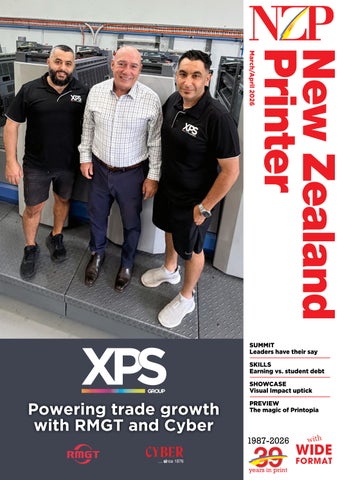
XPS scales trade with new RMGT 790 from Cyber

RMGT 790ST-5 versatility allows innovative Sydney print company XPS to easily transition between drastically different jobs.

Xclusive Printing Solutions (XPS), also known as XPS Group, in the heart of Sydney’s Ingleburn industrial hub, is not just surviving; it is scaling at a rate that has seen it transition from a general commercial printer into a high-capacity trade printing powerhouse.

Led by brothers Jason and John Meoushy, the family-owned business with 14 staff members recently confirmed an order with RMGT A/NZ distributors, Cyber, for a brand-new RMGT 790ST-5 offset press – a move that signals further confidence in the future of the A2 print market.

This investment follows a significant strategic pivot, starting late in 2024 and continuing throughout 2025 toward specialised trade services, providing

high quality, high-volume production for other printers, agencies, and largescale brokers.

From broking to printing

The Meoushy brothers are no strangers to the industry, boasting over 20 years of expertise.

Their journey with XPS began in 2016, After a period operating as print brokers starting in 2012, Jason found that the level of service he demanded for his clients simply wasn’t available in the outsourced market.

He says, “Upon the commencement of print production in 2016, we expected growth but we did not envisige the growth we have had in the last nine years.

“From humble beginnings with an SRA3 press in 2016, and acquiring our second SRA3 press in 2018, our growth continued to spiral, and so with strategic purchases, we decided to take the next step in our growth with the purchase of a Ryobi 755 from Cyber.

“The company continued to increase its footprint within the industry with the revamping of our entire bindery in 2024.

“With such a major investment to facilitate our growth and the increase in our finishing capacity, it has seen our company double in growth, which has giving us the confidence to now invest in a new RMGT 790 ST5 XL series.

“We then decided to concentrate more on the A2 – but we outgrew our premises.

From left: John Meoushy, joint managing director XPS; Rob Crough, state manager NSW, Cyber Australia; Jason Meoushy, joint managing director XPS in front of the Ryobi (now RMGT) 755 press

COVER STORY

We started looking at buying our own factory in 2023 and moved into our current premises in Stennett Road at Ingleburn in January 2025. It took us about four months to move the entire business across and complete renovations to the new building.”

A2 sweet spot

While some of their peers have chased the A1 format or exited the industry entirely, XPS has found its sweet spot in the A2 market. Jason believes this segment offers a strategic competitive advantage.

“The A2 market is shrinking in terms of the number of players,” he notes. “We find the A2 size easier to handle. Our makeready times are four minutes, and we’re up and running within 100 sheets. You don’t need to rely on the massive volumes required to keep two A1 machines fed; we can fill our capacity quickly and maintain high agility”.

The first new machine

XPS has now decided to purchase its first new offset press – an RMGT 790ST-5. The second SRA2 press will run alongside their existing Ryobi 755, effectively doubling their offset capacity.

“We have now decided to purchase the second A2 press, because we currently run from 3am until 6pm technically five days a week – but we also operate on Saturdays and Sundays,” Jason continues.

“I never had the intention of buying a brand-new machine – we tried to source a second-hand machine but there was nothing suitable. So, we said to ourselves – we are a young company and in an ageing industry. There is not a lot of new blood coming in. We have a decade or two still in us, so we realised that we could gain a lot more benefit by purchasing our brand-new offset machine because you really don’t know what you are buying with a second-hand press.

“This is going to be our main production machine for us – so it must be able to run at full capacity from day one. It’s a nobrainer for us – if we had the second press installed right now it would be running full tilt.

“Our workload has grown so much in recent years and the feedback we receive from our clients is because it is the service we deliver. We are not the cheapest – and we don’t strive to be the cheapest – because it is not about offering the lowest price. We don’t want to win a job based on the lowest dollar value – it is our reputation for quick turnarounds, and this is what we are known for in the market. We can do magazine work such as 5000 or 10,000 16-page publications within 24 hours. And customers are seeing that,” he adds.

The RMGT 790ST-5

The five-colour offset press distributed in Australia and New Zealand by Cyber features the 790 XL configuration, offering a larger image area of 780 x 600mm. This extra 30-35mm is a gamechanger for packaging work, allowing XPS to handle folding cartons and craft boards for overflow work from packaging specialists.

“The 790 XL allows us to have a larger image area accommodating a lot of packaging clients as well and as a result we are picking up more folding carton work with barrier and craft boards,” Jason says.

“Integration between the Equios workflow and our new Ink Volume Setter (IVS module) allows prepress to communicate directly with our presses and further increase the speeds of our makereadies”.

Equios workflow is the primary prepress management software. It handles the files, trapping, and imposition and generates CIP3 or CIP4 (PPF/JDF) files, which contain mapping data of how much ink is needed across the width of the page.

Meanwhile, the Ink Volume Setter (Inkeeper) software takes those CIP3/ PPF files from Equios and calculates the exact percentage of image area for each of the ink keys on the RMGT 790ST-5.

Deploying RMGT’s PCS-G (Press Control System) the calculated data is then sent to the press control console. Before the first sheet is even printed, the press automatically opens or closes its ink fountain keys to the correct levels.

Because Inkeeper presets the ink keys accurately, the press reaches correct ink density much faster, often within just 100 sheets, rather than the hundreds of sheets required by manual adjustment.

This removes the guesswork for the operator, ensuring that the job is true to colour with minimal wastage.

Sophisticated versatility

The versatility of the RMGT 790ST-5 lies in its sophisticated sheet-handling technology, which will allow XPS to transition between drastically different jobs without the downtime typically associated with offset printing.

While older generations of presses often required manual mechanical adjustments to the feeder suction, sidelays, and gripper pressures when changing paper thickness, the 790 series automates much of this through its Press Control System (PCS-G).

The range from 80 to 400gsm (heavyduty premium board) covers almost every commercial application in the modern market.

When running 80 to 120gsm stocks for high-pagination magazines or massmarket flyers, the press maintains maximum rated speeds, utilising precision air-management to ensure thin sheets don’t double-feed or flutter at high speed.

COVER STORY

Switching to 350 or 400gsm board – the standard for the high-end presentation folders and folding carton markets XPS is targeting is handled with minimal fuss. The V-type feeder and heavy-duty cylinders are engineered to handle the increased stiffness of the board without marking the stock or losing registration.

Jason highlights that this flexibility is a core component of their growth strategy. Because the operator doesn’t have to spend 30 to 45 minutes re-tuning the machine for a different stock, XPS can gang various jobs together.

For a trade printer like XPS, this agility is a massive competitive advantage. It means the team will be able to finish a flyer job on 100gsm gloss at 10AM and be halfway through a premium 350gsm presentation folder run by 10:30AM.

This seamless transition eliminates the traditional setup tax on diverse jobs, allowing XPS to maintain their 24-hour turnaround promise even when the production schedule includes a wide variety of substrate types.

The XPS team will continue to invest in RMGT machines and have already mapped out additional purchases in the years to come.

“The difference with the Ryobi machines is simplicity. It’s a machine that produces just as well as its competitors, but it is much simpler to operate and run. We have always liked the Ryobi machinery and the staff love working with it,” Jason adds.

“We trained an apprentice on the press who picked it up within three months and we can now literally leave him to run the machine now without any assistance

from our main operators. Our guillotine operators love the A2 sized sheet because it is smaller and it is easier to load. As a result, the flow of work through the factory is smooth – the work comes in and goes out without any interruptions.”

The

finishing touch

A printing press is only as fast as its bindery, and XPS has ensured there are no bottlenecks. Since mid-2024, the company started investing heavily in Horizon technology supplied by Currie Group.

The lineup includes a Horizon iCE StitchLiner Mark IV for high-speed booklet making and stitching, an automated Horizon BQ-500 iCE perfect binder that enables professional book production at scale, and an HT-300 iCE single knife three-edge trimmer used for precise finishing of books and catalogues.

With its expansive bindery setup, XPS now has the capacity to produce between 5000 and 8000 perfect bound books a day, often offering a 24-hour turnaround.

“The new machinery will allow us to perfect bind all sizes, even landscape booklets that were previously impossible to automate,” Jason says.

“The finishing equipment has changed the way we do work and now we have so much more confidence and firepower in our finishing capacity in the work that we do – we can take a job on knowing that we can get it out on time.”

Boutique trade philosophy

Despite its industrial scale, XPS maintains a boutique philosophy.

Unlike large trade printers that rely solely on faceless online portals, Jason emphasises the high value of direct human-to-human interaction.

“We don’t strive to be the cheapest because it’s not about the dollar figure; it’s about reliability and service,” he asserts. This approach has earned XPS the trust of major clients, including brand activation and direct marketing agencies who use XPS as their primary backup or specialised A2 provider.

As they move toward a 100 per cent trade model, the Meoushy brothers remain focused on what happens under their roof. With a full roof of solar panels contributing to an eco-friendly operation and a young, trained workforce –including apprentices ready to learn the ropes on the latest RMGT gear – XPS is proving that, with the right technology and a step-by-step growth strategy, the future of print is bright.

“The clear trend we are seeing in the market is that there are printers that are closing up or want to get out – so we are winning more and more of this work,” continues Jason. “Ultimately, we want to move to 100 per cent trade work as we don’t have any account managers, business development managers and no sales reps – it is all managed internally.

“The reason why some of the largest printing companies in the market use us for trade work – is because they trust us. There is a lot of work that we win that is not suitable for A1 machines. We have a reputation for reliability in the market – if they give us a job and there isa deadline to meet – it happens,” Jason concludes.

The existing Ryobi (now RMGT) 755 press operational at XPS

March/April

Cover Story p3-5

3-5 Cyber: Sydney based Xclusive Printing Solutions (XPS) recently confirmed an order with RMGT A/NZ distributors, Cyber, for a new RMGT 790ST-5 offset press, a move that signals great confidence in the future of the A2 print market.

12 Helping Hand: Ian McIntyre learns how combining formal training with real time application is critical for our industry’s ongoing success. Features p7-48

7 Printopia: Now into its fifth year, the Printopia Festival will deliver all its signature events including the country’s largest print fair.

16 Konica Minolta: ‘Lunch & Learn’ in 30 webinars will give Konica Minolta customers new insights how to make the most of their digital solutions.

18 Heidelberg: Moving its digital innovation strategy up a notch, Heidelberg has unveiled the new Jetfire 75.

36 Jet Technologies: Print businesses need to rethink production as automation and digital inkjet reshape 2026.

47 Strategy: Peter Fotiadis says you need to know when and how to pivot in your business.

48 Packaging: Converters should embrace digital technology for corrugated packaging, says Michael Strehlow.

Printing & Packaging Leaders Forum p19-35

20 Rob Mesaros, Chief Executive Officer, Currie Group.

22 Mark Daws, Director – Labels and Packaging A/NZ, Currie Group.

24 & 26 Matt Ashman, Managing Director, Durst Oceania.

28 Ruth Cobb, Chief Executive Officer, PrintNZ.

30 Jill Cowling, Chief Executive Officer, Blue Star Group.

31 Karren Challoner-Miles, Chief Executive Officer, Visual Connections.

32 Lawrence Evans, Director Touchprint.

33 Jade Grace, Managing Director, Loupe Global, Informa Markets.

34 Sabine Geldermann, Director drupa, Print Portfolios, Messe Düsseldorf.

35 Deb Corn, Intergalactic Ambassador to the Printerverse, Print Media Centr.

Wide Format Plus p37-46

38 Visual Impact: New sponsors and more exhibitors have signed up for the show in September.

40 NZSDA Update: An influx of returning member has NZSDA excited, says Mikayla Hopkins.

41 NZSDA President: Logan Sutton shares strategies on adding value to your clients’ jobs.

42 Training: Jackson Brattle is the first person to qualify in the Digital Signage strand of the apprenticeship qualification.

43 Canon: The new Colorado M-Traffic printer is based on Canon’s proven M-Series 1.6m printers.

44-45 Fespa: WrapFest is one of several initiatives that Fespa will host at the big show in May.

46 HP: Technology from HP is helping businesses future proof their operations.

EDITORIAL: 021 631 559

Bruce Craig, Editor - bruce@newzealandprinter.co.nz

CONTRIBUTORS:

Ruth Cobb, Peter Fotiadis, Mikayla Hopkins, Iain MacIntyre, Michael Strehlow, Logan Sutton

CIRCULATION: brian@newzealandprinter.co.nz

DISPLAY ADVERTISING SALES & SERVICE: Brian Moore - brian@newzealandprinter.co.nz

+61 410 578 876

CLASSIFIED ADVERTISING: Brian Moore - brian@newzealandprinter.co.nz

DESIGN & PRODUCTION: Sarah Vella - sarahvelladesigns@gmail.com

1171 7912

New Zealand Printer is mailed to members of the printing, packaging and graphic communications industry in New Zealand 11 times a year, February-December.

New Zealand Printer is a member of the Printer Media Group

New Zealand: New Zealand Printer Asia Pacific: ProPack.pro Australia: Australian Printer, ProPrint

MANAGING DIRECTOR: James Wells - james@intermedia.com.au

GROUP PUBLISHER: Brian Moore - brian@newzealandprinter.co.nz © Copyright 2026: Contents of this

Printopia launches full festival programme for fair in May

Festival will deliver all its signature events including the county’s largest print fair, live printing activities, artist talks, and multiple workshops .

Having grown into a regional arts event that brings together artists from around Aotearoa and the Asia Pacific, Printopia will celebrate its fifth edition, from May 1-3, 2026.

The Festival will deliver its signature events: the county’s largest print fair, live printing activities, artist talks, and workshops. Organisers have added a new offering of exhibitions, guided gallery tours, and experimental performances.

The event takes place across four venues: Studio One Toi Tū, Auckland Old Folks Association, The Button Factory and Eyes on Fire.

Printopia aims to support, grow and celebrate the printmaking community in Aotearoa while connecting it to printmakers globally. Printmaker and festival curator Ina Arraoui studied printmaking at Il Bisonte Foundation for Art and Printmaking in Florence, Italy. After returning home and researching the local printmaking community, she founded the Printopia Festival in May 2021 in response to the need for a physical space for the printmaking community to come together to share their work with new audiences.

She says, “The Festival is set to connect and inspire everyone who attends. It works as an interactive event to

educate the wider community, including art students, educators, galleries, and museums about contemporary printmaking in Aotearoa.”

Print Fair

This year, the Print Council Aotearoa New Zealand sponsors the Print Fair, where artists work across media to produce original works on paper as well as also clothing, jewellery, and domestic ware.

Printopia will also feature a selection of contemporary printmaking exhibitions at Studio One Toi Tū, and Eyes on Fire. The 2026 Printopia exhibition, At Close Range: pressure and touch in printmaking, is a group show investigating pressing social, political, and environmental issues felt at close range exploring singular and expansive processes, methods, and methodologies specific to printmaking.

In another exhibition, He kapu tī māu? - A cup of tea for you? Toi Whakaata - Māori Print Collective celebrates 20 years together with its response to whakawhanaungatanga through acts of manaakitanga anchored in the sharing of a kapu tī. Guided Gallery Tours will give audiences the chance to hear the curators and artists speak about the ideas and inspiration behind the work in each exhibition.

Another programme highlight sees a series of performances taking place on the Saturday evening at the Auckland Old Folks Association. Joanna Cooke and Steve Lovett will present a choreographed performance piece, called (il)legible inkscription, that invites audience participation followed by Distortion Notation, a piece of music written as a response to a graphic score performed by artist and musician Gemma Thompson.

Gemma Thompson, whose practice finds a dialogue between poetic form and soundscape, will also lead Drawing Into Print: Soundwalking, a workshop in which participants create experimental marks in response to the sounds of their environment. It explores the intersection between print and different creative mediums in the workshops; Lithography on Clay with Siriporn Falcon-Grey and Repurposed Prints with Toni Hartill, where participants make 3D structures using reject prints.

Performances and Artist Talks

Rialto Arts is sponsoring the Festival’s Performances and Artist Talks, which includes a Keynote speech from Robynn Smith, an artist and educator based in Santa Cruz, California and the founder and director of the annual worldwide printmaking event Print Day in May. Established in 2007, this event has embodied and reflected the last 20 years of the global printmaking renaissance, the technology revolution, the worldwide pandemic and two decades of global politics. Robynn and colleague Tia Brady from Maui, Hawaii, will broadcast the Festival live through the Print Day in May media platforms.

Visitors will have the chance to make a screen print with Tia Brady during one of the Festival’s free Live Printing drop-in sessions, suitable for all ages. Other Live Printing highlights include stencilling a Fijian Masi pattern, printing a poster on an antique letter press, seeing Techno Tapa printed off large wooden blocks, and adding your portrait to a large, collaborative installation piece.

Printopia works as an interactive event to educate the community about contemporary printmaking in Aotearoa

IN BRIEF

MIRACLON has reinforced its longstanding partnership with Windmöller & Hölscher (W&H) through the installation of a new Flexcel NX Ultra 42 solution at the W&H Technology Centre in Germany. The new system gives W&H a larger format, water‑processed platemaking solution to demonstrate a broader range of customer applications and press configurations, enabling visitors to see the full potential of modern flexo. It also allows for improved flexibility for wide‑web printing, and the plate performance required to run highly controlled, data‑driven press demonstrations.

ORORA has achieved positive results in its financial reports the half year ending 31 December 2025. The company has a full range of aluminium and glass products and says it has designed initiatives to maximise revenues and margin, cost efficiency and cash generation. Growth in new beverage categories, has supported 11.2 per cent volume growth. Last year, Orora invested $130m to expand production capacity at its Rocklea facility in Queensland, supporting increased demand for 375ml classic sized cans.

MCC has commenced its prepackaged Chapter 11 filing in the US Bankruptcy Court to implement a financial restructuring support agreement (RSA) that aims to eliminate about US$3.9bn ($6.51bn) in net debt. The company says the transactions contemplated by the RSA will significantly deleverage MCC’s balance sheet, reducing its net debt load. MCC has also filed a series of customary “first day motions” that will allow it to continue to operate in the ordinary course of business.

Durst Oceania is recruiting to service market growth

Durst Oceania is currently recruiting new service engineers and sales staff. Matt Ashman, managing director Durst Oceania, says, “Over the last seven years, Durst Oceania has achieved year on year growth and as a result, we are looking for additional staff members to service our growing customer base as it broadens geographically as well as into new areas of print.

“Growth brings change and challenges and our recent expansion into the New Zealand market has expanded our customer base and delivered sales growth that we could never have imagined.

“As a result, we now need to grow our already strong team with an additional service engineers and additional sales

Kodak Prinergy boosts rules-based automation

Kodak has launched version 11.5 of Kodak Prinergy software. The company says this latest release of its workflow software boasts significant improvements in rules based automation features, integration with other software solutions, and the performance of specific tools and features.

Jim Barnes, chief information technology implementation officer at

team members. To become a Durst’ler, we look for people with a strong and positive attitude that are also curious and eager to explore the market opportunities by travelling locally and internationally to experience the best of the printing industry.

Kodak, says, “The introduction of Kodak Prinergy software version 11.5 demonstrates our commitment to keeping our workflow solution at the cutting edge of technology and innovation, empowering our customers to effectively adapt to changing market requirements.

“Prinergy 11.5 empowers printers to boost automation, productivity and system security, ultimately leading to increased efficiency, profitability, and customer satisfaction.”

Offering smart end to end automation, the Kodak Prinergy platform provides an integrated workflow solution that streamlines and optimises production across analogue and digital printing processes. Key highlights of Prinergy 11.5

“We are currently recruiting for service engineers to join our Australian team in Victoria with a strong background in mechanics, electronics and engineering. As always, Durst will provide staff with full training.

“We are also currently recruiting for team members in our Tullamarine sales department including sales manager and admin support to service our evergrowing and broadening client base. We are looking for a strong customer-focused individuals with a proven passion for sales.

“These are new positions that have been created based on the substantial growth achieved by the highly experienced Durst Oceania team in Australia and New Zealand.”

For more information, please contact Matt Ashman on +61 456 709 338.

include innovative automation actions and troubleshooting enhancements for RulesBased Automation; improved Kodak Prinergy Preps Imposition Software integration; performance improvements and more convenient operation of the Virtual Proofing Software Plus; as well as new profile options for the Preflight+ software.

The new Prinergy Software version also offers enhanced integration of the PrintLink software, which also generates JDF and PPF files, with press interfaces and cutting machines.

In addition, various improvements in Prinergy 11.5 provide increased security and a smoother overall user experience.

Matt Ashman, managing director Durst Oceania

drupa defines its direction with new brand identity

A new brand identity has enabled drupa to present its future direction two years before the trade fair opens in Düsseldorf.

Running from May 9-17, 2028, the world’s leading trade fair for printing solutions has provided an initial glimpse of its conceptual and content related repositioning.

The central element of the new image, an octopus, symbolises networking, intelligence, agility, and resilience, as well as the simultaneous mastery of complex processes. It refers to a technological reality that conceives printing solutions as integrated systems, including sophisticated applications in the packaging environment. It interlinks processes; networks workflows; and creates efficiency through the interaction of hardware, software, materials, and automated applications.

Dr. Andreas Pleßke, chairman of the drupa committee, says, “drupa 2028 will be a drupa like never before. We are setting new standards in how technological developments, applications, and markets are classified and brought

High Court finds for Mosaic in software licensing case

The High Court of New Zealand has delivered its judgment in proceedings brought against Mosaic Solutions Group Limited by True North New Zealand Limited, True North Stocklink Limited and Youtopia Technologies Limited, entities associated with TMA Group of Companies Limited.

The Court dismissed the plaintiffs’

together, a claim that is also consistently reflected in the new brand identity.”

The slogan “drupa. dive into the unseen” picks up on this approach and draws attention to developments whose significance often only becomes apparent in the overall context, for example, through the interaction of technologies, processes, and applications along the value chain. The slogan stands for a solution oriented classification of technological innovations, beyond individual products or short-term effects.

Sabine Geldermann, director drupa, Portfolio Print Technologies at Messe Düsseldorf, says, “The slogan sums up what drupa stands for: vision, knowledge transfer, and orientation in an increasingly complex technological landscape.

claims in their entirety and found that Mosaic was entitled to terminate the relevant licensing agreements.

In its judgment, the Court also found that the plaintiffs breached those agreements and manipulate Tharstern licence keys, as determined by the Court, resulting in continued, unauthorised use of the software beyond the terms of the relevant licences.

The issues addressed by the Court highlight the importance of strict adherence to software licencing obligations across complex, integrated technology solutions relying on software intellectual property (IP)

Mosaic says its primary objective in defending these proceedings and advancing its counterclaim was to protect the integrity

“It underscores drupa’s claim and attitude of not presenting future topics and technological progress in isolation but rather classifying them in a comprehensible way in the context of the market, application, and value creation.”

Against this backdrop, drupa 2028 will introduce a new experience architecture for the first time. It will bundle content, applications, and formats for exchange, collaboration, and networking along clearly defined thematic clusters. Organisers say this will make technological developments comprehensible and structured. The architecture serves as a common framework for exhibitors, visitors, and the media.

of licensed software, uphold contractual and intellectual property boundaries, and ensure that serious conduct of this nature was properly scrutinised by the Court.

Mosaic considers the Court’s findings to be an important affirmation of these principles.

Matters arising from the conduct examined in the judgment are already the subject of consideration by the New Zealand Police Cyber Crime Unit. Any such process is separate from the civil proceedings and will continue un accordance with police processes.

Mosaic says it wanted to protect the integrity of licensed software as well as uphold contractual and intellectual property boundaries

The next drupa will take place in Düsseldorf from May 9 to 17, 2028. Photo: Messe Düsseldorf

Plockmatic introduces triple tool cutter and creaser

Plockmatic has made its new ColorCut SC7800 Pro-RS XL cutting and creasing system available globally.

The latest addition to Plockmatic Group’s ColorCut SC7000 series, the new triple tool cutter and creaser incorporates a tangential creasing tool, with male (convex) and female (concave) elements. This ensures superior double-sided creasing. With pressing and moulding tools that move above and below the sheet simultaneously, it creates ‘formed’ creases similar to a metal rule platen machine. The new machine supports production versatility with its ability to handle sheets up to 520mm x 740mm in a range of media up to 450 microns, including synthetics. It also enables perforation for application flexibility that includes folders, packaging and point of sale.

ePac signs on for more than 10 HP Indigo 200K Digital Presses

HP and flexible packaging company ePac have signed a commercial agreement that includes equipment, consumables, and service over three years, estimated at US$50m ($83.25m)

The agreement marks a decade of strategic collaboration between the companies that they say has driven a significant transformation in the global flexible packaging industry, accelerating the shift from traditional analogue production to digital printing, enabling full agility for brands of all sizes, true on demand manufacturing, and dramatically reducing lead times from weeks to just days. They add that these capabilities minimise excess inventory and waste across the supply chain.

As part of the agreement, ePac, which currently operates a fleet of more than 50 HP Indigo presses, will install more than 10 HP Indigo 200K Digital Presses, expanding and bolstering their global HP Indigo fleet with these new Gen Five presses.

The immediate value of the press purchase is approximately US$20m, with an expected additional US$30m in revenue from consumables and technical services over the next three years.

Oran Sokol, vice president and global head of Strategic Sales, HP Industrial

A QR code-driven workflow enables total unattended automation. It can process up to 1,000 sheets even when running multiple jobs within the same stack. Plockmatic claims “incredible accuracy’ through its SmartMark registration via the included ColorCut Pro software.

The company adds that the ColorCut SC7800 Pro-RS XL’s automated job handling and low running costs make it ideally suited to space-pressed print and packaging operations.

Mark Baker-Homes, vice president for Plockmatic Group’s Packaging and Label Business Unit, says, “We’ve had an extremely positive response to the SC7800 Pro-RS XL, which sets new standards in digital creasing and cutting.

“It is the world’s first machine that uses a floating second creasing wheel under the media, which moves in perfect synchronisation with the upper tool carriage. It enables a traditional male and female creasing effect, ensuring an enhanced and superior crease when compared to today’s flatbeds where the crease only hits from one side.

“At its core is a triple-tool hybrid design, blending the best of flatbed, sheet-fed, tangential, contour-cutting, and die-based technologies. It provides the freedom to digitally cut and crease any shape, directly from printed artwork with no dies. It takes finishing to a whole new level and delivers speed, precision, and total creative flexibility on demand. Designed in Sweden, its power consumption is incredibly low, making it an ideal investment for environmentally conscious operations.”

Print, says, “We are celebrating a decade of partnership with ePac, and we are immensely proud of what they have built during this journey. Together, we aligned early on around the evolving demands of the flexible packaging market where speed, personalization, and sustainable profitability are essential requirements for success. By responding decisively to those shifts, our joint efforts have helped reshape the industry and are now delivering tangible results.

“This new agreement underscores the strength of our partnership and equips ePac with even greater capacity to respond faster, minimize waste, grow profitably, and continue defining the future of digital flexible packaging.”

Parag Patel, president of Shared Services, ePac, says, “This $50 million investment marks a pivotal moment in ePac’s evolution. By integrating more than 10 HP Indigo 200K digital presses into our global network, we are not just expanding capacity; we are redefining

the standard for high-speed, sustainable packaging.”

Noam Zilbershtain, vice president and general manager of HP Indigo, adds, “Today’s agreement goes far beyond a commercial transaction, it is a declaration of strength and confidence in HP Indigo’s technology and resilience. A global strategic partner like ePac choosing to expand with us at this scale is a powerful endorsement of Israeli innovation and our global delivery capabilities.

“We are proud to be leading the worldwide digital transformation of the packaging industry from our development centre in Ness Ziona and our production lines in Kiryat Gat.”

The presses incorporate advanced AIenabled tools for automated print-quality diagnostics and real-time defect detection and correction. HP says these capabilities support continuous, nonstop printing and significantly reduce waste, helping global brands lower their carbon footprint and meet rigorous sustainability goals.

The new Plockmatic ColorCut SC7800 Pro-RS XL cutter and creaser
HP and ePac teams celebrate their partnership

Currie Group New Zealand receives 2026 HP APJ Service Excellence Award

Currie Group New Zealand has received the 2026 HP APJ Service Excellence Award, recognising exceptional performance in service delivery, customer experience, and technical excellence across the HP Indigo customer base.

Announced during the recent HP Masterclass event in Lisbon, the award recognises Currie Group New Zealand for consistently delivering industry-leading outcomes for customers across multiple service and performance benchmarks.

Over the past five consecutive quarters, Currie Group New Zealand achieved customer scorecard results above 90 per cent, including a standout 95 per cent result in one quarter. Judges also highlighted the team’s strengthened

FPLMA sets conference and awards dates

The Flexible Packaging & Label Manufacturers Association (FPLMA) has announced the 2026 Conference will take place at the Melbourne Convention & Exhibition Centre on August 27 and 28. Tony Dalleore, secretary and treasurer FPLMA, says, “The conference features local and international speakers. On

New printhead handles high viscosity materials

Kyocera has developed an inkjet printhead, with 1500 nozzles, capable of handling high viscosity materials for industrial applications.

The company says its proprietary new piezo actuator and fluid channel technology has enabled the breakthrough. A new actuator structure and optimised fluid channel design allow higher viscosities and larger droplets.

Applications include advanced manufacturing processes, painting and

remote support capabilities, which have contributed to reduced downtime and improved productivity for HP Indigo customers nationwide.

The recognition also acknowledges Currie Group New Zealand’s proactive ownership of machine-down case resolution, improved spare parts level of fill performance driving stronger parts readiness, and continued investment in engineering and operator capability through certification programs and the Currie Satellite Training Centre.

Sustainability initiatives, including

August 28. FPLMA will host the Gala Ball, celebrating the Print Awards,

3D printing. Kyocera says conventional inkjet technology has had difficulty addressing these processes adding that, in recent years, the manufacturing industry has faced a requirement to improve production efficiency in addition to reducing environmental impact and material waste. Inkjet technology contributes to sustainability with capability for on demand jetting of uniform, fine droplets, resulting in high material utilisation efficiency and reduced waste.

The company sees inkjet technology attracting more attention as an innovative manufacturing process in fields such as electronic circuits, semiconductor production lines, and additive manufacturing.

In addition, in automotive painting applications, efforts to develop practical

the team’s take-back programme for consumables, were also cited as reinforcing disciplined service operations and responsible environmental stewardship.

Craig Walmsley, country manager, HP Indigo, says he feels extremely proud of Currie Group New Zealand. He says, “Winning the APJ Service Award reflects the exceptional service culture within the organisation. Their team consistently demonstrates deep technical expertise, outstanding responsiveness, and a relentless focus on delivering the best possible outcomes for customers.”

Marcus Robinson, director of Operations at Currie Group, says the recognition reflects a long term commitment to building service capability that genuinely supports customer performance.

He adds, “This award is a direct result of the standards our service teams set for themselves every day. It’s about consistency, accountability and ensuring our customers can rely on their equipment to perform when it matters most.”

Currie Group continues to invest across service infrastructure, training, parts logistics and remote support capabilities to strengthen outcomes for customers across Australia and New Zealand.

which recognise excellence in the packaging industry. We have already started accepting entries from label and packaging converters based in Australia and New Zealand for these prestigious awards.

“FPLMA has distributed the 2026 Print Awards brochure. The competition is open to all Australian and New Zealand converters for works produced between May 1, 2025, and April 30, 2026.

“The entry categories include flexo, labels, offset, letterpress, gravure, digital, combination printing, booklets, screen printing, and innovation.”

inkjet processes are underway to enable more creative designs, reduce labour in masking processes and minimise paint loss.

The company says that it has leveraged strengths cultivated through years of printhead development, namely high productivity, high resolution, and high durability, to successfully develop technology that enables the stable jetting of high viscosity materials. As a result, manufacturing processes that use paints and materials in viscosity ranges that were previously difficult to handle with inkjet technology have now reached a practical stage.

Kyocera adds it will continue developing innovative technologies to reduce environmental impact, promote efficiency and lead the digitalisation of manufacturing.

Currie Group chief executive officer Rob Mesaros receives the award at the recent HP Masterclass event in Lisbon
The FPLMA Awards is open to all Australian and New Zealand converters

Print trades provide enduring employment security

Printing remains rooted in human skill. The team at PrintNZ understand that the future is not about replacing tradespeople; it is about upgrading them.

Combining formal training with real time application is critical and ensures qualifications reflect genuine competence

In the new and evolving world of workplace and industry, where artificial intelligence (AI) poses major threats to traditional and staid professions, trades and service industries in New Zealand increasing provide future-proofed career paths.

Economics agency Infometrics forecasts that the end of the decade will see around 3000 job vacancies in the print, packaging, and sign sector.

Ruth Cobb, chief executive officer PrintNZ, says, “These are hands on roles that require skilled humans to ensure real

outcomes. This gap presents an ideal opportunity for people looking for a career. AI can do some of the background work but producing physically-printed product will require humans that blend digital skill with real-world craftsmanship.

“Technology will change how we work, but printing remains rooted in human skill. The future is not about replacing tradespeople; it is about upgrading them.”

Changing dated perceptions

The time has long passed for people to stop seeing the term ‘trades’ in a

derogatory way. Ruth notes that the world has moved on from such old school views.

She says, “Perhaps we should describe these proactive people as ‘industry professionals’ instead of tradespeople.

“Trades might have once been seen as being for those that weren’t ‘bright’ enough to go to university. But in fact, it is those that are indeed smart enough to realise that they can earn while they learn, rather than end up with a student debt.

“In direct comparison, by the time a school leaver completes their university

degree with say a $50,000 loan, a print apprentice will also have both a qualification in hand and have already earned at least $200,000. Our skilled workers are making life advancements and creating long-term security.”

Something for everyone

While the print industry has become highly digitalised, by definition, it will never move online. Industry professionals have no trouble working in the digital world but print offers so much more than sitting in front of a screen.

Ruth says, “The industry has something for everyone across the spectrum, whether you are mechanically-minded, creative/artistic, or computer-oriented; we use it all.

“All the apprentices we talk to describe how coming into print has opened their eyes to just what the industry is and once they get a taste of it, they are hooked.”

Linden Hoverd, PrintNZ membership coordinator, leads the association’s careers initiative with schools. She points out that

the programme places a strong emphasis on turning around misplaced perceptions.

She says, “One of the comments we might get is: ‘Isn’t print a dying industry?’

I challenge that by saying, ‘You go into a supermarket, and I’ll give you $50 if you can find me something that doesn’t have print on it’ – and they can’t.

“Everything from your shopping bags to fruit, packaging, price tags, posters, point of sale, it is all printed and we will not move away from that pragmatic functionality.”

Print careers initiative

Unveiled over the past few years, PrintNZ’s careers initiative has established ongoing relationships with over 30 schools to drive home potential career opportunities.

Initially focused in the Upper North Island, the campaign has now also expanded to the South Island with additional input from PrintNZ membership co-ordinator Glenda Keegan.

Linden says, “Knowing our demographic has typically been the 22-25 age group, with a few younger and some much older, the question for me was ‘Where are we getting our apprentices from?’

“So, the clear intention has been to go into the schools and educate the educators. We are the most visible industry from a practical sense, yet we are often not ‘seen’.

“If a school is responsive to the approach, PrintNZ will follow-up with presentations and the school will then be asked to put forward applicable candidates.

“From there, we can see what interest we have and look to set up workplace visits for a group. We contact our members in the area to see if they have any opportunities and we will look to place the candidates somewhere – either for unpaid work experience or literally to put them directly into a job.

“The biggest challenge is marrying up the timing. For example, at the moment, I have two fabulous people who would be a great asset for any business, but they are both out West Auckland way and we don’t have any jobs in our membership there currently. But we will keep working with them to find a place in our industry as we don’t want to lose any momentum.”

She estimates that hundreds of people would have been taken out to print sites during the course of the programme to date with many such introductions leading to permanent positions.

“We also work with employment agencies such as CadetMax who prepare and support young people into these placements. Almost every single time they will say things like ‘I never thought of printing’ and ‘I never really knew about the industry’.”

Hands on fulfilment

Linden emphasises that many people simply “enjoy working with their hands”. She says, “If you like making something, then print could be for you. It is creative and innovative. No two days are the same and it pays well.

“You don’t need to have a particular skill set to get started, but you do need to have energy, a willingness to learn and the ability to be agile. We look for practical, reliable team players.

“And the other thing is that not every kid is suited to university. The statistics relating to how many people go to university and then actually get a job in the industry they have trained in are abysmal. But even with the schools where maybe 80 per cent choose to go to university, that still means there is 20 per

Workplace learning embeds technical proficiency alongside professional discipline
While vocational education has undergone substantial change, the importance of developing skilled tradespeople remains

cent that don’t. We need to make sure we can attract some of those people to print.

“It is about getting the right person into the right position at the right time.”

Training importance remains unchanged

While noting that vocational education has undergone “substantial change” over the last few years at a political level, Ruth says what hasn’t changed is the importance of developing skilled tradespeople.

She says, “Workplace learning plays a key role in this process; learning from those with experience in real workplace situations and creating tangible capability rather than abstract knowledge.

“In industries like print, competence is not developed in classrooms, it is forged on the factory floor, on live jobs, under real production pressures. It is the transfer of knowledge and mentoring from our industry stalwarts that transform a trainee into a tradesperson.

“Workplace learning embeds technical proficiency alongside professional discipline. Apprentices learn not only how to operate equipment and produce work, but how to manage time, maintain quality, communicate and take accountability for output.”

Also noting that like many sectors, the print industry has an “ageing” workforce, with many in the sector today now over 50 years old, she points out the necessity for deliberate succession.

She explains, “Workplace learning is not simply an educational pathway, it is a strategic workforce investment. Businesses that commit to developing people internally are building resilience into their operations, reducing reliance on a fluctuating labour market, and safeguarding institutional knowledge.

“For sectors such as print, where technology continues to evolve while client expectations rise, the ability to combine formal training with real time application is critical. This ensures that qualifications reflect genuine competence.

“The timing right now is perfect. The New Zealand Certificate in Print Level 4 apprenticeship qualifications underwent a full review in 2025. The updated programme will launch this March along with new resources.”

She concludes, “This is the ideal time to start someone on the first step of their print career.”

Everything in a supermarket is printed and we will not move away from that pragmatic functionality
Apprentices describe how coming into print has opened their eyes to just what the industry is and once they get a taste of it, they are hooked

New Zealand Printer magazine and PrintNZ thank attendees, speakers and sponsors of our inaugural New Zealand Printing & Packaging Forum incorporating the People In Print and Rising Stars Of Print Awards in 2025

DIGITAL

Konica Minolta invites you to ‘Lunch & Learn in 30’

Webinar series brings insights into solving everyday print challenges.

Konica Minolta New Zealand is introducing ‘Lunch & Learn in 30’ – a new 30-minute webinar series designed to deliver practical print and production insights in a format that fits into its customers’ workday.

Helen Pengelly, marketing and operations manager at Konica Minolta New Zealand, says, “With the Lunch & Learn in 30 series, we wanted to create something genuinely useful for busy print professionals: practical insights delivered in a format that fits the realities of production work.

“Each session is focused and built around real challenges we hear from customers every day. In just 30 minutes, attendees walk away with tips and techniques they can put into practice immediately. It’s all about helping New Zealand printers work smarter, reduce rework, and get the best possible results from their Konica Minolta solutions.”

Bite-sized sessions

Chris O’Hara, national production and industrial print manager for Konica Minolta, says the company has a range of strategies where its customers can add value to their processes or simply solve problems that pop up during their working day.

He explains, “It is easy to become fixated on speed and paper weights but there is a bigger picture that is worth looking at where it is about solving problems so you can successfully get the jobs through your machine.

“Our overall philosophy is ‘bringing value back to print’. Time frames are squeezed and the market is a tough competitive environment. We want to help add value to print through a variety of methods ranging from using alternating processes, to embellishments and colour management.

Essentially, we want our customers to learn new ways they can achieve their goals doing things they have not done before. Often, that involves increasing automation and levels of efficiency.

“These live, bite-sized sessions are built for busy print professionals who want actionable knowledge without stepping away from production for long. In just 30 minutes, our specialists will share tools, techniques and best practices to help you work smarter, reduce rework, and achieve better print outcomes.

“Each session focuses on a specific topic within print, workflow, automation, colour management, and production optimisation, giving clear, real-world guidance you can apply immediately.

Konica Minolta’s Mark Northin and Rebecca Hughes, production print sales specialists and analysts, will share hosting responsibilities for the ‘Lunch & Learn in 30’ webinar series.

Mark says, “Our first session will show you how you can take advantage of one of our optional upgrades for our AccurioPro Flux software called Flux Preflight Pro. We will show you how you can use the software to automatically fix many common file issues that are often seen when files arrive from third party

sources, often making them either time consuming or impossible to print”.

With this software you can add bleed to files, you can even add bleed to complex shapes which is ideal for jobs such as labels, or you can create job tickets based on text strings in the file name, just to name a few. It is pretty cool.

“We will cover off several case studies during the webinar to illustrate the possibilities the software brings.”

Chris adds, “We look forward to seeing you at the webinars. Bring your lunch and we will bring the insights.”

Lunch & Learn in 30 offers solutions to digital print

problems

Chris O’Hara lists what you can expect from the Lunch & Learn Series:

• Concise, practical 30-minute live webinars.

• Expert insights from Konica Minolta New Zealand specialists Mark Northin & Rebecca Hughes.

• Real solutions to everyday production challenges.

• Actionable tips you can implement straight away.

• Live Q&A opportunities.

• Whether you are looking to streamline prepress, improve workflow efficiency, reduce errors, or maximise the performance of your Konica Minolta solutions, Lunch & Learn sessions are designed to deliver real value and fast.

Rebecca Hughes and Mark Northin will host the webinar series

Bring your lunch. We’ll bring the insights.

LUNCH & LEARN IN 30

A new webinar series from Konica Minolta New Zealand -built for busy print professionals

Konica Minolta New Zealand is launching Lunch & Learn in 30, a new series of fast, focused 30‑minute webinars designed to deliver practical print and production insights without disrupting your workday. These live, bite‑sized sessions give you the tools, techniques, and real‑world know‑how to work smarter, reduce rework, and achieve consistently better print outcomes.

Each session dives into a specific area of print, workflow, automation, colour management, or production optimisation - offering clear, actionable guidance you can apply immediately on the shop floor.

What you’ll get from Lunch & Learn in 30:

+Concise, practical 30‑minute live webinars

+Expert insights from Konica Minolta specialists Mark Northin and Rebecca Hughes

+Real solutions to everyday production challenges

+Actionable tips you can implement straight away

+Live Q&A opportunities

Whether you want to streamline prepress, improve workflow efficiency, reduce errors, or get more from your Konica Minolta solutions, these sessions are designed to deliver real value - fast.

Find out more

DIGITAL

Heidelberg unveils the Jetfire 75

Company offers self-service concept where Jetfire 75 operators receive special training so they can carry out certain types of service work themselves.

Moving its digital innovation strategy up a notch, Heidelberg has expanded its portfolio for industrial digital printing with the new Jetfire 75.

An inkjet press in B2+ format (614mm x 750mm), the Jetfire 75 is fully embedded in the Heidelberg digital ecosystem, which encompasses machines, software, consumables, service, and training. Soon, the company will also incorporate postpress solutions in the ecosystem.

Heidelberg says the Jetfire 75 offers the best possible print quality, maximum flexibility, and a level of productivity that has never been seen before in digital printing. Customers can also access all key information and services via the Heidelberg Customer Portal.

The company ads that global volumes in commercial printing continue to develop steadily. While the average print run has become shorter, the number of print jobs has increased. Print shops looking for profitability need more flexibility and automation in their production operations, as well as digitalised processes.

Many commercial print shops have turned to industrial digital printing solutions while also continuing to use highly efficient sheetfed offset printing presses for longer runs. Dr. David Schmedding, chief technology and sales officer at Heidelberg, says, “Following

on from the successful market launch of the Jetfire 50, we are sending out a clear signal with the Jetfire 75, namely that Heidelberg is shaping the future of digital industrial print production and taking it to a whole new level.

“We are combining the strengths of our sheetfed offset printing presses with innovative digital printing solutions to create a hybrid production environment that offers our customers maximum flexibility and efficiency.”

Hybrid print production

Jetfire 75 owners can integrate the press into their print shop’s overall workflow using Prinect Production and the new Prinect Touch Free workflow. Heidelberg says this ensures hybrid print production implementation on a cost-optimised and efficient basis.

When using Prinect Touch Free, the fully automated workflow utilises AI and leverages real-time data to determine whether digital or offset printing is the most cost-effective means of production.

Heidelberg adds that its well established colour management technology ensures true to colour production or reproduction of jobs regardless of which printing method it selects. When combined with Prinect Touch Free, the Jetfire 75 can process over 1,000 print jobs per day on a fully automated basis. Heidelberg has already

kicked off the market launch of Prinect Touch Free. Customers ordering a Jetfire 50 or Jetfire 75 will get the new workflow when they install their digital press.

The new “self-service” concept involves Jetfire 75 operators receiving special training so they can carry out certain types of service work themselves. For operating the press, they require only a few days of training. In addition, print shops have access to Heidelberg’s service network.

Jürgen Otto, chief executive officer of Heidelberg, says, “By launching the Jetfire 75, Heidelberg is underscoring its approach as a comprehensive systems integrator in the printing sector, an approach that helps our customers become more profitable and more competitive.

“This is another milestone in the growth strategy for our core business, and one that will enable Heidelberg to leverage additional business potential.”

Industrial production

The Jetfire 75 combines industrial productivity, the best possible print quality, and maximum flexibility for everything from short runs and personalized products to high-volume print jobs.

Applications include brochures, advertisements, flyers, catalogues in short runs, books, magazines, labels, stickers, posters, and calendars. The new press also handles special digital print jobs such as personalised mailshots, jobs with a run size of one, photo books, as well as time critical print on demand job.

Jetfire 75 technical highlights:

• Water-based inkjet technology with 1200 dpi in B2+ format.

• Prints at up to 9,800 four-up sheets per hour (simplex), equivalent to approx. 39,000 A4 pages per hour.

• Annual production output of up to 58 million four-up sheets (simplex).

• Substrate range: 60gsm–450gsm, including selected cardboards.

• Fully automated quality control and self-service concept.

• Integration into Prinect Production & Prinect Touch Free for end to end automation.

The Jetfire 75 targets efficient, cost-optimised hybrid print production.

PRINTING & PACKAGING

LEADERS FORUM 2026

SPECIAL REPORT

Matt Ashman Managing Director, Durst Oceania
Sabine Geldermann Director drupa, Portfolio Print Technologies, Messe Dusseldorf
Ruth Cobb Chief E xecutive O fficer PrintNZ
Deborah Corn Intergalactic Ambassador to the Printerverse, Print Media Centr
Karren Challoner-Miles CEO, Visual Connections
Jill Cowling Chief Executive Officer, Blue Star Group
Lawrence Evans Managing Director, Redshift
Jade Grace Managing Director, LOUPE Global, Informa Markets
Rob Mesaros Chief E xecutive O fficer, Currie Group
Mark Daws Director – Labels and Packaging A/NZ, Currie Group

Leading through the next structural shift in print

If 2025 has made anything clear, it is that the print industry is no longer shaped by equipment cycles alone. It is being reshaped by structural change in how businesses operate, how customers buy, and how value is created – and that shift is accelerating.

Across Australia and New Zealand, the market remained resilient, but resilience came with pressure. Margins remained tight, labour constraints continued to challenge growth, input cost pressures persisted, and customer expectations lifted again. Faster turnarounds, greater flexibility, consistent quality, and transparency have become table stakes and, increasingly, a key differentiator.

What has changed most significantly over the past 12-18 months is the seriousness with which automation, software, and now AI are being discussed at a leadership level. These are boardroom conversations because they directly impact scalability, long-term competitiveness, and business risk.

More business leaders are asking harder questions, such as:

• How dependent is our operation on individual people?

• How predictable is our output?

• How exposed are we to labour disruption?

• How clearly do we understand our true costs and margins?

• What does AI really mean for our business?

These questions inevitably lead to technology, but not in isolation. They lead

to workflow, data, integration, discipline, and visibility. Automation is no longer about speed alone; it is about consistency and control. AI is no longer about novelty; it is about intelligence within the operation – the ability to understand what is happening, why it is happening, and how to respond faster and more effectively.

The businesses that gained momentum in 2025 were not necessarily the ones that spent the most. They were the ones that invested with clarity, understood where they make money, understood their constraints as well as the experience their customers expect. From there, technology becomes an enabler of strategy rather than an expense searching for justification. That distinction becomes even more important as we move into 2026.

AI will become one of the most used terms in our industry over the coming years, but it will also become one of the most misunderstood. It will not replace strong leadership, good culture, or sound commercial thinking. What it will do is expose weaknesses in businesses that lack structure. AI only delivers value when it is supported by good data, disciplined workflows and clear objectives. For leaders, the challenge is not whether to adopt AI, but whether their organisation is ready to use it meaningfully.

Print continues to evolve in how it is used and valued. Growth is increasingly found in complexity rather than volume.

More versions, shorter lifecycles, tighter brand control and higher expectations around presentation are reshaping buying

behaviour across commercial print, labels and packaging, and sign and display. The value of print is shifting towards its ability to be responsive, targeted and impactful, rather than simply efficient.

Commercial print applications continue to reward businesses that can deliver speed and consistency at scale, particularly as personalisation and shorter runs become standard rather than specialised. Labels and packaging continues to grow in complexity as brand owners manage expanding SKUs, compliance requirements and sustainability expectations. Sign and display is increasingly application-driven, with strong demand for high-quality short-run work across retail environments, events and interior spaces. Across all segments, finishing and embellishment remain some of the most effective ways to protect margin and differentiate output.

Sustainability is also maturing. The industry is moving beyond statements of intent towards practical accountability. Customers are asking better questions about waste, materials, energy use and end-of-life outcomes. More importantly, they want sustainability to coexist with commercial reality. The businesses that will lead are those who embed sustainability into operational efficiency, not those who treat it as a separate initiative.

For Currie Group, our focus moving into 2026 is grounded in this reality. We are investing in the areas that directly strengthen customer outcomes: service capability, technical expertise, preventative support models, training, and deeper integration across systems and workflows. We are working closely with our partners to bring solutions to market that reduce complexity rather than add to it, and that support customers in building operations that are more predictable, more resilient and more profitable. We see our role not simply as a supplier of technology, but as a longterm partner in capability building.

The industry is entering a phase where leadership matters more than ever. The gap between businesses that excel and those that do not will continue to widen. I believe technology will accelerate that divide rather than close it. The businesses that will succeed in 2026 and beyond will be those who understand their numbers, understand their customers, and make deliberate, informed investment decisions.

That is where the real opportunity now sits. How do we build stronger moats around our collective businesses by leveraging the full potential of technology? The race is on… and the future is an exciting one.

Rob Mesaros – CEO, Currie Group

Shaping the future of labels and packaging

Once again, 2025 demonstrated the resilience of the labels and packaging industry. Despite ongoing challenges, including skilled labour shortages and rising operational costs, the sector continues to adapt and move forward.

Digital printing remains central to industry conversations, with HP Indigo maintaining its position as the digital press of choice for many A/NZ converters. The question is no longer whether digital print is the answer – but which manufacturers will shape the next phase of intelligent automation. This is the new race we are in, with leading manufacturers such as HP continuing to push the boundaries.

Currie Group has seen accelerated growth in digital print volumes for flexible packaging, supported by recent HP Indigo 200K installations in Australia at Ultra Labels & FlexPack and QLM. Conversations with label converters, in general, indicate that flexible packaging is firmly on their radar. From a digital print perspective, flexible packaging is the fastest growing segment across all verticals.

A major highlight for Currie Group in 2025 was the sale of the HP Indigo V12 press to Ultra Labels & FlexPack at Labelexpo Barcelona in September. This was a first for A/NZ, and notably the first installation in the Asia-Pacific region. This milestone signals a growing readiness to embrace a non-stop, digital-first manufacturing mindset. As we look ahead

to 2026, Currie Group is well-positioned to support the evolving needs of our customers. The addition of global brands such as Uteco, Bimec, and our FlexCA partners further strengthens our flexible packaging machinery portfolio and reinforces our role as a fully integrated solutions provider.

Equally exciting is the next chapter in our journey, with Currie Group entering a new phase of growth. This evolution builds on the long-standing relationships and values that underpin our business and will enable further expansion of our end-to-end technology and service capabilities. The alignment also brings clear plans for continued investment in our people, systems, and capabilities to support long-term growth.

Sustainability will remain front and centre in 2026, with growing expectations around transparency from converters to brands and consumers alike. Currie Group will continue to build on the foundations of the Close the Loop program, including planned customer tours of the local facility and new initiatives designed to encourage broader adoption. To date, through our partnership with Close the Loop, we are proud to report more than 185 tonnes of landfill savings achieved by our HP Indigo customers, with even greater progress anticipated in the year ahead.

Building on the success of previous years, we also expect strong attendance

at the Dscoop Global events taking place early this year in both the US and Europe. Dscoop continues to offer a valuable forum for customers to connect with global peers, explore emerging trends, and bring new ideas and value propositions back to their own businesses.

2026 will be a pivotal one for the industry, as smart technologies, software, and AIdriven solutions improve on predictability and deliver smarter outcomes. The vision for a fully connected, AI-driven industrial print ecosystem where brands and print converters collaborate seamlessly, with production running autonomously and presses operating with minimal intervention, is fast becoming the reality.

Printing itself is not the issue – the question is, what can converters do to integrate different workflows, eliminate labour intensive tasks, respond quickly to changes and simplify their production complexities. The near future will see the use of AI play a role in all aspects of print production, from automation, marketing, predictive maintenance, prepress efficiency and of course operation analytics.

Digital embellishment is a clear example of an analogue-driven technology moving to digital means, which ultimately delivers faster turnaround times, lower costs, reduced tooling requirements and less reliance on specialised operators.

With multiple AB Graphic DigiJet installations already across the South Pacific region, and the recent arrival of JetFx digital embellishment print bars enabling both high-build effects and foiling in a single pass, we expect strong local uptake – both on new press platforms and through retrofitting existing equipment. It’s a practical, costeffective way to add meaningful value for both converters and brands.

That said, traditional print technologies such as flexo continue to play an important role in the industry. Ongoing technological advancements and automation from established manufacturers like OMET Srl demonstrate continued commitment to this space. The recent announcement of the new K6 platform highlights how innovative manufacturers such as OMET are delivering bespoke, multicombination solutions that provide customers with the flexibility they need, at the right price.

As always, our focus remains on standing alongside our customers, and the broader industry as we navigate these changes together and help shape the future of labels and packaging.

PRINTING & PACKAGING LEADERS FORUM

The only constant in the industry is change

In the printing industry, the only constant is change, and as businesses we try to be as ready as we can to pivot into new markets and deliver new solutions for our customers.

At Durst, we are always looking at how we can support our customers to grow and develop, and in 2026 the level of demarcation between different print businesses is becoming more blurred than it ever has been in the past.

Why can’t a wide format printer print labels or stickers as they are sometimes referred to? But likewise, why can’t a traditional flexo label printer jump into wide format? The modern market needs solution providers and partners who you can trust – partners that can deliver the product with high quality and short turnaround times as well as short-runs and variable data. This can only be delivered with digital technology and managed by strong software platforms in the background.

Durst has invested heavily in growing its software platforms to support its technology as well as third party technology. When customers approach Durst, they know we will deliver the best-in-class engineering

offering, the best quality, and highest production output with versatile machines that can grow alongside their businesses.

We might not be as well known for our software solutions, but as the acceptance and awareness of our SmartFactory concept grows, more and more businesses within Oceania have been turning to Durst software to manage not only their pre-press and RIP workflow, but also their complete ERP with Durst Lift software – from quoting to inventory to pre-flight, invoicing and delivery, as well as all of the production steps in between.

Durst can offer software to all businesses that is completely agnostic – meaning we can support any printer and any cutter as well as other finishing equipment.

Recent additions to the Durst Workflow software now offer AI-supported job tracking and image recognition baked in, and AI-driven upscaling. We are very excited to confirm that arriving in 2026 will be GMG Colour Management included with all Durst software modules.

It is truly quite an amazing milestone that Durst has entered its 90th year

of imaging innovation starting in the analogue photographic sector.

Not many people are also aware that Durst manufactured cameras, and even back then, Durst was known for its innovation and market leading solutions.

Basically, our core remains the same – delivering best-in-class engineering and technology solutions for our customers in the field of graphics and the broader print industry.

We look forward to celebrating our 90th birthday with a series of events around the globe. It truly is amazing to see a company that has come from humble roots in the mountains of Italy and remain a privately-owned powerhouse based in the same location.

However, this could never have been achieved without our amazing customer base who have stayed loyal to us and have also grown with us by pivoting from analogue to digital.

Over the last 12 months, we have brought the new P5 500 TEX iSUB 5m dye sublimation printer to market featuring water-based inks for soft signage and textile printing complementing the P5 350 TEX iSUB for media up to 340cm wide.

The P5 500 TEX iSUB features IR-inline fixation technology and ensures colour consistency, sharpness, and high-quality printing across the entire width of the media used.

In late 2025, Durst celebrated the official launch of the P5 Super Multi Pass (SMP) together with customers from around the world at its Lienz site in Austria.

The P5 SMP is a hybrid LED multi-pass inkjet system with a printing width of 3.5m, designed for both board and roll-toroll printing up to 70mm thick.

We have also recently announced the acquisition of Spanish-based manufacturer of cutting tables – Hasler Solutions. What matters most is Marc Hasler will remain with the business as co-owner and will continue to be the driving force behind the business.

As a result of this acquisition, Durst will take Print & Cut to an industrial level that the market expects and deserves – scalable, robust and uncompromising in quality.

The industry will be able to see the Hasler products as well as the next stage of the evolution of Durst at the upcoming FESPA exhibition in Barcelona. Once again, we will be hosting guests for the pre-FESPA Durst Open House in Brixen – we look forward to seeing you in Europe in May.

Matt Ashman – Managing Director, Durst Oceania

SCAN TO REGISTER YOUR INTEREST

While 2026 will see Durst continuing its large format expansion, this year will also be one of the most exciting times to be in the labels and packaging industry. With new technology continuously entering the market, it has proven that digitally printed packaging in the corrugated sector, in particular, is a force to be reckoned with. The reason more global companies are choosing digital presses is clear – this demonstrates and reinforces the market belief that quality and speed from this new technology far exceeds the output from traditional commercially available technology.

At Durst, we see the corrugated sector as the last bastion of the digital revolution. There have been huge advances in press technology from the analogue side and the methods in which these presses operate; however, a fully end-to-end digital workflow has always been the dream for converters globally.

Like many other industries that have recently experienced their digital revolution, Durst has consistently remained at the forefront of the digitisation of technology with the transition of the photographic industry to digital, the wide format printing industry to digital, ceramic printing to digital, label printing to digital and we are also perfectly placed to deliver the urgently required digital solution for the corrugated packaging industry.

The Durst advantage is simply the number of products available to service the needs of our customers including through our partnership with Koenig & Bauer – a joint venture of two powerhouses in printing.

The Koenig & Bauer Durst Delta SPC 130 represents a unique opportunity for corrugated packaging converters looking to embrace the benefits of digital production or upgrade from their current digital system as well as to take advantage of world-first ink technology. The game-changing digital water-based white ink is ideal for primary food packaging printing as it is food-safe, sustainable and meets all current and future regulatory and environmental standards, delivering a broad range of applications for end customers.

The Delta SPC 130 is ideal for converters with annual production volumes between 3 million and 5 million square metres annually, by printing at 60m/min on coated and 90m/min on uncoated boards.

At the top end of the corrugated printing portfolio is the Koenig & Bauer Durst VariJET 106. Offering speeds of 6,000 B1 sheets per hour, this is a solution that integrates the best of both worlds – the Durst digital inkjet technology with the reliability of the Koenig & Bauer Rapida 106 offset sheetfed press.

Our message to the corrugated industry is, for many years you have led the way

in high volume packaging and delivered outstanding results; however, the world is changing constantly and quickly and as a result customers are demanding shorter runs, customisation, and some niche effects and products. With our solutions running alongside already established and solid production processes, converters can provide a complementary solution that grows their digital offering and future proofs their business.

Additionally, Durst also has UV capable presses from the new Durst P5 SMP all the way through to small standalone box printers from its Vanguard product line. We have seen a wide range of attractive packaging that we offer to traditional high volume offset and litho printers that want to introduce flexible short- to mediumrun on-demand corrugated box solution.

Durst is truly a one-stop shop – not only do we have the hardware, but also the software to manage a fast-paced packaging operation – with Lift ERP and Workflow solutions through to the B2B Smart Shop software.

In the labels category, Durst launched its long-awaited third generation label printers – the Tau G3 Core and Tau G3 Peak at Labelexpo in Barcelona last year. The new Tau G3 platform delivers 1,200dpi by 1,200dpi native resolution for razor-sharp print quality. In terms of speed, the Tau G3 Core reaches 61m/min, while the Tau G3 Peak achieves 80m/ min and can optionally be expanded to 100m/min, depending on configuration. Print widths range from 244mm to 510mm, offering scalability for different production needs.

Supporting the entire labels & flexible packaging portfolio is the Durst Tau ink system. The UV 3 inks deliver superior adhesion and durability across diverse substrates, while the LED inks enable energy-efficient curing, reduced environmental impact, compatibility with heat-sensitive materials, and the most competitive TCO. Together, they provide converters with maximum flexibility and sustainability in their labels business.

Durst HAWK AI, Durst’s intelligent monitoring and assistance system, can be included to automate the colour-tocolour register and to provide closed loop nozzle correction during printing. Alongside the Tau G3, Durst continues to offer the Tau 340 RSC E as an entry-level solution, its proven Tau RSCi high-end model, and the hybrid OMET systems KJET and XJET for advanced production requirements. With more than 550 high-end Tau systems in the field and over 4,200 active inkjet installations worldwide, Durst is the leading force in digital label production.

Reminder to the market: USE PRINT!

In New Zealand, the print industry in plays a vital role in supporting the economy, communication, and culture. It underpins key sectors such as education, publishing, packaging, marketing, and manufacturing, ensuring that essential information and products reach communities across the country.

Print provides jobs for thousands of New Zealanders, from skilled tradespeople and designers to logistics and supply chain workers, contributing significantly to regional economies. Beyond its economic value, print remains one of the most trusted and accessible forms of communication and is crucial to support diverse populations with varying levels of digital access.

In 2026, our industry stands poised and ready to play its part as the economy starts to right itself.

We know how effective print is and so a large part of PrintNZ’s focus in 2026 will be on reminding our broader audience that they should USE PRINT.

Promoting the industry is one of PrintNZ’s four key pillars, and so the Board has committed a substantial amount of funds to develop a campaign that we will deliver initially to a targeted audience of print buyers, advertising agencies, corporates, and government agencies. To get further cut-through, we will make the collateral available to

our members to distribute to their own customer base to further spread the word.

The campaign focuses on the key words USE PRINT – concentrating initially on the efficacy angle. Be seen – USE PRINT. Make a statement – USE PRINT. Stand out – USE PRINT

The campaign lends itself to many other slogans that can be complemented by the words USE PRINT and this will see opportunities for expansion after the initial roll-out.

Businesses and consumers alike are discerning about how they deploy print and we need to continuously remind them that print will deliver high-impact products where tactile engagement and a physical presence strengthen brand recall and conversion to sales. The campaign will use bold images to demonstrate how print can be integrated into a broader marketing campaign and move print from being viewed as a cost line into a value driven investment.

Environmental stewardship will be a continuing focus in 2026 and if we want to encourage buyers to USE PRINT, we need to support that with verified sustainability credentials including recycled materials, responsible sourcing, lower carbon footprints, and circular pathways. In the next 12 months, PrintNZ will prioritise initiatives that support environmental compliance, providing a sustainability

framework that will be accessible to all members at a reasonable cost.

With licence from the VMA in Australia, we look forward to making the Sustainable Green Print + Sign certification available to members, allowing them to develop processes and documentation that support the sustainable story of print without the big price tag that is often associated with these certifications.

This remains a critical pathway to ensuring that we have a pipeline of skilled labour coming through. Our ability to attract new talent means reframing print as a technologically advanced, creative, and future-ready career choice.

And while AI may create efficiencies for processes in the industry, it will never replace the physical tasks required to create the products we deliver. Print is and will remain a career choice with multiple pathways and highlighting the diversity of roles and opportunities, as well as the longevity of print, will help attract the people we need.

PrintNZ will continue to work at a granular level promoting the benefits of working in the industry, the ability to “earn while you learn” and future pathways for those that commit to the industry.

The print industry operates within a broader economic and regulatory context. From postal cost pressures to trade policy, sustainability standards, employment, as well as health and safety, many external forces put pressure on print businesses. As an association, we act as the voice of the industry providing evidence-based research, articulating the economic contribution of print, and engaging policymakers on issues that affect our members.

Finally, the value of community within the print sector cannot be overstated. Networking, shared learning, collective problem solving, and peer support strengthen the industry’s resilience. PrintNZ plays a key role in providing platforms that foster connection and knowledge exchange. Collaboration between members, across sectors, and with international partners will unlock opportunities that no single business can capture alone and being able to generate opportunities for connection, particularly for our smaller members, will see the whole industry benefit.

We have to keep reminding everyone that print is a premium, high quality product that really grabs attention and they should USE PRINT!

Ruth Cobb – Chief Executive Officer, Print NZ

From “What’s Next?”

to “Who’s Leading?”

The New Zealand printing and packaging industry has always evolved but we now experience an exceptional pace of change. The questions facing our sector no longer emphasise just technology or efficiency; they now involve leadership, relevance, and long term value.

For several years, the industry conversation has focused on survival: cost pressures, declining volumes, offshore competition. Today, that conversation has moved on. The real question is no longer, “What’s next?’ It is instead, “Who is leading the way?”

From my perspective, leadership in 2026 will be defined by the breadth of capability and expertise you deliver, confidence to invest, and a clear understanding of how print, packaging, and brand activation work together to influence consumer behaviour and deliver commercial outcomes.

For any industry to be truly successful, we need to have good competition and good collaboration. Firstly, to ensure we continue to invest and innovate and secondly, to ensure we remain resilient. It’s why the Printing & Packaging Leaders Forum has relevance. It provides a platform to step beyond traditional print discussions and recognise the increasingly strategic role our industry plays in brand performance, supply chain resilience, and customer experience.

What I see increasingly is that customers no longer look for individual products in isolation. They look for partners who can deliver a broad, integrated range of products and services from creative and design, print and packaging through to brand activation, logistics, and execution at scale.

Value today is created by how well these elements work together. Packaging, point of sale, promotional materials, and brand activations need to be designed and delivered as a connected ecosystem, not as standalone components. Too often, we have seen our industry involved in “a race to the bottom” and in my opinion it has never been a successful strategy. Creating value for our Customers is the best way to ensure we have a strong and vibrant industry.

Leadership in this environment means understanding that ecosystem end to end and having the capability, infrastructure, and expertise to operate confidently across it.

In today’s cluttered world, full of digital noise, packaging has never been more important. In a crowded retail environment, packaging is often the final decision maker. It must do far more than protect a product or meet compliance standards, it must entice the consumer to purchase. It needs to communicate quality, trust, and brand intent in a matter of seconds.

Delivering amazing packaging requires a deep understanding of materials, sustainability requirements, production scalability, and critically consumer behaviour. When packaging is done well, it becomes a powerful brand asset. When it isn’t, it’s a missed opportunity.

I believe the future belongs to businesses that treat packaging not as a commodity, but as a strategic tool that directly influences purchasing decisions.

Brand activation is a natural extension of this thinking and is where print comes to life. Whether in store, in market, or experiential, activation is where brands truly come to life. Print plays a critical role here bringing texture, permanence, and trust into an increasingly digital world.

When packaging, print, and activation are aligned, they create moments that consumers remember and respond to. That alignment doesn’t happen by accident. It takes capability, collaboration, and experience.

It is my opinion, that none of this is possible without ongoing investment.

I firmly believe that investment is fundamental, investment in technology, automation, data, capability and people, but also in world class facilities. Facilities that can meet the evolving needs of our customers, while also providing an amazing work environment for our people.

Great facilities are about more than output. They support safety, sustainability, efficiency, and pride in what we do. They enable consistency, quality, and scalability for customers and they matter deeply to the people who work in them every day.

Creating environments where our people can do their best work is not optional. It is central to delivering great outcomes for customers.

The Printing & Packaging Leaders Forum provides an opportunity to elevate the industry conversation, to share practical experience, real case studies, and informed perspectives on where our sector is heading.

Leadership today is not about reacting to change. It’s about making deliberate decisions, investing with intent, and shaping the future of our industry with confidence; that’s exactly where Blue Star has positioned itself strategically, with a focus and ambition to deliver innovative and powerful products and solutions that exceed our customers’ expectations and support their success.

At a time of rapid transformation, leadership is the differentiator. Not just adapting to the future but actively defining it.

Jill Cowling – Chief Executive Officer, Blue Star Group

PRINTING & PACKAGING LEADERS FORUM

Equipping the industry’s businesses for success

2025 was the start of a new era for Visual Connections as I took over the reins from our former CEO, Peter Harper.

There was no time for a gentle initiation, with PacPrint 2025 consuming a lot of our team resources in the first half of the year, but it was well worth the effort. A total of 116 exhibitors showcased their latest innovations to almost 4,000 visitors and feedback from both groups showed the opportunity to do business, face-to-face, is still highly valued.

It was rewarding to support programs to attract new talent to the industry during the year. We again coordinated the industry’s presence at Career Expos around Australia via our Sign & Print Career Connections initiative, plus we attended the WorldSkills finals in Brisbane where we sponsored the sign and graphics apprentices to attend and compete.

It has also been great to strengthen existing partnerships and start new conversations with our fellow industry associations. We’ve had some interesting and productive discussions which will progress towards greater cooperation and collaboration.

During the year, we started the process of modernising our operational systems

and processes. This is now paying dividends in increased efficiency, better reporting and improved ability to address business challenges.

Each year, delivering a successful Visual Impact Conference & Expo in September is a key priority, but we’re also seeking sponsorship to continue the Career Connections program in 2026 – so if you’re reading this, and you’re committed to the future of our sector, please talk to me about how you can help.

Aside from that, we’ll be looking at what the future holds for our PacPrint events, and we have several new initiatives which we will share about in the coming months. One of the things we’re very clear on is that Visual Connections should not replicate or cut across anything that our fellow associations are doing. We value what our colleagues deliver to the sector and we’re keen to collaborate where it makes sense – to complement the work they do with our own events, programs and initiatives.

As far as tradeshows are concerned, we’ve conducted a strategic review of our events during the year and we’re looking at a range of measures to deliver better ROI to exhibitors. This includes actively targeting a wider group of visitors and delivering

opportunities for deeper engagement. Visitors to Visual Impact in Sydney in September will see some of the changes to how our shows look, feel and operate.

Carving out our own place and delivering unique benefits to the sector remains a key priority for us in 2026. I think we’ll see increasingly rapid change, particularly as the influence of AI grows. I’m expecting the increased implementation of automated and autonomous systems, more complex personalisation and AI-driven content creation, and increased opportunities for print in adjacent industries from interiors to electronics.

Automation and AI-enhanced systems for quality assurance, workflow optimisation and job creation all offer great potential to reduce costs and increase profitability. The growing demand for sustainable solutions provides exciting opportunities for print businesses to become a ‘sustainability partner’ to their clients and to create valuable new revenue streams for themselves.

Trends for 2026 will be sustainability, plus a growing recognition of the way print can be applied across new products and markets using innovative substrates, advances in ink, and application technologies – with an increasing confluence between digital and physical media.

It seems we’ll also face challenges arising from global economic and geopolitical uncertainty. The ever-increasing cost of inputs, a continuing lack of skilled talent, and fluctuating demand – not to mention global instability and pressure on supply chains – show no sign of relenting.

But in the face of these challenges, we continue to believe that print delivers powerful and relevant opportunities and solutions, so we’re optimistic about the future.

A large part of our role as an association is to also keep our supplier members informed about the government’s sustainability agenda, reporting requirements and how they can make sure they’re ready for the first key milestone of 2030. Plus, internally, we’re always looking for ways to make our operations more sustainable, and this will continue in 2026.

At Visual Connections, we continue to believe in the value of an association which represents the supplier body, recognises the contribution our members make to the strength of the industry, and is committed to supporting the activities which equip the industry’s businesses for success. We have some big plans for 2026, so watch this space!

Karren Challoner-Miles – CEO, Visual Connections

PRINTING & PACKAGING LEADERS FORUM

The Commercial Printing Industry – a New Zealand perspective

Fifteen years of ‘survival of the fittest’ has reshaped the print industry. Today, we see a market that has ‘cleared out’, barriers to entry are higher, size matters, and supply chains are barely recognisable.

Print companies operating today are hardy, resilient and fast to act. They are often consolidators acquiring or merging with competitors to remain sustainable. They have learnt to swim with the current, not against it.

If commercial printing were a sports competition, it would be a sudden death knockout league. One poor investment decision; one failed diversification initiative; or even one large customer loss can render that business unsustainable.

Suppliers to the commercial print industry have had to actively manage the risks of supply, payment terms and credit limits, especially after the high profile collapse of the largest commercial print groups in Australia and New Zealand. Bank lending criteria to printers and their suppliers have tightened or withdrawn completely.

Another dynamic in play is the size of the New Zealand economy, which is spread geographically wide. Consequently, New Zealand productivity, wage rates and company profitability are lower than they should be. When an industry is growing, it can get away with poor metrics. However, when it shrinks, normal business challenges amplify.

Print company owners know how to increase productivity, wages and profitability but are often constrained or reluctant to commit. Uncertainty results in ‘do nothing’ which in turn leads to atrophy. More often, it is a frustration when years of experience recognises a golden opportunity, but it is beyond reach due to unrelated constraints. Many owners and shareholders have described that same frustration to me in these terms:

• “We want our people earning more but…”

• “We want to train the next generation of trades but…”

• We want our customers to have the advantages of the best technologies but…”

A valid strategy is diversification, perhaps to an adjacent market, for example packaging, labels, or communications advice and delivery. I have watched closely print companies’ efforts to diversify and I have made several attempts to do that with my business, with two being successful and two unsuccessful.

I have compared notes with print company owners about the opportunities and difficulties of diversification and my top generalisations are:

1. It’s always harder than it looks at the start. You don’t know what you don’t know.

2. The commitment required and resources deployed are going to test the most experienced business owners and directors. Better make sure there is plenty of extra ‘head room’ before you start.

3. The existing business always suffers. A reliance on the existing business to cashflow the plan can become a double whammy of consequence.

4. The incumbents ‘play dirty’.

Another easily overlooked but valid strategy is to simply stay in your own lane and make sure you are the best in that space. Over time, develop a significant industry following inside of your core skill sets. This pathway seems more attractive, the older I get. In addition, if you love the work, the industry, and being involved in a creative service, it has many other intangible benefits

Against this background, there are signs that the industry is most of the way through right sizing itself. It is large enough to provide a profitable business environment and will continue to stabilise as the lessons of the past 15 years hit home.

The benefits of physical communication and its effectiveness are being recognised putting print firmly on the agenda through merit.

As they say, the pendulum swings back and when it does, the industry should be in great shape to make the profession profitable (and enjoyable again). ‘Lazy decisions’ don’t exist, like they did.

Business cases are detailed and shareholder expectations are explicit. The higher the risk the higher the expectation. Finance and banking will be a fast follower of a more profitable, but smaller, print industry.

A printing business that is profitable today is in fine shape to make respectable returns to its shareholders. When the New Zealand economy recovers, print will follow. It is not inconceivable, but somewhat optimistic, that we are poised to be more profitable than ever before.

Lawrence Evans – Director, Touchprint

Reflecting on the industry’s changing needs

Last year was an incredibly exciting time for Informa Markets, celebrating the portfolio’s 45year milestone with the introduction of LOUPE (formerly Labelexpo) and the move to Barcelona for our Europe location.

Although running biennially, it was also the year we delivered the last Labelexpo events in Mexico, Thailand, Spain, and Shanghai. Collectively across Europe, Americas, India, South China, Southeast Asia and the MENA region, we attract around 127,000 visitors and over 2,600 exhibitors across 150 countries. Since its inception in 1980, our portfolio has focused on being a platform to support growth and innovation of the labels industry and community by adapting and growing with it.

In the past two decades, the industry has gone through profound changes with technology developed for the labels market increasingly disrupting the flexible packaging and folding cartons sectors in the narrow and mid-web spectrum. We see convergence around core technologies such as digital, hybrid, and inline production, driven by automation and sustainability requirements. Market consolidation is creating integrated package printing operations that serve multiple packaging formats.

Adapting to these changes and evolving to reflect the industry is crucial and, in 2025, we announced the arrival of LOUPE: a direct continuation of Labelexpo and an acknowledgment of the evolution taking place in the industry. The change recognises and addresses genuine developments occurring within our labels and package printing industry, especially in the past 10 years.

LOUPE allows us to be more authentic, embracing adjacent sectors relevant to us, such as shrink sleeves and pouches within flexible packaging and inline folding carton converting. LOUPE will open opportunities and better serve our partners, associations, exhibitors, and visitors.

This year, we will deliver our first LOUPE events, formerly Labelexpo, in the USA, India, and China. Honouring and building on our 45-year heritage, we aim to remain the premier platform where the labels and package printing industry converges.

We expect a continuation of the key trends seen over the last 12 years of Labelexpo, with core narrow and mid-web labels technology further disrupting the wide-web flexible packaging and sheetfed folding carton markets. At the last two Europe exhibitions, 40 per cent of visitors registered an interest in flexible packaging as well as labels, and 25 per cent in folding cartons.

Alongside this, we expect to see growing integration of AI-driven automation into labels and package printing workflows and a continuing emphasis on sustainability.

There is a great opportunity for label converters to grow and diversify into flexible packaging (e.g. shrink sleeves, pouches) and inline carton converting.

Another important consideration is automation – essential for the long-term sustainability of the label and package printing industry. Label and package print converters also have a major opportunity to position themselves as experts in legislative compliance, helping brands navigate the growing and everchanging body of sustainability legislation and mandates.

Smart and intelligent labels are another big opportunity for growth. RFID mandates from global retailers and the introduction of Digital Product Passports in the EU will require solutions that label and package print converters are ideally positioned to deliver.

In 2026, we expect to see new technology for the efficient and profitable production of labels, short-run flexible packaging, and both inline and digital folding cartons. The last two Labelexpo shows – Europe and Asia in 2025 –demonstrated how core label converting technologies have been adapted to open up new opportunities in the flexible packaging and folding carton markets. We can expect LOUPE to build further on these foundations.

We have also seen the evolution of water-based inkjet, wider mid-web flexo presses optimised for flexible packaging, featuring extended IR/hot air units for water-based coatings and inline lamination. At the first LOUPE show, LOUPE Americas 2026, we expect to see suppliers of equipment, materials, consumables and software building on the foundations created by our portfolio over these four decades to deliver new and solid solutions across labels, flexible packaging and folding cartons.

Despite macro-economic and geopolitical challenges, the industry has demonstrated an appetite for innovation, growth, and expansion. We are humbled and proud to have reached our 45th anniversary with such reach and relevance in the labels and package printing industry and will continue to honour this heritage. We invite our industry to join us at one of our LOUPE events this year. Our teams are busy working on new features and partnerships to engage and impact our visitors, and bring value to our exhibitors.

Jade Grace – Managing Director, LOUPE Global, Informa Markets

PRINTING & PACKAGING LEADERS FORUM

Essential foundations for future success

A0cross the printing and packaging industry, 2025 saw continued transformation and resilience across the print and packaging industry. Global markets remained influenced by geopolitical uncertainty and rising cost structures but companies demonstrated adapted their operations, improve efficiency and accelerate digital production.

Technological progress, particularly in automation and data-driven workflows, played an increasingly central role, while new applications in packaging and industrial print created fresh momentum. Europe continued to contribute significantly to innovation and regulatory development, providing stability in an otherwise dynamic environment.

In 2025, businesses strengthened their relevance by expanding digital and automated production, integrating AIsupported tools and improving workflow efficiency. Many also focused on more resilient supply chains and closer collaboration across the value chain to respond more quickly to changing market demands.

For 2026, the priority is to build on this momentum. Companies will aim to further scale automation, simplify processes and enhance digital capabilities. Developing new applications, improving operational flexibility and strengthening regional production structures will be key to remaining competitive in an increasingly complex environment.

The print landscape will continue to shift toward more automated, connected and data-driven production environments in 2026. Overall, the industry is moving toward more integrated systems, broader application diversity and flexible

When we look at the year ahead, several areas stand out as strong drivers of growth for the industry. High-speed digital printing and on-demand production continue to offer new levels of flexibility, while industrial and functional print applications are opening up additional fields with strong innovation potential.

At the same time, advanced workflow automation and AI-supported tools are helping companies manage increasing complexity and improve overall efficiency. Packaging also remains an important growth market, supported by e-commerce, evolving consumer expectations and the need for reliable, high-quality solutions.

For 2026, we expect these developments to gain even more momentum. Automation, connected production and intelligent software will increasingly shape how companies plan, monitor and optimise their operations. Smart and connected packaging will also evolve further, and regionalised production models will play a stronger role as companies work to strengthen supply chain resilience.

Packaging remains a particularly strong growth area, supported by ongoing innovation in materials and functional printing across a wide range of segments. At the same time, the industry faces several persistent challenges, especially in Europe.

Geopolitical uncertainty, rising energy costs and increasing trade barriers are intensifying competitive pressure, while market distortions caused by statesupported industries in some regions further complicate the landscape.

In parallel, the ongoing shortage of skilled labour is placing additional strain on production environments which are becoming increasingly technology-driven.

Against this backdrop, automation and robotics are gaining strategic importance. Smart factory concepts and higher levels of automation help companies address cost pressures, stabilise quality and reduce reliance on labour-intensive processes. In this sense, technologydriven transformation is not only a response to current challenges, but also a central opportunity to strengthen longterm competitiveness and resilience.

Tradeshows in 2026 will increasingly focus on integrated solutions that combine digital transformation, automation and sustainability with clear customer value. We expect to see innovations which address endto-end workflows, connected production environments and scalable technologies suitable for different market requirements.

As part of drupa’s alliance portfolio, we’re looking forward to trade fairs such as printpack alger in Algiers (30 March-1 April 2026), Saudi Print & Pack (12-15 April 2026), Print Digital Convention in Düsseldorf (16-17 June 2026), PackPrintPlas Philippines in Manila (8-10 October, 2026), and All in Print in Shanghai (12-16 October 2026). These events offer valuable insights into regional markets and emerging technologies and help build momentum toward drupa 2028.

In a constantly evolving world, the industry continues to stand for innovation, resilience and creativity. 2025 showed that challenges are not obstacles, but opportunities to adapt, rethink and move forward with confidence. As we look toward 2026, AI, advanced technologies and stronger consumer connection are no longer emerging trends – they’ve become essential foundations for future success.

The progress of recent years highlights the sector’s core strengths which are innovation, collaboration and adaptability. Going forward, the focus will increasingly be on technology-driven efficiency, smarter production environments and new forms of value creation across print and packaging applications.

This is a time of opportunity for companies willing to rethink workflows, explore emerging applications and strengthen partnerships across the value chain. With its unique combination of engineering expertise, creativity and resilience, the industry is well positioned to shape a dynamic and competitive future.

Together, we can continue to build a more connected, forward-looking and impactful industry for the years ahead.

production models which can adapt quickly to changing market needs.
Sabine Geldermann – Director drupa, Portfolio Print Technologies, Messe Dusseldorf

Shaping the future of print

From my vantage point in the US, 2025 was a year of recalibration. Print did not disappear; it clarified its role. The highlights came from businesses that stopped waiting for demand to return to ’normal’ and instead redesigned themselves around value, relevance, and outcomes.

The challenges were familiar: labour shortages, margin pressure, rising costs, and customer hesitation. But the deeper challenge was mindset. Too many companies were still measuring success using outdated benchmarks while the market had already moved on.

The most relevant businesses did three things well. First, they moved upstream, positioning themselves as partners rather than vendors. Second, they invested in education, both internally and externally, helping customers understand what print can do, not just what it costs. Third, they simplified. Clear offerings, clear use cases, clear messaging. The printers who stayed relevant stopped selling print as a product and started delivering it as a solution.

In 2026, the industry’s priorities must be talent, differentiation, and visibility. Attracting and retaining skilled people is no longer optional. Differentiation is critical in a crowded market filled with

similar offerings. Visibility matters because if customers do not understand what you do beyond ink on paper, you are already behind. The priority is not efficiency alone; it is relevance at scale.

The print landscape in 2026 will be more polarised. Strong businesses will grow stronger by specialising, automating intelligently, and aligning closely with customer outcomes. Others will struggle if they continue to compete only on price or speed.

Print will increasingly be evaluated not against other print providers, but against digital experiences. That raises expectations, but it also creates opportunity for those willing to evolve.

Growth will come from applications, not equipment. Environmental branding, packaging, direct mail, interior graphics, short-run customisation, and integrated print and digital experiences will continue to expand. There is also strong growth in education-driven services, helping brands navigate materials, sustainability choices, and campaign effectiveness. Printers who teach, advise, and guide will win.

The greatest opportunity is repositioning print as a performance channel rather

than a commodity. The greatest challenge is complacency. The industry has extraordinary capability, but too often undersells itself. Printers must stop apologising for print and start owning its impact. Confidence, clarity, and courage will separate leaders from those left behind.

One of the most significant shifts in 2026 will be how printers engage with the creative process itself. As AI-generated art and design become more common, designers and brands will need partners who can translate digital creativity into physical outcomes with precision and intent.

This creates a real opportunity for printers to step in earlier, helping creatives understand how their work will reproduce, how materials, finishes, and production choices will affect the final result, and how to achieve the outcome they envision, not just something that looks good on screen.

AI will also play a growing role behind the scenes, supporting smarter decisionmaking, more efficient workflows, and more sophisticated personalisation. It will not replace creativity, but it will expose which businesses are willing to rethink how they operate and which are simply adding new tools to old processes.

Sustainability will continue to evolve from marketing language to accountability. Customers will ask more informed questions about materials, waste, and lifecycle impact, and they will expect printers to provide clear, practical answers. Those who can guide customers through responsible choices, without adding complexity or cost confusion, will stand out.

In 2026, sustainability will also be less about promises and more about proof. Reduced waste, smarter substrates, responsible sourcing, and measurable outcomes will matter more than claims. Printers that can clearly articulate and demonstrate their sustainability practices will earn trust and competitive advantage.

My parting message is simple: stop waiting for permission to lead. The future of print will not be defined by those who protect the status quo, but by those who challenge it. Print has never been more powerful, more personal, or more relevant than it is right now, but that power only matters if we actively educate customers and consumers about what print can truly do.

When we explain its impact, effectiveness, and role in modern communication, we elevate print from a tactic to a strategy. The question is not whether print has a future; it is whether you are willing to shape it.

Deborah Corn – Intergalactic Ambassador to the Printerverse, Print Media Centr

AUTOMATION

Rethinking how work moves through your print shop

Print businesses rethink production as automation and digital inkjet reshape 2026.

The team at Jet Technologies says that, for many print businesses, 2026 is proving to be less about chasing volume and more about rethinking how work moves through the factory. Ongoing labour shortages, rising expectations around turnaround times, and increasing job complexity are forcing printers to reduce manual intervention wherever possible, according to Jet Technologies.

Jack Malki, director at Jet Technologies, sees a structural shift toward production environments with fewer touchpoints and greater reliance on digital platforms. He says, “Printers are being asked to deliver more jobs, in more variations, with fewer people involved at every step.

“That combination simply isn’t sustainable with traditional, labourintensive workflows, and it is why we are seeing sustained momentum behind digital print, particularly inkjet.”

According to Jet Technologies, digital inkjet is no longer being evaluated purely on print quality or run length, but on how effectively it simplifies production and removes manual processes across the business. Jack says, “In many cases, the difference in touchpoints compared to conventional print is substantial. Digital print allows work to move through the business with far less manual handling.”

He points out that the press itself forms only part of the equation adding that printers increasingly invest in automation beyond print engines such as Management Information Systems (MIS), automated

artwork intake, pre-press preparation, variable data workflows and finishing.

He says, “Automation is often underestimated. The biggest gains happen when everything is connected. Even simple job-memory functions can save an enormous amount of time when complexity increases.”

Maintaining output and quality

Jet Technologies says labour availability remains the most consistent pressure point across the industry in 2026. An ageing workforce, combined with challenges in attracting and training younger staff, continues to affect printers across labels, packaging and commercial print.

Jack says, “There isn’t a single business we work with that isn’t feeling labour pressure in some form. It is universal, and it is the main driver behind the structural changes we’re seeing.”

Companies view digital platforms and automation as essential tools for maintaining output, consistency, and quality with fewer skilled operators. Alongside efficiency-driven investments, Jet Technologies is also seeing growing interest in digital embellishment, particularly in labels. One emerging area is what the company refers to as label contouring, where inkjet embellishment creates multi-height, tactile finishes.

Jack says, “Once brand owners see contoured, tactile labels, flat print starts to feel very ordinary. It adds a level of

engagement that’s difficult to achieve any other way, and the response from brands has been extremely strong.”

Strategies for sustainability

Sustainability adoption across the printing industry remains uneven. Jet Technologies says uptake varies widely not only between market segments, but often between customers operating in the same category.

Jack says, “There is a very broad spectrum, from minimal change through to genuinely embedded sustainability strategies. In the past, there was a lot of re-labelling of existing products, but that’s starting to give way to more meaningful change.”

He points out that new materials that deliver improved environmental outcomes without compromising performance or cost, have driven recent progress. He explains, “When a sustainable solution is accessible and commercially realistic, the industry does move.

“We have seen that clearly with laminating films containing recycled content, which have gone from niche to mainstream in a relatively short period.”

Looking ahead, Jet Technologies believes print businesses that continue to invest in digital inkjet, automation and connected workflows will be best positioned to manage labour constraints while meeting rising expectations around speed, variation and complexity.

Jack Malki, director at Jet Technologies
Jet Technologies is seeing growing interest in digital embellishment, particularly in labels

Visual Impact set for Sydney in September

Regional show adds new sponsors as exhibitor list continues to grow

: Fespa adds WrapFest • Canon unveils Colorado M-Traffic • Digital Signage marks a milestone

VISUAL IMPACT

Visual Impact increases supplier support for September

Leading companies add vital support for this year’s big Australasian print trade show.

Visual Impact has added Graphic Art Mart and HP Australia as Gold Sponsors for the upcoming Visual Impact Expo, which will run at the Sydney Showground, Sydney Olympic Park, from September 2-4, 2026.

Karren Challoner-Miles, chief executive officer of supplier association Visual Connections, the show’s host and organiser, welcomes the support from these suppliers. She says, “Graphic Art Mart and HP have unrivalled track records for supporting industry initiatives, and we are delighted to welcome them as Gold Sponsors of Visual Impact Expo 2026, alongside Mimaki and our Platinum Sponsor, Roland DG.

“It is leading companies like these, who not only support the industry by participating

in trade shows but also provide vital sponsorship funding, who make industry events like Visual Impact viable.”

As well as new sponsors, the show continues to attract exhibitor bookings. Both the new sponsors have confirmed their stands at the show: HP with a large stand just inside the front doors and Graphic Art Mart, with in the show’s biggest stand to date, in their familiar position near the Dome’s café.

They join Platinum Sponsor Roland DG, who has a prime position near the entrance, and Gold Sponsor Mimaki which has taken a sizeable stand on the centre aisle.

Other recent confirmations include Ball & Doggett, Interone and Stick-on-Signs,

who join early bird exhibitors Additive Machines, ADM Systems, HP, Multicam Systems, Mutoh Australia, Pozitive Sign & Graphics Supplies, SA-LED Australia, Shanghai Totem Exhibition Co and Shann Group.

Together, these latest bookings bring stand allocations to about 35 per cent of the available space, and promise visitors a comprehensive showcase covering everything from digital print, to textile and garment printing, car wrapping, engraving and routing, fabricated and illuminated signage, and more, and also the opportunity to connect with product experts who can help determine how those solutions can be applied to address individual business requirements.

Karren adds that those wanting to exhibit should not delay. She says, “Stands are starting to move fast but the design of the show, and the co-location of the inaugural Visual Impact Conference, is set to drive traffic flow throughout the Dome so, if you want to exhibit you can do so with confidence. We’ll be able to find you a great location.”

Planning is also underway for the inaugural Visual Impact Conference, which will run across all three days of the show, with experienced conference programmer Julia O’Keefe, joining the Visual Connections team earlier this month to focus on this project.

Karren says, “We will have a lot more to say about this in the coming days, but the program will be targeted at decision makers and business operations teams, with content designed to educate, upskill and challenge the status quo by drawing on best practice from other industries and markets.”

Other highlights adding value to the show include the co-location of the ASGA National Sign & Graphics Awards, which will run at the Sydney Showground on Thursday September 3, and a return of the popular Make it Happen Signage Bootcamps.

Visual Impact Conference & Expo 2026 will take place at the Sydney Showground, Sydney Olympic Park, from September 2-4, 2026.

Visual Impact has welcomed Graphic Art Mart and HP as Gold Sponsors alongside Mimaki and Platinum Sponsor, Roland DG
Visual Impact Conference & Expo 2026 will take place at the Sydney Showground, Sydney Olympic Park, from September 2-4, 2026

Nutec Digital Ink releases GBL-free CS250 ink

Ink developer and manufacturer, Nutec Digital Ink has announced the release of Diamond D10-GF-CS25, a GBL-free highperformance eco-solvent ink.

Hi-Tec Ink supplies Nutec Digital Ink solutions in New Zealand.

Darren Claassens, head of sales and marketing at Nutec Digital Ink, says, “The latest Diamond D10-GF-CS25 range reinforces our commitment to developing high-quality, printer-specific inks that offer peace of mind to our customers.

“With no flushing or profiling required, users can transition easily while benefiting from the reliability and support that comes with Nutec Digital’s IDS Warranty.”

Designed for professional wideformat printing, Diamond D10-GF-CS25 delivers reliable performance across a range of advertising and display graphics

Fiery focuses on DTF and DTG printing

Fiery has unveiled Digital Factory 12, which focuses on direct to film (DTF) and direct to garment (DTG) printing.

The company says that Digital Factory 12 introduces advanced, professionalgrade tools that scale as print businesses grow. Toby Weiss, chief executive at Fiery, says, “The DTF and DTG print market is growing rapidly, and customers want less friction, more impactful colour, and future ready workflows that take their operations to the next level.

Brother

shares its plans to acquire Mutoh

Brother Industries has stated its intention to acquire Mutoh Holdings with the aim of converting Mutoh into a wholly owned subsidiary.

Although it does not currently own any Mutoh shares, Brother sees this move as a strategic lever that will “accelerate growth, deepen technological capabilities, and strengthen Brother’s competitive position in industrial printing and adjacent automation markets.

The initiative follows Brother’s failed attempt to acquire Roland DG in 2024.

applications from high-impact signage to vehicle branding. Nutec says the ink produces vibrant, true to life colour

“For over 30 years, Fiery has provided the colour technology that tens of thousands of printers around the world have relied on for the best colour quality in digital print. Digital Factory 12 changes the game for DTF and DTG printing with that same professionalgrade colour calibration, combined with smart automation tools that scale as print businesses grow.

“Whether you’re printing your first custom t-shirt or your thousandth, Digital Factory 12 brings you the capabilities you need to reach your full printing potential.”

Digital Factory 12 offers new saturation rendering created specifically for DTF and textile workflows aimed at boosting vibrancy in traditionally dull areas while preserving natural

The company has released a Notice Regarding Commencement of Tender Offer for Shares of Mutoh Holdings. In that document, Brother explains that it has positioned its Industrial Printing Business, which comprises the Domino business and the Printing & Automation business, as a growth business.

The company has set sales revenue as a growth indicator to drive future profit growth and it will consider growth investments, including mergers and acquisitions to achieve discontinuous growth and establish these businesses as future business pillars. It will also prioritize the allocation of human resources to these businesses.

Under its medium-term management strategy, CS B2027, Brother has made clear its intention to reshape its business

while maintaining excellent outdoor durability and weather resistance. It adds that, formulated for colour accuracy, jetting stability, and long-term outdoor durability, this ink performs consistently well on flexible substrates such as selfadhesive vinyl, banners, vehicle wraps, posters, and outdoor signage.

Diamond D10-GF-CS25 offers a GBL-free formulation, combined with a low-odour profile and superior abrasion and chemical resistance. Nutec says these characteristics make it well suited for both indoor and outdoor environments where performance, longevity and print robustness are critical. In addition, removing gamma-butyrolactone and delivering a GBL-free composition ensures compliance with evolving international regulatory and safety standards.

Diamond D10-GF-CS25 is compatible with Mimaki JV100, CJV100, JV200 and CJV200 printers and available in CMYK with an 18-month shelf life. Supplied in one litre bottles, with or without chip options, the ink receives support globally through Nutec Digital Ink’s authorised distribution network.

skin tones. Fiery says this delivers punchier, more impactful colour without the risk of oversaturation, ideal for apparel decoration, heat transfers, and promotional items.

The company adds that Digital Factory 12 introduces the most advanced colour engine in Digital Factory history. With the new Fiery Colour Profiler add-on, print operators can achieve repeatable, professional quality output using supported spectrophotometers to calibrate printers and build ICC profiles in house, according to Fiery.

A new gang sheet builder brings visual, drag and drop layout directly into Digital Factory. Operators can preview, group, nest, and auto-close sheets, all from the queue. Fiery says it is faster and more intuitive.

portfolio by reallocating capital and management resources toward areas offering higher growth potential and more durable long-term returns. Industrial printing is explicitly positioned as a priority growth domain.

Brother says the proposed Mutoh acquisition aligns with CS B2027. The company sees this move as focusing its energies on a segment central to its future earnings profile.

For decades, Brother has established a substantial global footprint through organic expansion and acquisitions. It expects that buying Mutoh will accelerate entry into large format inkjet and related imaging technologies. These segments sit adjacent to Brother’s established strengths in inkjet systems, printing automation, and industrial solutions.

The new ink offers a range of applications including retail and vehicle signage

NZSDA welcomes an influx of returning members

Membership drive results in the biggest increase in numbers NZSDA has seen.

Sign makers made a strong start to 2026 with reports coming in from around the country of sign companies under the pump with too much work on their hands. Hopefully, this news provides an indication of the direction the economy will take this year.

As the NZSDA continues its rapid growth, we feel delighted to see an influx of former members returning to the association over the last six months. Since 2024, we have put a huge amount of effort into increasing the value of our membership, and it is awesome to see the results.

Last year, we had the biggest increase in members the association has ever seen, with 27 new businesses applying for membership. The quality of our membership remains top notch with the application process as rigorous as ever. We have also seen an increase in applications for Master Sign Maker, and we will award some new Masters

with their official plaque at this year’s awards ceremony.

Registration has opened for the 2026 Sign & Print Expo – Future and Focus. This event will introduce several new initiatives, which NZSDA will announce over the coming weeks. Make sure you get online and register to attend. With free entry, you might as well register the whole team to come along. Everyone will find something of value at the expo this year.

Entries for the awards have also opened, and we have welcomed the first few entries. An award winning entry takes time and effort, so make sure you use your time wisely over the next couple of months as you plan your written descriptions and capture great photos of your work.

Later this month, we will release a webinar hosted by the awards judging

panel, where they will assess a mock entry and share live commentary on what they look for when judging the final awards. This session will deliver real value as it will offer insights into how the judges think and what makes an entry stand out.

Please put some time aside to complete the 2026 Pay Rates Survey, which we follow up with the 2026 Pricing Guide Survey. Your commitment to these surveys means we can deliver valuable resources for the whole industry. The more companies that make the effort to complete the surveys, the better quality the final resource will be.

You have asked for them, so we have made the decision to run regional meetings for one more year. The future of these meetings depends on the turnout and the effort that the members put in. We can only put the money and effort into these events when everyone shows up and attendance is good, so please support them. NZSDA will release our 2026 meeting schedule as soon as we have secured hosts and sponsors.

Ngā mihi

“Success is the sum of small efforts, repeated day in and day out.” – Robert Collier

Mikayla Hopkins, Lead Projects, Events, and Marketing Specialist

NZSDA

Registration has opened for the 2026 Sign & Print Expo – Future and Focus
With free entry, you can register the whole team for the expo

Would you like fries with that?

Logan Sutton has strategies to address how sign makers can realistically increase revenue without pouring time and money into chasing new clients.

Are

We wrapped up last year with our NZSDA Board Strategic Planning Meeting, which reminded me how easy it is to spend the entire year running on a treadmill, going flat out but heading nowhere. That session lit a fire under me to do things better in my own business this year too, especially following through on ideas that usually just rattle around in my head all year.

Catching opportunities

Let’s assume we love all our clients. They pay on time, they fit our niche, and the work is right in our lane (There is a lot to unpack in that sentence another time). Even then, we still miss opportunities, not because we are lazy, but because we are so often under the pump and struggle to think strategically day to day.

Like many of you, I am the sales engine in my business. I see two problems with that. First, I can’t be across every conversation with every client. Second, my energy on the day depends on how much is on my plate. So, this year, I am setting out to solve that starting with three questions to help my team and I make the most of every potential sale.

1. Are we looking at the whole picture? It is easy to quote what the client asked for, but what do they

need? Someone might ask for a fascia sign. But step back and you will spot gaps. Maybe they also need window graphics and an under-veranda lightbox, as well as a pavement sign to help pull foot traffic.

By thinking bigger than the one product, we can offer a more complete solution. It shows we are not just ticking boxes, we are thinking like partners. And the bonus? It often turns into a bigger job, a better result, and a happier client. And maybe even a great shop front entry for the Sign Awards.

2. Are we offering something better than standard? Everyone does standard. Standard is safe. Standard is forgettable. If we want to grow revenue and create standout work, we need to show what ‘better’ looks like. For example, folded ACM boxes instead of flat panels on buildings; fabric SEG lightboxes inside instead of a panel on an office wall; or textured wallpaper over plain print vinyl in a retail space.

There are hundreds of these little upgrades. But don’t just mention them, show them. Bring samples and link to previous installs. If it’s a big job, buy the client a coffee and take

them to visit similar projects. Help them feel the difference and not just see the price.

These upgrades usually mean better margins, longer-lasting installs, and work your clients will rave about.

3. Are we building value into the process? This one is about consistency. Upselling should be baked into your culture and processes. Do you offer good, better, and best options in your quotes? Do you show value visually with photos, videos, and links to your social channels? Do you make it easy for your client to really see, and to really want the upgrades?

What about offering a cleaning or maintenance contract for shop front projects? You could handle this in house, or team up with a local window washer or water blasting company. It keeps signage looking sharp, builds in recurring income, and gives you regular contact with the client. When it’s time to refresh or rebrand in a few years? You will be top of the list.

Think like a consultant

This is about solving problems for your customer. We can do more than just make signs. We can help businesses show up in the world with clarity, confidence, and consistency. That often takes more than one sign panel. And if we can offer more, especially the right kind of more, then we should.

This month, pick one job and instead of just quoting what they asked for, ask yourself: “Am I looking at the whole picture? Am I offering something better than standard? Am I building value into the process?”

Focus on value. Think like a consultant. The revenue will follow.

Finally, a quick but important milestone: Melissa Coutts has celebrated 10 years with NZSDA. Huge congrats, Melissa. You are an absolute rock star and have made a massive contribution to the industry.

Logan Sutton President NZSDA

DIGITAL SIGNAGE

Digital signage makes a significant leap forward

Apprenticeship qualification marks a major milestone for a Wellington sign maker

Jackson Brattle, his company, and the wider signage industry.

AWellington sign maker has made industry history by becoming the first person in New Zealand to officially qualify in the Digital Signage strand of the sign making apprenticeship since its introduction.

Jackson Brattle of Dzine Signs (winner of the 2024 Keith Langtone Highflyer Award) is the only apprentice nationwide to undertake and complete the Digital Signage module, marking a significant milestone for both his own career and the wider sign industry.

The Digital Signage strand focuses on producing digital signage promotion using digital signage hardware, networking systems, and content production and management software.

Jackson’s employer and father, Dustin Brattle, says the achievement reflects both Jackson’s technical ability and his willingness to take on new and emerging areas of the trade.

Dustin says, “We are extremely proud of Jackson being the only apprentice to undertake this module. He spent his first few years in the workforce completing an electrical apprenticeship, so working with LED screens is a natural extension of his skill set.

“He meets directly with clients and carries out inductions so they can confidently control their systems. He also runs CNC and welding, meaning he can take a frame and enclosure from concept

through to completion himself. For a final term apprentice, that is incredible.”

Jackson’s broad skill set delivers value to Dzine Signs and strengthens the business’s digital signage capability. Dustin says, “We are proud to have Jackson here as our LED specialist and we are excited to see where he can take this sector of the business in the future.”

Jackson describes his decision to undertake the Digital Signage strand as a practical one. He explains, “I saw it as a good module that aligned well with my electrical skills.

“Learning I was the only apprentice in the country to complete the strand came as a surprise. I honestly thought more shops were doing LED work. I assumed more apprentices would be taking it.”

Jackson believes the limited uptake so far reflects the size and structure of many sign businesses. He says, “Most sign shops are smaller, so there is less opportunity to do LED signage in house. A lot of businesses import screens and use larger suppliers to build frames and handle programming.”

Since completing the strand, Jackson has become the go to person for LED signage at Dzine Signs. He assembles and programs screens, manages installations and supports clients with both software and physical troubleshooting.

He says, “I look after all LED signage in the factory. I also help clients when issues come up, whether that is software related or physical.”

The qualification has opened new possibilities for his future. He adds, “It means I will keep pushing further into LED and stay at the front of new products and digital platforms. These skills could take me further within the sign industry or even back into the electrical trade. Either way, they are valuable.”

His experience highlights the growing importance of digital capability within sign making and the opportunities available to apprentices willing to step into emerging areas of the trade.

Sign maker Jackson Brattle has also completed an electrical apprenticeship
Jackson’s experience highlights the growing importance of digital capability within sign making

WIDE FORMAT

Canon Announces Colorado M-Traffic Printer for Regulated Traffic Signage Production

Canon has created UVgel 540-R, a new gel set developed to meet stringent traffic signage industry standards and safety regulations.

Canon Production Printing has launched the Colorado M-Traffic printer, designed for regulated and non-regulated traffic signage production.

Equipped with Canon’s UVgel 540-R inks and connected to the SAi FlexiComplete 3M Traffic Edition software, the Colorado M-Traffic supports consistent, highquality output within a controlled and standards-aligned production workflow, according to Canon.

The printer is compatible with designated 3M reflective media which has been evaluated independently by 3M for eligibility under the 3M MCS Warranty for Traffic. 3M sets the 3M MCS Warranty for Traffic with the Colorado M-Traffic, while Canon supplies hardware and ink for the setup. You can purchase 3M reflective materials independently from 3M or its authorised distributors.

Steven Badger, head of Sales and Professional Services at Canon Production Printing Australia, says, “The introduction of the Colorado M-Traffic offers signage makers a workflow which brings ease of use and proven technology benefits.

“Through compatibility with 3M and SAi FlexiComplete 3M Traffic Edition

software, this printer enables sign makers globally to confidently deliver high quality, cost efficient, sustainable and highly productive output which helps improve traffic signage visibility.”

Advantages of Uvgel technology

The 1.6m (64-inch) Colorado M-Traffic rollto-roll printer supports the requirements of regulated and non-regulated traffic signage production environments.

Canon formulates compatible Canon UVgel 540-R inks to support the colour performance requirements of traffic signage applications using a CMYK ink set. The company says they enable the reproduction of seven key traffic colours

within a controlled production workflow, helping traffic signage producers achieve consistent and accurate output, when combined with appropriate materials and processing steps.

Canon adds that UVgel technology brings together advantages traditionally associated with multiple ink platforms, such as broad colour capability, strong lightfastness, productive print speeds and low-temperature gel-curing, while also enabling direct lamination, reliable colour consistency and reduced odour emissions during operation.

Energy-efficient operation

Designed for productive and efficient operation, the Colorado M-Traffic supports high volume workflows, offering the ability to print two 50m rolls per shift and, in suitable production environments, supports unattended overnight operation for an additional 50m roll.

In the dedicated ‘traffic-signage mode’, the printer can produce up to 15.3 square metres per hour on 122cm wide media. The Colorado M-Traffic also offers fast roll switching and integrated nozzle diagnostics to support reliable performance during long print jobs.

The new printer also features energyefficient operation, which can help to reduce operating costs and support customers’ sustainability objectives. In addition, UVgel printing processes produce no ozone emissions and zero VOC and hazardous air pollutants under Canon’s defined test conditions.

Canon adds that the Colorado M Traffic printer and UVgel 540 R inks’ compatibility with designated 3M Reflective media enables a robust and reliable workflow for traffic sign production. When used with SAi FlexiComplete 3M Traffic Edition Software, traffic sign producers can implement a streamlined workflow that supports predictable output, repeatability and high quality, on demand production.

Based on the Colorado M-series 1.6m roll-to-roll printer.
Canon UVgel 540-R inks enable the reproduction of seven key traffic colours

FESPA

Fespa confirms global exhibitor line up for Barcelona show

Show will feature new product launches, live demonstrations, and practical solutions from a strong international mix of brands and suppliers.

Fespa Global Print Expo 2026, European Sign Expo, Personalisation Experience, WrapFest and two new additions, Corrugated and Textile, will welcome over 500 new and returning exhibitors from over 40 countries in May. The event brings together the global speciality print community to experience innovation, insight and practical solutions across print, signage, personalisation, corrugated packaging and textile production and wrapping.

It takes place from May 19-22, 2026 at the Fira de Barcelona, Spain.

Visitors can see new product launches, live demonstrations, and practical solutions from a strong international mix of brands and suppliers. Exhibited technologies and solutions will cover everything from print production and finishing to software and automation, as well as sustainability aspects including low-impact inks and materials.

At Fespa Global Print Expo, visitors can explore solutions for wide format printing, production and industrial applications, textile and garment decoration and finishing. Confirmed exhibitors include Agfa, Brother, Durst, EFI, HP, Mutoh, Roland DG and swissQprint and, among others. The event will also showcase cutting and finishing technology from providers such as Kongsberg Precision Cutting Systems, Summa and Zünd, and finishing specialists like Morgana Systems.

Software and workflow suppliers will demonstrate end to end solutions that support production efficiency and scalable output for workflow automation, colour management, job onboarding, and RIP solutions. Exhibitors will include Caldera, Dataline, Enfocus, PrintFactory, GelatoConnect SA International and XMPie, as well as web-to-print and personalisation platforms such as Design Huddle and OnPrintShop.

A host of companies will also present the latest consumables and media, spanning inks, papers, self-adhesives and specialist films and substrates for a wide range of applications. Exhibiting companies include 3M, Ahlstrom, Antalis, Arlon Graphics, Coldenhove, Hexis, Lintec, LX Hausys, Nazdar, Neschen, Sun Chemical, and UPM Raflatac.

Co-located highlights

European Sign Expo will highlight suppliers in the signage and visual communications sector. Exhibiting companies include Bakker Magnetics, Bermaq, Chiplite, Dama3d, Domino Sign, and TPS, will highlight solutions supporting illuminated signage, displays, fabrication and visual communications applications.

Personalisation Experience will highlight software and solutions for customisation, design, and production automation. Exhibitors will demonstrate

Fespa Global Print Expo 2026 will feature new product launches, live demonstrations, and practical solutions

how businesses can deliver personalised products efficiently and at scale, and will include: Design Huddle, OnPrintShop, Makeblock, MercuryFlooring, Orange Tree Garments and Photo USA Electronic.

Textile will spotlight the latest technologies and materials that support textile and garment production, with exhibitors including Brother, DGI/d.gen, Durst, Kornit Digital, Klieverik, Monti Antonio, Polyprint, ROQ and Transmatic. These brands and suppliers will present solutions for printing, fixation, finishing, and production workflows. Visitors will also be able to attend sessions in the ‘Personalisation and Textile Conference’ and ‘WrapTalks’ programmes.

Corrugated will provide a dedicated platform for corrugated packaging and point-of-sale display production, and solutions on display will cover machinery and print technologies, workflow and software, consumables, converting and finishing, and plant logistics. A ‘Corrugated Conference’ programme, led by experts in the sector, will also be available. Corrugated exhibitors will include Barberan, Baysek Solutions,

Bobst, BW Papersystems Frankfurt, Canon, Cuir, Dücker Prefeeder, Freidheim International, HP, Hybrid Software Development, JD Engineers, Kento Digital Printing, Scodix, Sun Automation Group, TCY Machinery and Wonderjet.

Return to Barcelona

Michael Ryan, head of Fespa Global Print Expo, says, “It is a real pleasure to be back in Barcelona for the first time since 2012. This year, European Sign Expo is truly set to be ‘The place for experts’ –the ideal meeting point for the speciality print community. Visitors will have the chance to see a multitude of exhibitors, covering all aspects of print and signage, in one place. They will also be able to have inspiring conversations, compare solutions and ideas, and leave with knowledge that they can put into practice in their businesses.

“We are also excited to introduce our two new events, Corrugated and Textile, which will enable our visitors to connect with even more experts and suppliers, learn about sector trends, and help them identify opportunities for their businesses.”

Wrapfest moves to Fespa 2026

Fespa has announced that after two successful UK editions in 2023 and 2024, WrapFest will run alongside Fespa Global Print Expo and its co-located events. Together, the six co-located events offer a concentrated opportunity for visitors to meet with a broad range of experts from across the wrapping, speciality print and signage industries, discover an array of products and solutions, and develop their understanding of market trends and potential revenue streams.

Visitors to WrapFest 2026 will also get to experience the high energy World Wrap Masters (Europe and Series Final) competitions. On days three and four of the event, regional champions will battle it out to be crowned World Wrap Masters 2026 champion in the Finals of the global series. Over the first two days of the event, World Wrap Masters Europe will see regional competitions, during which vehicle wrappers from across Europe will go head-to-head to wrap a variety of special objects and vehicles.

In line with Fespa’s knowledge sharing and inspiring pillars, visitors to WrapFest can also attend a series of live wrapping demonstrations with industry experts, as well a dedicated conference programme.

In its new format in Barcelona, WrapFest will provide visitors with access to over 2,000 square metres of exhibition space, covering the Fespa 2026 line-up of events. The floorspace dedicated to WrapFest will showcase wrap-focused applications and solutions, including self-adhesive wrap films; software and design; tools and accessories; alongside a packed programme of live demos; technical tips; and skills development opportunities.

Fespa adds that, for prospective visitors to Fespa 2026, the integration of WrapFest represents an enhanced value proposition: more content, more expertise, and more opportunities to connect with the global wrap community, all within a single, internationally recognised event.

Duncan MacOwan, head of marketing and events at Fespa, says, “WrapFest has built real momentum in the UK. Now, by integrating it into Fespa 2026, we will give the global wrap community a bigger stage and a far more international platform. The show at Barcelona will allow us to connect wrap installers, brands, and suppliers with a much wider audience.

“The result will be more energy, more knowledge-sharing and more opportunities for our visitors and exhibitors to learn, compete and make crucial connections, all under one roof.”

The event brings together the global speciality print community together
Wrapfest will move to Fira Barcelona for run alongside Fespa Global Print Expo 2026

DIGITAL TRANSFORMATION

How HP is driving digital transformation via innovation

HP’s Craig Hardman explains how HP’s technology helps businesses stay ahead in a constantly changing market.

In an exclusive interview with ProPrint, ANZ country manager HP large format printing, Craig Hardman explained the current challenges in the market and how HP’s technology addresses these pressures.

“HP is helping PSPs embrace the future of work, where automation, intelligent software and hybrid production environments are becoming the new norm. Our goal is to give businesses the tools they need to run smarter, leaner and more predictably, no matter how the market evolves,” said Hardman.

“We find HP Latex can help enable customers to stand out from the crowd – whether it be in the flexible or rigid space. HP is focussed on solutions out of Print OS suite, with tools such as HP Production Hub, HP Learn and HP Ecommerce and Design.”

Hardman added: “When we look at workflow and reducing the manual touchpoints within a business, we see the immediate improvements with the HP Production Hub solution. When using the HP Jobs functionality, customers are removing whiteboards, job bags or baskets and allowing everyone in the printing process to understand where the business is – whether you’re in sales, production or finishing.”

“As well, solutions like the HP Latex R530 give them the flexibility to handle both rigid and flexible work on a single platform, making it easier to take on a wider range of jobs without adding complexity. For higher volume production, the HP Latex 730 and HP Latex 830 focus on speed and productivity, helping teams run more jobs faster,” he said.

When we look at machine-assisted technology, Hardman said print quality is a good place to start. “HP Pixel Control works at the pixel level to manage colour and ink placement with a high level of precision, improving consistency and image quality across different print modes and speeds. It’s a technology that we’ve brought across from our aqueous photo line of printers in HP DesignJet. For customers, this

translates into smoother gradients, better colour transitions, and reliable quality without the need for constant manual adjustment,” he added.

As an example of where HP technology has helped customers adapt to shorter runs or faster turnaround times, Hardman said: “A great example is Signart, a signage provider that integrated the HP Latex R530 into its workflow to address rising demand and limited production space. By bringing more work in-house, Signart significantly cut turnaround times and took on larger, more complex projects with confidence. The R530’s hybrid capability, white ink support and direct-to-rigid printing saved hours of manual work on jobs like backlit acrylic displays, allowing them to deliver customised jobs faster.”

Hardman agreed that technology needs to help businesses future-proof their operations, adding: “The print landscape is changing fast, and PSPs need to be ready for whatever comes next. With the HP Latex R530, customers have seen huge gains from an all-in-one solution that can switch from flexible to rigid in a quick and

easy manner – without losing anything they love about printing with HP Latex.

“HP PrintOS Production Hub gives full visibility across jobs, reduces manual work, and keeps workflows predictable, so teams can respond quickly to each customer’s demands. Our water-based HP Latex inks help PSPs meet growing sustainability expectations from brands and government customers, without compromising on quality or speed.

“Apart from all of the innovation around our HP Latex Printers and water-based inks, I think the tools and software we are providing to the market is something that sets us apart – and it’s applicable from our largest to our smallest customer,” he said.

Hardman added that because the largeformat market is evolving so quickly, digital transformation is driving customers to reduce manual work, introduce automation, and make smarter, datadriven decisions: “At the same time, there’s a strong push to grow online operations and make the most of digital channels.”

Regarding sustainability, Hardman said this is a key focus, with more customers looking for solutions that lower environmental impact: “We respond to these trends through a comprehensive ecosystem built around our innovation pillars, delivering stunning output with versatile applications and design with the environment in mind.”

For those print service providers who’re beginning or accelerating their digital transformation journey, Hardman advised: “Build a connected workflow that supports online channels without adding unnecessary complexity. Focus on where you can add value, whether through new applications or more responsible practices, so you’re shaping your own future rather than just reacting to change.

“The businesses that thrive will combine great output with efficient, adaptable processes and a mindset to innovate as the market evolves – from automation, AI integration and workflow software through to next-generation digital print technology and materials,” he said.

HP’s Craig Hardman says: “We find HP Latex can help enable customers to stand out from the crowd – whether it be in the flexible or rigid space.”
Hardman says solutions like the HP Latex R530 give PSPs the flexibility to handle both rigid and flexible work on a single platform.

“Pivot! … PIVOT!”

The

best businesses invest in preparation and detailed assessment before deciding they are

ready to diversify and pivot, says Mattingly’s Peter Fotiadis

The one sure thing about business expansion is that everyone loves the idea of a bold, strategic leap. In business, the difference between a brilliant move and an awkward experiment is knowing when to pivot, and how.

I’ve had the pleasure of working with a number of Mattingly clients who are in the middle of a successful pivot, and IVE Group is such example.

Anyone in the Friends fan club has probably smiled with a sense of recognition at this headline. That’s from Ross, yelling poor instructions to “pivot!” at his friends while they try to lift an oversized couch up the stairwell.

IVE, to its credit, didn’t pivot like Ross. It didn’t wrestle the same business model up a staircase that didn’t fit. For many years now, IVE has expanded with intention –from its successful grassroots in print, into distribution, 3PL, CX and data, e-commerce, merch, digital marketing, online marketplace, and of course packaging, and has now built a genuinely diversified marketing services portfolio.

Mattingly was alongside IVE through its packaging expansion and continues to support this ambition. This was not a sidestep from a commercial print business into a ‘hey, let’s do packaging’ – I’ve seen this mistake many times over. For IVE, this move was a full strategic expansion.

Pivoting a business requires more strategy than wrestling with a business model that doesn’t fit the company

The blueprint for a pivot

The best businesses invest in preparation and detailed assessment before deciding they are ready to diversify and pivot. This assessment is built on honesty, discipline, and full alignment of the executive team.

We typically speak with members of the leadership team and senior managers in a one-on-one setting to get a read on areas like the organisation’s objectives, capability, financial capacity, and appetite for change.

There is an important matching exercise in holding up the target industry against this key success criteria and asking whether we have the strength to win, not just a reason to give it a crack.

And finally, the customer lens. Will this move deepen market penetration or relevance with the clients who already trust you, and can your team deliver on this promise?

Aligning on the segment where capability, customer alignment, and strategic fit or objectives all line up, this will likely be a pivot that the company can sustain.

Entry strategy

It is difficult to grow organically from scratch… well, it’s time consuming at the least. Most of my experience in pivots are that they are executed by way of acquisition.

Of course, the usual management strategy collateral is prepared – an assessment of the market, players, SWOT (strengths, weaknesses, opportunities, and threats), and therefore a prioritised list of acquisition targets.

A strong suitor emerges and the company moves through to acquisition – great job!

But, as I have shared before, whilst leaders and consultants love the glamour of the negotiation and signing day, the real work starts when the deal is signed.

IVE consistently treat acquisitions as the beginning:

• Securing customers and migrating with care

• Integrating systems instead of letting them run in parallel forever

• Site consolidation to bring capability together

• Aligning cultures and co-mingling teams

• Unifying the brand

That discipline is the difference between merely bolting on a collection of companies versus building one bigger, stronger business.

The lesson

Strategic pivots are about recognising the business’ strengths, matching this against the target industry or segment, and preparing a detailed market entry strategy which you execute with discipline.

IVE didn’t just pivot from print to packaging. IVE has methodically grown into Australia’s largest diversified marketing company. And it has executed this deliberately systematically, and with the discipline of an operator rather than an optimist.

And unlike Ross shouting “PIVOT!” at the team as they grind a couch into a stairwell, IVE measured the angles, mapped the movement, and executed with purpose.

Peter Fotiadis is a co-founder and partner at Mattingly, an industry expert supporting businesses with strategy through to execution: strategy and growth, deals and integration, and transformation and execution.

PACKAGING

Corrugated packaging – give brands more than just a box

The value-added,

digitally

offer brands, boosting

Oenabled corrugated packaging that converters can

speed to shelf and driving consumer engagement

ne could be forgiven for having a somewhat staid view of corrugated packaging. It’s easy to think of it as simply protecting products in transit, but today, fullcolour printed corrugated packaging is proving to be a powerful asset in terms of efficiency, branding, and sustainability.

Corrugated packaging has evolved significantly beyond its traditional application, enabled by technological advancements in areas such as design software and QR codes, with corrugated packaging printing driving a change in mindset for brand owners.

Indeed, brands are now recognising corrugated packaging’s potential to enhance brand image, improve customer experience, and provide agility and efficiency within supply chain management.

The blank canvas of corrugated packaging is ideal for transforming into stunning, brand-defining designs that provide a unique and engaging unboxing experience. Designs can be customised to particular market segments or customer personas, and for brands seeking durable packaging, it offers almost unparalleled benefits over other materials, with high levels of costeffectiveness and sustainability.

How digital printing supports responsive packaging

In today’s hyper-competitive consumer landscape, speed to shelf is a crucial factor in achieving brand success. As highlighted by McKinsey’s State of the Consumer 2025 report, consumers are demanding more personalised, timely experiences, and brands must be able to adapt swiftly to shifting preferences and trends. For converters, digital corrugated packaging printing is emerging as a key differentiator, empowering brands to respond with unprecedented agility.

Unlike traditional methods, digital printing significantly reduces lead times and eliminates the need for costly setup processes, such as plate making. This means that a run can be composed of many variations or even personalised boxes, without additional printing costs.

This enables converters to streamline workflows and move packaging from concept to shelf more rapidly. The result is a faster go-to-market strategy, allowing brands to capitalise on time-sensitive campaigns or seasonal opportunities with minimal delay.

Speed to shelf isn’t just about urgency –it’s also about precision. Digital printing enables small-batch customisation, allowing for the creation of shelf-ready packaging, point-of-sale displays, and ecommerce-ready boxes that visually and emotionally appeal to target consumers. This flexibility helps brands test designs, update messaging, and roll out campaignspecific packaging – all while reducing waste and inventory costs.

Furthermore, digital presses offer “justin-time” production capabilities, ensuring converters can meet tight deadlines without overstocking or disrupting traditional production.

Packaging as a conversation enabler

Packaging often provides the first physical interaction between brand and consumer, and first impressions are everything. Corrugated packaging, particularly in retail and ecommerce settings, has become a crucial touchpoint for consumer engagement. For brands seeking to stand out on crowded shelves or create memorable unboxing experiences, digital printing provides

a dynamic and versatile solution. The combination of corrugated packaging and digital printing enables not only highresolution, eye-catching designs that elevate the consumer experience but also quick and cost-effective production of packaging variations, empowering brands to tell their unique stories.

Moreover, digital technology enables the integration of connected packaging through features like 2D Codes. These digitally printed QR codes serve as gateways to an extended brand experience, guiding consumers to interactive and informative digital content. As Merkle’s 2025 Connected Experience Research report highlights, QR code engagement has surged – 87 per cent of consumers now interact with them, up from 64 per cent in 2024. Many do so out of curiosity, seeking deeper insights into the product.

Through QR codes powered by GS1 or augmented reality (AR), consumers can access a wide range of content – from promotional games to vital information on provenance, sustainability, and recycling. This interactive bridge between the physical and digital realms enhances brand storytelling, offers a platform for brands to gather vital consumer feedback, and builds lasting relationships.

Finally, digital presses with variable data printing and late-stage customisation capabilities enable converters to help brands provide better distinction of product variants, delivering additional shelf impact and enabling more efficient picking. Messaging can be tailored to specific customer segments for a localised or even personalised experience, boosting relevance and engagement.

For converters, embracing digital print to produce innovative corrugated packaging is not just an upgrade; it’s a strategic tool enabling the next level of consumer connection in a more sustainable and efficient process.

Perino packs from Costa now use recyclable cardboard packaging

Custom Manufacturing

NOT JUST RING-BINDERS

Flatbed Printing

Packaging

Sample making

Assembly

Lanyard Pockets

Registration Holders

Self Adhesive Pockets

Mounting/Case Binding

Recycled and Recyclable

Options

Specialists in Finishing & Synthetic Stocks

Culperry Rd, Glendene, Auckland 0602 sales@eamar.co.nz | 09 836 9069 | www.eamar.co.nz

Interpack 2026

May 7-13, 2026 | Düsseldorf

As a global industry highlight, industry and research professionals will present innovations, developments, visionary impulses, and future oriented solutions. interpack.com

Fespa Global Print Expo 2026

May 19-22, 2026 | Barcelona

See the latest technology, materials, and applications across print, personalisation and signage with live demonstrations, hands on opportunities, and networking events. fespaglobalprintexpo.com

Sign & Print Expo 2026

June 17-19, 2026 | Auckland Showgrounds

Organisers expect to welcome up to 50 leading industry suppliers who will present their latest technology, innovations, and products. nzsda.org.nz

Pride In Print Awards

June 26, 2026 | Te Pae Convention Centre, Christchurch

Judging takes place this month. Grab your tickets now for the industry’s premier evening which includes the industry training awards. prideinprint.co.nz

Visual Impact

September 2-4, 2026 | Sydney Showgrounds

See the latest innovations for signage; digital and wide format; engraving and routing; textile printing and garment decoration; promotional products and awards; vinyl application; design; screenprinting and display solutions. visualimpact.org.au

LOUPE Americas 2026

September 15-17, 2026 | Chicago

Formerly Labelexpo Americas, this event’s cornerstone is the hundreds of live demonstrations and product launches from global manufacturers, offering the opportunity to see technology in action across the entire supply chain. loupe-global.com

Printing United 2026

September 23-25, 2026 | Las Vegas

The big show for all things print in the USA has gone from strength to strength featuring the latest technology, seminars, and opportunities to meet and learn from industry experts from around the world. printingunited.com

Printing & Packaging Forum

People In Print Awards and Rising Stars of Print Awards

October, 2026 | Auckland

The awards event recognises the outstanding people in our industry follows the must attend inaugural Printing & Packaging Forum. newzealandprinter.co.nz

Turn static files into dynamic content formats.

Create a flipbook