![]()


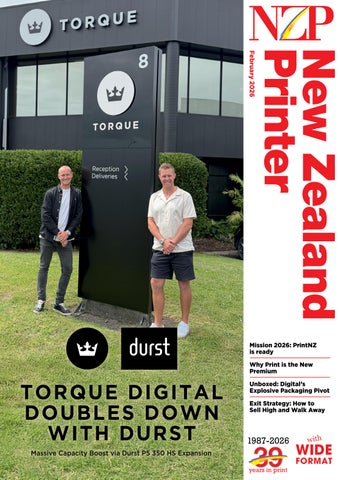
Auckland-based print company becomes the sole Kiwi business running a dual Durst P5 350 HS platform.

Since New Zealand Printer last visited, Torque has increased its staff numbers, moved to a new location, and doubled down on its Durst P5 350 HS large format capability.
The dynamic Auckland-based company exemplifies the traits that make successful Kiwi companies so distinctive: independent, progressive, practical, and fearless. Directors Kris Hassett and Liam Talbot have helmed Torque since its inception in 2008.
Kris says, “We are fortunate to have amazing people on our staff and most of them are also local.”
The company’s move to its new location in Collard Place, Henderson marks the latest chapter in its ongoing growth and evolution since Kris and Liam began the journey making student posters for their mates. Liam says, “We started out with a 64 inch printer and progressed quickly to buying another one, working out of a garage in Whenuapai.
“Over time, we expanded our production capabilities to include our first flatbed in
2009 and a second flatbed a year later. We have run dual platforms since that time.”
From Whenuapai, Torque Digital moved to a commercial site in Tony Street, Henderson and then to larger premises in nearby Moselle Ave in 2011.
Three years ago, once again owing to the need for more space to grow the business, Torque moved to a larger site in Winston Place, Henderson. Following the move, they commenced investigating options for their next major machinery upgrade, and in July of 2023, Torque installed the impressive Durst P5 350 HS printer – the first of its kind in New Zealand.
Liam says, “At Winston, realising that we were on a massive growth path, we consolidated everything together. We had to get out of the premises at Moselle Ave as it was too small and we were struggling to continue to operate efficiently.”
However, no one could see that more growth would follow. Liam continues,
“Moving to Winston had enabled a massive acceleration in our business and we understood the necessity to once again move.”
Therefore, in April 2025 Torque moved once again to its new, and current, headquarters in Collard Place, Henderson. Kris adds, “The move went extremely well. Our head of production Mark Bult was heavily involved with the machinery movement and installation. He has a wealth of knowledge, having moved us three times.”
Torque used its first Durst P5 350 HS printer to significantly increase capacity, without compromising on quality. At the time, Kris and Liam said, “We believed there was potential for a second Durst on the floor within the next year. Our first Durst had taken Torque to new production capability heights with its print quality and speed.”
The prediction proved accurate. In February 2025, Torque became the only company in New Zealand to operate two


Durst P5 350 HS printers. Liam says, “The second Durst P5 was inevitable. With the first, we were initially impressed with the quality of the build and after the installation the range of its capabilities was outstanding. From our business’ history, we had learned early on the value of running a dual platform in order to provide a consistent, failsafe, production capability for our customers.
Another factor in Torque’s choice to partner with Durst was the focus it places on business relationships, which aligns with one of Torque’s own key values. Seeing a global business that had maintained its family ownership and ethos was a characteristic that Torque identifies with and values highly.
Liam says, “At Torque, we believe in direct communication, and we keep it honest and free flowing. It is inevitable that there will be challenges onboarding new technology, supplier relationships, and processes. However, we have worked closely with Durst Oceania, including its New Zealand based team, to strengthen our connection and are seeing the results through positive feedback from our operators and production management.
Kris and Liam have always prioritised continual improvement and leading from the front, including investment in the latest and best technology.
Kris says, “The world we live in needs and demands innovation. It wants theatre; it wants bespoke; it wants ‘cool’ stuff.
“For us, this means speed to market matters, and we need to achieve that with no compromise in print quality. The Durst P5 350 HS printers have added to our capability to produce a diverse range of products. For example, the varnish and the white ink with the new machine definitely adds value to our portfolio of what we can offer.
“Speed to market has become meshed with automation. In our field, we make the best use of the latest technology, which enables us to do more than compete; it helps us disrupt the market and to take the lead. This market needed a disrupter and with the dual Durst platform, we have become big enough to turn the needle.
“Having more firepower has also created a mentality that we are going to keep testing everything, always pushing the boundaries.”
Technology and people
In addition to print technology, Torque has been investing in the development of its own production software to create additional efficiencies and customer offerings in the production process. Kris says, “In business, time is a challenge. When you can find, or free uptime you will already be ahead of most of the competition, who are scrambling to keep pace with demanding schedules.
Liam adds, “The challenge in harnessing automation, whether that be on the factory floor or within software and processes, often means making the right call on the right automation at the right time. Timing matters.
“Investing in the right things also matters. We have invested heavily in technology and in quality staff. Our staff have big hearts. You have to continue to invest to be the best.”
“In our field, we make the best use of the latest technology, which enables us to do more than compete; it helps us disrupt the market and to take the lead.”
–
Kris Hassett, director Torque Digital
“We have worked really hard to build the relationships we have with our suppliers, our customers and with all our team members. One of our basic business values is that relationships are key.
Like most other businesses, Torque witnessed a slowing down after the Covid-19 pandemic. Kris says, “The slowdown happened and we now see companies still struggling but in hard times, you need to remember what made you successful. You have to go back to your roots.
“We launched this company during the GFC, and we learned that we could find and build on opportunities in difficult economic times. We have seen the value of being able to lean in on our relationships and continuing to deliver high value.”
Matt Ashman, managing director of Durst Oceania, says he feels proud that Torque Digital has made the decision to stick with proven Durst technology and innovation.
He says, “Torque Digital has shown the value of pushing the boundaries with outside the box thinking and delivering exactly what their customers need. As the first New Zealand company to double down on the Durst P5 350 HS, they have
again proved their leadership in this competitive sector. We are excited and proud to continue our partnership.”
Liam concludes, “We are constantly reviewing our processes and our progress with the aim of continuous improvement, and we look forward to taking Torque to even higher levels.”

With a speed of up to 708 square metres per hour and the ability to change materials quickly with multi-roll and multi-track options, the P5 350 HS makes the printing process much more efficient.
It can handle corrugated materials, plus a wide range of others. It also offers Durst Workflow and Durst Analytics software for further productivity enhancements. Durst innovation in media handling means Durst customers can target higher volumes and transition work to this platform reducing their overall time and cost to produce.
The Durst P5 series printers are ideal hybrid solutions for roll and board printing up to 3.5m and are configurable based on your needs.
Durst operators gain more time between media changes and increase productivity with automated solutions


and easy maintenance procedures. Smart systems ensure a more efficient process for users who look to target optimum performance, Durst has produced a truly exceptional device.
One of the most productive hybrid printers in the world, the P5 350 HS printer’s ability to use Double Sided Dual-roll and multi-track 6 option for rigid boards makes it a versatile addition to companies striving to streamline the production demands and grow their category.
Configuration is versatile, and ink options allow you to specify the use of white and varnish, combine this with the Hapt-Printing option and creation of multi-layered, exceptionally striking tactile applications can be created with up to 18 layers.
Having white and utilising the ‘Day&Night’, ‘In&Out’ provides for brilliant three and five-layer prints for multiple display solutions by masking images between sides on clear substrates.
Messages from across the globe express admiration for his ethics; gratitude for his support; as well as affection for his warmth and humour.

The printing community across Australasia has been reflecting with deep sadness on the sudden passing of Frank Brokken, managing director of Nekkorb Solutions, who passed away peacefully in Auckland on Boxing Day.
His loss has been felt widely, not only because of his long career, but because of the character and generosity he brought to the industry.
Frank’s connection to print began early. At just 15, he stepped straight from school into an apprenticeship with E.S. & A. Robinson, later DRG, completing
his training in 1978. It was the start of a lifelong commitment to a trade he would eventually understand more thoroughly than almost anyone around him.
A major turning point arrived in 1982 when he was given the opportunity to join Morrison Printing Inks. Frank then moved through a succession of sales and leadership roles, steadily building a reputation as a trusted expert. His knowledge, calm professionalism and ability to forge strong relationships earned him respect not only in New Zealand and Australia, but among suppliers and partners around the world.
When his role was made redundant in 2008, Frank seized the moment to pursue a long-held ambition of running his own business. With determination and support of his wife Claire he launched Nekkorb Solutions in 2009, right as the global recession was taking hold. What began as a courageous leap soon grew into a respected, values driven company built on integrity, technical expertise and enduring partnerships.
Those who knew Frank often speak less about his achievements and more about the way he treated people. He was known as a mentor who always made time for others, a leader who guided without ego, and a colleague whose integrity set the tone for every interaction. Messages from across the globe have echoed the same sentiments: admiration for his ethics; gratitude for his support; as well as affection for his warmth and humour. The phrase that appears repeatedly is simple but telling - a true gentleman.
Frank’s influence will continue through his daughter, Tash, who has been part of the family business for 15 years. Having been closely mentored by her father, she now carries forward the company’s direction and values. She notes that while Frank’s depth of experience cannot be replicated, the foundations he built Nekkorb’s reputation on remain strong.
Nekkorb will continue representing its long standing international partners and delivering high quality solutions to customers throughout New Zealand and Australia.
Frank leaves behind a legacy woven through the people he guided, the relationships he nurtured, and the standards he set. As Tash steps into a larger leadership role, she does so with the support of her amazing team, trusted partners and those her father helped throughout his career. People who are committed to helping her continue the path Frank and Tash envisioned together.
His principles of integrity, excellence and genuine care remain at the heart of Nekkorb Solutions, ensuring that his impact endures well into the future.
Cover Story p3-5
3 Durst: Torque Digital recently became the sole Kiwi business running a dual Durst P5 350 HS platform. Directors Kris Hassett and Liam Talbot share the company’s journey from startup to major sector disruptor.
6 Tribute: From across the globe, industry members have sent heartwarming messages for Frank Brokken who passed away recently.
16 Konica Minolta: AccurioLabel presses have found a sweet spot in the digital label press market.
18 Currie Group: A strong partnership with HP Indigo sees Currie Group combining world leading digital print technology with deep local market expertise.
20-23 Fujifilm Business Innovation: Recently, FBNZ team members welcomed customers to its annual Bowls Day.
24 Heidelberg: Cloud-based platform offers automation solutions to boost efficiency of end to end print production.
26 Print Marketing: Daniel Edwards says print delivers more bang for your buck in any marketing campaign.
28 Labels & Packaging: Digital will continue its rise across labels and packaging over the next four years.
29 Packaging Power: Tony Ibbotson says packaging has become a strategic growth lever for business.
30 Business: It takes a village to sell a business, contends Peter Fotiadis.
11 Comment: Become a print storyteller so your customers can understand the real value of print, says Ruth Cobb.
12-14 Helping Hand: Iain MacIntyre previews some of this year’s industry highlights.
32 Epson: The new SureColor G9060 expands Epson’s wide format direct to film (DTFilm) printer lineup.
34 Computaleta: Ritetack’s Instant Grab Adhesive range is now available in New Zealand, supplied by Computaleta.
36 Visual Impact: Organisers have adopted a fresh approach to make this year’s show a must-attend event.
37 NZSDA Update: Mikayla Hopkins says NZSDA is laying a solid foundation for signage companies to succeed in 2026.
38-39 Master Sign Maker: Rapt! owners Julie and Blair Wadman share their journey to Master Sign Makers accreditation.
40-41 HP: Daniel Martinez discusses how HP Large Format can transform business workflows.
EDITORIAL: 021 631 559
Bruce Craig, Editor - bruce@newzealandprinter.co.nz
CONTRIBUTORS:
Ruth Cobb, Daniel Edwaards, Peter Fotiadis, Tony Ibbotson, Mikayla Hopkins, Iain MacIntyre, Daniel Martinez
CIRCULATION: brian@newzealandprinter.co.nz
DISPLAY ADVERTISING SALES & SERVICE:
Brian Moore - brian@newzealandprinter.co.nz +61 410 578 876
CLASSIFIED ADVERTISING: Brian Moore - brian@newzealandprinter.co.nz
DESIGN & PRODUCTION: Sarah Vella - sarahvelladesigns@gmail.com

New Zealand Printer is mailed to members of the printing, packaging and graphic communications industry in New Zealand 11 times a year, February-December.
New Zealand Printer is a member of the Printer Media Group
New Zealand: New Zealand Printer Asia Pacific: ProPack.pro Australia: Australian Printer, ProPrint
MANAGING DIRECTOR: James Wells - james@intermedia.com.au
GROUP PUBLISHER: Brian Moore - brian@newzealandprinter.co.nz
© Copyright 2026: Contents of this magazine are


COLOR-LOGIC has announced an update enabling full compatibility with Adobe Creative Cloud 2026 (CC 2026) for both Macintosh and Windows platforms. The update enables Color-Logic customers to integrate its Design Suite of tools into the latest Adobe CC 2026 environment. Color-Logic software now offers designers access to an extensive array of up to 924 metallic colours and effects for Photoshop, Illustrator, and InDesign. and enables them to add metallic effects to images with just one click inside Photoshop, streamlining workflow and elevating designs.
EPSON’S production facility, Epson Precision Suzhou (EPSZ), has achieved Platinum Recognition under the Responsible Business Alliance (RBA) Validated Assessment Programme (VAP). Epson says the recognition underscores the company’s commitment to corporate social responsibility (CSR) within the global supply chain. Since joining the RBA in April 2019, Epson says it has embraced its responsibility to achieve the highest standards in CSR by voluntarily undergoing rigorous VAP audits at its primary production sites.
SOMA has appointed CS Graphics as its new official sales representative for Australia and New Zealand, further strengthening SOMA’s presence in the Asia-Pacific region. The company sees CS Graphics as a well-established partner with extensive experience in the flexographic printing industry and a strong understanding of the local market. It adds that, through this cooperation, customers will benefit from enhanced local sales support, professional consulting, and closer access to SOMA’s portfolio of flexographic printing and converting solutions.
Durst has bought a majority stake in Spanish-based manufacturer of cutting tables Hasler Solutions.
Hasler Solutions produces its machines in Spain with up to 90 per cent of components from Germany. The company has operated for 17 years and has manufactured its own machines since 2019. Its founder Marc Hasler has extensive experience in the cutting machines industry after eight years working at Zünd in Switzerland and nine years with Bullmer in Germany.
Christoph Gamper, chief executive and co-owner Durst, said, “We have acquired the
Aldus Group has entered into an agreement to acquire Currie Group. In an email sent before Christmas, Frank Floriano, chief executive of Aldus Group, sent this email to his Aldus team:
“I am pleased to share that Aldus has entered into an agreement to acquire Currie Group, welcoming the business into the Aldus Group family.
“With completion scheduled for January 2026.


majority stake in Hasler Solutions Spain, a cutting systems company with real engineering depth and market credibility. What matters most: Marc Hasler stays. He remains co-owner and
This investment reflects our ongoing strategy of supporting market leading specialist businesses with strong leadership. With more than 75 years of history supporting the print and graphic communications industry across Australia and New Zealand, Currie Group has built a strong reputation for technical capability, customer service, and longterm relationships. In this regard, it shares many of the characteristics that have defined Aldus Group over a similar period.
“Currie Group will continue to operate as an independent business within the Aldus Group. Its leadership team remains in place, and its focus on

the driving force behind the business. From the very first moment we met, it was obvious that we would work together with shared values, shared standards, and shared ambition.
“What started as a collaboration has now become something more.: A Durst family story. Hasler Solutions remains independent and open to all customers. That is non-negotiable.
“Together, we will take Print & Cut to an industrial level that the market expects and deserves: scalable, robust, and uncompromising in quality. Plus, more to see at Fespa.
“2026 also marks 90 years of Durst Group AG. We are 90 years young, built on engineering, ownership and the courage to evolve. We are still pushing forward. At Barcelona, we can raise a glass with customers, partners and those who may become both.”
customers, partners and people remains unchanged. Our role is to support the business and provide stability and backing that allows it to continue to grow.
“Over the coming months, there will be opportunities to learn more about Currie Group and to build connections across the broader Aldus Group. I encourage you to welcome the Currie Group team and take pride in the strength and diversity of the businesses within our group.
“Thank you for your continued contribution to Aldus Group. As we head into the Christmas period, I wish you and your families a safe and enjoyable break, and I look forward to the year ahead.”

Companies and individuals have until the end of business on March 20, 2026, to get their best work in.
Well into its fourth decade, the Pride in Print Awards remains the pinnacle of recognition for the best visual print communication products produced in the country. Tania McDougall, manager for the Pride In Print Awards, says, “The Pride In Print Awards were established to promote excellence in print and every year, they do just that as industry professionals consistently exceed their customers’ expectations.
“Covering each industry sector with expert panels of judges analysing every entry the Pride In Print Awards deliver a programme that sees entrants continuously pushing the boundaries
Leading finishing equipment manufacturer A B Graphic International (ABG) has unveiled the ABG InkJet – a new single colour print bar module engineered for seamless integration across ABG’s own finishing systems, including the Digicon, Converter, SRI, and B5010 Booklet Machine, as well as third-party equipment.
Currie Group supplies ABG solutions in New Zealand and Australia.
Designed to deliver precision, versatility, and speed, the ABG InkJet is ideal for a wide range of applications, including variable data printing, multilayer labels, security features, barcodes, and pharmaceutical labelling.
Its standout features include 360dpi or 720dpi resolution and tool-less application for reduced operating costs


of what is possible in their craft. Based on technical excellence in all facets of the production process, typography and good design, the judging process allows specialists to make judgement calls based on the potential and the limits of processes and the materials and equipment used.”
“So please take the opportunity to place your best work into the Pride In Print Awards.”
The industry will celebrate the winners at the Pride In Print Gala
and compatibility across multiple web widths. It also offers a wasteless setup process, ensuring maximum efficiency and sustainability in production.
A key advantage of the new system is its ability to print directly onto adhesive layers, opening new creative and functional possibilities for label converters. The company says that, combined with ABG’s fleyeVision inspection system, it delivers exceptional print accuracy and consistent highresolution output, all within a compact, easily integrated module.
The same advanced technology also powers the ABG Braille module – a complementary solution that applies high build varnish to create braille text and warning triangles in accordance with recognised industry standards. By using varnishes of different viscosities, the system can also produce tactile embellishments on labels. With no cleaning required during varnish changes, users benefit from faster changeovers, minimal waste, and improved operational uptime.

Awards evening, which takes place in at the Te Pae Convention Centre in Christchurch on June 26, 2026.
The Pride In Print Awards receives invaluable support from the patron, Fujifilm. The Sponsors are Avery Dennison, B&F Papers, BJ Ball Group, Currie Group (New Zealand), Kurz New Zealand, Nekkorb Solutions, Paper Source, printIQ, Reproflex3, Ricoh New Zealand, Spicers New Zealand, and UPM Adhesive Materials. The media sponsor is New Zealand Printer Magazine
ABG manufactures both ABG InkJet and ABG Braille at its ABG’s German facility in Baesweiler, forming part of the company’s growing InkJet range. Further innovations in this series are already in development, with new modules set to launch in 2026.
Michael Leidgschwendner, managing director of ABG GmbH and leader of the Inkjet project, says, “As we continue to advance our inkjet capabilities here in Baesweiler, our focus has been on developing a fully modular print technology that can be utilised across the entire ABG portfolio.
“The new InkJet range represents a major step forward, giving customers a versatile, high-performance solution that integrates seamlessly with any ABG system, as well as third-party equipment.
“And by offering everything from one supplier, we’re enabling a more streamlined, efficient and future-proof approach to production, while opening up exciting new possibilities in variable data, security, multi-layer and functional printing.”
Colour language standards provider Pantone has named its 11-4201 Cloud Dancer as the Pantone Colour of the Year for 2026.
Leatrice Eiseman, executive director of the Pantone Colour Institute, said, “Cloud Dancer serves as a symbol of calming influence in a frenetic society, rediscovering the value of measured consideration and quiet reflection. Similar to a blank canvas, Cloud Dancer signifies our desire for a fresh start. Cloud Dancer is an ethereal white hue imbued
Xeikon has launched a new digital press for the Asia-Pacific label market named Ecolyne, which it will deliver through a subscription-based capacity service.
The company says this approach allows label converters to access production capacity rather than making a traditional equipment purchase. Designed for highquality label production, the machine boasts a 330mm web width, 25 metres per minute speed and 1200dpi resolution with the ability to run substrates from coated or uncoated paper to PP (white or clear), PET and metallised film.
Using a food-safe dry toner system, the Ecolyne press is also available in a four-colour (CMYK) and five-colour (CMYK+white) configuration.
Xeikon says today’s label printing landscape sees many converters facing the same barrier: the high upfront investment of buying a press, coupled with rapidly increasing demands for smaller runs,
Dscoop has announced four keynote speakers for Dscoop Edge Rockies, which runs from March 8–11, 2026 at the Gaylord Rockies Resort & Convention Centre near Denver, Colorado.
Organisers say the keynote lineup brings together distinct voices, each offering perspective on the challenges and opportunities facing business leaders today.
Taylor St. Germain, economist at ITR Economics, will deliver a forward-looking outlook on 2026 and beyond.

with a feeling of serenity.
“At this time of transformation, when we are reimagining our future and our
place in the world, Pantone 11-4201 Cloud Dancer is a discrete white hue offering a promise of clarity.”
Laurie Pressman, vice president of the Pantone Colour Institute, said, “We are living in a transitional time where people are seeking truth, possibility, and a new way of living. Pantone 114201 Cloud Dancer is an airy white hue that exemplifies our search for balance between our digital future and our primal need for human connection.”
Pantone will showcase artists who create their own interpretation of Cloud Dancer throughout next year and the company will release surprise limitededition designs from artists across all areas of design. Each creation will reflect the artist’s interpretation of the Pantone Colour of the Year.

quicker turnarounds, and flexible capacity.
The company sees the global digital label-printing market expanding from US$12.3bn ($21.3bn) in 2025 to US$20.6bn by 2035; yet smaller printers and e-commerce-driven label converters still hesitate because they often lack the capital or the operational bandwidth to adopt digital production solutions. With the Ecolyne press, by subscribing to labelprinting capacity rather than owning the hardware, converters can scale
A forecasting specialist, he helps leaders anticipate market shifts and guide strategy. His keynote will connect economic trends directly to the decisions print leaders face in the years ahead.
Lori Gottlieb, psychotherapist and New York Times bestselling author of Maybe You Should Talk to Someone, brings a human-centred perspective to leadership, change, and resilience. She will explore how leaders can navigate uncertainty and growth with greater clarity and connection.
Nick Santonastasso, an entrepreneur and bestselling author, will deliver a message focused on mindset and momentum. Born with Hanhart Syndrome, Nick inspires leaders to reframe challenges into opportunities and move forward with confidence,
production when needed and sidestep heavy investment.
Xeikon president Walter Benz says, “With a capacity-first approach, the focus shifts from machine ownership to printing performance, precisely what many emerging label printers are looking for. Beyond the commercial benefits, this service lets you stay current with technology trends and keep your digital label production line equipped with the latest capabilities.”
adaptability, and purpose. John Koller, head of print marketing at HP, brings decades of experience building global brands and marketing organisations, and will share insight into today’s print marketing landscape and host a panel discussion featuring leaders from Dscoop member companies.
Peter van Teeseling, executive director of Dscoop, says, “Edge Rockies is built on the belief that progress happens when people come together to address business challenges and learn from one another.
“These keynote speakers speak directly to what our members need right now, from navigating economic uncertainty and building resilience, to engaging teams and taking an active role in shaping the future of the print industry.”
Print professionals must become print storytellers, confident advocates who can connect the craft of print to outcomes that customers care about.

The things we remember most in life come from, and are told through, stories. By weaving a picture, stories help us make a connection. Knowing this, we understand that how we talk about print matters as much as what we make. We shouldn’t have to defend it, but we should take the opportunity to explain it better.
Too often, print is discussed narrowly: cost per unit, turnaround time, ink coverage, paper choice. While these details are important, they are not what makes print powerful. What gives print its value is purpose, impact, and connection.
Every print project provides an opportunity, not just to deliver a finished product, but to tell a story about why print was the right solution and what difference it made.
Print has always been tactile, visual, and emotional. In a world overloaded with screens and digital noise, those qualities matter more than ever. But they only matter if we articulate them. Print professionals must become print storytellers, confident advocates who can connect the craft of print to outcomes that customers care about.
Every print project has a story worth sharing:
• How was it printed?
• Why were those processes and finishes chosen?
• What was the objective of the campaign or product?
• Did it increase response rates, improve engagement, or enhance brand perception?
Whether it is a direct mail campaign that outperformed a digital-only approach; packaging that triggered engagement through its finishing or augmented content; or signage that changed behaviour in a physical space, these stories deserve to be told.
The best print storytellers don’t just talk about what was made; they talk about what it achieved. They connect print to emotion and to purpose. They understand that people remember the stories and the feelings far longer than specifications.
Over time, print storytellers build a personal library of examples that include samples, case studies, and experiences that hold meaning not just for themselves, but for the people they share them with. These become tools for education, inspiration, and confidence.
Strong print storytelling also builds bridges between design, data, and production and delivery. Print is not competing with digital. It complements it, strengthens it, and often gives it credibility. Print can drive people online, prompt action, and deliver measurable results when paired with data and technology. From personalised print powered by data analytics to trackable direct mail and interactive packaging, print is very much part of the modern marketing ecosystem.
When we tell these stories well, we help customers shift their focus. The conversation moves away from production mechanics and price pressure, and toward project purpose and impact. It moves from “How much will this cost?” to “What this will achieve”. Print storytelling reframes print not as a cost, but as an investment.
This matters because perception shapes decision making. If print is framed as old, static, secondary, and expensive, it will be treated that way. But when print is positioned as strategic, measurable, and human, it earns its place at the table.
We can show that print is not a thing of the past; it is very much part of the future: tangible, trackable, and capable of creating strong emotional connections.
We need to make sure we are well prepared to explain the value of print clearly and confidently, whether speaking to a marketer, a procurement manager, a designer, or a business owner.
Understand what they need and tell them how print can deliver that for them. Make sure you have the collateral that is available to you and use it to support your stories.
In an industry built on making things, our greatest opportunity lies in how we talk about them to others. When we tell better stories about print, we protect its value, elevate its role, and secure its future.

Print matters. So, articulate its value and tell its story. Ruth Cobb
Iain MacIntyre previews some of this year’s industry highlights.

The Print & Packaging Forum will return in 2026 with modifications and refinements
Various indications of a growing positivity in the economy provide optimism that 2026 will see an uplift in fortunes for New Zealand businesses, including the country’s dedicated print industry.
Ruth Cobb, chief executive of PrintNZ, says December business and consumer confidence surveys offered encouraging signs for the New Year. She explains, “The ANZ’s business confidence survey gave the highest score in more than 30 years, suggesting firms are seeing signs of improvement and are more willing to invest, and the Roy Morgan consumer confidence index was at its highest since September 2021.
“Together, this gives us cause for positive expectations about economic activity, investment and spending as we head into 2026.”
Notwithstanding economic factors, PrintNZ again has a full work programme planned to ensure members stay informed, engaged, educated, and entertained. Ruth says, “There is too
much to fully cover in this article, so in the following section we have highlighted the key events and projects that will get the ball rolling and then feed into other activities as the year progresses.”
• Seminar series. Across the regions during February and March will focus on the barrage of legislative changes that have or are about to take place, while also providing members with updates on industry initiatives such as the new marketing campaign and industry survey.
• Mainland Regional Charity Golf Day is set for February 13 at the Waitikiri Golf Club, Christchurch.
• Auckland Golf Day will take place at the Huapai Golf Club on February 27.
• Pride In Print Awards. Entries close on March 20.
• Pride In Print Awards. Judging takes place over April 13-14.
• Training Graduation Ceremonies. Held in Christchurch and Auckland, these events enable every person in the industry that has received a
qualification during 2025 to have their achievement recognised in front of peers and family.
• Apprentice of the Year. This also includes acknowledging the Top 10, Top 5, Training Company of the Year, Trainer of the Year and Diploma Student of the Year.
• Pride In Print Awards. Set for June 26 at Te Pae Christchurch, the industry’s gala event recognises excellence in product and people. It is The Big One!
• Visual Impact Sydney will run from September 2-4 at Sydney Showgrounds.
• Print & Packaging Forum/People In Print Awards. Leave space in October for this event. Ruth says, “Having run our inaugural Forum in 2025, alongside the People In Print Awards, we are thrilled to put the combined event back on the calendar for 2026, with modifications and refinements that always come out of a ‘first’ event”.
• Women In Print. Ruth says, “These sell-out events provide an ideal opportunity for women in the industry to network and be inspired by some of New Zealand’s great females.”

The PrintNZ Board has invested significantly into developing a new promotional campaign with marketing specialists, Strategy, for the betterment of both members and the industry overall.
Ruth says, “It is with much excitement that we now move into the production phase of the project. We have selected four key scenarios that highlight the strengths of print and demonstrate the impact of communicating a powerful message. They are:
• Be Seen – Use Print.
• Get Attention – Use Print.
• Be Trusted – Use Print.
• Be Remembered – Use Print.
“Each encapsulates the outcomes businesses seek when using any form of communication, and so we need to educate and encourage decision makers why they should include print in their campaigns.
“Our primary audiences are the private sector, comprising marketing decision makers, creative agencies, graphic designers and corporates; alongside the public sector such as local government, public institutions, and government agencies.
“As a secondary audience, we focus on our future through the education sector: students at marketing schools, design schools and so on. They will enter the workforce in the near term.

“Although those four scenarios start the ball rolling, the strategy lends itself to so many more slogans that can be tagged with the ‘Use Print’ call to action and we will continue to develop this as the campaign progresses.
As this edition of New Zealand Printer went to press, data from the first PrintNZ survey since the Covid-19 pandemic was being finalised. A snapshot of the key findings includes:
• 64 per cent believe there is a skills shortage in the industry.
• 81 per cent don’t have any formal accreditation for their business.
• View on business conditions in the last six months is: poor, 22 per cent; satisfactory, 14 per cent; good, 11 per cent; very good, 8 per cent.
• View on business conditions in the next six months: no change, 24 per cent; improving slowly, 71 per cent; improving rapidly, four per cent.
• Top three opportunities are technology/automation/AI, diversification, and sustainability.
• Top three challenges are economy; skills/age of workforce; AI/digital.
• 25 per cent of businesses have diversified in the last 12 months.
“Members also noted opportunities they can explore through a focus on innovation as well as an improving economy. It was interesting to see mention of the ‘cost’ of digital from both a trust point of view and increasing monetary outlay.
“In regard to other challenges, it was pleasing to see that competitive pricing wasn’t the prime concern! Although, it did rate a mention alongside concerns about overseas competition, energy and the environment.
“Another great revelation was that 94 per cent of our responders have used PrintNZ’s employment services in the last 12 months, be that employment agreements, policies or individual advice. That is really pleasing for us to see as it recognises the importance of this assistance to our members and the value it provides to their businesses.


“Compliance is becoming more complex and demanding, and having access to timely, practical advice is increasingly critical for businesses navigating a challenging regulatory environment.”
Sustainable Green Print + Sign (SGP+S)
This year PrintNZ will introduce SGP+S certification for its New Zealand members, which canvases:
• Operational efficiencies –documenting sustainability profiles to enable efficiencies in waste reduction and energy savings, thereby resulting in lower operational costs.
• Profitability – providing opportunities for print-buyers to pay a green premium for certified products.
• Risk mitigation – recording

sustainability to improve supply chain resilience by reducing dependency on raw materials – it also being noted that customers are more loyal to companies who offer sustainable products and services.
• Attracting talent –– younger workers being more attracted to companies that can demonstrate sustainable solutions across their businesses.
• Competitive edge as supplier of choice – with prospective print buyers facing more sustainability considerations and regulations increasing their sustainability reporting requirements, a supplier that reduces the reporting burden on their customers will likely enhance their prospects of becoming the supplier of choice.
Ruth says, “All SGP+S certification is audit and review driven and comprises
comprehensive Environmental Management System (EMS) documentation, including worksheets, guides and templates – and a support network.
“This programme provides the opportunity, particularly for small businesses, to attain an environmental certification without the large price tag that is often associated with them. This will mean all our members can demonstrate their sustainable practices in a verified way.”
The PrintNZ team looks forward to delivering all the aforementioned and more during the year. Ruth says, “There will be ongoing emphasis on our business-as-usual activities that the membership very much values. This includes the work we do with individual members on employment issues, health and safety, compliance and business referrals, and working with schools to secure a talent pipeline.
“As a team we are here to work for our members and we always encourage and welcome them to reach out directly to us with any queries or issues that arise, or in any other areas where we may be able to develop services to assist the industry.
“As we are all aware, it has not been easy, economically and psychologically, for businesses, families, and individuals over recent years. But we are in this together and the horizon is brightening with expectations of a progressive lift through the course of this year.”

Iain Macintyre

Konica Minola’s toner-based label presses have found a sweet spot in the digital label press market.

IDC has named Konica Minolta Business Solutions as a leader in the IDC MarketScape: Worldwide High-Speed Digital Label Printers 2025 Vendor Assessment.
The report states: “The high-speed digital label printer market is undergoing the same type of digital transformation we have seen in other segments of the printing market, with a portion of the total label volume moving from analogue to digital production based on digital printing’s economic advantages for short runs.
“The demand for digital production is based on a move to shorter runs and on demand production to impact consumer decisions and eliminate waste.
“Over that time, Konica Minolta has placed more than 1,700 of its toner-based label presses, which have found a ‘sweet spot’ in the digital label press market with their combination of quality and productivity.”
The report recognised Konica Minolta for the following strengths:
• Konica Minolta offers ongoing business development support, which helps print service providers identify and expand into new markets.
• The Konica Minolta AccurioLabel is a simple device, configurable with optional finishing for more automated production.

• Konica Minolta offers its own IC-605 digital front end and partners to offer a Creo controller as an option for either the AccurioLabel 230 or AccurioLabel 400.
• The AccurioLabel is a smaller device, requiring less of a footprint while maintaining robust production capabilities.
• The AccurioLabel presses offer low power consumption through Konica Minolta’s advanced HDE toner, which lowers fusing temperature, also saving on energy costs.
Chris O’Hara, national production and industrial print manager for Konica Minolta New Zealand, says, “Konica Minolta has a strong tradition of innovation where we target continuous improvements that deliver the best results
for our customers. This recognition from IDC MarketScape is significant in that it demonstrates Konica Minolta’s leadership in the sector.
“Konica Minolta built in high productivity, precision, and energy efficiency into the AccurioLabel 230 and AccurioLabel 400 presses. Delivering 3,600dpi by 2,400dpi resolution, the AccurioLabel 400 supports white toner printing and features low power consumption through Konica Minolta’s advanced HDE toner technology.
“Developing solutions that make digital production smarter and easier to adopt is part of Konica Minolta’s strength, but what we constantly aim for is to raise productivity without compromising on print quality in a way that helps our customers achieve sustainable growth. Reliable performance and advanced design inherent in these digital label presses helps converters and print companies with their own innovation and creativity as they unlock new commercial opportunities.”
The IDC MarketScape assessment model is designed to provide an overview of the competitive fitness of technology and service suppliers in a given market. The research methodology utilises a scoring methodology based on both qualitative and quantitative criteria which results in a single graphical illustration of each vendor’s position within a given market.


The new Konica Minolta AccurioLabel 400 press helps you profit from the latest trends in the Digital print customised label market. With the addition of our Vivid white colour option, you can capitalise on special finishes on a wide range of clear and metallic label media to produce striking Labels in one pass efficienc y.
Whether you’re a label print specialist looking to upgrade your digital capacity, or adding labels to your offering for the first time, you’ll profit from the flexibility and speed the new AccurioLabel 400 Press brings to your business.


SCAN TO REQUEST A FREE SAMPLE PACK

A strong partnership between HP Indigo and Currie Group, combines world leading digital print technology with deep local market expertise, addressing a range of industry challenges.
Across Australia and New Zealand, commercial print, labels, and packaging businesses are navigating a period of rapid change. Customer expectations continue to rise, run lengths are shrinking, speed to market is critical, and sustainability is no longer optional. At the same time, margin pressure, labour constraints and growing operational complexity are forcing businesses to rethink how they operate. At the centre of this shift sits the partnership between HP Indigo and Currie Group which provides solutions when addressing industry challenges.
Currie Group has supported the print and packaging industry across A/NZ for more than 75 years, and today represents HP Indigo across commercial print, labels, and packaging segments. This heritage brings a strong understanding of customer realities on the ground including commercial pressures, staffing challenges, workflow complexity, and the need for practical, sustainable solutions that deliver measurable business outcomes.
This is strengthened by Currie Group’s ability to deliver end-to-end solutions, bringing together HP Indigo technology with best of breed partners across workflow, finishing, materials and automation. As Currie Group CEO Rob Mesaros says: “It is this combination of advanced technology, integrated solutions and local partnership that’s helping customers move beyond the adoption of digital, towards true digital transformation.
“One of the most common challenges customers face today is balancing efficiency with flexibility,” Mesaros added. “Brand owners and buyers are demanding shorter runs, faster turnaround, greater versioning and more customisation, while still expecting premium quality. Traditional analogue workflows often struggle to meet these expectations economically. HP Indigo digital presses enable Currie Group customers to produce multiple SKUs, manage frequent changeovers, and deliver variable data applications without the time and cost penalties associated with conventional


production. For many businesses, this capability has become a genuine competitive advantage, opening doors to new clients, new applications, and new revenue opportunities.”
Mesaros said that automation is playing an increasingly critical role in delivering these outcomes on scale. “Currie Group works closely with customers to design production environments that extend beyond the press, incorporating workflow automation, colour management, and intelligent job orchestration.
“Solutions such as HP Site Flow, HP’s print production automation software, help streamline job onboarding, automate routing and reduce manual touchpoints across complex production environments. Platforms such as HP PrintOS provide real time visibility across operations, enabling businesses to monitor performance, optimise scheduling and improve decision making,” he added.
Mesaros said AI and machine-assisted technologies are also beginning to deliver real world value with capabilities such as intelligent quality monitoring, automated press optimisation, predictive maintenance, and HP Nio (AI powered assistant) all helping operators maintain consistency while reducing reliance on individual expertise. In a market where skilled labour is increasingly difficult to source, this is critical.
Across the region, there are many examples of customers using HP Indigo technology, supported by Currie Group, to evolve their business models. Commercial printers are expanding into higher value applications such as short run packaging, customised marketing collateral, and premium photo products. Label converters are building profitable digital divisions alongside flexo, supporting versioned SKUs, seasonal campaigns and rapid turnaround work. In flexible packaging, early adopters are working with Currie Group and HP Indigo to support brand owners with product testing and sustainability initiatives.
According to Mesaros, the measurable impact of these investments is clear: “Customers are reporting stronger productivity across complex job mixes, reduced waste and improved margins on short run and customised work. Digital production is also supporting sustainability outcomes, including reduced substrate waste, lower inventory obsolescence and more responsible manufacturing models. These are not theoretical benefits; they are commercial outcomes that Currie Group regularly reviews with customers as part of an ongoing partnership approach, rather than a one off installation.
“For businesses beginning or accelerating their digital transformation journey, the message is clear. Success depends as much on partnership as it does on technology. Define the outcomes you want to achieve, understand where digital can add the greatest value, and work with partners who bring both technical expertise and genuine market understanding. With the right strategy, support and tools, digital transformation becomes an opportunity for growth rather than a challenge to manage,” he said.
“Through its longstanding partnership with HP Indigo, and its deep commitment to the local industry, Currie Group continues to help commercial printers, label converters and packaging producers adapt with confidence, build resilience, and create operations designed for the future,” Mesaros added.


Print professionals share a leisurely afternoon of bowling and fellowship.
Taking advantage of a warm summer afternoon, print professionals joined Fujifilm Business Innovation (FBNZ) team members for the Annual FBNZ Bowls Day.
Despite stiff challenges from their peers, the team from Direct Print and Mail won the competition. Greg O’Shanassy, Northern Graphic Arts sales manager at FBNZ, said, “This is a great forum to
get the print industry together prior to Christmas. It has become a regular event in the calendar and continues to grow in participants.
“There is plenty of friendly banter on the day and it is a relaxed format. It’s our way of showing appreciation to our clients. We look forward to welcoming everyone when we host it again in 2026.”


Heidelberg reports that, three years after its launch, the company’s cloud-based Customer Portal is increasingly becoming the digital control centre for end to end production in print shops. It says that more than 7,000 individuals at over 3,000 printing companies worldwide are actively using the platform to make processes appreciably more efficient by digitalising and automating them.
The portal offers more than 15 specialised apps, including high performance functions such as the Maintenance Manager, the Inventory Management app, and Print Shop Analytics. These apps boost the efficiency and transparency of maintenance, materials management, and production operations thanks to digital assistance, automated processes, and real-time data.
The Apps also help to prevent downtime, reduce storage costs, and systematically improve both overall equipment effectiveness and sustainability. Heidelberg says it will soon be possible to purchase consumables and spare parts in just two clicks, calling it a real milestone in terms of user-friendliness and efficiency.
The company believes this makes Heidelberg an industry pioneer when it comes to combining all digital services such as access to production and workflow apps, real time analyses, maintenance,
management tools, and shopping for consumables, all in a single cloud-based portal. It says its ultimate goal is to equip print shops with high-performance tools that can be put to immediate use to implement automation directly in an everyday production environment.
The company adds that, in the printing industry, systems integration and process automation are becoming decisive competitive factors to an ever-greater extent. Dr David Schmedding, chief technology and sales officer at Heidelberg, says, “The Heidelberg Customer Portal is a milestone in the digitalisation of customer relationships and, at the same time, a strategic tool for optimising processes and mastering complex workflows in print shops. Our Prinect Workflow is the backbone for all that.
“In short, the Customer Portal quite simply makes our customers’ work easier.”
Mark Mills, president of Heidelberg customer Spectrum Packaging Corporation in the US city of Orlando, says, “The new Speedmaster XL 106-7+L with Prinect tripled press speed, reduced makeready times, and elevated colour consistency for every job. With support from the Heidelberg Performance Team and analytics from the Customer Portal, we are continuing to push efficiency even further, fine-tuning results week after week.”
Data Capture app for end to end capture and analysis of production data.
Heidelberg has also added the Data Capture App for capturing production data on an end to end basis and analysing it in real time. This application transfers planning and job data directly to print shop workstations, supports job and status tracking, and supplies operating data for reporting and actual costings. In this way, the new app function helps improve transparency and optimise control in print shop production departments.
Marco Rassfeld, head of prepress and CTP at the pilot user Meinders & Elstermann in Germany, holds the responsibility for all issues relating to workflow integration at the company. He says, The Data Capture app is self-explanatory and makes life a whole lot easier than the previous process. It saves time, has access to a centralised data source, and ensures full use can be made of all available production slots. The rollout was virtually seamless, and Heidelberg provided fast and professional support at all times.”
Largely implemented on the basis of Prinect to date, the Customer Portal’s current automation functions serve as an intermediate step, according to Heidelberg which says it will systematically enhance the portal, integrating further digital solutions that will increase the level of automation to achieve fully autonomous print production. In this way, the company looks to create a scalable infrastructure that print shops worldwide can use to control their production operations intelligently, autonomously, flexibly, and reliably.


New Zealand Printer magazine and PrintNZ thank attendees, speakers and sponsors of our inaugural New Zealand Printing & Packaging Forum incorporating the People In Print and Rising Stars Of Print Awards on October 14


The online component of a typical marketing campaign pays back 64 per cent more when there is direct mail in the marketing mix
Irecently had the dubious pleasure of dealing with a digital marketing company – the kind that does Adwords and web design, and makes everything sound much more mysterious than it actually is.
It’s amazing how these people talk about monthly budgets, particularly in comparison to my experience in the print industry. I feel like printers are always trying to save their customers money, or at least find ways to charge less.
The classic one for me was always economies of scale – increase the quantity and drive down the cost per unit. My focus has always been on getting the best deal for my customers. Rather than crafting an offer to suit a low budget, these Adwords guys berate their customers to spend more.
If you want real results, you need to actually spend some money – anything less than $1,000 a month and you’re wasting your time. You really want to be spending at least $1,800 a month. It also won’t start performing for at least three months because of technical setbacks, and so on. But once you do that, you will be drowning in leads.
The Adwords guys are so bold, and what is so compelling about their pitch is the numbers.
Google and Facebook are very open about search traffic, how much each click will cost, and how they arrive at those prices. Using all that data, it is quite straight forward to arrive at a reasonably accurate estimation for cost per customer.

Once the ads are going, a website will get a predictable amount of traffic, and it is over to the web master to increase the conversion rate.
What was interesting about all of this, was how easy it is for marketers to put a price on new customer acquisition. And how available this information was. Could the print industry take advantage of these figures?
The Google click rate is a price for just a click – not an action, or a purchase – just a click on a link that in most cases leads to an interaction time that is less than five seconds. A very basic engagement with a website that is comparable to picking up and glancing at a flyer, or a business card.
Recent figures I saw for Adwords for a plumbing business, as an example, was $30 a click. Could printers use this to frame their prices?
Google will charge you $30 per engagement. I can put a flyer in the hands of X number of people and it will
cost $2 per engagement. Then I can back it up with some stats – 81 per cent of Australians open and read their mail immediately, 74 per cent pay complete attention when reading emails, and 56 per cent of people trust information when it is presented on paper.
Direct mail is often kept for months, and is read by every person in the household, not just the person it is addressed to. The online component of a typical marketing campaign pays back 64 per cent more when there is direct mail in the marketing mix.
These stats are very direct mail oriented, but it is true for any take home form of print. There are many more data points in my book, and available at TwoSides.org.au.
On the below left is a snapshot of metrics comparing Google clicks and the power of print.
Suddenly your $2 flyer isn’t competing with a $30 click — it’s 36x cheaper per deep impression.
One of the best ways to promote anything is to stand against something else. Pepsi didn’t win by being ‘another cola’ – it won by blind-tasting Coke into oblivion.
Burger King didn’t say ‘we grill’ – it said ‘better than the clown’. Ryanair didn’t promise luxury – it promised ‘screw the suits, fly cheap’.
Print doesn’t need to apologise for ink on paper. It needs to call out the click fraud: $30 for a four-second bounce? We’ll give you 87 seconds in hand for $2. Google sells noise. We sell memory. Choose your weapon.

Daniel Edwards is the founder of Posterboy Printing. He has worked in the printing industry since 2002 and has worked on thousands of print jobs with hundreds of Australia’s top marketers. He is also the author of The Power of Print.


Where will growth in digital print for packaging emerge from over the next five years?
New analysis from Smithers suggests converters should be looking closely at corrugated and flexible packaging, as the global digital market almost doubles in value by 2030.
In its latest market study, The Future of Digital Print for Packaging to 2030, Smithers values the worldwide digital print for packaging and labels market at US$22.0 billion (around A$33.7 billion) in 2025, rising at a compound annual growth rate (CAGR) of 10.9 per cent to reach US$36.9 billion (about A$56.5 billion) in 2030, based on current exchange rates.
Digital still represents a relatively small slice of overall printed packaging – 1.3 per cent by volume and 4.1 per cent by value – but Smithers expects that share to increase as higher-throughput presses designed specifically for packaging applications come online.
Corrugated the standout growth engine
Smithers identifies corrugated as the single biggest opportunity for digital between 2025 and 2030. It forecasts the value of digitally printed corrugated to more than double over the period, reaching US$8.2 billion (about A$12.5 billion) by the end of the decade.
The research points to the rapid evolution of wide-web inkjet systems, which are already running at up to 400m/min in mono or colour, with speeds expected to reach 500m/min by 2030. According to Smithers, these will be the fastest digital presses in the market, opening up higher-volume corrugated work that has traditionally been the domain of flexo and litho.
Inkjet post-print capacity is also expanding quickly as high-performance systems are installed into box plants and display operations. This growth is being fuelled by increased use of printed e-commerce delivery boxes and the blurring of lines between display and secondary packaging, as brands specify higher quality, shelf-ready trays and cartons.

For converters in Australia and New Zealand, this aligns with recent investments in high-speed corrugated inkjet capacity, including new single-pass and sheetfed systems aimed at short to medium-run packaging and display work.
Installations such as integrated inkjet corrugated lines and new industrial-scale corrugated presses highlight how local players are gearing up to serve exactly the kind of applications Smithers identifies as the strongest opportunities.
Flexibles poised for double-digit digital growth
While corrugated leads in absolute value growth, Smithers anticipates strong digital opportunity in flexible packaging. The report notes that many label converters are exploring flexible substrates to leverage their existing narrow-web digital platforms.
Smithers forecasts digital print on flexibles to grow at an 11.6 per cent CAGR through to 2030, supported by both toner and inkjet technologies.
The study notes toner OEMs see flexibles as a natural adjacency for their installed base, while new inkjet machines are now entering the market with chemistries that overcome earlier “chem-stack” challenges when printing onto films and other flexible materials.
This is consistent with recent developments in digital flexible packaging presses, where inkjet platforms are being positioned to convert mainstream flexo and gravure jobs, offering higher quality, shorter runs and faster turnarounds for brands.
Solutions targeting flexible packaging at industrial speeds are already being promoted in the local market, providing converters with practical entry points into this growth segment.
Labels: A mature but still growing segment
By contrast, digital label printing is now a comparatively mature application, with growth slowing from earlier double-digit rates. Smithers anticipates an 8.0 per cent CAGR for digital labels between 2025 and 2030, reflecting its more advanced adoption curve.
Globally, Smithers estimates there are around 8,100 narrow-web inkjet and toner presses currently in use for label and sleeve production. This installed base gives digital a much higher share of label value, at 23.3 per cent, than in other packaging segments.
However, it also makes the label market extremely competitive, pushing many converters to look at flexible packaging and other adjacent applications as the next logical expansion path.
Tech advances and workflow key to competitiveness
Beyond hardware, Smithers points to a series of technical enhancements that will lift both the quality and cost-effectiveness of digital print across labels and packaging.
These include more sophisticated colour management, integration with automated prepress and order processing, and closer coupling of digital print engines with finishing and logistics workflows.
The report stresses that digital labels and packaging remain highly dynamic technology sectors.
Brand design leader at The Creative Method in Sydney, Tony Ibbotson, says
radical transparency, fluid systems, and AR labels will define the year ahead
As brands look ahead to 2026, packaging experts are signalling the trends set to dominate – from radical transparency and circular design to adaptive systems and interactive packs.
The common thread? Packaging is no longer cosmetic. It is a commercial lever that builds trust, distinctiveness, and measurable growth.
In 2026, packaging will earn even more influence in the boardroom. Consumers want proof, retailers demand impact, and investors reward clarity. The brands that thrive will be those that use packaging as both storytelling and strategy.
While trends evolve, four design truths remain constant:
• Trust markers: Every category has signals of trust; knowing when to follow or disrupt them is crucial
• Stand-out design: Disruption must be intelligent to win cut-through
• Emotional connection: Colour, texture, and form that evoke nostalgia, joy, or pride continue to spark loyalty
• Storytelling: Packaging that helps consumers retell the brand’s story drives memorability and advocacy.
These principles are already shaping brand success, with recent projects showing how packaging drives measurable growth.
A stellar example
For New Zealand-based Saint Clair Family Estate, boutique doesn’t mean small – it means crafted. The Marlborough winery has grown into a major international exporter with a portfolio spanning multiple brands, tiers and labels, yet its packaging had to preserve the boutique feel that underpins its reputation.
The Saint Clair story is a great example of design discipline at work. Clear brand


architecture and consistent use of crafted assets have allowed the brand to scale globally while still feeling boutique. From cellar door to supermarket aisle, it looks and feels authentic.
The result is packaging that travels seamlessly across markets and formats without losing its boutique essence –proof that design can build scale without sacrificing soul.
There are seven trends that will closely shape the packaging industry in 2026. These include:
1. Radical transparency and truthtelling: Clear ingredient information, visible pricing, and even carbon footprints will dominate, building consumer trust in cost-sensitive times.
2. Humanised and handmade: Handdrawn, tactile, and imperfect aesthetics will stand out against AIgenerated sameness, making brands feel personal.
3. Essence-driven design: Brands will mine their DNA and heritage for inspiration rather than chasing fads.
4. Place-based storytelling: Geography, culture, and environment will continue to anchor design for deeper authenticity.
5. Circular and responsible design: Sustainability will be designed into the pack: refill formats, minimalist structures, biodegradable materials.
6. Interactive and hybrid packaging: AR, QR, and gamified features will turn packaging into a portal for brand storytelling.
7. Adaptive and fluid systems: Single design languages will flex across multiple SKUs, markets, and campaigns, driving both efficiency and cohesion.
Taken together, these trends reflect a single reality: packaging has become a strategic growth lever, not a finishing touch.
In 2026, the brands that win won’t see packaging as a decoration. They’ll use it as strategy, earning trust, telling stories, and creating value in ways that move markets.

Tony Ibbotson is a brand design leader and the founder and creative director of The Creative Method (TCM), a Sydneybased independent brand design agency specialising in food, beverage, FMCG, and QSR.
Mattingly’s Peter Fotiadis examines why selling a business isn’t just a financial event – it’s a full-contact sport in stakeholder management
It’s the hidden dealbreaker, if you don’t manage the key stakeholders well in a business sale, it could be the end of your deal.
As I pen this article, I’ve taken a brief pause from my lead role in a major transaction Mattingly is deeply involved in. This moment of quiet has me reflecting on my day, my week, well months, if I’m honest.
The number of times my phone rings, a text pings, or an email arrives is relentless. The volume is matched only by the sheer variety of people , that includes ‘stakeholders’ to us consultant folk and just ‘people’ to everyone else) who need to speak to me, or I to them, about a deal.
Each one wants something slightly different: an answer, a document, a reassurance, sharing important findings, or sometimes, just a sounding board. It’s a reminder that selling a business isn’t just a financial event, it is a full contact sport in stakeholder management.
Understanding who these stakeholders are and how to proactively engage with them is critical to a smooth and successful sale.
So here it is. Meet the VIPs of your business sale, and no, it’s not just the buyer and seller:
1. Owners, shareholders, and the board
A little obvious to start with, but they’re the ones who give the green light and want to know the value is real, the integration plan and structure is sound, and the timing makes sense.
Tip: Keep them focused on outcomes, not noise. A clear summary pack and early visibility go a long way.
2. Executive team and employees They’ll keep the business humming while the deal’s going through, or panic and jump if left in the dark for too long. But you can’t bring everyone into the loop; maybe a competitor on the other side of the transaction, and the long, uncertain process means you must pick carefully. Plus, some won’t handle the waiting or stress if the deal drags or falls through.

Tip: Identify key people early, bring them into the conversation under strict confidentiality, and communicate honestly but carefully. Arm them with the right narrative to help answer rumours and manage the wider team.
3. Customers and suppliers
These relationships are the lifeblood of the business; but too much change too fast can spook them.
Tip: Have a tailored communications plan for your top five to 10 customers and suppliers, and a wider narrative ready to go for the rest. Put yourself in their shoes – why could this deal bring value to them? Preempt their questions and time your communication carefully.
4. Advisors, lawyers, and accountants
Pay them lots of money (just kidding)! They know the process and will guide you through expertly. They turn ideas into terms, numbers into statements, and risks into solutions. Make sure you appoint an experienced team that gets your business and matches up well with your executives and board.
Tip: You know your business, so keep the scope tight. Don’t just delegate –stay close, keep decisions moving, and make sure your advisors are aligned and commercial.
5. Banks and financiers
Banks aren’t just about lending money; they have detailed processes: their own due diligence, credit approvals,
bank and director guarantees, plus potentially novating bank accounts, payment approvals, credit cards, and other products. It’s a whole operation. Engage them early, get their commitment early, and keep them in the loop to avoid last minute surprises that can derail your timeline.
Tip: Get ahead of any consents, repayments, or refinancing. If they’re funding the buyer, ask early if the money’s real. Buyers: get your banks aboard before you start the transaction process.
6. Regulators
They don’t care about your timeline or your enthusiasm. They care about the rules.
Tip: Know what filings or approvals apply and bake in the lead time. You are not the only deal in town and these approvals can take time. Where appropriate, proactively engage, prepare a comprehensive brief, and find a known point of contact to engage with.
7. Don’t forget the others!
My apologies to the rest of my wonderful business community. I promise this is not in order of merit, but:
Insurers need early review for coverage continuity; IT providers need to transition systems, data and hardware, or separate (and, wow, can this one be big); landlords often require lease consents; unions may need formal consultation; and valuers or experts should be engaged early to avoid last minute delays.
So, if you’re about to sell your business, remember, it takes more than just a great offer and a signed contract. It takes a village, preferably one that is well fed; well informed; and full of well managed stakeholders.

Peter Fotiadis is a co-founder and partner at Mattingly, an industry expert supporting businesses with strategy through to execution: strategy and growth, deals and integration, and transformation and execution.


New direct to film printer offers numerous new production features.
Epson has expanded its SureColor G-Series wide-format dedicated direct to film (DTFilm) printer line with the SureColor G9060.
With higher production print speeds, print flexibility and automated maintenance features, Epson says it has engineered the 162cm (64-inch) SureColor G9060 from the ground up for direct to film applications and joins its smaller sibling, the SureColor G6060.
Designed to meet the requirements of garment creators and merchandise manufacturers, the SureColor G9060 offers consistent high quality output with low running costs, minimum maintenance, and a high duty cycle. Touting a user replaceable PrecisionCore Micro TFP printhead, Nozzle Verification Technology and UltraChrome DF inks, the new printer promises consistent, repeatable colour without constant oversight.
A large-capacity sealed-ink-pack system and roll print flexibility makes the SureColor G9060 ideal for high volume printing, oversized graphics, and large transfer orders. Leveraging automated maintenance routines to reduce downtime and user-friendly controls, it supports long run productions and keep print shops running smoothly around the clock.
Darren Kerber, product manager for Professional Print Solutions at Epson Australia, says, “Epson continues to expand its professional fabric printing line-up to meet the evolving needs of the market. Building on the success of our existing solutions, the new SureColor G9060 introduces a 64-inch format that delivers greater flexibility and productivity for businesses looking to scale.
“This addition reinforces our commitment to providing high-quality, reliable solutions that help customers maximise efficiency and profitability.
“With its advanced DTFilm capabilities, the SureColor G9060 makes it easier than ever to customise garments and accessories, enabling vibrant imaging across a broader range of materials and

opening new opportunities for growth in the textile sector.”
Epson adds that garment manufacturers seeking a dedicated DTFilm production system can now easily and cost-effectively create custom workwear and teamwear. They can produce event and show merchandise alongside value-add clothing and a wide range of other items including coasters, umbrellas, notepads, and binders.
The SureColor G9060 features a convenient bulk ink management design with all-front-loaded consumables. It supports film rolls up to 1626mm and wide 250mm in diameter. Incorporating an auto-cutter for sheet-based production means you can use it with a range of third-party powder shaker/oven machines for roll-based production.
The 6.7cm PrecisionCore Micro TFP printhead supports print speeds up to approximately 32 square metres per hour in colour + white. Epson’s Nozzle Verification Technology (ink-less nozzle status monitoring), auto-head cleaning, auto cap-cleaning and continuous white-ink recirculation ensure consistent high-quality output with maximum productivity and minimum waste.
The printer uses 1.6 litre UltraChrome DF ink packs that are cost-effective to order, easy to agitate, quick and messfree to load. Epson Precision Dot image processing ensures the SureColor G9060
can produce accurate and consistent prints with bright colour and an enhanced gamut, according to Epson.
The company says it has purpose built the SureColor G9060 for fast and efficient production and designed it to operate with minimal operator oversight and minimum manual maintenance. Requiring only a few minutes each week to ensure smooth and reliable operation, it features a high duty cycle and ships with a comprehensive warranty that covers the printhead.
The new printer features integrated support for Epson’s Cloud Solution PORT service. Operators can access this free web-based service from desktop PCs for direct management as well as Android and iOS devices for remote monitoring. The PORT service provides advanced reporting and costing tools while facilitating enhanced support and service for maximum uptime.
Additional features of the SureColor G9060 include:
• Efficient bulk ink system with sealed packs ensures high-volume output while minimising mess and reducing handling errors.
• Uses a 240 volt power supply for easy installation.
• Supplied complete with Epson Edge Print PRO RIP software.
• UltraChrome DF ink is GOTS approved, OEKO-TEX ECO Passport certified.
The new SureColor G9060 will ship with a comprehensive warranty that covers the printhead, bulk ink system, ink, and software. Epson will make the printer available in New Zealand shortly after the middle of the year with prices announced closer to the time of release.
Darren concludes, “The SureColor G9060 is a great addition to Epson’s fabric range and should be well received by manufacturers with volume DTFilm production needs. For users with lower requirements and/or those who wish to produce a mix of DTG and DTFilm we will continue to recommend our SC-F1060, SC-F2260, SC-F3000 and SC-G6060 models.”


Local customers now have access to the Instant Grab Adhesive range.


Computaleta customers now have local access to the Ritetack Instant Grab Adhesive range, with Computaleta appointed as the exclusive reseller for both Ritetack and Ritetack Xtra.
Computaleta will carry the Ritetack range across its New Zealand network, targeting the sign, print, construction, and architectural markets, where demand is growing for adhesives that can replace or reduce mechanical fixings while maintaining a high standard of finish.
Arlette Farland, regional general manager for Computaleta, says, “At Computaleta we are always looking for ways to give our customers more options on site. Adding Ritetack to our range means faster installs, fewer fixings, and a cleaner finish, without compromising on strength or reliability.”
Already a staple in Australia, Ritetack is a high performance instant grab adhesive designed for trade environments where fast handling strength and clean finishes are essential. Often described as a quick-grab construction glue, it delivers a powerful initial hold that can reduce or eliminate the need for clamps, props, and many visible fixings, helping installers work faster while achieving a neater result.
The adhesive is formulated for multimaterial bonding, adhering to metal, timber, glass, mirror, ACM sheet, plaster, stone, ceramic, concrete, polystyrene and more. This breadth of compatibility allows trades to standardise on a single product across a wide variety of signage, building and fabrication tasks.
Ritetack is solvent-free and isocyanatefree, with low odour for safer and more comfortable use indoors and on confined
sites. Once cured, it remains elastic to accommodate movement and is fully paintable, in contrast to many silicones which can restrict finishing options. In laboratory testing, Ritetack has demonstrated serious strength, including metal to concrete bonding and horizontal holding power up to 1000 kg/m² under controlled conditions.
Ritetack is available in 290ml and 600ml cartridges, supplied in boxes of 12, and comes in white, black, and grey to suit different substrates and detailing requirements.
Eurotech Group, which developed and supplies the Ritetack range, positions it as a solution for installers who want to move away from visible brackets and slow mechanical fixings without sacrificing safety or reliability. By combining instant grab with long-term elasticity and strength, Ritetack is intended to handle both initial positioning and ongoing performance in one system.
Sitting at the top of the range is Ritetack Xtra, also supplied exclusively to the New Zealand market through Computaleta. Ritetack Xtra offers approximately 20 per cent more initial tack than the standard Ritetack formulation and is tuned for especially demanding applications, including stone and heavily loaded exterior fixtures. It retains the same core benefits: multi-material bonding, paintability and solvent-free formulation, while taking initial grab and environmental resistance a step further.
Eurotech says that between Ritetack and Ritetack Xtra, most day to day and heavy duty bonding needs on site can be covered with a single family of products, adding that this simplicity is a big advantage for busy trades.
Computaleta will carry the Ritetack range across its New Zealand network, targeting the sign, print, construction, and architectural markets, where demand is growing for adhesives that can replace or reduce mechanical fixings while maintaining a high standard of finish.
For product details, technical data or ordering information, contact Computaleta or visit the website.
Recently, Orafol welcomed visitors to a brace of Open Days at its newly opened site on Auckland’s North Shore.
Steve Maclean, general manager Orafol New Zealand, says, “Months into our opening, and the response and attendance from across the industry has been incredible. We had strong support from our reseller partners, new customers discovering the Orafol brand, and longstanding industry connections who’ve followed our journey into New Zealand. It really shows the appetite for a direct local presence.”
The Open Days featured guided tours of the new facility, live vehicle wrap demonstrations, and an opportunity to meet the Orafol team. Guests enjoyed food, beverages, a raffle, and the chance to catch up with other industry professionals.
Among the highlights was a Lamborghini Sterrato wrapped by the team from The Wrap Shop. The wrap design came from Alan-George Nanai, a teenager from Rarotonga undergoing cancer treatment at Starship Hospital.
Steve says, “Alan-George has told the story of his journey, through his design in the wrap, weaving Pasifika
Caldera has introduced a DTF specific RIP that runs on Windows, macOS, and Linux.
The new DTF RIP offers intuitive preset-based workflows and minimal manual intervention. The user can simply install, link to a supported printer, load a preset profile, and start producing transfers immediately. Caldera says the new platform delivers highly optimised
Self-adhesive applications specialist Drytac has announced the launch of a 3.7mm(92µ) polypropylene film developed for the fast, tool-free installation of graphics applications.
SpotOn SynTac features a new dot pattern removable pressure sensitive polyacrylate adhesive, that Drytac says ensures bubble-free results on a wide

culture, resilience, and hope into every detail. From the heartbeat line to the hammerhead shark and sunrise colours, his creation is a true celebration of strength and creativity. We were truly grateful to be a part of this initiative.
white ink generation, enabling smoother garment blending, reduced stiffness, and improved tonal transitions.
It adds that many users handle colour profiling up front. Instead of building profiles manually, new customers typically receive pre-created profiles from printer or media partners. These are embedded directly into the RIP, eliminating complex configuration and drastically reducing onboarding time. Meanwhile, advanced users still retain fine-tuning capability and sophisticated spot-colour control when required.
range of smooth surfaces without the need for professional installation. Drytac offers the film in an improved white matte finish and a new clear gloss, adding a transparent option to the SpotOn SynTac portfolio.
Drytac has developed the new film with sustainability in mind. The company says SpotOn SynTac suits seasonal promotions, short-term campaigns, or peel and stick signage.
Its PVC-free construction helps reduce landfill impact and increase the recyclability of completed campaigns. The film also removes cleanly when the project or campaign concludes.
Dennis Leblanc, senior product and business development manager at Drytac,
“Thanks to The Wrap Shop, Orafol ANZ, and AWS Graphics, Alan-George’s vision came to life as the Lamborghini Sterrato was unveiled at the Starship Supercar Show. You can experience it at Lamborghini Auckland.”
For knockout operations, essential for DTF when removing background colour so garment colour can show through, rather than requiring image prep in external software, the RIP provides a direct tool knockout handled through a simple eyedropper system with adjustable tolerance. Users who have never opened Photoshop can now complete this task within the RIP itself.
On the production side, Caldera’s PrimeCenter can integrate with the DTF RIP for automation, workflow layout, and batching. Caldera plans additional automation features.
says, “We are delighted to introduce SpotOn SynTac to the market. It is the go to solution for short term graphics that need to go up quickly and come down just as easily.
“SpotOn SynTac is designed to make installation simple: just peel, stick, and apply. When it’s time to take it down, it removes cleanly within 12 months.
“With its cleaner environmental profile, effortless installation, and reliable performance, SpotOn SynTac is perfect for projects where speed, appearance, and sustainability matter.”
SpotOn SynTac is compatible with latex/resin and UV printers.
Stark Digital supplies Drytac solutions in New Zealand.
Organisers offer a “fresh approach” to make it a must-attend event.

Roland DG has confirmed its Platinum Sponsorship of Visual Impact 2026. The long-time trade show supporter will exhibit at the show, joined by the expo’s first Gold Sponsors Mimaki Australia.
Organisers see the sponsors’ confirmation as a welcome show of support for the local industry’s leading digital print, sign and graphics show, which will take place under The Dome at the Sydney Showground from September 2-4, 2026.
Companies who have confirmed their stands for the show recently include Additive Machines, ADM Systems, Mimaki, Multicam Systems, Mutoh Australia, Pozitive Sign & Graphics Supplies, Roland DG Australia, SA-LED Australia, Shanghai Totem Exhibition Co, and Shann Group.
Fresh layout
Organisers say the growing list of exhibitors has embraced the show’s fresh layout, which takes full advantage of the circular design of the Showgrounds’ Dome to create an in the round experience, with a number taking prime positions at the front of the hall and around the central area, designated The Hub.
Stands at the show will sit in the familiar grid format, arranged around The Hub, which will provide a central focus for visitors and a nucleus from which they can easily access every stand.
The concept is intended to disrupt the normal front to back traffic flow and disperse crowds more evenly throughout the hall. For exhibitors, that means a steadier, more consistent stream of visitors to stand, while for visitors, it provides an ideal meeting place and navigation point.
Karren Challoner-Miles, executive general manager of the event’s host, Visual Connections, says it’s just one of the innovative ideas which demonstrate the renewed approach the association is taking with this show.
She explains, “Like many, we have closely watched the evolution of trade shows both here in Australia and overseas, and across a variety of industries, and we’ve also been listening to the feedback from our exhibitors and visitors from previous shows.
“We know that costs are rising, we know that business owners are pushed for time. Exhibitors need to get real ROI for their investment, and visitors who are taking valuable time away from their workplace need to come away with not just information about products and services, but also with enhanced knowledge, understanding and confidence to make important purchasing decisions for their business.
“Events which do not evolve to meet changing market needs simply won’t stay relevant, so we are working hard to make sure that Visual Impact delivers value,
at every level, and for everyone who is involved,” she points out.
As well as the reimagined expo, Visual Impact will feature a co-located industry conference addressing issues of broad relevance and interest, like the economy, industry trends, sustainability, AI and more.
Karren continues, “While this is an industry event, we don’t want it to be completely internally focused. None of us operate in a vacuum; we are all working within a local and global economy, all facing challenges like rising costs, talent shortages, and the need to meet important sustainability goals. Our personal and business lives continue to be transformed by new technologies, and with AI advances, this is only going to continue.
“At Visual Impact, visitors will not only have access to the industry’s leading suppliers, who will bring their solutions and their collective expertise, experience and insights, but also to experts from outside the industry who will provide important information and valuable perspectives to the table.”
Jenny Harris, events consultant for Visual Connections, says organisers are in discussions with many other companies to secure their place at the show. She says, “We are having lots of conversations, which is a great result considering we are still 10 months out from the show.
“I think that’s a testament to the wisdom of pushing the date back a little bit to avoid clashes with other international shows, and the fresh approach we are taking, which is being really well received by industry suppliers.”
She adds that the team is making good progress with the conference and she looks forward to sharing more about that as the format and themes are finalised, and speakers start to be confirmed from early next year.
Visual Impact Conference & Expo 2026 will take place at the Sydney Showground, Sydney Olympic Park, from September 2-4, 2026.
Industry association dives straight into business laying a solid foundation for success for signage companies and the larger industry in 2026.


As we kick into the new year, our focus is on bringing to life the plans and priorities set at our December strategy meeting, ensuring the industry has strong opportunities to connect, learn, and grow. These goals were set ahead of time so we could dive straight into the year with vigour and momentum, and with a solid foundation already in place for 2026.
While the year is only just underway, planning is well advanced for our biggest event for the year: the Sign & Print Expo. This will be a key moment for the sector, bringing together suppliers, businesses, and decision makers, and is shaping up to deliver genuine value for those who attend.
After a couple of challenging years, there is a strong sense across the industry that 2026 is the year things begin to bounce back and get busy again. Preparing well now is key to making the most of the year, and the Sign and Print Expo is designed to support that preparation by creating space to step back from working in the business.
It is easy to get caught up in the day to day, with little opportunity to explore innovative ideas, tools, and ways to improve how the business operates. The Expo is designed to change that by bringing the entire industry together, allowing you to get hands on with the latest technology, talk directly with experts, and find practical solutions
that strengthen your business from the inside out.
The event runs from June 17-19 at the Auckland Showgrounds.
Here are seven reasons you should attend the 2026 Sign & Print Expo:
See the latest tools and technology. Expo brings all the top suppliers together so you can see the newest equipment, materials, tools, and software in action. You can ask specific technical questions, watch live demonstrations, and get practical tips for real world application. Many suppliers offer expo only deals, which can save you money on major purchases.
Find answers for your toughest challenges. Expo puts you in the same room as experts who understand the daily pressures of sign and print production in New Zealand. Whether it is a supplier, or a fellow sign maker, one conversation can uncover a simple fix for a problem that has been slowing you down for months. You can troubleshoot real issues on the spot and leave with solutions you can apply immediately.
Build strong industry relationships. Strengthen your network during face to face conversations to build trust and create long term benefits. These relationships often lead to better pricing,
faster technical support, early access to new products, and priority service when you need it most. Connecting with other business owners also opens the door to referrals, collaborations, subcontracting opportunities, and shared knowledge.
Learn new ideas to drive growth. Seeing hundreds of products and innovations in one place sparks new thinking. Many owners come away with ideas for new services, new revenue streams, improved efficiencies, or smarter ways to deliver work. The expo will expose you to solutions you did not know existed, which is where real growth opportunities begin.
Improve workflow clarity. By seeing new tools, substrates, machinery, and more, you can identify bottlenecks and streamline your production flow. One small improvement in how you print, cut, laminate, install, or dispatch can save hours each week.
Make fewer mistakes and less rework. Live demonstrations and expert guidance help you choose materials and methods that reduce errors. This lowers stress for your team, shortens turnaround times, and protects your margins.
Gain industry insights. Expo offers speaker sessions and workshops focused on the most topical subjects in the sign and print sector. You can learn about AI in production, sustainability expectations in New Zealand, advancements in digital signage, new illumination techniques, and other emerging trends. These insights help you stay ahead of customer expectations and prepare your business for what is coming next.
Make the time to attend expo this year and give your business the advantage it deserves. Bring your questions, explore the new products on display, and discover ideas that can improve your workflow and profitability. Registration is open, so head to the NZSDA website to get your name on the list.

Mikayla Hopkins, Lead Projects, Events, and Marketing Specialist NZSDA
Mikayla Hopkins meets Rapt! owners Julie and Blair Wadman and learns about their journey to become NZSDA’s most recently accredited Master Sign Maker.

Starting out as a graphic design and print broking studio, Rapt! purchased a sign shop three years ago. Rapt! owners Julie and Blair Wadman say it has been an intense three years of learning all about the signage industry.
They say, “One of the first things we did was join the NZSDA as we knew we needed support and guidance and we also wanted our clients to know that we were committed to excellence.”
And now, after two years of active membership and integration within the NZSDA community, their hard work has paid off as they have officially received the Master Sign Maker accreditation. The NZSDA Board were extremely impressed with Julie and Blair’s drive to achieve the accreditation, especially considering they have only been NZSDA members for two years. Their commitment to showing up at events and connecting with and learning from other sign makers has made all the difference.
Julie and Blair can now reflect on the journey, highlighting both the challenges and rewards of pursuing the Master title.
Julie says, “The accreditation process was very thorough; it took quite a few man hours to pull everything together and we did it over a period of about three weeks.
“It took four of the team in total to work on separate parts of the application process. Donna, our designer, dug through all our project photographs. We had Michelle, our administrator inputting all the important dates with Blair and myself writing all the technical parts. It was well worth the time and effort; our team members feel super proud of achieving Master Sign Maker.”
When asked about their decision to pursue the Master title, Julie says, “Building relationships with prospective clients is always challenging. We ask, ‘How do we prove to them we can do the job, and we know what we are doing?’ They have to trust us. I knew that having the Master Sign Maker accreditation would be another tool in our box that will help them feel at ease and that we are trustworthy.”
Keep upskilling
Looking back, they see the application process as an opportunity to strengthen their skills and reflect on past work. Julie

says, “Digging into past jobs actually gave us more confidence. Even though the application process took a lot of time, energy, and resources, it helped confirm that we are on the right track.
“We need to learn, tweak, and ask questions if we are to do our clients’ jobs justice. I have learned that you must keep upskilling and never stop asking questions.”
Julie and Blair also shared their advice for other businesses considering applying, set aside an hour every day to plug away at the application. It is worth the time and effort and will make the industry stronger in the long run.
Julie adds, “For me and Blair as owners and directors, it means so much. We have moved into 2026 with the confidence to keep growing and improving, knowing that we and our team have earned this accreditation.”
The journey, the learning, and the achievement all come together to show that with dedication, commitment, and support from the NZSDA community, reaching Master Sign Maker status is not just an accolade but a testament to hard work and professional growth.

Rapt! team members feel “super proud” achieving Master Sign Maker accreditation


Daniel Martinez discusses how HP Large Format can transform business workflows.


Last year saw HP Large Format driven by groundbreaking innovations and strategic advancements that elevated HP’s position in the graphics industry and set new benchmarks for large-format printing. These technologies not only advanced printing capabilities but also reimagined how businesses operate, creating a comprehensive ecosystem to enable our customers to achieve greater efficiency, productivity, versatility, and collaboration within their teams.
For print service providers, this transformation began with the unveiling
of the HP Latex R530 at the HP Amplify Conference. This printer redefined rigid and flexible printing and unlocked unprecedented versatility for small and medium-sized print shops. Alongside it, we also announced the HP PrintOS Production Hub, the world’s only largeformat software that combines order management and remote production control into a centralised, real-time platform, enhancing efficiency and reducing operational complexity.
At the ISA Sign Expo, we launched the HP Latex 730 and 830, demonstrating how high impact quality and productivity can

empower small and medium-sized print service providers to thrive in competitive markets. Finally, later in the year, Printing United witnessed the debut of the HP Latex FS70 W, HP’s most productive Latex printer to date, setting a new benchmark for scalability and productivity.
For professionals in architecture, engineering, and construction (AEC), we marked a milestone year by introducing AI Vectorisation to HP Build Workspace, making it one of the first solutions to use AI for the process of vectorising raster images into CAD editable documents, saving hours of manual work per drawing. In addition, with the global launch of the HP DesignJet T870 from Japan later in Spring, we delivered a compact 60cm printer designed for hybrid workspaces that combines versatility, quality, and space efficiency. Finally, on HP SitePrint, we also announced key enhancements, such as flatness measurement or the HP SitePrint SMR prism to bring next-level precision to construction layout.
Integrated workflows, digitisation, and intelligent solutions are shaping the future of work. HP Large Format is at the forefront of this transformation, leading HP’s print strategy to enable advanced business ecosystems.
Our vision is to create comprehensive ecosystems that anticipate and address customer frictions in their daily operations, empowering businesses to innovate, collaborate, and scale, thereby unlocking new opportunities for growth and resilience in an increasingly dynamic world.


By leveraging our HP Latex, HP DesignJet and HP SitePrint technology with our software’s latest solutions, we aim to deliver seamless experiences to our customers that simplify complexity and drive efficiency. These platforms are not just tools; they are enablers that combine automation, robotics, and data-driven insights to streamline operations and unlock new possibilities, helping our customers lead the future of the workspace.
In this sense, 2025 was a key year for software and robotics integration.
HP PrintOS Production Hub experienced a surge in orders, demonstrating its value as a go to platform for print service providers to digitise workflows, centralise management, and collaborate in real time.
HP Build Workspace continued to attract new AEC customers thanks to features like AI vectorisation, soon also AI-powered vectorisation directly from HP DesignJet MFPs, while HP SitePrint is continuing to evolve since its implementation thanks to its enhancements in productivity and precision, proving its transformative impact on construction workflows.
These advancements are not isolated wins; they are part of a larger ecosystem that positions HP as a leader in workflow digitisation and automation. As businesses seek efficiency and productivity, HP provides the tools to make it happen.
At HP Large Format, we believe that true innovation must go hand in hand with responsibility. That’s why sustainability is a cornerstone of our strategy and a defining advantage of our technology in the market. As we advance toward HP’s 2030 sustainability goals, we are embedding circularity into every stage of product design, production, and lifecycle. In 2025, we achieved a 33 per cent increase in circularity, doubling the percentage achieved in 2023, and set our sights on 65 per cent by 2030, reflecting our commitment to ensuring that every innovation we deliver contributes to a more sustainable future.
The new HP DesignJet T870 exemplifies this approach. Designed with circularity in mind, this printer incorporates at least 45 per cent recycled plastic and
10 per cent recycled metal, reducing the demand for virgin materials. Its packaging is 100 per cent polystyrenefree, minimising environmental impact from the moment it leaves our facilities. Another great example is our HP Latex inks. They shipped with 100 per cent carton cartridges, they are water-based, odourless, and certified by UL Ecologo and UL Greenguard Gold, creating safer, more comfortable workspaces. These choices demonstrate our commitment to minimising waste and promoting sustainable manufacturing practices.
Moreover, customers can accelerate their sustainability journey with the HP Sustainability Amplifier and recycle supplies and hardware through the HP Planet Partners programme, helping them deliver responsibly for both their business and the planet.
HP Large Format momentum is undeniable. 2026 will be a year of acceleration, innovation, and impact. Our mission remains clear: to empower businesses to transform and connect physical and digital workflows, enhance productivity, and achieve their goals, while shaping a sustainable future full of collaboration.
At HP Large Format, we aim to shape a future where design drives meaningful change. We lead with purpose, innovate responsibly, and deliver solutions that set he standard for the next era of work.


Custom Manufacturing
Flatbed Printing
Packaging
Sample making
Assembly
Lanyard Pockets
Registration Holders
Self Adhesive Pockets
Mounting/Case Binding
Recycled and Recyclable


Specialists in Finishing & Synthetic Stocks

Interpack 2026
May 7-13, 2026 | Düsseldorf
As a global industry highlight, industry and research professionals will present innovations, developments, visionary impulses, and future oriented solutions. interpack.com
Fespa Global Print Expo 2026
May 19-22, 2026 | Barcelona
See the latest technology, materials, and applications across print, personalisation and signage with live demonstrations, hands on opportunities, and networking events. fespaglobalprintexpo.com
Sign & Print Expo 2026
June 17-19, 2026 | Auckland Showgrounds
Organisers expect to welcome up to 50 leading industry suppliers who will present their latest technology, innovations, and products. nzsda.org.nz
Pride In Print Awards
June 26, 2026 | Te Pae Convention Centre, Christchurch
Entries will close for the country’s premier print awards programme on March 20, 2026. It’s time to find your best work and submit it. prideinprint.co.nz
Visual Impact | Sydney Showgrounds
September 2-4, 2026
See the latest innovations for signage; digital and wide format; engraving and routing; textile printing and garment decoration; promotional products and awards; vinyl application; design; screenprinting and display solutions. visualimpact.org.au
LOUPE Americas 2026
September 15-17, 2026 | Chicago
Formerly Labelexpo Americas, this event’s cornerstone is the hundreds of live demonstrations and product launches from global manufacturers, offering the opportunity to see technology in action across the entire supply chain. loupe-global.com
Printing United 2026
September 23-25, 2026 | Las Vegas
The big show for all things print in the USA has gone from strength to strength featuring the latest technology, seminars, and opportunities to meet and learn from industry experts from around the world. printingunited.com
Printing & Packaging Forum
People In Print Awards and Rising Stars of Print Awards
October, 2026 | Auckland
The awards event recognises the outstanding people in our industry follows the must attend inaugural Printing & Packaging Forum. newzealandprinter.co.nz