Advocating for the disability sector for 45 years
February-March 2026 | Volume 36 Issue 1

![]()

Advocating for the disability sector for 45 years
February-March 2026 | Volume 36 Issue 1

Maddy loves going off the beaten track. But her old wheelchair was holding her back. It couldn’t handle uneven terrain, making her excursions bumpy, uncomfortable and downright dangerous. So our specialist consultant got to know her needs and set her up with a new wheelchair (which we delivered in her favourite colour: electric blue).
With off-road settings and all-wheel suspension, it stays steady when the going gets tough. Now, Maddy can glide right over the rough patches and is, in her own words, as “free as a bird”. Made for nature’s ups and downs, made for Maddy.


Publisher
Simon Cooper
Editor
Kymberly Martin
kymberly@intermedia.com.au
Advertising
Michelle Stevens mstevens@intermedia.com.au 0419 822 717
Design
Sarah Vella
Prepress
Tony Willson
Production Manager
Jacqui Cooper
Subscribe
To subscribe visit www.intermedia.com.au
P: 1800 651 422 or E: subscriptions@intermedia.com.au www.linkonline.com.au
Link is published six times a year by Interpoint Events Pty Ltd.
ABN: 9810 451 2469
A: 41 Bridge Road, Glebe NSW 2037
P: +61 2 9660 2113 F: +61 2 9660 4419
Reprints from Link are permitted only with the permission of the publisher. In all cases, reprints must be acknowledged as follows: ‘Reprinted with permission from Link Magazine’, and must include the author’s byline.
The opinions expressed in this publication are those of the authors and do not necessarily represent those of the publisher.
The Intermedia Group takes its Corporate and Social Responsibilities seriously and is committed to reducing its impact on the environment. We continuously strive to improve our environmental performance and to initiate additional CSR based projects and activities.
As part of our company policy we ensure that the products and services used in the manufacture of this magazine are sourced from environmentally responsible suppliers.
This magazine has been printed on paper produced from sustainably sourced wood and pulp fibre and is accredited under PEFC chain of custody.
PEFC certified wood and paper products come from environmentally appropriate, socially beneficial and economically viable management of forests.
EXCITING CHANGES ARE PLANNED FOR LINK IN 2026.
After five years I am stepping down as publisher for LINK & Freedom2Live. I am proud of what LINK has achieved. When Interpoint took over the masthead the magazine had ceased to be published. It had a long history (almost 40 years) and I believed the disability sector deserved a strong and independent voice. It was a gamble, but with the support of a dedicated team and the backing of the AT industry LINK has become the leading media in the sector.
This would not have been possible without our dedicated team. Kymberly our editor has led the way with positive news, telling the stories. Michelle has been at the forefront of securing advertising support to re-establish the magazine. Recently Danielle has come on board to drive Freedom2Live and social media, and behind the scenes Ben has compiled the newsletters which have increased in frequency and reach, and thank you Sarah, our creative designer. I would also like to acknowledge the support of Melanie at ATSA, the industry association has always supported LINK, and we are grateful to be the official media partner for ATSA and the expos. And thank you to all our
• Assistive Technology • Autism

advertisers who have supported us on this journey.
LINK Magazine will continue to be the voice for the disability sector, telling positive news stories many others ignore. The journey has not been easy; print media is under pressure from increasing costs and from digital media, whilst digital media is also under pressure from sound bites, AI and misinformation. In 2026, LINK will be expanding its digital footprint to reach a wider audience. Watch this space with exciting news ahead and a new publisher joining the team.
LINK will have a stand at the Sydney ATSA show in May – I look forward to seeing you there.
In this issue the cover story is from the City of Moreton Bay Council with a plan to become the most accessible city in Queensland - inspired by a 7-year-old who uses a wheelchair. And how prepared are you in an emergency? Given the spate of natural disasters recently the article on pages 20-21 is timely.
February/March 2026
• Inclusive Sports & Recreation
Advertising booking date: February 27, 2026
Advertising material deadline: March 6, 2026
Publication date: April 2, 2026
For article proposals, contact the Editor: kymberly@intermedia.com.au
For advertising, contact the Advertising Manager: Michelle Stevens 0419 822 717 mstevens@intermedia.com.au

Having a diverse workforce really creates an opportunity for everyone to collaborate their unique set of skills and experience that they bring into the team. NOVA have been fantastic.
Sarah - Head of People & Culture –Custom Denning


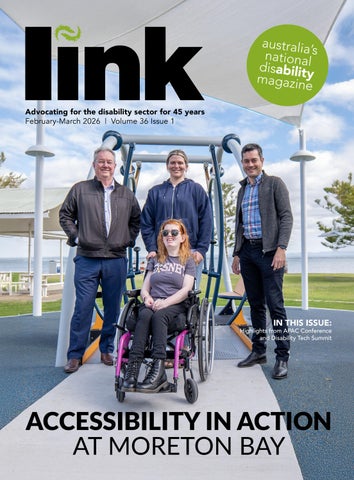
How do you become the most accessible local council area in Queensland? Danielle Kutchel investigates.
According to Peter Flannery, mayor of the City of Moreton Bay, it’s about a shared commitment to inclusion for everyone – a commitment that brings together all councillors, staff and even ratepayers.
“This is what we want to do for our community, and accessibility is a real key point for us,” he told Link
After being named an event city for the 2032 Olympic and Paralympic Games, Moreton Bay set out to become the most accessible city in South-East Queensland. The Games sharpened the city’s focus on the goal and the sort of legacy it wanted to leave, while also giving it a deadline to get things done.
“Council sees the 2032 Games as an incredible opportunity to elevate
accessibility standards across our city. We want our 2032 legacy to be one where we have accessibility standards that are not only the best in Queensland but are equal to or better than anywhere else in the world,” Flannery said.
So, the vision grew bolder: to be the most accessible city in the state of Queensland.
In 2023, the council’s desire to improve its accessibility was further solidified. After upgrading a park with new play equipment, Flannery received a letter from a seven-year-old boy named Zach, who said he couldn’t access the new playground because he used a wheelchair – and the playground wasn’t wheelchair accessible. It prompted a

complete rethink of how the City of Moreton Bay designed playgrounds, Flannery said.
“It really tugged at my heart, and I thought we can do better than that. I said, ‘OK Zach… we’re going to make a thing called Zach’s Guiding Principles. Whenever we design a park now, we’re going to make sure it’s got accessibility for everyone’.”
Since then, new parks and park upgrades in Moreton Bay have accessibility principles built in from the start with the principles being embedded in the council’s upcoming Disability Access and Inclusion Plan to guide development of inclusive spaces. With hundreds of people moving into the area every week, Flannery said it was important to get ahead of the
game and plan infrastructure early on – and make sure it was the right infrastructure for everyone’s needs.
“[We thought] let’s start including [accessibility] into how we plan things and our future vision… just put things in place that mean people can get out and enjoy our beautiful city, rather than having obstacles in their way,” Flannery said.
The council has moved ahead with that vision through several initiatives. A community-wide survey includes specific questions about accessibility and inclusion, to identify barriers and areas where accessibility can be enhanced in infrastructure and service delivery. It was the first local government in Australia to develop a Changing Places Network Plan, built in consultation with the community, service providers and other experts. It guides the planning and delivery of Changing Places facilities in the region.
Through its innovation challenge showcase competition, the council encourages local businesses to show how to improve accessibility.
The City of Moreton Bay opened Queensland’s first public We-Go-Swing at Crockatt Park, Woody Point, earlier this year, and libraries, art galleries and school holiday programs run inclusive activities.
Meanwhile, Flannery said, the disaster management team applies an accessibility lens to disaster preparedness for things like storms and flooding.
“Our Disaster Management Team regularly attends local events where they provide disaster preparedness information and advice to the community, including people with disability and their carers. Council also has dedicated accessibility and inclusion officers who regularly engage with people living with a disability and their carers while supporting the implementation of our Disability Access and Inclusion Plan.”
The council is currently working on its second Disability Access and Inclusion Plan, which will “outline how we are going to achieve our vision”, he added.
By embedding accessibility plans and targets across council, Flannery said they will be in place “for many, many decades to come”. This is important when new councillors are elected every few years, as it keeps the initiatives safe from the political cycle.
“We’re here to do a job and do the best job we can for the period we are here. We shouldn’t just be looking at trying to get back in again in the next election,” Flannery said. “It should be ‘this is what we need 10, 20, 30 years down the track, let’s plan for it now… so even if we’re not here, there’s still a plan in place for somebody else to continue that forward.”
Flannery said the City of Moreton Bay’s disability community had reacted positively to the council’s inclusion efforts. He added the council’s actions are informed by staff and consultants with disability, and consultation is vital to get things right.


“The [disability] community has jumped on board and they’re giving us their input,” he said. “We don’t have all the answers so we need to engage with the community and see what they need, what they want and what we can provide. We know how important it is to listen to that advice that’s outside of council on what we can do to improve things.”
WHAT SUCCESS LOOKS LIKE Flannery said he has a clear idea of how the council will know when it has achieved what it set out to do. “It’s by seeing that business-as-usual includes accessibility… so that when we design something or look at upgrading something, it’s not an afterthought,” he said. “Accessibility is something that’s required. And it should be standard practice to include it and budget for it, design it, plan it, and improve it as you go.”
And could Moreton Bay go further with its goals? Flannery thinks so. “Our original goal was to be the most accessible city in Queensland, if not Australia,” he said.
With the whole council team behind that vision, Flannery is confident the City of Moreton Bay will find success. “I like to think our council thinks outside the box. We are not just here for roads, rates and rubbish – this is about improving people’s lifestyles.”
And he wants to show other councils that they can get on board with the accessibility mission too.
“Embrace it. Don’t look at it as a burden,” he said. “There’s always a different way to do things.”
A practical guide for 2026

For many people, NDIS funding is more than numbers in a budget.
It’s practical support to live more independently, stay connected and achieve goals. It’s the support worker who assists you in getting ready for the day, the transportation that gets you to your speech therapist, or the assistive technology that supports you in staying connected with friends.
The NDIS continues to develop clear guidelines for what NDIS funding can be used for. However, because every person’s needs are different, there’s no one-size-fits-all answer.
A plan manager like nib Thrive can support you to understand what you may or may not be able to use your NDIS funding for.
At its core, a NDIS support is something you need because of your
disability. This can include allied health, assistive technology, support workers who help with daily living or community access, and home modifications such as grab rails or ramps. These are the supports the NDIS is designed to fund.
Everyday living costs and supports that are not evidence-based cannot be funded by the NDIS. These include rent, groceries, petrol, standard gym memberships, entertainment, regular furniture, and utility bills. Sometimes it can be hard to determine if something is an everyday living cost or something you need. For example, the NDIS won’t fund a typical gym membership but may fund sessions with an exercise physiologist if it directly relates to building capacity or improving function.
You can find more info on the ‘NDIS supports lists’ at ndis.gov.au/ understanding/supports-funded-ndis
Understanding what your funding can be used for empowers you to make the most of your plan and access supports that genuinely improve your quality of life. If you can answer yes to all of these, it’s more likely to meet NDIS requirements. Ask the following questions:
• Do you need the support because of your disability?
• Will it meet your needs and help you work towards your goals?
• Is the cost reasonable and good value for money?
• Can you afford it within your current budget?
• Is the support safe?
• Is it legal and in line with Australian law?
If you’re ever unsure whether something can be purchased with your NDIS funding, it’s a good idea to check your plan goals, talk to your support coordinator or plan manager.
Having the right plan management support can make a real difference. nib Thrive plan management can help you to understand what your NDIS funding can be used for, make sure your providers are paid on time, and support you to stay on track with your budget. The experienced Thrive team can help you navigate what is covered by the NDIS, answer questions about purchases and give you confidence that your funding is being used correctly and in line with your plan.
For further resources and support, chat to our friendly team at nib Thrive plan management today on 1800 999 333 or visit nibthrive.com.au.


Impact Institute’s My Future, My Choice Disability Expo program is the longest-running and largest of its kind in Australia, spanning nine locations across Eastern Australia in 2026. It continues to expand into new regions, with four of the nine expo’s located in smaller regional areas to ensure it’s not just those in the major capital cities that can access the benefits of meeting providers in a face-to-face format.
In addition to providing an ecosystem of product providers and services from private, not-for-profit and government sectors, the expos showcase a range of local talent from ambassadors to speakers and performers and most importantly accessible entertainment.
First-up in 2026 is the South West Sydney Disability Expo (Liverpool), on February 13-14, and the South East Melbourne Disability Expo
(Cranbourne), on March 27-28. Both will showcase a variety of exhibitors, offering everything from accessible travel and transport, aids and equipment, allied health and support services, housing, mental health, technology, transport, financial and legal services, education, training and employment.
Whether exploring mobility aids, home modifications or support networks, this event is a one-stop shop for enhancing quality of life.
With such a diverse line-up of exhibitors and activities, the expo will offer something for everyone. Attendees like the ease of having all their questions answered in one place and the chance to connect with providers face-to-face.
All the expos are designed to be fully accessible, creating a welcoming
environment where everyone is valued and supported.
From wide aisles, accessible bathrooms, wheelchairs to rent at no charge, Auslan interpreters, live captioning, assistance animal friendly zones to quiet sessions for those with sensory sensitivities, organisers ensure all attendees can enjoy the experience at their own pace.
Join an inclusive community that celebrates diversity, connection and possibility.
Following the South West Sydney Disability Expo and the South East Melbourne Disability Expos our next events for 2026 will be:
Hunter (Newcastle) – May 8-9
Gold Coast – June 5-6
Adelaide – June 26-27
Sydney – August 7-8
Canberra – September 25-26
Brisbane – October 30-31
Melbourne – November 20-21


The 2025 Asia Pacific Autism Conference (APAC) in Perth brought together autistic people, families, educators, clinicians and service providers from across Australia and the region.
Among the consistent themes to arrive from the conference was that the best outcomes happen when autistic people help shape the services and research that affect them; that education remains a powerful area for immediate change; and the ‘lived experience’ is becoming central to how research, services and policy are shaped. Innovation also featured strongly especially when it comes to innovations and best practice.
The conference theme, Creating and Inspiring the Future Together, meant something slightly different to each speaker but all pointed to the importance of “working collectively”.
Opening the conference, Professor David Amaral of the University of California reflected on the rapid progress of scientific knowledge, noting that, thankfully, “our understanding of autism is growing every year… 25
years ago scientists didn’t know about the genetic alterations that can cause autism. Today, we know there are more than 200 genes that can increase the likelihood of autism when altered during pregnancy. There is now convincing evidence that autism begins prenatally – if you are autistic, you were almost certainly born with autism,” he said.
Dr Tom Tutton, Head of Aspect Autism Friendly, saw “together” as a genuine working principle rather than a symbolic idea. “A reminder that meaningful change only happens when research, practice and community collaborate.” For Paul Micallef, autistic life coach for Autism from the Inside, the theme highlighted both inspiration and challenge. He noted “that words can ring hollow when autistic voices are not fully included or valued in decision-making processes”. Another speaker, Aspect Education deputy director Karilyn Gumley, agreed, saying that progress happens when “lived experience, family insight and professional expertise sit at the same table”.
Speakers also identified a range of challenges facing autistic people and their families, many which stem from
the speed and structure of modern systems. As services like healthcare, Centrelink and the NDIS process increasing volumes of people, those who don’t fit a neatly predefined box are often left behind. Autistic Life Coach Paul Micallef argued for a paradigm shift toward systems that expect diversity rather than forcing individuals to conform to rigid pathways. Another comment from Aspect Autism consultant Emma Beardsley was that many environments and services are not created with autistic people in mind with sensory, communication and social barriers limiting meaningful inclusion.
Education was highlighted by Micallef as a powerful area for immediate change.
“By teaching parents and educators to connect with and understand autistic children can avoid much of the harm caused when compliance is prioritised over authenticity.” Gumley agreed noting that education systems are increasingly recognising that inclusion is not a placement but a practice.
“And universal design, stronger partnerships with families and clearer accountability for student growth offer real opportunity for change.”
Autistic advocate Andrew Radford reinforced the need for inclusive environments more broadly, adding that “when spaces and systems are designed with accessibility in mind, participation naturally increases”. Aspect PBS and Safeguarding manager, Jessica Degrassi highlighted the growing momentum around funding reform with decision-makers increasingly listening to autistic people and their support networks.
A general view expressed was that lived experience is no longer a “nice to have” but is becoming central to how research, services and policy are shaped. According to Tutton it is embedded across Aspect’s governance, research and service delivery, with a new Autism Plan underway to deepen this commitment. Micallef emphasised that lived experience helps identify the areas of greatest immediate need and challenges the neuro-normative assumptions that have long shaped services. “Autistic voices ensure outcomes reflect what truly matters to the community,” he said.

often depending on the capability of individual teachers or the availability of supports. She emphasised the need for system-level investment in professional learning and predictable, well-designed learning environments. Degrassi described the breadth and diversity of needs across the autism spectrum as an ongoing challenge, stressing the importance of ensuring every autistic voice is heard in research and practice. Beardsley’s view was that many environments and
services still are not created with autistic people in mind. Sensory, communication and social barriers continue to limit meaningful inclusion. “Businesses and organisations need to modify their environments so autistic people can participate fully,” she said. While Tutton framed the challenge as an opportunity, pointing to the National Autism Strategy as a significant moment to reshape policy and services and a chance to create long-lasting, systemic change, if the implementation is done well and in genuine partnership with autistic people.
Gumley said that embedding student and family voice is a key focus across education planning, from Individual Education Plans to classroom routines, shaping not just practice but systemlevel initiatives while Degrassi pointed to the shift toward co-design in adult services, suggesting that “each new autistic voice strengthens and improves the support models we deliver”.
Beardsley reflected on this saying “nothing about us, without us,” and involving autistic people in design, research and implementation has already strengthened outcomes and continues to drive more authentic and effective support. For Radford, hearing from autistic people has shifted practice and research culture and how much more influence is yet to come.
As for the opportunities ahead Gumley mentioned the inconsistency in educational experiences as a major challenge, with outcomes


In today’s rapidly evolving Assistive Technology (AT) landscape, people with complex needs – and those who support them – are faced with an unprecedented volume of information. New products, new clinical approaches, new innovations and new voices appear almost daily across social media, expos, marketing channels and professional networks. Yet, more information doesn’t always mean better outcomes. In fact, the challenge for many families, service providers and prescribers is no longer finding information, but knowing which information is accurate, reliable and meaningful.
For AT to truly change lives, decisions must be grounded in evidence, clinical reasoning and an understanding of individual needs. Incomplete, biased or inaccurate information can affect far more than equipment choice – it can impact safety, independence, long-term health and overall quality of life. This is where trusted guidance becomes essential.
Complex seating and mobility solutions require a level of expertise that cannot be captured in generic descriptions or short social media posts. Every person brings unique experiences, function and goals. The best outcomes occur when the right information meets the right expertise at the right time. Reliable AT information should:
• Support informed, empowered choices
• help families understand options and trade-offs
• Give clinicians confidence in clinical application
• Enable providers to deliver consistent, evidence-aligned services
• Reduce the risk of inappropriate trials or prescriptions
• Foster true collaboration between users, therapists, suppliers and funders
Not all information available in the wider community meets this standard. Making it essential to turn for trusted, experience-driven knowledge.

ASTRIS PME: YOUR TRUSTED PARTNER
From humble beginnings 70 years ago, Astris PME has worked alongside people with disability, clinicians and providers to deliver Assistive Technology that genuinely improves lives. In an increasingly noisy sector, Astris PME remains committed to being a trusted, unbiased and collaborative source of guidance for everyone involved in the AT journey. This commitment shows up in three key ways:
Astris PME connects directly with families, people of all ages, support networks, clinicians and providers at nationwide exhibitions such as Source Expos and ATSA Independent Living Expos. These events allow the team to share knowledge in a personal, practical way – demonstrating advanced solutions, providing good practice insights and supporting informed decision making. By addressing real-
world needs, set-up considerations and long-term outcomes, Astris PME helps elevate the conversation around complex AT for both users and professionals.
Astris PME extends trusted guidance throughout the entire AT journey:
• Early enquiries and phone support
• Trials with clinically aligned assistance
• Delivery, configuration and training
• Ongoing maintenance and service
At every stage, Astris PME acts as a trusted partner, providing practical, experience driven support.
HIGH-QUALITY CLINICAL EDUCATION FOR PRESCRIBERS
Astris PME delivers purposeful education with clear learning objectives, helping clinicians translate knowledge into safe and effective prescriptions. The Astris PME Clinical Summit – Australia’s only conference dedicated to complex AT – brings international experts, innovators and researchers directly to prescribers. This tailored event provides advanced learning, hands-on sessions and meaningful insights. This year, the Clinical Summit is being held in Melbourne, on May 6, 2026.
LOOKING AHEAD TO 2026
As we enter 2026, the need for trustworthy, reliable and grounded information has never been greater. Whether you are an AT user, family member, clinician or provider, Astris PME remains committed to empowering everyone with knowledge, guidance and support – ensuring every AT decision is safe, effective and life changing.
Astris PME will be exhibiting at the ATSA Independent Living Expo in Adelaide at the Adelaide Showground March 18-19, 2026, on Stand #120.
Families across South Australia will soon have access to the state’s first autism-specific distance education program. Aspect Treetop School has announced the launch of its Aspect Distance Education offering for students in Years 3 to 6 from Term 2, 2026.
Delivered by Aspect (Autism Spectrum Australia) the program provides a flexible and fully accredited learning option for students who find attending school challenging or live too far from specialist education settings.
Aspect Treetop School principal Kaye Perry said every child learns differently, and for some children on the autism spectrum, a home-based program can make all the difference. “We’re proud to offer high-quality, autismspecific education that meets each student where they are,” she said.
“Our Distance Education program will blend live online lessons with flexible, individualised learning plans, supported by our experienced teachers and allied health team.”
The class will feature a high teacherto-student ratio, with both a teacher and teacher’s aide supporting daily learning. Families are also supported through regular one-on-one check-ins, access to Aspect’s Learning Support Team (including occupational therapy, speech therapy, and social work), and optional connection days at the main Treetop campus for social and educational experiences.
The program is ideal for students who:
• Have a formal autism diagnosis
• Live in regional or remote areas, or
• Experience challenges attending traditional school settings
“Not every child thrives in a busy classroom, and that’s something we deeply understand,” Perry said.
“This program gives students another pathway to learn and grow, with the same understanding and expertise Aspect is known for.”
Enrolments are open to South Australian students in Years 3–6 who meet eligibility criteria, with the first class commencing in Term 2, 2026. (Limited places are available for a Term 2, 2026 start date).
Families can register their interest or attend an upcoming information session via aspect.org.au.
For more information: karen@establishedpr.com.au 0411 052 408.
When we’re kinder to ourselves, everyone benefits.
Self-compassion is being gentle with ourselves when things feel hard.
Discover Aspect’s range of self-compassion resources for Autistic people and those who support them:
• A free, award-winning online program used by more than 1,400 Autistic adults
• A new, free downloadable guide for parents, with practical tips to nurture kindness toward yourself and your family
• A program for clinicians, trusted and recommended by psychologists.
Learn the skills: aspect.org.au/evidence-informed-resources

Where is Australia at?

According to the UN Department of Economic and Social Affairs, people with disability are “more likely to be left behind or abandoned during evacuation in disasters and conflicts due to a lack of preparation and planning” and inaccessible systems and services.
But work to create inclusive disaster responses and emergency preparedness in Australia is bearing fruit, according to one of the sector’s leading proponents. Danielle Kutchel reports.
Associate Professor Michelle Villeneuve, deputy director at the University of Sydney’s Centre for Disability Research and Policy told Link that in recent years, understanding of disabled people’s needs during natural disasters and emergency situations has been growing.
Villeneuve heads up Collaborating4Inclusion (C4I), a research program that has co-created a series of resources promoting ways to make disaster and emergency preparedness more inclusive and effective for people with disability, from preparation to evacuation.
After many years of working in this space, she said “key changes” are pushing recent momentum.
One is the NDIS Quality and Safeguards Commission requiring registered disability service providers to have service continuity plans in place that take into account a person’s personal emergency preparedness needs.
And last year, on International Day of People with Disability, the National Emergency Management Agency
launched national standards of practice for Disability Inclusive Emergency Management (DIEM) after a threeyear co-design process led by the Villeneuve and the C4I research team. These standards are intended to direct the actions of government and emergency sector personnel to make sure their work takes disability into account. The DIEM toolkit helps the emergency sector to advance maturity development in disability inclusion.
Villeneuve said the standards will “uplift their inclusive planning, build strategic partnerships and start a process of mapping accessible resources that can support people before a disaster, but potentially even be mobilised during disasters”.
The trend towards better emergency preparedness for disabled communities isn’t just being seen in Australia; Villeneuve said she’s witnessed it in many other countries too. But one thing that Australia has done differently is to begin the process through grassroots action. Through this process, she said emergency managers learned together with people with disability and their supporting services and co-designed the tools the sector needed.
“Initially that might have seemed like a radical thing to do when you’re trying to build a consistent policy to encourage safety. But the exciting thing is that grassroots [process] has had huge momentum, because the reality of disasters is they happen at the local community [level],” she said. “Those grassroots actions have grown crosssector collaboration – that supports meaningful participation of people with disability and that increases safety for everyone.”
The result? Australia now has national policy guidance on the issue, changes have happened in the disability, aged care and now the emergency management sectors, and these work together to create safer emergency responses for the disability community while “guiding growth, maturity and development for collaborative action on inclusive emergency management”, she said.
C4I has been instrumental in introducing national standards in this

space through its Disability Inclusive Emergency Management (DIEM) toolkit and online learning modules.
Villeneuve and the C4I team are currently running a series of 51 inclusive emergency planning forums in conjunction with local and state/ territory governments around the country. Key stakeholders are invited to each one: people with lived experience of disability, advocates, service providers, government representatives and emergency services, all sitting at the same table to learn about the tools available to help them on this journey.
Each meeting is a chance to promote the importance of inclusive disaster preparedness and the need for formalised approaches. To help ensure every person with a disability has the chance to be part of the conversation, the team is also running online forums and training.
One thing she has noticed on her travels is that the disability community in each area is feeling valued.
“What we’re hearing from people with disability on the ground is that they are feeling like they’re being heard and they’re being included,” she said.
Conversations and connections are crucial for ensuring that disabilityinclusive disaster responses are as good as they can be, while building the confidence and capability of leaders and organisations to champion inclusivity. The forums help break down barriers to collaboration, creating common ground, learning from each other and encouraging action.
“When we leave these forums, I think all the participants and stakeholder groups

go away recognising what actions they can take and how they can support and nurture those partnerships. But maybe more importantly, they can go to their own networks in the community and include them as part of the conversation… using their connections to strengthen the reach and access to inclusive emergency management information, tools and resources across their communities.”
C4I’s work touts person-centred approaches as part of its PersonCentred Emergency Preparedness (P-CEP) toolkit, which tailors emergency planning to the supports that people need to ensure their health and safety during emergencies. It’s underpinned by the principle that people are the experts in their own lives and must be involved in and drive the planning.
In parts of Australia, organisations and community leaders are taking the P-CEP approach to their whole community, driving it forward and integrating person-centred emergency preparedness conversations into how the community lives, works and plays. “This personalises risk information
and ensures tailored emergency preparedness that works.”
She said tools and processes like DIEM and P-CEP work better when they are locally driven, with national standards of practice adding a level structure to inclusive planning and embedding organisational accountability to grow capabilities in disability-inclusion.
“We need both of those things to happen together, so that communities can be successful when disasters happen and in preparing long before they occur,” Villeneuve said.
In future, the local conversations need to keep happening; networks between different communities and organisations need to be maintained and expanded; and processes and systems put in place to hold the data and information needed to execute emergency plans.
Villeneuve has been awarded an Australian Research Council industry fellowship, alongside the New South Wales Reconstruction Authority and five national partner organisations, to co-design and trial the development of a data system that will create visualised decision-system for disability-inclusive preparedness, response and recovery.
She likens it to “a GPS map of your community [where you can] see all those organisations that work across your community… and find out how prepared they are for an emergency… [and] how much they’ve been able to prepare the people they support”.
This visual approach would help create a more targeted approach by our emergency sector, she said, allowing their efforts toward inclusive community preparedness to be tailored where it’s needed.
Meanwhile, C4I’s disability-inclusive emergency planning forums continue to be rolled out. This, Villeneuve said, brings the organisations into contact with emergency services to start conversations about disability-specific emergency preparedness.
“That’s one critical way that from a practical level, we can build that confidence and capability,” she said.

Wila Innovations is the Australian distributor for the Vicair pressure care products, the FOCAL dynamic arm supports, the Obi robotic feeding device, and VELA work and medical chairs.
Vicair O2 cushions are a unique combination of high-quality pressure redistribution, optimal positioning and comfort. Available in several models, these are extremely suitable to protect skin.
The Vicair O2 wheelchair cushion range offers optimal hygiene, temperature and moist regulation as the cushions are 100 per cent breathable and machine washable.
FOCAL arm supports assist with reduced arm and/or hand function. In line with its motto ‘listen, create, improve’, the focus is on personal needs to achieve an improved quality of life.
The Obi is a revolutionary eating device for individuals with upper extremity strength and mobility limitations. Using customisable accessibility switches, the Obi allows the user to control what they eat and when. Eating should be personal, fun, joyful, exciting and independent, and Obi makes this possible.
The VELA chair range comprises the VELA 700E, suitable for those up to 160kg, while the VELA 310E is for users up to 300kg and the 600ES is a chair for children.
In a world first, VELA released the user-friendly VELA 600ES and 700ES chair with power wheels, designed to deliver independence at home, work and school.
The Power Wheels VELA 700E and 600ES carries all the benefits of a VELA chair, even for those without the strength to ‘walk’ the chair around throughout the day.
It allows the user to perform their usual standing activities safely and comfortably without draining their energy, thanks to a safe handbrake, easy-rolling wheels and stable sitting comfort.
The chair can convert a new or an existing VELA chair into an indoor power wheelchair.
Wila Innovations will be exhibiting at the ATSA Independent Living Expo 2026 in Adelaide at the Adelaide Showground from March 18-19, on Stand #192.
All VELA chairs are exclusively available in Australia via WILA Innovations.
For more details visit: wila-products.com.au or info@wila-products.com.au


By the Australian Rehabilitation & Assistive Technology Association (ARATA)
If 2025 had a nickname, it would almost certainly be “The Year of Submissions.” With reforms sweeping across the sectors, ongoing reviews, and a wave of consultations, the policy landscape has felt less like a steady stream and more like a swift, surging current. For many, the year’s flow has been shaped by submission after submission, each one important, punctuated by the occasional late-night whisper of “surely this is the last one?” to the glow of a laptop screen.
For ARATA and our peak-body and consumer/professional representative group colleagues, the year has offered rare opportunities to ensure that the right voices are present where decisions are shaped: in the rooms where frameworks are designed, legislation is contested, and lived experience is positioned to influence systems and services in meaningful ways. When the landscape is moving, showing up matters.
HIGHLIGHTS FROM A BIG YEAR REPRESENTING AT STAKEHOLDERS
Throughout 2025, ARATA delivered a substantial suite of submissions, statements, and invited responseseach contributing to safer, fairer, more equitable access to assistive technology (AT). While the themes and subject matter varied, the purpose remained constant: ensuring that propositions place the needs, rights, and aspirations of AT users at their centre.
Key contributions included:
• NDIS Joint Standing Committee – Addressing systemic barriers to AT timeliness, transparency, communication, and decisionmaking, and advocating for stronger recognition of AT expertise.
• Australian Energy Market Operator (AEMO) – Strengthening energy resilience and protections

for people dependent on powered and life-sustaining AT, highlighting the importance of coordinated emergency planning.
• Thriving Kids Inquiry –Emphasising the critical role of AT in development, learning, participation, and wellbeing, and the need for more responsive, family-centred supports.
• NDIS Evidence Advisory Committee – Promoting evidence approaches that respect lived experience, clinical reasoning, and real-world AT use, acknowledging that AT outcomes are multidimensional and context dependent.
• Improving Life Support Submission – Examining system interfaces and responsibilities affecting people reliant on ventilators, suction devices, oxygen concentrators, and other lifesupporting technologies.
• Australian Energy Market Commission (AEMC), Australian National Audit Office (ANAO), & Department of Social Services (DSS) Section 10 Support Lists – Providing detailed recommendations to strengthen regulatory clarity, ensure fair and accurate product categorisation,
and enhance consumer protection across the AT marketplace.
For many peaks, consumer organisations, and allied health groups, 2025 has been a marathon of drafting, reviewing, and fronting parliamentary committees. The workload has been intense, but the purpose has been clear: when system reforms seek evidence and views, our role is to act on behalf of our stakeholders. In ARATA’s case, this means representing our AT community of practice to steady the ground beneath the AT users who rely on these systems. Each submission has been a chance to shape safer, fairer, more sustainable ecosystems - work that will influence people’s independence, safety, participation, and quality of life for years to come. And what has stood out most is how powerfully the sector has risen to this challenge. Across consumer communities, advocacy groups, clinical networks, academic partners, and industry representatives, people have contributed their time, expertise, lived experience, and energy to ensure these submissions were robust, authentic, and grounded in real-world impact. Deep gratitude is extended to everyone who has played a part.
For anyone considering contributing to a committee, consultation, submission, or working group - there is still space to step in. Consultations continue across multiple programs, legislative reforms, and sector processes. There is plenty of work ahead, and even more to gain from the diverse expertise shaping the next chapter of aged-care, disability, and AT in Australia.
If 2025 was the ‘Year of Submissions’, then 2026 could well be the ‘Year of Impact’.
A new look and style for a transport chair
Transporting a loved one or patient should feel easy and secure. The Breezy Carbon combines ultralight handling with lasting comfort for both caregivers and user.
The high-gloss carbon finish adds a touch of luxury and style delivering smooth, responsive maneuverability that makes every journey feel easier.
Thoughtful ergonomics support all-day comfort, while these premium materials ensure lasting durability.
The Breezy Carbon’s sleek, minimalist design offers strength without weight, giving users confidence on the go and convenience during transport.
Caregivers benefit from its effortless manoeuvrability and easy car transport.
Weighing just 8.6 kg, this super light carbon wheelchair is a breeze to lift. Add the removable leg rests and the folding back, travelling with a wheelchair has never been easier. The Breezy Carbon was designed to fit in small spaces.
It’s also sure-footed and ready for adventure. The precision-crafted carbon fibre frame delivers natural vibration absorption, strength, and stability for a smooth, confident ride.
The robust, puncture-proof tyres roll smoothly across different surfaces, while corrosion-resistant hubs ensure lasting reliability perfectly for outings to the shops, theatre, restaurants and holiday trips.
Users enjoy an ergonomic seat and adjustable, mesh-fabric back
upholstery, ensuring airflow and ventilation, keeping users comfortable. Supportive armrests, removable leg rests and flip-up footplates ensure safe and easy use.
Whether navigating daily routines or exploring new places, the Breezy Carbon Wheelchair empowers you to move with ease, style, and independence. Discover mobility that feels as light and dynamic as you are.
Sunrise Medical are exhibiting at ATSA Independent Living Expo in Adelaide at the Adelaide Showground March 18-19 on Stand #55.
Learn more about the Breezy Carbon Wheelchair and to download the brochure: sunrisedice.com/asset-bank/ assetfile/112211.pdf


Kymberly Martin reports

The interior of the Sydney Town Hall was bathed in a soft purple light for the Remarkable Disability Tech Summit.
It carried the theme: ‘Re-Wiring the Future: Disability, AI and the next frontier of Innovation’, that brought over 250 thinkers, builders and changemakers in disability technology, Artificial Intelligence and inclusive innovation together. Founded by Cerebral Palsy Alliance, the Remarkable program is designed for innovators and startups in disability technology.
NSW Minister for Innovation Tim Ayres said the summit offered a world of possibilities about what Australian innovation can produce. “Parents, entrepreneurs, innovators and researchers have contributed to what is here today.” He said Australian innovation can provide technology that in different parts of the care economy that can improve lives and
makes service delivery not more efficient in quality but meets real needs. “We should be doing more to make our innovation economy, our research and development capability and commercialisation foster more of this kind of development. These are a useful reminder of what can be achieved,” he said.
Also speaking at the summit was Parliamentary Secretary for Disability Inclusion Liesl Tesch who said education, transport, health and every other part of our economy moving forward, needed to be fully inclusive. “Innovation is driven by inclusion delivering world leading research, cutting-edge product with tangible social impact which aligns perfectly with the NSW Government’s innovation blueprint,” she said
In a session ‘Founder Fireside’ – Faster together : How Startups and giants innovate together, three presenters
shared details of their success that began from a new idea.
Speckles founder Maddie Scarvone told how Disney and Marvel characters made wearing an eye patch fun for children. The paediatric orthoptist said how these brightly coloured patches are also helping to raise awareness about early vision screening. The Walt Disney company invited Speckles to run digital screening at film events testing 150 children, picking up 12 with visual issues that could have remained undetected.
“This was not just a marketing opportunity but one for public health,” she said. The Disney Princess range was launched in Chemist Warehouse, “which was super-beneficial for us, resulting in strong sales in Australia and New Zealand”. Speckles is also available in pharmacies in the US with interest coming from Europe and the UK, with a prescription eyewear range for children set to launch online this year.

And her message to other startups: “Don’t wait to be discovered, proceed with vision and share an idea that will resonate”
David Deneher, co-founder Field of Vision spoke about how a unique device has changed how people with vision impairment can enjoy a football match. It’s partnership with Telstra was the Irish-based company’s first with a corporate with its hand-held haptic devices that enables people with vision impairment to experience an AFL game using Touch & Track technology that follows the ball in real time around the ground. When someone with vision impairment was asked what he missed most said: “Driving a car and watching an AFL game.”
Deneher said the next stage is to expand the technology to all sports leagues including tennis and to supermarkets.” Deneher also echoed the view of other presenters about the benefits for startups to work with a big corporation. “We would not be here today without the contribution from Telstra.”
Adam Jahnke, founder of Australian company Umps Health, who partnered with aged care provider Anglicare for its personal alarm technology, said having a sponsor made a difference. “We did not want the technology to be innovation theatre but a tangible
product with features and benefits that clients could use, with a common goal of what we both wanted out of it.” The alarms are lightweight and easily worn around the neck or wrists and being an Australian company gives flexibility when it comes to designing and tweaking products, according to referral specialist Euan Scott. “We had a client with large wrists and a pacemaker, unable to wear a pendant. We developed a special large wrist band and now have stock of these to suit clients with both large and small wrists who prefer to wear a wrist band,” he told Link
Another startup was Canadian company Possibility Neurotechnologies with Think2Switch technology that translates brain signals from off-the-shelf headsets into usable commands, enabling control of devices through the thought process. “It is for people with complex communication issues and mobility needs,” co-founder Dion Kelly told Link. “It was developed as an out-of-box solution that is portable, easy-to-use, no Wi-Fi needed and can be used for up to 10 hours a day with features not found on existing assistive technologies.” We are working with Cerebral Palsy Alliance to cover NDIS funding.”
Heard about the robotic ramp that lives on a station platform? The first protype
called – you guessed it – Rampey was also grabbing attention at the summit. Founder Jay Davey said the ramp has been designed to automatically align with train door before it opens, allowing passengers to get on or off, without relying on assistance from railway staff. “We are working with the Toyota Centre of Excellence and once a full-sized version is created we will take it through a risk assessment process with Transport NSW and its B-Line bus service,” he told Link . He admitted there were challenges but without something like Rampey it will take decades and millions of dollars to solve this accessibility issue. “There were 450 falls at Sydney train stations in 2024. It is a very expensive problem that needs addressing.”
Also getting on board accessibility travel was vision impaired engineer and IDPwD ambassador Santiago Velasquez who developed Hailo, an app that connects people with disability to alert public transport drivers that they need ramp assistance. The system is being trialled in Melbourne and Sydney. “People with wheelchairs or an assistance dog won’t have to think about travel but just go,” he told Link
Other startups included the Marco Polo Portal – a dating app giving people with disability the opportunity to choose where they live and who they live with; and byStorm Beauty with silicone disc-shaped snap-on grips for easily applying and holding makeup and nail polish.

Returns to Adelaide in March 2026

For only the second time, the ATSA Independent Living Expo is being held in Adelaide on 18-19 March.
This event brings the largest display of assistive technology, mobility aids and daily living solutions to South Australia and is your chance to explore innovations designed to support independence, whether for yourself or someone you care about.
WHAT YOU WILL DISCOVER:
• Interactive product demonstrations: Get hands-on with cutting-edge mobility devices, compact power wheelchairs, lift chairs, beds, commodes and more. Explore solutions tailored to everyday needs.
• Expert advice: With over 100 exhibitors on-site, you’ll have access to experienced professionals who can help you identify solutions tailored to your unique needs.
• Inspiring presentations from leading experts: ATSA Independent Living Expos deliver some of the most comprehensive education programs in the assistive technology sector. Across the two days in Adelaide, attendees can access more than 40 seminars covering the latest in mobility, seating, posture, pressure
care, AI in assessment, paediatrics, aged care and NDIS reform.
The program brings together leading clinicians, suppliers and sector experts, offering practical workshops, case studies, interactive sessions and evidence-based guidance for real-world practice.
From wheelchair configuration to adaptive recreation, Support at Home updates and emerging technologies, the program equips professionals with the knowledge to improve outcomes for people of all ages and abilities. All sessions are free to attend but registration is required.
• Community Connections: Engage with others who work in the assistive technology space or use assistive technologies and learn from their experiences in a welcoming, inclusive environment.
WHEN AND WHERE:
Wednesday 18th and Thursday 19th March 2026 at the Jubilee Pavilion, Adelaide Showground.
WHY ATTEND?
Whether you’re a healthcare professional, caregiver or someone exploring ways to live more independently, this FREE event is your gateway to the tools and
expertise that can transform lives. By attending, you’ll not only gain valuable insights but also receive a complimentary coffee when you pre-register. This expo is more than a showcase; it’s an opportunity to join a growing community committed to improving accessibility, independence, and quality of life.
WHAT PREVIOUS ATTENDEES SAID ABOUT THE EVENT:
“These expos allow you to meet with experts within the field, people who lead the way with innovations and technology, so you’re getting a snapshot of up-to-date innovations within the disability equipment field.”
“I enjoyed the event and I came away feeling like it was time well spent. Thank you for organising it.”
“It was my first, but definitely not my last.”
“Many thanks for putting on the expo. I gained so much clinical knowledge and advice by attending and speaking with the reps.”
“The expo was very informative. It’s good to have all the suppliers in one place, you always learn something new.”
“These expos are fantastic!”
“It was a really great event, had a lot of fun and saw some interesting products. Was great to engage with suppliers.”
“Always lovely to see and feel the products and talk to the exhibitors. The only place where you can go and see and compare products.”
HOW TO REGISTER:
Visit expo.atsa.org.au or call (02) 8006 7357 to secure your spot.
Don’t miss this exciting opportunity to discover, learn, and connect. Spread the word and join us at the ATSA Independent Living Expo this March!


Introducing Performa CG Air
Air cushions for wheelchair users have come a long way—from basic comfort pads to highly engineered therapeutic devices. Early cushions, often made from foam or rubber, offered minimal postural support and limited pressure relief. As the needs of wheelchair users evolved, so did the technology. The introduction of air-filled systems improved pressure distribution dramatically, but commonly introduced new challenges: reduced postural stability, increased fatigue during functional tasks, and a greater risk of asymmetrical posture progression.
Performa CG Air represents a true reinvention of the air cushion, informed directly by the experiences and limitations reported by longterm wheelchair users and clinicians. Engineered for superior comfort, stability, and skin protection, Performa CG Air uses advanced materials and manufacturing techniques to deliver exceptional pressure management without compromise. Developed to address widespread industry challenges— hygiene, durability, maintenance, stability, and clinical positioning—Performa CG Air sets a new benchmark for performance.
MEDICAL-GRADE PVC CELL DESIGN
• Soft-to-the-touch material provides remarkable stability and long-term durability.
• Resistant to discolouration and odour, even in demanding clinical environments.
FLEXIBLE CUSHION CONFIGURATIONS
• Available in single or dualcompartment designs for tailored pressure control.
• Custom dimensions, cell layouts, and asymmetrical seat depths accommodate complex postural needs.


OPTIMISED CLINICAL BENEFITS
• Effectively reduces posterior pelvic tilt through improved stability and controlled immersion.
• Proven stability benefits for foot propellers who require a secure base of support.
The cushion cover plays an essential role in overall effectiveness. Performa CG Air covers are made from breathable spacer knit fabric, available in a standard single-layer or optional 3D double-layer design to enhance airflow, comfort, and shear reduction. GripZone, a patent-pending optional anti-slip technology, places a thin polymer layer under the femurs and trochanters to minimise shear while maintaining full stretch and breathability—all without stitches.
CG Air’s innovative air-channel architecture promotes smoother, controlled airflow to stimulate circulation and reduce pressure points. The low-stretch medicalgrade PVC cells maintain their shape even when overinflated, creating a natural ischial well that helps prevent pelvic migration and posterior pelvic tilt. High-frequency welded seams, stainless-steel valves, and machinewashable, autoclave-safe materials ensure exceptional reliability and hygiene. Made from fire-retardant, non-allergenic, anti-fungal materials, Performa CG Air is suitable for users with specialised clinical needs. Repairs are simple with commonly available glue - no specialised patch kit required.
Experience the next generation of air cushions. Contact Linds today to trial the Performa CG Air.
Linds will be exhibiting at the ATSA Expo in Adelaide from March 18-19 on Stand #100.

For residents requiring advanced postural support
In many community and aged-care settings, the simple act of showering can reveal how challenging daily routines become when a resident’s body can no longer provide the stability it once did. For Irene*, aged 86, living with advanced frailty and Parkinson’s disease, this was her daily reality. During showering, she struggled to stay upright as her posture folded forward and her truncal endurance faded. She would often slide forward in her chair, requiring two carers to keep her safe. Early non-blanching erythema began to appear, signaling growing concern for her skin integrity. What should have been a moment of comfort gradually became physically taxing for staff and increasingly distressing for Irene.
With these difficulties becoming more frequent, the facility’s occupational therapist reached out to Crescent Healthcare to explore a safer, more supportive option. The team trialed the Juvo Tilt ‘n’ Space Shower Commode, fitted with a pressure-care seat and swing-back armrests. As soon as Irene was positioned in controlled posterior tilt, her pelvis settled into a more aligned, stable position without her needing to fight against gravity. Carers noticed fewer repositioning attempts, improved access for perineal hygiene and a meaningful reduction in physical strain. Irene, in turn, experienced a calmer, more secure showering routine that restored some of her sense of comfort and dignity.
Stories like Irene’s are sadly familiar. Many residents experience reduced trunk control, impaired sitting balance or fatigue that quickly overwhelms them during hygiene care. Standard commodes often cannot maintain pelvic stability or midline posture, increasing the risk of sliding, leaning

and falls, while placing significant manual handling demands on carers. These challenges highlight the importance of equipment designed to genuinely support the resident and the teams who care for them.
Tilt ‘n’ Space technology helps ease these pressures by maintaining the seat-to-back angle while allowing smooth, controlled posterior tilt. This positioning approach promotes a stable midline posture, reduces anterior shear and lessens the physical effort required from residents who fatigue easily or experience progressive truncal instability. It also supports respiratory comfort and redistributes pressure across the ischial tuberosities to assist with skin protection. For carers, fewer repositioning attempts mean safer, more sustainable task
ergonomics and improved confidence during intimate care.
The Juvo Tilt ‘n’ Space Shower Commode range is built with these needs in mind. Durable Grade 304 stainless-steel construction ensures reliability in clinical environments, while PU and pressure-care seating options support vulnerable skin. Swing-back armrests create clear transfer pathways, and 125 mm total-locking castors enable steady, controlled manoeuvring during hygiene routines. Together, these features help reduce fatigue, sliding and carer strain, contributing to a safer, more dignified experience for the people who rely on this equipment every day.
Across aged-care, community care, hospital and rehabilitation settings, this approach offers meaningful support for individuals with neurological conditions such as Parkinson’s disease, stroke, multiple sclerosis or motor neurone disease, as well as those who are frail, deconditioned or at increased risk of pressure injury. It also provides valuable postural support for NDIS participants who require complex seating and positioning solutions.
At Crescent Healthcare, we believe clinically robust equipment should not only enhance safety but also nurture comfort, dignity and confidence. The Juvo Tilt ‘n’ Space range is available for purchase or rental, supported by our equipment specialists who work closely with clinicians to ensure each solution is the right fit.
To learn more or to arrange a clinical trial, contact an equipment specialist at: 03 8365 9990 or visit crescenthealthcare.com.au
All names in this case study are for illustration purposes only.


By Dr Lloyd Walker*
As a sector we must continue to emphasise that successful outcomes depend on a focus on an individual’s assistive technology (AT) needs. While there are almost no Randomised Controlled Trials (RCT) for assistive technology, working out what works comes through professional knowledge and assessment, combined with appropriate trials and follow-up adjustment actively involving the user and where appropriate their immediate care/support team. Collectively we learn how to deliver success by systematically collecting good documentation and record keeping and sharing insights for critique (including from our AT users and those around them).
There is no scope for a good AT business to treat the customer, or client, simply as a means towards a sale. Alarm bells go off for me when
a customer indicates they have a particular need, and the supplier/ provider or AT practitioner immediately begins showing or specifying a particular model or type of AT. There is a reason why understanding the client’s narrative is hammered home in good practice guidelines: what problem are they trying to solve, why have they come here today, have they used something like this before, do that have any needs that may limit their options in AT, and where and how often do they need to use it? These are just some of the prompt questions to ask.
When teaching rehabilitation engineers, I challenge them to focus on the client. Too often those of us who understand the technology, even designed or made it, can subconsciously shift our priority. We so love our solution that we focus on
finding potential candidates that we believe will benefit from it; sometimes we start ‘adapting’ the person to fit the technology! This can never be as successful as making an AT solution fit the person – and their needs.
Everyone supplying AT should be focused on delivering a good quality product that best addresses the user’s disability related needs, as efficiently as possible. Innovation and successful outcomes only come when we truly understand and solve the often-unique issues this client faces. Foreclosing on a solution prematurely leads to poor outcomes, often at a significant cost, both financial and reputational.
I am sceptical about organisations’ claims of ‘we value your opinion’ when it seems that it only applies if you have
a positive opinion. On a recent trip I faced a service delivery failure that was both stressful and frustrating. To help this major multinational, I captured the steps and barriers I faced, such as errors in their guidance etc. Despite telling me how much they valued my years of membership: their slow response to acting on the information I provided complicated the issue and increased my costs (despite requiring me to let them liaise with the end provider); and didn’t help resolve the issue, blaming me for not reading their fine print; ignored my evidence and reiterated their services would have worked as described. Their final solution was to close my case, advising me to take my $600 loss up with my travel insurance. In this connected world, customers telegraph such bad experiences.
By definition AT delivers a technical product to solve a disability challenge. The concept of Cost of Quality has been around for decades to improve cost effective production and product quality. Too often those making AT decisions, either in purchasing or setting payment levels, or even in supplier board rooms, seem not to be paying Cost of Quality the attention it deserves, either through ignorance or deliberately.
At the Oceania Seating Symposium, Pittsburgh University presented the results from almost a decade of analysis of wheeled mobility repair and maintenance data in the US. Some states were spending 20 per cent of their funds on repairs and associated administration, which did not include maintenance. Some power wheelchairs were found to be four times more likely to fail prematurely if built by a couple of suppliers in 2018, and three out of four brands experienced almost 50 per cent motor failure in their products by the third year of service. Many devices, including AT, now log their use, including any faults, routinely significantly adding to the data available for such analysis.
Pittsburgh University reported, although manufacturers would not go on record, what should be obvious end result of funders setting arbitrary price limits for a particular product type. Importers liaise with their manufacturers to meet this new Key Performance Indicator, which usually sees quality or functionality fall to
maintain viability. In Australia I’ve been distressed to see provider attention to product monitoring and active failure investigation dropping year-on year. I’ve even heard AT consumers report provider conversations suggesting that these high-cost assets are cheaper to ‘dump’ than fix or repair even during early months of use; this isn’t sustainable.
Several years ago, I was working to encourage a focus on outcomes in AT and looked for advice from the architects of Australia’s Pharmaceutical Benefits Scheme. They describe practices that reward providers who can deliver innovative, more effective products with a premium rebate level, but they don’t usually index that rebate annually for the supplier. Consequently, resting on your laurels (your ‘game changing innovation’) will see your financial returns slowly diminish with time. Companies seeking to survive can either drive efficiency in manufacture for standard products and/or pursue an ongoing innovation pipeline to solve more consumer problems and expectations more effectively.
In a country as diverse and vast as Australia, support, delivery and logistics impact sustainable AT outcomes at all levels. But how does a person who would benefit from AT, particularly those who are ageing, know what AT is? Government and the National Equipment Database (NED) websites are a good start. ATSA also contributes through the Independent Living Expos in every state now. In the last couple of years, we’ve also seen virtual ‘walk throughs’ of an AT product or showroom are now becoming a reality with the AI transformation. All these tools depend on key community contacts, such as GPs, OT’s, special educators, community health workers etc., to facilitate consumer introduction to the role of AT and rehabilitation technology. ARATA has created valuable tools to support this education, and this work continues.
After more than 40 years in this domain, I can see parallels from the past to many of the barriers or dangers our sector faces. In the 1980s many health practitioners had little time for AT because it didn’t cure the person, so the
push came from families and people with AT disability to seek out technologies that would help with disability.
Now we face the challenge of funders and some clinical advisors demanding only ‘evidence-based solutions’ are valid – often with a narrow interpretation of what ‘evidence-based’ means. As noted earlier, RCTs have driven evidence for population- based health interventions. Thankfully the importance of personalised medicine has helped our sector reinforce other methods of demonstrating the evidence for optimising a solution, including AT, for individual diversity –including as a result of disability. This nuanced gathering and application of evidence will certainly be helped by the recently established NDIS Evidence Advisory Committee and it’s AT subcommittee. Through the NDIS, Australia has empowered so many innovators with disability to be at the forefront of identifying and providing suitable AT. Our climate, geographic and cultural diversity offers almost a unique opportunity to innovate and test solutions that have applications around the world.
Even the way both the NDIS and the new Aged Care AT funding programs permit tailored AT solutions to be offered to their participants is a flexibility that is not available in many other international jurisdictions, and we should document why this delivers better outcomes. Unfortunately, overly rigid or perverse interpretation of guidelines/rules and delays, as well as fraud and misrepresentation of need, irrespective of the responsible actor, undermine success and trust for the majority of AT users and the public.
Australia now accounts for more than 5 per cent of the world market in AT, and as noted above, influences more markets. We have many world-leading factors that position us to be highly influential in both innovation and demonstration of good practice in AT and must continue to work hard to shut down poor practice and inefficiency that is a drag on such an important part of the Australian care and support, and general economy.
*Dr Lloyd Walker HonFIEAust CPEng (Biomed) GAICD/director Tech4Life.

What is said to be the world’s most advanced paediatric robotic walking device, the Trexo Robotics Gait Trainer was launched to families, clients and clinicians at a special event in Sydney.
Visiting Australia for the launch was founder and CEO of Trexo Robotics Canada, Manmeet Maggu who was inspired to find a solution for his nephew with cerebral palsy who was told would never walk. Maggu spoke about the global impact this device has brought to both home and clinical settings. “When my nephew took his first step it changed the status quo about what people think is possible and what is possible in the future,” he said.
Also attending the event were Stephen and Emily Pennisi, directors of Centre of Movement, a paediatric neurological rehabilitation clinic based on the Gold Coast and New Zealand. Stephen, a clinical exercise physiologist, and Emily,
an occupational therapist, were the first clinic in the Southern Hemisphere to introduce the Trexo Robotic Gait Trainer.
“We could immediately see what Trexo could offer the children and families we work with,” Stephen Pennisi said. “It allows us to tailor gait patterns to each child’s presentation and gives them the opportunity to take thousands of steps in a single session with robotic assistance. Previously, with manual gait training, we were limited to around 100 to 200 steps, even with two therapists supporting the child. Trexo has fundamentally changed what we can achieve in a single block of therapy.”
From a clinical standpoint, he described Trexo as a game changer, noting that children are more engaged, more consistent, and more motivated while using the device. “The quality of movement is clearly evident. Heel-toe strike, alignment, symmetry, and this integrates seamlessly as an adjunct to our intensive therapy programs.”
Emily highlighted the transformation from an OT perspective. “For many children, especially those with brain injuries or cortical visual impairment, upright movement gives them access to their environment in a completely different way,” she said. “They have a new perspective, new opportunities for engagement, and a way of participating that they do not always experience from floor-based positions or traditional equipment. Seeing children explore movement in a way that is meaningful to them is incredibly powerful.”
She also explained how Trexo has improved clinical reporting requirements for families supported by the NDIS. “Trexo automatically captures objective data such as step counts, endurance, distance, gait symmetry, and cadence, and that makes documenting progress much clearer and far more efficient for therapists,” she said. “It strengthens the evidence families need for funding applications and demonstrates measurable improvement over time.”
The Centre of Movement also offers mobile intensive programs across regional areas in Australia and New Zealand, ensuring more families can access advanced neurorehabilitation without long-distance travel.
“We hope to see a future where Trexo is not just in specialist clinics,” Emily added. “We want to see children using it in schools, at sports days, community events, and even walking down the main street with their families. Upright, moving and included in everyday life.”
The Trexo launch marks an important step forward for paediatric mobility in Australia, and Stephen and Emily believe the partnership with Apex Mobility will help make robotic-assisted walking more accessible for children across the country.
In the mobility sector, long-term partnerships matter. Products may come from around the world, but their success locally depends on the people standing behind them.
For more than three decades, Kevrek (Australia) Pty Ltd has played that role. As a family-owned business established in 1989, under the guidance of Terry and Gary O’Neill, Kevrek Australia has grown alongside the mobility industry, building its reputation on consistency, availability and customer service to ensure its customers are supported for years to come.
RICON is globally recognised for its wheelchair lifts, engineered to perform in a variety of different environments, from public transport and community
vehicles to privately used vehicles. In Australia, RICON has become a staple of dependable travel, a familiar sight for those who rely on seamless accessibility.
As the exclusive Australian dealer, Kevrek Australia ensures that this world-class technology is backed by local expertise. With an extensive inventory of new stock and the only supplier in Australia to hold all genuine spare parts, Kevrek Australia provides the peace of mind that comes with knowing you’ll stay on the road longer.
Inside the vehicle, the experience is completed by the Unwin restraints. These wheelchair tie-down and occupant restraint systems are designed for everybody as they are

quick for carers to secure, comfortable for passengers, and built with safety at their core without the unnecessary complexity of some other brands.
The mobility landscape is always evolving, and Kevrek Australia is evolving with it, combining decades of experience with a hands-on understanding of what operators and passengers really need.
Keep an eye out for some exciting upcoming news from the Kevrek Australia team as we continue to innovate and expand our support for the Australian community.
Kevrek will be exhibiting at ATSA Expo in Adelaide, March 18-19 on Stand #101.


Ricon specialise in the manufacturing of wheelchair lifts for vans, recreational vehicles and passenger rail.
Unwin provide top quality transport accessibility restraint options focusing on safety, comfort and security for the passenger, whilst remaining user-friendly.

Mattel has launched a Barbie doll with features that reflect autism. These include a new face sculpt with an eye gaze that shifts to the side as some people with autism avoid direct eye contact. The new doll also has articulating elbows and wrists allowing for hand flapping and other hand gestures which some people in the autistic community use.
Accessories include a fidget spinner, noise-cancelling headphones and a tablet with symbol-based AAC graphics for communication. Barbie is also outfitted in a loose-fitting dress for sensorysensitivity and flat shoes for stability.
To mark the launch in Australia, Barbie partnered with Yellow Ladybugs, an Australian not-for-profit organisation with a special event in Melbourne, with young autistic girls, families, community

age 18.
“This gap exists because the traditional picture of autism is still based on stereotyped and male-centric traits”, Koullas said. “That’s why representation like Autistic Barbie matters. When toys reflect more of our community’s diversity, it helps challenge outdated ideas about who is autistic and supports our community to see themselves in the world around them.”
Autistic Barbie joins a line of more than 175 looks with different disabilities, skin tones, eye colours, hair textures, body types and fashions.
ambassadors and Yellow Ladybug volunteers attending. The event featured low-sensory zones, parallelplay stations, craft activities, a sensory room and quiet photo moments. Each guest received their own autistic Barbie to explore at their own pace.
“At Yellow Ladybugs, we know that autistic people are diverse across race, gender, body type, age, style and identity”, Yellow Ladybugs CEO, Katie Koullas said. “This launch is one meaningful step in a broader journey toward authentic representation, and we are pleased to be partnering on a campaign that recognises autistic play, creativity and identity at every age.”
WHY IS THE AUTISTIC BARBIE IMPORTANT?
About 1 in 40 Australians are autistic, yet autistic girls and women are still


Anew partnership is helping to break down the barriers when it comes to women living with disability considering working in science, engineering and technology.
The Royal Australian Chemical Institute, and global girl empowerment brand Rebel Girls, has launched an initiative to celebrate Women with Disabilities in STEM, with a free e-book, podcast and downloadable activities.
These showcase stories of extraordinary women who have broken barriers and thrived in STEM, including Cathy Foley, physicist and former Chief Scientist of Australia, industrial chemist and 2025 Young Australian of the Year Katrina Wruck and geoscientist Verity Normington.
Through vivid illustrations and stories, the project gives children, particularly young girls, the chance to imagine themselves in those same spaces – as scientists, innovators and leaders.

The resources are accessible to schools, libraries and families with braille versions available too.
“This is a first as there are no resources out there to inspire equal opportunities. We are showing the next generation that disability is not a limitation but a source of strength and innovation,” RACI CEO Shenal Basnayake said.
Whether you need tilt-in-space, height-adjustable, or fully custom-moulded seating, we deliver bathroom mobility solutions with precision and compassion.
For over 35 years, we’ve specialised in complex rehab and high care needs across NSW & QLD. Spinal injury and neuro care focused, pressure relief and postural support, NDIS and therapist preferred. Tailored commode wheelchair fittings.
We take on the jobs
The project is supported by the Australian Government Department of Industry, Science and Technology and Swinburne University of Technology.
The Rebel Girls community spans more than 115 countries with a growing community of 43 million.
For more information visit: raci.org.au

By Olivia Karaolis

The New Connections and Directions for Educational Research, The Australian Association for Education Research National Conference was inspiring.
Associate Professor Kathy Cologon began the Sue Greishaber commemorative lecture by inviting members of the Early Childhood Special Interest Group to take a moment to acknowledge our gratitude for a moment in the conference.
Personally, I was grateful for her presenting this lecture and her work as an advocate for inclusion. She started by taking us back to 1990, with a story of a young girl, writing a letter to the Prime Minister at the time, Bob Hawke. The letter voiced her concern about the Iraq War and asked him to reconsider Australia’s Involvement. She was the author of this letter, revealing her ongoing commitment to social justice and illustrating how children care very deeply about matters that concern them, and that these voices are worthy of our attention.
The response from the Prime Minister’s secretary at the time added to her case, it was beautiful to read in its respect for young people.
Her lecture reminds us that listening to children is an obligation and one that is a right we must uphold. How we listen needs to be reimagined and not an afterthought. The session was inspiring for it asked us to honour the rights of every child, to view all children as competent and with agency. In an earlier workshop, I was able to present with Professor Cologon and we shared two inclusive, arts-based research projects that foreground children’s rights to participate and communicate in early childhood settings.
Our research explored how multimodal, relational, and anti-ableist practices reframe participation as a dynamic process that values gesture, touch, material exploration and affect alongside verbal language.
The first project was conducted in a Sydney preschool and used puppetry to
investigate children’s understanding of joy. Through interactions with a puppet called ”Joy”, children engaged in playful, creative dialogue that revealed deep emotional and social insights. The second project took place in a community playgroup and centred on tactile visual art experiences co-created with children who are blind or with low vision. Inspired by an accessible art exhibition, this project extended into a beach excursion and a collaborative mixed-media artmaking that placed sensory discovery at the heart of learning.
Both projects were designed using Lundy’s (2007) model of participation (space, voice, audience, and influence) and methodologically anchored in portraiture (Lawrence-Lightfoot and Davis, 1997), a qualitative approach that blends artistic with scientific enquiry. Our research revealed how through inclusive arts practices, we can challenge normative assumptions about communication and participation, particularly for children who experience disability, and create environments where all children are recognised as agentic co-constructors of meaning.
Our research encourages new directions: toward inclusive, joyful and relational pedagogies that transform early childhood education and care toward spaces, places and pedagogies that are for children in all their diversities.
In a workshop, educators from John Hunter Hospital School, Amy Kurtz and Brianne Balfoort invited educators to reconsider how to support students with complex medical needs and advocate for the holistic development of every learner, ensuring they thrive in their educational journeys, beyond the hospital walls.
We are either inclusive or we are not.
*Dr Olivia Karaolis is a senior lecturer in Special and Inclusive Education at the University of Notre Dame.
Through Assistive Technology & Daily Living Solutions
At VIP Access, we understand that the right combination of assistive technology, personal care equipment, and thoughtful home modifications can transform daily living for people with disabilities, older Australians, and those with changing care needs. Our mission is simple: to create safe, functional, and supportive environments that empower people to live with dignity, independence and confidence.
For many individuals, everyday activities such as showering, preparing meals, or moving safely throughout the home can present challenges. That’s why we specialise in delivering tailored accessibility solutions, from major home modifications to essential minor modifications that supports comfort and quality of life.
Our experienced team works collaboratively with occupational therapists, participants and families to provide a holistic approach. Whether it’s accessible bathrooms, customised kitchens, ramps, and lifts, every solution is designed to meet individual needs while adhering to Australian Standards and best-practice guidelines.
In addition to permanent home modifications, VIP Access also offers flexible short- and long-term equipment hire options, including portable accessible bathrooms, Careports, and a range of ramp systems. These temporary solutions are ideal for clients waiting on NDIS funding approvals, returning home after hospitalisation, or navigating accessibility challenges during renovations.
Creating Independence at Home – with Experience You Can Trust
For over 17 years, VIP Access has been helping people live more freely and safely in their own homes. From major renovations to small changes, we specialise in home modifications that make a real difference.
We also offer flexible rental options for essential equipment, including accessible bathrooms, ramps & more – delivered and set up with care.
Led by Scott, who brings personal insight into every project, we focus on practical, tailored solutions that remove barriers and empower independence.


With over 17 years of experience and as a long-standing NDIS Registered Provider and Master Builders Queensland member, VIP Access delivers reliable, high-quality service and genuine care at every step. From initial consultation to installation and after-support, we pride ourselves on making the process clear, respectful, and stress-free.
If you or your clients are exploring assistive technology, personal care solutions, or home modifications, our team is here to help. Contact VIP Access for a site consultation and discover how we can make everyday living safer, easier, and more accessible.

Call us on 07 3807 4309 or visit our website vipaccess.net.au


“Recently we attached a traverse rope between two anchor points across the valley which we organised with the Adaptive Athlete Academy where all four participants were wheelchair users. The Tyrolean traverse is set-up so we can get folks out of their chairs and straight onto the rope. From here they can move along the rope, out above the cliffs, then abseil back into the wheelchair at the bottom of the cliff. We overheard one of the guys say it was the best day since his accident. It’s great seeing them getting back into doing sports they used to love.”
Ward told Link the school has been operating since 1984 and won a Gold Medal for Excellence in Accessible Tourism at the 2025 NSW Tourism Awards.
“We try and make these experiences available to everyone,” but he added that it sometimes takes a considerable effort to see what their existing skills and special needs are which are not always physical but may be cognitive. “There could be other issues too, not necessarily a disability, that needs special attention. There was a lady with a colonoscopy bag, but we worked around that, and she had a great day.
“We have worked with several school programs and groups like LGBTIQ to help them see themselves in the outdoor space and encourage them to participate as much as possible.”
Ward said the activities are all relatively new and he would like to be doing more, however the challenge is letting people know these can be an option for them.
“We hold permits with all the local land managers and insurance to conduct these activities, as well as having skilled and experienced staff, and an easy online waiver system. Understanding people’s aspirations and abilities is key to helping to prepare a plan to fill the gap. This can be with a roping solution, sometimes with facilitation or location decisions as well as contingency planning around things like the weather.”
If outdoor adventure activities such as rock climbing, abseiling, canyoning or even a Tyrolean traverse sound impossible if you use wheelchair… then Hugh Ward, co-owner of the Blue
Mountains Climbing School reckons otherwise. “We make those experiences available to everyone…we ‘never say never.’ We do some incredible things for people in wheelchairs.
There are other accessible opportunities in the Blue Mountains regions including an Indigenous tour into the Jameson Valley from Scenic World, that Ward refers clients to.
To experience in 2026
If you’re looking for a fun, memorable way to explore Australia in 2026, the festival season is the perfect time to get out, join a supported group, and immerse yourself in something new. Here are five standout events that combine great entertainment with accessibility and the support of Leisure Options - so you can focus on enjoying every moment.
Echuca Riverboats Music Festival 12-16 February:
This riverside festival delivers three days of live music under the shady red gums of the Murray. Sit back in your camp chair, feel the river breeze, and enjoy the sights of historic paddle steamers gliding past. Your tour also includes a visit to Kyabram Fauna Park, a scenic paddle steamer cruise, and time to explore Echuca’s charming township.
Melbourne Footy Weekend 8-11 May:
A great choice for AFL fans and city explorers. Tour the MCG, step onto the boundary line and visit the Australian Sports Museum before cheering on two AFL games. Discover Melbourne’s laneways, enjoy great food and coffee, browse DFO South Wharf and meet thousands of sea creatures at SEA LIFE Aquarium.
Casterton Kelpie Muster 4-8 June: Perfect for dog lovers and country-life enthusiasts. Travel through the scenic Grampians, stopping at Lake Bellfield, MacKenzie Falls and kangaroo-filled picnic spots. In Casterton, enjoy the Kelpie Dash, hill climb, high jump, parade, market stalls and festive atmosphere.
Ballarat Winter Wonderland 2-6 July: Explore the goldfields at Sovereign Hill, then return at sunset for the magical
Winter Wonderlights display. Meet iconic Australian animals at Ballarat Wildlife Park and spend a day at Kryal Castle with jousting, archery and medieval performances.
Blue Mountains Elvis Festival 13-17 August:
Celebrate the king with three days of concerts and dancing. Explore Katoomba, Leura, and Blackheath, visit Bygone Beautys, and experience Scenic World’s famous railway and Skyway with breathtaking views of the ancient rainforest.
READY TO PLAN YOUR 2026 FESTIVAL GETAWAY?
Travel with confidence and enjoy every moment with the support of Leisure Options’ experienced team. Visit leisureoptions.com.au to learn more.

With more than 30 years’ experience in both the travel and disability industries, Leisure Options is Australia’s only national award-winning, accredited travel agent specialising in supported travel for the disability sector.
• Focus on providing holidays that allow maximum choice, loads of fun, high staffing ratios, commitment to individual needs, and a supportive holiday environment
Choice of either group or individualised touring
Respite care offered in a stimulating and fun-filled environment
Over 80 departures annually to local, national and international destinations
• Passionate, energetic, and professional tour leaders with extensive qualifications and a world of experience
Registered service provider with the NDIS


For more information call
or visit our website www.leisureoptions.com.au

Mildura All Seasons Houseboats and Caravan Park recently collected two gold Victorian Tourism awards for its accessible accommodation.
The company operates 16 houseboats that carry a range of features including accessible showers and toilets, grab rails, lowered kitchen benches and service dog provisions, along the
Murray, Australia’s longest river. The latest addition to the fleet is the Elevate Luxury houseboat with an elevator that connects two levels and a king-size bedroom with private ensuite – “the only fully accessible houseboat in the Southern Hemisphere,” founder Jodie Bromley told Link .
“It has opened up a holiday for people that was not previously available as grandparents with frames can now be part of the family holiday,” she said.
Minimum stay is three nights, but the most popular is six days and guests bring their own food and personal items, although an on-board chef is available.
The Murray offers 100km of navigable river for houseboats to travel upstream for three or four days, coming back through the canal lock. Along the journey are various stop-off points including the town of Mildura, to enjoy activities such as campfires in the winter or water skiing, kayaking and nature walks or visits to local restaurants and wineries. The only restrictions are bush walks that are not wheelchair accessible.
The caravan park has also been updated with a new amenities block. There are separate accessible showers and toilets, a large accessible family bathroom, an accessible BBQ area and a splash park for children in wheelchairs. Access to the games room and kitchen are being upgraded with ramps.
“The site has broad appeal and suits a large demographic and the opportunity for multi-generational gatherings which are becoming very popular,” Bromley said.
FEBRUARY
13-14: South West Disability Expo
Sydney southwestdisabilityexpo.com.au
24-25: Australia’s Disability Strategy National Forum Adelaide dohac.eventsair.com
28-March 1: Source Disability Expo Adelaide www.sourcedisabilityexpo.com.au
4-7: Oceania Academy Biennial Conference Hobart oceaniaacademyconference.com
18-19: ATSA Independent Living Expo Adelaide expo.atsa.org.au
27-28: South East Melbourne Disability Expo southeastmelbournedisabilityexpo.com.au


Australia’s most trusted disability news - free, twice a week


Stay ahead of policy, funding & sector changes
Discover new products, services & innovations first


Know which expos, events & opportunities are worth your time


Disability advocate and fundraiser
Marie Tesoriero is the 2025 Fred Hollows Humanitarian of the Year. Commenting on her achievement
Marie said: “I am still on cloud nine…or maybe cloud 10!”
Marie is a passionate disability advocate and unstoppable fundraiser whose creativity and determination have inspired people across Australia and around the world. Through her social enterprise, Made by Cool Marie, she handcrafts unique art pieces and donates the proceeds to support sick children at the Sydney Children’s Hospital, where she has raised more than $16,000, with her creations reaching supporters in Europe and the US. She also fundraises for Meals on Wheels, Guide Dogs Australia, Parkinson’s NSW and Northcott Disability Service, and volunteers on the Bayside Council Disability Inclusion Action Plan Working Group.
A winner speaks it all


One of the award-winning films from the 2025 Focus on Ability Short Film Festival was Where the World is . This documentary follows 2021 Australian of the Year Grace Tame and the emotional outlet she found in running and living with autism. In a speech to the festival audience, she said it was not until she saw the film she worked on with Benjamin Huggins Strum that she saw herself for the first time. “As the title of this festival highlights it is not synonymous with so many projects from the general public on the disabled community is not so much what we are capable of doing but I believe that as a person who is autistic, we have so much to teach the world how to express ourselves in unfiltered and freeways, and at the end of the day all that any of us are, is a human being.”

Unfinished Business, a groundbreaking, 3D lenticular photographic exhibition, sharing first-person experiences of Aboriginal and Torres Strait Islander people living with disabilities is now showing at the Australian Museum in Sydney. It features images and stories told by 30 Aboriginal and Torres Strait Islander people with disability from remote, regional, and urban communities across Australia. It brings together powerful 3D lenticular portraits - images that appear to move and shift as viewers walk past them - alongside a short documentary film. Each portrait and story comes directly from the person pictured. Working with Vision Australia and Expression Australia, the exhibition features tactile panels, audio descriptions, Auslan interpretation and largeprint materials, ensuring people who are blind, have low vision, are deaf or hard of hearing can fully connect with the stories. Visitors can access an audio description tour, an Auslan tour produced by Expression Australia, audio of exhibition labels via QR codes throughout the exhibition and online, presented for the first time in such an accessible format. Another installation, Not Fit for Purpose is created by Uncle John Baxter, one of the 30 people featured in the exhibition, with old and outdated mobility equipment, highlighting the difficulty and prohibitive expense associated with obtaining modern equipment.
For one night only nine neurodiverse musicians from ACE’s Club Weld Attitude program shared the stage with members of the Australian Chamber Orchestra at the Walsh Bay Arts Precinct in Sydney. The music spanned neo-classical piano pieces, jazz-inspired instrumentals, country, newfolk, pop, electronic and RnB/Soul, showcasing the talents of neurodiverse artists alongside virtuosic musicians for an evening of bold and inclusive creativity, diversity of voices, and lived experiences, in Australian music … a deeper, truer range of people than ever before,” said music journalist Doug Wallen. Since 2015 Club Weld has supported neurodiverse musicians via music making sessions, recording projects and professional development initiatives including performances & high-profile creative partnerships. Club Weld works for the success of artists with disabilities, who have the right to pursue music, develop careers and be recognised as professionals.

Vision Australia Radio will broadcast live from the ATSA Independent Living Expo in Adelaide, on March 18-18, 2026 at the Adelaide Showgrounds, its inaugural appearance at the exhibition.
Across both days of the expo, VAR Adelaide will go live at various times, capturing the energy, innovation and community spirit of the event. Among the on air team will be Studio 1 presenters Sam Rickard and Lizzie Eastham, who will feature in the live broadcast lineup, gather interviews, stories and lived experiences for their weekly half hour program, Studio 1 — your weekly look at life through a different lens.
As they interact with those at the expo, Sam and Lizzie will speak with exhibitors, product innovators, allied

health professionals, ambassadors, and community members. Their commitment to elevating the voices of people who are blind, have low vision or live with disability will help shine a spotlight on the real world impact of the products and services showcased at ATSA.
ATSA Independent Living Expos across Australia play a vital role in presenting new technology, practical supports and
life enhancing solutions designed to improve independence for people with disability, seniors, carers and health professionals. By broadcasting live and capturing rich content for Studio 1 from the event allows ensures those who cannot attend in person to explore, learn and connect through radio.
Vision Australia Radio and Audio Services, manager Conrad Browne, said: “As a print disability radio service, our objective is to make news and information accessible to people with print disability and provide greater access to events that enhance their everyday living, so this partnership is a match made in heaven.”
Learn more about Vision Australia Radio: varadio.org and register for free expo attendance: expo.atsa.org.au