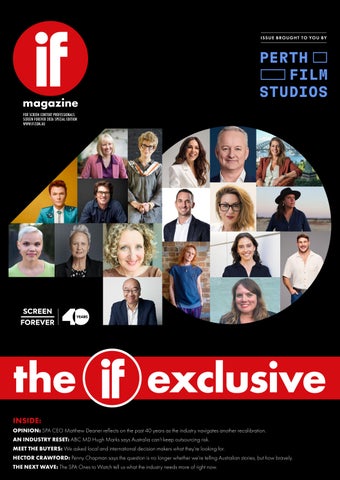
OPINION: SPA CEO Matthew Deaner reflects on the past 40 years as the industry navigates another recalibration.
AN INDUSTRY RESET: ABC MD Hugh Marks says Australia can’t keep outsourcing risk. MEET THE BUYERS: We asked local and international decision makers what they’re looking for.
HECTOR CRAWFORD: Penny Chapman says the question is no longer whether we’re telling Australian stories, but how bravely. THE NEXT WAVE: The SPA Ones to Watch tell us what the industry needs more of right now.
PRODUCING THROUGH CYCLES: 40 YEARS
OF MARKET CHANGE AND THE ROAD AHEAD
Screen Producers Australia CEO Matthew Deaner reflects on the past 40 years as the industry navigates a global recalibration.
Screen Forever’s 40th anniversary offers an opportunity to reflect not only on the longevity of our key industry gathering, but on the deeper story it represents: the evolution of Australia’s screen production market and the resilience of its producers.
Against the backdrop of the conference’s industry conversations, deal making and intense networking, Australian production has continually evolved over four decades. The feature film boom of the 1980s, supported by the 10BA tax incentive, helped propel Australian stories onto the global stage. At the same time the rise of the Australian mini-series established a distinctive long-form storytelling tradition, while the expansion of subscription TV in the 2000s introduced new commissioning pathways and creative risk-taking. Alongside these shifts, public investment frameworks and incentives such as the Producer Offset helped mature Australia’s production capability and international reputation.
The industry’s resilience has been tested repeatedly, but few moments have been as disruptive as the COVID-19 pandemic. While the sector adapted quickly, the recovery accelerated structural shifts that continue to define today’s marketplace, including buyer consolidation, more complex financing and longer development cycles.
The past decade has brought a new intensity to the market. The rapid expansion of global streaming platforms generated unprecedented demand for content, reshaping
financing structures and accelerating international collaboration. For a period, commissioning pipelines were strong and investor confidence high.
That momentum is now recalibrating. Consolidation among major buyers, a pivot from subscriber growth to profitability, and tightening capital conditions are reshaping commissioning behaviour worldwide. For Australian producers, whose businesses are closely tied to international investment flows, the effects are immediate. Expectations of “market ready” development have shifted, competition for greenlights is intensifying, and sustaining production businesses between projects has become more complex.
The introduction of local content regulation represents an important structural shift. Beyond its cultural significance, the framework has the potential to stabilise investment in Australian stories. Over time, this certainty can help smooth commissioning volatility, support sustainable business planning and enable producers to scale projects that resonate both locally and internationally.
In this environment, forums such as Screen Forever take on renewed importance. This year’s program reflects the realities of a recalibrating global market while identifying practical pathways forward.
The conference also continues to champion the creative ambition that drives the sector. Conversations exploring audience strategy, branded storytelling and global fandom, alongside
real-world case studies, highlight how producers are adapting and innovating in response to market pressure. After 40 years, Screen Forever remains both a barometer of industry conditions and a practical platform for producers to share intelligence, build relationships and position their businesses for the next cycle of growth.
There is reason for optimism. The global appetite for distinctive storytelling continues to expand, and Australian stories grounded in authentic perspective and originality are well positioned to connect with audiences seeking fresh voices. New partnership geographies and financing pathways are emerging, offering producers opportunities to diversify beyond traditional markets.
The challenge is to ensure that the structural settings underpinning screen production keep pace with an evolving global marketplace. Competitive incentives, sustainable financing pathways and stable investment frameworks will be essential to enabling producers to build resilient businesses and deliver Australian stories at scale.
Forty years of change has demonstrated that adaptability is a defining characteristic of Australia’s screen sector. While the market will continue to move in cycles, the combination of creative strength, entrepreneurial capability and collective industry leadership provides a strong foundation for the future. With the right strategic settings in place, Australian stories will continue to travel, and Australian producers will remain central to shaping the global screen landscape.
Managing Director: Simon Grover
Editor: Jackie Keast, jkeast@if.com.au
Journalist: Sean Slatter, sslatter@if.com.au
National Sales Manager: Tom Solis, tsolis@intermedia.com.au
Designer: Jacqui Cooper
Prepress: Tony Willson
Production Assistant: Tazlin Cantrill
SPA CEO Matthew Deaner.
MEET THE BUYERS
BANKSIDE FILMS
SOPHIE GREEN, head of acquisitions and development
What are you currently looking for?
We’re focused on independent films with a strong distinctive and creative voice and clear international potential. We’re always looking for films that can sit at the intersection of festival credibility and commercial viability; stories that can travel internationally but still feel culturally specific.
Recent successes?
Breakout Australian horror Talk to Me performed exceptionally worldwide. The Quiet Girl was a major international success, premiering in Berlin and securing both BAFTA and Academy Award nominations for Best Foreign Language Film. The Ballad of Wallis Island premiered at Sundance, sold globally to Focus Features and went on to win three BIFAs and received three BAFTA nominations. I Swear premiered in Toronto and led to BAFTA recognition for Robert Aramayo. Together these films reflect what we’re focused on as a company: filmmaker-led storytelling with a strong voice and emotional impact, but also clear positioning in the international market.
Tips for a standout pitch?
As an international sales company, we’re always thinking about how a film travels globally, so understanding tone, comps and positioning is always key. And keep it concise. I find the best pitches are confident, focused, and leave room for conversation.
MEDIAWAN RIGHTS
ANTOINE NUGOU, acquisitions manager
Why are you attending?
Screen Forever is the perfect opportunity to build long-term relationships between Europe and Australia from the ground up. I’m particularly interested in connecting with producers at the development stage – ideally with a local commissioner already attached or soon to be – where we can collaborate on shaping international strategies together.
What are you currently looking for?
We’re focused on two main areas: mainstream procedural crime, case of the week, shows that work for free-to-air broadcasters internationally, and genredriven content – particularly action, thriller, and crime. These genres have proven international appeal and strong commercial viability across multiple territories. Editorial quality is always central, and I’m consistently looking for projects that balance creative excellence with broad audience accessibility. Everything based on major IPs is also very relevant.
Tips for a standout pitch?
Passion is everything. I want to feel your enthusiasm for the project and understand what makes it unique to you. Focus on what sets your show apart and why it will resonate with international audiences – not just domestically. Be clear about the core of your story and how the project is calibrated for the market. Ultimately, nothing beats reading a script to truly grasp a project’s vision, so during the pitch, focus on the concept and the hook.
From the market floor to networking drinks, be ready. We asked a range of local and international buyers what they’re looking for.
STAN
DONNA CHANG, commissioning
editor (scripted)
What are you currently looking for?
Our focus is on commercially-driven television that demands attention. We’re looking for that rare combination: a premise with an instant, sticky hook and a pilot script that delivers on that promise through exceptional execution. I also love a project that comes out of left field –something that we weren’t explicitly out there looking for, but is bold and different.
Recent successes?
We’ve had some fantastic momentum lately with the beautiful family film Whale Shark Jack, and we’re looking forward to cold-case crime series The Killings at Parrish Station, medical drama The F Ward, and comedy/horror Gnomes hitting screens in 2026. A shout-out to the unscripted team as well – their work on MAFS: After the Dinner Party has been an incredible success.
Tips for a standout pitch?
1. Study our audience. Look at the Top 10 on the Stan platform daily. Over time, it will give you a keen sense of what kinds of content our audience is gravitating towards.
2. A winning pitch requires passion and conviction. If you aren’t completely sold on the idea, chances are that we won’t be either.
3. We encourage people to make their projects as conceptually distinctive as possible to stand out amongst a lot of content in the market.
4. There are lots of great ideas out there, but execution is king.
“It’s
Diana Glenn (Actor/Producer)
FOXTEL GROUP
HOWARD MYERS-RIFAI, head of unscripted originals
What are you currently looking for?
Every concept needs to be “must have” rather than “nice to have”!
I’m happy to look at all genres in unscripted, although “shiny floor” entertainment isn’t really our focus. What excites me are original ideas that truly stand out in a crowded media environment – something that will bring new audiences to our platforms and ideally also shine a light on Australia and our lives.
Beyond our usual commissioning routes, I’m open to co-productions and co-commissions, as well as brand-funded projects… but every project must be ideas-led and absolutely right for our audiences across Bing and Foxtel.
Tips for a standout pitch?
Be passionate and focussed about your idea and do your research on our platforms (Foxtel and Binge). Keep it simple, clear and concise to start with, rather than a 40-page pre-prepared pitch, while leaving some room for our input and collaboration. If possible, I also recommend having a sense of budget, finance plan or funding options. Sizzles always help to bring an idea to life.
TVF INTERNATIONAL
ALL3MEDIA INTERNATIONAL
LAUREN JACKSON, VP scripted content
What are you currently looking for?
Our scripted slate is highly varied, ranging from tentpole thrillers like The Assassin to heartwarming, returning favourites such as All Creatures Great and Small. We are looking for projects with compelling characters, set in worlds that transport audiences and deliver a clear, distinctive hook. Genres such as thrillers, detective series, and feel-good dramas are particularly appealing to us as they connect globally. We don’t take any animation or children’s content and we’re not looking for projects in the sci-fi, horror or fantasy genres.
Tips for a standout pitch?
Clear, concise and passionate pitches are always engaging. You can tell when a producer is genuinely excited about their project, so bringing that into a pitch makes it truly interesting for a buyer. If you can deliver a pitch clearly summing up an idea in a few sentences, you’ve landed on something with real appeal.
What market trends are you keeping tabs on?
Co-production is a major market trend and increasingly central to how projects get made. We’ve long partnered with Australian broadcasters such as Stan on hit series like The Tourist and we’re now seeing more projects conceived as co-productions from the outset. An example is Careless, where the story demanded it and required co-production across production companies, broadcasters etc. This is not always the easiest route for a series, but it can produce something distinctive, fresh and exciting for audiences.
The US market remains a key priority when we’re acquiring Australian series. Shows like Black Snow and Mystery Road demonstrate how long-term US partners such as Sundance or AMC can help build a show’s success across multiple seasons.
ZOE STINSON, acquisitions and productions executive
What are you currently looking for?
TVF International is always on the lookout for premium specialist factual, both series and one-off documentaries. Our tentpole genres are history, wildlife, science, and world affairs, and we also represent a strong catalogue of lifestyle, factual entertainment and true crime. We’re looking for projects with a distinctive ‘why now’, that are either linked to an anniversary, have unique access, or showcase new discoveries.
Recent successes?
We are seeing success with anniversary-driven history and world affairs that goes behind the headlines. Escape from Chernobyl: 48 Hours That Changed the World, for the upcoming 40th anniversary of the Chernobyl disaster, is attracting major interest, as is 1979: The Year of the Islamist Revolution, which provides historical context on the contemporary situation in Iran. Buzzy, clickable world affairs titles like The Ozempic Effect: Beyond the Waistline are also performing well – we sold this one
to Netflix UK & Ireland, and it has been number two in their charts.
Tips for a standout pitch?
It’s important to have a clear sense of where the project fits in the market: why would it stand out to international buyers, what kind of slots would it sell to, why this story and why now. The project should fit into a defined genre strand, and should be globally relevant. A killer title also goes a long way!
What market trends are you keeping tabs on?
We’re focusing on the steady and consistent interest in premium factual storytelling. The mantra across the industry is: fewer, bigger, better. In this risk-avoidable environment, there is less room and less budget for programming that is ‘nice to have’, and there is increasingly only space for the ‘must haves’.
OVER 80,000 PIECES OF
CHANNEL 4
FELIX JONES, acquisitions manager
Why are you attending?
The quality of series from Australia and New Zealand has been evident for some time now, and the majority now travel to the UK with considerable success. We recently acquired After The Party from Lingo Pictures and Luminous Beast, and have also pre-bought into Careless, an upcoming co-production with Stan produced by Easy Tiger and Scotland’s Synchronicity Films. With international funding now key to greenlighting drama, I’m keen to meet Australian producers who might be looking for a UK partner.
What are you currently looking for?
In our pre-buy model, we’re primarily seeking serialised crime thrillers. These series don’t have to be UK-set, but must star a key piece of local talent. We would also ask that there is a clear path to greenlight via an international commission, distribution advance, tax credits, and UK licence fee.
Tips for a standout pitch?
Streamline your premise to its essentials, but back it up after the meeting with a well-developed treatment – and of course a brilliant pilot script!
PBS KIDS
SARAH WALLENDJACK, senior director, content development
What are you currently looking for?
ABC
KELRICK MARTIN, head of Indigenous
What are you currently looking for?
ABC Indigenous commissions across multiple genres, but projects must be led from a First Nations perspective. Narrative comedy, highend drama and blue-chip factual series are our current priorities.
Recent successes?
Goolagong was massive hit for the ABC, and we’d love to see more drama projects like this. Always Was Tonight is a bold, satirical entertainment program that delivered on verve and authenticity. End Game with Tony Armstrong is a powerful doco series on racism in Australian sports. It continues to resonate in sporting circles via its impact campaign and community advocacy.
Tips for a standout pitch?
We’re very open to pitches and a great idea is just the beginning. Be eloquent, thoughtful, and practical about how you will engage an audience with your content. We know our audience very well so if you’re passionate about a subject area, come in and talk to us early. Think about your selling point, be ambitious and present us with your biggest idea.
What market trends are you keeping tabs on?
It’s not a commissioning priority, but I’m fascinated with tracking micro-drama successes. ABC Indigenous has a huge social media community, and I’m keen to see how this new format might impact Australian audiences.
PBS KIDS continues to be a home of highquality educational content for our 2 to 8-year-old audience. We want to ensure that every child in America sees themselves represented in our content, feels they belong to our audience, and is empowered and excited to explore the world around them. Our curriculum-driven content leads with great characters and stories, a smart-funny sense of humour, and memorable designs that capture children’s natural curiosity. We see a real need for programming that focuses on literacy, math and school readiness..
Tips for a standout pitch?
Put the child first. Not only what will entertain them, but also what will enrich their world and educate. We really appreciate a creator led, kid-first approach. Oh, and also, make sure you make the time to say hello! We like getting to know you just as much as we like hearing about your properties.
What market trends are you keeping tabs on?
We know that if you want to teach kids, you need to reach them. We are always looking for content that will resonate and entertain children, and aim to be in all the places kids are. We know it’s a success when we’ve made them laugh and they find ways to extend their learning and play when the show is over. We want to provide a window and a mirror to their worlds and are keeping tabs on creators and properties that are doing just that!
SHARMILL FILMS
KATHARINE THORNTON, CEO
What are you currently looking for?
At Sharmill we are focused on distinctive, director-led films that feel like true cinematic events; the kind that can connect strongly with audiences in theatres. That can range from international auteur cinema to bold documentaries and filmed theatre or cultural events. We are always drawn to projects with a clear voice, strong themes and the potential to spark conversation.
Tips for a standout pitch?
It is all about the elevator pitch. If you cannot explain why your film matters and its logline in a few words, your audience will not be able to either. Clarity around the core idea and why it is important right now is everything.
What market trends are you keeping tabs on?
It is harder than ever to cut through from a marketing perspective. Having a built-in audience is always a strong starting point. The question increasingly becomes “Who is this film for, and how do we reach them?”
40 YEARS OF SCREEN FOREVER
Screen Forever has spent four bringing Australia’s screen industry together, for business, connection and everything in between. Jackie Keast reports.
The more things change, the more they stay the same. While some of the agenda items at the first Screen Production Association of Australia conference in 1986 are of the time – “life after 10BA” being one – most wouldn’t be out of place today, some 40 years later. Sessions at the conference, dubbed ‘Take One’, were held on co-productions, marketing, alternative funding, distribution and exhibition, as well as the future of independent TV production and government support of the industry.
The first year was held in Thredbo, a deliberate choice to get people away from Sydney and Melbourne – and away from the offices of the major companies and the pull of lunches and dinners elsewhere.
In among the sessions was wine tasting, a formal dinner with “a banquet of mountain fare”, and a relaxed lunch on the green dubbed ‘Picnic at Hanging Rock’. The conference prize winners won a trip to the Cannes Film Festival. IF has been unable to establish fully what the Dead Horse Gap Mini-Marathon entailed, but it was followed by champagne on the green at 10.30am.
Producer Sue Milliken, a founding member of Screen Producers Australia (SPA), recalls a group “so full of life
and energy and enthusiasm”.
“Everybody was a bit insecure, because making films was certainly no easier than it is now. You were always living a little bit outside yourself,” she tells IF.
“So when we got together, we let it all go.”
While the bringing together of producers with commissioners, distributors, sales agents, financiers and screen agencies seems standard now, at the time, Milliken says, it was still quite novel. A new wave of government finance executives, hired deliberately from outside the industry, found themselves among what she calls “a wild bunch.” She suspects some of them “couldn’t quite believe their eyes”.
The conference, now Screen Forever, has grown considerably since. It now draws around more than 700 delegates, international keynote speakers and hosts a large marketplace. Producer Tania Chambers, a former SPA vice-president and veteran of nearly every edition, says it’s the first event she recommends any emerging producer attend, as it offers an “extremely fast learning curve on how the business operates and how the relationships operate in our industry.”
“It creates an environment where people are prepared to talk to someone they don’t know,” she says.
>> pg 14
Bob Collins at SPAA Take 7.
David Leckie.
Jane Corden and Kay Hart.
Penny Chapman and Mac Gudgeon.
Paddy Conroy and Murray Forrest, SPA Lifetime Members.
Mary-Anne Fahey and Jill Kitson‘Felicity & Felicity’
Rod Allan and Kim Williams.
Stephen Luby.
CONFERENCE FOLKLORE
Screen Forever isn’t all business. Across four decades, it has also been the site of cardboard sledding, swapped identities, all-night parties and piano sessions – along with a few stories best left off the record.
The conference celebrates its 40th edition this year, and producer Tania Chambers, a former vice-president of Screen Producers Australia, believes she’s been to most.
Those early years were slightly freer, in her view.
“People are a bit more corporate now,” she says. “A bit less fun and loose at times, and very businesslike.”
“Or maybe I’ve just been behaving more.”
At one of the early Thredbo conferences – wilder, slightly more alcohol-infused days, by her account – a handful of producers ventured onto the snowfields, ripped up boxes to serve as sleds and hurtled past the conference centre’s windowed main lounge. “I can imagine people sitting there and suddenly seeing all these crazy film people sliding down the hill on cardboard boxes.”
However, it’s a year at the Hyatt in Canberra that looms largest in her mind.
David Parker had taken command of the foyer’s grand piano, playing ‘blues’ accompanied by improvised lyrics that, in his words, “lampooned... many of the reprobates attending that conference.” He was still playing when a group came downstairs in cycling gear, headed for a morning lap of Lake Burley Griffin. A true trooper, he went up to his room, changed clothes and joined them.
Arguing across Parker’s piano at one point in the evening were Chambers and fellow Western Australian producer Sue Taylor. A spirited disagreement about their dresses somehow ended in swapping outfits entirely – only for them to forget what they’d been arguing about. The episode later gave rise to an ongoing industry rumour that they had changed openly in the foyer. “I can assure you, we didn’t,” Chambers says.
The Hyatt year also saw Chambers briefly take on a new identity, swapping badges and personas with a delegate from an international broadcaster. They adopted each other’s habits – including preferred drinks (fluffy ducks, in this case) – and Chambers even gave away pre-sale under the borrowed persona.
Another year at the Hydro Majestic in the Blue Mountains, Chambers ordered a full silver service high tea to the side of a fiercely contested tennis tournament, replete with a waiter, white cloth draped over his arm. Veteran journalist Sandy George, one of the players, doesn’t remember the tea service, but still recalls not winning.
Not all memories are quite so romantic. Producer Sue Milliken recalls one conference where three consecutive meals of chicken prompted her to ask, mid-speech, if anyone else was sick of it. “The whole place went up,” she says. “Of course, I got beaten up by the people running the conference, saying, ‘We’re doing our best’.”
Even if Screen Forever leans more serious these days, Chambers says the spirit behind thoese stories is what the conference has always been about: getting people together in person, away from their desks, in a setting where the usual barriers come down.
In an industry where personal relationships are everything, these kinds of interaction matter. Spending years developing a project with someone who isn’t enjoyable company, she says, is ‘barely worth it’.”
More than that, she says conferences like Screen Forever help build community in what can be a tough business.
“You don’t feel so alone,” she says.
“It’s like a startup business every single time you do a project. You get ‘no’ 20 times – or 100 times – for every time you get a ‘yes’.
“The sense of having other people around you and not being isolated in this business is really important.”
“Less experienced people in the industry can then get a chance to talk to the more experienced people.”
The opportunity to hear from leading creatives, both local and international, remains another draw, with Chambers arguing those speakers have often helped local producers “believe in ambition”. “Sometimes that really lifts your soul,” she says.
Further, the relationships built often have a long tail. For Chambers, based in Western Australia, the tyranny of distance makes face-to-face connection all the more valuable. She points to her recent official Australia-New Zealand co-production, God Bless You, Mr Kopu, as the culmination of roughly 30 years of turning up to events, meeting people and gradually deepening relationships. “Last year in Cannes it suddenly took off,” she says.
Milliken agrees building personal connections is vital. While there are now many large production companies in Australia compared to in the late ‘80s, a huge swathe of producers still work on their own.
“If you can pick up the phone to someone and they’ll take your call, you’ve got a quicker and a better chance of getting them to read your script and put things together,” she says.
In 40 years, some things have shifted. “In a way, nothing has changed broadly about putting your money together, but the world is very different,” Milliken observes.
Cinema “is not what it was”. Distributors are more wary. The streamers have entered the landscape, and audiences have changed. In Milliken’s view, there are less films made that are powerfully about Australian society. She also senses it’s harder to get informal support from the agencies, with more layers of bureaucracy, applications and rounds.
“You could walk into the FFC [Film Finance Corporation] at any time. If you had your investment manager, you could sit down with them and toss things around,” she says.
“There’s never been enough money. But it made you feel a bit better if you thought someone was on your side and you weren’t out there bashing your head against a wall.”
What Screen Forever has always offered, in Milliken’s view, is a particular kind of dynamic. Those early events could be “volatile, but a lot of fun”, at times boiling over as colleagues and competitors found themselves in the same room.
“It’s the group of you against the world,” she says. “But also, if they get the money before you – well you know, it’s not so good.”
Anne Bleakley Ross and Bob Campbell. David Parker.
SPAA Take 7: Kira Vecera, Selena Crowley, Michael Gordon Smith.
Brian Rosen, Vincent Sheehan, Sofia Sondervan, Deborah Zipser.
David Parker and Tait Brady.
ABC managing director Hugh Marks says Australia can’t keep outsourcing risk if it wants to retain the long-term value of its stories and build a more vibrant domestic production sector. He talks to Jackie Keast.
RISK, RIGHTS AND A RESET
Australian producers build the shows and local broadcasters help bring them to market, but international partners often take on the distribution risk, and with it, the long-term upside. ABC managing director Hugh Marks argues Australia has allowed its own financing and distribution capacity to erode, with implications for the long-term health of the sector.
Ludo Studio’s global phenomenon Bluey, estimated to be worth $US2 billion worldwide, was co-commissioned by the ABC and BBC Studios. Yet the longterm commercial benefits sit with the latter, which holds the merchandising and global distribution rights. Marks wasn’t at the broadcaster when that deal was struck, but the example reflects a broader issue he wants to address at Screen Forever.
“BBC got the rights by taking the risk on the distribution,” he tells IF.
“That’s what the market solution was at the time. And we [as Australians] do that a lot. We don’t take the risk here. We shift that offshore.”
At Screen Forever, Marks will appear on a big picture panel reimagining the future of the Australian screen industry, speaking alongside leading producers and Screen Australia CEO Deirdre Brennan. He brings to the conversation a broad perspective, having sat at many sides of the table. While now at the helm of the public broadcaster, he is a former CEO of Nine and a veteran of the production industry.
He hopes the discussion will explore how the ABC, Screen Australia and the state agencies can help to shift Australia’s risk dynamic.
“How do we change our approach to production funding programs to facilitate us being able to take on more of that risk domestically and enable us to hold onto rights that will benefit the long-term industry?”
Marks says the “complex patchwork” model of assembling international co-finance deal-by-deal can create years-long development cycles that slow everything down. In his view, Australia has allowed domestic infrastructure in gap financing, private investment and distribution to atrophy or be absorbed by international players.
“Reinvesting again in that capacity and capability domestically is an important discussion for us to have as an industry.”
The urgency is sharpened by what Marks sees as a widening gap between the industry’s potential and its ability to raise finance. While potential returns for rightholders have never been higher, international distributors are committing less to shows and pre-sales are becoming more competitive.
“While production costs are going up, finance options are decreasing,” he says.
“The gap is widening. That’s a problem.”
Among his other concerns is the commissioning pool. Unless the global streamers “significantly” lift spend on what he calls “distinctly Australian content”, rather than international production that shoots here, he sees a number of genres – including drama and high-end documentary – at risk, with children’s already largely confined to the ABC.
“You’ve got a smaller market, less production – ‘fewer, bigger, better’ – and less opportunities for development and growth.”
“Let’s assume there is no more money
ABC MD Hugh Marks.
from the taxpayer. What are the things that we can do that might contribute to a more vibrant domestic production sector, and who needs to play what role in that?”
Last year, at the National Press Club, Marks called the ABC “the nation’s town square”.
In a globalised market, Marks says the public broadcaster has a responsibility to serve a broad Australian audience –balancing specialist needs with shows that cut across demographics, like Fisk Achieving that depends on the health of the local industry.
“The role of the ABC becomes a bit more important and a bit different. We’re not just a broadcaster, we’re a cultural institution. We need a vibrant domestic production sector. We can have an influence over that.”
While Bluey is a globally successful Australian show that hasn’t been “internationalised” beyond its universal themes, there are local stories the ABC sees as important that may not travel beyond our borders. At the same time, it has to make content ambitious and distinctive enough to compete with the likes of Netflix and Amazon.
The challenge is the ABC has a fixed budget, and as Marks acknowledges, production costs are rising. Screen Australia’s most recent drama report showed in 24/25, the average cost per hour for TV and SVOD jumped 44 per cent year-on-year, from $3.6 million to $5.1 million.
Working out how the ABC achieves ambition within its budget “is my job to solve”, Marks says. At its 2026 upfronts, he promised the ABC would deliver 60 primetime premium series this year, up from 43 in 2025, and he plans to increase that number further in 2027.
“In the next two, three months, you’ll see the sorts of projects being announced by the ABC and the level of ambition in those shows. They come with a different model for financing. We are looking to reset,” he says.
“It’s picking the priorities and saying, ‘Well, okay, we’re not going to be stuck in one deal type or model’.”
Marks suggests, going forward, this could see the ABC’s slate increasingly polarise, with more hyper-local, fastturnaround content at one end, and bigger, more ambitious projects at the other, leaving less room for middlebudget commissions.
“We don’t take the risk here. We shift that offshore.”
Co-productions with international broadcasters are one tool to finance ambition, and Marks says the ABC is actively building those relationships. However, he’s reluctant to see them as the default. “Sometimes we just believe in something... and it is going to mean more contribution from the ABC to do it. We need to make that work within our budgets.”
Nowhere is the contraction of the commissioning pool more acute than in children’s television, with the ABC almost the sole home for children’s content in Australia. ACMA data show children’s TV shrank from 605 hours to just 95 from 2019 to 2022.
Marks has an unusual relationship with the issue, having been among those who advocated for scrapping commercial television’s children’s obligations when he was at Nine. He maintains children’s is not a linear viewing experience, and that building on-demand expertise in the space would require a decade of investment – an unreasonable ask of the commercial sector.
“I don’t know where the other commissioner is going to come from,” he says.
“Kids content does very well in streaming, so maybe they will look at it.”
The conditions leave the ABC with both responsibility and opportunity. It reaches 3.5 million Australian children each week, with 600,000 minutes of kids’ content viewed daily on iview. However, he’d like to see more ambitious new releases in the space.
A recently announced $50 million government allocation for both kids and drama takes some pressure off, but Marks’ bigger aim is structural: to move projects from concept to market faster by having the ABC stand behind financing, rather than waiting years for international pre-sales and distribution deals to align.
“In success, there’s upside for the ABC. We need to push more in that space.”
Marks is candid about the gaps in the ABC’s kids offering. The broadcaster is strong at the preschool end but can lose audiences as they age up. Consolidating the experience within iview could help build a continuous
relationship through childhood.
The harder problem is YA content; the Euphorias of the world. Marks admits he doesn’t yet know the solution.
“Heartbreak High did it very well, for which I’ll always give them credit,” he says, nodding to the Netflix show.
“It’s a harder category to build for an organisation like the ABC. That’s the bit that’s missing.”
Since Marks became managing director last year, he has publicly acknowledged the broadcaster’s reputation as a difficult partner for producers. In 2025, Screen Producers Australia said commissioning deals offered to producers in the prior year had “gone from bad to worse”.
Marks doesn’t dispute the tension but wants to reframe it. He argues the industry can get trapped in business affairs discussions – “scrapping about for $5,000 here and there” – missing the bigger structural questions.
At the heart of the difficult partner reputation, he says, is a rights conversation. The ABC wants more rights, because audiences no longer distinguish between iview, TV or other platforms, but this is typically something producers baulk at.
As a quid pro quo, he says the ABC needs to invest in different deals and financial models to stimulate independent production.
He acknowledges this is a hard discussion to have, requiring give and take on both sides, but suggests the industry’s interests and the ABC’s interests are aligned.
“If you imagine a world without an ABC – I think the domestic production sector would not like that world very much.”
It’s this bigger picture discussion he wants to have at Screen Forever.
“How do we reimagine all this for the future?” Marks says.
“What is going to create a bigger industry? How do we get faster to market? How do we solve some of these financing problems? What’s the right mix between internal and external production? Should we be outsourcing more, should we be doing more in-house? How do we develop talent?
“All of these things, I think, are the bigger challenges to solve.”
LESS PROTECTIONIST, MORE PROJECTIONIST
Penny Chapman intends this year’s Hector Crawford Memorial Lecture to be a provocation. The Matchbox Pictures co-founder talks to Jackie Keast about what ‘Australian content’ really means and why the question is no longer whether we tell our own stories - but how bravely we tell them.
In a world of AI, algorithms and general political upheaval, the moment calls for creative courage, according to Penny Chapman. It’s time for Australian storytelling to get “less protectionist, more projectionist”.
The producer and Matchbox Pictures co-founder will deliver this year’s Hector Crawford Memorial Lecture at Screen Forever, and tells IF she intends to use it to pull apart some of the industry’s accepted notions. While still shaping her central thesis, its spine is clear: Australian stories have the capacity to be braver, more surprising and more outward-facing.
For Chapman, the stakes extend beyond industry survival. Narrative still has the power to change lives and shape how people see the world, she argues. In today’s global climate, Australian stories have something to offer.
“We’ve got a lot to tell the world,” she says.
“We’re doing it in some ways. Bluey is a perfect example of something that not only has taken the market by storm, but is the most beautiful, astute, funny, smart observation of human behaviour. It’s incredibly brilliant.”
A more “projectionist” Australian industry, in her view, requires showrunners, producers and writers to be brave, and furthermore, persuasive, so as to “capture the commissioners in their nets”. Then commissioners, in turn, need to not bow to the algorithm or market logic.
“It is time for commissioners to stop being gatekeepers,” she says.
“If you as a commissioner can’t tell a story brilliantly, because you’ve got to persuade your superiors, you shouldn’t be doing the job.”
More simply, Chapman thinks the business succeeds on “breaking the rules”. All the films – or at least, “the good ones” – that were nominated for Oscars this year did exactly that. Australians also have form as rule breakers, going back to the ‘70s with directors like Fred Schepisi and Peter Weir.
“We’re not in this industry because we count pigs really well, you know? We’re in this industry because we’re imaginative creatures.
“We tell stories and that has no hard and fast rules; it is about the extraordinary relationship that happens when people get into a room and try and spin a tale,” she says.
Chapman’s provocations land with a particular weight right now. In February, Universal International Studios shuttered Matchbox Pictures after 18 years of operation, claiming it was “evolving its operating model in the region” and would evaluate ongoing production opportunities on a case-by-case basis.
The closure of the business, one of Australia’s most prolific and successful production companies, has been one of the biggest shocks to rock the industry in years.
While Chapman feels an “enormous sadness” for the people who lost their jobs, at the same time, she feels incredibly proud of what Matchbox achieved.
“We should celebrate that nothing lasts forever,” she says.
“There’s a hole waiting to be filled by the other incredible production companies... to be honest, I’m not depressed by it.
“All the people that came through Matchbox, the babies we nurtured –one of the things we’re most proud of – who’ve all gone on to be producers,
showrunners, commissioning editors, writers, they will take the industry forward.”
Chapman founded Matchbox in 2008 alongside Tony Ayres, Michael McMahon, Helen Bowden and Helen Panckhurst, with the company delivering 91 projects with a combined production value of $1.4 billion across its history. Her producing credits with the business include Secret City, Deadline Gallipoli, Devil’s Playground, The Straits, Leaky Boat, Sex: An Unnatural History and My Place Matchbox was born, somewhat circularly, at a SPA Conference in 2008. Chapman had long discussed working together with Ayres and McMahon – she commissioned one of Ayres’ first ever projects, Naked: Stories of Men, when she was at the ABC – and on the final day of the event over a cup of tea, the trio decided to “stop mucking about”.
They then brought Bowden and Panckhurst into the fold, initially intending to maintain separate companies while sharing resources like business affairs. That pragmatism was short-lived. An advisor made it clear they needed to fully amalgamate, formalising Matchbox as a single entity.
In those early days, coming together was purely about financial survival, Chapman admits, not “a whole magical realist dream about what we might be doing creatively.”
However, they put a mission statement together – firstly to help attract finance, but secondly to set a foundation of how they would work together. One tentpole was to relish the writer and their place in the development process. The other, with longevity in mind, was the need to build a scene of young talent.
“None of us were spring chickens by that stage,” she says. “We knew that in
“It is time for commissioners to stop being gatekeepers.”
order for the company to flourish, we needed to build a really strong young creative and business team who would take the company forward. We’re really proud of what occurred out of that.”
2011’s The Slap was an early success which, in Chapman’s view, showed how its relationship with writers delivered creative dividends. She pays credit to “hyperactive genius” Ayres. “You watch him work in a writer’s room, and he is just beautiful, the way he understands writers being one himself.”
The Slap was widely regarded as a turning point for the international perception of Australian drama.
DCD Rights sold it around the world, including to the BBC, Arte, SundanceTV and DIRECTV, and struck a format deal in the US. CEO Nicky Davies Williams has said it helped convince global buyers Australian scripted TV could be world class.
“That helped inform everything we did going forward. That relationship between the producer and the writer is the foundation of the industry,” Chapman says.
“No doubt in my mind, or Tony’s mind, that that’s the secret. And once you get the secret right, you’re in pretty good territory.”
Chapman says the rise in respect for writers is the biggest shift she’s seen in her career, noting Australia was slow to adopt an approach long embedded in the US. During her time at the ABC in the ‘90s, first as head of TV drama and later head of television, and at the Australian Film Commission, she observed many producers had “little to no” respect for writers.
“They weren’t allowed in the set, they weren’t allowed in the edit room; they were regarded as people for hire. ‘Just write it, and don’t make my life difficult’. I think those people got the scripts they deserved, really. It’s been very satisfying to see how the writer has become such a powerful force in the industry these days,” she says.
Chapman’s time at the ABC, where she commissioned and executive produced dramas including Brides of Christ, The
Leaving of Liverpool and Blue Murder, was a vital experience in shaping who she is a producer – and her ongoing view of commissioners.
It was her predecessor at the broadcaster, Sandra Levy, who gave her one of the best pieces of advice she’s ever received: “All the TV executives up on the hill will tell you it can’t be done. Do not listen to them.”
“The day before The Leaving of Liverpool went to air, one of the senior executives in the ABC said to me as he was crossing the car park: ‘That show will fail. Nobody wants to see a show that dark’... The figures the next day were 2.4 million. We didn’t get figures like that ever.
“They will take no shit, I love it,” she says.
“I have such great hope for the industry because of those smart little brains.
“I thought, ‘[Levy’s] right. She’s absolutely right. It pays as a commissioning editor to have the minimum amount of respect required for your betters, for your seniors, and for the algorithm.
“There were times when this was wonderful. We made wonderful shows that got fantastic responses. Then there were times when shows completely flopped – not saying that approach is a sure-fire recipe for success. But, gosh, it makes for a braver industry.”
What producers should expect from their commissioning editors is one of the key themes Chapman wants to interrogate in her lecture. Another is the idea of what makes an Australian story.
On the latter, she argues it’s not about how many disparate parts of the country are incorporated into a show, or whether the kids at school wear uniforms “which is specious in the extreme”, referencing Netflix’s Heartbreak High, created by her daughter Hannah Carroll Chapman. Instead, she says, it’s about attitude.
“It’s that line that Amerie says to Malachi in the first episode of [Heartbreak High].
“He sits down and she says ‘What, cunt?’
“You wouldn’t see that in too many other worlds, too many other industries.”
Through her relationship with her daughter, Chapman has come to know a new generation of writers and producers, who are “rude and perceptive and full of compassion”.
“I happened to be on the periphery of Hannah working with her writing group, many of whom were quite green. I watched the way she mothered those writers, and I thought, ‘I am learning lessons here I never knew I would.’ I was just gobsmacked. People say to me, ‘You must be so proud of her’. Pride involves the concept that you had something to do with it. I had nothing to do with it. I have so much to learn from her and her cohort.”
Chapman says the idea that Australians need to tell their own stories has become almost platitudinous, and at times, the conversation around it “a little smug”. While the idea is still important, she says we need to better interrogate how Australians tell their stories: “how bravely we do it, how originally we do it”.
“It’s not good enough just to be ticking boxes. That’s not going to make our industry strong. It’s got to be engaging. It’s got to be connecting. People who tick the boxes on whether it’s Australian or not, if they sit in offices and they don’t have conversations with the people who are trying to make these shows, then they shouldn’t be doing that job either,” she says.
“Connect! It’s vital. And debate; have the debate about whether you think this is ‘about us’ and whether we should be taking it to each other and therefore to the world.
“The things that have worked so well in the world are shows that – somebody in a backyard slaps a kid’s face. That becomes a hit. It’s not about whether that was Australian or not. It was about how brilliant it was and how truthful and rude and original.”
Penny Chapman.
THE NEXT WAVE
As Screen Forever marks 40 years, SPA’s Ones to Watch program highlights the producers shaping what comes next.
WHAT’S ONE THING THE INDUSTRY NEEDS MORE OF RIGHT NOW?
We asked a selection of SPA’s Ones to Watch cohort the same question about the state of the industry.
ALZBETA REKOSH
Boho Films, WA
Mentor: Laura Waters, Princess Pictures
A stronger focus on marketing and audience engagement strategy. We need more robust conversations regarding how Australian stories can better compete for and capture modern audiences. This requires both specialised training for producers and a shift in financing structures to ensure budgets allow for a more competitive investment in marketing.
KATE BOYLAN-ASCIONE
Fresh Basil Films, QLD
Mentor: Camilla Mazzaferro, Songbird Studios
We need to swing for the fences creatively, despite tightening budgets and risk-averse commissioning. When uncertainty rises, it’s instinctive to think conservatively, but that instinct is exactly what we need to resist. Our industry is built on creativity and original thinking. The moment we retreat into templates and tested formats, we lose our unique voice and shut the door on the ideas that could define the next era of Australian film.
LAWRENCE PHELAN
Recliner, VIC
Mentor: Lois Randall, Magpie Pictures
I think the industry needs more bravery. The past few years of Australian film and television have shown that the biggest successes often come from bold, unapologetic voices. We need production companies, commissioners and screen bodies to take more risks on ambitious ideas. When those risks pay off, it lifts the entire industry.
SABIN GNAWALI
SGT Productions, NSW
Mentor: Imogen Banks, Kindling Pictures
More audience engagement. We need stronger conversations around how Australian films can reach wider audiences and how we can encourage more people back into cinemas. Great storytelling matters, but so does building a stronger relationship between Australian films and the audiences they’re made for.
RENNY WIJEYAMOHAN
Open Door Films, NSW
Mentor: Debbie Lee
Collectively the industry, both here and abroad, is going through a period of consolidation right now, but I think now more than ever we need to take some big swings. There is so much creative potential in this country, it would be great to harness that to start pushing the boundaries of what “Australian content” means both locally and abroad. We’ve seen it done with hit shows in the US and the UK, like Beef and I May Destroy You and it’s time to do it here. When the world is changing so fast and audiences are becoming increasingly sophisticated, there’s not only an opportunity but an appetite for what’s “new”.
OTHER ONES TO WATCH THIS YEAR:
• Ellen Dedes-Vallas, Fat Poodle, NSW. Mentor: Helen Bowden, Lingo Pictures
• Mimo Mukii, Ten Days, VIC. Mentor: Joanna Werner, Werner Productions
SAM PRICE
Pathline Pictures, QLD
Mentor: Liz Watts, See-Saw Films
Hope! It’s been a difficult start to the year globally, and while things are feeling uncertain, there is so much to look forward to this year. I’m looking forward to a positive and engaged Screen Forever.
Vanilla/Wooden Horse, NSW
Mentor: Luke Wheatley, In Three Production
More mentorship and clearer pathways for female and non-binary filmmakers. A lot of recent TV shows and feature films that have really cut through have created platforms for emerging male directors (all of whom I personally adore, by the way) but I’d love to see many more incredible young female and non-binary directors cutting through in the same way. I also think there needs to be much greater literacy for younger and emerging film teams around private investment. For a lot of the industry, it still feels quite unapproachable and peeling back the layers on how that financing actually works would empower more producers to see it as a viable pathway for getting projects off the ground.
AT THE CROSSROADS OF OLD AND NEW
Caden Pearson, one of this year’s Ones to Watch, is navigating the evolving pathways into the industry.
Cairns-based First Nations writer, director, and producer Caden Pearson is stepping up at Screen Forever this year, not just as a participant in Screen Producers Australia’s Ones to Watch program, but as a session programmer.
Pearson, who attended the conference for the first time in 2025, is behind ‘Fandom Is the New Audience Strategy’, a session exploring the intersection of audience-building, fandom, financing, and distribution. Moderated by Nicholas Verso, it will include speakers Elsie Choi, head of scripted at CJ ENM America; author and BookTok content creator Luke Bateman; Australian Production House executive producer Louise Schultz, and The Wise Group/XYZ Films MD Marci Wiseman.
SPA programs manager Kristen Hodges invited Pearson to select a session to produce from a shortlist of topics that existed only as titles at the time. He chose the subject out of an interest in the creator economy and how shifting audience dynamics are reshaping what success looks like for producers.
“Could you be happy with having a very sustainable career online, and that be just as validating as a Netflix deal?” he says.
“I have met producers who have made some titles that everyone knows but they don’t have money. What does validation and success look like? That excites me and I think the panel will have a bunch of different perspectives.”
For Pearson, those questions stem from an early crossroads in his own career.
“When I was starting out, YouTube and that whole world was only just [starting] to look appealing. You were starting to see your first extraordinarily successful creators on that platform,” he says.
“I was looking at this path in front of me, thinking there were a couple of different ways I could go. One was going all in as a creator and see how that goes, or there is the more traditional pathway, which has this lovely aura around it.”
He chose the latter, entering the industry via Screen Queensland’s Indigenous Shorts Program in 2018 with Walter’s Ghost. He went on to write, direct, and produce 2020 NITV half-hour documentary Wawu Divine Hope, supported by Screen Queensland, which has also backed his development through First Peoples: First Draft, a SQhub residency, attachments on Robbie Hood and Love and Monsters, and an SQ Mentorship.
Last year, Pearson made his feature debut as a producer on James Ivor and Eryk Lenartowicz’s Storm Bird, filmed over four weeks in regional North Queensland, with a festival run planned.
His focus now turns to his first feature as a writer/director, an expanded version of Walter’s Ghost. The project follows a psychic live streamer ambushed by true crime podcasters over the cold case murder of a former schoolmate, a case she has long avoided. Deciding to step out from behind the screen, she sets out to confront her past trauma.
The project is part of a slate Pearson is bringing to Screen Forever, and he also plans to submit it to AACTA’s Regional Landscapes initiative.
In the meantime, he is getting advice from his Ones to Watch mentor, Deadhouse Films’ Enzo Tedeschi, producer of the upcoming Gen Z thriller Crashout.
“He’s been helpful in filling the gaps in my knowledge around financing and the nitty-gritty side of putting a budget together for a feature. It’s quite invaluable.”
By Sean Slatter
VANILLA TUPU
GO GLOBAL
IF chats with international producers who will be on the ground at Screen Forever looking for Aussie partners.
TRI-MOON FILMS, IRELAND
SAM ATWELL, producer
What’s your company’s focus?
Tri Moon Films is a production company in, Sligo, in the Northwest of Ireland. We are a full-service production company with post house, casting, line production services and plans to build a studio. We work in scripted and unscripted film, TV and podcast and our mission is to give a voice to the underrepresented in front of and behind the camera. We are passionate about continuing to build a sustainable industry in our region, attracting international co-productions to help achieve that.
Recent successes?
Our recent Christmas heist feature, You’ll Never Believe Who’s Dead, written and directed by Sligo native, Dallan Shovlin, which we co-produced with Wildcard and Fine Point films, has just been picked up by Bankside and will be released at the end of 2026. This is a Screen Ireland/Northern Ireland Screen funded film entirely shot in Sligo with a fantastic cast including Stephen Rea, Ardal O’Hanlon, Michelle Fairley and Peter Claffey.
What are you looking for in Australia?
We are always on the lookout for organic and authentic co-productions between Ireland and Australia where we can be involved on a creative level, have something to say about the world, could be an agent of change and are mutually beneficial to both parties.
SWEETSHOP ENTERTAINMENT, NZ
MADELEINE ASKWITH, producer
What’s your company’s focus?
We champion diverse voices and authentic perspectives, delivering cinematic, culturally rich stories that inspire, entertain, and endure locally and universally. Working across genres and formats, our focus is on premium narrative, ambitious factual, and unique children’s animated content. We are particularly drawn to stories with a strong sense of authorship that are locally grounded but internationally resonant. Whatungarongaro te tangata, toitū te kōrero (People pass on, but stories endure).
Recent successes?
Our recently released feature film Mārama demonstrates our company’s ability to champion diverse and culturally rich stories. Set in North Yorkshire in 1859, the Māori gothic horror follows a young Māori woman who is summoned
OCON, KOREA
MINSEOUNG GIL, media license business/manager
What’s your company’s focus?
OCON is a Korean animation company focused on creating and producing original animated IP. We are particularly passionate about 3D animation, especially character-driven commercial projects with strong onesource multi-use potential.
Recent successes?
One of our most recent and successful projects is the Pororo theatrical film series. The first Pororo movie was released in 2013, and since then we have produced and released a total of ten theatrical films.
What are you looking for in Australia?
We are attending Screen Forever to explore both co-production opportunities and new distribution partnerships. In particular, we are looking for potential partners for a new theatrical project featuring Loopy, a popular spin-off character from the Pororo franchise. We understand that Australia has strong expertise in CG production. At the same time, the Pororo theatrical films have not yet been widely distributed in Australia, so we are also excited to connect with partners who may be interested in bringing these titles to Australian audiences.
from New Zealand to England. There, she uncovers a horrific colonial heritage and is compelled to confront and destroy the Englishman who devastated her family. Mārama premiered at TIFF 2025, was released in New Zealand in February and will be released in cinemas across the US on April 17.
What are you looking for in Australia?
With our narrative work we’re interested in official New Zealand–Australia co-productions that combine NZ production with Australian post-production and VFX, assuming a 75/25 or 70/30 split. With our children’s content, we’re looking for 50/50 or 60/40 partners who have experience in feature or serial animation. Beyond our existing development slate, we are always looking for new projects and will use this opportunity to find partners who share an appetite for bold, culturally specific storytelling which can bring together talent from both countries. in front of and behind the camera.
Perth city skyline. Courtesy of Tourism Western Australia.