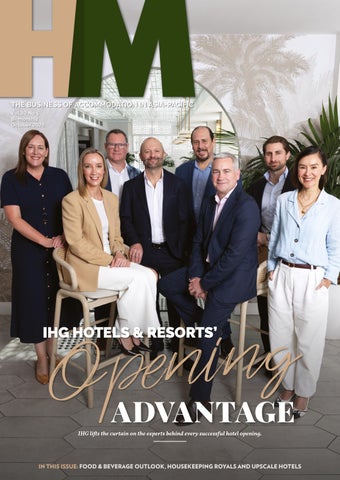
THE BUSINESS OF ACCOMMODATION IN ASIA-PACIFIC Vol.30 No.5 Bi-monthly October 2026
g n i n e p O
IHG HOTELS & RESORTS’
ADVANTAGE
IHG lifts the curtain on the experts behind every successful hotel opening.
IN THIS ISSUE: FOOD & BEVERAGE OUTLOOK, HOUSEKEEPING ROYALS AND UPSCALE HOTELS
Foxtel Business iQ is more than just entertainment. It’s a powerful way to inform, engage and impress your guests from the moment they turn on the TV. Whether guests are staying for one night or several, there’s always an opportunity to make their experience easier and more enjoyable. Foxtel Business iQ helps you showcase your property’s best features directly through the in-room TV.
Promote your amenities via the on-screen compendium
FOXTEL DPS Use carousel welcome screens to promote different amenities, services or offers
Book an in-person or online demo today. Call 1300 792 883
Or visit www.foxtel.com.au/biq for more information *Movies included when you take the Movie Vault add-on pack. Some channels not available in public viewing areas. This product is available to Foxtel Business subscribers only. Requires purchase of 100% of screens within the site and a minmum subscription volume of 10 screens per site excluding any lobby bars. Requires internet connection.
Here’s how it works:
Drive bookings for your services
FOXTEL DPS
Add your own channels such as a welcome channel
2026
TWO AWARD NIGHTS, ONE INDUSTRY CELEBRATION GALA DINNER FRIDAY 20 NOVEMBER 2026 THE FULLERTON HOTEL SYDNEY
AOTEAROA-PACIFIC WINNERS DINNER FRIDAY 30 OCTOBER 2026 HILTON AUCKLAND
Bring your team and be in the room when this year’s winners take the stage. Individual and table tickets on sale now. For all enquiries, please contact events@intermedia.com.au
hmawards.com.au
Our 2026 Sponsors and Partners Hosted By
Co-Hosted By
Presented By
Emerald Sponsors
Gold Sponsor
Silver Sponsors
Bronze Sponsors
In Association With
Supporting Partners
Organised by
CONTENTS
36 FUTUREPROOFING HOTEL ASSETS
Escalating operating costs, ageing assets and technical labour shortages are driving hotel operators to rethink traditional facility management models.
38 F&B OUTLOOK
The Food and Beverage industry is entering a sophisticated new era of innovation.
48 DRESSED TO IMPRESS
Storytelling begins as soon as a guest is greeted at a hotel, with uniforms playing a key role in that experience.
50 NAVIGATING THE FUTURE OF F&B
As the Food and Beverage industry battles talent shortages, education is proving a powerful driver for modern hotel operations.
52 ROOM ROYALS
A spotlight on dedicated top performers to celebrate the annual International Housekeeping Week.
54 AOTEAROA
ACCELERATES
72 A PERFECT STORM
Constrained supply and surging demand are driving a powerful resurgence in NSW and the ACT’s hospitality sectors.
OCTOBER 2026
Vol. 30 No.5
74 FRANCHISE FUTURE The hotel franchising model is expanding rapidly and across diverse tiers.
HM Q&A
28 TREMENDOUS
OPPORTUNITY
BWH Hotels doubles down on Australasia growth, glamping and technology investment.
38
32 ISLAND OASIS
As one of Hong Kong’s most iconic hotels, the Island Shangri-La has unveiled new spaces to ease the fast pace of city life.
34 MARRIOTT BULLISH ON ASIA PACIFIC EXPANSION Marriott International is experiencing phenomenal growth right across Asia Pacific as demand for new hotels continues at a record pace.
52 The latest in F&B innovation across the hospitality landscape Celebrating International Housekeeping Week
Positivity returns to New Zealand hotels as investor confidence rebounds.
62 JAPAN IN
TRANSITION Japan’s hotel sector enters new era of ‘quality growth’.
65 MAGNIFICENT MALDIVES
AHICE Maldives to attract leading investors, hoteliers and executives.
66 SURGING
STRENGTH Australia’s Upscale and Upper-Upscale hotel sector is entering a period of significant pricing power.
6
HM The Business of Accommodation
28
BWH Hotels doubles down on Australasia growth
REGULARS 54
08 EDITOR-IN-CHIEF’S LETTER
James Wilkinson on boosting global travel.
10 EDITOR’S LETTER
THE BUSINESS OF ACCOMMODATION IN ASIA-PACIFIC Vol.30 No.5 Bi-monthly October 2026
Daisy Melwani’s take on hotel F&B.
12 NEED TO KNOW A snapshot of the most essential stories you need to know.
16 COVER STORY
IHG lifts the curtain on the experts behind every successful hotel opening.
e n ing OpADVANTAGE
IHG HOTELS & RESORTS’
IHG lifts the curtain on the experts behind every successful hotel opening.
IN THIS ISSUE: FOOD & BEVERAGE OUTLOOK, HOUSEKEEPING ROYALS, UPSCALE HOTELS
On the cover
IHG Hotels & Resorts’ opening advantage
All the action from AHICE AOTEAROA
EDITOR-IN-CHIEF’S LETTER
Flying farther, boosting global travel
F
or many Australian travellers, the prospect of flying direct to London and New York from Sydney has always been one of the final frontiers in travel and finally, it is edging closer to reality. Qantas has finally revealed the date for its first ’Project Sunrise’ services to London and New York, with brand new, specially modified Airbus A350-1000 ultralong-range aircraft set to take flight on the routes in October 2027 and mid-2028, respectively. Project Sunrise was first revealed in 2017 and when the first Qantas jet takes off for London next year, some 10 years after the announcement, yet another frontier will be conquered in aviation and, at the same time, it will provide a big win for tourism on both sides of the world. “Conquering the tyranny of distance has been part of who Qantas is from the very beginning,” Qantas CEO, Vanessa Hudson said. “Reaching New York non-stop completes a vision we set out many years ago, and it’s a moment of enormous pride for the thousands of our people who have been working hard to make Project Sunrise a reality.” Since 2018, Qantas has been flying direct between Australia, the United Kingdom and Europe in the form of services from Perth to London, Rome and Paris, and the new direct flights from Sydney to Heathrow change that game even more. What’s exciting for me is Qantas being able to connect New York direct from Sydney, which will provide a major tourism boost thanks to the immense tourism appetite of American travellers. Qantas has got close to New York direct – there are flights to Dallas Fort Worth from Sydney and Melbourne, and the Flying Kangaroo operates to Kennedy Airport non-stop from Auckland – but these new services will truly give Qantas a massive X-factor against its competitors. “New York has always captured the imagination, and for generations, reaching it from Australia has meant breaking up the journey somewhere along the way,” Hudson said. “From 2028, our customers will be able to board in Sydney and arrive in New York around 18 hours later without stopping once, cutting around three hours off the current fastest travel time. “That changes what’s possible for travel between our two countries.” Whether people want to take three hours off their travel time or fly the route for the novelty factor, there’s no doubt the flights will be a success for Qantas, and both Sydney and the greater Australian accommodation sector. More flights mean more tourists, and that equates to higher occupancies, and I look forward to seeing the impact the new flights have on the inbound market. We’ve just held some exciting AHICE events in Christchurch and Tokyo, which both saw greater delegate numbers this year, and if you missed them, you can catch all the highlights in this issue. Enjoy our latest issue of HM, and as always, I look forward to your feedback.
The HM global hot list
Hotels around the world capturing our attention this month. ONE: Regent Santa Monica Beach @regentsantamonica
TWO: OUTRIGGER Reef Waikiki Beach Resort @outriggerreef
THREE: Fairmont Tokyo @fairmonttokyo
FOUR: Pan Pacific London @panpacificlondon
Yours in hospitality,
James Wilkinson Editor-In-Chief, HM magazine Chair & Convenor, AHICE global conferences
Qantas will offer direct flights to London from October 2027
8
HM The Business of Accommodation
FIVE: Eos by SkyCity, Adelaide @eosbyskycity
EDITOR’S LETTER
Sweetening the stay
Managing Director
H
Simon Grover
otel food and beverage venues have become one of the most fiercely contested battlegrounds in hospitality, and for good reason. In a climate where competition is rife, operating costs are high and savvy consumers are watching their wallets, hotel owners are examining every possible revenue stream and turning their focus to F&B to work harder for the bottom line. It’s now customary for hotel openings to generate as much noise around their restaurants, bars and dining concepts as they do their rooms and suites. Celebrity chef announcements have become standalone headlines, and they certainly make an impact. The shift towards attracting as many locals as in-house guests is shaping boardroom conversations and driving a more strategic approach. In this issue, we examine partnerships with external operators, ethical sourcing of produce, the use of technology to support sustainability, more flexible dining options and localised concepts as some of the innovative ways the sector is rising to the challenge. In an industry where margins are tight, staff training and retention remain difficult, and women are often under-represented. We turn the spotlight on culinary education as well as initiatives designed to further the careers of women in food. As greater focus is placed on creating dining-led experiences, we also look at how uniforms play a role in setting the tone and helping to create a memorable occasion Hotel food and beverage has moved well beyond the entrée, and from where I’m sitting, dessert is still to come. I look forward to the conversations ahead.
Daisy Melwani Editor, HM Magazine
Publisher James Wells
Editor–In–Chief
James Wilkinson jwilkinson@intermedia.com.au
Editor
Daisy Melwani dmelwani@intermedia.com.au
Group Commercial Manager
Tara Ducrou tducrou@intermedia.com.au
Production Manager Jacqui Cooper jacqui@intermedia.com.au
Graphic Designer Ryan Vizcarra
Photography
Cover and cover story photography by Oneill Photographics
Subscription enquiries
1800 651 422 Subscribe to HM Magazine – 6 issues for AU $88 (inc. GST) subscriptions@intermedia.com.au
Published by
41 Bridge Road, Glebe NSW 2037, Australia. (PO Box 55, Glebe NSW 2037, Australia) Tel: +61 (0) 2 9660 2113 Fax: +61 (0) 2 9660 4419 ABN 940 025 836 82
In association with
Award-winning Chef Pam will lead bespoke restaurants at Crown Sydney and Crown Perth, marking a rise in female talent across the industry (page 40)
We unpack the latest F&B innovations (page 38)
MEET THE HM TEAM…
James Wells Publisher
10
Tara Ducrou Group Commercial Manager
HM The Business of Accommodation
James Wilkinson Editor-in-Chief
Renita Collins Director, Events and Marketing
DISCLAIMER This publication is published by Travel Business Media Pty Ltd (the “Publisher”). Materials in this publication have been created by a variety of different entities and, to the extent permitted by law, the Publisher accepts no liability for materials created by others. All materials should be considered protected by Australian and international intellectual property laws. Unless you are authorised by law or the copyright owner to do so, you may not copy any of the materials. The mention of a product or service, person or company in this publication does not indicate the Publisher’s endorsement. The views expressed in this publication do not necessarily represent the opinion of the Publisher, its agents, company officers or employees. Any use of the information contained in this publication is at the sole risk of the person using that information. The user should make independent enquiries as to the accuracy of the information before relying on that information. All express or implied terms, conditions, warranties, statements, assurances and representations in relation to the Publisher, its publications and its services are expressly excluded save for those conditions and warranties which must be implied under the laws of any State of Australia or the provisions of Division 2 of Part V of the Trade Practices Act 1974 and any statutory modification or re–enactment thereof. To the extent permitted by law, the Publisher will not be liable for any damages including special, exemplary, punitive or consequential damages (including but not limited to economic loss or loss of profit or revenue or loss of opportunity) or indirect loss or damage of any kind arising in contract, tort or otherwise, even if advised of the possibility of such loss of profits or damages. While we use our best endeavours to ensure accuracy of the materials we create, to the extent permitted by law, the Publisher excludes all liability for loss resulting from any inaccuracies or false or misleading statements that may appear in this publication. Copyright © 2026 – Travel Business Media Pty Ltd.
NEED TO KNOW The essential hotel and travel industry news and trends from across the globe. Read more at hotelmanagement.com.au
Barefoot luxury Journey Beyond greenlights a $5 million Sal Salis Ningaloo Reef upgrade.
Sal Salis redesigned sundeck and central lounge render 12
HM The Business of Accommodation
SAL SALIS NINGALOO Reef will undergo a major refurbishment set to reimagine the ecoluxury property. The Journey Beyond property will elevate its eco-luxury experience with fully redesigned Wilderness Tents featuring private ensuites, alongside a reimagined reception, sundeck, and lounge complete with thoughtfully designed furniture, statement lighting and soft furnishings throughout. Design firm Woods Bagot will lead the redesign, with the property to also feature a new dining area with banquette-style seating and an all-inclusive open bar when it reopens in March 2027.
“The new look and feel remains true to the natural beauty of Sal Salis, with a refurbishment that is sensitive to the environment and designed to sit harmoniously within its surroundings. We’ve focused on the details that matter to our guests, while keeping the barefoot luxury that makes Sal Salis so unique,” Journey Beyond CEO, Chris Tallent said. Set on the Cape Range National Park, Sal Salis Ningaloo Reef features 16 eco-luxury Wilderness Tents with guests given direct access to the UNESCO World Heritage-listed Ningaloo Reef, one of the world’s largest fringing reefs.
NEED TO KNOW
IHG signs mega-deal
The franchise agreements for the 130-room
“This is a significant long-term development agreement for IHG in Australia. Establishing a portfolio of at least 15 hotels and 2,000 rooms with one development partner gives us a clear pathway to build a meaningful position in the extended-stay segment, where we see considerable longterm opportunity,” IHG Hotels and Resorts Managing Director, Australasia and Pacific, Matt Tripolone said. Speaking exclusively to HM, IHG Director of Development Australasia and Pacific, Cameron Burke added: “This agreement is significant because it establishes a platform for the national growth of Staybridge Suites with a proven development partner, allowing us to build immediate momentum from our first two signings while strategically expanding into the right markets across Australia”.
Staybridge Suites Sydney Parramatta and the 112-room Staybridge Suites Sydney Leppington have been sealed and will be managed by Signature Hotel Management Group, led by Dimitri Karam.
The latest signing marks an established relationship between the hotel giant and ALAND, which includes last year’s opening of the 130-room Voco Gosford within the property group’s Archibald precinct.
IHG Hotels and Resorts and property developer ALAND have signed a landmark Master Development Agreement to bring the upscale extended-stay brand, Staybridge Suites, to Australia.
Staybridge Suites Leppington Render UNDER THE DEAL, ALAND will have exclusive rights to develop a portfolio of at least 15 Staybridge Suites hotels totalling at least 2,000 rooms nationwide, with the first two slated for Parramatta and Leppington in Greater Western Sydney.
Cameron Burke, Matt Tripolone, Andrew Hrsto and Dimitri Karam at the signing of the landmark Master Development Agreement to launch Staybridge Suites in Australia
Where hospitality’s next leaders are made torrens.edu.au/blue-mountains-hotel-management-school Torrens University Australia Ltd, ABN 99 154 937 005, RTO No. 41343, TEQSA Provider ID: PRV12209 (Australian University), CRICOS Provider Code: 03389E T/A Blue Mountains International Hotel Management School at Torrens University Australia (Sydney and, Blue Mountains, Melbourne, Adelaide). Information provided in this document is current at the time of publishing (Aug 2026). T2557
hotelmanagement.com.au
13
NEED TO KNOW
Accor hints at return of iconic brand to Brisbane CBD Accor is set to bring back one of its most recognisable brands to Brisbane’s CBD through a new conversion deal.
Peppers Clear Mountain is the only five-star luxury retreat in the City of Moreton Bay. (Right) Accor’s Adrian Williams outlines Queensland opportunities ACCOR CHIEF OPERATING Officer in the Pacific region, Adrian Williams, has revealed the hotel giant had finalised a deal that will see “the return of one of our iconic brands to the Brisbane CBD”, describing the project as another sign of the company’s growing confidence in the Queensland capital and broader regional market. “We’ve got a new brand coming back. Well, one of our iconic brands coming back into Brisbane in a new project,” Williams said. “Unfortunately, we’ve literally just signed. The ink hasn’t even dried, so we can’t share it.” However, Williams confirmed it would involve the repositioning of an existing property. “It’s a conversion,” he said.
While the brand remains under wraps, Accor executives indicated the announcement is imminent, with the deal expected to be unveiled before the year’s end. The forthcoming project forms part of a broader expansion strategy for Brisbane and Queensland, where the group has over 90 properties. In September, Mandala Hotels and Resorts unveiled its transformation of the Mercure Clear Mountain into Peppers Clear Mountain, marking a significant new chapter for the property and the region. The repositioning has set a new benchmark for the area, becoming
Cleared for take-off Atura Oran Park will be the first major hotel to land as Western Sydney International Airport readies the runway. AS WESTERN SYDNEY International Airport gears up for its first commercial flight in late October, a new hotel is preparing to open just 20 minutes away as investment and development across the region gathers pace. Developed in partnership between the Perich family and EVT Hotels and Resorts, Atura Oran Park is on track for its late October debut, bringing 184 rooms and suites, along with F&B and conference facilities to the area. The hotel will feature an Italian-inspired restaurant and bar, resort-style pool and terrace, and generous communal spaces as well as flexible conference and event facilities to cater to a growing leisure and corporate market. Positioned in the centre of Oran Park Town, the region is forecast to expand to more than 14
HM The Business of Accommodation
50,000 residents over the coming decades, while Western Sydney International Airport will welcome millions of passengers annually. “We’re opening at a time when South Western Sydney is experiencing extraordinary growth and momentum, and being the closest hotel to the new Western Sydney International A render of Atura Oran Park
the only five-star luxury retreat in the City of Moreton Bay. According to Williams, the state is entering a new phase of growth as tourism demand strengthens and investment activity accelerates ahead of the 2032 Olympic Games. “Blue skies for Queensland. Blue skies for Brisbane,” Williams said. “The market is moving well. We’ve got good demand coming into the city and good air capacity coming into the airport. “We’ve got product refurbishments underway at the Mercure Spring Hill; we’ve got multimillion-dollar refurbishments completed. “And of course, the hotel that we can’t announce yet is coming, which is all showing that sense of optimism that we have in the Brisbane and broader Queensland market.” Williams added that Accor’s focus on Brisbane continues to grow as the city matures into a destination attracting both leisure and business travellers. “We said 12 months ago that the opportunity for Brisbane is immense,” he said. “The Olympics, we think, are wonderful because it shines the spotlight on Brisbane. “But the story of Brisbane is not the story of the Olympics. That’s just that kind of cream on the top. It’s the moment to focus on. But the optimism that sits behind that is really the story.
Airport puts us in a commanding position to support travellers in and out of Sydney,” Atura Oran Park Area General Manager, Shannon Craig said. “Together with the Perich family, we’ve designed a hotel that feels open, vibrant and full of energy, with beautiful communal spaces, generous outdoor areas and places where people naturally want to spend time. The accommodation has been equally considered, with a mix of room categories catering to everything, including both overnight visits and extended stays. It’s contemporary and welcoming, with a design language that draws on the region’s motorsport ties and the Perich family’s heritage, creating a strong sense of place and connection to the neighbourhood that sits at the very heart of Atura.” Atura Oran Park joins existing properties in Blacktown, Albury, Dandenong and Adelaide Airport. EVT Hotels Group GM, Callum Kennedy, said Oran Park was a natural fit for the Atura brand.
NEED TO KNOW
Heritage Icon Paradox eyes major development for Sydney hotel. PARADOX HOTEL GROUP is looking to deepen its presence in Australia, with CEO Tiah Joo Kim revealing ambitions for further hotel investment and development, while progressing plans for a significant expansion of its Sydney property. Tiah said the company sees strong longterm opportunities in the region and is keen to grow beyond its existing footprint of Paradox Sydney. “We would love to grow, do more business here organically, in this part of the world,” Tiah said. The company is currently pursuing a vertical extension at the heritage-listed 364key Paradox Sydney in the city’s CBD, which celebrated its first anniversary after being rebranded from Radisson Blu in July 2025.
The heritage-listed Paradox Sydney was rebranded from Radisson Blu in 2025 “We’re actually pursuing a vertical extension because this is a heritage building,” Tiah said. “So we want to do a modern extension on the top, and we’re just going through that process now with the city.” While plans are still being refined, Tiah confirmed the project is firmly on the agenda. “It’s definitely on the cards,” he said. The group has earmarked construction to begin in 2029 with the extension’s completion targeted for 2032, which could potentially see the addition of almost 100 rooms to the hotel. The development would also trigger a full renovation of the property.
“When we do the vertical extension, then we will renovate the whole thing,” Tiah said. Despite acknowledging the challenges of development in Australia, particularly around construction costs, Tiah said the market remains attractive for future investment. Beyond Sydney, Paradox is laying the foundations for broader growth across Australia and internationally. The company is also preparing to expand through hotel management agreements as it seeks to compete more directly with larger international operators. To support future growth, Paradox is also developing its first loyalty programme, which is already underway and expected to launch in 2027. Paradox has branded properties in Vancouver, Phuket, Bangkok, Kunshan, and Singapore, as well as Summit Lodge and Aava Whistler within its portfolio. The Westin Melbourne is owned by TA Global, owners of Paradox Hotels and Resorts, but remains a separate property from the Paradox portfolio.
Labour Hire The Right People, Right When You Need Them.
hotelmanagement.com.au
15
PARTNERSHIP
The team behind IHG hotel openings in Australasia & Pacific: Matt Tripolone, Managing Director, Australasia & Pacific, with Simon Morley, Hotel Lifecycle Growth; Cameron Burke, Development; Breanne Stratford, Legal; Jonathan Conroy, Design & Engineering; Emma Hynes and Sam Davies, Operations; and Manh Xi, Procurement
16
HM The Business of Accommodation
PARTNERSHIP
THE OPENING ADVANTAGE IHG LIFTS THE CURTAIN ON THE EXPERTS BEHIND EVERY SUCCESSFUL HOTEL OPENING.
O
pening a hotel brings years of planning, investment and ambition together in a single defining
moment. From day one, the hotel must capture attention, build demand and establish the commercial momentum that will shape its future performance. At IHG, a highly experienced team of specialists brings expertise to every stage of the hotel lifecycle, working together to give each hotel an exceptional start. For Matt Tripolone, Managing Director, Australasia & Pacific, IHG Hotels & Resorts, opening day is one point in a much longer investment journey. “Successful hotel openings start with making the right decisions around the opportunity, the market and the brand, then bringing specialist expertise to every stage that follows. By the time a hotel opens, significant capital and work have been invested into the property. Our role is to make sure that the hotel enters the market in the strongest possible position and has the platform to perform over the long term.”
CREATING THE FRAMEWORK FOR SUCCESS
That work begins at the earliest stages, with IHG’s Development team working alongside owners and developers to assess the opportunity. Market fundamentals, demand drivers, feasibility, brand positioning and operating model all come into play. Selecting the right brand is a strategic decision grounded in the market, the asset and the guest it is designed to attract. Alongside Development, IHG’s Legal team helps establish the commercial and contractual foundations on which the hotel will be built and operated. Specialist hospitality expertise at this stage brings clarity to the long-term relationships, obligations and responsibilities that will underpin the asset. hotelmanagement.com.au
17
PARTNERSHIP
InterContinental Sydney Coogee Beach has redefined the city’s luxury accommodation landscape
DESIGNING AN ASSET TO PERFORM
A hotel may ultimately be judged by guests on how it looks and feels, but design has much broader implications for an owner. IHG’s Design & Engineering team considers how the asset will function over its lifetime, balancing design ambition with a detailed understanding of hotel operations. Guest flow, back-of-house configuration, food and beverage spaces, energy use and operational efficiency can all carry material implications once the hotel begins trading.
Crowne Plaza Melbourne Carlton opened in April and marks Carlton’s first internationally branded hotel 18
HM The Business of Accommodation
The 130-room, new-build voco Gosford is on NSW’s Central Coast
Procurement brings another commercial lens. Access to established suppliers, specifications and purchasing expertise can help deliver efficiencies across furniture, fixtures, equipment and operating supplies, while managing consistency, cost and timing.
TURNING A DEVELOPMENT INTO A HOTEL
In the period from hotel conception to opening, hundreds of workstreams converge: people need to be recruited and trained, technology activated, commercial systems established, rooms and public areas tested, brand standards embedded and sales activity underway. Simon Morley and IHG’s Hotel Lifecycle Growth team sit at the centre of the project, ensuring the hotel opens successfully. “An opening is an orchestration of hundreds of moving parts,” says Simon. “The opportunity is to have everything ready before the first guest walks through the door, so the hotel team can focus immediately on delivering the experience, building demand and establishing its operating rhythm.” That capability has recently been successfully applied across openings including voco Gosford, InterContinental Sydney Coogee Beach, voco Darwin Suites, Holiday Inn Townsville and Crowne Plaza Melbourne Carlton, each presenting a different set of market, development and operating conditions.
Once the hotel is open, IHG’s Operations teams work with hotel leadership on operational performance, guest experience and colleague capability. In parallel, the Commercial team brings revenue management, sales, distribution and demand generation expertise to build awareness, capture demand and establish commercial momentum through the critical rampup period.
A PROVEN APPROACH
The results reflect the strength of IHG’s integrated approach: experienced specialists supporting the property from inception through to operation, with each discipline building on the work that has come before and focused on the same outcome. That capability is further strengthened by access to expertise across the East Asia & Pacific region, where IHG teams are continually opening, converting and repositioning hotels across different markets, brands and development models. Experience and learnings are shared across the region and applied to new openings in Australasia & Pacific, building a depth of knowledge that helps teams anticipate challenges, make better decisions and consistently set hotels up for success. As Matt says, “What owners are really accessing is a team that has done this successfully time and again, across different brands, markets and types of projects. That experience means we know how to bring the right expertise together at the right time, anticipate the pressure points and, ultimately, bring the best out in each asset from day one.” n
PARTNERSHIP
OCEAN DREAMS A new standard of sleep on the Sunshine Coast.
T
he opening of Avani Mooloolaba Beach Sealy Commercial supplied 180 beds for the Hotel marks an important moment newly opened Avani Mooloolaba Beach Hotel for Queensland tourism – and A focus on the complete another significant milestone guest experience is evident for Sealy Commercial. throughout Avani Mooloolaba Officially welcoming its first guests in May 2026, the 12-storey, 180-room hotel is the first internationally branded new-build hotel to open on the Sunshine Coast in more than four decades. Positioned in the heart of Mooloolaba, just 100 metres from the beach, it brings a major new premium accommodation offering to one of Australia’s most recognised coastal destinations. For Sealy Commercial, it is also an opportunity to support a landmark Queensland hotel with sleep solutions designed for the demands of modern hospitality. Developed, owned and operated by Queensland-based KPAT Hotels under a franchise agreement with Minor Hotels, Avani Mooloolaba combines international brand standards with strong local expertise. The project also represents another milestone in Sealy Commercial’s relationship with Minor Hotels, strengthening our presence across the group’s Australian portfolio. Sealy Commercial supplied 180 beds for the property, selected to meet the comfort, support and durability requirements of a premium international hotel. “Sleep is one of Avani’s four brand pillars, so selecting the right The 180-room hotel is the first internationally branded mattress was imperative to delivering on our brand promise of a great new-build hotel to open on the Sunshine Coast night’s sleep. The Sealy team were fantastic to work with throughout the process, taking the time to understand our requirements and ensuring we landed on the right solution for Avani Mooloolaba Beach Hotel,” The hotel’s arrival also coincides with significant investment across Avani Mooloolaba Beach Hotel General Manager, Scott Wright said. the Sunshine Coast, including the Mooloolaba Foreshore Revitalisation In hospitality, the bed carries considerable responsibility. Project and redevelopment of Sunshine Coast Airport, further Architecture, dining, service and location all contribute to a memorable strengthening the region’s tourism infrastructure. stay, but ultimately, the guest experience is heavily influenced by the For Sealy Commercial, projects such as Avani Mooloolaba quality of their sleep. For hotel operators, that means bedding must demonstrate the value of strong hospitality partnerships: trusted deliver consistent comfort and support, night after night, while meeting relationships, an understanding of operational requirements and a the rigorous demands of a commercial environment. shared commitment to delivering an exceptional guest experience. That focus on the complete guest experience is evident throughout As a Queensland-based manufacturer with decades of experience Avani Mooloolaba. supplying Australia’s accommodation sector, we are particularly proud The hotel has been designed to connect guests with its coastal setting, to contribute to a project of this significance in our home state. with contemporary rooms and social spaces complemented by a rooftop Avani Mooloolaba brings together a global hotel brand, Queensland pool and terrace. Sully’s Rooftop, the hotel’s signature restaurant, ownership and one of Australia’s most celebrated coastal destinations. celebrates local produce and seafood alongside expansive coastal views, Behind every stay, Sealy Commercial is proud to play its part, helping while AvaniSpa and AvaniFit provide dedicated spaces for guests guests wake ready to experience everything the Sunshine Coast has to recharge. to offer. n 20
HM The Business of Accommodation
AUSTRALIA’S TRUSTED SLEEP PARTNER FOR LEADING HOTELS & RESORTS
A GREAT STAY STARTS WITH A GREAT NIGHT’S SLEEP
SLEEP SOLUTIONS BUILT FOR HOSPITALITY
ENGINEERED FOR COMFORT
BUILT TO LAST
RESPONSIBLE BY DESIGN
From boutique properties to leading hotel brands, Sealy Commercial delivers sleep solutions that enhance guest experiences and drive repeat stays. Queensland & NT T | (07) 3718 2126 E | commercialsales@sealy.com.au
sealy.com.au/commercial
New South Wales & ACT T | (02) 9757 5400 E | nswcommercial@sealy.com.au
Victoria & Tasmania T | (03) 8788 2500 E | viccommercial@sealy.com.au
PARTNERS IN YOUR SUCCESS
AUSTRALIAN MADE
BEHIND EVERY GREAT STAY …is a great night’s sleep. South Australia T | (08) 8252 3000 E | sacommercial@sealy.com.au
Western Australia T | (08) 9373 2600 E | wacommercial@sealy.com.au
Sealy of Australia has manufacturing centres in Brisbane, Sydney, Melbourne, Adelaide and Perth.
PARTNERSHIP
The award-winning Flaminia is headed up by restaurateurs Giovanni Pilu and Marilyn Annecchini
BEYOND THE ROOM
F
How food and beverage is driving a new era of hotel performance.
or hotel owners and developers, food and beverage is increasingly moving from an operational consideration to a strategic one. The right restaurant or bar can create an identity for a hotel, attract an entirely new local audience, strengthen the guest proposition and turn previously under-utilised spaces into destinations in their own right. Across Accor’s Pacific portfolio, that shift is transforming the way restaurants and bars are conceived. Rather than simply creating places for hotel guests to eat, the ambition is to develop venues capable of competing with the best independent restaurants and bars in their markets. “Food and beverage has become a powerful differentiator for hotels,” says Adrian Williams, Chief Operating Officer of Accor in the Pacific region. “For owners, a compelling restaurant or bar can strengthen the positioning of the entire property, create additional reasons for guests to choose the hotel and, importantly, build a much deeper relationship with the local community. Our approach is to think less like a traditional hotel group and more like a world-class restaurant group.” 22
HM The Business of Accommodation
Accor operates more than 600 restaurants and bars across the Pacific region, spanning its broad portfolio of brands. From Sofitel and Pullman to Mövenpick, Peppers, Novotel, Mantra, Mercure and ibis, food and beverage plays a different role according to the hotel, market and guest – but the principle remains consistent: successful concepts need a distinctive identity and a genuine connection to place. This thinking led Accor to establish Table For, its dedicated food and beverage group in Asia-Pacific. Working hand-in-hand with hotel owners, Table For actively supports their investment decisions, bringing together culinary, operational, F&B marketing, design and commercial expertise while partnering with some of the region’s leading hospitality talent. Its first wave of openings demonstrates the model. At Pullman Quay Grand Sydney Harbour, Flaminia, created with acclaimed restaurateurs Giovanni Pilu and Marilyn Annecchini, celebrates the coastal cuisines of Italy against the backdrop of Sydney Harbour. The restaurant has already earned two Hats in the 2026 Good Food Guide and was named Best Hotel Dining for 2026 in the Gourmet Traveller Hotel and Travel Awards. It is joined by Acapulco El Vista, an energetic Latin-inspired
PARTNERSHIP
Fine-dining Italian restaurant, Cibaria, brings Mediterranean soul to Elysium Noosa Resort
Accor established Table For, its dedicated food and beverage group in Asia-Pacific, led by Ben Creek
Collection, acclaimed chef Victor Liong’s Lee Ho Fook brings its contemporary interpretation of modern Chinese cuisine to Sydney’s CBD. Elsewhere, Accor’s brands demonstrate how distinctive F&B can be adapted to very different hotel segments and markets. Miss Mi Restaurant & Bar at Mövenpick Hotel Melbourne on Spencer celebrates Asian flavours by Filipino Chef Migo Razon; Bacar Restaurant & Bar is a longstanding dining destination at Pullman Sydney Olympic Park; Ovello at Mantra South Accor operates more than Bank Brisbane draws inspiration from 600 restaurants and bars Mediterranean holidays; and Boda at across the Pacific region Mövenpick Hotel Auckland, recognised with a 2026 MICHELIN Guide New Zealand Bib Gourmand, showcases contemporary Korean fusion cuisine alongside stunning harbour views. Lifestyle hospitality is pushing the model further still. Ennismore – a joint venture in which Accor holds a majority shareholding – places restaurants, bars and social spaces at the heart of brands such as Mondrian, 25hours and HYDE, demonstrating Adrian Williams, Accor the potential for F&B to shape not only a hotel’s offering but be the driving force in building destination appeal. As Adrian Williams explains: “The hotels that resonate most Accor. “The strongest hotel venues don’t rely solely on the guests staying strongly today are those that people want to visit whether they are upstairs. They become part of their neighbourhood and build a loyal staying the night or not. By partnering with our owners to guide local following. That creates energy within the hotel, but it also gives their F&B investments through Table For, we maximise the value owners a much stronger and more resilient F&B proposition.” of their properties. When the restaurant, bar and hotel reinforce At The Brighton Hotel Sydney – MGallery Collection, Greek-inspired each other, you create a much more compelling destination – and a Ammos Brighton and Sands Beach Club form part of a broader stronger asset.” n coastal dining precinct. At The Porter House Hotel Sydney – MGallery bar transporting guests to the glamour of 1960s Acapulco. At Mantra 2 Bond Street Sydney, Bar Allora takes its cues from 1980s Milan, evolving throughout the day from morning espresso to evening aperitivo. Each has a strong standalone identity, designed to appeal as much to Sydneysiders as hotel guests. Table For has now expanded beyond Sydney. Its latest opening, Valentina, at Peppers Soul Surfers Paradise, is the group’s first Queensland venue. Inspired by the coastal restaurants of Barcelona, the Amalfi Coast and Andalusia, Valentina combines Mediterranean dining with sweeping Gold Coast views. Co-designed by Table For Culinary Director Rosy Scatigna and led by Executive Chef Chantelle RichardPreston, the menu centres around snacks and tapas, house-made pasta and seafood, while the cocktail programme has been developed by The Maybe Group and a wine list focused on mediterranean producers. “For us, the opportunity is to create restaurants and bars that have their own reason for being,” says Ben Creek, Head of Table For and Vice President of Food & Beverage, Asia Pacific,
“Our approach is to think less like a traditional hotel group and more like a world-class restaurant group.”
hotelmanagement.com.au
23
NEED TO KNOW
Workforce shortages are a nationwide issue Workforce challenges and migration settings are creating growing challenges for the hotel industry. By James Goodwin, CEO, Accommodation Association THE NATIONAL BOARD meetings of Accommodation Australia are a rare chance to get hotel leaders from across the nation together in one room. It is a great opportunity for me to sit across the table and hear the range of issues our members are grappling with. As you can imagine, in a country the size of ours, the hot topics usually vary widely. Problems in Darwin are usually a world away from those in Dandenong, and challenges facing hotels in Perth are rarely the same as those in Parramatta. But at our recent meeting in Parliament House, it quickly became clear that three challenges lead the agenda across the country right now. No matter where in the nation a hotel is, workforce challenges, migration
settings and the tourism outlook are the overriding concerns. And these concerns are only being made worse by the constant chatter about migration cuts coming from Canberra. To put it plainly, our industry is crying out for workers nationwide.
Right now, there are more than 40,000 job vacancies in hospitality across Australia, and there are simply not enough workers to fill them. Just like in other important industries like construction and aged care, targeted migration is necessary to fill the large gaps to ease the worker shortage and unlock investment and growth. Cutting the number of skilled workers in hospitality is only going to make a bad situation worse. The board meeting was held in Parliament House, and it was important for board members to be able to put their views across to the political leaders who attended. To add to concerns, the board also heard updates on Australia’s slowing tourism outlook. International visitor numbers only returned to pre-pandemic levels in February, but in the past few months this recovery has steadily been slowing, mainly due to forces outside our control. Hopefully, we can see some resolution in the Middle East and a clearer direction on migration so we can head into the warmer months with confidence.
The next NZ Government’s tourism to-do list Four key priorities stand out as New Zealand’s general election approaches. By James Doolan, Strategic Director, Hotel Council Aotearoa AS NEW ZEALAND heads towards a general election, there is welcome consensus across much of the political spectrum that tourism matters. The challenge now is moving beyond growth targets and campaign promises to address some of the structural issues that will determine whether tourism growth is sustainable. For Hotel Council Aotearoa (HCA), four priorities stand out. The first is tourism funding. New Zealand’s visitor economy generates almost NZ$5 billion annually in GST revenue, yet many communities hosting visitors continue to struggle with tourism-related infrastructure costs. The next government needs to deliver a durable mechanism that returns a greater share of tourism-generated revenue to tourism communities. Whatever the mechanism, the solution should be national. Second, New Zealand urgently needs a national register of short-term rental 24
HM The Business of Accommodation
accommodation. Unlike many international destinations, we still lack comprehensive data on the scale and location of commercial short-term rentals. Better information would support accommodation planning, improve data quality and help create a more level playing field across the sector. Third, the International Visitor Levy (IVL), the NZ$100 border charge paid by most non-
Australian international visitors entering New Zealand, should return to its original purpose. The levy was established to help address visitor pressures in communities and on the conservation estate. It should not become a substitute for normal government tourism spending. Finally, New Zealand cannot expect to double tourism exports while allowing Tourism New Zealand’s marketing budget to decline in real terms. International tourism is intensely competitive, and destination marketing remains one of the most effective investments governments can make. Yet Tourism New Zealand’s baseline funding today is little different from a decade ago. The election will determine who governs New Zealand. For tourism, the more important question is whether the next government is prepared to make the policy decisions needed to support the industry’s long-term success.
PARTNERSHIP The 328-room lifestyle hotel will occupy a 31-storey new-build development in Haymarket
RADISSON RED LANDS IN SYDNEY
A bold new chapter: Radisson RED makes its Australian debut.
R
adisson Hotel Group is entering a new chapter in Australasia, Radisson RED Sydney Haymarket is slated with the signing of Radisson RED Sydney Haymarket to open in 2029 marking a major milestone for the Group and the first introduction of the Radisson RED brand to Australia. Scheduled to open in 2029, the 328-room lifestyle hotel will occupy a 31-storey new-build development in Haymarket, at the southern gateway to Sydney’s CBD. Just 200 metres from Central Station, the property will sit within easy reach of Chinatown, Darling Harbour, the International Convention Centre, leading universities and Sydney’s fast-growing Tech Central precinct. For Lachlan Hoswell, Managing Director, Australasia, Radisson Hotel Group, the signing represents an important step in building a stronger and more diverse portfolio across the region. “Bringing Radisson RED to Australia for the first time is a significant milestone for us,” he says. “Sydney is one of the region’s most important hospitality markets, and Haymarket gives us the opportunity to introduce the brand in a location A dedicated early- and late-check-out lounge will that really reflects its energy and personality.” also provide additional flexibility for domestic The debut comes as lifestyle hospitality and international travellers. continues to gain momentum, driven by Its Haymarket location places guests close to key travellers looking for hotels that offer more than commercial, cultural, educational and entertainment accommodation alone. Design, social interaction, destinations, while strong transport links will connect flexibility and a stronger connection to the destination the property easily across Sydney and beyond. The new hotel is located are increasingly shaping the guest experience. The project also reflects Radisson Hotel Group’s just 200 metres from Radisson RED was created around this shift. The wider development strategy in Australasia, where Central Station brand combines bold, contemporary design with the business continues to pursue carefully selected informal service, flexible social spaces and a strong opportunities across lifestyle, upper-upscale, resort focus on art, music and local culture. Its arrival in Sydney will bring and conversion segments. a distinctive new offer to one of the city’s most dynamic and rapidly “Our approach is about bringing the right brand to the right market evolving precincts. and working with strong partners who share that vision,” Hoswell says. “Today’s guests are looking for experiences that feel individual and “This project with Ceerose is a strong example of that, strengthening relevant to the destination,” Hoswell says. our presence in Sydney while adding something genuinely different to “Radisson RED has a very distinct identity. It’s social, design-led our Australian portfolio.” and less conventional, which makes Sydney an exciting market for With Australia’s first Radisson RED now in the pipeline, the signing the brand.” signals both the continued expansion of Radisson Hotel Group’s The hotel will feature a restaurant, lobby café-bar, pool bar, outdoor regional footprint and its ambition to bring more of its international swimming pool, fitness centre and 218 square metres of meeting space. brand portfolio to Australasia. n hotelmanagement.com.au
25
REDEFINING THE RACE KLIMA: A different measure of performance.
KLIMA was created specifically for hotels
26
HM The Business of Accommodation
PARTNERSHIP
F
or decades, Michael Klim’s understanding of performance was measured in fractions of a second. As one of Australia’s most celebrated Olympians, the former worldrecord holder built a career defined by discipline, preparation and the relentless pursuit of improvement. Two Olympic gold medals, six World Championship titles and multiple world records established Klim as one of the sport’s great performers. Yet it wasn’t success in the pool that ultimately reshaped his perspective on wellbeing. In 2020, Klim was diagnosed with CIDP, Chronic Inflammatory Demyelinating Polyneuropathy, a rare neurological condition affecting the peripheral nerves. The diagnosis challenged the relationship he had spent a lifetime building with his body and forced him to reconsider what health, recovery and performance really meant. “The body I’d relied on for most of my life wasn’t responding in the way I expected,” Klim says. “I had to redefine what progress looked like.” Today, he views performance less through achievement and more through recovery, resilience, adaptability and consistency. That philosophy became the foundation of KLIMA, the hospitality wellness brand developed in partnership with Hunter Amenities. KLIMA was created specifically for hotels. Its starting point is simple. Wellbeing does not always require another facility, treatment or program. It can begin by improving the moments already built into every hotel stay. Klim’s years of international travel as an athlete gave him a unique perspective on that opportunity. “As an athlete, hotel rooms were where you prepared, recovered and tried to get the best night’s sleep possible before competing,” he says. “Over time I realised how influential those environments can be.” Almost every guest interacts with bathroom amenities during a stay. They might never visit the spa, use the gym or attend a wellness class, but they will shower, wash their hair and use the products placed in their room. For hotels, those everyday interactions represent one of the most consistent opportunities to influence how a guest feels about their stay. KLIMA begins with its core in-room amenity collection of shampoo, conditioner, body wash and body lotion, while extending the thinking into simple guest rituals around recovery, sleep and everyday wellbeing. The concept is deeply influenced by water, an element that has shaped Klim’s personal and professional life. Swimming taught him to understand water through speed and performance. His experiences since leaving competitive sport have given it a different meaning.
“Water adapts to its environment and keeps moving forward,” Klim says. “That idea became incredibly meaningful to me.” Water now informs much of KLIMA’s philosophy, visual identity and approach to wellbeing. The brand draws on the connection between Australia and Bali, two places that have played significant roles in Klim’s life, with marine ingredients and coastal influences forming part of the broader product story. The result is intended to feel calm, modern and considered within the hotel environment. Klim believes the strongest wellness experiences often come from small habits repeated consistently. A restorative shower after a long flight. Time to recover. A better night’s sleep. A few minutes to reset before the next day begins. Hotels already contain these moments. The opportunity is to make them feel more intentional without making the guest experience more complicated. That thinking also reflects a broader shift in how travellers view luxury. Design, service and facilities remain important, but guests increasingly remember how a property made them feel. Did they sleep well? Did they feel refreshed? Did the environment help them recover from the journey and prepare for what came next? “Sometimes luxury isn’t about adding more,” Klim says. “It’s about making what’s already there work better.” KLIMA also carries a purpose beyond the guest room. Following his CIDP diagnosis, Klim became closely connected to the community affected by the condition and established the Klim Foundation to support people living with CIDP and their caregivers. A percentage of every KLIMA sale supports the Foundation, connecting each hotel partnership with a wider social purpose. For Klim, the connection between the brand and the Foundation is personal. After a lifetime spent pursuing marginal gains, he no longer measures performance by speed or results alone. Performance now means recovery. Adaptability. Consistency. And finding ways to keep moving forward when circumstances change. It is a different measure of performance, and one increasingly relevant to the way modern travellers think about their own wellbeing. Sometimes the smallest moments within a stay leave the strongest impression. A soothing shower. A moment to unwind. A deeper night’s sleep. To discuss the range or to request KLIMA samples for your property, please connect with hunteramenities.com. n
Michael Klim has won two Olympic gold medals, six World Championship titles and multiple world records
hotelmanagement.com.au
27
HM Q&A
y t i n tu r o Opp
TREMENDOUS
BWH HOTELS DOUBLES DOWN ON AUSTRALASIA GROWTH, GLAMPING AND TECHNOLOGY INVESTMENT, EXECUTIVES REVEAL TO DAISY MELWANI.
B
WH Hotels sees significant growth opportunities across Australia, New Zealand and the wider Pacific region, with expansion plans spanning everything from regional Best Western properties and boutique Aiden hotels through to luxury glamping experiences, according to senior global executives on a recent visit to Sydney. BWH Hotels President and Chief Executive Officer Larry Cuculic, who oversees brands Best Western Hotels and Resorts, SureStay Hotels and WorldHotels, alongside Chairman Victor Patel, President of International Operations for BWH Hotels and President of WorldHotels, Ron Pohl and BWH Hotels Australasia Managing Director Rod Munro, outlined an ambitious growth strategy centred on regional markets, stronger owner relationships and major investment in technology and loyalty. Pohl said the visit was designed not only to meet with hotel owners but also to better understand the market and identify opportunities for future development. 28
HM The Business of Accommodation
“I think what we hear pretty consistently is there’s tremendous opportunity, less in the new construction side of the business, aside from the Olympics coming, so taking a lot of construction resources for that,” Pohl said. “But beyond the major markets, the secondary and tertiary markets are very appealing to us across all of our brands, from luxury glamping to mid-scale to economy,
Aiden by Best Western Darling Harbour is a boutique hotel in the heritage precinct of Pyrmont
and this region of the world, Australia, New Zealand, just has tremendous opportunity for that.” The comments come as BWH Hotels continues to expand its footprint across Australasia, where the company sees strong demand growth compared to many other global markets. “APAC is the region where we see the most opportunity, and that’s a combination of Australia, New Zealand, Thailand, and even stretching over to India,” Pohl said. “We’ve got 70 hotels open and operating here with Central Apartment Group in the pipeline. We’ve got another 35 hotels coming in, so that’s as strong as anywhere in the world.” Fiji was also highlighted as a potential growth destination, with Munro revealing: “We know Fiji is really hot at the moment”.
GLAMPING: A GROWTH OPPORTUNITY
Ron Pohl, Larry Cuculic and Victor Patel in Sydney
One of the strongest emerging opportunities identified by the group is nature-led accommodation and luxury glamping experiences across Australia, New Zealand and the Pacific. “The outback is kind of natural for it,” Pohl said.
HM Q&A
BWH Senior Executives and Board members on their recent Australian and New Zealand visit Munro pointed to opportunities already being explored throughout the region, including island destinations. “There’s even island developments, you know, they’re talking about – setting up glamping in the Whitsunday Islands, one which used to be a family resort,” Munro said. “It’s those sorts of opportunities we are exploring.” Patel said discussions with tourism authorities and local councils reinforced the growing demand for outdoor experiences. “They all express interest in expanding into that glamping where people are looking for the nature-led experience as opposed to a traditional hotel,” Patel said. “So we see great opportunity there with our WorldHotels backdrop.” Patel added that the region’s natural assets make it a particularly strong fit for the concept. “This region has so much to offer as far as nature trails and nature-led experiences. So we feel it would be a right fit.”
EXPANSION PIPELINE BUILDS MOMENTUM
Alongside glamping, BWH Hotels is continuing to grow its traditional and boutique hotel brands throughout Australasia. Under a deal signed this year with Central Apartment Group, Best Western Plus Canberra Central Apartments transitioned to the BWH network in May, with Munro confirming the remaining 24 properties in the portfolio are in the pipeline to be rebranded across the Best Western Plus, Best Western, and SureStay brands. “We’re hoping to have up to 10 hotels [converted] within the next eight to 12 months,” Munro said. The leadership team met with Prime Group Australasia, owners of CAG Hotels, CEO Sid Knell, during their visit, with Munro revealing: “He’s also got another 13 development sites that
he’s working on as well. These are potentially further opportunities for partnering with Sid.” The company is also targeting growth for its boutique Aiden brand, which currently has one Australian property at Aiden Darling Harbour. “This is kind of that flagship property that you’d want to bring others to, so they could see what a boutique hotel can be,” Cuculic said. Munro said discussions are underway in several major cities including Melbourne, Adelaide, Auckland, Christchurch and Queenstown. “These are all markets that really fit that Aiden part,” he said. While growth opportunities exist across both metropolitan and regional markets, executives stressed that brand selection would continue to be driven by local market demand. “The answer is the location, the demand drivers, the guests that travel to that location, what are they looking for?” Cuculic said. “There is no ‘this has to be the brand’ that we’re only developing. Everything is an opportunity.”
TECHNOLOGY PUSH
BWH Hotels is also preparing to unveil one of its largest technology investments in years, with a new website, mobile app and revamped
loyalty platform expected to launch globally later this year. Patel said the company has spent several years researching and redesigning its digital ecosystem. “For the past couple of years, we have done a lot of research, and we are enhancing our technology, so our website, as well as our loyalty programme,” Patel revealed. “We are revamping the entire programme so that it is recognised globally, and that it is accessible to our guests, and then we can attract the new emerging consumers as well.” Cuculic said the changes are designed specifically to improve visibility in an AI-driven search environment. “We’re launching a new website and a new app. We’re focused on content,” he said. “Because we understand that travellers search differently today than they did in the past. If you want to be the answer to the AI question of where should I stay in Melbourne or Sydney or Brisbane, you have to have those descriptions of what makes this hotel special.” The company has been working directly with hotel owners to develop richer local content that combines AI-generated insights with propertyspecific knowledge. “It’s not just using AI; it’s also the local knowledge,” Cuculic said. “The owner of this hotel knows what’s special about this hotel, and that content should be on their website so that travellers pick this hotel.” With a growing pipeline, new technology investments and strong confidence in the region’s tourism outlook, BWH Hotels believes Australasia will remain one of the most important growth markets of its global network of approximately 4,300 hotels. “We see tremendous opportunities in Australia,” Cuculic said. “We will grow here as tourism and business grow here. Those things go hand in hand. Australia is focused on growth.” n
Best Western Plus Canberra Central Apartments expands the group’s footprint into new and existing markets
hotelmanagement.com.au
29
ISLAND as is
B
o
AS ONE OF HONG KONG’S MOST ICONIC HOTELS WITH AN EQUALLY ICONIC VIEW, THE ISLAND SHANGRI-LA HAS UNVEILED NEW SPACES TO EASE THE FAST PACE OF CITY LIFE.
oasting over 14 years of experience with the Shangri-La Group, Clifford Weiner, General Manager of Island Shangri-La Hong Kong, has been at the helm of the iconic Hong Kong property since 2023 and sits down with HM’s Daisy Melwani to unpack the hotel’s new, elevated experiences.
What makes Island Shangri-La one of the best luxury properties in Hong Kong?
Island Shangri-La sits at the very beating heart of Hong Kong with sweeping views of the iconic skyline, from the Peak to Victoria Harbour. Opened in 1991 and used by generations of Hong Kongers for family celebrations, evenings out, and leisurely spa days, it is a busy hub of real city life. Just steps away from Hong Kong’s shopping and sightseeing districts, the 56 floors of Island Shangri-La nonetheless retain the calm feel of an urban resort – and the ongoing multi-year renovation has been thoughtfully planned to create spaces and experiences that ease the pace of city life. Recent developments include the opening of the award-winning wellness centre Yun Wellness, a serene sanctuary complete with a 32
HM The Business of Accommodation
tranquil pool deck, followed by the debut of the Family Floor, which has redefined family travel. Perfect for business and leisure travellers alike, Island Shangri-La’s team delivers refined comfort and world-class gastronomy, all powered by Shangri-La’s signature Asian hospitality.
The property was recently refurbished. Tell us what the guest feedback has been.
Clifford Weiner, General Manager
The recent upgrade has been met with overwhelmingly positive feedback from guests, who praise the successful blend of contemporary luxury with the hotel’s timeless elegance. Many highlight the refreshed rooms and suites for their modern design, calming neutral tones, advanced technology, and stunning floor-toceiling views, noting the transformation into a sophisticated urban sanctuary while preserving the classic Shangri-La warmth. The transformation of Yun Wellness has been
particularly well-received, with guests appreciating the new holistic facilities, including the city’s only hotel farinfrared sauna and personalised wellness programmes.
HM Q&A
Hong Kong is such a foodie destination. Tell us about the food and beverage on offer.
Hong Kong is a gourmet capital where East meets West in dazzling harmony. From bustling street flavours to refined culinary artistry, the city offers a vibrant blend of tradition and innovation that invites travellers to enjoy world-class gastronomy at every turn. At Island Shangri-La, this is exemplified by our Michelin-starred restaurants: the elegant Restaurant Petrus for French haute cuisine and Summer Palace for exceptional Cantonese dining. We have also introduced the remarkable Ming Pavilion, a unique venue that harmoniously blends traditional Chinese architecture with modern elegance.
The spacious family rooms are designed for the whole family
How does the hotel cater to both leisure and corporate guests?
Island Shangri-La, Hong Kong is committed to delivering exceptional MICE experiences with a strong focus on guest comfort, convenience, and well-being. Within walking distance from Admiralty and Central, eight meeting rooms equipped with the latest technology, intimate suites and dining spaces; the signature Island Ballroom can accommodate up to 1,000 guests. In addition to the Island Ballroom, The Library and Atrium offer distinctive event spaces flooded with natural light, ideal for conferences, meetings, and social gatherings. Two signature luxury suites, the Hong Kong Suite and the Shangri-La Suite, feature meticulous attention to detail and adaptable layouts ideal for special events. The Shangri-La Suite includes top-of-the-line entertainment systems, a separate kitchen with a wine cellar, a staff entrance, and a guest bathroom. For leisure travellers, the hotel offers a refined urban sanctuary focused on relaxation, family experiences, and discovery. Families particularly appreciate the dedicated family floor with thoughtfully designed rooms and suites. Positioned on the 45th Floor, it includes 21 luxurious, themed rooms and suites as well as a fully equipped shared Pantry and Hangout rooms, combining whimsy with practicality.
Restaurant Petrus has received One Michelin Star for six consecutive years
How important is MICE business to the hotel?
MICE business is a cornerstone of Island Shangri-La, Hong Kong’s operations and a key driver of our success. Located in the heart of Admiralty, with excellent connectivity and a wide range of flexible, state-ofthe-art venues, from intimate boardrooms to largescale spaces, we are ideally positioned to support high-profile conferences, incentives, exhibitions, and corporate events.
Being in a concrete jungle like Hong Kong, tell us about your wellness offering.
Escape the hustle and bustle of city life with a tranquil dip
In the heart of Hong Kong’s bustling urban landscape, Yun Wellness at Island Shangri-La serves as a tranquil, nature-inspired sanctuary where guests can truly recharge. Traditional Chinese Medicine (TCM) forms one of the centre’s key wellness pillars, shaping our understanding of the body, movement, energy, and recovery. Rather than treating wellness as a one-off indulgence, Yun Wellness applies TCM principles as a functional framework for modern living, supporting balance, circulation, regulation, and resilience in everyday life. Guests can enjoy a carefully curated collection of innovative treatments across ten luxurious spa rooms (including couples’ suites), ranging from signature massages and facials to specialised therapies such as far-infrared sauna sessions, the only one of its kind in a Hong Kong hotel, energy healing, sound therapy, and Swiss medi-spa treatments. Beyond treatments, Yun Wellness features state-of-the-art fitness facilities, a 28.5-metre outdoor swimming pool, and a vibrant community space. n hotelmanagement.com.au
33
HM Q&A
Asia Pacific growth
and risks, because different markets are driven by different demand fundamentals. While our largest volume of growth continues to come from India, Vietnam and Indonesia, we’re equally excited about expanding into other new and emerging destinations.
MARRIOTT INTERNATIONAL IS EXPERIENCING PHENOMENAL GROWTH RIGHT ACROSS ASIA PACIFIC AS DEMAND FOR NEW HOTELS CONTINUES AT A RECORD PACE. TO FIND OUT WHICH MARKETS, BRANDS AND SEGMENTS ARE FUELLING THAT GROWTH, HM EDITOR-IN-CHIEF JAMES WILKINSON SAT DOWN WITH MARRIOTT INTERNATIONAL CHIEF DEVELOPMENT OFFICER, ASIA PACIFIC EXCLUDING CHINA, GAUTAM BHANDARI.
G
autam, you have been in your current role for over six months and have been closely involved in Marriott’s APEC growth journey long before your appointment as CDO. How have the first six months been, and what have been the highlights? It has been incredibly energising. Having been closely involved in Marriott International’s Asia Pacific excluding China (APEC) growth journey well before taking on the Chief Development Officer (CDO) role, stepping into this position has felt more like an acceleration of the momentum we’ve been building for years. The team have hit the ground running, and the results speak for themselves – we’re now at over 760 operating properties across APEC, with more than 160,550 rooms spanning 27 brands across 22 countries, and over 470 properties in our development pipeline. The highlight for me is the sheer pace of execution. In the first half of 2026, we opened over 30 properties and signed more than 100 deals across 18 brands, building on a recordbreaking 2025. But beyond the numbers, what’s been most rewarding is seeing the strength of our relationship with existing and new owners, and the depth of our local development teams – that’s the foundation everything else is built on.
markets and investment types, and the calibre of our local development teams. Those are the constants behind our consecutive recordbreaking years. On the market side, strong domestic and intra-APEC demand, infrastructure investment, improving air connectivity, and deep owner confidence in Marriott’s platform, brands, distribution systems, and the Marriott Bonvoy ecosystem are all fuelling growth. Conversions also continue to support our growth, and 60% of deals signed in the second half of this year are with existing owners – reflecting owners’ trust to help them scale quickly. Geographic diversification is also one of our greatest strengths in APEC – being present across 22 countries lets us balance opportunities Series by Marriott made its debut in New Caledonia with the conversion of three Le Domaine du Pacifique resort properties in Noumea
What are some of the key drivers behind the region’s sustained growth, including expansion across established and emerging markets? If I had to point to our ‘secret sauce’, it comes down to three things: the strength of our relationships with owners, the breadth of our brand portfolio that lets us flex across 34
HM The Business of Accommodation
Gautam Bhandari, Marriott International
Tell us about the introduction of new brands across the region and how this has gone.
Introducing new brands to the region has been one of the most exciting parts of the journey. Series by Marriott is a great example of a brand that was designed to bring strong, regionally established local hotel brands under Marriott’s umbrella. Through our landmark founding agreement with Concept Hospitality, Series by Marriott made its global debut in India – with 26 hotels converted in a single day, accelerating brand scale overnight. We’ve since taken the model to Japan and most recently to the South Pacific, where Series by Marriott made its debut in New Caledonia with the conversion of three Le Domaine du Pacifique resort properties in Noumea. City Express by Marriott made its APAC debut in Osaka, and we’ve now signed it for India as well. On the lifestyle side, Moxy, AC Hotels and, following our recent acquisition, citizenM are attracting growing interest from owners and younger travellers. Our collection brands – Luxury Collection, Autograph Collection and Tribute Portfolio continue to resonate with travellers who want distinctive local experiences backed by Marriott’s global platform.
You have also entered some new markets. Tell us about that and where Marriott is headed next.
We’ve made some exciting new market entries. In Laos, La Résidence Phou Vao, a Luxury Collection Resort and Spa in Luang Prabang, will mark our entry into the country when it opens later this year. The signing of AC Hotel Ulaanbaatar, expected to open in 2027, marked our entry into Mongolia, and we’ve since signed a 73-room Element Ulaanbaatar, also set to open the same year. In Nepal, we’ve signed to debut The Luxury Collection in 2029, and Westin and JW Marriott in 2031. We’ve also recently signed a significant new deal in Cambodia for The Ritz-Carlton, Phnom Penh, alongside The Ritz-Carlton Residences, Phnom Penh, a brand debut for Cambodia when it opens in 2032 as part of a mixed-use development.
HM Q&A
We’re also seeing real momentum across Australia, New Zealand and the Pacific (ANZP) region. Le Méridien Lindeman Island Resort and Spa will mark our entry into Queensland’s Whitsundays, and St. Regis will make its debut in New Zealand with St. Regis Queenstown in 2027. Later this year, Australia will welcome its first Apartments by Marriott Bonvoy in Melbourne – a brand designed for longer stays and Fairfield by Marriott, opening in late 2028. Our strategy is simple: to be where our guests want to go next, continuing to expand our footprint and deepen our presence in highgrowth and emerging destinations.
Which brands are most in demand at present?
Demand is broad-based, which is the beauty of having over 30 brands in our portfolio. Marriott Hotels, Sheraton Hotels and Resorts, Westin Hotels and Resorts, Courtyard by Marriott and Four Points by Sheraton remain among the strongest across the region. Luxury also remains a strategic focus
with strong momentum for JW Marriott, The Ritz-Carlton and The Luxury Collection. Meanwhile, Four Points Flex by Sheraton, City Express by Marriott and Series by Marriott represent a significant growth opportunity through conversions. Overall, growth is increasingly being driven by experience-led travel, wellness, design and authentic destination storytelling.
How do you see the branded residences segment at present and where is the growth?
We now have more than 20 branded residential projects across APEC, spanning The RitzCarlton, W, St. Regis, EDITION and JW Marriott.
A deal with CP Group includes three New Zealand hotels between 2026 and 2029 including the Roturua Marriott
Residences are becoming an increasingly important component of mixed-use developments and give owners an additional avenue for value creation. Our latest signing for The Ritz-Carlton Residences, Phnom Penh is expected to mark the first branded residences in Cambodia, underscoring just how far this segment is reaching.
For many hotel companies, conversions are fuelling growth. How are you seeing that shift?
We are seeing a structural shift in how hotels come to market. Conversions are no longer just a fast-track growth lever; they’ve become essential in a region where demand for trusted, branded hospitality is outpacing the pace of new construction. When an owner chooses to convert to one of our brands, they’re putting their faith in our platform, our systems and our teams. Our role is to ensure that wherever travel demand emerges, and increasingly that’s in emerging destinations, there’s a Marriott property ready to welcome guests. n
Australia’s Premier Housekeeping Provider
Do you want to boost your guest experience?
Reach out to chat with us about how FBM’s hospitality services can work for your property. fbm.net.au | 02 8283 3215 | info@fbm.net.au
hotelmanagement.com.au
35
A turnkey Facility Management model combines expertise and technology to give hotels access to an entire team of experts
Futureproofing hotel assets A COMBINATION OF ESCALATING OPERATING COSTS, AGEING ASSETS, STRICTER COMPLIANCE DEMANDS, AND TECHNICAL LABOUR SHORTAGES ARE DRIVING HOTEL OPERATORS TO RETHINK TRADITIONAL FACILITY MANAGEMENT MODELS, DAISY MELWANI REPORTS.
W
hile the hotel industry grapples with a growing shortage of skilled technical labour, many operators are also facing increasing difficulty in recruiting and retaining experienced engineering and maintenance professionals. Together, these challenges place greater pressure on teams and often lead to a reactive approach to maintenance, resulting in limited capacity for preventative maintenance, lifecycle planning, contractor management and compliance – all of which are critical to protecting long-term performance and asset value. 36
HM The Business of Accommodation
“Hotels are complex assets operating 24 hours a day, and the technical demands continue to increase,” Metro Global Senior Vice President Commercial and Strategic Growth, Benjamin Krieg, told HM. “Our turnkey Facility Management model combines specialist expertise, procurement and technology to give hotels access to an entire team of experts rather than expecting every capability to sit within the property.” Krieg explains that this model can also be a practical response to labour shortages. In properties where key senior positions remain vacant or where recruitment remains challenging, elements of those
roles can be absorbed into an outsourced Facility Management structure. “This allows hotels to redirect resources towards maintaining and improving the physical asset, while critical assets, compliance and key service contracts are professionally managed,” he said. The structure also incorporates the latest technology to ensure the model is highly efficient. Using the cloud-based Building Management Software, MYBOS, asset registers are centralised, along with preventative maintenance, work orders, compliance and contractor management, significantly reducing administration and giving both property and portfolio teams real-time visibility. “MYBOS can save engineering and operational teams hours of administration, but the real value is what we do with that information,” Krieg said. “It underpins our Facility Management approach with transparency, accountability and data that allows us to make better decisions about the asset.”
FACILITY MANAGEMENT
“MYBOS can save engineering and operational teams hours of administration, but the real value is what we do with that information.”
One of the biggest challenges facing the industry is the growing shortage of skilled technical labour
Krieg also stressed that outsourcing Facility Management in no way means relinquishing control. Using the systems, Krieg explains, provides transparent tender management across key maintenance and service contracts, giving clear benchmarking, competitive tension and measurable savings.
“When every major contract is transparently tendered and benchmarked, the ROI becomes very clear,” Krieg added. “You combine procurement savings with improved asset management, reduced risk, specialist expertise and better use of hotel resources. That
Benjamin Krieg, Metro Global Senior Vice President Commercial and Strategic Growth
can deliver a significant financial and operational return.” According to Krieg, the result is a more resilient asset and stronger governance, giving hotel teams greater capacity to focus on operations and the ever-important guest experience. n
hotelmanagement.com.au
37
FOOD AND BEVERAGE
THE FOOD AND BEVERAGE INDUSTRY IS ENTERING A SOPHISTICATED NEW ERA OF INNOVATION, DAISY MELWANI REPORTS.
38
HM The Business of Accommodation
FOOD AND BEVERAGE Chef Dany Karam heads Magma, where exceptional Australian produce meets refined craftsmanship
The menu is led by premium Blackmore Full Blood Wagyu 9+ from Alexandra, Victoria, available in signature cuts
Magma is a 140-seat dining venue at Novotel Sydney Cabramatta
ON FIRE When Australia’s first integrated club resort opened its doors last November in the Western Sydney suburb of Cabramatta, it repositioned the region as a premier destination for dining, entertainment, accommodation and events. Cabravale Club Resort brings together a 140room Novotel Sydney Cabramatta, complete with signature dining venues including Magma, headed by acclaimed chef-owner Dany Karam. “We went into the transformation of Cabravale Club Resort knowing one thing: we didn’t want another boring hotel restaurant,” Cabravale Club Resort Chief Commercial Officer Vicki Le told HM. “Hotel guests – and locals – are increasingly looking for dining experiences with a real point of difference. They want something authentic, individual and memorable – somewhere they
The 1968 film 2001: A Space Odyssey inspired the cocktail
would actively choose to dine, regardless of whether they’re staying at the hotel.” Taking inspiration from hotel guests and locals who are “increasingly looking for dining experiences with a real point of difference”, according to Le, the result is Magma, where fire is at the heart of the dining experience. “We engaged acclaimed chef Dany Karam, who has an incredible track record of creating standout restaurants, and challenged him to create something truly remarkable,” Le said. “There’s an in-house butchery, exceptional Australian produce and a menu built around fire and grill cooking, but just as importantly, there’s theatre, atmosphere and a strong identity of its own. “And it’s paid off. Magma was booked out for its first few months, bookings continue
to be strong, and it has already been ranked the 61st best steak restaurant in the world – and 14th in Australia – by World’s 101 Best Steak Restaurants.” When it comes to other dining venues at the property, Le’s culinary stance comes from the belief that every resort needs different experiences for different moments. “Caffe Vicini provides a more relaxed, everyday offering for hotel guests, members and locals, and next year we’ll expand the mix again with Primitivo, another distinctive dining concept. “For me, that’s where hotel F&B is heading. The best hotel restaurants shouldn’t feel like hotel restaurants at all. They need their own identity, personality and following – somewhere locals want to visit, and hotel guests feel lucky to have downstairs,” she said.
COSMIC COCKTAILS Bond made the Vesper martini a fan favourite, but there’s a new film-inspired cocktail set to steal the limelight. Developed by talents at Dean and Nancy on 22 in collaboration with the team at Maybe Sammy, the 2001 Space Odyssey cocktail was inspired by the classic 1968 film and is one of 14 bespoke cocktails on the bar’s Time Machine menu, each inspired by legends, events and pop-culture moments of the mid-century era. “Planning starts at least six months before the launch of a signature cocktail menu. Once a theme is chosen, the team begins experimenting, refining and, importantly, building the story behind the menu,” Dean and Nancy on 22 Restaurant and Bar Manager, Krisztian Csigo told HM. With the cocktail lounge on the 22nd floor of A by Adina Sydney, Csigo said inspiration for the new menu was balanced with an understanding of its guests. “The goal is to create something innovative and memorable, while remaining approachable, commercially viable and true to the Dean & Nancy on 22 experience. “Our anchor is the Dean and Nancy on 22 brand. You need to believe in it, invest in it and protect it. While it’s important to remain agile, every decision has to stay true to who we are.” Demand for spaces that feel social and relaxed was on the rise, according to Csigo, while “authenticity and connection” were imperative to driving guest expectations.
hotelmanagement.com.au
39
FOOD AND BEVERAGE
CULINARY QUEEN
Chef Pam was crowned The World’s Best Female Chef 2025 and Asia’s Best Female Chef 2024
Fieldbar Handcrafted Cooler Box is a popular choice
Crown is bringing Michelin-recognised and ‘World’s Best Female Chef’ winner ‘Chef Pam’ to Australia with bespoke restaurants at Crown Sydney and Crown Perth. Pichaya Soontornyanakij, fondly known as Chef Pam, is known for her Michelin-starred venue Potong in Bangkok, which also earned a spot on the World’s 50 Best Restaurants list. Set to open in 2027, the Crown Sydney and Crown Perth restaurants will give guests a new way to experience Thai cuisine, with menus designed for sharing and moments of theatre throughout the meal. At Crown Perth, Khao San Sek will be an ingredientdriven restaurant repositioning Thai cuisine around five “sacred ingredients”. Meanwhile, at Crown Sydney, an entirely new concept, Sek, will be a chef-led journey through contemporary Thai cuisine with open-kitchen energy and refined service. “Sydney is one of the most dynamic dining cities in the world, with guests who appreciate creativity, quality and innovation,” Chef Pam tells HM. “We know Aussies love Thai food, but I guarantee they haven’t experienced it like this before.” While details of what to expect at Sek are scarce, it has been revealed that dining will include wine pairings to match curated courses, and a signature Thai dessert trolley will present as a playful finale. “While the concept remains under wraps for now, it reflects our ambition to create something genuinely distinctive – an experience that will surprise and delight guests while adding a new dimension to Sydney’s culinary scene,” Chef Pam added.
DESIGN-LED DINING
Swisstrade supplies ST. ALi ready-todrink coffee and matcha options
40
As guests seek design-led, experiential dining, venues are responding by prioritising promotion and sourcing of local and Australian products. Australian-owned and operated, Swisstrade elevates the guest experience by bringing the latest in product innovation and manufacturing to hotels across the region. “Tableware is increasingly part of the design story, with tactile ceramics, considered glassware, timber and organic service and presentation wares, and distinctive crockery and cutlery,” Swisstrade Head of Projects, Alex Watt, tells HM. The fluidity throughout the guest experience, from inhouse restaurant to in-room offering, is also on the rise. “In-room F&B is also being elevated, particularly
HM The Business of Accommodation
through coffee, ready-to-drink options, minibar presentation, carafes and glassware. “We’re seeing greater demand for flexible service solutions, including mobile coffee carts, food service trolleys, modular buffet tables and custom high tea stands,” Watt said. Driving sustainable practices, particularly finding solutions that reduce waste while maintaining a premium guest experience, also remains important, Watt explained. “Looking ahead, we expect more homely, less traditionally commercial F&B environments, with natural materials, craftsmanship and tactile finishes. Portable and flexible experiences, cordless table lighting, greater personality and customisation will continue to grow, alongside F&B expanding beyond traditional venues into lobbies, terraces, pool areas, pre-function spaces and guest rooms,” Watt said.
FOOD AND BEVERAGE
SCENE STEALER The highly anticipated Crystalbrook Sam is expected to bring luxury design-led accommodation and signature dining experiences to Adelaide when it opens in December. At the heart of the 12-storey hotel, which will boast 196 rooms and suites, is Matines, a coastal Australian bar and grill shaped by its South Australian setting, offering sweeping panoramic views from its top-floor position. “That connection to place runs from the room to the plate. Copper, drawn from South Australia’s naturally rich landscape, sits at the heart of the design. In the kitchen, our location puts exceptional local ingredients within easy reach, from Adelaide Central Market just a short stroll away to the state’s celebrated food bowl and coastline within easy reach,” Crystalbrook Sam General Manager Kelvin Dodt told HM. Dodt explained the hotel’s culinary team, headed by Food and Beverage Director Tara Sullivan, will incorporate local ingredients into a menu “grounded in simplicity, seasonality and livefire cooking”. “South Australian seafood, proteins and produce will sit alongside a wine list travelling from the Adelaide Hills to the Spanish coast, allowing the provenance and quality of each ingredient to speak for itself. “The result is a venue with many moods at one address: the long lunch, dinner, a seat at the bar or a more intimate gathering in one of two private dining rooms.” Matines, with its considered food, service and hospitality, will set the standard for the wider hotel, boasting “a genuine connection to South Australia, felt at every turn,” Dodt said.
The rooftop bar at Crystalbrook Sam will offer sweeping panoramic views
Matines will set the standard for the wider hotel when it opens in late December
TECH-DRIVEN TASTE EVT is changing the game in food and beverage, empowering high-performance teams through the latest technology to achieve stronger operational standards. Seasoned hospitality leader Dominic Rose leads EVT Hotels Group as General Manager of F&B Development, bringing three decades of experience and a track record of transforming venues into award-winning destinations. “Technology is playing a critical role in empowering F&B teams by removing friction and delivering better insights. From forecasting and labour optimisation, through to digital ordering and realtime performance reporting, the best technology allows our teams to spend less time on administration and more time delivering the exceptional guest
venues from coast to coast offer premium experiences, Rose admitted, has resulted in a new management style. “My leadership style has evolved from being highly operational to becoming more focused on elevating and empowering capable teams, creating clear frameworks and giving people the confidence to make decisions,” he said. “The best outcomes happen when people feel trusted, supported and connected to a shared vision.” Looking ahead, Rose said guest trends were leaning toward more experience-led dining, authentic local connections, more mindful
experiences we are known for,” Rose told HM. The group’s latest signature venues include the soon-to-open Atura Oran Park, QT Parramatta and within QT Queenstown’s transformation. Ensuring
no- and low-alcohol offerings and genuine value. “When F&B is done well, with the right people, concepts and infrastructure, it doesn’t just support the hotel; it helps define the destination,” Rose said.
Dominic Rose is an established leader in F&B
EVT is seeing strong momentum from destination-led venues, including Yamagen in Melbourne and the Gold Coast
hotelmanagement.com.au
41
FOOD AND BEVERAGE
POWER OF FOOD
PERFECT POUR As hotels increasingly seek ways to elevate the guest experience across every touchpoint, expectations continue to rise around quality, consistency and convenience, according to Nespresso Australia Head of HORECA and Key Accounts, William Lasses. “Coffee remains one of the most visible and frequently experienced parts of a stay,” Lasses explains. “A great coffee can elevate a breakfast service, leave a lasting impression in a guest room, or become a memorable part of the overall hotel experience.” Lasses told HM one of the strongest trends the coffee giant has seen is a growing demand for premium coffee experiences, delivered with greater operational efficiency. “Hospitality operators are looking for solutions that not only meet rising guest expectations but also make life easier for staff through intuitive technology, reliability and ease of use.” Nespresso Professional responded to this growing demand by launching two tailored solutions: the Giorno Mini, a compact machine ideal for hotel rooms, and the Momento Black, a high-performance machine developed for demanding hospitality settings like breakfast service, conferences and back of house. “Both are designed to help operators deliver exceptional coffee experiences consistently while simplifying day-to-day operations,” Lasses said. “Ultimately, the venues that stand out are those that combine memorable guest experiences with operational excellence, and premium coffee continues to play an important role in achieving both.
42
HM The Business of Accommodation
Momento Black enables teams to deliver exceptional coffee efficiently at scale
As the conversation around women’s representation in food and beverage grows from the kitchen to the boardroom, Accor is expanding its Women in Food initiative. After launching in the Pacific last year, the Valentina serves program expanded to Asia this year. MediterraneanLed by Accor Culinary Director and Chef inspired cuisine Rosy Scatigna, alongside Chef Nancye Pirini, who served as inaugural Chair, the Women in Food initiative aims to connect, support and empower female culinary leaders. “We launched Women in Food to create an inclusive platform for our female culinary leaders. The industry is still heavily dominated by males, and we want to rebalance this,” Scatigna told HM. “Creating opportunities and pathways for female leaders is important to show the up-and-coming generation that you can progress into senior roles in the kitchen. “We are making a stand on this and, through Women in Food, creating a more open place for discussion and supporting each other,” she said. The initiative expanded to Asia – a region with abundant female culinary talent – and is headed by Singapore-based Amanda Tan, Accor’s Director of F&B Business Performance and Strategy. “At Accor, we see the Women in Food community as an essential pillar of our strategy, as kitchens that have balanced gender representation tend to be more high-performing, calmer and inclusive environments,” Accor Vice President Food and Beverage Asia and Pacific, Ben Creek told HM. “Traditionally, kitchens have been dominated by males in senior roles, but we are changing this and making kitchens a better place to progress.” From analysing how kitchens are designed to examining the impact of flexible working arrangements on parents, the platform allows teams from across the region to share stories and learn from shared experiences. “We have also had males in the group, as this is not designed to exclude people from a certain group; it’s about collectively creating opportunities for all,” Scatigna added. Looking ahead, Scatigna pointed to Valentina Restaurant and Bar at Peppers Soul Surfers Paradise, led by Executive Chef Chantelle Richard-Preston and featuring an all-female kitchen leadership team, as a “demonstration of creating the right opportunities for our chefs”.
Valentina features an organically created all-female kitchen leadership team: Natsuko Morohoshi, Rosy Scatigna, Chantelle Richard-Preston and Laura Rossini
FOOD AND BEVERAGE
TOP OF THE WALDORF Already one of next year’s most anticipated hotel openings has created even more buzz after announcing that Melbourne-born celebrity chef Curtis Stone will lead the culinary vision for Waldorf Astoria Sydney. The move marks US-based Stone’s first restaurant project in Australia and is expected to bring a distinctly Australian culinary experience to the country’s first Waldorf Astoria hotel in Q3 of 2027. Owned and developed by Fiveight, the hotel will feature two original dining experiences at One Circular Quay, both of which will be shaped by Stone exclusively for the hotel. “The vision for Waldorf Astoria Sydney’s food and beverage offering is to create dining experiences that are destinations in their own right, celebrating the very best of contemporary Australian hospitality while remaining distinctly Waldorf Astoria,” Waldorf Astoria Sydney General Manager Marlene Poynder told HM. “As Australia’s first Waldorf Astoria, we are crafting experiences that reflect Sydney’s character, culture and extraordinary sense of place, underpinned by the brand’s
legacy of culinary excellence and personalised service.” Poynder said partnering with Curtis Stone was an “important part of that vision” as he shapes the culinary direction for the hotel’s signature restaurant and bar. “His passion for exceptional Australian produce, seasonality and storytelling will create a dining experience that reflects the character of Sydney and the strength of Australia’s culinary landscape,” she explained. With a growing demand for authentic dining experiences, Poynder said it was important to foster a genuine connection to place. “Importantly, Waldorf Astoria Sydney’s dining and social venues are being created with Sydneysiders as much in mind as our hotel guests. “Guests increasingly seek to discover the culture, flavours and people that define a destination. While innovation will continue to influence the guest journey, our focus remains on delivering warm, intuitive hospitality and thoughtfully curated experiences that resonate long after a visit has ended.”
Marlene Poynder and Curtis Stone at the soon-to-open Waldorf Astoria Sydney
Design and atmosphere play an integral role in Flaminia
FLAMINIA ANCHORS Accor’s in-house food and beverage group, Table For, introduced Italian dining destination Flaminia on the waterfront at Pullman Grand Sydney Harbour last December. Led by Giovanni Pilu and Marilyn Annecchini – owners of popular Northern Beaches restaurant Pilu at Freshwater – Flaminia is named after the ship that brought the Pilu family from Italy to Sydney in 1959 and draws on the culinary heritage of Italy’s great port towns. “The idea behind Flaminia is the port cities of Italy. We take inspiration from different ports and the food and traditions of the regions around them. It gives us a lot to work with and keeps the menu interesting,” Pilu told HM. With almost 12 months of operations under its belt, feedback has been “overwhelmingly positive”, according to Pilu. “People love the food and the space, but Flaminia is led by we also get a lot of comments about the Giovanni Pilu and concept and how different it is. It’s been Marilyn Annecchini great to see people really embrace what we’re trying to do,” he said. “We’ll keep exploring new ports and bringing those onto the menu, so there will always be new dishes and different regional influences coming through.” A rise in solo dining has been noted, with Pilu adding he’s seeing an increase in diners seeking an Instagram-worthy snap while enjoying their meal. “The food is obviously important, but so are the design, atmosphere and overall look of a restaurant. Social media has become a big part of how people discover and share where they dine.” Pilu added that providing value for guests was increasingly important given Sydney’s current cost-of-living climate. “People are more conscious of what they’re spending and want to feel they’re getting good value. At the same time, we’re seeing dining out becoming more occasion-driven, with Dining takes people prepared to spend more when they’re inspiration from different ports celebrating something special,” he said. across Italy
hotelmanagement.com.au
43
FOOD AND BEVERAGE
COOGEE COUP
(Above) British chef Rick Stein has three Australian restaurants; Rick Stein at Coogee Beach offers refined seaside dining
TIMELESS TABLEWARE As the iconic Coco Chanel once said, “Fashion changes, but style endures”; the same should apply to bar or restaurant styling. While trendy tableware may look great for a season, hoteliers should focus on consistency as much as style, warns hotel supplies business Weatherdon. “While new and fashionable tableware collections may look appealing, frequent seasonal changes can create costly challenges,” Weatherdon Head of Brand, Tobias Lord told HM. “A broken cup, chipped saucer, or missing glass should be a simple replacement, not the beginning of a complete refresh. “When a collection is discontinued after a single season, finding matching replacements becomes nearly impossible, often forcing venues to replace entire ranges long before they should.” Weatherdon’s Connoisseur range takes a different approach to help mitigate these issues, creating a classic and timeless range of quality tableware and cookware that are always in fashion and always in stock. “We believe hospitality classics are classic for a reason,” Lord explained. “Rather than reinventing our catalogue every season, we maintain many of our core collections for years, giving hotels, restaurants, and venues the confidence that replacement pieces will remain available when they need them. “This long-term commitment helps reduce unnecessary costs, minimise waste, and remove the frustration of mismatched tableware.” (Clockwise) Rattan placemats are washable and suitable for busy environments; The Connoisseur Stainless Steel Jug is corrosionresistant; The Berlin range is designed with exceptional durability
44
HM The Business of Accommodation
The newly minted InterContinental Sydney Coogee Beach is now home to a flagship restaurant by celebrated British chef Rick Stein and his wife, Sarah. Already popular amongst locals and in-house guests since its opening last November, the 224seat Rick Stein at Coogee Beach offers relaxed, elegant dining overlooking the sea in one of Sydney’s most popular beachside suburbs. “With coastal restaurants at Mollymook and Port Stephens, Sas and I were quite happy with both and realised that being right on the water was a great asset for a seafood restaurant, so the idea of opening in Sydney was not interesting,” Rick Stein told HM. The tide changed when hotel owners Salter Brothers approached Stein during the revamp of the seaside property, offering him the coveted ground floor restaurant at the hotel. “We realised it could be very exciting,” Stein said. “It would fit into our ethos of fresh seafood simply cooked perfectly, as I’ve long been a lover of Sydney Fish Market, and with the opening of the new one, the quality of the seafood would be superb.” Diners can expect Stein’s refined seaside dining style, using regional and local produce, and plenty of seafood. “The menu at Coogee is really a collection of my greatest hits, reflecting fifty years of cooking and running seafood restaurants,” Stein explained. “It’s a mixture of classics like fish pie, Provençal fish soup and even fish and chips with much newer ideas like seared tuna, sashimi, and pipies with xo sauce. The runaway success has been a simple entree twice baked spanner crab soufflé with Thermidor sauce.” Salter Brothers Director of Culinary and Creative Experiences, Matt Butcher, said the restaurant has been an opportunity to deliver distinctive and memorable dining experiences. “You have an iconic Australian beach setting, incredible seafood and Rick’s philosophy and storytelling all coming together.”
FOOD AND BEVERAGE
Visual storytelling, synchronised sound and carefully timed service create moments of surprise
Hotels are placing a much greater focus on creating destination dining to attract local audiences, not just in-house guests
ART MEETS PLATE A new exclusive dining experience has landed at West Hotel Sydney, Curio Collection by Hilton. Bespoke to the hotel’s Solander Dining and Bar restaurant, the art-filled, international ‘7 Paintings – The Art of Dining’ is an immersive dinner show that combines art, technology and food, bringing to life iconic artists such as Picasso, Michelangelo and Banksy, with each course dedicated to an artist. “Guests are taken on a curated journey inspired by seven iconic masterpieces, with each course brought to life through projection mapping, animation, music and theatrical storytelling,” West Hotel Sydney Hotel Manager, Nathan Kengike told HM.
“The experience is designed to engage all the senses, creating a memorable evening where food becomes part of a larger narrative. It is entertaining, interactive and appeals to both food lovers and those seeking a unique social experience. “Projection mapping transforms the dining table into an interactive canvas, allowing each artwork and story to unfold around guests as they dine.” With locations worldwide, the ‘show’ debuted in Australia at Rendezvous Melbourne, with its season now extended until December, coinciding with West Hotel Sydney’s run. Bringing the experience to the harbour city,
Kengike explains, was a bid to fuse culture, creativity, and hospitality. “We are always looking for ways to offer experiences that go beyond a conventional hotel stay. As a boutique lifestyle hotel, we see ourselves as a destination for both travellers and locals, and 7 Paintings aligns perfectly with that vision.” Kengike said unique collaborations are becoming increasingly important for travellers seeking memorable experiences. “Ultimately, the most successful hotel F&B concepts are those that blend food, culture and experience, creating something guests remember long after they have checked out,” he said.
STELLAR CELLAR The Reserve Wine Cellar is valued at over $10 million One of Australia’s most impressive wine impeccable collections, but to us, it still collections is hidden within the walls feels personal,” John explains. of the luxurious Emporium Hotel While standout pours include South Bank in Brisbane. The exclusive the cellar’s Chambertin Rousseau Reserve Wine Cellar is valued at over collection, which holds every vintage $10 million, with rare pours unavailable from 1995 through to 2009, the breadth anywhere else in the country, creating a of options provides a broad range signature experience for its guests. and depth to satisfy almost any palate “I started collecting around 50 years or occasion. ago, as a personal hobby to make the food “It comes down to expectation. If you’re and wine experiences in my own home more doing fine dining properly, you need a wine considered. That personal hobby has now grown list that can match it course for course, and ours into one of the strongest assets of our business,” really does. The Reserve Wine Cellar is what rounds founder, owner and developer of Emporium and Anthony John out the whole experience at Emporium – exquisite food and Group, Anthony John told HM. wine, considered service and exceptional design,” John said. “I never planned for it to become what it is – eventually the “With so many individual tastes to cater for, I expect the breadth collection outgrew every space in the home, so I had no choice but to and depth of our collection to keep growing across all price points.” move it to the hotel, and it kept growing from there.” As wine trends continue to evolve, quality and accessibility for Originally featuring an almost entirely French collection, today consumers are the primary shifts John’s noticed. wines from across the globe cater to an expansive range of tastes and “Right now, that’s Australia and New Zealand – the quality coming preferences across five cellars. out of both is genuinely competing with regions that have had “It is an inseparable part of the guest experience at Emporium centuries of practice, and there are some excellent newer producers – we are known for having access to one of the country’s most doing remarkable things.”
hotelmanagement.com.au
45
FOOD AND BEVERAGE
Shoreline Kitchen offers all-day dining Executive Chef Evan Prayogo heads up the new Shoreline Kitchen
HARBOURSIDE REVIVAL Adina Sydney Darling Harbour unveiled its multi-million-dollar refurbishment in August, taking inspiration from the seafoam greens and blues of Sydney Harbour. Reorienting the 114-key hotel towards its prime waterfront location, it also introduces a new F&B offering in Shoreline Kitchen, a relaxed all-day dining venue. “From breakfast through to dinner, the focus is on seasonal produce, quality ingredients, and food that’s generous, fresh, and easy to enjoy,” Executive Chef Evan Prayogo tells HM. Boasting more than 15 years’ experience across restaurants, cafés and catering kitchens throughout Australia, Prayogo brings a design-minded approach to hospitality driven by a background in architecture. “The menu draws influence from fresh Australian favourites, but at its heart, it’s about keeping things simple. Good produce, cooked with care, in a setting where people can take their time, catch up with friends or just enjoy being by the water,” he explains. Prayogo said he has noticed guests are now interested in where their meal is from and how it’s sourced. “Guests want fresh, seasonal ingredients and menus that feel connected to their local surroundings. At the same time, diners are placing greater value on the overall experience. Great food still matters, but so does the atmosphere and sense of place.” While Prayogo’s approach is less about novelty, his cooking style takes inspiration from the social nature of Mediterranean dining. “At Shoreline, the focus is on consistency, quality and creating an experience that feels effortless for guests.” 46
HM The Business of Accommodation
Customs House Bar offers a true taste of Sydney’s history, dating back to 1846
CUSTOM BREW Sydney Harbour Marriott’s Customs House Bar, in collaboration with Sydney Brewery, has released an exclusive new brew, CHB Lager – a signature beer crafted to honour the venue’s 180-year history, bringing a contemporary drinking CHB Lager is a experience to the harbourside property. light-bodied beer, The easy-drinking beer was launched alongside with subtle malt the hotel’s newest F&B offering, Taps & Tales: Stories character and a bright Brewed Since 1846, a unique experience where guests straw-gold colour can enjoy a guided tasting while discovering the people, moments, and local history that have shaped one of Sydney’s oldest pubs. Sydney Harbour Marriott Director of Food and Beverage, Roman Kristek, said the hotel’s dining philosophy revolves around “giving guests a genuine taste of Sydney through great local produce, seasonal flavours, and memorable experiences”. “Today’s diners are seeking authentic experiences, quality local produce, and greater transparency around where their food comes from,” Kristek told HM. “Sustainability, wellness-focused choices, and premium low and no-alcohol beverages continue to gain momentum, while technology is helping guests discover and personalise their dining experiences. “The venues that combine innovation with genuine hospitality and a strong sense of place will continue to stand out.”
FOOD AND BEVERAGE At Bar Allora, Stefano Catino, Ben Creek, Vincenzo Lombardo, Rosy Scatigna
Hippo serves up nostalgic classics
TABLE FOR TRIUMPH A mere year after its debut, Accor’s in-house food and beverage group, Table For, has raised the bar in hotel dining across Asia and the Pacific. Ben Creek, Accor’s Vice President of Food and Beverage for Asia and the Pacific, noted that it has been a “huge” first year within Table For, a culinary initiative designed to enhance industry experiences creatively and commercially. “The response has been fantastic, both from guests and industry,” Creek revealed to HM. “We launched in Sydney in late 2025 with Flaminia, Bar Allora and El Vista, and most recently brought Table For to the Gold Coast with the opening of Valentina, our first venue in Queensland. “The next chapter is about building on that momentum and continuing to expand our footprint across Queensland and into resort locations. Longer term, we’re also starting to explore opportunities in Asia.” By uniting internal experts in culinary, operations, design, and guest experience with top external hospitality leaders, Table For has already shifted the F&B conversation. “For us, it’s proof that hotel F&B doesn’t have to be an afterthought; it can be a destination in its own right, for locals and travellers alike,” Creek said. “We’ve also taken a different approach to how we partner with operators; this isn’t about one-off collaborations, it’s about building long-term relationships with the right people, and I think guests can feel that authenticity when they walk into one of our venues.” Creek shared that a global decline in alcohol consumption and rising expectations for quality is among the sector’s biggest shifts. “People are going out less often, but when they do, they’re spending, and they expect more for it,” Creek explained. “That means we have to double down on quality and premiumisation across the board, not just on the nonalcoholic side, but in the calibre of every drink and dish we serve.”
The Maybe Group founders Vincenzo Lombardo and Stefano Catino lead beverage and hospitality for Table For
PLAYFUL CLASSICS Tasmanian-born Executive Chef Tim Smith has taken over the reins of QT Wellington’s signature restaurant, Hippo, leading the establishment into a new chapter. “Hippo offers a polished take on nostalgic classics, alongside dishes that pique interest and invite playfulness. Our focus is on using quality ingredients, developing and championing supplier relationships, and creating dishes that are seasonal, flavour-forward, and considered but not fussy,” Smith tells HM. Exploring unique techniques that enhance flavour, consistency and sustainability has led to several different strategies in the kitchen. “This includes greater whole-product utilisation to reduce waste, preserving seasonal produce at its peak, and using data-driven menu insights to better understand guest preferences,” Smith explains. “For us, innovation isn’t about being overly technical; it’s about making thoughtful decisions that improve the dining experience.” Incorporating local elements into the cuisine to evoke a sense of place is a key factor for Smith. “In-house guests want to feel like they’re in a restaurant in Wellington, not a hotel restaurant that could be anywhere in the world.” n
Executive Chef Tim Smith wants diners who find themselves footloose and fancy free in Hippo
hotelmanagement.com.au
47
STYLE
DRESSED TO IMPRESS STORYTELLING BEGINS AS SOON AS A GUEST IS GREETED AT A HOTEL, WITH UNIFORMS PLAYING A KEY ROLE IN THAT EXPERIENCE, DAISY MELWANI REPORTS. Cargo Crew believes that an apron is a cost-effective piece that works hard both visually and functionally
A
s the saying goes, first impressions are everything. What employees wear speaks volumes about a hotel’s brand. Thoughtfully curated uniforms inspire confidence in staff across every department, including dining venues. “Food and beverage uniforms are becoming an increasingly important part of the story a restaurant wants to tell,” Dallen Director and Designer Paul Fitzpatrick told HM. While casual venues continue to embrace chore-style jackets, T-shirts and relaxed separates, Fitzpatrick says luxury hospitality is moving toward a more elevated, considered approach, with uniforms shaping the guest experience from the moment they arrive. “The uniform should be part of the personality of the restaurant,” he claims, immediately giving guests an idea of “where they are and what that experience is going to be”. At Cibaria at Elysium Manly, Dallen uniforms reference timeless Italian bar style with crisp white cotton jackets and bow ties, while at Melbourne’s Bar Ferdinand, historical and botanical influences inspired an entirely different aesthetic. “We encourage our clients to push things further,” Fitzpatrick stated. “It’s about creating theatre without feeling like a costume. The uniform can help give a venue an instantly recognisable personality.” 48
HM The Business of Accommodation
“Beyond how they look, they need to work as hard as the people wearing them. Functionality, comfort and durability are all equally important.” Felicity Rodgers, Cargo Crew Founder and Chief Creative Officer At Cibaria at Elysium Manly, Dallen uniforms reference timeless Italian bar style
STYLE
movements, with venues viewing apparel as an extension of their overall brand identity. “Venues are thinking about uniforms as part of the overall visual identity of the space rather than something considered in isolation,” she explained. With neutral and earthy tones continuing to dominate, Rodgers said tonal layering is also gaining momentum. “Alongside creams, whites and warm neutrals, we’re seeing richer shades such as prune and burgundy coming through, while chocolate is also making a strong return. These colours give venues personality, while still feeling sophisticated and considered,” she said. From a styling perspective, she noted a shift towards relaxed tailoring, chore-style jackets, modern shirting and contemporary silhouettes. Citing Cargo Crew’s work at Hannah St Hotel in Melbourne, Rodgers said the company created distinct but connected looks across the property rather than applying a single uniform approach to every role. “Hannah St is a great example of the way hospitality design is becoming more layered, expressive and connected to fashion and culture,” Rodgers said. “The collection combines relaxed tailoring and neutral tones with more expressive touches through bespoke aprons, embroidery and accessories.” Like Fitzpatrick, Rodgers also points to longevity as a critical consideration in modern uniform design. “Designing quality pieces that can withstand work, wear and repeated washing means uniforms can remain in circulation for longer, rather than being treated as disposable,” Rodgers explains. “We’re also incorporating recycled yarns where appropriate, including REPREVE® recycled fibre in pieces like our Banjo apron, as well as looking at end-oflife solutions through our upcycling program.” n
Dallen leaned into historical influences for Melbourne’s Bar Ferdinand attire Beyond aesthetics, Fitzpatrick believes sustainability should be viewed through the lens of longevity, particularly in food and beverage operations where staff turnover can be high. “A well-made shirt or jacket that withstands repeated laundering and can be reissued to new team members is ultimately a more sustainable investment,” he explained. “For us, sustainability starts with buying better. Quality, longevity and great design should go hand in hand.” This focus on balancing style, function and durability is echoed by uniform specialist Cargo Crew, whose philosophy is to create workwear that staff genuinely want to wear. “They communicate professionalism, identity and a sense of pride in the team,” Cargo Crew Founder and Chief Creative Officer Felicity Rodgers told HM of chef uniforms setting the tone of a kitchen. “Beyond how they look, they need to work as hard as the people wearing them. Functionality, comfort and durability are all equally important.” Rodgers said fabric composition, breathability and freedom of movement are important factors to consider alongside durability, ensuring garments can withstand the demands of a busy kitchen environment. “Ultimately, the best kitchen uniforms balance performance with presentation,” she said. According to Rodgers, uniform trends are increasingly influenced by both interior design and broader fashion
Cargo Crew’s earthy tones continue to dominate trends
hotelmanagement.com.au
49
EDUCATION
NAVIGATING THE FUTURE OF F&B AS THE FOOD AND BEVERAGE INDUSTRY BATTLES TALENT SHORTAGES, THE ROLE OF STRATEGIC HOSPITALITY EDUCATION IS PROVING A POWERFUL DRIVER FOR MODERN HOTEL OPERATIONS, DAISY MELWANI REPORTS.
D
espite the food and beverage services industry having recovered from the pandemic-era of closures, the sector faces new challenges, with a rising staffing crisis threatening its stability. While the effects of workforce shortages trickle into all areas of operations, hotels continue to invest in high-quality F&B outlets that boast longer operating hours and impeccable service standards, where proper training is essential. Speaking to HM, Blue Mountains International Hotel Management School Food and Beverage Manager Frencine Michelle Gozun explains how education extends beyond floor service into the wider food and beverage business. “BMIHMS develops students progressively from technical foundations to operational leadership,” Gozun told HM. “Undergraduate students build practical capability across floor service, bar operations and guest experience, supported by 50
HM The Business of Accommodation
BMIHMS develops students progressively from technical foundations to operational leadership
professional skills for industry readiness. At postgraduate level, learning progresses to supervisory capability, connecting operations with leadership, decision-making and commercial awareness. “Students learn not only what happens operationally, but why decisions are made and how they affect the guest, team and business.” Gozun explains that at BMIHMS, its three pillars, Academic Excellence, Practical Skills and Professional Development, can assist students with what they know and who they become as hospitality professionals. “F&B education is not only about developing technical skills; it is also about shaping confidence, professionalism and the mindset students carry into industry and eventually into leading their own teams.” Uptake and feedback for the hands-on courses over the past 12 months have been high, with BMIHMS’s undergraduate F&B program earning the accolade of the 2026 QS ranking of number one in Australia and Oceania.
“Students returning from industry placement demonstrate confidence in applying their skills, reinforced by positive industry feedback,” she said. “Postgraduate students progress from practical execution towards leadership, decision-making and understanding the broader operation.” The next evolution of the program is already in place, as the school continues to integrate theory and practice through live operational experiences. “Rather than learning areas in isolation, students apply knowledge while understanding not only how, but why,” Gozun stressed. “Building on this foundation, the program continues to respond to changing consumer behaviours, sustainability, industry trends and commercial demands, developing graduates who are adaptable, commercially aware and prepared to innovate as hospitality evolves.” A challenge the industry faces, according to Gozun, is a deeper understanding of the pressures F&B students will face in reallife situations. “F&B education must prepare students for a demanding industry while responding to evolving expectations around workplace culture and work-life balance. “Alongside technical competence, BMIHMS develops emotional intelligence and reflective practice to support positive teams and effective leadership,” she said. n
F&B education extends beyond floor service into the wider food and beverage business
At postgraduate level, learning progresses to supervisory capability
DRESS FOR EVERY ROLE. Explore modern uniforms for hotel service.
HOUSEKEEPING
ROOM ROYALS HM SHINES A SPOTLIGHT ON DEDICATED TOP PERFORMERS TO CELEBRATE THE ANNUAL INTERNATIONAL HOUSEKEEPING WEEK HELD IN SEPTEMBER.
ahs hospitality Josephine Smith NSW Training Manager – Housekeeping What have been your biggest learnings and challenges as you transition from an Executive Housekeeping Manager role into training and quality management?
Having progressed from a room attendant to a Housekeeping Manager and now into training and quality management, one of my biggest learnings has been discovering my own strengths, weaknesses and capacity to adapt. Change can be challenging, particularly when moving between properties and stepping outside your comfort zone. However, each transition has helped me grow and reinforced my passion for training. I enjoy helping others develop and seeing them progress through the same pathways I experienced, from room attendant to self-checker, supervisor and manager. My operational experience has also taught me that there is rarely a single solution that works for every team or property. It is about sharing what has worked previously, trialling new approaches and adapting them to suit different environments. We will not always get everything right, but every challenge gives us an opportunity to learn and improve.
As guest expectations rise, what does excellence in housekeeping look like in 2026?
Excellence in housekeeping is about much more than cleaning rooms. It brings together quality, communication, training, guest satisfaction and opportunities for people to grow. Consistent team briefings, workgroup discussions, quality inspections and audits all help us understand where we are performing well and where improvements may be needed. Feedback from guests and operations managers is equally important, as it allows us to identify patterns and respond proactively. 52
HM The Business of Accommodation
International Housekeeping Week was held from 13 to 19 September 2026
Most importantly, excellence starts with the team. When people receive the right training, feel supported and understand that they can build a career beyond their current role, they become more engaged and confident. If you invest in creating a capable and motivated team, improvements in quality, productivity and guest satisfaction will follow naturally.
How are technology and data helping housekeeping teams improve training, quality and consistency?
Technology has transformed housekeeping considerably. We have moved away from large volumes of paperwork and manual filing towards digital systems that make information more secure, accessible and easier to manage. For example, digital training records allow managers to see what training an employee has completed and what they may still require when moving between properties. This supports a safer and more consistent onboarding experience without asking employees to repeat unnecessary processes. Workforce and hotel management systems also make rostering, room allocation and last-minute adjustments much more efficient. They provide better visibility of employees’ availability, help teams communicate rosters earlier and make changes easier to track. Quality inspections, cleaning scores and complaint records can also reveal recurring trends and help managers identify whether an issue relates to training, equipment or a broader process. Ultimately, technology gives managers more time to focus on their people, whether that means delivering training, supporting the team or assisting operationally.
Looking ahead, what do you think will be the biggest changes in hotel housekeeping, and how are you helping teams prepare for them?
The greatest constant in housekeeping will continue to be change. Technology will keep evolving, but teams must also be prepared for unexpected disruptions, from rapid shifts in occupancy to operational or technology-related incidents that may require us to adapt quickly.
HOUSEKEEPING
The best way to prepare is to share knowledge rather than hold onto it. Experience should be passed on not only to managers and supervisors, but also to room attendants and other frontline team members. When everyone understands how to respond to different situations, the entire team becomes more confident. Cross-training will also become increasingly important. Team members who can work across rooms, public areas, houseperson duties and supervision are highly valuable because they can adapt to the needs of different properties. I think of them as our “hybrid” team members or star players. My focus is therefore on building strong, well-rounded teams, encouraging people to exchange ideas. When we give people opportunities to develop, they are better prepared for change and strong results follow.
FBM Bibek Pandey Housekeeping Manager, Silkari Suites Chatswood Housekeeping is one of the largest departments in any hotel. What are the biggest challenges you’re managing?
Our biggest priority is consistently meeting guest expectations. Managing different guest needs while maintaining high standards across many rooms can be challenging. Clear standards, good communication, and a well-trained and motivated team are essential to achieving consistent quality.
As guest expectations rise, what does excellence in housekeeping look like in 2026?
Excellence in housekeeping means consistently providing a clean, comfortable and welcoming environment. It is about attention to detail, strong supervision and, most importantly, having well-trained staff who take pride in their work and understand the impact they have on the guest’s experience.
What strategies have you put in place to develop and retain housekeeping talent?
Training, coaching and recognition are key to developing and retaining our team. We provide ongoing training and feedback while encouraging staff to share ideas and take ownership of their work. We also recognise outstanding performance through initiatives such as ʻStar of the Month’, which helps employees feel valued and motivated.
How has technology impacted your role?
Technology has improved communication, efficiency and accountability. Digital systems help us manage room status, allocate tasks and monitor productivity more effectively. However, technology is only a tool – the quality of housekeeping ultimately depends on our people, their training and their commitment.
Looking ahead, what will be the biggest changes in hotel housekeeping and how are you preparing for them?
I believe housekeeping will see greater use of technology, stronger sustainability practices and a continued focus on efficiency. We are preparing through ongoing training, clear standards and regular communication. Most importantly, we want to build a team that is motivated to learn, take responsibility and put the guest first.
GHS Yorick Li Global Hospitality Solutions, State Manager QLD
Yorick Li is Queensland Operations Manager for Global Hospitality Solutions (GHS), bringing more than 20 years of experience with the company and a career built from the ground up in hotel housekeeping.
Tell us about your career in hospitality.
Beginning as a Room Attendant at Meriton Suites in Sydney, I went on to gain five-star experience at Sydney Harbour Marriott before progressing through housekeeping and public area roles. These early years provided a strong understanding of hotel operations and, importantly, the people behind exceptional guest experiences. In 2008, I moved into my first supervisory role at Mercure Sydney Airport, followed by an appointment as Executive Housekeeper at ibis Sydney Airport. My career later expanded into multi-property operations before relocating to the Gold Coast in 2010 to manage GHS’s first Queensland operation. Over the past 16 years, I have played a key role in opening and establishing more than 20 hotel operations across the state.
Housekeeping is one of the largest departments in any hotel. What are the biggest challenges you're managing?
Today, one of the industry’s greatest challenges is balancing consistently high guest expectations with staffing, productivity, quality and sustainability, while ensuring housekeeping teams feel supported and valued.
What strategies have you put in place to develop and retain housekeeping talent?
Developing and retaining housekeeping talent has therefore become increasingly important. GHS places a strong emphasis on structured coaching and training, recognising great performance and creating opportunities for team members to develop new skills and progress. Retention, however, extends beyond career development. Creating a workplace where people feel respected, appreciated and genuinely part of a team is fundamental to building an engaged and sustainable workforce.
As guest expectations rise, what does excellence in housekeeping look like in 2026?
Excellence in housekeeping now extends well beyond delivering a clean room. Guests increasingly expect consistency, personalisation and a seamless experience that creates a genuine sense of comfort and belonging.
How has technology impacted your role?
Technology continues to improve visibility, efficiency and decision-making, but people remain at the heart of housekeeping. Looking ahead, the industry will increasingly combine technology, sustainability and operational efficiency with continued investment in people – while preserving the human touch fundamental to great hospitality.
Looking ahead, what will be the biggest changes in hotel housekeeping and how are you preparing for them?
The biggest change will continue to be balancing rising guest expectations with ongoing labour challenges. GHS is preparing by investing in people, training and technology, using smarter systems and operational data to improve productivity and consistency. Importantly, and something we are incredibly proud of, our supervisory and management teams average 10+ years of tenure, demonstrating the genuine career and growth opportunities we provide our people. n hotelmanagement.com.au
53
CONFERENCE Traditional pōwhiri Māori welcoming ceremony opened the two-day conference
AOTEAROA ACCELERATES POSITIVITY RETURNS TO NEW ZEALAND HOTELS AS INVESTOR CONFIDENCE REBOUNDS, DAISY MELWANI REPORTS.
A
record crowd of more than 600 hotel and hospitality industry leaders from across AustralasiaPacific gathered at Te Pae Convention Centre in Christchurch on 11-12 August for the fifth annual Aotearoa Hotel Industry Conference and Exhibition (AHICE), with optimism, investment and development emerging as dominant themes across the twoday event. The conference opened with a pōwhiri Māori welcoming ceremony before Hotel Council Aotearoa (HCA) Strategic Director James Doolan officially commenced proceedings, noting a significant shift in sentiment across the industry. “Already in the conversations outside, the mood feels different, doesn’t it?” Doolan told delegates. “International visitation continues to recover. Development activity is returning, investment confidence is improving, and hotels are looking beyond survival, and we’re focusing on growth.” 54
HM The Business of Accommodation
Christchurch Mayor Phil Mauger welcomed delegates to the city, pictured with HCA’s James Doolan (left) and AHICE’s James Wilkinson (right) Doolan cautioned that important policy decisions remained ahead, including tourism funding, short-term rental accommodation and broader regulatory settings that will shape the industry’s future. AHICE Group President and Convenor James Wilkinson revealed attendance had climbed from 530 delegates in 2025 to more than 600 this year, while exhibitor numbers had doubled. “The New Zealand hotel industry really is feeling the most positive we’ve seen since the pandemic,” Wilkinson said.
The inaugural Design INN for AHICE Aotearoa opened the conference program, bringing together leading designers and architects to discuss emerging trends in hospitality interiors and development. Following the design sessions, Christchurch Mayor Phil Mauger welcomed delegates to the city, highlighting Christchurch’s ongoing transformation and economic momentum. Mauger pointed to the NZ$150 million Sheraton Christchurch development, due for completion in 2027, as well as the success of One New Zealand Stadium at Te Kaha.
CONFERENCES IHG’s Rajit Sukumaran spoke about the group’s confidence in New Zealand
New suppliers attended the exhibition showcase in 2026 Hotel Council Aotearoa Chair Lani Hagaman delivered a keynote update on the organisation’s advocacy work
Development discussions were front and centre at AHICE Aotearoa 2026
“Sometimes, amazing things are born out of disaster,” Mauger said. “The road has been long, but I believe Christchurch has emerged as this country’s most vibrant city.” The Mayor noted international visitor arrivals to Christchurch had increased 27% year-onyear, while hotel occupancy had reached 69%, well above the national average. Hospitality Asset Managers Association (HAMA) Australia, New Zealand and Pacific Islands President Rodger L. Powell followed with the announcement that HAMA had officially established a presence in Aotearoa. “We work for the hotel owner,” Powell said. Market performance took centre stage when STR Regional Director – Asia Pacific ex-China Matthew Burke delivered an update on New Zealand’s hotel performance. “Even with all that’s going on, the world is selling more hotel rooms every month,” Burke said. “The Australian market is back to 2019 levels, and some of the other larger markets such as China are getting closer and closer to being there.” Burke noted New Zealand had become increasingly attractive for international travellers and highlighted strong growth in Christchurch, Queenstown and Auckland. “Since COVID, it’s 20% cheaper to come here and spend your money.”
He also pointed to the impact of major events and convention centres in driving occupancy and rate growth. A fireside discussion between Matthew Tripolone, Managing Director – Australasia and Pacific, IHG Hotels and Resorts, and Shane Le Compte, Owner, Crowne Plaza Christchurch, explored hotel ownership and adaptive reuse. Tripolone reflected on the challenges of converting Christchurch’s former Forsyth Barr Building into a hotel. “In my experience, adaptive reuse of buildings is actually incredibly challenging. It’s probably one of the hardest projects I think you can pull off.” Le Compte highlighted the importance of IHG’s support throughout the project. “We relied heavily on the forecasting that IHG put together for us.” Sustainability was another key focus throughout the conference. Hotel Council Aotearoa Sustainability Group members Danielle Kennedy, Sustainability Manager, Millennium Hotels and Resorts, and Richard Hayman, Head of Property and Environmental Policy Advisor, Scenic Hotel Group, provided an update on industry initiatives before Kennedy hosted a broader sustainability panel featuring Kanika Jhunjhnuwala, Chief Strategy and Sustainable Growth Officer, Hind Management; Katharine Hopper, Head of Sustainability,
EVT; Mike Baker, Managing Director, TMCO; and Richard Hayman. Jhunjhnuwala stressed the importance of transparency when communicating sustainability initiatives. “We set targets, and then we measure them,” she said. “It’s quite a transparent way for us to talk about the things that we want to do, as well as what we’re actually achieving.” Kennedy discussed the implications of changing climate reporting requirements. “For us at Millennium, that means we’re transitioning from mandatory to voluntary reporting.” EVT’s Hopper emphasised the need to align sustainability with guest expectations. “We don’t put water refill stations out because we feel really virtuous. It’s because guests love it.” Tourism New Zealand Chief Executive Officer René De Monchy then joined HCA’s James Doolan for a keynote conversation examining the nation’s tourism recovery. “Collectively we can move the needle if we invest in tourism growth across the whole system,” De Monchy said. He revealed holiday and VFR arrivals had fully recovered and highlighted accelerating inbound growth. The pair also discussed the launch of the Michelin Guide in New Zealand and the growing influence of artificial intelligence on travel planning. hotelmanagement.com.au
55
CONFERENCES
“Almost half of people who are interested in a trip to New Zealand say that they intend to use AI as part of their trip planning,” De Monchy said. “We used to build all of our content for human eyes only, but now we need to build it for human eyes and machines.” Development opportunities across New Zealand were explored in a panel hosted by Nick Thompson, National Director – Hotels New Zealand, Colliers, featuring Andrew Krukziener, Governing Director, Krukziener Properties; Ian Wilson, Director, Title Hospitality; Nic Smith, Managing Director, Alfred Taylor Development; and Pienaar Piso, Hotel Developer and Founder, Vision Complete Earthworks. The session followed the announcement of two new Mantra hotels in Hamilton alongside the upcoming Pullman Hamilton development. “Hamilton’s got so much going for it,” Piso said. Krukziener argued Auckland remained undersupplied in luxury accommodation. “Auckland still needs a luxury boutique, highquality hotel.” He also pointed to opportunities for luxury lodges and boutique developments throughout New Zealand’s regional destinations. HCA’s James Doolan later returned to the stage to provide an update on the association’s advocacy efforts and the importance of sustainable tourism funding. “There’s a level of confidence that the sector did not have two or three years ago, and none of this should surprise any of us in this room,” he said. “Today, we’re seeing benefits of the recovery flow through to our hotels and the visitor economy. The broader point is that this industry is cyclical, and today it’s moving in the right direction, even against a backdrop of global instability, natural disasters, and conflict, we can once again be broadly confident.” The day’s final one-on-one conversation saw Accor Chief Operating Officer in the Pacific region, Adrian Williams, join James Wilkinson on stage. “The best regions, the best markets, the best countries with developing tourism are where industry and government of any level work together,” Williams said. Williams noted tourism remained New Zealand’s largest employer and emphasised the sector’s contribution to the economy. “New Zealand has got a bit of a run on it now. We’re pretty optimistic about it.” He also predicted the Michelin Guide would help drive growth in culinary tourism. “The food story in New Zealand is a story that really does beg to be told.” 56
HM The Business of Accommodation
Accor’s Adrian Williams, in conversation with AHICE’s James Wilkinson, shared optimism about New Zealand’s growth Pienaar Piso (left) announced plans for two new Mantra hotels in Hamilton
EVT’s Norman Arundel officially announced the commencement of construction on the new 150-room Rydges Tauranga The final session of day one featured a leaders’ outlook panel hosted by Stephen Hamilton, Director, Horwath HTL, with Craig Bonnor, Managing Director, Cordis Auckland; Daniella Tonetto, Senior Director Commercial – Australasia, Hilton; Karl Luxon, Chief Executive Officer, Scenic Hotel Group; Luke Moran, Co-Chief Executive Officer, Drifter Hotels; and Raymond Faulkner, Vice President Operations and Development, Australia, New Zealand and Pacific, Swiss-Belhotel International. The panel highlighted growing international visitation, increased air connectivity and the importance of business events in supporting hotel demand. “It’s nice to see that international demand is also being dispersed throughout the country,” Tonetto said. Delegates then gathered at Rydges Christchurch Latimer Square for a gala networking event hosted by EVT. Day two commenced with INN Tech sessions before attention turned to development, franchising and investment. One of the most anticipated sessions focused on Hamilton’s growth trajectory and new hotel developments. Joining Wilkinson on stage were Hamilton Mayor Tim Macindoe and Vision Complete Earthworks founder Pienaar Piso. Macindoe described Hamilton as “currently
the fourth largest and the fastest-growing city in the country” and forecast it would become New Zealand’s third-largest city within 12 years. “One of the things that’s been holding us back is a shortage of top-quality accommodation,” Macindoe said. Piso said the developments were driven by a clear market need. “We got everything we need; all we need is a hotel.” Macindoe praised the developments and reinforced the city’s pro-business approach. “We are open for business, and we need you guys.” The conference then shifted to franchising, with a panel hosted by Ruwani Weerasinghe, Director Asset Management and Acquisition, La Vie Hotels, featuring Danesh Bamji, Vice President Franchise Pacific, Accor; Jonathan Gell, Regional Director Brand Performance Support, Hilton; Sam Davies, Director of Operations Australasia and Pacific, IHG Hotels and Resorts; Scott Armstrong, Director Development ANZ, Choice Hotels APAC; and Suresh Subramaniam, Head of Development, New Zealand and South Pacific, BWH Hotels. The panel discussed growth opportunities across New Zealand and the South Pacific, with Bamji highlighting the evolution of franchising in the region.
CONFERENCES
Rocker Toby Rand and local musicians turn up the tempo at the gala farewell
HCA Strategic Director James Doolan noted a shift of positivity across the industry “We’re all doubling down on franchising in New Zealand,” Bamji said. He stressed the importance of partnerships rather than compliance-focused relationships. The next keynote featured Rajit Sukumaran, Senior Vice President and Managing Director EAPAC, IHG Hotels and Resorts, in conversation with Wilkinson. “Almost 50% of our signings are conversions,” Sukumaran said. He highlighted strong growth fundamentals throughout Asia-Pacific and reiterated IHG’s confidence in New Zealand. “We do think there’s a lot more growth that we can get out of New Zealand.” Regional development opportunities were then explored in a panel hosted by Alistair Law, Partner, Anthony Harper, featuring Danilo Curcuruto, Director Development Australasia, Radisson Hotel Group; Lisa Hopkins, Chief Executive Officer, Business Events Industry Aotearoa; Matt Holmes, Vice President Development South East Asia and Pacific Rim, Wyndham Hotels and Resorts; Peter Doherty, Development Director, Choice Hotels APAC; and Peter Hill, Director of Development, EVT. Projects discussed included Radisson Red Queenstown, QT Queenstown and the newly announced Rydges Tauranga. “It’s underpinned the challenges of doing regional hotels,” Hill said.
Workforce challenges were raised in panels
Sudesh Jhunjunwala and Rodger L. Powell discuss investment
The panel identified Taupō, Rotorua, Hamilton, Northland and Central Otago as emerging opportunities. A session titled ʻThe Deal’ followed, featuring Michael Simpson, Managing Director, Capital Markets Hotels, CBRE, and Brett Russell, Director, Russell Group. The discussion examined the sale process surrounding the New Zealand Hotel Holdings portfolio. “I think there is definitely interest in New Zealand,” Russell said. “There’s definitely an appetite there.” Food and beverage trends were explored in a panel hosted by Alison Hulm, Director, Jack Hospitality Consulting, featuring Michael Stamboulidis, General Manager, QT Auckland; Mina Li, Regional Vice President and Country Manager, Hyatt; Robert Davies, Global Key Account Segment Leader, Hotel, Unox; and Zac Lumsden, Portfolio General Manager, CP Hotels New Zealand, Accor. The panel examined evolving kitchen design, operational efficiencies and changing guest expectations. “Where we can have more rooms within a hotel environment, we can create more memories,” Davies said. Li highlighted the importance of focused concepts and local relevance. “A smaller kitchen doesn’t mean less ambition.”
Workforce challenges then came under the spotlight during a human resources panel hosted by Ruwan Peiris, Chief Executive Officer, Hotel Advisors Global, featuring Craig Binney, Head of People and Culture, Scenic Hotel Group; Giovanna Green, Industry Placement Manager, PIHMS; Sally Carr, P&C Manager, Wairakei Resort Taupo; Sue Duncan, General Manager Hospitality, Working In; and Todd Wackrow, Country Manager New Zealand, Sidekicker. The discussion examined labour shortages, retention challenges and demographic trends. “By 2028, over 1,200 people per week will be turning 65,” Duncan said. The investment outlook panel followed, hosted by Peter Hamilton, Director, Hotels, CBRE, featuring Dean Bagley, Senior Director of Regional Development Australasia, BWH Hotels; Michael Patterson, Owner, Commodore Airport Hotel; Nicholas Lockyer, Executive Director, Development Pacific, Accor; Rodger L. Powell, Managing Director, Hotel Advisors Global; and Sudesh Jhunjunwala, Founder, Hind Management and Sudima Hotels. The panel highlighted rising transaction activity and improving investor confidence, while acknowledging ongoing challenges in Auckland and Wellington. “For us living in Australia, New Zealand’s disappeared from the promotional map,” Powell said. hotelmanagement.com.au
57
CONFERENCES
The discussion called for stronger destination marketing and long-term investment. General managers then took to the stage in a panel hosted by Wim Ruepert, Director New Zealand, Horwath HTL, featuring Annika Worth, General Manager, Novotel Queenstown Lakeside; Bruce Garrett, General Manager, The George Christchurch; Clinton Farley, General Manager, The Hotel Britomart; Colin McClean, Area General Manager North Island New Zealand, EVT; and Michael Sarino, General Manager, Hilton Auckland. The group discussed strong trading conditions, sustainability, AI and the positive impact of major film productions on regional tourism. Development remained front and centre in a panel hosted by Adam Bury, Executive Vice President Investment Sales and Head of Debt Advisory Australasia, JLL. Joining him were Cameron Burke, Director of Development Australasia and Pacific, IHG Hotels and Resorts; Richard Crawford, Vice President Hotel Development Australia, New Zealand and Pacific, Marriott International; Tushar Raniga, Regional Director Development Australasia, Hilton; John Sutcliffe, Director of Development, TFE Hotels; and Lindsay Leeser, Chief Development Officer Pacific and Head of Apartments and Realty, Accor. “Development is booming, absolutely booming,” Leeser said. “There are some great opportunities out there.” The panel highlighted new brands, significant projects and long-term growth opportunities throughout New Zealand. The conversation then turned to thirdparty management during a session hosted by Shaun Ormsby, Vice President of Growth, 1834 Hotels, featuring Les Morgan, Chief Operating Officer, Hind Management; Sajad Bassam, Chief Executive Officer, Marsden Hotel Group; Thomas John (TJ), Vice President Strategy and Development, Panache Hotel Group; and Troy Cuthbertson, General Manager Operations, EVT Connect Hospitality. Panellists discussed the growing acceptance of third-party operators among owners and brands. “I think the biggest change has been trust,” John said. The discussion highlighted opportunities in repositioning assets and expanding management platforms. In a keynote conversation with Wilkinson, EVT Director of Hotels and Resorts Norman Arundel officially announced the commencement of construction on the new 150-room Rydges Tauranga. 58
HM The Business of Accommodation
The gala farewell was held at One New Zealand Stadium, Te Kaha
Delegates enjoyed several fantastic networking opportunities “We’ve got a lot of confidence, not just in Queenstown, but the whole of New Zealand,” Arundel said. He also highlighted EVT’s ongoing investment in Queenstown and the group’s strong focus on food and beverage. The tourism outlook panel followed, hosted by Ronnie Ronalde, Advisor, Hotel Council Aotearoa, featuring Anne Newman, GM Visitor Economy, ChristchurchNZ; Fiona Winger, General Manager, Sofitel Queenstown Hotel and Spa; Mark Wong, Senior Vice President Asia Pacific, Small Luxury Hotels of the World; Paul Gorman, General Manager, Luxury Escapes; and Rachael Nicholson, Director of Commercial New Zealand and Fiji, Accor. “We have an extraordinary destination here with New Zealand,” Nicholson said. Winger highlighted wellness tourism as a significant growth opportunity. “We’re already sort of ahead of the game with that.” The panel also discussed infrastructure, accommodation levies and improving accessibility. Hotel Council Aotearoa Chair Lani Hagaman then delivered a keynote update on the organisation’s advocacy work and recent efforts to oppose the proposed Auckland targeted rate. “In Auckland alone, that targeted rate represented an annual cost of NZ$14 million to hotel owners,” Hagaman said.
The conference concluded with a Leaders Expectations panel co-hosted by Wilkinson and Doolan. Participants included Brett Forer, Chief Development Officer Asia Pacific, EVT; Clare Davies, Chief Operating Officer, Capstone Hotel Management and Marsden Group; Lachlan Hoswell, Managing Director Australasia, Radisson Hotel Group; Rob McIntyre, Vice President Operations New Zealand and Fiji, Accor; and Trent Conroy, Head of Investments and Portfolio Growth, Choice Hotels APAC. The panel reflected on the overwhelmingly positive mood that had characterised the conference while discussing regional development, aviation connectivity, convention centres and government support. “Big focus on these big assets that filter into regions,” Forer said. “We get these assets humming, and they are doing well. It’s going to feed everything in these markets.” Delegates closed AHICE Aotearoa 2026 with a farewell event at One New Zealand Stadium at Te Kaha, celebrating what many described as the most optimistic gathering of New Zealand hotel leaders since the pandemic. AHICE Aotearoa 2026 was co-hosted by Hotel Council Aotearoa and supported by more than 80 sponsors, led by Principal Partners Accor, Agilysys and EVT, alongside Supporting Partner Tourism New Zealand. n
CONFERENCES
DESIGNING FOR TOMORROW
AHICE Aotearoa 2026 debuts acclaimed Design INN Symposium.
T
he inaugural Design INN Symposium made a strong debut at AHICE Aotearoa, bringing together leading architects, designers and hotel executives to explore the future of hospitality design in New Zealand. The first panel, focused on Interior Design and Furnishings, was hosted by Monique EnokaDavidson, Director, Space Studio, and featured Mark Kessner, Director, Space Workshop; Philip Clarke, Senior Interior Designer, BCN Architects; Reuben Beatson, Managing Director, Astro Hospitality; and Scott Compton, Principal – Interior Design, Warren and Mahoney. “Hospitality design has never been more important. Great hotels don’t simply provide somewhere to sleep; they shape how guests feel, what they remember, how they connect with a place, and ultimately how successfully a hotel performs,” Enoka-Davidson said. A recurring theme throughout the session was authenticity and creating hotels that genuinely reflect Aotearoa’s culture, landscape and communities. “In Aotearoa, New Zealand, we have Te Ao Māori. It’s a local culture that references landscape, character of the community that we’re in, and there are elements that couldn’t exist anywhere else in the world,” Compton said. The panel stressed the importance of collaboration between designers, developers and operators from the earliest stages of a project, alongside thoughtful decisions around lighting, acoustics, furnishings and guest touchpoints. The second design panel, hosted by Richard Dalman, Managing Director, Dalman Architects, featured Brett Russell, Director, Russell Group;
Christopher Kelly, Principal, Architecture Workshop Aotearoa; Perry Royal, Principal Architect, Royal Assoc Architects; and Phillipa Le Roux, Design and Project Director – Architecture, Design and Construction, Australasia, Hilton. The discussion explored the balance between global brand standards and local creativity. “Get the brand standards right because they’re your performance criteria,” Le Roux said. Russell provided an update on Christchurch’s new Sheraton Hotel, currently under development beside Te Pae Convention Centre. “There was a big argument about whether it came down or whether it stayed, and I think we just looked at a creative way of keeping it,” Russell said. Manaakitanga and the importance of creating meaningful connections through hospitality were also key themes. Kelly highlighted the international appeal of New Zealand’s natural environment, citing Lindis Lodge as an example of architecture working in harmony with its surroundings. “The landscape does all the heavy lifting,” he said. “You just have to make your building fit in with it.” Sustainability also featured prominently, with Le Roux highlighting the long-term value of sustainable design and energy modelling. The symposium concluded with a keynote presentation from Douglas Drummond, Director Tourism and Leisure, Horwath HTL, who outlined the rapid growth of the wellness economy and also highlighted the growing importance of fostering human connection within hotel environments.n
TECH TALK
INN Tech brought together leaders to explore the latest innovations shaping hotel operations, guest experiences and business performance.
I
NN Tech at AHICE Aotearoa 2026 opened with an AI Essentials breakfast masterclass hosted by Ben Charlton, Regional Director Asia Pacific, Cloudbeds, who sat down with David Thompson, Co-Founder and Chief Executive Officer, Myma.ai. Thompson urged delegates to focus on what he described as the two most important words in AI today: “AI intent”. “AI intent is what you have to understand to get people to your web pages to get the big things like ChatGPT all to work,” Thompson said. He also warned of the risks associated with poorquality information. “If the content is wrong, the AI will hallucinate. Very simple.” The discussion expanded into a panel featuring Chris Clayton, Head of Technology, Scenic Hotel Group; Mark Allen, Special Counsel, Anthony Harper Law; and Myles Carr, VP Sales, Revenue and Distribution, 1834 Hotels. The panel examined how AI is being applied across hospitality, from guest-facing chatbots and supplier development to backoffice automation. Carr encouraged hoteliers to embrace AI sooner rather than later. “I think we’re at that inflection point now, where if you’re not doing it for at least some things, then unfortunately the train has left the station.” Providing a legal perspective, Allen highlighted emerging regulatory challenges and data privacy obligations. The second session, hosted by Benjamin Krieg, SVP Commercial and Strategic Growth, Metro Global, featured Alistair Robertson, Honeywell;
Carol Nesbitt, Flexkeeping; Chris Ormiston, Agilysys; Eric Wong, Infor; Justin De Lille, Liverton; Daniel Mourad, Canary Technologies; Matt Rose, Room Price Genie; Michael Bongiovanni, Cendyn; and Silvia Chen, Hub OS. The panel explored how technology is driving operational efficiencies, sustainability and guest personalisation. Wong argued hotels should focus on maximising returns from existing systems rather than continually adding new technologies. “What we’re looking at is we think hoteliers don’t need an extra system,” he said. “They need to get a return on investment on what they’ve already invested in.” De Lille revealed EVT’s mobile key rollout had delivered strong results, with “93% of the guests that received the link actually downloaded the key”. Bongiovanni discussed AI’s growing role in digital discovery and direct bookings. The summit concluded with a one-on-one discussion between Krieg and Agilysys Senior Sales Engineer Chris Ormiston, who examined how hotels can better leverage guest data to drive revenue. Ormiston encouraged operators to move beyond RevPAR and focus on RevPAG – revenue per available guest – by understanding total guest spend across rooms, restaurants and hotel facilities. Held in partnership with Agilysys and Myma.ai, INN Tech formed a key part of AHICE Aotearoa 2026, showcasing how technology, AI and data are increasingly shaping the future of hospitality. n hotelmanagement.com.au
59
10-11 August 2027
Te Pae Christchurch Convention Centre Thanks to our 2026 Partners & Sponsors Hosted By
Co-Hosted By
Supporting Partner
Principal Partners
ahiceconference.com/aotearoa
Diamond Sponsor
Emerald Sponsors
Platinum Sponsors
Affiliate Partners
Gold Sponsors
Silver Sponsors
Bronze Sponsors
Teal Sponsors
Media Partners
Organised By
CONFERENCES
JAPAN in transition JAPAN’S HOTEL SECTOR ENTERS NEW ERA OF ‘QUALITY GROWTH’ AS LEADERS GATHER FOR RECORD AHICE FAR EAST ASIA.
J
apan’s hotel sector is entering a new phase of growth, with over 350 local and global leaders at the 2026 AHICE Far East Asia Hotel Industry Conference and Exhibition last month pointing to regional expansion, hotel conversions, international brand growth, technology and profitability as key forces shaping the market. Held at the Grand Prince Hotel Takanawa in Tokyo on Thursday 3 September in front of a record crowd, the third annual AHICE Far East Asia brought together senior owners, operators, investors, developers and advisers to examine the outlook for one of the world’s most closely watched hotel markets. Opening the industry discussions, STR Regional Director Asia Pacific ex-China Matthew Burke said “Japan is in transition” following three years of double-digit RevPAR growth, with demand beginning to normalise and operators shifting their focus from occupancy towards rate, revenue optimisation and profitability. Despite occupancy remaining below 2019 levels, Burke said Japan continues to trade at exceptionally strong absolute occupancy and RevPAR remains well above its pre-pandemic benchmark – making the conversion of 62
HM The Business of Accommodation
revenue growth into profit an increasingly important focus. Growth beyond Tokyo, Osaka and Kyoto emerged as a major theme, with opportunities highlighted across Fukuoka, Hokkaido, Sapporo, Nagano, Hakuba, Okinawa and other emerging destinations. Pan Pacific Hotels Group Chief Executive Officer, Choe Peng Sum, said there were “so many opportunities outside these three golden routes”, while identifying air access and construction costs as key constraints to spreading growth more widely. With development costs rising sharply, Choe said acquiring and renovating existing hotels could increasingly make more commercial sense than building from the ground up. Direct international air access was also identified as a catalyst for regional markets. Seibu Prince Hotels Worldwide President, Representative Director and CEO Yoshiki
The third annual AHICE Far East Asia attracted a record number of delegates
AHICE Far East Asia will return to Tokyo in 2027
Kaneda highlighted new international services into Sapporo as a significant opportunity for Hokkaido, alongside growing adventure tourism demand. High construction costs, limited contractor capacity and longer development timelines are accelerating interest in conversions and repositionings, as well as regional resorts, lifestyle hotels and extendedstay accommodation. The Japan Development Outlook also heard that Japanese owners and developers are becoming increasingly sophisticated in their understanding of international brands, distribution and loyalty platforms. BWH Hotels Managing Director Development Asia Pacific, Cyril Czerwonka, said rising construction costs were making conversions an increasingly important avenue for growth, particularly in the upscale and luxury segments.
HOTEL INDUSTRY CONFERENCE & EXHIBITION
Early September 2027 Tokyo, Japan Thanks to our 2026 Partners & Sponsors Hosted By
Principal Partners
Diamond Sponsor
Emerald Sponsors
Platinum Sponsors
Affiliate Partner
Gold Sponsors
Media Partners
Silver Sponsor
Beverage Partner
Organised By
ahiceconference.com/fareastasia
CONFERENCES
Japan continues to trade at strong occupancy
IHG Hotels and Resorts Managing Director – Japan and Micronesia, Abhijay Sandilya, also highlighted the momentum behind conversions and international brands. IHG recently signed a landmark 14-hotel portfolio in Kyoto – including 12 Garner hotels – with Sandilya saying the deal reflected “the growing confidence of owners in our business” and the opportunity to grow conversion brands across Japan. Global hotel operators expressed strong confidence in further international brand growth in Japan, supported by comparatively low brand penetration and constrained new supply. During the Global Demand for Japan panel, BWH Hotels cited international brand penetration at approximately 5% in Japan, compared with around 25% in Thailand, while new supply was cited as significantly below the broader Asia-Pacific average. Hokkaido-based hotel adviser Michael Flynn described Japan as being in an “absolutely perfect storm”, combining strong international demand, a stable domestic market, rate growth and constrained supply. Radisson Hotel Group Asia Pacific Development Head Ramzy Fenianos called Japan an “absolute no-brainer”, while emphasising that international operators must
Discussions ranged from regional expansion, hotel conversions and international brand growth
64
HM The Business of Accommodation
also understand and penetrate the country’s substantial domestic travel market. Speakers also argued that Japan’s distinctive hospitality culture gives domestic operators a competitive advantage that is difficult to replicate. Kaneda said Seibu Prince’s local knowledge and heritage in Japanese service were difficult to replicate: “Japan is known for quality, trust, and great service and hospitality and great food.” He also highlighted technology’s role in sharing guest preferences across the portfolio, alongside continued investment in people. Seibu Prince recruited more than 500 graduates and maintained annual staff turnover below 10%. “In this industry, people make a difference,” he said. Technology and artificial intelligence also featured prominently throughout the event, with hotel technology companies and operators examining practical applications including guest communications, revenue management, staff productivity, recruitment, personalisation, mobile access and the automation of repetitive hotel processes. A consistent message was that technology should not replace hospitality, but remove friction and administrative work so hotel employees can spend more time with guests.
Over 350 leaders attended AHICE Far East Asia
The discussion also looked beyond generative AI towards systems capable of taking actions within hotel operations, as well as the potential for AI platforms and large language models to change the way travellers discover, compare and ultimately book hotels. AHICE Global Conferences Group President, James Wilkinson, said the conversation around Japan had moved decisively beyond recovery. “A few years ago, much of the conversation was about when international travellers would return. That question has been answered,” Wilkinson said. “The focus now is where hotels should be developed, how projects can stack up in a highcost environment and how technology can lift productivity without losing hospitality’s human element. There remains enormous confidence in Japan, but the next phase will be about the quality of growth, not simply the quantity.” Beyond business, the programme brought sport, design and fashion to the stage. Former Japanese Winter Olympian and Kamui Resort Director Gota Miura shared stories and skiing demonstrations; Bridgerton Set Decorator Natalie Papageorgiadis traced her path from luxury hotel design to film and television; and AllSaints founder Stuart Trevor staged a show of recycled and reimagined clothing while discussing fashion, sustainability and hospitality. On the back of solid demand, AHICE Far East Asia will return to Tokyo in 2027. “Tokyo is an incredible city with so much global demand, and we are excited to reveal AHICE Far East Asia will be back in Tokyo next September,” Wilkinson said. “Tokyo is not only the home of AHICE Far East Asia, it’s one of the most dynamic and exciting cities in the world and we are proud to call it our home.” AHICE Far East Asia will return in September 2027, with the venue to be announced, and Wilkinson said the event would build on its first three years and continue to grow year on year. n
AHICE delegates enjoyed fantastic networking events
CONFERENCES
MAGNIFICENT MALDIVES AHICE MALDIVES TO ATTRACT LEADING INVESTORS, HOTELIERS AND EXECUTIVES.
T
he stage is set for the Asia Pacific Hotel Industry Conference and Exhibition (AHICE) Maldives Hotel Investment Conference to make a successful return to South Malé Atoll, marking its third year in the island country. To be held on Tuesday 13 and Wednesday 14 October 2026 at the Hard Rock Hotel Maldives, the event is once again supported by Foundation Partner JLL, Principal Partner Candela and Affiliate Partner MATI, and once again will attract leaders from across the globe, including London, Sydney, Dubai, Singapore, Melbourne, Bangkok, Delhi and more, as well as from across the Maldives.
AHICE Maldives will be held at the Hard Rock Hotel on 13 and 14 October 2026 AHICE Maldives will present highly engaging panels and fireside discussions
Following a highly successful 2025 event, the conference returns with top speakers set to discuss national trends and opportunities for leading investors, executives, and operators. Once again, social events will drive networking opportunities across the two-day event. n
Thanks to our 2026 Partners & Sponsors Hosted By
Platinum Sponsor
Foundation Partner
Principal Partner
Affiliate Partners
Host Hotel
Gold Sponsors
Silver Sponsors
Late September 2027
Uliuli Sponsor
Supporting Partners
Honolulu, Hawaii
Media Partner
Organised By
ahiceconference.com/aloha
hotelmanagement.com.au
65
DEVELOPMENT
Crowne Plaza Maroochydore reflects continued confidence in global brands
SURGING
strength
1834 HOTELS Shaun Ormsby, Vice President of Growth
One thing we’re seeing more of is owners questioning the traditional model. Not because brands are less relevant. In many cases, the opposite is true. But owners are looking more closely at what the brand, operator and distribution platform are each contributing to the asset. We’re seeing strong interest in leisure-led destinations, particularly coastal and resort markets, but corporate, groups and MICE remain incredibly important where the location and facilities support them. For some hotels, the right answer is a global brand with an independent operator. For others, remaining independent creates more flexibility. There is no single model that works everywhere. Perhaps the biggest opportunity is with existing assets. Development doesn’t always mean building something new. Repositioning an underperforming hotel, improving how it competes and putting the right operating structure around it can create just as much value. There is still plenty sitting inside hotels that already exist.
ACCOR Lindsay Leeser, Chief Development Officer, Pacific
There is incredible momentum across the Pacific hospitality market right now. Premium hotel development is thriving as owners increasingly seek 66
HM The Business of Accommodation
DRIVEN BY A TIGHTENING PIPELINE, AUSTRALIA’S UPSCALE, UPPER-UPSCALE HOTEL SECTOR IS ENTERING A PERIOD OF SIGNIFICANT PRICING POWER WHERE SCARCE EXISTING ASSETS HOLD A DISTINCT ADVANTAGE. established brands that seamlessly pair commercial performance with the operational agility required to capture modern guest demand. At Accor, we are seeing strong partner appetite for our premium flagships, Pullman and Mövenpick. Pullman continues to strengthen its position as the largest and fastest-growing premium brand in the region, with 21 properties open and key pipeline projects underway, including Pullman Hamilton and Pullman Perth Airport. Mövenpick is on an equally impressive trajectory. The signing of Mövenpick Hotel Adelaide, alongside the highly anticipated openings of Mövenpick Singapore and Mövenpick Manila Bay Westside – poised to be the brand’s largest property globally – marks a landmark year for the brand. For leisure-driven markets, Peppers remains a powerful vehicle, offering a distinct sense of place across resort and regional destinations. And, the upcoming The Sebel Nuku Loaloa in Nadi underscores a rising demand for premium serviced apartments in key Pacific hubs. Ultimately, our development pipeline is diversifying. Beyond major gateways, regional cities are thriving as corporate and leisure demand converge. It is an exciting era of growth, centred on matching the right brand to the right market.
BWH HOTELS Rod Munro, Managing Director Australasia
We’re seeing strong momentum within our upscale portfolio, with Aiden continuing to gain traction across Australia, New Zealand and Fiji as demand for lifestyle-focused accommodation grows. Today’s travellers are redefining upscale hospitality. They are seeking
DEVELOPMENT
authentic, personalised experiences that reflect the character of the destination and create a genuine sense of connection, rather than traditional luxury alone. At the same time, franchising is evolving. Across Australasia, we are seeing growing demand for both owner-operated hotels and third-party management models. Owners are increasingly seeking the flexibility to either remain closely involved in day-to-day operations or engage experienced management companies to oversee hotel performance on their behalf. In both cases, they benefit from the scale, technology, distribution and loyalty programmes of a global brand. Aiden Darling Harbour Sydney reflects this vision, delivering a distinctive neighbourhood-focused experience that connects guests with the local destination while maintaining the individuality that travellers increasingly value.
CHOICE HOTELS Trent Conroy, Head of Investments and Portfolio Growth
Across the upscale and upper upscale space, we’ve seen growing demand in both established and emerging locations. Gateway cities, metropolitan hubs and regional markets, particularly those offering a balance of business and leisure demand drivers, continue to present attractive opportunities for upscale development. Sustained cost pressures are prompting owners to think more carefully about which global brand is best positioned to support their vision. The benefits of scale, distribution reach, loyalty, sales and marketing support and AI-driven technology are increasingly front of mind. For boutique and upscale hotels with real character, that’s where soft branding comes into its own. Ascend Collection Hotels allows these properties to retain their individuality while accessing the advantages of a global system. When it comes to day-to-day operations, owners have more choice than ever. Increasingly, they’re partnering with experienced thirdparty operators to manage the hotel on their behalf. We’re seeing strong momentum in pairing Ascend properties with operators who can bring an owner’s vision to life rather than apply a standardised approach. It’s a shift away from traditional HMAs towards more flexible franchise and third-party operating models and, in an environment of rising costs and tighter capital, we believe can represent a compelling pathway for upscale development.
EVT Brett Forer, Chief Development Officer, Hotels & Resorts – Asia Pacific
Across the Pacific, EVT Hotels and Resorts continues to expand in key gateway cities, leisure destinations and strategic regional markets, with recent additions including Rydges Tauranga, Rydges Wailoaloa Resort Fiji and The Florin Sydney. We are also exploring opportunities to grow our premium brands in major Asia-Pacific gateway and leisure markets. The QT and Rydges brands are resonating strongly across the Pacific, with increasing interest from international markets that have close travel ties to the region. Segments in demand are fundamentally market-driven, but the versatility of our brands, from QT’s luxury to LyLo’s social accommodation, enables us to attract a wide range of guests across any given market. Growth is being driven by owner demand. EVT Hotels and Resorts is seeing strong interest from owners both within the Pacific and abroad,
while Connect Hospitality has built considerable momentum and is well positioned for rapid expansion. While new-build economics remain challenging across many markets, we expect a greater proportion of industry growth to come from conversion, repositioning and adaptive reuse opportunities. That said, EVT continues to progress a number of significant new-build developments, including Atura Oran Park, QT Parramatta and The Florin, reflecting our confidence in the long-term fundamentals of high-quality hotel assets. Owners are increasingly seeking experienced partners who can maximise asset performance, drive returns and unlock the full potential of their properties, making this a key driver of future expansion. Emerging trends include high-quality food and beverage no longer being an add-on; it’s a core driver of guest satisfaction. Travellers are looking for authentic hotels with a strong sense of place, and F&B is one of the most powerful ways to deliver that experience. EVT’s awardwinning signature restaurants, such as Yamagen, Esther, Sherwood and Santini, all prove the power of our F&B.
HILTON Tushar Raniga, Director Development Australasia
Across Australasia, Hilton is seeing strong demand across gateway cities, premium resort locations, airport precincts and high-growth regional centres. Our portfolio is well placed to respond, with luxury, lifestyle, fullservice, focused-service and conversion-ready brands meeting evolving owner and guest needs. Demand remains broad-based across leisure, corporate travel and MICE, supported by resilient domestic travel, recovering international visitation and a strong calendar of events. Management agreements remain important for strategic assets, while franchising is becoming a key driver of growth for Hilton in Australasia. As third-party operators mature, franchising with our globally recognised brand is more accessible, and combines Hilton’s distribution, Hilton Honors and brand standards with flexible, specialist local operations. Market fundamentals remain compelling, with owners seeking partners who can unlock demand, strengthen asset performance and create long-term value. This is driving interest in conversions, adaptive reuse, brand-led repositioning and operating models that combine international scale with local market agility.
HIND MANAGEMENT Sudesh Jhunjhnuwala ONZM, Founder and CEO
The next phase of hotel development is less about adding rooms and more about getting the fundamentals right – the destination, proposition, operating model and customer. In the upscale and upper-upscale tier, that means owners want our Sudima brand alongside leading international flags. Demand spans every segment: leisure travellers wanting full-service comfort, corporates seeking reliable business product and MICE clients needing conference capability. HMAs continue to grow Sudima, while we’re actively pushing our Third-Party Operator (TPO) model for franchised brands and independent, unbranded assets – our first TPO deal, Novotel Christchurch Airport, delivered 22.6% revenue growth and beat budget by nearly 15%. hotelmanagement.com.au
67
Waldorf Astoria Sydney is the brand’s first hotel in Australia, set to open in 2027
Beyond New Zealand, opportunity is growing across Australia, Southeast Asia and the Pacific, including our MOU for an upscale hotel, resort and convention centre in Tonga. Construction costs and land scarcity remain hurdles, but undersupplied luxury boutique stock and adaptive reuse are the clearest opportunities ahead.
IHG HOTELS AND RESORTS Cameron Burke, Director of Development Australasia and Pacific
For IHG Hotels and Resorts, the upscale and upperupscale development sectors across Australasia remain incredibly buoyant. Driven by strong travel demand, constrained future supply and prevailing investor confidence in high-quality branded hotels, we continue to see the greatest opportunities in markets where investment fundamentals remain compelling. Recent openings such as Crowne Plaza Geelong and Crowne Plaza Melbourne Carlton, together with the debut of Voco Suites in Darwin, an adaptive reuse office-to-hotel conversion, highlight the breadth of opportunities emerging across the region. The recent groundbreaking of Crowne Plaza Maroochydore reflects continued confidence in global brands with strong local resonance, and we’re looking forward to the exciting opening of Crowne Plaza Shell Cove Marina later this year. The increasing prevalence of conversions and adaptive reuse projects, which enable owners to mitigate construction risk and accelerate their investment return horizons, remains a core focus. On this basis, the importance of upscale and upper-upscale brands with global relevance and local differentiation has arguably never been greater.
MARRIOTT INTERNATIONAL Richard Crawford, Vice President Hotel Development, Australia, New Zealand, Pacific
In 2025, Marriott achieved double-digit RevPAR growth for the second consecutive year across our portfolio in the Australia Pacific region – and we outperformed the market, with the strongest performance outcomes achieved at our upscale, upper-upscale, and luxury hotels. Strong hotel development headwinds across Australasia have seen many new hotel projects paused or abandoned in recent years, driving hotel investors to favour acquisitions of existing hotels ahead of engaging in hotel development (with hotels transacting at 20% to 40% below replacement cost). This shift has created valuable opportunities for hotel operators to gain immediate new footholds, via hotels sold with vacant possession. For Marriott, such conversions accounted for nearly 40% of our hotel signings in 2025. Consequently, 2025 was a record year of hotel signings for Marriott in the Australia Pacific region, and 2026 will see us well exceed 68
HM The Business of Accommodation
that previous record. Our signings in 2026 will span all tiers of accommodation, with almost 40% positioned in the upscale segment, 30% in upper-upscale, and 13% in the luxury segment. For Marriott, an important current trend is our advancement in the franchising sector, fuelled by our strengthening relationships with Australia’s major independent hotel management companies. Recent and imminent signings in this space are enabling Marriott to expand our reach into secondary and tertiary accommodation markets, and see our brands applied to smaller-scale hotels than we would typically operate under hotel management agreements. In this way, our industry is changing – and so are we.
MINOR HOTELS AUSTRALASIA Craig Hooley, Chief Operating Officer
There’s a new entrant coming to the upper-upscale hotel market in Australia, with NH Collection Sydney set to debut in the first half of 2027. As the first NH Collection property in the country and part of a portfolio of more than 100 NH Collection hotels globally, it marks an exciting milestone for Sydney’s hospitality landscape. NH Collection has a rich European heritage, and the location of the newest NH Collection in Sydney’s Surry Hills embraces a growing trend in upscale development where old is new again, celebrating the character and history of both the hotel’s address and brand heritage while also delivering contemporary hospitality experiences. This approach reflects the expectations of today’s travellers, who increasingly seek authentic connections to place through culture, gastronomy and local experiences. The hotel will launch with a culturally-grounded guest program, embodying NH Collection’s ethos to ’feel the place’ and creating a distinctive offering that celebrates Sydney’s unique identity while bringing a globally recognised upper-upscale brand to the Australian market.
OVOLO HOTELS Chris Batterham Chief Development Officer
The upscale and upper-upscale hotel sector continues to evolve as guests increasingly seek experiences that feel authentic, social and locally connected. At Ovolo, we see strong demand across Australia and Asia Pacific for lifestyle-led hotels that combine distinctive design, compelling food and beverage, technology and a genuine sense of place. Key destinations include major gateway cities, emerging lifestyle precincts and resort markets where leisure demand can be complemented by corporate and MICE business to build a robust business mix. Demand for traditional HMA structures remains strong, particularly from owners seeking an experienced operator to drive
DEVELOPMENT
performance and protect the long-term positioning of their asset. At the same time, we see franchise as an increasingly exciting opportunity, providing owners with greater flexibility and access to established distribution, loyalty and brand platforms. The critical caveat with any lifestyle brand, however, is execution. It is essential that the brand DNA can genuinely be delivered through the design, F&B, programming, service culture and overall guest experience. In a franchise environment, strong operator alignment, training and operational standards are therefore critical to protecting brand integrity. Looking ahead, technology will play an increasingly important role in enhancing the guest experience and customer journey. The opportunity is not simply to automate, but to use technology intelligently to create a more seamless, personalised and connected experience, while allowing the human elements of hospitality and the brand to remain at the forefront.
PANACHE HOTEL GROUP Thomas John, Vice President – Strategy and Development
Upscale hospitality is less about traditional luxury cues and more about how people travel. For Panache, Sydney, Brisbane and Perth remain priority markets, underpinned by diverse demand and strong opportunities for the right assets. Across the sector, demand is evolving. Multi-generational families
seek flexible accommodation, corporate and MICE guests are returning, major events drive travel, and guests increasingly want hotels that feel connected to their destination. Successful hotels need to trade across corporate weekdays, event peaks, leisure weekends and longer family stays. For owners, this creates opportunity. With construction, labour and finance costs constraining new supply, repositioning well-located assets can create value faster than starting from scratch, while allowing product and experience to evolve with demand. Operating models are evolving too. Owners want the distribution, loyalty and recognition of established brands, combined with the agility and commercial focus of independent operators. Whether through an HMA or our ’lanchise’ (lease-and-franchise) model, success comes from aligning brand, product, experience and operations – creating distinctive hotels that guests choose and that perform for owners.
RADISSON HOTEL GROUP Lachlan Hoswell, Managing Director Australasia
Australia’s upscale and upper-upscale hotel sector remains attractive, particularly in Sydney, Brisbane and Perth, as well as in select leisure destinations and markets with a strong mix of corporate and leisure demand. At Radisson Hotel Group, we see significant opportunities for Radisson
15-17 June 2027
Crowne Plaza Fiji Nadi Bay Resort and Spa & Sofitel Fiji Resort and Spa
For all sponsorship and ticketing enquiries, please contact the AHICE team at info@ahiceconference.com Hosted By
Co-Hosted By
Organised By
ahiceconference.com/fiji hotelmanagement.com.au
69
DEVELOPMENT
Blu, Radisson and Radisson RED, as owners seek globally recognised brands that combine powerful distribution and loyalty platforms with operating flexibility and a distinct market identity. Demand is also becoming more balanced. Leisure travel remains important, while the continued recovery of corporate travel, MICE and major events is strengthening weekday and shoulder-period demand. This benefits well-located hotels with compelling food and beverage, meetings and lifestyle offerings. We are also seeing greater flexibility in operating models. Hotel management agreements remain relevant, while franchise structures, often supported by experienced white-label operators, are gaining traction among owners seeking greater operational control. The principal challenge remains development feasibility, with elevated construction and financing costs constraining new supply. Despite this, opportunities remain for conversions where property improvement requirements are manageable, alongside repositioning opportunities and carefully targeted new-build projects across Australia.
TFE HOTELS John Sutcliffe, Director of Development
The upscale and upper-upscale sector continues to present compelling opportunities for TFE Hotels, with the ongoing success of our Collection and A by Adina brands appealing to guests and owners alike. Their premium positioning within urban precincts creates destinational demand, appealing to guests who increasingly want a hotel with a point of difference and a genuine connection to its location rather than a standardised experience. From a development perspective, owners are focused on TFE’s core strengths of brand recognition, operating capability and alignment. On the back of multiple Michelin Key awards across our Collection portfolio, we have several exciting developments set to continue the growth of this stand-out group of hotels across the region. That global recognition, paired with TFE’s efficient operating model, delivers leading long-term returns for owners. A by Adina addresses a different opportunity: premium hotel living that combines high-end hotel services with the space, flexibility and residential qualities increasingly valued by corporate, leisure and longer-stay guests. The proposition sits neatly within mixed-use developments alongside residential, commercial and F&B, and we look forward to bringing new hotels under this brand to market across both Australia and New Zealand in the coming months.
THE ASCOTT LIMITED James Shields, General Manager – Growth and Capital Strategy
Australia’s upscale accommodation landscape is changing, with healthcare, education, infrastructure and workforce mobility driving sophisticated demand well beyond traditional CBD and leisure markets. Traveller expectations are evolving too: guests want space, flexibility and independence, and with one in five Australians living with accessibility needs, accessibility is now mainstream, not niche – an area where Quest was an early mover, one of only two Australian hotel chains with independent Accessible Accommodation accreditation. Longer stays, blended business-leisure trips and multi-generational travel are reshaping hotel formats too. Our multi-brand portfolio gives Ascott the flexibility to respond market by market: Quest’s scale, local knowledge and owner 70
HM The Business of Accommodation
relationships provide a powerful growth platform, while Citadines and Oakwood let us tailor the proposition in CBD locations. In Hobart, Citadines Elizabeth Street Pier takes an upper-upscale brand and leans further upmarket, responding to the property’s waterfront location and demand for higher-end accommodation. Ultimately, successful development means matching the right brand, product and operating model to the market – then having the flexibility to make it work harder for the destination.
TRAVEL + LEISURE CO. Warren Cullum, Senior Vice President – International Operations
At Travel + Leisure Co., we’re seeing strong momentum in our upscale portfolio. Accor Vacation Club now spans 26 resorts across Australia, New Zealand and Indonesia, primarily under the Sebel, Peppers and Grand Mercure brands. We have continued to expand our footprint, adding new destinations and increasing our stakes in existing resorts, while also preparing for growth in the Middle East. Demand remains strong for premium, flexible leisure travel with predictable pricing, driven by both new and existing members. We’re also seeing growing demand for experienced hospitality management. Developers and owners increasingly recognise the benefits of mixed-use developments that incorporate vacation ownership, creating new opportunities in the upscale segment. Our club apartments maintain occupancies of around 90%, supporting onsite restaurants and retail, while club-funded maintenance and upgrades help ensure long-term quality standards. For new developments, we can also provide upfront capital, an attractive proposition as more upscale branded residences enter the market. Our Lifestyle+ program offers our vacation club owners and members a broader range of accommodation, experiences, tours and deals, and we recently introduced a new high-tier offering truly bespoke itineraries and experiences. This reflects where we see the greatest opportunity: luxury, personalised travel that delivers more than just accommodation.
TRILOGY HOTELS Scott Boyes, CEO
Australia’s upscale and upper-upscale story in 2026 is one of scarcity creating strength. With roughly 5,100 rooms under construction nationally and only a handful of projects beyond 2027, quality existing assets hold real pricing and performance power. This lack of new-build and converted hotels is amplifying a crunch in supply and demand economics. Demand is deepest where infrastructure, segmentation and events converge: Sydney, Brisbane ahead of 2032, Perth, and metropolitan precincts such as Parramatta, Mascot and Crows Nest, with around 30% of new supply now sitting outside the traditional CBD core. Leisure still drives rate, but corporate and MICE are returning with genuine midweek depth. On structure, owners are unbundling brand through franchise and operations through an HMA with a third-party manager. This creates an environment where everyone plays to their strengths. That flexibility is the fastest-growing part of our market, and the Australian hotel market remains relatively immature compared with the US and UK. The challenge is cost, construction, labour, energy and insurance. The opportunity belongs to operators who turn that complexity into opportunity and EBITDA for owners, careers for teams and premium experiences for guests. n
South East Asia TICKETS NOW ON SALE 3-4 March, 2027 Pan Pacific Singapore
Hosted by
Co-Located with
Principal Partner
For all sponsorship and ticketing enquiries, please contact the AHICE team at info@ahiceconference.com
ahiceconference.com/southeastasia
REAL ESTATE Hotel Florin in Sydney CBD is under construction and due for completion in 2028
A PERFECT STORM CONSTRAINED SUPPLY AND SURGING DEMAND ARE DRIVING A POWERFUL RESURGENCE IN NEW SOUTH WALES AND THE AUSTRALIAN CAPITAL TERRITORY’S HOSPITALITY SECTORS. CBRE Michael Simpson Managing Director, Hotels
Despite headwinds from geopolitical conflicts and inflationary pressures, Australia, and particularly the Sydney hotel sector, continues to record strong growth. To 30 June, Sydney RevPAR grew 11% compared to the previous corresponding 12-month period. Performance has been supported by recovered international visitation, resilient domestic demand, a weaker Australian dollar, new international flight routes and major events. Constrained supply continues to underpin the positive outlook. Australia is a very attractive investment market in a global context. While there is still a strong pool of domestic capital, we are seeing an increase in activity from foreign investors across multiple investment classes, including private capital, private equity and institutional capital, particularly for Sydney. Since the second half of the 2025 calendar year, there have been a series of large-scale transactions in Sydney, including Wentworth Capital and Sun Hung Kai’s acquisition of the Novotel and ibis Darling Harbour for $390m. The depth of capital targeting Australian hotels will support further transaction activity over the second half of the year. 72
HM The Business of Accommodation
COLLIERS Karen Wales Head of Hotels, Australia – Transaction Services
NSW continues to be Australia’s most sought-after and liquid hotel investment market, underpinned by strong tourism fundamentals, limited new supply and deep pools of both domestic and offshore capital. Recent sales campaigns have highlighted the depth of buyer demand, with quality assets attracting competitive interest from institutional investors, owner-operators, private capital and international groups seeking exposure to the sector’s long-term growth prospects. While challenges remain, including elevated construction costs, financing constraints, planning hurdles and broader economic uncertainty, these factors are also limiting new hotel development and reinforcing the value of existing assets. Consequently, investors remain focused on opportunities offering secure income, repositioning potential and the ability to capitalise on future tourism and visitation growth. Emerging themes include increasing demand for luxury and lifestyle hotels, experience-led hospitality, AI-enabled operating efficiencies and conversion opportunities. Key investor markets of interest include Sydney CBD and city-fringe precincts, Newcastle, Byron Bay and broader lifestyle-driven destinations, supported by infrastructure investment, growing international visitation and a strong major events pipeline. Recent Colliers transactions, including South Bondi Hotel ($60 million), BreakFree on Broadway, Claridge House and Hotel Diplomat, demonstrate continued liquidity and strong buyer appetite for quality hotel assets across NSW.
HTL PROPERTY Andrew Jolliffe Director of Asia Pacific Region
The broader investment market has been dealing with some well-publicised headwinds; however, quite often it’s during these more opaque times that astute investors initiate deliberate moves and, in doing so, create for themselves material wealth creation opportunities.
REAL ESTATE
Looking at alternative geographical markets has been a consistent investment feature since the conclusion of the global pandemic; albeit capital centres nationally still attract favourable levels of interest and consequently, investment. In the past winter season alone, HTL Group Australia has transacted significant accommodation assets in both Brisbane (Madison Tower Mill Hotel) and Canberra (The Statesman Hotel) and has separately listed two stunning luxury Sydney properties on behalf of Salter Brothers; in the form of Spicers Sangoma Retreat and the inimitable Hydro Majestic Hotel in the world-famous Blue Mountains. During the same 12 weeks, our capital finance team arranged funding for a $160m regional portfolio in NSW, and $100m for another ASX-listed entity. This strongly suggests that, for all the important market metrics one could turn to, the simple fact is that there are more buyers than sellers for assets, which remains most critical.
JLL Gus Moors Managing Director, Hotels and Hospitality Group
While international geopolitical tensions capture the headlines, the Australian hotel market and Sydney, in particular, have demonstrated incredible resilience. After a strong Q1, RevPAR for the second quarter has continued to outperform recent years, despite the headwinds. Moving into the second half, strong events and the opening of Western Sydney International Airport will continue to bolster demand for hotels. Hotel investors have also remained positive about the Australian market, with nearly A$1.3 billion sold in the first half of 2026. Singapore remains a key source market, but we are seeing increased regional diversity, with interest from Malaysia, Taiwan, Thailand and Vietnam. Owner-operators and regionally focused funds dominate the sub $40 million space, while large family offices and high-net-worth individuals are active in the larger CBD-focused markets. The robust trading fundamentals combined with an excellent pipeline of deals will ensure strong momentum for the balance of 2026 and into 2027.
MCVAY REAL ESTATE Sam McVay Managing Director
Sydney and the wider NSW region are entering the best sustained trading environment in history.
Canberra’s hotel market is supported by government, corporate, education and event demand. Pictured: ibis Styles Canberra Eaglehawk
The Quarters, an Ascend Collection Hotel, is a boutique coastal lifestyle precinct and resort in Forresters Beach, NSW The new Western Sydney International Airport will add 8,000,000 passengers and crucially accommodate the freight flights currently taking up valuable slots at Sydney Kingsford Smith (already Australia’s busiest airport). When you overlay Qantas’ Project Sunrise, delivering the highest-spending visitors direct from Paris, London and New York, extremely limited new supply, strong business confidence and major events like the Rugby World Cup, there will be a total reset in our market. Sydney’s hotel market faces a familiar paradox: exceptional demand against a supply pipeline throttled by feasibility constraints. FY2026 delivered RevPAR growth of 11.5%, with occupancy surpassing 84% and pushing past 89% across luxury and upscale assets, yet only one luxury lifestyle hotel has been built in the Sydney CBD in five years. That scarcity is itself the opportunity for well-positioned assets about to experience a significant increase in trade. The clearest emerging trend is the rise of lifestyle-branded, mixeduse hotels blending F&B, wellness and cultural design, increasingly the format capital is chasing. Urban CBD locations remain the priority as these key gateway markets are experiencing accelerating demand. Hotel Florin, Sydney CBD’s newest landmark under construction at 499 Kent Street, exemplifies this thesis and is now being formally offered for sale via an Expressions of Interest campaign via McVay Real Estate and Dransfield Hotels and Resorts.
SAVILLS ANZ Nicholas Lower Managing Director, Hotel Capital Markets
The NSW and ACT hotel investment markets are entering 2026-27 with increasingly positive momentum. Sydney remains one of Australia’s most tightly held hotel markets, supported by constrained new supply, high replacement costs, strengthening international visitation and a major events calendar. As capital markets stabilise, we expect these fundamentals to translate into stronger investor appetite and increased transaction activity. Beyond Sydney, regional NSW continues to attract capital where assets benefit from diversified corporate, infrastructure and leisure demand. Markets such as Newcastle, the Central Coast and key regional centres are increasingly being assessed on their individual investment fundamentals rather than simply as “regional” opportunities. Canberra remains a comparatively defensive hotel market, supported by government, corporate, education and event demand. Across NSW and the ACT, investors are increasingly focused on assets where operational upside, repositioning, alternative-use potential or active asset management can drive returns, with quality opportunities likely to attract increasingly competitive capital through 2027. n hotelmanagement.com.au
73
LEGAL
future
FRANCHISE
THE HOTEL FRANCHISING MODEL IS EXPANDING RAPIDLY AND ACROSS DIVERSE TIERS, SHIFTING FROM A NICHE ALTERNATIVE INTO A HIGHLY ADAPTABLE STRATEGY. BAKER AND MCKENZIE Graeme Dickson, Of Counsel
Most hotel franchise agreements deliver three primary benefits to the hotel owner. Firstly, a well-regarded and distinctive brand which has strong consumer awareness. Secondly, a firstclass reservation system which can significantly enhance bookings and thirdly, the availability to access top-flight technical assistance. The major difference between a franchise agreement and a hotel management agreement is that the latter also delivers day-to-day management. Franchises leave day-to-day management to the hotel owner, which opens a wealth of opportunities. The owner can operate the hotel itself. Alternatively, it can combine the franchise with white label management. White label managers are relatively recent entrants to the hotel industry and generally, with less hotel responsibilities than the legacy management companies (both domestic and international), assert that they can provide a bespoke approach to each hotel they manage. The owner can also seek to ʻget the best of both worlds’ by entering a manchise (usually with a legacy hotel management company) which affords hotel management with the option to convert to a franchise. We consider that manchises are a very attractive option because they allow the owner to elect whatever form of management it prefers (i.e. international or domestic operator, white label manager or DIY), but so far, the take-up of manchises in Australia has been relatively modest. We expect that franchises will increase in popularity not only because they are attractive to owners but because the legacy international management companies consider that franchise fees are more profitable than management fees and franchises generally do not come with the competition restrictions which are usual with management arrangements. Lastly, franchise agreements in Australia benefit from the protections afforded by the Franchising Code of Conduct, including franchisor disclosure requirements and beneficial cooling-off period benefits both at the beginning and at the end of the franchise relationship.
ROBERT WILLIAMS Partner, Head of Hotels and Hospitality Asia Pacific
Franchising of hotel brands is continuing at pace in Asia Pacific and is seemingly a structure that is determined not to be pigeonholed. La Vie’s recent announcement of The Westin Gold Coast, due to open in late 2029, 74
HM The Business of Accommodation
Franchising of hotel brands is continuing at pace in Asia Pacific illustrates that this franchising growth is not limited to select service brands. And CDLHT REIT’s engagement a year ago with Marriott’s Autograph Collection for one of their Indian Ocean resort properties, operated by Apara Hotel Management, shows institutional capital values the model as much as some private players. A quick look at the Australian Federal Government’s franchise disclosure provides a glimpse at what’s coming – you will see a wide range of brands, far beyond those they currently have franchised, are now registered by the various global hotel operating groups and available for franchising in the country. That list has exploded since even 12 months ago, and it is clear those brand-owners are betting on significantly more franchise growth. We are seeing similar activity elsewhere in Asia Pacific, particularly Japan. Owner-operators, as well as owners engaging third-party management companies, are looking to sign brands for distribution and loyalty, separating that function from operational management, and enabling them to hand-pick that management expertise. This reflects a wider shift in owner sentiment globally, alongside a refined focus for the global operators – Accor’s recent sell-down of its remaining stake in Essendi to Blackstone and Colony IM involves the relevant hotels transitioning over time off management contracts and onto long-term franchise contracts. Accor’s press release describes this as being aligned with its “strategy to simplify and further strengthen the resilience and predictability of its business model”. We are seeing franchising emerging as the preferred model for some developers on both new-build hotels and for (brand) conversions of existing hotels. The trend presents a huge opportunity for collection or soft brands aimed at independent hotels that can retain their own distinct local design, name, and history – and we expect massive activity here. Key issues emerging in this fast-moving space are (in no particular order): property improvement plans/PIPs, renewal terms on a sale, use of distribution channels (OTAs), quantifying system delivery and what bookings attract which fees, keeping “collection brands” as collection brands (i.e. application of brand standards), controls on engaging 3rd party management, and (deep breath…) performance tests. Franchising remains the “junior” and challenger model in this region, and for some capital sources, and many of our owner clients, full third-party management will continue to be their preferred structure. It is increasingly apparent, though, that Investors, operators and their advisers are looking at each deal very much at the property level, and at what structure and combination of brand plus operator will best position and drive that particular hotel business. n
Join us at Asia Pacific’s leading accommodation industry conference
TICKETS ON SALE NOW 4 – 6 May 2027
Adelaide Oval, South Australia Hosted By
Co-Hosted By
Co-Located With
For all sponsorship and ticketing enquiries, please contact the AHICE team at info@ahiceconference.com
ahiceconference.com/asiapacific