HM APRIL 2026

Page 1


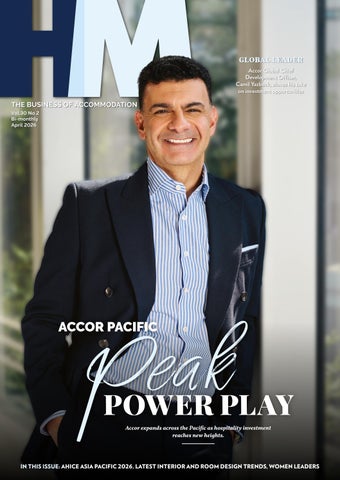
GLOBAL LEADER

Accor Global Chief Development Officer, Camil Yazbeck, shares his take on  investment  opportunities

ACCOR PACIFIC

POWER PLAYPeak

Accor expands across the Pacific as hospitality investment reaches new heights.

Here’s how it works:

Add your own channels such as a welcome channel

Mitchell and Eades were the interior designers for the luxurious Six Senses Fort Barwara in India

Meet Hyatt's Mina Li, and other exemplary women in hospitality

Minor International

Founder, William E. Heinecke, shares big growth plans

48 ROOM REVOLUTION

Spotlight on how hotel guest rooms have evolved into sanctuaries of rest, complemented by highquality amenities.

58 STORYTELLING SPACES

Leading designers and suppliers share the latest trends in lobbies and public spaces.

64 AHICE SOUTH EAST ASIA 2026 WRAP-UP

The hot trends, new properties and essential market analysis revealed.

69 DESIGN INN ASIA ATTRACTS A GLOBAL CROWD

A recap of the second annual Design INN Symposium Asia.

72 AHICE ASIA PACIFIC STAGE SET FOR STRONG RETURN TO ADELAIDE

A preview of the upcoming AHICE Asia Pacific 2026 conference.

76 FUTURE FORWARD DESIGNS

Australia’s top hotel projects will return to the limelight in Adelaide.

78 WATT-WISE WAYS

Lighting in hospitality plays its part as an invisible guest experience, but is sustainability a factor?

80 NO FRILLS PAYS OFF

An expanding global middleclass, coupled with being a smart investment choice for owners, is driving growth in the economy hotel segment. 84 TEMPERATURE RISING

Entering 2026 with renewed confidence, leading real estate experts unpack Australia’s hot and cold markets and emerging trends.

88 SET TO SOAR

A strong momentum driven by robust tourism demand and a constrained supply pipeline, combined with renewed offshore capital, is fueling the market in 2026.

90 POWERFUL INFLUENCE

Meet some of the most exemplary female leaders driving change in hospitality.

HM Q&A

38 MINOR’S MAJOR PLAY

Minor International Founder and Chairman, William E. Heinecke, talks about brand quality, asserting an asset right model, and bringing back Sizzler.

40 THE BUSINESS OF BABYMOONS

Salter Brothers Hospitality is investing in premium experiences for those seeking relaxation before welcoming a baby.

42 MASTERFUL MOMENTUM

Marriott International Regional Vice President, Jason Nuell, unpacks pipelines, performance and profitability.

44 LONGEVITY EVERYDAY

Accor’s founding brand Novotel gets behind supporting guests’ wellbeing, Global Brand President Jean-Yves Minet reveals.

REGULARS

08 EDITOR-IN-CHIEF’S LETTER

James Wilkinson on what to expect at AHICE Asia Pacific in Adelaide.

10 EDITOR’S LETTER

Daisy Melwani is seeing things differently.

12 NEED TO KNOW

Snapshot of the most essential stories you need to know.

18 COVER STORY

Accor expands across the Pacific as hospitality investment reaches new heights.

98 ON THE MOVE

Your roundup of key hotel industry appointments.

All eyes on Adelaide for AHICE Asia Pacific

We’re back in Adelaide for the 2026 Asia Pacific Hotel Industry Conference and Exhibition (AHICE) next month and from May 5-7, you can expect another world-class production at the region’s leading, largest and most influential accommodation event.

Over 200 global and local speakers will take to the stage in Adelaide across AHICE Asia Pacific, the Australasian Design INN Symposium, the Future Leaders Forum and the INN Tech Hotel Technology Summit and we’re very proud of the content we have curated for the three days.

You can expect the conference – which is expecting another record crowd of over 1600 – to be loaded up with all-new networking events, keynote speakers, evocative panel sessions and executive Q&A sessions, featuring some of the world’s leading hotel leaders.

I’m proud that AHICE has become known for our exciting networking events and headlining the event this year is an all-new farewell rock concert on Thursday May 7 featuring three iconic Aussie artists, headlined by INXS Garry Gary Beers and our own global music director Toby Rand, at a secret Adelaide venue we’ll reveal on the day.

We’re aware that delegates want to attend AHICE to learn, inspire, network and succeed, alongside do deals and that’s very important for us to ensure the on-stage content, curated exhibition showcases and networking events are all on a globally-renowned level.

Some people attend AHICE to hear the latest trends from the talent on stage, while others come to network and some want to procure the latest products for their property. Finding a mix that appeals to all is always our number one focus and I believe we have found a great balance for this year’s event.

In this issue of HM, you’ll find a preview to AHICE Asia Pacific (p72), plus if you missed our stellar AHICE South East Asia event in Singapore in March, you can catch-up on all the highlights too (p64).

Our April edition is loaded with the latest trends, interviews and much more and I hope you enjoy the read and see you in Adelaide next month.

Yours in hospitality,

conferences

The HM global hot list

Hotels around the world capturing our attention this month.

ONE: Parkroyal Collection Marina Bay, Singapore @parkroyalcollectionmarinabay

FOUR: Four Seasons Hotel Atlanta @fsatlanta

TWO: Ovolo Woolloomooloo, Sydney @ovolosydney
THREE: Eri Maldives @erimaldives
AHICE Asia Pacific returns for its 17th year in 2026

Seeing it differently

Design has always been one of the most powerful storytellers in our industry, and right now, it’s speaking louder than ever.

In this issue, we turn our focus to the future of hotel design, exploring how spaces are evolving not just to impress, but to connect. Across conversations with leading designers, a clear theme emerges – hotels are no longer places you merely pass through. It’s somewhere you’re invited to linger, work and socialise. Nowhere is this more evident than in the lobby. Once a transitional space, it’s being reimagined as a dynamic, multi-functional hub layered with personality, purpose and, increasingly, revenue opportunity.

Guestrooms, too, are shifting. The emphasis is on intuitive comfort and thoughtful detail, with spaces that feel both personal and functional. Designers are leaning toward creating sanctuaries that adapt to the modern traveller, with relaxation at its core.

Sustainability continues to shape many design decisions, and we take a closer look at one of its most innovative frontiers: lighting. From energy-efficient systems to designs that enhance wellbeing, lighting is no longer just functional; it’s strategic.

Meeting extraordinary leaders must be a highlight of this role. I recently had the opportunity to sit down with legendary hotelier, Minor International Founder, William E. Heinecke. In our candid chat, Bill shared tales of registering his business at just 17, life in Asia, and bringing back the beloved Sizzler to Australian shores.

We also feature some of the most exemplary female leaders driving change in hospitality today. Their insights tackle inclusion, workforce stigmas and share advice to help others on their path to leadership.

All of this makes for a thought-provoking issue as we lead into one of the most important events on our calendar: AHICE Asia Pacific in Adelaide. It will be my first time attending, and I’m keen to meet many of you.

I look forward to the conversations ahead.

MEET THE HM TEAM…

Managing Director Simon Grover

Publisher James Wells

Editor–In–Chief James Wilkinson jwilkinson@intermedia.com.au

Editor Daisy Melwani dmelwani@intermedia.com.au

Group Commercial Manager

Tara Ducrou tducrou@intermedia.com.au

Production Manager Jacqui Cooper jacqui@intermedia.com.au

Graphic Designer Ryan Vizcarra

Photography Cover story photographed by O’Neill Photographics

Subscription enquiries 1800 651 422

Subscribe to HM Magazine –6 issues for AU $88 (inc. GST) subscriptions@intermedia.com.au

Published by 41 Bridge Road, Glebe NSW 2037, Australia. (PO Box 55, Glebe NSW 2037, Australia) Tel: +61 (0) 2 9660 2113 Fax: +61 (0) 2 9660 4419 ABN 940 025 836 82 In association with

Tara Ducrou Group Commercial Manager
James Wells Publisher
Chada returns to breathe new life into Emirates Wolgan Valley, a Ritz-Carlton Lodge
Hannah St Hotel interiors were designed by Flack Studio

NEED TO KNOW

The essential hotel and travel industry news and trends from across the globe. Read more at hotelmanagement.com.au

Luxury Beckons

In a brand evolution for Baillie Lodges and Tierra Hotels, Beckons has been unveiled as the new global hospitality brand uniting both portfolios as a new era unfolds for the experiential tourism sector.

BECKONS OPERATES NINE properties across Australia, New Zealand, Canada and Chile, with an average of just 25 suites, and has outlined a development pipeline that is already equal to, or exceeding, its existing footprint.

Spearheading the new brand as Chief Executive Officer is industry veteran Michael Crawford, who said the group has positioned itself as a platform to scale its portfolio of ultraluxury experiential travel assets worldwide.

“It’s not changing the name, it’s introducing a new name, a new brand that allows us to create a portfolio of global assets, experiences … letting the lodges themselves, or the

experiences themselves, continue to be the hero,” U.S-based Crawford said on a recent visit to Sydney.

Our portfolio is a platform for travellers to experience the world more deeply through genuine cultural exchange.

“We believe meaningful travel should enrich everyone it touches: our guests, our teams, and the places that welcome us. Our people are at the heart of that hospitality philosophy, bringing a generosity of spirit and a shared commitment to emotional connection, regeneration, and cultural continuity to every journey.”

Crawford, who joined the business in May last year, said the brand is underpinned by three core pillars – nature, wildlife and culture – which he describes as “dials” that can be tailored to each destination and guest experience.

Future expansion will target remote and experience-led locations, including wildliferich and marine-focused destinations, as well as new opportunities within Australia, with Crawford highlighting Tasmania as a “beautiful part of the country”.

“In 2031, we want to be known as the best luxury experiential hospitality brand in the world,” Crawford said.

Southern Ocean Lodge on Kangaroo Island sets the benchmark for luxury experiential travel in Australia

Mega merger

Merger forms New Zealand’s largest hotel management platform.

THE MERGER OF Capstone Hotel Management and Marsden Group has created New Zealand’s largest locally owned, independent hotel management platform, boasting a portfolio of 45 properties.

With more than 2,500 rooms under management and investment oversight, the merger is expected to combine Capstone’s third-party hotel management expertise with Marsden Group’s capital strength and hospitality investment portfolio to better position the group to compete directly with international operators.

The transaction will also accelerate growth through new acquisitions, management agreements and “a stronger presence across regional and metropolitan markets,” according to a statement following the merger.

Capstone Hotels and Resorts Limited now forms part of the enlarged Marsden Group, operating within a unified group structure, with Capstone continuing to operate as a distinct brand within the expanded group.

Sajad Bassam has been appointed Chief Executive Officer of the combined group,

Capstone Hotel Management is part of the Marsden Group, and will manage the recently reopened Coronet

and Founder of Capstone, Clare Davies, retains an equity stake in the business and serves as Chief Operating Officer, while also sitting on the boards of both Capstone and Marsden Group.

“The combination of Marsden and Capstone creates a platform that is significantly more capable than either business on a standalone basis. It’s not just about scale, it’s about depth of capability,”

Bassam told HM.

“At this size, we can take on larger and more complex opportunities, invest more meaningfully in systems, people, and technology, and provide a more complete end-to-end offering to owners from development and repositioning through to long-term management.”

It also allows us to operate with greater consistency across the portfolio while still maintaining flexibility at an individual asset level, which is critical in the New Zealand market.

The key focus for us will be ensuring alignment without disruption. Bringing together two established businesses naturally involves merging systems, processes, and ways of working, so prioritising clarity is key, Davies told HM.

Marsden Group’s portfolio of five brands includes Marsden Hotels & Resorts, Ramada, Wyndham Garden, Microtel by Wyndham and now Capstone Hotels and Resorts.

Woodhouse Mountain Lodge
Ridge Resort

YHA’s green milestone

YHA achieves B Corp certification and nationwide Ecotourism accreditation, becoming Australia’s first owned and operated accommodation network to achieve the status.

AUSTRALIA’S LARGEST YOUTH

accommodation provider, YHA Australia has marked a major milestone with a dual sustainability achievement, securing both B Corp status and Ecotourism certification across its entire property portfolio.

Announced as a “two-pronged celebration”, YHA Chief Executive Officer, Paul McGrath said the recognition formalises a long-standing commitment to responsible travel, community impact and environmental stewardship.

“We’ve always operated with the mind of being sustainable, looking after the environment, looking after our own people, looking after our guests and looking after the community,” McGrath said.

“We felt that we needed to be certified by independent organisations to say what you say, you do, you are doing.”

According to the organisation, they are seeing growing demand for more responsible travel, consistent with Tourism Australia’s Consumer Demand Project, which shows 70% of international travellers value sustainability when making their travel decisions.

Founded in 1939, YHA continues to operate as a not-for-profit, membership-based organisation, and part of a global network of

55 member associations focused on accessible, low-cost travel. Today, it operates 18 properties across Australia, with 77% of its guests being international travellers.

DUAL CERTIFICATION MILESTONE

The newly obtained B Corp certification recognises YHA’s performance across its entire organisation, from governance and employee practices to community impact, requiring even constitutional changes.

“This is not a fad. This is not a marketing campaign. This is actually enshrined in our

Constitution that this is the way that we will continue to behave and continue to act,” McGrath said.

At the same time, all 18 YHA properties have now been awarded Ecotourism certification, following independent, site-by-site assessments of environmental performance.

B Corp assessed the whole organisation, while Ecotourism went into each individual property, McGrath explained, adding that to achieve certification across 100% of their portfolio was a significant milestone.

YHA operates a property in Pittwater, New South Wales
YHA Sydney Harbour rooftop, complete with solar panels

SUSTAINABLE TRAVEL AT SCALE

The organisation has implemented a wide range of sustainability initiatives, including solar energy and renewable energy transition plans, grey water recycling systems, waste reduction and recycling programs, plans to move from gas to electric kitchens and guestled environmental activities, such as coastal clean-ups.

McGrath said sustainability investments often come with upfront costs, but deliver longterm benefits.

“We make a lot of decisions that are the right thing to do, not necessarily the commercial thing to do,” he said, adding that over time, the group was seeing some investments reduce operating costs as well.

RESPONDING TO CHANGING TRAVELLERS

The certification comes as traveller expectations evolve, particularly among younger guests, McGrath explains.

“(Guests) expect us to be sustainable. If we’re going to be a relevant organisation,

then we need to make sure that we continue to uphold the expectations of our customers,” McGrath noted.

YHA’s core market, primarily aged 18 to 28, has shifted from traditional backpackers to more experience-driven, socially conscious

travellers in recent years. Increasingly, McGrath said, guests are choosing accommodation providers who align with their values, even if they are not paying a premium for sustainability.

“People are making decisions that say I want to make sure who I’m choosing is doing the right thing, even if I’m not willing to pay more for it,” McGrath said.

PURPOSE-LED GROWTH

Looking ahead, sustainability will remain central to YHA’s growth strategy, alongside expansion plans that could see the network grow to 25–30 properties by 2030, McGrath said.

The organisation is also investing in social impact initiatives, including its “Travel to Learn” program, which funds school travel for disadvantaged students.

“What we believe and what is ingrained in us is that through travel, people grow, people learn, people understand. And so we want to give everybody the opportunity to travel,” McGrath said.

YHA Thredbo is popular all year round
YHA Grampians is an eco-friendly nature retreat

CATCHING THE WAVE

Accor expands across the Pacific as hospitality investment reaches new heights.

Camil Yazbeck, Global Chief Development Officer, Accor

As Accor embarks upon a new wave of worldwide expansion, HM invited Camil Yazbeck, Global Chief Development Officer, to share his take on the best opportunities for developers and investors.

Why has the hotel sector emerged as a leading, high-performing asset class?

Hotel investment has moved from a niche category to a mainstream asset class as investors continue to seek diversification. Despite a macroeconomic climate that continues to be volatile, uncertain, and complex, hotel performance has remained resilient, fueled by a growing middle class that remains eager to travel, and keen to gather for conferences and events.

As we enter 2026, investors and owners are looking to mitigate uncertainty by partnering with a global operator such as Accor, who provides the scale and expertise to help navigate market cycles, control costs, diversify risk, and unlock the full potential of their assets.

In 2025, Accor delivered record development results, with the Group’s global pipeline increasing by 12% and extremely strong development performance for our Premium, Midscale and Economy brands, which collectively saw a 32% FY increase in signings worldwide.

Recent milestones include a strategic alliance with InterGlobe in India, to accelerate expansion and achieve 300 hotels by 2030, and the signing of our first hotel on the Las Vegas Strip, Treasure Island – TI Las Vegas Hotel & Casino – Handwritten Collection. We signed the world’s largest ibis budget in Makkah with 2,609 keys and the world’s

“In 2025, Accor delivered record development results, with the Group’s global pipeline increasing by 12%.”
Camil Yazbeck, Accor
The 195-key $90 million Mercure Melbourne La Trobe Street opened earlier this year

largest Mövenpick with Megaworld in the Philippines, with 1,530 keys. We also secured a landmark 600+ key agreement with Bayview International Hotels & Resorts in the Pacific, further strengthening our development pipeline in the region.

What is currently sparking the most interest among hotel investors?

The question among most hotel developers and investors today is not whether to invest, it is how to lead. It is how to create a legacy. Accor is leading the way in establishing hotels as destinations in their own right – powering mixed-use and multifaceted developments that

combine hospitality with branded residences, extended stay, wellness, co-working, and vibrant food and drink, while leaving space for the investor to lease. These community-driven ecosystems attract both travellers and locals alike, diversify investor risk through multiple cashflow streams, optimise revenue per square foot, and ultimately compress cap rates. We have some great local examples, such as Ennismore’s Mondrian Gold Coast at Burleigh Heads – and extended stay projects through Peppers, The Sebel, and Mantra. Through our innovation in technology, our differentiated guest experiences, and our truly impactful ESG initiatives, Accor and our partners are not merely anticipating the future of hospitality – we are shaping it.

Accor Pacific Development team with Accor Chief Operating Officer Pacific, Adrian Williams Back: Danesh Bamji, Toni Roberts, Adrian Williams, Nicholas Lockyer Front: Brett Forer, Jasmine Tindale, Lindsay Leeser, Taylor O’Brien

How do you prioritise markets and brands here in the Pacific region?

Our premium brands – such as Pullman and Swissôtel – are in high demand globally. We have a global network of 525+ premium hotels in operation and 290+ more in development. Pullman remains our star in the Pacific – the largest and fastest-growing premium brand in the region. This year we will open Pullman Hamilton, with the Pullman Perth Airport also underway.

Today, Accor has a network 425+ hotels and over 65,000 keys across the Pacific. This includes 370+ hotels in Australia, nearly 50 in New Zealand, and four in Fiji. Our award-winning loyalty programme, ALL Accor, offers unrivalled visibility with 110+ million members worldwide including millions of members in the region. We are the largest operator of luxury hotels, as well as airport hotels in the region – such as the architecturally striking Te Arikinui Pullman Auckland Airport. This scale provides stability and opportunity for owners. Hotel conversions are hotly in demand, and we are a leader in this space with brands like Mövenpick, Mercure, and ibis Styles. We are also seeing significant interest in our collection brands, including Handwritten Collection, which has already grown to a footprint of more than 90 hotels open and in the pipeline in a very short timeframe. Finally, the opening of Mercure Melbourne La Trobe Street earlier this year is an exciting addition to the community.

What does Accor mean by its ’owner-centric’ strategy?

Owners and investors are more sophisticated and agile than ever. Yes, they still want a strong brand name and market positioning, but more than that, they want a strategic partner who will help them create long-term value. Accor is differentiated by our ability to think like an owner through a real estate lens, aligning brand, deal structure and investment strategy to deliver strong value and performance. We are actively building success together with our partners by providing the most direct path to achieving their investment criteria and return on

equity targets. This means delivering strong local support, supported by our 360-degree solutions to increase revenue, through distribution, loyalty, sales and strong brands, and optimise operations across the entire value chain. These solutions include – but are not limited to – our world-renowned global procurement platform, 110+ million member ALL Accor loyalty program, our global sales network, marketing capabilities, sustainability expertise, advanced technology, and design and technical services. We bring operational teams, brand teams, and local experts to work with hoteliers to create inspiration for travellers and locals, while continuously unleashing new revenue opportunities for our partners.

Will we see you at AHICE Asia-Pacific in May?

Absolutely! Now is the time to grasp the opportunity, take action, and shape the future together. Mindset is everything – and the connections, ideas, and conversations that happen at AHICE are not to be missed. This is a vibrant market for Accor and we look forward to continuing to play a big role in the region’s deal flow and evolving development landscape. See you there. n

TRIBE Hotel Den Haag Centraal debuted in January 2026
Accor’s Mövenpick brand was launched in Australia in Hobart in 2021

RETHINKING THE PUMP

HYGIENIC. CIRCULAR. DESIGNED FOR HOSPITALITY.

A new standard in hygienic dispenser technology for modern hospitality

Monomaterial pump enabling full recyclability & true circularity

Integrated drainage system keeping the pump clean & residue-free

Closed hygiene system protecting the product from contamination

World-Renowned Brands +

Scan the code & find out about the problem of traditional pump dispensers.

Iconic facelift

Hilton to unveil LXR Hotels and Resorts in former Palazzo Versace site.

HILTON’S LXR HOTELS and Resorts will make its Australian debut in 2027 following a new signing of the hotel previously known as Palazzo Versace and currently operating as The Imperial Hotel.

The signing with hotel owner Islander Hotel Trading Pty Ltd will introduce LXR as a 200key hotel in early 2027 after a renovation and marks a milestone in Hilton’s expansion in Australia.

“The Gold Coast provides an ideal setting for LXR’s distinctive approach to luxury, where place, design and experience are deeply connected. The property holds one of the most alluring positions along the city’s main coastal corridors and will introduce the independent spirit of LXR to the Australian market. We are proud to work with our partners to bring this exceptional destination to life and to continue expanding Hilton’s presence in one of the region’s most dynamic resort markets,” Hilton, Director Development Australasia, Tushar Raniga said.

The new hotel will include design nods to grand neoclassical architecture and Italianinspired interiors, offering guests direct access to the Gold Coast Broadwater and proximity

to key attractions, including Marina Mirage, Hilton stated.

As the brand’s first Australian property, LXR is expected to deliver one-of-a-kind experiences with guests to expect bespoke service, captivating design, and immersive cultural experiences whilst staying at the hotel.

Globally, LXR Hotels and Resorts has 36 properties either operating or in the pipeline. The brand recently celebrated the openings of Cameo Beverly Hills and its first entry into France with the opening of Sax Paris. In the next three years, the brand will continue to

expand across Asia Pacific in sought-after destinations such as Niseko, Phuket and Da Nang, building on the success of Roku Kyoto and Umana Bali.

“The arrival of LXR Hotels and Resorts in the Gold Coast marks an important step in the evolution of the luxury hotel offering in Australia,” Hilton Vice President, Luxury Brands, Asia Pacific, Candice D’Cruz said.

LXR Hotels and Resorts will join Hilton’s Curio Collection by Hilton and Tapestry Collection by Hilton portfolio currently operating in Australia.

The exterior of The Imperial Hotel, which will be transformed into LXR Hotels and Resorts to open in 2027
Imperial Hotel pool

LEAVING REVENUE IN THE CAR PARK?

There is untapped revenue sitting beneath your hotel, according to Felicity Gallegoes.

Hotel managers have spent decades refining room revenue management. Yet one asset in many properties has remained largely unchanged: the car park.

In many hotels, parking is still managed at the front desk with limited oversight and no ongoing expert support. Without clear performance metrics, ownership, or accountability, revenue can quietly leak through under-pricing, poor inventory management, and the absence of a structured yield strategy. Unlike rooms, parking rarely benefits from rate management, distribution channels, or competitive benchmarking.

Even small improvements in non-room revenue can have a meaningful impact on a hotel’s overall asset value. A 1% improvement in non-room revenue yield can create a compounding effect on total NOI, yet parking in most properties continues to operate well below its commercial potential.

After more than a decade working across hotel operations, I’ve seen this pattern repeated in properties of every size and segment. Parking generates income, but without the right tools, operational ownership and consistent benchmarked improvements, it rarely performs as a true revenue centre.

THIS IS WHERE TECHNOLOGY IS STARTING TO CHANGE THE CONVERSATION

At DRIVO, we focus exclusively on helping hotels manage parking with the same commercial discipline applied to other revenue lines. Today, more than 90 hotels are connected to the platform, creating a network that allows properties to benchmark their parking performance against comparable hotels.

But it’s having the right support alongside leading technology that creates a real difference. A team of industry experts to guide, challenge, and elevate your staff into action. That’s what drew me to DRIVO. The opportunity to combine my experience as a hotel operator with the platform and help teams translate data into practical, day-today decisions.

SEVERAL CAPABILITIES HELP SUPPORT THIS SHIFT

Dynamic pricing allows public parking rates to respond automatically to demand signals such as occupancy levels, conferences, and major local events. Digital displays update in real time so pricing reflects actual demand.

Channel management connects parking inventory to aggregators such as Parkhound and Carparkit, allowing hotels to access additional demand while controlling rates from a single dashboard. In one example, this approach generated an additional 7% in parking revenue in a single month from guests referred by nearby hotels.

For conference-focused properties, a dedicated booking portal allows organisers to pre-book parking for attendees with customised rates and real-time availability.

Improved inventory management also gives hotels a clearer picture of capacity before guests arrive, helping teams plan ahead and avoid last-minute friction.

Perhaps most importantly, the data generated through these systems allows hotels to treat parking as a measurable revenue stream. With benchmarking, reporting, and regular performance reviews, car parks can join the same revenue discussions that already exist for rooms and events.

For general managers and asset owners, that shift matters. When parking is actively managed rather than simply administered, it can become a far more meaningful contributor to overall hotel performance.

The opportunity is not simply to install new technology, but to start viewing the hotel car park for what it really is: a valuable asset with significant revenue potential. n

DRIVO is a revenue management platform tailored for hotels. It combines license plate recognition, dynamic pricing, channel management, a conference booking portal, and Power BI analytics into one solution. The platform partners with Accor, EVT, TFE, IHG, and Marriott hotels in Australia.

Felicity Gallegoes is the Hotel Partnerships Manager at DRIVO, bringing operational leadership experience from Fairmont Blue Mountains, Novotel Wollongong, Oscars Hotels, Schwartz Family Company, and Trilogy Hotels.

Felicity Gallegoes, Hotel Partnerships Manager at DRIVO
DRIVO focuses exclusively on hotels to manage parking with a commercial discipline

Pacific to prosper

Sudima pours investment into Tonga in a new landmark deal.

NEW ZEALAND-BASED SUDIMA Hotels will develop a new upscale hotel, resort and convention centre in Tonga.

The group signed a Memorandum of Understanding (MOU) with His Majesty King Tupou VI during Prime Minister Christopher Luxon’s recent visit to Tonga, signalling investment into the country’s tourism sector and its long-term economic development.

The new upscale hotel will be aimed at satisfying increasing demand for highquality accommodation in Tonga, with the greater development and MICE facilities to strengthen the country’s ability to attract international visitors and host major gatherings.

“The MOU… reflects growing confidence in the Kingdom’s tourism future and the role

Global boom

Garner becomes IHG’s fastest-growing brand in its company history.

GARNER HOTELS, A midscale conversion brand within the IHG Hotels and Resorts (IHG) portfolio, has celebrated reaching 100 open hotels globally since its August 2023 launch, the company’s fastest-ever brand to scale globally.

of New Zealand businesses in supporting Pacific development,” Sudima Hotels stated in a release today.

The landmark development is expected to create up to 100 jobs and contribute around T$18 million annually to Tonga’s local economy through wages and procurement. The initiative is expected to act as a catalyst for further investment in the region.

Owners Hind Management and Sudima Hotels say the project signifies a long-term commitment to working in partnership with Tonga, with a focus on local employment, skills development and sustainable outcomes for Pacific communities.

Revealed at the Hunter Conference in Atlanta in March, Garner’s rapid expansion includes a global pipeline of almost 80 hotels that will nearly double its reach in the coming years.

IHG Hotels and Resorts’ Global Vice President for Garner hotels, Karen Gilbride, said Garner continues to drive value for guests and owners by focusing on important stay essentials while offering a flexible, conversion-friendly development model.

IHG introduces Garner hotels to Greater China, Shanghai Lujiazui

Gilbride said the brand’s rising popularity among owners and developers stems from growing worldwide demand for conversion properties, which accounted for 52 percent of all IHG room openings in 2025.

She said a competitive cost-per-key ratio, flexible design standards, reduced preopening costs and accelerated turnaround process likewise have fuelled its rapid growth, with some properties completing high-quality conversions in a little more than a month between signing and opening.

“Garner’s initial global success reflects IHG’s proven expertise in building and scaling conversion-ready brands that owners and guests trust,” she said.

“Beyond offering a high-quality alternative for value-conscious travellers, Garner’s flexible development model allows the brand to more quickly enter new global markets and deliver returns for owners.

“Even as we’ve reached some amazing initial milestones, we’re just starting to tap into Garner’s full growth potential and look forward to introducing its unique offering to more owners and travellers in the years ahead.”

Render of the new upscale hotel, resort, and convention centre planned for Tonga
Sudima Hotel in Tonga render

EFFICIENT BY DESIGN

Rising demand for IHG’s essentials and mainstream brands is fuelling a new era of hotel development in the Pacific.

Across Australasia & Pacific, hotel development is evolving as owners take an increasingly disciplined approach to new projects. With construction and financing costs remaining elevated, this focus is driving interest in segments that combine efficient development economics with strong, reliable demand and long-term returns.

While IHG’s luxury & lifestyle portfolio continues to deliver strong performance, another part of the portfolio is playing an increasingly important role in Australasia & Pacific growth: IHG’s essentials and mainstream brands.

Capital is flowing toward segments that offer efficient build economics, broad demand appeal and resilient performance. Against this backdrop, IHG’s essentials portfolio, including Holiday Inn, Holiday Inn Express, and Garner alongside mainstream brands voco and Crowne Plaza, are emerging as a core engine of growth across Australasia & Pacific.

BUILT FOR TODAY’S CAPITAL CONDITIONS

IHG’s essentials brands are designed to deliver efficient development economics, streamlined operations and wide guest appeal. Alongside these, mainstream brands such as voco and Crowne Plaza provide flexible positioning across a range of markets.

Compared with higher-end segments, essentials typically require lower capital investment and benefit from practical, well-tested designs. Operating models are lean and consistent, supporting cost control while maintaining strong guest satisfaction.

The segment attracts a diverse mix of travellers, from corporate and project-based demand to leisure and drive markets, helping smooth performance across cycles. Access to IHG One Rewards further supports occupancy and repeat visitation, while IHG’s global enterprise, including revenue management, digital marketing and procurement scale, provides disciplined commercial support. These fundamentals underpin the strength of the broader essentials and mainstream portfolio.

voco Darwin Suites is opening in 2026

MOMENTUM ACROSS AUSTRALASIA & PACIFIC

Recent activity highlights continued owner confidence. Holiday Inn

Express Perth Cockburn Central in Perth’s southern corridor is a newbuild essentials hotel within a growing mixed-use precinct. Holiday Inn Townsville demonstrates the appeal of conversion-led growth, bringing an established asset into the IHG system and unlocking access to global distribution and loyalty. Holiday Inn & Suites Caloundra, Sunshine Coast reflects confidence in infrastructure-supported regional markets.

Momentum is also being seen within IHG’s mainstream segment through the continued growth of voco. Recent openings such as voco Gosford and upcoming voco Darwin Suites highlight the flexibility of the brand across regional centres and gateway cities.

Together, these projects illustrate the adaptability of the essentials model and the broader mainstream portfolio across both mixed-use developments and standalone hotels.

Cameron Burke, Head of Development, IHG Australasia & Pacific, says the segment plays a critical role in portfolio balance.

“In a more measured capital environment, owners are prioritising efficiency and performance. These portfolios deliver disciplined development economics with strong brand recognition and access to IHG’s global platform.”

THE GARNER OPPORTUNITY

Noah Lu, Director of Private Clients at Celestial Capital and the owner’s representative for Holiday Inn Townsville, said “Our mandate was to reposition the asset in a way that improves both operating performance and underlying asset value while maintaining disciplined capital intensity. Aligning with Holiday Inn enables the property to plug into IHG’s global distribution and loyalty platforms, significantly strengthening demand visibility and rate integrity. For our investors, the conversion provides a highly efficient pathway to unlock capital uplift through brand alignment and operational repositioning.”

Eugene Lim (pictured above), Chief Financial Officer of SKS Group, owner of Holiday Inn Express Cockburn, adds: “In the current environment, careful capital management is critical. Holiday Inn Express offers efficient build economics and a proven operating model. The support from IHG, particularly through their commercial systems, gives us confidence in sustained performance. We see strong long-term opportunity in this segment.”

CONFIDENCE IN THE MARKET

“Our essentials and mainstream brands combine efficient development with the power of IHG’s global platform.”
Cameron Burke, IHG

An important part of the essentials story, and the broader essentials and mainstream growth strategy, is Garner, designed specifically for conversion.

Since launching in 2023, Garner has scaled rapidly to more than 100 open hotels globally, making it IHG’s fastest-growing brand. Its success reflects strong demand for conversion opportunities that combine speed to market with efficient capital deployment.

While Garner is not yet operating in Australasia & Pacific, it represents a near-term opportunity as conversion activity increases across regional and secondary markets.

“Conversion opportunities are strongest in regional centres and drive markets where independent properties often have strong underlying demand but dated positioning,” Cameron says. “Garner enables owners to reposition with lower capital intensity and access stronger distribution without the risk profile of a new build.”

BRAND STRENGTH, PLATFORM ADVANTAGE

A defining strength of IHG’s essentials and mainstream portfolios is the combination of brand and platform.

Through global distribution, sophisticated revenue systems and enterprise marketing capability, IHG supports performance across market cycles, providing owners with greater visibility and confidence in long-term asset value.

As development cycles evolve, regional growth, infrastructure investment and stabilising corporate demand are expanding opportunity beyond traditional CBDs. In these markets, wellrecognised brands supported by global scale are well positioned to succeed.

“Essentials and mainstream brands are a structurally important part of our portfolio and central to our long-term growth strategy across Australasia & Pacific, particularly as we continue to scale more deeply across regional markets,” said Cameron.

In a market defined by careful capital allocation and performance focus, IHG’s essentials and mainstream portfolios continue to demonstrate that efficiency, scale and brand trust remain powerful drivers of sustainable hotel growth. n

Holiday Inn Express Perth Cockburn Central is a new-build Essentials hotel
voco Darwin Suites

NEED TO KNOW

Uluru’s light stays on

Voyages confirms tourism icon to remain until 2029.

VOYAGES’ AYERS ROCK Resort has confirmed the popular Field of Light in Uluṟu will be extended until at least the end of 2029.

Created by renowned light artist Bruce Munro, the installation (pictured below) opened as a temporary exhibition but has since become one of Australia’s most iconic tourism experiences, welcoming over 750,000 visitors to Uluṟu since its inception a decade ago.

Inspired by desert wildflowers blooming after rain, the artwork features 50,000 solar powered stems illuminating an area the size

of seven football fields and sits on Aṉangu Country (Uluṟu’s Traditional Owners). The installation was refreshed in 2024, with the lights and infrastructure upgraded as it enters its second decade.

Voyages Tourism Australia Chief Executive Officer, Matt Cameron Smith said the installation had become a significant driver for tourism in the region: “Tourism and events drive more than 80% of Central Australia’s economy, with Field of Light now one of the region’s most powerful drawcards.”

“Originally planned to run for just one year, Field of Light has now welcomed more than 750,000 visitors and become one of Australia’s most iconic experiences. Extending it to 2029 ensures visitors can experience this remarkable artwork for years to come, in the landscape that first inspired it.”

Field of Light at Uluṟu also sparked a series of installations around the world, with Bruce Munro later creating similar works in locations including California, New York, Pennsylvania, Western Australia and the UK.

London boost

British Airways set for Melbourne return with new daily London flights.

BRITISH AIRWAYS IS adding Melbourne to its global route network from January 2027 with the launch of daily flights from London Heathrow via Kuala Lumpur, marking the first time in 20 years the carrier has flown to Victoria.

The new service will operate from 11 January 2027, connecting Melbourne and London Heathrow via Kuala Lumpur, offering travellers improved connectivity and greater choice between the two nations, according to British Airways’ Chief Planning and Strategy Officer, Neil Chernoff.

“We’re delighted to announce sizeable growth to our flying schedule for winter 2026, including two notable new destinations, that I am confident will prove popular with our customers,” he said.

“We’re also increasing services across several high-demand routes around the world.

“Together, these changes represent a significant investment in our long-haul leisure network, adding even more options and choice for our customers.”

British Airways will begin flying from Melbourne on 11 January 2027, operating

British Airways will be flying to Melbourne for the first time in 20 years

daily and year-round to London Heathrow.

The service marks British Airways’ return to Melbourne since 2006, responding to renewed and growing demand between the two regions.

The route will operate on its Boeing 787 fleet, and marks the airline’s second route from Australia, complementing its existing Sydney to London service.

Field of Light, credit Bill Blair

Amora arrives in Adelaide

An iconic Adelaide landmark gets a $73 million facelift ahead of Amora launch.

AMORA HOTELS AND Resorts is set to make its South Australian debut with Amora Adelaide in July, following a multimillion-dollar transformation of the former Hilton Adelaide.

Located in Adelaide’s CBD, the group last year acquired the five-star property, which is set to join as Amora Adelaide, becoming its fourth Australian hotel in its growing portfolio, which includes hotels across Australia and Asia.

The hotel will continue to operate until the rebranding to Amora is complete on July 1, with works progressing in stages for a full transformation expected to be completed by mid-2027.

Owned by Siriphatrawan family hoteliers, the brand’s arrival marks a new chapter for the landmark Adelaide property on Victoria Square.

The hotel will undergo extensive redevelopment to create Adelaide’s newest and genuine five-star destination, according to the group, led by acclaimed architectural design company Cottee Parker.

The transformation will include a reimagined grand lobby and the addition of Victoria’s Table, a brasserie-style café. A major transformation will breathe new life into Coal Cellar + Grill and will continue to showcase the very best of South Australian flavours in a sophisticated setting.

Inspired by the spirit and landscapes of South Australia, the hotel’s 380 guest rooms will feature sophisticated furnishings and refined design, drawing on tones and textures reminiscent of rolling hills, morning mist and caramel sunsets.

A 660sqm grand ballroom and over 2,200sqm of function space are supported by multi-million-dollar, state-of-the-art audio-visual technology complimenting its conference facilities.

“We are pleased to introduce the Amora brand to Adelaide and are confident that our signature hospitality and commitment to quality will resonate with South Australians, who are known for these values,” said the owner of Amora Hotels and Resorts, Earp Siriphatrawan.

“Our $73 million investment reflects a commitment to honouring the iconic Victoria Square building while delivering a new five-star destination for the city. The design draws on South Australia’s natural palette, enhancing the building’s original character. This transformation will deliver refined rooms, standout dining and premium event spaces, positioning the hotel among Adelaide’s leading destinations.”

Amora Hotel Adelaide, deluxe room render

Trump Tower soars

Gold Coast’s Trump Tower will become Australia’s tallest building.

TRUMP INTERNATIONAL HOTEL and Tower, Gold Coast, will rise in the middle of Surfers Paradise to become Australia’s tallest building at a soaring 340 metres.

The 91-storey Trump-branded hotel will include 272 exclusive residences, a private Beach Club and premier retail and dining, and cost an estimated A$1.5 billion to build.

“Set to become Australia’s tallest tower, this landmark address redefines beachfront sophistication with world-class amenities,

iconic design, and uninterrupted Gold Coast views,” the Trump Hotels website stated.

The project is in partnership with Altus Property Group Pty Ltd, who stated the 6-star resort will “leave every other Australian resort property in its wake when it comes to luxury”.

“With our signing of the final agreement with the Trump Organization at Mar-a-Lago on Valentine’s Day, we are now deeply into a process of design, engineering, construction and fit-out that will cost a shade under AUD1.5

Regional refresh

Qantas is updating its regional lounges  across Australia.

QANTAS IS CONTINUING with a major refresh of its regional Lounge network, with upgrades now underway for seven lounges across Australia.

The upgrades to lounges in Rockhampton, Gladstone, Kalgoorlie, Tamworth, Coffs Harbour, Mackay and Karratha are part of the Flying Kangaroo’s multi-million-dollar regional lounge investment, which will deliver improved comfort, upgraded amenities and a more contemporary design for customers travelling through some of its key regional destinations, according to QantasLink Chief Executive Officer, Mark Dal Pra.

He said each lounge will receive a refreshed interior featuring a distinct, new colour palette inspired by the region’s natural landscapes.

Customers can expect modern furniture and improved seating options, refined finishes such as new flooring and updated surfaces, as

billion and bring the world’s preeminent hotelresort brand to our shores,” Atlas Group CEO David Young wrote on his company’s website.

“Importantly, the building is Australianowned and Australian-built. It is an Altus subsidiary, Altus Resorts Pty Ltd, that makes the decisions on the fit-out, within the Trump design requirements.

“It will be an Australian, not American, project. It won’t have a Four Seasons or The RitzCarlton brand above the front door, but it will say ’Trump’. And that means it is a no-expensespared, highest possible quality building – the best in the world.”

Young said the project will employ at least 500 people during construction and another 500 once the building is completed.

“One third of the building is a 6-star resorthotel, overlooking the Pacific Ocean at Surfers Paradise Beach. Another third is residences – 270 apartments – which are likely to start at $5 million, with the penthouse prices not yet determined,” Young said.

The first five floors of the building encompassing a retail plaza will include highend brands as tenants, as well as event facilities, a beach club and swimming pool. The fifth storey will be reserved for Michelin-starred restaurants and lavish bars overlooking views of the Pacific.

well as upgraded technology, including more charging points and entertainment displays, according to Dal Pra.

He said the airline was committed to improving the travel experience for customers right across regional Australia.

“These investments are part of our commitment to ensuring customers have great experience with us both on the ground and in the air,” Dal Pra said.

“We know how much our frequent flyers value our regional lounges, whether it’s to grab a drink and a snack, or as a quiet place to get some work done.

“We apologise for the inconvenience while we renovate, but we’re confident the finished product will make it worthwhile.”

The lounge upgrades are part of the Qantas Group’s broader investment in regional Australia, with the airline also investing in an extensive regional fleet renewal program.

This includes the addition of 11 stateof-the-art A220 aircraft, with 18 more on the way, and the transition to a single fleet of Q400s, which will improve reliability, reduce emissions per seat and ensure it can keep delivering for customers across regional Australia.

Inside the renovated Qantas Karratha lounge
Trump International Hotel and Tower, Gold Coast, image credit: Altus Property Group

Radisson Blu Mirage Resort, Fiji Naisoso Island development is progressing and on track for an early 2027 opening

BOLD MOVES

Radisson Hotel Group is poised for a year of meaningful growth in 2026. Managing Director Australasia, Lachlan Hoswell outlines exciting opportunities ahead.

Australasia’s hospitality sector grew from strength to strength in 2025, as visitor numbers increased and hotel operators welcomed a rising number of guests from all around the world. This continued the region’s post-pandemic shift into a more resilient, diversified, experience-led market.

For Radisson Hotel Group, evolving consumer behaviours and technological advances are transforming our business and creating exciting opportunities. From the launch of new lifestyle-driven hotel brands to personalised guest experiences, we are leading the development of the hospitality industry in Australasia as we move through 2026 with confidence.

RISING VISITOR DEMAND FUELS GROWTH

Australasia’s hotel sector was fuelled by rising demand in 2025, as flight capacity returned and visitors flocked to popular destinations. In the year to September 2025, Australia saw a 7% rise in international arrivals and a 15% jump in expenditure¹, while domestic travel and spending also grew. Arrivals to New Zealand climbed 6%, driven by a surge in visitors from Australia², while Fiji’s tourism sector held steady³. This translated into a robust performance for the hotel sector in key cities, such as Sydney, Melbourne, Brisbane, Queenstown, and Auckland, where average daily rates (ADR) and occupancy showed healthy growth.

We are noticing a shift toward lifestyle, upper-upscale, and premium full-service hotels, which demonstrates consumer confidence and underscores Australasia’s reputation as an upmarket and experiential destination for the world’s travellers.

AUSTRALASIAN EXPANSION STRATEGY ON TRACK

Radisson Hotel Group’s Australasian expansion strategy is progressing rapidly, with several important new openings and signings.

Across the Pacific, our growth story is becoming even more balanced, combining high-potential conversions in Australia with new-build lifestyle momentum in New Zealand and resort development in the islands. Recent signings in Australia, including Canterbury International Hotel Melbourne, a member of Radisson Individuals, and The Merchant

Hotel, a Member of Radisson Individuals, extend our Radisson Hotel Group footprint in two key cities while showcasing the flexibility of Radisson Individuals for owners who want to retain a distinct identity supported by our global standards and distribution.

In New Zealand, we’re expanding with clear lifestyle intent. Radisson RED Hotel Queenstown, a new-build hotel set to open in early 2028, provides us with the perfect brand to launch in New Zealand’s leading market Queenstown, while Radisson RED Auckland will introduce the smart, design-forward energy of our Radisson RED brand to Auckland. Beyond the main gateways, we’re also deepening our reach across the islands, with Radisson Blu Mirage Resort Fiji, Naisoso Island progressing in Fiji and the signing of Radisson Individuals Samoa highlighting the strength of our partner network across Samoa and the wider Pacific.

TECHNOLOGY DRIVES PERSONALISATION AND LOYALTY

Technology continues to reshape the guest journey and Radisson Hotel Group remains at the forefront of this transformation. As mobile-first behaviour becomes the new normal, smooth digital touchpoints are essential, and we have strengthened our Radisson+ suite of digital and virtual tools to make every aspect of trip planning even easier. The growing membership of Radisson Rewards is enabling even stronger personalisation.

The Radisson Hotels App – recognised by Google for its best-in-class performance – surpassed 1.3 million annual downloads, and our website and mobile app are now available in nearly 30 languages, widening our reach across feeder markets. Our ability to drive targeted content to 60+ markets has contributed to double-digit conversion growth and strong click-through rates. In terms of the MICE sector, our Book It Easy platform and VR walkthroughs are now empowering meeting planners to book with confidence.

POSITIVE OUTLOOK FOR 2026

Looking ahead, we will continue to invest and innovate across Australasia. With multiple openings and developments underway, 2026 is set to be an exciting year for Radisson Hotel Group across Australia, New Zealand and the Pacific. We’re excited to work side-by-side with our owners and partners in the region to achieve a year of tangible and meaningful growth. n

¹ https://www.tra.gov.au/en/international/international-tourism-results ² https://www.stats.govt.nz/information-releases/international-travel-september-2025/#annual ³ https://www.statsfiji.gov.fj/provisional-visitor-arrivals-october-2025/

Sky high luxury

Mondrian Gold Coast unveils its most luxurious rooms yet.

TOUTED AS THE hotel’s most extraordinary residential offering, Sky House, set on level 24 of the Mondrian, is one of the most exclusive accommodation offerings on the Gold Coast.

The 320-square-metre penthouse-style residence offers 180-degree views stretching from Moreton Bay to Burleigh Headland,

Tasman expansion

1834 Hotels secures two Auckland properties as its first foray into New  Zealand.

1834 HOTELS HAS added two new Auckland hotels to its growing management portfolio, initiating the group’s expansion across the Pacific and marking its entry into New Zealand.

The four-star Mercure Auckland Queen Street and three-star Ascotia Off Queen both join the group and come after the appointment of Rod Harrex as new Chief Executive Officer, which is said to have “strengthened strategic focus and underpinned opportunities for regional expansion”.

The leadership restructure, which saw Founder Andrew Bullock transition to Executive Chairman, has enabled “increased emphasis on growth initiatives and development across new markets,” the group stated.

framed by five-metre-high floor-to-ceiling glass, and has been designed by internationally acclaimed U.S.-based Studio Carter.

Available from $4500 per night, the Sky House offers three king-sized ensuite bedrooms, including a statement master suite, expansive indoor living and dining zones, and

“Our entry into New Zealand underscores the capability of our management structure and the strength of our partner relationships. We are excited to bring our operational expertise and owner-aligned approach to these two respected properties in a vibrant city market,” Harrex said.

Bullock added, “This achievement reflects both the maturity of the 1834 Hotels organisation and the strategic impact of our leadership evolution. New Zealand is an important step in our expansion roadmap across the Pacific, and we’re thrilled to be entering with such strong assets.”

an open-plan layout. With its private balcony, the residence is designed for entertaining with a fully operational kitchen and a full-sized personal bar.

Guests are also treated to expedited inresidence check-in, and will have access to a dedicated personal host for the duration of their stay, which can even include packing and unpacking services.

For those seeking wellness and restoration, guests can access Ciel Spa’s infrared sauna, alongside the hotel’s magnesium plunge pools.

The Sky House anchors Mondrian Gold Coast’s premium residential portfolio, which includes a variety of one-two and threebedroom residences.

Mondrian Hotels and Residences is part of Ennismore and owned by Vitale Property Group.

1834 Hotels manages a diverse portfolio of hotels, motels and tourism assets across Australia and New Zealand.

Mercure Auckland Queen Street, within easy access of the city’s entertainment and business district, offers 96 rooms, modern amenities, and on-site facilities including the Lone Star restaurant and bar.

Meanwhile, Ascotia Off Queen is located in Auckland’s CBD and features 82 rooms, onsite dining and bar facilities, and convenient access to key city attractions including Queen Street, Sky Tower and the University of Auckland.

Mercure Auckland Queen Street to be managed by 1834 Hotels, credit: Accor
Sky House’s expansive living space, credit Justin Nicholas
Mondrian Gold Coast Sky Home bedroom, credit Justin Nicholas

TURNING HOSPITALITY DATA INTO OPERATIONAL ADVANTAGE WITH AI

Agilysys’ Craig Dennington unpacks how to unlock AI’s full potential.

Artificial intelligence is moving from concept to capability in hospitality. Yet, while hotels are collecting more operational data than ever, many struggle to turn that data into meaningful insight.

Research from Agilysys highlights an industry investing heavily in technology but still working to translate that investment into operational advantage.

In this feature, we sit down with Craig Dennington (pictured above) to discuss why data readiness matters, how hotels can overcome fragmented technology environments, and what it takes to unlock AI’s full potential.

Why are hotels struggling to turn data into decision-making advantage?

Hotels are undeniably data-rich, but not always decision-ready. Across multiple systems, large volumes of operational data remain disconnected, making it difficult to trust and act on consistently.

While most operators describe their data as useful, only around 15% say they’re confident in its accuracy and timeliness, highlighting a persistent trust gap. When confidence is low, decision-making slows and teams fall back on intuition.

Becoming decision-ready requires aligned systems and a trusted data foundation, enabling teams to work from the same insights. This

Turn hospitality data into operational advantage with AI

broader visibility allows operators to optimise the full guest journey and focus on metrics like Revenue per Available Guest (RevPAG), rather than room revenue alone.

How does fragmentation impact hotel operations?

Fragmentation is a significant hidden cost in hotel operations. Many properties rely on multiple platforms, often supported by manual reporting to consolidate information.

These inefficiencies affect the entire organisation, from finance teams reconciling data to frontline staff navigating disconnected workflows instead of focusing on guest service.

The solution isn’t fewer tools, but a connected ecosystem where core systems operate as an integrated platform, giving operators a single view of operations and guests.

What foundations must be in place before AI can deliver results?

AI is only as effective as the data behind it. Today, only around a quarter of operators feel ready to adopt AI, citing challenges around integration, accuracy, and return on investment.

To deliver value, hotels need three core foundations: trusted data, connected systems, and clear operational use cases.

With these in place, AI can automate repetitive tasks and surface insights faster, improving both efficiency and guest experience.

How can AI support predictive, guest-centric operations?

AI enables hotels to move from reactive to predictive operations. The most valuable capabilities identified by operators are real-time personalisation and predictive demand forecasting, each cited by roughly 80% of respondents.

Predictive analytics helps forecast demand and optimise staffing, while personalisation transforms guest data into tailored experiences that drive satisfaction and revenue.

A key enabler is intelligent guest profiles, which unify data across the guest journey to support more targeted offers and proactive service delivery.

What will differentiate hotels that successfully adopt AI?

The next era of hotel operations will be defined by approaching technology strategically rather than reactively.

Successful operators are prioritising integration, data consolidation, and business intelligence, recognising that strong foundations are essential for long-term innovation.

AI won’t replace hospitality but enhance it – equipping teams with insights to deliver more meaningful guest experiences and drive sustainable revenue growth. n

Green is our gold

The Tourism 2035 strategy provides the future blueprint for the industry.

2026 MARKS A pivotal moment for Australian tourism. After several years focused on rebuilding international travel to Australia, this year is about readying for inbound tourism’s eventual return to long-term sustainable growth.

Most recently, our industry has experienced disruptions and uncertainty due to unfolding events in the Middle East. However, we know that over time Australian tourism’s story is one of continued resilience and sustained growth underpinned by robust plans to realise the opportunities and navigate the challenges.

At our annual industry conference last month, we shared highlights from our soonto-be-released Tourism 2035 strategy. This strategic plan, our blueprint for the future, gives us purpose and ambition to strengthen our competitiveness and better navigate the changing global tourism landscape.

Our focus is on 16 international markets and our target audience of high-yielding travellers, which includes Leisure (holiday makers and visiting friends and relatives), the luxury segment, Working Holiday Makers and Business Events.

Through Tourism 2035 we will be looking to grow the spend of this high-yielding traveller audience in partnership with industry, from its current contribution of $30 billion annually to between $61 billion and $69 billion by 2035.

To do this, aviation capacity remains critical. An estimated additional 4.4 million seats will be needed out to 2035 to support the future sustained growth of our sector, which our plan seeks to address. Ongoing investment and reinvestment in tourism infrastructure, such as accommodation and experiences, will also be needed to ensure Australia remains attractive in its offering for visitors looking to travel here.

Alongside driving tourism’s economic, social and cultural benefits for communities, our plan also recognises that it is also about getting the environmental balance right. So much of why people choose to visit us is our natural environment and the people and wildlife that inhabit it.

To ensure we protect this for future generations, we have been rolling out our Tourism Australia-led industry rally cry – called Green is Our Gold – to support and encourage responsible travel within the tourism industry.

This initiative is founded on a shared industry vision. A promise to embrace sustainable travel and protect what makes Australia so special, with five responsible travel principles that, in time, we want consumers to embrace. I encourage the Australian tourism industry to visit our website (tourism.australia. com/greenandgold) for more details on how to get involved.

The work of this initiative and as well as our 10-year strategic plan is about building strong foundations to create a path for future growth. It is about ensuring that Australia is not only the first destination every traveller dreams of, but the one they ultimately choose. We look forward to working with all our industry partners to achieve this.

The 46th Australian Tourism Exchange (ATE) will be held in Adelaide/Tarntanya in May

What the Middle East conflict means for hotels

Concerns raised about people’s confidence to travel to long-haul destinations like Australia.

LIKE MANY AROUND the world, we have been closely watching the situation in the Middle East over the last few weeks.

Travel and accommodation continue to be disrupted, and we have already seen significant cancellations. However, at this stage, occupancy has largely remained stable.

In the early days of the hostilities, we had existing guests needing to extend

nights, people already here needing urgent accommodation and airline flight crews who were grounded in Australia and needing help.

I would like to acknowledge our members for the calm and efficient way they responded.

But as events in the region continue to widen, our focus has turned to what this means in the medium and longer-term for Australian tourism.

Our concerns are broadly about people’s confidence to travel – particularly to long-haul destinations like Australia.

We have already seen airfares rise and aviation capacity reduced. And the most insidious issue we face is traveller uncertainty.

We saw firsthand during the long, stopstart recovery from the global pandemic that confidence is easily lost and very hard to get back.

When you add into the mix the cost-ofliving pressures felt in many parts of the world, a holiday starts to look like a risky, expensive gamble better left until times are quieter.

It is far too early to tell how this will play out, and the figures from the Easter weekend

Why great design really matters

Competitive responses to improving market conditions see the rise of sharper hotel design and development.

WHAT’S

STRIKING ABOUT hotel

development in New Zealand right now isn’t just how much new supply has arrived –particularly in Auckland – but what that supply is doing to everything around it.

Over the past five years, Auckland alone has absorbed around 3,000 new rooms, representing roughly $1.5 billion worth of modern, international-standard hotel investment. Those properties have launched with sharper design, heavy-hitting brands and much higher expectations around public space, food and beverage, and in-room quality.

Nationally, RevPAR still hasn’t fully clawed its way back to 2019 levels. But that headline hides some different regional stories. Queenstown and Christchurch are already trading well ahead of pre-Covid levels, and in both markets, supply is tightening again. When operating performance is good, owners and developers stop sitting on the

sidelines, which means new builds and, just as importantly, renovations.

Marriott’s announcement of a new-build St Regis in Queenstown is a good example.

will probably be the first real test of how this will affect us.

I expect the situation will get worse before it gets better, but rest assured, we are working tirelessly behind the scenes to make sure our members’ views are known in the halls of power.

The data and anecdotal feedback our member hotels have provided so far have been invaluable, and we are doing everything we can to support our industry during this tough time.

A genuine luxury entrant doesn’t just add rooms; it resets the top end of the market. It establishes a new rate ceiling, creates a halo effect for the destination and, bluntly, forces other hotels to lift their game if they want to stay relevant.

You can see that dynamic playing out now, even ahead of new hotels opening there.

Rydges Queenstown is being renovated and repositioned as a QT. Holiday Inn Express is being selectively upgraded and elevated to the Voco brand. In Christchurch, the former Noah’s Hotel is being rebuilt and will reopen as a Sheraton. These renovations are rational, competitive responses to improving market conditions.

New hotels expose properties that have let physical standards drift or pushed renovation cycles one year too far. Guests have a keen sense of the “best new hotel in town”.

What’s happening in Queenstown and Christchurch is how hotel investment is supposed to work. Strong trading builds confidence. Confidence unlocks capital and improved product. Better product attracts higher-spending and more discerning guests. That reinforces performance and strengthens the destination overall.

That’s how you build higher productivity in the tourism industry.

Factory to fancy

$90 million Melbourne CBD hotel makes lavish debut.

THE 18-STOREY 195-KEY Mercure Melbourne La Trobe Street has officially opened, making it the largest purpose-built hotel to debut in Melbourne CBD this year.

Last month’s opening ceremony, including a traditional Chinese lion dance, was well attended by Melbourne Lord Mayor Nicholas

Fiji fantastic

JEAN-MICHEL COUSTEAU RESORT has reopened following the completion of a resortwide multi-million-dollar renovation, the most extensive in the property’s history.

The refresh reimagines all guest accommodations, shared spaces, and wellness

amenities while introducing expanded two-bedroom oceanfront bures designed for extended-family stays.

“This renovation marks a meaningful evolution for the resort,” Jean-Michel Cousteau Resort General Manager, Nigel Fisher said.

Reece, Accor representatives, developer and owners Spacious Group, industry partners, and the hotel’s leadership team.

Adrian Williams, Chief Operating Officer of Accor in the Pacific region, joined Justin Phillips, General Manager of Mercure Melbourne La Trobe Street, and Angela Liang, Managing Director of Spacious, to commemorate the milestone alongside invited guests and stakeholders.

Drawing on the site’s former life as a tinsmith factory, the hotel balances industrial detailing with a contemporary aesthetic, with guest rooms framed by floor-to-ceiling windows to maximise natural light. The hotel’s signature Suite 1603 features a freestanding bathtub positioned against skyline views.

The transformation of five existing onebedroom oceanfront bures into spacious two-bedroom, two-bathroom ocean-facing accommodations with extended decks, daybeds, and outdoor dining for six is expected to be popular amongst family groups and those seeking extra space.

The renovation also expanded the resort’s wellness offerings with the introduction of a new 900-square-foot ocean-facing fitness centre, which will complement the resort’s existing Fijian spa and open-air yoga platform. Tennis, pickleball, and basketball courts were also resurfaced.

Inspired by Fijian cultural traditions, the refreshed interiors included handcrafted textures and locally sourced timbers. The reception, dining, and main pool areas were completed with updated furnishings, enhanced lighting, refreshed finishes, and rebuilt decking. Landscaping throughout the property has also been restored.

The renovation was completed in collaboration with Langlois Design, working closely with the resort’s team and local partners.

The new Mercure Melbourne La Trobe Street is the largest purposebuilt hotel to open this year
The opening event featured a traditional Chinese lion dance and blessing ceremony
Accor’s Adrian Williams with Nicholas Reece, Melbourne Lord Mayor, at the opening ceremony of Mercure Melbourne La Trobe Street
Fiji’s Jean-Michel Cousteau Resort unveils multi-million-dollar renovations.
Inspired by Fijian cultural traditions, the refreshed interiors include handcrafted textures and locally sourced timbers

THE DEATH OF THE BASEMENT GYM

The guest amenity that costs you nothing and could earn you more.

Today’s traveller has an expectation that many properties still cannot fulfil: access to a quality gym. Not a treadmill in a converted storeroom. A real gym!

hotel.fitness, a new product from Viva Leisure, the ASX-listed operator behind Club Lime, Plus Fitness, and a range of other brands, has been built to solve this problem for accommodation providers across Australia. Zero cost to implement. Zero lock-in with a revenue opportunity on every pass issued.

WHAT IS HOTEL.FITNESS?

Launched in April, hotel.fitness connects guests to the Club Lime network of 135+ commercial gyms across Australia, soon to expand to 410+ nationally via Plus Fitness and World Gym.

A QR code in-room or an in-room digital portal allows a guest to register, pay, and receive a Digital Wallet Pass on their iPhone or Android in under 60 seconds for instant gym access via an automated door entry. No app. No front desk. No friction.

For hotel-issued passes, staff use a simple branded portal; costs are charged to the guest’s room bill, with a single end-of-month invoice issued to the property.

hotel.fitness is a product of Viva Leisure, operator of Club Lime and multiple other brands

TWO METHODS. ONE SEAMLESS EXPERIENCE.

hotel.fitness gives accommodation providers a genuine choice and critically, the flexibility to use either or both methods, or different approaches across their portfolio.

Method 1 – Guest Self-Activation: Guests scan a QR code, register with their mobile number, pay directly, and receive their pass instantly. No staff involvement required.

Method 2 – Hotel Issuance: Reception staff issues the pass via their branded hotel portal; it’s charged to the room bill.

Both methods deliver an identical Digital Wallet Pass experience for any Club Lime location.

THE

COMMERCIAL

CASE – INCREMENTAL REVENUE WITH ZERO HARD COST.

This is not simply a guest amenity. It is a revenue opportunity. hotel.fitness operates on a floor rate model, Viva Leisure sets a minimum rate per pass duration, and the property sets the guest-facing rate above that floor. The margin belongs to the property. No capital outlay. No staffing overhead. No subscription.

NO OBLIGATION. NO LOCK-IN. LIVE IN A FORTNIGHT.

• No sign-on fee during the launch period.

• No monthly subscription. No minimum pass sales. No lock-in.

• Fully branded for the property with comprehensive analytics.

• Live and active within two weeks of confirming participation.

BUILT FOR EVERY PROPERTY. BACKED BY A NATIONAL NETWORK.

hotel.fitness is as relevant for a regional motel as it is for a metropolitan hotel. Group operators can tailor method, branding, and pricing across their entire portfolio. n

hotel.fitness will be exhibiting at AHICE Asia Pacific. Visit our stand to see a live demonstration, ask questions, and register your property on the spot, or get in touch sooner. Website: https://hotel.fitness/ | Email: help@hotel.fitness

hotel.fitness will be exhibiting at AHICE Asia Pacific

Minor’s Major Play

A STRENGTHENING GLOBAL PRESENCE FROM A FLUX OF NEW HOTELS AND A FLOURISHING PIPELINE, MINOR INTERNATIONAL FOUNDER AND CHAIRMAN WILLIAM  E. HEINECKE SAT DOWN WITH HM’S DAISY MELWANI ON HIS RETURN TO SYDNEY AFTER NEARLY A DECADE TO DISCUSS BRAND QUALITY, ASSERTING AN ASSET RIGHT MODEL, AND BRINGING BACK THE BELOVED SIZZLER.

Minor Hotels is on track to surpass 850 properties by late 2028, with a current global footprint of 640 properties. The group signed 40 new hotel contracts and master agreements in 2025 – its highest annual total to date – highlighting sustained owner demand and signalling another record growth year ahead.

DOUBLING DOWN ON AUSTRALIA

Its portfolio of serviced apartments, hotels, and resorts now spans across almost every Australian state and territory, with more than 60 properties under brands including Oaks Hotels, Resorts and Suites, Avani Hotels and Resorts, NH Hotels and NH Collection, iStay, and its latest brand entry, the luxury Anantara Hotels and Resorts, set for a Perth debut in 2032.

William (Bill) E. Heinecke, who registered the group as a minor at just 17 years old, reaffirmed Australia’s importance to its global plans.

William E. Heinecke founded Minor International at just 17, cleverly naming it "Minor" because he was legally still a minor

“Australia is big on the agenda,” Heinecke told HM, “We’ve virtually doubled here in the last five years.”

Its newest and inaugural franchise for Avani in Australia, Avani Mooloolaba, will open in May, marking the first internationally branded hotel on the Sunshine Coast in four decades.

In NSW, plans are underway for the NH Collection Sydney, a 256-room upper-upscale hotel in the CBD, slated to open this year as the first NH Hotels property in Australia. NH Sydney Airport and a new-build 107-key Avani Wollongong Hotel are both earmarked for 2027.

The new 150-key Anantara Perth Hotel will mark the brand’s Australian debut

Heinecke also told HM of the opening of a new Oaks property at Sydney Airport, but details have yet to be formally announced.

“We’re about to double in Sydney, and Melbourne has been a growth market for us,” Heinecke said.

ASSET RIGHT, GROWTH READY

Minor International outlined plans earlier this year for a targeted asset-light expansion to drive growth through a higher mix of hotel management agreements and franchising. The move is expected to allow the group to scale with discipline, while aligning its role as owners to closely monitor hotel performance and brand standards.

Later this year, the company plans to launch a Real Estate Investment Trust (REIT) on its debut in the Singapore Exchange, which will include around 14 hotels in the over US$1 billion listing to further support its expansion plans.

“We are certainly hoping to park some of our real estate into a trust, which we expect to float this year in Singapore, and that will take perhaps as much as a US$1.5 billion off our balance sheet, because we like to think we’re asset right, which, after the acquisition of NH, meant we were asset heavy by all intents and purposes,” Heinecke said, referring to Minor’s acquisition of Europe-based NH Hotel Group, completed in 2023.

“So, we want to return to an asset-light model by using asset-light opportunities: franchising HMAs, so instead of buying and owning hotels or building hotels, we’ll try to just manage it,” Heinecke continued.

“Of course, that means although we don’t own it, we still have our technical teams getting in there to make sure it’s going to be built to what we want and what suits our brand.”

SCALING WITH INTENT

Minor Hotels is rapidly expanding its franchise model with five franchised hotels in Australia.

“We’re doing franchising here in Australia, so that’s also another form of asset light between HMAs or a franchise, depending on whether the owner has the capability to manage the project themselves,” Heinecke said.

“Under most franchise models, they’re very often owner-operated, and in which case, an owner usually has a pretty vested interest in maintaining his property and improving it, instead of waiting for the annual budget to come out.

“I look at that somewhat favourably generally, because we’ve got very concerned and committed owners that operate our franchise hotels, and we expect that to continue,” Heinecke continued.

“All of the major hotel groups are in it in a big way. We’ve only just begun.”

SIDE OF SIZZLER

Minor Food operates in Australia through its subsidiary Minor DKL Food Group, one of the country’s largest retail food brand franchisors.

Well-known brands include The Coffee Club, with 400 outlets, Coffee Hit, The Groove Train, Veneziano Coffee Roasters, and BlendCo, a B2B coffee roaster and equipment supplier.

Minor International (MINT) also owns the Sizzler brand outside of America, and has already announced an Australian comeback, with its first outlet at NH Sydney Airport.

“Australia is big on the agenda. We’ve virtually doubled here in the last five years.”
William E. Heinecke, Minor International

Benihana, the interactive teppanyaki Japanese-style family favourite, is also tipped to make a return, with Heinecke saying he hopes to bring the brand back to Australia after a series of openings worldwide, including most recently at the Oaks Ibn Battuta Gate Dubai.

Heinecke said he was exploring a debut on the Hong Kong Stock Exchange for its food business in the second half of 2026.

“So, all of those actions are designed to sort of lighten our balance sheet load,” Heinecke said.

STRONG FOUNDATION FOR ANANTARA RESIDENCES

While Minor’s residential arm has yet to launch in Australia, the group operates a growing portfolio of luxury and premium branded residences globally, often integrated with its Anantara brand.

The scale and quality of the Burswood Point precinct, upon which the Anantara Perth Hotel will be built, provide a “strong foundation for future branded real estate opportunities,” the group stated.

“It doesn’t seem to resonate much with Australians but certainly in the rest of the world, Anantara residences are a very big part of our expansion,” Heinecke said.

“In most countries, they want an Anantara-branded residence next to the hotel … that has become much more fashionable, but it’s not yet big in Australia. But I think it has to come.

“We hope to, as part of any Anantara, we would hope that it would include a residential component,” Heinecke said. n

Queensland-based KPAT Hotels, under franchise with Minor Hotels, will open Avani Mooloolaba Beach Hotel in May

THE BUSINESS OF

babymoons

WITH AN IMPRESSIVE REGIONAL RETREAT PORTFOLIO UNDER ITS MANAGEMENT, SALTER BROTHERS HOSPITALITY IS INVESTING IN PREMIUM EXPERIENCES FOR THOSE SEEKING REST AND RELAXATION BEFORE WELCOMING A BABY. RUTH HOGAN DELVES INTO THE RISE OF PREGNANCY GETAWAYS.

With ample research suggesting that millennials are more interested in spending their money on memory-making experiences like travel, over material possessions, it’s all about ’babymoons’ over ’push presents’ for soon-tobe parents and those expanding their family.

During pregnancy, overseas travel can be daunting, due to the prospect of long and uncomfortable travel times, fears over food and beverage standards, and a detachment from the Australian healthcare system should complications arise.

For these reasons and more, Australia’s city hotels, beach resorts and regional escapes are all primed to appeal to this lucrative domestic market segment.

With an impressive boutique retreat portfolio under its management – including Spicers Retreats, Bannisters Hotels and the new-to-market Ardour Hotels and Resorts –Salter Brothers Hospitality (SBH) is investing

in premium experiences for those seeking rest and relaxation before welcoming a baby.

SBH’s Group Director of Marketing Performance, Victoria Peterson, said the business has seen a clear rise in demand for babymoon experiences across the portfolio.

“Today’s parents-to-be are prioritising wellness and meaningful connection, and they’re seeking experiences that allow them to relax, recharge and celebrate this special chapter before welcoming their new arrival,” Peterson told HM

FROM THE BUSH TO THE SEASIDE

Regional retreats are in high demand with expectant couples often seeking a quiet escape to recharge before welcoming their new arrival, according to Peterson.

“Guests are seeking serene, naturerich destinations that offer privacy and tranquility – places where they can slow down and immerse themselves in restorative experiences,” she said.

“Our properties in the Blue Mountains region, Sunshine Coast Hinterland and Barossa Valley deliver exactly that, with nature walks, indulgent spa treatments, and cozy fireside moments.

“These destinations are ideal for parentsto-be looking for a meaningful escape before baby arrives.”

Renowned for ’nature-first’ relaxed luxury, Spicers Retreats are designed to reflect the character of their location – whether it’s Spicers Peak Lodge perched at 1,100 metres above sea level or Spicers Vineyard Estate among the vines in Hunter Valley’s wine country.

SBH is also seeing strong interest demand for babymoons across its coastal Bannisters properties, at Bannisters by the Sea in Mollymook and Bannisters Port Stephens.

Both Bannisters hotels offer glistening ocean views, indulgent spa experiences, and Rick Stein’s signature dining.

“These properties offer the perfect coastal alternative for parents-to-be seeking a stylish, restorative getaway and exemplify SBH’s ability to deliver diverse, luxury experiences across Australia,” Peterson added.

PURPOSE-DRIVEN PACKAGES

Eager to tap into heightened demand for babymoons, SBH recently launched a carefully

The Babymoon Bliss package at Spicers Retreats is in collaboration with Pure Mama

curated package across Spicers Retreats in collaboration with Pure Mama.

The Babymoon Bliss package at Spicers Retreats includes luxurious accommodation, award-winning dining, a gift set of pregnancyspecific skincare essentials and, in many cases, pregnancy-safe spa treatments at on-site day spas.

Peterson said the package is “more than a getaway, it’s a celebration of one of life’s most beautiful stages”.

“We’re committed to creating exceptional, purpose-driven stays that resonate with evolving guest needs,” she said.

“This partnership ensures our offering is premium, deeply nurturing, and tailored for expectant parents.”

Not one to shy away from the additional needs of pregnant travellers, SBH has ensured teams are highly skilled in delivering pregnancy-safe offerings – from the bar and restaurant to the day spa.

“Our spa teams are trained to deliver pregnancy-safe experiences. Spa therapists use Pure Mama’s pregnancy-specific skincare and tailor treatments to ensure comfort and safety.

“Chefs can curate menus with nourishing options suitable for expectant mothers, and we offer a comprehensive selection of nonalcoholic beverages available in our retreats including beautifully crafted mocktails.

“Every detail is considered to ensure a seamless, stress-free experience for our guests.”

HOT DEMAND

Spicers Sangoma Retreat – an all-inclusive luxury lodge in the New South Wales Blue

Mountains region that recently earned two Michelin Keys – is already seeing the results of this tailored offering.

“The concept of a babymoon has always been popular at Spicers Sangoma Retreat,” General Manager, Ivy Houia, told HM

“Guests love escaping the hustle and bustle of everyday life to enjoy an intimate weekend filled with rest and connection.

“Partnering with a well-known brand like Pure Mama has further increased interest in this unique offering, enhancing the overall babymoon experience at our property.

“Currently, we estimate that approximately 15% of our guests are travelling specifically for a babymoon.”

Located just 1.5 hours’ drive from Sydney, Spicers Sangoma’s close proximity to the city makes it an attractive option not only for soon-to-be parents conscious of keeping travel time to a minimum, but also for those who may be leaving older children with family to enjoy a break away.

With just eight suites on site, adding to its exclusivity, the adults-only retreat features the brand’s signature beds, designed for optimum comfort.

The property also features an outdoor pool overlooking the expansive bush below and a day spa set within a natural-style marquee fitted with net windows, allowing guests to take in the sights and sounds of the surrounding nature while enjoying their pampering experience.

Guests can also personalise their stay with curated add-ons such as outdoor picnics and private yoga, or take advantage of the numerous walks and hikes on offer nearby.

“Being such an intimate property, we have the ability to create unique and highly personalised stays for every guest,” said Houia.

On-site restaurant, Amara, serves up a curated menu of culinary delights from morning to night, with a new set menu for each lunch and dinner sitting. All dietary requirements, including consideration for pregnancy-safe ingredients and cooking methods, are carefully adhered to, ensuring a relaxed dining experience.

A comprehensive menu of non-alcoholic beverages is also on offer – from bubbles on arrival to excellently crafted mocktails, fine wines and craft beers at the bar and restaurant, as well as a variety of soft drinks and health drinks at the minibar.

“We know our guests well and truly understand what they are seeking from their stay,” Houia added.

“Tailored packages, such as our babymoon package, allows us to offer the most memorable and meaningful experiences possible.” n

As an adults-only retreat, Spicers Sangoma proves a popular choice, featuring an outdoor pool overlooking the expansive bush in the NSW Blue Mountains
Spicers Sangoma features the brand’s signature beds, designed for optimum comfort
Spicers Sangoma offers just eight suites on site, adding to its exclusivity

Masterful momentum

EARLY INDICATORS REVEAL MARRIOTT INTERNATIONAL IS TURNING A RECORD-BREAKING 2025 INTO ANOTHER BIG YEAR WITH STRONG OPERATIONAL DISCIPLINE, PROCUREMENT PARTNERSHIPS, AND EXPANDED DEVELOPMENT MILESTONES. MARRIOTT INTERNATIONAL REGIONAL VICE PRESIDENT AUSTRALIA, NEW ZEALAND AND THE PACIFIC, JASON  NUELL, SITS DOWN WITH DAISY MELWANI TO UNPACK PIPELINES, PERFORMANCE, AND PROFITABILITY.

Marriott has had a record year across ANZP in 2025. What do you see as the key drivers behind this strong RevPar and ADR growth in the region?

2025 delivered the strongest revenue performance in our history, with multiple months hitting all-time highs across the region, and strong year-on-year performance achieved from April to September due to the successful execution of our winter segmentation strategy.

We saw the continued recovery and premiumisation of leisure and business travel, particularly in gateway cities. Our RevPAR surged with 13% growth in Australia, outpacing industry benchmarks and reinforcing sustained demand. ADR growth remained robust rising 8% in Australia – reflecting strong pricing power and premium brand positioning.

This was driven by sustained demand for Marriott Bonvoy hotels from both domestic and inbound travellers, contributing to strong occupancy and rate performance, driven by the strength of our 271 million global Marriott Bonvoy members and loyalty ecosystem, supporting both our direct bookings and pricing power.

Our Marriott Bonvoy members love our existing partnerships in the Australian region, which support their member experience and drive business performance in our hotels over the summer months. Since 2021, Marriott Bonvoy has been the official hotel partner of the Australian Open and the Australian Summer of Tennis. The partnership brings together a line-up of incredible sports talent from around Australia and abroad and unlocks memorable travel moments for Bonvoy Members and VIP guests. While the Australian Open is the halo event, the partnership includes Summer of Tennis events across Perth, Hobart, Sydney, Brisbane and Adelaide, and supports hotel performance across the country through late December and January.

Marriott Bonvoy also continues its proud partnership with the Mercedes-AMG PETRONAS F1 Team. The partnership allows both iconic brands to provide unparalleled experiences for Marriott Bonvoy Members and guests through Marriott Bonvoy Moments.

What are the operational disciplines and procurement partnerships that have supported profitability and what changes have made the biggest performance differences?

Australia delivered over 20% growth year-over-year in GOP, demonstrating the strength of our operating model and the quality of our portfolio. With our continued focus on driving retail business and new strategies for strengthening group business, we drove increased performance over the winter months, which supported GOP.

Our procurement partnerships delivered Marriott’s #1 savings result in Asia Pacific Excluding China (APEC) with new centralised agreements forged with our beverage and food vendors, delivering savings three times higher than previous years, unlocking meaningful value for our owners and strengthening long-term cost efficiency.

The pipeline in this region continues to expand. What are Marriott’s plans behind this accelerated development, and which markets are you most optimistic about?

It was a record-breaking year for our development team – expanding our pipeline and reinforcing market confidence in our brands. This signals owner confidence in Marriott; our performance is reflected in new signings and reinvestment across the portfolio, with existing owners signing to open more hotels with us.

The Sydney market has continued to perform extremely well with strong international and domestic travel and increasing flight capacities, and we are confident in our expansion in Greater Sydney and NSW, as well as the opportunities we see with expansion in Queensland.

Marriott International Regional Vice President Australia, New Zealand, and the Pacific, Jason Nuell

Over the next 18 months, we have several exciting Australian openings expected, just a few include AC Hotel Gold Coast – expected to open this summer – and AC Hotel Sydney Hyde Metropolitan – expected in late 2027. AC Hotels brings thoughtful design at an accessible price point to support our portfolio of mostly luxury and premium hotels on the Gold Coast and Sydney –offering more variety for our Marriott Bonvoy members – particularly Gen Z travelers.

Emirates Wolgan Valley, a Ritz-Carlton Lodge: a 40-key all-inclusive luxury lodge situated on a 7,000acre conservancy in Australia’s Greater Blue Mountains World Heritage area will reopen after an A$50 million renovation, and plans also include a new signature sleep-out experience and the world-renowned The RitzCarlton Spa – all delivered by the world-famous service of the Ritz-Carlton Ladies and Gentlemen.

The Moxy Pitt Street, Sydney: a new build hotel in a prestigious city location for our much-loved global brand which brings ’play’ to the hotel experience, is expected to feature Sydney’s highest outdoor rooftop bar on level 34, alongside high street retail.

Sydney Marriott Hotel, Parramatta: introducing our most famous brand and the ethos of ’hospitality’ to one of Australia’s key gateway cities.

The opening of the world’s first Ritz-Carlton Lodge in New South Wales and the St. Regis in Queenstown both play into the luxury segment. Tell us about Marriott’s broader luxury strategy in the region.

Marriott International operates the best portfolio of luxury hotels in the most desirable locations across Australia. Our luxury portfolio has continued to perform

strongly, achieving RevPAR growth 9% higher than the remaining portfolio segments in 2025.

Our research shows that guests are seeking travel experiences and personalised service, which our luxury hotels offer. Our luxury hotels are highly awarded (Michelin Keys and one of the only two Australian Hotels to have been listed in the World’s 50 Best) and include some of the world’s leading luxury hotel brands. In Australia, we have The Ritz-Carlton, Elizabeth Quay, Perth, The Ritz-Carlton, Lonsdale Street, Melbourne, W Brisbane, Southbank, W Melbourne, Flinders Lane, Melbourne, W Sydney, Darling Harbour Sydney, and more. Soon, Emirates Wolgan Valley, a Ritz-Carlton Lodge will join this prestigious list.

Marriott International has recently announced several high-profile luxury signings in Queensland – in time for the 2032 Brisbane Olympics – including The St. Regis Gold Coast; Marina Mirage Gold Coast, a Luxury Collection Resort (due to open late 2028 – but the groundbreaking is starting very soon – marking a milestone in the development of the incredible new resort), and finally The Ritz-Carlton, Gold Coast. Across the Pacific, where Australians love to travel, we have announced The Ritz-Carlton, Fiji and St. Regis Queenstown in New Zealand.

Looking ahead, what’s next on the horizon for Marriott in the region?

“Our performance is reflected in new signings and reinvestment across the portfolio.”
Jason Nuell, Marriott

We will introduce new brands and open more hotels in more locations where Australians want to travel, offering a brand and experience to suit all types of travellers. There is now a Marriott Bonvoy hotel in every State and Territory in Australia. You can expect to see us signing deals in more regional cities and locations, with new brand introductions, like the Fairfield by Marriott, recently announced as coming to Melbourne.

We will continue to focus on our Marriott Bonvoy members and give them even more reasons to travel with us. New strategic partnerships will connect travellers to once-in-a-lifetime experiences – such as the newly announced 4-year partnership with ICC Cricket, one of Australia’s most loved sports and soon we will announce incredible member experiences here in Australia, for the FIFA World Cup in the USA. n

Emirates Wolgan Valley, A Ritz-Carlton Lodge will open as a 40-key all-inclusive luxury lodge situated on a 7,000-acre conservancy in Australia’s Greater Blue Mountains World Heritage area (render)
St. Regis Queenstown is slated for a late 2027 opening (render)

Longevity Everyday is a long-term brand vision, not a shortterm campaign

LONGEVITY Everyday

ACCOR’S

FOUNDING BRAND NOVOTEL IS GETTING FIRMLY BEHIND SUPPORTING GUESTS’ WELLBEING AND QUALITY OF LIFE THROUGH A NEW VISION CALLED ’LONGEVITY EVERYDAY’ AND IT’S SET TO BE A GLOBAL SENSATION, NOVOTEL’S GLOBAL BRAND PRESIDENT, JEAN-YVES MINET, TELLS

Jean-Yves, tell us how the Longevity Everyday concept came about. Over recent years, we have seen a clear shift in what travellers expect from hotels. Wellbeing and longevity are no longer niche or aspirational concepts; they are everyday priorities, and people are looking for realistic ways to feel better while they travel.

Novotel’s new global brand vision, Longevity Everyday, was created in response to that shift. It reflects our belief that longevity is not about extreme routines or radical change, but about small, consistent habits that fit into real life. As a brand that has served families and professionals for nearly 60 years, Novotel is uniquely placed to democratise longevity at scale.

From the outset, we knew this vision could not be delivered through programming alone. It needed to be brought to life through people who genuinely live these principles.

That is how the Novotel 37 Collective came about. The Collective will bring together experts, creators and athletes who embody the power of small, daily actions adding up over time. Our founding members include Olympic gold-medallist surfer, Kauli Vaast; plant-forward creator, Alfie Steiner; and former Paris Saint-Germain footballer, Javier Pastore.

The Novotel 37 Collective will grow over time, with members helping us to translate our vision into simple, practical ideas that guests can relate to, use during their stay, and continue long after they leave. In the coming

JAMES WILKINSON.

weeks, sleep experts and ocean defenders will join the Collective and it will continue to grow. It is not about aspiration or perfection. It is about progress that feels achievable. This is what both Longevity Everyday and the Novotel 37 Collective are designed to support.

How important is it for such a big global brand like Novotel to push wellness with travel?

Novotel today offers more than 600 hotels across 67 countries, so we have a real opportunity and responsibility to influence how people experience wellbeing in everyday life.

Travel today is no longer a pause from reality; it is part of how people live and work. Guests increasingly expect hotels to support their energy, balance and routines, not disrupt them.

By embedding wellbeing into the core of the stay, Novotel can make a meaningful impact at scale – not through extremes, but through accessible choices that help people feel better wherever they are.

This is more than just a campaign for the brand, isn’t it?

Indeed, Longevity Everyday is a long-term brand vision, not a short-term campaign. It shapes how we think about design, food, sleep, movement, meetings and connection across the entire Novotel experience.

Rather than creating standalone wellness offers, we are integrating longevity into everyday moments of the stay. It is about evolving the brand in a way that remains

relevant for the long term, strengthening emotional connection with guests and reinforcing Novotel’s role in their daily lives.

The vision is also looking at wellness cuisine – will we see all Novotel restaurants globally making some additions to menus?

Absolutely, food is a key pillar of Longevity Everyday. Novotel is progressively evolving its food offering to make healthier and more sustainable choices easier and more enjoyable.

We are very excited about our multi-year partnership with Alfie Steiner, worldrenowned plant-forward food creator with 5 million followers on social media. In April, all our hotels worldwide will launch new plantforward menus designed by Alfie.

By the end of 2026, at least 25% of menus across the network will be plant-forward. This evolution is supported by global culinary training delivered in partnership with the Culinary Institute of America, as well as sustainability guidelines developed with WWF, particularly around seafood sourcing. The aim is not restriction, but flavour and enjoyment – food that tastes good and makes people feel good.

What are some of the exclusive on-property experiences guests can expect going forward?

Guests will see Longevity Everyday expressed through a range of tangible experiences across

Novotel Global Brand President, Jean-Yves Minet

four pillars – Eat, Sleep, Move, and Meet –integrated directly into the Novotel stay.

Under Eat, new plant-forward menus will begin launching globally from April, with a commitment that at least 25% of menus will be plant-forward by the end of 2026. This evolution is supported by enhanced training with the Culinary Institute of America, alongside inspiration from leading voices in plant-forward cooking, helping make healthier, more sustainable choices both appealing and accessible across Novotel restaurants and kitchens.

On Sleep, this includes elevated bedding standards and the progressive rollout of new Novotel beds by 2030, designed to support better rest and recovery. For Move, everyday movement remains easy and inclusive, with around 70% of Novotel hotels featuring pools and gyms.

Through Meet, Novotel will continue to bring together families, friends and colleagues. For families, Novotel is expanding purpose-driven experiences such as WWFdesigned edutainment games that engage children as future ocean ambassadors.

The Novotel 37 Collective complements these pillars through on-property moments, content and experiences that translate

Novotel plans elevated bedding standards and the progressive rollout of new Novotel beds by 2030

longevity into practical, everyday ideas guests can use during their stay and continue at home.

What has the feedback been from hotel owners so far?

We introduced this new vision to Novotel owners last year and feedback has been very positive. Longevity Everyday is seen as a clear, relevant direction that responds directly to evolving guest expectations without requiring radical reinvention.

Owners value that this is a brand-led, equity-building strategy that enhances guest satisfaction and loyalty by improving how people feel during and after their stay. It provides a clear framework, practical standards and strong global partnerships, while remaining flexible enough to work across different markets and hotel formats.

How important is this wellness initiative for business travellers who are on the road and in the air for weeks at a time?

Work travel must offer more than just efficiency: it has to create value for the traveller as much as the business.

Increasingly, business travellers are prioritising their wellbeing, energy and performance. In fact, a third of travellers are

taking a daily step to improve their mental and physical wellbeing. When they travel, they are no longer just managing their time; they’re managing their energy levels – maximising their performance by maintaining their longevity habits.

So, for business travellers who spend weeks on the road and in the air, Longevity Everyday is essential.

Travel today is no longer an occasional interruption; for many professionals, it is part of everyday life. When you travel frequently, small disruptions to sleep, nutrition, movement and connection quickly add up.

Longevity Everyday is designed precisely with these travellers in mind. Rather than asking them to add new routines or find extra time, we focus on helping them maintain simple, familiar habits wherever they are.

Better sleep environments, healthier and more sustainable food choices, easy access to everyday movement, and spaces that support focus and meaningful connection all help business travellers manage their energy, not just their schedules.

They travel with purpose, and we must support them, not just to save time, but to help them stay energised, resilient, and ready to perform, both when they travel and when they return home.

When business travel supports wellbeing rather than undermining it, travellers feel better, perform better, maintain their wellbeing routines and maybe even come home inspired with new habits they can sustain long after the journey ends. n

BEACH BLISS

You have just landed. Or perhaps you have spent the afternoon in the salt and sun at Coogee. Either way, by the time you step into your guest room at InterContinental Sydney Coogee Beach, the quality of the sleep that follows will shape everything you remember about the stay.

It is the detail most hotel stories overlook. The view earns the headline; the restaurant receives the review. Yet the bed, the element that ultimately defines the guest experience, rarely receives the attention it deserves. At the newly transformed InterContinental Sydney Coogee Beach, that perspective has been thoughtfully reconsidered.

The multi-million-dollar transformation of this Eastern Suburbs landmark, undertaken by owners Salter Brothers, saw General Manager Melinda Lampier working alongside the owners to guide the vision and delivery of the refurbishment. Her approach set the tone for every decision that followed. For Lampier and her team, no element of the guest experience was too small to refine, and no partner was selected without purpose. That philosophy is what brought Sealy of Australia into the picture.

For Daniel Amos, Sealy of Australia’s Commercial Manager for NSW, the partnership reflects everything the brand has represented across more than a century of Australian-made craftsmanship.

“True luxury has always been about how you feel, not just what you see,” says Amos.

“Sleep is the foundation of every great stay. When a guest wakes feeling genuinely restored and supported, that is when a hotel experience lingers long after the stay itself.”

It is a belief shared by both brands.

“That is what Sealy of Australia has always stood for, and it aligns closely with what InterContinental Sydney Coogee Beach is committed to delivering,” Amos continues.

“Our mission has always been to ensure every guest enjoys truly restorative sleep, supported by the structural integrity and comfort the body needs to rest deeply.”

The art of restful luxury: Sealy of Australia and InterContinental Sydney Coogee Beach

“The bed, the element that ultimately defines the guest experience, rarely receives the attention it deserves.”

Sealy’s commercial sleep technology, engineered specifically for the demands of luxury hospitality, now sits at the centre of all 198 rooms and suites overlooking one of Sydney’s most loved stretches of coastline. It is not simply a feature of the room, but a fundamental part of the experience.

“It is a privilege to see our products become part of InterContinental Coogee’s next chapter. Excellence at this level is never accidental. It is the result of shared vision, strong partnerships and an uncompromising commitment to quality.” n

Hotel beds define the guest experience
InterContinental Sydney Coogee Beach opened last year following a multi-million-dollar transformation

From Sealy, the number one consumer mattress brand.

Room revolution

HOTEL GUEST ROOMS HAVE EVOLVED INTO SANCTUARIES OF REST, BLENDING THOUGHTFUL DESIGN WITH ARTISTIC ATTITUDE, COMPLEMENTED BY HIGHQUALITY AMENITIES. DAISY MELWANI EXPLORES EMERGING TRENDS FOR AN ELEVATED GUEST EXPERIENCE.

The art behind boutique

Hannah St Hotel on Melbourne’s Southbank welcomed its first guests in January, offering a fresh approach to boutique hospitality.

Designed by the renowned architecture and interior design firm Flack Studio, the $150 million property, operated by TFE Hotels, offers guests an immersive experience celebrating Melbourne’s art and architecture scene.

“At Hannah St Hotel, guest rooms function as inner-city sanctuaries. Exposed concrete ceilings softened by blush-toned carpet, bespoke walnut joinery referencing Charlotte Perriand’s 1920s work, all deliberate material decisions creating spaces that feel lived-in from day one,” Flack Studio Founder and Principal, David Flack told HM.

Flack described the interior design for Hannah St as unbiased, resulting in a cohesive experience for guests.

“We custom-designed everything: ceramic crockery, hooks, skirting boards, and ambient wall lighting. This exhaustive detailing applies equally to our smallest rooms. No hierarchical thinking. Every space receives the same material richness,” he said.

In terms of following the latest trends, Flack explained the shift “isn’t just about smart textiles or sustainability checkboxes,” but instead using quality products.

“It’s about creating spaces where guests feel the difference between objects designed to be replaced and objects designed to endure. Five years ago, amenities meant miniature branded bottles. Now it’s about material honesty, authentic craft, and a deeper connection to the local community,” he said.

Hannah St Hotel interiors were designed by Flack Studio

Pump up the hygiene

Despite a commitment to safety, hotels sometimes let certain aspects slip through the cracks. A study from Germany’s Rhine-Waal University of Applied Sciences has revealed that the traditional cosmetic pump dispensers could pose significant hygiene risks.

Hotel amenities provider, ADA Cosmetics, said the results were alarming, with two-thirds of conventional pump dispensers found to contain harmful bacteria.

“The causes lie in the system itself: in traditional pumps, water collects in the pump head, where a bacterial biofilm can form within days. With every use, this contamination is transferred into the dispenser, polluting the product – a risk that has long been underestimated,” according to ADA Cosmetics.

In response, ADA Cosmetics has released an innovative mono-material hygiene pump, which it claims is “proven against back-contamination and that sets new sustainability standards due to its mono-material composition.”

Beauty sleep

Today’s guests are looking for more than just a room. Expectations have shifted toward restorative room environments, flexible design, and a more considered approach to sustainability, Sealy of Australia Design INNovation Manager, Britta Gehrmann told HM.

“Colour direction is consolidating around calming neutrals layered with deeper, classic tones, while tactile finishes, including textured weaves and soft-touch surfaces, add dimension without overstatement,” Gehrmann explains.

These influences have seeped into bedding and how it is presented in the modern guest room.

“We have taken this on board whilst designing our new Sealy Commercial collection

(launching soon!) with the use of long-term neutral palettes, refined design lines and materials selected for both aesthetic appeal and commercial durability,” Sealy of Australia Commercial Manager, Mila Todorovic said.

Sealy’s reimagined Plaza and Studio collections now showcase versatile cool silver-grey tones, complemented by the brandnew Sealy Posturepedic Luxury Retreat range, which features a sophisticated, deep navy palette for a more luxurious aesthetic.

“Across the collection, we have opted for HealthShield treated knit fabrics for both comfort and to support hygiene standards expected in contemporary accommodation,” Todorovic said.

“As we look ahead, our focus remains clear: delivering bedding solutions that balance design relevance, guest comfort, and long-term performance across every property tier.”

The brand-new Sealy Posturepedic Luxury Retreat range
ADA Cosmetics has released an innovative mono-material hygiene pump

Thoughtful hospitality

The ever-evolving guest experience, coupled with non-negotiable sustainability goals, has forced hotel operators to lift the bar when introducing new concepts into inroom offerings.

“Every element of the guestroom is now being reviewed through this lens, from dry amenities and accessories through to how products are sourced, manufactured and operationally used within the room,” Swisstrade Managing Director, Peter Weingartner told HM.

The guest focus has sharpened in wellness experiences and local storytelling, with thoughtful details and trends shaping initiatives, such as the rise of curated sleep rituals, with pillow mists, sleep masks, or calming teas offered during turndown services.

“Initiatives such as the Yon-Ka Actimood® Sleep Experience, which

incorporates fragrance technology designed to promote relaxation, is an example of how wellness is beginning to extend beyond the spa and into the guestroom itself,” Weingartner said.

Also on the rise are hotels seeking to incorporate local products into rooms, in a bid to combine sustainability with meaningful guest experiences.

Future-focused

The recently opened Radisson RED Auckland has embraced the theatrical pulse of the surrounding Art District into its public spaces and guest experience. It’s where bold design meets a future-focused mindset, according to General Manager Reinout Engel, who said the hotel was designed to be more than just a place to stay, but a creative hub to reflect a new wave of travel where style, experience, and sustainability go hand in hand.

“Guest rooms echo an actor’s dressing room, layered textures, expressive colours, curated artwork and sensory lighting that sets the tone the moment guests walk in,” Engel told HM.

“As guests become increasingly aware of their environmental footprint, the hotel has embraced smart, practical initiatives that align with evolving expectations.”

The hotel has implemented strategies to reduce single-use plastics, including introducing sleek water bottles in guest rooms and water-filling stations on every floor. Largeformat bathroom amenities have replaced small individual bottles, and energy-efficient sensor lighting is integrated throughout the hotel.

“These considered features speak to emerging hospitality trends. At Radisson RED Auckland, sustainability isn’t a headline; it’s seamlessly woven into the experience,” Engle said.

“From Melbourne-roasted coffee by ST. ALi, through to locally produced products like Indigenous-owned Yarn’n toilet paper, or handcrafted timber accessories from Australian makers such as Jemmervale, these touches allow hotels to tell a local story within the room,” Wiengartner explains.

ST. ALi Coffee available from Swisstrade
Bathroom amenities have changed to reflect emerging trends
Radisson RED Auckland guest rooms are designed to echo an actor’s dressing room
ADA Cosmetics Yon-Ka Hotel Bathroom Amenities available from Swisstrade

Rise to better sleep

As guests increasingly prioritise wellbeing, hotel brands are making ’quality rest’ a core long-term strategy. This shift moves beyond traditional luxury, fundamentally changing how hotels are designed and operated.

Family-owned A.H. Beard redefines sleep and sustainability standards with its nextgeneration Origins Rise collection, with Group Commercial Manager, David Costantini, telling HM, “Premium guest sleep and responsible design no longer need to be a trade-off. With the introduction of A.H. Beard Origins Rise, hotels can confidently deliver both.”

Manufactured in Australia and described as the “sustainable commercial mattress delivering premium comfort, natural breathability and recyclable design to help hotels elevate guest sleep while supporting ESG goals,” Costantini said the range was part of the country’s first truly sustainable commercial mattress collection.

“Origins Rise combines naturally breathable Tencel® and organic cotton with blended Australian wool and eco-latex to create a cooler, healthier sleep environment for guests,” he explains.

“At its core is the recyclable QuadCore® support system, engineered to provide consistent posture support while helping properties progress toward circular sustainability goals. The mattress also features thousands of Comfort Coils that gently conform to the body, helping to relieve pressure and minimise partner disturbance –critical for quality hotel sleep.”

“Origins Rise is designed with both guest experience and operational performance in mind. Fire-retardant compliance, globally recognised sustainable materials and durable commercial construction make it a smart long-term investment for accommodation providers.”

Origins Rise represents the next generation of premium sleep

Luxe lift

Guests staying at luxury hotels are shifting values toward efficacy, transparency and skin health, according to La Bottega Collective.

In response, La Bottega Collective has introduced the world’s first fragrancefree, high-performance hotel amenities line, developed in partnership with Dr. Barbara Sturm.

Grounded in Dr. Sturm’s antiinflammatory philosophy, the collection “prioritises skin barrier support and hydration, without aggressive ingredients or sensory overload,” the company stated.

The formulations mirror the brand’s medical roots while being adapted for the hospitality environment, resulting in “a pioneering move that positions wellness and skin health at the forefront of the guest experience”.

“Dr. Barbara Sturm is a global authority in skincare and skin health. Translating her philosophy into hospitality is a milestone moment for not only La Bottega Collective but our industry as a whole. This hotel essentials collection is a testament to efficacy, trust, and elegance in guest care,” La Bottega Collective Chief Executive Officer, Tommaso Pacini told HM.

La Bottega Collective, in partnership with Dr. Barbara Sturm, has released a new hotel amenities line

Coastal styling

The anticipated launch of Avani Mooloolaba Beach Hotel in May will deliver guest rooms that feature restorative comfort, design, and a lighter environmental footprint.

“Travellers increasingly prioritise sleep quality, with premium mattresses, breathable linens and layered bedding that adapt to different climates becoming essential. Our pillow menu invites guests to choose not only their preferred level of cushioning but also the materials they sleep on, including options made from organic textiles,” Avani Mooloolaba Beach Hotel General Manager, Scott Wright told HM

“At the same time, guests are more conscious of sustainability and hygiene, favouring responsibly sourced materials, refillable amenity programs and textiles designed for durability without compromising softness or comfort. For both aesthetic and hygiene reasons, we have chosen to remove decorative pillows from our beds.”

Given the hotel’s location and with direct access to Mooloolaba Main Beach, Wright said room design “using natural materials, light and texture to create a sense of calm”, played a big role in creating environments that reflected the destination.

“In our suites, televisions are intentionally positioned away from the bed, creating distinct zones for sleep and relaxation while keeping entertainment separate from the sleeping environment,” he added.

“We expect continued innovation in smart textiles, eco-conscious amenity formats and wellness-focused sleep design, ensuring the in-room experience supports both relaxation and responsible travel.”

Going for gold

As hotels increasingly prioritise sleep quality and guest wellbeing, amenities are evolving into tools for restoration rather than simple functional products, notes Hunter Amenities Marketing and Communications Manager, APAC, Amy Bennison.

In response, the global formulator and manufacturer of cosmetic and personal care products for the hospitality industry has launched the Klima range, founded by Olympic champion Michael Klim, with products to support calm, recovery and deeper rest.

“Klima integrates ocean inspired formulations, refined fragrance profiles, and intentionally minimalist, low stimulus design to reduce sensory overload and promote relaxation. Packaging, texture, and fragrance delivery are considered as functional elements – working together to create a calmer in room environment,” Bennison said.

“Beyond the bathroom, wellness touchpoints such as guided in-room meditations, sleep rituals, and pillow mist solutions help guests transition into rest more naturally – particularly valuable for long haul travellers and high stress stays.”

One of this year’s top trends will be sleepsupporting amenities driven by intentional design, credible wellness, and subtle sensory cues, cites Hunter Amenities.

“By combining formulation integrity with functional rituals that encourage pause and recovery, brands like Klima are redefining how in room amenities contribute to overall comfort and sleep quality.”

In addition, all Klima hotel partnerships support the Klim Foundation, “adding meaning and social impact to every stay,” Bennison added.

Ocean Suite at Avani Mooloolaba Beach Hotel
The Klima range is founded by Olympic champion Michael Klim

Give greenwashing the flick

Many hotels claim to use eco or sustainable products, but are they certified? Leading industry sustainable accommodation solutions provider, Weatherdon, implores hotel operators to question suppliers about their eco-ratings.

“’Sustainable’ or ’Eco’ are not measurable assets. These buzzwords have made their way onto all manner of products, leading to a marketing greenwash trend,” Weatherdon, Head of Brand, Tobias Lord explains to HM

“We go to a lot of trouble to document and certify our claims to protect our customers’ reputation and take the guesswork out of purchasing. Hoteliers should be mindful of brands claiming ecological benefits that are not certified.”

Weatherdon’s range of Ecotex pillows and quilts is certified GRS, which Lord says makes “the difference

between trendy marketing jargon and actual measurable sustainability”.

Made using 100% GRS 7D Fibre sourced from recycled plastic bottles, the pillows are a sustainable choice that helps reduce plastic waste and environmental impact.

“By transforming discarded materials into high-quality filling, this product supports a circular economy. Vacuum-packed for efficient transportation, these items are packed in FSC cartons using Kraft card tape only,” Lord said.

Meanwhile, the company’s growing partnership with French group GM has helped evolve its hotel amenities range.

“Our Ecofill Platform provides a more economical option, reducing housekeeping time, cost of goods, and saving up to 36x more plastic than other commonly used solutions,” Lord said.

WHERE

Weatherdon’s Ecotex pillows and quilts are certified GRS
Ecofill Platform saves housekeeping time

Storytelling spaces

THE STUDIO BEHIND THE ORIGINAL DESIGN FOR EMIRATES ONE AND ONLY WOLGAN VALLEY, CHADA, IS BACK A DECADE LATER TO BREATHE NEW LIFE INTO THE RESORT AS IT REBRANDS INTO THE WORLD’S FIRST RITZ-CARLTON LODGE. CHADA, CREATIVE DIRECTOR AND OWNER, JULIET ASHWORTH, TALKS ABOUT LOBBIES AND PUBLIC SPACES TRENDS WITH DAISY  MELWANI.

Chada, Creative Director and Owner,

As one of the world’s leading design studios and leveraging over 40 years of expertise and a portfolio of 130 completed projects, Chada sets the pace in hospitality design by interpreting evolving societal trends.

“The traditional lobby has been going through a steady evolution into a hybrid space where we are encouraged to linger. Some have become multi-layered entertainment and work hubs with more and more alluring food and beverage offers, capturing increased revenue

from in-house guests and locals alike,” Chada, Creative Director and Owner, Juliet Ashworth told HM

“The lobby must now tell a story of the location rather than just offer a generic, functional entry and exit point.”

“For many high-end properties, especially in resort locations, the functional aspect of the lobby – checking in and out – is disappearing,” Ashworth said.

Design for the mid-2026 launch of the Emirates Wolgan Valley, a Ritz-Carlton Lodge in NSW’s Blue Mountains, is underway, starting with the notable absence of a reception desk.

“There is no reception desk planned, just a warm greeting into a transitional space, like arriving at a beautiful country home. So, the first impression is a positive, emotional one, and there’s no need to focus on anything except the stunning view, with a drink of choice in hand,” Ashworth adds.

Render of the lobby at the upcoming Emirates Wolgan Valley, a RitzCarlton Lodge, one of Chada’s current projects

Juliet Ashworth

“Whilst at the high-tech end of the spectrum, A1 technology can now identify someone as soon as they enter a lobby, signalling to reception staff pre-set preferences such as room type and pillow and mini-bar choices.”

Chada expects hotels to be part of the mix of new wellness concepts. Render of the Spa at Emirates Wolgan Valley, a Ritz-Carlton Lodge

The Lodge’s refreshed design will also incorporate the resort’s experiencedriven ethos.

“Hotel high points are increasingly around experiences. Moments – spontaneous or curated – that create long-lasting memories,” Ashworth explains.

“Designers and operators are building in these moments at the early planning stage. It might be an incredible piece of interactive art on arrival that makes one pause and wonder, or a wellness moment as simple as a fresh sprig of lavender in your shower.”

Ashworth notes that guests are likely to remember experiences, such as cocktails on the rooftop at sunset, rather than a wall finish in the hotel lobby.

She explains the upcoming Ritz-Carlton Lodge is all about experiences.

“Dinner under the stars cooked on the original brick fireplace, once part of the old

homestead; restorative treatments in a stateof-the-art longevity spa suite; horse-riding in the steps of Charles Darwin; and storytelling art, to name a few,” Ashworth said.

Wellness is another avenue hotels seeking differentiation can tap into.

“We’re going to see more wellness experiences and destinations that connect us to nature in truly authentic and original ways – immersive, authentic and therapeutic,” Ashworth notes, adding that “wellness both in wilderness and urban settings is what hotel owners, developers and designers are talking about, but few know how to do it well, as yet.”

Ashworth remarks on the Hotel 1 in Melbourne as an example of a property “that was developed with wellbeing and sustainability in mind”.

“One way to future-proof is to build in wellness from the outset of a project by designing for wellbeing through the artful use of natural materials and light, plants and landscaping, and mood-enhancing lighting and acoustics,” Ashworth explains.

“For established hotels, a good starting point is to develop truly localised responses to wellbeing, whether it be treatments that utilise locally produced or grown ingredients, creating experiences in the great outdoors, or by providing guests with nurturing cultural experiences through art and community events.”

As the rise of injectables and rejuvenating treatments comes to the fore, Ashworth expects the traditional hotel spa offering massages and facials will disappear.

“We’re seeing a plethora of high-tech, Medi-spa offerings and longevity programs focusing on immune boosting, circadian health, and biohacking,” Ashworth said.

“A fast-increasing demand for facilities, protocols, and design that supports brain health will spawn a new generation of wellness platforms, and hotels will be part of the mix.” n

The all-inclusive Emirates Wolgan Valley, a Ritz-Carlton Lodge, is expected to redefine eco-luxury

Hotels should consider a design that performs profitably

Cost of inefficient design

While hotel designers primarily focus on aesthetics, overlooked performance costs often affect the bottom line.

“The true benchmark of great design is not only how a space looks, but how it performs over time,” LUXXE Outsourced Hotel Services Chief Executive Officer, Craig Coughlin (pictured), told HM.

LUXXE claims design decisions at concept stages without operational expertise directly impact labour costs, with everything from heavy bedframes and fixed bed bases to awkward furniture placement costing hotels hundreds of thousands a year.

“Not installing a linen chute can add $2.05 CPOR as staff rely on lifts to transport linen. A

poorly specified bed can add $1.20 CPOR due to additional time and physical strain. Multiply this across a 200-room hotel and inefficient design can exceed $150,000 per year in labour

“The true benchmark of great design is not only how a space looks, but how it performs over time.”

costs alone — a figure that will only rise as wage rates increase,” Coughlin said.

“Beyond cost, poorly designed hotels see 55% higher sick leave and increased injury risk, placing further strain on teams and brand standards.”

Engaging operational experts at the design concept can mitigate these issues and provide long-term profitability.

“LUXXE ensures furniture, layouts and fixtures are specified with time-and-motion insight, protecting CPOR, team wellbeing and long-term profitability – before the first guest ever checks in,” Coughlin said. n

Embracing the rhythm of the day

The evolution of the Pullman brand drives a new design strategy focused on stylish lobbies, rooms, and suites as it embeds itself firmly in Accor’s Premium portfolio.

“Design is no longer understood as an aesthetic layer; it is a strategic tool that can significantly elevate guest experience and brand identity, create emotion, optimise operations and reinforce the project’s economic viability,” Accor Premium, Midscale & Economy Division Global Chief Design, Technical Services and Innovation Officer, Damien Perrot, tells HM

According to Perrot, contemporary lifestyles are behind the transformation of how hotel spaces are conceived and used.

“Hybridisation is no longer an emerging trend but a direct response to established behaviours. Hotels are moving away from a traditional organisation based on fixed

functions to favour spaces capable of hosting several atmospheres and adapting to the rhythm of the day,” he said.

Pullman supported a brand refresh in this spirit, introducing a new transition space and embracing what it calls ’the world of exchange’.

“The Pullman Portal serves as a bold architectural signature and transition space leading into the vibrant lobby, reinterpreted locally through materials, form, and colour to create distinct atmospheres and functions,” Perrot said.

“Here, guests have the freedom to choose the environment that best suits their mood, needs, or interaction – whether they wish to work, dine, relax, or connect.”

These designs are illustrated in the recently renovated Pullman Dubai Jumeirah Lakes Towers and Pullman São Paulo Ibirapuera, as well as the upcoming Pullman Hamilton and Pullman Perth Airport. n

The upcoming Pullman Hamilton will introduce new design elements across its spaces
Pullman São Paulo Ibirapuera design adapts to guests’ needs

Immersive narratives

Today’s hotel lobbies have evolved into immersive narratives, where ambiance is meticulously crafted to set the tone.

Leaders in the field of specialised, quality custom-manufactured hospitality furnishings, Montague, explains how storytelling is at the heart of modern hospitality design.

“Design, especially in hospitality, is fundamentally about storytelling,” Montague Executive Manager Australasia, Tracey Candido, tells HM

Montague Executive Manager Australasia, Tracey Candido

“This narrative shapes everything: the visual language, the tone of communication, uniforms, operations, and the overall identity. It becomes both the visual and verbal brand that carries through every stage of the project.”

Boutique hotels, in particular, rely on strong conceptual direction to differentiate themselves in an increasingly saturated market, Candido explains.

“Good design begins with boots on the ground – immersing oneself in the location, researching its history, culture, and character, and distilling those findings into a narrative that becomes the creative anchor for the hotel,” she said.

“Crafting memorable spaces is an essential part of this process. These moments – whether a lobby, a quiet nook, or a signature room – are grounded in traditional principles of spatial design: symmetry, balance, proportion, ceiling height, texture, and colour.”

“When these elements are skilfully harmonised, they create spaces that feel both intentional and emotionally resonant.”

Design opportunities in boutique hotels can also lead to reinterpreting what a hotel is, and what it can mean, for both guests and the community, Candido notes.

“Boutique has evolved from a design aesthetic into a broader lens through which the entire hospitality experience can be reimagined – from the arrival sequence to the social spaces to the way the brand engages with its surroundings.

“Today, luxury is no longer defined solely by thread counts or beverage lists. It has shifted beyond material offerings,” Candido said.

On curating luxury experiences, Candido said it was important to ensure guests feel “genuinely considered,” through “thoughtful, unique, and personalised moments”.

“In this new era of hospitality, storytelling is the compass. It informs design decisions big and small, ensuring that every detail contributes to a coherent, memorable, and emotionally rich experience,” she said.

“When narrative and design work hand in hand, the result is not just a hotel – it is a place guests remember, return to, and share with others.” n

Modern hospitality design is showcased at The Radical Asheville, Tapestry Collection by Hilton, one of Montague’s recent projects
The Radical Asheville, Tapestry Collection by Hilton in the USA, is one of Montague’s many global projects

Wellbeing by design

‘An era of wellness’ has arguably become hospitality’s favourite buzzword, but how has it impacted design trends?

Prominent global architecture and design firm Woods Bagot Principal and Global Sector Leader –Hospitality, Tracey Wiles, claims that as conversation around luxury continues, “the more meaningful shift in 2026 is the quiet rise of wellness as a design driver”.

“What feels most compelling now is not the spectacle of spa rituals, but the thoughtful integration of wellbeing into the fabric of a hotel,” Wiles told HM.

“True wellness is spatial, sensory and intuitive. It is the way light lands in a room, the quality of air, the tactility of materials and the subtle guidance of technology working in the background.”

As the design firm behind the recently opened InterContinental Sydney Coogee Beach, Wiles explains that hotels can leverage technology for thoughtful,

guest-centric wellness improvements.

“Hospitality has an opportunity to learn from technologically advanced environments where circadian lighting and human centred data already support daily rhythms,” she said.

“Hotels can translate these ideas into a sequence of spaces from arrival that gently prepare guests for rest, public spaces that encourage restoration and small gestures that feel unexpectedly personal. Even the minibar can shift from indulgence to nourishment with items like collagen masks or functional treats that speak to care.”

Merging sustainability with design will become a critical driver of success for future hotel projects.

“Sustainability remains the anchor, but differentiation will come from spaces that feel deeply attuned to how people want to live and recover. The most resonant hotels will be those that offer beauty with purpose and an atmosphere that quietly elevates the guest’s wellbeing,” Wiles said. n

The iconic curved central feature bar at The Treasury at InterContinental Sydney is tucked behind the lobby as a place to meet and unwind
Woods Bagot Principal and Global Sector Leader –Hospitality, Tracey Wiles
Woods Bagot masterfully translated the essence of Sydney’s coastline into the design at InterContinental Sydney Coogee Beach

AHICE SOUTH EAST ASIA 2026 WRAP-UP:

THE HOT TRENDS, NEW PROPERTIES AND ESSENTIAL MARKET ANALYSIS

THE LEADING INVESTORS, OWNERS, DEVELOPERS, HOTELIERS, ADVISERS AND SUPPLIERS FROM ACROSS SOUTH EAST ASIA WERE IN SINGAPORE ON MARCH 10-11, WITH AHICE BACK IN THE CITY OVER TWO ACTION-PACKED DAYS. RODERICK EIME REPORTS.

The fourth annual AHICE South East Asia once more proved to be an event that shouldn’t be missed, with over 600 delegates and 150 speakers from across the globe attending the event at Pan Pacific Singapore.

AHICE South East Asia, the largest and most influential hotel industry conference in the region, was also held alongside the South East Asia INN Tech Hotel Technology Summit and the 2026 Design INN South East Asia Symposium as part of a hotel industry ‘super week’ in Singapore that is attracting global interest.

AHICE DAY ONE

In the now well-rehearsed format, the formal AHICE program kicked off on the back of the informative and instructional Design INN symposium and immediately dived into the maelstrom of challenges facing hoteliers, owners and operators throughout the SEA region.

Emceed by the polished and experienced local media identity, Anita Kapoor, and welcomed by the familiar and dapper James Wilkinson, AHICE Group President and Editor-in-chief of HM and Wayfarer Magazines.

“I hope you enjoy the next two days as we explore facts and thoughts, trends, inspirations and ideas,” said Kapoor, “and I hope you are challenged as well.”

“We’re very happy to be back in Singapore at the stunning Pan Pacific Hotel,” said Wilkinson to the almost 600 delegates and speakers assembled before him, “there’s a lot happening in the industry both locally and globally, especially with what seems like a rush of deals being signed at the moment. It’s really an exciting time in Southeast Asia right now.”

That said, rapid developments in the Middle East hung something of a pall over many conversations, with the outcome of those events far from determined.

The first session launched into some hardcore data with a presentation by Jesper Palmqvist of STR, ‘by the numbers’ market outlook for South-East Asia, which he noted was more of a ‘safe haven’ comparatively.

Palmqvist also noted that while 2025 showed some stunning growth, especially in regions like India and Indonesia, 2026 was more likely to exhibit robust rather than spectacular growth.

“Some may say stable, while others may say ‘boring’, and it’s about defining those pockets of opportunity,” he said.

Over 600 delegates attended AHICE South East Asia in Singapore in March
Outrigger Hospitality Group President and Chief Executive Officer, Jeff Wagoner, with AHICE Group President and Chair, James Wilkinson in Singapore

Palmqvist also identified changes in the Singaporean guest profile and the surprising differences in CBD and Sentosa markets.

The first panel session asked “What does sustainability really mean for hotel operators and investors in Southeast Asia?” hosted by Andrew Cameron of Enzyme Consulting.

It was quickly determined that ‘greenwashing’ was still prevalent in many sectors with Youree Park of JLL observing that sustainability has moved backward from cost-benefit discussions with many hotels still grappling with the cost-benefit analysis and geopolitical issues, while Douglas Louden of Global Asset Solutions was more direct.

“Many hotels are still taking the cheapest option and giving lip service to sustainability,” he said, “and plastic waste disposal remains an ongoing problem”.

He later added that ‘overtourism’ was becoming a factor in many destinations, asking, “Just how many more people can we plug into these destinations?”

On a more optimistic note, Caspar Schmidt, CEO of QCC Collection cited the rise of ‘agritourism’ as a positive development and that children were now educating parents in sustainable and environmentally friendly practices.

While numerous initiatives were discussed, it remained clear that sustainability in Southeast Asia still had a way to go.

The first of the many enlightening Q&A sessions saw GuocoLand Head of Investment Management and Hotels, Darrell Tan, in conversation with JLL Executive Vice President, Investment Sales, Julien Naouri.

Tan quickly identified Singapore and Malaysia as prime investment locations thanks to political stability backed up by strong demand. He also noted that Malaysia surpassed tourist arrival numbers from Thailand and Japan for 2025, with Kuala Lumpur and resort destinations at the forefront.

While Singapore presented unique zoning issues, it nevertheless enjoyed a substantial margin of safety.

Next up in another Q&A was Marriott International APEC President, Rajeev Menon, joined by HM Editor-In-Chief and AHICE Group President, James Wilkinson, with both quickly resuming a comfortable position established over many years.

Wilkinson noted Marriott’s impressive growth on the back of the region’s healthy performance, with Malaysia identified as the star player. The chat inevitably turned to the success of Marriott’s Bonvoy program and how guests’ points could be utilised

Stars of the White Label

for a wide variety of experiences, thanks to the partnership with Flipkart, a multibrand rewards program. And we await an announcement about a new signing in Laos. Stay tuned to HM for that.

The following panel session canvassed the expectations for 2026 and beyond with leading hotel operators, hosted by Ruwan Peiris, Chief Executive Officer, THSA – Hotel Advisors.

Peiris had to make some adjustments to his intended script with Middle East developments and inquired of the panel whether these events had yet to make an impact on their activities.

Craig Bond of Pan Pacific Hotels summed up the majority of the panel’s sentiment, noting that the industry was adept at pivoting, but admitted to some nervousness about how inbound tourism would be affected by airspace closures.

“We just have to wait and see and make sure we can pivot quickly to continue to operate profitably,” he said.

Wong Kar Ling of The Ascott Limited believed that Southeast Asia’s strong domestic demand would “be able to sustain the uncertainties we’re facing at the moment”.

Beyond that, BWH’s Olivier Berrivin observed that while ‘greenfield’ opportunities were harder to come by, conversions and rebranding presented ample opportunity in the immediate future.

After a vital boost from afternoon tea, IHG Hotels and Resorts’ SVP & MD EAPAC, Rajit Sukumaran joined James Wilkinson for another leadership Q&A.

Sukumaran was typically bullish about the regional outlook, citing 60 per cent of new business coming through the Eastern pipeline, particularly from Thailand and China. He also noted that IHG’s new brands, such as Ruby

and Garner were resonating with middle-class segments because of IHG’s response to “going where our customers demand”.

The next panel session, hosted by QCC’s Caspar Schmidt, explored expectations for 2026 and beyond with leading executives and it was Hok Yean Chee of HVS who kicked the discussion off by citing Vietnam as her pick based on the perceived shortage of branded assets and relatively lower costs.

When quizzed about who was buying and driving real estate deals, Sam McVay of McVay Real Estate was candid when stating that he hadn’t seen such a diverse buyer pool in a long time. Private equity, institutions and high net worth investors are all making up the buyer pool. “In a short answer, it’s coming from everywhere, with private capital pushing hard and going early, followed by institutions with the deeper pockets.”

When Hok Yean Chee of HVS was asked what advice she would give to potential hotel investors, she drew muffled laughter from the room with her response: “Are you sure?! While a hotel is indeed a piece of real estate, it doesn’t behave like real estate”.

Hilton President Asia-Pacific, Alan Watts was next in the lineup of leadership luminaries, again with James Wilkinson, who drew the discussion back to one of his favourite topics, loyalty and rewards. Watts was quick to point out that unlike airline points which were something of a lottery, Hilton Rewards offered real experiences. “Non-delivery of rewards offers an exit strategy for customers who no longer see intrinsic value in the system.”

On the subject of brands, Watts was keen to point out that despite one in four hotels carrying a Hilton flag, they were not in the business of acquiring and deploying new

session: Jerry Xu (La Vie), Andrew Bullock (1834), Claas Elze (Apara), Scott Boyes (Trilogy) and Robert Williams (WFW)

brands for short-term gratification and possible long-term regret.

Another panel session followed, with leading investors taking to the stage to look at the segments, destinations, and brands that are fuelling growth.

Hosted by Irina Chadsey of JLL it seemed Christopher Hur of SC Capital Partners Group had the most to say about the vagaries and challenges of the Southeast Asian market, noting that Southeast Asia was a much harder sell when compared to Australia, Singapore or Japan.

“To get international capital into markets like Vietnam is still pretty difficult, much of it due to the regulatory framework. In my view, Thailand remains, relatively speaking, on investment grade.”

Adding to that, Rakesh Patel of ALTA Capital Real Estate noted that changes in the Chinese inbound market have forced diversification, which he sees as being good overall for the industry.

Nobu Hospitality Regional Director Asia Pacific, Lee Lin, then spoke with James Wilkinson on the remarkable evolution of this famous culinary brand. From dining to hotels to residential, Lin noted that while it was harder for small players to get into the major hotel market, branded residential offered a new pathway. He also maintained, unsurprisingly, that F&B remained the core of any quality hotel.

Back to panel sessions, and this time, asset managers gave their honest opinions on how they see the hotel industry. Hosted by Bill Barnett, Founder and Managing Director, C9 Hotelworks, who initiated the discussion by challenging the panel to reveal why it took something like Covid for hotel owners to rationalise their operations and grow their GOP.

Ever candid, David Bark of Mulpha can see inefficiency creeping back in despite the reorganisation, while Chris Ely of CBRE cited the “cooling off” of ADRs as a contributing factor. Chuiling Lee of JLL added rising expenses to the mix.

Barnett came back with “we keep looking at rooms, rooms, rooms. What about other revenue streams?”

Ever responsive, Rodger Powell quipped, “I am definitely not looking at STRs!” (the industry benchmarking standard) but acknowledged the total revenue per available room (TRevPAR) is critically important. This brought the discussion to progress naturally to F&B as well as the necessity to consider different asset classes to achieve accurate

benchmarking, to which Chuiling Lee of JLL acknowledged that more attention should be paid to restaurants, particularly in regard to capturing local patrons besides simply hotel guests.

For yet another leadership Q&A, Pan Pacific Hotels Group Chief Executive Officer, Choe Peng Sum, sat down with James Wilkinson.

The easy-flowing conversation dealt with Pan Pacific’s conservative expansion plans in developed markets for assets, but Choe revealed he was happy to consider management contracts anywhere, but particularly in China.

Choe also touched on the company’s Active Enhancement Initiative (AEI) where many millions are being spent to upgrade existing assets such as Pan Pacific London and its 42 suites after just five years.

“Every hotel is a testimony for the brand,” he said.

The following panel brought four visionary female leaders to the stage to reinforce what everyone in the room was already aware, namely that the hospitality industry and the ancillary services are a great opportunity for motivated women to advance.

Hosted by Serena Lim, Chief Growth Officer, The Ascott Limited – Choy Yuin Yi, Director, Masteron Group of Companies, Serena Teo, Chief Executive Officer, Capitaland Ascott Trust and Tong Yan, Managing Director, New Vision all shared their own journeys and aspirations. They talked about the hard decisions they’ve all had to make at times, along with the 24/7 demands with Teo noting that one cannot allow themselves to get too sentimental about a property, while Choy shared her advice about never trying to dominate a room (with men), and rather listen respectfully, then present your case with well-prepared facts and data.

The assembly then broke for a vibrant networking reception in the stunning foyer of the Pan Pacific Hotel, where Choe Peng Sum’s F&B team excelled in the delivery of exquisite food and refreshments.

AHICE DAY TWO

The role of technology in hotel management has always been a hot topic at every AHICE conference around the world and on the back of popular demand, AHICE day two started with the South East Asia INN Tech Hotel Technology Summit, covering everything from revenue management and property management systems (PMS) to customer relationship management (CRM) and payment systems and more.

Three panel sessions were conducted over the morning before the resumption of the main AHICE, with two sessions helmed by Enzyme Consulting’s Andrew Cameron and the other by Adam Mogelonsky of Hotel Mogel Consulting Limited.

With morning coffee still steaming, the first session dealt with creating the “frictionless” guest journey, which inevitably included the role of AI in its implementation from initial booking to checkout.

Daniel Mourad, General Manager –APAC, Canary Technologies, pointed out that it is critical that whatever technology is employed, it should be scalable to allow for future expansion and upgrading, while Alexandre Schappo of Lightera made the important point of ensuring any network is able to cope with the inevitable surge in data transmission coming from new technology. To this end, he identified legacy copper wiring creating issues, while fibre optic cable allowed for much higher data speeds as well as longevity.

INN Tech panel discussions flowed in Singapore

Adam Mogelonsky then posed the question of how a coordinated approach to revenue, procurement, operations and distribution technology turns information into financial performance.

Here it was Amanda See of Agilysys who identified AI’s role in optimising dynamic pricing to increase gross operating profit (GOP). David Bark of Mulpha made the point that with labour costs constantly increasing, effective technology can be employed to increase labour efficiency with rostering and so forth.

Cameron returned to the stage again with his strong suit of AI in the hotel environment, noting that guest-facing AI, smart-room automation and predictive commercial tools are already live in hotels across the region and, in a deeper dive, asked his panel what’s delivering, what’s next, and how to pilot emerging technology without disrupting service.

It was David Thompson of Myma.ai who pointed out that AI was having a corrosive effect on OTRs’ profitability by enabling guests to do their own research and make bookings directly with properties. This, he said, was already being reflected in OTRs’ share prices.

Following the INN Tech sessions, it was back into AHICE programming, starting with Far East Hospitality Managing Director, Mark Rohner, who sat with James Wilkinson to discuss his company’s progress in the Southeast Asian sector.

The following panel examined the greater Asia Pacific region and the outlook for 2026.

Hosted by Matthew Burke, Regional Director Asia Pacific ex China for STR, the conversations inevitably returned to the key metric of available daily rate (ADR). Section L COO Gavin Weightman identified the midmaul market as the driver in this region, with greater attention being paid to Japan.

Fortified by more excellent Pan Pacific

Engaging panel discussions at AHICE South East Asia in Singapore in March 2026

coffee and pastries, the assembly reconvened to examine top and emerging trends in F&B, hosted and moderated by Katherine Cameron Enzyme Consulting, it quickly became one of the day’s most engaged discussions.

Independent consultant, Evelyn Chen’s rousing chorus “China China China” set a humorous tone, yet identified China as a recognisable source for many modern hotel food trends in the APAC and SEA regions.

“China has so many styles to offer,” said Chen, “these many styles are driving creativity in so many hotels and it’s easy to see why.”

Cameron then postulated that many restaurants are set up for the sole purpose of winning awards in the short term and asked: “How do you set up a restaurant for longterm success?”

Bobby Carey of Studio Ryecroft responded with “... and then what? After all that effort, you’re only setting yourself up for failure, especially in such a tough market as Singapore”. Clearly, his message was to engineer for longevity.

The whole panel agreed that over-explaining menus and dishes only led to guest confusion and indecision and that simplicity was more efficient. It was Andrew Ing of OUE Restaurants who quipped, “It takes too darned long to order!”

The rise of mocktails with younger clients was raised, and what about AI-connected ovens? Stay tuned for that!

Leadership was again the focus with EVT Director of Hotels and Resorts, Norman Arundel, in conversation with James Wilkinson. Arundel identified F&B as the core of his hotels as well as the cultivation of exceptional GMs as the key drivers to his brands’ success, particularly in relation to the new QT in Singapore. The stalwart Rydges brand, meanwhile, remains “highly profitable”.

What is a ‘Power Session’? The room quickly discovered that the brisk and robust discussion

addressed the phenomenal growth of midscale and upscale projects and brands attracting this significant demand.

Hosted by Ananth Ramchandran, Head of Advisory & Strategic Transactions, Hotels & Hospitality Asia at CBRE Capital Markets, the panel was quick out of the blocks to recognise the relative ease of conversion for properties in this sector as a strong force for growth.

Shi’ai Liang of IHG used the Voco and Garner brands as a prime example based on growing ‘lifestyle’ demand, with Andrew Langdon of Accor adding that this sector was very amenable to franchise agreements and the tendency for owners to want to remain as operators, with lower fees being a significant factor.

Continuing on the power sessions, the evergreen topic of franchising was next up with a panel hosted by Kai Siang Cho, Head of Operator Selection Asia at JLL.

While some like Matt Holmes of Wyndham noted a strong growth in franchise, others like Cyrill Czerwonka of BWH lamented that destinations like Indonesia were much slower to adopt this model with most deals defaulting to Hotel Management Agreements (HMAs). Ruwani Weerasinghe of La Vie Hotels reminded the room that such agreements were effectively three-way partnerships and that luxury franchising was still a learning process regionally.

Back to a more ‘chatty’ panel session, Ivan Sunde, Founder and CEO of Onyx ASW quizzed his group of experts on which brands were standout performers. Surprisingly, it was not the luxury segment that dominated the discussion, but rather the upper and midscale, with one conversation even debating the merits of bunk beds with Anmol (AB) Bhojwani of Generator, a brand that combines the social atmosphere of a hostel with the design and amenities of a boutique hotel.

“It’s an easy way to utilise space, hence profitability,” says AB, “and it’s great for families.”

Anthony Smith of Yotel found similar results with his CBD and airport-based brand that focuses on technology and compact spaces.

“It’s actually the 35-50s who are our main market,” said Smith, “proving that anyone can be found at a Yotel”.

Stella Blythe of EVT added that the podbased brand Lylo “can earn more per square metre than QT under some circumstances”.

Next James Wilkinson returned to the stage with Outrigger Hospitality Group President and CEO, Jeff Wagoner, to discuss the brand’s

success in locations like the Maldives and how, after a couple of setbacks, the brand has recovered in markets like Thailand.

Obviously, Hawai‘i is where the heart lies, but Wagoner confessed a deep affection for Fiji and the continued support the property receives from the government. He added that US$100 million is about to be spent on the Outrigger flagship hotel on Waikiki.

After more fabulous food from the Pan Pacific team at lunch, leading investors took to the stage to look at the segments, destinations, and brands fuelling growth across Asia Pacific, with CBRE’s Andrew Hunter.

Ian Wilson of Title Hospitality was understandably enthusiastic about his $2 billion Lakeside mixed-use development in Queenstown NZ, citing strong interest from USA and Australia.

Jonathan Law of Liu Chong Hing Investment Ltd, cited the freehold law in Thailand as a motivator for investors, noting “100 per cent freehold is rare in Asia” and that conversely, such strict laws in China remained an impediment.

Samantha Manigsaca of Philippines-based AppleOne stated that important questions needed to be addressed, such as: “how resilient is the area”, “what is the market demand”, is it an “investor-friendly environment” and what is the “ease of travel to the destination”. She added that it was important for investors to share the same cultural values in her territory.

Next panel, hosted by Cleavon Tan, SVP Advisory, Asia, JLL, asked what to expect from the luxury sector this year and beyond as one of the world’s most resilient hospitality sectors.

Hyatt’s Bastien Touzeau was particularly bullish asserting “all signs point to growth in Asia” adding that “revenues are predicted to grow from $34b to $58b in the next five years”. with Nitesh Pandey of The Lux Collective adding that he believed experiential luxury is the growth engine with guests being more critical and owners wanting more control over costs while still delivering superior experiences.

Laure Morvan of Accor cautioned by noting brands and owners needed to be more selective because of escalating construction costs, with Steve Tjen of Radisson urging more focus on concepts than scale.

Overall, the panel agreed that the era of pure opulence was waning and that the creation of memories through experiences was a greater motivation for the new luxury traveller. And ‘all inclusive?’ Yes, it’s a growing thing in Asia, thanks to easier cost prediction.

Q&A

In a revealing keynote presentation, Watson Farley & Williams Partners’ Lada Shelkovnikova and Robert Williams shared the results of a survey of 50 APAC owners of their sentiments as Third Party Operators towards Franchise agreements. It exposed the value, risk and reality among those owners with some surprising results.

The topic of White Label is always an invigorating topic among panellists, and so it was again with Robert Williams, Head of Hotels & Hospitality Asia Pacific of Watson Farley & Williams, staying on stage to host the discussion.

Scott Boyes of Trilogy Hotels backed his position by asserting “TPOs are not a budget option as we must back ourselves on performance” and later adding “it is important to look at distribution gaps, remembering the whole value proposition is to drive better than the market”.

Claas Elze of Apara Hotel Advisers, also observed: “distribution is one thing, but what else is there in the system? Franchise is still a new concept in Asia”.

Clearly, there is some ground to be made up in Asia generally, but the education continues. While branded residential and mixed-use property is not a new concept, it is one that has been embraced in Asia, particularly Thailand. Lada Shelkovnikova, Partner, Hotels & Hospitality, Watson Farley & Williams hosted this panel.

Jael Fischer of Six Senses shared her strategy that selling on as an extension of lifestyle with an emphasis on wellness should go beyond the transactional, adding benefits with the brand’s hotels beyond cheap rates. Chanprakaisi Saowarin of The Ascott Limited added that such developments must add value to all parties and that standalone properties risked missing out on the benefits of the hotel offering.

Should brands demand minimum pricing?

Darlena Zhai of Swire Hotels was content to allow owners to set their own pricing based on their own market knowledge and experience.

Hotel Mogel Consulting Limited Partner, Adam Mogelonsky, is one of the most insightful voices globally on longevity, wellness and the next generation of travel behaviour. His advisory work spans financial analysis, development strategy, tech stack evaluations and wellness programming for luxury and independent hotels. He’s coauthored seven hospitality books, published more than 1,400 industry articles and cohosts the GAIN Momentum podcast – all of which gives him a uniquely integrated view of how wellness, AI, cybersecurity, loyalty, and behavioural shifts will impact owners and operators and as such his presentation revealed the growth of the long-living healthy generation and how that demographic is expecting more from the hospitality industry. These new sectors take the form of expanded hospitality into everything from agritourism to medical tourism. The takeaway: properties amplify what you have!

In another of James Wilkinson’s signature leadership Q&As, Travel and Leisure Co Vice President Commercial Partnerships and Marketing, Tony Gothard, joined him in conversation.

Gothard revealed that Japan was currently a big target, along with Bali and Thailand. He also advised the best place to use credits was Fiji and noted his growing demographic was in Gen Z and Millennial, with that cohort making up some 50 per cent of new business. Back under the spotlight this time was Ovolo Hotels Chief Development Officer, Chris Batterham in conversation with Wyndham Hotels and Resorts Vice President of Development – South East Asia and Pacific Rim, Matt Holmes, where the two waxed

Leadership
with Rajeev Menon, President Asia Pacific (excluding China) Marriott International with AHICE President, James Wilkinson

lyrically about the unique merger of their respective brands, a strategic partnership to develop a franchise model for the Ovolo brand using the extensive Wyndham distribution system.

“Ovolo retains full independence,” said Batterham, “we insisted that our hard-won brand not be cannibalised or diluted and Wyndham were very happy with that.”

Sounds like a true win-win in an otherwise ferocious jungle.

With one of his favourite topics, James Wilkinson quizzed Global Hotel Alliance Chief Executive Officer, Christopher Hartley on the benefits of his unique proposition for independent hotels and smaller operators.

“We have more than 50 independent brands in the alliance, brought together over 20 years,” said Hartley, “We’re not competing with the likes of Bonvoys, instead attracting those with more modest marketing budgets.”

Maintaining that loyalty is the true way to reward customers, GHA has developed Discovery Dollars as a virtual currency, rather than exchangeable points

with those dollars able to be spent on a variety of services and experiences – and soon, cruises.

James Wilkinson stayed on to host the next panel examining new developments in the travel industry through communications, marketing, PR and more

In one of the most dynamic environments in the hospitality sector, it was the wisdom of Renee Lim of The Lux Collective who stressed that proper analysis of an influencer’s target market should be conducted before any collaboration. The panel also reminded brands and operators that significant traction can also be obtained from regular guests via platforms like Instagram.

Plus, we all learned the new term of KOL – a Key Opinion Leader, namely someone who’s considered an expert on a certain topic and is respected by their audience.

Finally, in ‘The Closing Bell’ Kevin Croley of GHA predicted that 2026 – the year of the fire horse – would be one of fast-moving challenges and not for the faint-hearted.

While Vietnam as a destination arose many times over the two days as showing the most potential, Thailand, Japan and even South Korea were cited as hotspots to note with an underlying theme of wellness. Indonesia, for various reasons, was cited as the hardest nut to crack.

From the obvious and palpable “buzz” of these two days, it is clear that AHICE is not only here to stay as the pre-eminent hotel and hospitality conference, but its expansion into more and more destinations also demonstrates that the format and content are resonating loudly in the industry, assuring its continued success as hotels and hospitality move into more challenges.

The fourth annual event was hosted by HM and Wayfarer and had the support of over 65 sponsors and partners, headlined by Principal Partners IHG Hotels and Resorts, Marriott International, Pan Pacific Hotels Group and Travel and Leisure.

The next AHICE South East Asia event will be held in March 2027 at Pan Pacific Singapore, with dates to be revealed soon. n

DESIGN INN ASIA ATTRACTS A GLOBAL CROWD

THE SECOND ANNUAL DESIGN INN SYMPOSIUM ASIA ATTRACTED OVER 300 OF THE REGION’S LEADING DESIGNERS, SUPPLIERS, HOTELIERS AND INVESTORS AS PART OF AHICE SOUTH EAST ASIA IN SINGAPORE ON MARCH 10-11, AN EVENT WHICH LOOKED AT THE LEADING TRENDS IN THE INDUSTRY AT PRESENT. RODERICK EIME REPORTS.

The overarching theme of Design INN has always dealt with the physical functionality of hotels and resorts from the sketchbook to the realisation of that vision.

Over the last few years, the discussions have centred around how hotel design – from curtains and floor coverings to electrical systems, lighting and bathroom taps –influences the guest experience. But this year, the virtual elephant in the room permeating every conversation was the implementation of Artificial Intelligence (AI).

Panels bravely addressed the conundrum that will soon influence everything we do. AI is not an evolution we can choose to ignore; it demands to be recognised, and those who resist its implementation run the very real risk of becoming debris in the wake of progress.

Andrew Cameron, founder and CEO of Enzyme Consulting, shone as one who clearly had his head around this potentially gnarly subject, helming several panels and interrogating guests on how they were utilising this revolutionary technology.

It quickly became apparent that designers were using AI tools in the design phase to streamline otherwise time-consuming processes and planning tasks, freeing the ’humans’ to exercise the skills that enable them to inject the important ’natural’ elements into what are essentially human-focused structures.

This year, Design INN continued to deep dive into the trends and pathways that is driving the construction and refurbishment of contemporary hotels and resorts, examining the directions thought processes guiding the exciting world of modern, sustainable hospitality.

The first panel, ‘Hotels: More than a Place to Sleep’, was hosted by Paul Wiste, Principal of

Design Assembly, dealing with the sometimesoverlooked importance of public areas and their relevance to overall revenue.

Under Wiste’s probing, it quickly became clear that these spaces were often not used to optimum functionality and it was Ralph Frehner of DarkWhite Design consultancy who consistently reminded the packed Pan Pacific ballroom that the lobby was the ‘heartbeat’ of the hotel.

“Hotel lobby lounges need to be properly activated to reflect the true heartbeat of the hotel,” said Frehner, “it’s also the hotel’s opportunity to create a space truly reflecting the local community and locale.”

Sam Sheldon of F&B Social also questioned the necessity of the reception desk to be “front and centre” and instead create a multi-function space capable of incorporating numerous ‘experiences’ as potential revenue centres with the thoughtful use of acoustics, lighting and detail.

The following session, Hybrid Hospitality and the Design Habits We Need to Rethink, hosted by Tulsi Grover of re.vorG Studio was a logical follow-up to the previous session, dealing with how spaces within hotels can be utilised for multiple purposes with minimum disruption.

Susan Abraham, Design Director at Hilton, mentioned how lounges and dining spaces can be converted to bars at night, citing Brew 33 as a mechanism for creating more social space and retaining guests in-house as well as attracting local patrons for enhanced profitability.

Patricia Ho Douven of White Jacket maintained that guest rooms were essentially a sacred space for privacy, rest and relaxation, and that successful hybrid utilisation remained in public spaces, and that it was also important to incorporate quiet spaces into the lobby

design. She later added that the design of these spaces must be done with a firm prior intention.

Abraham also noted that furniture and fittings selected for these purposes must be durable, as they are subject to continual handling by both staff and guests during such transformations.

Mike Watson of Dezign also warned that allowing AI to unduly dictate the design process could quickly result in unrealistic aspirations from the owner or operator. AI, it was also observed, could lead to ‘sameness’ and standardisation of design, reminding the room that it was the critical ‘human’ input that was essential in this process.

And in the next session, it was Andrew Cameron of Enzyme Consulting who dealt with the matter of AI head-on, and how it was being utilised in the design of the modern hotel.

It was Matt Marshall of Cundall who first addressed the topic, asserting that AI was best utilised for efficiency more so than creativity.

“AI can free us from the mundane,” he said, “If used responsibly, it can be a valuable partner. And be careful not to let it propose designs that can’t actually be built.”

Simon McDonald, Design Director, Avalon, took us through the tricky process of building accurate ‘prompts’ to create a stream that will arrive at the desired result, a skill that was clear few in the room had mastered or even addressed.

To cap off the morning, Christopher Chua, Founding Partner & Creative Director, Kulör Group posed the question about design at scale, responsibility, risk, and realities.

It was industry veteran Joris Angevaare of HBA who added many valuable points, noting that while HBA had a massive global reach and presence, his company was divided into some 80 unique teams and still able to offer the same diverse offering as smaller companies. Regardless of size, it was any company’s ability to understand and match that client’s ambitions.

The fourth annual event was hosted by HM and Wayfarer and had the support of over 65 sponsors and partners, headlined by Principal Partners IHG Hotels and Resorts, Marriott International, Pan Pacific Hotels Group, and Travel and Leisure. n

The second annual Design INN Asia was held in Singapore in March

AHICE Asia Pacific stage set for strong return to Adelaide

AHICE ASIA PACIFIC: STELLAR LINE UP EXPECTED FOR OUR FLAGSHIP GLOBAL EVENT.

Over 200 global and local speakers are set to fly into Adelaide for the 2026 Asia Pacific Hotel Industry Conference and Exhibition (AHICE), being held in South Australia from May 5-7.

AHICE Asia Pacific is anticipated to be another sell-out with over 1600 expected for the event that will have over 100 sponsors again this year.

The conference is being held over three action packed days in Adelaide, loaded up with all-new networking events, keynote speakers, evocative panel sessions and executive Q&A sessions. Headlining the event this year is an allnew farewell rock concert on Thursday May 7 featuring three iconic Aussie artists, headlined by INXS Garry Gary Beers, at a secret Adelaide venue.

Here, delegates will be able to enjoy fantastic South Australian food, wine and world-class entertainment alongside Asia-Pacific’s best accommodation industry networking at the hotel event where deals get done.

While the farewell concert and networking events over three nights will attract a fantastic global crowd, the content curation over the event – which also includes the Australasian Design INN Symposium, the Future Leaders Forum and the INN Tech Hotel Technology Summit – has been amplified for 2026 with new panels, Q&As and keynotes that has attracted some of the finest leaders in the world.

Keynote speakers at AHICE Asia Pacific include the Premier of South Australia, the Hon. Peter Malinauskas MP; founding member

of INXS, Garry Gary Beers; Sleep strategist Olivia Arezzolo; and Olympian turned entrepreneur, Michael Klim.

“AHICE is one of the only hospitality event series’ around the world that attracts multiple keynote speakers from outside the hotel industry and I’m thrilled at the calibre of keynotes we have for our flagship Asia Pacific event,” said AHICE Group President and HM Editor-In-Chief, James Wilkinson.

“Alongside these fantastic keynotes, we have hoteliers descending on Adelaide from across

Accor's Global Chief Development Officer, Camil Yazbeck, speaking at AHICE Asia Pacific 2025
AHICE Asia Pacific in Adelaide draws huge crowds

the globe and the panel sessions, presentations and Q&As are going to be informative, evocative and inspirational right across the three days.”

Leading global executives flying into Adelaide to speak at AHICE Asia Pacific on keynote Q&As include Marriott International APEC President, Rajeev Menon (Singapore); Accor Premium, Midscale & Economy Brands

Global Chief Development Officer, Camil Yazbeck (London); Wyndham Hotels & Resorts Regional Vice President Operations – Asia Pacific, Ben Schumacher (Singapore); Ovolo Hotels Chief of Staff, Shivang Jhunjhnuwala (Hong Kong); Minor Hotels Chief Executive Officer, Dillip Rajakarier (Bangkok); Accor Hotels Chief Operating Officer PM&E – Pacific,

Adrian Williams (Melbourne); Outrigger Hospitality Group President & CEO, Jeff Wagoner (Honolulu); Luxury Escapes Chief Executive Officer, Adam Schwab (Melbourne); TFE Chief Executive Officer, Antony Ritch (Sydney); IHG Hotels and Resorts’ SVP & MD EAPAC, Rajit Sukumaran (Singapore); Lancemore Group Chief Executive Officer, Julian Clark (Melbourne); Schwartz Family Co Director, Dr Jerry Schwartz (Sydney); and Travel and Leisure Co President and Managing Director International Operations, Barry Robinson (Dubai).

Right across the two days, panel sessions feature leading investors, owners, developers, hoteliers, asset managers, consultants, executives and suppliers and span a range of topics from investment outlooks to human resources, food and beverage, training and more.

For the first time, a dedicated global development session will be held featuring some of the world’s leading executives, including Global Hotel Alliance Chief Development Officer, Kevin Croley (Bangkok);

Over 40 exhibitors are expected at AHICE Asia Pacific 2026

Minor Hotels Chief Development and Luxury Officer, Omar Romero (Bangkok); The Ascott Limited Chief Growth Officer, Serena Lim (Singapore); Seibu Prince Hotels and Resorts’ Head of Global Development and Strategy, Joyce Tan (Singapore); and Pan Pacific Hotels Group Head of Development, Kate Loh (Singapore) and Ovolo Hotels Chief Development Officer, Chris Batterham (Hong Kong).

“The global Chief Development Officers’ panel is shaping up to be one of the most exciting sessions at AHICE and it won’t just look at the growth trends across Asia Pacific, but

also where these leading chains are signing and targeting properties globally,” Wilkinson said.

Other sessions not to be missed include the Asia-Pacific Development Outlook panel, featuring speakers from across the region, plus OTAs and global distribution, third party management trends, investment, franchising, food and beverage and more sessions that will attract a full house at the Adelaide Oval.

On May 5, the Australasian Design INN Symposium will look at the top trends in architecture and interior design, while the INN Tech Hotel Technology Summit on May 6 will look at how to future proof hotels now and the

Future Leaders Forum on May 7 is an essential afternoon of talks for under 35s.

The final tickets are now on sale and limited sponsorship and ticket packages are still available until sold out.

AHICE Asia Pacific is hosted by HM magazine, co-hosted by the Government of South Australia and the South Australian Tourism Commission and sponsored by over 80 businesses already, headlined by Principal Partners 1834 Hotels, Accor, Agilysys, EVT, Hilton, Hostplus, IHG Hotels and Resorts, Marriott International, Minor Hotels, Ozone Hospitality Services and Travel and Leisure. n

Toby Rand will be back to put on a rockstar performance at AHICE Asia Pacific 2026
The conference will feature panel sessions on a range of topics
Delegates networking at AHICE Asia Pacific 2025 in Adelaide

Panellists at the Design INN Symposium will delve into leading hotel architecture and interior design

DESIGN INN SYMPOSIUM RETURNS FOR ANOTHER STELLAR YEAR

FUTURE FORWARDdesigns

Global designers will take centrestage at this year’s leading hotel architecture and interior design conference, Design INN Symposium, on Tuesday, 5 May at the Adelaide Oval.

Design INN, part of the larger AHICE Asia Pacific conference, will feature Rebecca King, Founder of Antica Projects, as the keynote speaker for the one-day event. King will share her views on Brisbane’s global identity and how it will be represented on the world stage in 2032 when it hosts the Olympic and Paralympic Games.

As the ex-Soho House designer and former Vice-President of Design at Starwood Hotels, King, will no doubt be a showstopping headliner as she unpacks crafting hotels and precincts that showcase the city’s character, culture, and creativity to the world.

Other sessions at the 2026 Design INN Symposium will include a panel discussion on hybrid hotels and the evolution of public spaces into multifunctional living rooms. Another engaging panel will focus on designing with intelligence and how AI is rewriting the future of hotel architecture and interiors.

There will be tight competition at the 2026 Australasia-Pacific Hotel Design Awards

Speakers will also present on Living Galleries, showcasing the blurred lines between public space, culture, and history through experiential art, as well as designing hotels with wellness and regenerative living in mind.

The one-day packed schedule will also include site tours at Little National Hotel Adelaide, and several Masterclasses, including a Food

and Beverage session led by Comcater, a Refurbishment Masterclass presented by Shape, and an informative segment about Guest Room Management, presented by Bluebottle.

With plenty of networking opportunities held throughout the day, the night is capped with the not-to-be-missed AHICE After Dark, brought to you by Beaurepaire Rylstone.

2026 AUSTRALASIA-PACIFIC HOTEL DESIGN AWARDS

The popular Australasia Pacific HM Hotel Design Awards will also be revealed at the Design INN Symposium.

The awards will recognise exceptional hotel interior design projects completed and opened during 2025 that demonstrate creativity, design innovation, a commitment to sustainable design practices, accessibility and outstanding guest experiences across Australia, New Zealand and the South Pacific (including Hawai'i).

Winners and highly commended will be announced at the leading hotel architecture and interior design conference, and span across four categories, including new-build properties, conversions, refurbishments, and an overall winner, the Paul Davis Award for the Australasia-Pacific Hotel of the Year.

The 2026 Design INN Symposium is brought to you by HM Magazine, AHICE Asia Pacific, and the South Australia Tourism Commission. n

Design INN Symposium will take place at the Adelaide Oval

Watt-wise ways

LIGHTING IN HOSPITALITY PLAYS ITS PART AS AN INVISIBLE GUEST EXPERIENCE, FROM AESTHETICS TO WELL-BEING, BUT IS SUSTAINABILITY A FACTOR? DAISY MELWANI REPORTS.

Lighting plays a pivotal role in any hotel guest’s experience, yet it is perhaps the most overlooked. Reviews rarely feature praises like ’the lighting was on point’ or ’that lamp was a total showstopper’, but lighting is often used to create dramatic or high-impact first impressions.

“In hospitality design, lighting is rarely the hero of the room, yet it quietly shapes almost every part of the guest experience,” Melbourne-based Interior Architecture and Design studio, Mitchell and Eades Principal, Hayley Mitchell told HM.

Beyond aesthetics, there are several ways hotels can adopt smarter lighting strategies to align with their sustainability goals.

“The most sustainable lighting strategy begins well before fixtures are selected,” Mitchell explains.

“It starts with understanding the site: its orientation, the quality of natural daylight and how a space will be experienced throughout the day. A breakfast setting requires a very different atmosphere from evening drinks, and thoughtful lighting design allows interiors to transition naturally from morning brightness to a softer, more intimate night time mood.”

The Mondrian Gold Coast features a Guest Room Management System integrated by Bluebottle
Mitchell and Eades designed the interiors for the luxurious Six Senses Fort Barwara in India
“Sustainability is not only about efficiency. It is also about restraint.”
Hayley Mitchell, Mitchell and Eades.

Mitchell explains that sustainable practices should extend beyond efficiency and into restraint.

“In many hospitality spaces, the most effective approach is to minimise the number of visible fittings and instead use reflected, concealed or architectural lighting to softly illuminate surfaces,” Mitchell said.

“Lighting should emphasise the moments that matter rather than flooding every corner with light. Decorative lighting then becomes an opportunity for storytelling and character.”

With lighting typically accounting for 10-15% of a hotel’s total energy consumption, more in smaller properties, integrating smart lighting systems can make a sizable impact on a hotel’s bottom line.

Bluebottle, an integrated solutions provider and specialist in lighting, claims guest rooms often make the biggest impact on a hotel’s energy consumption.

“Hotels sit at the centre of the energy conversation in the built environment. With guest rooms often accounting for the majority of both floor space and energy use, they present the single biggest opportunity for meaningful reduction – without compromising the guest experience,” Bluebottle Partner and General Manager, Christopher Caruana told HM

Caruana argues smart room technology enables hotels to cut their environmental footprint while keeping guest comfort a top priority.

“By connecting lighting, HVAC, and power systems to real-time occupancy and property management data, hotels can significantly reduce unnecessary energy use. Studies show

that smart guest room control can deliver energy savings in the order of 25-30% per room, driven largely by optimising air conditioning and ventilation, the biggest energy load in hotels,” he said.

“The real value lies in automation that works invisibly. Rooms can automatically adjust temperature when unoccupied, switch off nonessential power, and optimise lighting based on time of day or guest presence. Importantly, these systems enhance, not interrupt, the guest journey, enabling personalised environments while reducing waste.

“For owners and operators, this translates directly to ROI. Reduced energy consumption lowers operating costs, while integrated data improves maintenance, staff efficiency, and long-term asset performance. In a sector facing rising energy prices and sustainability expectations, smart room control is no longer a luxury; it’s a commercial imperative,” Caruana said.

The importance of a sustainable lighting system should ideally come into focus in the initial planning stages, where design and functionality can be integrated.

“Ultimately, the most sustainable lighting approach in hospitality is to design and build well once,” Mitchell explains.

“When lighting is carefully integrated with architecture, technology and guest experience, it becomes timeless rather than disposable. The result is spaces that feel welcoming, atmospheric, and efficient – where lighting supports wellbeing, enhances the brand narrative and quietly elevates the guest journey from morning through to the night.” n

The Lana – Dorchester Collection, Dubai showcases the Mitchell and Eades lighting strategy
Bluebottle systems are featured in the Mondrian Gold Coast

NO FRILLS

paysoff

AN EXPANDING GLOBAL MIDDLE-CLASS, COUPLED WITH BEING A SMART INVESTMENT CHOICE FOR OWNERS, IS DRIVING GROWTH IN THE ECONOMY HOTEL SEGMENT.

1834 HOTELS

The economy hotel segment across Australia and New Zealand continues to present compelling development fundamentals, particularly in an environment where capital discipline is paramount.

While elevated construction costs and financing pressures have challenged feasibility across the broader sector, economy and selectservice models remain attractive due to their efficient footprints, asset conversion opportunities, lean staffing structures and resilient domestic demand base.

We are seeing a shift from traditional “budget” positioning toward design-led, smart value accommodation. Guests expect quality beds, intuitive technology and vibrant communal spaces, but not necessarily full-service amenities. This evolution is improving ADR performance while maintaining operational efficiency.

Growth is strongest in secondary CBD locations, airport precincts and regional centres supported by infrastructure, health

Jo&Joe Auckland made its Asia Pacific debut in 2025, showcasing modern, shared-living, lifestyledriven, accommodation

and education demand. Markets aligned with major projects and key regional hubs across Victoria, New South Wales and Queensland continue to show long-term demand drivers.

Importantly, the flexibility of the 1834 Hotels white-label management model allows owners to align an independent identity or a franchise brand with market fundamentals, ensuring each asset is positioned for optimal performance rather than adopting a one-sizefits-all model.

As investors prioritise returns and operational resilience, we expect the economy and select-service segment to remain a significant contributor across the Australia and New Zealand markets.

ACCOR

It’s an exciting time for the evolution of economy hotels. Traveller expectations are shifting rapidly – guests still want value, but they also want thoughtful design, tech-enabled convenience, and a sense of local authenticity. Economy hotels are no longer just about a bed and a

bathroom, they’re about providing a seamless, enjoyable stay that meets modern lifestyle needs without stretching the budget.

Our ibis family of brands, which includes ibis, ibis Styles, and ibis budget, has long set the standard in economy hotels globally, delivering consistent quality and approachable style. These hotels meet the needs of both leisure and business travellers by providing welcoming stays with a sense of place.

We’re also seeing opportunities for new concepts across the Pacific region. Greet, with its flexible spaces and community-focused design, is an example of a brand that would resonate strongly in Australia and New Zealand, particularly in locations where travellers want both affordability and personality.

Meanwhile, our Jo&Joe Auckland opening late last year marked a milestone moment as the global hybrid hospitality brand made its AsiaPacific debut. This property shows how shared-living, lifestyle-driven accommodation can appeal to a younger, experience-focused audience while complementing more traditional economy offerings.

With an expanding global middle class and a strong appetite for travel, it’s no surprise the economy segment remains a firm favourite with guests – and a smart investment for owners. From a market perspective, demand continues to grow, driven by both domestic travellers and international visitors who are increasingly budgetconscious but experience-savvy. Growth isn’t just about adding rooms, it’s about creating adaptable spaces that appeal to diverse traveller profiles from solo business travellers to families on short breaks. Technology, modular design, and flexible layouts are all key enablers of this.

The opportunities are immense, and I’m excited to see how the economy segment continues to evolve and expand.

Ibis Sydney Barangaroo is just minutes from vibrant Darling Harbour

BWH HOTELS AUSTRALASIA

Across Australia, many owners of small economy hotels and motels have historically chosen to stay independent. BWH Hotels sees a real opportunity to partner with these hotels to expand their distribution reach, introduce high-yield business, and support them with centralised services, modern technology, and a strong loyalty program under either a hard or soft brand model. Despite the high cost of acquisition, OTAs continue to dominate bookings in the economy segment, and many operators have become overly reliant on them to fill rooms.

Observing trends in the economy segment, we see investor appetite for regional hotel assets remains incredibly strong, but supply simply isn’t keeping pace. Well-managed regional economy hotels continue to deliver attractive returns, which is why they’re firmly on the radar for buyers.

Hot destinations for BWH in the economy segment include metro Brisbane, Adelaide (outer CBD), regional Queensland & New South Wales, particularly popular coastal locations, and Cairns and Darwin.

We also see a changing investor landscape, with new entrants stepping into the market and established investment groups and funds broadening their portfolios to include economy and midscale properties. It’s a segment with undeniable potential.

In addition, we’re noticing that with construction costs at record highs, developers are increasingly purchasing and repositioning existing economy assets rather than pursuing greenfield projects. This trend will elevate many economy properties into the mid to upper-midscale category over the next three to five years.

One of the most exciting trends we’re seeing is the rise of retro-inspired motel redevelopments. These projects bring fresh character to the economy segment and create memorable points of difference for travellers.

Today’s traveller expects far more from an ’economy’ stay than they did a decade ago. In many ways, what we used to call upper-midscale is now the baseline for economy, particularly from a guest experience perspective.

CHOICE HOTELS

Australia’s economy hotel segment is no longer defined by price alone. Rising development

and operating costs, coupled with changing guest expectations, are reshaping the role economy hotels play within the broader accommodation landscape. Branded distribution, loyalty programs and corporate demand are also influencing performance and perception in ways that were once less pronounced.

As a result of these shifts, many well-located, well-run economy hotels are achieving ADRs above traditional economy brands. This requires a more deliberate approach to how value is positioned and delivered.

The opportunity lies in moving beyond a lowest-cost mindset toward smart value. As nightly rates increase, expectations shift from affordability alone to confidence in reliability, consistency and ease. Even where the physical product remains economy-led, value is judged on whether the experience feels proportionate to price. Corners cannot be cut on the fundamentals, and any cost-effective opportunity to enhance the guest experience should be taken.

Clear market positioning, supported by a defined branded value proposition, is critical in shaping this perception and capturing demand. Today’s value-conscious traveller is clear about what matters: an experience that works as expected, delivers the essentials and feels fair for the rate charged. Getting these right drives reputation, guest satisfaction, and repeat business, which are ultimate success factors of any hotel.

Demand for economy assets remains resilient, with corporate and essential travel continuing to underpin performance in both established and emerging locations. Markets supported by infrastructure, resources, health, or education sectors typically generate consistent base demand, and well-positioned economy assets in these areas often experience sustained occupancy.

However, the cost to build presents a significant challenge for new economy developments. Elevated construction costs mean feasibility models increasingly rely on higher ADR assumptions to meet developer return thresholds. In many cases, this pushes projected rates into midscale or even upper-midscale territory, prompting a fundamental reassessment of positioning and product design.

Where new-build feasibility has become constrained, alternative strategies are emerging. Renovation and repositioning of existing assets, particularly those that have seen limited capital investment in recent years, can offer a more viable pathway. Thoughtful refurbishment, operational repositioning and brand alignment have proven effective in unlocking value while managing development risk.

In today’s environment, redefining economy is less about minimising cost and more about calibrating value, ensuring that what is delivered feels proportionate, reliable and commercially sustainable for both guests and owners. n

U Studios Masterton is one of five hotels to join BWH in New Zealand in its SureStay portfolio
Guests staying in economy hotels such as BreakFree Port Pirie expect quality beds, intuitive technology and vibrant communal spaces

Temperature rising

ENTERING 2026 WITH RENEWED CONFIDENCE, LEADING REAL

ESTATE EXPERTS

UNPACK AUSTRALIA’S HOT AND COLD MARKETS AND EMERGING TRENDS.

CBRE

Michael Simpson, Pacific Head of Hotels and Hospitality

Australia’s hotel sector is entering a new phase defined by constrained supply and strengthening income growth. Elevated construction costs and competition for alternative land uses are materially limiting new hotel developments.

RevPAR growth was a standout over 2025, with at least 8% annual growth recorded across Sydney, Brisbane, Perth, Adelaide, Cairns and Hobart. Brisbane, Perth, Cairns and Darwin remain the only markets to have outperformed pre-pandemic KPIs across all three key performance metrics of RevPAR, ADR and occupancy. Despite ongoing supply pressures, Melbourne recorded 7% RevPAR growth.

This combination of improving fundamentals and limited new stock is reshaping investor confidence and driving renewed capital allocation.

Sydney remains Australia’s premier gateway market with the highest occupancy, ADR and RevPAR nationally. Brisbane has entered an accelerated growth phase, underpinned by major infrastructure investment and materially constrained new supply in the lead-up to the 2032 Olympic Games.

Melbourne’s supply cycle peaked in 2025, and performance is now improving strongly as the market absorbs new inventory. Adelaide faces a near-term increase of new supply, which may moderate performance gains. However, its medium-term outlook remains positive, supported by government investment in major events, conferencing and tourism, alongside ongoing defence, education and medical investment driving market confidence.

Offshore capital re-emerged strongly in 2025 and has already extended into 2026. Hotel transaction volumes in 2025 reached approximately $2.7 billion, the strongest result on record, with offshore investors accounting for 78% of activity, up from 27% in 2024. Capital inflows were led by investors from across Asia, including Singapore, Thailand, China, Taiwan, and the United States.

The year was characterised by several transactions above $100 million, including the InterContinental Sydney Double Bay, Hilton Adelaide, Park Hyatt Melbourne and Ayers Rock Resort, alongside major portfolio activity such as Blackstone’s acquisition of Hamilton Island.

Improving asset level performance, constrained new supply and Australia’s transparency and stability continue to attract international capital.

The primary challenges are the elevated cost of development and the interest rate environment due to inflation. Construction costs remain materially above pre-pandemic levels, which is limiting feasibility and contributing to a pronounced supply undershoot over the next five years.

However, this constraint is also creating opportunity. Cost escalation has materially widened the gap between replacement costs

Savills sold Queensland’s Quest Springfield Central for $26.7 million in 2025

and transaction pricing. Hotels are currently transacting 20-40% below replacement costs, favouring acquisition over development. With operating performance at cycle highs and new supply limited, income growth is translating into capital appreciation and renewed transaction activity.

Australia’s relative safe-haven status, transparent regulatory environment and significant equity and debt liquidity further enhance its appeal to both domestic and offshore investors.

COLLIERS

Karen Wales, Head of Hotels, Australia

The Australian hotel sector has entered 2026 with renewed confidence, underpinned by a return to baseline transaction momentum and robust trading fundamentals. Investment activity rose sharply in 2025, with 67 hotel assets transacting for $2.7 billion, an 80% uplift on the prior year, signalling that the sector has moved beyond earlier headwinds and is benefiting from strengthening listing activity and improved pricing benchmarks.

One of the most defining trends shaping real estate is the depth and diversity of the buyer pool. High-net-worth individuals and family offices accounted for one-third of total deal flow in 2025, drawn by hotels’ inflation hedging qualities and long-term capital preservation characteristics. Portfolio owners were also highly active, representing two-thirds of buyer activity as strong trading performance bolstered capital availability.

Perth, Brisbane, Darwin, Hobart and Cairns all recorded strong growth in 2025. Sydney remains the most supply-constrained capital, supporting continued ADR strength, while Melbourne is gaining traction despite elevated new supply. Secondary markets benefiting from infrastructure investment and unique demand drivers are also attracting increasing capital.

Offshore capital has re-engaged meaningfully, accounting for 49% of total hotel deal flow in 2025. This uplift reflects Australia’s safe haven appeal amid global geopolitical uncertainty, with South East Asian groups particularly active. A weaker Australian dollar and strong tourism fundamentals further enhance the attractiveness of Australian hotel assets to overseas investors.

Looking ahead, challenges remain. Construction costs continue to pressure feasibility, slowing new supply, and lenders remain conservative. However, these constraints also create opportunities as elevated replacement costs and limited upcoming supply provide compelling conditions for acquiring assets below replacement value. Combined with strong tourism demand, international visitor nights reached 301 million in 2025, which positions the sector for another year of constructive growth.

JLL HOTELS AND HOSPITALITY GROUP

Peter Harper, Managing Director and Head of Investment Sales, Australasia 2025 was a big one for the Australian hotel market. Despite some persisting headwinds impacting the broader economy and commercial real estate markets, hotel trading continued to improve while transaction volume rebounded with vigour to a record $2.2 billion across 59 deals (the largest annual number of sales in over a decade). Transaction volumes reached and sat in line with the national long-term average and highlighted a notable annual rise (31% YoY) on 2024 levels.

Positively, we saw major sales take place in almost every Australian capital city, highlighting the depth of investor interest and activity across markets, with a high frequency of deals occurring across the midmarkets and management rights sectors.

Four key themes continued or emerged over 2025, and these are likely to continue throughout 2026:

Resurgence in Offshore Capital and a Surge in International Investor Interest

Asia-based private investors (be they high-net-worth individuals, family offices, or privately owned companies), both traditional and new-entrant, shifted their focus back to ANZ after a period of pursuing compelling buying opportunities in the UK and Europe, or chasing a positive spread to the cost of debt in Japan. For these groups, trophy or large-scale assets are at the top of the wish list. Offshore capital accounted for 44% of total transaction volume in 2025, a marked improvement on 2023 (21%) and 2024 (19%).

Strong Demand for Value-Add

The longest queue of investors is for hotels with genuine value-add potential through refurbishment/repositioning/rebranding. It’s this sector of the market where we are also seeing funds and owneroperators compete in sale processes.

Highly Active Mid-Market Segment

Heightened activity remains throughout our metropolitan and regional markets spanning freeholds, leasehold, and management rights. Notably, in 2025, there were 40 deals sub-$40 million (68% of all transactions) as the mid-market sector in these locations remained highly active.

Conversion & Redevelopment

The underlying thematic and weight of capital in the living sector continues to see hotels acquired for conversion or redevelopment, as investors seek new ways to leverage underlying real estate value.

McVay Real Estate is marketing the recently opened 25hours Hotel The Olympia in Sydney’s Paddington

MCVAY REAL ESTATE

Sam McVay, Managing Director

2026 will be defined by the lack of new supply in the capital city CBD markets, translating into a significant uptick in RevPAR Growth.

These supply constraints are expected to persist for the foreseeable future due to the lack of new hotels in the pipeline in CBD locations, largely due to prohibitively high development costs.

Another trend emerging from severe housing shortages in Australia will see us mirroring markets like the US, where limited service hotels and serviced apartments have longer stay guests. We will also see some hotels taken out of supply being converted to other uses, including co-living and student accommodation, further exacerbating the supply constraints previously mentioned.

All markets are well positioned for a strong 2026, as domestic and international demand fall back in line with pre-Covid levels and new supply is very difficult. We see the largest growth areas in demand will be in the return of corporate and Chinese travellers to pre-Covid norms. This should drive outperformance in CBD markets over regional areas, but in saying that, Sydney will be the standout over the coming years.

We are now seeing strong interest in Australia’s hotel sector from offshore capital, and geopolitical uncertainty will only increase that interest given our “safe haven” status. In the final weeks of 2025, there was a swag of hotel transactions dominated by international investors, including Forest Endeavour’s acquisition of the Novotel Surfers Paradise, Blackstone’s purchase of Hamilton Island and The Generation Essentials Group’s purchase of a 50% stake in Ritz-Carlton Perth. We expect this trend to accelerate in 2026.

“Hotel trading continued to improve while transaction volume rebounded with vigour.”
Peter Harper, JLL Hotels and Hospitality Group

A key challenge for the sector will be managing the cost pressures required to run a hotel effectively. Operational costs, particularly labour-based, will require strategic attention to protect profit margins. The most significant opportunity stems directly from the supplydemand imbalance, particularly within the CBD markets. Hotel operators who can strategically capitalise on this scarcity whilst embracing Artificial Intelligence will be positioned for superior returns.

SAVILLS

Nick Lower, National Director NSW and VIC, Hotels

Australia’s hotel market in 2026 is increasingly defined by divergence rather than uniform growth. While national performance metrics remain strong, the underlying story is one of different markets moving at different speeds depending on supply dynamics, international demand, and depth of capital.

Sydney continues to anchor the sector. The city remains Australia’s most liquid and institutionally attractive hotel market, underpinned by strong international arrivals, a robust corporate and events calendar, and a constrained development pipeline. Occupancy and ADR growth have remained resilient, reinforcing Sydney’s position as the country’s benchmark gateway market.

Brisbane and Perth are also standout performers. Brisbane has benefited from strong corporate demand and infrastructure investment ahead of the 2032 Olympics, while Perth’s resources-driven economy has delivered sustained occupancy levels and room rate growth well above pre-pandemic benchmarks. These markets are now firmly in the performance phase rather than recovery.

Conversely, some markets are experiencing more moderate conditions. Melbourne continues to rebuild strongly through major events and international visitation, but still faces a relatively larger supply pipeline compared with other capital cities. Leisure-driven destinations such as Hobart have also seen trading conditions stabilise as domestic travel patterns normalise following the surge in postpandemic demand.

From an investment perspective, the return of offshore capital is a defining theme. International investors accounted for a significant proportion of hotel transaction activity in the past 12 months, drawn by Australia’s transparent regulatory environment, resilient operating fundamentals, and a favourable currency position. Many investors continue to view Australian hotels as a defensive asset class within global real estate portfolios.

The primary challenge moving into 2026 remains the cost of capital. Higher interest rates and tighter lending conditions are influencing pricing expectations and transaction timelines. However, with international tourism continuing to recover and new supply moderating in several markets, the long-term outlook for well-located hotel assets across Australia remains fundamentally positive. n

McVay Real Estate has been appointed to lead the sale of The Quincy Hotel Melbourne – a 241-key, design-led lifestyle CBD asset

Set to soar

STRONG MOMENTUM DRIVEN BY ROBUST TOURISM DEMAND AND A CONSTRAINED SUPPLY PIPELINE, COMBINED WITH RENEWED OFFSHORE CAPITAL, IS FUELLING THE MARKET IN 2026.

BAKER AND MCKENZIE

At the outset, I am not a hotel valuer. However, as a lawyer practicing largely exclusively in the hotel space for over 30 years, I have dealt with hotel valuers and hotel valuations extensively.

Most commonly, hotel valuations are conducted on hotels with a third-party operator pursuant to a hotel management agreement (HMA).

It is challenging to attribute value to inherent hotel goodwill and the efforts of previous operators. Operators are generally assumed to be reasonably efficient and competent with access to proper and appropriate operational and distribution systems. An operator’s track record in the relevant market and elsewhere is key, particularly with respect to the brand being used for the hotel. This is particularly relevant to a new entrant and or brand in the market.

The base fee or incentive fee configuration is critical, especially for longer agreements – the larger the base fee, the greater the tendency for an operator to focus on revenue rather than profit.

The term of the HMA is significant – the longer the term, the greater the need to ensure that an underperforming operator can be properly dealt with. The right to terminate an operator on sale is considered positive and without cause termination, more so, even if a significant termination fee is payable.

Performance termination provisions are generally given little weight because owners are rarely able to trigger these. Operator key money is contentious – particularly if it is merely a loan rather than an outright payment.

Lastly, where the hotel is in its life cycle is significant for a range of reasons.

Due to its significant impact, anyone negotiating an HMA should pay close attention to these hotel valuation considerations with the aim of creating the right environment to maximise any relevant valuation.

SQUIRE PATTON BOGGS

Hotel valuations in 2026 continue to be shaped by a combination of strong operating fundamentals and increasingly significant legal considerations. Nationally, the market has entered the year with solid momentum supported by robust tourism demand and a constrained supply pipeline. Moderating interest rate pressures and renewed offshore capital, particularly from Asia, are contributing to improving transaction activity and a shift toward more competitive bidding environments.

In Western Australia, the valuation environment remains resilient. Perth continues to exceed pre-pandemic metrics in occupancy, ADR and RevPAR due to diversified business and domestic demand. The state’s proximity to Asia continues to support inbound tourism and foreign investment, heightening the importance of well-structured cross-border transactions, FIRB compliance, mergers and acquisitions compliance and clarity around investment pathways.

Legal considerations are playing an increasingly central role in valuation outcomes. Operator and franchising arrangements are one area of focus. Supply constraints have intensified competition for operators, making the terms within management and franchise agreements critical to long-term asset value.

Capital markets activity is another driver of legal complexity. Offshore investors remain active, and recent record-setting hotel acquisitions highlight the need for strong ownership structures, brand standards compliance and financial regulatory oversight. Our experience advising real estate funds, international institutions and sovereign investors on multi-asset hotel transactions reflects the increasingly sophisticated legal due diligence required in this sector.

ESG compliance continues to influence valuations. Assets with documented environmental and operational credentials are attracting premium investor interest, consistent with broader sustainable tourism trends.

Looking ahead, valuations will hinge on the strength of contractual frameworks, operational risk allocation and ESG alignment. Western Australia’s fundamentals and its Asia-facing position will continue to support long-term confidence. n

Powerful influence

MEET SOME OF THE MOST EXEMPLARY FEMALE LEADERS DRIVING CHANGE IN HOSPITALITY.

GENUINE OWNERSHIP

What shapes a woman’s ability to succeed in leadership is the same thing that shapes any great leader: genuine ownership. Not a title, not a delegated role, but real ownership of decisions, outcomes, and accountability.

I built Mondrian Gold Coast alongside my husband and business partner, leading the guest experience, design vision, construction delivery and operational direction from the ground up. That partnership works because we each own our domain completely and with full conviction. We still don’t see enough women at the top of this industry because we continue to define leadership too narrowly. The path is typically linear: climb one ladder, master one discipline. I moved across design, construction, operations, and guest experience simultaneously, and that scope has been my greatest asset. It means I understand the hotel from the ground up, from the architecture and the guest experience through to the restaurant, the spa, the events and the commercial performance. My advice is to own something. Your ideas, your decisions, your outcomes. That is where real leadership begins.

BACK YOURSELF

Succeeding in leadership starts with self belief. The capability to do the job is already there; what truly matters is quieting the inner critic so your confidence can step forward.

In every new room I enter, I’m aware I may encounter biases, conscious or not, but I choose to see that as an opportunity to demonstrate the value of my voice. When I back myself, others do too.

I am lucky to have had a positive experience with EVT, an organisation that invests in its people for the long term, to build stronger, more balanced leadership teams.

Truly inclusive workplaces grow from openness, collaboration, and a willingness to listen. Navigating power structures isn’t always straightforward, but authenticity has been my most effective tool, and at EVT, that is rewarded.

To the next generation of female leaders: lean into your strengths, celebrate your progress, and back yourself boldly. Be your own hype woman, because your voice deserves to be heard.

DIVERSITY IN LEADERSHIP

I’ve learned over the years that what most shapes a woman’s ability to step into leadership is a combination of mindset, opportunity and support. Early in my career, my biggest barrier was my own sense of what was possible – I didn’t initially picture myself in the roles I hold today. That changed when mentors encouraged me to aim higher and trusted me with opportunities that stretched me, from Europe, Africa and the Middle East to South East Asia. When belief from others meets belief in yourself, it can be a powerful catalyst.

Diversity at the top still lags in hospitality and people believe what they can see. When leadership reflects real diversity, opportunity becomes tangible – and positive change follows fast.

Creating real progress requires equal opportunity, flexible pathways, and deliberate allyship. In a region as dynamic as South East Asia, I see every day how quickly momentum builds when organisations act with intention.

Navigating my personal career growth has required me to be intentional about building a broad network of allies and being clear about the value that diverse perspectives and skills bring. I use my seat at the table to listen closely, to notice who is not yet in the room – or not yet heard – and to bring those voices forward. Inclusive workplaces do not happen by chance; they are shaped through everyday choices about how we train, develop, and promote talent.

My advice to the next generation of leaders is not to create your own glass ceiling. Own your ambition, even if it feels uncomfortable at times. Ask for and say yes to opportunities that stretch you, be intentional about your growth and build a strong network of people who will both challenge and champion you. Most of all, lead with authenticity and empathy and always put others before self. Leadership is not about having all the answers, but more about creating the conditions for others to thrive alongside you. When that happens, both people and businesses are better for it.

CULTURE OF CARE

Leadership, to me, starts with confidence – not just in your capability, but also in your emotional intelligence. One of the most important lessons I’ve learned is that there is no single blueprint for leadership. It’s deeply personal, and diversity in leadership styles is what makes teams stronger. Trying to mirror others too closely can sometimes hold you back rather than move you forward.

I believe mindset remains one of the biggest barriers to female leadership. A shift in mindset drives different thinking, which ultimately changes behaviours and outcomes. While there is strong intent across the industry, we need to ensure that it translates into meaningful progress.

Anne Gill Vice President

Commercial Market Strategy and Performance – Pacific Accor

In hospitality, progression is often shaped by both attitude and opportunity. That’s why it’s critical we build stronger understanding and support at the supervisor and mid-management levels to create clearer pathways for women.

LEAD YOUR OWN WAY

As a relatively new leader at Hyatt, what attracted me, and what I see in action, is a genuine culture of care. In the hospitality development space, which has traditionally been male-dominated, that commitment to developing people and championing diverse talent signals real progress.

A woman’s ability to step into leadership is shaped by confidence, capability and the courage to lead in her

For me, leadership isn’t about hierarchy – it’s about people. I focus on understanding individuals, being visible, listening with intent, and asking thoughtful questions. Creating a culture of care and accountability allows every voice to be heard.

To the next generation: back yourself, seek mentorship, step outside your comfort zone and don’t wait for opportunity – create it.

Mina Li

Country Manager and Regional Vice President, Australia, New Zealand, and the Pacific Islands Hyatt

own way. Empathy, collaboration and intuition are powerful strengths. Often, the biggest barrier is the doubt we place on ourselves and building that inner confidence can be transformative. Diversity and inclusion champions also play a critical role. I’ve benefited from male leaders who intentionally opened doors, created visibility and advocated for women in decisionmaking rooms. That sponsorship creates momentum, and I’m grateful for those who have mentored and supported my journey. Equally important is a strong support circle, both within the company and outside the industry. External perspectives bring balance and fresh thinking.

My advice to emerging female leaders is simple: back yourself, seek sponsors and lead authentically. There is more than one way to lead well.

PERCEPTIVE LEADERSHIP

Women in leadership often feel forced into a false choice: be warm or be authoritative. Be liked or be respected. In my experience, that trade-off is a myth.

The leaders who consistently deliver strong commercial outcomes are those who combine clarity with emotional intelligence, particularly under pressure. Authority without humanity creates compliance at best. Humanity without clarity creates confusion. High performance requires both.

Some of my most effective moments of influence haven’t come from being the loudest voice in the room, but from being deliberate about how the room operates –how decisions are framed, how pressure is acknowledged, and how people are set up to contribute.

Performance starts with alignment. The way you lead upwards, laterally and within your team must flex. Setting people up to perform isn’t about being hands-on; it’s about

MENTORS MATTER

Women represent more than half of the hospitality workforce in our region, yet significantly fewer hold senior leadership roles across the industry. That gap is where our attention must remain firmly focused.

In my experience, two things matter enormously in shaping a woman’s ability to step into leadership: belief in herself and belief in her skill set. Competence alone is not enough, and confidence alone is not enough. The most effective female leaders cultivate both.

Progression is often shaped by early exposure to stretch opportunities, visible role models who demonstrate what is possible, and sponsors or mentors who advocate behind closed doors. Just as important is an environment where a woman’s voice is heard and valued.

One of the most common barriers I see is hesitation. Many talented women underestimate their readiness or feel they must meet every requirement before stepping forward. Leadership rarely works that way.

Flexibility also matters. Careers are not always linear, particularly when women are balancing responsibilities outside of their careers. Organisations that genuinely support flexible leadership pathways make it far easier for talented women to stay on course.

My advice to the next generation is to: find mentors who challenge you, keep building your capability, and do not wait until you feel completely ready.

Because leadership is rarely about having every answer. It is about having the courage to step forward and rise to the opportunity.

removing friction. When people have the right information, tools and commercial context, they move faster and make better decisions. Equally important is creating safe environments to practise. Spaces where people can test thinking, build capability and gain confidence through experience before stepping into bigger moments.

We’ve seen this style of leadership succeed at scale in our industry. When leaders such as Leanne Harwood at IHG Hotels and Resorts and Sarah Derry at Accor were at the helm of two of Australia’s largest accommodation portfolios, they demonstrated that commercial discipline and human leadership are not competing forces; they’re complementary.

Psychological safety isn’t a cultural nice-to-have. It’s a performance lever. When people feel respected and clear on expectations, they contribute more, challenge constructively and take ownership. Warmth and authority aren’t opposites. Together, they’re a competitive advantage.

Emma Hynes

Director of Operations, Australasia and Pacific

IHG Hotels and Resorts

Deputy Chair National Board Accommodation Australia

INCLUSIVE LEADERSHIP MATTERS

Women are more than capable of leading at the highest levels, and in my experience, it often comes down to a mix of confidence, encouragement, and having the right support at the right time. Strong role models matter, and so does backing from across the business and the wider industry.

The issue is rarely talent; it is more often limited visibility, under-sponsorship, and legacy structures that have not always created clear pathways to the top. That is why inclusive leadership matters. It takes leaders who listen well, make space for quieter voices, and build workplaces where people feel respected, heard, and connected by a common purpose.

Leadership is not easy – it carries responsibility, pressure, and visibility – so it also helps if it is something you genuinely want and enjoy. In my experience, women step into leadership best when they have both support and self-belief.

My advice to the next generation is simple: be bold and back yourself. This is a fast-moving industry with enormous opportunities. Keep learning, be brave enough to have a go, and bring others with you.

LEAD AUTHENTICALLY

The expectation for women to “do it all” continues to be a significant challenge. To grow the representation of women in leadership positions, it is important to design authentic workplace flexibility that champions family lifestyle. I have been fortunate to experience this, making it my priority to balance a successful career while protecting family time. Experience has taught me not to emulate male leadership styles, but rather to realise the importance of what women bring to the table in leadership roles. We bring diverse thinking, life experience, and skill sets, which, when fully embraced, contribute to a more balanced approach towards projects and overall business success.

Today, we are seeing more women in leadership roles across the

hotel industry and within our own business at Salter Brothers. From a predominantly male-dominated space when I first started in the industry two decades ago, the landscape has changed dramatically and continues to progress.

One of the most important lessons I have learned from one of my mentors is to “lead in your own style”. This is a lesson I have embraced and always come back to.

Advice I would share with the next generation of leaders is to say YES more to new projects and roles, even when you feel uncertain about your capabilities. You learn so much through exposure, learning on the job and navigating challenges. Lessons that no textbook or leadership course will teach you.

EARNED LEADERSHIP

Succeeding in leadership comes down to work ethic (drive and initiative), passion, and having the opportunity to grow alongside the right mentors. Leadership isn’t handed out; it’s earned through experience, accountability, honesty, and consistently showing up.

I think the most significant barrier to leadership representation across hotels is a perceived lack of talent. The real question is: how do we entice the next generation of hotel leaders into our businesses and keep them? Historically, barriers have often been structural and cultural rather than based on individual capability. Traditional promotion practices, reliance on informal networks, pay, and rigid work schedules can make it harder for talented individuals (including women) to reach senior roles. Hotels are dynamic, often 24/7 environments, so flexibility, mentorship, and transparent pathways are essential to ensure anyone with skill, passion, and drive can progress.

As an industry, the way forward is

EMBRACE DISCOMFORT

Offering advice to the next generation of women in hospitality is something I care deeply about, as this is an industry where women have enormous potential to lead and shape the future. The most important lesson I’ve learned is to never stop learning. Our sector is complex and fast-moving, and the strongest leaders are those who genuinely understand their craft, whether that’s finance, contracts, development, or asset management. In moments that matter, particularly in negotiations or major decisions, experience and knowledge are what give you confidence – there is no time to consult an AI tool.

While progress has been made, subtle assumptions about what women can or cannot do still appear in leadership environments. It is important not to let those narratives define how you see yourself. Do not lead as a “female” professional; lead as a capable, prepared and well-informed one. Be intentional about building your network by seeking mentors, sponsors and peers who will challenge you and advocate for you when you are not in the room.

My favourite piece of advice is to embrace discomfort. Growth doesn’t live in the familiar. There is a difference between recognising when something isn’t the right fit and stepping back because something feels intimidating. Often, the opportunities that stretch you the most are the ones that lead to the greatest development. Success is rarely linear. It is built over time through resilience, curiosity, and the willingness to keep moving forward even when the path is uncertain.

to actively showcase the many diverse career paths in hospitality, highlight those who have built successful careers, and ensure our top leaders, from owners to industry icons, are visible, front and centre, inspiring the next generation. By clearly promoting these pathways and creating programs that reward expertise and commitment (not just tenure or visibility), we can attract and retain capable people at all levels, build strong succession plans, and strengthen the future of our industry.

I’ve learned that credibility is built through consistent delivery. Execute well, be dependable, and understand the commercial drivers, the strategic “why” behind decisions. Bring people on the journey and invest in strong, crossfunctional relationships. Influence grows when people trust your judgement and recognise that you’re aligned with the broader organisational vision.

Inclusion isn’t just about adding another seat at the table. It’s about making sure every voice is genuinely heard and valued. It’s not a program or a policy; it’s simply how you show up and lead every day.

Ovolo Hotels

INCLUSIVE CULTURE

A woman’s ability to step into leadership is shaped by experience, her ability to navigate challenges, and the environment she operates in. Confidence and the willingness to trust her own judgment are critical. Mentors, sponsors and organisations that actively support leadership development can accelerate progression.

Women often thrive in frontline and mid-level roles but moving into positions that feed the C-suite can feel more challenging. It’s not about ambition; it’s the subtle challenges along the way, long hours, navigating cultural expectations, and confronting self-doubt. When organisations create space for women to take responsibility, trust their judgment and be seen, leadership becomes a real possibility. That’s how we see the next generation of female leaders step forward.

Inclusive workplaces aren’t just about policies; they’re about culture. Organisations that create safe spaces for contribution, provide visibility for talent, and actively encourage collaboration help individuals thrive.

I pay attention to who is speaking and who isn’t. Often, the quietest of voices have valuable perspectives, so I invite their input, whether in a meeting or oneon-one.

Advice for the next generation of female leaders coming through the industry would be to take opportunities, even if you don’t feel completely ready, because growth often comes from stepping into challenges. Seek out mentors and coaches who will advocate for you, be authentic and bring your skills and perspectives to the table.

REMOVING STIGMAS

From my perspective, the qualities that shape successful leadership are not defined by gender. The leaders who truly make an impact are authentic, can see the bigger picture, articulate a clear vision, and inspire others to move towards it. I believe that when leaders create trust, bring people along on the journey, and remain grounded in their values, they build teams and organisations that thrive. For me, genuine inclusion comes from designing workplaces where opportunities and support structures are available to everyone, regardless of gender. Policies such as flexible working arrangements should be normalised for all employees. For example, the ability to leave early to pick up children from school shouldn’t be viewed as a

“mum benefit”, but simply as a practical option available to any parent. When organisations remove the stigma around flexibility and shared responsibilities, they create environments where people can contribute fully both professionally and personally.

My advice for the next generation of female leaders coming through the industry would be to work hard but also work thoughtfully. Seek feedback regularly and be prepared to act on it – it is one of the most powerful tools for growth. Be clear about your values and the kind of leader you want to be. And importantly, build a strong network of mentors and supporters – both women and men – who will support, challenge, and advocate for your development as you progress through your career.

Amanda

LEAD BOLDLY

To the next generation of female leaders – leadership is not about having all the answers all the time, it is about bringing people together, asking better questions, and creating a safe space for others to succeed alongside you.

Leadership is also not something you are handed; it happens over time as you lean into every part of your career, through curiosity, courage, ambition, and a willingness to learn whilst you grow. Your voice and actions matter long before you feel completely ready. Be intentional. A woman’s ability to lead is shaped by the confidence she builds through experience, mentors who champion you and open doors, workplaces that value diverse voices, and the resilience she develops when those conditions are not yet perfect. Always remember that when you rise, you widen the path for those who follow.

Lastly, I would say – lead boldly and never underestimate the impact of showing up as your full and authentic self. As Oprah Winfrey once said, “Think like a queen. A queen is not afraid to fail!”

COURAGE COUNTS

A woman’s ability to step into and succeed in leadership is shaped by the courage to believe in herself and the powerful impact of having someone in her corner. This has always been fundamental to my own leadership style, where I try to lift, support, and encourage others wherever possible – and keep learning from my mistakes along the way.

Strong role models outside of business – like Chinese American freestyle skier Eileen Gu at the recent Winter Olympics – show what leading with courage looks like in the sporting arena. Eileen reminds me to challenge the status quo, be bold, value difference, and support my team, which is exactly the advice I’d give the next generation of leaders.

As I reflect on International Women’s Day, it’s clear that women remain underrepresented at the top across

most industries, which makes it even more important to call out inappropriate comments or bias to spark awareness and change. I think our reluctance to speak up for fear of not seeming “nice” can hold us back, even though strong and empathetic leadership requires the courage to have those difficult conversations.

IWD is a great way to raise awareness of the issues women face, but it must be about more than a cupcake and a LinkedIn post. As leaders, we need to stay mindful of who has a voice at the table by practising active inclusion and encouraging people to stretch beyond their comfort zones. And to create truly inclusive workplaces, we need to embrace the diversity already present in our industry by taking the time to learn from one another and to lift each other up and celebrate our successes.

VALUE-DRIVEN LEADERSHIP

For me, leadership is about shaping the business in a way that reflects our values while creating opportunities for others to step into the future with us. Being part of the owning family brings a strong sense of stewardship and a deep commitment to values-driven leadership. It means thinking not only about performance today, but about the organisation and culture we are building for the future, the legacy we leave behind, and the multigenerational impact of the decisions we make.

One of the barriers that still affects female leaders is the combination of structural norms and the selfdoubt they can create. Many women are highly capable, yet leadership has historically been modelled in a relatively narrow way. Women also often carry broader expectations and responsibilities outside work, which can make the pathway to leadership more complex. At the same time, navigating these realities often builds resilience, adaptability and strong prioritisation skills that translate into effective leadership.

CONSISTENT ADVOCACY

Hospitality has always attracted exceptional female talent, yet we still see fewer women in senior roles. In my view, the challenge isn’t capability – it’s access to opportunity and consistent advocacy.

A major barrier to female leadership is access to opportunity. Talent alone often isn’t enough; people need leaders who trust them and actively open doors. I’ve been fortunate to work with leaders who backed my judgment at different stages of my career, and that trust gave me the platform to evolve and say yes to new challenges. Advocacy from the right leaders can fundamentally change the trajectory of a career.

Over time, I’ve learned that being dynamic, thinking strategically, and showing up with results builds influence far more than trying to fit a traditional leadership mould. Influence is built through credibility and consistency. Not hierarchy.

Creating genuinely inclusive workplaces requires conscious leadership. We must be intentional about who is at the table and ensure diverse perspectives are genuinely heard. And it needs to happen every day, and not just on International Women’s Day.

For the next generation of women in hospitality, my advice is simple: back yourself. Be curious, contribute your perspective and don’t wait for permission to seek opportunities. Our industry thrives when diverse perspectives are not only heard but also empowered.

In our business, we value diversity and encourage people to bring their whole selves to work. My advice to the next generation of female leaders is to aim high and back yourself. When organisations recognise the realities people navigate and create inclusive environments, they build stronger cultures, stronger teams and more successful businesses.

Kanika Jhunjhnuwala Chief Strategy and Sustainable Growth Officer
Hind Management and Sudima Hotels

ON THE

M ove

YOUR ROUNDUP OF THE LATEST KEY APPOINTMENTS ACROSS THE HOTEL INDUSTRY.

ACCOR

ACCOR HAS APPOINTED Rob McIntyre as Vice President Operations for New Zealand and Fiji.

McIntyre’s appointment marks a return to New Zealand for him and his family from his most recent base in Singapore, where he led complex, high-performing Accor operations internationally, including the flagship Pullman Singapore Orchard.

In his new role, McIntyre will play a key role in continuing Accor’s work with Tourism New Zealand and regional tourism organisations to support the recovery of New Zealand’s tourism industry.

“I’m thrilled to be returning home to New Zealand and to be stepping into this role at such an exciting time for Accor,” Rob McIntyre said.

“New Zealand and Fiji are markets I know and love, and I’m looking forward to working closely with our teams and owners to build on the strong momentum, deliver exceptional guest experiences, and continue growing our diverse portfolio across the region,” he said.

“Rob’s appointment reflects our long-term confidence in New Zealand and Fiji, and our commitment to strong, on-the-ground leadership in New Zealand to support continued growth, performance, and owner partnerships across the region,” Chief Operating Officer of Accor in the Pacific region, Adrian Williams said.

“His deep operational knowledge, understanding of Accor’s brands and culture, and strong relationships with owners and teams make him ideally placed to lead the next phase of Accor’s journey in New Zealand and Fiji.”

KIMPTON MARGOT SYDNEY

EVT CONNECT HOSPITALITY has strengthened its leadership at Kimpton Margot Sydney with the appointment of Christina Grasso as General Manager.

Known for leading by example while mentoring high-performing teams, elevating guest satisfaction, and shaping environments where service excellence thrives, Grasso brings a background in operational leadership, commercial performance, as well as a people-first mindset and will lead overall hotel operations.

“Christina’s leadership strengths, strategic mindset, and passion for creating connected, people-focused environments make her an outstanding addition to our team,” EVT’s Director of Commercial and leader of Connect Hospitality, Mat Duff said.

“Her vision aligns strongly with the EVT Way – putting customers first and delivering experiences that escape the ordinary.”

MANDALA HOTELS AND RESORTS

GEMMA MCCOURT HAS been appointed Chief Operating Office for Mandala Hotels and Resorts, signifying an internal promotion from her previous role as Commercial Performance Officer.

A highly respected hospitality executive, and also President of Skal International Brisbane, McCourt is known for delivering measurable business transformation through high-performance commercial strategies, multi-level stakeholder engagement and scalable growth frameworks.

McCourt will now oversee the full business across operations and commercial performance, embedding clarity across statebased operations and spearheading the Group’s strategic approach to ensure alignment between culture, delivery and long-term commercial outcomes.

“Mandala’s unique position as both owner and operator gives us a strategic advantage that few in the industry can match,” McCourt said.

A committed industry advocate and champion for female executive leadership, McCourt has long driven the elevation of women into senior and executive roles across the hospitality and tourism sector.

CAPELLA HOTEL GROUP

CAPELLA HOTEL GROUP has appointed Roland Fasel as President to oversee both Capella Hotels and Resorts and Patina Hotels and Resorts while spearheading the group’s global expansion to double the current portfolio by 2030.

Bringing over 30 years of international experience to the role, Fasel has a proven track record of leading operations at some of the world’s most distinguished hotels.

Most recently, as Group Chief Operating Officer at Maybourne Hotel Group, Fasel oversaw an iconic portfolio including Claridge’s, The Connaught, The Berkeley, The Maybourne Beverly Hills, and The Maybourne Riviera.

Prior to Maybourne, Fasel spent six years as Chief Operating Officer at Aman Resorts (2017–2023), where he managed global operations during a period of significant expansion. He oversaw the opening of properties including Amanyangyun in China, Aman Kyoto in Japan, and the landmark Aman New York.

Fasel also served as General Manager at Badrutt’s Palace in St. Moritz, where he led an $80 million repositioning, and was also part of the launch of the Dorchester Collection, serving nine years as General Manager of The Dorchester and Regional Director UK, overseeing Coworth Park and 45 Park Lane as well.

“Roland brings the rare combination of strategic vision and operational expertise to lead Capella Hotel Group through its next chapter of growth,” Capella Hotel Group, Vice Chairman, Evan Kwee said.

Roland Fasel
Christina Grasso
Rob McIntyre
Gemma McCourt

Turn static files into dynamic content formats.

Create a flipbook