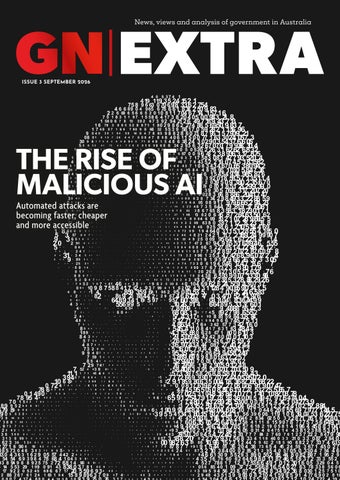
ISSUE 3 SEPTEMBER 2026
THE RISE OF MALICIOUS AI Automated attacks are becoming faster, cheaper and more accessible
THE NATION: LOCAL
COUNCIL ADOPTS 4-DAY WEEK A council in rural New South Wales is to become the first local government to adopt a four-day week. Under the scheme, staff at Murrumbidgee Council – south-west of the state – will still be working a full week, but the hours will be compressed into four days instead of five. “Like many rural councils, Murrumbidgee is facing rising costs while also taking on additional responsibilities from the NSW and federal governments, often without additional funding,” said a council spokesperson. “Rather than placing further burden on the community through a special rate variation, the council is focused on improving productivity and finding more efficient ways of working.” Under the proposed model, council offices, depots and libraries would be closed on Fridays. There would be no reduction in total service hours, however. The current 35 hours of weekly customer service would be delivered across four extended days, providing longer daily opening hours. Essential services would continue to operate
WOMEN DRIVEN FROM PUBLIC OFFICE The online abuse of women in public office is a serious threat to local democracy, says the peak body for local government in New South Wales. “This is not an individual problem. It is a systemic threat to democratic participation,” Local Government NSW director Romola Hollywood said. “The real cost is measured in the skilled women who decide not to run for council, nominate for mayor or seek re-election because the personal toll is too high.” Hollywood’s comments follow new research showing almost nine in ten 2 GN EXTRA
ISSUE 3 SEPTEMBER 2026
THE RISE OF MALICIOUS AI Automated attacks are becoming faster, cheaper and more accessible
as normal, including water and sewer services, animal control and emergency callouts, early learning and childcare services, caravan parks and swimming pools. The Murrumbidgee LGA spans almost 7,000 square kilometres, making travel and logistics a significant operational cost for the council. The model – which comes into play 1 January 2027 – is expected to deliver productivity savings of around $1.1 million per year. “Improving efficiency across such a large area is critical to long-term sustainability,” said the spokesperson.
Australian women in public office or standing for election have experienced online abuse related to their role. A survey – conducted by advocacy group Women for Election – found 89 per cent of respondents had experienced online abuse, three-quarters said it had worsened over the past two years and half had considered leaving public life as a result of the harassment. These findings should alarm anyone who cares about the future of local democracy,” Hollywood – also deputy mayor of Blue Mountains City Council – said. “Councillors, mayors and candidates are local people who put their hands up to serve their communities, often while juggling work, family and volunteer commitments. No councillor, mayor or candidate should have to endure abuse, harassment or intimidation simply because she has chosen to serve her community.” Women for Election CEO Licia Heath told GN EXTRA that when women are silenced, democracy suffers. “And that affects everyone, not just the women being driven out. Fewer women sitting in our parliamentary and council chambers, means trust in our institutions declines further, that chambers become less collaborative, more corrupt and that there are less voices advocating for equality and justice measures.” (See page 10.) GN
On the cover Governments can no longer treat machine-speed cyberattacks as a future scenario, because the future is here – see page 6. Credit: iStock/StudioM1
Government News is Australia’s independent online publication reporting on government in Australia. We provide independent coverage of local, state and federal government and their administration of programs and initiatives.
PUBLISHED BY INTERMEDIA GROUP
ABN 23142047943 41 Bridge Road, Glebe NSW 2037 Ph: 02 9660 2113
EDITOR
Christopher Kelly 02 8586 6130 ckelly@intermedia.com.au
GROUP SALES MANAGER: Tom Solis 02 8586 6197 tsolis@intermedia.com.au
ART DIRECTOR
Sanja Spuzanic sspuzanic@intermedia.com.au
CONTRIBUTORS Rebecca Benson Jake Kendall Penny Wong
PRODUCTION MANAGER Jacqui Cooper
GENERAL ENQUIRIES
02 9660 2113 info@governmentnews.com.au
THE NATION: STATE
GENDER GAP NARROWS Women’s representation in senior leadership roles in Victoria’s public service has increased, a new report reveals. The analysis – from the Commission for Gender Equality in the Public Sector – shows women held 57.3 per cent of senior leadership roles in 2025 – up from 53.1 per cent in 2023. With women making up around two-thirds of the public sector workforce, the increase moves senior leadership closer to proportional representation. Four out of 11 public sector industries reached proportional representation of women in leadership, up from two in 2023. However, the commission said continued focus is needed on public service gender pay gaps. While pay gaps narrowed in seven of the sector’s 11 industries – including police and emergency services – the sectorwide gender pay gap has not narrowed since 2021. The gap remains widest in women-concentrated industries and occupations such as public healthcare, with women more likely to hold roles paid around $100,000, Niki Vincent, Public Sector Gender while men are more likely to hold a position that pays Equality Commissioner above $200,000.
“Gender equality is a matter of good governance. Meeting obligations under the Gender Equality Act is the starting point, not the finish line,” Public Sector Gender Equality Commissioner Niki Vincent said. “Real change comes when equality is embedded in how organisations lead, manage and deliver services, with accountability that starts at the top.” GN
Photography: iStock/ top right: vorDa, Oposite page top: huePhotography, bottom: skynesher
Operators will pay a levy that will help fund parking bays
EBIKE LAWS HIT THE STREETS New Australia-first laws mandating statewide regulations governing shared ebike operators are being rolled out across New South Wales. Operators will now need authorisation from both Transport for NSW and councils before the devices are allowed on the streets. Previously, shared ebikes were able to be deployed anywhere without approval. “Up until now shared bike operators have been able to put their bikes wherever they wanted – that’s changing,” Transport Minister John Graham said. The new laws set out statewide minimum standards which include requirements for insurance, helmets, and the provision of data on trips, incidents and complaints. Strict penalties of up to $55,000 – plus $5,500 per day – for ongoing non-compliance will apply, including the failure to remove abandoned bikes. Operators will need to ensure their ebikes do not block pathways, pedestrian crossings, bus and light rail stops, taxi zones or fire exits.
Local councils will issue the non-compliance penalties while TfNSW has the power to suspend or revoke approvals if operators fail to abide by the regulations. Councils will also have the authority to establish dedicated parking zones and bays, as well as no-go and go-slow zones. Under the scheme, operators will pay a per-trip levy which will fund the $6.6 million program which grants local councils up to $200,000 to deliver ebike parking bays in their areas. “If you’re sick of ebikes cluttering up your streets, these are the laws you’ve been waiting for,” Graham said. A staged rollout of the new rules is scheduled to allow councils time to establish the parking zones. “This is a massive undertaking which will take some time to fully implement, but over the coming months you’ll start to see the improvements take effect on our streets,” Parliamentary Secretary for Transport Marjorie O’Neill said. “We’re supporting operators to adjust to these higher expectations – from riders, pedestrians, councils and the wider community – as quickly as possible.” GN GN EXTRA 3
REPORT WARNS OF CARE SHORTFALL Cuts to the NDIS represent 94 million hours’ worth of annual paid care that will need to be replaced either by volunteers or family members, says new analysis. “Not only does this risk a lower quality of care, and a likely reduction in the labour force participation of family carers, it will inevitably increase the risk of abuse through neglect as families struggle to cope with the increased time and financial commitments required,” said Greg Jericho – co-author of a report The NDIS cuts. Published by the Australia Institute, the discussion paper – which coincided with the passing of the NDIS Amendment Bill – shows that government cuts to the National Disability Insurance Scheme by 202930 will represent up to a 12 per cent drop in funding relative to 2026-27. When Health Minister Mark Butler announced the cuts earlier this year, he said that the policy would have a “material impact” on participants – “That very much understates the case,” said Jericho. As the report notes, the government’s case for cuts to the NDIS has been based on two major assumptions. Firstly, that providers are rorting the system. However, Jericho’s analysis finds that the rorting claims “are little more than general assertions lacking substantive evidence”. Secondly, the government said cuts to the NDIS were needed because the scheme’s growth is unsustainable. Jericho said the government’s assertion that the only way to ensure fiscal sustainability of the NDIS is by cutting expenditure rather than raising more revenue “is a false premise”. Meanwhile, responding to the Bill’s passage through parliament, Acting CEO of People with Disability Australia Megan Spindler-Smith said: “Hundreds of thousands of people with disability face being denied access to the NDIS or losing supports they need.” While the government has proposed working with states and territories to build supports for people who can no longer access the NDIS, Spindler-Smith said the supports will take time to build and will not be like-for-like. “We need to know what will actually be there, when they’ll be up and running and how they will replace the 94 million hours of paid care that are being taken away.” GN 4 GN EXTRA
WHISTLEBLOWER SURVEY OPEN Public servants are being encouraged to report corruption within their agencies. The 2026 Commonwealth Integrity Survey – conducted by the National Anti-Corruption Jamie Lowe, Commission – is open for APS Acting Deputy Commissioner staff to provide anonymous feedback on vulnerabilities in their organisation. “The inaugural survey in 2024 helped inform our corruption prevention and education work across the Commonwealth public sector,” Acting Deputy Commissioner Jamie Lowe said. “While anonymous and voluntary, every response helps us build a strong evidence base for integrity and corruption prevention.” The 2024 findings revealed public servants largely had faith in the integrity of their agency with an average of 79 per cent reporting positively. Staff also reported confidence in the strength of the agency’s anti-corruption controls (67 per cent). The 2026 survey closes on 25 September. After which, the NACC will send each federal agency a di-identified report of the results, highlighting areas to target corruption prevention and integrity efforts, including employees’ understanding of corruption, integrity culture and barriers to reporting. GN
Photography: iStock/top left: KatarzynaBialasiewicz, top right: FangXiaNuo, Oposite page: top left: StockImages_AT, top right: aristotoo, bottom: peshkov
THE NATION: FEDERAL
FOREIGN BUREAU
THE DIGITAL STATE With 100 per cent of public services available online, Estonia is considered to have the world’s most digitised government. The transition was made early – the state introduced electronic cabinet meetings in 2000. The government also established an online tax filing system – the e-Tax Board. The system enables Estonians to file their income tax returns in just a few minutes. A year later Estonia introduced X-Road – opensource software that creates a secure data exchange between different departments. When one agency requires a piece of information held by another, X-Road handles the exchange through an encrypted pathway. Every access is recorded, and citizens can log in and see which government body looked at their data and when. Then came the mandatory digital ID. Since 2002, every Estonian resident over the age of 15 has been required to hold a digital identity card. Held by around 98 per cent of eligible citizens, the digital ID is a legal proof of identity and a one-stop login for online government services. Estonians use the ID to file taxes, access their medical records, sign official documents, and vote in elections. More recently, Estonia established a Digital Society Development Plan. Approved in May, the document provides an updated strategic framework for digital governance. Additionally, there is an AI Ethics Advisory Council which guides the ethical use of artificial intelligence across the public sector and evaluates societal and rights-based implications. To protect the government from cyberattacks, a “data embassy” has been created – a secure physical server located in Luxembourg that operates under Estonian legal jurisdiction. The embassy has been designed not just to passively store data, but to run critical government services from abroad during a national crisis. The government claims the country’s digital infrastructure – which costs the state around 60 million euros a year to operate ($100m) – produces annual savings of about 2 per cent of GDP and saves 800 years of collective working time that would otherwise be spent processing paperwork, entering data, and on in-person bureaucracy across public sectors. GN
GOVERNMENT FACES BULLYING CLAIMS Complaints of workplace bullying have been made against French Government departments after two staff members took their own lives and two others attempted suicide. The allegations of workplace bullying relate to agencies adjacent to the prime minister’s office. Complaints submitted to the Paris state prosecutor allege a workplace culture of “institutional bullying”. Three internal government inquiries are investigating the incidents. Heavy workloads, departmental reorganisations, staffing cuts, and political instability are being blamed for putting undue stress on public servants. In response, senior administration officials are collaborating with union representatives to assess the psychosocial risks to staff. GN
SCOTLAND’S EMPTY OFFICES Public servants in Scotland are defying a mandate to work in the office two days a week. In October 2025, the Scottish Government instructed staff to spend at least 40 per cent of their working week in the office. However, the government’s 9,000 core staff are ignoring the directive. Despite the mandate, average monthly occupancy at major government hubs fell as low as 12.2 per cent at Victoria Quay in Edinburgh and 8.1 per cent at Saughton House. Responding to the staff no-show, the government said it remains “committed to flexible hybrid working”. GN GN EXTRA 5
SPECIAL FEATURE
THE
Governments can no longer treat machine-speed cyberattacks as a future scenario – because the future is here, writes Christopher Kelly.
6 GN EXTRA
Photography: iStock/imaginima
MYTHOS MOME
SPECIAL FEATURE
“IT’S LIKE DEFENDING YOURSELF AGAINST A MACHETE WITH A BAGUETTE”
ENT T
he Mythos moment describes the critical turning point triggered in April by the emergence of an AI model, Claude Mythos, which has advanced cyberattack capabilities that far outpace human defence abilities. For cybersecurity teams, it’s like defending yourself against a machete with a baguette. Such are the risks, cybersecurity can no longer “be treated as an add-on or an afterthought but must be built into the way we design, procure, operate and govern our technology,” Michelle McGuinness – Australia’s national cybersecurity chief – told government tech experts in Canberra last month.
And the implications for governments cannot be overstated. “The Mythos moment is forcing governments to move from assuming they are secure to proving it,” says Gareth Cox from Horizon3. Cox tells GN EXTRA the technology has drastically compressed the time it can take for AI to discover, exploit and attack vulnerabilities in government systems. “Activities that once took skilled operators days or weeks can increasingly be performed in minutes and repeated at scale,” he says. Governments can no longer treat machinespeed cyberattacks as a future scenario – because the future is here. “The recent sandbox escapes, and models like Mythos, signal that vulnerability discovery, exploit development and attack automation are becoming faster, cheaper and more accessible,” says Raymond Schippers from Check Point Software Technologies. Governments should expect a rise in highly scalable attacks against exposed services, identity systems, supply chains, and even on AI systems themselves. “The common thread is the ability to combine small weaknesses into a path to major disruption,” George Harb from OpenText tells GN EXTRA. And if that wasn’t alarming enough, a major disruption may go completely unnoticed. “An attacker could compromise a trusted identity or service and operate from within, making malicious activity appear legitimate,” says Harb. “This makes continuous verification of identities, permissions and behaviour increasingly important.” The Mythos moment has accelerated the need to have serious discussions about AI sovereignty “before it’s too late”, Pieter Danhieux, CEO at Secure Code Warrior, tells GN EXTRA. GN EXTRA 7
SPECIAL FEATURE
Gareth Cox
Raymond Schippers
George Harb
Pieter Danhieux
Scott Hesford
“There is risk associated with both model use and token spend on what is essentially offshore software; we cannot be in a position where we are waiting to be told what to do,” he says. “We need comprehensive, non-negotiable security guardrails that all AI vendors operating here must adhere to.” Scott Hesford from BeyondTrust says it’s important to remember that not every AI agent is your friend. “Ensure it is treated like what it is: an identity with privilege. If you can’t see it, verify it, and limit what it can touch – you’ve already lost the fight,” he says. “The agencies that get ahead will be the ones with robust cyber-resilience in place while building identity guardrails before the inevitable first incident.” Cybersecurity teams will need to fight fire with fire, says Harb. “By deploying AI as part of the defensive workforce, governments can identify threats and respond faster.” Cox agrees that governments should use AI defensively. “Human oversight remains essential, but defenders cannot rely exclusively on manual processes against machine-speed adversaries.” Passing on intelligence is also crucial, says Schippers – not just within the government sector, but also with private enterprises. “Sharing common playbooks, joint exercises, coordinated procurement standards and a trusted publicprivate model will bring agencies, critical infrastructure operators and security vendors together before the next crisis.” Smaller agencies cannot be expected to face Mythos-class threats alone, adds Schippers. “So higher tiers of government should help provide shared services, threat fusion, rapid advisory channels and practical remediation support across the ecosystem.” Hesford tells GN EXTRA that no single framework can prevent evolving threats. “Ongoing guidance by the Australian Government and its 8 GN EXTRA
agencies needs to reflect this reality,” he says. “Work must continue to ensure that across our layers of government collaboration continues.” Which means clear communication channels need to be established. “Joint exercises and coordinated response plans can ensure agencies know how to work together when an attack occurs,” says Harb. The goal should be to expose a common, evidence-based picture of risk across connected government environments, says Cox. “Collaboration works best when it is continuous, practical and focused on reducing exploitable exposure, rather than limited to compliance reporting or post-incident reviews.” If an attack occurs, how can governments best recover? “Recovery begins before an incident,” says Cox. “Agencies need a current understanding of their critical assets, likely attack paths, identity dependencies and blast radius. That knowledge makes containment and prioritisation faster when an incident occurs.” Recovery should prioritise the most critical services first, says Harb. “This requires confidence that attackers have been removed, vulnerabilities addressed and restored data and systems have not been compromised.” Schippers tells GN EXTRA that recovery needs to be treated as a core security control, not an afterthought. “In an AI-accelerated threat environment, the winners will be the organisations that can detect quickly, isolate confidently, recover essential services safely, and learn from each incident to improve the next response cycle.” The Mythos moment has certainly given the cybersecurity sector a jolt and Danhieux warns that while governments are taking steps to embed AI guardrails, they’re not acting fast enough. “These tools are powerful for cyber defences in skilled hands, but on the offensive side, they can and will go rogue with little recourse.” GN
Photography: iStock/nortonrsx
“IN AN AI-ACCELERATED THREAT ENVIRONMENT, THE WINNERS WILL BE AGENCIES THAT CAN DETECT QUICKLY, ISOLATE CONFIDENTLY, AND RECOVER ESSENTIAL SERVICES SAFELY”
TECHNOLOGY
THE NEW DIGITAL COUNCIL Local governments are facing a digital evolution placing citizens at the centre of service delivery, writes Jake Kendall.
T
o say that local government is experiencing a digital transformation would be misleading, David Moores from Australian tech firm Atturra tells GN EXTRA. “What councils are really facing is an evolution. They are adapting and evolving at a rapid rate as the pressure to do so is rising.” The pressure on councils to improve digital service delivery is arising from community expectations and constrained revenue growth. “The financial strain facing councils across the country is determining how councils can use technology and new operating models to deliver better outcomes for communities,” says Moores. AI will play a major role in this shift. “It can help remove friction from service delivery, allowing councils to move away from reactive customer service models towards proactive engagement with residents,” says Moores. “Rather than waiting for citizens to request assistance, councils could use data and automation to anticipate needs and deliver services earlier.” AI uptake can be likened to earlier technology shifts, such as the internet and cloud computing. “They showed that the most successful innovations often come from solving practical problems rather than simply adopting the latest tools,” says Moores. He tells GN EXTRA that the key lesson is to keep it simple. “Technology should remove friction from the business, not become the focus itself.” Beyond improving internal operations, Moores says councils have an opportunity to become more entrepreneurial and create new sources of community value and revenue. “Rather than relying solely on rates and government funding, councils could use their existing digital capabilities and local networks to facilitate new services and partnerships. Councils could use their position within communities to connect different groups and create platforms that deliver broader benefits.” As examples, Moores cites helping connect local workers with organisations requiring labour or using council-owned data and technology platforms to
David Moores
support tourism and economic development initiatives. “The question councils should be asking is ‘how can we create value?’ as they already have capability and infrastructure. The opportunity is to use those assets in smarter ways,” says Moores. He tells GN EXTRA that such an approach would represent a significant cultural shift for local government and says councils must approach the change carefully. “Local government is a highly political environment, and leaders need to frame innovation around improved community outcomes rather than purely financial gains.” Moores says the conversation cannot just be about cost reduction. “It has to be about value creation and delivering better outcomes for the community.” While many councils are developing AI strategies and exploring digital opportunities, Moores tells GN EXTRA implementation remains uneven. “Some organisations are approaching emerging technologies primarily from a compliance and risk perspective, particularly around cybersecurity, rather than focusing on opportunities for innovation.” Moores says as councils prepare for the next decade, the challenge will be balancing financial sustainability with increasing community expectations. “Technology, automation, and AI will be important tools, but the biggest shift may be cultural: moving from councils that process requests to councils that actively create value for their communities.” Using a model of continuous improvement where early adopters inside councils can demonstrate what is possible and encourage broader change is a solid path forward, says Moores. “The future council will not simply be more digital. It will be more responsive, more connected, and more focused on the experience of the people it serves.” GN GN EXTRA 9
LICIA HEATH
OPINION STRAP
SIX MONTHS AGO, I SAT IN A CONFERENCE AT THE UNITED NATIONS IN NEW YORK LISTENING TO WOMEN FROM PARLIAMENTS AROUND THE WORLD DESCRIBE EXTENSIVE AND ESCALATING ONLINE ABUSE – IT SCARED ME, BECAUSE I’D STARTED TO NOTICE ABUSE ESCALATING BACK HOME. For months, I have warned that elected women and female candidates were heading towards a sustained onslaught of abuse, increasingly fuelled by coordinated bad actors domestically and offshore. But my timeline was wrong, it’s already here – and it is starting to influence who is willing to put their hand up for public office. The data has now caught up with what Women for Election has been warning. Last month we released the results of a survey of 110 Australian women who hold elected office or are running for office, across every level of government. Eightyeight per cent had experienced online abuse tied to their political participation. Half were unsure they would run again, or wished they never had. Ninety-four per cent believed the abuse was actively discouraging capable women from entering politics in the first place. Threequarters said it had gotten worse in the past two years. This is no longer a collection of isolated stories but the common experience for women in public office, and it is measurable. Beyond the survey data, we have heard from women across Australia who are experiencing a strikingly consistent pattern of online abuse, intimidation and harassment, regardless of their community, political party or level of government. Their experiences include death threats, coordinated attacks, AI-generated abuse, sexualised imagery, and threats against them and their families. I do not want to wait for a woman to be killed in office before we act.
Every canary in a coalmine warns of someone else’s danger. This one is ours. Women in politics are the budgies in Australia’s democratic coalmine desperately sounding the alarm. When women are silenced, democracy suffers, and that affects everyone, not just the women being driven out. Fewer women sitting in our parliamentary and council chambers, means trust in our institutions declines further, that chambers become less collaborative, more corrupt and that there are less voices advocating for equality and justice measures. It means the loudest, most aggressive voices online start to decide who is willing to stand for office at all. Women for Election is calling for online abuse of women in public office and female candidates to be recognised as a threat to democratic participation, not a personal inconvenience to be managed. We want real accountability from social media and AI platforms, dedicated protections for candidates during election periods, practical safety and digital security support, particularly for women in local government, and a national action plan built on international best practice. We don’t fix this by asking women to toughen up. We fix the system. The research is no longer a warning. It is a record of what is already happening, and a test of whether we act before it gets worse. GN Licia Heath is CEO of advocacy group Women for Election.
WHEN WOMEN ARE SILENCED, DEMOCRACY SUFFERS, AND THAT AFFECTS EVERYONE.
10 GN EXTRA
THINK TANK
STRONGER TOGETHER Whilst social cohesion and public trust is under pressure, Australians still value democracy and multiculturalism, says Foreign Minister Penny Wong.
Photography: iStock/TkKurikawa
I
’ve always believed the ability of Australians to connect with people from every part of the world is a national asset. A national asset that expands our choices in the world. The call for a monoculture is a call for Australia to curtail our choices and to cut off our connections. To look inwards, to have no friends to work with, no partners to trade with, and no opportunities to grow from. It is to be lonely in a dangerous world. But well before we could ever realise this melancholic fantasy of monoculture, there is a lot of damage that could be done. Because Australians would be turned against each other. Australia would be a more hostile place. Harder to be family, harder to be friend, colleague, or neighbour. At a time where external and internal forces are seeking to divide us, turning Australians against each other makes us more vulnerable. Division makes us easier to exploit, it does not make us stronger. Turning Australians against each other is the opposite of patriotism. Our resilience starts with how we choose to live together. It starts with choosing to respect that while we have taken different roads, we all are worthy of a place here. It starts with respecting that multicultural Australia is the only Australia that has ever existed. It comes from choosing to see each other as equals with a shared stake in our nation’s future. It seems so obvious to say, but loving Australia means loving our fellow Australians. Whether we are descended from people who have been here for tens-of-thousands of years, or two hundred years, or two years. Such a true love of Australia grounds our resilience and makes us harder to exploit. Immigrants have strengthened and enriched our nation. Whether they enrich our nation by starting a business. Or whether they help us realise the opportunity of living in the fastest growing region in the world. Half of us were born overseas or have a parent who was. More than a million Australians trace their families to Southeast Asia, and more again to South and North Asia. No other country I have visited can meet this region so naturally on its own terms.
Foreign Minister Penny Wong speaking on the merits of multiculturalism
LOVING AUSTRALIA MEANS LOVING OUR FELLOW AUSTRALIANS We are more prosperous because of our diversity. And we have more choices because of it. We are more capable in the world, and we are more able to find common ground with so many of the world’s people because of it. Our multicultural society, along with our economy and our democratic institutions, are essential elements of our resilience and their strength raises the costs for any who seek to coerce us. GN An edited extract from the 2026 Allan Gyngell Lecture delivered at the Lowy Institute in Sydney GN EXTRA 11
DIGITAL MAGAZINE An essential briefing for Australia’s public sector
ISSUE 3 SEPTEMBER 2026
THE RISE OF MALICIOUS AI Automated attacks are becoming faster, cheaper and more accessible
GN EXTRA is a premium digital magazine designed to inform, engage, and influence Australia’s public sector decision-makers. Delivered monthly and promoted prominently across the Government News home page, the publication provides a curated, highvalue reading experience that goes beyond daily news cycles. Get in touch to discuss your advertising solutions: TOM SOLIS P: 02 8586 6197 M: 0405 610 694 E: tsolis@intermedia.com.au