![]()


As we look toward 2026, the big questions are already taking shape. How will our industry navigate the challenges ahead—and seize the opportunities? Will this election year bring signs of renewed confidence? How will AI reshape everyday decision‑making? And how fast will omnichannel retail continue to evolve?
In this special edition of FMCG Business, trusted industry leaders share their predictions, insights, and practical advice for the year ahead—highlighting the trends set to influence FMCG in 2026.
This issue also showcases fresh product launches, category insights, and the latest in packaging innovation, including updates from The Packaging Forum and new work from the multi‑award‑winning Onfire Design team.
Some good news on the home front: New Zealand retailers have seen a significant drop in violent retail crime over the past year. Find out more on pg 46, along with news from the Convenience & Petrol sector.
For more breaking news and daily industry updates, visit us online. If you’d like our weekly e‑news delivered straight to your inbox, you can subscribe at www.fmcgbusiness.co.nz where you can also access industry services and upcoming events.
PUBLISHED BY
C&I Media (NZ) Ltd PO Box 109 342
Newmarket, Auckland 1149
MANAGING DIRECTOR
Simon Grover
GROUP PUBLISHER AND COMMERCIAL DIRECTOR
Safa de Valois
safa@c-store.com.au
EDITORIAL DIRECTOR
James Wells james@intermedia.com.au
HEAD OF CONTENT
Tamara Rubanowski
trubanowski@fmcgbusiness.co.nz ph: 027 278 4761
MEDIA SALES MANAGER
Bridgit Hannigan bhannigan@fmcgbusiness.co.nz ph 022 1505 473
The popular C&I Expo returns to Auckland on 13 14th May, bigger, better and now held at the conveniently located Due Drop Centre in Manukau. You can find all the details on www.candiexpo.co.nz . We hope to see you there!
If you have new product launches or industry news to share, we’d love to hear from you. Please keep in touch and join our daily conversations on LinkedIn, Facebook, or Instagram.
Enjoy this issue,
Tamara Rubanowski trubanowski@fmcgbusiness.co.nz www.fmcgbusiness.co.nz


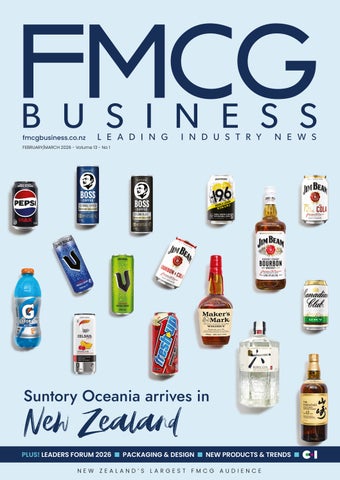
Suntory has officially launched its new multibeverage business in New Zealand - Suntory Oceania - marking a major milestone in the company’s regional growth strategy. Read the full story on pg 7.
GRAPHIC DESIGNER
Leanne Hogbin leanne@intermedia.com.au
PRODUCTION MANAGER
Jacqui Cooper jacqui@intermedia.com.au
DIGITAL AND PRINT
COORDINATOR
Eclypse Lee elee@intermedianz.co.nz
C&I Media takes its Corporate and Social Responsibilities seriously and is committed to reducing its impact on the environment. We continuously strive to improve our environmental performance and to initiate additional CSR based projects and activities. As part of our company policy we ensure that the products and services used in the manufacture of this magazine are sourced from environmentally responsible suppliers. FMCG is printed on FSC®-certified MIX paper from well-managed forests and other responsible sources. SCG print using BIO-inks that contain materials that are based on renewable resources including wood resin (rosin, colophony), and vegetable oils, linseed oil and soy bean oil. This magazine is printed by SCG, an ToitŪ enviromark gold certified printer.


Foodstuffs NZ has appointed Deirdre Boyle as its new Chief Customer Officer following an extensive international search. She will take up the role on 18 May.
Originally from Hawke’s Bay, Deirdre has spent more than 20 years leading product, digital, customer experience and marketing teams across some of Australia’s best known banking and insurance brands. She is currently the Chief Customer Officer at Flybuys Australia, the loyalty programme jointly owned by Coles Group and Wesfarmers.
“I’m looking forward to returning to New Zealand and joining an iconic business with a clear sense of purpose and a real impact on its customers, communities and people,” Deirdre says
“It’s great to be joining Foodstuffs and working alongside such a capable team. Both co ops play an important role in communities across the country, and I’m keen to help strengthen those connections and deliver real value for New Zealanders across a strong portfolio of brands.”
Deirdre joins at a time when Foodstuffs is making a number of changes to increase customer focus, including the formation of the new national Customer team and the ramp up of work in Customer Engagement to better understand shoppers and deliver improvements they notice in store and online.
Brendon Lawry will continue in his secondment leading the
Woolworths NZ has announced that Rod Gibson has joined its business as Commercial Director.
Rod joins Woolworths from T&G and has a long career in retail spanning time at Animates and 12 years at Foodstuffs, where he had a number of senior roles across Fresh, Liquor, and Own Brand.
“It’s an absolute privilege to have the opportunity to lead the Woolworths commercial team, and I know I am joining a really talented team who are already doing some great work,” says Rod.
“A strong and thriving Woolworths is important for New Zealand in so many ways, and I’m looking forward to getting to know our customers, suppliers and growers over the coming months.”
Sally Copland, Managing Director Woolworths NZ is delighted to have Rod join the executive leadership team. She says:
“Rod has incredible experience that will stand him in great stead as he takes the helm of the commercial team here in NZ. We’ve got some exciting plans ahead of us and I know Rod is looking forward to diving in and making a meaningful impact.”


Suntory has officially launched its new multi beverage business in New Zealand Suntory Oceania marking a major milestone in the company’s regional growth strategy.
First announced in August 2023, the creation of Suntory Oceania reflects the company’s confidence in the growth potential of the region.
The new business brings together a multi beverage portfolio of more than 40 iconic brands spanning premium spirits, RTD (ready‑to‑drink) alcohol beverages, juice, water, soft drinks, coffee, energy and sports drinks, supported by an end‑to‑end supply chain operations on both sides of the Tasman.
Brad Erceg, Chief Commercial Officer Suntory Beverage & Food Oceania, said the launch represents an important moment for the region.
“We’re building on a legacy that spans generations in both Japan and New Zealand. This is about combining the best of Suntory with deep local relevance. More than ever before, we have the power to fully leverage Suntory’s global network as we invest in local operations and our people.”
Suntory entered New Zealand in 2009 with the acquisition of Frucor

“New Zealand is a dynamic market with strong appetite for innovation, particularly in the RTD and premium spirit categories. Suntory Oceania gives us the platform to ignite growth and bring world class brands closer to Kiwi consumers.”
Morgan added that scale and capability will be key drivers for growth.
“Our combined manufacturing footprint across Australia and

“The new business brings together a multi-beverage portfolio of more than 40 iconic brands”
Consumers are spoiled for choice as late summer settles in. Fresh melons offer the perfect way to beat the heat and berries remain a seasonal favourite while supplies last. With the back to school routine now in full swing, parents are also on the lookout for convenient, healthy lunchbox fillers that keep kids satisfied throughout the day. This is the ideal time to highlight fresh summerfruit, cherry tomatoes and other nutritious snacks like cucumber and capsicum.

Beetroot is at its best in New Zealand during late summer and early autumn, bringing vibrant colour and earthy sweetness to seasonal cooking. Their versatility makes them a favourite for salads, smoothies and dips. What to look for: Choose firm, smooth beetroot with deep colour and unbruised skin.
Storage/handling: Keep beetroot refrigerated and maintain consistent temperatures to reduce spoilage. Handle bulbs carefully to prevent bruising, and remove leaves promptly to extend shelf life and maintain freshness.

“Sweetcorn should be left in the husk and refrigerated.”
Nutrition: Beetroot are a source of folate and a good source of vitamin B6, which helps reduce tiredness and fatigue.
The sweetcorn season is still going strong, bringing juicy cobs to stores nationwide. New Zealand’s prime growing regions
Gisborne and the Far North deliver the sweetest harvests. Their warm climates and long sunny days ensure consistently tender kernels, making fresh sweetcorn a seasonal favourite for shoppers all summer long.
What to look for: A reliable way to judge the freshness of corn is to choose cobs with firm, bright green husks that are rounder and fatter at the end. Shoppers should avoid peeling back the husk in store, as doing so causes the kernels to dry out more quickly.
Storage/handling: Sweetcorn should be left in the husk and refrigerated.
Nutrition: Sweetcorn is packed with nutrition: a good source of dietary fibre and folate, a source of vitamin C, B vitamins and zinc.
New season apples and pears are arriving in good volume across Aotearoa, offering crisp texture, great flavour and excellent quality at this time of year.
What to look for: Pears ripen from the inside out, stock should be firm to touch, with no dark or soft spots. Apples should be firm to touch, have no bruising and the skin should bright and fresh looking.
Storage/handling:

Pears have very delicate skin and should be handled gently to avoid bruising. If pears are not yet ripe, allow them to ripen at room temperature, then refrigerate to slow further ripening and maintain quality.
Apples are more robust but still benefit from careful handling. Store apples in the refrigerator or a cool, well ventilated area to maintain freshness, crispness and flavour. Keep apples separate from strong smelling produce, as they can absorb odours.
Nutrition: Both apples and pears are a source of vitamin C, which supports healthy skin, and a source of dietary fibre, which supports digestive health.
Hydroponic production keeps a steady stream of fresh herbs on shelves all year, making it easy to cater to Kiwi shoppers’ tastes. Essentials like mint, coriander, basil and parsley remain customer favourites, while expanding your range with sage, chives, dill, oregano, tarragon and fennel adds extra variety and strong visual appeal in store.

What to look for: Choose herbs with bright, vibrant colours. Avoid any bunches with yellowing, browning or wilting. If herbs are packaged, check for condensation, which can indicate they are starting to spoil.
Storage/handling: Handle living herbs gently and position them in a bright, sheltered spot, well away from draughts and refrigeration. Avoid misting them on display. Place coriander on the top shelf of the display, where it can receive plenty of light.

The first Finalist for the 2026 FMCG Business Product of the Year award addresses a growing consumer need: convenient, trustworthy meal solutions for families managing dietary requirements.
Waitoa Gluten Free Chicken Tenders offer a reliable option for households with gluten intolerance and food allergies, providing the familiarity of a trusted Kiwi brand with the reassurance of transparent ingredient standards.
Made with free range chicken, the product is SPCA certified, a good source of protein, and contains no artificial colours, flavours or added preservatives – giving shoppers confidence in what they’re serving their families.
The simple preparation (oven or air fryer) removes the stress from meal planning, whether for school lunches, family dinners, or portion controlled meals. The product delivers on the basics families can depend on: quality ingredients, straightforward preparation, and consistent results.
Waitoa free range chickens are raised in the Waikato, maintaining the local provenance that consumers trust. The brand’s Toitū netcarbonzero certification demonstrates an ongoing commitment to responsible practices.
New innovative packaging is being introduced to improve on shelf recognition and includes a QR code, which once scanned takes you to the farms where the chicken is raised and provides recipe inspiration. For more information visit https://www.waitoafreerange.co.nz/

“Made with free range chicken, the product is SPCA certified, a good source of protein, and contains no artificial colours, flavours or added preservatives”

SPONSORED BY


After years of economic headwinds, 2026 feels like a pivotal moment for FMCG and retail in New Zealand. The past few years have been anything but easy—far from the “rock star economy” of the 2010s. After the optimism that surrounded 2025, reality proved more challenging. Despite hopes for a rebound, economic conditions remained tight, and the anticipated turnaround never fully arrived.
Let us break down what is shaping the year ahead and why cautious optimism might be the right mindset to have as we enter 2026.
A year ago, when I contributed to the Leaders Forum, I predicted that 2025 would not be the flourishing year many hoped for—and unfortunately, that proved true. This time, I am confident in saying 2026 is shaping up to be a year of recovery and renewed momentum.
Green shoots are emerging, and while there are no expectations of a boom, several positive indicators give us the confidence our economy is on the mend.
The benefit of falling interest rates will continue to flow through the economy as households refix their mortgages. Lower repayments mean more disposable income, which should help support consumer spending.
Business confidence surged to its highest level in 30 years in December, a remarkable turnaround from the pessimism that has lingered since the pandemic. This renewed optimism is a strong signal that businesses are preparing for growth and investment.
Retail sales volumes grew by a seasonally adjusted 1.9% in Q3 2025, the strongest growth since late 2021. While modest, this uptick suggests consumers are starting to spend again, particularly in categories like pharmaceuticals, electronics, and recreational goods. Together, these factors highlight a shift toward a more positive economic outlook.
We expect three key trends to continue shaping FMCG in 2026: health, premiumisation, and the value proposition. Health remains front and centre, with protein leading the charge as consumers seek functional benefits. Premiumisation will persist in categories and products where emotional connection is strong—think indulgent treats, lifestyle beverages, and pet care.
At the same time, the value equation will drive behaviour: shoppers will look for cost savings on low attachment items but willingly pay
more where perceived benefits outweigh the price. In short, consumers will keep balancing practicality with moments of joy and quality.
Two forces will redefine FMCG in 2026:
1.
Weight loss drugs like Ozempic and Wegovy, approved in NZ in 2025, are reshaping consumption patterns globally. With 75% of Kiwis wanting to lose weight, these treatments could drive demand for smaller portions, protein rich foods, and functional products.
GLP 1 remains in its infancy in New Zealand, but its potential impact makes it one to monitor.
2. Agentic AI and Conversational Commerce
AI is moving beyond operational efficiency to agentic commerce— smart AI agents making purchase decisions for consumers.
Retailers like Walmart are pioneering this shift, and New Zealand will follow. Brands must optimize for AI driven discovery, not just Search Engine Optimisation, as generative engines become new gateways to product pages.
It is still tough out there, but signs point to recovery: interest rate cuts, stabilizing house prices, and improving business confidence. Retail is adapting through value driven models, omnichannel strategies, and health focused innovation.
For FMCG, 2026 will be about resilience, recovery, and reinvention—meeting consumers where they are, whether that’s in store, online, or through AI powered experiences.
The challenge? Staying agile, innovative, and connected while delivering value that feels worth it.
The opportunity? To turn these headwinds into tailwinds and make 2026 the year FMCG reclaims its momentum.

“Business confidence surged to its highest level in 30 years”

become: brittle, anxious, non linear, and often difficult to interpret in real time.
New Zealanders are feeling it also. Our latest customer sentiment work shows 61% of households consider themselves financially precarious, and 77% say their biggest concern is the price of groceries as it’s the shopping they do most often. In a small low density market, with tight supply chains and rising expectations, that kind of pressure is felt by everyone.
Through all this, we’ve set our aspiration to become New Zealand’s most customer driven and productive organisation. Aside from the demographic and logistical challenges of New Zealand being only five million people spread over a country roughly the size of Japan, we’re seeing customer expectations fragmenting at speed, and that matters for us and our supplier partners.
To give you an example, one trend our customer engagement has identified is the rise of two groups of customers quality seekers and budget constrained families who together represent 30% of value. Insights like this help us build ranges, promotions and experiences that win with customers and create the most value for suppliers.
assistant” for every New Zealander. It will be one of the biggest changes for supplier activation we’ve ever had.
We know how tough the operating environment is for suppliers. Costs are up, volatility is high, and planning is harder. That’s why we’re not just looking at how to make Foodstuffs more efficient, but also creating a healthier, more resilient, and more predictable grocery ecosystem.
We’re looking at the whole industry and tackling three big business processes first:
• Data to decision – better, faster insights that improve forecasting, ranging, promotions and availability for everyone.
• Supplier to customer – a more reliable, efficient supply chain with less waste, fewer delays, and clearer expectations.
• Cost-price process – reducing friction and delays in managing thousands of cost price changes each year.
The benefits for suppliers are less duplication, fewer touchpoints, clearer processes, lower costs and more certainty across the chain. This ultimately means faster speed to shelf and better availability and, overall, more stable planning in an unstable world. Suppliers have told us they need us to be easier to do business with, and this will help deliver that.
At the heart of it all is partnership. We don’t succeed without our suppliers. Every great local product on our shelves represents a family, a business, and a commitment to serving New Zealand.
Together, we can bring clarity to a complex environment, keep delivering great value for customers, and build a more competitive, resilient, future ready FMCG sector.

One of the biggest shifts we’ve made is taking greater ownership of our customer data and experience. After two decades as part of a coalition loyalty programme, we’ve rebuilt New World Clubcard from the ground up and now have more than a million contactable customers and growing fast.
That matters for suppliers because we can target with precision –testing, learning and scaling offers faster, and we can put products in front of the right customers at the right moments.
Next, we’re bringing PAK’nSAVE, New World, Four Square and Gilmours into one simple, digital experience a “personal shopping
“We’re not just looking at how to make Foodstuffs more efficient, but also creating a healthier, more resilient, and more predictable grocery ecosystem.”
though Hornby is just 2.5km from our distribution centre, and Stewart Island is about 600km away. That approach helps ensure customers can access food at affordable prices, regardless of where they live.

shopping experience.
Whether it’s via an online platform or one of our physical stores, our co operative exists to feed the South Island. That is sometimes easier said than done on an island that is 150,000 square kilometres in size – but home to only 1.2 million people.
We are proud to have 34 stores serving towns with fewer than 5,000 people. From full service supermarkets to small stores, these are often the only option for food and essentials – sometimes for hours in any direction. Every day we invest in delivering goods to places like Murchison, Stewart Island and Collingwood – towns where our stores serve relatively few people and provide a first class shopping experience.
To keep things fair, Foodstuffs South Island uses island wide pricing. This means our Four Square on Stewart Island pays the same transport costs as our PAK’nSAVE in Hornby, Christchurch – even
Being the main food supplier for a small town carries responsibility, which is accentuated through weather events. The South Island has always known how to live with the elements, and 2025 tested us again with the Tasman floods and other emergencies. Strengthening emergency response and food security remains a priority as we know these events won’t be the last our communities face.
Looking ahead, I’m encouraged by the strengthening South Island economy. Primary industries, tourism and infrastructure investment continue to support jobs, growth and confidence across Te Waipounamu. While inflation, wages, energy costs and changing consumer behaviour continue to put pressure on both retailers and suppliers, it’s also clear that many businesses are finding practical, creative ways to adapt.
With this backdrop, in 2026 we’ll stay focused on the things that have always mattered to us: retail excellence, supplier partnerships, and community support. With the combined strengths of our suppliers and local grocers working together, we can continue contributing to

things that have always mattered to us: retail excellence, supplier partnerships, and community support.”
Raewyn Bleakley

Chief Executive, NZ Food & Grocery Council
It feels like we’ve been blown into 2026 with more wind than usual or maybe that’s a result of me spending the summer in Pōneke Wellington! On the way to Wellington’s Airport, on the Evans Bay foreshore, we have a sculpture called the Zephyrometer. I love the irony, that zephyr means a calm breeze. It stands at 26m tall, swaying with every gust, indicating wind speed and direction. So, when the needle is blown horizontal you know it’s very
The weather certainly feels like a mirror to our times. Headwinds and tailwinds, terms to describe opposing and supporting economic forces, respectively, are both evident. While there was good news on the trade agreement and tariff front as 2025 drew to an end, the first few weeks of 2026 have already demonstrated the unpredictable nature. Perhaps “crosswinds” is the better term to describe the billowing uncertainty, demanding agility and grit as we navigate what’s ahead. Riding tailwinds of easing inflation, supportive monetary policy, and growing consumer and business confidence, many are hopeful that this year will provide a path towards a more sustainable recovery.
Like the Wellington winds, regulatory currents are moving fast bringing changes to the grocery landscape. For the NZFGC, we are working on supporting suppliers as the second Grocery Code takes effect later this year. We’re providing supplier training, resources, and practical guidance to help members understand requirements. At the same time, we’re continuing engagement on the Commerce Commission’s next phase of work on wholesale grocery access, ensuring supplier perspectives are heard.
The Government is continuing its commitment to grocery market competition reform, to increase competition to reduce consumer prices we’re expecting to hear more about further activity early on in the year. Election years are usually turbulent and 2026 could see grocery scrutiny intensify and feature heavily in the policy tousle between political parties, as the cost of living remains a real concern and top of mind for Kiwi voters.
A significant trans Tasman food labelling decision is expected in February, when Food Ministers decide whether to mandate Health Star Rating (HSR). It’s long been signalled that if fewer than 70% of products displayed HSR by November 2025, they’d consider mandating it. While final figures aren’t in, uptake is likely below target. Food Standard Australia New Zealand (FSANZ) has been preparing for this, exploring a Standard and researching consumer use of HSR to inform the decision. The HSR Implementation Guide has been updated to support industry understand what’s involved.
imported food products, allowing digital labelling to replace physical labels. While it offers opportunities, there are also risks, which we’ve urged Ministers to consider carefully. In addition, the Ministry for Regulation’s product labelling review recommendations are now with Ministers. We expect this will involve further consultation, and we look forward to providing feedback from our members.
FSANZ has a full agenda, including reviews into caffeine, supplemented sports foods, and formula for young children. Preparatory work will also begin on commercial foods for infants and young children. Service improvements are a priority too, with new tools and information to support Food Standards Code users.
Updates to Australian and New Zealand dietary guidelines are pending, while the new US Dietary Guidelines, released in January, sparked much debate among nutrition scientists. This will be one we keep an eye on.
As we navigate the shifting winds of 2026, NZFGC is in great shape to offer guidance and support. We value our members’ support, which enables NZFGC to provide a voice, support and networking for suppliers. We welcome new members in what is

We await an update on the exemption from food labelling trial which is part of the Government’s response to the yet unreleased submissions to their ‘request for information’ to improve grocery competition. This would provide a Food Act exemption for some
“We are working on supporting suppliers as the second Grocery Code takes effect later this year.”
Katherine Rich Chief Executive of BusinessNZ

Election years generate opportunity and uncertainty for businesses. That uncertainty can be costly in more ways than one, particularly when food and grocery is such a tempting political football.
FMCG is a sector that runs on long planning cycles, slim margins and complex supply chains. Decisions made in government are destined to impact factory floors, freight schedules and
As the next general election approaches, it’s worth raising our voice around what food and grocery businesses need (as well as the things they don’t), so that as business advocates we can push for the right settings and raise the level of debate on the issues that matter most to your business.
If recent history has shown us anything, it’s that businesses are resilient and can work with change, so long as any government policy changes are well flagged and enduring. Constant signalling without resolution or announcing a reform before the practical details are thought through only undermines confidence. Instead, we need to see policy announced when it’s ready, with clear expectations around what businesses are being asked to do to improve the status quo.
Take for example skills shortages across the sector, which are affecting output and service levels every day. From manufacturing and warehousing to logistics and retail, the sector relies on a steady pipeline of skilled workers.
So it’s no surprise that businesses expect clarity around training policy, workforce participation and migration settings, especially during any period of political change.
What we don’t need are last minute announcements with compliance implications that create disruption and cost. Even well intentioned policies fail when businesses are given no time to adapt.
Food and grocery businesses operate across manufacturing, transport and retail sectors. Further to the above, regulatory changes to things like packaging, labelling, emissions, or employment must not only be coherent, but practically deployable across the whole value chain in a cost effective manner. If it can’t work in reality, then it’s a fantasy not worth announcing.
To ensure a business remains ‘fit for purpose’, business leaders make decisions using experience, data forecasts and sound risk modelling. They expect the same discipline from government
policymakers. The buzz of an election year should not lower the bar for good policy design or thorough impact analysis.
Constant reversals, pauses or threats to unwind existing settings make investors skittish. That’s because without clear signals from policymakers, businesses will delay decisions. Projects stall and confidence erodes as a result.
Reliable ports, safe and open roads, plentiful energy supply and digital networks are essential to keeping New Zealand goods moving and prices stable. Infrastructure failures are felt keenly by food and grocery. Delays, bottlenecks and outages disrupt businesses, impacting availability and affordability for households.
When infrastructure becomes a campaign tool rather than a long term national priority, investment decisions are deferred and costs ultimately rise. For a sector dependent on reliable infrastructure, stop start delivery is as disruptive as no delivery at all.
Election years often test the patience of business leaders. They test our ability to separate debate from the likelihood of actual delivery. It’s also a reminder that business confidence is not abstract or something to be treated lightly; it determines whether or not a business will invest, hire and innovate for years to come.
As the next election draws near, it’s time for businesses to start voicing expectations around what improvements could be made to the current policy environment to help them perform better.
As the voice of New Zealand businesses, BusinessNZ’s role is to ensure those ideas are heard loud and clear by all parties contesting the 2026 election.

“Reliable ports, safe and open roads, plentiful energy supply and digital networks are essential to keeping New Zealand goods moving and prices stable.”
Lance Dobson
Executive Director, NielsenIQ

2026 marks a shift where caution dominates consumer behaviour.
Economic volatility and political uncertainty have become embedded making. While driven austerity is fading, consumers remain wary of further economic rebalancing. Trust in long term stability is low, and shoppers are adapting to volatility as the new normal. They seek emotional reassurance from brands alongside affordability. Although financial positions have not year, sentiment has improved slightly,
Globally, 33% of consumers report they are worse off financially, and 37% say their position is unchanged. In New Zealand, pessimism is more pronounced: over half of consumers feel worse off, primarily due to rising costs of utilities, food, and housing. Despite some relief from inflation, concerns about geopolitical conflict and job security persist. Optimism varies widely by region, with emerging markets like Nigeria and India showing stronger confidence compared to developed economies such as New Zealand, which ranks among the most pessimistic globally.
Heading into 2026, increasing food prices remain the top concern for New Zealand consumers, followed by global conflict and economic downturn. Utility costs, once the leading worry, have dropped in priority but still weigh heavily on household budgets. Health concerns and family welfare also feature prominently. Globally, inflation is expected to cool slightly, and GDP growth is forecast to improve, but uncertainty continues to shape consumer priorities.
Kiwis are spending 21% more on FMCG compared to 2021, while wages have only grown by 15%, widening the affordability gap. Inflation has cooled across many categories, with FMCG price growth slowing to 2.6% in 2025 from 4.1% in 2024.
However, some categories such as healthcare and snacks still experience above average inflation. Volume growth remains modest, with beverages and fresh food leading gains. Consumers plan to prioritise essential expenses like utilities, groceries, and housing while cutting back on discretionary categories, with over half of us choosing Private Labels as a saving strategy.
Brand trust remains critical, with 95% of consumers saying it is important. While ethical sourcing and sustainability are now baseline expectations, they no longer differentiate brands. Instead, relevance
and product quality drive trust. Lifestyle changes, such as spending more time at home are influencing purchase decisions. Consumers increasingly value intentionality, waste reduction and making purposeful purchases.
Commerce is evolving into an omnichannel ecosystem where consumers move fluidly across platforms. E commerce is the fastest growing channel globally, and in New Zealand, online grocery penetration has reached 28%, surpassing pandemic levels. Social shopping is gaining traction across APAC, while retail media networks are emerging as powerful tools for personalisation and growth. Despite digital acceleration, physical retail remains dominant, accounting for nearly 90% of all FMCG sales.
Key trends shaping 2026 include commodity price volatility, the rise of anti obesity medications influencing food consumption and portion control, and the growing momentum of private labels. 30% of us are experimenting with AI driven product discovery and it’s disrupting traditional search and advertising, while retailers invest heavily in personalisation and experiential shopping. These shifts demand agility from manufacturers and retailers to manage costs, innovate, and deliver frictionless shopping experiences.
• Myth vs Reality: Consumer confidence hasn’t surged; rather, shoppers have accepted volatility as a constant. Brands must simplify lives and deliver tangible benefits to earn purchases.
• Actionable Innovation: Companies that anticipate disruption through reformulation, AI driven personalisation, and health focused offerings will win.
• Private Label Partnerships: Collaboration between brands and private labels can unlock incremental spending and deliver incremental category growth.
• Omnichannel Imperative: Retailers and manufacturers must deliver seamless, personalised experiences across all channels, integrating e commerce, social commerce, and physical retail.


Packaging Forum CEO Craig Miller says 2026 is shaping up to be a big year with a new strategic plan focused on helping New Zealand navigate toward a sustainable future, with circularity
Central to this is the Forum’s role as a connector and knowledge hub for its members. Drawing on a strong network of local and international experts, the organisation provides access to insights, learnings, and global best practice to help accelerate sustainability outcomes — from sustainable packaging design and recycling labelling advice to resource recovery and recycling solutions.
Says Craig, one of the Forum’s greatest strengths is the diverse membership base — spanning SMEs, large enterprises, and global brands across packaging producers, brand owners, retailers, and
This brings a wealth of expertise together to tackle shared
“One of the pathways to unlocking circular solutions is industry collaboration,” he says. “We provide a platform that connects members, industry partners, policymakers, and international experts. Acting as that lynchpin allows us to broker practical solutions — not only by supporting the development of circular packaging initiatives, but also by creating learning opportunities through webinars, workshops, and events that stimulate innovative thinking.”
The Forum works closely with international partners, including Soft Plastics Stewardship Australia (SPSA), and as a member of the global Extended Producer Responsibility Alliance (EXPRA), ensures sharing and alignment with international best practice and regulatory frameworks for producer responsibility, which is particularly important for export markets.
“Our recycling schemes and technical advisory groups are a great example of member led groups bringing material experts together to test and deliver end of life solutions for packaging — whether that’s soft plastics, glass, food and beverage cartons, or caps and lids. Our recycling schemes are practical examples of circularity in action, giving waste materials value by recycling them into new products — from fence posts and building materials to new glass containers. And we strongly believe you’re not recycling if you’re not buying recycled, which is why we also help communicate circular behaviours to the public.”
The organisation also plays a critical leadership role in helping members navigate policy and regulatory change. Following the 2024
announcement that plastic and metal caps and lids would no longer be accepted in kerbside collections, the Forum worked alongside members and industry partners to develop a solution. The result was the pilot Caps and Lids Recycling Scheme programme — enabling caps and lids that would otherwise go to landfill to be dropped off at selected locations across New Zealand and recycled into new products.
“Regulatory change is constant at both local and central government levels,” says Craig. “On behalf of our members, it’s our responsibility to provide a clear, cohesive, unified voice and to take a leadership role in shaping effective policy. I also represent our members on the Recycling Leadership Forum, which advises the Ministry for the Environment on improving the recyclability and recovery of packaging materials.”
He points to the Government’s December 2025 announcement, outlining plans to modernise New Zealand’s waste and litter legislation as a significant milestone, particularly proposals to introduce a framework for extended producer responsibility. The Packaging Forum jointly led the co design of a Plastic Packaging Product Stewardship Scheme (PPPS), submitting best practice recommendations to Government.
“We’re pleased to see those recommendations reflected in the Government’s EPR framework. Without these changes, it wouldn’t be possible to implement effective mandatory schemes.”
The Packaging Forum supports members’ sustainability goals by creating the conditions for industry to collaborate and deliver meaningful progress toward a circular future.
Maybe you should be a member? Visit www.packagingforum.org.nz

“One of the pathways to unlocking circular solutions is industry collaboration” Packaging Forum CEO
Craig Miller
Be a part of our world class product stewardship solutions to enable a circular economy. A circular economy based on buying products made from our waste. BE PART OF THE ACTION!
BUSINESS FUNDING RESOURCE RECOVERY & RECYCLING
Developing a circular economy turning our soft plastic waste into consumable products
Diverting caps and lids from landfill, and instead placing them back into the circular economy
Increasing recycling rates of food and beverage cartons and recycling them into sustainable building supplies
Investing to increase recovery of container glass and improving recyclability
Scan the QR code to find out what products our partners are making
join us now packagingforum.org.nz
We
caught up with Jane Allan, Onfire’s New Business Director to hear how they are igniting brands in 2026.
Where are you based and what shape does the Onfire team take?
Onfire is based in Takapuna on Auckland’s North Shore. Just a few minutes’ walk from the beach so we’re close enough to sneak in a morning swim when summer rolls around.
The Onfire team, or Firestarters, as we like to call ourselves, is fifteen strong. A tight crew with plenty of firepower.
We share offices with DoneBy, our Social Media Agency partner, led by Olivia McIver.
Can you share what a typical day at the Onfire studio looks like?
Lively ideas, good energy and plenty of laughs.

Our Creative Directors, Matt and Sammo, are pretty outgoing, so the vibe is upbeat and friendly from the moment you walk in. There’s usually a bit of banter flying around, mixed in with serious thinking and getting great work out the door.
We often hear from clients how welcoming the studio feels, which we love. We’ve always had strong staff and client retention, which is a good sign we’re doing something right.
Global team based in Takapuna
We’re a multicultural bunch, with Firestarters from New Zealand, Australia, the UK and Europe.
It’s great for the work. Different perspectives, different ways of thinking, and as a bonus, we’ve all learnt a few choice words in other languages along the way.
What projects have you been working on recently?
We’ve just wrapped up a big brand refresh for Telegraph Hill, which was a really fun and full on project. A lot of heart went into it and we’re thrilled with how it’s landed.
We’ve also completed the new Cute & Co packaging for Cottonsoft, along with Ingham’s Crunchy Butter Milk Fixx range. That has kept us firmly in our happy place, FMCG.
What does the Onfire design process and philosophy look like?
Ideas lead everything we do.
We treat every project as if it could be a portfolio piece, backed by solid strategy and research. And if the best person for the job happens to be a typographer or illustrator on the other side of the world, we’ll bring them in. Even if it costs us a bit more.
In FMCG, we like to do things differently. We’re big believers in zigging when others zag, because standing out on shelf really matters in a crowded supermarket.
Favourite tools the studio couldn’t live without?
Matt will say the coffee machine. Jane will say timesheets.
But honestly, it is the people. An agency is only as good as its team, and our Firestarters are the reason the work stays strong and the studio stays lively.
achievements or projects are you most proud of?
Onfire is New Zealand’s most internationally awarded packaging design agency, and has been ranked in the Top Ten Agencies globally by World Brand Design Society in the UK since 2018.
Food and beverage packaging is not easy. It requires an extra level of craft and creativity, so to receive these accolades is proof of our teams expertise.
More importantly, we are proud of the impact the work has. Helping our clients sell more, build stronger brands and achieve real commercial results.
Where to next for Onfire? What’s the focus for 2026?
We’ve been seeing a steady flow of work coming in from the USA and the Middle East, so we’ve made some smart new hires to support that growth on both creative and account service. It’s shaping up to be a pretty exciting next chapter.
What makes you ‘On Fire’?
We know FMCG inside out. Our team specialises in creating brands and packaging that cut through busy categories and work in the real world, not just on a pitch slide.
Where can people connect with you?
Google ‘Onfire Design’, head to www.weareonfire.co.nz, or give
Jane Allan, New Business Director, a call on 021 752 356. Always happy to chat!


In packaging, trust is not built overnight. It is earned. Sheet by sheet, pack by pack, year after year. For more than 40 years, Formakote™ has been doing exactly that, becoming one of the most trusted folding boxboards used by converters and brand owners across FMCG, food service, retail, and beyond.
WML Paperboard registered the Formakote™ brand in 1981, and since then it has grown into a globally recognised benchmark for premium paperboard. Today, as the packaging landscape evolves rapidly driven by sustainability expectations, supply chain pressures, and rising performance demands WML Paperboards Formakote™ range continues to set the standard for high performance paperboard.
Proudly made right here in New Zealand, WML Paperboard is the only paperboard manufactured in the Asia Pacific region. This local manufacturing capability delivers something increasingly valuable to NZ markets: Confidence.
Confidence in supply. Confidence in quality. Confidence that your packaging partner will be there for you, just as they have been since 1939.
“Proudly made right here in New Zealand, WML Paperboard is the only paperboard manufactured in the Asia-Pacific region.”
Designed to perform across demanding applications from frozen foods and fast food trays to premium confectionery and retail packaging Formakote™ balances strength and printability with consistency converters rely on. For brand owners, that translates into packaging that protects, presents, and performs exactly as intended.
Sustainability has always been part of our story. Manufactured from renewable, responsibly sourced fibre and fully recyclable, it supports brands navigating complex ESG requirements without compromising on performance or shelf appeal. Backed by ongoing investment in manufacturing efficiency and emissions reduction, WML Paperboard reflects a long term commitment to responsible production.

What truly sets the Formakote™ range apart, is its track record. Over four decades, it has proven itself across markets, applications, and generations of packaging professionals. That heritage builds trust but it is the ongoing innovation, consistency, and customer focus that customers can continue to depend on.
Forty years on, Formakote™ is stronger than ever. Engineered for performance, trusted for quality, driven by sustainability, backed by consistency, and created for brands.
And when packaging matters as much as the product inside, there is one question worth asking: Ask, is it WML Paperboard?
Phone: +647 306 3899 Email: sales@wmlpaperboard.com www.wmlpaperboard.com
Standing out on shelf and delivering at scale has never been more critical. Brands need to move faster, be more sustainable, and create packaging and in store experiences that do more than protect the product. They need to drive purchase where it matters most.
That’s where Blue Star comes in.
As New Zealand’s leading print and packaging partner, Blue Star works alongside brands to deliver integrated solutions from concept through to consumer. Our end to end capabilities span design to production across packaging, promotional print, high impact retail display and point of sale solutions that help brands stand out and perform in store.
From cartons, sleeves and flexible packaging options through to permanent, semi permanent and promotional retail displays, everything we produce is designed for real world retail environments. Backed by advanced production technology and nationwide capability, we understand what it takes to bring products to market speed, accuracy, compliance and absolute reliability.

Sustainability remains a major priority and we partner with brands to explore responsible materials, reduce waste, and design packaging and displays that balance performance with environmental impact without compromising shelf presence.
Whether launching something new, refreshing an existing range, or scaling production, Blue Star brings the experience, capability and collaborative approach to make it happen. www.bluestar.co.nz hello@bluestar.co.nz
1309491 Blue Star Advertorial_006.pdf 1 22/01/2026 1:57 PM


Blue Star is New Zealand’s leading marketing execution partner, helping businesses turn ideas into meaningful connections with Kiwi customers. Visit bluestar.co.nz to find out how we can make the difference for your business today.
What’s new in egg and poultry products

Eggs are an exceptional source of high quality, complete protein, containing all nine essential amino acids, with protein found in both the white (albumen) and yolk. The average egg provides about 6 7g of protein, providing a nutritious, economical and versatile meal option for shoppers.
Tight household budgets and rising egg prices are driving some shoppers to seek the cheapest options available, says the Foodstuffs North Island team.
They explain: “Currently, best selling products vary by banner: at PAK’nSAVE and Four Square, colony eggs dominate unit sales, while free range leads in New World. However, even at New World, colony eggs are growing while free range is declining – despite many stores removing colony eggs. This reflects the overarching consumer trend: when prices rise, shoppers follow the cheapest option,” says the team.
However, recent research shows that many consumers in
New Zealand are also considering carefully how and where their food is made.
With consumers paying closer attention to how food is produced, SPCA Certified not only improves animal welfare, but also provides brands with a credible, independently audited framework to build consumer trust.
As consumers demand greater transparency and proof behind marketing claims, animal welfare is increasingly influencing brand trust and purchasing decisions. This is where being part of SPCA Certified can provide a real commercial advantage.
SPCA Certified is SPCA’s independent animal welfare certification programme. It supports practical, evidence based welfare improvements on farm and across the supply chain through species specific standards that go beyond the minimum legal requirements.
“SPCA Certified gives businesses the ability to align themselves with a trusted brand”
SPCA Certified provides FMCG businesses with an independently audited framework that delivers credible assurance, stronger brand value, and a practical pathway to show their commitment to higher animal welfare outcomes. The SPCA Certified blue badge enables brands to communicate these commitments clearly across packaging, marketing, and customer channels, reducing the risk associated with unverified claims and strengthening consumer confidence.
Animal welfare is important to New Zealanders. In a crowded market, SPCA Certified gives businesses the ability to align themselves with a trusted brand something that resonates with values driven consumers.
‘‘We understand that increasing welfare standards can feel like a big step,” says SPCA Certified National Manager, Dr Kelly Drake.
“That’s why our team of experts is here to support our members long term. We offer advice and practical support to businesses to meet current and future welfare standards and to retain their competitive edge.”
Find out how to join SPCA Certified and what it could mean for your brand. www.spcacertified.nz/join
Hear from brands who have decided to farm with care and join the programme www.spcacertified.nz/our-members

Selected segments. Excludes fresh random weight packaged chicken * denotes value AND unit growth > +2%


Produced and supplied by our cooperative of 100% NZ owned, regionally based, family farms, the New Day, Morning Harvest and Sure As Eggs brands are packed with locally produced, fresh, quality eggs and delivered with reliability and care via your local family farm. As members of Independent Egg Producers Co operative Ltd (IEP), each farm has been in the same family for multiple generations. As a result, an ongoing passion for time honoured tradition coupled with modern farming technology, ensure eggs of not only excellent quality, but also representing ‘local’, ‘community’ and ‘provenance’ are packed into every single carton and tray. Not only that, each local farmer has also invested in the ‘Trace My Egg’ stamping technology,

ensuring that every New Day free range and Morning Harvest barn egg is stamped in accordance with the ‘Trace My Egg’ compliance programme (www.tracemyegg.co.nz).
This means that both stockists and consumers can purchase these brands knowing the exact source farm for each individual egg and, more importantly, with the absolute confidence and security of knowing that these eggs are genuinely and authentically ‘true to label’. New to the range for 2026 are the New Day Free Range Size 7, 12 pack plus two SKUs in the Morning Harvest Cage Free Barn egg range (Mixed Grade, 12 pack & Size 7, 12 pack).
To place your orders or for further info please contact 0800 787 327 or email info@independenteggs.co.nz


Waitoa Free Range: Meeting the demand for food transparency
New Zealand consumers are asking more questions about their food than ever before, and Waitoa Free Range is responding by putting information directly into shoppers’ hands.
Walk through any supermarket aisle and you’ll notice something shifting. Shoppers are pausing at the meat case, phones out, reading labels more carefully. They want to know where their food comes from, how it was raised, what makes it worth buying. This genuine curiosity represents opportunity. Recent Mintel research confirms it: 84% of New Zealand consumers prefer locally sourced food, with 41% actively trying to buy local most or all the time*.
Waitoa’s new QR code technology reflects this reality. Consumers no longer accept generic claims; they want details about the farms and farmers raising chickens for Waitoa for over 18 years. One scan delivers farm information and recipe inspiration directly to their device at the exact moment they’re deciding what to buy. It builds on credentials already earned one of the first poultry brands with SPCA certification, and New Zealand’s first meat brand achieving Toitū net carbon zero certification.
This curiosity extends to everyday meal occasions. As consumers learn more about farming systems, they want to act consistently.
Waitoa’s expansion into family packs of kebabs and chicken burgers brings free range from Sunday roasts into Tuesday dinners.
The results are measurable. Waitoa is experiencing double digit growth in both Frozen and Fresh Barcoded Poultry categories**.
As free range becomes more widely available, Waitoa continues

“84% of New Zealand consumers prefer locally sourced food”
to go beyond standard expectations by showing where their chicken comes from and driving purchase reassurance.
Waitoa’s approach is straightforward: embrace consumer curiosity rather than fear it. Information isn’t a barrier to purchase it’s the bridge between values and action. That’s where category growth lives.
* Source Mintel, The Holistic Consumer, September 2025
** Source – Circana Total Supermarket Scan Sales MAT to 7th December 2025


offering versatile meal and lunchbox solutions.
The Foodstuffs North Island team shared: “The bakery bread category is evolving globally, driven by consumers seeking health, variety, and more premium experiences. Sourdough is leading growth, with plain varieties taking the top spot and grain options following closely. This trend is in line with the rise of café culture, where ready to eat sourdough products with fillings are becoming a staple for convenience and indulgence. Customers are increasingly looking for authentic, artisanal options that deliver both taste and perceived health benefits.
“Branded bread innovation follows broader grocery trends, with suppliers focusing on reducing carbs and adding protein for better health. This shift spans across standard and gluten free ranges, with gluten free now seen as a premium option. Functional benefits and dietary flexibility are also becoming evident in other categories like buns, rolls, wraps, and pita breads.
“The sliced bread market remains mature and competitive, but volumes are declining as shoppers choose alternative options like bagels, wraps, gluten free, and pita or naan.”
In a market hungry for healthier, smarter options, Farrah’s continues to prove why it remains one of New Zealand’s most loved and trusted food brands. Driven by category disrupting innovation, the company leads with bold product development, an unwavering commitment to quality, and a true understanding of evolving consumer needs. As New Zealand’s original wrap innovator, Farrah’s has set the standard for the category for years.
What sets Farrah’s apart is a comprehensive range across multiple categories that genuinely serves every Kiwi household across every meal occasion. From wraps to pizza bases and Mexican products, the brand is known for exceptional flavour diversity and generous sizing, delivering the complete package:
everyday family favourites combined with functional products for those wanting added health benefits.
Whether it’s a quick breakfast wrap, school lunch, family taco or pizza night, or any meal in between, Farrah’s delivers the trusted quality Kiwis rely on. Every product is proudly flame baked in Upper Hutt, with options spanning vegan friendly, yeast free, and free varieties.
The numbers prove the brand’s market leadership. Farrah’s holds an unprecedented nine out of ten top ranked wrap SKUs (Circana Grocery data MAT 04/01/26.), including Garden Spinach, Premium White, Multigrain, Garlic Butter, Low Carb Keto, and Kids Snack Wraps to name a few. Their success reflects years of authentic innovation and the brand’s ability to deliver what Kiwi households genuinely want.
Building on this strong foundation, Farrah’s has pioneered innovation in the functional nutrition space, leading the low carb evolution with category disrupting products that respond to evolving consumer lifestyles. For those following keto, high protein, or health focused diets, Farrah’s Low Carb range delivers without compromise.
The innovation story continues with the recent launch of High Protein Wraps, engineered to deliver 11.2g of protein per wrap, four times more than their White Snack Wrap. Determined to create New Zealand’s highest protein wrap, the team trialled over 80 recipes before landing on the perfect balance of nutrition, taste, and Farrah’s unique flame baked quality. Flying off the shelves nationwide, the launch highlights the rising demand for convenient, functional nutrition as part of a better for you lifestyle.

This success mirrors the trajectory of the Low Carb Ultra Keto Wrap, launched in 2024 and now entrenched as a nationwide bestseller. With just 1.4g of carbs per wrap, 92% fewer carbs than a Farrah’s White Snack Wrap, it’s confirmed as New Zealand’s #1 Low Carb Wrap. It’s the go to choice for Kiwis pursuing keto and low carb lifestyles.
“Our entire range reflects our commitment to meeting diverse consumer needs,” says Jasmine Currie, Head of Marketing. “As the trusted name Kiwis have relied on for years, we’re constantly innovating while delivering the quality and value families expect. There’s so much opportunity ahead as we continue to lead the category.”
Shop the full Farrah’s range at retailers nationwide. For recipe inspiration, visit www.farrahs.co.nz or follow us on Instagram and Tik Tok @farrahsnz to see countless ways to use our wraps, tortilla and pizza bases. For more information contact your Twin Agencies representative or visit www.farrahs.co.nz
“We’re constantly innovating while delivering the quality and value families expect.”
Jasmine Currie, Farrah’s Head of Marketing


Woolworths NZ bakes a difference
Woolworths New Zealand is already in Easter mode, with hot cross buns now on shelves nationwide.
Back by popular demand, the early return follows strong customer demand, with more than 1.7 million store baked buns sold last season alone.
Michael Whorskey, Woolworths Merchandise Manager for Bakery, says the early start reflects consistent customer behaviour rather than any shift
“Each year our customers tell us it’s never too early for hot cross buns, and the numbers back that up. We sold more than 1.7 million in store baked units last season, with traditional dried fruit still reigning supreme, so we’re responding to what customers clearly want rather than the calendar.”
Continuing their partnership with KidsCan, Woolworths will donate five cents from every pack of Woolworths Own hot cross buns sold. In 2025, this contribution totalled more than $85,000 supporting KidsCan’s work delivering the necessities like nutritious food and warm clothing for children across Aotearoa.
KidsCan CEO and founder Dame Julie Chapman says the partnership continues to make a meaningful difference for families and
“Grabbing a packet of hot cross buns from Woolworths is a great way to support KidsCan and the work we do, getting food, clothing and health products to thousands of kids living in hardship across New Zealand. So, go for it –buy some buns!”
Customers can find Woolworths Own in store baked hot cross buns on shelves nationwide now, through to Easter Sunday, 5 April 2026.
Alongside classic favourites like traditional dried fruit, Chocolate and Brioche, leading the line up is the Cinnabon Hot Cross Bun. A viral hit in Australia last year, this limited time drop takes its cues from the iconic cinnamon roll, with a cream cheese style filling and signature cinnamon hit, giving the seasonal staple a sweet new twist.
More speciality flavours will land as the season rolls on, including a Mudcake inspired bun and a Cadbury Caramello option.
Source: Circana MarketEdge Grocery Data MAT to 04/01/26
Woolworths’ full 2026 hot cross bun lineup includes: Traditional, Brioche Style Chocolate, Chocolate, Fruitless, Cinnabon, Caramelised Biscuit Filled, Cadbury Caramilk, Mudcake inspired, Cadbury Caramello, plus the Free From Gluten range in Traditional, Chocolate, and Apple & Cinnamon.
The FMCG Business team endeavours to produce a monthly snapshot of category news and highlights, based on information from participating clients, plus a table of the freshest data available at time of print. If you wish to contribute news for upcoming category reports, please contact trubanowski@fmcgbusiness.co.nz
Lisa’s, proudly Kiwi made since 1994, has launched its top selling Caramelised Onion Hummus in a new 380g shareable format. Sweet, caramelised onion blends with Lisa’s signature creamy hummus, offering a delicious, reliable favourite for sharing, entertaining, and everyday dipping. A flavour Kiwis love, now in an even more generous size.
Sources: IRI scan, NZ Grocery 52 weeks to 28/12/2025 lisas.co.nz
@lisashummusnz


A range that blends authentic Indian flavours with universal appeal. Featuring 25+ SKUs across Kebabs, Momos, Flatbreads, and South Indian snacks, it caters to all tastebuds. Quick to prepare and easy to serve, the range delivers restaurant style taste in minutes, ideal for diverse households including those with fast paced lifestyles. orders@abinternational.co.nz , Phone: 09 256 1400


Hellers new salami sticks are perfect for any dish, not just entertaining, like any of our salamis they can be used on pizza, platters and pasta. No need to peel off a messy casing, just slice and serve from the pack. We also eat them on the go!
www.hellers.co.nz

Almighty has proudly launched Almighty MATCHA, a premium ready to drink matcha brewed for modern life. Smooth, creamy and ready when you are, it is the first to bring the globally successful canned format to New Zealand chillers. Available in Original, Strawberry and plant based White Chocolate with Oat Milk—design led and flavour first convenience without compromise. www.drinkalmighty.com hello@drinkalmighty.com @drinkalmighty


An elevated line of multi use hair treatments featuring our signature luxurious fragrances and targeted active ingredients to meet key consumer needs: repair, smooth, hydrate and shine. Use as a deep mask, leave in treatment, or rich conditioner to instantly upgrade everyday haircare routines. Orders@glowlab.co.nz
www.glowlab.co.nz
Phone: 0800 GLOW LAB
In the most significant launch to hit the meat snacks category, Jack Link’s, New Zealand’s number one meat snack brand*, has partnered with MrBeast, the world’s most watched content creator and global phenomenon with more than 450 million YouTube subscribers to launch new Grass Fed Beef W.T.F! (What’s. The. Flavour.?!) products.

Marking Mr Beast’s first ever partnership with a Consumer Packaged Good company, this landmark collaboration sees the launch of ‘secretly flavoured’ Jack Link’s x Mr Beast Grass Fed Beef W.T.F! (What’s. The. Flavour.?!) products.
One limited edition 45g Beef Jerky flavour and one 50g Twin Beef Sticks will be available this month from Mobil, Fresh Choice, Z Energy, BP, Caltex and other independent convenience retailers.
The range is being supported
by what is set to become the biggest consumer promotion ever seen in the meat snacks category.
Shoppers who purchase the limited edition packs can scan the QR code, enter the unique code inside, and guess the secret flavours for the chance to win $1,000,000, driving repeat purchase, engagement, and in store excitement.
Jack Link’s Marketing Director APAC Dan Bitti said, “This is without a doubt the biggest news to ever hit meat snacks across Australia and New Zealand. With the number one meat snack brand partnering with the number one content creator in the world, we’re delivering a highly disruptive launch for retailers, combining exclusive new products with a once in a lifetime chance for consumers to win $1,000,000.”
Designed to drive incremental category growth, the partnership aims to recruit new shoppers into meat snacks by tapping into Gen Alpha and Gen Z consumers, who snack more frequently than any generation before them, but remain under indexed in meat snack consumption.
For MrBeast, also known as Jimmy Donaldson, the partnership is a natural fit.
“I’ve been eating Jack Link’s for as long as I can remember, so teaming up was a no brainer,” he said.

“Now we get to create something super fun and tasty for our fans.”
The Jack Link’s x MrBeast W.T.F! range launches from January 2026, with flavours progressively revealed from April as promotional packs sell through, ensuring sustained engagement and repeat store visits.
For more information visit JackLinks.com.au or JackLinks.co.nz
45g Beef Jerky RRP: $6.40
50g Twin Beef Sticks RRP: $5.49 Contact your distributor now...
Source: NZ Grocery Scantrack, Value Sales and Value Share $ MAT to 21/12/25
“The range is being supported by what is set to become the biggest consumer promotion ever seen in the meat snacks category.”


What’s trending in functional foods and drinks this year?
A Foodstuffs North Island spokesperson shared: “Functional drinks are gaining momentum, with strong growth in low and no sugar options and non alcoholic alternatives. They offer added benefits like pre and probiotics, nootropics, vitamins, and protein. Looking ahead, energy and transformation beverages are expected to be the biggest contributors to category growth by 2027.”
Functional foods in general include items such as probiotic yogurts, fortified cereals, and naturally functional foods such as nuts, seeds and soy products.
Functional drinks range from kombucha and kefir to energy drinks, coconut water, herbal teas and brain drinks such as Ārepa.
Life doesn’t really slow down. The emails keep coming, the calendar fills itself, and somewhere in between you’re expected to stay calm, clear headed, and upbeat. That’s exactly why Ārepa created its Sparkling Brain Drink range — functional sparkling drinks scientifically designed to support your brain through real life.
Now, the range has expanded with two new flavours, each crafted to support a different state of mind.
Crafted as the ultimate 3pm slump saviour, Ārepa’s new Spiced Orange flavour is a zesty, pick me up designed to get you through the day — without caffeine or sugar crashes.
Formulated by world renowned neuroscientists and backed by clinical research, this 300ml lightly sparkling drink is 97% sugar free and low in calories. Each serve contains 200mg of American Ginseng, 200mg of L Theanine, and Vitamins B5 & B6 to support mental energy.
With its warming citrus notes and subtle spice, Spiced Orange brings a fresh twist to the Uplift family.
Created in direct response to customer demand, Lemon Yuzu & Vanilla introduces magnesium to the Calm & Clarity range for the very first time.
Designed to help you unwind, de stress, and take a mindful pause, this 300ml lightly sparkling drink delivers a smooth, refreshing citrus profile with a soft vanilla finish.
What makes this release truly innovative is its advanced functional formulation. For the first time in an Ārepa Brain Drink, it blends 138mg of elemental magnesium — supporting a healthy nervous system, muscle relaxation, reduced fatigue, and psychological balance — alongside 200mg of L Theanine per serve.
These drinks are designed not as quick fixes, but as part of a daily ritual that fits seamlessly into modern life. Whether you’re reaching for focus before a meeting, clarity in the afternoon, or a gentle lift after a long day, Ārepa’s Sparkling Brain Drinks offer a considered, science led alternative to coffee, energy drinks, or sugary sodas. Lightly sparkling, refreshing, and thoughtfully formulated, they support how you want to feel, without overstimulation or compromise. Because when your brain feels better, everything else tends to follow, one sip at a time.
Both drinks are available now nationwide.
To order the range email orders@socialsmiths.co.nz


Look out for innovations from Harraways
Harraways is a premium quality, New Zealand oat brand, still privately owned, with oats sourced from Southland farms.
“Traditionally kilned and milled at the original Dunedin mill with over 158 years of trust as a local breakfast brand Harraways leads New Zealand’s oats category,” says Head of Marketing & Innovation, Peter Cox.
“Found in all good supermarkets, Harraways commands a market leading 44% dollar share of the $30.1million RSV oat bag business. It is also driving innovation and improvements within the oat sachets segment.
“Harraways has been a leader in average per annum oat sachet growth over the last few years, ranking within the top two selling oat sachet brands in New Zealand,” explains Cox.
Building on consumer opportunity and momentum, Harraways plans to further refresh its sachet range. From early March 2026, Harraways oat sachets will offer:
• Newly comprised, uniform, recyclable box size, which offers flexibility on serving size. The range comprises both big serve and smaller serve offerings 45g and a new, 35g sachet serve.
• The recipe mix includes old favourites. Most of these now offer less sugar per serve, in line with Harraways’ ongoing commitment to health and wellness.
• Harraways’ exciting new 35g sachets range features 10 serves per box. The recipes inside were developed with indulgence and an extra creamy texture, delivering an ultimate experience. New flavours coming to market include exciting Blueberry Buttermilk, alongside decadent Sea Salt Caramel. Contact the team on info@harraways.co.nz or ph: (03) 488 3073 www.harraways.co.nz
The FMCG Business team endeavours to produce a monthly snapshot of category news and highlights, based on information from participating clients, plus a table of the freshest data available at time of print. If you wish to contribute news for upcoming category reports, please contact trubanowski@fmcgbusiness.co.nz
Less Sugar Per Serve
Smaller 35g Serve
Indulgent
Fuller Textured
Less Sugar Per Serve
Big 45g Serve


Packed in smaller servings for those wanting less.
Extra creamy recipe, strongly desired.
Recipes designed to be nutritious yet indulgent.
On trend recipes. Salted caramel & buttermilk in recipes - always desired!


Consumers key desire = less sugar/serve.
Most recipes in new range contain 30% less sugar than Apple Sultana and Cinnamon Oat Sachets.


Foodstuffs has transitioned New World and PAK’nSAVE stores away from non‑recyclable PVC plastic wrap, replacing it with recyclable low‑density polyethylene (LDPE) across butchery, bakery, produce and deli departments. The change forms part of the co‑operatives’ commitment to reducing problem plastics and sending less waste to landfill.
The majority of Foodstuffs North and South Island New World and PAK’nSAVE stores have adopted the recyclable LDPE wrap. Both co ops plan to have fully transitioned all departments from PVC to the new wrap by the end of June 2026.

This is expected to remove around 850 tonnes of PVC plastic from landfill each year, equivalent to approximately 1,400 skip bins. This initiative supports Foodstuffs’ 2025 2030 sustainability commitments and lifts Foodstuffs’ overall packaging recyclability to 94%.
The change follows more than three years of evaluation. Working closely with packaging supplier Wedderburn, Foodstuffs implemented blind trials in store, with teams testing the old PVC wrap alongside the new, recyclable LDPE wrap. Three objectives were set:
The new wrap had to perform as well as or better than PVC, in store, and for customers at home.
It had to be recyclable through the New Zealand Soft Plastic Recycling Scheme. It had to be cost effective; adding cost to fresh produce was not an option.
Foodstuffs New Zealand sustainable packaging manager Debra Goulding said, “We knew the new wrap had to work across our machinery, our fresh departments, and in customers’ homes. It had to do everything the PVC was doing previously.”
The LDPE wrap scored higher overall, and while it handles slightly differently, stores have adapted quickly and stores have recalibrated in store machinery across the North and South Island.
The new wrap works well with chilled and ambient products such as meat, seafood, fruit and vegetables and baked goods. Hot foods are being transitioned to packaging options better suited to their temperature, such as paper bags, tubs and LDPE carry bags. These alternatives ensure the new recyclable packaging delivers the same functionality as the former PVC wrap.
“For us, this entire process comes back to our promise to customers. PVC was difficult to recycle, and we’ve been working towards a goal of making all our packaging at least recyclable. It took nearly three years to find a wrap that worked. There were a few issues to iron out, but we’ve arrived at a great, innovative solution,” said Debra.
Christchurch’s newest independent supermarket, Kai Co, officially opened its doors in January at the Northwood Supa Centa.
Father and Son owners Shane and Ethan Vickery said: “Kai Co is built around one belief, food is essential, so it should be affordable for everyone.”
They shared: “It’s been a big few weeks. In just over 20 days of trading, we’ve:
• Grown our team from 30 to 36 local staff
• Welcomed around 50,000 people through the doors
• Sold 12,000 trays of chicken breasts
• Moved 6,700kg of drumsticks
• Sold 11,200 litres of milk
• Sold 8,000 loaves of bread
• Gone through over 12,000 punnets of berries
“Our total product range has grown from 2,200 lines to over 3,000 — a 36% increase since opening, and it’s still growing fast as new suppliers come on board.
“There’s been a lot of learning, plenty of hard work, and a huge amount of community support along the way. We’re proud of what’s been achieved so far, and even more excited about what’s still to come.
“Still learning. Still improving. Still building.”
A shopper at KaiCo commented: “The meat, chicken, fruit and veg has delivered above my expectations for both taste and price! Being a fussy shopper looking for value and quality, KaiCo, has passed with flying colours!”

The Minister for Trade and Investment, and Minister of Agriculture Todd McClay has announced the appointment of Nathan Guy as New Zealand’s Special Agricultural Trade Envoy (SATE).
The position supports key Government objectives, including ensuring New Zealand’s trading partners understand our approach to agriculture and primary production.
The role also focuses on raising the performance of New Zealand’s agricultural and primary sector exports in global markets, thereby contributing to the Government’s goal of doubling the value of exports in 10 years.

“Nathan Guy’s immediate priorities will be to advocate for New Zealand’s primary production interests from the perspective of a practising farmer,” Mr McClay says.
“I have asked Mr Guy to show particular focus on India and GCC markets, to leverage the opportunities that trade agreements with these countries would present.”
Nathan Guy is a dairy farmer, agribusiness leader, and a former Minister for Primary Industries. He is currently the Chairman of the Meat Industry Association and Independent Chair of Apiculture New Zealand. He has extensive experience advocating for New Zealand’s agricultural exporters, both on the domestic and global stage.
Mr McClay says Nathan Guy’s background promoting New Zealand’s producers both as a Minister and as a farmer means that he is uniquely well placed to tell the story of New Zealand’s primary production sector to the world.
Nathan Guy replaces Hamish Marr, who has held the SATE role since 2023.
“Hamish has made an outstanding contribution to New Zealand’s agricultural trade interests,” Mr McClay says.
“He has been highly effective in conveying the message that New Zealand agriculture is not a threat to others but rather that we can complement our partners to our mutual advantage.”
Fresh produce packaging is often treated as unavoidable waste – clamshells, trays and cartons that exist for a single trip before heading to landfill or recycling. GrapeCo Australia is challenging that default with a reusable crate system developed and trialled with Woolworths New Zealand, showing how design led logistics can cut waste without compromising quality.
Instead of relying on layers of single use secondary packaging, GrapeCo Australia introduced a reusable crate format supported by a closed loop “return and wash” process with logistics partners. By measuring each single use component the crates replaced and multiplying by known unit weights, the trial calculated more than 60 tonnes of packaging mass taken out of the supply chain.
What makes this relevant for retailers is that the sustainability story is only half the equation. The trial tracked return rates and reuse cycles alongside operational inputs like energy and water, plus reject rates and fruit quality. The key finding: once crates are circulating at scale and returned consistently, the overall environmental profile improves while meeting the quality thresholds Woolworths NZ requires.

For Woolworths, it’s a practical example of how supplier partnerships can deliver circular packaging outcomes upstream, where the biggest gains sit.
That operational discipline is part of why GrapeCo Australia was recently recognised as Woolworths New Zealand’s Fresh Supreme Supplier of the Year, acknowledging the kind of measurable, repeatable innovation retailers need when they’re looking to reduce waste at scale without creating new friction in store or in distribution.
For the wider FMCG sector, it points to a shift from packaging reduction at shelf to redesigning the transport layer, with reverse logistics and traceability built in from day one. Now in the process of embedding the trial into business as usual, the focus shifts to wash capacity, crate pool management and traceability across partners to keep the loop tight as volumes grow.
People love dropping their empty drink bottles and cans into New Zealand’s first reverse vending machine trial in Birkenhead, Auckland. Store owner operator Mark Brittenden says, “The community loves it, the kids love using it, and it’s been really easy to run.”
The 6 month trial shows how a container deposit return scheme would work in a retail site. The reverse vending machine sits in the foyer, empty bottles and cans are fed in, sorted automatically and high quality recycling is ready to go to re processors to become recycled content in new packaging.
The trial showed the fundraising potential for schools and community organisations by turning 28,000 empty soft drink, juice, wine and beer bottles and cans into $2,800 dollars for eight local schools.
When the container return scheme is implemented nationwide, customers would pay a refundable deposit (20c) when they buy the drink and claim it back when the empty is returned. Stores would receive a handling fee for each container they collect.

Overseas experience shows a 20c equivalent refundable deposit results in just 3c to 5c per unit retail price increase, with only very short term dips in sales, if any. Overall, they are so effective everyone wins.
Supermarkets rely on single use packaging. Food and beverage packaging moves through the system fast. Customers are concerned about packaging waste, litter, landfill and pollution and expect to be able to recycle packaging they purchase in store. You need good recycling systems in place so you can reassure your customers this will happen.
About 2.5 billion drink bottles, cans, and cartons go onto the shelves in New Zealand every year and 1.25 billion of these end up littered or landfilled. Only 45% of our empty drink containers get recycled.
Meanwhile, 32 countries around the world already run successful container deposit return schemes and recycle 85%+ because they have the right systems and infrastructure.
In the past, councils have taken responsibility for developing kerbside recycling systems, but intense pressure on rates budgets and the reallocation of waste disposal levy funds to a much wider set of activities means new ways of paying for and organising recycling systems need to come into play.
Product stewardship schemes, like the container deposit return scheme, fill this gap by creating the revenue flows to fund the operational and capital costs of the collection and recycling system.
Five years of policy development work and stakeholder consultation has been done alongside industry, civil society and local government.
“There is strong evidence a good scheme will double recycling rates and halve litter.”
Reloop Pacific’s new Situation Analysis shows there is strong evidence a good scheme will double recycling rates and halve litter.
A well designed scheme for New Zealand has been drafted, featuring the five elements overseas evidence shows will make it a winner:
1. Convenient Return Network: return to retail (supermarkets) and depots for bulk drop offs
2. Meaningful refundable deposit (20c)
3. Broad Scope: glass, plastic, metal, and carton.
4. Effective Governance: Industry led with government oversight
5. Clear Targets: 85% year 3, 90% year 5.
There is broad support for a successful scheme spanning retailers, the recycling sector, local councils, large operators in the beverage industry, trade groups, NGOs and community organisations, as well as 76% of the public across the political spectrum (Ipsos 2025).
Putting single use containers on the shelves with labels claiming recyclability and a request to ‘recycle me again and again’ comes with the responsibility to be part of the solution.
Stakeholders across the whole supply chain need to work together to make sure the government has the container return scheme on their priority list in 2026.
Zero Waste Aotearoa looks forward to supporting the government, recycling and waste sectors, manufacturers, importers, Councils, retailers and the hospitality sector as we get a winning scheme up and running in New Zealand.
By Sue Coutts, External Affairs, Zero Waste Aotearoa

Claire Gray is a leadership facilitator, executive coach and author of Thriving Leaders and Thriving Teams. She is the founder of Thriving Culture and host of the Thriving Leaders Podcast. Claire works with FMCG organisations across Australia and New Zealand to develop confident leaders, high performing teams and healthy workplace cultures. Learn more at www.thrivingculture.com.au.
In the fast paced FMCG sector, where speed, agility and execution are everything, one of the most powerful competitive advantages an organisation can build is a truly thriving team. Not just a group of high performing individuals, but a cohesive, purpose driven unit that is clear on its goals, connected in its ways of working, and accountable for collective outcomes.
Through my work with FMCG leaders and teams across Australia and New Zealand, I’ve seen the difference between teams that simply function and those that truly thrive. I unpack this in detail in my new book Thriving Teams: When Teams Unite, Align & Achieve, a framework that helps leaders and their teams move from reactive and siloed to aligned, empowered and high performing.
A thriving team doesn’t happen by chance. It is built with intention, care and consistency. The model is made up of six interconnected elements:
A thriving team has a shared reason for being. They understand why they exist and how they contribute to the broader organisational goals. In FMCG, where delivery deadlines and priorities shift fast, a clear team purpose acts as the anchor.
It keeps everyone aligned on what matters most, especially in high pressure environments.
Trust and connection are the heartbeat of any thriving team. It’s not about everyone being best mates, but about cultivating psychological safety so that people can speak up, challenge ideas, and support one another. In dynamic environments like FMCG, where cross functional collaboration is essential, strong relationships create resilience and speed.
High performing teams know what they are accountable for – individually and collectively. They follow through on commitments, hold each other to account, and create operating rhythms that drive results. Accountability isn’t about blame; it’s about ownership and clarity. Accountable teams have a clear direction as team.
Connection is about how the team stays aligned and human while doing the work. It’s the meeting habits, shared rituals and unspoken rhythms that keep a team in sync. Whether teams are remote, hybrid or on the ground, connection ensures

Thriving teams are willing to challenge the status quo, speak honestly and make tough decisions – all while having each other’s backs. They balance accountability with compassion and build the feedback and learning muscle required for
Finally, alignment is about commitment. Thriving teams don’t just make decisions – they dedicate to them. They align internally and with stakeholders, ensuring everyone is clear, committed and collaborating towards shared outcomes. As a leader in FMCG, you’re navigating complexity daily. Whether you’re managing a brand, a supply chain, a sales region or a full executive team, the Thriving Teams Model gives you a roadmap to build the kind of team that can not only keep up with change – but lead through it. How are you building a thriving team? What areas do you and your team need to focus on?
Logic makes you think. Intuition makes you act. In business and leadership, intuition is often undervalued. We live in a world obsessed with data, KPIs and analytics. These are important, but they are not enough. Some of the biggest decisions I’ve ever made — the ones that changed everything — came not from a spreadsheet but from a gut feeling I couldn’t ignore.
Intuition is the quiet whisper beneath the noise. It’s the sense that tells you a deal isn’t right even when the numbers look good. It’s the nudge that pushes you to back a founder others doubt. It’s the inner certainty that guides you when the path ahead is foggy.
Many dismiss intuition as soft or unscientific. I see it as the most advanced operating system we have. It’s pattern recognition at lightning speed, drawing on experiences and insights we don’t even consciously register. When you learn to trust it, you gain an edge no algorithm can match.
In leadership, intuition allows you to read the room, sense the energy of a team, and make calls others can’t explain but later recognise as right. People want leaders who can see around corners, who can act before the evidence is undeniable. That’s intuition in action.
Of course, intuition alone isn’t enough. It must be balanced with analysis. Think of it as a dance between head and gut. Data informs, intuition decides. The best leaders know how to integrate both. They don’t ignore the whisper just because the spreadsheet says otherwise.
So how do you strengthen intuition? First, silence the noise. Constant busyness drowns it out. Create space for reflection, meditation, stillness. That’s when you hear it. Second, pay attention to your body. Intuition often shows up physically — a tightness in the chest, a lightness in the stomach, an unexplained calm. Learn to read these signals. Third, act on it. Intuition grows stronger with use. The more you trust it, the clearer it becomes.
For leaders, cultivating intuition is not optional. In uncertain times, data lags. By the time the numbers confirm a trend, the opportunity is gone. Intuition
“Intuition grows stronger with use. The more you trust it, the clearer it becomes.
is what lets you move first. It’s not reckless. It’s informed courage.
The silent power of intuition is that it operates beneath words, beneath logic, beneath conscious thought. It connects you to a deeper knowing — call it instinct, spirit, or subconscious intelligence. Whatever name you give it, the leaders who harness it move faster, decide better, and inspire greater trust.
When you look back on your own life, you’ll see the pattern. The moments you ignored intuition, you paid the price. The moments you honoured it, you moved closer to your truth. Business is no different. Listen to the whisper. It knows.
• This week, notice three decisions where you feel a gut pull one way or another. Write them down. Did you follow it? What happened?
• Schedule ten minutes of silence each day. No phone, no input. Just sit and listen. Capture any intuitive nudges that arise.
• Recall a time you ignored intuition and paid for it. Write the lesson.
• Recall a time you honoured intuition and it paid off. Anchor that memory.

• Choose one small decision this week to make purely on intuition. Trust it. Act on it. Then record the result.
As one of Australia’s most accomplished entrepreneurs, lawyers, and philanthropists, in his book Hilton Misso draws on over six decades of experience to provide 50 practical, proven lessons for turning ambition into achievement.


Dillon Tan Senior Solicitor
Steindle Williams Legal swlegal.co.nz
On 24 January 2026, the Disputes Tribunal Amendment Act 2025 came into force. This Act expanded the jurisdiction of the Disputes Tribunal to hear claims of up to $60,000, from a previous limit of $30,000.
This higher limit significantly expands the number of disputes that can now be heard in the Disputes Tribunal. Many matters that previously had to be taken to the District Court because of the $30,000 limit will now fall within the Tribunal’s jurisdiction, making the Tribunal a more accessible option for resolving issues that might otherwise be too costly to litigate formally.
Some of the key advantages of resolving disputes at the Tribunal compared to the District Court include:
1. Its informal and user friendly process.
2. Lawyers do not appear at hearings, but they can help you prepare the documents and evidence to be filed at the Tribunal.
3. Hearings are scheduled quickly, usually within a month or two.
4. The process is inquisitorial and flexible, and referees take an active role in exploring the facts and guiding the discussion.
5. Proceedings are conducted in plain English and not undecipherable legalese.
6. The filing process can be completed online, making it easier for self represented parties to engage with the Tribunal from start to finish.
A significant difference between the Disputes Tribunal and the District Court is that costs are usually not awarded against the unsuccessful party, except in limited circumstances (for example,

where the claim is frivolous or vexatious, or where the party has unnecessarily and intentionally prolonged the proceedings). The general absence of the risk of a cost award significantly lowers the financial risk for both claimants and respondents. Orders made by the Tribunal are enforceable in the same way as District Court judgments, giving parties confidence that successful outcomes can be acted upon, and appeal rights are limited to where the referee had conducted the proceedings in a manner that was unfair to such an extent that it affected the outcome. This means decisions are delivered and finalised more quickly and certainly, helping parties move on sooner.
If you have a claim that is slightly above the $60,000 threshold, you may consider abandoning the portion of the claim that exceeds the jurisdictional cap in order to bring the claim within the Tribunal’s jurisdiction. While this can be an effective strategy to access the Tribunal’s simpler process, the portion of the claim that is abandoned cannot later be recovered. Whether the cost savings justify the amount being written off should be carefully assessed.
The increase to a $60,000 jurisdictional limit is one of the most significant access to justice reforms in recent years. For many individuals and small businesses, disputes that were previously too costly to pursue in the District Court can now be resolved quickly and cost effectively in the Disputes Tribunal. As always, the suitability of the Tribunal will depend on the complexity of the issues and evidence required, but for a large portion of everyday disputes – such as residential construction disputes, consumer claims, small business contractual disputes, and defective goods or services claims – this change represents a practical and welcome shift.
If you are considering bringing or defending a claim under the new limit, we are happy to discuss the best forum and strategy for your matter.
“Orders made by the Tribunal are enforceable in the same way as District Court judgments”
Anchor Food Professionals Easy Bakery Cream has been awarded the Supreme Award at the 2025 New Zealand Food Awards, recognising a game changing product purpose of modern bakeries and the foodservice sector.

Formulated by Fonterra, Anchor Food Professionals Easy Bakery Cream is designed to deliver full dairy flavour, reliable functionality, and exceptional stability at a competitive price point.
Fonterra has long focused on staying one step ahead of customer expectations, guided by deep market insight and strong industry relationships. A network of chefs and technical specialists embedded across key markets continually share real time feedback, while years of scientific research sits behind every formulation. The two together bring the magic – and that is how the Easy Bakery Cream story began.

The journey dates back more than a decade, when Fonterra’s Research and Development teams first identified the potential for a high performing, shelf stable cream tailored to China’s emerging bakery sector. At the time, demand for UHT cream was still developing, and the mid tier bakery segment had yet to take shape, so the formulation was shelved – but not the vision.
By 2023, the landscape had transformed. China’s rapidly expanding middle class, accelerating urbanisation and consumers growing appetite for quality, convenience and nutrition had driven UHT cream from niche to necessity. More than 260 million cakes each year now rely on it – enough to stretch the length of the Great Wall of China. Despite this growth, the mid tier bakery segment was underserved, caught between premium dairy creams and lower cost blends – providing a clear opportunity for Fonterra: to offer a genuine New Zealand dairy solution at an accessible price without compromising quality.
structure, through precise fat structuring and process control, Fonterra’s patented formulation still delivers the whipping, baking and decorating performance professional bakers demand, with the added benefit of a lighter taste that pairs well with fruits and other flavours.
Judging Convenor Nikki Middleditch described the achievement as “a remarkable scientific feat,” noting the difficulty of delivering a full dairy whipping performance at just 30% fat. She highlighted that maintaining structure, flavour and stability at a lower fat level is “notoriously difficult”, making the result “a powerful example of New Zealand’s dairy ingenuity at its finest.”
The team behind the formulation also received the Food Technologist/Developer of the Year Award – a testament to the depth of expertise and collaboration that made this innovation possible. Fonterra worked closely with foodservice customers – bakeries, cafés, and restaurants – across China, supported by in market application centres and a team of 50 chefs. More than 200 recipes and real world bakery trials ensured the cream met practical needs and stood out for versatility and performance. The result is a product that fills a clear market gap while telling a uniquely New Zealand story of provenance, performance, and innovation.
With demand continuing to grow, Fonterra plans to expand Anchor Food Professionals Easy Bakery Cream into North and Southeast Asia and Latin America.
For more information about Anchor Food Professionals and its range of solutions, visit www.anchorfoodprofessionals.com
Pie bakers, get your recipes ready — it’s time to perfect your most irresistible creations. The Bakels NZ Supreme Pie Awards are back for 2026, culminating in a Las Vegas–themed awards night this August where New Zealand’s top pie maker will be crowned.
• Entries open: April 27
• Entries close: June 24
• Judging Day: July 30
• Awards Night: August 4 at the Cordis Hotel, Auckland First established in 1996 to champion excellence and innovation in the local baking industry, the Bakels Supreme Pie Awards have grown into one of New Zealand’s most celebrated food competitions. With around 600 pies entered each year, the awards continue to inspire bakers nationwide to push boundaries, refine their craft, and showcase the very best of Kiwi creativity.
The Coca Cola Company has announced its succession plan for CEO James Quincey. The company’s board of directors elected current COO Henrique Braun as its CEO, effective 31 March 2026.
Quincey is stepping down following around nine years as CEO, and transitioning into an executive chairman role.
Since being appointed as CEO in 2017, his leadership at Coca Cola has focused on expanding the company’s brand roster, and the digital transformation of its operating model and marketing strategy.
The board also plans to nominate Braun to stand for election as a director at the company’s 2026 Annual Meeting of Shareowners.
As CEO, Braun will focus on opportunities to build on a strong foundation. His priorities include seeking the best growth


opportunities worldwide; driving the company to get even closer to consumer needs; and leveraging technology as an enabler of business performance and growth.
“James Quincey is a transformative leader,” said David Weinberg, Coca Cola’s lead independent director. “James set and executed a strategy that has built Coca Cola’s status as a global leader. James will continue to be very active in the business through his role as Executive Chairman. We are confident that Henrique Braun will build on the company’s existing strengths to unlock more growth opportunities and increase the power of the incredible Coca Cola system.”
Braun has served as EVP and COO since Jan. 1, 2025, overseeing all the company’s operating units worldwide. He has served as EVP since 2024. From 2023 to 2024, Braun served as Senior Vice President and President, International Development, overseeing seven of the company’s nine operating units.
Braun joined Coca‑Cola in 1996 in Atlanta and progressed through roles of increasing responsibilities in North America, Europe, Latin America and Asia. Those positions included supply chain, new business development, marketing, innovation, general management and bottling operations.
He holds a bachelor’s degree in agricultural engineering from the University Federal of Rio de Janeiro, a Master of Science degree from Michigan State University and an MBA from Georgia State University. Braun is an American citizen who was born in California and raised in Brazil.
“I’m honoured to take on this new role and have tremendous appreciation for everything James has done to lead the company,” Braun said. “I will focus on continuing the momentum we’ve built with our system. We’ll work to unlock future growth in partnership with our bottlers. I’m excited about the future of our business and see huge opportunities in a fast changing global market.”

The much anticipated State of the Industry report, presented by NZACS, will this year be delivered as the keynote address of the C&I Industry Symposium at C&I NZ Expo.
NielsenIQ’s Executive Director, Lance Dobson, dives into the performance, strengths and challenges of the last 12 months, and where the data is indicating the market will move in 2026.
Also on the Day 1 line up is Theo Foukkare, CEO of the Australian Association of Convenience Stores, sharing trends from around the globe.

Day 2 of the Symposium line up features a host of experts from leading suppliers like Bluebird, Patties, Meris and Nayax, revealing their strategies for maximising product sales, the latest advances in technology, tips for driving consumers into store, and much more.
Save the date in your calendar! C&I NZ Expo is a trade only event and admission is free.
C&I Expo will be held on 13-14 May 2026 at Due Drop Centre in Auckland and will bring together convenience retailers and suppliers from all groups and brands for two days of education, networking, and business building.
Held in association with NZACS, it is the only national event devoted entirely to the needs of New Zealand’s owners and operators of service stations, convenience stores, dairies, corner stores, newsagents, mini marts, and takeaways.
Attendees will have the opportunity to sample the latest products, meet directly with suppliers, learn from industry experts and network with like minded convenience retailers from across the country.
The expo is highly regarded for the strength and quality of its audience, connecting suppliers to the retailers and buyers who are actively seeking new solutions for their stores. With almost 80% of C&I NZ Expo attendees authorised to buy, exhibiting ensures suppliers are speaking to motivated decision makers who want to understand their value and are ready to explore partnerships.
Trade shows are booming globally because face to face interaction creates opportunities to communicate with potential customers that emails and calls can’t match, helping buyers to understand your product. These show floor conversations can open doors to new accounts, stronger partnerships, and long term commercial opportunities.
Where else can you meet such a broad mix of retailers, distributors, and suppliers who can all play a role in growing your business? Beyond sales, C&I NZ Expo offers opportunities to exchange insights, spark collaborations, and discover key industry trends. The connections made here can deliver benefits long after the show closes.
C&I NZ Expo only comes to Auckland every two years. Make sure you’re there in May 2026!
For more info and Symposium ticket sales visit www.candiexpo.co.nz
To showcase your brand or services at C&I NZ Expo contact bhannigan@fmcgbusiness.co.nz or safa@c-store.com.au

New Zealand retailers have recorded a significant reduction in violent retail crime in the last year, with a fall in events involving violence, assaults, weapons and threats, according to global retail crime intelligence company, Auror.
The Auckland headquartered company, which provides reporting software used by the largest retailers in New Zealand and in more than 50,000 stores globally, showed violent events were trending down for January to October 2025, compared to the same period last year.
Across New Zealand, the use of weapons fell by 12%, while violent events dropped by 6%, and threatening events by 5%.
The figures demonstrate significant progress by retailers and police in getting on top of this issue, compared to data from retailers overseas.
Across the ditch, Australian retailers recorded an increase in the use of weapons by 12%, rise in violence by 17% and threatening behaviour increased by 20%.
Auror co founder and CEO Phil Thomson said, “while both violent and non violent crime targeting retailers remains a significant problem, we are now seeing retailers record fewer incidents involving weapons, violence and threats of violence”.
“This is an important milestone in the work being done to get on top of this issue as a country, and shows New Zealand is leading the way,” he said.
“There is still much more to be done - violence in retail is still a huge challenge and is impacting frontline workers.”
Auror co-founder and CEO
Phil Thomson
1 Jan - 31 Oct
“The challenge now is to drive it down, including for smaller retailers, through continued policy, policing, and focus on technology.
“These figures have been achieved through early adoption of technology by Kiwi retailers and Police to surface the historically underreported issue of retail crime and the fresh focus from government and Police on dealing with retail crime.”
Meanwhile, Auror retailer data continues to show that about 1 in 5 retail crime events involve verbal or physical abuse, intimidation, threats, violence or the use of weapons. Meanwhile, the top 10% of offenders cause over 60% of all retail crime, and those repeat offenders are six times more likely to be violent.
“There is still much more to be done violence in retail is still a huge challenge and is impacting frontline workers,” Phil said.
“But, we can see green shoots Auror’s mission with our partners is to reduce violent retail crime by 50% in 5 years, and these trends are fantastic to see as we work to turn the tide on this issue.
“There is no substitute for the incredible work police do in our communities, or the work retailers do to keep us all safe when we shop, but through technology and strong collaboration, we can help them be as effective and efficient as possible, and drive these rates down further.”
While most supermarkets deliver to a front door, FreshChoice Picton is going the extra nautical mile, operating a unique ferry and water taxi grocery service that ensures residents in the remote, boat only access homes of the Marlborough Sounds can receive essential supplies.
The store has been servicing these isolated communities for over 30 years. The dedicated team hand delivers orders to the Picton foreshore, where they are loaded onto the historic mailboat, Beachcomber Cruises, or local water taxis to complete the journey across the Queen Charlotte Sound.
For these customers, who cannot simply drive to the shop, this delivery lifeline is the definition of community service.
As Heide Watson, Co owner of FreshChoice Picton puts it: “For us, it’s more than just a delivery service it’s a commitment to our community. Many of our customers in the Sounds can’t just jump in a car to visit the store, so for well over 30 years, we’ve gone to them, whether by mailboat or

KitKat, the official chocolate bar of Formula 1®, is shifting into high gear with the launch of a world first innovation—the KitKat F1 Chocolate Car—alongside exciting fan activations at the Formula 1 Qatar Airways Australian Grand Prix from 6–8 March 2026.
To celebrate the partnership, KitKat has crafted a unique chocolate masterpiece in the shape of an F1 car—the first of its kind globally.

The KitKat F1 Chocolate Car is set to delight F1 fans and chocolate lovers alike. But the excitement doesn’t stop there. The KitKat x Formula 1® partnership goes beyond trackside branding, delivering immersive experiences for fans worldwide. From exclusive merchandise, in store activations, a consumer promotion, limited edition products, and Netflix’s Formula 1: Drive to Survive ad placements, KitKat is bringing the thrill of F1 closer than ever.
From 10 January to 10 March, shoppers in New Zealand and Australia will have the chance to WIN the ultimate VIP F1® experience – a trip for two people to the Formula 1 Pirelli Gran Premio D’Italia 2026 in Monza, Italy!
Plus, 1,000 exclusive KitKat F1® merch prizes to be won. To enter, purchase any two KitKat chocolate products (bars, blocks, share bags, racing car, Easter range only) in a single transaction, retain your purchase receipt and enter at kitkat.com.au/f1*.
Nestlé General Manager Confectionery & Snacks, Andrew Lawrey, said “Our partnership with Formula 1 demonstrates how we are investing at scale behind our most iconic brands and creating unique experiences for Aussie and Kiwi KitKat fans.
“This KitKat Formula 1 chocolate car brings the ‘Have a Break, Have a KitKat’ message to F1 fans worldwide.”
*Buy any 2 KitKat® chocolate products (bars, blocks, bags, race car & Easter range only) and enter and view terms and conditions at www.kitkat.com.au/f1. Between 10.01.26 – 10.03.26 (AEDT/ NZDT). AU/NZ res. 18+. Retain receipt. Max 1 entry p/trans. Max 1 prize p/person (excl. SA res.). Draw: 802/558 Pacific Highway, St Leonards NSW 2065, Australia at 12pm AEDT 12/03/26. Major Prize: Trip for 2 to Monza, Italy between 3 7 Sept. 2026 incl. return flights, 4 nights accommodation, Paddock Club™ tickets to FORMULA 1 PIRELLI GRAN PREMIO D’ITALIA 2026 + more, valued at up to $55k AUD. Minor Prize: 100 x KitKat® x F1® Branded Cup ($80AUD ea); 100 x KitKat® x F1® Branded Backpack ($80AUDea); 300 x KitKat® x F1® Branded Cap ($40AUD ea); or 500 x KitKat® x F1® Branded Tote Bag & KitKat® Chocolate Bar ($10AUDea). Total prize pool up to $88,000AUD/$96,020NZD. Winners notified & published on www.nestle.com.au/productnews/ winners by 19.03.26. Claim prize by 19.06.26. Redraw occurs 24.06.26.
Authorised under: ACT Permit No. TP 25/01954, NSW Authority No. TP/04525 and SA Permit No. T25/1461. Promoter: Nestlé Australia Ltd and Nestlé New Zealand Limited.
The F1 logo, FORMULA 1, F1, GRAND PRIX and related marks are trademarks of Formula One Licensing BV, a Formula 1 company. All rights reserved.

has announced.
“Artificial intelligence is becoming part of how Kiwis work every day across many industries. It can quickly sort information, answer simple customer questions at any hour, draft and check documents and handle repetitive digital tasks that normally eat into the day,” Mr Penk says.
“AI has enormous potential to drive economic growth and increase productivity. New Zealand’s Strategy for Artificial Intelligence estimates adopting generative AI alone could add a staggering $76 billion to the New Zealand economy by 2038, which equates to 15 percent of national GDP,” Minister of Science, Innovation and Technology Dr Shane Reti says.
“Small business owners tell me they want to use AI to clear space in their busy schedules, so they can focus on the parts of their business they enjoy, but many are unsure where to start or how to use these tools in a safe and practical way,” Mr Penk says.
“That’s why the Government is launching the AI Advisory Pilot. This pilot programme will give small business owners practical support from trusted experts so they can confidently use AI tools that lift productivity and help them stay competitive in a rapidly evolving technological landscape.
“Eligible businesses will receive co funding of up to 50 percent, capped at $15,000, to develop an AI plan tailored to the needs of their business, workers and customers. With support from experienced specialists, they can then put that plan into action.
“The pilot programme will run for at least six months through the Regional Business Partner Network for existing RBP customers, ensuring it is well targeted. Participants will be invited to take part from late January.
growth strategy or access funding to support innovation.
“The network consists of 15 regional service providers around the country with advisors who connect thousands of New Zealand businesses to the right advice, people and resources to help them grow and innovate.
“Expanding into AI support is a natural next step for the Regional Business Partner Network. The support provided will be able to provide clear guidance on privacy, data management and responsible use, which can feel challenging to navigate with AI still being such a new tool.
“The pilot will help the Government test whether targeted expert support and step by step guidance can accelerate digital adoption and deliver measurable productivity gains, allowing us to understand what success could look like on a larger scale.
“The Government is committed to creating the right environment and providing the right backing for businesses to thrive, create jobs and lift wages, because when business do well, Kiwis do well.”
“Through our AI strategy, the Government is also investing up to $70 million over seven years through the New Zealand Institute for Advanced Technology to support innovative AI research and applications, develop world class expertise, and sharpen New Zealand’s competitive edge,” Dr Reti says.
$765,000 has been initially allocated to the AI Advisory Pilot from within existing MBIE appropriations.
The pilot will run from 19 January 2026 to at least 30 June 2026 and is expected to include a minimum of 51 small and medium enterprises. New Zealand’s Strategy for Artificial Intelligence (2025) can be found here. https://www.mbie.govt.nz/assets/new-zealandsstrategy-for-artificial-intelligence.pdf
BP has appointed Meg O’Neill, current CEO of Woodside Energy, as its next chief executive officer, effective 1 April 2026.
O’Neill has led Woodside Energy since 2021, overseeing its acquisition of BHP Petroleum International and expanding the company into the largest energy firm listed on the Australian Securities Exchange. She previously spent 23 years at ExxonMobil in technical, operational and leadership roles globally.
O’Neill said that BP plays a critical role in delivering energy to customers around the world and that she is honoured to serve as the company’s next CEO.
“With an extraordinary portfolio of assets, BP has significant potential to reestablish market leadership and grow shareholder value. I look forward to working with the BP leadership team and colleagues worldwide to accelerate performance, advance safety, drive innovation and sustainability and do our part to meet the world’s energy needs.”
Murray Auchincloss stepped down as CEO and director of the Board in December and will remain in an advisory role until December 2026 to support the transition. Carol Howle, executive vice president of supply, trading and shipping, will serve as interim CEO until O’Neill joins.
Albert Manifold, Chair of BP, said they are delighted to welcome O’Neill to the BP team.
“Her proven track record of driving transformation, growth, and disciplined capital allocation makes her the right leader for BP. Her relentless focus on business improvement and financial discipline gives us high confidence in her ability to shape this great company for its next phase of growth and pursue significant strategic and financial opportunities.”
Auchincloss said that after more than three decades with BP, now is the right time to hand the reins to a new leader.

“I am confident that BP is now well positioned for significant growth and I look forward to watching the company’s future progress and success under Meg’s leadership.”
Fuel companies Gull and NPD have revealed plans to merge their national operations.
While still subject to Commerce Commission approval, the move would combine NPD and Gull sites, teams and supply chains to form the largest independent, majority New Zealand owned fuel company.

Each of their combined 240 sites would maintain its distinctive brand. Gull sites are most common in the North Island, and NPD in the South, the companies said in a statement.
The South Island based Sheridan family would own 50% of the operations, with Barry Sheridan, the current NPD owner and chief executive, to become the head of the new company.
Australasian private equity firm Allegro Funds, which owns Gull, would hold the other half.
The companies said the move should drive down pump prices. The companies have a combined staff of 130, and a combined buying power of about one billion litres of fuel a year.
Sharing services would help the new company continue to deliver market leading competitive pricing to motorists, the statement said.
The parties said they had already engaged with the Commerce Commission, and an application for clearance was registered in January 2026.


The Matakohe School community on the proposed site of their new vegetable garden and orchard, made possible with a $10,000 grant from Woolworths.
Has your team moved to new premises, or been part of a fun event, great harvest, or promotional activity? Send us your favourite snapshots to win tickets to the Food Show in Christchurch. The Food Show returns to Wolfbrook Arena from 27–29 March 2026 and we have a double pass up for grabs (worth $60).
Visit www.thefoodshow.co.nz for more info.
Just email your high res image with a caption to trubanowski@fmcgbusiness.co.nz