Australian Printer May 2026

Page 1


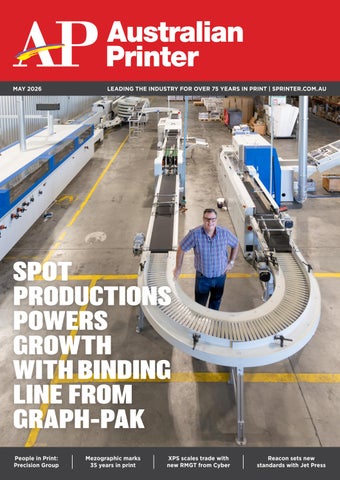
SPOT PRODUCTIONS POWERS GROWTH WITH BINDING LINE FROM GRAPH-PAK

ADVERTISING TELLS. REFERRALS PROVE.

1

The job update tracking from the courier was comprehensive, so I was able to keep the client fully posted on delivery which was great. The programs arrived on Friday and look fab –we’re all so happy with them!

Thanks again for turning it around so quickly.

Dom 12/2/26

2

As a small business, we know we’re a very small fish in the industry. However small our orders may be, I truly appreciate more than anything that we’re not made to feel like a low priority in any way.

Our experience in the past with other companies have left us feeling a little helpless and not important due to our size, this is certainly not the case with Hero.

Liv 6/11/25

3

This job was delivered yesterday morning!!!! MIND BLOWING turn around time. Less than 24 hours!!!

You guys have really impressed us.

Gary 26/11/25

4

You’re a legendeverything was brilliantproduct through to service - and a day early in peak season.

I can’t thank you enough!

Steve 17/12/25

VANGUARD

Investment in kit is a clear signal of confidence in print. Businesses are not just maintaining capability, but are scaling it with intent. Spot Productions is a case in point, building on strong growth with the installation of a BindEx Galix 5000S from Graph-Pak, bringing trade-quality perfect binding in-house.

Meanwhile, XPS has sped up its evolution into a trade printing powerhouse with a new RMGT 790ST-5 offset press. Mezographic’s 35-year milestone reinforces a similar theme: longevity built on reinvestment in technology.

But, investment today is not only about speed and capacity – it must balance sustainability with commercial reality. Forward-thinking printers are proving that reducing waste, adopting recyclable materials, and optimising processes can co-exist with cost efficiency and performance, turning environmental responsibility into a genuine and mindful competitive advantage.

Dive into the full details in this issue and we hope you enjoy the read.

Spandex acquisition to increase Spicers’ sales turnover

Spicers executive general manager of Signet and Visual Communications Darren Milligan has confirmed that the recent acquisition of Spandex Australia will lift Spicers Australia’s sales turnover by over 10 per cent.

“While the exact detail is commercial in confidence, we can say this will increase the sales turnover of Spicers Australia (including Signet) by over 10 per cent,” he said.

Milligan also confirmed that the number of employees has also increased to over 65 people and that Spandex Australia will come under the Signet and Visual Communications side of the business.

“Within the Spicers business, the Signet and Visual Communication segments both have a strong focus on growth. The Spandex acquisition fits within Visual Communications, which includes sign and display, industrial fabrics, and photofine art categories,” he said.

Spandex Australia officially transitioned to new ownership under Spicers Australia on 1 April, marking a significant milestone for both businesses.

Spandex Australia refers to two legal entities – Spandex Australia Holding Pty Limited and Spandex Asia Pacific Pty Ltd. Spandex Group will continue its global operations across Europe and the US.

Spicers Australia and Spandex Australia will continue to operate independently, as they do today. For customers, this means business as usual, with no changes to day-to-day contacts, product portfolio, service, or trading terms.

“Portfolio and brands will remain unchanged. Any future additions or changes to either the Spandex or Spicers range will be communicated in the normal way,” Milligan said.

Spandex Australia is a Sydney-based distributor of wide-format products, including digital print media, adhesive films, vehicle wrapping films, and laminates.

The full list of brands represented, according to the Spandex website include: 3A Composites, Arlon Graphics, AUTO, Avery Dennison, Cobra Wrap Tools, Contra Vision, Cover Styl, Gerber Technology, HP Printers & Digital Media, ImageBond, Imageperfect, Kiwalite Reflective, Knifeless Tape, Mimaki Printers, Cutting Plotters & Inks, Mutoh, My Wrap Game, Nazdar Ink Technologies, OLFA, Omega Skinz, Onyx Graphics, Pizazz Display Systems, PROSERIES, SAi Flexi, Siser, STEK Automotive, Summa Cutters, and TransferRite Application Tapes.

Managing Director

James Wells / 0414 995 104 james@intermedia.com.au

Subscriptions / (02) 9660 2113 subscriptions@intermedia.com.au

Subscription rate (5 issues) Australia $79

Editor Hafizah Osman / 0431 466 140 hosman@intermedia.com.au

Printed by Hero Print Alexandria, NSW, 2015

National Sales & Partnerships Manager

Carmen Ciappara / 0410 582 450 carmen@proprint.com.au

Mailed by D&D Mailing Services Wetherill Park, NSW, 2164

Design and Production Manager

Sarah Vella / 0406 967 559 svella@intermedia.com.au

Darren Milligan (Signet & Visual Communications) and Ben Clarke (Spandex Australia)

RELIABILITY

•Dependable performance

•Trusted platform

•Easy maintenance

PRODUCTIVITY

•High machine uptime

•High volume label printing

•Consistently high print speed

AUTOMATION

•Seamless integration

• Streamline production

• Maximum efficiency

SS Signs completes Sign Mart acquisition

SS Signs has completed the acquisition and integration of Tingalpa, Queenslandbased Sign Mart.

SS Signs operations manager Luke Lambourne told Australian Printer the business acquired Sign Mart when it noticed the company listed for sale. With a long-standing reputation in the signage industry and a 35-year rich, history behind its operations, Lambourne said Sign Mart presented lucrative opportunities for SS Signs.

“We’re always looking for ways to grow our business. The whole reason we purchased Sign Mart was for its staff as it’s so hard to get staff these days. The acquisition also allowed us to take on its clients – we’re now able to offer an expanded client base more and better offerings,” he said.

“We didn’t really bring any equipment over – the former owners Steve and Fiona sold their equipment, then all staff moved over to SS Signs,” he said.

GJS signs new distribution deal with Mutoh

GJS has announced a new dealer agreement with Mutoh Australia, enabling it to distribute Mutoh’s full range of wideformat printing and cutting solutions to its national customer base.

As well as Mutoh’s full range of printers and cutters, the deal covers Mutoh’s consumables, accessories, and spare parts as well, with GJS providing sales, installation, training, and technical support.

Mutoh Australia managing director Russell Cavenagh said, “We are very happy to announce a new partnership with GJS Group Australia and excited they have chosen to represent the Mutoh brand.

“Mutoh’s focus has always been on adding value to our customers and the endorsement of an industry leader such as GJS is a strong message about the value proposition Mutoh Australia offers.

“From our initial meetings it was clear they are very focused on providing an

“Sign Mart was outsourcing a lot of its work to MMT, which we do in-house. So, where there were gaps within that business, SS Signs was able to fill, and we found it to be a good fit for SS Signs too.”

Former Sign Mart general manager Steve Towers and director Fiona Chivers have

exceptional customer experience that strongly aligns with our core values of delivering reliability, quality and value. With the appointment of GJS, we know our customers, both new and existing, will experience those same values.”

Mutoh has been manufacturing wideformat inkjet printers since 1952

joined the SS Signs team – in the sales and graphic design teams respectively. The other staff have joined the administration and production and fabrication teams.

SS Signs has been on a growth trajectory through acquisitions – in the last two years, the company has bought eight companies, including Civic Media, Brand Productions, Vehicle Wraps Australia, and Signpower – which have all been added into the business masthead.

In 2023, SS Signs expanded interstate by acquiring Victoria-based Glenbrae Signs. This enabled SS Signs to better its reach nationwide, better serve its customers in every state across Australia as well as internationally, and broaden its footprint.

Building on the established reputation and experience of Glenbrae Signs, SS Signs has since also opened a new state-of-theart factory in Kilsyth, Victoria.

“Even though the Melbourne site isn’t as large as our Queensland one, it enables us to be seen by our customers like Tesla and Snap Fitness as a nation-wide company. Not only can we service Brisbane and Melbourne from our two locations, but we can also service Sydney as well as the rest of the Eastern Seaboard from either sites,” Lambourne added.

and is recognised for its engineering quality, reliability and colour accuracy. The company’s product range is used across signage, textile printing, vehicle graphics, fine art reproduction, and industrial applications.

GJS said it sees particular opportunity in Mutoh’s UV printing range for customers in direct-to-object printing, promotional products, and customised gift creation.

GJS managing director Greg Stone said, “Our customers are always looking for more choice in how they print, what they print on and how they grow their businesses. Adding Mutoh’s range gives them exactly that.

“With Brother International’s recent acquisition of Mutoh, and our longstanding relationship with Brother International Australia, a partnership with Mutoh was a natural fit. We’re looking forward to backing Mutoh’s products with the training, support and after-sales service our customers expect from GJS.”

GJS will support Mutoh products nationally via its existing network of sales and technical personnel across New South Wales, Victoria, and Queensland. Mutoh products are available now through GJS.

Russell Cavenagh (Mutoh Australia) and Greg Stone (GJS Group Australia)
(l-r) Jake Lambourne, Selina Lambourne, Steve Lambourne, and  Luke Lambourne from SS Signs

Major changes in key roles at Lamont Print & Signs

There have been some ‘well-earned appointments’ at Lamont Print & Signs recently with Daniel Lamont stepping into the role of general manager, Stephen Lamont consolidating his role as financial controller and founder, and Tammie-Lee Pickles taking up the role of office and sales manager.

The company said, “We’re proud to celebrate two well-earned appointments at Lamont Print & Signs. After more than 20 years working side-by-side with Stephen Lamont, Daniel Lamont has stepped into the role of general manager. Daniel’s journey reflects consistency, growth, and deep commitment to the business – and it was fitting that he was also recognised as the Most Improved Award recipient at this year’s Monty’s Awards.

“We’re also excited to acknowledge Tammie-Lee Pickles, who has accepted the dual role of office and sales manager. Tammie-Lee’s leadership, professionalism, and care for both our people and our customers saw her named Lamont Culture Champion at the Monty’s Awards – an award that speaks volumes about the way she shows up every day.

Speaking to Australian Printer about why the company had made these changes, Stephen Lamont said, “The two roles that Daniel and Tammie-Lee took up were ‘step one’ in our succession plan.

“Basically, it meant that Daniel and Tammie-Lee would start to assume responsibility for those key areas of the business – Daniel as general manager and Tammy as office manager and sales manager. To do that, we had to pull Daniel out of production so he could have more of a general oversight of the company. This can be challenging at times but we had to set a goal. And the goal was handing them both these responsibilities. And basically, I assist them both to exercise that responsibility.

“I’m here helping them now as they gradually shoulder the new responsibility. I’m the financial controller and founder and so I look after some of the strategic decisions, and Daniel and Tammie-Lee will help implement or adjust them. So, my role is more strategic now than it is hands-on.”

Stephen said the business has also engaged a company to assist them with this succession plan over the next five years and that the succession plan maps the forward progress of the company.

“I’m not going anywhere yet, but if I don’t make the decisions now, then I’ll never make them. I have to plan for the time when I will move on. The first step was to determine what the roles are going to be, and those two roles for Daniel and Tammie-Lee were the ones that needed to be developed most,“ Stephen added.

(l-r) Stephen Lamont, Daniel Lamont and Tammie-Lee Pickles from Lamont Print & Signs

Precision Group – fulfilment partnership that works

Beginning as a mailhouse, Precision Mail has grown to become a magnet for clients seeking end-to-end solutions. Peter Kohn pays a visit to its expansive Melbourne facility

Cory Hall is hands-on. He’s ready to jump in at Precision Group and do any job large or small that needs attention.

Greeting Australian Printer at the company’s sprawling facility in Somerton on Melbourne’s northern fringe, the affable CEO, described as “a knockabout Aussie bloke”, exudes the spirit of his family-owned company.

He has dedicated himself and his staff to becoming a ‘mate’ to project partners, the kind of pragmatic, reliable companion who solves problems, comes up with new ideas, and shepherds you through.

In a transforming market where solutions involve far more than printing itself, Precision Group has become a drawcard for print projects, some comprising a full third-party logistics (3PL) experience.

Hall says clients don’t come in identifying the services they need. They arrive with projects and they seek solutions. He reflects that his company has grown to become the pre-eminent address for outsourcing

a client’s supply-chain operations and optimising speed to market.

At the 15,000 cubic-metre Somerton plant, there’s plenty of horizontal and vertical space for Precision’s 7,500-pallet storage facility, for freight aggregation, a comprehensive warehouse management system and e-commerce platform integration – all of it ready for whatever a project needs, end-to-end.

Interestingly, Hall didn’t get his start in printing but in a mailhouse environment, and he credits that background to understanding clients’ needs beyond the printed collateral.

Only 14 years’ old when he started at Melbourne Mailing, Hall was employed as a materials handler by his uncle Ralph Russell, who founded the business. By the time he turned 17, he was the supervisor of the hand line and fulfilment team and 12 months later, became assistant production manager.

He later worked as production manager and operations manager, gaining experience in leadership, logistics and

decision making, before leaving Melbourne Mailing to set up Precision Group with Russell in 2008, at the age of 27.

With Russell’s assistance, Hall built the Precision Group into a full-service company. Mail fulfilment has been the engine that drives the wider group.

A unique approach

Hall’s early mailhouse experience has dovetailed with his passion for the notfor-profit (NFP) sector, which comprises 25 per cent of Precision’s clients (trade printing – printers, mailhouses, and agencies comprises 27 per cent and government printing makes up 17 per cent). Hall is a former committee member of the Fundraising Institute of Australia’s (FIA) Victorian branch and remains a member.

“As a mailhouse, we did some work with customers in the charity sector. It emerged that some of those organisations needed help with their creative and we discovered that the creative in NFP needed a distinct approach, different to the corporates,” he said.

(l-r) Precision Group’s Cory Hall and Chris Mayhew

It was an idea developed further with Precision’s art director Adrian Bologna and head of copy Terri Sheahan. Precision’s spread of revenue streams means it can work in NFP at a lower cost than some competitors.

“We started finding that clients needed help with approach and strategy. They were asking for more, and we responded. Soon many other NFP organisations became aware of our strategy for helping where it was needed. But those early projects were piecemeal. We needed a lot more focus on how we improve the donor relationship and experience, rather than just reacting to what clients needed,” Hall said.

Four years ago, Chris Mayhew was selected to lead Precision Fundraising. Mayhew, who has some 20 years of collaborative fundraising in the UK and Australia under his belt, heads an experienced team of fundraising specialists. He notes that Precision works with over 80 NFP clients today. He said recent work on Vision Australia’s e-store was an exciting venture.

According to Mayhew, Precision works with NFP clients to customise marketing solutions at all levels of their donor hierarchies –from one-off donors, to regular giving and bequest programs. Precision has recently developed an Emergency Response plan allowing for same-day event response for emergency fundraising.

“We all do it because we’re passionate about fundraising and partnering with great causes to help them do more of the fantastic work that they do,” he said.

Hall added, “We get great feedback from NFP clients about how we’ve helped them achieve an uplift in their revenue – and, in turn, that means a lot to our staff. When you feel a part of saving lives or helping others, you become more motivated”.

A tight-knit group

Staff morale is high, as is staff retention, with 35 per cent of team members having worked at Precision and Melbourne Mailing for more than 10 years. They are attracted to what Hall calls “a family culture” and to the company’s stability and steady growth.

A large part of the Precision Group story has been its acquisitions trail, which Hall emphasises was not always “a strategic acquisitions plan” but expansions which came at the right moment.

For six years after its start in 2008, Precision Mail operated as a mailhouse. But with a goal of moving into fulfilment, it launched into offset printing. In 2017,

Precision bought out one of its biggest suppliers, Melbourne-based The Place to Print, whose owner Greg Sullings was hired to head its new print division.

In 2022, Precision acquired Manark Printing, providing six senior staff, as well as presses, bindery and finishing capabilities.

That same year, Melbourne Mailing, the company at which Hall began as a teen, joined the fold. Through Melbourne Mailing, Precision gained some great experienced staff, adding to its team of subject-matter experts.

Along the way, Precision acquired Melbourne companies AMS (Advanced Mailing Solutions) and JP Printing, known for its niche work around raffle books and mattress tags. It partnered with Clover Marketing for its expertise in digital marketing. It also jointly founded a New Zealand Mailing 3PL business. It utilises outbound telemarketing through call centres in Melbourne and Brisbane.

Technology competency

Hall says Precision’s range of hardware helps it offer its key 3PL services – digital marketing, data management, creative (design and copywriting), and print mail.

A six-colour Heidelberg CD, already on the production floor through its The Place to Print purchase, enables Precision to print on heavy board up to 780gsm, which is rare, and positions it to provide packaging solutions that many can’t. The Manark integration gave Precision its second A1 press, a ten-colour Heidelberg Speedmaster, which enables it to print on heavy board, opening new client opportunities. Two SM52s round out the company’s offset capabilities. In the digital print-on-demand space, there are three Ricoh machines, three Kyoceras, and five Konica Minolta presses.

A comprehensive finishing department features guillotines, folders, saddlestitching, perfect and PUR binding,

The mail fulfilment team at Precision Group
Precision Group is based in Somerton, Melbourne

lamination, gluing, diecutting and specialty finishing, with hardware from well-known marques such as Heidelberg, MBO, Horizon and Kolbus. All of it has set up the company to engage with the explosion of custom packaging and curated promotional merchandise.

Mailhouse and fulfilment equipment includes intelligent insertion, intelligent plastic wrapping for magazines, catalogues and reports, and the ability to produce on-demand plastic cards, customised personalised packaging, postcards, and self-mailers.

A PrintIQ workflow integrates the prepress, print, and finishing processes. An in-house system interfaces with PrintIQ to utilise mailhouse sales and KPI data. Describing the 3PL concept, Hall says Precision has adopted a two-tier model.

“After clients are acquired through business development relationships, they’re handed over to account managers for dayto-day running. But the initial relationship remains intact, and the business development manager’s role is to examine future opportunities in the relationship.

Once developed, the additional services become part of the account manager’s work with that client,” he said.

Anthony Davis, in the role of client experience lead, is a central anchor who guides clients through their succession of interfaces within the group until a project is completed.

A refresh in branding

Hall notes that in the Precision logo, refreshed in 2023, the ‘o’ letter has been stylised into the figure of a person.

He said, “Every person encountering the client is a relationship. People know that if they contact Precision, they’re going to get a certain experience, a certain outcome, and they keep coming back. Of Precision’s top 20 clients, 16 have been with them for at least 10 years. That’s a lifetime in this business. We’ve been going now for 18 years, and we still have some of the clients we started with,” he mentioned.

Precision uses what it calls its “kitchen table” approach to discuss strategy with a client and between various project stakeholders within the company.

With the parties face-to-face from the start of the project, it becomes easy to identify where potential problems could arise and what the best course will be.

While few of its clients access the full 3PL range, typically 80 per cent of clients access at least more than one of the 20 touchpoints.

Talking to clients, it becomes clear what works for them, and Precision advises optimal strategies to build on that, says Hall. In NFP, that strategy could open with a social-media campaign, followed by email and then direct mail. He believes DM is experiencing a revival, as computer inboxes become crowded and residential letterboxes represent a renewed experience.

“The multi-channel approach is where the greatest results are achieved and with Precision’s bespoke fundraising and digital agencies working hand in hand, it’s obvious to see why they’re a sector favourite,” Hall explained.

“We ask clients where they’re getting their cut-through and we enhance the donor relationship from there.”

Sustainability is a deeply held value at Precision. The company prints to the Sustainable Green Print Level 3. It also uses NetNada environmental auditing. More broadly, Precision has ISO 9001, 14001, 45001 & 27001 certification and is PCI DSS compliant.

“Six years ago, 40 per cent of our waste went to landfill, now it’s only eight per cent. Carbon emissions have reduced by 22 per cent in the past 12 months,” Hall said.

Asked about the future, Hall said, “We aim to keep our core services as they are but bring more clients into more aspects of our user experience, and more clients into 3PL”.

Part of Precision Group’s 3PL facility
Precision Group’s staff are a team of subject-matter experts

The printer behind the printer

Trade printing for Australian printers. 100% confidential. 100% your client.

Since 2008, 27% of our business has been built on trade partnerships with printers just like you. White-label. Confidential. ISO 9001, 14001, 45001 & 27001 certified. We are PCI DSS compliant and a Level 3 Sustainable Green Printer too. Your clients stay yours - guaranteed.

Call our Group CEO, Cory Hall for a chat and a quote.

Cory Hall, Owner 0434 110954 - cory@thepg.com.au thepg.com.au

Somerton, Melbourne, 3062

Driven by a passion for print

Dashing Group account executives Sinead O’Callaghan and Avalon Abel have reinforced their commitment to print in their new careers at the company

Visual Merchandising, print, and design company Dashing Group recently beefed up its team by hiring two new account executives –Sinead O’Callaghan and Avalon Abel. Both O’Callaghan and Abel have embarked on this new journey with Dashing guided by their dedication to print and say there’s real reward in bringing ideas to life in a tangible way.

Hailing from Ireland, O’Callaghan started her career in print at Dublin-based Go To Print, where she worked across a variety of large-scale and in-house print projects – from signage and vehicle wraps to business cards and booklets.

“The role gave me a solid grounding in materials, paper types, and how production choices impact cost. I was also responsible for pricing jobs based on materials, artwork, and installation, which helped me build strong commercial awareness early on,” O’Callaghan said.

“I then moved into a more brand and packaging-focused role with Lidl Ireland where I built on that experience in a more structured, consumer-facing way.

Here, I was working on packaging design and keyline development, so I developed a strong attention to detail and a real care for how products show up on the shelf – not just visually, but how they connect with the customer and fit within the wider brand.”

The next step was a natural next step for O’Callaghan – she relocated to Sydney to explore bigger, brand-led opportunities, and was fortunate to find a role at Dashing that allowed her to stay closely connected to both the creative and technical sides of print that she enjoys.

“What excites me most about working in this industry is being involved in the full journey of a project – from the initial concept stage right through to final execution. I really enjoy working with creative teams and seeing their ideas develop, then collaborating with them to bring those ideas to life in a practical way,” she said.

“It’s especially rewarding to see the final result in-store, knowing the level of detail and teamwork that goes into making it

both visually impactful and effective in a real retail environment.”

Since starting at Dashing a few months ago, O’Callaghan said her experience has grown significantly, particularly in largescale print and the wider activation space.

“I’ve learnt a lot about thinking beyond just the visuals – considering how a structure will hang from the ceiling, where power points are located, and even the logistics of getting a campaign into a space depending on its scale. It has given me a much more practical and holistic understanding of how ideas are brought tolife, and I’m really enjoying continuing to build on that knowledge,” she said.

“A key highlight in my career has been the opportunity to work with some of Australia’s leading brands, which has been both challenging and highly rewarding.”

A healthy work environment

O’Callaghan finds her colleagues are a constant source of inspiration for her.

“Seeing the range of activations they work on and their willingness to support and help each other is really motivating. It naturally makes me want to do my best for the people I’m working alongside. The overall environment at Dashing is also very inspiring, with everyone bringing their own perspective and ideas to the table – it really feels like a true team effort,” she said.

O’Callaghan said she aims to help create an environment where collaboration and open communication are encouraged, and where everyone feels comfortable contributing their ideas.

“I also think it’s important to speak up and share your perspective, even in small ways, as those conversations can gradually shape how things are done and help drive positive change across the business,” she added.

“For me, giving back to the industry comes through being dependable, detail-focused, and supportive of those I work alongside. I place a strong emphasis on building trust and maintaining solid professional relationships, both within the team and with clients.”

O’Callaghan said her goals moving forward are to continue expanding her knowledge and experience within the industry.

Dashing account executive Sinead O’Callaghan

Driven by purpose

As for Abel, she joined Dashing from a fast-paced aviation role, which taught her how to stay calm under pressure and solve issues quickly and creatively. But her print experience started in weddings, where she worked on stationery and highly personalised pieces. That’s where she developed a strong attention to detail and real care factor for printed products.

“I made sure everything felt considered and intentional, not just visually, but also how it was experienced. I wanted to take that into something more structured and brand-driven, which led me straight to Dashing. It felt like the right step into larger scale projects, whilst still being connected to creativity and how brands show up in the real world,” Abel said.

“I love creating something that people interact with; not just something that lives on screen. I am a very tactile person, so I appreciate the details. I’m drawn to how information can be shared in more creative and considered ways – whether it’s in-store signage or an installation. It’s all about the feeling evoked when someone interacts with a print product, and how a brand is understood and remembered,” she said.

Having been with Dashing for six months now, Abel finds her learning journey with the business has been steep yet exciting.

“I’ve been able to both broaden and deepen my print knowledge, from the initial idea right through to what the client experiences at the end. I’ve had great opportunities to be more involved with installation work too, which has been interesting. Seeing how everything lands in a physical space adds a whole other layer to it, and that provides more opportunity to make impact,” she mentioned.

“A highlight for me has been stepping up into this role with more responsibility quite quickly. I’ve also had the chance to work with some of Australia’s leading brands, which has been rewarding. I’m enjoying the shift from more personalised print into larger brand-led work. It has changed how I look at what we do, and to consider how people interact with it – not just how it looks.”

Open to fresh thinking

Abel finds Dashing itself has “a really inspiring ethos” of being ever-evolving, learning-led, and being open to doing things differently.

“Being in such an environment motivates and pushes me beyond just getting the job done, and more about what we’re working towards together,” she said.

Abel added that though the link between the creative and logistical sides of work can be challenging at times, it also means there’s never a dull moment.

“I enjoy the impact we can have. In a lot of ways, we’re helping bring a brand’s message out into the world, so it’s interesting being part of how that translates,” she said.

“I try to contribute to a collaborative and supportive environment where people feel comfortable to share ideas and opinions openly. It’s also important to be honest and bring your perspective to the table, even if it’s small, as having those conversations can influence how things are approached over time.”

For Abel, giving back to the industry is about showing up, being reliable, paying attention to details, and supporting the people around her.

“Building trust and strong professional relationships within a team, and also with clients, helps things run smoothly and creates a more seamless and transparent experience overall,” she said.

When talking about her goals for the future Abel said she intends to be more involved in installation work and spend more time on site to see how everything comes together and how it lands in a real space.

“I’m also keen to keep building my understanding of how print fits into the bigger picture, especially how it supports a brand beyond just the final output,” she added.

A strong mentor to learn from

O’Callaghan and Abel report to Dashing Group account director Rachael Nicholl, but Nicholl is more than just a manager to them both – she’s their mentor as well.

“Since joining Dashing, Rachael has been an incredible mentor. She shares a wealth of knowledge while giving me the space to learn and develop independently. Having her as a manager has helped me build my confidence, as she places trust in me and encourages me to take ownership of my work,” O’Callaghan said.

Abel added that Nicholl has guided her through so much since she joined Dashing.

“Rachael’s been really supportive whilst also giving me the space to step up and figure things out on my own, which has been important this early in my career,” she said.

“Since a lot of my work has been about learning in real-time, having Rachael there to sense-check things, talk things through, and brainstorm has given me the invaluable confidence to back myself. I’ve also been lucky that several senior staff at Dashing have been open and generous with their time and knowledge, which has made a big difference for me.”

Dashing account executive Avalon Abel

Spot Productions powers growth with binding line from Graph-Pak

Spot Productions is accelerating its expansion by investing in a highly automated BindEx Galix 5000S binding line, enhancing its in-house capability to deliver trade-quality work

Spot Productions is building on its huge growth momentum. The company recently purchased and installed a BindEx Galix 5000S, an 18-station automated PUR binding line which includes an automatic trimmer, gatherer, and perfect binder – from Graph-Pak. This binding line beefs up Spot Productions’ offerings by providing perfect binding and giving the company the ability to deliver trade house quality work on its own production floor.

This high-end production machine is unlike others – it is said to be the most automated perfect binding system to enter Australia in a decade – and the decision for Spot Productions to invest in it was an easy one.

“This machine was the right choice to install and it’s going to shake up the Australian market. Not only does it allow us to do perfect binding in-house, but it also allows us to help other printers in and outside of Queensland by offering trade services,” Spot Productions managing director and owner Simon Carmody said.

“We’ve had the machine for just a few weeks but good news travels fast and we’re already engaged to do overflow work for people nationally. However, the primary reason we invested in it was to support our own work – we don’t intend on becoming a trade binder.”

While headquartered in Brisbane, Spot Productions delivers a diverse range of print solutions to clients across local, national, and global markets, spanning offset, shortrun digital, and wide-format production.

That’s why Spot Productions regularly invests in its business, keeping up with technological advancements to support its full-service business. This instance was no exception, and Carmody finds that the regular refresh of technology is what’s driving his agenda at the company this year.

With a team of more than 100 employees, Spot Productions has today built a solid reputation in offset printing, which accounts for roughly 70 per cent of its revenue, while cut-sheet, digital, and wide-format work contribute to the remaining 30 per cent.

Nearly two years ago, Carmody began laying the groundwork for the company’s latest major investments, undertaking a thorough review of available technologies and potential partners to secure solutions aligned with the business’ long-term goals.

Part of that strategy was his alignment with long-time supplier Graph-Pak and its purchase of the BindEx Galix 5000S.

Spot Productions and Graph-Pak have a strong history going back a long time. Over the years, Graph-Pak has sold Spot

Productions laminators, guillotines, pile turning equipment, and banding machines.

However, this investment is the largest that Graph-Pak has made with Spot Productions and was its biggest sale for 2025, according to Graph-Pak managing director Tom Ralph. The installation followed in February 2026.

“Because what Simon does is never small, he has put in the biggest binder in the East Coast, bringing in-house all the work that used to be outsourced,” Ralph said.

Benefiting in more than one way

The deal for the BindEx Galix 5000S came about as Carmody saw that Queensland, in particular, was feeling the pinch from the lack of trade house opportunities.

“If you wanted to get books bound previously, you would send them to trade houses. But bit by bit, especially in Brisbane, trade services have been biting the bullet, selling off their equipment at whatever cost they can get, and shutting their doors,” Carmody said.

“We had about three binders here in Queensland, and that essentially became one. There hasn’t been that much investment in binding lines across Australia

Simon Carmody from Spot Productions showing the entirety of the BindEx Galix 5000S at his site

in some time too. So, outsourcing our binding was becoming a huge issue.

“Some printers have put in their own small binders, but this puts the pressure on larger printers like Spot to do something about it as we feel the responsibility for our own customers. Now that we have the BindEx Galix 5000S, there won’t be leakage in our clients looking elsewhere for delivery.”

Previously, Carmody was outsourcing about $600,000 worth of work a year at a minimum to three binders, which is now what he’s saving.

“We just felt that it was now time to bring all those external costs back into Spot. We’ll still maintain our existing relationships with our suppliers and print service providers as there will be times where Spot gets so busy that we’re going to need them for output. It’s very humbling to have that network across the country,” Carmody added.

However, the plan to get a binding machine wasn’t on Carmody’s radar for 2025 as he had just invested in several other pieces of printing equipment.

“I actually had it in my view to purchase it a year later than when I did. This

changed when I found out that one of our local binding companies was closing down. Since there’s no perfect time to do something and we were outsourcing plenty of binding anyway, I fast tracked my purchasing of this machine,” Carmody said.

“I leveraged my strong relationship with Tom, and the transaction was just an easy fit.”

A machine worth its weight in gold

BindEx offers a range of perfect binding solutions which are designed for highvolume production and are equipped with advanced features such as servodriven adjustments, automatic thickness measurement, and integration with cloud platforms for real-time productivity tracking.

BindEx was initially run by German perfect binding company Wohlenberg but is now also part of a joint venture with Chinese company Pinghu.

“Wohlenberg has been building perfect binders for decades. But, because times got tough, it decided to build in China through a joint venture with Pinghu in 2015,” Ralph said.

“The Europeans are building in China because of the pricing and automation.

“It’s just so much better, and the ROI is better for Australia. Simon could have looked for a good European second-hand binder or buy a brand-new Chinese machine with all the bells and whistles, and he made the right decision to go with the second option.”

Working seamlessly with both digital and offset printers, the BindEx Galix 5000S has 13 clamps, so it can handle books up to 50mm thick and beyond with other adjustments. It can handle speeds of 5,000 books per hour, up to 300 pages per book, and pushes out a finished product trimmed in-line, all in one pass. Even though the machine has 65m of conveyor going in one direction alone, it features a small footprint for its type, made possible using a spiral conveyor.

“Instead of having 300m or 400m of conveyors, we shortened it to 100m – but we have a spiral which has 100m in it. So, it’s like a carousel and goes around in one spot,” Ralph said.

An appealing mix

In addition to the footprint and price point of the machine, the technology, smarts, and output times were also an appeal, which Carmody quickly realised during his trip over to the BindEx factory in China last year.

“When I went over to China, I was amazed by the speed and quality of the machine. And when I saw the quality that remains on a machine after five years – because we visited some major Chinese printers that have owned the same equipment for that long and they were still running at peak production and in great condition – I was even happier,” Carmody said.

“It ticked all my boxes and gave me peace of mind knowing that the investment I make today will last me several years.”

Simon Carmody from Spot Productions is impressed with the output produced on the BindEx Galix 5000S
The BindEx Galix 5000S has 13 clamps, so it can handle books up to 50mm thick and beyond with other adjustments
The BindEx Galix 5000S can handle speeds of 5,000 books per hour, up to 300 pages per book

The machine also features image detection in its 18 pockets with its scanning cameras that enable it to pick up problems with print or if anyone put the wrong section in it. And it allows for the creation of security work.

It also has a double nipping station on it, as well as an automation stacker that reduces the amount of labour that’s required on the machine. It can also do traditional perfect binding and burst binding in addition to PUR binding.

“PUR binding is replacing sewn books because of the strength it gives the spine. So, Spot Productions’ investment now takes it into markets that it traditionally wouldn’t have been able to get into before,” Ralph said.

“Simon’s binding line is the latest in specs and technology. He has missed out on

nothing and has the next 15 to 20 years sewn up for him. I don’t think there’s going to be any sort of quantum leap in this technology in the coming years that will radically surpass what he has.”

Carmody has already received some positive feedback from several of his clients since running the machine.

“The idea behind getting the BindEx machine was to help us deliver results for our clients, especially when they need things done urgently, or things are time specific. The scale of our output has certainly been meeting the demands of our clients,” he said.

“We now have more control over our deadlines and have been securing our own timelines internally. For example,

one of our big publishing clients was amazed to see her books go from being press checked on Monday, to being finished magazines on Thursday. Usually, it would have taken another week or so to get it done at an outside binding line.”

The building block for the future

The installation process was a massive process for the team at Spot Productions. The BindEx Galix 5000S was installed in February and the company was in full production within three weeks.

Four engineers and electrical engineers from BindEx flew in for the install and Graph-Pak also had its own engineering on site. Graph-Pak also hired cranes, as the machine weighs about 35 tons.

“It had to be brought in with a crane truck and heavy-duty forklifts. It really was the biggest binder I’ve ever installed. I’m very grateful to be part of it,” Ralph said.

“The deal is just as important for me as it is a success for Simon. It’s a massive pat on the back for all the hard work we’ve done since Graph-Pak started up in late 2005.

“It also goes to show that the print industry is still alive as people are still making books, customers are still investing, and Graph-Pak is still in that highly regarded category where we’ve tried to be the whole time. This just helps to cement where Graph-Pak is going to be for the next 20 years.”

Carmody said his recent investments –which involves the purchase or upgrade of almost 10 machines in the last two to three years including the BindEx Galix 5000S – have taken up a significant amount of space at Spot Productions, resulting in his plans to upgrade to a larger premises in the coming years.

“I don’t want to pre-empt too much, but I’m positive that within two or three years, we’ll have another binding line on site, because you need two of everything. I like to think that we’re certainly a current leader in investment and in technology, and you’ve got to keep up with technology as much as your budget can afford,” Carmody said.

“That has been Spot’s philosophy. If you’ve been to our site, you would have noticed that we’ve got multiples of everything. This also means we’ll need more space to house all of our machines, as well as additional storage and 3PL for our clients, so I’m looking to upgrade Spot’s facility in the next two to four years.

“But, as for the short-term, the next 12 months will be about consolidation and seeing exactly what we can output through our business following our investments.”

BindEx has a variety of machines to suit print service providers’ needs
BindEx is a joint venture between Wohlenberg and Pinghu
The BindEx Galix 5000S features a small footprint for its type, made possible using a spiral conveyor
Tom Ralph (Graph-Pak) and Simon Carmody (Spot Productions) at the BindEx factory in China

Print Finishing and Post‑Press Bindery

Explore Perfect Binder

Fully automatic PUR/EVA solution for short-run, longrun, and on-demand binding.

Patented PUR glue spraying system for precise spine and side gluing.

Ecobinder Perfect Binder

Fully automated five-clamp perfect binder. Automatic book thickness measurement for fast, accurate setup.

Ideal for flexible, quick binding of small to medium production runs.

Scan me for video

T

echnical Specifications

Clamps: 1

Max. Mechanical Speed: 500 c/h

Binding Size Range: 135*105 mm to 420*310 mm

JAZZ100e Three Knife Trimmer

Green and efficient three-knife trimmer.

Advanced German core technology with intelligent system upgrade.

11 servo-controlled adjustment points for highprecision trimming.

Technical Specifications

Max. Untrimmed Size: 410*310 mm

Min. Untrimmed Size: 115*95 mm

Max. Finished Size: 400*300 mm

Min. Finished Size: 110*90 mm

Scan me for video

Galaxy 8000e Perfect Binding Line

Intelligent upgraded version of the EXPLORER 8000s perfect binder.

Capable of collecting book processing data through multiple input methods.

Technical Specifications

Clamps: 22

Max. Mechanical Speed: 8000 c/h

Length of Book: 140*450 mm

Width of Book: 110*300 mm

Length of Cover: 140mm*450 mm

Width of Cover: 223*610 mm

Scan me for video

Technical Specifications

Clamps: 5

Max. Mechanical Speed: 2000 c/h

Binding Size Range: 140*120 mm to 450*320 mm

Galix 5000s Perfect Binder

Heavy-duty cast iron frame with professional clamp transport system for high-quality book production. Intuitive touch screen interface for easy operation. Motorized servo-controlled adjustments for precision setup.

Technical Specifications

Clamps: 13

Max. Mechanical Speed: 5000 c/h

Length of Book: 140*450 mm

Width of Book: 110*300 mm

Length of Cover: 140mm*450 mm

Width of Cover: 223*635 mm

Col-Tec 14 Station Deep Pile B3

Scan me for video

High-volume collator for efficient sheet and folded section handling.

Robust suction feed system for reliable and continuous operation.

Technical Specifications

Signature Collation: From 4–32 page sections

Speed Range: Up to 4,000 cycles per hour

Number of Stations: 6–30 stations

Standard Maximum Format: 350*350 mm

BINDEX GALAXY series (6000, 8000, 12000) available as high-speed automated EVA or Hybrid EVA/PUR systems.

BINDEX machines available as multipurpose binders (EVA, PUR, or both), with gauze feature inline, 3-way trimmers, cooling towers, and stackers.

COL-TEC available in multiple configurations (new or refurbished models available).

Scan here to view and download the Graph-Pak product catalogue.

For more information, please contact us:

Office: 1300 885 550 / +61 2 8530 7555

info@graph-pak.com.au | support@graph-pak.com.au

www.graph-pak.com.au

Xclusive Printing Solutions scales trade with new RMGT 790 from Cyber

The versatility that the RMGT 790ST-5 provides allows innovative Sydney print company Xclusive Printing Solutions to easily transition between drastically different jobs

Xclusive Printing Solutions (XPS), also known as XPS Group, in the heart of Sydney’s Ingleburn industrial hub, is not just surviving; it is scaling at a rate that has seen it transition from a general commercial printer into a high-capacity trade printing powerhouse.

Led by brothers Jason and John Meoushy, the family-owned business with 14 staff members recently confirmed an order with RMGT A/NZ distributors, Cyber, for a brand-new RMGT 790ST-5 offset press –a move that signals further confidence in the future of the A2 print market.

This investment follows a significant strategic pivot, starting late in 2024 and continuing throughout 2025 toward specialised trade services, providing high quality,

high-volume production for other printers, agencies, and large-scale brokers.

From broking to printing

The Meoushy brothers are no strangers to the industry, boasting over 20 years of expertise.

Their journey with XPS began in 2016, After a period operating as print brokers starting in 2012, Jason found that the level of service he demanded for his clients simply wasn’t available in the outsourced market.

He said, “Upon the commencement of print production in 2016, we expected growth but we did not envisige the growth we have had in the last nine years.

“From humble beginnings with an SRA3 press in 2016, and acquiring our second SRA3 press in 2018, our growth continued to spiral, and so with strategic purchases, we decided to take the next step in our growth with the purchase of a Ryobi 755 from Cyber.

“The company continued to increase its footprint within the industry with the revamping of our entire bindery in 2024.

“With such a major investment to facilitate our growth and the increase in our finishing capacity, it has seen our company double in growth, which has given us the confidence to now invest in a new RMGT 790 ST5 XL series.

“We then decided to concentrate more on the A2 – but we outgrew our premises. We

(l-r) John Meoushy (XPS), Rob Crough (Cyber Australia), and Jason Meoushy (XPS) in front of the Ryobi (now RMGT) 750 press

started looking at buying our own factory in 2023 and moved into our current premises in Stennett Road at Ingleburn in January 2025. It took us about four months to move the entire business across and complete renovations to the new building.”

A2 sweet spot

While some of their peers have chased the A1 format or exited the industry entirely, XPS has found its sweet spot in the A2 market. Jason believes this segment offers a strategic competitive advantage.

“The A2 market is shrinking in terms of the number of players,” he noted. “We find the A2 size easier to handle. Our makeready times are four minutes, and we’re up and running within 100 sheets. You don’t need to rely on the massive volumes required to keep two A1 machines fed; we can fill our capacity quickly and maintain high agility”.

The first new machine

XPS has now decided to purchase its first new offset press – an RMGT 790ST-5. The second SRA2 press will run alongside their existing Ryobi 755, effectively doubling their offset capacity.

“We have now decided to purchase the second A2 press, because we currently run from 3am until 6pm technically five days a week – but we also operate on Saturdays and Sundays,” Jason added.

“I never had the intention of buying a brand-new machine – we tried to source a second-hand machine but there was nothing suitable. So, we said to ourselves – we are a young company and in an ageing industry. There is not a lot of new blood coming in. We have a decade or two still in us, so we realised that we could gain a lot more benefit by purchasing our brand-new offset machine because you

really don’t know what you are buying with a second-hand press.

“This is going to be our main production machine for us – so it must be able to run at full capacity from day one. It’s a no-brainer for us – if we had the second press installed right now it would be running full tilt.

“Our workload has grown so much in recent years and the feedback we receive from our clients is because it is the service we deliver. We are not the cheapest –and we don’t strive to be the cheapest –because it is not about offering the lowest price. We don’t want to win a job based on the lowest dollar value – it is our reputation for quick turnarounds, and this is what we are known for in the market. We can do magazine work such as 5000 or 10,000 16-page publications within 24 hours. And customers are seeing that.”

The RMGT 790ST-5

The five-colour offset press distributed in Australia and New Zealand by Cyber features the 790 XL configuration, offering a larger image area of 780 x 600mm. This extra 30-35mm is a game changer for packaging work, allowing XPS to handle folding cartons and craft boards for overflow work from packaging specialists.

“The 790 XL allows us to have a larger image area accommodating a lot of packaging clients as well and as a result we are picking up more folding carton work with barrier and craft boards,” Jason said.

“Integration between the Equios workflow and our new Ink Volume Setter (IVS module) allows prepress to communicate directly with our presses and further increase the speeds of our makereadies.”

Equios workflow is the primary prepress management software. It handles the files,

trapping, and imposition and generates CIP3 or CIP4 (PPF/JDF) files, which contain mapping data of how much ink is needed across the width of the page.

Meanwhile, the Ink Volume Setter (Inkeeper) software takes those CIP3/ PPF files from Equios and calculates the exact percentage of image area for each of the ink keys on the RMGT 790ST-5.

Deploying RMGT’s PCS-G (Press Control System) the calculated data is then sent to the press control console. Before the first sheet is even printed, the press automatically opens or closes its ink fountain keys to the correct levels.

Because Inkeeper presets the ink keys accurately, the press reaches correct ink density much faster, often within just 100 sheets, rather than the hundreds of sheets required by manual adjustment.

This removes the guesswork for the operator, ensuring that the job is true to colour with minimal wastage.

Sophisticated versatility

The versatility of the RMGT 790ST-5 lies in its sophisticated sheet-handling technology, which will allow XPS to transition between drastically different jobs without the downtime typically associated with offset printing.

While older generations of presses often required manual mechanical adjustments to the feeder suction, sidelays, and gripper pressures when changing paper thickness, the 790 series automates much of this through its Press Control System (PCS-G).

The range from 80gsm to 400gsm (heavy-duty premium board) covers almost every commercial application in the modern market.

When running 80gsm to 120gsm stocks for high-pagination magazines or mass-market flyers, the press maintains maximum rated speeds, utilising precision air-management to ensure thin sheets don’t double-feed or flutter at high speed.

Switching to 350gsm or 400gsm board –the standard for the high-end presentation folders and folding carton markets XPS is targeting is handled with minimal fuss. The V-type feeder and heavy-duty cylinders are engineered to handle the increased stiffness of the board without marking the stock or losing registration.

Jason highlights that this flexibility is a core component of their growth strategy. Because the operator doesn’t have to spend 30 to 45 minutes re-tuning the machine for a different stock, XPS can gang various jobs together.

For a trade printer like XPS, this agility is a massive competitive advantage. It means the team will be able to finish a flyer job on 100gsm gloss at 10am and be halfway through a premium 350gsm presentation folder run by 10:30am.

This seamless transition eliminates the traditional setup tax on diverse jobs, allowing XPS to maintain their 24-hour turnaround promise even when the production schedule includes a wide variety of substrate types.

The XPS team will continue to invest in RMGT machines and have already mapped out additional purchases in the years to come.

“The difference with the Ryobi machines is simplicity. It’s a machine that produces just as well as its competitors, but it is much simpler to operate and run. We have always liked the Ryobi machinery

and the staff love working with it,” Jason added.

“We trained an apprentice on the press who picked it up within three months and we can now literally leave him to run the machine now without any assistance from our main operators. Our guillotine operators love the A2 sized sheet because it is smaller and it is easier to load. As a result, the flow of work through the factory is smooth – the work comes in and goes out without any interruptions.”

The finishing touch

A printing press is only as fast as its bindery, and XPS has ensured there are no bottlenecks. Since mid-2024, the company started investing heavily in Horizon technology supplied by Currie Group.

The lineup includes a Horizon iCE StitchLiner Mark IV for high-speed booklet making and stitching, an automated Horizon BQ-500 iCE perfect binder that enables professional book production at scale, and an HT-300 iCE single knife three-edge trimmer used for precise finishing of books and catalogues.

With its expansive bindery setup, XPS now has the capacity to produce between 5000 and 8000 perfect bound books a day, often offering a 24-hour turnaround.

“The new machinery will allow us to perfect bind all sizes, even landscape booklets that were previously impossible to automate,” Jason said.

“The finishing equipment has changed the way we do work and now we have so much more confidence and firepower in our finishing capacity in the work that we do – we can take a job on knowing that we can get it out on time.”

Boutique trade philosophy

Despite its industrial scale, XPS maintains a boutique philosophy. Unlike large trade printers that rely solely on faceless online portals, Jason emphasised the high value of direct human-to-human interaction.

“We don’t strive to be the cheapest because it’s not about the dollar figure; it’s about reliability and service,” he said.

This approach has earned XPS the trust of major clients, including brand activation and direct marketing agencies who use XPS as their primary backup or specialised A2 provider.

As they move toward a 100 per cent trade model, the Meoushy brothers remain focused on what happens under their roof. With a full roof of solar panels contributing to an eco-friendly operation and a young, trained workforce –including apprentices ready to learn the ropes on the latest RMGT gear – XPS is proving that, with the right technology and a step-by-step growth strategy, the future of print is bright.

“The trend we are seeing in the market is, printers are closing up or want to get out –so we are winning more and more of this work. Ultimately, we want to move to 100 per cent trade work as we don’t have any account managers, business development managers and no sales reps – it is all managed internally,“ Jason said.

“The reason why some of the largest printing companies in the market use us for trade work – is because they trust us. There is a lot of work that we win that is not suitable for A1 machines. We have a reputation for reliability in the market –if they give us a job and there isa deadline to meet – it happens.”

The existing Ryobi (now RMGT) 755 press operational at XPS

Mezographic marks 35 years with family roots and future focus

The Melbourne-based printer revisits its evolution from a small family-run screen printing startup to a 67-strong operation with a strong foundation in digital and trade printing

Mezographic marked 35 years in April with a full-scale celebration, bringing all 67 staff together for a festive office party.

The Melbourne-based printing company’s founder and managing director Frank Mezo told Australian Printer he was happy to celebrate this major milestone for the company he started in 1991.

He said, “Time goes quickly. We established the company in 1991 and at that time, it was just myself and my wife, Tanya, who’s a chartered accountant.

“Tanya still helps with all the financial work because she’s our financial controller and a full director, but she works as an accountant elsewhere as well. So, she has her own career, but she still does a lot of our ‘heavy lifting’.

“Our son Jack also works in the business, bringing his accounting expertise to the finance team.”

Revisiting some fond memories from the early days of Mezographic, Mezo said, “It has been a long journey. I was young and driven then – I don’t think

anything or anyone could have stopped me. It has definitely all been for the best and yes, the printing industry has been good to me”.

Mezo originally set up Mezographic as a screen-printing business, but it evolved from display and industrial screen printing to large format digital printing over the years.

Mezo said, “In the late 1990s, we made our first investment in digital technology. At our core, we remain trade qualified printers and graphic pre-press.”

Doing it their own way

Mezo said for 35 years, Mezographic has grown exponentially without sales reps and with minimal reliance on social media marketing.

“I’ve never employed a salesperson. We get our business from referrals and repeat business all the time. We rely on our reputation of print quality, customer service, and cost savings. Most of our work is for print management organisations and print resellers,” he said.

The company prides itself in using the latest technologies, having installed new equipment from a variety of manufacturers for large format digital printing over the years.

“I’ve always looked around,” Mezo said. “I look for the best solution for any particular area of the business. We installed our first flatbed UV printer in 2004 and have continually updated our equipment since.

“We purchased Australia’s first HP 10000 printer and Asia Pacific’s first – much acclaimed – Durst P5 in 2019. We also recently installed Australia’s first fully automated Durst P5 HS350.”

The innovation kept flowing and in 2024, Mezographic installed Australia’s first fluro-equipped swissQprint Kudu – the first flatbed printer in Australia capable of printing fluro inks.

“Our roll-to-roll department has two 5m-wide printers, three 3.2m printers, and seven 1.6m printers. Between our three Durst printers, we can print seven 500m rolls unattended overnight – that’s 3.5km of print,” Mezo said.

Team Mezographic celebrates the company turning 35 years old
Frank Mezo blowing off the candles at Mezographic’s 35-year celebration

Just last year, Mezographic invested in several new machines, including three new roll-to-roll printers – two Canon Colorado M-Series M5W presses and an Epson SureColor S80660L – in addition to a seventh cutting table – a Zünd 2XL – all of which resulted in “solid growth” for the company, according to Mezo. He was also named in the Top 5 at last year’s ProPrint Awards.

An idea that turned into reality

Mezo first toyed with the idea of starting a screen-printing company when he started studying a Bachelor of Arts in Fine Art at university. He said at the same time, he was inspired to figure out ways to make some money on the side.

“At first, I worked at a pub down in Warrnambool. And then, I started getting interested in screen printing and I thought perhaps I could design and print some t-shirts to supplement my income,” he said.

“In the end, I became so interested in this, I left university and sought out an apprenticeship. I went to the employment office back in 1989 and someone recommended a couple of screen printing companies, of which APG Displays was one of them. I went to APG and was told to contact John Featherston there. He interviewed and hired me, which was great. So, I started my apprenticeship there.”

Mezo said he had no hesitation leaving university, drawn by the appeal of building something for himself.

“My father had always been selfemployed, so I guess that’s where I got that from,” he mentioned.

Mezo was still employed at APG in the early days while running Mezographic on the side from his dad’s garage.

“During this time, I was printing t-shirts and other things – working at night and on the weekends,” he said.

Once he completed his apprenticeship at APG, he moved more towards consolidating Mezographic. Over time, he brought several former colleagues from his APG days into the business, including John Featherston, who first interviewed him 37 years ago.

“There are also people like Shane Hargreaves who I did my apprenticeship with at APG – he’s now one of Mezographic’s estimators. Plus, there’s Andrew Tucker – he was just starting his apprenticeship as I was finishing mine, and he’s also an estimator with us now,” Mezo added.

“Paul Farrugia is another APG person. We now have a strong contingent of team members who previously worked at APG. I’m lucky because I get to work with my friends.”

Growing from strength to strength

In the early 2000s, Mezographic evolved into a broader, full-service printing company and over the past 25 years has been growing from strength to strength.

The business’ first factory was in Hampton Park but within a few years, it moved to Hallam, and then, about 15 years ago it bought the factory it is currently located at now – in Dandenong South. Three years ago, it bought the factory next door, expanding its operations from two sites.

“The second site feels like a part of the same building because there’s no fence between them and this is great for business,” Mezo said.

Mezo’s role today is to keep a managerial view of the company.

He added that another major part of the company is maintaining sustainability.

“All our polypropylene plastic off cuts, such as core flute, synthetic paper, or polypropylene, are recycled. Last year, we recycled some 50 tons of this plastic. Plus, both of our sites have solar power and we offset all our remaining carbon emissions,” Mezo said.

As well, Mezographic has staff from over 17 countries and a large per cent of them are women.

“It’s not easy to find the right staff, so we tend to train people for the roles we need. We might start a young person off in a packing section and if they show initiative and ability, they might then be transferred to the cutting section. And if they work out there, they might then go to the print room,” Mezo said.

“In this industry, we find it’s just easier to train people. It would be very handy if there was some formalised training for the printing industry because it must be one of the larger manufacturing industries in Australia. It’s crazy to think there’s no formalised education when so many other people are training people, which takes up their time.”

A long road, but a rewarding one

Mezo said he’s happy with how everything has turned out for Mezographic.

“It has been a great journey, and I would do it all over again. With my son now involved in the business, he may be able to help with the running of the company in future,” he said.

“It is good to be part of the printing industry – we all have ink in our veins at Mezographic and all the staff are like my extended family.”

Early screen print work by Mezographic
Mezographic’s
Frank Mezo at the age of 22

Reacon Group sets new standards with Australia’s first Jet Press 1160CF

FUJIFILM Business Innovation Australia delivers measurable client value for the Westman Group following the install of a FUJIFILM Jet Press 1160CF at Reacon Group

Commercial print clients across retail, corporate, banking, telecommunications, and government sectors need end-to-end solutions from campaign planning through to data handling to final delivery. The Westman Group is rising to the challenge by combining Reacon Group’s reputation for innovation in data-driven production with Westman’s established reliability, client relationships, scale, and national logistics capabilities.

Between May and June 2024, Reacon Group installed Australia’s first FUJIFILM Jet Press 1160CF continuous feed inkjet press, delivering offset quality output at digital speed. Following Westman’s acquisition of Reacon in early 2025, the two businesses were unified and consolidated into a single location, enabling clients to continue receiving seamless, end to end service without disruption to output.

The two well-known and established companies combined now offer complementary strengths: Westman’s established reliability and national scale rounding out Reacon’s reputation for innovation and data expertise.

“Earlier this year we completed the full integration, bringing both organisations under one unified operating structure,” Westman Group managing director Vik Gulati said.

“Clients now experience one seamless brand that stands for scale, technical excellence, and consistent quality.”

The timing proved strategic. As both businesses consolidated into a single new location, Australia’s first FUJIFILM Jet Press 1160CF was added to the site, introducing continuous feed inkjet technology and marking a significant step forward in high volume commercial production printing.

First in Australia

The Jet Press 1160CF delivers up to 160m/ min at 1200dpi by 600dpi, with the option to run at 1200dpi by 1200dpi at 80m/min for jobs requiring maximum detail. It also offers flexibility in matching production speed to job requirements.

“Visually, most people cannot tell the difference between 1200dpi by 1200dpi and 1200dpi by 600dpi. So standard commercial work runs at 160m/min,” Harry Singh, CEO of Reacon Group, said.

The 520mm web width – more than double the previous 250mm –fundamentally changes production economics in the print sector. The web width on the Jet Press 1160CF also improves production cost-efficiency through intelligent slitting and job ganging. Multiple formats can run simultaneously across the web, boosting substrate use and lowering per-unit costs for clients.

Additionally, Reacon Group is also testing imported matte-coated substrates not readily available in Australia, which will open additional premium applications for the Jet Press 1160CF, once validated.

“The Jet Press 1160CF’s near-offset quality has opened new categories of work that previously required traditional offset or specialised trade suppliers,” Gulati said.

“Clients have remarked that it is difficult to distinguish Jet Press output from offset. Several new clients have specifically transitioned work to us after seeing sideby-side comparisons.”

But first-mover status isn’t without challenges. Singh acknowledged the reality, saying, “Being first in the country, we’ve had some teething issues. The reliability is improving as both our team and FUJIFILM Business Innovation (BI) Australia’s service network gain experience with the equipment”.

Where value lives

Understanding the needs of today’s clients is one area where Reacon Group add value. While printing is integral, building trust and offering data security are key. For example, the company manages data for financial institutions and telecommunications providers – clients who trust them with sensitive client information, including personalised data for loyalty and rewards programs and targeted campaigns. Delivering an efficient and economical service is equally important.

“The printing is great, but what happens before the printing starts is where the value is,” Singh said.

“We need to interpret the shared data accurately and help clients personalise messaging and deliver targeted content that resonates with their customers. With our team of five developers and coders, we apply those insights to our print workflows. Before XMF PressReady, we were spending close to two and a half hours on data-heavy files. With XMF PressReady, it cut down to 15 to 20 minutes.”

A loyalty card program demonstrates the practical impact. Previously, high-

Vik Gulati (Westman Group), Steve Fisher (FUJIFILM Business Innovation Australia), and Harry Singh (Reacon Group)

quality cards with six variable data points required offset printing for base imagery, then overprinting on inkjet devices for personalisation, followed by die-cutting and delivery.

“The quality we can achieve with the Jet Press 1160CF means clients receive faster execution and lower costs,” he explained, since a job like this now runs as a single pass on the Jet Press, eliminating multiple handling steps.

Flexibility under pressure

The business integration’s true test came during physical consolidation. Moving two factories to a third location while maintaining client deadlines required nearseamless production agility.

“The advantage that Jet Press 1160CF gives means, because of its near-offset quality, we could take jobs off our offset press and put them on the Jet Press during those weeks the offset press was down. And when we were moving the Jet Press, we could do vice versa,” Singh recalled.

The ability to shift work easily between machines ensured client deadlines were never compromised, even during complex facility moves. Gulati’s relationship with FUJIFILM BI Australia spans 15 years, through growth and tough times.

“What we found is that Fujifilm always tries to help when it matters. When we were going through a difficult phase, Fujifilm was there to work through the problems constructively,” he said.

The Jet Press 1160CF installation showcased this collaborative approach.

“We had Jack Starnawski, senior solution analyst from FUJIFILM BI Australia’s professional services team [on site]. He pretty much lived on our site for a week – from 7am to 9pm. Without them, it would have been very hard,” Singh said.

Fleet integration

The Reacon Group’s complete production environment includes the Jet Press 1160CF alongside two Revoria Press

PC1120 presses, an Iridesse Press, an Acuity Prime Hybrid for wide format, an Epson SurePress for end-to-end label manufacturing and finishing, and traditional offset. The team assesses and assigns each job individually, balancing resolution against delivery timelines to ensure the best outcome for the client.

“The two Revoria presses are our workhorses for core CMYK production. The hybrid and wide-format solutions open new markets. The Jet Press 1160CF occupies the high-volume, high-speed, quality-critical segment previously requiring offset,” Singh said.

Data security and national reach

The company’s strategic focus combines technology leverage with service expansion.

“We want to expand our national market share in retail, government, education and personalised communications,” Gulati said.

“We’re investing in further automation and are developing new offerings that combine data, personalisation, and premium print, bringing those elements together as a complete marketplace offering.”

The company’s client base spans small local businesses to national and international organisations with stringent data security requirements.

“Financial institutions are confident entrusting us with sensitive work because they recognise the strength of our data security systems and the rigour of our certifications,” Singh noted.

“This capability underpins our end-to-end service offering – from data strategy and multi-channel campaign management through to final delivery.”

National reach operates through centralised production, with Gulati adding, “We’re delivering from NSW into Western Australia, Victoria, and the ACT – we have in-house logistics, so it’s literally door-to-door.”

The industry perspective

Gulati provides practical advice based on experience for peers contemplating similar technology investments.

“The industry is at that stage where it’s more about partnerships rather than just fighting each other over the next print job. There are people good at manufacturing and people good at selling. Rather than a multi-million-dollar investment which not many can afford, look at who you can partner with to deliver the results together,” he said.

Singh reinforced this collaborative approach, saying, “Australia doesn’t have the volumes Asia or Europe have. Leverage each other’s capabilities rather than trying to do everything yourself and finding you can’t afford it”. The advice on high-volume continuous feed inkjet is equally direct.

“If you’re not running two shifts on it, it’s not worth it. Having an investment at that level sitting on your floor not doing what it needs to do daily – it’s a hungry device that needs to be fed,” Singh added.

For clients, the blend of Westman Group’s well-established position with Reacon’s data expertise ensures continued trusted services supported by increased capacity. The Jet Press 1160CF technology forms the production backbone, offering a marketdifferentiated range of services with the quality and speed demanded by modern commercial printing.

“Clients now experience one seamless brand that stands for scale, technical excellence and consistent quality. The Reacon brand represented agility and cutting-edge production. Now those attributes are united, giving clients confidence that Westman Group brings both stability and innovation together,” Singh said.

Contact FUJIFILM BI Australia today to discuss how the Jet Press 1160CF can accelerate your commercial printing capabilities.

Scan to see how the FUJIFILM Jet Press 1160CF is redefining production excellence.

A range of applications produced
The FUJIFILM Jet Press 1160CF high-speed continuous feed inkjet printing system

Flying Colours, Mercury Walch, and The20 win big at 12th Annual Diemen Awards in Tasmania

The winning award entries provided a clear snapshot of the capability, craftsmanship, and evolution of Tasmania’s print and visual media industry

Tasmania’s Flying Colours Group, Mercury Walch, and The20 were some of the biggest winners at the recent 12th Annual Diemen Awards, which celebrate the state’s best in commercial creativity.

Full-service design, print, and signage company Flying Colours Group took home five gongs during the evening of the event in Hobart, including the Signage Grand Diemen Award, as well as four additional awards within the signage category for the following projects:

• Boags Brewhouse Visitor Experience Signage: A complex environmental signage project showcasing large-format capability, fabrication, installation and cohesive on-site brand experience.

• ABC Elevator Interior Vinyl Wrap: A creative application of vinyl transforming a functional space into a branded environment.

• Solstice Brand Signage Package: A large format signage delivering strong brand presence and consistency.

• Boags Brewhouse Fabricated Signage Suite: A high-quality fabrication demonstrating structural capability and finish.

Its Boags Brewhouse Visitor Experience Signage won the Signage Grand Diemen Award.

“We’re incredibly proud to share that Flying Colours Group has taken out the Signage Grand Diemen Award at The Diemen Awards 2026,” Flying Colours Group said after its win.

“Recognised as Tasmania’s top signage project, this award celebrates our work on the Boags Brewhouse Visitor Experience Signage Package. Bringing together strategy, design, fabrication and installation to deliver a truly immersive brand experience.

“Five awards across five very different projects is something we’re extremely proud of. It reflects the strength of our team and the trust our clients place in us to deliver end-to-end solutions that make an impact.

“A big thank you to our clients, collaborators and our team for making this possible. We’re now looking ahead to representing Tasmania at the National Print Awards.”

However, it was Launceston-based commercial printer Foot and Playsted that won the Grand Diemen for Print for its Gentle Protagonist – Art of Michael McWilliams project, which showcased exceptional production quality and attention to detail. Recognised for exceptional craftsmanship, material selection, and finishing, this project delivered a highly refined and tactile print outcome.

Tasmanian print shop Mercury Walch took home four awards for the following projects:

• The Little Wren Birds and Marine Card Boxes: A high-quality digital print showcasing precision and finish.

• Clyde Mill Labels: For detailed label production with strong material and print execution.

• Seven Sisters Candle Sleeves: Specialty print showcasing craftsmanship and materiality.

• Dixie Cup Sleeve: A well-executed print packaging with attention to detail and usability.

Full-service creative agency The20 won five awards that evening for the following projects:

• Year 2 Membership Stickers – Tasmania Football Club: Strong use of ambient media to drive engagement and brand connection.

• 2026 Binder – Tasmanian Symphony Orchestra: A wellconsidered publication design with strong attention to detail and usability.

• Feel More – Tasmanian Symphony Orchestra: Consistent and effective campaign execution across multiple channels.

• Generation You – Aurora Energy: An integrated campaign demonstrating strategic thinking and cross-channel delivery.

The Flying Colours Group won five Diemen Awards
The Foot and Playsted team receiving the Grand Diemen for Print Award

• Tradewinds – RACT: For strong broadcast execution with clear messaging and brand alignment.

Additional category winners include:

• Hyperbaric Chamber Mural Wrap (Digital Ink Tasmania): A large format application delivering impact within a specialised environment.

• Black Rabbit Wines Packaging (Demelza Rafferty): An elegant packaging design with a clear and consistent brand application.

• Moth Whisky (Native Design): For distinctive typography-led design with strong visual identity.

• Scholé (Demelza Rafferty): A refined and cohesive brand identity demonstrating clarity and craft.

• Obliterator X Trailer (Adam Walker Film): A high-quality animation and visual storytelling with strong technical execution.

• Dulverton Waste – Do Your Dump Elsewhere! (Moon Cheese Studio): A creative-led campaign delivering strong social impact and engagement.

• Take a Minute App (Neon Jungle): An effective mobile solution with a focus on user engagement.

• Just Jump (Notorious Films): Compelling video content with strong narrative and execution.

• West Coast Wilderness Railway (ionata): A well-executed website delivering strong user experience and storytelling.

• Hint Line ‘93 (Secret Lab & Yarn Spinner): An innovative wildcard entry demonstrating creative experimentation.

Other Grand Diemen Winners include:

• Advertising & Communications (Futago for the Ten Days on the Island – Statewide Arts Festival project): Awarded for a cohesive and highly integrated campaign with strong visual storytelling across multiple channels.

• Design (Demelza Rafferty for the Black Rabbit Wines project): A considered and elegant brand identity demonstrating strong conceptual thinking and consistent execution.

• Digital – Honeywagon: Recognised for innovative digital execution and strong integration within broader campaign delivery.

In addition, Emerging Talent Award winners were also announced:

• Student of the Year – Rosanna Clapp (TasTAFE): Recognised for strong creative thinking and technical execution, demonstrating high

potential as an emerging industry professional.

• Young Executive of the Year – Harry Badcock (Abe’s Audio): Awarded for leadership, initiative, and contribution to business growth early in career.

• Print Apprentice of the Year – Kirstie Tyson (Impress Print): Recognised for technical skill development, attention to detail, and commitment to the trade.

• Inclusive Work Award – Rawia Chabchou (TasTAFE): Awarded for work that demonstrates inclusivity, accessibility, and meaningful impact.

“A key theme from the evening was the strength of emerging talent coming through the Tasmanian industry. Awards such as Student of the Year, Young Executive of the Year and Print Apprentice of the Year highlighted the quality of new entrants and the important role they play in supporting the future of print,” a spokesperson for The Diemen Awards said.

“This year’s awards also provided a clear snapshot of the capability, craftsmanship, and evolution of Tasmania’s print and visual media industry. Across multiple categories, the work highlighted the continued strength of print, particularly in high-end production, materials, finishing, and integrated delivery.”

Print Apprentice of the Year Kirstie Tyson from Impress Print (right) recognised for technical skill development, attention to detail and commitment to the trade
All the Grand Diemen Award winners
The Futago team accepting the Grand Diemen Award for the Advertising & Communications category
The Digital Ink Tasmania team receiving the award for its large-format Hyperbaric Chamber Mural Wrap
The Diemen Awards celebrate the state’s best in commercial creativity
Abe’s Audio team celebrating with Young Executive of the Year Harry Badcock (second from right)
The Mercury Walch team was recognised across multiple categories for high-quality print production and finishing

Currie Group and partners balance sustainability with commercial reality

How Currie Group, HP, and Close the Loop are helping printers turn intent into impact

Sustainability in print has shifted from aspiration to operational reality. For print service providers, the challenge is no longer whether to act, but how to deliver measurable environmental outcomes without compromising cost, performance, or turnaround times.

At Currie Group, the focus has been clear: sustainability must integrate into production in a way that strengthens, not disrupts, the commercial model.

Driving sustainability outcomes without adding more cost

Efficiency is one of the most powerful drivers of sustainable outcomes. Digital print technologies, particularly HP Indigo, are enabling printers to reduce makeready waste, eliminate overproduction, and move toward shorter, more targeted runs.

By removing plates, reducing setup time, and enabling versioning, businesses are producing only what is required. This reduces material waste, lowers inventory, and improves cash flow – delivering both environmental and commercial benefits.

Workflow automation also plays a key role. Solutions such as HP PrintOS and Site Flow are helping printers streamline production, reduce errors, and minimise rework. In many cases, the sustainability benefit is simply the result of running a more efficient operation.

This is where the shift is happening. Sustainability is no longer a trade-off; it is increasingly aligned with profitability.

Technology and materials that deliver performance

Technology continues to evolve in ways that support both output quality and environmental responsibility.

HP Indigo presses are designed to deliver high-quality results with reduced waste and efficient energy use. Their ability to print across a broad range of certified substrates also provides flexibility for printers to meet changing customer expectations.

At the same time, the expansion of certified media options, including recyclable and responsibly sourced stocks is making it easier to align production with sustainability goals. Programs supporting substrate

certification give printers confidence that materials will perform consistently while meeting environmental requirements.

Beyond the press, attention is increasingly turning to consumables and end-of-life processes – areas where meaningful gains are being made through circular solutions.

From waste to resource: circularity in action at Close the Loop

Recent collaboration between HP, Dscoop, Currie Group, Ball & Doggett, and Close the Loop highlights how circularity is being applied in practice. A sustainability exchange event in Melbourne provided printers with direct insight into how HP Indigo consumables are collected, processed, and repurposed through advanced recycling systems.

At Close the Loop’s facility, materials such as toner canisters and components are transformed into new products, including recycled plastics and TonerPlas, an additive used to enhance asphalt performance. What was once considered waste becomes a valuable input into other industries.

Globally, more than 17.5 million HP products have been processed through this partnership, with 8.5 million handled locally in Melbourne, diverting significant volumes from landfill.

For printers, participation is straightforward. Collection programs are simple to implement and do not impact production workflows. At the same time, they provide a credible, measurable sustainability story that can be shared with customers.

Shifting perceptions

A common misconception is that sustainability adds cost or complexity. In reality, many of the most effective sustainability measures like reducing

waste, improving efficiency, and optimising workflows are also fundamental to running a successful print business.

The conversation is shifting from compliance to competitiveness. Customers are increasingly seeking partners who can demonstrate responsible practices, and procurement requirements are evolving to reflect this.

Printers who can clearly articulate their sustainability credentials, backed by real processes and outcomes, are better positioned to secure and retain work.

The role of partnerships

Sustainability is not delivered in isolation. It requires alignment across technology providers, material suppliers, recyclers, and print service providers.

The partnership between HP, Currie Group, and Close the Loop demonstrates how this ecosystem can work effectively – from product design and manufacturing through to recovery and reuse.

Industry collaboration also plays an important role. Initiatives involving Dscoop and other industry groups are helping to create opportunities for knowledge sharing and practical insight, supporting printers as they navigate change.

The key message is clear: the capability exists across the industry. The opportunity is to engage with it.

A practical path forward

Balancing sustainability with commercial reality is no longer an either/or decision. Through smarter technology, efficient workflows, certified materials, and circular partnerships, printers can reduce waste, improve productivity, and meet growing environmental expectations without compromising performance.

The industry is moving from intent to action. And increasingly, sustainability is not just about responsibility, it is becoming a source of competitive advantage.

Scan the QR code to join HP and Currie Group inside the Close the Loop facility.
The partnership between HP, Currie Group, and Close the Loop demonstrates how partnerships aid sustainability outcomes

Series 3 430

Digicon

Sustainability embedded as a strategic principle for Durst Group

Durst Group sets the standard in sustainable print innovation as it combines social and environmental responsibility with technological excellence

Durst Group is strengthening its standing as a global frontrunner in sustainable print innovation, enabling customers to deliver meaningful environmental results while maintaining high standards of performance, efficiency, and commercial success.

For Durst Group, sustainability is more than just a buzzword – it is a strategic principle. As an innovation leader in digital printing technology, the company combines social and environmental responsibility with technological excellence, delivering measurable outcomes across its own operations and the solutions it provides to customers.

With the ambition of technology excellence for sustainability, the company has designed its products, processes, and supply chains by relying on measurable facts – the CO₂ balances at a company level (CCF) and product level (PCF) are key tools in its transformation strategy.

In 2024, the total emissions for Durst amounted to 173,277t CO₂e – Scope 1, 2, and 3 for its CCF, while its PCF, for the TAU 340 RSC 4C for example, amounts to 25.2t CO₂e (cradle-to-gate) with a calculation based on ISO 14067. Between 2019 and 2024, the company increased its revenue by 67 per cent while reducing its Scope 1 and Scope 2 emissions by 33 per cent.

“At Durst, sustainability is deeply embedded in the company’s DNA,” Durst Oceania managing director Matt Ashman said.

“Our approach is deliberate and datadriven, ensuring that we not only meet but exceed environmental standards. More importantly, we focus on delivering solutions that allow our customers to operate more efficiently and competitively while reducing their environmental impact.”

Durst Group adheres to a robust environmental management system certified under ISO 14001, enabling the business to systematically track, measure, and improve its environmental footprint across all areas of operation. This disciplined approach is not only about internal performance – it directly influences how Durst designs and develops its technologies. By focusing on efficiency

every

customers benefit from solutions that reduce energy consumption, minimise waste, and optimise production costs.

Durst has achieved carbon neutrality for Scope 1 and Scope 2 emissions at its production facilities in Brixen and Lienz, while Durst Oceania has taken this further locally, transitioning to a 100 per cent electric vehicle fleet in Australia.

“The transition to an entirely electric fleet reflects our broader commitment to sustainability, but it also demonstrates how operational efficiency and environmental responsibility can work together,” Ashman said.

Looking to the future, Durst Oceania is preparing to relocate to a purpose-built facility featuring solar power, battery storage, water recycling systems, and electric vehicle charging – reflecting the same environmentally conscious design principles seen at its global headquarters in Brixen.

Delivering commercial value

Durst’s commitment to sustainability is most evident in the technologies it brings to market, where environmental performance is closely linked to operational efficiency.

“From water-based ink systems to energyefficient LED curing technology, our focus is on delivering solutions that reduce resource consumption while maintaining high levels of productivity and print quality,” Ashman said.

These technologies enable print service providers and converters to lower energy usage, reduce material waste, and improve overall cost efficiency without

compromising turnaround times. Software also plays a critical role. Durst’s Ink Save system, for example, helps customers reduce ink consumption while maintaining colour consistency and output quality – delivering both environmental and financial benefits.

“For our customers, sustainability is not about trade-offs. It’s about smarter production. When you reduce waste, optimise ink usage, and lower energy consumption, you are also improving your margins and overall business performance,” Ashman said.

This approach challenges one of the most common misconceptions in the market – that sustainability comes at the expense of profitability.

“In reality, the opposite is often true. The most sustainable operations are also the most efficient,” Ashman added.

Partnerships accelerating sustainable innovation

Durst continues to strengthen its sustainability capabilities through strategic partnerships and targeted investment in new technologies. The recent acquisition of Aleph Srl, a specialist in water-based digital printing solutions for textiles and interior and exterior applications, is a key example. The move expands Durst’s capabilities in sustainable ink technologies and supports the growing global demand for environmentally responsible production.

“Aleph’s water-based technology aligns perfectly with Durst’s long-term vision. It allows us to offer customers scalable solutions that support both sustainability goals and commercial performance,” Ashman said.

Through ongoing collaboration with customers, partners, and the broader industry, Durst aims to help drive meaningful change across the print and packaging sectors.

“We aim to lead by example. Our focus is on delivering practical, measurable solutions that prove sustainability and commercial success can go hand-inhand,” Ashman said.

at
stage, Durst ensures its
Cutting-edge technology meets responsibility for the environment at Durst Group

Sustainability isn’t a trade-off;

it’s

a competitive advantage with Ricoh

Ricoh finds sustainability enables businesses to lower costs, improve efficiency, and drive profitability while reducing their environmental impact

One of the most persistent industry sustainability myths is that businesses must choose between environmental responsibility and commercial success. However, Ricoh finds experience across the print industry suggests the opposite is true.

“When treated as a design principle, like at Ricoh, sustainability – through reducing energy use, minimising waste, and optimising production – becomes a pathway to stronger margins and higher efficiency for your print business,” Ricoh Australia commercial and industrial print senior product manager Henryk Kraszewski said.

Historically, high-volume production equipment has been associated with high energy demand, costly infrastructure upgrades, and ongoing operational expense. That’s where modern digital production is changing the equation. Ricoh presses are designed from the outset to maximise energy efficiency, reducing the overall power required to run highvolume jobs. The impact is twofold: lower operating costs for the business, and a measurable reduction in CO₂ emissions across production.

And these gains aren’t theoretical –they’re validated through independent certifications such as Energy Star, EPEAT, SuMPO Environmental Product Declaration, and Ecomark which benchmark the energy performance and lifecycle environmental impact of Ricoh’s production systems.

Better fit, better efficiency

Another persistent misconception in sustainability planning, according to Ricoh, is that smaller equipment automatically delivers lower environmental impact. The company finds that in practice, the most sustainable – and cost-effective – solution depends on the job.

“Measured analysis has shown that larger, well-matched systems can consume less energy per job than multiple smaller devices producing the same output. Through our co-innovation approach, Ricoh works with customers to design production environments based on real performance data rather than assumption,” Kraszewski said.

Ricoh said by understanding volumes, run lengths, and job frequency, printers can adopt configurations that deliver both efficiency and environmental gains.

“Our collaborative approach to solution design ensures sustainability outcomes align directly with your commercial needs,” Kraszewski added.

Minimising waste, maximising commercial impact

Waste remains one of the most underestimated print production cost drivers. Misprints, reprints, colour inconsistencies, and overproduction all consume paper, power, labour, and time, impacting profitability. Digital production with Ricoh addresses waste – and its costs –at the source, with predictable, repeatable colour enabling printers to get jobs right the first time, reducing rework and scrap.

Combined with print-on-demand workflows, Ricoh digital systems allow businesses to produce exactly what’s required. The commercial impact is immediate, with lower consumable costs, tighter turnaround times, and greater confidence in delivery schedules all directly contributing to profitability.

Sustainability from build to output

Sustainable outcomes aren’t limited to energy and waste alone. Increasingly, they’re shaped by the materials and chemicals used throughout the print process. The Ricoh Pro C9500 demonstrates this shift clearly. On top of offering some of the fastest throughput speeds in the industry for a toner-based cut sheet printer, it achieves the highest three-star rating for Japan’s Green Printing certification.

Energy-saving motors, optimised power management across sleep, standby and continuous operation, and compliance

with international Energy Star standards all contribute to this performance. The outcome isn’t just simply improved sustainability – it’s a measurable reduction in running costs over the life of the device. Meanwhile, the Ricoh Pro C5400S is manufactured using recycled materials, contributing to lower environmental impact across its lifecycle.

“For many printers, the move to digital isn’t driven by environmental considerations alone, but by productivity, responsiveness, and cost control. Sustainability becomes the outcome of doing those things better,” Kraszewski said.

Inkjet is driving sustainability

According to Ricoh, digital print has long moved beyond concerns around quality and substrate flexibility, and its sustainability advantages are now well-established. Ricoh inkjet technology is accelerating this transformation, combining water-based inks, lower power consumption, and production speeds capable of replacing traditional offset workflows with the same image quality and substrate flexibility.

Using water-based inks instead of potentially hazardous alternatives eliminates the need for complex waste handling, while producing fully recyclable or compostable printed output.

For printers serving sectors such as packaging and food-adjacent applications, the benefits go beyond environmental credentials. Safer materials, reduced regulatory risk, and broader application approvals support commercial resilience and new growth opportunities.

An edge with sustainability coinnovation

Far from being a trade off, Ricoh says sustainability co-innovation with the company is increasingly a competitive advantage and driver of operational efficiency.

“For print businesses navigating rising costs and shifting expectations, the message is clear: doing the right thing environmentally and doing the smart thing commercially are no longer separate objectives. Increasingly, they’re the same decision,” Kraszewski said.

The Ricoh Pro C9500

Built to help you move beyond today’s jobs and into new opportunities.

More than production presses, these are tools to help you take on more work, expand into higher value applications, and produce with confidence. From specialty colours to smarter workflows, Ricoh works with you through co-innovation to unlock new ways to differentiate and grow.

Pro C7500

Built for flexibility across applications without compromising quality

Let’s build what’s next. ricoh.com.au

Pro C9500

Built for high-volume environments where consistency and uptime matter

Ricoh
Ricoh

Trends within the print industry: How are they shaping the market?

The role of print itself is evolving and being deployed more strategically

The print industry is in a period of change, driven by changing customer expectations, advancements in technologies, and a shift in how brands communicate with their audiences. These changes have accelerated a diversion from traditional print production models to more agile, authentic, and high-value applications.

At the same time, the role of print itself is evolving and being deployed more strategically in jobs where it can create meaningful engagement and impact, elevate brand perception and customer loyalty, and/or deliver something that digital cannot.

In alignment with these changes, printers are adapting to reflect consumers: becoming more environmentally conscious, valuing personalisation – at scale – more highly, and enjoying tactile, interactive features as part of a typical user experience. Considering this, the future of specialty print is shaping up to be more purposeful, powerful, and engaging than ever before.

Sustainability

Environmentally conscious operations have moved beyond being a selling point for brands; it is now a fundamental requirement across specialty print.

Businesses – particularly those that specialise in premium sectors like luxury packaging and high-end publishing – expect environmentally responsible materials, low-impact inks, and transparent supply chains as a baseline. What was once a differentiator is now an expectation, driven by both regulatory pressure and shifting consumer expectations around brand accountability.

Businesses are increasingly integrating green operations without compromising on quality or aesthetics. Printers are adapting

to this demand by using alternative materials, recyclable embellishments and low-impact finishing techniques that still deliver a premium look and feel.

The challenge is no longer choosing between sustainability and luxury; it’s achieving both simultaneously – and doing so consistently at scale.

Looking ahead, the next phase of this shift towards greener operations will be driven by measurement and proof, not just intent. Brands are increasingly seeking measurable data – such as carbon footprints, lifecycle assessments, and certifications – to support their sustainability claims.

This is pushing specialty printers to invest in materials and processes, as well as traceability and reporting infrastructure. Businesses that can clearly demonstrate environmental impact alongside premium output will be best positioned to win longterm, high-value contracts.

Personalisation

Advancements in digital print technology have made mass personalisation possible, as well as commercially viable.

Brands are increasingly using datadriven printing to tailor content, imagery and messaging to specific audiences, locations and even individuals. This shift is redefining the role of print – from a broad communication channel to a highly targeted, high-impact platform.

As a result, campaigns are becoming more intentional, with print used where it can deliver the greatest resonance and return. In specialty print, this translates to shorter runs, faster turnaround times, and a growing emphasis on relevance over reach.

The advancement of personalisation is also beginning to overlap with automation and AI-driven workflows, which supports even greater precision and efficiency. Campaigns can now be adapted to respond to behavioural or market conditions without slowing production.

For specialty print, this opens the door to more dynamic, interactive campaigns – where printed materials are no longer static assets, but part of a continuously developing communication strategy.

Interactivity

In an increasingly digital world, the physical qualities of print are becoming its greatest strength. Designers and brands are leaning into tactile finishes, such as embossing, textured coatings, and dimensional effects, to create experiences that engage the senses in ways screens cannot. This “touchfirst” approach is positioning print as a more immersive and memorable asset.

At the same time, advances in digital finishing are making these effects more accessible, even for shorter runs. Techniques that once required costly setup can now be applied on demand, opening new creative possibilities for specialty print. The result is a shift toward print that doesn’t just communicate visually, but invites interaction, offering a tangible, human touchpoint to the flatness of digital media.

This renewed focus on tactility is also influencing how print is valued on a wider level. As digital channels become increasingly saturated, physically engaging print is being used more strategically to create standout moments, whether in direct mail, retail environments, or premium brand experiences.

In this context, specialty finishes are no longer decorative extras; they are central to how brands capture attention, convey quality, and create lasting impressions.

These trends will surface not only throughout Fespa Global Print Expo 2026 at the Gran Via, Fira de Barcelona, but also across its co-located events: European Sign Expo, Personalisation Experience, WrapFest, and the brand-new Corrugated and Textile.

Michael Ryan is the head of Fespa Global Print Expo, Fespa

Automation supports even greater precision and efficiency when it comes to personalisation

Faster Installs. Damage-Free Removal. Zero Guesswork.

Nekoosa Wall Graphics® printable media is designed for smooth, hassle-free installation and clean removal, making wall graphics easier to print, apply, reposition, and remove.

Nekoosa Wall Graphics® printable media eliminates those challenges.

® delivers reliable print performance and

Bottom line: Faster installations. Clean removal. Results your customers can count on.

Nekoosa Wall Graphics®

• Easy to apply, reposition, and remove on smooth painted walls, wallpaper, wood panelling, and more

• Microsphere removable adhesive allows for easy installation and clean removal within one year

• Indoor and outdoor durability for up to 3 years

• Compatible with UV, latex, and eco-solvent wide format printers

How people respond to change: AI and print through the five stages of grief

Printers who lead the AI shift with customers will not be reacting to the future – they will help design it, according to Print Media Centr’s Deborah Corn

AI and print are beginning to explore a new working relationship. Artificial Intelligence may not be flooding production floors yet, but it is reshaping how art is created before print ever enters the picture. New technology brings new challenges, especially when tools can generate artwork and files that appear ready for production.

The five stages of grief is a framework for understanding how people respond to change. It shows how uncertainty triggers resistance, pressure produces frustration, and progress begins once people recognise what is actually happening.

Let’s look at AI and print through the five stages of grief:

1.Denial

“AI art creation is a fad.”

Every disruption is labelled this way at first.

It is easier to believe customers are experimenting than to admit a fundamental shift in how art is being created.

But expectations are forming.

Calling AI art generation temporary does not slow adoption. It only delays print’s involvement while the rules change.

The longer denial lasts, the further influence drifts away from the people who understand how the work performs in the real world.

2.Anger

“Why are we seeing this AI-generated art so late?”

Files arrive after creative decisions are made, and printing success is already defined.

Problems are obvious, many were preventable, and our collaborative influence is gone.

It is frustrating to inherit risk without having an opportunity to manage and/or avoid it.

And the frustration is understandable, but it does not restore a seat at the table.

3.Bargaining

“We’ll make it work.”

Printers protect customer relationships by absorbing pain.

They rebuild files, correct mistakes, and negotiate compromises.

Margins tighten. Schedules shrink.

Customers carry on without any pushback.

The job ships, and the costs are absorbed under the ‘price of doing business’.

Rescuing the work may save the moment, but it quietly reinforces a cycle where expertise arrives too late to matter.

4.Depression

“We are not being treated like experts.”

Not because AI exists, but because printers are brought in after the art is created.

Experience that once influenced outcomes is now spent on AI and print damage control.

Collaborative customer relationships can quickly slide back into transactions.

When that happens, value becomes measured by output, not insight.

5.Acceptance

AI begins the process. Print expertise determines the outcome.

Acceptance is not surrender. It is repositioning.

Customers are moving faster and exploring more ideas in more places.

They need partners who understand how those ideas perform in reality and who can guide AI and print decisions before they become expensive.

This is where printers shift from reacting to problems to shaping success.

Printers who quickly reach acceptance that AI art is here to stay can maintain or regain influence with customers. They can help prevent mistakes, protect budgets, and strengthen campaigns before they are underway.

Printers should not be obstacles to creativity. They can enable and champion print possibilities once they have accepted that AI-generated files will start showing up, and learn best practices for handling them from pre-press to printing.

If AI is where work begins, printers have an opportunity to shape how it is built.

That means stepping forward earlier, sharing expertise sooner, and helping customers understand how digital ideas translate to physical outcomes.

When that happens, collaboration begins before art creation, success becomes repeatable, and customer loyalty is locked in for the long-term.

Printers who lead this shift with customers will not be reacting to the future. They will help design it.

Deborah Corn is the Intergalactic Ambassador to The Printerverse at Print Media Centr.

Printers have an opportunity to shape

The thing that hasn’t changed

Your

success is dependent

on the people you sell to, the people you buy from, and perhaps most of all, the people who work for you

I’ve been thinking about change recently – specifically how much has changed in the printing industry since I first joined it 45 years ago – or even since I wrote my first article for Australian Printer some 20 years ago.

There’s no question that we’ve seen incredible quantity and quality of change, but there’s one thing that hasn’t changed at all. This is a people business. Your success is dependent on the people you sell to, the people you buy from, and perhaps most of all, the people who work for you.

Putting ink or toner or anything else on paper, vinyl, or any other substrate is secondary to your relationships with the people who are critical to your business.

Sell to vs. buy from

I might have said “the people who buy from you”. I didn’t, because there’s an important distinction between “sell to” and “buy from”.

One is passive, the other is proactive; and I want you to be proactive.

On the new business side of the equation, that means proactively seeking engagement with people who buy what you sell.

That can be prospecting, or networking, or responding to enquiries generated by your marketing. Just understand, those are three variations on the starting line. The goal is to get to the finish line!

On the current customer side of the equation, proactivity means staying in touch with your customers and talking about past performance and future opportunities in addition to current projects.

First and foremost, you must know that you have happy customers, not just hope so or think so. Beyond that, the more you know about the direction of their businesses, the more opportunity you may find to help them get there.

The people you buy from

Here’s an observation: Suppliers are an underutilised resource. I’m pretty sure you’re not getting maximum value from most of yours.

Now, I fully understand that some of the people you buy from are mostly transactional, they see value as quality, service and price.

Let’s go back to the idea of you knowing your customers’ direction, though, and using your knowledge to help them get

there. I encourage you to mine your suppliers’ knowledge to help you get to where you want to go.

And if they can’t or won’t provide that kind of value, you might think about buying from someone else.

Your employees

There are two sides to engagement with your employees. One concerns your level of satisfaction with their performance. The other concerns their level of satisfaction with their job.

Please consider two things: (1) There is usually room for improvement on both sides of the relationship. (2) Any behavior/ level of performance which is tolerated will likely be repeated.

Anything you can do to build a better, stronger team will benefit your business. And probably more so than anything else you might invest in. In a people business, the people inside the business are its most important resource.

Dave Fellman is the sales president of David Fellman & Associates, Raleigh, NC, US, a sales and marketing consulting firm serving numerous segments of the graphic arts industry.

In a people business, the people inside the business are its most important resource

Inside SS Signs’ Queensland site

SS Signs recently hosted an Open Day at its site in Queensland, inviting the industry and attendees to see the innovations and technologies that drive its success

Queensland-based SS Signs recently opened its doors to the industry, inviting people to its Open Day to get a behind-the-scenes look at what drives its business forward.

Founded in 1972, SS Signs has evolved from modest beginnings into a globally recognised leader in the signage sector. Backed by generations of expertise and a deep commitment to craftsmanship, the company

has grown into a highly sophisticated operation, now operating from a cutting-edge production facility in Cleveland.

Its experienced team of designers, engineers, and signage professionals delivers comprehensive, end-to-end solutions – spanning concept development and design through to fabrication and installation. The company produces a wide range of signage, including pylon

signs, vehicle wraps, LED and illuminated displays, custom-built structures, and large-format digital print.

During the Open Day, attendees were able to see the technologies that make SS Signs tick.

Here are some photos from inside its Queensland premises and of some attendees at the event.

(l-r) SS Signs’ Jake Lambourne, Selina Lambourne, Steve Lambourne, and Luke Lambourne
A car being wrapped at the SS Signs Open Day using Orafol media
The facility houses the first DigiTech printer in Australia – the DigiTech TruFire LT/X2, which is also paired with an Aristo 6m long cutter
SS Signs’ dispatch area, which also holds any extra stocks

Staff well-being is a key priority at SS Signs, and its lunch area has been thoughtfully planned with them in mind

SS Signs owns several HP Latex presses
A HP Latex R2000 at SS Signs
The younger generation at SS Signs’ Open Day
An EFI VUTEk 5r+ at SS Signs
Being taken up on the company’s knuckle boom lift
Celmac’s Mark Rixon and Wayne McIntyre at the event
Attendees being taken on a tour of SS Signs’ Queensland facility
Attendees being taken up on the company’s knuckle boom lift
Spicers had a booth at SS Signs – pictured is Joshua Ralph from Spicers with some of the company’s applications SS Signs’ steel fabrication area
Durst Oceania’s Brett Addison at the event
An aerial view of SS Signs

PRINT DIARY

Got an event? Send an email to hosman@intermedia.com.au with all the details and we will put your event on the page

* event dates correct at time of publishing

Ink & Innovation Conference 4 June 2026

Brisbane, Australia visualmediaassociation.org.au

National Print Awards 2026 4 June 2026 Brisbane, Australia visualmediaassociation.org.au

NZ Sign & Print Expo 17-19 June 2026

Auckland, New Zealand nzsda.org.nz

Visual Impact Conference & Expo 2-4 September 2026

Sydney, Australia visualimpact.org.au

ASGA National Sign & Graphics Awards 3 September 2026 Sydney, Australia signs.org.au

LOUPE Americas 2026 15-17 September 2026 Chicago, US loupe-americas.com

Printing United 23-25 September 2026

Las Vegas, US printingunited.com

All in Print China 12-16 October 2026 Shanghai, China allinprint.com

ProPrint Awards 16 October 2026

Sydney, Australia proprintawards.com.au

• Specialised services for non-standard applications

• In-house expertise to help you achieve your production goals

Also available • Konica C14000 with finishing

• Konica 6100 with long trays • Guillotine Polar 2020 N115

• Jwei digital cutter A2 Size

• Komfi Amega 52 Celloglazing Machine

• Duplo DBM-120SS Booklet maker and DBM 12Y Trimmer

• Horizon BQ 270B EVA bookbinder • Duplo DC 646

• Morgana Auto fold Pro and creaser

• 4 x Wide Format Poster Printing machines. Aquas and UV inks

Your Silent Print Partner

Trade-only large format and flatbed printing. No minimums.

24-hour turnaround. Nationwide.

Banners Labels
Posters
Rigid Boards Stickers Wall Coverings

HIGH SPEED MECHANICAL ATTACHING SERVICE

About Us

Celebrating 40 years as Australia's most trusted trade finisher, we deliver flawless results for high-volume production and short-run work, backed by reliable turnarounds and quality craftsmanship. From perfect binding to saddle stitching, hardcover binding to section sewing, we solve your toughest challenges.

HORIZON CRF 362 CREASER
HORIZON HT-30 TRIMMER SHOEI CRASH FOLDER
2021 BQ280 PUR BINDER
HORIZON AFC 564 FOLDER

Bound to Succeed

Revolutionise Your Bookbinding with Our State-of-the-Art Hard Case Solutions.

Print Logistics is proud to offer cutting-edge, hard case binding technology that delivers a new level of durability and sophistication. Our innovative process involves expert casing of the hardcover, resulting in a final product that exceeds the competition in both robustness and elegance.

Elevate your publications, specialty books, and projects to new heights with our superior hard case binding solutions, perfect for customers who refuse to compromise on quality.

Why Choose Us?

• Fast turnaround times

• Competitive trade-only pricing

• Privileged communication

• Family owned and run

• Variety of customisation options to meet your specific needs

What Customers Are Saying?

“We’ve relied on Print Logistics for years and couldn’t be happier with their service. Their professionalism, precision, and dedication to confidentiality make them invaluable partners. We highly recommend Print Logistics for exceptional printing and binding services.” Principle Design

Print is perception and we treat it accordingly.

Contact Us Today

Phone: 1300 659 029

Email: contactus@printlogistics.com.au

Visit: www.printlogistics.com.au

Turn static files into dynamic content formats.

Create a flipbook
Australian Printer May 2026 by The Intermedia Group - Issuu