![]()


Redefine Commercial Printing Standards and elevate production with Next-Gen High-Speed Inkjet


PRODUCTIVITY
•High productivity
•560mm paper width
•High machine uptime


QUALITY
•New Inkjet 1200dpi PHs
•New saturated ink SC2
•Enhanced image quality
USABILITY
• Energy-efficient drying
•Easy operation
•Offset-coated papers
AGILITY
•Optimised integration
•Precision paper sensing
•Complete New Platform


Welcome to AP ’s first edition for 2026. As we step into a new year, thought leaders in the industry have professed to a clear sense of renewed energy across all sectors. While the past year has not been without its pressures, the prevailing mood is one of confidence and forward-looking.
Across the sector, printers, suppliers, and industry bodies are generally navigating ongoing challenges with pragmatism, viewing them not as setbacks, but rather, as catalysts for innovation and growth. Obstacles are being reframed as opportunities to diversify, invest, and strengthen existing capabilities.
In this special bumper issue, our Print Leaders Forum brings together reflections on the year just passed, alongside informed perspectives on the trends, risks, and opportunities set to shape the remainder of 2026.
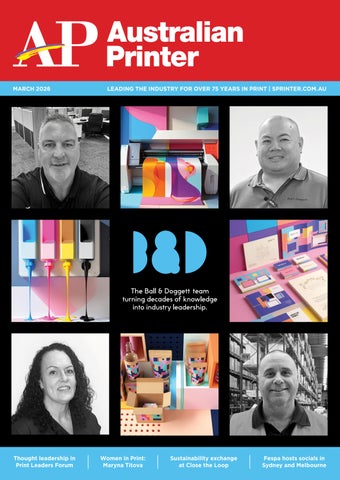
We also showcase the Ball & Doggett team that has turned decades of knowledge into industry leadership.
We trust you find this edition provides valuable takeaways for you and your business.

Nine has bought out-of-home media company QMS in a deal worth $850 million. Nine has said it will acquire 100 per cent of the issued capital of QMS (on a cash and debt-free enterprise value basis) from Quadrant Private Equity, which announced its intent to acquire QMS in 2019.
At that time, shareholders overwhelmingly voted to sell QMS to Shelley BidCo Pty Ltd, the entity controlled by Quadrant Private Equity, with the Federal Court of Australia also approving the scheme, in early 2020.
QMS is one of the country’s leading digital outdoor media platform, with a number of plum contracts, including the City of Sydney and Auckland Transport.
Nine has also sold its radio business – for talk back stations 2GB in Sydney, 3AW in Melbourne, 6PR in Perth and 4BC in Brisbane – to billionaire hotel baron Arthur Laundy for $56 million, and converted regional station NBN from a wholly owned business to an affiliate, owned and operated by Nine’s regional partner, Win.
Nine CEO Matt Stanton said, “These transactions will create a more efficient, higher-growth, and digitally powered Nine Group for our consumers, advertisers, shareholders and people. This positions Nine well for the future, enabling the Group
to withstand industry disruption and deliver long-term sustainable value to our shareholders”.
QMS is expected to report EBITDA of $105 million for calendar year 2026, a double-digit percentage leap from the prior year. The company is run by John O’Neill, who has been the CEO since January 2018. Nine told the market it has “identified clear opportunities for operational efficiency” and expects to deliver $20 million of annual pre-tax cost synergies by 2029.
“These synergies will be driven by the consolidation of back-office functions, technology infrastructure, procurement efficiencies and the switching of marketing spend into QMS,” it said.
“The acquisition of this high-growth digital outdoor media company, QMS, further diversifies Nine’s revenue streams and adds scale to our advertiser and agency relationships,” Stanton added.
“The QMS network will provide Nine with a branded platform to support key national news and sporting moments and serve as a public service utility for governments at all levels in times of emergency or community need. We are excited about the potential in this space.
“QMS is a highly complementary media platform, offering Nine the opportunity to drive significant value by leveraging our premium content on QMS screens and creating an unparalleled advertising proposition that spans from ‘Sofa to Street’.”
Stanton also described out-of-home as “more resilient to the impact of global digital platforms”.
At the end of last year, QMS officially became the biggest out-of-home operator in New Zealand when it completed its takeover of the Auckland Transport out-of-home street furniture network from oOh!media, which lost the contract in July.

Managing Director
James Wells / 0414 995 104 james@intermedia.com.au
Subscriptions / (02) 9660 2113 subscriptions@intermedia.com.au
Subscription rate (5 issues) Australia $79
Editor Hafizah Osman / 0431 466 140 hosman@intermedia.com.au
Printed by Hero Print Alexandria, NSW, 2015
National Sales Manager
Carmen Ciappara / 0410 582 450 carmen@proprint.com.au
Mailed by D&D Mailing Services Wetherill Park, NSW, 2164
Design and Production Manager
Sarah Vella / 0406 967 559 svella@intermedia.com.au
RTape Conform® with RLA®

Installers know the frustration of edge curl, tunnelling, and application tape that won’t behave. RTape Conform® paper application tape with proprietary RLA® Release Liner Adhesion technology was engineered to solve those problems. RTape Conform® adheres to
RTape Conform® with RLA®
• Proprietary RLA® Release Liner Adhesion technology
• No wrinkling, edge curling, or tunnelling
• No adhesive balls, gapping, or crusted edges
• Adhesive won’t build up on stored or rolled graphics
• Performs during wet or dry applications

® (FSC-084395)


DPS Print Group from the Northern Beaches in Sydney has bought iPrint Digital – a print company located close to the business – resulting in its expansion and deepening its market footprint.
DPS Print Group director Mark O’Connell said, “We’ve worked closely with iPrint for the last five or six years and their operations are almost a mirror of what we do. This move strengthens our company from a client-based, operational, and geographical perspective.
“[The acquisition emerged] through our almost daily contact. I was approached a few months ago and the owners floated the idea that they were looking to sell and if I would I be interested. I thought about it briefly, looking at all the factors, and we quickly reached an acquisition agreement.
“Apart from it strengthening our customer base, iPrint owned and operated production equipment that we didn’t have, which helped to consolidate our operations. This included die-cutting capabilities, both on a platen and cylinder for in house die-cutting and the like, along with automatic cello-glazing and greater guillotining capabilities which assists in productivity.
Durst chief executive and co-owner Christoph Gamper has confirmed the acquisition of Spanish-based manufacturer of cutting tables Hasler Solutions.
Hasler Solutions founder Marc Hasler has extensive experience in the cutting machines industry after eight years working at Zünd in Switzerland and nine years with Bullmer in Germany.
“We have acquired the majority stake in Hasler Solutions Spain, a cutting systems company with real engineering depth and market credibility,” Gamper said.
“What matters most: Marc Hasler stays. He remains co-owner and the driving force behind the business. From the very first moment we met, it was obvious that we would work together. Shared values, shared standards, shared ambition.

“Often, we would print and take them around to iPrint for finishing jobs of this nature, and on other occasions, they would come around and grab paper if they were running short on a job. It was never an us and them situation. We also worked together and helped each other out where we could.”
O’Connell said as the result of some recent consolidation of printers on the Northern Beaches of Sydney, DPS is now one of a few printers of its kind for the region.
“There’s not as many printers up this way as their used to be and even less now. I believe a further two smaller operations

shut down over the Christmas break along with the recent acquisition of IntoPrint being purchased by Rawson Graphics in Macquarie Park. Now that we’ve joined with iPrint, it means that in the space of a couple of months, five printers have become one,” he said.
Coinciding with the iPrint acquisition, Sydney Digital and Print Services has also changed its name, now under the DPS Print Group banner.
O’Connell said, “From early in the year, preparations were well underway for a name change to DPS Print Group for several different reasons. This took effect on 1 December and just happened to coincide with the finalisation of the acquisition of iPrint in mid-December.
“iPrint Digital was previously owned and operated by three partners, all of whom continue on in various capacities to ensure a smooth transition for the iPrint customer base.
“It is our main priority to ensure, that with this acquisition, it’s business as usual for the iPrint customer base and we have achieved this by the previous partners working with us to ensure this is followed through, especially with Nathan Alley joining us in a full-time role.
DPS and iPrint will both continue to run, with one site dedicated to the business’ flat sheet work and the other towards its wide format, promotional merchandise, and clothing operations.
“What started as a collaboration has now become something more. A Durst Family story. Hasler Solutions remains independent and open to all customers. That is non-negotiable.
“At the same time, together we will take Print & Cut to an industrial level that the market expects and deserves, Scalable, robust, uncompromising in quality. More to come and see at FESPA Barcelona 2026.
“2026 also marks 90 years of Durst Group AG. 90 years young. Built on engineering, ownership and the courage to evolve. Still pushing forward.
“Looking forward to Barcelona. Happy to raise a glass with customers, partners and those who may become both.”
In an exclusive interview with Marc Hasler in 2023, he told Australian Printer the company’s machines are fully produced in Spain with up to 90 per cent of components from Germany. The company has been operating for 17 years and has been manufacturing its own machines since 2019.

TMA Group of Companies, an Australian-owned multinational print, print management, technology and logistics company, recently won a decisive legal victory in the Supreme Court of NSW, with the court upholding claims made by TMA subsidiaries totalling more than $7.8 million, in a judgment handed down on 25 September 2025.
The case arose from a dispute between TMA and Spot Newspapers Pty Ltd, Grasett Investments Pty Ltd, JG and DG Properties Pty Ltd, and John Georgantzakos (former Spot Newspapers owner) concerning TMA’s acquisition of a heatset and hybrid printing business previously conducted by Marrickville-based printer Spot Newspapers.
After, a 12-day final hearing, the court confirmed that amongst other things, Spot Newspapers and Grasett Investments had breached warranties given to TMA and had engaged in misleading or deceptive conduct.
The court also found that Georgantzakos had breached an agreement with TMA and had made misleading representations to it, on behalf of Spot Newspapers and Grasett Investments.
“This outcome fully vindicates our position,” TMA executive chairman Anthony Karam said.
“We welcome the court’s recognition of the strength of our case and the award of damages that appropriately reflected the seriousness of the conduct and contractual breaches. TMA’s preference is always to pursue a fair and reasonable negotiated commercial resolution.”
Karam added the judgment represents a significant affirmation of TMA’s position and brings the matter to a successful conclusion after almost two years.
TMA acquired this catalogue and magazine (heatset) division of Spot Newspapers in March 2023. At the time of acquisition, Karam said it will provide TMA with greater opportunity to extend its print management capabilities.
That same year in November, TMA acquired Presfast Pty Ltd, a large independent printing business specialising in retail communications.
TMA was established in 1982 in Sydney and “has grown steadily into one of the largest fully integrated print and print management companies in Australia with offices in Asia and North America” according to its website.
TMA Group’s 12 companies provide products and services to industries including airlines, airports, FMCG, manufacturing, retail, higher education, telecoms, government, packaging, logistics, and more. It also operates manufacturing facilities in Australia, New Zealand, and the Philippines.

The widely acclaimed ROLAND 700 EVOLUTION litho press deploys an array of innovative technologies to give unprecedented levels of efficiency, productivity and print quality.
manrolandGoss - Australasia
Tel: +61-2-9645-7900
info.au@manrolandgoss.com
The Ball & Doggett team turning decades of knowledge into industry leadership include Verinia Johnston, Scott Chong, John McTaggart, and Darren Wallace


Eit is built over years of industry change, customer partnerships, and a commitment to delivering the right solutions at the right time.
At Ball & Doggett, Australia’s leading distributor to the print, packaging, wide-
format, and signage industries, that experience is one of its greatest strengths.
In this special feature, Ball & Doggett profiles four long-serving team members whose combined tenure spans more than a century: Verinia Johnston, Scott Chong, John McTaggart, and Darren Wallace.


of them has contributed to the growth of both the business itself, and the industries they serve.
Their stories reflect more than longevity –they represent the depth of knowledge and

trusted relationships that continue to define Ball & Doggett’s leadership in Australia.
Having spent more than two decades with Ball & Doggett, Verinia Johnston is currently the sales administration coordinator within the NSW office.
Reflecting on her journey with the business, and what has kept her working at the same place after all these years, she said, “I was actually a sales rep for an opposition merchant, and I was poached to come across to Edwards Dunlop by a good friend that I am now lucky to call my husband.
“I have stayed within Ball & Doggett for 25 years, as I have had the pleasure of working with fantastic people in an awesome industry. I love what I do, and I enjoy getting to do it with a group of people who are like family.”
Having always been given a great variety of scope in her roles over the years, Johnston said she has had several moments and milestones that stood out for her in her time at Ball & Doggett.
“Some of my favourites are: an implant at a major customer, working autonomously in launch projects, and most recently heading up our i_CONSIGNMENT program in NSW,” she mentioned.
“An absolute standout for me would be when I was rewarded with the opportunity to go to the mills in China and Korea and meet some of our suppliers with Aaron Carter [Ball & Doggett commercial print general manager] and a client.”
Having seen the industry go through significant technological transformation – from analogue to digital, from offset to wide-format, and beyond – Johnston said some shifts stand out to her with great impact.

“From my perspective, this industry has seen so much change. When I started at a small printer, we still did artwork on Linotype machines and could turn around 1,000 letterheads in about two weeks.
“Now, technology is fast and demanding, but it’s great to see so many advancements included in print, signage, and packaging, like variable data and digital,” she said.
“This industry has so much to offer and can be a phenomenal career for those that are open to learning and embrace it.”
Loving an industry that was stumbled upon
Another individual that has spent more than two decades with Ball & Doggett is its sales executive, Scott Chong.
But Chong’s journey with Ball & Doggett was different to Johnston’s – he stumbled into it by chance, fell in love with it, and sees plenty of opportunity in the space.
“I was working at my local video store while finishing a marketing degree at university, when one of my best friends started at Raleigh Paper, so I followed him there in 2000,” he recounted.
“Over the past 26 years, the name on the building has changed, and my role has evolved more times than I can count, but the fun and the great memories with past and present colleagues have stayed the same.
“I knew nothing about the world of paper and print when I started, but it has changed rapidly over the years – and I’ve been lucky enough to change right along with it.
“There’s always a challenge to tackle, something new to learn, and fun to be had – this is what motivates me every day.”
During his time at Ball & Doggett, some experiences stand out as particularly significant.
“Getting the opportunity to see our products being made in the U.S. and across Europe was a real highlight for me,” he said.
“Being able to connect with people in similar roles from around the world at an international conference was also something I never expected when I first started out. I’ve also been lucky enough to be part of some amazing design and print events over the years – these are experiences that have definitely been career highlights, and ones I won’t forget.”
Technological developments that Chong believes have been the most influential include the speed and quality of industry machines.
“It has been amazing to see businesses using technology alongside print and design to really connect with their audiences. The speed at which highquality work can now hit the market still blows me away, and with all the wideformat tech out there, it’s exciting to see what’s possible,” he said.
“At the same time, I still get a kick out of seeing traditional print craft celebrated. There’s something really special about those skills – and it’s great to see them still holding their own alongside all the new innovations.
In recommending the industry to future entrants pursuing careers in print, signage, and packaging, Chong said, “The next generation might think the print, signage, and packaging world is a bit oldfashioned, but if you take a look around, it’s still everywhere. Keep an open mind about what this industry can do – and the impact it has on consumers today is bigger than you might expect”.

A very rewarding and satisfying career at Ball & Doggett
As for John McTaggart, his journey with Ball & Doggett began with a small, independently owned Paper Merchant – Riegel Paper – which he started off with as a sales cadet in 1992. This was McTaggart’s first full-time job out of high school. Like Chong, McTaggart is also now a sales executive at Ball & Doggett.
“Before Riegel closed its doors, I moved to Raleigh Paper in 2004. I loved working for Raleigh; this then became part of BJ Ball in 2011. Since then, we merged with KW Doggett, and are now under the Ball & Doggett banner,” he said.
“Working in the paper industry is all I have known since I came out of school. I love the friends I have made within our business, but also the clients and the people I have come across over 30 years. My job challenges me and offers something different every day, and I love working in a team environment.”
McTaggart finds the trepidation around four businesses coming together to become BJ Ball in 2011 to be a very defining moment in his career, adding that it came at a time where there was significant changes to the operations of the company.
“It was a very difficult time at Raleigh Paper as we were a very small and closeknit team. Not everyone maintained their jobs moving to BJ Ball, which was hard, but it was also time to move forward and find new beginnings,” he said.
“This gave me a new and greater appreciation of what life would be like working for a bigger company. COVID, in 2020, further changed our lives in more ways than one. Those two years were very challenging. Thankfully, the packaging division I work in kept us extremely busy. Hopefully, we never see those times again.”

Having also served the industry for more than 20 years, McTaggart said it’s no doubt that technology has had a major impact on the industry.
“It would be fair to say that I have not always embraced some of these changes (I know a few readers would agree with this). I loved the days of doing my sales calls standing at the back of a GTO or 4-colour press, talking while the operator went to work. Those days don’t really exist anymore,” he said.
“It’s a very different world in print today – we predominantly see short-run digital machines or wide-format presses with much more automation, and equipment that runs quicker and more economically with a press of the button. This has, unfortunately, taken a bit of the craft out of our trade.”
Regardless, McTaggart is proud to tell people that he loves who he works for and the people that he works with.
“I work with some of my best friends every day. Striving to be successful in a team environment at work, or in sport, can be very rewarding and satisfying,” he added.
“I guess it doesn’t matter what industry you are in or what company you work for; enjoyment is very important. Being prepared to evolve and learn different skillsets, being passionate about what you do, and embracing being part of a team are just some of the transferable skills people should have.”
Ball & Doggett operations manager Darren Wallace is one of the longest serving team members at the business. Starting work as an offsider on a paper sheeter 32 years ago, Wallace progressed through the business one step at a time – from becoming its store person, truck driver, transport supervisor, and now its NSW operations manager.
“Change is inevitable in this industry; and adaptation is key. As technology and products are always evolving, I have had to embrace changes over the years, which has provided me with longevity,” he said.
“In my line of work, every day brings new challenges, which requires different solutions, that have helped me form some great relationships within the company. Helping our team to overcome new challenges through strong leadership and continuing to develop our employees’ skills, abilities, and confidence is what drives me.”
From an operations perspective, Wallace said warehousing technology, from picking and packing via RF, ensuring inventory accuracy, all the way through to delivery efficiencies through transport routing software and technology, has “changed the game” in how the industry runs.
“Helping implement two different WMS/ ERP systems throughout my time has been both the hardest and most rewarding milestones in my career, and one that I am very proud of,” he added.
While technologies evolve and markets shift, experience still remains a powerful differentiator.
The insights shared by Johnston, Chong, McTaggart, and Wallace demonstrate that long-term industry knowledge enables stronger customer partnerships and solutions that keep pace with change.
It is this continuity, combined with innovation, that allows Ball & Doggett to support customers with confidence.
As Australia’s leading distributor to the print, packaging, and graphics sectors, Ball & Doggett looks to the future with the same commitment that has shaped its past: investing in people, embracing progress, and delivering results. Because in this industry, experience doesn’t just matter – it leads.
Swatch kits that speak your language.
A clear and practical in-hand guide to choosing the right board for the job, designed to show how our boards really perform, in print, in finishing and in final form.
Built for printers, designers and brand-owners, these individual Cartonboard Swatch Kits highlight key grades in our range. Each kit includes DL samples across the weight range, coating and embellishment comparisons, quick-reference on applications, accreditations, plus technical details and reel sizes.
REQUEST A SWATCH KIT


The event brought together Dscoop, HP, Currie Group, Ball & Doggett, and Close the Loop with HP Indigo print providers to share practical insights on advancing a circular economy

Arecent Dscoop HP Indigo Sustainability Exchange gave more than 30 industry professionals an exclusive, behind-the-scenes look at how HP Indigo digital press consumables are collected, recycled, and transformed through circular economy processes at Close the Loop’s advanced recycling facility in Melbourne’s Reservoir.
The event brought together Dscoop, HP, Currie Group, Ball & Doggett, and Close the Loop with leading print service providers who use HP Indigo digital press technology, to provide practical insights into the processes which underpin the achievement of a circular economy.
Close the Loop is an Australian-led initiative, founded in 2001 to ‘turn waste into opportunity’ with a commitment of zero waste to landfill. Today, it is an ASX listed company – the only one with audited, zero waste to landfill certified reporting – with global operations in North America, Europe, and South Africa as well as Australia.
In addition to partnerships with a diverse group of international OEMs, Close the Loop has around 60,000 collection sites in Australia, providing opportunities for consumers to recycle everything from batteries to cartridges.
Close the Loop CEO and executive director Kesh Nair welcomed guests, saying partnerships with brands, retailers, manufacturers, and governments all play a vital role in enabling Close the Loop to ‘do what they do’.
“We are excited to have all the stakeholders in the room, to talk about strategies to progress towards a circular economy, and to better understand the processes which underpin our promises here at Close the Loop,” he said.
Nair then introduced Steve Morriss, co-founder and head of circularity, who designed most of the patented equipment used at the plant, to run guests through the principles behind Close the Loop’s operations.
“The first pillar of a circular economy is design – to ensure products stay in circulation for as long as possible and, when it cannot be circulated again, to ensure the atoms and molecules in the raw materials can be used again,” Morriss explained.
“The better a product is designed, the more value you get out of those materials. OEMs like HP are committed to circularity, not because it’s easy or cheap, but because it is what customers expect of their brand. We have been working with them
for more than 20 years, recycling both equipment and consumables, and the design of their products represents world’s best practice.”
Close the Loop, he explained, separates and refurbishes equipment components for return to HP’s manufacturing facilities in Israel, and processes consumables like toner canisters, and toner itself, into other products.
Over the past 20 years, the partnership has seen over 17.5 million HP products processed globally, 8.5 million of those in the Melbourne facility. That represents some 76 per cent of all HP spare parts and consumables products, diverting more than 7,800 tonnes of HP product from landfill.
The consumable products are used in a couple of key products, including rFlex recycled plastic resin made from mixed postconsumer soft plastics, printer cartridges and cosmetic packaging, which can be used in injection, rotational or extrusion moulding to create products from pallets, to crates, shopping trolleys, baskets and tubs, and TonerPlas engineered asphalt additive.
“Our biggest challenge has always been recycling toner,” Morriss explained.
“It’s actually a co-polymer of either polystyrene or polyester but, because


it is engineered to carry a charge, it is notoriously difficult to handle and recycle.
“With TonerPlas, we mix the toner with recovered soft plastics, including HP Indigo toner canisters, to create an additive which, when added to bitumen, results in roads that are stronger, and last longer, than traditional asphalt surfaces. It’s a great example of the ‘holy grail’ of recycling – to create a recycled product that is as good, if not better, than existing solutions.”
Guests were then taken on a tour of the plant, where they had the opportunity to see the TonerPlas process in full swing, with HP canisters delivered to a shredding unit before the output was mixed with toner and other recycled material to deliver strings of TonerPlas pellets.
Following the tour, Nair and Morriss took questions from guests, who were keen to learn more about the operation, and to explore the potential impact of proposed extended producer responsibility (EPR) legislation and C-Flex guidelines.
It was a neat segue into a presentation from Zaidee Jackson, sustainability and compliance manager at Ball & Doggett, who reminded guests that embedding sustainability was not a matter of policy or compliance, but represented a real, competitive advantage for businesses in Australia and around the world.

“Research shows that consumers want the option to choose sustainable products, even if it costs a little more,” she said.
“Sustainability is much more than a ‘box ticking’ exercise; it’s about governance, risk-based decision-making, reputation and procurement requirements, and transparency throughout your supply chain.
“Effective product design considers everything from materiality, to technology, to structures, to outcomes and end-of-life experience. The more you lean into your suppliers for information, the more confident you can be in conversations that have commercial outcomes for your business.”
Choosing the right, trusted partners is vital, she added, echoing what became the theme of the evening.
“Circularity is the North Star we are all trying to work towards, but you don’t need to be experts. Suppliers like those in the room here today, are here to collaborate. That’s the key message,” she said.
Ball & Doggett also took the opportunity to launch a new HP Indigo Swatch Book, featuring 153 different stocks that are certified for use on HP Indigo digital presses – another resource designed to equip customers to meet demands for quality and speed to market.


Dscoop community success manager Amy Yu then introduced the benefits of the global HP Indigo user community to the gathering and not only provided details of upcoming Dscoop Edge Rockies in Denver, Colorado in March, and Dscoop Edge Slovenia in June, but also gave two lucky guests a complimentary registration for either event.
The value of Dscoop was endorsed by Peter Barr, from Photo Create, who shared his own very positive experiences at previous Dscoop events with guests.
Craig Walmsley from HP and Mark Daws from Currie Group then brought the event to a close, reiterating their companies’ commitment to partnership, thanking guests for attending the Dscoop function, and voicing appreciation to the Close the Loop team once again, on behalf of the group.
By designing recovery, reuse, repurposing, and recycling solutions, Close the Loop aims to drive the shift from a linear model of consumption to a circular economy –but it was clear that it is partnerships which underpin successful circularity.
Print service providers and their customers can sign up to recycle product through Close the Loop by visiting the company’s website closetheloop.com.au and requesting a starter kit to collect everything from mobile phones and batteries, to soft plastics.
Having recently relocated from Ukraine to Australia, Maryna Titova has rapidly adapted, successfully transferring her industry expertise across international markets
Although relatively new to the Australian print and visual communications industry –having migrated from Ukraine only in 2022 – Maryna Titova has quickly built a strong understanding of the print and visual communications sector, successfully transferring her skills and experience across borders.
When the war in Ukraine began, Titova’s life and career were abruptly disrupted, and as a result, she relocated to Australia to rebuild from scratch. Having entered the print and signage industry during its early development in Ukraine, Titova chose to remain in this field in Australia as she didn’t want her skills to go to waste.
Instead, she put them to good use at several signage and wide-format print companies that she worked for, including Avon Graphics, and very quickly gained strong hands-on experience with printing workflows, RIP software, colour accuracy, and file preparation.
As a result, she now has hands-on experience across offset, screen, digital, and wide-format printing, as well as signage manufacturing and vehicle branding.
“I was trained as an architect and graduated from art school in Ukraine, which shaped my systems thinking and ability to see projects holistically –from concept to execution. I then built an advertising and production business from the ground up, working hands-on across all stages of production. This foundation gave me a deep understanding of materials, technologies, and real-world manufacturing processes,” she said, recounting her career path from before.
“My experience developed from a hands-on entrepreneur, doing everything independently, to a business owner with in-house production and projects delivered across Ukraine.
“Some key highlights from my career in Ukraine include building and scaling an advertising and production business from scratch into a stable operation with in-house manufacturing and nationwide projects. My clients included banks, Ukrainian alcohol producers, and

international companies such as Veolia, Kärcher, Reiners Aluminium, and Zeppelin.
“Another significant milestone was establishing and managing a corporate vehicle branding network during the COVID period, operating across 32 cities in Ukraine, which involved setting standards, processes and coordinating distributed teams.
“When I moved to Australia, I deliberately returned to hands-on production roles to understand local workflows, standards, and materials. An important professional achievement following my move was my ability to adapt quickly to a new market, language, and industry environment.”
Titova is currently creating AI assistants for signage and printing that embed her real production experience. Working at Artivisual AI, she combines AI capabilities with her 20-plus years of practical experience in signage, print, and marketing.
“What I enjoy most is understanding how a product is created at every stage. I always visualise the result early in the process to ensure quality, efficiency, and a reliable outcome,” she said.
“No two projects are the same, and every job presents a new challenge. I’m
especially drawn to the balance between aesthetics and technical expertise. This industry allows creativity, design and visual thinking to be realised through materials, engineering and production, resulting in tangible, functional outcomes.”
Titova enjoys building systems, but she’s also constantly learning and observing how different industries and technologies operate.
“I believe that some of the most effective and creative solutions emerge at the intersection of different business models, tools, and production approaches. This mindset allows continuous improvement rather than reliance on routine processes,” she mentioned.
As a woman in print, Titova is inspired by women who demonstrate adaptability, attention to quality, and a strong sense of aesthetics while confidently operating in technical environments. In print and manufacturing, the ability to combine flexibility, precision, and responsibility for outcomes is essential to her, and she sees these qualities as strengths women bring to the industry.
“I learnt directly from business owners and specialists in screen printing, wideformat, and digital printing, as well as furniture and metal fabrication. Selfeducation, continuous monitoring of market trends, and learning through practice played a key role in shaping my professional approach,” she said.
“Women in print can also give back by strengthening practical understanding and accountability within the industry. Sharing real production experience helps reduce costly mistakes, improve quality, and create more sustainable outcomes –especially in an industry where errors can have significant consequences.”
Going forward, Titova aims to continue working at the intersection of production, technology, and creative problem-solving.
“I see significant potential in AI and am actively exploring how it can support professional expertise, optimise workflows, and help create more thoughtful and resilient solutions in signage and printing,” she added.


If 2025 has made anything clear, it is that the print industry is no longer shaped by equipment cycles alone. It is being reshaped by structural change in how businesses operate, how customers buy, and how value is created – and that shift is accelerating.
Across Australia and New Zealand, the market remained resilient, but resilience came with pressure. Margins remained tight, labour constraints continued to challenge growth, input cost pressures persisted, and customer expectations lifted again. Faster turnarounds, greater flexibility, consistent quality, and transparency have become table stakes and, increasingly, a key differentiator.
What has changed most significantly over the past 12-18 months is the seriousness with which automation, software, and now AI are being discussed at a leadership level. These are boardroom conversations because they directly impact scalability, long-term competitiveness, and business risk.
More business leaders are asking harder questions, such as:
• How dependent is our operation on individual people?
• How predictable is our output?
• How exposed are we to labour disruption?
• How clearly do we understand our true costs and margins?
• What does AI really mean for our business?
These questions inevitably lead to technology, but not in isolation. They lead to workflow, data, integration, discipline, and visibility. Automation is no longer about speed alone; it is about consistency and control. AI is no longer about novelty; it is about intelligence within the operation – the ability to understand what is happening, why it is happening, and how to respond faster and more effectively.
The businesses that gained momentum in 2025 were not necessarily the ones that spent the most. They were the ones that invested with clarity, understood where they make money, understood their constraints as well as the experience their customers expect. From there, technology becomes an enabler of strategy rather than an expense searching for justification. That distinction becomes even more important as we move into 2026.
AI will become one of the most used terms in our industry over the coming years, but it will also become one of the most misunderstood. It will not replace strong leadership, good culture, or sound commercial thinking. What it will do is expose weaknesses in businesses that lack structure. AI only delivers value when it is supported by good data, disciplined workflows and clear objectives. For leaders, the challenge is not whether to adopt AI, but whether their organisation is ready to use it meaningfully.
Print continues to evolve in how it is used and valued. Growth is increasingly found in complexity rather than volume.
More versions, shorter lifecycles, tighter brand control and higher expectations around presentation are reshaping buying behaviour across commercial print, labels and packaging, and sign and display. The value of print is shifting towards its ability to be responsive, targeted and impactful, rather than simply efficient.
Commercial print applications continue to reward businesses that can deliver speed and consistency at scale, particularly as personalisation and shorter runs become standard rather than specialised. Labels and packaging continues to grow in complexity as brand owners manage expanding SKUs, compliance requirements and sustainability expectations. Sign and display is increasingly application-driven, with strong demand for high-quality shortrun work across retail environments, events and interior spaces. Across all segments, finishing and embellishment remain some of the most effective ways to protect margin and differentiate output.
Sustainability is also maturing. The industry is moving beyond statements of intent towards practical accountability. Customers are asking better questions about waste, materials, energy use and end-of-life outcomes. More importantly, they want sustainability to coexist with commercial reality. The businesses that will lead are those who embed sustainability into operational efficiency, not those who treat it as a separate initiative.
For Currie Group, our focus moving into 2026 is grounded in this reality. We are investing in the areas that directly strengthen customer outcomes: service capability, technical expertise, preventative support models, training, and deeper integration across systems and workflows. We are working closely with our partners to bring solutions to market that reduce complexity rather than add to it, and that support customers in building operations that are more predictable, more resilient and more profitable. We see our role not simply as a supplier of technology, but as a long-term partner in capability building.
The industry is entering a phase where leadership matters more than ever. The gap between businesses that excel and those that do not will continue to widen. I believe technology will accelerate that divide rather than close it. The businesses that will succeed in 2026 and beyond will be those who understand their numbers, understand their customers, and make deliberate, informed investment decisions.
That is where the real opportunity now sits. How do we build stronger moats around our collective businesses by leveraging the full potential of technology? The race is on… and the future is an exciting one.


Series 3 430

In the printing industry, the only constant is change, and as businesses we try to be as ready as we can to pivot into new markets and deliver new solutions for our customers.
At Durst, we are always looking at how we can support our customers to grow and develop, and in 2026 the level of demarcation between different print businesses is becoming more blurred than it ever has been in the past.
Why can’t a wide format printer print labels or stickers as they are sometimes referred to? But likewise, why can’t a traditional flexo label printer jump into wide format? The modern market needs solution providers and partners who you can trust – partners that can deliver the product with high quality and short turnaround times as well as short-runs and variable data. This can only be delivered with digital technology and managed by strong software platforms in the background.
Durst has invested heavily in growing its software platforms to support its technology as well as third party technology. When customers approach Durst, they know we will deliver the best-in-class engineering
offering, the best quality, and highest production output with versatile machines that can grow alongside their businesses.
We might not be as well known for our software solutions, but as the acceptance and awareness of our SmartFactory concept grows, more and more businesses within Oceania have been turning to Durst software to manage not only their pre-press and RIP workflow, but also their complete ERP with Durst Lift software – from quoting to inventory to pre-flight, invoicing and delivery, as well as all of the production steps in between.
Durst can offer software to all businesses that is completely agnostic – meaning we can support any printer and any cutter as well as other finishing equipment.
Recent additions to the Durst Workflow software now offer AI-supported job tracking and image recognition baked in, and AI-driven upscaling. We are very excited to confirm that arriving in 2026 will be GMG Colour Management included with all Durst software modules.
It is truly quite an amazing milestone that Durst has entered its 90th year of
imaging innovation starting in the analogue photographic sector.
Not many people are also aware that Durst manufactured cameras, and even back then, Durst was known for its innovation and market leading solutions.
Basically, our core remains the same – delivering best-in-class engineering and technology solutions for our customers in the field of graphics and the broader print industry.
We look forward to celebrating our 90th birthday with a series of events around the globe. It truly is amazing to see a company that has come from humble roots in the mountains of Italy and remain a privately-owned powerhouse based in the same location.
However, this could never have been achieved without our amazing customer base who have stayed loyal to us and have also grown with us by pivoting from analogue to digital.
Over the last 12 months, we have brought the new P5 500 TEX iSUB 5m dye sublimation printer to market featuring water-based inks for soft signage and textile printing complementing the P5 350 TEX iSUB for media up to 340cm wide.
The P5 500 TEX iSUB features IR-inline fixation technology and ensures colour consistency, sharpness, and high-quality printing across the entire width of the media used.
In late 2025, Durst celebrated the official launch of the P5 Super Multi Pass (SMP) together with customers from around the world at its Lienz site in Austria.
The P5 SMP is a hybrid LED multi-pass inkjet system with a printing width of 3.5m, designed for both board and roll-to-roll printing up to 70mm thick.
We have also recently announced the acquisition of Spanish-based manufacturer of cutting tables – Hasler Solutions. What matters most is Marc Hasler will remain with the business as co-owner and will continue to be the driving force behind the business.
As a result of this acquisition, Durst will take Print & Cut to an industrial level that the market expects and deserves – scalable, robust and uncompromising in quality.
The industry will be able to see the Hasler products as well as the next stage of the evolution of Durst at the upcoming FESPA exhibition in Barcelona. Once again, we will be hosting guests for the pre-FESPA Durst Open House in Brixen – we look forward to seeing you in Europe in May.


2025 was a big year for us, probably the most significant in Marvel’s recent history. Becoming part of the Opus Group was a major milestone, and what it has opened up for us going forward is very exciting – more capacity to invest, a stronger foundation to grow from, and ultimately, a better position to serve our customers. That’s what it means in practice.
For the industry, however, it was another tough year in a lot of ways. Cost pressures, tight margins, and finding good people was, and continues to be, a challenge across the board. But Australian print is resilient, and the businesses that have kept investing and adapting are in a good spot for the coming months.
The biggest thing Marvel did in 2025 was to make sure that through a period of significant change, our customers experienced none of it. Service levels, quality, turnaround times – all of that stayed exactly as people expect from us – and I’m proud of how the team delivered on that.
We also used the year to make some important decisions about investment and direction, so that we could enter 2026 ready to move quickly. That groundwork is already paying off, with new machinery coming in that will expand what we can
offer and how fast we can deliver it. Our investment in new machinery this year is our big focus. It’s going to allow us to run larger volume jobs more efficiently and get product to market quicker than we’ve been able to before. For customers, that means faster turnarounds and better value on bigger runs – and it all stays local, which matters to us.
Being part of Opus Group also now means sustainability is a conversation happening at a much larger scale than it was for us previously. There’s more structure around it, more shared knowledge across the group, and that’s pushing us to be more deliberate in how we think about it rather than just managing it job by job.
In practical terms, that still means minimising waste, making responsible choices in the materials we specify, and making sure we’re not creating more environmental impact than necessary in how we run production. The difference now is that we have more support and more accountability behind those efforts.
Across the industry, businesses will feel more confident about investing again in 2026. There was a lot of hesitation over the past couple of years, understandably so, but the mood is shifting. The businesses that back themselves and commit to growth
in 2026 will be in a strong position as the market continues to improve.
We’ll also see customers becoming a lot more selective about who they work with. Reliability, turnaround consistency, and being able to solve problems quickly are starting to matter just as much as price. There’s growth to be found in simply being easier to work with.
Responsive communication, quick problem solving, and genuinely understanding what your customer needs from a job before it even hits the floor is key. It sounds basic but it separates the good operators from the great ones. This shift in focus benefits trade businesses with real depth and capability behind them, and it’s something we’ve always prided ourselves on at Marvel.
In terms of technology, 2026 is the year that premium finishing will have its moment. Customers are looking for ways to make print stand out and there’s a growing appetite for tactile finishes, special coatings, and techniques that create a genuine shelf presence. The demand is there, and it’s an area where we have always loved pushing the boundaries of what’s possible, so we’re well placed in that area of the market.
There’s a real opening for businesses that are genuinely excellent at something specific – whether that’s a particular production capability, a niche market, or a level of service that others can’t match. Print buyers are getting more sophisticated and they respond to expertise.
Volume efficiency is also where I see real opportunity. Being able to run bigger jobs faster without costs blowing out is a genuine competitive advantage when margins are tight, and our new machinery investment is specifically aimed at delivering that for our customers.
Everyone wants things faster and that’s not changing. But what’s encouraging is that customers aren’t willing to drop their quality expectations to get it, which suits businesses like ours that have put the work into doing things properly.
As such, the case for working with local trade partners has never been stronger. The capability, the quality, and the flexibility are all here, and we’re seeing more print buyers recognise the real value that comes with keeping production close to home. Speed to market, easier communication, and the ability to adapt quickly when a job needs to change all add up to a pretty compelling case.
And for those already working with us, thank you. The investment we’re making in 2026 is directly aimed at giving you more capability, faster turnarounds, and better value. We’re in a great position and we’re looking forward to showing what we can do.

About Us
Celebrating 40 years as Australia's most trusted trade finisher, we deliver flawless results for high-volume production and short-run work, backed by reliable turnarounds and quality craftsmanship. From perfect binding to saddle stitching, hardcover binding to section sewing, we solve your toughest challenges.


2025 was a busy year for the print industry with some strong opportunities presenting themselves, particularly in large-format print and signage. For 1800 Projects, the continued investment we’ve made in machinery allowed us to confidently service these larger opportunities and say ‘yes’ to work that others couldn’t handle.
The main challenge across the industry has been customer expectations around price and speed. There’s an increasing demand for work to be delivered faster and cheaper, often without a clear understanding of what that means for quality and longevity.
Our way of combating this trend has been to remain focused on the quality of what we deliver to keep our clients coming back. We regularly see customers chase ultra-low pricing, only to come back to us after experiencing failures or poor service elsewhere. In the long run, cutting corners simply isn’t feasible, and quality continues to be the differentiator.
Staying relevant for us has meant being more than just a print supplier. We work closely with our customers from the outset to ensure the end product is right, not just printed. Over time, we’ve grown our
design team and our dedicated print and installation team, so projects are seen through from start to finish with a level of passion some contractors don’t possess.
If there’s an issue, we’re there immediately, and that responsiveness is something our customers genuinely value. We also remain committed to using high-quality materials – particularly 3M print media – and maintaining our equipment to the highest standard.
Colour consistency is another area we take seriously. Many of our clients require accurate colour matching, and they see the effort we put into getting it right. While preparation adds cost upfront, it’s far cheaper than fixing fallen or failed prints later.
Quality remains our number one priority in 2026. Alongside that, we’re focused on continuing to offer a higher level of service than our competitors and expanding our capabilities where it makes sense.
Another key focus is increasing awareness of who we are and what we can do. We know the value we bring, and 2026 is about making sure more people in the market understand that too and work alongside us.
For 2026, I see many of the same challenges continuing. There are still plenty of businesses racing to the bottom on price, and it’s important to remind ourselves not to be one of them.
Staying true to our values, structure, and strengths is critical. At the same time, there are plenty of opportunities out there. Growth won’t come from complacency – it will come from thinking differently.
Growth looks different for every business. The key is understanding what you do well and – more importantly – what makes you money.
One strong piece of advice for 2026 is to seriously look at AI. This isn’t a passing trend. Businesses that dismiss it will find themselves playing catch-up while others are already benefiting from improved efficiency and profitability.
AI will be a major trend in 2026. We’ll see more tools enter the market, and those who’ve already been using AI will start refining how it fits into their day-to-day operations. The real value will come from using it to make work easier, faster and more profitable, rather than viewing it as a novelty.
One of the most significant opportunities on the horizon is major project and infrastructure work, particularly with the lead-up to the Olympics.
To take advantage of these opportunities, businesses will need to be prepared, organised and willing to take calculated investment risks. Having your ducks in a row will be essential to even get a chance at this type of work.
Direct-to-film decals are also likely to surge in 2026. This technology represents a major shift in the signage industry, and while it’s still in its early stages in Australia, it’s gaining momentum quickly. Mimaki currently leads the space, but this is an area to watch closely. If adopted properly, it has the potential to significantly reduce traditional weeded signage graphics.
We’re continually exploring new materials and sharing this knowledge with our clients. Our target for 2026 is to increase the use of sustainable materials by 15 per cent. For us, sustainability is about informed choices and practical application, not just marketing language.
My message to the industry is simple: work hard, produce quality work and stay true to your business structure. Don’t aim to be the cheapest just to win a job. Price your work to maintain healthy margins and retain the quality you’re proud of. Good quality work is what will keep this industry alive, not prints that fail.

2025 was a year that forced realism across the print industry. Demand was generally there, but margins were under constant pressure. Rising material costs, freight volatility and ongoing labour challenges meant businesses had to work harder just to stand still.
It felt more like a consolidation year than a growth year. Operators who had invested in the right equipment, systems and people were able to absorb those pressures reasonably well, while those relying on price alone found it increasingly difficult to compete.
Across the industry, the focus shifted away from expansion and towards efficiency, reliability and execution.
For our business, staying relevant wasn’t about chasing trends – it was about doing the basics better. We concentrated on simplifying workflows, reducing manual handling and getting more out of the equipment we already own.
Being selective about the work we take on has also been important, prioritising repeatable, production-friendly jobs rather than complex one-offs that add cost and risk.
Continued investment in staff training remains critical. Even the best equipment only delivers value when operators understand it and trust it, and that continues to be one of the biggest differentiators in a competitive market.
The Canon Colorado M-Series, supplied by Currie Group, has become a core production asset for us. It’s delivered exactly what was promised – consistency, speed and reliability – and has allowed us to confidently take on higher-volume work while maintaining quality.
Just as importantly, the ongoing support from Currie Group and Paul Whitehead has been excellent, providing practical assistance that genuinely supports dayto-day production.
Looking ahead to 2026, our priorities are clear and grounded in operational reality. Improving production efficiency and workflow integration is a key focus, along with protecting margins through better pricing discipline and cost control.
We’re also focused on scalable, repeatable work that suits our production model, while continuing to retain skilled staff and invest in structured training. Growth remains important, but only when it aligns with capability and profitability.
As well in 2026, we’ll be embracing innovation, investing in greener practices and staying agile in an increasingly digital world. By doing so, we not only ensure our relevance but also contribute to a more sustainable and prosperous future for the industry.
The gap between well-run print businesses and the rest will continue to widen in 2026. Automation, workflow integration and smarter
production planning are becoming the baseline rather than a competitive advantage.
At the same time, customer expectations around turnaround times, pricing and consistency continue to rise, which puts even more pressure on internal efficiency. We’re also seeing ongoing consolidation across the industry, with scale and capability becoming increasingly important for long-term sustainability.
The strongest opportunities remain in areas where printers can add genuine value – particularly high-quality wideformat and signage, repeat campaign and rollout work, and applications well suited to digital and UV production.
Clients who value reliability, delivery and consistency will continue to be the most important long-term partners.
Rather than dramatic new trends, 2026 will be about refinement and discipline. Automation will continue to increase, ROI on equipment will be scrutinised more closely, and sustainability will move from a talking point to something customers actively question.
At the same time, cost pressures and skills shortages remain ongoing challenges that require constant management.
Our approach to sustainability is practical rather than promotional. This includes reducing waste through better planning, improving energy efficiency and working with suppliers who take sustainability seriously. Sustainability needs to make commercial sense to be sustainable long-term.
As well, for sustainability, we aim to continue introducing more environmentally friendly materials and to reduce our carbon footprint across all operations.
We are committed to reducing our carbon footprint by 20 per cent through energyefficient operations and switching to renewable energy sources.
We also plan for at least 50 per cent of our raw materials to be recyclable or biodegradable. Additionally, we aim to improve our waste management practices, striving for zero waste to landfill.
Ultimately, the businesses that will perform best over the next few years are those that stay disciplined. Understanding what you do well, investing carefully, pricing with confidence and focusing on execution will matter far more than chasing the next big idea.
Technology is an enabler, but strong processes and capable people are what ultimately make a business work.

For Bailey Print Group, 2025 was a significant and reflective year, marking our 40 years in business. Reaching this milestone provided an opportunity to look back on how far the business – and the industry – has evolved, while also reinforcing the importance of staying focused, disciplined and confident in our direction.
Across the print and signage industry, the pace of change continued, but the conversation shifted away from rapid expansion toward sustainable performance and long-term resilience.
Demand remained strong for high-impact visual communication, particularly in signage, fleet branding, events and placemaking. However, expectations around speed, quality and accountability continued to rise, requiring businesses to operate with greater precision and consistency than ever before.
Like many in the industry, we navigated rising material costs, ongoing labour constraints and supply chain complexity.
Celebrating 40 years highlighted the fact that while industry challenges may change, the fundamentals remain the same – strong relationships, skilled people and a commitment to quality. What became clear in 2025 is that the industry remains resilient, but future success increasingly depends on clarity of purpose and the ability to deliver consistent value beyond price.
Staying relevant at Bailey Print Group has always meant evolving without losing sight of who we are. As a family business now in its fourth decade, we’re acutely aware that
longevity only comes from adapting while maintaining strong foundations.
In 2025, we continued to invest in technology and capability that supports complex, high-quality work, custom signage and integrated branding projects.
Equally important was our investment in people. Many of the values that have sustained the business over 40 years – such as pride in workmanship, accountability and respect for craft –remain central today.
Strengthening leadership within the business and refining workflows, ensures those values continue to be carried forward by the next generation of industry professionals.
Approaching 2026, our priorities are clear and they are: people, performance and purpose. Developing and retaining great people remains our biggest focus, because skilled, engaged teams are the foundation of everything we do.
We’ll continue to strengthen systems that support efficiency and scalability while maintaining the high standards our clients expect. Sustainability forms part of this long-term view, ensuring the business remains responsible, resilient and relevant for decades to come.
The print landscape in 2026 will be more integrated, more specialised, and more customer centric. Print is no longer a standalone product – it is part of a broader experience that includes brand, space and storytelling. Clients want partners who can guide them through complexity, not just produce output.
Digital workflows, automation and smarter planning will continue to underpin production, while demand for tactile, visually striking print, will remain strong.
Growth opportunities for 2026 continue to sit strongly in wide-format signage, fleet and vehicle branding, experiential applications, and major events. There’s also significant opportunity in valueadded services – project management, design collaboration, installation and asset lifecycle support.
If 2025 showed us anything, it’s that resilience and relevance matter more than size alone. Looking to 2026, we expect greater adoption of automation, AI-supported workflows, and data-driven decision-making. Sustainability will become a baseline expectation rather than a differentiator.
The biggest opportunity for our industry is repositioning print as a strategic tool rather than a commodity. The biggest challenges remain workforce capability, rising costs and keeping pace with technological change.
From our perspective at Bailey Print Group, the advantage of longevity is perspective – understanding that challenges are cyclical, but businesses grounded in strong values and clear positioning are best equipped to navigate change.
In 2026, I expect tradeshows to focus less on speed alone and more on efficiency, automation, sustainability and workflow integration. Innovations that reduce waste, improve energy performance, and provide better production visibility will be front and centre.
Bailey Print Group will continue to commit to reducing waste, improving energy efficiency, and increasing the use of responsible materials and inks.
We’re also working closely with suppliers who share our values and support continuous improvement, and we’ll continue to educate clients about sustainable signage opportunities.
Reaching 40 years in business has reinforced our belief that the future of print is strong for businesses willing to evolve with intention.
This industry has always been built on craftsmanship, problem-solving, and pride in the work we deliver. For family businesses like ours, there’s a responsibility to honour this legacy while continuing to innovate and lead.
By investing in people, embracing change thoughtfully, and holding ourselves to high standards, the print industry can continue to thrive – and remain relevant – for generations to come.

Big Image Australia experienced steady growth in 2025. We spent much of last year working behind the scenes to expand our product portfolio in many different spaces, including making a big push into dye-sublimation with custom silicon edge graphics, flags, gazebos, umbrellas and other soft signage.
We also continued with our pursuit of more environmentally friendly signage options, the result of that will be several exciting new products coming online this year.
Lastly, we invested heavily in software automation tools and updated processes to further improve our speed, efficiency, and to give our clients better feedback, which, at the end of the day, provides an even better product.
Our key clients also continue to grow their business volumes – both in range and size of their projects. We have also had success in attracting and keeping new clients by being flexible and offering
unique products for interesting projects. Unfortunately, staffing and the impact this has on timely production was a challenge in 2025, but as our team grows, we have been lucky to find great creative and proactive people to fill our ranks.
Our main priorities for 2026 are always around how to better serve our clients. As a trade printer, we focus on areas we think will directly improve our customers offerings, as well as the day-to-day experience in ordering from us.
Our story is based on having absolute focus on our business, being positive in nature, and enjoying the ride. No matter what challenges approach, being laser focused on our goals, keeping an eye on future developments, and being adaptable has seen us through.
In 2026, we will continue our trajectory of constant incremental improvement. This kicked off with the delivery of our second 3.2m wide customised Genesis digital
cutting machine from Blackman & White from the UK, which was installed in January.
This will really help to supercharge our turnarounds. Later in the year, the industry will see our new website launch and an updated customer portal. For us, the most significant opportunities will revolve around how we can effectively integrate new technologies and processes in all sectors or our operation to facilitate new growth.
In addition, communication, quality, and speed to market will continue to be points of focus for us in 2026. We will also be looking at more customised print products that are specific to our clients. We are always looking to grow our business through solid partnerships where we can, to help our clients differentiate their own offerings.
In 2026, we also plan to continue our progress on increased sustainability. We currently run a 100kW solar system, and recycle our corflute and our paper/ cardboard-based waste. Our other waste goes to a waste energy scheme.
In 2026, we are looking to offer an increased number of more sustainable products especially in the self-adhesive vinyl space.
In terms of trends for 2026, I see companies consolidating on what they do best, incorporating more digital tools and physical automation. Those companies who are large and well-established will have more resources to put into this, but they also have more incumbent processes that may get in the way.
I expect there will continue to be a push, as we have seen for many years, into more automation, faster machines, more online integration, less manual intervention and less manual work. AI will be a part of this process in small and big ways.
AI will also be talked about a lot in 2026, and there will be many trying to incorporate it directly into their workflows. AI in design and workflows in the printing and advertising industry, in general, will be a big trend this year.
But, as to how revolutionary AI will be remains to be seen – it will certainly have a place, though. It’s easy to throw money at new and shiny things, but AI is not magic and unless you really understand how it works, the pitfalls and how to utilise its strengths may be money down the drain, or worse.
As for challenges, these will certainly be in the realm of attracting and retaining quality staff, keeping them engaged and excited about the future, and being able to provide them with effective training to make use of new technologies.

2025 marked another record year for Boom Group. Given that every project we undertake is unique, scaling the business while maintaining consistent quality is a continual challenge that we struggle with, but have managed to find a balance. Throughout the year, we delivered some amazing projects and had the privilege of working alongside some incredible brands and inspiring clients.
Encouragingly, there has been renewed momentum across the retail and brand activation sectors in 2025. City of Melbourne, in particular, appears to be regaining its vibrancy, which is a positive sign for the broader industry and business community.
Boom Group’s success has been built on our commitment to staying at the forefront of technology, culture, and evolving manufacturing methods –a strength that has defined us from day one. While the pace of change continues to accelerate, and keeping ahead is increasingly challenging, this focus remains central to our approach.
We have always placed a strong emphasis on spending meaningful, face-to-face time with our clients. This ensures we remain connected to emerging trends and ideas.
In the early months of 2026, Boom Group has doubled its footprint and expanded to a third location with more than 2500sqm of manufacturing space, in Collingwood. With the extra room, we can now ramp up our 3D design/3D print and digital screen offerings, as well as doubling down on our build and fabrication department.
We also recently relaunched our directto-public homewares and interiors brand, Boom Room, and are currently developing our own bricks-and-mortar retail store, scheduled to open in 2026. This next step will provide valuable real-world insights, enabling us to better anticipate challenges and deliver more proactive, informed solutions for our clients.
Another reason for us relaunching our web store is to sell used goods that we get back from projects – meaning we are trying to close the loop. We have also invested in
our own in-house recycling equipment to grind up our 3D printed waste and extrude that back into filament to reprint.
Sustainability is a priority for Boom as it is the backbone of all our designs and builds. We specifically choose our materials and use clever designs to save waste and unnecessary complexity. Recycling and true clean materials are what our industry needs.
In terms of industry opportunity, in 2026, people and client engagement are some of the biggest areas of growth – especially over the next five years. Companies that just focus on tech and system interfaces might be in a race to the bottom.
With the developments in digital, AI, and non-human interaction in businesses, clients are placing even greater value on genuine, human interaction. Tech noise, online ordering systems, and AI chat bots will reduce the quality of the customer experience over time to a point where they will want authentic interactions again – this could be the case for retail customers too.
As such, the industry can expect a swing back to “true retail” experience, leading to more design and build opportunities. Project management, as well as design and account management services will also see some big growth. We are prioritising “in real life” engagement with our clients and moving using as much human-to-human interactions where we can – tech is only the assist.
Having been a printer since I was 16 years old, I have seen the industry go through tremendous change – but for the last 30 years, the growth in print has been slowing year-on-year. We all loved digital print when it first came out, but, in my opinion, it spelt the death of us all and we didn’t know it at the time.
Big print suppliers now fight a tech war to make their machines faster and work easier and cheaper – and they’ve won. Print has become such an easy commodity now that we have all lost because of this. So, today, print service providers need to offer way more than just print to survive and grow. Finding your own niche and value proposition is crucial in the coming years – personally, I’m just waiting for screen printing to be king again.
With a background deeply rooted in the print industry, I am very passionate about using it as a medium to empower individuals and businesses alike. I love print and using it to push the boundaries of what’s achievable to make cool things. I also constantly get inspired by print service providers that think out of the box and produce best-in-class solutions. If we continue to learn from each other and share best practices, there is plenty of opportunity for the industry to flourish. Here’s to another 30 years of Boom.

In 2025, the printing industry made significant shifts in the way it was viewed and operated. For many small to medium businesses, including our own, the year presented both challenge and opportunity, requiring a more adaptable mindset and a willingness to rethink traditional ways of working. Customer expectations continued to evolve, with end users seeking more than a printed product.
Increasingly, they’re looking for complete, considered solutions that help solve practical problems, communicate clearly and add value beyond the printed page. The ability to offer a broader calibre of products, services, and outcomes has become central to long-term relevance and viability – something we see reflected in the conversations we now have with our clients every day.
We’ve also noticed trade shows and industry events are becoming more collaborative and education-focused, placing greater emphasis on innovation, sustainability, technology, and people. There’s a broader shift across the industry towards integrated solutions, stronger cross-sector collaboration, and an increasing presence in software, programming, and workflow automation.
In addition, people have always been, and will continue to be, a core element of our industry. In 2025, limited movement
across the sector, combined with a growing number of skilled professionals transitioning into retirement, placed renewed pressure on the workforce. This reinforced the need to attract the next generation while retaining existing talent, something we have felt directly within our own walls.
Addressing this challenge has required a new way of thinking, including consolidating roles, automating workflows and designing workplaces that are sustainable, supportive, and appealing places to build a career. For us, these changes have been key to maintaining a healthy workplace that people want to remain part of.
For Breen Printing, 2025 was a year of growth and transition. Being recognised as Regional Printer of the Year at the National Print Awards was an encouraging and very proud moment for our team. We focused on adapting the business to support a new direction, making space for new people, skills, and equipment. Expanding while maintaining quality, culture, and consistency required us to step back and work more intentionally on the business rather than solely in it.
While challenges remain across the industry, there’s growing awareness that without genuine investment in people, we risk losing not only skills, but the future of
print itself. Industry events, awards and networking opportunities continue to evolve into spaces where younger voices are welcomed, supported and celebrated.
This cultural shift is essential, and it is one I feel strongly about as both a business owner and an industry advocate. In 2025, Breen made a deliberate effort to contribute by attending regional careers expos, promoting opportunities within print, working with Melbourne Polytechnic’s SkillsLab to support the development of education offerings focused on futureready skills in manufacturing, and collaborating with Outer Eastern Local Learning and Employment Network to attract apprentices. Our focus has been on building long-term pathways and attracting the right people.
Throughout 2026, our priorities are centred on sustainable growth and on attracting and retaining people in a way that supports both the business and the individuals within it. By investing in emerging ideas through targeted circular design, programming and automation solutions, and maintaining our commitment to mental wellbeing through our partnership with Anchor Health, we’re supporting both skill development and wellbeing.
There’s a growing focus on mental wellbeing within our working culture as the increasing demands placed on businesses and individuals have highlighted the importance of mental fitness. Supporting mental fitness is no longer optional, particularly as we see the pressures our people and our industry are carrying. It’s a critical component of sustainable business practice and workforce retention.
Sustainability will also remain a key focus for Breen Printing in 2026. We are continuing our investment in progressing towards accreditation with Sustainable Green Print through the Visual Media Association and preparing our second site to operate with solar power. Circular design will play an increasing role in how we approach production, materials, and collaboration within our industry, and is emerging as an important area of opportunity.
Print has changed, and it will continue to do so. When goals feel further away, it can be easy to feel disheartened or isolated. My message to the industry is to pause, reflect on where you started, and recognise that we are all navigating change together, often more quietly than people realise. By investing in people, embracing new ideas and remaining open to collaboration, we can continue to build an industry that is resilient, relevant and worth being part of.

Cactus Imaging had its best year ever in 2025. We saw considerable growth, especially in outdoor billboards, even though some media, ironically, represented billboards as a dying breed. We saw a greater uptake of work with fabric and mesh for construction. In the events space, where we were once limited to vinyl and the likes of it, flatbed work enabled opportunities on corflute, aluminium composite material (ACM), and fabrics.
The new technologies we have at Cactus also allowed us to diversify. With the Durst P5, for instance, we can print a lot more high-end work for a greater yield, enabling us to bring in new clients and expand our offerings to current clients.
However, from an industry perspective, there were several challenges in 2025. The good businesses prospered, while unfortunately, a number folded. We also saw several mergers – you’ve only got to look at what some of the larger groups have bought out,
in their bid to expand. I suppose, in a way, 2025 was one of consolidation.
Another challenge the industry faced, and continues to face, is maintaining the future of our workforce. We have an ageing workforce, minimal apprentice take-up, and limited skilled labour. At Cactus, we try and mitigate this by investing time to upskill our current staff, so they’re more versatile. Our industry has been putting in the leg work to improve this too – the Fespa Leaders program and VMA’s The Inkers program have been trying to get young people into the industry. We’ve got to concentrate more on it.
In 2026, Cactus’ priority is to continue from 2025, but with our proven formula. We intend to keep expanding on what we’re doing and offer clients a greater range of solutions. To support this, we intend to invest in new machines and upgrade our software. We are currently working on upgrading workflow and production software so our processes will be improved. We also intend to pursue AI.
The advent of new technology, especially AI, will radically change how businesses operate. Automation and innovation is becoming more important now than ever. AI is still in its infancy, but already, a lot of the software packages of today incorporate AI, and it is getting incorporated within printers themselves. The question is, how are you going to use it? AI is also a way to get youth joining our industry, as the younger workforce is more digitally native and was brought up in the world of technology.
Print equipment is also becoming more versatile. If you look at the opportunities with hybrid printers themselves, they offer both flatbed and roll-to-roll functionalities – it used to be one or the other not too long ago. And the speeds at which these machines can print at now are impressive. I could see the day where we’ve got three or four printers here at Cactus, instead of 10, but with a quadrupled capacity. In saying that, manufacturers should not sacrifice quality for speed – the quality needs to be there even when producing at speed.
Sustainability is also becoming a greater focal point in our industry. Led by Nigel Spicer, Cactus has been working on its sustainability efforts over several years. It has been working with others to develop environmentally friendly printing options for outdoor advertising billboard skins, where the substrate is not only recycled, but turned back into boards for use again. We partner with Gale Pacific on these projects. In some cases, we’re on to a third or fourth recycling rerun of billboards.
However, efforts in sustainability seem to be very fragmented and the industry could be doing more in this space. In our conversations with several manufacturers, the biggest issue seems to be the limited choices in recycling of materials – we’ve had some success with fully recyclable billboard product, but it’s only up to 3.2m at the moment; PVC-free material is not recyclable at this stage. Also, when you have these big manufacturers in China producing PVC, they’re not going to change overnight to produce a recyclable product. That’s why sustainability, from our perspective, requires an industry-led approach rather than an individual solution.
There’s no doubt that the opportunities to expand and innovate today are bigger than ever, but one key business fundamental remains. Print service providers need to get back to basics –for instance, in our business model, I’ve yet to see sales techniques better than talking to people and visiting people. Face-toface interactions make it a lot easier to sell products and used in conjunction with social media and email, it’s how the best deals are done.

2025 was a year that tested the industry, but also reinforced its strength. At Evan Evans, we saw continued demand for high-quality print, particularly across events, civic projects, and experiential work, alongside a growing appreciation for locally made solutions.
Clients wanted faster turnarounds, more flexibility, and greater accountability, all while cost pressures and workforce challenges remained. Looking back, 2025 also reinforced the importance of flexibility and strong partnerships.
For our business, being Australian made and manufacturing locally continued to be a key strength, allowing us to respond quickly and maintain quality. Highlights included delivering complex projects with confidence, strengthening long-term client relationships, and being recognised by our peers.
Staying relevant also meant investing in both people and process. We focused on improving workflows, integrating smarter systems, and expanding our modular and reusable display solutions so clients could get more value from their investment.
Just as importantly, we positioned ourselves as a solutions partner rather than simply a print provider, helping clients navigate compliance, logistics, and planning.
We also placed greater emphasis on maintaining a strong multi-platform presence, particularly across social and digital channels, using these to showcase capability, share knowledge and grow engagement organically.
A proud moment for Evan Evans was when I was recognised in the Printer 50 category at the 2025 ProPrint Awards, and named among the Top 20 printers nationally. Like many in the industry, we also had to remain agile and realistic, balancing growth with sustainability and long-term planning.
Our priorities for 2026 are centred on capability, consistency, and people. We will continue investing in technology and automation, while also developing and supporting our team. Maintaining consistent quality across every project and strengthening relationships with clients and suppliers remain essential. Sustainable growth, supported by strong systems and skilled people, is our focus.
Sustainability remains a core focus for us as well. In 2026, we will continue prioritising Australian manufacturing, reducing waste through smarter production planning, and increasing the use of reusable and recyclable materials. We are also working closely with suppliers to support more responsible material choices.
In 2026, sustainability will continue to move from intention into action across the industry, with clients asking more informed questions about materials, reuse, and environmental impact. Modular systems, lighter materials, and smarter logistics will continue to shape the industry.
Looking into a crystal ball, I predict that print will continue to play a vital role this year, but it will be more integrated and considered. Campaigns are becoming shorter and more experiential, which means print must be flexible, modular and efficient. There will also be a stronger focus on reuse, durability, and lifecycle planning, particularly for events and activations.
As such, some areas of growth that printers can get involved in include experiential and event-based print, as it continues to offer strong growth opportunities, especially around solutions that can be reused across multiple activations.
Civic, education, and infrastructurebased projects also remain important, where compliance, quality, and local manufacturing are valued. Businesses that can provide guidance and clarity, not just products, will be well positioned.
I also find that the greatest opportunity lies in differentiation and collaboration. Printers who clearly understand their strengths and work collaboratively with others in the industry will thrive.
The ongoing challenges remain though, around workforce development, cost management, and supply variability. This has been a challenge over the past few years and will likely remain. As such, investing in people and systems will be critical to long-term success.
In terms of technologies in 2026, innovation at this year’s tradeshows is likely to be more practical and purpose-driven. Modular display systems, sustainable materials, and solutions designed for efficiency and reuse will be front and centre – with a focus on real-world application.
Print has a strong future when it is done with purpose and integrity. By investing in people, embracing innovation, and working collaboratively, our industry can continue to deliver meaningful value and remain relevant.

2025 turned out to be a fairly strong year, even though many people went into it expecting far tougher conditions. Rising costs, higher interest rates and lingering economic uncertainty meant that confidence was fragile across much of the business community.
Yet as the year unfolded, it became clear that the reality was more complex. In many ways, 2025 was a tale of two stories.
On the one hand, larger, more established companies continued to perform well and, in many cases, kept spending. Their scale, stronger balance sheets and longstanding client relationships allowed them to absorb cost pressures and continue investing in growth.
On the other hand, smaller, mum-and-dad operations and start-ups faced a much tougher environment. These businesses typically operate with tighter margins and less room to absorb shocks, so rising input costs and cautious customer spending hit them particularly hard.
For many, simply maintaining stability became the priority, with expansion and risk-taking taking a back seat.
Against this backdrop, our own strategy proved to be both timely and effective. We made a deliberate decision to focus on bringing more work in-house and reducing the amount of work we outsource.
This was not about cutting corners, but about gaining greater control over our processes and outcomes. By owning more of the production chain, we could better manage quality, timelines and costs, while also improving our profit margins. We achieved this goal in 2025, and the results have been extremely encouraging. It has made our business more agile, more efficient and better positioned for future growth.
A major part of this shift involved identifying the top three areas where we were outsourcing the most. Once we had clarity around this, we developed a clear and structured plan to bring those capabilities into the business. This was not a small undertaking.
It required investment in new equipment, additional training and, in some cases, new staff. However, the return on that investment has been significant. Not only have we been able to improve margins and reduce reliance on external suppliers, but we have also gained far greater visibility and control over our projects from start to finish.
There was also a strong cultural benefit. Investing in the business sent a clear message to our team that we are committed to long-term growth and stability. That commitment boosted morale and gave people confidence that they are part of a business that is planning for the future rather than simply reacting to shortterm pressures.
This approach has since become one of our key points of difference in the market. Many signage companies continue to outsource major parts of their work, such as metal fabrication or laser cutting. While outsourcing has its place, it can also introduce delays, inconsistencies and a loss of control.
By contrast, our in-house capability allows us to be more responsive, more accountable and more consistent in the quality we deliver. For clients, that reliability is increasingly valuable, particularly for complex or time-sensitive projects.
Looking ahead to 2026, several important trends are beginning to shape the industry. Digital integration will continue to expand, helping businesses streamline operations, improve accuracy and deliver better customer experiences.
Sustainability will remain a major focus, driven by both customer expectations and regulatory pressures. At the same time, artificial intelligence is set to play a much bigger role. From design and workflow management to inventory and production planning, AI has the potential to significantly improve efficiency and decision-making. Rather than seeing it as a threat, it should be viewed as a powerful tool that can help businesses remain competitive in a rapidly evolving market.
The construction industry also represents a major growth opportunity. Ongoing government infrastructure investment and strong demand for housing mean this sector is unlikely to slow down any time soon. For the signage and print industry, this translates into steady demand for wayfinding, branding, hoardings and architectural graphics, creating a solid pipeline of work for those positioned to serve it.
Sustainability continues to be both a challenge and an opportunity. At Factory One, while we do not have formal sustainability targets for 2026, we have made real progress. We have transitioned several media options to PVC-free alternatives and now present green options to every client before a job goes into production.
By explaining the differences clearly, we are finding that around 40 per cent of clients are choosing the greener option, even when it costs more or looks slightly different.
My parting message is simple. As an industry, we are stronger when we work together. No one can be an expert in everything, and collaboration benefits everyone. In my experience, building strong connections has not only generated work, but also provided invaluable advice and support when I have needed it most.

2025 was a year of recalibration for the retail marketing services industry. While retail footprint and in-store activity showed signs of stabilisation, brands remained cautious with spend and increasingly demanded measurable ROI from every campaign.
Highlights included stronger adoption of integrated omnichannel campaigns and a renewed focus on in-store experience as a key differentiator.
Challenges included cost pressures, compressed timelines, and the need to respond quickly to shifting consumer behaviour. Overall, the industry proved resilient by focusing on agility, relevance, and execution excellence.
To stay relevant, Fusion Corporation focused on expanding our services to become a full retail marketing services partner. This included expanding our end-to-end capabilities – from creative support and campaign planning through to visual merchandising, production, fulfilment, and installation.
With our global network, we invested in automation and data-driven workflows to improve speed and accuracy, while also strengthening our consultative approach to help clients maximise impact across both physical and digital touchpoints.
Fusion’s priorities for 2026 centre on delivering smarter, faster, and even more sustainable retail campaigns. This includes continuing to invest in technology, expanding our offering, broadening
our global supply chain resilience, and deepening partnerships with key clients.
We are also focused on developing our people, enhancing our project management capabilities, and expanding our ability to support complex, multi-site retail rollouts.
As chief growth officer, my role is centred on driving strategic growth across Fusion’s global operations. This includes identifying new business opportunities, developing partnerships, supporting innovation initiatives, and working closely with regional teams to align growth strategies.
A key part of the role is ensuring Fusion remains responsive to industry trends and well positioned for long-term success.
In the short term, my focus will be on solidifying Fusion’s existing partnerships, strengthening relationships across key markets, and identifying immediate opportunities for growth.
This includes supporting clients as they navigate market changes, advancing strategic initiatives, and helping align global resources to deliver measurable value.
In 2026, retail marketing will be increasingly driven by integration and personalisation. Print will remain a critical component of the in-store experience, but it will be more targeted, data-led, and closely aligned with digital channels. We are seeing a pattern of retailers that are seeking partners who can simplify
complexity, manage campaigns endto-end, and deliver consistency at scale across multiple locations.
Key growth areas this year will include campaign personalisation, quick change promotional activity, store refresh and rollout programmes, and sustainable point-of-sale solutions.
There are also strong opportunities in value-added services such as fulfilment, logistics, installation, and campaign performance reporting, as retailers look to streamline their supplier base.
For the end of 2025, retailers remained cautious but strategic with their marketing. Looking ahead to 2026, major trends will include shorter campaign cycles, greater use of data to drive localisation and personalisation, increased demand for sustainable materials, and stronger integration between in-store, online, and experiential marketing.
The biggest opportunity lies in becoming a true strategic partner to retailers rather than a transactional supplier.
However, this comes with challenges such as managing complexity, controlling costs, and maintaining consistent quality at scale. Supply chain agility will be critical to overcoming these challenges; however, we have the benefit of managing this with our global network.
Tradeshows in 2026 are expected to showcase innovations in automation, personalisation at scale, sustainable substrates, and modular display solutions.
We also anticipate a stronger focus on software platforms that support campaign management, asset control, and real-time reporting across large retail networks.
Sustainability is a key focus of Fusion’s business. Our commitments for 2026 include increasing the use of recyclable and responsibly sourced materials, reducing waste across production and fulfilment, and working with clients to design reusable and modular retail assets.
We are also focused on improving energy efficiency and supply chain transparency.
My message to the industry for 2026 is this: retail marketing remains a powerful driver of brand engagement and customer experience. By embracing collaboration, innovation, and sustainability, the industry can continue to deliver meaningful impact in an evolving retail environment.
Fusion’s focus will be on partnership, agility, and execution excellence that will see us best positioned for longterm success.

2025 proved to be a challenging year for the industry. The first half was marked by a downturn in activity, with inconsistent periods of high and low demand. From August onwards, however, signs of recovery began to emerge. The final quarter –October through to December – was particularly strong, with sustained demand for print that offered encouraging indications of renewed growth.
To keep relevant, Imagination Graphics implemented several initiatives. We refreshed our website and showcased several of our projects on social media to maintain strong visibility.
Additionally, we reached out directly to our clients through personalised emails, reinforcing our presence and highlighting the expanded range of services we can provide.
Personalisation was crucial here, as tailored messages helped strengthen relationships, demonstrate genuine understanding of each client’s needs, and increase engagement by showing that our communication was relevant, intentional, and client-focused.
Clients remain at the core of our business, and our primary focus throughout 2026 is on retaining our existing clients and delivering the highest standard of service possible for them – as well as to new customers. Their loyalty and trust drive our growth, and prioritising their needs ensures lasting relationships, consistent value, and a strong foundation for future success.
This is important, especially as we anticipate a continued decline in
the number of printing companies. Consolidation will define the year again, no doubt, with mergers and acquisitions becoming increasingly common. In addition, the industry will see fewer independent printers.
As companies seek efficiency, scale, and stability, we expect continued integration across the sector. This trend will reshape competitive dynamics, streamline operations, and create larger, more resilient organisations better positioned to navigate market pressures and evolving client expectations.
To compete with companies such as these that have a consolidated print arsenal, opportunities lie in strategic mergers and partnerships with other companies.
By combining complementary strengths, sharing resources, and expanding production capabilities, businesses can enhance market presence, improve efficiency, and offer more robust, scalable print solutions that rival larger, established competitors.
The challenges, however, are significant – this includes economic pressures, rising wages, increasing energy costs, and higher rental costs. Retaining customers will also be difficult, as many will be actively comparing options and seeking better value.
To mitigate these challenges, my advice is to look into key areas of growth, such as labels and signage. These industries are key to printing industry growth because they provide constant, highvolume demand driven by retail, logistics, manufacturing, and branding needs.
As businesses rely on clear identification and strong visual communication, printers benefit from steady work, opportunities for innovation, and expansion into highvalue, customised solutions.
At Imagination Graphics, we have expanded our signage division, which has proven both profitable and a reliable source of ongoing work.
Another major trend that will impact our industry in 2026 is the increased use of automation and a stronger emphasis on online ordering platforms.
Automation and enhanced online ordering platforms streamline production, reduce labour costs, and minimise errors for printing businesses. They enable faster turnaround times, improved workflow efficiency, and greater scalability. This is key, especially as the industry faces a lack of skilled workers.
Online platforms also attract more customers by offering convenient, selfservice ordering, increasing overall sales and enhancing competitiveness in a fast-paced market.
We also expect to see advancements in autonomous production systems – capable of printing, cutting, boxing, labelling, and distributing with minimal human intervention. The focus will once again be on reducing staffing costs and streamlining operations.
As we move into 2026, Imagination Graphics remains committed to sustainability, maintaining a steady trajectory. We continue to prioritise recycling, sourcing the best available eco-friendly products, and recommending sustainable solutions to our clients.
Sustainability is crucial for printing businesses because customers increasingly expect environmentally responsible practices, from recycled materials to energy-efficient production.
Adopting sustainable methods reduces waste, lowers operating costs, and enhances brand reputation. It also ensures compliance with tightening regulations, helping printers remain competitive and future-ready in a changing market.
Overall, the 2026 outlook for the printing sector will depend heavily on factors such as interest rates and energy costs. For businesses facing difficulties, it is essential to think creatively and avoid relying solely on traditional approaches.
Explore alternative revenue streams, consider mergers or acquisitions, and plan proactively for the future rather than waiting until challenges become critical.

2025 was a year of adjustment rather than extremes. Customers didn’t stop spending, but they became more careful, more timeconscious, and far more focused on outcomes. Long print runs continued to decline, while demand for short-run, fast-turn, personalised work, particularly in signage and visual communications, kept growing.
The biggest challenge wasn’t demand. It was an expectation. Customers now expect speed, quality, sustainability and uniqueness all at once – usually at a sharp price. That pressure sat behind most decisions across the industry last year, and it shows no sign of easing any time soon.
At Kwik Kopy, staying relevant isn’t about chasing shiny things. It’s about evolving in a way that works for our people and our customers. Over the past year, we’ve continued to broaden the value we bring. This has meant investing in training, equipment and, just as importantly, simplifying the way our franchise partners quote and deliver more complex work.
If you can’t respond quickly and confidently, you simply don’t get considered anymore. This shift has been deliberate and paced, particularly as we attract younger, commercially sharp franchise partners who want to keep moving forward with technology.
Our priority for 2026 is clear: taking a stronger leadership position in signage and visual communications. What’s often underestimated about Kwik Kopy is our scale. We’re a national network of locallyowned production businesses with more than 90 centres.
Collectively, that gives us one of the largest manufacturing capabilities in the country. It just happens to be spread across suburbs and regions rather than sitting in one big warehouse. This means we can service larger accounts while still delivering local service and accountability.
Equally important is our community model. Our franchise partners don’t operate alone. They tap into shared experience, practical problem-solving and collective thinking that simply isn’t available to single operators.
In 2026, we’ll continue to see software providers and equipment suppliers integrating AI more deeply into workflows, but it’s customer behaviour that’s driving the real change.
People want things faster, more personalised and in smaller quantities and often immediately. A generation that lives on their phone and expects instant answers doesn’t suddenly lower expectations because something is printed. This demand for speed and immediacy will only increase.
Looking ahead, the biggest growth area will be the ‘difference’. As AI produces more generic content, authenticity becomes far more valuable. Personal branding, tactile finishes and physical touchpoints which feel considered –not templated – will drive demand.
There’s something real about handing over a beautifully-finished piece and explaining why it looks and feels the way it does. It signals intent and originality. Print plays a big role in helping brands and people stand out in a world full of sameness.
In 2026, print will increasingly be used as a gateway rather than an endpoint. Physical assets will trigger digital experiences via QR codes, NFC, and interactive elements, helping combat digital fatigue rather than competing with it. We’ll also see a ‘fewer but better’ mindset take hold.
Brands will spend more on premium finishes, heavier stocks and tactile detail, treating print as something to be kept rather than disposed of. Automation and AI will continue to remove friction behind the scenes, but the front-end experience will feel more human.
The biggest challenge for the printing industry is expectation. Customers expect immediacy, quality, sustainability and creativity all at once. AI has lifted expectations, but it’s also created a flood of generic output.
This is also an opportunity. With so much sameness, businesses that can help customers express something genuinely, visually and physically, will win. Print has the power to make ideas feel owned, deliberate and real.
As far as trade shows go, I expect to see less emphasis on raw production speed and more focus on intelligent workflows, automation that genuinely reduces waste, smarter materials and better finishes. Sustainability will be a given, not a headline. We’ll also see more compact, localised production models that support short-run, on-demand work, rather than volume for volume’s sake.
As for Kwik Kopy’s 2026 plans, all our centres are SGP certified and in 2026 we’ll be pushing this further. This includes increasing Level 2 certification and focusing on real reductions in waste and energy use. As part of the Fortidia Group, our approach has shifted from offsets to direct reduction, supported by better data and technology at a local level.
The future of print isn’t about ink on things. It’s about helping people communicate in ways that feel genuine, considered and real.

For the print and paper sector, 2025 was a steadier year compared to the last, with paper pricing remaining relatively consistent across most grades. Offshore indent freight remained stretched, largely due to weather-related disruptions such as typhoons across Southeast Asia. But technologically, digital printing businesses have never been more spoilt for options. The breadth of presses, software, automation systems, and finishing technologies available has created a highly innovative environment. Customers continued their shift toward shorter runs, personalisation, and integrated workflows with greater transparency and speed.
In 2025, we focused on reducing time to print through deeper digital integration with partners and the rollout of customer portals which streamline quoting, onboarding and communication. The days of quoting via email are over –automation, accuracy, and fast turnaround now define competitiveness. We also invested significantly in the paper rolls sector, upgrading both press capacity, and slitting equipment to deliver a bestof-breed solution.
Sustainability remained central: we optimised our solar farm, reduced singleuse plastics, and continued working with our mills as they advance their ESG targets. At Integrated OS, part of The Lamson Paragon Group of Companies, expanding infrastructure, leadership capability and technology allowed us to grow while keeping culture strong and consistent.
Our 2026 priorities include accelerating growth in the paper rolls sector and
educating the market on the risks of cheap imports – particularly products still containing BPA. We’re also actively seeking additional integration partners, especially printers and print managers wanting advanced software and workflow automation without the capital burden of new equipment.
In addition, we’re focused on ensuring secure supply of non-core raw materials, including cheque paper, carbonless sets and specialised business form products. For Integrated OS, we’ll continue investing in our people and facilities, open an additional site, refresh key assets and expand The Circle – our team-care program – supporting wellbeing, retention and development of our staff.
Looking ahead, the print landscape will become even more agile, automated and digitally integrated. Customers expect seamless online ordering, automated proofs and real-time visibility into production, making efficient workflows essential.
Diversification will continue, with businesses expanding into complementary areas such as data-driven communication, short-run customised packaging and hybrid print-digital solutions. A key shift will come from owners deciding whether to reinvest in ageing equipment or to decrease risk by outsourcing production. These decisions will reshape operating models and industry structure.
For 2026, the main areas of growth will come from diversifying beyond print. Opportunities include uniforms, promotional products, signage, event
materials, and broader branded collateral. There’s strong potential in niche products no longer manufactured in Australia, where reliable offshore sourcing can fill market gaps.
Historically, our industry has taken direction from broad trends, but the greatest opportunities now come from listening directly to customers. Automation, integration, and strategic repositioning will define 2026.
AI-assisted colour control, automated imposition, predictive maintenance, and smart finishing will become mainstream. Sustainability expectations will intensify, with customers demanding transparency around carbon, recycled content, and responsible sourcing. Hybrid print-digital communication will expand. We also expect accelerated industry consolidation, as businesses choose between reinvestment and asset-light outsourcing models.
Right now, our greatest opportunities in this industry lie in our relationships. Trust-based partnerships across customers, suppliers and peers form the strongest foundation for innovation and growth – revealing opportunities that trend reports cannot.
The challenges include rising labour and energy costs, increasing land tax pressures, recruitment difficulties and the complexity created by diversification and consolidation.
In 2026, we also expect the shape of trade shows to change as consolidation continues. Suppliers may be less willing to invest heavily in large stands when many of them now have sophisticated showrooms and sales teams. Manufacturing, robotics, and automation expos will become more relevant, alongside major international shows that will increasingly set direction for the broader market.
For our sustainability commitments and targets for next year, we’re working closely with mills to ensure single-use plastics become a thing of the past, a key focus in achieving our ESG targets. We’re reducing waste through smarter planning and recycling, minimising plastics, expanding renewable energy via our optimised solar farm and progressing toward carbon-tracking capability.
Our message for this year is to think differently. Automate what you can. Be open to offshore teams to optimise your business – or at least explore what is possible as global models evolve. Consider your exit strategy early and take control of it now. Think about where you want to be in five years – and above all, listen to your customers. Print is evolving, and those who adapt boldly and partner deeply will shape the future.

Print is a very broad category, but overall, the sentiment across the industry in 2025 was fairly negative.
Many businesses felt the pressure of softer demand, particularly those heavily exposed to retail and discretionary spend. Rising costs and ongoing global uncertainty added to that strain.
That said, not all segments performed the same. Areas such as packaging tied to manufacturing held steady or experienced growth, highlighting that print continues to perform when it is closely aligned to essential supply chains and production-driven demand.
The key focus for Mediapoint in 2025 was consistency. Despite the uncertainty in the market, we made a conscious decision to maintain strong service levels, reliability, and turnaround times for our trade partners.
Rather than reacting externally through price cutting or reducing service, we looked inward. By identifying inefficiencies, reducing waste, and tightening internal processes, we were able to protect margins while continuing to deliver the level of service our customers rely on.
2026 is a significant milestone for Mediapoint as it marks our 20th year in business. Over that time, we’ve learnt a lot by working closely with trade partners across the country.
Our priority is to apply those learnings by addressing gaps in our offering, improving the customer experience, and continuing to evolve alongside our customers. The focus is on making it easier, more efficient, and more reliable for trade partners to do business with us.
The market is currently in a state of change. Global uncertainty remains, but there is also a major demographic shift underway. Generation X still leads many businesses, Gen Y makes up the bulk of the workforce, and Gen Z is now entering the industry in meaningful numbers.
At the same time, automation and AI are becoming more embedded in everyday operations. These combined factors mean behaviour, expectations, and ways of working will change rapidly over the next 12 months.
One of the smartest moves businesses can make in the current market is to focus on existing customers. Customer acquisition costs continue to rise, so finding ways to sell
more to customers you already trust and understand is a lower-risk growth strategy.
We’ve seen strong opportunities where trade partners use us to broaden their product offering to their own customers, creating mutual growth without the need for aggressive expansion.
Looking beyond print, many larger businesses in other industries are choosing not to expand their workforces as AI and automation become more mainstream. I expect this trend to increasingly flow into print.
Suppliers will focus more heavily on automation, workflow efficiency, and reducing labour reliance, not just to improve margins, but to remain competitive in a changing employment and cost environment.
Print businesses often focus heavily on the technical side of production – how ink is put onto material. While that remains important, the bigger long-term question is where print fits within a broader, increasingly digital world.
As technologies like VR and other digital platforms become more mainstream, the challenge and opportunity is understanding how print complements these environments rather than competes with them.
From a print technology perspective, equipment has become very mature. Quality is high across most platforms, so innovation often comes down to speed, reliability, and efficiency.
I’m curious to see whether suppliers bring genuinely new ideas to market or whether we see mostly incremental improvements. AI and automation will be common talking points, though the industry is still some way from fully realising their potential.
When it comes to sustainability at Mediapoint, we don’t believe it should be reduced to a single yearly target. Our approach is based on constant improvement and ongoing waste reduction.
We continue to look for ways to positively impact the environment, but meaningful change also depends on demand. Ultimately, trade partners and their customers need to support and value materials and processes with stronger sustainability credentials.
My message to the industry for 2026 is this: In a challenging environment, it’s important to remember that businesses are built by people.
Being aware of your own mental health, supporting those around you, and creating space for open conversations will help individuals and businesses stay resilient and sustainable.

2025 was, overall, a positive and rewarding year for Mezographic. We achieved solid growth in turnover and continued to invest strategically across the business, particularly in software, hardware, and our people.
After the unpredictability of 2024, it was encouraging to see more traditional patterns of print work return, with steadier demand and improved confidence from clients. That sense of normality helped us plan with greater certainty and reaffirmed our belief in the long-term resilience of print when supported by the right technology and processes.
For the first time in many years, I did not attend FESPA. That said, I am very much looking forward to attending the tradeshow in Barcelona this year.
Instead, 2025 presented a different opportunity, with a visit to the Digitech factory in San Antonio, Texas. Thank you [Celmac managing director] Wayne McIntyre; it proved to be an insightful experience. Digitech operates as a boutique manufacturer, producing highend, innovative machinery designed with specific applications in mind. Of particular interest was their purpose-built device for large signage plastics, as well as a highly integrated print-to-finish solution.
On the equipment front, 2025 was another year of significant investment for Mezographic. We installed three new roll-to-roll printers – two Canon Colorado M-Series M5W presses and an Epson SureColor S80660L – and brought our seventh cutting table online – a Zünd 2XL.
These additions were made not only to increase capacity, but also to improve speed, consistency, and overall quality. In an industry where turnaround times continue to shrink and expectations continue to rise, maintaining modern, capable equipment is essential to remaining relevant.
Alongside hardware investment, a major focus throughout 2025 was the development of our new MIS system, which incorporates automated preflight functionality.
We have already begun offering a client portal to select customers, allowing them to place repeat orders through a shoppingcart-style interface and track the progress of their jobs in real-time. This functionality will soon be rolled out more broadly via our website. Ultimately, the goal is to simplify the customer experience while improving internal efficiency and accuracy.
The need to continually upgrade machinery in pursuit of greater speed and
quality remains an ever-moving target for us at Mezographic. Technology advances quickly and staying competitive requires ongoing evaluation and reinvestment. While this presents challenges, it also creates opportunities for businesses that are willing to adapt and evolve.
Looking more broadly at the industry in 2025, print appeared to be in a relatively healthy position based on conversations with colleagues, fellow print business owners, and paper merchants. While pressures certainly remain, there was a general sense of stability and cautious optimism compared with previous years.
One noticeable trend has been the increasing emphasis placed on recognised workplace policies and environmental standards, particularly by multinational clients seeking to establish ethical and transparent supply chains. While meeting these requirements can be demanding, they also provide a valuable benchmark for best practice.
For Mezographic, pursuing a greener production model is not just a compliance exercise – it is a challenge that we believe will unlock future opportunities. We continue to actively reduce our environmental footprint and carbon offset everything else, and this will remain a key focus throughout the rest of 2026. Sustainability is no longer a peripheral issue; it is becoming central to how print businesses are evaluated by clients.
At the same time, competition within the industry has intensified. Going into 2026, I believe print service providers that can clearly articulate and deliver a point of differentiation will be the ones that succeed. Whether that differentiation comes through technology, service, innovation, or expertise, standing out is increasingly important.
At Mezographic, our aim is to drive greater efficiency across the business, ensuring we remain as competitive as possible while making the experience of dealing with us as seamless and noisefree as we can.
In terms of growth areas, I believe 3D displays represent a promising opportunity in 2026, as demand in this space continues to grow. Additionally, single-pass technology is likely to be a major focus this year, with many suppliers and manufacturers expected to showcase advancements at upcoming 2026 tradeshows.
My final message to the industry is simple: be innovative and competitive – that is part of the job – but also be kind. Support one another where possible.

The last 12 months reaffirmed the enduring value of physical media at a time when many predicted its decline. In particular, we saw a notable resurgence in catalogues, with retailers recording stronger engagement and response rates than digital-only formats.
In a marketplace saturated with online messaging, well-crafted print once again proved its ability to cut through the noise, hold attention for longer, and drive measurable commercial outcomes. For our group, this trend validated our belief that print remains a powerful medium when executed with quality, relevance, and intelligence, and that it continues to play a critical role within integrated marketing strategies.
This renewed confidence in print translated into tangible business performance. Throughout the year, we achieved significant monthly revenue milestones that previously felt aspirational rather than achievable. These results were driven by a combination of long-standing client partnerships, increased demand for personalised print solutions, and our ability to deliver reliably at scale. However, with growth came pressure, particularly on our operational capacity.
The volume and complexity of work in 2025 created an unprecedented workload that stretched both our people and our equipment. Challenges such as staff illness, skills shortages, and unexpected machine breakdowns tested our resilience and required teams to perform under sustained pressure.
While demanding, these experiences were also instructive. They reinforced the importance of robust processes, cross-training, and operational redundancy. As a result, they directly informed our strategic shift toward building a more resilient and scalable business underpinned by continuous process improvement.
Remaining relevant in a rapidly evolving industry requires more than production excellence alone. While traditional craftsmanship remains central to who we are, clients increasingly expect strong governance, data integrity, and environmental accountability.
In response, we deliberately bridged craftsmanship with modern compliance and security standards. The implementation of group-wide ISO certifications for quality management (ISO 9001), environmental management (ISO 14001), and information security (ISO 27001) marked a significant milestone for the business. These certifications strengthen internal discipline and consistency while reinforcing trust with clients operating in regulated and data-sensitive environments.
On the production floor, 2025 was a year of targeted investment. The installation of the HP PageWide Advantage 2200 enabled industrial-scale personalisation at unmatched speeds, allowing us to meet growing demand for variable data printing without compromising quality. Complementing this, the introduction
of the Mark V Horizon Stitchliner – an Australian-first installation – significantly enhanced our finishing efficiency and capacity. Together, these investments position us well to service high-volume, high-complexity work into the future.
In addition, to better reflect the breadth of our operations, we unified our identity through a ’House of Brands’ model under the New Litho Group (NLG) master brand. This structure preserves the specialised expertise and market presence of NEO, Valiant, Eastern Press, and Doculink, while allowing us to leverage shared systems, scale, and values. It provides clarity to the market and strengthens collaboration internally without diluting what makes each business unique.
Throughout 2026, our focus is firmly on execution and sustainable scaling. Process improvement remains central to this strategy, particularly where it impacts productivity, safety, and staff wellbeing. A significant commitment has been made to robotic automation within the bindery to increase throughput while reducing physical strain, with our first robotic stacker arriving next year.
Technology investment continues alongside a strong focus on people. While we are researching sheetfed inkjet solutions to replace toner-based fleets that no longer meet reliability expectations, we are equally committed to developing talent through initiatives such as the NextStep Program, which provides clear career pathways into skilled production and leadership roles.
From an industry perspective, 2026 is shaping up to be defined by “one size for one” solutions, where clients expect mass personalisation delivered at industrial speed. Sustainability and community impact are now baseline expectations. Through long-term partnerships with charities such as Bali Children Foundation, Koala Kids, and Hands on Learning, new partnerships with Life Education Victoria, by supporting educational initiatives, our contribution extends well beyond our factory walls.
As we look to the future, the most important lesson remains that culture trumps strategy. Technology only delivers value when supported by a culture that empowers people. The modern print workplace is much like a contemporary orchestra, combining deep experience with youthful energy. To lead effectively, we must be attraction leaders who create environments where people feel valued, heard, and motivated. My goal as CEO is to build a company I am proud to hand over to the next generation, one that values its people and purpose as much as its products.

Note Printing Australia (NPA) is a wholly owned subsidiary of the Reserve Bank of Australia (RBA) and a high security printer of Australian banknotes and passports, but it’s a lesser-known fact that we also design and print products for other countries. 2025 was a busy year with NPA continuing to work with the Central Bank of the Philippines to transition from paper to polymer and produce four denominations of the PISO polymer banknotes.
Another significant project was the collaboration with the Bank of Papua New Guinea, which has been a longstanding partnership, to design and launch the new 50- and 100-Kina banknotes. With the amount of security, technology and artistry that goes into a banknote, design is a highlight here at NPA.
There was real pride in our products from our people in helping to produce the PNG banknotes, which were designed to commemorate PNG’s 50 years of independence, reflect their culture and natural environments, and honour the people who helped build the country.
In terms of challenges, 2025 was extremely busy, but through strong collaboration and good support for our people, we successfully met customer demand with our people showing
incredible adaptability across all departments.
We also continued to invest heavily in our staff and found strength in sharing knowledge. In 2025, we opened a new training facility as part of our Apprenticeship Program, providing an on-site resource for our print apprentices. The program is well established with six apprentices working in the print hall and another three working in pre-production.
Named after the press that it houses –the Heidelberg GTO52, the GTO Training Room will enable NPA’s apprentices to experience live print training on-site without impacting the main production lines, which is a common problem for many print operations trying to give their apprentices training time on the presses.
In addition to our apprentice program for 2025, NPA delivered more than 5,000 hours of staff training in the areas of upskilling, professional development, and health safety and environment/compliance. At NPA, continuous improvement training is not seen as a cost; it’s an investment back into the business, and the return is significant.
With such a high value-add product and long production runs, incremental improvements in quality, production performance and waste reduction can
build customer confidence, show increases in production capacity, and improve our environmental footprint.
For those without a printing industry background, we offered an introductory Printing 101 training program in 2025 to provide a foundation in printing industry technologies, including essential concepts for anyone working at NPA, whether in administration or a technical or operational role. The uptake from our people was outstanding as they delved into everything from colour theory to printing processes.
In 2026, we’ll be continuing to focus on our people, especially their safety and wellbeing, as well as on skills development and succession planning and encouraging innovative thinking and continuous improvement.
We want NPA to continue to be a ‘cool’ place to work. We have amazing people here and there is a lot to be excited about. You may have heard about the new $5 banknote which the RBA held a public competition for to invite ways to celebrate First Nations cultures and history.
They received great ideas from the public about First Nations’ storytelling, art and design, native animals, and important landmarks. With the concept design under way, we’re looking forward to print trials in 2026.
With a strong international customer base, we are also building customer confidence in quality, consistency, and reliability, and continuing to work on being an employer of choice, and a provider of choice. Australia has been a long-time producer of polymer banknotes and is recognised and respected for our quality and expertise, especially from countries transitioning from paper to polymer.
On the sustainability front, we are continuing to use 100 per cent green power through a combination of 900kW rooftop solar and market-based procurement of accredited renewable energy, and we will continue to reduce waste sent to landfill, having already achieved 80 per cent landfill diversion.
In today’s rapidly evolving business landscape, environmental sustainability is no longer optional, it’s a strategic imperative. Organisations face increasing pressure to operate responsibly and minimise their environmental impact, reduce operational costs through energy efficiency and waste reduction and build a strong competitive advantage in a market that values eco-conscious practices.
Ultimately, integrating sustainability into core business operations is not just about protecting the planet; it’s about future-proofing the organisation.

For much of the industry, 2025 was a year of consolidation rather than outright recovery. Print volumes stabilised compared with the volatility of recent years, allowing businesses to plan with greater confidence.
While margin pressure remained a challenge – driven by ongoing increases in labour, energy and input costs – the improved predictability created space for printers to focus on efficiency, client relationships and long-term sustainability rather than short-term survival.
Last year, our focus was centred on operational discipline and relevance. We concentrated on consolidation, efficiency, and tighter supply-chain management, while working more closely with publishers on formats, stocks and pagination. These conversations helped keep offset viable at lower run lengths, ensuring quality outcomes while managing costs more effectively for both printer and client.
In 2025, we were also focused on other key areas such as customer satisfaction, and employee engagement, as well as a greater focus on sustainability and innovation to help drive long-term growth and adaptability.
At Printgraphics Printgreen, we continue to support our industry in the best way we can, which is to ensure the livelihoods associated with it remains strong and relevant. We have been and will always continue to advocate for the advantages of print.
In 2026, our priorities centre on capability, flexibility, and reliability. We have invested in new equipment to expand our inhouse offering for smaller-run and more specialised projects, with these services coming online this year.
At the same time, we are strengthening a network of trusted specialist partners, allowing us to broaden our service offering while staying focused on our core strengths.
Looking ahead to how the print landscape will evolve this year, the sector is expected to continue to polarise, with success increasingly driven by specialisation rather than scale alone. As market pressures intensify, publishers are demanding shorter lead times and tighter budgets, placing greater emphasis on efficiency and communication.
Encouragingly, print continues to prove its value as a trusted, high-quality medium – particularly for established publications that prioritise consistency, colour fidelity and reliability – reinforcing its role alongside digital channels.
To stay relevant in today’s environment, businesses need to be customer-centric, and laser focused on meeting the needs of our customers. This involves gathering feedback through direct communication, analysing customer behaviour, and tailoring products and services accordingly.
Additionally, effective communication and collaboration within teams is crucial to ensure that all employees are working towards common objectives.
Growth opportunities remain strongest in premium editorial products, locally produced titles seeking greater accountability and certainty, and clients with genuine, well-defined sustainability objectives. These segments tend to prioritise quality, transparency and longterm partnerships, creating opportunities for printers who can demonstrate expertise rather than compete purely on price.
Looking ahead, the key trends shaping 2026 will include a continued refinement of cost control per impression, selective investment in workflow automation and finishing capability, and a stronger focus on collaboration across the supply chain. Local manufacturing reliability will remain a competitive advantage.
While commodity print will continue to shift toward digital, opportunities exist for offset printers who focus on quality-led publications, shorter but higher-value runs, and hybrid workflows that integrate smoothly with digital publishing models.
Innovation in 2026 is likely to be evolutionary rather than revolutionary, with a focus on smarter automation, enhanced data visibility across production workflows, AI-assisted planning and scheduling tools, and more sophisticated finishing solutions.
In parallel, there will be a greater emphasis on credible, standardised environmental reporting and measurement, reflecting the growing demand from clients for clear, verifiable sustainability data rather than headline press launches.
Our sustainability commitments for 2026 remain practical, measurable, and firmly embedded in everyday operations. Our focus continues to be on meaningful waste reduction, responsible sourcing of materials, and ongoing improvements in energy efficiency across the business.
Rather than treating sustainability as a standalone initiative or marketing exercise, these principles are integrated into how we operate day-to-day – for example, we have now transitioned our entire vehicle fleet to electric and hybrid models.
This approach ensures that environmental responsibility delivers genuine, long-term impact while supporting operational resilience and meeting client expectations.
My message to the industry for 2026 is a positive one: offset printing continues to have a strong future for businesses that are disciplined, adaptable and confident in the value they deliver.
With the right focus on quality, efficiency and collaboration, print remains a vital and relevant part of the media landscape.

2025 was a year of transition for the print industry, marked by continued pressure on traditional offset printing and steady growth in diversified print services. While offset print volumes declined, we were able to offset this reduction by strengthening other areas of the business.
Our forms business remained stable, while signage, large format, and packaging experienced solid growth. In addition, our promotional products division continued to grow steadily throughout the year.
We also benefited from acquiring new clients as several print shops exited the market, allowing us to capture additional work. As a result, we successfully maintained overall turnover despite the modest decline in offset printing volumes.
The key challenges faced during 2025 included rising costs across the board –raw materials, overheads, and wages all increased steadily. Passing these cost increases on to customers proved difficult in a highly competitive market, which placed pressure on margins.
Another significant challenge is workforce renewal, as we continue to face difficulties
in sourcing skilled labour to replace an ageing workforce. Overall, 2025 required adaptability and diversification, and while margins were impacted, the business remained resilient in a challenging industry environment.
This year, we’re planning to keep doing what’s working and build on it. That means continuing to invest in the parts of the business that are growing, staying close to our customers, and being ready to adapt quickly as their needs change.
People will be a big focus for us. We know we need to bring younger staff into the business and grow our apprentice pool to help replace an ageing workforce. Passing on skills, developing our team, and setting the business up for the long term is important to us.
We’ll also be keeping a close eye on costs. With prices continuing to rise across materials, wages, and overheads, we’ll be looking for practical ways to improve efficiency and reduce costs where we can, without compromising on quality or service. Overall, our priority is to stay flexible, look after our customers and our people, and keep the business moving forward in what continues to be
a challenging industry. Sustainability is also a key focus for us throughout 2026. Following the installation of a smart energy monitoring system in 2025 – supported by the Energy Efficiency Grants for Small and Medium Enterprises – the business is targeting a 10-15 per cent reduction in grid energy consumption through improved equipment utilisation, smarter shift patterns, and data-led decision-making.
Quality Press, an early adopter of solar energy with a 130kW system installed in 2009, is also progressing plans to upgrade to a 300kW solar system with battery storage in 2026, with the goal of generating more than 40 per cent of on-site electricity from renewable sources and further reducing operating costs and emissions.
Looking at 2026, I expect print volumes from the corporate sector to continue their gradual decline, especially in traditional offset printing. That’s been a trend for some time now, and I don’t see it changing in the short-term.
What I do see changing is the type of clients coming to print. New customers are emerging with different needs, often looking for more specialised products, shorter runs, quicker turnaround times, and a broader mix of print solutions. This means print businesses can’t rely on doing things the same way they always have.
Print companies that are willing to adapt, listen to their clients, and evolve their offerings will continue to find opportunities. Being flexible, responsive, and open to change will be key to staying relevant in 2026 and beyond.
In 2026, the key is looking beyond traditional print and focusing on innovative products and services that really help our clients. This could be customised solutions, specialised products, or services that support the way clients market themselves and communicate. At the same time, keeping costs and sustainability in mind is crucial – finding smarter, more efficient ways to work and offering eco-friendly options will matter more than ever.
Finally, it’s not just about what you offer, but how you show it. A strong online presence, clear communication, and targeted promotion will make all the difference. For me, the opportunities in 2026 are all about being innovative, efficient, and proactive.
Finally, my message for the industry for 2026 is this: innovate, adapt, protect margins, and with the support of industry associations, invest in attracting and training younger apprentices and talent.

Even against the backdrop of a challenging business and economic climate, Rainbow Industries experienced a stable and resilient year in 2025. Rising operational costs, cautious client spending, and broader economic uncertainty have impacted nearly every corner of the print sector. Yet despite these pressures, Rainbow Industries maintained consistency, reinforcing the strength of its foundations and the loyalty of its client base.
Industry consolidation continued to accelerate throughout the year, and it has become increasingly clear that the traditional craft-based printer is slowly fading from the landscape. In its place, large-scale trade printers are steadily taking over. This shift is evident when examining the Top 10 of the ProPrint Printer 50 Awards category, as voted by the industry itself. The results tell a clear story: scale, volume, and automation are dominating, often at the expense of handson craftsmanship and specialist knowledge.
To stay ahead of the curve in 2025, Rainbow Industries focused on what it does best. Rather than chasing trends or compromising its principles, the business leaned into its strengths. Our clients understand exactly what they receive when working with us: experienced tradespeople who know the print industry inside and out, and who understand how to deliver the best possible product within a client’s budget.
That combination of technical expertise, honesty, and practical problem-solving continues to set Rainbow Industries apart in an increasingly commoditised market.
Looking ahead to 2026, our approach remains consistent. We will continue to build on what has proven successful, placing our clients’ needs at the centre of everything we do and showcasing the full breadth of our capabilities.
Now in our 44th year of operation, Rainbow Industries is well positioned to support a diverse range of client requirements. That longevity is not accidental; it is the result of adaptability, strong relationships, and a commitment to quality. In the year ahead, we also plan to work more closely with like-minded businesses across the industry, creating partnerships that allow everyone involved to grow sustainably and strategically.
At Rainbow Industries, we are strong advocates for collaboration with businesses that share similar values. It is unrealistic to believe that any single company can do everything, regardless of ego, job titles, or the weight of a family or business name. True progress comes from recognising limitations and forming partnerships that leverage complementary strengths. This mindset not only benefits individual businesses but also contributes to a healthier and more resilient industry overall.
Sustainability will remain a key focus area for Rainbow Industries moving forward. We continue to work closely with our business partners to increase the use of eco-friendly materials and responsible production methods. Wherever possible, we now choose recycled or responsibly sourced paper products over traditional plastic-based alternatives.
As the cost of these paper-based materials continues to stabilise and align with market expectations, we anticipate renewed enthusiasm for responsibly sourced print solutions. Sustainability is no longer a niche concern; it is becoming an expectation, and we are committed to meeting it without compromising quality.
In terms of broader industry trends, significant change seems unlikely in 2026 given the ongoing economic uncertainty. What we can expect is a continuation of what has already been unfolding: further consolidation across the print landscape. Many businesses will exit the market through acquisition, while others will close their doors entirely. This is particularly evident among family-owned print businesses, many of which are approaching retirement age. With property prices rising sharply and succession plans often absent, selling becomes the most viable option.
These family businesses were the pillars upon which the print industry was built. Their decline represents not just a structural shift, but a cultural loss as well. Unfortunately, once they are gone, it is unlikely that we will ever see their like again in the same form.
The most notable evolution expected in 2026 will be in automation. Investment in automated processes will continue as businesses look to reduce costs, improve efficiency, and remain competitive in a shrinking market.
For businesses navigating the print industry in 2026, my advice is straightforward: keep overheads low, maintain positive cash flow, and be prepared to sell – if necessary – at a reasonable price. This approach creates flexibility and allows businesses to capitalise on opportunities as they arise, whether that be expansion, collaboration, or the acquisition of machinery at reduced rates.
Finally, businesses should focus on selling their expertise and service, not just their price. Competing solely on cost drives profits down across the entire industry. Remember, price only becomes an issue when value is absent. Print remains a craft, built on knowledge, experience, and pride in workmanship. If we continue to champion those qualities, we can help keep that craft alive.

From our point of view, 2025 was the year the print industry stopped pretending things haven’t changed. The work was there, but customers were no longer willing to tolerate slow turnarounds, complicated ordering, or uncertainty.
They expected print to be easy, fast, and reliable, and businesses that had already invested in automation and strong systems were clearly better placed to deliver.
For Revolution Print, the year was less about chasing volume and more about doing the right work well. We focused heavily on refining production workflows so we could deliver consistent, high-quality results without adding complexity.
Our annual lookbook continued to evolve as an education piece, helping clients better understand what modern print can achieve.
The continued growth of StickySheets came from the same mindset – taking something traditionally messy and overcomplicated and making it simple to buy online.
Overall, 2025 reinforced a clear lesson: print businesses that simplify things for customers and back that up with strong systems will keep moving forward.
Staying relevant meant being honest about what no longer works in print.
Customers don’t want friction, endless back-and-forth or uncertainty, so we made a conscious decision to design those things out of our business through automation and simplified workflows.
At Revolution Print, we deliberately chose to do fewer things better, focusing on capability, consistency and education rather than volume. Our lookbook plays a key role in helping clients see the value of well-designed print beyond price.
With StickySheets, we took an even firmer stance by productising print –turning a traditionally manual process into a clear online product with no minimum quantities. Relevance, for us, hasn’t been about chasing trends, but about building systems designed for where print is going, not where it’s been.
Looking ahead to 2026, our priority is depth over breadth – refining core capabilities, pushing quality, and finishing further, and continuing to educate clients. We see education as a major differentiator in a crowded market.
For StickySheets, 2026 is about scale and refinement.
We’ll be expanding the range, improving the online experience and continuing to remove barriers for customers, all while maintaining fast turnaround and consistent production. Across both businesses, the focus is long-term sustainability. If 2025 was about clarity, 2026 is about execution at scale.
Looking more broadly at the industry for 2026, I believe the gap will widen between businesses designed around systems and those still relying on manual effort. Tolerance for inefficiency is disappearing, and customers will continue to expect speed, clarity and reliability.
At the same time, high-quality, wellfinished print will hold its value. As digital noise increases, tangible print that’s thoughtfully produced will stand out even more. The winners won’t be the biggest or the cheapest, but the clearest and most disciplined.
Growth for us this year is about working with more national and international clients who genuinely believe in the value of print. We’re seeing strong demand from brands looking for a partner that brings ideas, technical expertise and problem-solving –not just production.
For StickySheets, 2026 is about genuine expansion. As a startup, the foundations are now in place, and the focus shifts to development and scale, including AI-assisted design tools, platform improvements and a major push into national marketing.
My prediction for the industry this year is that the sector will become more polarised. Businesses with strong systems, clear offerings and a genuine point of difference will grow, while those competing on price and manual effort will struggle.
The biggest opportunity for businesses is rethinking how print is delivered and experienced. Customers are increasingly open to working with print partners who bring clarity and expertise.
The biggest challenge is mindset. Letting go of “how it’s always been done” is difficult, but essential. Opportunity and challenge are closely linked: businesses willing to change will find plenty of upside.
My message for the industry is this: Invest –properly and holistically. Invest in systems, processes, and equipment, but most importantly in leadership and people. And leave the ego behind.
The businesses that will thrive are those building strong teams, backing them with smart systems and having the discipline to invest for the long-term.

2025 was an exciting and dynamic year for Signarama Tuggerah and the signage industry more broadly. For us personally, some of the highlights included delivering high profile projects like Aland Archibald Precinct, expanding our capabilities with sustainable latex printing, and seeing the incredible impact our work has on local businesses and communities. We were also thrilled to continue engaging with our clients through events and community initiatives, which really reinforce the importance of signage in creating strong brand presence.
Of course, no year is without its challenges. Supply chain pressures and evolving technology meant we had to stay agile and innovative, ensuring we could consistently deliver high-quality outcomes for our clients. But overall, the industry remains strong, with a growing focus on sustainability, digital integration, and creative solutions that allow businesses to stand out.
In 2026, Signarama Tuggerah’s priorities are focused on innovation, sustainability, and community engagement. We aim to expand our use of eco-friendly latex printing and premium materials, delivering standout projects that meet evolving client needs. Engaging with the local community remains key, with more student work experience opportunities and school partnerships planned. Strengthening our presence through regional awards, events,
and digital campaigns, while investing in staff training and technology, also ensures we remain at the forefront of the signage industry. Sustainability also remains top of mind for us this year.
At Signarama Tuggerah, sustainability isn’t just about what we print – it’s about how we engage with our community.
In 2026, we’re focusing on education and awareness, hosting local students on work experience, partnering with schools, and helping businesses discover eco-friendly signage solutions. Through workshops, community events, and knowledge sharing, we’re proud to inspire a greener, more sustainable approach to signage across our region.
The broader print landscape will continue to evolve this year, with a strong emphasis on sustainability, digital integration and personalised experiences. Eco friendly technologies like latex printing will become even more mainstream as businesses prioritise lower environmental impact without sacrificing quality. Digital workflows, automation, and data driven marketing will streamline production and improve lead times, while creative signage solutions – from interactive displays to blended physical-digital experiences – will help brands stand out in a crowded market.
In 2026, businesses should focus on sustainable practices, digital transformation, and customer experience
as key growth areas. Investing in ecofriendly materials and processes not only reduces environmental impact but also appeals to conscious consumers. Embracing digital workflows, automation, and datadriven marketing can streamline operations and boost efficiency. Additionally, creating personalised, engaging experiences –whether through interactive signage, immersive campaigns, or community engagement – will help businesses stand out, build loyalty, and capture new opportunities in a competitive marketplace.
In terms of trends, in 2025 we saw growing demand for large-format, premium signage and a focus on sustainable, creative solutions. Looking to 2026, sustainable latex printing, digital integration, and interactive signage will be the big trends. Businesses that embrace innovation, eco-conscious materials, and technology-driven solutions will stay ahead in a competitive market.
The print industry is full of opportunities but also faces some significant challenges. Opportunities lie in sustainable and ecofriendly printing, as businesses increasingly prioritise environmentally conscious solutions. The rise of digital integration and personalised experiences also allows signage and print to play a more engaging, multi-sensory role for brands. Challenges include supply chain pressures, rising material costs, and rapidly evolving technology, which require businesses to stay agile, invest in training, and continuously innovate to remain competitive.
In 2026, Australian printers and signage specialists can expect trade shows to showcase innovations that make large-format and customised printing faster, smarter, and more sustainable. Highlights will include AI-driven workflow automation, advanced digital and hybrid presses, eco-friendly inks and substrates, and interactive print technologies that blend physical and digital experiences. These innovations will help businesses like Signarama deliver higher-quality, personalised signage more efficiently, while reducing environmental impact and staying ahead in a competitive market.
Looking at 2026, the print industry stands at an exciting crossroads of innovation, sustainability, and creativity. At Signarama Tuggerah, we’ve seen the power of eco-friendly printing, personalised signage, and community engagement in driving real impact for businesses and communities alike. My message to the industry is this: embrace innovation, stay agile, and champion sustainability. By collaborating, sharing knowledge, and investing in people and technology, we can continue to make print not just relevant, but essential in a fast-evolving world.

2025 was a tricky year with the economy starting slower than usual. However, it gave us time to reflect, evaluate, and make some important decisions for the year ahead.
A major highlight for Special T Print was strengthening the front end of our business and continuing to invest in systems, including the launch and refinement of Sprint, our online platform designed to make quoting and ordering simpler for smaller clients who prefer to work online.
The challenges were consistent across the industry: rising costs for paper, freight and electricity, tighter customer budgets, and increasing expectations around turnaround times and communication.
Industry-wide, we saw many printers operating in survival mode. We also saw an increase in businesses on the market, alongside continued mergers and acquisitions across the country, reflecting how much the industry is still evolving.
Our priorities for 2026 are clear but strategic to the market trends: strengthening the team, particularly in sales, account management and production flow, improving and protecting margins through smarter quoting, tighter cost control and better purchasing discipline, scaling Sprint in a targeted way, focusing on products and clients where
it genuinely adds value, growing our capability mix with more valueadded work, finishing and packaging solutions, and keeping service at the centre, because the “T is for Treatment” promise only works if clients feel it.
2026 will reward printers who are efficient, transparent and specialised. Customers will continue to fall into two clear needs: fast, repeatable, pricesensitive work that must be systemised to avoid surprise, and premium, complex, brand-critical work where expertise and finishing really matter.
While print production is the end result, we’ve always believed that giving the right advice at the start is what ensures a successful outcome for everyone involved.
Growth in 2026 won’t simply be about “more printing”, it will be about better solutions. Key areas include short-run and premium packaging, retail and event brand assets such as signage, POS, and launches, personalised and versioned print for targeted campaigns, on-demand portals and procurement integration for multi-site organisations, and fulfilment and logistics, including pick-and-pack, kitting and warehousing.
We have always tried to shy away from a “wait for the order” approach, preferring to be involved early without being pushy.
In 2026, we’ve adjusted this slightly, as some clients are asking for more proactive follow-up and planning support.
Looking back, 2025 was about efficiency and resilience through better systems, stronger workflows, fewer wasteful jobs, and a sharper focus on margin.
For 2026, major trends will include automation and connected workflows from quote through to production, shorter runs with more versions driven by personalisation and localisation, and agile marketing, increased demand for finishing and tactile impact as brands fight digital fatigue, portal-based ordering becoming standard for recurring corporate work, and sustainability scrutiny becoming more proof-based, not just claim-driven.
Opportunities for businesses this year will include becoming a true print and service partner rather than just a supplier, building repeatable systems that allow scale without chaos, and expanding into packaging, fulfilment and brand asset management.
Challenges include cost volatility and margin pressure, skills shortages and the need for better training and retention, differentiation – with many businesses still competing on price rather than value and setting customers’ expectations in line with production realities.
This year, we expect tradeshows to focus less on ’one big machine’ and more on end-to-end productivity, including smarter automation, scheduling and workflow integration, better finishing solutions for short-run packaging and embellishment, improvements in makeready reduction and waste control, practical innovations around data, portals and job onboarding, and sustainability technology that measures real impact. The most valuable innovations will be those that reduce touchpoints and improve consistency.
This industry is built on craftsmanship, problem-solving and pride. But the future belongs to printers who pair those strengths with strong systems, transparency, and genuine service.
Competition is healthy, but smart collaboration can be even stronger. No single business needs to be everything to everyone, and the right partnerships allow us to protect value rather than erode it through discounting just to keep machines busy.
If we continue to collaborate, share knowledge, invest in our people and protect quality, print will remain one of the most powerful tools available to brands. And at Special T, we’ll keep doing what we’ve always done, treating customers as best we can. After all, the T is for Treatment.

Reflecting on 2025, SunPrint experienced a year of significant contrasts. The latter half of FY25 was marked by considerable challenges, primarily stemming from the installation of new equipment in late 2024.
Unfortunately, the equipment did not perform as expected, and it took nearly 10 months to achieve the consistency needed. This period was characterised by substantial losses – both in terms of clients and wasted resources. The experience highlighted a persistent disconnect between equipment vendors and dealers, which I believe is a root cause of such operational difficulties within the industry.
Despite these setbacks, the first half of FY26 brought a welcome turnaround. Our operations stabilised, and we saw marked improvements in performance and client satisfaction.
The crowning achievement was being recognised as the Small Business Printer (up to 12 employees) at the National Print Awards. This accolade was not only a testament to our team’s resilience but also a major highlight for our business, reaffirming our commitment to excellence in a competitive market.
Looking ahead to 2026, our primary focus is on increasing the output of smaller, on-demand digital jobs. The market is shifting towards shorter print runs and
quicker turnaround times, and we aim to capitalise on this trend.
To support this goal, we are refining and updating our Management Information System (MIS) to ensure greater accuracy and efficiency. By enhancing our operational capabilities, we hope to attract more business in this segment and deliver superior service to our clients.
The print industry continues to undergo significant change. Print runs are shrinking, response times are accelerating, and there is a noticeable trend towards lower quality standards. These developments are driven by changing client expectations and technological advancements.
I anticipate that these patterns will persist throughout 2026, compelling businesses to adapt quickly and prioritise efficiency and agility.
Growth opportunities in 2026 are likely to centre on shorter-run, on-demand work. We plan to pursue this by collaborating with print management companies and engaging directly with corporate clients.
For example, we see potential in offering online ordering for business cards and point-of-sale materials, enabling clients to customise and order products conveniently. By leveraging digital platforms, we can streamline the ordering process and meet the evolving needs of our customers.
My predictions for 2025 – that run lengths and the overall market would contract –have proven accurate, and I expect this trend to continue into 2026.
Strategic acquisitions by larger corporate entities will remain prevalent as they seek autonomy and scale to counteract market shrinkage. Smaller businesses may also pursue acquisitions, albeit on a more localised level, to strengthen their market position and ensure long-term viability.
One of the most significant challenges facing the industry is the pressure on margins in an increasingly competitive environment. It is, in many respects, a buyer’s market.
To navigate this, I recommend maintaining up-to-date MIS data, conducting monthly reviews of margin performance, and being prepared to walk away from projects that do not meet margin requirements. Controlling overheads will be essential as costs are expected to rise.
While there are undoubtedly opportunities, global political uncertainty and persistent inflation suggest that businesses should focus on optimising existing operations rather than speculative investments.
Opportunities also exist for those willing to innovate and refine their processes. By concentrating on making existing operations more efficient and profitable, businesses can weather economic uncertainty and position themselves for future growth.
Sustainability remains a core commitment for our company. We have invested in solar power and battery storage, achieving self-sufficiency in our energy needs.
Despite the additional charges associated with solar, our total energy expenditure for the year was only around $200, underscoring the financial and environmental benefits of this approach.
Looking ahead, we will continue to explore ways to reduce our environmental footprint and contribute to a more sustainable industry.
Despite the many changes and challenges facing the print industry, I encourage my peers to remain steadfast and adaptable. Change is the only constant, and our response to it will determine not only our success, but also our enjoyment of the business.
If the pressures become overwhelming, seek support, clarify your position, and make informed decisions about your future. As for myself, I intend to continue for now, embracing the opportunities and challenges that lie ahead.

2025 was a year of continued progression, with a strong focus on sustainability, growth in labels and packaging, as well as smart flow and automation – and it proved to be a pivotal year for many.
The industry showcased this evolution at the industry’s premier event, PacPrint25, where innovation and diversity across a wide range of processes were clearly on display.
From emerging technologies to refined production methods, the event highlighted how businesses are adapting to new demands and opportunities.
It was an unmistakable sign that the industry is not standing still – but is instead continuing to be shaped by ongoing change, creativity, and a willingness to evolve in an increasingly dynamic market.
Print on demand also remains a growing aspect of the industry, allowing for more personalised connections with clients and a stronger emphasis on building relationships across the wider print community.
Beyond client interactions, print on demand is helping to strengthen ties across the wider print community, promoting
collaboration, knowledge sharing, and innovation throughout the industry.
Its expansion reflects a broader shift toward agility, customisation, and a more connected, relationship-driven approach to printing.
Taylor’d Press remains a strong craft business, honouring traditional methods of print and production. As the industry progresses through new technology and innovation, we stand firm in maintaining close connections with designers and clients, offering tactile, traditional finishes across offset, letterpress and embellishment.
In an ever-changing industry, we are now among the few who continue to uphold and deliver an authentic, handson print experience.
In 2026, we will continue to build relationships with those who seek and value these beautiful methods of print, while inviting others to learn from and be inspired by age-old production techniques.
Our focus remains firmly on our clients and on delivering the highest quality work, guided by a name that has now been part of the industry for 30 years.
Collaboration is a huge part of who we are, and we are excited to work alongside some of the best designers and printers in Melbourne and across Australia.
As a small business, our print footprint is intentionally small. We make conscious choices to minimise our environmental impact by recycling, using sustainable inks and materials, and partnering with suppliers who share these values.
We focus on smart operational decisions that reduce time and waste – running machines only when required, feeding solar energy back into our electricity usage, and maintaining processes that minimise errors and reprints.
This is especially important given our bespoke, craft-led approach, which relies on specialty stocks, considered finishes, and the care and time we pour into every piece of work.
Looking ahead, the industry landscape is expected to follow similar projections to 2025, with an ongoing focus on sustainability, continued growth in automation, and a renewed emphasis on education.
Digital print will continue to expand, while the adoption of AI will play an increasingly significant role in automating complex tasks, optimising processes, and enhancing creative possibilities.
With so many moving parts, each business must assess its own place within this evolving landscape. For us, traditional print methods will always inspire designers, and the curiosity around what is possible through craft remains our niche.
I continue to watch print thrive. It is a medium that consistently inspires and pushes boundaries.
Across the industry, there are many inspirational people, forward-thinking companies, and passionate associations demonstrating the strength and diversity of print in all its forms.
From traditional techniques to cuttingedge digital innovations, print continues to evolve while staying deeply rooted in its creative and tactile essence.
In 2026, it is my hope that collaboration, determination and unity within the industry continues to grow, and that every aspect of print is recognised, encouraged and celebrated.
There is so much potential when we share knowledge, support one another, and work together to advance our craft. We are all here to make our mark on the industry, and I wish everyone the very best in their endeavours.

In the past 12 months, our industry has faced an exciting and booming transition. Print, in particular, has changed a lot. Online platforms have made it much easier for businesses to set up websites and sell customised merchandise and printed products. Tools like Shopify, with their B2B capabilities and customisable apps, have allowed businesses to grow quickly, especially in the garment decoration space.
For a traditional print business like ours, that growth has also brought challenges. We’ve always been B2B-focused, protective of our trade relationships, and careful about pricing. But now, there are so many printers out there with great websites, selling both directly to consumers and businesses, and publishing their prices online.
That has changed the way people buy, and the expectations around print. We’ve had to adapt, and I’d say we were probably a little behind. It took us a year to redesign our main website – being a bigger business, with a complex site, makes rapid changes harder. But we’ve had to evolve to match how the market wants to buy now.
One of the biggest shifts for us going into 2026 is removing barriers for customers.
We’ve diversified our product range and made sure we have unique offerings, but we’re also focusing on getting back in front of people.
Over the past couple of years, marketing has leaned heavily on automated emails and AI-driven campaigns. While useful, they’re easy for people to ignore – so much so that most commercial emails go straight into filtered folders. I know I don’t check mine immediately; I review them at the end of the day or week. And I think that’s true for a lot of people in the industry.
That’s why we’re returning to more personal contact. Email and digital marketing are important, but we’re also picking up the phone again, and planning to visit clients in person.
It’s funny how things come full circle: years ago, visiting clients was the only way to do business, then it became phone calls, then online interactions. For me, the real value is in the relationships we’ve forged. Even with AI handling automated emails or phone receptionists, the personal connection is what keeps customers loyal.
Personalisation is another huge trend we can expect to see more of in 2026. Shortrun, personalised printing is booming, and
we’ve built systems to handle hundreds of small, customised orders efficiently.
For instance, one customer uploaded 450 different artworks totalling over 700 items. Our system initially capped at 200, because we never imagined anyone would upload that many designs – but that’s exactly the kind of demand we’re seeing now.
AI and technology remain important, too. We’re using AI in marketing and reporting, and technology helps with data analysis, cost management, and operational efficiency. Many businesses are also outsourcing support roles overseas, which has become more common to remain competitive. But while tech is valuable, human connection and authentic engagement are still what make the difference.
The pace of change in the industry is intense. Launching a product successfully now isn’t just about having the best item – it’s about timing, presentation, and accessibility.
Recently, we adjusted how one product is sold on our website without changing the product itself, and it immediately became our biggest-selling item. That shows how important ease of ordering and presentation are, even more than the product itself.
Looking at the broader industry, companies that embrace personalisation, technology, and easy-to-use systems will thrive. Businesses that stick solely to traditional B2B models or fail to adapt to direct-toconsumer buying risk being left behind.
Technology has lowered entry barriers, increasing competition and transparency around pricing. But relationships remain crucial. The companies that focus on communication, collaboration, and authenticity will navigate challenges far better.
My message for the industry in 2026 is simple: business is still a long game. The relationships we build – both with clients and with other industry partners – matter more than ever. New entrants are plentiful, but those who maintain strong, genuine relationships will have a significant advantage.
Technology and automation can help scale and streamline, but personal connection and authenticity are what will retain customers and drive long-term success.
Ultimately, the print industry is evolving fast, and businesses must adapt to survive. But success won’t just come from being the biggest or cheapest – it will come from combining accessible technology with personalisation, authentic relationships, and thoughtful adaptation to a rapidly changing market.

2025 tested the print industry’s resilience. While demand remained steady, rising costs, supply challenges, and cautious customers shifted success from scale to efficiency, flexibility, and strong relationships.
For VistaPrint, the year reinforced a clear shift in how small businesses are using print. They’re still investing, but far more deliberately – prioritising higher quality, thoughtful design and products that work harder to support their brand and growth.
Across the industry, the year highlighted the continuing relevance of print. In an increasingly digital-first world, wellexecuted print continues to play a critical role as a trusted, tangible way for businesses to stand out.
Staying relevant in 2025 meant staying close to our customers. We expanded product ranges where we saw clear demand, particularly in packaging, signage, labels, and business cards.
We doubled down on local production at our Australian facility, investing in our people and technology to deliver faster turnaround times, consistent quality and solutions designed with local businesses in mind.
Simplifying design was another key focus. By stripping away unnecessary complexity, we made it easier for small businesses to design confidently and achieve better outcomes through easy-to-use tools.
In 2026, our key priorities are delivering high-quality products, staying relevant in a digital-first world, and supporting small businesses as their needs evolve.
We’ll continue to expand in key growth areas such as packaging, signage, labels and business cards, where customers are placing greater importance on professional, well-designed print that reflects their brand.
As our range grows, maintaining quality will remain critical, supported by ongoing investment in people, equipment, and processes.
VistaPrint will also continue investing in Australian production and expanding more sustainable material options, while making the design and ordering process simpler for customers.
Sustainability also remains an ongoing priority for the VistaPrint business. We will continue expanding environmentally
conscious material options and helping customers make informed choices without compromising on quality.
Looking at wider industry trends, this year we expect to see continued growth in short-run, customised print that helps businesses connect more personally with their customers.
Print is also playing a stronger supporting role alongside digital channels. Physical products, whether a business card, sign or package, help build trust and leave a lasting impression in a way digital cannot.
Business cards are a good example. Despite predictions of their decline, they remain one of the most effective networking tools, particularly when businesses use quality materials, finishes and thoughtful design.
Vistaprint’s predictions for 2026 include:
1. More deliberate customer behaviour – demand for custom print will remain steady, with businesses placing greater value on quality over volume.
2. Continued growth for premium, considered print – with stronger demand for better materials, tactile finishes and clean, confident design, particularly across business cards, packaging, and signage.
3. Short-run and customised print will remain strong – continuing the trend of businesses seeking greater flexibility, faster turnaround times and ways to reduce waste. The use of AI will play a big part here, not just as a tool but as a co-creator offering a personalised approach.
One of the biggest opportunities lies in helping customers get more value from print, not just producing items, but supporting them to make the right choices for their business.
Challenges around rising costs, pricing, and portfolio diversification remain prevalent. This makes striving for efficiency, smart investment and clear customer communication more important than ever.
My message for the industry in 2026 is clear: we are entering the next phase from a position of strength.
Print continues to play a vital role for Australian businesses, particularly as brands look for more meaningful and tangible ways to connect with customers.
By staying focused on quality, creativity and evolving customer needs, the industry is well placed to adapt and grow in the years ahead – and to continue delivering real value in an increasingly competitive and digital-first landscape.

2025 was a turning point for the print and communications sector. Supply chains finally stabilised after several turbulent years, yet labour shortages and cost volatility continued to challenge production across the country. Clients demanded more speed, accuracy, and national consistency, and expected their suppliers to operate with the sophistication of technology-led partners rather than traditional print houses.
For Westman Printing, 2025 was defined by the strategic acquisition and integration of Reacon. Bringing both teams under one roof transformed our operating model, allowing us to consolidate production, elevate our technical capabilities, and establish a single, highly efficient location serving customers nationwide. It was a year of intense change, but one that laid the foundation for long-term growth.
Our response to the market was clear: lean into our strengths. We doubled down on data-driven communications, knowing accuracy, security, and reliability are now non-negotiable for clients managing large, complex programs.
In parallel, the Reacon integration enabled us to streamline workflows, unify systems, and remove duplication, creating one coordinated, high-performance operation. This sharpened our national service capability and ensured customers experienced faster turnaround, better reporting, and greater confidence in their campaigns.
Looking ahead, our strategic priorities for 2026 are focused on advancing data and technology to enhance accuracy, automation, and campaign insight; maximising our unified single-site model to deliver greater reliability and speed for national programs; and elevating the client experience with improved transparency, forecasting, and proactive communication.
These priorities are all about lifting capability while keeping customers’ needs, and their pressures, at the centre of our decisions.
The wider print landscape continues to evolve toward integrated communication execution. Print is no longer viewed in isolation; it sits alongside digital channels, data workflows, fulfilment, and analytics.
Clients increasingly expect one partner who can handle everything from data ingestion to national delivery. Providers who can unify these functions, not just outsource them, will lead the next phase of industry evolution.
Key areas of growth include personalised and variable-data communications driven by the move toward targeted, high-impact engagement; integrated fulfilment and campaign kitting, where clients want fewer touchpoints and more agility; automationled efficiencies that reduce rework, error rates, and production timelines; and sustainability services, particularly reporting and material optimisation that support corporate ESG commitments.
Several trends will define 2026. Data-first print production will become standard as clients expect version control, auditability, and performance visibility. Industry consolidation will continue, with a mindset shift from pure competition to greater collaboration as the number of strong, mature businesses narrows.
End-to-end automation, from data to dispatch, will transform speed and consistency, while heightened sustainability expectations will make transparent reporting a procurement requirement rather than a “nice to have”. This positions us strongly for all of these shifts, having created one streamlined, cohesive operating environment.
The greatest opportunity is to elevate print from a commodity to a strategic communications channel. Businesses that embrace data, automation, and operational integration will gain significant competitive advantage. The challenges remain talent scarcity, cost pressure, and the need for continued investment in technology. Those relying on legacy workflows or fragmented operations may find it increasingly difficult to meet customer expectations.
From industry tradeshows in 2026, we expect to see advances in data automation platforms, AI-enhanced proofing, more efficient wide-format and finishing technologies, and deeper integration between production, logistics, and clientfacing reporting systems. Innovation will be driven by time savings, transparency, and data accuracy.
Sustainability remains a major focus. In 2026, we are intensifying our focus on waste reduction, responsible sourcing, and carbon transparency. Consolidating operations into one centralised production site has already reduced duplication and improved energy efficiency.
We are also increasing our use of recyclable and responsibly sourced materials and expanding sustainability reporting to align with client expectations. We continue to trial plastic free materials for our coffee cup business, with testing now in Phase III.
My message for the industry this year is simple: we have outgrown the idea that print is just ink on substrate. We are communicators, data handlers, problem solvers, and brand partners. The businesses that embrace this broader identity, and build the systems to support it, will shape the future.
The next era of our industry will belong to companies who think beyond production and commit to true integration in data, technology, fulfilment, and national execution all working seamlessly together. That’s the future we’re building.

The print industry is entering 2026 with renewed confidence, stronger collaboration and a clear focus on skills development. At Holmesglen Institute, 2025 was a year defined by achievement, growth and momentum, laying a strong foundation for the year ahead.
A standout highlight was apprentice Jackson Young from Harden Packaging winning National Apprentice of the Year with both the Lithographic Institute of Australia (LIA) and the Flexible Packaging and Label Manufacturers Association (FPLMA). Securing recognition from two leading industry bodies is an exceptional accomplishment and reflects not only individual dedication and skill, but also the effectiveness of structured apprenticeship pathways. His achievement demonstrates what is possible when employers, industry associations, and training providers work in partnership to support emerging talent.
Holmesglen also strengthened its teaching and training capabilities throughout the year. Investment in new equipment has enhanced practical learning outcomes, ensuring apprentices train on technology aligned with current production environments. As print workflows evolve to incorporate automation, digital platforms, and integrated software systems, exposure to up-to-date machinery is essential. By aligning training infrastructure with industry standards, Holmesglen ensures graduates are prepared for real-world demands.
Growth in the specialist teaching team further supported this progress. The recognition of myself winning an FPLMA Service Award reinforced the calibre, experience, and commitment of Holmesglen’s educators.
Such acknowledgement highlights the importance of trainers who maintain close industry connections and bring contemporary knowledge into the classroom. Skilled educators are central to delivering high-quality vocational outcomes and inspiring the next generation of print professionals.
Across the broader industry, one theme remained clear in 2025: the sustained drive to support and grow apprentices. Businesses continued to prioritise training across offset, flexographic, digital, and finishing disciplines, recognising that workforce capability is critical to competitiveness. At the same time, the pace of technological advancement has accelerated. Automation is streamlining production processes, digital print capabilities are expanding application possibilities, and emerging AI tools are reshaping workflow management and quality control. As technology transforms operations, the need for skilled, adaptable employees becomes even more pronounced.
Looking ahead, Holmesglen’s priorities for 2026 centre on expansion, innovation, and collaboration. Continued investment in teaching staff will enhance the student experience and ensure programs remain responsive to industry needs. The introduction of a Certificate II qualification will open new entry pathways into print, providing school leavers and career changers with a clear and accessible starting point. This initiative is expected to broaden participation and strengthen the future talent pipeline.
Enhancements to the Certificate III trade programs will further align training with
contemporary production practices. Updated equipment and refined course content will provide apprentices with hands-on experience using current technologies. Embedding these competencies into formal qualifications ensures graduates are job-ready from day one, equipped with both practical expertise and an understanding of integrated workflows.
Trade shows in 2026 are expected to spotlight continued advances in digital print capabilities, alongside deeper exploration of AI and automation within production environments. These technologies are not replacing skilled operators; rather, they are enhancing efficiency, improving precision, and unlocking new creative possibilities.
Industry demand for skilled professionals is continuing to grow. Businesses are increasingly focused on formally qualifying both new and existing staff to secure business continuity and operational stability. In a competitive market, multiskilled employees who can operate across different print processes provide flexibility and resilience. This adaptability supports innovation, improves efficiency, and positions companies to respond quickly to shifting customer demands.
Collaboration will remain central to success. Partnerships between Holmesglen, suppliers, and industry associations help shape training that reflects real-world requirements. Supplier engagement ensures exposure to emerging technologies, while industry bodies provide insight into evolving standards and market trends. Together, these relationships strengthen the alignment between education and employment outcomes.
Despite being one of Australia’s largest manufacturing sectors, print remains relatively unknown to many young people and career changers. Promoting the industry’s diversity, technological sophistication, and career progression opportunities is vital to attracting new entrants. By showcasing innovation and highlighting the scale of opportunity available, the sector can inspire the next generation of skilled professionals.
The message for 2026 is clear: communication and collaboration must remain strong. Through active partnership between educators, employers, and industry bodies, the print sector can continue to evolve, innovate, and grow. For those seeking a practical, futurefocused career with genuine industry demand, Holmesglen’s printing courses offer a direct pathway into a dynamic and evolving field – where skills, technology, and collaboration combine to power the future of print.

2025 was an incredibly exciting year for Informa Markets, celebrating the portfolio’s 45-year milestone with the introduction of LOUPE (formerly Labelexpo) and the move to Barcelona for our Europe location.
Although running biennially, it was also the year we delivered the last Labelexpo events in Mexico, Thailand, Spain, and Shanghai. Collectively across Europe, Americas, India, South China, Southeast Asia and the MENA region, we attract around 127,000 visitors and over 2,600 exhibitors across 150 countries.
Since its inception in 1980, our portfolio has focused on being a platform to support growth and innovation of the labels industry and community by adapting and growing with it.
In the past two decades, the industry has gone through profound changes with technology developed for the labels market increasingly disrupting the flexible packaging and folding cartons sectors in the narrow and mid-web spectrum. We’re seeing convergence around core technologies such as digital, hybrid, and inline production, driven by automation and sustainability requirements. Market consolidation is creating integrated package printing operations that serve multiple packaging formats.
Adapting to these changes and evolving to reflect the industry is crucial and, in 2025, we announced the arrival of LOUPE: a direct continuation of Labelexpo and an acknowledgment of the evolution taking place in the industry. The change recognises and addresses genuine developments occurring within our labels and package printing industry, especially in the past 10 years.
LOUPE allows us to be more authentic, embracing adjacent sectors relevant to us, such as shrink sleeves and pouches within flexible packaging and inline folding carton converting. LOUPE will open opportunities and better serve our partners, associations, exhibitors, and visitors.
This year, we will deliver our first LOUPE events, formerly Labelexpo, in the US, India, and China. Honouring and building on our 45-year heritage, we aim to remain the premier platform where the labels and package printing industry converges.
We expect a continuation of the key trends seen over the last 12 years of Labelexpo, with core narrow and mid-web labels technology further disrupting the wideweb flexible packaging and sheetfed folding carton markets. At the last two Europe exhibitions, 40 per cent of visitors registered an interest in flexible packaging
as well as labels, and 25 per cent in folding cartons.
Alongside this, we expect to see growing integration of AI-driven automation into labels and package printing workflows and a continuing emphasis on sustainability.
There is a great opportunity for label converters to grow and diversify into flexible packaging (e.g. shrink sleeves, pouches) and inline carton converting.
Another important consideration is automation – essential for the long-term sustainability of the label and package printing industry. Label and package print converters also have a major opportunity to position themselves as experts in legislative compliance, helping brands navigate the growing and everchanging body of sustainability legislation and mandates.
Smart and intelligent labels are another big opportunity for growth. RFID mandates from global retailers and the introduction of Digital Product Passports in the EU will require solutions that label and package print converters are ideally positioned to deliver.
In 2026, we expect to see new technology for the efficient and profitable production of labels, short-run flexible packaging, and both inline and digital folding cartons. The last two Labelexpo shows – Europe and Asia in 2025 – demonstrated how core label converting technologies have been adapted to open up new opportunities in the flexible packaging and folding carton markets. We can expect LOUPE to build further on these foundations.
We have also seen the evolution of waterbased inkjet, wider mid-web flexo presses optimised for flexible packaging, featuring extended IR/hot air units for water-based coatings and inline lamination. At the first LOUPE show, LOUPE Americas 2026, we expect to see suppliers of equipment, materials, consumables and software building on the foundations created by our portfolio over these four decades to deliver new and solid solutions across labels, flexible packaging and folding cartons.
Despite macro-economic and geopolitical challenges, the industry has demonstrated an appetite for innovation, growth, and expansion. We are humbled and proud to have reached our 45th anniversary with such reach and relevance in the labels and package printing industry and will continue to honour this heritage. We invite our industry to join us at one of our LOUPE events this year. Our teams are busy working on new features and partnerships to engage and impact our visitors, and bring value to our exhibitors.

2025 felt like a turning point for the print and packaging industry, after what seemed like a stagnant few years. In 2025, there was a stronger focus for industry celebration of apprentices, especially with the LIA biennial Graduate of the Year finals being staged alongside the ProPrint Awards for the first time, spotlighting skills, apprentices, and future leaders.
This highlight underscored the sector’s talent pipeline and the alignment with ProPrint materially lifted the profile of skills and productivity.
However, across the industry, challenges remain. Australia’s packaging and print sector continues to face skilled labour shortages, especially in automation, prepress, and digital manufacturing roles. In addition, ongoing skills gaps and regional access to training and resources persist, as well as the shift away from individuals volunteering their time and expertise for the betterment of the industry.
To keep relevant in the industry, the LIA continues to engage with businesses, encouraging them to contribute and support LIA state programs (through Graduate of the Year cycles, plant tours, and events); and to connect stalwarts of the industry with rising talent and current best practice.
In 2026, the LIA is prioritising the rejuvenation of its volunteer and leadership base by bringing in younger industry
members, volunteerism, and ensuring continuity of purpose.
Equally important is strengthening sponsorships and industry partnerships so the organisation can continue to support, encourage, and celebrate apprentices, who are the future of our industry and essential to its long term skills sustainability.
The LIA’s whole focus is on encouraging, supporting, and celebrating the next generation of talent. Active participation in LIA state programs to mentor, sponsor, support, and join the organisation is core to our long term capability.
We always welcome new members.
Our focus is for ‘All People in Print’ – it takes a village to raise a child, as it does an industry to ensure future capability and capacity uplift.
Skills sustainability is a community effort. We owe our progress to partners who genuinely invest in the next generation, notably Heidelberg Australia (decades of support for LIA graduates), Visual Connections (National Graduate Scholarship Prize), and ProPrint (platforming the 2025 LIA finals). Their support doesn’t just celebrate talent; it combines learning, visibility and opportunity for the whole sector.
With talent and skills gaps in the spotlight after the 2025 LIA finals, we expect to see an evolution in the print landscape,
where employers that mentor apprentices and participate in talent development programs will win on quality and agility. Skills will become a differentiator.
The ask for 2026 is simple: give back. Host plant tours, mentor apprentices, sit on judging panels, join the LIA, and consider the future of the industry and the need to expose the next generation to all the things that make this industry great.
In terms of trends, 2026 will see printing and packaging move further toward AI enabled productivity, short run digital agility, connected packaging technologies, and regulatory driven sustainability compliance.
Specifically, short run, versioned packaging/labels with automated prepress and lean methodology to compress lead times and increase productivity will present areas of opportunity.
However, whilst technology plays a significant role in the productivity output of businesses, low-hanging fruit sometimes gets overlooked. Improved efficiency through lean practices should not be overlooked to increase bottom line profits. We need to get back to basics.
The sector will also continue to have to find a balance of consumer demand for value, convenience, and transparency. We might also be able to expect more onshoring of specialty packaging and time sensitive print, delivering on localisation and showing the resilience of our industry.
Manufacturers will showcase innovation around AI driven automation, next gen digital and hybrid print platforms, connected packaging, sustainable materials, and enhanced labelling technologies. There will be a continued focus on sustainable materials and energy efficiency support.
It would be terrific to see tradeshows showcase the importance of lean methodologies included in business models. Improved efficiency in businesses is the low-hanging fruit to increase ROI and increase the sustainability of the print industry.
But the growing need for AI-ready and dataliterate operators compounds the challenge, as well as the ability to attract the next generation into apprenticeship roles. We are also on the verge of increased compliance with mandatory packaging standards, recycled-content thresholds, and clearer recyclability labelling.
This is complex, and the need to have talent that understands these thresholds whilst balancing a practical implementation into the commercial sector is imperative.

2025 has been a year shaped by continued transformation and resilience across the print and packaging industry. While global markets remained influenced by geopolitical uncertainty and rising cost structures, companies demonstrated a strong ability to adapt their operations, improve efficiency and accelerate digital production.
Technological progress, particularly in automation and data-driven workflows, played an increasingly central role, while new applications in packaging and industrial print created fresh momentum. Europe continued to contribute significantly to innovation and regulatory development, providing stability in an otherwise dynamic environment.
In 2025, businesses strengthened their relevance by expanding digital and automated production, integrating AI-supported tools and improving workflow efficiency. Many also focused on more resilient supply chains and closer collaboration across the value chain to respond more quickly to changing market demands.
For 2026, the priority is to build on this momentum. Companies will aim to further scale automation, simplify processes and enhance digital capabilities. Developing new applications, improving operational flexibility and strengthening regional production structures will be key to remaining competitive in an increasingly complex environment.
The print landscape will continue to shift toward more automated, connected and data-driven production environments in 2026. Overall, the industry is moving toward more integrated systems, broader application diversity and flexible
When we look at the year ahead, several areas stand out as strong drivers of growth for the industry. High-speed digital printing and on-demand production continue to offer new levels of flexibility, while industrial and functional print applications are opening up additional fields with strong innovation potential.
At the same time, advanced workflow automation and AI-supported tools are helping companies manage increasing complexity and improve overall efficiency. Packaging also remains an important growth market, supported by e-commerce, evolving consumer expectations and the need for reliable, high-quality solutions.
For 2026, we expect these developments to gain even more momentum. Automation, connected production and intelligent software will increasingly shape how companies plan, monitor and optimise their operations. Smart and connected packaging will also evolve further, and regionalised production models will play a stronger role as companies work to strengthen supply chain resilience.
Packaging remains a particularly strong growth area, supported by ongoing innovation in materials and functional printing across a wide range of segments. At the same time, the industry faces several persistent challenges, especially in Europe.
Geopolitical uncertainty, rising energy costs and increasing trade barriers are intensifying competitive pressure, while market distortions caused by statesupported industries in some regions further complicate the landscape.
In parallel, the ongoing shortage of skilled labour is placing additional strain on production environments which are becoming increasingly technology-driven.
Against this backdrop, automation and robotics are gaining strategic importance. Smart factory concepts and higher levels of automation help companies address cost pressures, stabilise quality and reduce reliance on labour-intensive processes. In this sense, technology-driven transformation is not only a response to current challenges, but also a central opportunity to strengthen long-term competitiveness and resilience.
Tradeshows in 2026 will increasingly focus on integrated solutions that combine digital transformation, automation and sustainability with clear customer value. We expect to see innovations which address end-toend workflows, connected production environments and scalable technologies suitable for different market requirements.
As part of drupa’s alliance portfolio, we’re looking forward to trade fairs such as printpack alger in Algiers (30 March-1 April 2026), Saudi Print & Pack (12-15 April 2026), Print Digital Convention in Düsseldorf (16-17 June 2026), PackPrintPlas Philippines in Manila (8-10 October, 2026), and All in Print in Shanghai (12-16 October 2026). These events offer valuable insights into regional markets and emerging technologies and help build momentum toward drupa 2028.
In a constantly evolving world, the industry continues to stand for innovation, resilience and creativity. 2025 showed that challenges are not obstacles, but opportunities to adapt, rethink and move forward with confidence. As we look toward 2026, AI, advanced technologies and stronger consumer connection are no longer emerging trends – they’ve become essential foundations for future success.
The progress of recent years highlights the sector’s core strengths which are innovation, collaboration and adaptability. Going forward, the focus will increasingly be on technology-driven efficiency, smarter production environments and new forms of value creation across print and packaging applications.
This is a time of opportunity for companies willing to rethink workflows, explore emerging applications and strengthen partnerships across the value chain. With its unique combination of engineering expertise, creativity and resilience, the industry is well positioned to shape a dynamic and competitive future.
Together, we can continue to build a more connected, forward-looking and impactful industry for the years ahead.

From my vantage point in the US, 2025 was a year of recalibration. Print did not disappear; it clarified its role. The highlights came from businesses that stopped waiting for demand to return to ’normal’ and instead redesigned themselves around value, relevance, and outcomes.
The challenges were familiar: labour shortages, margin pressure, rising costs, and customer hesitation. But the deeper challenge was mindset. Too many companies were still measuring success using outdated benchmarks while the market had already moved on.
The most relevant businesses did three things well. First, they moved upstream, positioning themselves as partners rather than vendors. Second, they invested in education, both internally and externally, helping customers understand what print can do, not just what it costs. Third, they simplified. Clear offerings, clear use cases, clear messaging. The printers who stayed relevant stopped selling print as a product and started delivering it as a solution.
In 2026, the industry’s priorities must be talent, differentiation, and visibility. Attracting and retaining skilled people
is no longer optional. Differentiation is critical in a crowded market filled with similar offerings. Visibility matters because if customers do not understand what you do beyond ink on paper, you are already behind. The priority is not efficiency alone; it is relevance at scale.
The print landscape in 2026 will be more polarised. Strong businesses will grow stronger by specialising, automating intelligently, and aligning closely with customer outcomes. Others will struggle if they continue to compete only on price or speed.
Print will increasingly be evaluated not against other print providers, but against digital experiences. That raises expectations, but it also creates opportunity for those willing to evolve.
Growth will come from applications, not equipment. Environmental branding, packaging, direct mail, interior graphics, short-run customisation, and integrated print and digital experiences will continue to expand. There is also strong growth in education-driven services, helping brands navigate materials, sustainability choices, and campaign effectiveness. Printers who teach, advise, and guide will win.
The greatest opportunity is repositioning print as a performance channel rather than a commodity. The greatest challenge is complacency. The industry has extraordinary capability, but too often undersells itself. Printers must stop apologising for print and start owning its impact. Confidence, clarity, and courage will separate leaders from those left behind.
One of the most significant shifts in 2026 will be how printers engage with the creative process itself. As AI-generated art and design become more common, designers and brands will need partners who can translate digital creativity into physical outcomes with precision and intent.
This creates a real opportunity for printers to step in earlier, helping creatives understand how their work will reproduce, how materials, finishes, and production choices will affect the final result, and how to achieve the outcome they envision, not just something that looks good on screen.
AI will also play a growing role behind the scenes, supporting smarter decisionmaking, more efficient workflows, and more sophisticated personalisation. It will not replace creativity, but it will expose which businesses are willing to rethink how they operate and which are simply adding new tools to old processes.
Sustainability will continue to evolve from marketing language to accountability. Customers will ask more informed questions about materials, waste, and lifecycle impact, and they will expect printers to provide clear, practical answers. Those who can guide customers through responsible choices, without adding complexity or cost confusion, will stand out.
In 2026, sustainability will also be less about promises and more about proof. Reduced waste, smarter substrates, responsible sourcing, and measurable outcomes will matter more than claims. Printers that can clearly articulate and demonstrate their sustainability practices will earn trust and competitive advantage.
My parting message is simple: stop waiting for permission to lead. The future of print will not be defined by those who protect the status quo, but by those who challenge it. Print has never been more powerful, more personal, or more relevant than it is right now, but that power only matters if we actively educate customers and consumers about what print can truly do.
When we explain its impact, effectiveness, and role in modern communication, we elevate print from a tactic to a strategy. The question is not whether print has a future; it is whether you are willing to shape it.

2025 was the start of a new era for Visual Connections as I took over the reins from our former CEO, Peter Harper.
There was no time for a gentle initiation, with PacPrint 2025 consuming a lot of our team resources in the first half of the year, but it was well worth the effort. A total of 116 exhibitors showcased their latest innovations to almost 4,000 visitors and feedback from both groups showed the opportunity to do business, face-to-face, is still highly valued.
It was rewarding to support programs to attract new talent to the industry during the year. We again coordinated the industry’s presence at Career Expos around Australia via our Sign & Print Career Connections initiative, plus we attended the WorldSkills finals in Brisbane where we sponsored the sign and graphics apprentices to attend and compete.
It has also been great to strengthen existing partnerships and start new conversations with our fellow industry associations. We’ve had some interesting and productive discussions which will progress towards greater cooperation and collaboration.
During the year, we started the process of modernising our operational systems and processes. This is now paying dividends in increased efficiency, better reporting and improved ability to address business challenges.
Each year, delivering a successful Visual Impact Conference & Expo in September is a key priority, but we’re also seeking sponsorship to continue the Career Connections program in 2026 – so if you’re reading this, and you’re committed to the future of our sector, please talk to me about how you can help.
Aside from that, we’ll be looking at what the future holds for our PacPrint events, and we have several new initiatives which we will share about in the coming months. One of the things we’re very clear on is that Visual Connections should not replicate or cut across anything that our fellow associations are doing. We value what our colleagues deliver to the sector and we’re keen to collaborate where it makes sense – to complement the work they do with our own events, programs and initiatives.
As far as tradeshows are concerned, we’ve conducted a strategic review of our events
during the year and we’re looking at a range of measures to deliver better ROI to exhibitors. This includes actively targeting a wider group of visitors and delivering opportunities for deeper engagement. Visitors to Visual Impact in Sydney in September will see some of the changes to how our shows look, feel and operate.
Carving out our own place and delivering unique benefits to the sector remains a key priority for us in 2026. I think we’ll see increasingly rapid change, particularly as the influence of AI grows. I’m expecting the increased implementation of automated and autonomous systems, more complex personalisation and AI-driven content creation, and increased opportunities for print in adjacent industries from interiors to electronics.
Automation and AI-enhanced systems for quality assurance, workflow optimisation and job creation all offer great potential to reduce costs and increase profitability. The growing demand for sustainable solutions provides exciting opportunities for print businesses to become a ‘sustainability partner’ to their clients and to create valuable new revenue streams for themselves.
Trends for 2026 will be sustainability, plus a growing recognition of the way print can be applied across new products and markets using innovative substrates, advances in ink, and application technologies – with an increasing confluence between digital and physical media.
It seems we’ll also face challenges arising from global economic and geopolitical uncertainty. The ever-increasing cost of inputs, a continuing lack of skilled talent, and fluctuating demand – not to mention global instability and pressure on supply chains – show no sign of relenting.
But in the face of these challenges, we continue to believe that print delivers powerful and relevant opportunities and solutions, so we’re optimistic about the future.
A large part of our role as an association is to also keep our supplier members informed about the government’s sustainability agenda, reporting requirements and how they can make sure they’re ready for the first key milestone of 2030. Plus, internally, we’re always looking for ways to make our operations more sustainable, and this will continue in 2026.
At Visual Connections, we continue to believe in the value of an association which represents the supplier body, recognises the contribution our members make to the strength of the industry, and is committed to supporting the activities which equip the industry’s businesses for success. We have some big plans for 2026, so watch this space!

2025 was a year of transition and maturity for the print, visual media, sign, packaging, and mailing sectors. It was marked by strong engagement across skills, sustainability, workforce support, and industry advocacy, alongside continued pressure from workforce shortages, regulatory change and evolving customer expectations.
For the VMA, 2025 reinforced the importance of investing in long-term capability. We strengthened national leadership through programs such as The Inkers – Make Your Mark, a dedicated early-career retention initiative; redeveloped and launched a proprietary HR/IR Portal owned by the association for our members; and expanded Sustainable Green Print + Sign to support credible, industry-led sustainability outcomes.
At the same time, advocacy initiatives including the 2025 Industry Metrics Survey elevated the role of print, sign, and packaging in national conversations around sustainable manufacturing, skills and workforce policy initiatives as well as setting the agenda for our Buy Australian Print lobbying.
Our priorities for 2026 are firmly focused on strengthening the foundations of the industry:
• Workforce and skills development – expanding pathways, mentoring
and retention programs to build future capability.
• Sustainability in practice – moving beyond intent to measurable, verifiable outcomes and delivering wider auditing services and solutions for all industry sectors.
• Operational and digital capability – supporting efficiency, quality and confidence across member businesses.
• Member value – delivering services that directly support growth, resilience and compliance.
• Advocacy and innovation leadership – using credible industry research and metrics to inform policy, empower members and protect the interests of our sectors.
In 2026, print will continue to evolve as part of integrated, data-driven communication ecosystems. It will not sit in isolation, but alongside digital, automation and fulfilment, delivering tangible, trusted outcomes for customers. We will see greater segmentation toward high-value, customised, and targeted print, sign and display sectors will be expected to resolve environmental compliance issues and packaging solutions that meet both brand and environmental expectations.
Sustainability will increasingly be a competitive differentiator for all sectors and with drafted government legislative reforms currently in place, we must underpin our achievements through
credible and affordable certification programs with transparent reporting – an area where the VMA continues to lead through industry-owned frameworks.
Key growth areas for business in 2026 will include:
• Packaging and labels, particularly fibre-based formats, and refining the legislative reforms to be accurate to industry technologies.
• Targeted print and mail, bridging physical and digital engagement for promotion and protection of the channels.
• Value-added services, including data, technology, customisation and specialised services for members.
• AI innovation to improve workflow automations, streamline customer engagement and communications and technologies.
• Skills and training services, reflecting ongoing demand for qualified, cross-platform capabilities.
• Harnessing renewable energy technologies and solutions from our industry for Australians.
Challenges continue to include workforce shortages, regulatory complexity, sustainability reporting expectations and cost volatility. Addressing these requires collaboration, investment in people and technology, and a united industry voice.
As for innovation, it will extend well beyond equipment. We expect to see strong focus on workflow automation, labour-saving technologies, sustainability solutions, traceability tools, and integrated digital-print platforms. Global tradeshows will showcase connected ecosystems, solutions that improve efficiency, and innovation and profitability, reflecting the real operational priorities of modern print and visual media businesses.
For the VMA, sustainability this year will be about accountability and outcomes. The association is focused on increasing adoption of Sustainable Green Print + Sign, improving waste reduction and material recovery performance, strengthening chain-ofcustody transparency, and supporting members to report against clear, timebound sustainability goals.
My message to the industry for 2026 is one of confidence and unity. Print and visual media remain powerful, trusted and essential when delivered responsibly and intelligently. By continuing to invest in people, data, sustainability and collaboration, our industry will not only navigate change, rather we have the opportunity to lead it. Together, we are building a strong, future-focused industry that delivers value, integrity, and opportunity for generations to come.
The recent Open day in Sydney and Melbourne allowed attendees to see the possibilities that can be achieved with Mimaki, 3M, and Spicers’ products, as well as a little creativity
Mimaki, together with 3M and Spicers, recently showcased the latest in print, materials, and finishing solutions at a free Open Day event held in both Sydney and Melbourne.
At the events, industry professionals had the opportunity to learn about the companies’ products and see live demonstrations across UV and DTF, in addition to hands-on product experiences,


expert insights into emerging trends and applications, and new opportunities to expand print offering.
The events were held at the Mimaki Experience Centre in Sydney and Mimaki Experience Centre in Melbourne. Australian Printer attended the Sydney event, and here is a selection of photos from the Open Day.


The recent industry event brought together members of the country’s wide-format printing community for an evening of networking and fun
Fespa Australia recently hosted its highlyanticipated and well-attended annual BBQ in Melbourne, bringing together members of the wide-format printing community.
Held at the Richmond Rowing Club on the banks of the Yarra River, attendees had the opportunity to connect with colleagues and industry peers.


With gourmet BBQ food and drinks on offer, it was a great evening for attendees to kickstart the year by building and strengthening relationships for the year ahead.


FESPA Australia organised its Sydney Social at the Sydney Rowing Club, uniting wide-format printing professionals for an evening focused on networking and industry engagement.


Attendees mingled while having fine food and drinks, coupled with breathtaking views from the location. Attracting a strong turnout, the event is strategically held at the start of the


year to provide attendees with the opportunity to establish new connections and reinforce existing relationships for the months ahead. Here are some pictures from the event.


Got an event? Send an email to hosman@intermedia.com.au with all the details and we will put your event on the page
* event dates correct at time of publishing
FESPA Global Print Expo 19-22 May 2026 Barcelona, Spain fespaglobalprintexpo.com
National Print Awards 2026 28 May 2026 Brisbane, Australia visualmediaassociation.org.au
Visual Impact Conference & Expo 2-4 September 2026 Sydney, Australia visualimpact.org.au

LOUPE Americas 2026 15-17 September 2026 Chicago, US loupe-americas.com
Printing United 23-25 September 2026 Las Vegas, US printingunited.com
All in Print China 12-16 October 2026 Shanghai, China allinprint.com
ProPrint Awards 16 October 2026
Sydney, Australia proprintawards.com.au
Print China 12-16 April 2027 Guangdong, China printchina.com
drupa 9-17 May 2028
Düsseldorf, Germany drupa.com


• Wide range of rollers for printing and packaging, laminating, gluing, transport and nip
• Specialised services for non-standard applications
• In-house expertise to help you achieve your production goals


SCAN TO REGISTER YOUR INTEREST


Trade-only large format and flatbed printing. No minimums. 24-hour turnaround. Nationwide.


Revolutionise Your Bookbinding with Our State-of-the-Art Hard Case Solutions.
Print Logistics is proud to offer cutting-edge, hard case binding technology that delivers a new level of durability and sophistication. Our innovative process involves expert casing of the hardcover, resulting in a final product that exceeds the competition in both robustness and elegance.
Elevate your publications, specialty books, and projects to new heights with our superior hard case binding solutions, perfect for customers who refuse to compromise on quality.

Why Choose Us?
• Fast turnaround times
• Competitive trade-only pricing
• Privileged communication
• Family owned and run
• Variety of customisation options to meet your specific needs

“We’ve relied on Print Logistics for years and couldn’t be happier with their service. Their professionalism, precision, and dedication to confidentiality make them invaluable partners. We highly recommend Print Logistics for exceptional printing and binding services.” Principle Design
Print is perception and we treat it accordingly.
Contact Us Today
Phone: 1300 659 029
Email: contactus@printlogistics.com.au
Visit: www.printlogistics.com.au