SUMMER 2025
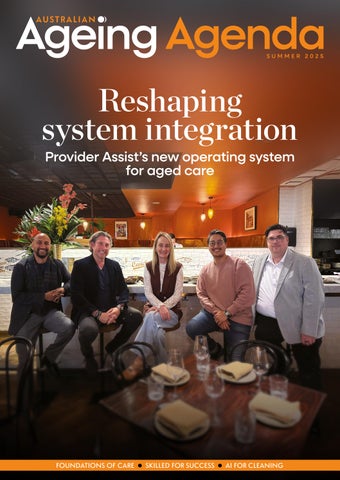
Reshaping system integration Provider Assist’s new operating system for aged care
FOUNDATIONS OF CARE ● SKILLED FOR SUCCESS ● AI FOR CLEANING
COVER STORY Sponsored feature
Provider Assist started out by solving funding, clinical and workforce problems on the ground across more than 2,500 facilities, now it has developed a new, integrated Digital Nervous System for the sector.
Building a new operating system for aged care Provider Assist and Humanetix have developed a new Digital Nervous System for aged care, prioritising system integration to reduce workflow complexity and compliance risk, allowing nurses and managers to focus on care.
A
ged care is undergoing its most significant transformation in decades, with new standards, new accountability and ongoing workforce pressure pushing providers to operate in an entirely different way. Yet most organisations are still relying on disconnected systems and fragmented support, which increases risk, complexity and cost. As reforms continue and digital expectations rise, one thing is becoming clear, aged care doesn’t just need more technology – it needs a Digital Nervous System. The newly merged organisation of Provider Assist and Humanetix has built exactly that, a single partner that can stand alongside providers clinically, commercially and digitally, through a combination of hands-on consulting and patented purpose-built technology. With software like MyVitals, the AN-ACC Navigator, Revenue Navigator, clever automations like Care Correspondence and the new DNS architecture, Provider Assist is positioning itself as the pulse at the centre of aged care operations. Powered by connected data and smart technology working in sync to give organisations clarity, confidence and control, providers can spend less time stitching systems together and more time focused on residents and teams. They can also enjoy a clearer view of risk and opportunity across domains and a practical, safe way to bring AI into daily work. 28 | SUMMER 2025
Post-reform implementation needs integration
Over the past few years, providers have been adding new systems, reports and roles to keep up with the new clinical expectations, new operating, billing and funding models, AN-ACC, strengthened standards, SaH reforms and evolving governance responsibilities. Integration is how we shift from “surviving reforms” to actually shaping the future of care, says chief executive officer Pete Morley. “Post-reform, the real risk isn’t that providers don’t have enough data – it’s that they can’t see how it all connects. Funding, care minutes, billing, rosters, incidents, quality indicators and consumer experience all sit in different systems and spreadsheets. By the time someone has pulled it all together, the moment to act has passed.” Integration, done properly, means: • one connected view across clinical, business and workforce domains • much clearer and earlier warning signs of risk than traditional retrospective “autopsies” • better, faster decisions for boards and executives, grounded in reality, not anecdotes • less burden on people to manually reconcile systems just to answer basic questions. “We think the next phase of reform will reward providers who can connect these dots – not just demonstrate compliance, but demonstrate insight, foresight and control,” Morley says.
What is different about the Digital Nervous System?
The DNS is not just a database that moves data from one system to another or drops everything into a data warehouse to be interpreted later, says chief digital officer Arthur Shih. It’s an operating architecture that understands aged care, interprets what’s happening across domains, and then supports operational action. It is made up of five layers: Data gathering layer – Information is pulled from clinical systems, workforce tools, AN-ACC and finance sources, incidents, quality processes, observations and even unstructured notes. DNS doesn’t ask you to rip anything out – it makes sense of what you already have. Ontology layer – Ontology is the sector’s shared language expressed in a computable form. It defines how care, funding, operations, compliance and workforce all relate. Provider Assist has spent over two decades watching how these domains interact in real organisations. That knowledge is encoded into the ontology so DNS can interpret implications consistently, in a way that mirrors experienced leaders but at organisational scale. Intelligence layer – Built on the ForgeX engine from Humanetix, this layer applies decision rules, predictive models, clinical logic and safe, contextual AI. It identifies patterns, detects anomalies, and anticipates emerging risks or opportunities. Domain engines – Domain engines translate intelligence into structured, operationally relevant action through defined workflows, escalation paths, analytics and verification steps. Today, Provider Assist has engines for clinical care workflows, financial governance, workforce and care-minutes alignment, incident and risk, fees and billing accuracy and funding and revenue, – including AN-ACC opportunities. Interaction Layer – Insights meet people where they work – via dashboards, natural language, notifications, workflows and APIs. Frontline staff, managers and executives see what matters in a way that’s relevant to their role.
DNS in action: Mayflower
Melbourne-based aged care provider Mayflower was an early adopter of the DNS platform, first replacing its legacy clinical care system with the Provider Assist clinical care domain engine – facilitating the move from retrospective documentation to workflow driven care that delivers real-time visibility of resident status. It then implemented the funding domain engine to have realtime visibility of its AN-ACC funding and what impacts that was having on care minutes and workforce. “At Mayflower, we’ve experienced firsthand how Humanetix and Provider Assist bring deep expertise and innovation to aged care,” Mayflower CEO Paul Gregersen says. “Their acquisition is a huge opportunity for the sector – combining technology and advisory excellence to deliver integrated, future-ready solutions. We’re excited to see the positive impact this will create for providers, staff, and, most importantly, older Australians.”
Digital tools that fit the real world
Provider Assist didn’t start life as a software company but by solving funding, clinical and workforce problems on the ground across more than 2,500 facilities. That experience shapes everything it builds today, says managing director Victoria Kelly.
Tools like the Revenue Navigator, MyVitals, AN-ACC Navigator and Automated Care Correspondence were built to solve very specific provider pains, including revenue leakage, wasted time, AN-ACC workflow and letters and billing administration, explains Kelly. “Our software is backed by our team, who have run facilities, rebuilt clinical programs, managed revenue and finance, and sat in boardrooms explaining variances and risk. That shows up in the design – it’s practical, pragmatic and grounded in what providers actually have time and capacity to do,” she says. For example, residential care providers manage thousands of government-issued fee letters each year, covering means tested care fees, accommodation contributions, refundable accommodation deposit or daily accommodation payment changes and ongoing reassessments. Before DNS, teams manually logged into the aged care provider portal, downloaded and named each letter, interpreted changes and tracked follow-up actions – a repetitive, error-prone process that added pressure across admissions, finance and resident management. Through the DNS revenue/letters domain engine, this entire workflow has been automated. The DNS also works to reduce compliance risk, says chief clinical officer Mathew Brincat. “Compliance risk in aged care rarely appears in one place,” he says. “A single issue will show up in documentation, staffing patterns, resident outcomes, incident trends and sometimes in funding anomalies – but those signals are usually scattered.” DNS brings those signals together into one connected view, so providers can see patterns and areas of concern that would otherwise be hard to interpret. Its domain engines link clinical observations, assessments, incidents and care minutes with funding and workforce data to guide workflows so that when risk is identified, organisations can respond in a consistent, auditable way. “Because the whole story is connected across domains, providers can show not just that something went wrong, but what was done, by whom, and how the organisation has learned from it,” Brincat says. l
Contact Provider Assist:
T: 1300 419 119 E: team@providerassist.com.au W: providerassist.com.au australianageingagenda.com.au | 29