


IDC2026 will set the agenda for future dementia care, with a stellar line-up of the most thoughtful voices.
Dementia is the fastest-growing major disease in Australia. It’s also our number one killer, with deaths rising sharply over the last decade.
But dying with dementia is only part of the story. Today, about 433,000 Australians are living with dementia – some of them for decades.
So, what does it mean for a person to live well with dementia? And how can they be cared for in a way that honours their stories – now, and in the future?
The International Dementia Conference 2026 at Hilton Sydney on 4-5 June will address these questions.
With a gathering of health professionals, researchers, advocates, scientists and those with lived experience, organisers say IDC2026 is an opportunity to discuss new ideas, new skills and new ways of doing things.
“Each IDC delivers something completely different to the sector,” explains Marie Alford, HammondCare’s General Manager for Growth and Innovation.
“Our conference team leans into the current issues but more importantly, listens to the people


we serve – those living with complex dementia – to align our international and national speakers to their needs.
“There are many conferences to choose from, but before I joined HammondCare this was my goto event. Being part of the convening team shaping this has only strengthened my position – this is the dementia event you can’t miss.”
Global experts, a groundbreaking film and legendary host
Taking the plenary stage at the conference will be a line-up of highly regarded dementia and palliative care experts from Australia and the world.

pioneering dementia educator and geriatrician Dr Allen Power from the United States, and Scottish Brain Sciences chief executive officer and founder Professor Craig Ritchie (see following pages for more on these three leaders).
They will join other keynote speakers such as health tech guru Dr Sanka Amadoru and Compassion Revolution founder Mary Freer, while panellists from a range of disciplines will debate challenges around diversity, reablement, rare dementias and dying well.

“This is the dementia event you can’t miss.”
A highlight of IDC2026 will be an exclusive Australian screening of the award-winning Dutch film Human Forever, presented by dementia activist Teun Toebes and filmmaker Jonathan de Jong.
Their book, The Housemates, tells of Teun’s three years living in what the Dutch call a “closed dementia ward”. Human Forever followed, exploring global attitudes to people living with dementia and their care. Teun will also speak at a plenary session and contribute to the panel discussion on diversity.
Guiding delegates through the compelling line-up will be legendary Australian journalist Ray Martin, who will bring his characteristic compassion and intelligence to the conversation.
Find your tribe
Organisers point out that one of the most rewarding aspects of IDC for attendees is the chance to connect with other health and aged care professionals, as well as close to 40 expected exhibitors.
Attendees are invited to a networking event on the evening of day one, followed by a special screening of Human Forever and a Q&A with Teun Toebes and Jonathan de Jong. Delegates attending both days can also choose to come to an exclusive masterclass with Dr Kathryn Mannix and Dr Allen Power or join a dementia cottage tour on Wednesday 3 June. ● Find out more at dementiaconference.com



Palliative care advocate and speaker
“I want to share their wisdom with the world.”
Dr Kathryn Mannix has been a palliative medicine specialist for most of her life. So, when she explains how her own family has approached the end-of-life wishes of her parents, ears all over the world should prick up.
But it turns out, it’s as much a cautionary tale as a set of guidelines.
Mannix explains that her parents wanted to give her power of attorney for health and welfare, for obvious reasons, but she was having none of it.

“I’ve got all of the ideas and stepping stones in my head completely clear already, while none of my siblings do,” she says. “With my understanding, coming from 40 years of watching other families figuring it out, I shouldn’t be making those decisions on behalf of everybody else. I should just be the advisor.”
A family meeting followed.
“Dad told us he would not want further treatment when he was unable to do what mattered to him, and said he knew Mum would feel the same,” continues Mannix.
“And Mum’s face just dropped! So, here’s the person who’s been married to her for 60 years, and it turns out they felt differently.”
Mannix describes her close family as “highly functional, where everyone loves one another”, but where – in the absence of clearly articulated wishes – they had made assumptions.
“It’s a helpful illustration of the fact that there’s no manual for this – your family has to figure it out, and the only way you can figure it out is by talking about it,” says Mannix, who will be on the main stage at IDC2026 in Sydney in June speaking about death – your own, your family’s, and those of the people you care for – and how to prepare for it.
“I’ve spent my whole career working alongside dying people and learning from them. Now, I want to share their wisdom with the world.”
At IDC2026, Dr Kathryn Mannix will particularly address end-of-life conversations in the context of dementia. She’ll also be signing her bestselling books, With the End in Mind and Listen, for delegates.
If you could sum up Dr Allen Power’s most urgent message in one phrase, it would be: “put yourself in their shoes”.
The well-known geriatrician and dementia advocate is the Schlegel Chair in Aging and Dementia Innovation at the Schlegel-University of Waterloo Research Institute for Aging (RIA) in Ontario.
Based in Rochester, New York, Power has spent much of his life writing and speaking about transformational models of care, particularly for those with changing cognitive abilities.

Author of two highly regarded books –Dementia Beyond Drugs: Changing the Culture of Care and Dementia Beyond Disease: Enhancing Well-Being – with a third on the way, Power wants to see a change in how we care for people living with dementia. It’s a change that puts the focus on the person at the heart of the care, with all their history, desires, relationships and needs.
“That’s what’s missing when we just care for people with the biomedical approach,” he says.
“But when we look at it through an experiential lens, we start seeing dementia differently. We have to shift the focus to
a strength-based, proactive approach to enhancing wellbeing, instead of just mitigating distress.”
So, what’s stopping us?
Power sees two big obstacles in the way of better person-centred care.
The first is the system.
“It doesn’t matter what the idea is, if you bring the idea to an institution, the institution will kill it every time,” Power says.
“So, you’ve got to shift operations if you want something to stick. And that means changing daily policies, practices, staffing patterns, ways of communicating, ways of addressing conflict.”
The second obstacle is, well, us.
“It’s still hard to keep from othering people with dementia, from seeing them as something different from themselves,” he says.
“We tend to think people living with dementia need something different than the rest of us do. But they don’t.”
Dr Allen Power believes there are ways for the aged care and health sectors to overcome these obstacles and transform care. He will expand on these in his keynote address at IDC2026.

Professor Craig Ritchie has been one of the loudest voices driving the global brain health agenda for over a decade, working extensively across both research and clinical settings. He is Professor of Brain Health and Neurodegenerative Medicine at the University of St Andrews and former Honorary Chair of Psychiatry of Ageing and Director of the Centre for Dementia Prevention at the University of Edinburgh.
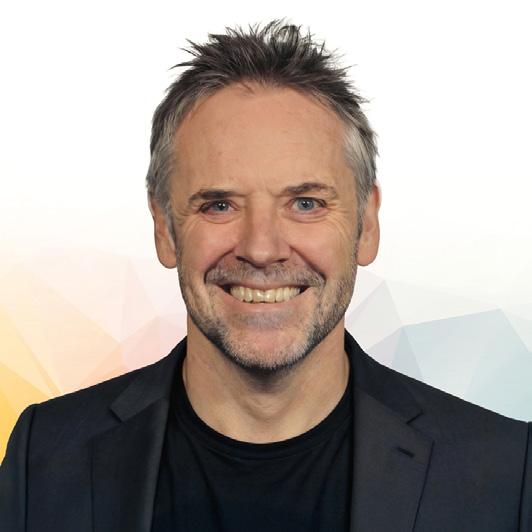
But in 2022, frustrated with the sector’s slow uptake of new ideas, Ritchie felt compelled to take a new road, founding a neuroscience research company called Scottish Brain Sciences, which develops early diagnostic tools and treatments for people with brain conditions. It’s part of an attempt to toss out the old brain health agenda roadmap (to extend the driving metaphor) and come up with a new one.
“In the past,” says Ritchie, “we assumed that, if you made a compelling argument and you shouted long enough and often enough about it, the system would change.”
But persuading leaders – in the government,
“We have to shift the focus to a strengthbased, proactive approach.”
the sector, the community – to get on board is one thing. It turns out that action on the ground requires more time, and perhaps the pulling of different levers.
“It’s been years since the launch of the whole brain health agenda, which is now gathering huge momentum, but on the ground the clinical care for patients hasn’t changed one bit,” he points out.
“There’s a big disconnect between what people recognise in manifestos and political discourse as being the right thing to do. But when you look at clinical care in the US, UK and Australia, it hasn’t moved much from where it was 30 years ago. It is still very much focused on dementia rather than prevention.”
The problem isn’t with winning hearts and minds, Ritchie insists. Both the public and political decision-makers are motivated to act – it’s the gigantic, slow, risk-averse healthcare systems that take a long time to turn around.
Professor Craig Ritchie will suggest how the sector can change direction in his keynote address at IDC2026.
“There’s a big disconnect.”