SPECIAL REPORT
Royal Commission
Roadmap for reform
Care and respect WELCOME to our special report on the findings and recommendations of the Royal Commission into Aged Care Quality and Safety. Like you, we have been eagerly awaiting the release of the report we now know as Care, Dignity and Respect. Inside you’ll find a summary of the recommendations including a timeline for implementation of many of the proposals. You will also find reports on the differing governance, financing and funding pathways put forward by the commissioners and how much stakeholders think the reforms will cost. There’s also a story about the responses from provider and consumer groups – including the recommendations they say should be prioritised – and the interim response from Government. Stay tuned for next issue when we cover the Government’s full response expected in the May Federal Budget. Until then,
Natasha Egan Australian Ageing Agenda Editor Tel: 02 8586 6132 Email: negan@intermedia.com.au
Contents 2 A total overhaul 3 Timeline for change 5 They said it 6 Technology implications of the royal commission 8 Digital transformation is real, achievable and necessary 10 Pathways to reform 12 How much will it cost? 14 Seeking maximum benefit
The royal commission has delivered its final report detailing the case for fundamental change. NATASHA EGAN reports.
A
fter 28 months, 23 public hearings, 641 witnesses and over 10,500 public submissions, Royal Commissioners Tony Pagone and Lynelle Briggs conclude the inquiry in a final report spanning five volumes across eight books. In their report titled Care, Dignity and Respect, the commissioners make 148 recommendations to fundamentally reform the aged care system after finding the high level of substandard care in myriad forms concerning and unacceptable. “The extent of substandard care in Australia’s aged care system reflects both poor quality on the part of some aged care providers and fundamental systemic flaws with the way the Australian aged care system is designed and governed. People receiving aged care deserve better. The Australian community is entitled to expect better,” they write. The commissioners add it is difficult to measure the precise extent of substandard care and say that must change. They also conclude that aged care funding is insufficient, insecure and subject to the fiscal priorities of the Australian Government of the day. There was $27 billion spent on aged care in 2018-19 including $19.9 billion from the Australian Government and $5.6 billion from recipients’ co-contributions. The collective decisions of successive governments have cut more than $9.8 billion from the budget for aged care in 2018–19, Pagone writes. “It is no wonder that there are waiting lists for home care and serious deficiencies in the quality of care,” he says. Limitations on funding have been a major contributor to the substandard care experienced, Pagone says. The Final Report of the Royal Commission into Aged Care Quality and Safety was delivered to GovernorGeneral David Hurley on 26 February and tabled in Parliament on 1 March. It follows a $92 million inquiry that involved eight Counsel Assisting and four commissioners. West Australian Supreme Court Justice Joseph McGrath and Briggs, a
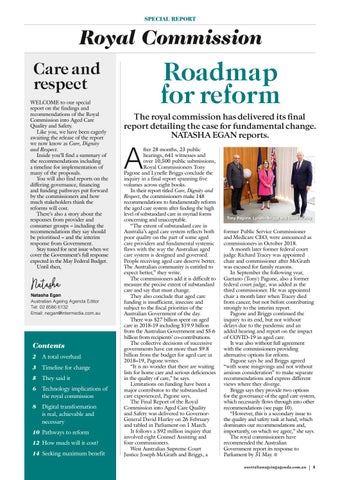
Tony Pagone, Lynelle Briggs and David Hurley
former Public Service Commissioner and Medicare CEO, were announced as commissioners in October 2018. A month later former federal court judge Richard Tracey was appointed chair and commissioner after McGrath was excused for family reasons. In September the following year, Gaetano (Tony) Pagone, also a former federal court judge, was added as the third commissioner. He was appointed chair a month later when Tracey died from cancer, but not before contributing strongly to the interim report. Pagone and Briggs continued the inquiry to its end, but not without delays due to the pandemic and an added hearing and report on the impact of COVID-19 in aged care. It was also without full agreement with the commissioners providing alternative options for reform. Pagone says he and Briggs agreed “with some misgivings and not without anxious consideration” to make separate recommendations and express different views where they diverge. Briggs says they provide two options for the governance of the aged care system, which necessarily flows through into other recommendations (see page 10). “However, this is a secondary issue to the quality and safety task at hand, which dominates our recommendations and, importantly, on which we agree,” she says. The royal commissioners have recommended the Australian Government report its response to Parliament by 31 May. n australianageingagenda.com.au
| 1
SPECIAL REPORT
A total overhaul The aged care royal commission proposes a new aged care system because the current one is hard to access, plagued by substandard care and hindered by systemic problems. NATASHA EGAN reports.
R
oyal Commissioners Tony Pagone and Lynelle Briggs have concluded the aged care system needs “a thorough systemic redesign” to sufficiently improve it after reaching “crisis point” following a prolonged period under stress. The high-level of substandard care is the particularly grim finding of the Royal Commission into Aged Care Quality and Safety. The commissioners found many examples in both complex care, such as dementia and challenging behaviours, mental health and palliative care, and in routine areas including diet and nutrition, oral health, skin care, mobility, medication and prescription management, continence and incontinence, infection control, social and emotional needs, and diversity and cultural needs. They identified systemic problems including inadequate funding, variable provider governance and behaviour, absence of system leadership and governance, and poor access to health care. The current state of the aged care system is a predictable outcome of these systemic problems and the reason that significant change is required, the commissioners say. “Many of the people and institutions in the aged care sector want to deliver the best possible care to older people, but are overwhelmed, underfunded or out of their depth,” they write. The royal commissioners’ 148 recommendations reflect many of those in Counsel Assisting’s final submissions in October last year. They call for a new system based on 2 | ROYAL COMMISSION SPECIAL REPORT
entitlement, need and the protection and promotion of the rights of older people with those rights enshrined in legislation to leave no doubt about their importance. It includes a new Act and single aged care program that puts much greater emphasis on care at home and buildings that resemble people’s homes in residential care and aims to simplify the system. “We envisage a system … that ensures that all older people can, without prejudice, receive high quality care in a safe and caring environment. A system that protects older people from mistreatment and neglect, and that protects them from harm,” Pagone writes in the report. Framing the reform agenda based on entitlement is essential to embedding the interests of aged care seekers and recipients in all key aspects of the new system, they say. “It will guide policy development and program administration; it will govern regulatory approaches and workforce development; and it will inform the approaches taken by approved providers to their internal governance, organisational culture and care delivery.” A summary of key recommendations follows.
A new Act The commissioners propose a rights-based Act that defines aged care as support for older people and their carers to maintain social, mental and physical capacities to function
SPECIAL REPORT independently as they age. The Act should specify a list of rights of older people including the rights to equitable access and choice between services for people seeking aged care and the right to freedom from degrading or inhumane treatment and restraint, autonomy, fair treatment and voice opinions and complaints for those receiving aged care. The commissioners call for a national cabinet reform committee on ageing to develop a strategy for an integrated system for longterm support and care of older people spanning welfare, social participation, housing, health and aged care.
Quality and safety The commissioners say high quality care, which puts older people first, must be the universally understood foundation of aged care. They call for an urgent review of the Aged Care Quality Standards to ensure they meet best practice oral care, medication management, pressure injury, wound management, continence care, falls prevention and mobility and infection control, desirable, nutritional and culturally-appropriate meals, governance and high-quality dementia and palliative care. They recommend limiting restrictive practices to last resort with the approval of an independent expert or in an emergency to prevent harm, with any breach exposing the provider to a civil penalty. They recommend expanding the health sector commission to make the Australian Commission on Safety and Quality in Health and Aged Care and giving it responsibility to set aged care quality and safety standards, guidelines and indicators. They also call for a three-to-five yearly review of the quality standards and ongoing research into quality indicators to expand the number in residential aged care and develop some for home care and use them to benchmark provider performance. As expected they also recommend government develop a star-rating system to allow consumers to make meaningful comparisons about quality and safety performance.
New program The commissioners call for the System Governor to implement a planning regime that supports funding sufficient to meet people’s entitlements to high-quality and safe care in their homes, the community and residential facilities and based on the costs of providing that according to assessed need. The new aged care program combines the Commonwealth Home Support Program, Home Care Packages Program, and Residential Aged Care Program including Respite Care and Restorative Care into a single system with five categories that retains the benefits of each program. Core features of the program include: • common eligibility criteria • single comprehensive assessment process • choice and flexibility about how aged care needs are met • simultaneous access to multiple categories based on need • services designed for diversity, difference, complexity and individuality. The respite support category aims to provide respite early and often for up to 63 days in the home, cottages or purpose-built facilities. The social supports category aims to reduce and prevent social isolation and loneliness through local services such as day centres, delivered meals and transport. The assistive technology and home modifications category aims to provide goods, aids, equipment, and services that promote independence and living safely at home. The care at home category aims to support older people to preserve and restore capacity for independent and dignified living and prevent inappropriate admission to residential care. It offers episodic or ongoing care from low to high needs and a form of entitlement, such as a budget, to provide care management, living supports, personal, clinical, enabling and therapeutic care and end-of-life care. In addition to accommodation, the residential care category aims to provide older people with the goods, aids, equipment and services to meet daily living needs and the care and support to preserve and restore where possible their capacity. Allied health care should be included for both residential and home aged care recipients and funded according to assessed need in the home or via a blended funded model in residential aged care, they say.
Timeline for change Deadlines and start dates for key recommendations – number in parentheses – include:
July 2021
• Aged Care Workforce Industry Council to review diversity of membership, invite Australian Government to join (76) • Fast-track development of accredited and nationally recognised aged care short courses, skills sets and micro-credentials (81) • Attach greater weight to experience of aged care recipients (94) • New indexation arrangements for care subsidies, viability supplement (110-111) • Boost Basic Daily Fee by $10 (112) • Urgent review of Aged Care Quality Standards in identified areas of substandard care (19) • New Australian Commission on Safety and Quality in Health and Aged Care responsible for quality indicators (22)
November 2021
• Medicare items for regular comprehensive health assessments from when a person starts receiving aged care and mental health services in residential care (61) • Aged care providers must have equipment and staff to support telehealth (63) • Restrict prescribing of antipsychotics in residential care to psychiatrists and geriatricians (65)
December 2021
• Extend Multi-Purpose Services Program (55) • Clear Home Care Package wait list • Clarify federal, state and aged care provider responsibilities for health care delivery (69) • Strengthen quality regulator’s monitoring powers (97)
January 2022
• Restrict use of restraints (17) • Capital grants for building small household models of accommodation (46) • Local hospital network-led multidisciplinary outreach services (58) • Outreach mental health services (59) • Pharmacists to conduct annual medication reviews in residential, respite and transition care (64) • No new entries to or living in aged care for people under the age of 65 and 45 respectively (74) • Aged care workforce planning division to develop three-year and 10-year strategy by July 2022 and July 2025 respectively (75) • Amend Acts to improve provider governance (88) • Review Certificate III and IV aged care courses (79)
July 2022
• New quality regulator (10 Briggs) • Review quality standards in staff training and practice, care plans and diversity and quality of life (21) • Reporting and benchmarking of provider performance against quality indicators (23) • Star-rating system on service quality and safety performance (24) • Public awareness education of aged care (26) • Ensure services delivering diverse, complex specialised services are trained and qualified (30) • Providers responsible for assigning a care manager (31) • Add respite supports, social supports and assistive technology categories into aged care program (32-34) • Begin transition to new care at home program (40) Continued p4 > australianageingagenda.com.au
| 3
SPECIAL REPORT • Link My Aged Care and the Carer Gateway (42) • National accessible and dementia-friendly residential aged care design principles and guidelines (45) • ATSI people receive culturally-safe care that meets needs from trauma-informed services and staff (47-48) • Providers must use digital care management system interoperable with My Health Record (68) • Access to state and territory health, palliative care and rehabilitation services (70) • National registration scheme and minimum Cert III for personal care workforce (77-78) • Mandatory dementia and palliative care training for direct contact roles (80) • Minimum staff time standard phase 1 (86) • Graded assessments of performance against standards (95) • Establish and fund Aged Care Research and Innovation Council (107) • Australian Institute of Health and Welfare to collect, store, collate, analyse and publish aged care statistics (108) • Providers to participate in cost data reviews (116) • Residential care funded through casemix classification (120) • Incentivise providers for reablement (121) • Quarterly reporting of daily direct care staffing hours (122)
December 2022
• Develop comprehensive Aboriginal and Torres Strait Islander Aged Care Workforce Plan (51-53)
January 2023
• Comprehensive, clear and accessible dementia support pathway (15) • Senior Dental Benefits Scheme (60)
July 2023
• New rights-based Aged Care Act (1-3) • New system governance approach (5-7 Pagone, 8 and 115 Briggs) • Single independent assessment process (28) • Care finders to support aged care navigation (29 Briggs) • Care at home to include allied health (36) • ATSI person as Aboriginal and Torres Strait Islander Aged Care Commissioner (49) • Teaching aged care programs in residential and home aged care settings (83) • System governor takes over prudential regulation (130 -134) • Continuous reporting requirements for providers (135-136)
2024
• Voluntary primary care model (56) • New aged care program combining all residential, home and community aged care and support into single needs based system (25) • Residential aged care category added (37) with allied health arrangements (38) • Demand-driven access (41) • Subsidies paid via individualised budget or casemix model in home care (118) and based on assessed need for residential aged care (119) • Minimum staff time standard in residential aged care phase 2 (86) • Approval needed for all aged care providers and accreditation for high-level home care services (92- 93)
2025
• No under 65s living in residential aged care (74)
2031
• Implement integrated long-term health and aged care system for older people across Federal and State Governments (4) n 4 | ROYAL COMMISSION SPECIAL REPORT
Improving accommodation The commissioners want the government to take the lead on ensuring the best and most appropriate residential aged care accommodation by developing design principles and guidelines on accessible and dementia-friendly aged care homes that can be applied to the small-household model of care. Government should also encourage take up of the guidelines through education, financial incentives, capital grants and the National Construction Code.
Culturally-safe care The Royal Commissioners call for an Aboriginal and Torres Strait Islander aged care pathway embedded in a single national system to bring culturally safe and flexible aged care that meets the needs of ATSI people wherever they live. They recommend an ATSI aged care commissioner give priority to existing ATSI health, disability and social service organisations to become aged care providers, and focus on local and regional integrated care and access to interpreters. Aged care system employees, aged care service staff and care finders should undertake training in cultural safety and trauma-informed care, they say.
Regional and remote services The commissioners call for improved analysis of unmet need and future demand in regional, rural and remote areas along with accurate costing of care provision and increased use of flexible funding to supplement gaps in services. The commissioners recommend that older people in regional, rural and remote locations have equitable access to aged care services including through expanding the Multi-Purpose Services Program with service users subject to the same eligibility, assessment and cocontribution as other aged care recipients.
Better access to healthcare In response to their finding that people receiving aged care miss out on access to adequate health care, the commissioners recommend a new primary care model to improve access, local hospital-led multidisciplinary outreach service, increased access to mental health services for older people and a senior dental benefits scheme for aged care residents and pensioners. The recommendations also call for increased access to medication management reviews, restricted prescription of antipsychotics in residential aged care, and better discharge protocols between hospitals and aged care facilities in both directions. All aged care providers should use a digital care management system with electronic medication management interoperable with the My Health Record, which they should also adopt.
Workforce The commissioners make many recommendations to boost the size, skills, training and capability of the aged care workforce. They include a new government planning division to prepare a three- and 10-year strategy and a revamped workforce industry council to map career pathways across roles. As expected they propose a national registration scheme and a minimum Certificate III qualification for personal care workers, dementia and palliative care training for all staff who come into contact with care recipients and ongoing professional development for the whole aged care workforce. They also call for an increase in wages for aged care and nursing awards, improved pay for aged care workers and a review of university and certificate-based courses for aged care. For residential aged care, they have called for the two-stage implementation of a minimum staff time standard for residents. Starting from July 2022, that includes 200 minutes from a nurse or care worker including 40 minutes from a registered nurse, plus a minimum of one RN during morning and afternoon shifts. The second phase kicking off two years later is at least 215 minutes from a nurse or care worker including 44 minutes from a registered nurse, plus a minimum of one RN at all times. Some stakeholders have voiced concerns that the proposed standard does not include allied health professionals.
SPECIAL REPORT Good provider governance The commissioners recommend legislative changes to improve provider governances including that boards have a majority of non-executive members and that key personnel pass a “fit and proper person” test. They also call for a new governance standard that requires governing bodies to have a suitable mix of skills and experience, a care governance committee, mechanisms to support feedback and complaints from care recipients and effective risk management practices. The commissioners recommend the Government establish an ongoing program to assist providers to improve governance arrangement from next financial year and Briggs calls for requirements for governing bodies to ensure leaders and managers have professional qualifications and staff have access to continuous learning. The Government has already committed $30 million to strengthen provider governance including training for all board members in its initial response.
Lifting the bar The commissioners find that ineffective regulation is one of the contributing factors to the high levels of substandard care in Australia’s aged care system. They recommend changes to approval and accreditation including that all providers be approved and all providers of residential and high-level home care be accredited. They also recommend changes to monitoring of quality and safety, complaints handling, serious incident reporting, enforcement powers and regulatory capability. They call for a general duty to provide high-quality and safe care on providers and the introduction of civil penalties for providers and key personnel if they breach this duty and for the regulator to adopt a more rigorous, graded assessment of performance against the quality standards than the current pass or fail approach. They recommend greater weight attached to the experience of aged care recipients and powers to give the regulator more scope to penalise including to ban individuals from providing aged care services or limit a provider’s ability to expand services. The new Act should also contain whistleblower protection for aged care recipients and their representatives and aged care employees and directors who make a complaint or report a breach of the standards or the Act.
Data, research and technology The commissioners recommend the Australian Institute of Health and Welfare undertake critical aged care data governance and management functions including to curate a National Aged Care Data Asset with comprehensive data on aged care recipients, the workforce and providers. Pagone recommends the System Governor establish and chair a management group to develop the national minimum aged care datasets and strategy for aged care data while Briggs considers the existing data management arrangements could accommodate these changes. The commissioners recommend a dedicated Aged Care Research and Innovation Fund funded in addition to and administered independently of existing research funds to ensure an enduring focus on the needs of the aged care system. They say their proposed Aged Care Research and Innovation Council should give priority to research codesigned with older people, providers and workers. In the short to medium term, annual aged care research funding should be fixed and equal to 1.8 per cent of the Government’s total expenditure on aged care, they recommend. The commissioners recommend the system governor support the development of the sector’s ICT capability including the secure use of data and real-time data sharing and facilitate the development of systems to enable automatic reporting by providers on mandatory reporting obligations, quality indicators, prudential arrangements and for the national data asset. n See page 10 for our report on governing, funding and financing the new system.
They said it “In many ways the magnitude of substandard care unfolded throughout our inquiry like the peeling of an onion – layer by layer, example after example, statistic by statistic.” Aged care Royal Commissioner Lynelle Briggs
“When you consider that this took over two years and $92 million of public expenditure... it is absolutely outrageous for the report that’s been produced, which doesn’t even model the costs, when the Productivity Commission for a few million dollars put out a report that is of similar breadth but greater detail and more reflective of public policy.” Professor Michael Woods, Centre for Health Economics Research and Evaluation at University of Technology Sydney
“The scope and scale of the changes that they have set out in those 148 recommendations is huge. We have all of that before us but I haven’t heard anyone say that this is not a job worth doing because I think we all feel very strongly that there is work to be done and we must lose no time in getting it done.” Janet Anderson, Aged Care Quality and Safety Commissioner
“I was a tad underwhelmed. I was a little disappointed that we were in fact reading things that we’ve known for a long time and this is a royal commission for the elders... but we haven’t seen how this is going to change and improve outcomes for elders.” Sabine Phillips, partner at HWL Ebsworth Lawyers
“It is fairly limited what they have provided; I think that you can look at recommendation 25, which is the joining of the different programs, the funding and how that’s going to work hasn’t been looked at.” Grant Corderoy, senior partner at StewartBrown
“The royal commission has been very good at defining the problems, but not so good at coming up with some of the solutions, particularly around funding and financing. And on a number of occasions throughout the recommendations they have effectively passed the buck on making decisions to other organisations that are yet to be formed.” Dr Henry Cutler, director of the Centre for the Health Economy at Macquarie University
“Work has to begin pretty much immediately and continue. We can’t wait around. We saw the Productivity Commission report was cherry picked [and with] the 21 other reviews that we’ve had over that time, a lot of the recommendations haven’t been taken on board and executed.” Patrick Reid, CEO of IRT Group australianageingagenda.com.au
| 5
SPONSORED ARTICLE
Technology implications of the royal commission Providers have at most, a three-year horizon to bring their technology up to scratch... writes Steven Strange.
T
Continuum of care here are implicit and explicit takeaways from If you’re a Provider and you the aged care royal deliver services across the commission’s findings. continuum of care, such No analysis is complete as residential aged care, without addressing the retirement living, home care criticisms. And this one on and disability care, then you page 77 of volume one hurts: must adopt a multi-pillar “The aged care system platform solution. is well behind other sectors eCase is the only multiin the use and application pillar technology platform of technology, and has that can simultaneously Steven Strange no clear information and serve multiple lines of communications technology strategy.” service delivery from a single interface or It’s a sad but true indictment of single experience. where we find ourselves in terms of the Workforce technology that underpins aged care. That said, there are ways to right the wrong. Key to the royal commission’s recommendations was the call to manage Interoperability – the case for the health and social care workforce middleware better. Recommendation 39 calls for the Interoperability is essentially data Government to clear the Home Care logistics. That is, the ability for Package waiting list, which will impact meaningful data to move between workforce substantially. systems. Data movements or data Among other things, the industry logistics must be underpinned by needs visibility of a secure and certified security, performance and privacy. workforce. With that in mind, in At Health Metrics, we have conjunction with Workday (see www. interoperability as part of our technology workday.com) Health Metrics plans to DNA. We call it eCoWare and it forms introduce a workforce (carer/worker/ the basis for our vision for a health and clinician first) oriented platform social care data ecosystem. that incorporates a human resources Middleware takes point-to-point information system, finance, clinical and connections to the next level. It enables administration functions into one endweb services –application programming to-end solution. interfaces – to be managed and We’re a people business, the maintained. Middleware is now a must application space needs to be people-first. have in the technology kitbag of providers.
Support for assistive technology
Data standards
Activity-based costing
Three-year horizon
It will be a requirement for providers to be able to report on and analyse the dayto-day tasks and activities of all facility staff, which is effectively, activity-based costing. Just like the acute sector and other parts of the health continuum already do. eCase already supports the concept of activity-based costing with its sophisticated work log functionality. For Health Metrics customers, this is already built into their systems today.
I estimate that providers have a threeyear horizon during which time they need to engage with and be compliant with all of the items above. The question providers’ need to ask themselves is: “Are we ready?” If the answer is no, the next question must be: “When will we be ready?” And then finally: “What is the cost of not being ready?” n Steven Strange is chief executive officer of Health Metrics
The next three years will see standards like FHIR, a standard for health care data exchange that embraces HL7, and possibly interRAI become de facto data standards for aged care, and more broadly, the health and social care sector. At Health Metrics, we continue to work with people like Professor Len Gray from the University of Queensland and others on being part of the data standards solution for aged care. 6 | ROYAL COMMISSION SPECIAL REPORT
The royal commission lends great support for assistive technology. The spectrum for assistive technology is broad, ranging from a handrail to an Internet of Things (IoT) device. My advice is that providers be wary of gimmicks and that getting one’s platform and transactions in order is of paramount importance. Because sometimes, residential aged care providers are sitting ducks for the gimmicks of the industry.
Real-time, automated reporting In order to get to a point where a provider can attest to real-time and automated reporting, the provider needs a great deal of confidence that their transaction base and their real-time collection of data is being matched by solid process engineering. Otherwise, this will become a mere pipedream. At Health Metrics, everything we do is on the basis of realtime operations.
Certification We welcome the royal commission’s notion of certification for software and hardware vendors. We believe the move to certification is long overdue. It will delineate between the serious enterprise participants and the rest. It will also give providers a level of certainty with respect to compliance.
SPONSORED ARTICLE
Digital transformation is real, achievable and necessary COVID-19 and the Royal Commission into Aged Care Quality and Safety have necessitated a sector-wide technology revolution, which is not as overwhelming or costly as you might think, writes IAN GILMOUR.
W
hen COVID-19 sector in their report was first crossed consistent and clear: the seas and “[IT] will need to operate started sharing in a technology-enabled Australia’s boundless environment for efficient plains, service providers clinical, business and were stuck scrambling operational systems. between responding quickly, “These [systems] need decisively and safely on the to be designed to identify frontline, and also having to older people’s needs and account for the heightened preferences and to provide operational and financial care tailored most effectively Ian Gilmour demands that emerged in to their needs,” they said. the back office as a result. This is not a case of easier The following over-12-month-long said than done. In fact, as the population period for service providers, was, mildly of ageing Australians grows along with put, an unpleasant experience. their care needs in an industry already Forget long-term strategy. How can overwhelmed, it’s easier done than just said. one consider immediate commercial Key technology recommendations viability and also ensure the highest include the establishment of a grantquality level of care when unprecedented funded assistive technology and home – and expensive – challenges were modifications category from mid-2022, presenting themselves daily? as well as a commitment to improving For many service providers, the answer aged care through data, research and laid in solutions worthy of MacGyver, technology. which while effective in the short-term It’s the wider push towards are neither efficient nor sustainable. digitisation (Recommendation 68), Although service providers who however, that will facilitate an efficient, had existing automated and integrated effective and cohesive move towards operational systems and processes were the desired rights- and needs-based by no means resting on their laurels, this system emphasising care at home, with technological infrastructure allowed for a improved governance and workforce flexible and agile business as usual. conditions and capabilities. This, in turn, enabled an element of Like the move from quill to pen to stability and the ability to strategically stylus, the scope and necessity of this plan, while simultaneously implementing transition, while seemingly overwhelming rapid care and operational changes. at first, is achievable in a smooth, phased It’s these future-proofed organisations and cost-effective manner. that will emerge as industry leaders From a finance and operations in the transition to the new normal perspective, implementing centralised prescribed by the royal commission. rostering management systems will Regardless of some clashing opinions be integral to meeting the minimum between Commissioners Lynelle residential staff stipulations required Briggs and Tony Pagone, the message by mid-2022 and again in mid-2024 regarding the future of the aged care within budget.
8 | ROYAL COMMISSION SPECIAL REPORT
Removing manual and labourintensive scheduling processes ensures minimal gaps and errors in rosters, which means facilities can save money normally spent on overtime or lastminute agency staff. Integrated and automated budget, planning and forecasting systems will also allow for more efficient and effective strategic planning when it comes to managing staff requirements. Similarly, enterprise workforce management systems will be integral when it comes to consistent staff training, education, development and best practice across facilities and departments, which will be particularly necessary when meeting the increased demand for home care. From a customer perspective, integrated Customer Relationship Management (CRM) systems will ensure minimal points of entry for staff and customers. Workers will be able to access the information they need wherever and whenever they need it, and customers and their families will be able to access and update information easily. CRMs will also be essential to implementing the new funding tool between now and 2022, and for the adoption of the My Health Record, as well as bridging any silo between aged care, allied health and disability services, which will be necessary by 2023 for home care and 2024 for residential. n Ian Gilmour is chief operating officer of Rohling International, which has been assisting aged care service providers with business and digital transformation for a decade. To find out how our trusted independent advisors can tailor a solution specific to your business, visit rohling.com.au.
AGED CARE EXPERTS ROHLING.COM.AU INFO@ROHLING.COM.AU ROHLING INTERNATIONAL
IT'S TIME TO TRANSFORM AND
GET AHEAD
Leveraging our unique methodologies and industry experience, Rohling International’s Aged Care Experts make your business more agile and responsive to current and emerging challenges, so you can focus on what matters most. Our consultants know what you need to get ahead, thrive and continue to provide top-notch customer care in a landscape brimming with change, whether it’s from legislation updates, ACFI and Home Care funding model changes, COVID-19, or the findings from and outcomes of the Aged Care Royal Commission.
LET US HELP YOU WITH: • • • •
Business and Finance Strategy & Consulting Business Effectiveness & Efficiencies IT Strategy & Solutions Project Delivery
SPECIAL REPORT
Pathways to reform The Royal Commissioners’ diverse recommendations leave the government open to choices and potentially criticism. NATASHA EGAN reports.
I
Tony Pagone
Lynelle Briggs
n their final report, the Royal Commissioners call for new and robust governance arrangements including new institutions to drive improvements. It is the key area where Commissioner Tony Pagone and Commissioner Lynelle Briggs offer differing pathways. But they do agree better system governance is crucial to the reform of aged care. Pagone follows Counsel Assisting’s final hearing submissions and recommends an independent commission model while Briggs prefers a government leadership model, also foreshadowed at the final hearing. They have different views on financing the new system from taxpayers with Pagone calling for a hypothecated levy, which means the funds can only be used for this specific purpose, and Briggs recommending an aged care improvement levy, which is not hypothecated like the Medicare Levy, and changes to means testing. Professor Michael Woods from the Centre for Health Economics Research 10 | ROYAL COMMISSION SPECIAL REPORT
regional presence, active intervention in the market to ensure high quality care and stronger accountability through an inspector general of aged care. Pagone’s new and independent authority involves the CEO-led Australian Aged Care Commission responsible for the system governor, Michael Woods Richard Colbeck quality regulator and prudential regulator under and Evaluation at University of six commissioners plus an independent Technology Sydney says the government pricing authority from July 2023. has to clearly establish what principles “There is, in my view, little point and objectives it wants from the system in repeating the same process again by and be transparent about them. asking the same Department that has It then needs to clearly use those overseen the current failings to build principles to justify which model or and run the new aged care system,” variation it chooses, says Woods, who led Pagone says. the Productivity Commission’s Caring for However, Briggs wants to reform Older Australians inquiry a decade ago. existing institutions to deliver reforms “But until it commits to a set of very more quickly and effectively under clear principles or objectives, it’s going her government leadership model to be accused of cherry picking things,” that supports greater independence of Professor Woods tells Australian regulation and pricing but maintains Ageing Agenda. government leadership. “The way to avoid that is be very Under her model, the Department up front and clear this is what we are of Health and Aged Care overseen by a committed to delivering in terms of Cabinet Minister would be the system principles and therefore on that basis, we governor and prudential regulator. She choose the following bits of what. There proposes a separate and new quality is a pathway for government to avoid regulator launching in July 2022 and criticism, but only if it takes that first step.” adding the pricing role to the hospital authority to create the Independent Two system regulation options Hospital and Aged Care Pricing While the commissioners propose Authority from July 2021. different regulatory models, they She also recommends a council have similarities including a strong of elders be established to advise the
SPECIAL REPORT minister and department on aged care quality and safety and the rights and dignity of older people. The government must step up and embrace its responsibilities for aged care including to lead and manage its delivery and fund the system at a level sufficient to provide high quality and safe aged care, she writes. The commissioners agree the pricing authority should determine funding and prices but Pagone considers the determination should be binding whereas Briggs states the government should be able to override via a transparent parliamentary motion. Both agree on the need for the pricing authority to require providers to participate in cost data reviews by July 2022 and all activities from the following year. In line with these recommendations for effective regulation, they also recommend strengthened power for the Prudential Regulator to undertake investigations and inquiries and the resources to do that. Professor Woods says he agrees with each model in part. Pagone’s “aged care commission is a good idea to bring that discipline, transparency and accountability into the system” but “I fundamentally disagree that a separate pricing agency can actually commit to public expenditure,” he says. The government needs to have the power to make decisions across the complete range of its responsibilities, Woods says. “I agree with an independent pricing authority provided it can openly and objectively assess the price and recommend to government and government must transparently respond.” In their response to the report, Ansell Strategic managing director Cam Ansell and director Amber Cartwright favour Briggs’ approach on balance because of the substantial lead time and cost for implementing a new entity. However they do not support Briggs’ provision for parliament to disallow pricing determined by the pricing authority. “We are concerned that such powers undermine the integrity of an independent authority and leave the system susceptible to the same budget interventions that ultimately lead to the royal commission.”
Funding shake up The royal commissioners say providers should be primarily funded for the aged care services they deliver based on the volume of activity each performs across the five categories of the their new program. They propose a mix of activity-based and block funding for social support, respite, assistive technologies and home modifications, the government continue its work on a funding model for unified
home care program, and a new activitybased casemix funding model for residential aged care. They recommend funding incentives for providers to invest in restorative care and reablement including retaining the previous level of funding if a resident becomes healthier or less dependent.
“There is a pathway for government to avoid criticism, but only if it takes that first step.” While waiting for independent pricing to begin, the commissioners recommend urgent interim measures including: • care subsidy and viability supplement indexation in line with wage and CPI increases • a $10 increase in the Basic Daily Fee in return for reporting on spending outcomes particularly in nutritional requirements • maintaining the increases to the viability supplement • education and training to improve the quality of care. The government has already committed to some of these.
Personal contributions, means testing The commissioners say a system of universal entitlement to high quality aged care based on assessed need is fundamental to their vision. Although there are differences to their approaches they agree this vision should guide the approach to contributions and means testing. However, they also agree universal entitlement is not an absolute right to have care delivered in a particular setting and suggest to limit care at home funding to what the Government would provide for them in a residential care setting. The commissioners also agree on no co-contribution for care in any community or residential setting. This includes respite, social support including transport, home modifications and assisting technologies and domestic assistance, such as cleaning and gardening, where services are supplied as assessed for aged care. Aged care residents should continue to pay living and accommodation costs via a base fee equal to 85 per cent of the single basic Age Pension plus a meanstested fee up to a maximum amount determined by the pricing authority. Both commissioners recommend changing means testing to make it fairer and simpler. Woods says the Australian government needs to work out what services will be subsidised and at
what level. A lot of domestic support shouldn’t be subsidised anywhere near to the extent it is, he added. “The means test needs to be much more rigorous, because there are a lot of people who are waiting for so called care with assets that can be drawn down to pay for that care, but they’re choosing not to do that.” As per his evidence provided to the royal commission, Woods says clinical care should be fully-funded as it is under Medicare but also taken out of the package. “If nursing care is clinically required, such as you’ve got a wound and that needs dressing for the next six weeks … it should be funded by the public as part of universal health care, but it should be mandatory.” There should be a reasonable quantum of allied health available to be called upon with the GP or a nurse practitioner as the gatekeeper subsidised through Medicare or similar “but you shouldn’t be able to swap an outing for clinical care,” he says. He agrees social supports should be reasonably subsidised but with at least a 10 or 20 per cent contribution from users. “They’re cheap, they’re effective and they help people. But things like domestic support and the range of personal care should be subsidised but there should be a means test. And then it should go into a package that people can choose.”
Long-term funding Pagone wants the Productivity Commission to report into financing the system from a hypothecated aged care levy, and if selected, phase out means testing. He considers a hypothecated levy approach would have significant advantages for the long-term financing of aged care where each person has a greater role in financing the system throughout their working life, and provide a high degree of accountability and trust. Briggs, who proposes a 1 per cent levy, disagrees hypothecation is necessary, and says government can continue to fund aged care from general revenue just like with the Medicare Levy. In regards to capital financing the commissioners recommend the pricing authority determine the Accommodation Supplement, which is the maximum amount of subsidy the government will pay, based on a review of the costs of providing accommodation. For unsupported residents, the commissioners recommend the government phase out Refundable Accommodation Deposits with Briggs saying that should happen for new residents from 2025. They say phasing out RADs should be complemented with a transitional australianageingagenda.com.au
| 11
SPECIAL REPORT mechanism to support providers’ liquidity. Pagone recommends an Australian Government-back loan facility to repay RADs while Briggs recommends the government establish an ongoing accommodation capital facility to support the construction
and refurbishment of aged care homes. During a keynote address to CEDA in mid-March Minister for Aged Care Services Richard Colbeck said the government will decide which of the commissioners’ recommendations it will choose by the 31 May deadline.
“You’ll have that answer very quickly,” Colbeck says. “We’ll respond to the royal commission’s recommendations by the end of May so … so we’ll know very quickly what path we’re going to go down with respect to those issues. We want to get on with this,” he says. n
How much will it cost?
R
oyal Commissioners Tony Pagone and Lynelle Briggs propose sweeping changes to ensure the future aged care system provides universal access to high quality and safe care. But they do not provide costings for their recommendations. It has left many wondering how much on top of the current $20 billion or so it will cost. In his analysis of the recommendations, Research Analytics principle Mark Sheldon-Stemm estimates it will cost $10.6 billion a year to implement the most expensive elements in the report. His costings include: • care finders to support navigation ($2 billion) • funding allied health in residential care ($1 billion) • planning based on need ($2.5 billion) • increases in award wages ($2 billion) • minimum staff time standard for residential care ($750 million) • amendments to residential care indexation ($440 million) • immediate changes to the Basic Daily Fee ($800 million) 12 | ROYAL COMMISSION SPECIAL REPORT
• maximum funding amounts for care at home ($1.14 billion) “These are the recurrent amounts for the industry and doesn’t include the one-offs or running cost of the new bureaucracies,” Sheldon-Stemm tells AAA. Panellists at Leading Age Services Australia’s Aged Care Transformed forum in the second week of March were asked their views on the price tag for key recommendations. Centre for the Health Economy at Macquarie University director Dr Henry Cutler suggests it will be up to $20 billion a year. “There is first of all a lot to catch up on. The system has obviously been chronically underfunded for the last 20 years,” Cutler told the forum. The reforms need to ensure a greater return generated for providers and the commissioners expect it to deliver a very high level of quality, he says. “My estimates would be a minimum $10 billion per year, up to $20 billion per year because there is such a significant amount of change that will have to occur in the sector. There is such
a significant amount of funding that needs to be pumped into home care and into residential care to deliver the quality that’s required. Aged care is expensive. And good aged care, good quality aged care is very expensive,” Cutler says. Grant Thornton Principal and national head of health and aged care Darrell Price agrees the price will be high. “I’m too scared to say the number that’s in my mind,” Price says. It will be “north of the order of twice or double what we’re currently spending, and I think well north of that,” he says. StewartBrown senior partner Grant Corderoy says it will cost around $7-8 billion a year for “a better version of what we do now”. That covers funding to lift staffing hours, provide significant additional training and development, introduce a subsidy in addition to the basic daily fee and additional money for rural and remote areas and improve the financial viability of providers, he says. “I feel it is premature to estimate the additional funding required for a new aged care model until there is more clarity as to how it will look,” Corderoy tells AAA. n
PainChek® Universal. Enabling best practice pain management for all people, everywhere.
PainChek® Universal now includes access to the PainChek® App, the Numerical Rating Scale and PainChek® Analytics. PainChek® Universal seamlessly integrates with all Care Management Systems providing the complete point of care solution.
PainChek® App
Numerical Rating Scale (NRS)
PainChek® Analytics
Uses artificial intelligence to assess pain levels - giving a voice to those who cannot reliably verbalise their pain.
Documents the pain scores of those who can self-report their pain.
A tailored dashboard to inform and empower clinicians to make crucial medical decisions on pain management.
A fully funded 12-month PainChek® license is now available for all Australian Residential Aged Care facilities.
Call 1800 098 809 or go online and visit painchek.com/free
SIGN UP BY 31ST MAY 2021
SPECIAL REPORT
Seeking maximum benefit Provider and consumer groups have outlined the priority royal commission recommendations. NATASHA EGAN and SANDY CHEU report.
A
coalition of aged care providers and an alliance of aged care consumer groups have each released a list of the royal commission recommendations for the government to prioritise in the upcoming Federal Budget and coming months. There is some crossover in the 12 April wish lists of the Australian Aged Care Collaboration, an alliance of six provider peak bodies, and its consumer counterpart made of 12 peak associations. They include the urgent need to: • establish a rights-based Aged Care Act • end the home care waitlist • fund independent care finders to help consumers navigate aged care • commit to a timetable for the implementation of the recommendations and reform. The AACC’s 15-point implementation plan prioritises 52 of the commission’s 148 recommendations in the key areas of human rights, access and choice, workforce, transparency, and sustainability that it says will give seniors the maximum benefit in the quickest amount of time. Similarly, the consumer alliance led by Council on the Ageing Australia has outlined key reforms across 10 areas it says must be delivered within the next 12-18 months. They include requiring providers to publish real-time data on staffing, quality performance, financial information and consumer experience, implementing minimum staffing levels among a trained, registered and qualified workforce across all settings and developing a simple aged care system where assessed and appropriate care is guaranteed within 30 days. Provider and consumer groups say the budget must include the government’s commitment to aged care reform. At the time of its release Prime Minister Scott Morrison announced
14 | ROYAL COMMISSION SPECIAL REPORT
Sean Rooney
Ian Yates
a $452.2 million immediate response package (see breakout opposite). He said the report was comprehensive, candid, passionate and ambitious and provided all the things parliament needed to know to bring about the generational change required. “The royal commission has now set out a very important roadmap which I think will establish generational change in this country,” he told reporters. Since then the government has promised to meet the commission’s recommended 31 May deadline for a response as well as respond in the budget in full with a five-year plan. Provider and consumer groups hope it is a very full response.
Provider priorities The AACC, which was established in February, comprises provider peak bodies Aged and Community Services Australia, Anglicare Australia, Baptist Care Australia, Catholic Health Australia, Leading Age Services Australia and UnitingCare Australia. Their report Aged care – the way forward calls on the government to move immediately on the recommended amendments to indexation to increase the subsidy annually in line with wages,
Richard Colbeck
extend the 30 per cent increase in the Viability Supplement and add $10 to the residential daily basic fee. It is also asking the government to commit to establishing an independent aged care pricing authority by July 2022, funding to remove the home care package waiting list by December 2022 and implementing enhanced transparency and accountability provisions by the same date. AACC spokesperson and LASA CEO Sean Rooney says the Federal Budget is an opportunity to set a plan to transform the aged care system. “We have focused on a 15-point plan in four key focus areas, which will provide the quickest and most effective way to deliver better outcomes for older Australians now, but also position us to transform the aged care system going forward,” Rooney tells Australian Ageing Agenda. The AACC would like the government to outline their commitment to the aged care sector, he says. “We’d like to see first and foremost a clear statement from the Australian Government articulating their commitment for the total overhaul of the aged care system. “No more tinkering at the edges.
SPECIAL REPORT And with that a clear statement, plan and timetable that then builds on [our] 15-point plan across the four focus areas that we’ve put forward,” Rooney says. The AACC has spent time with its members, consumers and other key stakeholders to establish these priorities, he says. The priorities also include: • a new integrated and uncapped aged care program and a blended funding model for providers to engage allied health professionals from July 2024 • a timetable to remove the Aged Care Approvals Round • regulation to ensure physical and chemical restraint is only used as a last resort and part of a plan approved by a behaviour expert • appointing an Inspector-General of Aged Care to introduce independent standards • announcing a joint Australian Government, employer and union application to the Fair Work Commission in 2021-22 to increase minimum award wages • funding a program to support training, clinical placements, scholarships and other initiatives to respond to workforce challenges in a targeted manner • funding for designing and implementing a national registration scheme for personal care workers.
Consumer priorities In addition to COTA Australia, the 12 consumer groups includes Association of Independent Retirees, Carers Australia, Dementia Australia, Elder Abuse Action Australia, Federation of Ethnic Communities Councils of Australia, Legacy Australia, LGBTIQ+ Health Australia, National Seniors Australia, Older Persons Advocacy Network, PICAC Alliance, Returned and Services League Australia. They say the new human rights-based Aged Care Act must ensure consumer choice and control, contain stronger protections for consumers and better accountability of aged care providers, and a strongly resourced independent regulator that takes robust action to ensure consumer protections. The alliance also indicates their preference for the governance and regulation of aged care in the future include a bi-partisan joint standing committee in Parliament similar to NDIS, an inspector-general who reports to parliament, an independent pricing commissioner just for aged care and a council of elders. COTA Australia chief executive Ian Yates says the reforms highlighted by the group must be implemented together to be able to address the sector’s issues. “The point is they’re a package… because this is not about changing
some aspects of the aged care program, this is about reinventing the aged care program,” Yates tells AAA. Several inquiries into the aged care sector have already outlined the need to reinvent the aged care system, however it has not happened, he says. “If we don’t do it now, then the numbers of people needing support in the near future are such that the system will literally break because it’s not properly structured. It’s not properly funded and it doesn’t do the job it’s supposed to do,” Yates says. Now is the time to make these structural changes in the sector, he says. “Our point is very simple, that if you want to make major structural change to aged care, you have to have a coordinated set of measures started in a similar timeframe. You can’t put some of them off and many of these things are not new,” he says. “You can’t make these changes overnight, which is why you have to start pretty quickly.”
“The point is they’re a package... because this is not about changing some aspects of the aged care program, this is about reinventing the aged care program.” – Ian Yates Aged care providers can support these reforms by making their views known to their members of parliament, Yates says. Other key reforms the group calls for include: • implementing a single care at home program that provides individualised care by 2023 • abolishing the Aged Care Approvals Round and giving older people control of their residential aged care funding • developing a funding model that grows with needs and ensures sufficient taxpayer funding, balanced with consumer contributions • providing equitable access to health services including dental care, medication reviews, mental health services, allied health, and restorative care and reablement • legislating a commitment to ensuring the lived experience of older people using care services is given real weight in accreditation, reviews, quality
Initial response The government’s $452.2 million immediate response package includes: • $32 million toward strengthening residential aged care quality and safety including an additional 1,772 quality audits in residential and home care • $280 million for temporary financial support for residential providers • $92 million to grow a skilled aged care workforce including by attracting 18,000 jobseekers • $30 million to strengthen provider governance including training for all board members
measurement, recruitment and every aspect of the aged care system • a commitment to respecting diversity throughout aged care in standards, training, accountability, access pathways and service design • providing greater support for family and friend carers including a major increase in accessible respite care and a network of carer hubs.
New Act two years away Minister for Aged Care Services Richard Colbeck says some of the royal commission’s recommendations will take time, including replacing the existing aged Aged Care Act with a new one by July 2023. Scoping, drafting and legislating a new Act will take “a period of time,” says Mr Colbeck during a keynote address to CEDA in mid-March. “It’s probably a couple of years that will be required for a new Act,” he says. “Setting up a completely new structure will take time and that will obviously impact on the speed and capacity for government and the system to react.” However, he says the industry and the community will see continuous improvements along the way, with the government to provide a full dollar response in the federal budget. Some areas and home care in particular will see more immediate results, he says. “The budget will address things like access to home care services and pricing and transparency around home care services, and we’d like to see the effects of that happen quite quickly because the sector is growing rapidly.” Find the AACC report at careaboutagedcare.org.au and the consumer joint statement at cota.org.au n
Additional reporting by Judy Skatssoon australianageingagenda.com.au
| 15
Real
Real
Data
Time
Real
Control
Anytime, Anywhere and from Any Device. By working with Ezymed, you gain peace of mind and can access verifiable medication data with meaningful, actionable reporting tools to oversee your organisation’s medication usage – it’s all part of our professional service. Are you ready for a Medication Management Audit?
Ageing Agenda Special Offer Ezymed will visit and audit one of your facilities FREE of charge. Valued at $6500, this offer is valid until the 30th June.
Got questions?
Talk to us now.
1300 399 633
www.ezymed.com.au